EP0327429B1 - Labeling by simultaneous ligation and restriction - Google Patents
Labeling by simultaneous ligation and restriction Download PDFInfo
- Publication number
- EP0327429B1 EP0327429B1 EP89400220A EP89400220A EP0327429B1 EP 0327429 B1 EP0327429 B1 EP 0327429B1 EP 89400220 A EP89400220 A EP 89400220A EP 89400220 A EP89400220 A EP 89400220A EP 0327429 B1 EP0327429 B1 EP 0327429B1
- Authority
- EP
- European Patent Office
- Prior art keywords
- fragments
- dsdna
- strand
- sequence
- dna
- Prior art date
- Legal status (The legal status is an assumption and is not a legal conclusion. Google has not performed a legal analysis and makes no representation as to the accuracy of the status listed.)
- Expired - Lifetime
Links
- 238000002372 labelling Methods 0.000 title claims description 38
- 108020004414 DNA Proteins 0.000 claims description 52
- 239000012634 fragment Substances 0.000 claims description 47
- 108091008146 restriction endonucleases Proteins 0.000 claims description 34
- 238000000034 method Methods 0.000 claims description 28
- 102000053602 DNA Human genes 0.000 claims description 25
- 230000000295 complement effect Effects 0.000 claims description 18
- YBJHBAHKTGYVGT-ZKWXMUAHSA-N (+)-Biotin Chemical compound N1C(=O)N[C@@H]2[C@H](CCCCC(=O)O)SC[C@@H]21 YBJHBAHKTGYVGT-ZKWXMUAHSA-N 0.000 claims description 12
- 239000003446 ligand Substances 0.000 claims description 12
- 239000000203 mixture Substances 0.000 claims description 12
- 102000004190 Enzymes Human genes 0.000 claims description 10
- 108090000790 Enzymes Proteins 0.000 claims description 10
- 102000003960 Ligases Human genes 0.000 claims description 7
- 108090000364 Ligases Proteins 0.000 claims description 7
- 239000002773 nucleotide Substances 0.000 claims description 7
- 108091028043 Nucleic acid sequence Proteins 0.000 claims description 6
- 229960002685 biotin Drugs 0.000 claims description 6
- 235000020958 biotin Nutrition 0.000 claims description 6
- 239000011616 biotin Substances 0.000 claims description 6
- 229910019142 PO4 Inorganic materials 0.000 claims description 5
- 239000011541 reaction mixture Substances 0.000 claims description 5
- 102000016928 DNA-directed DNA polymerase Human genes 0.000 claims description 3
- 108010014303 DNA-directed DNA polymerase Proteins 0.000 claims description 3
- -1 nucleotide triphosphates Chemical class 0.000 claims description 3
- 239000010452 phosphate Substances 0.000 claims description 3
- 238000003752 polymerase chain reaction Methods 0.000 claims description 3
- 238000001962 electrophoresis Methods 0.000 claims description 2
- 239000007850 fluorescent dye Substances 0.000 claims description 2
- 239000001226 triphosphate Substances 0.000 claims description 2
- 235000011178 triphosphate Nutrition 0.000 claims description 2
- 235000021317 phosphate Nutrition 0.000 claims 4
- 230000029087 digestion Effects 0.000 claims 2
- 125000002467 phosphate group Chemical group [H]OP(=O)(O[H])O[*] 0.000 claims 2
- 150000003013 phosphoric acid derivatives Chemical group 0.000 claims 2
- 239000002243 precursor Substances 0.000 claims 2
- 210000003918 fraction a Anatomy 0.000 claims 1
- 150000007523 nucleic acids Chemical group 0.000 description 35
- 239000000523 sample Substances 0.000 description 32
- 102000039446 nucleic acids Human genes 0.000 description 21
- 108020004707 nucleic acids Proteins 0.000 description 21
- 238000001514 detection method Methods 0.000 description 18
- 108091034117 Oligonucleotide Proteins 0.000 description 13
- 229940088598 enzyme Drugs 0.000 description 9
- 108091032973 (ribonucleotides)n+m Proteins 0.000 description 7
- JLCPHMBAVCMARE-UHFFFAOYSA-N [3-[[3-[[3-[[3-[[3-[[3-[[3-[[3-[[3-[[3-[[3-[[5-(2-amino-6-oxo-1H-purin-9-yl)-3-[[3-[[3-[[3-[[3-[[3-[[5-(2-amino-6-oxo-1H-purin-9-yl)-3-[[5-(2-amino-6-oxo-1H-purin-9-yl)-3-hydroxyoxolan-2-yl]methoxy-hydroxyphosphoryl]oxyoxolan-2-yl]methoxy-hydroxyphosphoryl]oxy-5-(5-methyl-2,4-dioxopyrimidin-1-yl)oxolan-2-yl]methoxy-hydroxyphosphoryl]oxy-5-(6-aminopurin-9-yl)oxolan-2-yl]methoxy-hydroxyphosphoryl]oxy-5-(6-aminopurin-9-yl)oxolan-2-yl]methoxy-hydroxyphosphoryl]oxy-5-(6-aminopurin-9-yl)oxolan-2-yl]methoxy-hydroxyphosphoryl]oxy-5-(6-aminopurin-9-yl)oxolan-2-yl]methoxy-hydroxyphosphoryl]oxyoxolan-2-yl]methoxy-hydroxyphosphoryl]oxy-5-(5-methyl-2,4-dioxopyrimidin-1-yl)oxolan-2-yl]methoxy-hydroxyphosphoryl]oxy-5-(4-amino-2-oxopyrimidin-1-yl)oxolan-2-yl]methoxy-hydroxyphosphoryl]oxy-5-(5-methyl-2,4-dioxopyrimidin-1-yl)oxolan-2-yl]methoxy-hydroxyphosphoryl]oxy-5-(5-methyl-2,4-dioxopyrimidin-1-yl)oxolan-2-yl]methoxy-hydroxyphosphoryl]oxy-5-(6-aminopurin-9-yl)oxolan-2-yl]methoxy-hydroxyphosphoryl]oxy-5-(6-aminopurin-9-yl)oxolan-2-yl]methoxy-hydroxyphosphoryl]oxy-5-(4-amino-2-oxopyrimidin-1-yl)oxolan-2-yl]methoxy-hydroxyphosphoryl]oxy-5-(4-amino-2-oxopyrimidin-1-yl)oxolan-2-yl]methoxy-hydroxyphosphoryl]oxy-5-(4-amino-2-oxopyrimidin-1-yl)oxolan-2-yl]methoxy-hydroxyphosphoryl]oxy-5-(6-aminopurin-9-yl)oxolan-2-yl]methoxy-hydroxyphosphoryl]oxy-5-(4-amino-2-oxopyrimidin-1-yl)oxolan-2-yl]methyl [5-(6-aminopurin-9-yl)-2-(hydroxymethyl)oxolan-3-yl] hydrogen phosphate Polymers Cc1cn(C2CC(OP(O)(=O)OCC3OC(CC3OP(O)(=O)OCC3OC(CC3O)n3cnc4c3nc(N)[nH]c4=O)n3cnc4c3nc(N)[nH]c4=O)C(COP(O)(=O)OC3CC(OC3COP(O)(=O)OC3CC(OC3COP(O)(=O)OC3CC(OC3COP(O)(=O)OC3CC(OC3COP(O)(=O)OC3CC(OC3COP(O)(=O)OC3CC(OC3COP(O)(=O)OC3CC(OC3COP(O)(=O)OC3CC(OC3COP(O)(=O)OC3CC(OC3COP(O)(=O)OC3CC(OC3COP(O)(=O)OC3CC(OC3COP(O)(=O)OC3CC(OC3COP(O)(=O)OC3CC(OC3COP(O)(=O)OC3CC(OC3COP(O)(=O)OC3CC(OC3COP(O)(=O)OC3CC(OC3COP(O)(=O)OC3CC(OC3CO)n3cnc4c(N)ncnc34)n3ccc(N)nc3=O)n3cnc4c(N)ncnc34)n3ccc(N)nc3=O)n3ccc(N)nc3=O)n3ccc(N)nc3=O)n3cnc4c(N)ncnc34)n3cnc4c(N)ncnc34)n3cc(C)c(=O)[nH]c3=O)n3cc(C)c(=O)[nH]c3=O)n3ccc(N)nc3=O)n3cc(C)c(=O)[nH]c3=O)n3cnc4c3nc(N)[nH]c4=O)n3cnc4c(N)ncnc34)n3cnc4c(N)ncnc34)n3cnc4c(N)ncnc34)n3cnc4c(N)ncnc34)O2)c(=O)[nH]c1=O JLCPHMBAVCMARE-UHFFFAOYSA-N 0.000 description 7
- LFQSCWFLJHTTHZ-UHFFFAOYSA-N Ethanol Chemical compound CCO LFQSCWFLJHTTHZ-UHFFFAOYSA-N 0.000 description 6
- 239000002253 acid Substances 0.000 description 6
- 150000007513 acids Chemical class 0.000 description 6
- 241000894007 species Species 0.000 description 6
- 241000700605 Viruses Species 0.000 description 5
- 125000003729 nucleotide group Chemical group 0.000 description 5
- HEDRZPFGACZZDS-UHFFFAOYSA-N Chloroform Chemical compound ClC(Cl)Cl HEDRZPFGACZZDS-UHFFFAOYSA-N 0.000 description 4
- KCXVZYZYPLLWCC-UHFFFAOYSA-N EDTA Chemical compound OC(=O)CN(CC(O)=O)CCN(CC(O)=O)CC(O)=O KCXVZYZYPLLWCC-UHFFFAOYSA-N 0.000 description 4
- ISWSIDIOOBJBQZ-UHFFFAOYSA-N Phenol Chemical compound OC1=CC=CC=C1 ISWSIDIOOBJBQZ-UHFFFAOYSA-N 0.000 description 4
- 210000004027 cell Anatomy 0.000 description 4
- 238000006243 chemical reaction Methods 0.000 description 4
- OPTASPLRGRRNAP-UHFFFAOYSA-N cytosine Chemical compound NC=1C=CNC(=O)N=1 OPTASPLRGRRNAP-UHFFFAOYSA-N 0.000 description 4
- 239000000047 product Substances 0.000 description 4
- 108090000623 proteins and genes Proteins 0.000 description 4
- 0 C*(C)C(NC)=O Chemical compound C*(C)C(NC)=O 0.000 description 3
- 238000004458 analytical method Methods 0.000 description 3
- 230000001413 cellular effect Effects 0.000 description 3
- GNBHRKFJIUUOQI-UHFFFAOYSA-N fluorescein Chemical compound O1C(=O)C2=CC=CC=C2C21C1=CC=C(O)C=C1OC1=CC(O)=CC=C21 GNBHRKFJIUUOQI-UHFFFAOYSA-N 0.000 description 3
- 238000009396 hybridization Methods 0.000 description 3
- 238000012544 monitoring process Methods 0.000 description 3
- 229940046166 oligodeoxynucleotide Drugs 0.000 description 3
- 244000052769 pathogen Species 0.000 description 3
- 239000013612 plasmid Substances 0.000 description 3
- 238000006467 substitution reaction Methods 0.000 description 3
- KDELTXNPUXUBMU-UHFFFAOYSA-N 2-[2-[bis(carboxymethyl)amino]ethyl-(carboxymethyl)amino]acetic acid boric acid Chemical compound OB(O)O.OB(O)O.OB(O)O.OC(=O)CN(CC(O)=O)CCN(CC(O)=O)CC(O)=O KDELTXNPUXUBMU-UHFFFAOYSA-N 0.000 description 2
- 241000894006 Bacteria Species 0.000 description 2
- WSNMPAVSZJSIMT-UHFFFAOYSA-N COc1c(C)c2COC(=O)c2c(O)c1CC(O)C1(C)CCC(=O)O1 Chemical compound COc1c(C)c2COC(=O)c2c(O)c1CC(O)C1(C)CCC(=O)O1 WSNMPAVSZJSIMT-UHFFFAOYSA-N 0.000 description 2
- 108700024394 Exon Proteins 0.000 description 2
- 108091092195 Intron Proteins 0.000 description 2
- 108020004682 Single-Stranded DNA Proteins 0.000 description 2
- 108010090804 Streptavidin Proteins 0.000 description 2
- 210000001744 T-lymphocyte Anatomy 0.000 description 2
- IQFYYKKMVGJFEH-XLPZGREQSA-N Thymidine Chemical compound O=C1NC(=O)C(C)=CN1[C@@H]1O[C@H](CO)[C@@H](O)C1 IQFYYKKMVGJFEH-XLPZGREQSA-N 0.000 description 2
- 239000011543 agarose gel Substances 0.000 description 2
- 125000003277 amino group Chemical group 0.000 description 2
- 210000003719 b-lymphocyte Anatomy 0.000 description 2
- 230000008901 benefit Effects 0.000 description 2
- 239000000872 buffer Substances 0.000 description 2
- 230000008859 change Effects 0.000 description 2
- 239000003153 chemical reaction reagent Substances 0.000 description 2
- 229940104302 cytosine Drugs 0.000 description 2
- 238000003745 diagnosis Methods 0.000 description 2
- 238000000605 extraction Methods 0.000 description 2
- 238000013467 fragmentation Methods 0.000 description 2
- 238000006062 fragmentation reaction Methods 0.000 description 2
- 238000010353 genetic engineering Methods 0.000 description 2
- 210000004698 lymphocyte Anatomy 0.000 description 2
- 238000013507 mapping Methods 0.000 description 2
- 239000000463 material Substances 0.000 description 2
- 108020004999 messenger RNA Proteins 0.000 description 2
- 238000006384 oligomerization reaction Methods 0.000 description 2
- 102000004169 proteins and genes Human genes 0.000 description 2
- 230000002285 radioactive effect Effects 0.000 description 2
- 230000008707 rearrangement Effects 0.000 description 2
- 239000000126 substance Substances 0.000 description 2
- 239000000758 substrate Substances 0.000 description 2
- XLYOFNOQVPJJNP-UHFFFAOYSA-N water Substances O XLYOFNOQVPJJNP-UHFFFAOYSA-N 0.000 description 2
- RIFDKYBNWNPCQK-IOSLPCCCSA-N (2r,3s,4r,5r)-2-(hydroxymethyl)-5-(6-imino-3-methylpurin-9-yl)oxolane-3,4-diol Chemical compound C1=2N(C)C=NC(=N)C=2N=CN1[C@@H]1O[C@H](CO)[C@@H](O)[C@H]1O RIFDKYBNWNPCQK-IOSLPCCCSA-N 0.000 description 1
- QKNYBSVHEMOAJP-UHFFFAOYSA-N 2-amino-2-(hydroxymethyl)propane-1,3-diol;hydron;chloride Chemical compound Cl.OCC(N)(CO)CO QKNYBSVHEMOAJP-UHFFFAOYSA-N 0.000 description 1
- LRSASMSXMSNRBT-UHFFFAOYSA-N 5-methylcytosine Chemical compound CC1=CNC(=O)N=C1N LRSASMSXMSNRBT-UHFFFAOYSA-N 0.000 description 1
- 102100031126 6-phosphogluconolactonase Human genes 0.000 description 1
- 108010029731 6-phosphogluconolactonase Proteins 0.000 description 1
- 102000002260 Alkaline Phosphatase Human genes 0.000 description 1
- 108020004774 Alkaline Phosphatase Proteins 0.000 description 1
- 108700028369 Alleles Proteins 0.000 description 1
- 108090001008 Avidin Proteins 0.000 description 1
- DWRXFEITVBNRMK-UHFFFAOYSA-N Beta-D-1-Arabinofuranosylthymine Natural products O=C1NC(=O)C(C)=CN1C1C(O)C(O)C(CO)O1 DWRXFEITVBNRMK-UHFFFAOYSA-N 0.000 description 1
- HKCBFFMOBXWMJZ-XPLVVLGFSA-N CC([C@@H](CSC1C)C1N1)C1=O Chemical compound CC([C@@H](CSC1C)C1N1)C1=O HKCBFFMOBXWMJZ-XPLVVLGFSA-N 0.000 description 1
- HMFHBZSHGGEWLO-SOOFDHNKSA-N D-ribofuranose Chemical compound OC[C@H]1OC(O)[C@H](O)[C@@H]1O HMFHBZSHGGEWLO-SOOFDHNKSA-N 0.000 description 1
- 230000004544 DNA amplification Effects 0.000 description 1
- 239000003298 DNA probe Substances 0.000 description 1
- 230000007023 DNA restriction-modification system Effects 0.000 description 1
- 108090000626 DNA-directed RNA polymerases Proteins 0.000 description 1
- 102000004163 DNA-directed RNA polymerases Human genes 0.000 description 1
- 241000196324 Embryophyta Species 0.000 description 1
- 108010042407 Endonucleases Proteins 0.000 description 1
- 102000004533 Endonucleases Human genes 0.000 description 1
- 241000701959 Escherichia virus Lambda Species 0.000 description 1
- 241000233866 Fungi Species 0.000 description 1
- 108010015776 Glucose oxidase Proteins 0.000 description 1
- 239000004366 Glucose oxidase Substances 0.000 description 1
- 108010018962 Glucosephosphate Dehydrogenase Proteins 0.000 description 1
- 229920002527 Glycogen Polymers 0.000 description 1
- 108010001336 Horseradish Peroxidase Proteins 0.000 description 1
- 108060003951 Immunoglobulin Proteins 0.000 description 1
- 229930010555 Inosine Natural products 0.000 description 1
- UGQMRVRMYYASKQ-KQYNXXCUSA-N Inosine Chemical compound O[C@@H]1[C@H](O)[C@@H](CO)O[C@H]1N1C2=NC=NC(O)=C2N=C1 UGQMRVRMYYASKQ-KQYNXXCUSA-N 0.000 description 1
- 241000204031 Mycoplasma Species 0.000 description 1
- NQTADLQHYWFPDB-UHFFFAOYSA-N N-Hydroxysuccinimide Chemical compound ON1C(=O)CCC1=O NQTADLQHYWFPDB-UHFFFAOYSA-N 0.000 description 1
- 206010028980 Neoplasm Diseases 0.000 description 1
- 101710163270 Nuclease Proteins 0.000 description 1
- 108010033276 Peptide Fragments Proteins 0.000 description 1
- 102000007079 Peptide Fragments Human genes 0.000 description 1
- 108700005075 Regulator Genes Proteins 0.000 description 1
- PYMYPHUHKUWMLA-LMVFSUKVSA-N Ribose Natural products OC[C@@H](O)[C@@H](O)[C@@H](O)C=O PYMYPHUHKUWMLA-LMVFSUKVSA-N 0.000 description 1
- 108020004566 Transfer RNA Proteins 0.000 description 1
- 239000007983 Tris buffer Substances 0.000 description 1
- 108091023045 Untranslated Region Proteins 0.000 description 1
- 108010093894 Xanthine oxidase Proteins 0.000 description 1
- 102100033220 Xanthine oxidase Human genes 0.000 description 1
- 230000001594 aberrant effect Effects 0.000 description 1
- HMFHBZSHGGEWLO-UHFFFAOYSA-N alpha-D-Furanose-Ribose Natural products OCC1OC(O)C(O)C1O HMFHBZSHGGEWLO-UHFFFAOYSA-N 0.000 description 1
- 238000003556 assay Methods 0.000 description 1
- IQFYYKKMVGJFEH-UHFFFAOYSA-N beta-L-thymidine Natural products O=C1NC(=O)C(C)=CN1C1OC(CO)C(O)C1 IQFYYKKMVGJFEH-UHFFFAOYSA-N 0.000 description 1
- 230000015572 biosynthetic process Effects 0.000 description 1
- 210000004369 blood Anatomy 0.000 description 1
- 239000008280 blood Substances 0.000 description 1
- 238000004587 chromatography analysis Methods 0.000 description 1
- 230000002759 chromosomal effect Effects 0.000 description 1
- 238000003776 cleavage reaction Methods 0.000 description 1
- 239000003086 colorant Substances 0.000 description 1
- 239000002299 complementary DNA Substances 0.000 description 1
- 230000002596 correlated effect Effects 0.000 description 1
- 230000008878 coupling Effects 0.000 description 1
- 238000010168 coupling process Methods 0.000 description 1
- 238000005859 coupling reaction Methods 0.000 description 1
- 238000004132 cross linking Methods 0.000 description 1
- 238000005520 cutting process Methods 0.000 description 1
- 230000018044 dehydration Effects 0.000 description 1
- 238000006297 dehydration reaction Methods 0.000 description 1
- 230000004069 differentiation Effects 0.000 description 1
- 201000010099 disease Diseases 0.000 description 1
- 208000037265 diseases, disorders, signs and symptoms Diseases 0.000 description 1
- VHJLVAABSRFDPM-QWWZWVQMSA-N dithiothreitol Chemical compound SC[C@@H](O)[C@H](O)CS VHJLVAABSRFDPM-QWWZWVQMSA-N 0.000 description 1
- 239000000975 dye Substances 0.000 description 1
- 230000000694 effects Effects 0.000 description 1
- 230000005670 electromagnetic radiation Effects 0.000 description 1
- 238000001976 enzyme digestion Methods 0.000 description 1
- 239000000499 gel Substances 0.000 description 1
- 229940116332 glucose oxidase Drugs 0.000 description 1
- 235000019420 glucose oxidase Nutrition 0.000 description 1
- 229940096919 glycogen Drugs 0.000 description 1
- 238000010438 heat treatment Methods 0.000 description 1
- 230000007062 hydrolysis Effects 0.000 description 1
- 238000006460 hydrolysis reaction Methods 0.000 description 1
- 102000018358 immunoglobulin Human genes 0.000 description 1
- 229940072221 immunoglobulins Drugs 0.000 description 1
- 230000002779 inactivation Effects 0.000 description 1
- 229960003786 inosine Drugs 0.000 description 1
- 230000002452 interceptive effect Effects 0.000 description 1
- 238000002955 isolation Methods 0.000 description 1
- 238000005304 joining Methods 0.000 description 1
- 230000031700 light absorption Effects 0.000 description 1
- 150000002632 lipids Chemical class 0.000 description 1
- 238000004519 manufacturing process Methods 0.000 description 1
- 229910021645 metal ion Inorganic materials 0.000 description 1
- 238000002156 mixing Methods 0.000 description 1
- 210000001616 monocyte Anatomy 0.000 description 1
- 230000035772 mutation Effects 0.000 description 1
- 229930014626 natural product Natural products 0.000 description 1
- 210000005170 neoplastic cell Anatomy 0.000 description 1
- 230000009826 neoplastic cell growth Effects 0.000 description 1
- 210000000440 neutrophil Anatomy 0.000 description 1
- 238000007899 nucleic acid hybridization Methods 0.000 description 1
- 230000001717 pathogenic effect Effects 0.000 description 1
- NBIIXXVUZAFLBC-UHFFFAOYSA-K phosphate Chemical compound [O-]P([O-])([O-])=O NBIIXXVUZAFLBC-UHFFFAOYSA-K 0.000 description 1
- 108060006184 phycobiliprotein Proteins 0.000 description 1
- 210000002381 plasma Anatomy 0.000 description 1
- 239000002244 precipitate Substances 0.000 description 1
- 238000001556 precipitation Methods 0.000 description 1
- 238000002360 preparation method Methods 0.000 description 1
- 230000008569 process Effects 0.000 description 1
- 230000017854 proteolysis Effects 0.000 description 1
- 150000003212 purines Chemical class 0.000 description 1
- 150000003230 pyrimidines Chemical class 0.000 description 1
- 229910052761 rare earth metal Inorganic materials 0.000 description 1
- 150000002910 rare earth metals Chemical class 0.000 description 1
- 239000011535 reaction buffer Substances 0.000 description 1
- 230000001105 regulatory effect Effects 0.000 description 1
- 238000011160 research Methods 0.000 description 1
- 238000002271 resection Methods 0.000 description 1
- 238000010839 reverse transcription Methods 0.000 description 1
- PYWVYCXTNDRMGF-UHFFFAOYSA-N rhodamine B Chemical compound [Cl-].C=12C=CC(=[N+](CC)CC)C=C2OC2=CC(N(CC)CC)=CC=C2C=1C1=CC=CC=C1C(O)=O PYWVYCXTNDRMGF-UHFFFAOYSA-N 0.000 description 1
- 108020004418 ribosomal RNA Proteins 0.000 description 1
- 150000003839 salts Chemical class 0.000 description 1
- 230000007017 scission Effects 0.000 description 1
- 238000007790 scraping Methods 0.000 description 1
- 238000012216 screening Methods 0.000 description 1
- 238000000926 separation method Methods 0.000 description 1
- 210000002966 serum Anatomy 0.000 description 1
- 238000004513 sizing Methods 0.000 description 1
- YZHUMGUJCQRKBT-UHFFFAOYSA-M sodium chlorate Chemical compound [Na+].[O-]Cl(=O)=O YZHUMGUJCQRKBT-UHFFFAOYSA-M 0.000 description 1
- 239000007787 solid Substances 0.000 description 1
- 230000009870 specific binding Effects 0.000 description 1
- 238000003860 storage Methods 0.000 description 1
- 229940104230 thymidine Drugs 0.000 description 1
- 238000005891 transamination reaction Methods 0.000 description 1
- 238000013518 transcription Methods 0.000 description 1
- 230000035897 transcription Effects 0.000 description 1
- 238000013519 translation Methods 0.000 description 1
- 238000011282 treatment Methods 0.000 description 1
- LENZDBCJOHFCAS-UHFFFAOYSA-N tris Chemical compound OCC(N)(CO)CO LENZDBCJOHFCAS-UHFFFAOYSA-N 0.000 description 1
- 210000002700 urine Anatomy 0.000 description 1
- 238000005406 washing Methods 0.000 description 1
Classifications
-
- C—CHEMISTRY; METALLURGY
- C12—BIOCHEMISTRY; BEER; SPIRITS; WINE; VINEGAR; MICROBIOLOGY; ENZYMOLOGY; MUTATION OR GENETIC ENGINEERING
- C12Q—MEASURING OR TESTING PROCESSES INVOLVING ENZYMES, NUCLEIC ACIDS OR MICROORGANISMS; COMPOSITIONS OR TEST PAPERS THEREFOR; PROCESSES OF PREPARING SUCH COMPOSITIONS; CONDITION-RESPONSIVE CONTROL IN MICROBIOLOGICAL OR ENZYMOLOGICAL PROCESSES
- C12Q1/00—Measuring or testing processes involving enzymes, nucleic acids or microorganisms; Compositions therefor; Processes of preparing such compositions
- C12Q1/68—Measuring or testing processes involving enzymes, nucleic acids or microorganisms; Compositions therefor; Processes of preparing such compositions involving nucleic acids
- C12Q1/6876—Nucleic acid products used in the analysis of nucleic acids, e.g. primers or probes
-
- C—CHEMISTRY; METALLURGY
- C12—BIOCHEMISTRY; BEER; SPIRITS; WINE; VINEGAR; MICROBIOLOGY; ENZYMOLOGY; MUTATION OR GENETIC ENGINEERING
- C12Q—MEASURING OR TESTING PROCESSES INVOLVING ENZYMES, NUCLEIC ACIDS OR MICROORGANISMS; COMPOSITIONS OR TEST PAPERS THEREFOR; PROCESSES OF PREPARING SUCH COMPOSITIONS; CONDITION-RESPONSIVE CONTROL IN MICROBIOLOGICAL OR ENZYMOLOGICAL PROCESSES
- C12Q1/00—Measuring or testing processes involving enzymes, nucleic acids or microorganisms; Compositions therefor; Processes of preparing such compositions
- C12Q1/68—Measuring or testing processes involving enzymes, nucleic acids or microorganisms; Compositions therefor; Processes of preparing such compositions involving nucleic acids
- C12Q1/6813—Hybridisation assays
-
- C—CHEMISTRY; METALLURGY
- C12—BIOCHEMISTRY; BEER; SPIRITS; WINE; VINEGAR; MICROBIOLOGY; ENZYMOLOGY; MUTATION OR GENETIC ENGINEERING
- C12Q—MEASURING OR TESTING PROCESSES INVOLVING ENZYMES, NUCLEIC ACIDS OR MICROORGANISMS; COMPOSITIONS OR TEST PAPERS THEREFOR; PROCESSES OF PREPARING SUCH COMPOSITIONS; CONDITION-RESPONSIVE CONTROL IN MICROBIOLOGICAL OR ENZYMOLOGICAL PROCESSES
- C12Q1/00—Measuring or testing processes involving enzymes, nucleic acids or microorganisms; Compositions therefor; Processes of preparing such compositions
- C12Q1/68—Measuring or testing processes involving enzymes, nucleic acids or microorganisms; Compositions therefor; Processes of preparing such compositions involving nucleic acids
- C12Q1/6813—Hybridisation assays
- C12Q1/6827—Hybridisation assays for detection of mutation or polymorphism
-
- C—CHEMISTRY; METALLURGY
- C12—BIOCHEMISTRY; BEER; SPIRITS; WINE; VINEGAR; MICROBIOLOGY; ENZYMOLOGY; MUTATION OR GENETIC ENGINEERING
- C12Q—MEASURING OR TESTING PROCESSES INVOLVING ENZYMES, NUCLEIC ACIDS OR MICROORGANISMS; COMPOSITIONS OR TEST PAPERS THEREFOR; PROCESSES OF PREPARING SUCH COMPOSITIONS; CONDITION-RESPONSIVE CONTROL IN MICROBIOLOGICAL OR ENZYMOLOGICAL PROCESSES
- C12Q1/00—Measuring or testing processes involving enzymes, nucleic acids or microorganisms; Compositions therefor; Processes of preparing such compositions
- C12Q1/68—Measuring or testing processes involving enzymes, nucleic acids or microorganisms; Compositions therefor; Processes of preparing such compositions involving nucleic acids
- C12Q1/6813—Hybridisation assays
- C12Q1/6827—Hybridisation assays for detection of mutation or polymorphism
- C12Q1/683—Hybridisation assays for detection of mutation or polymorphism involving restriction enzymes, e.g. restriction fragment length polymorphism [RFLP]
-
- C—CHEMISTRY; METALLURGY
- C12—BIOCHEMISTRY; BEER; SPIRITS; WINE; VINEGAR; MICROBIOLOGY; ENZYMOLOGY; MUTATION OR GENETIC ENGINEERING
- C12Q—MEASURING OR TESTING PROCESSES INVOLVING ENZYMES, NUCLEIC ACIDS OR MICROORGANISMS; COMPOSITIONS OR TEST PAPERS THEREFOR; PROCESSES OF PREPARING SUCH COMPOSITIONS; CONDITION-RESPONSIVE CONTROL IN MICROBIOLOGICAL OR ENZYMOLOGICAL PROCESSES
- C12Q1/00—Measuring or testing processes involving enzymes, nucleic acids or microorganisms; Compositions therefor; Processes of preparing such compositions
- C12Q1/68—Measuring or testing processes involving enzymes, nucleic acids or microorganisms; Compositions therefor; Processes of preparing such compositions involving nucleic acids
- C12Q1/6844—Nucleic acid amplification reactions
- C12Q1/6853—Nucleic acid amplification reactions using modified primers or templates
- C12Q1/6855—Ligating adaptors
-
- C—CHEMISTRY; METALLURGY
- C12—BIOCHEMISTRY; BEER; SPIRITS; WINE; VINEGAR; MICROBIOLOGY; ENZYMOLOGY; MUTATION OR GENETIC ENGINEERING
- C12Q—MEASURING OR TESTING PROCESSES INVOLVING ENZYMES, NUCLEIC ACIDS OR MICROORGANISMS; COMPOSITIONS OR TEST PAPERS THEREFOR; PROCESSES OF PREPARING SUCH COMPOSITIONS; CONDITION-RESPONSIVE CONTROL IN MICROBIOLOGICAL OR ENZYMOLOGICAL PROCESSES
- C12Q1/00—Measuring or testing processes involving enzymes, nucleic acids or microorganisms; Compositions therefor; Processes of preparing such compositions
- C12Q1/68—Measuring or testing processes involving enzymes, nucleic acids or microorganisms; Compositions therefor; Processes of preparing such compositions involving nucleic acids
- C12Q1/6844—Nucleic acid amplification reactions
- C12Q1/6858—Allele-specific amplification
-
- Y—GENERAL TAGGING OF NEW TECHNOLOGICAL DEVELOPMENTS; GENERAL TAGGING OF CROSS-SECTIONAL TECHNOLOGIES SPANNING OVER SEVERAL SECTIONS OF THE IPC; TECHNICAL SUBJECTS COVERED BY FORMER USPC CROSS-REFERENCE ART COLLECTIONS [XRACs] AND DIGESTS
- Y10—TECHNICAL SUBJECTS COVERED BY FORMER USPC
- Y10S—TECHNICAL SUBJECTS COVERED BY FORMER USPC CROSS-REFERENCE ART COLLECTIONS [XRACs] AND DIGESTS
- Y10S435/00—Chemistry: molecular biology and microbiology
- Y10S435/81—Packaged device or kit
Definitions
- Nucleic acids are found in all living matter. For each species or host, unique sequences exist providing for the genotype and phenotype of that particular host. Thus, one can use the presence of a particular sequence as indicative of the particular strain or species. In many instances, a number of strains will share a common sequence as distinct from other strains or species, so that one can not only detect a particular strain but, if desired, can detect subspecies, species or genera. In addition, one can distinguish between RNA or DNA so as to determine whether a particular gene is being expressed, the existence of one or more alleles, the level of expression, and the like.
- nucleic acid sequences is a powerful tool in the diagnosis of disease states, the presence of sets or subsets of cells, the particular strain or species of a pathogen, such as a bacterium, protista, or virus, or the like.
- probes allow for detection of a variety of sequences of interest, including structural genes, regulatory sequences, introns, exons, leader sequences, both translated and untranslated, and the like.
- sequence of interest may be present as only a very small fraction of the total amount of nucleic acid, and/or in very small amount, e.g. attomole levels.
- sequence of interest may be accompanied by a number of sequences having substantial homology to the sequence of interest.
- relatively high stringencies may be required to ensure the absence of unwanted heteroduplexing, which may further limit the available concentration of the sequence of interest.
- nucleic acid fragments of different size may appear on nucleic acid fragments of different size and the appearance of a sequence on a particular size fragment may be correlated to the presence of a particular phenotype.
- Double-stranded DNA (“dSDNA”) fragments are labeled with detectable double-stranded nucleic acid that possesses a terminus complementary to at least one terminus of the double-stranded DNA fragments to be labeled.
- the labeling double-stranded sequence contains either a label or sequence that can subsequently be detected or isolated.
- the labeling reaction is performed using ligase to couple the complementary ends and a restriction enzyme to produce the complementary ends on the DNA fragment and to prevent unintended ligation of the fragments to each other. Joining of the nucleic acid labeling segment to the dsDNA fragment results in loss of the restriction enzyme recognition sequence.
- Methods and compositions provide for labeling a ds nucleic acid fragment in a sample.
- the method involves ligating the label onto the fragment in the simultaneous presence of a restriction enzyme, where ligation results in loss of the restriction enzyme recognition sequence.
- the subject method finds use in a number of situations.
- One application is in the detection of DNA samples, wherein the probe so labeled serves to link the labeled sample sequence to a solid support.
- Another situation is in the addition of a particular sequence to restricted sequences, preventing oligomerization of the restricted sequences, while using substantially stoichlometric amounts of the moiety containing the desired sequence.
- the sequence may be a template or a promoter sequence, a specific sequence for detection or use, for example in the polymerase chain reaction as used in DNA amplification schemes, or the like.
- Another use is to change the nature of the terminus while removing a restriction site.
- the labeling procedure would also be useful for labeling DNA restriction fragments which will be sized and detected in order to map regions of DNA.
- the sample employed will be genomic or cDNA involving a plurality of different restricted fragments, generally at least two different fragments, more usually five or more fragments, and may be 50 or more or even thousands or millions of fragments.
- ligand any moiety of interest, which may be a label allowing for detection, a nucleic acid sequence providing a desired function, a coupling molecule, etc. It is described herein how such a labeling procedure is applied to assays for detection of specific nucleic acid sequences using probes for such sequences.
- the same ligation/restriction labeling procedure could be used to add a given oligonucleotide sequence or sequences to the ends of a DNA fragment instead of adding a moiety to be detected.
- Such an oligonucleotide sequence would prove very valuable, for example, as a primer sequence for DNA or RNA polymerase that would be used to transcribe or reproduce the DNA fragment of interest.
- the DNA fragment could be ligated to primers and then amplified by means of a polymerase chain reaction. (Saiki et al ., Science (1985) 230 :1350 ff.)
- These added defined sequence regions could also be used as a target sequence for a probe used to identify or to pull out the fragment of interest.
- the ligated double-stranded pieces added may be synthesized organically, enzymatically, biologically or in some combination of methods.
- the source of the sample may be any material or substance comprising nucleic acid.
- the nucleic acid need not be a naturally occurring nucleic acid, but may be synthesized chemically, enzymatically, or biologically and may have other than naturally occurring purines and pyrimidines.
- the sample source may be cellular or non-cellular, may be a clinical sample or isolate, may be derived from such physiological media as blood, serum, plasma, stool, pus, scrapings, washings, urine, or the like; may be associated with a set or subset of cells, such as neoplastic cells, lymphocytes, e.g. T-cells or B-cells, monocytes, neutrophils, etc.
- pathogens including viruses, bacteria, mycoplasma, fungi, protozoa, etc. may include constructs, involving plasmids, viruses or DNA or RNA fragments, or the like.
- the nucleic acid sample may involve DNA, which may be chromosomal or extrachromosomal, e.g. plasmids, viruses, synthetic constructs, etc. or RNA, such as messenger RNA, transfer RNA, ribosomal RNA, viruses, or the like, where the RNA may be transcribed into dsDNA.
- the nucleic acid sequences may involve structural genes, untranslated regions, regulatory regions, introns, exons, or the like.
- the detection may be for a wide variety of purposes. Detection may involve diagnosis of a diseased state in plant or animal species, such as neoplasia or other aberrant cellular state, the detection of sets or subsets of cells, such as lymphocytes at various stages of differentiation, the detection of strains or species of pathogens, the monitoring of genetic engineering, or the like.
- the sample Prior to use of the sample in the subject invention, the sample may have been subjected to a variety of chemical or physical treatments, such as proteolysis, extraction, precipitation, separation of nucleic acid from other components, such as lipids, proteins, or the like, hydrolysis of RNA, inactivation of nucleases, concentration, chromatography, dehydration, heating, etc.
- the sample may be manipulated for a variety of reasons, such as removal of interfering materials, preparation for storage or shipment, concentration, or the like.
- the composition will normally be subjected to fragmentation by employing restriction enzymes.
- the restriction enzymes will cleave in the recognition site, usually having a 4 to 8bp recognition site.
- One or more restriction enzymes may be employed where, depending upon the nature of the sample, fragments may be provided varying from 50bp to 200kbp or more, more usually from about 0.5 to 25kbp.
- Various restriction enzymes may be used resulting in the formation of flush or sticky ends with either 3′ or 5′ overhangs. In some situations, the presence of sticky ends may be desired as a specific site for linking. For the most part only one restriction enzyme will be used, although in some situations two or more enzymes may be used.
- the sample may involve the reverse transcription product of messenger RNA, where the mixture may be relatively small sequences of DNA and RNA. If desired, the RNA may be hydrolyzed, leaving only the DNA sequences. In this manner, one would have a composition of solely single-stranded DNA. The single-stranded DNA could then be converted into dsDNA using an enzyme such as DNA polymerase.
- the dsDNA may be labeled.
- the choice of sequence other than the terminus and immediately adjacent nucleotide(s) will generally be arbitrary.
- the labeling moiety other than the portion of the restriction endonuclease recognition site, e.g. the complementary blunt end, cohesive end or overhang, will usually have at least three base pairs (bp) and may have 50 or more, usually up to about 200bp or more.
- the termini of the labeling moiety may lack phosphate, so that the labeling moiety cannot oligomerize, being ligatable solely to the phosphorylated sample.
- compositions may be employed having complementary ends, e.g. short double-stranded sequences, particularly molecules having ends produced by restriction enzymes, either cohesive ends or blunt ends, so as to link to a double-strand and label either one or both strands.
- the double-stranded sequence could be created from the hybridization of a single pair of oligonucleotides, from the snap-back or hairpin structure of a single oligonucleotide sequence with complementary internal sequences, or even from the hybridization of three or more oliogonucleotides which hybridize to each other in a linear fashion so as to lie next to and across from each other so as to create such a double-stranded sequence.
- the double-stranded sequences could also be restriction fragments themselves or derivatized restriction fragments possessing termini satisfying the required conditions of sequence and being cohesive to the termini being labeled.
- the labeling composition will have usually from one to three oligonucleotide strands. For the most part there will only be two strands, as has been described above. However, three strands provide some flexibility and may find particular application where the restriction enzyme digestion results in a 3′ overhang. With three strands, one may employ a bridging strand, and two additional strands, each hybridizing with adjacent portions of the bridging strand, one strand proximal to the 3′ end of the bridging strand (the labeling strand) and the other proximal to the 5′ end of the bridging strand (the adapter strand).
- the labeling strand will provide a label or a sequence of interest, e.g. a promoter; the adapter strand will normally abut the strand of the fragment having the same 5′-3′ direction and at the other end, the-labeling strand.
- the adapter strand will have its 5′ end phosphorylated and will contain the particular sequence necessary to destroy the recognition site of the restriction enzyme of interest.
- the labeling strand becomes ligated to the adapter strand and the adapter to the fragment.
- the adapter strand which hybridizes to the bridging strand can provide for a cohesive terminus, where the adapter strand is the overhang or where the bridging strand is the overhang, or a flush end to provide for ligation to the fragment.
- two oligonucleotides are synthesized, at least one of which contains the label, here a dye, to be added to the nucleic acid samples.
- the restriction enzyme Hind III has been used in this example to produce fragments with a 5′ protruding sticky end.
- the oligonucleotides are synthesized so as to be complementary to each other and, when hybridized to each other, to have a protruding end complementary to a sticky end of the sample nucleic acid fragment to be labeled.
- the synthesized oligonucleotides may have a flush end when hybridized to enable ligation to a flush ended fragment.
- the labeled oligonucleotide becomes covalently attached to the sample nucleic acid fragment.
- the labeling example shown can be generalized to any restriction enzyme where synthetic oligonucleotides can be ligated into a cleaved restriction enzyme site, where the oligonucleotide contains a sequence that destroys the recognition site of the enzyme.
- a sequence may involve a base change, e.g. from cytosine to thymidine, or perhaps substitution of a derivatized base such as 5-methyl-cytosine or 3-methyl adenosine, or by substitution of an analog like inosine.
- sequence specific DNA cleaving molecules such as natural product analogs, metal ion complexes, peptide fragments, etc. is also possible, e.g. Moser and Dervan, Science (1987) 238 :645-650.
- the labeling need not be direct but may be indirect. That is, the nucleic acid sequence may be modified with a molecule which may then bind to a second molecule which will provide for a detectable signal or other desired property.
- the nucleic acid sequence may be modified with biotin, where subsequently the nucleic acid sequence may be combined with avidin or streptavidin to which various detectable labels may be conjugated.
- various ligands may be used other than biotin in conjunction with their naturally occurring receptors or immunoglobulins specific for the ligand.
- detectable labels may be used, particularly those which allow for convenient detection.
- the detection may be as a result of electromagnetic radiation, such as radioactivity, light absorption in the ultraviolet or visible range, fluorescence, or chemiluminescence, enzymes which produce a detectable product or destroy a detectable substrate, stable free radicals, or the like.
- electromagnetic radiation such as radioactivity, light absorption in the ultraviolet or visible range, fluorescence, or chemiluminescence, enzymes which produce a detectable product or destroy a detectable substrate, stable free radicals, or the like.
- the various molecules providing for these properties may be joined to the sequence in accordance with conventional ways, either directly or indirectly, depending upon the particular manner of labeling.
- radioactive elements such as 32P, 127I, 14C 3H, 35S; fluorescers, such as fluorescein, rhodamine, phycobiliprotein, rare earth chelates, derivatives thereof, etc., where the fluorescers may be individual molecules or joined in tandem to a nucleic acid or non-(nucleic acid) backbone; enzymes such as horseradish peroxidase, by itself or in conjunction with glucose oxidase, xanthine oxidase, alkaline phosphatase, glucose-6-phosphate dehydrogenase, or the like, usually employing enzymes which react with a substrate to provide a fluorescent or light absorbing product; a member of a specific binding moiety-receptor pair, such as biotin-avidin or streptavidin, or complementary nucleic acid sequences; as well as any other label which provides for detection and can be used in the subject invention.
- fluorescers such as fluorescein, rhodamine
Landscapes
- Chemical & Material Sciences (AREA)
- Life Sciences & Earth Sciences (AREA)
- Organic Chemistry (AREA)
- Proteomics, Peptides & Aminoacids (AREA)
- Health & Medical Sciences (AREA)
- Zoology (AREA)
- Engineering & Computer Science (AREA)
- Wood Science & Technology (AREA)
- Analytical Chemistry (AREA)
- Immunology (AREA)
- Bioinformatics & Cheminformatics (AREA)
- Molecular Biology (AREA)
- Biophysics (AREA)
- Biotechnology (AREA)
- Physics & Mathematics (AREA)
- Biochemistry (AREA)
- Microbiology (AREA)
- General Engineering & Computer Science (AREA)
- General Health & Medical Sciences (AREA)
- Genetics & Genomics (AREA)
- Chemical Kinetics & Catalysis (AREA)
- Measuring Or Testing Involving Enzymes Or Micro-Organisms (AREA)
- Investigating Or Analysing Biological Materials (AREA)
- Saccharide Compounds (AREA)
Description
- Method for labeling nucleic acid fragments for detection.
- Today, biology is in many ways the science of proteins and nucleic acids. Nucleic acids are found in all living matter. For each species or host, unique sequences exist providing for the genotype and phenotype of that particular host. Thus, one can use the presence of a particular sequence as indicative of the particular strain or species. In many instances, a number of strains will share a common sequence as distinct from other strains or species, so that one can not only detect a particular strain but, if desired, can detect subspecies, species or genera. In addition, one can distinguish between RNA or DNA so as to determine whether a particular gene is being expressed, the existence of one or more alleles, the level of expression, and the like. Where cells, such as B-cells and T-cells, are involved with genomic rearrangements, one can detect the presence or absence of such rearrangements by employing probes. Thus, the detection of particular nucleic acid sequences is a powerful tool in the diagnosis of disease states, the presence of sets or subsets of cells, the particular strain or species of a pathogen, such as a bacterium, protista, or virus, or the like.
- The detection and isolation of sequences is also important in the field of molecular biology. Thus, the use of probes allows for detection of a variety of sequences of interest, including structural genes, regulatory sequences, introns, exons, leader sequences, both translated and untranslated, and the like.
- There is also substantial interest in detecting sequences in genetic engineering. Monitoring levels of transcription, detecting the integrity of constructs, monitoring levels of mutation, resection, mapping, or the like provide opportunities for nucleic acid screening and detection.
- In many instances, the sequence of interest may be present as only a very small fraction of the total amount of nucleic acid, and/or in very small amount, e.g. attomole levels. Furthermore, the sequence of interest may be accompanied by a number of sequences having substantial homology to the sequence of interest. Thus, relatively high stringencies may be required to ensure the absence of unwanted heteroduplexing, which may further limit the available concentration of the sequence of interest.
- Additionally, the same or similar sequences may appear on nucleic acid fragments of different size and the appearance of a sequence on a particular size fragment may be correlated to the presence of a particular phenotype.
- There is also interest in developing analytical systems which can be automated, so as to minimize the time and energy required from technicians, as well as minimizing errors which may result from manual manipulation. In many systems the sample is labeled to allow for detection of the sequence. The labeling can be time consuming and limited as to the nature of the label as in nick translation with radioactive nucleotide triphosphates. In other situations, the particular nature of the label may be limited, as when using terminal deoxytransferase. Other techniques result in random substitution. There is therefore an interest in providing for rapid convenient controlled labeling of sample nucleic acids, where the labeled moiety may be commercially available and require little, if any, technical skills in being used to label the sample.
- Kempe et al., Nucl. Acids. Res. (1985) 13:45-57 describe biotinylated oligonucleotides linked to DNA fragments by a ligase. Gamper et al., Nucl. Acids Res. (1985) 14:9943-9954, employs a psoralen-functionalized oligomer as a probe which labels target DNA when hybridization and photochemical cross-linking occur. Zapolski et al.. Electrophoresis (1987) 8:255-261 discuss a robotic system for automating Southern-type nucleic acid hybridization analysis. Goldkorn and Prockop, Nucl. Acids Res. (1986) 14:9171 -9191 describe techniques for covalent attachment of DNA probes to cellulosic supports for hybridization-restriction analysis. Syvanen et al., Nucl. Acids Res. (1986) 14:5037-5048 quantify nucleic acid hybrids by affinity-based hybrid collection. Forster et al., Nucl. Acids Res. (1985) 13:745-761 covalently label nucleic acids with biotin photochemically. Hung and Wensink, Nucl.Acids Res. (1984) 12 : 1863-1874 discloses adapters which can be ligated to sticky ends and wherein the formed fragment is insensitive to the restriction enzyme creating the sticky end.
- Double-stranded DNA ("dSDNA") fragments are labeled with detectable double-stranded nucleic acid that possesses a terminus complementary to at least one terminus of the double-stranded DNA fragments to be labeled. The labeling double-stranded sequence contains either a label or sequence that can subsequently be detected or isolated. The labeling reaction is performed using ligase to couple the complementary ends and a restriction enzyme to produce the complementary ends on the DNA fragment and to prevent unintended ligation of the fragments to each other. Joining of the nucleic acid labeling segment to the dsDNA fragment results in loss of the restriction enzyme recognition sequence.
- Methods and compositions ate provided for labeling a ds nucleic acid fragment in a sample. The method involves ligating the label onto the fragment in the simultaneous presence of a restriction enzyme, where ligation results in loss of the restriction enzyme recognition sequence.
- The subject method finds use in a number of situations. One application is in the detection of DNA samples, wherein the probe so labeled serves to link the labeled sample sequence to a solid support. Another situation is in the addition of a particular sequence to restricted sequences, preventing oligomerization of the restricted sequences, while using substantially stoichlometric amounts of the moiety containing the desired sequence. The sequence may be a template or a promoter sequence, a specific sequence for detection or use, for example in the polymerase chain reaction as used in DNA amplification schemes, or the like. Another use is to change the nature of the terminus while removing a restriction site. The labeling procedure would also be useful for labeling DNA restriction fragments which will be sized and detected in order to map regions of DNA.
- Usually, the sample employed will be genomic or cDNA involving a plurality of different restricted fragments, generally at least two different fragments, more usually five or more fragments, and may be 50 or more or even thousands or millions of fragments.
- The method described above for labeling double-stranded DNA with a ligand using ligation in combination with restriction enzymes is very general and can be used in any procedure where it is desired to covalently attach a ligand to dsDNA. By ligand is intended any moiety of interest, which may be a label allowing for detection, a nucleic acid sequence providing a desired function, a coupling molecule, etc. It is described herein how such a labeling procedure is applied to assays for detection of specific nucleic acid sequences using probes for such sequences. The use of different detectable labels with different colors or fluorescent emission wavelengths would enable the mapping to occur with greater efficiency by using one color attached to a size standard and another one (or more) as samples cut by the same or different restriction enzymes. Hence the ligation/restriction labeling procedure is useful for the production of labeled fragments for any subsequent length analysis.
- Alternatively, the same ligation/restriction labeling procedure could be used to add a given oligonucleotide sequence or sequences to the ends of a DNA fragment instead of adding a moiety to be detected. Such an oligonucleotide sequence would prove very valuable, for example, as a primer sequence for DNA or RNA polymerase that would be used to transcribe or reproduce the DNA fragment of interest. In such a fashion, the DNA fragment could be ligated to primers and then amplified by means of a polymerase chain reaction. (Saiki et al., Science (1985) 230:1350 ff.) These added defined sequence regions could also be used as a target sequence for a probe used to identify or to pull out the fragment of interest. In this and all other examples of the ligation/restriction procedure the ligated double-stranded pieces added may be synthesized organically, enzymatically, biologically or in some combination of methods.
- The use of the subject method will be primarily illustrated in a diagnostic system, where a DNA sample is fragmented using endonuclease cleavage (restriction), followed by labeling.
- The source of the sample may be any material or substance comprising nucleic acid. The nucleic acid need not be a naturally occurring nucleic acid, but may be synthesized chemically, enzymatically, or biologically and may have other than naturally occurring purines and pyrimidines. The sample source may be cellular or non-cellular, may be a clinical sample or isolate, may be derived from such physiological media as blood, serum, plasma, stool, pus, scrapings, washings, urine, or the like; may be associated with a set or subset of cells, such as neoplastic cells, lymphocytes, e.g. T-cells or B-cells, monocytes, neutrophils, etc. pathogens, including viruses, bacteria, mycoplasma, fungi, protozoa, etc. may include constructs, involving plasmids, viruses or DNA or RNA fragments, or the like. The nucleic acid sample may involve DNA, which may be chromosomal or extrachromosomal, e.g. plasmids, viruses, synthetic constructs, etc. or RNA, such as messenger RNA, transfer RNA, ribosomal RNA, viruses, or the like, where the RNA may be transcribed into dsDNA. The nucleic acid sequences may involve structural genes, untranslated regions, regulatory regions, introns, exons, or the like.
- The detection may be for a wide variety of purposes. Detection may involve diagnosis of a diseased state in plant or animal species, such as neoplasia or other aberrant cellular state, the detection of sets or subsets of cells, such as lymphocytes at various stages of differentiation, the detection of strains or species of pathogens, the monitoring of genetic engineering, or the like. Prior to use of the sample in the subject invention, the sample may have been subjected to a variety of chemical or physical treatments, such as proteolysis, extraction, precipitation, separation of nucleic acid from other components, such as lipids, proteins, or the like, hydrolysis of RNA, inactivation of nucleases, concentration, chromatography, dehydration, heating, etc. The sample may be manipulated for a variety of reasons, such as removal of interfering materials, preparation for storage or shipment, concentration, or the like.
- The composition will normally be subjected to fragmentation by employing restriction enzymes. The restriction enzymes will cleave in the recognition site, usually having a 4 to 8bp recognition site. One or more restriction enzymes may be employed where, depending upon the nature of the sample, fragments may be provided varying from 50bp to 200kbp or more, more usually from about 0.5 to 25kbp. Various restriction enzymes may be used resulting in the formation of flush or sticky ends with either 3′ or 5′ overhangs. In some situations, the presence of sticky ends may be desired as a specific site for linking. For the most part only one restriction enzyme will be used, although in some situations two or more enzymes may be used.
- In some instances, the sample may involve the reverse transcription product of messenger RNA, where the mixture may be relatively small sequences of DNA and RNA. If desired, the RNA may be hydrolyzed, leaving only the DNA sequences. In this manner, one would have a composition of solely single-stranded DNA. The single-stranded DNA could then be converted into dsDNA using an enzyme such as DNA polymerase.
- Once the sample has been digested or treated in the appropriate manner to provide the desired terminus, the dsDNA may be labeled. The choice of sequence other than the terminus and immediately adjacent nucleotide(s) will generally be arbitrary. The labeling moiety other than the portion of the restriction endonuclease recognition site, e.g. the complementary blunt end, cohesive end or overhang, will usually have at least three base pairs (bp) and may have 50 or more, usually up to about 200bp or more. The termini of the labeling moiety may lack phosphate, so that the labeling moiety cannot oligomerize, being ligatable solely to the phosphorylated sample.
- For the labeling, various compositions may be employed having complementary ends, e.g. short double-stranded sequences, particularly molecules having ends produced by restriction enzymes, either cohesive ends or blunt ends, so as to link to a double-strand and label either one or both strands. The double-stranded sequence could be created from the hybridization of a single pair of oligonucleotides, from the snap-back or hairpin structure of a single oligonucleotide sequence with complementary internal sequences, or even from the hybridization of three or more oliogonucleotides which hybridize to each other in a linear fashion so as to lie next to and across from each other so as to create such a double-stranded sequence. The double-stranded sequences could also be restriction fragments themselves or derivatized restriction fragments possessing termini satisfying the required conditions of sequence and being cohesive to the termini being labeled. By carrying out the ligation of the labeling moiety in the presence of the restriction enzyme, excesses of the labeling moiety may be avoided.
- The labeling composition will have usually from one to three oligonucleotide strands. For the most part there will only be two strands, as has been described above. However, three strands provide some flexibility and may find particular application where the restriction enzyme digestion results in a 3′ overhang. With three strands, one may employ a bridging strand, and two additional strands, each hybridizing with adjacent portions of the bridging strand, one strand proximal to the 3′ end of the bridging strand (the labeling strand) and the other proximal to the 5′ end of the bridging strand (the adapter strand). The labeling strand will provide a label or a sequence of interest, e.g. a promoter; the adapter strand will normally abut the strand of the fragment having the same 5′-3′ direction and at the other end, the-labeling strand.
- The adapter strand will have its 5′ end phosphorylated and will contain the particular sequence necessary to destroy the recognition site of the restriction enzyme of interest. Upon introduction of the ligase, the labeling strand becomes ligated to the adapter strand and the adapter to the fragment.
- By using three strands, one can have a substantially universal sequence where only one strand need be changed for each restriction site. In this way the labeled strand may be kept constant, while only the adapter strand involved in providing the complementary terminus need be changed. The adapter strand which hybridizes to the bridging strand can provide for a cohesive terminus, where the adapter strand is the overhang or where the bridging strand is the overhang, or a flush end to provide for ligation to the fragment.
- In a particular example shown below, two oligonucleotides are synthesized, at least one of which contains the label, here a dye, to be added to the nucleic acid samples. The restriction enzyme HindIII has been used in this example to produce fragments with a 5′ protruding sticky end.

The oligonucleotides are synthesized so as to be complementary to each other and, when hybridized to each other, to have a protruding end complementary to a sticky end of the sample nucleic acid fragment to be labeled. Alternatively, the synthesized oligonucleotides may have a flush end when hybridized to enable ligation to a flush ended fragment. Thus, when a ligating enzyme is added, the labeled oligonucleotide becomes covalently attached to the sample nucleic acid fragment. - The sequence of the oligonucleotides shown in the example above was chosen so that after correct ligation occurs the recognition sequence of the enzyme is destroyed. This choice provides a unique advantage in using ligation labeling: if the cognizant restriction enzyme is present and operational during ligation, then any ligation of sample nucleic acid to itself will be re-cut. This property yields two significant advantages: first, restriction activity and ligation labeling can occur simultaneously in the same vessel thus minimizing handling and manipulations; second, a large molar excess of the labeling moiety is no longer needed to prevent sample nucleic acid from being ligated to itself. The labeling example shown can be generalized to any restriction enzyme where synthetic oligonucleotides can be ligated into a cleaved restriction enzyme site, where the oligonucleotide contains a sequence that destroys the recognition site of the enzyme. Such a sequence may involve a base change, e.g. from cytosine to thymidine, or perhaps substitution of a derivatized base such as 5-methyl-cytosine or 3-methyl adenosine, or by substitution of an analog like inosine.
- In all examples above and below where restriction enzymes are used for cutting nucleic acid strands at defined recognition sequences, the use of sequence specific DNA cleaving molecules such as natural product analogs, metal ion complexes, peptide fragments, etc. is also possible, e.g. Moser and Dervan, Science (1987) 238:645-650.
- The labeling need not be direct but may be indirect. That is, the nucleic acid sequence may be modified with a molecule which may then bind to a second molecule which will provide for a detectable signal or other desired property. For example, the nucleic acid sequence may be modified with biotin, where subsequently the nucleic acid sequence may be combined with avidin or streptavidin to which various detectable labels may be conjugated. Alternatively, various ligands may be used other than biotin in conjunction with their naturally occurring receptors or immunoglobulins specific for the ligand.
- A wide variety of detectable labels may be used, particularly those which allow for convenient detection. The detection may be as a result of electromagnetic radiation, such as radioactivity, light absorption in the ultraviolet or visible range, fluorescence, or chemiluminescence, enzymes which produce a detectable product or destroy a detectable substrate, stable free radicals, or the like. The various molecules providing for these properties may be joined to the sequence in accordance with conventional ways, either directly or indirectly, depending upon the particular manner of labeling.
- As detectable labels, various radioactive elements may be employed, such as ³²P, ¹²⁷I, ¹⁴C ³H, ³⁵S; fluorescers, such as fluorescein, rhodamine, phycobiliprotein, rare earth chelates, derivatives thereof, etc., where the fluorescers may be individual molecules or joined in tandem to a nucleic acid or non-(nucleic acid) backbone; enzymes such as horseradish peroxidase, by itself or in conjunction with glucose oxidase, xanthine oxidase, alkaline phosphatase, glucose-6-phosphate dehydrogenase, or the like, usually employing enzymes which react with a substrate to provide a fluorescent or light absorbing product; a member of a specific binding moiety-receptor pair, such as biotin-avidin or streptavidin, or complementary nucleic acid sequences; as well as any other label which provides for detection and can be used in the subject invention.
- The following examples are offered by way of illustration and not by way of limitation.
- Use of ligation to label a probe with the ligand biotin.
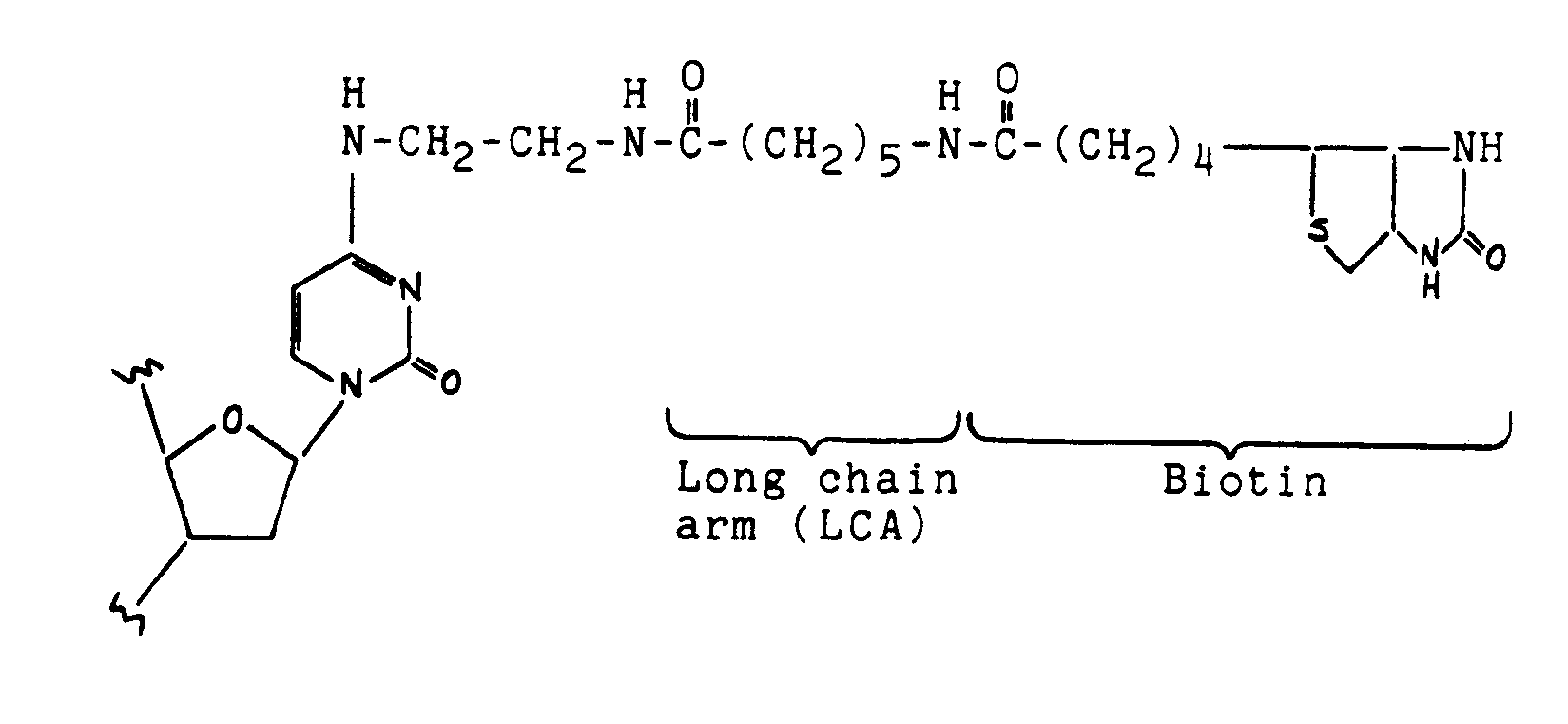
- 1. Oligodeoxynucleotides with structures I and II are synthesized on an Applied Biosystem Model 381A DNA synthesizer according to the manufacturer's directions. Structure I is synthesized with C (cytosine) in the X positions shown. The C's are then converted to the structure of X shown by a transamination reaction performed as described by Draper, Nucleic Acids Research (1984) 12:988 ff, followed by reaction with long chain arm biotin according to the manufacturer's directions (Pierce Chemical Co., Rockford, IL).
- 2. A reaction mixture is prepared by combining the following reagents:
- 1 µl of 1 pmole/µl of pSP64 plasmid (Promega, Madison, WI) in 10 mM Tris HCl, 1 mM EDTA, pH 8.0 (TE)
- 1 µl of 10x Medium Salt Buffer (Maniatis et al., supra)
- 1 µl of 10mM ATP
- 1 µl of 1 unit/µl T4 ligase (Boehringer Mannheim, Indianapolis, IN)
- 1 µl of biotinylated oligodeoxynucleotide (Structure I containing 2.5 pmole in TE)
- 1 µl of complementary oligodeoxynucleotide (Structure II containing 2.5 pmoles in TE)
- 3 µl water
- 1 µl of 10 units/µl HindIII restriction enzyme (Boehringer Mannheim, Indianapolis, IN)
- 3. The mixture is incubated for 1 hour at 37°C.
- 4. The reaction is stopped by adding 1 µl of 0.2M EDTA.
- 5' >TXXXTTTTTTTTTTTTTAGTTATGATGTTGT <3' Where X =
- 5′-AGCTACAACATCATAACT
- Use of ligation to label sample nucleic acid with fluorescent dyes.
- 1. Using an Applied Biosystem Model 381 DNA synthesizer, an 18 nucleotide oligomer is synthesized and purified following the manufacturer's directions. The 5′ end is terminated with an amino group using Amino-Link™ (Applied Biosystems). This amino group is coupled to fluorescein N-hydroxy succinimide, again according to the manufacturer's directions (Applied Biosystems).
- 2. Using an Applied Biosystems Model 381 DNA synthesizer, a 20 nucleotide oligomer is synthesized and purified following the manufacturer's directions. The synthesized sequence is
5′ AGC TAC AAC GTC GTG ACT GG 3′
The sequence is chosen so that the first 14 nucleotides (from the 5′ end) are complementary to the 3′ end of the fluorescein labeled 18-mer and the four nucleotides at the 3′ end of the 18 mer are complementary to the 5′ sticky end overhang generated by the restriction enzyme HindIII. The particular sequence chosen will destroy the recognition sequence of HindIII when the 18-mer/20-mer duplex is formed and then is ligated to the sticky ends of target DNA that has been cut with the HindIII restriction enzyme. - 3. A reaction mixture is prepared by mixing the following reagents:
- 1 µg of lambda phage target DNA in 1 µl of TE
- 0.9 µl of 10x HindIII reaction buffer (BRL Gaithersberg, MD)
- 3.0 µl of the 18-mer in TE; the number of moles should be twice that of the expected number of sticky ends generated when the HindIII digests the 1 µg of target DNA.
- 2.0 µl of the 20-mer in TE; the number of moles should be equal to that of the 18-mer.
- 1.0 µl of 10 mM dithiothreitol
- 1.0 µl of 3 mM ribose ATP
- 0.5 µl of HindIII enzyme (12 units/µl)
- 0.5 µl of ligase enzyme (0.5 units)
- 4. Incubate at 37°C for 1 hour.
- 5. Add 0.5 µl of 0.2M EDTA and 1.0 µl of 20µg/µl glycogen in water.
- 6. Clean up mixture by performing two phenol/chloroform extractions. Add 10 µl each of phenol and chloroform. Mix and centrifuge. Remove and discard lower phase. Repeat. (Maniatis et al., supra).
- 7. Add ≧1 µl 3M NaAc pH 5.5 and 25 µl of 95% ethanol. Mix. Let stand for 30 minutes. Centrifuge.
- 8. Wash the precipitate with 500 µl of 70% ethanol.
- 9. Use a vacuum centrifuge to dry sample.
- 10. Resuspend in 50 µl of 10 mM Tris, 1 mM EDTA, pH 8.0.
- 11. An aliquot of the reaction mixture is applied to a 0.6% agarose gel run at 3 volts/cm in 1x TBE (Tris-borate EDTA) buffer for 4 hours. The fluorescent bands migrating through the gel are detected by an Applied Biosystem 370A DNA sequencer adapted to read horizontal agarose gels. Fluorescent peaks are detected corresonding to the 560, 2027, 2322, 4361, 6557, 9416, and 23,130 base pair fragments in the HindIII cut lambda DNA.
- It is evident from the above results that a simple effective process for labeling or modifying termini of double-stranded DNA is provided. Smaller amounts of the labeling moiety are required, while oligomerization of the sample is substantially prevented. Labeling can occur in the same reaction vessel in which restriction or specific fragmentation is accomplished. Thus, a homogeneous product is obtained which provides for accurate sizing, detection and ease of further manipulation.
- All publications and patent applications mentioned in this specification are indicative of the level of skill of those skilled in the art to which this invention pertains.
Claims (13)
- A method for extending dsDNA fragments with a moiety of interest comprising :
combining in a reaction mixture said fragments in the simultaneous presence of ligase and a restriction enzyme, with dsDNA comprising said moiety and having a terminus complementary to a terminus of said fragments, wherein said fragments have predetermined termini as a result of digestion with said restriction enzyme, said fragments have terminal phosphates and said complementary termini of said dsDNA lack a terminal phosphate and ligation of said dsDNA results in a sequence different from the sequence cleaved by said restriction enzyme,
whereby said fragments and dsDNA are covalently joined. - A method according to Claim 1 , wherein said moiety comprises a ligand.
- A method according to Claim 2, wherein said ligand is a label capable of providing a detectable signal.
- A method according to Claim 1, wherein said moiety is a DNA sequence of interest.
- A method according to Claim 4, including the additional steps of:
selecting a fraction of said covalently joined fragments and dsDNA;
adding to said selected fraction a DNA polymerase, nucleotide triphosphates and sequences complementary to the strands of said dsDNA; and
carrying out a polymerase chain reaction to expand said selected fraction. - A method according to Claim 5, wherein said selecting is size selection by electrophoresis.
- A method according to Claim 1, wherein said DNA fragments are obtained by adding precursor DNA to be fragmented to said reaction mixture, whereby said precursor DNA is cleaved by said restriction enzyme.
- A method for labeling DNA fragments with a ligand comprising:
combining said fragments in the simultaneous presence of ligase and a restriction enzyme, with ligand labeled dsDNA of fewer than about 200bp and having a terminus complementary to a terminus of said fragments, wherein said fragments have predetermined termini as a result of digestion with said restriction enzyme, said fragments have terminal phosphates and said complementary termini of said dsDNA lack a terminal phosphate and ligation of said dsDNA results in a sequence different from the sequence cleaved by said restriction enzyme,
whereby said fragments and dsDNA are covalently joined to label said fragments. - A method according to Claim 8, wherein said ligand is biotin.
- A method according to Claim 8, wherein said ligand is a radionuclide, fluorescer or an enzyme.
- A method according to Claim 8, wherein said termini have cohesive ends.
- A method according to Claim 8, wherein said fragments are obtained by the step of: digesting genomic DNA with at least one restriction enzyme to provide fragments of less than about 200kbp.
- A labeling composition for binding to a restricted dsDNA fragment resulting in loss of the restriction recognition site by simultaneous restriction and ligation, said composition comprising
a bridging strand and first and second strands hybridized to said bridging strand, wherein said strands hybridize contiguously to said bridging strand ; said first strand is a labeling strand providing for a double-stranded DNA sequence of interest and a fluorescent label ; said second strand is an adapter strand hybridizing to said bridging strand to provide a cohesive end or blunt end with said bridging strand, and wherein said adapter strand contains a particular sequence necessary to destroy the recognition site of a restriction enzyme of interest.
Applications Claiming Priority (2)
| Application Number | Priority Date | Filing Date | Title |
|---|---|---|---|
| US148757 | 1988-01-26 | ||
| US07/148,757 US5093245A (en) | 1988-01-26 | 1988-01-26 | Labeling by simultaneous ligation and restriction |
Publications (3)
| Publication Number | Publication Date |
|---|---|
| EP0327429A2 EP0327429A2 (en) | 1989-08-09 |
| EP0327429A3 EP0327429A3 (en) | 1989-08-16 |
| EP0327429B1 true EP0327429B1 (en) | 1993-09-22 |
Family
ID=22527225
Family Applications (1)
| Application Number | Title | Priority Date | Filing Date |
|---|---|---|---|
| EP89400220A Expired - Lifetime EP0327429B1 (en) | 1988-01-26 | 1989-01-26 | Labeling by simultaneous ligation and restriction |
Country Status (5)
| Country | Link |
|---|---|
| US (2) | US5093245A (en) |
| EP (1) | EP0327429B1 (en) |
| JP (2) | JP2609317B2 (en) |
| CA (1) | CA1327169C (en) |
| DE (1) | DE68909266T2 (en) |
Families Citing this family (64)
| Publication number | Priority date | Publication date | Assignee | Title |
|---|---|---|---|---|
| US5093245A (en) * | 1988-01-26 | 1992-03-03 | Applied Biosystems | Labeling by simultaneous ligation and restriction |
| US5508178A (en) * | 1989-01-19 | 1996-04-16 | Rose; Samuel | Nucleic acid amplification using single primer |
| WO1992010588A1 (en) * | 1990-12-06 | 1992-06-25 | Affymax Technologies N.V. | Sequencing by hybridization of a target nucleic acid to a matrix of defined oligonucleotides |
| US5451343A (en) * | 1991-05-20 | 1995-09-19 | Spectra Group Limited, Inc. | Fluorone and pyronin y derivatives |
| HU223760B1 (en) * | 1991-09-24 | 2005-01-28 | Keygene N.V. | Selective restriction fragment amplification, a general method for dna fingerprinting |
| US20100267023A1 (en) * | 1992-09-24 | 2010-10-21 | Keygene N.V. | Selective restriction fragment amplification: fingerprinting |
| US7026115B1 (en) | 1991-09-24 | 2006-04-11 | Keygene N.V. | Selective restriction fragment amplification: fingerprinting |
| AU3728093A (en) * | 1992-02-19 | 1993-09-13 | Public Health Research Institute Of The City Of New York, Inc., The | Novel oligonucleotide arrays and their use for sorting, isolating, sequencing, and manipulating nucleic acids |
| US6180338B1 (en) | 1992-08-04 | 2001-01-30 | Beckman Coulter, Inc. | Method, reagent and kit for the detection and amplification of nucleic acid sequences |
| US6207368B1 (en) | 1992-08-04 | 2001-03-27 | Beckman Coulter, Inc. | Methods and reagents for controlling chain extension and ligation chain reactions |
| WO1995025538A1 (en) * | 1994-03-18 | 1995-09-28 | The General Hospital Corporation | Cleaved amplified rflp detection methods |
| US6110709A (en) * | 1994-03-18 | 2000-08-29 | The General Hospital Corporation | Cleaved amplified modified polymorphic sequence detection methods |
| US5831065A (en) * | 1994-04-04 | 1998-11-03 | Lynx Therapeutics, Inc. | Kits for DNA sequencing by stepwise ligation and cleavage |
| US5714330A (en) * | 1994-04-04 | 1998-02-03 | Lynx Therapeutics, Inc. | DNA sequencing by stepwise ligation and cleavage |
| US5552278A (en) * | 1994-04-04 | 1996-09-03 | Spectragen, Inc. | DNA sequencing by stepwise ligation and cleavage |
| US5710000A (en) * | 1994-09-16 | 1998-01-20 | Affymetrix, Inc. | Capturing sequences adjacent to Type-IIs restriction sites for genomic library mapping |
| USRE43097E1 (en) | 1994-10-13 | 2012-01-10 | Illumina, Inc. | Massively parallel signature sequencing by ligation of encoded adaptors |
| US6013445A (en) * | 1996-06-06 | 2000-01-11 | Lynx Therapeutics, Inc. | Massively parallel signature sequencing by ligation of encoded adaptors |
| US8236493B2 (en) * | 1994-10-21 | 2012-08-07 | Affymetrix, Inc. | Methods of enzymatic discrimination enhancement and surface-bound double-stranded DNA |
| US6974666B1 (en) * | 1994-10-21 | 2005-12-13 | Appymetric, Inc. | Methods of enzymatic discrimination enhancement and surface-bound double-stranded DNA |
| US5582705A (en) * | 1995-05-19 | 1996-12-10 | Iowa State University Research Foundation, Inc. | Multiplexed capillary electrophoresis system |
| US5888731A (en) * | 1995-08-30 | 1999-03-30 | Visible Genetics Inc. | Method for identification of mutations using ligation of multiple oligonucleotide probes |
| US6418382B2 (en) | 1995-10-24 | 2002-07-09 | Curagen Corporation | Method and apparatus for identifying, classifying, or quantifying DNA sequences in a sample without sequencing |
| US5972693A (en) * | 1995-10-24 | 1999-10-26 | Curagen Corporation | Apparatus for identifying, classifying, or quantifying DNA sequences in a sample without sequencing |
| US5871697A (en) | 1995-10-24 | 1999-02-16 | Curagen Corporation | Method and apparatus for identifying, classifying, or quantifying DNA sequences in a sample without sequencing |
| CN1254376A (en) | 1996-10-01 | 2000-05-24 | 杰龙公司 | Telomerase reverse transcriptase |
| US5851805A (en) * | 1997-01-16 | 1998-12-22 | Board Of Trustees Operating Michigan State University | Method for producing DNA from mRNA |
| US5888737A (en) * | 1997-04-15 | 1999-03-30 | Lynx Therapeutics, Inc. | Adaptor-based sequence analysis |
| US6703228B1 (en) * | 1998-09-25 | 2004-03-09 | Massachusetts Institute Of Technology | Methods and products related to genotyping and DNA analysis |
| DE19849348A1 (en) * | 1998-10-26 | 2000-04-27 | Univ Ludwigs Albert | Identification and/or sequencing of an unknown DNA or RNA sequence adjacent to a known DNA or RNA region comprises linker-mediated PCR following amplification by linear PCR |
| EP1124990B1 (en) * | 1998-10-27 | 2006-01-18 | Affymetrix, Inc. | Complexity management and analysis of genomic dna |
| CA2387018C (en) | 1999-10-12 | 2008-02-12 | Chemocentryx, Inc. | Chemokine receptor |
| US6958225B2 (en) * | 1999-10-27 | 2005-10-25 | Affymetrix, Inc. | Complexity management of genomic DNA |
| US7300751B2 (en) * | 2000-06-30 | 2007-11-27 | Syngenta Participations Ag | Method for identification of genetic markers |
| AU7970401A (en) * | 2000-06-30 | 2002-01-14 | Syngenta Participations Ag | Method for identification, separation and quantitative measurement of nucleic acid fragments |
| AUPR054000A0 (en) * | 2000-10-04 | 2000-10-26 | Austai Motors Designing Pty Ltd | A planetary gear apparatus |
| AR031640A1 (en) * | 2000-12-08 | 2003-09-24 | Applied Research Systems | ISOTHERMAL AMPLIFICATION OF NUCLEIC ACIDS IN A SOLID SUPPORT |
| US6727068B2 (en) | 2001-01-24 | 2004-04-27 | Syngenta Participations Ag | Method for non-redundant library construction |
| US6872529B2 (en) * | 2001-07-25 | 2005-03-29 | Affymetrix, Inc. | Complexity management of genomic DNA |
| US7270960B2 (en) | 2001-08-29 | 2007-09-18 | Pacific Northwest Research Institute | Diagnosis of ovarian carcinomas |
| AU2003217749A1 (en) * | 2002-02-26 | 2003-09-09 | Pharmacia Corporation | Sequence detection system calculator |
| DE60326224D1 (en) * | 2002-04-26 | 2009-04-02 | Solexa Inc | SIGNATURES OF CONSTANT LENGTH FOR THE PARALLEL SEQUENCING OF POLYNUCLEOTIDES |
| JP2006500959A (en) * | 2002-09-30 | 2006-01-12 | パラレル バイオサイエンス, インコーポレイテッド | Polynucleotide synthesis and labeling by dynamic sampling binding |
| EP1606417A2 (en) * | 2003-03-07 | 2005-12-21 | Rubicon Genomics Inc. | In vitro dna immortalization and whole genome amplification using libraries generated from randomly fragmented dna |
| FR2852605B1 (en) * | 2003-03-18 | 2012-11-30 | Commissariat Energie Atomique | PROCESS FOR PREPARING DNA FRAGMENTS AND ITS APPLICATIONS |
| FR2853907B1 (en) * | 2003-04-18 | 2007-08-03 | Commissariat Energie Atomique | PROCESS FOR PREPARING DNA FRAGMENTS BY SELECTIVE FRAGMENTATION OF NUCLEIC ACIDS AND USES THEREOF |
| US7365179B2 (en) * | 2003-09-09 | 2008-04-29 | Compass Genetics, Llc | Multiplexed analytical platform |
| AU2005214329A1 (en) | 2004-02-12 | 2005-09-01 | Population Genetics Technologies Ltd | Genetic analysis by sequence-specific sorting |
| US7622281B2 (en) * | 2004-05-20 | 2009-11-24 | The Board Of Trustees Of The Leland Stanford Junior University | Methods and compositions for clonal amplification of nucleic acid |
| US7867703B2 (en) | 2004-08-26 | 2011-01-11 | Agilent Technologies, Inc. | Element defined sequence complexity reduction |
| US7407757B2 (en) * | 2005-02-10 | 2008-08-05 | Population Genetics Technologies | Genetic analysis by sequence-specific sorting |
| WO2006099604A2 (en) * | 2005-03-16 | 2006-09-21 | Compass Genetics, Llc | Methods and compositions for assay readouts on multiple analytical platforms |
| JP2007043937A (en) * | 2005-08-09 | 2007-02-22 | Matsushita Electric Ind Co Ltd | Gene detection method |
| GB0522310D0 (en) * | 2005-11-01 | 2005-12-07 | Solexa Ltd | Methods of preparing libraries of template polynucleotides |
| GB0524069D0 (en) * | 2005-11-25 | 2006-01-04 | Solexa Ltd | Preparation of templates for solid phase amplification |
| EP2021503A1 (en) * | 2006-03-17 | 2009-02-11 | Solexa Ltd. | Isothermal methods for creating clonal single molecule arrays |
| EP2049682A2 (en) * | 2006-07-31 | 2009-04-22 | Illumina Cambridge Limited | Method of library preparation avoiding the formation of adaptor dimers |
| WO2008093098A2 (en) | 2007-02-02 | 2008-08-07 | Illumina Cambridge Limited | Methods for indexing samples and sequencing multiple nucleotide templates |
| US9388457B2 (en) * | 2007-09-14 | 2016-07-12 | Affymetrix, Inc. | Locus specific amplification using array probes |
| US9074244B2 (en) | 2008-03-11 | 2015-07-07 | Affymetrix, Inc. | Array-based translocation and rearrangement assays |
| US20110059453A1 (en) * | 2009-08-23 | 2011-03-10 | Affymetrix, Inc. | Poly(A) Tail Length Measurement by PCR |
| US10308979B2 (en) * | 2012-06-01 | 2019-06-04 | Agilent Technologies, Inc. | Target enrichment and labeling for multi-kilobase DNA |
| US9255265B2 (en) | 2013-03-15 | 2016-02-09 | Illumina, Inc. | Methods for producing stranded cDNA libraries |
| US10840974B1 (en) * | 2018-04-06 | 2020-11-17 | Rambus Inc. | Transmitter/receiver with small-swing level-shifted output |
Family Cites Families (7)
| Publication number | Priority date | Publication date | Assignee | Title |
|---|---|---|---|---|
| US4672040A (en) * | 1983-05-12 | 1987-06-09 | Advanced Magnetics, Inc. | Magnetic particles for use in separations |
| CA1222680A (en) * | 1983-07-05 | 1987-06-09 | Nanibhushan Dattagupta | Testing dna samples for particular nucleotide sequences |
| US4920061A (en) * | 1984-03-02 | 1990-04-24 | The University Of Texas System | Biological magnetic colloids |
| US4775619A (en) * | 1984-10-16 | 1988-10-04 | Chiron Corporation | Polynucleotide determination with selectable cleavage sites |
| US4883750A (en) * | 1984-12-13 | 1989-11-28 | Applied Biosystems, Inc. | Detection of specific sequences in nucleic acids |
| GB8612087D0 (en) * | 1986-05-19 | 1986-06-25 | Ici Plc | Hybridisation probes |
| US5093245A (en) * | 1988-01-26 | 1992-03-03 | Applied Biosystems | Labeling by simultaneous ligation and restriction |
-
1988
- 1988-01-26 US US07/148,757 patent/US5093245A/en not_active Expired - Lifetime
-
1989
- 1989-01-17 CA CA000588447A patent/CA1327169C/en not_active Expired - Lifetime
- 1989-01-26 JP JP1015219A patent/JP2609317B2/en not_active Expired - Lifetime
- 1989-01-26 EP EP89400220A patent/EP0327429B1/en not_active Expired - Lifetime
- 1989-01-26 DE DE89400220T patent/DE68909266T2/en not_active Expired - Lifetime
-
1990
- 1990-10-22 US US07/601,962 patent/US5366877A/en not_active Expired - Lifetime
-
1994
- 1994-10-19 JP JP6253514A patent/JP2685143B2/en not_active Expired - Lifetime
Non-Patent Citations (1)
| Title |
|---|
| Nucleic Acids Research, Vol.12, No. 4, 1984, Oxford. M.C.Hung and P.C. Wensink. "Different restriction enzyme-generated sticky DNA ends can be joined in vitro", pages 1863-1874 * |
Also Published As
| Publication number | Publication date |
|---|---|
| JP2685143B2 (en) | 1997-12-03 |
| EP0327429A2 (en) | 1989-08-09 |
| JPH01231899A (en) | 1989-09-18 |
| EP0327429A3 (en) | 1989-08-16 |
| JP2609317B2 (en) | 1997-05-14 |
| DE68909266T2 (en) | 1994-01-13 |
| CA1327169C (en) | 1994-02-22 |
| US5093245A (en) | 1992-03-03 |
| JPH07184698A (en) | 1995-07-25 |
| US5366877A (en) | 1994-11-22 |
| DE68909266D1 (en) | 1993-10-28 |
Similar Documents
| Publication | Publication Date | Title |
|---|---|---|
| US5093245A (en) | Labeling by simultaneous ligation and restriction | |
| AU674211B2 (en) | Method for generating single-stranded DNA molecules | |
| Zoller et al. | [32] Oligonucleotide-directed mutagenesis of DNA fragments cloned into M13 vectors | |
| US5728526A (en) | Method for analyzing a nucleotide sequence | |
| JP2788034B2 (en) | Amplification method for polynucleotide assay | |
| JP3415150B2 (en) | How to use branched nucleic acid probes | |
| AU2019274949B2 (en) | Method | |
| EP0760002B1 (en) | Detection of mutation by resolvase cleavage | |
| US6054266A (en) | Nucleic acid detection with separation | |
| EP0379369A2 (en) | Nucleic acid amplification using single primer | |
| EP0549107A1 (en) | Method for producing a polynucleotide for use in single primer amplification and phosphorothioate-containing oligonucleotides as primers in nucleic acid amplification | |
| CN112941065A (en) | Polynucleotide enrichment Using CRISPR-CAS System | |
| EP0322311B1 (en) | Method and kit for detecting a nucleic acid sequence | |
| JP2001506864A (en) | DNA sequencing method based on detection of pyrophosphate release | |
| JP2002502606A (en) | Materials and Methods for Identifying and Analyzing Medium Tandem Repeat DNA Markers | |
| US7820385B2 (en) | Method for retaining methylation pattern in globally amplified DNA | |
| CA2073184A1 (en) | Compositions and methods for analyzing genomic variation | |
| JP2982304B2 (en) | Method for identifying nucleic acid and test set for identifying nucleic acid | |
| AU785211B2 (en) | Method for selectively isolating a nucleic acid | |
| HK40053631A (en) | Polynucleotide enrichment using crispr-cas systems | |
| WO2000056923A2 (en) | Genetic analysis | |
| AU1523799A (en) | Methods and compositions for detection of specific nucleotide sequences |
Legal Events
| Date | Code | Title | Description |
|---|---|---|---|
| PUAI | Public reference made under article 153(3) epc to a published international application that has entered the european phase |
Free format text: ORIGINAL CODE: 0009012 |
|
| PUAL | Search report despatched |
Free format text: ORIGINAL CODE: 0009013 |
|
| AK | Designated contracting states |
Kind code of ref document: A2 Designated state(s): CH DE FR GB IT LI SE |
|
| AK | Designated contracting states |
Kind code of ref document: A3 Designated state(s): CH DE FR GB IT LI SE |
|
| 17P | Request for examination filed |
Effective date: 19891030 |
|
| 17Q | First examination report despatched |
Effective date: 19911205 |
|
| GRAA | (expected) grant |
Free format text: ORIGINAL CODE: 0009210 |
|
| AK | Designated contracting states |
Kind code of ref document: B1 Designated state(s): CH DE FR GB IT LI SE |
|
| ITF | It: translation for a ep patent filed | ||
| REF | Corresponds to: |
Ref document number: 68909266 Country of ref document: DE Date of ref document: 19931028 |
|
| ET | Fr: translation filed | ||
| PLBE | No opposition filed within time limit |
Free format text: ORIGINAL CODE: 0009261 |
|
| STAA | Information on the status of an ep patent application or granted ep patent |
Free format text: STATUS: NO OPPOSITION FILED WITHIN TIME LIMIT |
|
| 26N | No opposition filed | ||
| EAL | Se: european patent in force in sweden |
Ref document number: 89400220.3 |
|
| REG | Reference to a national code |
Ref country code: GB Ref legal event code: IF02 |
|
| REG | Reference to a national code |
Ref country code: FR Ref legal event code: TP |
|
| REG | Reference to a national code |
Ref country code: GB Ref legal event code: 732E |
|
| REG | Reference to a national code |
Ref country code: GB Ref legal event code: 732E |
|
| PGFP | Annual fee paid to national office [announced via postgrant information from national office to epo] |
Ref country code: CH Payment date: 20080130 Year of fee payment: 20 |
|
| PGFP | Annual fee paid to national office [announced via postgrant information from national office to epo] |
Ref country code: IT Payment date: 20080129 Year of fee payment: 20 Ref country code: SE Payment date: 20080129 Year of fee payment: 20 Ref country code: GB Payment date: 20080129 Year of fee payment: 20 |
|
| PGFP | Annual fee paid to national office [announced via postgrant information from national office to epo] |
Ref country code: FR Payment date: 20080117 Year of fee payment: 20 Ref country code: DE Payment date: 20080229 Year of fee payment: 20 |
|
| REG | Reference to a national code |
Ref country code: CH Ref legal event code: PL |
|
| REG | Reference to a national code |
Ref country code: GB Ref legal event code: PE20 Expiry date: 20090125 |
|
| EUG | Se: european patent has lapsed | ||
| PG25 | Lapsed in a contracting state [announced via postgrant information from national office to epo] |
Ref country code: GB Free format text: LAPSE BECAUSE OF EXPIRATION OF PROTECTION Effective date: 20090125 |