EP0326166B1 - Thermodegradable compositions based on crystalline homo- or copolymers of propylene and process for degrading such polymers - Google Patents
Thermodegradable compositions based on crystalline homo- or copolymers of propylene and process for degrading such polymers Download PDFInfo
- Publication number
- EP0326166B1 EP0326166B1 EP89101465A EP89101465A EP0326166B1 EP 0326166 B1 EP0326166 B1 EP 0326166B1 EP 89101465 A EP89101465 A EP 89101465A EP 89101465 A EP89101465 A EP 89101465A EP 0326166 B1 EP0326166 B1 EP 0326166B1
- Authority
- EP
- European Patent Office
- Prior art keywords
- propylene
- polymer
- copolymers
- homo
- weight
- Prior art date
- Legal status (The legal status is an assumption and is not a legal conclusion. Google has not performed a legal analysis and makes no representation as to the accuracy of the status listed.)
- Expired - Lifetime
Links
- 229920000642 polymer Polymers 0.000 title claims description 36
- 239000000203 mixture Substances 0.000 title claims description 23
- 238000000034 method Methods 0.000 title claims description 21
- 229920005606 polypropylene copolymer Polymers 0.000 title claims description 17
- 230000000593 degrading effect Effects 0.000 title 1
- MFEWNFVBWPABCX-UHFFFAOYSA-N 1,1,2,2-tetraphenylethane-1,2-diol Chemical class C=1C=CC=CC=1C(C(O)(C=1C=CC=CC=1)C=1C=CC=CC=1)(O)C1=CC=CC=C1 MFEWNFVBWPABCX-UHFFFAOYSA-N 0.000 claims description 16
- -1 C1-C4 alkyl radicals Chemical class 0.000 claims description 15
- 239000003963 antioxidant agent Substances 0.000 claims description 14
- 229920001577 copolymer Polymers 0.000 claims description 8
- 239000004743 Polypropylene Substances 0.000 claims description 7
- 229920001155 polypropylene Polymers 0.000 claims description 7
- 230000003078 antioxidant effect Effects 0.000 claims description 6
- 150000005840 aryl radicals Chemical class 0.000 claims description 6
- 150000001875 compounds Chemical class 0.000 claims description 6
- 238000010438 heat treatment Methods 0.000 claims description 6
- QQONPFPTGQHPMA-UHFFFAOYSA-N propylene Natural products CC=C QQONPFPTGQHPMA-UHFFFAOYSA-N 0.000 claims description 5
- 125000004805 propylene group Chemical group [H]C([H])([H])C([H])([*:1])C([H])([H])[*:2] 0.000 claims description 5
- VGGSQFUCUMXWEO-UHFFFAOYSA-N Ethene Chemical compound C=C VGGSQFUCUMXWEO-UHFFFAOYSA-N 0.000 claims description 4
- 239000005977 Ethylene Substances 0.000 claims description 4
- 229920002521 macromolecule Polymers 0.000 claims description 4
- XUIMIQQOPSSXEZ-UHFFFAOYSA-N Silicon Chemical group [Si] XUIMIQQOPSSXEZ-UHFFFAOYSA-N 0.000 claims description 2
- 125000004430 oxygen atom Chemical group O* 0.000 claims description 2
- 229910052710 silicon Inorganic materials 0.000 claims description 2
- 238000006731 degradation reaction Methods 0.000 description 15
- 230000015556 catabolic process Effects 0.000 description 11
- RTZKZFJDLAIYFH-UHFFFAOYSA-N Diethyl ether Chemical compound CCOCC RTZKZFJDLAIYFH-UHFFFAOYSA-N 0.000 description 8
- CXWXQJXEFPUFDZ-UHFFFAOYSA-N tetralin Chemical compound C1=CC=C2CCCCC2=C1 CXWXQJXEFPUFDZ-UHFFFAOYSA-N 0.000 description 8
- NLZUEZXRPGMBCV-UHFFFAOYSA-N Butylhydroxytoluene Chemical compound CC1=CC(C(C)(C)C)=C(O)C(C(C)(C)C)=C1 NLZUEZXRPGMBCV-UHFFFAOYSA-N 0.000 description 6
- IMNFDUFMRHMDMM-UHFFFAOYSA-N N-Heptane Chemical compound CCCCCCC IMNFDUFMRHMDMM-UHFFFAOYSA-N 0.000 description 6
- 239000003999 initiator Substances 0.000 description 5
- 239000000178 monomer Substances 0.000 description 4
- IZLFGIVMQQIPMI-UHFFFAOYSA-N 3,3-dimethyl-1-silylbutan-2-one Chemical compound CC(C)(C)C(=O)C[SiH3] IZLFGIVMQQIPMI-UHFFFAOYSA-N 0.000 description 3
- QVGXLLKOCUKJST-UHFFFAOYSA-N atomic oxygen Chemical compound [O] QVGXLLKOCUKJST-UHFFFAOYSA-N 0.000 description 3
- 125000001624 naphthyl group Chemical group 0.000 description 3
- 229910052760 oxygen Inorganic materials 0.000 description 3
- 239000001301 oxygen Substances 0.000 description 3
- 125000001997 phenyl group Chemical group [H]C1=C([H])C([H])=C(*)C([H])=C1[H] 0.000 description 3
- 238000006116 polymerization reaction Methods 0.000 description 3
- 230000008684 selective degradation Effects 0.000 description 3
- 150000005481 1,2-diphenylethanes Chemical class 0.000 description 2
- VXNZUUAINFGPBY-UHFFFAOYSA-N 1-Butene Chemical compound CCC=C VXNZUUAINFGPBY-UHFFFAOYSA-N 0.000 description 2
- LIKMAJRDDDTEIG-UHFFFAOYSA-N 1-hexene Chemical compound CCCCC=C LIKMAJRDDDTEIG-UHFFFAOYSA-N 0.000 description 2
- CJZGTCYPCWQAJB-UHFFFAOYSA-L calcium stearate Chemical compound [Ca+2].CCCCCCCCCCCCCCCCCC([O-])=O.CCCCCCCCCCCCCCCCCC([O-])=O CJZGTCYPCWQAJB-UHFFFAOYSA-L 0.000 description 2
- 239000008116 calcium stearate Substances 0.000 description 2
- 235000013539 calcium stearate Nutrition 0.000 description 2
- 125000004122 cyclic group Chemical group 0.000 description 2
- MTZQAGJQAFMTAQ-UHFFFAOYSA-N ethyl benzoate Chemical compound CCOC(=O)C1=CC=CC=C1 MTZQAGJQAFMTAQ-UHFFFAOYSA-N 0.000 description 2
- 125000001495 ethyl group Chemical group [H]C([H])([H])C([H])([H])* 0.000 description 2
- 229920001519 homopolymer Polymers 0.000 description 2
- 238000004519 manufacturing process Methods 0.000 description 2
- 125000002496 methyl group Chemical group [H]C([H])([H])* 0.000 description 2
- AQSJGOWTSHOLKH-UHFFFAOYSA-N phosphite(3-) Chemical class [O-]P([O-])[O-] AQSJGOWTSHOLKH-UHFFFAOYSA-N 0.000 description 2
- XRBCRPZXSCBRTK-UHFFFAOYSA-N phosphonous acid Chemical class OPO XRBCRPZXSCBRTK-UHFFFAOYSA-N 0.000 description 2
- 239000000047 product Substances 0.000 description 2
- 150000003254 radicals Chemical class 0.000 description 2
- UFHFLCQGNIYNRP-UHFFFAOYSA-N Hydrogen Chemical compound [H][H] UFHFLCQGNIYNRP-UHFFFAOYSA-N 0.000 description 1
- 239000004594 Masterbatch (MB) Substances 0.000 description 1
- NINIDFKCEFEMDL-UHFFFAOYSA-N Sulfur Chemical compound [S] NINIDFKCEFEMDL-UHFFFAOYSA-N 0.000 description 1
- 239000005864 Sulphur Substances 0.000 description 1
- HCHKCACWOHOZIP-UHFFFAOYSA-N Zinc Chemical compound [Zn] HCHKCACWOHOZIP-UHFFFAOYSA-N 0.000 description 1
- 239000000654 additive Substances 0.000 description 1
- 125000000217 alkyl group Chemical group 0.000 description 1
- 150000001412 amines Chemical class 0.000 description 1
- 125000003118 aryl group Chemical group 0.000 description 1
- 238000006701 autoxidation reaction Methods 0.000 description 1
- 150000001565 benzotriazoles Chemical class 0.000 description 1
- 230000015572 biosynthetic process Effects 0.000 description 1
- 229920001400 block copolymer Polymers 0.000 description 1
- 238000009835 boiling Methods 0.000 description 1
- 125000004432 carbon atom Chemical group C* 0.000 description 1
- 239000003054 catalyst Substances 0.000 description 1
- 238000001816 cooling Methods 0.000 description 1
- 238000004132 cross linking Methods 0.000 description 1
- 238000000354 decomposition reaction Methods 0.000 description 1
- 230000003247 decreasing effect Effects 0.000 description 1
- 239000008380 degradant Substances 0.000 description 1
- 238000010586 diagram Methods 0.000 description 1
- 238000009826 distribution Methods 0.000 description 1
- HQQADJVZYDDRJT-UHFFFAOYSA-N ethene;prop-1-ene Chemical group C=C.CC=C HQQADJVZYDDRJT-UHFFFAOYSA-N 0.000 description 1
- 238000001704 evaporation Methods 0.000 description 1
- 230000008020 evaporation Effects 0.000 description 1
- 238000001125 extrusion Methods 0.000 description 1
- YLQWCDOCJODRMT-UHFFFAOYSA-N fluoren-9-one Chemical compound C1=CC=C2C(=O)C3=CC=CC=C3C2=C1 YLQWCDOCJODRMT-UHFFFAOYSA-N 0.000 description 1
- 229910052739 hydrogen Inorganic materials 0.000 description 1
- 239000001257 hydrogen Substances 0.000 description 1
- 238000001746 injection moulding Methods 0.000 description 1
- 125000000959 isobutyl group Chemical group [H]C([H])([H])C([H])(C([H])([H])[H])C([H])([H])* 0.000 description 1
- 125000001449 isopropyl group Chemical group [H]C([H])([H])C([H])(*)C([H])([H])[H] 0.000 description 1
- 239000004611 light stabiliser Substances 0.000 description 1
- 239000007791 liquid phase Substances 0.000 description 1
- 239000000463 material Substances 0.000 description 1
- 239000000155 melt Substances 0.000 description 1
- 238000002844 melting Methods 0.000 description 1
- 230000008018 melting Effects 0.000 description 1
- 238000002156 mixing Methods 0.000 description 1
- 125000004108 n-butyl group Chemical group [H]C([H])([H])C([H])([H])C([H])([H])C([H])([H])* 0.000 description 1
- 125000004123 n-propyl group Chemical group [H]C([H])([H])C([H])([H])C([H])([H])* 0.000 description 1
- 239000002667 nucleating agent Substances 0.000 description 1
- 150000001451 organic peroxides Chemical class 0.000 description 1
- 239000003960 organic solvent Substances 0.000 description 1
- 239000002245 particle Substances 0.000 description 1
- 150000002978 peroxides Chemical class 0.000 description 1
- 239000002530 phenolic antioxidant Substances 0.000 description 1
- 150000002989 phenols Chemical class 0.000 description 1
- 238000012667 polymer degradation Methods 0.000 description 1
- 239000000843 powder Substances 0.000 description 1
- 125000002914 sec-butyl group Chemical group [H]C([H])([H])C([H])([H])C([H])(*)C([H])([H])[H] 0.000 description 1
- 150000003336 secondary aromatic amines Chemical class 0.000 description 1
- 239000011949 solid catalyst Substances 0.000 description 1
- 229910001220 stainless steel Inorganic materials 0.000 description 1
- 239000010935 stainless steel Substances 0.000 description 1
- 239000000126 substance Substances 0.000 description 1
- 239000011885 synergistic combination Substances 0.000 description 1
- 238000003786 synthesis reaction Methods 0.000 description 1
- 229920000576 tactic polymer Polymers 0.000 description 1
- 239000000454 talc Substances 0.000 description 1
- 229910052623 talc Inorganic materials 0.000 description 1
- 125000000999 tert-butyl group Chemical group [H]C([H])([H])C(*)(C([H])([H])[H])C([H])([H])[H] 0.000 description 1
- 150000003568 thioethers Chemical class 0.000 description 1
- VOITXYVAKOUIBA-UHFFFAOYSA-N triethylaluminium Chemical compound CC[Al](CC)CC VOITXYVAKOUIBA-UHFFFAOYSA-N 0.000 description 1
- XPEMYYBBHOILIJ-UHFFFAOYSA-N trimethyl(trimethylsilylperoxy)silane Chemical class C[Si](C)(C)OO[Si](C)(C)C XPEMYYBBHOILIJ-UHFFFAOYSA-N 0.000 description 1
- 239000011701 zinc Substances 0.000 description 1
- 229910052725 zinc Inorganic materials 0.000 description 1
- 239000004711 α-olefin Substances 0.000 description 1
Images

Classifications
-
- C—CHEMISTRY; METALLURGY
- C08—ORGANIC MACROMOLECULAR COMPOUNDS; THEIR PREPARATION OR CHEMICAL WORKING-UP; COMPOSITIONS BASED THEREON
- C08F—MACROMOLECULAR COMPOUNDS OBTAINED BY REACTIONS ONLY INVOLVING CARBON-TO-CARBON UNSATURATED BONDS
- C08F8/00—Chemical modification by after-treatment
- C08F8/50—Partial depolymerisation
-
- C—CHEMISTRY; METALLURGY
- C08—ORGANIC MACROMOLECULAR COMPOUNDS; THEIR PREPARATION OR CHEMICAL WORKING-UP; COMPOSITIONS BASED THEREON
- C08F—MACROMOLECULAR COMPOUNDS OBTAINED BY REACTIONS ONLY INVOLVING CARBON-TO-CARBON UNSATURATED BONDS
- C08F2800/00—Copolymer characterised by the proportions of the comonomers expressed
- C08F2800/20—Copolymer characterised by the proportions of the comonomers expressed as weight or mass percentages
-
- C—CHEMISTRY; METALLURGY
- C08—ORGANIC MACROMOLECULAR COMPOUNDS; THEIR PREPARATION OR CHEMICAL WORKING-UP; COMPOSITIONS BASED THEREON
- C08F—MACROMOLECULAR COMPOUNDS OBTAINED BY REACTIONS ONLY INVOLVING CARBON-TO-CARBON UNSATURATED BONDS
- C08F2810/00—Chemical modification of a polymer
- C08F2810/10—Chemical modification of a polymer including a reactive processing step which leads, inter alia, to morphological and/or rheological modifications, e.g. visbreaking
-
- Y—GENERAL TAGGING OF NEW TECHNOLOGICAL DEVELOPMENTS; GENERAL TAGGING OF CROSS-SECTIONAL TECHNOLOGIES SPANNING OVER SEVERAL SECTIONS OF THE IPC; TECHNICAL SUBJECTS COVERED BY FORMER USPC CROSS-REFERENCE ART COLLECTIONS [XRACs] AND DIGESTS
- Y10—TECHNICAL SUBJECTS COVERED BY FORMER USPC
- Y10S—TECHNICAL SUBJECTS COVERED BY FORMER USPC CROSS-REFERENCE ART COLLECTIONS [XRACs] AND DIGESTS
- Y10S525/00—Synthetic resins or natural rubbers -- part of the class 520 series
- Y10S525/938—Polymer degradation
Definitions
- the present invention relates to new thermodegradable compositions based on homo- or copolymers of propylene. Moreover, it relates to a process for carrying out the selective degradation of crystalline homo- or copolymers of propylene, in order to obtain polymers showing a narrower molecular weight distribution and being suitable for injection moulding and production of fibres and films.
- the decomposition residues of the peroxides are generally volatile and cause an unpleasant smell.
- JP-A-61-174 203 while directed to a process for decreasing the molecular weight of polypropylene, does not disclose or suggest the use of the present benzopinacol derivatives for said purpose. Instead, this document discloses the use of certain trimethylsilyl peroxides to this end.
- EP-A-0 131 323 is directed to a process for the degradation of (co)-polymers of propylene using as degradants chlorinated 1,1,2,2-tetramethyl-1,2-diphenyl ethane (chlorinated bicumyl) and/or derivatives thereof carring alkyl substituents in the aromatic nuclei (see, e.g., ab-stract of D3).
- chlorinated bicumyl chlorinated 1,1,2,2-tetramethyl-1,2-diphenyl ethane
- derivatives thereof carring alkyl substituents in the aromatic nuclei see, e.g., ab-stract of D3
- C6-C12 aryl radicals e.g., phenyl, naphthyl and biphenylyl
- the compounds of formula (I) are known. They may be prepared according to the methods described, for instance, in Polymer Bulletin, 16, pages 95 to 102 (1986), Springer Ed. and in J. P. Sci: Part A: Polymer Chemistry, Vol. 24, pages 1197 to 1215 (1986).
- thermodegradable compositions of homo- and copolymers of propylene comprising at least one benzopinacol derivative falling within formula (I) as illustrated above and at least one primary and/or secondary antioxidant.
- a further object of the present invention is a process for carrying out the degradation of homo- or copolymers of propylene, which comprises the heating of such homo- or copolymers to a temperature of from 250 to 350°C in the presence of at least one benzopinacol derivative of formula (I) as illustrated above as well as of one or more primary and/or secondary antioxidants.
- the homo- or copolymers of propylene may be stereoregular polymers obtained by means of Ziegler-Natta type catalysts including, beside polypropylene consisting essentially of isotactic macromolecules, the copolymers of propylene and ethylene containing predominantly propylene.
- the homopolymer or copolymer of propylene that is present in the degradable compositions of the present invention may have MFI values falling within a wide range, generally between 0.2 and 100 but preferably between 0.2 to 0.5 and 50.
- antioxidants all the common primary and secondary antioxidants may be employed which are suitable for avoiding the degradation of the polymeric macromolecules due to secondary autoxidation reactions.
- the sterically hindered phenols may be mentioned, particularly, (2,6)-di-tert-butyl-4-methylphenol (BHT), as well as secondary aromatic amines, thioethers, phosphites, phosphonites, zinc dithiobutylcarbamate and mixtures thereof.
- synergistic combinations of BHT with 2-2′-thio-diethyl-bis-[3-(3,5-di-tert-butyl-4-hydroxyphenyl)]-propionate and/or with phosphites and phosphonites, in particular, tetrakis-(2,4-di-tert-butylphenyl)-4,4′-diphenylenediphosphonite may be used to advantage.
- the amounts of the benzopinacol derivatives of formula (I), to be used in the compositions and process of the present invention may vary within wide ranges depending on the desired extent of the reduction of the molecular weight. Said amounts generally range from 0.01 to 3% by weight, based on the polymer. Amounts ranging from 0.1 to 1% by weight are preferred.
- the antioxidants to be used according to the invention are, preferably, present in total amounts of not more than 2% by weight, particularly of from 0.01 to 1% by weight, based on the polymer.
- light stabilizers comprising, for instance, 2(2′-hydroxyphenyl)benzotriazoles, 2-hydroxy-4-alkoxybenzophenones, sterically hindered amines and the like may be added.
- Other additives suitable for improving the rheologic properties of the products, for instance nucleating agents, may also be advantageously employed in the degradation process.
- the preferred temperatures for the degradation according to the process of the present invention range from 270 to 330°C.
- the degradation reaction may be carried out by heating the polymers at the temperatures mentioned above for a period of time generally ranging from 0.1 to 20 minutes, preferably from 0.5 to 10 minutes, in a standard, closed mixer (for instance, of the Banbury type) or, preferably, in a screw extruder. Thereafter, the polymer thus degraded may be granulated.
- the benzopinacol derivative may be added directly to the powdered (co)polymer or it may be introduced in the form of a concentrated masterbatch of polymer, directly into the extruder together with the (co)polymer to be degraded.
- the benzopinacol derivatives as well as the antioxidants are added at an earlier stage, i.e., during the synthesis of the (co)polymer by a polymerization of the monomers in liquid phase. Thereafter, the (co)polymers thus obtained may be subjected to a degradation reaction as described above.
- the polymer degradation is characterized by an increase in melt flow index, determined according to ASTM D-1238-73, condition L, and a corresponding reduction of the intrinsic viscosity of the polymer.
- Table 1 shows that the MFI values of the polymer thus treated according to the invention increase so significantly that values over 100 are achieved whereas the corresponding values of the intrinsic viscosity are remarkably low.
- the mixture was fed into the feedtank of a Werner-Pfleiderer double-screw extruder type 2D5 K28, having screws with a diameter of 28 mm.
- the conditions were as follows: Flow of the mixture: 3 kg/h; residence time: 100 seconds; screw speed: 100 rpm.
- the MFI increases remarkably as a function of the temperature of the molten mass.
- a mixture of 100 parts by weight of an ethylene/propylene block copolymer (MFI 2.4 g/10 minutes; content by weight of ethylene 14.1%), 3 parts by weight of talc (fine powder of a particle diameter of about 1 ⁇ m) and 0.1 parts by weight of antioxidant BHT, 0.1 parts by weight of Irganox® 1035 and 0.6 parts by weight of cyclic silylpinacolon ether having the following formula: and having been obtained according to the method described by J.V. Crivello et al. in Polymer Bulletin 16, pages 95 to 102 (1986), was fed into a Werner-Pfleiderer double screw extruder of the same type as indicated in example 3, at a temperature of from 240 to 310°C.
- the specimens obtained from the blend thus treated were subjected to a determination of flexural modulus and impact strength.
- a flexural modulus of 14000 kg/cm2 and an impact strength of 105 kg-cm at 40°C were determined, whereas the specimens obtained without the use of cyclic silylpinacolon ether had an impact strength of 4.5 kg-cm only although they showed an elasticity modulus of 14500 kg/cm2.
Landscapes
- Chemical & Material Sciences (AREA)
- General Chemical & Material Sciences (AREA)
- Health & Medical Sciences (AREA)
- Chemical Kinetics & Catalysis (AREA)
- Medicinal Chemistry (AREA)
- Polymers & Plastics (AREA)
- Organic Chemistry (AREA)
- Compositions Of Macromolecular Compounds (AREA)
- Addition Polymer Or Copolymer, Post-Treatments, Or Chemical Modifications (AREA)
- Processes Of Treating Macromolecular Substances (AREA)
- Silicon Polymers (AREA)
- Biological Depolymerization Polymers (AREA)
Description
- The present invention relates to new thermodegradable compositions based on homo- or copolymers of propylene. Moreover, it relates to a process for carrying out the selective degradation of crystalline homo- or copolymers of propylene, in order to obtain polymers showing a narrower molecular weight distribution and being suitable for injection moulding and production of fibres and films.
- From US-A-3 144 436 a process concerning the degradation of molten crystalline polypropylene is known, which degradation is carried out, substantially in the absence of oxygen, in a screw extruder at a temperature of 100°C above the melting point of the polymer and in the presence of a free radical initiator, and under such conditions that the amount of oxygen introduced into the polymer is kept below 0.2 p.h.r. Such a degradation process leads to an increase in "melt flow index" and, therefore, results in a reduced polymer viscosity.
- The use of organic peroxides as initiators as described in the above patent, however, causes a concomitant thermooxidative degradation which makes control of the process impossible and, therefore, reproducible results cannot be obtained thereby.
- Moreover, the decomposition residues of the peroxides are generally volatile and cause an unpleasant smell.
- Carrying out the degradation of crystalline homopolymers and copolymers of propylene by using derivatives of 1,2-diphenylethane as free radical initiators is also known. According to JP-A-J5 4090-291 brominated and alkyl derivatives of such compounds have been used for this purpose. In this case too, however, the termooxidative degradation of the polymer at the required high temperatures cannot be avoided and, furthermore, residues of the initiator are always present in the degraded polymer, which residues consist of undesirable volatile or brominated compounds. Particularly, the presence of brominated residues prevents the production of articles suitable for contact with foodstuffs.
- The same drawbacks are encountered when the process of US-A-4 555 695 is employed, wherein chlorinated derivatives of 1,2-diphenylethane are used.
- US-A-4 675 426, although disclosing some of the benzopinacol derivatives of general formula (I), is not directed to the selective degradation of polymers in order to selectively reduce the molecular weight thereof, but to just the opposite, i.e., the polymerization (crosslinking) of organic monomers and polymers by means of said benzopinacol derivatives (compare, e.g., claim 1).
- JP-A-61-174 203, while directed to a process for decreasing the molecular weight of polypropylene, does not disclose or suggest the use of the present benzopinacol derivatives for said purpose. Instead, this document discloses the use of certain trimethylsilyl peroxides to this end. There are significant structural and chemical differences between peroxide compounds and the benzopinacol derivatives used in the present invention
EP-A-0 131 323 is directed to a process for the degradation of (co)-polymers of propylene using as degradants chlorinated 1,1,2,2-tetramethyl-1,2-diphenyl ethane (chlorinated bicumyl) and/or derivatives thereof carring alkyl substituents in the aromatic nuclei (see, e.g., ab-stract of D3). In this case, too, there is a considerable structural difference between the chlorinated bicumyls and the present benzopinacol derivatives. - It has now, surprisingly, been found that the selective degradation of homo- and copolymers of propylene can be carried out, even in the presence of oxygen, without thermooxidative degradation of the polymer by heating the polymer to temperatures of from 250°C to 350°C in the presence of one or more primary and/or secondary antioxidants and at least one benzopinacol derivative of formula (I)

wherein n is 1 or 0, and wherein:
for n = 1 and X = 1
Z₁ and Z₂ together form a
group (fluorenone),
A and B are
groups,
wherein R₁, R₂ and R₃, the same or different from each other, are (optionally substituted) C₁-C₄ alkyl radicals (e.g. methyl, ethyl, n- or i-propyl, n-, i-, sec- or tert-butyl, particularly, methyl and ethyl) or (optionally substituted) C₆-C₁₂ aryl radicals (e.g., phenyl, naphthyl and biphenylyl);
for X ranging from 3 to 20 and n = 0
Z₁ and Z₂, the same or different from each other, are (preferably C₆-C₁₂) aryl radicals (e.g., optionally substituted phenyl, naphthyl or biphenylyl);
A is a
group
and is part of an oligomer of formula (I), containing at least 3 and up to 20 repeating units of formula (n = 0):
wherein Ar is an aryl radical and R₁ and R₂ have the meanings as defined above;
and for n = 0, X = 1
Z₁ and Z₂, the same or different from each other, are (preferably C₆-C₁₂) aryl radicals (e.g., optionally substituted phenyl, naphthyl or biphenylyl);
A represents
the silicon atom being also linked to the oxygen atoms of the two groups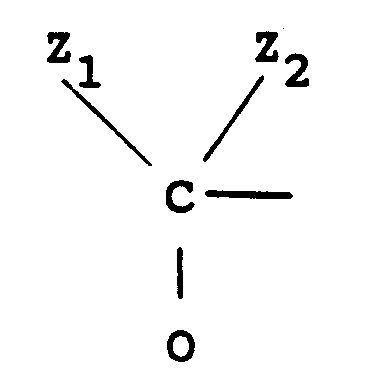
and R₁ and R₂ have the meanings defined above. - The compounds of formula (I) are known. They may be prepared according to the methods described, for instance, in Polymer Bulletin, 16, pages 95 to 102 (1986), Springer Ed. and in J. P. Sci: Part A: Polymer Chemistry, Vol. 24, pages 1197 to 1215 (1986).
- Examples of products within the scope of general formula (I) are for n = 1:

For n = 0:
An object of the present invention are, thus, thermodegradable compositions of homo- and copolymers of propylene, comprising at least one benzopinacol derivative falling within formula (I) as illustrated above and at least one primary and/or secondary antioxidant. - A further object of the present invention is a process for carrying out the degradation of homo- or copolymers of propylene, which comprises the heating of such homo- or copolymers to a temperature of from 250 to 350°C in the presence of at least one benzopinacol derivative of formula (I) as illustrated above as well as of one or more primary and/or secondary antioxidants.
- The homo- or copolymers of propylene, to which the compositions and the process of the present invention refer may be stereoregular polymers obtained by means of Ziegler-Natta type catalysts including, beside polypropylene consisting essentially of isotactic macromolecules, the copolymers of propylene and ethylene containing predominantly propylene. Said homo- or copolymers may also be of the statistic or block type and include copolymers of propylene and alpha-olefins of formula CH₂ = CH-R, wherein R is an alkyl radical having from 2 to 6 carbon atoms, particularly, 1-butene and 1-hexene. Preferably, they are crystalline.
- The homopolymer or copolymer of propylene that is present in the degradable compositions of the present invention may have MFI values falling within a wide range, generally between 0.2 and 100 but preferably between 0.2 to 0.5 and 50.
- As antioxidants all the common primary and secondary antioxidants may be employed which are suitable for avoiding the degradation of the polymeric macromolecules due to secondary autoxidation reactions. Specifially, the sterically hindered phenols may be mentioned, particularly, (2,6)-di-tert-butyl-4-methylphenol (BHT), as well as secondary aromatic amines, thioethers, phosphites, phosphonites, zinc dithiobutylcarbamate and mixtures thereof.
- Moreover, synergistic combinations of BHT with 2-2′-thio-diethyl-bis-[3-(3,5-di-tert-butyl-4-hydroxyphenyl)]-propionate and/or with phosphites and phosphonites, in particular, tetrakis-(2,4-di-tert-butylphenyl)-4,4′-diphenylenediphosphonite may be used to advantage.
- The amounts of the benzopinacol derivatives of formula (I), to be used in the compositions and process of the present invention, may vary within wide ranges depending on the desired extent of the reduction of the molecular weight. Said amounts generally range from 0.01 to 3% by weight, based on the polymer. Amounts ranging from 0.1 to 1% by weight are preferred.
- The antioxidants to be used according to the invention are, preferably, present in total amounts of not more than 2% by weight, particularly of from 0.01 to 1% by weight, based on the polymer.
- In addition to these compounds light stabilizers comprising, for instance, 2(2′-hydroxyphenyl)benzotriazoles, 2-hydroxy-4-alkoxybenzophenones, sterically hindered amines and the like may be added. Other additives suitable for improving the rheologic properties of the products, for instance nucleating agents, may also be advantageously employed in the degradation process.
- The preferred temperatures for the degradation according to the process of the present invention range from 270 to 330°C.
- The degradation reaction may be carried out by heating the polymers at the temperatures mentioned above for a period of time generally ranging from 0.1 to 20 minutes, preferably from 0.5 to 10 minutes, in a standard, closed mixer (for instance, of the Banbury type) or, preferably, in a screw extruder. Thereafter, the polymer thus degraded may be granulated.
- After having been dissolved, suitably in an organic solvent, the benzopinacol derivative may be added directly to the powdered (co)polymer or it may be introduced in the form of a concentrated masterbatch of polymer, directly into the extruder together with the (co)polymer to be degraded.
- According to another embodiment of the present invention the benzopinacol derivatives as well as the antioxidants are added at an earlier stage, i.e., during the synthesis of the (co)polymer by a polymerization of the monomers in liquid phase. Thereafter, the (co)polymers thus obtained may be subjected to a degradation reaction as described above.
- The polymer degradation is characterized by an increase in melt flow index, determined according to ASTM D-1238-73, condition L, and a corresponding reduction of the intrinsic viscosity of the polymer.
- The following examples illustrate the present invention without limiting the scope thereof.
- 500 parts by weight of powdered crystalline polypropylene, having an apparent density of 0.50 g/cm³, a melt flow index of 12 (according to ASTM-1233-73, condition L) and produced by Himont Italy (tradename Moplen® FL-F20) were uniformly mixed in a Banbury mixer at room temperature with 5 parts by weight of BHT antioxidants (tradename Tepal®, produced by ICI), 5 parts by weight of phenolic antioxidant containing sulphur (tradename Irganox® 1035, produced by Ciba-Geigy) and 5 parts by weight of calcium stearate. Thereafter, the composition thus obtained was subjected to heating at 290°C and continuously stirred.
- A sample was drawn every 2 minutes for a total of 10 minutes and, after cooling to room temperature, the MFI and intrinsic viscosity [η] at 130 °C in tetralin were determined.
- From the data set out in table 1, no substantial change indicating any degradation of the polymer can be recognized.
- 43 parts by weight of a silylpinacolone ether, an oligomer of the monomer of formula:

(Initiator ZF - WFH - 5090, produced by Bayer) were added to the composition described in (reference) example 1. - The mixture thus obtained was subjected to heating at 280°C. Then the procedure of example 1 was followed.
- Table 1 shows that the MFI values of the polymer thus treated according to the invention increase so significantly that values over 100 are achieved whereas the corresponding values of the intrinsic viscosity are remarkably low.
TABLE 1 Mixing time (minutes) MFI (230°C-2,169 kg) [η] 130°C tetralin (ml/g) Example 1 (Reference) Example 2 Example 1 (Reference) Example 2 0 12 12 134.5 134.5 2 14 15 128.7 126.2 4 14.5 35.3 126.2 97.8 6 15.2 67.5 125.7 82.1 8 15.8 95 124.3 74.5 10 17.5 102.7 120.7 72.8 - 100 parts by weight of crystalline polypropylene (Moplen® FL-F20) were mixed for half a minute in a Henschel turbomixer with 0.1 parts by weight of BHT, 0.1 parts by weight of antioxidant Irganox® 1035 and 0.1 parts by weight of calcium stearate. Finally, 0.6 p.h.r. of bis-(trimethylsilyl)fluorenone-pinacolate having the following formula were added:

which had been obtained according to procedure B described by J.V. Crivello et al. in the Journal of Polymer Science: Part A, Polymer Chemistry, Vol. 24 (1986), page 1200. - Then the mixture was fed into the feedtank of a Werner-Pfleiderer double-screw extruder type 2D5 K28, having screws with a diameter of 28 mm. The conditions were as follows: Flow of the mixture: 3 kg/h; residence time: 100 seconds; screw speed: 100 rpm. As shown by the data in table 2, the MFI increases remarkably as a function of the temperature of the molten mass.
- In the enclosed diagram the MFI values within the temperature range of from 240°C to 310°C, under the conditions described above, are shown.
TABLE 2 Temperature of the molten mass (°C) MFI of the extruded material (g/10 minutes) 240 6 280 11 300 40 310 > 100 - A mixture of 100 parts by weight of an ethylene/propylene block copolymer (MFI 2.4 g/10 minutes; content by weight of ethylene = 14.1%), 3 parts by weight of talc (fine powder of a particle diameter of about 1 µm) and 0.1 parts by weight of antioxidant BHT, 0.1 parts by weight of Irganox® 1035 and 0.6 parts by weight of cyclic silylpinacolon ether having the following formula:

and having been obtained according to the method described by J.V. Crivello et al. in Polymer Bulletin 16, pages 95 to 102 (1986), was fed into a Werner-Pfleiderer double screw extruder of the same type as indicated in example 3, at a temperature of from 240 to 310°C. - The specimens obtained from the blend thus treated were subjected to a determination of flexural modulus and impact strength.
- A flexural modulus of 14000 kg/cm² and an impact strength of 105 kg-cm at 40°C were determined, whereas the specimens obtained without the use of cyclic silylpinacolon ether had an impact strength of 4.5 kg-cm only although they showed an elasticity modulus of 14500 kg/cm².
- 500 g of propylene and 2.1 millimoles of Al(C₂H₅)₃ together with 0.7 millimoles of ethyl benzoate and 20 mg of solid catalyst, suspended in 30 ml of n-heptane and prepared according to JP-A-77-151091, were introduced into a 3 l stainless steel autoclave under a hydrogen pressure of 0.3 atmospheres.
- Finally, 1.8 g of spirocyclic silyl-ortho ester (m.p. 240°C) of the following formula:

were added. - This compound had been prepared according to the method described by J.V. Crivello et al. in Polymer Bulletin 16, page 98 (1986).
- After polymerization at 60°C for 4 hours the residual monomer was removed by evaporation, thereby recovering 300 g of polymer, 94% of which turned out to be insoluble in boiling n-heptane and which had an intrinsic viscosity [η] at 130°C in tetraline of 136 ml/g and an MFI of 5.6 (acccording to ASTM D 1231, condition L).
- 100 parts by weight of the crystalline polymer containing the above-mentioned spirocyclic ether were mixed in a Henschel turbomixer with 0.1 parts by weight of BHT, 0.1 parts by weight of antioxidant Irganox ® 1035 and 0.1 parts by weight of Ca-stearate.
- The composition thus obtained was extruded under the same conditions as in example 3.
- After extrusion, the MFI had increased to 53 whereas the intrinsic viscosity fell to 88.6 ml/g.
Claims (13)
- Thermodegradable compositions, based on homo- or copolymers of propylene, comprising at least one primary and/or secondary antioxidant and at least one benzopinacol derivative having the general formula:
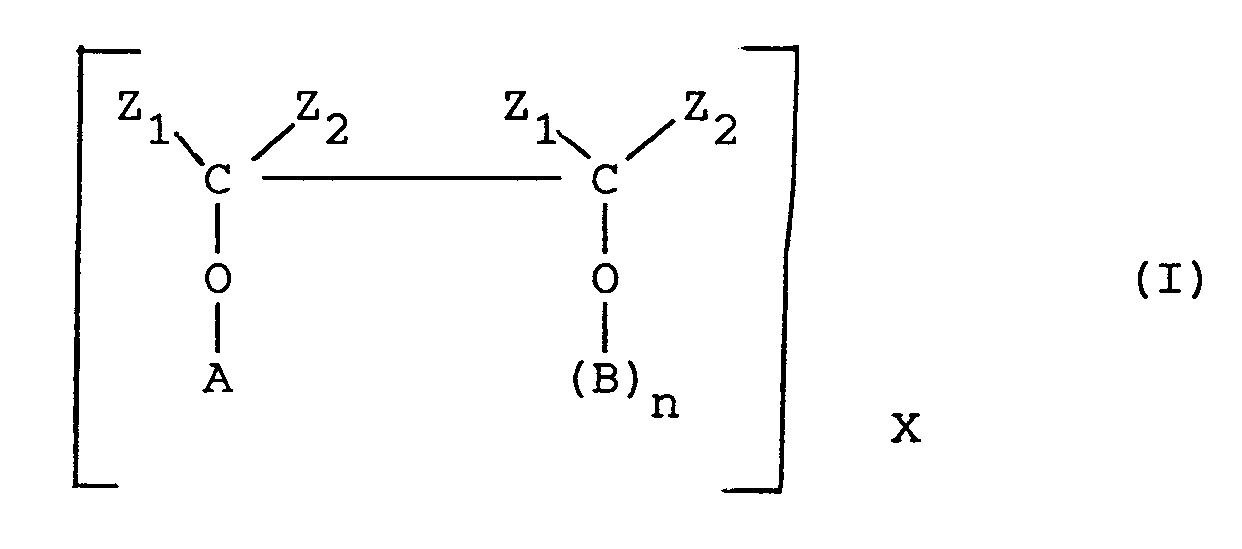
and wherein: for n = 1 and X = 1:
Z₁ and Z₂ together form a
A and B are
wherein R₁, R₂ and R₃, the same or different from each other, represent C₁-C₄ alkyl radicals or C₆-C₁₂ aryl radicals;
for X ranging from 3 to 20 and n = 0:
Z₁ and Z₂, the same or different from each other, are aryl radicals,
A is a
and is part of an oligomer of formula (I), which contains at least 3 and up to 20 repeating units of formula
and for n = 0, X = 1:
Z₁ and Z₂, the same or different from each other, are aryl radicals;
A represents

- Compositions according to claim 1, wherein the benzopinacol derivative is present in amounts ranging from 0.01 to 3% by weight, based on the polymer.
- Compositions according to any one of claims 1 and 2, wherein the antioxidant(s) is (are) present in amounts up to 2% by weight, based on the polymer.
- Compositions according to any one of claims 1 to 3, wherein the benzopinacol derivative of general formula (I) wherein X ranges from 3 to 20 and n = 0 is an oligomer having 3 to 20 repeating units of formula:

- Compositions according to any one of claims 1 to 3, wherein the benzopinacol derivative has the formulae:

- Compositions according to any one of claims 1 to 5, wherein the polymer is polypropylene, consisting essentially of isotactic macromolecules.
- Compositions according to any one of claims 1 to 6, wherein the polymer is a crystalline copolymer of propylene and ethylene containing a predominant portion of propylene.
- Compositions according to any one of claims 1 to 7, wherein said homo- or copolymers of propylene are crystalline polymers.
- Process for thermodegrading homo- or copolymers of propylene comprising the heating of said homo- or copolymers to a temperature of from 250 to 350°C, preferably from 270 to 330°C, in the presence of one or more primary and/or secondary antioxidants and of at least one compound of general formula (I) as defined in any one of claims 1, 4 and 5.
- Process according to claim 9, wherein the polymer is polypropylene, consisting essentially of isotactic macromolecules.
- Process according to any one of claims 9 and 10, wherein the polymer is a copolymer of propylene and ethylene, containing a predominant portion of propylene.
- Process according to any one of claims 9 to 11, wherein the benzopinacol derivative is employed in amounts of from 0.01 to 3% by weight, based on the polymer.
- Process according to any one of claims 9 to 12, wherein said homo- or copolymers of propylene are crystalline polymers.
Applications Claiming Priority (2)
| Application Number | Priority Date | Filing Date | Title |
|---|---|---|---|
| IT8819233A IT1216719B (en) | 1988-01-28 | 1988-01-28 | THERMODEGRADABLE COMPOSITIONS ABASE OF OMO OR CRYSTALLINE COPOLYMERS OF PROPYLENE AND PROCEDURE TO PERFORM THE SELECTIVE DEGRADATION OF SUCH OMO AND COPOLYMERS. |
| IT1923388 | 1988-01-28 |
Publications (3)
| Publication Number | Publication Date |
|---|---|
| EP0326166A2 EP0326166A2 (en) | 1989-08-02 |
| EP0326166A3 EP0326166A3 (en) | 1990-10-24 |
| EP0326166B1 true EP0326166B1 (en) | 1993-12-01 |
Family
ID=11155982
Family Applications (1)
| Application Number | Title | Priority Date | Filing Date |
|---|---|---|---|
| EP89101465A Expired - Lifetime EP0326166B1 (en) | 1988-01-28 | 1989-01-27 | Thermodegradable compositions based on crystalline homo- or copolymers of propylene and process for degrading such polymers |
Country Status (8)
| Country | Link |
|---|---|
| US (1) | US4948820A (en) |
| EP (1) | EP0326166B1 (en) |
| JP (1) | JPH023439A (en) |
| BR (1) | BR8900349A (en) |
| CA (1) | CA1336217C (en) |
| DE (1) | DE68910991T2 (en) |
| ES (1) | ES2055748T3 (en) |
| IT (1) | IT1216719B (en) |
Families Citing this family (12)
| Publication number | Priority date | Publication date | Assignee | Title |
|---|---|---|---|---|
| US5194457A (en) * | 1990-01-24 | 1993-03-16 | Enimont Augusta Industriale S.R.L | Zeolitic nucleants for crystalline polyolefines modified by means of macroradicalic degradation |
| IT1252388B (en) * | 1991-11-12 | 1995-06-12 | Sviluppo Settori Impiego Srl | PROPYLENE POLYMERS AND COPOLYMERS SEAMED WITH VINYL POLYBUTADIENE AND PREPARATION PROCEDURE |
| US5518730A (en) | 1992-06-03 | 1996-05-21 | Fuisz Technologies Ltd. | Biodegradable controlled release flash flow melt-spun delivery system |
| IT1264437B1 (en) * | 1993-05-13 | 1996-09-23 | Spherilene Srl | POLYMERS OF PROPYLENE GRAFTED WITH POLYALKENYLENES AND PROCESS FOR THEIR PREPARATION |
| US5814404A (en) * | 1994-06-03 | 1998-09-29 | Minnesota Mining And Manufacturing Company | Degradable multilayer melt blown microfibers |
| WO1996011982A1 (en) * | 1994-10-12 | 1996-04-25 | Kimberly-Clark Worldwide, Inc. | Melt-extrudable thermoplastic polypropylene composition and nonwoven web prepared therefrom |
| IT1272915B (en) * | 1995-01-20 | 1997-07-01 | Commer Spa | SCRAPED PROPYLENE POLYMERS AND COPOLYMERS |
| US5738745A (en) * | 1995-11-27 | 1998-04-14 | Kimberly-Clark Worldwide, Inc. | Method of improving the photostability of polypropylene compositions |
| JP3358441B2 (en) * | 1996-06-04 | 2002-12-16 | 住友化学工業株式会社 | Polypropylene block copolymer |
| US6967229B2 (en) | 2003-07-07 | 2005-11-22 | Acushnet Company | Carbon-carbon initiators for use in golf balls |
| US9056227B2 (en) | 2007-07-03 | 2015-06-16 | Acushnet Company | Golf ball comprising a core having a shallow hardness gradient |
| US8968117B2 (en) | 2007-07-03 | 2015-03-03 | Acushnet Company | Dual-core comprising zero gradient center and positive gradient outer core layer |
Family Cites Families (10)
| Publication number | Priority date | Publication date | Assignee | Title |
|---|---|---|---|---|
| US3144436A (en) * | 1961-01-04 | 1964-08-11 | Du Pont | Process for degrading stereoregular polymers |
| DK107446C (en) * | 1963-04-03 | 1967-05-29 | Bayer Ag | Process for the preparation of stable prepolymers by catalytic polymerization. |
| FR2094611A5 (en) * | 1970-06-26 | 1972-02-04 | Aquitaine Petrole | |
| US3931355A (en) * | 1971-12-24 | 1976-01-06 | Bayer Aktiengesellschaft | Radical-initiated polymerization reactions and mixture |
| US4360606A (en) * | 1972-10-26 | 1982-11-23 | Owens-Illinois, Inc. | Photo-degradable polymer compositions |
| NL168232C (en) * | 1976-07-17 | 1982-03-16 | Bayer Ag | PROCESS FOR PREPARING CURABLE RESIN MIXTURES, METHOD FOR PREPARING SILYL ETHERS SUITABLE THEREFORE AS INITIATORS, AND PREPARED PRODUCTS MADE FROM THESE MIXES. |
| DE3151444A1 (en) * | 1981-12-24 | 1983-07-07 | Bayer Ag, 5090 Leverkusen | NEW SILYLETHERS, METHOD FOR THE PRODUCTION THEREOF AND THEIR USE AS POLYMERIZATION INITIATORS |
| EP0131323A1 (en) * | 1983-07-11 | 1985-01-16 | Akzo N.V. | Process for the degradation of (co)polymers of propylene |
| US4535174A (en) * | 1984-11-02 | 1985-08-13 | General Electric Company | Free-radical initiators and method for making |
| US4675426A (en) * | 1986-06-11 | 1987-06-23 | General Electric Company | Free-radical, initiators, curable compositions, and methods |
-
1988
- 1988-01-28 IT IT8819233A patent/IT1216719B/en active
-
1989
- 1989-01-27 CA CA000589381A patent/CA1336217C/en not_active Expired - Fee Related
- 1989-01-27 DE DE89101465T patent/DE68910991T2/en not_active Expired - Fee Related
- 1989-01-27 EP EP89101465A patent/EP0326166B1/en not_active Expired - Lifetime
- 1989-01-27 BR BR898900349A patent/BR8900349A/en not_active Application Discontinuation
- 1989-01-27 ES ES89101465T patent/ES2055748T3/en not_active Expired - Lifetime
- 1989-01-27 US US07/302,191 patent/US4948820A/en not_active Expired - Fee Related
- 1989-01-30 JP JP1020654A patent/JPH023439A/en active Pending
Also Published As
| Publication number | Publication date |
|---|---|
| JPH023439A (en) | 1990-01-09 |
| IT8819233A0 (en) | 1988-01-28 |
| EP0326166A2 (en) | 1989-08-02 |
| EP0326166A3 (en) | 1990-10-24 |
| ES2055748T3 (en) | 1994-09-01 |
| BR8900349A (en) | 1989-09-19 |
| US4948820A (en) | 1990-08-14 |
| IT1216719B (en) | 1990-03-08 |
| DE68910991T2 (en) | 1994-03-24 |
| DE68910991D1 (en) | 1994-01-13 |
| CA1336217C (en) | 1995-07-04 |
Similar Documents
| Publication | Publication Date | Title |
|---|---|---|
| AU733943B2 (en) | Olefin polymer composition having low smoke generation and fiber and film prepared therefrom | |
| EP0411628A2 (en) | Process for the stabilization of polyolefin and products obtained thereby | |
| EP0326166A2 (en) | Thermodegradable compositions based on crystalline homo- or copolymers of propylene and process for degrading such polymers | |
| EP0428153A2 (en) | Thermoplastic elastomer of propylene Polymer Material and Crosslinked Ethylene-Propylene Rubber | |
| EP0497590B1 (en) | Highly crystalline polypropylene for forming film | |
| KR910004485B1 (en) | Thermal stability of olefinic polymers | |
| EP0171199A2 (en) | Crystalline polypropylene sheet | |
| EP0103987A2 (en) | Ethylene-propylene block-copolymers and process for producing the same | |
| RU2066333C1 (en) | Elastomer based-thermoplastic polymeric composition | |
| US5574082A (en) | Propylene polymer compositions having improved color and stabilizers therefor. | |
| US8716408B2 (en) | Method for producing modified propylene polymer | |
| EP0673396B1 (en) | Process for producing polypropylene materials grafted with an epoxyalkyl acrylate compound | |
| US4960593A (en) | Process for preparing thermally stable olefinic polymers | |
| US6391951B1 (en) | Propylene pentene-1 copolymers, method of preparation thereof and composition containing them | |
| US5859139A (en) | Propylene polymers grafted with polyalkenylenes and process for their preparation | |
| EP0206515A1 (en) | Production of injection molded polypropylene articles | |
| US5635567A (en) | Propylene polymer, process for obtaining it and use | |
| EP0131323A1 (en) | Process for the degradation of (co)polymers of propylene | |
| US3429849A (en) | Process for thermally stabilizing isotactic polymers with (i) alkali metal or alkaline earth metal hydroxide and (ii) conventional thermal stabilizers | |
| JPH07179685A (en) | Piperidinyl phosphite composition and polyolefin composition containing it | |
| JP3929081B2 (en) | Propylene polymer resin film or sheet manufacturing method | |
| EP0419874A2 (en) | Composition of polybutene-1 and process for preparing same | |
| JPH04332741A (en) | Crystalline poly-4-methyl-1-pentene composition | |
| EP0507576A1 (en) | Polypropylene-based resin compositions | |
| JPH0873671A (en) | Thermoplastic resin composition |
Legal Events
| Date | Code | Title | Description |
|---|---|---|---|
| PUAI | Public reference made under article 153(3) epc to a published international application that has entered the european phase |
Free format text: ORIGINAL CODE: 0009012 |
|
| AK | Designated contracting states |
Kind code of ref document: A2 Designated state(s): BE DE ES FR GB NL SE |
|
| PUAL | Search report despatched |
Free format text: ORIGINAL CODE: 0009013 |
|
| RAP1 | Party data changed (applicant data changed or rights of an application transferred) |
Owner name: MONTEDIPE S.R.L. |
|
| AK | Designated contracting states |
Kind code of ref document: A3 Designated state(s): BE DE ES FR GB NL SE |
|
| RAP1 | Party data changed (applicant data changed or rights of an application transferred) |
Owner name: MONTEDIPE S.R.L. |
|
| 17P | Request for examination filed |
Effective date: 19901122 |
|
| 17Q | First examination report despatched |
Effective date: 19920323 |
|
| RAP1 | Party data changed (applicant data changed or rights of an application transferred) |
Owner name: ECP ENICHEM POLIMERI S.R.L. |
|
| GRAA | (expected) grant |
Free format text: ORIGINAL CODE: 0009210 |
|
| AK | Designated contracting states |
Kind code of ref document: B1 Designated state(s): BE DE ES FR GB NL SE |
|
| REF | Corresponds to: |
Ref document number: 68910991 Country of ref document: DE Date of ref document: 19940113 |
|
| ET | Fr: translation filed | ||
| RAP2 | Party data changed (patent owner data changed or rights of a patent transferred) |
Owner name: ENICHEM S.P.A. |
|
| REG | Reference to a national code |
Ref country code: ES Ref legal event code: FG2A Ref document number: 2055748 Country of ref document: ES Kind code of ref document: T3 |
|
| PLBE | No opposition filed within time limit |
Free format text: ORIGINAL CODE: 0009261 |
|
| STAA | Information on the status of an ep patent application or granted ep patent |
Free format text: STATUS: NO OPPOSITION FILED WITHIN TIME LIMIT |
|
| 26N | No opposition filed | ||
| NLT2 | Nl: modifications (of names), taken from the european patent patent bulletin |
Owner name: ENICHEM S.P.A. TE MILAAN, ITALIE. |
|
| PGFP | Annual fee paid to national office [announced via postgrant information from national office to epo] |
Ref country code: FR Payment date: 19950110 Year of fee payment: 7 |
|
| PGFP | Annual fee paid to national office [announced via postgrant information from national office to epo] |
Ref country code: GB Payment date: 19950117 Year of fee payment: 7 |
|
| PGFP | Annual fee paid to national office [announced via postgrant information from national office to epo] |
Ref country code: SE Payment date: 19950118 Year of fee payment: 7 |
|
| PGFP | Annual fee paid to national office [announced via postgrant information from national office to epo] |
Ref country code: DE Payment date: 19950121 Year of fee payment: 7 |
|
| EAL | Se: european patent in force in sweden |
Ref document number: 89101465.6 |
|
| PGFP | Annual fee paid to national office [announced via postgrant information from national office to epo] |
Ref country code: NL Payment date: 19950131 Year of fee payment: 7 Ref country code: ES Payment date: 19950131 Year of fee payment: 7 |
|
| PGFP | Annual fee paid to national office [announced via postgrant information from national office to epo] |
Ref country code: BE Payment date: 19950302 Year of fee payment: 7 |
|
| PG25 | Lapsed in a contracting state [announced via postgrant information from national office to epo] |
Ref country code: GB Effective date: 19960127 |
|
| PG25 | Lapsed in a contracting state [announced via postgrant information from national office to epo] |
Ref country code: SE Effective date: 19960128 |
|
| PG25 | Lapsed in a contracting state [announced via postgrant information from national office to epo] |
Ref country code: ES Free format text: LAPSE BECAUSE OF NON-PAYMENT OF DUE FEES Effective date: 19960129 |
|
| PG25 | Lapsed in a contracting state [announced via postgrant information from national office to epo] |
Ref country code: BE Effective date: 19960131 |
|
| BERE | Be: lapsed |
Owner name: ENICHEM POLIMERI S.R.L. ECP Effective date: 19960131 |
|
| PG25 | Lapsed in a contracting state [announced via postgrant information from national office to epo] |
Ref country code: NL Effective date: 19960801 |
|
| GBPC | Gb: european patent ceased through non-payment of renewal fee |
Effective date: 19960127 |
|
| PG25 | Lapsed in a contracting state [announced via postgrant information from national office to epo] |
Ref country code: FR Effective date: 19960930 |
|
| NLV4 | Nl: lapsed or anulled due to non-payment of the annual fee |
Effective date: 19960801 |
|
| PG25 | Lapsed in a contracting state [announced via postgrant information from national office to epo] |
Ref country code: DE Effective date: 19961001 |
|
| EUG | Se: european patent has lapsed |
Ref document number: 89101465.6 |
|
| REG | Reference to a national code |
Ref country code: FR Ref legal event code: ST |
|
| REG | Reference to a national code |
Ref country code: ES Ref legal event code: FD2A Effective date: 19990301 |