EP0324521A2 - Method of treating haematologic diseases and pharmaceutical compositions to be used therefor - Google Patents
Method of treating haematologic diseases and pharmaceutical compositions to be used therefor Download PDFInfo
- Publication number
- EP0324521A2 EP0324521A2 EP89200030A EP89200030A EP0324521A2 EP 0324521 A2 EP0324521 A2 EP 0324521A2 EP 89200030 A EP89200030 A EP 89200030A EP 89200030 A EP89200030 A EP 89200030A EP 0324521 A2 EP0324521 A2 EP 0324521A2
- Authority
- EP
- European Patent Office
- Prior art keywords
- group
- alkyl
- amino
- substituted
- phenyl
- Prior art date
- Legal status (The legal status is an assumption and is not a legal conclusion. Google has not performed a legal analysis and makes no representation as to the accuracy of the status listed.)
- Withdrawn
Links
- 238000000034 method Methods 0.000 title claims abstract description 21
- 239000008194 pharmaceutical composition Substances 0.000 title claims description 3
- 201000010099 disease Diseases 0.000 title description 2
- 208000037265 diseases, disorders, signs and symptoms Diseases 0.000 title description 2
- 150000001875 compounds Chemical class 0.000 claims abstract description 44
- 239000000203 mixture Substances 0.000 claims abstract description 24
- 125000001997 phenyl group Chemical group [H]C1=C([H])C([H])=C(*)C([H])=C1[H] 0.000 claims abstract description 24
- 125000002924 primary amino group Chemical group [H]N([H])* 0.000 claims abstract description 18
- 125000004178 (C1-C4) alkyl group Chemical group 0.000 claims abstract description 17
- 125000000623 heterocyclic group Chemical group 0.000 claims abstract description 17
- 229910052736 halogen Inorganic materials 0.000 claims abstract description 15
- 125000001424 substituent group Chemical group 0.000 claims abstract description 15
- 125000004169 (C1-C6) alkyl group Chemical group 0.000 claims abstract description 13
- -1 nitro, hydroxy Chemical group 0.000 claims abstract description 13
- 125000004765 (C1-C4) haloalkyl group Chemical group 0.000 claims abstract description 12
- 125000000229 (C1-C4)alkoxy group Chemical group 0.000 claims abstract description 12
- 125000004435 hydrogen atom Chemical group [H]* 0.000 claims abstract description 12
- 125000003277 amino group Chemical group 0.000 claims abstract description 10
- 125000000753 cycloalkyl group Chemical group 0.000 claims abstract description 9
- 125000004767 (C1-C4) haloalkoxy group Chemical group 0.000 claims abstract description 8
- 125000002252 acyl group Chemical group 0.000 claims abstract description 8
- 125000004414 alkyl thio group Chemical group 0.000 claims abstract description 8
- 125000005843 halogen group Chemical group 0.000 claims abstract description 8
- NINIDFKCEFEMDL-UHFFFAOYSA-N Sulfur Chemical group [S] NINIDFKCEFEMDL-UHFFFAOYSA-N 0.000 claims abstract description 6
- 125000004995 haloalkylthio group Chemical group 0.000 claims abstract description 6
- 125000005842 heteroatom Chemical group 0.000 claims abstract description 6
- 229910052760 oxygen Inorganic materials 0.000 claims abstract description 6
- 125000004430 oxygen atom Chemical group O* 0.000 claims abstract description 6
- 229910052717 sulfur Inorganic materials 0.000 claims abstract description 6
- 125000004423 acyloxy group Chemical group 0.000 claims abstract description 5
- 125000000217 alkyl group Chemical group 0.000 claims abstract description 5
- 125000001072 heteroaryl group Chemical group 0.000 claims abstract description 5
- 125000003118 aryl group Chemical group 0.000 claims abstract description 4
- 125000003678 cyclohexadienyl group Chemical group C1(=CC=CCC1)* 0.000 claims abstract description 4
- 125000005553 heteroaryloxy group Chemical group 0.000 claims abstract description 4
- 125000004183 alkoxy alkyl group Chemical group 0.000 claims abstract description 3
- 125000004453 alkoxycarbonyl group Chemical group 0.000 claims abstract description 3
- 125000004448 alkyl carbonyl group Chemical group 0.000 claims abstract description 3
- 125000004644 alkyl sulfinyl group Chemical group 0.000 claims abstract description 3
- 125000004390 alkyl sulfonyl group Chemical group 0.000 claims abstract description 3
- 125000005530 alkylenedioxy group Chemical group 0.000 claims abstract description 3
- 125000003236 benzoyl group Chemical group [H]C1=C([H])C([H])=C(C([H])=C1[H])C(*)=O 0.000 claims abstract description 3
- 125000004093 cyano group Chemical group *C#N 0.000 claims abstract description 3
- 125000004441 haloalkylsulfonyl group Chemical group 0.000 claims abstract description 3
- 125000004433 nitrogen atom Chemical group N* 0.000 claims abstract description 3
- 125000000951 phenoxy group Chemical group [H]C1=C([H])C([H])=C(O*)C([H])=C1[H] 0.000 claims abstract description 3
- 125000003884 phenylalkyl group Chemical group 0.000 claims abstract description 3
- 125000005504 styryl group Chemical group 0.000 claims abstract description 3
- 239000013543 active substance Substances 0.000 claims description 13
- 208000014951 hematologic disease Diseases 0.000 claims description 13
- 239000003814 drug Substances 0.000 claims description 10
- 150000002367 halogens Chemical class 0.000 claims description 9
- 210000000601 blood cell Anatomy 0.000 claims description 8
- 125000000113 cyclohexyl group Chemical group [H]C1([H])C([H])([H])C([H])([H])C([H])(*)C([H])([H])C1([H])[H] 0.000 claims description 8
- 238000004519 manufacturing process Methods 0.000 claims description 8
- 125000004076 pyridyl group Chemical group 0.000 claims description 5
- 230000004936 stimulating effect Effects 0.000 claims description 5
- 239000002671 adjuvant Substances 0.000 claims description 4
- 239000003937 drug carrier Substances 0.000 claims description 4
- 125000002887 hydroxy group Chemical group [H]O* 0.000 claims description 4
- QQQYTWIFVNKMRW-UHFFFAOYSA-N diflubenzuron Chemical compound FC1=CC=CC(F)=C1C(=O)NC(=O)NC1=CC=C(Cl)C=C1 QQQYTWIFVNKMRW-UHFFFAOYSA-N 0.000 claims description 3
- 230000011132 hemopoiesis Effects 0.000 claims description 3
- 125000000168 pyrrolyl group Chemical group 0.000 claims description 3
- 230000001105 regulatory effect Effects 0.000 claims description 3
- 125000001113 thiadiazolyl group Chemical group 0.000 claims description 3
- 238000010348 incorporation Methods 0.000 claims 1
- 208000018706 hematopoietic system disease Diseases 0.000 abstract 1
- 210000004027 cell Anatomy 0.000 description 27
- 241000699670 Mus sp. Species 0.000 description 18
- 210000000689 upper leg Anatomy 0.000 description 18
- 210000002798 bone marrow cell Anatomy 0.000 description 14
- WEVYAHXRMPXWCK-UHFFFAOYSA-N Acetonitrile Chemical compound CC#N WEVYAHXRMPXWCK-UHFFFAOYSA-N 0.000 description 12
- 210000000952 spleen Anatomy 0.000 description 11
- 238000002360 preparation method Methods 0.000 description 10
- QTBSBXVTEAMEQO-UHFFFAOYSA-N Acetic acid Chemical compound CC(O)=O QTBSBXVTEAMEQO-UHFFFAOYSA-N 0.000 description 9
- YMWUJEATGCHHMB-UHFFFAOYSA-N Dichloromethane Chemical compound ClCCl YMWUJEATGCHHMB-UHFFFAOYSA-N 0.000 description 9
- RTZKZFJDLAIYFH-UHFFFAOYSA-N Diethyl ether Chemical compound CCOCC RTZKZFJDLAIYFH-UHFFFAOYSA-N 0.000 description 9
- ZMXDDKWLCZADIW-UHFFFAOYSA-N N,N-Dimethylformamide Chemical compound CN(C)C=O ZMXDDKWLCZADIW-UHFFFAOYSA-N 0.000 description 9
- 235000013855 polyvinylpyrrolidone Nutrition 0.000 description 9
- 238000002844 melting Methods 0.000 description 8
- 230000008018 melting Effects 0.000 description 8
- 229920000036 polyvinylpyrrolidone Polymers 0.000 description 8
- 239000002244 precipitate Substances 0.000 description 8
- WHNWPMSKXPGLAX-UHFFFAOYSA-N N-Vinyl-2-pyrrolidone Chemical compound C=CN1CCCC1=O WHNWPMSKXPGLAX-UHFFFAOYSA-N 0.000 description 7
- 229940079593 drug Drugs 0.000 description 7
- 239000011541 reaction mixture Substances 0.000 description 7
- 210000003958 hematopoietic stem cell Anatomy 0.000 description 6
- 238000000338 in vitro Methods 0.000 description 6
- 239000006285 cell suspension Substances 0.000 description 5
- 239000003795 chemical substances by application Substances 0.000 description 5
- 230000000694 effects Effects 0.000 description 5
- 230000003394 haemopoietic effect Effects 0.000 description 5
- 238000001727 in vivo Methods 0.000 description 5
- 239000000243 solution Substances 0.000 description 5
- IAZDPXIOMUYVGZ-UHFFFAOYSA-N Dimethylsulphoxide Chemical compound CS(C)=O IAZDPXIOMUYVGZ-UHFFFAOYSA-N 0.000 description 4
- 241001465754 Metazoa Species 0.000 description 4
- 210000002966 serum Anatomy 0.000 description 4
- 239000002904 solvent Substances 0.000 description 4
- 238000011740 C57BL/6 mouse Methods 0.000 description 3
- OKKJLVBELUTLKV-UHFFFAOYSA-N Methanol Chemical compound OC OKKJLVBELUTLKV-UHFFFAOYSA-N 0.000 description 3
- RWRDLPDLKQPQOW-UHFFFAOYSA-N Pyrrolidine Chemical compound C1CCNC1 RWRDLPDLKQPQOW-UHFFFAOYSA-N 0.000 description 3
- 125000003545 alkoxy group Chemical group 0.000 description 3
- 238000010171 animal model Methods 0.000 description 3
- 230000000259 anti-tumor effect Effects 0.000 description 3
- 125000004429 atom Chemical group 0.000 description 3
- 201000011510 cancer Diseases 0.000 description 3
- 230000001332 colony forming effect Effects 0.000 description 3
- 238000001816 cooling Methods 0.000 description 3
- 229960004132 diethyl ether Drugs 0.000 description 3
- 230000000857 drug effect Effects 0.000 description 3
- 238000002474 experimental method Methods 0.000 description 3
- 238000003756 stirring Methods 0.000 description 3
- XLYOFNOQVPJJNP-UHFFFAOYSA-N water Substances O XLYOFNOQVPJJNP-UHFFFAOYSA-N 0.000 description 3
- OOCPQLDZKZSIEG-UHFFFAOYSA-N 2-(dimethylamino)-6-fluorobenzamide Chemical compound CN(C)C1=CC=CC(F)=C1C(N)=O OOCPQLDZKZSIEG-UHFFFAOYSA-N 0.000 description 2
- KPIZKXOSKJUYID-UHFFFAOYSA-N 2-(dimethylamino)-6-methoxy-n-[[3-(trifluoromethyl)phenyl]carbamoyl]benzamide Chemical compound COC1=CC=CC(N(C)C)=C1C(=O)NC(=O)NC1=CC=CC(C(F)(F)F)=C1 KPIZKXOSKJUYID-UHFFFAOYSA-N 0.000 description 2
- QSNSCYSYFYORTR-UHFFFAOYSA-N 4-chloroaniline Chemical compound NC1=CC=C(Cl)C=C1 QSNSCYSYFYORTR-UHFFFAOYSA-N 0.000 description 2
- 208000030507 AIDS Diseases 0.000 description 2
- 206010001513 AIDS related complex Diseases 0.000 description 2
- 108091003079 Bovine Serum Albumin Proteins 0.000 description 2
- ROSDSFDQCJNGOL-UHFFFAOYSA-N Dimethylamine Chemical compound CNC ROSDSFDQCJNGOL-UHFFFAOYSA-N 0.000 description 2
- WSFSSNUMVMOOMR-UHFFFAOYSA-N Formaldehyde Chemical compound O=C WSFSSNUMVMOOMR-UHFFFAOYSA-N 0.000 description 2
- WZUVPPKBWHMQCE-UHFFFAOYSA-N Haematoxylin Chemical compound C12=CC(O)=C(O)C=C2CC2(O)C1C1=CC=C(O)C(O)=C1OC2 WZUVPPKBWHMQCE-UHFFFAOYSA-N 0.000 description 2
- 206010061598 Immunodeficiency Diseases 0.000 description 2
- 208000029462 Immunodeficiency disease Diseases 0.000 description 2
- KFZMGEQAYNKOFK-UHFFFAOYSA-N Isopropanol Chemical compound CC(C)O KFZMGEQAYNKOFK-UHFFFAOYSA-N 0.000 description 2
- DCXYFEDJOCDNAF-REOHCLBHSA-N L-asparagine Chemical compound OC(=O)[C@@H](N)CC(N)=O DCXYFEDJOCDNAF-REOHCLBHSA-N 0.000 description 2
- YNAVUWVOSKDBBP-UHFFFAOYSA-N Morpholine Chemical compound C1COCCN1 YNAVUWVOSKDBBP-UHFFFAOYSA-N 0.000 description 2
- 206010028980 Neoplasm Diseases 0.000 description 2
- CTQNGGLPUBDAKN-UHFFFAOYSA-N O-Xylene Chemical compound CC1=CC=CC=C1C CTQNGGLPUBDAKN-UHFFFAOYSA-N 0.000 description 2
- GLUUGHFHXGJENI-UHFFFAOYSA-N Piperazine Chemical compound C1CNCCN1 GLUUGHFHXGJENI-UHFFFAOYSA-N 0.000 description 2
- NQRYJNQNLNOLGT-UHFFFAOYSA-N Piperidine Chemical compound C1CCNCC1 NQRYJNQNLNOLGT-UHFFFAOYSA-N 0.000 description 2
- XSQUKJJJFZCRTK-UHFFFAOYSA-N Urea Chemical compound NC(N)=O XSQUKJJJFZCRTK-UHFFFAOYSA-N 0.000 description 2
- 208000007502 anemia Diseases 0.000 description 2
- 239000002246 antineoplastic agent Substances 0.000 description 2
- 210000001185 bone marrow Anatomy 0.000 description 2
- 239000003054 catalyst Substances 0.000 description 2
- 230000000973 chemotherapeutic effect Effects 0.000 description 2
- 238000001914 filtration Methods 0.000 description 2
- 230000007813 immunodeficiency Effects 0.000 description 2
- 238000011534 incubation Methods 0.000 description 2
- 238000002347 injection Methods 0.000 description 2
- 239000007924 injection Substances 0.000 description 2
- AQHWKIAAJKKNPU-UHFFFAOYSA-N n-[(4-chlorophenyl)carbamoyl]-2-fluoro-6-hydroxybenzamide Chemical compound OC1=CC=CC(F)=C1C(=O)NC(=O)NC1=CC=C(Cl)C=C1 AQHWKIAAJKKNPU-UHFFFAOYSA-N 0.000 description 2
- QJTIXLQDLLIHAB-UHFFFAOYSA-N n-[(4-chlorophenyl)carbamoyl]-4-(trifluoromethyl)benzamide Chemical compound C1=CC(C(F)(F)F)=CC=C1C(=O)NC(=O)NC1=CC=C(Cl)C=C1 QJTIXLQDLLIHAB-UHFFFAOYSA-N 0.000 description 2
- 239000001267 polyvinylpyrrolidone Substances 0.000 description 2
- 239000000047 product Substances 0.000 description 2
- 239000007858 starting material Substances 0.000 description 2
- 230000001629 suppression Effects 0.000 description 2
- 238000002054 transplantation Methods 0.000 description 2
- 239000008096 xylene Substances 0.000 description 2
- XNUSJJQAZWHEFR-UHFFFAOYSA-N 1-(4-chlorophenyl)-3-(2-methylbenzenecarbothioyl)urea Chemical compound CC1=CC=CC=C1C(=S)NC(=O)NC1=CC=C(Cl)C=C1 XNUSJJQAZWHEFR-UHFFFAOYSA-N 0.000 description 1
- ADAKRBAJFHTIEW-UHFFFAOYSA-N 1-chloro-4-isocyanatobenzene Chemical compound ClC1=CC=C(N=C=O)C=C1 ADAKRBAJFHTIEW-UHFFFAOYSA-N 0.000 description 1
- WOSRSAZVLIFCRP-UHFFFAOYSA-N 2-chloro-6-phenylmethoxy-n-[[4-(trifluoromethyl)phenyl]carbamoyl]benzamide Chemical compound C1=CC(C(F)(F)F)=CC=C1NC(=O)NC(=O)C1=C(Cl)C=CC=C1OCC1=CC=CC=C1 WOSRSAZVLIFCRP-UHFFFAOYSA-N 0.000 description 1
- TUVZKWGLYZEGJH-UHFFFAOYSA-N 2-chloro-n-[(3,4-dichlorophenyl)carbamoyl]-4-nitrobenzamide Chemical compound ClC1=CC([N+](=O)[O-])=CC=C1C(=O)NC(=O)NC1=CC=C(Cl)C(Cl)=C1 TUVZKWGLYZEGJH-UHFFFAOYSA-N 0.000 description 1
- XEXVMCRJSPZVRB-UHFFFAOYSA-N 2-fluoro-6-methoxy-n-[[3-(trifluoromethyl)phenyl]carbamoyl]benzamide Chemical compound COC1=CC=CC(F)=C1C(=O)NC(=O)NC1=CC=CC(C(F)(F)F)=C1 XEXVMCRJSPZVRB-UHFFFAOYSA-N 0.000 description 1
- DEFUMLHLEJNWIO-UHFFFAOYSA-N 2-methylbenzenecarbothioamide Chemical compound CC1=CC=CC=C1C(N)=S DEFUMLHLEJNWIO-UHFFFAOYSA-N 0.000 description 1
- DTIIRMWDYPYNGD-UHFFFAOYSA-N 2-methylbenzenecarbothioyl isocyanate Chemical compound CC1=CC=CC=C1C(=S)N=C=O DTIIRMWDYPYNGD-UHFFFAOYSA-N 0.000 description 1
- BMYNFMYTOJXKLE-UHFFFAOYSA-N 3-azaniumyl-2-hydroxypropanoate Chemical compound NCC(O)C(O)=O BMYNFMYTOJXKLE-UHFFFAOYSA-N 0.000 description 1
- GMHGTXBNHPMZRV-UHFFFAOYSA-N 4-(trifluoromethyl)benzoyl isocyanate Chemical compound FC(F)(F)C1=CC=C(C(=O)N=C=O)C=C1 GMHGTXBNHPMZRV-UHFFFAOYSA-N 0.000 description 1
- 229920001817 Agar Polymers 0.000 description 1
- 201000010000 Agranulocytosis Diseases 0.000 description 1
- NLXLAEXVIDQMFP-UHFFFAOYSA-N Ammonium chloride Substances [NH4+].[Cl-] NLXLAEXVIDQMFP-UHFFFAOYSA-N 0.000 description 1
- VHUUQVKOLVNVRT-UHFFFAOYSA-N Ammonium hydroxide Chemical compound [NH4+].[OH-] VHUUQVKOLVNVRT-UHFFFAOYSA-N 0.000 description 1
- 239000011547 Bouin solution Substances 0.000 description 1
- 238000011749 CBA mouse Methods 0.000 description 1
- 102000007644 Colony-Stimulating Factors Human genes 0.000 description 1
- 108010071942 Colony-Stimulating Factors Proteins 0.000 description 1
- 208000035473 Communicable disease Diseases 0.000 description 1
- 206010010356 Congenital anomaly Diseases 0.000 description 1
- 239000006144 Dulbecco’s modified Eagle's medium Substances 0.000 description 1
- 206010018687 Granulocytopenia Diseases 0.000 description 1
- 208000002250 Hematologic Neoplasms Diseases 0.000 description 1
- CPELXLSAUQHCOX-UHFFFAOYSA-N Hydrogen bromide Chemical compound Br CPELXLSAUQHCOX-UHFFFAOYSA-N 0.000 description 1
- 206010023204 Joint dislocation Diseases 0.000 description 1
- 206010025323 Lymphomas Diseases 0.000 description 1
- 241001529936 Murinae Species 0.000 description 1
- 241000699666 Mus <mouse, genus> Species 0.000 description 1
- 239000004677 Nylon Substances 0.000 description 1
- 229910019020 PtO2 Inorganic materials 0.000 description 1
- QAOWNCQODCNURD-UHFFFAOYSA-N Sulfuric acid Chemical compound OS(O)(=O)=O QAOWNCQODCNURD-UHFFFAOYSA-N 0.000 description 1
- GPWHDDKQSYOYBF-UHFFFAOYSA-N ac1l2u0q Chemical compound Br[Br-]Br GPWHDDKQSYOYBF-UHFFFAOYSA-N 0.000 description 1
- 125000005073 adamantyl group Chemical group C12(CC3CC(CC(C1)C3)C2)* 0.000 description 1
- YKIOKAURTKXMSB-UHFFFAOYSA-N adams's catalyst Chemical compound O=[Pt]=O YKIOKAURTKXMSB-UHFFFAOYSA-N 0.000 description 1
- 239000008272 agar Substances 0.000 description 1
- 150000001408 amides Chemical class 0.000 description 1
- 235000011114 ammonium hydroxide Nutrition 0.000 description 1
- 239000003242 anti bacterial agent Substances 0.000 description 1
- 229940088710 antibiotic agent Drugs 0.000 description 1
- 229940041181 antineoplastic drug Drugs 0.000 description 1
- 125000006615 aromatic heterocyclic group Chemical group 0.000 description 1
- 229960001230 asparagine Drugs 0.000 description 1
- 238000003556 assay Methods 0.000 description 1
- 239000012298 atmosphere Substances 0.000 description 1
- 239000003855 balanced salt solution Substances 0.000 description 1
- 229910052790 beryllium Inorganic materials 0.000 description 1
- ATBAMAFKBVZNFJ-UHFFFAOYSA-N beryllium atom Chemical compound [Be] ATBAMAFKBVZNFJ-UHFFFAOYSA-N 0.000 description 1
- 230000033228 biological regulation Effects 0.000 description 1
- 210000001772 blood platelet Anatomy 0.000 description 1
- 230000037396 body weight Effects 0.000 description 1
- 229940098773 bovine serum albumin Drugs 0.000 description 1
- 244000309466 calf Species 0.000 description 1
- 239000002775 capsule Substances 0.000 description 1
- 239000004202 carbamide Substances 0.000 description 1
- 230000036755 cellular response Effects 0.000 description 1
- 229940044683 chemotherapy drug Drugs 0.000 description 1
- 239000003636 conditioned culture medium Substances 0.000 description 1
- WQJONRMBVKFKOB-UHFFFAOYSA-N cyanatosulfanyl cyanate Chemical compound N#COSOC#N WQJONRMBVKFKOB-UHFFFAOYSA-N 0.000 description 1
- 230000007547 defect Effects 0.000 description 1
- 230000007812 deficiency Effects 0.000 description 1
- 230000000994 depressogenic effect Effects 0.000 description 1
- 230000004069 differentiation Effects 0.000 description 1
- 239000012895 dilution Substances 0.000 description 1
- 238000010790 dilution Methods 0.000 description 1
- 229960001760 dimethyl sulfoxide Drugs 0.000 description 1
- YQGOJNYOYNNSMM-UHFFFAOYSA-N eosin Chemical compound [Na+].OC(=O)C1=CC=CC=C1C1=C2C=C(Br)C(=O)C(Br)=C2OC2=C(Br)C(O)=C(Br)C=C21 YQGOJNYOYNNSMM-UHFFFAOYSA-N 0.000 description 1
- 210000003743 erythrocyte Anatomy 0.000 description 1
- 230000000913 erythropoietic effect Effects 0.000 description 1
- 239000012894 fetal calf serum Substances 0.000 description 1
- 239000000706 filtrate Substances 0.000 description 1
- 238000011010 flushing procedure Methods 0.000 description 1
- 210000003714 granulocyte Anatomy 0.000 description 1
- 125000004438 haloalkoxy group Chemical group 0.000 description 1
- 125000001188 haloalkyl group Chemical group 0.000 description 1
- 230000009033 hematopoietic malignancy Effects 0.000 description 1
- 239000001257 hydrogen Substances 0.000 description 1
- 229910052739 hydrogen Inorganic materials 0.000 description 1
- 239000005457 ice water Substances 0.000 description 1
- 125000002883 imidazolyl group Chemical group 0.000 description 1
- 230000001900 immune effect Effects 0.000 description 1
- 208000015181 infectious disease Diseases 0.000 description 1
- 238000001802 infusion Methods 0.000 description 1
- 238000001990 intravenous administration Methods 0.000 description 1
- LRNMCMHIMOVMFF-UHFFFAOYSA-N isothiocyanic acid;thiourea Chemical class N=C=S.NC(N)=S LRNMCMHIMOVMFF-UHFFFAOYSA-N 0.000 description 1
- 208000032839 leukemia Diseases 0.000 description 1
- 210000000265 leukocyte Anatomy 0.000 description 1
- 210000004698 lymphocyte Anatomy 0.000 description 1
- 230000035800 maturation Effects 0.000 description 1
- 125000000956 methoxy group Chemical group [H]C([H])([H])O* 0.000 description 1
- 229920000609 methyl cellulose Polymers 0.000 description 1
- 239000001923 methylcellulose Substances 0.000 description 1
- 235000010981 methylcellulose Nutrition 0.000 description 1
- 210000001616 monocyte Anatomy 0.000 description 1
- UNOQSRMWYRMQGO-UHFFFAOYSA-N n-[(4-chlorophenyl)carbamoyl]-2,6-bis(phenylmethoxy)benzamide Chemical compound C1=CC(Cl)=CC=C1NC(=O)NC(=O)C(C(=CC=C1)OCC=2C=CC=CC=2)=C1OCC1=CC=CC=C1 UNOQSRMWYRMQGO-UHFFFAOYSA-N 0.000 description 1
- GZSSMODJKXMIDQ-UHFFFAOYSA-N n-[(4-chlorophenyl)carbamoyl]-2-fluoro-6-methoxybenzamide Chemical compound COC1=CC=CC(F)=C1C(=O)NC(=O)NC1=CC=C(Cl)C=C1 GZSSMODJKXMIDQ-UHFFFAOYSA-N 0.000 description 1
- 125000000449 nitro group Chemical group [O-][N+](*)=O 0.000 description 1
- 239000012299 nitrogen atmosphere Substances 0.000 description 1
- 125000006574 non-aromatic ring group Chemical group 0.000 description 1
- 229920001778 nylon Polymers 0.000 description 1
- 210000000056 organ Anatomy 0.000 description 1
- 125000002971 oxazolyl group Chemical group 0.000 description 1
- 239000012188 paraffin wax Substances 0.000 description 1
- 230000002688 persistence Effects 0.000 description 1
- 239000006187 pill Substances 0.000 description 1
- 229960005141 piperazine Drugs 0.000 description 1
- 229920006316 polyvinylpyrrolidine Polymers 0.000 description 1
- 125000003373 pyrazinyl group Chemical group 0.000 description 1
- 125000003226 pyrazolyl group Chemical group 0.000 description 1
- 125000000714 pyrimidinyl group Chemical group 0.000 description 1
- 238000011160 research Methods 0.000 description 1
- 239000012266 salt solution Substances 0.000 description 1
- 230000000638 stimulation Effects 0.000 description 1
- 238000007920 subcutaneous administration Methods 0.000 description 1
- 239000000126 substance Substances 0.000 description 1
- 125000000547 substituted alkyl group Chemical group 0.000 description 1
- 125000005346 substituted cycloalkyl group Chemical group 0.000 description 1
- 125000000446 sulfanediyl group Chemical group *S* 0.000 description 1
- 239000001117 sulphuric acid Substances 0.000 description 1
- 235000011149 sulphuric acid Nutrition 0.000 description 1
- 239000000829 suppository Substances 0.000 description 1
- 239000003826 tablet Substances 0.000 description 1
- 238000012360 testing method Methods 0.000 description 1
- 229940124597 therapeutic agent Drugs 0.000 description 1
- 230000001225 therapeutic effect Effects 0.000 description 1
- 125000000335 thiazolyl group Chemical group 0.000 description 1
- 125000001544 thienyl group Chemical group 0.000 description 1
- 210000004881 tumor cell Anatomy 0.000 description 1
- 210000004291 uterus Anatomy 0.000 description 1
- 210000003462 vein Anatomy 0.000 description 1
Classifications
-
- A—HUMAN NECESSITIES
- A61—MEDICAL OR VETERINARY SCIENCE; HYGIENE
- A61K—PREPARATIONS FOR MEDICAL, DENTAL OR TOILETRY PURPOSES
- A61K31/00—Medicinal preparations containing organic active ingredients
- A61K31/33—Heterocyclic compounds
- A61K31/395—Heterocyclic compounds having nitrogen as a ring hetero atom, e.g. guanethidine or rifamycins
- A61K31/40—Heterocyclic compounds having nitrogen as a ring hetero atom, e.g. guanethidine or rifamycins having five-membered rings with one nitrogen as the only ring hetero atom, e.g. sulpiride, succinimide, tolmetin, buflomedil
-
- A—HUMAN NECESSITIES
- A61—MEDICAL OR VETERINARY SCIENCE; HYGIENE
- A61K—PREPARATIONS FOR MEDICAL, DENTAL OR TOILETRY PURPOSES
- A61K31/00—Medicinal preparations containing organic active ingredients
- A61K31/16—Amides, e.g. hydroxamic acids
- A61K31/165—Amides, e.g. hydroxamic acids having aromatic rings, e.g. colchicine, atenolol, progabide
-
- A—HUMAN NECESSITIES
- A61—MEDICAL OR VETERINARY SCIENCE; HYGIENE
- A61K—PREPARATIONS FOR MEDICAL, DENTAL OR TOILETRY PURPOSES
- A61K31/00—Medicinal preparations containing organic active ingredients
- A61K31/16—Amides, e.g. hydroxamic acids
- A61K31/17—Amides, e.g. hydroxamic acids having the group >N—C(O)—N< or >N—C(S)—N<, e.g. urea, thiourea, carmustine
-
- A—HUMAN NECESSITIES
- A61—MEDICAL OR VETERINARY SCIENCE; HYGIENE
- A61K—PREPARATIONS FOR MEDICAL, DENTAL OR TOILETRY PURPOSES
- A61K31/00—Medicinal preparations containing organic active ingredients
- A61K31/33—Heterocyclic compounds
- A61K31/395—Heterocyclic compounds having nitrogen as a ring hetero atom, e.g. guanethidine or rifamycins
- A61K31/41—Heterocyclic compounds having nitrogen as a ring hetero atom, e.g. guanethidine or rifamycins having five-membered rings with two or more ring hetero atoms, at least one of which being nitrogen, e.g. tetrazole
-
- A—HUMAN NECESSITIES
- A61—MEDICAL OR VETERINARY SCIENCE; HYGIENE
- A61K—PREPARATIONS FOR MEDICAL, DENTAL OR TOILETRY PURPOSES
- A61K31/00—Medicinal preparations containing organic active ingredients
- A61K31/33—Heterocyclic compounds
- A61K31/395—Heterocyclic compounds having nitrogen as a ring hetero atom, e.g. guanethidine or rifamycins
- A61K31/435—Heterocyclic compounds having nitrogen as a ring hetero atom, e.g. guanethidine or rifamycins having six-membered rings with one nitrogen as the only ring hetero atom
- A61K31/44—Non condensed pyridines; Hydrogenated derivatives thereof
-
- A—HUMAN NECESSITIES
- A61—MEDICAL OR VETERINARY SCIENCE; HYGIENE
- A61K—PREPARATIONS FOR MEDICAL, DENTAL OR TOILETRY PURPOSES
- A61K31/00—Medicinal preparations containing organic active ingredients
- A61K31/33—Heterocyclic compounds
- A61K31/395—Heterocyclic compounds having nitrogen as a ring hetero atom, e.g. guanethidine or rifamycins
- A61K31/435—Heterocyclic compounds having nitrogen as a ring hetero atom, e.g. guanethidine or rifamycins having six-membered rings with one nitrogen as the only ring hetero atom
- A61K31/44—Non condensed pyridines; Hydrogenated derivatives thereof
- A61K31/445—Non condensed piperidines, e.g. piperocaine
-
- A—HUMAN NECESSITIES
- A61—MEDICAL OR VETERINARY SCIENCE; HYGIENE
- A61K—PREPARATIONS FOR MEDICAL, DENTAL OR TOILETRY PURPOSES
- A61K31/00—Medicinal preparations containing organic active ingredients
- A61K31/33—Heterocyclic compounds
- A61K31/395—Heterocyclic compounds having nitrogen as a ring hetero atom, e.g. guanethidine or rifamycins
- A61K31/495—Heterocyclic compounds having nitrogen as a ring hetero atom, e.g. guanethidine or rifamycins having six-membered rings with two or more nitrogen atoms as the only ring heteroatoms, e.g. piperazine or tetrazines
-
- A—HUMAN NECESSITIES
- A61—MEDICAL OR VETERINARY SCIENCE; HYGIENE
- A61P—SPECIFIC THERAPEUTIC ACTIVITY OF CHEMICAL COMPOUNDS OR MEDICINAL PREPARATIONS
- A61P35/00—Antineoplastic agents
- A61P35/02—Antineoplastic agents specific for leukemia
-
- A—HUMAN NECESSITIES
- A61—MEDICAL OR VETERINARY SCIENCE; HYGIENE
- A61P—SPECIFIC THERAPEUTIC ACTIVITY OF CHEMICAL COMPOUNDS OR MEDICINAL PREPARATIONS
- A61P37/00—Drugs for immunological or allergic disorders
-
- A—HUMAN NECESSITIES
- A61—MEDICAL OR VETERINARY SCIENCE; HYGIENE
- A61P—SPECIFIC THERAPEUTIC ACTIVITY OF CHEMICAL COMPOUNDS OR MEDICINAL PREPARATIONS
- A61P7/00—Drugs for disorders of the blood or the extracellular fluid
-
- A—HUMAN NECESSITIES
- A61—MEDICAL OR VETERINARY SCIENCE; HYGIENE
- A61P—SPECIFIC THERAPEUTIC ACTIVITY OF CHEMICAL COMPOUNDS OR MEDICINAL PREPARATIONS
- A61P7/00—Drugs for disorders of the blood or the extracellular fluid
- A61P7/06—Antianaemics
Definitions
- the present invention relates to a method of treating hematologic diseases in a warm-blooded living being.
- Hematologic diseases including immunodeficiency, anemia, leukemia, malignant lymphoma and other hematopoietic malignancies, result from a deficiency or defect in the capacity of the bone marrow cells to support hematopoiesis or in the ability of the living being to regulate production of blood cells.
- Means to regulate, support or enhance repopulation of bone marrow cells have been of interest for several decades, but satisfactory methods of regulation are still unavailable.
- Early research on hematopoietic stimulation (or repopulation) was related to efforts to rescue experimental animals from radiation-induced bone marrow suppression.
- agents that have a potential to regulate or stimulate the production of blood cells, in particular of leukocytes, but also of lymphocytes, erythrocytes and blood platelets.
- Such agents would be therapeutic because many types of patients are hematologically suppressed and prone to infection.
- many patients taking anti-cancer drugs suffer hematopoietic (and immunologic) suppression and may succumb to infectious diseases rather than cancer.
- Agents having a potential to regulate or stimulate blood cell production are considered therapeutically significant, not only in human medicine but also in veterinary science.
- the present invention relates to a method of treating hematologic diseases in warm-blooded living beings, comprising administering to the living being in an amount effective for regulating or stimulating hematopoiesis a composition
- a composition comprising as the active substance at least one compound of the general formula wherein R1 is a phenyl group, a C1-C16 alkyl group, a C6-C12 (bridged) cycloalkyl group, a cyclohexadienyl group, a styryl group, a phenyl(C1-C4)alkyl group, an N-oxypyridyl group or a heteroaryl group having 1 or 2 nitrogen atoms in its nucleus, which groups may be substituted with one or more substituents selected from the group consisting of halogen, C1-C6 alkyl, C1-C4 haloalkyl, C1-C4 alkoxy, C1-C4 haloalk
- the substituent(s) may be chosen from various atoms and groups, for example, halogen, nitro, lower alkyl, lower haloalkyl, lower alkoxy and lower haloalkoxy. If in the above meanings mention is made of a substituted alkyl group, the substituent may equally be chosen from various atoms and groups, for example, halogen, hydroxy and lower alkoxy. If in the above meanings mention is made of a substituted cycloalkyl group, the substituent(s) may equally be chosen from various atoms and groups, for example, halogen and lower alkyl.
- a (bridged) cycloalkyl group also includes radicals derived from bridged ring compounds such as adamantyl, etc. If in the above meanings mention is made of a heterocyclic ring, said ring may be aromatic or not; examples of non-aromatic rings are piperidine, pyrrolidine, morpholine and piperazine. Heterocyclic aromatic groups may be chosen from various heteroaryl radicals such as pyridyl, pyrazinyl, pyrazolyl, pyrimidinyl, pyrrolyl, oxazolyl, thiadiazolyl, thiazolyl, thienyl and imidazolyl. If in the above meanings mention is made of a heteroaryl or a heteroaryloxy group, said heteroaryl radical may equally be chosen from various radicals, for example the heteroaryl radicals mentioned above.
- the compounds to be used as active substances in the above compositions are partly known compounds, e.g. from European patent applications 25363, 107214, 164694, 166615, 169484, 178572, 192235 and 226104.
- chemotherapeutic drugs usually have a suppressive effect on blood cell production; see e.g. in this connection a recent article of Kulik and coworkers (Chem. Abstr. 106 , 1987, 188563). Therefore it is surprising, that the above-defined compounds show stimulating effects on hematopoietic stem cells and consequently offer an interesting potential for regulating or stimulating blood cell production.
- R1 ⁇ is a phenyl group, a cyclohexyl group, a cyclohexadienyl group, an N-oxypyridyl group, a pyridyl group or a pyrrolyl group, which groups may be substituted (a) with 1-3 substitutents selected from the group consisting of halogen, C1-C6 alkyl, C1-C4 haloalkyl, C1-C4 alkoxy, C1-C4 alkylthio, hydroxy, C1-C5 alkanoyloxy and amino, which amino group may be substituted with 1 or 2 C1-C4 alkyl groups, which, together with the amino N, may form a heterocyclic ring; or (b) with 4 or 5 halogen atom
- the new compounds can be prepared in a manner known per se for related compounds.
- the new compounds of the general formula (I), wherein n is 1, and R3 and R4 are hydrogen can be prepared by reacting a substituted amino compound of the general formula R2 - NH2 wherein R2 has the above meaning, with an iso(thio)cyanato compound of the general formula R1 - CX - NCY wherein R1, X and Y have the above meanings.
- the new compounds can also be prepared by reacting a (thio)amide of the general formula R1 - CX - NH2 wherein R1 and X have the above meanings, with an iso(thio)cyanate of the general formula R2 - NCY wherein R2 and Y also have the above meanings.
- the compounds obtained may be modified by an after-treatment to convert reactive side-chains like hydroxy, amino, etc. into functional derivatives such as alkoxy, N-alkylamino, N-acylamino, etc., and vice versa , to convert functional derivatives into the desired hydroxy, etc. substituted compounds.
- the present invention also relates to a pharmaceutical composition to be used for the method of treating hematologic diseases in warm-blooded living beings, comprising in addition to a pharmaceutically acceptable carrier and, if desired, at least one pharmaceutically acceptable adjuvant, as the active substance at least one compound as defined above in an amount effective for treating hematologic diseases.
- a pharmaceutical composition may differ substantially from an antitumorous composition.
- Antitumorous compositions are usually administered repeatedly and therefore are given in relatively greater amounts, i.e. in maximally tolerated doses; such known compositions are generally administered intravenously by infusion, though oral administration is not excluded.
- compositions of the present invention are preferably in a form suitable for oral or rectal administration, e.g., in the form of tablets, pills, capsules, suppositories, etc., but may also be in a form suitable for intravenous or subcutaneous administration.
- the active substance is incorporated in a considerably lower dosage than for a chemotherapeutic substance.
- the present invention further relates to a method of conventionally preparing a composition for treating hematologic diseases, that is, by incorporating the active substance in an amount effective for treating hematologic diseases into a pharmaceutically acceptable carrier, to which, if desired, at least one pharmaceutically acceptable adjuvant is added.
- the hematopoietic stimulating activity of the compounds was determined in vivo , using animal model systems, and in vitro , using a culture of hematopoietic colonies.
- DFB 1-(2,6-difluorobenzoyl)-3-(4-chlorophenyl)urea
- PVP polyvinylpyrrolidone
- CFU s spleen colony forming unit
- CSF colony stimulating factor
- CFU colony forming unit
- S.D. standard deviation
- P statistical probability
- BMC bone marrow cells
- gm granulocytes + monocytes
- mice Ten-to-twelve-weeks-old mice of the C57B1/6 strain are used in these studies.
- Donor mice are treated with test drugs at different doses and schedules to induce changes in numbers of hematopoietic stem cells.
- Recipient mice are given 850 cGy (rad) total-body irradiation about two hours before bone marrow cell transplantation to reduce their endogeneous hematopoietic cells. Irradiation is delivered by a Philips 250 KVP X-ray machine operated at a target to source distance of 50 cm. 250 KV peak and 30 MA, 4.75 mm beryllium (Be) inherent filtration, 0.4 mm Thoraeus added filtration, and a dose rate of about 50 cGy/min.
- Be beryllium
- Selected drugs are injected into the donor mice at varied doses and schedules.
- the data reported below are from donors given a single dose (20 mg) of DFB 24 or 40 hours before sacrifice.
- Control mice are given an injection of 0.2 ml of 5% PVP.
- Donor mice are sacrificed, both femurs are removed, and the bone marrow cells are suspended in a cold balanced salt solution containing antibiotics. Counts of the bone marrow cells from individual donors are made in a hemocytometer and the numbers of cells per femur determined: Table A. In each experiment, cell suspensions from 5-10 donor mice within a drug-treatment or control group are combined and dilutions are made to obtain a concentration of 1 x 10⁵ nucleated cells per ml. The cell suspensions are kept on ice until the time of injection into recipient mice, usually 1-2 hr after sacrifice of the donors.
- One-half ml of the cell suspension (5 x 10⁴ cells) from a drug-treatment or control group is injected into the tail vein of 5-10 irradiated (850 cGy) recipient mice.
- the recipients are sacrificed 8 days later and their spleens removed and fixed in buffered formalin.
- the numbers of surface colonies (macroscopic) on the spleens are counted under a dissecting microscope after the spleens are stained in Bouin's solution for 10-15 min.
- the mean number of macroscopic colonies on spleens of groups of recipient mice are taken as the mean number of transplantable spleen colony forming units (CFU s ) contained in 5 x 10⁴ bone marrow cells of the donor mice.
- CFU s transplantable spleen colony forming units
- the spleens are embedded in paraffin and subserially sectioned (5 micrometers (mcm) thick sections at 125 mcm intervals) along the longitudinal axis for microscopic examination.
- the resulting sections are stained with hematoxylin and eosin and the numbers and cell type(s) of the colonies are tabulated: Table C.
- Table C For an aggregate of cells to be called a colony, at least 20 cells are required in the largest cross section, except for megakaryocytic colonies which are counted if six cells are together. Colonies containing more than one cell type are considered mixed if the secondary cell type comprises an estimated 10% or more of the total cell number.
- Erythropoietic or granulocytic colonies contain pure cell lines with differing degrees of maturation Undifferentiated colonies contain cells that are not matured enough to identify the line of differentiation for the cell type.
- Bone marrow cells are obtained from donor mice (treated and control) in the same manner as cells for the spleen colony technique.
- Cell preparations for culture are made by adding 1 x 10⁶ bone marrow cells (0.3 ml) to a 2% solution of methyl cellulose containing 8% fetal calf serum, 8% bovine serum albumin, 8% asparagine-thiol solution and 12.5% giant tumor cell conditioned medium.
- 25 x 104 cells in one ml are added to each of three culture plates (10 x 35 mm) and the plates are incubated at 37°C in a mixture of 95% air/5% CO2 for 7 days. The plates are then removed from incubation, cooled to arrest colony growth, and the number of colonies (CFUgm) per plate are counted under an inverted phase microscope.
- the number of CFUgm per donor femur is determined by multiplying the number of CFUgm per 25 x 104 cells by the number of cells per femur.
- the results are presented in Table D.
- a composition with 1-(2-N,N-dimethylamino-6-fluorobenzoyl)-3-(4-chlorophenyl)urea as the active component is also tested in the same experimental models.
- the in vivo and in vitro effects of the second composition on CFU are similar to the effects produced by DFB.
- NUMBER CFU s PER DONOR FEMUR 5% PVP (0.2 ml.) 40 hours 5 x 10⁴ 7.4 ⁇ 2.2 (19) 2930 ⁇ 851 DFB (20 mg.) 40 hours 5 x 10⁴ 11.1 ⁇ 3.1 (19)* 3962 ⁇ 672* * P ⁇ 0.002 TABLE D IN VITRO BONE MARROW COLONIES (C57BL/6 ⁇ ) TREATMENT TIME AFTER TREATMENT MEAN NUMBER BM CELLS ⁇ S.D.X106PER FEMUR(NO.OF DONOR MICE) MEAN NUMBER CFUgm ⁇ S.D.PER 105CELLS(NO.OF PLATES) MEAN NUMBER CFUgm ⁇ S.D.
- a murine bone marrow cell suspension is obtained by flushing the femurs of 7 week old B/CBA male mice with a sterile buffered salt solution. Clumps are dispersed by pushing them through a nylon sieve.
- Cells are diluted to an end concentration of 5x10⁴ cells/ml in Dulbecco's modified Eagle's medium supplemented with 20% (v/v) serum mixture of horse serum and foetal calf serum (2:1), L-asparagine and 0.3% (w//v) agar at a temperature of 40°C.
- Pregnant mouse uterus extract is added as a source of CSF.
- Drugs (5 mg/ml DMSO) are diluted in the above described serum mixture and added to the culture at drug end concentrations as indicated below.
- One ml aliquots of the culture mixture are plated and solidified by incubation for 15 min. at 4°C
- the cultures are subsequently incubated at 37°C in a humidified atmosphere consisting of 10% CO2 in air for 7 days. All determinations are performed in triplicate. Colonies larger than 50 cells are counted with an inverted microscope.
- the following compounds show a significant increase in the number of colonies at a concentration of 0.1 ⁇ g per ml: 11 (144), 16 (137), 19 (130), 20 (127), 21 (131), 27 (126), 36 (126), 38 (131), 41 (136), 42 (138), 47 (128), 50 (134), 51 (124), 52 (135), 56 (131), 57 (152), 67 (134), 68 (134), 69 (135), 74 (131) and 77 (143).
- Example II To confirm the in vitro drug effects observed in Example II some selected drugs are tested for their in vivo activity.
- mice Five-week old male B/CBA mice (2 mice/group) are intraperitoneally injected with 20 mg drug/20 g body weight suspended in 0.2 ml of a 5% solution of polyvinylpyrrolidone. After 40 hours the mice are killed by cervical dislocation and their femurs are disected. Bone marrow cell suspensions are prepared as described in Example II and the femoral cell content is determined. The number of CFU gm per 5x10⁴ bone marrow cells is estimated as described in Example II and the number of CFU gm per femur is calculated.
- 2-Methylthiobenzamide in an amount of 1.67 g is suspended in 25 ml of dry xylene. After addition of 1.54 g of 4-chlorophenylisocyanate, the reaction mixture is refluxed over night. After cooling to room temperature the desired product crystallizes in a yield of 2.8 g, m.p. 211°C. The same result is obtained when 2-methylthiobenzoyl isocyanate is reacted with 4-chloroaniline.
- 1-(2-Fluoro-6 methoxybenzoyl)-3-(4-chlorophenyl)urea obtained by the method as described in Example IV, is suspended in an amount of 2.5 g in 35 ml of methylene chloride. Thereupon 2.27 ml of borium tribromide (BBr3) in 15 ml of methylene chloride is added dropwise in a nitrogen atmosphere at -75°C. After stirring for 0.5 hour at -70°C the reaction mixture is brought to room temperature. After stirring over night the reaction mixture is cooled again to -70°C and 25 ml of methanol is added dropwise. After the reaction mixture is warmed up to room temperature the formed precipitate is sucked off and washed with methylene chloride. The title compound is obtained in a yield of 2.1 g; melting point 215°C.
- BBr3 borium tribromide
- 1-(2-chloro-4-nitrobenzoyl)-3-(3,4-dichlorophenyl)urea obtained by the method described in Example IV, is dissolved in an amount of 1.9 g in 20 ml of dimethylformamide and thereupon hydrogenated in the presence of PtO2 as a catalyst for 24 hours. After separating the catalyst by suction, the filtrate is evaporated in vacuo and the residue boiled with isopropanol. After cooling down to room temperature the desired product is obtained in a yield of 1.5 g; melting point 280°C.
- 1-(2-methoxy-6-fluorobenzoyl)-3-(3-trifluoromethylphenyl)urea is dissolved in an amount of 1.0 g in 6 ml of dimethylformamide.
- the starting compound is obtained by the method as described in Example VI. Liquified dimethylamine in an amount of 0.5 ml is added and the reaction mixture is heated on 100°C for 4 hours in a sealed tube. After cooling down to room temperature the reaction mixture is poured on ice-water. The formed precipitate is filtered off and washed with water. The desired compound is obtained in a yield of 0.8 g; melting point 180°C.
Landscapes
- Health & Medical Sciences (AREA)
- Chemical & Material Sciences (AREA)
- Medicinal Chemistry (AREA)
- Pharmacology & Pharmacy (AREA)
- Life Sciences & Earth Sciences (AREA)
- Animal Behavior & Ethology (AREA)
- General Health & Medical Sciences (AREA)
- Public Health (AREA)
- Veterinary Medicine (AREA)
- Epidemiology (AREA)
- Chemical Kinetics & Catalysis (AREA)
- General Chemical & Material Sciences (AREA)
- Nuclear Medicine, Radiotherapy & Molecular Imaging (AREA)
- Organic Chemistry (AREA)
- Bioinformatics & Cheminformatics (AREA)
- Hematology (AREA)
- Engineering & Computer Science (AREA)
- Diabetes (AREA)
- Immunology (AREA)
- Oncology (AREA)
- Pharmaceuticals Containing Other Organic And Inorganic Compounds (AREA)
- Acyclic And Carbocyclic Compounds In Medicinal Compositions (AREA)
- Heterocyclic Carbon Compounds Containing A Hetero Ring Having Oxygen Or Sulfur (AREA)
- Organic Low-Molecular-Weight Compounds And Preparation Thereof (AREA)
- Nitrogen- Or Sulfur-Containing Heterocyclic Ring Compounds With Rings Of Six Or More Members (AREA)
- Pyridine Compounds (AREA)
- Pyrrole Compounds (AREA)
Abstract

R₁ is a phenyl group, a C₁-C₁₆ alkyl group, a C₆-C₁₂ (bridged) cycloalkyl group, a cyclohexadienyl group, a styryl group, a phenyl(C₁-C₄)alkyl group, an N-oxypyridyl group or a heteroaryl group having 1 or 2 nitrogen atoms in its nucleus, which groups may be substituted with one or more substituents selected from the group consisting of halogen, C₁-C₆ alkyl, C₁-C₄ haloalkyl, C₁-C₄ alkoxy, C₁-C₄ haloalkoxy, C₁-C₄ alkylthio, C₁-C₄ haloalkylthio, nitro, hydroxy, C₁-C₅ alkanoyloxy and amino, which amino group may be substituted with a C₂-C₅ alkanoyl group or with 1 or 2 C₁-C₄ alkyl groups which, together with the amino N, may form a heterocyclic ring;
X is an oxygen atom or a sulphur atom;
R₃ is a hydrogen atom, a C₁-C₄ alkyl group or a C₂-C₅ alkoxyalkyl group;
Y is an oxygen atom or a sulphur atom;
R₄ is a hydrogen atom or a C₁-C₄ alkyl group;
n is 0 or 1; and
R₂ is a hydrogen atom, a C₁-C₆ alkyl group, a phenyl group, a C₆-C₁₂ (bridged) cycloalkyl group, a phenyl(C₁-C₄)alkyl group or a heterocyclic group having 1-3 hetero atoms selected from N, O and S in its nucleus, which phenyl group, cycloalkyl group, phenylalkyl group and heterocyclic group may be substituted with one or more substituents selected from the group consisting of halogen, C₁-C₆ alkyl, C₁-C₄ haloalkyl, C₁-C₄ alkoxy, a C₁-C₄ haloalkoxy, C₁-C₄ alkylthio, C₁-C₄ haloalkylthio, C₁-C₄ alkylsulphinyl, C₁-C₄ haloalkylsulphinyl, C₁-C₄ alkylsulphonyl, C₁-C₄ haloalkylsulphonyl, optionally substituted C₃-C₁₂ cycloalkyl, optionally substituted C₃-C₁₂ cycloalkoxy, nitro, hydroxy, cyano, C₂-C₅ alkylcarbonyl, C₂-C₅ alkoxycarbonyl, optionally substituted benzoyl, optionally substituted phenoxy, optionally substituted phenyl(C₁-C₄)alkoxy, optionally substituted heteroaryloxy having 1 or 2 heteroatoms in its aromatic nucleus selected from N, O and S, and amino, which amino group may be substituted with a C₂-C₅ alkanoyl group or with 1 or 2 C₁-C₄ alkyl groups which, together with the amino N, may form a heterocyclic ring, which ring may comprise an additional N and may be substituted in its turn;
or wherein two of the said substituents together constitute a C₁-C₃ alkylenedioxy group or haloalkylenedioxy group.
Description
- The present invention relates to a method of treating hematologic diseases in a warm-blooded living being.
- Hematologic diseases, including immunodeficiency, anemia, leukemia, malignant lymphoma and other hematopoietic malignancies, result from a deficiency or defect in the capacity of the bone marrow cells to support hematopoiesis or in the ability of the living being to regulate production of blood cells. Means to regulate, support or enhance repopulation of bone marrow cells have been of interest for several decades, but satisfactory methods of regulation are still unavailable. Early research on hematopoietic stimulation (or repopulation) was related to efforts to rescue experimental animals from radiation-induced bone marrow suppression. Recent evidence that emphasizes the persistence of need for methods to regulate blood cell production was the futile attempt to rescue hematopoietically depressed victims of the Chernobyl nuclear power plant accident. It would be revolutionary to be able to regulate production of blood cells by the use of therapeutic agents. Such agents could have potential in treatment of patients with a broad range of diseases from cancer to acquired immunodeficiency syndrome (AIDS) and AIDS related complex (ARC), including patients suffering from anemia, granulocytopenia or from immunodeficiency, (e.g , congenital, acquired or induced for organ transplantation) It must be emphasized that many years of diligent effort will be required to realize such a potential.
- Consequently, there exists a long standing need for agents that have a potential to regulate or stimulate the production of blood cells, in particular of leukocytes, but also of lymphocytes, erythrocytes and blood platelets. Such agents would be therapeutic because many types of patients are hematologically suppressed and prone to infection. In fact many patients taking anti-cancer drugs suffer hematopoietic (and immunologic) suppression and may succumb to infectious diseases rather than cancer. Agents having a potential to regulate or stimulate blood cell production are considered therapeutically significant, not only in human medicine but also in veterinary science.
- In order to asses hematopoietic effects the inventor has conducted studies on the influence of numerous agents on hematopoietic stem cells in an animal model system. As a result of such studies, it has now been found that certain amide compounds regulate or stimulate production of hematopoietic cells and, therefore, may be used for treating hematologic diseases.
- Consequently the present invention relates to a method of treating hematologic diseases in warm-blooded living beings, comprising administering to the living being in an amount effective for regulating or stimulating hematopoiesis a composition comprising as the active substance at least one compound of the general formula

R₁ is a phenyl group, a C₁-C₁₆ alkyl group, a C₆-C₁₂ (bridged) cycloalkyl group, a cyclohexadienyl group, a styryl group, a phenyl(C₁-C₄)alkyl group, an N-oxypyridyl group or a heteroaryl group having 1 or 2 nitrogen atoms in its nucleus, which groups may be substituted with one or more substituents selected from the group consisting of halogen, C₁-C₆ alkyl, C₁-C₄ haloalkyl, C₁-C₄ alkoxy, C₁-C₄ haloalkoxy, C₁-C₄ alkylthio, C₁-C₄ haloalkylthio, nitro, hydroxy, C₁-C₅ alkanoyloxy and amino, which amino group may be substituted with a C₂-C₅ alkanoyl group or with 1 or 2 C₁-C₄ alkyl groups which, together with the amino N, may form a heterocyclic ring;
X is an oxygen atom or a sulphur atom;
R₃ is a hydrogen atom, a C₁-C₄ alkyl group or a C₂-C₅ alkoxyalkyl group;
Y is an oxygen atom or a sulphur atom;
R₄ is a hydrogen atom or a C₁-C₄ alkyl group;
n is 0 or 1; and
R₂ is a hydrogen atom, a C₁-C₆ alkyl group, a phenyl group, a (bridged) C₆- C₁₂ cycloalkyl group, a phenyl(C₁-C₄)alkyl group or a heterocyclic group having 1-3 hetero atoms selected from N, O and S in its nucleus, which phenyl group, cycloalkyl group, phenylalkyl group and heterocyclic group may be substituted with one or more substituents selected from the group consisting of halogen, C₁-C₆ alkyl, C₁-C₄ haloalkyl, C₁-C₄ alkoxy, a C₁-C₄ haloalkoxy, C₁-C₄ alkylthio, C₁-C₄ haloalkylthio, C₁-C₄ alkylsulphinyl, C₁-C₄ haloalkylsulphinyl, C₁-C₄ alkylsulphonyl, C₁-C₄ haloalkylsulphonyl, optionally substituted C₃-C₁₂ cycloalkyl, optionally substituted C₃-C₁₂ cycloalkoxy, nitro, hydroxy, cyano, C₂-C₅ alkylcarbonyl, C₂-C₅ alkoxycarbonyl, optionally substituted benzoyl, optionally substituted phenoxy, optionally substituted phenyl (C₁-C₄) alkoxy, optionally substituted heteroaryloxy having 1 or 2 heteroatoms in its aromatic nucleus selected from N, O and S, and amino, which amino group may be substituted with a C₂-C₅ alkanoyl group or with 1 or 2 C₁-C₄ alkyl groups which, together with the amino N, may form a heterocyclic ring, which ring may comprise an additional N and may be substituted in its turn;
or wherein two of the said substituents together constitute a C₁-C₃ alkylenedioxy group or haloalkylenedioxy group. - If in the above meanings mention is made of a substituted phenyl or heteroaryl group, the substituent(s) may be chosen from various atoms and groups, for example, halogen, nitro, lower alkyl, lower haloalkyl, lower alkoxy and lower haloalkoxy. If in the above meanings mention is made of a substituted alkyl group, the substituent may equally be chosen from various atoms and groups, for example, halogen, hydroxy and lower alkoxy. If in the above meanings mention is made of a substituted cycloalkyl group, the substituent(s) may equally be chosen from various atoms and groups, for example, halogen and lower alkyl. A (bridged) cycloalkyl group also includes radicals derived from bridged ring compounds such as adamantyl, etc. If in the above meanings mention is made of a heterocyclic ring, said ring may be aromatic or not; examples of non-aromatic rings are piperidine, pyrrolidine, morpholine and piperazine. Heterocyclic aromatic groups may be chosen from various heteroaryl radicals such as pyridyl, pyrazinyl, pyrazolyl, pyrimidinyl, pyrrolyl, oxazolyl, thiadiazolyl, thiazolyl, thienyl and imidazolyl. If in the above meanings mention is made of a heteroaryl or a heteroaryloxy group, said heteroaryl radical may equally be chosen from various radicals, for example the heteroaryl radicals mentioned above.
- The compounds to be used as active substances in the above compositions are partly known compounds, e.g. from European patent applications 25363, 107214, 164694, 166615, 169484, 178572, 192235 and 226104. In these patent publications an antitumor activity is demonstrated for the compounds disclosed, making them potentially valuable for the chemotherapeutic treatment of malignant tumors. It is generally known, however, that chemotherapeutic drugs usually have a suppressive effect on blood cell production; see e.g. in this connection a recent article of Kulik and coworkers (Chem. Abstr. 106, 1987, 188563). Therefore it is surprising, that the above-defined compounds show stimulating effects on hematopoietic stem cells and consequently offer an interesting potential for regulating or stimulating blood cell production.
- As active substance for a composition to be used for the method of the present invention is to be preferred at least one compound of the general formula
R₁´―― ―
― R₂´ (II)
wherein
R₁´ is a phenyl group, a cyclohexyl group, a cyclohexadienyl group, an N-oxypyridyl group, a pyridyl group or a pyrrolyl group, which groups may be substituted (a) with 1-3 substitutents selected from the group consisting of halogen, C₁-C₆ alkyl, C₁-C₄ haloalkyl, C₁-C₄ alkoxy, C₁-C₄ alkylthio, hydroxy, C₁-C₅ alkanoyloxy and amino, which amino group may be substituted with 1 or 2 C₁-C₄ alkyl groups, which, together with the amino N, may form a heterocyclic ring; or (b) with 4 or 5 halogen atoms;
R₂´ is a hydrogen atom, a C₁-C₄ alkyl group, a phenyl group, a cyclohexyl group or a heterocyclic group selected from pyridyl and thiadiazolyl, which phenyl group, cyclohexyl group and hetercyclic group may be substituted with 1-3 substituents selected from the group consisting of halogen, C₁-C₆ alkyl, C₁-C₄ haloalkyl, C₁-C₄ alkoxy, C₁-C₄ haloalkoxy, cyclohexyl, cyclohexyloxy, adamantyloxy, hydroxy, phenoxy, phenoxy substituted with halogen or C₁-C₄ haloalkyl, and amino, which amino group may be substituted with a C₂-C₅ alkanoyl group; and
X, Y and n have the meanings given above. - In particular 1-(2,6-difluorobenzoyl)-3-(4-chlorophenyl)urea (1) and 1-(2-N,N-dimethylamino-6-fluorobenszoyl)-3-(4-chlorophenyl) urea (2) have proven to be highly suitable for achieving the intended effect.
- Compounds which can be used as active substances for treating hematologic diseases in warm-blooded living beings are tabulated below: Tables E and F.


- Part of the above active compounds is new. The new compounds can be prepared in a manner known per se for related compounds. For example, the new compounds of the general formula (I), wherein n is 1, and R₃ and R₄ are hydrogen, can be prepared by reacting a substituted amino compound of the general formula
R₂ - NH₂
wherein R₂ has the above meaning,
with an iso(thio)cyanato compound of the general formula
R₁ - CX - NCY
wherein R₁, X and Y have the above meanings. - The new compounds can also be prepared by reacting a (thio)amide of the general formula
R₁ - CX - NH₂
wherein R₁ and X have the above meanings,
with an iso(thio)cyanate of the general formula
R₂ - NCY
wherein R₂ and Y also have the above meanings. - The compounds obtained may be modified by an after-treatment to convert reactive side-chains like hydroxy, amino, etc. into functional derivatives such as alkoxy, N-alkylamino, N-acylamino, etc., and vice versa, to convert functional derivatives into the desired hydroxy, etc. substituted compounds.
- The preparation of the new compounds is illustrated in the examples.
- The present invention also relates to a pharmaceutical composition to be used for the method of treating hematologic diseases in warm-blooded living beings, comprising in addition to a pharmaceutically acceptable carrier and, if desired, at least one pharmaceutically acceptable adjuvant, as the active substance at least one compound as defined above in an amount effective for treating hematologic diseases. Such a composition may differ substantially from an antitumorous composition. Antitumorous compositions are usually administered repeatedly and therefore are given in relatively greater amounts, i.e. in maximally tolerated doses; such known compositions are generally administered intravenously by infusion, though oral administration is not excluded. The compositions of the present invention, however, are preferably in a form suitable for oral or rectal administration, e.g., in the form of tablets, pills, capsules, suppositories, etc., but may also be in a form suitable for intravenous or subcutaneous administration. In the compositions of the present invention the active substance is incorporated in a considerably lower dosage than for a chemotherapeutic substance.
- The present invention further relates to a method of conventionally preparing a composition for treating hematologic diseases, that is, by incorporating the active substance in an amount effective for treating hematologic diseases into a pharmaceutically acceptable carrier, to which, if desired, at least one pharmaceutically acceptable adjuvant is added.
- The hematopoietic stimulating activity of the compounds was determined in vivo, using animal model systems, and in vitro, using a culture of hematopoietic colonies.
- The present invention will now be described in greater detail in the following Examples. It should be understood that these Examples are only intended to illustrate the present invention and not as a limitation thereof.
- DFB = 1-(2,6-difluorobenzoyl)-3-(4-chlorophenyl)urea
PVP = polyvinylpyrrolidone
CFUs = spleen colony forming unit
CSF = colony stimulating factor
CFU = colony forming unit
S.D. = standard deviation
P = statistical probability
BMC = bone marrow cells
gm = granulocytes + monocytes - Ten-to-twelve-weeks-old mice of the C57B1/6 strain are used in these studies. Donor mice are treated with test drugs at different doses and schedules to induce changes in numbers of hematopoietic stem cells. Recipient mice are given 850 cGy (rad) total-body irradiation about two hours before bone marrow cell transplantation to reduce their endogeneous hematopoietic cells. Irradiation is delivered by a Philips 250 KVP X-ray machine operated at a target to source distance of 50 cm. 250 KV peak and 30 MA, 4.75 mm beryllium (Be) inherent filtration, 0.4 mm Thoraeus added filtration, and a dose rate of about 50 cGy/min.
- Selected drugs are injected into the donor mice at varied doses and schedules. The data reported below are from donors given a single dose (20 mg) of DFB 24 or 40 hours before sacrifice. Control mice are given an injection of 0.2 ml of 5% PVP.
- Donor mice are sacrificed, both femurs are removed, and the bone marrow cells are suspended in a cold balanced salt solution containing antibiotics. Counts of the bone marrow cells from individual donors are made in a hemocytometer and the numbers of cells per femur determined: Table A. In each experiment, cell suspensions from 5-10 donor mice within a drug-treatment or control group are combined and dilutions are made to obtain a concentration of 1 x 10⁵ nucleated cells per ml. The cell suspensions are kept on ice until the time of injection into recipient mice, usually 1-2 hr after sacrifice of the donors. One-half ml of the cell suspension (5 x 10⁴ cells) from a drug-treatment or control group is injected into the tail vein of 5-10 irradiated (850 cGy) recipient mice. The recipients are sacrificed 8 days later and their spleens removed and fixed in buffered formalin.
- The numbers of surface colonies (macroscopic) on the spleens are counted under a dissecting microscope after the spleens are stained in Bouin's solution for 10-15 min. The mean number of macroscopic colonies on spleens of groups of recipient mice are taken as the mean number of transplantable spleen colony forming units (CFUs) contained in 5 x 10⁴ bone marrow cells of the donor mice. The mean number of CFUs contained in each femur is determined by multiplying the mean number of CFUs per 5 x 10⁴ cells by the mean number of bone marrow cells per femur of the donor-mouse groups. The results are presented in Table B.
- After the numbers of surface colonies have been determined the spleens are embedded in paraffin and subserially sectioned (5 micrometers (mcm) thick sections at 125 mcm intervals) along the longitudinal axis for microscopic examination. The resulting sections are stained with hematoxylin and eosin and the numbers and cell type(s) of the colonies are tabulated: Table C. For an aggregate of cells to be called a colony, at least 20 cells are required in the largest cross section, except for megakaryocytic colonies which are counted if six cells are together. Colonies containing more than one cell type are considered mixed if the secondary cell type comprises an estimated 10% or more of the total cell number. Erythropoietic or granulocytic colonies contain pure cell lines with differing degrees of maturation Undifferentiated colonies contain cells that are not matured enough to identify the line of differentiation for the cell type.
- Bone marrow cells are obtained from donor mice (treated and control) in the same manner as cells for the spleen colony technique.
- Cell preparations for culture are made by adding 1 x 10⁶ bone marrow cells (0.3 ml) to a 2% solution of methyl cellulose containing 8% fetal calf serum, 8% bovine serum albumin, 8% asparagine-thiol solution and 12.5% giant tumor cell conditioned medium. For each donor sample, 25 x 10⁴ cells in one ml are added to each of three culture plates (10 x 35 mm) and the plates are incubated at 37°C in a mixture of 95% air/5% CO₂ for 7 days. The plates are then removed from incubation, cooled to arrest colony growth, and the number of colonies (CFUgm) per plate are counted under an inverted phase microscope. The number of CFUgm per donor femur is determined by multiplying the number of CFUgm per 25 x 10⁴ cells by the number of cells per femur. The results are presented in Table D.
In addition to the studies with DFB, a composition with 1-(2-N,N-dimethylamino-6-fluorobenzoyl)-3-(4-chlorophenyl)urea as the active component is also tested in the same experimental models. The in vivo and in vitro effects of the second composition on CFU are similar to the effects produced by DFB.TABLE A NUMBER BONE MARROW CELLS PER FEMUR (C57BL/6 ♀) TREATMENT TIME AFTER TREATMENT MEAN NUMBER OF CELLS ± S.D.X10⁶/FEMUR 5% PVP (0.2 ml.) 24 hours 22.7 ± 4.1 8 femurs/4 animals DFB (20 mg.) 24 hours 21.2 ± 4.4 9 femurs/5 animals 5% PVP (0.2 ml.) 40 hours 20.5 ± 7.7 14 femurs/7 animals DFB (20 mg.) 40 hours 19.2 ± 3.7 16 femurs/8 animals TABLE B MACROSCOPIC SPLEEN COLONIES (C57BL/6 ♀ ,8 DAYS) TREATMENT TIME AFTER TREATMENT NUMBER OF CELLS INJECTED NUMBER OF COLONIES PER SPLEEN (NO. OF MICE) NUMBER CFU s PER DONOR FEMUR 5% PVP (0.2 ml.) 40 hours 5 x 10⁴ 7.4 ± 2.2 (19) 2930 ± 851 DFB (20 mg.) 40 hours 5 x 10⁴ 11.1 ± 3.1 (19)* 3962 ± 672* * P < 0.002 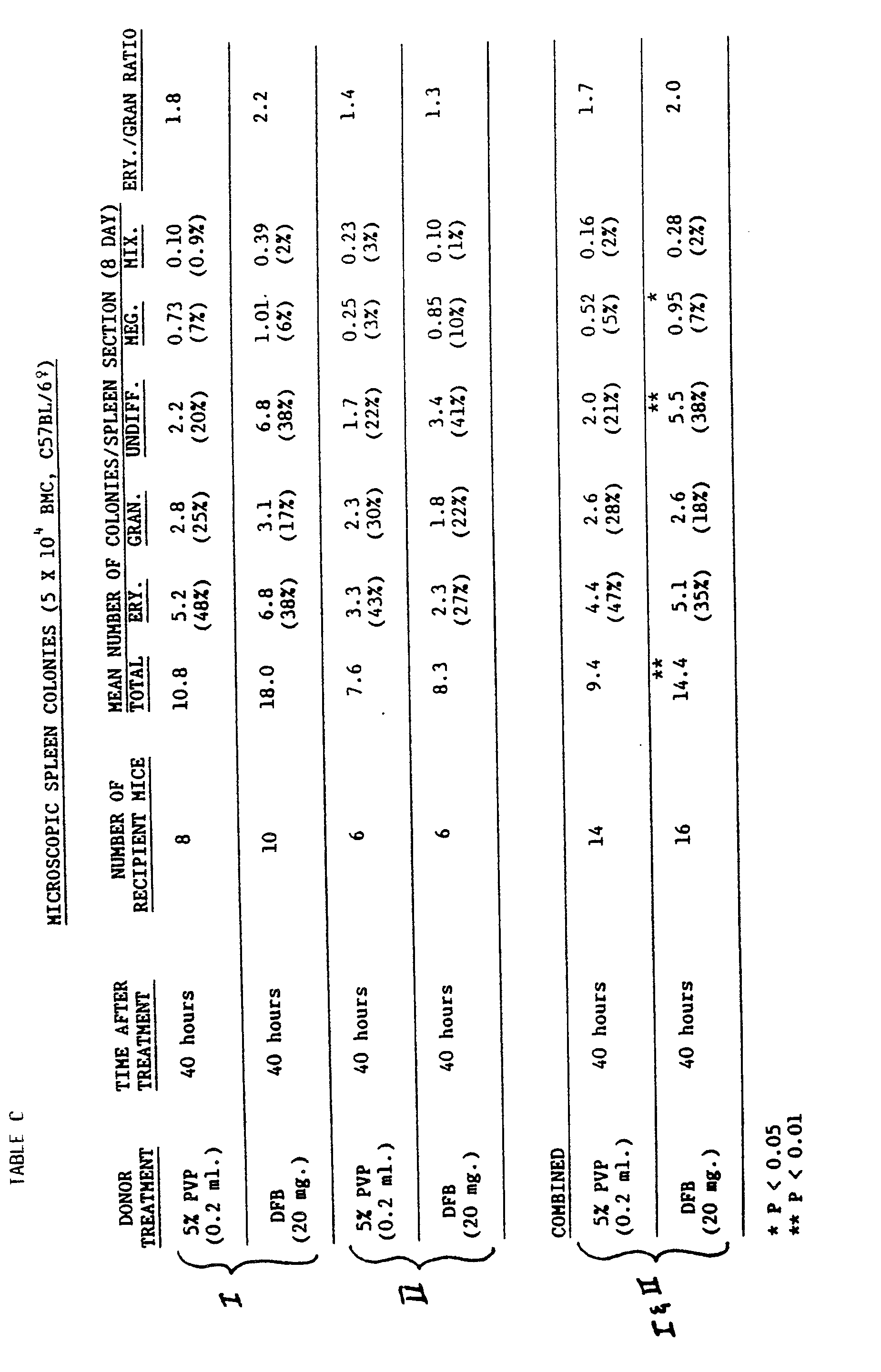
TABLE D IN VITRO BONE MARROW COLONIES (C57BL/6♀) TREATMENT TIME AFTER TREATMENT MEAN NUMBER BM CELLS±S.D.X10⁶PER FEMUR(NO.OF DONOR MICE) MEAN NUMBER CFUgm±S.D.PER 10⁵CELLS(NO.OF PLATES) MEAN NUMBER CFUgm ± S.D. PER FEMUR 5% PVP (0.2 ml.) 24 hours 18.3 ± 4.6 (3) 31.37 ± 3.28 (7) 5710 ± 518 (7) DFB (20 mg.) 24 hours 18.8 ± 8.0 (4) 68.88±14.4 (12)* 12944±1719(12)* 5% PVP (0.2 ml.) 40 hours 19.3 ± 5.7 (3) 34.35 ± 2.6 (8) 6602 ± 831 (8) DFB (20 mg.) 40 hours 20.4 ± 2.2 (4) 92.87±21.7(12)* 18742±2703(12)* * P=0.0000 - A murine bone marrow cell suspension is obtained by flushing the femurs of 7 week old B/CBA male mice with a sterile buffered salt solution. Clumps are dispersed by pushing them through a nylon sieve.
- Cells are diluted to an end concentration of 5x10⁴ cells/ml in Dulbecco's modified Eagle's medium supplemented with 20% (v/v) serum mixture of horse serum and foetal calf serum (2:1), L-asparagine and 0.3% (w//v) agar at a temperature of 40°C. Pregnant mouse uterus extract is added as a source of CSF.
- Drugs (5 mg/ml DMSO) are diluted in the above described serum mixture and added to the culture at drug end concentrations as indicated below. One ml aliquots of the culture mixture are plated and solidified by incubation for 15 min. at 4°C The cultures are subsequently incubated at 37°C in a humidified atmosphere consisting of 10% CO₂ in air for 7 days. All determinations are performed in triplicate. Colonies larger than 50 cells are counted with an inverted microscope.
- The results are compared with a blank consisting of a cell preparation incubated with solvent concentrations identical to those used in the experiments. If desired, dimethylformamide or polyvinylpyrrolidine is used as a solvent for the compound to be tested, instead of dimethylsulphoxide.
- The following compounds (numbers as indicated before) show a significant increase in the number of colonies, even at a concentration of 0.03 µg per ml (percentage compared to blank in parentheses): 3 (129), 4 (146), 5 (127), 6 (131), 7 (134), 8 (141), 9 (141), 10 (141), 12 (135), 13 (147), 14 (130), 15 (127), 17 (142), 18 (132), 22 (128), 23 (134), 24 (158), 25 (131), 26 (128), 28 (132), 29 (147), 30 (144), 31 (147), 32 (135), 33 (137), 34 (130), 35 (140), 37 (135), 39 (146), 40 (130), 44 (136), 45 (130), 46 (135), 48 (138), 53 (140), 54 (140), 55 (170), 58 (130), 59 (136), 60 (136), 61 (129), 62 (129), 63 (143), 64 (158), 65 (125), 66 (158), 70 (128), 71 (147), 72 (128), 73 (124), 75 (132) and 76 (123).
- The following compounds show a significant increase in the number of colonies at a concentration of 0.1 µg per ml: 11 (144), 16 (137), 19 (130), 20 (127), 21 (131), 27 (126), 36 (126), 38 (131), 41 (136), 42 (138), 47 (128), 50 (134), 51 (124), 52 (135), 56 (131), 57 (152), 67 (134), 68 (134), 69 (135), 74 (131) and 77 (143).
- To confirm the in vitro drug effects observed in Example II some selected drugs are tested for their in vivo activity.
- Five-week old male B/CBA mice (2 mice/group) are intraperitoneally injected with 20 mg drug/20 g body weight suspended in 0.2 ml of a 5% solution of polyvinylpyrrolidone. After 40 hours the mice are killed by cervical dislocation and their femurs are disected. Bone marrow cell suspensions are prepared as described in Example II and the femoral cell content is determined. The number of CFUgm per 5x10⁴ bone marrow cells is estimated as described in Example II and the number of CFUgm per femur is calculated. The following results, compared with the blank (5% polyvinylpyrrolidone) are obtained (in parentheses the factor with regard to the blank): 2 (2.31), 7 (2.02), 9 (2.70), 18 (1.83), 43 (2.63), 44 (2.27), 55 (2.30), 14 (2.93), 31 (2.77), 56 (2.42), 60 (2.76), 66 (2.05), 78 (3.60), 79 (2.96) and 80 (2.23).
- 2-Methylthiobenzamide in an amount of 1.67 g is suspended in 25 ml of dry xylene. After addition of 1.54 g of 4-chlorophenylisocyanate, the reaction mixture is refluxed over night. After cooling to room temperature the desired product crystallizes in a yield of 2.8 g, m.p. 211°C. The same result is obtained when 2-methylthiobenzoyl isocyanate is reacted with 4-chloroaniline.
- In a corresponding manner, in which, if desired, instead of xylene diethyl ether or acetonitrile is used as a solvent, the following compounds are prepared; compound numbers correspond with the numbers given before:
comp. no. melt. point (°C) comp. no. melt. point (°C) 4 125 54 112 5 101 55 188 31 228 59 124 42 * >280 67 140 48 93 78 191.5 * obtained from the corresponding 1-(2,6-dibenzyloxybenzoyl)-3-(4-chlorophenyl)urea by a reaction with HBr in acetic acid. - 1-(2-Fluoro-6 methoxybenzoyl)-3-(4-chlorophenyl)urea, obtained by the method as described in Example IV, is suspended in an amount of 2.5 g in 35 ml of methylene chloride. Thereupon 2.27 ml of borium tribromide (BBr₃) in 15 ml of methylene chloride is added dropwise in a nitrogen atmosphere at -75°C. After stirring for 0.5 hour at -70°C the reaction mixture is brought to room temperature. After stirring over night the reaction mixture is cooled again to -70°C and 25 ml of methanol is added dropwise. After the reaction mixture is warmed up to room temperature the formed precipitate is sucked off and washed with methylene chloride. The title compound is obtained in a yield of 2.1 g; melting point 215°C.
- In a corresponding manner the following compounds are prepared starting from the corresponding methoxy substituted compounds obtained according to Example IV. The compound numbers correspond again with the numbers given before in the specification:
comp. no. melt. point (°C) comp. no. melt. point (°C) 7 >250 50 203 19 >240 52 163 20 214 64 142 21 >250 65 147 22 233 73 182 29 206 74 >260 30 250 75 137 76 235 - To a stirred solution of 1.08 g of 4-trifluoromethylbenzoylisocyanate in 5 ml of dry diethylether is added a solution of 0.64 g of 4-chloroaniline in 50 ml of acetonitrile. A precipitate is immediately formed. The precipitate is sucked off and washed with acetonitrile. The title compound is obtained a yield of 1.1 g; melting point 260°C.
- In a corresponding manner, in which, if desired diethyl ether, acetonitrile or a mixture thereof is used as a solvent, the following compounds are obtained. For the required thiourea isothiocyanates are used as starting materials. The compound numbers corresponding again with the numbers given before:
comp. no. melt. point (°C) comp. no. melt. point (°C) 8 222 47 191 11 229 51 168 14 248 56 17 194 58 180 18 237 68 219 37 >260 69 240 41 165 70 201 79 186 80 188 - An amount of 13.1 g of 2-fluoro-6-dimethylaminobenzonitrile is dissolved in 40 ml of concentrated sulphuric acid. This mixture is heated for three hours at 95°C, subsequently poured on ice and made alkaline by adding a 25% aquous ammonia solution. The formed white precipitate is sucked off and washed with water. The title compound is obtained in a yield of 10.4 g.
- 1-(2-chloro-4-nitrobenzoyl)-3-(3,4-dichlorophenyl)urea, obtained by the method described in Example IV, is dissolved in an amount of 1.9 g in 20 ml of dimethylformamide and thereupon hydrogenated in the presence of PtO₂ as a catalyst for 24 hours. After separating the catalyst by suction, the filtrate is evaporated in vacuo and the residue boiled with isopropanol. After cooling down to room temperature the desired product is obtained in a yield of 1.5 g; melting point 280°C.
- In a corresponding manner compound no. 46, having a melting point of 153°C, is obtained.
- An amount of 2.2 g of 1-(2-chloro-6-benzyloxybenzoyl)-3-(4-trifluoromethylphenyl)urea, obtained by the method as described in Example VI, is dissolved in 20 ml of 48% hydrobromic acid in acetic acid. After stirring for 2.5 hours at 90°C a precipitate is formed. The reaction mixture is cooled to room temperature and the precipitate is sucked off; the precipitate is washed successively with acetic acid and water. The title compound is obtained in a yield of 1.47 g; melting point 264°C.
- In a corresponding manner the following compounds are obtained: compound no. 42, melting point >280°C and compound no. 77, melting point 188°C.
- 1-(2-methoxy-6-fluorobenzoyl)-3-(3-trifluoromethylphenyl)urea is dissolved in an amount of 1.0 g in 6 ml of dimethylformamide. The starting compound is obtained by the method as described in Example VI. Liquified dimethylamine in an amount of 0.5 ml is added and the reaction mixture is heated on 100°C for 4 hours in a sealed tube. After cooling down to room temperature the reaction mixture is poured on ice-water. The formed precipitate is filtered off and washed with water. The desired compound is obtained in a yield of 0.8 g; melting point 180°C.
- In a corresponding manner the following compounds are obtained; the numbers correspond again with the numbers given before:
comp. no. melt. point (°C) comp. no. melt. point (°C) 12 198 40 161 38 205
Claims (9)

R₁ is a phenyl group, a C₁-C₁₆ alkyl group, a C₆-C₁₂ (bridged) cycloalkyl group, a cyclohexydienyl group, a styryl group, a phenyl(C₁-C₄)alkyl group, an N-oxypyridyl group or a heteroaryl group having 1 or 2 nitrogen atoms in its nucleus, which groups may be substituted with one or more substituents selected from the group consisting of halogen, C₁-C₆ alkyl, C₁-C₄ haloalkyl, C₁-C₄ alkoxy, C₁-C₄ haloalkoxy, C₁-C₄ alkylthio, C₁-C₄ haloalkylthio, nitro, hydroxy, C₁-C₅ alkanoyloxy and amino, which amino group may be substituted with a C₂-C₅ alkanoyl group or with 1 or 2 C₁-C₄ alkyl groups which, together with the amino N, may form a heterocyclic ring;
X is an oxygen atom or a sulphur atom;
R₃ is a hydrogen atom, a C₁-C₄ alkyl group or a C₂-C₅ alkoxyalkyl group;
Y is an oxygen atom or a sulphur atom;
R₄ is a hydrogen atom or a C₁-C₄ alkyl group;
n is 0 or 1; and
R₂ is a hydrogen atom, a C₁-C₆ alkyl group, a phenyl group, a C₆-C₁₂ (bridged) cycloalkyl group, a phenyl(C₁-C₄) alkyl group or a heterocyclic group having 1-3 hetero atoms selected from N, O and S in its nucleus, which phenyl group, cycloalkyl group, phenylalkyl group and heterocyclic group may be substituted with one or more substituents selected from the group consisting of halogen, C₁-C₆ alkyl, C₁-C₄ haloalkyl, C₁-C₄ alkoxy, a C₁-C₄ haloalkoxy, C₁-C₄ alkylthio, C₁-C₄ haloalkylthio, C₁-C₄ alkylsulphinyl, C₁-C₄ haloalkylsulphinyl, C₁-C₄ alkylsulphonyl, C₁-C₄ haloalkylsulphonyl, optionally substituted C₃-C₁₂ cycloalkyl, optionally substituted C₃-C₁₂ cycloalkoxy, nitro, hydroxy, cyano, C₂-C₅ alkylcarbonyl, C₂-C₅ alkoxycarbonyl, optionally substituted benzoyl, optionally substituted phenoxy, optionally substituted phenyl(C₁-C₄)alkoxy, optionally substituted heteroaryloxy having 1 or 2 heteroatoms in its aromatic nucleus selected from N, O and S, and amino, which amino group may be substituted with a C₂-C₅ alkanoyl group or with 1 or 2 C₁-C₄ alkyl groups which, together with the amino N, may form a heterocyclic ring, which ring may comprise an additional N and may be substituted in its turn;
or wherein two of the said substituents together constitute a C₁-C₃ alkylenedioxy group or haloalkylenedioxy group.
R₁´―


wherein
R₁′ is a phenyl group, a cyclohexyl group, a cyclohexadie nyl group, an N-oxypyridyl group, a pyridyl group or a pyrrolyl group, which groups may be substituted (a) with 1-3 substituents selected from the group consisting of halogen, C₁-C₆ alkyl, C₁-C₄ haloalkyl, C₁-C₄ alkoxy, C₁-C₄ alkylthio, hydroxy, C₂-C₅ alkanoyloxy and amino, which amino group may be substitued with 1 or 2 C₁-C₄ alkyl groups, which, together with the amino N, may form a heterocyclic ring; or (b) with 4 or 5 halogen atoms;
R₂′ is a hydrogen atom, a C₁-C₄ alkyl group, a phenyl group, a cyclohexyl group or a heterocyclic group selected from pyridyl and thiadiazolyl, which phenyl group, cyclohexyl group and hetercyclic group may be substituted with 1-3 substituents selected from the group consisting of halogen, C₁-C₆ alkyl, C₁-C₄ haloalkyl, C₁-C₄ alkoxy, C₁-C₄ haloalkoxy, cyclohexyl, cyclohexyloxy, adamantyloxy, hydroxy, phenoxy, phenoxy substituted with halogen or C₁-C₄ haloalkyl, and amino, which amino group may be substituted with a C₂-C₅ alkanoyl group; and
X, Y and n have the meanings given in claim 1.
Applications Claiming Priority (2)
| Application Number | Priority Date | Filing Date | Title |
|---|---|---|---|
| US14184888A | 1988-01-11 | 1988-01-11 | |
| US141848 | 1988-01-11 |
Publications (2)
| Publication Number | Publication Date |
|---|---|
| EP0324521A2 true EP0324521A2 (en) | 1989-07-19 |
| EP0324521A3 EP0324521A3 (en) | 1991-11-27 |
Family
ID=22497538
Family Applications (1)
| Application Number | Title | Priority Date | Filing Date |
|---|---|---|---|
| EP19890200030 Withdrawn EP0324521A3 (en) | 1988-01-11 | 1989-01-06 | Method of treating haematologic diseases and pharmaceutical compositions to be used therefor |
Country Status (5)
| Country | Link |
|---|---|
| EP (1) | EP0324521A3 (en) |
| JP (1) | JPH02703A (en) |
| AU (1) | AU614012B2 (en) |
| DK (1) | DK5489A (en) |
| ZA (1) | ZA89135B (en) |
Cited By (9)
| Publication number | Priority date | Publication date | Assignee | Title |
|---|---|---|---|---|
| US5340810A (en) * | 1991-09-18 | 1994-08-23 | Glaxo Group Limited | Benzanilide derivatives |
| US5356893A (en) * | 1991-09-18 | 1994-10-18 | Glaxo Group Limited | Benzanilide derivatives |
| US5358948A (en) * | 1991-09-18 | 1994-10-25 | Glaxco Group Limited | Benzanilide derivatives |
| EP0861080A4 (en) * | 1995-11-13 | 1999-01-20 | Smithkline Beecham Corp | Hemoregulatory compounds |
| WO2003101927A1 (en) | 2002-05-31 | 2003-12-11 | Proteotech, Inc. | Compounds, compositions and methods for the treatment of amyloid diseases and synucleinopathies such as alzheimer's disease, type 2 diabetes, and parkinson's disease |
| US8513282B2 (en) | 2008-10-23 | 2013-08-20 | Vertex Pharmaceuticals Incorporated | Modulators of cystic fibrosis transmembrane conductance regulator |
| US8754133B2 (en) | 2001-11-02 | 2014-06-17 | Proteotech, Inc. | Compounds, compositions and methods for the treatment of inflammatory diseases |
| US9469605B2 (en) | 2002-05-31 | 2016-10-18 | Protamed, Inc. | Compounds and compositions for use a modulators of tau aggregation and alleviation of tauopathies |
| CN112876384A (en) * | 2021-01-20 | 2021-06-01 | 安阳市安林生物化工有限责任公司 | Synthesis process and application of diflubenzuron |
Families Citing this family (4)
| Publication number | Priority date | Publication date | Assignee | Title |
|---|---|---|---|---|
| IL88133A0 (en) * | 1987-10-26 | 1989-06-30 | Lilly Co Eli | N-phenylalkylbenzamide fungicides |
| DE10142878C5 (en) * | 2001-09-03 | 2007-01-25 | W.E.T. Automotive Systems Ag | Heating element with stranded contact |
| DE10302452B4 (en) * | 2003-01-23 | 2005-02-24 | Aventis Pharma Deutschland Gmbh | Carbonylamino-substituted acyl-phenyl-urea derivatives, processes for their preparation and their use |
| KR100929863B1 (en) * | 2009-05-19 | 2009-12-04 | (주)참우엔씨 | Waterproof, explosion proof, earthquake-proof construction method |
Family Cites Families (9)
| Publication number | Priority date | Publication date | Assignee | Title |
|---|---|---|---|---|
| AU1862083A (en) * | 1982-09-02 | 1984-03-08 | Duphar International Research B.V. | Tumor growth inhibitors |
| JPS6133176A (en) * | 1984-07-24 | 1986-02-17 | Ishihara Sangyo Kaisha Ltd | N-nitrobenzoyl-n'-pyridazinyloxyphenylurea compound, its preparation and carcinostatic agent containing said compound |
| JPS6193163A (en) * | 1984-10-12 | 1986-05-12 | Ishihara Sangyo Kaisha Ltd | N-benzoyl-n'-phenylurea compound, its preparation and carcinostatic agent containing same |
| ES8801896A1 (en) * | 1985-03-01 | 1988-03-01 | Duphar Int Res | Benzoyl urea derivatives having ati-tumor activity. |
| AU594098B2 (en) * | 1985-12-11 | 1990-03-01 | Ishihara Sangyo Kaisha Ltd. | N-benzoyl urea compounds, antitumorous compositions containing them, and process for their preparation |
| ES2024444B3 (en) * | 1986-03-10 | 1992-03-01 | American Cyanamid Co | METHOD FOR PREPARING FORMULATION OF THICK PILLS FOR SUSTAINED RELEASE. |
| TR24034A (en) * | 1988-02-26 | 1991-02-05 | Sumitomo Chemical Company Lmt | THE METHOD TO IMPROVE BENZOILUREA TUEREVI IT, INTECTIVE THAT REQUIRES THIS, THE REPORTING INTERMEDIATE AND ITS INTERMEDIATE METHOD |
| EP0336888A1 (en) * | 1988-03-18 | 1989-10-11 | Ciba-Geigy Ag | Pest control agent |
| IL90266A0 (en) * | 1988-05-20 | 1989-12-15 | Ciba Geigy Ag | Benzoylphenylureas |
-
1989
- 1989-01-06 DK DK005489A patent/DK5489A/en not_active Application Discontinuation
- 1989-01-06 EP EP19890200030 patent/EP0324521A3/en not_active Withdrawn
- 1989-01-06 ZA ZA89135A patent/ZA89135B/en unknown
- 1989-01-10 JP JP1002180A patent/JPH02703A/en active Pending
- 1989-01-11 AU AU28408/89A patent/AU614012B2/en not_active Ceased
Cited By (16)
| Publication number | Priority date | Publication date | Assignee | Title |
|---|---|---|---|---|
| US5340810A (en) * | 1991-09-18 | 1994-08-23 | Glaxo Group Limited | Benzanilide derivatives |
| US5356893A (en) * | 1991-09-18 | 1994-10-18 | Glaxo Group Limited | Benzanilide derivatives |
| US5358948A (en) * | 1991-09-18 | 1994-10-25 | Glaxco Group Limited | Benzanilide derivatives |
| US5510350A (en) * | 1991-09-18 | 1996-04-23 | Glaxo Group Limited | Benzanilide derivatives |
| EP0861080A4 (en) * | 1995-11-13 | 1999-01-20 | Smithkline Beecham Corp | Hemoregulatory compounds |
| US6114357A (en) * | 1995-11-13 | 2000-09-05 | Smithkline Beecham Corporation | Hemoregulatory compounds |
| US8754133B2 (en) | 2001-11-02 | 2014-06-17 | Proteotech, Inc. | Compounds, compositions and methods for the treatment of inflammatory diseases |
| AU2009202023B2 (en) * | 2002-05-31 | 2011-04-07 | Protamed, Inc. | Compounds, compositions and methods for the treatment of amyloid diseases and synucleinopathies such as Alzheimer's disease, type 2 diabetes, and Parkinson's disease |
| US8163957B2 (en) | 2002-05-31 | 2012-04-24 | Proteotech, Inc. | Compounds, compositions and methods for the treatment of amyloid diseases and synucleinopathies such as alzheimer's disease, type 2 diabetes and parkinson's disease |
| EP2527315A1 (en) * | 2002-05-31 | 2012-11-28 | Proteotech Inc. | Compounds, compositions and methods for the treatment of amyloid diseases and synucleinopathies such as Alzheimer's disease, type 2 diabetes and Parkinson's disease |
| WO2003101927A1 (en) | 2002-05-31 | 2003-12-11 | Proteotech, Inc. | Compounds, compositions and methods for the treatment of amyloid diseases and synucleinopathies such as alzheimer's disease, type 2 diabetes, and parkinson's disease |
| US9469605B2 (en) | 2002-05-31 | 2016-10-18 | Protamed, Inc. | Compounds and compositions for use a modulators of tau aggregation and alleviation of tauopathies |
| US8513282B2 (en) | 2008-10-23 | 2013-08-20 | Vertex Pharmaceuticals Incorporated | Modulators of cystic fibrosis transmembrane conductance regulator |
| US8598205B2 (en) | 2008-10-23 | 2013-12-03 | Vertex Pharmaceuticals Incorporated | Modulators of cystic fibrosis transmembrane conductance regulator |
| US8785640B2 (en) | 2008-10-23 | 2014-07-22 | Vertex Pharmaceuticals Incorporated | Modulators of cystic fibrosis transmembrane conductance regulator |
| CN112876384A (en) * | 2021-01-20 | 2021-06-01 | 安阳市安林生物化工有限责任公司 | Synthesis process and application of diflubenzuron |
Also Published As
| Publication number | Publication date |
|---|---|
| AU614012B2 (en) | 1991-08-15 |
| ZA89135B (en) | 1989-10-25 |
| DK5489D0 (en) | 1989-01-06 |
| AU2840889A (en) | 1989-07-13 |
| DK5489A (en) | 1989-07-12 |
| JPH02703A (en) | 1990-01-05 |
| EP0324521A3 (en) | 1991-11-27 |
Similar Documents
| Publication | Publication Date | Title |
|---|---|---|
| US6127384A (en) | Compounds, compositions and methods for treatment of hepatitis C | |
| AU614012B2 (en) | Method of treating haematologic diseases and pharmaceutical compositions to be used therefor | |
| US20080090842A1 (en) | Novel pyridyl cyanoguanidine compounds | |
| CZ290736B6 (en) | Use of isoxazole-4-carboxamides for preparing medicaments | |
| CA2577046A1 (en) | Chemokine combinations to mobilize progenitor/stem cells | |
| JP2009520697A (en) | Compounds having cytokine regulatory properties | |
| JP4057648B2 (en) | Thiols that promote the growth of hematopoietic progenitor cells | |
| RU2170577C2 (en) | Pharmaceutical composition containing n-chlorophenylcarbamate or n- chlorophenylthiocarbamate, composition of standard medicinal formula and method of treatment of cancer patients | |
| KR100424503B1 (en) | Metastasis suppressory agents | |
| EP0358150A2 (en) | Use of 5-(4-Chlorophenyl)-2,4-Dimethyl-3H-1,2,4-Triazole-3-thione for preparing drugs for the treatment of thrombocytosis | |
| US5166180A (en) | Method of treating hematologic diseases and pharmaceutical composition to be used therefor | |
| RU2730998C2 (en) | Phorbol ester compositions and methods of using them for treating or reducing duration of cytopenia | |
| EP0391971B1 (en) | Improving toxicity profiles in chemotherapy | |
| JPH02501930A (en) | Novel uses for pharmaceutical compounds | |
| US6077857A (en) | Hemoregulatory compounds | |
| US6194413B1 (en) | Hemoregulatory compounds | |
| JP2000500454A (en) | Blood regulatory compounds | |
| US6037357A (en) | N-benzoyl-α-alkylated azatyrosines as anticancer agents | |
| US6046197A (en) | Hemoregulatory compounds | |
| EP0127389B1 (en) | N,n-diethyl-5-methyl-2h-1-benzothiopyrano-(4,3,2-cd)-indazole-2-ethanamine, compositions comprising the same and uses therefor | |
| EP0362578A1 (en) | Treatment of cancer in mammals by concurrent administration of 4-quinoline carboxylic acid derivatives and interleukin-2 | |
| EP0398336A1 (en) | Xanthocillin X monomethyl ether derivative and antitumor agent containing the same | |
| JPH06192098A (en) | Inhibition agent for platelet coagulation | |
| US6114357A (en) | Hemoregulatory compounds | |
| EP0215200A2 (en) | Use of sulfanilamido quinoxalines in the treatment of neoplastic diseases |
Legal Events
| Date | Code | Title | Description |
|---|---|---|---|
| PUAI | Public reference made under article 153(3) epc to a published international application that has entered the european phase |
Free format text: ORIGINAL CODE: 0009012 |
|
| AK | Designated contracting states |
Kind code of ref document: A2 Designated state(s): AT BE CH DE ES FR GB GR IT LI LU NL SE |
|
| PUAL | Search report despatched |
Free format text: ORIGINAL CODE: 0009013 |
|
| AK | Designated contracting states |
Kind code of ref document: A3 Designated state(s): AT BE CH DE ES FR GB GR IT LI LU NL SE |
|
| 17P | Request for examination filed |
Effective date: 19920410 |
|
| 17Q | First examination report despatched |
Effective date: 19920922 |
|
| STAA | Information on the status of an ep patent application or granted ep patent |
Free format text: STATUS: THE APPLICATION IS DEEMED TO BE WITHDRAWN |
|
| 18D | Application deemed to be withdrawn |
Effective date: 19931019 |