EP0323145B1 - Equipment and method for supply of organic metal compound - Google Patents
Equipment and method for supply of organic metal compound Download PDFInfo
- Publication number
- EP0323145B1 EP0323145B1 EP88312191A EP88312191A EP0323145B1 EP 0323145 B1 EP0323145 B1 EP 0323145B1 EP 88312191 A EP88312191 A EP 88312191A EP 88312191 A EP88312191 A EP 88312191A EP 0323145 B1 EP0323145 B1 EP 0323145B1
- Authority
- EP
- European Patent Office
- Prior art keywords
- organic metal
- metal compound
- vessel
- carrier gas
- partition
- Prior art date
- Legal status (The legal status is an assumption and is not a legal conclusion. Google has not performed a legal analysis and makes no representation as to the accuracy of the status listed.)
- Expired - Lifetime
Links
Images
Classifications
-
- C—CHEMISTRY; METALLURGY
- C03—GLASS; MINERAL OR SLAG WOOL
- C03B—MANUFACTURE, SHAPING, OR SUPPLEMENTARY PROCESSES
- C03B31/00—Manufacture of rippled or crackled glass
-
- C—CHEMISTRY; METALLURGY
- C23—COATING METALLIC MATERIAL; COATING MATERIAL WITH METALLIC MATERIAL; CHEMICAL SURFACE TREATMENT; DIFFUSION TREATMENT OF METALLIC MATERIAL; COATING BY VACUUM EVAPORATION, BY SPUTTERING, BY ION IMPLANTATION OR BY CHEMICAL VAPOUR DEPOSITION, IN GENERAL; INHIBITING CORROSION OF METALLIC MATERIAL OR INCRUSTATION IN GENERAL
- C23C—COATING METALLIC MATERIAL; COATING MATERIAL WITH METALLIC MATERIAL; SURFACE TREATMENT OF METALLIC MATERIAL BY DIFFUSION INTO THE SURFACE, BY CHEMICAL CONVERSION OR SUBSTITUTION; COATING BY VACUUM EVAPORATION, BY SPUTTERING, BY ION IMPLANTATION OR BY CHEMICAL VAPOUR DEPOSITION, IN GENERAL
- C23C16/00—Chemical coating by decomposition of gaseous compounds, without leaving reaction products of surface material in the coating, i.e. chemical vapour deposition [CVD] processes
- C23C16/44—Chemical coating by decomposition of gaseous compounds, without leaving reaction products of surface material in the coating, i.e. chemical vapour deposition [CVD] processes characterised by the method of coating
- C23C16/448—Chemical coating by decomposition of gaseous compounds, without leaving reaction products of surface material in the coating, i.e. chemical vapour deposition [CVD] processes characterised by the method of coating characterised by the method used for generating reactive gas streams, e.g. by evaporation or sublimation of precursor materials
- C23C16/4481—Chemical coating by decomposition of gaseous compounds, without leaving reaction products of surface material in the coating, i.e. chemical vapour deposition [CVD] processes characterised by the method of coating characterised by the method used for generating reactive gas streams, e.g. by evaporation or sublimation of precursor materials by evaporation using carrier gas in contact with the source material
-
- B—PERFORMING OPERATIONS; TRANSPORTING
- B01—PHYSICAL OR CHEMICAL PROCESSES OR APPARATUS IN GENERAL
- B01J—CHEMICAL OR PHYSICAL PROCESSES, e.g. CATALYSIS OR COLLOID CHEMISTRY; THEIR RELEVANT APPARATUS
- B01J7/00—Apparatus for generating gases
Definitions
- the present invention relates to a supply equipment for stable supply of a solid organic metal compound in gaseous form which is a starting material for the formation of semiconductor film, superconductor film or the like of the compound.
- the invention is also concerned with a method for providing stable supply of a solid organic metal compound in gaseous form by using the supply instrument.
- MOCVD metal organic chemical vapor deposition
- MOMBE metal organic molecular beam epitaxy
- Vessels for supplying to the film-formation apparatus vapor of an organic metal compound which is a starting material for the film of semiconductor, for example, by transporting it by the use of the vapor pressure by means of carrier gas usually involve introducing through a capillary carrier gas that is inert to said organic metal compound into the liquid organic metal compound and collecting it after removed from the vessel in association with said carrier gas.
- organic metal compounds that are solid at ordinary temperature such as, for example, trimethylindium (m.p. 88.4°C) in general have been treated by the use of sublimation pressure in a vessel similar to the one for organic metal compounds that are liquid at ordinary temperature.
- vapor deposition method for forming film for example, of compound semiconductor or superconductor using an organic metal compound in gaseous phase it is desired to provide stable and continuous supply in gaseous phase to the film-formation apparatus of vaporizing organic metal compound feed which compound is solid or liquid in nature.
- GB 787076 discloses a cylindrical carburettor having organic metal compounds supported therein, on mesh screens, to permit the flow of a carrier gas therethrough from an inlet to an outlet.
- the object of the invention is to provide equipment for supplying, for example, to film-formation equipment feed gas substantially saturated with an organic metal compound in a constant or substantially constant concentration of the saturated gas at a stable flow rate even when flow rate of the carrier gas or amount of the organic compound remaining in the vessel are changed, and a method for providing such supply.
- equipment for providing a stable supply of a feed gas containing vaporised solid organic metal compound at a constant or substantially constant concentration comprising a cylindrical vessel having an upper part and a lower part; an inlet tube for a carrier gas for vaporizing said organic metal compound, an outlet tube for carrier gas substantially saturated with the vaporized organic metal compound; a chamber provided in a lower part of the vessel and connected to said carrier gas inlet tube; a packed bed of an organic metal compound formed above said chamber; and a partition with a plurality of pores and located in the lower part of the vessel between said chamber and said packed bed, whereby carrier gas introduced into said chamber passes through said partition to said packed bed, is substantially saturated with the organic metal compound and exits through said outlet tube connected to said upper part of the vessel, characterised in that the upper part of the vessel is of larger diameter than the lower part.
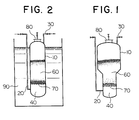
- FIG. 1 is a schematic view showing an example of structure of the vessel according to the invention
- Fig. 2 is a schematic view not in accordance with the invention showing a vessel placed in a thermostatic chamber
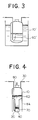
- Fig. 3 is a schemamtic view showing a prior art vessel
- Fig. 4 is a schematic view of the vessel of Fig. 1 which is additionally equipped with a skirt with the same diameter as that of the upper part of the vessel in order to assure stability in installation.
- organic metal compounds in the present invention are mentioned organic metal compounds that are solid at ordinary temperature such as biscyclopentadienylmagnesium, dicyclopentadienylmanganese, bismethylcyclopentadienylmagnesium, acetylacetonestrontium, bispentadienylstrontium, dimethoxystrontium, trimethylindium, dimethoxybarium, acetylacetonebarium, biscyclopentadienylbarium, trimethoxylanthanum, acetylacetonelanthanum, triscyclopentadienyllanthanum, trismethylcyclopentadienyllanthanum, trimethoxyyttrium, acetylacetoneyttrium and triscyclopentadienylytrium.
- organic metal compounds that are solid at ordinary temperature such as biscyclopentadienylmagnesium, dicyclopentadienylmanganese, bismethylcyclopent
- the carrier gas used in the invention are mentioned those which are inert to the above-mentioned organic metal compounds such as, for example, hydrogen, nitrogen, argon and helium.
- Pressure of, the gas is as high as about 200-2000 Torr (26.67-266.7KN/m2) that the pressure will approximately be equal to pressure of the vessel in use.
- the carrier gas is introduced from the chamber below the bottom of the packed bed, flowed through the packed bed in association with vapor of an organic metal compound and removed out of the system from the top of the packed tower.
- the temperature range for the carrier gas may be varied according to the vapor pressure of said organic metal compound and may be appropriately selected in accordance with the vapor pressure. Usually, it is about in the range between 0 and 100°C.
- the introduction tube for the carrier gas is constructed in such a manner that it is capable of being exchanged in contact with the heating medium as is the body of the vessel placed in a thermostatic chamber.
- Heating means by an electric heater or an infrared heater may be employed in place of the heating medium provided that it is capable of maintaining the vessel at a predetermined temperature.
- the thermostatic chamber as referred to in the invention is intended to cover those which are operated by such various heating means. Descriptions will be given below with reference to a thermostatic chamber as representative of these thermostatically heating means.
- Fig. 1 is a schematic view showing structure of an example of the organic metal compound vessels according to the invention. The drawing, however, is not intended to limit the invention in any way.
- the vessel in the invention comprises the cylindrical vessel 10 in which the organic metal compound 60 is housed, the inlet tube 20 for carrier gas to vaporize said organic metal compound and the outlet tube 30 for removing the carrier gas substantially saturated with the vaporized organic metal compound.
- the chamber 40 which is connected with said carrier gas inlet tube.
- the organic metal compound packed bed 60 Above said chamber is formed the organic metal compound packed bed 60.
- Said chamber is separated from said packed bed by the partition (or holding plate) 70 having a plurality of pores.
- Carrier gas introduced into said chamber is delivered through said partition 70 to said organic metal compound packed bed 60 and passed through it.
- the carrier gas is substantially saturated with the organic metal compound while passing through the packed bed and removed through the effluent tube 30 at the top of said vessel.
- the cylindrical vessel used in the invention has a larger diameter in the upper part than in the lower part. This assists processability in fabrication and simplicity in supplying and packing the solid organic metal compound. Moreover, arranging for the upper part to have a larger diameter than that of the lower part enables a decreased gas flow rate thus avoiding association of fine particles of the solid organic metal compound with the carrier gas out of the vessel. Also, a relatively small diameter of the part for the packed bed at least facilitates prevention of channelling of the carrier gas to result in its uniform contact with the organic metal compound. As shown, a tapered part is provided at the connection between the upper part of larger diameter and the lower part of smaller diameter so as to allow for smooth supply of the solid organic metal compound flowing downward.
- a vessel as described above is preferably soaked in a thermostatic chamber, as illustrated in Figure 2.
- Said thermostatic chamber is filled with heating medium 90 at a predetermined temperature, in which the inlet tube 20 for carrier gas for vaporizing said organic metal compound is immersed.
- the carrier gas supplied from said introduction tube is heat exchanged with said medium and heated to a temperature necessary for vaporizing said organic metal compound. It is then introduced through the introduction tube into the chamber 40 in the vessel. It is preferred that said chamber occupies about 1-20% of entire volume of the vessel.
- Said carrier gas is flowed through a large number of pores into the packed bed and vaporizes said organic metal compound while flowing through said packed bed thereby being substantially saturated with the compound.
- the gas saturated with the vaporized organic metal compound is removed through the carrier gas outlet tube 30 at the top.
- the carrier gas inlet tube 20 may be provided at the top of the cylindrical vessel and directed downward in parallel with the wall inside the cylindrical vessel in such a way that outlet of the end is inserted in the chamber 40.
- the organic metal compound in the invention is a solid material about 0.1 - 5 mm in size. Bed packed with it is readily formed by pouring the solid material of said organic metal compound from the top of the cylindrical vessel. Preferably, there is provided the feed packing port 80 from which the feed solid material is poured. The poured organic metal compound is then held on the partition or holding plate 70 installed in the lower part of the vessel and accumulated on it to form a packed bed. Carrier gas which has been heat exchanged with the medium 90 by passing through the carrier gas introduction tube 20 and then through the partition 70 to be heated to a temperature necessary for vaporizing said organic metal compound comes into contact with it within the packed bed 60 and is led out of the system through the saturated vapor effluent tube 30. The saturated vapor of the organic metal compound thus produced is used for the preparation of film of a semiconductor or a superconductor.
- the partition or holding plate 70 is in the form of, for example, metallic mesh, perforated plate or multipore plate. It may be in any shape and in any material and appropriately selected provided that it can support the packed bed formed by the solid organic metal compound, have a large number of pores and allow for easy flow of the carrier gas. Diameter of the pores is preferably about 0.1 - 1 mm, and the number of pores is about 10-200. It is preferred that the partition is firmly adhered to the wall of the cylindrical vessel by welding. As clearly seen from examples of the invention described below, the invention produces especially remarkable results in general when an organic metal compound that is solid at ordinary temperature.
- Figure 4 shows a vessel according to Fig. 1 in which a skirt 82 of the same diameter as that of the upper part of the vessel is provided to improve setting stability.
- the carrier gas introduction tube 20 and the saturated vapor outlet tube 30 are firmly adhered to the cylindrical vessel, for example, by welding.
- a gas circuit breaker such as valve.
- the feed supply port 80 at the top of the vessel is firmly adhered to the vessel and is preferably equipped with such a breaker such as a valve.
- the diameter of the lower cylinder is about 0.5-4 cm, more specifically about 1-3 cm, and the diameter of the larger upper cylinder is about 2-10 cm, more specifically about 3-7 cm.
- H/R about 1-20 wherein H represents effective height of the vessel and R represents the diameter of the cylinder.
- Volume of the vessel V is preferably about 50 - 10,000 ml.
- Choice of material for the vessel is not limited, and the material may be of glass, resin or metal provided that it is inert to the organic metal compound to be housed therein.
- metals in general are acceptable in consideration of such factors as safety during transportation.
- stainless steel is preferred.
- Such a grade of stainless steel as SUS304 or SUS316 is satisfactory.
- semiconductor gas such as silane or germane is commercially supplied from manufacturer to user in a bomb.
- the user in turn obtains a stable supply of semiconductor gas by connecting said bomb in a pipe arrangement via such an instrument as a mass flow controller to the production equipment for semiconductor film.
- the vessel of the invention as shown in Fig. 1 which is used in the technical field of semiconductor film manufacturing is marketed with amounts of organic metal compound, such as several grams to ten and some grams, at most several hundred grams, in a tightly sealed housing. It is therefore to be recognized that the vessel is small enough to be readily transported.
- Example-1 An experiment was run in the same way as in Example-1 except that a prior-art vessel shown in Fig. 3 was used. Results are shown in Table-1. Table-1 Set Temperature Example-1 Example-1A 10°C 0.97 0.79 20°C 0.96 0.71
- Example-2 An experiment was run in the same way as in Example-2 except that a prior-art vessel (38 mm in diameter, 150 mm in height and 150 ml in inner volume) was used. Results are shown in Table-2.
- Table-2 Set Temperature Example-2 Comparative Example-2 10°C 0.99 0.84 20°C 0.98 0.72
- Example-2 The vessel used in Example-2 filled with 20g of trimethylindium was soaked in a thermostatic chamber maintained at 10°C.
- the upper saturated vapor efferent tube 5 was connected to gas chromatography (called GC for short).
- the carrier gas was flowed in the same way as in Example-1. Concentration of the trimethylindium was measured for 2 hours after the system became steady. Results are shown in Table-3.
- Example-4 An experiment was run in the same way as in Example-4 except that the vessel of Comparative Example-1A was used. The vapor concentration was generally low and variable. Results are shown in Table-4. Table-4 Amount filled Example-4 Comparative Example-4 1 0.94 0.61 3 0.98 0.54 6 0.99 0.73 9 1.00 0.88 12 0.98 0.85 15 1.01 0.76 20 0.99 0.84
- the invention represents a method or the film formation of semiconductor or superconductor by gas-phase deposition of an organic metal compound which enables flow control at a constant concentration and stable supply of such gas in entirely the same sense as in the case of the prior-art gas for the production of semiconductor such as silane and germane.
- the method can be said to be of very high industrial applicability.
Landscapes
- Chemical & Material Sciences (AREA)
- Organic Chemistry (AREA)
- Chemical Kinetics & Catalysis (AREA)
- Engineering & Computer Science (AREA)
- Materials Engineering (AREA)
- General Chemical & Material Sciences (AREA)
- Mechanical Engineering (AREA)
- Metallurgy (AREA)
- Chemical Vapour Deposition (AREA)
- Feeding, Discharge, Calcimining, Fusing, And Gas-Generation Devices (AREA)
- Superconductor Devices And Manufacturing Methods Thereof (AREA)
- Superconductors And Manufacturing Methods Therefor (AREA)
Description
- The present invention relates to a supply equipment for stable supply of a solid organic metal compound in gaseous form which is a starting material for the formation of semiconductor film, superconductor film or the like of the compound.
- The invention is also concerned with a method for providing stable supply of a solid organic metal compound in gaseous form by using the supply instrument.
- In recent years, vapor deposition method in gaseous phase using an organic metal compound has remarkably progressed for film formation of semiconductor, super conductor or the like of the compound. Compound semiconductors are prepared by such methods as so-called MOCVD (metal organic chemical vapor deposition) and MOMBE (metal organic molecular beam epitaxy) . Using high-grade film controlling technique according to such methods, high-capacity semiconductor lasers, for example, are produced on a trial basis, some of which are now at a stage of large-scale production. Extensive studies have also been done on the formation or semiconductors that have physical properties never existing in nature by artificially controlling the film on the level of atom layer. It is expected that such semiconductors will soon be in practical use.
- Vessels for supplying to the film-formation apparatus vapor of an organic metal compound which is a starting material for the film of semiconductor, for example, by transporting it by the use of the vapor pressure by means of carrier gas (shown in Fig. 4) usually involve introducing through a capillary carrier gas that is inert to said organic metal compound into the liquid organic metal compound and collecting it after removed from the vessel in association with said carrier gas.
- Heretofore, organic metal compounds that are solid at ordinary temperature such as, for example, trimethylindium (m.p. 88.4°C) in general have been treated by the use of sublimation pressure in a vessel similar to the one for organic metal compounds that are liquid at ordinary temperature.
- In the vapor deposition method for forming film, for example, of compound semiconductor or superconductor using an organic metal compound in gaseous phase it is desired to provide stable and continuous supply in gaseous phase to the film-formation apparatus of vaporizing organic metal compound feed which compound is solid or liquid in nature.
- There has been in the prior-art method using a vessel as shown in Fig. 3 when a solid organic metal compound is used as the starting material a problem that the carrier gas is apt to be ventilated through crystals of the starting material thereby causing channelling with a result that the outlet vapor is not saturated. Poor controllability due to variation in flow rate of the carrier gas and low stability in the degree of saturation have also been problematic.
- Such instability behaviours occurred more frequently as the organic metal compound was used up and the amount remaining in the vessel diminished, however they ware when the compound was fully packed. Therefore, they produced bad influence upon controllability and reproducability in the film-formation reaction using a gaseous organic metal compound.
- GB 787076 discloses a cylindrical carburettor having organic metal compounds supported therein, on mesh screens, to permit the flow of a carrier gas therethrough from an inlet to an outlet.
- One of the disadvantages of this carburettor is that the carrier gas velocity is kept relatively high and as such the flow is not laminar and there is loss of the organic metal compound by entrainment.
- The object of the invention is to provide equipment for supplying, for example, to film-formation equipment feed gas substantially saturated with an organic metal compound in a constant or substantially constant concentration of the saturated gas at a stable flow rate even when flow rate of the carrier gas or amount of the organic compound remaining in the vessel are changed, and a method for providing such supply.
- According to the present invention, there is provided equipment for providing a stable supply of a feed gas containing vaporised solid organic metal compound at a constant or substantially constant concentration, the equipment comprising a cylindrical vessel having an upper part and a lower part; an inlet tube for a carrier gas for vaporizing said organic metal compound, an outlet tube for carrier gas substantially saturated with the vaporized organic metal compound; a chamber provided in a lower part of the vessel and connected to said carrier gas inlet tube; a packed bed of an organic metal compound formed above said chamber; and a partition with a plurality of pores and located in the lower part of the vessel between said chamber and said packed bed, whereby carrier gas introduced into said chamber passes through said partition to said packed bed, is substantially saturated with the organic metal compound and exits through said outlet tube connected to said upper part of the vessel, characterised in that the upper part of the vessel is of larger diameter than the lower part.
- Reference will now be made, by way of example, to the accompanying drawings, in which:-
Fig. 1 is a schematic view showing an example of structure of the vessel according to the invention; Fig. 2 is a schematic view not in accordance with the invention showing a vessel placed in a thermostatic chamber; Fig. 3 is a schemamtic view showing a prior art vessel; and Fig. 4 is a schematic view of the vessel of Fig. 1 which is additionally equipped with a skirt with the same diameter as that of the upper part of the vessel in order to assure stability in installation. - The invention will be described in more detail below.
- As the organic metal compound in the present invention are mentioned organic metal compounds that are solid at ordinary temperature such as biscyclopentadienylmagnesium, dicyclopentadienylmanganese, bismethylcyclopentadienylmagnesium, acetylacetonestrontium, bispentadienylstrontium, dimethoxystrontium, trimethylindium, dimethoxybarium, acetylacetonebarium, biscyclopentadienylbarium, trimethoxylanthanum, acetylacetonelanthanum, triscyclopentadienyllanthanum, trismethylcyclopentadienyllanthanum, trimethoxyyttrium, acetylacetoneyttrium and triscyclopentadienylyttrium.
- As the carrier gas used in the invention are mentioned those which are inert to the above-mentioned organic metal compounds such as, for example, hydrogen, nitrogen, argon and helium. Pressure of, the gas is as high as about 200-2000 Torr (26.67-266.7KN/m²) that the pressure will approximately be equal to pressure of the vessel in use.
- The carrier gas is introduced from the chamber below the bottom of the packed bed, flowed through the packed bed in association with vapor of an organic metal compound and removed out of the system from the top of the packed tower.
- An important matter is that it is especially preferable to maintain the carrier gas to be introduced into the packed bed at a temperature necessary for vaporizing the organic metal compound. The temperature range for the carrier gas may be varied according to the vapor pressure of said organic metal compound and may be appropriately selected in accordance with the vapor pressure. Usually, it is about in the range between 0 and 100°C. In order to meet the above requirement, the introduction tube for the carrier gas is constructed in such a manner that it is capable of being exchanged in contact with the heating medium as is the body of the vessel placed in a thermostatic chamber. Thus, such construction more advantageously enables stable supply of the gas saturated with vapor of the organic metal compound. Heating means by an electric heater or an infrared heater may be employed in place of the heating medium provided that it is capable of maintaining the vessel at a predetermined temperature. The thermostatic chamber as referred to in the invention is intended to cover those which are operated by such various heating means. Descriptions will be given below with reference to a thermostatic chamber as representative of these thermostatically heating means.
- Preferred embodiments of the invention will further be described in details with reference to attached drawings.
- Fig. 1 is a schematic view showing structure of an example of the organic metal compound vessels according to the invention. The drawing, however, is not intended to limit the invention in any way.
- As shown in Fig. 1, the vessel in the invention comprises the
cylindrical vessel 10 in which theorganic metal compound 60 is housed, theinlet tube 20 for carrier gas to vaporize said organic metal compound and theoutlet tube 30 for removing the carrier gas substantially saturated with the vaporized organic metal compound. - In the lower part of the vessel is provided the
chamber 40 which is connected with said carrier gas inlet tube.
Above said chamber is formed the organic metal compound packedbed 60. Said chamber is separated from said packed bed by the partition (or holding plate) 70 having a plurality of pores. Carrier gas introduced into said chamber is delivered through saidpartition 70 to said organic metal compound packedbed 60 and passed through it. - The carrier gas is substantially saturated with the organic metal compound while passing through the packed bed and removed through the
effluent tube 30 at the top of said vessel. - The cylindrical vessel used in the invention has a larger diameter in the upper part than in the lower part. This assists processability in fabrication and simplicity in supplying and packing the solid organic metal compound. Moreover, arranging for the upper part to have a larger diameter than that of the lower part enables a decreased gas flow rate thus avoiding association of fine particles of the solid organic metal compound with the carrier gas out of the vessel. Also, a relatively small diameter of the part for the packed bed at least facilitates prevention of channelling of the carrier gas to result in its uniform contact with the organic metal compound. As shown, a tapered part is provided at the connection between the upper part of larger diameter and the lower part of smaller diameter so as to allow for smooth supply of the solid organic metal compound flowing downward.
- In using such vessel for stable supply of the feed gas substantially saturated with an organic metal compound, first a vessel as described above is preferably soaked in a thermostatic chamber, as illustrated in Figure 2.
- Said thermostatic chamber is filled with
heating medium 90 at a predetermined temperature, in which theinlet tube 20 for carrier gas for vaporizing said organic metal compound is immersed. The carrier gas supplied from said introduction tube is heat exchanged with said medium and heated to a temperature necessary for vaporizing said organic metal compound. It is then introduced through the introduction tube into thechamber 40 in the vessel. It is preferred that said chamber occupies about 1-20% of entire volume of the vessel. Said carrier gas is flowed through a large number of pores into the packed bed and vaporizes said organic metal compound while flowing through said packed bed thereby being substantially saturated with the compound. The gas saturated with the vaporized organic metal compound is removed through the carriergas outlet tube 30 at the top. The carriergas inlet tube 20 may be provided at the top of the cylindrical vessel and directed downward in parallel with the wall inside the cylindrical vessel in such a way that outlet of the end is inserted in thechamber 40. - It is preferred that the organic metal compound in the invention is a solid material about 0.1 - 5 mm in size. Bed packed with it is readily formed by pouring the solid material of said organic metal compound from the top of the cylindrical vessel. Preferably, there is provided the
feed packing port 80 from which the feed solid material is poured. The poured organic metal compound is then held on the partition or holdingplate 70 installed in the lower part of the vessel and accumulated on it to form a packed bed. Carrier gas which has been heat exchanged with the medium 90 by passing through the carriergas introduction tube 20 and then through thepartition 70 to be heated to a temperature necessary for vaporizing said organic metal compound comes into contact with it within the packedbed 60 and is led out of the system through the saturatedvapor effluent tube 30. The saturated vapor of the organic metal compound thus produced is used for the preparation of film of a semiconductor or a superconductor. - The partition or holding
plate 70 is in the form of, for example, metallic mesh, perforated plate or multipore plate. It may be in any shape and in any material and appropriately selected provided that it can support the packed bed formed by the solid organic metal compound, have a large number of pores and allow for easy flow of the carrier gas. Diameter of the pores is preferably about 0.1 - 1 mm, and the number of pores is about 10-200. It is preferred that the partition is firmly adhered to the wall of the cylindrical vessel by welding. As clearly seen from examples of the invention described below, the invention produces especially remarkable results in general when an organic metal compound that is solid at ordinary temperature. - Figure 4 shows a vessel according to Fig. 1 in which a
skirt 82 of the same diameter as that of the upper part of the vessel is provided to improve setting stability. - In the vessel of the invention, the carrier
gas introduction tube 20 and the saturatedvapor outlet tube 30 are firmly adhered to the cylindrical vessel, for example, by welding. Desirably there is further provided a gas circuit breaker such as valve. Also, thefeed supply port 80 at the top of the vessel is firmly adhered to the vessel and is preferably equipped with such a breaker such as a valve. When an organic metal compound in around such an amount as used in examples given below is housed and treated, typically the diameter of the lower cylinder is about 0.5-4 cm, more specifically about 1-3 cm, and the diameter of the larger upper cylinder is about 2-10 cm, more specifically about 3-7 cm. It is preferred that H/R = about 1-20 wherein H represents effective height of the vessel and R represents the diameter of the cylinder. Volume of the vessel V is preferably about 50 - 10,000 ml. - Choice of material for the vessel is not limited, and the material may be of glass, resin or metal provided that it is inert to the organic metal compound to be housed therein. Usually, metals in general are acceptable in consideration of such factors as safety during transportation. Among them stainless steel is preferred. Such a grade of stainless steel as SUS304 or SUS316 is satisfactory.
- Heretofore, so-called semiconductor gas such as silane or germane is commercially supplied from manufacturer to user in a bomb. The user in turn obtains a stable supply of semiconductor gas by connecting said bomb in a pipe arrangement via such an instrument as a mass flow controller to the production equipment for semiconductor film.
- Unlike the so-called semiconductor gas such as silane or germane, however, organic metal compounds, for example solid trimethylindium, are commercially supplied in a vessel of the shape as shown in Fig. 3, and therefore it is difficult to have a stable supply of the feed vapor at a constant concentration from the vessel. This is because a stable supply of the feed gas would by no means be feasible by setting of the vessel by the user in a thermostatic chamber as shown in Fig. 4, passing a carrier gas to the vessel to vaporize the feed and supplying the vapor to production equipment for semiconductor film. As described above, and also as clearly seen from comparative examples, stable supply of the feed vapor at a constant concentration can by no means be achieved, leaving a big problem to users for the manufacturing semiconductor equipment.
- In the vessel of Fig. 1, on the contrary, there is housed in tight sealing in a cylindrical vessel an organic metal compound in the form of a solid packed bed. The feed gas, tightly sealed in a housing in the form of a bomb, is commercially supplied to users in entirely the same manner as the current supply of semiconductor gas filled in a bomb. Therefore, as shown in Fig. 2, the bomb is immersed in a thermostatic chamber together with a carrier gas introduction tube, a gas effluent tube is connected to equipment for the production of semiconductor film, and carrier gas is introduced into the system. Only such arrangements very easily allow for stable supply of the feed gas for forming the film at a constant concentration substantially independent of quantities of the carrier gas and the organic metal. Such supply could be as easy as supply of silane gas from bomb. It is to be noted that the vessel of the invention as shown in Fig. 1 which is used in the technical field of semiconductor film manufacturing is marketed with amounts of organic metal compound, such as several grams to ten and some grams, at most several hundred grams, in a tightly sealed housing. It is therefore to be recognized that the vessel is small enough to be readily transported.
- In a SUS316 vessel (38 mm in diameter, 150 mm in height and 150 ml in inner volume) was filled 50 g of trimethylindium. As the partition wall was used a perforated plate (1 mm in pore size x 50). The vessel was soaked in a thermostatic chamber set at 10°C or20°C, and high-purity hydrogen as carrier gas was supplied at a rate of 10 ml/min, by means of a mass flow controller. After the system reached steady state, outlet gas was treated with IN aqueous HCl for 30 min. to decompose trimethylindium, and indium concentration in said solution was analyzed by ICP analysis (induction coupling plasma emission spectrophotometry) to determine degree of saturation against theoretical value for trimethylindium in the outlet gas. Results are shown in Table-1.
- An experiment was run in the same way as in Example-1 except that a prior-art vessel shown in Fig. 3 was used. Results are shown in Table-1.
Table-1 Set Temperature Example-1 Example- 1A 10°C 0.97 0.79 20°C 0.96 0.71 - In a SUS316 vessel according to the invention (38 mm in diameter of the upper cylindrical part, 13 mm in diameter of the lower cylindrical part, 50 mm in length of the lower part and 90 ml in inner volume) was filled 20 g of trimethylindium. As the partition was employed a perforated plate ( 1 mm in pore size x 15). The vessel was soaked in a thermostatic chamber set at 10°C or 20°C and high-purity hydrogen as carrier gas was supplied at a rate of 10 ml/min. After the system reached steady state, the outlet gas was treated in IN aqueous HCl for 30 min. to decompose the trimethylindium. Indium concentration in said solution was analyzed by ICP analysis (induction coupling plasma emission spectrophotometry) to determine degree of saturation against theoretical value for trimethylindium in the outlet gas. Results are shown in Table-2.
- An experiment was run in the same way as in Example-2 except that a prior-art vessel (38 mm in diameter, 150 mm in height and 150 ml in inner volume) was used. Results are shown in Table-2.
Table-2 Set Temperature Example-2 Comparative Example-2 10°C 0.99 0.84 20°C 0.98 0.72 - The vessel used in Example-2 filled with 20g of trimethylindium was soaked in a thermostatic chamber maintained at 10°C. The upper saturated vapor efferent tube 5 was connected to gas chromatography (called GC for short). The carrier gas was flowed in the same way as in Example-1. Concentration of the trimethylindium was measured for 2 hours after the system became steady. Results are shown in Table-3.
- An experiment was run in the same way as in Example-3 except that the vessel used in Comparative Example-1A was employed. The vapor did not reach saturated state due to channelling of the carrier gas and other conditions. Results are shown in Table-3.
Table-3 Time elapsed (min) Peak height in GC Example-3 Comparative Example-3 0 89 72 15 90 74 30 91 72 45 91 74 60 88 77 75 90 76 90 90 78 105 90 80 120 90 78 Mean 89.5 75.2 Standard deviation 1.23 2.89 - Relationship between amount of filled trimethylindium and degree of saturation for the outlet gas against theoretical value was determined in an experiment carried out in the same way as in Example-2 in a thermostatic chamber maintained at 10°C. Stable production of the saturated vapor was achieved with trimethylindium in a remaining amount up to about 3 g. Results are shown in Table-4.
- An experiment was run in the same way as in Example-4 except that the vessel of Comparative Example-1A was used. The vapor concentration was generally low and variable. Results are shown in Table-4.
Table-4 Amount filled Example-4 Comparative Example-4 1 0.94 0.61 3 0.98 0.54 6 0.99 0.73 9 1.00 0.88 12 0.98 0.85 15 1.01 0.76 20 0.99 0.84 - Concentration of trimethylindium was measured in the same way as in Example-3 except that the temperature of the thermostatic chamber was changed to 20°C and the flow rate of the carrier gas was changed stepwise from 10 ml/min. to 100 ml/min. while monitoring the outlet gas by GC. Results are shown in Table-5.
- An experiment was run in the same way as in Example-4 except that the vessel of Comparative Example-1A was employed. The faster the flow rate of the carrier gas, the lower was the concentration of trimethylindium. Results are shown in Table-5.
Table-5 Time elapsed (min.) Flow rate of the carrier gas (ml/min.) Peak height in GC Example-5 Comparative Example-5 0 10 319 228 15 10 321 231 30 10 318 238 45 20 315 210 60 20 318 230 75 20 318 235 90 50 317 165 105 50 315 207 120 50 320 201 135 100 315 160 150 100 317 127 165 100 318 183 180 10 318 190 195 10 315 156 210 10 319 209 - The invention represents a method or the film formation of semiconductor or superconductor by gas-phase deposition of an organic metal compound which enables flow control at a constant concentration and stable supply of such gas in entirely the same sense as in the case of the prior-art gas for the production of semiconductor such as silane and germane. The method can be said to be of very high industrial applicability.
Claims (10)
- Equipment for providing a stable supply of a feed gas containing vaporised solid organic metal compound (60) at a constant or substantially constant concentration, the equipment comprising:-
a cylindrical vessel (10) having an upper part and a lower part;
an inlet tube (20) for a carrier gas for vaporizing said organic metal compound, an outlet tube (30) for carrier gas substantially saturated with the vaporized organic metal compound,
a chamber (40) provided in the lower part of the vessel and connected to said carrier gas inlet tube,
a packed bed (60) of said organic metal compound formed above said chamber, and
a partition (70) with a plurality of pores and located in the lower part of the vessel between said chamber and said packed bed, whereby carrier gas introduced into said chamber passes through said partition to said packed bed, is substantially saturated with the organic metal compound and exits through said outlet tube connected to said upper part of the vessel, characterised in that the upper part of the vessel is of larger diameter than the lower part. - Equipment according to Claim 1, wherein the upper and lower parts are connected by a tapered part.
- Equipment according to Claim 1 or Claim 2, wherein the portion above the partition (70) in the vessel is substantially filled with the organic metal compound (60).
- Equipment according to any of Claims 1 to 3, wherein the partition (70) is a multipore plate.
- Equipment according to any of Claims 1 to 3, wherein the partition (70) is a mesh.
- Equipment according to any of Claims 1 to 3, wherein the partition (70) is a perforated plate.
- Equipment according to any one of the preceding claims, wherein the carrier gas inlet tube (20) and the outlet tube (30) are each provided with a valve.
- Equipment according to any one of the preceding claims, which is in the form of a housing for the organic metal compound.
- Method for providing a stable supply of a feed gas substantially saturated with a solid organic metal compound (60) which comprises:-
immersing the equipment of any preceding Claim in a thermostatic chamber,
introducing carrier gas through a carrier gas inlet tube (20) maintained at a constant temperature sufficient to vaporize said organic metal compound (60); and
flowing said carrier gas through said packed bed (60) to vaporize said organic metal compound thereby substantially saturating the gas with the compound. - Method according to Claim 9, wherein the gas substantially saturated with the organic metal compound is suitable for use as a feed gas for film-formation.
Applications Claiming Priority (2)
| Application Number | Priority Date | Filing Date | Title |
|---|---|---|---|
| JP62325385A JPH01168331A (en) | 1987-12-24 | 1987-12-24 | Process for saturating organic metallic compound |
| JP325385/87 | 1987-12-24 |
Publications (2)
| Publication Number | Publication Date |
|---|---|
| EP0323145A1 EP0323145A1 (en) | 1989-07-05 |
| EP0323145B1 true EP0323145B1 (en) | 1993-05-19 |
Family
ID=18176242
Family Applications (1)
| Application Number | Title | Priority Date | Filing Date |
|---|---|---|---|
| EP88312191A Expired - Lifetime EP0323145B1 (en) | 1987-12-24 | 1988-12-22 | Equipment and method for supply of organic metal compound |
Country Status (6)
| Country | Link |
|---|---|
| US (1) | US5019423A (en) |
| EP (1) | EP0323145B1 (en) |
| JP (1) | JPH01168331A (en) |
| KR (1) | KR910001925B1 (en) |
| CA (1) | CA1310823C (en) |
| DE (1) | DE3881189T2 (en) |
Families Citing this family (18)
| Publication number | Priority date | Publication date | Assignee | Title |
|---|---|---|---|---|
| JPH0269389A (en) * | 1988-08-31 | 1990-03-08 | Toyo Stauffer Chem Co | Formation of saturated vapor of solid organometallic compound in vapor growth method |
| US5381605A (en) * | 1993-01-08 | 1995-01-17 | Photonics Research Incorporated | Method and apparatus for delivering gas |
| US5989305A (en) * | 1995-03-09 | 1999-11-23 | Shin-Etsu Chemical Co., Ltd. | Feeder of a solid organometallic compound |
| JPH0940489A (en) * | 1995-03-30 | 1997-02-10 | Pioneer Electron Corp | MOCVD solid material supply method and supply apparatus |
| US6663713B1 (en) * | 1996-01-08 | 2003-12-16 | Applied Materials Inc. | Method and apparatus for forming a thin polymer layer on an integrated circuit structure |
| JP3909792B2 (en) * | 1999-08-20 | 2007-04-25 | パイオニア株式会社 | Raw material supply apparatus and raw material supply method in chemical vapor deposition |
| JP2003031050A (en) * | 2001-07-16 | 2003-01-31 | Nec Corp | Superconductor thin film of copper oxide containing mercury, manufacturing device and manufacturing method therefor |
| US20050109281A1 (en) * | 2002-03-22 | 2005-05-26 | Holger Jurgensen | Process for coating a substrate, and apparatus for carrying out the process |
| GB2395839A (en) * | 2002-11-30 | 2004-06-02 | Sharp Kk | MBE growth of p-type nitride semiconductor materials |
| KR20050004379A (en) * | 2003-07-02 | 2005-01-12 | 삼성전자주식회사 | Gas supplying apparatus for atomic layer deposition |
| JP4585182B2 (en) * | 2003-07-11 | 2010-11-24 | 東ソー・ファインケム株式会社 | Trimethylindium filling method and filling container |
| US7261118B2 (en) * | 2003-08-19 | 2007-08-28 | Air Products And Chemicals, Inc. | Method and vessel for the delivery of precursor materials |
| EP1747302B1 (en) * | 2004-05-20 | 2012-12-26 | Akzo Nobel N.V. | Bubbler for constant vapor delivery of a solid chemical |
| GB2432371B (en) * | 2005-11-17 | 2011-06-15 | Epichem Ltd | Improved bubbler for the transportation of substances by a carrier gas |
| US9109287B2 (en) * | 2006-10-19 | 2015-08-18 | Air Products And Chemicals, Inc. | Solid source container with inlet plenum |
| GB2444143B (en) * | 2006-11-27 | 2009-10-28 | Sumitomo Chemical Co | Apparatus of supplying organometallic compound |
| EP2496733B1 (en) | 2009-11-02 | 2021-08-04 | Sigma-Aldrich Co. LLC | Method for evaporation |
| EP2872669A4 (en) * | 2012-07-13 | 2016-03-23 | Omniprobe Inc | Gas injection system for energetic-beam instruments |
Family Cites Families (5)
| Publication number | Priority date | Publication date | Assignee | Title |
|---|---|---|---|---|
| US2738762A (en) * | 1951-10-08 | 1956-03-20 | Ohio Commw Eng Co | Apparatus for the deposition of nonconductive copper coatings from vapor phase |
| US2701901A (en) * | 1952-04-03 | 1955-02-15 | Ohio Commw Eng Co | Method of manufacturing thin nickel foils |
| GB787076A (en) * | 1954-10-20 | 1957-12-04 | Ohio Commw Eng Co | Improvements in or relating to gas plating |
| JPS59204543A (en) * | 1983-05-10 | 1984-11-19 | 住友ベークライト株式会社 | Laminated conductive film |
| FR2569207B1 (en) * | 1984-08-14 | 1986-11-14 | Mellet Robert | PROCESS AND DEVICE FOR OBTAINING A GAS STREAM CONTAINING A VAPOR COMPOUND, IN PARTICULAR USABLE FOR INTRODUCING THIS COMPOUND INTO AN EPITAXY REACTOR |
-
1987
- 1987-12-24 JP JP62325385A patent/JPH01168331A/en active Pending
-
1988
- 1988-12-21 US US07/289,807 patent/US5019423A/en not_active Expired - Fee Related
- 1988-12-22 EP EP88312191A patent/EP0323145B1/en not_active Expired - Lifetime
- 1988-12-22 CA CA000586847A patent/CA1310823C/en not_active Expired - Lifetime
- 1988-12-22 DE DE8888312191T patent/DE3881189T2/en not_active Expired - Fee Related
- 1988-12-22 KR KR1019880017273A patent/KR910001925B1/en not_active Expired
Non-Patent Citations (1)
| Title |
|---|
| THE CONDENSED CHEMICAL DICTIONARY, 9th ed., 1977; p. 639# * |
Also Published As
| Publication number | Publication date |
|---|---|
| DE3881189D1 (en) | 1993-06-24 |
| DE3881189T2 (en) | 1993-09-02 |
| JPH01168331A (en) | 1989-07-03 |
| KR890009781A (en) | 1989-08-04 |
| CA1310823C (en) | 1992-12-01 |
| KR910001925B1 (en) | 1991-03-30 |
| EP0323145A1 (en) | 1989-07-05 |
| US5019423A (en) | 1991-05-28 |
Similar Documents
| Publication | Publication Date | Title |
|---|---|---|
| US5019423A (en) | Equipment and method for supply of organic metal compound | |
| US6444038B1 (en) | Dual fritted bubbler | |
| US5904771A (en) | Method of subliming material in CVD film preparation method | |
| JP5645985B2 (en) | Bubbler for constant supply of solid compound vapor | |
| EP1160355B1 (en) | Bubbler | |
| KR101264394B1 (en) | Guiding device | |
| EP1079001B1 (en) | Dual fritted bubbler | |
| CN101960044A (en) | Solid precursor sublimator | |
| WO1993003196A1 (en) | Method for deposition of a metal | |
| US4985281A (en) | Elemental mercury source for metal-organic chemical vapor deposition | |
| US4901670A (en) | Elemental mercury source for metal-organic chemical vapor deposition | |
| US3049797A (en) | Gas plating cerium | |
| JP4748928B2 (en) | Solid organometallic compound filling method and filling container | |
| KR20010110909A (en) | Apparatus for Supplying a Precursor | |
| JPH0531293B2 (en) | ||
| KR20070015955A (en) | Bubbler for continuous vapor transport of solid chemicals |
Legal Events
| Date | Code | Title | Description |
|---|---|---|---|
| PUAI | Public reference made under article 153(3) epc to a published international application that has entered the european phase |
Free format text: ORIGINAL CODE: 0009012 |
|
| AK | Designated contracting states |
Kind code of ref document: A1 Designated state(s): CH DE FR GB IT LI NL |
|
| 17P | Request for examination filed |
Effective date: 19891202 |
|
| 17Q | First examination report despatched |
Effective date: 19910502 |
|
| GRAA | (expected) grant |
Free format text: ORIGINAL CODE: 0009210 |
|
| AK | Designated contracting states |
Kind code of ref document: B1 Designated state(s): CH DE FR GB IT LI NL |
|
| PG25 | Lapsed in a contracting state [announced via postgrant information from national office to epo] |
Ref country code: IT Free format text: LAPSE BECAUSE OF FAILURE TO SUBMIT A TRANSLATION OF THE DESCRIPTION OR TO PAY THE FEE WITHIN THE PRE;WARNING: LAPSES OF ITALIAN PATENTS WITH EFFECTIVE DATE BEFORE 2007 MAY HAVE OCCURRED AT ANY TIME BEFORE 2007. THE CORRECT EFFECTIVE DATE MAY BE DIFFERENT FROM THE ONE RECORDED.SCRIBED TIME-LIMIT Effective date: 19930519 |
|
| REF | Corresponds to: |
Ref document number: 3881189 Country of ref document: DE Date of ref document: 19930624 |
|
| ET | Fr: translation filed | ||
| PLBE | No opposition filed within time limit |
Free format text: ORIGINAL CODE: 0009261 |
|
| STAA | Information on the status of an ep patent application or granted ep patent |
Free format text: STATUS: NO OPPOSITION FILED WITHIN TIME LIMIT |
|
| 26N | No opposition filed | ||
| PGFP | Annual fee paid to national office [announced via postgrant information from national office to epo] |
Ref country code: GB Payment date: 19941206 Year of fee payment: 7 |
|
| PGFP | Annual fee paid to national office [announced via postgrant information from national office to epo] |
Ref country code: CH Payment date: 19941220 Year of fee payment: 7 |
|
| PGFP | Annual fee paid to national office [announced via postgrant information from national office to epo] |
Ref country code: NL Payment date: 19941231 Year of fee payment: 7 |
|
| PGFP | Annual fee paid to national office [announced via postgrant information from national office to epo] |
Ref country code: DE Payment date: 19950130 Year of fee payment: 7 |
|
| PG25 | Lapsed in a contracting state [announced via postgrant information from national office to epo] |
Ref country code: GB Effective date: 19951222 |
|
| PGFP | Annual fee paid to national office [announced via postgrant information from national office to epo] |
Ref country code: FR Payment date: 19951222 Year of fee payment: 8 |
|
| PG25 | Lapsed in a contracting state [announced via postgrant information from national office to epo] |
Ref country code: CH Effective date: 19951231 Ref country code: LI Effective date: 19951231 |
|
| PG25 | Lapsed in a contracting state [announced via postgrant information from national office to epo] |
Ref country code: NL Effective date: 19960701 |
|
| GBPC | Gb: european patent ceased through non-payment of renewal fee |
Effective date: 19951222 |
|
| REG | Reference to a national code |
Ref country code: CH Ref legal event code: PL |
|
| NLV4 | Nl: lapsed or anulled due to non-payment of the annual fee |
Effective date: 19960701 |
|
| PG25 | Lapsed in a contracting state [announced via postgrant information from national office to epo] |
Ref country code: DE Effective date: 19960903 |
|
| PG25 | Lapsed in a contracting state [announced via postgrant information from national office to epo] |
Ref country code: FR Effective date: 19970829 |
|
| REG | Reference to a national code |
Ref country code: FR Ref legal event code: ST |