EP0322236B1 - Catalytic process for preparing optically active threonine - Google Patents
Catalytic process for preparing optically active threonine Download PDFInfo
- Publication number
- EP0322236B1 EP0322236B1 EP88312185A EP88312185A EP0322236B1 EP 0322236 B1 EP0322236 B1 EP 0322236B1 EP 88312185 A EP88312185 A EP 88312185A EP 88312185 A EP88312185 A EP 88312185A EP 0322236 B1 EP0322236 B1 EP 0322236B1
- Authority
- EP
- European Patent Office
- Prior art keywords
- binap
- group
- formula
- optically active
- lower alkyl
- Prior art date
- Legal status (The legal status is an assumption and is not a legal conclusion. Google has not performed a legal analysis and makes no representation as to the accuracy of the status listed.)
- Expired - Lifetime
Links
- 239000004473 Threonine Substances 0.000 title claims description 16
- AYFVYJQAPQTCCC-UHFFFAOYSA-N Threonine Natural products CC(O)C(N)C(O)=O AYFVYJQAPQTCCC-UHFFFAOYSA-N 0.000 title claims description 14
- 238000004519 manufacturing process Methods 0.000 title claims description 5
- 230000003197 catalytic effect Effects 0.000 title claims 2
- ZMANZCXQSJIPKH-UHFFFAOYSA-N Triethylamine Chemical group CCN(CC)CC ZMANZCXQSJIPKH-UHFFFAOYSA-N 0.000 claims description 62
- XYFCBTPGUUZFHI-UHFFFAOYSA-N Phosphine Chemical compound P XYFCBTPGUUZFHI-UHFFFAOYSA-N 0.000 claims description 26
- AYFVYJQAPQTCCC-GBXIJSLDSA-N L-threonine Chemical compound C[C@@H](O)[C@H](N)C(O)=O AYFVYJQAPQTCCC-GBXIJSLDSA-N 0.000 claims description 17
- 238000000034 method Methods 0.000 claims description 17
- VEXZGXHMUGYJMC-UHFFFAOYSA-N Hydrochloric acid Chemical compound Cl VEXZGXHMUGYJMC-UHFFFAOYSA-N 0.000 claims description 16
- 125000000217 alkyl group Chemical group 0.000 claims description 16
- 150000001875 compounds Chemical class 0.000 claims description 15
- 239000002904 solvent Substances 0.000 claims description 14
- 229910000073 phosphorus hydride Inorganic materials 0.000 claims description 13
- 150000002148 esters Chemical class 0.000 claims description 12
- 239000003054 catalyst Substances 0.000 claims description 11
- 125000003545 alkoxy group Chemical group 0.000 claims description 10
- VLTRZXGMWDSKGL-UHFFFAOYSA-M perchlorate Chemical compound [O-]Cl(=O)(=O)=O VLTRZXGMWDSKGL-UHFFFAOYSA-M 0.000 claims description 10
- 125000001997 phenyl group Chemical group [H]C1=C([H])C([H])=C(*)C([H])=C1[H] 0.000 claims description 10
- 125000001797 benzyl group Chemical group [H]C1=C([H])C([H])=C(C([H])=C1[H])C([H])([H])* 0.000 claims description 9
- 229910001914 chlorine tetroxide Inorganic materials 0.000 claims description 9
- UFHFLCQGNIYNRP-UHFFFAOYSA-N Hydrogen Chemical compound [H][H] UFHFLCQGNIYNRP-UHFFFAOYSA-N 0.000 claims description 8
- 229910052739 hydrogen Inorganic materials 0.000 claims description 8
- 239000001257 hydrogen Substances 0.000 claims description 8
- 125000002496 methyl group Chemical group [H]C([H])([H])* 0.000 claims description 7
- 125000000999 tert-butyl group Chemical group [H]C([H])([H])C(*)(C([H])([H])[H])C([H])([H])[H] 0.000 claims description 6
- 229910052719 titanium Inorganic materials 0.000 claims description 6
- 229910052718 tin Inorganic materials 0.000 claims description 5
- 125000000051 benzyloxy group Chemical group [H]C1=C([H])C([H])=C(C([H])=C1[H])C([H])([H])O* 0.000 claims description 4
- 125000004435 hydrogen atom Chemical group [H]* 0.000 claims description 4
- 150000003512 tertiary amines Chemical group 0.000 claims description 4
- 230000007062 hydrolysis Effects 0.000 claims description 3
- 238000006460 hydrolysis reaction Methods 0.000 claims description 3
- 230000003301 hydrolyzing effect Effects 0.000 claims description 3
- 125000002023 trifluoromethyl group Chemical group FC(F)(F)* 0.000 claims description 3
- 229910052782 aluminium Inorganic materials 0.000 claims description 2
- 150000003587 threonine derivatives Chemical class 0.000 claims description 2
- 229910052725 zinc Inorganic materials 0.000 claims description 2
- LFQSCWFLJHTTHZ-UHFFFAOYSA-N Ethanol Chemical compound CCO LFQSCWFLJHTTHZ-UHFFFAOYSA-N 0.000 description 44
- YMWUJEATGCHHMB-UHFFFAOYSA-N Dichloromethane Chemical compound ClCCl YMWUJEATGCHHMB-UHFFFAOYSA-N 0.000 description 43
- MUALRAIOVNYAIW-UHFFFAOYSA-N binap Chemical compound C1=CC=CC=C1P(C=1C(=C2C=CC=CC2=CC=1)C=1C2=CC=CC=C2C=CC=1P(C=1C=CC=CC=1)C=1C=CC=CC=1)C1=CC=CC=C1 MUALRAIOVNYAIW-UHFFFAOYSA-N 0.000 description 32
- 239000000243 solution Substances 0.000 description 31
- IJGRMHOSHXDMSA-UHFFFAOYSA-N Atomic nitrogen Chemical compound N#N IJGRMHOSHXDMSA-UHFFFAOYSA-N 0.000 description 17
- 238000004821 distillation Methods 0.000 description 15
- 229960002898 threonine Drugs 0.000 description 14
- XLYOFNOQVPJJNP-UHFFFAOYSA-N water Substances O XLYOFNOQVPJJNP-UHFFFAOYSA-N 0.000 description 14
- OKKJLVBELUTLKV-UHFFFAOYSA-N Methanol Chemical compound OC OKKJLVBELUTLKV-UHFFFAOYSA-N 0.000 description 12
- RTZKZFJDLAIYFH-UHFFFAOYSA-N Diethyl ether Chemical compound CCOCC RTZKZFJDLAIYFH-UHFFFAOYSA-N 0.000 description 11
- HEDRZPFGACZZDS-MICDWDOJSA-N Trichloro(2H)methane Chemical compound [2H]C(Cl)(Cl)Cl HEDRZPFGACZZDS-MICDWDOJSA-N 0.000 description 10
- 238000006243 chemical reaction Methods 0.000 description 10
- 125000001495 ethyl group Chemical group [H]C([H])([H])C([H])([H])* 0.000 description 10
- 229910052757 nitrogen Inorganic materials 0.000 description 10
- 238000005984 hydrogenation reaction Methods 0.000 description 9
- 239000000203 mixture Substances 0.000 description 8
- VLKZOEOYAKHREP-UHFFFAOYSA-N n-Hexane Chemical compound CCCCCC VLKZOEOYAKHREP-UHFFFAOYSA-N 0.000 description 8
- 230000003287 optical effect Effects 0.000 description 8
- -1 p-methoxybenzyl Chemical group 0.000 description 7
- 239000007787 solid Substances 0.000 description 7
- VHUUQVKOLVNVRT-UHFFFAOYSA-N Ammonium hydroxide Chemical compound [NH4+].[OH-] VHUUQVKOLVNVRT-UHFFFAOYSA-N 0.000 description 6
- XEKOWRVHYACXOJ-UHFFFAOYSA-N Ethyl acetate Chemical compound CCOC(C)=O XEKOWRVHYACXOJ-UHFFFAOYSA-N 0.000 description 6
- KFZMGEQAYNKOFK-UHFFFAOYSA-N Isopropanol Chemical compound CC(C)O KFZMGEQAYNKOFK-UHFFFAOYSA-N 0.000 description 6
- YXFVVABEGXRONW-UHFFFAOYSA-N Toluene Chemical compound CC1=CC=CC=C1 YXFVVABEGXRONW-UHFFFAOYSA-N 0.000 description 6
- VSCWAEJMTAWNJL-UHFFFAOYSA-K aluminium trichloride Chemical compound Cl[Al](Cl)Cl VSCWAEJMTAWNJL-UHFFFAOYSA-K 0.000 description 6
- QGZKDVFQNNGYKY-UHFFFAOYSA-N ammonia Natural products N QGZKDVFQNNGYKY-UHFFFAOYSA-N 0.000 description 6
- 239000013078 crystal Substances 0.000 description 6
- 239000012046 mixed solvent Substances 0.000 description 6
- 239000003444 phase transfer catalyst Substances 0.000 description 6
- 239000011541 reaction mixture Substances 0.000 description 6
- 239000012298 atmosphere Substances 0.000 description 5
- 230000015572 biosynthetic process Effects 0.000 description 5
- 238000010992 reflux Methods 0.000 description 5
- 238000003786 synthesis reaction Methods 0.000 description 5
- 238000005160 1H NMR spectroscopy Methods 0.000 description 4
- AYFVYJQAPQTCCC-STHAYSLISA-N D-threonine Chemical compound C[C@H](O)[C@@H](N)C(O)=O AYFVYJQAPQTCCC-STHAYSLISA-N 0.000 description 4
- 229930182822 D-threonine Natural products 0.000 description 4
- DKGAVHZHDRPRBM-UHFFFAOYSA-N Tert-Butanol Chemical compound CC(C)(C)O DKGAVHZHDRPRBM-UHFFFAOYSA-N 0.000 description 4
- 229910021627 Tin(IV) chloride Inorganic materials 0.000 description 4
- 238000000921 elemental analysis Methods 0.000 description 4
- 238000001953 recrystallisation Methods 0.000 description 4
- 150000003839 salts Chemical class 0.000 description 4
- 238000003756 stirring Methods 0.000 description 4
- 230000002194 synthesizing effect Effects 0.000 description 4
- HPGGPRDJHPYFRM-UHFFFAOYSA-J tin(iv) chloride Chemical compound Cl[Sn](Cl)(Cl)Cl HPGGPRDJHPYFRM-UHFFFAOYSA-J 0.000 description 4
- JIAARYAFYJHUJI-UHFFFAOYSA-L zinc dichloride Chemical compound [Cl-].[Cl-].[Zn+2] JIAARYAFYJHUJI-UHFFFAOYSA-L 0.000 description 4
- 238000004679 31P NMR spectroscopy Methods 0.000 description 3
- UHOVQNZJYSORNB-UHFFFAOYSA-N Benzene Chemical compound C1=CC=CC=C1 UHOVQNZJYSORNB-UHFFFAOYSA-N 0.000 description 3
- KJTLSVCANCCWHF-UHFFFAOYSA-N Ruthenium Chemical compound [Ru] KJTLSVCANCCWHF-UHFFFAOYSA-N 0.000 description 3
- 238000009876 asymmetric hydrogenation reaction Methods 0.000 description 3
- 229910052799 carbon Inorganic materials 0.000 description 3
- DHCWLIOIJZJFJE-UHFFFAOYSA-L dichlororuthenium Chemical compound Cl[Ru]Cl DHCWLIOIJZJFJE-UHFFFAOYSA-L 0.000 description 3
- 238000006073 displacement reaction Methods 0.000 description 3
- 239000003446 ligand Substances 0.000 description 3
- 239000000047 product Substances 0.000 description 3
- 229910052707 ruthenium Inorganic materials 0.000 description 3
- GIZSHQYTTBQKOQ-UHFFFAOYSA-N threo-Syringoylglycerol Chemical compound COC1=CC(C(O)C(O)CO)=CC(OC)=C1O GIZSHQYTTBQKOQ-UHFFFAOYSA-N 0.000 description 3
- 239000010936 titanium Substances 0.000 description 3
- XJDNKRIXUMDJCW-UHFFFAOYSA-J titanium tetrachloride Chemical compound Cl[Ti](Cl)(Cl)Cl XJDNKRIXUMDJCW-UHFFFAOYSA-J 0.000 description 3
- 239000011701 zinc Substances 0.000 description 3
- 235000005074 zinc chloride Nutrition 0.000 description 3
- 239000011592 zinc chloride Substances 0.000 description 3
- HEDRZPFGACZZDS-UHFFFAOYSA-N Chloroform Chemical compound ClC(Cl)Cl HEDRZPFGACZZDS-UHFFFAOYSA-N 0.000 description 2
- ULGZDMOVFRHVEP-RWJQBGPGSA-N Erythromycin Chemical group O([C@@H]1[C@@H](C)C(=O)O[C@@H]([C@@]([C@H](O)[C@@H](C)C(=O)[C@H](C)C[C@@](C)(O)[C@H](O[C@H]2[C@@H]([C@H](C[C@@H](C)O2)N(C)C)O)[C@H]1C)(C)O)CC)[C@H]1C[C@@](C)(OC)[C@@H](O)[C@H](C)O1 ULGZDMOVFRHVEP-RWJQBGPGSA-N 0.000 description 2
- 239000002841 Lewis acid Substances 0.000 description 2
- NBIIXXVUZAFLBC-UHFFFAOYSA-N Phosphoric acid Chemical compound OP(O)(O)=O NBIIXXVUZAFLBC-UHFFFAOYSA-N 0.000 description 2
- VMHLLURERBWHNL-UHFFFAOYSA-M Sodium acetate Chemical compound [Na+].CC([O-])=O VMHLLURERBWHNL-UHFFFAOYSA-M 0.000 description 2
- 229910003074 TiCl4 Inorganic materials 0.000 description 2
- DTQVDTLACAAQTR-UHFFFAOYSA-N Trifluoroacetic acid Chemical compound OC(=O)C(F)(F)F DTQVDTLACAAQTR-UHFFFAOYSA-N 0.000 description 2
- IOPQYDKQISFMJI-UHFFFAOYSA-N [1-[2-bis(4-methylphenyl)phosphanylnaphthalen-1-yl]naphthalen-2-yl]-bis(4-methylphenyl)phosphane Chemical group C1=CC(C)=CC=C1P(C=1C(=C2C=CC=CC2=CC=1)C=1C2=CC=CC=C2C=CC=1P(C=1C=CC(C)=CC=1)C=1C=CC(C)=CC=1)C1=CC=C(C)C=C1 IOPQYDKQISFMJI-UHFFFAOYSA-N 0.000 description 2
- 239000002253 acid Substances 0.000 description 2
- WPYMKLBDIGXBTP-UHFFFAOYSA-N benzoic acid Chemical compound OC(=O)C1=CC=CC=C1 WPYMKLBDIGXBTP-UHFFFAOYSA-N 0.000 description 2
- 150000001734 carboxylic acid salts Chemical class 0.000 description 2
- 239000012043 crude product Substances 0.000 description 2
- 239000003814 drug Substances 0.000 description 2
- 238000001035 drying Methods 0.000 description 2
- 230000000694 effects Effects 0.000 description 2
- 239000003480 eluent Substances 0.000 description 2
- 235000020776 essential amino acid Nutrition 0.000 description 2
- 239000003797 essential amino acid Substances 0.000 description 2
- 239000000706 filtrate Substances 0.000 description 2
- 238000001914 filtration Methods 0.000 description 2
- 239000010410 layer Substances 0.000 description 2
- 150000007517 lewis acids Chemical class 0.000 description 2
- 238000002844 melting Methods 0.000 description 2
- 230000008018 melting Effects 0.000 description 2
- QJGQUHMNIGDVPM-UHFFFAOYSA-N nitrogen group Chemical group [N] QJGQUHMNIGDVPM-UHFFFAOYSA-N 0.000 description 2
- GTBPUYSGSDIIMM-UHFFFAOYSA-N phosphane;ruthenium Chemical compound P.[Ru] GTBPUYSGSDIIMM-UHFFFAOYSA-N 0.000 description 2
- 238000010898 silica gel chromatography Methods 0.000 description 2
- 239000001632 sodium acetate Substances 0.000 description 2
- 235000017281 sodium acetate Nutrition 0.000 description 2
- VYXHVRARDIDEHS-QGTKBVGQSA-N (1z,5z)-cycloocta-1,5-diene Chemical compound C\1C\C=C/CC\C=C/1 VYXHVRARDIDEHS-QGTKBVGQSA-N 0.000 description 1
- HHWCUKQKFIVCEZ-UHFFFAOYSA-N 2-benzamido-3-phenylprop-2-enoic acid Chemical compound C=1C=CC=CC=1C=C(C(=O)O)NC(=O)C1=CC=CC=C1 HHWCUKQKFIVCEZ-UHFFFAOYSA-N 0.000 description 1
- 239000005711 Benzoic acid Substances 0.000 description 1
- 102000004190 Enzymes Human genes 0.000 description 1
- 108090000790 Enzymes Proteins 0.000 description 1
- PEDXUVCGOLSNLQ-WUJLRWPWSA-N N-acetyl-L-threonine Chemical compound C[C@@H](O)[C@@H](C(O)=O)NC(C)=O PEDXUVCGOLSNLQ-WUJLRWPWSA-N 0.000 description 1
- VYPSYNLAJGMNEJ-UHFFFAOYSA-N Silicium dioxide Chemical compound O=[Si]=O VYPSYNLAJGMNEJ-UHFFFAOYSA-N 0.000 description 1
- 125000004423 acyloxy group Chemical group 0.000 description 1
- 229910000147 aluminium phosphate Inorganic materials 0.000 description 1
- 239000007864 aqueous solution Substances 0.000 description 1
- 235000010233 benzoic acid Nutrition 0.000 description 1
- CHQVQXZFZHACQQ-UHFFFAOYSA-M benzyl(triethyl)azanium;bromide Chemical compound [Br-].CC[N+](CC)(CC)CC1=CC=CC=C1 CHQVQXZFZHACQQ-UHFFFAOYSA-M 0.000 description 1
- 125000004432 carbon atom Chemical group C* 0.000 description 1
- 150000001732 carboxylic acid derivatives Chemical class 0.000 description 1
- 238000001816 cooling Methods 0.000 description 1
- 238000000354 decomposition reaction Methods 0.000 description 1
- 229910001873 dinitrogen Inorganic materials 0.000 description 1
- BGBUNNHXCHSBQT-CAHLUQPWSA-N ethyl (2r,3s)-2-acetamido-3-hydroxybutanoate Chemical compound CCOC(=O)[C@@H]([C@H](C)O)NC(C)=O BGBUNNHXCHSBQT-CAHLUQPWSA-N 0.000 description 1
- YTDONZJDHQKIBA-GXSJLCMTSA-N ethyl (2r,3s)-2-benzamido-3-hydroxybutanoate Chemical compound CCOC(=O)[C@@H]([C@H](C)O)NC(=O)C1=CC=CC=C1 YTDONZJDHQKIBA-GXSJLCMTSA-N 0.000 description 1
- 125000005843 halogen group Chemical group 0.000 description 1
- 238000010438 heat treatment Methods 0.000 description 1
- 238000011835 investigation Methods 0.000 description 1
- 238000002955 isolation Methods 0.000 description 1
- 239000007788 liquid Substances 0.000 description 1
- 125000004108 n-butyl group Chemical group [H]C([H])([H])C([H])([H])C([H])([H])C([H])([H])* 0.000 description 1
- 125000001624 naphthyl group Chemical group 0.000 description 1
- 239000012299 nitrogen atmosphere Substances 0.000 description 1
- 125000004433 nitrogen atom Chemical group N* 0.000 description 1
- 239000012044 organic layer Substances 0.000 description 1
- 239000003960 organic solvent Substances 0.000 description 1
- VLTRZXGMWDSKGL-UHFFFAOYSA-N perchloric acid Chemical compound OCl(=O)(=O)=O VLTRZXGMWDSKGL-UHFFFAOYSA-N 0.000 description 1
- WJIBZZVTNMAURL-UHFFFAOYSA-N phosphane;rhodium Chemical compound P.[Rh] WJIBZZVTNMAURL-UHFFFAOYSA-N 0.000 description 1
- 150000004714 phosphonium salts Chemical group 0.000 description 1
- 125000004437 phosphorous atom Chemical group 0.000 description 1
- 229910052698 phosphorus Inorganic materials 0.000 description 1
- 238000001394 phosphorus-31 nuclear magnetic resonance spectrum Methods 0.000 description 1
- 238000000746 purification Methods 0.000 description 1
- 239000012264 purified product Substances 0.000 description 1
- 150000003242 quaternary ammonium salts Chemical class 0.000 description 1
- 230000006340 racemization Effects 0.000 description 1
- 239000000376 reactant Substances 0.000 description 1
- YBCAZPLXEGKKFM-UHFFFAOYSA-K ruthenium(iii) chloride Chemical compound [Cl-].[Cl-].[Cl-].[Ru+3] YBCAZPLXEGKKFM-UHFFFAOYSA-K 0.000 description 1
- 238000000926 separation method Methods 0.000 description 1
- 229910052708 sodium Inorganic materials 0.000 description 1
- 239000011734 sodium Substances 0.000 description 1
- BAZAXWOYCMUHIX-UHFFFAOYSA-M sodium perchlorate Chemical compound [Na+].[O-]Cl(=O)(=O)=O BAZAXWOYCMUHIX-UHFFFAOYSA-M 0.000 description 1
- 229910001488 sodium perchlorate Inorganic materials 0.000 description 1
- 239000007858 starting material Substances 0.000 description 1
- 239000000126 substance Substances 0.000 description 1
- 239000000758 substrate Substances 0.000 description 1
- 125000004044 trifluoroacetyl group Chemical group FC(C(=O)*)(F)F 0.000 description 1
Classifications
-
- C—CHEMISTRY; METALLURGY
- C07—ORGANIC CHEMISTRY
- C07C—ACYCLIC OR CARBOCYCLIC COMPOUNDS
- C07C227/00—Preparation of compounds containing amino and carboxyl groups bound to the same carbon skeleton
- C07C227/30—Preparation of optical isomers
- C07C227/32—Preparation of optical isomers by stereospecific synthesis
-
- C—CHEMISTRY; METALLURGY
- C07—ORGANIC CHEMISTRY
- C07C—ACYCLIC OR CARBOCYCLIC COMPOUNDS
- C07C231/00—Preparation of carboxylic acid amides
- C07C231/16—Preparation of optical isomers
- C07C231/18—Preparation of optical isomers by stereospecific synthesis
-
- C—CHEMISTRY; METALLURGY
- C07—ORGANIC CHEMISTRY
- C07C—ACYCLIC OR CARBOCYCLIC COMPOUNDS
- C07C269/00—Preparation of derivatives of carbamic acid, i.e. compounds containing any of the groups, the nitrogen atom not being part of nitro or nitroso groups
- C07C269/06—Preparation of derivatives of carbamic acid, i.e. compounds containing any of the groups, the nitrogen atom not being part of nitro or nitroso groups by reactions not involving the formation of carbamate groups
Definitions
- This invention relates to a process for preparing optically active threonine, which is important as an essential amino acid and also is useful as an intermediate for synthesizing pharmaceuticals, by asymmetric hydrogenation of a 2-N-acylaminoacetoacetic ester in the presence of a ruthenium-optically active phosphine complex as a catalyst, followed by hydrolysis.
- the process of this invention can be used to prepare either natural or non-natural type threonine by suitably selecting the absolute configuration of the ligand of the ruthenium-optically active phosophine complex used.
- a commonly used process comprises synthesizing DL-threonine and then optically resolving the racemate with an enzyme to obtain the desired isomer, the undesired isomer being reused through racemization, as described in Fodor, et al., J. Biol. Chem., Vol. 178, 503 (1949).
- a problem in the conventional synthesis of threonine lies in the difficulty of selectively synthesizing
- an optically active N-acylthreonine can be synthesized selectively in high yield by hydrogenation of a 2-N-acylaminoacetoacetic ester in the presence of a ruthenium-optically active phosphine complex as a catalyst.
- This process has been found to be capable of synthesizing either natural type threonine or non-natural type threonine as desired, by selecting the absolute configuration of the ligand of the ruthenium-optically active phosphine complex.
- the present invention is based on these findings.
- the present invention relates to a process a threo form. That is, the product obtained generally comprises a mixture of a threo form and an erythro form in a ratio of 8 to 2. Another problem is that since each of the threo form and the erythro form comprises optical isomers (antipodes), isolation of the respective desired isomers cannot be achieved without racemic resolution. This means that the whole process involves a step of separating and purifying the isomer and a step of racemizing the undesired isomer, thus leading to an increase of production cost.
- Our EP-A-174057 discloses the use of ruthenium phosphine BINAP catalyst of the type used in the present invention for asymmetric hydrogenation, e.g. of benzamidocinnamic acid.
- R1 represents a lower alkyl group, a phenyl group, a phenyl group substituted with a lower alkyl group or a lower alkoxy group, a benzyl group, or a benzyl group substituted with a lower alkyl group or a lower alkoxy group
- R2 represents a hydrogen atom, a lower alkyl group, a lower alkoxy group, a phenyl group, a phenyl group substituted with a lower alkyl group or a lower alkoxy group, a benzyloxy group, or a benzyloxy group substituted with a lower alkyl group or a lower alkoxy group, in the presence of a ruthenium-optically active phosphine complex as a catalyst to obtain an optically active threonine derivative
- the 2-N-acylaminoacetoacetic ester represented by formula (I) which can be used in the present invention as a starting compound can be obtained by known processes, for example, the process described in Shulgin, et al., J. Am. Chem. Soc. , Vol. 74, 2427 (1952) and Attenburrow, et al., J. Chem. Soc. , 310 (1948).
- the compound of formula (I) includes methyl 2-N-accetamidoacetoacetate, ethyl 2-N-acetamidoacetoacetate, n-butyl 2-N-acetamidoacetoacetate, t-butyl 2-N-acetamidoacetoacetate, benzyl 2-N-acetamidoacetoacetate, p-methoxybenzyl 2-N-acetamidoacetoacetate, p-methylbenzyl 2-N-acetamidoacetoacetate, methyl 2-N-benzamidoacetoacetate, ethyl 2-N-benzamidoacetoacetate, benzyl 2-N-benzamidoacetoacetate, ethyl 2-N-benzyloxycarbonylamidoacetoacetate, methyl 2-N-ethoxycarbonylamidoacetoacetate, ethyl 2-N-t-butoxycarbonylamidoacetoacetate,
- the ruthenium-optically active phosphine complex to be used as a catalyst includes those represented by the following formulae (III), (V), (VI) and (VII): Ru x H y Cl z (R3-BINAP)2(T) p (III) wherein R3-BINAP represents a tertiary phosphine represented by formula (IV): wherein R3 represents a hydrogen atom, a methyl group, or a t-butyl group; T represents a tertiary amine; when y represents 0, x represents 2, z represents 4, and p represents 1; and when y represents 1, x represents 1, z represents 1, and p represents 0.
- R3-BINAP [RuH u (R3-BINAP) v ]Y w (V) wherein R3-BINAP is as defined above; Y represents ClO4, BF4 or PF6; when u represents 0, v represents 1 and w represents 2; and when u represents 1, v represents 2 and w represents 1. wherein R3-BINAP is as defined above; and R4 represents a lower alkyl group or a trifluoromethyl group.
- R3-BINAP is as defined above; M represents Zn, Al, Ti or Sn; X represents N(C2H5)3 or CH3CO2; when X is N(C2H5)3, l is 2, m is 1, and k is 4 when M is Zn, 5 when M is Al, or 6 when M is Ti or Sn; and when X is CH3CO2, l is 1, m is 2, and k is 2 when M is Zn, 3 when M is Al, or 4 when M is Ti or Sn.
- the complex of formula (III) can be obtained by the process disclosed in T. Ikariya, et al., J. Chem. Soc., Chem. Commun. , 922-924 (1985) and JP-A-61-63690 (the term "JP-A” as used herein means an "unexamined published Japanese patent application”).
- the complex of formula (III) wherein y is 0 can be prepared by reacting 1 mole of [RuCl2(COD)] n (wherein COD represents cycloocta-1,5-diene, hereinafter the same), which is obtainable by reacting ruthenium chloride and COD in an ethanol solution, and 1.2 mols of a 2,2′-bis(di-p-R3-phenylphosphino)-1,1′-binaphthyl (R3-BINAP) by heating in a solvent (e.g., toluene, ethanol) in the presence of 4 moles of a tertiary amine (e.g., triethylamine).
- a solvent e.g., toluene, ethanol
- a tertiary amine e.g., triethylamine
- the complex of formula (III) wherein y is 1 can be prepared by reacting 1 mole of [RuCl2(COD)] n , 2.25 moles of R3-BINAP, and 4.5 moles of a tertiary amine.
- the complex of formula (V) wherein u is 0, v is 1, and w is 2 can be prepared by reacting Ru2Cl4(R3-BINAP)2(NEt3) (wherein Et represents an ethyl group, hereinafter the same), which is obtained by the above-described process, with a salt represented by formula (VIII): MY (VIII) wherein M represents Na, K, Li, Mg, or Ag; and Y is as defined above, in a solvent system comprising water and methylene chloride in the presence of a quaternary ammonium salt or quaternary phosphonium salt represented by formula (IX): R5R6R7R8AB (IX) wherein R5, R6, R7, and R8 each represents an alkyl group having from 1 to 16 carbon atoms, a phenyl group, or a benzyl group; A represents a nitrogen atom or a phosphorus atom; and B represents a halogen atom, as a phase
- the reaction can be carried out by adding the reactants and the phase transfer catalyst of formula (IX) to a mixed solvent of water and methylene chloride and stirring the system.
- the amounts of the salt of formula (VIII) and the phase transfer catalyst of formula (IX) to be added range from 2 to 10 moles (preferably 5 moles) and from 1/100 to 1/10 mole, respectively, per mole of ruthenium.
- the reaction sufficiently proceeds by stirring at a temperature of from 5 to 30°C for a period of from 6 to 18 hours, usually 12 hours.
- Examples of the phase transfer catalyst of formula (IX) are described in literature, e.g., W.P. Weber and G.W.
- the complex of formula (V) where u is 1, v is 2, and w is 1 can be prepared by reacting RuHCl(R3-BINAP)2 with the salt of formula (VIII) in a mixed solvent of water and an organic solvent, e.g., methylene chloride, in the presence of the phase transfer catalyst of formula (IX).
- the amounts of the salt of formula (VIII) and the phase transfer catalyst of formula (IX) range from 2 to 10 moles (preferably 5 moles) and from 1/100 to 1/10 mole, respectively, per mole of ruthenium. This reaction sufficiently proceeds by stirring at a temperature of from 5 to 30°C for a period of from 6 to 18 hours, usually 12 hours.
- the complex of formula (VI) can be prepared by reacting Ru2Cl4(R3-BINAP)2(NEt3) with a carboxylic acid salt in an alcohol solvent, e.g., methanol, ethanol, and t-butanol, at a temperature of from about 20 to 110°C for 3 to 15 hours. After the reaction, the solvent is removed by distillation, and the residue is extracted with a solvent, e.g., diethyl ether, ethanol, etc., to obtain the desired complex, followed by concentration to dryness to obtain a crude complex. Recrystallization of the crude product from ethyl acetate, etc. gives a purified product.
- an alcohol solvent e.g., methanol, ethanol, and t-butanol
- the complex of formula (VII) can be prepared by starting with Ru2Cl4(R3-BINAP)2(NEt3) or Ru(R3-BINAP)-(OCOCH3)2. That is, Ru2Cl4(R3-BINAP)2(Net3) is reacted with a Lewis acid selected from zinc chloride, aluminum chloride, titanium tetrachloride, and tin tetrachloride in a solvent, e.g., methylene chloride, at 10 to 25°C for 2 to 20 hours, and the solvent is removed by distillation, followed by drying to solidify to obtain the desired compound.
- a Lewis acid selected from zinc chloride, aluminum chloride, titanium tetrachloride, and tin tetrachloride in a solvent, e.g., methylene chloride, at 10 to 25°C for 2 to 20 hours, and the solvent is removed by distillation, followed by drying to solidify to obtain the desired compound.
- Ru(R3-BINAP)(OCOCH3)2 is reacted with the above-recited Lewis acid in a solvent, e.g., methylene chloride, at 10 to 25°C for 2 to 20 hours, and the solvent is removed by distillation, followed by drying to solidify to obtain the desired compound.
- a solvent e.g., methylene chloride
- an optically active ruthenium-phosphine complex can be obtained by using R3-BINAP having the corresponding optical activity.
- Ru2Cl4(BINAP)2(NEt3) BINAP represents 2,2′-bis(diphenylphosphino)-1,1′-binaphthyl, hereinafter the same) RuC2l4(T-BINAP)2(NEt3)
- T-BINAP represents 2,2′-bis(di-p-tolylphosphino)-1,1′-binaphthyl]
- t-Bu-BINAP represents 2,2′-bis(di-p-t-butylphenylphosphino)-1,1′- binaphthyl]
- an alcohol, methanol, ethanol or isopropanol is charged into an autoclave in a nitrogen stream, and from 1/50 to 1/1000 mole of a ruthenium-optically active phosphine complex is added thereto per mole of the ester.
- the hydrogenation reaction is effected at a temperature of from 25 to 50°C at a hydrogen pressure of from 9.8 x 10 5 to 106 Pa (10 to 100 kg/cm2) for a period of from 15 to 48 hours, to thereby obtain an N-acyl-threonine (II).
- the resulting compound is then subjected to hydrolysis in a hydrochloric acid aqueous solution in a usual manner, followed by purification to obtain optically active threonine.
- the present invention thus provides a process for preparing optically active threonine, which is important as an essential amino acid and also useful as an intermediate for pharmaceuticals, by asymmetric hydrogenation of a 2-N-acyloaminoacetoacetic ester using a cheap ruthenium-optically active phosphine complex as a catalyst and then hydrolyzing the product.
- either natural type threonine or non-natural type threonine can be selectively synthesized by selecting the absolute configuration of the ligand of the ruthenium-optically active phosphine complex. Therefore, the process of the present invention is industrially highly useful.
Landscapes
- Chemical & Material Sciences (AREA)
- Organic Chemistry (AREA)
- Chemical Kinetics & Catalysis (AREA)
- Organic Low-Molecular-Weight Compounds And Preparation Thereof (AREA)
- Catalysts (AREA)
- Low-Molecular Organic Synthesis Reactions Using Catalysts (AREA)
Description
- This invention relates to a process for preparing optically active threonine, which is important as an essential amino acid and also is useful as an intermediate for synthesizing pharmaceuticals, by asymmetric hydrogenation of a 2-N-acylaminoacetoacetic ester in the presence of a ruthenium-optically active phosphine complex as a catalyst, followed by hydrolysis. The process of this invention can be used to prepare either natural or non-natural type threonine by suitably selecting the absolute configuration of the ligand of the ruthenium-optically active phosophine complex used.
- There have been proposed many processes for preparing optically active threonine. A commonly used process comprises synthesizing DL-threonine and then optically resolving the racemate with an enzyme to obtain the desired isomer, the undesired isomer being reused through racemization, as described in Fodor, et al., J. Biol. Chem., Vol. 178, 503 (1949).
- A problem in the conventional synthesis of threonine lies in the difficulty of selectively synthesizing
- As a result of extensive investigations to overcome the above-described problems and meet the requirements of the art, the inventors have found that an optically active N-acylthreonine can be synthesized selectively in high yield by hydrogenation of a 2-N-acylaminoacetoacetic ester in the presence of a ruthenium-optically active phosphine complex as a catalyst. This process has been found to be capable of synthesizing either natural type threonine or non-natural type threonine as desired, by selecting the absolute configuration of the ligand of the ruthenium-optically active phosphine complex. The present invention is based on these findings.
- The present invention relates to a process a threo form. That is, the product obtained generally comprises a mixture of a threo form and an erythro form in a ratio of 8 to 2. Another problem is that since each of the threo form and the erythro form comprises optical isomers (antipodes), isolation of the respective desired isomers cannot be achieved without racemic resolution. This means that the whole process involves a step of separating and purifying the isomer and a step of racemizing the undesired isomer, thus leading to an increase of production cost.
- FR-A-2176128 (=GB-A-1423911) discloses in Example 8 thereof a process of preparing optically active N-acetylthreonine by asymmetrical hydrogenation of optically active 2-N-acylaminoacetoacetic acid (1-2-acetylamino-3-oxobutyric acid) in the presence as catalyst of a rhodium phosphine complex. Our EP-A-174057 discloses the use of ruthenium phosphine BINAP catalyst of the type used in the present invention for asymmetric hydrogenation, e.g. of benzamidocinnamic acid. for preparing optically active threonine which comprises asymmetrically hydrogenating a 2-N-acylaminoacetoacetic ester represented by formula (I):

wherein R¹ represents a lower alkyl group, a phenyl group, a phenyl group substituted with a lower alkyl group or a lower alkoxy group, a benzyl group, or a benzyl group substituted with a lower alkyl group or a lower alkoxy group; R² represents a hydrogen atom, a lower alkyl group, a lower alkoxy group, a phenyl group, a phenyl group substituted with a lower alkyl group or a lower alkoxy group, a benzyloxy group, or a benzyloxy group substituted with a lower alkyl group or a lower alkoxy group,
in the presence of a ruthenium-optically active phosphine complex as a catalyst to obtain an optically active threonine derivative represented by formula (II):
wherein R¹ and R² are as defined above,
and then hydrolyzing the compound of formula (II). - The 2-N-acylaminoacetoacetic ester represented by formula (I) which can be used in the present invention as a starting compound can be obtained by known processes, for example, the process described in Shulgin, et al., J. Am. Chem. Soc., Vol. 74, 2427 (1952) and Attenburrow, et al., J. Chem. Soc., 310 (1948). Specific but non-limiting examples of the compound of formula (I) includes methyl 2-N-accetamidoacetoacetate, ethyl 2-N-acetamidoacetoacetate, n-butyl 2-N-acetamidoacetoacetate, t-butyl 2-N-acetamidoacetoacetate, benzyl 2-N-acetamidoacetoacetate, p-methoxybenzyl 2-N-acetamidoacetoacetate, p-methylbenzyl 2-N-acetamidoacetoacetate, methyl 2-N-benzamidoacetoacetate, ethyl 2-N-benzamidoacetoacetate, benzyl 2-N-benzamidoacetoacetate, ethyl 2-N-benzyloxycarbonylamidoacetoacetate, methyl 2-N-ethoxycarbonylamidoacetoacetate, ethyl 2-N-t-butoxycarbonylamidoacetoacetate, benzyl 2-N-benzyloxycarbonylamidoacetoacetate, methyl 2-N-formamidoacetoacetate, benzyl 2-N-formamidoacetoacetate and t-butyl 2-N-formamidoacetoacetate.
- The ruthenium-optically active phosphine complex to be used as a catalyst includes those represented by the following formulae (III), (V), (VI) and (VII):
RuxHyClz(R³-BINAP)₂(T)p (III)
wherein R³-BINAP represents a tertiary phosphine represented by formula (IV):
wherein R³ represents a hydrogen atom, a methyl group, or a t-butyl group; T represents a tertiary amine; when y represents 0, x represents 2, z represents 4, and p represents 1; and when y represents 1, x represents 1, z represents 1, and p represents 0.
[RuHu(R³-BINAP)v]Yw (V)
wherein R³-BINAP is as defined above; Y represents CℓO₄, BF₄ or PF₆; when u represents 0, v represents 1 and w represents 2; and when u represents 1, v represents 2 and w represents 1.
wherein R³-BINAP is as defined above; and R⁴ represents a lower alkyl group or a trifluoromethyl group.
[Ru(R³-BINAP)MCℓk]ℓ Xm (VII)
wherein R³-BINAP is as defined above; M represents Zn, Aℓ, Ti or Sn; X represents N(C₂H₅)₃ or CH₃CO₂; when X is N(C₂H₅)₃, ℓ is 2, m is 1, and k is 4 when M is Zn, 5 when M is Aℓ, or 6 when M is Ti or Sn; and when X is CH₃CO₂, ℓ is 1, m is 2, and k is 2 when M is Zn, 3 when M is Aℓ, or 4 when M is Ti or Sn. - The complex of formula (III) can be obtained by the process disclosed in T. Ikariya, et al., J. Chem. Soc., Chem. Commun., 922-924 (1985) and JP-A-61-63690 (the term "JP-A" as used herein means an "unexamined published Japanese patent application"). More specifically, the complex of formula (III) wherein y is 0 can be prepared by reacting 1 mole of [RuCℓ₂(COD)]n (wherein COD represents cycloocta-1,5-diene, hereinafter the same), which is obtainable by reacting ruthenium chloride and COD in an ethanol solution, and 1.2 mols of a 2,2′-bis(di-p-R³-phenylphosphino)-1,1′-binaphthyl (R³-BINAP) by heating in a solvent (e.g., toluene, ethanol) in the presence of 4 moles of a tertiary amine (e.g., triethylamine). The complex of formula (III) wherein y is 1 can be prepared by reacting 1 mole of [RuCℓ₂(COD)]n, 2.25 moles of R³-BINAP, and 4.5 moles of a tertiary amine.
- The complex of formula (V) wherein u is 0, v is 1, and w is 2 can be prepared by reacting Ru₂Cℓ₄(R³-BINAP)₂(NEt₃) (wherein Et represents an ethyl group, hereinafter the same), which is obtained by the above-described process, with a salt represented by formula (VIII):
MY (VIII)
wherein M represents Na, K, Li, Mg, or Ag; and Y is as defined above,
in a solvent system comprising water and methylene chloride in the presence of a quaternary ammonium salt or quaternary phosphonium salt represented by formula (IX):
R⁵R⁶R⁷R⁸AB (IX)
wherein R⁵, R⁶, R⁷, and R⁸ each represents an alkyl group having from 1 to 16 carbon atoms, a phenyl group, or a benzyl group; A represents a nitrogen atom or a phosphorus atom; and B represents a halogen atom,
as a phase transfer catalyst. The reaction can be carried out by adding the reactants and the phase transfer catalyst of formula (IX) to a mixed solvent of water and methylene chloride and stirring the system. The amounts of the salt of formula (VIII) and the phase transfer catalyst of formula (IX) to be added range from 2 to 10 moles (preferably 5 moles) and from 1/100 to 1/10 mole, respectively, per mole of ruthenium. The reaction sufficiently proceeds by stirring at a temperature of from 5 to 30°C for a period of from 6 to 18 hours, usually 12 hours. Examples of the phase transfer catalyst of formula (IX) are described in literature, e.g., W.P. Weber and G.W. Gokel, Sokan Ido Shokubai (Japanese translation), 1st Ed., Kagaku Dojinsha (1978). After completion of the reaction, the reaction mixture is allowed to stand still, and the aqueous layer is removed by liquid-liquid separation. The methylene chloride solution thus separated is washed with water and the methylene chloride was removed by distillation under reduced pressure to obtain the desired compound. - The complex of formula (V) where u is 1, v is 2, and w is 1 can be prepared by reacting RuHCℓ(R³-BINAP)₂ with the salt of formula (VIII) in a mixed solvent of water and an organic solvent, e.g., methylene chloride, in the presence of the phase transfer catalyst of formula (IX). The amounts of the salt of formula (VIII) and the phase transfer catalyst of formula (IX) range from 2 to 10 moles (preferably 5 moles) and from 1/100 to 1/10 mole, respectively, per mole of ruthenium. This reaction sufficiently proceeds by stirring at a temperature of from 5 to 30°C for a period of from 6 to 18 hours, usually 12 hours.
- The complex of formula (VI) can be prepared by reacting Ru₂Cℓ₄(R³-BINAP)₂(NEt₃) with a carboxylic acid salt in an alcohol solvent, e.g., methanol, ethanol, and t-butanol, at a temperature of from about 20 to 110°C for 3 to 15 hours. After the reaction, the solvent is removed by distillation, and the residue is extracted with a solvent, e.g., diethyl ether, ethanol, etc., to obtain the desired complex, followed by concentration to dryness to obtain a crude complex. Recrystallization of the crude product from ethyl acetate, etc. gives a purified product. The acyloxy group (R₄=alkyl group) to be introduced can be determined by selecting the carboxylic acid to be used. For example, when sodium acetate is used as a carboxylic acid salt, Ru(R³-BINAP)(OCOCH₃)₂ is yielded. The complex of formula (VI) having a trifluoroacetyl group (R⁴=trifluoromethyl group) can be obtained by reacting the above-prepared diacetate complex with trifluoroacetic acid in methylene chloride at about 25°C for about 12 hours.
- The complex of formula (VII) can be prepared by starting with Ru₂Cℓ₄(R³-BINAP)₂(NEt₃) or Ru(R³-BINAP)-(OCOCH₃)₂. That is, Ru₂Cℓ₄(R³-BINAP)₂(Net₃) is reacted with a Lewis acid selected from zinc chloride, aluminum chloride, titanium tetrachloride, and tin tetrachloride in a solvent, e.g., methylene chloride, at 10 to 25°C for 2 to 20 hours, and the solvent is removed by distillation, followed by drying to solidify to obtain the desired compound. Ru(R³-BINAP)(OCOCH₃)₂ is reacted with the above-recited Lewis acid in a solvent, e.g., methylene chloride, at 10 to 25°C for 2 to 20 hours, and the solvent is removed by distillation, followed by drying to solidify to obtain the desired compound.
- In the processes stated above, an optically active ruthenium-phosphine complex can be obtained by using R³-BINAP having the corresponding optical activity.
- Specific examples of the ruthenium-optically active phosphine complex used in the present invention are shown below.
Ru₂Cℓ₄(BINAP)₂(NEt₃)
[BINAP represents 2,2′-bis(diphenylphosphino)-1,1′-binaphthyl, hereinafter the same)
RuC₂ℓ₄(T-BINAP)₂(NEt₃)
[T-BINAP represents 2,2′-bis(di-p-tolylphosphino)-1,1′-binaphthyl]
Ru₂Cℓ₄(t-Bu-BINAP)₂(NEt₃)
[t-Bu-BINAP represents 2,2′-bis(di-p-t-butylphenylphosphino)-1,1′- binaphthyl]
RuHCℓ(BINAP)₂
RuHCℓ(T-BINAP)₂
RuHCℓ(t-Bu-BINAP)₂
[Ru(BINAP)](CℓO₄)₂
[Ru(T-BINAP)](CℓO₄)₂
[Ru(t-Bu-BINAP)](CℓO₄)₂
[Ru(BINAP)](BF₄)₂
[Ru(T-BINAP)](BF₄)₂
[Ru(t-Bu-BINAP)](BF₄)₂
[Ru(BINAP)](PF₆)₂
[Ru(T-BINAP)](PF₆)₂
[RuH(T-BINAP)₂]CℓO₄
[RuH(T-BINAP)₂]CℓO₄
[RuH(BINAP)₂]BF₄
[RuH(T-BINAP)₂]BF₄
[RuH(BINAP)₂]PF₆
[RuH(T-BINAP)₂]PF₆
Ru(BINAP)(OCOCH₃)₂
Ru(BINAP)(OCOCF₃)₂
Ru(T-BINAP)(OCOCH₃)₂
Ru(BINAP)(OCO-t-Bu)₂ (t-Bu represents a t-butyl group)
Ru(T-BINAP)(OCOCF₃)₂
Ru(t-Bu-BINAP)(OCOCH₃)₂
[Ru(BINAP)ZnCℓ₄]₂(NEt₃)
[Ru(BINAP)AℓCℓ₅]₂(NEt₃)
[Ru(BINAP)SnCℓ₆]₂(NEt₃)
[Ru(BINAP)TiCℓ₆]₂(NEt₃)
[Ru(T-BINAP)ZnCℓ₄]₂(NEt₃)
[Ru(T-BINAP)AℓCℓ₅]₂(NEt₃)
[Ru(T-BINAP)SnCℓ₆]₂(NEt₃)
[Ru(T-BINAP)TiCℓ₆]₂(NEt₃)
[Ru(BINAP)ZnCℓ₂](OCOCH₃)₂
[Ru(BINAP)AℓCℓ₃](OCOCH₃)₂
[Ru(BINAP)SnCℓ₄](OCOCH₃)₂
[Ru(BINAP)TiCℓ₄](OCOCH₃)₂
[Ru(T-BINAP)ZnCℓ₂](OCOCH₃)₂
[Ru(T-BINAP)AℓCℓ₃](OCOCH₃)₂
[Ru(T-BINAP)SnCℓ₄](OCOCH₃)₂
[Ru(T-BINAP)TiCℓ₄](OCOCH₃)₂
The process of the invention can be carried out as follows:
a solution of a 2-N-acylaminoacetoacetic ester (I) dissolved in an equivalent amount to ten times the volume of a solvent, e.g. an alcohol, methanol, ethanol or isopropanol, is charged into an autoclave in a nitrogen stream, and from 1/50 to 1/1000 mole of a ruthenium-optically active phosphine complex is added thereto per mole of the ester. The hydrogenation reaction is effected at a temperature of from 25 to 50°C at a hydrogen pressure of from 9.8 x 10 ⁵ to 10⁶ Pa (10 to 100 kg/cm²) for a period of from 15 to 48 hours, to thereby obtain an N-acyl-threonine (II). The resulting compound is then subjected to hydrolysis in a hydrochloric acid aqueous solution in a usual manner, followed by purification to obtain optically active threonine. - The present invention is now illustrated in greater detail with reference to Reference Examples and Examples.
- To 100 ml of toluene were added 1 g (3.56 mmoles) of [RuCℓ₂(COD)]n, 2.66 g (4.27 mmoles of (+)-BINAP, and 1.5 g of triethylamine in a nitrogen atmosphere, and the mixture was heat-refluxed for 10 hours. The solvent was removed from the reaction mixture by distillation under reduced pressure, and the residual solid was dissolved in methylene chloride, followed by filtration through "Celite" filter acid. The filtrate was concentrated to dryness to obtain 3.7g of the entitled compound as a deep brown solid.
Elemental Analysis for C₉₄H₇₉Cℓ₄NP₄Ru₂: Calcd. (%): Ru 11.96; C 66.85; H 4.71; P 7.33 Found (%): Ru 11.68; C 67.62; H 4.97; P 6.94 - ¹H-NMR (CDCl₃) δ ppm:
- 1.30-1.50 (t, 6H, NCH₂CH₃), 3.05-3.30 (q, 4H, NCH₂CH₃) 6.40-8.60 (m, 32H, Ar-H)
- In a 250 ml-volume Schlenk's tube was charged 0.54 g (0.30 mmole) of Ru₂Cℓ₄[(-)-T-BINAP]₂(NEt₃). After thorough displacement of the atmosphere with nitrogen gas, 60 ml of methylene chloride was added thereto, and then a solution of 0.73 g (6.0 mmoles) of sodium perchlorate in 60 ml of water and a solution of 16 mg (0.06 mmole) of triethylbenzylammonium bromide in 3 ml of water were added to the mixture. The mixture was stirred at room temperature for 12 hours. After completion of the reaction, the reaction mixture was allowed to stand, and the aqueous layer was removed. The methylene chloride was removed from the organic layer by distillation under reduced pressure, and the residue was dried under reduced pressure to obtain 0.59 g (99.6%) of the entitled compound as a deep brown solid.
Elemental Analysis for C₄₈H₄₀Cℓ₂O₈P₂Ru: Calcd. (%): Ru 10.32; C 58.90; H 4.12; P 6.33 Found (%): Ru 10.08; C 58.61; H 4.53; P 5.97 - ³¹P NMR (CDCl₃) δ ppm:
- 12.920 (d, J=41.1 Hz) 61.402 (d, J=41.1 Hz)
- In a 250 ml-volume Schlenk's tube were charged 1.43 g (0.85 mmole) of Ru₂Cℓ₄[(-)-BINAP]₂(NEt₃) and 3.06 g (37 mmoles) of sodium acetate. After thorough displacement of the atmosphere with nitrogen, 100 mℓ of t-butanol was added thereto. The mixture was heated at reflux for 12 hours. After completion of the reaction, 5-butanol was removed by distillation under reduced pressure of 20 mmHg, and the residual solid was extracted twice with 10 mℓ portions of ethyl ether. The ethyl ether was removed from the extract by distillation, and the resulting solid was further extracted twice with 10 mℓ portions of ethanol. The extract was concentrated to dryness to obtain 1.50 g of crude Ru[(-)-BINAP](OCOCH₃)₂. Recrystallization of the crude product from ethyl acetate gave 0.79 g (52%) of the entitled compound as a yellowish brown solid.
Melting Point: 180-181°C (with decomposition)Elemental Analysis for C₄₈H₃₈O₄P₂Ru: Calcd. (%): Ru 12.01; C 68.48; H 4.55; P 7.36 Found (%): Ru 11.85; C 68.35; H 4.61; P 7.28
³¹P-NMR (CDCℓ₃) δ ppm: 65.00 (s)
¹H-NMR (CDCℓ₃) δ ppm: 1.75 (s, 6H,
- In a 80 mℓ-volume Schlenk's tube was charged 0.52 g (0.3 mmole) of Ru₂Cℓ₄[(-)-T-BINAP]₂(NEt₃). After thorough displacement of the atmosphere with nitrogen, 20 mℓ of methylene chloride and 0.16 g (0.6 mmole) of SnCℓ₄ were added thereto, followed by stirring at room temperature for 15 hours. After completion of the reaction, the methylene chloride was removed by distillation under reduced pressure, and the residue was dried to solidify to obtain 0.68 g (100%) of the entitled compound as a deep brown solid.
Elemental Analysis for C₁₀₂H₉₅Cℓ₁₂NP₄Sn₂Ru₂: Found (%): P 5.91; C 53.48; H 4.36; Cℓ 17.56 Calcd. (%): P 5.33; C 52.72; H 4.12; Cℓ 18.31 - ³¹P-NMR (CDCℓ₃) δ ppm:
- 14.14 (d, J=41.7 Hz) 62.57 (d, J=41.7 Hz)
- In a 500 mℓ-volume stainless steel-made autoclave whose atmosphere had been replaced with nitrogen was added a solution of 29 g (0.12 mole) of ethyl 2-N-benzamidoacetoacetate and 582 mg (0.33 mmole) of Ru₂Cℓ₄[(-)-BINAP]₂(NEt₃) prepared according to Reference Example 1 in 100 mℓ of methylene dichloride, and the solution was stirred at room temperature at a hydrogen pressure of 40 kg/cm² for 80 hours to effect hydrogenation. The solvent was removed by distillation, and the residue was subjected to silica gel column chromatography (eluent = 7:3 mixture of hexane:isopropanol) to remove the catalyst and to obtain 23.0 g of N-benzoyl-D-threonine ethyl ester, which was crystallized from a 2:1 mixed solvent of ethyl ether and n-hexane to obtain 15.0 g of crystals. Recrystallization from a 2:1 mixed solvent of benzene and ethyl ether to obtain 12.0 g (41.4%) of a pure product.
- Melting Point:
- 85-86.5°C
- Optical Yield:
- 97.2%ee
- ¹H-NMR (D₂O) δ ppm:
- 4.18 (1H) 3.55 (1H, J=4.86 Hz) 1.25 (3H, J=6.78 Hz)
- In a 500 mℓ-volume stainless steel-made autoclave whose atmosphere had been replaced with nitrogen was charged a solution of 20.7 g (0.11 mole) of ethyl 2-N-acetamidoacetoacetate and 444 mg (0.25 mmole) of Ru₂Cℓ₄[(-)-T-BINAP]₂(NEt₃) prepared according to Reference Example 1 in 200 mℓ of methylene dichloride, and the mixture was stirred at 50°C at a hydrogen pressure of 100 kg/cm² for 24 hours to effect hydrogenation. The solvent was removed by distillation and the residue was subjected to silica gel column chromatography (eluent = 7:3 mixture of hexane and isopropanol) to remove the catalyst and to obtain 19.5 g (93%) of N-acetyl-D-threonine ethyl ester.
- Then, 4.4 g of the resulting ester was refluxed in 10% hydrochloric acid for 3 hours to prepare a uniform solution. The solution was concentrated to dryness, and 10 mℓ of water was added to the residue. The solution was adjusted to a pH of 7 with 28% aqueous ammonia and then recrystallized from a 1:2 mixed solvent of water and ethanol to obtain 2.2 g (79%) of D-threonine.
[α]
- Optical Yield:
- 98.6%ee
- ¹H-NMR (D₂O):
- The same as in Example 1
- In 50 ml of methanol were dissolved 17.3 g (0.1 mole) of methyl 2-N-acetamidoacetoacetate and 422 mg (0.25 mmole) of Ru₂Cℓ₄[(+)-BINAP]₂(NEt₃) as synthesized in Reference Example 1, and the solution was charged in an autoclave in a nitrogen stream. The solution was subjected to hydrogenation at 35°C at a hydrogen pressure of 40 kg/cm² for 24 hours. The methanol was removed by distillation, and 72 mℓ of 10% hydrochloric acid was added to the residue, followed by heat-refluxing for 3 hours to obtain a uniform solution. The solution was concentrated to dryness, and 50 mℓ of water was added therto. The solution was adjusted to a pH of 7 with 28% aqueous ammonia. The precipitated crystals were collected and dried to obtain 8.1 g (0.07 mol, 68%) of L-threonine.
[α]
- Optical Yield:
- 97.9%ee
- In 50 ml of ethanol were dissolved 18.7 g (0.1 mole) of ethyl 2-N-acetamidoacetoacetate and 461 mg (0.5 mmole) of [Ru((+)-BINAP)](CℓO₄)₂ prepared according to Reference Example 2, and the solution was charged in an autoclave in a nitrogen stream. The solution was subjected to hydrogenation at 25°C and at a hydrogen pressure of 70 kg/cm² for 40 hours. The ethanol was removed from the reaction mixture by distillation under reduced pressure, and to the residue was added 70 ml of 10% hydrochloric acid, followed by heat-refluxing for 4 hours. The solution was concentrated to dryness, and 47 mℓ of water was added to the residue. The solution was adjusted to a pH of 7 with 28% aqueous ammonia, and the precipitated crystals were collected and dried to obtain 8.56 g (72%) of L-threonine.
[α]
- Optical Yield:
- 95%ee
- In 80 mℓ of ethanol were dissolved 28 g (0.1 mole) of ethyl 2-N-benzyloxycarbonylamidoacetoacetate and 1,105 mg (0.5 mmole) of [(Ru((-)-BINAP)SnCℓ₆]₂(NEt₃) as synthesized in Reference Example 4, and the solution was charged in an autoclave in a nitrogen stream. The solution was subjected to hydrogenation at 30°C and at a hydrogen pressure of 50 kg/cm² for 30 hours. The ethanol was removed from the reaction mixture by distillation under reduced pressure, and 70 mℓ of 10% hydrochloric acid was added to the residue, followed by heat-refluxing for 3 hours. The solution was concentrated to dryness, and 50 mℓ of water was added to the residue. The solution was adjusted to a pH of 7 with 28% aqueous ammonia. The thus precipitated crystals were collected and dried to obtain 8.33 g (70%) of D-threonine.
[α]
- Optical Yield:
- 90%ee
- In 54 mℓ of ethanol were dissolved 18.7 g (0.1 mole) of ethyl 2-N-acetamidoacetoacetate and 89.7 g (0.1 mmole) of Ru[(-)-T-BINAP](OCOCH₃)₂ prepared according to Reference Example 3 and the solution was charged in an autoclave in a nitrogen stream. The solution was subjected to hydrogenation at 30°C and at a hydrogen pressure of 70 kg/cm² for 35 hours. The ethanol was removed from the reaction mixture by distillation, and to the residue was added 70 mℓ of 10% hydrochloric acid, followed by heat-refluxing for 3 hours. The solution was concentrated to dryness. To the residue was added 50 mℓ of water, and the solution was adjusted to a pH of 7 with 28% aqueous ammonia. The precipitated crystals were collected and dried to obtain 8.9 g (72%) of D-threonine.
[α]
- Optical Yield:
- 88%ee
- The same procedure of Examples 1 to 6 was repeated, except for altering the substrate, catalyst and reaction conditions as shown in Table 1. The reaction results are shown in Table 1.

- The present invention thus provides a process for preparing optically active threonine, which is important as an essential amino acid and also useful as an intermediate for pharmaceuticals, by asymmetric hydrogenation of a 2-N-acyloaminoacetoacetic ester using a cheap ruthenium-optically active phosphine complex as a catalyst and then hydrolyzing the product. By the present invention, either natural type threonine or non-natural type threonine can be selectively synthesized by selecting the absolute configuration of the ligand of the ruthenium-optically active phosphine complex. Therefore, the process of the present invention is industrially highly useful.
In the foregoing Reference Examples, ³¹P-NMR spectra were measured by means of AM400 Model (161 MHz) manufactured by Bruker Co., and the chemical shift was determined by using 85% phosphoric acid as an external standard.

Then, 3.6 g of the resulting ester was refluxed in 10% hydrochloric acid for 3 hours to obtain a uniform solution. The solution was allowed to stand under ice-cooling for 1 hour, followed by filtration to remove benzoic acid crystals. The filtrate was concentrated to dryness, and the residue was dissolved in 10 mℓ of water. After adjusting to a pH of 7.0 with 28% aqueous ammonia, the solution was subjected to recrystallization from a 1:2 mixed solvent of water and ethanol to obtain 1.2 g (71%) of D-threonine.
[α]

Claims (3)
- A process for preparing optically active threonine which comprises asymmetrically hydrogenating a 2-N-acylaminoacetoacetic ester represented by formula (I):
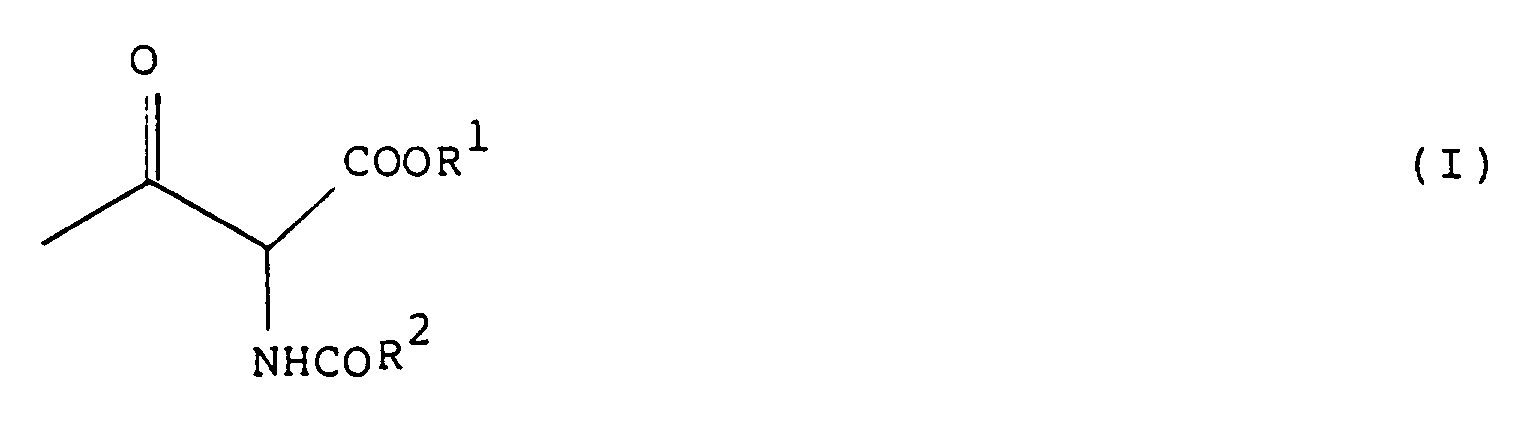
in the presence of a ruthenium-optically active phosphine complex as a catalyst to obtain an optically active threonine derivative represented by formula (II):
and then hydrolysing the compound of formula (II). - A process as claimed in claim 1, wherein said ruthenium-optically active phosphine complex is selected from a compound represented by formula (III):
RuxHyClz(R³-BINAP)₂(T)p (III)
wherein R³-BINAP represents a tertiary phosphine represented by formula (IV):
when y represents 0, x represents 2, z represents 4, and p represents 1; and when y represents 1, x represents 1, z represents 1, and p represents 0,
a compound represented by formula (V):
[RuHu(R³-BINAP)v]Yw (V)
wherein R³-BINAP is as defined above; Y represents CℓO₄, BF₄ or PF₆; when u represents 0, v represents 1, and w represents 2; and when u represents 1, v represents 2, and w represents 1,
a compound represented by formula (VI):
and a compound represented by formula (VII):
[Ru(R³-BINAP)MCℓk]ℓ Xm (VII)
wherein R³-BINAP is as defined above; M represents Zn, Aℓ, Ti, or Sn; X represents N(C₂H₅)₃ or CH₃CO₂; when X is N(C₂H₅)₃, ℓ is 2, m is 1, and k is 4 when M is Zn, 5 when M is Aℓ, or 6 when M is Ti or Sn; and when X is CH₃CO₂, ℓ is 1, m is 2, and k is 2 when M is Zn, 3 when M is Aℓ, or 4 when M is Ti or Sn. - A process as claimed in Claim 1 or 2, which is carried out by dissolving the ester (I) in a solvent, adding 1/50 to 1/1000 mole of the catalytic complex per mole of the ester, and hydrogenating at a hydrogen pressure of 9.8 x 10⁵ to 9.8 x 10⁶ Pa for 15 to 48 hours at a temperature of 25° to 50 C, followed by hydrolysis with hydrochloric acid.
Applications Claiming Priority (2)
| Application Number | Priority Date | Filing Date | Title |
|---|---|---|---|
| JP324399/87 | 1987-12-22 | ||
| JP62324399A JPH0641444B2 (en) | 1987-12-22 | 1987-12-22 | Method for producing optically active threonine |
Publications (3)
| Publication Number | Publication Date |
|---|---|
| EP0322236A2 EP0322236A2 (en) | 1989-06-28 |
| EP0322236A3 EP0322236A3 (en) | 1990-08-29 |
| EP0322236B1 true EP0322236B1 (en) | 1994-05-04 |
Family
ID=18165362
Family Applications (1)
| Application Number | Title | Priority Date | Filing Date |
|---|---|---|---|
| EP88312185A Expired - Lifetime EP0322236B1 (en) | 1987-12-22 | 1988-12-22 | Catalytic process for preparing optically active threonine |
Country Status (4)
| Country | Link |
|---|---|
| US (1) | US4906773A (en) |
| EP (1) | EP0322236B1 (en) |
| JP (1) | JPH0641444B2 (en) |
| DE (1) | DE3889441T2 (en) |
Families Citing this family (4)
| Publication number | Priority date | Publication date | Assignee | Title |
|---|---|---|---|---|
| US5364961A (en) * | 1992-06-15 | 1994-11-15 | Monsanto Company | Process for making optically active α-amino ketones |
| US5321153A (en) * | 1992-06-15 | 1994-06-14 | Monsanto Company | Process for making chiral alpha-amino phosphonates selected novel chiral alpha-amino phosphonates |
| US5473092A (en) * | 1992-11-20 | 1995-12-05 | Monsanto Company | Synthesis of optically-active phosphono analogs of succinates |
| US6410749B1 (en) * | 1999-01-18 | 2002-06-25 | Nippon Soda Co., Ltd. | Process for the preparation of optically active amino alcohols |
Family Cites Families (4)
| Publication number | Priority date | Publication date | Assignee | Title |
|---|---|---|---|---|
| CA1000293A (en) * | 1972-03-16 | 1976-11-23 | Arthur J. Solodar | Asymmetric reduction of ketones to form optically active alcohols |
| DE2804892A1 (en) * | 1977-02-09 | 1978-08-10 | Procter & Gamble | PROCESS FOR THE PRODUCTION OF L-THREONINE AND ITS N-ACYL DERIVATIVE |
| JPS6163690A (en) * | 1984-09-04 | 1986-04-01 | Takasago Corp | Ruthenium-phosphine complex |
| JPH0699367B2 (en) * | 1987-06-11 | 1994-12-07 | 高砂香料工業株式会社 | Production method of optically active alcohol |
-
1987
- 1987-12-22 JP JP62324399A patent/JPH0641444B2/en not_active Expired - Fee Related
-
1988
- 1988-12-21 US US07/287,434 patent/US4906773A/en not_active Expired - Lifetime
- 1988-12-22 DE DE3889441T patent/DE3889441T2/en not_active Expired - Fee Related
- 1988-12-22 EP EP88312185A patent/EP0322236B1/en not_active Expired - Lifetime
Non-Patent Citations (2)
| Title |
|---|
| ALDRICH, 1990, Aldrich Chemical Company, Inc., Milwaukee, Wisconsin, USA, p. 1243 * |
| CHEMISTRY OF THE AMINO ACIDS, J. P. Greenstein and M. Winith, vol. 3, John Wiley & Sons, Inc., New York, London; chapter 37, pp. 2238-2258 * |
Also Published As
| Publication number | Publication date |
|---|---|
| DE3889441D1 (en) | 1994-06-09 |
| JPH01165561A (en) | 1989-06-29 |
| US4906773A (en) | 1990-03-06 |
| JPH0641444B2 (en) | 1994-06-01 |
| EP0322236A3 (en) | 1990-08-29 |
| EP0322236A2 (en) | 1989-06-28 |
| DE3889441T2 (en) | 1994-12-01 |
Similar Documents
| Publication | Publication Date | Title |
|---|---|---|
| EP0272787B1 (en) | Catalytic production of optically active carboxylic acid | |
| EP0295109B2 (en) | Process for preparing optically active alcohol | |
| EP0295890B1 (en) | Process of preparing optically active alcohol | |
| EP0403188B1 (en) | A compound of 2,2'-bis(diphenylphosphino)-1,1'-binaphthyl and catalytic complexes thereof | |
| US4739085A (en) | Ruthenium-phosphine complex | |
| EP0174057A2 (en) | Ruthenium-phosphine complex catalysts | |
| EP0271311B1 (en) | Ruthenium-phosphine complexes | |
| EP0643065A1 (en) | Novel bisphosphines for asymetric hydrogenation catalysts | |
| EP0369691B1 (en) | Process for preparing optically active 3-hydroxybutanoic acid | |
| EP0503884B1 (en) | Optically active diphenylphosphino-binaphtyl compounds and catalytic transition metal complexes thereof | |
| EP0271310B1 (en) | Ruthenium-phosphine complexes | |
| JPS63316742A (en) | Production of optically active alcohol | |
| EP0466405B1 (en) | 2,2'-Bis(dicyclopenthylphosphino)-1-1'-binaphthyl and metal complexes thereof | |
| EP0479541B1 (en) | Iridium-optically active phosphine complex and catalytic production of optically active alcohols therewith | |
| EP0478147B1 (en) | Process for producing optically active gamma-butyrolactone derivatives | |
| JP4201916B2 (en) | Optically active 1,2-bis (dialkylphosphino) benzene derivative, process for producing the same, and rhodium metal complex having the compound as a ligand | |
| US4906773A (en) | Process for preparing optically active threonine | |
| US5919962A (en) | Process for preparing ruthenium-phosphine complex | |
| EP0673911A1 (en) | Process for producing optically active carboxylic acids and chiral ligands for this purpose | |
| US6194593B1 (en) | 1, 2-bis(dialkylphosphino) benzene derivates having optical activites, process for producing same, and rhodium metal complexes containing same as ligands | |
| EP0732337A1 (en) | Optically active asymmetric diphosphine and process for producing optically active substance in its presence | |
| JPH0816078B2 (en) | Process for producing optically active phenylacetic acid derivative | |
| US5068425A (en) | Process of preparation of phosphinamides, applications and new products | |
| JPH05170718A (en) | Method of enatioselectively synthesizing 2(r)- benzylsuccinic acid monoamide derivative | |
| JP2855221B2 (en) | Optically active 3,4-bisphosphinopyrrolidine compound |
Legal Events
| Date | Code | Title | Description |
|---|---|---|---|
| PUAI | Public reference made under article 153(3) epc to a published international application that has entered the european phase |
Free format text: ORIGINAL CODE: 0009012 |
|
| AK | Designated contracting states |
Kind code of ref document: A2 Designated state(s): CH DE FR GB LI NL |
|
| PUAL | Search report despatched |
Free format text: ORIGINAL CODE: 0009013 |
|
| AK | Designated contracting states |
Kind code of ref document: A3 Designated state(s): CH DE FR GB LI NL |
|
| 17P | Request for examination filed |
Effective date: 19901231 |
|
| 17Q | First examination report despatched |
Effective date: 19930204 |
|
| GRAA | (expected) grant |
Free format text: ORIGINAL CODE: 0009210 |
|
| AK | Designated contracting states |
Kind code of ref document: B1 Designated state(s): CH DE FR GB LI NL |
|
| REF | Corresponds to: |
Ref document number: 3889441 Country of ref document: DE Date of ref document: 19940609 |
|
| ET | Fr: translation filed | ||
| PLBE | No opposition filed within time limit |
Free format text: ORIGINAL CODE: 0009261 |
|
| STAA | Information on the status of an ep patent application or granted ep patent |
Free format text: STATUS: NO OPPOSITION FILED WITHIN TIME LIMIT |
|
| 26N | No opposition filed | ||
| PGFP | Annual fee paid to national office [announced via postgrant information from national office to epo] |
Ref country code: CH Payment date: 19971204 Year of fee payment: 10 |
|
| PGFP | Annual fee paid to national office [announced via postgrant information from national office to epo] |
Ref country code: GB Payment date: 19971212 Year of fee payment: 10 |
|
| PGFP | Annual fee paid to national office [announced via postgrant information from national office to epo] |
Ref country code: NL Payment date: 19971231 Year of fee payment: 10 Ref country code: FR Payment date: 19971231 Year of fee payment: 10 |
|
| PGFP | Annual fee paid to national office [announced via postgrant information from national office to epo] |
Ref country code: DE Payment date: 19980128 Year of fee payment: 10 |
|
| PG25 | Lapsed in a contracting state [announced via postgrant information from national office to epo] |
Ref country code: GB Free format text: LAPSE BECAUSE OF NON-PAYMENT OF DUE FEES Effective date: 19981222 |
|
| PG25 | Lapsed in a contracting state [announced via postgrant information from national office to epo] |
Ref country code: LI Free format text: LAPSE BECAUSE OF NON-PAYMENT OF DUE FEES Effective date: 19981231 Ref country code: CH Free format text: LAPSE BECAUSE OF NON-PAYMENT OF DUE FEES Effective date: 19981231 |
|
| PG25 | Lapsed in a contracting state [announced via postgrant information from national office to epo] |
Ref country code: NL Free format text: LAPSE BECAUSE OF NON-PAYMENT OF DUE FEES Effective date: 19990701 |
|
| GBPC | Gb: european patent ceased through non-payment of renewal fee |
Effective date: 19981222 |
|
| REG | Reference to a national code |
Ref country code: CH Ref legal event code: PL |
|
| PG25 | Lapsed in a contracting state [announced via postgrant information from national office to epo] |
Ref country code: FR Free format text: LAPSE BECAUSE OF NON-PAYMENT OF DUE FEES Effective date: 19990831 |
|
| NLV4 | Nl: lapsed or anulled due to non-payment of the annual fee |
Effective date: 19990701 |
|
| REG | Reference to a national code |
Ref country code: FR Ref legal event code: ST |
|
| PG25 | Lapsed in a contracting state [announced via postgrant information from national office to epo] |
Ref country code: DE Free format text: LAPSE BECAUSE OF NON-PAYMENT OF DUE FEES Effective date: 19991001 |