EP0320253B1 - 21-alkoxysteroid compounds - Google Patents
21-alkoxysteroid compounds Download PDFInfo
- Publication number
- EP0320253B1 EP0320253B1 EP88311616A EP88311616A EP0320253B1 EP 0320253 B1 EP0320253 B1 EP 0320253B1 EP 88311616 A EP88311616 A EP 88311616A EP 88311616 A EP88311616 A EP 88311616A EP 0320253 B1 EP0320253 B1 EP 0320253B1
- Authority
- EP
- European Patent Office
- Prior art keywords
- group
- compound
- formula
- betamethasone
- methoxide
- Prior art date
- Legal status (The legal status is an assumption and is not a legal conclusion. Google has not performed a legal analysis and makes no representation as to the accuracy of the status listed.)
- Expired - Lifetime
Links
Classifications
-
- C—CHEMISTRY; METALLURGY
- C07—ORGANIC CHEMISTRY
- C07J—STEROIDS
- C07J5/00—Normal steroids containing carbon, hydrogen, halogen or oxygen, substituted in position 17 beta by a chain of two carbon atoms, e.g. pregnane and substituted in position 21 by only one singly bound oxygen atom, i.e. only one oxygen bound to position 21 by a single bond
-
- C—CHEMISTRY; METALLURGY
- C07—ORGANIC CHEMISTRY
- C07J—STEROIDS
- C07J5/00—Normal steroids containing carbon, hydrogen, halogen or oxygen, substituted in position 17 beta by a chain of two carbon atoms, e.g. pregnane and substituted in position 21 by only one singly bound oxygen atom, i.e. only one oxygen bound to position 21 by a single bond
- C07J5/0046—Normal steroids containing carbon, hydrogen, halogen or oxygen, substituted in position 17 beta by a chain of two carbon atoms, e.g. pregnane and substituted in position 21 by only one singly bound oxygen atom, i.e. only one oxygen bound to position 21 by a single bond substituted in position 17 alfa
- C07J5/0061—Normal steroids containing carbon, hydrogen, halogen or oxygen, substituted in position 17 beta by a chain of two carbon atoms, e.g. pregnane and substituted in position 21 by only one singly bound oxygen atom, i.e. only one oxygen bound to position 21 by a single bond substituted in position 17 alfa substituted in position 16
- C07J5/0069—Normal steroids containing carbon, hydrogen, halogen or oxygen, substituted in position 17 beta by a chain of two carbon atoms, e.g. pregnane and substituted in position 21 by only one singly bound oxygen atom, i.e. only one oxygen bound to position 21 by a single bond substituted in position 17 alfa substituted in position 16 by a saturated or unsaturated hydrocarbon group
- C07J5/0076—Normal steroids containing carbon, hydrogen, halogen or oxygen, substituted in position 17 beta by a chain of two carbon atoms, e.g. pregnane and substituted in position 21 by only one singly bound oxygen atom, i.e. only one oxygen bound to position 21 by a single bond substituted in position 17 alfa substituted in position 16 by a saturated or unsaturated hydrocarbon group by an alkyl group
-
- C—CHEMISTRY; METALLURGY
- C07—ORGANIC CHEMISTRY
- C07J—STEROIDS
- C07J31/00—Normal steroids containing one or more sulfur atoms not belonging to a hetero ring
- C07J31/006—Normal steroids containing one or more sulfur atoms not belonging to a hetero ring not covered by C07J31/003
Definitions
- the present invention relates to 21-alkoxysteroid compounds having excellent anti-inflammatory effect.
- corticosteroids for prevention, therapy and treatment of inflammatory skin diseases, asthmatic allergy diseases and rheumatic diseases are commercially available as non-prescription drugs or prescription drugs. However, these commercially available corticosteroids for non-prescription drugs or prescription drugs do not have sufficient effect.
- An object of the present invention is to provide 21-alkoxysteroid compounds represented by the formula wherein R1 is an alkyl group having 1 to 4 carbon atoms or a methylthiomethyl group, R2 is an alkanoyl group having 2 to 7 carbon atoms, and a wavy line indicates the ⁇ - or ⁇ -configuration.
- the alkyl group having 1 to 4 carbon atoms refers to a methyl group, an ethyl group, a propyl group and the like.
- the alkanoyl group having 2 to 7 carbon atoms refers to an alkanoyl group having a straight or branched chain alkyl group such as, for example, an acetyl group, a propionyl group, a butyryl group, an isobutyryl group, a valeryl group, an isovaleryl group and the like, preferably an alkanoyl group having 2 to 4 carbon atoms.
- R2 is an acetyl group, a propionyl group or a butyryl group.
- the compounds of the present invention can be prepared, for example, by the following methods.
- R1 is an alkyl group having 1 to 4 carbon atoms
- R3 is the alkyl group for R1
- X is a halogen atom
- R2 is as defined above.
- a process for preparing a compound of the formula (I) comprises reacting a compound (III) with a compound (such as trifluoroacetic anhydride) capable of providing a hydroxy-protecting group on the hydroxy at the 11-, but not at the 17-, position, acylating the hydroxyl group at the 17-position with a carboxylic acid or reactive derivative thereof capable of providing the group R2 and hydrolysing the resultant product to remove the hydroxyl protecting group at the 11-position.
- a compound such as trifluoroacetic anhydride
- the compound (III) may be prepared by reaction of compound (II) with an alkylating agent such as an alkyl halide or dialkyl sufate, capable of providing the group R3.
- an alkylating agent such as an alkyl halide or dialkyl sufate
- a known compound of Formula (II) is reacted with 1.0 to 10.0 equivalents of an alkyl halide of the formula R3-X (wherein R3 and X are as defined above) or with 1.0 to 10.0 equivalents of a dialkyl sulfate of the formula R32SO4 (wherein R3 is as defined above) in the presence of 1.0 to 1.5 equivalents of a base to give a compound of Formula (III).
- Examples of the base used in this reaction are alkali hydrides such as sodium hydride, potassium hydride and the like; alcoholates such as potassium tert-butoxide and the like; alkali hydroxides such as sodium hydroxide, potassium hydroxide and the like; alkali carbonates such as sodium carbonate, potassium carbonate and the like.
- Examples of the alkyl halide of the formula R3-X are methyl iodide, ethyl iodide, propyl iodide and the like, and examples of the dialkyl sulfate of the formula R32SO4 are dimethyl sulfate and the like.
- the reaction can be carried out in a solvent such as ether system solvents (e.g., tetrahydrofuran, dioxane and the like), amide system solvents (e.g., N,N-dimethylformamide, dimethyl sulfoxide, hexamethylphosphortriamide and the like) or a mixture thereof with stirring at -30°C - 10°C for 1 to 10 hours.
- ether system solvents e.g., tetrahydrofuran, dioxane and the like
- amide system solvents e.g., N,N-dimethylformamide, dimethyl sulfoxide, hexamethylphosphortriamide and the like
- the compound of Formula (III) obtained in the above is reacted with 1 to 10 equivalents of trifluoroacetic anhydride to give a compound of Formula (IV).
- This reaction can be also carried out in the presence of a base.
- the base are organic bases such as pyridine, triethylamine, diisopropylamine and the like.
- the reaction can be carried out in a solvent such as N,N-dimethylformamide, chloroform, dichloromethane, tetrahydrofuran, benzene and the like or without solvent at a reaction temperature of from -50 to 5°C for a reaction time of from 5 minutes to 3 hours.
- the acylation used may be a reaction using a carboxylic anhydride of the formula R22O (wherein R2 is as defined above) such as acetic anhydride, propionic anhydride, butyric anhydride and the like, without solvent or in an organic solvent (e.g., dichloromethane, benzene and the like) in the presence of an acid (e.g., p-toluenesulfonic acid, 60 to 70% perchloric acid and the like) or a reaction using a carboxylic acid of the formula R2-OH (wherein R2 is as defined above) such as acetic acid, propionic acid, butyric acid and the like, without solvent or in an organic solvent (e.g., dichloromethane, benzene and the like) in the
- these reactions may be carried out at room temperature and accomplished in 10 minutes to 5 days.
- the hydrolysis can be carried out by adding an organic solvent (e.g., N,N-dimethylformamide, tetrahydrofuran, methanol and the like) and an aqueous sodium acetate solution (or an aqueous sodium hydrogencarbonate solution) to the above reaction solution, and stirring the mixture at 20 to 100°C for 10 minutes to 3 hours.
- an organic solvent e.g., N,N-dimethylformamide, tetrahydrofuran, methanol and the like
- an aqueous sodium acetate solution or an aqueous sodium hydrogencarbonate solution
- a compound of Formula I wherein R1 is a methylthiomethyl group can be obtained by the reaction of a known 21-hydroxysteroid compound of the formula (wherein R2 is as defined above) with dimethyl sulfoxide in the presence of a carboxylic anhydride and a carboxylic acid.
- carboxylic anhydride examples include acetic anhydride, propionic anhydride and the like
- carboxylic acid examples of the carboxylic acid are acetic acid, propionic acid and the like.
- This reaction may be carried out without solvent or in a nitrile system solvent (e.g., acetonitrile and the like) at a reaction temperature of from room temperature to 100°C for a reaction time of from 10 minutes to 20 hours.
- the compounds obtained by the above reactions can be separated from the reaction mixture and purified by the procedures known per se, for example, column chromatography, recrystallization and the like.
- the compounds of Formula (I) of the present invention have excellent topical anti-inflammatory effect when compared with the closer compounds (e.g., betamethasone 21-methoxide, betamethasone 17-valerate and hydrocortisone 17-methylsuccinate 21-methoxide described in Japanese Patent Kokai No. 60-4200); therefore, the compounds of Formula (I) are useful for therapy of various clinical skin diseases such as, for example, acute eczema, chronic eczema, seborrheric eczema, atopic dermatitis, infantile eczema, contact dermatitis, psoriasis vulgaris and the like.
- the closer compounds e.g., betamethasone 21-methoxide, betamethasone 17-valerate and hydrocortisone 17-methylsuccinate 21-methoxide described in Japanese Patent Kokai No. 60-4200
- the compounds of Formula (I) are useful for therapy of various clinical skin diseases such as, for
- these compounds can be used for prevention, therapy and treatment of diseases caused by inflammation such as asthmatic allergy diseases, rheumatic diseases and the like.
- the compounds of Formula (I) can be administered topically by conventional dosage forms (e.g., ointments, creams, lotions, solutions, plasters and the like), all of which can be prepared by ordinary practices.
- the amount of the compound of the present invention in the above dosage form may be in the range of 0.01 to 5.0% by weight.
- Ointments containing each 0.01% (w/w) of the compounds of Formula (I) and the comparative drugs (betamethasone 21-methoxide, betamethasone 17-valerate and hydrocortisone 17-methylsuccinate 21-methoxide) were prepared using white petrolatum as a basal ingredient.
- Adhesive plasters for patch test (Finn chamber, manufactured by Epitest Ltd. Oy, Finland) painted with a given amount (20 mg) of the ointment each were applied to the bending sites of both forearms of twenty male adult volunteers. Four hours later, these adhesive plasters were removed, and the remaining drug on the skin was softly wiped off by a cotton impregnated with spirit.
- the degrees of the blanching were judged after 2 and 4 hours, and divided into four degrees, with ++ indicating remarkable, + moderate, ⁇ slight and - ineffective, which were scored as 3, 2, 1 and 0, respectively.
- the scores of twenty subjects were added together from which the average scores were calculated (maximum point : 3.00).
- Table 1 The compound numbers in Table 1 are as defined in the following Examples.
- Table 1 Degree of blanching (point) Compound No. 2 hours 4 hours 1 2.70 2.90 2 2.15 2.50 3 2.40 2.80 7 2.60 2.85 8 2.30 2.75 13 2.40 2.45 14 2.40 2.50 15 2.35 2.55 16 2.40 2.75 17 2.60 2.70 18 2.50 2.80 A 0.50 0.55 B 1.75 2.20 C 1.31 1.51
- B Betamethasone 17-valerate
- C Hydrocortisone 17-methylsuccinate 21-methoxide
- Ointments containing each 0.005% and 0.00125% (w/w) of betamethasone 17-propionate 21-methoxide of the present invention and betamethasone 17-valerate of a comparative drug were prepared using white petrolatum as a basal ingredient. Following a procedure similar to that of Experiment 1 using these ointments, the blanching after 2 and 4 hours was measured.
- the present invention is illustrated by Examples in more detail.
- Betamethasone 17-butyrate 21-methoxide (Compound 3) m.p. 150 - 151°C Betamethasone 17-isobutyrate 21-methoxide
Landscapes
- Chemical & Material Sciences (AREA)
- Organic Chemistry (AREA)
- Health & Medical Sciences (AREA)
- General Health & Medical Sciences (AREA)
- Steroid Compounds (AREA)
- Pharmaceuticals Containing Other Organic And Inorganic Compounds (AREA)
Abstract
Description
- The present invention relates to 21-alkoxysteroid compounds having excellent anti-inflammatory effect.
- Few corticosteroid 21-alkoxy-17-ester derivatives, while being disclosed in Japanese Patent Kokai 60-4200, are reported because of the difficulty of their preparation.
- Various corticosteroids for prevention, therapy and treatment of inflammatory skin diseases, asthmatic allergy diseases and rheumatic diseases are commercially available as non-prescription drugs or prescription drugs. However, these commercially available corticosteroids for non-prescription drugs or prescription drugs do not have sufficient effect.
- As a result of various researches, the present inventors have succeeded in preparing 21-alkoxysteroid compounds having potent anti-inflammatory activity.
- An object of the present invention is to provide 21-alkoxysteroid compounds represented by the formula

wherein R¹ is an alkyl group having 1 to 4 carbon atoms or a methylthiomethyl group, R² is an alkanoyl group having 2 to 7 carbon atoms, and a wavy line indicates the α- or β-configuration. - In formula (I) of 21-alkoxysteroid compounds of the present invention, the alkyl group having 1 to 4 carbon atoms refers to a methyl group, an ethyl group, a propyl group and the like. The alkanoyl group having 2 to 7 carbon atoms refers to an alkanoyl group having a straight or branched chain alkyl group such as, for example, an acetyl group, a propionyl group, a butyryl group, an isobutyryl group, a valeryl group, an isovaleryl group and the like, preferably an alkanoyl group having 2 to 4 carbon atoms.
- Among the preferred compounds of the present invention are compounds of Formula (I) wherein R² is an acetyl group, a propionyl group or a butyryl group.
- The compounds of the present invention can be prepared, for example, by the following methods.
- Compounds of Formula (I) wherein R¹ is an alkyl group having 1 to 4 carbon atoms can be prepared according to the following reaction scheme wherein R³ is the alkyl group for R¹, X is a halogen atom and R² is as defined above.
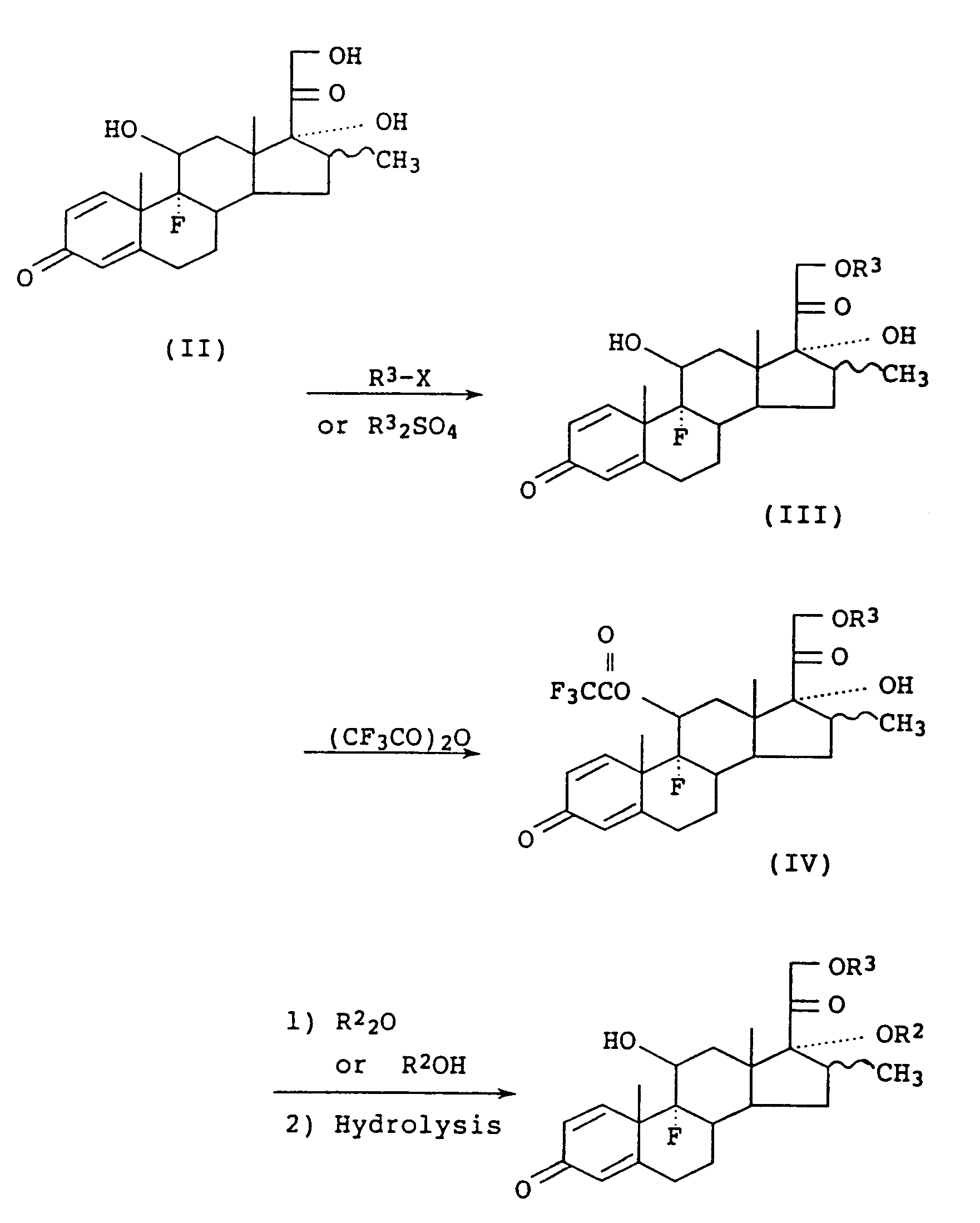
- Thus, a process for preparing a compound of the formula (I) comprises reacting a compound (III) with a compound (such as trifluoroacetic anhydride) capable of providing a hydroxy-protecting group on the hydroxy at the 11-, but not at the 17-, position, acylating the hydroxyl group at the 17-position with a carboxylic acid or reactive derivative thereof capable of providing the group R² and hydrolysing the resultant product to remove the hydroxyl protecting group at the 11-position.
- The compound (III) may be prepared by reaction of compound (II) with an alkylating agent such as an alkyl halide or dialkyl sufate, capable of providing the group R³.
- According to the reaction scheme, a known compound of Formula (II) is reacted with 1.0 to 10.0 equivalents of an alkyl halide of the formula R³-X (wherein R³ and X are as defined above) or with 1.0 to 10.0 equivalents of a dialkyl sulfate of the formula R³₂SO₄ (wherein R³ is as defined above) in the presence of 1.0 to 1.5 equivalents of a base to give a compound of Formula (III).
- Examples of the base used in this reaction are alkali hydrides such as sodium hydride, potassium hydride and the like; alcoholates such as potassium tert-butoxide and the like; alkali hydroxides such as sodium hydroxide, potassium hydroxide and the like; alkali carbonates such as sodium carbonate, potassium carbonate and the like. Examples of the alkyl halide of the formula R³-X are methyl iodide, ethyl iodide, propyl iodide and the like, and examples of the dialkyl sulfate of the formula R³₂SO₄ are dimethyl sulfate and the like. The reaction can be carried out in a solvent such as ether system solvents (e.g., tetrahydrofuran, dioxane and the like), amide system solvents (e.g., N,N-dimethylformamide, dimethyl sulfoxide, hexamethylphosphortriamide and the like) or a mixture thereof with stirring at -30°C - 10°C for 1 to 10 hours.
- Then, the compound of Formula (III) obtained in the above is reacted with 1 to 10 equivalents of trifluoroacetic anhydride to give a compound of Formula (IV). This reaction can be also carried out in the presence of a base. Examples of the base are organic bases such as pyridine, triethylamine, diisopropylamine and the like. Furthermore, the reaction can be carried out in a solvent such as N,N-dimethylformamide, chloroform, dichloromethane, tetrahydrofuran, benzene and the like or without solvent at a reaction temperature of from -50 to 5°C for a reaction time of from 5 minutes to 3 hours. Then, the hydroxy group at the 17-position of the compound of Formula (IV) obtained above is acylated followed by hydrolysis of the trifluoroacetate at the 11-position to give the compound of the present invention. The acylation used may be a reaction using a carboxylic anhydride of the formula R²₂O (wherein R² is as defined above) such as acetic anhydride, propionic anhydride, butyric anhydride and the like, without solvent or in an organic solvent (e.g., dichloromethane, benzene and the like) in the presence of an acid (e.g., p-toluenesulfonic acid, 60 to 70% perchloric acid and the like) or a reaction using a carboxylic acid of the formula R²-OH (wherein R² is as defined above) such as acetic acid, propionic acid, butyric acid and the like, without solvent or in an organic solvent (e.g., dichloromethane, benzene and the like) in the presence of trifluoroacetic anhydride, an alkyl chloroformate and the like. Usually, these reactions may be carried out at room temperature and accomplished in 10 minutes to 5 days. The hydrolysis can be carried out by adding an organic solvent (e.g., N,N-dimethylformamide, tetrahydrofuran, methanol and the like) and an aqueous sodium acetate solution (or an aqueous sodium hydrogencarbonate solution) to the above reaction solution, and stirring the mixture at 20 to 100°C for 10 minutes to 3 hours.
- On the other hand, a compound of Formula I wherein R¹ is a methylthiomethyl group can be obtained by the reaction of a known 21-hydroxysteroid compound of the formula

(wherein R² is as defined above) with dimethyl sulfoxide in the presence of a carboxylic anhydride and a carboxylic acid. Examples of the carboxylic anhydride are acetic anhydride, propionic anhydride and the like, and examples of the carboxylic acid are acetic acid, propionic acid and the like. This reaction may be carried out without solvent or in a nitrile system solvent (e.g., acetonitrile and the like) at a reaction temperature of from room temperature to 100°C for a reaction time of from 10 minutes to 20 hours. - The compounds obtained by the above reactions can be separated from the reaction mixture and purified by the procedures known per se, for example, column chromatography, recrystallization and the like.
- The compounds of Formula (I) of the present invention have excellent topical anti-inflammatory effect when compared with the closer compounds (e.g., betamethasone 21-methoxide, betamethasone 17-valerate and hydrocortisone 17-methylsuccinate 21-methoxide described in Japanese Patent Kokai No. 60-4200); therefore, the compounds of Formula (I) are useful for therapy of various clinical skin diseases such as, for example, acute eczema, chronic eczema, seborrheric eczema, atopic dermatitis, infantile eczema, contact dermatitis, psoriasis vulgaris and the like. Furthermore, these compounds can be used for prevention, therapy and treatment of diseases caused by inflammation such as asthmatic allergy diseases, rheumatic diseases and the like. For the purposes, the compounds of Formula (I) can be administered topically by conventional dosage forms (e.g., ointments, creams, lotions, solutions, plasters and the like), all of which can be prepared by ordinary practices. The amount of the compound of the present invention in the above dosage form may be in the range of 0.01 to 5.0% by weight.
- Ointments containing each 0.01% (w/w) of the compounds of Formula (I) and the comparative drugs (betamethasone 21-methoxide, betamethasone 17-valerate and hydrocortisone 17-methylsuccinate 21-methoxide) were prepared using white petrolatum as a basal ingredient. Adhesive plasters for patch test (Finn chamber, manufactured by Epitest Ltd. Oy, Finland) painted with a given amount (20 mg) of the ointment each were applied to the bending sites of both forearms of twenty male adult volunteers. Four hours later, these adhesive plasters were removed, and the remaining drug on the skin was softly wiped off by a cotton impregnated with spirit. The degrees of the blanching were judged after 2 and 4 hours, and divided into four degrees, with ++ indicating remarkable, + moderate, ± slight and - ineffective, which were scored as 3, 2, 1 and 0, respectively. The scores of twenty subjects were added together from which the average scores were calculated (maximum point : 3.00).
- The results are shown in Table 1. The compound numbers in Table 1 are as defined in the following Examples.
Table 1 Degree of blanching (point) Compound No. 2 hours 4 hours 1 2.70 2.90 2 2.15 2.50 3 2.40 2.80 7 2.60 2.85 8 2.30 2.75 13 2.40 2.45 14 2.40 2.50 15 2.35 2.55 16 2.40 2.75 17 2.60 2.70 18 2.50 2.80 A 0.50 0.55 B 1.75 2.20 C 1.31 1.51 (Note)
A: Betamethasone 21-methoxide
B: Betamethasone 17-valerate
C: Hydrocortisone 17-methylsuccinate 21-methoxide - Ointments containing each 0.005% and 0.00125% (w/w) of betamethasone 17-propionate 21-methoxide of the present invention and betamethasone 17-valerate of a comparative drug were prepared using white petrolatum as a basal ingredient. Following a procedure similar to that of Experiment 1 using these ointments, the blanching after 2 and 4 hours was measured.
- Results are shown in Table 2.
Table 2 Ointment concentration (w/w%) Compound No. Degree of blanching (point) 2 hours 4 hours 0.00125 1 2.40 2.55 B 1.25 1.45 0.005 1 2.50 2.65 B 1.80 1.95 (Note)
B: Betamethasone 17-valerate - The present invention is illustrated by Examples in more detail.
-
- (1) With 20 ml of n-hexane was washed 1.23 g of 60% oily sodium hydride under a nitrogen atmosphere, and 100 ml of tetrahydrofuran was added. To the mixture was added dropwise a mixture of 10 g of betamethasone, 30 ml of N,N-dimethylformamide and 20 ml of tetrahydrofuran under ice cooling, and after completion of the addition, the mixture was stirred at the same temperature for 10 minutes. Then, 5 ml of methyl iodide was added, and the mixture was stirred for a further 5 hours. After the reaction, ice water was added, the mixture was extracted with ethyl acetate, and the organic layer was washed successively with a saturated aqueous sodium hydrogencarbonate solution, 5% hydrochloric acid and a saturated aqueous sodium chloride solution and dried over anhydrous magnesium sulfate. After filtration, the solvent was evaporated, and the resulting crude product was washed with ethyl acetate to give 8.44 g of betamethasone 21-methoxide, which was then recrystallized from a mixture of ethyl acetate and methanol to give colorless prisms.
m.p. 228 - 230°C - (2) To a cooled (-25°C) solution of 8.43 g of betamethasone 21-methoxide in 85 ml of pyridine was added dropwise 7.05 ml of trifluoroacetic anhydride, and after completion of the addition, the mixture was stirred at the same temperature for 30 minutes. To the reaction solution was added ice water, the mixture was extracted with ethyl acetate, and the organic layer was washed successively with 10% hydrochloric acid, a saturated aqueous sodium hydrogencarbonate solution and a saturated aqueous sodium chloride solution and dried over anhydrous magnesium sulfate. The solvent was evaporated, and the resulting crude crystals were recrystallized from a mixture of methanol and dichloromethane to give 6.66 g of betamethasone 11-trifluoroacetate 21-methoxide.
m.p. 216 - 219°C - (3) To a mixture of 4.1 g of betamethasone 11-trifluoroacetate 21-methoxide obtained in the above, 15 ml of propionic acid and 15 ml of propionic anhydride was added 1 g of p-toluenesulfonic acid, and the mixture was stirred at room temperature for 4 days. After completion of the reaction, 25 ml of N,N-dimethylformamide and 20 ml of a 10% aqueous sodium acetate solution were added successively and the mixture was stirred at about 60°C for 1 hour. Then, water was added, the mixture was extracted with ethyl acetate, and the organic layer was washed successively with a saturated aqueous sodium hydrogencarbonate solution and a saturated aqueous sodium chloride solution, and dried over anhydrous magnesium sulfate. After evaporation of the solvent, the residue was applied to silica gel column chromatography (eluent; ethyl acetate : hexane = 3 : 5) to give 2.60 g of betamethasone 17-propionate 21-methoxide (Compound 1), which was then recrystallized from ethyl acetate to give colorless prisms.
m.p. 214 - 216°C - To a cooled (-9°C) solution of 84.30 g of betamethasone 21-methoxide, obtained in Example 1 (1), in 850 ml of N,N-dimethylformamide was added dropwise 74 ml of trifluoroacetic anhydride for a 30 minutes period. After the addition, the mixture was stirred at -5°C for 30 minutes, the reaction solution was poured into water, and the precipitate was collected by filtration and washed with water, dried and washed with ethyl acetate to give 97.9 g of betamethasone 11-trifluoroacetate 21-methoxide.
- To 134 ml of trifluoroacetic anhydride was added dropwise 70.5 ml of propionic acid under ice cooling, and the mixture was stirred at room temperature for 15 minutes. 95.0 g of betamethasone 11-trifluoroacetate 21-methoxide obtained in Example 1 (2) or Example 2 was added gradually, and the mixture was stirred for a further 4 hours. After completion of the reaction, 475 ml of N,N-dimethylformamide, 258 ml of water and 186 g of sodium acetate were added under ice cooling successively and the mixture was stirred at room temperature for 30 minutes. To the reaction solution was added ethyl acetate, and the mixture was washed successively with a saturated aqueous sodium chloride solution, a saturated aqueous sodium hydrogencarbonate solution, water and a saturated aqueous sodium chloride solution and dried over anhydrous magnesium sulfate. After evaporation of the solvent, the residue was applied to silica gel column chromatography (eluent; acetone : chloroform : hexane = 1 : 3 : 5) followed by recrystallization from a 95% aqueous ethanol to give 45.3 g of betamethasone 17-propionate 21-methoxide, which was identical to that obtained in Example 1 (3).
- To a solution of 2.0 g of betamethasone 11-trifluoroacetate 21-methoxide, obtained in Example 1 (2) or Example 2, in 10 ml of dichloromethane were added 2 ml of propionic anhydride and then 0.1 ml of 70% perchloric acid, and the mixture was stirred at room temperature for 80 minutes. After completion of the reaction, 10 ml of N,N-dimethylformamide and 10 ml of an aqueous sodium acetate solution were added to the reaction solution, and the mixture was stirred at about 60°C for 1 hour. Then, water was added, the mixture was extracted with ethyl acetate, and the organic layer was washed successively with a saturated aqueous sodium hydrogencarbonate solution and a saturated aqueous sodium chloride solution, and dried over anhydrous magnesium sulfate. After evaporation of the solvent, the residue was recrystallized from a 95% aqueous ethanol to give 1.33 g of betamethasone 17-propionate 21-methoxide, which was identical to that obtained in Example 1 (3).
- Following a procedure similar to that of the above Example, there were obtained the following compounds
Betamethasone 17-acetate 21-methoxide - m.p. 257 - 261°C
Betamethasone 17-butyrate 21-methoxide (Compound 3)
m.p. 150 - 151°C
Betamethasone 17-isobutyrate 21-methoxide - m.p. 127 - 130°C
Betamethasone 17-valerate 21-methoxide - m.p. 101 - 103°C
Betamethasone 17-isovalerate 21-methoxide - m.p. 106 - 108°C
Betamethasone 17-acetate 21-ethoxide - m.p. 250 - 252°C (dec.)
Betamethasone 17-propionate 21-ethoxide - m.p. 208 - 211°C
Betamethasone 17-butyrate 21-ethoxide - m.p. 106 - 109°C
Betamethasone 17-acetate 21-propoxide - m.p. 228 - 230°C
Betamethasone 17-propionate 21-propoxide - m.p. 203 - 205°C
Betamethasone 17-butyrate 21-propoxide - m.p. 168 - 169°C
Dexamethasone 17-acetate 21-methoxide - m.p. 242 - 245°C
Dexamethasone 17-propionate 21-methoxide - m.p. 216 - 217°C
Dexamethasone 17-butyrate 21-methoxide - m.p. 172 - 173°C
Dexamethasone 17-acetate 21-ethoxide - m.p. 211 - 213°C
Dexamethasone 17-propionate 21-ethoxide - m.p. 194 - 195°C
Dexamethasone 17-butyrate 21-ethoxide - m.p. 189 - 190°C
Dexamethasone 17-propionate 21-propoxide - m.p. 165 - 167°C
- To a solution of 1.00 g of betamethasone 17-propionate in 50 ml of acetonitrile were added 4.21 ml of acetic anhydride, 3.16 ml of dimethyl sulfoxide and 1.27 ml of acetic acid, and then the mixture was refluxed for 4 hours. After evaporation of the solvent, the residue was poured into a 10% aqueous sodium hydrogencarbonate solution, the precipitate which separated was collected by filtration, and applied to silica gel column chromatography (eluent; acetone : chloroform : hexane = 3 : 3 : 16) to give 280 mg of betamethasone 17-propionate 21-methylthiomethyleneoxide (Compound 20).
m.p. 215 - 218°C
Claims (7)
- A 21-alkoxysteroid compound represented by the formula

- A 21-alkoxysteroid compound according to Claim 1, wherein the alkyl group of R¹ is a methyl group, an ethyl group or a propyl group.
- A 21-alkoxysteroid compound according to Claim 1, wherein the alkanoyl group of R² is an acetyl group, a propionyl group, a butyryl group, an isobutyryl group, a valeryl group or an isovaleryl group.
- A pharmaceutical composition comprising a compound of the formula (I), given and defined in Claim 1, and a pharmaceutically acceptable excipient.
- A compound of the formula (I), given and defined in Claim 1, for use as a pharmaceutical.
- A compound of the formula (I), given and defined in Claim 1, for use a an anti-inflammatory agent.
- Use of a compound of the formula (I), given and defined in Claim 1, in the manufacture of a medicament for treating inflammation.
Priority Applications (1)
| Application Number | Priority Date | Filing Date | Title |
|---|---|---|---|
| AT88311616T ATE90356T1 (en) | 1987-12-11 | 1988-12-08 | 21-ALKOXY-STEROID DERIVATIVES. |
Applications Claiming Priority (2)
| Application Number | Priority Date | Filing Date | Title |
|---|---|---|---|
| JP313879/87 | 1987-12-11 | ||
| JP31387987 | 1987-12-11 |
Publications (2)
| Publication Number | Publication Date |
|---|---|
| EP0320253A1 EP0320253A1 (en) | 1989-06-14 |
| EP0320253B1 true EP0320253B1 (en) | 1993-06-09 |
Family
ID=18046608
Family Applications (1)
| Application Number | Title | Priority Date | Filing Date |
|---|---|---|---|
| EP88311616A Expired - Lifetime EP0320253B1 (en) | 1987-12-11 | 1988-12-08 | 21-alkoxysteroid compounds |
Country Status (5)
| Country | Link |
|---|---|
| US (1) | US4968822A (en) |
| EP (1) | EP0320253B1 (en) |
| KR (1) | KR970005316B1 (en) |
| AT (1) | ATE90356T1 (en) |
| DE (1) | DE3881657T2 (en) |
Cited By (1)
| Publication number | Priority date | Publication date | Assignee | Title |
|---|---|---|---|---|
| RU2177951C2 (en) * | 1996-04-18 | 2002-01-10 | Хехст Марион Руссель | Pregnane derivatives substituted in 17-position, method of their synthesis, industrial products, pharmaceutical composition |
Families Citing this family (4)
| Publication number | Priority date | Publication date | Assignee | Title |
|---|---|---|---|---|
| US5446177A (en) * | 1984-12-28 | 1995-08-29 | Alcon Laboratories, Inc. | Anti-inflammatory compounds for ophthalmic use |
| ES2120503T3 (en) * | 1990-11-13 | 1998-11-01 | Alcon Lab Inc | ANTI-INFLAMMATORY COMPOUNDS FOR OPHTHALMIC USE. |
| AU1803100A (en) * | 1999-01-06 | 2000-07-24 | Taisho Pharmaceutical Co., Ltd. | Amelometasone lotion |
| KR100713932B1 (en) | 2006-03-29 | 2007-05-07 | 주식회사 하이닉스반도체 | Flip Chip Bonded Package |
Family Cites Families (8)
| Publication number | Priority date | Publication date | Assignee | Title |
|---|---|---|---|---|
| JPS5834480B2 (en) * | 1980-02-01 | 1983-07-27 | パトフアルマ エスタブリシユメント | Method for producing 16 beta-methyl-17 alpha-acyloxy-1,4-diene-21-halosteroid compound |
| JPS55108896A (en) * | 1980-02-01 | 1980-08-21 | Patpharma Ets | Manufacture of stero |
| JPS55108895A (en) * | 1980-02-01 | 1980-08-21 | Patpharma Ets | Manufacture of stero |
| JPS55108894A (en) * | 1980-02-01 | 1980-08-21 | Patpharma Ets | Manufacture of steroid compound |
| JPS55108900A (en) * | 1980-02-01 | 1980-08-21 | Patpharma Ets | Steroid compound |
| US4588530A (en) * | 1982-07-30 | 1986-05-13 | Florida Agricultural And Mechanical University | Anti-inflammatory prednisolone steroids |
| DE3243482A1 (en) * | 1982-11-22 | 1984-05-24 | Schering AG, 1000 Berlin und 4709 Bergkamen | NEW 6 (ALPHA) METHYL CORTICOIDS, THEIR PRODUCTION AND USE |
| DE3400188A1 (en) * | 1984-01-02 | 1985-07-11 | Schering AG, Berlin und Bergkamen, 1000 Berlin | NEW 6 (ALPHA), 16 (ALPHA) DIMETHYL CORTICOIDS |
-
1988
- 1988-12-05 US US07/279,454 patent/US4968822A/en not_active Expired - Fee Related
- 1988-12-08 DE DE8888311616T patent/DE3881657T2/en not_active Expired - Fee Related
- 1988-12-08 AT AT88311616T patent/ATE90356T1/en not_active IP Right Cessation
- 1988-12-08 EP EP88311616A patent/EP0320253B1/en not_active Expired - Lifetime
- 1988-12-10 KR KR1019880016492A patent/KR970005316B1/en not_active Expired - Fee Related
Cited By (1)
| Publication number | Priority date | Publication date | Assignee | Title |
|---|---|---|---|---|
| RU2177951C2 (en) * | 1996-04-18 | 2002-01-10 | Хехст Марион Руссель | Pregnane derivatives substituted in 17-position, method of their synthesis, industrial products, pharmaceutical composition |
Also Published As
| Publication number | Publication date |
|---|---|
| DE3881657T2 (en) | 1993-09-23 |
| DE3881657D1 (en) | 1993-07-15 |
| KR970005316B1 (en) | 1997-04-15 |
| ATE90356T1 (en) | 1993-06-15 |
| EP0320253A1 (en) | 1989-06-14 |
| KR890009969A (en) | 1989-08-05 |
| US4968822A (en) | 1990-11-06 |
Similar Documents
| Publication | Publication Date | Title |
|---|---|---|
| US6197761B1 (en) | 17β-2-oxo-tetrahydrofuranyl)-carbothioic acid ester, -carboxylic acid ester and -carboxylic acid amide androstane derivatives | |
| HK125196A (en) | Novel steroid derivatives | |
| JPH08508278A (en) | New prednisolone derivative | |
| HU186965B (en) | Process for producing new 6-alpha-methyl-prednisolone derivatives | |
| US4224342A (en) | Guanidinobenzoic acid compounds and process for preparing the same | |
| EP0332143B1 (en) | 11beta,17alpha,21-trihydroxy-1,4-pregnadiene-3,20-dione 21-[(E,E)-3,7,11-trimethyl-2,6,10-dodecatrienoate] | |
| US4567172A (en) | 6α-Methylprednisolone derivatives | |
| US5278156A (en) | 11-beta, 17-alpha, 21-trihydroxy-1, 4-pregnadiene-3, 20 21-[(E-E)-3,7, 11-trimethyl-2,6,10-dodecatrienoate] | |
| US3984544A (en) | Retinoic acid esters of steroids of the pregnane series, their use in the treatment of acne and pharmaceutical formulations useful therefor | |
| US4086254A (en) | Photocleavable steroids | |
| US4968822A (en) | 21-alkoxysteroid compounds | |
| US3723484A (en) | 17-chloro steroids | |
| US4933331A (en) | Hydrocortisone 17-oxo-21-thioesters and their uses as medicaments | |
| US4427671A (en) | Steroids esterified in position 17 and thioesterified in position 21, a process for preparing them and their use as medicaments | |
| CA1135253A (en) | Hydrocortisone - 17, 21-diesters and method of the production of same | |
| US5266566A (en) | Method of treating fungal infections using sterodial ester compounds | |
| CS231199B2 (en) | Processing method of derivative of 6alpha-methylhydrokortisone | |
| US4440764A (en) | Water soluble esters of steroid-oxazole and pharmaceutical compositions containing them | |
| EP0193871B1 (en) | 2-oxa- or aza-pregnane compounds | |
| US4264585A (en) | Hydrocortisone esters, pharmaceutical formulations containing these and processes for their preparation | |
| NO127190B (en) | ||
| EP0503388B1 (en) | Pregna-21-oic acid esters | |
| EP0124252A2 (en) | Double ester of 16beta-ethylestran-17beta-ol derivatives | |
| JPH0368039B2 (en) | ||
| JPH02134396A (en) | 21-alkoxypregnane derivative |
Legal Events
| Date | Code | Title | Description |
|---|---|---|---|
| PUAI | Public reference made under article 153(3) epc to a published international application that has entered the european phase |
Free format text: ORIGINAL CODE: 0009012 |
|
| AK | Designated contracting states |
Kind code of ref document: A1 Designated state(s): AT BE CH DE FR GB IT LI LU NL SE |
|
| 17P | Request for examination filed |
Effective date: 19890915 |
|
| 17Q | First examination report despatched |
Effective date: 19920525 |
|
| GRAA | (expected) grant |
Free format text: ORIGINAL CODE: 0009210 |
|
| AK | Designated contracting states |
Kind code of ref document: B1 Designated state(s): AT BE CH DE FR GB IT LI LU NL SE |
|
| REF | Corresponds to: |
Ref document number: 90356 Country of ref document: AT Date of ref document: 19930615 Kind code of ref document: T |
|
| ITF | It: translation for a ep patent filed | ||
| REF | Corresponds to: |
Ref document number: 3881657 Country of ref document: DE Date of ref document: 19930715 |
|
| ET | Fr: translation filed | ||
| EPTA | Lu: last paid annual fee | ||
| PLBE | No opposition filed within time limit |
Free format text: ORIGINAL CODE: 0009261 |
|
| STAA | Information on the status of an ep patent application or granted ep patent |
Free format text: STATUS: NO OPPOSITION FILED WITHIN TIME LIMIT |
|
| 26N | No opposition filed | ||
| EAL | Se: european patent in force in sweden |
Ref document number: 88311616.2 |
|
| PGFP | Annual fee paid to national office [announced via postgrant information from national office to epo] |
Ref country code: SE Payment date: 19991207 Year of fee payment: 12 |
|
| PGFP | Annual fee paid to national office [announced via postgrant information from national office to epo] |
Ref country code: GB Payment date: 19991208 Year of fee payment: 12 Ref country code: FR Payment date: 19991208 Year of fee payment: 12 |
|
| PGFP | Annual fee paid to national office [announced via postgrant information from national office to epo] |
Ref country code: DE Payment date: 19991210 Year of fee payment: 12 Ref country code: CH Payment date: 19991210 Year of fee payment: 12 |
|
| PGFP | Annual fee paid to national office [announced via postgrant information from national office to epo] |
Ref country code: LU Payment date: 19991213 Year of fee payment: 12 |
|
| PGFP | Annual fee paid to national office [announced via postgrant information from national office to epo] |
Ref country code: AT Payment date: 19991220 Year of fee payment: 12 |
|
| PGFP | Annual fee paid to national office [announced via postgrant information from national office to epo] |
Ref country code: NL Payment date: 19991228 Year of fee payment: 12 |
|
| PGFP | Annual fee paid to national office [announced via postgrant information from national office to epo] |
Ref country code: BE Payment date: 20000217 Year of fee payment: 12 |
|
| PG25 | Lapsed in a contracting state [announced via postgrant information from national office to epo] |
Ref country code: LU Free format text: LAPSE BECAUSE OF NON-PAYMENT OF DUE FEES Effective date: 20001208 Ref country code: GB Free format text: LAPSE BECAUSE OF NON-PAYMENT OF DUE FEES Effective date: 20001208 Ref country code: AT Free format text: LAPSE BECAUSE OF NON-PAYMENT OF DUE FEES Effective date: 20001208 |
|
| PG25 | Lapsed in a contracting state [announced via postgrant information from national office to epo] |
Ref country code: SE Free format text: LAPSE BECAUSE OF NON-PAYMENT OF DUE FEES Effective date: 20001209 |
|
| PG25 | Lapsed in a contracting state [announced via postgrant information from national office to epo] |
Ref country code: LI Free format text: LAPSE BECAUSE OF NON-PAYMENT OF DUE FEES Effective date: 20001231 Ref country code: CH Free format text: LAPSE BECAUSE OF NON-PAYMENT OF DUE FEES Effective date: 20001231 Ref country code: BE Free format text: LAPSE BECAUSE OF NON-PAYMENT OF DUE FEES Effective date: 20001231 |
|
| BERE | Be: lapsed |
Owner name: TAISHO PHARMACEUTICAL CO. LTD Effective date: 20001231 |
|
| PG25 | Lapsed in a contracting state [announced via postgrant information from national office to epo] |
Ref country code: NL Free format text: LAPSE BECAUSE OF NON-PAYMENT OF DUE FEES Effective date: 20010701 |
|
| GBPC | Gb: european patent ceased through non-payment of renewal fee |
Effective date: 20001208 |
|
| EUG | Se: european patent has lapsed |
Ref document number: 88311616.2 |
|
| REG | Reference to a national code |
Ref country code: CH Ref legal event code: PL |
|
| PG25 | Lapsed in a contracting state [announced via postgrant information from national office to epo] |
Ref country code: FR Free format text: LAPSE BECAUSE OF NON-PAYMENT OF DUE FEES Effective date: 20010831 |
|
| NLV4 | Nl: lapsed or anulled due to non-payment of the annual fee |
Effective date: 20010701 |
|
| REG | Reference to a national code |
Ref country code: FR Ref legal event code: ST |
|
| PG25 | Lapsed in a contracting state [announced via postgrant information from national office to epo] |
Ref country code: DE Free format text: LAPSE BECAUSE OF NON-PAYMENT OF DUE FEES Effective date: 20011002 |
|
| PG25 | Lapsed in a contracting state [announced via postgrant information from national office to epo] |
Ref country code: IT Free format text: LAPSE BECAUSE OF NON-PAYMENT OF DUE FEES Effective date: 20051208 |