EP0319861A2 - Composite disk valve for dispensing cartridges - Google Patents
Composite disk valve for dispensing cartridges Download PDFInfo
- Publication number
- EP0319861A2 EP0319861A2 EP88120191A EP88120191A EP0319861A2 EP 0319861 A2 EP0319861 A2 EP 0319861A2 EP 88120191 A EP88120191 A EP 88120191A EP 88120191 A EP88120191 A EP 88120191A EP 0319861 A2 EP0319861 A2 EP 0319861A2
- Authority
- EP
- European Patent Office
- Prior art keywords
- disk
- polyester
- opening
- valve
- paperboard
- Prior art date
- Legal status (The legal status is an assumption and is not a legal conclusion. Google has not performed a legal analysis and makes no representation as to the accuracy of the status listed.)
- Granted
Links
- 239000002131 composite material Substances 0.000 title claims abstract description 18
- 229920000728 polyester Polymers 0.000 claims abstract description 46
- 235000015067 sauces Nutrition 0.000 claims abstract description 43
- 235000013305 food Nutrition 0.000 claims abstract description 33
- 239000011087 paperboard Substances 0.000 claims abstract description 33
- 239000004698 Polyethylene Substances 0.000 claims abstract description 29
- -1 polyethylene Polymers 0.000 claims abstract description 27
- 229920000573 polyethylene Polymers 0.000 claims abstract description 27
- 239000000853 adhesive Substances 0.000 claims abstract description 20
- 230000001070 adhesive effect Effects 0.000 claims abstract description 20
- 239000000463 material Substances 0.000 claims abstract description 9
- 238000010276 construction Methods 0.000 claims description 4
- 230000009969 flowable effect Effects 0.000 claims description 2
- 229920001169 thermoplastic Polymers 0.000 claims 6
- 239000004416 thermosoftening plastic Substances 0.000 claims 6
- 230000002730 additional effect Effects 0.000 claims 1
- 239000003921 oil Substances 0.000 abstract description 3
- 239000011888 foil Substances 0.000 description 8
- 239000011324 bead Substances 0.000 description 4
- 239000011248 coating agent Substances 0.000 description 4
- 238000000576 coating method Methods 0.000 description 4
- 235000010746 mayonnaise Nutrition 0.000 description 4
- 239000008268 mayonnaise Substances 0.000 description 4
- 241000208822 Lactuca Species 0.000 description 3
- 235000003228 Lactuca sativa Nutrition 0.000 description 3
- 235000013409 condiments Nutrition 0.000 description 2
- 238000001125 extrusion Methods 0.000 description 2
- 239000012943 hotmelt Substances 0.000 description 2
- 238000007789 sealing Methods 0.000 description 2
- 238000002788 crimping Methods 0.000 description 1
- 235000015071 dressings Nutrition 0.000 description 1
- 230000006870 function Effects 0.000 description 1
- 239000003292 glue Substances 0.000 description 1
- 239000004615 ingredient Substances 0.000 description 1
- 238000003475 lamination Methods 0.000 description 1
- 229920001684 low density polyethylene Polymers 0.000 description 1
- 239000004702 low-density polyethylene Substances 0.000 description 1
- 230000002093 peripheral effect Effects 0.000 description 1
- 229920003023 plastic Polymers 0.000 description 1
- 239000004033 plastic Substances 0.000 description 1
- 235000014438 salad dressings Nutrition 0.000 description 1
- 239000007787 solid Substances 0.000 description 1
- 235000013599 spices Nutrition 0.000 description 1
- 239000000126 substance Substances 0.000 description 1
Images
Classifications
-
- B—PERFORMING OPERATIONS; TRANSPORTING
- B65—CONVEYING; PACKING; STORING; HANDLING THIN OR FILAMENTARY MATERIAL
- B65D—CONTAINERS FOR STORAGE OR TRANSPORT OF ARTICLES OR MATERIALS, e.g. BAGS, BARRELS, BOTTLES, BOXES, CANS, CARTONS, CRATES, DRUMS, JARS, TANKS, HOPPERS, FORWARDING CONTAINERS; ACCESSORIES, CLOSURES, OR FITTINGS THEREFOR; PACKAGING ELEMENTS; PACKAGES
- B65D83/00—Containers or packages with special means for dispensing contents
- B65D83/76—Containers or packages with special means for dispensing contents for dispensing fluent contents by means of a piston
Definitions
- This invention relates generally to the dispensing of materials such as food sauces and deals more particularly with an improved disk valve which controls the flow of materials that are dispensed from cartridge type dispensers.
- sauces of various types must be dispensed in a large number of portions each containing a relatively small quantity of sauce.
- the sauces are usually a mayonnaise base salad dressing with various spices and other ingredients added to provide flavoring and/or texture. Because they have a consistency similar to mayonnaise, the food sauces are semi-solid and can be made to flow without great difficulty. Accordingly, it has proven to be convenient to package a wide variety of food sauces in cartridges from which the sauces are dispensed by hand held dispensing guns similar to caulking guns.
- the dispensing gun includes a plunger which is advanced incrementally an identical distance each time its operating trigger is squeezed.
- the plunger in turn advances a plug in one end of the cartridge, and this causes a measured amount of sauce to be extruded out through a cross hair cut in the opposite end of the cartridge which serves as a dispensing valve.
- U.S. Patent No. 4,432,473 for a more thorough discussion of this type of dispensing cartridge and gun.
- the end disk which serves as the dispensing valve is typically made from low density polyethylene which is slitted in a cross hair pattern to provide leaves or vanes which are normally closed but which open when internal pressure is generated by the advancing plunger.
- the size of the valve is based on the relationship between the viscosity of the product which is being dispensed and the "memory" of the polyethylene (i.e., its ability to return to its undeformed state following removal of the deforming force). If the valve is too large, the vanes do not exert sufficient back pressure to achieve an even and predictable product flow.
- a cartridge dispenser is provided with an end valve in the form of a composite disk made up of a number of different layers adhesively secured together.
- An outer polyethylene layer overlies a paperboard layer in order to shield the paper board from oils and other possibly damaging substances.
- the purpose of the paperboard is to provide the disk with sufficient stiffness and rigidity to permit it to be handled by existing "chip feeding" machines.
- polyester which serves as the valve. Because of the good "memory" of polyester, the vanes of the valve are stiff enough to quickly close as soon as the dispensing pressure is relieved. Thus, the dispensing is closely controlled and there is neither "stringing" of the food sauce at the end of the dispensing operation nor forceful splattering resulting from excess back pressure.
- the polyester also permits three valves to be used in place of the single valve that has been provided in the past. Due to the presence of three equally spaced valve openings in the polyester disk, the sauce is spread over a relatively large area such that it is well distributed and can act as an adhesive to hold fine cuts of lettuce and other small condiments in place on the sandwich.
- a second polyethylene disk may be adhesively secured to the inner side of the polyester disk.
- Polyethylene is compatible with available food grade adhesives, and the inner polyethylene disk provides a surface for adhesively securing the end disk in place on the cartridge.
- a suitable adhesive may be used to secure the polyethylene to the polyester.
- numeral 10 generally designates a disposable cartridge type dispenser in which food sauce 12 is packaged and from which the food sauce may be dispensed by the operation of a hand held dispensing gun 14.
- the dispensing gun 14 is constructed to receive the dispenser 10 between a pair of flanged plates 16.
- the gun 14 includes a plunger 18 which fits in one end of the dispenser 10 and may be advanced into the dispenser by squeezing a trigger 20 which operates a ratchet mechanism 22.
- the ratchet mechanism 22 advances plunger 18 a preselected distance into the dispenser 10, and this results in the dispensing of a controlled amount of the food sauce 12.
- the dispensing gun is not a part of the present invention, and the manner in which it operates is more fully disclosed in U.S. patent no. 4,432,473.
- the dispenser 10 may hold various types of flowable materials, it is contemplated that it will normally be used to dispense food sauces such as those used in high volume in fast service restaurants.
- the food sauces are mayonnaise based dressings and thus have a consistency and flowability similar to mayonnaise.
- the cartridge dispenser 10 has a cylindrical body 24 which is preferably a foil laminated food grade paper board coated with thermal plastic.
- One end of the body 24 is provided with a plug 26 which closes the end of the cartridge and yet may be advanced within body 24 throughout its entire length by the plunger 18 of the dispensing gun 14.
- the side wall of the plug 26 may be provided with wiping ribs 28 which wipe the inside surface of body 24 as the plug is advanced.
- the opposite end of the cartridge body 24 has an inwardly rolled rim 30.
- An end disk 32 constructed in accordance with the present invention is disposed against the inwardly rolled rim 30 and is secured to the inside surface of body 24 by a bead 34 of food grade adhesive which contacts the inside surface of the end disk 32. The outside surface of the end disk is exposed.
- Fig. 3 best illustrates the laminated construction of the end disk 32. Stiffness, thickness and rigidity are provided by a paperboard disk 36 which is thick enough to permit the disk to be handled and fed by existing "chip feeding" machines of the type currently used to apply polyethylene end disks to cartridges of this type. Disk 36 is preferably food grade paper board which may, but need not, be laminated with foil. A circular opening 38 is formed through the center of disk 36.
- the outer surface of the paperboard disk 36 is covered by a polyethylene disk 40 which protects disk 36 and prevents it from being oil stained or subjected to other materials that could possibly damage the paperboard disk.
- the polyethylene disk 40 also provides an outer surface which is heat sealable in order to receive a foil sealing strip 42 (see Fig. 2) which will subsequently be described in more detail.
- Disk 40 has a circular opening 44 through its center. Heat sealing extrusion lamination, adhesive securement or any other suitable means may be used to secure disks 36 and 40 together.
- the two disks are equal in diameter, and the two openings 38 and 44 are equal in diameter and are disposed in registration with one another.
- a polyester disk 46 provides the dispensing valve through which the sauce 12 is dispensed.
- a layer of suitable adhesive 48 is used to secure the polyester disk 46 to the underside of the paperboard disk 36.
- the adhesive 48 can either be a cold set glue or a heat seal coating, and it may be applied to disk 36 or 46 or to both. Disks 36 and 46 are equal in diameter.
- the polyester disk 46 is provided with a circular valve area 50 in its center which is the same size as opening 38 and is in registration with the opening.
- the valve area 50 is provided with three spaced apart valve openings 52 which are each formed by a pair of intersecting slits 54 formed through the valve area 50 of the polyester disks.
- Each pair of slits 54 is made in a cross hair pattern, and the slits 54 in each pair intersect at their centers.
- Each pair of slits 54 thus form four leaves or vanes 56 which are located between the slits and which taper to in tip portions located adjacent to one another at the intersection between the slits.
- the petals or vanes 56 are part of the polyester disk 46 and are normally coplanar with the remainder of the disk to close the valve openings 52. However, the vanes 56 may be displaced outwardly from the closed position when internal pressure is generated in dispenser 10 due to the advancing plug 26. When the vanes 56 are thus displaced outwardly, the valve openings 52 are opened to allow the sauce 12 to be dispensed through them. When the advancement of plug 26 is terminated at the end of each dispensing stroke, the "memory" or resiliency of the vanes 56 causes them to quickly return to their normal undeformed conditions, and the valve openings 52 are thus quickly closed immediately following the end of each dispensing stroke.
- the valve openings 52 are distributed uniformly in the valve area 50 and are spaced equally from one another and from the center of disk 46.
- polyester The stiff nature of polyester and the good “memory” it exhibits cause the vanes 56 to quickly close as soon as the positive pressure within cartridge 10 is reduced.
- the characteristics of the polyester also allow three valve openings 52 to be used within approximately the same area as has been occupied by a single valve in other known cartridge end disks. It has been found that good valve action results when the polyester disk 46 has a thickness between approximately .004 inch and about .006 inch. If the disk thickness varies appreciably from this range, the valve operation suffers.
- a polyethylene disk 58 is secured to the underside of the polyester disk 46 by a suitable adhesive 60. Because polyethylene is not compatible with polyester, the polyethylene disk 58 cannot be extrusion laminated directly onto the polyester, thus the adhesive 60 is required to secure the two disks together. Disk 58 is the same diameter as disk 46 and is provided with a central opening 62 which has the same size as and is disposed in registration with the valve area 50.
- the purpose for the polyethylene disk 58 is to provide a surface on the composite disk 32 for the adhesive bead 34.
- the adhesive 34 is a suitable food grade hot melt luting which secures the periphery of disk 58 to the inside surface of body 24, thus securing the composite disk 32 in place against the rolled rim 30. It should be noted that disk 58 may not always be needed and may be eliminated if the polyester disk 46 can be secured directly to the dispenser 10.
- the foil strip 42 is preferably provided with a heat seal or pressure sensitive coating on its underside.
- the strip 42 is larger than opening 44, and the heat seal or pressure sensitive coating adheres to the outer surface of disk 42 in order to cover the valve area 50 and the aligned openings 44 and 38.
- the coating on foil 42 is releaseable from disk 40, and the foil strip can thus be removed when the cartridge dispenser 10 is to be used.
- the valve openings 52 are exposed so that the food sauce 12 may be dispensed through the valve openings 52.
- the various layers of the composite end disks 32 are assembled and secured together, and the composite disk is applied to and adhesively secured to the end of dispenser 10.
- the foiled strip 42 is initially sealed to the outer surface of disk 40 to cover opening 44 and thus retain the contents within the dispenser 10.
- cartridge 10 When the sauce 12 is to be dispensed, cartridge 10 is placed in the dispensing gun 14, foil 42 is removed, and the trigger 20 is squeezed to dispense an incremental amount of the sauce. Each time the trigger is squeezed, plunger 18 is advanced an incremental distance and thus advances the end plug 26 the same distance to dispense a measured and consistent amount of the sauce 12.
- the sauce which is dispensed passes outwardly through the valve openings 52 since valves 56 are opened by the internal pressure caused by the advancing end plug.
- end plug 26 stops, and the internal pressure is reduced.
- the vanes 56 immediately close due to the good "memory" characteristics of the polyester of which disk 46 is constructed.
- the valves thus quickly close at the end of the dispensing operation to prevent "stringing" of the food sauce as the dispensing gun is moved from one sandwich to another.
- the vanes 56 smoothly open as the sauce 12 is dispensed, and they do not apply enough back pressure to cause the sauce to be squirted out of the cartridge with enough force to result in splattering.
- the overall result is that the sauce is dispensed in accurately controlled amounts, and the flow is cleanly and immediately cut off at the end of the dispensing stroke.
- the presence of the three valve openings 52 allows the sauce to be dispensed over substantially the entirety provided of the valve area 50.
- the sauce is thus distributed over a larger area than occurs with disks having only a single valve, and this improved distribution of the sauce over a larger area allows the sauce to act as an adhesive which holds fine cuts of lettuce and other small materials in place on the sandwich.
- the composite end disk 32 has a unique laminated construction in which each layer has the ability to effect-vely perform its assigned function. Together, the layers cooperate to provide the end disk with improved operating characteristics which significantly enhance the valving action of the disk and more effectively distribute the food sauces and other materials which are dispensed from cartridge dispensers.
- the disk is illustrated and described as being held in place on the cartridge by the adhesive bead 34, the disk can alternatively be provided with a peripheral skirt (not shown) which could be mechanically crimped onto the cartridge when the edge is curled to form the inwardly rolled rim 30. Suitable hot melt forming the bead 34 would then act as caulking to insure a leakproof seal between the disk and the cartridge. A combination of adhesive attachment and mechamical crimping can also be used to secure the disk.
Landscapes
- Engineering & Computer Science (AREA)
- Mechanical Engineering (AREA)
- Containers And Packaging Bodies Having A Special Means To Remove Contents (AREA)
- Closures For Containers (AREA)
- Coating Apparatus (AREA)
- Sampling And Sample Adjustment (AREA)
- Seasonings (AREA)
- Multiple-Way Valves (AREA)
- Optical Record Carriers And Manufacture Thereof (AREA)
- Manufacturing Of Magnetic Record Carriers (AREA)
Abstract
Description
- This invention relates generally to the dispensing of materials such as food sauces and deals more particularly with an improved disk valve which controls the flow of materials that are dispensed from cartridge type dispensers.
- In fast service restaurants and other retail food establishments, food sauces of various types must be dispensed in a large number of portions each containing a relatively small quantity of sauce. The sauces are usually a mayonnaise base salad dressing with various spices and other ingredients added to provide flavoring and/or texture. Because they have a consistency similar to mayonnaise, the food sauces are semi-solid and can be made to flow without great difficulty. Accordingly, it has proven to be convenient to package a wide variety of food sauces in cartridges from which the sauces are dispensed by hand held dispensing guns similar to caulking guns.
- The dispensing gun includes a plunger which is advanced incrementally an identical distance each time its operating trigger is squeezed. The plunger in turn advances a plug in one end of the cartridge, and this causes a measured amount of sauce to be extruded out through a cross hair cut in the opposite end of the cartridge which serves as a dispensing valve. Reference may be made to U.S. Patent No. 4,432,473 for a more thorough discussion of this type of dispensing cartridge and gun.
- Although this manner of dispensing food sauces has been satisfactory for the most part, it has not been wholly free of problems. The end disk which serves as the dispensing valve is typically made from low density polyethylene which is slitted in a cross hair pattern to provide leaves or vanes which are normally closed but which open when internal pressure is generated by the advancing plunger. With polyethylene end disks, the size of the valve is based on the relationship between the viscosity of the product which is being dispensed and the "memory" of the polyethylene (i.e., its ability to return to its undeformed state following removal of the deforming force). If the valve is too large, the vanes do not exert sufficient back pressure to achieve an even and predictable product flow. As a consequence, the sauce oozes through the valve and is not cleanly cut off at the end of the dispensing operation, thus tending to "string" the food sauce as the dispensing gun in moved from one sandwich to another. Conversely, a valve that is too small results in excessive back pressure, and the sauce squirts out with so much force that it splatters and at times can displace lettuce and other condiments from the sandwich. Because only one valve is used, the product is dispensed over only a relatively small area and the dispensing operation suffers for this reason also.
- From the foregoing, it is evident that a need exists for a cartridge dispenser end valve that operates to more closely control the dispensing of food sauces and to dispense them over a larger area than has been achieved in the past. The present invention is aimed principally at satisfying this need.
- In accordance with the invention, a cartridge dispenser is provided with an end valve in the form of a composite disk made up of a number of different layers adhesively secured together. An outer polyethylene layer overlies a paperboard layer in order to shield the paper board from oils and other possibly damaging substances. The purpose of the paperboard is to provide the disk with sufficient stiffness and rigidity to permit it to be handled by existing "chip feeding" machines.
- Underlying the paperboard is a thin layer of polyester which serves as the valve. Because of the good "memory" of polyester, the vanes of the valve are stiff enough to quickly close as soon as the dispensing pressure is relieved. Thus, the dispensing is closely controlled and there is neither "stringing" of the food sauce at the end of the dispensing operation nor forceful splattering resulting from excess back pressure. The polyester also permits three valves to be used in place of the single valve that has been provided in the past. Due to the presence of three equally spaced valve openings in the polyester disk, the sauce is spread over a relatively large area such that it is well distributed and can act as an adhesive to hold fine cuts of lettuce and other small condiments in place on the sandwich.
- In order to hold the composite disk in place on the end of the dispensing cartridge, a second polyethylene disk may be adhesively secured to the inner side of the polyester disk. Polyethylene is compatible with available food grade adhesives, and the inner polyethylene disk provides a surface for adhesively securing the end disk in place on the cartridge. A suitable adhesive may be used to secure the polyethylene to the polyester.
- In the accompanying drawing which forms a part of the specification and is to be read in conjunction therewith and in which like reference numerals are used to indicate like parts in the various views:
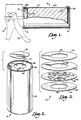
- Fig. 1 is an elevational view of a cartridge dispenser having a composite end disk constructed according to a preferred embodiment of the present invention, with the cartridge shown partially in section and held by a dispensing gun;
- Fig. 2 is an exploded perspective view showing the cartridge of Fig. 1 and a seal strip which initially seals the valve of the end disk; and
- Fig. 3 is an exploded perspective view on an enlarged scale showing the various layers of the composite end disk.
- Referring now to the drawing in more detail and initially to Fig. 1,
numeral 10 generally designates a disposable cartridge type dispenser in which food sauce 12 is packaged and from which the food sauce may be dispensed by the operation of a hand held dispensinggun 14. Thedispensing gun 14 is constructed to receive thedispenser 10 between a pair offlanged plates 16. Thegun 14 includes aplunger 18 which fits in one end of thedispenser 10 and may be advanced into the dispenser by squeezing atrigger 20 which operates aratchet mechanism 22. Each time thetrigger 20 is squeezed, theratchet mechanism 22 advances plunger 18 a preselected distance into thedispenser 10, and this results in the dispensing of a controlled amount of the food sauce 12. The dispensing gun is not a part of the present invention, and the manner in which it operates is more fully disclosed in U.S. patent no. 4,432,473. - Although the
dispenser 10 may hold various types of flowable materials, it is contemplated that it will normally be used to dispense food sauces such as those used in high volume in fast service restaurants. Typically, the food sauces are mayonnaise based dressings and thus have a consistency and flowability similar to mayonnaise. - The
cartridge dispenser 10 has acylindrical body 24 which is preferably a foil laminated food grade paper board coated with thermal plastic. One end of thebody 24 is provided with aplug 26 which closes the end of the cartridge and yet may be advanced withinbody 24 throughout its entire length by theplunger 18 of the dispensinggun 14. The side wall of theplug 26 may be provided withwiping ribs 28 which wipe the inside surface ofbody 24 as the plug is advanced. - The opposite end of the
cartridge body 24 has an inwardly rolledrim 30. Anend disk 32 constructed in accordance with the present invention is disposed against the inwardly rolledrim 30 and is secured to the inside surface ofbody 24 by a bead 34 of food grade adhesive which contacts the inside surface of theend disk 32. The outside surface of the end disk is exposed. - Fig. 3 best illustrates the laminated construction of the
end disk 32. Stiffness, thickness and rigidity are provided by apaperboard disk 36 which is thick enough to permit the disk to be handled and fed by existing "chip feeding" machines of the type currently used to apply polyethylene end disks to cartridges of this type.Disk 36 is preferably food grade paper board which may, but need not, be laminated with foil. Acircular opening 38 is formed through the center ofdisk 36. - The outer surface of the
paperboard disk 36 is covered by apolyethylene disk 40 which protectsdisk 36 and prevents it from being oil stained or subjected to other materials that could possibly damage the paperboard disk. Thepolyethylene disk 40 also provides an outer surface which is heat sealable in order to receive a foil sealing strip 42 (see Fig. 2) which will subsequently be described in more detail. Disk 40 has acircular opening 44 through its center. Heat sealing extrusion lamination, adhesive securement or any other suitable means may be used to securedisks openings - A
polyester disk 46 provides the dispensing valve through which the sauce 12 is dispensed. A layer of suitable adhesive 48 is used to secure thepolyester disk 46 to the underside of thepaperboard disk 36. The adhesive 48 can either be a cold set glue or a heat seal coating, and it may be applied todisk Disks - The
polyester disk 46 is provided with acircular valve area 50 in its center which is the same size as opening 38 and is in registration with the opening. Thevalve area 50 is provided with three spacedapart valve openings 52 which are each formed by a pair of intersectingslits 54 formed through thevalve area 50 of the polyester disks. Each pair ofslits 54 is made in a cross hair pattern, and theslits 54 in each pair intersect at their centers. Each pair ofslits 54 thus form four leaves orvanes 56 which are located between the slits and which taper to in tip portions located adjacent to one another at the intersection between the slits. - The petals or
vanes 56 are part of thepolyester disk 46 and are normally coplanar with the remainder of the disk to close thevalve openings 52. However, thevanes 56 may be displaced outwardly from the closed position when internal pressure is generated indispenser 10 due to the advancingplug 26. When thevanes 56 are thus displaced outwardly, thevalve openings 52 are opened to allow the sauce 12 to be dispensed through them. When the advancement ofplug 26 is terminated at the end of each dispensing stroke, the "memory" or resiliency of thevanes 56 causes them to quickly return to their normal undeformed conditions, and thevalve openings 52 are thus quickly closed immediately following the end of each dispensing stroke. Thevalve openings 52 are distributed uniformly in thevalve area 50 and are spaced equally from one another and from the center ofdisk 46. - The stiff nature of polyester and the good "memory" it exhibits cause the
vanes 56 to quickly close as soon as the positive pressure withincartridge 10 is reduced. The characteristics of the polyester also allow threevalve openings 52 to be used within approximately the same area as has been occupied by a single valve in other known cartridge end disks. It has been found that good valve action results when thepolyester disk 46 has a thickness between approximately .004 inch and about .006 inch. If the disk thickness varies appreciably from this range, the valve operation suffers. - A
polyethylene disk 58 is secured to the underside of thepolyester disk 46 by a suitable adhesive 60. Because polyethylene is not compatible with polyester, thepolyethylene disk 58 cannot be extrusion laminated directly onto the polyester, thus the adhesive 60 is required to secure the two disks together.Disk 58 is the same diameter asdisk 46 and is provided with acentral opening 62 which has the same size as and is disposed in registration with thevalve area 50. - The purpose for the
polyethylene disk 58 is to provide a surface on thecomposite disk 32 for the adhesive bead 34. Currently available food grade adhesives are not compatible with polyester, and it is thus not feasible to adhesively secure thepolyester 46 directly to thecartridge body 24. Preferably, the adhesive 34 is a suitable food grade hot melt luting which secures the periphery ofdisk 58 to the inside surface ofbody 24, thus securing thecomposite disk 32 in place against the rolledrim 30. It should be noted thatdisk 58 may not always be needed and may be eliminated if thepolyester disk 46 can be secured directly to thedispenser 10. - The
foil strip 42 is preferably provided with a heat seal or pressure sensitive coating on its underside. Thestrip 42 is larger than opening 44, and the heat seal or pressure sensitive coating adheres to the outer surface ofdisk 42 in order to cover thevalve area 50 and the alignedopenings foil 42 is releaseable fromdisk 40, and the foil strip can thus be removed when thecartridge dispenser 10 is to be used. When the foil strip is removed, thevalve openings 52 are exposed so that the food sauce 12 may be dispensed through thevalve openings 52. - The various layers of the
composite end disks 32 are assembled and secured together, and the composite disk is applied to and adhesively secured to the end ofdispenser 10. The foiledstrip 42 is initially sealed to the outer surface ofdisk 40 to coveropening 44 and thus retain the contents within thedispenser 10. - When the sauce 12 is to be dispensed,
cartridge 10 is placed in the dispensinggun 14,foil 42 is removed, and thetrigger 20 is squeezed to dispense an incremental amount of the sauce. Each time the trigger is squeezed,plunger 18 is advanced an incremental distance and thus advances theend plug 26 the same distance to dispense a measured and consistent amount of the sauce 12. The sauce which is dispensed passes outwardly through thevalve openings 52 sincevalves 56 are opened by the internal pressure caused by the advancing end plug. - At the end of the dispensing cycle, end plug 26 stops, and the internal pressure is reduced. As soon as this occurs, the
vanes 56 immediately close due to the good "memory" characteristics of the polyester of whichdisk 46 is constructed. The valves thus quickly close at the end of the dispensing operation to prevent "stringing" of the food sauce as the dispensing gun is moved from one sandwich to another. At the same time, thevanes 56 smoothly open as the sauce 12 is dispensed, and they do not apply enough back pressure to cause the sauce to be squirted out of the cartridge with enough force to result in splattering. The overall result is that the sauce is dispensed in accurately controlled amounts, and the flow is cleanly and immediately cut off at the end of the dispensing stroke. - The presence of the three
valve openings 52 allows the sauce to be dispensed over substantially the entirety provided of thevalve area 50. The sauce is thus distributed over a larger area than occurs with disks having only a single valve, and this improved distribution of the sauce over a larger area allows the sauce to act as an adhesive which holds fine cuts of lettuce and other small materials in place on the sandwich. - The
composite end disk 32 has a unique laminated construction in which each layer has the ability to effect-vely perform its assigned function. Together, the layers cooperate to provide the end disk with improved operating characteristics which significantly enhance the valving action of the disk and more effectively distribute the food sauces and other materials which are dispensed from cartridge dispensers. - Although the disk is illustrated and described as being held in place on the cartridge by the adhesive bead 34, the disk can alternatively be provided with a peripheral skirt (not shown) which could be mechanically crimped onto the cartridge when the edge is curled to form the inwardly rolled
rim 30. Suitable hot melt forming the bead 34 would then act as caulking to insure a leakproof seal between the disk and the cartridge. A combination of adhesive attachment and mechamical crimping can also be used to secure the disk. - From the foregoing, it will be seen that this invention is one well adapted to attain all the ends and objects hereinabove set forth together with other advantages which are obvious and which are inherent to the structure.
- It will be understood that certain features and subcombinations are of utility and may be employed without reference to other features and subcombinations. This is contemplated by and is within the scope of the claims.
- Since many possible embodiments may be made of the invention without departing from the scope thereof, it is to be understood that all matter herein set forth or shown in the accompanying drawings is to be interpreted as illustrative and not in a limiting sense.
Claims (12)
Priority Applications (1)
| Application Number | Priority Date | Filing Date | Title |
|---|---|---|---|
| AT88120191T ATE77336T1 (en) | 1987-12-07 | 1988-12-03 | MULTI-LAYER VALVE DISC FOR DISPENSING CARTRIDGES. |
Applications Claiming Priority (2)
| Application Number | Priority Date | Filing Date | Title |
|---|---|---|---|
| US07/129,155 US4830231A (en) | 1987-12-07 | 1987-12-07 | Composite disk valve for dispensing cartridges |
| US129155 | 1987-12-07 |
Publications (3)
| Publication Number | Publication Date |
|---|---|
| EP0319861A2 true EP0319861A2 (en) | 1989-06-14 |
| EP0319861A3 EP0319861A3 (en) | 1989-12-20 |
| EP0319861B1 EP0319861B1 (en) | 1992-06-17 |
Family
ID=22438690
Family Applications (1)
| Application Number | Title | Priority Date | Filing Date |
|---|---|---|---|
| EP88120191A Expired - Lifetime EP0319861B1 (en) | 1987-12-07 | 1988-12-03 | Composite disk valve for dispensing cartridges |
Country Status (7)
| Country | Link |
|---|---|
| US (1) | US4830231A (en) |
| EP (1) | EP0319861B1 (en) |
| JP (1) | JPH0794266B2 (en) |
| AT (1) | ATE77336T1 (en) |
| AU (1) | AU609912B2 (en) |
| CA (1) | CA1286645C (en) |
| DE (1) | DE3872190D1 (en) |
Cited By (6)
| Publication number | Priority date | Publication date | Assignee | Title |
|---|---|---|---|---|
| WO1994011271A1 (en) * | 1992-11-06 | 1994-05-26 | Teroson Gmbh | Single and multi-use drum with insert |
| EP0860377A1 (en) * | 1997-02-20 | 1998-08-26 | Quick Coordination Center in het kort "Quick C.C." | Refill cartridge for dispensing sauces such as mayonnaise or ketchup on hamburger or the like |
| EP1125863A1 (en) | 2000-02-14 | 2001-08-22 | VG Nicolaus GmbH | Cylindrical package for pasty fillings |
| WO2006005147A1 (en) * | 2004-07-08 | 2006-01-19 | Sonoco For-Plas S/A | Dispensing closure for a container, and dispensing container incorporating same |
| EP2743200A1 (en) | 2012-12-17 | 2014-06-18 | Develey Holding GmbH & Co. Beteiligungs KG | Cartridge |
| FR3002214A1 (en) * | 2013-02-19 | 2014-08-22 | Nicolas Caunant | SAUCE DISPENSER AND CONDIMENTS |
Families Citing this family (27)
| Publication number | Priority date | Publication date | Assignee | Title |
|---|---|---|---|---|
| US5149327A (en) * | 1989-09-05 | 1992-09-22 | Terumo Kabushiki Kaisha | Medical valve, catheter with valve, and catheter assembly |
| US5474210A (en) * | 1992-02-27 | 1995-12-12 | Pump Products, Inc. | Fluid dispensing device |
| USD359446S (en) | 1993-04-29 | 1995-06-20 | Geocel Corporation | Display package for dispensing tubes |
| US5622288A (en) * | 1995-06-12 | 1997-04-22 | Sonoco Products Company | Cartridge plunger with surface cleaning skirt |
| US6163951A (en) * | 1999-03-31 | 2000-12-26 | Sealright Co., Inc. | Method and apparatus for lifting tabs of a laminate from a substrate |
| US6176399B1 (en) * | 1999-07-12 | 2001-01-23 | Aptargroup, Inc | Valved dispensing system for multiple dispensing streams |
| US6361485B1 (en) | 2000-12-07 | 2002-03-26 | Sealright Co., Inc. | Method and apparatus for constructing an end portion of a food sauce dispensing cartridge |
| US6371335B1 (en) | 2000-12-07 | 2002-04-16 | Sealright Co., Inc. | Folded end construction for food sauce dispensing cartridges |
| US6655554B2 (en) * | 2002-01-11 | 2003-12-02 | Huhtamaki Consumer Packing, Inc. | Wide pattern laminated end disk for food dispensing gun and cartridge for implementing same |
| US20040111071A1 (en) * | 2002-12-09 | 2004-06-10 | Jeffrey Lewis Powers | Portable device for dispensing hand treatments |
| US7146782B2 (en) * | 2003-08-19 | 2006-12-12 | Huhtamaki Consumer Packaging, Inc. | Method of sealing a plug with a food sauce dispensing cartridge |
| US7337928B2 (en) * | 2003-10-27 | 2008-03-04 | Jackman Brian F | Cartridge nozzle seal opened by internal cartridge pressure |
| US7237698B2 (en) * | 2004-01-20 | 2007-07-03 | Brian Francis Jackman | Pressure activated self opening container and seal |
| US20060060612A1 (en) * | 2004-09-22 | 2006-03-23 | Keith Antal | Liquid media flapper dispensing valve |
| US8561854B2 (en) * | 2005-08-01 | 2013-10-22 | Rich Products Corporation | Dispensing device for viscous materials |
| US8297481B2 (en) * | 2005-08-01 | 2012-10-30 | Rich Products Corporation | Dispensing device |
| JP4855171B2 (en) * | 2006-07-28 | 2012-01-18 | キユーピー株式会社 | Gun type dispenser for viscous liquids |
| US8146781B2 (en) | 2007-08-09 | 2012-04-03 | Huhtamaki, Inc. | Dispenser for viscous condiments |
| US20110121028A1 (en) * | 2009-05-13 | 2011-05-26 | Server Products, Inc. | Dispenser and flexible pouch for liquid food product |
| CN103370264B (en) | 2011-02-18 | 2015-09-30 | 丘比株式会社 | The discharge member of container and manufacture method, container and container package food |
| EP3854705B1 (en) | 2014-07-28 | 2025-09-03 | Cryovac, LLC | Package |
| US9731317B2 (en) | 2014-10-15 | 2017-08-15 | Sonoco Development, Inc. | Device for holding and dispensing viscous material |
| WO2018119066A1 (en) * | 2016-12-21 | 2018-06-28 | Stoneridge Kitchen & Bath Llc | Glue gun |
| US10618076B2 (en) | 2018-01-10 | 2020-04-14 | Huhtamaki, Inc. | Condiment dispensing device |
| USD878168S1 (en) | 2018-01-10 | 2020-03-17 | Huhtamaki, Inc. | Condiment dispensing device |
| US10787306B2 (en) * | 2018-10-05 | 2020-09-29 | Server Products, Inc. | Dispenser for viscous materials |
| US10654622B2 (en) * | 2018-10-05 | 2020-05-19 | Server Products, Inc. | Dispensers with diverter inserts |
Family Cites Families (4)
| Publication number | Priority date | Publication date | Assignee | Title |
|---|---|---|---|---|
| US4373646A (en) * | 1970-08-03 | 1983-02-15 | Phillips Petroleum Company | Cartridge-type dispenser |
| US4171084A (en) * | 1978-07-21 | 1979-10-16 | Phillips Petroleum Company | Closure assembly and container sealed therewith |
| US4432473A (en) * | 1981-02-24 | 1984-02-21 | Sealright Co., Inc. | Cartridge-type dispenser |
| US4448345A (en) * | 1982-07-29 | 1984-05-15 | Container Corporation Of America | Composite lid |
-
1987
- 1987-12-07 US US07/129,155 patent/US4830231A/en not_active Expired - Lifetime
-
1988
- 1988-11-28 JP JP63300429A patent/JPH0794266B2/en not_active Expired - Lifetime
- 1988-12-03 AT AT88120191T patent/ATE77336T1/en not_active IP Right Cessation
- 1988-12-03 DE DE8888120191T patent/DE3872190D1/en not_active Expired - Lifetime
- 1988-12-03 EP EP88120191A patent/EP0319861B1/en not_active Expired - Lifetime
- 1988-12-05 CA CA000584968A patent/CA1286645C/en not_active Expired - Lifetime
- 1988-12-07 AU AU26660/88A patent/AU609912B2/en not_active Expired
Cited By (9)
| Publication number | Priority date | Publication date | Assignee | Title |
|---|---|---|---|---|
| WO1994011271A1 (en) * | 1992-11-06 | 1994-05-26 | Teroson Gmbh | Single and multi-use drum with insert |
| US5732848A (en) * | 1992-11-06 | 1998-03-31 | Teroson Gmbh | Disposable and returnable containers comprising an insert |
| EP0860377A1 (en) * | 1997-02-20 | 1998-08-26 | Quick Coordination Center in het kort "Quick C.C." | Refill cartridge for dispensing sauces such as mayonnaise or ketchup on hamburger or the like |
| EP1125863A1 (en) | 2000-02-14 | 2001-08-22 | VG Nicolaus GmbH | Cylindrical package for pasty fillings |
| WO2006005147A1 (en) * | 2004-07-08 | 2006-01-19 | Sonoco For-Plas S/A | Dispensing closure for a container, and dispensing container incorporating same |
| US7959038B2 (en) | 2004-07-08 | 2011-06-14 | Sonoco For-Plas S/A | Dispensing closure for a container, and dispensing container incorporating same |
| EP2743200A1 (en) | 2012-12-17 | 2014-06-18 | Develey Holding GmbH & Co. Beteiligungs KG | Cartridge |
| FR3002214A1 (en) * | 2013-02-19 | 2014-08-22 | Nicolas Caunant | SAUCE DISPENSER AND CONDIMENTS |
| WO2014127957A1 (en) * | 2013-02-19 | 2014-08-28 | Nicolas Caunant | Sauce and condiment dispenser |
Also Published As
| Publication number | Publication date |
|---|---|
| ATE77336T1 (en) | 1992-07-15 |
| EP0319861B1 (en) | 1992-06-17 |
| EP0319861A3 (en) | 1989-12-20 |
| JPH024678A (en) | 1990-01-09 |
| AU609912B2 (en) | 1991-05-09 |
| JPH0794266B2 (en) | 1995-10-11 |
| US4830231A (en) | 1989-05-16 |
| DE3872190D1 (en) | 1992-07-23 |
| CA1286645C (en) | 1991-07-23 |
| AU2666088A (en) | 1989-06-08 |
Similar Documents
| Publication | Publication Date | Title |
|---|---|---|
| EP0319861B1 (en) | Composite disk valve for dispensing cartridges | |
| AU2003202262B2 (en) | Wide pattern laminated end disk for food dispensing gun and cartridge for implementing same | |
| US4356935A (en) | Method and apparatus for storing and dispensing fluid foodstuff | |
| US3986640A (en) | Package for a flowable product and material for making such package | |
| US4373646A (en) | Cartridge-type dispenser | |
| AU760342B2 (en) | Integral package applicator | |
| JPH0323436B2 (en) | ||
| WO1991017931A1 (en) | Package and method for a liquid sample | |
| IE54635B1 (en) | Dispenser package | |
| US3261504A (en) | Dispensing closure | |
| AU743010B2 (en) | Method of making multiple miniature sample compartments | |
| AU2001285356B2 (en) | Folded end construction for food sauce dispensing cartridges | |
| AU2001285356A1 (en) | Folded end construction for food sauce dispensing cartridges | |
| CA1044649A (en) | Dispenser for paste materials | |
| CA1243281A (en) | Dispenser package for soft-frozen comestibles | |
| KR20010113442A (en) | Sachet and material for making a sachet |
Legal Events
| Date | Code | Title | Description |
|---|---|---|---|
| PUAI | Public reference made under article 153(3) epc to a published international application that has entered the european phase |
Free format text: ORIGINAL CODE: 0009012 |
|
| AK | Designated contracting states |
Kind code of ref document: A2 Designated state(s): AT BE CH DE ES FR GB GR IT LI LU NL SE |
|
| PUAL | Search report despatched |
Free format text: ORIGINAL CODE: 0009013 |
|
| AK | Designated contracting states |
Kind code of ref document: A3 Designated state(s): AT BE CH DE ES FR GB GR IT LI LU NL SE |
|
| 17P | Request for examination filed |
Effective date: 19891201 |
|
| 17Q | First examination report despatched |
Effective date: 19910327 |
|
| GRAA | (expected) grant |
Free format text: ORIGINAL CODE: 0009210 |
|
| AK | Designated contracting states |
Kind code of ref document: B1 Designated state(s): AT BE CH DE ES FR GB GR IT LI LU NL SE |
|
| PG25 | Lapsed in a contracting state [announced via postgrant information from national office to epo] |
Ref country code: IT Free format text: LAPSE BECAUSE OF FAILURE TO SUBMIT A TRANSLATION OF THE DESCRIPTION OR TO PAY THE FEE WITHIN THE PRE;WARNING: LAPSES OF ITALIAN PATENTS WITH EFFECTIVE DATE BEFORE 2007 MAY HAVE OCCURRED AT ANY TIME BEFORE 2007. THE CORRECT EFFECTIVE DATE MAY BE DIFFERENT FROM THE ONE RECORDED.SCRIBED TIME-LIMIT Effective date: 19920617 Ref country code: BE Effective date: 19920617 Ref country code: SE Effective date: 19920617 Ref country code: DE Effective date: 19920617 Ref country code: ES Free format text: THE PATENT HAS BEEN ANNULLED BY A DECISION OF A NATIONAL AUTHORITY Effective date: 19920617 Ref country code: FR Effective date: 19920617 Ref country code: LI Effective date: 19920617 Ref country code: NL Effective date: 19920617 Ref country code: CH Effective date: 19920617 Ref country code: AT Effective date: 19920617 Ref country code: GR Free format text: LAPSE BECAUSE OF FAILURE TO SUBMIT A TRANSLATION OF THE DESCRIPTION OR TO PAY THE FEE WITHIN THE PRESCRIBED TIME-LIMIT Effective date: 19920617 |
|
| REF | Corresponds to: |
Ref document number: 77336 Country of ref document: AT Date of ref document: 19920715 Kind code of ref document: T |
|
| REF | Corresponds to: |
Ref document number: 3872190 Country of ref document: DE Date of ref document: 19920723 |
|
| REG | Reference to a national code |
Ref country code: CH Ref legal event code: PL |
|
| EN | Fr: translation not filed | ||
| NLV1 | Nl: lapsed or annulled due to failure to fulfill the requirements of art. 29p and 29m of the patents act | ||
| PG25 | Lapsed in a contracting state [announced via postgrant information from national office to epo] |
Ref country code: LU Free format text: LAPSE BECAUSE OF NON-PAYMENT OF DUE FEES Effective date: 19921231 |
|
| PLBE | No opposition filed within time limit |
Free format text: ORIGINAL CODE: 0009261 |
|
| STAA | Information on the status of an ep patent application or granted ep patent |
Free format text: STATUS: NO OPPOSITION FILED WITHIN TIME LIMIT |
|
| 26N | No opposition filed | ||
| REG | Reference to a national code |
Ref country code: GB Ref legal event code: IF02 |
|
| PGFP | Annual fee paid to national office [announced via postgrant information from national office to epo] |
Ref country code: GB Payment date: 20071218 Year of fee payment: 20 |
|
| REG | Reference to a national code |
Ref country code: GB Ref legal event code: PE20 Expiry date: 20081202 |
|
| PG25 | Lapsed in a contracting state [announced via postgrant information from national office to epo] |
Ref country code: GB Free format text: LAPSE BECAUSE OF EXPIRATION OF PROTECTION Effective date: 20081202 |