EP0318186B1 - Procedure for producing poly-alpha-olefin-type lubricant - Google Patents
Procedure for producing poly-alpha-olefin-type lubricant Download PDFInfo
- Publication number
- EP0318186B1 EP0318186B1 EP88310621A EP88310621A EP0318186B1 EP 0318186 B1 EP0318186 B1 EP 0318186B1 EP 88310621 A EP88310621 A EP 88310621A EP 88310621 A EP88310621 A EP 88310621A EP 0318186 B1 EP0318186 B1 EP 0318186B1
- Authority
- EP
- European Patent Office
- Prior art keywords
- catalyst
- complex
- olefin
- oligomerization
- process according
- Prior art date
- Legal status (The legal status is an assumption and is not a legal conclusion. Google has not performed a legal analysis and makes no representation as to the accuracy of the status listed.)
- Expired - Lifetime
Links
- 238000000034 method Methods 0.000 title claims abstract description 16
- 239000000314 lubricant Substances 0.000 title claims abstract 3
- 239000003054 catalyst Substances 0.000 claims abstract description 33
- 238000006384 oligomerization reaction Methods 0.000 claims abstract description 19
- 230000003606 oligomerizing effect Effects 0.000 claims abstract description 7
- 238000004821 distillation Methods 0.000 claims abstract description 6
- LFQSCWFLJHTTHZ-UHFFFAOYSA-N Ethanol Chemical compound CCO LFQSCWFLJHTTHZ-UHFFFAOYSA-N 0.000 claims abstract description 4
- 150000001732 carboxylic acid derivatives Chemical class 0.000 claims abstract 2
- 150000001336 alkenes Chemical class 0.000 claims description 7
- 238000000926 separation method Methods 0.000 claims description 3
- 229920005862 polyol Polymers 0.000 claims description 2
- 150000003077 polyols Chemical class 0.000 claims description 2
- JRZJOMJEPLMPRA-UHFFFAOYSA-N olefin Natural products CCCCCCCC=C JRZJOMJEPLMPRA-UHFFFAOYSA-N 0.000 claims 3
- 238000010924 continuous production Methods 0.000 claims 1
- WTEOIRVLGSZEPR-UHFFFAOYSA-N boron trifluoride Chemical compound FB(F)F WTEOIRVLGSZEPR-UHFFFAOYSA-N 0.000 abstract description 24
- 239000004711 α-olefin Substances 0.000 abstract 1
- 229910015900 BF3 Inorganic materials 0.000 description 19
- 239000000047 product Substances 0.000 description 13
- AFFLGGQVNFXPEV-UHFFFAOYSA-N 1-decene Chemical compound CCCCCCCCC=C AFFLGGQVNFXPEV-UHFFFAOYSA-N 0.000 description 7
- LRHPLDYGYMQRHN-UHFFFAOYSA-N N-Butanol Chemical compound CCCCO LRHPLDYGYMQRHN-UHFFFAOYSA-N 0.000 description 5
- 238000002474 experimental method Methods 0.000 description 5
- VYPSYNLAJGMNEJ-UHFFFAOYSA-N Silicium dioxide Chemical compound O=[Si]=O VYPSYNLAJGMNEJ-UHFFFAOYSA-N 0.000 description 4
- 238000006243 chemical reaction Methods 0.000 description 4
- 238000005461 lubrication Methods 0.000 description 4
- 150000001298 alcohols Chemical class 0.000 description 3
- 238000001816 cooling Methods 0.000 description 3
- IJGRMHOSHXDMSA-UHFFFAOYSA-N Atomic nitrogen Chemical compound N#N IJGRMHOSHXDMSA-UHFFFAOYSA-N 0.000 description 2
- 238000009835 boiling Methods 0.000 description 2
- 239000007795 chemical reaction product Substances 0.000 description 2
- DIOQZVSQGTUSAI-UHFFFAOYSA-N decane Chemical compound CCCCCCCCCC DIOQZVSQGTUSAI-UHFFFAOYSA-N 0.000 description 2
- 150000002222 fluorine compounds Chemical class 0.000 description 2
- 239000007789 gas Substances 0.000 description 2
- 238000004519 manufacturing process Methods 0.000 description 2
- 239000000203 mixture Substances 0.000 description 2
- 239000000377 silicon dioxide Substances 0.000 description 2
- 235000012239 silicon dioxide Nutrition 0.000 description 2
- JBJWASZNUJCEKT-UHFFFAOYSA-M sodium;hydroxide;hydrate Chemical compound O.[OH-].[Na+] JBJWASZNUJCEKT-UHFFFAOYSA-M 0.000 description 2
- 239000007787 solid Substances 0.000 description 2
- 239000007858 starting material Substances 0.000 description 2
- 238000005406 washing Methods 0.000 description 2
- 238000005727 Friedel-Crafts reaction Methods 0.000 description 1
- NPXOKRUENSOPAO-UHFFFAOYSA-N Raney nickel Chemical compound [Al].[Ni] NPXOKRUENSOPAO-UHFFFAOYSA-N 0.000 description 1
- XAGFODPZIPBFFR-UHFFFAOYSA-N aluminium Chemical compound [Al] XAGFODPZIPBFFR-UHFFFAOYSA-N 0.000 description 1
- 229910052782 aluminium Inorganic materials 0.000 description 1
- 239000004411 aluminium Substances 0.000 description 1
- 239000012298 atmosphere Substances 0.000 description 1
- 238000000998 batch distillation Methods 0.000 description 1
- 238000010923 batch production Methods 0.000 description 1
- 125000004432 carbon atom Chemical group C* 0.000 description 1
- 150000001735 carboxylic acids Chemical class 0.000 description 1
- 230000004087 circulation Effects 0.000 description 1
- 239000003426 co-catalyst Substances 0.000 description 1
- 229910052681 coesite Inorganic materials 0.000 description 1
- 150000001875 compounds Chemical class 0.000 description 1
- 229910052906 cristobalite Inorganic materials 0.000 description 1
- 239000000539 dimer Substances 0.000 description 1
- 238000009826 distribution Methods 0.000 description 1
- 230000000694 effects Effects 0.000 description 1
- 238000005516 engineering process Methods 0.000 description 1
- 239000000945 filler Substances 0.000 description 1
- 238000011010 flushing procedure Methods 0.000 description 1
- 238000010438 heat treatment Methods 0.000 description 1
- 238000005984 hydrogenation reaction Methods 0.000 description 1
- 230000006698 induction Effects 0.000 description 1
- 239000007791 liquid phase Substances 0.000 description 1
- 239000000178 monomer Substances 0.000 description 1
- 229910052757 nitrogen Inorganic materials 0.000 description 1
- 239000012299 nitrogen atmosphere Substances 0.000 description 1
- 239000012071 phase Substances 0.000 description 1
- 238000005191 phase separation Methods 0.000 description 1
- 238000001556 precipitation Methods 0.000 description 1
- 239000011541 reaction mixture Substances 0.000 description 1
- 230000035484 reaction time Effects 0.000 description 1
- 150000003839 salts Chemical class 0.000 description 1
- 238000010561 standard procedure Methods 0.000 description 1
- 229910052682 stishovite Inorganic materials 0.000 description 1
- 230000001988 toxicity Effects 0.000 description 1
- 231100000419 toxicity Toxicity 0.000 description 1
- 229910052905 tridymite Inorganic materials 0.000 description 1
- 239000002699 waste material Substances 0.000 description 1
Images

Classifications
-
- C—CHEMISTRY; METALLURGY
- C10—PETROLEUM, GAS OR COKE INDUSTRIES; TECHNICAL GASES CONTAINING CARBON MONOXIDE; FUELS; LUBRICANTS; PEAT
- C10M—LUBRICATING COMPOSITIONS; USE OF CHEMICAL SUBSTANCES EITHER ALONE OR AS LUBRICATING INGREDIENTS IN A LUBRICATING COMPOSITION
- C10M177/00—Special methods of preparation of lubricating compositions; Chemical modification by after-treatment of components or of the whole of a lubricating composition, not covered by other classes
-
- C—CHEMISTRY; METALLURGY
- C10—PETROLEUM, GAS OR COKE INDUSTRIES; TECHNICAL GASES CONTAINING CARBON MONOXIDE; FUELS; LUBRICANTS; PEAT
- C10G—CRACKING HYDROCARBON OILS; PRODUCTION OF LIQUID HYDROCARBON MIXTURES, e.g. BY DESTRUCTIVE HYDROGENATION, OLIGOMERISATION, POLYMERISATION; RECOVERY OF HYDROCARBON OILS FROM OIL-SHALE, OIL-SAND, OR GASES; REFINING MIXTURES MAINLY CONSISTING OF HYDROCARBONS; REFORMING OF NAPHTHA; MINERAL WAXES
- C10G50/00—Production of liquid hydrocarbon mixtures from lower carbon number hydrocarbons, e.g. by oligomerisation
- C10G50/02—Production of liquid hydrocarbon mixtures from lower carbon number hydrocarbons, e.g. by oligomerisation of hydrocarbon oils for lubricating purposes
-
- C—CHEMISTRY; METALLURGY
- C10—PETROLEUM, GAS OR COKE INDUSTRIES; TECHNICAL GASES CONTAINING CARBON MONOXIDE; FUELS; LUBRICANTS; PEAT
- C10M—LUBRICATING COMPOSITIONS; USE OF CHEMICAL SUBSTANCES EITHER ALONE OR AS LUBRICATING INGREDIENTS IN A LUBRICATING COMPOSITION
- C10M107/00—Lubricating compositions characterised by the base-material being a macromolecular compound
- C10M107/02—Hydrocarbon polymers; Hydrocarbon polymers modified by oxidation
-
- C—CHEMISTRY; METALLURGY
- C10—PETROLEUM, GAS OR COKE INDUSTRIES; TECHNICAL GASES CONTAINING CARBON MONOXIDE; FUELS; LUBRICANTS; PEAT
- C10M—LUBRICATING COMPOSITIONS; USE OF CHEMICAL SUBSTANCES EITHER ALONE OR AS LUBRICATING INGREDIENTS IN A LUBRICATING COMPOSITION
- C10M2205/00—Organic macromolecular hydrocarbon compounds or fractions, whether or not modified by oxidation as ingredients in lubricant compositions
-
- C—CHEMISTRY; METALLURGY
- C10—PETROLEUM, GAS OR COKE INDUSTRIES; TECHNICAL GASES CONTAINING CARBON MONOXIDE; FUELS; LUBRICANTS; PEAT
- C10M—LUBRICATING COMPOSITIONS; USE OF CHEMICAL SUBSTANCES EITHER ALONE OR AS LUBRICATING INGREDIENTS IN A LUBRICATING COMPOSITION
- C10M2205/00—Organic macromolecular hydrocarbon compounds or fractions, whether or not modified by oxidation as ingredients in lubricant compositions
- C10M2205/02—Organic macromolecular hydrocarbon compounds or fractions, whether or not modified by oxidation as ingredients in lubricant compositions containing acyclic monomers
-
- C—CHEMISTRY; METALLURGY
- C10—PETROLEUM, GAS OR COKE INDUSTRIES; TECHNICAL GASES CONTAINING CARBON MONOXIDE; FUELS; LUBRICANTS; PEAT
- C10N—INDEXING SCHEME ASSOCIATED WITH SUBCLASS C10M RELATING TO LUBRICATING COMPOSITIONS
- C10N2020/00—Specified physical or chemical properties or characteristics, i.e. function, of component of lubricating compositions
- C10N2020/01—Physico-chemical properties
Definitions
- the present invention concerns a procedure for producing a poly- ⁇ -olefine-type lubrication by oligomerizing olefins with the aid of a BF3 cocatalyst complex.
- oligomerization catalysts are of so-called Friedel-Crafts type, primarily boron trifluoride, in addition to which various alcohols are used as so-called cocatalysts or promotor (see e.g. USP 3,780,128, USP 4,032,591, USP 4,376,222, USP 4,409,415 and USP 4,587,368), or aluminium halogenides (see e.g. USP 2,559,984, USP 3,637,503 and USP 3,652,706).
- the present invention concerns a procedure for producing a lubrication of poly- ⁇ -olefine type, which is characterized in that the BF3 cocatalyst complex is separated from the oligomerization product by distilling, and said separated complex is reused as catalyst in a similar oligomerizing reaction.
- the BF3 complex circulated by distilling can be reused as such or after a minor BF3 addition as an oligomerizing catalyst without essentially changing the quality of the end product. It should also be noted that circulation can be continued innumerable times, thus allowing the maximum use of said catalyst.
- the invention particularly concerns the procedures in which the BF3 catalyst complex is separated from the oligomerization product by distilling, preferably at a low, about 0.1 to 3 mbar pressure and at a low, about 20 to 100°C temperature. In order to enhance the separation efficiency, it is recommended to use distillation columns.
- cocatalyst compounds which form a stable, relatively low boiling complex with BF3, such as C1-C15 alcohols or polyols, and C1-C7 carboxylic acids.
- Particularly suitable cocatalysts are C1-C10 alcohols.
- olefins either straight chain or branched C4-C20 olefins, preferably however olefins with straight chains, are used, in which the double bond is located in the 1 position and the length of a chain portion is 8 to 12 carbon atoms, or mixtures of said olefins.
- the invention is suited for use in producing poly- ⁇ -olefin-type lubrications either in a batch or continous type of process.
- the reaction was accomplished in a 2 liter Parr autoclave provided with a mixer and an internal heating/cooling coil. Into the reactor were weighed a 1 decene and n butanol or a distilled catalyst complex. From the reactor was removed air with the aid of vacuum and N2 flushing. The temperature was raised up to 30°C, and BF3 gas was supplied at constant rate to obtain the quantity required in producing the BF3-BuOH complex. The oligomerization process was performed in the BF3 atmosphere and terminated by supplying nitrogen for about 30 mins. The catalyst complex was distilled as a batch distillation utilising the aid of a Vigreux column at 0.1 to 3 mbar pressure and at 20 to 100°C temperature of the bottom.
- the temperature of the top of the distillation column was 40 to 70°C.
- the distillate was stored under an N2 atmosphere and at room temperature prior to use.
- the BF3 residues were removed by washing with a 5% NaOH water solution, and the monomer (1 decene) boiling at low temperature and part of the dimer were removed by distilling.
- the end product was hydrogenated with the aid of the Raney-Ni catalyst.
- the experiments 1 to 5 were carried out in succession in that the catalyst distillate obtained in the preceding experiment was used as such for the oligomerization catalyst in the next experiment subsequent to a minor BF3 addition.
- the product features, which are introduced in Table I, are determined using standard procedures.
- the oligomerization reaction was accomplished using two mixer reactors connected in series, their reaction volumes being 2.15 l and 4.1 l. Both reactors were provided with a mixer and an inner cooling coil. Into the reactors was supplied in continuous action 0.7 l/h 1-decene, 12.3 g/h n butanol (Example 6), or 19.2 g/h circulated cocatalyst complex (Example 7), this being obtained in the form of a product separated from an oligomerization product similar to the one presented in the previous example by distilling, and BF3 gas so that both reactors had about 1.5 bar pressure. The temperature of the first reactors was 10°C and of the other, 30°C. The feeding of both the circulated and the fresh catalyst was so controlled that the concentration of the catalyst complex regarding the decene supply was about 4 mol%.
- Fig. 1 is presented the distribution of various oligomers of a product oligomerized using continuous-action oligomerization equipment with a fresh (Example 6) and a circulated (Example 7) catalyst, in which it is seen that a similar product is obtained with the circulated catalyst as with the fresh catalyst.
Landscapes
- Chemical & Material Sciences (AREA)
- Oil, Petroleum & Natural Gas (AREA)
- Chemical Kinetics & Catalysis (AREA)
- General Chemical & Material Sciences (AREA)
- Organic Chemistry (AREA)
- Engineering & Computer Science (AREA)
- Organic Low-Molecular-Weight Compounds And Preparation Thereof (AREA)
- Low-Molecular Organic Synthesis Reactions Using Catalysts (AREA)
- Lubricants (AREA)
- Addition Polymer Or Copolymer, Post-Treatments, Or Chemical Modifications (AREA)
- Catalysts (AREA)
- Transition And Organic Metals Composition Catalysts For Addition Polymerization (AREA)
- Adhesives Or Adhesive Processes (AREA)
Abstract
Description
- The present invention concerns a procedure for producing a poly-α-olefine-type lubrication by oligomerizing olefins with the aid of a BF₃ cocatalyst complex.
- The production methods known in the art of a poly-α-olefine lubrication consist in general of the following phases: oligomerizing the starting material olefine, removal of catalyst residues, fraction distillation of the product, and hydrogenation. The most commonly used oligomerization catalysts are of so-called Friedel-Crafts type, primarily boron trifluoride, in addition to which various alcohols are used as so-called cocatalysts or promotor (see e.g. USP 3,780,128, USP 4,032,591, USP 4,376,222, USP 4,409,415 and USP 4,587,368), or aluminium halogenides (see e.g. USP 2,559,984, USP 3,637,503 and USP 3,652,706).
- Among said catalysts, specifically boron trifluoride, owing to high-level toxicity of fluorine compounds, involves considerable removal and waste handling problems related to catalyst residues, thus resulting in remarkable economic expenses.
- Known procedures used for removing catalyst residues consist primarily of washing of an oligomerizing mixture with a concentrated NaOH water solution, and precipitation of the fluorine compounds in the form of solid inorganic salts.
- In addition, procedures for circulating the BF₃ catalyst have been developed, either by binding it to a solid cocatalyst (silicon dioxide), whereby in the oligomerization product is left only the part of the BF₃ soluble therein, the separation of which from the product is accomplished with filler piece columns operating at reduced pressure (US. 4,263,467). Also liquid phase separation between the BF₃ alcohol catalyst complex and the oligomer product can be performed.
- Utilization of both said technologies leads, however, to the use of such a BF₃ cocatalyst system (BF₃*SiO₂ or a BF₃*alcohol) which does not allow an optimum oligomerization result and which causes problems in the production of a high-quality product.
- The present invention concerns a procedure for producing a lubrication of poly-α-olefine type, which is characterized in that the BF₃ cocatalyst complex is separated from the oligomerization product by distilling, and said separated complex is reused as catalyst in a similar oligomerizing reaction.
- With said procedure, remarkable savings are achieved both in the total catalyst consumption and in the expenses incurred in removing residues. In addition, it should be noted that the total reaction time is reduced compared with a standard batch process because the circulated catalyst already is in the form of a complex, and is able to start the reaction immediately.
- It is thus essential in view of the invention that the BF₃ complex circulated by distilling can be reused as such or after a minor BF₃ addition as an oligomerizing catalyst without essentially changing the quality of the end product. It should also be noted that circulation can be continued innumerable times, thus allowing the maximum use of said catalyst.
- In addition, the invention particularly concerns the procedures in which the BF₃ catalyst complex is separated from the oligomerization product by distilling, preferably at a low, about 0.1 to 3 mbar pressure and at a low, about 20 to 100°C temperature. In order to enhance the separation efficiency, it is recommended to use distillation columns.
- For cocatalyst are used compounds which form a stable, relatively low boiling complex with BF₃, such as C₁-C₁₅ alcohols or polyols, and C₁-C₇ carboxylic acids. Particularly suitable cocatalysts are C₁-C₁₀ alcohols.
- For starting material olefins, either straight chain or branched C₄-C₂₀ olefins, preferably however olefins with straight chains, are used, in which the double bond is located in the 1 position and the length of a chain portion is 8 to 12 carbon atoms, or mixtures of said olefins.
- The invention is suited for use in producing poly-α-olefin-type lubrications either in a batch or continous type of process.
- The invention can be described more in detail with the aid of the examples presented below.
- The reaction was accomplished in a 2 liter Parr autoclave provided with a mixer and an internal heating/cooling coil. Into the reactor were weighed a 1 decene and n butanol or a distilled catalyst complex. From the reactor was removed air with the aid of vacuum and N₂ flushing. The temperature was raised up to 30°C, and BF₃ gas was supplied at constant rate to obtain the quantity required in producing the BF₃-BuOH complex. The oligomerization process was performed in the BF₃ atmosphere and terminated by supplying nitrogen for about 30 mins. The catalyst complex was distilled as a batch distillation utilising the aid of a Vigreux column at 0.1 to 3 mbar pressure and at 20 to 100°C temperature of the bottom. During the collection, the temperature of the top of the distillation column was 40 to 70°C. The distillate was stored under an N₂ atmosphere and at room temperature prior to use. From the oligomerization product, the BF₃ residues were removed by washing with a 5% NaOH water solution, and the monomer (1 decene) boiling at low temperature and part of the dimer were removed by distilling. The end product was hydrogenated with the aid of the Raney-Ni catalyst. The experiments 1 to 5 were carried out in succession in that the catalyst distillate obtained in the preceding experiment was used as such for the oligomerization catalyst in the next experiment subsequent to a minor BF₃ addition. The product features, which are introduced in Table I, are determined using standard procedures.

- a) obtained from the preceding oligomerization experiment as distillate
- b) feeding at constant rate
- c) in the first experiment n-BuOH and equivalent molar quantity of BF₃ (fresh catalyst) is used, whereby the catalyst concentration regarding the decane is 10 mol%.
- The oligomerization reaction was accomplished using two mixer reactors connected in series, their reaction volumes being 2.15 l and 4.1 l. Both reactors were provided with a mixer and an inner cooling coil. Into the reactors was supplied in continuous action 0.7 l/h 1-decene, 12.3 g/h n butanol (Example 6), or 19.2 g/h circulated cocatalyst complex (Example 7), this being obtained in the form of a product separated from an oligomerization product similar to the one presented in the previous example by distilling, and BF₃ gas so that both reactors had about 1.5 bar pressure. The temperature of the first reactors was 10°C and of the other, 30°C. The feeding of both the circulated and the fresh catalyst was so controlled that the concentration of the catalyst complex regarding the decene supply was about 4 mol%.
- In Fig. 1 is presented the distribution of various oligomers of a product oligomerized using continuous-action oligomerization equipment with a fresh (Example 6) and a circulated (Example 7) catalyst, in which it is seen that a similar product is obtained with the circulated catalyst as with the fresh catalyst.
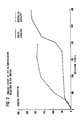
- In Fig. 2, the changing of the cooling effect (endeavours were made to maintain the reaction mixture in isothermic form) of the batch oligomerization (Examples 1 to 5), in which is seen that with the distilled, or circulated catalyst, the oligomerization reaction starts at a far greater rate than with the fresh catalyst, with which a remarkably long induction time takes in forming the catalyst complex, and consequently, in starting the oligomerization reaction.
Claims (6)
Priority Applications (1)
| Application Number | Priority Date | Filing Date | Title |
|---|---|---|---|
| AT88310621T ATE60879T1 (en) | 1987-11-12 | 1988-11-10 | PROCESS FOR MAKING A POLY ALPHA OLEFIN LUBRICANT. |
Applications Claiming Priority (2)
| Application Number | Priority Date | Filing Date | Title |
|---|---|---|---|
| FI874999A FI80891C (en) | 1987-11-12 | 1987-11-12 | Process for the preparation of polyolefin-type lubricants |
| FI874999 | 1987-11-12 |
Publications (2)
| Publication Number | Publication Date |
|---|---|
| EP0318186A1 EP0318186A1 (en) | 1989-05-31 |
| EP0318186B1 true EP0318186B1 (en) | 1991-02-13 |
Family
ID=8525403
Family Applications (1)
| Application Number | Title | Priority Date | Filing Date |
|---|---|---|---|
| EP88310621A Expired - Lifetime EP0318186B1 (en) | 1987-11-12 | 1988-11-10 | Procedure for producing poly-alpha-olefin-type lubricant |
Country Status (8)
| Country | Link |
|---|---|
| US (1) | US4956512A (en) |
| EP (1) | EP0318186B1 (en) |
| JP (1) | JPH0639393B2 (en) |
| AT (1) | ATE60879T1 (en) |
| DE (1) | DE3861776D1 (en) |
| ES (1) | ES2020333B3 (en) |
| FI (1) | FI80891C (en) |
| GR (1) | GR3001928T3 (en) |
Families Citing this family (44)
| Publication number | Priority date | Publication date | Assignee | Title |
|---|---|---|---|---|
| FI91970C (en) * | 1990-12-21 | 1994-09-12 | Neste Oy | Process for the recovery of gaseous boron trifluoride BF3 and use of the product obtained in the process |
| GB9216014D0 (en) * | 1992-07-28 | 1992-09-09 | British Petroleum Co Plc | Lubricating oils |
| ATE165802T1 (en) * | 1994-06-24 | 1998-05-15 | Neste Alfa Oy | METHOD FOR REMOVAL OF A CATALYST FROM AN OLIGOMER PRODUCT |
| DE69509082T2 (en) * | 1995-06-12 | 1999-11-25 | Amoco Corp., Chicago | Process for the preparation of oligomers of mono-olefins |
| US5811616A (en) * | 1995-06-13 | 1998-09-22 | Amoco Corporation | BF3 gas recovery process |
| US5705727A (en) * | 1995-06-13 | 1998-01-06 | Amoco Corporation | BF3 recovery process |
| WO1996041782A1 (en) * | 1995-06-13 | 1996-12-27 | Amoco Corporation | Bf3 promoter process |
| US5650548A (en) * | 1995-06-16 | 1997-07-22 | Amoco Corporation | Olefin oligomerization process |
| US5633420A (en) * | 1995-09-22 | 1997-05-27 | Amoco Corporation | Olefin oligomerization process |
| US5929297A (en) * | 1995-12-20 | 1999-07-27 | Bp Amoco Corporation | Olefin oligomerization process |
| US5744676A (en) * | 1996-02-26 | 1998-04-28 | Theriot; Kevin J. | Olefin oligomerization process |
| US5994605A (en) * | 1996-12-03 | 1999-11-30 | Chevron Chemical Company | High viscosity polyalphaolefins |
| US6084144A (en) * | 1997-02-26 | 2000-07-04 | Nippon Petrochemicals Company, Limited | Method of recovering boron trifluoride complex and process for producing olefin oligomer using the same |
| US6884858B2 (en) * | 1999-10-19 | 2005-04-26 | Texas Petrochemicals Lp | Process for preparing polyolefin products |
| US6562913B1 (en) | 1999-09-16 | 2003-05-13 | Texas Petrochemicals Lp | Process for producing high vinylidene polyisobutylene |
| ATE507247T1 (en) | 1999-09-16 | 2011-05-15 | Tpc Group Llc | METHOD FOR PRODUCING POLYOLEFIN PRODUCTS |
| US6992152B2 (en) * | 1999-10-19 | 2006-01-31 | Texas Petrochemicals Lp | Apparatus and method for controlling olefin polymerization process |
| US6858188B2 (en) | 2003-05-09 | 2005-02-22 | Texas Petrochemicals, Lp | Apparatus for preparing polyolefin products and methodology for using the same |
| US7037999B2 (en) | 2001-03-28 | 2006-05-02 | Texas Petrochemicals Lp | Mid-range vinylidene content polyisobutylene polymer product and process for producing the same |
| US6410812B1 (en) | 2000-03-01 | 2002-06-25 | Chevron Phillips Chemical Company Lp | Process for recovering boron trifluoride from a catalyst complex |
| US6734329B1 (en) * | 2000-10-02 | 2004-05-11 | Chevron U.S.A. Inc. | Oligomerization of alpha olefins in the presence of carboxylic acids |
| EP1661921B1 (en) | 2004-11-26 | 2019-07-17 | Mitsui Chemicals, Inc. | Synthetic lubricating oil and lubricating oil composition thereof |
| JP5333460B2 (en) | 2008-12-22 | 2013-11-06 | タカタ株式会社 | Seat belt device |
| US20100298507A1 (en) * | 2009-05-19 | 2010-11-25 | Menschig Klaus R | Polyisobutylene Production Process With Improved Efficiencies And/Or For Forming Products Having Improved Characteristics And Polyisobutylene Products Produced Thereby |
| KR101394943B1 (en) | 2012-11-19 | 2014-05-14 | 대림산업 주식회사 | Copolymer of ethylene and alpha-olefin and method for producing the same |
| WO2015005226A1 (en) | 2013-07-11 | 2015-01-15 | 三井化学株式会社 | Vibration damping material and polymer composition |
| JP6618891B2 (en) | 2014-03-28 | 2019-12-11 | 三井化学株式会社 | Ethylene / α-olefin copolymer and lubricating oil |
| KR101970078B1 (en) | 2014-09-10 | 2019-04-17 | 미쓰이 가가쿠 가부시키가이샤 | Lubricant composition |
| CN110072981B (en) | 2017-01-16 | 2022-02-25 | 三井化学株式会社 | Lubricating oil composition for automotive gears |
| CN111321002A (en) * | 2018-12-14 | 2020-06-23 | 中国石油天然气股份有限公司 | A kind of low-viscosity polyalpha-olefin lubricating oil and its synthesis method |
| KR102107930B1 (en) | 2019-02-28 | 2020-05-08 | 대림산업 주식회사 | Lubricant composition for hydraulic oil |
| KR102097232B1 (en) | 2019-02-28 | 2020-04-06 | 대림산업 주식회사 | Lubricant composition for gear oil |
| KR20210141610A (en) | 2019-03-26 | 2021-11-23 | 미쓰이 가가쿠 가부시키가이샤 | Lubricating oil composition for automobile transmission oil and manufacturing method thereof |
| CN113574140A (en) | 2019-03-26 | 2021-10-29 | 三井化学株式会社 | Lubricating oil composition for industrial gear and method for producing the same |
| CN113574145A (en) | 2019-03-26 | 2021-10-29 | 三井化学株式会社 | Lubricating oil composition for compressor oil and method for producing same |
| EP3950901A4 (en) | 2019-03-26 | 2022-08-17 | Mitsui Chemicals, Inc. | Lubricating oil composition for internal combustion engines and method for producing same |
| WO2020194548A1 (en) | 2019-03-26 | 2020-10-01 | 三井化学株式会社 | Lubricating oil composition for automobile gears and method for producing same |
| WO2020194546A1 (en) | 2019-03-26 | 2020-10-01 | 三井化学株式会社 | Lubricating oil composition for internal combustion engines and method for producing same |
| KR20210139407A (en) | 2019-03-26 | 2021-11-22 | 미쓰이 가가쿠 가부시키가이샤 | Grease composition and method for preparing the same |
| CN113522192B (en) * | 2020-04-20 | 2022-10-21 | 中国石油化工股份有限公司 | Apparatus and method for producing polyalphaolefins |
| US11772517B2 (en) | 2020-11-09 | 2023-10-03 | Ford Global Technologies, Llc | Vehicular system capable of adjusting a passenger compartment from a child seat arrangement to a second arrangement |
| US11904732B2 (en) | 2020-11-09 | 2024-02-20 | Ford Global Technologies, Llc | Vehicular system capable of adjusting a passenger compartment from a first arrangement to a child care arrangement |
| US12077068B2 (en) | 2020-11-09 | 2024-09-03 | Ford Global Technologies, Llc | Authorization-based adjustment of passenger compartment arrangement |
| US12257932B2 (en) | 2020-11-09 | 2025-03-25 | Ford Global Technologies, Llc | Exterior imager utilized in adjusting a passenger compartment arrangement |
Family Cites Families (9)
| Publication number | Priority date | Publication date | Assignee | Title |
|---|---|---|---|---|
| US2220307A (en) * | 1937-12-07 | 1940-11-05 | Standard Oil Dev Co | Lubricating oils and method of producing same |
| US3780128A (en) * | 1971-11-03 | 1973-12-18 | Ethyl Corp | Synthetic lubricants by oligomerization and hydrogenation |
| US3763244A (en) * | 1971-11-03 | 1973-10-02 | Ethyl Corp | Process for producing a c6-c16 normal alpha-olefin oligomer having a pour point below about- f. |
| US4032591A (en) * | 1975-11-24 | 1977-06-28 | Gulf Research & Development Company | Preparation of alpha-olefin oligomer synthetic lubricant |
| US4209654A (en) * | 1978-10-16 | 1980-06-24 | Allied Chemical Corporation | Recyclable boron trifluoride catalyst and method of using same |
| US4239930A (en) * | 1979-05-17 | 1980-12-16 | Pearsall Chemical Company | Continuous oligomerization process |
| US4227027A (en) * | 1979-11-23 | 1980-10-07 | Allied Chemical Corporation | Recyclable boron trifluoride catalyst and method of using same |
| US4420647A (en) * | 1982-04-26 | 1983-12-13 | Texaco Inc. | Semi-synthetic lubricating oil composition |
| US4454366A (en) * | 1982-07-08 | 1984-06-12 | Gulf Research & Development Company | Method of recovering and recycling boron trifluoride catalyst |
-
1987
- 1987-11-12 FI FI874999A patent/FI80891C/en not_active IP Right Cessation
-
1988
- 1988-11-10 EP EP88310621A patent/EP0318186B1/en not_active Expired - Lifetime
- 1988-11-10 AT AT88310621T patent/ATE60879T1/en not_active IP Right Cessation
- 1988-11-10 ES ES88310621T patent/ES2020333B3/en not_active Expired - Lifetime
- 1988-11-10 JP JP63284822A patent/JPH0639393B2/en not_active Expired - Lifetime
- 1988-11-10 DE DE8888310621T patent/DE3861776D1/en not_active Expired - Lifetime
- 1988-11-14 US US07/271,022 patent/US4956512A/en not_active Expired - Lifetime
-
1991
- 1991-05-10 GR GR91400243T patent/GR3001928T3/en unknown
Also Published As
| Publication number | Publication date |
|---|---|
| DE3861776D1 (en) | 1991-03-21 |
| ATE60879T1 (en) | 1991-02-15 |
| FI80891B (en) | 1990-04-30 |
| FI874999L (en) | 1989-05-13 |
| US4956512A (en) | 1990-09-11 |
| JPH0639393B2 (en) | 1994-05-25 |
| FI80891C (en) | 1990-08-10 |
| EP0318186A1 (en) | 1989-05-31 |
| GR3001928T3 (en) | 1992-11-23 |
| JPH01163136A (en) | 1989-06-27 |
| ES2020333B3 (en) | 1991-08-01 |
| FI874999A0 (en) | 1987-11-12 |
Similar Documents
| Publication | Publication Date | Title |
|---|---|---|
| EP0318186A1 (en) | Procedure for producing poly-alpha-olefin-type lubricant | |
| EP1006097B1 (en) | Oligomerization process | |
| JP4251770B2 (en) | Method for oligomerizing isobutylene | |
| US3769363A (en) | Oligomerization of olefins with boron trifluoride | |
| US7652185B2 (en) | Catalyst recovery process | |
| US4308414A (en) | Oligomerizing alpha-olefins with a heterogeneous catalyst | |
| JPH02191232A (en) | Olefin oligomer functional fluid using internal olefin | |
| EP0477673B1 (en) | Process for producing olefin oligomer | |
| EP0688748B2 (en) | Method for removing catalyst from an oligomer product | |
| EP0742191B1 (en) | BF3 removal from olefin oligomerisation product stream and recycling of the recovered BF3 | |
| US2830106A (en) | Polymerization process | |
| AU751343B2 (en) | Improved process for the production of linear alpha-olefins | |
| EP0363218A2 (en) | Process for producing tricyclodecanecarboxylic acid esters | |
| EP0634381A1 (en) | Olefin oligomerization process | |
| EP0642484B1 (en) | Verfahren zur Herstellung unverzweigter Olefine | |
| US5877375A (en) | Production of monoolefin oligomer | |
| EP0638533B1 (en) | Process of producing alpha-olefin | |
| US6717010B2 (en) | Cracking of neo-C9 and neo-C13 carboxylic acids to either pivalic acid or methyl pivalate | |
| US4490571A (en) | Oligomerization of olefins | |
| EP0079335A4 (en) | Oligomerizing alpha-olefins with a heterogeneous catalyst. | |
| JPH07238054A (en) | Method for producing esters | |
| MXPA00004941A (en) | Process for the oligomerization of isobutylene | |
| JPH0665109A (en) | Production of olefin oligomer | |
| HK1007257B (en) | Bf3 removal from olefin oligomerisation product stream and recycling of the recovered bf3 |
Legal Events
| Date | Code | Title | Description |
|---|---|---|---|
| PUAI | Public reference made under article 153(3) epc to a published international application that has entered the european phase |
Free format text: ORIGINAL CODE: 0009012 |
|
| AK | Designated contracting states |
Kind code of ref document: A1 Designated state(s): AT BE CH DE ES FR GB GR IT LI LU NL SE |
|
| 17P | Request for examination filed |
Effective date: 19890615 |
|
| 17Q | First examination report despatched |
Effective date: 19900312 |
|
| GRAA | (expected) grant |
Free format text: ORIGINAL CODE: 0009210 |
|
| AK | Designated contracting states |
Kind code of ref document: B1 Designated state(s): AT BE CH DE ES FR GB GR IT LI LU NL SE |
|
| REF | Corresponds to: |
Ref document number: 60879 Country of ref document: AT Date of ref document: 19910215 Kind code of ref document: T |
|
| REF | Corresponds to: |
Ref document number: 3861776 Country of ref document: DE Date of ref document: 19910321 |
|
| ITF | It: translation for a ep patent filed | ||
| ET | Fr: translation filed | ||
| PLBE | No opposition filed within time limit |
Free format text: ORIGINAL CODE: 0009261 |
|
| STAA | Information on the status of an ep patent application or granted ep patent |
Free format text: STATUS: NO OPPOSITION FILED WITHIN TIME LIMIT |
|
| 26N | No opposition filed | ||
| REG | Reference to a national code |
Ref country code: GR Ref legal event code: FG4A Free format text: 3001928 |
|
| EPTA | Lu: last paid annual fee | ||
| EAL | Se: european patent in force in sweden |
Ref document number: 88310621.3 |
|
| PGFP | Annual fee paid to national office [announced via postgrant information from national office to epo] |
Ref country code: LU Payment date: 19951101 Year of fee payment: 8 |
|
| PG25 | Lapsed in a contracting state [announced via postgrant information from national office to epo] |
Ref country code: LU Free format text: LAPSE BECAUSE OF NON-PAYMENT OF DUE FEES Effective date: 19961110 |
|
| REG | Reference to a national code |
Ref country code: GB Ref legal event code: IF02 |
|
| PGFP | Annual fee paid to national office [announced via postgrant information from national office to epo] |
Ref country code: DE Payment date: 20071123 Year of fee payment: 20 Ref country code: ES Payment date: 20071129 Year of fee payment: 20 Ref country code: NL Payment date: 20071119 Year of fee payment: 20 |
|
| PGFP | Annual fee paid to national office [announced via postgrant information from national office to epo] |
Ref country code: AT Payment date: 20071116 Year of fee payment: 20 Ref country code: CH Payment date: 20071115 Year of fee payment: 20 Ref country code: IT Payment date: 20071126 Year of fee payment: 20 |
|
| PGFP | Annual fee paid to national office [announced via postgrant information from national office to epo] |
Ref country code: BE Payment date: 20071231 Year of fee payment: 20 Ref country code: SE Payment date: 20071114 Year of fee payment: 20 |
|
| PGFP | Annual fee paid to national office [announced via postgrant information from national office to epo] |
Ref country code: GB Payment date: 20071120 Year of fee payment: 20 Ref country code: FR Payment date: 20071122 Year of fee payment: 20 |
|
| PGFP | Annual fee paid to national office [announced via postgrant information from national office to epo] |
Ref country code: GR Payment date: 20071126 Year of fee payment: 20 |
|
| REG | Reference to a national code |
Ref country code: CH Ref legal event code: PL |
|
| BE20 | Be: patent expired |
Owner name: *NESTE OY Effective date: 20081110 |
|
| REG | Reference to a national code |
Ref country code: GB Ref legal event code: PE20 Expiry date: 20081109 |
|
| NLV7 | Nl: ceased due to reaching the maximum lifetime of a patent |
Effective date: 20081110 |
|
| PG25 | Lapsed in a contracting state [announced via postgrant information from national office to epo] |
Ref country code: NL Free format text: LAPSE BECAUSE OF EXPIRATION OF PROTECTION Effective date: 20081110 |
|
| REG | Reference to a national code |
Ref country code: ES Ref legal event code: FD2A Effective date: 20081111 |
|
| PG25 | Lapsed in a contracting state [announced via postgrant information from national office to epo] |
Ref country code: ES Free format text: LAPSE BECAUSE OF EXPIRATION OF PROTECTION Effective date: 20081111 |
|
| PG25 | Lapsed in a contracting state [announced via postgrant information from national office to epo] |
Ref country code: GB Free format text: LAPSE BECAUSE OF EXPIRATION OF PROTECTION Effective date: 20081109 |