EP0317873B1 - Radioiodinated benzamides and method of their use as radioimaging agents - Google Patents
Radioiodinated benzamides and method of their use as radioimaging agents Download PDFInfo
- Publication number
- EP0317873B1 EP0317873B1 EP88118990A EP88118990A EP0317873B1 EP 0317873 B1 EP0317873 B1 EP 0317873B1 EP 88118990 A EP88118990 A EP 88118990A EP 88118990 A EP88118990 A EP 88118990A EP 0317873 B1 EP0317873 B1 EP 0317873B1
- Authority
- EP
- European Patent Office
- Prior art keywords
- group
- carbon atoms
- compound
- pyrrolidinyl
- iodo
- Prior art date
- Legal status (The legal status is an assumption and is not a legal conclusion. Google has not performed a legal analysis and makes no representation as to the accuracy of the status listed.)
- Expired - Lifetime
Links
- 150000003936 benzamides Chemical class 0.000 title abstract description 19
- 229940054066 benzamide antipsychotics Drugs 0.000 title abstract description 13
- 238000000034 method Methods 0.000 title description 8
- 125000004432 carbon atom Chemical group C* 0.000 claims abstract description 21
- 125000004435 hydrogen atom Chemical group [H]* 0.000 claims abstract description 12
- 239000000203 mixture Substances 0.000 claims abstract description 12
- 125000002887 hydroxy group Chemical group [H]O* 0.000 claims abstract description 11
- 125000001997 phenyl group Chemical class [H]C1=C([H])C([H])=C(*)C([H])=C1[H] 0.000 claims abstract description 9
- 125000000217 alkyl group Chemical group 0.000 claims abstract description 8
- 239000012217 radiopharmaceutical Substances 0.000 claims abstract description 8
- 229940121896 radiopharmaceutical Drugs 0.000 claims abstract description 8
- 230000002799 radiopharmaceutical effect Effects 0.000 claims abstract description 8
- 125000003342 alkenyl group Chemical group 0.000 claims abstract description 5
- 125000000304 alkynyl group Chemical group 0.000 claims abstract description 5
- 125000000753 cycloalkyl group Chemical group 0.000 claims abstract description 4
- 125000005843 halogen group Chemical group 0.000 claims abstract description 4
- 125000000956 methoxy group Chemical group [H]C([H])([H])O* 0.000 claims abstract description 3
- 150000001875 compounds Chemical class 0.000 claims description 41
- ZCYVEMRRCGMTRW-AHCXROLUSA-N Iodine-123 Chemical group [123I] ZCYVEMRRCGMTRW-AHCXROLUSA-N 0.000 claims description 17
- ZCYVEMRRCGMTRW-RNFDNDRNSA-N Iodine I-131 Chemical compound [131I] ZCYVEMRRCGMTRW-RNFDNDRNSA-N 0.000 claims description 5
- PNDPGZBMCMUPRI-XXSWNUTMSA-N [125I][125I] Chemical compound [125I][125I] PNDPGZBMCMUPRI-XXSWNUTMSA-N 0.000 claims description 5
- KUSIAXOLEAUCHF-VIFPVBQESA-N 5-chloro-n-[[(2s)-1-ethylpyrrolidin-2-yl]methyl]-2-hydroxy-3-iodo-6-methoxybenzamide Chemical compound CCN1CCC[C@H]1CNC(=O)C1=C(O)C(I)=CC(Cl)=C1OC KUSIAXOLEAUCHF-VIFPVBQESA-N 0.000 claims 1
- APNNSBJHVTUORL-LBPRGKRZSA-N N-[[(2S)-1-ethyl-2-pyrrolidinyl]methyl]-5-iodo-2,3-dimethoxybenzamide Chemical compound CCN1CCC[C@H]1CNC(=O)C1=CC(I)=CC(OC)=C1OC APNNSBJHVTUORL-LBPRGKRZSA-N 0.000 claims 1
- XVMUOADAYCZGPG-QGZVFWFLSA-N n-[[(2r)-1-[(4-fluorophenyl)methyl]pyrrolidin-2-yl]methyl]-5-iodo-2-methoxybenzamide Chemical compound COC1=CC=C(I)C=C1C(=O)NC[C@@H]1N(CC=2C=CC(F)=CC=2)CCC1 XVMUOADAYCZGPG-QGZVFWFLSA-N 0.000 claims 1
- JHMTYLJMPBFCTD-GFCCVEGCSA-N n-[[(2r)-1-ethylpyrrolidin-2-yl]methyl]-5-iodo-2-methoxybenzamide Chemical compound CCN1CCC[C@@H]1CNC(=O)C1=CC(I)=CC=C1OC JHMTYLJMPBFCTD-GFCCVEGCSA-N 0.000 claims 1
- BKJGKGPGPACEQW-JTQLQIEISA-N n-[[(2s)-1-ethylpyrrolidin-2-yl]methyl]-2-hydroxy-3-iodo-5,6-dimethoxybenzamide Chemical compound CCN1CCC[C@H]1CNC(=O)C1=C(O)C(I)=CC(OC)=C1OC BKJGKGPGPACEQW-JTQLQIEISA-N 0.000 claims 1
- 102000004980 Dopamine D2 Receptors Human genes 0.000 abstract description 11
- 108090001111 Dopamine D2 Receptors Proteins 0.000 abstract description 11
- 239000012216 imaging agent Substances 0.000 abstract description 8
- 210000005171 mammalian brain Anatomy 0.000 abstract description 2
- 238000009206 nuclear medicine Methods 0.000 abstract description 2
- 238000004458 analytical method Methods 0.000 abstract 1
- HEMHJVSKTPXQMS-UHFFFAOYSA-M Sodium hydroxide Chemical compound [OH-].[Na+] HEMHJVSKTPXQMS-UHFFFAOYSA-M 0.000 description 18
- 210000004556 brain Anatomy 0.000 description 17
- RTZKZFJDLAIYFH-UHFFFAOYSA-N Diethyl ether Chemical compound CCOCC RTZKZFJDLAIYFH-UHFFFAOYSA-N 0.000 description 13
- VEXZGXHMUGYJMC-UHFFFAOYSA-N Hydrochloric acid Chemical compound Cl VEXZGXHMUGYJMC-UHFFFAOYSA-N 0.000 description 13
- 230000027455 binding Effects 0.000 description 13
- LFQSCWFLJHTTHZ-UHFFFAOYSA-N Ethanol Chemical compound CCO LFQSCWFLJHTTHZ-UHFFFAOYSA-N 0.000 description 12
- 239000000243 solution Substances 0.000 description 11
- ZCYVEMRRCGMTRW-UHFFFAOYSA-N 7553-56-2 Chemical compound [I] ZCYVEMRRCGMTRW-UHFFFAOYSA-N 0.000 description 10
- 229910052740 iodine Inorganic materials 0.000 description 10
- UHOVQNZJYSORNB-UHFFFAOYSA-N Benzene Chemical compound C1=CC=CC=C1 UHOVQNZJYSORNB-UHFFFAOYSA-N 0.000 description 9
- ZMANZCXQSJIPKH-UHFFFAOYSA-N Triethylamine Chemical compound CCN(CC)CC ZMANZCXQSJIPKH-UHFFFAOYSA-N 0.000 description 9
- -1 carbamoylmethyl Chemical group 0.000 description 9
- 239000011630 iodine Substances 0.000 description 9
- LNEPOXFFQSENCJ-UHFFFAOYSA-N haloperidol Chemical compound C1CC(O)(C=2C=CC(Cl)=CC=2)CCN1CCCC(=O)C1=CC=C(F)C=C1 LNEPOXFFQSENCJ-UHFFFAOYSA-N 0.000 description 8
- 125000002496 methyl group Chemical group [H]C([H])([H])* 0.000 description 8
- 239000002287 radioligand Substances 0.000 description 8
- 238000004809 thin layer chromatography Methods 0.000 description 8
- BGRJTUBHPOOWDU-NSHDSACASA-N (S)-(-)-sulpiride Chemical compound CCN1CCC[C@H]1CNC(=O)C1=CC(S(N)(=O)=O)=CC=C1OC BGRJTUBHPOOWDU-NSHDSACASA-N 0.000 description 7
- 230000002285 radioactive effect Effects 0.000 description 7
- 229960004940 sulpiride Drugs 0.000 description 7
- ULYONBAOIMCNEH-HNNXBMFYSA-N (3s)-3-(5-chloro-2-methoxyphenyl)-3-fluoro-6-(trifluoromethyl)-1h-indol-2-one Chemical compound COC1=CC=C(Cl)C=C1[C@@]1(F)C2=CC=C(C(F)(F)F)C=C2NC1=O ULYONBAOIMCNEH-HNNXBMFYSA-N 0.000 description 6
- CSCPPACGZOOCGX-UHFFFAOYSA-N Acetone Chemical compound CC(C)=O CSCPPACGZOOCGX-UHFFFAOYSA-N 0.000 description 6
- WEVYAHXRMPXWCK-UHFFFAOYSA-N Acetonitrile Chemical compound CC#N WEVYAHXRMPXWCK-UHFFFAOYSA-N 0.000 description 6
- 238000000605 extraction Methods 0.000 description 6
- NXTVQNIVUKXOIL-UHFFFAOYSA-N N-chlorotoluene-p-sulfonamide Chemical compound CC1=CC=C(S(=O)(=O)NCl)C=C1 NXTVQNIVUKXOIL-UHFFFAOYSA-N 0.000 description 5
- 241000700159 Rattus Species 0.000 description 5
- VYPSYNLAJGMNEJ-UHFFFAOYSA-N Silicium dioxide Chemical compound O=[Si]=O VYPSYNLAJGMNEJ-UHFFFAOYSA-N 0.000 description 5
- KXDAEFPNCMNJSK-UHFFFAOYSA-N benzene carboxamide Natural products NC(=O)C1=CC=CC=C1 KXDAEFPNCMNJSK-UHFFFAOYSA-N 0.000 description 5
- 230000000694 effects Effects 0.000 description 5
- 102000005962 receptors Human genes 0.000 description 5
- 108020003175 receptors Proteins 0.000 description 5
- FVAUCKIRQBBSSJ-UHFFFAOYSA-M sodium iodide Inorganic materials [Na+].[I-] FVAUCKIRQBBSSJ-UHFFFAOYSA-M 0.000 description 5
- 239000002904 solvent Substances 0.000 description 5
- 102000015554 Dopamine receptor Human genes 0.000 description 4
- 108050004812 Dopamine receptor Proteins 0.000 description 4
- MHAJPDPJQMAIIY-UHFFFAOYSA-N Hydrogen peroxide Chemical compound OO MHAJPDPJQMAIIY-UHFFFAOYSA-N 0.000 description 4
- FAPWRFPIFSIZLT-UHFFFAOYSA-M Sodium chloride Chemical compound [Na+].[Cl-] FAPWRFPIFSIZLT-UHFFFAOYSA-M 0.000 description 4
- DTQVDTLACAAQTR-UHFFFAOYSA-N Trifluoroacetic acid Chemical compound OC(=O)C(F)(F)F DTQVDTLACAAQTR-UHFFFAOYSA-N 0.000 description 4
- 239000000872 buffer Substances 0.000 description 4
- 239000003795 chemical substances by application Substances 0.000 description 4
- 229960003878 haloperidol Drugs 0.000 description 4
- 239000000543 intermediate Substances 0.000 description 4
- BDAGIHXWWSANSR-UHFFFAOYSA-N methanoic acid Natural products OC=O BDAGIHXWWSANSR-UHFFFAOYSA-N 0.000 description 4
- NFHFRUOZVGFOOS-UHFFFAOYSA-N palladium;triphenylphosphane Chemical compound [Pd].C1=CC=CC=C1P(C=1C=CC=CC=1)C1=CC=CC=C1.C1=CC=CC=C1P(C=1C=CC=CC=1)C1=CC=CC=C1.C1=CC=CC=C1P(C=1C=CC=CC=1)C1=CC=CC=C1.C1=CC=CC=C1P(C=1C=CC=CC=1)C1=CC=CC=C1 NFHFRUOZVGFOOS-UHFFFAOYSA-N 0.000 description 4
- 238000002360 preparation method Methods 0.000 description 4
- 229960001479 tosylchloramide sodium Drugs 0.000 description 4
- HBAQYPYDRFILMT-UHFFFAOYSA-N 8-[3-(1-cyclopropylpyrazol-4-yl)-1H-pyrazolo[4,3-d]pyrimidin-5-yl]-3-methyl-3,8-diazabicyclo[3.2.1]octan-2-one Chemical class C1(CC1)N1N=CC(=C1)C1=NNC2=C1N=C(N=C2)N1C2C(N(CC1CC2)C)=O HBAQYPYDRFILMT-UHFFFAOYSA-N 0.000 description 3
- VHUUQVKOLVNVRT-UHFFFAOYSA-N Ammonium hydroxide Chemical compound [NH4+].[OH-] VHUUQVKOLVNVRT-UHFFFAOYSA-N 0.000 description 3
- 235000011114 ammonium hydroxide Nutrition 0.000 description 3
- 238000006243 chemical reaction Methods 0.000 description 3
- 238000003384 imaging method Methods 0.000 description 3
- 238000001727 in vivo Methods 0.000 description 3
- 125000002346 iodo group Chemical group I* 0.000 description 3
- CANPFCFJURGKAX-JTQLQIEISA-N iolopride Chemical compound CCN1CCC[C@H]1CNC(=O)C1=C(O)C(I)=CC=C1OC CANPFCFJURGKAX-JTQLQIEISA-N 0.000 description 3
- 239000003446 ligand Substances 0.000 description 3
- 210000001577 neostriatum Anatomy 0.000 description 3
- 238000002610 neuroimaging Methods 0.000 description 3
- 230000009871 nonspecific binding Effects 0.000 description 3
- 239000012044 organic layer Substances 0.000 description 3
- NLKNQRATVPKPDG-UHFFFAOYSA-M potassium iodide Chemical compound [K+].[I-] NLKNQRATVPKPDG-UHFFFAOYSA-M 0.000 description 3
- 208000020016 psychiatric disease Diseases 0.000 description 3
- 239000000523 sample Substances 0.000 description 3
- PNDPGZBMCMUPRI-HVTJNCQCSA-N 10043-66-0 Chemical compound [131I][131I] PNDPGZBMCMUPRI-HVTJNCQCSA-N 0.000 description 2
- OSWFIVFLDKOXQC-UHFFFAOYSA-N 4-(3-methoxyphenyl)aniline Chemical compound COC1=CC=CC(C=2C=CC(N)=CC=2)=C1 OSWFIVFLDKOXQC-UHFFFAOYSA-N 0.000 description 2
- NLXLAEXVIDQMFP-UHFFFAOYSA-N Ammonia chloride Chemical compound [NH4+].[Cl-] NLXLAEXVIDQMFP-UHFFFAOYSA-N 0.000 description 2
- HEDRZPFGACZZDS-UHFFFAOYSA-N Chloroform Chemical compound ClC(Cl)Cl HEDRZPFGACZZDS-UHFFFAOYSA-N 0.000 description 2
- QZRGKCOWNLSUDK-UHFFFAOYSA-N Iodochlorine Chemical group ICl QZRGKCOWNLSUDK-UHFFFAOYSA-N 0.000 description 2
- TWRXJAOTZQYOKJ-UHFFFAOYSA-L Magnesium chloride Chemical compound [Mg+2].[Cl-].[Cl-] TWRXJAOTZQYOKJ-UHFFFAOYSA-L 0.000 description 2
- KDLHZDBZIXYQEI-UHFFFAOYSA-N Palladium Chemical compound [Pd] KDLHZDBZIXYQEI-UHFFFAOYSA-N 0.000 description 2
- 239000002253 acid Substances 0.000 description 2
- 235000019270 ammonium chloride Nutrition 0.000 description 2
- 239000007864 aqueous solution Substances 0.000 description 2
- 230000015572 biosynthetic process Effects 0.000 description 2
- 239000007975 buffered saline Substances 0.000 description 2
- 238000000354 decomposition reaction Methods 0.000 description 2
- VYFYYTLLBUKUHU-UHFFFAOYSA-N dopamine Chemical compound NCCC1=CC=C(O)C(O)=C1 VYFYYTLLBUKUHU-UHFFFAOYSA-N 0.000 description 2
- 238000001704 evaporation Methods 0.000 description 2
- 230000008020 evaporation Effects 0.000 description 2
- 238000002474 experimental method Methods 0.000 description 2
- 235000019253 formic acid Nutrition 0.000 description 2
- 238000011065 in-situ storage Methods 0.000 description 2
- 230000002401 inhibitory effect Effects 0.000 description 2
- 229940044173 iodine-125 Drugs 0.000 description 2
- 239000012528 membrane Substances 0.000 description 2
- 239000003176 neuroleptic agent Substances 0.000 description 2
- 210000000056 organ Anatomy 0.000 description 2
- 230000003647 oxidation Effects 0.000 description 2
- 238000007254 oxidation reaction Methods 0.000 description 2
- LXNAVEXFUKBNMK-UHFFFAOYSA-N palladium(II) acetate Substances [Pd].CC(O)=O.CC(O)=O LXNAVEXFUKBNMK-UHFFFAOYSA-N 0.000 description 2
- YJVFFLUZDVXJQI-UHFFFAOYSA-L palladium(ii) acetate Chemical compound [Pd+2].CC([O-])=O.CC([O-])=O YJVFFLUZDVXJQI-UHFFFAOYSA-L 0.000 description 2
- 239000008188 pellet Substances 0.000 description 2
- 230000035515 penetration Effects 0.000 description 2
- 239000003586 protic polar solvent Substances 0.000 description 2
- 230000005855 radiation Effects 0.000 description 2
- 239000011541 reaction mixture Substances 0.000 description 2
- 239000000377 silicon dioxide Substances 0.000 description 2
- 235000009518 sodium iodide Nutrition 0.000 description 2
- 239000007858 starting material Substances 0.000 description 2
- 239000000725 suspension Substances 0.000 description 2
- 238000003786 synthesis reaction Methods 0.000 description 2
- REDSKZBUUUQMSK-UHFFFAOYSA-N tributyltin Chemical compound CCCC[Sn](CCCC)CCCC.CCCC[Sn](CCCC)CCCC REDSKZBUUUQMSK-UHFFFAOYSA-N 0.000 description 2
- XLYOFNOQVPJJNP-UHFFFAOYSA-N water Substances O XLYOFNOQVPJJNP-UHFFFAOYSA-N 0.000 description 2
- AEZWPJRKTRKDRE-ULKWEWGCSA-N (1s)-6-bromo-n-[(1-ethylpyrrolidin-2-yl)methyl]-6-hydroxy-2,3-dimethoxycyclohexa-2,4-diene-1-carboxamide Chemical compound CCN1CCCC1CNC(=O)[C@H]1C(Br)(O)C=CC(OC)=C1OC AEZWPJRKTRKDRE-ULKWEWGCSA-N 0.000 description 1
- RYHBNJHYFVUHQT-UHFFFAOYSA-N 1,4-Dioxane Chemical compound C1COCCO1 RYHBNJHYFVUHQT-UHFFFAOYSA-N 0.000 description 1
- QKNYBSVHEMOAJP-UHFFFAOYSA-N 2-amino-2-(hydroxymethyl)propane-1,3-diol;hydron;chloride Chemical compound Cl.OCC(N)(CO)CO QKNYBSVHEMOAJP-UHFFFAOYSA-N 0.000 description 1
- YEOYYWCXWUDVCX-UHFFFAOYSA-N 2-iodobenzamide Chemical class NC(=O)C1=CC=CC=C1I YEOYYWCXWUDVCX-UHFFFAOYSA-N 0.000 description 1
- WAOQONBSWFLFPE-VIFPVBQESA-N 3,5-dichloro-N-[[(2S)-1-ethyl-2-pyrrolidinyl]methyl]-2-hydroxy-6-methoxybenzamide Chemical compound CCN1CCC[C@H]1CNC(=O)C1=C(O)C(Cl)=CC(Cl)=C1OC WAOQONBSWFLFPE-VIFPVBQESA-N 0.000 description 1
- IBUGWYFNHKGWRI-JTQLQIEISA-N 3-chloro-n-[[(2s)-1-ethylpyrrolidin-2-yl]methyl]-6-hydroxy-2-methoxybenzamide Chemical compound CCN1CCC[C@H]1CNC(=O)C1=C(O)C=CC(Cl)=C1OC IBUGWYFNHKGWRI-JTQLQIEISA-N 0.000 description 1
- CSDQQAQKBAQLLE-UHFFFAOYSA-N 4-(4-chlorophenyl)-4,5,6,7-tetrahydrothieno[3,2-c]pyridine Chemical compound C1=CC(Cl)=CC=C1C1C(C=CS2)=C2CCN1 CSDQQAQKBAQLLE-UHFFFAOYSA-N 0.000 description 1
- PVFOHMXILQEIHX-UHFFFAOYSA-N 8-[(6-bromo-1,3-benzodioxol-5-yl)sulfanyl]-9-[2-(2-bromophenyl)ethyl]purin-6-amine Chemical compound C=1C=2OCOC=2C=C(Br)C=1SC1=NC=2C(N)=NC=NC=2N1CCC1=CC=CC=C1Br PVFOHMXILQEIHX-UHFFFAOYSA-N 0.000 description 1
- QTBSBXVTEAMEQO-UHFFFAOYSA-N Acetic acid Chemical compound CC(O)=O QTBSBXVTEAMEQO-UHFFFAOYSA-N 0.000 description 1
- PAYRUJLWNCNPSJ-UHFFFAOYSA-N Aniline Chemical class NC1=CC=CC=C1 PAYRUJLWNCNPSJ-UHFFFAOYSA-N 0.000 description 1
- UXVMQQNJUSDDNG-UHFFFAOYSA-L Calcium chloride Chemical compound [Cl-].[Cl-].[Ca+2] UXVMQQNJUSDDNG-UHFFFAOYSA-L 0.000 description 1
- 101150049660 DRD2 gene Proteins 0.000 description 1
- 229910004373 HOAc Inorganic materials 0.000 description 1
- DGAQECJNVWCQMB-PUAWFVPOSA-M Ilexoside XXIX Chemical compound C[C@@H]1CC[C@@]2(CC[C@@]3(C(=CC[C@H]4[C@]3(CC[C@@H]5[C@@]4(CC[C@@H](C5(C)C)OS(=O)(=O)[O-])C)C)[C@@H]2[C@]1(C)O)C)C(=O)O[C@H]6[C@@H]([C@H]([C@@H]([C@H](O6)CO)O)O)O.[Na+] DGAQECJNVWCQMB-PUAWFVPOSA-M 0.000 description 1
- 206010028980 Neoplasm Diseases 0.000 description 1
- 238000000297 Sandmeyer reaction Methods 0.000 description 1
- GKLVYJBZJHMRIY-OUBTZVSYSA-N Technetium-99 Chemical compound [99Tc] GKLVYJBZJHMRIY-OUBTZVSYSA-N 0.000 description 1
- 229910001516 alkali metal iodide Inorganic materials 0.000 description 1
- 239000000908 ammonium hydroxide Substances 0.000 description 1
- 125000002490 anilino group Chemical group [H]N(*)C1=C([H])C([H])=C([H])C([H])=C1[H] 0.000 description 1
- 239000005557 antagonist Substances 0.000 description 1
- 239000000010 aprotic solvent Substances 0.000 description 1
- 125000003710 aryl alkyl group Chemical group 0.000 description 1
- 125000003118 aryl group Chemical group 0.000 description 1
- 238000003556 assay Methods 0.000 description 1
- 238000000376 autoradiography Methods 0.000 description 1
- 230000000903 blocking effect Effects 0.000 description 1
- 125000001246 bromo group Chemical group Br* 0.000 description 1
- 125000000484 butyl group Chemical group [H]C([*])([H])C([H])([H])C([H])([H])C([H])([H])[H] 0.000 description 1
- FFSAXUULYPJSKH-UHFFFAOYSA-N butyrophenone Chemical class CCCC(=O)C1=CC=CC=C1 FFSAXUULYPJSKH-UHFFFAOYSA-N 0.000 description 1
- 239000001110 calcium chloride Substances 0.000 description 1
- 235000011148 calcium chloride Nutrition 0.000 description 1
- 229910001628 calcium chloride Inorganic materials 0.000 description 1
- OKTJSMMVPCPJKN-BJUDXGSMSA-N carbon-11 Chemical compound [11C] OKTJSMMVPCPJKN-BJUDXGSMSA-N 0.000 description 1
- 239000003054 catalyst Substances 0.000 description 1
- 210000001638 cerebellum Anatomy 0.000 description 1
- 229910052681 coesite Inorganic materials 0.000 description 1
- 238000004440 column chromatography Methods 0.000 description 1
- 238000002591 computed tomography Methods 0.000 description 1
- 229910052906 cristobalite Inorganic materials 0.000 description 1
- 238000003745 diagnosis Methods 0.000 description 1
- 238000002059 diagnostic imaging Methods 0.000 description 1
- IJGRMHOSHXDMSA-UHFFFAOYSA-O diazynium Chemical class [NH+]#N IJGRMHOSHXDMSA-UHFFFAOYSA-O 0.000 description 1
- 235000014113 dietary fatty acids Nutrition 0.000 description 1
- 229960004132 diethyl ether Drugs 0.000 description 1
- 201000010099 disease Diseases 0.000 description 1
- 208000037265 diseases, disorders, signs and symptoms Diseases 0.000 description 1
- 238000006073 displacement reaction Methods 0.000 description 1
- 229960003638 dopamine Drugs 0.000 description 1
- 239000003210 dopamine receptor blocking agent Substances 0.000 description 1
- 239000003937 drug carrier Substances 0.000 description 1
- 239000003480 eluent Substances 0.000 description 1
- IJMMQHLXDGCSLS-UHFFFAOYSA-N ethyl acetate;hex-1-ene Chemical compound CCCCC=C.CCOC(C)=O IJMMQHLXDGCSLS-UHFFFAOYSA-N 0.000 description 1
- 239000000194 fatty acid Substances 0.000 description 1
- 229930195729 fatty acid Natural products 0.000 description 1
- 150000004665 fatty acids Chemical class 0.000 description 1
- 238000001914 filtration Methods 0.000 description 1
- 229910052736 halogen Inorganic materials 0.000 description 1
- 150000002367 halogens Chemical group 0.000 description 1
- 229910052739 hydrogen Inorganic materials 0.000 description 1
- 239000001257 hydrogen Substances 0.000 description 1
- XMBWDFGMSWQBCA-UHFFFAOYSA-N hydrogen iodide Chemical compound I XMBWDFGMSWQBCA-UHFFFAOYSA-N 0.000 description 1
- 238000000338 in vitro Methods 0.000 description 1
- 238000010253 intravenous injection Methods 0.000 description 1
- PNDPGZBMCMUPRI-UHFFFAOYSA-N iodine Chemical compound II PNDPGZBMCMUPRI-UHFFFAOYSA-N 0.000 description 1
- 238000002372 labelling Methods 0.000 description 1
- 239000007788 liquid Substances 0.000 description 1
- 230000004807 localization Effects 0.000 description 1
- 229910001629 magnesium chloride Inorganic materials 0.000 description 1
- 239000000463 material Substances 0.000 description 1
- 150000007522 mineralic acids Chemical class 0.000 description 1
- FFTJGSHWLKTHJY-ZEECNFPPSA-N n-[[(2r)-1-[(4-fluorophenyl)methyl]pyrrolidin-2-yl]methyl]-5-iodo-2-methoxybenzamide;hydrate;hydrochloride Chemical compound O.Cl.COC1=CC=C(I)C=C1C(=O)NC[C@@H]1N(CC=2C=CC(F)=CC=2)CCC1 FFTJGSHWLKTHJY-ZEECNFPPSA-N 0.000 description 1
- DQDAHRKHWVTGOB-NSHDSACASA-N n-[[(2s)-1-ethylpyrrolidin-2-yl]methyl]-6-hydroxy-2,3-dimethoxybenzamide Chemical compound CCN1CCC[C@H]1CNC(=O)C1=C(O)C=CC(OC)=C1OC DQDAHRKHWVTGOB-NSHDSACASA-N 0.000 description 1
- 125000004108 n-butyl group Chemical group [H]C([H])([H])C([H])([H])C([H])([H])C([H])([H])* 0.000 description 1
- SJUGPXBWZCQTKM-UHFFFAOYSA-N n-chloro-4-methylbenzenesulfonamide;sodium Chemical compound [Na].CC1=CC=C(S(=O)(=O)NCl)C=C1 SJUGPXBWZCQTKM-UHFFFAOYSA-N 0.000 description 1
- 229910052757 nitrogen Inorganic materials 0.000 description 1
- IJGRMHOSHXDMSA-UHFFFAOYSA-N nitrogen Substances N#N IJGRMHOSHXDMSA-UHFFFAOYSA-N 0.000 description 1
- 239000012299 nitrogen atmosphere Substances 0.000 description 1
- QJGQUHMNIGDVPM-UHFFFAOYSA-N nitrogen group Chemical group [N] QJGQUHMNIGDVPM-UHFFFAOYSA-N 0.000 description 1
- 230000003287 optical effect Effects 0.000 description 1
- 150000007524 organic acids Chemical class 0.000 description 1
- 229910052763 palladium Inorganic materials 0.000 description 1
- 239000008194 pharmaceutical composition Substances 0.000 description 1
- UEZVMMHDMIWARA-UHFFFAOYSA-M phosphonate Chemical compound [O-]P(=O)=O UEZVMMHDMIWARA-UHFFFAOYSA-M 0.000 description 1
- 239000002243 precursor Substances 0.000 description 1
- 102000004169 proteins and genes Human genes 0.000 description 1
- 108090000623 proteins and genes Proteins 0.000 description 1
- 238000000746 purification Methods 0.000 description 1
- 229950001518 raclopride Drugs 0.000 description 1
- 238000001525 receptor binding assay Methods 0.000 description 1
- 238000010992 reflux Methods 0.000 description 1
- 230000002441 reversible effect Effects 0.000 description 1
- 150000003839 salts Chemical class 0.000 description 1
- 238000000926 separation method Methods 0.000 description 1
- 239000000741 silica gel Substances 0.000 description 1
- 229910002027 silica gel Inorganic materials 0.000 description 1
- 235000012239 silicon dioxide Nutrition 0.000 description 1
- 239000011780 sodium chloride Substances 0.000 description 1
- 159000000000 sodium salts Chemical class 0.000 description 1
- 238000013222 sprague-dawley male rat Methods 0.000 description 1
- 230000000707 stereoselective effect Effects 0.000 description 1
- 229910052682 stishovite Inorganic materials 0.000 description 1
- 125000003107 substituted aryl group Chemical group 0.000 description 1
- 229940056501 technetium 99m Drugs 0.000 description 1
- BKVIYDNLLOSFOA-OIOBTWANSA-N thallium-201 Chemical compound [201Tl] BKVIYDNLLOSFOA-OIOBTWANSA-N 0.000 description 1
- 238000003325 tomography Methods 0.000 description 1
- PIILXFBHQILWPS-UHFFFAOYSA-N tributyltin Chemical group CCCC[Sn](CCCC)CCCC PIILXFBHQILWPS-UHFFFAOYSA-N 0.000 description 1
- 229910052905 tridymite Inorganic materials 0.000 description 1
- 238000005406 washing Methods 0.000 description 1
Images
Classifications
-
- C—CHEMISTRY; METALLURGY
- C07—ORGANIC CHEMISTRY
- C07D—HETEROCYCLIC COMPOUNDS
- C07D207/00—Heterocyclic compounds containing five-membered rings not condensed with other rings, with one nitrogen atom as the only ring hetero atom
- C07D207/02—Heterocyclic compounds containing five-membered rings not condensed with other rings, with one nitrogen atom as the only ring hetero atom with only hydrogen or carbon atoms directly attached to the ring nitrogen atom
- C07D207/04—Heterocyclic compounds containing five-membered rings not condensed with other rings, with one nitrogen atom as the only ring hetero atom with only hydrogen or carbon atoms directly attached to the ring nitrogen atom having no double bonds between ring members or between ring members and non-ring members
- C07D207/08—Heterocyclic compounds containing five-membered rings not condensed with other rings, with one nitrogen atom as the only ring hetero atom with only hydrogen or carbon atoms directly attached to the ring nitrogen atom having no double bonds between ring members or between ring members and non-ring members with hydrocarbon radicals, substituted by hetero atoms, attached to ring carbon atoms
- C07D207/09—Radicals substituted by nitrogen atoms, not forming part of a nitro radical
Definitions
- the present invention relates to new radiolabeled compounds and a radiopharmaceutical composition comprising same. More specifically, the present invention relates to substituted benzamides which in radioiodinated form can be used in a radiopharmaceutical composition as an imaging agent, particularly for the brain.
- Radiolabeled compounds which are subject to localization in particular organs or tumors therein are of great value for diagnosis of diseases of the human body.
- thallium 201 and fatty acids labeled with carbon-11 and iodine-123 have been utilized as heart imaging agents.
- Various phosphonate ligands labeled with technetium-99m have been used to image infarcted regions of the heart.
- radiolabeled compounds are known, there remains a need for the discovery of improved compounds which are effective for routine imaging of the brain. In particular, there remains a need for radiolabeled compounds which are useful in imaging the dopamine D-2 receptor of the brain.
- Butyrophenones and substituted benzamides labeled with iodine-125, iodine-123, and iodine-131 have been found to image dopamine receptors of the brain.
- previous agents lack the ability to selectively label only subpopulations of the dopamine D-2 receptors implicated in psychiatric disorders.
- Japanese Patent Application 59112971 discloses an agent for detecting changes in dopamine receptors having the following structure: Landwater, S.W., Label Comp. Radiopharm . 22:273-278 (1985), disclosed the following compound which is described as a high affinity dopamine receptor probe: Crawley, F.C.W., et al., Clin. Sci . 70:Suppl. 13, Abstr. 145 (1986), and, independently, Kung, H.F., et al., J. Label Comp. Radiopharm. 23:1318-1319 (1986) discloses the following compound which is described as an agent for the studying of dopamine receptors in vivo, dopamine D-2 receptors in the brain, in particular. This compound, having a non-radioactive isotope of iodine, was disclosed in European Patent Application EP 60235.
- radioidine containing compounds useful as brain imaging agents are disclosed in US Patent Application 4,279,887 and have the general formula wherein I is a radioisotope of iodine with I-123 being preferred, R1 and R2 are the same or different and are selected from the group consisting of hydrogen, hydroxy, alkyl, aryl, substituted aryl, aralkyl, anilino and carbamoylmethyl or R1 and R2 taken together with the nitrogen to which they are attached form a 5- or 6-membered ring.
- European Patent Application EP 207913 discloses the following compound which is described as a brain dopamine receptor blocker:
- European Patent Application EP 156776 discloses the following compound which is described as a neuroleptic agent: Neumeyer, J.L., et al., J. Med. Chem . 28:405-407 (1985), disclosed the following compound which is described to have receptor binding behaviour similar to that of haloperidol: Wilson, A.A., et al., J. Nucl. Med . 28:729 (1987), disclosed the following compound which is described to bind to brain receptors blockable by haloperidol: Martres, M.-P., et al., Eur. J. Pharmacol.
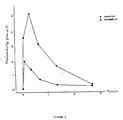
- FIG. 1 is a graphic representation of in vivo binding studies of the radioiodinated substituted benzamine of the present invention demonstrating its properties of having rapid penetration into the rat brain and labeling of the dopamine D-2 receptor.
- R1 is 123I, 125I, 131I
- R2 is a hydrogen atom or a hydroxyl group
- R3 is a hydrogen atom, a halogen atom, a hydroxyl group, or a methoxy group
- R4 is an alkyl group of 1 to 4 carbon atoms, an alkenyl group of 2 to 4 carbon atoms, an alkynyl group or 2 to 4 carbon atoms, cycloalkyl group of 3 to 7 carbon atoms, a phenyl group, a para-halogen-substituted phenyl group, or an enantiomer thereof, under the proviso that when R2 is a hydroxyl group R3 is not a hydrogen atom.
- a radiopharmaceutical composition of the present invention comprises an effective amount of at least one compound of the above general formula I and suitably a pharmaceutical carrier such as physiological buffered saline solution.
- substituted benzamide derivatives represented by the formula: wherein R1 is a hydrogen atom, a lower alkyl group consisting of 1 to 4 carbon atoms, a cycloalkyl group consisting of 3 to 7 carbon atoms, an alkenyl group consisting of 2 to 4 carbon atoms, an alkynyl group consisting of 2 to 4 carbon atoms, a phenyl group, a halogen-substituted phenyl group, or an enantiomer or pharmaceutically suitable salt thereof may be obtained by the reaction of the intermediate compound: wherein R1 is tributyltin group with a radioactive isotope of iodine in a protic solvent such as ethanol or hydrochloric acid.
- a protic solvent such as ethanol or hydrochloric acid
- the iodine can be generated in situ by decomposition of iodine monochloride or by oxidation of the alkali metal iodide with hydrogen peroxide or an agent such as the sodium salt of N-chloro- p -toluenesulfonamide.
- compounds of the preferred formula can be obtained by reaction of the intermediate compound, wherein R1 is a triazeno group of the formula: wherein R is a lower alkyl group of 1 to 4 carbon atoms or constitutes a 5- or 6-member ring, which is reacted with an acid, such as hydrochloric acid or trifluoroacetic acid, in the presence of iodide in the solvent, such as acetone, formic acid, or acetonitrile.
- an acid such as hydrochloric acid or trifluoroacetic acid
- a compound of this invention (Example 1) could be competitively displaced to 50% at 1-2 nM inhibitory concentration by haloperidol or at 1.3 nM inhibitory concentration by raclopride from their binding sites in rat brain homogenates.
- Radioiodinated substituted benzamide compounds suitable for use herein can be synthesized by the Sandmeyer reaction to introduce the radioligand.
- the intermediate diazonium derivative is generated by acid decomposition of the corresponding pyrrolidinotriaze.
- the benzamide compounds of this invention can also be obtained by acid-catalyzed iododestannylation of the corresponding trialkyltin derivatives.
- the radioiodination technique is illustrated in the examples. I-123, I-125, and I-131 radioligands are employed as imaging agents for the brain.
- a pharmaceutical composition of the present invention comprises one of the aforementioned isotopes of radioiodinated substituted benzamides and a carrier such as physiological buffered saline solution.
- compositions of the present invention When practically applied the composition will be systematically administered to the patient as by intravenous injection.
- Suitable dosages for use as a diagnostic imaging agent are from about 2 to about 20 mCi of I-123 labelled iodobenzamides for D-2 dopamine receptors, that is, as imaging agents for the brain.
- the novel imaging agent of the present invention is employed in accordance with conventional methodology in nuclear medicine in a manner analogous to functional brain imaging.
- a composition of the present invention can be systematically applied to the patient and subsequently the uptake of the composition in the selected organ is measured and an image formed, for example, by means of a conventional gamma radiation CT camera.
- the radioactive iodine atom is introduced in the last step of the synthesis. In this manner, the radiation hazard will be limited in the preparation and purification of the ligands.
- Preferred compounds of the present invention are: The above-noted compounds are used to detect, visualize and analyze the distribution and function of the dopamine D-2 receptor in the mammalian brain as racemic mixtures or as their optically resolved anantiomers.
- the corresponding enantiomers can be obtained by using the optical stereoisomers of the appropriate synthetic precursor.
- Suitable iodine isotopes for single photon (gamma) auto radiography or computed tomography are iodine-123 for maximum specific radioactivity at 9 x 10⁶ Ci/mmol, iodine-125 for 2 x 10³ Ci/mmol, and iodine-131 for 1.6 x 10⁴ Ci/mmol.
- Compounds of the present invention can be obtained by one of the following methods of synthesis.
- Compounds of Formula A wherein n 1 or 2, R2 is a hydrogen atom or a hydroxyl group, R3 is a hydrogen atom, a halogen atom, a hydroxyl or methoxyl group and R4 is an alkyl of 1 to 4 carbon atoms, an alkenyl group of 2 to 4 carbon atoms or an alkynyl group of 2 to 4 carbon atoms, a phenyl group, or a para-halogen-substituted phenyl group, are treated with an organic acid such as trifluoroacetic acid or an inorganic acid such as hydrochloric acid in the presence of radioactive sodium or potassium iodide in an aprotic solvent such as acetone, benzene, or acetonitrile.
- an organic acid such as trifluoroacetic acid or an inorganic acid such as hydrochloric acid
- Compounds of Formula B wherein R is an alkyl of 1 to 5 carbon atoms such as n -butyl, R2, R3 and R4 are defined as before are treated with radioactive iodine in a protic solvent such as ethanol or dilute hydrochloric acid.
- the iodine can be generated in situ by oxidation of sodium iodide with hydrogen peroxide or chloramine-T, or by using radioactive iodine monochloride.
- Compounds of Formula C wherein R2, R3 and R4 are defined as in Formula I are treated with radioactive iodine in a solvent such as chloroform or dioxane at elevated temperature.
- Sulpiride a neuroleptic agent
- has a high selectivity in blocking the D-2 receptor see Fuxe, K. et al., Neurosci. Lett . 64:163-168 (1986).
- radioligand [3H]sulpiride was compared to [125I]( S )- N -[(1-ethyl-2-pyrrolidinyl)methyl]-5-iodo-2-methoxybenzamide ([125I]( S )-II in a receptor binding assay.
- the suspension was incubated at 37°C for 10 min, centrifuged again at 30,000 x g for 10 min (4°C) and the final pellet was resuspended with the polytron in 200 vol of ice cold buffer.
- Assay tubes contained 50 ⁇ M or radioligand at 2.9 nM concentration and 90 ⁇ L of the striatal membrane preparation. Nonspecific binding was determined in the presence of 10 ⁇ M(-)[125I]( S )-II. Tubes were incubated for 30 min at 37°C, poured over Whatman GF/B filters under vacuum, and the filters were rinsed three times with 4 mL of ice cold buffer.
Landscapes
- Chemical & Material Sciences (AREA)
- Organic Chemistry (AREA)
- Medicines Containing Antibodies Or Antigens For Use As Internal Diagnostic Agents (AREA)
- Pyrrole Compounds (AREA)
- Acyclic And Carbocyclic Compounds In Medicinal Compositions (AREA)
Abstract
Description
- The present invention relates to new radiolabeled compounds and a radiopharmaceutical composition comprising same. More specifically, the present invention relates to substituted benzamides which in radioiodinated form can be used in a radiopharmaceutical composition as an imaging agent, particularly for the brain.
- Radiolabeled compounds which are subject to localization in particular organs or tumors therein are of great value for diagnosis of diseases of the human body. For example, thallium 201 and fatty acids labeled with carbon-11 and iodine-123 have been utilized as heart imaging agents. Various phosphonate ligands labeled with technetium-99m have been used to image infarcted regions of the heart. However, although many useful radiolabeled compounds are known, there remains a need for the discovery of improved compounds which are effective for routine imaging of the brain. In particular, there remains a need for radiolabeled compounds which are useful in imaging the dopamine D-2 receptor of the brain.
- Butyrophenones and substituted benzamides labeled with iodine-125, iodine-123, and iodine-131 have been found to image dopamine receptors of the brain. However, previous agents lack the ability to selectively label only subpopulations of the dopamine D-2 receptors implicated in psychiatric disorders.
- Japanese Patent Application 59112971 discloses an agent for detecting changes in dopamine receptors having the following structure:

Landwater, S.W., Label Comp. Radiopharm. 22:273-278 (1985), disclosed the following compound which is described as a high affinity dopamine receptor probe:
Crawley, F.C.W., et al., Clin. Sci. 70:Suppl. 13, Abstr. 145 (1986), and, independently, Kung, H.F., et al., J. Label Comp. Radiopharm. 23:1318-1319 (1986) discloses the following compound which is described as an agent for the studying of dopamine receptors in vivo, dopamine D-2 receptors in the brain, in particular.
This compound, having a non-radioactive isotope of iodine, was disclosed in European Patent Application EP 60235. - However, no mention is made with respect to an improved binding selectivity to a hypothetical subpopulation of dopamine D-2 receptors in the brain thought to be involved in psychiatric disorders.
- Further, radioidine containing compounds useful as brain imaging agents are disclosed in US Patent Application 4,279,887 and have the general formula

wherein I is a radioisotope of iodine with I-123 being preferred, R₁ and R₂ are the same or different and are selected from the group consisting of hydrogen, hydroxy, alkyl, aryl, substituted aryl, aralkyl, anilino and carbamoylmethyl or R₁ and R₂ taken together with the nitrogen to which they are attached form a 5- or 6-membered ring. - European Patent Application EP 207913 discloses the following compound which is described as a brain dopamine receptor blocker:

European Patent Application EP 156776 discloses the following compound which is described as a neuroleptic agent:
Neumeyer, J.L., et al., J. Med. Chem. 28:405-407 (1985), disclosed the following compound which is described to have receptor binding behaviour similar to that of haloperidol:
Wilson, A.A., et al., J. Nucl. Med. 28:729 (1987), disclosed the following compound which is described to bind to brain receptors blockable by haloperidol:
Martres, M.-P., et al., Eur. J. Pharmacol. 118:211-219 (1985), disclosed the following compound which is described as a selective ligand for dopamine D-2 receptors:
FIG. 1 is a graphic representation of in vivo binding studies of the radioiodinated substituted benzamine of the present invention demonstrating its properties of having rapid penetration into the rat brain and labeling of the dopamine D-2 receptor. - It is the object underlying the present invention to provide novel radiopharmaceutical substituted benzamides as well as radiopharmaceutical compositions comprising these compounds which compared with the compounds of the prior art have the advantage that a) their preparation and radioiodination is facile, b) both enantiomers can be used for enhanced image contrast, and c) they bind selectively to a hypothetical subpopulation of dopamine D-2 receptors in the brain thought to be involved in psychiatric disorders.
- This object is obtained with a compound of general formula I

wherein R¹ is ¹²³I, ¹²⁵I, ¹³¹I, R² is a hydrogen atom or a hydroxyl group, R³ is a hydrogen atom, a halogen atom, a hydroxyl group, or a methoxy group, R⁴ is an alkyl group of 1 to 4 carbon atoms, an alkenyl group of 2 to 4 carbon atoms, an alkynyl group or 2 to 4 carbon atoms, cycloalkyl group of 3 to 7 carbon atoms, a phenyl group, a para-halogen-substituted phenyl group, or an enantiomer thereof, under the proviso that when R² is a hydroxyl group R³ is not a hydrogen atom. - A radiopharmaceutical composition of the present invention comprises an effective amount of at least one compound of the above general formula I and suitably a pharmaceutical carrier such as physiological buffered saline solution.
- Various substituted benzamides which undergo the radioiodination reaction of the present invention are either known compounds or can be formulated by the following procedures. Briefly, the benzamides can be obtained by reacting a halogen substituted benzamide with bis(trialkyltin) in the presence of a palladium catalyst. For example, substituted benzamide derivatives represented by the formula:

wherein R¹ is a hydrogen atom, a lower alkyl group consisting of 1 to 4 carbon atoms, a cycloalkyl group consisting of 3 to 7 carbon atoms, an alkenyl group consisting of 2 to 4 carbon atoms, an alkynyl group consisting of 2 to 4 carbon atoms, a phenyl group, a halogen-substituted phenyl group, or an enantiomer or pharmaceutically suitable salt thereof may be obtained by the reaction of the intermediate compound:
wherein R¹ is tributyltin group with a radioactive isotope of iodine in a protic solvent such as ethanol or hydrochloric acid. The iodine can be generated in situ by decomposition of iodine monochloride or by oxidation of the alkali metal iodide with hydrogen peroxide or an agent such as the sodium salt of N-chloro-p-toluenesulfonamide. - Further, compounds of the preferred formula can be obtained by reaction of the intermediate compound, wherein R¹ is a triazeno group of the formula:

wherein R is a lower alkyl group of 1 to 4 carbon atoms or constitutes a 5- or 6-member ring, which is reacted with an acid, such as hydrochloric acid or trifluoroacetic acid, in the presence of iodide in the solvent, such as acetone, formic acid, or acetonitrile. - It has been found that when substituted benzamides are radioiodinated they are useful radiopharmaceuticals for imaging the dopamine D-2 receptor in the brain and therefore are useful in brain imaging experiments.
- In vitro receptor binding studies of the radioiodinated substituted benzamides have shown them to be selective antagonists of central dopamine D-2 receptors. A compound of this invention (Example 1) could be competitively displaced to 50% at 1-2 nM inhibitory concentration by haloperidol or at 1.3 nM inhibitory concentration by raclopride from their binding sites in rat brain homogenates.
- In vivo receptor binding studies of the radioiodinated substituted benzamides have shown a rapid penetration into the rat brain (Fig. 1). Peak uptake in the striatum was observed after 20 min. After 60 min, the ratio of radioactivity in the striatum was 7.3 times higher than that in the cerebellum, showing a preferential binding to dopamine-rich structures of the brain. Pretreatment of haloperidol reduced the uptake of the radioiodinated benzamide in striatum to 23% of that of untreated rats.
- Radioiodinated substituted benzamide compounds suitable for use herein can be synthesized by the Sandmeyer reaction to introduce the radioligand. The intermediate diazonium derivative is generated by acid decomposition of the corresponding pyrrolidinotriaze. The benzamide compounds of this invention can also be obtained by acid-catalyzed iododestannylation of the corresponding trialkyltin derivatives. The radioiodination technique is illustrated in the examples. I-123, I-125, and I-131 radioligands are employed as imaging agents for the brain. A pharmaceutical composition of the present invention comprises one of the aforementioned isotopes of radioiodinated substituted benzamides and a carrier such as physiological buffered saline solution. When practically applied the composition will be systematically administered to the patient as by intravenous injection. Suitable dosages for use as a diagnostic imaging agent are from about 2 to about 20 mCi of I-123 labelled iodobenzamides for D-2 dopamine receptors, that is, as imaging agents for the brain. It will be appreciated by those skilled in the art that the novel imaging agent of the present invention is employed in accordance with conventional methodology in nuclear medicine in a manner analogous to functional brain imaging. Thus, a composition of the present invention can be systematically applied to the patient and subsequently the uptake of the composition in the selected organ is measured and an image formed, for example, by means of a conventional gamma radiation CT camera.
- Further understanding and use of the present invention can be obtained from the examples and from Budinger, T.F., Physical Attributes of Single-Photon Tomography, J. Nucl. Med. 21:579-592 (1980).
- In the process of preparing the radiolabelled substituted benzamides of the present invention, the radioactive iodine atom is introduced in the last step of the synthesis. In this manner, the radiation hazard will be limited in the preparation and purification of the ligands.
- Preferred compounds of the present invention are:
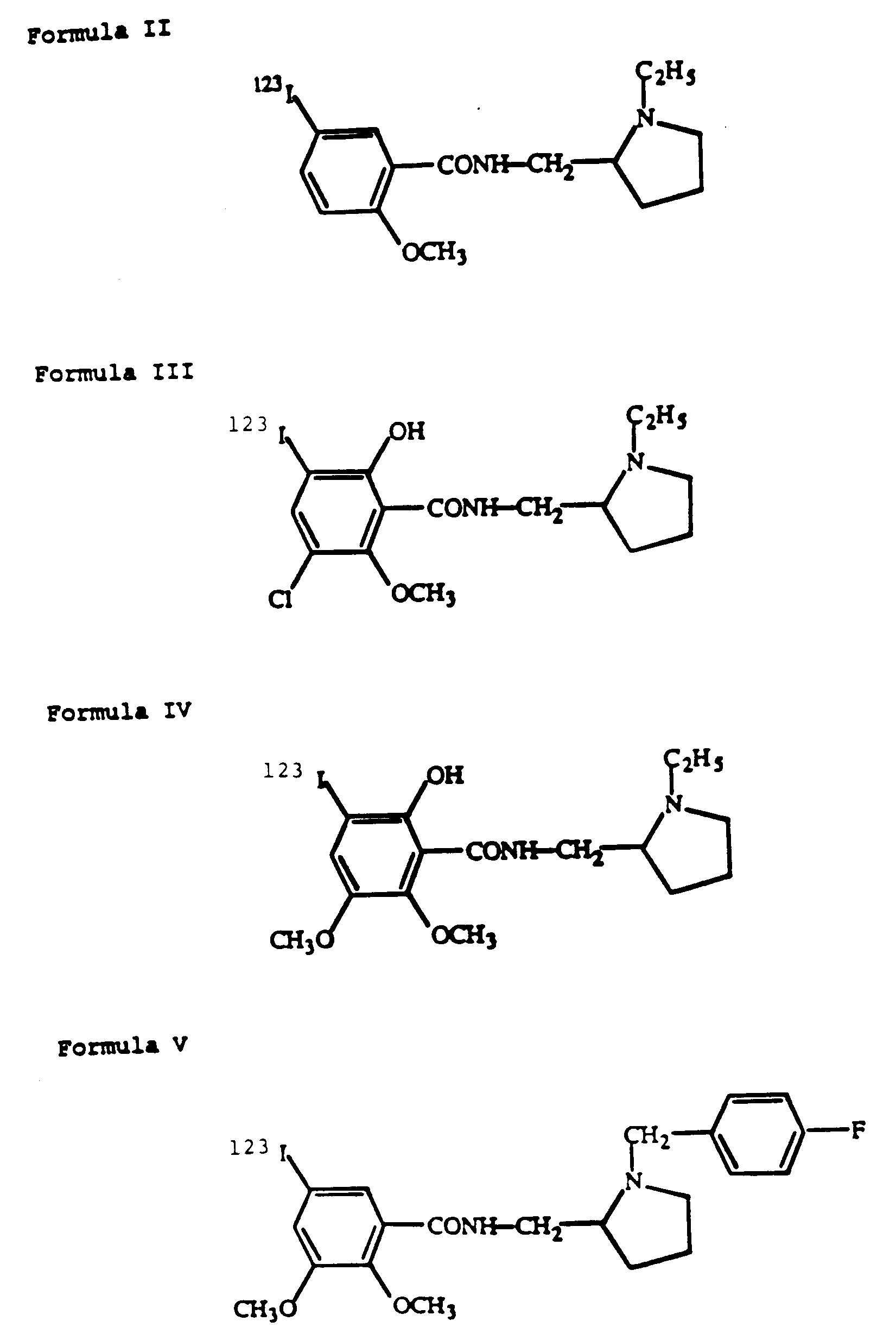
The above-noted compounds are used to detect, visualize and analyze the distribution and function of the dopamine D-2 receptor in the mammalian brain as racemic mixtures or as their optically resolved anantiomers. The corresponding enantiomers can be obtained by using the optical stereoisomers of the appropriate synthetic precursor. - Suitable iodine isotopes for single photon (gamma) auto radiography or computed tomography are iodine-123 for maximum specific radioactivity at 9 x 10⁶ Ci/mmol, iodine-125 for 2 x 10³ Ci/mmol, and iodine-131 for 1.6 x 10⁴ Ci/mmol.
- Compounds of the present invention can be obtained by one of the following methods of synthesis.

Compounds of Formula A wherein n = 1 or 2, R² is a hydrogen atom or a hydroxyl group, R³ is a hydrogen atom, a halogen atom, a hydroxyl or methoxyl group and R⁴ is an alkyl of 1 to 4 carbon atoms, an alkenyl group of 2 to 4 carbon atoms or an alkynyl group of 2 to 4 carbon atoms, a phenyl group, or a para-halogen-substituted phenyl group, are treated with an organic acid such as trifluoroacetic acid or an inorganic acid such as hydrochloric acid in the presence of radioactive sodium or potassium iodide in an aprotic solvent such as acetone, benzene, or acetonitrile.
Compounds of Formula B wherein R is an alkyl of 1 to 5 carbon atoms such as n-butyl, R², R³ and R⁴ are defined as before are treated with radioactive iodine in a protic solvent such as ethanol or dilute hydrochloric acid. The iodine can be generated in situ by oxidation of sodium iodide with hydrogen peroxide or chloramine-T, or by using radioactive iodine monochloride.
Compounds of Formula C wherein R², R³ and R⁴ are defined as in Formula I are treated with radioactive iodine in a solvent such as chloroform or dioxane at elevated temperature. - The following examples describe in detail compounds illustrative of the present invention and methods which have been devised for their preparation.
- A solution of (S)-N-[1-ethyl-2-pyrrolidinyl)methyl]-2-methoxy-5-[3,3-(1,4-butanediyl)]triazenebenzamide (1.5 µg, 4.7 nmol) in benzene (9 µl) was mixed with 1.8 mCi of Na¹²⁵I (0.5 µg, 520 nmol) in formic acid (10 µl) was added and the reaction mixture was shaken for 40 min at 20°C. Aqueous 1 N NaOH (300 µl) was added. Extraction with benzene (2 x 100 µl) gave the iodine substituted benzamide. Extraction of the combined organic layer with 0.1 N HCl (2 x 150 µl) gave 0.41 mCi of pure product. Specific activity 560 Ci/mmol, radiochemical yield 22%.
- A solution of (R)-N-[(1-ethyl-2-pyrrolidinyl)methyl[-2-methoxy-5-tri-n-butyltinbenzamide (15 µg, 22 nmol) in diethylether (10 µL) was mixed with 10.4 mCi of Na¹²⁵I (3.2 µg, 22 nmol) in 0.001 N NaOH (29 µL). Hydrochloric acid (0.1 N, 10 µL) was added followed by the addition of an aqueous solution (5 µL) of sodium N-chloro-4-methylbenzene sulfonamide (16 µg, 70 nmol). After 10 min at 20°C, NaOH (2 N, 20 µL) was added. Extraction with ether (2 x 150 µL) gave 7.2 mCi of the desired iodobenzamide. Specific activity 590 Ci/mmol, radiochemical yield 70%.
- A solution of (S)-5-chloro-N-[(1-ethyl-2-pyrrolidinyl) methyl]-6-methoxysalicylamide (de Paulis, T., et al., J. Med. Chem., 28:1263-1269 (1985)(9.4 µg, 30 nmol) in ethanol (30 µL) was mixed with a solution of 10 mCi of Na¹²⁵I (4.5 µg, 330 Ci/mmol, 30 nmol) in 0.001 N NaOH (30 µL). A solution of chloramine-T (13 µg, 50 nmol) in water (10 µL) was added. The mixture was heated to 60°C for 45 min. Addition of 0.1 N NH₄Cl (100 µL) and extraction with ether (2 x 150 mL) gave 7.6 mCi of product. Extraction of the combined organic layer with 0.1 N HCl (3 x 100 µl) gave 4.6 mCi of pure iodine substituted benzamide (specific activity 330 Ci/mmol). Thin layer chromatography (SiO₂, Merck F₂₅₄) in isopropylethermethanol-conc. NH₄OH (160:39:1) showed radioactivity at Rf 0.16, identical to that of an authentic sample. (The starting material had Rf 0.26). Radiochemical yield 46%.
- A solution of (S)-N-[(1-ethyl-2-pyrrolidinyl)methyl]-5,6-dimethoxysalicylamide (Eur. Pat. Appl. EP 156 776)(6.8 µg, 22 nmol) in ethanol (20 µL) was added to 6.13 mCi of Na¹²⁵I (3.2 µg, 22 nmol) in 0.001 N NaOH (20 µL). A solution of chloramine-T (10 µg, 44 nmol) in water (7 µl) was added at 20°C. After 15 min 1N NH₄Cl (50 µL) and 2 N NH₄OH (20 µL) were added. Extraction with ether (3 x 150 µL) combining of the organic layer and extracting with 0.1 N HCl (2 x 100 µl) gave pure iodobenzamide (specific activity 220 Ci/mmol and radiochemical yield 72%). Thin layer chromatography showed radioactivity at Rf 0.36, identical to that of an authentic sample. The starting material had Rf 0.42.
- A solution of (R)-N-[(1-(4-fluorobenzyl)-2-pyrrolidinyl) methyl]-5-iodo-2-methoxybenzamide hydrochloride hydrate (0.52 g, 1.0 mmol) in triethylamine (30 ml) was treated with palladium(II) acetate (20 mg, 0.10 mm0l), tetrakis(triphenylphosphine) palladium(0) (60 mg, 0.05 mmol), and bis(tributyltin)(0.61 g, 1.05 mmol) at 85°C for 3 h. Filtration and washing of the isoluble material with triethylamine (10 mL), followed by evaporation of the solvent gave 1.1 g of a yellow oil. Separation on silica gel with a gradient of hexane-isopropylether-ethyl acetate-ethanol gave fractions with the corresponding tributyltinbenzamide as an oil. A 2 N solution of this oil in ether was preapred. 1 mCi of Na¹²⁵I (specific activity 200 Ci/mmol, 45 nmol) was prepared in 0.1 N HCl (10 µL, 1 µmol) and added to the benzamide solution (25 µL, 50 nmol). An aqueous solution of chloramine-T (10 µL, 149 nmol) was added. After 30 min the reaction mixture was neutralized with an excess of 2N NaOH (20 µL, 40 µmol) and the product was extracted with ether (3 x 150 µL). TLC showed radioactivity at Rf 0.57 identical to that of the starting iodobenzamide.
- To a solution of (S)-(-)-N-[(1-ethyl-2-pyrrolidinyl) methyl]-2-bromo-5,6-dimethoxysalicylamide (GB 2153354) (0.42 g, 1.0 mmol) in triethylamine (30 mL, freshly distilled from calcium hydride) was added palladium(II) acetate (20 mg, 0.1 mmol), tetrakis(triphenylphosphine)palladium(0), (60 mg, 0.05 mmol) and bis(tributyltin) 0.85 g (1.4 mmol) under nitrogen atmosphere at 25°C. The mixture was heated to reflux (85°C) for 16 h. The solvent was evaporated and the residue was subjected to column chromatography on silica el (Merck, 0.063 - 0.200 mm) with hexeneethyl acetate (10:1) as eluent. Fractions with a single spot on TLC with Rf 0.58 in isopropylethermethanol-conc. ammonium hydroxide (160:39:1) were collected and the solvent was removed by evaporation. This gave 0.30 g (50%) of an oil. NMR of low field regions: δ 7.08 (s, 1H), 3.93 (s, 3H) and 3.84 ppm (s, 3H). Part of the butyl signal appears at 0.89 ppm.
- By the same method, the following organotin-benzamides were prepared from their corresponding bromo or iodo derivatives:
(S)-(-)-N-[(1-Ethyl-2-pyrrolidinyl)methyl]-2-methoxy-5-tributyltinbenzamide TLC: Rf 0.32 (i-Pr₂O-MeOH-NH₃, 160:39:1) from the iodo-derivative (Rf 0.12) NMR: δ 8.26 ppm (d, J = 3 Hz, C(6)-H).
(S)-(-)-N-[(1-Ethyl-2-pyrrolidinyl)methyl]-6-methoxy-3-tributyltinsalicylamide. TLC: Rf 0.43 (i-Pr₂O-MeOH-NH₃, 160:39:1), from the bromo derivative (Rf 0.35), NMR: δ 7.33 ppm (d, J = 10 Hz, C(4)H).
(R)-(+)-N-[(1-(4-Fluorobenzyl)-2-pyrrolidinyl)methyl]-2,3-methoxy-5-tributyltinbenzamide, TLC: Rf 0.61 (i-Pr₂O-MeOH-NH₃, 160:39:1), from the iodo derivative (Rf 0.58), NMR δ 8.32 ppm (d, J = 2.6 Hz, C(6)-H)
(S)-(-)-N-[(1-Ethyl-2-pyrrolidinyl)methyl]-2,3-dimethoxy-3-tributyltinbenzamide. TLC: Rf 0.56 (i-Pr₂O-MeOH-NH₃, 160:39:1), from the iodo derivative (Rf 0.53), NMR δ 7.77 (d, J = 1.2 Hz) and 7.11 ppm (d, C(4)-H). - Sulpiride, a neuroleptic agent, has a high selectivity in blocking the D-2 receptor, see Fuxe, K. et al., Neurosci. Lett. 64:163-168 (1986). Its radioligand [³H]sulpiride, was compared to [¹²⁵I](S)-N-[(1-ethyl-2-pyrrolidinyl)methyl]-5-iodo-2-methoxybenzamide ([¹²⁵I](S)-II in a receptor binding assay.
- Male Sprague-Dawley rats (150-200 g) were killed by decapitation and their brains quickly removed and dissected on ice. Striata were dissected and homogenized in 40 vol of ice-cold Tris-HCl (50 mM) containing 123 mM NaCl, 5 mM KCl, 2 mM CaCl₂ and 1 mM MgCl₂ (pH 7.4) using a Brinkman Polytron. The suspension was centrifuged at 30,000 x g for 10 min at 4°C, and the pellet was resuspended in 40 vol of fresh buffer with polytron. The suspension was incubated at 37°C for 10 min, centrifuged again at 30,000 x g for 10 min (4°C) and the final pellet was resuspended with the polytron in 200 vol of ice cold buffer. Assay tubes contained 50 µM or radioligand at 2.9 nM concentration and 90 µL of the striatal membrane preparation. Nonspecific binding was determined in the presence of 10 µM(-)[¹²⁵I](S)-II. Tubes were incubated for 30 min at 37°C, poured over Whatman GF/B filters under vacuum, and the filters were rinsed three times with 4 mL of ice cold buffer. Radioactivity remaining on the filters was measured by liquid scintillation on a Quantum 9 Multichannel analyzer operating at 35% efficiency. Results are shown in Table I.
TABLE I Compounda [¹²⁵I]-(S) II bindingb IC₅₀(nM) [³H]sulpiridec binding IC₅₀(nM) (R)-II 169 146 (S)-II 5.0 3.6 Sulpiride 45 28 a) Each compound was dissolved in 0.2mL of HOAc and diluted with buffer. b) Radioligand concentration 0.46 nM. Nonspecific binding was determined in the presence of 10 µM of (S)-II. c) Radioligand concentration 2.9 nM. Nonspecific binding was determined in the presence of 10 µM sulpiride. - The binding of [¹²⁵I](S)-II to rat striated membranes was saturable, reversible and stereospecific under the conditions described above. Binding reached equilibrium at 37°C within 20 min, and remained stable for at least 60 min. Scatchard anlysis of the saturation isotherm revealed a single set of binding sites with a Kd of 1.0 nM and a maximal number of binding sites of 169 fmol/mg protein. Sulpiride displaced the radioligand with an IC₅₀ of approximately 45 nM. In a displacement experiment using [³H](S)-(-)-sulpiride as the radioligand, the two enantiomers (R)-II and (S)-II had IC₅₀ values of 146 nM and 3.6 nM, respectively. (RS)-sulpiride had IC₅₀ 28 nM.
Claims (13)
- A compound of general formula I

- The compound of claim 1 wherein R¹ is an isotope selected from I-123, I-125 and I-131.
- The compound of claim 1 wherein R¹ of the compound is the I-123 isotope.
- The compound of claim 1 wherein R¹ of the compound is the I-125 isotope.
- The compound of claim 1 wherein R¹ of the compound is the I-131 isotope.
- [¹²³I] (S)-N- [(1-ethyl-2-pyrrolidinylmethy]-5-iodo-2-methoxybenzamide.
- [¹²³I] (R)-N- [(1-(4-fluorobenzyl)-2-pyrrolidinyl) methyl]-5-iodo-2-methoxybenzamide.
- [¹²³I] (S)-N- [(1-ethyl-2-pyrrolidinyl)methyl]-5-chloro-3-iodo-6-methoxysalicylamide.
- [¹²³I](R)-N- [(1-(4-fluorobenzyl)-2-pyrrolidinyl) methyl]5-iodo-2,3-dimethoxybenzamide.
- [¹²³I] (S)-N-[(1-ethyl-2-pyrrolidinyl)methyl] -5-iodo-2,3-dimethoxybenzamide.
- [¹²³I] (S)-N-[(1-ethyl-2-pyrrolidinyl)methyl] -3-iodo-5,6-dimethoxysalicylamide.
- [¹²³I] (R)-N- [(1-ethyl-2-pyrrolidinyl)methyl]-5-iodo-2-methoxybenzamide.
- A radiopharmaceutical composition comprising an effective amount of at least one compound according to any of claims 1 to 12.
Priority Applications (1)
| Application Number | Priority Date | Filing Date | Title |
|---|---|---|---|
| AT88118990T ATE89271T1 (en) | 1987-11-19 | 1988-11-14 | RADIOIODIUM-CONTAINING BENZAMIDES AND METHODS OF USE AS RADIOGENIC AGENTS. |
Applications Claiming Priority (2)
| Application Number | Priority Date | Filing Date | Title |
|---|---|---|---|
| US12239087A | 1987-11-19 | 1987-11-19 | |
| US122390 | 1987-11-19 |
Publications (2)
| Publication Number | Publication Date |
|---|---|
| EP0317873A1 EP0317873A1 (en) | 1989-05-31 |
| EP0317873B1 true EP0317873B1 (en) | 1993-05-12 |
Family
ID=22402429
Family Applications (1)
| Application Number | Title | Priority Date | Filing Date |
|---|---|---|---|
| EP88118990A Expired - Lifetime EP0317873B1 (en) | 1987-11-19 | 1988-11-14 | Radioiodinated benzamides and method of their use as radioimaging agents |
Country Status (5)
| Country | Link |
|---|---|
| EP (1) | EP0317873B1 (en) |
| JP (1) | JP2551643B2 (en) |
| AT (1) | ATE89271T1 (en) |
| CA (1) | CA1331007C (en) |
| DE (1) | DE3880974T2 (en) |
Families Citing this family (8)
| Publication number | Priority date | Publication date | Assignee | Title |
|---|---|---|---|---|
| US5993777A (en) * | 1993-05-06 | 1999-11-30 | Research Corporation Technologies, Inc. | Benzamide compounds for cancer imaging and therapy |
| US5911970A (en) * | 1993-05-06 | 1999-06-15 | Research Corporation Technologies, Inc. | Methods for cancer imaging and therapy using benzamine compounds |
| US6517811B2 (en) | 1993-05-06 | 2003-02-11 | Research Corporation Technologies, Inc. | Compounds for cancer imaging and therapy |
| CA2190727C (en) * | 1994-05-19 | 2006-07-18 | Sudhakar Kasina | Aromatic amine substituted bridged nitrogen and sulfur donor atom ligands for imaging |
| DE69636881T2 (en) * | 1995-12-01 | 2007-09-20 | Molecular Insight Pharmaceuticals, Inc., Cambridge | STEREOISOMERS OF FATTY ACID ANALOGS FOR DIAGNOSTIC IMAGING |
| US6005083A (en) | 1997-03-28 | 1999-12-21 | Neorx Corporation | Bridged aromatic substituted amine ligands with donor atoms |
| US8877943B2 (en) * | 2012-09-11 | 2014-11-04 | Atomic Energy Council-Institute of Nuclear Eenergy Research | Radiotracer precursor and method for preparing the same |
| CN106366075B (en) * | 2016-08-19 | 2018-06-12 | 北京市神经外科研究所 | Pyrrolidines, salt, nuclear-magnetism probe and medicinal application, reagent, drug |
Family Cites Families (1)
| Publication number | Priority date | Publication date | Assignee | Title |
|---|---|---|---|---|
| US4279887A (en) * | 1978-11-29 | 1981-07-21 | Medi-Physics, Inc. | Amides useful as brain imaging agents |
-
1988
- 1988-11-14 EP EP88118990A patent/EP0317873B1/en not_active Expired - Lifetime
- 1988-11-14 DE DE8888118990T patent/DE3880974T2/en not_active Expired - Fee Related
- 1988-11-14 AT AT88118990T patent/ATE89271T1/en not_active IP Right Cessation
- 1988-11-16 CA CA000583258A patent/CA1331007C/en not_active Expired - Fee Related
- 1988-11-18 JP JP63290352A patent/JP2551643B2/en not_active Expired - Lifetime
Non-Patent Citations (2)
| Title |
|---|
| CRAWLEY, F.C.W. et al., Clin. Sci. 70, Abstract 145 (1986) * |
| KUNG, H.F. et al., J. Label Comp. Radiopharm. 23, 1318 (1986) * |
Also Published As
| Publication number | Publication date |
|---|---|
| JP2551643B2 (en) | 1996-11-06 |
| ATE89271T1 (en) | 1993-05-15 |
| DE3880974T2 (en) | 1993-08-26 |
| JPH01230552A (en) | 1989-09-14 |
| CA1331007C (en) | 1994-07-26 |
| EP0317873A1 (en) | 1989-05-31 |
| DE3880974D1 (en) | 1993-06-17 |
Similar Documents
| Publication | Publication Date | Title |
|---|---|---|
| Kung et al. | Dopamine D-2 receptor imaging radiopharmaceuticals: Synthesis, radiolabeling and in vitro binding of (R)-(+)-and (S)-(-)-3-iodo-2-hydroxy-6-methoxy-N-[(1-ethyl-2-pyrrolidinyl) methyl] benzamide | |
| Lan et al. | Design and synthesis of the CB1 selective cannabinoid antagonist AM281: a potential human SPECT ligand | |
| KR100451077B1 (en) | Dopamine and Serotonin Transporter Ligands and Imaging Agents | |
| EP2436666B1 (en) | Method for obtaining novel derivatives of naphtalene for the in vivo diagnosis of alzheimer 's disease | |
| KR930002491B1 (en) | Dopamine receptor ligands and imaging agents | |
| Satyamurthy et al. | No-carrier-added 3-(2′-[18F] fluoroethyl) spiperone, a new dopamine receptor-binding tracer for positron emission tomography | |
| CN101384578A (en) | Radioligands for the 5 -ht1b receptor | |
| Satyamurthy et al. | 3-(2′-[18F] fluoroethyl) spiperone, a potent dopamine antagonist: synthesis, structural analysis and in-vivo utilization in humans | |
| US5446147A (en) | Fluorinated and iodinated dopamine agents | |
| US5154913A (en) | Radioiodinated benzamines method of their use as radioimaging agents | |
| Lee Collier et al. | Synthesis of [18F]‐1‐(3‐Fluoropropyl)‐4‐(4‐cyanophenoxymethyl)‐piperidine: A potential sigma‐1 receptor radioligand for PET | |
| De Paulis et al. | (S)-N-[(1-ethyl-2-pyrrolidinyl) methyl]-5-[125I] iodo-2-methoxybenzamide hydrochloride, a new selective radioligand for dopamine D-2 receptors | |
| EP1119356A1 (en) | Radiolabeled neurokinin-1 receptor antagonists | |
| WO1996032968A1 (en) | Compounds for cancer imaging and therapy | |
| EP0317873A1 (en) | Radioiodinated benzamides and method of their use as radioimaging agents | |
| JP3731005B2 (en) | Iodine-labeled neuroprobe for mapping monoamine reuptake sites | |
| US5700446A (en) | Synthesis of ferrocenyl phenyltropane analogs and their radio-transformation to technetium neuroprobes for mapping monoamine reuptake sites | |
| US5569447A (en) | Stannylated 3-quinuclidinyl benzilates and methods of preparing radiohalogenated derivatives | |
| EP1867634B1 (en) | Ligand for vesicular acetylcholine transporter | |
| CA1284505C (en) | Radioactive and non-radioactive iodobutyrophenone derivative and processes for the preparation thereof | |
| US20140288317A1 (en) | Aryloxyanilide imaging agents | |
| Musachio et al. | Radioiodination via vinylstannylated alkylating agents | |
| US4883649A (en) | Iodinated clonidine derivatives as radioactive imaging tracers | |
| CA2499825C (en) | Radiolabeled neurokinin-1 receptor antagonists | |
| JPH02286662A (en) | Dopamine receptor ligand and imaging agent |
Legal Events
| Date | Code | Title | Description |
|---|---|---|---|
| PUAI | Public reference made under article 153(3) epc to a published international application that has entered the european phase |
Free format text: ORIGINAL CODE: 0009012 |
|
| AK | Designated contracting states |
Kind code of ref document: A1 Designated state(s): AT BE CH DE FR GB LI NL |
|
| 17P | Request for examination filed |
Effective date: 19890921 |
|
| 17Q | First examination report despatched |
Effective date: 19910725 |
|
| GRAA | (expected) grant |
Free format text: ORIGINAL CODE: 0009210 |
|
| AK | Designated contracting states |
Kind code of ref document: B1 Designated state(s): AT BE CH DE FR GB LI NL |
|
| REF | Corresponds to: |
Ref document number: 89271 Country of ref document: AT Date of ref document: 19930515 Kind code of ref document: T |
|
| REF | Corresponds to: |
Ref document number: 3880974 Country of ref document: DE Date of ref document: 19930617 |
|
| ET | Fr: translation filed | ||
| PGFP | Annual fee paid to national office [announced via postgrant information from national office to epo] |
Ref country code: FR Payment date: 19991122 Year of fee payment: 12 Ref country code: CH Payment date: 19991122 Year of fee payment: 12 |
|
| PGFP | Annual fee paid to national office [announced via postgrant information from national office to epo] |
Ref country code: AT Payment date: 19991123 Year of fee payment: 12 |
|
| PGFP | Annual fee paid to national office [announced via postgrant information from national office to epo] |
Ref country code: DE Payment date: 19991125 Year of fee payment: 12 |
|
| PGFP | Annual fee paid to national office [announced via postgrant information from national office to epo] |
Ref country code: NL Payment date: 19991129 Year of fee payment: 12 |
|
| PGFP | Annual fee paid to national office [announced via postgrant information from national office to epo] |
Ref country code: GB Payment date: 19991202 Year of fee payment: 12 |
|
| PGFP | Annual fee paid to national office [announced via postgrant information from national office to epo] |
Ref country code: BE Payment date: 19991214 Year of fee payment: 12 |
|
| PG25 | Lapsed in a contracting state [announced via postgrant information from national office to epo] |
Ref country code: GB Free format text: LAPSE BECAUSE OF NON-PAYMENT OF DUE FEES Effective date: 20001114 Ref country code: AT Free format text: LAPSE BECAUSE OF NON-PAYMENT OF DUE FEES Effective date: 20001114 |
|
| PG25 | Lapsed in a contracting state [announced via postgrant information from national office to epo] |
Ref country code: LI Free format text: LAPSE BECAUSE OF NON-PAYMENT OF DUE FEES Effective date: 20001130 Ref country code: CH Free format text: LAPSE BECAUSE OF NON-PAYMENT OF DUE FEES Effective date: 20001130 Ref country code: BE Free format text: LAPSE BECAUSE OF NON-PAYMENT OF DUE FEES Effective date: 20001130 |
|
| BERE | Be: lapsed |
Owner name: THE VANDERBILT UNIVERSITY Effective date: 20001130 |
|
| PG25 | Lapsed in a contracting state [announced via postgrant information from national office to epo] |
Ref country code: NL Free format text: LAPSE BECAUSE OF NON-PAYMENT OF DUE FEES Effective date: 20010601 |
|
| GBPC | Gb: european patent ceased through non-payment of renewal fee |
Effective date: 20001114 |
|
| REG | Reference to a national code |
Ref country code: CH Ref legal event code: PL |
|
| PG25 | Lapsed in a contracting state [announced via postgrant information from national office to epo] |
Ref country code: FR Free format text: LAPSE BECAUSE OF NON-PAYMENT OF DUE FEES Effective date: 20010731 |
|
| NLV4 | Nl: lapsed or anulled due to non-payment of the annual fee |
Effective date: 20010601 |
|
| PG25 | Lapsed in a contracting state [announced via postgrant information from national office to epo] |
Ref country code: DE Free format text: LAPSE BECAUSE OF NON-PAYMENT OF DUE FEES Effective date: 20010801 |
|
| REG | Reference to a national code |
Ref country code: FR Ref legal event code: ST |
|
| PLBE | No opposition filed within time limit |
Free format text: ORIGINAL CODE: 0009261 |
|
| STAA | Information on the status of an ep patent application or granted ep patent |
Free format text: STATUS: NO OPPOSITION FILED WITHIN TIME LIMIT |