EP0317087B1 - Preparation of lewis base complexes of alkali metal salts - Google Patents
Preparation of lewis base complexes of alkali metal salts Download PDFInfo
- Publication number
- EP0317087B1 EP0317087B1 EP88309913A EP88309913A EP0317087B1 EP 0317087 B1 EP0317087 B1 EP 0317087B1 EP 88309913 A EP88309913 A EP 88309913A EP 88309913 A EP88309913 A EP 88309913A EP 0317087 B1 EP0317087 B1 EP 0317087B1
- Authority
- EP
- European Patent Office
- Prior art keywords
- alkali metal
- reaction
- ligand
- thiocyanate
- lithium
- Prior art date
- Legal status (The legal status is an assumption and is not a legal conclusion. Google has not performed a legal analysis and makes no representation as to the accuracy of the status listed.)
- Expired - Lifetime
Links
- 229910052783 alkali metal Inorganic materials 0.000 title claims description 20
- -1 alkali metal salts Chemical class 0.000 title claims description 19
- 239000002879 Lewis base Substances 0.000 title claims description 10
- 150000007527 lewis bases Chemical class 0.000 title claims description 10
- 238000002360 preparation method Methods 0.000 title claims description 7
- YXFVVABEGXRONW-UHFFFAOYSA-N Toluene Chemical compound CC1=CC=CC=C1 YXFVVABEGXRONW-UHFFFAOYSA-N 0.000 claims description 48
- MZRVEZGGRBJDDB-UHFFFAOYSA-N N-Butyllithium Chemical group [Li]CCCC MZRVEZGGRBJDDB-UHFFFAOYSA-N 0.000 claims description 21
- 238000006243 chemical reaction Methods 0.000 claims description 21
- VLKZOEOYAKHREP-UHFFFAOYSA-N n-Hexane Chemical group CCCCCC VLKZOEOYAKHREP-UHFFFAOYSA-N 0.000 claims description 21
- 238000000034 method Methods 0.000 claims description 19
- GNOIPBMMFNIUFM-UHFFFAOYSA-N hexamethylphosphoric triamide Chemical compound CN(C)P(=O)(N(C)C)N(C)C GNOIPBMMFNIUFM-UHFFFAOYSA-N 0.000 claims description 18
- 229910052744 lithium Inorganic materials 0.000 claims description 13
- WYURNTSHIVDZCO-UHFFFAOYSA-N Tetrahydrofuran Chemical compound C1CCOC1 WYURNTSHIVDZCO-UHFFFAOYSA-N 0.000 claims description 12
- WHXSMMKQMYFTQS-UHFFFAOYSA-N Lithium Chemical compound [Li] WHXSMMKQMYFTQS-UHFFFAOYSA-N 0.000 claims description 11
- 150000001340 alkali metals Chemical class 0.000 claims description 11
- 150000001450 anions Chemical group 0.000 claims description 11
- 239000003446 ligand Substances 0.000 claims description 10
- 239000000203 mixture Substances 0.000 claims description 9
- UKODFQOELJFMII-UHFFFAOYSA-N pentamethyldiethylenetriamine Chemical compound CN(C)CCN(C)CCN(C)C UKODFQOELJFMII-UHFFFAOYSA-N 0.000 claims description 9
- KWYHDKDOAIKMQN-UHFFFAOYSA-N N,N,N',N'-tetramethylethylenediamine Chemical compound CN(C)CCN(C)C KWYHDKDOAIKMQN-UHFFFAOYSA-N 0.000 claims description 8
- XTHFKEDIFFGKHM-UHFFFAOYSA-N Dimethoxyethane Chemical compound COCCOC XTHFKEDIFFGKHM-UHFFFAOYSA-N 0.000 claims description 6
- 150000003863 ammonium salts Chemical class 0.000 claims description 6
- YLQBMQCUIZJEEH-UHFFFAOYSA-N tetrahydrofuran Natural products C=1C=COC=1 YLQBMQCUIZJEEH-UHFFFAOYSA-N 0.000 claims description 6
- NLXLAEXVIDQMFP-UHFFFAOYSA-N Ammonia chloride Chemical group [NH4+].[Cl-] NLXLAEXVIDQMFP-UHFFFAOYSA-N 0.000 claims description 5
- 239000004215 Carbon black (E152) Substances 0.000 claims description 5
- SBZXBUIDTXKZTM-UHFFFAOYSA-N diglyme Chemical compound COCCOCCOC SBZXBUIDTXKZTM-UHFFFAOYSA-N 0.000 claims description 5
- 229930195733 hydrocarbon Natural products 0.000 claims description 5
- 150000002430 hydrocarbons Chemical class 0.000 claims description 5
- 229910052700 potassium Inorganic materials 0.000 claims description 5
- 239000002904 solvent Substances 0.000 claims description 5
- 235000019270 ammonium chloride Nutrition 0.000 claims description 4
- 238000001816 cooling Methods 0.000 claims description 4
- 229910000103 lithium hydride Inorganic materials 0.000 claims description 4
- 239000000376 reactant Substances 0.000 claims description 4
- 229910052708 sodium Inorganic materials 0.000 claims description 4
- 239000011734 sodium Substances 0.000 claims description 4
- RYHBNJHYFVUHQT-UHFFFAOYSA-N 1,4-Dioxane Chemical compound C1COCCO1 RYHBNJHYFVUHQT-UHFFFAOYSA-N 0.000 claims description 3
- KEAYESYHFKHZAL-UHFFFAOYSA-N Sodium Chemical compound [Na] KEAYESYHFKHZAL-UHFFFAOYSA-N 0.000 claims description 3
- 150000004678 hydrides Chemical class 0.000 claims description 3
- 229910000104 sodium hydride Inorganic materials 0.000 claims description 3
- 239000012312 sodium hydride Substances 0.000 claims description 3
- 125000000217 alkyl group Chemical group 0.000 claims description 2
- ZMZDMBWJUHKJPS-UHFFFAOYSA-M Thiocyanate anion Chemical group [S-]C#N ZMZDMBWJUHKJPS-UHFFFAOYSA-M 0.000 claims 4
- ZMZDMBWJUHKJPS-UHFFFAOYSA-N hydrogen thiocyanate Chemical group SC#N ZMZDMBWJUHKJPS-UHFFFAOYSA-N 0.000 claims 4
- CPELXLSAUQHCOX-UHFFFAOYSA-M Bromide Chemical compound [Br-] CPELXLSAUQHCOX-UHFFFAOYSA-M 0.000 claims 1
- 150000001335 aliphatic alkanes Chemical class 0.000 claims 1
- 239000007810 chemical reaction solvent Substances 0.000 claims 1
- 125000005843 halogen group Chemical group 0.000 claims 1
- XMBWDFGMSWQBCA-UHFFFAOYSA-N hydrogen iodide Chemical compound I XMBWDFGMSWQBCA-UHFFFAOYSA-N 0.000 claims 1
- 239000012429 reaction media Substances 0.000 claims 1
- IJGRMHOSHXDMSA-UHFFFAOYSA-N Atomic nitrogen Chemical compound N#N IJGRMHOSHXDMSA-UHFFFAOYSA-N 0.000 description 12
- 239000000047 product Substances 0.000 description 7
- QGZKDVFQNNGYKY-UHFFFAOYSA-N Ammonia Chemical compound N QGZKDVFQNNGYKY-UHFFFAOYSA-N 0.000 description 6
- 239000007789 gas Substances 0.000 description 6
- AMXOYNBUYSYVKV-UHFFFAOYSA-M lithium bromide Chemical compound [Li+].[Br-] AMXOYNBUYSYVKV-UHFFFAOYSA-M 0.000 description 6
- 229910052757 nitrogen Inorganic materials 0.000 description 6
- 239000007787 solid Substances 0.000 description 6
- SOIFLUNRINLCBN-UHFFFAOYSA-N ammonium thiocyanate Chemical compound [NH4+].[S-]C#N SOIFLUNRINLCBN-UHFFFAOYSA-N 0.000 description 5
- 239000013078 crystal Substances 0.000 description 4
- 229910001508 alkali metal halide Inorganic materials 0.000 description 3
- 150000008045 alkali metal halides Chemical class 0.000 description 3
- 229910021529 ammonia Inorganic materials 0.000 description 3
- 238000004090 dissolution Methods 0.000 description 3
- 150000004820 halides Chemical class 0.000 description 3
- 229910017971 NH4BF4 Inorganic materials 0.000 description 2
- ZLMJMSJWJFRBEC-UHFFFAOYSA-N Potassium Chemical compound [K] ZLMJMSJWJFRBEC-UHFFFAOYSA-N 0.000 description 2
- VSCWAEJMTAWNJL-UHFFFAOYSA-K aluminium trichloride Chemical compound Cl[Al](Cl)Cl VSCWAEJMTAWNJL-UHFFFAOYSA-K 0.000 description 2
- 230000015572 biosynthetic process Effects 0.000 description 2
- 239000003153 chemical reaction reagent Substances 0.000 description 2
- 238000002425 crystallisation Methods 0.000 description 2
- 230000036571 hydration Effects 0.000 description 2
- 238000006703 hydration reaction Methods 0.000 description 2
- DLEDOFVPSDKWEF-UHFFFAOYSA-N lithium butane Chemical compound [Li+].CCC[CH2-] DLEDOFVPSDKWEF-UHFFFAOYSA-N 0.000 description 2
- KWGKDLIKAYFUFQ-UHFFFAOYSA-M lithium chloride Chemical compound [Li+].[Cl-] KWGKDLIKAYFUFQ-UHFFFAOYSA-M 0.000 description 2
- 239000000463 material Substances 0.000 description 2
- 229910052751 metal Inorganic materials 0.000 description 2
- 239000002184 metal Substances 0.000 description 2
- IJDNQMDRQITEOD-UHFFFAOYSA-N n-butane Chemical compound CCCC IJDNQMDRQITEOD-UHFFFAOYSA-N 0.000 description 2
- 239000011591 potassium Substances 0.000 description 2
- 239000011541 reaction mixture Substances 0.000 description 2
- XLYOFNOQVPJJNP-UHFFFAOYSA-N water Substances O XLYOFNOQVPJJNP-UHFFFAOYSA-N 0.000 description 2
- MPPPKRYCTPRNTB-UHFFFAOYSA-N 1-bromobutane Chemical compound CCCCBr MPPPKRYCTPRNTB-UHFFFAOYSA-N 0.000 description 1
- XZXYQEHISUMZAT-UHFFFAOYSA-N 2-[(2-hydroxy-5-methylphenyl)methyl]-4-methylphenol Chemical compound CC1=CC=C(O)C(CC=2C(=CC=C(C)C=2)O)=C1 XZXYQEHISUMZAT-UHFFFAOYSA-N 0.000 description 1
- 241000819038 Chichester Species 0.000 description 1
- UFHFLCQGNIYNRP-UHFFFAOYSA-N Hydrogen Chemical compound [H][H] UFHFLCQGNIYNRP-UHFFFAOYSA-N 0.000 description 1
- DGAQECJNVWCQMB-PUAWFVPOSA-M Ilexoside XXIX Chemical compound C[C@@H]1CC[C@@]2(CC[C@@]3(C(=CC[C@H]4[C@]3(CC[C@@H]5[C@@]4(CC[C@@H](C5(C)C)OS(=O)(=O)[O-])C)C)[C@@H]2[C@]1(C)O)C)C(=O)O[C@H]6[C@@H]([C@H]([C@@H]([C@H](O6)CO)O)O)O.[Na+] DGAQECJNVWCQMB-PUAWFVPOSA-M 0.000 description 1
- 241000238370 Sepia Species 0.000 description 1
- SWLVFNYSXGMGBS-UHFFFAOYSA-N ammonium bromide Chemical compound [NH4+].[Br-] SWLVFNYSXGMGBS-UHFFFAOYSA-N 0.000 description 1
- 229940107816 ammonium iodide Drugs 0.000 description 1
- 239000001273 butane Substances 0.000 description 1
- 239000006227 byproduct Substances 0.000 description 1
- 239000003795 chemical substances by application Substances 0.000 description 1
- 239000012612 commercial material Substances 0.000 description 1
- 239000002178 crystalline material Substances 0.000 description 1
- 230000008034 disappearance Effects 0.000 description 1
- 229940079593 drug Drugs 0.000 description 1
- 239000003814 drug Substances 0.000 description 1
- 238000001035 drying Methods 0.000 description 1
- 239000003792 electrolyte Substances 0.000 description 1
- 238000005516 engineering process Methods 0.000 description 1
- 238000001704 evaporation Methods 0.000 description 1
- 230000008020 evaporation Effects 0.000 description 1
- 230000007717 exclusion Effects 0.000 description 1
- 238000002474 experimental method Methods 0.000 description 1
- 238000001914 filtration Methods 0.000 description 1
- 239000012467 final product Substances 0.000 description 1
- 230000002140 halogenating effect Effects 0.000 description 1
- 239000001257 hydrogen Substances 0.000 description 1
- 229910052739 hydrogen Inorganic materials 0.000 description 1
- 238000010952 in-situ formation Methods 0.000 description 1
- 239000010416 ion conductor Substances 0.000 description 1
- 150000002641 lithium Chemical class 0.000 description 1
- 229910003002 lithium salt Inorganic materials 0.000 description 1
- 159000000002 lithium salts Chemical class 0.000 description 1
- 229910001496 lithium tetrafluoroborate Inorganic materials 0.000 description 1
- UBJFKNSINUCEAL-UHFFFAOYSA-N lithium;2-methylpropane Chemical compound [Li+].C[C-](C)C UBJFKNSINUCEAL-UHFFFAOYSA-N 0.000 description 1
- 239000000155 melt Substances 0.000 description 1
- 238000002844 melting Methods 0.000 description 1
- 230000008018 melting Effects 0.000 description 1
- QSHDDOUJBYECFT-UHFFFAOYSA-N mercury Chemical compound [Hg] QSHDDOUJBYECFT-UHFFFAOYSA-N 0.000 description 1
- 229910052753 mercury Inorganic materials 0.000 description 1
- OFBQJSOFQDEBGM-UHFFFAOYSA-N n-pentane Natural products CCCCC OFBQJSOFQDEBGM-UHFFFAOYSA-N 0.000 description 1
- 239000013110 organic ligand Substances 0.000 description 1
- JAMNHZBIQDNHMM-UHFFFAOYSA-N pivalonitrile Chemical compound CC(C)(C)C#N JAMNHZBIQDNHMM-UHFFFAOYSA-N 0.000 description 1
- 239000002798 polar solvent Substances 0.000 description 1
- 229910000105 potassium hydride Inorganic materials 0.000 description 1
- NTTOTNSKUYCDAV-UHFFFAOYSA-N potassium hydride Chemical compound [KH] NTTOTNSKUYCDAV-UHFFFAOYSA-N 0.000 description 1
- ZNNZYHKDIALBAK-UHFFFAOYSA-M potassium thiocyanate Chemical compound [K+].[S-]C#N ZNNZYHKDIALBAK-UHFFFAOYSA-M 0.000 description 1
- 238000001556 precipitation Methods 0.000 description 1
- 239000002243 precursor Substances 0.000 description 1
- 238000011027 product recovery Methods 0.000 description 1
- 238000005057 refrigeration Methods 0.000 description 1
- 150000003839 salts Chemical class 0.000 description 1
- 229910001495 sodium tetrafluoroborate Inorganic materials 0.000 description 1
- VGTPCRGMBIAPIM-UHFFFAOYSA-M sodium thiocyanate Chemical compound [Na+].[S-]C#N VGTPCRGMBIAPIM-UHFFFAOYSA-M 0.000 description 1
- 239000012453 solvate Substances 0.000 description 1
- 238000001228 spectrum Methods 0.000 description 1
- 238000010183 spectrum analysis Methods 0.000 description 1
- 239000007858 starting material Substances 0.000 description 1
- 239000000126 substance Substances 0.000 description 1
- 239000000725 suspension Substances 0.000 description 1
- 238000003786 synthesis reaction Methods 0.000 description 1
- 150000003567 thiocyanates Chemical class 0.000 description 1
- 125000001814 trioxo-lambda(7)-chloranyloxy group Chemical group *OCl(=O)(=O)=O 0.000 description 1
- 238000010792 warming Methods 0.000 description 1
- 238000005406 washing Methods 0.000 description 1
Classifications
-
- C—CHEMISTRY; METALLURGY
- C07—ORGANIC CHEMISTRY
- C07F—ACYCLIC, CARBOCYCLIC OR HETEROCYCLIC COMPOUNDS CONTAINING ELEMENTS OTHER THAN CARBON, HYDROGEN, HALOGEN, OXYGEN, NITROGEN, SULFUR, SELENIUM OR TELLURIUM
- C07F1/00—Compounds containing elements of Groups 1 or 11 of the Periodic Table
-
- C—CHEMISTRY; METALLURGY
- C07—ORGANIC CHEMISTRY
- C07F—ACYCLIC, CARBOCYCLIC OR HETEROCYCLIC COMPOUNDS CONTAINING ELEMENTS OTHER THAN CARBON, HYDROGEN, HALOGEN, OXYGEN, NITROGEN, SULFUR, SELENIUM OR TELLURIUM
- C07F1/00—Compounds containing elements of Groups 1 or 11 of the Periodic Table
- C07F1/005—Compounds containing elements of Groups 1 or 11 of the Periodic Table without C-Metal linkages
-
- C—CHEMISTRY; METALLURGY
- C07—ORGANIC CHEMISTRY
- C07F—ACYCLIC, CARBOCYCLIC OR HETEROCYCLIC COMPOUNDS CONTAINING ELEMENTS OTHER THAN CARBON, HYDROGEN, HALOGEN, OXYGEN, NITROGEN, SULFUR, SELENIUM OR TELLURIUM
- C07F9/00—Compounds containing elements of Groups 5 or 15 of the Periodic Table
- C07F9/02—Phosphorus compounds
- C07F9/06—Phosphorus compounds without P—C bonds
- C07F9/22—Amides of acids of phosphorus
- C07F9/24—Esteramides
- C07F9/2404—Esteramides the ester moiety containing a substituent or a structure which is considered as characteristic
- C07F9/2408—Esteramides the ester moiety containing a substituent or a structure which is considered as characteristic of hydroxyalkyl compounds
Definitions
- This invention relates to the preparation of alkali metal salt complexes of the formula (M x X.nL) y , where M is an alkali metal, e.g. Li, Na or K, X is an anion, e.g.
- L is a Lewis base, such as hexamethylphosphoramide (HMPA), tetramethylethylenediamine (TMEDA) or pentamethyldiethylenetriamine (PMDETA),
- HMPA hexamethylphosphoramide
- TMEDA tetramethylethylenediamine
- PMDETA pentamethyldiethylenetriamine
- x is the valency of the anion X, and is usually 1 or 2
- n is usually 1, 2 or 4
- y is an integer up to infinity, depending upon the degree of lattice formation by the complex.
- Alkali metal halide complexes of the above type are known: W. Setzer and P.v.R. Schleyer, Adv. Organomet. Chem. 1985, 24 , 353; and are potentially useful commercial materials for a variety of purposes, particularly in the field of organic synthesis, where their solubility in organic media renders them useful as soluble, stoichiometrically controllable halogenating agents.
- This solubility is in marked contrast to the corresponding uncomplexed salts, e.g. the uncomplexed alkali metal halides, which are known to be high-melting-point materials often of extremely high lattice energy and therefore insoluble except in polar solvents.
- the Lewis base complexes of alkali metal salts are also of interest because of their low melting points in comparison with their uncomplexed precursors, and are potentially useful as low energy electrolytic sources of alkali metals: "Lithium: Current Applications in Science, Medicine and Technology", ed. R.O. Bach, Wiley, Chichester, 1985; they are potentially of great value as fast-ion conductors, e.g. in electrolyte and solvent systems for batteries, see Angew. Chem. Int. Ed. Engl. 25 , 1986, No. 12, 1087-1089.
- An alternative route involves the in situ formation of (M.Hal) y at low temperatures in the presence of the donor, the presence of which restricts the growth of the lattice, i.e. the value of y.
- an alkali metal organic compound such as a lithium alkyl or an iminolithium complex
- a halide source such as aluminium chloride or n -butyl bromide
- the present invention is based on the discovery of an alternative route for the preparation of Lewis base complexes of alkali metal salts, particularly lithium halide and thiocyanate complexes, that produces the complexes in high yield and high purity, and that does not apparently suffer from the hydration problems or product recovery problems associated with the known processes.
- alkali metal salt complexes of the formula (M x X.nL) y where M is an alkali metal, X is an anion, L is an organic electron-donating ligand (Lewis base), x is the valency of the anion X, n is a number such that n:l is the molar ratio of ligand to alkali metal salt in the complex, and y is an integer up to infinity are prepared by reacting an alkali metal or a hydride or alkyl thereof with an anhydrous ammonium salt of the anion X in the presence of the ligand (L), the reaction being carried out under anhydrous conditions and under an inert atmosphere and in the presence of a hydrocarbon solvent.
- n is usually 1, 2 or 4.
- the reaction scheme of the process of the invention may be illustrated as follows: More than one alkali metal, more than one ammonium salt and/or more than one Lewis base may be used in the reaction, but the results may be less predictable in such cases.
- reaction which occurs readily at moderately elevated temperatures, e.g. 40°C to 60°C, is accompanied by vigorous evolution of gas, which is a mixture of butane and ammonia in the case of the alkali metal alkyl, e.g. butyllithium reactant and of hydrogen and ammonia in the case of the pure metal or the hydride, e.g. lithium hydride, reactant.
- gas which is a mixture of butane and ammonia in the case of the alkali metal alkyl, e.g. butyllithium reactant and of hydrogen and ammonia in the case of the pure metal or the hydride, e.g. lithium hydride, reactant.
- This gas evolution probably helps to drive the reaction substantially to completion.
- the desired complex can be recovered from solution by crystallisation, preferably under conditions of refrigeration.
- substantially stoichiometric quantities of the reagents will be used, and it is an additional feature of this invention that, in contrast to previous procedures, the stoichiometry of the final product can be controlled by the stoichiometry of the reaction mixture, in particular, the stoichiometric quantity of the ligand L, e.g. 1, 2 or 4 moles depending on the desired value for n.
- the stoichiometric quantity of the ligand L e.g. 1, 2 or 4 moles depending on the desired value for n.
- the process of the present invention is particularly applicable to the preparation of lithium complexes, i.e. complexes of the formula defined where M is Li.
- the process may also be applied to complexes of other alkali metals, e.g. Na or K, and such complexes are novel.
- the present invention is particularly directed to the preparation of the halide complexes, i.e. where X is F ⁇ , Cl ⁇ , Br ⁇ or I ⁇ , but other anions may be used, e.g. monovalent anions such as SCN ⁇ , OCN ⁇ , ClO4 ⁇ and BF4 ⁇ , and polyvalent anions such as CO32 ⁇ .
- organic ligand L there may be used any suitable organic electron donor (Lewis base) such as hexamethylphosphoramide (HMPA), tetramethylethylenediamine (TMEDA), pentamethyldiethylenetriamine (PMDETA), 1,2-dimethoxyethane (glyme), bis(2-methoxyethyl)ether (diglyme), dioxan, and tetrahydrofuran (THF).
- HMPA hexamethylphosphoramide
- TEDA tetramethylethylenediamine
- PMDETA pentamethyldiethylenetriamine
- Glyme 1,2-dimethoxyethane
- diglyme 1,2-dimethoxyethane
- dioxan 1,2-dimethoxyethyl)ether
- THF tetrahydrofuran
- reaction is carried out in an anhydrous hydrocarbon solvent, e.g. hexane, toluene or mixtures thereof, and under an inert atmosphere, e.g. under nitrogen.
- anhydrous hydrocarbon solvent e.g. hexane, toluene or mixtures thereof
- inert atmosphere e.g. under nitrogen.
- n -butyllithium When n -butyllithium is used in an excess of THF as Lewis base, it must first be freed from hexane to avoid product precipitation.
Landscapes
- Chemical & Material Sciences (AREA)
- Organic Chemistry (AREA)
- Health & Medical Sciences (AREA)
- Life Sciences & Earth Sciences (AREA)
- Biochemistry (AREA)
- General Health & Medical Sciences (AREA)
- Molecular Biology (AREA)
- Organic Low-Molecular-Weight Compounds And Preparation Thereof (AREA)
Description
- This invention relates to the preparation of alkali metal salt complexes of the formula (MxX.nL)y, where M is an alkali metal, e.g. Li, Na or K, X is an anion, e.g. F⁻, Cl⁻ Br⁻, I⁻, SCN⁻, OCN⁻, ClO₄⁻, CO₃²⁻, L is a Lewis base, such as hexamethylphosphoramide (HMPA), tetramethylethylenediamine (TMEDA) or pentamethyldiethylenetriamine (PMDETA), x is the valency of the anion X, and is usually 1 or 2, n is usually 1, 2 or 4 and y is an integer up to infinity, depending upon the degree of lattice formation by the complex.
- Alkali metal halide complexes of the above type are known: W. Setzer and P.v.R. Schleyer, Adv. Organomet. Chem. 1985, 24, 353; and are potentially useful commercial materials for a variety of purposes, particularly in the field of organic synthesis, where their solubility in organic media renders them useful as soluble, stoichiometrically controllable halogenating agents. This solubility is in marked contrast to the corresponding uncomplexed salts, e.g. the uncomplexed alkali metal halides, which are known to be high-melting-point materials often of extremely high lattice energy and therefore insoluble except in polar solvents. The Lewis base complexes of alkali metal salts are also of interest because of their low melting points in comparison with their uncomplexed precursors, and are potentially useful as low energy electrolytic sources of alkali metals: "Lithium: Current Applications in Science, Medicine and Technology", ed. R.O. Bach, Wiley, Chichester, 1985; they are potentially of great value as fast-ion conductors, e.g. in electrolyte and solvent systems for batteries, see Angew. Chem. Int. Ed. Engl. 25, 1986, No. 12, 1087-1089.
- However, existing routes to such complexes are disadvantageous. For example, dissolution of uncomplexed alkali metal halides in neat donor or donor/hydrocarbon mixes requires total exclusion of water both from the halide and from the reaction system at large, both of which, in practice are extremely difficult to attain. In any case their frequently extremely high lattice energy often makes such dissolution impossible, D. Barr, W. Clegg, R. E. Mulvey and R. Snaith, J. Chem. Soc., Chem. Commun. 1984, 79; D.Barr, K. B. Hutton, J. H. Morris, R. E. Mulvey, D. Reed and R. Snaith, J. Chem. Soc., Chem. Commun. 1986, 127.
- An alternative route involves the in situ formation of (M.Hal)y at low temperatures in the presence of the donor, the presence of which restricts the growth of the lattice, i.e. the value of y. According to this procedure an alkali metal organic compound, such as a lithium alkyl or an iminolithium complex, is reacted with a halide source, such as aluminium chloride or n-butyl bromide, in the presence of the ligand, e.g.:

However, these routes are still highly susceptible to hydration problems and require extreme precautions to avoid the presence of water, which precautions are largely impracticable for commercial-scale operation. Not only that, but such processes represent an extremely inefficient utilisation of lithium, since the starting materials t-BuLi (which is used initially to prepare the t-Bu₂C = NLi by reaction with t-BuCN) and n-BuLi are themselves obtained by the reaction of a butyl halide with lithium, which produces lithium halide as a by-product, e.g.
(n or t)-BuHal + 2Li → (n or t)-BuLi + LiHal.
- The present invention is based on the discovery of an alternative route for the preparation of Lewis base complexes of alkali metal salts, particularly lithium halide and thiocyanate complexes, that produces the complexes in high yield and high purity, and that does not apparently suffer from the hydration problems or product recovery problems associated with the known processes. In accordance with the present invention, alkali metal salt complexes of the formula (MxX.nL)y, where M is an alkali metal, X is an anion, L is an organic electron-donating ligand (Lewis base), x is the valency of the anion X, n is a number such that n:l is the molar ratio of ligand to alkali metal salt in the complex, and y is an integer up to infinity are prepared by reacting an alkali metal or a hydride or alkyl thereof with an anhydrous ammonium salt of the anion X in the presence of the ligand (L), the reaction being carried out under anhydrous conditions and under an inert atmosphere and in the presence of a hydrocarbon solvent. n is usually 1, 2 or 4. The reaction scheme of the process of the invention may be illustrated as follows:
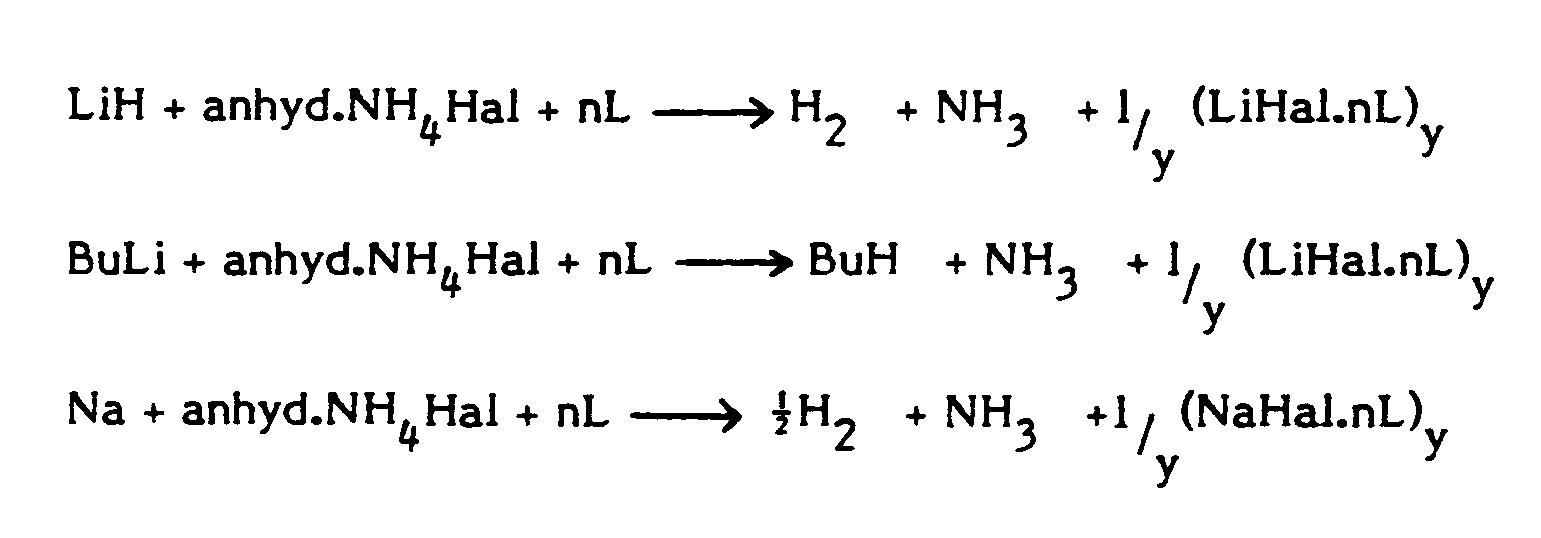
More than one alkali metal, more than one ammonium salt and/or more than one Lewis base may be used in the reaction, but the results may be less predictable in such cases. - The reaction, which occurs readily at moderately elevated temperatures, e.g. 40°C to 60°C, is accompanied by vigorous evolution of gas, which is a mixture of butane and ammonia in the case of the alkali metal alkyl, e.g. butyllithium reactant and of hydrogen and ammonia in the case of the pure metal or the hydride, e.g. lithium hydride, reactant. This gas evolution probably helps to drive the reaction substantially to completion.
- Following completion of the reaction, which is indicated by the cessation of gas evolution, the desired complex can be recovered from solution by crystallisation, preferably under conditions of refrigeration.
- As to the requirement for anhydrous reagents and conditions, it is to be understood that normal commercial-grade anhydrous ammonium salts may be used. This is in contrast to the previous reaction procedures, where even analar-grade anhydrous lithium salts have to be subjected to further extensive drying in vacuo to eliminate even the last traces of moisture, before satisfactory yields of a non-hydrated product can be obtained.
- In general, substantially stoichiometric quantities of the reagents will be used, and it is an additional feature of this invention that, in contrast to previous procedures, the stoichiometry of the final product can be controlled by the stoichiometry of the reaction mixture, in particular, the stoichiometric quantity of the ligand L, e.g. 1, 2 or 4 moles depending on the desired value for n.
- As indicated, the process of the present invention is particularly applicable to the preparation of lithium complexes, i.e. complexes of the formula defined where M is Li. However, the process may also be applied to complexes of other alkali metals, e.g. Na or K, and such complexes are novel.
- Similarly, the present invention is particularly directed to the preparation of the halide complexes, i.e. where X is F⁻, Cl⁻, Br⁻ or I⁻, but other anions may be used, e.g. monovalent anions such as SCN⁻, OCN⁻, ClO₄⁻ and BF₄⁻, and polyvalent anions such as CO₃²⁻.
- As the organic ligand L, there may be used any suitable organic electron donor (Lewis base) such as hexamethylphosphoramide (HMPA), tetramethylethylenediamine (TMEDA), pentamethyldiethylenetriamine (PMDETA), 1,2-dimethoxyethane (glyme), bis(2-methoxyethyl)ether (diglyme), dioxan, and tetrahydrofuran (THF). Other suitable electron donors (Lewis bases) will be apparent.
- The reaction is carried out in an anhydrous hydrocarbon solvent, e.g. hexane, toluene or mixtures thereof, and under an inert atmosphere, e.g. under nitrogen.
- The process of the present invention is illustrated by the following Examples. Crystal structures of all the products have been determined.
- 5.9 cm³ of a 1.7 mol/litre solution of n-butyl lithium in n-hexane (10 mmol n-BuLi) was charged under nitrogen to a reaction vessel, following which the n-hexane was removed by evaporation and replaced by toluene. HMPA was added in 1, 2, 3 or 4 molar equivalents relative to BuLi followed by 10 mmol solid anhydrous ammonium halide as indicated below. The reaction mixture was heated to 40°C to 60°C, whereupon vigorous evolution of the n-butane and ammonia occurred, accompanied by numerous colour changes of the solution and gradual disappearance of the solid. At the termination of the reaction (cessation of gas evolution and complete dissolution of the solid) the resulting solution was refrigerated (-5°C) to crystallise the lithium halide complex indicated. The results are tabulated below in Table 1. Spectral analysis of the solution at the end of the reaction and before crystallisation shows a complete absence of ammonium ions, thus indicating substantially 100% reaction.

- Anhydrous NH₄Cl was added to a suspension of uncomplexed lithium hydride in a mixture of HMPA (2 equivalents) and toluene and the mixture heated for 4 days at 110°C. After filtration and cooling (LiCl.HMPA)₄ was recovered at 51% yield, m.p. 142-144°C.
- By proceeding in accordance with Example 2, but using NH₄BF₄ instead of NH₄Cl, the complex (LiBF₄.4HMPA)y, m.p. 120-122°C, is obtained in yield about 65%.
- By proceeding in accordance with Example 2, but using NH₄BF₄ instead of NH₄Cl and PMDETA instead of HMPA, the complex (LiBF₄.PMDETA)y, m.p. 109-110°C, can be obtained in yield about 30%.
- Under anhydrous conditions and under nitrogen, a solution of 10 mmol of n-butyllithium in hexane was added to a frozen mixture of 0.76 g (10 mmol) solid ammonium thiocyanate, 10 ml of toluene and 3.58 g (20 mmol) of HMPA at -196°C to produce an orange-red mixture. This slowly turned violet at about 0°C, then yellow, and then became colourless but slightly cloudy at 25°C, with vigorous evolution of gas. 10 ml of toluene was added and the mixture warmed to give a pale-yellow solution, which on cooling deposited cubic crystals of basic formula (LiNCS.2HMPA)₂, but solvated with toluene probably to (LiNCS.2HMPA.

- Following similar procedures, the following complexes were also obtained;

- Where, in the above product formulae, the value of y is not given, the degree of lattice formation in the product has not been determined.
- Under anhydrous conditions and under nitrogen, a red solution of 5 mmol of n-butyllithium in 5 ml of toluene and 1.79 g (10 mmol) of HMPA was frozen. 0.49 g (5 mmol) of solid ammonium bromide was added. The mixture was then warmed to 50°C, with vigorous evolution of gas and colour change to violet, then sepia, and finally after about 15 minutes, clear and colourless. 5 ml of hexane and 7 ml of toluene was added, whereupon a yellow oil separated. On cooling, colourless crystals were formed. These were filtered off and found by chemical analysis and ¹H n.m.r. spectra to be of formula (LiBr.1.5HMPA 0.5 toluene)₂, m.p. 56-58°C. The yield was 60%. After washing the crystals with hexane and submitting them to an absolute pressure of 40Pa (0.3 mm of mercury) for 30 minutes, some toluene solvate was removed to give material of formula (LiBr.1.5HMPA 0.35 toluene)₂, m.p. 70-72°C.
- By proceeding in a similar manner to that of Example 1, but using sodium hydride, ammonium tetrafluoroborate and HMPA, a complex of sodium tetrafluoroborate and HMPA is obtained.
- By proceeding in a similar manner to that of Example 1, but using n-butyllithium and sodium hydride, ammonium thiocyanate and HMPA in the molar ratios 1:1:2:4, a crystalline complex containing both lithium and sodium is obtained. This, by analogy with the product of Example 3, is assumed to be [LiNa(SCN)₂.4HMPA]y. It melts at 103-104°C.
- Metallic potassium, ammonium thiocyanate and HMPA in the molar ratio 1:1:5 are reacted together in toluene under nitrogen and under anhydrous conditions at 110°C for 15 minutes to give a white crystalline material, m.p. 60°C, which has been identified as (KSCN)₃.5HMPA.
- This experiment is repeated at 25°C for 15 minutes, using potassium hydride instead of the metal. The same product is obtained. Yields are about 60% to 90% over two batches.
- In a similar manner to that of Example 7, metallic lithium, ammonium thiocyanate and HMPA in the molar ratios 1:1:2 are reacted together in toluene at ambient temperature to give (LiSCN.2HMPA)₂ in 85% yield.
- When lithium hydride is substituted for metallic lithium, reaction is slower but (LiSNC.2HMPA)₂ is obtained, although the yield is lower, viz 72%.
- Metallic potassium, ammonium iodide and HMPA in the molar ratios 1:1:2 are reacted together in toluene under nitrogen under anhydrous conditions. Warming to 100°C initiates a vigorous reaction and a white solid, assumed to be (KI.2HMPA)y, is formed.
- When n-butyllithium is used in an excess of THF as Lewis base, it must first be freed from hexane to avoid product precipitation.
- Dioxan, THF and diglyme all give vigorous reactions with n-butyllithium and ammonium thiocyanate, a colourless crystalline complex of the form [LiSCN.n(donor)]y being produced in each case.
- As well as the complexes mentioned in the Examples, the following crystalline complexes have also been made and identified, only the value y remaining to be found.
(LiBr.TMEDA)y
(LiI.TMEDA)y
(NaSCN.PMDETA)y
Claims (9)
- A method for the preparation of alkali metal salt complexes of the formula (MxX.nL)y, where M is an alkali metal, X is an anion, L is an organic electron-donating ligand (Lewis base), x is the valency of the anion X, n is a number such that n:l is the molar ratio of ligand to alkali metal salt in the complex, and y is an integer up to infinity, which comprises reacting an alkali metal or a hydride or alkyl thereof with an anhydrous ammonium salt of the anion X in the presence of the ligand (L), the reaction being carried out under anhydrous conditions and under an inert atmosphere and in the presence of a hydrocarbon solvent.
- A method according to claim 1, in which the product alkali metal complex is recovered in crystalline form by cooling the reaction medium at the termination of the reaction, and/or by the addition of alkane.
- A method according to claim 1 or 2, in which, in the formula, M is Li and X is halide or thiocyanate, and which comprises reacting lithium hydride or a lithium alkyl with an anhydrous ammonium halide or thiocyanate, the reaction being carried out under anhydrous conditions in a hydrocarbon solvent and in the presence of the ligand L.
- A method according to claim 3, in which the lithium reactant is n-butyllithium.
- A method according to claim 1 or 2, in which, in the formula, M is Na or K.
- A method according to claim 1 or 2, in which a mixture of sodium hydride and n-butyllithium is used as the alkali metal reactant and the ammonium salt is the thiocyanate.
- A method according to claim 1, 2 or 5, in which the ammonium salt is ammonium chloride, bromide, iodide, thiocyanate or fluoroborate.
- A method according to any one of claims 1 to 7, which the ligand L is hexamethylphosphoramide (HMPA), tetramethylethylenediamine (TMEDA), pentamethyldiethylenetriamine (PMDETA), 1 ,2-dimethoxyethane (glyme), bis(2-methoxyethyl)ether (diglyme), dioxan, or tetrahydrofuran (THF).
- A method according to any one of claims 1 to 8, in which the reaction solvent is n-hexane or toluene.
Applications Claiming Priority (2)
| Application Number | Priority Date | Filing Date | Title |
|---|---|---|---|
| GB8724662 | 1987-10-21 | ||
| GB878724662A GB8724662D0 (en) | 1987-10-21 | 1987-10-21 | Lewis base complexes of alkali metal salts |
Publications (2)
| Publication Number | Publication Date |
|---|---|
| EP0317087A1 EP0317087A1 (en) | 1989-05-24 |
| EP0317087B1 true EP0317087B1 (en) | 1992-09-23 |
Family
ID=10625675
Family Applications (1)
| Application Number | Title | Priority Date | Filing Date |
|---|---|---|---|
| EP88309913A Expired - Lifetime EP0317087B1 (en) | 1987-10-21 | 1988-10-21 | Preparation of lewis base complexes of alkali metal salts |
Country Status (13)
| Country | Link |
|---|---|
| US (1) | US5206394A (en) |
| EP (1) | EP0317087B1 (en) |
| JP (1) | JPH02501928A (en) |
| KR (1) | KR890701597A (en) |
| AU (1) | AU615011B2 (en) |
| CA (1) | CA1336000C (en) |
| DE (1) | DE3874862T2 (en) |
| DK (1) | DK305089A (en) |
| ES (1) | ES2052741T3 (en) |
| GB (2) | GB8724662D0 (en) |
| GR (1) | GR3006278T3 (en) |
| PT (1) | PT88806B (en) |
| WO (1) | WO1989003835A1 (en) |
Families Citing this family (3)
| Publication number | Priority date | Publication date | Assignee | Title |
|---|---|---|---|---|
| GB8915531D0 (en) * | 1989-07-06 | 1989-08-23 | Ass Octel | Alkaline earth,transition and lanthanide metal inorganic salt complexes |
| US6420581B1 (en) | 1999-06-29 | 2002-07-16 | Flexsys America L.P. | Manufacture of zinc hexasulfide amine complexes |
| JP5087754B2 (en) * | 2010-04-27 | 2012-12-05 | 信越化学工業株式会社 | Cyclic polyorganosiloxane silazane and method for producing the same |
Citations (1)
| Publication number | Priority date | Publication date | Assignee | Title |
|---|---|---|---|---|
| DE2523542A1 (en) * | 1974-05-28 | 1975-12-04 | Dale Johannes | METHOD FOR MANUFACTURING MACROCYCLIC POLYAETERS |
Family Cites Families (14)
| Publication number | Priority date | Publication date | Assignee | Title |
|---|---|---|---|---|
| US3734963A (en) * | 1969-03-18 | 1973-05-22 | Exxon Co | Inorganic lithium-amine complexes |
| US4094876A (en) * | 1969-03-18 | 1978-06-13 | Exxon Research & Engineering Co. | Chelated lithium aluminum compounds |
| US4156603A (en) * | 1969-03-18 | 1979-05-29 | Exxon Research & Engineering Co. | Reductions with chelated lithium hydridoaluminates or hydridoborates |
| US4152401A (en) * | 1969-03-18 | 1979-05-01 | Exxon Research & Engineering Co. | Chelated lithium aluminum compounds |
| USRE28456E (en) * | 1969-03-18 | 1975-07-01 | Inorganic lithium amine complexes | |
| US3933879A (en) * | 1969-03-18 | 1976-01-20 | Exxon Research And Engineering Company | Chelated lithium aluminum compounds |
| US4088666A (en) * | 1969-03-18 | 1978-05-09 | Exxon Research & Engineering Co. | Reductions with chelated lithium hydridoaluminates or hydridoborates |
| US3758585A (en) * | 1970-07-27 | 1973-09-11 | Exxon Research Engineering Co | Complexes of inorganic sodium compounds and chelating amines |
| US3755447A (en) * | 1971-11-26 | 1973-08-28 | Exxon Research Engineering Co | Polyalkylene polyamine separation and purification |
| US3758580A (en) * | 1971-11-26 | 1973-09-11 | Exxon Research Engineering Co | Separation of tertiary chelating polyamines |
| CH623353A5 (en) * | 1976-09-08 | 1981-05-29 | Ciba Geigy Ag | |
| DE2722221A1 (en) * | 1977-05-17 | 1978-11-23 | Studiengesellschaft Kohle Mbh | ALKALIMETAL COMPLEX COMPLEXES, PROCESS FOR THEIR PRODUCTION AND THEIR USE FOR HYDROGENATION AND NITRIDATION OF ALKALIMETALS |
| NZ189722A (en) * | 1978-03-03 | 1981-05-15 | Nat Res Dev | Manganese complexes and sorption of gases |
| US4900856A (en) * | 1988-05-26 | 1990-02-13 | Ethyl Corporation | Preparation of metal halide-amine complexes |
-
1987
- 1987-10-21 GB GB878724662A patent/GB8724662D0/en active Pending
-
1988
- 1988-10-20 PT PT88806A patent/PT88806B/en not_active IP Right Cessation
- 1988-10-20 CA CA000580823A patent/CA1336000C/en not_active Expired - Fee Related
- 1988-10-21 AU AU26053/88A patent/AU615011B2/en not_active Ceased
- 1988-10-21 EP EP88309913A patent/EP0317087B1/en not_active Expired - Lifetime
- 1988-10-21 JP JP63508629A patent/JPH02501928A/en active Pending
- 1988-10-21 ES ES88309913T patent/ES2052741T3/en not_active Expired - Lifetime
- 1988-10-21 GB GB8824778A patent/GB2211189B/en not_active Expired - Lifetime
- 1988-10-21 KR KR1019890701103A patent/KR890701597A/en not_active Ceased
- 1988-10-21 US US07/372,362 patent/US5206394A/en not_active Expired - Fee Related
- 1988-10-21 DE DE8888309913T patent/DE3874862T2/en not_active Expired - Fee Related
- 1988-10-21 WO PCT/GB1988/000915 patent/WO1989003835A1/en not_active Ceased
-
1989
- 1989-06-20 DK DK305089A patent/DK305089A/en not_active Application Discontinuation
-
1992
- 1992-11-19 GR GR920402636T patent/GR3006278T3/el unknown
Patent Citations (1)
| Publication number | Priority date | Publication date | Assignee | Title |
|---|---|---|---|---|
| DE2523542A1 (en) * | 1974-05-28 | 1975-12-04 | Dale Johannes | METHOD FOR MANUFACTURING MACROCYCLIC POLYAETERS |
Non-Patent Citations (2)
| Title |
|---|
| J.A.C.S. 89:26/December 20, 1967, pages 7017-7036 * |
| J.A.C.S. 98:13/June 23, 1976, pages 3769-3777 * |
Also Published As
| Publication number | Publication date |
|---|---|
| AU2605388A (en) | 1989-05-23 |
| GR3006278T3 (en) | 1993-06-21 |
| PT88806B (en) | 1993-01-29 |
| GB2211189B (en) | 1991-06-26 |
| GB8824778D0 (en) | 1988-11-30 |
| DE3874862D1 (en) | 1992-10-29 |
| GB2211189A (en) | 1989-06-28 |
| ES2052741T3 (en) | 1994-07-16 |
| WO1989003835A1 (en) | 1989-05-05 |
| AU615011B2 (en) | 1991-09-19 |
| KR890701597A (en) | 1989-12-21 |
| DE3874862T2 (en) | 1993-02-04 |
| JPH02501928A (en) | 1990-06-28 |
| GB8724662D0 (en) | 1987-11-25 |
| DK305089D0 (en) | 1989-06-20 |
| CA1336000C (en) | 1995-06-20 |
| DK305089A (en) | 1989-06-20 |
| US5206394A (en) | 1993-04-27 |
| EP0317087A1 (en) | 1989-05-24 |
Similar Documents
| Publication | Publication Date | Title |
|---|---|---|
| US3607020A (en) | Preparation of lithium hexafluorophosphate | |
| Jones et al. | Synthesis, characterisation and reactivity of germanium (II) amidinate and guanidinate complexes | |
| IE63185B1 (en) | Preparation of organometallic amide compositions | |
| Bochkarev et al. | Synthesis and Crystal Structure of Ph3Ln (THF) 3 (Ln= Er, Tm) | |
| US5206394A (en) | Lewis base complexes of alkali metal salts | |
| US3278570A (en) | Molybdenum pentacarbonyl compounds and process for preparing same | |
| US6348166B1 (en) | Method for producing di-organo alkaline-earth compounds | |
| Barr et al. | Reactions of ammonium salts with butyllithium and with lithium hydride: new routes to fully anhydrous inorganic lithium complexes | |
| AU628188B2 (en) | Alkaline earth, transition and lanthanide metal inorganic salt complexes | |
| US5545759A (en) | Method of producing tris(pentafluorophenyl)borane using pentafluorophenyl alkali metal salt prepared from pentafluorobenzene | |
| US2913498A (en) | Process for preparing aromatic phosphorus compounds | |
| US4364873A (en) | Method of making aluminum alkyls | |
| US2912465A (en) | Process for preparing organophosphines | |
| US4045494A (en) | Method for preparing triogranophosphines | |
| US3357806A (en) | Process for preparing alkali metal aluminum hexahydrides | |
| US20070187847A1 (en) | Process for the preparation of pure aryllithium compounds and their use | |
| Barr et al. | The Ammonium Salt Route to Oligomeric Lanthanum Salt Complexes: Synthesis and X‐Ray Crystal Structure of La (NCS) 3· 4 HMPA | |
| Lappert et al. | Amido-derivatives of metals and metalloids. Part XIII. Dialkylamides of low-valent titanium: their preparation and properties | |
| CA1184566A (en) | Process for the synthesis of 1,1'-diphosphaferrocenes | |
| Razuvaev et al. | Synthesis and properties of alkylvanadium (III) alkoxides | |
| Steiner et al. | α-Zincated phosphorus ylides | |
| US3489812A (en) | Method of preparing bis-(diethyl sulfide)-decaborane | |
| Ebels et al. | Syntheses and structure of bis (pentamethylcyclopentadienyl)‐dithiophosphinato Complexes | |
| Schumann | Organometallic Compounds with Lanthanide—Carbon Sigma Bonds, One of the Last Problems in Organometallic Chemistry | |
| US2875224A (en) | Preparation of organic compounds of trivalent phosphorus |
Legal Events
| Date | Code | Title | Description |
|---|---|---|---|
| PUAI | Public reference made under article 153(3) epc to a published international application that has entered the european phase |
Free format text: ORIGINAL CODE: 0009012 |
|
| AK | Designated contracting states |
Kind code of ref document: A1 Designated state(s): BE DE ES FR GB GR IT LU NL SE |
|
| 17P | Request for examination filed |
Effective date: 19891004 |
|
| 17Q | First examination report despatched |
Effective date: 19910207 |
|
| GRAA | (expected) grant |
Free format text: ORIGINAL CODE: 0009210 |
|
| AK | Designated contracting states |
Kind code of ref document: B1 Designated state(s): BE DE ES FR GB GR IT LU NL SE |
|
| REF | Corresponds to: |
Ref document number: 3874862 Country of ref document: DE Date of ref document: 19921029 |
|
| ET | Fr: translation filed | ||
| ITF | It: translation for a ep patent filed | ||
| REG | Reference to a national code |
Ref country code: GR Ref legal event code: FG4A Free format text: 3006278 |
|
| PLBE | No opposition filed within time limit |
Free format text: ORIGINAL CODE: 0009261 |
|
| STAA | Information on the status of an ep patent application or granted ep patent |
Free format text: STATUS: NO OPPOSITION FILED WITHIN TIME LIMIT |
|
| 26N | No opposition filed | ||
| EPTA | Lu: last paid annual fee | ||
| REG | Reference to a national code |
Ref country code: ES Ref legal event code: FG2A Ref document number: 2052741 Country of ref document: ES Kind code of ref document: T3 |
|
| PGFP | Annual fee paid to national office [announced via postgrant information from national office to epo] |
Ref country code: NL Payment date: 19941031 Year of fee payment: 7 |
|
| PGFP | Annual fee paid to national office [announced via postgrant information from national office to epo] |
Ref country code: GR Payment date: 19941227 Year of fee payment: 7 |
|
| PGFP | Annual fee paid to national office [announced via postgrant information from national office to epo] |
Ref country code: DE Payment date: 19941228 Year of fee payment: 7 |
|
| PGFP | Annual fee paid to national office [announced via postgrant information from national office to epo] |
Ref country code: FR Payment date: 19941230 Year of fee payment: 7 Ref country code: BE Payment date: 19941230 Year of fee payment: 7 |
|
| PGFP | Annual fee paid to national office [announced via postgrant information from national office to epo] |
Ref country code: SE Payment date: 19950103 Year of fee payment: 7 |
|
| PGFP | Annual fee paid to national office [announced via postgrant information from national office to epo] |
Ref country code: ES Payment date: 19950104 Year of fee payment: 7 |
|
| EAL | Se: european patent in force in sweden |
Ref document number: 88309913.7 |
|
| PGFP | Annual fee paid to national office [announced via postgrant information from national office to epo] |
Ref country code: LU Payment date: 19950201 Year of fee payment: 7 |
|
| PG25 | Lapsed in a contracting state [announced via postgrant information from national office to epo] |
Ref country code: LU Free format text: LAPSE BECAUSE OF NON-PAYMENT OF DUE FEES Effective date: 19951021 |
|
| PG25 | Lapsed in a contracting state [announced via postgrant information from national office to epo] |
Ref country code: SE Effective date: 19951022 Ref country code: ES Free format text: LAPSE BECAUSE OF NON-PAYMENT OF DUE FEES Effective date: 19951022 |
|
| PG25 | Lapsed in a contracting state [announced via postgrant information from national office to epo] |
Ref country code: BE Effective date: 19951031 |
|
| BERE | Be: lapsed |
Owner name: THE ASSOCIATED OCTEL CY LTD Effective date: 19951031 |
|
| PG25 | Lapsed in a contracting state [announced via postgrant information from national office to epo] |
Ref country code: GR Free format text: THE PATENT HAS BEEN ANNULLED BY A DECISION OF A NATIONAL AUTHORITY Effective date: 19960430 |
|
| PG25 | Lapsed in a contracting state [announced via postgrant information from national office to epo] |
Ref country code: NL Effective date: 19960501 |
|
| PG25 | Lapsed in a contracting state [announced via postgrant information from national office to epo] |
Ref country code: FR Effective date: 19960628 |
|
| REG | Reference to a national code |
Ref country code: GR Ref legal event code: MM2A Free format text: 3006278 |
|
| EUG | Se: european patent has lapsed |
Ref document number: 88309913.7 |
|
| PG25 | Lapsed in a contracting state [announced via postgrant information from national office to epo] |
Ref country code: DE Effective date: 19960702 |
|
| NLV4 | Nl: lapsed or anulled due to non-payment of the annual fee |
Effective date: 19960501 |
|
| REG | Reference to a national code |
Ref country code: FR Ref legal event code: ST |
|
| PGFP | Annual fee paid to national office [announced via postgrant information from national office to epo] |
Ref country code: GB Payment date: 20001020 Year of fee payment: 13 |
|
| PG25 | Lapsed in a contracting state [announced via postgrant information from national office to epo] |
Ref country code: GB Free format text: LAPSE BECAUSE OF NON-PAYMENT OF DUE FEES Effective date: 20011021 |
|
| REG | Reference to a national code |
Ref country code: GB Ref legal event code: IF02 |
|
| GBPC | Gb: european patent ceased through non-payment of renewal fee |
Effective date: 20011021 |
|
| REG | Reference to a national code |
Ref country code: ES Ref legal event code: FD2A Effective date: 19961113 |
|
| PG25 | Lapsed in a contracting state [announced via postgrant information from national office to epo] |
Ref country code: IT Free format text: LAPSE BECAUSE OF NON-PAYMENT OF DUE FEES;WARNING: LAPSES OF ITALIAN PATENTS WITH EFFECTIVE DATE BEFORE 2007 MAY HAVE OCCURRED AT ANY TIME BEFORE 2007. THE CORRECT EFFECTIVE DATE MAY BE DIFFERENT FROM THE ONE RECORDED. Effective date: 20051021 |