EP0316150B1 - Thermosetting urethane elastomer - Google Patents
Thermosetting urethane elastomer Download PDFInfo
- Publication number
- EP0316150B1 EP0316150B1 EP88310537A EP88310537A EP0316150B1 EP 0316150 B1 EP0316150 B1 EP 0316150B1 EP 88310537 A EP88310537 A EP 88310537A EP 88310537 A EP88310537 A EP 88310537A EP 0316150 B1 EP0316150 B1 EP 0316150B1
- Authority
- EP
- European Patent Office
- Prior art keywords
- prepolymer
- urethane elastomer
- thermosetting urethane
- polyol
- curing agent
- Prior art date
- Legal status (The legal status is an assumption and is not a legal conclusion. Google has not performed a legal analysis and makes no representation as to the accuracy of the status listed.)
- Expired - Lifetime
Links
Classifications
-
- C—CHEMISTRY; METALLURGY
- C08—ORGANIC MACROMOLECULAR COMPOUNDS; THEIR PREPARATION OR CHEMICAL WORKING-UP; COMPOSITIONS BASED THEREON
- C08G—MACROMOLECULAR COMPOUNDS OBTAINED OTHERWISE THAN BY REACTIONS ONLY INVOLVING UNSATURATED CARBON-TO-CARBON BONDS
- C08G18/00—Polymeric products of isocyanates or isothiocyanates
- C08G18/06—Polymeric products of isocyanates or isothiocyanates with compounds having active hydrogen
- C08G18/70—Polymeric products of isocyanates or isothiocyanates with compounds having active hydrogen characterised by the isocyanates or isothiocyanates used
- C08G18/72—Polyisocyanates or polyisothiocyanates
- C08G18/74—Polyisocyanates or polyisothiocyanates cyclic
- C08G18/76—Polyisocyanates or polyisothiocyanates cyclic aromatic
- C08G18/7614—Polyisocyanates or polyisothiocyanates cyclic aromatic containing only one aromatic ring
-
- C—CHEMISTRY; METALLURGY
- C08—ORGANIC MACROMOLECULAR COMPOUNDS; THEIR PREPARATION OR CHEMICAL WORKING-UP; COMPOSITIONS BASED THEREON
- C08G—MACROMOLECULAR COMPOUNDS OBTAINED OTHERWISE THAN BY REACTIONS ONLY INVOLVING UNSATURATED CARBON-TO-CARBON BONDS
- C08G18/00—Polymeric products of isocyanates or isothiocyanates
- C08G18/06—Polymeric products of isocyanates or isothiocyanates with compounds having active hydrogen
- C08G18/08—Processes
- C08G18/0895—Manufacture of polymers by continuous processes
-
- C—CHEMISTRY; METALLURGY
- C08—ORGANIC MACROMOLECULAR COMPOUNDS; THEIR PREPARATION OR CHEMICAL WORKING-UP; COMPOSITIONS BASED THEREON
- C08G—MACROMOLECULAR COMPOUNDS OBTAINED OTHERWISE THAN BY REACTIONS ONLY INVOLVING UNSATURATED CARBON-TO-CARBON BONDS
- C08G18/00—Polymeric products of isocyanates or isothiocyanates
- C08G18/06—Polymeric products of isocyanates or isothiocyanates with compounds having active hydrogen
- C08G18/08—Processes
- C08G18/10—Prepolymer processes involving reaction of isocyanates or isothiocyanates with compounds having active hydrogen in a first reaction step
Definitions
- thermosetting urethane elastomer more particularly to a thermosetting urethane elastomer prepared from a prepolymer containing terminal isocyanate groups obtained from p-phenylene diisocyanate (hereinafter abbreviated to PPDI) and a polyol, and a curing agent comprising specific polyols.
- PPDI p-phenylene diisocyanate
- Thermosetting urethane elastomers are generally produced (a) by curing a prepolymer containing terminal isocyanate groups and derived from a diisocyanate such as tolylene diisocyanate, diphenylmethane diisocyanate (hereinafter abbreviated to MDI) or hexamethylene diisocyanate, and a polyol such as polyether polyol, polyester polyol or polycaprolactone polyol, using a glycol such as 1,4-butylene glycol (hereinafter abbreviated to 1,4-BG) or an amine such as 3,3'-dichloro-4,4'-diaminodiphenyl-methane, or (b) by rapidly curing an unstable prepolymer derived from 1,5-naphthalene diisocyanate (hereinafter abbreviated to NDI) and a polyester polyol, with a glycol such as 1,4-BG.
- NDI 1,5-
- thermosetting urethane elastomers are highly elastic, having excellent tensile strength, and have been widely used for rolls, solid tires and belts.
- the elastomer obtained in method (a) is inferior in heat resistance, has a hardness greatly dependent on temperature, and is therefore unsuitable for use in environments subjected to elevated temperatures or to large changes of temperature.
- the prepolymer obtained in method (b) has excellent heat resistance, but since it is obtained from an unstable prepolymer, drawbacks are involved in the equipment used for its production and in the time restrictions involved.
- EP-A-0135111 describes the production of thermoplasticly processable branched polyurethanes based on NDI. They are produced by reacting another diisocyanate such as MDI with a stoichiometric excess of a long-chain polyol to form an OH-prepolymer, reacting the latter with an excess of NDI to form an NCO-prepolymer, and reacting that product with a chain lengthening polyol such as a mixture of hydroquinone-di-( ⁇ -hydroxyethylether) and trimethylolpropane.
- a chain lengthening polyol such as a mixture of hydroquinone-di-( ⁇ -hydroxyethylether) and trimethylolpropane.
- FR-A-1339799 describes a procedure performing polyurethane coatings for electrical conductors, in which an aromatic polyisocyanate such as MDI is reacted with an alkyl aromatic diol such as hydroquinone bis-(2-hydroxyethyl)ether and a triol such as trimethylolpropane.
- EP-A-0240118 concerns a fibre-reinforced curable polyurethane matrix of a diisocyanate selected from p- and m-phenyl diisocyanates, 1,4-cyclohexyl diisocyanate, tetramethylxylyl diisocyanate and MDI, a polyol/polythiol and a diol/dithiol curing agent.
- a diisocyanate selected from p- and m-phenyl diisocyanates, 1,4-cyclohexyl diisocyanate, tetramethylxylyl diisocyanate and MDI
- a polyol/polythiol and a diol/dithiol curing agent.
- thermosetting urethane elastomers which seeks to improve the heat resistance and temperature variation in physical properties of thermosetting urethane elastomers is derived from intensive investigations on combinations of various prepolymers containing terminal isocyanate groups and derived from diisocyanate and polyol, with various curing agents, and is based on the discovery that such properties can be improved by use of a combination of a specific diisocyanate with a specific curing agent.
- thermosetting urethane elastomer prepared from:
- PPDI is the diisocyanate of choice.
- PPDI is an aromatic diisocyanate having isocyanate groups at the 1- and 4-positions on the benzene ring, and its melting point is 95 °C.
- a prepolymer containing terminal isocyanate groups obtained from PPDI and polyol was cured with various curing agents, and heat resistance and temperature dependency, of the cured products were measured.
- the use of BHEB and TMP as the curing agents led to a thermosetting urethane elastomer having excellent physical properties being obtained.
- thermosetting urethane elastomer consisting only of the prepolymer and BHEB, although excellent in heat resistance, has the drawback that its compression set is large.
- the thermosetting urethane elastomer according to the present invention has improved compression set and simultaneously improved heat resistance.
- Compounds having two or more active hydrogens which can be used for obtaining the prepolymer having terminal isocyanate groups have an average molecular weight of 1000 to 6000, preferably 1000 to 3000.
- polyester polyols polyether polyols, polycarbonate polyols and polyacrylic polyols.
- polyester polyol there may be employed polyester polyols obtained by polycondensation of glycol such as ethylene glycol, 1,2-propylene glycol, 1,3-propylene glycol, 1,3-butylene glycol, 1,4-BG, 2,2-dimethyl-1,3-propane diol, diethylene glycol, 1,5-pentane diol, 3-methyl-1,5-pentane diol, 1,6-hexane diol, cyclohexane-1,4-diol and cyclohexane-1,4-dimethanol, alone or as a mixture with a dibasic acid such as succinic acid, maleic acid, adipic acid, glutaric acid, pimellic acid, suberic acid, azelaic acid, sebacic acid, phthalic acid, isophthalic acid, terephthalic acid, hexahydrophthalic acid and hexahydroisophthalic acid, alone or as a mixture and
- polyether polyol there may be employed hydroxyl-containing polyether polyols made by the addition polymerization of alkylene oxide such as ethylene oxide and propylene oxide, to glycols such as ethylene glycol, 1,2-propylene glycol, diethylene glycol and polyethylene glycol, polyols having 3 or more functional groups such as glycerine, trimethylolethane, TMP and pentaerythritol, polyamines such as ethylenediamine and toluenediamine, either alone or as a mixture of two or more.
- alkylene oxide such as ethylene oxide and propylene oxide
- glycols such as ethylene glycol, 1,2-propylene glycol, diethylene glycol and polyethylene glycol
- polyols having 3 or more functional groups such as glycerine, trimethylolethane, TMP and pentaerythritol
- polyamines such as ethylenediamine and toluenediamine
- polycarbonate polyol can be obtained by the reaction of a dialkyl carbonate, an alkylene carbonate or a diaryl carbonate, with a hydroxyl compound, for example, 1,4-BG and 1,6-hexane diol, and these can be also used either alone or as a mixture of two or more.
- the mole ratio of BHEB and TMP ranges from 9.5:0.5 to 1:9, preferably from 9:1 to 2:8.
- the ratio influences various physical properties of the thermosetting urethane elastomer such as hardness, tensile strength and compression set. Accordingly, any thermosetting urethane elastomer having desired properties can be prepared by changing the above ratio.
- the preparation of the prepolymer having terminal isocyanate groups can be practiced as follows.
- the reaction between the organic polyisocyanate and the active hydrogen-containing compound should be conducted so that the isocyanate content in the prepolymer should be 2 to 20% by weight, preferably 3 to 10% by weight. If the isocyanate content in the prepolymer is greater than 20% by weight, the amount of free PPDI is excessive and the prepolymer will have inferior storage stability. On the other hand, if it is smaller than 2% by weight, the isocyanate content as the prepolymer is low and its viscosity becomes very high, and the prepolymer can then be handled only with difficulty.
- thermosetting urethane elastomer of the present invention is preferably prepared by setting the NCO equivalent of the prepolymer and the OH equivalent of the curing agent at a ratio of 1 : 0.8 to 1 : 0.95, adjusting the prepolymer temperature to 110 to 130 °C, the curing agent temperature at 110 to 120 °C and the mold temperature at 120 to 130 °C, stirring predetermined amounts of the prepolymer and the curing agents, and degassing the mixture under reduced pressure prior to casting into the mold, followed by heating for 8 to 15 hours.
- a dispersing machine it is necessary to perform degassing under reduced pressure before mixing the prepolymer with the curing agent.
- thermosetting urethane elastomer heat resistance and the temperature reduction of physical properties which have been the drawbacks of known thermosetting urethane elastomer, can be improved by a composition comprising a prepolymer containing terminal isocyanate groups by use of PPDI as the diisocyanate and, as the curing agents, BHEB and TMP.
- PPDI the diisocyanate
- BHEB the curing agents
- compression set which has been deemed to be improved only with difficultly, can also be improved to better than the performance exhibited by the thermosetting urethane elastomer of the prior art.
- thermosetting urethane elastomer of the present invention finds uses in environments involving elevated temperatures or great temperature changes where known thermosetting urethane elastomers could not be employed. Specific examples of such uses may include rolls for paper making, printing rolls and rolls for other OA instruments, cleaning blades, belts, O-rings, sealing materials such as bushes, vibration insulators, solid tires, wheels for casters, and snow plows.
- PPDI which is solid at ordinary temperature
- a polycaprolactone polyol average molecular weight 2000, functionality 2
- the prepolymer was found to have an NCO content of 3.6%.
- BHEB/TMP at a weight ratio of 5.80/1.00 was completely mixed and dissolved at 120 °C to provide a curing agent.
- the above prepolymer and the curing agent were adjusted to 110 °C and a mold to 120 °C, 100 g of the prepolymer and 6.8 g of the curing agent were well stirred and poured into the mold after degassing under reduced pressure. After casting, heating was effected at 120 °C for 10 hours to obtain a thermosetting urethane elastomer. The urethane elastomer was left to stand at 25 °C for 7 days, and then subjected to various tests. The results are shown in Table 1 (physical properties), Table 2 (heat aging test), and Table 3 (temperature dependency of hardness).
- PPDI at a rate of 0.505 mol/min. and a polytetramethylene glycol (average molecular weight 1000, functionality 2) heated to 80 °C at a rate of 0.253 mol/min. were fed into a twin-screw extruder rotating at 150 rpm, with cylinder temperatures of 80 °C at the feed portion, 120 to 150 °C at the middle portion and 80 °C at the outlet portion, to obtain a prepolymer.
- the prepolymer was found to have an NCO content of 6.3%.
- Example 2 By use of the curing agent in Example 1, the above prepolymer and the curing agent were adjusted to 110 °C and a mold to 120 °C, 100 g of the prepolymer and 12.0 g of the curing agent were well stirred and poured into the mold after degassing under reduced pressure. After casting, heating was effected at 120 °C for 10 hours to obtain a thermosetting urethane elastomer. The urethane elastomer was left to stand at 25 °C for 7 days, and then subjected to various tests. The results are shown in Table 1 to Table 3.
- the same prepolymer as in Example 1 was employed.
- the prepolymer was adjusted to 75 °C, 1,4-BG to 25 °C and a mold to 120 °C, and 100 g of the prepolymer and 3.7 g of 1,4-BG were well stirred and poured into the mold after degassing under reduced pressure. After casting, heating was effected at 120 °C for 5 hours to obtain a thermosetting urethane elastomer. The urethane elastomer was left to stand at 25 °C for 7 days, and then subjected to various tests. The results are shown in Table 1 to Table 3.
- the same prepolymer as in Example 2 was employed.
- the prepolymer was adjusted to 100 °C, 1,4-BG to 25 °C and a mold to 120 °C, and 100 g of the prepolymer and 3.6 g of 1,4-BG were well stirred and poured into the mold after degassing under reduced pressure. After casting, heating was effected at 120 °C for 5 hours to obtain a thermosetting urethane elastomer. The urethane elastomer was left to stand at 25 °C for 7 days, and then subjected to various tests. The results are shown in Table 1 to Table 3.
- Example 1 By use of the curing agent of Example 1, and similarly under the same temperature conditions as in Example 1, 100 g of the prepolymer and 10.3 g of the curing agent were well stirred and poured into the mold after degassing under reduced pressure. After casting, heating was effected at 120 °C for 10 hours to obtain a thermosetting urethane elastomer. The urethane elastomer was left to stand at 25 °C for 7 days, and then subjected to various tests. The results are shown in Table 1 to Table 3.
- PPDI at a rate of 0.437 mol/min. and a polycaprolactone polyol (average molecular weight 1200, functional group number 2) heated to 80°C at a rate of 0.219 mol/min. were fed into a twin-screw extruder rotating at 150 rpm, with cylinder temperatures of 80°C at the feed portion, 120 to 150°C at the middle portion and 80°C at the outlet portion, to obtain a prepolymer.
- the prepolymer was found to have an NCO content of 5.5 %.
- Resin formation in Examples 3-6 was carried out at various prepolymer/curing agent ratios and at various BHEB/TMP ratios, as shown in Table 4.
- the procedure for mold casting and the conditions after molding were the same as in Example 1.
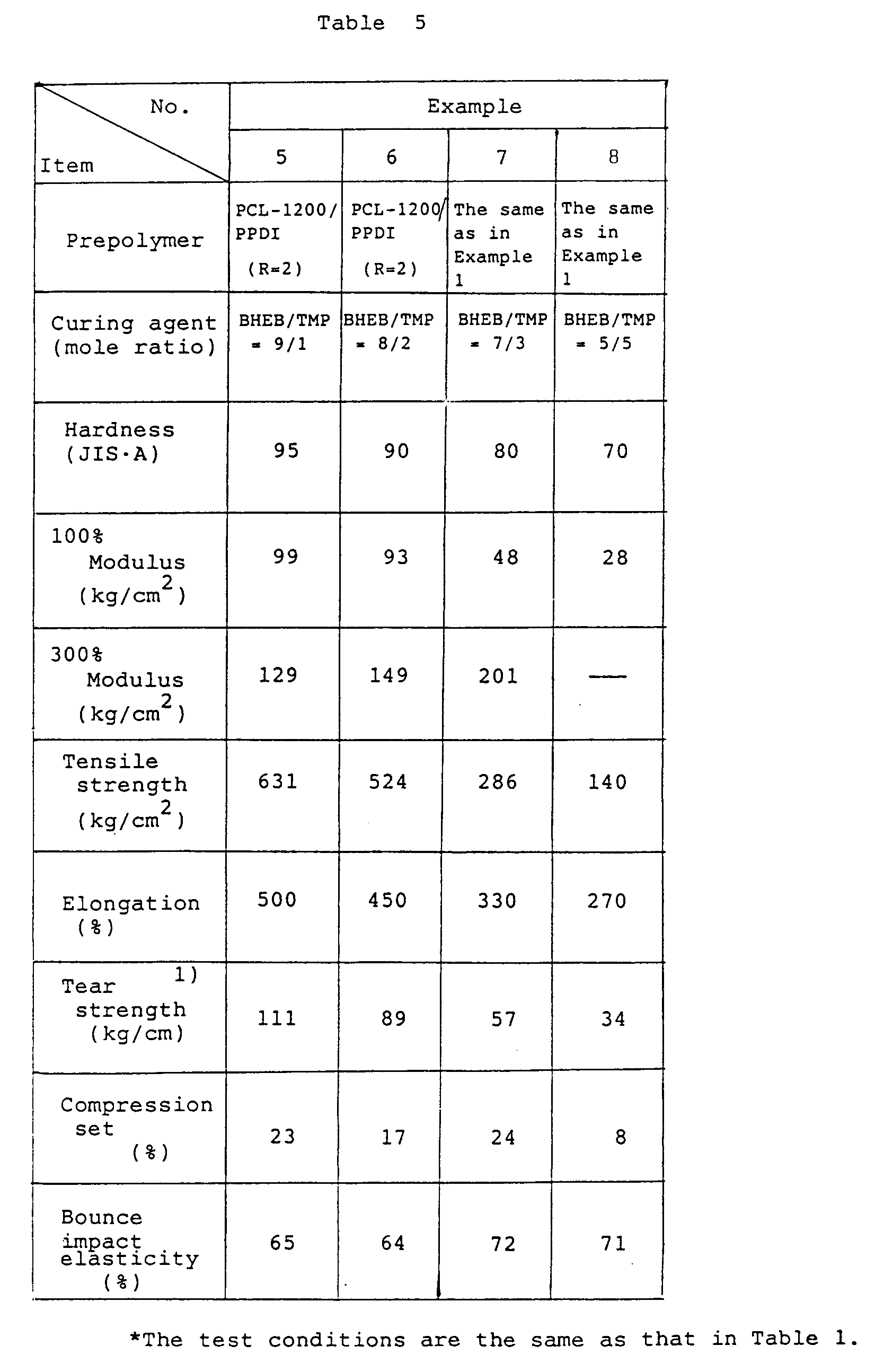
- Table 5 shows the physical properties of the thermosetting urethane elastomers obtained in Examples 3-6.
Landscapes
- Chemical & Material Sciences (AREA)
- Health & Medical Sciences (AREA)
- Chemical Kinetics & Catalysis (AREA)
- Medicinal Chemistry (AREA)
- Polymers & Plastics (AREA)
- Organic Chemistry (AREA)
- Engineering & Computer Science (AREA)
- Manufacturing & Machinery (AREA)
- Polyurethanes Or Polyureas (AREA)
Description
- This invention relates to a thermosetting urethane elastomer, more particularly to a thermosetting urethane elastomer prepared from a prepolymer containing terminal isocyanate groups obtained from p-phenylene diisocyanate (hereinafter abbreviated to PPDI) and a polyol, and a curing agent comprising specific polyols.
- Thermosetting urethane elastomers are generally produced (a) by curing a prepolymer containing terminal isocyanate groups and derived from a diisocyanate such as tolylene diisocyanate, diphenylmethane diisocyanate (hereinafter abbreviated to MDI) or hexamethylene diisocyanate, and a polyol such as polyether polyol, polyester polyol or polycaprolactone polyol, using a glycol such as 1,4-butylene glycol (hereinafter abbreviated to 1,4-BG) or an amine such as 3,3'-dichloro-4,4'-diaminodiphenyl-methane, or (b) by rapidly curing an unstable prepolymer derived from 1,5-naphthalene diisocyanate (hereinafter abbreviated to NDI) and a polyester polyol, with a glycol such as 1,4-BG.
- These thermosetting urethane elastomers are highly elastic, having excellent tensile strength, and have been widely used for rolls, solid tires and belts. However, the elastomer obtained in method (a) is inferior in heat resistance, has a hardness greatly dependent on temperature, and is therefore unsuitable for use in environments subjected to elevated temperatures or to large changes of temperature. In contrast, the prepolymer obtained in method (b) has excellent heat resistance, but since it is obtained from an unstable prepolymer, drawbacks are involved in the equipment used for its production and in the time restrictions involved.
- Amongst other patent publications in this area, EP-A-0135111 for example, describes the production of thermoplasticly processable branched polyurethanes based on NDI. They are produced by reacting another diisocyanate such as MDI with a stoichiometric excess of a long-chain polyol to form an OH-prepolymer, reacting the latter with an excess of NDI to form an NCO-prepolymer, and reacting that product with a chain lengthening polyol such as a mixture of hydroquinone-di-(β-hydroxyethylether) and trimethylolpropane.
- Also, FR-A-1339799 describes a procedure performing polyurethane coatings for electrical conductors, in which an aromatic polyisocyanate such as MDI is reacted with an alkyl aromatic diol such as hydroquinone bis-(2-hydroxyethyl)ether and a triol such as trimethylolpropane. Further EP-A-0240118 concerns a fibre-reinforced curable polyurethane matrix of a diisocyanate selected from p- and m-phenyl diisocyanates, 1,4-cyclohexyl diisocyanate, tetramethylxylyl diisocyanate and MDI, a polyol/polythiol and a diol/dithiol curing agent.
- The present invention which seeks to improve the heat resistance and temperature variation in physical properties of thermosetting urethane elastomers is derived from intensive investigations on combinations of various prepolymers containing terminal isocyanate groups and derived from diisocyanate and polyol, with various curing agents, and is based on the discovery that such properties can be improved by use of a combination of a specific diisocyanate with a specific curing agent.
- According to the invention, there is now provided a thermosetting urethane elastomer prepared from:
- (a) a prepolymer having from 2 to 20 weight % terminal isocyanate groups obtained by allowing p-phenylene diisocyanate to react with a compound having 2 or more active hydrogen atoms and an average molecular weight from 1,000 to 6,000; and
- (b) as curing agent, 1,4-bis(2-hydroxyethoxy)benzene and trimethylolpropane in a molar ratio of 9.5 : 0.5 to 1 : 9.
- As the result of investigations on the starting materials for improving the heat resistance of thermosetting urethane elastomers, it has been found that PPDI is the diisocyanate of choice. PPDI is an aromatic diisocyanate having isocyanate groups at the 1- and 4-positions on the benzene ring, and its melting point is 95 °C.
- A prepolymer containing terminal isocyanate groups obtained from PPDI and polyol was cured with various curing agents, and heat resistance and temperature dependency, of the cured products were measured. As a result, the use of BHEB and TMP as the curing agents led to a thermosetting urethane elastomer having excellent physical properties being obtained.
- A thermosetting urethane elastomer consisting only of the prepolymer and BHEB, although excellent in heat resistance, has the drawback that its compression set is large. The thermosetting urethane elastomer according to the present invention has improved compression set and simultaneously improved heat resistance.
- Compounds having two or more active hydrogens which can be used for obtaining the prepolymer having terminal isocyanate groups have an average molecular weight of 1000 to 6000, preferably 1000 to 3000. Among them are polyester polyols, polyether polyols, polycarbonate polyols and polyacrylic polyols.
- As the polyester polyol, there may be employed polyester polyols obtained by polycondensation of glycol such as ethylene glycol, 1,2-propylene glycol, 1,3-propylene glycol, 1,3-butylene glycol, 1,4-BG, 2,2-dimethyl-1,3-propane diol, diethylene glycol, 1,5-pentane diol, 3-methyl-1,5-pentane diol, 1,6-hexane diol, cyclohexane-1,4-diol and cyclohexane-1,4-dimethanol, alone or as a mixture with a dibasic acid such as succinic acid, maleic acid, adipic acid, glutaric acid, pimellic acid, suberic acid, azelaic acid, sebacic acid, phthalic acid, isophthalic acid, terephthalic acid, hexahydrophthalic acid and hexahydroisophthalic acid, alone or as a mixture and their acid esters and acid halides and mixtures of the polyester polyols and the glycols, and further lactone type polyols such as polycaprolactone diols obtained by subjecting lactones such as ε-caprolactone to ring-opening addition polymerization in the presence of a glycol.
- As the polyether polyol, there may be employed hydroxyl-containing polyether polyols made by the addition polymerization of alkylene oxide such as ethylene oxide and propylene oxide, to glycols such as ethylene glycol, 1,2-propylene glycol, diethylene glycol and polyethylene glycol, polyols having 3 or more functional groups such as glycerine, trimethylolethane, TMP and pentaerythritol, polyamines such as ethylenediamine and toluenediamine, either alone or as a mixture of two or more.
- Further, the polycarbonate polyol can be obtained by the reaction of a dialkyl carbonate, an alkylene carbonate or a diaryl carbonate, with a hydroxyl compound, for example, 1,4-BG and 1,6-hexane diol, and these can be also used either alone or as a mixture of two or more.
- The mole ratio of BHEB and TMP ranges from 9.5:0.5 to 1:9, preferably from 9:1 to 2:8. The ratio influences various physical properties of the thermosetting urethane elastomer such as hardness, tensile strength and compression set. Accordingly, any thermosetting urethane elastomer having desired properties can be prepared by changing the above ratio.
- The preparation of the prepolymer having terminal isocyanate groups can be practiced as follows.
- (A) By use of a twin-screw extruder, solid PPDI and a liquid polyol are fed quantitatively at a predetermined molar ratio at a cylinder temperature of 70 to 180 °C for continuous synthesis.
- (B) A predetermined amount of a polyol is charged into a reaction batch, and after adjustment of temperature to 100 to 130 °C, a predetermined amount of solid PPDI is charged and synthesis is carried out while stirring.
- (C) A predetermined amount of solid PPDI and a part of a polyol are charged into a reaction batch, and while the reaction is carried out at 70 to 100°C the remainder of the polyol is charged in several portions, and synthesis is carried out while repeating the reaction.
- It is required that the reaction between the organic polyisocyanate and the active hydrogen-containing compound should be conducted so that the isocyanate content in the prepolymer should be 2 to 20% by weight, preferably 3 to 10% by weight. If the isocyanate content in the prepolymer is greater than 20% by weight, the amount of free PPDI is excessive and the prepolymer will have inferior storage stability. On the other hand, if it is smaller than 2% by weight, the isocyanate content as the prepolymer is low and its viscosity becomes very high, and the prepolymer can then be handled only with difficulty.
- The thermosetting urethane elastomer of the present invention is preferably prepared by setting the NCO equivalent of the prepolymer and the OH equivalent of the curing agent at a ratio of 1 : 0.8 to 1 : 0.95, adjusting the prepolymer temperature to 110 to 130 °C, the curing agent temperature at 110 to 120 °C and the mold temperature at 120 to 130 °C, stirring predetermined amounts of the prepolymer and the curing agents, and degassing the mixture under reduced pressure prior to casting into the mold, followed by heating for 8 to 15 hours. When a dispersing machine is to be used, it is necessary to perform degassing under reduced pressure before mixing the prepolymer with the curing agent.
- According to the present invention, heat resistance and the temperature reduction of physical properties which have been the drawbacks of known thermosetting urethane elastomer, can be improved by a composition comprising a prepolymer containing terminal isocyanate groups by use of PPDI as the diisocyanate and, as the curing agents, BHEB and TMP. Particularly, compression set which has been deemed to be improved only with difficultly, can also be improved to better than the performance exhibited by the thermosetting urethane elastomer of the prior art.
- The thermosetting urethane elastomer of the present invention finds uses in environments involving elevated temperatures or great temperature changes where known thermosetting urethane elastomers could not be employed. Specific examples of such uses may include rolls for paper making, printing rolls and rolls for other OA instruments, cleaning blades, belts, O-rings, sealing materials such as bushes, vibration insulators, solid tires, wheels for casters, and snow plows.
- The present invention is described below in more detail by the following Examples. In the Examples, "parts" and "%" are respectively "parts by weight" and "% by weight", unless otherwise noted.
- PPDI (which is solid at ordinary temperature) at a rate of 0.288 mol/min. and a polycaprolactone polyol (average molecular weight 2000, functionality 2) heated to 80 °C at a rate of 0.144 mol/min. were fed into a twin-screw extruder rotating at 150 rpm, with cylinder temperatures of 80 °C at the feed portion, 120 to 150 °C at the middle portion and 80 °C at the outlet portion, to obtain a prepolymer. The prepolymer was found to have an NCO content of 3.6%.
- BHEB/TMP at a weight ratio of 5.80/1.00 was completely mixed and dissolved at 120 °C to provide a curing agent.
- The above prepolymer and the curing agent were adjusted to 110 °C and a mold to 120 °C, 100 g of the prepolymer and 6.8 g of the curing agent were well stirred and poured into the mold after degassing under reduced pressure. After casting, heating was effected at 120 °C for 10 hours to obtain a thermosetting urethane elastomer. The urethane elastomer was left to stand at 25 °C for 7 days, and then subjected to various tests. The results are shown in Table 1 (physical properties), Table 2 (heat aging test), and Table 3 (temperature dependency of hardness).
- PPDI at a rate of 0.505 mol/min. and a polytetramethylene glycol (average molecular weight 1000, functionality 2) heated to 80 °C at a rate of 0.253 mol/min. were fed into a twin-screw extruder rotating at 150 rpm, with cylinder temperatures of 80 °C at the feed portion, 120 to 150 °C at the middle portion and 80 °C at the outlet portion, to obtain a prepolymer. The prepolymer was found to have an NCO content of 6.3%.
- By use of the curing agent in Example 1, the above prepolymer and the curing agent were adjusted to 110 °C and a mold to 120 °C, 100 g of the prepolymer and 12.0 g of the curing agent were well stirred and poured into the mold after degassing under reduced pressure. After casting, heating was effected at 120 °C for 10 hours to obtain a thermosetting urethane elastomer. The urethane elastomer was left to stand at 25 °C for 7 days, and then subjected to various tests. The results are shown in Table 1 to Table 3.
- As the prepolymer, the same prepolymer as in Example 1 was employed.
- The prepolymer was adjusted to 75 °C, 1,4-BG to 25 °C and a mold to 120 °C, and 100 g of the prepolymer and 3.7 g of 1,4-BG were well stirred and poured into the mold after degassing under reduced pressure. After casting, heating was effected at 120 °C for 5 hours to obtain a thermosetting urethane elastomer. The urethane elastomer was left to stand at 25 °C for 7 days, and then subjected to various tests. The results are shown in Table 1 to Table 3.
- As the prepolymer, the same prepolymer as in Example 2 was employed.
- Under the same temperature conditions as in Comparative example 1, 100 g of the prepolymer and 6.4 g of 1,4-BG were well stirred and poured into the mold after degassing under reduced pressure. After casting, heating was effected at 120 °C for 5 hours to obtain a thermosetting urethane elastomer. The urethane elastomer was left to stand at 25 °C for 7 days, and then subjected to various tests. The results are shown in Table 1 to Table 3.
- Into a four-necked round bottomed flask equipped with a stirrer, a thermometer and a pipe for nitrogen atmosphere, 2.00 mol of MDI and 1.00 mol of a polycaprolactone polyol (average molecular weight 1000, functionality 2) were charged and the reaction was carried out under nitrogen at 65 to 75 °C for 3 hours. The prepolymer obtained was found to have an NCO content of 5.6%.
- Under the same temperature conditions as in Comparative example 1, 100 g of the prepolymer and 5.7 g of 1,4-BG were well stirred and poured into the mold after degassing under reduced pressure. After casting, heating was effected at 120 °C for 5 hours to obtain a thermosetting urethane elastomer. The urethane elastomer was left to stand at 25 °C for 7 days, and then subjected to various tests. The results are shown in Table 1 to Table 3.
- Into the same round bottomed flask as in Comparative example 3 was charged 1.00 mol of a polyethylene adipate (average molecular weight 2000, functionality 2) and the temperature was adjusted to 120 °C. To the polyethylene adipate was added 2.00 mol of solid NDI, and the reaction was carried out under stirring without heating until the temperature fell to 90 °C. The prepolymer obtained was found to have an NCO content of 3.5%.
- The prepolymer was adjusted to 100 °C, 1,4-BG to 25 °C and a mold to 120 °C, and 100 g of the prepolymer and 3.6 g of 1,4-BG were well stirred and poured into the mold after degassing under reduced pressure. After casting, heating was effected at 120 °C for 5 hours to obtain a thermosetting urethane elastomer. The urethane elastomer was left to stand at 25 °C for 7 days, and then subjected to various tests. The results are shown in Table 1 to Table 3.
- The prepolymer obtained in Comparative example 3 was used.
- By use of the curing agent of Example 1, and similarly under the same temperature conditions as in Example 1, 100 g of the prepolymer and 10.3 g of the curing agent were well stirred and poured into the mold after degassing under reduced pressure. After casting, heating was effected at 120 °C for 10 hours to obtain a thermosetting urethane elastomer. The urethane elastomer was left to stand at 25 °C for 7 days, and then subjected to various tests. The results are shown in Table 1 to Table 3.
- PPDI at a rate of 0.437 mol/min. and a polycaprolactone polyol (average molecular weight 1200, functional group number 2) heated to 80°C at a rate of 0.219 mol/min. were fed into a twin-screw extruder rotating at 150 rpm, with cylinder temperatures of 80°C at the feed portion, 120 to 150°C at the middle portion and 80°C at the outlet portion, to obtain a prepolymer. The prepolymer was found to have an NCO content of 5.5 %.
- The prepolymer obtained in Example 3 was used.
- The prepolymer obtained in Example 1 was used.
- Resin formation in Examples 3-6 was carried out at various prepolymer/curing agent ratios and at various BHEB/TMP ratios, as shown in Table 4. The procedure for mold casting and the conditions after molding were the same as in Example 1. Table 5 shows the physical properties of the thermosetting urethane elastomers obtained in Examples 3-6.


Claims (3)
- A thermosetting urethane elastomer prepared from:(a) a prepolymer having from 2 to 20 weight % terminal isocyanate groups obtained by allowing p-phenylene diisocyanate to react with a compound having 2 or more active hydrogen atoms and an average molecular weight from 1,000 to 6,000; and(b) as curing agent, 1,4-bis(2-hydroxyethoxy)benzene and trimethylolpropane in a molar ratio of 9.5 : 0.5 to 1 : 9.
- A thermosetting urethane elastomer according to claim 1, wherein the prepolymer has from 3 to 10 weight % terminal isocyanate groups.
- A thermosetting urethane elastomer according to claim 1 or claim 2, wherein the ratio of NCO equivalents in the prepolymer : OH equivalents in the curing agents is 1 : 0.8 to 1 : 0.95.
Priority Applications (1)
| Application Number | Priority Date | Filing Date | Title |
|---|---|---|---|
| EP94201292A EP0617066B1 (en) | 1987-11-11 | 1988-11-09 | Thermosetting urethane elastomer |
Applications Claiming Priority (2)
| Application Number | Priority Date | Filing Date | Title |
|---|---|---|---|
| JP282999/87 | 1987-11-11 | ||
| JP62282999A JPH01126318A (en) | 1987-11-11 | 1987-11-11 | Composition for thermosetting polyurethane elastomer |
Related Child Applications (2)
| Application Number | Title | Priority Date | Filing Date |
|---|---|---|---|
| EP94201292.3 Division-Into | 1988-11-09 | ||
| EP94201292A Division EP0617066B1 (en) | 1987-11-11 | 1988-11-09 | Thermosetting urethane elastomer |
Publications (3)
| Publication Number | Publication Date |
|---|---|
| EP0316150A2 EP0316150A2 (en) | 1989-05-17 |
| EP0316150A3 EP0316150A3 (en) | 1990-10-31 |
| EP0316150B1 true EP0316150B1 (en) | 1995-02-22 |
Family
ID=17659904
Family Applications (2)
| Application Number | Title | Priority Date | Filing Date |
|---|---|---|---|
| EP88310537A Expired - Lifetime EP0316150B1 (en) | 1987-11-11 | 1988-11-09 | Thermosetting urethane elastomer |
| EP94201292A Expired - Lifetime EP0617066B1 (en) | 1987-11-11 | 1988-11-09 | Thermosetting urethane elastomer |
Family Applications After (1)
| Application Number | Title | Priority Date | Filing Date |
|---|---|---|---|
| EP94201292A Expired - Lifetime EP0617066B1 (en) | 1987-11-11 | 1988-11-09 | Thermosetting urethane elastomer |
Country Status (4)
| Country | Link |
|---|---|
| US (1) | US5021534A (en) |
| EP (2) | EP0316150B1 (en) |
| JP (1) | JPH01126318A (en) |
| DE (2) | DE3853128T2 (en) |
Families Citing this family (26)
| Publication number | Priority date | Publication date | Assignee | Title |
|---|---|---|---|---|
| JP2962843B2 (en) * | 1990-06-07 | 1999-10-12 | キヤノン株式会社 | Cleaning blade and device using the same |
| TW264487B (en) * | 1992-02-18 | 1995-12-01 | Takeda Pharm Industry Co Ltd | |
| US5795948A (en) * | 1992-05-26 | 1998-08-18 | Bayer Aktiengesellschaft | Multistage process for production of thermoplastic polyurethane elastomers |
| DE4217364A1 (en) * | 1992-05-26 | 1993-12-02 | Bayer Ag | Process for the production of thermoplastically processable polyurethane elastomers by a multi-stage process |
| US5618904A (en) * | 1993-12-29 | 1997-04-08 | Essex Specialty Products Inc. | Polyurethane hot melt adhesive |
| JP2942183B2 (en) * | 1995-11-24 | 1999-08-30 | バンドー化学株式会社 | Method and apparatus for manufacturing blade for electrophotographic apparatus |
| BR9508405A (en) | 1994-07-14 | 1997-12-23 | Gates Corp | Belt subjected to dynamic load in use and process for manufacturing the belt |
| US5703193A (en) * | 1996-06-03 | 1997-12-30 | Uniroyal Chemical Company, Inc. | Removal of unreacted diisocyanate monomer from polyurethane prepolymers |
| DE19627907A1 (en) | 1996-07-11 | 1998-01-15 | Basf Ag | Process for the production of compact or cellular polyurethane elastomers and isocyanate prepolymers suitable for this |
| CN1057308C (en) * | 1997-01-27 | 2000-10-11 | 天津石油化工公司研究所 | Method for preparing heat resistant polyurethane elastomer |
| US5840233A (en) | 1997-09-16 | 1998-11-24 | Optimer, Inc. | Process of making melt-spun elastomeric fibers |
| US6392002B1 (en) * | 1999-05-14 | 2002-05-21 | Acushnet Company | Urethane golf ball |
| DE60107583T2 (en) | 2000-09-11 | 2005-12-29 | Dow Global Technologies, Inc., Midland | METHOD AND DEVICE FOR PRODUCING A TIRE SUPPORT BODY |
| KR100835873B1 (en) | 2000-09-11 | 2008-06-09 | 다우 글로벌 테크놀로지스 인크. | Pneumatic running tire support and colorant therefor |
| KR100674798B1 (en) | 2005-06-15 | 2007-01-29 | 현대모비스 주식회사 | Composition for manufacturing thermoplastic polyurethane used in powder slush molding process |
| JP4647430B2 (en) * | 2005-08-11 | 2011-03-09 | 帝人テクノプロダクツ株式会社 | Method for producing aromatic polyamide fiber for reinforcing thermosetting urethane resin belt |
| WO2007101807A1 (en) * | 2006-03-06 | 2007-09-13 | Basf Se | Process for preparing prepolymers having isocyanate groups |
| DE102006030391A1 (en) * | 2006-07-01 | 2008-01-10 | Bayer Materialscience Ag | Foamed and massive polyurethane elastomers based on 1,5-naphthalene diisocyanate, process for their preparation and their use |
| JP5122240B2 (en) * | 2006-11-20 | 2013-01-16 | シーシーアイ株式会社 | Solid tire composition and solid tire |
| JP4837648B2 (en) * | 2006-11-20 | 2011-12-14 | シーシーアイ株式会社 | Solid tire composition and solid tire |
| KR101075479B1 (en) | 2007-06-25 | 2011-10-21 | 이치가와 가부시키가이샤 | Shoe press belt for paper making |
| US8733746B1 (en) * | 2008-07-28 | 2014-05-27 | SuperSprings International, Inc. | Vehicular suspension enhancement |
| US8720921B1 (en) | 2012-10-30 | 2014-05-13 | SuperSprings International, Inc. | Vehicular suspension enhancement |
| JP6365869B2 (en) * | 2014-03-19 | 2018-08-01 | Dic株式会社 | Urethane composition and abrasive |
| WO2016158868A1 (en) * | 2015-03-31 | 2016-10-06 | バンドー化学株式会社 | Thermosetting urethane composition, cured article, and husking roll |
| WO2019097975A1 (en) * | 2017-11-14 | 2019-05-23 | 本田技研工業株式会社 | Seal material, and vibration damping device equipped with same |
Family Cites Families (10)
| Publication number | Priority date | Publication date | Assignee | Title |
|---|---|---|---|---|
| DE1029559B (en) * | 1956-11-16 | 1958-05-08 | Bayer Ag | Process for the production of high molecular weight crosslinked plastics with shaping |
| FR1339799A (en) * | 1961-11-13 | 1963-10-11 | Gen Motors Corp | Improvements to polyurethane type coatings for electrical conductors |
| DE1902931A1 (en) * | 1969-01-22 | 1970-08-27 | Bayer Ag | Semicarbazide alkylamine elastomer threads |
| US3716519A (en) * | 1969-08-11 | 1973-02-13 | Toray Industries | Method for producing a polyamideimide and product of said method |
| US3784503A (en) * | 1972-03-08 | 1974-01-08 | Olin Corp | Urethane coating based on a substituted isocyanurate-lactone addition product |
| JPS4925427A (en) * | 1972-06-29 | 1974-03-06 | ||
| JPS5746448B2 (en) * | 1975-03-14 | 1982-10-04 | ||
| DE3329775A1 (en) * | 1983-08-18 | 1985-02-28 | Bayer Ag, 5090 Leverkusen | THERMOPLASTIC POLYURETHANES OF HIGH HEAT RESISTANCE BASED ON NAPHTHYLENE DIISOCYANATE, METHOD FOR THEIR PRODUCTION AND THEIR USE |
| JPS6059249A (en) * | 1983-09-09 | 1985-04-05 | 金子 一雄 | Method and structure for connecting stone material |
| US4738999A (en) * | 1986-03-31 | 1988-04-19 | Lord Corporation | Fiber reinforced composites |
-
1987
- 1987-11-11 JP JP62282999A patent/JPH01126318A/en active Granted
-
1988
- 1988-11-09 EP EP88310537A patent/EP0316150B1/en not_active Expired - Lifetime
- 1988-11-09 EP EP94201292A patent/EP0617066B1/en not_active Expired - Lifetime
- 1988-11-09 DE DE3853128T patent/DE3853128T2/en not_active Expired - Fee Related
- 1988-11-09 DE DE3856125T patent/DE3856125T2/en not_active Expired - Fee Related
-
1990
- 1990-06-27 US US07/544,820 patent/US5021534A/en not_active Expired - Fee Related
Also Published As
| Publication number | Publication date |
|---|---|
| DE3853128D1 (en) | 1995-03-30 |
| EP0316150A3 (en) | 1990-10-31 |
| EP0617066A3 (en) | 1994-10-19 |
| EP0617066A2 (en) | 1994-09-28 |
| EP0316150A2 (en) | 1989-05-17 |
| DE3856125D1 (en) | 1998-03-05 |
| JPH01126318A (en) | 1989-05-18 |
| DE3856125T2 (en) | 1998-07-23 |
| JPH057408B2 (en) | 1993-01-28 |
| US5021534A (en) | 1991-06-04 |
| DE3853128T2 (en) | 1995-09-21 |
| EP0617066B1 (en) | 1998-01-28 |
Similar Documents
| Publication | Publication Date | Title |
|---|---|---|
| EP0617066B1 (en) | Thermosetting urethane elastomer | |
| EP1805239B1 (en) | A polyurethane elastomer of high clarity | |
| US4208507A (en) | Polyurethane-urea elastomers and their production | |
| EP0311278B1 (en) | Process for preparation of a thermoplastic polyurethane resin | |
| US5496496A (en) | Process for producing polyurethane elastomers | |
| US5821316A (en) | Polyurethane prepolymers for making elastomers having improved dynamic properties | |
| US5077371A (en) | Low free toluene diisocyanate polyurethanes | |
| WO1994013722A1 (en) | Polyurethanes cured with 4,4'-methylene-bis-(3-chloro-2,6-diethylaniline) | |
| EP0299068B1 (en) | Process for producing polyurethane | |
| US4448905A (en) | Alcohol substituted amides as chain extenders for polyurethanes | |
| EP0194452A1 (en) | Polyester-polyurethane and process for producing it | |
| AU2007352616A1 (en) | Improved storage stable one component polyurethane system | |
| US3471445A (en) | Curable urethane compositions | |
| KR20090082249A (en) | Urethane Elastomer Formable Composition | |
| US4604445A (en) | Polyurethane prepolymer comprising the reaction product of at least two active hydrogen containing substances with polyisocyanate | |
| US3014894A (en) | Polyurethane plastics | |
| JPH07149883A (en) | Method for producing lactone type polyester polyether polyol and polyurethane resin using the same | |
| EP0235887B1 (en) | The use of polyester polyols for preparing microcellular polyurethane elastomers | |
| JPH09169828A (en) | Polyurethane elastomer composition for casting and molded product thereof | |
| EP1265940A2 (en) | Aromatic amine curatives and their use | |
| JPS6114221A (en) | Production of thermoplastic polyurethane of excellent mold resistance | |
| KR950011895B1 (en) | Polyurethane resin composition | |
| JPS61243830A (en) | Urethane composition and its production | |
| RU2523797C2 (en) | Method of producing thermoplastic polyurethane elastomer | |
| CN121241110A (en) | Polyurethane prepolymer composition |
Legal Events
| Date | Code | Title | Description |
|---|---|---|---|
| PUAI | Public reference made under article 153(3) epc to a published international application that has entered the european phase |
Free format text: ORIGINAL CODE: 0009012 |
|
| AK | Designated contracting states |
Kind code of ref document: A2 Designated state(s): DE FR GB |
|
| PUAL | Search report despatched |
Free format text: ORIGINAL CODE: 0009013 |
|
| AK | Designated contracting states |
Kind code of ref document: A3 Designated state(s): DE FR GB |
|
| 17P | Request for examination filed |
Effective date: 19901228 |
|
| 17Q | First examination report despatched |
Effective date: 19920907 |
|
| GRAA | (expected) grant |
Free format text: ORIGINAL CODE: 0009210 |
|
| AK | Designated contracting states |
Kind code of ref document: B1 Designated state(s): DE FR GB |
|
| XX | Miscellaneous (additional remarks) |
Free format text: TEILANMELDUNG 94201292.3 EINGEREICHT AM 09/11/88. |
|
| REF | Corresponds to: |
Ref document number: 3853128 Country of ref document: DE Date of ref document: 19950330 |
|
| ET | Fr: translation filed | ||
| PLBE | No opposition filed within time limit |
Free format text: ORIGINAL CODE: 0009261 |
|
| STAA | Information on the status of an ep patent application or granted ep patent |
Free format text: STATUS: NO OPPOSITION FILED WITHIN TIME LIMIT |
|
| 26N | No opposition filed | ||
| PGFP | Annual fee paid to national office [announced via postgrant information from national office to epo] |
Ref country code: GB Payment date: 19991103 Year of fee payment: 12 |
|
| PGFP | Annual fee paid to national office [announced via postgrant information from national office to epo] |
Ref country code: FR Payment date: 19991109 Year of fee payment: 12 |
|
| PGFP | Annual fee paid to national office [announced via postgrant information from national office to epo] |
Ref country code: DE Payment date: 19991115 Year of fee payment: 12 |
|
| PG25 | Lapsed in a contracting state [announced via postgrant information from national office to epo] |
Ref country code: GB Free format text: LAPSE BECAUSE OF NON-PAYMENT OF DUE FEES Effective date: 20001109 |
|
| GBPC | Gb: european patent ceased through non-payment of renewal fee |
Effective date: 20001109 |
|
| PG25 | Lapsed in a contracting state [announced via postgrant information from national office to epo] |
Ref country code: FR Free format text: LAPSE BECAUSE OF NON-PAYMENT OF DUE FEES Effective date: 20010731 |
|
| PG25 | Lapsed in a contracting state [announced via postgrant information from national office to epo] |
Ref country code: DE Free format text: LAPSE BECAUSE OF NON-PAYMENT OF DUE FEES Effective date: 20010801 |
|
| REG | Reference to a national code |
Ref country code: FR Ref legal event code: ST |