EP0315078B1 - Aqueous microemulsions comprising functional perfluoropolyethers - Google Patents
Aqueous microemulsions comprising functional perfluoropolyethers Download PDFInfo
- Publication number
- EP0315078B1 EP0315078B1 EP88118020A EP88118020A EP0315078B1 EP 0315078 B1 EP0315078 B1 EP 0315078B1 EP 88118020 A EP88118020 A EP 88118020A EP 88118020 A EP88118020 A EP 88118020A EP 0315078 B1 EP0315078 B1 EP 0315078B1
- Authority
- EP
- European Patent Office
- Prior art keywords
- surfactant
- perfluoropolyether
- water
- weight
- groups
- Prior art date
- Legal status (The legal status is an assumption and is not a legal conclusion. Google has not performed a legal analysis and makes no representation as to the accuracy of the status listed.)
- Expired - Lifetime
Links
Classifications
-
- C—CHEMISTRY; METALLURGY
- C08—ORGANIC MACROMOLECULAR COMPOUNDS; THEIR PREPARATION OR CHEMICAL WORKING-UP; COMPOSITIONS BASED THEREON
- C08J—WORKING-UP; GENERAL PROCESSES OF COMPOUNDING; AFTER-TREATMENT NOT COVERED BY SUBCLASSES C08B, C08C, C08F, C08G or C08H
- C08J3/00—Processes of treating or compounding macromolecular substances
- C08J3/02—Making solutions, dispersions, lattices or gels by other methods than by solution, emulsion or suspension polymerisation techniques
-
- C—CHEMISTRY; METALLURGY
- C08—ORGANIC MACROMOLECULAR COMPOUNDS; THEIR PREPARATION OR CHEMICAL WORKING-UP; COMPOSITIONS BASED THEREON
- C08J—WORKING-UP; GENERAL PROCESSES OF COMPOUNDING; AFTER-TREATMENT NOT COVERED BY SUBCLASSES C08B, C08C, C08F, C08G or C08H
- C08J3/00—Processes of treating or compounding macromolecular substances
- C08J3/02—Making solutions, dispersions, lattices or gels by other methods than by solution, emulsion or suspension polymerisation techniques
- C08J3/03—Making solutions, dispersions, lattices or gels by other methods than by solution, emulsion or suspension polymerisation techniques in aqueous media
-
- C—CHEMISTRY; METALLURGY
- C08—ORGANIC MACROMOLECULAR COMPOUNDS; THEIR PREPARATION OR CHEMICAL WORKING-UP; COMPOSITIONS BASED THEREON
- C08J—WORKING-UP; GENERAL PROCESSES OF COMPOUNDING; AFTER-TREATMENT NOT COVERED BY SUBCLASSES C08B, C08C, C08F, C08G or C08H
- C08J3/00—Processes of treating or compounding macromolecular substances
- C08J3/02—Making solutions, dispersions, lattices or gels by other methods than by solution, emulsion or suspension polymerisation techniques
- C08J3/09—Making solutions, dispersions, lattices or gels by other methods than by solution, emulsion or suspension polymerisation techniques in organic liquids
-
- C—CHEMISTRY; METALLURGY
- C08—ORGANIC MACROMOLECULAR COMPOUNDS; THEIR PREPARATION OR CHEMICAL WORKING-UP; COMPOSITIONS BASED THEREON
- C08L—COMPOSITIONS OF MACROMOLECULAR COMPOUNDS
- C08L71/00—Compositions of polyethers obtained by reactions forming an ether link in the main chain; Compositions of derivatives of such polymers
-
- C—CHEMISTRY; METALLURGY
- C08—ORGANIC MACROMOLECULAR COMPOUNDS; THEIR PREPARATION OR CHEMICAL WORKING-UP; COMPOSITIONS BASED THEREON
- C08J—WORKING-UP; GENERAL PROCESSES OF COMPOUNDING; AFTER-TREATMENT NOT COVERED BY SUBCLASSES C08B, C08C, C08F, C08G or C08H
- C08J2371/00—Characterised by the use of polyethers obtained by reactions forming an ether link in the main chain; Derivatives of such polymers
-
- Y—GENERAL TAGGING OF NEW TECHNOLOGICAL DEVELOPMENTS; GENERAL TAGGING OF CROSS-SECTIONAL TECHNOLOGIES SPANNING OVER SEVERAL SECTIONS OF THE IPC; TECHNICAL SUBJECTS COVERED BY FORMER USPC CROSS-REFERENCE ART COLLECTIONS [XRACs] AND DIGESTS
- Y10—TECHNICAL SUBJECTS COVERED BY FORMER USPC
- Y10S—TECHNICAL SUBJECTS COVERED BY FORMER USPC CROSS-REFERENCE ART COLLECTIONS [XRACs] AND DIGESTS
- Y10S526/00—Synthetic resins or natural rubbers -- part of the class 520 series
- Y10S526/911—Emulsifying agents
Definitions
- microemulsions comprising perfluoropolyethers (PFPE) having perfluoroalkyl end groups, obtained by using fluorinated surfactants and, optionally, fluorinated or non-fluorinated co-surfactants , such as alkanols and fluoroalkanols and, optionally, electrolytes.
- PFPE perfluoropolyethers
- the maximum amount of solubilized PFPE in the aqueous phase depends on the utilized amounts of surfactant and of co-surfactant, as the maximum PFPE/water interphase obtainable can be considered as lower than, or at the most equal to the sum of the areas of the surfactant and co-surfactant polar heads.
- microemulsions characterized by a lower concentration of surfactant and co-surfactant and even free from added water-soluble perfluorinated surfactant, if a PFPE having end groups at least partially of the non-perfluoroalkyl type is used.
- the present invention provides a microemulsion of the oil-in-water (o/w) or water-in-oil (w/o) type, comprising
- microemulsion there are usually meant products macroscopically consisting of a single liquid, transparent or opalescent and optically isotropic phase, comprising two immiscible liquids and at least a surfactant, in which products one of the two immiscible liquids is dispersed in the other in the form of droplets having diameters ranging from about 5 to 200nm (50 to 2,000 ⁇ ).
- particles having higher or lower sizes up to the limit of the molecular dispersion may be present.
- structures may be present, in which both liquids, interdispersed as bicontinuous tridimensional immiscible films, are co-solubilized at a molecular level.
- Such products spontaneously form by simple mixing of the components and are indefinitely stable in a certain temperature range, defined lateron as existence range.
- microemulsion has a broader meaning, comprising also non optically isotropic systems (i.e. birefractive), characterized by an orientation of the liquid-crystalline type of the components.
- the (per)fluoropolyethers employed in the present invention are characterized in that they can be a mixture of components of different molecular weights, comprising a (per)fluoropolyether chain in which a few end groups do not consist of perfluoroalkyl groups but of functional groups.
- Such end groups may be monovalent or polyvalent.
- the functional groups can be present on branches of the (per)fluoropolyether chain, as is described in IT-A-20,346 A/86.
- the preferred average functionality of the molecules is in the range from 0.1 to 4, preferably from 0.1 to 2 and most preferably from 0.3 to 1.
- the functional groups present in the PFPE chains are representable by the formula : -(B) n -T m as defined above.
- the preferred end groups are : -COOH, -OH, -polyoxyalkylene-OH, quaternary ammonium groups.
- the acid end group is preferably salified.
- perfluoropolyethers with -COF or -SO2F end groups which, in the preparation of the microemulsion, hydrolize to -COOH and -SO3H groups.
- the average viscosimetric molecular weight of the (per)fluoropolyether chain ranges from 1,500 to 10,000, and preferably from 2,000 to 6,000.
- aqueous microemulsions comprising (per)fluoropolyethers having end groups with hydrophilic functionality (for example COOH, polyoxyalkylene-OH, etc.) exhibit the property of requiring, for being formed, a lower surfactant amount with respect to corresponding microemulsions of PFPE having perfluoroalkyl end groups, because the hydrophilic groups co-operate in the formation of an interphase film, which renders the (per)fluorooxyalkylene chains compatible with the aqueous solution, although the functionalized PFPE molecules are substantially insoluble.
- Preferred (per)fluoropolyethers for the preparation of the microemulsions according to the invention having R f , R' f end groups of the functionalized type and optionally in part also of the perfluoroalkyl type, as pointed out above, are the ones comprising fluorooxyalkylene units selected from the following : (CF2CF2CH2O) and in particular belonging to the following classes :
- Perfluoropolyethers of class (1) are known on the market under the trade-mark Fomblin® Y, those of class (2) under the trade-mark Fomblin® Z, all of them being manufactured by Montedison.
- Commercially known products of class (4) are Krytox® (DuPont) products.
- the ones of class (3) are prepared according to US-A-3,665,041. Suitable are also the perfluoropolyethers described in US-A-4,523,039 or in J. Am. Chem. Soc. 1985 , 107, 1195-1201.
- Perfluoropolyethers suited for the preparation of the microemulsions according to the invention are also the ones disclosed in IT-A-20,346 A/86, which comprise functional groups of the above-indicated type arranged along the chain and functional or perfluoroalkyl end groups.
- the fluorinated surfactants to be used according to the present invention may be ionic or non-ionic.
- the following ones can be cited :
- co-surfactant it is possible to use a hydrogenated alcohol having 1 to 12 carbon atoms, preferably 1 to 6 carbon atoms.
- the weight composition of the system was as follows: - aqueous phase : 1.48% - alcohol : 14.75% - raw perfluoropolyether : 83.77%.
- the obtained microemulsion was of the water-in-oil (w/o) type.
- the resulting system was still composed of a single limpid, transparent phase, which was indefinitely stable in the temperature range of 25-75°C.
- the weight composition of the system was as follows: - aqueous phase : 11.12% - alcohol : 13.31% - raw perfluoropolyether : 75.57%.
- the obtained microemulsion was of the w/o type.
- the resulting system was still composed of a single limpid, transparent phase, which was indefinitely stable in the temperature range of 25-75°C.
- the weight composition of the system was as follows: - aqueous phase : 15.63% - alcohol : 12.63% - raw perfluoropolyether : 71.74%.
- the obtained microemulsion was of the w/o type.
- a surfactant consisting of an acid having a perfluoropolyether structure belonging to class 1 and exhibiting an average equivalent weight equal to 668, and 0.6 ml of tert-butanol corresponding to a fluorinated surfactant/alcohol weight ratio equal to 0.18.
- a microemulsion did form, which, macroscopically, was in the form of a limpid, transparent liquid, that was indefinitely stable at room temperature.
- the weight composition of the system was as follows: - aqueous phase : 41.53% - alcohol : 15.34% - fluorinated surfactant : 2.87% - raw perfluoropolyether : 40.26%.
- the resulting system was in the form of a single limpid and transparent phase, which was stable in the temperature range of 25-75°C.
- the weight composition of the system was as follows: - aqueous phase : 64.10% - alcohol : 9.55% - fluorinated surfactant : 1.75% - raw perfluoropolyether : 24.60%.
- the obtained microemulsion was of the oil-in-water (o/w) type.
- a surfactant consisting of an acid having a perfluoropolyether structure belonging to class 1 composed of a mixture of components having different molecular weights and with an average equivalent weight equal to 668, and 0.54 ml of isopropanol.
- the weight composition of the system was as follows: - aqueous phase : 58.82% - alcohol : 15.88% - fluorinated surfactant : 4.71% - raw perfluoropolyether : 20.59%.
- the resulting microemulsion was of the o/w type.
- the weight composition of the system was equal to the one of example 6.
- the weight compositon of the system was as follows: - aqueous phase : 42.02% - alcohol : 10.71% - raw perfluoropolyether : 47.27%.
- a system macroscopically consisting of a single limpid phase which was stable at room temperature (25-30°C) was obtained.
- the weight composition of the system was as follows : - aqueous phase : 9.51% - hydrogenated alcohol + fluorinated alcohol : 4.23 + 11.42% - fluorinated surfactant : 11.42% - raw perfluoropolyether : 63.42%.
- the obtained microemulsion was of the w/o type.
- the weight composition of the system was as follows : - aqueous phase 48.08% - fluorinated surfactant : 17.31% - raw perfluoropolyether : 34.61%.
- a microemulsion did form, which macroscopically consisted of a limpid, transparent liquid, which was indefinitely stable in the temperature range of 25-75°C.
- the weight composition of the system was as follows: - aqueous phase : 47.44% - fluorinated surfactant : 13.14% - raw perfluoropolyether : 39.42%.
- the weight composition of the system was as follows: - aqueous phase : 65.04% - fluorinated surfactant : 20.33% - raw perfluoropolyether : 14.63%.
- the obtained microemulsion was of the o/w type.
- the weight composition of the system was as follows: - aqueous phase : 47.9 % - alcohol : 26.35% - fluorinated surfactant : 14.97% - raw perfluoropolyether : 10.80%.
- the resulting microemulsion was of the o/w type.
- the weight composition of the system was as follows: - aqueous phase : 60% - alcohol : 5% - fluorinated surfactant : 21% - raw perfluoropolyether : 14%.
- the obtained microemulsion was of the o/w type.
- a solution was prepared as is described in example 14. To this solution there were added, under gentle stirring, 0.36 g of a raw perfluoropolyether belonging to class 1, hydrolized by heat-treatment with H2SO4, having an average equivalent weight of 7,000 with respect to the acid groups and an average viscosimetric molecular weight equal to 4,000, containing peroxide bridges and consisting of a mixture of polymers having different molecular weights.
- the resulting system was stable at a temperature lower than 50°C, exhibited birefringence characteristics, and the raw perfluoropolyether therein contained was still solubilized.
- the weight composition of the system was as follows: - aqueous phase : 53.5% - alcohol : 4.5% - fluorinated surfactant : 18.0% - raw perfluoropolyether : 24.0%.
- the obtained microemulsion was of the o/w type.
- a raw perfluoropolyether belonging to class 1 having an average functionality equal to 0.45 in acid groups and an average viscosimetric molecular weight equal to 3,650, consisting of a mixture of polymers having different molecular weights were neutralized with 1 ml of an ammonia solution at 6% by weight of NH3, whereafter 1 ml of bidistilled water was added thereto.
- microemulsion macroscopically consisted of a limpid, transparent liquid, indefinitely stable in the temperature range of 25-75°C.
- the weight composition of the system was as follows: - aqueous phase : 45.1% - alcohol : 14.3% - raw perfluoropolyether : 40.6%.
- the resulting monophase system appeared macroscopically as a limpid, transparent liquid, which was indefinitely stable in the temperature range of 40-50°C.
- the weight composition of the system was as follows: - aqueous phase : 53.2% - alcohol : 8.5% - perfluorinated phase : 38.0%.
Landscapes
- Chemical & Material Sciences (AREA)
- Health & Medical Sciences (AREA)
- Chemical Kinetics & Catalysis (AREA)
- Medicinal Chemistry (AREA)
- Polymers & Plastics (AREA)
- Organic Chemistry (AREA)
- Dispersion Chemistry (AREA)
- Colloid Chemistry (AREA)
- Detergent Compositions (AREA)
- Cosmetics (AREA)
- Emulsifying, Dispersing, Foam-Producing Or Wetting Agents (AREA)
- Medicinal Preparation (AREA)
- Compositions Of Macromolecular Compounds (AREA)
- Polyethers (AREA)
- Lubricants (AREA)
- Removal Of Floating Material (AREA)
- Push-Button Switches (AREA)
- Accommodation For Nursing Or Treatment Tables (AREA)
- Micromachines (AREA)
- Medicines Containing Material From Animals Or Micro-Organisms (AREA)
- Organic Low-Molecular-Weight Compounds And Preparation Thereof (AREA)
Abstract
Description
- IT-A-20 910 A/86 and 19,494 A/87, both in applicant's name, disclose microemulsions comprising perfluoropolyethers (PFPE) having perfluoroalkyl end groups, obtained by using fluorinated surfactants and, optionally, fluorinated or non-fluorinated co-surfactants, such as alkanols and fluoroalkanols and, optionally, electrolytes.
- Generally, in the abovesaid microemulsions the maximum amount of solubilized PFPE in the aqueous phase depends on the utilized amounts of surfactant and of co-surfactant, as the maximum PFPE/water interphase obtainable can be considered as lower than, or at the most equal to the sum of the areas of the surfactant and co-surfactant polar heads.
- Therefore it would be very advantageous, for example for use in the polymerization of fluorinated monomers, as is described in IT-A-20,909 A/86 in the name of the Applicant, to have available a microemulsion characterized by the presence of a water-soluble surfactant and co-surfactant in an amount lower than the one which is required for the microemulsions of PFPE having perfluoroalkyl end groups.
- It has now surprisingly been found that it is possible to prepare microemulsions characterized by a lower concentration of surfactant and co-surfactant and even free from added water-soluble perfluorinated surfactant, if a PFPE having end groups at least partially of the non-perfluoroalkyl type is used.
- Accordingly, the present invention provides a microemulsion of the oil-in-water (o/w) or water-in-oil (w/o) type, comprising
- (i) an aqueous dispersion of a liquid (per)fluoropolyether having an average molecular weight of from 1,500 to 10,000 and end groups (Rf, R'f) which are at least partially of the functionalized (non-perfluoroalkyl) type, said functionalized end groups being represented by the formula:
-(B)nTm
wherein n = 0 or 1, B is a linking divalent or polyvalent hydrocarbon group, in particular an alkylene, cycloalkylene or arylene group having up to 20 and preferably up to 8 carbon atoms, m ranges from 1 to 3 and preferably is equal to 1, and T is selected from -H, -COOH, -SO₃H, -OH, polyoxyalkylene-OH and ester, amidic, aminic and quaternary ammonium groups; - (ii) a perfluorinated surfactant and/or a co-surfactant; and, optionally,
- (iii) one or more water-soluble electrolytes.
- By "microemulsion" there are usually meant products macroscopically consisting of a single liquid, transparent or opalescent and optically isotropic phase, comprising two immiscible liquids and at least a surfactant, in which products one of the two immiscible liquids is dispersed in the other in the form of droplets having diameters ranging from about 5 to 200nm (50 to 2,000 Å).
- In principle it cannot be excluded that particles having higher or lower sizes up to the limit of the molecular dispersion may be present. Furthermore, structures may be present, in which both liquids, interdispersed as bicontinuous tridimensional immiscible films, are co-solubilized at a molecular level.
- Such products spontaneously form by simple mixing of the components and are indefinitely stable in a certain temperature range, defined lateron as existence range.
- Whenever used herein, the term "microemulsion" has a broader meaning, comprising also non optically isotropic systems (i.e. birefractive), characterized by an orientation of the liquid-crystalline type of the components.
- The (per)fluoropolyethers employed in the present invention are characterized in that they can be a mixture of components of different molecular weights, comprising a (per)fluoropolyether chain in which a few end groups do not consist of perfluoroalkyl groups but of functional groups.
- Such end groups may be monovalent or polyvalent.
- Furthermore, the functional groups can be present on branches of the (per)fluoropolyether chain, as is described in IT-A-20,346 A/86.
- The preferred average functionality of the molecules is in the range from 0.1 to 4, preferably from 0.1 to 2 and most preferably from 0.3 to 1.
- The functional groups present in the PFPE chains are representable by the formula :
-(B)n-Tm
as defined above. - The preferred end groups are : -COOH, -OH, -polyoxyalkylene-OH, quaternary ammonium groups. The acid end group is preferably salified.
- As starting products it is possible to use also perfluoropolyethers with -COF or -SO₂F end groups which, in the preparation of the microemulsion, hydrolize to -COOH and -SO₃H groups.
- The average viscosimetric molecular weight of the (per)fluoropolyether chain ranges from 1,500 to 10,000, and preferably from 2,000 to 6,000.
- Generally, aqueous microemulsions comprising (per)fluoropolyethers having end groups with hydrophilic functionality (for example COOH, polyoxyalkylene-OH, etc.) exhibit the property of requiring, for being formed, a lower surfactant amount with respect to corresponding microemulsions of PFPE having perfluoroalkyl end groups, because the hydrophilic groups co-operate in the formation of an interphase film, which renders the (per)fluorooxyalkylene chains compatible with the aqueous solution, although the functionalized PFPE molecules are substantially insoluble. At the limit, it is possible to prepare functional PFPE microemulsions with hydrophilic functionaly even in the total absence of added surfactant and only in the presence of a co-surfactant, which should be preferably hydrogenated.
- Preferred (per)fluoropolyethers for the preparation of the microemulsions according to the invention, having Rf, R'f end groups of the functionalized type and optionally in part also of the perfluoroalkyl type, as pointed out above, are the ones comprising fluorooxyalkylene units selected from the following :

(CF₂CF₂CH₂O) and in particular belonging to the following classes : - 1)

- 2) RfO(CF₂CF₂O)n(CF₂O)mR'f
with a random distribution of the perfluorooxyalkylene units, wherein m, n have such values as to meet the above molecular weight requirements; - 3)

- 4)

- 5) RfO(CF₂CF₂O)nR'f
wherein n has such an average value as to meet the above molecular weight requirements; - 6) RfO(CF₂CF₂CF₂O)nR'f or RfO(CH₂CF₂CF₂O)nR'f
wherein n has such a value as to meet the above molecular weight requirements. - Perfluoropolyethers of class (1) are known on the market under the trade-mark Fomblin® Y, those of class (2) under the trade-mark Fomblin® Z, all of them being manufactured by Montedison. Commercially known products of class (4) are Krytox® (DuPont) products.
- The products of class (5) are described in US-A-4,523,039; those of class (6) are described in EP-A-148,482.
- The ones of class (3) are prepared according to US-A-3,665,041. Suitable are also the perfluoropolyethers described in US-A-4,523,039 or in J. Am. Chem. Soc. 1985, 107, 1195-1201.
- The products of classes 1, 2, 3, which are obtained through photochemical oxidation processes, are utilizable as crude products of the photo-oxidation process, which contain peroxide groups (-OO-)in the chain, said groups being inserted between the perfluorooxyalkylene units.
- Perfluoropolyethers suited for the preparation of the microemulsions according to the invention are also the ones disclosed in IT-A-20,346 A/86, which comprise functional groups of the above-indicated type arranged along the chain and functional or perfluoroalkyl end groups.
- The fluorinated surfactants to be used according to the present invention may be ionic or non-ionic. In particular, the following ones can be cited :
- (a) perfluorocarboxylic acids with 5 to 11 carbon atoms and the salts thereof;
- (b) perfluorosulphonic acids with 5 to 11 carbon atoms and the salts thereof;
- (c) the non-ionic surfactants disclosed in EP-A-51526 consisting of a perfluoroalkyl chain and of a polyoxyalkylene hydrophilic head;
- (d) mono- and di-carboxylic acids derived from perfluoropolyethers having mean molecular weights not higher than 1000, and the salts thereof;
- (e) the non-ionic surfactants consisting of a perfluoropolyether chain bound to a polyoxyalkylene chain;
- (f) perfluorinated cationic surfactants or those derived from perfluoropolyethers having 1, 2 or 3 hydrophobic chains.
- As co-surfactant it is possible to use a hydrogenated alcohol having 1 to 12 carbon atoms, preferably 1 to 6 carbon atoms.
- The following examples are given merely to illustrate the present invention and are not to be considered as a limitation of the possible embodiments thereof.
- 16.992 g of a raw perfluoropolyether belonging to class 1, with -COF end groups, having an average functionality equal to 0.57 and an average viscosimetric molecular weight equal to 4,000, containing peroxide bridges (PO = 1.02% by weight) and consisting of a mixture of polymers having a different molecular weight, were neutralized with 0.3 ml of an ammonia solution at 30% by weight of NH₃. 3.74 ml of t.butanol were added to the system, thereby obtaining a limpid, transparent solution, which was indefinitely stable in the temperature range of from 25 to 75°C.
- The weight composition of the system was as follows:
- aqueous phase : 1.48% - alcohol : 14.75% - raw perfluoropolyether : 83.77%. - The obtained microemulsion was of the water-in-oil (w/o) type.
- Following the modalities described in the preceding example 1, a solution was prepared, whereto 2.2 ml of bidistilled water were added under gentle stirring.
- The resulting system was still composed of a single limpid, transparent phase, which was indefinitely stable in the temperature range of 25-75°C.
- The weight composition of the system was as follows:
- aqueous phase : 11.12% - alcohol : 13.31% - raw perfluoropolyether : 75.57%. - The obtained microemulsion was of the w/o type.
- Following the modalities described in the preceding example 2 a solution was prepared, to which 1.2 ml of bidistilled water were added under gentle stirring.
- The resulting system was still composed of a single limpid, transparent phase, which was indefinitely stable in the temperature range of 25-75°C.
- The weight composition of the system was as follows:
- aqueous phase : 15.63% - alcohol : 12.63% - raw perfluoropolyether : 71.74%. - The obtained microemulsion was of the w/o type.
- 1.26 g of a raw perfluoropolyether belonging to class 1, with -COF end groups, having an average functionality of 0.46 and an average viscosimetric molecular weight equal to 4,600, containing peroxide bridges (PO = 1.02%) and consisting of a mixture of polymers having different molecular weights, were neutralized with 0.3 ml of an ammonia solution at 10% by weight of NH₃ and 1 ml of bidistilled water was added thereto.
- To such mixture there were added, under gentle stirring, 0.05 ml of a surfactant consisting of an acid having a perfluoropolyether structure belonging to class 1 and exhibiting an average equivalent weight equal to 668, and 0.6 ml of tert-butanol corresponding to a fluorinated surfactant/alcohol weight ratio equal to 0.18.
- A microemulsion did form, which, macroscopically, was in the form of a limpid, transparent liquid, that was indefinitely stable at room temperature.
- By heating the product to temperatures higher than 35-40°C, the system tended to separate into two phases and the product became turbid.
- By cooling to room temperature, the system spontaneously regained the characteristics of a microemulsion.
- The weight composition of the system was as follows:
- aqueous phase : 41.53% - alcohol : 15.34% - fluorinated surfactant : 2.87% - raw perfluoropolyether : 40.26%. - To 2.65 ml of the system described in example 4, 2 ml of bidistilled water were added at room temperature.
- The resulting system was in the form of a single limpid and transparent phase, which was stable in the temperature range of 25-75°C.
- The weight composition of the system was as follows:
- aqueous phase : 64.10% - alcohol : 9.55% - fluorinated surfactant : 1.75% - raw perfluoropolyether : 24.60%. - The obtained microemulsion was of the oil-in-water (o/w) type.
- 0.7 g of a raw PFPE belonging to class 1 having an average equivalent weight of 6250 with respect to the acid end groups and an average viscosimetric molecular weight of 3500, containing peroxide bridges (PO = 1.01%) and consisting of a mixture of polymers having different molecular weights, were neutralized with 0.2 ml of an ammonia solution at 10% by weight of NH₃ whereafter 1.8 ml of bidistilled water were added.
- To the resulting system there were added, under gentle stirring, 0.16 ml of a surfactant consisting of an acid having a perfluoropolyether structure belonging to class 1 composed of a mixture of components having different molecular weights and with an average equivalent weight equal to 668, and 0.54 ml of isopropanol.
- Obtained was a system macroscopically composed of a single limpid and transparent phase, which was stable in the temperature range of 25-75°C.
- The weight composition of the system was as follows:
- aqueous phase : 58.82% - alcohol : 15.88% - fluorinated surfactant : 4.71% - raw perfluoropolyether : 20.59%. - The resulting microemulsion was of the o/w type.
- 0.7 g of a raw perfluoropolyether belonging to class 1, having an average equivalent weight of 6250 with respect to acid end groups and an average viscosimetric molecular weight of 3,500, containing peroxide bridges (PO = 1.02%) and consisting of a mixture of polymers with different molecular weights, were neutralized with 0.2 ml of an ammmonia solution at 10% by weight of NH₃ whereafter 1.8 ml of KNO₃ 0.1 M were added thereto.
- To the resulting system there were added 0.16 ml of a surfactant consisting of an acid with perfluoropolyether structure belonging to class 1 and having an average equivalent weight equal to 668, as well as 0.54 ml of isopropanol.
- Obtained was a system macroscopically composed of a single limpid, transparent phase, which was stable in the temperature range of 25-75°C.
- The weight composition of the system was equal to the one of example 6.
- 1.5 ml of bidistilled water and 0.51 ml of ter.butanol were added to 1.0 g of a raw perfluoropolyether belonging to class 1, hydrolized by heat-treatment with H₂SO₄, having an average functionality in -COOH of about 0.57 and an average viscosimetric molecular weight equal to 4,000, containing peroxide bridges (PO = 1.01%) and consisting of a mixture of polymers with different molecular weights, neutralized with 0.1 ml of an ammonia solution at 10% by weight of NH₃.
- Obtained was a solution macroscopically consisting of a single limpid phase, which was stable in the temperature range of 25-65°C.
- The weight compositon of the system was as follows:
- aqueous phase : 42.02% - alcohol : 10.71% - raw perfluoropolyether : 47.27%. - 1.8 g of a raw perfluoropolyether belonging to class 1, hydrolized by heat-treatment with H₂SO₄, having an average equivalent weight of 7,000 with respect to the acid groups and an average viscosimetric molecular weight of 4,000, containing peroxide bridges (PO = 1.01%) and consisting of a mixture of polymers having different molecular weights, were neutralized with 0.2 ml of an ammonia solution at 10% by weight of NH₃. Under gentle stirring there were added 0.18 g of a fluorinated alcohol having formula CHF₂(CF₂)₆CH₂OH, 0.18 g of a 5 M aqueous solution of a surfactant consisting of the ammonium salt of an acid having perfluoropolyether structure belonging to class 1 and an average equivalent weight equal to 367, and 0.15 ml of ter.butanol.
- A system macroscopically consisting of a single limpid phase which was stable at room temperature (25-30°C) was obtained.
- The weight composition of the system was as follows :
- aqueous phase : 9.51% - hydrogenated alcohol + fluorinated alcohol : 4.23 + 11.42% - fluorinated surfactant : 11.42% - raw perfluoropolyether : 63.42%. - The obtained microemulsion was of the w/o type.
- 0.72 g of a raw perfluoropolyether belonging to class 1 having an average functionality of 0.46 with respect to the acid groups and an average viscosimetric molecular weight of 4,600, containing peroxide bridges (PO = 1.02%) and consisting of a mixture of polymers having different molecular weights were neutralized with 0.1 ml of an ammonia solution at 10% by weight of NH₃ whereafter 0.8 ml of bidistilled water were added.
- To the system there were added 0.2 ml of a 5 M aqueous solution of a surfactant consisting of the ammonium salt of an acid having a perfluoropolyether structure belonging to class 1 and an average equivalent weight equal to 367.
- Obtained was a monophase opalescent and room-temperature (25-30°C) stable system, which became limpid at a temperature of 65°C.
- The weight composition of the system was as follows :
- aqueous phase 48.08% - fluorinated surfactant : 17.31% - raw perfluoropolyether : 34.61%. - To 1.08 g of a raw perfluoropolyether belonging to class 1 having an average equivalent weight of 10,000 with respect to acid groups and an average viscosimetric molecular weight of 4,600, containing peroxide bridges (PO = 1.02%) and consisting of a mixture of polymers with different molecular weights, neutralized with 0.5 ml of an ammonia solution at 10% of NH₃, there was added, under gentle stirring, 1 ml of a solution at a concentration of 360 g/l of a surfactant consisting of the ammonium salt of an acid having a perfluoropolyether structure belonging to class 1 , consisting of a mixture of components with different molecular weights and with an average equivalent weight equal to 446.
- A microemulsion did form, which macroscopically consisted of a limpid, transparent liquid, which was indefinitely stable in the temperature range of 25-75°C.
- The weight composition of the system was as follows:
- aqueous phase : 47.44% - fluorinated surfactant : 13.14% - raw perfluoropolyether : 39.42%. - 2 ml of a solution at a concentration of 250 g/l of lithium perfluoro-octansulphonate were added to 0.36 g of a raw perfluoropolyether belonging to class 1, hydrolized by heat-treatment with H₂SO₄, having an average equivalent weight of 7,000 with respect to the acid groups and an average viscosimetric molecular weight of 4,000, containing peroxide bridges (PO = 1.01%) and consisting of a mixture of polymers having different molecular weights, neutralized with 0.1 ml of an ammonia solution at 10% by weight of NH₃.
- A solution slightly opalescent at room temperature, having birefringence characteristics was obtained.
- The weight composition of the system was as follows:
- aqueous phase : 65.04% - fluorinated surfactant : 20.33% - raw perfluoropolyether : 14.63%. - The obtained microemulsion was of the o/w type.
- 1.1 ml of t-butanol were added to 0.5 ml of the solubilized composition indicated in example 12.
- A system composed of a single limpid phase, stable in the temperature range of 25-75°C and optically isotropic was obtained.
- The weight composition of the system was as follows:
- aqueous phase : 47.9 % - alcohol : 26.35% - fluorinated surfactant : 14.97% - raw perfluoropolyether : 10.80%. - The resulting microemulsion was of the o/w type.
- 0.36 g of a raw perfluoropolyether belonging to class 1, hydrolized by heat-treatment with H₂SO₄, having an average equivalent weight of 7,000 with respect to the acid groups and an average viscosimetric molecular weight of 4,000, containing peroxide bridges (PO = 1.01%) and consisting of a mixture of polymers having different molecular weights, were neutralized with 0.1 ml of an ammonia solution at 10% by weight of NH₃ whereafter 0.5 ml of a 0.1 M solution of KNO₃ were added thereto.
- To this system there were added 1.5 ml of an aqueous solution of ammonium perfluorooctanoate at a concentration of 360 g/l and 0.2 ml of t-butanol.
- A system characterized by a single limpid, transparent phase, indefinitely stable at a temperature higher than 40°C, was obtained.
- The weight composition of the system was as follows:
- aqueous phase : 60% - alcohol : 5% - fluorinated surfactant : 21% - raw perfluoropolyether : 14%. - The obtained microemulsion was of the o/w type.
- A solution was prepared as is described in example 14. To this solution there were added, under gentle stirring, 0.36 g of a raw perfluoropolyether belonging to class 1, hydrolized by heat-treatment with H₂SO₄, having an average equivalent weight of 7,000 with respect to the acid groups and an average viscosimetric molecular weight equal to 4,000, containing peroxide bridges and consisting of a mixture of polymers having different molecular weights.
- The resulting system was stable at a temperature lower than 50°C, exhibited birefringence characteristics, and the raw perfluoropolyether therein contained was still solubilized.
- The weight composition of the system was as follows:
- aqueous phase : 53.5% - alcohol : 4.5% - fluorinated surfactant : 18.0% - raw perfluoropolyether : 24.0%. - The obtained microemulsion was of the o/w type.
- 1.8 g of a raw perfluoropolyether belonging to class 1 , having an average functionality equal to 0.45 in acid groups and an average viscosimetric molecular weight equal to 3,650, consisting of a mixture of polymers having different molecular weights were neutralized with 1 ml of an ammonia solution at 6% by weight of NH₃, whereafter 1 ml of bidistilled water was added thereto.
- 0.8 ml of isopropanol were added to this system under gentle stirring.
- The resulting microemulsion macroscopically consisted of a limpid, transparent liquid, indefinitely stable in the temperature range of 25-75°C.
- The weight composition of the system was as follows:
- aqueous phase : 45.1% - alcohol : 14.3% - raw perfluoropolyether : 40.6%. - 18 g of a surfactant consisting of an acid having a perfluoropolyether structure belonging to class 1, consisting of a mixture of components having different molecular weights, and exhibiting an average equivalent weight equal to 690 with respect to the acid groups, were salified with 10 ml of an ammonia solution at 10% by weight of NH₃. Thereto there were added 20 ml of bidistilled water, 6 ml of anhydrous ethanol and 3.6 g of a dialcohol having a perfluoropolyether structure belonging to class 2, having an average molecular weight equal to 2,000 and a functionality equal to 2 with end groups -CH₂OH.
- The resulting monophase system appeared macroscopically as a limpid, transparent liquid, which was indefinitely stable in the temperature range of 40-50°C.
- The weight composition of the system was as follows:
- aqueous phase : 53.2% - alcohol : 8.5% - perfluorinated phase : 38.0%.
Claims (3)
- Microemulsion of the oil-in-water (o/w) or water-in-oil (w/o) type, comprising(i) an aqueous dispersion of a liquid (per)fluoropolyether having an average molecular weight of from 1,500 to 10,000 and end groups (Rf, R'f) which are at least partially of the functionalized (non-perfluoroalkyl) type, said functionalized end groups being represented by the formula:
-(B)nTm
wherein n = 0 or 1, B is a linking divalent or polyvalent hydrocarbon group, in particular an alkylene, cycloalkylene or arylene group having up to 20 and preferably up to 8 carbon atoms, m ranges from 1 to 3 and preferably is equal to 1, and T is selected from -H, -COOH, -SO₃H, -OH, polyoxyalkylene-OH and ester, amidic, aminic and quaternary ammonium groups;(ii) a perfluorinated surfactant and/or a co-surfactant; and, optionally,(iii) one or more water-soluble electrolytes. - Microemulsion according to claim 1, wherein the (per)fluoropolyether comprises fluorooxyalkylene units selected from
 (1)
(1) (2) RfO(CF₂CF₂O)n(CF₂O)mR'f
with a random distribution of the perfluorooxyalkylene units;(3) (4)
(4)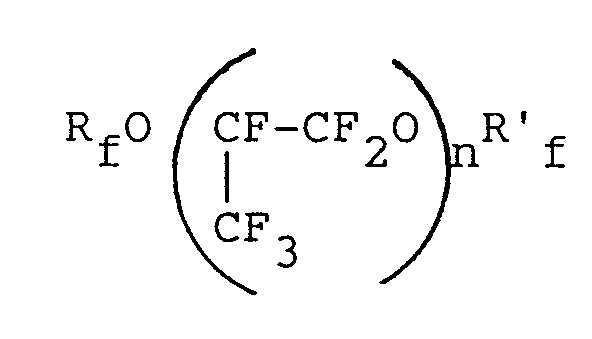 (5) RfO(CF₂CF₂O)nR'f(6) RfO(CF₂CF₂CF₂O)nR'f or RfO(CH₂CF₂CF₂O)nR'f wherein the subscripts m, n, p and o have values such that the corresponding (per)fluoropolyether satisfies the molecular weight requirement.
 - Microemulsion according to claim 2, wherein the perfluoropolyethers of formulae (1), (2) and (3) are raw products of the photo-oxidation process and also contain peroxide groups (-OO-) in the chain.
Priority Applications (1)
| Application Number | Priority Date | Filing Date | Title |
|---|---|---|---|
| AT88118020T ATE99717T1 (en) | 1987-10-28 | 1988-10-28 | FUNCTIONAL PERFLUOROPOLYAETHER CONTAINING AQUEOUS MICROEMULSIONS. |
Applications Claiming Priority (2)
| Application Number | Priority Date | Filing Date | Title |
|---|---|---|---|
| IT2242087 | 1987-10-28 | ||
| IT22420/87A IT1223324B (en) | 1987-10-28 | 1987-10-28 | WATER MICROEMULSIONS INCLUDING FUNCTIONAL FLUOROPOLIS |
Publications (3)
| Publication Number | Publication Date |
|---|---|
| EP0315078A2 EP0315078A2 (en) | 1989-05-10 |
| EP0315078A3 EP0315078A3 (en) | 1990-03-28 |
| EP0315078B1 true EP0315078B1 (en) | 1994-01-05 |
Family
ID=11196062
Family Applications (1)
| Application Number | Title | Priority Date | Filing Date |
|---|---|---|---|
| EP88118020A Expired - Lifetime EP0315078B1 (en) | 1987-10-28 | 1988-10-28 | Aqueous microemulsions comprising functional perfluoropolyethers |
Country Status (21)
| Country | Link |
|---|---|
| US (1) | US5656201A (en) |
| EP (1) | EP0315078B1 (en) |
| JP (1) | JP2700156B2 (en) |
| KR (1) | KR970006705B1 (en) |
| CN (1) | CN1025624C (en) |
| AT (1) | ATE99717T1 (en) |
| BR (1) | BR8805586A (en) |
| CA (1) | CA1311983C (en) |
| CZ (1) | CZ73789A3 (en) |
| DD (1) | DD283408A5 (en) |
| DE (1) | DE3886897T2 (en) |
| ES (1) | ES2061600T3 (en) |
| FI (1) | FI884909A7 (en) |
| IL (1) | IL88153A (en) |
| IN (1) | IN170037B (en) |
| IT (1) | IT1223324B (en) |
| NO (1) | NO178033C (en) |
| PT (1) | PT88852B (en) |
| RU (1) | RU1839676C (en) |
| TR (1) | TR23743A (en) |
| ZA (1) | ZA887948B (en) |
Families Citing this family (36)
| Publication number | Priority date | Publication date | Assignee | Title |
|---|---|---|---|---|
| IT1217839B (en) * | 1988-06-17 | 1990-03-30 | Ausimont Spa | MICROEMULSIONS OF THE ELECTRICALLY CONDUCTIVE OIL TYPE IN WATER, BASED ON FLUORINATED COMPOUNDS, USED AS A CATHOLITE IN ELECTROCHEMICAL PROCESSES |
| IT1217838B (en) * | 1988-06-17 | 1990-03-30 | Ausimont Spa | MICROEMULSIONS FOR ELECTRICALLY CONDUCTIVE WATER IN OIL TYPE, BASED ON FLUORINATED COMPOUNDS USED AS CATHOLITES IN ELECTROCHEMICAL PROCESSES |
| JPH05301228A (en) * | 1992-04-28 | 1993-11-16 | Daikin Ind Ltd | Release agent |
| IT1255633B (en) * | 1992-05-22 | 1995-11-09 | Ausimont Spa | FLUOROELASTOMERIC AND FLUOROPLASTOMERIC COPOLYMERS EQUIPPED WITH HIGH BASIC RESISTANCE |
| US5539072A (en) * | 1993-03-26 | 1996-07-23 | W. L. Gore & Associates, Inc. | Fabric laminates |
| DE69324605T2 (en) * | 1993-03-26 | 1999-08-26 | W.L. Gore & Associates | METHOD FOR PRODUCING COATED ITEMS AND THE USE THEREOF |
| US5460872A (en) * | 1993-03-26 | 1995-10-24 | W. L. Gore & Associates, Inc. | Process for coating microporous substrates and products therefrom |
| US6196708B1 (en) | 1998-05-14 | 2001-03-06 | Donaldson Company, Inc. | Oleophobic laminated articles, assemblies of use, and methods |
| US7279522B2 (en) | 2001-09-05 | 2007-10-09 | 3M Innovative Properties Company | Fluoropolymer dispersions containing no or little low molecular weight fluorinated surfactant |
| EP1323747A1 (en) * | 2001-12-19 | 2003-07-02 | Borealis Technology Oy | Production of olefin polymerisation catalysts |
| JP4013881B2 (en) * | 2002-10-18 | 2007-11-28 | ソニーケミカル&インフォメーションデバイス株式会社 | Perfluoropolyether ester compound, lubricant and magnetic recording medium |
| EP1589082A4 (en) | 2003-01-29 | 2007-05-30 | Asahi Glass Co Ltd | COATING COMPOSITION, ANTI-REFLECTIVE FILM, PHOTORESIN, AND PATTERN FORMING METHOD USING THE SAME |
| ITMI20040586A1 (en) * | 2004-03-25 | 2004-06-25 | Solvay Solexis Spa | COMPLEX EMULSIONS OF PERFLUOROPOLYETERS |
| GB2427170A (en) * | 2005-06-17 | 2006-12-20 | 3M Innovative Properties Co | Fluoropolymer film having glass microspheres |
| GB0523853D0 (en) | 2005-11-24 | 2006-01-04 | 3M Innovative Properties Co | Fluorinated surfactants for use in making a fluoropolymer |
| GB0525978D0 (en) | 2005-12-21 | 2006-02-01 | 3M Innovative Properties Co | Fluorinated Surfactants For Making Fluoropolymers |
| GB0514398D0 (en) | 2005-07-15 | 2005-08-17 | 3M Innovative Properties Co | Aqueous emulsion polymerization of fluorinated monomers using a fluorinated surfactant |
| US20080015304A1 (en) | 2006-07-13 | 2008-01-17 | Klaus Hintzer | Aqueous emulsion polymerization process for producing fluoropolymers |
| US20070015937A1 (en) * | 2005-07-15 | 2007-01-18 | 3M Innovative Properties Company | Process for recovery of fluorinated carboxylic acid surfactants from exhaust gas |
| GB2430437A (en) * | 2005-09-27 | 2007-03-28 | 3M Innovative Properties Co | Method of making a fluoropolymer |
| US7728087B2 (en) | 2005-12-23 | 2010-06-01 | 3M Innovative Properties Company | Fluoropolymer dispersion and method for making the same |
| US7754795B2 (en) | 2006-05-25 | 2010-07-13 | 3M Innovative Properties Company | Coating composition |
| US8119750B2 (en) * | 2006-07-13 | 2012-02-21 | 3M Innovative Properties Company | Explosion taming surfactants for the production of perfluoropolymers |
| JP5588679B2 (en) | 2006-11-09 | 2014-09-10 | イー・アイ・デュポン・ドウ・ヌムール・アンド・カンパニー | Aqueous polymerization of fluorinated monomers using a polymerization agent containing fluoropolyether acid or salt and a short chain fluorosurfactant |
| WO2008060462A1 (en) | 2006-11-09 | 2008-05-22 | E. I. Du Pont De Nemours And Company | Aqueous polymerization of fluorinated monomers using polymerization agent comprising fluoropolyether acid or salt and siloxane surfactant |
| US20080144219A1 (en) * | 2006-12-19 | 2008-06-19 | Burns John M | Conductive pfpe disk lubricant |
| US20080264864A1 (en) * | 2007-04-27 | 2008-10-30 | 3M Innovative Properties Company | PROCESS FOR REMOVING FLUORINATED EMULSIFIER FROM FLUOROPOLMER DISPERSIONS USING AN ANION-EXCHANGE RESIN AND A pH-DEPENDENT SURFACTANT AND FLUOROPOLYMER DISPERSIONS CONTAINING A pH-DEPENDENT SURFACTANT |
| WO2008147796A1 (en) * | 2007-05-23 | 2008-12-04 | 3M Innovative Properties Company | Aqueous compositions of fluorinated surfactants and methods of using the same |
| EP2160421A1 (en) | 2007-06-06 | 2010-03-10 | 3M Innovative Properties Company | Fluorinated ether compositions and methods of using the same |
| MX2011000702A (en) * | 2008-07-18 | 2011-02-24 | 3M Innovative Properties Co | Fluorinated ether compounds and methods of using the same. |
| EP2319879B1 (en) * | 2008-08-15 | 2015-11-18 | Zhonghao Chenguang Research Institute Of Chemical Industry | A peroxidic fluoropolyether and its use in emulsion polymerization of fluorin-containing monomer |
| CN102317403A (en) | 2008-12-18 | 2012-01-11 | 3M创新有限公司 | Method of contacting hydrocarbon-bearing formations with fluorinated ether compositions |
| CN102770468B (en) | 2009-12-18 | 2016-08-10 | 索尔维特殊聚合物意大利有限公司 | For the method producing fluoroelastomer |
| EP2513171B1 (en) | 2009-12-18 | 2015-02-25 | Solvay Specialty Polymers Italy S.p.A. | Method for manufacturing fluoropolymers |
| WO2016096684A1 (en) * | 2014-12-15 | 2016-06-23 | Solvay Specialty Polymers Italy S.P.A. | Water-based composition comprising a fluorinated polymer |
| CN114456369B (en) * | 2021-12-31 | 2023-06-09 | 西安近代化学研究所 | A kind of binary copolymerized perfluoropolyether and preparation method thereof |
Family Cites Families (14)
| Publication number | Priority date | Publication date | Assignee | Title |
|---|---|---|---|---|
| US3564059A (en) * | 1966-07-11 | 1971-02-16 | Montedison Spa | Perfluorinated ethers and polyethers |
| US3513203A (en) * | 1966-07-11 | 1970-05-19 | Montedison Spa | Fluorinated ketones and process for their preparation |
| US3451908A (en) * | 1966-07-19 | 1969-06-24 | Montedison Spa | Method for preparing polyoxyperfluoromethylenic compounds |
| US3665041A (en) * | 1967-04-04 | 1972-05-23 | Montedison Spa | Perfluorinated polyethers and process for their preparation |
| US3778381A (en) * | 1972-04-24 | 1973-12-11 | Allied Chem | Fluorocarbon microemulsions |
| US3981361A (en) * | 1975-07-31 | 1976-09-21 | Exxon Production Research Company | Oil recovery method using microemulsions |
| US4146499A (en) * | 1976-09-18 | 1979-03-27 | Rosano Henri L | Method for preparing microemulsions |
| US4443480A (en) * | 1982-04-12 | 1984-04-17 | Children's Hospital Medical Center | Artificial blood and other gas transport agents |
| US4917930A (en) * | 1984-04-16 | 1990-04-17 | Adamantech, Inc. | Perfluoro compound dispersions containing reduced amounts of surfactant and process of preparation |
| IT1188216B (en) * | 1985-12-23 | 1988-01-07 | Ausimont Spa | FLUORINATED POLYMERS CONTAINING CHARGES AND HAVING IMPROVED PROPERTIES |
| IL82308A (en) * | 1986-06-26 | 1990-11-29 | Ausimont Spa | Microemulsions containing perfluoropolyethers |
| FR2602774B1 (en) * | 1986-07-29 | 1990-10-19 | Atta | NOVEL POLYHYDROXYLATED AND PERFLUOROALKYLATED AMPHIPHILIC MOLECULES HAVING SURFACTANT PROPERTIES |
| US4722904A (en) * | 1986-12-18 | 1988-02-02 | Fisher Scientific Company | Thermodynamically-stable aqueous perfluorocarbon microemulsion useful as blood gas control or calibrator |
| IT1223325B (en) * | 1987-10-28 | 1990-09-19 | Ausimont Spa | ELECTRICALLY CONDUCTIVE MICROEMULSIONS BASED ON PERFLUOROPOLYETERS |
-
1987
- 1987-10-28 IT IT22420/87A patent/IT1223324B/en active
-
1988
- 1988-10-24 FI FI884909A patent/FI884909A7/en not_active IP Right Cessation
- 1988-10-24 ZA ZA887948A patent/ZA887948B/en unknown
- 1988-10-25 IL IL88153A patent/IL88153A/en not_active IP Right Cessation
- 1988-10-25 IN IN881/CAL/88A patent/IN170037B/en unknown
- 1988-10-25 PT PT88852A patent/PT88852B/en not_active IP Right Cessation
- 1988-10-26 JP JP63268382A patent/JP2700156B2/en not_active Expired - Lifetime
- 1988-10-26 DD DD88321102A patent/DD283408A5/en not_active IP Right Cessation
- 1988-10-27 CZ CS89737A patent/CZ73789A3/en unknown
- 1988-10-27 CA CA000581463A patent/CA1311983C/en not_active Expired - Lifetime
- 1988-10-27 RU SU884356777A patent/RU1839676C/en active
- 1988-10-27 NO NO884798A patent/NO178033C/en unknown
- 1988-10-27 BR BR8805586A patent/BR8805586A/en not_active Application Discontinuation
- 1988-10-28 EP EP88118020A patent/EP0315078B1/en not_active Expired - Lifetime
- 1988-10-28 ES ES88118020T patent/ES2061600T3/en not_active Expired - Lifetime
- 1988-10-28 DE DE88118020T patent/DE3886897T2/en not_active Expired - Lifetime
- 1988-10-28 TR TR88/0789A patent/TR23743A/en unknown
- 1988-10-28 CN CN88107378A patent/CN1025624C/en not_active Expired - Lifetime
- 1988-10-28 AT AT88118020T patent/ATE99717T1/en not_active IP Right Cessation
- 1988-10-28 KR KR1019880014105A patent/KR970006705B1/en not_active Expired - Fee Related
-
1993
- 1993-09-09 US US08/118,278 patent/US5656201A/en not_active Expired - Lifetime
Also Published As
| Publication number | Publication date |
|---|---|
| IL88153A (en) | 1993-01-14 |
| DE3886897T2 (en) | 1994-04-28 |
| DE3886897D1 (en) | 1994-02-17 |
| ES2061600T3 (en) | 1994-12-16 |
| TR23743A (en) | 1990-07-31 |
| CZ73789A3 (en) | 1994-11-16 |
| IT8722420A0 (en) | 1987-10-28 |
| RU1839676C (en) | 1993-12-30 |
| IL88153A0 (en) | 1989-06-30 |
| ATE99717T1 (en) | 1994-01-15 |
| NO178033B (en) | 1995-10-02 |
| IT1223324B (en) | 1990-09-19 |
| IN170037B (en) | 1992-02-01 |
| PT88852B (en) | 1993-01-29 |
| ZA887948B (en) | 1989-07-26 |
| KR890006749A (en) | 1989-06-15 |
| BR8805586A (en) | 1989-07-11 |
| FI884909L (en) | 1989-04-29 |
| CN1033281A (en) | 1989-06-07 |
| NO884798D0 (en) | 1988-10-27 |
| NO178033C (en) | 1996-01-10 |
| CN1025624C (en) | 1994-08-10 |
| FI884909A7 (en) | 1989-04-29 |
| NO884798L (en) | 1989-05-02 |
| AU601631B2 (en) | 1990-09-13 |
| US5656201A (en) | 1997-08-12 |
| EP0315078A3 (en) | 1990-03-28 |
| KR970006705B1 (en) | 1997-04-29 |
| JPH01236935A (en) | 1989-09-21 |
| AU2432188A (en) | 1989-05-04 |
| JP2700156B2 (en) | 1998-01-19 |
| DD283408A5 (en) | 1990-10-10 |
| CA1311983C (en) | 1992-12-29 |
| FI884909A0 (en) | 1988-10-24 |
| EP0315078A2 (en) | 1989-05-10 |
Similar Documents
| Publication | Publication Date | Title |
|---|---|---|
| US5656201A (en) | Aqueous microemulsions comprising functional perfluoropolyethers | |
| EP0280312B1 (en) | Microemulsions based on three immiscible liquids, comprising a perfluoropolyether | |
| US4990283A (en) | Microemulsions containing perfluoropolyethers | |
| KR100526410B1 (en) | Fluorine grease | |
| EP0130052A1 (en) | Fluorinated vinyl ether copolymers having low glass transition temperatures | |
| US6013712A (en) | Perfluoropolymer dispersions | |
| EP0733666B1 (en) | Polytetrafluoroethylene dispersions in an organic solvent and dispersing agents employed therein | |
| EP0315841B1 (en) | Electrically conductive microemulsions based on perfluoropolyethers | |
| US6100325A (en) | Fluoropolymer dispersions | |
| US20010031709A1 (en) | Lubricant compositions based on PTFE | |
| EP0583130A2 (en) | Water dispersible silicone composition | |
| CA1338862C (en) | Electrically conductive water/oil microemulsions based on perfluorinated compounds | |
| US5035841A (en) | Triblock amide fluorosurfactants | |
| CA1338861C (en) | Electrically conductive oil in water microemulsions based on perfluorinated compounds and used as a catholyte in electrochemical processes | |
| RU2030428C1 (en) | Microemulsion |
Legal Events
| Date | Code | Title | Description |
|---|---|---|---|
| PUAI | Public reference made under article 153(3) epc to a published international application that has entered the european phase |
Free format text: ORIGINAL CODE: 0009012 |
|
| AK | Designated contracting states |
Kind code of ref document: A2 Designated state(s): AT BE CH DE ES FR GB GR IT LI NL SE |
|
| PUAL | Search report despatched |
Free format text: ORIGINAL CODE: 0009013 |
|
| AK | Designated contracting states |
Kind code of ref document: A3 Designated state(s): AT BE CH DE ES FR GB GR IT LI NL SE |
|
| 17P | Request for examination filed |
Effective date: 19900924 |
|
| 17Q | First examination report despatched |
Effective date: 19920327 |
|
| ITF | It: translation for a ep patent filed | ||
| RAP1 | Party data changed (applicant data changed or rights of an application transferred) |
Owner name: AUSIMONT S.P.A. |
|
| GRAA | (expected) grant |
Free format text: ORIGINAL CODE: 0009210 |
|
| AK | Designated contracting states |
Kind code of ref document: B1 Designated state(s): AT BE CH DE ES FR GB GR IT LI NL SE |
|
| REF | Corresponds to: |
Ref document number: 99717 Country of ref document: AT Date of ref document: 19940115 Kind code of ref document: T |
|
| REF | Corresponds to: |
Ref document number: 3886897 Country of ref document: DE Date of ref document: 19940217 |
|
| ET | Fr: translation filed | ||
| REG | Reference to a national code |
Ref country code: GR Ref legal event code: FG4A Free format text: 3011182 |
|
| PGFP | Annual fee paid to national office [announced via postgrant information from national office to epo] |
Ref country code: SE Payment date: 19941017 Year of fee payment: 7 |
|
| PGFP | Annual fee paid to national office [announced via postgrant information from national office to epo] |
Ref country code: GR Payment date: 19941031 Year of fee payment: 7 |
|
| PLBE | No opposition filed within time limit |
Free format text: ORIGINAL CODE: 0009261 |
|
| STAA | Information on the status of an ep patent application or granted ep patent |
Free format text: STATUS: NO OPPOSITION FILED WITHIN TIME LIMIT |
|
| REG | Reference to a national code |
Ref country code: ES Ref legal event code: FG2A Ref document number: 2061600 Country of ref document: ES Kind code of ref document: T3 |
|
| 26N | No opposition filed | ||
| EAL | Se: european patent in force in sweden |
Ref document number: 88118020.2 |
|
| PGFP | Annual fee paid to national office [announced via postgrant information from national office to epo] |
Ref country code: AT Payment date: 19951011 Year of fee payment: 8 |
|
| PGFP | Annual fee paid to national office [announced via postgrant information from national office to epo] |
Ref country code: NL Payment date: 19951024 Year of fee payment: 8 |
|
| PG25 | Lapsed in a contracting state [announced via postgrant information from national office to epo] |
Ref country code: SE Effective date: 19951029 |
|
| PGFP | Annual fee paid to national office [announced via postgrant information from national office to epo] |
Ref country code: ES Payment date: 19951030 Year of fee payment: 8 |
|
| PGFP | Annual fee paid to national office [announced via postgrant information from national office to epo] |
Ref country code: CH Payment date: 19951113 Year of fee payment: 8 |
|
| PGFP | Annual fee paid to national office [announced via postgrant information from national office to epo] |
Ref country code: BE Payment date: 19951213 Year of fee payment: 8 |
|
| PG25 | Lapsed in a contracting state [announced via postgrant information from national office to epo] |
Ref country code: GR Free format text: THE PATENT HAS BEEN ANNULLED BY A DECISION OF A NATIONAL AUTHORITY Effective date: 19960430 |
|
| REG | Reference to a national code |
Ref country code: GR Ref legal event code: MM2A Free format text: 3011182 |
|
| EUG | Se: european patent has lapsed |
Ref document number: 88118020.2 |
|
| PG25 | Lapsed in a contracting state [announced via postgrant information from national office to epo] |
Ref country code: AT Effective date: 19961028 |
|
| PG25 | Lapsed in a contracting state [announced via postgrant information from national office to epo] |
Ref country code: ES Free format text: LAPSE BECAUSE OF THE APPLICANT RENOUNCES Effective date: 19961029 |
|
| PG25 | Lapsed in a contracting state [announced via postgrant information from national office to epo] |
Ref country code: CH Effective date: 19961031 Ref country code: BE Effective date: 19961031 Ref country code: LI Effective date: 19961031 |
|
| BERE | Be: lapsed |
Owner name: AUSIMONT S.P.A. Effective date: 19961031 |
|
| PG25 | Lapsed in a contracting state [announced via postgrant information from national office to epo] |
Ref country code: NL Effective date: 19970501 |
|
| REG | Reference to a national code |
Ref country code: CH Ref legal event code: PL |
|
| NLV4 | Nl: lapsed or anulled due to non-payment of the annual fee |
Effective date: 19970501 |
|
| REG | Reference to a national code |
Ref country code: ES Ref legal event code: FD2A Effective date: 19991102 |
|
| REG | Reference to a national code |
Ref country code: GB Ref legal event code: IF02 |
|
| PGFP | Annual fee paid to national office [announced via postgrant information from national office to epo] |
Ref country code: DE Payment date: 20071025 Year of fee payment: 20 |
|
| PGFP | Annual fee paid to national office [announced via postgrant information from national office to epo] |
Ref country code: IT Payment date: 20071026 Year of fee payment: 20 |
|
| PGFP | Annual fee paid to national office [announced via postgrant information from national office to epo] |
Ref country code: GB Payment date: 20071024 Year of fee payment: 20 Ref country code: FR Payment date: 20071009 Year of fee payment: 20 |
|
| REG | Reference to a national code |
Ref country code: GB Ref legal event code: PE20 Expiry date: 20081027 |
|
| PG25 | Lapsed in a contracting state [announced via postgrant information from national office to epo] |
Ref country code: GB Free format text: LAPSE BECAUSE OF EXPIRATION OF PROTECTION Effective date: 20081027 |