EP0314146B1 - Thermoplastic compositions based on syndiotactic polymers of styrene and polyphenylene ethers - Google Patents
Thermoplastic compositions based on syndiotactic polymers of styrene and polyphenylene ethers Download PDFInfo
- Publication number
- EP0314146B1 EP0314146B1 EP88117949A EP88117949A EP0314146B1 EP 0314146 B1 EP0314146 B1 EP 0314146B1 EP 88117949 A EP88117949 A EP 88117949A EP 88117949 A EP88117949 A EP 88117949A EP 0314146 B1 EP0314146 B1 EP 0314146B1
- Authority
- EP
- European Patent Office
- Prior art keywords
- styrene
- compositions according
- weight
- styrene polymer
- polyphenylene ether
- Prior art date
- Legal status (The legal status is an assumption and is not a legal conclusion. Google has not performed a legal analysis and makes no representation as to the accuracy of the status listed.)
- Expired - Lifetime
Links
- PPBRXRYQALVLMV-UHFFFAOYSA-N Styrene Chemical compound C=CC1=CC=CC=C1 PPBRXRYQALVLMV-UHFFFAOYSA-N 0.000 title claims description 53
- 239000000203 mixture Substances 0.000 title claims description 40
- 229920001955 polyphenylene ether Polymers 0.000 title claims description 32
- 229920001169 thermoplastic Polymers 0.000 title description 2
- 229920001576 syndiotactic polymer Polymers 0.000 title 1
- 239000004416 thermosoftening plastic Substances 0.000 title 1
- 229920000642 polymer Polymers 0.000 claims description 29
- 239000004793 Polystyrene Substances 0.000 claims description 12
- 229920002223 polystyrene Polymers 0.000 claims description 12
- 125000004432 carbon atom Chemical group C* 0.000 claims description 10
- -1 poly(2,6-dimethyl-1,4-phenylene) Polymers 0.000 claims description 6
- 229920001577 copolymer Polymers 0.000 claims description 5
- 238000002844 melting Methods 0.000 claims description 5
- 230000008018 melting Effects 0.000 claims description 5
- 125000001997 phenyl group Chemical group [H]C1=C([H])C([H])=C(*)C([H])=C1[H] 0.000 claims description 5
- RTZKZFJDLAIYFH-UHFFFAOYSA-N Diethyl ether Chemical compound CCOCC RTZKZFJDLAIYFH-UHFFFAOYSA-N 0.000 claims description 4
- 125000005843 halogen group Chemical group 0.000 claims description 4
- 239000004215 Carbon black (E152) Substances 0.000 claims description 2
- 125000000217 alkyl group Chemical group 0.000 claims description 2
- 229930195733 hydrocarbon Natural products 0.000 claims description 2
- 125000004435 hydrogen atom Chemical group [H]* 0.000 claims description 2
- 229910052760 oxygen Inorganic materials 0.000 claims description 2
- 239000001301 oxygen Substances 0.000 claims description 2
- 229920000314 poly p-methyl styrene Polymers 0.000 claims description 2
- 125000003011 styrenyl group Chemical group [H]\C(*)=C(/[H])C1=C([H])C([H])=C([H])C([H])=C1[H] 0.000 claims 1
- WSFSSNUMVMOOMR-UHFFFAOYSA-N Formaldehyde Chemical compound O=C WSFSSNUMVMOOMR-UHFFFAOYSA-N 0.000 description 6
- LFQSCWFLJHTTHZ-UHFFFAOYSA-N Ethanol Chemical compound CCO LFQSCWFLJHTTHZ-UHFFFAOYSA-N 0.000 description 4
- 239000000178 monomer Substances 0.000 description 4
- ZWEHNKRNPOVVGH-UHFFFAOYSA-N 2-Butanone Chemical compound CCC(C)=O ZWEHNKRNPOVVGH-UHFFFAOYSA-N 0.000 description 3
- 229920010524 Syndiotactic polystyrene Polymers 0.000 description 3
- MVPPADPHJFYWMZ-UHFFFAOYSA-N chlorobenzene Substances ClC1=CC=CC=C1 MVPPADPHJFYWMZ-UHFFFAOYSA-N 0.000 description 3
- 230000007423 decrease Effects 0.000 description 3
- 238000000034 method Methods 0.000 description 3
- 238000002156 mixing Methods 0.000 description 3
- 150000003254 radicals Chemical class 0.000 description 3
- KLAQSPUVCDBEGF-UHFFFAOYSA-N 2,3,5,6-tetramethylphenol Chemical compound CC1=CC(C)=C(C)C(O)=C1C KLAQSPUVCDBEGF-UHFFFAOYSA-N 0.000 description 2
- QQOMQLYQAXGHSU-UHFFFAOYSA-N 2,3,6-Trimethylphenol Chemical compound CC1=CC=C(C)C(O)=C1C QQOMQLYQAXGHSU-UHFFFAOYSA-N 0.000 description 2
- 150000004996 alkyl benzenes Chemical group 0.000 description 2
- 238000004458 analytical method Methods 0.000 description 2
- 125000001246 bromo group Chemical group Br* 0.000 description 2
- 229910052801 chlorine Inorganic materials 0.000 description 2
- 229910052731 fluorine Inorganic materials 0.000 description 2
- 230000009477 glass transition Effects 0.000 description 2
- 229920001519 homopolymer Polymers 0.000 description 2
- 238000001556 precipitation Methods 0.000 description 2
- 239000011347 resin Substances 0.000 description 2
- 229920005989 resin Polymers 0.000 description 2
- 238000005160 1H NMR spectroscopy Methods 0.000 description 1
- VPWNQTHUCYMVMZ-UHFFFAOYSA-N 4,4'-sulfonyldiphenol Chemical class C1=CC(O)=CC=C1S(=O)(=O)C1=CC=C(O)C=C1 VPWNQTHUCYMVMZ-UHFFFAOYSA-N 0.000 description 1
- JLBJTVDPSNHSKJ-UHFFFAOYSA-N 4-Methylstyrene Chemical compound CC1=CC=C(C=C)C=C1 JLBJTVDPSNHSKJ-UHFFFAOYSA-N 0.000 description 1
- 229910019142 PO4 Inorganic materials 0.000 description 1
- ISWSIDIOOBJBQZ-UHFFFAOYSA-N Phenol Chemical compound OC1=CC=CC=C1 ISWSIDIOOBJBQZ-UHFFFAOYSA-N 0.000 description 1
- 238000002441 X-ray diffraction Methods 0.000 description 1
- 125000002877 alkyl aryl group Chemical group 0.000 description 1
- 125000003118 aryl group Chemical group 0.000 description 1
- 238000012512 characterization method Methods 0.000 description 1
- 238000006243 chemical reaction Methods 0.000 description 1
- 125000001309 chloro group Chemical group Cl* 0.000 description 1
- 230000000052 comparative effect Effects 0.000 description 1
- 238000005336 cracking Methods 0.000 description 1
- 230000003247 decreasing effect Effects 0.000 description 1
- 238000004090 dissolution Methods 0.000 description 1
- 125000001033 ether group Chemical group 0.000 description 1
- 125000001495 ethyl group Chemical group [H]C([H])([H])C([H])([H])* 0.000 description 1
- 238000000605 extraction Methods 0.000 description 1
- 238000001125 extrusion Methods 0.000 description 1
- 125000001153 fluoro group Chemical group F* 0.000 description 1
- 125000002496 methyl group Chemical group [H]C([H])([H])* 0.000 description 1
- 229940032007 methylethyl ketone Drugs 0.000 description 1
- 239000002480 mineral oil Substances 0.000 description 1
- 238000000465 moulding Methods 0.000 description 1
- 125000004108 n-butyl group Chemical group [H]C([H])([H])C([H])([H])C([H])([H])C([H])([H])* 0.000 description 1
- 125000004123 n-propyl group Chemical group [H]C([H])([H])C([H])([H])C([H])([H])* 0.000 description 1
- 235000021317 phosphate Nutrition 0.000 description 1
- 150000003013 phosphoric acid derivatives Chemical class 0.000 description 1
- 239000004014 plasticizer Substances 0.000 description 1
- 229920002959 polymer blend Polymers 0.000 description 1
- 238000002360 preparation method Methods 0.000 description 1
- 238000007711 solidification Methods 0.000 description 1
- 230000008023 solidification Effects 0.000 description 1
- 239000002904 solvent Substances 0.000 description 1
- 238000001228 spectrum Methods 0.000 description 1
- 239000000126 substance Substances 0.000 description 1
- 229920001059 synthetic polymer Polymers 0.000 description 1
- 238000002076 thermal analysis method Methods 0.000 description 1
Images

Classifications
-
- C—CHEMISTRY; METALLURGY
- C08—ORGANIC MACROMOLECULAR COMPOUNDS; THEIR PREPARATION OR CHEMICAL WORKING-UP; COMPOSITIONS BASED THEREON
- C08L—COMPOSITIONS OF MACROMOLECULAR COMPOUNDS
- C08L25/00—Compositions of, homopolymers or copolymers of compounds having one or more unsaturated aliphatic radicals, each having only one carbon-to-carbon double bond, and at least one being terminated by an aromatic carbocyclic ring; Compositions of derivatives of such polymers
- C08L25/02—Homopolymers or copolymers of hydrocarbons
- C08L25/04—Homopolymers or copolymers of styrene
-
- C—CHEMISTRY; METALLURGY
- C08—ORGANIC MACROMOLECULAR COMPOUNDS; THEIR PREPARATION OR CHEMICAL WORKING-UP; COMPOSITIONS BASED THEREON
- C08L—COMPOSITIONS OF MACROMOLECULAR COMPOUNDS
- C08L25/00—Compositions of, homopolymers or copolymers of compounds having one or more unsaturated aliphatic radicals, each having only one carbon-to-carbon double bond, and at least one being terminated by an aromatic carbocyclic ring; Compositions of derivatives of such polymers
- C08L25/02—Homopolymers or copolymers of hydrocarbons
-
- C—CHEMISTRY; METALLURGY
- C08—ORGANIC MACROMOLECULAR COMPOUNDS; THEIR PREPARATION OR CHEMICAL WORKING-UP; COMPOSITIONS BASED THEREON
- C08L—COMPOSITIONS OF MACROMOLECULAR COMPOUNDS
- C08L25/00—Compositions of, homopolymers or copolymers of compounds having one or more unsaturated aliphatic radicals, each having only one carbon-to-carbon double bond, and at least one being terminated by an aromatic carbocyclic ring; Compositions of derivatives of such polymers
- C08L25/02—Homopolymers or copolymers of hydrocarbons
- C08L25/04—Homopolymers or copolymers of styrene
- C08L25/06—Polystyrene
-
- C—CHEMISTRY; METALLURGY
- C08—ORGANIC MACROMOLECULAR COMPOUNDS; THEIR PREPARATION OR CHEMICAL WORKING-UP; COMPOSITIONS BASED THEREON
- C08L—COMPOSITIONS OF MACROMOLECULAR COMPOUNDS
- C08L71/00—Compositions of polyethers obtained by reactions forming an ether link in the main chain; Compositions of derivatives of such polymers
- C08L71/08—Polyethers derived from hydroxy compounds or from their metallic derivatives
- C08L71/10—Polyethers derived from hydroxy compounds or from their metallic derivatives from phenols
- C08L71/12—Polyphenylene oxides
Definitions
- the present invention relates to compositions of polyphenylene ethers with styrene polymers, endowed with improved mechanical characteristics.
- it relates to compositions of polyphenylene ethers with styrene polymers having a syndiotactic structure.
- Polyphenylene ethers are a family of synthetic polymers well known in the art, and are disclosed, e.g., in U.S. patent No. 3,306,875. They have excellent properties, in particular with respect to mechanical and electrical properties, over a wide temperature range. However, they show a low impact strength, and the occurrence of cracking in solvents.
- Blends of polyphenylene ether with amorphous polystyrene, obtained by directly mixing the two polymers, are furthermore disclosed in U.S. patents Nos. 3,373,226 and 3,383,435.
- non-crystalline compositions which display unsatisfactory mechanical characteristics.
- such compositions show a sharp decrease of the elastic modulus at a temperature just above the glass transition temperature.
- compositions which comprise:
- the styrene polymers having an essentially syndiotactic structure are per se known products. Their preparation is disclosed in European patent application No. 0 271 875 to Montedison.
- Such polymers are characterized by an H-NMR spectrum showing chemical shifts of methynic and methylenic protons, respectively centered at 1.9 and 1.4 ppm.
- compositions of the present invention comprise from 60 to 90% by weight of at least one syndiotactic crystalline styrene polymer, and from 40 to 10% by weight of a polyphenylene ether, both based on the sum of the weights of the styrene polymers and of the polyphenylene ether.
- the molecular weight of the styrene polymers having an essentially syndiotactic structure used for the compositions according to the present invention may range from 25,000 to 1,200,000 (weight average molecular weight "M w "), but preferably it is from 100,000 to 800,000.
- R an alkyl-aryl group, or a halogen-substituted (e.g. F, Cl or Br-substituted) aryl (e.g. phenyl) group, containing from 6 to 20, particularly 6 to 14 carbon atoms; as well as st
- styrene polymers besides polystyrene, syndiotactic poly-para-methylstyrene, and styrene copolymers with para-methyl-styrene, having a syndiotactic structure, may be mentioned.
- polyphenylene ethers which are contained in the compositions of the present invention are polymers or copolymers comprising recurring units of the general formula: wherein the ether-oxygen of a unit is linked to the benzene ring of the adjacent unit,
- Preferred polyphenylene ethers are those where at least one of the R1 and R2 radicals is an alkyl group of from 1 to 4 carbon atoms.
- the above halo-hydrocarbon radicals and halo-hydrocarboxy radicals also contain preferably 1 to 4 carbon atoms.
- the most preferred polyphenylene ether is poly(2,6-dimethyl-1,4-phenylene)ether.
- copolymers are also included which are prevailingly formed by units having the formula shown above, obtained by copolymerizing phenol with alkyl-substituted-phenols, typical representatives of which are 2,3,6-trimethyl-phenol and 2,3,5,6-tetramethyl-phenol.
- modified polyphenylene ethers such as e.g., polyphenylene ethers modified with alkylbenzene/formaldehyde resins, comprising as the main block a block having a polyphenylene ether structure as defined above, and a block obtained by the reaction of an alkylbenzene/formaldehyde resin with an alkylphenol.
- compositions of the present invention may be obtained by means of blending methods which are customarily used in the field of thermoplastic polymers, such as extrusion, melting, dissolution followed by precipitation, and so forth.
- compositions may include plasticizers, such as mineral oils, phosphates or chlorinated bisphenols, in an amount generally from 5 to 15% based on the weight of the composition.
- plasticizers such as mineral oils, phosphates or chlorinated bisphenols
- the mixture was kept stirred at 135°C for 30 minutes, so as to perfectly homogenize said solutions with each other.
- the mixture was transferred by siphon into a 10-liter flask equipped with a turbine stirrer of the Ultraturrax type, and containing 6 liters of ethanol, where the precipitation of the two polymers (as an intimate mutual blend) was obtained.
- the polymer blend was filtered off and extracted with ethanol for 24 hours, in order to remove any trace of ortho-chlorobenzene. It was then dried at 130°C under vacuum.
- Example 1 was repeated with the only difference being that 850 ml of syndiotactic polystyrene solution were used in place of 700 ml, and that 150 ml of polyphenylene ether solution were used in place of 300 ml. In this way, a composition constituted by 85% by weight of polystyrene and 15% by weight of polyphenylene ether was obtained.
Landscapes
- Chemical & Material Sciences (AREA)
- Health & Medical Sciences (AREA)
- Chemical Kinetics & Catalysis (AREA)
- Medicinal Chemistry (AREA)
- Polymers & Plastics (AREA)
- Organic Chemistry (AREA)
- Compositions Of Macromolecular Compounds (AREA)
Description
- The present invention relates to compositions of polyphenylene ethers with styrene polymers, endowed with improved mechanical characteristics. In particular, it relates to compositions of polyphenylene ethers with styrene polymers having a syndiotactic structure.
- Polyphenylene ethers are a family of synthetic polymers well known in the art, and are disclosed, e.g., in U.S. patent No. 3,306,875. They have excellent properties, in particular with respect to mechanical and electrical properties, over a wide temperature range. However, they show a low impact strength, and the occurrence of cracking in solvents.
- Many attempts have been made in the art to obviate such drawbacks, such as, e.g., blending polyphenylene ethers with amorphous styrene polymers in various proportions. According to U.S. patent No. 3,356,761, the polyphenylene ether is dissolved in monomeric styrene, which is subsequently polymerized into polystyrene, so as to produce a blend of both polymers.
- Blends of polyphenylene ether with amorphous polystyrene, obtained by directly mixing the two polymers, are furthermore disclosed in U.S. patents Nos. 3,373,226 and 3,383,435.
- In all the above cases, non-crystalline compositions were obtained which display unsatisfactory mechanical characteristics. In particular, such compositions show a sharp decrease of the elastic modulus at a temperature just above the glass transition temperature.
- In accordance with the present invention, it has now been discovered that crystalline compositions of polyphenylene ether with styrene polymers may be obtained which are not affected by the above-mentioned drawbacks, if crystalline styrene polymers having an essentially syndiotactic structure are used in an amount within the range of from 50 to 95% by weight, based on their blends, with polyphenylene ether.
- Therefore the present invention relates to compositions which comprise:
- from 95 to 50% by weight of at least one styrene polymer having an essentially syndiotactic structure; and
- from 5 to 50% by weight of one or more polyphenylene ether(s),
- The styrene polymers having an essentially syndiotactic structure are per se known products. Their preparation is disclosed in European patent application No. 0 271 875 to Montedison.
- Such polymers are characterized by an H-NMR spectrum showing chemical shifts of methynic and methylenic protons, respectively centered at 1.9 and 1.4 ppm.
- Furthermore such polymers, or their residues on extraction with methyl-ethyl-ketone, show, after melting and solidification, when subjected to x-ray analysis, the highest-intensity reflections corresponding to interplanar distances of 13.1, 7.6, 6.46, 4.37, and 2.58·10⁻¹⁰m (Å).
- By the term "essentially syndiotactic structure," as used in this application, it is to be understood that such a structure is present for at least long portions of the polymeric chains.
- Preferably, the compositions of the present invention comprise from 60 to 90% by weight of at least one syndiotactic crystalline styrene polymer, and from 40 to 10% by weight of a polyphenylene ether, both based on the sum of the weights of the styrene polymers and of the polyphenylene ether.
- The molecular weight of the styrene polymers having an essentially syndiotactic structure used for the compositions according to the present invention may range from 25,000 to 1,200,000 (weight average molecular weight "Mw"), but preferably it is from 100,000 to 800,000.
- Syndiotactic styrene polymers having a melting temperature of at least 250°C, and, in particular, from 260° to 275°C, are preferred.
- By "styrene polymers," according to the present invention,these should be understood as including not only styrene homopolymers, but, in general, also the homopolymers of monomers of the formula:
CH₂=CH-R,
wherein:
R = an alkyl-aryl group, or a halogen-substituted (e.g. F, Cl or Br-substituted) aryl (e.g. phenyl) group, containing from 6 to 20, particularly 6 to 14 carbon atoms;
as well as styrene copolymers with such monomers, or with other ethylenically-unsaturated copolymerizable monomers, provided they have an essentially syndiotactic structure. - Among the preferred styrene polymers, besides polystyrene, syndiotactic poly-para-methylstyrene, and styrene copolymers with para-methyl-styrene, having a syndiotactic structure, may be mentioned.
- The polyphenylene ethers which are contained in the compositions of the present invention are polymers or copolymers comprising recurring units of the general formula:

wherein the ether-oxygen of a unit is linked to the benzene ring of the adjacent unit,
- n
- is an integer larger than 50,e.g. between 50 and 1000
- R₁ and R₂,
- equal to or different from each other, are hydrogen atoms or halogen atoms (e.g. F, Cl or Br atoms), hydrocarbon radicals not containing tertiary carbon atoms in the alpha-position (e.g. methyl, ethyl, n-propyl, n-butyl), halo-hydrocarbon radicals or halo-hydrocarboxy radicals containing at least two carbon atoms between the benzene ring and the halogen atom, and not containing tertiary carbon atoms in the alpha-position, e.g. -CH₂CH₂Cl, -CH₂CH₂Br, -CH₂-CH₂-CH₂Cl,-CH₂CH₂-CH₂-Br.
- Preferred polyphenylene ethers are those where at least one of the R₁ and R₂ radicals is an alkyl group of from 1 to 4 carbon atoms. The above halo-hydrocarbon radicals and halo-hydrocarboxy radicals also contain preferably 1 to 4 carbon atoms. The most preferred polyphenylene ether is poly(2,6-dimethyl-1,4-phenylene)ether.
- As mentioned above, within the definition of polyphenylene ether, copolymers are also included which are prevailingly formed by units having the formula shown above, obtained by copolymerizing phenol with alkyl-substituted-phenols, typical representatives of which are 2,3,6-trimethyl-phenol and 2,3,5,6-tetramethyl-phenol.
- Furthermore, within that definition, come modified polyphenylene ethers, such as e.g., polyphenylene ethers modified with alkylbenzene/formaldehyde resins, comprising as the main block a block having a polyphenylene ether structure as defined above, and a block obtained by the reaction of an alkylbenzene/formaldehyde resin with an alkylphenol.
- Finally, within said definition come those polyphenylene ethers which are obtained by grafting vinyl-aromatic monomers on polyphenylene ethers.
- The compositions of the present invention may be obtained by means of blending methods which are customarily used in the field of thermoplastic polymers, such as extrusion, melting, dissolution followed by precipitation, and so forth.
- The compositions may include plasticizers, such as mineral oils, phosphates or chlorinated bisphenols, in an amount generally from 5 to 15% based on the weight of the composition.
- The following examples still further explain the present invention, without, however, limiting it.
- To a reactor of 2 liters capacity, there were charged:
- A) 150 ml of a solution of 10% weight of a polyphenylene ether (having an intrinsic viscosity [η] = 0.7) in ortho-chlorobenzene, at a temperature of 135°C;
- B) 700 ml of a solution at 10% by weight of a crystalline polystyrene having an essentially syndiotactic structure (having [η] = 1.3), in ortho-chloro-benzene, at a temperature of 135°C. Such polystyrene had incorporated therein 0.3% weight of BHT and 0.1% by weight of Irganox® 1076, and was prepared according to the process disclosed in European patent application No. 0 271 875.
- The mixture was kept stirred at 135°C for 30 minutes, so as to perfectly homogenize said solutions with each other. The mixture was transferred by siphon into a 10-liter flask equipped with a turbine stirrer of the Ultraturrax type, and containing 6 liters of ethanol, where the precipitation of the two polymers (as an intimate mutual blend) was obtained.
- The polymer blend was filtered off and extracted with ethanol for 24 hours, in order to remove any trace of ortho-chlorobenzene. It was then dried at 130°C under vacuum.
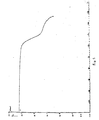
- From the thus-obtained product, constituted by a blend of 70% by weight of polystyrene, and 30% by weight of polyphenylene ether, specimens for the dynamic-mechanical analysis and for the thermal characterization of the composition were produced by press-molding. The plot of Figure 1 describes the dynamic-mechanical characteristics of the product.
- The thermal analysis showed the following Vicat values:
-- Vicat at 1 kg higher than 145°C -- Vicat at 5 kg 143°C - The Vicat values at 1 kg and 5 kg of the syndiotactic polystyrene as such, as used for the composition, were higher than 145°C.
- Example 1 was repeated with the only difference being that 850 ml of syndiotactic polystyrene solution were used in place of 700 ml, and that 150 ml of polyphenylene ether solution were used in place of 300 ml. In this way, a composition constituted by 85% by weight of polystyrene and 15% by weight of polyphenylene ether was obtained.
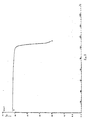
- The plot of Figure 2 shows the dynamic-mechanical characteristics of such composition.
- By the same procedures as in Example 1, a composition was prepared which was constituted by 30% by weight of the same polyphenylene ether and 70% by weight of EDISTAR® 1280 polystyrene (an amorphous polystyrene manufactured by MONTEDIPE) having [η] = 1.0.
- The analysis of the press-molded specimens obtained from such a composition supplied 1-kg and 5-kg Vicat values respectively of 118°C and 114°C. The corresponding Vicat values of the polystyrene used were 100°C and 95°C respectively.
- The plot of Figure 3 shows the dynamic-mechanical characteristics of this composition.
- By comparing the plots of Figures 1, 2 and 3, one can see that the elastic modulus of the composition containing amorphous polystyrene decreases by three orders of magnitude as soon as the temperature increases beyond the glass transition temperature of the composition (approximately 120°C), while the modulus of the compositions containing syndiotactic polystyrene (Figure 1 and 2) decreases by only one order of magnitude in correspondence to that temperature, then decreasing slowly until the melting temperature is reached.
relative to the sum of the weights of the styrene polymer and the polyphenylene ether.
Claims (10)
- Compositions comprising:- from 50 to 95% by weight of at least one styrene polymer having an essentially syndiotactic structure; and- from 50 to 5% by weight of at least one polyphenylene ether,with respect to the sum of the weights of the styrene polymer plus the polyphenylene ether.
- Compositions according to claim 1, comprising from 60 to 90% by weight of a styrene polymer, and from 40 to 10% by weight of polyphenylene ether.
- Compositions according to claim 1 or 2, wherein the styrene polymer has a weight average molecular weight from 25,000 to 1,200,000, and preferably from 100,000 to 800,000.
- Compositions according to one or more of claims 1 to 3, wherein the styrene polymer has a melting temperature of at least 250°C, and preferably from 260°C to 275°C.
- Compositions according to one or more of claims 1 to 4, wherein the styrene polymer is polystyrene.
- Compositions according to one or more of claims 1 to 4, wherein the styrene polymer is poly-para-methyl-styrene.
- Compositions according to one or more of claims 1 to 4, wherein the styrene polymer is a styrene/para-methyl-styrene copolymer.
- Compositions according to one or more of claims 1 to 7, wherein the polyphenylene ether contains recurring units of the formula:
 n is an integer larger than 50,R₁ and R₂, equal to or different from each other, are hydrogen atoms or halogen atoms, hydrocarbon radicals not containing tertiary carbon atoms in the alpha position, halo-hydrocarbon radicals or halo-hydrocarboxy radicals containing at least two carbon atoms between the benzene ring and the halogen atom, and not containing tertiary carbon atoms in the alpha-position.
 - Compositions according to claim 8, wherein at least one of the R₁ and R₂ radicals is an alkyl group containing from 1 to 4 carbon atoms.
- Compositions according to claim 8, wherein the polyphenylene ether is poly(2,6-dimethyl-1,4-phenylene)ether.
Applications Claiming Priority (2)
| Application Number | Priority Date | Filing Date | Title |
|---|---|---|---|
| IT2242287 | 1987-10-28 | ||
| IT22422/87A IT1223326B (en) | 1987-10-28 | 1987-10-28 | THERMOPLASTIC COMPOSITIONS BASED ON SYNDIOTACTIC POLYMERS OF STYRENE AND POLYPHENYLENETERS |
Publications (2)
| Publication Number | Publication Date |
|---|---|
| EP0314146A1 EP0314146A1 (en) | 1989-05-03 |
| EP0314146B1 true EP0314146B1 (en) | 1992-09-09 |
Family
ID=11196093
Family Applications (1)
| Application Number | Title | Priority Date | Filing Date |
|---|---|---|---|
| EP88117949A Expired - Lifetime EP0314146B1 (en) | 1987-10-28 | 1988-10-27 | Thermoplastic compositions based on syndiotactic polymers of styrene and polyphenylene ethers |
Country Status (10)
| Country | Link |
|---|---|
| US (1) | US4946897A (en) |
| EP (1) | EP0314146B1 (en) |
| JP (1) | JP2710646B2 (en) |
| KR (1) | KR960016619B1 (en) |
| AU (1) | AU629184B2 (en) |
| BR (1) | BR8805511A (en) |
| CA (1) | CA1331661C (en) |
| DE (1) | DE3874484T2 (en) |
| ES (1) | ES2051815T3 (en) |
| IT (1) | IT1223326B (en) |
Families Citing this family (21)
| Publication number | Priority date | Publication date | Assignee | Title |
|---|---|---|---|---|
| WO1989003857A1 (en) * | 1987-10-20 | 1989-05-05 | Idemitsu Kosan Company Limited | Styrenic resin composition and process for producing resin molding |
| JPH01197546A (en) * | 1988-02-01 | 1989-08-09 | Asahi Chem Ind Co Ltd | Heat-resistant resin composition |
| US5109068A (en) * | 1988-08-31 | 1992-04-28 | Idemitsu Kosan Co., Ltd. | Styrene-based polymer composition, stretched molding thereof and process for producing the same |
| IT1228915B (en) * | 1989-02-28 | 1991-07-09 | Himont Inc | MANUFACTURED IN A NEW CRYSTALLINE FORM OF SYNDIOTACTIC POLYSTYRENE. |
| US5219940A (en) * | 1989-10-13 | 1993-06-15 | Idemitsu Kosan Co., Ltd. | Styrene polymer composition |
| AU628651B2 (en) * | 1989-10-13 | 1992-09-17 | Idemitsu Kosan Co. Ltd | Styrene polymer composition |
| JP2939278B2 (en) * | 1989-11-28 | 1999-08-25 | 出光興産株式会社 | Stampable sheet |
| US5703164A (en) * | 1990-09-12 | 1997-12-30 | Idemitsu Kosan Co., Ltd. | Styrene polymer composition |
| JP3080671B2 (en) * | 1991-02-07 | 2000-08-28 | 出光石油化学株式会社 | Laminate |
| EP0501625B1 (en) * | 1991-02-26 | 1996-08-21 | The Dow Chemical Company | Reinforcing agents for thermoplastic resins |
| EP0501352A3 (en) * | 1991-02-28 | 1993-06-02 | Idemitsu Kosan Company Limited | Fibrous reinforcing molding and building material |
| JP3166788B2 (en) * | 1992-03-04 | 2001-05-14 | 出光興産株式会社 | Styrene resin composition |
| US5391603A (en) * | 1992-03-09 | 1995-02-21 | The Dow Chemical Company | Impact modified syndiotactic vinyl aromatic polymers |
| DE19616075A1 (en) * | 1996-04-23 | 1997-10-30 | Basf Ag | Thermoplastic molding compositions based on vinyl aromatic polymers with syndiotactic structure, low-viscosity polyamides and polyphenylene ethers modified with polar groups |
| US5889069A (en) * | 1997-07-15 | 1999-03-30 | The Dow Chemical Company | High temperature syndiotactic styrene polymer foam |
| US5916740A (en) * | 1997-09-24 | 1999-06-29 | Eastman Kodak Company | Photographic film base and photographic elements |
| IT1296986B1 (en) * | 1997-12-19 | 1999-08-03 | Enichem Spa | THERMOPLASTIC COMPOSITIONS BASED ON SYNDIOTACTIC STYRENE POLYMERS REINFORCED WITH RIGID CHARGES |
| JP4865952B2 (en) * | 2001-03-23 | 2012-02-01 | 出光興産株式会社 | Styrene polymer composition and molded article using the same |
| JP2003185064A (en) * | 2001-12-19 | 2003-07-03 | Ge Plastics Japan Ltd | Piping member |
| US6894102B2 (en) * | 2002-05-20 | 2005-05-17 | General Electric | Syndiotactic polystyrene blends |
| JP5801532B2 (en) * | 2009-11-30 | 2015-10-28 | 帝人株式会社 | High insulation film |
Family Cites Families (11)
| Publication number | Priority date | Publication date | Assignee | Title |
|---|---|---|---|---|
| BE635350A (en) | 1962-07-24 | |||
| NL141540B (en) * | 1965-01-06 | 1974-03-15 | Gen Electric | PROCESS FOR PREPARING A POLYSTYRENE CONTAINING POLYMER MIXTURE WHICH CAN BE PROCESSED INTO PRODUCTS WITH HIGH BENDING AND TENSILE STRENGTHS, AS WELL AS SUCH PRODUCTS. |
| US3373226A (en) | 1965-08-02 | 1968-03-12 | Gen Electric | Polymeric films comprising a polyphenylene oxide and blends thereof with polystyrene |
| US3356761A (en) | 1967-04-12 | 1967-12-05 | Gen Electric | Melt processable polyphenylene ether and process |
| NL8301284A (en) * | 1983-04-12 | 1984-11-01 | Gen Electric | POLYMER MIXTURE CONTAINING A POLYPHENYLENE ETHER AND ANY POLYSTYRENE AND / OR A RUBBER-MODIFIED POLYSTYRENE AND ARTICLES THEREFOR. |
| EP0191326A1 (en) * | 1985-02-04 | 1986-08-20 | The Dow Chemical Company | Blends of alpha-methylstyrene copolymers and polyphenylene ethers |
| JPS62187708A (en) * | 1985-11-11 | 1987-08-17 | Idemitsu Kosan Co Ltd | Production of styrene polymer |
| JPH0755995B2 (en) * | 1986-05-06 | 1995-06-14 | 出光興産株式会社 | Thermoplastic resin composition |
| JPH0611857B2 (en) * | 1986-09-11 | 1994-02-16 | 三菱レイヨン株式会社 | Polyphenylene ether resin composition |
| IL84797A (en) | 1986-12-15 | 1993-01-14 | Montedison Spa | Production of crystalline vinyl aromatic polymers having mainly a syndiotactic structure |
| CA1320775C (en) * | 1987-08-05 | 1993-07-27 | Peter H. Thompson | Thermoplastic blend of polyphenylene ether, polystyrene, hydrogenated block copolymer and polyacrylate |
-
1987
- 1987-10-28 IT IT22422/87A patent/IT1223326B/en active
-
1988
- 1988-10-24 US US07/261,228 patent/US4946897A/en not_active Expired - Lifetime
- 1988-10-25 BR BR8805511A patent/BR8805511A/en not_active IP Right Cessation
- 1988-10-27 AU AU24396/88A patent/AU629184B2/en not_active Ceased
- 1988-10-27 ES ES88117949T patent/ES2051815T3/en not_active Expired - Lifetime
- 1988-10-27 DE DE8888117949T patent/DE3874484T2/en not_active Expired - Fee Related
- 1988-10-27 EP EP88117949A patent/EP0314146B1/en not_active Expired - Lifetime
- 1988-10-27 CA CA000581503A patent/CA1331661C/en not_active Expired - Fee Related
- 1988-10-28 JP JP63272863A patent/JP2710646B2/en not_active Expired - Fee Related
- 1988-10-28 KR KR1019880014107A patent/KR960016619B1/en not_active Expired - Fee Related
Also Published As
| Publication number | Publication date |
|---|---|
| JP2710646B2 (en) | 1998-02-10 |
| CA1331661C (en) | 1994-08-23 |
| ES2051815T3 (en) | 1994-07-01 |
| AU629184B2 (en) | 1992-10-01 |
| KR960016619B1 (en) | 1996-12-16 |
| DE3874484D1 (en) | 1992-10-15 |
| IT8722422A0 (en) | 1987-10-28 |
| EP0314146A1 (en) | 1989-05-03 |
| BR8805511A (en) | 1989-07-04 |
| JPH01259053A (en) | 1989-10-16 |
| IT1223326B (en) | 1990-09-19 |
| US4946897A (en) | 1990-08-07 |
| KR890006738A (en) | 1989-06-15 |
| DE3874484T2 (en) | 1993-07-01 |
| AU2439688A (en) | 1989-05-04 |
Similar Documents
| Publication | Publication Date | Title |
|---|---|---|
| EP0314146A1 (en) | Thermoplastic compositions based on syndiotactic polymers of styrene and polyphenylene ethers | |
| AU596620B2 (en) | Cationic polymerization of bromoalkenyl aromatic compounds | |
| US3994856A (en) | Composition of a polyphenylene ether and a block copolymer of a vinyl aromatic compound and a conjugated diene | |
| EP0769514B1 (en) | Method for making polyarylene ether-siloxane copolymers | |
| CA2018682A1 (en) | Modification of polyphenylene ether or related polymers with a cyclic acid anhydride and the use thereof in modified, high temperature rigid polymer of vinyl substituted aromatics | |
| EP0305764B1 (en) | High molecular weight polystyrene blends with PPE and HIPS | |
| US3976725A (en) | High impact strength thermoplastic compositions | |
| EP0237949A2 (en) | Flame retardant polyphenylene ether compositions containing polybrominated diphenoxybenzene and antimony oxide | |
| CA1285091C (en) | Mixtures including polyphenylene ethers and lactams and resinous compositions prepared therefrom | |
| US5008314A (en) | Polyphenylene ether compositions resistant to environmental stress cracking | |
| EP0037124B1 (en) | Polyphenylene ether copolymers and graft copolymers | |
| US4745225A (en) | Phosphorus-containing polyarylene ethers | |
| JPH05331280A (en) | Polyphenylene ether capping method, polyphenylene resin obtained thereby, and composition thereof | |
| EP0271697A2 (en) | High impact rubber modified polystyrene and polyphenylene ether resins containing the same | |
| EP0984991B1 (en) | Long chain branched syndiotactic vinyl aromatic polymers | |
| JPS6354428A (en) | Polyphenylene ether-polyester copolymer and manufacture | |
| EP0343648B1 (en) | Polyphenylene ether resin composition | |
| EP0263108A1 (en) | Flame retardant polyphenylene ether composition containing brominated polystyrene and antimony oxide | |
| EP0177989A1 (en) | Polymer mixture | |
| EP0262615A2 (en) | Low molecular weight brominated polystyrene as a flame retardant for resin compositions containing polyphenylene ethers | |
| CA1040782A (en) | High impact strength thermoplastic compositions | |
| EP0226149A2 (en) | Process to produce polyphenylene ether blends with rubber modified polystyrene | |
| JP2945992B2 (en) | Heat resistant resin composition | |
| EP0082424A2 (en) | Composition of PPE and PS-grafted EPDM where gel fraction has swelling index of less than 11.0 | |
| WO1987007901A1 (en) | Flame retardant polyphenylene ether-polystyrene blends of increased heat resistance and method of achievement |
Legal Events
| Date | Code | Title | Description |
|---|---|---|---|
| PUAI | Public reference made under article 153(3) epc to a published international application that has entered the european phase |
Free format text: ORIGINAL CODE: 0009012 |
|
| AK | Designated contracting states |
Kind code of ref document: A1 Designated state(s): BE CH DE ES FR GB LI NL SE |
|
| 17P | Request for examination filed |
Effective date: 19891003 |
|
| RAP1 | Party data changed (applicant data changed or rights of an application transferred) |
Owner name: MONTEDIPE S.R.L. |
|
| 17Q | First examination report despatched |
Effective date: 19911106 |
|
| RAP1 | Party data changed (applicant data changed or rights of an application transferred) |
Owner name: ECP ENICHEM POLIMERI S.R.L. |
|
| GRAA | (expected) grant |
Free format text: ORIGINAL CODE: 0009210 |
|
| AK | Designated contracting states |
Kind code of ref document: B1 Designated state(s): BE CH DE ES FR GB LI NL SE |
|
| REF | Corresponds to: |
Ref document number: 3874484 Country of ref document: DE Date of ref document: 19921015 |
|
| ET | Fr: translation filed | ||
| PLBI | Opposition filed |
Free format text: ORIGINAL CODE: 0009260 |
|
| 26 | Opposition filed |
Opponent name: IDEMITSU KOSAN CO. LTD Effective date: 19930609 |
|
| NLR1 | Nl: opposition has been filed with the epo |
Opponent name: IDEMITSU KOSAN CO. LTD. |
|
| REG | Reference to a national code |
Ref country code: ES Ref legal event code: FG2A Ref document number: 2051815 Country of ref document: ES Kind code of ref document: T3 |
|
| EAL | Se: european patent in force in sweden |
Ref document number: 88117949.3 |
|
| APAC | Appeal dossier modified |
Free format text: ORIGINAL CODE: EPIDOS NOAPO |
|
| APAA | Appeal reference recorded |
Free format text: ORIGINAL CODE: EPIDOS REFN |
|
| PLAB | Opposition data, opponent's data or that of the opponent's representative modified |
Free format text: ORIGINAL CODE: 0009299OPPO |
|
| PLBQ | Unpublished change to opponent data |
Free format text: ORIGINAL CODE: EPIDOS OPPO |
|
| R26 | Opposition filed (corrected) |
Opponent name: IDEMITSU KOSAN CO. LTD Effective date: 19930609 |
|
| NLR1 | Nl: opposition has been filed with the epo |
Opponent name: IDEMITSU KOSAN CO. LTD |
|
| PGFP | Annual fee paid to national office [announced via postgrant information from national office to epo] |
Ref country code: SE Payment date: 19981006 Year of fee payment: 11 |
|
| PGFP | Annual fee paid to national office [announced via postgrant information from national office to epo] |
Ref country code: FR Payment date: 19981009 Year of fee payment: 11 |
|
| PGFP | Annual fee paid to national office [announced via postgrant information from national office to epo] |
Ref country code: CH Payment date: 19981113 Year of fee payment: 11 |
|
| PGFP | Annual fee paid to national office [announced via postgrant information from national office to epo] |
Ref country code: BE Payment date: 19981216 Year of fee payment: 11 |
|
| PG25 | Lapsed in a contracting state [announced via postgrant information from national office to epo] |
Ref country code: SE Free format text: THE PATENT HAS BEEN ANNULLED BY A DECISION OF A NATIONAL AUTHORITY Effective date: 19991030 |
|
| PG25 | Lapsed in a contracting state [announced via postgrant information from national office to epo] |
Ref country code: CH Free format text: LAPSE BECAUSE OF NON-PAYMENT OF DUE FEES Effective date: 19991031 Ref country code: BE Free format text: LAPSE BECAUSE OF NON-PAYMENT OF DUE FEES Effective date: 19991031 Ref country code: LI Free format text: LAPSE BECAUSE OF NON-PAYMENT OF DUE FEES Effective date: 19991031 |
|
| APAC | Appeal dossier modified |
Free format text: ORIGINAL CODE: EPIDOS NOAPO |
|
| PLBN | Opposition rejected |
Free format text: ORIGINAL CODE: 0009273 |
|
| STAA | Information on the status of an ep patent application or granted ep patent |
Free format text: STATUS: OPPOSITION REJECTED |
|
| 27O | Opposition rejected |
Effective date: 19990511 |
|
| NLR2 | Nl: decision of opposition | ||
| BERE | Be: lapsed |
Owner name: ENICHEM POLIMERI S.R.L. ECP Effective date: 19991031 |
|
| REG | Reference to a national code |
Ref country code: CH Ref legal event code: PL |
|
| EUG | Se: european patent has lapsed |
Ref document number: 88117949.3 |
|
| PG25 | Lapsed in a contracting state [announced via postgrant information from national office to epo] |
Ref country code: FR Free format text: LAPSE BECAUSE OF NON-PAYMENT OF DUE FEES Effective date: 20000630 |
|
| REG | Reference to a national code |
Ref country code: FR Ref legal event code: ST |
|
| REG | Reference to a national code |
Ref country code: GB Ref legal event code: IF02 |
|
| APAH | Appeal reference modified |
Free format text: ORIGINAL CODE: EPIDOSCREFNO |
|
| PGFP | Annual fee paid to national office [announced via postgrant information from national office to epo] |
Ref country code: NL Payment date: 20061024 Year of fee payment: 19 |
|
| PGFP | Annual fee paid to national office [announced via postgrant information from national office to epo] |
Ref country code: GB Payment date: 20061025 Year of fee payment: 19 |
|
| PGFP | Annual fee paid to national office [announced via postgrant information from national office to epo] |
Ref country code: ES Payment date: 20061026 Year of fee payment: 19 |
|
| PGFP | Annual fee paid to national office [announced via postgrant information from national office to epo] |
Ref country code: DE Payment date: 20061130 Year of fee payment: 19 |
|
| GBPC | Gb: european patent ceased through non-payment of renewal fee |
Effective date: 20071027 |
|
| NLV4 | Nl: lapsed or anulled due to non-payment of the annual fee |
Effective date: 20080501 |
|
| PG25 | Lapsed in a contracting state [announced via postgrant information from national office to epo] |
Ref country code: DE Free format text: LAPSE BECAUSE OF NON-PAYMENT OF DUE FEES Effective date: 20080501 |
|
| PG25 | Lapsed in a contracting state [announced via postgrant information from national office to epo] |
Ref country code: NL Free format text: LAPSE BECAUSE OF NON-PAYMENT OF DUE FEES Effective date: 20080501 |
|
| PG25 | Lapsed in a contracting state [announced via postgrant information from national office to epo] |
Ref country code: GB Free format text: LAPSE BECAUSE OF NON-PAYMENT OF DUE FEES Effective date: 20071027 |
|
| REG | Reference to a national code |
Ref country code: ES Ref legal event code: FD2A Effective date: 20071029 |
|
| PG25 | Lapsed in a contracting state [announced via postgrant information from national office to epo] |
Ref country code: ES Free format text: LAPSE BECAUSE OF NON-PAYMENT OF DUE FEES Effective date: 20071029 |