The present invention relates to N-acylamino acid
derivatives or their salts useful in the pharmaceutical
field. More particularly, the present invention relates
to N-acylamino acid derivatives or their salts which have
renin inhibiting activities and which are thus expected to
be useful as hypotensive drugs.
A renin-angiotensin system is one of hypertensive
systems in the living body, and it is an important system
for regulating the blood pressure-body fluid electrolyte.
Renin is secreted from renal juxtaglomerular cells and
enters into the whole body circulation system via the
renal vein. In the blood, there exists angiotensinogen
which is a glycoprotein produced in the liver. Renin
reacts on angiotensinogen to form angiotensin I. Most of
angiotensin I will be converted to angiotensin II by
angiotensin I-converting enzyme which is present in the
pulmonary vascular endothelial cells in one cycle of
pulmonary circulation. Angiotensin II thus formed
directly induces contraction of smooth muscles of
peripheral blood vessels and thus shows a strong
hypertensive activity. It further acts on the adrenal
cortex to induce secretion of aldosterone, which in turn
acts on the renal to facilitate reabsorption of sodium,
whereby the effective circulatory blood flow increases,
the cardiac output increases and the peripheral vascular
resistance increases so that the blood pressure increases.
It is known that hypertension will be brought about if
this renin-angiotensin system was enhanced abnormally.
Typical examples are renal vascular hypertension and
malignant hypertension. Further, as a rare case,
hypertension caused by a renin producing tumor is known.
For the treatment of the hypertension due to the
enhancement of the renin-angiotensin system, inhibitors
against the angiotensin I-converting enzyme have been
studied, developed and subjected to clinical tests.
However, such inhibitors are suspected to have side
effects, since the substrate specificity of the
angiotensin I-converting enzyme is broad to some extent
and there exist some enzymes similar to the angiotensin
I-converting enzyme in the living body. On the other
hand, it is known that renin has a strict substrate
specificity. Accordingly, an inhibitor against renin has
a strong specificity and can be a superior hypotensive
drug. For this reason, the research on renin inhibitors
has been very active, and a number of renin inhibitors
have been proposed. Certain renin inhibitors are known from
EP-A-229 667 and EP-A-236 734.
However, most of these inhibitors are polypeptides,
which are hardly absorbable by oral administration and
which are susceptible to decomposition by a protease in
vivo. Besides, they have high lipophilicity and are
likely to be readily excreted to bile, whereby the
retention of the hypotensive effects can not be expected.
On the other hand, Japanese Unexamined Patent
Publication No. 275258/1986 discloses dipeptides
represented by the formula:
wherein each of R
1 and R
2 which may be the same or
different is a -B-R
6 group wherein B is a single bond or a
straight chain or branched chain lower alkylene group
which may have a double bond in the chain, and R
6 is an
aryl group or a heteroaryl group, a C
1-C
10 alkyl group or
a -E-R
7 group wherein E is a lower alkylene group which
may be interrupted by one oxygen atom, and R
7 is a lower
alkoxy group, an aryloxy group, an arylthio group, an
aralkyloxy group or a nitrogen-containing heterocyclyl
group; R
3 is an ethylene, trimethylene or tetramethylene
group which may be substituted by a lower alkyl, phenyl or
hydroxyl group, a
group wherein R
8 is a
nitrogen-containing heterocyclyl-substituted lower alkyl
group, a C
5-C
18 alkyl group, a C
2-C
5 alkenyl or C
2-C
5
alkynyl group which may be substituted by halogen, or a
wherein each of R
9 and R
10 which may be the same or
different is a lower alkyl group, or R
9 and R
10 form
together with the adjacent carbon atom a C
3-C
8 cycloalkyl
group; R
4 is an isopropyl group, a C
3-C
8 cycloalkyl group
or a phenyl group; R
5 is a hydroxyl group, a C
1-C
10 alkoxy
group, an aryloxy group, an amino group, a mono- or
di-(C
1-C
10 alkyl)amino group (wherein the alkyl group may
have one or two substituents which may be the same or
different and which are selected from the group consisting
of a hydroxyl group, a lower alkoxy group, a halogen atom,
an unsubstituted or substituted phenyl group, a pyridyl
group, a C
3-C
8 cycloalkyl group, a di(lower alkyl)amino
group, a di(hydroxy lower alkyl)amino group or a
nitrogen-containing heterocyclyl group), a mono or
di(C
3-C
4 alkenyl)amino group, a C
3-C
8 cycloalkylamino
group, an arylamino group, a nitrogen-containing
heterocyclylamino group wherein the amino and heterocyclyl
are linked by N-C, a nitrogen-containing heterocyclyl
group wherein the heterocyclyl group is linked to a
carbonyl group by a nitrogen atom contained in the group,
or a -NHR
11 group wherein R
11 is an amino group, a C
1-C
10
aliphatic acylamino group which may be substituted by a
halogen atom, a lower alkoxy group, an aryloxy group, an
arylacyl group, an aryl group or a C
3-C
8 cycloalkyl group,
an arylacylamino group, a cinnamoylamino group, a
heteroarylacylamino group, a lower alkylamino group which
may be substituted by a hydroxyl group, a lower alkoxy
group, a C
1-C
5 aliphatic acyloxy group, an arylacyloxy
group or an aryl group, an arylamino group or a
nitrogen-containing heterocyclyl group wherein the
heterocyclyl group is linked to -NH- by a nitrogen atom; R
is a hydrogen atom, a C
1-C
6 aliphatic acyl group or an
arylacyl group; and A is a single bond, an oxygen atom or
a sulfur atom. Further, Japanese Unexamined Patent
Publication No. 120370/1987 discloses dipeptide
derivatives represented by the formula:
wherein R
1 is a carbamoyl group or a lower alkoxycarbonyl
group, His is a L-histidine group, n is 0 or 1, Y is -O-
or -NH-; and R
2 is a C
1-C
7 straight chain or branched
alkyl group.
The compounds disclosed in the above publications have
relatively short peptide chains and are therefore expected
to have improved absorbability by oral administration.
However, because of the short peptide chains, their
renin-inhibiting activities are poor.
To reduce the molecular size is the most effective
means to improve the absorbability by oral administration,
to be stable against a protease in vivo and to avoid the
rapid excretion to bile. However, such a means is likely
to lead to a substantial decrease of the renin-inhibiting
activities as shown by the above publications.
As a result of years of extensive researches on the
peptide derivatives and on the renin-inhibitors, the
present inventors have found that N-acylamino acid
derivatives having a novel structure exhibit strong
renin-inhibiting activities in spite of their short
peptide chains, and yet they have excellent absorbability
by oral administration. The present invention is based on
this discovery.
The present invention provides an N-acylamino acid
derivative of the formula:
as defined in claim 1.
The present invention also provides a hypotensive drug
comprising an effective amount of an N-acylamino acid
derivative of the formula I or its pharmaceutically
acceptable salt and a pharmaceutically acceptable carrier.
The N-acylamino acid derivative of the formula I can
be prepared by a process which comprises condensing an
N-acylamino acid of the formula:
wherein R
1, R
2, R
3, R
4, m and n are as defined above, or a
reactive derivative at the carboxyl group thereof with an
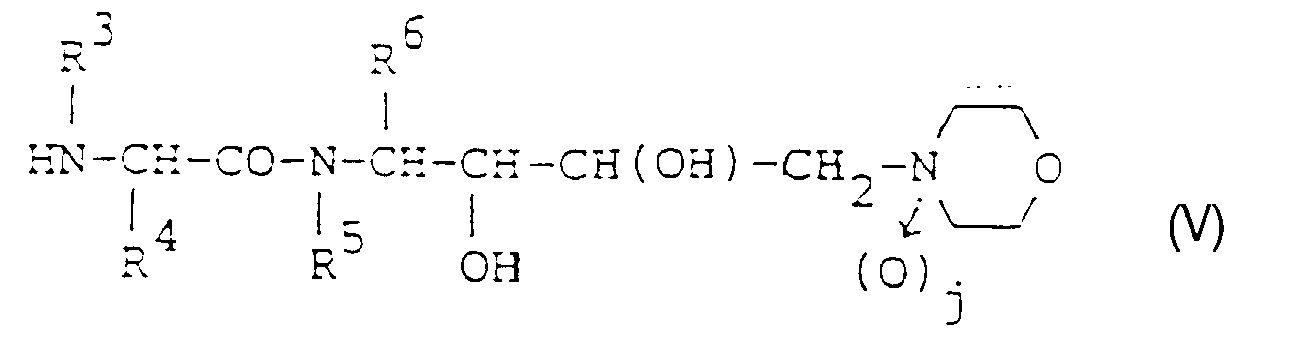
amine of the formula:
wherein R
5, R
6 and A are as defined above, or condensing a
carboxylic acid of the Formula:
wherein R
1, R
2, m and n are as defined above, or a
reactive derivative at the carboxyl group thereof with an
amino acid amide of the formula:
wherein R
3, R
4, R
5, R
6 and A are as defined above.
Further, the
intermediates represented by the following formulas A and
B are useful for the production of the compound of
the formula I, compounds of formula B being novel:
wherein each of R
1 and R
2 which may be the same or
different is a hydrogen atom, a substituted or
unsubstituted C
1-6 alkyl group, a substituted or
unsubstituted cycloalkyl group, a substituted or
unsubstituted cycloalkylalkyl group, a substituted or
unsubstituted aryl group, a substituted or unsubstituted
aralkyl group or a substituted or unsubstituted monocyclic
or bicyclic heterocyclic group containing from 1 to 4
hetero atoms selected from the group consisting of
nitrogen, sulfur and oxygen atoms; R
14 is a carboxyl
group, a reactive derivative of a carboxyl group or a
protected carboxyl group; m is 0, 1 or 2; and n is an
integer of from 1 to 5; provided that when R
1 is a
hydrogen atom, m is 0;
wherein R
5, R
6, R
15, R
16, R
17, j are as defined in
claim 4.
Now, the present invention will be described in detail
with reference to the preferred embodiments.
In the accompanying drawing, Figure 1 is a graph
showing the hypotensive activities of the compound of the
present invention as administered to monkeys in Test
Example 3 given hereinafter.
Firstly, the definitions of various terms referred to
in this specification and some specific examples falling
within such terms will be given.
The substituted or unsubstituted lower alkyl group is
a straight chain or branched lower alkyl group having
from 1 to 6 carbon atoms such as a methyl group, an ethyl
group, a propyl group, an isopropyl group, a butyl group,
an isobutyl group, a sec-butyl group, a tert-butyl group,
a pentyl group, a neopentyl group, an isopentyl group, a
hexyl group or an isohexyl group, which is unsubstituted
or substituted by a halogen atom such as a chlorine atom,
a fluorine atom or a bromine atom; a hydroxyl group; a
lower alkoxy group such as a methoxy group, an ethoxy
group, a propoxy group, an isopropoxy group, a butoxy
group, an isobutoxy group, a sec-butoxy group or a
tert-butoxy group; an aryloxy group such as a phenoxy
group, a 1-naphthyloxy group or a 2-naphthyloxy group; an
aralkyloxy group such as a benzyloxy group, a phenetyloxy
group, a 1-naphthylmethyloxy group or a
2-naphthylmethyloxy group; an amino group; a mono- or
di-lower alkylamino group such as a methylamino group, an
ethylamino group, a propylamino group, an isopropylamino
group, a butylamino group, a sec-butylamino group, an
isobutylamino group, a tert-butylamino group, a
dimethylamino group or a diethylamino group; an arylamino
group such as a phenylamino group, a 1-naphthylamino group
or a 2-naphthylamino group; an aralkylamino group such as
a benzylamino group, a phenetylamino group, a
1-naphthylmethylamino group or a 2-naphthylmethylamino
group; a carboxyl group; a formyl group; a lower
alkoxycarbonyl group such as a methoxycarbonyl group, an
ethoxycarbonyl group, a propoxycarbonyl group, an
isopropoxycarbonyl group, a butoxycarbonyl group, a
sec-butoxycarbonyl group, an isobutoxycarbonyl group or a
tert-butoxycarbonyl group; an aryloxy carbonyl group such
as a phenoxycarbonyl group, a 1-naphthyloxycarbonyl group
or a 2-naphthyloxycarbonyl group; an aralkyloxycarbonyl
group such as a benzyloxycarbonyl group, a
phenetyloxycarbonyl group, a 1-naphthylmethyloxycarbonyl
group or a 2-naphthylmethyloxycarbonyl group; a mercapto
group; a lower alkylthio group such as a methylthio group,
an ethylthio group, a propylthio group, an isopropylthio
group, a butylthio group, a sec-butylthio group, an
isobutylthio group or a tert-butylthio group; an arylthio
group such as a phenylthio group, a 1-naphthylthio group
or a 2-naphthylthio group; an aralkylthio group such as a
benzylthio group, a phenetylthio group, a
1-naphthylmethylthio group or a 2-naphthylmethylthio
group; an arylsulfinyl group such as a phenylsulfinyl
group, a 1-naphthylsulfinyl group or a 2-naphthylsulfinyl
group; an aralkylsulfinyl group such as a benzylsulfinyl
group, a phenetylsulfinyl group, a
1-naphthylmethylsulfinyl group or a
2-naphthylmethylsulfinyl group; a lower alkylsulfonyl
group such as a mesyl group, an ethylsulfonyl group, a
propylsulfonyl group, an isopropylsulfonyl group, a
butylsulfonyl group, an isobutylsulfonyl group, a
sec-butylsulfonyl group or a tert-butylsulfonyl group; an
arylsulfonyl group such as a phenylsulfonyl group, a
1-naphthylsulfonyl group or a 2-naphthylsulfonyl group; an
aralkylsulfonyl group such as a benzylsulfonyl group, a
phenetylsulfonyl group, a 1-naphthylmethylsulfonyl group
or a 2-naphthylmethylsulfonyl group; or a heterocyclic
group such as a pyrrolyl group, a furyl group, a thienyl
group, a pyridyl group, an imidazolyl group, a pyrazolyl
group, a thiazolyl group, an isothiazolyl group, an
isoxazolyl group, an oxazolyl group, a pyrazinyl group, a
pyrimidinyl group, a pyridazinyl group, an indolyl group,
a quinolyl group, an isoquinolyl group, a phthalazinyl
group, a naphthidinyl group, a quinoxalinyl group, a
quinazolinyl group, a 1,4-benzodioxanyl group, a
1,3-benzodioxanyl group, a 1,2,3-triazolyl group, a
1,3,4-triazolyl group, a 1,3,4-thiadiazolyl group, a
1,2,3-thiadiazolyl group, a tetrazolyl group, a
tetrahydrofuranyl group, a tetrahydrothienyl group, a
pyrrolidinyl group, an imidazolidinyl group, a
2-imidazolinyl group, a morpholinyl group, a morpholino
group, a morpholine N-oxide group, a lower alkyl
morpholino group such as an N-methylmorpholino group, an
N-ethylmorpholino group or an N-propylmorpholino group, a
piperazinyl group, a piperidino group, a piperidinyl
group, a thiomorpholino group or athiomorpholinyl group.
The substituted or unsubstituted cycloalkylalkyl group
may be a cycloalkylalkyl group having from 4 to 10 carbon
atoms such as a cyclopropylmethyl group, a
cyclobutylmethyl group, a cyclopentylmethyl group, a
cyclohexylmethyl group, 1-cyclopropylethyl group, a
2-cyclopropylethyl group, a 1-cyclobutylethyl group, a
2-cyclobutylethyl group, a 1-cyclopentylethyl group, a
2-cyclopentylethyl group, a 1-cyclohexylethyl group, a
3-cyclohexylpropyl group, a 3-cyclopentylpropyl group, a
4-cyclohexylbutyl group or a 4-cyclopentylbutyl group,
which is unsubstituted or substituted by a halogen atom
such as a chlorine atom, a fluorine atom or a bromine
atom; a hydroxyl group; a lower alkyl group such as a
methyl group, an ethyl group, a propyl group, an isopropyl
group, a butyl group, an isobutyl group, a sec-butyl group
or a tert-butyl group; a lower alkoxy group such as a
methoxy group, an ethoxy group, a propoxy group, an
isopropoxy group, a butoxy group, an isobutoxy group, a
sec-butoxy group or a tert-butoxy group; an aryloxy group
such as a phenoxy group, a 1-naphthyloxy group or a
2-naphthyloxy group; an aralkyloxy group such as a
benzyloxy group, a phenetyloxv group, a
1-naphthylmethyloxy group or a 2-naphthylmethyloxy group;
an amino group; a mono- or di-lower alkylamino group such
as a methylamino group, an ethylamino group, a propylamino
group, an isopropylamino group, a butylamino group, a
sec-butylamino group, an isobutylamino group, a
tert-butylamino group, a dimethylamino group or a
diethylamino group; an arylamino group such as a
phenylamino group, a 1-naphthylamino group or a
2-naphthylamino group; an aralkylamino group such as a
benzylamino group, a phenetylamino group, a
1-naphthylmethylamino group or a 2-naphthylmethylamino
group; a carboxyl group; a formyl group; a lower
alkoxycarbonyl group such as a methoxycarbonyl group, an
ethoxycarbonyl group, a propoxycarbonyl group, an
isopropoxycarbonyl group, a butoxycarbonyl group, a
sec-butoxycarbonyl group, an isobutoxycarbonyl group or a
tert-butoxycarbonyl group; an aryloxy carbonyl group such
as a phenoxycarbonyl group, a 1-naphthyloxycarbonyl group
or a 2-naphthyloxycarbonyl group; an aralkyloxycarbonyl
group such as a benzyloxycarbonyl group, a
phenetyloxycarbonyl group, a 1-naphthylmethyloxycarbonyl
group or a 2-naphthylmethyloxycarbonyl group; a mercapto
group; a lower alkylthio group such as a methylthio group,
an ethylthio group, a propylthio group, an isopropylthio
group, a butylthio group, a sec-butylthio group, an
isobutylthio group or a tert-butylthio group; an arylthio
group such as a phenylthio group, a 1-naphthylthio group
or a 2-naphthylthio group; an aralkylthio group such as a
benzylthio group, a phenetylthio group, a
1-naphthylmethylthio group or a 2-naphthylmethylthio
group; an arylsulfinyl group such as a phenylsulfinyl
group, a 1-naphthylsulfinyl group or a 2-naphthylsulfinyl
group; an aralkylsulfinyl group such as a benzylsulfinyl
group, a phenetylsulfinyl group, a
1-naphthylmethylsulfinyl group or a
2-naphthylmethylsulfinyl group; a lower alkylsulfonyl
group such as a mesyl group, an ethylsulfonyl group, a
propylsulfonyl group, an isopropylsulfonyl group, a
butylsulfonyl group, an isobutylsulfonyl group, a
sec-butylsulfonyl group or a tert-butylsulfonyl group; an
arylsulfonyl group such as a phenylsulfonyl group, a
1-naphthylsulfonyl group or a 2-naphthylsulfonyl group; an
aralkylsulfonyl group such as a benzylsulfonyl group, a
phenetylsulfonyl group, a 1-naphthylmethylsulfonyl group
or a 2-naphthylmethylsulfonyl group; or a heterocyclic
group such as a pyrrolyl group, a furyl group, a thienyl
group, a pyridyl group, an imidazolyl group, a pyrazolyl
group, a thiazolyl group, an isothiazolyl group, an
isoxazolyl group, an oxazolyl group, a pyrazinyl group, a
pyrimidinyl group, a pyridazinyl group, an indolyl group,
a quinolyl group, an isoquinolyl group, a phthalazinyl
group, a naphthidinyl group, a quinoxalinyl group, a
quinazolinyl group, a 1,4-benzodioxanyl group, a
1,3-benzodioxanyl group, a 1,2,3-triazolyl group, a
1,3,4-triazolyl group, a 1,3,4-thiadiazolyl group, a
1,2,3-thiadiazolyl group, a tetrazolyl group, a
tetrahydrofuranyl group, a tetrahydrothienyl group, a
pyrrolidinyl group, an imidazolidinyl group, a
2-imidazolinyl group, a morpholinyl group, a morpholino
group, a morpholine N-oxide group, a lower alkyl
morpholino group such as an N-methylmorpholino group, an
N-ethylmorpholino group or an N-propylmorpholino group, a
piperazinyl group, a piperidino group, a piperidinyl
group, a thiomorpholino group or a thiomorpholinyl group.
The substituted or unsubstituted cycloalkyl group may
be a cycloalkyl group having from 3 to 6 carbon atoms such
as a cyclopropyl group, a cyclobutyl group, a cyclopentyl
group or a cyclohexyl group, which is unsubstituted or
substituted by a halogen atom such as a chlorine atom, a
fluorine atom or a bromine atom; a hydroxyl group; a lower
alkyl group such as a methyl group, an ethyl group, a
propyl group, an isopropyl group, a butyl group, an
isobutyl group, a sec-butyl group or a tert-butyl group; a
lower alkoxy group such as a methoxy group, an ethoxy
group, a propoxy group, an isopropoxy group, a butoxy
group, an isobutoxy group, a sec-butoxy group or a
tert-butoxy group; an aryloxy group such as a phenoxy
group, a 1-naphthyloxy group or a 2-naphthyloxy group; an
aralkyloxy group such as a benzyloxy group, a phenetyloxy
group, a 1-naphthylmethyloxy group or a
2-naphthylmethyloxy group; an amino group; a mono- or
di-lower alkylamino group such as a methylamino group, an
ethylamino group, a propylamino group, an isopropylamino
group, a butylamino group, a sec-butylamino group, an
isobutylamino group, a tert-butylamino group, a
dimethylamino group or a diethylamino group; an arylamino
group such as a phenylamino group, a 1-naphthylamino group
or a 2-naphthylamino group; an aralkylamino group such as
a benzylamino group, a phenetylamino group, a
1-naphthylmethylamino group or a 2-naphthylmethylamino
group; a carboxyl group; a formyl group; a lower
alkoxycarbonyl group such as a methoxycarbonyl group, an
ethoxycarbonyl group, a propoxycarbonyl group, an
isopropoxycarbonyl group, a butoxycarbonyl group, a
sec-butoxycarbonyl group, an isobutoxycarbonyl group or a
tert-butoxycarbonyl group; an aryloxy carbonyl group such
as a phenoxycarbonyl group, a 1-naphthyloxycarbonyl group
or a 2-naphthyloxycarbonyl group; an aralkyloxycarbonyl
group such as a benzyloxycarbonyl group, a
phenetyloxycarbonyl group, a 1-naphthylmethyloxycarbonyl
group or a 2-naphthylmethyloxycarbonyl group; a mercapto
group; a lower alkylthio group such as a methylthio group,
an ethylthio group, a propylthio group, an isopropylthio
group, a butylthio group, a sec-butylthio group, an
isobutylthio group or a tert-butylthio group; an arylthio
group such as a phenylthio group, a 1-naphthylthio group
or a 2-naphthylthio group; an aralkylthio group such as a
benzylthio group, a phenetylthio group, a
1-naphthylmethylthio group or a 2-naphthylmethylthio
group; an arylsulfinyl group such as a phenylsulfinyl
group, a 1-naphthylsulfinyl group or a 2-naphthylsulfinyl
group; an aralkylsulfinyl group such as a benzylsulfinyl
group, a phenetylsulfinyl group, a
1-naphthylmethylsulfinyl group or a
2-naphthylmethylsulfinyl group; a lower alkylsulfonyl
group such as a mesyl group, an ethylsulfonyl group, a
propylsulfonyl group, an isopropylsulfonyl group, a
butylsulfonyl group, an isobutylsulfonyl group, a
sec-butylsulfonyl group or a tert-butylsulfonyl group; an
arylsulfonyl group such as a phenylsulfonyl group, a
1-naphthylsulfonyl group or a 2-naphthylsulfonyl group; an
aralkylsulfonyl group such as a benzylsulfonyl group, a
phenetylsulfonyl group, a 1-naphthylmethylsulfonyl group
or a 2-naphthylmethylsulfonyl group; or a heterocyclic
group such as a pyrrolyl group, a furyl group, a thienyl
group, a pyridyl group, an imidazolyl group, a pyrazolyl
group, a thiazolyl group, an isothiazolyl group, an
isoxazolyl group, an oxazolyl group, a pyrazinyl group, a
pyrimidinyl group, a pyridazinyl group, an indolyl group,
a quinolyl group, an isoquinolyl group, a phthalazinyl
group, a naphthidinyl group, a quinoxalinyl group, a
quinazolinyl group, a 1,4-benzodioxanyl group, a
1,3-benzodioxanyl group, a 1,2,3-triazolyl group, a
1,3,4-triazolyl group, a 1,3,4-thiadiazolyl group, a
1,2,3-thiadiazolyl group, a tetrazolyl group, a
tetrahydrofuranyl group, a tetrahydrothienyl group, a
pyrrolidinyl group, an imidazolidinyl group, a
2-imidazolinyl group, a morpholinyl group, a morpholino
group, a morpholine N-oxide group, a lower alkyl
morpholino group such as an N-methylmorpholino group, an
N-ethylmorpholino group or an N-propylmorpholino group, a
piperazinyl group, a piperidino group, a piperidinyl
group, a thiomorpholino group or a thiomorpholinyl group.
The substituted or unsubstituted aryl group may be an
aryl group having from 6 to 15 carbon atoms such as a
phenyl group, a biphenylyl group, a 1-naphthyl group or a
2-naphthyl group, which is unsubstituted or substituted by
a halogen atom such as a chlorine atom, a fluorine atom or
a bromine atom; a nitro group; a hydroxyl group; a lower
alkyl group such as a methyl group, an ethyl group, a
propyl group, an isopropyl group, a butyl group, an
isobutyl group, a sec-butyl group or a tert-butyl group; a
lower alkoxy group such as a methoxy group, an ethoxy
group, a propoxy group, an isopropoxy group, a butoxy
group, an isobutoxy group, a sec-butoxy group or a
tert-butoxy group; an aryloxy group such as a phenoxy
group, a 1-naphthyloxy group or a 2-naphthyloxy group; an
aralkyloxy group such as a benzyloxy group, a phenetyloxy
group, a 1-naphthylmethyloxy group or a
2-naphthylmethyloxy group; an amino group; a mono- or
di-lower alkylamino group such as a methylamino group, an
ethylamino group, a propylamino group, an isopropylamino
group, a butylamino group, a sec-butylamino group, an
isobutylamino group, a tert-butylamino group, a
dimethylamino group or a diethylamino group; an arylamino
group such as a phenylamino group, a 1-naphthylamino group
or a 2-naphthylamino group; an aralkylamino group such as
a benzylamino group, a phenetylamino group, a
1-naphthylmethylamino group or a 2-naphthylmethylamino
group; a carboxyl group; a formyl group; a lower
alkoxycarbonyl group such as a methoxycarbonyl group, an
ethoxycarbonyl group, a propoxycarbonyl group, an
isopropoxycarbonyl group, a butoxycarbonyl group, a
sec-butoxycarbonyl group, an isobutoxycarbonyl group or a
tert-butoxycarbonyl group; an aryloxy carbonyl group such
as a phenoxycarbonyl group, a 1-naphthyloxycarbonyl group
or a 2-naphthyloxycarbonyl group; an aralkyloxycarbonyl
group such as a benzyloxycarbonyl group, a
phenetyloxycarbonyl group, a 1-naphthylmethyloxycarbonyl
group or a 2-naphthylmethyloxycarbonyl group; a mercapto
group; a lower alkylthio group such as a methylthio group,
an ethylthio group, a propylthio group, an isopropylthio
group, a butylthio group, a sec-butylthio group, an
isobutylthio group or a tert-butylthio group; an arylthio
group such as a phenylthio group, a 1-naphthylthio group
or a 2-naphthylthio group; an aralkylthio group such as a
benzylthio group, a phenetylthio group, a
1-naphthylmethylthio group or a 2-naphthylmethylthio
group; an arylsulfinyl group such as a phenylsulfinyl
group, a 1-naphthylsulfinyl group or a 2-naphthylsulfinyl
group; an aralkylsulfinyl group such as a benzylsulfinyl
group, a phenetylsulfinyl group, a
1-naphthylmethylsulfinyl group or a
2-naphthylmethylsulfinyl group; a lower alkylsulfonyl
group such as a mesyl group, an ethylsulfonyl group, a
propylsulfonyl group, an isopropylsulfonyl group, a
butylsulfonyl group, an isobutylsulfonyl group, a
sec-butylsulfonyl group or a tert-butylsulfonyl group; an
arylsulfonyl group such as a phenylsulfonyl group, a
1-naphthylsulfonyl group or a 2-naphthylsulfonyl group; an
aralkylsulfonyl group such as a benzylsulfonyl group, a
phenetylsulfonyl group, a 1-naphthylmethylsulfonyl group
or a 2-naphthylmethylsulfonyl group; or a heterocyclic
group such as a pyrrolyl group, a furyl group, a thienyl
group, a pyridyl group, an imidazolyl group, a pyrazolyl
group, a thiazolyl group, an isothiazolyl group, an
isoxazolyl group, an oxazolyl group, a pyrazinyl group, a
pyrimidinyl group, a pyridazinyl group, an indolyl group,
a quinolyl group, an isoquinolyl group, a phthalazinyl
group, a naphthidinyl group, a quinoxalinyl group, a
quinazolinyl group, a 1,4-benzodioxanyl group, a
1,3-benzodioxanyl group, a 1,2,3-triazolyl group, a
1,3,4-triazolyl group, a 1,3,4-thiadiazolyl group, a
1,2,3-thiadiazolyl group, a tetrazolyl group, a
tetrahydrofuranyl group, a tetrahydrothienyl group, a
pyrrolidinyl group, an imidazolidinyl group, a
2-imidazolinyl group, a morpholinyl group, a morpholino
group, a morpholine N-oxide group, a lower alkyl
morpholino group such as an N-methylmorpholino group, an
N-ethylmorpholino group or an N-propylmorpholino group, a
piperazinyl group, a piperidino group, a piperidinyl
group, a thiomorpholino group or a thiomorpholinyl group.
The substituted or unsubstituted aralkyl group may be
an aralkyl group having from 7 to 15 carbon atoms such as
a benzyl group, a 1-naphthylmethyl group, a
2-naphthylmethyl group, a 5,6,7,8-tetrahydro-1-naphthylmethyl
group, a 5,6,7,8-tetrahydro-2-naphthylmethyl group, a phenetyl
group, a 3-phenylpropyl group or a 4-phenylbutyl group,
which is unsubstituted or substituted by a halogen atom
such as a chlorine atom, a fluorine atom or a bromine
atom; a nitro group; a hydroxyl group; a lower alkyl group
such as a methyl group, an ethyl group, a propyl group, an
isopropyl group, a butyl group, an isobutyl group, a
sec-butyl group or a tert-butyl group; a lower alkoxy
group such as a methoxy group, an ethoxy group, a propoxy
group, an isopropoxy group, a butoxy group, an isobutoxy
group, a sec-butoxy group or a tert-butoxy group; an
aryloxy group such as a phenoxy group, a 1-naphthyloxy
group or a 2-naphthyloxy group; an aralkyloxy group such
as a benzyloxy group, a phenetyloxy group, a
1-naphthylmethyloxy group or a 2-naphthylmethyloxy group;
an amino group; a mono- or di-lower alkylamino group such
as a methylamino group, an ethylamino group, a propylamino
group, an isopropylamino group, a butylamino group, a
sec-butylamino group, an isobutylamino group, a
tert-butylamino group, a dimethylamino group or a
diethylamino group; an arylamino group such as a
phenylamino group, a 1-naphthylamino group or a
2-naphthylamino group; an aralkylamino group such as a
benzylamino group, a phenetylamino group, a
1-naphthylmethylamino group or a 2-naphthylmethylamino
group; a carboxyl group; a formyl group; a lower
alkoxycarbonyl group such as a methoxycarbonyl group, an
ethoxycarbonyl group, a propoxycarbonyl group, an
isopropoxycarbonyl group, a butoxycarbonyl group, a
sec-butoxycarbonyl group, an isobutoxycarbonyl group or a
tert-butoxycarbonyl group; an aryloxy carbonyl group such
as a phenoxycarbonyl group, a 1-naphthyloxycarbonyl group
or a 2-naphthyloxycarbonyl group; an aralkyloxycarbonyl
group such as a benzyloxycarbonyl group, a
phenetyloxycarbonyl group, a 1-naphthylmethyloxycarbonyl
group or a 2-naphthylmethyloxycarbonyl group; a mercapto
group; a lower alkylthio group such as a methylthio group,
an ethylthio group, a propylthio group, an isopropylthio
group, a butylthio group, a sec-butylthio group, an
isobutylthio group or a tert-butylthio group; an arylthio
group such as a phenylthio group, a 1-naphthylthio group
or a 2-naphthylthio group; an aralkylthio group such as a
benzylthio group, a phenetylthio group, a
1-naphthylmethylthio group or a 2-naphthylmethylthio
group; an arylsulfinyl group such as a phenylsulfinyl
group, a 1-naphthylsulfinyl group or a 2-naphthylsulfinyl
group; an aralkylsulfinyl group such as a benzylsulfinyl
group, a phenetylsulfinyl group, a
1-naphthylmethylsulfinyl group or a
2-naphthylmethylsulfinyl group; a lower alkylsulfonyl
group such as a mesyl group, an ethylsulfonyl group, a
propylsulfonyl group, an isopropylsulfonyl group, a
butylsulfonyl group, an isobutylsulfonyl group, a
sec-butylsulfonyl group or a tert-butylsulfonyl group; an
arylsulfonyl group such as a phenylsulfonyl group, a
1-naphthylsulfonyl group or a 2-naphthylsulfonyl group; an
aralkylsulfonyl group such as a benzylsulfonyl group, a
phenetylsulfonyl group, a 1-naphthylmethylsulfonyl group
or a 2-naphthylmethylsulfonyl group; or a heterocyclic
group such as a pyrrolyl group, a furyl group, a thienyl
group, a pyridyl group, an imidazolyl group, a pyrazolyl
group, a thiazolyl group, an isothiazolyl group, an
isoxazolyl group, an oxazolyl group, a pyrazinyl group, a
pyrimidinyl group, a pyridazinyl group, an indolyl group,
a quinolyl group, an isoquinolyl group, a phthalazinyl
group, a naphthidinyl group, a quinoxalinyl group, a
quinazolinyl group, a 1,4-benzodioxanyl group, a
1,3-benzodioxanyl group, a 1,2,3-triazolyl group, a
1,3,4-triazolyl group, a 1,3,4-thiadiazolyl group, a
1,2,3-thiadiazolyl group, a tetrazolyl group, a
tetrahydrofuranyl group, a tetrahydrothienyl group, a
pyrrolidinyl group, an imidazolidinyl group, a
2-imidazolinyl group, a morpholinyl group, a morpholino
group, a morpholine N-oxide group, a lower alkyl
morpholino group such as an N-methylmorpholino group, an
N-ethylmorpholino group or an N-propylmorpholino group, a
piperazinyl group, a piperidino group, a piperidinyl
group, a thiomorpholino group or a thiomorpholinyl group.
The substituted or unsubstituted monocyclic or bicyclic
heterocyclic group containing from 1 to 4 hetero atoms
selected from the group consisting of nitrogen, sulfur and
oxygen atoms, may be a heterocyclic group such as a
pyrrolyl group, a furyl group, a thienyl group, a pyridyl
group, an imidazolyl group, a pyrazolyl group, a thiazolyl
group, an isothiazolyl group, an isoxazolyl group, an
oxazolyl group, a pyrazinyl group, a pyrimidinyl group, a
pyridazinyl group, an indolyl group, a quinolyl group, an
isoquinolyl group, a phthalazinyl group, a naphthidinyl
group, a quinoxalinyl group, a quinazolinyl group, a
1,4-benzodioxanyl group, a 1,3-benzodioxanyl group, a
1,2,3-triazolyl group, a 1,3,4-triazolyl group, a
1,3,4-thiadiazolyl group, a 1,2,3-thiadiazolyl group, a
tetrazolyl group, a tetrahydrofuranyl group, a
tetrahydrothienyl group, a pyrrolidinyl group, an
imidazolidinyl group, a 2-imidazolinyl group, a
morpholinyl group, a morpholino group, a piperizine
N-oxide group, a piperazine N-oxide group, a morpholine
N-oxide group, a lower alkyl morpholino group such as an
N-methylmorpholino group, an N-ethylmorpholino group or an
N-propylmorpholino group, a piperazinyl group, a
piperidino group, a piperidinyl group, a thiomorpholino
group or a thiomorpholinyl group, which is unsubstituted
or substituted by a halogen atom such as a chlorine atom,
a fluorine atom or a bromine atom; a nitro group; a
hydroxyl group; a lower alkyl group such as a methyl
group, an ethyl group, a propyl group, an isopropyl group,
a butyl group, an isobutyl group, a sec-butyl group or a
tert-butyl group; a triphenylmethyl group; a lower alkoxy
group such as a methoxy group, an ethoxy group, a propoxy
group, an isopropoxy group, a butoxy group, an isobutoxy
group, a sec-butoxy group or a tert-butoxy group; an
aryloxy group such as a phenoxy group, a 1-naphthyloxy
group or a 2-naphthyloxy group; an aralkyloxy group such
as a benzyloxy group, a phenetyloxy group, a
1-naphthylmethyloxy group or a 2-naphthylmethyloxy group;
an amino group; a mono- or di-lower alkylamino group such
as a methylamino group, an ethylamino group, a propylamino
group, an isopropylamino group, a butylamino group, a
sec-butylamino group, an isobutylamino group, a
tert-butylamino group, a dimethylamino group or a
diethylamino group; an arylamino group such as a
phenylamino group, a 1-naphthylamino group or a
2-naphthylamino group; an aralkylamino group such as a
benzylamino group, a phenetylamino group, a
1-naphthylmethylamino group or a 2-naphthylmethylamino
group; a carboxyl group; a formyl group; a lower
alkoxycarbonyl group such as a methoxycarbonyl group, an
ethoxycarbonyl group, a propoxycarbonyl group, an
isopropoxycarbonyl group, a butoxycarbonyl group, a
sec-butoxycarbonyl group, an isobutoxycarbonyl group or a
tert-butoxycarbonyl group; an aryloxy carbonyl group such
as a phenoxycarbonyl group, a 1-naphthyloxycarbonyl group
or a 2-naphthyloxycarbonyl group; an aralkyloxycarbonyl
group such as a benzyloxycarbonyl group, a
phenetyloxycarbonyl group, a 1-naphthylmethyloxycarbonyl
group or a 2-naphthylmethyloxycarbonyl group; a mercapto
group; a lower alkylthio group such as a methylthio group,
an ethylthio group, a propylthio group, an isopropylthio
group, a butylthio group, a sec-butylthio group, an
isobutylthio group or a tert-butylthio group; an arylthio
group such as a phenylthio group, a 1-naphthylthio group
or a 2-naphthylthio group; an aralkylthio group such as a
benzylthio group, a phenetylthio group, a
1-naphthylmethylthio group or a 2-naphthylmethylthio
group; an arylsulfinyl group such as a phenylsulfinyl
group, a 1-naphthylsulfinyl group or a 2-naphthylsulfinyl
group; an aralkylsulfinyl group such as a benzylsulfinyl
group, a phenetylsulfinyl group, a
1-naphthylmethylsulfinyl group or a
2-naphthylmethylsulfinyl group; a lower alkylsulfonyl
group such as a mesyl group, an ethylsulfonyl group, a
propylsulfonyl group, an isopropylsulfonyl group, a
butylsulfonyl group, an isobutylsulfonyl group, a
sec-butylsulfonyl group or a tert-butylsulfonyl group; an
arylsulfonyl group such as 2 phenylsulfonyl group, a
1-naphthylsulfonyl group or a 2-naphthylsulfonyl group; or
an aralkylsulfonyl group such as a benzylsulfonyl group, a
phenetylsulfonyl group, a 1-naphthylmethylsulfonyl group
or a 2-naphthylmethylsulfonyl group.
In the compound of the formula I of the present
invention, the asymmetric carbon atoms may have
R-configuration, S-configuration or RS-configuration.
The salt of the compound of the present invention may
be any pharmaceutically acceptable non-toxic salt. For
example, it may be a salt with anion such as Cl⊖, F⊖, Br⊖
or I⊖ with an inorganic acid such as hydrochloric acid,
sulfuric acid, hydrobromic acid, hydriodic acid or
phosphoric acid, or a salt with an organic acid such as
oxalic acid, maleic acid, acetic acid, formic acid or
tartaric acid.
Representative compounds of the present invention are
listed in Table B, wherein Et means ethyl,
iPr
isopropyl,
nBu n-butyl,
iBu isobutyl,
tBu tert-butyl, Tri
triphenylmethyl, Z benzyloxycarbonyl and Nap-CH
2-
1-naphthylmethyl, and each of A, B, C, D and E indicates
the steric configuration (R, S or RS).
Now, the process for the preparation of the compound
of the formula I of the present invention will be
described.
In the following formulas, R1, R2, R3, R4, R5, R6, m,
n and A are as defined above, and T is a leaving group.
Basically, the N-acylamino acid derivative of the
formula I of the present invention can be prepared by
condensing an N-acylamino acid of the formula:
or a reactive derivative at the carboxyl group thereof
with an amine of the formula:
or condensing a carboxylic acid of the formula:
or a reactive derivative at the carboxyl group thereof
with an amino acid amide of the formula:
The condensation of the compounds of the formulas II
and III or the condensation of the compounds of the
formulas IV and V can be conducted by a usual method for
the synthesis of a peptide, such as an azide method, an
active ester method, a mixed acid anhydride method, a
carbodiimide method, an imidazole method, a
diphenylphosphoryl azide method, a Woodward method or
condensation method in an oxidation and reduction system.
When a functional group which may adversely affect the
condensation reaction, such as an amino group, or a
carboxyl group, is present, such a functional group may be
protected and then condensed, and the protecting group is
then removed to obtain the compound of the present
invention. Such a condensation method, protection of a
functional group and removal of the functional group are
disclosed in detail, for example, in "Basic for the
Peptide Synthesis and Experiments" edited by Nobuo Izumiya
et al, Maruzen (1985), "Protein Chemistry I" edited by
Shiro Akabori et al, Kyoritsu Shuppan (1969), or
"Chemistry of the Amino Acids" edited by J.P. Greenstein
and M. Winitz, John Wiley & Sons, Inc. (1961).
The compound of the formula II can be prepared by the
process shown by reaction scheme I.
To a dialkyl malonate, a halide such as
1-(chloromethyl)naphthalene is reacted at room temperature
in a solvent such as tetrahydrofuran in the presence of a
base such as sodium hydride to obtain a compound of the
formula 2, which is then subjected to a saponification
reaction at room temperature in ethanol by means of e.g.
potassium hydroxide or sodium hydroxide to obtain a half
ester of the formula 3. If this hydrolytic reaction is
conducted by means of an enzyme such as esterase or
lipase, or an insolubilized enzyme thereof, it is possible
to obtain an optically active half ester of the formula 3.
The compound of the
formula 3 is condensed with an
amino acid having a protected carboxyl group by the
above-mentioned usual method for the peptide synthesis, to
obtain a compound of the
formula 4. As a preferred
embodiment, a tert-butyl ester of an amino acid and the
compound of the
formula 3 are condensed at room
temperature in dimethylformamide by means of
N,N'-dicyclohexylcarbodiimide in the presence of
1-hydroxybenzotriazole. Depending upon the purpose, the
compound of the
formula 4 is subjected to an extension of
the carbon chain, for example, by the method shown by
reaction scheme 2.
The compound of the formula 4 has two ester moieties.
By differenciating the types of the ester moieties, it is
possible to convert only one of the ester moieties to a
carboxylic acid group. For example, by selecting an ethyl
group for R and a tert-butyl group for R', it is possible
to hydrolyze only the ethyl ester moiety by saponification
with an alkali. The resulting carboxylic acid compound of
the formula 10 may be converted to an acid anhydride or to
an acid halide by a usual method and then reacted with a
diazomethane to obtain a diazoketone compound of the
formula 11, which is then reacted with a silver compound
such as silver benzoate or silver oxide dissolved in
triethylamine, in a lower alkanol such as methanol or
ethanol to obtain a compound of the formula 12 having the
carbon number increased by one. By repeating this
reaction, it is possible to obtain a compound of the
formula 5 having various carbon numbers. The compound of
the formula 5 has two ester moieties. By differenciating
the types of the ester moieties, it is possible to reduce
only one of the ester moieties. For example, by using an
ethyl group for R and a tert-butyl group for R', it is
possible to obtain the desired compound of the formula 6
by the reduction with sodium borohydride in ethanol at
room temperature. To facilitate the thioetherification,
the hydroxyl group formed by the reduction of the ester of
the compound of the formula 5 is converted to an excellent
leaving group shown by T such as a tosyloxy group, a
mesyloxy group or a halogen. This step can readily be
conducted by reacting p-toluene sulfonyl chloride to the
compound of the formula 6 at room temperature in the
presence of a base such as pyridine. Then, the compound
of the formula 7 and a thiol compound are reacted usually
at room temperature in the presence of a base such as
sodium hydride in a solvent such as dimethylformamide to
obtain a compound of the formula 8. The oxidation of the
compound of the formula 8 can be conducted by a usual
method, for example, with a manganese compound, chromic
acid, a lead compound, a halogen, hydrogen peroxide, an
organic per acid, an inorganic nitrogen compound or an
organic compound such as dimethylsulfoxide. By selecting
the oxidizing agent or reaction conditions, a sulfoxide
compound (compound wherein m = 1) and a sulfone compound
(compound wherein m = 2) can be prepared, respectively.
For example, when a compound of the formula 8 is oxidized
at room temperature by means of an aqueous hydrogen
peroxide solution in a solvent such as methanol by using
sodium tungstate as a catalyst, a sulfonic compound
(compound wherein m = 2) can be obtained. By removing the
protecting group from the compound of the formula 9 by a
method suitable for the removal of the particular
protecting group, compound of the formula II can be
obtained.
Further, the steric chemistry on the carbon to which
R
2 is bonded, can be freely controlled by utilizing the
Sharpless oxidation reaction, for example, by a method
represented by
Reaction scheme 3.
In the above formulas, R2, R3, R4, R' and n are as
defined above, and P1 and P2 represent hydroxyl-protecting
groups.
An allylic alcohol of the formula 13 is subjected to
asymmetric epoxidation in accordance with the method
disclosed by A. Pfenninger in "Synthesis" p89-116 (1986).
Then, the hydroxyl group is protected by a
hydroxyl-protecting group P2, and then the epoxy ring is
selectively opened by a Grignard reagent. Then, P2 is
removed. Then, oxidation is conducted by e.g. sodium
periodate to obtain a carboxylic acid, which is then
condensed with an amino acid having a protected carboxylic
acid by a usual method for peptide synthesis such as a
dicyclohexylcarbodiimide method. Then, the
hydroxy-protecting group P1 is removed to obtain the
compound of the formula 6 having the desired steric
coodination. The hydroxyl-protecting group P1 is
preferably a benzyl group, and P2 is preferably a
tert-butyldimethylsilyl group.
Further, the synthesis can be conducted
stereoselectivly also by the following
Reaction scheme 4.
wherein R
1, R
2, m and n are as defined above, and D is an
optically active amine.
A compound of the formula 20 obtained by reacting a
fatty acid having a mercapto group at the terminal with
R1-X wherein X is a halogen such as bromine, is converted
to a mixed acid anhydride by using e.g. pivaloyl chloride
and then condensed with an optically active compound such
as (4R,5S)-4-methyl-5-phenyl-2-oxazolidinone in the
presence of e.g. n-butyl lithium. Then, R2-X wherein X is
a halogen such as bromine is reacted thereto by using a
base such as lithium diisopropylamide to
stereospecifically introduce the R2 group. Then, if
necessary, after an addition of hydrogen peroxide, the
product is hydrolyzed with an alkali to obtain a compound
of the formula 23. If necessary, by using a suitable
oxidizing agent such as hydrogen peroxide, a sulfoxide
compound (a compound wherein m is 1) or sulfonic compound
(compound wherein m is 2) can be obtained. The optically
active compound of the formula D may be recovered and
again used for the reaction.
Some of the compounds of the formula II can also be
prepared by a process shown by Reaction scheme 5.
In the above formulas, R2' is a substituent of R2
wherein the 1-position is methylene group, such as a
naphthylmethyl group. A Horner-Emmon's reagent of the
formula 1' and an aldehyde are reacted usually at room
temperature preferably under an inert gas stream such as
argon or nitrogen in a solvent which does not adversely
affect the reaction, such as tetrahydrofuran or
dimethylformamide, if necessary, by an addition of an
alkali metal or alkaline earth metal halide such as
lithium chloride, lithium bromide or magnesium bromide and
by a further addition of a base e.g. a tertiary amine such
as diazabicycloundecene, triethylamine or
diisopropylethylamine or an alkali metal halide,
hydroxide, alcoholate or alkyl compound such as sodium
hydride, sodium hydroxide, sodium ethoxide or butyl
lithium, to obtain a compound of the formula 2'. The
hydroxyl-protecting group W' may be a commonly employed
hydroxyl-protecting group such as a tetrahydropyranyl
group, a trityl group or a benzyl group, but preferably is
a tetrahydropyranyl group. As the Horner-Emmon's reagent,
any reagent equivalent to the compound of the formula 1'
may be employed. The compound of the formula 2' is
catalytically reduced under atmospheric pressure or
elevated pressure in the presence of a metal catalyst such
as palladium black, palladium-carbon or platinum oxide to
obtain a compound of the formula 3', followed by the
removal of the protective group to obtain a compound of
the formula 4'. Steps 4, 5 and 6 can be conducted in the
same manner as Steps 6, 7 and 8, respectively, of Reaction
scheme 1. The saponification of Step 7 can be conducted
in a usual manner, for example, saponification with an
alkali such as sodium hydroxide in a solvent mixture of
water and a lower alkanol, to obtain a compound of the
formula 8'. The condensation of Step 8 can be conducted in
the same manner as Step 3 in Reaction scheme 1. Then, the
removal of the protective group is conducted to obtain a
compound of the formula II.
The compound of the formula III can be prepared by a
process shown by Reaction scheme 6.
In the above formulas, R
18 is an amino-protecting
group, and R
19 is a hydroxyl-protecting group. The
compound of the formula 24 can be prepared by a method
disclosed in J. Med. Chem., Vol. 30, p.976-982 (1987).
The compound of the formula 24 is reacted with
wherein X is chlorine or bromine,
in a solvent such as dry tetrahydrofuran
at a temperature of from -78°C to room temperature, to
obtain a compound of the formula 25. By removing the
protective group, a compound of the formula III can be
obtained.
Some of the compounds can also be prepared by a
process shown by Reaction scheme 7.
The compound of the formula 26 is a starting material
for the preparation of the compound of the formula 24, and
the method for the preparation thereof is also disclosed
in J. Med. Chem., Vol 30, p.976-982 (1987). The compound
of the formula 26 is reacted with an oxidizing agent such
as m-chloro perbenzoic acid at room temperature in a
solvent such as methylene chloride to obtain a compound of
the formula 27, which is then reacted with a morpholino compound
B to obtain a compound of
the formula 28. By the removal of a protecting group, a
compound of the formula III can be obtained.
Some of the compounds of the formula III can be
prepared stereospecifically by utilizing the asymmetric
center of a saccharide by a process as shown by Reaction
scheme 8.
In the above formulas, R6' corresponds to R6 except
that it is shorter than R6 by one methylene, and P1, P2
and P3 are hydroxy-protecting groups, and G represents a
morpholino compound.
The starting material 1,2:5,6-diisopropylidene-α-D-allofuranose
can readily be prepared from a D-glucose by a
method disclosed by J.D. Stevens in "Methods in
Carbohydrate Chemistry", Vol. VI, p.123 (1972). After
protecting the hydroxyl group at the 3-position by P1,
only the 5,6-isopropylidene was selectively removed by
means of e.g. acetic acid. Then, by means of a suitable
oxidizing agent such as sodium periodate, the product is
converted to an aldehyde. Then, a desired side chain is
introduced by Wittig reaction. If necessary, the olefin
is reduced by means of e.g. Raney nickel. The
1,2-isopropylidene is removed by treatment with an acid in
a lower alcohol, and at the same time, the hydroxyl group
at the 1-position is protected by P2. Further, the
hydroxyl group at the 2-position is protected by P3, and
then the hydroxyl-protecting group P2 at the 1-position is
removed. Morpholine is added,
and the amino alkylation reaction is conducted by means of
a metal hydride complex compound such as sodium cyano
borohydride. Then, the free hydroxyl group at the
4-position is stereoinversibly converted to an azide group
by means of diphenylphospholyl azide in the presence of
suitable azide-forming agents, preferably
triphenylphosphine and diethyl azodicarboxylate. This
azide group is reduced to an amino group in a usual
manner. Then, the hydroxyl-protecting groups P1 and P3
are removed. Thus, some of the compounds of the formula
III can be stereospecifically prepared. A benzyl group
may be mentioned as a preferred example for the
hydroxyl-protecting group P1 or P3, and a methyl group may
be mentioned as a preferred example for the hydroxyl
protecting group P2.
Further, as shown by a typical example in Reaction
scheme 9, such a stereospecific synthesis can be conducted
by the above Sharpless asymmetric epoxidation reaction by
using an optically inactive compound as the starting
material.
In the above formulas, R6', T, B, P1, P2 and P3 are as
defined above.
1,4-Pentadien-3-ol of the formula 41 prepared from
vinyl magnesium bromide and methyl formate, is subjected
to the above-mentioned Sharpless asymmetric epoxidation
reaction to obtain an epoxy compound of the formula 42.
After protecting the hydroxyl group by P1, the epoxy ring
is selectively opened by means of a Grignard reagent
R6'MgX, and the side chain is introduced. After
protecting the formed hydroxyl group by P2, a hydroxyl
group is stereoselectively introduced by an oxidizing
agent such as osmium tetraoxide to obtain a compound of
the formula 46. A leaving group such as a tosyl group or
a mesyl group is bonded to the primary hydroxyl group,
followed by treatment with an alkali such as potassium
carbonate, whereby an epoxy compound of the formula 48 can
be stereospecifically obtained. This compound of the
formula 48 can also be prepared by removing the
hydroxyl-protecting group P1 of the compound of the
formula 45, followed by the above sharpless asymmetric
epoxidation reaction and against protecting the hydroxyl
group by P1. A morpholino compound B
is reacted to the compound
of the formula 48, and the formed hydroxyl group is
protected by P3, and the hydroxyl-protecting group P2 is
removed to obtain a compound of the formula 51. A
compound of the formula III can be stereospecifically
prepared from the compound of the formula 51 in the same
manner as shown by the process steps 37→38→39→40 as
shown in Reaction Scheme 8.
The compound of the formula IV can be prepared in the
same manner as in Reaction scheme 1 except that the
condensation step 3 is omitted. Namely, the compound of
the
formula 3 is converted to
and the
subsequent steps are the same as the
steps
4→5→6→7→8→9 to obtain a compound of the formula
IV.
The compound of the formula V can readily be obtained
by condensing an amino-protecting amino acid and the
compound of the formula III in accordance with a usual
method for the peptide synthesis, followed by removal of
the protecting group.
When the compound of the present invention is to be
used as a medicine, it may be administered by itself, but
it is usually administered as a mixture with a carrier
suitably selected depending upon the route for
administration and standard formulations. For example,
for oral administration, the compound of the present
invention may be administered in the form of tablets which
may be prepared by adding to a powder of the active
ingredient of the present invention an excipient such as
starch, lactose, sucrose, glucose, crystalline cellulose,
calcium carbonate or kaolin, a binder such as a starch
solution, a gelatin solution, a hydroxypropyl cellulose, a
glucose solution, a sucrose solution, water or ethanol, a
disintegrator such as starch, agar, gelatin powder,
carboxymethyl cellulose calcium (CMC-Ca), carboxymethyl
cellulose sodium (CMC-Na), crystalline cellulose, calcium
carbonate or sodium hydrogencarbonate, or a lubricant such
as magnesium stearate, calcium stearate, talc, macrogoal
4,000, macrogoal 6,000 or stearic acid, subjecting the
mixture to compression molding by a conventional
tabletting method, and if necessary, applying a sugar
coating by means of a concentrated sugar solution
containing e.g. gum arabic, talc, polyvinyl pyrrolidone,
polyethylene glycol and/or titanium oxide, applying a film
coating by means of a film-forming agent composed of e.g.
polyvinyl acetal, diethylaminoacetate, cellulose acetate,
N,N-dibutylaminohydroxypropyl ether, hydroxypropylmethyl
cellulose, hydroxypropyl cellulose, ethyl cellulose or
polyvinyl pyrrolidone, or applying an enteric coating by
means of a film-forming agent composed of e.g. ethyl
cellulose phthalate cerac, cellulose acetate phthalate or
hydroxypropylmethyl cellulose phthalate; granules or fine
granules which may be prepared by adding to the active
ingredient of the present invention a binder such as
starch, gelatin, gum arabic, methyl cellulose, sodium
carboxymethyl cellulose, heavy silicic anhydride or light
silicic anhydride, followed by kneading and granulation by
usual methods; a powder of the active ingredient of the
present invention by itself; or capsules which may be
prepared by adding to the active ingredient of the present
invention an excipient such as lactose, starch or
crystalline cellulose and/or a lubricant such as magnesium
stearate, calcium stearate or talc, and filling the
mixture into capsules. For non-oral administration, an
injection formulation may be used wherein an emulsifying
agent such as propylene glycol, polyethylene glycol or a
vegetable oil such as olive oil, or a solubilization agent
such as sodium benzoate, sodium salicylate,
N-hydroxyethyllactamide, calcium α-saccharide, mannitol,
nicotic acid amide or cyclodextrin, is suitably used.
Further, to such formulations, other medicinal
substances may be incorporated. Such medicinal
substances include, for example, acetazolamide, amiloride,
chlorothiazide, furosemide, timolol, propranolol,
cetamolol, clonidine, methyldopa, minoxidil, hydralazine,
captopril, pivalopril, enalapril, lidinopril, verapamil,
nifedipine, nicardipine, felodipine, nimodipine and
diltiazem.
An advantageous formulation contains from about 0.1 mg
to 500 mg of the compound of the present invention. A
preferred range of a daily dose for oral administration is
from about 0.1 mg/kg to 500 mg/kg, and such a daily dose
may be administered at once or in three times a day. For
non-oral administration, it is preferred to administer
the compound of the present invention in an amount of from
about 0.1 mg/kg to 10 mg/kg per day at once. The dose may
be increased or reduced by a doctor's prescription
depending upon e.g. the sex and diseased condition of the
patient.
Now, the present invention will be described in
further detail with reference to the Test Example for
renin inhibiting activities of the compounds of the
present invention and Working Examples.
TEST EXAMPLE 1: Renin inhibiting activities
To 156 µl of a 0.2M sodium phosphate buffer solution
(pH7.4), 40 µl of a solution mixture of 34mM
8-hydroxyquinoline and 100mM disodium ethylenediamine
tetraacetate, 4 µl of dimethyl sulfoxide or a dimethyl
sulfoxide solution of an inhibitor and 200 µl of human
plasma were added and reacted at 37°C for one hour. Then,
pepstatin was added thereto to terminate the reaction, and
the amount of the resulting angiotension I was measured by
radio immunoassay whereby the inhibiting activity was
determined. The 50% inhibition concentrations (IC
50
values) of the compounds of the present invention are
shown below.
| Tested Compounds | IC50(M) |
| Compound of Example 1 | 3.4 x 10⁻⁹ |
| Compound of Example 2 | 8.3 x 10⁻⁹ |
| Compound of Example 7 | 4.2 x 10⁻⁹ |
| Compound of Example 11 | 5.9 x 10⁻⁹ |
| Compound of Example 12 | 2.7 x 10⁻⁹ |
| Compound of Example 14 | 5.9 x 10⁻⁹ |
| Compound of Example 16 | 5.3 x 10⁻⁹ |
| Compound of Example 17 | 1.7 x 10⁻⁹ |
| Compound of Example 18 | 3.6 x 10⁻⁹ |
| Compound of Example 20 | 3.8 x 10⁻⁹ |
| Tested Compounds | IC50(M) |
| Compound of Example 22 | 2.3 x 10⁻⁹ |
| Compound of Example 24(A) | 6.1 x 10⁻⁹ |
| Compound of Example 26(B) | 2.0 x 10⁻⁹ |
| Compound of Example 27 | 3.0 x 10⁻⁹ |
| Compound of Example 29 | 2.0 x 10⁻⁹ |
From the above results, it is evident that the
compounds of the present invention have remarkably strong
inhibiting activities against human plasma renin.
TEST EXAMPLE 2: Absorption test by oral administration
10 mg/kg of the compound of Example 1 was orally
administered to rats (n = 4), whereupon the concentration
of the compound in the plasma was measured. The
concentration in the plasma was calculated by the
inhibiting activities against human plasma renin. The
results are shown in Table 2.
| Time (hrs.) | 1/12 | 1/6 | 1/4 | 1/2 | 1 | 2 | 4 | 8 | 24 |
| Concentration of the compound of Example 1 (ng/ml) | 89 | 136 | 212 | 267 | 183 | 85 | 34 | 12 | 7 |
It is evident from Table 2 that the compound of the
present invention is efficiently absorbed by oral
administration and shows a continual concentration in
blood.
The hypotensive activities were measured in accordance
with a method disclosed in J. Cardiovascular Pharmacology,
Vol. 7, (Suppl. 4) 558 - 561 (1985). Namely, 30 mg/kg of
furosemido (diuretic) was intracutaneously injected to
three marmosets i.e. small size monkeys to produce a high
renin active state. To these marmosets, 30 mg/kg of the
compound of Example 1 was orally administered, whereupon
the hypotensive activities were measured. The results are
shown in Figure 1.
It is evident from Figure 1 that the compound of the
present invention exhibits hypotensive activities by the
oral administration. Thus, the compound of the present
invention has properties useful as a medicine.
Now, the present invention will be described in
further detail with reference to Examples. However, it
should be understood that the present invention is by no
means restricted to such specific Examples.
REFERENCE EXAMPLE 1
(2RS,4S,5S)-5-{L-N-[(2R or S)-3-ethylsulfonyl-2-(1-naphthylmethyl)propionyl]norleucyl}amino-2-ethyl-4
-hydroxy-7-methyloctanoic
acid isobutylamide
(1) Ethyl (1-naphthylmethyl)malonate
(a) Into a reactor, 1 g of sodium hydride (60% in oil)
was introduced and washed a few times with dry n-hexane.
Then, it was dried in dry argon to dry powder, and then 10
ml of dry tetrahydrofuran (hereinafter referred to simply
as THF) was promptly added thereto and the reactor was
sealed under an argon stream. While cooling the reaction
solution with ice, 4.2 ml of diethyl malonate was dropwise
added. Generation of hydrogen started, but ended upon
completion of the dropwise addition, whereby a uniform
transparent reaction solution was obtained. The reaction
solution was returned to room temperature, then stirred
for 15 minutes and again cooled with ice. To this
reaction solution, a solution of 4.86 g of
1-(chloromethyl)naphthalene in 5 ml of dry THF was
dropwise added. The mixture was returned to room
temperature and stirred overnight.
Then, the reaction solution was diluted with 200 ml of
ethyl acetate and washed with 100 ml of water and then
with 100 ml of a saturated sodium chloride aqueous
solution. The organic layer was separated, dried over
anhydrous magnesium sulfate and concentrated under reduced
pressure. The syrup thereby obtained was purified by
silica gel column chromatography (n-hexane/ethyl acetate =
10/1) to obtain 5.61 g (yield: about 64%) of diethyl
(1-naphthylmethyl)malonate as crude syrup.
Rf value (measured by silica gel plate Merck 5715, the
same applies hereinafter): 0.3 (n-hexane/ethyl acetate
= 10/l)
Nuclear magnetic resonance spectrum (hereinafter
referred to simply as NMR.) (300 MHz, CDCl3)
- δppm:
- 1.2(6H,t,J=7Hz), 3.7(2H,d,J=8Hz),
3.84(1H,dd,J=6.5,8Hz), ), 4.15(4H,m)
(b) 5.32 g of the syrup of diethyl
(1-naphthylmethyl)malonate was dissolved in 20 ml of
absolute ethanol. To this solution, a solution of 1.17 g
of-potassium hydroxide (85%) in 45 ml of absolute ethanol
was dropwise added over a period of 1.5 hours.
Thereafter, the stirring was continued overnight. Then,
the resulting suspension was weakly acidified with 3 ml of
6N hydrochloric acid under cooling with ice, and 20 ml of
water was further added thereto. Then, the mixture was
concentrated under reduced pressure at a temperature of
not higher than 40°C. The concentrated suspension after
sufficient evaporation of ethanol was dissolved in 300 ml
of ethyl acetate. The solution was washed sequentially
with 200 ml of water and with 200 ml of a saturated sodium
chloride aqueous solution. The ethyl acetate layer was
separated, dried over anhydrous magnesium sulfate and then
concentrated under reduced pressure. The syrup thereby
obtained was purified by silica gel column chromatography
(benzene/ethanol/acetic acid = 100/4/0.5). The purified
fractions of the eluted solutions were collected (about
200 ml), and 100 ml of ethyl acetate was added thereto to
bring the total volume to about 300 ml. The mixture was
thoroughly washed with a saturated sodium chloride aqueous
solution (200 ml x 3 times). The organic layer was dried
over anhydrous sodium sulfate. The inorganic salt was
filtered off, and the filtrate was concentrated and dried
to obtain 3.64 g of ethyl (1-naphthylmethyl)malonate.
- Rf:
- 0.54 (benzene/ethanol/acetic acid = 10/1/0.5)
- NMR
- (300 MHz, CDCl3)
- δppm:
- 1.16(3H,t,J=7Hz), 3.73(2H),
3.90(1H,dd,J=6.5,8Hz), 4.16(m,2H)
(2) L-norleucine tert-butyl ester
2.0 g of L-norleucine was introduced into a pressure
tube, and about 30 ml of dry dioxane was added thereto to
obtain a suspension. Then, 2 ml of concentrated sulfuric
acid was added thereto, and the reactor was cooled to
-75°C. Then, isobutene gas was blown thereinto. When
about 10 ml of isobutene gas was introduced, the tube was
sealed. The temperature was gradually returned to room
temperature under stirring, and then the stirring was
continued overnight. Then, the reactor was opened, and
isobutene was evaporated under atmospheric pressure.
Then, the reaction solution was poured into 200 ml of a 2M
sodium hydroxide aqueous solution under cooling with ice,
and the mixture was vigorously stirred. Then, the mixture
was extracted with diethyl ether (250 ml x 2 times). The
separated ether layer was washed with a saturated sodium
chloride aqueous solution (100 ml x 2 times) and then
dried over anhydrous magnesium sulfate. The inorganic
salt was filtered off, and the filtrate was concentrated
to obtain a syrup. The syrup was thoroughly dried under
reduced pressure and then stored at a temperature of not
higher than 5°C, whereby 1.46 g (yield: 51%) of the above
identified compound precipitated as white crystals.
- Rf:
- 0.71 (chloroform/methanol/conc.aqueous ammonia =
(10/0.5/0.2)
- NMR
- (300 MHz, CDCl3)
- δppm:
- 0.9(3H,m), 1.2-1.8(15H,m), 3.29(1H)
(3) L-N-{2-ethoxycarbonyl-3-(1-naphthyl)propionyl}norleucine
tert-butyl ester
1.59 g of ethyl (1-naphthylmethyl)malonate was
dissolved in 15 ml of anhydrous dimethylformamide
(hereinafter referred to simply as DMF). Then, a solution
of 1.20 g of L-norleucine tert-butyl ester in 5 ml of dry
DMF was added thereto. The reaction solution was cooled
to -15°C, and 1.28 g of 1-hydroxybenzotriazole and 1.68 g
of N,N-dicyclohexylcarbodiimide (hereinafter referred to
simply as DCC) were added thereto. The mixture was
stirred for 1 hour at -15°C and then stirred overnight at
room temperature. Then, precipitated dicyclohexylurea
was filtered off, the collected filtration product was
washed with a small amount of a solvent mixture of
n-hexane/ethyl acetate (4/1) and the washing solutions
were put together. The filtrate was diluted with 200 ml
of ethyl acetate and then washed sequentially with 150 ml
of a 4% sodium hydrogencarbonate aqueous solution and with
150 ml of a saturated sodium chloride aqueous solution.
The separated ethyl acetate layer was dried over anhydrous
magnesium sulfate. The inorganic salt was filtered off,
and the filtrate was concentrated under reduced pressure.
The syrup thereby obtained was purified by silica gel
column chromatography (n-hexane/ethyl acetate = 4/1). The
eluted fractions were collected, concentrated under
reduced pressure and dried to obtain 2.45 g (yield: 95%)
of the above identified compound as gelled solid.
- Rf:
- 0.41, 0.35 (n-hexane/ethyl acetate = 3/l)
- NMR
- (300 MHz, CDCl3)
- δppm:
- 0.89(3H,t,J=7Hz), 1.07(3H,t,J=7Hz),
1.14-1.58(13H), 1.65(1H,m), 1.82(1H,m),
3.59-3.82(3H,m), 4.06(2H,m), 4.45(1H,m),
6.92(1H,d,J=8Hz), 7.34(2H,m), 7.46-7.61(2H,m),
7.73(1H,m), 7.85(1H,d,J=8Hz), 8.06(1H,d,J=8Hz)
(4) L-N-{(2R or S)-2-hydroxymethyl-3-(1-naphthyl)propionyl}norleucine
tert-butyl ester
2.45 g of L-N-{2-ethoxycarbonyl-3-(1-naphthyl)propionyl}norleucine
tert-butyl ester was dissolved in 60
ml of ethanol. Then, 1.48 g of sodium borohydride was
gradually added thereto. The mixture was stirred for 5.5
hours and then concentrated under reduced pressure at a
temperature of not higher than 40°C to obtain a suspension
syrup. The syrup was dissolved in 250 ml of ethyl acetate
and then washed with 200 ml of water and then with 200 ml
of a saturated sodium chloride aqueous solution. The
organic layer was separated and dried over anhydrous
magnesium sulfate. Then, the inorganic salt was filtered
off, and the filtrate was concentrated under reduced
pressure to obtain a solid. The product was purified by
silica gel column chromatography (n-hexane/ethyl acetate =
1/1 - 2/1). Among the purified fractions, the fraction
having a Rf value of 0.58 (n-hexane/ethyl acetate = 1/1)
was collected and extracted. The extract solution was
concentrated and dried to obtain 0.74 g (yield: 33%) of
crystalline solid. Further, the fraction having a Rf
value of 0.45 (under the same condition as in the case of
the Rf value of 0.58) was collected and concentrated to
obtain 0.97 g (yield: 44%) of crystalline solid.
Product having a Rf value of 0.58:
- NMR
- (300 MHz, CDCl3)
- δppm:
- 0.86(3H,t,J=7Hz), 1.15-1.38(4H),
1.43(9H,s), 1.6(1H,m), 1.8(2H,m),
2.78(2H,m), 3.33(1H,dd,J=7.5,14Hz),
3.49(1H,dd,J=7.5,14Hz), 3.82(2H,m),
4.37(1H,m), 6.12(1H,br s,J=7Hz),
7.38(2H,d,J=5Hz), 7.45-7.57(2H,m), 7.74(1H,m),
7.86(1H,d,J=8Hz), 8.05(1H,d,J=8Hz)
- Melting point:
- 94 - 95°C
- Angle of rotation
- [α] 20 / D = + 50.5° (C 1.00, CHCl3)
Product having a Rf value of 0.45
- NMR
- (300 MHz, CDCl3)
- δppm:
- 0.82(3H,t,J=7Hz), 0.85-1.0(2H,m),
1.12-1.22(2H,m), 1.36-1.56(11H,m),
2.79(1H,m), 3.27(2H,m), 3.48 (1H,dd,J=9,14Hz),
3.86(2H,t,J=6Hz), 4.36(1H,m),
5.74(1H,br d,J=8Hz), 7.37(2H,m), 7.51(2H,m),
7.73(1H,m), 7.86(1H,dd,J=1.5,8Hz),
8.02(1H,d,J=8Hz)
- Melting point:
- 92 - 94°C
- Angle of rotation
- [α] 20 / D = - 72.6° (C 1.00, CHCl3)
(5) L-N-{(2R or S)-2-(1-naphthylmethyl)-3-p-toluenesulfonyloxypropionyl}norleucine
tert-butyl ester
202 mg of the solid of L-N-{(2R or S)-3-hydroxy-2-(1-naphthylmethyl)propionyl}norleucine
tert-butyl ester
(the product having a Rf value of 0.58 obtained in the
Process (4)) was dissolved in 3 ml of dry pyridine. Then,
107 mg of p-toluene sulfonylchloride was added thereto,
and the mixture was reacted at room temperature for 24
hours. 15 mg of the same reagent was additionally added
thereto, and the mixture was reacted for further 24 hours.
Then, the reaction solution was concentrated under reduced
pressure. The residue was dissolved in 20 ml of ethyl
acetate and then washed sequentially with 10 ml of a 4%
potassium hydrogen sulfate aqueous solution, with 10 ml of
a 4% sodium hydrogencarbonate aqueous solution and with 10
ml of a saturated sodium chloride aqueous solution. The
organic layer was separated and dried over anhydrous
magneisum sulfate. Then, the inorganic salt was removed
by filtration, and the filtrate was concentrated under
reduced pressure. The residue was purified by silica gel
column chromatography (n-hexane/ethyl acetate = 4/1), and
the eluted solution was concentrated and dried under
reduced pressure to obtain 264 mg of L-N-{(2R or S)-2-(1-naphthylmethyl)-3-p-toluenesulfonyloxypropionyl}norleucine
tert-butyl ester as colorless transparent
syrup.
- Rf:
- 0.44 (n-hexane/ethyl acetate = 3/1)
- NMR
- (300 MHz, CDCl3)
- δppm:
- 0.86(3H,t,J=7Hz), 1.05-1.4(4H,m),
1.39(9H,s), 1.52(1H,m), 1.70(1H,m),
2.44(3H,s), 2.93(1H,m), 3.28(2H,m),
4.15(1H,dd,J=6,10Hz), 4.28(2H,m),
5.78(1H,d,J=8Hz), 7.19-7.38(5H,m), 7.51(2H,m),
7.72(2H,m), 7.85(1H,m), 7.93(1H,m)
(6) L-N-{(2R or S)-3-ethylthio-2-(1-naphthylmethyl)propionyl}norleucine
tert-butyl ester
30 mg of L-N-{(2R or S)-2-(1-naphthylmethyl)-3-p-toluenesulfonyloxy
propionyl}norleucine tert-butyl ester
was dissolved in 0.2 ml of dry DMF. Separately, a
suspension of a thioalkoxide (in 1.8 ml of dry DMF)
prepared from 64 mg of sodium hydride and 0.3 ml of ethyl
mercaptan, was prepared, and 0.5 ml of the suspension was
added to the above solution. The mixture was reacted at
room temperature for 30 minutes, and then about 1 ml of
water was added. Then, the reaction solution was diluted
by an addition of 20 ml of benzene and washed sequentially
with 10 ml of water and with 10 ml of a saturated sodium
chloride aqueous solution. The organic layer was
separated and dried over anhydrous magnesium sulfate, and
then concentrated and dried under reduced pressure to
obtain 23 mg of L-N-{(2R or S)-3-ethylthio-2-(1-naphthylmethyl)propionyl}norleucine
tert-butyl ester as colorless
transparent syrup.
- Rf:
- 0.56 (n-hexane/ethyl acetate = 3/1)
- NMR
- (300 MHz, CDCl3)
- δppm:
- 0.88(3H,t,J=7Hz), 1.1-1.4(7H,m),
1.41(9H,s), 1.59(1H,m), 1.75(1H,m),
2.51(1H,m), 2.72(2H,m), 2.93(1H,m),
3.39(2H,d,J=6.5Hz), 4.36(1H,m),
5.86(1H,d,J=7Hz), 7.35(2H,m), 7.52(2H,m),
7.72(1H), 7.85(1H), 8.07(1H)
Infrared absorption spectrum (hereinafter referred to
simply as IR) (KBr)
- νcm-1:
- 1740, 1660, 1540, 1520, 1390, 1160
(7) L-N-{(2R or S)-3-ethylsulfonyl-2-(1-naphthylmethyl)propionyl}norleucine
tert-butyl ester
23 mg of L-N-{(2R or S)-3-ethylthio-2-(1-naphthylmethyl)propionyl}norleucine
tert-butyl ester was dissolved
in 1 ml of methanol. To this solution, 0.1 ml of a 30%
hydrogen peroxide aqueous solution and sodium
tungstate dihydrate were added, and the mixture was
stirred at room temperature for 1 hour. Then, the
reaction solution was diluted with 20 ml of ethyl acetate
and washed sequentially with 10 ml of water and with 10 ml
of a saturated sodium chloride aqueous solution. The
organic layer was separated and dried over anhydrous
magnesium sulfate, and then concentrated and dried under
reduced pressure to obtain 22 mg of the above identified
compound as colorless transparent syrup.
- Rf:
- 0.12 (n-hexane/ethyl acetate = 3/1)
- NMR
- (300 MHz, CDCl3)
- δ ppm:
- 0.85(3H,t,J=7Hz), 1.1-1.35(7H,m),
1.38(9H,s), 1.59(1H,m), 1.72(1H,m),
2.82(2H,m), 3.01(1H,dd,J=3,14.5Hz),
3.26(1H,m), 3.41(2H,m),
3.70(1H,dd,J=9,14.5Hz), 5.97(1H,d,J=7Hz),
7.30(1H,d,J=6Hz), 7.38(1H,t,J=8Hz), 7.54(2H,m),
7.75(1H,d,J=8Hz), 7.86(1H,d,J=8Hz),
8.02(1H,d,J=8.5Hz)
- IR
- (KBr, neat)
- νcm-1:
- 1740, 1660, 1540, 1310, 1160, 1110
- Mass spectrum (FAB-MS)
- 420, 476 (M+ + 1)
(8) (2RS,4S,5S)-5-amino-2-ethyl-4-hydroxy-7-methyloctanoic
acid isobutylamide·hydrochloride
(a) 856 mg of a sodium hydride (60% in oil) was washed
three times with n-hexane under a nitrogen atmosphere.
After drying, the obtained powder was suspended in 7.2 ml
of dry DMF under a nitrogen atmosphere, and 4.26 ml of
ethyl diethylphosphono acetate was dropwise added thereto
over a period of one hour under stirring at 0°C. After
stirring at room temperature for about one hour, the
mixture was cooled to 0°C, and 1.92 ml of bromoethane was
added thereto under stirring. The mixture was then
stirred overnight at 55°C. The reaction solution was
poured into 40 ml of water and extracted three times with
20 ml of ethyl acetate. The organic layer was washed with
water and then with a saturated sodium chloride aqueous
solution and dried over anhydrous sodium sulfate. Then,
the solvent was distilled off under reduced pressure. The
residue was purified by silica gel column chromatography
(n-hexane/acetone = 4/1) to obtain 2.76 g of ethyl
2-diethylphosphonobutanoate as oily substance.
- Rf:
- 0.63 (n-hexane/ethyl acetate = 1/5)
- Mass spectrum m/z
- 253 (M++1)
- NMR
- (60 MHz, CDCl3)
- δ ppm:
- 0.95(3H,t,J=8Hz), 1.25(3H,t,J=8Hz)
1.29(6H,t,J=7Hz), 1.6-2.1(2H,m),
2.8 2.8(1H,ddd,J=22,7,7Hz), 4.05(2H,q,J=8Hz),
4.15(2H,q,J=7Hz)
(b) 3-[(4S,5S)-3-benzyloxycarbonyl-2,2-dimethyl-4-isobutyloxazolidin-5-yl]-2-ethyl-2-propenoic
acid
isobutylamide71.6 mg of lithium chloride was suspended in 5 ml of
dry THF under an argon atmosphere, and 426 mg of ethyl
2-diethylphosphonobutanoate dissolved in 0.6 ml of dry THF
was added thereto under stirring. The mixture was stirred
at room temperature for 5 minutes, and then 323 mg of
1,8-diazabicyclo[5,4,0]-7-undecene (hereinafter referred
to simply as DBU) was added thereto in the form of a 50%
dry THF solution, and the mixture was stirred at room
temperature for 10 minutes. Then, 450 mg of
(4S,5R)-3-benzyloxycarbonyl-2,2-dimethyl-5-formyl-4-isobutyloxazolidine
dissolved in 1.0 ml of dry THF was
added thereto, and the mixture was stirred at room
temperature overnight. The reaction solution was cooled
to 0°C and neutralized with 1N hydrochloric acid. Then,
the solution was extracted three times with ethyl acetate.
The organic layer was washed with water and with a
saturated sodium chloride aqueous solution and dried over
anhydrous sodium sulfate. The solvent was distilled off
under reduced pressure, and the residue was purified by
silica gel column chromatography (n-hexane/ethyl acetate =
10/1) to obtain 518 mg of ethyl 3-[(4S,5S)-3-benzyloxycarbonyl-2,2-dimethyl-4-isobutyloxazolidin-5-yl]-2-ethyl-2-propenoate
as colorless oily substance.
- Rf:
- 0.53 (n-hexane/ethyl acetate = 5/1)
- δNMR
- (60 MHz, CDCl3)
- δppm:
- 0.7-1.8(21H,m),2.32(2H,m),
3.80(1H,m), 4.20(2H,q,J=7Hz),
4.58(0.5H,dd,J=2,9Hz), 5.10(0.5H,m),
5.11(2H,s), 5.85(0.5H,br d,J=9Hz),
6.66(0.5H,d,J=9Hz), 7.30(5H,s)
517 mg of ethyl 3-[(4S,5S)-3-benzyloxycarbonyl-2,2-dimethyl-4-isobutyloxazolidin-5-yl]-2-ethyl-2-ethyl-2-propenoate
was dissolved in 3.10 ml of an ethanol/water (9/1)
solution of 2N potassium hydroxide, and the solution was
stirred at room temperature for 3 hours. Then, the
reaction solution was adjusted to pH2 with 1N hydrochloric
acid under cooling with ice and after an addition of 24 ml
of water, extracted three times with 20 ml of ethyl
acetate. The organic layer was washed with water and with
a saturated sodium chloride aqueous solution and dried
over anhydrous sodium sulfate. The solvent was distilled
off under reduced pressure to obtain 3-((4S,5S)-3-benzyloxycarbonyl-2,2-dimethyl-4-isobutyloxazolidin-5-yl]-2-ethyl-2-propenoic
acid as colorless oily substance.This product was dissolved without purification in 1.0
ml of dry DMF. While stirring the solution at -10°C, 145
µl of isobutylamine, 320 µl of diphenylphosphorylazide
(hereinafter referred to simply as DPPA) and 207 µl of
triethylamine were added thereto. The mixture was stirred
at -10°C for one hour and further at room temperature
overnight. Then, 60 ml of ethyl acetate was added to the
reaction solution. The organic layer was washed
sequentially with a 10% citric acid aqueous solution, with
water, with a 4% sodium hydrogencarbonate aqueous
solution, with water and with a saturated sodium chloride
aqueous solution and then dried over anhydrous sodium
sulfate. The solvent was distilled off under reduced
pressure, and the residue was purified by silica gel
column chromatography (n-hexane/ethyl acetate = 5/1) to
obtain 204 mg of 3-[(4S,5S)-3-benzyloxycarbonyl-2,2-dimethyl-4-isobutyloxazolidin-5-yl]-2-ethyl-2(Z)-propenoic
acid isobutylamide, 151 mg of
3-[(4S,5S)-3-benzyloxycarbonyl-2,2-dimethyl-4-isobutyloxazolidin-5-yl]-2-ethyl-2(E)-propenoic
acid
isobutylamide and 55 mg of a mixture of both as colorless
oily substances.
Rf: 2(Z) isomer
0.37 (n-hexane/ethyl acetate = 5/2)
2(E) isomer
0.28 (n-hexane/ethyl acetate = 5/2)
NMR (60 MHz, CDCl3)
2(Z) isomer - δppm:
- 0.7-1.3(15H,m), 1.4-2.1(10H,m)
2.30(2H,m), 3.20(2H,dd,J=6,6Hz)
3.8(1H,m), 4.52(1H,dd,J=2,9Hz)
5.12(2H,s), 5.60(1H,br d,J=9Hz)
6.50(1H,m), 7.30(5H,s)
2(E) isomer - δppm:
- 0.7-1.3(15H,m), 1.3-2.0(10H,m)
2.30(2H,m), 3.10(2H,dd,J=6,6Hz)
3.75(1H,m), 4.52(1H,dd,J=2,9Hz)
5.04(2H,s), 5.75(1H,m), 6.00(1H,d,J=9Hz),
7.25(5H,s)
(c) 578 mg of 3-[(4S,5S)-3-benzyloxycarbonyl-2,2-dimethyl-4-isobutyloxazolidin-5-yl]-2-ethyl-2(Z,E)-propenoic
acid isobutylamide was dissolved in 10 ml of methanol. A
palladium black catalyst was added thereto, and hydrogen
was continuously blown into it over a period of 4 hours.
During the period, 0.2 ml of 1N hydrochloric acid was
added seven times at intervals of about 30 minutes to
maintain the reaction solution to be weakly acidic. The
catalyst was removed by filtration, and the filtrate was
concentrated under reduced pressure. The residue thereby
obtained was dissolved in a solvent mixture of
dichloromethane/benzene and azeotropically concentrated
under reduced pressure for drying. Then, similar drying
was conducted under a solvent mixture of
dichloromethane/hexane to obtain 455 mg of
(2RS,4S,5S)-5-amino-2-ethyl-4-hydroxy-7-methyloctanoic
acid isobutylamide hydrochloride as white solid.
- Rf:
- 0.52, 0.45 (chloroform/methanol/conc. aqueous
ammonia = 10/1/0.5)
(9) (2RS,4S,5S)-5-{L-N-[(2R or S)-3-ethylsulfonyl-2-(1-naphthylmethyl)propionyl]norleucyl}amino-2-ethyl-4
-hydroxy-7-methyloctanoic
acid isobutylamide
20 mg of L-N-{(2R or S)-3-ethylsulfonyl-2-(1-naphthylmethyl)propionyl}norleucine
tert-butyl ester was
dissolved in 0.5 ml of dichloromethane. Then, 0.5 ml of
trifluoroacetic acid (hereinafter referred to simply as
TFA) was added thereto, and the mixture was reacted at
room temperature for one hour. Then, the reaction
solution was concentrated under reduced pressure, and the
resulting syrup was dissolved in benzene. This solution
was concentrated under reduced pressure, and excess TFA
was azeotropically evaporated and removed to finally
obtain white solid. Obtained L-N-{(2R or S)-3-ethylsulfonyl-2-(1-naphthylmethyl}propionyl}norleucine
was
throughly dried under reduced pressure and dissolved in
0.3 ml of dry DMF. At a temperature of -20°C, 12 µl of
triethylamine and 12 µl of DPPA were successively added,
and the mixture was stirred. Five minutes later, 23 mg of
(2RS,4S,5S)-5-amino-2-ethyl-4-hydroxy-7-methyloctanoic
acid isobutylamide hydrochloride and 10 µl
of triethylamine dissolved in 0.4 ml of dry DMF were added
to the previous reaction solution.
The mixture was stirred at -20°C for one hour and at
5°C overnight and then at room temperature for 3 hours.
Then, the reaction solution was diluted with 20 ml of
ethyl acetate and washed sequentially with 10 ml of a 5%
potassium hydrogen sulfate aqueous solution, with 10 ml of
a 4% sodium hydrogen carbonate aqueous solution and with
10 ml of a saturated sodium chloride aqueous solution.
The separated ethyl acetate layer was dried over anhydrous
magnesium sulfate. The inorganic salt was removed by
filtration, and the filtrate was concentrated under
reduced pressure. The residue thereby obtained was
purified by silica gel column chromatography
(chloroform/methanol = 40/1). The eluted fractions of the
desired product were collected and concentrated, and the
resulting syrup was azeotropically concentrated under an
ethyl ether solution to dryness to obtain 23 mg of the
above identified compound as white solid.
- Rf:
- 0.65 (chloroform/methanol = 10/1)
REFERENCE EXAMPLE 2
(2RS,4S,5S)-5-{L-N-[(2R or S)-3-ethylsulfonyl-2-(2,3-ethylenedioxybenzyl)propionyl]-δ-hydroxynorvalyl}
amino-2-ethyl-4-hydroxy-7-methyloctanoic
acid
isobutylamide
(1) 2,3-ethylenedioxybenzaldehyde
12.04 g of 2,3-dihydroxybenzaldehyde was dissolved in
120 ml of dry DMF. To this solution, 9.0 ml of
1.2-dibromoethane, 12.1 g of anhydrous potassium carbonate
and 1.1 g of cupric oxide were added. The reaction
solution was refluxed under heating for three hours on a
hot water bath at 135°C. The reaction solution was
diluted with 700 ml of benzene and then washed with 500 ml
of water. The aqueous layer was separated and extracted
with benzene (500 ml x 2 times). The extracted organic
layers were combined to the previously separated organic
layer, the combined organic layer was dried over anhydrous
magnesium sulfate. The inorganic salt was removed by
filtration, and the reaction solution was concentrated
under reduced pressure to obtain a brown syrup. This
syrup was purified by silica gel column chromatography
(n-hexane/acetone = 5/1). The eluted solution was
concentrated under reduced pressure, and the residue was
recrystallized from n-hexane/acetone to obtain 7.0 g of
the above identified compound as white crystals (melting
point: 63-64°C) (yield: 49%). The mother solution was
concentrated and dried to obtain 3.2 g of the above
identified compound as crude syrup (yield: 22%).
- NMR
- (300 MHz, CDCl3)
- δppm:
- 4.31(2H,m), 4.37(2H,m), 6.89(1H,t,J=8Hz),
7.08(1H,dd,J=1,8Hz), 7.39(1H,dd,J=1,8Hz),
10.35(1H,s)
(2) 2,3-ethylenedioxybenzyl alcohol
3.15 g of 2,3-ethylenedioxybenzaldehyde was dissolved
in 50 ml of ethanol. Then, 1.17 g of sodium borohydride
was added thereto, and the mixture was stirred at room
temperature for one hour. The reaction solution was
concentrated under reduced pressure and then suspended
with an addition of 100 ml of ethyl acetate. The
suspension was washed with 100 ml of water and then with
100 ml of saturated sodium chloride aqueous solution. The
separated ethyl acetate layer was dried over anhydrous
magnesium sulfate. The inorganic salt was removed by
filtration, and the filtrate was concentrated under
reduced pressure and then purified by silica gel column
chromatography (n-hexane/ethyl acetate = 2/1) to obtain
1.78 g of the above identified compound as white solid.
- Rf:
- 0.2 (n-hexane/ethyl acetate = 2/1)
(3) 2,3-ethylenedioxybenzyl chloride
4.3 g of 2,3-ethylenedioxybenzyl alcohol was dissolved
in 50 ml of dry dichloromethane. Then, 2.1 ml of dry
pyridine was dropwise added thereto, and 3.8 ml of thionyl
chloride was gradually added under cooling. The reaction
solution was returned to room temperature and then the
reaction solution was refluxed for 3 hours on a hot water
bath at 60°C. The reaction solution was concentrated
under reduced pressure to obtain a syrup, which was then
dissolved in 300 ml of ethyl acetate. The solution was
washed with 200 ml of 0.1N hydrochloric acid and then
twice with 200 ml of a saturated sodium chloride aqueous
solution. Then, the solution was dried over anhydrous
magnesium sulfate. The inorganic salt was removed by
filtration, and the filtrate was concentrated under
reduced pressure and purified by silica gel column
chromatography (n-hexane/ethyl acetate = 60/1) to obtain
4.0 g of the above identified compound as syrup.
- Rf:
- 0.64 (n-hexane/ethyl acetate = 2/1)
(4) Diethyl (2,3-ethylenedioxybenzyl)malonate
Diethyl (2,3-ethylenedioxybenzyl)malonate was obtained
from 2,3-ethylenedioxybenzyl chloride and diethyl malonate
in the same manner as the preparation of diethyl
(1-naphthylmethyl)malonate.
- NMR
- (300 MHz, CDCl3)
- δppm:
- 1.21(3H,t,J=7Hz), 3.17(2H,d,J=8Hz)
3.82(2H,d,J=8Hz), 4.15(4H,m),
4.26(4H,m), 6.72(3H,m)
- IR
- (KBr)
- νcm-1:
- 2990, 2940, 2880, 1740, 1610, 1480, 1370
(5) Ethyl (2,3-ethylenedioxybenzyl)malonate
Ethyl (2,3-ethylenedioxybenzyl)malonate was prepared
from the product of (4) in the same manner as in the
preparation of ethyl (1-naphthylmethyl)malonate.
- NMR
- (300 MHz, CDCl3)
- δppm:
- 1.20(3H,t,J=7Hz), 3.20(2H,m),
3.85(1H,t,J=7.5Hz), 4.15(2H,m),
4.24(4H,m), 6.72(3H,m)
- IR
- (KBr)
- νcm-1:
- 2990, 2940, 2880, 1740, 1610, 1480
(6) Tert-butyl (2,3-ethylenedioxybenzyl)malonate
846 ml of ethyl (2,3-ethylenedioxybenzyl)malonate was
dissolved in 20 ml of dry dichloromethane. After an
addition of 0.2 ml of conc. sulfuric acid, isobutene gas
was blown into the reaction solution under cooling at
-78°C and collected. After about 20 ml of isobutene was
collected, the reactor was sealed. The reactor was
returned to room temperature and stirred overnight. Then,
the reactor was opened, and isobutene was removed by
evaporation at room temperature under atmospheric
pressure. The reaction solution was added to a solution
mixture comprising 100 ml of a 0.5M sodium carbonate
aqueous solution and 150 ml of dichloromethane, and the
mixture was vigorously stirred. The organic layer was
separated, washed with 100 ml of a saturated sodium
chloride aqueous solution and then dried over anhydrous
magnesium sulfate. The inorganic salt was removed by
filtration, and the filtrate was concentrated under
reduced pressure and purified by silica gel column
chromatography (n-hexane/ethyl acetate = 4/1) to obtain
765 mg (yield: 75%) of the above identified compound as
colorless transparent syrup.
- NMR
- (300 MHz, CDCl3)
- δppm:
- 1.23(3H,t,J=7Hz), 1.39(9H,s),
3.13(2H,d,J=8Hz), 3.74(1H,t,J=8Hz),
4.15(2H,m), 4.25(4H,m), 6.72(3H,m)
- IR
- (KBr)
- νcm-1:
- 2990, 1730, 1480, 1370, 1310, 1280
(7) Tert-butyl 2-(2,3-ethylenedioxybenzyl)-3-hydroxypropionate
761 mg of tert-butyl (2,3-ethylenedioxybenzyl)malonate
was dissolved in 20 ml of ethanol. Then, 0.57 g of sodium
borohydride was added thereto, and the mixture was stirred
at room temperature overnight. The reaction solution was
diluted with 150 ml of ethyl acetate and washed with 100
ml of water and then with 100 ml of a saturated sodium
chloride aqueous solution. The organic layer was dried
over anhydrous magnesium sulfate, then concentrated under
reduced pressure and purified by silica gel column
chromatography (n-hexane/ethyl acetate = 3/1) to obtain
241 mg (yield: 36%) of the desired product as syrup.
- NMR
- (300 MHz, CDCl3)
- δppm:
- 1.41(9H,s), 2.39(1H,t,J=6.5Hz),
2.88(3H,m), 3.70(2H,m), 4.25(4H,m),
6.73(3H,m)
- IR
- (KBr)
- νcm-1:
- 3480, 2980, 2930, 2880, 1730, 1610,
1480, 1370
(8) Tert-butyl 2-(2,3-ethylenedioxybenzyl)-3-p-toluenesulfonyloxypropionate
238 mg of tert-butyl 2-(2,3-ethylenedioxybenzyl)-3-hydroxypropionate
was dissolved in 4 ml of dry pyridine,
and 170 mg of p-toluenesulfonyl chloride was added
thereto. The mixture was reacted at room temperature
overnight and then concentrated under reduced pressure.
The residue was dissolved in 50 ml of ethyl acetate and
washed sequentially with 50 ml of a 5% potassium
hydrogensulfate aqueous solution, with 50 ml of a 4%
sodium hydrogencarbonate aqueous solution and with 50 ml
of a saturated sodium chloride aqueous solution. The
organic layer was dried over anhydrous magnesium sulfate,
then concentrated under reduced pressure and purified by
silica gel column chromatography (n-hexane/ethyl acetate =
3/1) to obtain 257 mg of tert-butyl 2-(2,3-ethylenedioxybenzyl)-3-p-toluenesulfonyloxypropionate
as
colorless transparent syrup.
- NMR
- (300 MHz, CDCl3)
- δppm:
- 1.32(9H,s), 2.45(3H,s), 2.78(2H,m),
3.02(1H,m), 4.11(2H,m), 4.22(4H,m),
6.55(1H,dd,J=8,1Hz), 6.68(1H,t,J=8Hz),
6.74(1H,dd,J=8,1Hz), 7.32(2H,d,J=8Hz),
7.75(2H,d,J=8Hz)
(9) Tert-butyl 3-ethylsulfonyl-2-(2,3-ethylenedioxybenzyl)propionate
87 mg of the tosyl compound obtained in the above step
(8) was dissolved in 0.5 ml of dry DMF, and a suspension
comprising 27 mg of sodium hydride, 65 µl of
ethylmercaptan and 0.5 ml of dry DMF was added thereto.
The mixture was stirred at room temperature for one hour,
and then 1 ml of water was added to the reaction solution.
After an addtion of 20 ml of benzene, the reaction
solution was washed sequentially with water (10 ml x 2
times) and with 10 ml of a saturated sodium chloride
aqueous solution. The organic layer was dried over
anhydrous magnesium sulfate and concentrated under reduced
pressure to obtain 58 mg of a syrup. Then, the syrup was
dissolved in 2.5 ml of methanol, and 0.25 ml of a 30%
hydrogen peroxide aqueous solution and 14 mg of sodium
tungstate dihydrate were added thereto. The mixture was
stirred vigorously at room temperature for one hour. The
reaction solution was diluted with 20 ml of benzene and
washed with 10 ml of water and then 10 ml of a saturated
sodium chloride aqueous solution. The organic layer was
dried over anhydrous magnesium sulfate and then
concentrated under reduced pressure to obtain 57 mg
(yield: 79%) of the syrup of the above identified
compound.
- NMR
- (300 MHz, CDCl3)
- δppm:
- 1.33(3H,t,J=8Hz), 1.37(9H,s),
2.8-3.0(5H,m), 3.39(1H,m),
3.55(1H,dd,J=14,10Hz), 4.28(4H,m),
6.65(dd,J=8,1Hz), 6.76(1H,t,J=8Hz)
6.79(1H,dd,J=8,1Hz)
(10) L-O-acetyl-N-[3-ethylsulfonyl-2-(2,3-ethylenedioxybenzyl)pronionyl]-δ-hydroxynorvaline
tert-butyl ester
Tert-butyl 3-ethylsulfonyl-2-(2,3-ethylenedioxybenzyl)propionate
was dissolved in 1.2 ml of
a dichloromethane/TFA (1/1) solution. The solution was
stirred at room temperature for 3 hours and then
concentrated under reduced pressure. The residue was
dissolved in benzene, and the benzene solution was
concentrated under reduced pressure and azeotropically
dried. The syrup thereby obtained was subjected to
condensation reaction with L-O-acetyl-δ-hydroxynorvaline
tert-butyl ester by using a DPPA method (18 µl of
triethylamine, 12 µl of DPPA and 2 ml of dry DMF), and the
reaction mixture was purified by silica gel column
chromatography to obtain 26 mg (yield: 34%) of a
diastereomer of a polar component and 36 mg (yield: 47%)
of a diastereomer of a less-polar component, respectively,
as syrups.
Polar component
- NMR
δ ppm:
- 1.32(3H,t,J=8Hz), 1.45(9H,s), 2.05(3H,s),
2.78(1H,dd,J=14,9Hz), 2.85-3.0(4H,m),
3.26(1H,m), 3.67 (1H,dd,J=14,10Hz),
4.05(2H,t,J=7Hz), 4.2-4.4(5H,m),
6.29(1H,d,J=8Hz), 6.6(1H,dd,J=8,1Hz),
6.72(1H,t,J=8Hz), 6.77(1H,dd,J=8,1Hz)
- IR
- (KBr)
- νcm-1:
- 3370, 2980, 2940, 1740, 1680, 1540,
1480, 1460, 1400, 1370
Less-polar component
- NMR
δppm:
- 1.32(3H,t,J=8Hz), 1.45(9H,s),
2.05(3H,s), 2.8-3.0(5H,m), 3.30(1H,m),
3.67(1H,dd,J=14,10Hz), 3.93(2H,t,J=6.5Hz),
4.25-4.4(5H,m), 6.26(1H,d,J=8Hz),
6.62(1H,dd,J=8,1Hz), 6.73(1H,t,J=8Hz),
6.78(1H,dd,J=8,1Hz)
- IR
- (KBr)
- νcm-1:
- 3360, 2980, 2940, 1740, 1680, 1540,
1480, 1460, 1400, 1370
(11) (2RS,4S,5S)-5-{L-N-[(2R or S)-3-ethylsulfonyl-2-(2,3-ethylenedioxybenzyl)propionyl]-δ-hydroxynorvalyl}amino-2-ethyl-4-hydroxy-7-methyloctanoic
acid
isobutylamide
34 mg of the less-polar component obtained in the
above step (10) was subjected to ester-removal in a
solution mixture of dichloromethane/TFA in a usual method
and then condensed with 24 mg of
(2RS,4S,5S)-5-amino-2-ethyl-4-hydroxy-7-methyloctanoic
acid isobutylamide by a DPPA
method. The product was purified by column chromatography
to obtain 50 mg of a condensed product, which was
dissolved in 1.5 ml of ethanol/water (10/1), and 0.8 ml of
a 2N potassium hydroxide solution (ethanol/water = 10/1)
was added for deacetylation. One hour later, the reaction
solution was neutralized and extracted with ethyl acetate.
The extract was washed with a saturated sodium chloride
aqueous solution and purified by silica gel column
chromatography and dried to obtain 23 mg of the above
identified compound as white solid.
- Rf:
- 0.33 (chloroform/methanol = 10/1)
(12) (2RS,4S,5S)-5-{L-N-[(25
or R)-3-ethylsulfonyl-2-(2,3-ethylenedioxybenzyl)procionyl]-δ-hydroxynorvalyl}
amino-2-ethyl-4-hydroxy-7-methyloctanoic
acid
isobutylamide
24 mg of the polar component obtained in the above
step (10) was treated in the same manner as in step (11)
to obtain 10 mg of the above identified compound as a
stereoisomer of the compound obtained in step (11).
- Rf:
- 0.33 (chloroform/methanol = 10/1)
REFERENCE EXAMPLE 3
(2RS,4S,5S)-5-{L-N-[(2S)-3-ethylsulfonyl-2-(4-quinolylmethyl)propionyl]norleucyl}amino-2-ethyl-4-hydroxy-7-methyloctanoic
acid isobutylamide
(1) Ethyl 2-diethylphosphono-3-(4-quinolyl)propionate
1.2 g of sodium hydride was suspended in 30 ml of dry
DMF, end 5.9 ml of ethyl diethylphosphonoacetate was
dropwise added thereto under cooling with ice. The
mixture was stirred at room temperature for one hour, and
12 ml of a solution in dry DMF of 5.31 g of
(4-chloromethyl)quinoline was added under cooling with
ice. Ten minutes later, the reaction solution was
returned to room temperature and stirred overnight. Then,
the reaction solution was acidified by an addition of 200
ml of 0.5N hydrochloric acid and washed with 200 ml of
ethyl acetate. The aqueous layer was separated and made
basic by an addition of about 20 g of sodium hydrogen
carbonate. The product was extracted with 300 ml of ethyl
acetate. The ethyl acetate layer was washed with 200 ml
of a saturated sodium chloride aqueous solution, dried
over anhydrous sodium sulfate and concentrated under
reduced pressure. The residue was purified by silica gel
column chromatography (ethyl acetate) and dried under
reduced pressure to obtain 6.41 g (yield: 59%) of the
above identified compound as yellow syrup.
- NMR
- (300 MHz, CDCl3)
- δppm:
- 1.13(3H,t,J=7.0Hz), 1.38(3H,t,J=7.1Hz),
1.40(3H,t,J=7.2Hz), 3.40(ddd,J=23.0,10.9,3.6Hz),
3.65(1H,m), 3.76(1H,m), 4.10(2H,m), 4.24(4H,m),
7.27(1H,d,J=4.9Hz), 7.61(ddd,J=8.5,7.0,1.6Hz),
7.73(ddd,J=8.3,6.9,1.5), 8.07(1H,dd,J=8.6,1.0),
8.12(1H,dd,J=8.6,1.0Hz), 8.80(1H,d,J=4.4Hz)
(2) Ethyl 2-(4-quinolylmethyl)acrylate
140 mg of anhydrous lithium chloride was dissolved in
7 ml of dry THF, and 3 ml of a THF solution of 1.04 g of
ethyl 2-diethylphosphono-3-(4-quinolyl)propionate was
added thereto. Then, 1.7 ml of DBU/THF (12/25) was added,
and then a 3 ml of a THF solution of 0.14 g of
paraformaldehyde was added thereto. The mixture was
stirred at room temperature for one hour, and then the
insoluble materials were removed by filtration. The
product collected by filtration was washed with a small
amount of benzene, and the washed solution was combined
with the filtrate. The combined filtrate was diluted with
60 ml of ethyl acetate and washed with 40 ml of water and
then with 40 ml of a saturated sodium chloride aqueous
solution. The organic layer was separated, dried over
anhydrous sodium sulfate, concentrated and then purified
by silica gel column chromatography (n-hexane/ethyl
acetate = 3/1) to obtain 601 mg of the above identified
compound as syrup.
- NMR
- (300 MHz, CDCl3)
- δppm:
- 1.29(3H,t,J=7.2Hz), 4.11(2H,s),
4.24(2H,q,J=7.lHz), 5.32(1H,s),
6.32(1H,s), 7.24(1H,d,J=4.3Hz),
7.55(1H,ddd,J=8.3,6.8,1.5Hz),
7.71(1H,ddd,J=8.3,6.8,1.5Hz)
7.97(1H,dd,J=8.7,1.6Hz),
8.13(1H,dd,J=7.9,0.7Hz),
8.84(1H,d,J=4.3Hz)
(3) 3-Ethylthio-2-(4-quinolylmethyl)propionic acid
597 mg of ethyl 2-(4-quinolylmethyl)acrylate was
dissolved in 3 ml of ethylmercaptan. Then, 50 mg of
potassium tert-butoxide was added thereto, and the mixture
was stirred at room temperature for two hours. Then, the
reaction solution was diluted with 60 ml of ethyl acetate
and washed with 40 ml of water and then with 40 ml of a
saturated sodium chloride aqueous solution. The organic
layer was separated, dried over anhydrous magnesium
sulfate and then concentrated under reduced pressure. The
residual syrup was purified by silica gel column
chromatography (n-hexane/ethyl acetate = 5/2) and dried to
obtain 640 mg (yield: 85%) of the desired product as
syrup.
- Rf:
- 0.47 (n-hexane/ethyl acetate = 1/1)
- NMR
- (300 MHz, CDCl3)
- δppm:
- 1.10(3H,t,J=7.3Hz), 1.25(3H,t,J=7.3Hz),
2.56(2H,q,J=7.5Hz), 2.74(1H,dd,J=13.0,7.0Hz),
2.91(1H,dd,J=13.2,7.2Hz), 3.04(1H,m),
3.39(1H,dd,J=13.9,8.5Hz),
3.51(1H,dd,J=13.9,5.9Hz), 4.05(2H,m),
7.26(1H,d,J=4.4Hz), 7.59(1.5H,ddd,J=8.4,6.9Hz),
7.72(ddd,J=8.3,6.9,1.4Hz),
8.09(1H,dd,J=8,7,1.4Hz),
8.12(1H,dd,J=9.7,0.9Hz), 8.80(1H,d,J=4.4Hz)
Then, this product was saponified by using 12 ml of a
1N potassium hydroxide in ethanol/water (10/1). The
reaction mixture was left at room temperature for 3 hours
and then concentrated at room temperature to a volume of
from 2 to 3 ml. The mixture was diluted with 35 ml of
water and washed with 40 ml of ethyl ether. The aqueous
layer was separated and neutralized by an addition of
about 10 ml of 1N hydrochloric acid, and then 5 g of
sodium chloride was added thereto. The aqueous layer was
extracted four times with 40 ml of ethyl acetate/ethanol
(10/1), and the extract was dried over anhydrous magnesium
sulfate. The inorganic salt was removed by filtration,
and the filtrate was concentrated under reduced pressure
to obtain 502 mg (yield: 54%) of the above identified
compound as white crystals.
- Melting point:
- 168-170°C
(4) L-N-[(2R or S)-3-ethylthio-2-(4-quinolylmethyl)propionyl]norleucine
tert-butyl ester
255 mg of 3-ethylthio-2-(4-quinolylmethyl)-propionic
acid was subjected to a condensation reaction with 0.19 ml
(1.5 eq) of triethylamine, 0.26 ml (1.3 eq) of DPPA and
248 mg of L-norleucine tert-butyl ester in 4 ml of dry
DMF. The product was subjected to a usual after treatment
and the purified by silica gel column chromatography
(n-hexane/ethyl acetate = 2/1) to obtain 189 mg (yield:
46%) of a diastereomer (polar component) and 188 mg
(yield: 46%) of a diastereomer (less-polar component),
respectively, as syrups.
- NMR
- (300 MHz, CDCl3)
Polar component
- δppm:
- 2.54(2H,m), 2.72(2H,m),
2.93(1H,dd,J=14.2,9.5Hz), 3.41(2H,m),
4.34(1H,m), 5.89(1H,d,J=7.5Hz)
Less-polar component
- δ ppm:
- 2.59(2H,q,J=7.0Hz), 2.71(1H,m),
2.79(1H,dd,J=13.1,7.2),
2.97(1H,dd,J=12.8,6.9Hz),
3.33(1H,dd,J=13.2,9.8Hz),
3.55(1H,dd,J=13.6,4.3Hz), 4.34(1H,m),
5.74(1H,d,J=7.5Hz)
(5) (2RS,4S,5S)-5-{L-N-[(2S)-3-ethylsulfonyl-2-(4-quinolylmethyl)propionyl]norleucyl}amino-2-ethyl-4
-hydroxy-7-methyloctanoic
acid isobutylamide
86 mg of L-N-[(2S)-3-ethylthio-2-(4-quinolylmethyl)propionyl]norleucine
obtained as the polar
component in step (4) was oxidized with a hydrogen
peroxide aqueous solution/sodium tungstate in a usual
manner to obtain 88 mg of L-N-[(2S)-3-ethylsulphonyl-2-(4-quinolylmethyl)propionyl]norleucine
tert-butyl ester.
This was deprotected with a dichloromethane/TFA solution
in a usual manner and condensed with (2SR,4S,5S)-5-amino-2-ethyl-4-hydroxy-7-methyloctanoic
acid isobutylamide by a
usual DPPA method to obtain 39 mg of the above identified
compound.
- Rf:
- 0.48 (chloroform/methanol = 10/1)
REFERENCE EXAMPLE 4
(2RS,4S,5S)-5-{L-N-[(2S)-3-ethylsulfonyl-2-(8-quinolylmethyl)propionyl]norleucyl}amino-2-ethyl-4
-hydroxy-7-methyloctanoic
acid isobutylamide
(1) 3-ethylthio-2-(8-quinolylmethyl)propionic acid
In the same manner as in Reference Example 3(1) to 3(3), the
above identified compound was obtained from ethyl
2-diethylphosphono-3-(8-quinolyl)propionate by the
Horner-Emmons reaction with formalin, followed by the
Michael addition reaction with ethylmercaptane and the
saponification by means of potassium hydroxide.
- Melting point:
- 143-145°C
- NMR
- (300 MHz, CDCl3)
- δppm:
- 1.16(3H,t,J=7.5Hz), 2.41(2H,m),
2.83(1H,dd,J=9.1Hz), 2.96(1H,m),
3.15(1H,dd,J=5.4,12.4Hz),
3.22(1H,dd,J=4.7,14.9Hz),
3.87(1H,dd,J=4.2,14.6Hz), 7.59(2H,m),
7.83(2H,m), 8.38(1H,dd,J=1.1,8.5Hz),
8.92(1H,dd,J=1.7,4.7Hz)
(2) N-[3-ethylsulfonyl-2-(8-quinolylmethyl)propionylnorleucine
tert-butyl ester
114 mg of 3-ethylthio-2-(8-quinolylmethyl)propionic
acid obtained in step (1) was condensed with norleucine
tert-butyl ester by a usual DPPA method. The product was
purified by silica gel column chromatography to obtain 149
mg of a condensed product (yield: 81%). Then, it was
subjected to oxidation with a hydrogen peroxide aqueous
solution/sodium tungstate in a usual manner, and the
product was separated and purified by silica gel column
chromatography (n-hexane/ethyl acetate = 1/1) to obtain 79
mg (yield: 50%) of a polar diastereoisomer and 68 mg
(yield: 43%) of a less-polar diastereoisomer,
respectively, as syrups.
NMR
Less-polar component
- δppm:
- 2.83-3.03(3H,m), 3.22(1H,dd,J=7.3,13.0Hz),
3.60(1H,m), 3.71(1H,m),
3.87(1H,dd,J=9.7,14.5Hz), 4.32(1H,m)
Polar component
- δppm:
- 2.8-3.0(3H,m), 3.08(1H,dd,J=8.7,13.2Hz),
3.53(1H,br), 3.88(dd,J=10.2,14.7Hz),
3.91(1H,m), 4.42(1H,m)
(3) (2RS,4S,5S)-5-{L-N-[(2S)-3-ethylsulfonyl-2-(8-quinolylmethyl)propionyl]norleucyl}amino-2-ethyl-4
-hydroxy-7-methyloctanoic
acid isobutylamide
19 mg of the polar diastereoisomer obtained in step
(2) was dissolved in 0.5 ml of dichloromethane and 0.7 ml
of TFA, and the solution was reacted at room temperature
for 5 hours. Then, the reaction mixture was concentrated
under reduced pressure. The residue thereby obtained was
dissolved in dichloromethane, benzene and n-pentane and
concentrated under reduced pressure and azeotropically
dried to obtain 21 mg of a solid. This product was
condensed with (2RS,4S,5S)-5-amino-2-ethyl-4-hydroxy-7-methyloctanoic
acid isobutylamide by a usual DPPA
method. The product was purified by silica gel column
chromatography (chloroform/methanol = 30/1) to obtain 10
mg of the above identified compound as solid.
- Rf:
- 0.54 (chloroform/methanol = 10/1)
(4) (2RS,4S,5S)-5-{L-N-[(2R)-3-ethylsulfonyl-2-(8-quinolylmethyl)propionyl]norleucyl}amino-2-ethyl-4
-hydroxy-7-methyloctanoic
acid isobutylamide
21 mg of the less-polar diastereoisomer obtained in
step (2) was treated in the same manner as in step (3),
and after the tert-butyl group was deprotected, subjected
to the condensation reaction by a DPPA method. The
product was purified by silica gel column chromatography
to obtain 15 mg of the above identified compound as white
solid, which is the stereo isomer of the compound obtained
in step (3).
- Rf:
- 0.49 (chloroform/methanol = 10/1)
REFERENCE EXAMPLE 5
(2RS,4S,5S)-5-{L-Nα-[2(S)-3-ethylsulfonyl-2-(8-quinolylmethyl)propionyl]histidyl}amino-2-ethyl-4
-hydroxy-7-methyloctanoic
acid isobutylamide
(1) L-Nα-tert-butoxycarbonyl-Nim-triphenylmethylhistidine
methyl ester
1.43 g of·L-Nα-tert-butoxycarbonylhistidine methyl
ester was dissolved in 15 ml of dry dichloromethane.
Then, 1.8 g of triphenylmethyl chloride was added thereto,
and 0.18 ml of triethylamine was further added thereto.
The mixture was stirred at room temperature for 30
minutes, and the reaction solution was diluted with 150 ml
of chloroform. The reaction solution was washed with 100
ml of water and then dried over anhydrous sodium sulfate.
The inorganic salt was removed by filtration, and the
filtrate was concentrated under reduced pressure and
prurified by silica gel column chromatography
(chloroform/methanol = 30/1) to obtain 2.6 g (yield: 89%)
of the above identified compound as white solid.
- Rf:
- 0.31 (chloroform/methanol = 30/1)
(2) L -Nim-triphenylmethylhistidine methyl ester
1.2 g of L-Nα-tert-butoxycarbonyl-Nim-triphenylmethylhistidine
methyl ester was dissolved in 4
ml of dichloromethane. Then, 4 ml of TFA was added
thereto, and the mixture was left to stand at room
temperature for 15 minutes and then immediately diluted by
an addition of 50 ml of benzene. The mixture was quickly
concentrated under reduced pressure. The residue was
concentrated under reduced pressure in the benzene/hexane
solution and was azeotropically removed excess TFA. The
residue was dissolved in 100 ml of ethyl acetate and
washed sequentially with 100 ml of a 4% sodium hydrogen
carbonate aqueous solution and with 100 ml of a saturated
sodium chloride aqueous solution. The organic layer was
dried over anhydrous sodium sulfate. The reaction
solution was concentrated under reduced pressure, and the
residue was purified by silica gel column chromatography
(chloroform/methanol/conc. aqueous ammonia = 400/15/0.4).
The eluted fractions containing the desired product were
collected and dried over anhydrous magnesium sulfate. The
inorganic salt was removed by filtration, and the filtrate
was concentrated under reduced pressure to obtain 474 mg
(yield: 49%) of the desired product as white solid.
- Rf:
- 0.59 (chloroform/methanol/conc. aqueous ammonia =
10/0.5/0.2)
- NMR
- (300 MHz, CDCl3)
- δppm:
- 2.87(1H,dd,J=14,7Hz), 2.99(1H,dd,J=14,6Hz),
6.59(1H,s), 7.12(6H,m), 7.33(9H,m), 7.37(1H,s)
3) L-Nα-[3-ethylthio-2-(8-quinolylmethyl)propionyl]-Nim-triphenylmethylhistidine
methyl ester
69 mg of 3-ethylthio-2-(8-quinolylmethyl)propionic
acid obtained in Reference Example 4 (1) and 113 mg of
L-Nim-tirphenylmethylhistidine methyl ester obtained in
step (2) of this Example were condensed by a DPPA method
(52 µl of triethylamine, 65 µl of DPPA and 2.6 ml of dry
DMF). The product was purified by silica gel column
chromatography (benzene/methanol = 25/1) to obtain 64 mg
of hygroscopic solid as a mixture of diastereomers.
- NMR
- (300 MHz, CDCl3)
- δppm:
- 1.08(3H,tx2,J=7.5Hz),
3.58,3.66(3H,sx2)
(4) L-Nα-[2(R or S)-]-3-ethylsulfonyl-2-(8-quinolylmethyl)propionyl]-Nim-triphenylmethylhistidine
61 mg of L-Nα-[3-ethylthio-2-(8-quinolylmethyl)prosionyl]-Nim-triphenylmethylhistidine
methyl ester
obtained in the preceeding step was dissolved in 1 ml of
methanol. Then, 1 ml of a 2N potassium hydroxide solution
(methanol/water = 10/1) was added thereto, and the mixture
was stirred at room temperature for 1.5 hours. Then, the
reaction solution was neutralized with 1N hydrochloric
acid under cooling with ice. The reaction solution was
diluted with 10 ml of a saturated sodium chloride aqueous
solution and extracted with ethyl acetate (20 ml x 2
times), and the extract was concentrated under reduced
pressure. The residue was dissolved in 2.2 ml of
methanol/30% hydrogen peroxide aqueous solution (10/1).
Then, 4 mg of sodium tungstate dihydrate was added
thereto, and the mixture was stirred for two hours. The
reaction solution was diluted with 20 ml of ethyl acetate
and washed with 10 ml of a saturated sodium chloride
aqueous solution. The organic layer was dried over
anhydrous magnesium sulfate and evaporated under reduced
pressure to dryness to obtain 53 mg of the above
identified compound as yellow solid.
- Rf:
- 0.28, 0.36 (chloroform/methanol/33% acetic acid =
10/1/0.5)
(5) (2SR,4S,5S)-5-{L-Nα-[2(R or S)-3-ethylsulfonyl-2-(8-quinolylmethyl)propionyl]histidyl}amino-2-ethyl-4
-hydroxy-7-methyloctanoic
acid isobutylamide
53 mg of L-Nα-[2(R or S)-3-ethylsulfonyl-2-(8-quinolylmethyl)propionyl]-Nim-triphenylmethylhistidine
obtained by the preceeding step was condensed with 30 mg
of (2SR,4S,5S)-5-amino-2-ethyl-4-hydroxy-7-methyloctanoic
acid isobutylamide by a DPPA method (20 µl of
triethylamine and 0.8 ml of DPPA). The product was
subjected to work up in a usual manner and purified by
silica gel column chromatography to obtain 63 mg of
yellow solid. This product was dissolved in 1.0 ml of
dichloromethane, and 0.5 ml of TFA was added to remove the
protective group for the trityl group. The product was
concentrated and dried under reduced pressure, and then
stereoisomers of the above identified compound were
separated by means of preparative TLC (Merck Art. 5715) to
obtain 14.3 mg of a polar component (identified as the
titled compound) and 9.4 mg of a less-polar component.
- Rf:
- (benzene/methanol = 10/1)
- Polar component:
- 0.16
- Lees-palar component:
- 0.20
EXAMPLE 1
(2RS,3RS,4S)-4-{L-N-[3-ethylsulfonyl-2-(1-naphthylmethyl)propionyl]norleucyl}amino-5-cyclohexyl-1-morpholino-2,3
-pentandiol
(1) L-N-benzyloxycarbonylcyclohexylalanine
3,5-dimethylpyrazolide
(a) 2 g of L-phenylalanine was dissolved in 30 ml of
50% acetic acid, and high pressure hydrogenation was
conducted (hydrogen pressure: 50 kg/cm2, 40-70°C, two
hours) by an addition of 200 mg of platinum oxide. The
catalyst was removed by filtration, and the solvent was
distilled off under reduced pressure to obtain 2.2 g of
L-cyclohexylalanine as colorless needles.
(b) 2.2 g of L-cyclohexylalanine was suspended in 8 ml
of water and dissolved by an addition of 2.7 ml of
triethylamine. Then, 8 ml of a dioxane solution of 4.2 g
of S-(benzyloxycarbonyl)-4,6-dimethyl-2-mercaptopyrimidine
was added thereto, and the mixture was stirred at room
temperature for two hours. After an addition of 100 ml of
water, the reaction mixture was extracted with ethyl
acetate. Then, the aqueous layer was adjusted to pH2 with
6N hydrochloric acid at 0°C. The aqueous layer was
extracted with ethyl acetate, and the ethyl acetate layer
was washed with 1N hydrochloric acid and a saturated
sodium chloride aqueous solution and then dried over
anhydrous magnesium sulfate. The solvent was distilled
off under reduced pressure to obtain 4.1 g of
L-N-benzyloxycarbonylcyclohexylalanine as colorless oily
substance.
- Rf:
- 0.48 (benzene/methanol/acetic acid = 10/1/0.5)
(c) 2 g of L-N-benzyloxycarbonylcyclohexylalanine was
dissolved in 20 ml of dichloromethane, and 0.84 g of
3,5-dimethylpyrazole was added thereto. Further, 1.8 g of
DCC was added thereto, and the mixture was stirred at from
0 to 8°C overnight. The precipitates were removed by
filtration, and the solvent was distilled off under
reduced pressure. The residue was dissolved in ethyl
acetate, and the solution was washed with a 10% citric
acid aqueous solution, water, a 4% sodium
hydrogencarbonate aqueous solution, water and a saturated
sodium chloride aqueous solution and dried over anhydrous
magnesium sulfate. Then, the solvent was distilled off
under reduced pressure, and the residue was crystallized
from diethyl ether/n-hexane to obtain 2.1 g of
L-N-benzyloxycarbonylcyclohexylalanine
3,5-dimethylpyrazolide as colorless needles.
- mp:
- 93-94°C
- Rf:
- 0.45 (n-hexane/ethyl acetate = 3/1)
(2) (3RS,4S)-4-(benzyloxycarbonyl)amino-5-cyclohexyl-3-hydroxypentene
(a) 792 mg of lithium aluminum hydride was suspended
in 50 ml of dry THF. Then, 50 ml of a dry THF solution of
4 g of L-N-benzyloxycarbonylcyclohexylalanine
3,5-dimethylpyrazolide was dropwise added thereto over a
period of about 40 minutes at -40 to -45°C under argon.
The mixture was further stirred at the same temperature
for 20 minutes, and then 5 ml of 5N hydrochloric acid was
added thereto. The insolubles were removed by filtration,
and the solvent was distilled off under reduced pressure.
The residue was dissolved in ethyl acetate. The ethyl
acetate layer was washed with 1N hydrochloric acid and
with a saturated sodium chloride aqueous solution and then
dried over anhydrous magnesium sulfate. Then, the solvent
was distilled off under reduced pressure to obtain 3.4 g
of L-N-benzyloxycarbonylcyclohexylalaninal as colorless
oily substance.
- Rf:
- 0.30 (n-hexane/ethyl acetate = 4/1)
(b) 3.4 g of L-N-benzyloxycarbonylcyclohexyalaninal
was dissolved in 25 ml of dry THF. Then, 36 ml of a THF
solution of 0.88M vinyl magnesium bromide was dropwise
added thereto over a period of 40 minutes at -78°C under
an argon gas atmosphere. After completion of the dropwise
addition, the reaction mixture was returned to room
temperature and stirred at room temperature for 30
minutes. The reaction solution was poured into 250 ml of
a saturated ammonium chloride aqueous solution and
extracted with ethyl acetate. The ethyl acetate layer was
washed with a saturated sodium chloride aqueous solution
and dried over anhydrous magnesium sulfate. Then, the
solvent was distilled off under reduced pressure. The
residue was purified by silica gel column chromatography
(toluene/ethyl acetate = 7/1) to obtain 1.9 g of the above
identified compound as colorless oily substance.
- Rf:
- 0.18 (n-hexane/ethyl acetate = 4/1)
(3) (4S,5RS)-3-benzyloxycarbonyl-4-cyclohexylmethyl-5-ethenyl-2,2-dimethyloxazolidine
983 mg of (3RS,4S)-4-(benzyloxycarbonyl)amino-5-cyclohexylpentene-3-ol
was dissolved in 5 ml of
dichloromethane, and 4 ml of 2,2-dimethoxypropane and 30
mg of dry p-toluenesulfonic acid were added thereto. The
mixture was stirred at room temper-ature overnight. Then,
100 ml of ethyl acetate was added to the reaction mixture.
The mixture was washed with a saturated sodium
hydrogencarbonate aqueous solution and with a saturated
sodium chloride aqueous solution. Then, the organic layer
was dried over anhydrous magnesium sulfate. The solvent
was distilled off under reduced pressure, and the residue
was purified by silica gel column chromatography
(n-hexane/ethyl acetate = 20/1) to obtain 967 mg of
(4S,5RS)-3-benzyloxycarbonyl-4-cyclohexylmethyl-5-ethenyl-2,2-dimethyloxazolidine
as colorless oily
substance.
- Rf:
- 0.74 (n-hexane/ethyl acetate = 3/1)
(4) (4S,5RS)-3-benzyloxycarbonyl-4-cyclohexylmethyl-2,2-dimethyl-5-[(1RS)-1-hydroxy-2-morpholinoethyl]oxazolidine
(a) 440 mg of (4S,5RS)-3-benzyloxycarbonyl-4-cyclohexylmethyl-5-ethenyl-2,2-dimethyloxazolidine
was
dissolved in 12 ml of dichloromethane, and 850 mg of
m-chloroperbenzoic acid (hereinafter referred to simply as
MCPBA) was added thereto. The mixture was stirred at room
temperature overnight, and then refluxed under heating for
three hours. Then, 60 ml of ethyl acetate was added to
the reaction mixture, and the mixture was washed with a
10% sodium hydrogensulfite aqueous solution, a saturated
sodium hydrogencarbonate aqueous solution and a saturated
sodium chloride aqueous solution. The ethyl acetate layer
was dried over anhydrous magnesium sulfate, and then the
solvent was distilled off under reduced pressure. The
residue was purified by silica gel column chromatography
(n-hexane/ethyl acetate = 10/1) to obtain 318 mg of
(1RS)-1-[(4S,5RS)-3-benzyloxycarbonyl-4-cyclohexylmethyl-2,2-dimethyloxazolidin-5-yl]oxirane
as
colorless oily substance.
- Rf:
- 0.19 (n-hexane/ethyl acetate = 10/1)
(b) 80 mg of (1RS)-1-[(4S,5RS)-3-benzyloxycarbonyl-4-cyclohexylmethyl-2,2-dimethyloxazolidin-5-yl]oxirane
was
dissolved in 3.5 ml of methanol, and 22 µl of morpholine
was added thereto. The mixture was refluxed under heating
for five hours. The reaction mixture was subjected to
distillation under reduced pressure to remove the solvent.
The residue was purified by silica gel column
chromatography (n-hexane/ethyl acetate = 1/1) to obtain 78
mg of (4S,5RS)-3-benzyloxycarbonyl-4-cyclohexylmethyl-2,2-dimethyl-5-[(1RS)-1-hydroxy-2-morpholinoethyl]oxazolidine
as colorless oily substance.
- Rf:
- 0.23, 0.32 (n-hexane/ethyl acetate = 1/1)
(5) (2RS,3RS,4S)-4-{L-N-[3-ethylsulfonyl-2-(1-naphthylmethyl)propionyl]norleucyl}amino-5-cyclohexyl-1
-morpholino-2,3-pentanediol
(a) 61 mg of (4S,5RS)-3-benzyloxycarbonyl-4-cyclohexylmethyl-2,2-dimethyl-5-[(1RS-1-hydroxymorpholinoethyl]oxazolidine
was dissolved in 1.5 ml of
ethanol, and palladium black was added thereto. Then,
hydrogenation was conducted at room temperature under
atmospheric pressure. The catalyst was removed by
filtration, and the solvent was distilled off under
reduced pressure to obtain 38 mg of (2RS,3RS,4S)-4-amino-5-cyclohexyl-1-morpholino-2,3-pentanediol
as colorless
oily substance.
- Rf:
- 0.32, 0.42 (chloroform/methanol/aqueous ammonia =
10/2/0.2)
(b) 18 mg of L-N-[3-ethylsulfonyl-2-(1-naphthylmethyl)propionyl]norleucine
was dissolved in 0.2 ml of dry
DMF. Then, 8µl of triethylamine, 11 µl of DPPA and a
solution of 18.4 mg of
(2RS,3RS,4S)-4-amino-5-cyclohexyl-1-morpholino-2,3-pentanediol
in 0.4 ml of dry DMF, were
added thereto under stirring at -15°C. The mixture was
stirred at room temperature ovenight. Then, 20 ml of
ethyl acetate was added to the reaction mixture, and the
mixture was washed with water and a saturated sodium
chloride aqueous solution. The ethyl acetate layer was
dried over anhydrous magnesium sulfate, and then the
solvent was distilled off under reduced pressure. The
residue was purified by silica gel column chromatography
(chloroform/methanol = 100/1) to obtain 10.9 mg of the
above identified compound as colorless powder.
- Rf:
- 0.20 (chloroform/methanol = 20/1)
- Mass spectrum m/z
- 688(M++1)
- NMR
- (300 MHz, CDCl3)
- δppm:
- 0.82-0.97(3H,m), 1.20(3H,t,J=7.6Hz),
1.12-1.85(19H,m), 2.42-2.58(2H,m),
2.58-2.91(6H,m), 3.03(1H,dd,J=13.7,3.4Hz),
3.25-3.78(11H,m), 4.19-4.33(2H,m),
6.01(1H,d,J=7.9Hz), 6.09(1H,d,J=6.3Hz),
7.33-7.69(4H,m), 7.82(1H,d,J=7.9Hz),
7.92(1H,d,J=7.9Hz), 8.03(1H,d,J=7.9Hz)
Example 2
(2S,3R,4S)-4-{L-N-[(2S)-3-ethylsulfonyl-2-(1-naphthylmethyl)propionyl]norleucyl}amino-6-methyl-1
-morpholino-2,3-heptanediol
(1) (3RS,4S)-4-(benzyloxycarbonyl)amino-6-methylhepten-3-ol
(a) 120 mg of lithium aluminum hydride was suspended
in 3 ml of dry THF, and 12 ml of a dry THF solution of 1 g
of L-N-benzyloxycarbonylleucine pyrazolide was dropwise
added over a period of 35 minutes at -35 to -40°C under an
argon gas atmosphere. The mixture was left at the same
temperature for one hour, and then 0.64 ml of 5N
hydrochloric acid was added thereto. The insolubles were
removed by filtration, and the solvent was distilled off
under reduced pressure from the filtrate. The residue was
dissolved in ethyl acetate. The ethyl acetate layer was
washed with 1N hydrochloric acid and with a saturated
sodium chloride aqueous solution and dried over anhydrous
magnesium sulfate. The solvent was distilled off under
reduced pressure to obtain 634 mg of
L-N-benzyloxycarbonylleucinal as colorless oily substance.
- Rf:
- 0.34 (n-hexane/ethyl acetate = 3/1)
(b) 634 mg of L-N-benzyloxycarbonylleucinal was
dissolved in 7 ml of dry THF, and 10 ml of a THF solution
of 0.87M vinyl magnesium bromide was dropwise added over a
period of 25 minutes at -78°C under an argon gas
atmosphere. After completion of the dropwise addition,
the reaction mixture was returned to room temperature and
further stirred for 15 hours. The reaction solution was
poured into 20 ml of a saturated ammonium chloride aqueous
solution and extracted with diethyl ether. The ether
layer was washed with a saturated sodium chloride aqueous
solution and dried over anhydrous magnesium sulfate. The
solvent was distilled off under reduced pressure. The
residue was purified by silica gel column chromatography
(n-hexane/ethyl acetate = 5/1) to obtain 384 mg of
(3RS,4S)-4-(benzyloxycarbonyl)amino-6-methylhepten-3-ol as
colorless oily substance.
- Rf:
- 0.29 (n-hexane/ethyl acetate = 3/1)
(2) (4S,5RS)-3-benzyloxycarbonyl-2,2-dimethyl-5-ethenyl-4-isobutyloxazolidine
124 mg of (3RS,4S)-4-(benzyloxycarbonyl)amino-6-methylhepten-3-ol
was dissolved in 0.33 ml of
2,2-dimethoxypropane, and 4 mg of dry p-toluenesulfonic
acid was added thereto. The mixture was stirred at room
temperature overnight. Then, 20 ml of ethyl acetate was
added to the reaction solution, and the mixture was washed
with a saturated sodium hydrogencarbonate aqueous solution
and a saturated sodium chloride aqueous solution. The
organic layer was dried over anhydrous magnesium sulfate.
The solvent was distilled off under reduced pressure, and
the residue was purified by silica gel column
chromatography (n-hexane/ethyl acetate = 10/1) to obtain
101 mg of (4S,5RS)-3-benzyloxycarbonyl-2,2-dimethyl-5-ethenyl-4-isobutyloxazolidine
as colorless oily
substance.
- Rf:
- 0.73 (n-hexane/ethyl acetate = 3/1)
(3) (4S,5RS)-3-benzyloxycarbonyl-2,2-dimethyl-5-[(1RS)-1-hydroxy-2-morpholinoethyl]-4-isobutyloxazolidine
(a) 98.4 mg of (4S,5RS)-3-benzyloxycarbonyl-2,2-dimethyl-5-ethenyl-4-isobutyloxazolidine
was dissolved in
6 ml of dichloromethane, and 212 mg of MCPBA was added
thereto. The mixture was stirred at room temeprature for
one hour and futher refluxed for 4.5 hours. Then, 20 ml
of ethyl acetate was added to the reaction solution, and
the mixture was washed with a cold 5% sodium
hydrogensulfite aqueous solution, with a saturated sodium
hydrogencarbonate aqueous solution and with a saturated
sodium chloride aqueous solution. The ethyl acetate layer
was dried over anhydrous magnesium sulfate. The solvent
was distilled off under reduced pressure, and the residue
was purified by silica gel column chromatography
(n-hexane/ethyl acetate = 10/1) to obtain 50 mg of
(1RS)-1-[(4S,5RS)-3-benzyloxycarbonyl-2,2-dimethyl-4-isobutyloxazolidin-5-yl]oxirane
as colorless oily
substance.
- Rf:
- 0.25 (n-hexane/ethyl acetate = 5/1)
(b) 48 mg of (1RS)-1-[(4S,5RS)-3-benzyloxycarbonyl-2,2-dimethyl-4-isobutyloxazolidin-5-yl]oxirane
was
dissolved in 2 ml of methanol, and 14 µl of morpholine was
added thereto. The mixture was refluxed overnight. The
reaction solution was subjected to distillation under
reduced pressure for the removal of the solvent, and the
residue was purified by silica gel column chromatography
(n-hexane/ethyl acetate = 1/1) to obtain 55 mg of
(4S,5RS)-3-benzyloxycarbonyl-2,2-dimethyl-5-[(1RS)-1-hydroxy-2-morpholinoethyl]-4-isobutyloxazolidine
as
colorless oily substance.
- Rf:
- 0.32 (n-hexane/ethyl acetate = 1/1)
(4) (2S,3R,4S)-4-{L-N-[(2S)-3-ethylsulfonyl-2-(1-naphthylmethyl)propionyl]norleucyl}amino-6-methyl-1
-morpholino-2,3-heptanediol
(a) 53.7 mg of (4S,5RS)-3-benzyloxycarbonyl-2,2-dimethyl-5-[(1RS)-1-hydroxy-2-morpholinoethyl]-4-isobutyloxazolidine
was dissolved in 0.8 ml of ethanol,
and palladium black was added thereto. Then,
hydrogenation was conducted at room temperature at
atmospheric pressure. The catalyst was removed by
filtration, and the solvent was distilled off to obtain 23
mg of (2RS,3RS,4S)-4-amino-6-methyl-1-morpholino-2,3-heptanediol
as colorless oily substance.
- Rf:
- 0.32, 0.43 (chloroform/methanol/aqueous ammonia
= 10/1/0.2)
(b) 38.8 mg of L-N-[3-ethylsulfonyl-2-(1-naphthylmethyl)propionyl]norleucine
was dissolved in 0.3
ml of dry DMF. Then, 16 µl of triethylamine, 22 µl of
DPPA and 0.6 ml of a dry DMF solution of 23 mg of
(2RS,3RS,4S)-4-amino-6-methyl-1-morpholino-2,3-heptanediol,
were added thereto under stirring at -15°C.
The mixture was stirred at room temperature overnight.
Then, 20 ml of ethyl acetate was added to the reaction
mixture, and the mixture was washed with a 10% citric acid
solution, with a 4% sodium hydrogencarbonate aqueous
solution and with a saturated sodium chloride aqueous
solution. The ethyl acetate layer was dried over
anhydrous magnesium sulfate, and the solvent was distilled
off under reduced pressure. The residue was purified by
silica gel column chromatography (chloroform/methanol =
50/1) to obtain 19.6 mg of the above identified compound
as colorless powder.
- Rf:
- 0.23 (chloroform/methanol = 30/1)
- Mass spectrum m/z
- 648(M++1)
- NMR
- (300 MHz, CDCl3)
- δppm:
- 0.84(3H,t,J=7.5Hz), 0.92(3H,d,J=7.5Hz),
0.97(3H,d;J=7.5Hz), 1.20(3H,t,J=7.5Hz),
1.20-1.35(4H,m), 1.34-1.47(1H,m),
1.47-1.85(5H,m), 2.41-2.55(2H,m),
2.55-2.86(6H,m), 3.01(1H,dd,J=2.4,14.4Hz),
3.22-3.74(10H,m), 4.16-4.26(2H,m),
4.58(1H,s), 5.96(1H,d,j=9.4Hz),
6.06(1H,d,J=7.1Hz), 7.20-7.62(4H,m),
7.78(1H,d,J=7.9Hz), 7.88(1H,d,J=7.9Hz),
7.98(1H,d,J=7.9Hz)
Example 3
(2S,3R,4S)-4-{L-N-[(2S or R)-2-ethylsulfonylmethyl-4-methylpentanoyl]norleucyl]amino-5-cyclohexyl-1
-morpholino-2,3-pentanediol
(1) Ethyl 2-isobutyl-2-propenoate
(a) 1.6 g of a sodium hydride dispersion, (60% in oil)
was washed three times with n-pentane and dried by an
argon stream. The obtained powder was suspended in 14 ml
of dry DMF under an argon stream and 8.97 g of ethyl
diethylphosphonoacetate was dropwise added thereto under
stirring at 0°C. The mixture was stirred at room
temperature for one hour and then cooled to 0°C. Then,
6.58 g of 1-bromo-2-methylpropane was dropwise added under
stirring. Then, the mixture was stirred at 55°C
overnight. Then, 80 ml of water was added thereto, and
the mixture was extracted with ethyl acetate. The ethyl
acetate layer was washed with water and with a saturated
sodium chloride aqueous solution and dried over anhydrous
sodium sulfate. Then, the solvent was distilled off. The
residue was purified by silica gel column chromatography
(n-hexane/acetone = 4/1) to obtain 7.59 g of ethyl
2-diethylphosphono-4-methylpentanoate as colorless oily
substance.
- Rf:
- 0.23 (n-hexane/acetone = 2/1)
- NMR
- (300 MHz, CDCl3)
- δppm:
- 0.84-0.95(6H), 1.22-1.36(9H),
1.58(1H,m), 1.86(1H,m), 1.98(1H,m),
3.02(1H,m), 4.06-4.25(6H)
(b) 333 mg of lithium chloride was suspended in 14 ml
of dry THF. Then, 2.0 g of ethyl 2-diethylphosphono-4-methylpentanoate
was added thereto under stirring. Then,
1.41 g of DBU was added thereto in the form of a dry THF
solution. Then, a suspension of 348 mg of
paraformaldehyde in dry THF was added thereto. The
mixture was stirred at room temperature overnight. The
reaction solution was subjected to filtration, and the
collected substance was washed with a small amount of
benzene. The filtrate and the washing solution were put
together and concentrated under reduced pressure. The
syrup thereby obtained was dissolved in 60 ml of ethyl
acetate. The ethyl acetate layer was washed with water
and with a saturated sodium chloride aqueous solution and
dried over anhydrous sodium sulfate. Then, solvent was
distilled off to obtain 700 mg of ethyl 2-isobutyl-2-propanoate
as colorless oily substance.
- Rf:
- 0.53 (n-hexane/ethyl acetate = 20/1)
- NMR
- (300 MHz, CDCl3)
- δppm:
- 0.89(6H), 1.30(3H), 1.78(1H,m),
2.17(2H,m), 4.18(2H,m), 5.47(1H,s),
6.13(1H,s)
(2) L-N-[(2RS)-2-ethylthiomethyl-4-methylpentanoyl]norleucine
tert-butyl ester
(a) 650 mg of ethyl 2-isobutyl-2-propenoate was
dissolved in 3 ml of methylmercaptan, and 50 mg of
potassium tert-butoxide was added thereto. The mixture
was stirred at room temperature for two hours. The
reaction solution was diluted with 60 ml of ethyl acetate,
washed with water and then with a saturated sodium
chloride aqueous solution and dried over anhydrous sodium
sulfate. The solvent was distilled off under reduced
pressure to obtain 660 mg of ethyl 2-ethylthiomethyl-4-methylpentanoate
as colorless oily substance.
- Rf:
- 0.40 (n-hexane/ethyl acetate = 20/1)
- NMR
- (300 MHz, CDCl3)
- δppm:
- 0.90(6H), 1.20-1.34(6H), 1.48-1.68(2H),
1.75(0.5H), 2.00(0.5H), 2.52(2H),
2.59-2.79(3H), 4.15(2H)
(b) 650 mg of ethyl 2-ethylthiomethyl-4-methylpentanoate
was dissolved in 6 ml of an ethanol/water
(10/1) solution, 8.9 ml of an ethanol/water (10/1)
solution of 2N potassium hydroxide was added thereto. The
solution was stirred at room temperature for 2.5 hours,
and then, the reaction solution was distilled off under
reduced pressure to obtain a suspension. To this
suspension, 40 ml of water was added, and the reaction
solution was adjusted to pH2 with 2N hydrochloric acid
under cooling with ice, and extracted with ethyl acetate.
The ethyl acetate layer was washed with water and then
with a saturated sodium chloride aqueous solution and
dried over anhydrous sodium sulfate. Then, the solvent
was distilled off to obtain 577 mg of 2-ethylthiomethyl-4-methylpentanoic
acid as colorless oily substance.
- Rf:
- 0.41 (chloroform/methanol/acetic acid =
10/0.5/0.1)
(c) 570 mg of 2-ethylthiomethyl-4-methylpentanoic acid
was dissolved in 7 ml of dry DMF, and 618 mg of
L-norleucine tert-butyl ester, 657 mg of
1-hydroxybenzotriazole and 860 mg of DCC were added
thereto at 0°C under stirring. The mixture was stirred at
room temperature overnight. Then, the precipitated
dicyclohexyl urea was removed by filtration. The filtrate
was diluted with 100 ml of ethyl acetate. The ethyl
acetate layer was washed sequentially with 10% citric acid
aqueous solution, with water, with a 4% sodium
hydrogencarbonate aqueous solution, with water, with a
saturated sodium chloride aqueous solution and dried over
anhydrous sodium sulfate. The solvent was distilled off.
A small amount of chloroform was added to the residue, the
insolubles were removed twice by filtration. The filtrate
thereby obtained was distilled off under reduced pressure.
The residue was purified by silica gel column
chromatography (n-hexane/ethyl acetate = 20/1) to obtain
679 mg of L-N-[(2RS)-2-ethylthiomethyl-4-methylpentanoyl]norleucine
tert-butyl ester.
- Rf:
- 0.35 (n-hexane/ethyl acetate = 5/1)
- NMR
- (300 MHz, CDCl3)
- δppm:
- 0.8(9H), 1.19-1.43(7H), 1.46(9H)
1.52-1.73(4H), 1.82(1H), 2.37(1H)
2.45-2.63(3H), 2.78(1H), 4.50(1H)
6.08(0.5H), 6.16(0.5H)
(3) (2S,3R,4S)-4-[L-N-[(2S or R)-2-ethylsulfonylmethyl-4-methylpentanoyl]norleucyl]amino-5-cyclohexyl-1-morpholino
-2,3-pentanediol
(a) 679 mg of L-N-[(2RS)-2-ethylthiomethyl-4-methylpentanoyl]norleucine
tert-butyl ester was dissolved
in 10 ml of methanol, and 3.21 ml of a 30% hydrogen
peroxide aqueous solution and 62.4 mg of sodium tungstate
dihydrate were added thereto. The mixture was stirred at
room temperature for 2 hours. Then, 42 mg of sodium
tungstate dihydrate was further added thereto, and the
mixture was stirred at room temperature for 4 hours. 100
ml of ethyl acetate was added to the reaction solution,
and the ethyl acetate layer was washed with water and with
a sodium chloride aqueous solution and dried over
anhydrous sodium sulfate. The solvent was distilled off,
and the residue thereby obtained was purified by silica
gel column chromatography (n-hexane/ethyl acetate = 3/1)
to obtain 358 mg of the isomer having a high Rf value of
L-N-(2-ethylsulfonylmethyl-4-methylpentanoyl)norleucine
tert-butyl ester and 315 mg of the isomer having a low Rf
value.
Isomer having a high Rf value: - Rf:
- 0.66 (n-hexane/ethyl acetate = 1/1)
- NMR
- (300 MHz, CDCl3)
- δppm:
- 0.85-1.00(9H), 1.20-1.40(7H),
1.46(9H,s), 1.53-1.73(4H), 1.80(1H,m),
2.79-3.06(4H), 3.57(1H,dd,J=8,15Hz),
4.40(1H,dt,J=7,8Hz),
6.27(1H,d,J=8Hz)
Isomer having a low Rf value: - Rf:
- 0.56 (n-hexane/ethyl acetate = 1/1)
- NMR
- (300 MHz, CDCl3)
- δppm:
- 0.85-1.00(9H), 1.22-1.42(7H),
1.47(9H,s), 1.52-1.88(5H), 2.80-3.02(4H),
3.60(1H,m), 4.46(1H,m), 6.16(1H,d,J=8Hz)
(b) 358 mg of the isomer having a high Rf value of
L-N-[(2S or R)-2-ethylsulfonylmethyl-4-methylpentanoyl]norleucine
tert-butyl ester was dissolved in dry
dichloromethane, and 1.5 ml of TFA was added thereto. The
reaction solution was stirred at room temperature for 1.5
hours, and then concentrated under reduced pressure to
obtain a syrup. The syrup was dissolved in benzene, and
the solution was concentrated under reduced pressure.
This operation was repeated. The syrup was crystallized
from diethyl ether/n-hexane, and evaporated under reduced
pressure to dryness to obtain 312 mg of L-N-[(2S or
R)-2-ethylsulfonylmethyl-4-methylpentanoyl]norleucine as
colorless solid.
- Rf:
- 0.24 (chloroform/methanol/acetic acid =
10/0.5/0.1)
- NMR
- (300 MHz, CDCl3)
- δppm:
- 0.85-1.00(9H), 1.20-1.45(8H),
1.51-1.83(3H), 1.93(1H,m),
2.82-3.17(4H), 3.62(1H,dd,J=8,15Hz),
4.56(1H,dt,J=7,8Hz), 6.91(1H,br)
(c) 25.6 mg of L-N-[(2S or R)-2-ethylsulfonylmethyl-4-methylpentanoyl]norleucine
was dissolved in 0.5 ml of dry
DMF, and a dry DMF solution of 30.8 mg of triethylamine,
25.2 mg of DPPA and 38.5 mg of (2RS,3R,4S)-4-amino-5-cyclohexyl-1-morpholino-2,3-pentanediol
dihydrochloride
was added thereto at -15°C under stirring. The mixture
was stirred at the same temperature for one hour and at
room temperature overnight. The reaction solution was
diluted with 10 ml of ethyl acetate. The ethyl acetate
layer was washed with water and with a saturated sodium
chloride aqueous solution and dried over anhydrous sodium
sulfate. The solvent was distilled off under reduced
pressure, and the residue thereby obtained was purified by
silica gel column chromatography (chloroform/methanol =
50/1) to obtain 21.7 mg of (2S,3R,4S)-4-{L-N-[(2S or R)-2-ethylsulfonylmethyl-4-methylpentanoyl)norleucyl}amino-5-cyclohexyl-1-morpholino-2,3-pentanediol
as colorless
solid.
- Rf:
- 0.51 (chloroform/methanol = 10/1)
- Mass spectrum m/z
- 604(M++1)
- NMR
- (300 MHz, CDCl3)
- δppm:
- 0.85-1.02(9H), 1.08-1.98(25H),
2.46(2H,br), 2.62(1H,t,J=11Hz),
2.72-3.06(5H), 3.24(2H,m),
3.38-3.52(2H,m), 3.52-3.77(5H),
4.24(2H,m), 4.90(1H,br),
6.18(1H,d,J=7.1Hz)
7.12(1H,d,J=8.7Hz)
EXAMPLE 4
(2S,3R,4S)-4-{L-N-[(2S or R)-5-ethylthio-2-(1-naphthylmethyl)pentanoyl]norleucyl}amino-5-cyclohexyl-1
-morpholino-2,3-pentanediol
50.5 mg of L-N-[(2S or R)-5-ethylthio-2-(1-naphthylmethyl)pentanoyl]norleucine
was dissolved in 0.5
ml of dry DMF, and a dry DMF solution of 58.2 mg of
triethylamine, 47.4 mg of DPPA and 72.3 mg of
(2RS,3R,4S)-4-amino-5-cyclohexyl-1-morpholino-2,3-pentanediol
dihydrochloride was added thereto at -15°C
under stirring. The mixture was stirred at the same
temperature for two hours and at room temperature
overnight. The reaction solution was diluted with 30 ml
of ethyl acetate, and the ethyl acetate layer was washed
with water and with a saturated sodium chloride aqueous
solution and dried over anhydrous sodium sulfate. The
solvent was distilled off, and the residue thereby
obtained was purified by silica gel column chromatography
(chloroform/methanol = 100/1) to obtain 25.5 mg of the
above identified compound as colorless solid.
- Rf:
- 0.50 (chloroform/methanol = 20/1)
- NMR
- (300 MHz, CDCl3)
- δppm:
- 0.75-1,04(5H), 1.04-1.35(11H),
1.3-1.80(12H), 1.85(1H,m),
2.38-2.68(8H), 2.78(2H), 3.25(2H,d,J=7.9Hz),
3.48(2H,m), 3,68(4H), 4.22(2H,m), 4.58(1H,br),
5.55(1H,d,J=7.1Hz), 5.90(1H,d,J=8.7Hz),
1.38(2H,m), 7.54(2H,m), 7.75(1H,d,J=7.9Hz),
7.88(1H,d,J=7.9Hz), 7.96(1H,d,J=7.9Hz)
Example 5
(2S,3R,4S)-4-{L-N-[(2S or R)-5-ethylsulfonyl-2-(1-naphthylmethyl)pentanoyl]norleucyl}amino-5-cyclohexyl-1
-morpholino-2,3-pentanediol
90 mg of L-N-[(2S or R)-5-ethylsulfonyl-2-(1-naphthylmethyl)pentanoyl]norleucine
was dissolved in 0.4
ml of dry DMF, and 81.4 mg of triethylamine, 66.3 mg of
DPPA and 0.4 ml of a dry DMF solution of 101 mg of
(2RS,3R,4S)-4-amino-5-cyclohexyl-1-morpholino-2,3-pentanediol
dihydrochloride was added thereto at -15°C
under stirring. The mixture was stirred at the same
temperature for 2 hours and at room temperature overnight.
The reaction solution was diluted with 50 ml of ethyl
acetate, and the ethyl acetate layer was washed with water
and with a saturated sodium chloride aqueous solution and
dried over anhydrous sodium sulfate. The solvent was
distilled off, and the residue was purified by silica gel
column chromatography (chloroform/methanol = 50/1) to
obtain 46.2 mg of the above identified compound as
colorless solid.
- Rf:
- 0.51 (chloroform/methanol = 10/1)
- NMR
- (300 MHz, CDCl3)
- δppm:
- 0.76-1.05(5H), 1.05-2.02(24H),
2.48(2H,m), 2.62(2H,m), 2.70-3.00(6H),
3.22(1H,m), 3,32(1H,m), 3.48(2H,m),
3.65(4H), 4.22(2H,m), 4.60(1H,br),
5.84(1H,d,J=7.1Hz), 5.96(1H,d,J=8.7Hz),
7.38(2H,m), 7.54(2H,m), 7.76(1H,d,J=7.9Hz),
7.88(1H,d,J=7,9Hz), 7.98(1H,d,J=7.9Hz)
Example 6
(2S,3R,4S)-4-{L-N-[(2S)-3-ethylsulfonyl-2-(8-quinolylmethyl)propionyl]norluecyl}amino-5-cyclohexyl-1
-morpholino-2,3-pentanediol
The condensation reaction was conducted by using 33 mg
of L-N-[(2S)-3-ethylsulfonyl-2-(8-quinolylmethyl)propionyl]norleucine
which was one of diastereomers, as an
acid component, and 1 mg of (2S,3R,4S)-4-amino-5-cyclohexyl-1-morpholino-2,3-pentanediol
dihydrochloride,
51 µl of triethylamine and 21 µl of DPPA as amine
components. The product was purified by silica gel column
chromatography (chloroform/methanol/conc. ammonia =
150/3/0.1) to obtain 27 mg of the above identified
compound.
- Rf:
- 0.48 (chloroform/methanol = 10/1)
Example 7
(2S,3R,4S)-4-(L-Nα-[(2S)-3-ethylsulfonyl-2-(1-naphthylmethyl)propionyl]histidyl}amino-5-cyclohexyl-1
-morpholino-2,3-pentanediol
(a) 56.5 mg of L-Nα-[(2RS)-3-ethylsulfonyl-2-(1-naphthylmethyl)propionyl)-Nim-triphenylmethylhistidine
was
dissolved in 0.4 ml of dry DMF, 10.4 mg of triethylamine
and 28.3 mg of DPPA were added thereto at -15°C under
stirring. Further, 24.3 mg of triethylamine and 43.1 mg
of (2RS,3R,4S)-4-amino-5-cyclohexyl-1-morpholino-2,3-pentanediol.dihydrochloride
were added thereto, and the
mixture was stirred at the same temperature for 1 hour and
at room temperature overnight. The reaction solution was
diluted with 30 ml of ethyl acetate, and the ethyl acetate
layer was washed with water and with a saturated sodium
chloride aqueous solution and dried over anhydrous sodium
sulfate. Then, the solvent was distilled off. The
residue was purified by silica gel column chromatography
(chloroform/methanol = 40/1) to obtain 32.3 mg of
(2S,3R,4S)-4-{L-Nα-[(2RS)-3-ethylsulfonyl-2-(1-naphthylmethyl)propionyl]-Nim-triphenylmethylhistidyl}amino-5-cyclohexyl-1-morpholino-2,3-pentanediol
as
colorless solid.
- Rf:
- 0.45, 0.53 (chloroform/methanol = 10/1)
- Mass spectrum m/z
- 954(M++1)
(b) 32.3 mg of (2S,3R,4S)-4-{L-Nα-[(2RS)-3-ethylsulfonyl-2-(1-naphthylmethyl)propionyl]-Nim-triphenylmethylhistidyl}amino-5-cyclohexyl-1-morpholino-2,3-pentanediol
was dissolved in 0.4 ml of
dichloromethane, and 0.1 ml of TFA was added thereto. The
mixture was stirred at room temperature for one hour, and
then the solvent was distilled off. The residue was
dissolved in 15 ml of ethyl acetate, and the organic layer
was washed sequentially with a 4% sodium hydrogencarbonate
aqueous solution, with water and with a saturated sodium
chloride aqueous solution and dried over anhydrous sodium
sulfate. The solvent was distilled off, and the residue
thereby obtained was purified by silica gel column
chromatography (toluene/methanol = 10/1) to obtain 19.1 mg
of (2S,3R,4S)-4-{L-Nα-[(2RS)-3-ethylsulfonyl]-2-(1-naphthylmethyl)pentanoyl]histidyl)amino-5-cyclohexyl-1-morpholino-2,3-pentanediol
as colorless solid.
- Rf:
- 0.07, 0.17 (chloroform/methanol = 10/1)
- Mass spectrum m/z
- 712(M++1)
- NMR
- (300 MHz, CDCl3)
- δppm:
- 0.62-1.87(16H), 2.48(2H), 2.55-2.95(5H),
3.05(4H,m), 3.25-3.58(5H), 3.58-3.80(5H),
4.10(0.7H,m), 4.19(0.3H,m), 4.43(0.7H,m),
4.53(0.3H,m), 6.88(0.3H,s), 6.91(0.7H,s),
7.30-7.65(5H), 7.76(1H), 7.87(1H), 8.04(1H)
(c) 16 mg of (2S,3R,4S)-4-{L-Nα-[(2RS)-3-ethylsulfonyl-2-(1-naphthylmethyl)propionyl]histidyl}amino-5-cyclohexyl-1-morpholino-2,3-pentanediol
was
purified by high performance liquid chromatography
(Inertsil, ODS, 7.6 x 250 mm) by using a solvent mixture
of 0.01M phospholic acid-triethylamine bufer
(pH7)-methanol (30-70) to obtain 2.45 mg of (2S,3R,4S)-4-{L-Nα-[(2S)-3-ethylsulfonyl-2-(1-naphthylmethyl)propionyl]histidyl}amino-5-cyclohexyl-1-morpholino-2,3-pentanediol
as colorless solid.
| Retention time | 29.30 minutes |
| Column | Inertsil ODS 7.6 x 250 mm |
| Moving phase | 0.01M phospholic acid-triethylamine (pH7)/methanol = 30/70 |
| Verosity | 2.5 ml/min. |
| Detector | UV (245 nm) |
Example 8
(2S,3R,4S)-4-{L-N-[(2S)-3-ethylsulfonyl-2-(1-naphthylmethyl)propionyl]seryl)amino-5-cyclohexyl-1
-morpholino-2,3-pentanediol
(1) L-N-[(2S)-3-ethylsulfonyl-2-(1-naphthylmethyl)propionyl]serine
(a) 72.5 mg of (2RS)-3-ethylthio-2-(1-naphthylmethyl)propionic
acid was dissolved in 0.2 ml of dry DMF, and 99
µl of triethylamine-, 77 µl of DPPA and 0.6 ml of a dry DMF
solution of 60.4 mg of L-serine ethyl ester hydrochloride
was added thereto at -15°C under stirring. The mixture
was stirred at room temperature overnight. Then, 50 ml of
ethyl acetate was added to the reaction solution, and the
mixture was washed with water and with a saturated sodium
chloride aqueous solution. The ethyl acetate layer was
dried over anhydrous magnesium sulfate, and then the
solvent was distilled off under reduced pressure. The
residue was purified by silica gel column chromatography
(n-hexane/ethyl acetate = 2/1) to obtain 28.8 mg of
L-N-{(2S)-3-ethylthio-2-(1-naphthylmethyl)propionyl}serine
ethyl ester as colorless powder.
- Rf:
- 0.32 (n-hexane/ethyl acetate = 1/1)
(b) 28.8 mg of L-N-{(2S)-3-ethylthio-2-(1-naphthylmethyl)propionyl)serine
ethyl ester was dissolved
in 0.4 ml of ethanol, and 0.34 ml of an ethanol/water
(10/1) solution of 1N potassium hydroxide was added
thereto. The mixture was stirred at room temperature for
1.5 hours. Under cooling with ice, 1N hydrochloric acid
was added to the reaction solution to adjust the solution
to pH2, and the solution was extracted with ethyl acetate.
The ethyl acetate layer was washed with water and with a
saturated sodium chloride aqueous solution and dried over
anhydrous magnesium sulfate. Then, the solvent was
distilled off under reduced pressure to obtain 26.1 mg of
L-N-{(2S)-3-ethylthio-2-(1-naphthylmethyl)propionyl}serine
as colorless oily substance.
- Rf:
- 0.23 (chloroform/methanol/acetic acid =
10/1/0.2)
(c) 26.1 mg of L-N-{(2S)-3-ethylthio-2-(1-naphthylmethyl)propionyl)serine
was dissolved in 0.8 ml of
methanol, and 0.14 ml of a 30% hydrogen peroxide aqueous
solution and 2.6 mg of sodium tungstate dihydrate were
added thereto. The mixture was stirred at room
temperature for 5.5 hours. 30 ml of ethyl acetate was
added to the reaction solution, and the mixture was washed
sequentially with 1N hydrochloric acid, with water and
with a saturated sodium chloride aqueous solution. The
ethyl acetate layer was dried over anhydrous magnesium
sulfate, and the solvent was distilled off under reduced
pressure to obtain 28.3 mg of L-N-{(2S)-3-ethylsulfonyl-2-(1-naphthylmethyl)propionyl}serine
as colorless oily
substance.
- Rf:
- 0.08 (chloroform/methanol/acetic acid =
10/1/0.2)
(2) (2S,3R,4S)-4-{L-N-[(2S)-3-ethylsulfonyl-2-(1-naohthylmethyl)propionyl]seryl}amino-5-cyclohexyl-1
-morpholino-2,3-pentanediol
28.3 mg of L-N-[(2S)-3-ethylsulfonyl-2-(1-naphthylmethyl)propionyl]serine
was dissolved in 0.1 ml of
dry DMF, and 44 µl of triethylamine, 22 µl of DPPA and 0.3
ml of a dry DMF solution of 38.1 mg of
(2S,3R,4S)-4-amino-5-cyclohexyl-1-morpholino-2,3-pentanediol
dihydrochloride was added thereto at -15°C
under stirring. The mixture was stirred at room
temperature overnight. Then, 35 ml of ethyl acetate was
added to the reaction solution, and the mixture was washed
with water and with a saturated sodium chloride aqueous
solution. The ethyl acetate layer was dried over
anhydrous magnesium sulfate, and the solvent was distilled
off under reduced pressure. The residue was purified by
silica gel column chromatogrrphy (chloroform/methanol =
30/1) to obtain 11.5 mg of the above identified compound
as colorless powder.
- Rf:
- 0.24 (chloroform/methanol = 10/1)
- Mass spectrum m/z
- 662(M++1)
- NMR
- (300 MHz, CDCl3)
- δppm:
- 0.70-0.98(3H,m), 1.23(3H,t,J=7.6Hz),
1.04-1.80(13H,m), 2.43-2.67(2H,m),
2.68-2.90(4H,m); 2.93-3.21(4H,m),
3.30-3.52(5H,m), 3.58-3.81(6H,m),
4.10-4.27(2H,m), 4.77(1H,br s),
6.08(1H,d,J=8Hz), 6.96(1H,d,J=9Hz),
7.23-7.63(4H,m), 7.79(1H,d,J=8Hz),
7.89(1H,d,J=8Hz), 7.99(1H,d,J=8Hz)
Example 9
(2S,3R,4S)-4-{L-N-[(2S)-3-ethylsulfonyl-2-(1-naphthylmethyl)propionyl]methionyl}amino-5
-cyclohexyl-1-morpholino-2,3-pentanediol
(1) L-N-[(2RS)-3-ethylsulfonyl-2-(1-naphthylmethyl)-propionyl]methionine
(a) 1.0 g of (2RS)-3-ethylthio-2-(1-naphthylmethyl)propionic
acid was dissolved in 36 ml of
methanol, and 6.1 ml of a 30% hydrogen peroxide aqueous
solution and 140 mg of sodium tungstate dihydrate were
added thereto. The mixture was stirred at room
temperature overnigth. 350 ml of ethyl acetate was added
to the reaction solution, and the mixture was washed
sequentially with 1N hydrochloric acid, with water and
with a saturated sodium chloride aqueous solution and
dried over anhydrous magnesium sulfate. The solvent was
distilled off under reduced pressure to obtain 1.08 g of
(2RS)-3-ethylsulfonyl-2-(1-naphthylmethyl)propionic acid
as colorless crystals.
- Rf:
- 0.47 (chloroform/methanol/acetic acid =
10/1/0.5)
(b) 99.2 mg of L-methionine ethyl ester
monohydrochloride was dissolved in 1.5 ml of
dichloromethane, and 65 µl of triethylamine was added
thereto. Under cooling with ice, 129.9 mg of (2RS)-3-ethylsulfonyl-2-(1-naphthylmethyl)propionic
acid, 71.5 mg
of 1-hydroxybenzotriazole and 99.5 mg of DCC were added
thereto. The mixture was stirred at room temperature
overnight, and then, the insolubles substances were
removed by filtration. The filtrate was diluted with
ethyl acetate, washed sequentially with a 10% citric acid
aqueous solution, with a saturated sodium carbonate
aqueous solution and with a saturated sodium chloride
aqueous solution and dried over anhydrous magnesium
sulfate. The solvent was distilled off under reduced
pressure, and the residue was purified by silica gel
column chromatography (chloroform/ethyl acetate = 3/1) to
obtain 51.3 mg of L-N-{(2RS)-3-ethylsulfonyl-2-(1-naphthylmethyl)propionyl)methionine
ethyl ester as
colorless powder.
- Rf:
- 0.38, 0.45 (chloroform/ethyl acetate = 5/1)
(c) 80 mg of L-N-{(2RS)-3-ethylsulfonyl-2-(1-naphthylmethyl)propionyl)methionine
was dissolved in 3.6
ml of ethanol, and 0.86 ml of an ethanol/water (10/1)
solution of 1N potassium hydroxide was added thereto. The
mixture was washed with water and with a saturated sodium
chloride aqueous solution. The ethyl acetate layer was
dried over anhydrous magnesium sulfate, and the solvent
was distilled off under reduced pressure to obtain 75.3 mg
of L-N-{(2RS)-3-ethylsulfonyl-2-(1-naphthylmethyl)propionyl}methionine
as colorless crystals.
- Rf:
- 0.31, 0.43 (chloroform/methanol/acetic acid =
10/1/0.5)
(2) (2S,3R,4S)-4-{L-N-[(2S)-3-ethylsulfonyl-2-(1-naphthylmethyl)propionyl]methionyl}amino-5-cyclohexyl-1
-morpholino-2,3-pentanediol
75.3 mg of the compound obtained in step (1) was
dissolved in 0.5 ml of dry DMF, and 106 µl of
triethylamine, 56 µl of DPPA and 90.4 mg of
(2S,3R,4S)-4-amino-5-cyclohexyl-1-morpholino-2,3-pentanediol.dihydrochloride
were added thereto at -15°C
under stirring. The mixture was stirred at room
temperature overnight. Ethyl acetate was added to the
reaction solution, and the mixture was washed with water
and with a saturated sodium chloride aqueous solution and
dried over anhydrous magnesium sulfate. The residue was
purified by silica gel column chromatography
(chloroform/methanol = 20/1), and separated and
purificated by thin layer chromatography (silica gel
plate, developer: chloroform/methanol = 10/1) to obtain
12.6 mg of the above identified compound as colorless
powder.
- Rf:
- 0.41 (chloroform/methanol = 10/1)
- Mass spectrum m/z
- 706(M++1)
- NMR
- (300 MHz, CDCl3)
- δppm:
- 0.80-1.06(2H,m), 1.06-2.10(16H,m),
2.03(3H,s), 2.40-2.90(10H,m),
3.02(1H,dd,J=3,14Hz) , 3.24-3.78(12H,m),
4.15-4.32(1H,m), 4.39-4.55(1H,m),
6.23(1H,d,J=9Hz), 6.50(1H,d,J=6Hz),
7.29-7.63(4H,m), 7.79(1H,d,J=8Hz),
7.89(1H,d,J=8Hz, 8.00(1H,d,J=8Hz)
Example 10
(2S,3R,4S)-4-{L-N-[(2S)-3-isopropylsulfonyl-2-(8-quinolylmethyl)propionyl]leucyl}amino-5-cyclohexyl-1
-morpholino-2,3-pentanediol
(a) The ethyl ester of the above identified compound
was obtained in the same manner as in Reference Example 4 by
Michael addition reaction of ethyl
2-(8-quinolylmethyl)acrylate with isopropylmercaptan. The
ester was subjected to saponification by an ethanol/water
(10/1) solution of 1N potassium hydroxide, and then
3-isopropylthio-2-(8-quinolylmethyl)propionic acid as
yellow solid (yield: 81%).
- NMR
- (300 MHz, CDCl3)
- δppm:
- 1.16(3H,d,J=7Hz), 1.23(3H,d,J=7Hz),
2.75(1H,m), 2.8-2.9(2H,m),
3.18(2H,m), 3.87(1H,dd,J=2.4,15Hz)
(b) (2RS)-3-isopropylthio-2-(8-quinolylmethyl)propionic
acid with leucine tert-butyl ester were
condensed by a usual DPPA method, followed by oxidation
into the sulfonyl compound in methanol/30% hydrogen
peroxide aqueous solution (10/1) in the presence of a
sidium tungstate catalyst. The product was purified by
silica gel column chromatography (n-hexane/ethyl acetate =
1/1) to obtain L-N-[(2RS)-3-isopropylsulfonyl-2-(8-quinolylmethyl)propionyl]leucine
tert-butyl ester as
colorless transparent syrup.
- Rf:
- 0.27, 0.30 (n-hexane/ethyl acetate = 1/1)
(c) 54 mg of L-N-[(2RS)-3-isopropylsulfonyl-2-(8-quinolylmethyl)propionyl]leucine
tert-butyl ester was
dissolved in 0.8 ml of dichloromethane/TFA (1/1). The
solution was concentrated under reduced pressure and dried
to obtain 45 mg of L-N-[(2RS)-3-isopropylsulfonyl-2-(8-quinolylmethyl)propionyl]leucine
as solid. This compound
was subjected to condensation reaction with
(2S,3R,4S)-4-amino-5-cyclohexyl-1-morpholino-2,3-pentanediol
by a usual DPPA method. The product was
purified by silica gel column chromatography
(chloroform/methanol = 50/1) and separated a stereoisomer
to obtain 17 mg of the above-identified compound.
- Rf:
- 0.46 (chloroform/methanol = 50/1)
Example 11
(2S,3R,4S)-4-{L-Nα-[(2S)-3-isopropylsulfinyl-2-(1-naphthylmethyl)propionyl]histidyl}amino-5-cyclohexyl
-1-morpholino-2,3-pentanediol
(a) 7 g of sodium hydroxide was dissolved in 30 ml of
water. 45 ml of methanol was added thereto and throughly
mixed therewith, and 6.86 ml of β-mercaptopropionic acid
was dropwise added thereto. Then, 17.43 g of isopropyl
bromide was added thereto, and the mixture was stirred at
room temperature overnight. The isopropyl bromide was
gradually dissolved and reacted. The reaction solution
was diluted with 120 ml of water and washed with 120 ml of
diethyl ether. The separated aqueous layer was adjusted
to pH1 with conc. hydrochloric acid under cooling with
ice, and extracted with ethyl acetate (200 ml x 2, 100 x
1). Then, the organic layer was washed with a saturated
sodium chloride aqueous solution (100 ml x 2), dried over
anhydrous magnesium sulfate, and then concentrated under
reduced pressure to obtain 9.27 g of syrup of
3-isopropylthiopropionic acid.
- Rf:
- 0.43 (chloroform/methanol/33% acetic acid =
10/1/0.5)
(b) 226 mg of 3-isopropylthiopropionic acid was
dissolved in 1.5 ml of dry dichloromethane. 0.22 ml (1.0
eq) of triethylamine was added thereto, and then the
mixture was cooled with ice. 0.19 ml of pivaloyl chloride
was added thereto under stirring to obtain a gelled
reaction solution. The reaction solution was stirred at
10°C for 10 minutes and then cooled with ice. A
dichloromethane solution of lithium amide prepared from
270 mg of (4R,5S)-4-methyl-5-phenyl-2-oxazolidinone and
0.96 ml of 1.5M n-butyl lithium was prepared, and the
solution was added to the previous reaction solution under
cooling with ice. The mixture was stirred at room
temperature overnight, and then the reaction solution was
diluted with 20 ml of chloroform. After washing with 15
ml of a 4% sodium hydrogencarbonate aqueous solution, the
chloroform solution was dried over anhydrous magnesium
sulfate. The chloroform solution was concentrated under
reduced pressure, and then purified by silica gel column
chromatography (n-hexane/ethyl acetate = 6/1) to obtain
240 mg of (4R,5S)-3-(3-isopropylthiopropionyl)-4-methyl-5-phenyl-2-oxazolidinone
as colorless transparent syrup
(yield: 51%).
(c) 4.47 g of (4R,5S)-3-(3-isopropylthiopropionyl)-4-methyl-5-phenyl-2-oxazolidinone
was dissolved in 30 ml
of dry THF. 24 ml of tetrahydrofuran solution of lithium
diisopropylamide prepared from 2.36 g of diisopropylamine,
20 ml of THF and 14.7 ml of a n-hexane solution of 15%
n-butyl lithium, was added thereto at -78°C. The mixture
was stirred at -78°C for 30 minutes. 15 ml of a THF
solution of 3.57 g of 1-(bromomethyl)naphthalene was
dropwise added thereto. Then, temperature of the reaction
solution was raised to -35°C, and the stirring was
continued overnight. 40 ml of a saturated ammonium
chloride aqueous solution was added to the reaction
solution to decompose excess anions in the reaction
solution. Further, the reaction solution was diluted with
40 ml of water and extracted with 200 ml of ethyl acetate.
The ethyl acetate layer was washed sequentially with 100
ml of a 5% potassium hydrogen sulfate aqueous solution,
with 100 ml of a 4% sodium hydrogencarbonate aqueous
solution and with 100 ml of a saturated sodium chloride
aqueous solution. The ethyl acetate layer was dried over
anydrous sodium sulfate, and then concentrated under
reduced pressure. The resulting syrup was purified by
silica gel column chromatography (n-hexane/ethyl acetate =
7/1) to obtain 1.78 g of
(4R,5S)-3-{(2S)-3-isopropylthio-2-(1-naphthylmethyl)propionyl)-4-methyl-5-phenyl-2-oxazolidinone
as slightly
yellow transparent syrup (yield: 27%).
- NMR
- (300 MHz, CDCl3)
- δppm:
- 0.65(3H,d,J=7.1Hz), 1.14(3H,d,J=6.5Hz),
1.20(3H,d,J=6.5Hz), 2.63(1H,dd,J=5.7,12.6Hz),
2.92(1H,m), 2.95(1H,dd,J=8.9,12.6Hz),
3.41(1H,dd,J=9.9,13.8Hz),
3.54(1H,dd,J=4.7,13.8Hz), 4.70(1H,m),
4.77(1H,m), 5.62(1H,d,J=7.0Hz)
- Optical purity:
- 99% (HPLC analysis)
(d) 45 mg of (4R,5S)-3-{(2S)-3-isopropylthio-2-(1-naphthylmethyl)propionyl)-4-methyl-5-phenyl-2-oxazolidinone
was dissolved in 0.6 ml of THF. 0.3 ml of a
solution of 50 mg/ml lithium hydroxide monohydrate was
added thereto under cooling with ice. The mixture was
stirred at 0°C for 1 hour and at room temperature for 3
hours. Only the THF was concentrated under reduced
pressure, and water was added thereto. Then, the
precipitated norephedrineamide was removed by filtration.
The filtrate was adjusted to pHl with 1N hydrochloric
acid, and extracted with ethyl acetate (15 ml x 2 times).
The ethyl acetate layer was dried over anhydrous magnesium
sulfate, and then concentrated under reduced pressure to
obtain 24 mg (yield: 24%) of a syrup of (2S)-3-isopropylthio-2-(1-naphthylmethyl)propionic
acid. This
compound was condensed with L-Nim-triphenylmethylhistidine
methyl ester by a usual DPPA method. The product was
purified to obtain 40 mg of L-Nα-[(2S)-3-isopropylthio-2-(1-naphthylmethyl)propionyl]-Nim-triphenylmethylhistidine
methyl ester as white solid.
- Rf:
- 0.36 (benzene/methanol = 20/1)
(e) 40 mg of L-Nα-[(2S)-3-isopropylthio-2-(1-naphthylmethyl)propionyl]-Nim-triphenylmethylhistidine
methyl ester was dissolved in 0.6 ml of dioxane. 0.3 ml
of a 37 mg/ml sodium bromide trihydrate aqueous solution
was added thereto at room temperature. The reaction
solution was stirred at room temperature for 15 minutes,
and then diluted with 20 ml of ethyl acetate. The
reaction solution was washed with 8 ml of water and then
with 8 ml of a saturated sodium chloride aqueous solution
and dried over anhydrous sodium sulfate. The reaction
solution was concentrated under reduced pressure to obtain
yellow solid. This product was saponified with a solution
of 0.4N potassium hydroxide in methanol/water (10/1) to
obtain 40 mg of L-Nα-[(2S)-3-isopropylsulfinyl-2-(1-naphthylmethyl)propionyl]-Nim-triphenylmethylhistidine
(Rf: 0.48, chloroform/methanol/33% acetic acid =
10/1/0.2). This compound was condensed in the same manner
as in Reference Example 5 with (2S,3R,4S)-4-amino-5-cyclohexyl-1-morpholino-2,3-pentanediol
by a usual DPPA method, further
subjected to removal of a triphenylmethyl group by
dichloromethane/TFA (3/4). The product was purified by
silica gel column chromatography
(chloroform/methanol/conc. aqueous ammonia = 30/3/0.02) to
obtain 20 mg of (2S,3R,4S)-4-{L-Nα-[(2S)-3-isopropylsulfinyl-2-(1-naphthylmethyl)propionyl]histidyl}amino-5-cyclohexyl-1-morpholino-2,3-pentanediol
as white solid.
- Rf:
- 0.28, 0.27 (chloroform/methanol/conc. aqueous
ammonia = 10/1/0.5)
Example 12
(2S,3R,4S)-4-(L-N-[(2S or R)-3-(1-hydroxyethyl)sulfonyl-2-(1-naphthylmethyl)propionyl]norleucyl}amino-5
-cyclchexyl-1-morpholino-2,3-pentanediol
(1) (2RS)-3-(2-hydroxyethyl)thio-2-(1-naphthylmethyl)propionic
acid
(a) 3.2 g of a sodium hydride dispersion (60% in oil)
was washed three times with n-pentane and dried in an
argon stream. The resulting powder was suspended in 30 ml
of dry DMF under an argon stream, and 17.9 g of ethyl
diethylphosphono acetate was dropwise added thereto over a
period of 1 hour at 0°C under stirring. The mixture was
stirred at room temperature for 1 hour and cooled to 0°C.
17.0 g of 1-chloromethylnaphthalene was dropwise added
thereto over a period of 50 minutes under stirring. The
mixture was stirred at 55°C overnight. Then, 160 ml of
water was added to the reaction solution, and the mixture
was extracted with ethyl acetate (80 ml x 3 times). The
ethyl acetate layer was washed with a saturated sodium
chloride aqueous solution and dried over anhydrous sodium
sulfate. The solvent was distilled off, and the syrup
thereby obtained was purified by silica gel column
chromatography (n-hexane/ethyl acetate = 2/3) to obtain
28.7 g of ethyl 2-diethylphosphono-3-(1-naphthyl)propionate
as colorless oily substance.
- Rf:
- 0.37 (n-hexane/ethyl acetate = 1/2)
(b) 1.92 g of lithium chloride was suspended in 50 ml
of dry THF, and 15 g of ethyl 2-diethylphosphono-3-(1-naphthyl)propionate
was dropwise added thereto. Then, 16
ml of a 50% dry THF solution of DBU was dropwise added
thereto, and 2.01 g of paraformaldehyde suspended in dry
THF was added thereto. The mixture was stirred at room
temperature for 3 hours, and the insolubles were removed
by filtration and washed with a small amount of diethyl
ether. The washing solution and and the filtrate were put
together, and the solvent was distilled off. The
resulting syrup was dissolved in 180 ml of diethyl ether.
The diethyl ether layer was washed sequentially with a 10%
citric acid aqueous solution, with water and with a
saturated sodium chloride aqueous solution and dried over
anhydride sodium sulfate. The solvent was distilled off,
and the syrup thereby obtained was purified by silica gel
column chromatography (n-hexane/diethyl ether = 20/1) to
obtain 6.48 g of ethyl 2-(1-naphthyl)methyl-2-propenoate
as colorless oily substance.
- Rf:
- 0.45 (n-hexane/ethyl acetate = 10/1)
- NMR
- (300 MHz, CDCl3)
- δppm:
- 1.33(3H,t,J=6,9Hz), 4.10(2H,s),
4.27(2H,q,J=6.9Hz), 5.16(1H,d,J=1.5Hz),
6.24(1H,d,J=1.5Hz), 7.35(1H,d,J=8Hz),
7.40-7.52(3H), 7.78(2H,d,J=8Hz),
7.82-7.95(2H)
(c) 2.04 g of ethyl 2-(1-naphthyl)methyl-2-propenoate
was dissolved in 714 µl of 2-mercaptoethanol, and 102 mg
of potassium tert-butoxide was added thereto at room
temperature under stirring. The mixture was stirred at
room temperature for 15 minutes. 500 µl of
2-mercaptoethanol was added thereto and the mixture was
stirred for 15 minutes. Then, the reaction solution was
diluted with 150 ml of diethyl ether. The diethyl ether
layer was washed with water and with a saturated sodium
chloride aqueous solution and dried over anhydrous sodium
sulfate. The solvent was distilled off to obtain 2.81 g
of ethyl (2RS)-3-(2-hydroxyethyl)thio-2-(1-naphthylmethyl)propionate
as colorless oily substance.
- Rf:
- 0.43 (n-hexane/ethyl acetate = 1/1)
- NMR
- (300 MHz, CDCl3)
- δppm:
- 1.08(3H,t,J=7.5Hz), 2.40(1H,br),
2.63(2H,t,J=5.9Hz), 2.69(1H,m),
2.84(1H,m), 3.04(1H,m), 3.35(2H,m),
3.61(2H,t,J=5.9Hz), 4.04(2H,q,J=7.5Hz),
7.30(2H,m), 7.48(2H,m), 7.70(1H,d,J=7.9Hz),
7.82(1H,d,J=7.9Hz), 8.00(1H,d,J=7.9Hz)
(d) 151 mg of ethyl (2RS)-3-(2-hydroxyethyl)thio-2-(1-naphthylmethyl)propionate
was dissolved in 0.9 ml of a
solution of ethanol/water (10/1), and 1.18 ml of a
solution of 2N potassium hydroxide in ethanol/water (10/1)
was added thereto. The mixture was stirred at room
temperature for 2 hours, and then the reaction solution
was concentrated under reduced pressure. To the
concentrated solution, water was added and the reaction
solution was adujusted to pH2 with 2N hydrochloric acid at
0°C under stirring, and extracted with ethyl acetate. The
ethyl acetate layer was washed with water and with a
saturated sodium chloride aqueous solution and dried over
anhydrous sodium sulfate. Then, the solvent was distilled
off, and the residue thereby obtained was purified by
silica gel column chromatography (chloroform/ethyl
acetate/acetic acid = 6/3/0.1) to obtain 82 mg of
(2RS)-3-(2-hydroxyethyl)thio-2-(1-naphthylmethyl)propionate
as colorless solid.
- Rf:
- 0.28 (chloroform/methanol/acetic acid =
10/0.5/0.1)
- NMR
- (300 MHz, CDCl3)
- δppm:
- 2.68(2H,t,J=5.7Hz), 2.74(1H,m),
2.86(1H,m), 3.14(1H,m),
3.33(1H,dd,J=6.3,13.8Hz),
3.57(1H,dd,J=6.3,13.8Hz), 3.64(2H,t,J=5.7Hz),
7.38(2H,m), 7.52(2H,m), 7.77(1H,d,J=7.2Hz),
7.88(1H,dd,J=1.8,7.8Hz), 8.60(1H,d,J=8.4Hz)
(2) (2S,3R,4S)-4-{L-N-[(2S or R)-3-(2-hydroxyethyl)sulfonyl-2-(1-naphthylmethyl)propionyl]norleucyl}amino-5-cyclohexyl-1-morpholino-2,3-pentanediol
(a) 80 mg of (2RS)-3-(2-hydroxyethyl)thio-2-(1-naphthylmethyl)propionic
acid was dissolved in 0.7 ml of
dry DMF. 56.9 mg of L-norleucine tert-butyl ester, 68.6
mg of 1-hydroxybenzotriazole and 79.2 mg of DCC were added
thereto at 0°C under stirring. The mixture was stirred at
room temperature overnight. The precipitated dicyclohexyl
urea was removed by filtration, and the filtrate was
diluted with 20 ml of ethyl acetate. The ethyl acetate
layer was washed sequentially with a 10% citric acid
aqueous solution, with water and with a saturated sodium
chloride aqueous solution and dried over anhydrous sodium
sulfate. Then, the solvent was distilled off, and the
residue was purified by silica gel column chromatography
(chloroform/ethyl acetate = 7/1) to obtain 35.7 mg of the
isomer having a high Rf value of
L-N-[(2RS)-3-(2-hydroxyethyl)thio-2-(1-naphthylmethyl)propionyl]norleucine
tert-butyl ester, and 15.9 mg of the
isomer having a low Rf value and 32.3 mg of the mixture
thereof.
Isomer having a high Rf value:
- Rf:
- 0.60 (chloroform/ethyl acetate = 1/1)
- NMR
- (300 MHz, CDCl3)
- δppm:
- 0.85(3H,t,J=7.1Hz), 1.00-2.00(15H),
2.64(2H,t,J=5.1Hz), 2.68-2.84(3H),
2.96(1H,m), 3.32(2H,m), 3.66(2H,d,J=5.1Hz),
4.35(1H,m), 6.10(1H,d,J=7.9Hz),
7.26-7.40(2H) 7.44-7.60(2H), 7.72(1H,d,J=7.9Hz),
7.84(1H,d,J=7.9Hz), 8.04(1H,d,J=7.9Hz)
Isomer having a low Rf value:
- Rf:
- 0.52 (chloroform/ethyl acetate = 1/1)
(b) 359 mg of the isomer having a high Rf value of L-N-[3-(2-hydroxyethyl)thio-2-(1-naphthylmethyl)propionyl]norleucine
tert-butyl ester was dissolved in 5 ml of
methanol, and 1.33 ml of a 30% hydrogen peroxide aqueous
solution and 25.7 mg of sodium tungstate dihydrate were
added thereto. The mixture was stirred at room
temperature for 2 hours. The reaction solution was
diluted with 50 ml of ethyl acetate, and the mixture was
washed with water and with a saturated sodium chloride
aqueous solution and dried over anhydrous sodium sulfate.
The solvent was distilled off to obtain 332 mg of
L-N-[(2S or R)-3-(2-hydroxyethyl)sulfonyl-2-(1-naphthylmethyl)propionyl]norleucine
tert-butyl ester.
- Rf:
- 0.34 (chloroform/ethyl acetate = 1/1)
- NMR
- (300 MHz, CDCl3)
- δppm:
- 0.86(3H,t,J=7.1Hz), 1.05-1.35(4H),
1.40(9H,s), 1.54-1.82(3H),
3.02-3.24(3H), 3.24-3.50(3H),
3.92-4.06(3H), 4.26(1H,m), 6.05(1H,d,J=7.9Hz),
7.28-7.42(2H), 7.48-7.63(2H),
7.76(1H,d,J=7.9Hz), 7.88(1H,d,J=7.9Hz),
8.01(1H,d,J=7.9Hz)
(c) 315 mg of L-N-[(2S or R)-3-(2-hydroxyethyl)sulfonyl-2-(1-naphthylmethyl)propionyl]norleucine
tert-butyl ester was dissolved in 2 ml of dry
dichloromethane, and 1 ml of TFA was added thereto. The
mixture was stirred at room temperature for three hours.
The solvent was distilled off. The residue was
recrystallized from ethyl acetate to obtain 267 mg of
L-N-[(2S or R)-3-(2-hydroxyethyl)sulfonyl-2-(1-naphthylmethyl)propionyl]norleucine
as colorless solid.
- Rf:
- 0.23 (chloroform/methanol/acetic acid =
10/0.5/0.1)
(d) 50 mg of L-N-[(2S or R)-3-(2-hydroxyethyl)sulfonyl-2-(1-naphthylmethyl)propionyl]norleucine
was
dissolved in 0.2 ml of dry DMF, and 28.2 mg of
1-hydroxybenzotriazole and 33.2 mg of DCC were added
thereto at 0°C under stirring. Then, 55.2 mg of
(2RS,3R,4S)-4-amino-5-cyclohexyl-1-morpholino-2,3-pentanediol
dihydrochloride was dissolved
in 0.2 ml of dry DMF, and 31.1 mg of triethylamine was
added thereto for neutralization. This mixture was added
to the previous reaction solution, and the mixture was
stirred at 0°C for two hours and at room temperature
overnight. The precipitated dicyclohexyl urea was removed
by filtration, and the filtrate was diluted with 10 ml of
ethyl acetate. The ethyl acetate layer was washed
sequentially with a 4% sodium hydrogencarbonate aqueous
solution, with water and with a saturated sodium chloride
aqueous solution and dried over anhydrous sodium sulfate.
Then, the solvent was distilled off. The residue was
purified by silica gel column chromatography
(chlorofrom/methanol = 20/1) to obtain 20.1 mg of
(2S,3R,4S)-4-{L-N-[(2S or R)-3-(2-hydroxyethyl)sulfonyl-2-(1-naphthylmethyl)propionyl]norleucyl}amino-5-cyclohexyl-1-morpholino-2,3-pentanediol
as colorless
solid.
- Rf:
- 0.31 (chloroform/methanol = 10/1)
- Mass spectrum m/z
- 704(M++1)
- NMR
- (300 MHz, CDCl3)
- δppm:
- 0.74-1.10(4H), 1.10-1.40(4H),
1.40-1.82(14H), 2.50(2H), 2.58-2.83(4H),
3.09(2H,m), 3.24(1H,dd,J=2.7,14.0Hz),
3.31-3.53(6H), 3.69(4H)
3.81(1H,dd,J=8.3,14.0Hz), 3.98(2H,t,J=10.3Hz),
4.17(1H,m), 4.62(1H,br), 5.98(1H,s),
4.26(1H,m), 6.10(2H,d,J=7.9Hz), 7.31-7.50(2H),
7.50-7.65(2H), 7.81(1H,d,J=7.9Hz),
7.91(1H,d,J=7.9Hz), 8.02(1H,d,J=7.9Hz)
Example 13
(2S,3R,4S)-4-{L-N-[(2S)-2-benzyl-3-ethylsulfonylpropionyl)norleucyl)amino-5-cyclohexyl-1-morpholino-2,3
-pentanediol
(1) Ethyl (2RS)-2-benzyl-3-ethylthiopropionate
(a) 2.1 g of sodium hydride (60% in oil) was suspended
in DMF, and 10 g of ethyl diethylphosphonoacetate was
dropwise added thereto at -20°C under argon atmosphere.
The mixture was stirred at room temperature for 30
minutes, and then 9.2 g of benzyl bromide was added
thereto at 0°C. The mixture was stirred at 50°C
overnight. The reaction solution was poured into a
saturated ammonium chloride aqueous solution, and
extracted with ethyl acetate. The ethyl acetate layer was
washed with a saturated sodium chloride aqueous solution,
and then dried over anhydrous magnesium sulfate. The
solvent was distilled off under reduced pressure. The
residue was purified by silica gel column chromatography
(n-hexane/acetone = 6/1) to obtain 5.7 g of ethyl
2-diethylphosphono-3-phenylpropionate as colorless oily
substance.
- Rf:
- 0.32 (n-hexane/acetone = 3/1)
(b) 1.0 g of lithium chloride was suspended in 20 ml
of THF, and 5 g of ethyl 2-diethylphosphono-3-phenylpropionate
was dropwise added thereto. The mixture
was stirred at room temperature for seven minutes. Then,
3.6 ml of DBU was added thereto and further 11 minutes
later, a suspension of 0.72 g of paraformaldehyde in THF
(20 ml) was added thereto at 0°C. The mixture was stirred
at room temperature overnight. Then, the mixture was
neutralized with 1N hydrochloric acid, and water and ethyl
acetate were added thereto. The organic layer was
separted, and washed with a saturated sodium chloride
aqueous solution and dried over anhydrous magnesium
sulfate. The solvent was distilled off under reduced
pressure, and the residue was purified by silica gel
column chromatography (n-hexane/ethyl acetate = 20/1) to
obtain 2.4 g of ethyl 2-benzylacrylate as colorless oily
substance.
- Rf:
- 0.54 (n-hexane/ethyl acetate = 15/1)
(c) To 1.95 g of ethyl 2-benzylacrylate, 1 ml of
ethylmercaptan, and 20 mg of potassium tert-butoxide was
added thereto under cooling with ice. The mixture was
stirred at room temperature for one hour. Then, ethyl
acetate was added to the reaction solution, and the
mixture was washed sequentially with 1N hydrochloric acid,
with water and with a saturated sodium chloride aqueous
solution and dried over anhydrous magnesium sulfate.
Then, the solvent was distilled off under reduced pressure
to obtain 2.5 g of the above identified compound as
slightly yellow oily substance.
- Rf:
- 0.32 (n-hexane/ethyl acetate = 15/1)
(2) L-N-[(2RS)-2-benzyl-3-ethylsulfonylpropionyl]norleucine
benzyl ester
(a) 1 g of ethyl (2RS)-2-benzyl-3-ethylthiopropionate
was dissolved in 4 ml of ethanol/water
(9/1), and 8 ml of 2N potassium hydroxide in ethanol/water
(9/1) was added thereto. The mixture was stirred at room
temperature for 4 hours. The reaction solution was
neutralized with 2N hydrochloric acid. Then, ethanol was
distilled off under reduced pressure, and the residual
solution was adjusted to pH2 with 2N hydrochloric acid and
extracted with ethyl acetate. The extract was washed with
water and with a saturated sodium chloride aqueous
solution and then, dried over anhydrous magnesium sulfate.
The solvent was distilled off under reduced pressure to
obtain 0.9 g of a carboxylic acid as slightly yellow oily
substance.
- Rf:
- 0.40 (benzene/methanol/acetic acid = 20/1/0.5)
(b) 520 mg of the carboxylic acid obtained in step (a)
and 1.0 g of L-norleucine benzyl ester p-toluenesulfonate
were dissolved in 10 ml of DMF, and 600 µl of DPPA and 744
p1 of triethylamine were added thereto at -15°C. The
mixture was stirred at 0°C for three hours and further at
room temperature overnight. Then, ethyl acetate was added
to the reaction solution, and the mixture was washed
sequentially with a 4% sodium hydrogencarbonate aqueous
solution, with water, with 1N hydrochloric acid, with
water and with a saturated sodium chloride aqueous
solution and dried over anhydrous magnesium sulfate.
Then, the solvent was distilled off under reduced
pressure, and the residue thereby obtained was purified by
silica gel column chromatography (n-hexane/ethyl acetate =
6/1) to obtain 891 mg of L-N-[(2RS)-2-benzyl-3-ethylthiopropionyl]norleucine
benzyl ester as colorless
powder.
- Rf:
- 0.31 (n-hexane/ethyl acetate = 4/1)
(c) 300 mg of the L-N-acylnorleucine benzyl ester
obtained in step (b) was dissolved in 10 ml of methanol,
and 1 ml of a 30% hydrogen peroxide aqueous solution and
20 mg of sodium tungstate were added thereto. The mixture
was stirred at room temperature overnight. The reaction
solution was diluted with ethyl acetate, washed with water
and with a saturated sodium chloride aqueous solution and
dried over anhydrous magnesium sulfate. Then, the solvent
was distilled off under reduced pressure to obtain 325 mg
of the above identified compound as colorless powder.
- Rf:
- 0.23 (n-hexane/ethyl acetate = 2/1)
(3) (2S,3R,4S)-4-{L-N-[(2S)-2-benzyl-3-ethylsulfonylpropionyl]norleucyl}amino-5-cyclohexyl-1-morpholino-2,3
-pentanediol
(a) 320 mg of the sulfone compound obtained in step
(2) was dissolved in 5 ml of ethanol, and subjected to
hydrogenation at room temperature under an atmospheric
pressure for 2 hours by an addition of palladium black.
The catalyst was removed by filtration. Then, the
filtrate was concentrated under reduced pressure to
dryness to obtain 265 mg of a carboxylic acid as colorless
powder.
- Rf:
- 0.05, 0.14 (n-hexane/ethyl acetate/acetic acid =
6/6/0.1)
(b) 100 mg of the carboxylic acid obtained in step
(a), 97.3 mg of
(2S,3R,4S)-4-amino-5-cyclohexyl-1-morpholino-2,3-pentanediol
dihydrochloride and 120 mg of
benzotriazolyl-N-hydroxytris(dimethylamino)phosphonium
hexafluorophosphate (hereinafter referred to simply as BOP
reagent) were dissolved in 2 ml of DMF, and 114 µl of
triethylamine was dropwise added thereto at -10°C. The
mixture was stirred at 8°C overnight. Then, ethyl acetate
was added to the reaction solution, and the mixture was
washed sequentially with a 4% sodium hydrogencarbonate
aqueous solution, with water and with a sodium chloride
aqueous solution and dried over anhydrous magnesium
sulfate. The solvent was distilled off under reduced
pressure, and the residue was purified by silica gel
column chromatography (chloroform/methanol = 60/1) to
obtain 31 mg of the above identified compcund as colorless
powder from the first fraction. Further, 75 mg of an
optical isomer thereof was obtained as colorless powder
from the second fraction.
- Rf:
- 0.39 (chloroform/methanol = 20/1)
- Mass spectrum m/z
- 638(M++1)
Example 14
(2S,3R,4S)-4-{L-N-[(2S)-3-tert-butylsulfonyl-2-(1-naphthylmethyl)propionyl]norleucyl}amino-5
-cylohexyl-1-morpholino-2,3-pentanediol
(1) L-N-[2-(1-naphthylmethyl)acryloyl]norleucine
tert-butyl ester
(a) 469 mg of L-N-[(2R)-3-hydroxy-2-(1-naphthylmethyl)propionyl]norleucine
tert-butyl ester was
dissolved in 5 ml of dichloromethane, and 175 mg of
methanesulfonyl chloride and 262 µl of triethylamine were
dropwise added thereto. The mixture was stirred at 8°C
overnight. Then, ethyl acetate was added thereto, and the
mixture was washed sequentially with water and with a
saturated sodium chloride aqueous solution. The organic
layer was dried over anhydrous magnesium sulfate, and then
the solvent was distilled off under reduced pressure to
obtain 566 mg of
L-N-[(2S)-3-mesyloxy-2-(1-naphthylmethyl)propionyl]norleucine
tert-butyl ester as slightly yellow oily
substance.
- Rf:
- 0.55 (n-hexane/ethyl acetate = 1/1)
(b) 22 mg of the O-mesyl compound obtained in step (a)
was dissolved in 0.3 ml of chloroform, and 28 µl of DBU
was added thereto. The mixture was heated at 45°C
overnight. 8.3 µl of acetic acid and ethyl acetate were
added to the reaction solution, and the mixture was washed
with water and with a saturated sodium chloride aqueous
solution and dried over anhydrous magnesium sulfate.
Then, the solvent was distilled off under reduced pressure
to obtain 17.4 mg of the above identified compound as
slightly yellow oily substance.
- Rf:
- 0.68 (n-hexane/ethyl acetate = 2/1)
- NMR
- (300 MHz, CDCl3)
- δppm:
- 1.50(9H,s), 4.08(1H,d,J=17.7Hz),
4.16(1H,d,J=16.2Hz), 4.53-4.60(1H,m),
5.01(1H,s), 5.72(1H,s)
(2) L-N-[(2S)-3-tert-butylsulfonyl-2-(1-naphthylmethyl)propionyl]norleucine
tert-butyl ester
(a) To 365 mg of the exo-methylene compound obtained
in step (1), 1.0 ml of tert-butylmercaptan and 15 mg of
potassium tert-butoxide were added, and the mixture was
heated at 40°C for 30 minutes. Ethyl acetate was added to
the reaction solution, and the mixture was adjusted to pH6
with acetic acid. The mixture was washed with water and
with a saturated sodium chloride aqueous solution and
dried over anhydrous magnesium sulfate. The solvent was
distilled off under reduced pressure to obtain 400 mg of
L-N-[(2RS)-3-tert-butylthio-2-(1-naphthylmethyl)propionyl]norleucine
tert-butyl ester as slightly yellow oily
substance.
- Rf:
- 0.35 (n-hexane/ethyl acetate = 4/1)
(b) 400 mg of the sulfide compound obtained in step
(a) was dissolved in 10 ml of methanol, and 1 ml of a 30%
hydrogen peroxide aqueous solution and 20 mg of sodium
tungstate dihydrate were added thereto. Methanol was
distilled off under redcued pressure for concentration.
To the residual solution, water and ethyl acetate were
added, and the organic layer was separated. The organic
layer was washed with water and with a saturated sodium
chloride aqueous solution and dried over anhydrous
magnesium sulfate. The solvent was distilled off under
reduced pressure to obtain 373 mg of a mixture of optical
isomers of a sulfone compound as colorless solid.
The optical isomers were separated and purified by
silica gel column chromatography (n-hexane/ethyl acetate =
6/1) to obtain 126 mg of the above identified compound
from the first fraction as colorless powder.
- Rf:
- 0.37 (n-hexane/ethyl acetate = 2/1)
(3) (2S,3R,4S)-4-{L-N-[(2S)-3-tert-butylsulfonyl-2-(1-naphthylmethyl)propionyl]norleucyl}amino-5-cyclohexvl-1
-morpholino-2,3-pentanediol
(a) 123 mg of the sulfone compound obtained in step
(2) was dissolved in 2 ml of formic acid, and the solution
was stirred at room temperature for 30 minutes. The
reaction solution was concentrated under reduced pressure
to dryness to obtain 116 mg of a carboxylic acid as
colorless solid.
- Rf:
- 0.47 (benzene/methanol/acetic acid = 20/1/0.25)
(b) 30 mg of the above carboxylic acid of the above
step (a), 24 mg of (2S,3R,4S)-4-amino-5-cyclohexyl-1-morpholino-2,3-pentanediol
dihydrochloride and 30 mg of
BOP reagent were dissolved in 1 ml of DMF. 29 µl of
triethylamine was added thereto under cooling with ice,
and the mixture was stirred at room temperature for 5
hours and further at 8°C overnight. The reaction solution
was diluted with ethyl acetate, washed sequentially with a
4% sodium hydrogencarbonate aqueous solution, with water
and with a saturated sodium chloride aqueous solution and
dried over anhydrous magnesium sulfate. Then, the solvent
was distilled off under reduced pressure, and the residue
thereby obtained was purified by silica gel column
chromatography (chloroform/methanol = 50/1) to obtain 44
mg of the above identified compound as colorless powder.
- Rf:
- 0.30 (chloroform/methanol = 20/1)
- Mass spectrum m/z
- 716(M++1)
Example 15
(2S,3R,4S)-4-[L-N-(2S)-3-[[(2S)-N-benzyloxycarbonyl-2-pyrrolidinyl]methyl]sulfonyl-2-(1-naphthylmethyl)
-propionyl]norleucyl]amino-5-cyclohexyl-1-morpholino
-2,3-pentanediol
(1) L-N-benzyloxycarbonylprolinol
5 g of L-N-benzyloxycarbonylproline was dissolved in
100 ml of DMF, 8.1 ml of ethyl iodide and 3.4 g of sodium
hydrogencarbonate were added thereto. The mixture was
stirred at room temperature for 24 hours. Then, water was
added to the reaction solution, and extracted with ethyl
acetate. The ethyl acetate layer was washed with a
saturated sodium chloride aqueous solution and dried over
anhydrous magnesium sulfate. Then, the solvent was
distilled off under reduced pressure. The residue thereby
obtained was dissolved in a solvent mixture of 72 ml of
ethanol and 48 ml of THF, and reacted at room temperature
for two hours by an addition of 2.28 g of sodium
borohydride and 2.25 of lithium chloride. 3.45 ml of
acetic acid was added to the reaction solution, and the
mixture was concentrated under reduced pressure to
dryness. Water and ethyl acetate were added to the
residue, and the organic layer was speparated, washed with
water and with a saturated sodium chloride aqueous
solution and dried over anhydrous magnesium sulfate. The
solvent was distilled off under reduced pressure to obtain
3.57 g of the above identified compound as colorless oily
substance.
- Rf:
- 0.23 (n-hexane/ethyl acetate = 1/1)
(2) (2S)-2-(acetylthiomethyl)-N-benzyloxycarbonylpyrrolidine
(a) 2 g of the N-protected prolinol compound obtained
in step (1) was dissolved in 40 ml of dichloromethane, and
870 µl of methane sulfonyl chloride and 1.9 ml of
triethylamine were added thereto at 0°C. The mixture was
stirred at room temperature for 1 hour. Then, the
reaction solution was poured into water, and organic
layer was separated. The organic layer was washed with
water and with a saturated soium chloride aqueous solution
and dried over anhydrous magnesium sulfate. Then, the
solvent was distilled off under reduced pressure to obtain
2.8 g of L-N-benzyloxycarbonyl-O-mesylprolinol as slightly
yellow oily substance.
- Rf:
- 0.36 (n-hexane/ethyl acetate = 1/1)
(b) 555 mg of sodium hydride (60% in oil) was suspended
in 15 ml of DMF, and 1.2 ml of thioacetic acid was
dropwise added thereto at -15°C under an argon atmosphere.
The mixture was stirred at the same temperature for ten
minutes, and then a solution of 2.8 g of the mesyl
compound obtained in step (a) in DMF (10 ml) was dropwise
added thereto at -15°C. The mixture was stirred at room
temperature overnight. Then, the reaction solution was
poured into a saturated ammonium chloride aqueous solution
and extracted with ethyl acetate. The ethvl acetate layer
was washed with water and with a saturated sodium chloride
aqueous solution and dried over anhydrous magnesium
sulfate. The solvent was distilled off under reduced
pressure, and the residue thereby obtained was purified by
silica gel column chromatography (n-hexane/ethyl acetate =
4/1) to obtain 1.06 g of the above identified compound as
slightly yellow oily substance. Further, 1.53 g of the
O-mesyl compound was recovered.
- Rf:
- 0.49 (n-hexane/ethyl acetate = 2/1)
(3) L-N-[(2RS)-3-[[(2S)-N-benzyloxycarbonyl-2-pyrrolidinyl]methyl]thio-2-(1-naphthylmethyl)propionyl]
norleucine
tert-butyl ester
211 mg of the thio ester obtbined in step (2) was
dissolved in 2 ml of methanol, and a solution of 41 mg of
sodium methoxide in methanol (1 ml) was dropwise added
thereto at 0°C under an argon atmosphere. The mixture was
stirred at room temperature for 15 minutes. Then, 42 µl
of acetic acid was added to the reaction solution, and the
mixture was concentrated under reduced pressure to
dryness. To the residue, water and ethyl acetate were
added, and the organic layer was separated. The organic
layer was washed with water and with a saturated sodium
chloride aqueous solution and dried over anhydrous
magnesium sulfate. The solvent was distilled off under
reduced pressure. The residue was dissolved in 2 ml of
DMF, and a solution of 250 mg of L-N-[2-(1-naphthymethyl)acryloyl]norleucine
tert-butyl ester in DMF (1 ml) and 20
mg of potassium tert-butoxide were added thereto. The
mixture was stirred at room temperature for one hour and
at 40°C for one hour. Then, the reaction solution was
washed with water and with a saturated sodium chloride
aqueous solution and dried over anhydrous magnesium
sulfate. The solvent was distilled off under reduced
pressure, and the residue was purified by silica gel
column chromatography (n-hexane/ethyl acetate = 5/1, and
then 2/1) to obtain 218 mg of the above identified
compound from the second fraction. Further, 106 mg of the
exo-methylene compound was recovered from the first
fraction.
- Rf:
- 0.53 (n-hexane/ethyl acetate = 1/1)
(4) (2S,3R,4S)-4-[L-N-(2S)-3-[[(2S)-N-benzyloxycarbonyl-2-pyrrolidinyl]methyl]sulfonyl-2-(1-naphthylmethyl)
propionyl]norleucyl]amino-5-cyclohexyl-1-morpholino
-2,3-pentanediol
(a) 200 mg of the sulfide compound obtained in step
(3) was dissolved in 10 ml of methanol, and 1 ml of a 30%
hydrogen peroxide aqueous solution and 20 mg of sodium
tungstate dihydrate were added thereto. The mixture was
stirred at room temperature overnight. The reaction
solution was concentrated under reduced pressure to
dryness to obtain 209 mg of a sulfone compound as
colorless oily substance.
- Rf:
- 0.26 (n-hexane/ethyl acetate = 2/1)
(b) 209 mg of the sulfone compound obtained in step
(a) was dissolved in 2 ml of formic acid, and reacted at
room temperature for one hour. The reaction solution was
concentrated under reduced pressure to dryness to obtain
191 mg of a carboxylic acid as colorless powder.
- Rf:
- 0.26, 0.29 (benzene/methanol/acetic acid =
10/1/0.25)
(c) 140 mg of the carboxylic acid obtained in step
(b), 86 mg of (2S,3R,4S)-4-amino-5-cyclohexyl-1-morpholino-2,3-pentanediol
dihyrochloride and 106 mg of
BOP reagent were dissolved in 2 ml of DMF, and 100 µl of
triethylamine was dropwise added thereto at -10°C. The
mixture was stirred at room temperature for 5 hours and at
8°C overnight. Then, ethyl acetate was added to the
reaction solution, and the mixture was washed sequentially
with a 4% sodium hydrogencarbonate aqueous solution, with
water and with a saturated sodium chloride aqueous
solution and dried over anhydrous magnesium sulfate. The
solvent was distilled off under reduced pressure, and the
residue was purified by silica gel column chromatography
(chloroform/methanol = 60/1) to obtain 28 mg of the above
identified compound from the first fraction as colorless
powder. Further, 75 mg of the optical isomer was obtained
from the second fraction as colorless powder.
- Rf:
- 0.33 (chloroform/methanol = 20/1)
- Mass spectrum m/z
- 877(M++1)
Example 16
(2S,3R,4S)-4-{L-N-[(2S)-2-(1-naphthylmethyl)-3-(pyrimidin-2-yl)thiopropionyl]norleucyl}amino-5
-cyclohexyl-1-morpholino-2,3-pentanediol
(1) L-N-[(2S)-2-(1-naphthylmethyl)-3-(pyrimidin-2-yl)thiopropionyl]norleucine
tert-butyl ester
86.4 mg (2.2 eq) of 2-mercoptopyrimidine was dissolved
in 1 ml of dry DMF, and 16.8 mg (2 eq) of sodium hydride
(60% in oil) was added thereto. The mixture was stirred
at room temperature for 30 minutes, and 193 mg of
L-N-[(2R)-2-(1-naphthylmethyl)-3-(p-toluenesulfonyloxy)propionyl]norleucine
tert-butyl ester dissolved in 1 ml of
dry DMF was added thereto. The mixture was stirred at
room temperature for five hours. About 50 ml of water was
added to the reaction solution and the mixture was
extracted with ethyl acetate. The organic layer was
washed with a saturated sodium chloride aqueous solution
and dried over anhydrous magnesium sulfate. The organic
layer was subjected to filtration, concentration and
purification by silica gel column chromatography
(n-hexane/ethyl acete = 3/1) to obtain 138.3 mg (yield:
80%) of the above identified compound.
- Rf:
- 0.29 (n-hexane/ethyl acetate = 3/1)
- NMR
- (300 MHz, CDOD)
- δppm:
- 0.88(3H,t), 1.28(4H,m), 1.39(9H,s),
1.62(2H,m), 3.32(5H,m), 4.20(1H,dd),
7.03(1H,t), 7.38(2H,d), 7.48(2H,m),
7.74(1H,t), 7.87(1H,d), 8.19(1H,d),
8.35(2H,d)
(2) L-N-[(2S)-2-(1-naphthylmethyl)-3-pyrimidin-2-yl)thiopropionyl]norleucine
70 mg of the L-N-[(2S)-2-(1-naphthylmethyl)-3-(pyrimidin-2-yl)thiopropionyl]norleucine
tert-butyl ester
obtained in step (1) was dissolved in 2 ml of dry
dichloromethane, and 0.5 ml of TFA was added thereto. The
mixture was stirred at room temperature for 4 hours.
Further, 1 ml of TFA was added thereto, and the mixture
was stirred at room temperature for 2 hours. Benzene was
added to the reaction solution, and the solvent was
distilled off. The same operation was repeated three
times. The residue was dried under reduced pressure to
obtain 61.5 mg (yield: 100%) of the above identified
compound.
- Rf:
- 0.18 (benzene/methanol/acetic acid = 20/1/0.5)
- NMR
- (300 MHz, CD3OD)
- δppm:
- 0.93(3H,t), 1.39(4H,m), 1.95(2H,m),
3.20(2H,m), 3.55(1H,dd), 3.65(1H,dd),
3.97(1H,dd), 4.32(1H,dd), 7.40(5H,m),
7.78(1H,d), 7.88(1H,m), 8.10(1H,m),
8.58(2H,d)
(3) (2S,3R,4S)-4-{L-N-[(2S)-2-(1-naphthylmethyl)-3-(pyrimidin-2-yl)thiopropionyl]norleucyl)amino-5-cyclohexyl-1-morpholino-2,3-pentanediol
59.2 mg of L-N-[(2S)-2-(1-naphthylmethyl)-3-(pyrimidin-2-yl)thiopropionyl]norleucine
was dissolved in
1 ml of dry DMF, and cooled with an ice bath. Then, 58.2
mg (1.2 eq) of (2S,3R,4S)-4-amino-5-cyclohexyl-1-morpholino-2,3-pentanediol
dihydrochloride dissolved in 1
ml of dry DMF was added thereto, and 35 µl (1.2 eq) of
DPPA and 65 µl (3.4 eq) of triethylamine were added
thereto. The mixture was stirred at temperatures of 0 to
4°C for 2.5 days. Excess ethyl acetate was added to the
reaction solution. The organic layer was washed with a
sodium chloride aqueous solution and dried over anhydrous
magnesium sulfate. Then, the organic layer was purified
by silica gel column chromatography (chloroform/methanol =
50/1, and then 20/1) twice to obtain 20.8 mg (yield: 22%)
of the above identified compound.
- Rf:
- 0.26 (chloroform/methanol = 20/1)
- Mass spectrum m/z
- 706(M++1)
- IR
- (KBr)
- νcm-1:
- 1390, 1460, 1560, 1645, 2850, 2930,
3300, 3450
- NMR
- (300 MHz, CDCl3)
- δppm:
- 0.83(3H,t) 1.20(10H,m), 1.60(9H,m), 2.49(2H,m),
2.62(1H,m), 2.78(3H,m), 3.08(1H,m), 3.44(7H,m),
2.70(4H,m), 4.22(2H,m), 4.59(1H,br s),
5.91(2H,m), 6.98(1H,t), 7.47(4H,m), 7.75 (1H,m)
7.87(1H,m), 8.15(1H,m), 8.46(2H,d)
Example17
(2S,3R,4S)-4-{L-N-[(2S)-2-(1-naphthylmethyl)-3-(pyrimidin-2-yl)sulfonylpropionyl]norleucyl}amino-5
-cyclohexyl-1-morpholino-2,3-pentanediol
(1) L-N-[(2S)-2-(1-naphthylmethyl)-3-(pyrimidin-2-yl)sulfonylpropionyl]norleucine
tert-butyl ester
100 mg of L-N-[(2S)-2-(1-nephthylmethyl)-3-(pyrimidin-2-yl)thiopropionyl]norleucine
tert-butyl ester
obtained in step (I) of Example 16, was dissolved in 1 ml
of acetic acid, and 600 µl of a 30% hydrogen peroxide
aqueous solution. The mixture was stirred at room
temperature overnight. About 20 ml of benzene was added
to the reaction solution, and the solvent was distilled
off under redcued pressure. The azeotropic operation with
benzene was repeated four times. The product was purified
by silica gel column chromatography (n-hexane/ethyl
acetate = 1/3, 1/5 and 0/100) to obtain 52.2 mg (yield:
50%) of the above identified compound.
- Rf:
- 0.33 (n-hexane/ethyl acetate = 1/3)
- NMR
- (300 MHz, CDCl3)
- δppm:
- 0.88(3H,t), 1.28(4H,m), 1.40(9H,s),
1.69(2H,m), 3.30(3H,m), 3.49(1H,dd),
4.12(1H,dd), 4.29(1H,dd), 6.10(1H,d),
7.32(3H,m), 7.49(2H,m), 7.70(1H,d),
7.82(1H,d), 7.85(1H,d), 8.62(2H,d)
(2) L-N-[(2S)-2-(1-naphthylmethyl)-3-(pyrimidin-2-yl)sulfonylpropionyl]norleucine
130 mg of L-N-[(2S)-2-(1-naphthylmethyl)-3-(pyrimidin-2-yl)sulfonylpropionyl]norleucine
tert-butyl
ester was dissolved in 2 ml of dry dichloromethane, and 1
ml of TFA was added thereto. The mixture was stirred at
room temperature for 1.5 hours. Benzene was added to the
reaction solution, and the solvent was distilled off under
reduced pressure. This operation was repeated four times.
The product was dried under reduced pressure to obtain 113
mg (yield: 97%) of the above identified compound.
- Rf:
- 0.09 (benzene/methanol/acetic acid = 20/1/0.5)
- NMR
- (300 MHz, CD3OD)
- δppm:
- 0.93(3H,t), 1.39(4H,m), 1.73(2H,m),
3.20(1H,dd), 3.65(1H,dd), 3.97(1H,dd),
4.32(1H,dd), 7.40(5H,m), 7.78(1H,d),
7.88(1H,m), 8.10(1H,m), 8.58(2H,d)
(3) (2S,3R,4S)-4-{L-N-[(2S)-(1-naphthylmethyl)-3-(pyrimidin-2-yl)sulfonylpropionyl]norleucyl}amino-5
-cyclohexyl-1-morpholino-2,3-pentanediol
110 mg of L-N-[(2S)-2-(1-naphthylmethyl)-3-(pyrimidin-2-yl)sulfonylpropionyl]norleucine
was dissolved
in 2 ml of dry DMF. The mixture was cooled with an ice
bath. Then, 101 mg (1.2 eq) of (2S,3R,4S)-4-amino-5-cyclchexyl-1-morpholino-2,3-pentanediol
dihydrochloride
dissolved in 2 ml of dry DMF was added thereto, and 61 µl
(1.2 eq) of DPPA and 112 µl (3.4 eq) of triethylamine were
added thereto. The mixture was stirred at temperatures of
0 to 4°C for 2.5 days. The aftertreatment was conducted
in the same manner as in step (2) of Example 16, and the
product was purified by silica gel column chromatography
(chloroform/methanol = 20/1) to obtain 64.3 mg (yield:
37%) of the above identified compound.
- Rf:
- 0.2 (chloroform/methanol = 20/1)
- Mass spectrum m/z
- 738(M++1]
- IR
- (KBr)
- νcm-1:
- 1120(SO2), 1320(SO2), 1390, 1460,
1540, 1560, 1655, 2850, 2930, 3400
- NMR
- (300 MHz, CDCl3)
- δppm:
- 0.87(3H,t), 1.25(10H,m), 1.60(9H,m),
2.48(2H,m), 2.62(1H,m), 2.75(3H,m),
3.29(2H,m), 3.46(3H,m), 3.65(5H,m),
3.99(1H,m), 4.25(2H,m), 4.60(1H,br s),
6.02(1H,d), 6.27(1H,d), 7.29(2H,m),
7.39(1H,t), 7.52(2H,m), 7.74(1H,d),
7.88(2H,m), 8.55(2H,d)
Example 18
(2S,3R,4S)-4-{L-N-[(2S)-2-(1-naphthylmethyl)-3-(pyrimidin-2-yl)sulfinylpropionyl]norleucyl)amino-5
-cyclohexyl-1-morpholino-2,3-pentanediol
(1) L-N-[(2S)-2-(1-naphthylmethyl)-3-(pyrimidin-2-yl)sulfinylpropionyl]norleucine
tert-butyl ester
60 mg of the L-N-[(2S)-2-(1-naphthylmethyl)-3-(pyrimidin-2-yl)thiopropionyl]norleucine
tert-butyl ester
obtained in step (1) of Example 16 was dissolved in 0.4 ml
of acetic acid, and 27 µl (2 eq) of a 30% hydrogen
peroxide aqueous solution was added thereto. The mixture
was stirred at room temperature overnight. To the
reaction solution, about 20 ml of benzene was added, and
the solvent was distilled off. The azeotropic operation
with benzene was repeated 4 times. Then, the product was
purified by silica gel column chromatography
(n-hexane/ethyl acetate = 1/3, and 0/100) to obtain 38.7
mg (yield: 63.3%) of the above identified compound.
- Rf:
- 0.07 (n-hexane/ethyl acetate = 1/3)
(2) L-N-[(2S)-2-(1-naphthylmethyl)-3-(pyrimidin-2-yl)sulfinylpropionyl]norleucine
58 mg of L-N-[(2S)-2-(1-naphthylmethyl)-3-(pyrimidin-2-yl)sulfinylpropionyl]norleucine
tert-butyl ester was
dissolved in 1 ml of dichloromethane, and 0.5 ml of TFA
was added thereto. The mixture was stirred at room
temperature for 1.5 hours. The aftertreatment was
conducted in the same manner as in step (3) of Exemple 17
to obtain 52 mg (yield: 100%) of the above identified
compound.
- Rf:
- 0.06 (benzene/methanol/acetic acid = 20/1/0.5)
(3) (2S,3R,4S)-4-{L-N-[(2S)-2-(1-naphthylmethyl)-3-(pyrimidin-2-yl)sulfinylpropionyl]norleucyl}amino-5-cyclohexyl-1-morpholino-2,3-pentanediol
51.7 mg of L-N-[(2S)-2-(1-naphthylmethyl)-3-(pyrimidin-2-yl)sulfinylpropionyl]norleucine
was dissolved
in 1 ml of dry DMF, and the solution was cooled with an
ice bath. Then, 49 mg (1.2 eq) of (2S,3R,4S)-4-amino-5-cyclohexyl-1-morpholino-2,3-pentanediol
dihydrochloride
dissolved in 1 ml of dry DMF was added to the solution and
29 µl (1.2 eq) of DPPA and 55 µl (3.4 eq) of triethylamine
were further added thereto. The mixture was stirred at
4°C for 2.5 days. The aftertreatment was conducted in the
same manner as in step (2) of Example 16, and the product
was purified by silica gel column chromatography
(chloroform/methanol = 40/1) to obtain 31.5 mg of Isomer A
and 16.2 mg of Isomer B of the above identified compound,
respectively.
Isomer A
- Rf:
- 0.28 (chloroform/methanol = 20/1)
- Mass spectrum m/z
- 722(M++1)
- IR
- (KBr)
- νcm-1:
- 1060(SO), 1390, 1460, 1560, 1650,
2860, 2930, 3300, 3420
- NMR
- (300 MHz, CDCl3)
- δppm:
- 0.91(1H,t), 1.0-2.0(19H,m), 2.41(2H,m),
2.58(1H,t), 2.82(4H,m), 3.27(3H,m),
3.45(5H,m), 3.64(3H,m), 4.22(1H,m),
4.35(1H,m), 4.71(1H,br s), 6.37(1H,t),
6.60(1H,t), 7.09(1H,d), 7.32(1H,t),
7.45(2H,m), 7.61(2H,m), 7.72(1H,m),
7.97(1H,m), 8.01(2H,d)
Isomer B
- Rf:
- 0.23 (chloroform/methanol = 20/1)
- Mass spectrum m/z
- 722(M++1)
- IR
- (KBr)
- νcm-1:
- 1060(SO), 1380, 1460, 1540, 1560, 1650,
2850, 2920, 3300, 3420
- NMR
- (300 MHz, CDCl3)
- δppm:
- 0.83(3H,t), 1.20(2H,m), 1.65(8H,m),
2.47(2H,m), 2.62(1H,m), 2.76(3H,m),
3.45(6H,m), 3.64(6H,m), 3.59(1H,m),
4.32(1H,m), 4.68(1H,s), 6.07(1H,d),
6.14(1H,d), 7.39(3H,m), 7.57(2H,m),
7.77(1H,d), 7.88(1H,d), 8.03(1H,d),
8.80(2H,d)
Example 19
(2S,3R,4S)-4-{L-N-[(2S)-2-(1-naphthylmethyl)-3-[[(2S)-2-pyrrolidinyl]methyl]sulfonylpropionyl]norleucine}amino-5
-cyclohexyl-1-morpholino-2,3-pentanediol
dihydrochloride
21.6 mg of the N-benzyloxycarbonyl compound obtained
in step (4) of Example 15 was dissolved in 2 ml of
ethanol. The hydrogenation was conducted at room
temperature under an atmospheric pressure for 2 hours by
an addition of palladium black. The catalyst was removed
by filtration. 55 µl of 1N hydrochloric acid was added to
the filtrate, and the mixture was concentrated under
reduced pressure to dryness. The residue was crystallized
by an addition of diethyl ether to obtain 20.4 mg of the
above identified compound as colorless powder.
- Rf:
- 0.63 (chloroform/methanol = 5/1)
- Mass spectrum m/z
- 743(M++1)
Example 20
(2S,3R,4S)-4-{L-N-((2S)-2-benzyl-3-(pyrimidin-2-yl)sulfonylpropionyl]norleucyl}amino-5-cyclohexyl-1
-morpholino-2,3-pentanediol
(1) L-N-[(2RS)-2-ethoxycarbonyl-3-phenylpropionyl]-norleucine
tert-butyl ester
5 g of diethyl benzylmalonate was dissolved in 15 ml
of ethanol, and an ethanol solution (12 ml) of 1.15 g of
potassium hydroxide was dropwise added thereto. The
mixture was stirred at room temperature overnight. Then,
the reaction solution was concentrated under reduced
pressure to dryness. The residue was dissolved in water
and extracted with diethyl ether. The aqueous layer was
adjusted to pH2 with 1N hydrochloric acid and extracted
with diethyl ether. The diethyl ether layer was washed
with a saturated sodium chloride aqueous solution and then
dried over anhydrous magnesium sulfate. The solvent was
distilled off under reduced pressure to obtain 3.7 g of a
half ester as colorless oily substance.
1 g of the half ester was dissolved in 10 ml of DMF,
and a DMF solution (15 ml) of 1.45 g of DPPA was added
thereto. A DMF solution (15 ml) of 927 mg of L-norleucine
tert-butyl ester containing 659 µl of triethylamine was
dropwise added thereto at -5°C. The mixture was stirred
at -5°C for 2 hours and further at room temperature
overnight. Then, ethyl acetate was added to the reaction
solution, and the mixture was washed sequentially with
0.5N hydrochloric acid, with a 4% sodium hydrogencarbonate
aqueous solution, with water and with a saturated sodium
chloride aqueous solution and dried over anhydrous
magnesium sulfate. Then, the solvent was distilled off
under reduced pressure to obtain 1.99 of the above
identified compound as colorless powder.
- Rf:
- 0.47 (n-hexane/ethyl acetate = 3/1)
(2) L-N-[(2RS)-2-benzyl-3-hydroxypropionyl]norleucine
tert-butyl ester
1.8 g of the L-N-acylnorleucine obtained in step (1)
was dissolved in a solvent mixture of 20 ml of ethanol and
15 ml of THF, and 210 mg of sodium borohydride and 240 mg
of lithium chloride were added thereto. The mixture was
stirred at room temperature for 2 hours. Then, 53 mg of
sodium borohydride and 60 mg of lithium chloride were
further added thereto. The mixture was stirred at room
temperature for 2 hours. Then, 396 µl of acetic acid was
added thereto, and the mixture was concentrated under
reduced pressure. To the residue, water and ethyl acetate
was added, and the ethyl acetate layer was separated. The
ethyl acetate layer was washed with a saturated sodium
chloride aqueous solution and dried over anhydrous
magnesium sulfate. Then, the solvent was distilled off
under reduced pressure to obtain 1.7 g of the above
identified compound as colorless powder.
- Rf:
- 0.24, 0.31 (n-hexane/ethyl acetate = 4/3)
(3) L-N-[(2S)-2-benzyl-3-(pyrimidin-2-yl)sulfonylpropionyl]norleucine
tert-butyl ester
(a) 400 mg of the alcohol compound obtained in step
(2) was dissolved in 6 ml of dichloromethane, and 116 µl
of methanesulfonyl chloride and 224 µl of triethylamine
were dropwise added thereto at -5°C. The mixture was
stirred at room temperature for one hour. Then, the
reaction solution was diluted with ethyl acetate. The
mixture was washed with water and with a saturated sodium
chloride aqueous solution and dried over anhydrous
magnesium sulfate. Then, the solvent was distilled off
under reduced pressure to obtain 538 mg of L-N-[(2RS)-2-benzyl-3-mesyloxypropiony]norleucine
tert-butyl ester as
colorless solid.
- Rf:
- 0.37 (n-hexane/ethyl acetate = 2/1)
(b) 55 mg of sodium hydride (60% in oil) was suspended
in 3 ml of DMF, and a DMF suspension (3 ml) of 154 mg of
2-mercaptopyrimidine was added thereto at -5°C under an
argon atmosphere. The mixture was stirred at room
temperature for 20 minutes. Then, a DMF solution (4 ml)
of 500 mg of O-mesyl compound obtained in step (a) was
dropwise added thereto at -5°C. The mixture was stirred
at room temperature for three hours, and then the reaction
solution was poured into a saturated ammonium chloride
aqueous solution and extracted with ethyl acetate. The
ethyl acetate layer was washed with a saturated sodium
chloride aqueous solution and dried over anhydrous
magnesium sulfate. The solvent was distilled off under
reduced pressure, and the residue was purified by silica
gel column chromatography (n-hexane/ethyl acetate = 5/1)
to obtain 100 mg of L-N-[(2S)-2-benzyl-3-(pyrimidin-2-yl)thiopropionyl]norleucine
tert-butyl ester as colorless
powder from the first fraction.
- Rf:
- 0.50 (n-hexane/ethyl acetate = 4/3)
(c) 95 mg of the sulfide compound obtained in step (b)
was dissolved in 4 ml of methanol, and 0.4 ml of a 30%
hydrogen peroxide aqueous solution and 10 mg of sodium
tungstate dihydrate were added thereto. The mixture was
stirred at room temperature overnight. To the reaction
solution, water was added, and methanol was distilled off
under reduced pressure. To the residue, water and ethyl
acetate were added, and the organic layer was separated.
The organic layer was washed with a saturated sodium
chloride aqueous solution and dried over anhydrous
magnesium sulfate. Then, the solvent was distilled off
under reduced pressure, and the residue was purified by
silica gel column chromatography (n-hexane/ethyl acetate =
4/3) to obtain 69 mg of the above identified compound as
colorless powder.
- Rf:
- 0.19 (n-hexane/ethyl acetate = 1/1)
(4) (2S,3R,4S)-4-{L-N-[(2S)-2-benzyl-3-(pyrimidin-2-yl)sulfonylpropionyl]norleucyl}amino-5-cyclohexyl-1
-morpholino-2,3-pentanediol
(a) 63.6 mg of the sulfone compound obtained in step
(3) was dissolved in 1 ml of dichlcromethane, and 0.5 ml
of TFA was added thereto. The mixture was stirred at room
temperature for 30 minutes. Further, 0.5 ml of TFA was
added thereto, and the mixture was stirred at room
temperature for 30 minutes. Then, the reaction solution
was concentrated under reduced pressure to dryness.
Azeotropic evaporation with benzene was repeated twice to
obtain 54.9 mg of a carboxylic acid as slightly yellow
solid.
- Rf:
- 0.10 (benzene/methanol/acetic acid = 20/1/0.5)
(b) 54.9 mg of the carboxylic acid obtained in step
(a), 48 mg of (2S,3R,4S)-4-amino-5-cyclohexyl-1-morpholino-2,3-pentanediol
dihydrochloride and 60 mg of
BOP reagent were dissolved in 2 ml of DMF, and 56 µl of
triethylamine was added thereto at -5°C. The mixture was
stirred at -5°C for 30 minutes and further at 8°C.
overnight. Then, to the reaction solution, ethyl acetate
was added. The mixture was washed with a 4% sodium
hydrogencarbonate aqueous solution and with a saturated
sodium chloride aqueous solution and dried over anhydrous
magnesium sulfate. The solvent was distilled off under
reduced pressure, and the residue was purified by silica
gel column chromatography (chloroform/methanol = 60/1) to
obtain 60.5 mg of the above identified compound as
colorless powder.
- Rf:
- 0.21 (chloroform/methanol = 20/1)
- Mass spectrum m/z
- 688(M++1)
Example 21
(2S,3R,4S)-4-{L-O-acetyl-N-[(2S)-3-ethylsulfonyl-2-(1-naphthylmethyl)propionyl]homoseryl}amino-5-cyclohexyl-1
-morpholino-2,3-pentanediol
(1) L-O-acetyl-N-tert-butoxycarbonylhomoserine benzyl
ester
(a) 117 mg of L-homoserine was dissolved in 3 ml of
ethanol/water (2/1), and 0.99 ml of a 1N sodium hydroxide
aqueous solution was added thereto. Then, 1 ml of a THF
solution of 240 mg of di-tert-butyl dicarbonate was added
thereto. The mixture was stirred at room temperature
overnight. The unreacted reagent was extracted from the
reaction solution with diethyl ether, and the residual
aqueous layer was adjusted to pH2 by an addition of 1N
hydrochloric acid under cooling with ice. The aqueous
layer was extracted with ethyl acetate, and the ethyl
acetate layer was dried over anhydrous magnersium sulfate.
Then, the solvent was distilled off under redcued pressure
to obtain 210 mg of L-N-tert-butoxycarbonylhomoserine as
colorless oily substance.
- Rf:
- 0.22 (chloroform/methanol/acetic acid = 10/1/0.2)
(b) 210 mg of L-N-tert-butoxycarbonylhomoserine was
dissolved in 3 ml of ethanol, and 0.96 ml of a 1N sodium
hydroxide aqueous solution was added thereto. The mixture
was stirred at room temperature for one day. The solvent
of the reaction solution was distilled off under reduced
pressure, and the residue was dissolved in 3 ml of DMF.
132 µl of benzyl bromide was added to the solution, and
the mixture was stirred at room temperature overnight.
The reaction solution was diluted with 30 ml of ethyl
acetate. The mixture was washed sequentially with a
saturated sodium hydrogencarbonate aqueous solution, with
water and with a saturated sodium chloride aqueous
solution and dried over magnesium sulfate. The solvent
was distilled off under reduced pressure, and the residue
was purified by silica gel column chromatography
(n-hexane/ethyl acetate = 1/1) to obtain 266 mg of
L-N-tert-butoxycarbonylhomoserine benzyl ester as
colorless oily substance.
- Rf:
- 0.55 (n-hexane/ethyl acetate = 1/2)
(c) 266 mg of L-N-tert-butoxycarbonylhomoserine benzyl
ester was dissolved in 3 ml of pyridine, and 2 ml of
acetic anhydride was added thereto. The mixture was
stirred at room temperature for 18 hours. The reaction
solution was poured into ice water and extracted with
ethyl acetate. The mixture was washed sequentially with a
1N hydrochloric acid, with a saturated sodium
hydrogencarbonate aqueous solution and with a saturated
sodium chloride aqueous solution and dried over anhydrous
magnesium sulfate. Then, the solvent was distilled off
under reduced pressure, and the residue was purified by
silica gel column chromatography (n-hexane/ethyl acetate =
3/1) to obtain 273 mg of
L-O-acetyl-N-tert-butoxycarbonylhomoserine benzyl ester as
colorless oily substance.
- Rf:
- 0.34 (n-hexane/ethyl acetate = 2/1)
(2) L-O-acetylhomoserine benzyl ester hydrochloride
215 mg of L-O-acetyl-N-tert-butoxycarbonylhomoserine
benzyl ester was dissolved in 2 ml of dioxane, and 3.4 ml
of a 3.6M hydrogen chloride/dioxane solution was added
thereto under cooling with ice. The mixture was stirred
at room temperature for 2.5 hours. The reaction solution
was subjected to distillation under reduced pressure for
removal of the solvent to obtain 174 mg of
L-O-acetylhomoserine benzyl ester hydrochloride as
colorless oily substance.
- Rf:
- 0.75 (chloroform/methanol/aqueous ammonia =
10/1/0.5)
(3) L-O-acetyl-N-{(2S)-3-ethylsulfonyl-2-(1-naphthylmethyl)propionyl}homoserine
(a) 128 mg of (2RS)-3-ethylsulfonyl-2-(1-naphthylmethyl)propionic
acid was dissolved in 0.3 ml of
DMF, and 78 mg of 1-hydroxybenzotriazole and 103 mg of DCC
were sequentially added thereto under cooling with ice. A
solution of 174 mg of L-O-acetylhomoserine benzyl ester
hydrochloride dissolved in 0.5 ml of DMF and neutralize
with 86 µl of triethylamine, was added thereto. The
temperature was returned to room temperature, and the
mixture was stirred overnight. The insolubles were
removed from the reaction solution by filtration. The
filtrate was diluted with ethyl acetate, washed with 1N
hydrochloric acid, with a saturated sodium
hydrogencarbonate aqueous solution and with a saturated
sodium chloride aqueous solution and dried over anhydrous
magnesium sulfate. Then, the solvent was distilled off
under reduced pressure, and the residue was purified by
silica gel column chromatography (n-hexane/ethyl acetate =
1/1) to obtain 55.6 mg of L-O-acetyl-N-[(2S)-3-ethylsulfonyl-2-(1-naphthylmethyl)propionyl}homoserine
benzyl ester as colorless crystals.
- Rf:
- 0.50 (n-hexane/ethyl acetate = 1/2)
(b) 55.6 mg of L-O-acetyl-N-{(2S)-3-ethylsulfonyl-2-(1-naphthylmethyl)propionyl}homoserine
benzyl ester was
dissolved in 3 ml of ethanol and hydrogenated at ordinary
temperature under an atmospheric pressure by an addition
of palladium black. The catalyst was removed by
filtration, and then the solvent was distilled off under
reduced pressure to obtain 46.3 mg of
L-O-acetyl-N-{(2S)-3-ethylsulfonyl-2-(1-naphthylmethyl)propionyl}homoserine
as colorless oily substance.
- Rf:
- 0.51 (chloroform/methanol/acetic acid = 10/1/0.5)
(3) (2S,3R,4S)-4-{L-O-acetyl-N-[(2S)-3-ethylsulfonyl-2-(1-naphthylmethyl)propionyl]homoseryl}amino-5-cyclohexyl
-1-morpholino-2,3-pentanediol
47.1 mg of L-O-acetyl-N-{(2S)-3-ethylsulfonyl-2-(1-naphthylmethyl)propionyl}homoserine
was dissolved in 0.2
ml of dry DMF, and 19 µl of triethylamine, 29 µl of DPPA
and 0.5 ml of a DMF solution of 51.5 mg of (2S,3R,4S)-4-amino-5-cyclohexyl-1-morpholino-2,3-pentanediol
dihydrochloride neutralized with 40 µl of triethylamine,
was added thereto. The mixture was stirred at room
temperature overnight. To the reaction solution, 30 ml of
ethyl acetate was added, and washed with water and with a
saturated sodium chloride aqueous solution and dried over
anhydrous magnesium sulfate. The solvent was distilled
off under reduced pressure, and the residue was purified
by silica gel column chromatography (chloroform/methanol =
30/1) to obtain 43.0 mg of the above identified compound
as colorless amorphous.
- Rf:
- 0.50 (chloroform/methanol = 10/1)
- Mass spectrum m/z
- 718(M++1)
- NMR
- (300 MHz, CDCl3)
- δppm:
- 0.80-1.04(3H,m), 1.20(3H,t,J=7.6Hz),
1.10-2.15(15H,m), 1.97(3H,s), 2.41-3.00(9H,m),
3.03(1H,dd,J=2,14Hz), 3.25-3.78(10H,m),
3.96-4.48(4H,m), 4.52(1H,br s),
6.38(1H,d,J=9Hz), 6.50(1H,d,J=6Hz),
7.30-7.62(4H,m), 7.79(1H,d,J=8Hz),
7.89(1H,d,J=8Hz), 7.99(1H,d,J=8Hz)
Example 22
(2S,3R,4S)-4-{L-N-[(2S)-3-furfurylsulfonyl-2-(1-naphthylmethyl)propionyl]norleucyl}amino-5
-cyclohexyl-1-morpholino-2,3-pentanediol
(1) (2R)-3-hydroxy-2-(1-naphthylmethyl)propionic acid
(2R)-3-benzyloxy-2-(1-naphthylmethyl)propionic acid
was dissolved in 6 ml of THF, and 3 ml of cyolohexane, 2.5
ml of 1N hydrochloric acid and 400 mg of 10% palladium
carbon were added thereto. The mixture was refluxed under
heating for 48 hours. After filtration, the solvent was
distilled off under refluced pressure, and the residue was
divided with ethyl acetate and a 4% sodium
hydrogencarbonate aqueous solution. The aqueous layer was
adjusted= to pH2 with 1N hydrochloric acid under cooling
with ice and extracted with ethyl acetate. The ethyl
acetate layer was washed sequentially with water and a
saturated sodium chloride aqueous solution and dried over
anhydride sodium sulfate to obtain 212 mg of (2R)-3-hydroxy-2-(1-naphthylmethyl)propionic
acid as colorless
oily substance.
- Rf:
- 0.40 (n-hexane/ethyl acetate/acetic acid =
6/6/0.2)
(2) L-N-[(2R)-3-hydroxy-2-(1-naphthylmethyl)propionyl]norleucine
tert-butyl ester
79 mg of (2R)-3-hydroxy-2-(1-naphthylmethyl)propionic
acid was dissolved in 0.5 ml of DMF and 1.0 ml of a DMF
solution of 84 mg of L-norleucine tert-butyl ester, 82 mg
of 1-hydroxybenzotriazole monohydrate and 79 mg of DCC
were added thereto under stirring at -15°C- The mixture
was stirred at -15°C for 1 hour and then at room
temperature overnight. Then, the reaction solution was
treated in the same manner as in Reference Example 1 (3), and the
product was purified by silica gel column chromatography
(n-hexane/ethyl acetate = 2/1) to obtain 79 mg of L-N-[(2R)-3-hydroxy-2-(1-naphthylmethyl)propionyl]norleucine
tert-butyl ester as white solid.
- Rf:
- 0.26 (n-hexane/ethyl acetate = 2/1)
(3) L-N-[(2S)-3-furfurylthio-2-(1-naphthylmethyl)propionyl]norleucine
tert-butyl ester
(a) 78 mg of L-N-[(2R)-3-hydroxy-2-(1-naphthylmethyl)propionyl]norleucine
tert-butyl ester was dissolved in 0.8
ml of dry pyridine, 80 mg of p-toluenesulfonyl chloride
was added thereto. The mixture was stirred at room
temperature overnight. The reaction solution was poured
into ice water and extracted with ethyl acetate. The
extract was washed sequentially with 1N hydrochloric acid,
water, a saturated sodium hydrogencarbonate aqueous
solution and a saturated sodium chloride aqueous solution
and dried over anhydrous sodium sulfate. Then, the
solvent was distilled off under reduced pressure, and the
residue was purified by silica gel column chromatography
(n-hexane/ethyl acetate = 3/1) to obtain 86 mg of
L-N-[(2R)-2-(1-naphthylmethyl)-3-p-toluenesulfonyloxypropionyl]norleucine
tert-butyl ester as
colorless oily substance.
- Rf:
- 0.54 (n-hexane/ethyl acetate = 2/1)
(b) 11 mg of sodium hydride (60% in oil) was suspended
in 0.3 ml of dry DMF, and 30 µl of furfurylmercaptan was
added thereto at 0°C under stirring. The mixture was
stirred at room temperature for 30 minutes. Then, 0.7 ml
of a dry DMF solution of 86 mg of L-N-[(2R)-2-(1-naphthylmethyl)
-3-p-toluenesulfonyl)norleucine
tert-butyl ester was added thereto at 0°C, and
the mixture was stirred at room temperature for one hour.
To the reaction solution, ethyl acetate was added, and the
mixture was washed sequentially with water and a saturated
sodium chloride aqueous solution. The organic layer was
dried over anhydrous sodium sulfate, and the solvent was
distilled off under reduced pressure. Then, the residue
was purified by silica gel column chromatography
(n-hexane/ethyl acetate = 10/1) to obtain 64 mg of the
above identified compound as colorless oily substance.
- Rf:
- 0.28 (n-hexane/ethyl acetate = 5/1)
(4) L-N-[(2S)-3-furfurylsulfonyl-2-(1-naphthylmethyl)propionyl]norleucine
(a) 60 mg of L-N-[(2S)-3-furfurylthio-2-(1-naphthylmethyl)propionyl]norleucine
tert-butyl ester was
dissolved in 1.0 ml of methanol, and 0.21 ml of a 30%
hydrogen peroxide aqueous solution and 6 mg of sodium
tungstate dihydrate were added thereto. The mixture was
stirred at room temperature for 4 hours. To the reaction
solution, ethyl acetate was added, and the mixture was
washed sequentially with water and a saturated sodium
chloride aqueous solution. The organic layer was dried
over anhydrous sodium sulfate. Then, the solvent was
distilled off under reduced pressure to obtain 57 mg of
L-N-[(2S)-3-furfurylsulfonyl-2-(1-naphthylmethyl)propionyl]norleucine
tert-butyl ester as colorless oily
substance.
- Rf:
- 0.38 (n-hexane/ethyl acetate = 2/1)
(b) 55 mg of L-N-[(2S)-3-furfurylsulfonyl-2-(1-naphthylmethyl)propionyl]norleucine
tert-butyl ester was
dissolved in 0.3 ml of dichloromethane, and 0.3 ml of TFA
was added thereto. The mixture was stirred at room
temperature for one hour. To the reaction solution, ethyl
acetate was added. The mixture was washed sequentially
with water and a saturated sodium chloride aqueous
solution and dried over anhydrous sodium sulfate. The
solvent was distilled off under reduced pressure to obtain
52 mg of the above identified compound as colorless oily
substance.
- Rf:
- 0.27 (n-hexane/ethyl acetate/acetic acid =
6/6/0.2)
(5) (2S,3R,4S)-4-{L-N-[(2S)-3-furfurylsulfonyl-2-(1-naphthylmethyl)propionyl]norleucyl}amino-5-cyclohexyl
-1-morpholino-2,3-pentanediol
50 mg of L-N-[(2S)-3-furfurylsulfonyl-2-(1-naphthylmethyl)propionyl]norleucine
was dissolved in 0.4
ml of dry DMF, and 18 µl of triethylamine, 28 µl of DPPA
and 0.6 ml of a dry DMF solution or 53.5 mg of
(2S,3R,4S)-4-amino-5-cyclohexyl-1-morpholino-2,3-pentanediol
dihydrochloride was added thereto and 41 µl of
triethylamine was further added thereto. The mixture was
stirred at room temperature overnight. Then, the same
procedure as in Example 1 (5)-(b) was conducted, and the
purification by silica gel column chromatography
(chloroform/methanol = 100/1, and then 50/1 was conducted
to obtain 64 mg of the above identified compound as white
powder.
- Rf:
- 0.29 (chloroform/methanol = 20/1)
- Mass spectrum (FA-B) m/z
- 740(M++1)
- NMR
- (300 MHz, CDCl3)
- δppm:
- 0.79-0.82(3H,m), 1.05-1.38(6H,m),
1.38-1.80(9H,m), 2.40-2.55(2H,m),
2.55-2.82(4H,m), 3.05(1H,dd,J=14.2,3.2Hz),
3.15-3.32(1H,m), 3.32-3.75(9H,m),
4.13-4.32(4H,m), 5.88(1H,d,J=7.9Hz),
6.02(1H,d,J=8.7Hz), 6.34(1H,d,J=0.8Hz),
6.38(1H,d,J=0.8Hz), 7.28-7.65(4H,m),
7.79(1H,d,J=7.9Hz), 7.90(1H,d,J=7.9Hz),
7.99(1H,d,J=7.9Hz)
Example 23
(2S,3R,4S)-4-{L-N-[(2S or R)-3-(2-hydroxyethyl)sulfinyl-2-(1-naphthylmethyl)propionyl]norleucyl}amino-5
-cyclohexyl-1-morpholino-2,3-pentanediol
(a) 114 mg of the isomer having a high Rf value of
L-N-[(2S or R)-3-(2-hydroxyethyl)thio-2-(1-naphthylmethyl)propionyl]norleucine
tert-butyl ester was dissolved
in 1.06ml of acetic acid, and 28.1 µl of a 30% hydrogen
peroxide aqueous solution was added thereto. The mixture
was stirred at room temperature for 30 minutes, and then
the solvent was distilled off under reduced pressure. To
the residue, benzene was added, and benzene was distilled
off under reduced pressure. This operation was repeated.
The syrup thereby obtained was purified by silica gel
column chromatography (chloroform/methanol = 30/1) to
obtain 117 mg of L-N-[(2S or R)-3-(2-hydroxyethyl)sulfinyl-2-(1-naphthylmethyl)propionyl]norleucine
tert-butyl ester as colorless oily substance.
- Rf:
- 0.30 (chloroform/methanol = 20/1)
- NMR
- (300 MHz, CDCl3)
- δppm:
- 0.84(3H,q,J=7.6Hz), 1.10-1.47(13H),
1.47-1.85(2H), 2.63-3.08(3H),
3.20-3.62(4H), 4.00-4.38(3H),
5.98(0.3H,d,J=7.9Hz),
6.34(0.7H,d,J=7.9Hz), 7.28-7.42(2H),
7.50(2H,m), 7.73(1H,d,J=7.9Hz),
7.85(1H,d,J=7.9Hz), 8.00(0.7H,d,J=7.9Hz),
8.06(0.3H,d,J=7.9Hz)
(b) 109 mg of L-N-[(2S or R)-3-(2-hydroxyethyl)sulfinyl-2-(1-naphthylmethyl)propionyl]norleucine
tert-butyl ester was dissolved in 0.4 ml of dry
dichloromethane, and 0.4 ml of TFA was added thereto. The
mixture was stirred at room temperature for 2.5 hours.
Then, the solvent was distilled off. To the residue,
benzene was added, and the mixture was concentrated under
reduced pressure. This operation was repeated to obtain
94.8 mg of L-N-[(2S or R)-3-(2-hydroxyethyl)sulfinyl-2-(1-naphthylmethyl)propionyl]norleucine
as colorless solid.
- Rf:
- 0.30, 0.23 (chloroform/methanol/acetic acid
= 10/0.5/0.1)
- NMR
- (300 MHz, CD3OD)
- δppm:
- 0.90(3H), 1.20-1.42(4H), 1.55-1.85(2H),
2.72-3.02(3H), 3.02-3.62(4H), 3.80-3.96(2H),
4.24(0.3H,m), 4.35(0.7H,m), 7.37(2H,m),
7.52(2H,m), 7.75(1H,m), 7.85(1H,d,J=8.1Hz),
8.18(1H,d,J=8.1Hz)
(c) 54.6 mg of L-N-[(2S or R)-3-(2-hydroxyethyl)sulfinyl-2-(1-naphthylmethyl)propionyl]norleucine
was
dissolved in 0.2 ml of dry DMF, and 32.3 mg of
l-hydroxybenzotriazole and 41.2 mg of DCC were added
thereto at 0°C under stirring. Then, 60.4 mg of
(2S,3R,4S)-4-amino-5-cyclohexyl-1-morpholino-2,3-pentanediol
dihydrochloride was dissolved
in 0.2 ml of dry DMF, and 34.0 mg of triethylamine was
added thereto for neutralization. This solution was added
to the previous solution, and the mixture was stirred at
0°C for 2 hours and at 5°C overnight. The precipitated
dicyclohexyl urea was removed by filtration, and solvent
of the filtrate was distilled off. To the residue, a
small amount of chloroform was added, and the insolubles
were removed by filtration. Then, the solvent of the
filtrate was distilled off under reduced pressure. This
operation was repeated twice. The residue thereby
obtained was dissolved in 10 ml of ethyl acetate. The
ethyl acetae layer was washed sequentially with a 4%
sodium hydrogencarbonate aqueous solution, with water and
with a saturated sodium aqueous solution and dried over
anhydride sodium sulfate. The solvent was distilled off
under reduced pressure, and the residue was purified by
silica gel column chromatography (chlorofrom/methanol =
15/1) to obtain 32.0 mg of the isomer having a high Rf
value (Example 23-A) and 23.4 mg of the isomer having a
low Rf value (Example 23-B) of (2S,3R,4S)-4-{L-N-[(2S or
R)-3-(2-hydroxyethyl)sulfinyl-2-(1-naphthylmethyl)propionyl]norleucyl}amino-5-cyclohexyl-1-morpholino-2,3-pentanediol
as colorless
solids, respectively.
Isomer having a high Rf value (Example 23-A):
- Rf:
- 0.33 (chloroform/methanol = 10/1)
- Mass spectrum m/z
- 688(M++1)
- NMR
- (300 MHz, CDCl3)
- δppm:
- 0.80-1.08(4H), 1.10-1.85(18H),
2.48(2H), 2.57-2.86(6H), 3.08(2H,m),
3.30-3.54(5H), 3.54-3.75(5H), 3.98(2H,m),
4.25(2H,m), 4.70(1H,br), 6.46(1H,d,J=8.4Hz),
6.77(1H,br), 7.32-7.46(2H), 7.55(2H,m),
7.79(1H,d,J=7.8Hz), 7.89(1H,dd,J=2.1,7.5Hz),
7.99(1H,d,J=8.1Hz)
Isomer having a low Rf value (Example 23-B):
- Rf:
- 0.29 (chloroform/methanol = 10/1)
- Mass spectrum m/z
- 688(M++1)
- NMR
- (300 MHz, CDCl3)
- δppm:
- 0.70-1.05(4H), 1.05-1.38(8H);
1.38-1.90(10H), 2.48(2H,Br),
2.57-3.00(7H), 3.21-3.56(6H),
3.66(4H), 3.94-4.30(4H),
4.68(1H,br), 6.30(2H), 7.30-7.45(2H),
7.55(2H,m), 7.78(1H), 7.88(1H),
7.95-8.09(1H)
Example 24
(2S,3R,4S)-4-{L-N-[(2S)-3-ethylsulfinyl-2-(1-naphthylmethyl)propionyl]norleucyl}amino-5
-cyclohexyl-1-morpholiono-2,3-pentanediol
(a) 133.3 mg of L-N-[(2S)-3-ethylthio-2-(1-naphthylmethyl)propionyl]norleucine
tert-butyl ester was
dissolved in 1 ml of acetic acid, and 31.9 µl of a 30%
hydrogen peroxide aqueous solution was added thereto. The
mixture was stirred at room temperature for 25 minutes.
Then, the solvent was distilled off under reduced
pressure. To the residue, benzene was added, and benzene
was distilled off under reduced pressure. This operation
was repeated to obtain 136.1 mg of
L-N-[(2S)-3-ethylsulfinyl-2-(1-naphthylmethyl)propionyl]norleucine
tert-butyl ester as colorless oily
substance.
- Rf:
- 0.33 (chloroform/ethyl acetate = 1/1)
- Mass spectrum m/z
- 460(M++1)
(b) 129.2 mg of L-N-[(2S)-3-ethylsulfinyl-2-(1-naphthylmethyl)propionyl]norleucine
tert-butyl ester was
dissolved in 0.5 ml of dry dichloromethane, and 0.5 ml of
TFA was added thereto. The mixture was stirred at room
temperature for 2.5 hours. Then, the solvent was
distilled off. The residue was dissolved in benzene, and
the mixture was concentrated under reduced pressure. This
operation was repeated to obtain oily substance. The oily
substance was solidified with chloroform/diethyl ether.
The solvent was distilled off under reduced pressure to
obtain 117 mg of L-N-[(2S)-3-ethylsulfinyl-2-(1-naphthylmethyl)propionyl]norleucine
as colorless solid.
- Rf:
- 0.37, 0.41 (chloroform/methanol/acetic acid =
10/0.5/0.1)
- NMR
- (300 MHz, CDCl3)
- δppm:
- 0.83(3H), 1.05-1.39(7H), 1.70(1H,m),
1.92(1H,m), 2.62-2.82(2H),
2.90(0.3H,dd,J=9.9,13.5Hz), 3.08-3.58(3.7H),
3.70(1H,m), 4.22(0.3H,dt,J=5.4,5.4Hz),
4.40(0.7H,dt,J=5.8,5.8Hz), 7.28-7.67(6H),
7.92(0.7H), 8.08(0.3H,d,J=8.1Hz)
(c) 60 mg of L-N-[(2S)-3-ethylsulfinyl-2-(1-naphthylmethyl)propionyl]norleucine
was dissolved in 0.2
ml of dry DMF, and 36.4 mg of 1-hydroxybenzotriazole and
42.9 mg of DCC were added thereto at 0°C under stirring.
Then, 69.5 mg of (2S,3R,4S)-4-amino-5-cyclohexyl-1-morpholino-2,3-pentanediol
dihydrochloride was dissolved
in 0.2 ml of dry DMF, 39.1 mg of triethylamine was added
thereto for neutralization. This solution was added to
the previous reaction solution, and the mixture was
stirred at 0°C for two hours and at 5°C overnight. The
precipitated dicyclohexylurea was removed by filtration
and washed with a small amount of chloroform. This
washing solution and the filtrate were put together, and
concentrated under reduced pressure. The concentrated
solution was diluted with 20 ml of ethyl acetate. The
organic layer was washed sequentially with a 4% sodium
hydrogencarbonate aqueous solution, with water and with a
saturated sodium chloride aqueous solution and dried over
anhydrous sodium sulfate. The solvent was distilled off
under reduced pressure, the residue was purified by silica
gel column chromatography (chloroform/methanol = 60/1) to
obtain 38.3 mg of the isomer having a high Rf value
(Example 24-A) and 16.1 mg of the isomer having a low Rf
value (Example 24-B) of (2S,3R,4S)-4-{L-N-[(2S)-3-ethylsulfinyl-2-(1-naphthylmethyl)propionyl]norleucyl}amino-5-cyclohexyl-1-morpholino-2,3-pentanediol
as colorless solids, respectively.
Isomer having a high Rf value (Example 24-A):
- Rf:
- 0.5 (chloroform/methanol = 10/1)
- Mass spectrum m/z
- 672(M++1)
- NMR
- (300 MHz, CDCl3)
- δppm:
- 0.75-1.86(25H), 2.27(1H,m), 2.40-2.69(4H),
2.78(4H), 3.04(1H,dd,J=9.2,13.1Hz),
3.32(2H), 3.42-3.62(7H), 4.25(2H),
4.68(1H,br), 6.34(1H,d,J=9.3Hz),
6.90(1H,d,J=5.4Hz), 7.32-7.48(2H),
7.78(1H,d,J=7.8Hz), 7.89(1H,dd,J=1.4,7.8Hz)
7.98(1H,d,J=8.7Hz)
Isomer having a low Rf value (Example 24-B):
- Rf:
- 0.43 (chloroform/methanol = 10/1)
- Mass spectrum m/z
- 672(M++1)
- NMR
- (300 MHz, CDCl3)
- δppm:
- 0.77-2.00(25H), 2.49(2H), 2.55-2.85(7H),
3.04(1H,m), 3.32(1H,m), 3.46(4H),
3.64(4H), 4.15(1H,m), 4.25 (1H,m),
6.19(1H), 6.46(1H), 7.32-7.47(2H),
7.47-7.63(2H), 7.78(1H,d,J=7.8Hz),
7.89(1H,d,J=8.1Hz), 8.08(1H,d,J=8.1Hz)
Example 25
N-[(2S,3R,4S)-4-[L-N-[(2R)-3-ethylsulfonyl-2-(1-naphthylmethyl)propionyl]norleucyl]amino-5-cyclohexyl
-2,3-dihydroxypentyl]morpholine
N-oxide
25 mg of (2S,3R,4S)-4-{L-N-[(2S)-3-ethylsulfonyl-2-(1-naphthylmethyl)propionyl]norleucyl)amino-5-cyclohexyl-1-morpholino-2,3-pentanediol
was dissolved in 1.5 ml of
methanol, and 150 µl of a 30% hydrogen peroxide aqueous
solution was added thereto. 2 mg of sodium tungstate
dihydrate was added thereto as a catalyst, and the mixture
was stirring. The mixture was stirred at room temperature
for three hours, and the insolubles were removed by
filtration. The filtrate was diluted with 15 ml of ethyl
acetate and washed with a 4% sodium carbonate aqeuous
solution (10 ml x 1 time) and then with a saturated sodium
aqueous solution (10 ml x 2 times). The ethyl acetate
layer was dried over anhydrous sodium sulfate and then
concentrated under reduced pressure to obtain 25 mg of the
above identified compound as white solid.
- Mass spectrum m/z
- 704(M++1)
Example 26
(2S,3R,4S)-4-{L-N-[(2S or R)-3-cyclopentanesulfonyl-2-benzylpropionyl]norleucyl}amino-5-cyclohexyl-1
-morpholino-2,3-pentanediol
(a) 210 mg of (2S or R)-3-cyclopentanesulfonyl-2-benzylpropionic
acid was dissolved in 3 ml of dry DMF, and
0.8 ml of a dry DMF solution of 0,15 ml of triethylamine,
0.18 ml of DPPA and 0.15 g of norleucine tert-butyl ester
was added thereto at -15°C by a usual DPPA method. The
mixutre was subjected to usual aftertreatment, and the
product was purified by silica gel column chromatography
to obtain 122 mg of L-N-((2S or R)-3-cyclopentanesulfonyl-2-benzylpropionyl)norleucine
tert-butyl ester as white
solid.
- NMR
- (300 MHz, CDCl3)
- δppm:
- 2.81-3.18(4H,m), 3.25(0.75H,m),
3.40(0.25H,m), 3.59(1H,m), 4.23(0.25H,m),
4.45(0.75H,m), 5.91(0.25H,d,J=8Hz),
6.09(0.75H,d,J=8Hz), 7.1-7.3(5H,m)
(b) L-N-((2S or R)-3-cyclopentanesulfonyl-2-benzylpropionyl)norleucine
tert-butyl ester obtained in
step (a) was subjected to deesterification with 4.2 ml of
dichloromethane/TFA (1/1). 108 mg of L-N-(3-cyclopentanesulfonyl-2-benzylpropionyl)norleucine
thereby
obtained was condensed with (2S,3R,4S)-4-amino-5-cyclohexyl-1-morpholino-2,3-pentanediol
in 3 ml of dry DMF
by using a DPPA method. The product was subjected to
usual work up and purified by silica gel column
chromatography to obtain 62 mg of the above identified
compound, 13 mg of (2S,3R,4S)-4-{L-N-[(2R or S)-3-cyclopentanesulfonyl-2-benzylpropionyl]norleucyl}amino-5-cyclohexyl-1-morpholino-2,3-pentanediol
and 80 mg
of a mixture of the both isomers as white solids,
respectively.
S or R isomer:
- NMR
- (300 MHz, CDCl3)
- δppm:
- 2.49(2H,m), 2.62(1H,m), 2.70-3.05(6H,m),
3.15(1H,m), 3.26(1H,m), 3.6-3.7(3H,m),
3.68(4H,m), 4.18-4.31(2H,m), 4.60(1H,br s),
6.00(1H,d,J=9.5Hz), 6.08(1H,d,J=7Hz),
7.2-7.4(5H,m)
R or S isomer:
- NMR
- (300 MHz, CDCl3)
- δppm:
- 2.50(2H,m), 2.63(1H,m), 2.7-2.8(2H,m),
2.83-3.06(4H,m), 3.16(1H,m),
3.37-3.82(8H,m), 4.04(1H,m), 4.91(1H,br),
5.81(1H,d,J=8Hz), 7.08(1H,d,J=9Hz),
7.14-7.35(5H,m)
Example 27
N-[(2S,3R,4S)-4-[L-N-[(2S)-3-cyclopentanesulfonyl-2-benzylpropionyl]norleucyl]amino-5-cyclohexyl-2,3
-dihydroxypentyl]morpholine
N-oxide
25 mg of (2S,3R,4S)-4-{L-N-[(2S)-3-cyclopentanesulfonyl-2-benzylpropionyl}norleucyl}amino-5-cyclohexyl-1-morpholino-2,3-pentanediol
obtained in
Example 26 was dissolved in 1.5 ml of methanol, and 150 µl
of a 30% hydrogen peroxide aqueous solution was added
thereto. 2 mg of sodium tungstate dihydrate was added
thereto as a catalyst, and the mixture was stirred. The
mixture was stirred at room temperature for 3 hours, and
then the insolubles were removed by filtration. The
filtrate was diluted with 15 ml of ethyl acetate and
washed with a 4% sodium carbonate aqueous solution (10 ml
x 1 time) and then with a saturated sodium chloride
aqueous solution (10 ml x 2 times). The ethyl acetate
layer was dried over anhydride sodium sulfate, and then
concentrated under reduced pressure to obtain 25 mg of the
above identified compound as white solid.
- Mass spectrum m/z
- 694(M++1)
Reference Example 6
(2R)-3-benzyloxy-2-(1-naphthylmethyl)propionic acid
(1) (E)-4-benzyloxy-2-buten-1-ol
(a) 14.6 g of soium hydride (60% in oil) was washed
with n-pentane under argon, and dried. 150 ml of dry DMF
was added thereto for suspension, and 75 g of
(Z)-2-buten-1,4-diol was dropwise added thereto over a
period of 30 minutes under stirring at 0°C. The mixture
was stirred at room temperature for 1.5 hours, and then 44
g of benzyl bromide was added thereto under stirring at
0°C. The mixture was stirred at the same time for 30
minutes and then the temperature was returned to room
temperature and stirred at 50°C overnight. The reaction
solution was poured into ice water, extracted with ether,
and the ether solution was washed sequentially with water
and a saturated sodium chloride aqueous solution and dried
over anhydrous magnesium sulfate. The solvent was
distilled off under reduced pressure, and the residue was
subjected to distillation under reduced pressure (2.5
mmHg, 134-138°C) to obtain 29 g of
(Z)-4-benzyloxy-2-buten-1-ol as colorless oily substance.
- Rf:
- 0.49 (n-hexane/ethyl acetate = 1/1)
(b) 11.1 g of pyridinium chlorochromate and 12 g of
celite were suspended in 100 ml of dry dichloromethane,
and 6 g of (Z)-4-benzyloxy-2-buten-1-ol was added thereto
under stirring at 0°C. The mixture was stirred at room
temperature for three hours, and then diethyl ether was
added thereto. The insolubles were removed by filtration.
The filtrate was subjected to distillation under reduced
pressure for removal of the solvent, and the residue was
purified by silica gel column chromatography (diethyl
ether) to obtain 3.9 g of (Z)-4-benzyloxy-butenal as
slightly yellow oily substance.
- Rf:
- 0.59 (n-hexane/ethyl acetate = 1/1)
(c) 3.9 g of (Z)-4-benzyloxy-2-butenal was dissolved
in 60 ml of ethanol, and 850 mg of sodium borohydride was
added thereto under stirring at 0°C. The mixture was
stirred at 0°C for 1.5 hours. The reaction solution was
poured into ice water and extracted with ethyl acetate.
The ethyl acetate solution was washed sequentially with
water and with a saturated sodium chloride aqueous
solution and dried over anhydrous sodium sulfate. Then,
the solvent was distilled off under reduced pressure, and
the residue was subjected to distillation under reduced
pressure (2.0 mmHg, 142°C) to obtain 2.2 g of (E)-4-benzyloxy-2-buten-1-ol
as colorless oily substance.
- Rf:
- 0.49 (n-hexane/ethyl acetate = 1/1)
(2) (2R, 3R)-4-benzyloxy-1-tert-butyldimethylsilyloxy-3-(1-naphthylmethyl)-2-butanol
(a) In 190 ml of dry dichloromethane, 3.3 g of a
molecular sieves (powder, 3A) was suspended, and 4.2 ml of
isopropyl orthotitanate and 2.9 ml of diethyl
L(+)-tartarate were added thereto under stirring at -23°C.
The mixture was stirred at the same temperature for 15
minutes. then, 3 ml of a dry dichloromethane solution of
4.7 g of (E)-4-benzyloxy-2-buten-1-ol was added thereto,
and the mixture was stirred at the same temperature for 5
minutes. 11 ml of tert-butylhydroxyperoxide (5.17M
dichloromethane solution) was added thereto, and the
mixture was stirred for further seven hours. Then, the
reaction solution was left to stand at -23°C overnight.
To the reaction solution, 190 ml of diethyl ether and 4.2
ml of a saturated sodium sulfate aqueous solution were
added, and the mixture was stirred at room temperature for
4 hours. The insolubles were removed by filtration, and
the solvent was distilled off under reduced pressure. The
residue was dissolved in 240 ml of diethyl ether, and 42
ml of a 1N sodium chloride aqueous solution was added
thereto under stirring at 0°C. The mixture was stirred at
0°C for 30 minutes. The diethyl ether layer was washed
sequentially with a saturated sodium hydrogencarbonate
aqueous solution and a saturated sodium chloride aqueous
solution and then dried over anhydrous sodium sulfate.
The solvent was distilled off under reduced pressure, and
then the residue was purified by silica gel column
chromatography (n-hexane/ethyl acetate = 1/1) to obtain
2.9 g of (2S,3S)-4-benzyloxy-2,3-epoxy-1-butanol as
colorless oily substance.
- Rf:
- 0.28 (n-hexane/ethyl acetate = 1/1)
- Angle of rotation:
- [α] 20 / D- 22.7° (C 0.988,CHCl3)
- Mass spectrum (FAB) m/z
- 195(M++1)
(b) 2.15 g of (2S,3S)-4-benzyloxy-2,3-epoxy-1-butanol
was dissolved in 13 ml of dry DMF, and 1.83 g of imidazole
and 2 g of tert-butyldimethylchlorosilane were added
thereto. The mixture was stirred at room temperature
overnight. The reaction solution was diluted with ethyl
acetate, washed sequentially with cold 1N hydrochloric
acid, water and a saturated sodium chloride aqueous
solution and dried over anhydrous sodium sulfate. Then,
the solvent was distilled off under reduced pressure, and
the residue was purified by silica gel column
chromatography (n-hexane/ethyl acetate = 10/1) to obtain
2.3 g of (2S,3S)-4-benzyloxy-2,3-epoxy-1-butanol
tert-butyldimethylsilyl ether as colorless oily substance.
- Rf:
- 0.59 (n-hexane/ethyl acetate = 5/1)
- Angle of rotation:
- [α] 20 / D- 9.0° (C 1.140,CHCl3)
- Mass spectrum (FAB) m/z
- 441(M++Cs)
(c) 123 mg of copper iodide was suspended in 2.3 ml of
dry THF, and 8 ml of naphthylmethyl magnesium chloride
(0.8M diethyl ether solution) was added thereto under
stirring. The mixture was stirred at the same temperature
for five minutes. Then, 1.0 ml of a dry THF solution of 1
g of (2S,3S)-4-benzyloxy-2,3-epoxy-1-butanol
tert-butyldimethylsilyl ether was added thereto, and the
mixture was stirred at room temperature for 1 hour. The
reaction solution was poured into a saturated ammonium
chloride aqueous solution and extracted with diethyl
ether. The extract was washed seqeuntially with water and
a saturated sodium chloride aqueous solution and dried
over anhydrous sodium sulfate. Then, the solvent was
distilled off under reduced pressure, and the residue was
purified by silica gel column chromatography
(n-hexane/ethyl acetate = 20/1) to obtain 938 mg of the
above identified compound as colorless oily substance.
- Rf:
- 0.53 (n-hexane/ethyl acetate = 5/1)
- Angle of rotation:
- [α] 20 / D- 21.8° (C 1.120, CHCl3)
- Mass spectrum (FAB) m/z
- 451(M++1)
(3) (2R,3R)-4-benzyloxy-3-(1-naphthylmethyl)butan-1,2-diol
910 mg of (2R,3R)-4-benzyloxy-1-tert-butyldimethylsilyloxy-3-(1-naphthylmethyl)-2-butanol
was treated with 7
ml of tetra-n-butylammonium fluoride (1M THF solution),
and stirred at 0°C for ten minutes and then at room
temperature for 50 minutes. The reaction solution was
diluted with diethyl ether, and then washed sequentially
with a saturated sodium hydrogencarbonate aqueous solution
and a saturated sodium chloride aqueous solution and dried
over anhydrous sodium sulfate. The solvent was distilled
off under reduced pressure, and the residue was purified
by silica gel column chromatography (n-hexane/ethyl
acetate = 1/1) to obtain 642 mg of the above identified
compound as colorless oily substance.
- Rf:
- 0.29 (n-hexane/ethyl acetate = 1/1)
- Angle of rotation:
- [α] 20 / D- 42.6° (C 1.187, CHCl3)
- Mass spectrum m/z
- 337(M++1)
(4) (2R)-3-benzyloxy-2-(1-naphthylmethyl)propionic acid
740 mg of (2R,3R)-4-benzyloxy-3-(1-naphthylmethyl)butan-1,2-diol
was dissolved in 50 ml of methanol, and 19
ml of an aqueous solution of 568 mg of sodium
metaperiodate was added thereto under stirring at 0°C.
The mixture was stirred at room temperature for 4 hours.
The insolubles were removed by filtration, and then the
solvent was concentrated under reduced pressure. The
residue was diluted with a saturated sodium
hydrogencarbonate aqueous solution, and extracted with
diethyl ether. Then, the extract was washed with a
saturated sodium chloride aqueous solution and dried over
anhydrous sodium sulfate. The solvent was distilled off
under reduced pressure. 620 mg of
(2R)-3-benzyloxy-2-(1-naphthylmethyl)-1-propanal thereby
obtained as oily substance, was dissolved in 50 ml of
acetone, and Jones' reagent was added thereto under
stirring at 0°C. The mixture was stirred at the same
temperature for 1.5 hours. To the reaction solution,
isopropanol was added for decomposition of the reagent.
Then, the insolubles were removed by filtration, and the
filtrate was concentrated under reduced pressure. The
concentrated solution was diluted with ethyl acetate,
washed sequentially with water and a saturated sodium
chloride aqueous solution and dried over anhydrous sodium
sulfate. Then, the solvent was distilled off under
reduced pressure, and the residue was purified by silica
gel column chromatography (n-hexane/ethyl acetate = 2/1)
to obtain 457 mg of the above identified compound as
colorless oily substance.
- Rf:
- 0.47 (n-hexane/ethyl acetate/acetic acid =
1/1/0.5)
- Angle of rotation:
- [α] 20 / D- 13.2° (C 1.04, CHCl3)
- Mass spectrum m/z
- 321(M++1)
- NMR
- (300 MHz, CDCl3)
- δppm:
- 3.11-3.21(1H,m), 3.33(1H,dd,J=15.2,8.0Hz),
3.57(1H,dd,J=15.2,7.6Hz), 3.66(2H,d,J=7.2Hz),
4.51(1H,d,J=16.0Hz), 4.55(1H,d,J=16.0Hz),
7.24-7.38(7H,m), 7.45-7.55(2H,m),
7.75(1H,d,J=8.0Hz), 7.86(1H,d,J=8.0Hz),
8.05(1H,d,J=8.0Hz)
Example 28
(2S,3R,4S)-4-amino-5-cyclohexyl-1-morpholino-2,3-pentanediol
dihydrochloride
(1) 3-O-benzyl-1,2-O-isopropylidene-α-D-allofuranose
3.0 g of sodium hydride was added to 50 ml of dry DMF,
and 31 ml of a dry DMF solution of 30.7 g of 1,2:5,6-di-O-isopropylidene-α-D-allofuranose
was added thereto under
stirring and cooling with ice. The mixture was stirred at
room temperature for one hour, and then 14.5 ml of benzyl
bromide was dropwise added thereto under cooling with ice.
The mixture was stirred at room temperature overnight..
Then, 90 ml of water was added thereto under cooling for
crystallization. The crystals were collected by
'filtration washed with 50 ml of cold water and then dried
to obtain 3-O-benzyl derivative 39.1 g (yield: 95%) of
slightly yellow crude crystals.
Then, the crystals was dissolved in 200 ml of 70%
acetic acid, and the reaction was conducted at 37°C for
seven hours. The reaction soluton was neutralized with
aqueous sodium carbonate (200 g/300 ml) under cooling with
ice and extracted with ethyl acetate (300 ml x 1 time, 150
ml x 1 time). The extract was washed with water (200 ml)
and then with a saturated sodium chloride aqueous solution
(200 ml) and then dried over anhydrous sodium sulfate.
The filtrate was concentrated under reduced pressure to
obtain the above identified compound 54.5 g of slightly
yellow syrup (yield: 94%).
- NMR
- (300 MHz, CHCl3)
- δppm:
- 1.37(3H,s), 1.60(3H,s), 3.70(2H,s)
3.93(1H,dd,J=4.4,8.7Hz), 4.01(1H,m),
4.12(1H,dd,J=3.2,8.9Hz), 4.56(1H,d,J=11.2Hz),
5.77(1H,d,J=3.6Hz), 7.3-7.4(5H,m)
- Rf:
- 0.2 (chloroform/methanol = 30/1)
(2) 3-O-benzyl-1,2-O-isopropylidene-α-D-ribo-pentodialdo-1,4-furanose
34.5 g of 3-O-benzyl-1,2-O-isopropylidene-α-D-allofuranose
was dissolved in 280 ml of ethanol/water
(7/1), and a sodium methaperiodate aqueous solution (25
g/210 ml) was dropwise added thereto. The mixture was
stirred at room temperature for 1.5 hours, and then the
precipitated inorganic salts were separated by filtration.
The salt thereby separated was washed with a samll amount
of ethanol. The washing solution and the filtrate were
put together and concentrated under reduced pressure. The
syrup thereby obtained was dissolved in 300 ml of ethyl
acetate and washed with 100 ml of water and then with 100
ml of a sodium chloride aqueous solution. The ethyl
acetate layer was dried over anhydrous magnesium sulfate
and then concentrated under reduced pressure. The syrup
thereby obtained was dissolved in diethyl ether and the
diethyl ether solution was concentrated again and dried
under reduced pressure to obtain 32.6 g of the above
identified compound as slightly yellow crude syrup. This
syrup could be used as a starting material for Wittig
reaction in the following step as it was.
- Rf:
- 0.44 (chloroform/methanol = 30/1)
(3) 3-O-benzyl-5-cyclohexylidene-5-deoxy-1,2-O-isopropylidene-α-D-ribofuranose
82.7 g of cyclohexyltriphenylphosphonium bromide was
suspended under stirring in 600 ml of 1,2-dimethoxyethane
purified by distillation. The reaction solution was
sealed under an argon atmosphere, and 130 ml of n-butyl
lithium (n-hexane solution, 1.5N) was dropwise added
thereto at room temperature. The mixture was stirred for
one hour to form a reddish brown ylide. The reactor was
cooled with ice, and a 1,2-dimethoxyethane solution (36
g/70 ml) of 3-O-benzyl-1,2-O-isopropylidene-α-D-ribopentodialdo-1,4-furanose
was added thereto over a period
of 30 minutes. The temperature was returned to room
temperature, and the reaction solution was stirred for 18
hours. Then, the precipitated salt was separated by
filtration. The salt thereby separated was washed with a
small amount of benzene. To the combined filtrate, 100 ml
of water was added to decompose the excess ylide. The
reaction solution was distillated off, and the residue
thereby obtained was dissolved in 300 ml of benzene. The
benzene solution was washed with 130 ml of water and then
with 150 ml of a saturated sodium chloride aqueous
solution. Then, the benzene layer was dried over
anhydrous magnesium sulfate. The dried benzene layer was
concentrated under reduced pressure, and the concentrate
was purified by silica gel column chromatography
(n-hexane/ethyl acetate = 8/1). The eluted fractions
containing the desired compound were put together,
concentrated under reduced pressure and dried to obtain
28.9 g (yield: 64%) of white solid. The solid was
recrystallized from 50 ml n-hexane to obtain 27.2 g
(yield: 61%) of columnar crystals.
- NMR
- (300 MHz, CDCl3)
- δppm:
- 1.35(3H,s), 1.58(6H,m), 1.64(3H,s),
2.13(2H,br), 2.29(2H,br),
3.46(1H,dd,J=4.4,8.8Hz),
4.53(1H,t,J=4.0Hz), 4.63(1H,d,J=12.4Hz),
4.73(1H,d,J=12.4Hz), 4.82(1H,t,J=8.9Hz),
5.02(1H,dd,J=1.5,8.7Hz), 5.70(1H,d,J=3.6Hz),
7.29-7.35(5H,m)
- Melting point:
- 62-64°C
- Angle of rotation:
- [α] 20 / D= - 7.2° (C=0.97, CHCl3)
IR
- νcm-1:
- 2930, 2850, 1460, 1390, 1380, 1250, 1220,
1200, 1170, 1130, 1120, 1090, 1030, 1000,
890, 870, 730
| Elemental analysis: |
| Calculated value | C: 73.23, | H: 8.19 |
| Measured value | C: 73.28, | H: 8.12 |
(4) Methyl 2,3-di-O-benzyl-5-cyclohexyl-5-deoxy-α-D-ribofuranoside
and methyl 2,3-di-O-benzyl-5-cyclohexyl-5-deoxy-β-D-ribofuranoside
27.0 g of 3-O-benzyl-5-cyclohexylidene-5-deoxy-1,2-O-isopropylidene-α-D-ribofuranose
was dissolved in 230 ml
of ethanol, and Raney nickel (Wl) in about 10 ml of
ethanol was added thereto. The stirring was continued
under a hydrogen atmospheric pressure. 4.5 hours later,
the catalyst was separated by filtration on Celite, and
the filtrate was concentrated under reduced pressure and
dried under reduced pressure to obtain 28.4 g of 3-O-benzyl-5-cyclohexyl-5-deoxy-1,2-O-isopropylidene-α-D-ribofuranose
as transparent syrup. Then, the syrup
was dissolved in 66 ml of dry methanol. 66 ml of 10% dry
methanol hydrochloride was added thereto and reacted
therewith at room temperature under sealing for 66 hours.
Then, 100 ml of methanol was added to the reaction
solution and diluted it. 500 ml of an anion exchange
resin Amberlite (IRA-400, OH-) was gradually added to the
reaction solution for neutralization. The resin was
removed by filtration, and then the reaction solution was
concentrated under reduced pressure. The syrup thereby
obtained was azeotropically concentrated to dryness from
the diethyl ether solution and from the benzene solution
under reduced pressure to obtain 24.7 g of methyl 3-O-benzyl-5-cyclohexyl-5-deoxy-α(or
β)-D-ribofuranoside as
yellow syrup. (Rf: 0.32, silica gel plate, n-hexane/ethyl
acetate = 3/1)
Then, the syrup was dissolved in 45 ml of dry DMF
without purification, and the solution was added under
cooling with ice to 30 ml of a dry DMF solution containing
1.9 g of sodium hydride prepared separately. The
temperature was returned to room temperature, and the
mixture was stirred for 30 minutes and cooled with ice.
9.3 ml of benzyl bromide was added thereto and the mixture
was stirred at room temperature overnight. Then, the
reaction solution was dissolved in 400 ml of ethyl
acetate, and the solution was washed sequentially with 300
ml of water and with 300 ml of a saturated sodium chloride
aqueous solution. The organic layer was dried over
anhydrous sodium sulfate and then concentrated under
reduced pressure. The concentrate was purificated by
silica gel column chromatography (n-hexane/ethyl acetate =
8/1-6/1) to obtain 3.55 g of methyl 2,3-di-O-benzyl-5-cyclohexyl-5-deoxy-α-D-ribofuranoside
and 27.6 g of methyl
2,3-di-O-benzyl-5-cyclohexyl-5-deoxy-β-D-ribofuranoside as
colorless transparent syrup.
α-anomer:
- NMR
- (300 MHz, CDCl3)
- δppm:
- 0.85(2H,m), 1.1-1.4(6H,m), 1.6-1.8(5H,m),
3.45(3H,s), 3.50(1H,dd,J=3.6,6.8Hz),
3.76(1H,dd,J=4.0,6.8Hz), 4.18(1H,m),
4.59(1H,d,J=12.7Hz), 4.63(1H,d,J=12.2Hz),
4.68(1H,d,J=12.5Hz), 4.74(1H,d,J=13.1Hz),
4.83(1H,d,J=4.5Hz), 7.28-7.40(10H,m)
- Rf:
- 0.44 (n-hexane/ethyl acetate = 3/1)
- IR
νcm-1:
- 3050, 2930, 2850, 1510, 1460
β-anomer:
- NMR
- (300 MNz, CDCl3)
- ppm:
- 0.9(2H,m), 1.1-1.3(3H,m), 1.4-1.6(3H,m),
1.6-1.85(5H,m), 3.31(3H,s),
3.77(1H,dd,J=4.5,7Hz),
3.82(1H,dd,J=1,4.5Hz), 4.22(1H,m),
4.41(1H,d,J=12Hz), 4.55(1H,d,J=12Hz),
4.57(1H,d,J=12Hz), 4.6811H,d,J=12Hz),
4.87(1H,s)
- Rf:
- 0.60 (n-hexane/ethyl acetate = 3/1)
- IR
νcm-1:
- 3040, 2930, 2850, 1500, 1460
(5) (2S,3R,4R)-2,3-dibenzyloxy-5-cyclohexyl-1-morpholinopentan-4-ol
30.8 g of the mixture of methyl 2,3-di-O-benzyl-5-cyclohexyl-5-deoxy-α-D-ribofuranoside
and its β-anomer
obtained step (4), was dissolved in 600 ml of acetic
acid/hydrochloric acid/water 19/1/2), and reacted at 20°C
for 10 hours and then at 6°C for 14 hours. The reaction
solution was diluted with 1 liter of toluene and washed
sequentially with water (400 ml x 2 times), with a 4%
sodium hydrogencarbonate aqueous solution (500 ml) and
with saturated sodium chloride aqueous solution (500 ml).
The organic layer was dried over anhydrous magnesium
sulfate and then concentrated under reduced pressure to
obtain 2,3-di-O-benzyl-5-cyclohexyl-5-deoxy-D-ribofuranose
as yellow syrup. (Rf: 0.38, silica gel
plate, solvent: hexane/ethyl acetate = 3/1)
Then, the product was dissolved in 500 ml of methanol.
41.7 g of morpholine hydrochloride was added thereto and
dissolved. A methanol solution of sodium cyanoborohydride
(8.49 g/100 ml) was added thereto, and then the mixture
was stirred. The mixture was stirred at room temperature
for 39 hours, and then the reaction solution was
concentrated under reduced pressure. The product was
dissolved in 1 liter of benzene./ethyl acetate (4/6), and
the mixture was washed with water (300 ml x 2 times) with
a saturated sodium chloride aqueous solution (300 ml).
The organic layer was dried over anhydrous magnesium
sulfate, and then concentrated under reduced pressure.
The purification by silica gel column chromatography
(chloroform/ethyl acetate = 4/1) and the drying under
reduced pressure were conducted to obtain 31.7 g of the
above identified compound as white solid (yield: 90%).
- NMR
- (300 MHz, 55°C, CDCl3)
- δppm:
- 0.85(2H,m), 1.1-1.3(5H,m), 1.44(1H,m),
1.55-1.8(5H,m), 2.39(1H,dd,J=2.5,13.1Hz),
2.51(4H,m), 3.02(1H,dd,J=8.9,13.1Hz),
3.59(1H,dd,J=1.4,5.3Hz), 3.66(4H,m),
3.77(2H,m), 4.56(1H,d,J=12.2Hz),
4.59(1H,d,J=12.2Hz), 4.63(1H,d,J=11.7Hz),
4.76(1H,d,J=11.7Hz), 7.2-7.4(10H,m)
- IR
νcm-1:
- 3220(br), 2930, 2850, 1460, 1120, 1070,
1030
- Melting point:
- 54-56°C
- Angle of rotation:
- [α] 20 / D= + 31.0° (C=1.09, CHCl3)
| Elemental analysis: |
| Calculated value | C: 74.48, | H: 8.84, | N: 3.00 |
| Measured value | C: 74.52, | H: 8.87, | N: 2.92 |
(6) (2S,3R,4S)-4-azide-2,3-dibenzyloxy-5-cyclohexyl-1-morpholinopentane
27.7 g of (2S,3R,4R)-2,3-dibenzyloxy-5-cyclohexyl-1-morpholinopentan-4-ol
was dissolved in 200 ml of dry THF,
and 24.9 g of triphenylphosphine was added thereto and
dissolved. Then, the reaction solution was stirred at
-20°C under cooling. To the reaction solution, 14.9 mg of
diethyl azodicarboxylate and 20.5 ml of DPPA were dropwise
added thereto, respectively. A few minutes later, the
reaction solution was stirred at 20°C. 24 hours later,
the reaction solution was concentrated under reduced
pressure, the syrup thereby obtained was purified by
silica gel column chromatography (n-hexane/ethyl acetate =
5/1) to obtain 12.7 g (yield: 43%) of desired colorless
transparent syrup.
- NMR
- (300 MHz, CDCl3)
- δppm:
- 0.89(2H,m), 1.1-1.5(5H,m), 1.7(6H,m),
2.37(2H,ddd,J=4.6,4.7,11.3Hz),
2.59(2H,m), 2.65(2H,m),
3.56(1H,ddd,J=3.4,4.0,10.1Hz),
3.64(1H,dd,J=3.1,6.6Hz), 3.67(4H,m),
3.74(1H,m), 4.58(1H,d,J=11.1Hz),
4.69(1H,d,J=11.1Hz), 4.73(1H,d,J=11.5Hz),
4.78(1H,d,J=11.5Hz), 7.28-7.38(10H,m)
- IR
νcm-1:
- 2930, 2850, 2110, 1750, 1740, 1500, 1460
- Mass spectrum (FAB) m/z
- 493(M++1)
(7) (2S,3R,4S)-4-amino-5-cyclohexyl-1-morpholino-2,3-pentanediol
dihydrochloride
80 mg of (2S,3R,4S)-4-azide-2,3-dibenzyloxy-5-cyclohexyl-1-morpholinopentane
was dissolved in 2 ml of
ethanol, and 0.2 ml of 2N hydrochloric acid was added for
acidification. Hydrogen gas was continuously blown
thereinto in the presence of a palladium black catalyst.
Two hours later, the catalyst was separated on celite by
filtration, and the filtrate was concentrated under
reduced pressure. The residue was concentrated under
reduced pressure in the form of a mixed solution of
ethanol/benzene and azeotropically dried. The dried solid
was recrystallized from dichloromethane/diethyl ether to
obtain 52 mg (yield: 90%) of white crystals.
- 1H-NMR
- (300 MHz, CDCl3, free salt)
- δppm:
- 0.95(2H,m), 1.23(3H,m), 1.43(2H,m),
1.57(1H,m), 1.72(5H,m), 2.55(2H,m),
3.40(1H,m), 3.50(1H,br dd,J=1.5,7.0Hz),
3.70(4H,m), 3.88(1H,m), 4.26(4H,br)
- 13C-NMR
- (75 Hz, CDCl3-D2O, hydrochloride)
- δppm:
- 25.8(2C), 26.2, 32.6, 33.1, 33.2,
37.2, 48.9, 52.4, 53.5, 60.8,
63.5, 63.6, 65.1, 69.9
Intermediate Example
(2S,3R,4R)-2,3-dibenzyloxy-5-cyclohexyl-1-morpholinopentan-4-ol
(1) 1,4-pentadien-3-ol
To 400 ml of a THF solution of 0.98M vinyl magnesium
bromide, 11.0 ml of methyl formate was dropwise added over
a period of 1 hour at a temperature of from 0 to 5°C.
After completion of the dropwise addition, 100 ml of a
saturated ammonium chloride aqueous solution was
immediately added thereto, and the mixture was extracted
with THF. The THF layer was dried over anhydrous
magnesium sulfate, and then the solvent was distilled off
under reduced pressure (100 mmHg). The residue was
subjected to distillation under reduced pressure to obtain
9.6 g of the above identified compound as colorless
liquid.
- Rf:
- 0.52 (n-hexane/ethyl acetate = 2/1)
- Boiling point:
- 55-57°C/78 mmHg)
(2) (2R,3S)-1,2-epoxypent-4-ene-3-ol
7 g of molecular sieves (3A, powder) were suspended in
500 ml of dichloromethane, and 10.2 g of tetraisopropyl
orthotitanate and 8.8 g of diethyl L-(+)-tartarate were
added thereto under an argon atmosphere at -30°C. Then,
40.5 ml of tert-butylhydroperoxide (5M dichloromethane
solution, treated with molecular sieves 4A for 30 minutes
before the dropwise addition) was dropwise added over a
period of 10 minutes at the same temperature. The mixture
was stirred at the same temperature for 10 minutes. A
dichloromethane solution of 10 g of 1,4-pentadien-3-ol was
dropwise added thereto over a period of 20 minutes. The
mixture was left to stand at -20°C for ten days, and then,
500 ml of acetone containing 10.5 ml of water was added to
the reaction solution at -20°C. The mixture was stirred
at room temperature for three hours. Then, the insoluble
substances were removed by filtration, and the filtrate
was concentrated under reduced pressure. The residual
solution was subjected to distillation under reduced
pressure, and the eluted fractions of a boiling point of
30-60°C/18 mmHg (first fraction) and a boiling point of
60-73°C/18 mmHg (second fraction) were collected. Each
fraction was purified by silica gel column chromatography
(n-pentane/diethyl ether = 1/1) to obtain 2.3 g and 5.4 g
of the above identified compound as colorless liquid,
respectively.
- Rf:
- 0.27 (n-hexane/ethyl acetate = 2/1)
- Angle of rotation:
- [α] 20 / D= + 57.3° (C=0.964, CHCl3)
(3) (2R,3S)-3-benzyloxy-2-tert-butyldimethylsilyoxy-1-cyclohexyl-4-pentene
(a) 428 mg of sodium hydride (60% in oil) was
suspended in 8 ml of THF, and a THF solution (5 ml) of 970
mg of (2R,3S)-1,2-epoxypent-4-ene-3-ol was dropwise added
thereto under an argon atmosphere at -10°C. The mixture
was stirred at room temperature for 20 minutes. Then, 360
mg of tetra-n-butylammonium iodide and 1.27 ml of benzyl
bromide were added thereto at -10°C. The mixture was
stirred at room temperature for two hours, and then poured
into a saturated ammonium chloride aqueous solution and
extracted with ethyl acetate. The ethyl acetate layer was
dried over anhydrous magnesium sulfate, and the solvent
was distilled off. The residue was purified by silica gel
column chromatography (n-hexane/ethyl acetate = 10/1) to
obtain 1.7 g of (2R,3S)-3-benzyloxy-1,2-epoxy-4-pentene
as colorless oily substance.
- Rf:
- 0.49 (n-hexane/ethyl acetate = 4/1)
(b) 146 mg of copper (I) iodide was suspended in THF,
and 3.85 ml of cyclohexyl magnesium chloride (2M diethyl
ether solution) was added thereto under an argon
atmosphere at -78°C. The mixture was stirred at the same
temperature for ten minutes. Then, a THF solution (5 ml)
of 969 mg of (2R,3S)-3-benzyloxy-1,2-epoxy-4-pentene was
dropwise added thereto over a period of 10 minutes at
-78°C. The mixture was stirred at -10°C for two hours,
and then poured into a saturated ammonium chloride aqueous
solution and extracted with ethyl acetate. The extract
layer was washed with a saturated sodium chloride aqueous
solution and dried over anhydrous magnesium sulfate. The
solvent was distilled off under reduced pressure to obtain
1.2 g of (2R,3S)-3-benzyloxy-1-cyclohexyl-4-penten-2-ol as
slightly brown oily substance. This alcohol was dissolved
in DMF, and 923 mg of tert-butyldimethylsilyl chloride,
312 mg of 4-dimethylaminopyridine and 923 µl of
triethylamine were added thereto at 0°C. The mixture was
stirred at room temperature overnight. Then, water and
ethyl acetate were added to the reaction solution, and the
organic layer was separated. The organic layer was washed
sequentially with 1N hydrochloric acid, with 4% sodium
hydrogencarbonate, with water and with a saturated sodium
chloride aqueous solution and dried over anhydrous
magnesium sulfate. The solvent was distilled off under
reduced pressure, and the residue was purified by silica
gel column chromatography (n-hexane/benzene = 10/1) to
obtain 1.3 g of the above identified compound as colorless
oily substance.
- Rf:
- 0.53 (n-hexane/benzene = 5/1)
- Angle of rotation:
- [α] 20 / D= + 28.9° (C=0.944, CHCl3)
(4) (2S,3R,4R)-3-benzyloxy-4-tert-butyldimethylsilyloxy-5-cyclohexyl-1,2-epoxypentane
(a) 1.27 g of 4-penten-2,3-diol having a protected
hydroxyl group obtained in step (3), was dissolved in a
solvent mixture of acetone (12 ml)/water (1.2 ml), and 42
mg of osmium tetraoxide and 790 mg of N-methylmorpholine
N-oxide were added thereto. The mixture was stirred at
room temperature overnight. Then, 35 ml of a saturated
sodium hydrogen sulfate aqueous solution was added thereto
and the mixture was extracted with ethyl acetate. The
organic layer was washed with a saturated sodium chloride
aqueous solution and the solvent was distilled off under
reduced pressure. The residue was purified by silica gel
column chromatography (n-hexane/ethyl acetate = 2/1) to
obtain 1.12 g of (2S,3R,4R)-3-benzyloxy-4-tert-butyldimethylsilyloxy-5-cyclohexylpentan-1,2-diol
as
colorless oily substance.
- Rf:
- 0.43 (n-hexane/ethyl acetate = 2/1)
(b) The diol obtained in step (a) was dissolved in 3 ml
of dichloromethane, and 46 µl of methanesulphonyl chloride
and 94 µl of triethylamine were dropwise added thereto at
0°C. The mixture was stirred at room temperature for 20
minutes. Then, ethyl acetate was added thereto. The
mixture was washed sequentially with water, with 1N
hydrochloric acid, with a 4% sodium hydrogencarbonate
aqueous solution, with water and with a saturated sodium
chloride aqueous solution and dried over anhydrous
magnesium sulfate. Then, the solvent was distilled off
under reduced pressure. The residue was dissolved in 4 ml
of methanol, and 124 mg of potassium carbonate was added
thereto at 0°C. The mixture was stirred at room
temperature overnight. Then, 78 µl of acetic acid, water
and ethyl acetate were added to the reaction solution.
The organic layer was separated, washed with a saturated
sodium chloride aqueous solution and then dried over
anhydrous magnesium sulfate. The solvent was distilled
off under reduced pressure, and the residue was purified
by silica gel column chromatography (n-hexane/ethyl
acetate = 4/1) to obtain 125 mg of the above identified
compound as colorless oily substance.
- Rf:
- 0.76 (n-hexane/ethyl acetate = 4/1)
- NMR
- (300 MHz, CDCl3)
- δppm:
- 0.06(3H,s), 0.08(3H,s), 0.90(9H,s),
0.75-1.05(1H,m), 1.10-1.70(12H,m),
2.69(1H,dd,J=2.7,5.4Hz),
2.75(1H,dd,J=3.9,5.4Hz),
3.12(1H,ddd,J=2.7,3.9,5.1Hz),
3.23(1H,dd,J=2.4,5.1Hz),
3.98(1H,ddd,J=2.4,4.5,8.3Hz),
4.60(2H,s), 7.23-7.38(5H,m)
(5) (2S,3R,4R)-2,3-dibenzyloxy-5-cyclohexyl-1-morpholinopentan-4-ol
(a) 122 mg of the epoxy compound obtained in step (4)
was dissolved in 1.5 ml of methanol, and 32 µl of
morpholine was added thereto. The mixture was heated at a
temperature of from 75 to 80°C for two hours and further
at 60°C overnight. The reaction solution was concentrated
under reduced pressure to dryness, and the residue was
purified by silica gel column chromatography
(n-hexane/ethyl acetate = 4/1) to obtain 139 mg of
(2S,3R,4R)-3-benzyloxy-4-tert-butyldimethylsilyloxy-5-cyclohexyl-1-morpholinopentan-2-ol
as colorless oily
substance.
- Rf:
- 0.11 (n-hexane/ethyl acetate = 4/1)
- NMR
- (300 MHz, CDCl3)
- δppm:
- 0.10(3H,s), 0.12(3H,s), 0.75-1.05(2H,m),
0.91(9H,s), 1.07-1.85(11H,m), 2.30-2.47(3H,m),
2.55-2.72(3H,m), 3.41(1H,dd,J=1.8,7,1Hz),
3.62-3.75(5H,m), 4.16(1H,ddd,J=1.8,3.3,8.7Hz),
4.55(1H,d,J=11.7Hz), 4.87(1H,d,J=11.7Hz),
7.25-7.40(5H,m)
(b) 12 mg of sodium hydride (60% in oil) was suspended
in 0.5 ml of THF, and a THF solution (0.5 ml) of 135 mg of
the amino alcohol obtained in step (a) was dropwise added
thereto under an argon atmosphere at -20°C. The mixture
was stirred at room temperature for one hour. Then, 11 mg
of tetra-n-butylammonium iodide and 36 µl of benzyl
bromide were added thereto. The mixture was stirred at
room temperature overnight. Then, the reaction solution
was poured into a saturated ammonium chloride aqueous
solution and the mixture was extracted with ethyl acetate.
The extract was dried over anhydrous magnesium sulfate.
Then, the solvent was distilled off under reduced
pressure, and the residue was purified by silica gel
column chromatography (n-hexane/ethyl acetate = 8/1) to
obtain 30 mg of (2S,3R,4R)-2,3-dibenzyloxy-4-tert-butyldimethylsilyloxy-5-cyclohexyl-1-morpholinopentane
as
colorless oily substance. Further, 103 mg of the starting
material was recovered.
- Rf:
- 0.70 (n-hexane/ethyl acetate = 2/1)
- NMR
- (300 MHz, CDCl3)
- δppm:
- 0.07(3H,s), 0.10(3H,s), 0.70-1.00(2H,m),
0.92(9H,s), 1.10-1.78(11H,m), 2.34-2.44(2H,m),
2.50-2.76(4H,m), 3.59(1H,dt,J=2.4,6.5Hz),
3.64-3.76(5H,m), 4.14(1H,m),
4.52(1H,d,J=11.4Hz), 4.61(1H,d,J=11.4Hz),
4.70(1H,d,J=11.4Hz), 4.87(1H,d,J=11.4Hz),
7.20-7.40(10H,m)
(c) The protected triol obtained in step (b) was
dissolved in 0.2 ml of THF, and 80 µl of a THF solution of
1M tetra-n-butylammonium chloride was added thereto. The
mixture was stirred at room temperature. Further, two
hours later, 160 µl of a THF solution of 1M tetra-n-butylammonium
chloride was added thereto and four hours
later, 200 µl of the THF solution was added thereto. The
mixture was stirred at room temperature overnight.
Diethyl ether was added to the reaction solution. The
mixture was washed with water and with a saturated sodium
chloride aqueous solution and dried over anhydrous
magnesium sulfate. Then, the solvent was distilled off
under reduced pressure, and the residue was purified by
silica gel column chromatography (n-hexane/ethyl acetate =
1/1) to obtain 15.5 mg of the above identified compound as
colorless solid.
- Rf:
- 0.64 (n-hexane/ethyl acetate = 2/1)
This compound completely agreed with a product derived
from 1,2:5,6-diisopropylidene-2-D-allofuranose in a 300
MHz NMR analysis.
Example 29
(2S,3R,4S)-4-{L-N-[(2S)-2-benzyl-3-furfurylsulfonylpropionyl]norleucyl}amino-5-cyclohexyl-1-morpholino-2,3
-pentanediol
(a) 1.2 g of (2S,3S)-4-benzyloxy-2,3-epoxy-1-butanal
tert-butyldimethylsilyl ether obtained in Example 38 was
subjected to Grignard reaction by using benzyl magnesium
bromide (0.8M diethyl ether solution) in the same manner
as in Reference Example 6 to obtain 975 mg of (2R,3R)-3-benzyl-4-benzyloxy-1-tert-butyldimethylsilyloxy-2-butanal
as
colorless oily substance.
Then, the removal of the silyl group by 5 ml of
tetra-n-butylammonium fluoride (1M THF solution) was
conducted in the same manner as in Reference Example 6. Then the
product was converted to an aldehyde by using 625 mg of
sodium metaperiodate and subjected to chromic acid
oxidation (Jones' reagent) to obtain 427 mg of
(2R)-2-benzyl-3-benzyloxypropionic acid.
- Rf:
- 0.57 (n-hexane/ethyl acetate/acetic acid =
6/6/0.2)
- Angle of rotation:
- [α] 26 / D= - 4.8° (C=0.765, CHCl3)
- Mass spectrum (FAB) m/z
- 293(M++Na), 271(M++1)
(b) 420 mg of (2R)-2-benzyl-3-benzyloxypropionic acid
was dissolved in 5.5 ml of ethanol, and hydrogenated at an
ordinary temperature under an atmospheric pressure for two
hours in the presence of palladium black. The insolubles
were removed by filtration, and then the solvent was
distilled off under reduced pressure to obtain 290 mg of
(2R)-2-benzyl-3-hydroxypropionic acid as colorless oily
substance.
- Rf:
- 0.24 (n-hexanelethyl acetate/acetic acid =
6/6/0.2)
- Angle of rotation:
- [α] 26 / D= + 4.9° (C=0.853, CHCl3)
- Mass spectrum (FAB) m/z
- 203(M++Na), 181(M++1)
(c) 274 mg of (2R)-2-benzyl-3-hydroxypropionic acid
was dissolved in 2 ml of dry DMF, and subjected to
coupling raction with 322 mg of L-norcleucine tert-butyl
ester by a DCC-HOBT method in the same manner as in
Example 22 to obtain 306 mg of L-N-[(2S)-2-benzyl-3-hydroxypropionyl]norleucine
tert-butyl ester as white
solid.
- Rf:
- 0.25 (n-hexane/ethyl acetate = 2/1)
(d) 68 mg of L-N-[(25)-2-benzyl-3-hydroxypropionyl]norleucine
tert-butyl ester was subjected to tosylation
(p-toluenesulfonyl chloride). Then, the product was
substituted with furfurylmercaptan to convert to the
furfurylthio ether. Then, the furfurylthio ether was
oxidized by hydrogen peroxide/sodium tungstate to the
sulfone compound, and the sulfone compound was treated
with TFA to obtain 60 mg of L-N-[(2S)-2-benzyl-3-furfurylsulfonylpropionyl]norleucine
as colorless
oily substance.
- Rf:
- 0.22 (n-hexane/ethyl acetate/acetic acid =
6/6/0.2)
(e) 60 mg of L-N-[(2S)-2-benzyl-3-furfurylsulfonylpropionyl]norleucine
was dissolved in 0.4 ml of dry DMF,
and subjected to coupling reaction conducted in the same
manner as in Example 22 with 62 mg of
(2S,3R,4S)-4-amino-5-cyclohexyl-1-morpholino-2,3-pentanediol
dihydrochloride by a DPPA method to obtain 72
mg of the above identified compound as white powder.
- Rf:
- 0.40 (chloroform/methanol = 20/1)
- Mass Spectrum (FAB) m/z
- 690(M++1)
- NMR
- (300 MHz, CDCl3)
- δppm:
- 0.79-1.06(3H,m), 1.06-1.94(19H,m),
2.40-3.15(10H,m), 3.39-3.85(7H,m),
4.17-4.31(4H,m), 5.90(1H,d,J=7.9Hz),
5.98(1H,d,J=8.7Hz), 6.41(1H,d,J=0.8Hz),
6.46(1H,d,J=0.8Hz), 7.18-7.52(5H,m)
Example 30
(2S,3R,4S)-4-{L-N-[(2S)-3-ethylsulfonyl-2-[(5,6,7,8-tetrahydro-1-naphthyl)methyl]propionyl]norleucyl}amino
5-cyclohexyl-1-morpholino-2,3-pentanediol
(a) 107 mg of L-N-[(2R)-3-benzyloxy-2-(1-naphthylmethyl)pcopionyl]norleucine
tert-butyl ester was
dissolved in 2 ml of ethanol and hydrogenated at a
ordinally temperature under an atmospheric pressure by an
addition of palladium black. The catalyst was removed by
filtration, and then the solvent was distilled off to
obtain 89 mg of L-N-{(2R)-3-hydroxy-2-[(5,6,7,8-tetrahydro-1-naphthyl)methyl]propionyl}norleucine
tert-butyl ester as colorless oily substance.
- Rf:
- 0.33 (n-hexane/ethyl acetate = 2/1)
(b) 87 mg of L-N-{(2R)-3-hydroxy-2-[(5,6,7,8-tetrahydro-1-naphthyl)methyl]propionyl)norleucine
tert-butyl ester was subjected to tosylation in the same
manner as in Reference Example 1, and then converted to the thio
compound by using ethylmercaptan. Then, the thio compound
was oxidized to the sulfone compound and treated with TFA
to obtain 61 mg of L-N-{(2S)-3-ethylsulfonyl-2-[(5,6,7,8-tetrahydro-1-naphthyl)methyl]propionyl)norleucine
as
colorless oily substance. This compound was subjected to
coupling reaction in the same manner as in Reference Example 2 with
39 mg of (2S,3R,4S)-4-amino-5-cyclohexyl-1-morpholino-2,3-pentanediol
dihydrochloride by a DPPA method to obtain
27 mg of the above identified compound as white powder.
- Rf:
- 0.42 (chloroform/methanol = 20/1)
- Mass spectrum m/z
- 692(M++1)
Example 31
(2S,3R,4S)-4-{L-N-[(2S)-3-ethylsulfonyl-2-(3-tolylmethyl)propionyl]norleucyl}amino-5-cyclohexyl-1-morpholino-2,3
-pentanediol
(1) (2R)-3-hydroxy-2-(3-tolylmethyl)propionic acid
(a) 325 mg of (2S,3S)-4-benzyloxy-2,3-epoxy-1-butanol
tert-butyldimethylsilyl ether obtained in Reference Example 6,
was subjected to Grignard reaction in the same manner
as in Reference Example 6 by using 3-tolylmethyl magnesium bromide
(0.8M diethyl ether solution). The product was
purificated by silica Gel column chromatography to obtain
210 mg of (2R,3R)-4-benzyloxy-1-tert-butyldimethylsilyloxy-3-(3-tolylmethyl)-2-butanol
as colorless oily
substance.
(b) Then, 328 mg of (2R,3R)-4-benzyloxy-1-tert-butyldimethylsilyloxy-3-(3-tolylmethyl)-2-butanol
was
subjected to removal of the silyl group with 1.4 ml of
tetra-n-butylammonium fluoride (1M THF solution). The
product was converted to the aldehyde by using 168 mg of
sodium metaperiodate, and the aldehyde was subjected to
chromic acid oxidation (Jones' reagent) to obtain 177 mg
of (2R)-3-benzyloxy-2-(3-trimethyl)propionic acid as
colorless oily substance.
(c) 157 mg of the compound obtained in step (b) was
dissolved in ethanol, and hydrogenated at a ordinary
temperature under an atmospheric pressure in the presence
of palladium black to obtain 108 mg of the above
identified compound as colorless oily substance.
(2) L-N-[(2S)-3-ethylsulfonyl-2-(3-tolylmethyl)propionyl]norleucine
(a) 89 mg of the compound obtained in step (1) was
dissolved in dry DMF, and subjected to coupling reaction
with 102 mg of L-norleucine tert-butyl ester by a DCC-HOBT
method to obtain 144 mg of L-N-[(2R)-3-hydroxy-2-(3-tolylmethyl)propionyl]norleucine
tert-butyl ester as
colorless oily substance.
(b) 71 mg of the compound obtained in step (a) was
subjected to tosylation in pyridine by using
p-toluenesulfonyl chloride. Then, the product was
subjected to substitution reaction with
ethylmercaptan/sodium hydride to obtain 46 mg of
L-N-[(2S)-3-ethylthio-2-(3-tolylmethyl)propionyl]norleucine
tert-butyl ester as colorless oily substance.
(c) The compound obtained in step (b) was sulfonated
in methanol with aqueous hydrogen peroxide/sodium
tungstate to convert from the sulfide to the sulfone, and
the sulfone compound was treated with TFA in
dichloromethane to obtain 38 mg of the above identified
compound as colorless oily substance.
(3) (2S,3R,4S)-4-{L-N-[(2S)-3-ethylsulfonyl-2-(3-tolylmethyl)propionyl]norleucyl}amino-5-cyclohexyl-1
-morpholino-2,3-pentanediol
38 mg of the compound of step (2) was dissolved in 0.3
ml of dry DMF and subjected to coupling reaction with 48
mg of (2S,3R,4S)-4-amino-5-cyclohexyl-1-morpholino-2,3-pentanediol
dihydrochloride by a DPPA method. The product
was purified by silica gel column chromatography
(chloroform/methanol = 100/1) to obtain 32 mg of the above
identified compound as colorless solid.
- Rf:
- 0.50 (chloroform/methanol = 10/1)
- Mass spectrum m/z
- 652(M++1)
- NMR
- (300 MHz, CDCl3)
- δppm:
- 0.79-1.35(5H,m), 1.40-1.86(20H,m),
2.33(3H,s), 2.42-3.28(12H,m), 3.37-3.53(3H,m),
3.58-3.75 (4H,m), 4.19-4.31(2H,m) 4.58(1H,br s),
6,03(1H,d,J=9Hz), 6.14(1H,d,J=6Hz),
6.97-7,10(3H,m), 7.17-723(1H,m)
Example 32
(2S,3R,4S)-4-{L-N-[(2S)-3-ethylsulfonyl-2-(2-tolylmethyl)propionyl]norleucyl}amino-5-cyclohexyl-1
-morpholino-2,3-pentanediol
(1) (2R)-3-hydroxy-2-(2-tolylmethyl)propionic acid
(a) 351 mg of (2S,3S)-4-benzyloxy-2,3-epoxy-1-butanol
tert-butyldimethylsilyl ether obtained in Reference Example 6,
was subjected to Grignard reaction in the same manner
as in Reference Example 6 by using 2-tolylmethyl magnesium bromide
(0.8M diethyl ether solution). The product was
purificated by silica gel column chromatography to obtain
210 mg of (2R,3R)-4-benzyloxy-1-tert-butyldimethylsilyloxy-3-(2-tolylmethyl)-2-butanol
as colorless oily
substance.
(b) Then, 266 mg of (2R,3R)-4-benzyloxy-1-tert-butyldimethylsilyloxy-3-(2-tolylmethyl)-2-butanol
was
subjected to removal of the silyl group in the same manner
as in Example 31 with tetra-n-butylammonium fluoride (1N
THF solution). The product was converted to the aldehyde
by using sodium methaperiodate, and the aldehyde was
subjected to chromic acid oxidation by Jones' reagent.
Then, the carboxylic acid thereby obtained was
hydrogenated by palladium black catalyst at a ordinally
temperature under an atmospheric pressure to obtain 88 mg
of the above identified compound as colorless oily
substance.
(2) (2S,3R,4S)-4-{L-N-[(2S)-3-ethylsulfonyl-2-(2-tolylmethyl)propionyl]norleucyl}amino-5-cyclohexyl-1
-morpholino-2,3-pentanediol
(a) The compound of step (1) was subjected to coupling
reaction in the same manner as in Example 31 with
L-norleucine tert-butyl ester by a DCC-HOBT method. The
product was subjected to tosylation with p-toluenesulfonyl
chloride to obtain the tosyl compound. The tosyl compound
was converted to the ethylsulfide by ethylmercaptan/sodium
hydride. The ethylsulfide was oxidized to the sulfone
compound by using aqueous hydrogen peroxide/sodium
tungstate. The sulfone compound was treated with THF in
dichloromethane to convert to
L-N-[(2S)-3-ethylsulfonyl-2-(2-tolylmethyl)propionyl]norleucine.
(b) 14.1 mg of the carboxylic acid obtained in step
(a) was subjected to coupling reaction with 19.3 mg of
(2S,3R,4S)-4-amino-5-cyclohexyl-1-morpholino-2,3-pentanediol
dihydrochloride by a DPPA method to obtain 6.8
mg of the above identified compound as colorless solid.
- NMR
- (300 MHz, CDCl3)
- δppm:
- 0.75-1.00(6H,m) 1.07-1.95(19H,m),
2.32(3H,s) 2.38-3.12(11H,m),
3.32-3.72(8H,m), 4.16-4.27(2H,m),
5.96(1H,d,J=9Hz), 6.08-6.15(1H,m),
7.05-7.18(4H,m)
The compounds of the present invention have strong
renin-inhibiting activities against a renin-angiotensin
hypertensive system and thus expected to be useful as
curing agents of hypertension due to the progress of the
renin-angiotensin system.



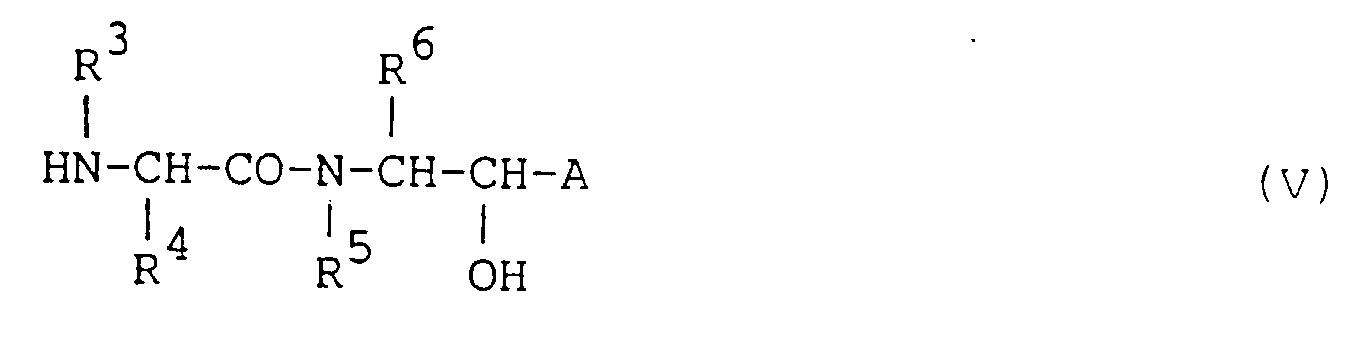

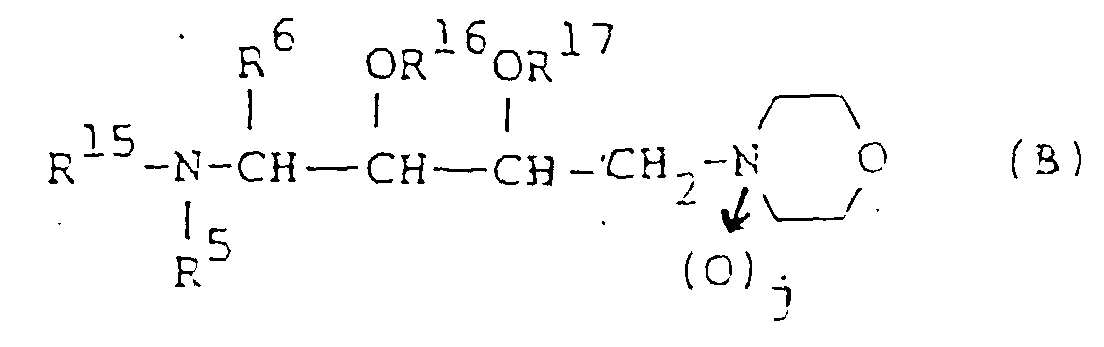
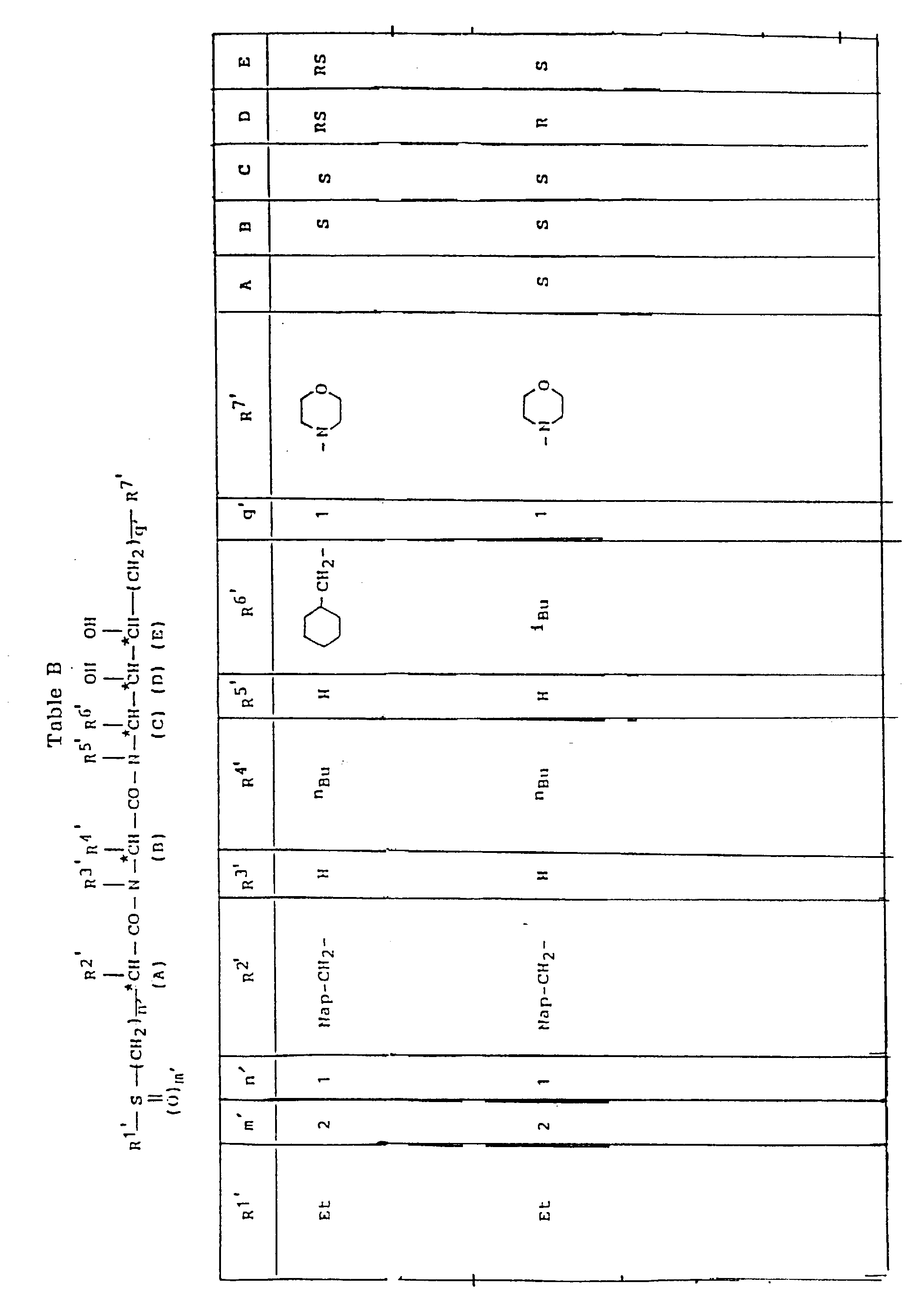

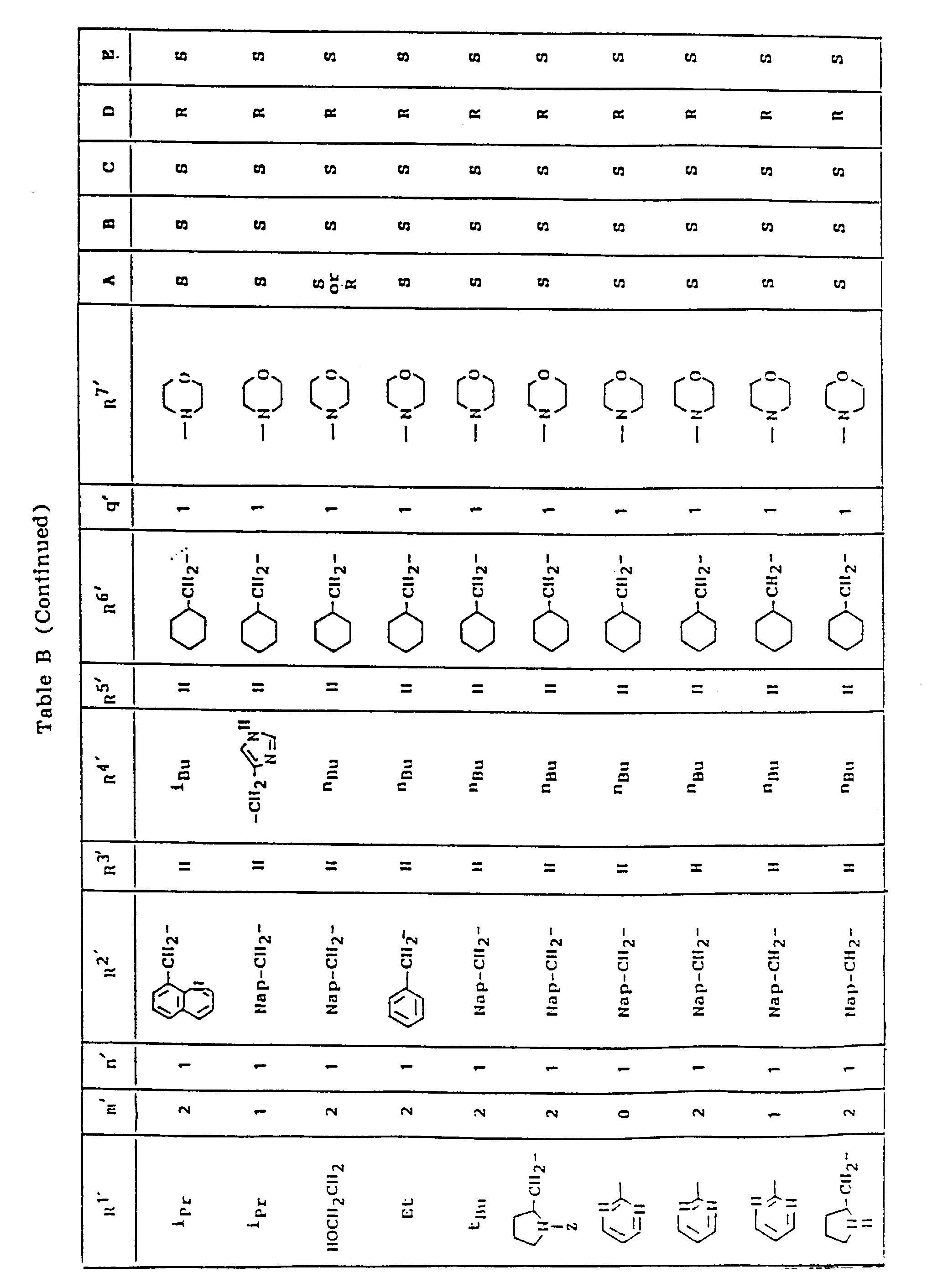
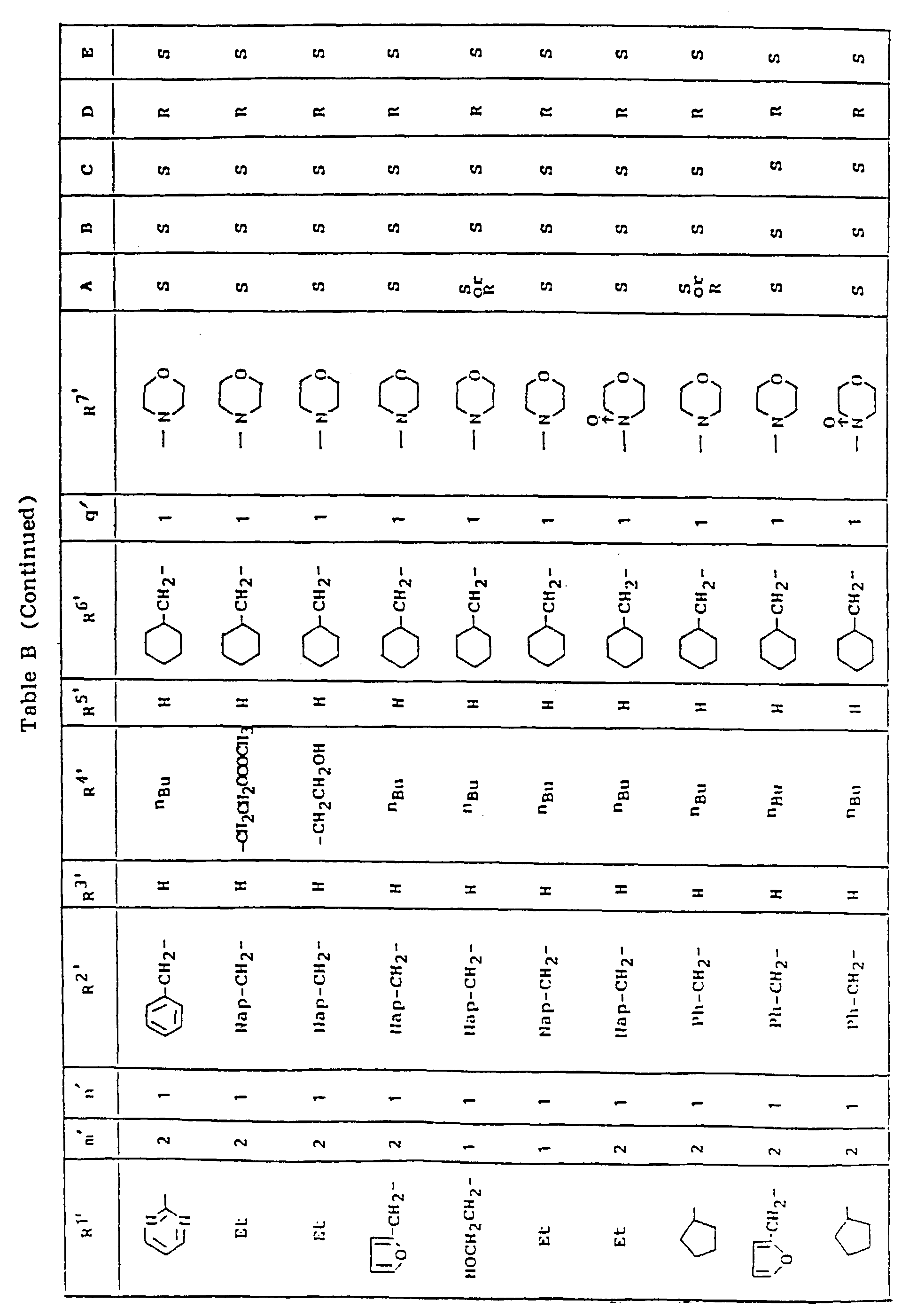

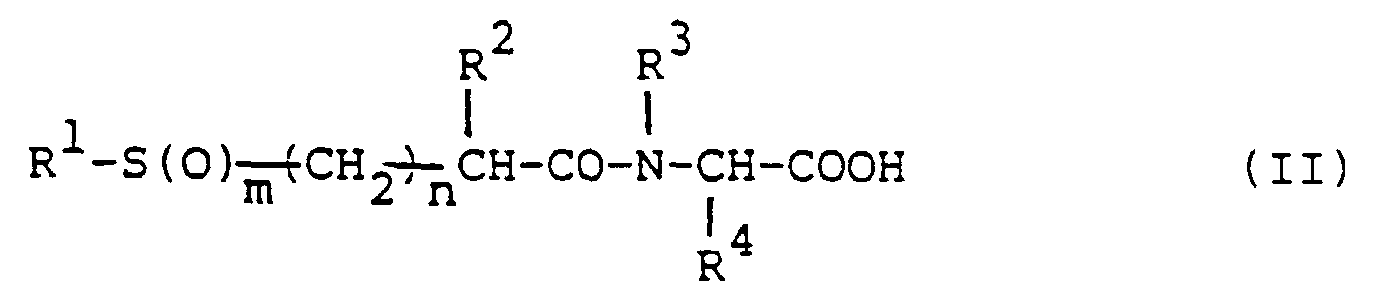
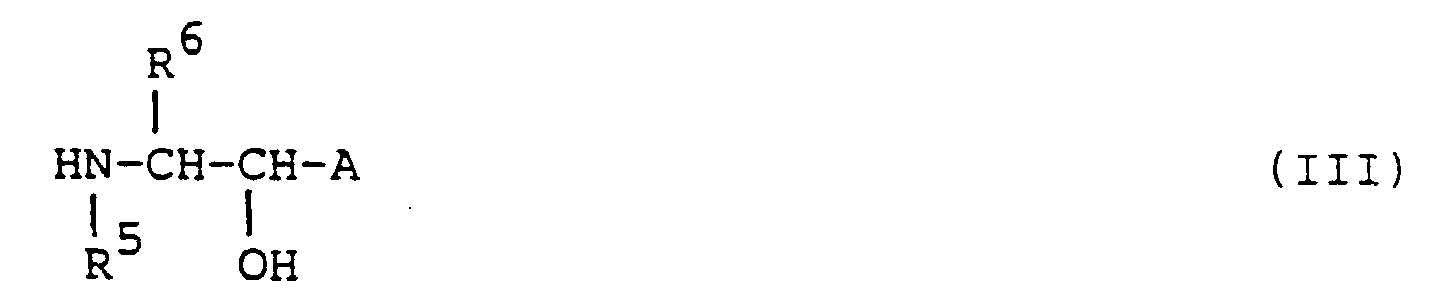

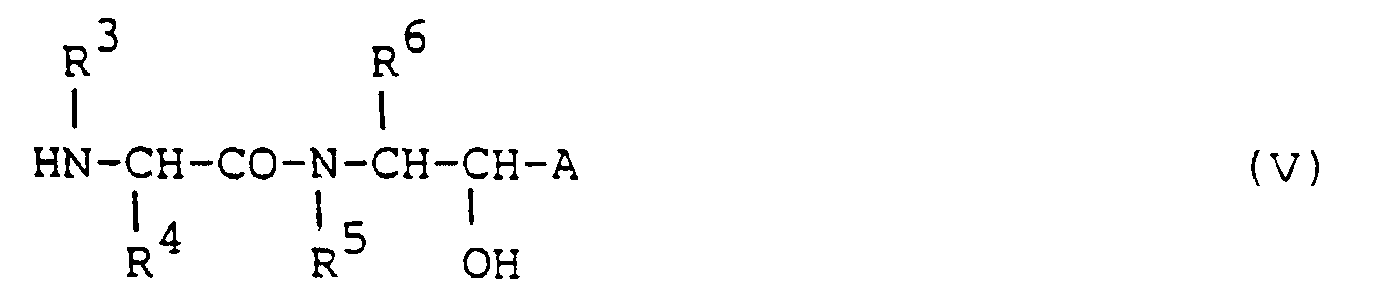


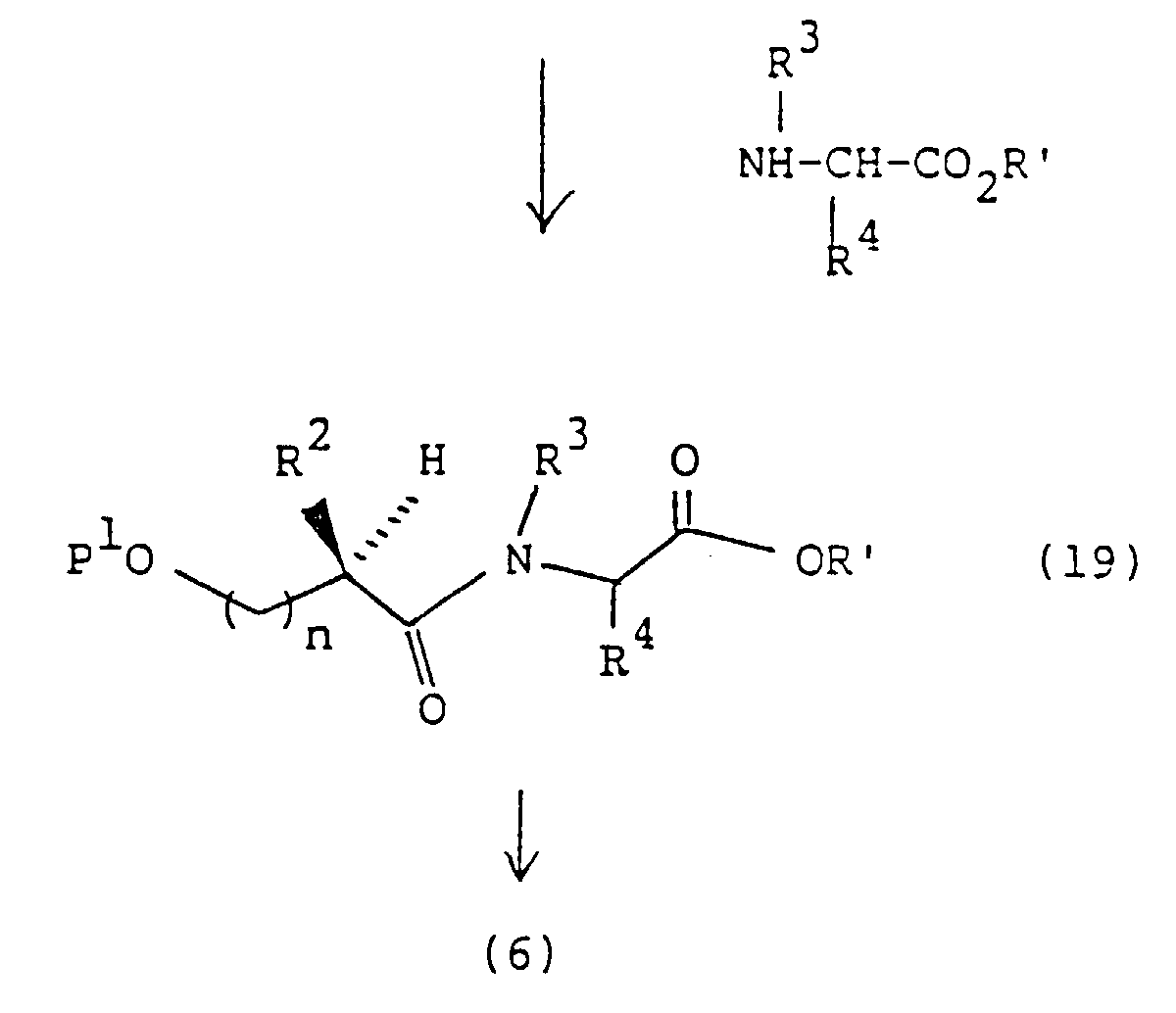

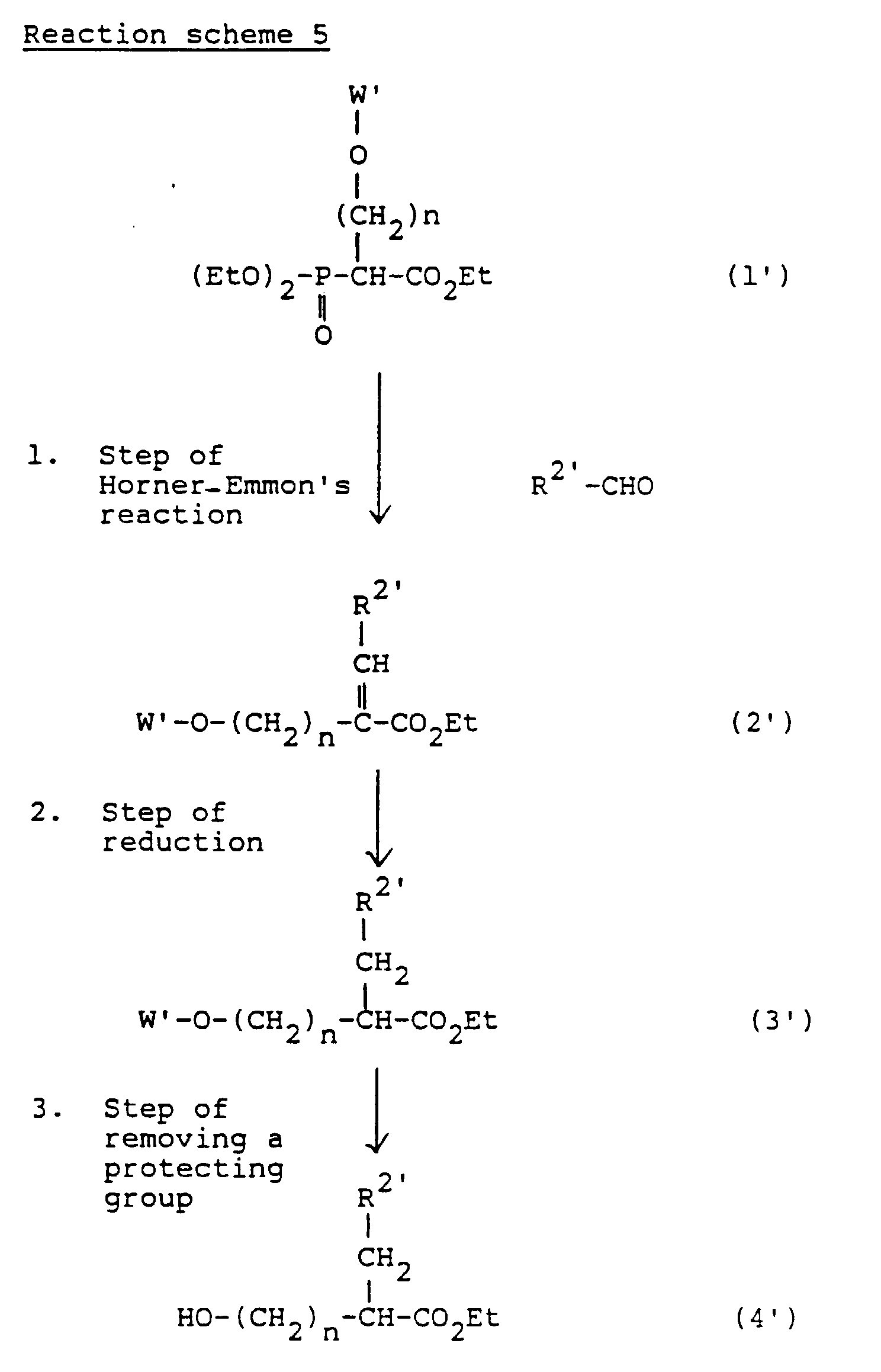

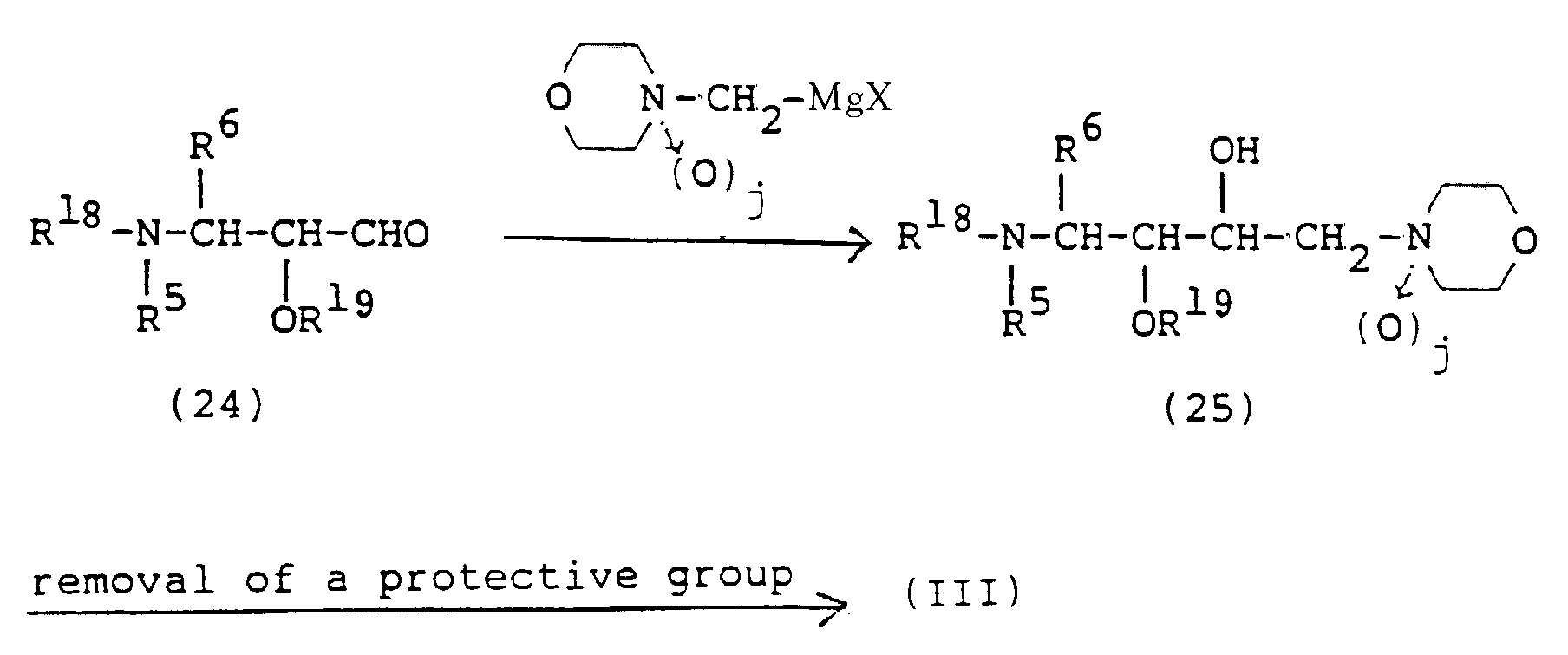
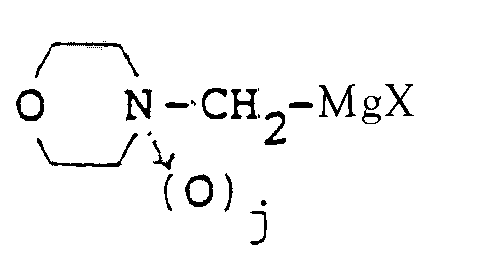
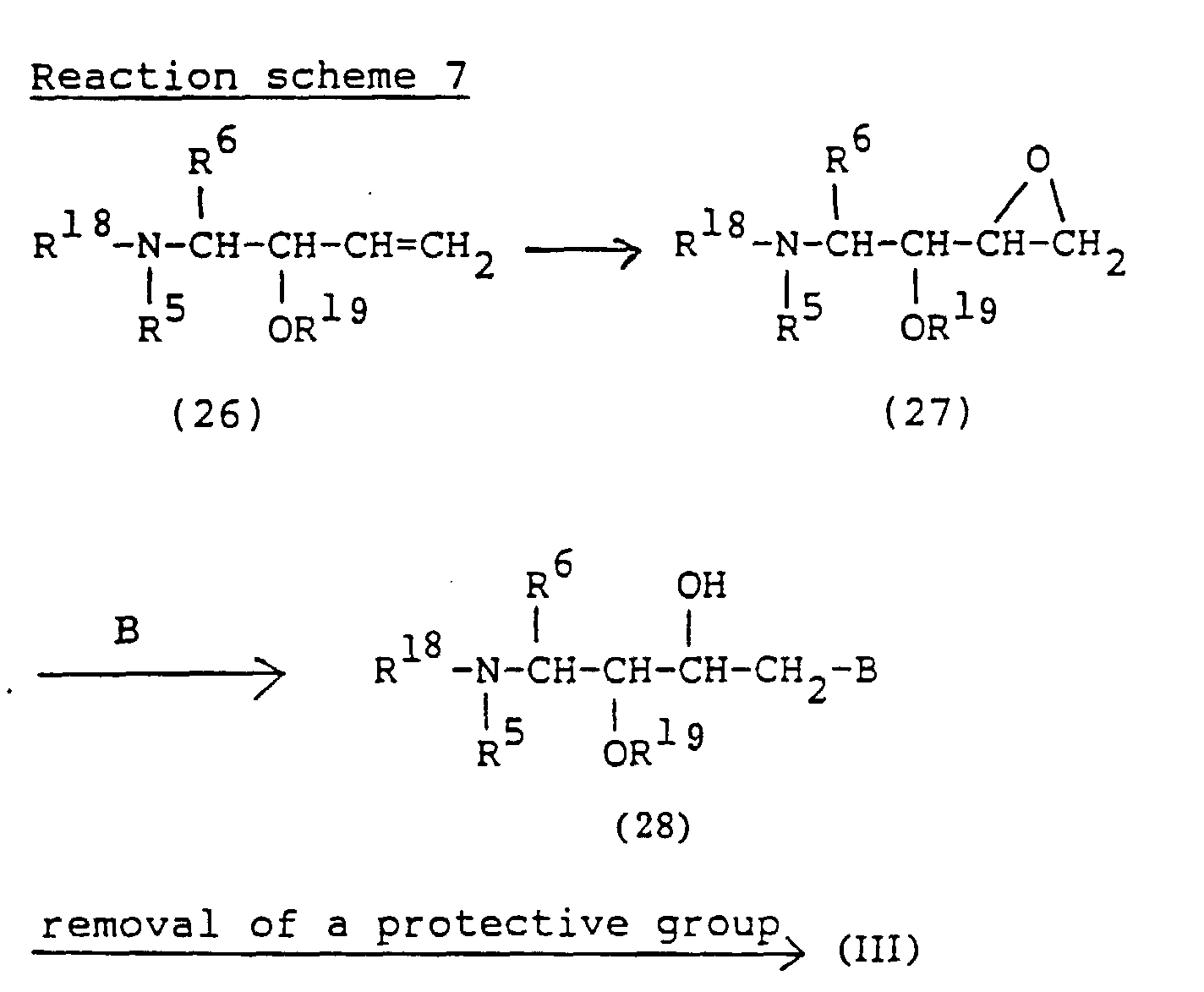

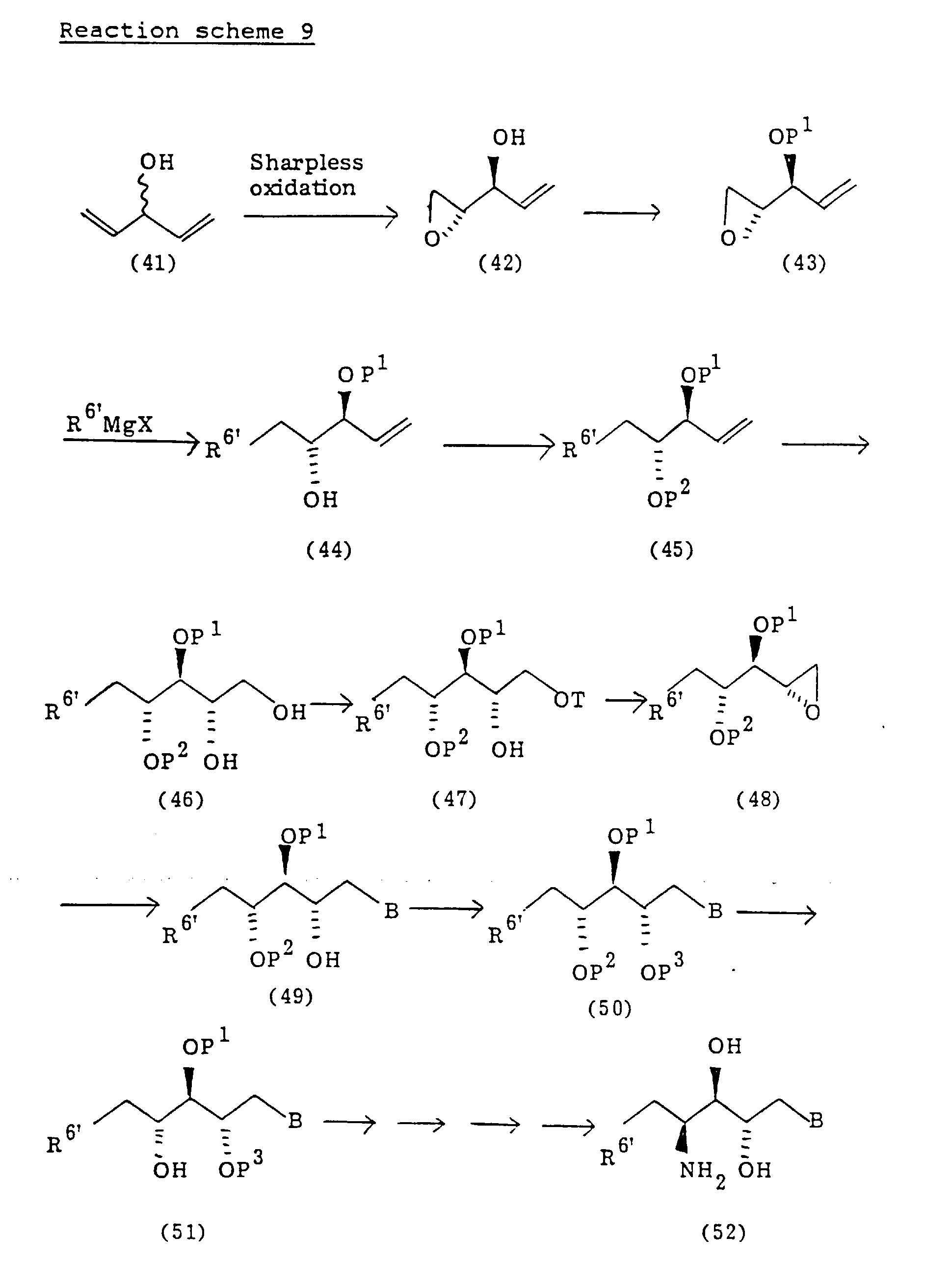
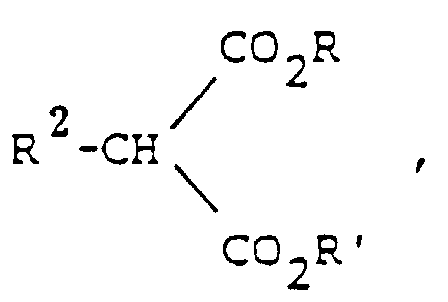
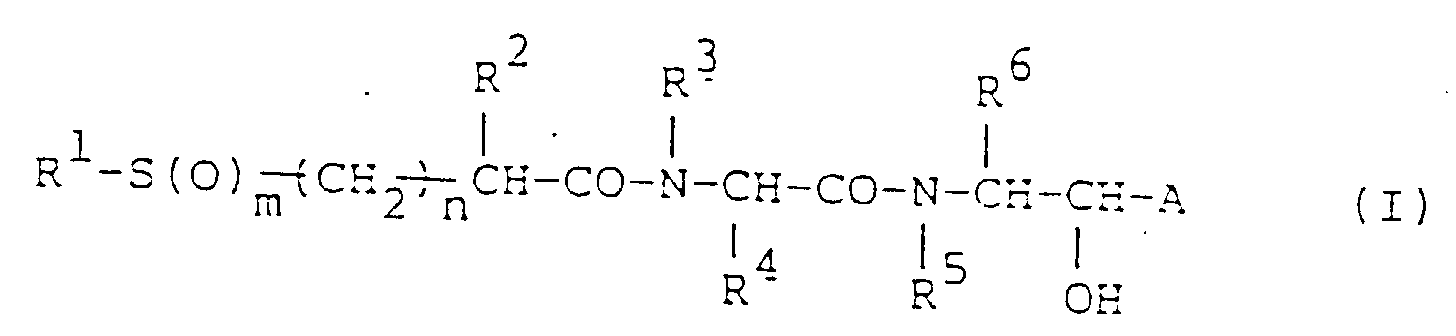
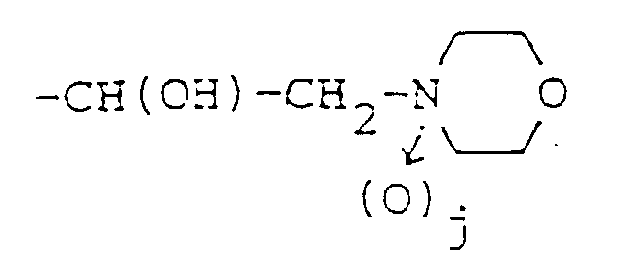
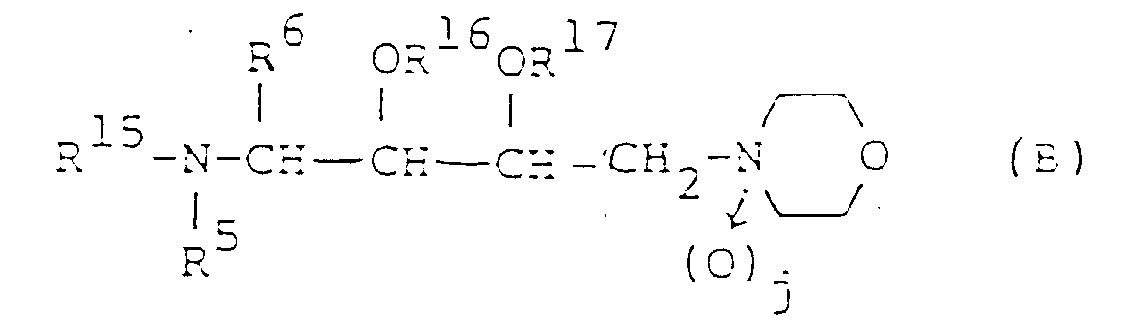
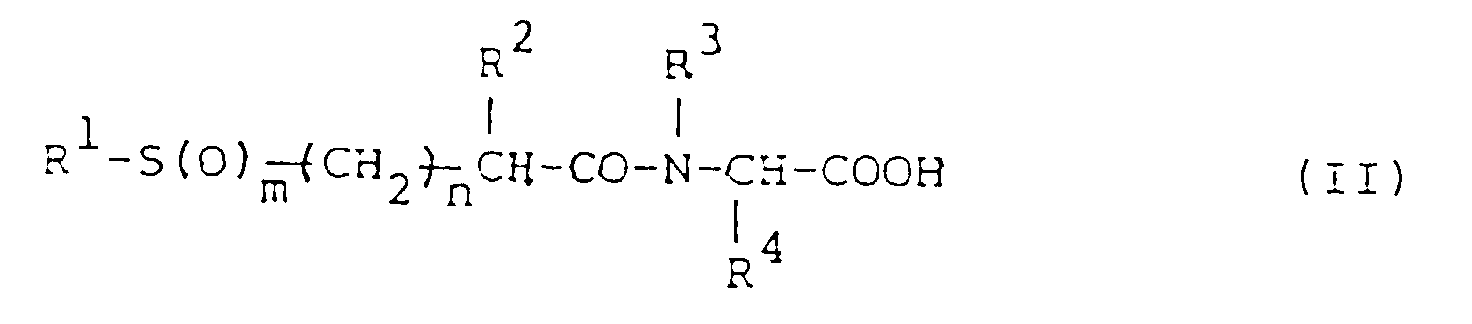 wherein R5, R6 and j are as defined in Claim 1, or condensing a carboxylic acid of the formula:
 wherein R1, R2, m and n are as defined in Claim 1, or a reactive derivative at the carboxyl group thereof with an amino acid amide of the formula:
 wherein R1, R4, R5, R6 and j are as defined in Claim 1.