EP0309622B1 - Method for reducing build up of electrostatic charges on transparent synthetic macromolecular materials selected from polymethyl methycrylate or polycarbonate - Google Patents
Method for reducing build up of electrostatic charges on transparent synthetic macromolecular materials selected from polymethyl methycrylate or polycarbonate Download PDFInfo
- Publication number
- EP0309622B1 EP0309622B1 EP87308575A EP87308575A EP0309622B1 EP 0309622 B1 EP0309622 B1 EP 0309622B1 EP 87308575 A EP87308575 A EP 87308575A EP 87308575 A EP87308575 A EP 87308575A EP 0309622 B1 EP0309622 B1 EP 0309622B1
- Authority
- EP
- European Patent Office
- Prior art keywords
- synthetic macromolecular
- polycarbonate
- alkyl group
- macromolecular materials
- transparent synthetic
- Prior art date
- Legal status (The legal status is an assumption and is not a legal conclusion. Google has not performed a legal analysis and makes no representation as to the accuracy of the status listed.)
- Expired - Lifetime
Links
Classifications
-
- C—CHEMISTRY; METALLURGY
- C07—ORGANIC CHEMISTRY
- C07F—ACYCLIC, CARBOCYCLIC OR HETEROCYCLIC COMPOUNDS CONTAINING ELEMENTS OTHER THAN CARBON, HYDROGEN, HALOGEN, OXYGEN, NITROGEN, SULFUR, SELENIUM OR TELLURIUM
- C07F9/00—Compounds containing elements of Groups 5 or 15 of the Periodic Table
- C07F9/02—Phosphorus compounds
- C07F9/28—Phosphorus compounds with one or more P—C bonds
- C07F9/54—Quaternary phosphonium compounds
-
- C—CHEMISTRY; METALLURGY
- C08—ORGANIC MACROMOLECULAR COMPOUNDS; THEIR PREPARATION OR CHEMICAL WORKING-UP; COMPOSITIONS BASED THEREON
- C08J—WORKING-UP; GENERAL PROCESSES OF COMPOUNDING; AFTER-TREATMENT NOT COVERED BY SUBCLASSES C08B, C08C, C08F, C08G or C08H
- C08J7/00—Chemical treatment or coating of shaped articles made of macromolecular substances
- C08J7/04—Coating
- C08J7/044—Forming conductive coatings; Forming coatings having anti-static properties
-
- C—CHEMISTRY; METALLURGY
- C08—ORGANIC MACROMOLECULAR COMPOUNDS; THEIR PREPARATION OR CHEMICAL WORKING-UP; COMPOSITIONS BASED THEREON
- C08J—WORKING-UP; GENERAL PROCESSES OF COMPOUNDING; AFTER-TREATMENT NOT COVERED BY SUBCLASSES C08B, C08C, C08F, C08G or C08H
- C08J7/00—Chemical treatment or coating of shaped articles made of macromolecular substances
- C08J7/04—Coating
- C08J7/06—Coating with compositions not containing macromolecular substances
- C08J7/065—Low-molecular-weight organic substances, e.g. absorption of additives in the surface of the article
-
- C—CHEMISTRY; METALLURGY
- C08—ORGANIC MACROMOLECULAR COMPOUNDS; THEIR PREPARATION OR CHEMICAL WORKING-UP; COMPOSITIONS BASED THEREON
- C08K—Use of inorganic or non-macromolecular organic substances as compounding ingredients
- C08K5/00—Use of organic ingredients
- C08K5/49—Phosphorus-containing compounds
- C08K5/50—Phosphorus bound to carbon only
-
- C—CHEMISTRY; METALLURGY
- C09—DYES; PAINTS; POLISHES; NATURAL RESINS; ADHESIVES; COMPOSITIONS NOT OTHERWISE PROVIDED FOR; APPLICATIONS OF MATERIALS NOT OTHERWISE PROVIDED FOR
- C09K—MATERIALS FOR MISCELLANEOUS APPLICATIONS, NOT PROVIDED FOR ELSEWHERE
- C09K3/00—Materials not provided for elsewhere
- C09K3/16—Anti-static materials
Definitions
- This invention relates to a method for reducing the build up of electrostatic charges on transparent synthetic macromolecular materials selected from polymethyl methacrylate or polycarbonate.
- Synthetic macromolecular materials are generally hydrophobic. As a result, they tend to become electrostatically charged and this property is a serious obstacle not only in the production of such materials but also in using the products.
- electrically conductive agents such as carbon and metal particles, or surfactants were used in attempts to reduce electrostatic charges on synthetic macromolecular materials, either by mixing the components together or by coating the polymer with a suitable agent.
- electrically conductive agents such as carbon and metal particles, or surfactants were used in attempts to reduce electrostatic charges on synthetic macromolecular materials, either by mixing the components together or by coating the polymer with a suitable agent.
- antistats having surfactants as their main constituent,and appropriate antistats may be selected according to the situation.
- anionic surfactants are difficult to handle because they are of inferior compatibility and do not disperse uniformly, or else tend to decompose or deteriorate when heated.
- Cationic surfactants containing quaternary nitrogen in their molecules, and amphoteric surfactants can be used only in a narrow range of situations because, although their antistatic characteristics are good, they are extremely poor in heat resistance.
- Non-ionic surfactants are relatively superior to ionic surfactants as regarding compatibility with synthetic macromolecular materials, but tend to be of weak antistatic characteristics,with effects which disappear with time at high or even normal temperatures.
- metal salts of organic sulfonic acids have been reported as internally applied (i.e. compounded) antistats for polycarbonate and polyester resins which are moulded at high temperatures (West German Patent 3, 004, 017), they are not sufficiently compatible with resins and possess inadequate heat resistance.
- the present invention sets out to provide a new method of reducing electrostatic charges, by which the aforementioned problems of conventional method can be reduced or eliminated.
- the present inventors have discovered that applying phosphonium sulfonates of a special type is a desirable way of reducing electrostatic charges upon transparent synthetic macromolecular materials selected from polymethyl methacrylate or polycarbonate, without causing turbidity and discolouration.
- Phosphonium sulfonate as shown by (I) is composed of an organic sulfonate anion and an organic phosphonium cation.
- the phosphonium sulfonate of the present invention can be produced by mixing the metal salt of the corresponding organic sulfonate and quaternary phosphonium salt in a solvent and washing out the byproduct inorganic salt with water, or extracting the product with an organic solvent such as methanol, isopropanol or acetone.
- Tetrabutyl phosphonium dodecylbenzene sulfonate for example, can be produced with a yield of about 90% by placing 34.8g of sodim dodecylbenzene sulfonate, 33.9g of tetrabutyl phosphonium bromide and 200ml of water in a flask, stirring the mixture for one hour at 80°C, isolating phosphonium sulfonate which separates as an oily layer, washing it with 50ml of warm water and dehydrating by means of an evaporator.
- Antistats having phosphonium sulfonate shown by formula (I) as principal components can be used with transparent synthetic macromolecular materials selected from polymethyl methacrylate or polycarbonate in two different ways to make use of their antistatic characteristics and the heat resistance of such antistatic characteristics.
- One of the methods is to add the antistat internally to, i.e. compound it with, such a synthetic macromolecular material.
- a common way to practice this method is to add the agent directly and to mix it in at the time of polymer production or fabrication.
- Another method involves preliminary preparation of master chips containing the agent at a high concentration. Such common methods can be used equally well with the present invention.
- an antistat agent in the case of polymethyl methacrylate and polycarbonate, an antistat agent can be added and mixed together either directly or as master chips at the time of fabrication. It can also be added at the time of cast-moulding of polymethyl methacrylate.
- the agent of the present invention it is preferable to add the agent of the present invention at the rate of 0.1-10wt% with respect to the thermoplastic resin material and it is even more preferable to do so at the rate of 0.3-5wt%.
- Antistats of the present invention are more strongly resistant to heat than the conventional ionic surfactants, such as anionic, cationic and amphoteric surfactants, or than non-ionic surfactants. Since phosphonium with a hydrocarbon group having no other substituent is superior in heat resistance, it is particularly useful with synthetic macromolecular materials such as polycarbonate requiring high fabrication temperatures.
- An antistat compound of formula (I) has the advantage of not having the problems of turbidity and colouring which might be present in aformentioned transparent synthetic macromolecular materials.
- a Brabender mill (produced by Toyo Seiki, Inc) was used to mix specified amounts of the antistats of the present invention described in Table 1A with polymethyl methacrylate and polycarbonate. These resin compositions were used to mold sheets of 2mm in thickness by using a hot press (produced by Toyo Seiki, Inc).After each blank sheet was visually inspected and compared with a blank, it was left for one night at constant temperature and humidity of 10°C x65%RH and its surface resistance was measured thereafter in the same environmental conditions by using a super megohm meter (Model SM-5E produced by Toa Denpa Kogyo, Inc).
Landscapes
- Chemical & Material Sciences (AREA)
- Organic Chemistry (AREA)
- Health & Medical Sciences (AREA)
- Polymers & Plastics (AREA)
- Chemical Kinetics & Catalysis (AREA)
- Medicinal Chemistry (AREA)
- General Health & Medical Sciences (AREA)
- Molecular Biology (AREA)
- Biochemistry (AREA)
- Life Sciences & Earth Sciences (AREA)
- Engineering & Computer Science (AREA)
- Materials Engineering (AREA)
- Compositions Of Macromolecular Compounds (AREA)
- Paints Or Removers (AREA)
- Coating Of Shaped Articles Made Of Macromolecular Substances (AREA)
Description
- This invention relates to a method for reducing the build up of electrostatic charges on transparent synthetic macromolecular materials selected from polymethyl methacrylate or polycarbonate.
- Synthetic macromolecular materials are generally hydrophobic. As a result, they tend to become electrostatically charged and this property is a serious obstacle not only in the production of such materials but also in using the products.
- In the past, electrically conductive agents, such as carbon and metal particles, or surfactants were used in attempts to reduce electrostatic charges on synthetic macromolecular materials, either by mixing the components together or by coating the polymer with a suitable agent. These methods are however not generally feasible for many reasons such as the large amount of such agent which must be used, difficulty of adding such agent to materials, the difficulty of obtaining a transparent product and high cost of such conductive agents. Thus, such electrically conductive agents can be used only in limited situations.
- There are however many antistats having surfactants as their main constituent,and appropriate antistats may be selected according to the situation.
- Many of the type to be internally compounded have been considered and tried. When used in this way, however, anionic surfactants are difficult to handle because they are of inferior compatibility and do not disperse uniformly, or else tend to decompose or deteriorate when heated. Cationic surfactants containing quaternary nitrogen in their molecules, and amphoteric surfactants, can be used only in a narrow range of situations because, although their antistatic characteristics are good, they are extremely poor in heat resistance. Non-ionic surfactants are relatively superior to ionic surfactants as regarding compatibility with synthetic macromolecular materials, but tend to be of weak antistatic characteristics,with effects which disappear with time at high or even normal temperatures.
- Although metal salts of organic sulfonic acids have been reported as internally applied (i.e. compounded) antistats for polycarbonate and polyester resins which are moulded at high temperatures (West German Patent 3, 004, 017), they are not sufficiently compatible with resins and possess inadequate heat resistance.
- There has also been a report on using phosphonium salts of organic sulfonic acids having a halogen substituent as a flame retardant (U.S. Patent 4,093,589); and a further report on using phosphonium salts with a conductive polymer as an antistatic composition (U.S. Patent 4005057). However the former is not expected to function as an antistat and the latter is not expected to provide a transparent antistatic thermoplastic resin composition.
- The present invention sets out to provide a new method of reducing electrostatic charges, by which the aforementioned problems of conventional method can be reduced or eliminated.
- The present inventors have discovered that applying phosphonium sulfonates of a special type is a desirable way of reducing electrostatic charges upon transparent synthetic macromolecular materials selected from polymethyl methacrylate or polycarbonate, without causing turbidity and discolouration.
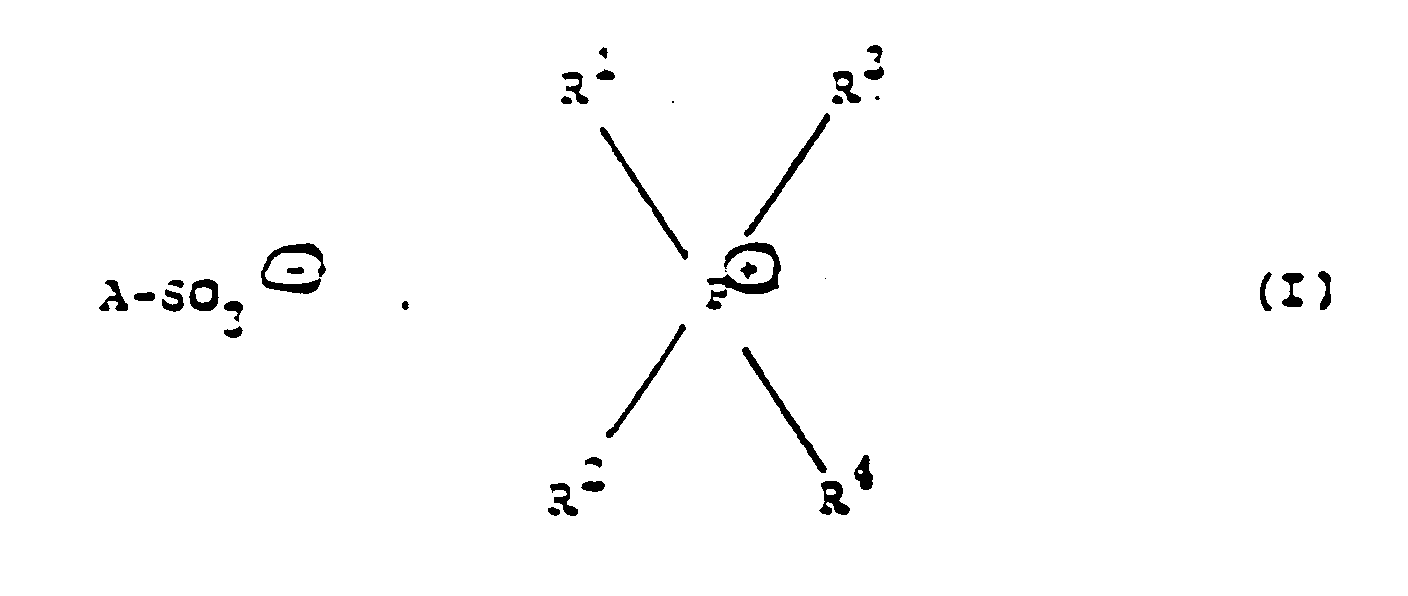
- In accordance with the present invention there is provided a method for reducing the build-up of electrostatic charge without causing turbidity or discolouration upon transparent synthetic macromolecular materials selected from polymethyl methacrylate or polycarbonate in which an antistat comprising phosphonium sulfonate per se or phosphonium sulphonate compounded into master chips of the material is incorporated therein during production or fabrication thereof, the phosphonium sulfonate being shown by the general formula (I) below:

- Phosphonium sulfonate as shown by (I) is composed of an organic sulfonate anion and an organic phosphonium cation.
- The phosphonium sulfonate of the present invention can be produced by mixing the metal salt of the corresponding organic sulfonate and quaternary phosphonium salt in a solvent and washing out the byproduct inorganic salt with water, or extracting the product with an organic solvent such as methanol, isopropanol or acetone. Tetrabutyl phosphonium dodecylbenzene sulfonate, for example, can be produced with a yield of about 90% by placing 34.8g of sodim dodecylbenzene sulfonate, 33.9g of tetrabutyl phosphonium bromide and 200ml of water in a flask, stirring the mixture for one hour at 80°C, isolating phosphonium sulfonate which separates as an oily layer, washing it with 50ml of warm water and dehydrating by means of an evaporator.
- Antistats having phosphonium sulfonate shown by formula (I) as principal components can be used with transparent synthetic macromolecular materials selected from polymethyl methacrylate or polycarbonate in two different ways to make use of their antistatic characteristics and the heat resistance of such antistatic characteristics. One of the methods is to add the antistat internally to, i.e. compound it with, such a synthetic macromolecular material. A common way to practice this method is to add the agent directly and to mix it in at the time of polymer production or fabrication. Another method involves preliminary preparation of master chips containing the agent at a high concentration. Such common methods can be used equally well with the present invention. Thus, in the case of polymethyl methacrylate and polycarbonate, an antistat agent can be added and mixed together either directly or as master chips at the time of fabrication. It can also be added at the time of cast-moulding of polymethyl methacrylate. In order to obtain a favourable result of such an internal application method, it is preferable to add the agent of the present invention at the rate of 0.1-10wt% with respect to the thermoplastic resin material and it is even more preferable to do so at the rate of 0.3-5wt%. Antistats of the present invention are more strongly resistant to heat than the conventional ionic surfactants, such as anionic, cationic and amphoteric surfactants, or than non-ionic surfactants. Since phosphonium with a hydrocarbon group having no other substituent is superior in heat resistance, it is particularly useful with synthetic macromolecular materials such as polycarbonate requiring high fabrication temperatures.
- An antistat compound of formula (I) has the advantage of not having the problems of turbidity and colouring which might be present in aformentioned transparent synthetic macromolecular materials.
- In what follows, examples of the present invention are given explaining more clearly the present invention.
- The scope of the present invention as claimed is not intended to be limited by these examples.
- A Brabender mill (produced by Toyo Seiki, Inc) was used to mix specified amounts of the antistats of the present invention described in Table 1A with polymethyl methacrylate and polycarbonate. These resin compositions were used to mold sheets of 2mm in thickness by using a hot press (produced by Toyo Seiki, Inc).After each blank sheet was visually inspected and compared with a blank, it was left for one night at constant temperature and humidity of 10°C x65%RH and its surface resistance was measured thereafter in the same environmental conditions by using a super megohm meter (Model SM-5E produced by Toa Denpa Kogyo, Inc).
- The results are shown in Table 1A wherein *1 indicates log Ω, *2 indicates a mixture with average chain length of C22 H45, Ø indicates a benzene ring, PMMA indicates polymethyl methacrylate, PC indicates polycarbonate, good indicates no colouring and no turbidity, and wherein mixing was effected under the condition of 130°C x 5 minutes for PMMA, 260°C x 5 minutes for PC and A, R1 - R4 are as explained in connection with the formula (I).
TABLE 1A (Test Examples) RESINS ANTISTATS RESULTS TYPE A R1 R2 R3 R4 WT% SURFACE RESISTANCE *1 APPEARANCE PMMA 2a C9H19Ø C4H9 C4H9 C4H9 C4H9 4 9.3 Good 2a C9H19Ø C4H9 C4H9 C4H9 C4H9 2 10.3 Good 2a C9H19Ø C4H9 C4H9 C4H9 C4H9 1 10.9 Good 2b C9H19Ø Ø Ø Ø CH3 2 10.5 Good 2c C14H29 C4H9 C4H9 C4H9 C4H9 2 9.8 Good 2d *2 C8H17 C8H17 C8H17 CH3 2 10.6 Good 2i C12H25Ø C4H9 C4H9 C4H9 C4H9 2 10.4 Good 2j C13H27Ø C2H5 C2H5 C2H5 C2H5 2 10.0 Good PC 2a C9H19Ø C4H9 C4H9 C4H9 C4H9 2 11.1 Good 2b C9H19Ø Ø Ø Ø CH3 2 11.5 Good 2e C8H17 C4H9 C4H9 C4H9 Ø-CH2 2 10.4 Good 2i C12H25Ø C4H9 C4H9 C4H9 C4H9 2 10.9 Good - Conventional antistats in Table 2 were used for similar tests as described above. The results of comparisons and measurements are shown in Table 2.
TABLE 2 (Comparison Examples) RESINS ANTISTATS RESULTS TYPE WT% SURFACE RESISTANCE *1 APPEARANCE PMMA a' Dodecylbenzene sulfonate Na 4 11.3 White,turbid a' Dodecylbenzene sulfonate Na 2 12.8 White,turbid b' Alkyl (C = 14-15) sulfonate Na 2 11.1 White,turbid c' Glycerine monostearate 2 13< Good d' Lauryltrimethyl ammonium chloride 2 12.0 Turbid, Yellowing e' Lauryltrimethyl ammonium tosilate 2 11.8 Yellowing h' Tetrabutyl phosphonium paraamino benzene sulfonate 2 11.5 Yellowing PC a' Dodecylbenzene sulfonate Na 2 12.8 Turbid Yellowing c' Glycerine monostearate 2 13< Slight Yellowing e' Lauryltrimethyl ammonium tosilate 2 12.7 Yellowing i' Tetraphenyl phosphonium trichlorobenzene sulfonate 2 13< Good - The tables presented above show clearly that the present invention not only has resistance against heat and humidity but also has improved antistatic characteristics and good appearance.
Claims (3)
- A method for reducing the build-up of electrostatic charge without causing turbidity or discolouration upon transparent synthetic macromolecular materials selected from polymethyl methacrylate or polycarbonate in which an antistat comprising phosphonium sulfonate per se or phosphonium sulfonate compounded into master chips of the materials is incorporated therein during production or fabrication thereof, the phosphonium sulfonate being shown by the general formula (I) below:
- A method as claimed in claim 1 in which from 0.1-10wt% of the antistat with respect to the synthetic macromolecular material is incorporated.
- A method as claimed in claim 2 in which 0.3 to 5wt% of the antistat with respect to the synthetic macromolecular material is incorporated.
Priority Applications (2)
| Application Number | Priority Date | Filing Date | Title |
|---|---|---|---|
| DE3752023T DE3752023T2 (en) | 1987-09-28 | 1987-09-28 | Process for the reduction of electrostatic charges on transparent synthetic macromolecular materials selected from polymethyl methacrylate or polycarbonate |
| EP87308575A EP0309622B1 (en) | 1987-09-28 | 1987-09-28 | Method for reducing build up of electrostatic charges on transparent synthetic macromolecular materials selected from polymethyl methycrylate or polycarbonate |
Applications Claiming Priority (1)
| Application Number | Priority Date | Filing Date | Title |
|---|---|---|---|
| EP87308575A EP0309622B1 (en) | 1987-09-28 | 1987-09-28 | Method for reducing build up of electrostatic charges on transparent synthetic macromolecular materials selected from polymethyl methycrylate or polycarbonate |
Publications (2)
| Publication Number | Publication Date |
|---|---|
| EP0309622A1 EP0309622A1 (en) | 1989-04-05 |
| EP0309622B1 true EP0309622B1 (en) | 1997-03-05 |
Family
ID=8198050
Family Applications (1)
| Application Number | Title | Priority Date | Filing Date |
|---|---|---|---|
| EP87308575A Expired - Lifetime EP0309622B1 (en) | 1987-09-28 | 1987-09-28 | Method for reducing build up of electrostatic charges on transparent synthetic macromolecular materials selected from polymethyl methycrylate or polycarbonate |
Country Status (2)
| Country | Link |
|---|---|
| EP (1) | EP0309622B1 (en) |
| DE (1) | DE3752023T2 (en) |
Cited By (1)
| Publication number | Priority date | Publication date | Assignee | Title |
|---|---|---|---|---|
| US7211690B2 (en) | 2004-04-13 | 2007-05-01 | General Electric Company | Methods of making an antistatic agent |
Families Citing this family (7)
| Publication number | Priority date | Publication date | Assignee | Title |
|---|---|---|---|---|
| USRE38530E1 (en) * | 1997-07-23 | 2004-06-08 | General Electric Company | Anti-static resin composition containing fluorinated phosphonium sulfonates |
| US6194497B1 (en) * | 1997-07-23 | 2001-02-27 | General Electric Company | Anti-static resin composition containing fluorinated phosphonium sulfonates |
| CN1643053A (en) * | 2002-02-08 | 2005-07-20 | 通用电气公司 | Thermoplastic resin composition and method for improving appearance |
| JP2003231815A (en) | 2002-02-08 | 2003-08-19 | Ge Plastics Japan Ltd | Thermoplastic resin composition and method for ameliorating soil pattern |
| CN113646850A (en) * | 2019-03-29 | 2021-11-12 | 日清纺控股株式会社 | Conductive metal paste |
| FR3142042B1 (en) * | 2022-11-16 | 2025-07-18 | Solvionic | COMPOUND BASED ON (2-CYANOETHYL)PHOSPHONIUM SALT, ELECTROLYTE AND BATTERY COMPRISING IT |
| FR3141940A1 (en) * | 2022-11-16 | 2024-05-17 | Solvionic | (2-CYANOETHYL)PHOSPHONIUM SALT, METHOD FOR SYNTHESIS THEREOF AND ITS USE AS AN ELECTROLYTE COMPOUND, AS A LUBRICANT, AS A LUBRICANT ADDITIVE, AS A GAS CAPTURE AGENT AND AS AS A SOLVENT FOR CATALYSIS. |
Family Cites Families (4)
| Publication number | Priority date | Publication date | Assignee | Title |
|---|---|---|---|---|
| DE2044931A1 (en) * | 1970-09-11 | 1972-03-16 | Hoechst Ag | Thread-forming synthetic linear high molecular weight polyester |
| US3755459A (en) * | 1971-01-22 | 1973-08-28 | Rorer Inc William H | Phenylphosphonium salts |
| US4006123A (en) * | 1973-10-03 | 1977-02-01 | E. I. Du Pont De Nemours And Company | Conductive aliphatic polyester or polyetherester having units containing phosphonium sulfonate groups |
| US4005057A (en) * | 1973-10-09 | 1977-01-25 | E. I. Du Pont De Nemours And Company | Antistatic composition containing an N-alkyl polycarbonamide and a phosphonium salt |
-
1987
- 1987-09-28 DE DE3752023T patent/DE3752023T2/en not_active Expired - Fee Related
- 1987-09-28 EP EP87308575A patent/EP0309622B1/en not_active Expired - Lifetime
Cited By (3)
| Publication number | Priority date | Publication date | Assignee | Title |
|---|---|---|---|---|
| US7211690B2 (en) | 2004-04-13 | 2007-05-01 | General Electric Company | Methods of making an antistatic agent |
| US7309735B2 (en) | 2004-04-13 | 2007-12-18 | General Electric Company | Method of making a thermoplastic composition containing an antistatic agent |
| US7429628B2 (en) | 2004-04-13 | 2008-09-30 | Sabic Innovative Plastics Ip B.V. | Method of making a thermoplastic composition containing an antistatic agent |
Also Published As
| Publication number | Publication date |
|---|---|
| DE3752023T2 (en) | 1997-07-24 |
| DE3752023D1 (en) | 1997-04-10 |
| EP0309622A1 (en) | 1989-04-05 |
Similar Documents
| Publication | Publication Date | Title |
|---|---|---|
| US4943380A (en) | Antistatic resin composition with transparency containing phosphonium sulphonate | |
| AU750137B2 (en) | Anti-static resin compositions and molded articles therefrom | |
| US4374760A (en) | Electro conductive polymer compositions and new materials found useful in their preparation | |
| EP0242732B1 (en) | Flame proof polyamides | |
| CA1085080A (en) | Antistatic agent for thermoplastic synthetic resins | |
| JP2909735B2 (en) | Antistatic agent for resin with excellent heat resistance and antistatic resin composition | |
| EP0456151A1 (en) | Antistatic polymeric composition | |
| DE3752023T2 (en) | Process for the reduction of electrostatic charges on transparent synthetic macromolecular materials selected from polymethyl methacrylate or polycarbonate | |
| EP0103106A1 (en) | Use of a low molecular 1,3-butadiene polymer containing amino groups as a stabilizer for plastics | |
| EP0310977A2 (en) | Glass fibre reinforced thermoplastic moulding compositions based on polyesters and graft polymers | |
| EP0382957A1 (en) | Antistatic resin composition with transparency | |
| EP0025018B1 (en) | Flame-resistant plastics moulding composition | |
| DE2605794B2 (en) | POLYAMIDE COMPOUNDS WITH IMPROVED THERMAL STABILITY | |
| US4301062A (en) | Diester of 3,5,3',5'-tetrabromo-bisphenol A with halogenated aromatic carboxylic acid | |
| USRE38530E1 (en) | Anti-static resin composition containing fluorinated phosphonium sulfonates | |
| EP1737814B1 (en) | Methods of making an antistatic agent | |
| US3932362A (en) | Amorphous polyamide of C-alkyl substituted diamine and terephthalic acid dialkyl ester having improved electrical creep resistance | |
| EP0426243B1 (en) | Polyamide moulding compositions | |
| JPH0770361A (en) | Antistatic agent | |
| US4469637A (en) | Electro conductive polymer compositions and new materials found useful in their preparation | |
| DE1544887A1 (en) | Process for the antistatic finishing of high molecular weight compounds | |
| DE4412366A1 (en) | Antistatic plastic molding compound | |
| US3935251A (en) | 2,4,8-Trichloro-tri and tetra bromodibenzofurans | |
| KR910008682B1 (en) | Process for producing flame retardant polyamide resin composition | |
| JPH08259927A (en) | Antistatic agent and synthetic resin containing the same |
Legal Events
| Date | Code | Title | Description |
|---|---|---|---|
| PUAI | Public reference made under article 153(3) epc to a published international application that has entered the european phase |
Free format text: ORIGINAL CODE: 0009012 |
|
| 17P | Request for examination filed |
Effective date: 19890126 |
|
| AK | Designated contracting states |
Kind code of ref document: A1 Designated state(s): DE FR GB |
|
| 17Q | First examination report despatched |
Effective date: 19901218 |
|
| GRAG | Despatch of communication of intention to grant |
Free format text: ORIGINAL CODE: EPIDOS AGRA |
|
| GRAH | Despatch of communication of intention to grant a patent |
Free format text: ORIGINAL CODE: EPIDOS IGRA |
|
| GRAH | Despatch of communication of intention to grant a patent |
Free format text: ORIGINAL CODE: EPIDOS IGRA |
|
| GRAA | (expected) grant |
Free format text: ORIGINAL CODE: 0009210 |
|
| AK | Designated contracting states |
Kind code of ref document: B1 Designated state(s): DE FR GB |
|
| REF | Corresponds to: |
Ref document number: 3752023 Country of ref document: DE Date of ref document: 19970410 |
|
| ET | Fr: translation filed | ||
| PLBE | No opposition filed within time limit |
Free format text: ORIGINAL CODE: 0009261 |
|
| STAA | Information on the status of an ep patent application or granted ep patent |
Free format text: STATUS: NO OPPOSITION FILED WITHIN TIME LIMIT |
|
| 26N | No opposition filed | ||
| REG | Reference to a national code |
Ref country code: GB Ref legal event code: IF02 |
|
| PGFP | Annual fee paid to national office [announced via postgrant information from national office to epo] |
Ref country code: FR Payment date: 20050823 Year of fee payment: 19 |
|
| PGFP | Annual fee paid to national office [announced via postgrant information from national office to epo] |
Ref country code: DE Payment date: 20050922 Year of fee payment: 19 |
|
| PGFP | Annual fee paid to national office [announced via postgrant information from national office to epo] |
Ref country code: GB Payment date: 20050928 Year of fee payment: 19 |
|
| PG25 | Lapsed in a contracting state [announced via postgrant information from national office to epo] |
Ref country code: DE Free format text: LAPSE BECAUSE OF NON-PAYMENT OF DUE FEES Effective date: 20070403 |
|
| GBPC | Gb: european patent ceased through non-payment of renewal fee |
Effective date: 20060928 |
|
| REG | Reference to a national code |
Ref country code: FR Ref legal event code: ST Effective date: 20070531 |
|
| PG25 | Lapsed in a contracting state [announced via postgrant information from national office to epo] |
Ref country code: GB Free format text: LAPSE BECAUSE OF NON-PAYMENT OF DUE FEES Effective date: 20060928 |
|
| PG25 | Lapsed in a contracting state [announced via postgrant information from national office to epo] |
Ref country code: FR Free format text: LAPSE BECAUSE OF NON-PAYMENT OF DUE FEES Effective date: 20061002 |