EP0307078A1 - Quinoline derivatives, process for their preparation and pharmaceutical compositions containing them - Google Patents
Quinoline derivatives, process for their preparation and pharmaceutical compositions containing them Download PDFInfo
- Publication number
- EP0307078A1 EP0307078A1 EP88306583A EP88306583A EP0307078A1 EP 0307078 A1 EP0307078 A1 EP 0307078A1 EP 88306583 A EP88306583 A EP 88306583A EP 88306583 A EP88306583 A EP 88306583A EP 0307078 A1 EP0307078 A1 EP 0307078A1
- Authority
- EP
- European Patent Office
- Prior art keywords
- hydrogen
- quinoline
- methyl
- methylphenyl
- compound
- Prior art date
- Legal status (The legal status is an assumption and is not a legal conclusion. Google has not performed a legal analysis and makes no representation as to the accuracy of the status listed.)
- Granted
Links
- 238000002360 preparation method Methods 0.000 title claims abstract description 56
- 238000000034 method Methods 0.000 title claims abstract description 21
- 239000008194 pharmaceutical composition Substances 0.000 title claims abstract description 6
- 229940027991 antiseptic and disinfectant quinoline derivative Drugs 0.000 title description 3
- 125000002943 quinolinyl group Chemical class N1=C(C=CC2=CC=CC=C12)* 0.000 title 1
- 229910052739 hydrogen Inorganic materials 0.000 claims abstract description 93
- 239000001257 hydrogen Substances 0.000 claims abstract description 93
- 150000002431 hydrogen Chemical class 0.000 claims abstract description 46
- 125000004169 (C1-C6) alkyl group Chemical group 0.000 claims abstract description 34
- 229910052736 halogen Inorganic materials 0.000 claims abstract description 28
- 150000002367 halogens Chemical class 0.000 claims abstract description 28
- 125000004191 (C1-C6) alkoxy group Chemical group 0.000 claims abstract description 26
- 125000006700 (C1-C6) alkylthio group Chemical group 0.000 claims abstract description 25
- -1 cyano, amino, hydroxy, carbamoyl Chemical group 0.000 claims abstract description 23
- 125000000449 nitro group Chemical group [O-][N+](*)=O 0.000 claims abstract description 15
- 125000002023 trifluoromethyl group Chemical group FC(F)(F)* 0.000 claims abstract description 15
- 125000002887 hydroxy group Chemical group [H]O* 0.000 claims abstract description 14
- 125000002924 primary amino group Chemical group [H]N([H])* 0.000 claims abstract description 10
- 125000004178 (C1-C4) alkyl group Chemical group 0.000 claims abstract description 9
- 125000003178 carboxy group Chemical group [H]OC(*)=O 0.000 claims abstract description 8
- 125000001997 phenyl group Chemical group [H]C1=C([H])C([H])=C(*)C([H])=C1[H] 0.000 claims abstract description 8
- 125000002861 (C1-C4) alkanoyl group Chemical group 0.000 claims abstract description 3
- 150000001875 compounds Chemical class 0.000 claims description 92
- UFHFLCQGNIYNRP-UHFFFAOYSA-N Hydrogen Chemical compound [H][H] UFHFLCQGNIYNRP-UHFFFAOYSA-N 0.000 claims description 39
- 150000003839 salts Chemical class 0.000 claims description 23
- 125000002496 methyl group Chemical group [H]C([H])([H])* 0.000 claims description 22
- 229910052757 nitrogen Inorganic materials 0.000 claims description 17
- 238000006243 chemical reaction Methods 0.000 claims description 14
- 239000000460 chlorine Substances 0.000 claims description 12
- 125000000956 methoxy group Chemical group [H]C([H])([H])O* 0.000 claims description 12
- 229910052801 chlorine Inorganic materials 0.000 claims description 9
- 125000004433 nitrogen atom Chemical group N* 0.000 claims description 9
- 125000004435 hydrogen atom Chemical group [H]* 0.000 claims description 8
- 229920006395 saturated elastomer Polymers 0.000 claims description 8
- 125000004890 (C1-C6) alkylamino group Chemical group 0.000 claims description 7
- 125000001309 chloro group Chemical group Cl* 0.000 claims description 7
- 239000003814 drug Substances 0.000 claims description 5
- 239000003937 drug carrier Substances 0.000 claims description 4
- 125000006239 protecting group Chemical group 0.000 claims description 4
- 239000012434 nucleophilic reagent Substances 0.000 claims description 3
- 208000025865 Ulcer Diseases 0.000 claims description 2
- XKINAVWQRQLUIA-UHFFFAOYSA-N CC1=C(C=CC=C1)N1C=CC=2C(=NC=3C(=CC=CC3C21)C)NC.CC2=C(C=CC=C2)N2C=CC=1C(=NC=3C(=CC=CC3C12)C)NCCO Chemical compound CC1=C(C=CC=C1)N1C=CC=2C(=NC=3C(=CC=CC3C21)C)NC.CC2=C(C=CC=C2)N2C=CC=1C(=NC=3C(=CC=CC3C12)C)NCCO XKINAVWQRQLUIA-UHFFFAOYSA-N 0.000 claims 1
- 238000004519 manufacturing process Methods 0.000 claims 1
- 229940124597 therapeutic agent Drugs 0.000 claims 1
- 230000027119 gastric acid secretion Effects 0.000 abstract description 3
- 238000002560 therapeutic procedure Methods 0.000 abstract description 3
- 239000003112 inhibitor Substances 0.000 abstract description 2
- YMWUJEATGCHHMB-UHFFFAOYSA-N Dichloromethane Chemical compound ClCCl YMWUJEATGCHHMB-UHFFFAOYSA-N 0.000 description 111
- LFQSCWFLJHTTHZ-UHFFFAOYSA-N Ethanol Chemical compound CCO LFQSCWFLJHTTHZ-UHFFFAOYSA-N 0.000 description 85
- XEKOWRVHYACXOJ-UHFFFAOYSA-N Ethyl acetate Chemical compound CCOC(C)=O XEKOWRVHYACXOJ-UHFFFAOYSA-N 0.000 description 57
- RTZKZFJDLAIYFH-UHFFFAOYSA-N Diethyl ether Chemical compound CCOCC RTZKZFJDLAIYFH-UHFFFAOYSA-N 0.000 description 43
- OKKJLVBELUTLKV-UHFFFAOYSA-N Methanol Chemical compound OC OKKJLVBELUTLKV-UHFFFAOYSA-N 0.000 description 30
- VYPSYNLAJGMNEJ-UHFFFAOYSA-N Silicium dioxide Chemical compound O=[Si]=O VYPSYNLAJGMNEJ-UHFFFAOYSA-N 0.000 description 27
- 239000000203 mixture Substances 0.000 description 26
- 239000000243 solution Substances 0.000 description 23
- 239000000741 silica gel Substances 0.000 description 22
- 229910002027 silica gel Inorganic materials 0.000 description 22
- 239000002904 solvent Substances 0.000 description 22
- HEMHJVSKTPXQMS-UHFFFAOYSA-M Sodium hydroxide Chemical compound [OH-].[Na+] HEMHJVSKTPXQMS-UHFFFAOYSA-M 0.000 description 21
- 238000001953 recrystallisation Methods 0.000 description 19
- CBHOOMGKXCMKIR-UHFFFAOYSA-N azane;methanol Chemical compound N.OC CBHOOMGKXCMKIR-UHFFFAOYSA-N 0.000 description 18
- 238000004587 chromatography analysis Methods 0.000 description 17
- 238000010992 reflux Methods 0.000 description 16
- KFZMGEQAYNKOFK-UHFFFAOYSA-N Isopropanol Chemical compound CC(C)O KFZMGEQAYNKOFK-UHFFFAOYSA-N 0.000 description 15
- LRHPLDYGYMQRHN-UHFFFAOYSA-N N-Butanol Chemical compound CCCCO LRHPLDYGYMQRHN-UHFFFAOYSA-N 0.000 description 14
- USIUVYZYUHIAEV-UHFFFAOYSA-N diphenyl ether Chemical compound C=1C=CC=CC=1OC1=CC=CC=C1 USIUVYZYUHIAEV-UHFFFAOYSA-N 0.000 description 14
- 239000003208 petroleum Substances 0.000 description 14
- XHXFXVLFKHQFAL-UHFFFAOYSA-N phosphoryl trichloride Chemical compound ClP(Cl)(Cl)=O XHXFXVLFKHQFAL-UHFFFAOYSA-N 0.000 description 14
- HEDRZPFGACZZDS-UHFFFAOYSA-N Chloroform Chemical compound ClC(Cl)Cl HEDRZPFGACZZDS-UHFFFAOYSA-N 0.000 description 12
- SMWDFEZZVXVKRB-UHFFFAOYSA-N Quinoline Chemical compound N1=CC=CC2=CC=CC=C21 SMWDFEZZVXVKRB-UHFFFAOYSA-N 0.000 description 12
- UIIMBOGNXHQVGW-UHFFFAOYSA-M Sodium bicarbonate Chemical compound [Na+].OC([O-])=O UIIMBOGNXHQVGW-UHFFFAOYSA-M 0.000 description 10
- 239000012043 crude product Substances 0.000 description 10
- 238000002425 crystallisation Methods 0.000 description 10
- XLYOFNOQVPJJNP-UHFFFAOYSA-N water Substances O XLYOFNOQVPJJNP-UHFFFAOYSA-N 0.000 description 10
- VEXZGXHMUGYJMC-UHFFFAOYSA-N Hydrochloric acid Chemical compound Cl VEXZGXHMUGYJMC-UHFFFAOYSA-N 0.000 description 8
- 239000012458 free base Substances 0.000 description 8
- UMSFRNYBNXEUCY-UHFFFAOYSA-N 4-chloro-6-methyl-1-(2-methylphenyl)-2,3-dihydropyrrolo[3,2-c]quinoline Chemical compound CC1=CC=CC=C1N1C(C=2C(=C(C)C=CC=2)N=C2Cl)=C2CC1 UMSFRNYBNXEUCY-UHFFFAOYSA-N 0.000 description 7
- 108091006112 ATPases Proteins 0.000 description 7
- 102000057290 Adenosine Triphosphatases Human genes 0.000 description 7
- KDLHZDBZIXYQEI-UHFFFAOYSA-N Palladium Chemical compound [Pd] KDLHZDBZIXYQEI-UHFFFAOYSA-N 0.000 description 7
- KRKNYBCHXYNGOX-UHFFFAOYSA-N citric acid group Chemical group C(CC(O)(C(=O)O)CC(=O)O)(=O)O KRKNYBCHXYNGOX-UHFFFAOYSA-N 0.000 description 7
- 230000000694 effects Effects 0.000 description 7
- 230000002496 gastric effect Effects 0.000 description 7
- MFPNFROJXDBUIR-UHFFFAOYSA-N 4-chloro-6-methyl-1-(2-methylphenyl)pyrrolo[3,2-c]quinoline Chemical compound CC1=CC=CC=C1N1C2=C3C=CC=C(C)C3=NC(Cl)=C2C=C1 MFPNFROJXDBUIR-UHFFFAOYSA-N 0.000 description 6
- WFDIJRYMOXRFFG-UHFFFAOYSA-N Acetic anhydride Chemical compound CC(=O)OC(C)=O WFDIJRYMOXRFFG-UHFFFAOYSA-N 0.000 description 6
- BAVYZALUXZFZLV-UHFFFAOYSA-N Methylamine Chemical compound NC BAVYZALUXZFZLV-UHFFFAOYSA-N 0.000 description 6
- 239000000047 product Substances 0.000 description 6
- 239000007787 solid Substances 0.000 description 6
- 239000000725 suspension Substances 0.000 description 6
- BBLXQPCJKOLSTQ-UHFFFAOYSA-N 6-methoxy-1-(2-methoxyphenyl)-3,5-dihydro-2h-pyrrolo[3,2-c]quinolin-4-one Chemical compound COC1=CC=CC=C1N1C(C=2C(=C(OC)C=CC=2)NC2=O)=C2CC1 BBLXQPCJKOLSTQ-UHFFFAOYSA-N 0.000 description 5
- PXLQUAOLDGDVNL-UHFFFAOYSA-N 6-methyl-1-(2-methylphenyl)-3,5-dihydro-2h-pyrrolo[3,2-c]quinolin-4-one Chemical compound CC1=CC=CC=C1N1C(C=2C(=C(C)C=CC=2)NC2=O)=C2CC1 PXLQUAOLDGDVNL-UHFFFAOYSA-N 0.000 description 5
- UIIMBOGNXHQVGW-DEQYMQKBSA-M Sodium bicarbonate-14C Chemical compound [Na+].O[14C]([O-])=O UIIMBOGNXHQVGW-DEQYMQKBSA-M 0.000 description 5
- AYRRNFHDJUXLEQ-UHFFFAOYSA-N [amino(hydroxy)phosphinimyl]oxybenzene Chemical compound NP(N)(=O)OC1=CC=CC=C1 AYRRNFHDJUXLEQ-UHFFFAOYSA-N 0.000 description 5
- 238000001816 cooling Methods 0.000 description 5
- WRIRWRKPLXCTFD-UHFFFAOYSA-N malonamide Chemical compound NC(=O)CC(N)=O WRIRWRKPLXCTFD-UHFFFAOYSA-N 0.000 description 5
- RNVCVTLRINQCPJ-UHFFFAOYSA-N o-toluidine Chemical compound CC1=CC=CC=C1N RNVCVTLRINQCPJ-UHFFFAOYSA-N 0.000 description 5
- 239000003921 oil Substances 0.000 description 5
- 235000019198 oils Nutrition 0.000 description 5
- 238000000746 purification Methods 0.000 description 5
- 235000017557 sodium bicarbonate Nutrition 0.000 description 5
- 229910000030 sodium bicarbonate Inorganic materials 0.000 description 5
- 239000003826 tablet Substances 0.000 description 5
- NHQDETIJWKXCTC-UHFFFAOYSA-N 3-chloroperbenzoic acid Chemical compound OOC(=O)C1=CC=CC(Cl)=C1 NHQDETIJWKXCTC-UHFFFAOYSA-N 0.000 description 4
- LRRNXUOMUQEWTP-UHFFFAOYSA-N 6-methoxy-4-methyl-1-(2-methylphenyl)-2,3-dihydropyrrolo[3,2-c]quinoline Chemical compound C1CC2=C(C)N=C3C(OC)=CC=CC3=C2N1C1=CC=CC=C1C LRRNXUOMUQEWTP-UHFFFAOYSA-N 0.000 description 4
- HMPCMIPTMCJNTL-UHFFFAOYSA-N 7-methoxy-1-(2-methylphenyl)-3,4-dihydro-2h-benzo[h][1,6]naphthyridine Chemical compound C1CCC2=CN=C3C(OC)=CC=CC3=C2N1C1=CC=CC=C1C HMPCMIPTMCJNTL-UHFFFAOYSA-N 0.000 description 4
- IJGRMHOSHXDMSA-UHFFFAOYSA-N Atomic nitrogen Chemical compound N#N IJGRMHOSHXDMSA-UHFFFAOYSA-N 0.000 description 4
- 239000003153 chemical reaction reagent Substances 0.000 description 4
- OGVXWEOZQMAAIM-UHFFFAOYSA-N hydron;2-methylaniline;chloride Chemical compound Cl.CC1=CC=CC=C1N OGVXWEOZQMAAIM-UHFFFAOYSA-N 0.000 description 4
- 230000003647 oxidation Effects 0.000 description 4
- 238000007254 oxidation reaction Methods 0.000 description 4
- QAEDZJGFFMLHHQ-UHFFFAOYSA-N trifluoroacetic anhydride Chemical compound FC(F)(F)C(=O)OC(=O)C(F)(F)F QAEDZJGFFMLHHQ-UHFFFAOYSA-N 0.000 description 4
- 238000001665 trituration Methods 0.000 description 4
- RRBFGVWNRIZVRB-UHFFFAOYSA-N 3-[(2-methoxyanilino)methylidene]oxan-2-one Chemical compound COC1=CC=CC=C1NC=C1C(=O)OCCC1 RRBFGVWNRIZVRB-UHFFFAOYSA-N 0.000 description 3
- RXOMMEBNQDHZNR-UHFFFAOYSA-N 3-[[6-methyl-1-(2-methylphenyl)pyrrolo[3,2-c]quinolin-4-yl]amino]propan-1-ol Chemical compound CC1=CC=CC=C1N1C2=C3C=CC=C(C)C3=NC(NCCCO)=C2C=C1 RXOMMEBNQDHZNR-UHFFFAOYSA-N 0.000 description 3
- SGPBTRUWFXZHEL-UHFFFAOYSA-N 4-chloro-3-(2-chloroethyl)-2-methylquinoline;hydrochloride Chemical compound Cl.C1=CC=C2C(Cl)=C(CCCl)C(C)=NC2=C1 SGPBTRUWFXZHEL-UHFFFAOYSA-N 0.000 description 3
- SMBVDPXPBHJOGJ-UHFFFAOYSA-N 4-chloro-3-(2-chloroethyl)-8-methoxy-2-methylquinoline Chemical compound ClCCC1=C(C)N=C2C(OC)=CC=CC2=C1Cl SMBVDPXPBHJOGJ-UHFFFAOYSA-N 0.000 description 3
- YQULGBXBBYIMFU-UHFFFAOYSA-N 4-chloro-3-(3-chloropropyl)-8-methoxyquinoline Chemical compound ClCCCC1=CN=C2C(OC)=CC=CC2=C1Cl YQULGBXBBYIMFU-UHFFFAOYSA-N 0.000 description 3
- AFFRBNWXAIRXDS-UHFFFAOYSA-N 4-chloro-6-methoxy-1-(2-methoxyphenyl)-2,3-dihydropyrrolo[3,2-c]quinoline Chemical compound COC1=CC=CC=C1N1C(C=2C(=C(OC)C=CC=2)N=C2Cl)=C2CC1 AFFRBNWXAIRXDS-UHFFFAOYSA-N 0.000 description 3
- HCCJBFFJRILGGS-UHFFFAOYSA-N 4-methyl-1-(2-methylphenyl)-2,3-dihydropyrrolo[3,2-c]quinoline Chemical compound CC1=CC=CC=C1N1C(C=2C(=CC=CC=2)N=C2C)=C2CC1 HCCJBFFJRILGGS-UHFFFAOYSA-N 0.000 description 3
- USRVDMXRIJDEGA-UHFFFAOYSA-N 7-methoxy-1-(2-methylphenyl)-2,3,4,6-tetrahydrobenzo[h][1,6]naphthyridin-5-one Chemical compound C1CCC=2C(=O)NC=3C(OC)=CC=CC=3C=2N1C1=CC=CC=C1C USRVDMXRIJDEGA-UHFFFAOYSA-N 0.000 description 3
- HBAQYPYDRFILMT-UHFFFAOYSA-N 8-[3-(1-cyclopropylpyrazol-4-yl)-1H-pyrazolo[4,3-d]pyrimidin-5-yl]-3-methyl-3,8-diazabicyclo[3.2.1]octan-2-one Chemical class C1(CC1)N1N=CC(=C1)C1=NNC2=C1N=C(N=C2)N1C2C(N(CC1CC2)C)=O HBAQYPYDRFILMT-UHFFFAOYSA-N 0.000 description 3
- 241000124008 Mammalia Species 0.000 description 3
- 208000007107 Stomach Ulcer Diseases 0.000 description 3
- 239000002775 capsule Substances 0.000 description 3
- 239000003054 catalyst Substances 0.000 description 3
- 208000037265 diseases, disorders, signs and symptoms Diseases 0.000 description 3
- 238000009472 formulation Methods 0.000 description 3
- 235000011167 hydrochloric acid Nutrition 0.000 description 3
- 239000000543 intermediate Substances 0.000 description 3
- YBPZMAMOMUSHID-UHFFFAOYSA-N n,n,6-trimethyl-1-(2-methylphenyl)-2,3-dihydropyrrolo[3,2-c]quinolin-4-amine Chemical compound C1CC=2C(N(C)C)=NC3=C(C)C=CC=C3C=2N1C1=CC=CC=C1C YBPZMAMOMUSHID-UHFFFAOYSA-N 0.000 description 3
- 230000001225 therapeutic effect Effects 0.000 description 3
- SQZPUIQPGWJIBO-UHFFFAOYSA-N 1-(2,6-dimethylphenyl)-4-methyl-2,3-dihydropyrrolo[3,2-c]quinoline Chemical compound CC1=CC=CC(C)=C1N1C(C=2C(=CC=CC=2)N=C2C)=C2CC1 SQZPUIQPGWJIBO-UHFFFAOYSA-N 0.000 description 2
- XCLKJESJXJTROX-UHFFFAOYSA-N 1-(4-methoxy-2-methylphenyl)-4-methyl-2,3-dihydropyrrolo[3,2-c]quinoline Chemical compound CC1=CC(OC)=CC=C1N1C(C=2C(=CC=CC=2)N=C2C)=C2CC1 XCLKJESJXJTROX-UHFFFAOYSA-N 0.000 description 2
- UFFBMTHBGFGIHF-UHFFFAOYSA-N 2,6-dimethylaniline Chemical compound CC1=CC=CC(C)=C1N UFFBMTHBGFGIHF-UHFFFAOYSA-N 0.000 description 2
- HZAXFHJVJLSVMW-UHFFFAOYSA-N 2-Aminoethan-1-ol Chemical compound NCCO HZAXFHJVJLSVMW-UHFFFAOYSA-N 0.000 description 2
- IMMCZYBKRMEERB-UHFFFAOYSA-N 2-[[6-methyl-1-(2-methylphenyl)pyrrolo[3,2-c]quinolin-4-yl]amino]ethanol Chemical compound CC1=CC=CC=C1N1C2=C3C=CC=C(C)C3=NC(NCCO)=C2C=C1 IMMCZYBKRMEERB-UHFFFAOYSA-N 0.000 description 2
- XCZCWGVXRBJCCD-UHFFFAOYSA-N 2-methoxyaniline;hydrochloride Chemical compound Cl.COC1=CC=CC=C1N XCZCWGVXRBJCCD-UHFFFAOYSA-N 0.000 description 2
- HMBVZGJJMCCWHH-UHFFFAOYSA-N 3-methyl-4-(4-methyl-2,3-dihydropyrrolo[3,2-c]quinolin-1-yl)phenol Chemical compound CC1=CC(O)=CC=C1N1C(C=2C(=CC=CC=2)N=C2C)=C2CC1 HMBVZGJJMCCWHH-UHFFFAOYSA-N 0.000 description 2
- NKSVVROSSLQQJO-UHFFFAOYSA-N 4,6-dimethyl-1-(2-methylphenyl)-2,3-dihydropyrrolo[3,2-c]quinoline Chemical compound CC1=CC=CC=C1N1C(C=2C(=C(C)C=CC=2)N=C2C)=C2CC1 NKSVVROSSLQQJO-UHFFFAOYSA-N 0.000 description 2
- SZFILFVNVLVOLO-UHFFFAOYSA-N 4-[[6-methyl-1-(2-methylphenyl)pyrrolo[3,2-c]quinolin-4-yl]amino]butan-1-ol;hydrochloride Chemical compound Cl.CC1=CC=CC=C1N1C2=C3C=CC=C(C)C3=NC(NCCCCO)=C2C=C1 SZFILFVNVLVOLO-UHFFFAOYSA-N 0.000 description 2
- KXULKDXMGYRLLV-UHFFFAOYSA-N 4-chloro-3-(2-chloroethyl)-8-fluoro-2-methylquinoline Chemical compound C1=CC=C2C(Cl)=C(CCCl)C(C)=NC2=C1F KXULKDXMGYRLLV-UHFFFAOYSA-N 0.000 description 2
- URKASTAVUBZXQN-UHFFFAOYSA-N 4-methoxy-6-methyl-1-(2-methylphenyl)-2,3-dihydropyrrolo[3,2-c]quinoline Chemical compound C1CC=2C(OC)=NC3=C(C)C=CC=C3C=2N1C1=CC=CC=C1C URKASTAVUBZXQN-UHFFFAOYSA-N 0.000 description 2
- KPMCWEQOSCEPJP-UHFFFAOYSA-N 4-methyl-1-(2-methylphenyl)-2,3-dihydropyrrolo[3,2-c]quinolin-6-ol Chemical compound CC1=CC=CC=C1N1C(C=2C(=C(O)C=CC=2)N=C2C)=C2CC1 KPMCWEQOSCEPJP-UHFFFAOYSA-N 0.000 description 2
- RDSRYNINLCJZSI-UHFFFAOYSA-N 6-fluoro-4-methyl-2-(2-methylphenyl)-2,3-dihydro-1h-pyrrolo[3,2-c]quinoline Chemical compound C1C=2C(C)=NC3=C(F)C=CC=C3C=2NC1C1=CC=CC=C1C RDSRYNINLCJZSI-UHFFFAOYSA-N 0.000 description 2
- BRIYRZHSGRCAMP-UHFFFAOYSA-N 6-methoxy-1-(2-methoxyphenyl)-2,3-dihydropyrrolo[3,2-c]quinolin-4-amine Chemical compound COC1=CC=CC=C1N1C(C=2C(=C(OC)C=CC=2)N=C2N)=C2CC1 BRIYRZHSGRCAMP-UHFFFAOYSA-N 0.000 description 2
- PKJORJWACYFBAI-UHFFFAOYSA-N 6-methoxy-1-(2-methoxyphenyl)-2,3-dihydropyrrolo[3,2-c]quinoline;hydrochloride Chemical compound Cl.COC1=CC=CC=C1N1C2=C3C=CC=C(OC)C3=NC=C2CC1 PKJORJWACYFBAI-UHFFFAOYSA-N 0.000 description 2
- ZVCLXPNROWCWPR-UHFFFAOYSA-N 6-methoxy-1-(2-methoxyphenyl)-4-methyl-2,3-dihydropyrrolo[3,2-c]quinoline Chemical compound COC1=CC=CC=C1N1C(C=2C(=C(OC)C=CC=2)N=C2C)=C2CC1 ZVCLXPNROWCWPR-UHFFFAOYSA-N 0.000 description 2
- NEWLSHVMGDRRFT-UHFFFAOYSA-N 6-methoxy-4-methyl-1-(2-methylphenyl)pyrrolo[3,2-c]quinoline Chemical compound C1=CC2=C(C)N=C3C(OC)=CC=CC3=C2N1C1=CC=CC=C1C NEWLSHVMGDRRFT-UHFFFAOYSA-N 0.000 description 2
- NUVYJSUHWARGTF-UHFFFAOYSA-N 6-methyl-1-(2-methylphenyl)-2,3-dihydropyrrolo[3,2-c]quinolin-4-amine Chemical compound CC1=CC=CC=C1N1C(C=2C(=C(C)C=CC=2)N=C2N)=C2CC1 NUVYJSUHWARGTF-UHFFFAOYSA-N 0.000 description 2
- NBTSONDYVWZUMZ-UHFFFAOYSA-N 6-methyl-1-(2-methylphenyl)-2,3-dihydropyrrolo[3,2-c]quinoline Chemical compound CC1=CC=CC=C1N1C2=C3C=CC=C(C)C3=NC=C2CC1 NBTSONDYVWZUMZ-UHFFFAOYSA-N 0.000 description 2
- IYMIOJRHPCMYLF-UHFFFAOYSA-N 6-methyl-1-(2-methylphenyl)-4-methylsulfanyl-2,3-dihydropyrrolo[3,2-c]quinoline Chemical compound C1CC=2C(SC)=NC3=C(C)C=CC=C3C=2N1C1=CC=CC=C1C IYMIOJRHPCMYLF-UHFFFAOYSA-N 0.000 description 2
- NFEUVTOYRRQVMX-UHFFFAOYSA-N 6-methyl-1-(2-methylphenyl)-5h-pyrrolo[3,2-c]quinolin-4-one Chemical compound CC1=CC=CC=C1N1C(C=2C(=C(C)C=CC=2)NC2=O)=C2C=C1 NFEUVTOYRRQVMX-UHFFFAOYSA-N 0.000 description 2
- CIWBSHSKHKDKBQ-JLAZNSOCSA-N Ascorbic acid Chemical compound OC[C@H](O)[C@H]1OC(=O)C(O)=C1O CIWBSHSKHKDKBQ-JLAZNSOCSA-N 0.000 description 2
- ZAMOUSCENKQFHK-UHFFFAOYSA-N Chlorine atom Chemical compound [Cl] ZAMOUSCENKQFHK-UHFFFAOYSA-N 0.000 description 2
- ROSDSFDQCJNGOL-UHFFFAOYSA-N Dimethylamine Chemical compound CNC ROSDSFDQCJNGOL-UHFFFAOYSA-N 0.000 description 2
- 208000007882 Gastritis Diseases 0.000 description 2
- 208000018522 Gastrointestinal disease Diseases 0.000 description 2
- PEDCQBHIVMGVHV-UHFFFAOYSA-N Glycerine Chemical compound OCC(O)CO PEDCQBHIVMGVHV-UHFFFAOYSA-N 0.000 description 2
- CSNNHWWHGAXBCP-UHFFFAOYSA-L Magnesium sulfate Chemical compound [Mg+2].[O-][S+2]([O-])([O-])[O-] CSNNHWWHGAXBCP-UHFFFAOYSA-L 0.000 description 2
- 239000002202 Polyethylene glycol Substances 0.000 description 2
- WQDUMFSSJAZKTM-UHFFFAOYSA-N Sodium methoxide Chemical compound [Na+].[O-]C WQDUMFSSJAZKTM-UHFFFAOYSA-N 0.000 description 2
- IYISJBIPHPYZTG-UHFFFAOYSA-N [1-(2-methylphenyl)-2,3-dihydropyrrolo[3,2-c]quinolin-4-yl]methanol Chemical compound CC1=CC=CC=C1N1C(C=2C(=CC=CC=2)N=C2CO)=C2CC1 IYISJBIPHPYZTG-UHFFFAOYSA-N 0.000 description 2
- 239000002253 acid Substances 0.000 description 2
- 239000004480 active ingredient Substances 0.000 description 2
- 230000001262 anti-secretory effect Effects 0.000 description 2
- 239000000969 carrier Substances 0.000 description 2
- 235000010980 cellulose Nutrition 0.000 description 2
- 229920002678 cellulose Polymers 0.000 description 2
- YQFGGHAYDHVKGW-UHFFFAOYSA-N diethyl 2-(2-ethoxyethyl)propanedioate Chemical compound CCOCCC(C(=O)OCC)C(=O)OCC YQFGGHAYDHVKGW-UHFFFAOYSA-N 0.000 description 2
- 201000010099 disease Diseases 0.000 description 2
- 239000006185 dispersion Substances 0.000 description 2
- 229940079593 drug Drugs 0.000 description 2
- 238000001704 evaporation Methods 0.000 description 2
- 230000008020 evaporation Effects 0.000 description 2
- 208000021302 gastroesophageal reflux disease Diseases 0.000 description 2
- 239000007903 gelatin capsule Substances 0.000 description 2
- CGIGDMFJXJATDK-UHFFFAOYSA-N indomethacin Chemical compound CC1=C(CC(O)=O)C2=CC(OC)=CC=C2N1C(=O)C1=CC=C(Cl)C=C1 CGIGDMFJXJATDK-UHFFFAOYSA-N 0.000 description 2
- 229910052816 inorganic phosphate Inorganic materials 0.000 description 2
- 239000007788 liquid Substances 0.000 description 2
- HQKMJHAJHXVSDF-UHFFFAOYSA-L magnesium stearate Chemical compound [Mg+2].CCCCCCCCCCCCCCCCCC([O-])=O.CCCCCCCCCCCCCCCCCC([O-])=O HQKMJHAJHXVSDF-UHFFFAOYSA-L 0.000 description 2
- CDGNLUSBENXDGG-UHFFFAOYSA-N meta-Cresidine Chemical compound COC1=CC=C(N)C(C)=C1 CDGNLUSBENXDGG-UHFFFAOYSA-N 0.000 description 2
- XZENCZPCSRXPSL-UHFFFAOYSA-N n,6-dimethyl-1-(2-methylphenyl)-2,3-dihydropyrrolo[3,2-c]quinolin-4-amine Chemical compound C1CC=2C(NC)=NC3=C(C)C=CC=C3C=2N1C1=CC=CC=C1C XZENCZPCSRXPSL-UHFFFAOYSA-N 0.000 description 2
- JOGWXHBETFBJEX-UHFFFAOYSA-N n,6-dimethyl-1-(2-methylphenyl)pyrrolo[3,2-c]quinolin-4-amine Chemical compound C1=CC=2C(NC)=NC3=C(C)C=CC=C3C=2N1C1=CC=CC=C1C JOGWXHBETFBJEX-UHFFFAOYSA-N 0.000 description 2
- 238000007911 parenteral administration Methods 0.000 description 2
- 229920001223 polyethylene glycol Polymers 0.000 description 2
- 150000003248 quinolines Chemical class 0.000 description 2
- 230000008707 rearrangement Effects 0.000 description 2
- 239000007858 starting material Substances 0.000 description 2
- 238000003756 stirring Methods 0.000 description 2
- IIZPXYDJLKNOIY-JXPKJXOSSA-N 1-palmitoyl-2-arachidonoyl-sn-glycero-3-phosphocholine Chemical compound CCCCCCCCCCCCCCCC(=O)OC[C@H](COP([O-])(=O)OCC[N+](C)(C)C)OC(=O)CCC\C=C/C\C=C/C\C=C/C\C=C/CCCCC IIZPXYDJLKNOIY-JXPKJXOSSA-N 0.000 description 1
- CFYKZGWQVKIGBH-UHFFFAOYSA-N 1-phenyl-2,3-dihydropyrrolo[3,2-c]quinoline Chemical class C1CC2=CN=C3C=CC=CC3=C2N1C1=CC=CC=C1 CFYKZGWQVKIGBH-UHFFFAOYSA-N 0.000 description 1
- QAOBBBBDJSWHMU-WMBBNPMCSA-N 16,16-dimethylprostaglandin E2 Chemical compound CCCCC(C)(C)[C@H](O)\C=C\[C@H]1[C@H](O)CC(=O)[C@@H]1C\C=C/CCCC(O)=O QAOBBBBDJSWHMU-WMBBNPMCSA-N 0.000 description 1
- ZQORNIYFHYBYDY-UHFFFAOYSA-N 2,3-dihydro-1h-pyrrolo[3,2-c]quinoline Chemical class C1=CC=CC2=C(NCC3)C3=CN=C21 ZQORNIYFHYBYDY-UHFFFAOYSA-N 0.000 description 1
- FTZQXOJYPFINKJ-UHFFFAOYSA-N 2-fluoroaniline Chemical compound NC1=CC=CC=C1F FTZQXOJYPFINKJ-UHFFFAOYSA-N 0.000 description 1
- 125000004204 2-methoxyphenyl group Chemical group [H]C1=C([H])C(*)=C(OC([H])([H])[H])C([H])=C1[H] 0.000 description 1
- MGPYOFOULRRGEF-UHFFFAOYSA-N 2-methyl-1-(2-methylphenyl)-3,5-dihydro-2h-pyrrolo[3,2-c]quinolin-4-one Chemical compound CC1CC(C(NC2=CC=CC=C22)=O)=C2N1C1=CC=CC=C1C MGPYOFOULRRGEF-UHFFFAOYSA-N 0.000 description 1
- YLQDXCAHIIESME-UHFFFAOYSA-N 3-(hydroxymethylidene)oxan-2-one Chemical compound OC=C1CCCOC1=O YLQDXCAHIIESME-UHFFFAOYSA-N 0.000 description 1
- QCQCHGYLTSGIGX-GHXANHINSA-N 4-[[(3ar,5ar,5br,7ar,9s,11ar,11br,13as)-5a,5b,8,8,11a-pentamethyl-3a-[(5-methylpyridine-3-carbonyl)amino]-2-oxo-1-propan-2-yl-4,5,6,7,7a,9,10,11,11b,12,13,13a-dodecahydro-3h-cyclopenta[a]chrysen-9-yl]oxy]-2,2-dimethyl-4-oxobutanoic acid Chemical compound N([C@@]12CC[C@@]3(C)[C@]4(C)CC[C@H]5C(C)(C)[C@@H](OC(=O)CC(C)(C)C(O)=O)CC[C@]5(C)[C@H]4CC[C@@H]3C1=C(C(C2)=O)C(C)C)C(=O)C1=CN=CC(C)=C1 QCQCHGYLTSGIGX-GHXANHINSA-N 0.000 description 1
- BLFRQYKZFKYQLO-UHFFFAOYSA-N 4-aminobutan-1-ol Chemical compound NCCCCO BLFRQYKZFKYQLO-UHFFFAOYSA-N 0.000 description 1
- HREKRRSBKFRWTN-UHFFFAOYSA-N 4-chloro-3-(2-chloroethyl)-2,8-dimethylquinoline Chemical compound C1=CC=C2C(Cl)=C(CCCl)C(C)=NC2=C1C HREKRRSBKFRWTN-UHFFFAOYSA-N 0.000 description 1
- PQDVRCSZKVSKGV-UHFFFAOYSA-N 4-chloro-3-(2-chloroethyl)-2-methylquinoline Chemical compound C1=CC=C2C(Cl)=C(CCCl)C(C)=NC2=C1 PQDVRCSZKVSKGV-UHFFFAOYSA-N 0.000 description 1
- UPIOYCZAKDZBBI-UHFFFAOYSA-N 4-chloro-3-(2-chloroethyl)-3-fluoro-2-methyl-2h-quinoline Chemical compound C1=CC=CC2=C(Cl)C(CCCl)(F)C(C)N=C21 UPIOYCZAKDZBBI-UHFFFAOYSA-N 0.000 description 1
- DXHJXHCTUJCMTQ-UHFFFAOYSA-N 4-chloro-3-(2-chloroethyl)-8-methoxy-2-methylquinoline;hydrochloride Chemical compound Cl.ClCCC1=C(C)N=C2C(OC)=CC=CC2=C1Cl DXHJXHCTUJCMTQ-UHFFFAOYSA-N 0.000 description 1
- RAIHNJPXCGBXTE-UHFFFAOYSA-N 4-chloro-6-methoxy-2,3-dihydrofuro[3,2-c]quinoline Chemical compound N1=C2C(OC)=CC=CC2=C2OCCC2=C1Cl RAIHNJPXCGBXTE-UHFFFAOYSA-N 0.000 description 1
- QGNGOGOOPUYKMC-UHFFFAOYSA-N 4-hydroxy-6-methylaniline Chemical compound CC1=CC(O)=CC=C1N QGNGOGOOPUYKMC-UHFFFAOYSA-N 0.000 description 1
- IILAIBOJQPWABN-UHFFFAOYSA-N 6-methoxy-1-(4-methoxy-2-methylphenyl)-4-methyl-2,3-dihydropyrrolo[3,2-c]quinoline Chemical compound CC1=CC(OC)=CC=C1N1C(C=2C(=C(OC)C=CC=2)N=C2C)=C2CC1 IILAIBOJQPWABN-UHFFFAOYSA-N 0.000 description 1
- FAMWJDPFOLYSHB-UHFFFAOYSA-N 6-methoxy-3,5-dihydro-2h-furo[3,2-c]quinolin-4-one Chemical compound C1=2OCCC=2C(=O)NC2=C1C=CC=C2OC FAMWJDPFOLYSHB-UHFFFAOYSA-N 0.000 description 1
- GUBGYTABKSRVRQ-XLOQQCSPSA-N Alpha-Lactose Chemical compound O[C@@H]1[C@@H](O)[C@@H](O)[C@@H](CO)O[C@H]1O[C@@H]1[C@@H](CO)O[C@H](O)[C@H](O)[C@H]1O GUBGYTABKSRVRQ-XLOQQCSPSA-N 0.000 description 1
- 235000003911 Arachis Nutrition 0.000 description 1
- 244000105624 Arachis hypogaea Species 0.000 description 1
- BSYNRYMUTXBXSQ-UHFFFAOYSA-N Aspirin Chemical compound CC(=O)OC1=CC=CC=C1C(O)=O BSYNRYMUTXBXSQ-UHFFFAOYSA-N 0.000 description 1
- 0 CCCC(C([N-]C1C(*)=C(*)C(*)=C(*)C11)=O)=C1Nc1c(*)c(*)c(*)c(*)c1* Chemical compound CCCC(C([N-]C1C(*)=C(*)C(*)=C(*)C11)=O)=C1Nc1c(*)c(*)c(*)c(*)c1* 0.000 description 1
- IAZDPXIOMUYVGZ-UHFFFAOYSA-N Dimethylsulphoxide Chemical compound CS(C)=O IAZDPXIOMUYVGZ-UHFFFAOYSA-N 0.000 description 1
- 108010010803 Gelatin Proteins 0.000 description 1
- 206010022653 Intestinal haemorrhages Diseases 0.000 description 1
- GUBGYTABKSRVRQ-QKKXKWKRSA-N Lactose Natural products OC[C@H]1O[C@@H](O[C@H]2[C@H](O)[C@@H](O)C(O)O[C@@H]2CO)[C@H](O)[C@@H](O)[C@H]1O GUBGYTABKSRVRQ-QKKXKWKRSA-N 0.000 description 1
- CMWTZPSULFXXJA-UHFFFAOYSA-N Naproxen Natural products C1=C(C(C)C(O)=O)C=CC2=CC(OC)=CC=C21 CMWTZPSULFXXJA-UHFFFAOYSA-N 0.000 description 1
- IOVCWXUNBOPUCH-UHFFFAOYSA-M Nitrite anion Chemical compound [O-]N=O IOVCWXUNBOPUCH-UHFFFAOYSA-M 0.000 description 1
- WUGQZFFCHPXWKQ-UHFFFAOYSA-N Propanolamine Chemical compound NCCCO WUGQZFFCHPXWKQ-UHFFFAOYSA-N 0.000 description 1
- 229920002472 Starch Polymers 0.000 description 1
- CZMRCDWAGMRECN-UGDNZRGBSA-N Sucrose Chemical compound O[C@H]1[C@H](O)[C@@H](CO)O[C@@]1(CO)O[C@@H]1[C@H](O)[C@@H](O)[C@H](O)[C@@H](CO)O1 CZMRCDWAGMRECN-UGDNZRGBSA-N 0.000 description 1
- 229930006000 Sucrose Natural products 0.000 description 1
- 239000007983 Tris buffer Substances 0.000 description 1
- 241000860832 Yoda Species 0.000 description 1
- 201000008629 Zollinger-Ellison syndrome Diseases 0.000 description 1
- HDUHSISAGHHYRW-UHFFFAOYSA-N [N].N1=CC=CC2=CC=CC=C21 Chemical group [N].N1=CC=CC2=CC=CC=C21 HDUHSISAGHHYRW-UHFFFAOYSA-N 0.000 description 1
- 229960001138 acetylsalicylic acid Drugs 0.000 description 1
- 230000009858 acid secretion Effects 0.000 description 1
- 150000007513 acids Chemical class 0.000 description 1
- 230000001154 acute effect Effects 0.000 description 1
- 125000001931 aliphatic group Chemical group 0.000 description 1
- WNROFYMDJYEPJX-UHFFFAOYSA-K aluminium hydroxide Chemical compound [OH-].[OH-].[OH-].[Al+3] WNROFYMDJYEPJX-UHFFFAOYSA-K 0.000 description 1
- 229910021502 aluminium hydroxide Inorganic materials 0.000 description 1
- 150000001412 amines Chemical class 0.000 description 1
- 125000003277 amino group Chemical group 0.000 description 1
- 229940069428 antacid Drugs 0.000 description 1
- 239000003159 antacid agent Substances 0.000 description 1
- 230000000844 anti-bacterial effect Effects 0.000 description 1
- 229940111121 antirheumatic drug quinolines Drugs 0.000 description 1
- 239000003699 antiulcer agent Substances 0.000 description 1
- 239000008365 aqueous carrier Substances 0.000 description 1
- 239000003125 aqueous solvent Substances 0.000 description 1
- 125000003118 aryl group Chemical group 0.000 description 1
- 235000010323 ascorbic acid Nutrition 0.000 description 1
- 229960005070 ascorbic acid Drugs 0.000 description 1
- 239000011668 ascorbic acid Substances 0.000 description 1
- 239000011230 binding agent Substances 0.000 description 1
- 238000009835 boiling Methods 0.000 description 1
- 239000012267 brine Substances 0.000 description 1
- 150000001735 carboxylic acids Chemical class 0.000 description 1
- 239000001913 cellulose Substances 0.000 description 1
- 239000003610 charcoal Substances 0.000 description 1
- 239000003795 chemical substances by application Substances 0.000 description 1
- 230000001684 chronic effect Effects 0.000 description 1
- 229960001380 cimetidine Drugs 0.000 description 1
- CCGSUNCLSOWKJO-UHFFFAOYSA-N cimetidine Chemical compound N#CNC(=N/C)\NCCSCC1=NC=N[C]1C CCGSUNCLSOWKJO-UHFFFAOYSA-N 0.000 description 1
- 229940110456 cocoa butter Drugs 0.000 description 1
- 235000019868 cocoa butter Nutrition 0.000 description 1
- 238000004040 coloring Methods 0.000 description 1
- 238000011340 continuous therapy Methods 0.000 description 1
- 239000013078 crystal Substances 0.000 description 1
- 238000006356 dehydrogenation reaction Methods 0.000 description 1
- 238000010790 dilution Methods 0.000 description 1
- 239000012895 dilution Substances 0.000 description 1
- 229960001760 dimethyl sulfoxide Drugs 0.000 description 1
- 208000035475 disorder Diseases 0.000 description 1
- 208000000718 duodenal ulcer Diseases 0.000 description 1
- 230000003804 effect on potassium Effects 0.000 description 1
- 239000000839 emulsion Substances 0.000 description 1
- 238000005538 encapsulation Methods 0.000 description 1
- 239000003925 fat Substances 0.000 description 1
- 235000019197 fats Nutrition 0.000 description 1
- 238000001914 filtration Methods 0.000 description 1
- 235000011087 fumaric acid Nutrition 0.000 description 1
- 150000002238 fumaric acids Chemical class 0.000 description 1
- 201000000052 gastrinoma Diseases 0.000 description 1
- 229920000159 gelatin Polymers 0.000 description 1
- 235000019322 gelatine Nutrition 0.000 description 1
- 235000011852 gelatine desserts Nutrition 0.000 description 1
- 235000011187 glycerol Nutrition 0.000 description 1
- 150000002334 glycols Chemical class 0.000 description 1
- 238000010438 heat treatment Methods 0.000 description 1
- XLYOFNOQVPJJNP-ZSJDYOACSA-N heavy water Substances [2H]O[2H] XLYOFNOQVPJJNP-ZSJDYOACSA-N 0.000 description 1
- 125000000623 heterocyclic group Chemical group 0.000 description 1
- 239000003485 histamine H2 receptor antagonist Substances 0.000 description 1
- XLYOFNOQVPJJNP-UHFFFAOYSA-M hydroxide Chemical compound [OH-] XLYOFNOQVPJJNP-UHFFFAOYSA-M 0.000 description 1
- 125000004356 hydroxy functional group Chemical group O* 0.000 description 1
- CBOIHMRHGLHBPB-UHFFFAOYSA-N hydroxymethyl Chemical group O[CH2] CBOIHMRHGLHBPB-UHFFFAOYSA-N 0.000 description 1
- 238000011534 incubation Methods 0.000 description 1
- 229960000905 indomethacin Drugs 0.000 description 1
- 230000002401 inhibitory effect Effects 0.000 description 1
- 230000005764 inhibitory process Effects 0.000 description 1
- 238000002347 injection Methods 0.000 description 1
- 239000007924 injection Substances 0.000 description 1
- 210000000936 intestine Anatomy 0.000 description 1
- 238000007918 intramuscular administration Methods 0.000 description 1
- 238000001990 intravenous administration Methods 0.000 description 1
- 239000008101 lactose Substances 0.000 description 1
- 235000010445 lecithin Nutrition 0.000 description 1
- 239000000787 lecithin Substances 0.000 description 1
- 229940067606 lecithin Drugs 0.000 description 1
- 239000012669 liquid formulation Substances 0.000 description 1
- 239000007937 lozenge Substances 0.000 description 1
- 239000000314 lubricant Substances 0.000 description 1
- ZLNQQNXFFQJAID-UHFFFAOYSA-L magnesium carbonate Chemical compound [Mg+2].[O-]C([O-])=O ZLNQQNXFFQJAID-UHFFFAOYSA-L 0.000 description 1
- 239000001095 magnesium carbonate Substances 0.000 description 1
- 229910000021 magnesium carbonate Inorganic materials 0.000 description 1
- 239000000347 magnesium hydroxide Substances 0.000 description 1
- 229910001862 magnesium hydroxide Inorganic materials 0.000 description 1
- 235000019359 magnesium stearate Nutrition 0.000 description 1
- 229910052943 magnesium sulfate Inorganic materials 0.000 description 1
- 235000019341 magnesium sulphate Nutrition 0.000 description 1
- 150000002689 maleic acids Chemical class 0.000 description 1
- 239000000463 material Substances 0.000 description 1
- 238000002844 melting Methods 0.000 description 1
- 230000008018 melting Effects 0.000 description 1
- 125000000250 methylamino group Chemical group [H]N(*)C([H])([H])[H] 0.000 description 1
- 150000007522 mineralic acids Chemical class 0.000 description 1
- 210000004877 mucosa Anatomy 0.000 description 1
- CMWTZPSULFXXJA-VIFPVBQESA-N naproxen Chemical compound C1=C([C@H](C)C(O)=O)C=CC2=CC(OC)=CC=C21 CMWTZPSULFXXJA-VIFPVBQESA-N 0.000 description 1
- 229960002009 naproxen Drugs 0.000 description 1
- 239000012299 nitrogen atmosphere Substances 0.000 description 1
- 229910000510 noble metal Inorganic materials 0.000 description 1
- 239000000041 non-steroidal anti-inflammatory agent Substances 0.000 description 1
- 229940021182 non-steroidal anti-inflammatory drug Drugs 0.000 description 1
- VMPITZXILSNTON-UHFFFAOYSA-N o-anisidine Chemical compound COC1=CC=CC=C1N VMPITZXILSNTON-UHFFFAOYSA-N 0.000 description 1
- 230000003287 optical effect Effects 0.000 description 1
- 150000007524 organic acids Chemical class 0.000 description 1
- 239000012044 organic layer Substances 0.000 description 1
- 239000008188 pellet Substances 0.000 description 1
- 235000011007 phosphoric acid Nutrition 0.000 description 1
- 150000003016 phosphoric acids Chemical class 0.000 description 1
- 229920000036 polyvinylpyrrolidone Polymers 0.000 description 1
- 235000013855 polyvinylpyrrolidone Nutrition 0.000 description 1
- 239000001267 polyvinylpyrrolidone Substances 0.000 description 1
- 230000003389 potentiating effect Effects 0.000 description 1
- 239000003755 preservative agent Substances 0.000 description 1
- 230000002335 preservative effect Effects 0.000 description 1
- 229940127293 prostanoid Drugs 0.000 description 1
- 150000003814 prostanoids Chemical class 0.000 description 1
- 108090000623 proteins and genes Proteins 0.000 description 1
- 102000004169 proteins and genes Human genes 0.000 description 1
- 238000011084 recovery Methods 0.000 description 1
- 239000008159 sesame oil Substances 0.000 description 1
- 235000011803 sesame oil Nutrition 0.000 description 1
- 150000004760 silicates Chemical class 0.000 description 1
- RMBAVIFYHOYIFM-UHFFFAOYSA-M sodium methanethiolate Chemical compound [Na+].[S-]C RMBAVIFYHOYIFM-UHFFFAOYSA-M 0.000 description 1
- 159000000000 sodium salts Chemical class 0.000 description 1
- HPALAKNZSZLMCH-UHFFFAOYSA-M sodium;chloride;hydrate Chemical compound O.[Na+].[Cl-] HPALAKNZSZLMCH-UHFFFAOYSA-M 0.000 description 1
- 238000010561 standard procedure Methods 0.000 description 1
- 239000008107 starch Substances 0.000 description 1
- 235000019698 starch Nutrition 0.000 description 1
- 230000003637 steroidlike Effects 0.000 description 1
- 150000003431 steroids Chemical class 0.000 description 1
- 210000002784 stomach Anatomy 0.000 description 1
- 238000007920 subcutaneous administration Methods 0.000 description 1
- 125000001424 substituent group Chemical group 0.000 description 1
- 239000005720 sucrose Substances 0.000 description 1
- IIACRCGMVDHOTQ-UHFFFAOYSA-N sulfamic acid Chemical compound NS(O)(=O)=O IIACRCGMVDHOTQ-UHFFFAOYSA-N 0.000 description 1
- 235000011149 sulphuric acid Nutrition 0.000 description 1
- 239000000829 suppository Substances 0.000 description 1
- 239000000375 suspending agent Substances 0.000 description 1
- 239000006188 syrup Substances 0.000 description 1
- 235000020357 syrup Nutrition 0.000 description 1
- LENZDBCJOHFCAS-UHFFFAOYSA-N tris Chemical compound OCC(N)(CO)CO LENZDBCJOHFCAS-UHFFFAOYSA-N 0.000 description 1
- 235000013311 vegetables Nutrition 0.000 description 1
- 239000008215 water for injection Substances 0.000 description 1
- 239000001993 wax Substances 0.000 description 1
Classifications
-
- C—CHEMISTRY; METALLURGY
- C07—ORGANIC CHEMISTRY
- C07D—HETEROCYCLIC COMPOUNDS
- C07D471/00—Heterocyclic compounds containing nitrogen atoms as the only ring hetero atoms in the condensed system, at least one ring being a six-membered ring with one nitrogen atom, not provided for by groups C07D451/00 - C07D463/00
- C07D471/02—Heterocyclic compounds containing nitrogen atoms as the only ring hetero atoms in the condensed system, at least one ring being a six-membered ring with one nitrogen atom, not provided for by groups C07D451/00 - C07D463/00 in which the condensed system contains two hetero rings
- C07D471/04—Ortho-condensed systems
-
- A—HUMAN NECESSITIES
- A61—MEDICAL OR VETERINARY SCIENCE; HYGIENE
- A61P—SPECIFIC THERAPEUTIC ACTIVITY OF CHEMICAL COMPOUNDS OR MEDICINAL PREPARATIONS
- A61P1/00—Drugs for disorders of the alimentary tract or the digestive system
-
- A—HUMAN NECESSITIES
- A61—MEDICAL OR VETERINARY SCIENCE; HYGIENE
- A61P—SPECIFIC THERAPEUTIC ACTIVITY OF CHEMICAL COMPOUNDS OR MEDICINAL PREPARATIONS
- A61P1/00—Drugs for disorders of the alimentary tract or the digestive system
- A61P1/04—Drugs for disorders of the alimentary tract or the digestive system for ulcers, gastritis or reflux esophagitis, e.g. antacids, inhibitors of acid secretion, mucosal protectants
-
- A—HUMAN NECESSITIES
- A61—MEDICAL OR VETERINARY SCIENCE; HYGIENE
- A61P—SPECIFIC THERAPEUTIC ACTIVITY OF CHEMICAL COMPOUNDS OR MEDICINAL PREPARATIONS
- A61P35/00—Antineoplastic agents
Definitions
- the present invention relates to substituted quinoline derivatives, processes for their preparation, intermediates useful in their preparation, pharmaceutical compositions containing them and their use in therapy.
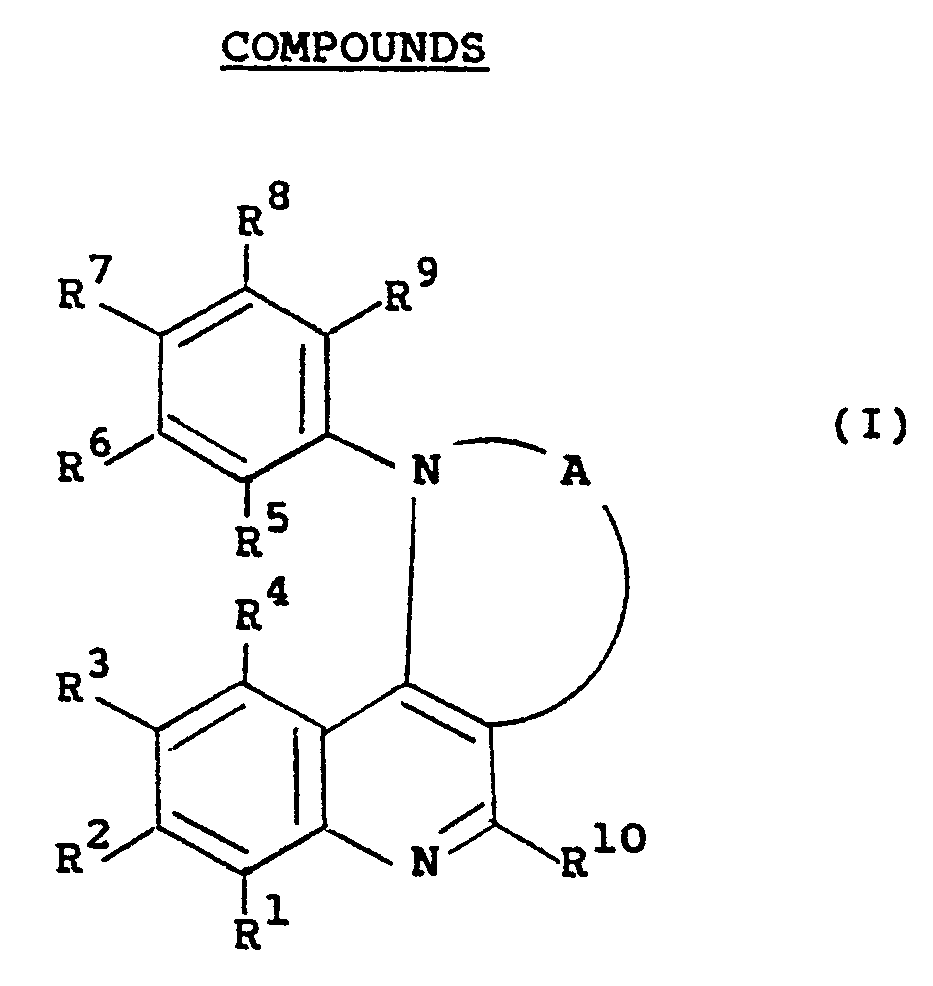
- the present invention provides, in a first aspect compounds of structure (I) in which R1 to R4 are the same or different and are each hydrogen, C1 ⁇ 4alkyl, C1 ⁇ 6alkoxy, phenyl, C1 ⁇ 6alkylthio, C1 ⁇ 4alkanoyl, amino, C1 ⁇ 6alkylamino, diC1 ⁇ 6alkylamino, halogen, trifluoromethyl or nitro, provided that at least two of R1 to R4 are hydrogen.
- R5 to R9 are the same or different and are each hydrogen, C1 ⁇ 6alkyl, C1 ⁇ 6alkoxy, C1 ⁇ 6alkylthio, halogen, cyano, amino, hydroxy, carbamoyl, carboxy, C1 ⁇ 6alkanoyl, trifluoromethyl or nitro, provided that at least two of R5 to R9 are hydrogen;
- R10 is hydrogen, C1 ⁇ 6alkyl, C1 ⁇ 6alkoxy, halogen, hydroxy, -CH2OH, C1 ⁇ 6alkylthio, NH(CH2) n OH in which n is 0 to 4 or a group -NR11R12 in which R11 and R12 are the same or different and are each hydrogen or C1 ⁇ 6alkyl or together with the nitrogen atom to which they are attached form a saturated or unsaturated ring; and
- R1 to R4 are all hydrogen; more suitably only two of R1 to R4 are hydrogen. Preferably three of R1 to R4 are hydrogen. More preferably R2 to R4 are hydrogen and R1 is other than hydrogen. Most preferably R2 to R4 are hydrogen and R1 is C1 ⁇ 6alkyl or C1 ⁇ 6alkoxy.
- R5 to R9 are all hydrogen.
- Preferably three of R5 to R9 are hydrogen. More preferably R5 to R8 are all hydrogen and R9 is other than hydrogen. Most preferably R5 to R8 are all hydrogen and R9 is C1 ⁇ 6alkyl, in particular, methyl.
- R10 is halogen or C1 ⁇ 6alkylthio.
- R10 is hydrogen, or a group NR11R12.
- R11 and R12 together with the nitrogen atom to which they are attached form a saturated or unsaturated ring.
- R11 and R12 are the same or different and are each hydrogen or C1 ⁇ 6alkyl.
- C1 ⁇ 6alkyl groups (either alone or as part of another group) can be straight or branched.
- compounds of structure (1) in which one or more of R1 to R10 is a C3 ⁇ 6alkyl group may contain an assymetric centre due to the presence of the C3 ⁇ 6alkyl group.
- Such compounds will exist as two (or more) optical isomers (enantiomers). Both the pure enantiomers, racemic mixtures (50% of each enantiomer) and unequal mixtures of the two are included within the scope of the present invention. Further, all diastereomeric forms possible (pure enantiomers and mixtures thereof) are within the scope of the invention.
- the compounds of the present invention can be prepared by processes analogous to those known in the art.
- the present invention therefore provides in a further aspect a process for the preparation of a compound of structure (I) or a pharmaceutically acceptable salt thereof which comprises (a) for compounds in which R10 is hydrogen or C1 ⁇ 6alkyl, cyclisation of a compound of structure in which R1 to R4 are as described for structure (I), and R10 is as described for structure (I) or a leaving group, n is 2 or 3 and X1 and X2 are leaving groups, in the presence of a compound of structure (III) in which R5 to R9 are as described for structure (I); or (b) for compounds in which R10 is other than C1 ⁇ 6alkyl reaction of a compound of structure (IV) in which R1 to R9 and A are as described for structure (I) with a reagent providing the group R10, and optionally thereafter ° converting one group R10 into another group R10; ° oxidising a compound in which A is (CH
- Suitable leaving groups X1 and X2 will be apparent to those skilled in the art and include for example halogen, in particular chlorine.
- Suitable leaving groups for R10 will also be apparent to those skilled in the art and include for example C1 ⁇ 4alkylsulphinyl, particularly methylsulphinyl.
- the cyclisation of a compound of structure (II) in the presence of a compound of structure (III) is carried out in a solvent and at a temperature of between ambient and the reflux temperature of the solvent used.
- the reaction is carried out at elevated temperature under pressure in a suitable solvent.
- a solvent such as 2-propanol at a temperature of 160-180° at a pressure of between 50-150 p.s.i.
- Suitable reagents providing the group R10 will be apparent to those skilled in the art and will of course depend on the nature of the group R10 sought.
- R10 is halogen, for example chlorine
- a suitable compound of structure (IV) can be reacted with phosphorous oxychloride, optionally in the presence of a suitable solvent and at an appropriate temperature
- R10 is NH2
- a suitable compound of structure (IV) can be reacted with phenyl phosphorodiamidate, again optionally in the presence of a suitable solvent at an appropriate temperature.
- compounds of structure (I) can be prepared from other compounds of structure (I), for example, compounds of structure (I) in which R10 is halogen can be converted into compounds of structure (I) in which R10 is other than halogen by reaction with an appropriate nucleophilic reagent capable of displacing the chlorine atom.
- suitable nucleophilic reagents include for example an amine such as a C1 ⁇ 4alkylamine, for example methylamine in a suitable solvent such as methanol; such reagents can be used to form compounds of structure (I) in which R10 is C1 ⁇ 4alkylamino, particularly, methylamino.
- compounds of structure (I) in which R10 is methyl can be converted into compounds of structure (I) in which R10 is CH2OH, in two steps, firstly by oxidation of the adjacent ring nitrogen atom with, for example, m-chloroperbenzoic acid followed by rearrangement in the presence of, for example, trifluoroacetic anhydride
- compounds of structure (I) in which A is -(CH2)3- and R10 is hydrogen can be converted to compounds of structure (IV) in which A is -(CH2)3-, in two steps, firstly by oxidation of the quinoline nitrogen atom, with for example, m-chloroperbenzoic acid followed by rearrangement in the presence of, for example, trifluoroacetic anhydride.
- compositions of structure (I) can be prepared by standard procedures by, for example, reaction with suitable organic and inorganic acids the nature of which will be apparent to persons skilled in the art.
- pharmaceutically acceptable salts can be formed by reaction with hydrochloric, sulphuric, or phosphoric acids; aliphatic, aromatic or heterocyclic sulphonic acids or carboxylic acids such as, for example, citric, maleic or fumaric acids.
- Certain intermediate compounds of structure (II) and (IV) are new and as such form a further aspect of the present invention. They can be prepared by procedures analogous to those known in the art.
- compounds of structure (II) can be prepared by heating a compound of structure (V) and a compound of structure (VI) in which, R1 to R4 are as described for structure (I), R11 is hydrogen or C1 ⁇ 4alkyl and A1 is (CH2)2- or -(CH2)3- optionally in the presence of a suitable solvent, followed by treatment with, for example, phosphorous oxychloride.
- the compounds of structure (I) and their pharmaceutically acceptable salts and related compounds for which no pharmaceutical utility has been previously disclosed exert an anti-secretory effect by inhibition of the gastrointestinal H+K+ATPase enzyme (Fellenius E., Berglindh T., Sachs G., Olke L., Elander B., Sjostrand S.E., and Wahlmark B., 1981, Nature, 290 , 159-61).
- the present invention provides the use of the compounds of structure (IA) in which R1 to R4 are the same or different and are each hydrogen, C1 ⁇ 4alkyl, C1 ⁇ 6alkoxy, phenyl, C1 ⁇ 6alkylthio, C1 ⁇ 6alkanoyl, amino, C1 ⁇ 6alkylamino, diC1 ⁇ 6alkylamino, halogen, trifluoromethyl or nitro, provided that at least two of R1 to R4 are hydrogen.
- R5 to R9 are the same or different and are each hydrogen, C1 ⁇ 6alkyl, C1 ⁇ 6alkoxy, C1 ⁇ 6alkylthio, halogen, cyano, amino, hydroxy, carbamoyl, carboxy, C1 ⁇ 6alkanoyl, trifluoromethyl or nitro, provided that at least two of R5 to R9 are hydrogen;
- R10 is hydrogen, C1 ⁇ 6alkyl, C1 ⁇ 6alkoxy, halogen, hydroxy, -CH2OH, C1 ⁇ 6alkylthio, NH(CH2) n OH in which n is 0 to 4 or a group -NR11R12 in which R11 and R12 are the same or different and are each hydrogen or C1 ⁇ 6alkyl or together with the nitrogen atom to which they are attached form a saturated or unsaturated ring; and
- the compounds of structure (IB) can be used in the treatment of other disorders where an anti-secretory effect is desirable for example in patients with gastritis, NSAID induced gastritis, gastric ulcers, acute upper intestinal bleeding, in patients with a history of chronic and excessive alcohol consumption, and in patients with gastro oesophageal reflux disease (GERD).
- gastritis NSAID induced gastritis
- gastric ulcers gastric ulcers
- acute upper intestinal bleeding in patients with a history of chronic and excessive alcohol consumption
- gastro oesophageal reflux disease GSD
- the compounds of the present invention are usually administered in a standard pharmaceutical composition.
- the present invention therefore provides in a further aspect pharmaceutical compositions comprising a compound of structure (IB) or a pharmaceutically acceptable salt thereof and a pharmaceutically acceptable carrier.
- the compounds of structure (IB) and their pharmaceutically acceptable salts which are active when given orally can be formulated as liquids, for example syrups, suspensions or emulsions, tablets, capsules and lozenges.
- a liquid formulation will generally consist of a suspension or solution of the compound or pharmaceutically acceptable salt in a suitable liquid carrier(s) for example, ethanol, glycerine, non-aqueous solvent, for example polyethylene glycol, oils, or water with a suspending agent, preservative, flavouring or colouring agent.
- a suitable liquid carrier(s) for example, ethanol, glycerine, non-aqueous solvent, for example polyethylene glycol, oils, or water with a suspending agent, preservative, flavouring or colouring agent.
- a composition in the form of a tablet can be prepared using any suitable pharmaceutical carrier(s) routinely used for preparing solid formulations.
- suitable pharmaceutical carrier(s) include magnesium stearate, starch, lactose, sucrose and cellulose.
- a composition in the form of a capsule can be prepared using routine encapsulation procedures.
- pellets containing the active ingredient can be prepared using standard carriers and then filled into a hard gelatin capsule; alternatively, a dispersion or suspension can be prepared using any suitable pharmaceutical carrier(s), for example aqueous gums, celluloses, silicates or oils and the dispersion or suspension then filled into a soft gelatin capsule.
- Typical parenteral compositions consist of a solution or suspension of the compound or pharmaceutically acceptable salt in a sterile aqueous carrier or parenterally acceptable oil, for example polyethylene glycol, polyvinyl pyrrolidone, lecithin, arachis oil or sesame oil.
- a sterile aqueous carrier or parenterally acceptable oil for example polyethylene glycol, polyvinyl pyrrolidone, lecithin, arachis oil or sesame oil.
- the solution can be lyophilised and then reconstituted with a suitable solvent just prior to administration.
- a typical suppository formulation comprises a compound of structure (IB) or a pharmaceutically acceptable salt thereof which is active when administered in this way, with a binding and/or lubricating agent such as polymeric glycols, gelatins or cocoa butter or other low melting vegetable or synthetic waxes or fats.
- a binding and/or lubricating agent such as polymeric glycols, gelatins or cocoa butter or other low melting vegetable or synthetic waxes or fats.
- composition is in unit dose form such as a tablet or capsule.
- Each dosage unit for oral administration contains preferably from 1 to 250 mg (and for parenteral administration contains preferably from 0.1 to 25 mg) of a compound of structure (IB) or a pharmaceutically acceptable salt thereof calculated as the free base.
- the present invention also provides a method of inhibiting gastric acid secretion which comprises administering to a mammal in need thereof an effective amount of a compound of structure (IB) or a pharmaceutically acceptable salt thereof; and a method of treatment of diseases of the stomach or intestine based on increased acid secretion which comprises administering to a mammal in need thereof an effective amount of a compound of structure (IB) or a pharmaceutically acceptable salt thereof.
- the pharmaceutically acceptable compounds of the invention will normally be administered to a subject for the treatment of gastro-intestinal diseases and other conditions caused or exacerbated by gastric acidity.
- the daily dosage regimen for an adult patient may be, for example, an oral dose of between 1 mg and 500 mg, preferably between 1 mg and 250 mg, or an intravenous, subcutaneous, or intramuscular dose of between 0.1 mg and 100 mg, preferably between 0.1 mg and 25 mg, of the compound of structure (IB) or a pharmaceutically acceptable salt thereof calculated as the free base, the compound being administered 1 to 4 times per day.
- the compounds will be administered for a period of continuous therapy, for example for a week or more.
- the compounds of the present invention can be co-administered with further active ingredients, such as antacids (for example magnesium carbonate or hydroxide and aluminium hydroxide), non-steroidal anti-flammatory drugs (for example indomethacin, aspirin or naproxen), steroids, or nitrite scavengers (for example ascorbic acid or aminosulphonic acid), or other drugs used for treating gastric ulcers (for example pirenzipine, prostanoids for example 16,16 dimethyl PGE2, or histamine H2-antagonists (for example, cimetidine).
- active ingredients such as antacids (for example magnesium carbonate or hydroxide and aluminium hydroxide), non-steroidal anti-flammatory drugs (for example indomethacin, aspirin or naproxen), steroids, or nitrite scavengers (for example ascorbic acid or aminosulphonic acid), or other drugs used for treating gastric ulcers (for example pirenzipine, prostanoids
- 2-Methyl-3-(2-chloroethyl)-4-chloroquinoline hydrochloride (5.53 g, 20 mmol) and 4-methoxy-2-methylaniline (5.15 ml, 40 mmol) in ethanol (100 ml) were heated at 170°C in a pressure vessel for 24 hours, then the solvent evaporated, the crude product taken up in dichloromethane, washed with aqueous sodium bicarbonate, dried and evaporated.
- Impure 1-(2-methylphenyl)-4-oxo-6-methyl-2,3,4,5-tetrahydropyrrolo[3,2-c]quinoline (10.0 g) and phenyl phosphorodiamidate (12 g) were fused at 230°C. After 30 minutes the mixture was diluted with diphenyl ether (50 ml), further phenyl phosphorodiamidate (4 g) added, and heated for a further 30 minutes at 230°C. Aqueous sodium hydroxide was added and the product extracted into dichloromethane.
- a tablet for oral administration is prepared by combining into a 9 mm tablet.
- An injection for parenteral administration was prepared from the following Compound of Structure 1 6.68%(w:v) 1M citric acid 30%(v:v) sodium hydroxide (qs) to pH 3.2 water for injection Ep to 100 ml
- the compound of Structure 1 was dissolved in the citric acid and the pH slowly adjusted to pH 3.2 with the sodium hydroxide solution. The solution was then made up to 100 ml with water, sterilised by filtration and sealed into appropriately sized ampoules and vials.
- Lyophilised gastric vesicles were prepared from pig fundic mucosa after the method of Keeling et. al. (Biochem. Pharmacol., 34, 2967, 1985).
- K+-stimulated ATPase activity was determined at 37°C in the presence of the following : 10 mM Pipes/Tris buffer pH 7.0, 2 mM MgSO4, 1 mM KCl, 2 mM Na2ATP and 3 ⁇ g protein/ml lyophilised gastric vesicles. After incubation for 30 minutes, the inorganic phosphate hydrolysed from ATP was determined by the method of Yoda and Hokin (Biochem. Biophys. Res. Commun. 40, 880, 1970).
Landscapes
- Organic Chemistry (AREA)
- Chemical & Material Sciences (AREA)
- Health & Medical Sciences (AREA)
- General Health & Medical Sciences (AREA)
- Veterinary Medicine (AREA)
- Nuclear Medicine, Radiotherapy & Molecular Imaging (AREA)
- General Chemical & Material Sciences (AREA)
- Pharmacology & Pharmacy (AREA)
- Life Sciences & Earth Sciences (AREA)
- Animal Behavior & Ethology (AREA)
- Chemical Kinetics & Catalysis (AREA)
- Public Health (AREA)
- Medicinal Chemistry (AREA)
- Engineering & Computer Science (AREA)
- Bioinformatics & Cheminformatics (AREA)
- Pharmaceuticals Containing Other Organic And Inorganic Compounds (AREA)
- Plural Heterocyclic Compounds (AREA)
- Organic Low-Molecular-Weight Compounds And Preparation Thereof (AREA)
- Quinoline Compounds (AREA)
- Nitrogen Condensed Heterocyclic Rings (AREA)
Abstract
Description
- The present invention relates to substituted quinoline derivatives, processes for their preparation, intermediates useful in their preparation, pharmaceutical compositions containing them and their use in therapy.
- Substituted quinoline derivatives are known in the art. For example, in J.Chem.Soc. 1957, 3448, J.Pharm. Soc.Japan 1961, 18, 363, 1961 and 479, certain 1-(substituted phenyl)-4-methyl-2,3-dihydropyrrolo[3,2-c]quinolines 1-phenyl-4-halo-2,3-dihydropyrrolo[3,2-c]quinolines and 1-phenyl-2,3-dihydropyrrolo[3,2-c]quinolines are disclosed as synthetic intermediates but no therapeutic activity is disclosed for such compounds. In addition, J.Pharm.Soc.Japan 1957, 77, 85, and ibid. 1961, 90, disclose certain 1-(substituted phenyl)-4-methyl-2,3-dihydropyrrolo[3,2-c]quinolines and report anti-bacterial activity for the compounds but do not disclose formulations containing said compounds or information concerning a specific therapeutic utility for the compounds. It has now been found that certain substituted 2,3-dihydropyrrolo[3,2-c]quinolines are potent inhibitors of the H⁺K⁺ATPase enzyme and as such are useful as antiulcer agents.
- Accordingly the present invention provides, in a first aspect compounds of structure (I)

R¹ to R⁴ are the same or different and are each hydrogen, C₁₋₄alkyl, C₁₋₆alkoxy, phenyl, C₁₋₆alkylthio, C₁₋₄alkanoyl, amino, C₁₋₆alkylamino, diC₁₋₆alkylamino, halogen, trifluoromethyl or nitro, provided that at least two of R¹ to R⁴ are hydrogen.
R⁵ to R⁹ are the same or different and are each hydrogen, C₁₋₆alkyl, C₁₋₆alkoxy, C₁₋₆alkylthio, halogen, cyano, amino, hydroxy, carbamoyl, carboxy, C₁₋₆alkanoyl, trifluoromethyl or nitro, provided that at least two of R⁵ to R⁹ are hydrogen;
R¹⁰ is hydrogen, C₁₋₆alkyl, C₁₋₆alkoxy, halogen, hydroxy, -CH₂OH, C₁₋₆alkylthio, NH(CH₂)nOH in which n is 0 to 4 or a group -NR¹¹R¹² in which R¹¹ and R¹² are the same or different and are each hydrogen or C₁₋₆alkyl or together with the nitrogen atom to which they are attached form a saturated or unsaturated ring; and A is -(CH₂)₂-, -(CH₂)₃- or -CH=CH-;
provided that
- (i) when R¹ to R⁷ are each hydrogen, one of R⁸ and R⁹ is hydrogen and the other is hydrogen or methoxy and R¹⁰ is methyl, A is -(CH₂)₃- or -CH=CH-;
- (ii) when R¹ to R⁶ and R⁸ and R⁹ are each hydrogen, R⁷ is hydroxy and R¹⁰ is methyl, A is -(CH₂)₃- or -CH=CH-;
- (iii) when R¹ to R⁹ are each hydrogen and R¹⁰ is chlorine, A is -(CH₂)₃-;
- (iv) when R¹ to R¹⁰ are each hydrogen. A is -(CH₂)₃-;
- (v) when R¹ and R² and R⁴ to R¹⁰ are each hydrogen and R³ is methoxy, A is -(CH₂)₂- or -(CH₂)₃-;
- (vi) when R² to R⁹ are each hydrogen, R¹⁰ is methyl and R¹ is hydrogen, hydroxy or methoxy, A is -(CH₂)₃- or -CH=CH-;
- (vii) when R¹ to R⁶ and R⁸ and R⁹ are each hydrogen, R¹⁰ is methyl and R⁷ is methyl or methoxy, A is -(CH₂)₃-or -CH=CH-;
- (viii) when R¹ to R⁸ are each hydrogen, R⁹ is chlorine and R¹⁰ is methyl, A is -(CH₂)₃ or -CH=CH-,
- Suitably A is -(CH₂)₃-, preferably A is -(CH₂)₂- or -CH=CH-.
- Suitably, R¹ to R⁴ are all hydrogen; more suitably only two of R¹ to R⁴ are hydrogen. Preferably three of R¹ to R⁴ are hydrogen. More preferably R² to R⁴ are hydrogen and R¹ is other than hydrogen. Most preferably R² to R⁴ are hydrogen and R¹ is C₁₋₆alkyl or C₁₋₆alkoxy.
- Suitably R⁵ to R⁹ are all hydrogen. Preferably three of R⁵ to R⁹ are hydrogen. More preferably R⁵ to R⁸ are all hydrogen and R⁹ is other than hydrogen. Most preferably R⁵ to R⁸ are all hydrogen and R⁹ is C₁₋₆alkyl, in particular, methyl.
- Suitably R¹⁰ is halogen or C₁₋₆alkylthio. Preferably R¹⁰ is hydrogen, or a group NR¹¹R¹².
- Suitably R¹¹ and R¹² together with the nitrogen atom to which they are attached form a saturated or unsaturated ring. Preferably R¹¹ and R¹² are the same or different and are each hydrogen or C₁₋₆alkyl.
- C₁₋₆alkyl groups (either alone or as part of another group) can be straight or branched.
- It will be appreciated that compounds of structure (1) in which one or more of R¹ to R¹⁰ is a C₃₋₆alkyl group (either alone or as part of another group) may contain an assymetric centre due to the presence of the C₃₋₆alkyl group. Such compounds will exist as two (or more) optical isomers (enantiomers). Both the pure enantiomers, racemic mixtures (50% of each enantiomer) and unequal mixtures of the two are included within the scope of the present invention. Further, all diastereomeric forms possible (pure enantiomers and mixtures thereof) are within the scope of the invention.
- The compounds of the present invention can be prepared by processes analogous to those known in the art. The present invention therefore provides in a further aspect a process for the preparation of a compound of structure (I) or a pharmaceutically acceptable salt thereof which comprises
(a) for compounds in which R¹⁰ is hydrogen or C₁₋₆alkyl, cyclisation of a compound of structure

(b) for compounds in which R¹⁰ is other than C₁₋₆alkyl reaction of a compound of structure (IV)
° converting one group R¹⁰ into another group R¹⁰;
° oxidising a compound in which A is (CH₂)₂ to a compound in which A is -CH=CH-;
° removing any protecting groups;
° forming a pharmaceutically acceptable salt. - Suitable leaving groups X¹ and X² will be apparent to those skilled in the art and include for example halogen, in particular chlorine. Suitable leaving groups for R¹⁰ will also be apparent to those skilled in the art and include for example C₁₋₄alkylsulphinyl, particularly methylsulphinyl.
- Suitably the cyclisation of a compound of structure (II) in the presence of a compound of structure (III) is carried out in a solvent and at a temperature of between ambient and the reflux temperature of the solvent used. Preferably the reaction is carried out at elevated temperature under pressure in a suitable solvent. For example, in a solvent such as 2-propanol at a temperature of 160-180° at a pressure of between 50-150 p.s.i.
- Suitable reagents providing the group R¹⁰ will be apparent to those skilled in the art and will of course depend on the nature of the group R¹⁰ sought. For example in the preparation of compounds of structure (I) in which R¹⁰ is halogen, for example chlorine, a suitable compound of structure (IV) can be reacted with phosphorous oxychloride, optionally in the presence of a suitable solvent and at an appropriate temperature; for compounds of structure (I) in which R¹⁰ is NH₂, a suitable compound of structure (IV) can be reacted with phenyl phosphorodiamidate, again optionally in the presence of a suitable solvent at an appropriate temperature.
- Alternatively, compounds of structure (I) can be prepared from other compounds of structure (I), for example, compounds of structure (I) in which R¹⁰ is halogen can be converted into compounds of structure (I) in which R¹⁰ is other than halogen by reaction with an appropriate nucleophilic reagent capable of displacing the chlorine atom. Suitable nucleophilic reagents include for example an amine such as a C₁₋₄alkylamine, for example methylamine in a suitable solvent such as methanol; such reagents can be used to form compounds of structure (I) in which R¹⁰ is C₁₋₄alkylamino, particularly, methylamino. In addition compounds of structure (I) in which R¹⁰ is methyl can be converted into compounds of structure (I) in which R¹⁰ is CH₂OH, in two steps, firstly by oxidation of the adjacent ring nitrogen atom with, for example, m-chloroperbenzoic acid followed by rearrangement in the presence of, for example, trifluoroacetic anhydride
- Further interconversions will be apparent to those skilled in the art, for example, compounds of structure (I) in which A is -(CH₂)₃- and R¹⁰ is hydrogen, can be converted to compounds of structure (IV) in which A is -(CH₂)₃-, in two steps, firstly by oxidation of the quinoline nitrogen atom, with for example, m-chloroperbenzoic acid followed by rearrangement in the presence of, for example, trifluoroacetic anhydride.
- Suitable reagents for carrying out the oxidation of compounds of structure (I) in which A is (CH₂)₂ to compounds of structure (I) in which A is CH=CH will be apparent to those skilled in the art and include, for example, dehydrogenation in the presence of a noble metal catalyst, in particular palladium-on-carbon.
- Pharmaceutically acceptable acid addition salts of the compounds of structure (I) can be prepared by standard procedures by, for example, reaction with suitable organic and inorganic acids the nature of which will be apparent to persons skilled in the art. For example, pharmaceutically acceptable salts can be formed by reaction with hydrochloric, sulphuric, or phosphoric acids; aliphatic, aromatic or heterocyclic sulphonic acids or carboxylic acids such as, for example, citric, maleic or fumaric acids.
- Certain intermediate compounds of structure (II) and (IV) are new and as such form a further aspect of the present invention. They can be prepared by procedures analogous to those known in the art. For example, compounds of structure (II) can be prepared by heating a compound of structure (V) and a compound of structure (VI)

- Compounds of structure (IV) in which R¹ to R⁴ are the same as R⁶ to R⁹ and R⁵ is hydrogen can be prepared by the reactions outlined in Scheme (I) below.

- The compounds of structure (IV) so formed can be converted into the corresponding compounds of structure (IV) in which A is CH=CH by oxidation in the presence of a palladium/carbon catalyst.
- It is to be noted, and apparent to those skilled in the art that in the foregoing reactions, where necessary, groups R¹ to R⁹ will be in protected form when undergoing the procedures described.
- For example, in carrying out the reaction step (iv) of Scheme 1 any hydroxy or amino groups present in said substituents should be protected. Suitable protecting groups are as described in "Greene, T.W., Protective Groups in Organic Chemistry".
- The compounds of structure (I) and their pharmaceutically acceptable salts and related compounds for which no pharmaceutical utility has been previously disclosed exert an anti-secretory effect by inhibition of the gastrointestinal H⁺K⁺ATPase enzyme (Fellenius E., Berglindh T., Sachs G., Olke L., Elander B., Sjostrand S.E., and Wahlmark B., 1981, Nature, 290, 159-61).
- In a further aspect therefore the present invention provides the use of the compounds of structure (IA)

R¹ to R⁴ are the same or different and are each hydrogen, C₁₋₄alkyl, C₁₋₆alkoxy, phenyl, C₁₋₆alkylthio, C₁₋₆alkanoyl, amino, C₁₋₆alkylamino, diC₁₋₆alkylamino, halogen, trifluoromethyl or nitro, provided that at least two of R¹ to R⁴ are hydrogen.
R⁵ to R⁹ are the same or different and are each hydrogen, C₁₋₆alkyl, C₁₋₆alkoxy, C₁₋₆alkylthio, halogen, cyano, amino, hydroxy, carbamoyl, carboxy, C₁₋₆alkanoyl, trifluoromethyl or nitro, provided that at least two of R⁵ to R⁹ are hydrogen;
R¹⁰ is hydrogen, C₁₋₆alkyl, C₁₋₆alkoxy, halogen, hydroxy, -CH₂OH, C₁₋₆alkylthio, NH(CH₂)nOH in which n is 0 to 4 or a group -NR¹¹R¹² in which R¹¹ and R¹² are the same or different and are each hydrogen or C₁₋₆alkyl or together with the nitrogen atom to which they are attached form a saturated or unsaturated ring; and
A is -(CH₂)₂-, -(CH₂)₃- or -CH=CH-;
provided that
- ( i) when R² to R⁹ are each hydrogen, R¹⁰ is methyl and R¹ is hydrogen, hydroxy or methoxy, A is -(CH₂)₃- or -CH=CH-;
- ( ii) when R¹ to R⁶ and R⁸ and R⁹ are each hydrogen, R¹⁰ is methyl and R⁷ is methyl or methoxy, A is -(CH₂)₃- or -CH=CH-;
- (iii) when R¹ to R⁸ are each hydrogen, R⁹ is chlorine and R¹⁰ is methyl, A is -(CH₂)₃ or -CH=CH-,
- Further, the compounds of structure (IB) can be used in the treatment of other disorders where an anti-secretory effect is desirable for example in patients with gastritis, NSAID induced gastritis, gastric ulcers, acute upper intestinal bleeding, in patients with a history of chronic and excessive alcohol consumption, and in patients with gastro oesophageal reflux disease (GERD).
- In therapeutic use, the compounds of the present invention are usually administered in a standard pharmaceutical composition. The present invention therefore provides in a further aspect pharmaceutical compositions comprising a compound of structure (IB) or a pharmaceutically acceptable salt thereof and a pharmaceutically acceptable carrier.
- The compounds of structure (IB) and their pharmaceutically acceptable salts which are active when given orally can be formulated as liquids, for example syrups, suspensions or emulsions, tablets, capsules and lozenges.
- A liquid formulation will generally consist of a suspension or solution of the compound or pharmaceutically acceptable salt in a suitable liquid carrier(s) for example, ethanol, glycerine, non-aqueous solvent, for example polyethylene glycol, oils, or water with a suspending agent, preservative, flavouring or colouring agent.
- A composition in the form of a tablet can be prepared using any suitable pharmaceutical carrier(s) routinely used for preparing solid formulations. Examples of such carriers include magnesium stearate, starch, lactose, sucrose and cellulose.
- A composition in the form of a capsule can be prepared using routine encapsulation procedures. For example, pellets containing the active ingredient can be prepared using standard carriers and then filled into a hard gelatin capsule; alternatively, a dispersion or suspension can be prepared using any suitable pharmaceutical carrier(s), for example aqueous gums, celluloses, silicates or oils and the dispersion or suspension then filled into a soft gelatin capsule.
- Typical parenteral compositions consist of a solution or suspension of the compound or pharmaceutically acceptable salt in a sterile aqueous carrier or parenterally acceptable oil, for example polyethylene glycol, polyvinyl pyrrolidone, lecithin, arachis oil or sesame oil. Alternatively, the solution can be lyophilised and then reconstituted with a suitable solvent just prior to administration.
- A typical suppository formulation comprises a compound of structure (IB) or a pharmaceutically acceptable salt thereof which is active when administered in this way, with a binding and/or lubricating agent such as polymeric glycols, gelatins or cocoa butter or other low melting vegetable or synthetic waxes or fats.
- Preferably the composition is in unit dose form such as a tablet or capsule.
- Each dosage unit for oral administration contains preferably from 1 to 250 mg (and for parenteral administration contains preferably from 0.1 to 25 mg) of a compound of structure (IB) or a pharmaceutically acceptable salt thereof calculated as the free base.
- The present invention also provides a method of inhibiting gastric acid secretion which comprises administering to a mammal in need thereof an effective amount of a compound of structure (IB) or a pharmaceutically acceptable salt thereof; and a method of treatment of diseases of the stomach or intestine based on increased acid secretion which comprises administering to a mammal in need thereof an effective amount of a compound of structure (IB) or a pharmaceutically acceptable salt thereof.
- The pharmaceutically acceptable compounds of the invention will normally be administered to a subject for the treatment of gastro-intestinal diseases and other conditions caused or exacerbated by gastric acidity. The daily dosage regimen for an adult patient may be, for example, an oral dose of between 1 mg and 500 mg, preferably between 1 mg and 250 mg, or an intravenous, subcutaneous, or intramuscular dose of between 0.1 mg and 100 mg, preferably between 0.1 mg and 25 mg, of the compound of structure (IB) or a pharmaceutically acceptable salt thereof calculated as the free base, the compound being administered 1 to 4 times per day. Suitably the compounds will be administered for a period of continuous therapy, for example for a week or more.
- In addition, the compounds of the present invention can be co-administered with further active ingredients, such as antacids (for example magnesium carbonate or hydroxide and aluminium hydroxide), non-steroidal anti-flammatory drugs (for example indomethacin, aspirin or naproxen), steroids, or nitrite scavengers (for example ascorbic acid or aminosulphonic acid), or other drugs used for treating gastric ulcers (for example pirenzipine, prostanoids for example 16,16 dimethyl PGE₂, or histamine H₂-antagonists (for example, cimetidine).
- The following examples illustrate the invention. Temperatures are recorded in degrees centigrade.
- 2-Methyl-3-(2-chloroethyl)-4-chloro-8-methoxyquinoline (2.70 g, 10 mmol) and 2-methoxyaniline hydrochloride (1.60 g, 10 mmol) in 1-butanol (40 ml) were heated at reflux for 6 hours then the solvent evaporated, the crude product taken up in dichloromethane, washed with aqueous sodium bicarbonate, dried and evaporated. Trituration with ether and recrystallisation from aqueous methanol gave 1-(2-methoxyphenyl)-4-methyl-6-methoxy-2,3-dihydropyrrolo[3,2-c]quinoline (0.62 g, 19%), m.p. 168-169°.
C₂₀H₂₀N₂O₂
Found C 74.84, H 6.33, N 8.53
Requires C 74.98, H 6.29, N 8.74 - 2-Methyl-3-(2-chloroethyl)-4-chloro-8-methoxyquinoline (8.37 g, 31 mmol) and 2-methylaniline hydrochloride (4.45 g, 31 mmol) in 1-butanol (100 ml) were heated at reflux for 5 days, then the solvent evaporated, the crude product taken up in dichloromethane, washed with aqueous sodium bicarbonate, dried and evaporated. Chromatography (silica gel, 2% methanolic ammonia in dichloromethane) and recrystallisation from aqueous ethanol gave 1-(2-methylphenyl)-4-methyl-6-methoxy-2,3-dihydropyrrolo[3,2-c]quinoline (2.04 g, 22 %), m.p. 182-183°.
C₂₀H₂₀N₂O
Found C 79.04, H 6.50, N 9.21
Requires C 78.92, H 6.62, N 9.20 - 2-Methyl-3-(2-chloroethyl)-4-chloro-8-methoxyquinoline (54 g, 0.2 mol), o-methylaniline hydrochloride (28.7 g, 0.2 mol) and 1-butanol (500 ml) were heated to 170°C in a pressure vessel for 10 hours, then the solvent evaporated. Conversion to free base and chromatography (silica gel, 2% methanolic ammonia in dichloromethane) gave 1-(2-methylphenyl)-4-methyl-6-methoxy-2,3-dihydropyrrolo[3,2-c]quinoline in the early fractions. Later fractions were recrystallised from ethyl acetate to yield 1-(2-methylphenyl)-4-methyl-6-hydroxy-2,3-dihydropyrrolo[3,2-c]quinoline, m.p. 144-146°.
C₁₉H₁₈N₂O
Found C 78.49, H 6.39, N 9.70
Requires C 78.59, H 6.25, N 9.65 - 1-(2-Methylphenyl)-4-methyl-6-methoxy-2,3-dihydropyrrolo[3,2-c]quinoline (4.57 g, 15 mmol) in diphenyl ether (50 ml) was heated at reflux with 10% palladium-on-charcoal (1.0 g) for 1 hour then the catalyst removed on celite. Chromatography (silica gel, 1% methanolic ammonia in dichloromethane) and recrystallisation from ethyl acetate/petroleum ether gave 1-(2-methylphenyl)-4-methyl-6-methoxypyrrolo[3,2-c]quinoline(2.2 g, 48%), m.p. 143-145°.
C₂₀H₁₈N₂O
Found C 79.22, H 6.05, N 9.23
Requires C 79.44, H 6.00, N 9.26 - 2,8-Dimethyl-3-(2-chloroethyl)-4-chloroquinoline (7.63 g, 30 mmol) and 2-methylaniline hydrochloride (4.31 g, 30 mmol) in 1-butanol (100 ml) were heated at reflux for 4 days, then the solvent evaporated, the crude product taken up in dichloromethane, washed with aqueous sodium bicarbonate, dried and evaporated. Chromatography (silica gel, 2% methanolic ammonia in dichloromethane) and recrystallisation from aqueous ethanol gave 1-(2-methylphenyl)-4,6-dimethyl-2,3-dihydropyrrolo-[3,2-c]quinoline (1.95 g, 23%), m.p. 126-128°.
C₂₀H₂₀N₂
Found C 83.11, H 7.06, N 9.65
Requires C 83.30, H 6.99, N 9.71 - 2-Methyl-3-(2-chloroethyl)-4-chloroquinoline (45 g, 0.16 mol), 2-methylaniline (35 ml, 0.32 mol) and ethanol (300 ml) were heated to 150°C in a pressure vessel for 17 hours, then concentrated in vacuo. The product crystallised as the hydrochloride salt. Conversion to free base and recrystallisation from ethyl acetate yielded 1-(2-methylphenyl)-4-methyl-2,3-dihydropyrrolo[3,2-c]quinoline (19.1 g, 43%), m.p. 148-150°.
C₁₉H₁₈N₂
Found C 83.25, H 6.66, N 10.20
Requires C 83.18, H 6.61, N 10.21 - 2-Methyl-3-(2-chloroethyl)-4-chloroquinoline hydrochloride (5.53 g, 20 mmol) and 4-methoxy-2-methylaniline (5.15 ml, 40 mmol) in ethanol (100 ml) were heated at 170°C in a pressure vessel for 24 hours, then the solvent evaporated, the crude product taken up in dichloromethane, washed with aqueous sodium bicarbonate, dried and evaporated. Chromatography (silica gel, 2% methanolic ammonia in dichloromethane) and recrystallisation from aqueous methanol gave 1-(4-methoxy-2-methylphenyl)-4-methyl-2,3-dihydropyrrolo[3,2-c]quinoline (2.04 g, 22 %), m.p. 115-117°.
C₂₀H₂₀N₂O. 0.4H₂O
Found C 77.07, H 6.70, N 8.85
Requires C 77.09, H 6.73, N 8.99 - The sodium salt of 3-(hydroxymethylene)-tetrahydropyran-2-one (25 g, 0.17 mol) and 2-methoxyaniline hydrochloride (32 g, 0.2 mol) in ethanol (750 ml) were warmed to 70°C with stirring for 2 hours, then filtered hot. After evaporation of the ethanol, the crude product was taken up in dichloromethane, washed with dilute hydrochloric acid, dried and evaporated. Trituration with ether gave 3-(2-methoxyphenylaminomethylene)tetrahydropyran-2-one (21.5 g, 55%) as a mixture of E and Z isomers, m.p. 85-100°.
- 3-(2-Methoxyphenylaminomethylene)-tetrahydropyran-2-one (11.67 g, 50 mmol) in phosphoryl chloride (50 ml) was heated at reflux for 1 hour. After cooling, the solution was poured onto ice, the mixture heated to boiling, charcoal added., and the hot solution filtered through celite. Subsequent cooling and addition of sodium hydroxide solution gave a solid which was filtered off and recrystallised from aqueous ethanol to yield 3-(3-chloropropyl)-4-chloro-8-methoxyquinoline (5.6 g, 41%), m.p. 86-89°.
- A solution of 3-(3-chloropropyl)-4-chloro-8-methoxyquinoline (6.4 g, 23.6 mmol) and 2-methylaniline (5.0 ml, 47.2 mmol) in ethanol (250 ml) was heated at reflux for 4 days, then cooled and evaporated. Dichloromethane and aqueous sodium bicarbonate solution were added, and the organic layer washed with water, dried and evaporated. Chromatography (silica gel, 1% methanolic ammonia in dichloromethane) followed by crystallisation from ethyl acetate gave 1-(2-methylphenyl)-7-methoxy-1,2,3,4-tetrahydropyridino-[3,2-c]quinoline (1.92 g, 27%), m.p. 160-161°.
C₂₀H₂₀N₂O
Found C 78.80, H 6.57, N 9.23
Required C 78.92, H 6.62, N 9.20 - A mixture of o-anisidine (45.1 ml, 0.4 mol) and diethyl 2-ethoxyethylmalonate (46.5 g, 0.2 mol) was heated to 200°C as nitrogen was bubbled slowly through the mixture, and ethanol allowed to distill off. After 3 hours the crude product was allowed to cool and triturated with petroleum ether. The solid was filtered off and recrystallised from ethyl acetate/ petroleum ether to give 2-(2-ethoxyethyl)-N,N′-di(2-methoxyphenyl)malonodiamide (36.6 g, 47%), m.p. 132-133°.
- 2-(2-Ethoxyethyl)-N,N′-di(2-methoxyphenyl)malonodiamide (31 g, 80 mmol) was stirred for 9 hours in diphenyl ether (120 ml) at reflux. The mixture was allowed to cool, diluted with petroleum ether, and the resulting solid filtered off. This was a mixture of the desired product plus 4-oxo-6-methoxy-2,3,4,5-tetrahydrofuro[3,2-c]quinoline. Repeated chromatography (silica gel, 1.5% methanolic ammonia in dichloromethane) followed by recrystallisation from ethyl acetate/petroleum ether gave a sample of 1-(2-methoxyphenyl)-4-oxo-6-methoxy-2,3,4,5-tetrahydropyrrolo[3,2-c]quinoline (0.6 g), m.p. 204-205°.
C₁₉H₁₈N₂O₃ . 0.03EtOAc
Found C 70.44, H 5.48, N 8.49
Requires C 70.66, H 5.66, N 8.62 - The bulk of the material was recrystallised once from ethyl acetate/petroleum ether, then used in subsequent synthetic steps without further purification.
- 1-(2-Methoxyphenyl)-4-oxo-6-methoxy-2,3,4,5-tetrahydropyrrolo[3,2-c]quinoline (9.55 g) was dissolved in phosphoryl chloride (100 ml) and heated at reflux for 2.5 hours. After cooling, the solution was poured onto ice, made alkaline with aqueous sodium hydroxide solution, and extracted with dichloromethane. The organic extract was dried and evaporated, and the crude product purified by chromatography (silica gel, 50-100% diethyl ether in petroleum ether). The first compound to elute was 4-chloro-6-methoxy-2,3-dihydrofuro[3,2-c]quinoline, m.p. 99-101°. Later fractions containing the desired product were recrystallised from ethyl acetate, then ethyl acetate/ethanol to give 1-(2-methoxyphenyl)-4-chloro-6-methoxy-2,3-dihydropyrrolo[3,2-c]quinoline, m.p. 183-184°.
C₁₉H₁₇ClN₂O₂
Found C 67.03, H 5.02, N 8.15, Cl 10.66
Requires C 66.96, H 5.03, N 8.22, Cl 10.40 - A suspension of 1-(2-methoxyphenyl)-4-chloro-6-methoxy-2,3-dihydropyrrolo[3,2-c]quinoline (2.5 g, 7.3 mmol) in ethanol (250 ml) was hydrogenated over 10% palladium on charcoal at an initial pressure of 4 bar. After 2.25 hours the solution was filtered through celite and evaporated. Crystallisation from ethanol/ethyl acetate gave 1-(2-methoxyphenyl)-6-methoxy-2,3-dihydropyrrolo[3,2-c]quinoline hydrochloride as a hygroscopic solid (1.05 g, 42%), m.p. 213-214° (dec).
C₁₉H₁₈N₂O₂. HCl. 0.3H₂O
Found C 65.49, H 5.41, N 7.99
Requires C 65.53, H 5.67, N 8.04 - The mother liquors from the crystallisation were converted to the free base to give an oil which slowly crystallised (1.15 g, 51%), m.p. 173-176°.
- 1-(2-Methoxyphenyl)-4-oxo-6-methoxy-2,3,4,5-tetrahydropyrrolo[3,2-c]quinoline (1.5 g) and phenyl phosphorodiamidate (2.5 g) were fused at 230°C. After 45 minutes the mixture was diluted with diphenyl ether (10 ml), further phenyl phosphorodiamidate (2 g) added, and heated for a further 15 minutes at 230°C. Aqueous sodium hydroxide was added and the product extracted into dichloromethane. Chromatography (silica gel, 2.5-4% methanolic ammonia in dichloromethane) to remove unchanged starting material was followed by recrystallisation from ethanol/ethyl acetate to yield 1-(2-methoxyphenyl) 4-amino-6-methoxy-2,3- dihydropyrrolo[3,2-c]quinoline (0.36 g), m.p. 244-247° (dec).
C₁₉H₁₉N₃O₂. 0.3EtOH. 0.02EtOAc
Found C 70.69, H 5.86, N 12.79
Requires C 70.85, H 6.00, N 12.95 - A mixture of o-methylaniline (74 ml, 0.68 mol) and diethyl 2-ethoxyethylmalonate (80 g, 0.31 mol) was heated to 220°C as nitrogen was bubbled slowly through the mixture, and ethanol allowed to distill off. After 2.5 hours the crude product was allowed to cool, and triturated with petroleum ether. The solid was filtered off and washed with petroleum ether to give 2-(2-ethoxyethyl)-N,N′-di(2-methylphenyl)malonodiamide (270 g), which was used without further purification.
- 2-(2-Ethoxyethyl)-N,N′-di(2-methylphenyl)malonodiamide (90 g) was stirred for 15 hours in diphenyl ether (250 ml) at reflux, then the diphenyl ether evaporated off in vacuo. Crystallisation of the residue from petroleum ether gave 1-(2-methylphenyl)-4-oxo-6-methyl-2,3,4,5-tetrahydropyrrolo[3,2-c]quinoline (21 g), which was used without further purification.
- 1-(2-Methylphenyl)-4-oxo-6-methyl-2,3,4,5-tetrahydropyrrolo[3,2-c]quinoline (16 g) was dissolved in phosphoryl chloride (100 ml) and heated at reflux for 5 hours. After cooling, the solution was poured onto ice, made alkaline with aqueous sodium hydroxide solution, and extracted with dichloromethane, which was dried and evaporated. Crystallisation from ethyl acetate gave 1-(2-methylphenyl)-4-chloro-6-methyl-2,3-dihydropyrrolo- [3,2-c]quinoline, which was used without further purification.
- 1-(2-Methylphenyl)-4-chloro-6-methyl-2,3-dihydropyrrolo[3,2-c]quinoline (1.5 g. 4.9 mmol) and dimethylamine (33% in ethanol, 150 ml) were heated to 180°C in a pressure vessel for 18 hours, then evaporated, taken up in dichloromethane, washed with sodium bicarbonate, dried and evaporated. Crystallisation from aqueous ethanol gave 1-(2-methylphenyl)-4-dimethylamino- 6-methyl-2,3-dihydropyrrolo[3,2-c]quinoline (0.97 g,. 63%), m.p. 120-121°.
C₂₁H₂₃N₂. 0.1H₂O
Found C 79.06, H 7.31, N 13.20
Requires C 79.01, H 7.33, N 13.16 - 1-(2-Methylphenyl)-4-chloro-6-methyl-2,3-dihydropyrrolo[3,2-c]quinoline (1.5 g, 4.9 mmol) and methylamine (33% in ethanol, 250 ml) were heated to 180°C in a pressure vessel for 24 hours, then evaporated. Crystallisation from aqueous ethanol gave 1-(2-methylphenyl)-4-methylamino-6-methyl-2,3-dihydropyrrolo[3,2-c]quinoline (1.05 g, 71%), m.p. 165-167°.
C₂₀H₂₁N₃. 0.1H₂O
Found C 78.77, H 6.89, N 13.78
Requires C 78.71, H 7.00, N 13.77 - Impure 1-(2-methylphenyl)-4-oxo-6-methyl-2,3,4,5-tetrahydropyrrolo[3,2-c]quinoline (10.0 g) and phenyl phosphorodiamidate (12 g) were fused at 230°C. After 30 minutes the mixture was diluted with diphenyl ether (50 ml), further phenyl phosphorodiamidate (4 g) added, and heated for a further 30 minutes at 230°C. Aqueous sodium hydroxide was added and the product extracted into dichloromethane. Chromatography (silica gel, 3% methanolic ammonia in dichloromethane) to remove unchanged starting material was followed by recrystallisation from ethanol to yield 1-(2-methylphenyl)-4-amino-6-methyl-2,3-dihydropyrrolo[3,2-c]quinoline (1.51 g), m.p. 173-174°.
C₁₉H₁₉N₃
Found C 78.80, H 6.70, N 14.55
Requires C 78.86, H 6.62, N 14.52 - 1-(2-Methylphenyl)-4-chloro-6-methyl-2,3-dihydropyrrolo[3,2-c]quinoline (1.5 g) in ethanol (100 ml) was hydrogenated over 10% palladium on charcoal (0.25 g) at an initial pressure of 3 bar. After 7 hours the mixture was filtered through celite and evaporated. Conversion to free base and recrystallisation from ethyl acetate/petroleum ether yielded 1-(2-methylphenyl)-6-methyl-2,3-dihydropyrrolo[3,2-c]quinoline (0.41 g, 31 %), m.p. 109-110°.
C₁₉H₁₈N₂
Found C 83.05, H 6.69, N 10.20
Requires C 83.18, H 6.61, N 10.21 - 1-(2-Methylphenyl)-4-chloro-6-methyl-2,3-dihydropyrrolo[3,2-c]quinoline (0.62 g, 2 mmol), sodium methoxide (1.0 g, 18.5 mmol) and methanol (30 ml) were heated to 170°C in a pressure vessel for 18 hours, then the solvent evaporated in vacuo. Conversion to free base, chromatography (silica gel, 40:60 dichloromethane/petroleum ether) and recrystallisation from methanol yielded 1-(2-methylphenyl)-4-methoxy-6-methyl-2,3-dihydropyrrolo- [3,2-c]quinoline (0.30 g), m.p. 107-108°.
C₂₀H₂₀N₂O
Found C 78.88, H 6.63, N 9.15
Requires C 78.92, H 6.62, N 9.20 - 1-(2-Methylphenyl)-4-oxo-6-methyl-2,3,4,5-tetrahydropyrrolo[3,2-c]quinoline (9.25 g), diphenyl ether (75 ml) and 10% palladium on charcoal (1 g) were heated at reflux for 4 hours, cooled, diluted with ethyl acetate, and filtered through celite. Further dilution with ethyl acetate induced crystallisation of 1-(2-methylphenyl)-4-oxo-6-methyl-4,5-dihydropyrrolo[3,2-c]quinoline (6.68 g), m.p. 226-232°, which was used without further purification.
- 1-(2-Methylphenyl)-4-oxo-6-methyl-4-5-dihydropyrrolo[3,2-c]quinoline (4.75 g) and phosphoryl chloride (40 ml) were heated at reflux for 1.5 hours. The phosphoryl chloride was evaporated in vacuo, the residue poured onto ice and extracted with dichloromethane, which was dried and evaporated. Crystallisation from ethanol yielded 1-(2-methylphenyl)-4-chloro-6-methylpyrrolo[3,2-c]quinoline (4.76 g), m.p. 135-137°.
- 1-(2-Methylphenyl)-4-chloro-6-methylpyrrolo[3,2-c]quinoline (1.0 g) and 3-aminopropanol (3.0 g) were heated to 150°C for 3 hours. Chromatography (silica gel, 2% methanolic ammonia in dichloromethane) and recrystallisation from ethyl acetate/petroleum ether yielded 1-(2-methylphenyl)-4-(3-hydroxypropylamino)-6-methylpyrrolo[3,2-c]quinoline (0.57 g), m.p. 135-137°.
C₂₂H₂₃N₃O. 0.02EtOAc
Found C 76.16, H 6.75, N 12.15
Requires C 76.38, H 6.72, N 12.10 - 1-(2-Methylphenyl)-4-chloro-6-methylpyrrolo[3,2-c]quinoline (1.0 g) and ethanolamine (3.0 g) were heated to 150°C for 3 hours. Chromatography (silica gel, 2% methanolic ammonia in dichloromethane) and recrystallisation from ethyl acetate/petroleum ether yielded 1-(2-methylphenyl)-4-(2-hydroxyethylamino)-6-methylpyrrolo[3,2-c]quinoline (0.78 g), m.p. 187-188°.
C₂₁H₂₁N₃O
Found C 76.57, H 6.28, N 12.83
Requires C 76.11, H 6.39, N 12.68 - 1-(2-Methylphenyl)-4-chloro-6-methylpyrrolo[3,2-c]quinoline (1.5 g, 4.9 mmol) and methylamine (33% in ethanol, 50 ml) were heated to 150°C in a pressure vessel for 16 hours, then the solvent evaporated. Chromatography (silica gel, 2% methanolic ammonia in dichloromethane) and recrystallisation from aqueous ethanol yielded 1-(2-methylphenyl)-4-methylamino-6-methylpyrrolo[3,2-c]quinoline (0.62 g), m.p. 129-130°.
C₂₀H₁₉N₃
Found C 79.80, H 6.47, N 13.94
Requires C 79.70, H 6.35, N 13.94 - 2-Fluoroaniline (9.65 ml, 0.1 mol) and 2-acetyl-§-butyrolactone (10.76 ml, 0.1 mol) were heated to 120° for 1 hour, then 160° for 2 hours. The mixture was cooled, phosphoryl chloride (100 ml) added, and the resulting solution heated at reflux for 1.5 hours. After cooling, the mixture was poured onto ice and extracted with dichloromethane, which was washed with sodium bicarbonate solution, water and brine, dried and evaporated. Trituration with ether followed by recrystallisation from ethanol gave 3-(2-chloroethyl)-4-chloro-3-fluoro-2-methylquinoline (3.68 g), m.p. 101-103°
- 3-(2-Chloroethyl)-4-chloro-8-fluoro-2-methylquinoline (2.58 g, 10 mmol) and 2-methylaniline hydrochloride (2.87 g, 20 mmol) in 2-propanol (25 ml) were heated to 170° in a pressure vessel for 18 hours. The solvent was evaporated, the residue taken up in dichloromethane and washed with sodium bicarbonate solution. Evaporation of the dichloromethane, trituration with ether, and recrystallisation from methanol then ethyl acetate gave 2-(methylphenyl)-4-methyl-6-fluoro-2,3-dihydropyrrolo[3,2-c]quinoline (0.85 g), m.p. 209-211°.
C₁₉H₁₇FN₂
Found C 78.24, H 5.87, N 9.59
Requires C 78.06, H 5.86, N 9.58 - 1-(2-Methylphenyl)-4-chloro-6-methyl-2,3-dihydro pyrrolo-[3,2-c]quinoline (1.54 g, 5 mmol) and sodium methanethiolate (1.40 g, 20 mmol) in 2-propanol (25 ml) were heated at 170° in a pressure vessel for 18 hours. The solvent was evaporated, the residue taken up in dichloromethane and washed with sodium bicarbonate solution. Chromatography (silica gel, dichloromethane) and crystallisation from methanol gave 1-(2-methylphenyl)-4-methylthio-6-methyl-2,3-dihydropyrrolo-[3,2-c]quinoline (0.8 g), m.p. 111-113°.
C₂₀H₂₀N₂S. 0.2MeOH
Found C 74.26, H 6.15, N 8.59, S 9.93
Require C 74.23, H 6.41, N 8.57, S 9.81 - 1-(2-Methylphenyl)-4-methyl-2,3-dihydropyrrolo[3,2-c]quinoline (15.0 g, 0.055 mol) was stirred at 0°C in chloroform (200 ml). A solution of m-chloroperoxybenzoic acid (9.5 g, 0.055 mol) in chloroform (100 ml) was added dropwise keeping the temperature below 5°C. The mixture was stirred for a further 30 minutes and the solvent then evaporated. The residue was chromatographed (silica gel, 2% methanolic ammonia in dichloromethane) to afford 1-(2-methylphenyl)-4-methyl-5-oxo-2,3-dihydropyrrolo[3,2-c]quinoline (1.8 g, 11.3%) m.p. 212-4°.
- 1-(2-Methylphenyl)-4-methyl-5-oxo-2,3-dihydropyrrolo[3,2-c]quinoline (3.5 g, 0.0155 mol) was heated in acetic anhydride (75 ml) over a steam bath for 30 minutes. The solvent was evaporated and the residue was again heated over a steam bath in 10% hydrochloric acid for 45 minutes. When cool the solution was neutralised with sodium bicarbonate and extracted into dichloromethane. The organic solution was dried and evaporated then chromatographed (silica gel, 2% methanolic ammonia in dichloromethane) to afford 1-(2-methylphenyl)-4-hydroxymethyl-2,3-dihydropyrrolo[3,2-c]quinoline as crystals from ethyl acetate (0.56 g, 16%) m.p. 164-6°.
C₁₉H₁₈N₂O
Requires: C 78.59, H 6.25, N 9.65
Found : C 78.32, H 6.25, N 9.58 - 1-(2-methylphenyl)-7-methoxy-1,2,3,4-tetrahydropyridino-[3,2-c]quinoline (0.26 g, 0.85 mmol) was stirred at 0-5°C in chloroform (20 ml) and m-chloroperoxybenzoic acid (0.15 g) in chloroform (2 ml) was added. Stirring was continued at 0°C for 2 hours. The solvent was evaporated and the residue was chromatographed (silica gel, 2-3% methanolic ammonia in dichloromethane) to afford the required 1-(2-methylphenyl)-7-methoxy-6-oxo-1,2,3,4-tetrahydropyridino(3,2-c]quinoline (0.08 g, 29%).
- 1-(2-methylphenyl)-7-methoxy-6-oxo-1,2,3,4-tetrahydropyridino-[3,2-c]quinoline (0.08 g, 0.25 mmol) was heated over a steam bath in acetic anhydride (10 ml) for 40 minutes. The solvent was evaporated and the residue was reheated over a steam bath in 10% hydrochloric acid (10 ml) for 30 minutes. The product was extracted into chloroform and chromatographed (silica gel, 1% methanol in chloroform) to give 1-(2-methylphenyl)-5-oxo-7-methoxy-1,2,3,4,5,6-hexahydropyridino[3,2-c]- quinoline (5 ml) m.p. 203-5°.
- 1-(2-methylphenyl)4-chloro-6-methylpyrrolo[3,2-c]quinoline (1.0 g, 3.26 mmol) was dissolved in 4-aminobutanol (3.0 g) and stirred for 6 hours at 170°. Chromatography (silica gel, 2% methanolic ammonia in dichloromethane), conversion to the hydrochloride and recrystallisation from ethanol/ether gave 1-(2-methylphenyl)-4-(4-hydroxybutylamino)-6-methylpyrrolo[3,2-c]quinoline hydrochloride (0.8 g), m.p. 176-178°.
C₂₃H₂₅N₃O.HCl.0.2H₂O
Found C 69.31, H 6.67, N 10.53, Cl 8.59
Requires C 69.30, H 6.65, N 10.54, Cl 8.89 - A solution of 4-chloro-3-chloroethyl-2-methylquinoline hydrochloride (1.28 g, 4.6 mmol) and 4-hydroxy-2-methylaniline (1.13 g, 9.2 mmol) in n-butanol (20 ml) was heated at reflux under a nitrogen atmosphere for 20 hours, then evaporated. Chromatography (silica gel, 5-7% methanolic ammonia in dichloromethane) and recrystallisation from aqueous methanol gave 1-(4-hydroxy2-methylphenyl)-4-methyl-2,3-dihydropyrrolo[3,2-c]quinoline (0.16 g), m.p. 315-318°.
C₁₉H₁₈N₂O
Found C 78.55, H 6.27, N 9.56
Requires C 78.59, H 6.25, N 9.65 - A mixture of 2-methyl-3-(2-chloroethyl)-4-chloro-8-methoxyquinoline hydrochloride (15.33 g, 50 mmol), 4-methoxy-2-methylaniline (9.0 ml, 70 mmol) and 2-propanol (200 ml) was heated at reflux for 2 days, then evaporated. The crude product was triturated with ether then recrystallised twice from aqueous ethanol to give the title compound (3.16 g), m.p. 163-167°.
C₂₁C₂₂N₂O₂. 0.9H₂O
Found C 72.02, H 6.84, N 7.98
Requires C 71.93, H 6.84, N 7.99 - A mixture of 2-methyl-3-(2-chloroethyl)-4-chloroquinoline hydrochloride (13.8 g, 50 mmol), 2,6-dimethylaniline (12.5 ml, 100 mmol) and 2-propanol (400 ml) was heated to 140° for 5 days in a pressure vessel, then cooled and evaporated. The crude product was converted to free base and chromatographed (silica gel, methanolic ammonia in dichloromethane). Recrystallisation from aqueous methanol followed by aqueous ethanol gave 1-(2,6-dimethylphenyl)-4-methyl- 2,3-dihydropyrrolo[3,2-c]quinoline (1.52 g), m.p. 149-152°.
C₂₀H₂₀N₂
Found C 83.02, H 6.99, N 9.65
Requires C 83.30, H 6.99, N 9.71 - A tablet for oral administration is prepared by combining

- An injection for parenteral administration was prepared from the following
Compound of Structure 1 6.68%(w:v)
1M citric acid 30%(v:v)
sodium hydroxide (qs) to pH 3.2
water for injection Ep to 100 ml - The compound of Structure 1 was dissolved in the citric acid and the pH slowly adjusted to pH 3.2 with the sodium hydroxide solution. The solution was then made up to 100 ml with water, sterilised by filtration and sealed into appropriately sized ampoules and vials.
- The effects of a single high concentration (100 µM) of a compound of structure (I) on K-stimulated ATPase activity in lyophilised gastric vesicles was determined. Preferred compounds of structure (I) were also tested over a range of concentrations to determine IC₅₀ values.
- Lyophilised gastric vesicles were prepared from pig fundic mucosa after the method of Keeling et. al. (Biochem. Pharmacol., 34, 2967, 1985).
- K⁺-stimulated ATPase activity was determined at 37°C in the presence of the following : 10 mM Pipes/Tris buffer pH 7.0, 2 mM MgSO₄, 1 mM KCl, 2 mM Na₂ATP and 3 µg protein/ml lyophilised gastric vesicles. After incubation for 30 minutes, the inorganic phosphate hydrolysed from ATP was determined by the method of Yoda and Hokin (Biochem. Biophys. Res. Commun. 40, 880, 1970).
- Compounds of structure (I) were dissolved in dimethylsulphoxide which up to the highest concentration used had no effect on K⁺-stimulated ATPase activity.
- The effect of the highest concentration of each compound of structure (I) on the recovery of a standard amount of inorganic phosphate was also determined.
- The compounds of each of examples 1 to 16 and 18 to 21, 23 and 25 to 28 were assayed in the above-noted screen and found to have IC₅₀ values in the range of from 0.17 to 33 µM.

R¹ to R⁴ are the same or different and are each hydrogen, C₁₋₄alkyl, C₁₋₆alkoxy, phenyl, C₁₋₆alkylthio, C₁₋₆alkanoyl amino, C₁₋₆alkylamino, diC₁₋₆alkylamino, halogen, trifluoromethyl or nitro, provided that at least two of R¹ to R⁴ are hydrogen.
R⁵ to R⁹ are the same or different and are each hydrogen, C₁₋₆alkyl, C₁₋₆alkoxy, C₁₋₆alkylthio, halogen, cyano, amino, hydroxy, carbamoyl, carboxy, C₁₋₆alkanoyl, trifluoromethyl or nitro, provided that at least two of R⁵ to R⁹ are hydrogen;
R¹⁰ is hydrogen, C₁₋₆alkyl, C₁₋₆alkoxy, halogen, hydroxy, -CH₂OH, C₁₋₆alkylthio, NH(CH₂)nOH in which n is 0 to 4 or a group -NR¹¹R¹² in which R¹¹ and R¹² are the same or different and are each hydrogen or C₁₋₆alkyl or together with the nitrogen atom to which they are attached form a saturated or unsaturated ring; and
A is -(CH₂)₂-, -(CH₂)₃- or -CH=CH-;
or a pharmaceutically acceptable salt thereof for use in the preparation of a medicament for use in the treatment of ulcer disease.
Claims (14)

R¹ to R⁴ are the same or different and are each hydrogen, C₁₋₄alkyl, C₁₋₆alkoxy, phenyl, C₁₋₆alkylthio, C₁₋₄alkanoyl, amino, C₁₋₆alkylamino, diC₁₋₆alkylamino, halogen, trifluoromethyl or nitro, provided that at least two of R¹ to R⁴ are hydrogen.
R⁵ to R⁹ are the same or different and are each hydrogen, C₁₋₆alkyl, C₁₋₆alkoxy, C₁₋₆alkylthio, halogen, cyano, amino, hydroxy, carbamoyl, carboxy, C₁₋₆alkanoyl, trifluoromethyl or nitro, provided that at least two of R⁵ to R⁹ are hydrogen;
R¹⁰ is hydrogen, C₁₋₆alkyl, C₁₋₆alkoxy, halogen, hydroxy, -CH₂OH, C₁₋₆alkylthio, NH(CH₂)nOH in which n is 0 to 4 or a group -NR¹¹R¹² in which R¹¹ and R¹² are the same or different and are each hydrogen or C₁₋₆alkyl or together with the nitrogen atom to which they are attached form a saturated or unsaturated ring; and
A is -(CH₂)₂-, -(CH₂)₃- or -CH=CH-;
provided that
(i) when R¹ to R⁷ are each hydrogen, one of R⁸ and R⁹ is hydrogen and the other is hydrogen or methoxy and R¹⁰ is methyl, A is -(CH₂)₃- or -CH=CH-;
(ii) when R¹ to R⁶ and R⁸ and R⁹ are each hydrogen, R⁷ is hydroxy and R¹⁰ is methyl, A is -(CH₂)₃- or -CH=CH-;
(iii) when R¹ to R⁹ are each hydrogen and R¹⁰ is chlorine, A is -(CH₂)₃-;
(iv) when R¹ to R¹⁰ are each hydrogen. A is -(CH₂)₃-;
(v) when R¹ and R² and R⁴ to R¹⁰ are each hydrogen and R³ is methoxy, A is -(CH₂)₂- or -(CH₂)₃-;
(vi) when R² to R⁹ are each hydrogen, R¹⁰ is methyl and R¹ is hydrogen, hydroxy or methoxy, A is -(CH₂)₃- or -CH=CH-;
(vii) when R¹ to R⁶ and R⁸ and R⁹ are each hydrogen, R¹⁰ is methyl and R⁷ is methyl or methoxy, A is -(CH₂)₃- or -CH=CH-;
(viii) when R¹ to R⁸ are each hydrogen, R⁹ is chlorine and R¹⁰ is methyl, A is -(CH₂)₃ or -CH=CH-,
or a pharmaceutically acceptable salt thereof, which comprises
(a) for compounds in which R¹⁰ is hydrogen or C₁₋₆alkyl, cyclisation of a compound of structure (II)


(b) for compounds in which R¹⁰ is other than C₁₋₆alkyl reaction of a compound of structure (IV)

° converting one group R¹⁰ into another group R¹⁰;
° oxidising a compound in which A is (CH₂)₂ to a compound in which A is -CH=CH-;
° removing any protecting groups;
° forming a pharmaceutically acceptable salt.
1-(2-methoxyphenyl)-4-methyl-6-methoxy-2,3-dihydropyrrolo[3,2-c]quinoline
1-(2-methylphenyl)-4-methyl-6-methoxy-2,3-dihydropyrrolo[3,2-c]quinoline
1-(2-methylphenyl)-4-methyl-6-hydroxy-2,3-dihydropyrrolo[3,2-c]quinoline
1-(2-methylphenyl)-4-methyl-6-methoxypyrrolo[3,2-c]quinoline
1-(2-methylphenyl)-4,6-dimethyl-2,3-dihydropyrrolo[3,2-c]quinoline
1-(2-methylphenyl)-4-methyl-2,3-dihydropyrrolo[3,2-c]quinoline
1-(4-methoxy-2-methylphenyl)-4-methyl-2,3-dihydropyrrolo[3,2-c]quinoline
1-(2-methylphenyl)-7-methoxy-1,2,3,4-tetrahydropyridino[3,2-c]quinoline
1-(2-methoxyphenyl)-4-oxo-6-methoxy-2,3,4,5-tetrahydropyrrolo[3,2-c]quinoline
1-(2-methoxyphenyl)-4-chloro-6-methoxy-2,3-dihydropyrrolo[3,2-c]quinoline
1-(2-methoxyphenyl)-6-methoxy-2,3-dihydropyrrolo[3,2-c]quinoline hydrochloride
1-(2-methoxyphenyl)-4-amino-6-methoxy-2,3-dihydropyrrolo[3,2-c]quinoline
1-(2-methylphenyl)-4-dimethylamino-6-methyl-2,3-dihydropyrrolo[3,2-c]quinoline
1-(2-methylphenyl)-4-methylamino-6-methyl-2,3-dihydropyrrolo[3,2-c]quinoline
1-(2-methylphenyl)-4-amino-6-methyl-2,3-dihydropyrrolo[3,2-c]quinoline
1-(2-methylphenyl)-6-methyl-2,3-dihydropyrrolo[3,2-c]quinoline
1-(2-methylphenyl)-4-methoxy-6-methyl-2,3-dihydropyrrolo[3,2-c]quinoline
1-(2-methylphenyl)-4-(3-hydroxypropylamino)-6-methylpyrrolo[3,2-c]quinoline
1-(2-methylphenyl)-4-(2-hydroxyethylamino)-6-methylpyrrolo[3,2-c]quinoline
1-(2-methylphenyl)-4-methylamino-6-methylpyrrolo[3,2-c]quinoline

R¹ to R⁴ are the same or different and are each hydrogen, C₁₋₄alkyl, C₁₋₆alkoxy, phenyl, C₁₋₆alkylthio, C₁₋₆alkanoyl, amino, C₁₋₆alkylamino, diC₁₋₆alkylamino, halogen, trifluoromethyl or nitro, provided that at least two of R¹ to R⁴ are hydrogen.
R⁵ to R⁹ are the same or different and are each hydrogen, C₁₋₆alkyl, C₁₋₆alkoxy, C₁₋₆alkylthio, halogen, cyano, amino, hydroxy, carbamoyl, carboxy, C₁₋₆alkanoyl, trifluoromethyl or nitro, provided that at least two of R⁵ to R⁹ are hydrogen;
R¹⁰ is hydrogen, C₁₋₆alkyl, C₁₋₆alkoxy, halogen, hydroxy, -CH₂OH, C₁₋₆alkylthio, NH(CH₂)nOH in which n is 0 to 4 or a group -NR¹¹R¹² in which R¹¹ and R¹² are the same or different and are each hydrogen or C₁₋₆alkyl or together with the nitrogen atom to which they are attached form a saturated or unsaturated ring; and
A is -(CH₂)₂-, -(CH₂)₃- or -CH=CH-;
or a pharmaceutically acceptable salt thereof and a pharmaceutical carrier.

R¹ to R⁴ are the same or different and are each hydrogen, C₁₋₄alkyl, C₁₋₆alkoxy, phenyl, C₁₋₆alkylthio, C₁₋₆alkanoyl, amino, C₁₋₆alkylamino, diC₁₋₆alkylamino, halogen, trifluoromethyl or nitro, provided that at least two of R¹ to R⁴ are hydrogen.
R⁵ to R⁹ are the same or different and are each hydrogen, C₁₋₆alkyl, C₁₋₆alkoxy, C₁₋₆alkylthio, halogen, cyano, amino, hydroxy, carbamoyl, carboxy, C₁₋₆alkanoyl, trifluoromethyl or nitro, provided that at least two of R⁵ to R⁹are hydrogen;
R¹⁰ is hydrogen, C₁₋₆alkyl, C₁₋₆alkoxy, halogen, hydroxy, -CH₂OH, C₁₋₆alkylthio, NH(CH₂)nOH in which n is 0 to 4 or a group -NR¹¹R¹² in which R¹¹ and R¹² are the same or different and are each hydrogen or C₁₋₆alkyl or together with the nitrogen atom to which they are attached form a saturated or unsaturated ring; and
A is -(CH₂)₂-, -(CH₂)₃- or -CH=CH-;
provided that
( i) when R² to R⁹ are each hydrogen, R¹⁰ is methyl and R¹ is hydrogen, hydroxy or methoxy, A is -(CH₂)₃- or -CH=CH-;
( ii) when R¹ to R⁶ and R⁸ and R⁹ are each hydrogen, R¹⁰ is methyl and R⁷ is methyl or methoxy, A is -(CH₂)₃- or -CH=CH-;
(iii) when R¹ to R⁸ are each hydrogen, R⁹ is chlorine and R¹⁰ is methyl, A is -(CH₂)₃ or -CH=CH-,
or a pharmaceutically acceptable salt thereof as a therapeutic agent.
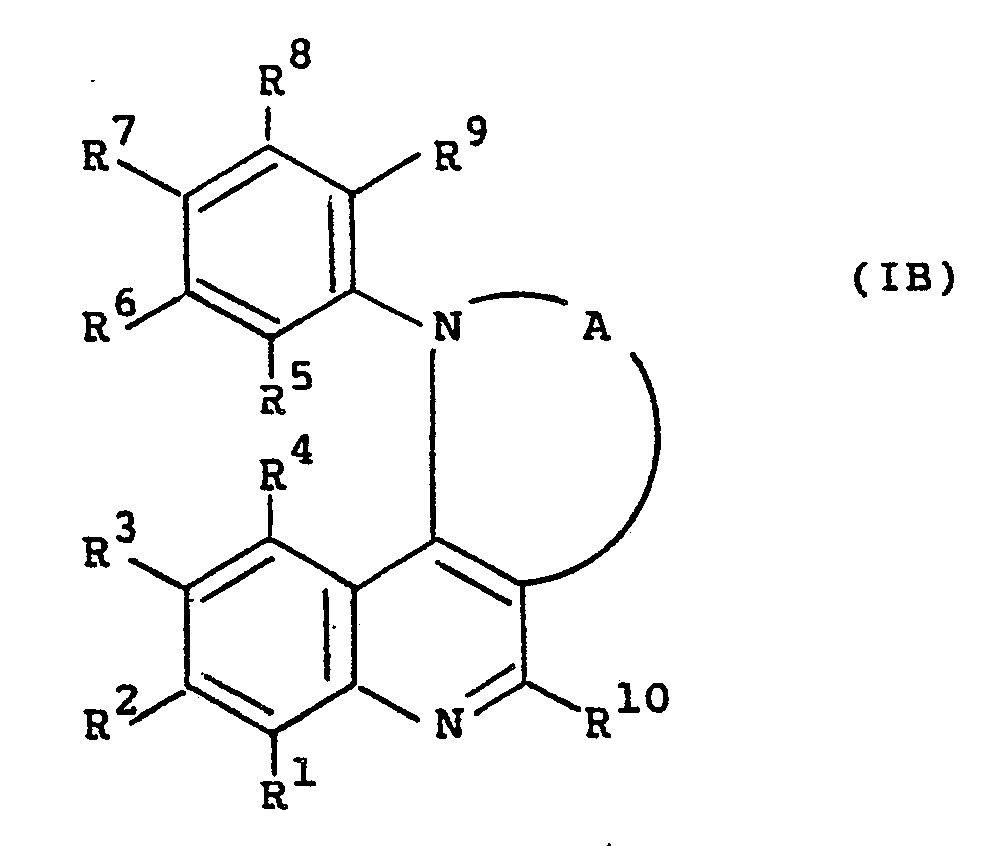
R¹ to R⁴ are the same or different and are each hydrogen, C₁₋₄alkyl, C₁₋₆alkoxy, phenyl, C₁₋₆alkylthio, C₁₋₆alkanoyl, amino, C₁₋₆alkylamino, diC₁₋₆alkylamino, halogen, trifluoromethyl or nitro, provided that at least two of R¹ to R⁴ are hydrogen.
R⁵ to R⁹ are the same or different and are each hydrogen, C₁₋₆alkyl, C₁₋₆alkoxy, C₁₋₆alkylthio, halogen, cyano, amino, hydroxy, carbamoyl, carboxy, C₁₋₆alkanoyl, trifluoromethyl or nitro, provided that at least two of R⁵ to R⁹ are hydrogen;
R¹⁰ is hydrogen, C₁₋₆alkyl, C₁₋₆alkoxy, halogen, hydroxy, -CH₂OH, C₁₋₆alkylthio, NH(CH₂)nOH in which n is 0 to 4 or a group -NR¹¹R¹² in which R¹¹ and R¹² are the same or different and are each hydrogen or C₁₋₆alkyl or together with the nitrogen atom to which they are attached form a saturated or unsaturated ring; and
A is -(CH₂)₂-, -(CH₂)₃- or -CH=CH-;
or a pharmaceutically acceptable salt thereof for use in the preparation of a medicament for use in the treatment of ulcer disease.


Priority Applications (1)
| Application Number | Priority Date | Filing Date | Title |
|---|---|---|---|
| AT88306583T ATE79880T1 (en) | 1987-07-24 | 1988-07-19 | QUINOLINE DERIVATIVES, PROCESSES FOR THEIR MANUFACTURE AND PHARMACEUTICAL PREPARATIONS CONTAINING THEM. |
Applications Claiming Priority (2)
| Application Number | Priority Date | Filing Date | Title |
|---|---|---|---|
| GB8717644 | 1987-07-24 | ||
| GB878717644A GB8717644D0 (en) | 1987-07-24 | 1987-07-24 | Compounds |
Publications (2)
| Publication Number | Publication Date |
|---|---|
| EP0307078A1 true EP0307078A1 (en) | 1989-03-15 |
| EP0307078B1 EP0307078B1 (en) | 1992-08-26 |
Family
ID=10621289
Family Applications (1)
| Application Number | Title | Priority Date | Filing Date |
|---|---|---|---|
| EP88306583A Expired - Lifetime EP0307078B1 (en) | 1987-07-24 | 1988-07-19 | Quinoline derivatives, process for their preparation and pharmaceutical compositions containing them |
Country Status (10)
| Country | Link |
|---|---|
| US (1) | US5051508A (en) |
| EP (1) | EP0307078B1 (en) |
| JP (1) | JPS6440482A (en) |
| AT (1) | ATE79880T1 (en) |
| AU (1) | AU1920088A (en) |
| DE (1) | DE3874056T2 (en) |
| DK (1) | DK414488A (en) |
| GB (1) | GB8717644D0 (en) |
| PT (1) | PT88033B (en) |
| ZA (1) | ZA885311B (en) |
Cited By (12)
| Publication number | Priority date | Publication date | Assignee | Title |
|---|---|---|---|---|
| EP0380257A3 (en) * | 1989-01-23 | 1991-08-07 | Smithkline Beckman Intercredit B.V. | Condensed cinnoline derivatives, process and intermediates for their preparation and pharmaceutical compositions containing them |
| EP0441036A3 (en) * | 1989-12-14 | 1992-02-26 | Smith Kline & French Laboratories Limited | Quinoline derivatives, processes for their preparation, intermediates, and pharmaceutical compositions containing these derivatives |
| US5102892A (en) * | 1989-03-17 | 1992-04-07 | Basf Aktiengesellschaft | 2-alkyl-4-arylmethylaminoquinolines, the use thereof and drugs prepared therefrom |
| WO1997044342A1 (en) * | 1996-05-17 | 1997-11-27 | Korea Research Institute Of Chemical Technology | PROCESS FOR PREPARING 1-ARYL-4-OXOPYRROLO[3,2-c]QUINOLINE DERIVATIVES |
| WO1999009029A1 (en) * | 1997-08-13 | 1999-02-25 | Korea Research Institute Of Chemical Technology | PYRROLO[3,2-c]QUINOLINE DERIVATIVES CONTAINING HALOALKOXY GROUP AND PHARMACEUTICALLY ACCEPTABLE SALTS THEREOF |
| WO2000001696A1 (en) * | 1998-07-02 | 2000-01-13 | Korea Research Institute Of Chemical Technology | 3-ALKYLPYRROLO[3,2-c]QUINOLINE DERIVATIVES |
| WO2007054693A1 (en) * | 2005-11-08 | 2007-05-18 | Helperby Therapeutics Limited | Use of pyrroloquinoline compounds to kill clinically latent microorganisms |
| EP1974730A1 (en) | 2003-11-03 | 2008-10-01 | AstraZeneca AB | Imidazo[1,2-a]pyridine derivatives for use in the treatment of sleep disturbance due to silent gastro-esophageal reflux |
| EP2086542A1 (en) * | 2006-11-08 | 2009-08-12 | Helperby Therapeutics Limited | Topical formulations |
| US7998972B2 (en) | 2002-05-21 | 2011-08-16 | Novartis Ag | 1H-imidazo[4,5-c]quinoline derivatives in the treatment of protein kinase dependent diseases |
| WO2023003497A1 (en) * | 2021-07-23 | 2023-01-26 | Общество С Ограниченной Ответственностью "Валента-Интеллект" | Compounds with lysosomotropic and antiviral activity |
| RU2817947C2 (en) * | 2021-07-23 | 2024-04-23 | Общество С Ограниченной Ответственностью "Валента - Интеллект" | Compounds with lysosomotropic and antiviral activity |
Families Citing this family (7)
| Publication number | Priority date | Publication date | Assignee | Title |
|---|---|---|---|---|
| US5556863A (en) * | 1993-06-11 | 1996-09-17 | Astra Aktiebolag | Compound for gastric acid secretion inhibition |
| IS4164A (en) * | 1993-06-11 | 1994-12-12 | Ab Astra | Compounds that inhibit gastric acid flow |
| UA80393C2 (en) | 2000-12-07 | 2007-09-25 | Алтана Фарма Аг | Pharmaceutical preparation comprising an pde inhibitor dispersed on a matrix |
| MY140561A (en) * | 2002-02-20 | 2009-12-31 | Nycomed Gmbh | Dosage form containing pde 4 inhibitor as active ingredient |
| EA009985B1 (en) | 2003-03-10 | 2008-04-28 | Никомед Гмбх | Novel process for the preparation of roflumilast |
| ES2421916T3 (en) * | 2005-03-16 | 2013-09-06 | Nycomed Gmbh | Masked flavor pharmaceutical form containing roflumilast |
| KR20240101561A (en) | 2021-10-14 | 2024-07-02 | 인사이트 코포레이션 | Quinoline compounds as inhibitors of KRAS |
Citations (2)
| Publication number | Priority date | Publication date | Assignee | Title |
|---|---|---|---|---|
| US2691023A (en) * | 1952-05-26 | 1954-10-05 | Schenley Ind Inc | Dihydropyrrolo-(3.2-c) quinoline derivatives |
| FR2258855A1 (en) * | 1974-01-30 | 1975-08-22 | Bellon Labor Sa Roger |
Family Cites Families (1)
| Publication number | Priority date | Publication date | Assignee | Title |
|---|---|---|---|---|
| GB725745A (en) * | 1952-05-26 | 1955-03-09 | Bayer Ag | Pyrrolinoquinolines and processes for making same |
-
1987
- 1987-07-24 GB GB878717644A patent/GB8717644D0/en active Pending
-
1988
- 1988-07-19 AT AT88306583T patent/ATE79880T1/en not_active IP Right Cessation
- 1988-07-19 DE DE8888306583T patent/DE3874056T2/en not_active Expired - Fee Related
- 1988-07-19 PT PT88033A patent/PT88033B/en not_active IP Right Cessation
- 1988-07-19 EP EP88306583A patent/EP0307078B1/en not_active Expired - Lifetime
- 1988-07-20 AU AU19200/88A patent/AU1920088A/en not_active Abandoned
- 1988-07-21 JP JP63184463A patent/JPS6440482A/en active Pending
- 1988-07-21 ZA ZA885311A patent/ZA885311B/en unknown
- 1988-07-22 DK DK414488A patent/DK414488A/en not_active Application Discontinuation
-
1990
- 1990-06-19 US US07/540,394 patent/US5051508A/en not_active Expired - Fee Related
Patent Citations (2)
| Publication number | Priority date | Publication date | Assignee | Title |
|---|---|---|---|---|
| US2691023A (en) * | 1952-05-26 | 1954-10-05 | Schenley Ind Inc | Dihydropyrrolo-(3.2-c) quinoline derivatives |
| FR2258855A1 (en) * | 1974-01-30 | 1975-08-22 | Bellon Labor Sa Roger |
Non-Patent Citations (1)
| Title |
|---|
| CHEMICAL ABSTRACTS, Vol. 84, No. 1, January 5, 1976, Columbus, Ohio, USA, MORISAWA, YASUHIRO: "Quinoline derivatives", page 409, column 2, Abstract No. 4825e; & JP,A,50 089 378, 17 Jul. 1975. * |
Cited By (16)
| Publication number | Priority date | Publication date | Assignee | Title |
|---|---|---|---|---|
| EP0380257A3 (en) * | 1989-01-23 | 1991-08-07 | Smithkline Beckman Intercredit B.V. | Condensed cinnoline derivatives, process and intermediates for their preparation and pharmaceutical compositions containing them |
| US5102892A (en) * | 1989-03-17 | 1992-04-07 | Basf Aktiengesellschaft | 2-alkyl-4-arylmethylaminoquinolines, the use thereof and drugs prepared therefrom |
| EP0441036A3 (en) * | 1989-12-14 | 1992-02-26 | Smith Kline & French Laboratories Limited | Quinoline derivatives, processes for their preparation, intermediates, and pharmaceutical compositions containing these derivatives |
| WO1997044342A1 (en) * | 1996-05-17 | 1997-11-27 | Korea Research Institute Of Chemical Technology | PROCESS FOR PREPARING 1-ARYL-4-OXOPYRROLO[3,2-c]QUINOLINE DERIVATIVES |
| US5914402A (en) * | 1996-05-17 | 1999-06-22 | Korea Research Institute Of Chemical Technology | Process for preparing 1-aryl-4-oxopyrrolo 3,2-c! quinoline derivatives |
| WO1999009029A1 (en) * | 1997-08-13 | 1999-02-25 | Korea Research Institute Of Chemical Technology | PYRROLO[3,2-c]QUINOLINE DERIVATIVES CONTAINING HALOALKOXY GROUP AND PHARMACEUTICALLY ACCEPTABLE SALTS THEREOF |
| WO2000001696A1 (en) * | 1998-07-02 | 2000-01-13 | Korea Research Institute Of Chemical Technology | 3-ALKYLPYRROLO[3,2-c]QUINOLINE DERIVATIVES |
| US7998972B2 (en) | 2002-05-21 | 2011-08-16 | Novartis Ag | 1H-imidazo[4,5-c]quinoline derivatives in the treatment of protein kinase dependent diseases |
| EP1974730A1 (en) | 2003-11-03 | 2008-10-01 | AstraZeneca AB | Imidazo[1,2-a]pyridine derivatives for use in the treatment of sleep disturbance due to silent gastro-esophageal reflux |
| WO2007054693A1 (en) * | 2005-11-08 | 2007-05-18 | Helperby Therapeutics Limited | Use of pyrroloquinoline compounds to kill clinically latent microorganisms |
| US8207187B2 (en) | 2005-11-08 | 2012-06-26 | Helperby Therapeutics Limited | Use of pyrroloquinoline compounds to kill clinically latent microorganisms |
| US9694006B2 (en) | 2005-11-08 | 2017-07-04 | Helperby Therapeutics Limited | Use of pyrroloquinoline compounds to kill clinically latent microorganisms |
| US10493071B2 (en) | 2005-11-08 | 2019-12-03 | Helperby Therapeutics Limited | Use of pyrroloquinoline compounds to kill clinically latent microorganisms |
| EP2086542A1 (en) * | 2006-11-08 | 2009-08-12 | Helperby Therapeutics Limited | Topical formulations |
| WO2023003497A1 (en) * | 2021-07-23 | 2023-01-26 | Общество С Ограниченной Ответственностью "Валента-Интеллект" | Compounds with lysosomotropic and antiviral activity |
| RU2817947C2 (en) * | 2021-07-23 | 2024-04-23 | Общество С Ограниченной Ответственностью "Валента - Интеллект" | Compounds with lysosomotropic and antiviral activity |
Also Published As
| Publication number | Publication date |
|---|---|
| PT88033A (en) | 1989-06-30 |
| GB8717644D0 (en) | 1987-09-03 |
| DE3874056D1 (en) | 1992-10-01 |
| DE3874056T2 (en) | 1993-01-07 |
| US5051508A (en) | 1991-09-24 |
| AU1920088A (en) | 1989-01-27 |
| EP0307078B1 (en) | 1992-08-26 |
| ZA885311B (en) | 1989-07-26 |
| JPS6440482A (en) | 1989-02-10 |
| DK414488A (en) | 1989-01-25 |
| ATE79880T1 (en) | 1992-09-15 |
| DK414488D0 (en) | 1988-07-22 |
| PT88033B (en) | 1995-03-31 |
Similar Documents
| Publication | Publication Date | Title |
|---|---|---|
| EP0307078B1 (en) | Quinoline derivatives, process for their preparation and pharmaceutical compositions containing them | |
| EP0322133B1 (en) | Quinazoline derivatives | |
| EP0393926B1 (en) | 1-Aminoisoquinoline derivatives | |
| RU2235725C2 (en) | Derivatives of imidazopyridine, method for their preparing and intermediate compounds, pharmaceutical preparation based on thereof (variants), method for inhibition of gastric acid secretion and method for treatment of states associated with helicobacter pylori infection | |
| EP0441034A2 (en) | Support for fragrance samples | |
| RU2136682C1 (en) | Imidazopyridines, method of their synthesis, pharmaceutical composition on said and method of pharmaceutical composition preparing | |
| US5280026A (en) | Thienopyrimidines | |
| EP0404355A1 (en) | Pyridopyrimidine derivatives, process for the preparation thereof and pharmaceutical compositions containing them | |
| EP0334491A1 (en) | Thienopyridines, process and intermediates for their preparation and pharmaceutical compositions containing them | |
| IE61104B1 (en) | Derivatives of 4-aminoquinoline | |
| EP0330485B1 (en) | 4-amino-3-acyl quinoline derivatives and their use as inhibitors of gastric acid secretion | |
| WO1993015056A1 (en) | Pyridone derivatives, their preparation and use as medicines | |
| US5143920A (en) | Substituted 4-aminoquinoline derivatives as gastric secretion inhibitors | |
| KR20060005333A (en) | Use of and some novel imidazopyridines | |
| EP0404322B1 (en) | Quinazoline derivatives | |
| US5089498A (en) | Substituted 4-aminoquinoline derivatives as gastric acid secretion inhibitors | |
| US5420135A (en) | Substituted quinoline derivatives | |
| US5006535A (en) | Substituted heterocylic 4-aminoquinoline derivatives as gastric acid secretion inhibitors | |
| US4988695A (en) | Pyrrolocinnolines for use as inhibitors of gastric acid secretion | |
| SK197A3 (en) | Imidazopyridine-azolidinones, preparation method thereof, pharmaceutical composition containing same and their use | |
| EP0416749B1 (en) | Substituted 4-aminoquinolines | |
| EP1186607B1 (en) | Optically active pyrrolopyridazine compounds | |
| EP0404356A1 (en) | Substituted thienopyrimidine derivatives, their preparation, pharmaceutical compositions and medical use | |
| EP0331357A1 (en) | 4-Amino-3-acylquinoline derivatives and their use as inhibitors of gastric secretion | |
| KR101137168B1 (en) | Pyrrolo[2,3-d]pyridazine derivatives and processes for the preparation thereof |
Legal Events
| Date | Code | Title | Description |
|---|---|---|---|
| PUAI | Public reference made under article 153(3) epc to a published international application that has entered the european phase |
Free format text: ORIGINAL CODE: 0009012 |
|
| 17P | Request for examination filed |
Effective date: 19880802 |
|
| AK | Designated contracting states |
Kind code of ref document: A1 Designated state(s): AT BE CH DE ES FR GB GR IT LI LU NL SE |
|
| 17Q | First examination report despatched |
Effective date: 19901123 |
|
| RAP1 | Party data changed (applicant data changed or rights of an application transferred) |
Owner name: SMITHKLINE BEECHAM INTERCREDIT B.V. |
|
| RAP1 | Party data changed (applicant data changed or rights of an application transferred) |
Owner name: SMITHKLINE BEECHAM INTERCREDIT B.V. |
|
| GRAA | (expected) grant |
Free format text: ORIGINAL CODE: 0009210 |
|
| AK | Designated contracting states |
Kind code of ref document: B1 Designated state(s): AT BE CH DE ES FR GB GR IT LI LU NL SE |
|
| PG25 | Lapsed in a contracting state [announced via postgrant information from national office to epo] |
Ref country code: SE Free format text: THE PATENT HAS BEEN ANNULLED BY A DECISION OF A NATIONAL AUTHORITY Effective date: 19920826 Ref country code: GR Free format text: LAPSE BECAUSE OF FAILURE TO SUBMIT A TRANSLATION OF THE DESCRIPTION OR TO PAY THE FEE WITHIN THE PRESCRIBED TIME-LIMIT Effective date: 19920826 Ref country code: ES Free format text: THE PATENT HAS BEEN ANNULLED BY A DECISION OF A NATIONAL AUTHORITY Effective date: 19920826 Ref country code: BE Effective date: 19920826 Ref country code: AT Effective date: 19920826 |
|
| REF | Corresponds to: |
Ref document number: 79880 Country of ref document: AT Date of ref document: 19920915 Kind code of ref document: T |
|
| ITF | It: translation for a ep patent filed | ||
| REF | Corresponds to: |
Ref document number: 3874056 Country of ref document: DE Date of ref document: 19921001 |
|
| ET | Fr: translation filed | ||
| PLBE | No opposition filed within time limit |
Free format text: ORIGINAL CODE: 0009261 |
|
| STAA | Information on the status of an ep patent application or granted ep patent |
Free format text: STATUS: NO OPPOSITION FILED WITHIN TIME LIMIT |
|
| PG25 | Lapsed in a contracting state [announced via postgrant information from national office to epo] |
Ref country code: LU Free format text: LAPSE BECAUSE OF NON-PAYMENT OF DUE FEES Effective date: 19930731 |
|
| 26N | No opposition filed | ||
| PGFP | Annual fee paid to national office [announced via postgrant information from national office to epo] |
Ref country code: GB Payment date: 19950619 Year of fee payment: 8 |
|
| PGFP | Annual fee paid to national office [announced via postgrant information from national office to epo] |
Ref country code: NL Payment date: 19950707 Year of fee payment: 8 |
|
| PGFP | Annual fee paid to national office [announced via postgrant information from national office to epo] |
Ref country code: FR Payment date: 19950714 Year of fee payment: 8 |
|
| PGFP | Annual fee paid to national office [announced via postgrant information from national office to epo] |
Ref country code: DE Payment date: 19950731 Year of fee payment: 8 |
|
| PGFP | Annual fee paid to national office [announced via postgrant information from national office to epo] |
Ref country code: CH Payment date: 19951024 Year of fee payment: 8 |
|
| PG25 | Lapsed in a contracting state [announced via postgrant information from national office to epo] |
Ref country code: GB Effective date: 19960719 |
|
| PG25 | Lapsed in a contracting state [announced via postgrant information from national office to epo] |
Ref country code: LI Effective date: 19960731 Ref country code: CH Effective date: 19960731 |
|
| PG25 | Lapsed in a contracting state [announced via postgrant information from national office to epo] |
Ref country code: NL Effective date: 19970201 |
|
| GBPC | Gb: european patent ceased through non-payment of renewal fee |
Effective date: 19960719 |
|
| REG | Reference to a national code |
Ref country code: CH Ref legal event code: PL |
|
| PG25 | Lapsed in a contracting state [announced via postgrant information from national office to epo] |
Ref country code: FR Effective date: 19970328 |
|
| NLV4 | Nl: lapsed or anulled due to non-payment of the annual fee |
Effective date: 19970201 |
|
| PG25 | Lapsed in a contracting state [announced via postgrant information from national office to epo] |
Ref country code: DE Effective date: 19970402 |
|
| REG | Reference to a national code |
Ref country code: FR Ref legal event code: ST |
|
| PG25 | Lapsed in a contracting state [announced via postgrant information from national office to epo] |
Ref country code: IT Free format text: LAPSE BECAUSE OF NON-PAYMENT OF DUE FEES;WARNING: LAPSES OF ITALIAN PATENTS WITH EFFECTIVE DATE BEFORE 2007 MAY HAVE OCCURRED AT ANY TIME BEFORE 2007. THE CORRECT EFFECTIVE DATE MAY BE DIFFERENT FROM THE ONE RECORDED. Effective date: 20050719 |