EP0305039B1 - Process for making cationic latex - Google Patents
Process for making cationic latex Download PDFInfo
- Publication number
- EP0305039B1 EP0305039B1 EP88306335A EP88306335A EP0305039B1 EP 0305039 B1 EP0305039 B1 EP 0305039B1 EP 88306335 A EP88306335 A EP 88306335A EP 88306335 A EP88306335 A EP 88306335A EP 0305039 B1 EP0305039 B1 EP 0305039B1
- Authority
- EP
- European Patent Office
- Prior art keywords
- weight percent
- methacrylate
- alkyl
- acrylate
- monomers selected
- Prior art date
- Legal status (The legal status is an assumption and is not a legal conclusion. Google has not performed a legal analysis and makes no representation as to the accuracy of the status listed.)
- Expired
Links
- 125000002091 cationic group Chemical group 0.000 title claims description 31
- 238000000034 method Methods 0.000 title claims description 28
- 229920000126 latex Polymers 0.000 title description 25
- 239000004816 latex Substances 0.000 title description 22
- 239000000178 monomer Substances 0.000 claims description 50
- 239000000839 emulsion Substances 0.000 claims description 44
- 239000006185 dispersion Substances 0.000 claims description 37
- 125000000129 anionic group Chemical group 0.000 claims description 23
- -1 alkali metal salts Chemical class 0.000 claims description 21
- 239000002270 dispersing agent Substances 0.000 claims description 21
- BAPJBEWLBFYGME-UHFFFAOYSA-N Methyl acrylate Chemical compound COC(=O)C=C BAPJBEWLBFYGME-UHFFFAOYSA-N 0.000 claims description 20
- 229920000642 polymer Polymers 0.000 claims description 19
- SOGAXMICEFXMKE-UHFFFAOYSA-N Butylmethacrylate Chemical compound CCCCOC(=O)C(C)=C SOGAXMICEFXMKE-UHFFFAOYSA-N 0.000 claims description 16
- 150000001408 amides Chemical class 0.000 claims description 14
- 150000001735 carboxylic acids Chemical class 0.000 claims description 14
- WSFSSNUMVMOOMR-UHFFFAOYSA-N Formaldehyde Chemical compound O=C WSFSSNUMVMOOMR-UHFFFAOYSA-N 0.000 claims description 12
- 125000002768 hydroxyalkyl group Chemical group 0.000 claims description 12
- 125000000217 alkyl group Chemical group 0.000 claims description 11
- RRHGJUQNOFWUDK-UHFFFAOYSA-N Isoprene Chemical compound CC(=C)C=C RRHGJUQNOFWUDK-UHFFFAOYSA-N 0.000 claims description 10
- PPBRXRYQALVLMV-UHFFFAOYSA-N Styrene Chemical compound C=CC1=CC=CC=C1 PPBRXRYQALVLMV-UHFFFAOYSA-N 0.000 claims description 10
- 229920002554 vinyl polymer Polymers 0.000 claims description 10
- 150000001412 amines Chemical class 0.000 claims description 9
- 229910052801 chlorine Inorganic materials 0.000 claims description 9
- 239000002245 particle Substances 0.000 claims description 9
- 239000003381 stabilizer Substances 0.000 claims description 9
- 125000000391 vinyl group Chemical group [H]C([*])=C([H])[H] 0.000 claims description 9
- 125000004209 (C1-C8) alkyl group Chemical group 0.000 claims description 8
- GOXQRTZXKQZDDN-UHFFFAOYSA-N 2-Ethylhexyl acrylate Chemical compound CCCCC(CC)COC(=O)C=C GOXQRTZXKQZDDN-UHFFFAOYSA-N 0.000 claims description 8
- OMIGHNLMNHATMP-UHFFFAOYSA-N 2-hydroxyethyl prop-2-enoate Chemical compound OCCOC(=O)C=C OMIGHNLMNHATMP-UHFFFAOYSA-N 0.000 claims description 8
- KAKZBPTYRLMSJV-UHFFFAOYSA-N Butadiene Chemical compound C=CC=C KAKZBPTYRLMSJV-UHFFFAOYSA-N 0.000 claims description 8
- JIGUQPWFLRLWPJ-UHFFFAOYSA-N Ethyl acrylate Chemical compound CCOC(=O)C=C JIGUQPWFLRLWPJ-UHFFFAOYSA-N 0.000 claims description 8
- VVQNEPGJFQJSBK-UHFFFAOYSA-N Methyl methacrylate Chemical compound COC(=O)C(C)=C VVQNEPGJFQJSBK-UHFFFAOYSA-N 0.000 claims description 8
- CQEYYJKEWSMYFG-UHFFFAOYSA-N butyl acrylate Chemical compound CCCCOC(=O)C=C CQEYYJKEWSMYFG-UHFFFAOYSA-N 0.000 claims description 8
- 150000001993 dienes Chemical class 0.000 claims description 8
- SUPCQIBBMFXVTL-UHFFFAOYSA-N ethyl 2-methylprop-2-enoate Chemical compound CCOC(=O)C(C)=C SUPCQIBBMFXVTL-UHFFFAOYSA-N 0.000 claims description 8
- 229910052757 nitrogen Inorganic materials 0.000 claims description 8
- KCAMXZBMXVIIQN-UHFFFAOYSA-N octan-3-yl 2-methylprop-2-enoate Chemical compound CCCCCC(CC)OC(=O)C(C)=C KCAMXZBMXVIIQN-UHFFFAOYSA-N 0.000 claims description 8
- PNJWIWWMYCMZRO-UHFFFAOYSA-N pent‐4‐en‐2‐one Natural products CC(=O)CC=C PNJWIWWMYCMZRO-UHFFFAOYSA-N 0.000 claims description 8
- HRPVXLWXLXDGHG-UHFFFAOYSA-N Acrylamide Chemical compound NC(=O)C=C HRPVXLWXLXDGHG-UHFFFAOYSA-N 0.000 claims description 7
- CNCOEDDPFOAUMB-UHFFFAOYSA-N N-Methylolacrylamide Chemical compound OCNC(=O)C=C CNCOEDDPFOAUMB-UHFFFAOYSA-N 0.000 claims description 7
- 229920001577 copolymer Polymers 0.000 claims description 7
- FQPSGWSUVKBHSU-UHFFFAOYSA-N methacrylamide Chemical compound CC(=C)C(N)=O FQPSGWSUVKBHSU-UHFFFAOYSA-N 0.000 claims description 7
- DNTMQTKDNSEIFO-UHFFFAOYSA-N n-(hydroxymethyl)-2-methylprop-2-enamide Chemical compound CC(=C)C(=O)NCO DNTMQTKDNSEIFO-UHFFFAOYSA-N 0.000 claims description 7
- 125000004433 nitrogen atom Chemical group N* 0.000 claims description 7
- 125000001424 substituent group Chemical group 0.000 claims description 7
- 229920002818 (Hydroxyethyl)methacrylate Polymers 0.000 claims description 6
- WOBHKFSMXKNTIM-UHFFFAOYSA-N Hydroxyethyl methacrylate Chemical compound CC(=C)C(=O)OCCO WOBHKFSMXKNTIM-UHFFFAOYSA-N 0.000 claims description 6
- 125000001309 chloro group Chemical group Cl* 0.000 claims description 6
- 239000007788 liquid Substances 0.000 claims description 6
- BDHFUVZGWQCTTF-UHFFFAOYSA-M sulfonate Chemical compound [O-]S(=O)=O BDHFUVZGWQCTTF-UHFFFAOYSA-M 0.000 claims description 6
- 229920001732 Lignosulfonate Polymers 0.000 claims description 5
- 239000000203 mixture Substances 0.000 claims description 5
- 244000043261 Hevea brasiliensis Species 0.000 claims description 4
- UFWIBTONFRDIAS-UHFFFAOYSA-N Naphthalene Chemical class C1=CC=CC2=CC=CC=C21 UFWIBTONFRDIAS-UHFFFAOYSA-N 0.000 claims description 4
- 239000000460 chlorine Substances 0.000 claims description 4
- YACLQRRMGMJLJV-UHFFFAOYSA-N chloroprene Chemical compound ClC(=C)C=C YACLQRRMGMJLJV-UHFFFAOYSA-N 0.000 claims description 4
- 229920001519 homopolymer Polymers 0.000 claims description 4
- 229920003052 natural elastomer Polymers 0.000 claims description 4
- 229920001194 natural rubber Polymers 0.000 claims description 4
- JRZJOMJEPLMPRA-UHFFFAOYSA-N olefin Natural products CCCCCCCC=C JRZJOMJEPLMPRA-UHFFFAOYSA-N 0.000 claims description 4
- SBYMUDUGTIKLCR-UHFFFAOYSA-N 2-chloroethenylbenzene Chemical compound ClC=CC1=CC=CC=C1 SBYMUDUGTIKLCR-UHFFFAOYSA-N 0.000 claims description 3
- WKBOTKDWSSQWDR-UHFFFAOYSA-N Bromine atom Chemical group [Br] WKBOTKDWSSQWDR-UHFFFAOYSA-N 0.000 claims description 3
- KZBUYRJDOAKODT-UHFFFAOYSA-N Chlorine Chemical compound ClCl KZBUYRJDOAKODT-UHFFFAOYSA-N 0.000 claims description 3
- CERQOIWHTDAKMF-UHFFFAOYSA-M Methacrylate Chemical compound CC(=C)C([O-])=O CERQOIWHTDAKMF-UHFFFAOYSA-M 0.000 claims description 3
- 125000001931 aliphatic group Chemical group 0.000 claims description 3
- 229910052783 alkali metal Inorganic materials 0.000 claims description 3
- 229910052784 alkaline earth metal Inorganic materials 0.000 claims description 3
- 150000001336 alkenes Chemical class 0.000 claims description 3
- XYLMUPLGERFSHI-UHFFFAOYSA-N alpha-Methylstyrene Chemical compound CC(=C)C1=CC=CC=C1 XYLMUPLGERFSHI-UHFFFAOYSA-N 0.000 claims description 3
- NHARPDSAXCBDDR-UHFFFAOYSA-N propyl 2-methylprop-2-enoate Chemical compound CCCOC(=O)C(C)=C NHARPDSAXCBDDR-UHFFFAOYSA-N 0.000 claims description 3
- PNXMTCDJUBJHQJ-UHFFFAOYSA-N propyl prop-2-enoate Chemical compound CCCOC(=O)C=C PNXMTCDJUBJHQJ-UHFFFAOYSA-N 0.000 claims description 3
- SMZOUWXMTYCWNB-UHFFFAOYSA-N 2-(2-methoxy-5-methylphenyl)ethanamine Chemical compound COC1=CC=C(C)C=C1CCN SMZOUWXMTYCWNB-UHFFFAOYSA-N 0.000 claims description 2
- NLHHRLWOUZZQLW-UHFFFAOYSA-N Acrylonitrile Chemical compound C=CC#N NLHHRLWOUZZQLW-UHFFFAOYSA-N 0.000 claims description 2
- 125000000882 C2-C6 alkenyl group Chemical group 0.000 claims description 2
- VGGSQFUCUMXWEO-UHFFFAOYSA-N Ethene Chemical compound C=C VGGSQFUCUMXWEO-UHFFFAOYSA-N 0.000 claims description 2
- 239000005977 Ethylene Substances 0.000 claims description 2
- CERQOIWHTDAKMF-UHFFFAOYSA-N Methacrylic acid Chemical compound CC(=C)C(O)=O CERQOIWHTDAKMF-UHFFFAOYSA-N 0.000 claims description 2
- GYCMBHHDWRMZGG-UHFFFAOYSA-N Methylacrylonitrile Chemical compound CC(=C)C#N GYCMBHHDWRMZGG-UHFFFAOYSA-N 0.000 claims description 2
- XTXRWKRVRITETP-UHFFFAOYSA-N Vinyl acetate Chemical compound CC(=O)OC=C XTXRWKRVRITETP-UHFFFAOYSA-N 0.000 claims description 2
- 125000005907 alkyl ester group Chemical group 0.000 claims description 2
- 125000005020 hydroxyalkenyl group Chemical group 0.000 claims description 2
- QQONPFPTGQHPMA-UHFFFAOYSA-N propylene Natural products CC=C QQONPFPTGQHPMA-UHFFFAOYSA-N 0.000 claims description 2
- 125000004805 propylene group Chemical group [H]C([H])([H])C([H])([*:1])C([H])([H])[*:2] 0.000 claims description 2
- 229920006395 saturated elastomer Polymers 0.000 claims description 2
- XLYOFNOQVPJJNP-UHFFFAOYSA-N water Substances O XLYOFNOQVPJJNP-UHFFFAOYSA-N 0.000 claims description 2
- 150000001732 carboxylic acid derivatives Chemical class 0.000 claims 7
- 239000003995 emulsifying agent Substances 0.000 description 12
- 238000002474 experimental method Methods 0.000 description 11
- 239000007787 solid Substances 0.000 description 7
- VEXZGXHMUGYJMC-UHFFFAOYSA-N Hydrochloric acid Chemical compound Cl VEXZGXHMUGYJMC-UHFFFAOYSA-N 0.000 description 4
- 239000002253 acid Substances 0.000 description 4
- 229920001971 elastomer Polymers 0.000 description 4
- 229920001084 poly(chloroprene) Polymers 0.000 description 4
- 239000005060 rubber Substances 0.000 description 4
- 239000004094 surface-active agent Substances 0.000 description 4
- QTBSBXVTEAMEQO-UHFFFAOYSA-N Acetic acid Chemical compound CC(O)=O QTBSBXVTEAMEQO-UHFFFAOYSA-N 0.000 description 3
- 239000002585 base Substances 0.000 description 3
- 230000000052 comparative effect Effects 0.000 description 3
- 150000001875 compounds Chemical class 0.000 description 3
- 229920000058 polyacrylate Polymers 0.000 description 3
- SQAINHDHICKHLX-UHFFFAOYSA-N 1-naphthaldehyde Chemical class C1=CC=C2C(C=O)=CC=CC2=C1 SQAINHDHICKHLX-UHFFFAOYSA-N 0.000 description 2
- IJGRMHOSHXDMSA-UHFFFAOYSA-N Atomic nitrogen Chemical compound N#N IJGRMHOSHXDMSA-UHFFFAOYSA-N 0.000 description 2
- 239000004793 Polystyrene Substances 0.000 description 2
- 229920004896 Triton X-405 Polymers 0.000 description 2
- 239000002280 amphoteric surfactant Substances 0.000 description 2
- 239000003795 chemical substances by application Substances 0.000 description 2
- 238000005345 coagulation Methods 0.000 description 2
- 230000015271 coagulation Effects 0.000 description 2
- 238000013329 compounding Methods 0.000 description 2
- 230000008021 deposition Effects 0.000 description 2
- 230000001687 destabilization Effects 0.000 description 2
- 239000000835 fiber Substances 0.000 description 2
- 229920002857 polybutadiene Polymers 0.000 description 2
- 229920001195 polyisoprene Polymers 0.000 description 2
- 229920002223 polystyrene Polymers 0.000 description 2
- 238000002360 preparation method Methods 0.000 description 2
- 150000003254 radicals Chemical class 0.000 description 2
- 229920003048 styrene butadiene rubber Polymers 0.000 description 2
- 210000002268 wool Anatomy 0.000 description 2
- OEPOKWHJYJXUGD-UHFFFAOYSA-N 2-(3-phenylmethoxyphenyl)-1,3-thiazole-4-carbaldehyde Chemical compound O=CC1=CSC(C=2C=C(OCC=3C=CC=CC=3)C=CC=2)=N1 OEPOKWHJYJXUGD-UHFFFAOYSA-N 0.000 description 1
- GAWIXWVDTYZWAW-UHFFFAOYSA-N C[CH]O Chemical group C[CH]O GAWIXWVDTYZWAW-UHFFFAOYSA-N 0.000 description 1
- 239000004215 Carbon black (E152) Substances 0.000 description 1
- IAYPIBMASNFSPL-UHFFFAOYSA-N Ethylene oxide Chemical compound C1CO1 IAYPIBMASNFSPL-UHFFFAOYSA-N 0.000 description 1
- 229920000459 Nitrile rubber Polymers 0.000 description 1
- 239000005062 Polybutadiene Substances 0.000 description 1
- 229920004890 Triton X-100 Polymers 0.000 description 1
- 230000002378 acidificating effect Effects 0.000 description 1
- 150000007513 acids Chemical class 0.000 description 1
- 125000003277 amino group Chemical group 0.000 description 1
- 238000004458 analytical method Methods 0.000 description 1
- 239000003945 anionic surfactant Substances 0.000 description 1
- 229920005551 calcium lignosulfonate Polymers 0.000 description 1
- RYAGRZNBULDMBW-UHFFFAOYSA-L calcium;3-(2-hydroxy-3-methoxyphenyl)-2-[2-methoxy-4-(3-sulfonatopropyl)phenoxy]propane-1-sulfonate Chemical compound [Ca+2].COC1=CC=CC(CC(CS([O-])(=O)=O)OC=2C(=CC(CCCS([O-])(=O)=O)=CC=2)OC)=C1O RYAGRZNBULDMBW-UHFFFAOYSA-L 0.000 description 1
- 125000004432 carbon atom Chemical group C* 0.000 description 1
- 238000006243 chemical reaction Methods 0.000 description 1
- 239000007859 condensation product Substances 0.000 description 1
- 239000003599 detergent Substances 0.000 description 1
- 239000003792 electrolyte Substances 0.000 description 1
- 238000007720 emulsion polymerization reaction Methods 0.000 description 1
- 238000005516 engineering process Methods 0.000 description 1
- 150000002148 esters Chemical class 0.000 description 1
- 150000002196 fatty nitriles Chemical class 0.000 description 1
- 239000000945 filler Substances 0.000 description 1
- 238000009472 formulation Methods 0.000 description 1
- 229930195733 hydrocarbon Natural products 0.000 description 1
- 150000002430 hydrocarbons Chemical class 0.000 description 1
- MTNDZQHUAFNZQY-UHFFFAOYSA-N imidazoline Chemical compound C1CN=CN1 MTNDZQHUAFNZQY-UHFFFAOYSA-N 0.000 description 1
- 239000004615 ingredient Substances 0.000 description 1
- 150000002500 ions Chemical class 0.000 description 1
- 229920005610 lignin Polymers 0.000 description 1
- 238000004519 manufacturing process Methods 0.000 description 1
- 239000000463 material Substances 0.000 description 1
- 239000008204 material by function Substances 0.000 description 1
- 150000007522 mineralic acids Chemical class 0.000 description 1
- 238000002156 mixing Methods 0.000 description 1
- PSZYNBSKGUBXEH-UHFFFAOYSA-N naphthalene-1-sulfonic acid Chemical class C1=CC=C2C(S(=O)(=O)O)=CC=CC2=C1 PSZYNBSKGUBXEH-UHFFFAOYSA-N 0.000 description 1
- 150000002825 nitriles Chemical class 0.000 description 1
- 150000007524 organic acids Chemical class 0.000 description 1
- 235000005985 organic acids Nutrition 0.000 description 1
- 230000020477 pH reduction Effects 0.000 description 1
- 150000004885 piperazines Chemical class 0.000 description 1
- 229920003023 plastic Polymers 0.000 description 1
- 239000004033 plastic Substances 0.000 description 1
- 229920002587 poly(1,3-butadiene) polymer Polymers 0.000 description 1
- 229920000233 poly(alkylene oxides) Polymers 0.000 description 1
- 229920000867 polyelectrolyte Polymers 0.000 description 1
- XAEFZNCEHLXOMS-UHFFFAOYSA-M potassium benzoate Chemical compound [K+].[O-]C(=O)C1=CC=CC=C1 XAEFZNCEHLXOMS-UHFFFAOYSA-M 0.000 description 1
- GHKGUEZUGFJUEJ-UHFFFAOYSA-M potassium;4-methylbenzenesulfonate Chemical compound [K+].CC1=CC=C(S([O-])(=O)=O)C=C1 GHKGUEZUGFJUEJ-UHFFFAOYSA-M 0.000 description 1
- 230000002028 premature Effects 0.000 description 1
- 150000003141 primary amines Chemical class 0.000 description 1
- 150000003335 secondary amines Chemical class 0.000 description 1
- 238000000926 separation method Methods 0.000 description 1
- 239000000344 soap Substances 0.000 description 1
- 159000000000 sodium salts Chemical class 0.000 description 1
- KVCGISUBCHHTDD-UHFFFAOYSA-M sodium;4-methylbenzenesulfonate Chemical compound [Na+].CC1=CC=C(S([O-])(=O)=O)C=C1 KVCGISUBCHHTDD-UHFFFAOYSA-M 0.000 description 1
- 238000003756 stirring Methods 0.000 description 1
- 239000000126 substance Substances 0.000 description 1
- 229920001059 synthetic polymer Polymers 0.000 description 1
- 150000003512 tertiary amines Chemical class 0.000 description 1
- 239000004753 textile Substances 0.000 description 1
- JOXIMZWYDAKGHI-UHFFFAOYSA-N toluene-4-sulfonic acid Chemical compound CC1=CC=C(S(O)(=O)=O)C=C1 JOXIMZWYDAKGHI-UHFFFAOYSA-N 0.000 description 1
Classifications
-
- C—CHEMISTRY; METALLURGY
- C09—DYES; PAINTS; POLISHES; NATURAL RESINS; ADHESIVES; COMPOSITIONS NOT OTHERWISE PROVIDED FOR; APPLICATIONS OF MATERIALS NOT OTHERWISE PROVIDED FOR
- C09K—MATERIALS FOR MISCELLANEOUS APPLICATIONS, NOT PROVIDED FOR ELSEWHERE
- C09K23/00—Use of substances as emulsifying, wetting, dispersing, or foam-producing agents
- C09K23/12—Sulfonates of aromatic or alkylated aromatic compounds
-
- C—CHEMISTRY; METALLURGY
- C08—ORGANIC MACROMOLECULAR COMPOUNDS; THEIR PREPARATION OR CHEMICAL WORKING-UP; COMPOSITIONS BASED THEREON
- C08K—Use of inorganic or non-macromolecular organic substances as compounding ingredients
- C08K5/00—Use of organic ingredients
- C08K5/36—Sulfur-, selenium-, or tellurium-containing compounds
- C08K5/41—Compounds containing sulfur bound to oxygen
- C08K5/42—Sulfonic acids; Derivatives thereof
-
- C—CHEMISTRY; METALLURGY
- C08—ORGANIC MACROMOLECULAR COMPOUNDS; THEIR PREPARATION OR CHEMICAL WORKING-UP; COMPOSITIONS BASED THEREON
- C08J—WORKING-UP; GENERAL PROCESSES OF COMPOUNDING; AFTER-TREATMENT NOT COVERED BY SUBCLASSES C08B, C08C, C08F, C08G or C08H
- C08J3/00—Processes of treating or compounding macromolecular substances
- C08J3/02—Making solutions, dispersions, lattices or gels by other methods than by solution, emulsion or suspension polymerisation techniques
- C08J3/03—Making solutions, dispersions, lattices or gels by other methods than by solution, emulsion or suspension polymerisation techniques in aqueous media
-
- C—CHEMISTRY; METALLURGY
- C08—ORGANIC MACROMOLECULAR COMPOUNDS; THEIR PREPARATION OR CHEMICAL WORKING-UP; COMPOSITIONS BASED THEREON
- C08L—COMPOSITIONS OF MACROMOLECULAR COMPOUNDS
- C08L21/00—Compositions of unspecified rubbers
- C08L21/02—Latex
-
- C—CHEMISTRY; METALLURGY
- C09—DYES; PAINTS; POLISHES; NATURAL RESINS; ADHESIVES; COMPOSITIONS NOT OTHERWISE PROVIDED FOR; APPLICATIONS OF MATERIALS NOT OTHERWISE PROVIDED FOR
- C09K—MATERIALS FOR MISCELLANEOUS APPLICATIONS, NOT PROVIDED FOR ELSEWHERE
- C09K23/00—Use of substances as emulsifying, wetting, dispersing, or foam-producing agents
Definitions
- the present invention relates to cationic stabilized particles distributed throughout a liquid medium such as cationic emulsions, dispersions or latices. More particularly the present invention relates to a process to make an anionic dispersion, emulsion or latex compatible in or with a cationic emulsion.
- Emulsions and dispersions are useful in a wide range of industrial processes. Many emulsions or dispersions which are naturally occuring or synthetically prepared are anionic. This means that the electrostatic charge on the particles of the dispersed phase is negative. There are instances where it would be desirable to make the latex useful in a system which has a different charge.
- British Patent Application 2,151,640A published July 24, 1985 in the name of Bayer AG discloses a process for converting an anionic emulsion to a cationic emulsion by adding an amphoteric emulsifier to the emulsion prior to adding a cationic emulsifier. The pH of the emulsion is then adjusted to an acid level.
- the subject matter of the present patent application is distinct over that of the British patent application as the present patent application does not contemplate the use of the amphoteric surfactants taught in the British Patent Application.
- DE-A-2 010 763 discloses a process for converting an anionic emulsion into a cationic emulsion by adding a cationic emulsifier and a lignin derivative and then acidifying the emulsion.
- DE-A-2 010 763 states that in all cases during the conversion a sharp viscosity increase occurs and, in addition, attempts to reproduce Example 3 (II) of DE-A-2 010 763 always resulted in coagulation.
- FR-A-2 139 235 discloses the testing of lignosulfonates as secondary emulsifiers in a process for the separation of chloroprene rubber from an aqueous anionic chloroprene rubber dispersion, acidification being a necessary step in such process.
- FR-A-2 139 235 states that in all cases coagulation of the dispersion occurs.
- the mere use of formaldehyde-condensed naphthalene sulfonates as secondary emulsifiers to enhance latex stability and to avoid precoagulation during latex preparation in the presence of electrolytes is state of the art and is, for example, disclosed in EP-A-20906.
- cationic-stabilized latices using cationic or amphoteric (i.e. cationic in an acidified medium) emulsifiers is known from FR-A2 312 300.
- Applicant has been unable to locate any other published data about processes for treating anionic dispersions or emulsions so they are compatible with cationic dispersions or emulsions in which a cationic stabilizer is first added to the anionic emulsion or dispersion and the pH is dropped below 6.5.
- the stabilizer at a pH of 6.5 or less is cationic and is effective to stabilize the emulsion or dispersion.
- Conventional views on such a process are that it would likely result at least in a localized premature destabilization of the emulsion or dispersion.
- an anionic emulsion or dispersion is treated to be compatible with a cationic emulsion or dispersion by the addition of a cationic emulsifier and lowering the pH, the emulsion or dispersion may go through a viscosity peak on the order of 10,000 mPa.s at a pH from about 8.5 to 6.5.
- the present invention seeks to overcome the limitations in the prior art.
- the present invention provides a process for treating anionically stabilized particles dispersed in a continuous liquid medium so they are compatible with cationic dispersions or emulsions, said system having a dispersed phase content of at least 50 percent by weight and a pH of not less than 8.5 which comprises adding to said system a stabilizing agent which at a pH of 6.5 or less is cationic and effective and adjusting the pH of the system to less than 6.5, characterized in that the anionic dispersion or emulsion contains a dispersing agent which is effective at a pH between 8.5 and 6.5 selected from : alkali metal salts of napthalene formaldehyde sulfonate condensates; alkaline earth metal salts of lignosulfonates; and C1-4 alkyl aromatic sulfonate salts, and is present in an amount from 0.1 to 2 parts by weight per 100 parts by weight of said anionically stabilized particles prior to lowering the pH of the system to less than 6.5.
- the present invention is suitable for use with liquid dispersions or emulsions.
- the discontinuous phase may be a hydrocarbon (oily phase), such as a monomer, or it may be a solid e.g. a polymer.
- the continuous phase is a liquid, preferably water.
- Emulsions or dispersions treated in accordance with the present process may still go through a viscosity peak at pH's in the range from 8.5 to 6.5.
- the viscosity peak may be as high as 4000 poise, preferably less than 2000 poise (as measured using a Brookfield viscometer). Most preferably there should be no viscosity build up at all.
- the dispersed phase should form at least 50, preferably from 60 to 75 weight percent of the dispersion or emulsion. This refers to uncompounded systems. It is possible to treat the anionic dispersion or emulsion and subsequently compound the dispersion or emulsion using suitable fillers or other compounding ingredients compatible with a cationic dispersion or emulsion.
- a small amount generally from 3 to 10, preferably 6 to 8 weight percent based on the weight of the dispersed phase of a surfactant which is cationic at a pH of less than 6.5 is added to the emulsion or dispersion.
- a surfactant which is cationic at a pH of less than 6.5 is added to the emulsion or dispersion.
- suitable stabilizers or surfactants available. These are listed in a number of annual trade publications such as McCutcheon's's Emulsifiers and Detergents published annually by McCutcheon Division of MC Publishing Co.
- Generally cationic emulsifiers are nitrogen based compounds.
- the compound may be an amine e.g. a fatty amine e.g. a primary amine comprising 12 to 18 carbon atoms.
- the amine may be a secondary amine in which the radicals are shorter chain hydroxyalkyl radicals e.g. hydroxypropyl or hydroxyethyl radicals.
- the amine may be reacted with ethylene oxide to increase the radical chain length if required.
- Amine surfactants may also be prepared by the reduction of a fatty nitrile.
- the amine may be a cyclic amine e.g. an imidazoline or a piperazine derivative.
- the amines may be quaternized if necessary for the particular application.
- a preferred class of emulsifiers are the tertiary amine type emulsifiers of the formula wherein R is a C io - 18 alkenyl radical and x and y are integers and the sum of x + y is from 2 to 20.
- R is a C io - 18 alkenyl radical and x and y are integers and the sum of x + y is from 2 to 20.
- Such a material is available under the tradename Noramox S-11.
- Such emulsifiers contain groups which form ions at a pH of less than 6.5 e.g. an amine group.
- the anionically stabilized dispersion or emulsion contains from 0.1 to 2.0, preferably from 0.2 to 1 parts by weight per 100 parts by weight of dispersed phase of a dispersing agent which is anionic or nonionic, preferably anionic which is effective at a pH from 8.5 to 6.5.
- a dispersing agent which is anionic or nonionic, preferably anionic which is effective at a pH from 8.5 to 6.5.
- the required amount of the dispersing agent is added to the dispersion or emulsion prior to lowering its pH to less than 6.5.
- Dispersing agents are listed in the annual trade publication Functional Materials by McCutcheons published by the MC Publishing Co.
- the classes of suitable dispersing agents are: alkali metal salts of naphthalene formaldehyde sulfonate condensates;
- the dispersed phase may be a naturally occuring polymer e.g. natural rubber or it may be a synthetic polymer, e.g. a plastic or rubber.
- Some polymers are natural rubber, polybutadienes, polychloroprene, polyisoprene, polystyrenes, styrenebutadiene rubbers, polyacrylates, poly olefin-ester polymers, nitrile rubbers, co and homo polymers of vinyl and vinylidene chloride.
- the polymers may be prepared by emulsion polymerization in the presence of an anionic surfactant then treated to be compatible in or with cationic emulsions or dispersions.
- the dispersion may also be prepared from solid particulate polymer and then it may be treated to be compatible with a cationic system.
- the styrene butadiene rubbers comprise: 80 to 20 weight percent of one or more monomers selected from : C 8-12 vinyl or vinylidene aromatic monomers which may be unsubstituted or substituted by a C 1 - 4 alkyl radical or a chlorine or bromine atom; and C 1 - 2 alkyl esters of acrylic or methacrylic acid; and 20 to 80 weight percent of one or more C4 -6 conjugated diolefins which may be unsubstituted or substituted by a chlorine atom.
- such polymers may contain up to 10, preferably from 0.5 to 5 weight percent of one or more additional monomers selected from :
- Some vinyl or vinylidene aromatic monomers are styrene, alpha methyl styrene, chlorostyrene and mixtures thereof.
- C 4 - 6 conjugated diolefins are butadiene, isoprene, chloroprene and mixtures thereof.
- Some additional monomers may be methyl acrylate, methyl methacrylate, ethyl acrylate, ethyl methacrylate, butyl acrylate, butyl methacrylate, ethyl hexyl acrylate, ethyl hexyl methacrylate, hydroxyethyl acrylate, hydroxyethyl methacrylate, acrylamide, methacrylamide, N-methylol acrylamide; N-methylol methacrylamide.
- Some acrylate polymers comprise: at least 90 weight percent of a mixture comprising 60 to 100 weight percent of one or more C 1-8 alkyl or hydroxy alkyl esters of C 3-4 .
- Some C 1-8 alkyl and hydroxy alkyl esters of C3 -4 ethylenically unsaturated carboxylic acids are methyl methacrylate, methyl acrylate, ethyl acrylate, ethyl methacrylate, propyl methacrylate, propyl acrylate, butyl methacrylate, butyl acrylate, ethyl hexyl acrylate, ethyl hexyl methacrylate, hydroxy ethyl acrylate and hydroxy ethyl methacrylate.
- Some olefin ester polymers comprise:
- Ethylene and propylene are some olefin monomers.
- Some ester monomers are vinyl acetate, methyl methacrylate, methyl acrylate, ethyl methacrylate, and ethyl acrylate.
- the nitrile polymers may comprise:
- the polystyrene polymers may comprise 85 to 100 weight percent of one or more monomers selected from:
- the pH of the anionic emulsion or dispersion may be lowered using conventional means.
- the pH may be lowered using dilute acids e.g. organic acids acetic acid or inorganic acids e.g. hydrochloric acid.
- the acid used to lower the pH of the emulsion or dispersion should be selected so as not to significantly degrade the continuous and the discontinuous phases.
- the acid should be sufficiently diluted and added to the emulsion or dispersion at a rate and under stirring sufficient to prevent localized destabilization of the emulsion or dispersion. Simple testing will indicate appropriate conditions for lowering the pH of the emulsion or dispersion.
- a base latex of an anionic styrene:butadiene polymer having a bound styrene content of 24 percent, a solids content of 70 percent and a pH of about 10.8 were added 7.0 parts by weight (dry) per 100 parts by dry weight of polymer of a tertiary amine cationic stabilizer sold under the trademark Noramox S11 and 0.3 parts of an acrylic polymer.
- the pH of the latex was then lowered with 18 percent hydrochloric acid. The viscosity of the latex was recorded at various pH's from 10 to 3.
- This experiment shows the increase in viscosity at a pH between 8.5 and 7 to 10,000 mPa.s.
- the use of the dispersing agent eliminates the viscosity peak at pH's from 8 to 7.
- the base latex was diluted to 65-66 percent solids and 7.0 part of Noramox S11 was added to the latex per 100 parts of polymer solids. Then the specified amount of dispersing agent was compounded with the control and the pH was lowered using 18 percent HCI. (Note: In the present invention , any numerical value, e.g. 18 percent, includes the precise value and any value "about” or “substantially” the same as the precise value.)
- the base latex was adjusted to pH 4 in the absence of dispersing agent.
- control was further compounded with 0.5 parts of Distagine LK, and the pH was adjusted to 4 with 18 percent HCI.
- the use of the dispersing agent eliminates the viscosity peak at pH's from 8 to 7.
- dispersing agent which was a Calcium lignosulfonate sold under the trademark Borresperse CAF.
- a dispersing agent which was a sodium salt of napthalene formaldehyde sulfonate condensate sold under the trademark Distagine LS.
- the viscosity peak has been controlled.
Landscapes
- Chemical & Material Sciences (AREA)
- Organic Chemistry (AREA)
- Chemical Kinetics & Catalysis (AREA)
- Materials Engineering (AREA)
- Health & Medical Sciences (AREA)
- Engineering & Computer Science (AREA)
- Medicinal Chemistry (AREA)
- Polymers & Plastics (AREA)
- Dispersion Chemistry (AREA)
- Compositions Of Macromolecular Compounds (AREA)
- Addition Polymer Or Copolymer, Post-Treatments, Or Chemical Modifications (AREA)
- Processes Of Treating Macromolecular Substances (AREA)
- Emulsifying, Dispersing, Foam-Producing Or Wetting Agents (AREA)
- Colloid Chemistry (AREA)
Description
- The present invention relates to cationic stabilized particles distributed throughout a liquid medium such as cationic emulsions, dispersions or latices. More particularly the present invention relates to a process to make an anionic dispersion, emulsion or latex compatible in or with a cationic emulsion.
- Emulsions and dispersions are useful in a wide range of industrial processes. Many emulsions or dispersions which are naturally occuring or synthetically prepared are anionic. This means that the electrostatic charge on the particles of the dispersed phase is negative. There are instances where it would be desirable to make the latex useful in a system which has a different charge.
- There has been little work in this field.
- One of the earliest papers on this subject is "The Deposition of Rubbers onto Textile Fibers" by C. M. Blow, Rubber Chemistry and Technology, Vol. 11, 1938, pg. 545. Blow was interested in the deposition of natural rubber (anionic) onto wool (also anionic). To satisfactorily deposit latex on wool fiber Blow had to treat anionic natural latex to be compatible in a cationic system. To do so Blow added the natural latex to an excess of a cationic soap or stabilizer. This has become one recommended procedure for treating an anionic latex to be compatible in a cationic system and is referred to in High Polymer Latices, D. C. Blackley, MacLaren and Sons Ltd., London, 1966, Vol. I, pg. 107-110; 432-435. While the procedure produces the required compatibility it has several drawbacks. The procedure requires the rapid mixing of the latex with excess surfactant. This results in a latex having a relatively low solids content.
- U.S. Patent 3,205,187 issued September 7, 1965 to John W. Vanderhoff, assigned to Dow Chemical Company discloses a process for converting an anionic latex to a cationic latex. Vanderhoff appears to have followed the Blow process in that Vanderhoff teaches adding the latex to an excess of a cationic polyelectrolyte.
- British Patent Application 2,151,640A published July 24, 1985 in the name of Bayer AG discloses a process for converting an anionic emulsion to a cationic emulsion by adding an amphoteric emulsifier to the emulsion prior to adding a cationic emulsifier. The pH of the emulsion is then adjusted to an acid level. The subject matter of the present patent application is distinct over that of the British patent application as the present patent application does not contemplate the use of the amphoteric surfactants taught in the British Patent Application.
- Similar teaching is contained in Canadian Patent 779,376 issued February 27, 1968 in the name of The Goodyear Tire and Rubber Company. In this patent an amphoteric surfactant which is amine based is added to an anionic latex to convert it to a cationic latex. The present patent application is distinct over the Canadian Patent in that applicant adds a dispersant to the anionic emulsion prior to making the latex compatible in a cationic system. The Canadian Patent does not disclose nor suggest the use of such a dispersant.
- DE-A-2 010 763 discloses a process for converting an anionic emulsion into a cationic emulsion by adding a cationic emulsifier and a lignin derivative and then acidifying the emulsion. However, DE-A-2 010 763 states that in all cases during the conversion a sharp viscosity increase occurs and, in addition, attempts to reproduce Example 3 (II) of DE-A-2 010 763 always resulted in coagulation.
- FR-A-2 139 235 discloses the testing of lignosulfonates as secondary emulsifiers in a process for the separation of chloroprene rubber from an aqueous anionic chloroprene rubber dispersion, acidification being a necessary step in such process.
- However, FR-A-2 139 235 states that in all cases coagulation of the dispersion occurs. The mere use of formaldehyde-condensed naphthalene sulfonates as secondary emulsifiers to enhance latex stability and to avoid precoagulation during latex preparation in the presence of electrolytes is state of the art and is, for example, disclosed in EP-A-20906.
- The conventional preparation of cationic-stabilized latices using cationic or amphoteric (i.e. cationic in an acidified medium) emulsifiers is known from FR-A2 312 300.
- Applicant has been unable to locate any other published data about processes for treating anionic dispersions or emulsions so they are compatible with cationic dispersions or emulsions in which a cationic stabilizer is first added to the anionic emulsion or dispersion and the pH is dropped below 6.5. The stabilizer at a pH of 6.5 or less is cationic and is effective to stabilize the emulsion or dispersion. Conventional views on such a process are that it would likely result at least in a localized premature destabilization of the emulsion or dispersion. Additionally, under controlled laboratory conditions where such processes have been attempted it has been possible to treat the anionic emulsion but there is a high viscosity peak at a pH from about 8.5 to 6.5. While it may be possible to deal with small samples in a laboratory such processes are undesirable for industrial application. Specifically, if an anionic emulsion or dispersion is treated to be compatible with a cationic emulsion or dispersion by the addition of a cationic emulsifier and lowering the pH, the emulsion or dispersion may go through a viscosity peak on the order of 10,000 mPa.s at a pH from about 8.5 to 6.5.
- The present invention seeks to overcome the limitations in the prior art.
- The present invention provides a process for treating anionically stabilized particles dispersed in a continuous liquid medium so they are compatible with cationic dispersions or emulsions, said system having a dispersed phase content of at least 50 percent by weight and a pH of not less than 8.5 which comprises adding to said system a stabilizing agent which at a pH of 6.5 or less is cationic and effective and adjusting the pH of the system to less than 6.5, characterized in that the anionic dispersion or emulsion contains a dispersing agent which is effective at a pH between 8.5 and 6.5 selected from : alkali metal salts of napthalene formaldehyde sulfonate condensates; alkaline earth metal salts of lignosulfonates; and C1-4 alkyl aromatic sulfonate salts, and is present in an amount from 0.1 to 2 parts by weight per 100 parts by weight of said anionically stabilized particles prior to lowering the pH of the system to less than 6.5.
- The present invention is suitable for use with liquid dispersions or emulsions. The discontinuous phase may be a hydrocarbon (oily phase), such as a monomer, or it may be a solid e.g. a polymer. The continuous phase is a liquid, preferably water. One of the advantages arising from the present invention is that it permits the formulation of emulsions or dispersions at mildly acidic conditions rather than under basic conditions. This gives a greater degree of freedom in compounding and using such emulsions and/or dispersions.
- Emulsions or dispersions treated in accordance with the present process may still go through a viscosity peak at pH's in the range from 8.5 to 6.5. The viscosity peak may be as high as 4000 poise, preferably less than 2000 poise (as measured using a Brookfield viscometer). Most preferably there should be no viscosity build up at all.
- The dispersed phase should form at least 50, preferably from 60 to 75 weight percent of the dispersion or emulsion. This refers to uncompounded systems. It is possible to treat the anionic dispersion or emulsion and subsequently compound the dispersion or emulsion using suitable fillers or other compounding ingredients compatible with a cationic dispersion or emulsion.
- In the process of the present invention, a small amount, generally from 3 to 10, preferably 6 to 8 weight percent based on the weight of the dispersed phase of a surfactant which is cationic at a pH of less than 6.5 is added to the emulsion or dispersion. There are many suitable stabilizers or surfactants available. These are listed in a number of annual trade publications such as McCutcheon's's Emulsifiers and Detergents published annually by McCutcheon Division of MC Publishing Co.
- Generally cationic emulsifiers are nitrogen based compounds. The compound may be an amine e.g. a fatty amine e.g. a primary amine comprising 12 to 18 carbon atoms. The amine may be a secondary amine in which the radicals are shorter chain hydroxyalkyl radicals e.g. hydroxypropyl or hydroxyethyl radicals. The amine may be reacted with ethylene oxide to increase the radical chain length if required. Amine surfactants may also be prepared by the reduction of a fatty nitrile. The amine may be a cyclic amine e.g. an imidazoline or a piperazine derivative. The amines may be quaternized if necessary for the particular application.
- A preferred class of emulsifiers are the tertiary amine type emulsifiers of the formula

- In accordance with the present invention the anionically stabilized dispersion or emulsion contains from 0.1 to 2.0, preferably from 0.2 to 1 parts by weight per 100 parts by weight of dispersed phase of a dispersing agent which is anionic or nonionic, preferably anionic which is effective at a pH from 8.5 to 6.5. The required amount of the dispersing agent is added to the dispersion or emulsion prior to lowering its pH to less than 6.5. Dispersing agents are listed in the annual trade publication Functional Materials by McCutcheons published by the MC Publishing Co. The classes of suitable dispersing agents are: alkali metal salts of naphthalene formaldehyde sulfonate condensates;
- alkaline earth metal salts of lignosulfonates; and
- C1 -4 alkyl aromatic sulfonate salts.
- As noted above the process of the present invention is useful in association with aqueous emulsions or dispersions. The dispersed phase may be a naturally occuring polymer e.g. natural rubber or it may be a synthetic polymer, e.g. a plastic or rubber. Some polymers are natural rubber, polybutadienes, polychloroprene, polyisoprene, polystyrenes, styrenebutadiene rubbers, polyacrylates, poly olefin-ester polymers, nitrile rubbers, co and homo polymers of vinyl and vinylidene chloride. The polymers may be prepared by emulsion polymerization in the presence of an anionic surfactant then treated to be compatible in or with cationic emulsions or dispersions. The dispersion may also be prepared from solid particulate polymer and then it may be treated to be compatible with a cationic system.
- E.g. the styrene butadiene rubbers comprise: 80 to 20 weight percent of one or more monomers selected from : C8-12 vinyl or vinylidene aromatic monomers which may be unsubstituted or substituted by a C1 -4 alkyl radical or a chlorine or bromine atom; and C1 -2 alkyl esters of acrylic or methacrylic acid; and 20 to 80 weight percent of one or more C4 -6 conjugated diolefins which may be unsubstituted or substituted by a chlorine atom.
- Optionally such polymers may contain up to 10, preferably from 0.5 to 5 weight percent of one or more additional monomers selected from :
- C1-8 alkyl or hydroxy alkyl esters of C3 -6 ethylenically unsaturated carboxylic acids; and amides of C3-6 ethylenically unsaturated carboxylic acids which amides may be unsubstituted or substituted at the nitrogen atom by up to two substituents selected from :
- of C1 -4 alkyl and hydroxy alkyl radicals.
- Some vinyl or vinylidene aromatic monomers are styrene, alpha methyl styrene, chlorostyrene and mixtures thereof.
- Some C4-6 conjugated diolefins are butadiene, isoprene, chloroprene and mixtures thereof.
- Some additional monomers may be methyl acrylate, methyl methacrylate, ethyl acrylate, ethyl methacrylate, butyl acrylate, butyl methacrylate, ethyl hexyl acrylate, ethyl hexyl methacrylate, hydroxyethyl acrylate, hydroxyethyl methacrylate, acrylamide, methacrylamide, N-methylol acrylamide; N-methylol methacrylamide.
- Some acrylate polymers comprise: at least 90 weight percent of a mixture comprising 60 to 100 weight percent of one or more C1-8 alkyl or hydroxy alkyl esters of C3-4. ethylenically unsaturated carboxylic acids and up to 40 weight percent of a C8-12 vinyl or vinylidene aromatic monomer which may be unsubstituted or substituted by a C1-4 alkyl radical or a chlorine atom; and optionally up to 10, preferably 0.5 to 5 weight percent of one or more of the above noted additional monomers.
- Some C1-8 alkyl and hydroxy alkyl esters of C3 -4 ethylenically unsaturated carboxylic acids are methyl methacrylate, methyl acrylate, ethyl acrylate, ethyl methacrylate, propyl methacrylate, propyl acrylate, butyl methacrylate, butyl acrylate, ethyl hexyl acrylate, ethyl hexyl methacrylate, hydroxy ethyl acrylate and hydroxy ethyl methacrylate.
- Some vinyl or vinylidene aromatic monomers have been discussed above.
- Some olefin ester polymers comprise:
- up to 40, preferably from 10 to 25 weight percent of a C2 -3 olefin;
- at least 60, preferably from 75 to 90 weight percent of one or more monmers selected from : C2 -6 alkenyl or hydroxyalkenyl esters of C, -6 saturated carboxylic acids or C, -6 alkyl or hydroxy alkyl esters of C3-6 ethylenically unsaturated carboxylic acids; and optionally up to 10, preferably from 0.5 to 5 weight percent of one or more of the above noted additional monomers.
- Ethylene and propylene are some olefin monomers. Some ester monomers are vinyl acetate, methyl methacrylate, methyl acrylate, ethyl methacrylate, and ethyl acrylate.
- The nitrile polymers may comprise:
- up to 40, preferably from 15 to 40 weight percent of a C3-6 alkenyl nitrile, preferably acrylonitrile or methacrylonitrile;
- at least 60, preferably 60 to 80 weight percent of a C4-6 conjugated diolefin, e.g. those listed above; and
- optionally up to 10, preferably 0.5 to 5 weight percent of one or more additional monomers listed above.
- The polybutadiene, polyisoprene and polychloroprene polymers may comprise from 85 to 100 weight percent of one or more monomers selected from :
- C4-6 aliphatic conjugated diolefins which may be unsubstituted or substituted by a chlorine atom; and optionally up to 15 weight percent of one or more of the additional monomers described above.
- Some conjugated diolefins and additional monomers have been described above.
- The polystyrene polymers may comprise 85 to 100 weight percent of one or more monomers selected from:
- Ca-,2 mono vinyl or vinylidene aromatic monomers and optionally up to 15 weight percent of one or more of the additional monomers described above. Some mono vinyl aromatic monomers and additional monomers have been described above.
- Other suitable copolymers comprise
- i) from 30 to 70 weight percent of one or more monomers selected from: styrene, alpha methyl styrene, chlorostyrene;
- ii) from 69.5 to 25 weight percent of one or more monomers selected from: butadiene, isoprene and chloroprene; and
- iii) from 0.5 to 5 weight percent of one or more monomers selcted from: methyl acrylate, methyl methacrylate, ethyl acrylate, ethyl methacrylate, butyl acrylate, butyl methacrylate, ethyl hexyl acrylate, ethyl hexyl methacrylate, hydroxyethyl acrylate, hyroxyethyl methacrylate, acrylamide, meth acrylamide, N-methylol acrylamide and N-methylol methacrylamide, or
- i) at least 95 weight percent of one or more monomers selected from: methyl methacrylate, methyl acrylate, propyl methacrylate, propylacrylate, butyl methacrylate, butyl acrylate, ethyl hexyl acrylate, ethyl hexyl methacrylate, hydroxy ethyl acrylate, and hydroxy ethyl meathacrylate;
- ii) optionally from 0.5 to 5 weight percent of one or more monomers selcted from: acrylamide, methacrylamide, N-methylol acrylamide and N-methylol-methacrylamide.
- The pH of the anionic emulsion or dispersion may be lowered using conventional means. The pH may be lowered using dilute acids e.g. organic acids acetic acid or inorganic acids e.g. hydrochloric acid. The acid used to lower the pH of the emulsion or dispersion should be selected so as not to significantly degrade the continuous and the discontinuous phases. The acid should be sufficiently diluted and added to the emulsion or dispersion at a rate and under stirring sufficient to prevent localized destabilization of the emulsion or dispersion. Simple testing will indicate appropriate conditions for lowering the pH of the emulsion or dispersion.
- The following examples are intended to illustrate the invention. In the examples parts are parts by dry weight unless otherwise indicated.
- To a base latex of an anionic styrene:butadiene polymer having a bound styrene content of 24 percent, a solids content of 70 percent and a pH of about 10.8 were added 7.0 parts by weight (dry) per 100 parts by dry weight of polymer of a tertiary amine cationic stabilizer sold under the trademark Noramox S11 and 0.3 parts of an acrylic polymer. The pH of the latex was then lowered with 18 percent hydrochloric acid. The viscosity of the latex was recorded at various pH's from 10 to 3.
- The results are set forth in the following table.
-

- The control experiment was repeated except that 0.5 parts by dry weight of a dispersing agent which was the potassium salt of a naphthalene formaldehyde sulfonate condensate sold under the trademark Distagine LK, was added to the latex prior to adjusting the pH. The viscosity measured at various pH's is as follows:
-

- The use of the dispersing agent eliminates the viscosity peak at pH's from 8 to 7.
- For experimental purposes the following examples were carried out. The base latex was diluted to 65-66 percent solids and 7.0 part of Noramox S11 was added to the latex per 100 parts of polymer solids.Then the specified amount of dispersing agent was compounded with the control and the pH was lowered using 18 percent HCI. (Note: In the present invention , any numerical value, e.g. 18 percent, includes the precise value and any value "about" or "substantially" the same as the precise value.)
- The base latex was adjusted to pH 4 in the absence of dispersing agent.
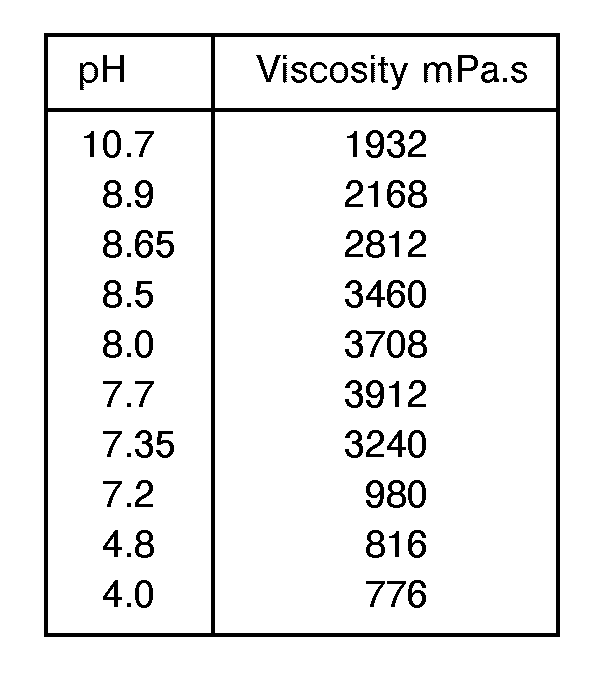
- Even at diluted solids there is a viscosity peak at a pH between 8.5 ad 7.
- The control was further compounded with 0.5 parts of Distagine LK, and the pH was adjusted to 4 with 18 percent HCI.

- The use of the dispersing agent eliminates the viscosity peak at pH's from 8 to 7.
- To the control were added 0.5 and 1.0 parts dispersing agent which was a Calcium lignosulfonate sold under the trademark Borresperse CAF.

- This experiment shows lignosulfonates are effective at relative higher concentrations.
- To the control were added 0.5 parts of a dispersing agent which was a sodium salt of napthalene formaldehyde sulfonate condensate sold under the trademark Distagine LS.

- Again the viscosity peak has been eliminated.
- To the control were added 0.5 parts of a dispersing agent which was a higher weight condensation product of napthalene formaldehyde sulfonate condensate sold under the trademark Lomar D.

- The viscosity peak has been controlled.
- Individually, to the control were added to the following dispersing agents in the following amounts. 0.5 parts nonylphenolpolyethylene oxide (10 moles) sold under the trademark Triton X100 0.5 parts nonylphenolpolyethylene oxide (40 moles) sold under the trademark Triton X405 1.0 parts nonylphenolpolyethylene oxide (40 moles) sold under the trademark Triton X405
-

- This experiment shows that the alkyl phenol polyalkylene oxide type dispersing agents are not very useful in this application.
- To the control were added 0.5 and 1.0 parts of a dispersing agent which was a potassium toluene sulfonate sold under the trademark Eltesol PT 45.

- This experiment shows that relatively larger amounts of sodium toluene sulfonate is required to reduce the viscosity rise.
- A further series of experiments were carried out with the same procedure using other classes of dispersing agents. These agents failed to keep the viscosity below 4000 mPa.s.

- Experiments A, B and C are comparative experiments which do not illustrate nor form part of the invention but show that it is not merely the addition of any dispersing agent which controls the viscosity rise.
- To simplify comparing data of Example 3, 7, the first comparative example, and experiments A and B applicant plotted the viscosity as a function of pH for each experiment. The viscosity was then determined at a series of fixed pH values for each experiment. The results of the analysis is shown in the following tables:


Claims (8)

Applications Claiming Priority (2)
| Application Number | Priority Date | Filing Date | Title |
|---|---|---|---|
| FR8709931A FR2618153A1 (en) | 1987-07-15 | 1987-07-15 | PROCESS FOR PRODUCING CATIONIC LATEX |
| FR8709931 | 1987-07-15 |
Publications (3)
| Publication Number | Publication Date |
|---|---|
| EP0305039A2 EP0305039A2 (en) | 1989-03-01 |
| EP0305039A3 EP0305039A3 (en) | 1990-04-25 |
| EP0305039B1 true EP0305039B1 (en) | 1992-11-11 |
Family
ID=9353120
Family Applications (1)
| Application Number | Title | Priority Date | Filing Date |
|---|---|---|---|
| EP88306335A Expired EP0305039B1 (en) | 1987-07-15 | 1988-07-12 | Process for making cationic latex |
Country Status (7)
| Country | Link |
|---|---|
| EP (1) | EP0305039B1 (en) |
| JP (1) | JPS6434434A (en) |
| CN (1) | CN1030772A (en) |
| AU (1) | AU605326B2 (en) |
| DE (1) | DE3875868T2 (en) |
| ES (1) | ES2052723T3 (en) |
| FR (1) | FR2618153A1 (en) |
Families Citing this family (2)
| Publication number | Priority date | Publication date | Assignee | Title |
|---|---|---|---|---|
| US20230183135A1 (en) | 2020-05-11 | 2023-06-15 | Vinci Construction | Cationic latex modified hydrocarbon binder emulsions and their use in the preparation of bituminous products |
| CN111808234B (en) * | 2020-08-03 | 2022-05-27 | 山东京博中聚新材料有限公司 | Styrene-butadiene latex and preparation method and application thereof |
Family Cites Families (6)
| Publication number | Priority date | Publication date | Assignee | Title |
|---|---|---|---|---|
| US3205187A (en) * | 1960-09-22 | 1965-09-07 | Dow Chemical Co | Making cationically stabilized latexes from anionically stabilized latexes |
| JPS4810615B1 (en) * | 1969-03-08 | 1973-04-05 | ||
| US3759886A (en) * | 1971-05-17 | 1973-09-18 | Petro Tex Chem Corp | Biodegradable emulsifiers for polychloroprene |
| NL7506412A (en) * | 1975-05-30 | 1976-12-02 | Akzo Nv | PROCEDURE FOR DRAINLESS COVERING OF METAL SURFACES. |
| US4256871A (en) * | 1979-04-18 | 1981-03-17 | Diamond Shamrock Corporation | Synthetic polymer emulsifier from condensation of naphthalene sulfonic acid, alkyl benzene sulfonic acid and formaldehyde |
| DE3345786A1 (en) * | 1983-12-17 | 1985-06-27 | Bayer Ag, 5090 Leverkusen | CATIONIC RUBBER MATERIALS, METHOD FOR THEIR PRODUCTION AND THEIR USE |
-
1987
- 1987-07-15 FR FR8709931A patent/FR2618153A1/en not_active Withdrawn
-
1988
- 1988-07-12 DE DE8888306335T patent/DE3875868T2/en not_active Expired - Lifetime
- 1988-07-12 AU AU18964/88A patent/AU605326B2/en not_active Ceased
- 1988-07-12 ES ES88306335T patent/ES2052723T3/en not_active Expired - Lifetime
- 1988-07-12 EP EP88306335A patent/EP0305039B1/en not_active Expired
- 1988-07-13 JP JP63174836A patent/JPS6434434A/en active Pending
- 1988-07-15 CN CN88104368A patent/CN1030772A/en active Pending
Also Published As
| Publication number | Publication date |
|---|---|
| AU1896488A (en) | 1989-01-19 |
| DE3875868T2 (en) | 1993-03-18 |
| FR2618153A1 (en) | 1989-01-20 |
| DE3875868D1 (en) | 1992-12-17 |
| AU605326B2 (en) | 1991-01-10 |
| ES2052723T3 (en) | 1994-07-16 |
| EP0305039A3 (en) | 1990-04-25 |
| EP0305039A2 (en) | 1989-03-01 |
| JPS6434434A (en) | 1989-02-03 |
| CN1030772A (en) | 1989-02-01 |
Similar Documents
| Publication | Publication Date | Title |
|---|---|---|
| US4337185A (en) | Process for making cationic structured particle latexes using reactive polymeric surfactants | |
| US4672090A (en) | Surfactant system for emulsion polymers | |
| EP0266850B1 (en) | A composite board comprising inorganic and/or cellulosic materials and a latex composition as a binder, said composite board having dimensional stability and strength | |
| US6075075A (en) | Use of aqueous polymer dispersions for modifying mineral building materials | |
| US4474919A (en) | Polyalkylene glycol stabilized alkali swellable latex | |
| KR19990087553A (en) | Cross-linkable protective colloid | |
| CA1269487A (en) | Polymer particles and process for producing the same | |
| US6974852B2 (en) | Emulsifier system for aqueous emulsion polymerization | |
| EP0013031B1 (en) | A paper coating composition and its production | |
| JPH0790031A (en) | Preparation of polychloroprene | |
| US4772659A (en) | Surfactant system for emulsion polymers | |
| US4582663A (en) | Amphoteric latexes containing pH independent and pH dependent bound charges | |
| US5679740A (en) | Mechanically stable self inverting water-in-oil polymer emulsions containing carboxylated ethoxylated phenols or alcohols | |
| US4544697A (en) | Amphoteric latexes containing pH independent and pH dependent bound charges | |
| AU605326B2 (en) | Process for making cationic latex | |
| EP0128454A1 (en) | Stable blends of vinyl chloride and acrylic latexes | |
| WO1997049766A9 (en) | Mechanically stable self-inverting water-in-oil polymer emulsions | |
| JPS6219780B2 (en) | ||
| JPS6147751A (en) | Viscosity control for asphalt emulsion and denaturing composition therefor | |
| US4666974A (en) | Antioxidant thickening compositions | |
| US4102841A (en) | Heat sensitive latices | |
| US2446115A (en) | Creaming of synthetic rubber latices | |
| JPH08319314A (en) | Production of polychloroprene in aqueous emulsion | |
| JPH0672363B2 (en) | Flooring composition with improved heat resistance | |
| DE2910168A1 (en) | RUBBER DISPERSIONS |
Legal Events
| Date | Code | Title | Description |
|---|---|---|---|
| PUAI | Public reference made under article 153(3) epc to a published international application that has entered the european phase |
Free format text: ORIGINAL CODE: 0009012 |
|
| AK | Designated contracting states |
Kind code of ref document: A2 Designated state(s): AT BE CH DE ES FR GB GR IT LI LU NL SE |
|
| RBV | Designated contracting states (corrected) |
Designated state(s): BE CH DE ES GB IT LI NL SE |
|
| RAP1 | Party data changed (applicant data changed or rights of an application transferred) |
Owner name: BASF AKTIENGESELLSCHAFT |
|
| PUAL | Search report despatched |
Free format text: ORIGINAL CODE: 0009013 |
|
| AK | Designated contracting states |
Kind code of ref document: A3 Designated state(s): BE CH DE ES GB IT LI NL SE |
|
| 17P | Request for examination filed |
Effective date: 19900404 |
|
| 17Q | First examination report despatched |
Effective date: 19911014 |
|
| GRAA | (expected) grant |
Free format text: ORIGINAL CODE: 0009210 |
|
| AK | Designated contracting states |
Kind code of ref document: B1 Designated state(s): BE CH DE ES GB IT LI NL SE |
|
| REF | Corresponds to: |
Ref document number: 3875868 Country of ref document: DE Date of ref document: 19921217 |
|
| ITF | It: translation for a ep patent filed | ||
| PLBE | No opposition filed within time limit |
Free format text: ORIGINAL CODE: 0009261 |
|
| STAA | Information on the status of an ep patent application or granted ep patent |
Free format text: STATUS: NO OPPOSITION FILED WITHIN TIME LIMIT |
|
| 26N | No opposition filed | ||
| REG | Reference to a national code |
Ref country code: ES Ref legal event code: FG2A Ref document number: 2052723 Country of ref document: ES Kind code of ref document: T3 |
|
| EAL | Se: european patent in force in sweden |
Ref document number: 88306335.6 |
|
| REG | Reference to a national code |
Ref country code: GB Ref legal event code: IF02 |
|
| PGFP | Annual fee paid to national office [announced via postgrant information from national office to epo] |
Ref country code: SE Payment date: 20020618 Year of fee payment: 15 Ref country code: NL Payment date: 20020618 Year of fee payment: 15 |
|
| PGFP | Annual fee paid to national office [announced via postgrant information from national office to epo] |
Ref country code: CH Payment date: 20020624 Year of fee payment: 15 |
|
| PGFP | Annual fee paid to national office [announced via postgrant information from national office to epo] |
Ref country code: GB Payment date: 20020702 Year of fee payment: 15 |
|
| PGFP | Annual fee paid to national office [announced via postgrant information from national office to epo] |
Ref country code: ES Payment date: 20020703 Year of fee payment: 15 Ref country code: BE Payment date: 20020703 Year of fee payment: 15 |
|
| PGFP | Annual fee paid to national office [announced via postgrant information from national office to epo] |
Ref country code: DE Payment date: 20020718 Year of fee payment: 15 |
|
| PG25 | Lapsed in a contracting state [announced via postgrant information from national office to epo] |
Ref country code: GB Free format text: LAPSE BECAUSE OF NON-PAYMENT OF DUE FEES Effective date: 20030712 |
|
| PG25 | Lapsed in a contracting state [announced via postgrant information from national office to epo] |
Ref country code: SE Free format text: LAPSE BECAUSE OF NON-PAYMENT OF DUE FEES Effective date: 20030713 |
|
| PG25 | Lapsed in a contracting state [announced via postgrant information from national office to epo] |
Ref country code: ES Free format text: LAPSE BECAUSE OF NON-PAYMENT OF DUE FEES Effective date: 20030714 |
|
| PG25 | Lapsed in a contracting state [announced via postgrant information from national office to epo] |
Ref country code: LI Free format text: LAPSE BECAUSE OF NON-PAYMENT OF DUE FEES Effective date: 20030731 Ref country code: CH Free format text: LAPSE BECAUSE OF NON-PAYMENT OF DUE FEES Effective date: 20030731 Ref country code: BE Free format text: LAPSE BECAUSE OF NON-PAYMENT OF DUE FEES Effective date: 20030731 |
|
| PG25 | Lapsed in a contracting state [announced via postgrant information from national office to epo] |
Ref country code: DE Free format text: LAPSE BECAUSE OF THE APPLICANT RENOUNCES Effective date: 20030822 |
|
| BERE | Be: lapsed |
Owner name: *BASF A.G. Effective date: 20030731 |
|
| PG25 | Lapsed in a contracting state [announced via postgrant information from national office to epo] |
Ref country code: NL Free format text: LAPSE BECAUSE OF NON-PAYMENT OF DUE FEES Effective date: 20040201 |
|
| EUG | Se: european patent has lapsed | ||
| GBPC | Gb: european patent ceased through non-payment of renewal fee |
Effective date: 20030712 |
|
| REG | Reference to a national code |
Ref country code: CH Ref legal event code: PL |
|
| NLV4 | Nl: lapsed or anulled due to non-payment of the annual fee |
Effective date: 20040201 |
|
| REG | Reference to a national code |
Ref country code: ES Ref legal event code: FD2A Effective date: 20030714 |
|
| PG25 | Lapsed in a contracting state [announced via postgrant information from national office to epo] |
Ref country code: IT Free format text: LAPSE BECAUSE OF NON-PAYMENT OF DUE FEES;WARNING: LAPSES OF ITALIAN PATENTS WITH EFFECTIVE DATE BEFORE 2007 MAY HAVE OCCURRED AT ANY TIME BEFORE 2007. THE CORRECT EFFECTIVE DATE MAY BE DIFFERENT FROM THE ONE RECORDED. Effective date: 20050712 |