EP0304482B1 - A multilayer article having improved printability and mark permanency and a method of making - Google Patents
A multilayer article having improved printability and mark permanency and a method of making Download PDFInfo
- Publication number
- EP0304482B1 EP0304482B1 EP88903504A EP88903504A EP0304482B1 EP 0304482 B1 EP0304482 B1 EP 0304482B1 EP 88903504 A EP88903504 A EP 88903504A EP 88903504 A EP88903504 A EP 88903504A EP 0304482 B1 EP0304482 B1 EP 0304482B1
- Authority
- EP
- European Patent Office
- Prior art keywords
- layer
- article
- particulate material
- porous
- mark
- Prior art date
- Legal status (The legal status is an assumption and is not a legal conclusion. Google has not performed a legal analysis and makes no representation as to the accuracy of the status listed.)
- Expired - Lifetime
Links
- 238000004519 manufacturing process Methods 0.000 title abstract description 5
- 239000010410 layer Substances 0.000 claims abstract description 136
- 230000002745 absorbent Effects 0.000 claims abstract description 14
- 239000002250 absorbent Substances 0.000 claims abstract description 14
- 239000000853 adhesive Substances 0.000 claims abstract description 10
- 230000001070 adhesive effect Effects 0.000 claims abstract description 10
- 239000013047 polymeric layer Substances 0.000 claims abstract description 6
- 239000011236 particulate material Substances 0.000 claims description 37
- 239000000976 ink Substances 0.000 claims description 26
- 239000012633 leachable Substances 0.000 claims description 26
- 239000003960 organic solvent Substances 0.000 claims description 20
- 238000005299 abrasion Methods 0.000 claims description 13
- 239000002245 particle Substances 0.000 claims description 10
- 239000000975 dye Substances 0.000 claims description 9
- 239000011148 porous material Substances 0.000 claims description 9
- 230000007423 decrease Effects 0.000 claims description 5
- 239000000049 pigment Substances 0.000 claims description 5
- 239000000463 material Substances 0.000 abstract description 40
- 238000000034 method Methods 0.000 abstract description 8
- 239000000758 substrate Substances 0.000 abstract description 4
- FAPWRFPIFSIZLT-UHFFFAOYSA-M Sodium chloride Chemical compound [Na+].[Cl-] FAPWRFPIFSIZLT-UHFFFAOYSA-M 0.000 description 60
- 239000011780 sodium chloride Substances 0.000 description 30
- 239000000203 mixture Substances 0.000 description 23
- YMWUJEATGCHHMB-UHFFFAOYSA-N Dichloromethane Chemical compound ClCCl YMWUJEATGCHHMB-UHFFFAOYSA-N 0.000 description 15
- 239000004698 Polyethylene Substances 0.000 description 10
- 238000001125 extrusion Methods 0.000 description 10
- -1 phosphate ester Chemical class 0.000 description 10
- 229920000573 polyethylene Polymers 0.000 description 10
- 239000002904 solvent Substances 0.000 description 8
- 230000005855 radiation Effects 0.000 description 7
- 239000012530 fluid Substances 0.000 description 5
- 238000007654 immersion Methods 0.000 description 5
- XLYOFNOQVPJJNP-UHFFFAOYSA-N water Substances O XLYOFNOQVPJJNP-UHFFFAOYSA-N 0.000 description 5
- 239000002033 PVDF binder Substances 0.000 description 4
- CDBYLPFSWZWCQE-UHFFFAOYSA-L Sodium Carbonate Chemical compound [Na+].[Na+].[O-]C([O-])=O CDBYLPFSWZWCQE-UHFFFAOYSA-L 0.000 description 4
- 230000009977 dual effect Effects 0.000 description 4
- 238000002386 leaching Methods 0.000 description 4
- 239000003550 marker Substances 0.000 description 4
- 229920002981 polyvinylidene fluoride Polymers 0.000 description 4
- 210000003813 thumb Anatomy 0.000 description 4
- KFZMGEQAYNKOFK-UHFFFAOYSA-N Isopropanol Chemical compound CC(C)O KFZMGEQAYNKOFK-UHFFFAOYSA-N 0.000 description 3
- 239000003795 chemical substances by application Substances 0.000 description 3
- 238000004132 cross linking Methods 0.000 description 3
- 238000005187 foaming Methods 0.000 description 3
- 238000010438 heat treatment Methods 0.000 description 3
- 239000011159 matrix material Substances 0.000 description 3
- 239000000126 substance Substances 0.000 description 3
- UOCLXMDMGBRAIB-UHFFFAOYSA-N 1,1,1-trichloroethane Chemical compound CC(Cl)(Cl)Cl UOCLXMDMGBRAIB-UHFFFAOYSA-N 0.000 description 2
- 239000004677 Nylon Substances 0.000 description 2
- 230000015572 biosynthetic process Effects 0.000 description 2
- 238000000576 coating method Methods 0.000 description 2
- 239000000498 cooling water Substances 0.000 description 2
- 230000000694 effects Effects 0.000 description 2
- 229920001971 elastomer Polymers 0.000 description 2
- 239000000806 elastomer Substances 0.000 description 2
- 239000004088 foaming agent Substances 0.000 description 2
- 239000000446 fuel Substances 0.000 description 2
- 239000003502 gasoline Substances 0.000 description 2
- 239000004615 ingredient Substances 0.000 description 2
- 238000009413 insulation Methods 0.000 description 2
- 238000003475 lamination Methods 0.000 description 2
- 239000010687 lubricating oil Substances 0.000 description 2
- 230000014759 maintenance of location Effects 0.000 description 2
- 229920001778 nylon Polymers 0.000 description 2
- 150000003839 salts Chemical class 0.000 description 2
- 239000002356 single layer Substances 0.000 description 2
- 229910000029 sodium carbonate Inorganic materials 0.000 description 2
- 235000017550 sodium carbonate Nutrition 0.000 description 2
- 239000003381 stabilizer Substances 0.000 description 2
- 229920001169 thermoplastic Polymers 0.000 description 2
- 229920002725 thermoplastic elastomer Polymers 0.000 description 2
- 239000004416 thermosoftening plastic Substances 0.000 description 2
- 239000011800 void material Substances 0.000 description 2
- BOSAWIQFTJIYIS-UHFFFAOYSA-N 1,1,1-trichloro-2,2,2-trifluoroethane Chemical compound FC(F)(F)C(Cl)(Cl)Cl BOSAWIQFTJIYIS-UHFFFAOYSA-N 0.000 description 1
- RNFJDJUURJAICM-UHFFFAOYSA-N 2,2,4,4,6,6-hexaphenoxy-1,3,5-triaza-2$l^{5},4$l^{5},6$l^{5}-triphosphacyclohexa-1,3,5-triene Chemical compound N=1P(OC=2C=CC=CC=2)(OC=2C=CC=CC=2)=NP(OC=2C=CC=CC=2)(OC=2C=CC=CC=2)=NP=1(OC=1C=CC=CC=1)OC1=CC=CC=C1 RNFJDJUURJAICM-UHFFFAOYSA-N 0.000 description 1
- HZAXFHJVJLSVMW-UHFFFAOYSA-N 2-Aminoethan-1-ol Chemical compound NCCO HZAXFHJVJLSVMW-UHFFFAOYSA-N 0.000 description 1
- POAOYUHQDCAZBD-UHFFFAOYSA-N 2-butoxyethanol Chemical compound CCCCOCCO POAOYUHQDCAZBD-UHFFFAOYSA-N 0.000 description 1
- 229910019142 PO4 Inorganic materials 0.000 description 1
- 239000002253 acid Substances 0.000 description 1
- 239000000654 additive Substances 0.000 description 1
- 230000003466 anti-cipated effect Effects 0.000 description 1
- 239000007864 aqueous solution Substances 0.000 description 1
- 239000002585 base Substances 0.000 description 1
- 239000000356 contaminant Substances 0.000 description 1
- 238000001816 cooling Methods 0.000 description 1
- 239000003431 cross linking reagent Substances 0.000 description 1
- 239000013078 crystal Substances 0.000 description 1
- 238000004090 dissolution Methods 0.000 description 1
- 239000002355 dual-layer Substances 0.000 description 1
- 230000005670 electromagnetic radiation Effects 0.000 description 1
- 150000002148 esters Chemical class 0.000 description 1
- 239000003063 flame retardant Substances 0.000 description 1
- 239000006260 foam Substances 0.000 description 1
- 150000002334 glycols Chemical class 0.000 description 1
- 229910052500 inorganic mineral Inorganic materials 0.000 description 1
- 229910001867 inorganic solvent Inorganic materials 0.000 description 1
- 239000003049 inorganic solvent Substances 0.000 description 1
- 239000003350 kerosene Substances 0.000 description 1
- 239000011707 mineral Substances 0.000 description 1
- 235000010755 mineral Nutrition 0.000 description 1
- 150000002978 peroxides Chemical class 0.000 description 1
- 239000003208 petroleum Substances 0.000 description 1
- 239000010452 phosphate Substances 0.000 description 1
- 229920000642 polymer Polymers 0.000 description 1
- 229920002959 polymer blend Polymers 0.000 description 1
- 239000000843 powder Substances 0.000 description 1
- 230000002028 premature Effects 0.000 description 1
- 230000002035 prolonged effect Effects 0.000 description 1
- 239000010453 quartz Substances 0.000 description 1
- 238000011084 recovery Methods 0.000 description 1
- 238000003303 reheating Methods 0.000 description 1
- 239000011347 resin Substances 0.000 description 1
- 229920005989 resin Polymers 0.000 description 1
- 238000007788 roughening Methods 0.000 description 1
- VYPSYNLAJGMNEJ-UHFFFAOYSA-N silicon dioxide Inorganic materials O=[Si]=O VYPSYNLAJGMNEJ-UHFFFAOYSA-N 0.000 description 1
- 239000007787 solid Substances 0.000 description 1
- 239000000243 solution Substances 0.000 description 1
- 235000015096 spirit Nutrition 0.000 description 1
- 239000007858 starting material Substances 0.000 description 1
- 239000002344 surface layer Substances 0.000 description 1
- 238000004381 surface treatment Methods 0.000 description 1
- 230000008961 swelling Effects 0.000 description 1
- 239000012815 thermoplastic material Substances 0.000 description 1
- 229920001187 thermosetting polymer Polymers 0.000 description 1
- WFKWXMTUELFFGS-UHFFFAOYSA-N tungsten Chemical compound [W] WFKWXMTUELFFGS-UHFFFAOYSA-N 0.000 description 1
- 229910052721 tungsten Inorganic materials 0.000 description 1
- 239000010937 tungsten Substances 0.000 description 1
Images
Classifications
-
- B—PERFORMING OPERATIONS; TRANSPORTING
- B32—LAYERED PRODUCTS
- B32B—LAYERED PRODUCTS, i.e. PRODUCTS BUILT-UP OF STRATA OF FLAT OR NON-FLAT, e.g. CELLULAR OR HONEYCOMB, FORM
- B32B27/00—Layered products comprising a layer of synthetic resin
- B32B27/06—Layered products comprising a layer of synthetic resin as the main or only constituent of a layer, which is next to another layer of the same or of a different material
- B32B27/08—Layered products comprising a layer of synthetic resin as the main or only constituent of a layer, which is next to another layer of the same or of a different material of synthetic resin
-
- B—PERFORMING OPERATIONS; TRANSPORTING
- B32—LAYERED PRODUCTS
- B32B—LAYERED PRODUCTS, i.e. PRODUCTS BUILT-UP OF STRATA OF FLAT OR NON-FLAT, e.g. CELLULAR OR HONEYCOMB, FORM
- B32B27/00—Layered products comprising a layer of synthetic resin
- B32B27/16—Layered products comprising a layer of synthetic resin specially treated, e.g. irradiated
-
- B—PERFORMING OPERATIONS; TRANSPORTING
- B41—PRINTING; LINING MACHINES; TYPEWRITERS; STAMPS
- B41M—PRINTING, DUPLICATING, MARKING, OR COPYING PROCESSES; COLOUR PRINTING
- B41M5/00—Duplicating or marking methods; Sheet materials for use therein
- B41M5/50—Recording sheets characterised by the coating used to improve ink, dye or pigment receptivity, e.g. for ink-jet or thermal dye transfer recording
- B41M5/502—Recording sheets characterised by the coating used to improve ink, dye or pigment receptivity, e.g. for ink-jet or thermal dye transfer recording characterised by structural details, e.g. multilayer materials
- B41M5/508—Supports
-
- B—PERFORMING OPERATIONS; TRANSPORTING
- B41—PRINTING; LINING MACHINES; TYPEWRITERS; STAMPS
- B41M—PRINTING, DUPLICATING, MARKING, OR COPYING PROCESSES; COLOUR PRINTING
- B41M5/00—Duplicating or marking methods; Sheet materials for use therein
- B41M5/50—Recording sheets characterised by the coating used to improve ink, dye or pigment receptivity, e.g. for ink-jet or thermal dye transfer recording
- B41M5/52—Macromolecular coatings
-
- B—PERFORMING OPERATIONS; TRANSPORTING
- B32—LAYERED PRODUCTS
- B32B—LAYERED PRODUCTS, i.e. PRODUCTS BUILT-UP OF STRATA OF FLAT OR NON-FLAT, e.g. CELLULAR OR HONEYCOMB, FORM
- B32B2305/00—Condition, form or state of the layers or laminate
- B32B2305/02—Cellular or porous
- B32B2305/026—Porous
-
- B—PERFORMING OPERATIONS; TRANSPORTING
- B32—LAYERED PRODUCTS
- B32B—LAYERED PRODUCTS, i.e. PRODUCTS BUILT-UP OF STRATA OF FLAT OR NON-FLAT, e.g. CELLULAR OR HONEYCOMB, FORM
- B32B2307/00—Properties of the layers or laminate
- B32B2307/50—Properties of the layers or laminate having particular mechanical properties
- B32B2307/554—Wear resistance
-
- B—PERFORMING OPERATIONS; TRANSPORTING
- B32—LAYERED PRODUCTS
- B32B—LAYERED PRODUCTS, i.e. PRODUCTS BUILT-UP OF STRATA OF FLAT OR NON-FLAT, e.g. CELLULAR OR HONEYCOMB, FORM
- B32B2307/00—Properties of the layers or laminate
- B32B2307/70—Other properties
- B32B2307/75—Printability
-
- B—PERFORMING OPERATIONS; TRANSPORTING
- B41—PRINTING; LINING MACHINES; TYPEWRITERS; STAMPS
- B41M—PRINTING, DUPLICATING, MARKING, OR COPYING PROCESSES; COLOUR PRINTING
- B41M5/00—Duplicating or marking methods; Sheet materials for use therein
- B41M5/50—Recording sheets characterised by the coating used to improve ink, dye or pigment receptivity, e.g. for ink-jet or thermal dye transfer recording
- B41M5/502—Recording sheets characterised by the coating used to improve ink, dye or pigment receptivity, e.g. for ink-jet or thermal dye transfer recording characterised by structural details, e.g. multilayer materials
- B41M5/504—Backcoats
-
- Y—GENERAL TAGGING OF NEW TECHNOLOGICAL DEVELOPMENTS; GENERAL TAGGING OF CROSS-SECTIONAL TECHNOLOGIES SPANNING OVER SEVERAL SECTIONS OF THE IPC; TECHNICAL SUBJECTS COVERED BY FORMER USPC CROSS-REFERENCE ART COLLECTIONS [XRACs] AND DIGESTS
- Y02—TECHNOLOGIES OR APPLICATIONS FOR MITIGATION OR ADAPTATION AGAINST CLIMATE CHANGE
- Y02P—CLIMATE CHANGE MITIGATION TECHNOLOGIES IN THE PRODUCTION OR PROCESSING OF GOODS
- Y02P70/00—Climate change mitigation technologies in the production process for final industrial or consumer products
- Y02P70/10—Greenhouse gas [GHG] capture, material saving, heat recovery or other energy efficient measures, e.g. motor control, characterised by manufacturing processes, e.g. for rolling metal or metal working
Definitions
- Dhingra U.S. patent no. 4,427,877 and European patent application no. 076130 have proposed the inclusion of particulates which cause a roughening of the surface of the material, thereby improving the printability of the material.
- Druin et al. U.S. patent no. 3,801,404 and Isaacson et al. U.S. patent no. 3,558,764 propose the formation of a microporous film by cold stretching.
- multilayer film consisting of a void-free layer bonded to a stratified void layer wherein the void layer is formed by biaxially orienting a matrix material containing void-initiating particles.
- Japanese Kokai 61-37827 proposes a porous resin film for printing wherein the porosity is formed by the leaching out of a powder.
- U.S. patent no. 4,226,886 proposes an ink-retentive pad which is formed by the leaching out of a particulate material.
- Heat recoverable articles suitable for use as markers, are disclosed in, for example, Evans U.S. Patent No. 3,894,731.
- One problem that is associated with printing information on markers by means of, for example, a typewriter is that the characters applied to the markers are not initially permanent and thus are subject to removal or smearing by rubbing and abrasion.
- the characters may be rendered indelible by exposing the printed marker sleeves to an infrared radiation source, for example a quartz tungsten filament lamp, for a short period of time during which the temperature of the print portions of the markers is believed to be raised to a temperature of about 315°C.
- an infrared radiation source for example a quartz tungsten filament lamp
- the objects of the invention have been achieved by providing a heat-recoverable article having improved printability and mark permanency and a method of making such an article.
- a heat-recoverable article comprising: a first substantially non-porous, heat-recoverable polymeric layer bonded to a second substantially porous, absorbent, polymeric layer wherein:
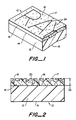
- Figure 1 is a perspective view of a section of a heat-recoverable article according to the invention.
- FIG 2 it an enlarged cross-sectional view of the heat-recoverable article in Figure 1.
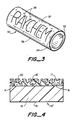
- Figure 3 is a perspective view of a heat-recoverable article according to the invention wherein the article is an extruded dual wall tubing.
- Figure 4 is an enlarged cross-sectional view of another embodiment of a heat-recoverable article according to the invention.
- the heat-recoverable article comprises a first substantially non-porous layer 12 bonded 14 to a second porous absorbent layer 16.
- additional layers of material between the first layer 12 and the second layer 16.
- the additional layer or layers may include, for example, adhesives or primers. Such additional layer or layers may be necessary when the polymeric materials making up the first and second layers are incompatible.
- first layer 12 and the second layer 16 are intimately and directly bonded to one another.
- first layer 12 and second layer 14 are joined to one another without the intervention of an intermediate tie layer such as a primer of an adhesive.
- first layer 12 and second layer 14 are physically (eg. fused) or chemically bonded to each other.
- the simplest way to achieve this result is to choose polymeric materials for the first and second layers which are compatible with each other.
- the polymeric materials making up the first and second layers may be the same material.
- the polymeric materials may be dissimilar so long as they fuse during, for example, co-extrusion.
- ком ⁇ онент may have to be added to one or both of the polymeric materials so that intimate bonding may be effected.
- compatibility agents are well known to those skilled in the art.
- first layer 12 is preferably intimately and directly bonded to second layer 16, of course, does not exclude additional layers of material, such as adhesives, which may be bonded to first layer 12 on surface 19, the surface opposite from bond area 14.
- the second layer 16 is relatively, and preferably much, thinner than the first layer 12. This is important because it is the first layer which provides the structural integrity of any subsequent article to be formed.
- the purpose of the second layer is merely for improving the printability and mark permanency of the article. Thus, it is desirable for the second layer to be as thin as possible.
- the porosity 18 in the second layer 16 is more visible. It can also be seen that the second layer 16 contains a small amount of leachable particulate material 20. The second layer 16 has been previously leached by subjecting the article to a suitable solvent so as to remove a portion of the particulate material. It can thus be appreciated that the porosity 18 is due to the fact that a Portion of the leachable particulate material 20 has in fact been leached out. Where the leachable particulate material 20 has not been leached out, there will be no pores in the material.
- the leachable particulate material 20 is incompatible with the second layer 16 so that there is no physical or chemical bond formed between the leachable particulate material 20 and the second layer material 16. In this way it is easier to select a solvent which will leach only the leachable particulate material 20 without affecting the polymeric matrix material.
- At least one, and preferably both, of the first 12 and second 16 layers should be cross-linked.
- Heat-recoverable articles are articles that have been changed from an original heat-stable configuration to a dimensionally heat-unstable configuration. Such an article will revert, or attempt to revert, to its original heat-stable configuration on the application of heat alone. Examples of such heat-recoverable articles are found in Currie U.S. Patent No. 2,027,962, CooK et al. U.S. Patent No, 3,086,242 and Clabburn U.S. Patent No. 3,721,749, the disclosures of which are incorporated herein by reference.
- One method of making a heat-recoverable article involves the formation of a polymeric article followed by crosslinking of the polymer.
- the crosslinking can be effected by chemical means, e.g. with peroxides, or by irradiation or a combination of the two.
- Radiation employed can be of various types including charged particles e.g. alpha particles or high energy electrons and electromagnetic radiation e.g. gamma or ultraviolet radiation. Sunsequent heating of the material will melt the crystals in the crystalline thermoplastic material or significantly lessen other internal molecular forces to an extent sufficient to allow distortion of the article.
- doses of any desired amount can be used although, generally a dosage of from 1 to 50, preferably 2 to 20 Mrads will be sufficient.
- the thickness 22 of the second layer 16 should be as thin as possible. It is preferred that the maximum thickness of the second layer should be about .005 inch and the minimum thickness should be about .0005 inch. In this way the thickness 22 of the second layer 16 has little effect on the overall structural integrity of the article.
- the second layer should in general be absorbent, it is most preferred that it be absorbent with respect to inks and dyes.
- indicia or markings 24 are applied to the surface 17 of the second layer 16 such as by a typewriter (or other printing apparatus)
- the ink from the typewriter ribbon is absorbed into the pores 18 of the second layer 16.
- the pores per se are extremely important to the invention, the dimensions of the pores are not extremely critical. However, it is necessary that the majority of pores be generally in the range of 1 to 10 microns. That is it is important that the size of the pores be large enough to capture the pigment particles of the inks and dyes applied to the exposed surface 17 of the second layer 16.
- the markings or indicia are resistant to organic solvents, smearing and abrasion. Resistance to organic solvents and abrasion are direct indications of the mark permanency of the markings or indicia. Resistance to smearing refers to the ability of the markings or indicia not to smear (or at least smear very slightly) when rubbed, for example with a thumb, immediately after printing. Such a property is certainly desirable since if the markings or indicia were capable of smearing immediately after printing, there would be the possibility of .smearing during handling which might render the markings or indicia unreadable. The present invention avoids that possibility.
- the article may be used in a very demanding market place, e.g. the military, where resistance to organic solvents and abrasion is of paramount importance.
- Military Specification MIL-M-81531 requires that the markings or indicia be readable at a distance of 14 inches after being rubbed with an eraser 10 to 20 times, depending on the material.
- MIL-STD-202 requires that the markings or indicia be readable at a distance of at least 6 inches after being immersed in a variety of organic solvents and then brushed with a toothbrush.
- organic solvents include: mixtures of isopropyl alcohol and mineral spirits; an azeotrope mixture of trichlorotrifluoroethane (FREON® TF, a registered trademark of E. I. DuPont de Nemours) and methylene chloride; 1,1,1--trichloroethane; and an aqueous solution of butyl-cellosolve and monoethanolamine.
- the markings or indicia be resistant to removal during prolonged immersion in the following organic solvents: JP-4 fuel (kerosene), Skydrol 500TM (a phosphate ester hydraulic fluid available from Monsanto Company), hydraulic fluid (petroleum based), aviation gasoline, lubricating oil (ester based) and anti-icing fluid (an aqueous mixture of glycols).
- organic solvents JP-4 fuel (kerosene), Skydrol 500TM (a phosphate ester hydraulic fluid available from Monsanto Company), hydraulic fluid (petroleum based), aviation gasoline, lubricating oil (ester based) and anti-icing fluid (an aqueous mixture of glycols).
- the marked article according to the invention is resistant to dichloromethane which is representative of the class of halogenated solvents which includes 1,1,1--trichloroethane and FREON mixtures.
- the articles of the invention may be formed in a number of ways.
- the first and second layers may be formed by lamination.
- the first and second layers may be formed by extrusion or co-extrusion.
- the second layer may be formed by a coating process.
- the first and second layers be formed by co-extrusion as this is a more efficient, economical process.
- the extruded article be a dual wall tubing as shown in Figure 3.
- the surface 37 of layer 36 is porous so that it is readily absorbent with respect to a mark 38 which is placed upon the article 30.
- the polymeric materials of the first and second layers may be made from a variety of materials such as thermoplastics, elastomers, and thermoplastic elastomers. This would include most polymeric materials except for thermoset polymeric materials.
- first substantially non-porous layer 12 which is bonded (preferably intimately and directly bonded) 14 to a second porous absorbent layer 16.
- the second layer 16 is relatively thinner than the first layer 12.
- the volume of porosity 18 in a second layer 16 is the greatest on the surface 17 of the second layer which is farthest away from the interface 14 between the first 12 and second 16 layers. This porosity also gradually decreases towards the interface 14 between the first 12 and second 16 layers.
- This porosity 18 may be formed as discussed previously wherein the second layer 16 contains a leachable particulate material 20. In this case it can be appreciated that the porosity 18 forms as a result of the dissolution of the leachable particulate material 20 and transport of the dissolved particulate material away from the second layer 16.
- the second layer 16 is relatively, and preferably much thinner than the first layer 12. It is preferred that the second layer have a maximum thickness of about .005 inches. At least one, and preferably both of the first 12 and second 16 layers is crosslinked. Crossliking may be by chemicals or be radiation as discussed previously.
- FIG. 2 A cross-section of the article is shown in Figure 2. It can be seen that the second layer 16 has a substantial amount of porosity 18. It is most preferred that the porosity 18 of the second layer 16 be formed by leaching out a leachable particulate material, as previously discussed. However, the porous second layer 16 may be formed in other ways as will be discussed hereafter.
- the second layer 16 is absorbent with respect to inks or dyes.
- an exposed surface 17 of the second layer 16 may, and preferably will contain printed indicia thereon. Due to the fact that the ink or dye making up the printed indicia is absorbed by the porosity 18, the printed indicia is resistant to removal by smearing immediately after printing. Further, the printed indicia is resistant to abrasion and organic solvents. Accordingly, the printed indicia has acquired a certain mark permanency.
- first 12 and second 16 layers be formed by extrusion or co-extrusion. It is further preferred that the extruded or co-extruded article be a dual-wall marker as shown in Figure 3. Alternatively, the extruded or co-extruded article may be formed in a planar configuration, in which case the article may be a wrap-around marker (not shown).
- the leachable particulate material is preferably chosen so that it is incompatible with the polymeric matrix material. This makes the selection of a suitable solvent much easier.
- the leachable particulate material may be chosen so that it is leachable by water, acid, base or organic solvents. A water-soluble particulate material would be very convenient in use. For example, if the leachable particulate material was water-soluble and the first and second layers were co-extruded, then a substantial portion of the particulate material would be leached out during immersion in the water trough after extrusion. Further amounts of the particulate material could be leached out during subsequent processing such as immersion or expansion, if the material were to be heat-shrinkable.
- the article may be marked by applying an ink to the exposed surface 17 of the second layer 16.
- an ink to the exposed surface 17 of the second layer 16.
- a mark 24,38 has been applied to the surface of the article 10,30 by a typewriter or some other printing apparatus so that ink is contacted with the exposed surface 17,37 of the second layer 16,36.
- the ink ink allowed to penetrate into the porosity 18 of the second layer and become entrapped therein. Thereafter, the mark is resistant to removal by organic solvents, smearing and abrasion.
- the first and second layers may be bonded by lamination or preferably by extrusion or most preferably by coextrusion.
- a particularly preferred article of the invention ink the extruded or coextruded dual wall tubing 30 as shown in Figure 3.
- the maximum thickness of the second layer is about .005 inch and the minimum thickness is about .0005 inch.
- the thickness of the second layer is desirable to have the thickness of the second layer as thin as possible in that the sole purpose of the second layer is for improving the printability and mark permanency of the article.
- the polymeric materials of the first and second layers be chemically compatible with each other.
- the materials of the first and second layers may be any of the thermoplastics, elastomers or thermoplastic elastomers.
- the most preferred volume percents of leachable particulate material will vary depending on the particulate material itself and the polymeric material. This is due to the fact that certain polymeric materials can be more highly loaded than other polymeric materials. For a given polymeric material, the preferred volume percent of leachable particulate material can be easily determined by those skilled in the art.
- Figure 4 ink an enlarged cross-sectional view of another embodiment of a heat-recoverable article according to the invention.
- a method of making this embodiment ink as follows.
- the first step is bonding (preferably intimately and directly bonding) a first layer 12 of polymeric material to a second layer 16 of polymeric material wherein: (a) the second layer 16 ink relatively thinner than the first layer 12; and (b) the second layer 16 contains a foaming agent.
- the next step in the method comprises foaming the second layer 16 No as to cause the second layer 16 to become porous and absorbent wherein the first layer 12 remains substantially free of porosity.
- first layer 12 ie. the surface opposite the second layer (herein referred to as the "opposite surface")
- an adhesive may be coated with, for example an adhesive.
- Such articles may be installed over various substrates, such as wires, appropriately marked to identify the wire.
- a tubular article, or sleeve is positioned over a wire where it has been connected to another wire or terminal block. In such instances, the insulation of the wire at the end thereof may have been removed.
- the sleeve provides insulation over this section after it has been installed.
- it ink desirable to adhere the sleeve to the wire, eg. by means of an adhesive, in particular a heat activatable adhesive by heating the sleeve to cause it to shrink onto the wire.
- a composition was compounded consisting of the following ingredients: 56 wt% polyethylene, 30 wt% flame retardant and other additives, and 14 wt% stabilizers, pigments and cross-linking coagents. To this composition varying amounts of sodium chloride having an average particle size of about 2 microns were added so that the amount of sodium chloride in the sodium chloride/polyethylene composition varied from 0 to 60 wt% or 0 to about 47 vol%. A second composition was compounded consisting of the polyethylene composition without any addition of the sodium chloride. Several samples were extruded in a single layer of each of the two groups of compositions. The samples containing sodium chloride were leached by immersion in water.
- compositions containing the leached sodium chloride began to show an improvement in printability, mark permanency and non-smearing characteristics at about 5 volume (about 7 wt%) of sodium chloride. Beyond about 5 volume (about 8wt%) of sodium chloride the improvement continued until the limit of sodium chloride was reached. It was found that no greater improvement of the printability of the material occurred when there was more than about 47 vol% (or 60 wt%) of sodium chloride. Additionally, greater amounts of sodium chloride in the polyethylene composition would drastically effect the integrity and processability of the material.
- a composition was compounded consisting of the following ingredients: 93 wt% polyvinylidene fluoride polymer blend, and 7 wt% stabilizers, pigments and cross-linking agents. To this was added an amount of sodium chloride having an average particle size of about 2 microns so that the amount of sodium chloride in the sodium chloride/polyvinylidene fluoride blend was about 50wt% (44.7 vol%). A sample was extruded in a single layer from the sodium chloride/ polyvinylidene fluoride blend. Another sample was prepared from the polyvinylidene fluoride blend only. The sample containing the sodium chloride was leached by immersion in water.
- a dual-wall heat recoverable tubing article was produced in the following manner.
- a 21 mil thick inner layer of the standard polyethylene composition in Example 1(i.e. without the sodium chloride) was coextruded with a 5 mil thick outer layer consisting of a blend of 47 wt.% (34.4 vol%) of sodium chloride (having an average particle size of about 2 microns) and 53 wt % of the standard polyethylene composition.
- a further heat recoverable tubing article was made by extruding a 21 mil thick tube of the standard polyethylene composition.
- Each of the tubings were radiation cross-linked with a dose of 17 Mrad and then bilaterally warm expanded to a size 3.5 times their original size.
- the cooling water during the extrusion and expansion processes leached out a substantial part of the sodium chloride from the outer layer of the dual-wall tubing.
- Each of the tubings were then partially recovered onto nylon bandoliers as disclosed in Evans U.S. Patent No. 3,894,731, discussed previously.
- a further dual-wall tubing article was produced in the following manner.
- a 21 mil thick inner layer of the standard polyethylene composition in Example 1 i.e. without the sodium chloride
- Example 1 i.e. without the sodium chloride
- Example 2 a 5 mil thick outer layer consisting of a blend of 48.3 wt% (32.1 vol%) of sodium carbonate (Na2CO3, having an average particle size of 2.6 microns) and 51.7 wt% of the standard polyethylene blend.
- Each of the tubings were radiation cross-linked with a dose of 17 Mrad and then bilaterally warm expanded to a size 3.5 times their original size.
- the cooling water during the extrusion and expansion processes leached out a substantial part of the sodium chloride from the outer layer of the dual-wall tubing.
- Each of the tubings were then partially recovered onto nylon bandoliers as disclosed in Evans U.S: Patent No. 3,894,731, discussed previously.
Landscapes
- Laminated Bodies (AREA)
- Printing Methods (AREA)
Abstract
Description
- Various solutions have been proposed for improving the printability of polymeric materials. Thus, for example, Blok et al. U.S. patent no. 4,461,793 and U.K. patent application no. 2,117,270A have proposed ink receptive coatings on heat recoverable articles.
- Dhingra U.S. patent no. 4,427,877 and European patent application no. 076130, for example, have proposed the inclusion of particulates which cause a roughening of the surface of the material, thereby improving the printability of the material.
- In European patent application no. 156532, it is proposed that a porous layer be joined to a substrate. The porous layer improves the printability of the laminate.
- In Williams et al. U.S. patent no. 3,839,516, a porous film is created by contacting the film with a swelling agent and then stretching the film.
- Druin et al. U.S. patent no. 3,801,404 and Isaacson et al. U.S. patent no. 3,558,764 propose the formation of a microporous film by cold stretching.
- In Karabedian U.S. patent no. 4,581,262, a laminate of a thick closed-cell foam layer and a decoratable solid skin layer is proposed.
- Ashcraft et al. U.S. patent nos. 4,377,616 and 4,438,175 and Duncan U.S. Patent no. 4,582,736, for example, propose a
- multilayer film consisting of a void-free layer bonded to a stratified void layer wherein the void layer is formed by biaxially orienting a matrix material containing void-initiating particles.
- Japanese Kokai 61-37827 proposes a porous resin film for printing wherein the porosity is formed by the leaching out of a powder. takes U.S. patent no. 4,226,886 proposes an ink-retentive pad which is formed by the leaching out of a particulate material.
- The above references do not appear to have addressed the issue of mark permanency.
- Heat recoverable articles, suitable for use as markers, are disclosed in, for example, Evans U.S. Patent No. 3,894,731. One problem that is associated with printing information on markers by means of, for example, a typewriter is that the characters applied to the markers are not initially permanent and thus are subject to removal or smearing by rubbing and abrasion. According to Evans, however, the characters may be rendered indelible by exposing the printed marker sleeves to an infrared radiation source, for example a quartz tungsten filament lamp, for a short period of time during which the temperature of the print portions of the markers is believed to be raised to a temperature of about 315°C. A difficulty with this method, of course, is that premature recovery of the markers may occur upon exposure to the heat from the infrared radiation source.
- All of the above patents and publications are incorporated by reference herein.
- In spite of the advances in surface treatment of polymeric materials, there nevertheless remains a need for polymeric articles which are mechanically strong, have good printability and mark permanency and are simple to produce.
- The objects of the invention have been achieved by providing a heat-recoverable article having improved printability and mark permanency and a method of making such an article.
- According to the invention there it disclosed a heat-recoverable article comprising:
a first substantially non-porous, heat-recoverable polymeric layer bonded to a second substantially porous, absorbent, polymeric layer wherein: - (a) at least the second layer it crosslinked; and
- (b) the second layer is relatively thinner than the first layer;
and wherein the second layer contains pores large enough to capture the pigment particles of inks and dyes applied to it and is sufficiently absorbent with respect to inks or dyes such that an exposed surface thereof is capable of being marked with indicia or markings that are resistant to organic solvents, smearing and abrasion. - Figure 1 is a perspective view of a section of a heat-recoverable article according to the invention.
- Figure 2 it an enlarged cross-sectional view of the heat-recoverable article in Figure 1.
- Figure 3 is a perspective view of a heat-recoverable article according to the invention wherein the article is an extruded dual wall tubing.
- Figure 4 is an enlarged cross-sectional view of another embodiment of a heat-recoverable article according to the invention
- Referring to the Figures in more detail and particularly referring to Figure 1, there is shown a heat-recoverable article generally indicated by 10. The heat-recoverable article comprises a first substantially
non-porous layer 12 bonded 14 to a second porousabsorbent layer 16. - While not shown in the Figures, there may be one or more additional layers of material between the
first layer 12 and thesecond layer 16. The additional layer or layers may include, for example, adhesives or primers. Such additional layer or layers may be necessary when the polymeric materials making up the first and second layers are incompatible. - It is most preferred, however, that the
first layer 12 and thesecond layer 16 are intimately and directly bonded to one another. - It should be understood throughout this specification that "directly bonded" is to mean that
first layer 12 andsecond layer 14 are joined to one another without the intervention of an intermediate tie layer such as a primer of an adhesive. - It should further be understood throughout this specification that "intimately bonded" is to mean that
first layer 12 andsecond layer 14 are physically (eg. fused) or chemically bonded to each other. The simplest way to achieve this result is to choose polymeric materials for the first and second layers which are compatible with each other. For example, the polymeric materials making up the first and second layers may be the same material. Alternatively, the polymeric materials may be dissimilar so long as they fuse during, for example, co-extrusion. - Completely incompatible polymeric materials may also be chosen; in this case, however, a compatibility agent may have to be added to one or both of the polymeric materials so that intimate bonding may be effected. Such compatibility agents are well known to those skilled in the art.
- The fact that the
first layer 12 is preferably intimately and directly bonded tosecond layer 16, of course, does not exclude additional layers of material, such as adhesives, which may be bonded tofirst layer 12 onsurface 19, the surface opposite frombond area 14. - The
second layer 16 is relatively, and preferably much, thinner than thefirst layer 12. This is important because it is the first layer which provides the structural integrity of any subsequent article to be formed. The purpose of the second layer is merely for improving the printability and mark permanency of the article. Thus, it is desirable for the second layer to be as thin as possible. - Referring now to Figure 2 wherein a cross-sectional view of the article in Figure 1 is shown in greater detail, the
porosity 18 in thesecond layer 16 is more visible. It can also be seen that thesecond layer 16 contains a small amount of leachableparticulate material 20. Thesecond layer 16 has been previously leached by subjecting the article to a suitable solvent so as to remove a portion of the particulate material. It can thus be appreciated that theporosity 18 is due to the fact that a Portion of the leachableparticulate material 20 has in fact been leached out. Where the leachableparticulate material 20 has not been leached out, there will be no pores in the material. While not absolutely essential to the invention, it is nevertheless preferred that the leachableparticulate material 20 is incompatible with thesecond layer 16 so that there is no physical or chemical bond formed between the leachableparticulate material 20 and thesecond layer material 16. In this way it is easier to select a solvent which will leach only the leachableparticulate material 20 without affecting the polymeric matrix material. - At least one, and preferably both, of the first 12 and second 16 layers should be cross-linked.
- Heat-recoverable articles are articles that have been changed from an original heat-stable configuration to a dimensionally heat-unstable configuration. Such an article will revert, or attempt to revert, to its original heat-stable configuration on the application of heat alone. Examples of such heat-recoverable articles are found in Currie U.S. Patent No. 2,027,962, CooK et al. U.S. Patent No, 3,086,242 and Clabburn U.S. Patent No. 3,721,749, the disclosures of which are incorporated herein by reference.
- One method of making a heat-recoverable article involves the formation of a polymeric article followed by crosslinking of the polymer. The crosslinking can be effected by chemical means, e.g. with peroxides, or by irradiation or a combination of the two. Radiation employed can be of various types including charged particles e.g. alpha particles or high energy electrons and electromagnetic radiation e.g. gamma or ultraviolet radiation. Sunsequent heating of the material will melt the crystals in the crystalline thermoplastic material or significantly lessen other internal molecular forces to an extent sufficient to allow distortion of the article. Upon cooling of the heated and distorted article, there is obtained a product which remains in its distorted shape while at room temperature due to the reformation of strong interchain forces such as crystallinity. Upon reheating, the crosslink forces become dominant and the material tends to recover to its original geometry.
- When irradiation is used, doses of any desired amount can be used although, generally a dosage of from 1 to 50, preferably 2 to 20 Mrads will be sufficient.
- As stated earlier, the
thickness 22 of thesecond layer 16 should be as thin as possible. It is preferred that the maximum thickness of the second layer should be about .005 inch and the minimum thickness should be about .0005 inch. In this way thethickness 22 of thesecond layer 16 has little effect on the overall structural integrity of the article. - While the second layer should in general be absorbent, it is most preferred that it be absorbent with respect to inks and dyes. The reason for this is that when indicia or
markings 24 are applied to thesurface 17 of thesecond layer 16 such as by a typewriter (or other printing apparatus), the ink from the typewriter ribbon is absorbed into thepores 18 of thesecond layer 16. It has been found that when the ink is in fact captured by theporosity 18 of thesecond layer 16 that there is greatly improved retention of the marking orindicia 24 on thearticle 10. While the pores per se are extremely important to the invention, the dimensions of the pores are not extremely critical. However, it is necessary that the majority of pores be generally in the range of 1 to 10 microns. That is it is important that the size of the pores be large enough to capture the pigment particles of the inks and dyes applied to the exposedsurface 17 of thesecond layer 16. - In regards No the retention of the markings or
indicia 24 on thearticle 10, it is most preferred that the markings or indicia are resistant to organic solvents, smearing and abrasion. Resistance to organic solvents and abrasion are direct indications of the mark permanency of the markings or indicia. Resistance to smearing refers to the ability of the markings or indicia not to smear (or at least smear very slightly) when rubbed, for example with a thumb, immediately after printing. Such a property is certainly desirable since if the markings or indicia were capable of smearing immediately after printing, there would be the possibility of .smearing during handling which might render the markings or indicia unreadable. The present invention avoids that possibility. - Resistance to organic solvents and abrasion are very important properties. In particular, the article may be used in a very demanding market place, e.g. the military, where resistance to organic solvents and abrasion is of paramount importance. In this regard, it is necessary for the article to meet the requirements of Military specification MIL-M-81531 and Military Standard MIL-STD-202, both of which are incorporated by reference herein. With respect to abrasion, Military Specification MIL-M-81531 requires that the markings or indicia be readable at a distance of 14 inches after being rubbed with an
eraser 10 to 20 times, depending on the material. - With respect to resistance to organic solvents, Military Standard MIL-STD-202 requires that the markings or indicia be readable at a distance of at least 6 inches after being immersed in a variety of organic solvents and then brushed with a toothbrush. These organic solvents include: mixtures of isopropyl alcohol and mineral spirits; an azeotrope mixture of trichlorotrifluoroethane (FREON® TF, a registered trademark of E. I. DuPont de Nemours) and methylene chloride; 1,1,1--trichloroethane; and an aqueous solution of butyl-cellosolve and monoethanolamine.
- In addition to meeting the requirements of Military Standard MIL-STD-202, it is Preferred that the markings or indicia be resistant to removal during prolonged immersion in the following organic solvents: JP-4 fuel (kerosene), Skydrol 500™ (a phosphate ester hydraulic fluid available from Monsanto Company), hydraulic fluid (petroleum based), aviation gasoline, lubricating oil (ester based) and anti-icing fluid (an aqueous mixture of glycols). These organic solvents are further specified in the Raychem Corporation Specification RT-1800/2, which is incorporated by reference herein.
- It is also preferred that the marked article according to the invention is resistant to dichloromethane which is representative of the class of halogenated solvents which includes 1,1,1--trichloroethane and FREON mixtures.
- It is, of course, anticipated that the marked article according to the invention will be resistant to many other organic solvents as well as many inorganic solvents.
- It should be understood, then, that whenever throughout this specification the markings or indicia are stated to be resistant to organic solvents, smearing and abrasion, such resistance to organic solvents, smearing and abrasion shall be defined as indicated above.
- The articles of the invention may be formed in a number of ways. Thus, for example the first and second layers may be formed by lamination. Alternatively, the first and second layers may be formed by extrusion or co-extrusion. It is also believed possible for the second layer to be formed by a coating process. However, it is preferred that the first and second layers be formed by co-extrusion as this is a more efficient, economical process. It is most preferred that the extruded article be a dual wall tubing as shown in Figure 3. Thus, there is a dual wall tubing, generally indicated by 30, in which there is a
first layer 32 which is intimately and directly bonded 34 to asecond layer 36. Thesurface 37 oflayer 36 is porous so that it is readily absorbent with respect to amark 38 which is placed upon thearticle 30. - The polymeric materials of the first and second layers may be made from a variety of materials such as thermoplastics, elastomers, and thermoplastic elastomers. This would include most polymeric materials except for thermoset polymeric materials.
- Referring again to Figures 1 and 2, there is the first substantially
non-porous layer 12 which is bonded (preferably intimately and directly bonded) 14 to a second porousabsorbent layer 16. Thesecond layer 16 is relatively thinner than thefirst layer 12. Now particularly referring to Figure 2, it can be seen that the volume ofporosity 18 in asecond layer 16 is the greatest on thesurface 17 of the second layer which is farthest away from theinterface 14 between the first 12 and second 16 layers. This porosity also gradually decreases towards theinterface 14 between the first 12 and second 16 layers. - This
porosity 18 may be formed as discussed previously wherein thesecond layer 16 contains a leachableparticulate material 20. In this case it can be appreciated that theporosity 18 forms as a result of the dissolution of the leachableparticulate material 20 and transport of the dissolved particulate material away from thesecond layer 16. - The
second layer 16 is relatively, and preferably much thinner than thefirst layer 12. It is preferred that the second layer have a maximum thickness of about .005 inches. At least one, and preferably both of the first 12 and second 16 layers is crosslinked. Crossliking may be by chemicals or be radiation as discussed previously. - A cross-section of the article is shown in Figure 2. It can be seen that the
second layer 16 has a substantial amount ofporosity 18. It is most preferred that theporosity 18 of thesecond layer 16 be formed by leaching out a leachable particulate material, as previously discussed. However, the poroussecond layer 16 may be formed in other ways as will be discussed hereafter. - It is most preferred that the
second layer 16 is absorbent with respect to inks or dyes. Thus, an exposedsurface 17 of thesecond layer 16 may, and preferably will contain printed indicia thereon. Due to the fact that the ink or dye making up the printed indicia is absorbed by theporosity 18, the printed indicia is resistant to removal by smearing immediately after printing. Further, the printed indicia is resistant to abrasion and organic solvents. Accordingly, the printed indicia has acquired a certain mark permanency. - It is most preferred that the first 12 and second 16 layers be formed by extrusion or co-extrusion. It is further preferred that the extruded or co-extruded article be a dual-wall marker as shown in Figure 3. Alternatively, the extruded or co-extruded article may be formed in a planar configuration, in which case the article may be a wrap-around marker (not shown).
- While most leachable particulate materials will be satisfactory, the leachable particulate material is preferably chosen so that it is incompatible with the polymeric matrix material. This makes the selection of a suitable solvent much easier. With this constraint in mind, the leachable particulate material may be chosen so that it is leachable by water, acid, base or organic solvents. A water-soluble particulate material would be very convenient in use. For example, if the leachable particulate material was water-soluble and the first and second layers were co-extruded, then a substantial portion of the particulate material would be leached out during immersion in the water trough after extrusion. Further amounts of the particulate material could be leached out during subsequent processing such as immersion or expansion, if the material were to be heat-shrinkable.
- No matter what the solvent/leachable particulate material combination, it is desirable to leach out as much of the particulate material as possible (although it is unlikely that all of the particulate material will be leached out). In this way, the structural properties of the second layer will closely approximate the structural properties of the first layer. It should be understood, however, that perfectly acceptable properties result when only a portion of the particulate material is leached out. It ink just necessary to leach out sufficient particulate material so as to obtain a surface layer of porosity which is absorbent with respect to inks or dyes.
- The article may be marked by applying an ink to the exposed
surface 17 of thesecond layer 16. Thus, as can be been in, for example, Figures 1 and 3, amark article surface second layer porosity 18 of the second layer and become entrapped therein. Thereafter, the mark is resistant to removal by organic solvents, smearing and abrasion. - The first and second layers may be bonded by lamination or preferably by extrusion or most preferably by coextrusion. A particularly preferred article of the invention ink the extruded or coextruded
dual wall tubing 30 as shown in Figure 3. - It is preferred that the maximum thickness of the second layer is about .005 inch and the minimum thickness is about .0005 inch. Of course it is desirable to have the thickness of the second layer as thin as possible in that the sole purpose of the second layer is for improving the printability and mark permanency of the article.
- While there are many suitable polymeric materials for the first and second layers, it is preferred that the polymeric materials of the first and second layers be chemically compatible with each other. Thus, the materials of the first and second layers may be any of the thermoplastics, elastomers or thermoplastic elastomers.
- It has been found that the printability and mark permanency of the article is noticeably improved when there is at least about 5 volume% of leachable particulate material added to the second layer. Usually all of the leachable particulate material will not in fact be leached out due to the fact that some of the leachable particulate material, as shown for example in Figure 2, may not be contacted by the solvent so that it will not be dissolved. Accordingly, when there is about 5 volume% of leachable particulate material in the starting material, there will usually be less than about 5 volume% of porosity produced. It is generally believed that efficacious results will be produced when the second layer contains about 5 to 90 volume% of leachable particulate material. It is also believed that even better results can be obtained when there is about 20 to 60 volume% of leachable particulate material. The most preferred results will be obtained, et is believed, when there is about 30 to 50 volume% of leachable particulate material.
- It should, of course, be understood that the most preferred volume percents of leachable particulate material will vary depending on the particulate material itself and the polymeric material. This is due to the fact that certain polymeric materials can be more highly loaded than other polymeric materials. For a given polymeric material, the preferred volume percent of leachable particulate material can be easily determined by those skilled in the art.
- Figure 4 ink an enlarged cross-sectional view of another embodiment of a heat-recoverable article according to the invention. A method of making this embodiment ink as follows. The first step is bonding (preferably intimately and directly bonding) a
first layer 12 of polymeric material to asecond layer 16 of polymeric material wherein: (a) thesecond layer 16 ink relatively thinner than thefirst layer 12; and (b) thesecond layer 16 contains a foaming agent. The next step in the method comprises foaming thesecond layer 16 No as to cause thesecond layer 16 to become porous and absorbent wherein thefirst layer 12 remains substantially free of porosity. - Such an open cell porous structure produced by the step of foaming ink shown in Figure 4. As is apparent, when a foaming agent is added to the material, the
porosity 18′shown in Figure 4 ink very similar toporosity 18 shown in Figure 2. Thus, foaming of the porous second layer ink believed to be a viable alternative in the making of the dual layer article. - As mentioned above with reference to Figure 2,
surface 19 offirst layer 12, ie. the surface opposite the second layer (herein referred to as the "opposite surface"), may be coated with, for example an adhesive. This can be particularly advantageous in embodiments of the invention in which the heat-recoverable article ink tubular. Such articles may be installed over various substrates, such as wires, appropriately marked to identify the wire. At times such a tubular article, or sleeve, is positioned over a wire where it has been connected to another wire or terminal block. In such instances, the insulation of the wire at the end thereof may have been removed. The sleeve provides insulation over this section after it has been installed. To prevent ingress of moisture or other contaminants, it ink desirable to adhere the sleeve to the wire, eg. by means of an adhesive, in particular a heat activatable adhesive by heating the sleeve to cause it to shrink onto the wire. - This ability to seal the sleeve into the wire ink not possible with conventional marker sleeves as these require a permatization step, which involves heating, during the process of marking the sleeve. This would cause the adhesive to melt and flow prematurely. For this reason such sleeves are not provided with adhesive and are not sealed to the wires, or other substrates, onto which they are installed.
- The advantages and features of the invention will become more apparent or referring to the following illustrative examples.
- A composition was compounded consisting of the following ingredients: 56 wt% polyethylene, 30 wt% flame retardant and other additives, and 14 wt% stabilizers, pigments and cross-linking coagents. To this composition varying amounts of sodium chloride having an average particle size of about 2 microns were added so that the amount of sodium chloride in the sodium chloride/polyethylene composition varied from 0 to 60 wt% or 0 to about 47 vol%. A second composition was compounded consisting of the polyethylene composition without any addition of the sodium chloride. Several samples were extruded in a single layer of each of the two groups of compositions. The samples containing sodium chloride were leached by immersion in water.
- Marks were then applied to each of the samples by a typewriter. Immediately after printing on each of the samples the samples were rubbed with a thumb to test the smearing and readability of the mark. The samples were then abraded (by a brush) in the presence of an organic solvent which was dichloromethane.
- It was found that the compositions containing the leached sodium chloride began to show an improvement in printability, mark permanency and non-smearing characteristics at about 5 volume (about 7 wt%) of sodium chloride. Beyond about 5 volume (about 8wt%) of sodium chloride the improvement continued until the limit of sodium chloride was reached. It was found that no greater improvement of the printability of the material occurred when there was more than about 47 vol% (or 60 wt%) of sodium chloride. Additionally, greater amounts of sodium chloride in the polyethylene composition would drastically effect the integrity and processability of the material.
- In sum, the addition of the leachable particulate material dramatically improved the printability, mark permanency and non-smearing characteristics of the material.
- A composition was compounded consisting of the following ingredients: 93 wt% polyvinylidene fluoride polymer blend, and 7 wt% stabilizers, pigments and cross-linking agents. To this was added an amount of sodium chloride having an average particle size of about 2 microns so that the amount of sodium chloride in the sodium chloride/polyvinylidene fluoride blend was about 50wt% (44.7 vol%). A sample was extruded in a single layer from the sodium chloride/ polyvinylidene fluoride blend. Another sample was prepared from the polyvinylidene fluoride blend only. The sample containing the sodium chloride was leached by immersion in water.
- Marks were applied by a typewriter to each of the samples and then they were rubbed with a thumb to determine smearing. In the sample containing the leached sodium chloride there was no smearing at all immediately after printing while the sample not containing the leached sodium chloride smeared. After abrading each of the samples in the presence of an organic solvent which was dichloromethane, it was found that the sample containing the leached sodium chloride did not suffer much decrease in readability while the sample not containing the leached sodium chloride suffered a marked decrease in readability.
- It can thus be seen that the addition and subsequent leaching of the sodium chloride markedly improved the printability, mark permanency and non-smearing characteristics of the material.
- A dual-wall heat recoverable tubing article was produced in the following manner. A 21 mil thick inner layer of the standard polyethylene composition in Example 1(i.e. without the sodium chloride) was coextruded with a 5 mil thick outer layer consisting of a blend of 47 wt.% (34.4 vol%) of sodium chloride (having an average particle size of about 2 microns) and 53 wt % of the standard polyethylene composition. A further heat recoverable tubing article was made by extruding a 21 mil thick tube of the standard polyethylene composition.
- Each of the tubings were radiation cross-linked with a dose of 17 Mrad and then bilaterally warm expanded to a size 3.5 times their original size. The cooling water during the extrusion and expansion processes leached out a substantial part of the sodium chloride from the outer layer of the dual-wall tubing. Each of the tubings were then partially recovered onto nylon bandoliers as disclosed in Evans U.S. Patent No. 3,894,731, discussed previously.
- Marks were applied to these bandoliered tubings by a typewriter. Immediately after printing, the marks were rubbed to determine smearing. In the samples containing the leached sodium chloride there was no smearing at all immediately after printing while the samples not containing the sodium chloride smeared.
- Mark permanency was then tested in the following manner. Each of the samples was immersed for 24 hours at 23°C in the following solvents: JP-4 fuel, Skydrol 500™, hydraulic fluid, aviation gasoline, lubricating oil, salt water (5% salt) and anti-icing fluid all of which are defined in Raychem Specification Rt1800/2. The samples were then tested for abrasion resistance and solvent resistance according to Military Specification MIL-M-81531 and Military Standard MIL-STD-202, each of which were described earlier. The dual-wall article containing the porous outer layer (from the leached sodium chloride) passed while the standard article containing no sodium chloride failed. In other words, the dual-wall article according to the invention demonstrated mark permanency while the standard article did not demonstrate such mark permanency.
- A further dual-wall tubing article was produced in the following manner. A 21 mil thick inner layer of the standard polyethylene composition in Example 1 (i.e. without the sodium chloride) was coextruded with a 5 mil thick outer layer consisting of a blend of 48.3 wt% (32.1 vol%) of sodium carbonate (Na₂CO₃, having an average particle size of 2.6 microns) and 51.7 wt% of the standard polyethylene blend.
- Each of the tubings were radiation cross-linked with a dose of 17 Mrad and then bilaterally warm expanded to a size 3.5 times their original size. The cooling water during the extrusion and expansion processes leached out a substantial part of the sodium chloride from the outer layer of the dual-wall tubing. Each of the tubings were then partially recovered onto nylon bandoliers as disclosed in Evans U.S: Patent No. 3,894,731, discussed previously.
- A mark was then applied to the article and then immediately rubbed with a thumb. It was found that again there was no smearing of the mark. Subsequently, the surface of the material was abraded in the presence of dichloromethane (an organic solvent). It was found that there was not a marked decrease in the readability of the mark. This is to be compared with the undesirable results obtained with the standard polyethylene samples in Examples 1 to 3.
Claims (7)
- A heat-recoverable article comprising:
a first substantially non-porous, heat-recoverable polymeric layer bonded to a second substantially porous, absorbent, polymeric layer wherein:(a) at least the second layer is crosslinked; and(b) the second layer is relatively thinner than the first layer;
and wherein the second layer contains pores large enough to capture the pigment particles of inks and dyes applied to it and is sufficiently absorbent with respect to inks or dyes such that an exposed surface thereof is capable of being marked with indicia or markings that are resistant to organic solvents, smearing and abrasion. - The article of claim 1, wherein the size of the pores is in the range of from 1 to 10 Microns.
- The article of claim 1 or claim 2, wherein the second layer contains a quantity of leachable particulate material, the second layer having been previously leached to remove a portion of the particulate material.
- The article of any preceding claim, wherein the volume porosity in the second layer is greatest on the surface farthest away from, and gradually decreases towards, the interface between the first and second layers.
- The article of any preceding claim wherein the article is an extruded or co-extruded dual-wall tubing.
- The article of any preceding claim wherein an exposed surface of the second layer contains indicia or markings thereon.
- The article of any preceding claim wherein the second layer is bonded to a first surface of the first layer and a second surface of the first layer is coated with adhesive.
Applications Claiming Priority (2)
| Application Number | Priority Date | Filing Date | Title |
|---|---|---|---|
| US1752087A | 1987-02-24 | 1987-02-24 | |
| US17520 | 1987-02-24 |
Publications (3)
| Publication Number | Publication Date |
|---|---|
| EP0304482A1 EP0304482A1 (en) | 1989-03-01 |
| EP0304482A4 EP0304482A4 (en) | 1989-05-16 |
| EP0304482B1 true EP0304482B1 (en) | 1992-08-26 |
Family
ID=21783051
Family Applications (1)
| Application Number | Title | Priority Date | Filing Date |
|---|---|---|---|
| EP88903504A Expired - Lifetime EP0304482B1 (en) | 1987-02-24 | 1988-02-23 | A multilayer article having improved printability and mark permanency and a method of making |
Country Status (4)
| Country | Link |
|---|---|
| EP (1) | EP0304482B1 (en) |
| JP (1) | JPH01502333A (en) |
| DE (1) | DE3874053D1 (en) |
| WO (1) | WO1988006520A1 (en) |
Cited By (1)
| Publication number | Priority date | Publication date | Assignee | Title |
|---|---|---|---|---|
| US11203188B2 (en) | 2016-02-12 | 2021-12-21 | Ampacet Corporation | Multilayered polymeric film |
Families Citing this family (3)
| Publication number | Priority date | Publication date | Assignee | Title |
|---|---|---|---|---|
| JP2577455B2 (en) * | 1988-09-22 | 1997-01-29 | 三井石油化学工業株式会社 | Method for producing thermoplastic elastomer laminate |
| DE69401781T2 (en) * | 1993-03-29 | 1997-06-26 | Minnesota Mining & Mfg | Porous dye-receiving layer for thermal dye transfer |
| US20040229966A1 (en) * | 2003-05-13 | 2004-11-18 | Eastman Kodak Company | Manufacturing process and use for open celled microcellular foam |
Citations (1)
| Publication number | Priority date | Publication date | Assignee | Title |
|---|---|---|---|---|
| US4049107A (en) * | 1974-10-08 | 1977-09-20 | Societe D'applications Generales D'electricite Et De Mecanique Sagem | Printing devices or heads for printers or the like and a process for making such a printing head |
Family Cites Families (7)
| Publication number | Priority date | Publication date | Assignee | Title |
|---|---|---|---|---|
| GB1406160A (en) * | 1973-05-18 | 1975-09-17 | Ici Ltd | Pressure-sensitive transfer elements |
| US4049147A (en) * | 1974-01-14 | 1977-09-20 | National Distillers And Chemical Corporation | Plastic skin envelopes for glass bottles and the like |
| US4112178A (en) * | 1977-07-14 | 1978-09-05 | Columbia Ribbon & Carbon Manufacturing Co., Inc. | Aqueous polyurethane undercoats |
| US4278483A (en) * | 1979-08-31 | 1981-07-14 | Congoleum Corporation | Process for producing decorative surface covering |
| US4481244A (en) * | 1982-02-03 | 1984-11-06 | Canon Kabushiki Kaisha | Material used to bear writing or printing |
| GB8408079D0 (en) * | 1984-03-29 | 1984-05-10 | Ici Plc | Inkable sheet |
| US4636410A (en) * | 1984-08-29 | 1987-01-13 | Canon Kabushiki Kaisha | Recording method |
-
1988
- 1988-02-23 WO PCT/US1988/000642 patent/WO1988006520A1/en not_active Ceased
- 1988-02-23 DE DE8888903504T patent/DE3874053D1/en not_active Expired - Lifetime
- 1988-02-23 EP EP88903504A patent/EP0304482B1/en not_active Expired - Lifetime
- 1988-02-23 JP JP63503148A patent/JPH01502333A/en active Pending
Patent Citations (1)
| Publication number | Priority date | Publication date | Assignee | Title |
|---|---|---|---|---|
| US4049107A (en) * | 1974-10-08 | 1977-09-20 | Societe D'applications Generales D'electricite Et De Mecanique Sagem | Printing devices or heads for printers or the like and a process for making such a printing head |
Cited By (1)
| Publication number | Priority date | Publication date | Assignee | Title |
|---|---|---|---|---|
| US11203188B2 (en) | 2016-02-12 | 2021-12-21 | Ampacet Corporation | Multilayered polymeric film |
Also Published As
| Publication number | Publication date |
|---|---|
| EP0304482A4 (en) | 1989-05-16 |
| JPH01502333A (en) | 1989-08-17 |
| DE3874053D1 (en) | 1992-10-01 |
| WO1988006520A1 (en) | 1988-09-07 |
| EP0304482A1 (en) | 1989-03-01 |
Similar Documents
| Publication | Publication Date | Title |
|---|---|---|
| US4879148A (en) | Marker assembly | |
| EP0546436B1 (en) | Sheet material for thermal transfer imaging | |
| CA1307174C (en) | Polyolefin article having permanent indicia thereon | |
| EP0618079B1 (en) | Porous dye-receptor sheet for thermal dye transfer | |
| WO1988006520A1 (en) | A multilayer article having improved printability and mark permanency and a method of making | |
| CA1272075A (en) | Marker assembly | |
| KR100594922B1 (en) | Labels or Bottles with Labels and Their Recycling Methods | |
| US3922438A (en) | Supercoated transfer elements and process for preparing and using same | |
| JP3424801B2 (en) | Label-attached bottle and recycling method | |
| EP0690793B1 (en) | Thermal transfer printing receiver sheet | |
| EP0301490B1 (en) | Thermal transfer recording medium and image forming body | |
| CA2077334C (en) | Marker device with permanent indicia | |
| CA1336370C (en) | Articles having permanent indicia thereon | |
| EP0653985B1 (en) | Dye-donor film for thermosensitive dye-transfer system | |
| JPH07276832A (en) | Dye receptor for thermal transfer image forming | |
| JPH11231792A (en) | Label, bottle equipped with the label, and method for recycling the bottle | |
| JPH0867072A (en) | Thermal transfer recording image protection medium | |
| FR2496287A1 (en) | DIELECTRIC COATING RECORDING MEDIUM AND TRANSPARENT CONDUCTIVE BASE | |
| JP2001064598A (en) | Laminated film for thermosensitive coloring layer support | |
| EP0275326A1 (en) | Color developer sheet | |
| JP2000066606A (en) | Label, bottle equipped with the label, and method for recycling the bottle | |
| JPH06278378A (en) | Thermal transfer recording medium set | |
| JPS62243674A (en) | Bonding composition for transfer | |
| JP2001353818A (en) | Printing laminated product and printing laminating film |
Legal Events
| Date | Code | Title | Description |
|---|---|---|---|
| PUAI | Public reference made under article 153(3) epc to a published international application that has entered the european phase |
Free format text: ORIGINAL CODE: 0009012 |
|
| 17P | Request for examination filed |
Effective date: 19881006 |
|
| AK | Designated contracting states |
Kind code of ref document: A1 Designated state(s): BE CH DE FR GB IT LI NL SE |
|
| A4 | Supplementary search report drawn up and despatched |
Effective date: 19890516 |
|
| 17Q | First examination report despatched |
Effective date: 19901211 |
|
| GRAA | (expected) grant |
Free format text: ORIGINAL CODE: 0009210 |
|
| AK | Designated contracting states |
Kind code of ref document: B1 Designated state(s): BE CH DE FR GB IT LI NL SE |
|
| PG25 | Lapsed in a contracting state [announced via postgrant information from national office to epo] |
Ref country code: IT Free format text: LAPSE BECAUSE OF FAILURE TO SUBMIT A TRANSLATION OF THE DESCRIPTION OR TO PAY THE FEE WITHIN THE PRE;WARNING: LAPSES OF ITALIAN PATENTS WITH EFFECTIVE DATE BEFORE 2007 MAY HAVE OCCURRED AT ANY TIME BEFORE 2007. THE CORRECT EFFECTIVE DATE MAY BE DIFFERENT FROM THE ONE RECORDED.SCRIBED TIME-LIMIT Effective date: 19920826 Ref country code: LI Effective date: 19920826 Ref country code: NL Effective date: 19920826 Ref country code: CH Effective date: 19920826 Ref country code: BE Effective date: 19920826 Ref country code: SE Free format text: THE PATENT HAS BEEN ANNULLED BY A DECISION OF A NATIONAL AUTHORITY Effective date: 19920826 Ref country code: DE Effective date: 19920826 |
|
| REF | Corresponds to: |
Ref document number: 3874053 Country of ref document: DE Date of ref document: 19921001 |
|
| REG | Reference to a national code |
Ref country code: CH Ref legal event code: PL |
|
| EN | Fr: translation not filed | ||
| PG25 | Lapsed in a contracting state [announced via postgrant information from national office to epo] |
Ref country code: FR Effective date: 19930115 |
|
| NLV1 | Nl: lapsed or annulled due to failure to fulfill the requirements of art. 29p and 29m of the patents act | ||
| PG25 | Lapsed in a contracting state [announced via postgrant information from national office to epo] |
Ref country code: GB Effective date: 19930223 |
|
| PLBE | No opposition filed within time limit |
Free format text: ORIGINAL CODE: 0009261 |
|
| STAA | Information on the status of an ep patent application or granted ep patent |
Free format text: STATUS: NO OPPOSITION FILED WITHIN TIME LIMIT |
|
| 26N | No opposition filed | ||
| GBPC | Gb: european patent ceased through non-payment of renewal fee |
Effective date: 19930223 |
|
| REG | Reference to a national code |
Ref country code: FR Ref legal event code: ST |