EP0304087B1 - Quinolone and naphthyridine antibacterial agents containing an alpha-amino acid in the side chain of the 7-substituent - Google Patents
Quinolone and naphthyridine antibacterial agents containing an alpha-amino acid in the side chain of the 7-substituent Download PDFInfo
- Publication number
- EP0304087B1 EP0304087B1 EP88113525A EP88113525A EP0304087B1 EP 0304087 B1 EP0304087 B1 EP 0304087B1 EP 88113525 A EP88113525 A EP 88113525A EP 88113525 A EP88113525 A EP 88113525A EP 0304087 B1 EP0304087 B1 EP 0304087B1
- Authority
- EP
- European Patent Office
- Prior art keywords
- amino
- oxo
- cyclopropyl
- pyrrolidinyl
- dihydro
- Prior art date
- Legal status (The legal status is an assumption and is not a legal conclusion. Google has not performed a legal analysis and makes no representation as to the accuracy of the status listed.)
- Expired - Lifetime
Links
- 0 CCCCN(C)CCC(*)(CC)CC* Chemical compound CCCCN(C)CCC(*)(CC)CC* 0.000 description 17
Classifications
-
- C—CHEMISTRY; METALLURGY
- C07—ORGANIC CHEMISTRY
- C07D—HETEROCYCLIC COMPOUNDS
- C07D215/00—Heterocyclic compounds containing quinoline or hydrogenated quinoline ring systems
- C07D215/02—Heterocyclic compounds containing quinoline or hydrogenated quinoline ring systems having no bond between the ring nitrogen atom and a non-ring member or having only hydrogen atoms or carbon atoms directly attached to the ring nitrogen atom
- C07D215/16—Heterocyclic compounds containing quinoline or hydrogenated quinoline ring systems having no bond between the ring nitrogen atom and a non-ring member or having only hydrogen atoms or carbon atoms directly attached to the ring nitrogen atom with hetero atoms or with carbon atoms having three bonds to hetero atoms with at the most one bond to halogen, e.g. ester or nitrile radicals, directly attached to ring carbon atoms
- C07D215/20—Oxygen atoms
- C07D215/22—Oxygen atoms attached in position 2 or 4
-
- C—CHEMISTRY; METALLURGY
- C07—ORGANIC CHEMISTRY
- C07D—HETEROCYCLIC COMPOUNDS
- C07D401/00—Heterocyclic compounds containing two or more hetero rings, having nitrogen atoms as the only ring hetero atoms, at least one ring being a six-membered ring with only one nitrogen atom
- C07D401/02—Heterocyclic compounds containing two or more hetero rings, having nitrogen atoms as the only ring hetero atoms, at least one ring being a six-membered ring with only one nitrogen atom containing two hetero rings
- C07D401/04—Heterocyclic compounds containing two or more hetero rings, having nitrogen atoms as the only ring hetero atoms, at least one ring being a six-membered ring with only one nitrogen atom containing two hetero rings directly linked by a ring-member-to-ring-member bond
-
- A—HUMAN NECESSITIES
- A61—MEDICAL OR VETERINARY SCIENCE; HYGIENE
- A61P—SPECIFIC THERAPEUTIC ACTIVITY OF CHEMICAL COMPOUNDS OR MEDICINAL PREPARATIONS
- A61P31/00—Antiinfectives, i.e. antibiotics, antiseptics, chemotherapeutics
- A61P31/04—Antibacterial agents
-
- C—CHEMISTRY; METALLURGY
- C07—ORGANIC CHEMISTRY
- C07D—HETEROCYCLIC COMPOUNDS
- C07D471/00—Heterocyclic compounds containing nitrogen atoms as the only ring hetero atoms in the condensed system, at least one ring being a six-membered ring with one nitrogen atom, not provided for by groups C07D451/00 - C07D463/00
- C07D471/02—Heterocyclic compounds containing nitrogen atoms as the only ring hetero atoms in the condensed system, at least one ring being a six-membered ring with one nitrogen atom, not provided for by groups C07D451/00 - C07D463/00 in which the condensed system contains two hetero rings
- C07D471/04—Ortho-condensed systems
Definitions
- 7-amino-6-fluoro- and 7-amino-6,8-difluoro quinolone-3-carboxylic acids and 7-amino-6-fluoro-1,8-naphthyridine-3-carboxylic acids are especially known to have potent antibacterial activity especially in vitro against gram-negative bacteria.
- Corresponding 7-amino-pyrrolidinyl-quinolones and naphthyridines of the above type have shown to extend this potent activity against gram-positive bacteria. Nevertheless, many of the above compounds do not exhibit potent activity when tested in vivo. It has now been found that by adding an ⁇ -amino acid to the known 7-amino substituents, there is surprisingly enhanced in vivo antibacterial activity when such compounds are administered both orally and subcutaneously.
- the present invention relates to novel quinolones and naphthyridines having the formula wherein X is N, CH, CF, CCl, CCF3, COR2, or CNR2R3; Y is H, F, NH2, or OR2; Z is R is H, alkyl of 1-6 carbon atoms or a cation; R1 is alkyl of 1-6 carbon atoms, haloalkyl in which alkyl has 1-4 carbon atoms, vinyl, cycloalkyl of 3-6 carbon atoms, phenyl or phenyl substituted by halogen, hydroxy, amino, or alkyl of 1-4 carbon atoms; R2 and R3 are each independently hydrogen or alkyl of 1-4 carbon atoms; R4 is -(CR2R3) n -NR2R5 in which n is 0, 1 or 2; and R5 is in which R6 is hydrogen, alkyl of 1-10 carbon atoms or alkyl of 1-10 carbon atoms substitute
- a second aspect of the present invention is a pharmaceutical composition
- a pharmaceutical composition comprising an antibacterially effective amount of a compound of formula I together with a carrier or excipient.
- a third aspect of the present invention is the use of a compound of formula I for preparing a pharmaceutical useful for treating bacterial infections.
- the present invention essentially concerns ⁇ -amino acid derivatives on the side chain of known 7-amino-quinolone and naphthyridine antibacterial agents.
- ⁇ -amino acids the invention includes all naturally occurring ⁇ -amino acids, their D-conformers, and additional analogs as defined by the group R5 below.
- the naturally occurring ⁇ -amino acids are glycine, alanine, valine, leucine, isoleucine, phenylalanine, asparagine, glutamine, tryptophan, proline, serine, threonine, tyrosine, hydroxyproline, cysteine, cystine, methionine, aspartic acid, glutamic acid, lysine, arginine, and histidine.
- Alkyl is a straight or branched hydrocarbon chain having a designated number of carbon atoms.
- alkyl may include methyl, ethyl, n-propyl, isopropyl, n-butyl, isobutyl, sec-butyl, t-butyl, amyl, hexyl, decyl, and the like.
- halo or halogen means an atom of the halogen series such as fluorine, chlorine, bromine, and iodine.
- the preferred halogens are fluorine or chlorine.
- Cycloalkyl refers to a saturated cyclic hydrocarbon group such as cyclopropyl, cyclobutyl, cyclopentyl, and cyclohexyl.
- the preferred cycloalkyl group is cyclopropyl.
- ⁇ -amino acyl group R5 as R6 is also defined as trimethylene or hydroxy-substituted trimethylene when taken together with the nitrogen atom of the ⁇ -amino group so that one terminal methylene is bonded to the ⁇ -amino group to form acyl groups derived from proline or hydroxyproline, both naturally occurring amino acids.
- R6 is hydrogen, alkyl of 1-4 carbon atoms or alkyl of 1-4 carbon atoms substituted by OH, NH2, CO2H, CONH2, phenyl, p -hydroxyphenyl, 3-indolyl, 4-imidazolyl, or phenyl, p -hydroxyphenyl, or taken with the nitrogen of the ⁇ -amino group is trimethylene or hydroxy substituted trimethylene.
- R1 is alkyl of 1-3 carbon atoms, 2-fluoroethyl, vinyl, cyclopropyl, phenyl, phenyl substituted by halogen, hydroxy, amino or alkyl of 1-4 carbon atoms, or a 5- or 6-membered heteroaromatic ring containing at least one nitrogen, oxygen, or sulfur atom.
- a preferred protective group is t-butyloxy-carbonyl and said group is removed by acid hydrolysis in aqueous hydrochloric acid.
- Another preferred protective group is benzyloxycarbonyl which is removed by catalytic hydrogenation using palladium on carbon as catalyst.
- the quinolones and naphthyridines of formula II having a free primary or secondary amino group are reacted with an ⁇ -amino acid by a coupling reaction where the ⁇ -amino group is protected by a known amino protecting group, such as carboxylic acyl groups, alkoxycarbonyl groups such as t-butyloxycarbonyl, and benzyloxycarbonyl, and the carboxylic acid group of the ⁇ -amino group is left untouched or activated as an acid halide, preferably chloride, a mixed anhydride or a hydroxy succinic ester.
- a known amino protecting group such as carboxylic acyl groups, alkoxycarbonyl groups such as t-butyloxycarbonyl, and benzyloxycarbonyl
- carboxylic acid group of the ⁇ -amino group is left untouched or activated as an acid halide, preferably chloride, a mixed anhydride or a hydroxy succinic ester.
- a coupling reaction activator such as dicyclohexylcarbodiimide may be used when the carboxylic acid group of that amino acid is used as such.
- the reaction proceeds as well described in peptide synthesis at a temperature of about 0° to about 100°C in an inert solvent, such as acetonitrile, chloroform, dichloromethane, or dimethylformamide and, optionally, in the presence of a proton acceptor such as a base, e.g., triethylamine or other amine bases.
- an inert solvent such as acetonitrile, chloroform, dichloromethane, or dimethylformamide
- a proton acceptor such as a base, e.g., triethylamine or other amine bases.
- Alkoxycarbonyl groups for example, are removed by acid or base hydrolysis and benzyloxycarbonyl, by hydrogenolysis.
- An alternative method for preparing the compounds of the present invention when Z is involves reacting a compound of the formula in which L is a leaving group, with an amine of the formula ZH, in which the ⁇ -amino group in R5 is protected, and removing the protecting group by acid hydrolysis or catalytic hydrogenation, and, if desired, converting the resulting compound to a pharmaceutically acceptable base or acid addition salt thereof by known means.
- the reaction between the compound of formula III and suitably protected ZH may be performed in an inert solvent preferably at elevated temperatures for a sufficient time for the reaction to proceed substantially to completion.
- the reaction is carried out preferably in the presence of an acid acceptor such an alkali metal or alkaline earth metal carbonate or bicarbonate, a tertiary amine such as triethylamine, pyridine, 1,5-diazabicyclo[5.4.0]undecene-5 (DBU), or picoline.
- an acid acceptor such as alkali metal or alkaline earth metal carbonate or bicarbonate, a tertiary amine such as triethylamine, pyridine, 1,5-diazabicyclo[5.4.0]undecene-5 (DBU), or picoline.
- Convenient solvents for this reaction are nonreactive solvents such as acetonitrile, tetrahydrofuran, ethanol, chloroform, dimethylsulfoxide, dimethylformamide, pyridine, picoline, water, and the like. Solvent mixtures may also be utilized.
- Convenient reaction temperatures are in the range of from about 20° to about 150°C; higher temperatures usually require shorter reaction times.
- the removal of the protecting group may be accomplished as mentioned above either in situ or after isolating the product, I.
- the pure D isomer, pure L isomer as well as mixtures thereof, including the racemic mixtures, are contemplated by the invention.
- the individual D and L isomers are preferably prepared by using the naturally occurring L- ⁇ -amino acids or their D-conformers and, in the case of other ⁇ -amino acids, resolving such acids by known means, then reacting them by already described methods in standard peptide chemistry, with compounds of the formula II or with an optionally protected amine Z'H, where Z' is above defined.
- an additional asymmetric carbon atom may be present in the Z' portion of the compounds of formula II.
- the compounds of formula I may have two asymmetric carbon atoms and four optical isomers where both asymmetric carbon atoms reside in the Z group. All such isomers, diastereomers, enantiomers as well as mixtures thereof are intended to be included in the invention.
- the preferable method of synthesizing the individual optical isomers involve preparing the pure isomers in the Z group by reacting the optically active protected ⁇ -amino acid with an optically active Z'H to form ZH which is then reacted as described above with a compound of formula III followed by removal of the protecting group.
- Base salts are formed with metals or amines, such as alkali and alkaline earth metals or organic amines.
- metals used as cations are sodium, potassium, magnesium, calcium, silver, and the like.
- suitable amines are N,N'-dibenzylethylenediamine, chloroprocaine, choline, diethanolamine, ethylenediamine, N-methylglucamine, and procaine.
- Pharmaceutically acceptable acid addition salts are formed with organic and inorganic acids.
- suitable acids for salt formations are hydrochloric, sulfuric, phosphoric, acetic, citric, oxalic, malonic, salicylic, malic, gluconic, fumaric, succinic, ascorbic, maleic, methanesulfonic, lactic, and the like.
- the salts are prepared by contacting the free base form with a sufficient amount of the desired acid to produce either a mono or di, etc salt in the conventional manner.
- the free base forms may be regenerated by treating the salt form with a base.
- dilute solutions of aqueous bases may be utilized. Dilute aqueous sodium hydroxide, potassium carbonate, ammonia, and sodium bicarbonate solutions are suitable for this purpose.
- the free base forms differ from their respective salt forms somewhat in certain physical properties such as solubility in polar solvents, but the salts are otherwise equivalent to their respective free base forms for purposes of the invention. Use of excess base where R is hydrogen gives the corresponding basic salt.
- the compounds of the invention can exist in unsolvated as well as solvated forms, including hydrated forms.
- the solvated forms, including hydrated forms and the like are equivalent to the unsolvated forms for purposes of the invention.
- 2,4,5-Trifluorobromobenzene (Aldrich) is lithiated and subsequently carboxylated to form the compound 3-bromo-2,5,6-trifluorobenzoic acid.
- Various lithiating agents such as lithium dialkylamide, for example lithium diisopropylamide, and carbon dioxide in diethyl ether may be used.
- the reaction proceeds at temperatures from about -40° to -100°C, preferably from about -60° to -80°C.
- Possible solvents include but are not limited to ether, dimethoxyethane, and tetrahydrofuran. The preferred solvent is tetrahydrofuran.
- the carboxylic acid group of the 3-bromo-2,5,6-trifluorobenzoic acid is treated with a fluorinating agent such as, for example, selenium tetrafluoride or sulphur tetrafluoride and hydrogen fluoride forming the compound 1-bromo-2,4,5-trifluoro-3-(trifluoromethyl)benzene.
- a fluorinating agent such as, for example, selenium tetrafluoride or sulphur tetrafluoride and hydrogen fluoride forming the compound 1-bromo-2,4,5-trifluoro-3-(trifluoromethyl)benzene.
- the reaction proceeds for from about 1 to 48 hours at temperatures of about 80 to 150°C.
- the reaction time is from about six to eight hours at temperatures from about 120° to 140°.
- carboxylating agents include but are not limited to n-butyl lithium and carbon dioxide, Mg and either CO2 or a chloroformate followed by ester hydrolysis, or other lithium such as MeLi or t-butyl lithium followed by an anhydrous halide salt of a less electropositive metal, then followed either by CO2 or a chloroformate derivative, which would be subsequently hydrolyzed; preferably n-butyl lithium and carbon dioxide are used.
- This portion of the process proceeds at temperatures from about -40 to -100°C in ether or tetrahydrofuran. Temperatures from about -70 to -80° are preferred.
- the benzoic acid formed above is then treated with a chlorinating agent, an alkyl hydrogen malonate and n-butyl lithium forming the desired alkyl 2,4,5-trifluoro- ⁇ -oxo-3-(trifluoromethyl)benzene-propanoate.
- a chlorinating agent such as, for example thionyl chloride, POCl3, PCl3, and PCl5.
- Brominating agents are also possible such as, for example SOBr2.
- Thionyl chloride is the preferred agent used with a dianion of a malonate, such as ethyl hydrogen malonate.
- the reaction proceeds at temperatures of from about -40 to -100°; preferably from about -70 to -85°C.
- the above propanoate is reacted with an alkylorthoformate and acetic anhydride and subsequently with a primary alkylamino group, e.g., cyclopropylamine, forming an ethyl (N-(cyclo)alkylaminomethylene)-3-oxo-3-aryl propanoate derivative.
- the reactants are preferably ethylorthoformate and cyclopropylamine or ethylamine. The reaction proceeds for about one to six hours at reflux.
- the above product is reacted with a base in an organic solvent to cyclize the compound forming alkyl 1-alkyl-6,7-difluoro-8-trifluoromethylquinol-4-one-3-carboxylate, in particular, ethyl 1-cyclopropyl-6,7-difluoro-8-trifluoromethylquinol-4-one-3-carboxylate.
- a preferred base is an alkali hydride such as sodium hydride and solvents include but are not limited to t-butanol, DMSO or tetrahydrofuran. The reaction occurs at temperatures from about -20° to 100°C.
- the quinolone is then deesterified forming the corresponding carboxylic acid.
- Useful reactants are chlorotrimethylsilane and sodium iodide in acetonitrile. Hydrogen chloride in acetic acid is also useful.
- the deesterification occurs at reflux which in the case of acetonitrile would be at about 80°C. The reaction time is from two to six hours.
- a starting material of the formula Z' wherein Z' is may be prepared by the following reaction steps.
- 2,6-Diaminoheptanedioic acid is esterified, preferably with thionyl chloride and methanol, to form the corresponding 2,6-diaminoheptanedioic acid dimethyl ester hydrochloride.
- the 2,6-diaminoheptanedioic acid may be substituted at the 3-, 4-, or 5-positions each independently by an alkyl, preferably by a methyl group.
- the reaction proceeds at reflux and then is stirred for from 10 to 20 hours or overnight at room temperature.
- esterified compound is then reacted with a trialkylamine and an alcohol, such as for example, 1-pentanol to form the corresponding 6,8-diazabicyclo [3.2.2]nonane-7,9-dione.
- a trialkylamine and an alcohol such as for example, 1-pentanol
- the triethylamine is the preferred reactant.
- a dilute solution is used. It is heated under reflux for as long as four days.
- the dione formed is reacted with an alkali metal hydride, preferably, sodium hydride, and an unsubstituted benzylhalide to form the corresponding 6,8-bis(substituted benzyl)-6,8-diazabicyclo[3.2.2] nonane-7,9-dione.
- an alkali metal hydride preferably, sodium hydride
- an unsubstituted benzylhalide preferably, bromomethylbenzene or an ⁇ -methyl benzyl halide such as chlorine, bromine, or iodine is used.
- the above bis benzylated dione-containing compound is then reduced to the corresponding 6,8-bis(substituted benzyl)-6,8-diazabicyclo[3.2.2]nonane with lithium aluminum hydride in tetrahydrofuran, diglyme, diethylether, or dioxane. Tetrahydrofuran is the preferred solvent.
- the reduced compound is subsequently debenzylated by catalytic hydrogenation with, preferably, palladium on carbon, to form a desired 6,8-diazabicyclo [3.2.2]nonane, hydrochloride.
- the reaction occurs in methanol and water in a ratio of about 2:1.
- the compounds of the present invention having an additional ⁇ -amino acid group are potent antibacterial agents against both gram-positive and gram-negative bacteria.
- the unexpected advantage found for the present compounds is an enhancement in in vivo activity when administered both orally and subcutaneously.
- the following table illustrates the advantage of the present compounds by the comparative in vivo data.
- the reference agents are identical to the exemplified compounds absent the ⁇ -amino acid moiety.
- PD50 means median protective dose.
- the compounds of the invention can be prepared and administered in a wide variety of oral, parenteral, and topical dosage forms. It will be obvious to those skilled in the art that the following dosage forms may comprise as the active component, either a compound of formula I, an optical isomer thereof, or a corresponding pharmaceutically acceptable salt of a compound of formula I.
- inert, pharmaceutically acceptable carriers can be either solid or liquid.
- Solid form preparations include powders, tablets, dispersible granules, capsules, cachets, suppositories, and ointments.
- a solid carrier can be one or more substances which may also act as diluents, flavoring agents, binders, or tablet disintegrating agents; it can also be an encapsulating material.
- the carrier is a finely divided solid which is in admixture with the finely divided active compound.
- the active compound is mixed with carriers having the necessary binding properties in suitable proportions and compacted in the shape and size desired.
- the powders and tablets preferably contain from 5 or 10 to about 70 percent of the active ingredient.
- Suitable solid carriers are magnesium carbonate, magnesium stearate, talc, sugar, lactose, pectin, dextrin, starch, gelatin, tragacanth, methyl cellulose, sodium carboxymethyl cellulose, a low melting wax, cocoa butter, and the like.
- the term "preparation” is intended to include the formulation of the active compound with encapsulating material as carrier providing a capsule in which the active component (with or without other carriers) is surrounded by carrier, which is thus in association with it.
- cachets are included. Tablets, powders, cachets, and capsules can be used as solid dosage forms suitable for oral administration.
- Liquid form preparation included solutions, suspensions, and emulsions.
- water or water-propylene glycol solutions for parenteral injection Such solutions are prepared so as to be acceptable to biological systems (isotonicity, pH, etc).
- Liquid preparations can also be formulated in solution in aqueous polyethylene glycol solution.
- Aqueous solutions suitable for oral use can be prepared by dissolving the active component in water and adding suitable colorants, flavors, stabilizing, and thickening agents as desired.
- Aqueous suspension suitable for oral use can be made by dispersing the finely divided active component in water with viscous material, i.e., natural or synthetic gums, resins, methyl cellulose, sodium carboxymethyl cellulose, and other well-known suspending agents.
- Ointment preparations contain heavy metal salts of a compound of formula I with a physiologically acceptable carrier.
- the carrier is desirably a conventional water-dispersible hydrophilic or oil-in-water carrier, particularly a conventionally semi-soft or cream-like water-dispersible or water soluble, oil-in-water emulsion which may be applied to an affected burn surface or infected surface with a minimum of discomfort.
- Suitable compositions may be prepared by merely incorporating or homogeneously admixing finely divided compounds with the hydrophilic carrier or base or ointment.
- the pharmaceutical preparation is in unit dosage form.
- the preparation is subdivided into unit doses containing appropriate quantities of the active component.
- the unit dosage form can be a packaged preparation, the package containing discrete quantities of preparation, for example, packeted tablets, capsules, powders in vials or ampules, and ointments in tubes or jars.
- the unit dosage form can also be a capsule, cachet, tablet, gel, or cream itself or it can be the appropriate number of any of these packaged forms.
- the quantity of active compound in a unit dose of preparation may be varied or adjusted from 1 mg to 100 mg according to the particular application and the potency of the active ingredient.
- the compounds utilized in the pharmaceutical method of this invention are administered at the initial dosage of about 3 mg to about 40 mg per kilogram daily.
- a daily dose range of about 6 mg to about 14 mg per kilogram is preferred.
- the dosages may be varied depending upon the requirements of the patient, the severity of the condition being treated, and the compound being employed. Determination of the proper dosage for a particular situation is within the skill of the art. Generally, treatment is initiated with smaller dosages which are less than the optimum dose of the compound. Thereafter, the dosage is increased by small increments until the optimum effect under the circumstances is reached. For convenience, the total daily dosage may be divided and administered in portions during the day if desired.
- reaction mixture was saturated with sodium chloride and extracted with ethyl acetate (2 x 500 ml).
- the combined organic layers were washed with 1.0 N sodium hydroxide (4 x 50 ml), water, dried (MgSO4) and evaporated in vacuo to give 17.5 of the title compound.
Landscapes
- Chemical & Material Sciences (AREA)
- Organic Chemistry (AREA)
- Health & Medical Sciences (AREA)
- Life Sciences & Earth Sciences (AREA)
- General Health & Medical Sciences (AREA)
- General Chemical & Material Sciences (AREA)
- Medicinal Chemistry (AREA)
- Nuclear Medicine, Radiotherapy & Molecular Imaging (AREA)
- Oncology (AREA)
- Pharmacology & Pharmacy (AREA)
- Communicable Diseases (AREA)
- Animal Behavior & Ethology (AREA)
- Chemical Kinetics & Catalysis (AREA)
- Public Health (AREA)
- Veterinary Medicine (AREA)
- Nitrogen Condensed Heterocyclic Rings (AREA)
- Pharmaceuticals Containing Other Organic And Inorganic Compounds (AREA)
- Quinoline Compounds (AREA)
- Plural Heterocyclic Compounds (AREA)
- Saccharide Compounds (AREA)
Description
- 7-amino-6-fluoro- and 7-amino-6,8-difluoro quinolone-3-carboxylic acids and 7-amino-6-fluoro-1,8-naphthyridine-3-carboxylic acids are especially known to have potent antibacterial activity especially in vitro against gram-negative bacteria. Corresponding 7-amino-pyrrolidinyl-quinolones and naphthyridines of the above type have shown to extend this potent activity against gram-positive bacteria. Nevertheless, many of the above compounds do not exhibit potent activity when tested in vivo. It has now been found that by adding an α-amino acid to the known 7-amino substituents, there is surprisingly enhanced in vivo antibacterial activity when such compounds are administered both orally and subcutaneously.
- Accordingly, the present invention relates to novel quinolones and naphthyridines having the formula

wherein X is N, CH, CF, CCl, CCF₃, COR₂, or CNR₂R₃; Y is H, F, NH₂, or OR₂;
Z is
R is H, alkyl of 1-6 carbon atoms or a cation; R₁ is alkyl of 1-6 carbon atoms, haloalkyl in which alkyl
has 1-4 carbon atoms, vinyl, cycloalkyl of 3-6 carbon atoms, phenyl or phenyl substituted by halogen, hydroxy, amino, or alkyl of 1-4 carbon atoms;
R₂ and R₃ are each independently hydrogen or alkyl of 1-4 carbon atoms;
R₄ is -(CR₂R₃)n -NR₂R₅ in which n is 0, 1 or 2; and
R₅ is
in which R₆ is hydrogen, alkyl of 1-10 carbon atoms or alkyl of 1-10 carbon atoms substituted by OR₂, NR₂R₃, CO₂H, CO₂R₂, CONR₂R₃,
SR₂,
CN, phenyl, phenyl substituted by halogen, hydroxy, amino or alkyl of 1-4 carbon atoms, -indolyl or a 5- or 6-membered heterocyclic ring containing at least one nitrogen, oxygen, or sulfur atom; or phenyl, p-hydroxyphenyl, or taken with the nitrogen atom of the amino group is trimethylene or hydroxy substituted trimethylene;
an optically active isomer
thereof, or a pharmaceutically acceptable acid addition salt thereof. - A second aspect of the present invention is a pharmaceutical composition comprising an antibacterially effective amount of a compound of formula I together with a carrier or excipient.
- A third aspect of the present invention is the use of a compound of formula I for preparing a pharmaceutical useful for treating bacterial infections.
- The present invention essentially concerns α-amino acid derivatives on the side chain of known 7-amino-quinolone and naphthyridine antibacterial agents.
- By α-amino acids, the invention includes all naturally occurring α-amino acids, their D-conformers, and additional analogs as defined by the group R₅ below. The naturally occurring α-amino acids are glycine, alanine, valine, leucine, isoleucine, phenylalanine, asparagine, glutamine, tryptophan, proline, serine, threonine, tyrosine, hydroxyproline, cysteine, cystine, methionine, aspartic acid, glutamic acid, lysine, arginine, and histidine.
- The additional parameters under the compounds of formula I are hereinafter defined.
- "Alkyl" is a straight or branched hydrocarbon chain having a designated number of carbon atoms. Thus "alkyl" may include methyl, ethyl, n-propyl, isopropyl, n-butyl, isobutyl, sec-butyl, t-butyl, amyl, hexyl, decyl, and the like.
- The term "halo" or "halogen" means an atom of the halogen series such as fluorine, chlorine, bromine, and iodine. The preferred halogens are fluorine or chlorine.
- "Cycloalkyl" refers to a saturated cyclic hydrocarbon group such as cyclopropyl, cyclobutyl, cyclopentyl, and cyclohexyl. The preferred cycloalkyl group is cyclopropyl.
- Also in the definition of the α-amino acyl group R₅ as

R₆ is also defined as trimethylene or hydroxy-substituted trimethylene when taken together with the nitrogen atom of the α-amino group so that one terminal methylene is bonded to the α-amino group to form acyl groups derived from proline or hydroxyproline, both naturally occurring amino acids. - Preferred are compounds of formula I in which R₆ is hydrogen, alkyl of 1-4 carbon atoms or alkyl of 1-4 carbon atoms substituted by OH, NH₂, CO₂H, CONH₂,

phenyl, p-hydroxyphenyl, 3-indolyl, 4-imidazolyl, or phenyl, p-hydroxyphenyl, or taken with the nitrogen of the α-amino group is trimethylene or hydroxy substituted trimethylene. - More preferred are compounds of formula I wherein R₁ is alkyl of 1-3 carbon atoms, 2-fluoroethyl, vinyl, cyclopropyl, phenyl, phenyl substituted by halogen, hydroxy, amino or alkyl of 1-4 carbon atoms, or a 5- or 6-membered heteroaromatic ring containing at least one nitrogen, oxygen, or sulfur atom.
- Further preferred are compounds of formula I wherein X is N, CH, CF, CCl or CCF₃; Y is H or NH₂, and R₁ is ethyl, 2-fluoroethyl, vinyl, or cyclopropyl.
- Further preferred are compounds of formula I wherein X is N,
CH, CF, CCl, or CCF₃,
Y is H or NH₂,
R1 is ethyl, 2-fluoroethyl, vinyl, or cyclopropyl and Z is
Most preferred of the compounds of the present invention are those wherein Z is
and R₁ is cyclopropyl. - Particularly valuable are the following:
7-[3-[(2-amino-1-oxopropyl)amino]-1-pyrrolidinyl]-1-cyclopropyl-6-fluoro-1,4-dihydro-4-oxo-1,8-naphthyridine-3-carboxylic acid or an optical isomer thereof;
7-[3-[(aminoacetyl)amino]-1-pyrrolidinyl]-1-cyclopropyl-6-fluoro-1,4-dihydro-4-oxo-1,8-naphthyridine-3-carboxylic acid or an optical isomer thereof;
7-[3-[(2-amino-1-oxo-3-phenylpropyl)amino]-1-pyrrolidinyl]-1-cyclopropyl-6-fluoro-1,4-dihydro-4-oxo-1,8-naphthyridine-3-carboxylic acid or an optical isomer thereof;
[S-(R*,S*)]-7-[3-[(2-amino-1-oxo-3-phenylpropyl) amino]-1-pyrrolidinyl]-1-cyclopropyl-6-fluoro-1,4-dihydro-4-oxo-1,8-naphthyridine-3-carboxylic acid or an optical isomer thereof;
7-[3-[(2,5-diamino-1,5-dioxopentyl)amino]-1-pyrrolidinyl]-1-cyclopropyl-6-fluoro-1,4-dihydro-4-oxo-1,8-naphthyridine-3-carboxylic acid or an optical isomer thereof;
7-[3-[(2-amino-4-carboxy-1-oxobutyl)amino]-1-pyrrolidinyl]-1-cyclopropyl-6-fluoro-1,4-dihydro-4-oxo-1,8-naphthyridine-3-carboxylic acid or an optical isomer thereof;
7-[3-[(2,6-diamino-1-oxohexyl)amino]-1-pyrrolidinyl]-1-cyclopropyl-6-fluoro-1,4-dihydro-4-oxo-1,8-naphthyridine-3-carboxylic acid or an optical isomer thereof;
7-[3-[(aminophenylacetyl)amino]-1-pyrrolidinyl]-1-cyclopropyl-6-fluoro-1,4-dihydro-4-oxo-1,8-naphthyridine-3-carboxylic acid or an optical isomer thereof;
7-[3-[[(2-amino-1-oxo-3-phenylpropyl)amino]methyl]-3-methyl-1-pyrrolidinyl]-1-cyclopropyl-6-fluoro-1,4-dihydro-4-oxo-1,8-naphthyridine-3-carboxylic acid or an optical isomer thereof;
7-[3-[[(2-amino-1-oxopropyl)amino]methyl]-3-methyl-1-pyrrolidinyl]-1-cyclopropyl-6-fluoro-1,4-dihydro-4-oxo-1,8-naphthyridine-3-carboxylic acid or an optical isomer thereof;
7-[3-[[(aminoacetyl)amino]methyl]-3-methyl-1-pyrrolidinyl]-1-cyclopropyl-6-fluoro-1,4-dihydro-4-oxo-1,8-naphthyridine-3-carboxylic acid or an optical isomer thereof;
7-[3-[[(aminophenylacetylamino)methyl]-3-methyl-1-pyrrolidinyl]-1-cyclopropyl-6-fluoro-1,4-dihydro-4-oxo-1,8-naphthyridine-3-carboxylic acid or an optical isomer thereof;
7-[3-[[(2-amino-4-carboxy-1-oxobutylamino]methyl]-3-methyl-1-pyrrolidinyl]-1-cyclopropryl-6-fluoro-1,4-dihydro-4-oxo-1,8-naphthyridine-3-carboxylic acid or an optical isomer thereof;
7-[3-[[(2,6-diamino-1-oxohexyl)amino]methyl]-3-methyl-1-pyrrolidinyl]-1-cyclopropyl-6-fluoro-1,4-dihydro-4-oxo-1,8-naphthyridine-3-carboxylic acid or an optical isomer thereof;
7-[3-[[(2,5-diamino-1,5-dioxopentylamino]methyl]-3-methyl-1-pyrrolidinyl]-1-cyclopropyl-6-fluoro-1, 4-dihydro-4-oxo-1,8-naphthyridine-3-carboxylic acid or an optical isomer thereof;
7-[3-[(2-amino-1-oxopropyl)amino]-1-pyrrolidiny]-1-cyclopropyl-6,8-difluoro-1,4-dihydro-4-oxo-3-quinolinecarboxylic acid or an optical isomer thereof;
[S-(R*,S*)]-7-[3-[(2-amino-1-oxopropyl)amino]-1-pyrrolidiny]-1-cyclopropyl-6,8-difluoro-1,4-dihydro-4-oxo-3-quinolinecarboxylic acid or an optical isomer thereof;
The compounds of the present invention and of formula I may be prepared by reacting a compound of the formula II
in which Z' is
and R₄' is -(CR₂R₃)n-NR₂H, with a compound of the formula
or an activated acid derivative thereof in which Pro represents a protecting group, in the presence of activated acid, and removing the protecting group by acid hydrolysis or catalytic hydrogenation, and, if desired, converting by known means the resulting product to a pharmaceutically acceptable base or acid addition salt thereof. - A preferred protective group is t-butyloxy-carbonyl and said group is removed by acid hydrolysis in aqueous hydrochloric acid.
- Another preferred protective group is benzyloxycarbonyl which is removed by catalytic hydrogenation using palladium on carbon as catalyst.
- The quinolones and naphthyridines of formula II having a free primary or secondary amino group are reacted with an α-amino acid by a coupling reaction where the α-amino group is protected by a known amino protecting group, such as carboxylic acyl groups, alkoxycarbonyl groups such as t-butyloxycarbonyl, and benzyloxycarbonyl, and the carboxylic acid group of the α-amino group is left untouched or activated as an acid halide, preferably chloride, a mixed anhydride or a hydroxy succinic ester. A coupling reaction activator such as dicyclohexylcarbodiimide may be used when the carboxylic acid group of that amino acid is used as such. The reaction proceeds as well described in peptide synthesis at a temperature of about 0° to about 100°C in an inert solvent, such as acetonitrile, chloroform, dichloromethane, or dimethylformamide and, optionally, in the presence of a proton acceptor such as a base, e.g., triethylamine or other amine bases.
- Following the above reaction, the amino protecting group is removed by known procedures. Alkoxycarbonyl groups, for example, are removed by acid or base hydrolysis and benzyloxycarbonyl, by hydrogenolysis.
- An alternative method for preparing the compounds of the present invention when Z is

involves reacting a compound of the formula
in which L is a leaving group, with an amine of the formula ZH, in which the α-amino group in R₅ is protected, and removing the protecting group by acid hydrolysis or catalytic hydrogenation, and, if desired, converting the resulting compound to a pharmaceutically acceptable base or acid addition salt thereof by known means. - The reaction between the compound of formula III and suitably protected ZH may be performed in an inert solvent preferably at elevated temperatures for a sufficient time for the reaction to proceed substantially to completion. The reaction is carried out preferably in the presence of an acid acceptor such an alkali metal or alkaline earth metal carbonate or bicarbonate, a tertiary amine such as triethylamine, pyridine, 1,5-diazabicyclo[5.4.0]undecene-5 (DBU), or picoline.
- Convenient solvents for this reaction are nonreactive solvents such as acetonitrile, tetrahydrofuran, ethanol, chloroform, dimethylsulfoxide, dimethylformamide, pyridine, picoline, water, and the like. Solvent mixtures may also be utilized.
- Convenient reaction temperatures are in the range of from about 20° to about 150°C; higher temperatures usually require shorter reaction times.
- The removal of the protecting group may be accomplished as mentioned above either in situ or after isolating the product, I.
- Because of the presence of an α-amino acid group on the compounds of the present invention, they all exist in optically active forms. The pure D isomer, pure L isomer as well as mixtures thereof, including the racemic mixtures, are contemplated by the invention. The individual D and L isomers are preferably prepared by using the naturally occurring L-α-amino acids or their D-conformers and, in the case of other α-amino acids, resolving such acids by known means, then reacting them by already described methods in standard peptide chemistry, with compounds of the formula II or with an optionally protected amine Z'H, where Z' is above defined.
- An additional asymmetric carbon atom may be present in the Z' portion of the compounds of formula II. Thus the compounds of formula I may have two asymmetric carbon atoms and four optical isomers where both asymmetric carbon atoms reside in the Z group. All such isomers, diastereomers, enantiomers as well as mixtures thereof are intended to be included in the invention. The preferable method of synthesizing the individual optical isomers involve preparing the pure isomers in the Z group by reacting the optically active protected α-amino acid with an optically active Z'H to form ZH which is then reacted as described above with a compound of formula III followed by removal of the protecting group.
- The compounds of the invention are capable of forming both pharmaceutically acceptable acid addition and/or base salts. Base salts are formed with metals or amines, such as alkali and alkaline earth metals or organic amines. Examples of metals used as cations are sodium, potassium, magnesium, calcium, silver, and the like. Examples of suitable amines are N,N'-dibenzylethylenediamine, chloroprocaine, choline, diethanolamine, ethylenediamine, N-methylglucamine, and procaine.
- Pharmaceutically acceptable acid addition salts are formed with organic and inorganic acids.
- Examples of suitable acids for salt formations are hydrochloric, sulfuric, phosphoric, acetic, citric, oxalic, malonic, salicylic, malic, gluconic, fumaric, succinic, ascorbic, maleic, methanesulfonic, lactic, and the like. The salts are prepared by contacting the free base form with a sufficient amount of the desired acid to produce either a mono or di, etc salt in the conventional manner. The free base forms may be regenerated by treating the salt form with a base. For example, dilute solutions of aqueous bases may be utilized. Dilute aqueous sodium hydroxide, potassium carbonate, ammonia, and sodium bicarbonate solutions are suitable for this purpose. The free base forms differ from their respective salt forms somewhat in certain physical properties such as solubility in polar solvents, but the salts are otherwise equivalent to their respective free base forms for purposes of the invention. Use of excess base where R is hydrogen gives the corresponding basic salt.
- The compounds of the invention can exist in unsolvated as well as solvated forms, including hydrated forms. In general, the solvated forms, including hydrated forms and the like are equivalent to the unsolvated forms for purposes of the invention.
- Starting materials used to prepare compounds of formula I such as compounds of formulae II, III, and Z' are known and may be prepared by methods described in the following list of patents and publications:
US Patent No. 4,617,308
US Patent No. 4,442,101
US Patent No. 4,496,566
US Patent No. 4,649,144
US Patent No. 4,382,937
US Patent No. 4,341,784
US Patent No. 4,663,457
US Patent No. 4,638,067
US Patent No. 4,668,680
US Patent No. 4,657,913
US Patent No. 4,599,334
US Patent No. 4,571,396
European Patent Application Publication No. 195135
European Patent Application Publication No. 167763
European Patent Application Publication No. 195841
European Patent Application Publication No. 178388
European Patent Application Publication No. 191451
European Patent Application Publication No. 172651
European Patent Application Publication No. 215650
Compounds of formula III wherein X is CCF₃, for example, 1-cyclopropyl-6,7-difluoro-1,4-dihydro-4-oxo-8-(trifluoromethyl)-3-quinolinecarboxylic acid, may be prepared by the following sequence of reactions. - 2,4,5-Trifluorobromobenzene (Aldrich) is lithiated and subsequently carboxylated to form the compound 3-bromo-2,5,6-trifluorobenzoic acid. Various lithiating agents such as lithium dialkylamide, for example lithium diisopropylamide, and carbon dioxide in diethyl ether may be used. The reaction proceeds at temperatures from about -40° to -100°C, preferably from about -60° to -80°C. Possible solvents include but are not limited to ether, dimethoxyethane, and tetrahydrofuran. The preferred solvent is tetrahydrofuran.
- The carboxylic acid group of the 3-bromo-2,5,6-trifluorobenzoic acid is treated with a fluorinating agent such as, for example, selenium tetrafluoride or sulphur tetrafluoride and hydrogen fluoride forming the compound 1-bromo-2,4,5-trifluoro-3-(trifluoromethyl)benzene. The reaction proceeds for from about 1 to 48 hours at temperatures of about 80 to 150°C. Preferably the reaction time is from about six to eight hours at temperatures from about 120° to 140°.
- Subsequently the bromine group of the above compound is treated with a carboxylating agent forming the compound 2,4,5-trifluoro-3-(trifluoromethyl)benzoic acid. Possible carboxylating agents include but are not limited to n-butyl lithium and carbon dioxide, Mg and either CO₂ or a chloroformate followed by ester hydrolysis, or other lithium such as MeLi or t-butyl lithium followed by an anhydrous halide salt of a less electropositive metal, then followed either by CO₂ or a chloroformate derivative, which would be subsequently hydrolyzed; preferably n-butyl lithium and carbon dioxide are used. This portion of the process proceeds at temperatures from about -40 to -100°C in ether or tetrahydrofuran. Temperatures from about -70 to -80° are preferred.
- The benzoic acid formed above is then treated with a chlorinating agent, an alkyl hydrogen malonate and n-butyl lithium forming the desired alkyl 2,4,5-trifluoro-β-oxo-3-(trifluoromethyl)benzene-propanoate. Various chlorinating agents will be useful such as, for example thionyl chloride, POCl₃, PCl₃, and PCl₅. Brominating agents are also possible such as, for example SOBr₂. Thionyl chloride is the preferred agent used with a dianion of a malonate, such as ethyl hydrogen malonate. The reaction proceeds at temperatures of from about -40 to -100°; preferably from about -70 to -85°C.
- The above propanoate is reacted with an alkylorthoformate and acetic anhydride and subsequently with a primary alkylamino group, e.g., cyclopropylamine, forming an ethyl (N-(cyclo)alkylaminomethylene)-3-oxo-3-aryl propanoate derivative. The reactants are preferably ethylorthoformate and cyclopropylamine or ethylamine. The reaction proceeds for about one to six hours at reflux.
- The above product is reacted with a base in an organic solvent to cyclize the compound forming alkyl 1-alkyl-6,7-difluoro-8-trifluoromethylquinol-4-one-3-carboxylate, in particular, ethyl 1-cyclopropyl-6,7-difluoro-8-trifluoromethylquinol-4-one-3-carboxylate. A preferred base is an alkali hydride such as sodium hydride and solvents include but are not limited to t-butanol, DMSO or tetrahydrofuran. The reaction occurs at temperatures from about -20° to 100°C.
- The quinolone is then deesterified forming the corresponding carboxylic acid. Useful reactants are chlorotrimethylsilane and sodium iodide in acetonitrile. Hydrogen chloride in acetic acid is also useful. The deesterification occurs at reflux which in the case of acetonitrile would be at about 80°C. The reaction time is from two to six hours.
- A starting material of the formula Z' wherein Z' is

may be prepared by the following reaction steps. - 2,6-Diaminoheptanedioic acid is esterified, preferably with thionyl chloride and methanol, to form the corresponding 2,6-diaminoheptanedioic acid dimethyl ester hydrochloride. The 2,6-diaminoheptanedioic acid may be substituted at the 3-, 4-, or 5-positions each independently by an alkyl, preferably by a methyl group. The reaction proceeds at reflux and then is stirred for from 10 to 20 hours or overnight at room temperature.
- The esterified compound is then reacted with a trialkylamine and an alcohol, such as for example, 1-pentanol to form the corresponding 6,8-diazabicyclo [3.2.2]nonane-7,9-dione. The triethylamine is the preferred reactant. A dilute solution is used. It is heated under reflux for as long as four days.
- The dione formed is reacted with an alkali metal hydride, preferably, sodium hydride, and an unsubstituted benzylhalide to form the corresponding 6,8-bis(substituted benzyl)-6,8-diazabicyclo[3.2.2] nonane-7,9-dione. Preferably bromomethylbenzene or an α-methyl benzyl halide such as chlorine, bromine, or iodine is used.
- The above bis benzylated dione-containing compound is then reduced to the corresponding 6,8-bis(substituted benzyl)-6,8-diazabicyclo[3.2.2]nonane with lithium aluminum hydride in tetrahydrofuran, diglyme, diethylether, or dioxane. Tetrahydrofuran is the preferred solvent. The reduced compound is subsequently debenzylated by catalytic hydrogenation with, preferably, palladium on carbon, to form a desired 6,8-diazabicyclo [3.2.2]nonane, hydrochloride. The reaction occurs in methanol and water in a ratio of about 2:1.
- The compounds of the present invention having an additional α-amino acid group are potent antibacterial agents against both gram-positive and gram-negative bacteria. The unexpected advantage found for the present compounds is an enhancement in in vivo activity when administered both orally and subcutaneously. The following table illustrates the advantage of the present compounds by the comparative in vivo data. The reference agents are identical to the exemplified compounds absent the α-amino acid moiety.

- The test was carried out using 8 to 16 mice per dose level according to the well-known method described in Antimicrobial Agents and Chemotherapy, 2, 1972, pp 89-94 by Heifetz, et al., and the values recorded as PD₅₀ in mg/kg. PD₅₀ means median protective dose.
- The compounds of the invention can be prepared and administered in a wide variety of oral, parenteral, and topical dosage forms. It will be obvious to those skilled in the art that the following dosage forms may comprise as the active component, either a compound of formula I, an optical isomer thereof, or a corresponding pharmaceutically acceptable salt of a compound of formula I.
- For preparing pharmaceutical compositions from the compounds described by this invention, inert, pharmaceutically acceptable carriers can be either solid or liquid. Solid form preparations include powders, tablets, dispersible granules, capsules, cachets, suppositories, and ointments. A solid carrier can be one or more substances which may also act as diluents, flavoring agents, binders, or tablet disintegrating agents; it can also be an encapsulating material. In powders, the carrier is a finely divided solid which is in admixture with the finely divided active compound. In the tablet the active compound is mixed with carriers having the necessary binding properties in suitable proportions and compacted in the shape and size desired. The powders and tablets preferably contain from 5 or 10 to about 70 percent of the active ingredient. Suitable solid carriers are magnesium carbonate, magnesium stearate, talc, sugar, lactose, pectin, dextrin, starch, gelatin, tragacanth, methyl cellulose, sodium carboxymethyl cellulose, a low melting wax, cocoa butter, and the like. The term "preparation" is intended to include the formulation of the active compound with encapsulating material as carrier providing a capsule in which the active component (with or without other carriers) is surrounded by carrier, which is thus in association with it. Similarly, cachets are included. Tablets, powders, cachets, and capsules can be used as solid dosage forms suitable for oral administration.
- Liquid form preparation included solutions, suspensions, and emulsions. As an example may be mentioned water or water-propylene glycol solutions for parenteral injection. Such solutions are prepared so as to be acceptable to biological systems (isotonicity, pH, etc). Liquid preparations can also be formulated in solution in aqueous polyethylene glycol solution. Aqueous solutions suitable for oral use can be prepared by dissolving the active component in water and adding suitable colorants, flavors, stabilizing, and thickening agents as desired. Aqueous suspension suitable for oral use can be made by dispersing the finely divided active component in water with viscous material, i.e., natural or synthetic gums, resins, methyl cellulose, sodium carboxymethyl cellulose, and other well-known suspending agents.
- Ointment preparations contain heavy metal salts of a compound of formula I with a physiologically acceptable carrier. The carrier is desirably a conventional water-dispersible hydrophilic or oil-in-water carrier, particularly a conventionally semi-soft or cream-like water-dispersible or water soluble, oil-in-water emulsion which may be applied to an affected burn surface or infected surface with a minimum of discomfort. Suitable compositions may be prepared by merely incorporating or homogeneously admixing finely divided compounds with the hydrophilic carrier or base or ointment.
- Preferably, the pharmaceutical preparation is in unit dosage form. In such form, the preparation is subdivided into unit doses containing appropriate quantities of the active component. The unit dosage form can be a packaged preparation, the package containing discrete quantities of preparation, for example, packeted tablets, capsules, powders in vials or ampules, and ointments in tubes or jars. The unit dosage form can also be a capsule, cachet, tablet, gel, or cream itself or it can be the appropriate number of any of these packaged forms.
- The quantity of active compound in a unit dose of preparation may be varied or adjusted from 1 mg to 100 mg according to the particular application and the potency of the active ingredient.
- In therapeutic use as agents for treating bacterial infections the compounds utilized in the pharmaceutical method of this invention are administered at the initial dosage of about 3 mg to about 40 mg per kilogram daily. A daily dose range of about 6 mg to about 14 mg per kilogram is preferred. The dosages, however, may be varied depending upon the requirements of the patient, the severity of the condition being treated, and the compound being employed. Determination of the proper dosage for a particular situation is within the skill of the art. Generally, treatment is initiated with smaller dosages which are less than the optimum dose of the compound. Thereafter, the dosage is increased by small increments until the optimum effect under the circumstances is reached. For convenience, the total daily dosage may be divided and administered in portions during the day if desired.
- The following examples illustrate methods for preparing the compounds of the invention.
- To a solution of 9.46 g (50 mmol) of t-butoxycarbonylamino-L-alanine (Sigma) in 100 ml of acetonitrile was added 8.1 g (50 mmol) of 1,1'-carbonyldiimidazole. After gas evolution ceased, the reaction mixture was heated at 60° for one hour and allowed to stand at room temperature for 18 hours. The reaction was cooled to 0° and treated with 8.8 g (150 mmole) of 1-benzyl-3-pyrrolidinamine (J. Med. Chem., 24, 1229 (1981)). The reaction was stirred at room temperature for three hours and the solvent was removed in vacuo. The residue was dissolved in ethyl acetate, washed with water, dried (MgSO₄) and evaporated in vacuo to give 16.1 g of the title compound which crystallized on standing and had a mp of 83-85°C.
- A solution of 6.9 g (20 mmol) of [1-methyl-2-oxo-2-[(1-(phenylmethyl)-3-pyrrolidinyl)amino]ethyl]carbamic acid 1,1-dimethylethyl ester in 100 ml of methanol was treated with 1.0 g of 20% palladium on carbon and shaken in a hydrogen atmosphere at pressures of 33.6 to 52.7 psi and temperatures of 23.5-27.0° for 18 hours. The catalyst was removed by filtration and the solvent evaporated to give 5.0 g of the title compound as a viscous liquid.
- A suspension of 1.4 g (50 mmol) of 1-cyclopropyl-6,7,8-trifluoro-1,4-dihydro-4-oxo-quinoline-3-carboxylic acid, 1.92 g (7.5 mmol) of [1-methyl-2-oxo-2-[(3-pyrrolidinyl)amino]ethyl]carbamic acid 1,1-dimethylethyl ester, 1.5 g (15 mmol) of triethylamine and 75 ml of acetonitrile was heated at reflux for five hours. The solvent was removed in vacuo and the residue was partitioned between chloroform/water (250 ml each) and acidified to pH 2.0 at 0° with 6.0 M hydrochloric acid. The solid was removed by filtration, washed with water and dried in vacuo to give 2.4 g of the title compound, mp 185-187°C.
- A solution of 2.3 g (4.4 mmol) of 1-Cyclopropyl-7-[3-[[2-[[(1,1-dimethylethoxy)carbonyl]amino]-1-oxopropyl]amino]-1-pyrrolidinyl]-6,8-difluoro-1,4-dihydro-4-oxo-3-quinolinecarboxylic acid in a mixture of 25 ml of 1.0 M hydrochloric acid and 25 ml of ethanol was heated at reflux for two hours. The mixture was evaporated to dryness in vacuo and the residue was triturated with ethanol/ether (100 ml/1:1). The solid was removed by filtration, washed with ethanol/ether, ether and dried in vacuo to give 1.6 g of the title compound, mp 238-240°C.
-

- A solution of 22.5 g (105 mmol) of 1-benzyl-3(S)-pyrrolidinol (J. Am. Chem. Soc., 1986, 108, 2049) hydrochloride in 400 ml of methanol was treated with 2.0 g of 20% palladium on carbon and shaken in an atmosphere of hydrogen at temperatures of 23-26.5°C and pressures of 48.4-51.2 psi for 21 hours. The catalyst was removed by filtration through Celite and the solvent was removed in vacuo to give 12.9 g of the title compound as a light yellow oil.

- The above procedure was followed using 30.4 g (142 mmol) of 1-benzyl-3(R)-pyrrolidinol (J. Am. Chem. Soc., 1986, 108, 2049) hydrochloride, 600 ml of methanol, and 3.0 g of 20% palladium on carbon to give 14.8 g of the title compound as a light yellow oil.

- A solution of 10.2 g (82.6 mmol) of R-3-hydroxypyrrolidine hydrochloride (Chem. Letts., 1966, pp 893-6) in 50 ml of water was cooled to 0° and treated with 22.5 ml (90 mmol) of 4.0 N sodium hydroxide. The neutral solution was treated dropwise with 15.6 g (87 mmol) of carbobenzyloxy chloride maintaining the pH at 11.0 ± 0.5 by the dropwise addition of 87 ml of 1.0 N sodium hydroxide and the temperature below 5° with a salt-ice bath. When the addition was complete, the mixture was stirred at 5° for two hours and stored at 5° for 18 hours. The reaction mixture was saturated with sodium chloride and extracted with ethyl acetate
(2 x 500 ml). The combined organic layers were washed with 1.0 N sodium hydroxide (4 x 50 ml), water, dried (MgSO₄) and evaporated in vacuo to give 17.5 of the title compound.
- When the above procedure was repeated using 12.4 g (0.1 mol) of (S)-3-hydroxypyrrolidine hydrochloride, the yield of the title compound was 20.1 g.

- A solution of 17.5 g (84 mmol) of (R)-3-hydroxy-1-pyrrolidinecarboxylic acid, phenylmethyl ester in 150 ml of dry pyridine was cooled to 5° and treated dropwise with 11.5 g (0.1 mol) of methanesulfonyl chloride keeping the temperature at 5°. The reaction mixture was stirred at 5° for two hours and stored at 5° for 18 hours. The reaction mixture was allowed to warm to room temperature over three hours and the solvent was then removed in vacuo. The residue was partitioned between ethyl acetate/water (500 ml each) and the aqueous layer was reextracted with ethyl acetate. The combined organic layers were washed with water, dried (MgSO₄) and evaporated in vacuo to give 21.2 g of the title compound.

- When the above reaction was run using 19.7 g (89 mmol) of the (S)-isomer, the yield of the title compound was 26.2 g.

- A solution of 20.5 g (72 mmol) of (R)-3-[(methylsulfonyl)oxy]-1-pyrrolidinecarboxylic acid, phenylmethyl ester in 100 ml of dry N,N-dimethylformamide was treated with 6.5 g (0.1 mol) of sodium azide and heated at 90° for four hours. The solvent was removed in high vacuo at 50° and the residue was partitioned between ethyl acetate/water (250 ml each). The aqueous layer was reextracted with ethyl acetate and the combined organic fractions were washed with water, dried (MgSO₄) and evaporated in vacuo to give 16.2 g of the title compound.

- When the above reaction was run using 21.0 g (70 mmol) of the S-isomer, the yield of the title compound was 15.2 g.

- A solution of 14.7 g (60 mmol) of (S)-3-azido-1-pyrrolidinecarboxylic acid, phenylmethyl ester in 200 ml of methanol was treated with 1.0 g of Raney-nickel and shaken in a hydrogen atmosphere at pressures of 49.5-51 psi and temperatures of 25.3-29.5° for nine hours. The catalyst was removed by filtration and the solvent was removed in vacuo to give 13.2 g of the title compound.

- When the above reaction was run using 15.1 g (61 mmol) of the (R)-isomer, the yield of the title compound was 13.4 g.
- To a solution of 13.7 g (60 mmol) of (S-3-amino-1-pyrrolidinecarboxylic acid, phenylmethyl ester in a mixture of 59 ml of 1.0 N sodium hydroxide and 90 ml of t-butanol was added dropwise a solution of 13.1 g (60 mmol) of di-tert-butyl dicarbonate in 20 ml of t-butanol keeping the temperature below 40°. The reaction was allowed to come to room temperature over 18 hours and the t-butanol was evaporated in vacuo. The residue was partitioned between ethyl acetate/water (250 ml of each) and the aqueous layer was reextracted with ethyl acetate (250 ml). The combined ethyl acetate layers were washed with water, dried (MgSO₄), filtered, and evaporated in vacuo to give 18.2 g of the title compound, mp 124-125°C.

- When the above reaction was run using 17.6 g (80 mmol) of (R)-3-amino-1-pyrrolidinecarboxylic acid, phenylmethyl ester, the yield of the title compound was 24.8 g.

- A solution of 17.7 g (55.2 mmol) of (S)-3-[[(1,1-dimethylethoxy)carbonyl]amino]-1-pyrrolidinecarboxylic acid, phenylmethyl ester, in 400 ml of methanol was treated with 2.0 g of 20% palladium on carbon and shaken in an atmosphere of hydrogen at temperatures of 22-26.5° and pressures of 45-50.5 psi for one hour. The solvent was removed in vacuo to give 10.1 g of the title compound.

- When the above reaction was run using 22.4 g (70 mmol) of (R)-3-[[(1,1-dimethylethoxy)carbonyl]amino]-1-pyrrolidinecarboxylic acid, phenylmethyl ester, the yield of the title compound was 12.5 g.

- A solution of 12.5 g (40 mmol) of 1-cyclopropyl-6,7,8-trifluoro-1,4-dihydro-4-oxo-3-quinolinecarboxylic acid, ethyl ester, 8.9 g (48 mmol) of (S)-3-[[(1,1-dimethylethoxy)carbonyl]amino]pyrrolidine, 8.1 g (80 mmol) of triethylamine and 75 ml of acetonitrile was heated at reflux for 18 hours. The reaction mixture was cooled to 5° and the solid was removed by filtration, washed with acetonitrile, ether and dried in vacuo to give 19.0 g of the title compounds, mp 148-151°C.
- When the above reaction was run using 15.6 g (50 mmol) of 1-cyclopropyl-6,7,8-trifluoro-1,4-dihydro-4-oxo-3-quinolinecarboxylic acid, ethyl ester, 10.2 g (55 mmol) of (R)-3-[[(1,1-dimethylethoxy)carbonyl]amino]pyrrolidine, 10.1 g (0.1 mol) triethylamine and 100 ml of acetonitrile, the yield of the title compound was 23.8 g.

- A solution of 23.9 g (50 mmol) of (S)-1-cyclopropyl-7-[3-[[(1,1-dimethylethoxy)carbonyl]amino]-1-pyrrolidinyl]-6,8-difluoro-1,4-dihydro-4-oxo-3-quinoline carboxylic acid, ethyl ester in 150 ml of trifluoroacetic acid was stirred at room temperature for four hours. The solvent was removed in vacuo and the residue was triturated with 5% sodium bicarbonate. The solid was removed by filtration, washed 5% sodium bicarbonate, water and dried in vacuo to give 17.8 g of the title compound, mp 227-228° C.

- When the above reaction was run using 19.1 g (40 mmol) of (R)-1-cyclopropyl-7-[3-[[(1,1-dimethylethoxy)carbonyl]amino]-1-pyrrolidinyl]-6,8-difluoro-1,4-dihydro-4-oxo-3-quinolinecarboxylic acid, ethyl ester, the yield of the title compound was 14.0 g.
- A solution of 8.76 g (50 mmol) of N-t-butoxy-L-alanine, 5.1 g (50 mmol) of N-methylmorpholine and 100 ml of acetonitrile was cooled to -20° and treated dropwise with 6.9 g (50 mmol) of isobutyl chloroformate keeping the temperature below -10°. The resulting turbid mixture was stirred at -10 ± 5° for one hour and treated with a solution of 18.9 g (50 mmole) of (S)-7-[3-(amino)-1-pyrrolidinyl]-1-cyclopropyl-6,8-difluoro-1,4-dihydro-4-oxo-3- quinolinecarboxylic acid, ethyl ester, in 100 ml of methylene chloride.
- The reaction was stirred at 0° for one hour and allowed to come to room temperature where it was stirred for eight hours. The solvent was removed in vacuo and the residue was triturated with water. The solid was removed by filtration, washed with water and dried in vacuo to give 25.2 g of the title compound, mp 100-105°C.
- When the above reaction was run using 7.0 g (40 mmol) of N-t-butoxy-L-alanine, 4.1 g (40 mmol) of N-methylmorpholine, 5.5 g (40 mmol) of isobutyl chloroformate, 15.1 g (40 mmol) of (R)-7-[3-(amino)-1-pyrrolidinyl]-1-cyclopropyl-6,8-difluoro-1,4-dihydro-4-oxo-3-quinolinecarboxylic acid, ethyl ester in a total 100 ml of acetonitrile and 100 ml of methylene chloride, the yield of the title compound was 19.6 g.
- A solution of 27.4 g (50 mmol) of [S-(R*,R*)]-1-cyclopropyl-7-[3-[[2-[[(1-dimethylethoxy)carbonyl] amino]-1-oxopropyl]amino]-1-pyrrolidinyl]-6,8-difluoro-1,4-dihydro-4-oxo-3-quinolinecarboxylic acid, ethyl ester in 200 ml of ethanol and 100 ml of 1.0 M hydrochloric acid was heated at reflux for four hours. The solvent was removed in vacuo and the residue was triturated with 100 ml of a mixture of ethanol/ether (1:1). The solid was removed by filtration, washed with ethanol/ether (l:l), ether and dried in vacuo to give 17.9 g of the title compound, mp 127-130°C.
- When the above reaction was run using 16.4 g (30 mmol) of [R-(R*,S*)]-1-cyclopropyl-7-[3-[[2-[[(1-dimethylethoxy)carbonyl]amino]-1-oxopropyl]amino]-1-pyrrolidinyl]-6,8-difluoro-1,4-dihydro-4-oxo-3-quinolinecarboxylic acid, ethyl ester, 60 ml of 1.0 M hydrochloric acid and 125 ml of ethanol, the yield of the title compound was 10.4 g, mp 210-214°C.
-

- To a suspension of 8.9 g (50 mmol) of (S)-1-phenylmethyl-3-hydroxypyrrolidine [Synth. Commun., 15, 587 (1985)], 9.8 g (50 mmol) of phthalimide, 13.1 g (50 mmol) of triphenylphosphine and 100 ml of tetrahydrofuran was added, dropwise, a solution of 8.8 g (50 mmol) of diethyl azodicarboxylate at room temperature. The reaction was stirred for 18 hours and the solvent was removed in vacuo. The residue was triturated with ether and the solid was removed by filtration and chromatographed on silica gel (E. Merck-240-400 mesh) eluting with chloroform/ethyl acetate (80:20). Fractions were combined based on thin layer chromatography and evaporated in vacuo to give 12.1 g of the title compound.
- A solution of 30.6 g (0.1 mol) of [R]-2-[1-(phenylmethyl)-3-pyrrolidinyl]-1H-isoindole-1, 3(2H)-dione in 300 ml of methanol was treated with 6.4 g (0.2 mol) of hydrazine. The reaction was stirred at room temperature for 18 hours and treated with 12.5 ml (0.15 mol) of concentrated hydrochloric acid. The solid was removed by filtration; the precipitate was washed with ethanol and the filtrate evaporated in vacuo. The residue was dissolved in water, made basic with 20% sodium hydroxide saturated with sodium chloride and extracted with ether (3 x 250 ml). The combined ether layers were washed with saturated sodium chloride solution, dried (MgSO₄), filtered and evaporated in vacuo. The residue was distilled in high vacuo to give 14.4 g of the title compound, bp 86-87°/0.15 mm.
- A solution of 13.3 g (50 mmol) of N-t-butoxy-L-phenylalanine, 5.1 g (50 mmol) of N-methylmorpholine and 100 ml of acetonitrile was cooled to -20° and treated dropwise with 6.9 g (50 mmol) of isobutyl chloroformate keeping the temperature below -10°. The resulting turbid mixture was stirred at -10 ± 5° for one hour and treated with a solution of 8.8 g (50 mmol) of [R]-1-(phenylmethyl)-3-pyrrolidinamine in 50 ml of acetonitrile. The reaction was stirred at 0° for one hour and allowed to come to room temperature where it was stirred for eight hours. The solvent was removed in vacuo and the residue was partitioned between ethyl acetate and water. The organic layer was washed with water, dried (MgSO₄), filtered and evaporated in vacuo to give 17.7 g of the title compound.
- A solution of 21.2 g (50 mmol) of [R-(R*,S*)]-[1-phenylmethyl-2-oxo-2-[(1-(phenylmethyl)-3-pyrrolidinyl)amino]ethyl]carbamic acid, 1,1-dimethylethyl ester in 200 ml of methanol was treated with 1.0 g of 20% palladium on carbon and shaken in a hydrogen atmosphere at pressures of 32.5-53.4 psi and temperatures of 23.0-27.5° for 18 hours. The catalyst was removed by filtration and the solvent was removed in vacuo to give 16.3 g of the title compound.
- A suspension of 14.1 g (50 mmol) of 7-chloro-1-cyclopropyl-6-fluoro-1,4-dihydro-4-oxo-1,8-naphthyridine-3-carboxylic acid, 18.3 g (55 mmol) of [R-(R*,S*)]-[1-phenylmethyl-2-oxo-2-[(3-pyrrolidinyl)amino]ethyl]carbamic acid 1,1-dimethylethyl ester, 15.2 g (0.15 mol) of triethylamine and 200 ml of acetonitrile was heated at reflux for four hours. The solvent was removed in vacuo and the residue was dissolved in methylene chloride and washed with 100 ml of cold 1.0 M hydrochloric acid and then water. After drying (MgSO₄) and filtering, the solvent was removed in vacuo to give 26.2 g of the title compound.

- A solution of 14.5 g (25 mmol) of [R-(R*,S*)]-1-cyclopropyl-7-[3-[[2-[[(1,1-dimethylethoxy)carbonyl] amino]-1-oxo-3-phenylpropyl]amino]-1-pyrrolidinyl]-6-fluoro-1,4-dihydro-4-oxo-1,8-napthyridine-3-carboxylic acid, 100 ml of 1.0 M hydrochloric acid and 100 ml of ethanol was heated at reflux for three hours. The solution was filtered through a fiber glass pad to clarify and the solvent removed in vacuo. The residue was triturated with 100 ml of ethanol/ether (1:1) and the solid was removed by filtration. After washing with ethanol/ether (2 x 50 ml-1:1) and ether, the solid was dried in vacuo to give 10.2 g of the title compound, mp 216-219°C.

- When the above sequence of reactions outlined for Example 3 was carried out using (R)-1-phenylmethyl-3-hydroxypyrrolidine, the title compound was achieved, mp 210-214°.
- Using the same sequence of reactions and substituting N-t-butoxy-D-phenylalanine the final products having the [R-(R*,R*)]-(3b) and [S-(R*,S*]-(3c) configurations were achieved.
- A solution of 14.1 g (75 mmole) of t-butoxycarbonyl-L-alanine in 135 ml of dry acetonitrile was treated with 12.5 g (77 mmol) of 1,1'-carbonyldiimidazole. After stirring at room temperature for one hour and gas evolution had ceased, the reaction mixture was heated at 60° for one hour cooled to room temperature and treated with 14.2 g (70 mmol) of 3-methyl-1-(phenylmethyl)-3-pyrrolidinemethanamine. The reaction mixture was stirred at room temperature for 18 hours and the solvent was removed in vacuo. The residue was partitioned between ethyl acetate/water and the organic layer was separated, washed with water, dried (MgSO₄), and evaporated in vacuo to give 23.9 g of the title compound.
- A solution of 23.1 g (61.6 mmol) of [1-methyl-2-[[(3-methyl-1-(phenylmethyl)-3-pyrrolidinyl)methyl]amino]-2-oxoethyl]carbamic acid, 1,1-dimethylethyl ester in 400 ml of methanol was treated with 3.0 g of 20% palladium on carbon and shaken in a hydrogen atmosphere at temperatures of 22-26° and pressures of 48.7-53.4 psi for 2.5 hours. The catalyst was removed by filtering through celite and the filtrate was evaporated in vacuo to give 17.0 g of the title compound.
- A solution of 1.2 g (4.3 mmol) of 7-chloro-1-cyclopropyl-6-fluoro-1,4-dihydro-4-oxo-1,8-naphthyridine-3-carboxylic acid, 2.43 g (8.5 mmol) of [1-methyl-2-[[(3-methyl-3-pyrrolidinyl)methyl]amino]-2-oxoethyl]carbamic acid, 1,1-dimethylethyl ester, 1.3 g (13 mmol) of triethylamine and 50 ml of acetonitrile was heated at reflux for three hours. The solvent was removed in vacuo and the residue was partitioned between methylene chloride and water.
- The organic layer was washed with water, dried (MgSO₄), and evaporated in vacuo to give 2.1 g of the title compound.
- A suspension of 2.6 g (4.9 mmol) of 7-[3-[[[2-[[(1,1-dimethylethoxy)carbonyl]amino]-1-oxypropyl]amino]methyl]-3-methyl-1-pyrrolidinyl]-1-cyclopropyl-6-fluoro-1,4-dihydro-4-oxo-1,8-naphthyridine-3-carboxylic acid, 1,1-dimethylethyl ester in 50 ml of ethanol and 50 ml of 1.0 M hydrochloric acid was heated at reflux for three hours. The resulting solution was filtered through a fiber glass pad to clarify and the solvent was removed in vacuo. The residue was triturated with ethanol/ether (30 ml each) and the solid was removed by filtration, washed with ethanol/ether (1:1), ether and dried in vacuo to give 1.7 g of the title compound, mp 270-272°.
- Using the sequence of reactions outlined in Example 4, the following compounds were prepared: 7-[3-[[(2-Amino-1-oxopropyl)amino]methyl]-3-methyl-1-pyrrolidinyl]-1-cyclopropyl-6,8-difluoro-1,4-dihydro-4-oxo-3-quinolinecarboxylic acid monohydrochloride, (4a);
7-[3-[[(2-Amino-1-oxopropyl)amino]methyl]-3-methyl-1-pyrrolidinyl]-1-cyclopropyl-6-fluoro-1,4-dihydro-4-oxo-3-quinolinecarboxylic acid monohydrochloride, mp 233-235°, (4b), and
5-Amino-7-[3-[[(2-amino-1-oxopropyl)amino]methyl]-3-methyl-1-pyrrolidinyl]-1-cyclopropyl-6,8-difluoro-1,4-dihydro-4-oxo-3-quinolinecarboxylic acid monohydrochloride, (4c). - A solution of 1.2 g (4.2 mmol) of 7-chloro-1-cyclopropyl-6-fluoro-1,4-dihydro-4-oxo-1,8-naphthyridine-3-carboxylic acid, 1.7 g (6.6 mmol) of [1-methyl-2-oxo-2-[(3-pyrrolidinyl)amino]ethyl]carbamic acid 1,1-dimethylethyl ester, 1.4 g (13.5 mmol) of triethylamine and 70 ml of acetonitrile was heated at reflux for three hours and then stirred at room temperature for 18 hours. The solvent was removed in vacuo and the residue was partitioned between methylene chloride and water. The organic layer was separated, washed with water, dried (MgSO₄) and evaporated in vacuo to give 2.0 g of the title compound.
- A suspension of 2.0 g (4.0 mmol) of 1-cyclopropyl-7-[3-[[2-[[(1,1-dimethylethoxy)carbonyl]amino]-1-oxypropyl]amino]-1-pyrrolidinyl]-6-fluoro-1,4-dihydro-4-oxo-1,8-naphthyridine-3-carboxylic acid (mixture of isomers) in a mixture of 25 ml of ethanol and 25 ml of 1.0 M hydrochloric acid was heated at reflux for two hours. The solution was filtered through a fiber glass pad to clarify and the solvent was removed in vacuo. The residue was triturated with ethanol/ether (25 ml each) and the solid was removed by filtration. After washing with ethanol/ether (1:1), ether and drying in vacuo, the yield of the title compound was 1.5 g, mp 222-224°C.
- Using the sequence of reactions outlined in Example 5, the following compounds were prepared:
7-[3-[(2-Amino-1-oxypropyl)amino]-1-pyrrolidinyl]-1-cyclopropyl-6,8-difluoro-1,4-dihydro-4-oxo-3-quinolinecarboxylic acid monohydrochloride, (5a);
7-[3-[(2-Amino-1-oxopropyl)amino]-1-pyrrolidinyl]-1-cyclopropyl-6-fluoro-1,4-dihydro-4-oxo-3-quinolinecarboxylic acid monohydrochloride, mp 218-221°, (5b), and
5-Amino-7-[3-[(2-amino-1-oxopropyl)amino]-1-pyrrolidinyl]-1-cyclopropyl-6,8-difluoro-1,4-dihydro-4-oxo-3-quinolinecarboxylic acid monohydrochloride, mp 228-230°C., (5c). - Using various combinations of chiral amino acids and pyrrolidine side chain enantiomers, the following examples were prepared with the indicated stereo-chemistry using the previously described routes:
7-[3-[(aminoacetyl)amino]-1-pyrrolidinyl-1-cyclopropyl-6-fluoro-1,4-dihydro-4-oxo-3-quinolinecarboxylic acid hydrochloride (6), mp 208-210°C.
7-[3-[[(2-Amino-1-oxopropyl)amino]methyl]-3-methyl-1-pyrrolidinyl]-1-cyclopropyl-6-fluoro-1,4-dihydro-4-oxo-1,8-naphthyridine-3-carboxylic acid hydrochloride (7), mp 270-272°C.
[R(R*,S*)]- and [S-(R*,R*)]-7-[3-[(2-Amino-1-oxopropyl)amino]-1-pyrrolidinyl]-1-cyclopropyl-6-fluoro-1,4-dihydro-4-oxo-1,8-naphthyridine-3-carboxylic acid hydrochloride (8), mp 198-200°C.
[R-(R*,R*)]- and [S-(R*,S*)]-7-[3-[(2-Amino-1-oxopropyl)amino]-1-pyrrolidinyl]-1-cyclopropyl-6,8-difluoro-1,4-dihydro-4-oxo-3-quinolinecarboxylic acid hydrochloride (9), mp 190-193°C.
[R-(R*,S*)- and [S-(R*,R*)]-7-[3-[(2-Amino-1-oxopropyl)amino]-1-pyrrolidinyl]-1-cyclopropyl-6,8-difluoro-1,4-dihydro-4-oxo-3-quinolinecarboxylic acid hydrochloride (10), mp 200-202°C.
[R-(R*,R*)]- and [S-(R*,S*)]-7-[3-[(2-Amino-1-oxopropyl)amino]-1-pyrrolidinyl]-1-cyclopropyl-6-fluoro-1,4-dihydro-4-oxo-1,8-naphthyridine-3-carboxylic acid hydrochloride (11), mp 268-270°C.
7-[3-[(Aminoacetyl)amino]-1-pyrrolidinyl]-1-cyclopropyl-6,8-difluoro-1,4-dihydro-4-oxo-3-quinolinecarboxylic acid hydrochloride (12), mp 273-274°C.
5-Amino-7-[3-[[(aminoacetyl)amino]methyl]-3-methyl-1-pyrrolidinyl]-1-cyclopropyl-6,8-difluoro-1,4-dihydro-4-oxo-3-quinolinecarboxylic acid hydrochloride (13), mp 271-273°C.
7-[3-[[(2-Amino-1-oxo-3-phenylpropyl)amino]methyl]-3-methyl-1-pyrrolidinyl]-1-cyclopropyl-6,8-difluoro-1,4-dihydro-4-oxo-3-quinolinecarboxylic acid hydrochloride (14), mp 268-270°C.
[S-(R*,R*)]-7-[3-[(2-Amino-1-oxopropyl)amino]-1-pyrrolidinyl]-1-cyclopropyl-6-fluoro-1,4-dihydro-4-oxo-1,8-naphthyridine-3-carboxylic acid, hydrochloride (15), mp 210-213°C.
[R-(R*,S*)]- and [S-(R*,R*)]-7-[3-[(2-Amino-1-oxopropyl)amino]-1-pyrrolidinyl]-1-cyclopropyl-6-fluoro-1,4-dihydro-4-oxo-3-quinolinecarboxylic acid hydrochloride (16), mp 218-220°C.
7-[3-[[(Aminoacetyl)amino]methyl]-3-methyl-1-pyrrolidinyl]-1-cyclopropyl-6-fluoro-1,4-dihydro-4-oxo-3-quinolinecarboxylic acid hydrochloride, mp 287-289°C.
[R-(R*,S*)]- and [S-(R*,R*)]-5-Amino-7-[3-[[(2-amino-1-oxo-3-phenylpropyl)amino]methyl]-3-methyl-1-pyrrolidinyl]-1-cyclopropyl-6,8-difluoro-1,4-dihydro-4-oxo-3-quinolinecarboxylic acid hydrochloride (17), mp 223-225°C.
7-[3-[[(Aminoacetyl)amino]methyl]-3-methyl-1-pyrrolidinyl]-1-cyclopropyl-6-f1uoro-1,4-dihydro-4-oxo-1,8-naphthyridine-3-carboxylic acid hydrochloride (18), mp 297-300°C.
[R-(R*,R*)]- and [S-(R*,S*)]-7-[3-[[(2-Amino-1-oxo-3-phenylpropyl)amino]methyl]-3-methyl-1-pyrrolidinyl]-1-cyclopropyl-6,8-difluoro-1,4-dihydro-4-oxo-3-quinolinecarboxylic acid hydrochloride (18), mp 268-271°C.
[R-(R*,S*)]- and [S-(R*,R*)]-7-[3-[[(2-Amino-1-oxo-3-phenylpropyl)amino]methyl]-3-methyl-1-pyrrolidinyl]-1-cyclopropyl-6-fluoro-1,4-dihydro-4-oxo-3-quinolinecarboxylic acid hydrochloride (20), mp 195-198°C.
[R-(R*,S*)]-5-Amino-7-[3-[(2-amino-1-oxopropyl)amino]-1-pyrrolidinyl]-1-cyclopropyl-6,8-difluoro-1,4-dihydro-4-oxo-3-quinolinecarboxylic acid hydrochloride (21), mp 267-272°C.
[S-(R*,R*)]-5-Amino-7-[3-[(2-amino-1-oxopropyl)amino]-1-pyrrolidinyl]-1-cyclopropyl-6,8-difluoro-1,4-dihydro-4-oxo-3-quinolinecarboxylic acid hydrochloride (22), mp 228-230°C.
[R-(R*,R*)]- and [S-(R*,S*)]-7-[3-[[(2-Amino-1-oxo-3-phenylpropyl)amino]methyl]-3-methyl-1-pyrrolidinyl]-1-cyclopropyl-6-fluoro-1,4-dihydro-4-oxo-1,8-naphthyridine-3-carboxylic acid hydrochloride (23), mp 190-195°C.
[S-(R*,R*)]- and [R(R*,S*)]-7-[3-[[(2-Amino-1-oxo-3-phenylpropyl)amino]methyl]-3-methyl-1-pyrrolidinyl]-1-cyclopropyl-6-fluoro-1,4-dihydro-4-oxo-1,8-naphthyridine-3-carboxylic acid hydrochloride (24), mp 190-193°C.
[R-[R*,S*)]- and [S-(R*,R*]-7-[3-[(2-Amino-1-oxo-3-phenylpropyl)amino]-1-pyrrolidinyl]-1-cyclopropyl-6-fluoro-1,4-dihydro-4-oxo-1,8-naphthyridine-3-carboxylic acid hydrochloride (25), mp 108-110°C.
[R-(R*,S*)]- and [S-(R*,R*)]-7-[3-[(2-Amino-1-oxo-3-phenylpropyl)amino]-1-pyrrolidinyl]-1-cyclopropyl-6,8-difluoro-1,4-dihydro-4-oxo-3-quinolinecarboxylic acid hydrochloride (26), mp 217-219°C.
[R-(R*,R*)]- and [S-(R*,S*)]-7-[3-[[(2-Amino-1-oxopropyl)amino]methyl]-3-methyl-1-pyrrolidinyl]-1-cyclopropyl-6-fluoro-1,4-dihydro-4-oxo-1,8-naphthyridine-3-carboxylic acid hydrochloride (27).
[R-(R*,R*)]- and [S-(R*,S*)]-7-[3-[[(2-Amino-1-oxopropyl)amino]methyl]-3-methyl-1-pyrrolidinyl]-1-cyclopropyl-6,8-difluoro-1,4-dihydro-4-oxo-3-quinolinecarboxylic acid hydrochloride (28).
[R-(R*,S*)]- and [S-(R*,R*)]-7-[3-[[(2-Amino-1-oxopropyl)amino]methyl]-3-methyl-1-pyrrolidinyl]-1-cyclopropyl-6-fluoro-1,4-dihydro-4-oxo-3-quinolinecarboxylic acid hydrochloride (29).
7-[3-[(Aminoacetyl)amino]-1-pyrrolidinyl]-1-cyclopropyl-6-fluoro-1,4-dihydro-4-oxo-1,8-naphthyridine-3-carboxylic acid hydrochoride (30), mp 158-160°C. [R-(R*,S*)]- and [S-(R*,R*)-1-Cyclopropyl-7-[3-[(2,6-diamino-1-oxohexyl)amino]-1-pyrrolidinyl]-6-fluoro-1,4-dihydro-4-oxo-3-quinolinecarboxylic acid hydrochloride (31), mp 190-192°C.
[R-(R*,S*)]- and [S-(R*,R*)]-7-[3-[(2-Amino-1-oxo-3-phenylpropyl)amino]-1-pyrrolidinyl]-1-cyclopropyl-6-fluoro-1,4-dihydro-4-oxo-3-quinolinecarboxylic acid hydrochloride (32), mp 197-200°C.
[R-(R*,S*)]- and [S-(R*,R*)]-1-Cyclopropyl-7-[3-[(2,6-diamino-1-oxohexyl)amino]-1-pyrrolidinyl]-6-fluoro-1,4-dihydro-4-oxo-1,8-naphthyridine-3-carboxylic acid dihydrochloride (33), mp 125-130°C.
5-Amino-7-[3-[(aminoacetyl)amino]-1-pyrrolidinyl]-1-cyclopropyl-6,8-difluoro-1,4-dihydro-4-oxo-3-quinolinecarboxylic acid hydrochloride (34).
Claims (21)
- A compound of the formula I

Y is H, F, NH₂, or OR₂;
Z is
R₁ is alkyl of 1-6 carbon atoms, haloalkyl in which
alkyl has 1-4 carbon atoms, vinyl, cycloalkyl of 3-6 carbon atoms, phenyl or phenyl substituted by halogen, hydroxy, amino or alkyl of 1-4 carbon atoms;
R₂ and R₃ are each independently hydrogen or alkyl
of 1-4 carbon atoms;
R₄ is -(CR₂R₃)n-NR₂R₅ in which n is 0, 1, or 2;
R₅ is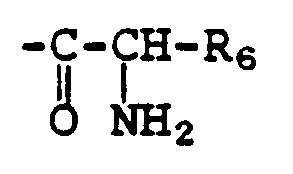
hydrogen, alkyl of 1-10 carbon atoms or alkyl of 1-10 carbon atoms substituted by OR₂, NR₂R₃, CO₂H, CO₂R₂, CONR₂R₃,
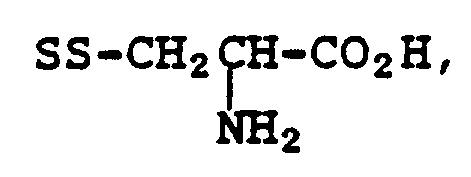
an optically active isomer
thereof, or a pharmaceutically acceptable acid addition salt thereof. - A compound according to claim 1, in which
R₆ is hydrogen, alkyl of 1-4 carbon atoms or alkyl of 1-4 carbon atoms substituted by OH, NH₂, CO₂H, CONH₂,

- A compound according to claims 1 to 2, wherein R₁ is alkyl of 1-3 carbon atoms, 2-fluoroethyl, vinyl, cyclopropyl, phenyl, phenyl substituted by halogen, hydroxy, amino or alkyl of 1-4 carbon atoms, or a 5- or 6-membered heteroaromatic ring containing at least one nitrogen, oxygen, or sulfur atom.
- A compound according to claims 1 to 3, wherein X is N, CH, CF, CCl, or CCF₃,
Y is H or NH₂,
R1 is ethyl, 2-fluoroethyl, vinyl, or cyclopropyl and Z is
- A compound according to claims 1 to 4, wherein Z is

- A compound according to claim 1 and being a member of the group consisting of 7-[3-(2-amino-1-oxopropyl)amino]-1-pyrrolidinyl]-1-cyclopropyl-6-fluoro-1,4-dihydro-4-oxo-1,8-naphthyridine-3-carboxylic acid
or the [S-(R*,R*)] or the [S-(R*,S*) isomer thereof,
7-[3-[(aminoacetyl)amino]-1-pyrrolidinyl]-1-cyclopropyl-6-fluoro-1,4-dihydro-4-oxo-1,8-naphthyridine-3-carboxylic acid or an optical isomer thereof,
7[-3-[(2-amino-1-oxo-3-phenylpropyl)amino]-1-pyrrolidinyl]-1-cyclopropyl-6-fluoro-1,4dihydro-4-oxo-1,8-naphthyridine-3-carboxylic acid
or the [S-(R*,S*)] or the [S-(R*,R*)] isomer thereof,
7-[3-[(2,5-diamino-1,5-dioxopentyl)amino]-1-pyrrolidinyl]-1-cyclopropyl-6-fluoro-1,4-dihydro-4-oxo-1,8-naphthyridine-3-carboxylic acid or an optical isomer thereof,
7-[3-[(2-amino-4-carboxy-1-oxobutyl)amino]-1-pyrrolidinyl]-1-cyclopropyl-6-fluoro-1,4-dihydro-4-oxo-1,8-naphthyridine-3-carboxylic acid or an optical isomer thereof,
7-[3-[(2,6-diamino-1-oxohexyl)amino]-1-pyrrolidinyl-1-cyclopropyl-6-fluoro-1,4-dihydro-4-oxo-1,8-naphthyridine-3-carboxylic acid or an optical isomer thereof,
7-[3-[[(2-amino-1-oxo-3-phenylpropyl)amino]methyl]-3-methyl-1-pyrrolidinyl]-1-cyclopropyl-6-fluoro-1,4-dihydro-4-oxo-1,8-naphthyridine-3-carboxylic acid or an optical isomer thereof,
7-[3-[[(2-amino-1-oxopropyl)amino]methyl]-3-methyl-1-pyrrolidinyl]-1-cyclopropyl-6-fluoro-1,4-dihydro-4-oxo-1,8-naphthyridine-3-carboxylic acid or an optical isomer thereof,
7-[3-[[(aminoacetyl)amino]methyl]-3-methyl-1-pyrrolidinyl]-1-cyclopropyl-6-fluoro-1,4-dihydro-4-oxo-1,8-naphthyridine-3-carboxylic acid or an optical isomer thereof,
7-[3-[[(aminophenylacetyl)amino]methyl]-3-methyl-1-pyrrolidinyl]-1-cyclopropyl-6-fluoro-1,4-dihydro-4-oxo-1,8-naphthyridine-3-carboxylic acid or an optical isomer thereof,
7-[3-[[(2-amino-4-carboxy-1-oxobutylamino]methyl]-3-methyl-1-pyrrolidinyl]-1-cyclopropyl-6-fluoro-1,4-dihydro-4-oxo-1,8-naphthyridine-3-carboxylic acid or an optical isomer thereof,
7-[3-[[(2,6-diamino-1-oxohexyl)amino]methyl]-3-methyl-1-pyrrolidinyl]-1-cyclopropyl-6-fluoro-1,4-dihydro-4-oxo-1,8-naphthyridine-3-carboxylic acid or an optical isomer thereof,
7-[3-[[2,5-diamino-1,5-dioxopentyl)amino]methyl]-3-methyl-1-pyrrolidinyl]-1-cyclopropyl-6-fluoro-1,4-dihydro-4-oxo-1,8-naphthyridine-3-carboxylic acid or an optical isomer thereof,
7-[3-[(2-amino-1-oxopropyl)amino]-1-pyrrolidiny]-1-cyclopropyl-6,8-difluoro-1,4-dihydro-4-oxo-3-quinolinecarboxylic acid
or the [S-(R*,R*)] isomer thereof.
7-[3-[(aminophenylacetyl)amino]-1-pyrrolidinyl]-1-cyclopropyl-6-fluoro-1,4-dihydro-4-oxo-1,8-naphthyridine-3-carboxylic acid or an optical isomer thereof,
- A pharmaceutical composition comprising an antibacterially effective amount of a compound according to claims 1 to 6 together with a carrier or excipient.
- Use of a compound according to claims 1 to 6 for the preparation of a pharmaceutical for the treatment of bacterial infections.
- A process for the preparation of a compound according to the formula I

Y is H, F, NH₂, or OR₂;
Z is
R₁ is alkyl of 1-6 carbon atoms, haloalkyl in which
alkyl has 1-4 carbon atoms, vinyl, cycloalkyl of 3-6 carbon atoms, phenyl or phenyl substituted by halogen, hydroxy, amino or alkyl of 1-4 carbon atoms;
R₂ and R₃ are each independently hydrogen or alkyl
of 1-4 carbon atoms;
R₄ is -(CR₂R₃)n-NR₂R₅ in which n is 0, 1, or 2;
R₅ is
hydrogen, alkyl of 1-10 carbon atoms or alkyl of 1-10 carbon atoms substituted by OR₂, NR₂R₃, CO₂H, CO₂R₂, CONR₂R₃,

an optically active isomer thereof, or a pharmaceutically acceptable acid addition salt thereof which comprises reacting a compound of the formula II


- A process according to claim 9, wherein Pro is t-butyloxycarbonyl or benzyloxycarbonyl.
- A process for the preparation of a compound of the formula I


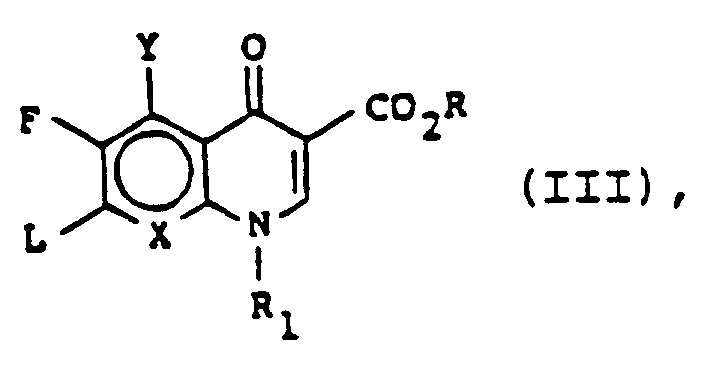
- A process for the preparation of a compound according to claim 9 which comprises removing a protective group from the α-amino group, R₅, by acid hydrolysis or catalytic hydrogenation, and if desired, converting the resulting free acid to a pharmaceutically acceptable base salt or to a pharmaceutically acceptable acid addititon salt by known means.
- A process according to claims 9 to 12 wherein the protective group is t-butyloxycarbonyl and said group is removed by acid hydrolysis in aqueous hydrochloric acid.
- A process according to claims 9 to 12 wherein the protective group is benzyloxycarbonyl and said group is removed by catalytic hydrogenation using palladium on carbon as catalyst.
- A process according to claim 9 for the preparation of a compound of formula I, wherein R₆ is hydrogen, alkyl of 1-4 carbon atoms or alkyl of 1-4 carbon atoms substituted by OH, NH₂, CO₂H, CONH₂,


- A process according to claim 9, for the preparation of a compound of formula I, wherein R₁ is alkyl of 1-3 carbon atoms, 2-fluoroethyl, vinyl, cyclopropyl, phenyl, phenyl substituted by halogen, hydroxy, amino or alkyl of 1-4 carbon atoms, or a 5- or 6-membered heteroaromatic ring containing at least one nitrogen, oxygen, or sulfur atom.
- A process for the preparation of a compound of formula I according to claim 9, wherein X is N, CH, CF, CCl, or CCF₃, Y is H or NH₂, R1 is ethyl, 2-fluoroethyl, vinyl, or cyclopropyl and Z is

- A process for the preparation of a compound of formula I according to claim 9, wherein Z is

- Process according to claim 9 for the preparation of a compound according to claim 9 being a member of the group consisting
of 7-[3-(2-amino-1-oxopropyl)amino]-1-pyrrolidinyl]-1-cyclopropyl-6-fluoro-1,4-dihydro-4-oxo-1,8-naphthyridine-3-carboxylic acid
or the [S-(R*,R*)] or the [S-(R*,S*) isomer thereof,
7-[3-[(aminoacetyl)amino]-1-pyrrolidinyl]-1-cyclopropyl-6-fluoro-1,4-dihydro-4-oxo-1,8-naphthyridine-3-carboxylic acid or an optical isomer thereof,
7[-3-[(2-amino-1-oxo-3-phenylpropyl)amino]-1-pyrrolidinyl]-1-cyclopropyl-6-fluoro-1,4dihydro-4-oxo-1,8-naphthyridine-3-carboxylic acid
or the [S-(R*,S*)] or the [S-(R*,R*)] isomer thereof,
7-[3-[(2,5-diamino-1,5-dioxopentyl)amino]-1-pyrrolidinyl]-1-cyclopropyl-6-fluoro-1,4-dihydro-4-oxo-1,8-naphthyridine-3-carboxylic acid or an optical isomer thereof,
7-[3-[(2-amino-4-carboxy-1-oxobutyl)amino]-1-pyrrolidinyl]-1-cyclopropyl-6-fluoro-1,4-dihydro-4-oxo-1,8-naphthyridine-3-carboxylic acid or an optical isomer thereof,
7-[3-[(2,6-diamino-1-oxohexyl)amino]-1-pyrrolidinyl-1-cyclopropyl-6-fluoro-1,4-dihydro-4-oxo-1,8-naphthyridine-3-carboxylic acid or an optical isomer thereof,
7-[3-[(aminophenylacetyl)amino]-1-pyrrolidinyl]-1-cyclopropyl-6-fluoro-1,4-dihydro-4-oxo-1,8-naphthyridine-3-carboxylic acid or an optical isomer thereof,
7-[3-[[(2-amino-1-oxo-3-phenylpropyl)amino]methyl]-3-methyl-1-pyrrolidinyl]-1-cyclopropyl-6-fluoro-1,4-dihydro-4-oxo-1,8-naphthyridine-3-carboxylic acid or an optical isomer thereof,
7-[3-[[(2-amino-1-oxopropyl)amino]methyl]-3-methyl-1-pyrrolidinyl]-1-cyclopropyl-6-fluoro-1,4-dihydro-4-oxo-1,8-naphthyridine-3-carboxylic acid or an optical isomer thereof,
7-[3-[[(aminoacetyl)amino]methyl]-3-methyl-1-pyrrolidinyl]-1-cyclopropyl-6-fluoro-1,4-dihydro-4-oxo-1,8-naphthyridine-3-carboxylic acid or an optical isomer thereof,
7-[3-[[(aminophenylacetyl)amino]methyl]-3-methyl-1-pyrrolidinyl]-1-cyclopropyl-6-fluoro-1,4-dihydro-4-oxo-1,8-naphthyridine-3-carboxylic acid or an optical isomer thereof,
7-[3-[[(2-amino-4-carboxy-1-oxobutylamino]methyl]-3-methyl-1-pyrrolidinyl]-1-cyclopropyl-6-fluoro-1,4-dihydro-4-oxo-1,8-naphthyridine-3-carboxylic acid or an optical isomer thereof,
7-[3-[[(2,6-diamino-1-oxohexyl)amino]methyl]-3-methyl-1-pyrrolidinyl]-1-cyclopropyl-6-fluoro-1,4-dihydro-4-oxo-1,8-naphthyridine-3-carboxylic acid or an optical isomer thereof,
7-[3-[[2,5-diamino-1,5-dioxopentyl)amino]methyl]-3-methyl-1-pyrrolidinyl]-1-cyclopropyl-6-fluoro-1,4-dihydro-4-oxo-1,8-naphthyridine-3-carboxylic acid or an optical isomer thereof,
7-[3-[(2-amino-1-oxopropyl)amino]-1-pyrrolidiny]-1-cyclopropyl-6,8-difluoro-1,4-dihydro-4-oxo-3-quinolinecarboxylic acid
or the [S-(R*,R*)] isomer thereof. - Use of a compound prepared according to claims 9 to 19 for the preparation of a pharmaceutical for the treatment of bacterial infections.
- Process for preparing a pharmaceutical composition characterized by adding a compound prepared according to claims 9 to 19 to a pharmaceutically acceptable carriers or excipient.
Priority Applications (1)
| Application Number | Priority Date | Filing Date | Title |
|---|---|---|---|
| AT88113525T ATE103602T1 (en) | 1987-08-21 | 1988-08-19 | QUINOLONE AND NAPHTHYRIDINE ANTIBACTERIAL AGENTS WITH AN ALPHA AMINO ACID IN THE SIDE CHAIN OF THE 7-SUBSTITUENT. |
Applications Claiming Priority (4)
| Application Number | Priority Date | Filing Date | Title |
|---|---|---|---|
| US8795087A | 1987-08-21 | 1987-08-21 | |
| US87950 | 1987-08-21 | ||
| US07/220,177 US4851418A (en) | 1987-08-21 | 1988-07-20 | Naphthyridine antibacterial agents containing an α-amino acid in the side chain of the 7-substituent |
| US220177 | 1988-07-20 |
Publications (3)
| Publication Number | Publication Date |
|---|---|
| EP0304087A2 EP0304087A2 (en) | 1989-02-22 |
| EP0304087A3 EP0304087A3 (en) | 1989-10-25 |
| EP0304087B1 true EP0304087B1 (en) | 1994-03-30 |
Family
ID=26777552
Family Applications (1)
| Application Number | Title | Priority Date | Filing Date |
|---|---|---|---|
| EP88113525A Expired - Lifetime EP0304087B1 (en) | 1987-08-21 | 1988-08-19 | Quinolone and naphthyridine antibacterial agents containing an alpha-amino acid in the side chain of the 7-substituent |
Country Status (16)
| Country | Link |
|---|---|
| US (1) | US4851418A (en) |
| EP (1) | EP0304087B1 (en) |
| JP (1) | JP2679818B2 (en) |
| KR (1) | KR0120389B1 (en) |
| AU (1) | AU608881B2 (en) |
| CA (1) | CA1339216C (en) |
| DE (1) | DE3888754T2 (en) |
| DK (1) | DK172152B1 (en) |
| ES (1) | ES2063011T3 (en) |
| FI (1) | FI90237C (en) |
| HK (1) | HK1000802A1 (en) |
| IE (1) | IE62787B1 (en) |
| NO (1) | NO171979C (en) |
| NZ (1) | NZ225870A (en) |
| PH (1) | PH25460A (en) |
| PT (1) | PT88289B (en) |
Cited By (14)
| Publication number | Priority date | Publication date | Assignee | Title |
|---|---|---|---|---|
| EP0360258A3 (en) * | 1988-09-22 | 1991-06-05 | Abbott Laboratories | Amino acid quinoline and naphthyridine derivatives |
| EP0391169A3 (en) * | 1989-04-05 | 1991-09-18 | Bayer Ag | Enantiomeric pure 7-(3-amino-1-pyrrolidinyl)-chinolon-and-naphthyridon carboxylic acids |
| EP0394685A3 (en) * | 1989-03-28 | 1991-09-25 | Warner-Lambert Company | (s)-7-(3-amino-1-pyrrolidinyl)-1-cyclopropyl-6-fluoro-1,4-dihydro-4-oxo-1,8-naphthyridine-3-carboxylic acid |
| EP0366643A3 (en) * | 1988-10-24 | 1991-12-04 | Norwich Eaton Pharmaceuticals, Inc. | Novel antimicrobial dithiocarbamoyl quinolones |
| EP0465716A1 (en) * | 1990-07-10 | 1992-01-15 | Hokuriku Pharmaceutical Co., Ltd. | Optically active thiazetoquino-line-3-carboxylic acid compound, method for preparation thereof, and a pharmaceutical composition comprising the same |
| EP0514268A1 (en) * | 1991-05-16 | 1992-11-19 | Laboratorios Del Dr. Esteve, S.A. | Substituted amino acid azetidinyl pyridone derivatives, their preparation and use as medicines |
| WO1993022283A1 (en) * | 1992-04-27 | 1993-11-11 | Warner-Lambert Company | Process for the manufacture of (s)-3-amino-1-substituted-pyrrolidines |
| WO1993024481A1 (en) * | 1992-06-01 | 1993-12-09 | Synphar Laboratories, Inc. | 7-substituted-6-fluoro-1,4-dihydro-4-oxo-quinoline-3-carboxylic acid compounds and related compounds as antibacterial agents |
| US5326769A (en) * | 1991-01-25 | 1994-07-05 | Hoffmann-La Roche Inc. | (S)-1-[(10-chloro-6,7-dihydro-4-oxo-3-phenyl-4H-benzo[a]quino-lizin-1-yl)carbonyl]-3-ethoxypyrrolidine |
| US5385913A (en) * | 1989-10-06 | 1995-01-31 | Pfizer Inc. | 1,4-dihydro-4-oxo-3-quinoline derivatives as selectively toxic mammalian antibacterial agents |
| US5637580A (en) * | 1988-10-24 | 1997-06-10 | The Procter & Gamble Company | Antimicrobial penem-quinolones |
| US6034086A (en) * | 1994-07-18 | 2000-03-07 | Ube Industries, Ltd. | Trifluoromethylquinolinecarboxylic acid derivative |
| US7902227B2 (en) * | 2007-07-27 | 2011-03-08 | Janssen Pharmaceutica Nv. | C-7 isoxazolinyl quinolone / naphthyridine derivatives useful as antibacterial agents |
| EP2261205A4 (en) * | 2008-04-02 | 2012-06-06 | Kaneka Corp | Method of producing (s)-3-(1-cyano-1,1-diphenylmethyl)-pyrrolidine |
Families Citing this family (42)
| Publication number | Priority date | Publication date | Assignee | Title |
|---|---|---|---|---|
| EP0207420B1 (en) * | 1985-06-26 | 1992-05-06 | Daiichi Pharmaceutical Co., Ltd. | Pyridonecarboxylic acid derivatives |
| IN166416B (en) * | 1985-09-18 | 1990-05-05 | Pfizer | |
| JPH089597B2 (en) * | 1986-01-21 | 1996-01-31 | 杏林製薬株式会社 | 8-Alkoxyquinolonecarboxylic acid excellent in selective toxicity and its salt, and method for producing the same |
| EP0251308B1 (en) * | 1986-07-04 | 1990-11-22 | Chemie Linz Gesellschaft m.b.H. | 4-quinolone-3-carboxylic-acid derivatives, process for their synthesis and pharmaceutical preparations containing them |
| US4780468A (en) * | 1987-08-07 | 1988-10-25 | Warner-Lambert Company | 8-trifluoromethyl quinolones as antibacterial agents |
| MY105136A (en) * | 1988-04-27 | 1994-08-30 | Daiichi Seiyaku Co | Optically active pyridonecarboxylic acid derivatives. |
| JPH0395177A (en) * | 1988-05-19 | 1991-04-19 | Chugai Pharmaceut Co Ltd | Novel quinolone carboxylic acid derivative |
| JP2844079B2 (en) * | 1988-05-23 | 1999-01-06 | 塩野義製薬株式会社 | Pyridonecarboxylic acid antibacterial agent |
| FI95130C (en) * | 1988-07-20 | 1995-12-27 | Sankyo Co | Process for the preparation of 4-oxoquinoline-3-carboxylic acid derivatives useful as a medicament |
| US5057520A (en) * | 1989-03-24 | 1991-10-15 | Abbott Laboratories | 7-(peptidylpyrolidinyl)naphthyridine antibacterial compounds |
| US5057523A (en) * | 1988-09-22 | 1991-10-15 | Abbott Laboratories | Dipeptide quinolone derivatives |
| US5262417A (en) * | 1988-12-06 | 1993-11-16 | The Upjohn Company | Antibacterial quinolone compounds |
| CA2012681A1 (en) * | 1989-03-31 | 1990-09-30 | Masayasu Okuhira | Quinolone derivatives, preparation processes thereof, and antibacterial agents containing the same |
| US5164402A (en) * | 1989-08-16 | 1992-11-17 | Pfizer Inc | Azabicyclo quinolone and naphthyridinone carboxylic acids |
| FI921475L (en) * | 1989-10-06 | 1992-04-03 | Pfizer | 1,4-DIHYDRO-4-OXO-3-QUINOLINE DERIVATIVES ARE SELECTIVELY TOXIC WITH ANTIBACTERIAL AEMENN HOS DAEGGDJUR. |
| US5084276A (en) * | 1990-01-05 | 1992-01-28 | Abbott Laboratories | Quinolone carboxylic acid compositions with polymeric additive to reduce vein irritation |
| DK0525057T3 (en) | 1990-04-18 | 2000-07-31 | Procter & Gamble Pharma | Antimicrobial quinolonyllactams |
| ZA92804B (en) | 1991-02-06 | 1992-12-30 | Igen Inc | Methods and apparatus for improved luminescence assays |
| FR2673426B1 (en) * | 1991-03-01 | 1993-07-16 | Bouchara Sa | NEW QUINOLONES, THEIR PREPARATION PROCESS AND THE CLOSING COMPOSITIONS. |
| US5696132A (en) * | 1991-05-28 | 1997-12-09 | Daiichi Pharmaceutical Co., Ltd. | Pyridonecarboxylic acid derivatives |
| FR2692577B1 (en) * | 1992-05-26 | 1996-02-02 | Bouchara Sa | NOVEL FLUORINATED QUINOLONES, THEIR PREPARATION PROCESS AND THE PHARMACEUTICAL COMPOSITIONS CONTAINING THE SAME. |
| US5290794A (en) * | 1992-10-27 | 1994-03-01 | Warner Lambert Co. | Soluble calcium lactate antibacterial complexes as non-irritating parenteral forms |
| WO1994025464A1 (en) * | 1993-04-24 | 1994-11-10 | Korea Research Institute Of Chemical Technology | Novel quinolone carboxylic acid derivatives and process for preparing the same |
| KR950018003A (en) * | 1993-12-09 | 1995-07-22 | 스미스클라인 비참 피엘씨 | Novel quinolone derivatives and methods for their preparation |
| US5602254A (en) * | 1995-05-26 | 1997-02-11 | Warner-Lambert Company | Method for making quinoline carboxylic acids or naphthyridine carboxylic acids in free base form |
| US5939550A (en) * | 1995-06-15 | 1999-08-17 | Pfizer Inc. | Process for preparing derivatives of azabicyclo naphthyridine carboxylic acid comprising a dipeptide |
| JP4057088B2 (en) * | 1996-04-22 | 2008-03-05 | 株式会社カネカ | Method for producing pyrrolidine derivative |
| EP0945435B1 (en) * | 1996-11-28 | 2003-08-13 | Wakunaga Pharmaceutical Co., Ltd. | Novel pyridonecarboxylic acid derivatives or salts thereof and drugs containing the same as the active ingredient |
| US6608078B2 (en) | 2000-05-08 | 2003-08-19 | Wockhardt Limited | Antibacterial chiral 8-(substituted piperidino)-benzo [i,j] quinolizines, processes, compositions and methods of treatment |
| US7098219B2 (en) | 2000-08-01 | 2006-08-29 | Wockhart Limited | Inhibitors of cellular efflux pumps of microbes |
| SE0003795D0 (en) | 2000-10-20 | 2000-10-20 | Astrazeneca Ab | Pharmaceutically useful compounds |
| US6964966B2 (en) | 2001-04-25 | 2005-11-15 | Wockhardt Limited | Generation triple-targeting, chiral, broad-spectrum antimicrobial 7-substituted piperidino-quinolone carboxylic acid derivatives, their preparation, compositions and use as medicaments |
| US6878713B2 (en) | 2001-04-25 | 2005-04-12 | Wockhardt Limited | Generation triple-targeting, chiral, broad-spectrum antimicrobial 7-substituted piperidino-quinolone carboxylic acid derivatives, their preparation, compositions and use as medicaments |
| US6664267B1 (en) | 2002-05-28 | 2003-12-16 | Wockhardt Limited | Crystalline fluoroquinolone arginine salt form |
| WO2005023805A1 (en) | 2003-09-04 | 2005-03-17 | Wockhardt Limited | Benzoquinolizine-2-carboxylic acid arginine salt tetrahydrate |
| EP1676837A4 (en) * | 2003-10-08 | 2008-09-10 | Teijin Pharma Ltd | Process for producing aminopyrrolidine derivative and intermediate compound |
| KR100939347B1 (en) | 2005-07-20 | 2010-01-29 | (주)카이로드 | Method for preparing optically pure (S) -3-hydroxy pyrrolidine |
| CN101239937B (en) * | 2007-02-07 | 2010-05-19 | 上海雅本化学有限公司 | Method for preparing optical activity R-(-)-1-benzylcarbonyl-3-aminopyrrolidine and hydrochloride thereof |
| WO2009011871A2 (en) * | 2007-07-17 | 2009-01-22 | Amgen Inc. | Thiadiazole modulators of pkb |
| JP5779100B2 (en) | 2008-11-24 | 2015-09-16 | カウンシル オブ サイエンティフィック アンド インダストリアル リサーチ | Process for producing optically active N-benzyl-3-hydroxypyrrolidine |
| CN114989165B (en) * | 2022-05-30 | 2024-11-08 | 青岛大学附属医院 | A compound or composition for resisting persister bacteria and biofilm bacteria and its use |
| EP4382529A1 (en) | 2022-12-07 | 2024-06-12 | Bayer Consumer Care AG | A process for preparing pure (3s)-pyrrolidin-3-ol and pure (3s)-pyrrolidin-3-ol hydrochloride |
Family Cites Families (15)
| Publication number | Priority date | Publication date | Assignee | Title |
|---|---|---|---|---|
| JPS5630964A (en) * | 1979-08-22 | 1981-03-28 | Kyorin Pharmaceut Co Ltd | Novel substituted quinolinecarboxylic acid and its preparation |
| JPS58174367A (en) * | 1982-04-07 | 1983-10-13 | Tanabe Seiyaku Co Ltd | Quinoline derivative and its preparation |
| IE55898B1 (en) * | 1982-09-09 | 1991-02-14 | Warner Lambert Co | Antibacterial agents |
| US4665079A (en) * | 1984-02-17 | 1987-05-12 | Warner-Lambert Company | Antibacterial agents |
| DE3306771A1 (en) * | 1983-02-25 | 1984-08-30 | Bayer Ag, 5090 Leverkusen | CHINOLONIC CARBONIC ACIDS, METHOD FOR THE PRODUCTION THEREOF AND THE ANTIBACTERIAL AGENTS CONTAINING THEM |
| DE3318145A1 (en) * | 1983-05-18 | 1984-11-22 | Bayer Ag, 5090 Leverkusen | 7-AMINO-1-CYCLOPROPYL-6,8-DIFLUOR-1,4-DIHYDRO-4-OXO-3-CHINOLINE CARBONIC ACIDS, METHOD FOR THE PRODUCTION THEREOF AND THEIR CONTAINING ANTIBACTERIAL AGENTS |
| JPS60126271A (en) * | 1983-12-09 | 1985-07-05 | Kyorin Pharmaceut Co Ltd | Quinolonecarboxylic acid derivative |
| ZA85853B (en) * | 1984-02-17 | 1986-09-24 | Warner Lambert Co | Antibacterial agents |
| JPS60178867A (en) * | 1984-02-24 | 1985-09-12 | Dai Ichi Seiyaku Co Ltd | Dihalogenoquinoline derivative |
| US4571396A (en) * | 1984-04-16 | 1986-02-18 | Warner-Lambert Company | Antibacterial agents |
| JPS60250573A (en) * | 1984-05-25 | 1985-12-11 | 富士通株式会社 | Electrically connecting socket |
| JPS61205258A (en) * | 1985-03-08 | 1986-09-11 | Kyorin Pharmaceut Co Ltd | Quinolonecarboxylic acid derivative and production thereof |
| US4657913A (en) * | 1985-04-18 | 1987-04-14 | Warner-Lambert Company | Trifluoro- quinoline -3- carboxylic acids and their use as anti-bacterial agents |
| JPS62469A (en) * | 1985-06-27 | 1987-01-06 | Dainippon Pharmaceut Co Ltd | Novel quinolone derivative and ester and salt thereof |
| US4668680A (en) * | 1985-12-12 | 1987-05-26 | Warner-Lambert Company | 5-amino-6,8-difluoroquinolones as antibacterial agents |
-
1988
- 1988-07-20 US US07/220,177 patent/US4851418A/en not_active Expired - Lifetime
- 1988-08-02 CA CA000573632A patent/CA1339216C/en not_active Expired - Fee Related
- 1988-08-02 IE IE236388A patent/IE62787B1/en not_active IP Right Cessation
- 1988-08-08 AU AU20629/88A patent/AU608881B2/en not_active Ceased
- 1988-08-17 FI FI883807A patent/FI90237C/en not_active IP Right Cessation
- 1988-08-18 PH PH37426A patent/PH25460A/en unknown
- 1988-08-18 PT PT88289A patent/PT88289B/en not_active IP Right Cessation
- 1988-08-18 NZ NZ225870A patent/NZ225870A/en unknown
- 1988-08-19 DK DK467388A patent/DK172152B1/en not_active IP Right Cessation
- 1988-08-19 DE DE3888754T patent/DE3888754T2/en not_active Expired - Fee Related
- 1988-08-19 ES ES88113525T patent/ES2063011T3/en not_active Expired - Lifetime
- 1988-08-19 EP EP88113525A patent/EP0304087B1/en not_active Expired - Lifetime
- 1988-08-19 JP JP63204893A patent/JP2679818B2/en not_active Expired - Fee Related
- 1988-08-19 NO NO883722A patent/NO171979C/en not_active IP Right Cessation
- 1988-08-20 KR KR1019880010617A patent/KR0120389B1/en not_active Expired - Fee Related
-
1997
- 1997-12-10 HK HK97102379A patent/HK1000802A1/en not_active IP Right Cessation
Non-Patent Citations (1)
| Title |
|---|
| 30th. Interscience Conference on Antimicrobial Agents & Chemotherapy, Atlanta, Geogia. * |
Cited By (17)
| Publication number | Priority date | Publication date | Assignee | Title |
|---|---|---|---|---|
| EP0360258A3 (en) * | 1988-09-22 | 1991-06-05 | Abbott Laboratories | Amino acid quinoline and naphthyridine derivatives |
| EP0366643A3 (en) * | 1988-10-24 | 1991-12-04 | Norwich Eaton Pharmaceuticals, Inc. | Novel antimicrobial dithiocarbamoyl quinolones |
| US5648346A (en) * | 1988-10-24 | 1997-07-15 | The Procter & Gamble Company | Antimicrobial carbacephem-quinolones |
| US5637580A (en) * | 1988-10-24 | 1997-06-10 | The Procter & Gamble Company | Antimicrobial penem-quinolones |
| EP0394685A3 (en) * | 1989-03-28 | 1991-09-25 | Warner-Lambert Company | (s)-7-(3-amino-1-pyrrolidinyl)-1-cyclopropyl-6-fluoro-1,4-dihydro-4-oxo-1,8-naphthyridine-3-carboxylic acid |
| EP0391169A3 (en) * | 1989-04-05 | 1991-09-18 | Bayer Ag | Enantiomeric pure 7-(3-amino-1-pyrrolidinyl)-chinolon-and-naphthyridon carboxylic acids |
| US5385913A (en) * | 1989-10-06 | 1995-01-31 | Pfizer Inc. | 1,4-dihydro-4-oxo-3-quinoline derivatives as selectively toxic mammalian antibacterial agents |
| EP0465716A1 (en) * | 1990-07-10 | 1992-01-15 | Hokuriku Pharmaceutical Co., Ltd. | Optically active thiazetoquino-line-3-carboxylic acid compound, method for preparation thereof, and a pharmaceutical composition comprising the same |
| US5342846A (en) * | 1990-12-05 | 1994-08-30 | Synphar Laboratories, Inc. | 7-substituted-6-fluoro-1,4-dihydro-4-oxo-quinoline-3-carboxylic acid compounds and 7-(substituted triazolyl pyrrolidin-1-yl) 4-oxoquinoline-3-carboxylic acid derivatives useful as antibacterial agents |
| US5326769A (en) * | 1991-01-25 | 1994-07-05 | Hoffmann-La Roche Inc. | (S)-1-[(10-chloro-6,7-dihydro-4-oxo-3-phenyl-4H-benzo[a]quino-lizin-1-yl)carbonyl]-3-ethoxypyrrolidine |
| FR2676445A1 (en) * | 1991-05-16 | 1992-11-20 | Esteve Labor Dr | SUBSTITUTED AZETIDINYL AMINO ACID PYRIDONE DERIVATIVES, THEIR PREPARATION AND THEIR USE AS MEDICAMENTS. |
| EP0514268A1 (en) * | 1991-05-16 | 1992-11-19 | Laboratorios Del Dr. Esteve, S.A. | Substituted amino acid azetidinyl pyridone derivatives, their preparation and use as medicines |
| WO1993022283A1 (en) * | 1992-04-27 | 1993-11-11 | Warner-Lambert Company | Process for the manufacture of (s)-3-amino-1-substituted-pyrrolidines |
| WO1993024481A1 (en) * | 1992-06-01 | 1993-12-09 | Synphar Laboratories, Inc. | 7-substituted-6-fluoro-1,4-dihydro-4-oxo-quinoline-3-carboxylic acid compounds and related compounds as antibacterial agents |
| US6034086A (en) * | 1994-07-18 | 2000-03-07 | Ube Industries, Ltd. | Trifluoromethylquinolinecarboxylic acid derivative |
| US7902227B2 (en) * | 2007-07-27 | 2011-03-08 | Janssen Pharmaceutica Nv. | C-7 isoxazolinyl quinolone / naphthyridine derivatives useful as antibacterial agents |
| EP2261205A4 (en) * | 2008-04-02 | 2012-06-06 | Kaneka Corp | Method of producing (s)-3-(1-cyano-1,1-diphenylmethyl)-pyrrolidine |
Also Published As
| Publication number | Publication date |
|---|---|
| KR0120389B1 (en) | 1997-11-04 |
| IE882363L (en) | 1989-02-21 |
| AU2062988A (en) | 1989-02-23 |
| PT88289B (en) | 1995-03-31 |
| CA1339216C (en) | 1997-08-05 |
| US4851418A (en) | 1989-07-25 |
| FI90237C (en) | 1994-01-10 |
| AU608881B2 (en) | 1991-04-18 |
| DK467388D0 (en) | 1988-08-19 |
| EP0304087A2 (en) | 1989-02-22 |
| ES2063011T3 (en) | 1995-01-01 |
| KR890003704A (en) | 1989-04-17 |
| NO883722D0 (en) | 1988-08-19 |
| JPH01125371A (en) | 1989-05-17 |
| NO883722L (en) | 1989-02-22 |
| FI883807A7 (en) | 1989-02-22 |
| DK172152B1 (en) | 1997-12-01 |
| IE62787B1 (en) | 1995-02-22 |
| DE3888754D1 (en) | 1994-05-05 |
| FI90237B (en) | 1993-09-30 |
| FI883807A0 (en) | 1988-08-17 |
| NO171979B (en) | 1993-02-15 |
| HK1000802A1 (en) | 1998-05-01 |
| PT88289A (en) | 1989-09-14 |
| DE3888754T2 (en) | 1994-07-14 |
| PH25460A (en) | 1991-07-01 |
| NZ225870A (en) | 1990-12-21 |
| NO171979C (en) | 1993-05-26 |
| DK467388A (en) | 1989-02-22 |
| EP0304087A3 (en) | 1989-10-25 |
| JP2679818B2 (en) | 1997-11-19 |
Similar Documents
| Publication | Publication Date | Title |
|---|---|---|
| CA1339216C (en) | Quinolone and naphthyridine antibacterial agents containing an alpha-amino acid in the side chain of the 7-substituent | |
| HK1000802B (en) | Quinolone and naphthyridine antibacterial agents containing an alpha-amino acid in the side chain of the 7-substituent | |
| EP0153163B1 (en) | 7-substituted-1-cyclopropyl-6,8-difluoro-1,4-dihydro-4-oxo-3-quinolinecarboxylic acids; 7-substituted-1-cyclopropyl-1,4-dihydro-6-fluoro-4-oxo-1,8-naphthyridine-3-carboxylic acids; their derivatives; and a process for preparing the compounds | |
| US4780468A (en) | 8-trifluoromethyl quinolones as antibacterial agents | |
| AU3048389A (en) | Antibacterial agents | |
| EP0202763B1 (en) | 5,6-difluoronaphthyridines and 5,6,8-trifluoro-quinolines as antibacterial agents | |
| JPH082896B2 (en) | 7-[[3- (aminomethyl) -3-alkyl] -1-pyrrolidinyl] -quinoline-carboxylic acid | |
| JP2582515B2 (en) | Optical isomers of 7- [3- (1,1-dialkylmethyl-1-amino) -1-pyrrolidinyl] -quinolone and naphthyridone as antibacterial agents | |
| CA2013136C (en) | (s)-7-(3-amino-1-pyrrolidinyl)-1-cyclopropyl-6-fluoro-1, 4-dihydro-4-oxo-1,8-naphthyridine-3-carboxylic acid | |
| US5072001A (en) | Certain optically active substituted 3-pyrraidine acetic acid derivatives useful as intermediates | |
| US4803205A (en) | Quinolones as antibacterial agents | |
| US5364861A (en) | Optical isomers of 7-[3-(1,1-dialkylmethyl-1-amino-1-pyrrolidinyl]-quinolones and naphthyridones as antibacterial agents | |
| US4933335A (en) | Quinolones as antibacterial agents | |
| WO1991016312A1 (en) | Quinolinecarboxylic acid antibacterial agents | |
| FI91636C (en) | Method for preparing antibacterial quinolone compounds |
Legal Events
| Date | Code | Title | Description |
|---|---|---|---|
| PUAI | Public reference made under article 153(3) epc to a published international application that has entered the european phase |
Free format text: ORIGINAL CODE: 0009012 |
|
| 17P | Request for examination filed |
Effective date: 19880819 |
|
| AK | Designated contracting states |
Kind code of ref document: A2 Designated state(s): AT BE CH DE ES FR GB GR IT LI LU NL SE |
|
| PUAL | Search report despatched |
Free format text: ORIGINAL CODE: 0009013 |
|
| AK | Designated contracting states |
Kind code of ref document: A3 Designated state(s): AT BE CH DE ES FR GB GR IT LI LU NL SE |
|
| 17Q | First examination report despatched |
Effective date: 19910909 |
|
| GRAA | (expected) grant |
Free format text: ORIGINAL CODE: 0009210 |
|
| AK | Designated contracting states |
Kind code of ref document: B1 Designated state(s): AT BE CH DE ES FR GB GR IT LI LU NL SE |
|
| REF | Corresponds to: |
Ref document number: 103602 Country of ref document: AT Date of ref document: 19940415 Kind code of ref document: T |
|
| REF | Corresponds to: |
Ref document number: 3888754 Country of ref document: DE Date of ref document: 19940505 |
|
| ET | Fr: translation filed | ||
| ITF | It: translation for a ep patent filed | ||
| REG | Reference to a national code |
Ref country code: GR Ref legal event code: FG4A Free format text: 3012178 |
|
| REG | Reference to a national code |
Ref country code: ES Ref legal event code: FG2A Ref document number: 2063011 Country of ref document: ES Kind code of ref document: T3 |
|
| EAL | Se: european patent in force in sweden |
Ref document number: 88113525.5 |
|
| PLBE | No opposition filed within time limit |
Free format text: ORIGINAL CODE: 0009261 |
|
| 26N | No opposition filed | ||
| REG | Reference to a national code |
Ref country code: GB Ref legal event code: IF02 |
|
| PGFP | Annual fee paid to national office [announced via postgrant information from national office to epo] |
Ref country code: AT Payment date: 20030630 Year of fee payment: 16 |
|
| PGFP | Annual fee paid to national office [announced via postgrant information from national office to epo] |
Ref country code: LU Payment date: 20030701 Year of fee payment: 16 |
|
| PGFP | Annual fee paid to national office [announced via postgrant information from national office to epo] |
Ref country code: GB Payment date: 20030702 Year of fee payment: 16 |
|
| PGFP | Annual fee paid to national office [announced via postgrant information from national office to epo] |
Ref country code: NL Payment date: 20030707 Year of fee payment: 16 |
|
| PGFP | Annual fee paid to national office [announced via postgrant information from national office to epo] |
Ref country code: GR Payment date: 20030722 Year of fee payment: 16 |
|
| PGFP | Annual fee paid to national office [announced via postgrant information from national office to epo] |
Ref country code: FR Payment date: 20030804 Year of fee payment: 16 |
|
| PGFP | Annual fee paid to national office [announced via postgrant information from national office to epo] |
Ref country code: SE Payment date: 20030805 Year of fee payment: 16 |
|
| PGFP | Annual fee paid to national office [announced via postgrant information from national office to epo] |
Ref country code: ES Payment date: 20030820 Year of fee payment: 16 |
|
| PGFP | Annual fee paid to national office [announced via postgrant information from national office to epo] |
Ref country code: DE Payment date: 20030829 Year of fee payment: 16 |
|
| PGFP | Annual fee paid to national office [announced via postgrant information from national office to epo] |
Ref country code: CH Payment date: 20030915 Year of fee payment: 16 |
|
| PGFP | Annual fee paid to national office [announced via postgrant information from national office to epo] |
Ref country code: BE Payment date: 20030923 Year of fee payment: 16 |
|
| PG25 | Lapsed in a contracting state [announced via postgrant information from national office to epo] |
Ref country code: LU Free format text: LAPSE BECAUSE OF NON-PAYMENT OF DUE FEES Effective date: 20040819 Ref country code: GB Free format text: LAPSE BECAUSE OF NON-PAYMENT OF DUE FEES Effective date: 20040819 Ref country code: AT Free format text: LAPSE BECAUSE OF NON-PAYMENT OF DUE FEES Effective date: 20040819 |
|
| PG25 | Lapsed in a contracting state [announced via postgrant information from national office to epo] |
Ref country code: SE Free format text: LAPSE BECAUSE OF NON-PAYMENT OF DUE FEES Effective date: 20040820 Ref country code: ES Free format text: LAPSE BECAUSE OF NON-PAYMENT OF DUE FEES Effective date: 20040820 |
|
| PG25 | Lapsed in a contracting state [announced via postgrant information from national office to epo] |
Ref country code: LI Free format text: LAPSE BECAUSE OF NON-PAYMENT OF DUE FEES Effective date: 20040831 Ref country code: CH Free format text: LAPSE BECAUSE OF NON-PAYMENT OF DUE FEES Effective date: 20040831 Ref country code: BE Free format text: LAPSE BECAUSE OF NON-PAYMENT OF DUE FEES Effective date: 20040831 |
|
| BERE | Be: lapsed |
Owner name: *WARNER-LAMBERT CY Effective date: 20040831 |
|
| PG25 | Lapsed in a contracting state [announced via postgrant information from national office to epo] |
Ref country code: NL Free format text: LAPSE BECAUSE OF NON-PAYMENT OF DUE FEES Effective date: 20050301 Ref country code: DE Free format text: LAPSE BECAUSE OF NON-PAYMENT OF DUE FEES Effective date: 20050301 |
|
| PG25 | Lapsed in a contracting state [announced via postgrant information from national office to epo] |
Ref country code: GR Free format text: LAPSE BECAUSE OF NON-PAYMENT OF DUE FEES Effective date: 20050303 |
|
| EUG | Se: european patent has lapsed | ||
| GBPC | Gb: european patent ceased through non-payment of renewal fee |
Effective date: 20040819 |
|
| REG | Reference to a national code |
Ref country code: CH Ref legal event code: PL |
|
| PG25 | Lapsed in a contracting state [announced via postgrant information from national office to epo] |
Ref country code: FR Free format text: LAPSE BECAUSE OF NON-PAYMENT OF DUE FEES Effective date: 20050429 |
|
| NLV4 | Nl: lapsed or anulled due to non-payment of the annual fee |
Effective date: 20050301 |
|
| REG | Reference to a national code |
Ref country code: FR Ref legal event code: ST |
|
| PG25 | Lapsed in a contracting state [announced via postgrant information from national office to epo] |
Ref country code: IT Free format text: LAPSE BECAUSE OF NON-PAYMENT OF DUE FEES;WARNING: LAPSES OF ITALIAN PATENTS WITH EFFECTIVE DATE BEFORE 2007 MAY HAVE OCCURRED AT ANY TIME BEFORE 2007. THE CORRECT EFFECTIVE DATE MAY BE DIFFERENT FROM THE ONE RECORDED. Effective date: 20050819 |
|
| REG | Reference to a national code |
Ref country code: ES Ref legal event code: FD2A Effective date: 20040820 |
|
| BERE | Be: lapsed |
Owner name: *WARNER-LAMBERT CY Effective date: 20040831 |