EP0304063A2 - Quinoline type mevalonolactones - Google Patents
Quinoline type mevalonolactones Download PDFInfo
- Publication number
- EP0304063A2 EP0304063A2 EP88113448A EP88113448A EP0304063A2 EP 0304063 A2 EP0304063 A2 EP 0304063A2 EP 88113448 A EP88113448 A EP 88113448A EP 88113448 A EP88113448 A EP 88113448A EP 0304063 A2 EP0304063 A2 EP 0304063A2
- Authority
- EP
- European Patent Office
- Prior art keywords
- carboxylic acid
- hydroxy
- chloro
- hydrogen
- quinolin
- Prior art date
- Legal status (The legal status is an assumption and is not a legal conclusion. Google has not performed a legal analysis and makes no representation as to the accuracy of the status listed.)
- Granted
Links
- 0 OC(C*O1)CC1=O Chemical compound OC(C*O1)CC1=O 0.000 description 1
Classifications
-
- C—CHEMISTRY; METALLURGY
- C07—ORGANIC CHEMISTRY
- C07D—HETEROCYCLIC COMPOUNDS
- C07D405/00—Heterocyclic compounds containing both one or more hetero rings having oxygen atoms as the only ring hetero atoms, and one or more rings having nitrogen as the only ring hetero atom
- C07D405/02—Heterocyclic compounds containing both one or more hetero rings having oxygen atoms as the only ring hetero atoms, and one or more rings having nitrogen as the only ring hetero atom containing two hetero rings
- C07D405/06—Heterocyclic compounds containing both one or more hetero rings having oxygen atoms as the only ring hetero atoms, and one or more rings having nitrogen as the only ring hetero atom containing two hetero rings linked by a carbon chain containing only aliphatic carbon atoms
-
- C—CHEMISTRY; METALLURGY
- C07—ORGANIC CHEMISTRY
- C07D—HETEROCYCLIC COMPOUNDS
- C07D215/00—Heterocyclic compounds containing quinoline or hydrogenated quinoline ring systems
- C07D215/02—Heterocyclic compounds containing quinoline or hydrogenated quinoline ring systems having no bond between the ring nitrogen atom and a non-ring member or having only hydrogen atoms or carbon atoms directly attached to the ring nitrogen atom
- C07D215/12—Heterocyclic compounds containing quinoline or hydrogenated quinoline ring systems having no bond between the ring nitrogen atom and a non-ring member or having only hydrogen atoms or carbon atoms directly attached to the ring nitrogen atom with substituted hydrocarbon radicals attached to ring carbon atoms
- C07D215/14—Radicals substituted by oxygen atoms
-
- C—CHEMISTRY; METALLURGY
- C07—ORGANIC CHEMISTRY
- C07D—HETEROCYCLIC COMPOUNDS
- C07D215/00—Heterocyclic compounds containing quinoline or hydrogenated quinoline ring systems
- C07D215/02—Heterocyclic compounds containing quinoline or hydrogenated quinoline ring systems having no bond between the ring nitrogen atom and a non-ring member or having only hydrogen atoms or carbon atoms directly attached to the ring nitrogen atom
- C07D215/16—Heterocyclic compounds containing quinoline or hydrogenated quinoline ring systems having no bond between the ring nitrogen atom and a non-ring member or having only hydrogen atoms or carbon atoms directly attached to the ring nitrogen atom with hetero atoms or with carbon atoms having three bonds to hetero atoms with at the most one bond to halogen, e.g. ester or nitrile radicals, directly attached to ring carbon atoms
- C07D215/18—Halogen atoms or nitro radicals
-
- C—CHEMISTRY; METALLURGY
- C07—ORGANIC CHEMISTRY
- C07D—HETEROCYCLIC COMPOUNDS
- C07D215/00—Heterocyclic compounds containing quinoline or hydrogenated quinoline ring systems
- C07D215/02—Heterocyclic compounds containing quinoline or hydrogenated quinoline ring systems having no bond between the ring nitrogen atom and a non-ring member or having only hydrogen atoms or carbon atoms directly attached to the ring nitrogen atom
- C07D215/16—Heterocyclic compounds containing quinoline or hydrogenated quinoline ring systems having no bond between the ring nitrogen atom and a non-ring member or having only hydrogen atoms or carbon atoms directly attached to the ring nitrogen atom with hetero atoms or with carbon atoms having three bonds to hetero atoms with at the most one bond to halogen, e.g. ester or nitrile radicals, directly attached to ring carbon atoms
- C07D215/20—Oxygen atoms
Definitions
- the present invention relates to novel mevalonolactones having a quinoline ring, processes for their production, pharmaceutical compositions containing them and their pharmaceutical uses particularly as anti-hyperlipidemic, hypolipoproteinemic and anti-atherosclerotic agents, and intermediates useful for their production and processes for the production of such intermediates.
- Some fermentation metabolic products such as compactine, CS-514, Mevinolin or semi-synthetic derivatives or fully synthetic derivatives thereof are known to be inhibitors against HMG-CoA reductase which is a rate limiting enzyme for cholesterol biosynthesis. (A. Endo J. Med Chem., 28(4) 401 (1985))
- CS-514 and Mevinolin have been clinically proved to be potentially useful anti-hyperlipoproteinemic agents, and they are considered to be effective for curing or preventing diseases of coronary artery sclerosis or atherosclerosis. (IXth Int. Symp. Drugs Affect. Lipid Metab., 1986, p30, p31, p66)
- the present inventors have found that mevalonolactone derivatives having a quinoline ring, the corresponding dihydroxy carboxylic acids and salts and esters thereof have high inhibitory activities against cholesterol biosynthesis wherein HMG-CoA reductase acts as a rate limiting enzyme.
- the present invention has been accomplished on the basis of this discovery.
- C1 ⁇ 6 alkyl for R1, R2, R3, R4, R6 and R9 includes, for example, methyl, ethyl, n-propyl, i-propyl, n-butyl, i-butyl, sec-butyl and t-butyl.
- C1 ⁇ 3 alkoxy for R1, R2, R3, R4 and R6 includes, for example, methoxy, ethoxy, n-propoxy and i-propoxy.
- C1 ⁇ 3 alkyl for R11 includes, for example, methyl, ethyl, n-propyl and i-propyl.
- C1 ⁇ 3 alkyl for R13 includes, for example, methyl, ethyl, n-propyl and i-propyl.
- Alkyl for R14 includes, for example, methyl, ethyl, n-propyl, i-propyl, n-butyl and i-butyl.
- M is a metal capable of forming a pharmaceutically acceptable salt, and it includes, for example, sodium and potassium.
- CO2M includes, for example, -CO2NH4 and -CO2H ⁇ (primary to tertiary lower alkylamine such as trimethylamine).
- C1 ⁇ 6 alkyl for R5 includes, for example, methyl, ethyl, n-propyl, i-propyl, n-butyl, i-butyl, sec-butyl, t-butyl, n-pentyl and n-hexyl.
- C3 ⁇ 6 cycloalkyl for R5 includes, for example, cyclopropyl, cyclobutyl, cyclopentyl and cyclohexyl.
- C2 ⁇ 3 alkenyl for R5 includes, for example, vinyl and i-propenyl.
- Phenyl-(CH2) m - for R5 includes, for example, benzyl, ⁇ -phenylethyl and ⁇ -phenylpropyl.
- Phenyl-(CH2) n CH(CH3)- for R5 includes, for example, ⁇ -phenylethyl and ⁇ -benzylethyl.
- C1 ⁇ 3 alkyl for R7 and R8 includes, for example, methyl, ethyl, n-propyl and i-propyl.
- these compounds may have at least one or two asymmetric carbon atoms and may have at least two to four optical isomers.
- the compounds of the formula I include all of these optical isomers and all of the mixtures thereof.
- the numerals for the positions of the substituents indicate the positions on the quinoline ring.
- N′ shown by e.g. 1′ or 2′ indicates the position of the substituent on the phenyl substituted at the 4-position of the quinoline ring (the carbon connected to the quinoline ring is designated as 1′).
- the meanings of the respective substituents are the same as the above-mentioned meanings.
- R1, R2 and R6 are hydrogen, fluoro, chloro, bromo, C1 ⁇ 3 alkyl, C1 ⁇ 3 alkoxy, C3 ⁇ 6 cycloalkyl, dimethylamino, hydroxy, hydroxymethyl, hydroxyethyl, trifluoromethyl, trifluoromethoxy, difluoromethoxy, phenoxy and benzyloxy.
- R6 is hydrogen, it is preferred that R1 and R2 together form methylenedioxy.
- R3 when R4 is hydrogen, R3 is hydrogen, 3′-fluoro, 3′-chloro, 3′-methyl, 4′-methyl, 4′-chloro and 4′-fluoro.
- R3 and R4 include 3′-methyl-4′-chloro, 3′,5′-dichloro, 3′,5′-difluoro, 3′,5′-dimethyl and 3′-methyl-4′-fluoro.
- R5 include primary and secondary C1 ⁇ 6 alkyl and C3 ⁇ 6 cycloalkyl.
- Preferred examples for Z include -CH(OH)CH2CH2(OH)CH2CO2R12, -CH(OH)CH2C(O)CH2CO2R12 and -CH(OH)CH2C(OR13)2CH2CO2R12.
- R1 is hydrogen, 5-fluoro, 6-fluoro, 7-fluoro, 8-fluoro, 5-chloro, 6-chloro, 7-chloro, 8-chloro, 5-bromo, 6-bromo, 7-bromo, 8-bromo, 5-methyl, 6-methyl, 7-methyl, 8-methyl, 5-methoxy, 6-methoxy, 7-methoxy, 8-methoxy, 5-trifluoromethyl, 6-trifluoromethyl, 7-trifluoromethyl, 8-trifluoromethyl, 6-trifluoromethoxy, 6-difluoromethoxy, 8-hydroxyethyl, 5-hydroxy, 6-hydroxy, 7-hydroxy, 8-hydroxy, 6-ethyl, 6-n-butyl and 7-dimethylamino.
- R1 and R2 together represent 6-chloro-8-methyl, 6-bromo-7-methoxy, 6-methyl-7-chloro, 6-chloro-8-hydroxy, 5-methyl-2-hydroxy, 6-methoxy-7-chloro, 6-chloro-7-methoxy, 6-hydroxy-7-chloro, 6-chloro-7-hydroxy, 6-chloro-8-bromo, 5-chloro-6-hydroxy, 6-bromo-8-chloro, 6-bromo-8-hydroxy, 5-methyl-8-chloro, 7-hydroxy-8-chloro, 6-bromo-8-hydroxy, 6-methoxy-7-methyl, 6-chloro-8-bromo, 6-methyl-8-bromo, 6,7-difluoro, 6,8-difluoro, 6,7-methylenedioxy, 6,8-dichloro, 5,8-dimethyl, 6,8-dimethyl, 6,7-dimethoxy, 6,7-diethoxy, 6,7-dibromo or 6,8-dibrom
- R1, R2 and R6 are not hydrogen, they together represent 5,7-dimethoxy-8-hydroxy, 5,8-dichloro-6-hydroxy, 6,7,8-trimethoxy, 6,7,8-trimethyl, 6,7,8-trichloro, 5-fluoro-6,8-dibromo or 5-chloro-6,8-dibromo.
- R3 and R4 when R3 is hydrogen, R4 is hydrogen, 4′-methyl, 4′-chloro or 4′-fluoro. When both R3 and R4 are not hydrogen, they together represent 3′,5′-dimethyl or 3′-methyl-4′-fluoro.
- R1 is hydrogen, 6-methyl, 6-ethyl, 6-trifluoromethyl, 6-hydroxy, 6-methoxy, 6-chloro, 6-bromo, 6-n-butyl and 7-dimethylamino.
- R1 and R2 represent 6,8-dichloro, 5,8-dimethyl, 6,8-dimethyl, 6,7-dimethoxy, 6,7-diethoxy, 6,7-dibromo, 6,8-dibromo, 6,7-difluoro and 6,8-difluoro.
- R3 and R4 when R3 is hydrogen, R4 is hydrogen, 4′-chloro or 4′-fluoro, or R3 and R4 together represent 3′-methyl-4′-fluoro.
- R5 include ethyl, n-propyl, i-propyl and cyclopropyl.
- R1 is hydrogen, 6-methyl or 6-chloro.
- R1 and R2 together represent, for example, 6,7-dimethoxy.
- R3 is hydrogen and R4 is hydrogen, 4′-chloro or 4′-fluoro.
- R5 examples include i-propyl and cyclopropyl.
- the present invention include not only the compounds in the form of carboxylic acids but also the corresponding lactones formed by the condensation of the carboxylic acids with hydroxy at the 5-position, and sodium salts and lower alkyl esters (such as methyl, ethyl, i-propyl and n-propyl esters) of the carboxylic acids, which can be physiologically hydrolyzed to the carboxylic acids.
- the present invention include not only the compounds in the form of carboxylic acids but also the corresponding lactones formed by the condensation of the carboxylic acids with hydroxy at the 5-position, and sodium salts and lower alkyl esters (such as methyl, ethyl, i-propyl and n-propyl esters) of the carboxylic acids, which can be physiologically hydrolyzed to the carboxylic acids.
- the mevalonolactones of the formula I can be prepared by the following reaction scheme.
- the enal III can also be prepared by processes K, L and M.
- R1, R2, R3, R4, R5, R6 and R12 are as defined above with respect to the formula I, and R21 and R22 independently represent C1 ⁇ 4 lower alkyl such as methyl, ethyl, n-propyl, i-propyl or n-butyl.
- Step A represents a reduction reaction of the ester to a primary alcohol.
- Such reduction reaction can be conducted by using various metal hydrides, preferably diisobutylaluminium hydride, in a solvent such as tetrahydrofuran or toluene at a temperature of from -20 to 20°C, preferably from -10 to 10°C.
- Step B represents an oxidation reaction of the primary alcohol to an aldehyde, which can be conducted by using various oxidizing agents.
- the reaction can be conducted by using pyridinium chlorochromate in methylene chloride at a temperature of from 0 to 25°C, or by using oxalyl chloride, dimethyl sulfoxide and a tertiary amine such as triethylamine (Swern oxidation), or by using a sulfur trioxide pyridine complex.
- Step C represents a synthesis of a 3-ethoxy-1-hydroxy-2-propene derivative, which can be prepared by reacting a compound V to lithium compound which has been preliminarily formed by treating cis-1-ethoxy-2-(tri-n-butylstannyl)ethylene with butyl lithium in tetrahydrofuran.
- reaction temperature it is preferred to employ a low temperature at a level of from -60 to -78°C.
- Step D represents a synthesis of an enal by acidic hydrolysis.
- the acid catalyst it is preferred to employ p-toluene sulfonic acid, hydrochloric acid or sulfuric acid, and the reaction may be conducted in a solvent mixture of water and tetrahydrofuran or ethanol at a temperature of from 10 to 25°C.
- the 3-ethoxy-1-hydroxy-2-propene derivative obtained in Step C can be used in Step D without purification i.e. by simply removing tetra-n-butyl tin formed simultaneously.
- Step E represents a double anion condensation reaction between the enal III and an acetoacetate.
- Such condensation reaction is preferably conducted by using sodium hydride and n-butyl lithium as the base in tetrahydrofuran at a temperature of from -80 to 0°C, preferably from -30 to -10°C.
- Step F represents a reduction reaction of the carbonyl group, which can be conudcted by using a metal hydride, preferably sodium borohydride in ethanol at a temperature of from -10 to 25°C, preferably from -10 to 5°C.
- a metal hydride preferably sodium borohydride in ethanol
- the reduction reaction may be conducted by using zinc borohydride in dry ethyl ether or dry tetrahydrofuran at a temperature of -100 to 25°C, preferably from -80 to -50°C.
- Step G is a step for hydrolyzing the ester.
- the hydrolysis can be conducted by using an equimolar amount of a base, preferably potassium hydroxide or sodium hydroxide, in a solvent mixture of water and methanol or ethanol at a temperature of from 10 to 25°C.
- a base preferably potassium hydroxide or sodium hydroxide
- the free acid hereby obtained may be converted to a salt with a suitable base.
- Step H is a step for forming a mevalonolactone by the dehydration reaction of the free hydroxy acid I-2.
- the dehydration reaction can be conducted in benzene or toluene under reflux while removing the resulting water or by adding a suitable dehydrating agent such as molecular sieve.
- the dehydration reaction may be conducted in dry methylene chloride by using a lactone-forming agent such as carbodiimide, preferably a water soluble carbodiimide such as N-cyclohexyl-N′-[2′-(methylmorpholinium)ethyl]carbodiimide p-toluene sulfonate at a temperature of from 10 to 35°C, preferably from 20 to 25°C.
- a lactone-forming agent such as carbodiimide, preferably a water soluble carbodiimide such as N-cyclohexyl-N′-[2′-(methylmorpholinium)ethyl]carbodiimide p-toluene sulfonate
- Step J represents a reaction for hydrogenating the double bond connecting the mevalonolactone moiety and the quinoline ring.
- This hydrogenation reaction can be conducted by using a catalytic amount of palladium-carbon or rhodium-carbon in a solvent such as methanol, ethanol, tetrahydrofuran or acetonitrile at a temperature of from 0 to 50°C, preferably from 10 to 25°C.
- Step K represents a reaction for the synthesis of an ⁇ , ⁇ -unsaturated carboxylic acid ester, whereby a trans-form ⁇ , ⁇ -unsaturated carboxylic acid ester can be obtained by a so-called Horner-Wittig reaction by using an alkoxycarbonylmethyl phosphonate.
- the reaction is conducted by using sodium hydride or potassium t-butoxide as the base in dry tetrahydrofuran at a temperature of from -30 to 0°C, preferably from -20 to -15°C.
- Step L represents a reduction reaction of the ⁇ , ⁇ -unsaturated carboxylic acid ester to an allyl alcohol.
- This reduction reaction can be conducted by using various metal hydrides, preferably diisobutylaluminiumhydride, in a solvent such as dry tetrahydrofuran or toluene at a temperature of from -10 to 10°C, preferably from -10 to 0°C.
- Step M represents an oxidation reaction of the allyl alcohol to an enal.
- This oxidation reaction can be conducted by using various oxidizing agents, particularly active manganese dioxide, in a solvent such as tetrahydrofuran, acetone, ethyl ether or ethyl acetate at a temperatrue of from 0 to 100°C, preferably from 15 to 50°C.
- Step N represents a reaction for the synthesis of an ⁇ , ⁇ -unsaturated ketone by the selective oxidation of the dihydroxy carboxylic acid ester.
- This reaction can be conducted by using activated manganese dioxide in a solvent such as ethyl ether, tetrahydrofuran, benzene or toluene at a temperature of from 20 to 80°C, preferably from 40 to 80°C.
- salts such as potassium salts or esters such as ethyl esters or methyl esters of these compounds can be prepared in the same manner.
- the compounds of the present invention exhibit high inhibitory activities against the cholesterol biosynthesis wherein HMG-CoA reductase acts as a rate limiting enzyme, as shown by the test results given hereinafter, and thus are capable of suppressing or reducing the amount of cholesterol in blood as lipoprotein.
- the compounds of the present invention are useful as curing agents against hyperlipidemia, hyperlipoproteinemia and atheroscleosis.
- the compounds of the present invention may be formulated into various suitable formulations depending upon the manner of the administration.
- the compounds of the present invention may be administered in the form of free acids or in the form of physiologically hydrolyzable and acceptable esters or lactones, or pharmaceutically acceptable salts.
- the pharmaceutical composition of the present invention is preferably administered orally in the form of the compound of the present invention per se or in the form of powders, granules, tablets or capsules formulated by mixing the compound of the present invention with a suitable pharmaceutically acceptable carrier including a binder such as hydroxypropyl cellulose, syrup, gum arabic, gelatin, sorbitol, tragacanth gum, polyvinyl pyrrolidone or CMC-Ca, an excipient such as lactose, sugar, corn starch, calcium phosphate, sorbitol, glycine or crystal cellulose powder, a lubricant such as magnesium stearate, talk, polyethylene glycol or silica, and a disintegrator such as potato starch.
- a binder such as hydroxypropyl cellulose, syrup, gum arabic, gelatin, sorbitol, tragacanth gum, polyvinyl pyrrolidone or CMC-Ca
- an excipient such as lacto
- the pharmaceutical composition of the present invention is not limited to such oral administration and it is applicable for parenteral administration.
- it may be administered in the form of e.g. a suppository formulated by using oily base material such as cacao butter, polyethylene glycol, lanolin or fatty acid triglyceride, a transdermal therapeutic base formulated by using liquid paraffin, white vaseline, a higher alcohol, Macrogol ointment, hydrophilic ointment or hydro-gel base material, an injection formulation formulated by using one or more materials selected from the group consisting of polyethylene glycol, hydro-gel base material, distilled water, distilled water for injection and excipient such as lactose or corn starch, or a formulation for administration through mucous membranes such as an ocular mucous membrane, a nasal mucous membrane and an oral mucous membrane.
- oily base material such as cacao butter, polyethylene glycol, lanolin or fatty acid triglyceride
- a transdermal therapeutic base
- the compounds of the present invention may be combined with basic ion-exchange resins which are capable of binding bile acids and yet not being absorbed in gastraintestinal tract.
- the daily dose of the compound of the formula I is from 0.05 to 500 mg, preferably from 0.5 to 50 mg for an adult. It is administered from once to three times per day. The dose may of course be varied depending upon the age, the weight or the condition of illness of the patient.
- the compounds of the formulas II to VII are novel, and they are important intermediates for the preparation of the compounds of the formula I. Accordingly, the present invention relates also to the compounds of the formulas II to VII and the processes for their production.
- Test A Inhibition of cholesterol biosynthesis from acetate in vitro
- Enzyme solution was prepared from liver of male Wistar rat billialy cannulated and discharged bile for over 24 hours. Liver was cut out at mid-dark and microsome and supernatant fraction which was precipitable with 40-80% of saturation of ammonium sulfate (sup fraction) were prepared from liver homogenate according to the modified method of Knauss et. al.; Kuroda, M., et. al., Biochim. Biophys. Acta, 489, 119 (1977).
- microsome 0.1 mg protein
- sup fraction 1.0 mg protein
- reaction mixture containing ATP; 1 mM, Glutathione; 6 mM, Glucose-1-phosphate; 10 mM, NAD; 0.25 mM, NADP; 0.25 mM, CoA; 0.04 mM and 0.2 mM [2-14C]sodium acetate (0.2 ⁇ Ci) with 4 ⁇ l of test compound solution dissolved in water or dimethyl sulfoxide.
- 1 ml of 15% EtOH-KOH was added to the reactions and heated at 75°C for 1 hour.
- Nonsaponifiable lipids were extracted with petroleum ether and incorporated 14C radioactivity was counted. Inhibitory activity of compounds was indicated with IC50.
- Test B Inhibition of cholesterol biosynthesis in culture cells
- Hep G2 cells at over 5th passage were seeded to 12 well plates and incubated with Dulbecco's modified Eagle (DME) medium containing 10% of fetal bovine serum (FBS) at 37°C, 5% CO2 until cells were confluent for about 7 days.
- DME Dulbecco's modified Eagle
- FBS fetal bovine serum
- LpDS lipoprotein deficient serum
- 0.2 ⁇ Ci of [2-14C]sodium acetate (20 ⁇ l) was added at 0 hr(B-1) or 4 hrs(B-2) after addition of compounds. After 4 hrs further incubation with [2-14C]sodium acetate, medium was removed and cells were washed with phosphate buffered saline(PBS) chilled at 4°C. Cells were scraped with rubber policeman and collected to tubes with PBS and digested with 0.2 ml of 0.5 N KOH at 37°C. Aliquot of digestion was used for protein analysis and remaining was saponified with 1 ml of 15% EtOH-KOH at 75°C for 1 hour. Nonsaponifiable lipids were extracted with petroleum ether and 14C radioactivity was counted. Counts were revised by cell protein and indicated with DPM/mg protein. Inhibitory activity of compounds was indicated with IC50.
- Test C Inhibition of cholesterol biosynthesis in vivo
- mice Male Sprague-Dawley rats weighing about 150 g were fed normal Purina chow diet and water ad libitum, and exposed to 12 hours light/12 hours dark lighting pattern (2:00 PM - 2:00 AM dark) prior to use for in vivo inhibition test of cholesterol biosynthesis. Animals were separated groups consisting of five rats as to be average mean body weight in each groups. Test compounds at dosage of 0.02-0.2 mg/kg body weight (0.4 ml/100 g body weight), were dissolved in water or suspended or in 0.5% methyl cellulose and orally administered at 2-3 hours before mid-dark (8:00 PM), while cholesterol biosynthesis reaches to maximum in rats. As control, rats were orally administered only water or vehicle.
- lipids were extracted according to the method of Folch et al. and saponified with EtOH-KOH. Nonsaponifiable lipids were extracted with petroleum ether and radio activity incorporated into nonsaponifiable lipids was counted.
- Inhibitory activity was indicated as percent decrease of counts in testing groups (DPM/2 ml serum/2 hours) from that in control group.
- Table 2-2 the relative activities are shown based on the activities of CS-514 being evaluated to be 1.
- Table 2-2 Relative activities by Test A Compound Relative activities (Comounds of the present invention) I-16 1.75 I-116 2.25 I-117 0.37 I-120 3.21 I-522 0.76 Structures of reference compounds: Table 3 Inhibitory activities by Test B-1 Compound I50 (molar concentration) (Compound of the present invention) I-51 1 x 10 ⁇ 7 (Reference compound) CS-514 3.5 x 10 ⁇ 7
- Table 3-2 the relative activities are shown based on the activities of CS-514 being evaluated to be 1.
- Table 3-2 Relative activities by Test B-1 Compound Relative activities I-116 19.4 I-520 20.0 II-20 20.8
- the percent decrease of counts after the oral administration of 0.05 mg/kg of compound I-520 was 55% relative to the measured value of the control group.
- the percent decrease of counts after the oral administration of 10 mg/kg of CS-514 was 55% under the same condition.
- the compounds of the present invention exhibited activities superior to the reference compound such as CS-514 or Mevinolin in Test A, and exhibited activities superior to CS-514 in Tests B and C.
- Test D Acute toxicity
- a 0.5% CMC suspension of a test compound was orally administered to ICR male mice (group of three mice). The acute toxicity was determined based on the mortality after seven days. With compound I-57, I-58, I-59, I-511, I-512, I-513, I-514, I-515, I-517 and I-523 of the present invention, the mortality was 0% even when they were orally administered in an amount of 1000 mg/kg.
- EXAMPLE 1-a Ethyl 4-(4′-fluorophenyl)-2-(1′-methylethyl)-quinolin-3-yl-carboxylate (compound VII-1)
- a gelled product was dissolved by an addition of an aqueous sodium hydroxide solution and extracted anew with ethyl ether.
- the ethyl ether extracts were put together, dried over anhydrous magnesium sulfate and filtered.
- the solvent was distilled off.
- the residual oil underwent crystallization when left to stand. It was recrystallized from ethyl acetate-n-hexane to obtain 3.3 g of white crystals. Yield: 70%. Melting point: 136-137°C.
- EXAMPLE 1-f Ethyl (E)-7-[4′-(4′′-fluorophenyl)-2′-(1′′-methylethyl)-quinolin-3′-yl]-5-hydroxy-3-oxohepto-6-enoate (compound II-1)
- EXAMPLE 1-g Ethyl (E)-3,5-dihydroxy-7-[4′-(4′′-fluorophenyl)-2′-(1′′-methylethyl)-quinolin-3′-yl]-hept-6-enoate (compound I-11)
- the above components were mixed by a usual method and then tabletted to produce 100 tablets each containing 10 mg of the active ingredient.
- the above components were mixed by a usual method and then packed in No. 4 gelatin capsules to obtain 100 capsules each containing 10 mg of the active ingredient.
- Compound I-51 1.00 g PEG (polyethylene glycol) 400 3.89 g Saturated fatty acid triglyceride 15.00 g Peppermint oil 0.01 g Polysorbate 80 0.10 g Total 20.00 g
- the above components were melt-mixed by a usual method and poured into suppository containers, followed by cooling for solidification to obtain 100 suppositories of 1 g each containing 10 mg of the active component.
- the formulation is prepared by dissolving the compound in the distilled water whenever it is required.
- the above components were granulated by a usual method and packaged to obtain 100 packages each containing 200 mg of the granules so that each package contains 10 mg of the active ingredient.
Landscapes
- Chemical & Material Sciences (AREA)
- Organic Chemistry (AREA)
- Pharmaceuticals Containing Other Organic And Inorganic Compounds (AREA)
- Plural Heterocyclic Compounds (AREA)
Abstract


Description
- The present invention relates to novel mevalonolactones having a quinoline ring, processes for their production, pharmaceutical compositions containing them and their pharmaceutical uses particularly as anti-hyperlipidemic, hypolipoproteinemic and anti-atherosclerotic agents, and intermediates useful for their production and processes for the production of such intermediates.
- Some fermentation metabolic products such as compactine, CS-514, Mevinolin or semi-synthetic derivatives or fully synthetic derivatives thereof are known to be inhibitors against HMG-CoA reductase which is a rate limiting enzyme for cholesterol biosynthesis. (A. Endo J. Med Chem., 28(4) 401 (1985))
- CS-514 and Mevinolin have been clinically proved to be potentially useful anti-hyperlipoproteinemic agents, and they are considered to be effective for curing or preventing diseases of coronary artery sclerosis or atherosclerosis. (IXth Int. Symp. Drugs Affect. Lipid Metab., 1986, p30, p31, p66)
- However, with respect to fully synthetic derivatives, particularly hetero aromatic derivatives of inhibitors against HMG-CoA reductase, limited information is disclosed in the following literatures:
WPI ACC NO. 84-158675, 86-028274, 86-098816, 86-332070, 87-124519, 87-220987, 88-07781, 88-008460, 88-091798 and 88-112505. - The present inventors have found that mevalonolactone derivatives having a quinoline ring, the corresponding dihydroxy carboxylic acids and salts and esters thereof have high inhibitory activities against cholesterol biosynthesis wherein HMG-CoA reductase acts as a rate limiting enzyme. The present invention has been accomplished on the basis of this discovery.
- The novel mevalonolactone derivatives of the present invention are represented by the following formula I:


- Various substituents in the formula I will be described in detail with reference to specific examples. However, it should be understood that the present invention is by no means restricted by such specific examples.
- C₁₋₆ alkyl for R¹, R², R³, R⁴, R⁶ and R⁹ includes, for example, methyl, ethyl, n-propyl, i-propyl, n-butyl, i-butyl, sec-butyl and t-butyl. C₁₋₃ alkoxy for R¹, R², R³, R⁴ and R⁶ includes, for example, methoxy, ethoxy, n-propoxy and i-propoxy.
- C₁₋₃ alkyl for R¹¹ includes, for example, methyl, ethyl, n-propyl and i-propyl.
- C₁₋₃ alkyl for R¹³ includes, for example, methyl, ethyl, n-propyl and i-propyl.
- Alkyl for R¹⁴ includes, for example, methyl, ethyl, n-propyl, i-propyl, n-butyl and i-butyl.
- M is a metal capable of forming a pharmaceutically acceptable salt, and it includes, for example, sodium and potassium.
- CO₂M includes, for example, -CO₂NH₄ and -CO₂H· (primary to tertiary lower alkylamine such as trimethylamine).
- C₁₋₆ alkyl for R⁵ includes, for example, methyl, ethyl, n-propyl, i-propyl, n-butyl, i-butyl, sec-butyl, t-butyl, n-pentyl and n-hexyl.
- C₃₋₆ cycloalkyl for R⁵ includes, for example, cyclopropyl, cyclobutyl, cyclopentyl and cyclohexyl.
- C₂₋₃ alkenyl for R⁵ includes, for example, vinyl and i-propenyl.
- Phenyl-(CH₂)m- for R⁵ includes, for example, benzyl, β-phenylethyl and γ-phenylpropyl.
- Phenyl-(CH₂)nCH(CH₃)- for R⁵ includes, for example, α-phenylethyl and α-benzylethyl.
- C₁₋₃ alkyl for R⁷ and R⁸ includes, for example, methyl, ethyl, n-propyl and i-propyl.
- Further, these compounds may have at least one or two asymmetric carbon atoms and may have at least two to four optical isomers. The compounds of the formula I include all of these optical isomers and all of the mixtures thereof.
- Among compounds having carboxylic acid moieties falling outside the definition of -CO₂R¹² of the carboxylic acid moiety of substituent Z of the compounds of the present invention, those which undergo physiological hydrolysis, after intake, to produce the corresponding carboxylic acids (compounds wherein the -CO₂R¹² moiety is -CO₂H) are equivalent to the compounds of the present invention.
- Now, preferred substituents of the compounds of the present invention will be described.
- In the following preferred, more preferred still further perferred and most preferred examples, the numerals for the positions of the substituents indicate the positions on the quinoline ring. For example, N′ shown by e.g. 1′ or 2′ indicates the position of the substituent on the phenyl substituted at the 4-position of the quinoline ring (the carbon connected to the quinoline ring is designated as 1′). The meanings of the respective substituents are the same as the above-mentioned meanings.
- Preferred substituents for R¹, R² and R⁶ are hydrogen, fluoro, chloro, bromo, C₁₋₃ alkyl, C₁₋₃ alkoxy, C₃₋₆ cycloalkyl, dimethylamino, hydroxy, hydroxymethyl, hydroxyethyl, trifluoromethyl, trifluoromethoxy, difluoromethoxy, phenoxy and benzyloxy.
- Further, when R⁶ is hydrogen, it is preferred that R¹ and R² together form methylenedioxy.
- As preferred examples for R³ and R⁴, when R⁴ is hydrogen, R³ is hydrogen, 3′-fluoro, 3′-chloro, 3′-methyl, 4′-methyl, 4′-chloro and 4′-fluoro.
- Other preferred combinations of R³ and R⁴ include 3′-methyl-4′-chloro, 3′,5′-dichloro, 3′,5′-difluoro, 3′,5′-dimethyl and 3′-methyl-4′-fluoro.
- Preferred examples for R⁵ include primary and secondary C₁₋₆ alkyl and C₃₋₆ cycloalkyl.
- Preferred examples for Y include -CH₂-CH₂- and -CH=CH-.
- Preferred examples for Z include

- Now, more preferred substituents of the compounds of the present invention will be described.
- As more preferred examples for R¹, R² and R⁶, when both R² and R⁶ are hydrogen, R¹ is hydrogen, 5-fluoro, 6-fluoro, 7-fluoro, 8-fluoro, 5-chloro, 6-chloro, 7-chloro, 8-chloro, 5-bromo, 6-bromo, 7-bromo, 8-bromo, 5-methyl, 6-methyl, 7-methyl, 8-methyl, 5-methoxy, 6-methoxy, 7-methoxy, 8-methoxy, 5-trifluoromethyl, 6-trifluoromethyl, 7-trifluoromethyl, 8-trifluoromethyl, 6-trifluoromethoxy, 6-difluoromethoxy, 8-hydroxyethyl, 5-hydroxy, 6-hydroxy, 7-hydroxy, 8-hydroxy, 6-ethyl, 6-n-butyl and 7-dimethylamino.
- When R⁶ is hydrogen, R¹ and R² together represent 6-chloro-8-methyl, 6-bromo-7-methoxy, 6-methyl-7-chloro, 6-chloro-8-hydroxy, 5-methyl-2-hydroxy, 6-methoxy-7-chloro, 6-chloro-7-methoxy, 6-hydroxy-7-chloro, 6-chloro-7-hydroxy, 6-chloro-8-bromo, 5-chloro-6-hydroxy, 6-bromo-8-chloro, 6-bromo-8-hydroxy, 5-methyl-8-chloro, 7-hydroxy-8-chloro, 6-bromo-8-hydroxy, 6-methoxy-7-methyl, 6-chloro-8-bromo, 6-methyl-8-bromo, 6,7-difluoro, 6,8-difluoro, 6,7-methylenedioxy, 6,8-dichloro, 5,8-dimethyl, 6,8-dimethyl, 6,7-dimethoxy, 6,7-diethoxy, 6,7-dibromo or 6,8-dibromo.
- When R¹, R² and R⁶ are not hydrogen, they together represent 5,7-dimethoxy-8-hydroxy, 5,8-dichloro-6-hydroxy, 6,7,8-trimethoxy, 6,7,8-trimethyl, 6,7,8-trichloro, 5-fluoro-6,8-dibromo or 5-chloro-6,8-dibromo.
- As more preferred examples for R³ and R⁴, when R³ is hydrogen, R⁴ is hydrogen, 4′-methyl, 4′-chloro or 4′-fluoro. When both R³ and R⁴ are not hydrogen, they together represent 3′,5′-dimethyl or 3′-methyl-4′-fluoro.
- As more preferred examples for R⁵, the above-mentioned preferred examples of R⁵ may be mentioned.
- As preferred examples for Y, -CH₂-CH₂- and (E)--CH=CH- may be mentioned. As more preferred examples for Z, the above preferred examples for Z may be mentioned.
- Now, still further preferred substituents of the compounds of the present invention will be described. As examples for R¹, R² and R⁶, when both R² and R⁶ are hydrogen, R¹ is hydrogen, 6-methyl, 6-ethyl, 6-trifluoromethyl, 6-hydroxy, 6-methoxy, 6-chloro, 6-bromo, 6-n-butyl and 7-dimethylamino.
- When only R⁶ is hydrogen, R¹ and R² represent 6,8-dichloro, 5,8-dimethyl, 6,8-dimethyl, 6,7-dimethoxy, 6,7-diethoxy, 6,7-dibromo, 6,8-dibromo, 6,7-difluoro and 6,8-difluoro.
- As still further preferred examples for R³ and R⁴, when R³ is hydrogen, R⁴ is hydrogen, 4′-chloro or 4′-fluoro, or R³ and R⁴ together represent 3′-methyl-4′-fluoro.
- Still further preferred examples for R⁵ include ethyl, n-propyl, i-propyl and cyclopropyl.
- Still further preferred examples for Y include (E)--CH=CH-.
- As still further preferred examples for Z, the above-mentioned preferred example for Z may be mentioned.
- Now, the most preferred substituents for the compounds of the present invention will be described.
- As the most preferred examples for R¹, R² and R⁶, when both R² and R⁶ are hydrogen, R¹ is hydrogen, 6-methyl or 6-chloro.
- When only R⁶ is hydrogen, R¹ and R² together represent, for example, 6,7-dimethoxy.
- As the most preferred examples for R³ and R⁴, R³ is hydrogen and R⁴ is hydrogen, 4′-chloro or 4′-fluoro.
- The most preferred examples for R⁵ include i-propyl and cyclopropyl. The most preferred example for Y may be (E)--CH=CH-.
- As the most preferred examples for Z, the above-mentioned preferred examples for Z may be mentioned.
- Now, particularly preferred specific compounds of the present invention will be presented. The following compounds (a) to (z) are shown in the form of carboxylic acids. However, the present invention include not only the compounds in the form of carboxylic acids but also the corresponding lactones formed by the condensation of the carboxylic acids with hydroxy at the 5-position, and sodium salts and lower alkyl esters (such as methyl, ethyl, i-propyl and n-propyl esters) of the carboxylic acids, which can be physiologically hydrolyzed to the carboxylic acids.
- (a) (E)-3,5-dihydroxy-7-[4′-(4′′-fluorophenyl)-2′-(1′′-methylethyl)-quinolin-3′-yl]-hept-6-enoic acid
- (b) (E)-3,5-dihydroxy-7-[4′-(4′′-fluorophenyl)-2′-(1′′-methylethyl)-6′-chloro-quinolin-3′-yl]-hept-6-enoic acid
- (c) (E)-3,5-dihydroxy-7-[4′-(4′′-fluorophenyl)-2′-(1′′-methylethyl)-6′-methyl-quinolin-3′-yl]-hept-6-enoic acid
- (d) (E)-3,5-dihydroxy-7-[4′-(4′′-fluorophenyl)-2′-(1′′-methylethyl)-6′,7′-dimethoxy-quinolin-3′-yl]-hept-6-enoic acid
- (e) (E)-3,5-dihydroxy-7-[4′-(4′′-fluorophenyl)-2′-cyclopropyl-quinolin-3′-yl]-hept-6-enoic acid
- (f) (E)-3,5-dihydroxy-7-[4′-(4′′-fluorophenyl)-2′-cyclopropyl-6′-chloro-quinolin-3′-yl]-hept-6-enoic acid
- (g) (E)-3,5-dihydroxy-7-[4′-(4′′-fluorophenyl)-2′-cyclopropyl-6′-methyl-quinolin-3′-yl]-hept-6-enoic acid
- (h) (E)-3,5-dihydroxy-7-[4′-(4′′-fluorophenyl)-2′-cyclopropyl-6′,7′-dimethoxy-quinolin-3′-yl]-hept-6-enoic acid
- (i) (E)-3,5-dihydroxy-7-[4′-(4′′-chlorophenyl)-2′-(1′′-methylethyl)-quinolin-3′-yl]-hept-6-enoic acid
- (j) (E)-3,5-dihydroxy-7-[4′-(4′′-chlorophenyl)-2′-(1′′-methylethyl)-6′-chloro-quinolin-3′-yl]-hept-6-enoic acid
- (k) (E)-3,5-dihydroxy-7-[4′-(4′′-chlorophenyl)-2′-(1′′-methylethyl)-6′-methyl-quinolin-3′-yl]-hept-6-enoic acid
- (l) (E)-3,5-dihydroxy-7-[4′-(4′′-chlorophenyl)-2′-(1′′-methylethyl)-6′,7′-dimethoxy-quinolin-3′-yl]-hept-6-enoic acid
- (m) (E)-3,5-dihydroxy-7-[4′-(4′′-chlorophenyl)-2′-cyclopropyl-quinolin-3′-yl]-hept-6-enoic acid
- (n) (E)-3,5-dihydroxy-7-[4′-(4′′-chlorophenyl)-2′-cyclopropyl-6′-chloro-quinolin-3′-yl]-hept-6-enoic acid
- (o) (E)-3,5-dihydroxy-7-[4′-(4′′-chlorophenyl)-2′-cyclopropyl-6′-methyl-quinolin-3′-yl]-hept-6-enoic acid
- (p) (E)-3,5-dihydroxy-7-[4′-(4′′-chlorophenyl)-2′-cyclopropyl-6′7′-dimethoxy-quinolin-3′-yl]-hept-6-enoic acid
- (q) (E)-3,5-dihydroxy-7-[4′-phenyl-2′-(1′′-methylethyl)-quinolin-3′-yl]-hept-6-enoic acid
- (r) (E)-3,5-dihydroxy-7-[4′-phenyl-2′-(1′′-methylethyl)-6′-chloro-quinolin-3′-yl]-hept-6-enoic acid
- (s) (E)-3,5-dihydroxy-7-[4′-phenyl-2′-(1′′-methylethyl)-6′-methyl-quinolin-3′-yl]-hept-6-enoic acid
- (t) (E)-3,5-dihydroxy-7-[4′-phenyl-2′-(1′′- methylethyl)-6′,7′-dimethoxy-quinolin-3′-yl]-hept-6-enoic acid
- (u) (E)-3,5-dihydroxy-7-[4′-phenyl-2′-cyclopropyl-quinolin-3′-yl]-hept-6-enoic acid
- (v) (E)-3,5-dihydroxy-7-[4′-phenyl-2′-cyclopropyl-6′-chloro-quinolin-3′-yl]-hept-6-enoic acid
- (w) (E)-3,5-dihydroxy-7-[4′-phenyl-2′-cyclopropyl-6′-methyl-quinolin-3′-yl]-hept-6-enoic acid
- (x) (E)-3,5-dihydroxy-7-[4′-phenyl-2′-cyclopropyl-6′7′-dimethoxy-quinolin-3′-yl]-hept-6-enoic acid
- (y) (E)-3,5-dihydroxy-7-[4′-(4′′-fluorophenyl-2′-(1′′-methylethyl)-6′-methoxy-quinolin-3′-yl]-hept-6-enoic acid
- (z) (E)-3,5-dihydroxy-7-[4′-(4′′-fluorophenyl-2′-cyclopropyl-6′-methoxy-quinolin-3′-yl]-hept-6-enoic acid
- The mevalonolactones of the formula I can be prepared by the following reaction scheme. The enal III can also be prepared by processes K, L and M.


- In the above reaction scheme, R¹, R², R³, R⁴, R⁵, R⁶ and R¹² are as defined above with respect to the formula I, and R²¹ and R²² independently represent C₁₋₄ lower alkyl such as methyl, ethyl, n-propyl, i-propyl or n-butyl.
- Step A represents a reduction reaction of the ester to a primary alcohol. Such reduction reaction can be conducted by using various metal hydrides, preferably diisobutylaluminium hydride, in a solvent such as tetrahydrofuran or toluene at a temperature of from -20 to 20°C, preferably from -10 to 10°C.
- Step B represents an oxidation reaction of the primary alcohol to an aldehyde, which can be conducted by using various oxidizing agents. Preferably, the reaction can be conducted by using pyridinium chlorochromate in methylene chloride at a temperature of from 0 to 25°C, or by using oxalyl chloride, dimethyl sulfoxide and a tertiary amine such as triethylamine (Swern oxidation), or by using a sulfur trioxide pyridine complex.
- Step C represents a synthesis of a 3-ethoxy-1-hydroxy-2-propene derivative, which can be prepared by reacting a compound V to lithium compound which has been preliminarily formed by treating cis-1-ethoxy-2-(tri-n-butylstannyl)ethylene with butyl lithium in tetrahydrofuran.
- As the reaction temperature, it is preferred to employ a low temperature at a level of from -60 to -78°C.
- Step D represents a synthesis of an enal by acidic hydrolysis. As the acid catalyst, it is preferred to employ p-toluene sulfonic acid, hydrochloric acid or sulfuric acid, and the reaction may be conducted in a solvent mixture of water and tetrahydrofuran or ethanol at a temperature of from 10 to 25°C. The 3-ethoxy-1-hydroxy-2-propene derivative obtained in Step C can be used in Step D without purification i.e. by simply removing tetra-n-butyl tin formed simultaneously.
- Step E represents a double anion condensation reaction between the enal III and an acetoacetate. Such condensation reaction is preferably conducted by using sodium hydride and n-butyl lithium as the base in tetrahydrofuran at a temperature of from -80 to 0°C, preferably from -30 to -10°C.
- Step F represents a reduction reaction of the carbonyl group, which can be conudcted by using a metal hydride, preferably sodium borohydride in ethanol at a temperature of from -10 to 25°C, preferably from -10 to 5°C.
- Further, the reduction reaction may be conducted by using zinc borohydride in dry ethyl ether or dry tetrahydrofuran at a temperature of -100 to 25°C, preferably from -80 to -50°C.
- Step G is a step for hydrolyzing the ester. The hydrolysis can be conducted by using an equimolar amount of a base, preferably potassium hydroxide or sodium hydroxide, in a solvent mixture of water and methanol or ethanol at a temperature of from 10 to 25°C. The free acid hereby obtained may be converted to a salt with a suitable base.
- Step H is a step for forming a mevalonolactone by the dehydration reaction of the free hydroxy acid I-2. The dehydration reaction can be conducted in benzene or toluene under reflux while removing the resulting water or by adding a suitable dehydrating agent such as molecular sieve.
- Further, the dehydration reaction may be conducted in dry methylene chloride by using a lactone-forming agent such as carbodiimide, preferably a water soluble carbodiimide such as N-cyclohexyl-N′-[2′-(methylmorpholinium)ethyl]carbodiimide p-toluene sulfonate at a temperature of from 10 to 35°C, preferably from 20 to 25°C.
- Step J represents a reaction for hydrogenating the double bond connecting the mevalonolactone moiety and the quinoline ring. This hydrogenation reaction can be conducted by using a catalytic amount of palladium-carbon or rhodium-carbon in a solvent such as methanol, ethanol, tetrahydrofuran or acetonitrile at a temperature of from 0 to 50°C, preferably from 10 to 25°C.
- Step K represents a reaction for the synthesis of an α,β-unsaturated carboxylic acid ester, whereby a trans-form α,β-unsaturated carboxylic acid ester can be obtained by a so-called Horner-Wittig reaction by using an alkoxycarbonylmethyl phosphonate. The reaction is conducted by using sodium hydride or potassium t-butoxide as the base in dry tetrahydrofuran at a temperature of from -30 to 0°C, preferably from -20 to -15°C.
- Step L represents a reduction reaction of the α,β-unsaturated carboxylic acid ester to an allyl alcohol. This reduction reaction can be conducted by using various metal hydrides, preferably diisobutylaluminiumhydride, in a solvent such as dry tetrahydrofuran or toluene at a temperature of from -10 to 10°C, preferably from -10 to 0°C.
- Step M represents an oxidation reaction of the allyl alcohol to an enal. This oxidation reaction can be conducted by using various oxidizing agents, particularly active manganese dioxide, in a solvent such as tetrahydrofuran, acetone, ethyl ether or ethyl acetate at a temperatrue of from 0 to 100°C, preferably from 15 to 50°C.
- Step N represents a reaction for the synthesis of an α,β-unsaturated ketone by the selective oxidation of the dihydroxy carboxylic acid ester. This reaction can be conducted by using activated manganese dioxide in a solvent such as ethyl ether, tetrahydrofuran, benzene or toluene at a temperature of from 20 to 80°C, preferably from 40 to 80°C.
- In addition to the compounds disclosed in Examples given hereinafter, compounds of the formulas I-2 and I-5 given in Table 1 can be prepared by the process of the present invention. In Table 1, i- means iso, sec- means secondary and c- means cyclo. Likewise, Me means methyl, Et means ethyl, Pr means propyl, Bu means butyl, Pent means pentyl, Hex means hexyl and Ph means phenyl.


- Further, pharmaceutically acceptable salts such as potassium salts or esters such as ethyl esters or methyl esters of these compounds can be prepared in the same manner.
- The compounds of the present invention exhibit high inhibitory activities against the cholesterol biosynthesis wherein HMG-CoA reductase acts as a rate limiting enzyme, as shown by the test results given hereinafter, and thus are capable of suppressing or reducing the amount of cholesterol in blood as lipoprotein. Thus, the compounds of the present invention are useful as curing agents against hyperlipidemia, hyperlipoproteinemia and atheroscleosis.
- They may be formulated into various suitable formulations depending upon the manner of the administration. The compounds of the present invention may be administered in the form of free acids or in the form of physiologically hydrolyzable and acceptable esters or lactones, or pharmaceutically acceptable salts.
- The pharmaceutical composition of the present invention is preferably administered orally in the form of the compound of the present invention per se or in the form of powders, granules, tablets or capsules formulated by mixing the compound of the present invention with a suitable pharmaceutically acceptable carrier including a binder such as hydroxypropyl cellulose, syrup, gum arabic, gelatin, sorbitol, tragacanth gum, polyvinyl pyrrolidone or CMC-Ca, an excipient such as lactose, sugar, corn starch, calcium phosphate, sorbitol, glycine or crystal cellulose powder, a lubricant such as magnesium stearate, talk, polyethylene glycol or silica, and a disintegrator such as potato starch.
- However, the pharmaceutical composition of the present invention is not limited to such oral administration and it is applicable for parenteral administration. For example, it may be administered in the form of e.g. a suppository formulated by using oily base material such as cacao butter, polyethylene glycol, lanolin or fatty acid triglyceride, a transdermal therapeutic base formulated by using liquid paraffin, white vaseline, a higher alcohol, Macrogol ointment, hydrophilic ointment or hydro-gel base material, an injection formulation formulated by using one or more materials selected from the group consisting of polyethylene glycol, hydro-gel base material, distilled water, distilled water for injection and excipient such as lactose or corn starch, or a formulation for administration through mucous membranes such as an ocular mucous membrane, a nasal mucous membrane and an oral mucous membrane.
- Further, the compounds of the present invention may be combined with basic ion-exchange resins which are capable of binding bile acids and yet not being absorbed in gastraintestinal tract.
- The daily dose of the compound of the formula I is from 0.05 to 500 mg, preferably from 0.5 to 50 mg for an adult. It is administered from once to three times per day. The dose may of course be varied depending upon the age, the weight or the condition of illness of the patient.
- The compounds of the formulas II to VII are novel, and they are important intermediates for the preparation of the compounds of the formula I. Accordingly, the present invention relates also to the compounds of the formulas II to VII and the processes for their production.
- Now, the present invention will be described in further detail with reference to Test Examples for the pharmacological activities of the compounds of the present invention, their Preparation Examples and Formulation Examples. However, it should be understood that the present invention is by no means restricted by such specific Examples.
- Enzyme solution was prepared from liver of male Wistar rat billialy cannulated and discharged bile for over 24 hours. Liver was cut out at mid-dark and microsome and supernatant fraction which was precipitable with 40-80% of saturation of ammonium sulfate (sup fraction) were prepared from liver homogenate according to the modified method of Knauss et. al.; Kuroda, M., et. al., Biochim. Biophys. Acta, 489, 119 (1977). For assay of cholesterol biosynthesis, microsome (0.1 mg protein) and sup fraction (1.0 mg protein) were incubated for 2 hours at 37°C in 200 µl of the reaction mixture containing ATP; 1 mM, Glutathione; 6 mM, Glucose-1-phosphate; 10 mM, NAD; 0.25 mM, NADP; 0.25 mM, CoA; 0.04 mM and 0.2 mM [2-¹⁴C]sodium acetate (0.2 µCi) with 4 µl of test compound solution dissolved in water or dimethyl sulfoxide. To stop reaction and saponify, 1 ml of 15% EtOH-KOH was added to the reactions and heated at 75°C for 1 hour. Nonsaponifiable lipids were extracted with petroleum ether and incorporated ¹⁴C radioactivity was counted. Inhibitory activity of compounds was indicated with IC50.
- Hep G2 cells at over 5th passage were seeded to 12 well plates and incubated with Dulbecco's modified Eagle (DME) medium containing 10% of fetal bovine serum (FBS) at 37°C, 5% CO₂ until cells were confluent for about 7 days. Cells were exposed to the DME medium containing 5% of lipoprotein deficient serum (LpDS) prepared by ultracentrifugation method for over 24 hours. Medium was changed to 0.5 ml of fresh 5% LPDS containing DME before assay and 10 µl of test compound solution dissolved in water or DMSO were added. 0.2 µCi of [2-¹⁴C]sodium acetate (20 µl) was added at 0 hr(B-1) or 4 hrs(B-2) after addition of compounds. After 4 hrs further incubation with [2-¹⁴C]sodium acetate, medium was removed and cells were washed with phosphate buffered saline(PBS) chilled at 4°C. Cells were scraped with rubber policeman and collected to tubes with PBS and digested with 0.2 ml of 0.5 N KOH at 37°C. Aliquot of digestion was used for protein analysis and remaining was saponified with 1 ml of 15% EtOH-KOH at 75°C for 1 hour. Nonsaponifiable lipids were extracted with petroleum ether and ¹⁴C radioactivity was counted. Counts were revised by cell protein and indicated with DPM/mg protein. Inhibitory activity of compounds was indicated with IC50.
- Male Sprague-Dawley rats weighing about 150 g were fed normal Purina chow diet and water ad libitum, and exposed to 12 hours light/12 hours dark lighting pattern (2:00 PM - 2:00 AM dark) prior to use for in vivo inhibition test of cholesterol biosynthesis. Animals were separated groups consisting of five rats as to be average mean body weight in each groups. Test compounds at dosage of 0.02-0.2 mg/kg body weight (0.4 ml/100 g body weight), were dissolved in water or suspended or in 0.5% methyl cellulose and orally administered at 2-3 hours before mid-dark (8:00 PM), while cholesterol biosynthesis reaches to maximum in rats. As control, rats were orally administered only water or vehicle. At 90 minutes after sample administration, rats were injected intraperitoneally with 10 µCi of [2-¹⁴C]sodium acetate at volume of 0.2 ml per one. 2 Hours later, blood samples were obtained and serum were separated immediately. Total lipids were extracted according to the method of Folch et al. and saponified with EtOH-KOH. Nonsaponifiable lipids were extracted with petroleum ether and radio activity incorporated into nonsaponifiable lipids was counted.
- Inhibitory activity was indicated as percent decrease of counts in testing groups (DPM/2 ml serum/2 hours) from that in control group.
- With respect to the compounds of the present invention, the inhibitory activities against the cholesterol biosynthesis in which HMG-CoA reductase serves as a rate limiting enzyme, were measured by the above Test A and B. The results are shown in Tables, 2, 2-2, 3 and 3-2. Further, the results of the measurements by Test C are also presented.
Table 2 Inhibitory activities by Test A Compound I₅₀ (molar concentration) (Compounds of the present invention) I-13 1.25 x 10⁻⁷ I-51 1.0 x 10⁻⁸ I-52 7.1 x 10⁻⁸ I-53 1.9 x 10⁻⁷ (Reference compounds) Mevinolin 1.4 x 10⁻⁸ CS-514 9.0 x 10⁻⁹ - In Table 2-2, the relative activities are shown based on the activities of CS-514 being evaluated to be 1.
Table 2-2 Relative activities by Test A Compound Relative activities (Comounds of the present invention) I-16 1.75 I-116 2.25 I-117 0.37 I-120 3.21 I-522 0.76

Table 3 Inhibitory activities by Test B-1 Compound I₅₀ (molar concentration) (Compound of the present invention) I-51 1 x 10⁻⁷ (Reference compound) CS-514 3.5 x 10⁻⁷ - In Table 3-2, the relative activities are shown based on the activities of CS-514 being evaluated to be 1.
Table 3-2 Relative activities by Test B-1 Compound Relative activities I-116 19.4 I-520 20.0 II-20 20.8 - The percent decrease of counts after the oral administration of 0.05 mg/kg of compound I-520 was 55% relative to the measured value of the control group. The percent decrease of counts after the oral administration of 10 mg/kg of CS-514 was 55% under the same condition. The compounds of the present invention exhibited activities superior to the reference compound such as CS-514 or Mevinolin in Test A, and exhibited activities superior to CS-514 in Tests B and C.
- A 0.5% CMC suspension of a test compound was orally administered to ICR male mice (group of three mice). The acute toxicity was determined based on the mortality after seven days. With compound I-57, I-58, I-59, I-511, I-512, I-513, I-514, I-515, I-517 and I-523 of the present invention, the mortality was 0% even when they were orally administered in an amount of 1000 mg/kg.
- The synthesis was conducted in accordance with the method disclosed in J. Org. Chem., 2899 (1966).
- 6.45 g (0.03 mol) of 2-amino-4′-fluorobenzophenone, 5.53 g (0.035 mol) of ethyl isobutyrylacetate and 0.1 ml of conc. sulfuric acid were dissolved in 30 ml of glacial acetic acid, and the mixture was heated at 100°C for about 10 hours. After confirming the substantial disappearance of 2-amino-4′-fluorobenzophenone by thin layer chromatography, the reaction solution was cooled to room temperature, and a mixture of 45 ml of conc. aqueous ammonia and 120 ml of water cooled with ice, was gradually added thereto. A separated oily substance was solidified when left to stand overnight in a refrigerator. This solid was recrystallized from a small amount of ethanol to obtain 6.47 g (55%) of white powder. Melting point: 68-70.5°C
- 5.4 g (0.016 mol) of compound VII-1 was dissolved in dry toluene under a nitrogen atmosphere and cooled in ice bath to 0°C. To this solution, 40 ml of a 16 wt% diisobutylaluminium hydride-toluene solution was dropwise added, and the mixture was stirred at 0°C for two hours. After confirming the complete disappearance of compound VII-1 by thin layer chromatography, a saturated ammonium chloride solution was added thereto at 0°C to terminate the reaction. Ethyl ether was added to the reaction mixture, and the organic layer was separated. A gelled product was dissolved by an addition of an aqueous sodium hydroxide solution and extracted anew with ethyl ether. The ethyl ether extracts were put together, dried over anhydrous magnesium sulfate and filtered. The solvent was distilled off. The residual oil underwent crystallization when left to stand. It was recrystallized from ethyl acetate-n-hexane to obtain 3.3 g of white crystals. Yield: 70%. Melting point: 136-137°C.
- 2.0 g (9.3 mmol) of pyridinium chlorochromate and 0.4 g of anhydrous sodium acetate was suspended in 10 ml of dry dichloromethane. To this suspension, a solution obtained by dissolving 1 g (3.4 mmol) of compound VI-1 in 10 ml of dry dichloromethane, was immediately added at room temerature. The mixture was stirred for one hour. Then, 100 ml of ethyl ether was added thereto, and the mixture was throughly mixed. The reaction mixture was filtered under suction through a silica gel layer. The filtrate was dried under reduced pressure. The residue was dissolved in the isopropyl ether, and insoluble substances were filtered off. The filtrate was again dried under reduced pressure, and the residue was recrystallized from diisopropyl ether to obtain 0.7 g (Yield: 70%) of slightly yellow prism crystals. Melting point: 124-126°C.
- 1.13 g (3.13 mmol) of cis-1-ethoxy-2-(tri-n-butylstannyl)ethylene was dissolved in 8 ml of dry tetrahydrofuran, and the solution was cooled to -78°C in a nitrogen stream. To this solution, 2 ml (3.2 mmol) of a 15 wt% n-butyllithium-n-hexane solution was dropwise added. The mixture was stirred for 45 minutes. Then, a solution prepared by dissolving 0.76 g (2.6 mmol) of compound V-1 in 10 ml of dry tetrahydrofuran was dropwise added thereto. The reaction mixture was stirred at -78°C for two hours. Then, 2 ml of a saturated ammonium chloride solution was added thereto to terminate the reaction. The organic layer was extracted with diethyl ether, and the diethyl ether extract was washed with a saturated sodium chloride aqueous solution and dried over anhydrous magnesium sulfate. The solvent was distilled off under reduced pressure. The residue was separated with n-hexane and acetonitrile. The solvent was distilled off under reduced pressure from the acetonitrile layer, and an oily substance thereby obtained was purified by silica gel column chromatography (eluent: 2.5% methanol-chloroform) to obtain 0.91 g of the desired compound in a purified oily form.
H-MNR (CDCl₃) δ ppm:
1.1(t,3H,7Hz) 1.37(d,6H,J=7Hz) 3.7(m,1H) 3.7(q,2H,J=7Hz) 4.75(t,1H,7Hz) 5.7(m,1H) 5.95(m,1H) 7.05-8.2(m,8H) - 0.91 g of compound IV-1 was dissolved in 20 ml of tetrahydrofuran, and 5 ml of water and 100 mg of p-toluenesulfonic acid were added thereto. The mixture was stirred at room temperature for 24 hours. The reaction solution was extracted with diethyl ether a few times. The extracts were washed with a saturated sodium chloride aqueous solution and dried over anhydrous magnesium sulfate. Then, the solvent was distilled off. The residue was purified by silica gel column chromatography (eluent: chloroform) to obtain the desired product as white prism crystals. 0.4 g (50%). Melting point: 127-128°C.
- 50 mg of 60% sodium hydride was washed with dry petroleum ether and dried under a nitrogen stream, and then suspended in 5 ml of dry tetrahydrofuran. The suspension was cooled to -15°C in a nitrogen atmosphere. Then, 120 mg (0.92 mmol) of ethyl acetoacetate was dropwise added thereto, and the mixture was stirred for 15 minutes. Then, 0.6 ml (0.92 mmol) of a 15 wt% n-butyllithium-n-hexane solution was dropwise added thereto, and the mixture was stirred for 30 minutes. Then, a solution prepared by dissolving 160 mg (0.5 mmol) of compound III-1 in dry tetrahydrofuran, was dropwise added thereto, and the mixture was stirred for one hour. To the reaction mixture, 1 ml of a saturated ammonium chloride aqueous solution was added at -15°C. Then, the mixture was extracted three times with diethyl ether. The diethyl ether solution was washed with a saturated sodium chloride aqueous solution and dried over anhydrous magnesium sulfate. The solution was evaporated to dryness under reduced pressure. The residue was recrystallized from diisopropyl ether to obtain 130 mg (yield: 59%) of white crystals. Melting point: 99-101°C.
- 110 mg (0.245 mmol) of compound II-1 was dissolved in 5 ml of ethanol in a nitrogen atmosphere, and the solution was cooled 0°C. Then, 10 mg (0.263 mmol) of sodium borohydride was added, and the mixturer was stirred for one hour. Then, 1 ml of a 10% hydrochloric acid aqueous solution was added thereto, and the mixture was extracted three times with ethyl ether. The ethyl ether solution was washed with a saturated sodium chloride aqueous solution and dried over anhydrous magnesium sulfate. Then, the solution was evaporated to dryness under reduced pressure. The residual oil was purified by silica gel column chromatography (eluent: 5% methanol-chloroform) to obtain the desired product as a pure colorless oily substance. 70 mg (Yield: 64%)
H-NMR (CDCl₃) δ ppm:
1.30(t,3H,J=8Hz) 1.39(d,6H,J=8Hz) 1.4-1.8(m,2H) 2.42(d,2H,J=7Hz) 3.0-3.8 (m,2H) 3.50(m,1H) 3.9-4.6(m,2H) 4.20(q,2H,J=8Hz) 5.35(m,1H) 6.59(m,1H) 7.10-8.18(m,8H) - 60 mg (0.133 mmol) of compound I-11 was dissolved in 3 ml of ethanol. Then, 0.26 ml of a 0.5 N sodium hydroxide aqueous solution was dropwise added thereto. The mixture was stirred at room temperature for further one hour, and ethanol was distilled off under reduced pressure. Then, 5 ml of water was added thereto, and the mixture was extracted with ethyl ether. The aqueous layer was freeze-dried to obtain 40 mg (67%) of hygroscopic white powder. Melting point: 207-209°C (decomposed).
- 110 mg (0.244 mmol) of compound I-11 was dissolved in 10 ml of ethanol. Then, 0.79 ml of a 0.5 N sodium hydroxide aqueous solution was dropwise added thereto. The mixture was stirred at room temperature for further one hour, and ethanol was distilled off under reduced pressure. Then, 10 ml of water was added thereto, and the mixture was extracted with ethyl ether. The aqueous layer was weakly acidified (pH 4) with a dilute hydrochloric aqueous solution and extracted three times with ethyl ether. The ethyl ether layers were put together and dried over anhydrous magnesium sulfate. Then, the solvent was distilled off under reduced pressure to obtain 90 mg of slightly yellow oily substance.
H-NMR (CDCl₃) δ ppm:
1.36(d,6H,J=7Hz) 2.4(m,2H) 3.5(m,1H) 3.45(m,1H) 3.8-4.6(m,2H) 5.40(dd,1H,J₁=19Hz,J₂=8Hz) 6.55 (d,1H,J=19Hz) 7.0-8.3(m,8H) - 90 mg of compound I-21 was dissolved in 10 ml of dry toluene, and the solution was refluxed under heating for 3 hours by means of a Dean Stark apparatus.
- Toluene was distilled off under reduced pressure, and the residual solid was recrystallized from diisopropyl ether to obtain 40 mg of colorless prism crystals. Melting point: 182-184°C.
- By silica gel thin chromatography, the product gave two absorption spots close to each other attributable to the diastereomers. (Developping solvent: 3% methanol-chloroform)
- These diasteromers were separated and isolated by silica gel thin layer chromatography. [Developping solvent: t-BuOMe/hexane/acetone=7/2/1 (v/v), Rf=0.6 and 0.7 (obtained weight ratio: 1/2)]
- H-NMR (CDCl₃) δ ppm:
1.40(d,6H,J=7Hz) 1.6(m,2H) 2.65(m,2H) 3.48(m,1H) 4.20(m,1H) 5.15(m,1H) 5.37(dd,1H,J₁=18Hz,J₂=7Hz) 6.68(d,1H,J=19Hz) 7.1-8.2(m,8H)
- H-NMR (CDCl₃) δ ppm:
1.40(d,6H,J=7Hz) 1.6(m,2H) 2.65(m,2H) 3.48(m,1H) 4.20(m,1H) 4.65(m,1H) 5.40(dd,1H,J₁=18Hz,J₂=7Hz) 6.66(m,1H) 7.0-8.2(m,8H)
- 20 mg of a mixture of diastereomers of compound I-31 was dissolved in 5 ml of ethanol, and 10 mg of 5% palladium-carbon was added thereto. The mixture was stirred under a hydrogen atmosphere. After confirming the disappearance of the starting substance and the appearance of a new spot by thin layer chromatography, the palladium-carbon was filtered off, and ethanol was distilled off to obtain colorless oil.
- This oil was purified by preparative thin layer chromatography to obtain 16 mg of the desired product as pure colorless oil.
MS(m/e): 408(M⁺+H), 407(M⁺), 366, 292, 278 - In the same manner as in Example 1-a, compounds VII-2 to VII-27 were prepared. The physical properties of these compounds are shown in Table 4. (In the Table, R¹, R², R³, R⁴, R⁵ and R²¹ correspond to the substitients of compound VII.)


- H-NMR(in CDCℓ₃) δ ppm :
0.92 (t,3H,J=7Hz), 1.41 (d,6H,J=6Hz) 2.47 (s, 3H), 3.27(Heptaplet,1H,J=6Hz) 3.96 (q,2H,J=7Hz), 7.0 -7.8(m, 8H)
- H-NMR(in CDCℓ₃) δ ppm :
1.01 (t,3H,J=7Hz), 1.42 (d,6H,J=6Hz) 2.38 (s, 3H,J=3Hz), 3.25(Heptaplet,1H,J=6Hz) 4.04 (q,2H,J=7Hz), 6.9-8.1(m, 7Hz)
- H-NMR(in CDCℓ₃) δ ppm :
0.97 (t,3H,J=7Hz), 1.43 (d,6H,J=6Hz) 2.29 (s, 3H), 3.25(Heptaplet,1H,J=6Hz) 4.00 (q,2H,J=7Hz), 6.8-8.0(m, 7H)
- H-NMR(in CDCℓ₃) δ ppm :
0.98 (t,3H,J=7Hz), 1.02 (t,3H,J=7Hz) 1.6-2.3(m, 2H), 2.8-3.1(m,2H) 4.03 (q,2H,J=7Hz), 6.9-8.1(m, 8H)
- H-NMR(in CDCℓ₃) δ ppm :
1.03 (t,3H,J=7Hz), 1.41 (d,6H,J=6Hz) 3.25(Heptaplet,1H,J=6Hz) , 4.05(q,2H,J=7Hz), 6.8-8.1(m, 13H)
- H-NMR(in CDCℓ₃) δ ppm :
0.97 (d,6H,J=6Hz), 2.0∼2.6(m,1H) 2.85 (d,2H,J=7Hz), 3.51(s,3H), 6.8-8.1(m, 8H)
- In the same manner as in Example 1-b, compounds VI-2 to IV-27 were prepared. (In Table 5, R¹, R², R³, R⁴ and R⁵ correspond to the substituents of compound VI.)


- In the same manner as in Example 1-c, compounds V-2 to V-27 were prepared. (In Table 6, R¹, R², R³, R⁴ and R⁵ correspond to the substituents of compound of V.)


- In the same manner as in Example 1-d, compounds IV-2 to IV-6 were prepared. (In Table 7, R¹, R², R³, R⁴ and R⁵ correspond to the substituents of compound of IV.)
Table 7 (Compounds in this Table are compounds of the formula IV wherein R⁶ is hydrogen.) Compound R¹ R² R³ R⁴ R⁵ m. p. (°C) IV - 2 H H 4-F H CH₃ 177-179 IV - 3 H H H H CH₃ - IV - 4 H H H H i-Pr - IV - 5 6-Cℓ H H H CH₃ - IV - 6 6-Cℓ H H H i-Pr - - In the same manner as in Example 1-e, compounds III-2 to III-27 were prepared. (In Table 8, R¹, R², R³, R⁴ and R⁵ correspond to the substituents of compound III.)


- H-NMR(in CDCℓ₃) δ ppm :
1.40(d,6H,J=7Hz), 3.44(Heptaplet,1H,J=7Hz) 5.93(dd,1H,J=8Hz,J=16Hz), 6.8-8.1(m,14H) 9.34(d,1H,J=8Hz)
- In the same manner as in Example 1-f, compounds II-2 to II-27 were prepared. (In Table 9, R¹, R², R³, R⁴ and R⁵ correspond to the substituents of compound II.)


- H-NMR(in CDCℓ₃) δ ppm :
1.21(t,3H,J=7Hz), 1.32(d,6H,J=6Hz) 2.2-2.4(m,2H), 2.5-2.7(m,1H) 3.28 (s, 1H), 3.34(Heptaplet,1H,J=6Hz) 4.08(q,2H,J=7Hz), 4.3-4.6(m, 1H) 5.28(dd,1H,J=1.5Hz,J=15Hz), 6.53(dd, 1H,J=1.5Hz,J=15Hz), 6.9-8.0(m,8H)
- H-NMR(in CDCℓ₃) δ ppm :
1.25(t,3H,J=7Hz), 1.33(d,6H,J=6Hz) 2.2-2.4(m,2H), 2.5-2.8(m,1H) 3.32(s, 2H), 3.38(Heptaplet,1H,J=6Hz) 4.13(q,2H,J=7Hz), 4.2-4.6(m, 1H) 5.34(dd,1H,J=6Hz, J=15Hz), 6.53(dd,1H,J=1.5Hz,J=15Hz), 7.0-8.0(m,7H)
- H-NMR(in CDCℓ₃) δ ppm :
1.23(t,3H,J=7Hz), 1.35(d,6H,J=6Hz) 2.2-2.4(m,2H), 2.31(s,6H) 2.6-2.8(m,1H), 3.32(s, 2H) 3.35(Heptaplet,1H,J=6Hz),4.12(q,2H,J=7Hz) 4.3-4.7(m,1H), 5.30(dd,1H,J=6Hz,J=16Hz) 6.51(dd,1H,J=1Hz,J=16Hz), 6.7-8.0(m,7H)
- H-NMR(in CDCℓ₃) δ ppm :
1.00(t,3H,J=7Hz), 1.26(t,3H,J=7Hz) 1.6-2.3(m,2H), 2.42(d,2H,J=6Hz) 2.6-3.2(m,3H), 3.35(s,2H) 4.11(q,2H,J=7Hz), 4.3-4.7(m, 1H) 5.27(dd,1H,J=6Hz,J=16Hz) 6.46(dd,1H,J=1.5Hz,J=16Hz), 6.9-8.0(m,8H)
- H-NMR(in CDCℓ₃) δ ppm :
1.26(t,3H,J=7Hz), 1.33(d,6H,J=6Hz) 2.43(d,2H,J=6Hz), 2.6-2.9(m,1H) 3.36(s, 2H), 3.44(Heptaplet,1H,J=6Hz) 4.13(q,2H,J=7Hz), 4.3-4.7(m, 1H) 5.30(dd,1H,J=6Hz,J=16Hz), 6.53(dd,1H,J=1.5Hz,J=16Hz), 7.0-7.6(m,6H)
- H-NMR(in CDCℓ₃) δ ppm :
1.23(t,3H,J=7Hz), 2.21(d,2H,J=6Hz) 2.4-2.6(m,1H), 3.25(s,2H) 4.09(q,2H,J=7Hz), 4.1-4.4(m, 1H) 5.08(dd,1H,J=6Hz,J=16Hz), 6.26(dd,1H,J=1.5Hz,J=16Hz), 7.0∼8.0 (m,13H)
- H-NMR(in CDCℓ₃) δ ppm :
0.96(d,6H,J=6Hz), 1.26(t,3H,J=7Hz), 1.8-2.4(m,1H), 2.43(d,2H,J=6Hz), 2.6-2.9(m,1H), 2.88(d,2H,J=7Hz), 3.36(s,2H), 4.14(q,2H,J=7Hz), 4.3-4.7(m, 1H), 5.0-5.5(m,1H), 6.3-6.7(m,1H), 6.9-8.1(m,8H)
- H-NMR(in CDCℓ₃) δ ppm :
1.25(t,3H,J=7Hz), 1.32(d,6H,J=6Hz), 2.32(s,3H), 2.39(d,2H,J=7Hz), 2.6-3.1(m,1H), 3.36(s, 2H), 3.41(Heptaplet,1H,J=6Hz), 4.11(q,2H,J=7Hz), 4.3-4.7(m, 1H), 5.0-5.5(m,1H), 6.3-6.7(m,1H), 6.8-7.9(m,7H)
- H-NMR(in CDCℓ₃) δ ppm :
0.8-1.5(m,4H), 1.26(t,3H,J=7Hz), 2.0-2.9(m,4H), 3.42(s,2H), 3.71(s,3H), 4.00(s,3H), 4.20(q,2H,J=7Hz), 4.4-4.8(m,1H), 5.3-5.8(m,1H), 6.4-6.9(m,1H), 6.58(s,1H), 7.0-7.5(m,5H)
- In the same manner as in Example 1-g, compounds I-12 to I-127 were prepared.
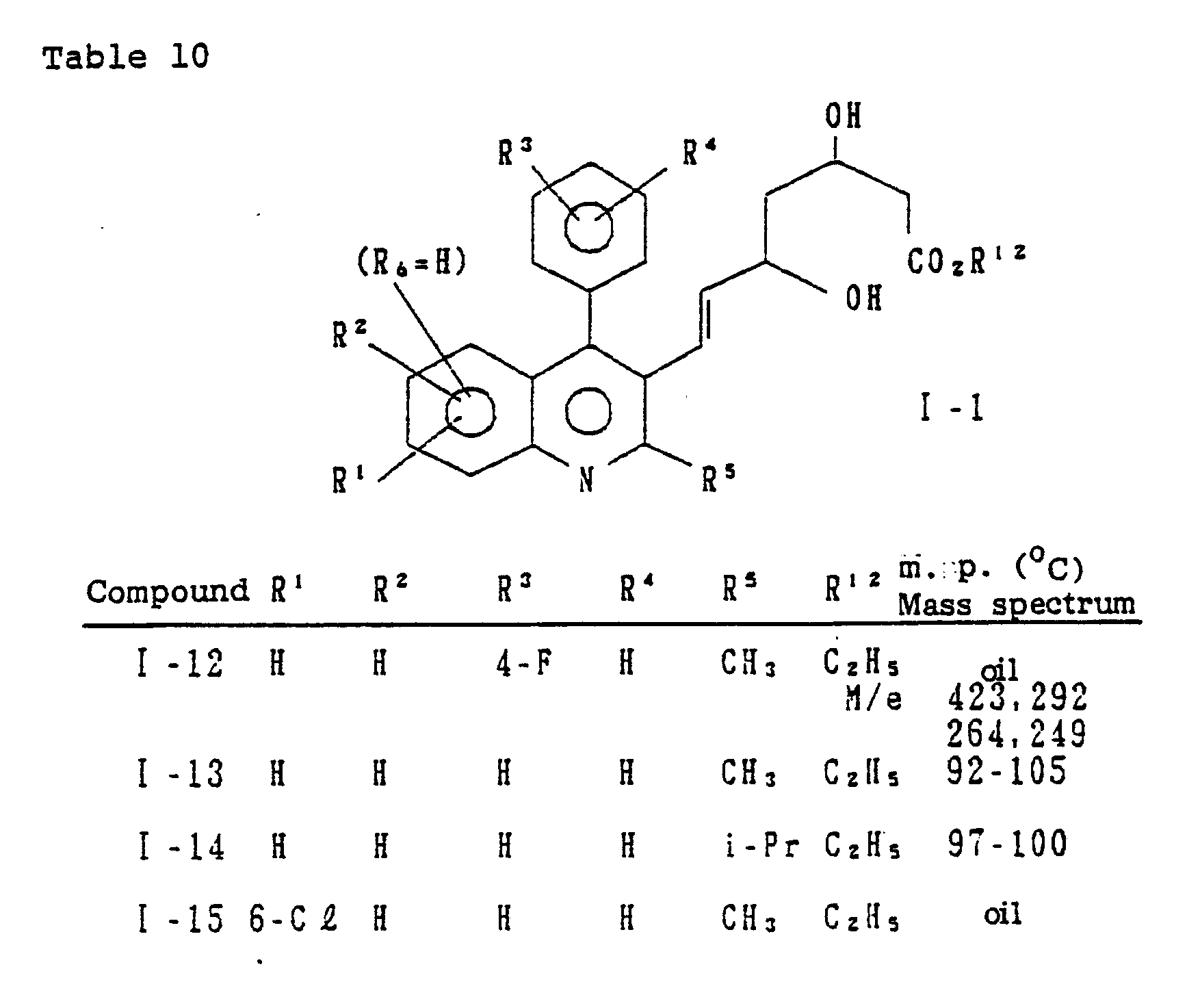

- H-NMR(in CDCℓ₃) δ ppm :
1.29(t,3H,J=7Hz), 1.40(d,6H,J=6Hz) 1.4-1.7(m,2H), 2.3-2.5(m,2H) 2.9-3.2(m,1H), 3.49(Heptaplet,1H,J=6Hz) 3.5-3.8(m,1H), 3.9-4.5(m,2H) 4.20(q,2H,J=7Hz), 5.2-5.7(m, 1H) 6.5-6.9(m,1H), 7.0-8.2(m,8H)
- H-NMR(in CDCℓ₃) δ ppm :
1.0-1.4(m,2H), 1.31(t,3H,J=7Hz) 1.39(d,6H,J=6Hz), 2.3-2.5(m,2H) 2.52(s,3H), 3.1-3.4(m,1H) 3.48(Heptaplet,1H,J=6Hz),3.5-3.8(m,1H) 3.8-4.1(m, 1H), 4.20(q,2H,J=7Hz) 4.2-4.5(m,1H), 5.2-5.6(m,1H) 6.4-6.8(m,1H), 7.0-8.0(m,8H)
- H-NMR(in CDCℓ₃) δ ppm :
1.29(t,3H,J=7Hz), 1.38(d,6H,J=6Hz) 1.4-1.8(m,2H), 2.3-2.5(m,2H) 3.2-3.4(m,1H), 3.49(Heptaplet,1H,J=6Hz) 3.6-3.8(m,1H), 3.9-4.2(m,1H) 4.20(q,2H,J=7Hz), 4.3-4.5(m,1H) 5.2-5.5(m,1H), 6.5-6.8(m,1H) 7.0-8.2(m,8H)
- H-NMR(in CDCℓ₃) δ ppm :
1.29(t,3H,J=7Hz), 1.40 (d,6H,J=6Hz) 1.5-1.6(m,2H), 2.3-2.5(m,2H) 2.8-3.0(m,1H), 3.4-3.6(m,1H) 3.52(Heptaplet,1H,J=6Hz),3.88(s,3H) 3.9-4.1(m,1H), 4.20(q,2H,J=7Hz) 4.3-4.5(m,1H), 5.3-5.5(m,1H) 6.5-6.7(m,1H), 6.9-8.1(m,8H)
- H-NMR(in CDCℓ₃) δ ppm :
1.30(t,3H,J=7Hz), 1.3-1.5(m,2H) 1.39(d,6H,J=6Hz), 2.3-2.5(m,2H) 2.43(s,3H), 2.8-3.0(m,1H) 3.50(Heptaplet,1H,J=6Hz),3.5-3.7(m,1H) 3.9-4.2(m,1H), 4.19(q,2H,J=7Hz) 4.2-4.5(m,1H), 5.2-5.6(m,1H) 6.4-6.8(m,1H), 6.9-8.2(m,8H)
- H-NMR(in CDCℓ₃) δ ppm :
1.30(t,3H,J=7Hz), 1.3-1.6(m,2H) 1.37(d,6H,J=6Hz), 2.3-2.5(m,2H) 2.9-3.2(m,1H), 3.47(Heptaplet,1H,J=6Hz) 3.5-3.8(m,1H), 3.9-4.1(m,1H) 4.19(q,2H,J=7Hz), 4.2-4.5(m, 1H) 5.3-5.7(m,1H), 6.5-6.8(m,1H) 7.1-8.1(m,7H)
- H-NMR(in CDCℓ₃) δ ppm :
1.0-1.3(m,2H), 1.30(t,3H,J=7Hz) 1.40(d,6H,J=6Hz), 2.3-2.4(m,2H) 3.3-3.5(m,1H), 3.49(Heptaplet,1H,J=6Hz) 3.6-3.7(m,1H), 3.9-4.1(m,1H) 4.18(q,2H,J=7Hz), 4.2-4.5(m,1H) 5.1-5.5(m, 1H), 6.5-6.8(m,1H) 7.2-8.2(m,8H)
- H-NMR(in CDCℓ₃) δ ppm :
1.2-1.4(m,2H), 1.30(t,3H,J=7Hz) 1.39(d,6H,J=6Hz), 2.32(bs,3H) 2.3-2.5(m,2H), 3.0-3.3(m,1H) 3.50(Heptaplet,1H,J=6Hz),3.6-3.8(m,1H) 3.8-4.1(m,1H), 4.20(q,2H,J=7Hz) 4.3-4.6(m,1H), 5.2-5.6(m,1H) 6.5-6.8(m,1H), 7.0-8.2(m,7H)
- H-NMR(in CDCℓ₃) δ ppm :
1.1-1.4(m,2H), 1.30(t,3H,J=7Hz) 1.40(d,6H,J=6Hz), 2.2-2.5(m,2H) 2.35(s,6H), 2.7-3.1(m,1H) 3.51(Heptaplet,1H,J=6Hz),3.6.3.7(m,1H) 3.8-4.1(m,1H), 4.20(q,2H,J=7Hz) 4.2-4.6(m,1H), 5.2-5.6(m,1H) 6.4-6.8(m,1H), 6.8-8.2(m,7H)
- H-NMR(in CDCℓ₃) δ ppm :
1.30(t,3H,J=7Hz), 1.37(d,6H,J=6Hz) 1.5-1.8(m,2H), 2.3-2.5(m,2H) 2.9-3.2(m,1H), 3.46(Heptaplet,1H,J=6Hz) 3.6-3.8(m,1H), 3.75(s,3H) 3.9-4.1(m,1H), 4.07(s,3H) 4.20(q,2H,J=7Hz), 4.2-4.5(m, 1H) 5.1-5.5(m,1H), 6.4-6.8(m,2H) 7.1-7.5(m,5H)
- H-NMR(in CDCℓ₃) δ ppm :
1.30(t,3H,J=7Hz), 1.37(t,3H,J=7Hz) 1.4-1.7(m,2H), 2.2-2.6(m,2H) 2.8-3.2(m,3H), 3.6-3.9(m,1H) 3.9-4.7(m,4H), 5.2-5.7(m,1H) 6.3-6.7(m,1H), 7.0-8.2(m,8H)
- H-NMR(in CDCℓ₃) δ ppm :
1.01(t,3H,J=7Hz), 1.27(t,3H,J=7Hz) 1.4-2.1(m,4H), 2.3-2.6(m,2H) 2.8-3.3(m,3H), 3.6-3.8(m,1H) 3.9-4.1(m,1H), 4.18(q,2H,J=7Hz) 4.2-4.5(m,1H), 5.2-5.6(m,1H) 6.4-6.7(m,1H), 7.0-8.1(m,8H)
- H-NMR(in CDCℓ₃) δ ppm :
1.2-1.5(m,2H), 1.31(t,3H,J=7Hz) 1.37 (d,6H,J=6Hz), 2.3-2.6(m,2H) 3.0-3.4(m,1H), 3.49(Heptaplet,1H,J=6Hz) 3.6-3.8(m,1H), 3.8-4.2(m,1H) 4.20(q,2H,J=7Hz), 4.3-4.5(m,1H) 5.2-5.6(m,1H), 6.4-6.8(m,1H) 7.0-8.1(m,7H)
- H-NMR(in CDCℓ₃) δ ppm :
0.8-1.8(m,6H), 1.30(t,3H,J=7Hz) 2.1-2.6(m,3H), 2.9-3.3(m,1H) 3.4-3.7(m,1H), 3.8-4.6(m,2H) 4.20(q,2H,J=7Hz), 5.4-5.8(m,1H) 6.4-6.8(m,1H), 6.8-8.0(m,8H)
- H-NMR(in CDCℓ₃) δ ppm :
1.29(t,3H,J=7Hz), 1.39(d,6H,J=6Hz) 1.4-1.9(m,2H), 2.3-2.5(m,2H) 2.7-3.2(m,1H), 3.51(Heptaplet,1H,J=6Hz) 3.6-3.8(m,1H), 3.9-4.2(m,1H) 4.19(q,2H,J=7Hz), 4.3-4.6(m,1H) 5.2-5.6(m,1H), 6.4-6.8(m,1H) 6.9-8.2(m,13H)
- H-NMR(in CDCℓ₃) δ ppm :
1.1-1.8(m,2H), 1.31(t,3H,J=7Hz) 1.41(d,6H,J=6Hz), 2.3-2.5(m,2H) 2.9-3.4(m,1H), 3.50(Heptaplet,1H,J=6Hz) 3.6-3.8(m,1H), 3.9-4.5(m,2H) 4.20(q,2H,J=7Hz), 5.2-5.6(m,1H) 6.4-6.8(m,1H), 7.1-7.3(m,5H) 7.72(d,1H,J=6Hz)
- H-NMR(in CDCℓ₃) δ ppm :
0.8-1.5(m,2H), 1.29(t,3H,J=7Hz) 2.2-2.4(m,2H), 2.6-2.9(m,1H) 3.2-3.6(m,1H), 3.7-4.3(m,2H) 4.17(q,2H,J=7Hz),5.0-5.4(m,1H) 6.1-6.5(m,1H), 7.0-8.2(m,13H)
- H-NMR(in CDCℓ₃) δ ppm :
0.8-1.8(m,6H), 1.29 (t,3H,J=7Hz), 2.2-2.6(m,3H), 2.8-3.2(m,1H), 3.3-3.7(m,1H), 3.9-4.5(m,2H), 4.19(q,2H,J=7Hz), 5.4-5.8(m,1H) 6.5-6.8(m,1H), 7.1-8.0(m,8H)
- H-NMR(in CDCℓ₃) δ ppm :
0.94(d,6H,J=6Hz), 1.0-1.7(m,3H), 1.27(t,3H,J=7Hz), 1.9-2.5(m,3H), 2.90(d,2H,J=7Hz), 3.3-4.4(m,3H), 4.12(q,2H,J=7Hz), 5.0-5.5(m,1H) 6.2-6.7(m,1H), 6.9-8.0(m,8H)
- H-NMR(in CDCℓ₃) δ ppm :
1.0-1.6(m,3H), 1.21(t,3H,J=7Hz), 1.34(d,6H,J=6Hz), 2.34(s,3H), 2.37(d,2H,J=7Hz), 2.9-3.7(m,2H), 3.8-4.5(m,2H), 4.15(q,2H,J=7Hz) 5.0-5.5(m,1H), 6.3-6.7(m,1H), 6.9-8.0(m,7H)
- H-NMR(in CDCℓ₃) δ ppm :
0.8-1.9(m,8H),1.29(t,3H,J=7Hz), 2.1-2.6(m,3H), 2.8-3.2(m,1H), 3.72(s,3H), 4.02(s,3H), 4.19(q,2H,J=7Hz), 4.3-4.6(m,1H), 5.4-5.8(m,1H), 6.4-6.8(m,1H), 6.56(s,1H), 7.0-7.4(m,5H)
- In the same manner as in Exmple 2, compounds I-52 to I-527 were prepared.


- H-NMR (in DMSO-d⁶) δ ppm :
0.9-1.2(m,2H), 1.37(d,6H,J=7Hz) 1.6-2.1(m,2H), 3.48(Heptaplet,1H,J=6Hz) 3.7-4.3(m,4H), 5.3-5.6(m,1H) 6.4-6.7(m,1H), 7.1-8.1(m,8H)
- H-NMR (in DMSO-d⁶) δ ppm :
0.9-1.2(m,2H), 1.31(d,6H,J=7Hz) 1.7-2.2(m,2H), 2.50(s,3H) 3.3-4.5(m,5H), 5.2-5.6(m,1H) 6.3-6.6(m,1H), 7.1-7.9(m,8H)
- H-NMR (in DMSO-d⁶) δ ppm :
0.9-1.3(m,2H), 1.33(d,6H,J=7Hz) 1.6-2.2(m,2H), 3.48(Heptaplet,1H,J=7Hz) 3.5-4.6(m,4H), 5.2-5.6(m,2H) 6.3-6.6(m,1H), 7.1-8.1(m,8H)
- H-NMR (in DMSO-d⁶) δ ppm :
1.0-1.3(m,2H), 1.32(d,6H,J=7Hz) 1.6-2.2(m,2H), 3.0-3.8(m,4H) 3.86(s,3H), 4.0-4.3(m,1H) 5.3-5.6(m,1H), 6.3-6.6(m,1H) 6.9-8.1(m,8H)
- H-NMR (in DMSO-d⁶) δ ppm :
0.9-1.3(m,2H), 1.33(d,6H,J=7Hz) 1.7-2.1(m,2H), 2.41(s,3H) 3.2-4.3(m,5H), 5.3-5.6(m,1H) 6.3-6.6(m,1H), 7.0-8.3(m,8H)
- H-NMR (in DMSO-d⁶) δ ppm :
0.9-1.3(m,2H), 1.33(d,6H,J=7Hz) 1.6-2.2(m,2H), 3.1-3.8(m,3H) 3.48(Heptaplet,1H,J=7Hz),3.9-4.2(m,1H) 5.3-5.7(m,1H), 6.3-6.7(m,1H) 7.0-8.1(m,7H)
- H-NMR (in DMSO-d⁶) δ ppm :
0.8-1.3(m,2H), 1.34(d,6H,J=7Hz) 1.6-2.2(m,2H), 2.7-3.9(m,3H) 3.49(Heptaplet,1H,J=7Hz),3.9-4.3(m,1H) 5.2-5.6(m,4H), 6.3-6.7(m,1H) 7.1-8.1(m,8H)
- H-NMR (in DMSO-d⁶) δ ppm :
0.9-1.3(m,2H), 1.35(d,6H,J=7Hz) 1.7-2.1(m,2H), 2.30(d,3H,J=2Hz) 3.0-3.8(m,3H), 3.51(Heptaplet,1H,J=7Hz) 3.9-4.3(m,1H), 5.3-5.6(m,1H) 6.3-6.6(m,1H), 6.9-8.1(m,7H)
- H-NMR (in DMSO-d⁶) δ ppm :
1.0-1.2(m,2H), 1.35(d,6H,J=7Hz) 1.6-2.2(m,2H), 2.35(s,6H) 3.0-3.8(m,3H), 3.51(Heptaplet,1H,J=7Hz) 4.0-4.3(m,1H), 5.3-5.6(m,1H) 6.3-6.6(m,1H), 6.8-8.0(m,7H)
- H-NMR (in DMSO-d⁶) δ ppm :
0.9-1.3(m,2H), 1.31(d,6H,J=7Hz) 1.7-2.0(m,2H), 3.2-3.7(m,4H) 3.62(s,3H), 3.9-4.2(m,1H) 3.94(s,3H), 5.1-5.5(m,1H) 6.2-6.6(m,1H), 7.0-7.5(m,6H)
- H-NMR (in DMSO-d⁶) δ ppm :
0.9-1.5(m,2H), 1.34(t,3H,J=7Hz) 1.6-2.2(m,2H), 2.7-3.4(m,4H) 3.6-4.3(m,2H), 5.2-5.7(m,1H) 6.1-6.6(m,1H), 6.9-8.1(m,8H)
- H-NMR (in DMSO-d⁶) δ ppm :
0.8-1.3(m,2H), 1.01(t,3H,J=7Hz) 1.6-2.1(m,4H), 2.7-3.8(m,5H) 3.9-4.3(m,1H), 5.2-5.7(m,1H) 6.3-6.6(m,1H), 7.1-8.1(m,8H)
- H-NMR (in DMSO-d⁶) δ ppm :
0.9-1.3(m,2H), 1.33(d,6H,J=7Hz) 1.6-2.2(m,2H), 2.9-3.9(m,3H) 3.49(Heptaplet,1H,J=7Hz),4.0-4.3(m,1H) 5.3-5.6(m,1H), 6.3-6.6(m,1H) 7.2-8.1(m,7H)
- H-NMR (in DMSO-d⁶) δ ppm :
0.8-1.5(m,6H), 1.7-2.2(m,2H) 2.3-2.7(m,1H), 3.0-3.9(m,3H) 4.0-4.3(m,1H), 5.5-5.8(m,1H) 6.4-6.7(m,1H), 7.2-8.0(m,8H)
- H-NMR (in DMSO-d⁶) δ ppm :
0.9-1.5(m,2H), 1.36(d,6H,J=7Hz) 1.7-2.3(m,2H), 3.0-3.9(m,3H) 3.50(Heptaplet,1H,J=6Hz),4.0-4.3(m,1H) 5.2-5.6(m,1H), 6.4-6.7(m,1H) 7.0-8.1(m,13H)
- H-NMR (in DMSO-d⁶) δ ppm :
0.8-1.3(m,2H), 1.37(d,6H,J=7Hz) 1.6-2.2(m,2H), 3.1-3.9(m,3H) 3.51(Heptaplet,1H,J=7Hz),4.0-4.3(m,1H) 5.3-5.7(m,1H), 6.3-6.7(m,1H) 7.1-8.0(m,6H)
- H-NMR (in DMSO-d⁶) δ ppm :
0.8-1.4(m,2H), 1.6-2.1(m,2H) 2.9-3.7(m,3H), 3.7-4.1(m,1H) 5.1-5.4(m,1H), 6.1-6.4(m,1H) 7.1-8.2(m,13H)
- H-NMR (in DMSO-d⁶) δ ppm :
0.8-1.5(m,5H), 1.6-2.2(m,2H) 2.3-2.7(m,2H), 3.0-3.8(m,3H) 3.9-4.3(m,1H), 5.4-5.8(m,1H) 6.3-6.6(m,1H), 7.0-8.0(m,8H)
- H-NMR (in DMSO-d⁶) δ ppm :
0.9-1.6(m,2H), 0.96(d,6H,J=6Hz) 1.7-2.6(m,3H), 2.89(d,2H,J=7Hz) 3.0-3.8(m,3H), 3.9-4.2(m,1H) 5.2-5.6(m,1H), 6.2-6.6(m,1H) 7.1-8.1(m,8H)
- H-NMR (in DMSO-d⁶) δ ppm :
1.30(d,6H,J=7Hz),1.7-2.0(m,2H), 2.34(s,3H), 2.4-2.6(m,1H), 3.0-3.3(m,2H), 3.3-3.8(m,3H) 3.9-4.2(m,1H), 5.2-5.6(m,1H) 6.3-6.6(m,1H), 7.0-8.0(m,7H)
- H-NMR (in DMSO-d⁶) δ ppm :
0.7-1.5(m,5H), 1.8-2.2(m,2H), 2.2-2.6(m,2H), 3.1-3.3(m,2H), 3.59(s,3H), 3.9-4.2(m,2H), 3.91(s,3H), 5.4-5.7(m,1H) 6.3-6.6(m,1H), 6.52(s,1H), 7.0-7.4(m,5H)
- In the same manner as in Example 3, compounds I-22 to I-26 can be prepared.

- In the same manner as in Example 4, compounds I-32 to I-36 can be prepared.

-
Compound I-51 1.0 g Lactose 5.0 g Crystal cellulose powder 8.0 g Corn starch 3.0 g Hydroxypropyl cellulose 1.0 g CMC-Ca 1.5 g Magnesium stearate 0.5 g Total 20.0 g - The above components were mixed by a usual method and then tabletted to produce 100 tablets each containing 10 mg of the active ingredient.
-
Compound I-51 1.0 g Lactose 3.5 g Crystal cellulose powder 10.0 g Magnesium stearate 0.5 Total 15.0 g - The above components were mixed by a usual method and then packed in No. 4 gelatin capsules to obtain 100 capsules each containing 10 mg of the active ingredient.
-
Compound I-51 1.00 g PEG (polyethylene glycol) 400 3.89 g Saturated fatty acid triglyceride 15.00 g Peppermint oil 0.01 g Polysorbate 80 0.10 g Total 20.00 g - The above components were mixed and packed in No. 3 soft gelatin capsules by a usual method to obtain 100 soft capsules each containing 10 mg of the active ingredient.
-
Compound I-51 1.0 g (10.0 g) Liquid paraffin 10.0 g (10.0 g) Cetanol 20.0 g (20.0 g) White vaseline 68.4 g (59.4 g) Ethylparaben 0.1 g ( 0.1 g) L-menthol 0.5 g ( 0.5 g) Total 100.0 g - The above components were mixed by a usual method to obtain a 1% (10%) ointment.
-
Compound I-51 1.0 g Witepsol H15* 46.9 g Witepsol W35* 52.0 g Polysorbate 80 0.1 g Total 100.0 g *: Trademark for triglyceride compound - The above components were melt-mixed by a usual method and poured into suppository containers, followed by cooling for solidification to obtain 100 suppositories of 1 g each containing 10 mg of the active component.
- Compound I-51 1 mg
Distilled water for injection formulation 5 ml
- The formulation is prepared by dissolving the compound in the distilled water whenever it is required.
-
Compound I-51 1.0 g Lactose 6.0 g Crystal cellulose powder 6.5 g Corn starch 5.0 g Hydroxypropyl cellulose 1.0 g Magnesium stearate 0.5 g Total 20.0 g - The above components were granulated by a usual method and packaged to obtain 100 packages each containing 200 mg of the granules so that each package contains 10 mg of the active ingredient.
Claims (10)


(E)-3,5-dihydroxy-7-[4′-(4′′-fluorophenyl)-2′-(1′′-methylethyl)-quinolin-3′-yl]-hept-6-enoic acid, a lactone formed by the condensation of the carboxylic acid with hydroxy at the 5-position, or a sodium salt or C₁₋₃ alkyl ester of the carboxylic acid;
(E)-3,5-dihydroxy-7-[4′-(4′′-fluorophenyl)-2′-(1′′-methylethyl)-6′-chloro-quinolin-3′-yl]-hept-6-enoic acid, a lactone formed by the condensation of the carboxylic acid with hydroxy at the 5-position, or a sodium salt or C₁₋₃ alkyl ester of the carboxylic acid;
(E)-3,5-dihydroxy-7-[4′-(4′′-fluorophenyl)-2′-(1′′-methylethyl)-6′-methyl-quinolin-3′-yl]-hept-6-enoic acid, a lactone formed by the condensation of the carboxylic acid with hydroxy at the 5-position, or a sodium salt or C₁₋₃ alkyl ester of the carboxylic acid;
(E)-3,5-dihydroxy-7-[4′-(4′′-fluorophenyl)-2′-(1′′-methylethyl)-6′,7′-dimethoxy-quinolin-3′-yl]-hept-6-enoic acid, a lactone formed by the condensation of the carboxylic acid with hydroxy at the 5-position, or a sodium salt or C₁₋₃ alkyl ester of the carboxylic acid;
(E)-3,5-dihydroxy-7-[4′-(4′′-fluorophenyl)-2′ cyclopropyl-quinolin-3′-yl]-hept-6-enoic acid, a lactone formed by the condensation of the carboxylic acid with hydroxy at the 5-position, or a sodium salt or C₁₋₃ alkyl ester of the carboxylic acid;
(E)-3,5-dihydroxy-7-[4′-(4′′-fluorophenyl)-2′-cyclopropyl-6′-chloro-quinolin-3′-yl]-hept-6-enoic acid, a lactone formed by the condensation of the carboxylic acid with hydroxy at the 5-position, or a sodium salt or C₁₋₃ alkyl ester of the carboxylic acid;
(E)-3,5-dihydroxy-7-[4′-(4′′ fluorophenyl)-2′-cyclopropyl-6′-methyl-quinolin-3′-yl]-hept-6-enoic acid, a lactone formed by the condensation of the carboxylic acid with hydroxy at the 5-position, or a sodium salt or C₁₋₃ alkyl ester of the carboxylic acid;
(E)-3,5-dihydroxy-7-[4′-(4′′-fluorophenyl)-2′-cyclopropyl-6′,7′-dimethoxy-quinolin-3′-yl]-hept-6-enoic acid, a lactone formed by the condensation of the carboxylic acid with hydroxy at the 5-position, or a sodium salt or C₁₋₃ alkyl ester of the carboxylic acid;
(E)-3,5-dihydroxy-7-[4′-(4′′-chlorophenyl)-2′-(1′′-methylethyl)-quinolin-3′-yl]-hept-6-enoic acid, a lactone formed by the condensation of the carboxylic acid with hydroxy at the 5-position, or a sodium salt or C₁₋₃ alkyl ester of the carboxylic acid;
(E)-3,5-dihydroxy-7-[4′-(4′′-chlorophenyl)-2′-(1′′-methylethyl)-6′-chloro-quinolin-3′-yl]-hept-6-enoic acid, a lactone formed by the condensation of the carboxylic acid with hydroxy at the 5-position, or a sodium salt or C₁₋₃ alkyl ester of the carboxylic acid;
(E)-3,5-dihydroxy-7-[4′-(4′′-chlorophenyl)-2′ (1′′-methylethyl)-6′-methyl-quinolin-3′-yl]-hept-6-enoic acid, a lactone formed by the condensation of the carboxylic acid with hydroxy at the 5-position, or a sodium salt or C₁₋₃ alkyl ester of the carboxylic acid;
(E)-3,5-dihydroxy-7-[4′-(4′′-chlorophenyl)-2′-(1′′-methylethyl)-6′,7′-dimethoxy-quinolin-3′-yl]-hept-6-enoic acid, a lactone formed by the condensation of the carboxylic acid with hydroxy at the 5-position, or a sodium salt or C₁₋₃ alkyl ester of the carboxylic acid;
(E)-3,5-dihydroxy-7-[4′-(4′′-chlorophenyl)-2′-cyclopropyl-quinolin-3′-yl]-hept-6-enoic acid, a lactone formed by the condensation of the carboxylic acid with hydroxy at the 5-position, or a sodium salt or C₁₋₃ alkyl ester of the carboxylic acid;
(E)-3,5-dihydroxy 7-[4′-(4′′-chlorophenyl)-2′-cyclopropyl-6′-chloro-quinolin-3′-yl]-hept-6-enoic acid, a lactone formed by the condensation of the carboxylic acid with hydroxy at the 5-position, or a sodium salt or C₁₋₃ alkyl ester of the carboxylic acid;
(E)-3,5-dihydroxy-7-[4′-(4′′-chlorophenyl)-2′-cyclopropyl-6′-methyl-quinolin-3′-yl]-hept-6-enoic acid, a lactone formed by the condensation of the carboxylic acid with hydroxy at the 5-position, or a sodium salt or C₁₋₃ alkyl ester of the carboxylic acid;
(E)-3,5-dihydroxy-7-[4′-(4′′-chlorophenyl)-2′-cyclopropyl-6′7′-dimethoxy-quinolin-3′-yl]-hept-6-enoic acid, a lactone formed by the condensation of the carboxylic acid with hydroxy at the 5-position, or a sodium salt or C₁₋₃ alkyl ester of the carboxylic acid;
(E)-3,5-dihydroxy-7-[4′-phenyl-2′-(1′′-methylethyl)-quinolin-3′-yl]-hept-6-enoic acid, a lactone formed by the condensation of the carboxylic acid with hydroxy at the 5-position, or a sodium salt or C₁₋₃ alkyl ester of the carboxylic acid;
(E)-3,5-dihydroxy-7-[4′-phenyl-2′ (1′′-methylethyl)-6′-chloro-quinolin-3′-yl]-hept-6-enoic acid, a lactone formed by the condensation of the carboxylic acid with hydroxy at the 5-position, or a sodium salt or C₁₋₃ alkyl ester of the carboxylic acid;
(E)-3,5-dihydroxy-7-[4′-phenyl-2′-(1′′-methylethyl)-6′-methyl-quinolin-3′-yl]-hept-6-enoic acid, a lactone formed by the condensation of the carboxylic acid with hydroxy at the 5-position, or a sodium salt or C₁₋₃ alkyl ester of the carboxylic acid;
(E)-3,5-dihydroxy-7-[4′-phenyl-2′-(1′′-methylethyl)-6′,7′-dimethoxy-quinolin-3′-yl]-hept-6-enoic acid, a lactone formed by the condensation of the carboxylic acid with hydroxy at the 5-position, or a sodium salt or C₁₋₃ alkyl ester of the carboxylic acid;
(E)-3,5-dihydroxy-7-[4′-phenyl-2′-cyclopropyl-quinolin-3′-yl]-hept-6-enoic acid, a lactone formed by the condensation of the carboxylic acid with hydroxy at the 5-position, or a sodium salt or C₁₋₃ alkyl ester of the carboxylic acid ;
(E)-3,5-dihydroxy-7-[4′-phenyl-2′-cyclopropyl-6′-chloro-quinolin-3′-yl]-hept-6-enoic acid, a lactone formed by the condensation of the carboxylic acid with hydroxy at the 5-position, or a sodium salt or C₁₋₃ alkyl ester of the carboxylic acid ;
(E)-3,5-dihydroxy-7-[4′-phenyl-2′-cyclopropyl-6′-methyl-quinolin-3′-yl]-hept-6-enoic acid, a lactone formed by the condensation of the carboxylic acid with hydroxy at the 5-position, or a sodium salt or C₁₋₃ alkyl ester of the carboxylic acid;
(E)-3,5-dihydroxy-7-[4′-phenyl-2′-cyclopropyl-6′,7′-dimethoxy-quinolin-3′-yl]-hept-6-enoic acid, a lactone formed by the condensation of the carboxylic acid with hydroxy at the 5-position, or a sodium salt or C₁₋₃ alkyl ester of the carboxylic acid;
(E)-3,5-dihydroxy-7-[4′-(4′′-fluorophenyl)-2′-(1′′-methylethyl)-6′-methoxy-quinolin-3′-yl]-hept-6-enoic acid, a lactone formed by the condensation of the carboxylic acid with hydroxy at the 5-position, or a sodium salt or C₁₋₃ alkyl ester of the carboxylic acid; or
(E)-3,5-dihydroxy-7-[4′-(4′′-fluorophenyl)-2′-cyclopropyl-6′-methoxy-quinolin-3′-yl]-hept-6-enoic acid, a lactone formed by the condensation of the carboxylic acid with hydroxy at the 5-position, or a sodium salt or C₁₋₃ alkyl ester of the carboxylic acid.
Applications Claiming Priority (6)
| Application Number | Priority Date | Filing Date | Title |
|---|---|---|---|
| JP20722487 | 1987-08-20 | ||
| JP207224/87 | 1987-08-20 | ||
| JP1558588 | 1988-01-26 | ||
| JP15585/88 | 1988-01-26 | ||
| JP193606/88 | 1988-08-03 | ||
| JP63193606A JP2569746B2 (en) | 1987-08-20 | 1988-08-03 | Quinoline mevalonolactones |
Publications (3)
| Publication Number | Publication Date |
|---|---|
| EP0304063A2 true EP0304063A2 (en) | 1989-02-22 |
| EP0304063A3 EP0304063A3 (en) | 1990-10-03 |
| EP0304063B1 EP0304063B1 (en) | 1994-11-30 |
Family
ID=27281072
Family Applications (1)
| Application Number | Title | Priority Date | Filing Date |
|---|---|---|---|
| EP88113448A Expired - Lifetime EP0304063B1 (en) | 1987-08-20 | 1988-08-18 | Quinoline type mevalonolactones |
Country Status (7)
| Country | Link |
|---|---|
| EP (1) | EP0304063B1 (en) |
| AT (1) | ATE114645T1 (en) |
| CA (1) | CA1336714C (en) |
| DE (1) | DE3852243T2 (en) |
| ES (1) | ES2067460T3 (en) |
| GR (1) | GR3015186T3 (en) |
| HU (1) | HU211700A9 (en) |
Cited By (55)
| Publication number | Priority date | Publication date | Assignee | Title |
|---|---|---|---|---|
| EP0356788A3 (en) * | 1988-08-29 | 1990-11-22 | E.R. SQUIBB & SONS, INC. | Quinoline and pyridine anchors for hmg-coa reductase inhibitors |
| EP0520406A1 (en) * | 1991-06-24 | 1992-12-30 | Nissan Chemical Industries Ltd. | Diastereomer salt of optically active quinolinemevalonic acid |
| EP0535548A1 (en) * | 1991-10-04 | 1993-04-07 | Nissan Chemical Industries Ltd. | Inhibitor of atherosclerotic intimal thickening |
| US5455252A (en) * | 1993-03-31 | 1995-10-03 | Syntex (U.S.A.) Inc. | Optionally substituted 6,8-quinolines |
| US5475003A (en) * | 1994-03-03 | 1995-12-12 | Syntex (U.S.A.) Inc. | 8-phenylcyclopentenoquinoline and 8-phenylcyclohexenoquinoline derivatives |
| EP0757039A1 (en) * | 1995-08-02 | 1997-02-05 | MERCK PATENT GmbH | Endothelin receptor antagonists |
| WO1997023200A1 (en) * | 1995-12-22 | 1997-07-03 | Kowa Company, Ltd. | Pharmaceutical composition stabilized with a basic agent |
| US5686433A (en) * | 1988-08-29 | 1997-11-11 | E.R. Squibb & Sons, Inc. | Quinoline and pyridine anchors for HMG-CoA reductase inhibitors |
| EP0818448A1 (en) * | 1996-07-08 | 1998-01-14 | Bayer Ag | Cycloalkano-pyridine as CETP inhibitors |
| US5753675A (en) * | 1989-03-03 | 1998-05-19 | Novartis Pharmaceuticals Corporation | Quinoline analogs of mevalonolactone and derivatives thereof |
| WO1998039299A1 (en) * | 1997-03-06 | 1998-09-11 | Bayer Aktiengesellschaft | 5-oxysubstituted chinolines and their use as cholesterol ester transfer proteins inhibitors |
| US5852039A (en) * | 1993-06-29 | 1998-12-22 | Takeda Chemical Industries, Ltd. | Pharmaceutical composition containing quinoline or quinazoline derivatives |
| WO1999014215A1 (en) * | 1997-09-18 | 1999-03-25 | Bayer Aktiengesellschaft | 4-heteroaryl-tetrahydroquinolines and their use as inhibitors of the cholesterin-ester transfer protein |
| US5948782A (en) * | 1992-04-24 | 1999-09-07 | Takeda Chemical | Pharmaceutical composition containing quinoline and quinazoline derivatives and novel compounds therefor |
| WO2000042016A1 (en) * | 1999-01-14 | 2000-07-20 | Nissan Chemical Industries, Ltd. | Process for producing quinolinecarbaldehyde |
| WO2002063028A1 (en) * | 2001-02-02 | 2002-08-15 | Mitsubishi Chemical Corporation | Process for producing (3r,5s)-(e)-7-[2-cyclopropyl-4-(4-fluorophenyl)-quinolin-3-yl]-3,5-dihydroxyhept-6-enic acid esters |
| WO2002064569A1 (en) * | 2001-02-14 | 2002-08-22 | Ube Industries, Ltd. | Process for producing quinoline carboxyaldehyde derivative and intermediate thereof |
| WO2002085363A1 (en) * | 2001-04-19 | 2002-10-31 | Kowa Co., Ltd. | Remedial agent for glomerular disease |
| WO2002098859A1 (en) | 2001-05-30 | 2002-12-12 | Daicel Chemical Industries, Ltd. | Process for preparation of a quinolinecarbaldehyde |
| WO2003078634A1 (en) * | 2002-03-19 | 2003-09-25 | Mitsubishi Chemical Corporation | Novel carbonyl reductase, gene encoding it and process for producing optically active alcohols using the same |
| WO2004041787A1 (en) * | 2002-11-06 | 2004-05-21 | Nissan Chemical Industries, Ltd. | Process for producing quinolinecarbaldehyde |
| US6855824B2 (en) | 2000-02-21 | 2005-02-15 | Kuraray Co., Ltd. | Processes for preparing quinoline derivatives and intermediates thereof |
| WO2005018626A1 (en) | 2003-08-22 | 2005-03-03 | Fournier Laboratories Ireland Limited | Pharmaceutical composition comprising a combination of metformin and a statin |
| RU2260001C2 (en) * | 2001-04-05 | 2005-09-10 | Ниссан Кемикал Индастриз, ЛТД | Method for preparing 7-quinolinyl-3,5-dihydroxyhept-6-enoate |
| US7208623B2 (en) | 2002-02-21 | 2007-04-24 | Novartis Ag | Process for the manufacture of HMG-CoA reductase inhibitory mevalonic acid derivatives |
| WO2007050425A2 (en) | 2005-10-21 | 2007-05-03 | Bristol-Myers Squibb Company | Lxr modulators |
| WO2008139703A1 (en) | 2007-04-27 | 2008-11-20 | Kyushu University, National University Corporation | Agent for treatment of pulmonary disease |
| US7576215B2 (en) | 2003-12-12 | 2009-08-18 | Wyeth | Quinolines and pharmaceutical compositions thereof |
| EP1719524A4 (en) * | 2004-02-25 | 2009-09-23 | Kowa Co | NUCLEAR TRANSFER PROMOTER FOR RAC PROTEIN AND SCREENING METHOD THEREFOR |
| EP1719525A4 (en) * | 2004-02-25 | 2009-09-23 | Kowa Co | NUCLEAR TRANSFER PROMOTER FOR CDC42 PROTEIN AND SCREENING METHOD THEREFOR |
| US7692018B2 (en) | 2003-10-03 | 2010-04-06 | Nissan Chemical Industries, Ltd. | Process for producing high purity 3,5-dihydroxy-6-heptenoic acid derivative |
| WO2011089623A2 (en) | 2010-01-20 | 2011-07-28 | Cadila Healthcare Limited | Process for preparing pitavastatin and pharmaceutically acceptable salts thereof |
| EP2359826A1 (en) | 2006-07-05 | 2011-08-24 | Nycomed GmbH | Combination of HMG-COA reductase inhibitors, such as roflumilast, roflumilast-N-oxide with a phosphodiesterase 4 inhibitor, rosuvastatin, for the treatment of inflammatory pulmonary diseases |
| WO2011130079A1 (en) | 2010-04-16 | 2011-10-20 | Cumberland Pharmaceuticals, Inc. | Stabilized statin formulations |
| US20110275643A1 (en) * | 2010-05-06 | 2011-11-10 | National Health Research Institutes | Aroylquinoline compounds |
| WO2011141934A1 (en) | 2010-05-13 | 2011-11-17 | Matrix Laboratories Ltd. | An improved process for the preparation of an intermediate of hmg-coa reductase inhibitors |
| WO2012025939A1 (en) | 2010-08-25 | 2012-03-01 | Cadila Healthcare Limited | Pitavastatin calcium and process for its preparation |
| WO2012046772A1 (en) | 2010-10-06 | 2012-04-12 | 国立大学法人東京大学 | Prophylactic and/or therapeutic agent against lymphedema |
| EP2500339A1 (en) | 2003-02-12 | 2012-09-19 | Nissan Chemical Industries, Ltd. | Crystalline forms of pitavastatin calcium |
| WO2013037838A1 (en) | 2011-09-12 | 2013-03-21 | Farma Grs, D.O.O. | Polymorphic form of pitavastatin calcium |
| WO2013080219A2 (en) | 2011-11-28 | 2013-06-06 | Mylan Laboratories Ltd | NOVEL PROCESS FOR THE PREPARATION OF INTERMEDIATES OF HMG-CoA REDUCTASE INHIBITORS |
| US8476432B2 (en) | 2010-07-01 | 2013-07-02 | Yuhan Corporation | Process for the preparation of HMG-COA reductase inhibitors and intermediates thereof |
| CN103204807A (en) * | 2013-04-08 | 2013-07-17 | 黄河三角洲京博化工研究院有限公司 | Synthetic method of 2-cyclopropyl-4-(4-fluoro-phenyl)-3-quinolinecarboxaldehyde |
| CN103483252A (en) * | 2013-09-04 | 2014-01-01 | 黄河三角洲京博化工研究院有限公司 | Synthetic method of 2-cyclopropyl-4-(4-fluorophenyl)-3-quinolylmethanol |
| CN103508948A (en) * | 2013-10-17 | 2014-01-15 | 凯莱英医药集团(天津)股份有限公司 | Method for preparing pitavastatin calcium |
| CN103694228A (en) * | 2013-12-18 | 2014-04-02 | 北京华禧联合科技发展有限公司 | New method of pitavastatin calcium key intermediate |
| WO2014203045A1 (en) | 2013-06-20 | 2014-12-24 | Lupin Limited | A novel, green and cost effective process for synthesis of tert-butyl (3r,5s)-6-oxo-3,5-dihydroxy-3,5-o-isopropylidene-hexanoate |
| WO2016005919A1 (en) | 2014-07-09 | 2016-01-14 | Lupin Limited | Polymorphic forms of pitavastatin sodium |
| EP4470609A2 (en) | 2019-01-18 | 2024-12-04 | Astrazeneca AB | Pcsk9 inhibitors and methods of use thereof |
| EP4566591A1 (en) | 2023-12-07 | 2025-06-11 | KRKA, d.d., Novo mesto | Solid pharmaceutical dosage form comprising ezetimibe and pitavastatin |
| WO2025168652A1 (en) | 2024-02-05 | 2025-08-14 | Astrazeneca Ab | Azd-0780 in combination with a statin for use in lowering ldl-c levels and treating cardiovacular diseases |
| WO2025196153A1 (en) | 2024-03-20 | 2025-09-25 | Astrazeneca Ab | Pcsk9 inhibitors and methods of use thereof |
| WO2025196154A1 (en) | 2024-03-20 | 2025-09-25 | Astrazeneca Ab | Pcsk9 inhibitors and methods of use thereof |
| WO2025196155A1 (en) | 2024-03-20 | 2025-09-25 | Astrazeneca Ab | Pcsk9 inhibitors and methods of use thereof |
| WO2025238159A1 (en) | 2024-05-16 | 2025-11-20 | Astrazeneca Ab | Combination therapy comprising azd0780 and ezetimibe |
Families Citing this family (10)
| Publication number | Priority date | Publication date | Assignee | Title |
|---|---|---|---|---|
| US7939105B2 (en) | 1998-11-20 | 2011-05-10 | Jagotec Ag | Process for preparing a rapidly dispersing solid drug dosage form |
| PL370658A1 (en) | 2002-01-31 | 2005-05-30 | Novartis Ag | Process for the manufacture of hmg-coa reductase inhibitors |
| GB0427491D0 (en) * | 2004-12-16 | 2005-01-19 | Avecia Ltd | Process and compounds |
| US7888376B2 (en) | 2005-11-23 | 2011-02-15 | Bristol-Myers Squibb Company | Heterocyclic CETP inhibitors |
| US8455640B2 (en) | 2006-05-03 | 2013-06-04 | Msn Laboratories Limited | Process for statins and its pharmaceutically acceptable salts thereof |
| US8404841B2 (en) | 2006-10-09 | 2013-03-26 | Msn Laboratories Limited | Process for the preparation of statins and their pharmaceutically acceptable salts thereof |
| EP2387561A4 (en) | 2009-01-19 | 2012-07-25 | Msn Lab Ltd | IMPROVED PROCESS FOR THE PREPARATION OF HIGH-PURITY (3R, 5S) -7-β-CYCLOPROPYL-4- (4-FLUOROPHENYL) QUINOLIN-3-YL-3,5-DIHYDROXY-6 (E) -HEPTENOIC ACID, INCLUDING ITS PHARMACEUTICALLY ACCEPTABLE SALTS |
| WO2011086584A2 (en) | 2010-01-18 | 2011-07-21 | Msn Laboratories Limited | Improved process for the preparation of amide intermediates and their use thereof |
| SG11201507496UA (en) | 2013-04-17 | 2015-11-27 | Pfizer | N-piperidin-3-ylbenzamide derivatives for treating cardiovascular diseases |
| WO2016055901A1 (en) | 2014-10-08 | 2016-04-14 | Pfizer Inc. | Substituted amide compounds |
Family Cites Families (4)
| Publication number | Priority date | Publication date | Assignee | Title |
|---|---|---|---|---|
| WO1984002131A1 (en) * | 1982-11-22 | 1984-06-07 | Sandoz Ag | Analogs of mevalolactone and derivatives thereof, processes for their production, pharmaceutical compositions containing them and their use as pharmaceuticals |
| FI860755A0 (en) * | 1984-06-22 | 1986-02-20 | Sandoz Ag | PYRAZOLANALOGER AV MEVOLONOLAKTON OCH DERAS DERIVAT, FOERFARANDEN FOER DERAS FRAMSTAELLNING SAMT DERAS ANDVAENDNING. |
| US4647576A (en) * | 1984-09-24 | 1987-03-03 | Warner-Lambert Company | Trans-6-[2-(substitutedpyrrol-1-yl)alkyl]-pyran-2-one inhibitors of cholesterol synthesis |
| US4761419A (en) * | 1987-12-07 | 1988-08-02 | Warner-Lambert Company | 6-(((substituted)quinolinyl)ethyl)-and ethenyl)tetrahydro-4-hydroxypyran-2-one inhibitors of cholesterol biosynthesis |
-
1988
- 1988-08-17 CA CA000574999A patent/CA1336714C/en not_active Expired - Lifetime
- 1988-08-18 EP EP88113448A patent/EP0304063B1/en not_active Expired - Lifetime
- 1988-08-18 ES ES88113448T patent/ES2067460T3/en not_active Expired - Lifetime
- 1988-08-18 DE DE3852243T patent/DE3852243T2/en not_active Expired - Lifetime
- 1988-08-18 AT AT88113448T patent/ATE114645T1/en not_active IP Right Cessation
-
1995
- 1995-02-27 GR GR950400396T patent/GR3015186T3/en unknown
- 1995-06-20 HU HU95P/P00280P patent/HU211700A9/en unknown
Cited By (92)
| Publication number | Priority date | Publication date | Assignee | Title |
|---|---|---|---|---|
| US5686433A (en) * | 1988-08-29 | 1997-11-11 | E.R. Squibb & Sons, Inc. | Quinoline and pyridine anchors for HMG-CoA reductase inhibitors |
| EP0356788A3 (en) * | 1988-08-29 | 1990-11-22 | E.R. SQUIBB & SONS, INC. | Quinoline and pyridine anchors for hmg-coa reductase inhibitors |
| US5691322A (en) * | 1988-08-29 | 1997-11-25 | E.R. Squibb & Sons, Inc. | Quinoline and pyridine anchors for HMG-CoA reductase inhibitors |
| US5753675A (en) * | 1989-03-03 | 1998-05-19 | Novartis Pharmaceuticals Corporation | Quinoline analogs of mevalonolactone and derivatives thereof |
| EP0742209A3 (en) * | 1991-06-24 | 1997-05-14 | Nissan Chemical Ind Ltd | A process for producing an optically active quinolinemevalonolactone and a process for producing an optically active quinolinemevalonic acid salt |
| EP0520406A1 (en) * | 1991-06-24 | 1992-12-30 | Nissan Chemical Industries Ltd. | Diastereomer salt of optically active quinolinemevalonic acid |
| US5284953A (en) * | 1991-06-24 | 1994-02-08 | Nissan Chemical Industries Ltd. | Diastereomer salt of optically active quinolinemevalonic acid |
| EP0535548A1 (en) * | 1991-10-04 | 1993-04-07 | Nissan Chemical Industries Ltd. | Inhibitor of atherosclerotic intimal thickening |
| KR100264543B1 (en) * | 1991-10-04 | 2001-10-24 | 도쿠시마 히데이치 | Atherosclerotic Endothelial Thickener |
| US6162798A (en) * | 1991-10-04 | 2000-12-19 | Nissan Chemical Industries Ltd. | Inhibitor of atherosclerotic intimal thickening |
| US5948782A (en) * | 1992-04-24 | 1999-09-07 | Takeda Chemical | Pharmaceutical composition containing quinoline and quinazoline derivatives and novel compounds therefor |
| US5455252A (en) * | 1993-03-31 | 1995-10-03 | Syntex (U.S.A.) Inc. | Optionally substituted 6,8-quinolines |
| US5852039A (en) * | 1993-06-29 | 1998-12-22 | Takeda Chemical Industries, Ltd. | Pharmaceutical composition containing quinoline or quinazoline derivatives |
| US5530005A (en) * | 1994-03-03 | 1996-06-25 | Syntex (U.S.A.) Inc. | Method of use of 8-phenylcyclopentenoquinoline and 8-phenylcyclohexenoquinoline derivatives |
| US5475003A (en) * | 1994-03-03 | 1995-12-12 | Syntex (U.S.A.) Inc. | 8-phenylcyclopentenoquinoline and 8-phenylcyclohexenoquinoline derivatives |
| EP0757039A1 (en) * | 1995-08-02 | 1997-02-05 | MERCK PATENT GmbH | Endothelin receptor antagonists |
| US5731321A (en) * | 1995-08-02 | 1998-03-24 | Merck Patent Gesellschaft Mit Beschrankter Haftung | Endothelin receptor antagonists |
| AU705959B2 (en) * | 1995-08-02 | 1999-06-03 | Merck Patent Gesellschaft Mit Beschrankter Haftung | Endothelin receptor antagonists |
| WO1997023200A1 (en) * | 1995-12-22 | 1997-07-03 | Kowa Company, Ltd. | Pharmaceutical composition stabilized with a basic agent |
| US6069148A (en) * | 1996-07-08 | 2000-05-30 | Bayer Aktiengesellschaft | Cycloalkano-pyridines |
| EP0818448A1 (en) * | 1996-07-08 | 1998-01-14 | Bayer Ag | Cycloalkano-pyridine as CETP inhibitors |
| WO1998039299A1 (en) * | 1997-03-06 | 1998-09-11 | Bayer Aktiengesellschaft | 5-oxysubstituted chinolines and their use as cholesterol ester transfer proteins inhibitors |
| WO1999014215A1 (en) * | 1997-09-18 | 1999-03-25 | Bayer Aktiengesellschaft | 4-heteroaryl-tetrahydroquinolines and their use as inhibitors of the cholesterin-ester transfer protein |
| US6387929B1 (en) | 1997-09-18 | 2002-05-14 | Bayer Aktiengesellschaft | 4-heteroaryl-tetrahydroquinolines and their use as inhibitors of the cholesterin-ester transfer protein |
| US7192971B2 (en) | 1997-09-18 | 2007-03-20 | Bayer Aktiengesellschaft | 4-Heteroaryl-tetrahydroquinolines and their use as inhibitors of the cholesterin-ester transfer protein |
| US6958346B2 (en) | 1997-09-18 | 2005-10-25 | Bayer Aktiengesellschaft | 4-heteroaryl-tetrahydroquinolines and their use as inhibitors of the cholesterin-ester transfer protein |
| WO2000042016A1 (en) * | 1999-01-14 | 2000-07-20 | Nissan Chemical Industries, Ltd. | Process for producing quinolinecarbaldehyde |
| US6437135B1 (en) | 1999-01-14 | 2002-08-20 | Nissan Chemical Industries, Ltd. | Process for producing quinolinecarbaldehyde |
| US6855824B2 (en) | 2000-02-21 | 2005-02-15 | Kuraray Co., Ltd. | Processes for preparing quinoline derivatives and intermediates thereof |
| WO2002063028A1 (en) * | 2001-02-02 | 2002-08-15 | Mitsubishi Chemical Corporation | Process for producing (3r,5s)-(e)-7-[2-cyclopropyl-4-(4-fluorophenyl)-quinolin-3-yl]-3,5-dihydroxyhept-6-enic acid esters |
| US6965031B2 (en) | 2001-02-02 | 2005-11-15 | Mitsubishi Chemical Corporation | Process for producing (3R,5S)-(E)-7-[2-cyclopropyl-4-(4-fluorophenyl)-quinolin- 3-yl]-3,5-dihydroxyhept-6-enic acid esters |
| CZ305024B6 (en) * | 2001-02-14 | 2015-04-01 | Nissan Chemical Industries | Process for preparing quinoline carboxaldehyde derivatives and intermediates thereof |
| US6841681B2 (en) | 2001-02-14 | 2005-01-11 | Nissan Chemical Industries, Ltd. | Process for producing quinoline carboxyaldehyde derivative and intermediate thereof |
| KR100714735B1 (en) | 2001-02-14 | 2007-05-07 | 닛산 가가쿠 고교 가부시키 가이샤 | Method for preparing quinolinecarboxyaldehyde derivatives and intermediates thereof |
| RU2264391C2 (en) * | 2001-02-14 | 2005-11-20 | Ниссан Кемикал Индастриз, Лтд. | Method for preparing quinoline carboxaldehyde derivative and intermediate compounds |
| AU2002232190B2 (en) * | 2001-02-14 | 2006-07-13 | Nissan Chemical Industries, Ltd. | Process for producing quinoline carboxyaldehyde derivative and intermediate thereof |
| WO2002064569A1 (en) * | 2001-02-14 | 2002-08-22 | Ube Industries, Ltd. | Process for producing quinoline carboxyaldehyde derivative and intermediate thereof |
| RU2260001C2 (en) * | 2001-04-05 | 2005-09-10 | Ниссан Кемикал Индастриз, ЛТД | Method for preparing 7-quinolinyl-3,5-dihydroxyhept-6-enoate |
| US7038056B2 (en) | 2001-04-05 | 2006-05-02 | Nissan Chemical Industries, Ltd. | Method for preparing a 7-quinolinyl-3,5-dihydroxyhept-6-enoate |
| US7504415B2 (en) | 2001-04-19 | 2009-03-17 | Kowa Co., Ltd. | Therapeutic agent for glomerular disease |
| WO2002085363A1 (en) * | 2001-04-19 | 2002-10-31 | Kowa Co., Ltd. | Remedial agent for glomerular disease |
| WO2002098859A1 (en) | 2001-05-30 | 2002-12-12 | Daicel Chemical Industries, Ltd. | Process for preparation of a quinolinecarbaldehyde |
| US7208623B2 (en) | 2002-02-21 | 2007-04-24 | Novartis Ag | Process for the manufacture of HMG-CoA reductase inhibitory mevalonic acid derivatives |
| US7335757B2 (en) | 2002-03-19 | 2008-02-26 | Mitsubishi Chemical Corporation | Carbonyl reductase, gene encoding the same, and process for producing optically active alcohols using the same |
| WO2003078634A1 (en) * | 2002-03-19 | 2003-09-25 | Mitsubishi Chemical Corporation | Novel carbonyl reductase, gene encoding it and process for producing optically active alcohols using the same |
| WO2004041787A1 (en) * | 2002-11-06 | 2004-05-21 | Nissan Chemical Industries, Ltd. | Process for producing quinolinecarbaldehyde |
| US8557993B2 (en) | 2003-02-12 | 2013-10-15 | Nissan Chemical Industries Ltd. | Crystalline forms of pitavastatin calcium |
| US8853405B2 (en) | 2003-02-12 | 2014-10-07 | Nissan Chemical Industries Ltd. | Crystalline forms of pitavastatin calcium |
| EP2500339A1 (en) | 2003-02-12 | 2012-09-19 | Nissan Chemical Industries, Ltd. | Crystalline forms of pitavastatin calcium |
| WO2005018626A1 (en) | 2003-08-22 | 2005-03-03 | Fournier Laboratories Ireland Limited | Pharmaceutical composition comprising a combination of metformin and a statin |
| US7692018B2 (en) | 2003-10-03 | 2010-04-06 | Nissan Chemical Industries, Ltd. | Process for producing high purity 3,5-dihydroxy-6-heptenoic acid derivative |
| EP2284157A1 (en) * | 2003-12-12 | 2011-02-16 | Wyeth | Quinolines useful in treating cardiovascular disease |
| US7576215B2 (en) | 2003-12-12 | 2009-08-18 | Wyeth | Quinolines and pharmaceutical compositions thereof |
| EP1719525A4 (en) * | 2004-02-25 | 2009-09-23 | Kowa Co | NUCLEAR TRANSFER PROMOTER FOR CDC42 PROTEIN AND SCREENING METHOD THEREFOR |
| EP1719524A4 (en) * | 2004-02-25 | 2009-09-23 | Kowa Co | NUCLEAR TRANSFER PROMOTER FOR RAC PROTEIN AND SCREENING METHOD THEREFOR |
| US8309574B2 (en) | 2004-02-25 | 2012-11-13 | Kowa Company, Ltd. | Nuclear transfer promoter for Rac protein and method of screening the same |
| US8252524B2 (en) | 2004-02-25 | 2012-08-28 | Kowa Company, Ltd. | Method of screening pharmaceutical compositions that promote nuclear transfer of Cdc42 protein |
| WO2007050425A2 (en) | 2005-10-21 | 2007-05-03 | Bristol-Myers Squibb Company | Lxr modulators |
| EP2359826A1 (en) | 2006-07-05 | 2011-08-24 | Nycomed GmbH | Combination of HMG-COA reductase inhibitors, such as roflumilast, roflumilast-N-oxide with a phosphodiesterase 4 inhibitor, rosuvastatin, for the treatment of inflammatory pulmonary diseases |
| EP2363130A1 (en) | 2006-07-05 | 2011-09-07 | Nycomed GmbH | Combination of HMG-CoA reductase inhibitors with phosphodiesterase 4 inhibitors for the treatment of inflammatory pulmonary diseases |
| WO2008139703A1 (en) | 2007-04-27 | 2008-11-20 | Kyushu University, National University Corporation | Agent for treatment of pulmonary disease |
| WO2011089623A2 (en) | 2010-01-20 | 2011-07-28 | Cadila Healthcare Limited | Process for preparing pitavastatin and pharmaceutically acceptable salts thereof |
| US9820966B2 (en) | 2010-04-16 | 2017-11-21 | Cumberland Pharmaceuticals | Stabilized statin formulations |
| EP3524053A1 (en) | 2010-04-16 | 2019-08-14 | Cumberland Pharmaceuticals, Inc. | Stabilized statin formulations |
| US8372877B2 (en) | 2010-04-16 | 2013-02-12 | Cumberland Pharmaceuticals | Stabilized statin formulations |
| US8933115B2 (en) | 2010-04-16 | 2015-01-13 | Cumberland Pharmaceuticals Inc. | Stabilized statin formulations |
| WO2011130079A1 (en) | 2010-04-16 | 2011-10-20 | Cumberland Pharmaceuticals, Inc. | Stabilized statin formulations |
| US20110275643A1 (en) * | 2010-05-06 | 2011-11-10 | National Health Research Institutes | Aroylquinoline compounds |
| WO2011141934A1 (en) | 2010-05-13 | 2011-11-17 | Matrix Laboratories Ltd. | An improved process for the preparation of an intermediate of hmg-coa reductase inhibitors |
| US8476432B2 (en) | 2010-07-01 | 2013-07-02 | Yuhan Corporation | Process for the preparation of HMG-COA reductase inhibitors and intermediates thereof |
| WO2012025939A1 (en) | 2010-08-25 | 2012-03-01 | Cadila Healthcare Limited | Pitavastatin calcium and process for its preparation |
| WO2012046772A1 (en) | 2010-10-06 | 2012-04-12 | 国立大学法人東京大学 | Prophylactic and/or therapeutic agent against lymphedema |
| WO2013037838A1 (en) | 2011-09-12 | 2013-03-21 | Farma Grs, D.O.O. | Polymorphic form of pitavastatin calcium |
| WO2013080219A2 (en) | 2011-11-28 | 2013-06-06 | Mylan Laboratories Ltd | NOVEL PROCESS FOR THE PREPARATION OF INTERMEDIATES OF HMG-CoA REDUCTASE INHIBITORS |
| CN103204807B (en) * | 2013-04-08 | 2015-12-23 | 黄河三角洲京博化工研究院有限公司 | The fluoro-phenyl of a kind of 2-cyclopropyl-4-(4-) synthetic method of-3-quinoline aldehyde |
| CN103204807A (en) * | 2013-04-08 | 2013-07-17 | 黄河三角洲京博化工研究院有限公司 | Synthetic method of 2-cyclopropyl-4-(4-fluoro-phenyl)-3-quinolinecarboxaldehyde |
| WO2014203045A1 (en) | 2013-06-20 | 2014-12-24 | Lupin Limited | A novel, green and cost effective process for synthesis of tert-butyl (3r,5s)-6-oxo-3,5-dihydroxy-3,5-o-isopropylidene-hexanoate |
| CN103483252A (en) * | 2013-09-04 | 2014-01-01 | 黄河三角洲京博化工研究院有限公司 | Synthetic method of 2-cyclopropyl-4-(4-fluorophenyl)-3-quinolylmethanol |
| CN103483252B (en) * | 2013-09-04 | 2015-07-22 | 黄河三角洲京博化工研究院有限公司 | Synthetic method of 2-cyclopropyl-4-(4-fluorophenyl)-3-quinolylmethanol |
| CN103508948A (en) * | 2013-10-17 | 2014-01-15 | 凯莱英医药集团(天津)股份有限公司 | Method for preparing pitavastatin calcium |
| CN103694228B (en) * | 2013-12-18 | 2018-08-28 | 北京华禧联合科技发展有限公司 | A method of preparing Pitavastatin Calcium key intermediate |
| CN103694228A (en) * | 2013-12-18 | 2014-04-02 | 北京华禧联合科技发展有限公司 | New method of pitavastatin calcium key intermediate |
| US9969691B2 (en) | 2014-07-09 | 2018-05-15 | Lupin Limited | Polymorphic forms of pitavastatin sodium |
| US10259790B2 (en) | 2014-07-09 | 2019-04-16 | Lupin Limited | Polymorphic forms of pitavastatin sodium |
| WO2016005919A1 (en) | 2014-07-09 | 2016-01-14 | Lupin Limited | Polymorphic forms of pitavastatin sodium |
| EP4470609A2 (en) | 2019-01-18 | 2024-12-04 | Astrazeneca AB | Pcsk9 inhibitors and methods of use thereof |
| EP4566591A1 (en) | 2023-12-07 | 2025-06-11 | KRKA, d.d., Novo mesto | Solid pharmaceutical dosage form comprising ezetimibe and pitavastatin |
| WO2025168652A1 (en) | 2024-02-05 | 2025-08-14 | Astrazeneca Ab | Azd-0780 in combination with a statin for use in lowering ldl-c levels and treating cardiovacular diseases |
| WO2025196153A1 (en) | 2024-03-20 | 2025-09-25 | Astrazeneca Ab | Pcsk9 inhibitors and methods of use thereof |
| WO2025196154A1 (en) | 2024-03-20 | 2025-09-25 | Astrazeneca Ab | Pcsk9 inhibitors and methods of use thereof |
| WO2025196155A1 (en) | 2024-03-20 | 2025-09-25 | Astrazeneca Ab | Pcsk9 inhibitors and methods of use thereof |
| WO2025238159A1 (en) | 2024-05-16 | 2025-11-20 | Astrazeneca Ab | Combination therapy comprising azd0780 and ezetimibe |
Also Published As
| Publication number | Publication date |
|---|---|
| ATE114645T1 (en) | 1994-12-15 |
| HU211700A9 (en) | 1995-12-28 |
| GR3015186T3 (en) | 1995-05-31 |
| DE3852243T2 (en) | 1995-06-14 |
| EP0304063B1 (en) | 1994-11-30 |
| EP0304063A3 (en) | 1990-10-03 |
| CA1336714C (en) | 1995-08-15 |
| DE3852243D1 (en) | 1995-01-12 |
| ES2067460T3 (en) | 1995-04-01 |
Similar Documents
| Publication | Publication Date | Title |
|---|---|---|
| EP0304063B1 (en) | Quinoline type mevalonolactones | |
| KR960000852B1 (en) | Quinoline type mevalonolactones | |
| US5854259A (en) | Quinoline type mevalonolactones | |
| EP0535548B1 (en) | Inhibitor of atherosclerotic intimal thickening | |
| US4761419A (en) | 6-(((substituted)quinolinyl)ethyl)-and ethenyl)tetrahydro-4-hydroxypyran-2-one inhibitors of cholesterol biosynthesis | |
| EP0187977B1 (en) | Tetrahydroquinoline derivatives, process for preparing the same and anti-peptic ulcer compositions containg the same | |
| US5026698A (en) | Thienopyridine type mevalonolactones | |
| US5055472A (en) | Pyrazolopyrimidine type mevalonolactones | |
| JPH066576B2 (en) | Aminoquinoline derivative and process for producing the same | |
| NZ268608A (en) | 4-substituted coumarin and 2-oxoquinoline derivatives | |
| JP2943725B2 (en) | Quinolinone derivatives and antiallergic agents containing the same as active ingredients | |
| EP0308736A2 (en) | Pyrimidine type mevalonolactones | |
| US7208518B2 (en) | Substituted furochromene compounds of antiinflammatory action | |
| US5185328A (en) | Quinoline type mevalonolactones useful for treating hyperlipidemia, hyperlipoproteinemia or atherosclerosis | |
| HU196075B (en) | Process for producing thieno-benzo-pyranes and thiopyranes and pharmaceutical preparations containing same | |
| JP2890448B2 (en) | Pyrazolopyridine mevalonolactones | |
| US5024999A (en) | Pyrazolopyridine type mevalonolactones useful as pharmaeuticals | |
| US4977161A (en) | Isoxazolopyridine type mevalonolactones | |
| EP0742211A1 (en) | Pyridazinone derivative | |
| JPH06116239A (en) | 7-substituted-3, 5-dihydroxyhept-6-ynoic acid compounds | |
| JP2683205B2 (en) | Pyrazole fused ring derivative and androgen action expression inhibitor | |
| JP2936595B2 (en) | Thienopyridine mevalonolactones | |
| JPH01203383A (en) | Antibacterial compound | |
| JPH0633255B2 (en) | Tetrahydroquinoline derivative | |
| JPWO2000042025A1 (en) | Poly(ADP-ribose) synthetase inhibitors consisting of pyrimidine derivatives |
Legal Events
| Date | Code | Title | Description |
|---|---|---|---|
| PUAI | Public reference made under article 153(3) epc to a published international application that has entered the european phase |
Free format text: ORIGINAL CODE: 0009012 |
|
| AK | Designated contracting states |
Kind code of ref document: A2 Designated state(s): AT BE CH DE ES FR GB GR IT LI LU NL SE |
|
| PUAL | Search report despatched |
Free format text: ORIGINAL CODE: 0009013 |
|
| AK | Designated contracting states |
Kind code of ref document: A3 Designated state(s): AT BE CH DE ES FR GB GR IT LI LU NL SE |
|
| 17P | Request for examination filed |
Effective date: 19901129 |
|
| 17Q | First examination report despatched |
Effective date: 19920508 |
|
| GRAA | (expected) grant |
Free format text: ORIGINAL CODE: 0009210 |
|
| AK | Designated contracting states |
Kind code of ref document: B1 Designated state(s): AT BE CH DE ES FR GB GR IT LI LU NL SE |
|
| REF | Corresponds to: |
Ref document number: 114645 Country of ref document: AT Date of ref document: 19941215 Kind code of ref document: T |
|
| ITF | It: translation for a ep patent filed | ||
| REF | Corresponds to: |
Ref document number: 3852243 Country of ref document: DE Date of ref document: 19950112 |
|
| ET | Fr: translation filed | ||
| REG | Reference to a national code |
Ref country code: ES Ref legal event code: FG2A Ref document number: 2067460 Country of ref document: ES Kind code of ref document: T3 |
|
| REG | Reference to a national code |
Ref country code: GR Ref legal event code: FG4A Free format text: 3015186 |
|
| PLBE | No opposition filed within time limit |
Free format text: ORIGINAL CODE: 0009261 |
|
| STAA | Information on the status of an ep patent application or granted ep patent |
Free format text: STATUS: NO OPPOSITION FILED WITHIN TIME LIMIT |
|
| 26N | No opposition filed | ||
| REG | Reference to a national code |
Ref country code: GB Ref legal event code: IF02 |
|
| PGFP | Annual fee paid to national office [announced via postgrant information from national office to epo] |
Ref country code: LU Payment date: 20070816 Year of fee payment: 20 Ref country code: DE Payment date: 20070816 Year of fee payment: 20 |
|
| PGFP | Annual fee paid to national office [announced via postgrant information from national office to epo] |
Ref country code: ES Payment date: 20070914 Year of fee payment: 20 |
|
| PGFP | Annual fee paid to national office [announced via postgrant information from national office to epo] |
Ref country code: CH Payment date: 20070815 Year of fee payment: 20 Ref country code: AT Payment date: 20070813 Year of fee payment: 20 |
|
| PGFP | Annual fee paid to national office [announced via postgrant information from national office to epo] |
Ref country code: GB Payment date: 20070815 Year of fee payment: 20 |
|
| PGFP | Annual fee paid to national office [announced via postgrant information from national office to epo] |
Ref country code: SE Payment date: 20070807 Year of fee payment: 20 Ref country code: IT Payment date: 20070828 Year of fee payment: 20 Ref country code: NL Payment date: 20070815 Year of fee payment: 20 |
|
| PGFP | Annual fee paid to national office [announced via postgrant information from national office to epo] |
Ref country code: BE Payment date: 20071012 Year of fee payment: 20 |
|
| PGFP | Annual fee paid to national office [announced via postgrant information from national office to epo] |
Ref country code: FR Payment date: 20070808 Year of fee payment: 20 |
|
| PGFP | Annual fee paid to national office [announced via postgrant information from national office to epo] |
Ref country code: GR Payment date: 20070718 Year of fee payment: 20 |
|
| REG | Reference to a national code |
Ref country code: CH Ref legal event code: PFA Owner name: NISSAN CHEMICAL INDUSTRIES, LTD Free format text: NISSAN CHEMICAL INDUSTRIES, LTD#3-7-1, KANDA NISHIKI-CHO#CHIYODA-KU/TOKYO (JP) -TRANSFER TO- NISSAN CHEMICAL INDUSTRIES, LTD#3-7-1, KANDA NISHIKI-CHO#CHIYODA-KU/TOKYO (JP) |
|
| BE20 | Be: patent expired |
Owner name: *NISSAN CHEMICAL INDUSTRIES LTD Effective date: 20080818 |
|
| REG | Reference to a national code |
Ref country code: CH Ref legal event code: PL |
|
| REG | Reference to a national code |
Ref country code: GB Ref legal event code: PE20 Expiry date: 20080817 |
|
| EUG | Se: european patent has lapsed | ||
| PG25 | Lapsed in a contracting state [announced via postgrant information from national office to epo] |
Ref country code: NL Free format text: LAPSE BECAUSE OF EXPIRATION OF PROTECTION Effective date: 20080818 |
|
| NLV7 | Nl: ceased due to reaching the maximum lifetime of a patent |
Effective date: 20080818 |
|
| REG | Reference to a national code |
Ref country code: ES Ref legal event code: FD2A Effective date: 20080819 |
|
| PG25 | Lapsed in a contracting state [announced via postgrant information from national office to epo] |
Ref country code: GB Free format text: LAPSE BECAUSE OF EXPIRATION OF PROTECTION Effective date: 20080817 |
|
| PG25 | Lapsed in a contracting state [announced via postgrant information from national office to epo] |
Ref country code: ES Free format text: LAPSE BECAUSE OF EXPIRATION OF PROTECTION Effective date: 20080819 |