EP0302324B1 - Production of high molecular weight polyhalobisphenol polycarbonates - Google Patents
Production of high molecular weight polyhalobisphenol polycarbonates Download PDFInfo
- Publication number
- EP0302324B1 EP0302324B1 EP88111837A EP88111837A EP0302324B1 EP 0302324 B1 EP0302324 B1 EP 0302324B1 EP 88111837 A EP88111837 A EP 88111837A EP 88111837 A EP88111837 A EP 88111837A EP 0302324 B1 EP0302324 B1 EP 0302324B1
- Authority
- EP
- European Patent Office
- Prior art keywords
- molecular weight
- polyhalobisphenol
- high molecular
- polycarbonates
- polycarbonate
- Prior art date
- Legal status (The legal status is an assumption and is not a legal conclusion. Google has not performed a legal analysis and makes no representation as to the accuracy of the status listed.)
- Expired - Lifetime
Links
- 0 C(CC1)C*1C1CC=*CC1 Chemical compound C(CC1)C*1C1CC=*CC1 0.000 description 6
- AEPIEWRCRMGZHN-UHFFFAOYSA-N CN(c1ccncc1)I Chemical compound CN(c1ccncc1)I AEPIEWRCRMGZHN-UHFFFAOYSA-N 0.000 description 1
Classifications
-
- C—CHEMISTRY; METALLURGY
- C08—ORGANIC MACROMOLECULAR COMPOUNDS; THEIR PREPARATION OR CHEMICAL WORKING-UP; COMPOSITIONS BASED THEREON
- C08G—MACROMOLECULAR COMPOUNDS OBTAINED OTHERWISE THAN BY REACTIONS ONLY INVOLVING UNSATURATED CARBON-TO-CARBON BONDS
- C08G64/00—Macromolecular compounds obtained by reactions forming a carbonic ester link in the main chain of the macromolecule
-
- C—CHEMISTRY; METALLURGY
- C08—ORGANIC MACROMOLECULAR COMPOUNDS; THEIR PREPARATION OR CHEMICAL WORKING-UP; COMPOSITIONS BASED THEREON
- C08G—MACROMOLECULAR COMPOUNDS OBTAINED OTHERWISE THAN BY REACTIONS ONLY INVOLVING UNSATURATED CARBON-TO-CARBON BONDS
- C08G64/00—Macromolecular compounds obtained by reactions forming a carbonic ester link in the main chain of the macromolecule
- C08G64/04—Aromatic polycarbonates
- C08G64/06—Aromatic polycarbonates not containing aliphatic unsaturation
- C08G64/08—Aromatic polycarbonates not containing aliphatic unsaturation containing atoms other than carbon, hydrogen or oxygen
- C08G64/10—Aromatic polycarbonates not containing aliphatic unsaturation containing atoms other than carbon, hydrogen or oxygen containing halogens
-
- C—CHEMISTRY; METALLURGY
- C08—ORGANIC MACROMOLECULAR COMPOUNDS; THEIR PREPARATION OR CHEMICAL WORKING-UP; COMPOSITIONS BASED THEREON
- C08G—MACROMOLECULAR COMPOUNDS OBTAINED OTHERWISE THAN BY REACTIONS ONLY INVOLVING UNSATURATED CARBON-TO-CARBON BONDS
- C08G64/00—Macromolecular compounds obtained by reactions forming a carbonic ester link in the main chain of the macromolecule
- C08G64/16—Aliphatic-aromatic or araliphatic polycarbonates
Definitions
- This invention relates to an interfacial process for the production of high molecular weight polyhalobisphenol polycarbonates using activated pyridine catalysts.
- TBBA-PC tetrabromobisphenol-A polycarbonates
- the polymer obtained is brittle (see Controls 1-5).
- U.S. 3,912,687 describes the details of the preparation of TBBA-PC. The highest molecular weight reported is 50,000. The polymer has a relative viscosity of 1.18 or an inherent viscosity of 0.33.
- the polycarbonates must have a molecular weight higher than a critical molecular weight. It is found that the critical weight average molecular weight of TBBA-PC is 60,000 which corresponds to the inherent viscosity of 0.4 or the degree of polymerization of 35. For example, for applications such as solvent cast film or solution spinning fiber, the polycarbonate must have an inherent viscosity of above 0.4 so that tough film or fiber can be prepared.
- EP-A-242 147 which has an earlier priority date but is published after the priority date of the subject application, discloses high molecular weight carbonate homopolymers of 3, 3', 5, 5'- tetrabromo-or 3, 3', 5, 5' -tetrachlorobisphenol, having an inherent viscosity > 0.4.
- the present invention is directed to a process wherein high molecular weight polyhalobisphenol polycarbonates are prepared using activated pyridine catalysts.
- the resultant resins having an inherent viscosity greater than 0.4 and preferably in the range of from 0.4 to 0.9 are useful fire retardant polycarbonates.
- the resins prepared from tetrabromobisphenol A are also useful to prepare hollow fibers for gas separations.
- the process of this invention comprises the following steps:
- polyhalobisphenols are well known from U.S. 3,912,687. They include aromatic dihydroxy compounds of the general formula in which R is chlorine, bromine, or mixtures thereof, and X is C1-C6 alkylene, cycloalkylene, a single bond, -O-, -S-, -SO-, -SO2-, -CO- or They also include 2,2-bis(4-hydroxy-3-bromophenyl)propane, 2,2-bis(4-hydroxy-3-chlorophenyl)propane, 2,2-bis(4-hydroxy-2,3,5,6-tetrabromophenyl)propane and 2,2-bis(4-hydroxy-2,3,5,6-tetrachlorophenyl)propane.
- the catalysts used in this invention are activated pyridines or their salts having electron donor substitutents such as alkyl or dialkylamino groups.
- the preferred activated pyridines are 4-aminopyridines of general formula (II): in which R1 and R2 are alkyl groups, a polymer chain, or can be bridged to form cycloalkylene groups.
- the dialkylamino group or related group activates the pyridine by donating electron to N in the ring by resonance effect as shown by Angew. Chem. Int. Ed. Engl., 17, 569 (1978), G. Höfle, W. Steglich and H. Vorbrüggen: Examples of 4-dialkylaminopyridines are: 4-dimethylaminopyridine, 4-pyrrolidinopyridine poly(N,N-dialkylaminopyridine) as shown by L. J. Mathias, R.V. Vaidyn and R. M. Bloodworth, Polymer Preprints, 26(2), 182 (1985).
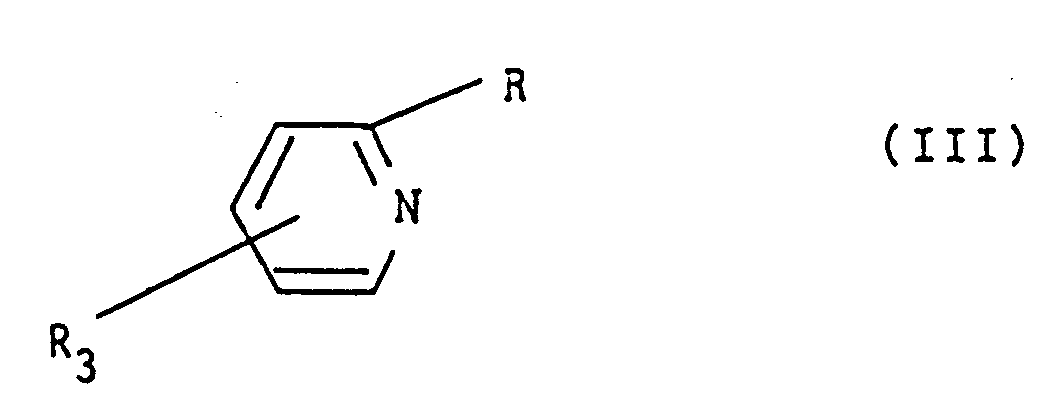
- the preferred activated pyridines are 2-substituted pyridines of general formula (III) wherein R is alkyl, cycloalkyl, or a polymer chain.
- R is alkyl, cycloalkyl, or a polymer chain.
- the group in the 2 position activates the pyridine by donating electron to N in the ring by inductive effects.
- 2-substituted pyridines are: methyl, ethyl, isopropyl or polyvinyl pyridine having the formula
- the activated pyridines of formulas (II) and (III) with additional alkyl groups can also be used: where R3 are alkyl groups.
- the amount of catalyst used varies according to the specific bisphenol used and the reaction temperature. In general, an effective or a catalytic amount of the catalyst is in the range of from 0.02 to 10 mole percent based on the moles of the bisphenol used. A preferred range is from 0.05 to 5 mole percent.
- the temperature of the reaction is generally kept in the range of from 20°C to 50°. However, temperatures over or under this can be used if desired.
- halogenated solvents examples include chlorobenzene, chloroform, carbon tetrachloride, 1,2-dichloroethane, methylene chloride, 1,1,2-trichloroethane, tetrachloroethane, and mixtures thereof.
- the pH of the reaction mixture is maintained in the range of from 8 to 13 depending on the bisphenol used and preferably in the range of from 9 to 11.
- the present invention is also directed to the high molecular weight polyhalobisphenol polycarbonate produced in accordance with the practice of this invention. It includes carbonate homopolymer of polyhalobisphenol or carbonate copolymers of two or more different polyhalobisphenols with bisphenol A. Additionally, the production of high molecular weight randomly branched polyhalobisphenol polycarbonate and copolyester-polycarbonate are included within the scope of this invention.
- the weight average molecular weight (Mw) and number average molecular weight (Mn) of the polycarbonate from hindered bisphenols were measured by size exclusion chromatography using polycarbonate from bisphenol A as a standard.
- the inherent viscosity of the polycarbonate was measured in methylene chloride at 25°C with concentration at 5 gms/l.
- the degree of polymerization was calculated by dividing Mn by the weight of a repeating unit (569.8 for TBBA-PC).
- the inherent viscosity ( ⁇ ) is calculated from the relative viscosity using the following equation: The following examples and controls are presented to further illustrate the invention.
- This control illustrates an unsuccessful attempt to prepare high molecular weight TBBA-PC using benzyltrimethyl ammonium chloride as a catalyst.
- Benzyltrimethyl ammonium chloride is described as an effective catalyst for producing high molecular weight bisphenol A polycarbonate in U.S. Patent 2,970,131.
- the reactor was charged with tetrabromobisphenol-A (TBBA) (205 g, 0.377 mole), methylene chloride (200 ml) and water (100 ml). Nitrogen was purged through the reaction mixture for 10 minutes. Benzyltrimethyl ammonium chloride (2.3 g, 0.0123 mole) was added to the reaction mixture.
- the caustic feed reservoir was charged with 120 g of 50 percent NaOH.
- Phosgene 50 g, 0.51 mole was introduced into the reaction mixture in 30 minutes maintaining the reaction mixture at pH 10 by pumping caustic from the reservoir. After adding the phosgene, the pH of the mixture was raised to 12.5 and stirring was continued for 30 minutes.
- This control illustrates another unsuccessful attempt to prepare high molecular weight TBBA-PC with triethylamine as a catalyst using a conventional process of making high molecular weight polymer from bisphenol A (U.S. Patent 3,275,601).
- the reactor was charged with TBBA (205 g, 0.377 mole), methylene chloride (2000 ml) and water (1000 ml). Nitrogen was purged through the reaction mixture for 10 minutes.
- the caustic reservoir was charged with 120 g of 50 percent NaOH.
- Phosgene 50 g, 0.510 mole was introduced into the reaction mixture in 30 minutes and keeping the reaction solution at pH 10 by pumping the caustic from the reservoir. After adding the phosgene, the pH of the mixture was raised to 12.5 and 2 ml of TEA was added. The reaction was stirred for 1 hour. Phosgene was added to bring the reaction mixture to pH 7.
- the organic layer was washed three times with water. Molecular weight analysis of the organic layer indicated that only low molecular weight of TBBA-PC was obtained (Mw ⁇ 10,000).
- This control illustrates an attempt to prepare high molecular weight TBBA-PC using dimethylaminopyridine (DMAP) as a catalyst under the similar conditions that U.S. Patent 4,286,085 claims to produce high molecular weight PC from bisphenol A.
- DMAP dimethylaminopyridine
- This example illustrates an unsuccessful attempt to prepare high molecular weight TBBA-PC using TEA as a catalyst similar to the process described in U.S. Patent 3,912,687.
- the reactor was charged with TBBA (409.5 g, 0.753 mole), methylene chloride (2000 ml), water (1000 ml) and TEA (2.7 g, 0.027 mole).
- Phosgene (93 g, 0.949 mole) was introduced into the reaction mixture in 30 minutes, keeping the pH of the solution at 9-10 by adding 50 percent caustic (180 g, 2.25 mole).
- a second portion of methylene chloride (1000 ml) was added and the pH was raised to 12. The mixture was stirred for two hours. More phosgene was added to adjust the mixture to pH 7.
- the organic phase was washed three times with water.
- TBBA-PC having a weight average molecular weight of 37,000 was obtained.
- the polymer had a relative viscosity of 1.13.
- the molecular weight of the polymer obtained was not very reproducible and varied from 30,000 to 50,000.
- the relative viscosity of 1.18 corresponds to the inherent viscosity of 0.33.
- the reaction mixture was diluted with methylene chloride (2000 ml). Dimethylaminopyridine (0.2 g in 10 ml CH2Cl2) was added to the reaction mixture. The reaction mixture was stirred for 30 minutes while caustic (118 g, 1.475 moles) was added to keep the pH at 10. The caustic addition was stopped and phosgene (10 g, 0.1 mole) was added to bring the pH to 7. The organic layer was washed three times with water. A film obtained from the washed polymer solution had a weight average molecular weight of 140,000. The polycarbonate obtained had an inherent viscosity of 0.60.
- Example 2 The procedure of Example 1 was repeated without using phenol as a terminator. The result was a TBBA polycarbonate with a weight average molecular weight of 240,000 and an inherent viscosity of 0.85.
- the reaction mixture was diluted with methylene chloride (300 ml). Dimethylaminopyridine (0.21 g, 0.00172 mole) was added to the reaction mixture. The reaction mixture was stirred for 30 minutes while adding caustic to keep the pH at 10. The caustic addition was stopped and phosgene (5 g, 0.05 mole) was added to bring the pH to 7. Total 50 weight percent caustic used was 270-300 g (or 3.4 to 3.75 moles). The organic layer was washed three times with water. A film obtained from the washed polymer solution had a weight average molecular weight of 250,000 or an inherent viscosity of 0.90.
- Example 2 The procedure of Example 2 was repeated using 2.8 grams of 2-picoline and 2-propyl pyridine, respectively to obtain high molecular weight polycarbonates. The results are set forth in the table.
- Example 2 The procedure of Example 2 was repeated using 2.8 grams of 4-picoline. The results are set forth in the table.
- Example 1 The procedure of Example 1 was repeated using 0.32 and 0.91 grams of phenol, respectively. The results are set forth in the table.
Landscapes
- Chemical & Material Sciences (AREA)
- Health & Medical Sciences (AREA)
- Chemical Kinetics & Catalysis (AREA)
- Medicinal Chemistry (AREA)
- Polymers & Plastics (AREA)
- Organic Chemistry (AREA)
- Polyesters Or Polycarbonates (AREA)
- Organic Low-Molecular-Weight Compounds And Preparation Thereof (AREA)
Abstract
Description
- This invention relates to an interfacial process for the production of high molecular weight polyhalobisphenol polycarbonates using activated pyridine catalysts.
- It is known from U.S. 3,912,687 that tetrahalobisphenols have a reduced reactivity due to steric hindrance and low pK values and that the preparation of polycarbonate resins from these phenols using the interfacial technique can be accomplished with relatively large amounts of trialkylamine catalysts and a two-stage reactor. However, it has been found that this process gives low molecular weight resins.
- It is also known from U.S. Patent 4,286,085 and U.S. Patent 3,530,094 that substituted pyridine catalysts can be used to make high molecular weight polycarbonates from bisphenol A. However, U.S. Patent 4,286,085 teaches the addition of the catalyst before the phosgenation step and this does not give high molecular weight polycarbonates when tetrahalobisphenols are used.
- Other patents such as 2,970,131; 4,262,113; 4,286,085; and 4,291,151 generally teach the preparation of high molecular weight polycarbonates from tetrahalobisphenols but they do not have examples of the use of these hindered phenols for support. These known procedures adaptable to the preparation of high molecular weight bisphenol-A polycarbonate (U.S. 4,286,085, U.S. 2,970,131, U.S. 4,262,113, U.S. 4,286,086, U.S. 4,291,151) are not satisfactory for preparing high molecular weight polycarbonate (PC) from the hindered halobisphenols. The tetrabromobisphenol-A polycarbonates (TBBA-PC) prepared using these known procedures have inherent viscosity less than 0.3 (42,000 weight average molecular weight). The polymer obtained is brittle (see Controls 1-5). U.S. 3,912,687 describes the details of the preparation of TBBA-PC. The highest molecular weight reported is 50,000. The polymer has a relative viscosity of 1.18 or an inherent viscosity of 0.33.
- Generally, to possess a useful ductility, the polycarbonates must have a molecular weight higher than a critical molecular weight. It is found that the critical weight average molecular weight of TBBA-PC is 60,000 which corresponds to the inherent viscosity of 0.4 or the degree of polymerization of 35. For example, for applications such as solvent cast film or solution spinning fiber, the polycarbonate must have an inherent viscosity of above 0.4 so that tough film or fiber can be prepared.
- EP-A-242 147, which has an earlier priority date but is published after the priority date of the subject application, discloses high molecular weight carbonate homopolymers of 3, 3', 5, 5'- tetrabromo-or 3, 3', 5, 5' -tetrachlorobisphenol, having an inherent viscosity > 0.4.
- The present invention is directed to a process wherein high molecular weight polyhalobisphenol polycarbonates are prepared using activated pyridine catalysts. The resultant resins having an inherent viscosity greater than 0.4 and preferably in the range of from 0.4 to 0.9 are useful fire retardant polycarbonates. The resins have high glass transition temperature (Tg=265°C for the polycarbonate made from tetrabromobisphenol A), good solvent resistance and good hydrolytic stability. Tough film or fiber can be prepared from the polymer. The resins prepared from tetrabromobisphenol A are also useful to prepare hollow fibers for gas separations.
- The process of this invention comprises the following steps:
- (A) mixing a polyhalobisphenol, a halogenated solvent, and sufficient aqueous alkali metal hydroxide to obtain a mixture having said bisphenol in the alkali metal form,
- (B) adding phosgene and additional aqueous hydroxide to said mixture whereby the pH of said mixture is maintained in the range of from 8 to 13, whereby a mixture of bischloroformate and monochloroformate from the bisphenol are formed,
- (C) adding a catalytic amount of an activated pyridine selected from the group consisting of 4-aminopyridines and 2-substituted pyridines and additional aqueous hydroxide whereby said pH is maintained, and
- (D) recovering said high molecular weight polycarbonate.
- These polyhalobisphenols are well known from U.S. 3,912,687. They include aromatic dihydroxy compounds of the general formula

in which R is chlorine, bromine, or mixtures thereof, and X is C₁-C₆ alkylene, cycloalkylene, a single bond, -O-, -S-, -SO-, -SO₂-, -CO- or
They also include 2,2-bis(4-hydroxy-3-bromophenyl)propane, 2,2-bis(4-hydroxy-3-chlorophenyl)propane, 2,2-bis(4-hydroxy-2,3,5,6-tetrabromophenyl)propane and 2,2-bis(4-hydroxy-2,3,5,6-tetrachlorophenyl)propane. - The catalysts used in this invention are activated pyridines or their salts having electron donor substitutents such as alkyl or dialkylamino groups.
- The preferred activated pyridines are 4-aminopyridines of general formula (II):

in which R¹ and R² are alkyl groups, a polymer chain, or can be bridged to form cycloalkylene groups. - The dialkylamino group or related group activates the pyridine by donating electron to N in the ring by resonance effect as shown by Angew. Chem. Int. Ed. Engl., 17, 569 (1978), G. Höfle, W. Steglich and H. Vorbrüggen:

Examples of 4-dialkylaminopyridines are: 4-dimethylaminopyridine, 4-pyrrolidinopyridine
poly(N,N-dialkylaminopyridine)
as shown by L. J. Mathias, R.V. Vaidyn and R. M. Bloodworth, Polymer Preprints, 26(2), 182 (1985). - The preferred activated pyridines are 2-substituted pyridines of general formula (III)

wherein R is alkyl, cycloalkyl, or a polymer chain. The group in the 2 position activates the pyridine by donating electron to N in the ring by inductive effects. - Examples of the 2-substituted pyridines are: methyl, ethyl, isopropyl or polyvinyl pyridine having the formula

- The activated pyridines of formulas (II) and (III) with additional alkyl groups can also be used:

where R₃ are alkyl groups. - The amount of catalyst used varies according to the specific bisphenol used and the reaction temperature. In general, an effective or a catalytic amount of the catalyst is in the range of from 0.02 to 10 mole percent based on the moles of the bisphenol used. A preferred range is from 0.05 to 5 mole percent.
- The temperature of the reaction is generally kept in the range of from 20°C to 50°. However, temperatures over or under this can be used if desired.
- Examples of useful halogenated solvents are chlorobenzene, chloroform, carbon tetrachloride, 1,2-dichloroethane, methylene chloride, 1,1,2-trichloroethane, tetrachloroethane, and mixtures thereof.
- Normally, from 1.5 to 2 moles of phosgene will be used per mole of bisphenol in this reaction. A slight excess of phosgene is used in order to achieve complete reaction.
- The pH of the reaction mixture is maintained in the range of from 8 to 13 depending on the bisphenol used and preferably in the range of from 9 to 11.
- The present invention is also directed to the high molecular weight polyhalobisphenol polycarbonate produced in accordance with the practice of this invention. It includes carbonate homopolymer of polyhalobisphenol or carbonate copolymers of two or more different polyhalobisphenols with bisphenol A. Additionally, the production of high molecular weight randomly branched polyhalobisphenol polycarbonate and copolyester-polycarbonate are included within the scope of this invention.
- The weight average molecular weight (Mw) and number average molecular weight (Mn) of the polycarbonate from hindered bisphenols were measured by size exclusion chromatography using polycarbonate from bisphenol A as a standard. The inherent viscosity of the polycarbonate was measured in methylene chloride at 25°C with concentration at 5 gms/l. An emperical relationship between Mw and inherent viscosity for TBBA-PC was obtained as follows:


The following examples and controls are presented to further illustrate the invention. - This control illustrates an unsuccessful attempt to prepare high molecular weight TBBA-PC using benzyltrimethyl ammonium chloride as a catalyst. Benzyltrimethyl ammonium chloride is described as an effective catalyst for producing high molecular weight bisphenol A polycarbonate in U.S. Patent 2,970,131.
- The reactor was charged with tetrabromobisphenol-A (TBBA) (205 g, 0.377 mole), methylene chloride (200 ml) and water (100 ml). Nitrogen was purged through the reaction mixture for 10 minutes. Benzyltrimethyl ammonium chloride (2.3 g, 0.0123 mole) was added to the reaction mixture. The caustic feed reservoir was charged with 120 g of 50 percent NaOH. Phosgene (50 g, 0.51 mole) was introduced into the reaction mixture in 30 minutes maintaining the reaction mixture at pH 10 by pumping caustic from the reservoir. After adding the phosgene, the pH of the mixture was raised to 12.5 and stirring was continued for 30 minutes. An extra amount of phosgene (ca 10 g) was used to adjust the pH of the reaction mixture to 7. The organic layer was washed three times with water. Molecular weight analysis of the organic layer indicated that only low molecular weight TBBA-PC was obtained (Mw < 10,000). This control demonstrates that a catalyst for bisphenol A polycarbonate may not necessarily be a catalyst for TBBA polycarbonate.
- This control illustrates another unsuccessful attempt to prepare high molecular weight TBBA-PC with triethylamine as a catalyst using a conventional process of making high molecular weight polymer from bisphenol A (U.S. Patent 3,275,601).
- The reactor was charged with TBBA (205 g, 0.377 mole), methylene chloride (2000 ml) and water (1000 ml). Nitrogen was purged through the reaction mixture for 10 minutes. The caustic reservoir was charged with 120 g of 50 percent NaOH. Phosgene (50 g, 0.510 mole) was introduced into the reaction mixture in 30 minutes and keeping the reaction solution at pH 10 by pumping the caustic from the reservoir. After adding the phosgene, the pH of the mixture was raised to 12.5 and 2 ml of TEA was added. The reaction was stirred for 1 hour. Phosgene was added to bring the reaction mixture to pH 7. The organic layer was washed three times with water. Molecular weight analysis of the organic layer indicated that only low molecular weight of TBBA-PC was obtained (Mw < 10,000).
- Using the same conditions as Control II, bisphenol A gave a high molecular weight (100,000 Mw) polycarbonate. A comparison of Controls II and III shows that while bisphenol A can be readily converted into a high molecular weight polycarbonate, the same conditions using tetrabromobisphenol A results in a low molecular weight polymer.
- This control illustrates an attempt to prepare high molecular weight TBBA-PC using dimethylaminopyridine (DMAP) as a catalyst under the similar conditions that U.S. Patent 4,286,085 claims to produce high molecular weight PC from bisphenol A.
- To the reactor was charged TBBA (543.9 g, 1.0 moles), methylene chloride (1300 g), water (228 g), DMAP (1.63 g, 0.0133 mole), and 15 percent NaOH (624 g, 2.34 moles). Phosgene (104 g, 1.061 moles) was then added to the reaction in 30 minutes while keeping pH 9 by adding 15 percent NaOH. After 30 minutes, additional sodium hydroxide was added to adjust the reaction mixture to pH 11. Molecular weight analysis of the organic layer indicated that low molecular weight TBBA-PC was obtained (35,000 Mw). The inherent viscosity of the polycarbonate was 0.25.
- This example illustrates an unsuccessful attempt to prepare high molecular weight TBBA-PC using TEA as a catalyst similar to the process described in U.S. Patent 3,912,687.
- The reactor was charged with TBBA (409.5 g, 0.753 mole), methylene chloride (2000 ml), water (1000 ml) and TEA (2.7 g, 0.027 mole). Phosgene (93 g, 0.949 mole) was introduced into the reaction mixture in 30 minutes, keeping the pH of the solution at 9-10 by adding 50 percent caustic (180 g, 2.25 mole). After adding the phosgene, a second portion of methylene chloride (1000 ml) was added and the pH was raised to 12. The mixture was stirred for two hours. More phosgene was added to adjust the mixture to pH 7. The organic phase was washed three times with water. After evaporation of the solvent, TBBA-PC having a weight average molecular weight of 37,000 was obtained. The polymer had a relative viscosity of 1.13. The reported value of relative viscosity of TBBA polymer in U.S. Patent 3,912,687 was 1.18 or Mw=50,000. Several duplicate runs were made. The molecular weight of the polymer obtained was not very reproducible and varied from 30,000 to 50,000. The relative viscosity of 1.18 corresponds to the inherent viscosity of 0.33.
- A five-necked round bottom flask fitted with a pH electrode, subsurface gas inlet tube, thermometer, caustic inlet port, and electric paddle stirrer and set in an ice water bath is purged with nitrogen. Tetrabromobisphenol A (409.5 g 0.753 mole) was charged to the reactor followed by methylene chloride (1000 ml), water (1500 ml), and phenol (0.5 g, 0.0053 mole). The mixture was adjusted to pH 10 by adding 50 percent caustic (119.5 g, 1.494 moles). The reaction temperature was 25±3°C. Phosgene (110 g, 1.11 moles) was introduced into the reaction mixture in 30 minutes while maintaining pH 10 by adding caustic (15 g, 0.187 mole). A sample of the reaction mixture was analyzed and found to have 70 percent by weight of the bischloroformate of TBBA and 30 percent by weight of the monochloroformate of TBBA.
- The reaction mixture was diluted with methylene chloride (2000 ml). Dimethylaminopyridine (0.2 g in 10 ml CH₂Cl₂) was added to the reaction mixture. The reaction mixture was stirred for 30 minutes while caustic (118 g, 1.475 moles) was added to keep the pH at 10. The caustic addition was stopped and phosgene (10 g, 0.1 mole) was added to bring the pH to 7. The organic layer was washed three times with water. A film obtained from the washed polymer solution had a weight average molecular weight of 140,000. The polycarbonate obtained had an inherent viscosity of 0.60.
- The procedure of Example 1 was repeated without using phenol as a terminator. The result was a TBBA polycarbonate with a weight average molecular weight of 240,000 and an inherent viscosity of 0.85.
- A five-necked round bottom flask fitted with a pH electrode, subsurface gas inlet tube, thermometer, caustic inlet port, and electric paddle stirrer and set in an ice water bath is purged with nitrogen. Tetrachlorobisphenol A (146.4 g, 0.4 mole) was charged to the reactor followed by methylene chloride (325 ml), and water (480 ml). the mixture was adjusted to pH 10 by adding 50 percent caustic solution. The reaction temperature was 25±3°C. Phosgene (80 g, 0.81 mole) was introduced into the reaction mixture in 30 minutes while maintaining pH 10 by adding 50 percent caustic solution. At this stage, all tetrachlorobisphenol A has reacted. The reaction mixture was diluted with methylene chloride (300 ml). Dimethylaminopyridine (0.21 g, 0.00172 mole) was added to the reaction mixture. The reaction mixture was stirred for 30 minutes while adding caustic to keep the pH at 10. The caustic addition was stopped and phosgene (5 g, 0.05 mole) was added to bring the pH to 7. Total 50 weight percent caustic used was 270-300 g (or 3.4 to 3.75 moles). The organic layer was washed three times with water. A film obtained from the washed polymer solution had a weight average molecular weight of 250,000 or an inherent viscosity of 0.90.
- The procedure of Example 2 was repeated using 2.8 grams of 2-picoline and 2-propyl pyridine, respectively to obtain high molecular weight polycarbonates. The results are set forth in the table.
- The procedure of Example 2 was repeated using 2.8 grams of 4-picoline. The results are set forth in the table.
- The procedure of Example 1 was repeated using 0.32 and 0.91 grams of phenol, respectively. The results are set forth in the table.


- The following conclusions can be drawn from the facts set forth in the above table. The results from Controls I-IV indicate that the known procedure for preparing high molecular weight bisphenol A PC are not satisfactory for making high molecular weight TBBA-PC. The results of Control V indicate that the teaching in U.S. 3,912,687 gives low molecular weight polycarbonates. The maximum molecular weight obtained was Mw=50,000 (inherent viscosity = 0.35) even though no terminator was used. The results in Examples 2 and 3 indicate that the process of this invention gives a high molecular weight product. Examples 1, 2, 6 and 7 indicate that the process of this invention allows one to prepare controlled molecular weight polycarbonate from TBBA. The results of Experiments 2, 4 and 5 indicate that activated pyridines with the general structures (II) and (III) on pages 4 and 6 above are required to obtain the desired high molecular weights. The substituted pyridines such as 4-methylpyridine which does not have the general structures gives only low molecular weight.
Claims (8)
- A process for the production of high molecular weight polyhalobisphenol polycarbonates including carbonate homopolymers of polyhalobisphenol or carbonate copolymers of two or more different polyhalobisphenols with bisphenol A, randomly branched polyhalobisphenol polycarbonate and copolyester-polycarbonate, having an inherent viscosity greater than 0.4 which comprises the steps of(A) mixing a polyhalobisphenol, a halogenated solvent, and sufficient aqueous alkali metal hydroxide to obtain a mixture having said bisphenol in the alkali metal form,(B) adding phosgene to said mixture and additional aqueous hydroxide whereby the pH of said mixture is maintained in the range of from 8 to 13 and whereby mixtures of bischloroformate and monochloroformate of the bisphenols are formed,(C) adding a catalytic amount of an activated pyridine selected from the group consisting of 4-aminopyridines and 2-substituted pyridines and additional aqueous hydroxide whereby said pH is maintained, and(D) recovering said high molecular weight polycarbonate.
- A process according to claim 1 wherein the activated pyridine is in its salt form.
- A process as set forth in Claim 1 or 2 wherein said polyhalobisphenolpolycarbonate is prepared from a polyhalobisphenol of the general formula


- A process as set forth in Claim 1 or 2 wherein said polyhalobisphenolpolycarbonate is prepared from a polyhalobisphenol of the general formula


- A process as claimed in Claim 1 wherein the polyhalobisphenol polycarbonates are tetrahalobisphenol A polycarbonates, the polyhalobisphenol is tetrahalobisphenol A and the activated pyridine has either one of the general formulas:

- A process as set forth in any of Claims 1-5 wherein a phenolic terminator is added in step A to control the molecular weight.
- A process as set forth in any one of the preceding claims which comprises the additional step of phosgenating said mixture containing the pyridine catalyst until the reaction is completed.
- The high molecular weight polyhalobisphenol polycarbonate obtainable by any of the processes as claimed in claims 1-7.
Applications Claiming Priority (2)
| Application Number | Priority Date | Filing Date | Title |
|---|---|---|---|
| US07/081,418 US4794156A (en) | 1987-08-04 | 1987-08-04 | Two stage catalytic production of high molecular weight polyhalobisphenol polycarbonates |
| US81418 | 1987-08-04 |
Publications (3)
| Publication Number | Publication Date |
|---|---|
| EP0302324A2 EP0302324A2 (en) | 1989-02-08 |
| EP0302324A3 EP0302324A3 (en) | 1990-05-23 |
| EP0302324B1 true EP0302324B1 (en) | 1995-08-02 |
Family
ID=22164034
Family Applications (1)
| Application Number | Title | Priority Date | Filing Date |
|---|---|---|---|
| EP88111837A Expired - Lifetime EP0302324B1 (en) | 1987-08-04 | 1988-07-22 | Production of high molecular weight polyhalobisphenol polycarbonates |
Country Status (9)
| Country | Link |
|---|---|
| US (1) | US4794156A (en) |
| EP (1) | EP0302324B1 (en) |
| JP (1) | JPS6465127A (en) |
| KR (1) | KR920003693B1 (en) |
| AT (1) | ATE125834T1 (en) |
| AU (1) | AU607788B2 (en) |
| BR (1) | BR8804036A (en) |
| CA (1) | CA1322070C (en) |
| DE (1) | DE3854247T2 (en) |
Families Citing this family (22)
| Publication number | Priority date | Publication date | Assignee | Title |
|---|---|---|---|---|
| US4847352A (en) * | 1987-08-26 | 1989-07-11 | The Dow Chemical Company | Polycarbonate production with motionless mixer |
| US4902758A (en) * | 1988-10-24 | 1990-02-20 | The Dow Chemical Company | Preparation of segmented block copolycarbonates |
| US5247053A (en) * | 1990-02-08 | 1993-09-21 | The Dow Chemical Company | Halogenated copolycarbonates having improved end group selectivity and resistance to degradation |
| US5081218A (en) * | 1990-02-08 | 1992-01-14 | The Dow Chemical Company | Halogenated copolycarbonates having improved end group selectivity and resistance to degradation |
| US5218078A (en) * | 1991-07-15 | 1993-06-08 | The Dow Chemical Company | Process for preparing halogenated polycarbonate from emulsified reaction mixture |
| US5212281A (en) * | 1991-08-08 | 1993-05-18 | The Dow Chemical Company | Process for the preparation of high molecular weight halogenated polycarbonate |
| US5300624A (en) * | 1993-05-24 | 1994-04-05 | General Electric Company | Method for making flame retardant polycarbonate |
| US5916361A (en) * | 1993-10-12 | 1999-06-29 | Henry J. Molly & Associates, Inc. | Glass fiber reinforced cement composites |
| KR100462845B1 (en) * | 2002-11-13 | 2004-12-29 | 박희공 | A wig |
| CN101177481B (en) * | 2007-12-04 | 2010-06-09 | 山东默锐化学有限公司 | Preparation method for synthesizing brominated polycarbonate with dual catalysts |
| JP5480514B2 (en) * | 2009-03-25 | 2014-04-23 | 帝人株式会社 | High molecular weight halogenated polycarbonate compound and process for producing the same |
| KR102032749B1 (en) | 2010-04-16 | 2019-10-16 | 에스더블유아이엠씨 엘엘씨 | Coating compositions for packaging articles and methods of coating |
| WO2012161758A2 (en) | 2011-02-07 | 2012-11-29 | Valspar Sourcing, Inc. | Coating compositions for containers and other articles and methods of coating |
| JP5971943B2 (en) * | 2011-12-27 | 2016-08-17 | ニチコン株式会社 | Capacitor |
| US9944749B2 (en) | 2012-08-09 | 2018-04-17 | Swimc, Llc | Polycarbonates |
| WO2014025406A1 (en) | 2012-08-09 | 2014-02-13 | Valspar Sourcing, Inc. | Dental materials and method of manufacture |
| RU2618704C2 (en) | 2012-08-09 | 2017-05-11 | Вэлспар Сорсинг, Инк. | Compositions for containers and other products and their application methods |
| AU2013300118B2 (en) | 2012-08-09 | 2017-07-13 | Swimc Llc | Container coating system |
| WO2014025400A1 (en) | 2012-08-09 | 2014-02-13 | Valspar Sourcing, Inc. | Developer for thermally responsive record materials |
| US10316211B2 (en) | 2012-08-09 | 2019-06-11 | Swimc Llc | Stabilizer and coating compositions thereof |
| EP3131965B1 (en) | 2014-04-14 | 2024-06-12 | Swimc Llc | Methods of preparing compositions for containers and other articles and methods of using same |
| TWI614275B (en) | 2015-11-03 | 2018-02-11 | Valspar Sourcing Inc | Liquid epoxy resin composition for preparing a polymer |
Citations (1)
| Publication number | Priority date | Publication date | Assignee | Title |
|---|---|---|---|---|
| EP0242147A2 (en) * | 1986-04-14 | 1987-10-21 | The Dow Chemical Company | The use of polycarbonate containing semipermeable membranes in the separation of gases. |
Family Cites Families (15)
| Publication number | Priority date | Publication date | Assignee | Title |
|---|---|---|---|---|
| US2970131A (en) * | 1961-01-31 | polycarbonate process | ||
| BE624166A (en) * | 1961-11-02 | 1963-02-15 | Electro Chimie Soc D | Chlorinated polycarbonates |
| US3248366A (en) * | 1963-07-03 | 1966-04-26 | Allied Chem | Halogenated polycarbonates |
| US3428600A (en) * | 1965-06-18 | 1969-02-18 | Union Carbide Corp | Carbonate polymer synthesis |
| CA1036744A (en) * | 1973-03-30 | 1978-08-15 | Heinrich Haupt | Process for preparing halogen-substituted aromatic polycarbonates |
| DE2410743C2 (en) * | 1974-03-06 | 1986-10-02 | Bayer Ag, 5090 Leverkusen | Process for the production of bisphenol bischloric acid esters |
| US4180651A (en) * | 1978-02-28 | 1979-12-25 | General Electric Company | Polycarbonate composition having resistance to high heat distortion |
| US4195157A (en) * | 1978-02-28 | 1980-03-25 | General Electric Company | Polycarbonate compositions having improved barrier properties |
| US4224434A (en) * | 1978-02-28 | 1980-09-23 | General Electric Company | Continuous process for producing halogenated polycarbonates and the polycarbonates obtained therefrom |
| US4291151A (en) * | 1979-12-28 | 1981-09-22 | General Electric Company | Process for preparing polycarbonate using cyclic di- or triamine catalyst |
| US4262113A (en) * | 1979-12-28 | 1981-04-14 | General Electric Company | Process for preparing polycarbonates using amino guanidine or amino amidine catalysts |
| US4286086A (en) * | 1979-12-28 | 1981-08-25 | General Electric Company | Process for preparing polycarbonate using sterically hindered secondary amine catalysts |
| US4286085A (en) * | 1979-12-28 | 1981-08-25 | General Electric Company | Process for preparing polycarbonates using substituted pyridine catalysts |
| US4719002A (en) * | 1986-04-21 | 1988-01-12 | Exxon Research And Engineering Company | Slurry hydroconversion process |
| CA1322442C (en) * | 1986-04-28 | 1993-09-28 | Joginder N. Anand | Tetrabromo bisphenol based polyestercarbonate membranes and method of using |
-
1987
- 1987-08-04 US US07/081,418 patent/US4794156A/en not_active Expired - Lifetime
-
1988
- 1988-07-22 EP EP88111837A patent/EP0302324B1/en not_active Expired - Lifetime
- 1988-07-22 AT AT88111837T patent/ATE125834T1/en not_active IP Right Cessation
- 1988-07-22 DE DE3854247T patent/DE3854247T2/en not_active Expired - Fee Related
- 1988-07-28 AU AU20142/88A patent/AU607788B2/en not_active Ceased
- 1988-08-02 BR BR8804036A patent/BR8804036A/en not_active IP Right Cessation
- 1988-08-03 KR KR1019880009881A patent/KR920003693B1/en not_active Expired
- 1988-08-03 CA CA000573703A patent/CA1322070C/en not_active Expired - Fee Related
- 1988-08-04 JP JP63195284A patent/JPS6465127A/en active Pending
Patent Citations (1)
| Publication number | Priority date | Publication date | Assignee | Title |
|---|---|---|---|---|
| EP0242147A2 (en) * | 1986-04-14 | 1987-10-21 | The Dow Chemical Company | The use of polycarbonate containing semipermeable membranes in the separation of gases. |
Also Published As
| Publication number | Publication date |
|---|---|
| US4794156A (en) | 1988-12-27 |
| ATE125834T1 (en) | 1995-08-15 |
| KR920003693B1 (en) | 1992-05-09 |
| AU607788B2 (en) | 1991-03-14 |
| AU2014288A (en) | 1989-02-09 |
| EP0302324A3 (en) | 1990-05-23 |
| DE3854247T2 (en) | 1996-01-11 |
| DE3854247D1 (en) | 1995-09-07 |
| JPS6465127A (en) | 1989-03-10 |
| BR8804036A (en) | 1989-03-07 |
| KR890003832A (en) | 1989-04-18 |
| EP0302324A2 (en) | 1989-02-08 |
| CA1322070C (en) | 1993-09-07 |
Similar Documents
| Publication | Publication Date | Title |
|---|---|---|
| US4794156A (en) | Two stage catalytic production of high molecular weight polyhalobisphenol polycarbonates | |
| US4605731A (en) | Method for preparing linear polycarbonate from cyclic oligomer with aryl carbanion generating catalyst | |
| US4009148A (en) | High molecular weight polycarbonates of α,α,α,α',α',α'-hexakisaryl-1,3-and/or -1,4-dimethyl benzenes | |
| US4657989A (en) | Method for preparing siloxane-carbonate block copolymers | |
| JP2634756B2 (en) | Method for producing polymer | |
| IT7352571A1 (en) | HIGH MOLECULAR WEIGHT POLYCARBONATES CONTAINING S-TRIAZINE RINGS AND PROCEDURE FOR THEIR PRODUCE | |
| US4902758A (en) | Preparation of segmented block copolycarbonates | |
| US5362841A (en) | Process for the preparation of high molecular weight halogenated polycarbonate | |
| US4789725A (en) | Phenylene ether-carbonate copolymer containing spiroindane group | |
| JPH06234839A (en) | Novel polycarbonate polymer and method for producing the same | |
| JPH06234838A (en) | Novel polycarbonate polymer and method for producing the same | |
| US5089595A (en) | Flame-proof polycarbonate containing units deriving from halogenated macrocyclic compounds | |
| JPS6215223A (en) | Branched polycarbonate and its production | |
| US4880897A (en) | Process for preparing aromatic polycarbonates | |
| KR920007758B1 (en) | Flammable polycarbonate containing monomers derived from halogenated triphenyl compounds | |
| US5145939A (en) | Dihydroxy-meta-terphenyl polycarbonate | |
| US5149770A (en) | Preparation of a polycarbonate with electron donative amine compound and alkali or alkaline earth metal compound | |
| JP3097775B2 (en) | Production method of polycarbonate | |
| US6156871A (en) | Mixtures of cyclic oligocarbonates, their production and use | |
| US5412064A (en) | Process for preparing polycarbonate from a bisphenoxy fluorene | |
| US5102975A (en) | Liquid crystalline polycarbonate from dihydroxy biphenyl and dihydroxy diphenyl ether | |
| US4880899A (en) | Cyclic polyphenylene ether-polycarbonate oligomers | |
| USRE31262E (en) | Polycarbonate transesterification | |
| JP2519996B2 (en) | Manufacturing method of flame retardant oligocarbonate | |
| US6297346B1 (en) | Mixtures of cyclic oligocarbonates, their production and use |
Legal Events
| Date | Code | Title | Description |
|---|---|---|---|
| PUAI | Public reference made under article 153(3) epc to a published international application that has entered the european phase |
Free format text: ORIGINAL CODE: 0009012 |
|
| AK | Designated contracting states |
Kind code of ref document: A2 Designated state(s): AT BE CH DE FR GB IT LI NL SE |
|
| PUAL | Search report despatched |
Free format text: ORIGINAL CODE: 0009013 |
|
| AK | Designated contracting states |
Kind code of ref document: A3 Designated state(s): AT BE CH DE FR GB IT LI NL SE |
|
| 17P | Request for examination filed |
Effective date: 19901114 |
|
| 17Q | First examination report despatched |
Effective date: 19920505 |
|
| GRAA | (expected) grant |
Free format text: ORIGINAL CODE: 0009210 |
|
| AK | Designated contracting states |
Kind code of ref document: B1 Designated state(s): AT BE CH DE FR GB IT LI NL SE |
|
| PG25 | Lapsed in a contracting state [announced via postgrant information from national office to epo] |
Ref country code: IT Free format text: LAPSE BECAUSE OF FAILURE TO SUBMIT A TRANSLATION OF THE DESCRIPTION OR TO PAY THE FEE WITHIN THE PRE;WARNING: LAPSES OF ITALIAN PATENTS WITH EFFECTIVE DATE BEFORE 2007 MAY HAVE OCCURRED AT ANY TIME BEFORE 2007. THE CORRECT EFFECTIVE DATE MAY BE DIFFERENT FROM THE ONE RECORDED.SCRIBED TIME-LIMIT Effective date: 19950802 Ref country code: LI Effective date: 19950802 Ref country code: CH Effective date: 19950802 Ref country code: AT Effective date: 19950802 Ref country code: BE Effective date: 19950802 |
|
| REF | Corresponds to: |
Ref document number: 125834 Country of ref document: AT Date of ref document: 19950815 Kind code of ref document: T |
|
| REF | Corresponds to: |
Ref document number: 3854247 Country of ref document: DE Date of ref document: 19950907 |
|
| ET | Fr: translation filed | ||
| PG25 | Lapsed in a contracting state [announced via postgrant information from national office to epo] |
Ref country code: SE Effective date: 19951102 |
|
| PGFP | Annual fee paid to national office [announced via postgrant information from national office to epo] |
Ref country code: FR Payment date: 19960523 Year of fee payment: 9 |
|
| PLBE | No opposition filed within time limit |
Free format text: ORIGINAL CODE: 0009261 |
|
| STAA | Information on the status of an ep patent application or granted ep patent |
Free format text: STATUS: NO OPPOSITION FILED WITHIN TIME LIMIT |
|
| PGFP | Annual fee paid to national office [announced via postgrant information from national office to epo] |
Ref country code: GB Payment date: 19960701 Year of fee payment: 9 |
|
| 26N | No opposition filed | ||
| PGFP | Annual fee paid to national office [announced via postgrant information from national office to epo] |
Ref country code: DE Payment date: 19970602 Year of fee payment: 10 |
|
| PGFP | Annual fee paid to national office [announced via postgrant information from national office to epo] |
Ref country code: NL Payment date: 19970625 Year of fee payment: 10 |
|
| PG25 | Lapsed in a contracting state [announced via postgrant information from national office to epo] |
Ref country code: GB Free format text: LAPSE BECAUSE OF NON-PAYMENT OF DUE FEES Effective date: 19970722 |
|
| GBPC | Gb: european patent ceased through non-payment of renewal fee |
Effective date: 19970722 |
|
| PG25 | Lapsed in a contracting state [announced via postgrant information from national office to epo] |
Ref country code: FR Free format text: LAPSE BECAUSE OF NON-PAYMENT OF DUE FEES Effective date: 19980331 |
|
| REG | Reference to a national code |
Ref country code: FR Ref legal event code: ST |
|
| PG25 | Lapsed in a contracting state [announced via postgrant information from national office to epo] |
Ref country code: NL Free format text: LAPSE BECAUSE OF NON-PAYMENT OF DUE FEES Effective date: 19990201 |
|
| NLV4 | Nl: lapsed or anulled due to non-payment of the annual fee |
Effective date: 19990201 |
|
| PG25 | Lapsed in a contracting state [announced via postgrant information from national office to epo] |
Ref country code: DE Free format text: LAPSE BECAUSE OF NON-PAYMENT OF DUE FEES Effective date: 19990501 |