EP0302149A1 - Lubricant oil composition with improved friction reducing properties - Google Patents
Lubricant oil composition with improved friction reducing properties Download PDFInfo
- Publication number
- EP0302149A1 EP0302149A1 EP87306874A EP87306874A EP0302149A1 EP 0302149 A1 EP0302149 A1 EP 0302149A1 EP 87306874 A EP87306874 A EP 87306874A EP 87306874 A EP87306874 A EP 87306874A EP 0302149 A1 EP0302149 A1 EP 0302149A1
- Authority
- EP
- European Patent Office
- Prior art keywords
- composition
- carbon atoms
- oil
- reaction product
- weight
- Prior art date
- Legal status (The legal status is an assumption and is not a legal conclusion. Google has not performed a legal analysis and makes no representation as to the accuracy of the status listed.)
- Granted
Links
Classifications
-
- C—CHEMISTRY; METALLURGY
- C10—PETROLEUM, GAS OR COKE INDUSTRIES; TECHNICAL GASES CONTAINING CARBON MONOXIDE; FUELS; LUBRICANTS; PEAT
- C10M—LUBRICATING COMPOSITIONS; USE OF CHEMICAL SUBSTANCES EITHER ALONE OR AS LUBRICATING INGREDIENTS IN A LUBRICATING COMPOSITION
- C10M141/00—Lubricating compositions characterised by the additive being a mixture of two or more compounds covered by more than one of the main groups C10M125/00 - C10M139/00, each of these compounds being essential
- C10M141/10—Lubricating compositions characterised by the additive being a mixture of two or more compounds covered by more than one of the main groups C10M125/00 - C10M139/00, each of these compounds being essential at least one of them being an organic phosphorus-containing compound
-
- C—CHEMISTRY; METALLURGY
- C10—PETROLEUM, GAS OR COKE INDUSTRIES; TECHNICAL GASES CONTAINING CARBON MONOXIDE; FUELS; LUBRICANTS; PEAT
- C10M—LUBRICATING COMPOSITIONS; USE OF CHEMICAL SUBSTANCES EITHER ALONE OR AS LUBRICATING INGREDIENTS IN A LUBRICATING COMPOSITION
- C10M161/00—Lubricating compositions characterised by the additive being a mixture of a macromolecular compound and a non-macromolecular compound, each of these compounds being essential
-
- C—CHEMISTRY; METALLURGY
- C10—PETROLEUM, GAS OR COKE INDUSTRIES; TECHNICAL GASES CONTAINING CARBON MONOXIDE; FUELS; LUBRICANTS; PEAT
- C10M—LUBRICATING COMPOSITIONS; USE OF CHEMICAL SUBSTANCES EITHER ALONE OR AS LUBRICATING INGREDIENTS IN A LUBRICATING COMPOSITION
- C10M2207/00—Organic non-macromolecular hydrocarbon compounds containing hydrogen, carbon and oxygen as ingredients in lubricant compositions
- C10M2207/02—Hydroxy compounds
- C10M2207/021—Hydroxy compounds having hydroxy groups bound to acyclic or cycloaliphatic carbon atoms
-
- C—CHEMISTRY; METALLURGY
- C10—PETROLEUM, GAS OR COKE INDUSTRIES; TECHNICAL GASES CONTAINING CARBON MONOXIDE; FUELS; LUBRICANTS; PEAT
- C10M—LUBRICATING COMPOSITIONS; USE OF CHEMICAL SUBSTANCES EITHER ALONE OR AS LUBRICATING INGREDIENTS IN A LUBRICATING COMPOSITION
- C10M2207/00—Organic non-macromolecular hydrocarbon compounds containing hydrogen, carbon and oxygen as ingredients in lubricant compositions
- C10M2207/28—Esters
- C10M2207/287—Partial esters
-
- C—CHEMISTRY; METALLURGY
- C10—PETROLEUM, GAS OR COKE INDUSTRIES; TECHNICAL GASES CONTAINING CARBON MONOXIDE; FUELS; LUBRICANTS; PEAT
- C10M—LUBRICATING COMPOSITIONS; USE OF CHEMICAL SUBSTANCES EITHER ALONE OR AS LUBRICATING INGREDIENTS IN A LUBRICATING COMPOSITION
- C10M2207/00—Organic non-macromolecular hydrocarbon compounds containing hydrogen, carbon and oxygen as ingredients in lubricant compositions
- C10M2207/28—Esters
- C10M2207/287—Partial esters
- C10M2207/288—Partial esters containing free carboxyl groups
-
- C—CHEMISTRY; METALLURGY
- C10—PETROLEUM, GAS OR COKE INDUSTRIES; TECHNICAL GASES CONTAINING CARBON MONOXIDE; FUELS; LUBRICANTS; PEAT
- C10M—LUBRICATING COMPOSITIONS; USE OF CHEMICAL SUBSTANCES EITHER ALONE OR AS LUBRICATING INGREDIENTS IN A LUBRICATING COMPOSITION
- C10M2207/00—Organic non-macromolecular hydrocarbon compounds containing hydrogen, carbon and oxygen as ingredients in lubricant compositions
- C10M2207/28—Esters
- C10M2207/287—Partial esters
- C10M2207/289—Partial esters containing free hydroxy groups
-
- C—CHEMISTRY; METALLURGY
- C10—PETROLEUM, GAS OR COKE INDUSTRIES; TECHNICAL GASES CONTAINING CARBON MONOXIDE; FUELS; LUBRICANTS; PEAT
- C10M—LUBRICATING COMPOSITIONS; USE OF CHEMICAL SUBSTANCES EITHER ALONE OR AS LUBRICATING INGREDIENTS IN A LUBRICATING COMPOSITION
- C10M2209/00—Organic macromolecular compounds containing oxygen as ingredients in lubricant compositions
- C10M2209/10—Macromolecular compoundss obtained otherwise than by reactions only involving carbon-to-carbon unsaturated bonds
- C10M2209/102—Polyesters
-
- C—CHEMISTRY; METALLURGY
- C10—PETROLEUM, GAS OR COKE INDUSTRIES; TECHNICAL GASES CONTAINING CARBON MONOXIDE; FUELS; LUBRICANTS; PEAT
- C10M—LUBRICATING COMPOSITIONS; USE OF CHEMICAL SUBSTANCES EITHER ALONE OR AS LUBRICATING INGREDIENTS IN A LUBRICATING COMPOSITION
- C10M2223/00—Organic non-macromolecular compounds containing phosphorus as ingredients in lubricant compositions
- C10M2223/02—Organic non-macromolecular compounds containing phosphorus as ingredients in lubricant compositions having no phosphorus-to-carbon bonds
- C10M2223/04—Phosphate esters
-
- C—CHEMISTRY; METALLURGY
- C10—PETROLEUM, GAS OR COKE INDUSTRIES; TECHNICAL GASES CONTAINING CARBON MONOXIDE; FUELS; LUBRICANTS; PEAT
- C10M—LUBRICATING COMPOSITIONS; USE OF CHEMICAL SUBSTANCES EITHER ALONE OR AS LUBRICATING INGREDIENTS IN A LUBRICATING COMPOSITION
- C10M2223/00—Organic non-macromolecular compounds containing phosphorus as ingredients in lubricant compositions
- C10M2223/02—Organic non-macromolecular compounds containing phosphorus as ingredients in lubricant compositions having no phosphorus-to-carbon bonds
- C10M2223/04—Phosphate esters
- C10M2223/041—Triaryl phosphates
-
- C—CHEMISTRY; METALLURGY
- C10—PETROLEUM, GAS OR COKE INDUSTRIES; TECHNICAL GASES CONTAINING CARBON MONOXIDE; FUELS; LUBRICANTS; PEAT
- C10M—LUBRICATING COMPOSITIONS; USE OF CHEMICAL SUBSTANCES EITHER ALONE OR AS LUBRICATING INGREDIENTS IN A LUBRICATING COMPOSITION
- C10M2223/00—Organic non-macromolecular compounds containing phosphorus as ingredients in lubricant compositions
- C10M2223/02—Organic non-macromolecular compounds containing phosphorus as ingredients in lubricant compositions having no phosphorus-to-carbon bonds
- C10M2223/04—Phosphate esters
- C10M2223/042—Metal salts thereof
-
- C—CHEMISTRY; METALLURGY
- C10—PETROLEUM, GAS OR COKE INDUSTRIES; TECHNICAL GASES CONTAINING CARBON MONOXIDE; FUELS; LUBRICANTS; PEAT
- C10N—INDEXING SCHEME ASSOCIATED WITH SUBCLASS C10M RELATING TO LUBRICATING COMPOSITIONS
- C10N2040/00—Specified use or application for which the lubricating composition is intended
- C10N2040/25—Internal-combustion engines
-
- C—CHEMISTRY; METALLURGY
- C10—PETROLEUM, GAS OR COKE INDUSTRIES; TECHNICAL GASES CONTAINING CARBON MONOXIDE; FUELS; LUBRICANTS; PEAT
- C10N—INDEXING SCHEME ASSOCIATED WITH SUBCLASS C10M RELATING TO LUBRICATING COMPOSITIONS
- C10N2040/00—Specified use or application for which the lubricating composition is intended
- C10N2040/25—Internal-combustion engines
- C10N2040/251—Alcohol-fuelled engines
-
- C—CHEMISTRY; METALLURGY
- C10—PETROLEUM, GAS OR COKE INDUSTRIES; TECHNICAL GASES CONTAINING CARBON MONOXIDE; FUELS; LUBRICANTS; PEAT
- C10N—INDEXING SCHEME ASSOCIATED WITH SUBCLASS C10M RELATING TO LUBRICATING COMPOSITIONS
- C10N2040/00—Specified use or application for which the lubricating composition is intended
- C10N2040/25—Internal-combustion engines
- C10N2040/255—Gasoline engines
-
- C—CHEMISTRY; METALLURGY
- C10—PETROLEUM, GAS OR COKE INDUSTRIES; TECHNICAL GASES CONTAINING CARBON MONOXIDE; FUELS; LUBRICANTS; PEAT
- C10N—INDEXING SCHEME ASSOCIATED WITH SUBCLASS C10M RELATING TO LUBRICATING COMPOSITIONS
- C10N2040/00—Specified use or application for which the lubricating composition is intended
- C10N2040/25—Internal-combustion engines
- C10N2040/255—Gasoline engines
- C10N2040/28—Rotary engines
Definitions
- This invention is directed to a lubricating oil composition containing an oxygenated (hydroxy) ester of a dimer acid in combination with an oil soluble alkanol or alkyl phosphate to provide improved friction reducing properties and to a method of reducing friction in an internal combustion engine by using a lubricating oil composition which contains said additives.
- the friction reducing additive which is used in this invention is an oil soluble oxygenated (hydroxy) ester of a dimer acid (HEDA hydroxy ester of dimer acid) in combination with an oil soluble alkanol or alkyl phosphate, wherein the oxygenated (hydroxy) ester is characterized by the formula: where R is selected from the group consisting of -CH2-CH2 OCH2CH2] n OH; with n being equal to 1 to 5 (hereafter designated as HEDA); -CH2-CH2-N(CH2CH2OH)2 (hereinafter designated as LA214); and -CH2 -CH2-OH (hereinafter designated as LA200).
- R is selected from the group consisting of -CH2-CH2 OCH2CH2] n OH; with n being equal to 1 to 5 (hereafter designated as HEDA); -CH2-CH2-N(CH2CH2OH)2 (hereinafter designated as LA214); and -CH2 -CH2-OH (hereinafter designated as LA
- an oxygenated (hydroxy) ester of the dimer acid as a friction-reducing agent for oils in a gasoline engine can be limited by poor solubility in the lubricating oil and adverse interactions with other lubricating oil components, wherein some of these interactions show up as sediment formation.
- the present invention teaches that the solubilization and stabilization of the dimer acid esters in the lubricating oils is improved by the addition of an oil-soluble alkanol or alkyl phosphate.
- the oxygenated (hydroxy) esters of the dimer acid are classified as reaction products of a dimer carboxylic acid and a polyhydric alcohol.
- a reaction product may be a partial, di- or polyester, with typical formulae represented as follows when using a trihydric alcohol: wherein R ⁇ is the hydrocarbon radical of the dimer acid; each R and R ⁇ may be the same or different hydrocarbon radicals associated with a trihydric alcohol; and n is an integer which typically is 1 to 5 or higher.
- the ester reaction products can be obtained by reacting a dimer carboxylic acid or a mixture of such acids with a trihydric alcohol or other polyhydric alcohol or mixtures of such alcohols.
- the alcohol used in preparing the friction reducing reaction product additive of this invention is a polyhydric alcohol having at least 2 hydroxy groups and from 3 to 18 carbon atoms.
- such compounds will be aliphatic and may contain branched or unbranched hydrocarbon groups, as well as other functional groups, such as nitrogen, sulfur and phosphorus.
- Such polyhydric alcohols will contain at least 2 hydroxyl groups and may contain more, generally from 3 to 6 hydroxyl groups, with the upper amount limited by the degree of solubility and effectiveness of the reaction product in the lubricating oil composition.
- such polyhydric alcohol will contain 2 to 4 hydroxyl groups and 3 to 12 carbon atoms.
- such polyhydric alcohol will be saturated, contain 3 hydroxyl groups and 3 to 8 carbon atoms.
- Compounds of this type include diethylene glycol, glycerol (i.e., 1, 2, 3, propane triol), 1, 2, 6-trihydroxyhexane and 2, 2 ⁇ , 2 ⁇ nitrilotriethanol.
- the carboxylic acid used in preparing the oxygenated (hydroxy) esters of the dimer acid friction reducing reaction product of this invention will be a dimer of an aliphatic saturated or unsaturated carboxylic acid, said dimer acid having a total of 24 to 90 carbon atoms, and from 9 to 42 carbon between the carboxylic acid groups.
- the dimer acid will have a total of 24 to 60 carbon atoms and 12 to 42 carbon atoms between the carboxylic acid groups, and more preferably a total of 24 to 44 carbon atoms and 16 to 22 carbon atoms between the carboxylic acid groups.
- the molar quantities of the dimer acid and polyhydric alcohol reactants may be adjusted so as to secure either a complete ester or partial ester and generally from 1 to 3 or more moles of polyhydric alcohol will be used per mole of dimer acid and preferably from 2 to 3 moles of alcohol per mole of acid.
- the most preferred esters are those wherein the carboxyl groups are separated from the closest caboxyl group by from 2 to 12 carbon atoms.
- Particularly useful ester additives are obtained when the acid used is a dimer of a fatty acid, preferably those fatty acids containing 12 to 22 carbon atoms.
- Such dimers are, of course, clearly taught in U. S. Patent No. 3,180,832, which was granted on April 27, 1965, and U. S. Patent No.
- prepared dimer acids may be saturated or unsaturated. While in some instances the unsaturated dimer acids are preferred, it is also contemplated that if desired dimer acids formed having one or more saturated bonds may have such unsaturation removed, e.g., by hydrogenation.
- the ester friction reducing additive of this invention will generally be used at a concentratoin level of from 0.1 to 2.0 parts by weight per 100 parts of lubricating oil composition, more preferably from 0.1 to 1.0, and most preferably from 0.2 to 1.0 parts.
- the oil-soluble alkanol will generally be used at a concentration of from 1 to 10 parts by weight per part of the ester friction reducing additive, more preferably 1 to 5, and most preferably about 2 to about 4.
- the lubricating base oil will generally comprise a major amount of the lubricating composition, i.e., at least 50% by weight thereof, and will include liquid hydrocarbons, such as the mineral lubricating oils and the synthetic lubricating oils, and mixtures thereof.
- the synthetic oils which can be used include diester oils, such as di(2-ethylhexyl) sebacate, azelate and adipate; complex ester oils, such as those formed from dicarboxylic acids, glycols and either monobasic acids or monohydric alcohols; silicone oils; sulfide esters; organic carbonates; and other synthetic oils known in the art.
- additives may be added to the oil composition of the present invention to form a finished oil.
- additives include dispersants, antiwear agents, antioxidants, corrosion inhibitors, detergents, pour point depressants, extreme pressure additives, viscosity index improvers, etc. These additives are typically disclosed, for example, in Lubricant Additives by C. V. Smalheer and R. Kennedy Smith, 1967, pages 1-11, and in U. S. Patent No. 4,105,571.
- Oils A and B are fully formulated SF quality SAE 10W-30 passenger car engine oils. Each oil is formulated with standard additives used in the industry to meet the requirements of current gasoline engines. Oils A and B contain the sam viscosity index improvers, dispersants, detergents, antioxidants, pour depressants and antifoamant additives. Oil A contains a zinc dialkyl dithiophosphate antiwear additive made with primary alcohols, while oil B contains a zinc dialkyl dithiophosphate antiwear additive made with secondary alcohols. This is the only difference between oils A and B.
- Oil A and oil B each formulated with 0.5 weight percent HEDA solubilized with C8Oh at a 3/1 alcohol/HEDA weight ratio were tested for relative friction using a ball on cylinder test, described in the Journal of the American Society of Lubricating Engineers , entitled ASLE Transactions , Volume 4, pages 1-11, 1961.
- the apparatus consists basically of a fixed metal ball loaded against a rotating cylinder.
- the weight on the ball and the rotation of the cylinder can be varied during any given test or from test to test.
- the time of any given test can be varied.
- steel on steel is used at a constant load, constant rpm, and a fixed time and in each of the tests of these examples a 4 Kg load, 0.26 rpm and 70 minutes was used.
- oil A and oil B each with 0.5 weight percent HEDA and 1.5 weight percent C8OH, gave lower BOC friction than the base case oils without HEDA/C8 alcohol (oil A or oil B).
- oil A or oil B the BOC data on the oxidized oil from the 3 hour Lube Stability Test (LST) is a better predictor of fuel economy differences during field service than fresh oil data.
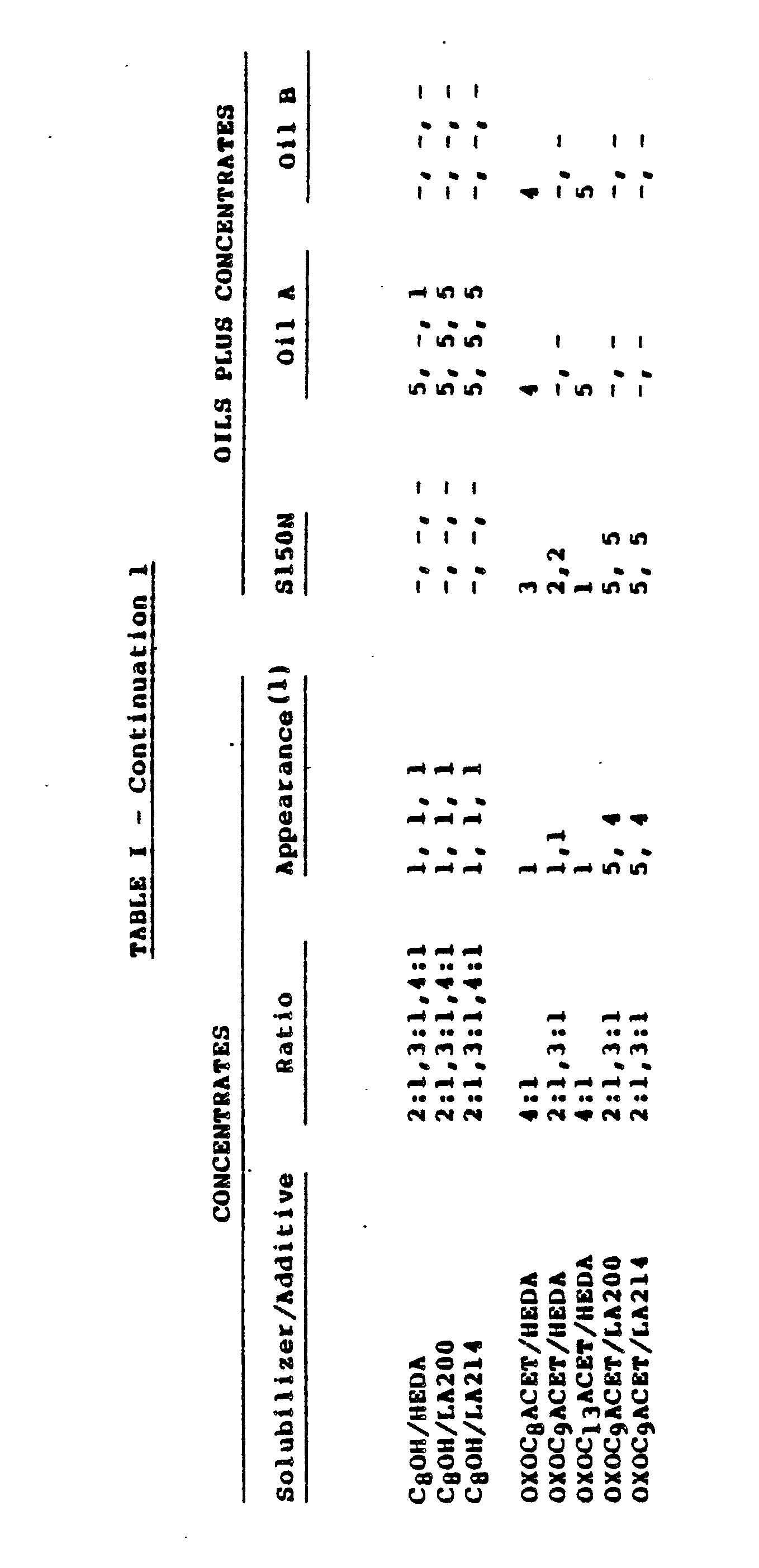
- Table I lists the surfactants and alcohols tested as solubilizers for dimer acid esters.
- CO for the solubilizer refers to a series of ethoxylated nonyl phenols produced by GAF Corp. under the trademark name Igepal®.
- OXO refers to oil soluble alcohols manufactured by the OXO process.
- DM refers to the Igepal DM® series of ethoxylated dinonyl phenols manufactured by the GAF Corp.
- Spans® are products of ICI Americas, Inc.; Tetronics® are products of BASF Wyandott Corp.; Tritons® are products of Rohm and Haas, Inc.; Aerosol® are products of American Cyanamid; and Emphos® designates a series of alkyl phosphates manufactured by Witco Chemical Corp. Of all the materials tested, only the alkanols and alkyl phosphates formed clear solutions, with HEDA in oil A at the ratios of solubilizer/ester indicated in the second column of Table I.
- this oil was temperature cycled for one-half hour at 100°C, one and one-half hours at -14°C, one-half hour at -40°C and one hour at 100°C with no apparent change in clarity. Also indicated is the criticality of the chain length in the alkanol. C13OH is less effective in solubilizing HEDA in both oil A and oil B relative to C8OH and C6OH.
Landscapes
- Chemical & Material Sciences (AREA)
- Chemical Kinetics & Catalysis (AREA)
- General Chemical & Material Sciences (AREA)
- Oil, Petroleum & Natural Gas (AREA)
- Organic Chemistry (AREA)
- Lubricants (AREA)
Abstract
Description
- This invention is directed to a lubricating oil composition containing an oxygenated (hydroxy) ester of a dimer acid in combination with an oil soluble alkanol or alkyl phosphate to provide improved friction reducing properties and to a method of reducing friction in an internal combustion engine by using a lubricating oil composition which contains said additives.
- The friction reducing additive which is used in this invention is an oil soluble oxygenated (hydroxy) ester of a dimer acid (HEDA hydroxy ester of dimer acid) in combination with an oil soluble alkanol or alkyl phosphate, wherein the oxygenated (hydroxy) ester is characterized by the formula:

-CH₂-CH₂OCH₂CH₂]nOH;
with n being equal to 1 to 5 (hereafter designated as HEDA);
-CH₂-CH₂-N(CH₂CH₂OH)₂
(hereinafter designated as LA214);
and
-CH₂-CH₂-OH
(hereinafter designated as LA200). - The use of an oxygenated (hydroxy) ester of the dimer acid as a friction-reducing agent for oils in a gasoline engine can be limited by poor solubility in the lubricating oil and adverse interactions with other lubricating oil components, wherein some of these interactions show up as sediment formation. The present invention teaches that the solubilization and stabilization of the dimer acid esters in the lubricating oils is improved by the addition of an oil-soluble alkanol or alkyl phosphate.
- The oxygenated (hydroxy) esters of the dimer acid are classified as reaction products of a dimer carboxylic acid and a polyhydric alcohol. Such a reaction product may be a partial, di- or polyester, with typical formulae represented as follows when using a trihydric alcohol:

- The alcohol used in preparing the friction reducing reaction product additive of this invention is a polyhydric alcohol having at least 2 hydroxy groups and from 3 to 18 carbon atoms. Generally, such compounds will be aliphatic and may contain branched or unbranched hydrocarbon groups, as well as other functional groups, such as nitrogen, sulfur and phosphorus. Such polyhydric alcohols will contain at least 2 hydroxyl groups and may contain more, generally from 3 to 6 hydroxyl groups, with the upper amount limited by the degree of solubility and effectiveness of the reaction product in the lubricating oil composition. Preferably, such polyhydric alcohol will contain 2 to 4 hydroxyl groups and 3 to 12 carbon atoms. More preferably, such polyhydric alcohol will be saturated, contain 3 hydroxyl groups and 3 to 8 carbon atoms. Compounds of this type include diethylene glycol, glycerol (i.e., 1, 2, 3, propane triol), 1, 2, 6-trihydroxyhexane and 2, 2ʹ, 2ʺ nitrilotriethanol.
- The carboxylic acid used in preparing the oxygenated (hydroxy) esters of the dimer acid friction reducing reaction product of this invention will be a dimer of an aliphatic saturated or unsaturated carboxylic acid, said dimer acid having a total of 24 to 90 carbon atoms, and from 9 to 42 carbon between the carboxylic acid groups. Preferably, the dimer acid will have a total of 24 to 60 carbon atoms and 12 to 42 carbon atoms between the carboxylic acid groups, and more preferably a total of 24 to 44 carbon atoms and 16 to 22 carbon atoms between the carboxylic acid groups.
- The molar quantities of the dimer acid and polyhydric alcohol reactants may be adjusted so as to secure either a complete ester or partial ester and generally from 1 to 3 or more moles of polyhydric alcohol will be used per mole of dimer acid and preferably from 2 to 3 moles of alcohol per mole of acid.
- While any of the dimer acids and polyhydric alcohols described above may be used in preparing the friction reducing additive of this invention, the most preferred esters, as set forth above, are those wherein the carboxyl groups are separated from the closest caboxyl group by from 2 to 12 carbon atoms. Particularly useful ester additives are obtained when the acid used is a dimer of a fatty acid, preferably those fatty acids containing 12 to 22 carbon atoms. Such dimers are, of course, clearly taught in U. S. Patent No. 3,180,832, which was granted on April 27, 1965, and U. S. Patent No. 3,429,817, which was granted on February 25, 1969, and as here indicated the hydrocarbon portion of the dimer carboxylic acid thus obtained may contain a 6 member ring. The formation of the dimer from linoleic acid, oleic acid and mixtures of these acids is illustrated by the following reactions:


- The ester friction reducing additive of this invention will generally be used at a concentratoin level of from 0.1 to 2.0 parts by weight per 100 parts of lubricating oil composition, more preferably from 0.1 to 1.0, and most preferably from 0.2 to 1.0 parts.
- The oil soluble alkanols which are added to the lubricating base oil and the oxygenated (hydroxy) ester of the dimer acid are:
RCH₂-OH
wherein R = 2-16 carbon atoms and is straight chained or branched and Rʹ is H or a straight or branched hydrocarbon chain containing 1 to 5 carbon atoms. - The oil-soluble alkanol will generally be used at a concentration of from 1 to 10 parts by weight per part of the ester friction reducing additive, more preferably 1 to 5, and most preferably about 2 to about 4.
- The lubricating base oil will generally comprise a major amount of the lubricating composition, i.e., at least 50% by weight thereof, and will include liquid hydrocarbons, such as the mineral lubricating oils and the synthetic lubricating oils, and mixtures thereof. The synthetic oils which can be used include diester oils, such as di(2-ethylhexyl) sebacate, azelate and adipate; complex ester oils, such as those formed from dicarboxylic acids, glycols and either monobasic acids or monohydric alcohols; silicone oils; sulfide esters; organic carbonates; and other synthetic oils known in the art.
- Other additives, known in the art, may be added to the oil composition of the present invention to form a finished oil. Such additives include dispersants, antiwear agents, antioxidants, corrosion inhibitors, detergents, pour point depressants, extreme pressure additives, viscosity index improvers, etc. These additives are typically disclosed, for example, in Lubricant Additives by C. V. Smalheer and R. Kennedy Smith, 1967, pages 1-11, and in U. S. Patent No. 4,105,571.
- The following Examples are further illustrative of this invention and are not to be construed as limitations thereof.
- Oils A and B are fully formulated SF quality SAE 10W-30 passenger car engine oils. Each oil is formulated with standard additives used in the industry to meet the requirements of current gasoline engines. Oils A and B contain the sam viscosity index improvers, dispersants, detergents, antioxidants, pour depressants and antifoamant additives. Oil A contains a zinc dialkyl dithiophosphate antiwear additive made with primary alcohols, while oil B contains a zinc dialkyl dithiophosphate antiwear additive made with secondary alcohols. This is the only difference between oils A and B.
- Oil A and oil B, each formulated with 0.5 weight percent HEDA solubilized with C₈Oh at a 3/1 alcohol/HEDA weight ratio were tested for relative friction using a ball on cylinder test, described in the Journal of the American Society of Lubricating Engineers, entitled ASLE Transactions, Volume 4, pages 1-11, 1961. In essence, the apparatus consists basically of a fixed metal ball loaded against a rotating cylinder. The weight on the ball and the rotation of the cylinder can be varied during any given test or from test to test. Also, the time of any given test can be varied. Generally, however, steel on steel is used at a constant load, constant rpm, and a fixed time and in each of the tests of these examples a 4 Kg load, 0.26 rpm and 70 minutes was used.

- As summarized above, oil A and oil B, each with 0.5 weight percent HEDA and 1.5 weight percent C₈OH, gave lower BOC friction than the base case oils without HEDA/C₈ alcohol (oil A or oil B). As indicated in U. S. Patent No. 4,479,883, the BOC data on the oxidized oil from the 3 hour Lube Stability Test (LST) is a better predictor of fuel economy differences during field service than fresh oil data.
- Table I lists the surfactants and alcohols tested as solubilizers for dimer acid esters. The designation CO for the solubilizer refers to a series of ethoxylated nonyl phenols produced by GAF Corp. under the trademark name Igepal®. The prefix OXO refers to oil soluble alcohols manufactured by the OXO process. The designation DM refers to the Igepal DM® series of ethoxylated dinonyl phenols manufactured by the GAF Corp. Spans® are products of ICI Americas, Inc.; Tetronics® are products of BASF Wyandott Corp.; Tritons® are products of Rohm and Haas, Inc.; Aerosol® are products of American Cyanamid; and Emphos® designates a series of alkyl phosphates manufactured by Witco Chemical Corp. Of all the materials tested, only the alkanols and alkyl phosphates formed clear solutions, with HEDA in oil A at the ratios of solubilizer/ester indicated in the second column of Table I.



- A series of alkanols, including C₆, C₈ and C₁₃, were used as solubilization agents with HEDA in lubricating oils A and B. Shown in Table II is the appearance of the oils using 0.5 weight percent HEDA solubilized by the alkanols. As illustrated, solubilization of HEDA in oil B requires more alkanol than required by oil A to obtain a bright and clear oil. To test the stability of these systems, oil A containing 0.5 weight percent of HEDA, solubilized with 3 parts of C₈OH per part of HEDA was stored two months at 22°C with no apparent change. In addition, this oil was temperature cycled for one-half hour at 100°C, one and one-half hours at -14°C, one-half hour at -40°C and one hour at 100°C with no apparent change in clarity. Also indicated is the criticality of the chain length in the alkanol. C₁₃OH is less effective in solubilizing HEDA in both oil A and oil B relative to C₈OH and C₆OH.

Claims (10)
R-CH₂

where R = 2-16 carbon atoms and can be linear or branched and Rʹ is H or a straight or branched hydrocarbon chain containing 1 to 5 carbon atoms.

Priority Applications (3)
| Application Number | Priority Date | Filing Date | Title |
|---|---|---|---|
| US06/846,007 US4684473A (en) | 1986-03-31 | 1986-03-31 | Lubricant oil composition with improved friction reducing properties |
| DE8787306874T DE3775769D1 (en) | 1987-08-03 | 1987-08-03 | LUBRICANT OIL WITH IMPROVED CHARACTERISTICS TO REDUCE FRICTION. |
| EP87306874A EP0302149B1 (en) | 1987-08-03 | 1987-08-03 | Lubricant oil composition with improved friction reducing properties |
Applications Claiming Priority (1)
| Application Number | Priority Date | Filing Date | Title |
|---|---|---|---|
| EP87306874A EP0302149B1 (en) | 1987-08-03 | 1987-08-03 | Lubricant oil composition with improved friction reducing properties |
Publications (2)
| Publication Number | Publication Date |
|---|---|
| EP0302149A1 true EP0302149A1 (en) | 1989-02-08 |
| EP0302149B1 EP0302149B1 (en) | 1992-01-02 |
Family
ID=8197983
Family Applications (1)
| Application Number | Title | Priority Date | Filing Date |
|---|---|---|---|
| EP87306874A Expired - Lifetime EP0302149B1 (en) | 1986-03-31 | 1987-08-03 | Lubricant oil composition with improved friction reducing properties |
Country Status (2)
| Country | Link |
|---|---|
| EP (1) | EP0302149B1 (en) |
| DE (1) | DE3775769D1 (en) |
Cited By (4)
| Publication number | Priority date | Publication date | Assignee | Title |
|---|---|---|---|---|
| WO2013048763A1 (en) * | 2011-09-29 | 2013-04-04 | Dow Global Technologies Llc | Method for solubilizing carboxylic acid-containing compound in hydrocarbon solvent |
| US8968828B2 (en) | 2011-01-24 | 2015-03-03 | Dow Global Technologies Llc | Composite polyamide membrane |
| US9051417B2 (en) | 2013-03-16 | 2015-06-09 | Dow Global Technologies Llc | Method for solubilizing carboxylic acid-containing compound in hydrocarbon solvent |
| US9051227B2 (en) | 2013-03-16 | 2015-06-09 | Dow Global Technologies Llc | In-situ method for preparing hydrolyzed acyl halide compound |
Families Citing this family (1)
| Publication number | Priority date | Publication date | Assignee | Title |
|---|---|---|---|---|
| US9289729B2 (en) | 2013-03-16 | 2016-03-22 | Dow Global Technologies Llc | Composite polyamide membrane derived from carboxylic acid containing acyl halide monomer |
Citations (3)
| Publication number | Priority date | Publication date | Assignee | Title |
|---|---|---|---|---|
| FR1047117A (en) * | 1950-12-26 | 1953-12-11 | Bataafsche Petroleum | Lubricating composition |
| GB708017A (en) * | 1951-08-23 | 1954-04-28 | Standard Oil Dev Co | Lubricating oil composition |
| EP0093598A2 (en) * | 1982-05-05 | 1983-11-09 | Exxon Research And Engineering Company | Lubricating oil composition |
-
1987
- 1987-08-03 DE DE8787306874T patent/DE3775769D1/en not_active Expired - Lifetime
- 1987-08-03 EP EP87306874A patent/EP0302149B1/en not_active Expired - Lifetime
Patent Citations (3)
| Publication number | Priority date | Publication date | Assignee | Title |
|---|---|---|---|---|
| FR1047117A (en) * | 1950-12-26 | 1953-12-11 | Bataafsche Petroleum | Lubricating composition |
| GB708017A (en) * | 1951-08-23 | 1954-04-28 | Standard Oil Dev Co | Lubricating oil composition |
| EP0093598A2 (en) * | 1982-05-05 | 1983-11-09 | Exxon Research And Engineering Company | Lubricating oil composition |
Cited By (7)
| Publication number | Priority date | Publication date | Assignee | Title |
|---|---|---|---|---|
| US8968828B2 (en) | 2011-01-24 | 2015-03-03 | Dow Global Technologies Llc | Composite polyamide membrane |
| WO2013048763A1 (en) * | 2011-09-29 | 2013-04-04 | Dow Global Technologies Llc | Method for solubilizing carboxylic acid-containing compound in hydrocarbon solvent |
| CN103328088A (en) * | 2011-09-29 | 2013-09-25 | 陶氏环球技术有限责任公司 | Method for solubilizing carboxylic acid-containing compounds in hydrocarbon solvents |
| KR20140068797A (en) * | 2011-09-29 | 2014-06-09 | 다우 글로벌 테크놀로지스 엘엘씨 | Method for solubilizing carboxylic acid-containing compound in hydrocarbon solvent |
| CN103328088B (en) * | 2011-09-29 | 2016-02-03 | 陶氏环球技术有限责任公司 | Method for solubilizing carboxylic acid-containing compounds in hydrocarbon solvents |
| US9051417B2 (en) | 2013-03-16 | 2015-06-09 | Dow Global Technologies Llc | Method for solubilizing carboxylic acid-containing compound in hydrocarbon solvent |
| US9051227B2 (en) | 2013-03-16 | 2015-06-09 | Dow Global Technologies Llc | In-situ method for preparing hydrolyzed acyl halide compound |
Also Published As
| Publication number | Publication date |
|---|---|
| EP0302149B1 (en) | 1992-01-02 |
| DE3775769D1 (en) | 1992-02-13 |
Similar Documents
| Publication | Publication Date | Title |
|---|---|---|
| US4479883A (en) | Lubricant composition with improved friction reducing properties containing a mixture of dithiocarbamates | |
| CA2086757C (en) | Synergystic blend of amine/amide and ester/alcohol friction modifying agents for improved fuel economy of an internal combustion engine | |
| US5286394A (en) | Fuel economy and oxidation inhibition in lubricant compositions for internal combustion engines | |
| US4158633A (en) | Lubricating oil | |
| US4208293A (en) | Improved crankcase lubricant composition | |
| KR100640453B1 (en) | Oil Soluble Molybdenum Multifunctional Friction Modifier Additives for Lubricant Compositions | |
| US4609376A (en) | Anti-wear additives in alkanol fuels | |
| EP0953035B1 (en) | Biodegradable lubricant composition from triglycerides and oil-soluble copper | |
| CA2087182C (en) | Low pressure derived mixed phosphorous- and sulfur_containing reaction products useful in power transmitting compositions and process for preparing same | |
| US4201683A (en) | Alkanol solutions of organo molybdenum complexes as friction reducing antiwear additives | |
| JPH04142396A (en) | Lubricant containing thiodixanthogene and metal thiophosphate | |
| US4684473A (en) | Lubricant oil composition with improved friction reducing properties | |
| US4921624A (en) | Modified fatty amides and sulfurized fatty oils as lubricant additives | |
| US5282990A (en) | Synergistic blend of amine/amide and ester/alcohol friction modifying agents for improved fuel economy of an internal combustion engine | |
| EP0093598B1 (en) | Lubricating oil composition | |
| JP2013529697A (en) | Uses and compositions | |
| US4557846A (en) | Lubricating oil compositions containing hydroxamide compounds as friction reducers | |
| EP0302149B1 (en) | Lubricant oil composition with improved friction reducing properties | |
| JPH09132790A (en) | Gear oil composition | |
| EP0051998B1 (en) | Lubricating oil composition | |
| EP0552554B1 (en) | Lubricating oil compositions | |
| US4243538A (en) | Fuel and lubricating compositions containing N-hydroxymethyl aliphatic hydrocarbylamide friction reducers | |
| US5013465A (en) | Dithiophosphates | |
| US3000824A (en) | Lubricating oil composition | |
| US5320767A (en) | Lubricant composition containing alkoxylated amine salt of hydrocarbylsulfonic acid |
Legal Events
| Date | Code | Title | Description |
|---|---|---|---|
| PUAI | Public reference made under article 153(3) epc to a published international application that has entered the european phase |
Free format text: ORIGINAL CODE: 0009012 |
|
| AK | Designated contracting states |
Kind code of ref document: A1 Designated state(s): BE DE FR GB |
|
| 17P | Request for examination filed |
Effective date: 19890717 |
|
| 17Q | First examination report despatched |
Effective date: 19900316 |
|
| GRAA | (expected) grant |
Free format text: ORIGINAL CODE: 0009210 |
|
| AK | Designated contracting states |
Kind code of ref document: B1 Designated state(s): BE DE FR GB |
|
| REF | Corresponds to: |
Ref document number: 3775769 Country of ref document: DE Date of ref document: 19920213 |
|
| ET | Fr: translation filed | ||
| PLBE | No opposition filed within time limit |
Free format text: ORIGINAL CODE: 0009261 |
|
| STAA | Information on the status of an ep patent application or granted ep patent |
Free format text: STATUS: NO OPPOSITION FILED WITHIN TIME LIMIT |
|
| 26N | No opposition filed | ||
| PGFP | Annual fee paid to national office [announced via postgrant information from national office to epo] |
Ref country code: BE Payment date: 19970703 Year of fee payment: 11 |
|
| PG25 | Lapsed in a contracting state [announced via postgrant information from national office to epo] |
Ref country code: BE Free format text: LAPSE BECAUSE OF NON-PAYMENT OF DUE FEES Effective date: 19980831 |
|
| BERE | Be: lapsed |
Owner name: EXXON RESEARCH AND ENGINEERING CY Effective date: 19980831 |
|
| PGFP | Annual fee paid to national office [announced via postgrant information from national office to epo] |
Ref country code: GB Payment date: 20000718 Year of fee payment: 14 Ref country code: FR Payment date: 20000718 Year of fee payment: 14 |
|
| PGFP | Annual fee paid to national office [announced via postgrant information from national office to epo] |
Ref country code: DE Payment date: 20000724 Year of fee payment: 14 |
|
| PG25 | Lapsed in a contracting state [announced via postgrant information from national office to epo] |
Ref country code: GB Free format text: LAPSE BECAUSE OF NON-PAYMENT OF DUE FEES Effective date: 20010803 |
|
| GBPC | Gb: european patent ceased through non-payment of renewal fee |
Effective date: 20010803 |
|
| PG25 | Lapsed in a contracting state [announced via postgrant information from national office to epo] |
Ref country code: FR Free format text: LAPSE BECAUSE OF NON-PAYMENT OF DUE FEES Effective date: 20020430 |
|
| PG25 | Lapsed in a contracting state [announced via postgrant information from national office to epo] |
Ref country code: DE Free format text: LAPSE BECAUSE OF NON-PAYMENT OF DUE FEES Effective date: 20020501 |
|
| REG | Reference to a national code |
Ref country code: FR Ref legal event code: ST |