EP0301700B1 - Neutralization of sulfuric acid containing iron ions - Google Patents
Neutralization of sulfuric acid containing iron ions Download PDFInfo
- Publication number
- EP0301700B1 EP0301700B1 EP88305745A EP88305745A EP0301700B1 EP 0301700 B1 EP0301700 B1 EP 0301700B1 EP 88305745 A EP88305745 A EP 88305745A EP 88305745 A EP88305745 A EP 88305745A EP 0301700 B1 EP0301700 B1 EP 0301700B1
- Authority
- EP
- European Patent Office
- Prior art keywords
- ions
- solution
- organic solvent
- sulfuric acid
- iron
- Prior art date
- Legal status (The legal status is an assumption and is not a legal conclusion. Google has not performed a legal analysis and makes no representation as to the accuracy of the status listed.)
- Expired - Lifetime
Links
- QAOWNCQODCNURD-UHFFFAOYSA-N Sulfuric acid Chemical compound OS(O)(=O)=O QAOWNCQODCNURD-UHFFFAOYSA-N 0.000 title claims description 143
- XEEYBQQBJWHFJM-UHFFFAOYSA-N iron Substances [Fe] XEEYBQQBJWHFJM-UHFFFAOYSA-N 0.000 title claims description 127
- 229910052742 iron Inorganic materials 0.000 title claims description 41
- -1 iron ions Chemical class 0.000 title claims description 40
- 238000006386 neutralization reaction Methods 0.000 title claims description 11
- 239000000243 solution Substances 0.000 claims description 85
- 150000002500 ions Chemical class 0.000 claims description 76
- 238000000034 method Methods 0.000 claims description 69
- 239000003960 organic solvent Substances 0.000 claims description 61
- VEXZGXHMUGYJMC-UHFFFAOYSA-N Hydrochloric acid Chemical compound Cl VEXZGXHMUGYJMC-UHFFFAOYSA-N 0.000 claims description 44
- GRYLNZFGIOXLOG-UHFFFAOYSA-N Nitric acid Chemical compound O[N+]([O-])=O GRYLNZFGIOXLOG-UHFFFAOYSA-N 0.000 claims description 43
- 229910017604 nitric acid Inorganic materials 0.000 claims description 43
- 238000000605 extraction Methods 0.000 claims description 40
- 239000000460 chlorine Substances 0.000 claims description 39
- FBAFATDZDUQKNH-UHFFFAOYSA-M iron chloride Chemical compound [Cl-].[Fe] FBAFATDZDUQKNH-UHFFFAOYSA-M 0.000 claims description 33
- 229910001868 water Inorganic materials 0.000 claims description 29
- XLYOFNOQVPJJNP-UHFFFAOYSA-N water Substances O XLYOFNOQVPJJNP-UHFFFAOYSA-N 0.000 claims description 26
- 239000007864 aqueous solution Substances 0.000 claims description 23
- FAPWRFPIFSIZLT-UHFFFAOYSA-M Sodium chloride Chemical compound [Na+].[Cl-] FAPWRFPIFSIZLT-UHFFFAOYSA-M 0.000 claims description 19
- QVGXLLKOCUKJST-UHFFFAOYSA-N atomic oxygen Chemical compound [O] QVGXLLKOCUKJST-UHFFFAOYSA-N 0.000 claims description 18
- 150000001875 compounds Chemical class 0.000 claims description 18
- 239000001301 oxygen Substances 0.000 claims description 18
- 229910052760 oxygen Inorganic materials 0.000 claims description 18
- 229910052801 chlorine Inorganic materials 0.000 claims description 16
- 229910001447 ferric ion Inorganic materials 0.000 claims description 15
- 229910021578 Iron(III) chloride Inorganic materials 0.000 claims description 14
- RBTARNINKXHZNM-UHFFFAOYSA-K iron trichloride Chemical compound Cl[Fe](Cl)Cl RBTARNINKXHZNM-UHFFFAOYSA-K 0.000 claims description 14
- 238000001704 evaporation Methods 0.000 claims description 12
- 235000002639 sodium chloride Nutrition 0.000 claims description 12
- 239000011780 sodium chloride Substances 0.000 claims description 12
- 229910003202 NH4 Inorganic materials 0.000 claims description 9
- 150000003973 alkyl amines Chemical class 0.000 claims description 9
- ZAMOUSCENKQFHK-UHFFFAOYSA-N Chlorine atom Chemical compound [Cl] ZAMOUSCENKQFHK-UHFFFAOYSA-N 0.000 claims description 8
- 239000012535 impurity Substances 0.000 claims description 8
- VEXZGXHMUGYJMC-UHFFFAOYSA-M Chloride anion Chemical compound [Cl-] VEXZGXHMUGYJMC-UHFFFAOYSA-M 0.000 claims description 7
- CWYNVVGOOAEACU-UHFFFAOYSA-N Fe2+ Chemical compound [Fe+2] CWYNVVGOOAEACU-UHFFFAOYSA-N 0.000 claims description 6
- 239000003795 chemical substances by application Substances 0.000 claims description 6
- 239000007800 oxidant agent Substances 0.000 claims description 6
- 239000000126 substance Substances 0.000 claims description 6
- 229910001424 calcium ion Inorganic materials 0.000 claims description 5
- 229910001425 magnesium ion Inorganic materials 0.000 claims description 5
- 229910052708 sodium Inorganic materials 0.000 claims description 5
- 239000007787 solid Substances 0.000 claims description 5
- 229910052749 magnesium Inorganic materials 0.000 claims description 3
- 125000001309 chloro group Chemical group Cl* 0.000 claims 1
- 239000012074 organic phase Substances 0.000 description 23
- 239000002699 waste material Substances 0.000 description 22
- 235000011149 sulphuric acid Nutrition 0.000 description 18
- 239000008346 aqueous phase Substances 0.000 description 16
- 238000011282 treatment Methods 0.000 description 15
- 239000011734 sodium Substances 0.000 description 13
- UQSXHKLRYXJYBZ-UHFFFAOYSA-N Iron oxide Chemical compound [Fe]=O UQSXHKLRYXJYBZ-UHFFFAOYSA-N 0.000 description 12
- HEMHJVSKTPXQMS-UHFFFAOYSA-M Sodium hydroxide Chemical compound [OH-].[Na+] HEMHJVSKTPXQMS-UHFFFAOYSA-M 0.000 description 12
- GWEVSGVZZGPLCZ-UHFFFAOYSA-N Titan oxide Chemical compound O=[Ti]=O GWEVSGVZZGPLCZ-UHFFFAOYSA-N 0.000 description 12
- 238000004821 distillation Methods 0.000 description 12
- VTLYFUHAOXGGBS-UHFFFAOYSA-N Fe3+ Chemical compound [Fe+3] VTLYFUHAOXGGBS-UHFFFAOYSA-N 0.000 description 9
- 238000004519 manufacturing process Methods 0.000 description 9
- 239000010936 titanium Substances 0.000 description 9
- 229910052719 titanium Inorganic materials 0.000 description 9
- QGZKDVFQNNGYKY-UHFFFAOYSA-N Ammonia Chemical compound N QGZKDVFQNNGYKY-UHFFFAOYSA-N 0.000 description 8
- PMZURENOXWZQFD-UHFFFAOYSA-L Sodium Sulfate Chemical compound [Na+].[Na+].[O-]S([O-])(=O)=O PMZURENOXWZQFD-UHFFFAOYSA-L 0.000 description 8
- 230000008020 evaporation Effects 0.000 description 8
- 239000000203 mixture Substances 0.000 description 8
- OKTJSMMVPCPJKN-UHFFFAOYSA-N Carbon Chemical compound [C] OKTJSMMVPCPJKN-UHFFFAOYSA-N 0.000 description 7
- 229910052799 carbon Inorganic materials 0.000 description 7
- 229910052602 gypsum Inorganic materials 0.000 description 7
- 229910000360 iron(III) sulfate Inorganic materials 0.000 description 7
- 230000003647 oxidation Effects 0.000 description 7
- 238000007254 oxidation reaction Methods 0.000 description 7
- 229910052938 sodium sulfate Inorganic materials 0.000 description 7
- 235000011152 sodium sulphate Nutrition 0.000 description 7
- UXVMQQNJUSDDNG-UHFFFAOYSA-L Calcium chloride Chemical compound [Cl-].[Cl-].[Ca+2] UXVMQQNJUSDDNG-UHFFFAOYSA-L 0.000 description 6
- 239000007832 Na2SO4 Substances 0.000 description 6
- 239000002253 acid Substances 0.000 description 6
- 239000011575 calcium Substances 0.000 description 6
- 239000001110 calcium chloride Substances 0.000 description 6
- 235000011148 calcium chloride Nutrition 0.000 description 6
- 229910001628 calcium chloride Inorganic materials 0.000 description 6
- 229910052804 chromium Inorganic materials 0.000 description 6
- YDZQQRWRVYGNER-UHFFFAOYSA-N iron;titanium;trihydrate Chemical compound O.O.O.[Ti].[Fe] YDZQQRWRVYGNER-UHFFFAOYSA-N 0.000 description 6
- 229910052748 manganese Inorganic materials 0.000 description 6
- 229910052720 vanadium Inorganic materials 0.000 description 6
- LFQSCWFLJHTTHZ-UHFFFAOYSA-N Ethanol Chemical compound CCO LFQSCWFLJHTTHZ-UHFFFAOYSA-N 0.000 description 5
- 229910052758 niobium Inorganic materials 0.000 description 5
- 229910001415 sodium ion Inorganic materials 0.000 description 5
- OGIDPMRJRNCKJF-UHFFFAOYSA-N titanium oxide Inorganic materials [Ti]=O OGIDPMRJRNCKJF-UHFFFAOYSA-N 0.000 description 5
- YIWUKEYIRIRTPP-UHFFFAOYSA-N 2-ethylhexan-1-ol Chemical compound CCCCC(CC)CO YIWUKEYIRIRTPP-UHFFFAOYSA-N 0.000 description 4
- VTYYLEPIZMXCLO-UHFFFAOYSA-L Calcium carbonate Chemical compound [Ca+2].[O-]C([O-])=O VTYYLEPIZMXCLO-UHFFFAOYSA-L 0.000 description 4
- TWRXJAOTZQYOKJ-UHFFFAOYSA-L Magnesium chloride Chemical compound [Mg+2].[Cl-].[Cl-] TWRXJAOTZQYOKJ-UHFFFAOYSA-L 0.000 description 4
- 239000006227 byproduct Substances 0.000 description 4
- 239000010440 gypsum Substances 0.000 description 4
- 239000002440 industrial waste Substances 0.000 description 4
- 235000014413 iron hydroxide Nutrition 0.000 description 4
- BAUYGSIQEAFULO-UHFFFAOYSA-L iron(2+) sulfate (anhydrous) Chemical compound [Fe+2].[O-]S([O-])(=O)=O BAUYGSIQEAFULO-UHFFFAOYSA-L 0.000 description 4
- NCNCGGDMXMBVIA-UHFFFAOYSA-L iron(ii) hydroxide Chemical compound [OH-].[OH-].[Fe+2] NCNCGGDMXMBVIA-UHFFFAOYSA-L 0.000 description 4
- 229910052700 potassium Inorganic materials 0.000 description 4
- 238000011084 recovery Methods 0.000 description 4
- VWDWKYIASSYTQR-UHFFFAOYSA-N sodium nitrate Chemical compound [Na+].[O-][N+]([O-])=O VWDWKYIASSYTQR-UHFFFAOYSA-N 0.000 description 4
- STCOOQWBFONSKY-UHFFFAOYSA-N tributyl phosphate Chemical compound CCCCOP(=O)(OCCCC)OCCCC STCOOQWBFONSKY-UHFFFAOYSA-N 0.000 description 4
- ZMBHCYHQLYEYDV-UHFFFAOYSA-N trioctylphosphine oxide Chemical compound CCCCCCCCP(=O)(CCCCCCCC)CCCCCCCC ZMBHCYHQLYEYDV-UHFFFAOYSA-N 0.000 description 4
- VHUUQVKOLVNVRT-UHFFFAOYSA-N Ammonium hydroxide Chemical compound [NH4+].[OH-] VHUUQVKOLVNVRT-UHFFFAOYSA-N 0.000 description 3
- RTZKZFJDLAIYFH-UHFFFAOYSA-N Diethyl ether Chemical compound CCOCC RTZKZFJDLAIYFH-UHFFFAOYSA-N 0.000 description 3
- 229910052782 aluminium Inorganic materials 0.000 description 3
- 235000011114 ammonium hydroxide Nutrition 0.000 description 3
- BFNBIHQBYMNNAN-UHFFFAOYSA-N ammonium sulfate Chemical compound N.N.OS(O)(=O)=O BFNBIHQBYMNNAN-UHFFFAOYSA-N 0.000 description 3
- 229910052921 ammonium sulfate Inorganic materials 0.000 description 3
- 235000011130 ammonium sulphate Nutrition 0.000 description 3
- 229910052791 calcium Inorganic materials 0.000 description 3
- AXCZMVOFGPJBDE-UHFFFAOYSA-L calcium dihydroxide Chemical compound [OH-].[OH-].[Ca+2] AXCZMVOFGPJBDE-UHFFFAOYSA-L 0.000 description 3
- 239000000920 calcium hydroxide Substances 0.000 description 3
- 235000011116 calcium hydroxide Nutrition 0.000 description 3
- 229910001861 calcium hydroxide Inorganic materials 0.000 description 3
- 238000002474 experimental method Methods 0.000 description 3
- 239000000463 material Substances 0.000 description 3
- 230000001590 oxidative effect Effects 0.000 description 3
- SUKJFIGYRHOWBL-UHFFFAOYSA-N sodium hypochlorite Chemical compound [Na+].Cl[O-] SUKJFIGYRHOWBL-UHFFFAOYSA-N 0.000 description 3
- NLXLAEXVIDQMFP-UHFFFAOYSA-N Ammonia chloride Chemical compound [NH4+].[Cl-] NLXLAEXVIDQMFP-UHFFFAOYSA-N 0.000 description 2
- 239000000654 additive Substances 0.000 description 2
- 230000000996 additive effect Effects 0.000 description 2
- 238000013019 agitation Methods 0.000 description 2
- 150000004703 alkoxides Chemical class 0.000 description 2
- 125000000217 alkyl group Chemical group 0.000 description 2
- 235000019270 ammonium chloride Nutrition 0.000 description 2
- 230000015572 biosynthetic process Effects 0.000 description 2
- 238000009835 boiling Methods 0.000 description 2
- 235000010216 calcium carbonate Nutrition 0.000 description 2
- 229910000019 calcium carbonate Inorganic materials 0.000 description 2
- 229940043430 calcium compound Drugs 0.000 description 2
- 150000001674 calcium compounds Chemical class 0.000 description 2
- JHIVVAPYMSGYDF-UHFFFAOYSA-N cyclohexanone Chemical compound O=C1CCCCC1 JHIVVAPYMSGYDF-UHFFFAOYSA-N 0.000 description 2
- QDOXWKRWXJOMAK-UHFFFAOYSA-N dichromium trioxide Chemical compound O=[Cr]O[Cr]=O QDOXWKRWXJOMAK-UHFFFAOYSA-N 0.000 description 2
- 230000000694 effects Effects 0.000 description 2
- 239000012776 electronic material Substances 0.000 description 2
- 230000002708 enhancing effect Effects 0.000 description 2
- 150000002170 ethers Chemical class 0.000 description 2
- XLYOFNOQVPJJNP-ZSJDYOACSA-N heavy water Substances [2H]O[2H] XLYOFNOQVPJJNP-ZSJDYOACSA-N 0.000 description 2
- 230000001965 increasing effect Effects 0.000 description 2
- 229910000358 iron sulfate Inorganic materials 0.000 description 2
- 229910000359 iron(II) sulfate Inorganic materials 0.000 description 2
- JEIPFZHSYJVQDO-UHFFFAOYSA-N iron(III) oxide Inorganic materials O=[Fe]O[Fe]=O JEIPFZHSYJVQDO-UHFFFAOYSA-N 0.000 description 2
- 239000003350 kerosene Substances 0.000 description 2
- 229910001629 magnesium chloride Inorganic materials 0.000 description 2
- 229910052751 metal Inorganic materials 0.000 description 2
- 239000002184 metal Substances 0.000 description 2
- XTAZYLNFDRKIHJ-UHFFFAOYSA-N n,n-dioctyloctan-1-amine Chemical compound CCCCCCCCN(CCCCCCCC)CCCCCCCC XTAZYLNFDRKIHJ-UHFFFAOYSA-N 0.000 description 2
- XNLICIUVMPYHGG-UHFFFAOYSA-N pentan-2-one Chemical compound CCCC(C)=O XNLICIUVMPYHGG-UHFFFAOYSA-N 0.000 description 2
- 239000000047 product Substances 0.000 description 2
- 239000002994 raw material Substances 0.000 description 2
- 230000001172 regenerating effect Effects 0.000 description 2
- 239000002893 slag Substances 0.000 description 2
- 235000010344 sodium nitrate Nutrition 0.000 description 2
- 238000004381 surface treatment Methods 0.000 description 2
- 230000001131 transforming effect Effects 0.000 description 2
- VGVHNLRUAMRIEW-UHFFFAOYSA-N 4-methylcyclohexan-1-one Chemical compound CC1CCC(=O)CC1 VGVHNLRUAMRIEW-UHFFFAOYSA-N 0.000 description 1
- ZNSMNVMLTJELDZ-UHFFFAOYSA-N Bis(2-chloroethyl)ether Chemical compound ClCCOCCCl ZNSMNVMLTJELDZ-UHFFFAOYSA-N 0.000 description 1
- 229910019582 Cr V Inorganic materials 0.000 description 1
- AQZGPSLYZOOYQP-UHFFFAOYSA-N Diisoamyl ether Chemical compound CC(C)CCOCCC(C)C AQZGPSLYZOOYQP-UHFFFAOYSA-N 0.000 description 1
- ZAFNJMIOTHYJRJ-UHFFFAOYSA-N Diisopropyl ether Chemical compound CC(C)OC(C)C ZAFNJMIOTHYJRJ-UHFFFAOYSA-N 0.000 description 1
- NTIZESTWPVYFNL-UHFFFAOYSA-N Methyl isobutyl ketone Chemical compound CC(C)CC(C)=O NTIZESTWPVYFNL-UHFFFAOYSA-N 0.000 description 1
- UIHCLUNTQKBZGK-UHFFFAOYSA-N Methyl isobutyl ketone Natural products CCC(C)C(C)=O UIHCLUNTQKBZGK-UHFFFAOYSA-N 0.000 description 1
- 239000005708 Sodium hypochlorite Substances 0.000 description 1
- 229910000831 Steel Inorganic materials 0.000 description 1
- QAOWNCQODCNURD-UHFFFAOYSA-L Sulfate Chemical compound [O-]S([O-])(=O)=O QAOWNCQODCNURD-UHFFFAOYSA-L 0.000 description 1
- RTAQQCXQSZGOHL-UHFFFAOYSA-N Titanium Chemical compound [Ti] RTAQQCXQSZGOHL-UHFFFAOYSA-N 0.000 description 1
- 150000007513 acids Chemical class 0.000 description 1
- 150000001298 alcohols Chemical class 0.000 description 1
- 125000001931 aliphatic group Chemical group 0.000 description 1
- 150000001338 aliphatic hydrocarbons Chemical class 0.000 description 1
- PNEYBMLMFCGWSK-UHFFFAOYSA-N aluminium oxide Inorganic materials [O-2].[O-2].[O-2].[Al+3].[Al+3] PNEYBMLMFCGWSK-UHFFFAOYSA-N 0.000 description 1
- 150000001408 amides Chemical class 0.000 description 1
- 239000000908 ammonium hydroxide Substances 0.000 description 1
- 229910052925 anhydrite Inorganic materials 0.000 description 1
- 238000013459 approach Methods 0.000 description 1
- 150000004945 aromatic hydrocarbons Chemical class 0.000 description 1
- 150000008378 aryl ethers Chemical class 0.000 description 1
- 150000005840 aryl radicals Chemical class 0.000 description 1
- 238000007630 basic procedure Methods 0.000 description 1
- OSGAYBCDTDRGGQ-UHFFFAOYSA-L calcium sulfate Chemical compound [Ca+2].[O-]S([O-])(=O)=O OSGAYBCDTDRGGQ-UHFFFAOYSA-L 0.000 description 1
- FDQQFTPXVYEDRY-UHFFFAOYSA-M calcium;chloride;hypochlorite Chemical compound [Cl-].[Ca+2].Cl[O-] FDQQFTPXVYEDRY-UHFFFAOYSA-M 0.000 description 1
- 238000006243 chemical reaction Methods 0.000 description 1
- 238000005660 chlorination reaction Methods 0.000 description 1
- 150000001805 chlorine compounds Chemical class 0.000 description 1
- 238000011109 contamination Methods 0.000 description 1
- 238000001816 cooling Methods 0.000 description 1
- 229910052593 corundum Inorganic materials 0.000 description 1
- 238000002425 crystallisation Methods 0.000 description 1
- 230000008025 crystallization Effects 0.000 description 1
- 238000000354 decomposition reaction Methods 0.000 description 1
- 238000006056 electrooxidation reaction Methods 0.000 description 1
- 150000002148 esters Chemical class 0.000 description 1
- 239000007789 gas Substances 0.000 description 1
- 238000010438 heat treatment Methods 0.000 description 1
- CATSNJVOTSVZJV-UHFFFAOYSA-N heptan-2-one Chemical compound CCCCCC(C)=O CATSNJVOTSVZJV-UHFFFAOYSA-N 0.000 description 1
- 229930195733 hydrocarbon Natural products 0.000 description 1
- 150000002430 hydrocarbons Chemical class 0.000 description 1
- SZVJSHCCFOBDDC-UHFFFAOYSA-N iron(II,III) oxide Inorganic materials O=[Fe]O[Fe]O[Fe]=O SZVJSHCCFOBDDC-UHFFFAOYSA-N 0.000 description 1
- 150000002576 ketones Chemical class 0.000 description 1
- 239000007788 liquid Substances 0.000 description 1
- 239000011777 magnesium Substances 0.000 description 1
- 229910052603 melanterite Inorganic materials 0.000 description 1
- 229910021645 metal ion Inorganic materials 0.000 description 1
- 239000007769 metal material Substances 0.000 description 1
- 239000010446 mirabilite Substances 0.000 description 1
- 238000002156 mixing Methods 0.000 description 1
- 229910000069 nitrogen hydride Inorganic materials 0.000 description 1
- SOQBVABWOPYFQZ-UHFFFAOYSA-N oxygen(2-);titanium(4+) Chemical class [O-2].[O-2].[Ti+4] SOQBVABWOPYFQZ-UHFFFAOYSA-N 0.000 description 1
- 239000012188 paraffin wax Substances 0.000 description 1
- 239000002245 particle Substances 0.000 description 1
- 239000003209 petroleum derivative Substances 0.000 description 1
- 150000003014 phosphoric acid esters Chemical class 0.000 description 1
- 239000000049 pigment Substances 0.000 description 1
- 239000002244 precipitate Substances 0.000 description 1
- 150000003138 primary alcohols Chemical class 0.000 description 1
- 238000007670 refining Methods 0.000 description 1
- 229920006395 saturated elastomer Polymers 0.000 description 1
- 150000003333 secondary alcohols Chemical class 0.000 description 1
- 238000000926 separation method Methods 0.000 description 1
- 239000002904 solvent Substances 0.000 description 1
- 239000010959 steel Substances 0.000 description 1
- 150000003509 tertiary alcohols Chemical class 0.000 description 1
- 238000012360 testing method Methods 0.000 description 1
- 229910052718 tin Inorganic materials 0.000 description 1
- 230000009466 transformation Effects 0.000 description 1
- 229910001845 yogo sapphire Inorganic materials 0.000 description 1
Images




Classifications
-
- C—CHEMISTRY; METALLURGY
- C02—TREATMENT OF WATER, WASTE WATER, SEWAGE, OR SLUDGE
- C02F—TREATMENT OF WATER, WASTE WATER, SEWAGE, OR SLUDGE
- C02F1/00—Treatment of water, waste water, or sewage
- C02F1/58—Treatment of water, waste water, or sewage by removing specified dissolved compounds
- C02F1/62—Heavy metal compounds
- C02F1/64—Heavy metal compounds of iron or manganese
-
- C—CHEMISTRY; METALLURGY
- C01—INORGANIC CHEMISTRY
- C01G—COMPOUNDS CONTAINING METALS NOT COVERED BY SUBCLASSES C01D OR C01F
- C01G49/00—Compounds of iron
- C01G49/0009—Preparation involving a liquid-liquid extraction, an adsorption or an ion-exchange
-
- C—CHEMISTRY; METALLURGY
- C01—INORGANIC CHEMISTRY
- C01B—NON-METALLIC ELEMENTS; COMPOUNDS THEREOF; METALLOIDS OR COMPOUNDS THEREOF NOT COVERED BY SUBCLASS C01C
- C01B17/00—Sulfur; Compounds thereof
- C01B17/69—Sulfur trioxide; Sulfuric acid
- C01B17/90—Separation; Purification
- C01B17/901—Recovery from spent acids containing metallic ions, e.g. hydrolysis acids, pickling acids
- C01B17/903—Recovery from spent acids containing metallic ions, e.g. hydrolysis acids, pickling acids by liquid-liquid extraction
-
- C—CHEMISTRY; METALLURGY
- C02—TREATMENT OF WATER, WASTE WATER, SEWAGE, OR SLUDGE
- C02F—TREATMENT OF WATER, WASTE WATER, SEWAGE, OR SLUDGE
- C02F1/00—Treatment of water, waste water, or sewage
- C02F1/26—Treatment of water, waste water, or sewage by extraction
-
- C—CHEMISTRY; METALLURGY
- C02—TREATMENT OF WATER, WASTE WATER, SEWAGE, OR SLUDGE
- C02F—TREATMENT OF WATER, WASTE WATER, SEWAGE, OR SLUDGE
- C02F1/00—Treatment of water, waste water, or sewage
- C02F1/66—Treatment of water, waste water, or sewage by neutralisation; pH adjustment
-
- Y—GENERAL TAGGING OF NEW TECHNOLOGICAL DEVELOPMENTS; GENERAL TAGGING OF CROSS-SECTIONAL TECHNOLOGIES SPANNING OVER SEVERAL SECTIONS OF THE IPC; TECHNICAL SUBJECTS COVERED BY FORMER USPC CROSS-REFERENCE ART COLLECTIONS [XRACs] AND DIGESTS
- Y10—TECHNICAL SUBJECTS COVERED BY FORMER USPC
- Y10S—TECHNICAL SUBJECTS COVERED BY FORMER USPC CROSS-REFERENCE ART COLLECTIONS [XRACs] AND DIGESTS
- Y10S423/00—Chemistry of inorganic compounds
- Y10S423/01—Waste acid containing iron
- Y10S423/02—Sulfuric acid
-
- Y—GENERAL TAGGING OF NEW TECHNOLOGICAL DEVELOPMENTS; GENERAL TAGGING OF CROSS-SECTIONAL TECHNOLOGIES SPANNING OVER SEVERAL SECTIONS OF THE IPC; TECHNICAL SUBJECTS COVERED BY FORMER USPC CROSS-REFERENCE ART COLLECTIONS [XRACs] AND DIGESTS
- Y10—TECHNICAL SUBJECTS COVERED BY FORMER USPC
- Y10S—TECHNICAL SUBJECTS COVERED BY FORMER USPC CROSS-REFERENCE ART COLLECTIONS [XRACs] AND DIGESTS
- Y10S423/00—Chemistry of inorganic compounds
- Y10S423/09—Reaction techniques
- Y10S423/14—Ion exchange; chelation or liquid/liquid ion extraction
Definitions
- the present invention relates to a method for neutralization of sulfuric acid which, as its main impurity, contains iron ions.
- sodium hydroxide for neutralization of sulfuric acids containing iron ions as their main impurity, such as waste sulfuric acid from surface treatments of steel products, from refining processes for non-ferrous metals and from production processes for titanium oxide that use sulfuric acid, as well as sulfuric acid obtained by distilling or evaporating hydrochloric acid or nitric acid containing iron ions to which sulfuric acid has been added.
- a method is uneconomical, because sodium hydroxide is valuable, whereas the sodium sulfate obtained as by-product is of almost no commercial value.
- a chlorine-containing compound for instance NaCl which is cheap and easily available or MgCl2 which is plentifully-produced as industrial waste or CaCl2 or NH4Cl.
- a method for neutralization of sulfuric acid containing Fe ions comprising adding ions selected from the group consisting of Na ions, K ions, Mg ions, Ca ions and NH4 ions, in the form of a compound containing chlorine, to said sulfuric acid solution containing impurities chiefly comprising iron ions, in an amount corresponding at least to the chemical equivalent to SO42 ⁇ , and bringing the resultant solution into contact with an organic solvent (b) containing oxygen and/or comprising alkylamine, so as thus to extract Fe ions from said aqueous solution into the organic solvent as chloride complex.
- the method of the present invention can also be advantageously used for treatment of waste Fe-contaminated hydrochloric acid and nitric acid, by adopting a preliminary procedure in which sulfuric acid is added to the Fe-containing waste acid and the resultant solution is evaporated or distilled so as to recover HCl or HNO3 therefrom, thus transforming the residual solution to Fe-contaminated sulfuric acid, and thereafter the sulfuric acid thus obtained is treated in the same way as indicated above.
- This new procedure involves treatment of a sulfuric acid solution containing iron ions by adding thereto one or more chlorine-containing compounds which provide a source of Na ions, K ions, Mg ions, Ca ions and/or NH4 ions, said compound(s) being added in an amount corresponding to at least the chemical equivalent of the SO42 ⁇ contained in the acid, and the resultant aqueous solution is then brought into contact with at least one organic solvent containing oxygen and/or comprising an alkylamine, so as thus to extract Fe ions from said sulfuric acid solution into the organic phase as a chloride complex.
- the organic solvent containing Fe as chloride complex thus obtained is then preferably brought into contact with water to extract back iron and chlorine therefrom into the aqueous phase and regenerate the organic solvent.
- an organic solvent containing oxygen for instance, an alcohol with a carbon number of 6 - 18 (primary, secondary and tertiary) is added to the organic phase before the organic phase is brought into contact with water, and then the resultant organic solution is brought into contact with water to inversely extract Fe ions and Cl ions into the aqueous phase, and the remaining organic solution is distilled or evaporated under reduced or ordinary atmospheric pressures to separate and regenerate the organic solvent added prior to the inverse extraction as the original state.
- an alcohol with a carbon number of 6 - 18 primary, secondary and tertiary
- the organic solvent containing iron chloride complex may be distilled or evaporated under reduced or ordinary atmospheric pressures prior to the contact with water for separating and recovering water and hydrochloric acid from the organic solution, and then the remaining organic solution is brought into contact with water to inversely extract Fe ions and Cl ions into the aqueous solution and regenerate the organic solvent.
- ions selected from the group consisting of Na ions, K ions, Mg ions, Ca ions and NH4 ions in the form of a compound containing chlorine are added in an amount corresponding at least to the chemical equivalent to SO42 ⁇ , and the resultant aqueous solution can be treated with addition of at least one of oxygen-containing organic solvents or alkylamine organic solvents similarly as described in the above.
- Hydrochloric acid or nitric acid containing Fe ions after adding sulfuric acid may be distilled or evaporated under reduced or ordinary atmospheric pressures to separate and recover HCl or HNO3, and then the remaining aqueous solution can also be treated in the manner herein disclosed.
- the present invention provides an excellent and economical method for the neutralization thereof, and moreover one in which further refined iron hydroxide, oxide and metallic iron can be recovered.
- rock salt as a typical source of the sodium chloride for use as the additive for the chloridizing process (B) as will be described hereinafter, it will be realized that rock salt is distributed widely on earth and thus not only easily obtainable but also cheap, while moreover the aqueous solution as the residual solution (D) in the extraction process (C) in this instance comprises Na2SO4, so that purified Glauber salt (Na2SO4 ⁇ 10H2O) can easily be recovered therefrom with no need for evaporation and concentration. Therefore, the pollution of rivers by the waste solution can to a substantial extent be prevented by practising the present invention.
- the iron concentration for instance in the case of waste sulfuric acid from the production of titanium oxide, one adds materials such as ilmenite, anatase or high-titanium slag (as it stands, or after the reduction treatment) or iron-containing industrial waste (in the case when its treatment is difficult) to the waste sulfuric acid so as thereby to dissolve Fe ions therein selectively and thus to control the ratio of Fe to sulfuric acid in the solution.
- materials such as ilmenite, anatase or high-titanium slag (as it stands, or after the reduction treatment) or iron-containing industrial waste (in the case when its treatment is difficult) to the waste sulfuric acid so as thereby to dissolve Fe ions therein selectively and thus to control the ratio of Fe to sulfuric acid in the solution.
- an oxygen-containing organic solvent with which a large quantity of water can be extracted such as an alcohol (primary, secondary and tertiary) with a carbon number of 6 - 18 is added so as to increase the re-extraction efficiency, and then the resultant organic solution is brought into contact with water for re-extracting the Fe ions and Cl ions in the organic solution back into the aqueous phase, and the remaining organic solution is distilled or evaporated off under reduced or ordinary atmospheric pressures, so as thereby to separate the oxygen-containing organic solvent added to the organic solution prior to the re-extraction (for instance alcohol) and thus regenerate the original organic solvent back to its original state.
- an oxygen-containing organic solvent with which a large quantity of water can be extracted such as an alcohol (primary, secondary and tertiary) with a carbon number of 6 - 18 is added so as to increase the re-extraction efficiency, and then the resultant organic solution is brought into contact with water for re-extracting the Fe ions and Cl ions in the organic solution back
- the organic phase containing iron chloride complex is then further subjected to distillation or evaporation under reduced or ordinary atmospheric pressures, so as to recover HCl and H2O therefrom according to the following equation:
- the remaining organic phase is then subjected to re-extraction in contact with water as follows:
- the back-extracted aqueous phase contains no HCl, one can obtain a concentrated FeCl3 solution, and accordingly the production of iron hydroxide and oxide from the FeCl3 thus transferred into the aqueous phase can be economically achieved.
- the distillation of the organic phase containing the iron chloride complex may be carried further under reduced pressure so as to distil off and recover the organic solvent, leaving FeCl3 as an anhydrous solid, as shown below:
- the recovered organic solvent can be recycled for re-use in the extraction of iron chloride complex.
- FeCl3 contains no water of crystallization, its recovery as iron oxide or metallic iron can be easily achieved as follows: FeCl3 + 3/4 O2 ⁇ 1/2 Fe2O3 + 1.5Cl2 ⁇ FeCl3 + 1.5H2O ⁇ 1/2 Fe2O3 + 3HCl ⁇ FeCl3 + 1.5H2 ⁇ Fe + 3HCl ⁇
- the thus-recovered FeCl3 may also be employed for the production of various alkoxides, as in the following equation: FeCl3 + 3ROH + 3NH3 ⁇ Fe(OR)3 + 3NH4Cl where ROH indicates an alcohol.
- the compound containing Na and Cl used in the present invention will typically be NaCl, chiefly in the form of rock salt, but such compounds as NaClO and NaClO3 may also be used.
- the compound containing Ca and Cl will typically be CaCl2 (exhausted in large quantity as industrial waste) but such compounds as CaCl2 ⁇ Ca(ClO)2 may also be used. Further, NH4Cl and MgCl2 may also be used.
- a compound such as sodium hypochlorite (NaClO) or calcium chloride-hypochlorite (CaCl2 ⁇ Ca(ClO)2) can be used.
- NaClO sodium hypochlorite
- CaCl2 ⁇ Ca(ClO)2 calcium chloride-hypochlorite
- NO x -type oxidizing agents such as HNO3, NaNO3, NH4NO3 and NO x gas may also be employed.
- HNO3 When Fe2+ ions are oxidized to Fe3+ ions with HNO3, then HNO3 is extracted into the organic phase together with the iron chloride complex (HNO3 + Org. ⁇ HNO3 ⁇ Org.) and this co-extracted HNO3 is brought into contact with an aqueous solution containing NaCl prior to the re-extraction of Fe ions and Cl ions, in order thereby to back-extract HNO3 into the aqueous solution, leaving Fe ions and Cl ions in the organic solvent. (HNO3 ⁇ Org + NaCl ⁇ Org. + NaNO3 + HCl)
- HCl remaining in the aqueous solution helps to improve the extraction distribution ratio of the iron chloride complex, so that Fe ions and Cl ions co-present with HNO3 remain in the organic phase. Meanwhile the back-extracted HNO3 is re-used for the oxidation of Fe2+ ions.
- oxygen-containing organic solvent and/or alkylamine used in the present invention is selected from the following groups:
- the organic solvent used for the extraction of iron chloride is sometimes diluted with a petroleum hydrocarbon comprising aliphatic and aromatic hydrocarbons or a mixture thereof.
- a petroleum hydrocarbon comprising aliphatic and aromatic hydrocarbons or a mixture thereof.
- a mixture of various hydrocarbons such as kerosene is also frequently used.
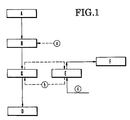
- the flow sheet in Fig. 1 shows the basic procedure of the present method, in which a sulfuric acid solution containing Fe ions (A) is introduced into a chloridizing process (B), where a compound that comprises Na and Cl, Ca and Cl, K and Cl, Mg and Cl or NH4 and Cl (a) is added thereto so as to convert Fe ions into chloride, and the resultant solution is introduced into an extraction process (C), where the aqueous phase is brought into contact with at least one oxygen-containing organic solvent and/or alkylamine (b) in order to extract Fe ions from the aqueous phase into the organic phase as chloride complex, leaving a residual aqueous solution (D) in which sulfuric acid is neutralized.
- iron chloride complex transferred into the organic phase is brought into contact with water (c) in a re-extracting process (E) for inversely extracting Fe ions and Cl ions in the organic phase back into an aqueous solution (F) and regenerating the oxygen-containing and/or alkylamine-comprising organic solvent (b).
- the back-extracted aqueous phase comprises iron chloride solution (F) with no contamination by impurities such as sulfate, so that iron hydroxide can easily be obtained therefrom by double decomposition using cheap Ca(OH)2, leaving CaCl2 solution with no formation of precipitates such as gypsum, and iron oxide and metallic iron can easily be obtained therefrom for such uses as electronic material and pigment.
- Fe chloride solution (F) with no contamination by impurities such as sulfate
- the flow sheet in Fig. 2 is basically same as in Fig. 1, but in order to carry out the extraction of iron in the extraction process (C) more completely, another oxygen-containing organic solvent (d) whose boiling point is lower than that of the former oxygen-containing organic solvent (b) is added in a mixing process (H), and then the resultant organic phase is brought into contact with water in the re-extraction process (E) for inversely extracting Fe ions present together with Cl ions in the organic phase back into the aqueous phase. After inverse extraction, the organic phase is transferred into the next evaporation or distillation process (G) for separating the low boiling point organic solvent (d) added prior to the inverse extraction and regenerating the original organic solvent (b).
- the flow sheet of Fig. 3 is same as that of Figs. 1 and 2 to the extent that sulfuric acid containing Fe is first subjected to neutralization treatment, but the method for re-extracting the oxygen-containing organic solvent (b) containing extracted iron chloride complex differs therefrom.
- the organic solvent containing iron chloride complex is next introduced into a distillation or evaporation process (G') so as to separate and recover HCl (J) together with physically-contained and extracted water. A part of the organic solvent is also separated therewith.
- FeCl3 is concentrated in the organic solvent (b), and the organic solution is contacted with water (c) in a re-extraction process (E) for inversely extracting Fe ions and Cl ions (F) into the aqueous solution.
- E re-extraction process
- Fe ions and Cl ions F
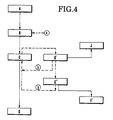
- the flow sheet in Fig. 4 is basically the same as the flow sheet in Fig. 3, but the organic solvent containing iron chloride complex, from which HCl and water (J) are removed in a primary distillation or evaporation process (G'), is distilled continuously under reduced pressure or newly distilled or evaporated in a secondary distillation or evaporation process (G") so as to separate and regenerate the organic solvent (b) and to recover anhydrous iron chloride (F') from the residue.
- Anhydrous iron chloride (F') obtained thereby may be converted into iron oxide or metallic iron by means of known methods. Since the iron chloride is obtained in an anhydrous state, its treatment is easy.
- Anhydrous iron chloride may also be converted into alkoxide by treatment with alcohol, and may be treated with ammonia gas for production of electronic material.
- the flow sheet in Fig. 5 is the same as in Fig. 1 except that, as a countermeasure when iron in the original waste sulfuric acid solution is in the state of Fe2+, the oxidation process for iron (K) is added.
- the process depends either on the addition of an oxidation agent (e) or upon electrochemical oxidation.
- the treatments thereafter are the same as in Fig. 1.
- the flow sheet in Fig. 6 is similar to the flow sheet in Fig. 2, but, as a countermeasure when the content of Fe ion in the waste sulfuric acid solution to be treated is not appropriate (one mol of Fe is necessary for 2 mols of H2SO4), the sulfuric acid solution is introduced into an iron concentration adjustment process (L), and an additive (f) - which is a material containing a relatively large amount of iron (such as iron sulfate, an industrial waste containing iron, ilmenite or anatase) when the iron concentration is low, and is waste sulfuric acid or waste hydrochloric acid whose iron content is a small when the iron concentration is relatively high - is added thereto for controlling the ratio of Fe ion and H2SO4 appropriately.
- an additive (f) - which is a material containing a relatively large amount of iron (such as iron sulfate, an industrial waste containing iron, ilmenite or anatase) when the iron concentration is low, and is waste sulfuric acid or
- the flow sheet shown in Fig. 7 relates to a process for the treatment of hydrochloric acid or nitric acid containing iron ions (A') as their main impurity.
- Sulfuric acid is added to the acid solution (A') in a transformation process (M), and HCl or HNO3 (P) is separated and recovered due to difference in the vapor pressure in a distillation or evaporating process (N).
- the resultant sulfuric acid solution containing chiefly iron ions is transferred to a chlorination process (B), where a compound comprising Na, Ca, K, Mg or NH4 together with Cl (a) is added thereto for converting Fe ions into iron chloride, and the resultant solution is introduced into an extraction process (C).
- the processes thereafter shown in Fig. 7 are the same as in the case of Fig. 4, but various processes as shown in Figs. 1, 2 and 3 may also be substituted therefor.
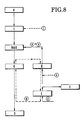
- Fig. 8 is a flow sheet similar to that shown in Fig. 1, in which however HNO3 is used as an oxidizing agent (e) for oxidizing Fe2+ ions after the Fe ion concentration is controlled in a Fe concentration control process (L). The remaining HNO3 is extracted simultaneously with iron chloride complex into the organic phase in the extraction process (C).
- HNO3 is used as an oxidizing agent (e) for oxidizing Fe2+ ions after the Fe ion concentration is controlled in a Fe concentration control process (L).
- the remaining HNO3 is extracted simultaneously with iron chloride complex into the organic phase in the extraction process (C).
- the organic solvent (b) containing iron chloride complex and HNO3 is introduced into a HNO3 recovery process (Q), where said organic phase is brought into contact with an aqueous solution containing chloridizing agent (a) (a compound of Na, NH4 or Mg together with Cl) containing FeCl3 for transferring only HNO3 in the organic solution into the aqueous phase, leaving Fe ions and Cl ions in the organic solution (b). Fe ions and Cl ions are then extracted into the aqueous phase in a subsequent re-extraction process (E).
- chloridizing agent (a) a compound of Na, NH4 or Mg together with Cl
- FeCl3 a compound of Na, NH4 or Mg together with Cl
- HNO3 transferred into the aqueous phase comprises a solution containing the chloridizing agent (a), and is introduced into an oxidizing and chloridizing process (B or K), the chloridizing agent (a) and the oxidizing agent (e) are repeatedly re-used.
- B or K oxidizing and chloridizing process
- the methods shown in Figs. 3, 4 and 7 may be used in combination.
- HNO3 with a concentration of 10% was added to the waste sulfuric acid solution so as to ensure that the concentration of HNO3 in the solution is 30%, and the resultant solution was heated to 60°C to completely convert all the Fe2+ ions present to Fe3+ ions. Then, NaCl solution was added in the amount necessary to convert the total H2SO4 sufficiently to Na2SO4.
- the extraction of the solution was carried out by using (a) 50% tributyl phosphate (TBP) + 50% isoparaffin, and (b) 20% trioctyl amine (TOA) + 10% TBP + 70% isoparaffin.
- TBP tributyl phosphate
- TOA trioctyl amine
- the analysis of the residual aqueous solution is shown in Table 3.
- Table 5 The composition of the solution after the treatment is shown in Table 5.
- Table 5 (g/l) Total H2SO4 Total HCl Total HNO3 Total Na Fe3+ Al Mn Ti4+ Cr V Nb 260 182 48.3 116 70.5 0.06 7.1 4.1 0.06 0.06 -
- the thus controlled solution was brought into contact three times with an organic solvent comprising 30% trioctylphosphine oxide (TOPO) + 70% kerosene for extracting Fe ions in the aqueous solution into the organic solvent as iron chloride complex.
- the composition of the residual aqueous solution is shown in Table 6.
- Table 6 (g/l) Total H2SO4 Total HCl Total HNO3 Total Na Total Fe Al, Mn, Ti, Cr, V, Nb 269 5.1 0.2 119 0.06 No Change
- the aqueous solution in Table 5 was brought into contact with an organic solvent comprising 35% trioctyl phosphine oxide (TOPO) + 5% 2-ethylhexyl alcohol + 60% n-paraffin countercurrently in 6 stages.
- the residual aqueous solution is shown in Table 7, and the organic solution obtained is shown in Table 8.
- a sulfuric acid solution containing Fe2(SO4)3 and NaCl with the following composition was prepared artificially: Fe3+ 39.1 g/l Cl 108.4 g/l SO4 250 g/l Na 115 g/l
- the extraction of iron chloride complex into organic solvent was done with the use of 50% tributyl phosphate + 50% isoparaffin.
- the analysis of the residual aqueous solution was as below: Fe3+ 2.1 g/l Total SO4 250 g/l Total Cl 14.8 g/l Na 115 g/l
Landscapes
- Organic Chemistry (AREA)
- Chemical & Material Sciences (AREA)
- Environmental & Geological Engineering (AREA)
- Life Sciences & Earth Sciences (AREA)
- Hydrology & Water Resources (AREA)
- Engineering & Computer Science (AREA)
- Water Supply & Treatment (AREA)
- Inorganic Chemistry (AREA)
- Extraction Or Liquid Replacement (AREA)
- Physical Water Treatments (AREA)
- Inorganic Compounds Of Heavy Metals (AREA)
- Manufacture And Refinement Of Metals (AREA)
- Catalysts (AREA)
Description
- The present invention relates to a method for neutralization of sulfuric acid which, as its main impurity, contains iron ions.
- It is commonplace to add sodium hydroxide for neutralization of sulfuric acids containing iron ions as their main impurity, such as waste sulfuric acid from surface treatments of steel products, from refining processes for non-ferrous metals and from production processes for titanium oxide that use sulfuric acid, as well as sulfuric acid obtained by distilling or evaporating hydrochloric acid or nitric acid containing iron ions to which sulfuric acid has been added. However, such a method is uneconomical, because sodium hydroxide is valuable, whereas the sodium sulfate obtained as by-product is of almost no commercial value.
- It is also known to use ammonia gas or ammonium hydroxide in some instances, but commercialization of the ammonium sulfate then obtained as a by-product is difficult, while anyway ammonium sulfate itself is cheap, and, such a method also is therefore not economical. It is possible to use Ca(OH)₂ or CaCO₃, which are cheaper than NaOH and NH₄OH, but then disposal of the solid by-product, CaSO₄·2H₂O (gypsum), is troublesome, so that the use of such a calcium compound also is not desirable.
- Thus the current situation is that factories, in which waste sulfuric acid containing iron ions is formed as by-product, are trying to find a new market for Na₂SO₄ or to develop an effective use of gypsum (CaSO₄·2H₂O). Till now, however, no effective and economical method for neutralization of waste sulfuric acid containing iron ions had yet been discovered.
- Besides the neutralization process, there is another way for the recovery and reuse of sulfuric acid solution containing Fe ions, in which the solution is subjected to evaporation under reduced pressure so as thereby to precipitate FeSO₄·7H₂O and thus to reduce the content of Fe ion in the residual solution. This method is in fact widely adopted, but since it is impossible to obtain pure sulfuric acid entirely free from Fe ion and a large amount of energy is consumed in the evaporation and concentration, this method is neither practical nor economical.
- For completeness, it may be mentioned that in United States Patent No. 4,210,502 we have disclosed an essentially-electrolytic procedure for treatment of waste acids during which at a certain stage ferric ions are extracted in the form of a chloride complex into an organic phase, but this procedure involves the use of expensive hydrochloric acid to generate relatively cheap sulfuric acid and is therefore economically unattractive.
- Against that background, it is an object of the present invention to provide an excellent and economical method for neutralization of sulfuric acids which contain iron ions as their main impurity, by means of which iron can be recovered as high purity iron oxide and/or metallic iron, thus enhancing the commercial value of the procedure, and yet without any need to use valuable NaOH, NH₃ and NH₄OH or a calcium compound such as Ca(OH)₂ and CaCO₃ (which produce troublesome gypsum (CaSO₄)₂·2H₂O), but using instead a chlorine-containing compound, for instance NaCl which is cheap and easily available or MgCl₂ which is plentifully-produced as industrial waste or CaCl₂ or NH₄Cl.
- According to this invention there is provided a method for neutralization of sulfuric acid containing Fe ions, comprising adding ions selected from the group consisting of Na ions, K ions, Mg ions, Ca ions and NH₄ ions, in the form of a compound containing chlorine, to said sulfuric acid solution containing impurities chiefly comprising iron ions, in an amount corresponding at least to the chemical equivalent to SO₄²⁻, and bringing the resultant solution into contact with an organic solvent (b) containing oxygen and/or comprising alkylamine, so as thus to extract Fe ions from said aqueous solution into the organic solvent as chloride complex.
- Although primarily concerned with the treatment of iron-contaminated waste sulfuric acid, the method of the present invention can also be advantageously used for treatment of waste Fe-contaminated hydrochloric acid and nitric acid, by adopting a preliminary procedure in which sulfuric acid is added to the Fe-containing waste acid and the resultant solution is evaporated or distilled so as to recover HCl or HNO₃ therefrom, thus transforming the residual solution to Fe-contaminated sulfuric acid, and thereafter the sulfuric acid thus obtained is treated in the same way as indicated above.
- This new procedure involves treatment of a sulfuric acid solution containing iron ions by adding thereto one or more chlorine-containing compounds which provide a source of Na ions, K ions, Mg ions, Ca ions and/or NH₄ ions, said compound(s) being added in an amount corresponding to at least the chemical equivalent of the SO₄²⁻ contained in the acid, and the resultant aqueous solution is then brought into contact with at least one organic solvent containing oxygen and/or comprising an alkylamine, so as thus to extract Fe ions from said sulfuric acid solution into the organic phase as a chloride complex.
The organic solvent containing Fe as chloride complex thus obtained is then preferably brought into contact with water to extract back iron and chlorine therefrom into the aqueous phase and regenerate the organic solvent. - Further, for increasing the inverse extraction effect, it is preferable that another organic solvent containing oxygen, for instance, an alcohol with a carbon number of 6 - 18 (primary, secondary and tertiary) is added to the organic phase before the organic phase is brought into contact with water, and then the resultant organic solution is brought into contact with water to inversely extract Fe ions and Cl ions into the aqueous phase, and the remaining organic solution is distilled or evaporated under reduced or ordinary atmospheric pressures to separate and regenerate the organic solvent added prior to the inverse extraction as the original state.
- As a modified process, the organic solvent containing iron chloride complex may be distilled or evaporated under reduced or ordinary atmospheric pressures prior to the contact with water for separating and recovering water and hydrochloric acid from the organic solution, and then the remaining organic solution is brought into contact with water to inversely extract Fe ions and Cl ions into the aqueous solution and regenerate the organic solvent.
- In the present invention, separately, after adding sulfuric acid to a hydrochloric acid solution containing chiefly Fe ions, ions selected from the group consisting of Na ions, K ions, Mg ions, Ca ions and NH₄ ions in the form of a compound containing chlorine are added in an amount corresponding at least to the chemical equivalent to SO₄²⁻, and the resultant aqueous solution can be treated with addition of at least one of oxygen-containing organic solvents or alkylamine organic solvents similarly as described in the above. Hydrochloric acid or nitric acid containing Fe ions after adding sulfuric acid may be distilled or evaporated under reduced or ordinary atmospheric pressures to separate and recover HCl or HNO₃, and then the remaining aqueous solution can also be treated in the manner herein disclosed.
- It will be seen that while no satisfactory and economical method for the neutralization of sulfuric acid containing Fe ions had been discovered in the past, the present invention provides an excellent and economical method for the neutralization thereof, and moreover one in which further refined iron hydroxide, oxide and metallic iron can be recovered.
- Particularly, taking rock salt as a typical source of the sodium chloride for use as the additive for the chloridizing process (B) as will be described hereinafter, it will be realized that rock salt is distributed widely on earth and thus not only easily obtainable but also cheap, while moreover the aqueous solution as the residual solution (D) in the extraction process (C) in this instance comprises Na₂SO₄, so that purified Glauber salt (Na₂SO₄·10H₂O) can easily be recovered therefrom with no need for evaporation and concentration. Therefore, the pollution of rivers by the waste solution can to a substantial extent be prevented by practising the present invention.
- The invention will now be described in greater detail as follows. One starts with a sulfuric acid solution contaminated chiefly with Fe ions, but possibly also with other metal ions such as Al, Mn, Cr, V, Sn and Nb and so on, which has been used for surface treatment of a metal product or a metal material, or particularly which has been discharged to waste in the production of titanium oxide by the sulfuric acid process. To this waste acid solution one adds ions selected from the group consisting of Na ions, K ions, Mg ions, Ca ions and NH₄ ions, in the form of a compound containing chlorine, and in an amount at least corresponding to the chemical equivalent of the added ions relative to the SO₄²⁻. In any case where the iron present in the sulfuric acid solution is in the Fe²⁺ state, such ions are first oxidized to Fe³⁺. The resultant aqueous phase is brought into contact with an oxygen-containing organic solvent and/or with alkylamine. Then Fe³⁺ ions in the sulfuric acid solution are extracted into the organic solvent as a chloride complex. In this way the sulfuric acid can be neutralized, for instance according to the following equations:
Fe₂(SO₄)₃ + H₂SO₄ + 8NaCl + Org. → 2HFeCl₄·Org. + 4Na₂SO₄
FeSO₄ + H₂SO₄ + 4NaClO + 7H⁺ + Org. → HFeCl₄·Org. + 2Na₂SO₄ + 4H₂O
Fe₂(SO₄)₃ + H₂SO₄ + 8KCl + Org. → 2HFeCl₄·Org. + 4K₂SO₄
Fe₂(SO₄)₃ + H₂SO₄ + 4CaCl₂ + Org. → 2HFeCl₄·Org. + 4CaSO₄
FeSO₄ + H₂SO₄ + CaCl₂·Ca(ClO)₂·2H₂O + 3H⁺ + Org. → HFeCl₄·Org. + 2[CaSO₄·2H₂O]
Fe₂(SO₄)₃ + H₂SO₄ + 4MgCl₂ + Org. → 2HFeCl₄·Org. + 4MgSO₄
Fe₂(SO₄)₃ + H₂SO₄ + 8NH₄Cl + Org. → 2HFeCl₄·Org. + 4(NH₄)₂SO₄
- From this it can be appreciated that when the content of Fe ions in the original sulfuric acid solution is small as compared with the content of SO₄ ions, it is necessary to adjust the iron concentration by adding Fe ions thereto in order to be able to neutralize H₂SO₄ sufficiently by the use of a compound comprising such a component as Na, K or NH₄ together with Cl. As a method for adjusting the iron concentration, for instance in the case of waste sulfuric acid from the production of titanium oxide, one adds materials such as ilmenite, anatase or high-titanium slag (as it stands, or after the reduction treatment) or iron-containing industrial waste (in the case when its treatment is difficult) to the waste sulfuric acid so as thereby to dissolve Fe ions therein selectively and thus to control the ratio of Fe to sulfuric acid in the solution. By dissolving out iron in the raw material with the use of waste acid in this way, the TiO₂ concentration in ilmenite, anatase or high-titanium slag is increased, thus simultaneously enhancing its value as a raw material.
- On the other hand, by bringing the organic solvent containing iron chloride complex into contact with water, the Fe ions and Cl ions as is well known are re-extracted back into the aqueous phase, and the organic solvent is regenerated according to the well known equation as shown below:

- Furthermore, before bringing the organic solvent containing the extracted iron chloride complex into contact with water, an oxygen-containing organic solvent with which a large quantity of water can be extracted, such as an alcohol (primary, secondary and tertiary) with a carbon number of 6 - 18 is added so as to increase the re-extraction efficiency, and then the resultant organic solution is brought into contact with water for re-extracting the Fe ions and Cl ions in the organic solution back into the aqueous phase, and the remaining organic solution is distilled or evaporated off under reduced or ordinary atmospheric pressures, so as thereby to separate the oxygen-containing organic solvent added to the organic solution prior to the re-extraction (for instance alcohol) and thus regenerate the original organic solvent back to its original state.
- The organic phase containing iron chloride complex is then further subjected to distillation or evaporation under reduced or ordinary atmospheric pressures, so as to recover HCl and H₂O therefrom according to the following equation:

- The remaining organic phase is then subjected to re-extraction in contact with water as follows:

In this situation, since the back-extracted aqueous phase contains no HCl, one can obtain a concentrated FeCl₃ solution, and accordingly the production of iron hydroxide and oxide from the FeCl₃ thus transferred into the aqueous phase can be economically achieved. - Alternatively, the distillation of the organic phase containing the iron chloride complex may be carried further under reduced pressure so as to distil off and recover the organic solvent, leaving FeCl₃ as an anhydrous solid, as shown below:

The recovered organic solvent can be recycled for re-use in the extraction of iron chloride complex. Furthermore, in this instance, since the FeCl₃ contains no water of crystallization, its recovery as iron oxide or metallic iron can be easily achieved as follows:
FeCl₃ + 3/4 O₂ → 1/2 Fe₂O₃ + 1.5Cl₂↑
FeCl₃ + 1.5H₂O → 1/2 Fe₂O₃ + 3HCl↑
FeCl₃ + 1.5H₂ → Fe + 3HCl↑
The thus-recovered FeCl₃ may also be employed for the production of various alkoxides, as in the following equation:
FeCl₃ + 3ROH + 3NH₃ → Fe(OR)₃ + 3NH₄Cl
where ROH indicates an alcohol. - The recovery of iron in this way, as an optional procedure in the present invention, can be achieved in various different ways. Thus, according to practical needs, it is possible freely to choose the production of iron hydroxide, of iron oxide, of iron chloride (solid), of iron alkoxide or of metallic iron.
- The compound containing Na and Cl used in the present invention will typically be NaCl, chiefly in the form of rock salt, but such compounds as NaClO and NaClO₃ may also be used. The compound containing Ca and Cl will typically be CaCl₂ (exhausted in large quantity as industrial waste) but such compounds as CaCl₂·Ca(ClO)₂ may also be used. Further, NH₄Cl and MgCl₂ may also be used.
- For the oxidation of Fe²⁺ ions in the sulfuric acid solution into Fe³⁺ ions, a compound such as sodium hypochlorite (NaClO) or calcium chloride-hypochlorite (CaCl₂·Ca(ClO)₂) can be used. Further, NOx-type oxidizing agents such as HNO₃, NaNO₃, NH₄NO₃ and NOx gas may also be employed.
- When Fe²⁺ ions are oxidized to Fe³⁺ ions with HNO₃, then HNO₃ is extracted into the organic phase together with the iron chloride complex (HNO₃ + Org. → HNO₃·Org.) and this co-extracted HNO₃ is brought into contact with an aqueous solution containing NaCl prior to the re-extraction of Fe ions and Cl ions, in order thereby to back-extract HNO₃ into the aqueous solution, leaving Fe ions and Cl ions in the organic solvent. (HNO₃·Org + NaCl → Org. + NaNO₃ + HCl)
- HCl remaining in the aqueous solution helps to improve the extraction distribution ratio of the iron chloride complex, so that Fe ions and Cl ions co-present with HNO₃ remain in the organic phase. Meanwhile the back-extracted HNO₃ is re-used for the oxidation of Fe²⁺ ions.
- The oxygen-containing organic solvent and/or alkylamine used in the present invention is selected from the following groups:
- (a) The group of ethers:
Ethers to be used as an oxygen-containing organic solvent in the present invention are selected from the group consisting of saturated and unsaturated aliphatic and aromatic ethers, for instance diisoamyl ether, diethyl ether, diisopropyl ether, dichlorodiethyl ether and so on. - (b) The group of ketones:

- (c) The group of esters:
The group of phosphoric acid esters selected from the group consisting of the following types:
- (d) The group of amides:

- (e) The group of alcohols:
Various primary, secondary and tertiary alcohols with a carbon number of 4 to 18. - (f) The group of alkylamines:
Various primary, secondary and tertiary alkylamines with a carbon number in the alkyl group of 4 to 24. - When using an organic solvent having a high degree of basicity, such as alkylphosphineoxide, the amount of Cl ions extracted together with Fe ions is very often three times Fe ions (in terms of the molar ratio) according to the following reaction:
Fe₂(SO₄)₃ + 6NaCl + n·Org. → 2FeCl₃·n·Org. + 3Na₂SO₄
Therefore, when such highly basic extractants are used, it is necessary to add Fe-containing solid or liquid so as to ensure that the molar ratio of Fe ions to the sum of SO₄ combined with Fe and free SO₄ approaches the maximum ratio (about 0.66). Needless to say, at plants where titanium oxides are produced it is possible to adjust the molar ratio of Fe ions by adding titanium materials, such as anatase and ilmenite, iron sulfate or wastes containing Fe and Ti. - In the present invention, the organic solvent used for the extraction of iron chloride is sometimes diluted with a petroleum hydrocarbon comprising aliphatic and aromatic hydrocarbons or a mixture thereof. A mixture of various hydrocarbons such as kerosene is also frequently used.
- In order that the invention may be still better understood it will now be further described with reference to the accompanying drawings, in which:
- Fig. 1 is a flow sheet showing a basic-type process of the present invention. Figs. 2, 3 and 4 are respectively a flow sheet showing a basic-type process for re-extracting iron chloride from the organic solvent containing iron chloride complex previously extracted thereinto. Fig. 5 is a flow sheet in which the oxidation process of Fe²⁺ ion (K) is inserted in the basic-type process shown in Fig. 1. Fig. 6 is to show a process of controlling Fe ion concentration (L) in the waste sulfuric acid solution, in which the treatments as shown in Figs. 1, 3 and 4 may be applied in the process of extracting iron chloride complex (L) and thereafter. Fig. 7 is a flow sheet in which a process of transforming hydrochloric acid or nitric acid solution into sulfuric acid solution (M) is included. Fig. 8 is a flow sheet similar to Fig. 6, in which however HNO₃ is used as an oxidation agent (e) for oxidizing Fe²⁺ ion after the Fe ion concentration is adjusted in the Fe concentration control process (L).
- Preferred embodiments of the present invention will now be described in detail, with reference to the drawings, showing non-limiting examples of the process of the present invention.
- The flow sheet in Fig. 1 shows the basic procedure of the present method, in which a sulfuric acid solution containing Fe ions (A) is introduced into a chloridizing process (B), where a compound that comprises Na and Cl, Ca and Cl, K and Cl, Mg and Cl or NH₄ and Cl (a) is added thereto so as to convert Fe ions into chloride, and the resultant solution is introduced into an extraction process (C), where the aqueous phase is brought into contact with at least one oxygen-containing organic solvent and/or alkylamine (b) in order to extract Fe ions from the aqueous phase into the organic phase as chloride complex, leaving a residual aqueous solution (D) in which sulfuric acid is neutralized.
- On the other hand, iron chloride complex transferred into the organic phase is brought into contact with water (c) in a re-extracting process (E) for inversely extracting Fe ions and Cl ions in the organic phase back into an aqueous solution (F) and regenerating the oxygen-containing and/or alkylamine-comprising organic solvent (b).
- The back-extracted aqueous phase comprises iron chloride solution (F) with no contamination by impurities such as sulfate, so that iron hydroxide can easily be obtained therefrom by double decomposition using cheap Ca(OH)₂, leaving CaCl₂ solution with no formation of precipitates such as gypsum, and iron oxide and metallic iron can easily be obtained therefrom for such uses as electronic material and pigment.
- The flow sheet in Fig. 2 is basically same as in Fig. 1, but in order to carry out the extraction of iron in the extraction process (C) more completely, another oxygen-containing organic solvent (d) whose boiling point is lower than that of the former oxygen-containing organic solvent (b) is added in a mixing process (H), and then the resultant organic phase is brought into contact with water in the re-extraction process (E) for inversely extracting Fe ions present together with Cl ions in the organic phase back into the aqueous phase. After inverse extraction, the organic phase is transferred into the next evaporation or distillation process (G) for separating the low boiling point organic solvent (d) added prior to the inverse extraction and regenerating the original organic solvent (b).
- The flow sheet of Fig. 3 is same as that of Figs. 1 and 2 to the extent that sulfuric acid containing Fe is first subjected to neutralization treatment, but the method for re-extracting the oxygen-containing organic solvent (b) containing extracted iron chloride complex differs therefrom. The organic solvent containing iron chloride complex is next introduced into a distillation or evaporation process (G') so as to separate and recover HCl (J) together with physically-contained and extracted water. A part of the organic solvent is also separated therewith. FeCl₃ is concentrated in the organic solvent (b), and the organic solution is contacted with water (c) in a re-extraction process (E) for inversely extracting Fe ions and Cl ions (F) into the aqueous solution. The merit of this procedure is that it improves the effectiveness of the re-extraction due to the separation of HCl together with water prior to the re-extraction for controlling the formation of iron chloride complex.
- The flow sheet in Fig. 4 is basically the same as the flow sheet in Fig. 3, but the organic solvent containing iron chloride complex, from which HCl and water (J) are removed in a primary distillation or evaporation process (G'), is distilled continuously under reduced pressure or newly distilled or evaporated in a secondary distillation or evaporation process (G") so as to separate and regenerate the organic solvent (b) and to recover anhydrous iron chloride (F') from the residue. Anhydrous iron chloride (F') obtained thereby may be converted into iron oxide or metallic iron by means of known methods. Since the iron chloride is obtained in an anhydrous state, its treatment is easy. Anhydrous iron chloride may also be converted into alkoxide by treatment with alcohol, and may be treated with ammonia gas for production of electronic material.
- The flow sheet in Fig. 5 is the same as in Fig. 1 except that, as a countermeasure when iron in the original waste sulfuric acid solution is in the state of Fe²⁺, the oxidation process for iron (K) is added. The process depends either on the addition of an oxidation agent (e) or upon electrochemical oxidation. The treatments thereafter are the same as in Fig. 1.
- The flow sheet in Fig. 6 is similar to the flow sheet in Fig. 2, but, as a countermeasure when the content of Fe ion in the waste sulfuric acid solution to be treated is not appropriate (one mol of Fe is necessary for 2 mols of H₂SO₄), the sulfuric acid solution is introduced into an iron concentration adjustment process (L), and an additive (f) - which is a material containing a relatively large amount of iron (such as iron sulfate, an industrial waste containing iron, ilmenite or anatase) when the iron concentration is low, and is waste sulfuric acid or waste hydrochloric acid whose iron content is a small when the iron concentration is relatively high - is added thereto for controlling the ratio of Fe ion and H₂SO₄ appropriately.
- In the subsequent oxidation process (K), Fe²⁺ ions in the solution are transformed into Fe³⁺ ions by the addition of an oxidizing agent (e). The treatments thereafter shown in Fig. 6 are same as in Fig. 2, but for the processes of re-extraction and thereafter it is also possible to employ various processes as shown in Fig. 1, 3 and 4.
- The flow sheet shown in Fig. 7 relates to a process for the treatment of hydrochloric acid or nitric acid containing iron ions (A') as their main impurity. Sulfuric acid is added to the acid solution (A') in a transformation process (M), and HCl or HNO₃ (P) is separated and recovered due to difference in the vapor pressure in a distillation or evaporating process (N). The resultant sulfuric acid solution containing chiefly iron ions is transferred to a chlorination process (B), where a compound comprising Na, Ca, K, Mg or NH₄ together with Cl (a) is added thereto for converting Fe ions into iron chloride, and the resultant solution is introduced into an extraction process (C). The processes thereafter shown in Fig. 7 are the same as in the case of Fig. 4, but various processes as shown in Figs. 1, 2 and 3 may also be substituted therefor.
- Fig. 8 is a flow sheet similar to that shown in Fig. 1, in which however HNO₃ is used as an oxidizing agent (e) for oxidizing Fe²⁺ ions after the Fe ion concentration is controlled in a Fe concentration control process (L). The remaining HNO₃ is extracted simultaneously with iron chloride complex into the organic phase in the extraction process (C). Then, the organic solvent (b) containing iron chloride complex and HNO₃ is introduced into a HNO₃ recovery process (Q), where said organic phase is brought into contact with an aqueous solution containing chloridizing agent (a) (a compound of Na, NH₄ or Mg together with Cl) containing FeCl₃ for transferring only HNO₃ in the organic solution into the aqueous phase, leaving Fe ions and Cl ions in the organic solution (b). Fe ions and Cl ions are then extracted into the aqueous phase in a subsequent re-extraction process (E). HNO₃ transferred into the aqueous phase comprises a solution containing the chloridizing agent (a), and is introduced into an oxidizing and chloridizing process (B or K), the chloridizing agent (a) and the oxidizing agent (e) are repeatedly re-used. As the further processes, the methods shown in Figs. 3, 4 and 7 may be used in combination.
- The present invention will now be explained in still more detail with reference to the following examples.
- As a typical waste sulfuric acid solution containing Fe ions, waste sulfuric acid discharged during the production of titanium oxide by a sulfuric acid method was adopted. Its composition is shown in Table 1 below.
Table 1 (g/l) Total H₂SO₄ Fe²⁺ Fe³⁺ Al Mn Ti V Cr Nb 380 33.5 Trace Trace 7.8 2.8 0.1 0.1 0.01 - HNO₃ with a concentration of 10% was added to the waste sulfuric acid solution so as to ensure that the concentration of HNO₃ in the solution is 30%, and the resultant solution was heated to 60°C to completely convert all the Fe²⁺ ions present to Fe³⁺ ions. Then, NaCl solution was added in the amount necessary to convert the total H₂SO₄ sufficiently to Na₂SO₄. The composition of the resultant solution is shown in Table 2.
Table 2 (g/l) Fe³⁺ Fe²⁺ Total H₂SO₄ Total HCl Total Na Total HNO₃ Al, Mn, Ti, V, Cr, Nb 22.1 <0.1 248 175 115 15.1 Minute Quantities - The extraction of the solution was carried out by using (a) 50% tributyl phosphate (TBP) + 50% isoparaffin, and (b) 20% trioctyl amine (TOA) + 10% TBP + 70% isoparaffin. The conditions employed in the extraction were as follows: the ratio of organic solvent to sulfuric acid solution (O/A ratio) = 1.2/1, extraction time: 20 minutes, and temperature: room temperature. The analysis of the residual aqueous solution is shown in Table 3.
Table 3 (g/l) Solvent Fe³⁺ Fe²⁺ Total H₂SO₄ Total HCl Total Na Total HNO₃ Al, Mn, Ti, V, Cr, Nb (a) 0.04 <0.001 248 120 115 15.1 No Change (b) <0.001 0.08 246 110 115 15.1 No Change - These two solutions were respectively subjected to heating under a reduced pressure (-600 mm Hg) (-0.8 bar) so as to remove HCl and HNO₃, and as a result, it was confirmed that both the amounts of HCl and HNO₃ were reduced to less than 10 g/l, and all the sulfuric acid was neutralized to Na₂SO₄ due to the effect of Na ion added.
- To 1 liter of sulfuric acid solution shown in Table 1, rock salt was added in an amount corresponding to the chemical equivalent of the SO₄ present (430 g). At 70°C, ilmenite with the composition shown in Table 4 and a particle size of less than -100 Tyler standard mesh (-0.147 mm) and 2 mol/l HNO₃ were added alternately thereto, and the addition of HNO₃ was stopped when the concentration of HNO₃ in the solution became about 50%. The addition of ilmenite was continued until the ratio of Fe and sulfuric acid in the solution became 0.95 mol : 2 mol.
Table 4 (wt. %) Total TiO₂ FeO Fe₂O₃ Al₂O₃ MnO Cr₂O₃ 52.18 27.86 10.18 0.33 5.96 0.015 - The composition of the solution after the treatment is shown in Table 5.
Table 5 (g/l) Total H₂SO₄ Total HCl Total HNO₃ Total Na Fe³⁺ Al Mn Ti⁴⁺ Cr V Nb 260 182 48.3 116 70.5 0.06 7.1 4.1 0.06 0.06 - - The thus controlled solution was brought into contact three times with an organic solvent comprising 30% trioctylphosphine oxide (TOPO) + 70% kerosene for extracting Fe ions in the aqueous solution into the organic solvent as iron chloride complex. The extracting conditions in each case was O/A (Org./Aq.) = 5.0/1.0 by volume with the contact time of 5 minutes at 32°C. The composition of the residual aqueous solution is shown in Table 6.
Table 6 (g/l) Total H₂SO₄ Total HCl Total HNO₃ Total Na Total Fe Al, Mn, Ti, Cr, V, Nb 269 5.1 0.2 119 0.06 No Change - It was proved that the residual solution was completely neutralized, and Na₂SO₄·10H₂O was precipitated on cooling.
- Re-extraction of iron chloride complex extracted in the oxygen-containing organic solvent into the aqueous phase was carried out with the use of water.
- At first, the aqueous solution in Table 5 was brought into contact with an organic solvent comprising 35% trioctyl phosphine oxide (TOPO) + 5% 2-ethylhexyl alcohol + 60% n-paraffin countercurrently in 6 stages. The extraction condition was O/A = 2.0/1.0 by volume with a contact time of 5 minutes at 32°C. The residual aqueous solution is shown in Table 7, and the organic solution obtained is shown in Table 8.
Table 7 (g/l) Total H₂SO₄ Total HCl Total HNO₃ Total Na Total Fe Al, Mn, Ti, Cr, V, Nb 261 5.2 0.1 116 <0.01 No Change Table 8 (g/l) Total H₂SO₄ Total HCl Total HNO₃ Total Na Total Fe Al, Mn, Ti, Cr, V, Nb Trace 88.3 24.1 Trace 35.2 Trace - The organic solution in Table 8 as it stands (OA) and a sample obtained by adding 0.15 vol.% of 2-ethylhexyl alcohol thereto (OB) were respectively brought into contact with water for the inverse extraction test. The treating condition was OA/A = 1.0/1.4 by volume and OB/A = 1.15/1.4 by volume with the contact time of 5 minutes at 40°C countercurrently in 4 stages. The result is as shown in Table 9.
Table 9 (g/l) Starting Organic Solution Solution After Treatment Fe³⁺ Cl No 2-ethylhexyl Alcohol Organic 10.4 26.0 Aqueous 17.7 44.4 With 2-ethylhexyl Alcohol Organic 0.6 1.5 Aqueous 25.1 62.7 - A sulfuric acid solution containing Fe₂(SO₄)₃ and NaCl with the following composition was prepared artificially:
Fe³⁺ 39.1 g/l Cl 108.4 g/l SO₄ 250 g/l Na 115 g/l - The extraction of iron chloride complex into organic solvent was done with the use of 50% tributyl phosphate + 50% isoparaffin. The extraction condition was as follows: the ratio of organic solvent to sulfuric acid solution (O/A ratio) = 1.4/1 by volume, extraction time: 20 minutes, and temperature: room temperature. The analysis of the residual aqueous solution was as below:
Fe³⁺ 2.1 g/l Total SO₄ 250 g/l Total Cl 14.8 g/l Na 115 g/l - The contents of Fe, Cl and H₂O in the organic phase in the above extraction experiment was as below:
Fe 28.1 g/l Cl 70.5 g/l H₂O 36.3 g/l - 200 ml of said organic phase was distilled at 28 - 35°C under a reduced pressure of 3 torrs (400 Pa) until the volume of the bottom solution reaches 48 ml. The analysis of the result was as follows:
Bottom solution Volume 48 ml Fe 117.1 g/l Cl 220.3 g/l Distillate (-80°C) Total volume 152 ml Volume of organic solvent 116 ml Volume of HCl solution 36 ml Concentration of HCl 101 g/l - Back extraction was done by bringing water into contact with the organic phase remaining at the bottom part in the above distillation experiment under agitation. The extraction condition was as follows: O/A = 1/3 by volume, time of agitation: 10 minutes and temperature: room temperature.
Organic phase Aqueous phase Fe 1.4 g/l 151.1 g/l HCl 2.7 g/l 292.5 g/l - Very excellent results could be obtained as compared with the case where no distillation of the organic phase was performed.
- Instead of subjecting the bottom solution of the organic phase in the above mentioned distillation experiment to back extraction, it is in this case subjected to further distillation up to a temperature in the range from 85 to 90°C under a reduced pressure of 3 torrs (400 Pa), and in this way anhydrous FeCl₃ was obtained, with the analytical value as shown below.
Weight 16.3 g Fe 34.3 % Cl 65.0 % Organic solvent 0.6 % Water 0.0 %
Claims (10)
- A method for neutralization of sulfuric acid containing Fe ions, comprising adding ions selected from the group consisting of Ha ions, K ions, Mg ions, Ca ions and NH₄ ions in the form of a compound containing chlorine to a sulfuric acid solution containing impurities comprising chiefly iron ions in an amount corresponding at least to the chemical equivalent to SO₄²⁻, and bringing the resultant solution into contact with an organic solvent (b) containing oxygen and/or comprising alkylamine to extract Fe ions from said aqueous solution into the organic solvent as chloride complex.
- A method according to claim 1, in which the sulfuric acid to be treated is one obtained by adding sulfuric acid to a hydrochloric acid or nitric acid solution containing impurities chiefly comprising Fe ions and distilling or evaporating the resultant solution under reduced or ordinary atmospheric pressure to remove HCl or NHO₃.
- A method according to claim 1 or 2, in which the compound containing chlorine to be added to the sulfuric acid solution comprises rock salt.
- A method according to claim 1, 2 or 3, in which an oxidizing agent is added to the sulfuric acid solution to be treated prior to the extraction of iron ions therefrom into the organic solvent when the iron ions contained are in the state of Fe²⁺ to oxidize said Fe²⁺ ions to Fe³⁺ ions electrochemically.
- A method according to any one of claims 1 to 4, in which another oxygen-containing organic solvent (d) is added newly to the organic solvent (b) containing iron chloride complex, the resultant organic solution is brought into contact with water to inversely extract Fe ions and Cl ions into the water, and then the remaining organic solution is distilled or evaporated under reduced or ordinary atmospheric pressure to separate the oxygen-containing organic solvent (d) added prior to the inverse extraction and regenerate the organic solvent (b).
- A method according to any one of claims 1 to 4, in which, after distilling or evaporating the organic solvent containing iron chloride complex under reduced or ordinary pressure for separating and recovering hydrochloric acid and water, the remaining organic solution is brought into contact with water to inversely recover iron chloride and regenerate the organic solvent.
- A method according to any one of the preceding claims, in which when the molar ratio of Fe ions contained in the sulfuric acid solution relative to the sum of SO₄ ions combined with Fe ions and free SO₄ ions is less than 0.66:1, a solution or solid containing iron is added to the sulfuric acid solution.
- A method according to claim 4, in which the oxidizing agent to be added to the sulfuric acid solution is HNO₃.
- A method according to any one of the preceding claims, in which the solution remaining after extracting the Fe ions from the aqueous solution into the organic solvent is distilled or evaporated under reduced pressure to recover HCl or HNO₃.
- A process according to claim 8, in which the organic solvent into which the iron chloride complex and HNO₃ have been extracted is brought into contact with an aqueous solution containing at least one chlorine-containing compound which also contains Na, Mg and/or NH₄ ions(s) serving as chloridizing agent together with ferric chloride so as thereby selectively to transfer HNO₃ into the aqueous solution.
Applications Claiming Priority (4)
| Application Number | Priority Date | Filing Date | Title |
|---|---|---|---|
| JP16084987 | 1987-06-30 | ||
| JP160849/87 | 1987-06-30 | ||
| JP22853987 | 1987-09-14 | ||
| JP228539/87 | 1987-09-14 |
Publications (2)
| Publication Number | Publication Date |
|---|---|
| EP0301700A1 EP0301700A1 (en) | 1989-02-01 |
| EP0301700B1 true EP0301700B1 (en) | 1993-06-09 |
Family
ID=26487210
Family Applications (1)
| Application Number | Title | Priority Date | Filing Date |
|---|---|---|---|
| EP88305745A Expired - Lifetime EP0301700B1 (en) | 1987-06-30 | 1988-06-22 | Neutralization of sulfuric acid containing iron ions |
Country Status (11)
| Country | Link |
|---|---|
| US (1) | US4952378A (en) |
| EP (1) | EP0301700B1 (en) |
| JP (1) | JP2702158B2 (en) |
| KR (1) | KR890000355A (en) |
| AU (1) | AU606695B2 (en) |
| BR (1) | BR8803225A (en) |
| CA (1) | CA1303815C (en) |
| DE (1) | DE3881599T2 (en) |
| ES (1) | ES2040857T3 (en) |
| FI (1) | FI85723C (en) |
| NO (1) | NO882765L (en) |
Families Citing this family (11)
| Publication number | Priority date | Publication date | Assignee | Title |
|---|---|---|---|---|
| EP0298763A3 (en) * | 1987-07-08 | 1990-01-10 | Solex Research Corporation of Japan | Method for recovering titanium |
| US5061460A (en) * | 1988-08-19 | 1991-10-29 | Solex Research Corporation Of Japan | Method for manufacturing titanium oxide |
| JPH0254729A (en) * | 1988-08-19 | 1990-02-23 | Nishimura Watanabe Chiyuushiyutsu Kenkyusho:Kk | Method for neutralizing sulfuric acid containing Zn ions |
| JP2968877B2 (en) * | 1991-11-08 | 1999-11-02 | 日鉄鉱業株式会社 | Method for recovering sulfuric acid from waste sulfuric acid containing metal sulfate |
| US20020005210A1 (en) * | 2000-01-05 | 2002-01-17 | Olsen Douglas R. | Regenerating spent pickling liquor |
| EP1522522B2 (en) * | 2003-10-06 | 2012-03-07 | Kerr-McGee Pigments GmbH | Method for the processing of iron-contaminated waste sulphuric acid |
| RU2404929C2 (en) * | 2008-11-10 | 2010-11-27 | Открытое акционерное общество "Магнитогорский металлургический комбинат" | Ecologically clean iron vitriol neutraliser and method of using said neutraliser |
| CN102502880B (en) * | 2011-08-23 | 2016-06-22 | 青岛三友科技有限公司 | Utilize the method that acid-washing waste acid produces iron series water purifier |
| JP6206518B2 (en) * | 2016-02-17 | 2017-10-04 | 住友金属鉱山株式会社 | Neutralization treatment method, nickel oxide ore hydrometallurgy method |
| KR102045523B1 (en) | 2016-11-09 | 2019-11-18 | 주식회사 엘지화학 | Process for purifiying waste hydrochloric acid |
| CN112661196A (en) * | 2020-12-29 | 2021-04-16 | 斯瑞尔环境科技股份有限公司 | Purification method of ferric trichloride |
Family Cites Families (4)
| Publication number | Priority date | Publication date | Assignee | Title |
|---|---|---|---|---|
| US4210502A (en) * | 1976-03-09 | 1980-07-01 | Solex Research Corporation Of Japan | Process for recovery of waste H2 SO4 and HCl |
| JPS59162108A (en) * | 1983-03-03 | 1984-09-13 | Tadao Nagai | Washing of solution of sulfuric acid |
| JPS6050128A (en) * | 1983-08-25 | 1985-03-19 | Daihachi Kagaku Kogyosho:Kk | Extracting method of iron (iii) from aqueous solution and reverse extracting method of iron (iii) from extracting solvent |
| GB8504819D0 (en) * | 1985-02-25 | 1985-03-27 | Ici Plc | Extraction of metal values |
-
1988
- 1988-06-15 CA CA000569566A patent/CA1303815C/en not_active Expired - Fee Related
- 1988-06-22 ES ES198888305745T patent/ES2040857T3/en not_active Expired - Lifetime
- 1988-06-22 EP EP88305745A patent/EP0301700B1/en not_active Expired - Lifetime
- 1988-06-22 NO NO88882765A patent/NO882765L/en unknown
- 1988-06-22 DE DE88305745T patent/DE3881599T2/en not_active Expired - Fee Related
- 1988-06-23 AU AU18297/88A patent/AU606695B2/en not_active Ceased
- 1988-06-23 JP JP63155929A patent/JP2702158B2/en not_active Expired - Lifetime
- 1988-06-28 US US07/212,439 patent/US4952378A/en not_active Expired - Fee Related
- 1988-06-29 FI FI883107A patent/FI85723C/en not_active IP Right Cessation
- 1988-06-29 BR BR8803225A patent/BR8803225A/en unknown
- 1988-06-30 KR KR1019880008083A patent/KR890000355A/en not_active Withdrawn
Non-Patent Citations (4)
| Title |
|---|
| CHEMICAL ABSTRACTS, volume 107, no. 8, 24 August 1987, page 324, abstract 64190x; L. SANTORO et al.: "Limestone neutralization of acid waters in the presence of surface precipitates"; & WATER RES., volume 21, no. 6, 1987, pages 641-647 (cat. A) * |
| CHEMICAL ABSTRACTS, volume 84, no. 20, 17th May 1976, page 340, abstract 140493x; T. KAWANISHI et al.: "Neutralization of waste water containing sulfuric and sulfurous acids with lime stone"; & JP-A-75 156 266 * |
| CHEMICAL ABSTRACTS, volume 99, no. 4, 25th July 1983, page 302, abstract 27449j; J. STURC et al.: "New technology for neutralization of spent sulfate pickling baths"; & HUTN. LISTY, volume 38, no. 4, 1983, pages 268-275 * |
| PATENT ABSTRACTS OF JAPAN, volume 4, no. 174 (C-33)(656) 2nd December 1980; & JP-A-55 116 489 (SUMITOMO KINZOKU KOGYO K.K.) 08-09-1980 * |
Also Published As
| Publication number | Publication date |
|---|---|
| JP2702158B2 (en) | 1998-01-21 |
| AU606695B2 (en) | 1991-02-14 |
| EP0301700A1 (en) | 1989-02-01 |
| CA1303815C (en) | 1992-06-23 |
| BR8803225A (en) | 1990-02-06 |
| FI85723C (en) | 1992-05-25 |
| FI85723B (en) | 1992-02-14 |
| AU1829788A (en) | 1989-01-19 |
| FI883107L (en) | 1988-12-31 |
| KR890000355A (en) | 1989-03-14 |
| FI883107A0 (en) | 1988-06-29 |
| US4952378A (en) | 1990-08-28 |
| ES2040857T3 (en) | 1993-11-01 |
| NO882765D0 (en) | 1988-06-22 |
| JPH01157421A (en) | 1989-06-20 |
| DE3881599D1 (en) | 1993-07-15 |
| NO882765L (en) | 1989-01-02 |
| DE3881599T2 (en) | 1994-01-20 |
Similar Documents
| Publication | Publication Date | Title |
|---|---|---|
| US7282187B1 (en) | Recovery of metal values | |
| US4193968A (en) | Process for recovering gallium | |
| US5078786A (en) | Process for recovering metal values from jarosite solids | |
| EP0301700A1 (en) | Neutralization of sulfuric acid containing iron ions | |
| EP0052354B1 (en) | Process for preparing metals from their fluorine-containing compounds | |
| CA1073216A (en) | Method of separating zinc and copper from aqueous solutions | |
| US4565675A (en) | Process for treating and recovering pickling waste liquids for stainless steel | |
| US4241027A (en) | Reductive stripping process for the recovery of either or both uranium and vanadium | |
| DE102017221268A1 (en) | Process for producing lithium hydroxide from lithiated ore by means of chlorination and chloralkali process | |
| EP0356132B1 (en) | A method for manufacturing titanium oxide | |
| DD298001A5 (en) | METHOD OF OBTAINING OXID Uranium | |
| US3880980A (en) | Recovery of uranium from HCl digested phosphate rock solution | |
| Avila Rodriguez et al. | Recovery of Indium (III) from Mixed Hydrochloric Acid-Sulphuric Acid Media by Solvent Extraction with Cyanex 301® | |
| US3310374A (en) | Process for removing iron from phosphoric acid | |
| DE69501955T2 (en) | METHOD FOR THE EXTRACTION OF METALS FROM METAL CONTAINING MATERIALS BY PYROHYDROLYSIS | |
| EP0298763A2 (en) | Method for recovering titanium | |
| US4166098A (en) | Process for treating an acid waste liquid | |
| US4150092A (en) | Process for recovering vanadium values from acidic chloride solutions | |
| US4992248A (en) | Method for neutralizing sulfuric acid containing zinc ion | |
| JPS63235435A (en) | Manufacture of metallic tantalum | |
| JPS5815039A (en) | Production of high purity iron oxide | |
| JPH0225841B2 (en) | ||
| DE2126175A1 (en) | Extraction of metals from the seabed | |
| EP0132073A2 (en) | Process for producing metallic niobium or metallic tantalum | |
| JPS6114128A (en) | Method for recovering gallium from dust generated by electrolyzing aluminum |
Legal Events
| Date | Code | Title | Description |
|---|---|---|---|
| PUAI | Public reference made under article 153(3) epc to a published international application that has entered the european phase |
Free format text: ORIGINAL CODE: 0009012 |
|
| AK | Designated contracting states |
Kind code of ref document: A1 Designated state(s): BE DE ES FR GB IT NL SE |
|
| 17P | Request for examination filed |
Effective date: 19890717 |
|
| 17Q | First examination report despatched |
Effective date: 19910905 |
|
| GRAA | (expected) grant |
Free format text: ORIGINAL CODE: 0009210 |
|
| AK | Designated contracting states |
Kind code of ref document: B1 Designated state(s): BE DE ES FR GB IT NL SE |
|
| PG25 | Lapsed in a contracting state [announced via postgrant information from national office to epo] |
Ref country code: IT Free format text: LAPSE BECAUSE OF FAILURE TO SUBMIT A TRANSLATION OF THE DESCRIPTION OR TO PAY THE FEE WITHIN THE PRE;WARNING: LAPSES OF ITALIAN PATENTS WITH EFFECTIVE DATE BEFORE 2007 MAY HAVE OCCURRED AT ANY TIME BEFORE 2007. THE CORRECT EFFECTIVE DATE MAY BE DIFFERENT FROM THE ONE RECORDED.SCRIBED TIME-LIMIT Effective date: 19930609 Ref country code: NL Effective date: 19930609 Ref country code: BE Effective date: 19930609 Ref country code: SE Effective date: 19930609 |
|
| PGFP | Annual fee paid to national office [announced via postgrant information from national office to epo] |
Ref country code: ES Payment date: 19930621 Year of fee payment: 6 |
|
| PGFP | Annual fee paid to national office [announced via postgrant information from national office to epo] |
Ref country code: FR Payment date: 19930625 Year of fee payment: 6 |
|
| REF | Corresponds to: |
Ref document number: 3881599 Country of ref document: DE Date of ref document: 19930715 |
|
| ET | Fr: translation filed | ||
| PGFP | Annual fee paid to national office [announced via postgrant information from national office to epo] |
Ref country code: DE Payment date: 19930830 Year of fee payment: 6 |
|
| REG | Reference to a national code |
Ref country code: ES Ref legal event code: FG2A Ref document number: 2040857 Country of ref document: ES Kind code of ref document: T3 |
|
| NLV1 | Nl: lapsed or annulled due to failure to fulfill the requirements of art. 29p and 29m of the patents act | ||
| PLBE | No opposition filed within time limit |
Free format text: ORIGINAL CODE: 0009261 |
|
| STAA | Information on the status of an ep patent application or granted ep patent |
Free format text: STATUS: NO OPPOSITION FILED WITHIN TIME LIMIT |
|
| 26N | No opposition filed | ||
| PGFP | Annual fee paid to national office [announced via postgrant information from national office to epo] |
Ref country code: GB Payment date: 19940614 Year of fee payment: 7 |
|
| PG25 | Lapsed in a contracting state [announced via postgrant information from national office to epo] |
Ref country code: ES Free format text: LAPSE BECAUSE OF THE APPLICANT RENOUNCES Effective date: 19940623 |
|
| PG25 | Lapsed in a contracting state [announced via postgrant information from national office to epo] |
Ref country code: FR Effective date: 19950228 |
|
| PG25 | Lapsed in a contracting state [announced via postgrant information from national office to epo] |
Ref country code: DE Effective date: 19950301 |
|
| REG | Reference to a national code |
Ref country code: FR Ref legal event code: ST |
|
| PG25 | Lapsed in a contracting state [announced via postgrant information from national office to epo] |
Ref country code: GB Effective date: 19950622 |
|
| GBPC | Gb: european patent ceased through non-payment of renewal fee |
Effective date: 19950622 |
|
| REG | Reference to a national code |
Ref country code: ES Ref legal event code: FD2A Effective date: 19991007 |