EP0301516B1 - Dental adhesive composition - Google Patents
Dental adhesive composition Download PDFInfo
- Publication number
- EP0301516B1 EP0301516B1 EP88112155A EP88112155A EP0301516B1 EP 0301516 B1 EP0301516 B1 EP 0301516B1 EP 88112155 A EP88112155 A EP 88112155A EP 88112155 A EP88112155 A EP 88112155A EP 0301516 B1 EP0301516 B1 EP 0301516B1
- Authority
- EP
- European Patent Office
- Prior art keywords
- adhesive composition
- dental adhesive
- radical
- urethane prepolymer
- isocyanate groups
- Prior art date
- Legal status (The legal status is an assumption and is not a legal conclusion. Google has not performed a legal analysis and makes no representation as to the accuracy of the status listed.)
- Expired - Lifetime
Links
- 239000000203 mixture Substances 0.000 title claims description 126
- 239000003479 dental cement Substances 0.000 title claims description 41
- JOYRKODLDBILNP-UHFFFAOYSA-N Ethyl urethane Chemical compound CCOC(N)=O JOYRKODLDBILNP-UHFFFAOYSA-N 0.000 claims description 111
- 239000000178 monomer Substances 0.000 claims description 63
- IQPQWNKOIGAROB-UHFFFAOYSA-N isocyanate group Chemical group [N-]=C=O IQPQWNKOIGAROB-UHFFFAOYSA-N 0.000 claims description 58
- NIXOWILDQLNWCW-UHFFFAOYSA-M Acrylate Chemical compound [O-]C(=O)C=C NIXOWILDQLNWCW-UHFFFAOYSA-M 0.000 claims description 28
- -1 ester compound Chemical class 0.000 claims description 25
- 150000001875 compounds Chemical class 0.000 claims description 20
- 125000002496 methyl group Chemical group [H]C([H])([H])* 0.000 claims description 14
- IAYPIBMASNFSPL-UHFFFAOYSA-N Ethylene oxide Chemical group C1CO1 IAYPIBMASNFSPL-UHFFFAOYSA-N 0.000 claims description 13
- 125000004435 hydrogen atom Chemical group [H]* 0.000 claims description 13
- 239000005057 Hexamethylene diisocyanate Substances 0.000 claims description 11
- GOOHAUXETOMSMM-UHFFFAOYSA-N Propylene oxide Chemical group CC1CO1 GOOHAUXETOMSMM-UHFFFAOYSA-N 0.000 claims description 11
- VNQXSTWCDUXYEZ-UHFFFAOYSA-N 1,7,7-trimethylbicyclo[2.2.1]heptane-2,3-dione Chemical compound C1CC2(C)C(=O)C(=O)C1C2(C)C VNQXSTWCDUXYEZ-UHFFFAOYSA-N 0.000 claims description 10
- VVBLNCFGVYUYGU-UHFFFAOYSA-N 4,4'-Bis(dimethylamino)benzophenone Chemical compound C1=CC(N(C)C)=CC=C1C(=O)C1=CC=C(N(C)C)C=C1 VVBLNCFGVYUYGU-UHFFFAOYSA-N 0.000 claims description 10
- 229930006711 bornane-2,3-dione Natural products 0.000 claims description 10
- 239000003999 initiator Substances 0.000 claims description 10
- 229920005906 polyester polyol Polymers 0.000 claims description 9
- UPMLOUAZCHDJJD-UHFFFAOYSA-N 4,4'-Diphenylmethane Diisocyanate Chemical compound C1=CC(N=C=O)=CC=C1CC1=CC=C(N=C=O)C=C1 UPMLOUAZCHDJJD-UHFFFAOYSA-N 0.000 claims description 8
- 125000002947 alkylene group Chemical group 0.000 claims description 7
- 229920001223 polyethylene glycol Polymers 0.000 claims description 7
- 239000005056 polyisocyanate Substances 0.000 claims description 7
- 229920001228 polyisocyanate Polymers 0.000 claims description 7
- 239000002202 Polyethylene glycol Substances 0.000 claims description 6
- 239000004359 castor oil Substances 0.000 claims description 5
- 235000019438 castor oil Nutrition 0.000 claims description 5
- ZEMPKEQAKRGZGQ-XOQCFJPHSA-N glycerol triricinoleate Natural products CCCCCC[C@@H](O)CC=CCCCCCCCC(=O)OC[C@@H](COC(=O)CCCCCCCC=CC[C@@H](O)CCCCCC)OC(=O)CCCCCCCC=CC[C@H](O)CCCCCC ZEMPKEQAKRGZGQ-XOQCFJPHSA-N 0.000 claims description 5
- RRAMGCGOFNQTLD-UHFFFAOYSA-N hexamethylene diisocyanate Chemical compound O=C=NCCCCCCN=C=O RRAMGCGOFNQTLD-UHFFFAOYSA-N 0.000 claims description 5
- DVKJHBMWWAPEIU-UHFFFAOYSA-N toluene 2,4-diisocyanate Chemical compound CC1=CC=C(N=C=O)C=C1N=C=O DVKJHBMWWAPEIU-UHFFFAOYSA-N 0.000 claims description 5
- BAPJBEWLBFYGME-UHFFFAOYSA-N Methyl acrylate Chemical group COC(=O)C=C BAPJBEWLBFYGME-UHFFFAOYSA-N 0.000 claims description 4
- OFSAUHSCHWRZKM-UHFFFAOYSA-N Padimate A Chemical compound CC(C)CCOC(=O)C1=CC=C(N(C)C)C=C1 OFSAUHSCHWRZKM-UHFFFAOYSA-N 0.000 claims description 4
- 239000003701 inert diluent Substances 0.000 claims description 4
- VVQNEPGJFQJSBK-UHFFFAOYSA-N Methyl methacrylate Chemical compound COC(=O)C(C)=C VVQNEPGJFQJSBK-UHFFFAOYSA-N 0.000 claims description 3
- XTXRWKRVRITETP-UHFFFAOYSA-N Vinyl acetate Chemical compound CC(=O)OC=C XTXRWKRVRITETP-UHFFFAOYSA-N 0.000 claims description 3
- 125000000217 alkyl group Chemical group 0.000 claims description 3
- VYHBFRJRBHMIQZ-UHFFFAOYSA-N bis[4-(diethylamino)phenyl]methanone Chemical compound C1=CC(N(CC)CC)=CC=C1C(=O)C1=CC=C(N(CC)CC)C=C1 VYHBFRJRBHMIQZ-UHFFFAOYSA-N 0.000 claims description 3
- 125000004432 carbon atom Chemical group C* 0.000 claims description 3
- MKVYSRNJLWTVIK-UHFFFAOYSA-N ethyl carbamate;2-methylprop-2-enoic acid Chemical compound CCOC(N)=O.CC(=C)C(O)=O.CC(=C)C(O)=O MKVYSRNJLWTVIK-UHFFFAOYSA-N 0.000 claims description 3
- NAWXUBYGYWOOIX-SFHVURJKSA-N (2s)-2-[[4-[2-(2,4-diaminoquinazolin-6-yl)ethyl]benzoyl]amino]-4-methylidenepentanedioic acid Chemical compound C1=CC2=NC(N)=NC(N)=C2C=C1CCC1=CC=C(C(=O)N[C@@H](CC(=C)C(O)=O)C(O)=O)C=C1 NAWXUBYGYWOOIX-SFHVURJKSA-N 0.000 claims description 2
- IISBACLAFKSPIT-UHFFFAOYSA-N bisphenol A Chemical group C=1C=C(O)C=CC=1C(C)(C)C1=CC=C(O)C=C1 IISBACLAFKSPIT-UHFFFAOYSA-N 0.000 claims description 2
- ZFSLODLOARCGLH-UHFFFAOYSA-N isocyanuric acid Chemical group OC1=NC(O)=NC(O)=N1 ZFSLODLOARCGLH-UHFFFAOYSA-N 0.000 claims description 2
- INQDDHNZXOAFFD-UHFFFAOYSA-N 2-[2-(2-prop-2-enoyloxyethoxy)ethoxy]ethyl prop-2-enoate Chemical compound C=CC(=O)OCCOCCOCCOC(=O)C=C INQDDHNZXOAFFD-UHFFFAOYSA-N 0.000 claims 2
- HWSSEYVMGDIFMH-UHFFFAOYSA-N 2-[2-[2-(2-methylprop-2-enoyloxy)ethoxy]ethoxy]ethyl 2-methylprop-2-enoate Chemical compound CC(=C)C(=O)OCCOCCOCCOC(=O)C(C)=C HWSSEYVMGDIFMH-UHFFFAOYSA-N 0.000 claims 1
- JDPZLHCKBWMLDH-UHFFFAOYSA-N 2-[2-[2-[2-[2-[2-[2-[2-(2-prop-2-enoyloxyethoxy)ethoxy]ethoxy]ethoxy]ethoxy]ethoxy]ethoxy]ethoxy]ethyl prop-2-enoate Chemical compound C=CC(=O)OCCOCCOCCOCCOCCOCCOCCOCCOCCOC(=O)C=C JDPZLHCKBWMLDH-UHFFFAOYSA-N 0.000 claims 1
- HLGNMOUJXWELKK-UHFFFAOYSA-N 2-[2-[2-[2-[2-[2-[2-[2-[2-(2-methylprop-2-enoyloxy)ethoxy]ethoxy]ethoxy]ethoxy]ethoxy]ethoxy]ethoxy]ethoxy]ethyl 2-methylprop-2-enoate Chemical compound CC(=C)C(=O)OCCOCCOCCOCCOCCOCCOCCOCCOCCOC(=O)C(C)=C HLGNMOUJXWELKK-UHFFFAOYSA-N 0.000 claims 1
- DBCAQXHNJOFNGC-UHFFFAOYSA-N 4-bromo-1,1,1-trifluorobutane Chemical compound FC(F)(F)CCCBr DBCAQXHNJOFNGC-UHFFFAOYSA-N 0.000 claims 1
- OKKRPWIIYQTPQF-UHFFFAOYSA-N Trimethylolpropane trimethacrylate Chemical compound CC(=C)C(=O)OCC(CC)(COC(=O)C(C)=C)COC(=O)C(C)=C OKKRPWIIYQTPQF-UHFFFAOYSA-N 0.000 claims 1
- STVZJERGLQHEKB-UHFFFAOYSA-N ethylene glycol dimethacrylate Substances CC(=C)C(=O)OCCOC(=O)C(C)=C STVZJERGLQHEKB-UHFFFAOYSA-N 0.000 claims 1
- ILLKMACMBHTSHP-UHFFFAOYSA-N tetradecaethylene glycol Chemical compound OCCOCCOCCOCCOCCOCCOCCOCCOCCOCCOCCOCCOCCOCCO ILLKMACMBHTSHP-UHFFFAOYSA-N 0.000 claims 1
- 239000000853 adhesive Substances 0.000 description 47
- 230000001070 adhesive effect Effects 0.000 description 47
- 239000000463 material Substances 0.000 description 35
- 230000015572 biosynthetic process Effects 0.000 description 30
- 238000003786 synthesis reaction Methods 0.000 description 30
- LYCAIKOWRPUZTN-UHFFFAOYSA-N Ethylene glycol Chemical compound OCCO LYCAIKOWRPUZTN-UHFFFAOYSA-N 0.000 description 29
- 238000000034 method Methods 0.000 description 23
- 239000003505 polymerization initiator Substances 0.000 description 22
- DNIAPMSPPWPWGF-UHFFFAOYSA-N Propylene glycol Chemical compound CC(O)CO DNIAPMSPPWPWGF-UHFFFAOYSA-N 0.000 description 18
- 210000004268 dentin Anatomy 0.000 description 16
- 239000003795 chemical substances by application Substances 0.000 description 15
- 125000002887 hydroxy group Chemical group [H]O* 0.000 description 14
- 125000000391 vinyl group Chemical group [H]C([*])=C([H])[H] 0.000 description 14
- PEDCQBHIVMGVHV-UHFFFAOYSA-N Glycerine Chemical compound OCC(O)CO PEDCQBHIVMGVHV-UHFFFAOYSA-N 0.000 description 12
- 239000012948 isocyanate Substances 0.000 description 11
- 150000002513 isocyanates Chemical class 0.000 description 11
- 239000004721 Polyphenylene oxide Substances 0.000 description 10
- 150000002334 glycols Chemical class 0.000 description 10
- 229920000570 polyether Polymers 0.000 description 10
- 229920005862 polyol Polymers 0.000 description 10
- 210000001519 tissue Anatomy 0.000 description 9
- NBIIXXVUZAFLBC-UHFFFAOYSA-N Phosphoric acid Chemical compound OP(O)(O)=O NBIIXXVUZAFLBC-UHFFFAOYSA-N 0.000 description 8
- WNLRTRBMVRJNCN-UHFFFAOYSA-N adipic acid Chemical compound OC(=O)CCCCC(O)=O WNLRTRBMVRJNCN-UHFFFAOYSA-N 0.000 description 8
- 238000002156 mixing Methods 0.000 description 8
- 150000001252 acrylic acid derivatives Chemical class 0.000 description 7
- 238000006243 chemical reaction Methods 0.000 description 7
- 210000003298 dental enamel Anatomy 0.000 description 7
- WGCNASOHLSPBMP-UHFFFAOYSA-N hydroxyacetaldehyde Natural products OCC=O WGCNASOHLSPBMP-UHFFFAOYSA-N 0.000 description 7
- 229920000728 polyester Polymers 0.000 description 7
- 230000000052 comparative effect Effects 0.000 description 6
- MTHSVFCYNBDYFN-UHFFFAOYSA-N diethylene glycol Chemical compound OCCOCCO MTHSVFCYNBDYFN-UHFFFAOYSA-N 0.000 description 6
- WOBHKFSMXKNTIM-UHFFFAOYSA-N Hydroxyethyl methacrylate Chemical compound CC(=C)C(=O)OCCO WOBHKFSMXKNTIM-UHFFFAOYSA-N 0.000 description 5
- 229910052739 hydrogen Inorganic materials 0.000 description 5
- 239000001257 hydrogen Substances 0.000 description 5
- 238000005259 measurement Methods 0.000 description 5
- 239000001361 adipic acid Substances 0.000 description 4
- 235000011037 adipic acid Nutrition 0.000 description 4
- 229910000147 aluminium phosphate Inorganic materials 0.000 description 4
- 239000003054 catalyst Substances 0.000 description 4
- 239000000805 composite resin Substances 0.000 description 4
- 238000011156 evaluation Methods 0.000 description 4
- 150000003077 polyols Chemical class 0.000 description 4
- 229920001296 polysiloxane Polymers 0.000 description 4
- 238000002360 preparation method Methods 0.000 description 4
- 239000011347 resin Substances 0.000 description 4
- 229920005989 resin Polymers 0.000 description 4
- XLYOFNOQVPJJNP-UHFFFAOYSA-N water Substances O XLYOFNOQVPJJNP-UHFFFAOYSA-N 0.000 description 4
- ZWEHNKRNPOVVGH-UHFFFAOYSA-N 2-Butanone Chemical compound CCC(C)=O ZWEHNKRNPOVVGH-UHFFFAOYSA-N 0.000 description 3
- CSCPPACGZOOCGX-UHFFFAOYSA-N Acetone Chemical compound CC(C)=O CSCPPACGZOOCGX-UHFFFAOYSA-N 0.000 description 3
- 241000283690 Bos taurus Species 0.000 description 3
- 102000008186 Collagen Human genes 0.000 description 3
- 108010035532 Collagen Proteins 0.000 description 3
- XEKOWRVHYACXOJ-UHFFFAOYSA-N Ethyl acetate Chemical compound CCOC(C)=O XEKOWRVHYACXOJ-UHFFFAOYSA-N 0.000 description 3
- KWYUFKZDYYNOTN-UHFFFAOYSA-M Potassium hydroxide Chemical compound [OH-].[K+] KWYUFKZDYYNOTN-UHFFFAOYSA-M 0.000 description 3
- VYPSYNLAJGMNEJ-UHFFFAOYSA-N Silicium dioxide Chemical compound O=[Si]=O VYPSYNLAJGMNEJ-UHFFFAOYSA-N 0.000 description 3
- HEMHJVSKTPXQMS-UHFFFAOYSA-M Sodium hydroxide Chemical compound [OH-].[Na+] HEMHJVSKTPXQMS-UHFFFAOYSA-M 0.000 description 3
- YXFVVABEGXRONW-UHFFFAOYSA-N Toluene Chemical compound CC1=CC=CC=C1 YXFVVABEGXRONW-UHFFFAOYSA-N 0.000 description 3
- ZMANZCXQSJIPKH-UHFFFAOYSA-N Triethylamine Chemical compound CCN(CC)CC ZMANZCXQSJIPKH-UHFFFAOYSA-N 0.000 description 3
- 238000012644 addition polymerization Methods 0.000 description 3
- 229920001436 collagen Polymers 0.000 description 3
- 238000005530 etching Methods 0.000 description 3
- XXMIOPMDWAUFGU-UHFFFAOYSA-N hexane-1,6-diol Chemical compound OCCCCCCO XXMIOPMDWAUFGU-UHFFFAOYSA-N 0.000 description 3
- 239000011256 inorganic filler Substances 0.000 description 3
- 229910003475 inorganic filler Inorganic materials 0.000 description 3
- 210000000214 mouth Anatomy 0.000 description 3
- 239000003504 photosensitizing agent Substances 0.000 description 3
- 229920003229 poly(methyl methacrylate) Polymers 0.000 description 3
- 239000004926 polymethyl methacrylate Substances 0.000 description 3
- 239000000843 powder Substances 0.000 description 3
- 150000003512 tertiary amines Chemical class 0.000 description 3
- 229920002554 vinyl polymer Polymers 0.000 description 3
- 229910000497 Amalgam Inorganic materials 0.000 description 2
- QIGBRXMKCJKVMJ-UHFFFAOYSA-N Hydroquinone Chemical compound OC1=CC=C(O)C=C1 QIGBRXMKCJKVMJ-UHFFFAOYSA-N 0.000 description 2
- ATUOYWHBWRKTHZ-UHFFFAOYSA-N Propane Chemical compound CCC ATUOYWHBWRKTHZ-UHFFFAOYSA-N 0.000 description 2
- PPBRXRYQALVLMV-UHFFFAOYSA-N Styrene Chemical compound C=CC1=CC=CC=C1 PPBRXRYQALVLMV-UHFFFAOYSA-N 0.000 description 2
- KKEYFWRCBNTPAC-UHFFFAOYSA-N Terephthalic acid Chemical compound OC(=O)C1=CC=C(C(O)=O)C=C1 KKEYFWRCBNTPAC-UHFFFAOYSA-N 0.000 description 2
- ZJCCRDAZUWHFQH-UHFFFAOYSA-N Trimethylolpropane Chemical compound CCC(CO)(CO)CO ZJCCRDAZUWHFQH-UHFFFAOYSA-N 0.000 description 2
- 239000002253 acid Substances 0.000 description 2
- NIXOWILDQLNWCW-UHFFFAOYSA-N acrylic acid group Chemical group C(C=C)(=O)O NIXOWILDQLNWCW-UHFFFAOYSA-N 0.000 description 2
- 239000012790 adhesive layer Substances 0.000 description 2
- 229910045601 alloy Inorganic materials 0.000 description 2
- 239000000956 alloy Substances 0.000 description 2
- 229910052586 apatite Inorganic materials 0.000 description 2
- RWCCWEUUXYIKHB-UHFFFAOYSA-N benzophenone Chemical compound C=1C=CC=CC=1C(=O)C1=CC=CC=C1 RWCCWEUUXYIKHB-UHFFFAOYSA-N 0.000 description 2
- 239000012965 benzophenone Substances 0.000 description 2
- 210000001124 body fluid Anatomy 0.000 description 2
- 239000010839 body fluid Substances 0.000 description 2
- WERYXYBDKMZEQL-UHFFFAOYSA-N butane-1,4-diol Chemical compound OCCCCO WERYXYBDKMZEQL-UHFFFAOYSA-N 0.000 description 2
- 239000000919 ceramic Substances 0.000 description 2
- 239000003638 chemical reducing agent Substances 0.000 description 2
- 235000014113 dietary fatty acids Nutrition 0.000 description 2
- 239000000194 fatty acid Substances 0.000 description 2
- 229930195729 fatty acid Natural products 0.000 description 2
- 150000004665 fatty acids Chemical class 0.000 description 2
- 238000009472 formulation Methods 0.000 description 2
- PCHJSUWPFVWCPO-UHFFFAOYSA-N gold Chemical compound [Au] PCHJSUWPFVWCPO-UHFFFAOYSA-N 0.000 description 2
- 229910052737 gold Inorganic materials 0.000 description 2
- 239000010931 gold Substances 0.000 description 2
- QQVIHTHCMHWDBS-UHFFFAOYSA-N isophthalic acid Chemical compound OC(=O)C1=CC=CC(C(O)=O)=C1 QQVIHTHCMHWDBS-UHFFFAOYSA-N 0.000 description 2
- 229910052751 metal Inorganic materials 0.000 description 2
- 239000002184 metal Substances 0.000 description 2
- 150000002739 metals Chemical class 0.000 description 2
- SLCVBVWXLSEKPL-UHFFFAOYSA-N neopentyl glycol Chemical compound OCC(C)(C)CO SLCVBVWXLSEKPL-UHFFFAOYSA-N 0.000 description 2
- BDJRBEYXGGNYIS-UHFFFAOYSA-N nonanedioic acid Chemical compound OC(=O)CCCCCCCC(O)=O BDJRBEYXGGNYIS-UHFFFAOYSA-N 0.000 description 2
- 229920000620 organic polymer Polymers 0.000 description 2
- VSIIXMUUUJUKCM-UHFFFAOYSA-D pentacalcium;fluoride;triphosphate Chemical compound [F-].[Ca+2].[Ca+2].[Ca+2].[Ca+2].[Ca+2].[O-]P([O-])([O-])=O.[O-]P([O-])([O-])=O.[O-]P([O-])([O-])=O VSIIXMUUUJUKCM-UHFFFAOYSA-D 0.000 description 2
- XNGIFLGASWRNHJ-UHFFFAOYSA-N phthalic acid Chemical compound OC(=O)C1=CC=CC=C1C(O)=O XNGIFLGASWRNHJ-UHFFFAOYSA-N 0.000 description 2
- BASFCYQUMIYNBI-UHFFFAOYSA-N platinum Chemical compound [Pt] BASFCYQUMIYNBI-UHFFFAOYSA-N 0.000 description 2
- 239000004417 polycarbonate Substances 0.000 description 2
- 229920000515 polycarbonate Polymers 0.000 description 2
- 238000006068 polycondensation reaction Methods 0.000 description 2
- 238000006116 polymerization reaction Methods 0.000 description 2
- 235000013849 propane Nutrition 0.000 description 2
- 102000004169 proteins and genes Human genes 0.000 description 2
- 108090000623 proteins and genes Proteins 0.000 description 2
- 150000003254 radicals Chemical class 0.000 description 2
- WBHHMMIMDMUBKC-XLNAKTSKSA-N ricinelaidic acid Chemical compound CCCCCC[C@@H](O)C\C=C\CCCCCCCC(O)=O WBHHMMIMDMUBKC-XLNAKTSKSA-N 0.000 description 2
- 229960003656 ricinoleic acid Drugs 0.000 description 2
- FEUQNCSVHBHROZ-UHFFFAOYSA-N ricinoleic acid Natural products CCCCCCC(O[Si](C)(C)C)CC=CCCCCCCCC(=O)OC FEUQNCSVHBHROZ-UHFFFAOYSA-N 0.000 description 2
- CXMXRPHRNRROMY-UHFFFAOYSA-N sebacic acid Chemical compound OC(=O)CCCCCCCCC(O)=O CXMXRPHRNRROMY-UHFFFAOYSA-N 0.000 description 2
- 238000012360 testing method Methods 0.000 description 2
- ZIBGPFATKBEMQZ-UHFFFAOYSA-N triethylene glycol Chemical compound OCCOCCOCCO ZIBGPFATKBEMQZ-UHFFFAOYSA-N 0.000 description 2
- GETQZCLCWQTVFV-UHFFFAOYSA-N trimethylamine Chemical compound CN(C)C GETQZCLCWQTVFV-UHFFFAOYSA-N 0.000 description 2
- UOCLXMDMGBRAIB-UHFFFAOYSA-N 1,1,1-trichloroethane Chemical compound CC(Cl)(Cl)Cl UOCLXMDMGBRAIB-UHFFFAOYSA-N 0.000 description 1
- WIIVKNLYINAMDA-UHFFFAOYSA-N 2,4,6-tris(diethylaminomethyl)phenol Chemical compound CCN(CC)CC1=CC(CN(CC)CC)=C(O)C(CN(CC)CC)=C1 WIIVKNLYINAMDA-UHFFFAOYSA-N 0.000 description 1
- BEVWMRQFVUOPJT-UHFFFAOYSA-N 2,4-dimethyl-1,3-thiazole-5-carboxamide Chemical compound CC1=NC(C)=C(C(N)=O)S1 BEVWMRQFVUOPJT-UHFFFAOYSA-N 0.000 description 1
- 125000000954 2-hydroxyethyl group Chemical group [H]C([*])([H])C([H])([H])O[H] 0.000 description 1
- QTWJRLJHJPIABL-UHFFFAOYSA-N 2-methylphenol;3-methylphenol;4-methylphenol Chemical compound CC1=CC=C(O)C=C1.CC1=CC=CC(O)=C1.CC1=CC=CC=C1O QTWJRLJHJPIABL-UHFFFAOYSA-N 0.000 description 1
- SEILKFZTLVMHRR-UHFFFAOYSA-N 2-phosphonooxyethyl 2-methylprop-2-enoate Chemical compound CC(=C)C(=O)OCCOP(O)(O)=O SEILKFZTLVMHRR-UHFFFAOYSA-N 0.000 description 1
- WGKYSFRFMQHMOF-UHFFFAOYSA-N 3-bromo-5-methylpyridine-2-carbonitrile Chemical compound CC1=CN=C(C#N)C(Br)=C1 WGKYSFRFMQHMOF-UHFFFAOYSA-N 0.000 description 1
- NLHHRLWOUZZQLW-UHFFFAOYSA-N Acrylonitrile Chemical compound C=CC#N NLHHRLWOUZZQLW-UHFFFAOYSA-N 0.000 description 1
- YPCZBJIYTRDJGJ-UHFFFAOYSA-N C(C(=C)C)(=O)OCCN(C(=O)OCC)CCCCN(C(=O)OCC)CCOC(C(=C)C)=O Chemical compound C(C(=C)C)(=O)OCCN(C(=O)OCC)CCCCN(C(=O)OCC)CCOC(C(=C)C)=O YPCZBJIYTRDJGJ-UHFFFAOYSA-N 0.000 description 1
- BESHJYVINJOVDK-UHFFFAOYSA-N C(C(=C)C)(=O)OCCN(C(=O)OCC)CCN(C(=O)OCC)CCOC(C(=C)C)=O Chemical compound C(C(=C)C)(=O)OCCN(C(=O)OCC)CCN(C(=O)OCC)CCOC(C(=C)C)=O BESHJYVINJOVDK-UHFFFAOYSA-N 0.000 description 1
- PENYSGOBHZKBGA-UHFFFAOYSA-N C(C=C)(=O)OCCC(OC(NCCCCCCN(C(=O)OC(C)(C)C)C)=O)(C)CCOC(C=C)=O Chemical compound C(C=C)(=O)OCCC(OC(NCCCCCCN(C(=O)OC(C)(C)C)C)=O)(C)CCOC(C=C)=O PENYSGOBHZKBGA-UHFFFAOYSA-N 0.000 description 1
- OBKFOKJVYHUDLD-UHFFFAOYSA-N C(C=C)(=O)OCCN(C(=O)OCC)CCCCN(C(=O)OCC)CCOC(C=C)=O Chemical compound C(C=C)(=O)OCCN(C(=O)OCC)CCCCN(C(=O)OCC)CCOC(C=C)=O OBKFOKJVYHUDLD-UHFFFAOYSA-N 0.000 description 1
- YLVGLIHAFYSUCN-UHFFFAOYSA-N C(C=C)(=O)OCCN(C(=O)OCC)CCN(C(=O)OCC)CCOC(C=C)=O Chemical compound C(C=C)(=O)OCCN(C(=O)OCC)CCN(C(=O)OCC)CCOC(C=C)=O YLVGLIHAFYSUCN-UHFFFAOYSA-N 0.000 description 1
- MBSHITKENKWVHD-UHFFFAOYSA-N CC(=C)C(=O)OC(COP(O)(O)=O)OC(=O)C(C)=C Chemical compound CC(=C)C(=O)OC(COP(O)(O)=O)OC(=O)C(C)=C MBSHITKENKWVHD-UHFFFAOYSA-N 0.000 description 1
- 0 COC(N*N)=O Chemical compound COC(N*N)=O 0.000 description 1
- FBPFZTCFMRRESA-FSIIMWSLSA-N D-Glucitol Natural products OC[C@H](O)[C@H](O)[C@@H](O)[C@H](O)CO FBPFZTCFMRRESA-FSIIMWSLSA-N 0.000 description 1
- FBPFZTCFMRRESA-JGWLITMVSA-N D-glucitol Chemical compound OC[C@H](O)[C@@H](O)[C@H](O)[C@H](O)CO FBPFZTCFMRRESA-JGWLITMVSA-N 0.000 description 1
- QSJXEFYPDANLFS-UHFFFAOYSA-N Diacetyl Chemical group CC(=O)C(C)=O QSJXEFYPDANLFS-UHFFFAOYSA-N 0.000 description 1
- OTMSDBZUPAUEDD-UHFFFAOYSA-N Ethane Chemical compound CC OTMSDBZUPAUEDD-UHFFFAOYSA-N 0.000 description 1
- CERQOIWHTDAKMF-UHFFFAOYSA-M Methacrylate Chemical compound CC(=C)C([O-])=O CERQOIWHTDAKMF-UHFFFAOYSA-M 0.000 description 1
- CTQNGGLPUBDAKN-UHFFFAOYSA-N O-Xylene Chemical compound CC1=CC=CC=C1C CTQNGGLPUBDAKN-UHFFFAOYSA-N 0.000 description 1
- 239000004793 Polystyrene Substances 0.000 description 1
- OFOBLEOULBTSOW-UHFFFAOYSA-N Propanedioic acid Natural products OC(=O)CC(O)=O OFOBLEOULBTSOW-UHFFFAOYSA-N 0.000 description 1
- BQCADISMDOOEFD-UHFFFAOYSA-N Silver Chemical compound [Ag] BQCADISMDOOEFD-UHFFFAOYSA-N 0.000 description 1
- CZMRCDWAGMRECN-UGDNZRGBSA-N Sucrose Chemical compound O[C@H]1[C@H](O)[C@@H](CO)O[C@@]1(CO)O[C@@H]1[C@H](O)[C@@H](O)[C@H](O)[C@@H](CO)O1 CZMRCDWAGMRECN-UGDNZRGBSA-N 0.000 description 1
- 229930006000 Sucrose Natural products 0.000 description 1
- WYURNTSHIVDZCO-UHFFFAOYSA-N Tetrahydrofuran Chemical compound C1CCOC1 WYURNTSHIVDZCO-UHFFFAOYSA-N 0.000 description 1
- DAKWPKUUDNSNPN-UHFFFAOYSA-N Trimethylolpropane triacrylate Chemical compound C=CC(=O)OCC(CC)(COC(=O)C=C)COC(=O)C=C DAKWPKUUDNSNPN-UHFFFAOYSA-N 0.000 description 1
- SMTMHIBDBASBQK-UHFFFAOYSA-N [3-methyl-3-[6-[methyl-[(2-methylpropan-2-yl)oxycarbonyl]amino]hexylcarbamoyloxy]-5-(2-methylprop-2-enoyloxy)pentyl] 2-methylprop-2-enoate Chemical compound C(C(=C)C)(=O)OCCC(OC(NCCCCCCN(C(=O)OC(C)(C)C)C)=O)(C)CCOC(C(=C)C)=O SMTMHIBDBASBQK-UHFFFAOYSA-N 0.000 description 1
- UKLDJPRMSDWDSL-UHFFFAOYSA-L [dibutyl(dodecanoyloxy)stannyl] dodecanoate Chemical compound CCCCCCCCCCCC(=O)O[Sn](CCCC)(CCCC)OC(=O)CCCCCCCCCCC UKLDJPRMSDWDSL-UHFFFAOYSA-L 0.000 description 1
- 125000004018 acid anhydride group Chemical group 0.000 description 1
- 150000007513 acids Chemical class 0.000 description 1
- 238000004026 adhesive bonding Methods 0.000 description 1
- 230000002411 adverse Effects 0.000 description 1
- PNEYBMLMFCGWSK-UHFFFAOYSA-N aluminium oxide Inorganic materials [O-2].[O-2].[O-2].[Al+3].[Al+3] PNEYBMLMFCGWSK-UHFFFAOYSA-N 0.000 description 1
- 238000004873 anchoring Methods 0.000 description 1
- 239000003963 antioxidant agent Substances 0.000 description 1
- 150000004982 aromatic amines Chemical class 0.000 description 1
- WURBFLDFSFBTLW-UHFFFAOYSA-N benzil Chemical compound C=1C=CC=CC=1C(=O)C(=O)C1=CC=CC=C1 WURBFLDFSFBTLW-UHFFFAOYSA-N 0.000 description 1
- WPYMKLBDIGXBTP-UHFFFAOYSA-N benzoic acid Chemical compound OC(=O)C1=CC=CC=C1 WPYMKLBDIGXBTP-UHFFFAOYSA-N 0.000 description 1
- AOJOEFVRHOZDFN-UHFFFAOYSA-N benzyl 2-methylprop-2-enoate Chemical compound CC(=C)C(=O)OCC1=CC=CC=C1 AOJOEFVRHOZDFN-UHFFFAOYSA-N 0.000 description 1
- 125000001797 benzyl group Chemical group [H]C1=C([H])C([H])=C(C([H])=C1[H])C([H])([H])* 0.000 description 1
- 230000001588 bifunctional effect Effects 0.000 description 1
- RUGJGIJOPOCYCH-UHFFFAOYSA-N bis[4-(dibutylamino)phenyl]methanone Chemical compound C1=CC(N(CCCC)CCCC)=CC=C1C(=O)C1=CC=C(N(CCCC)CCCC)C=C1 RUGJGIJOPOCYCH-UHFFFAOYSA-N 0.000 description 1
- 239000001273 butane Substances 0.000 description 1
- 125000000484 butyl group Chemical group [H]C([*])([H])C([H])([H])C([H])([H])C([H])([H])[H] 0.000 description 1
- 239000001506 calcium phosphate Substances 0.000 description 1
- 229910000389 calcium phosphate Inorganic materials 0.000 description 1
- 235000011010 calcium phosphates Nutrition 0.000 description 1
- 239000003086 colorant Substances 0.000 description 1
- 239000002131 composite material Substances 0.000 description 1
- 238000007796 conventional method Methods 0.000 description 1
- DTPCFIHYWYONMD-UHFFFAOYSA-N decaethylene glycol Chemical compound OCCOCCOCCOCCOCCOCCOCCOCCOCCOCCO DTPCFIHYWYONMD-UHFFFAOYSA-N 0.000 description 1
- 239000005548 dental material Substances 0.000 description 1
- 125000005442 diisocyanate group Chemical group 0.000 description 1
- 239000003085 diluting agent Substances 0.000 description 1
- 125000002147 dimethylamino group Chemical group [H]C([H])([H])N(*)C([H])([H])[H] 0.000 description 1
- 150000002009 diols Chemical class 0.000 description 1
- 239000000975 dye Substances 0.000 description 1
- UJKWLAZYSLJTKA-UHFFFAOYSA-N edma Chemical compound O1CCOC2=CC(CC(C)NC)=CC=C21 UJKWLAZYSLJTKA-UHFFFAOYSA-N 0.000 description 1
- BXKDSDJJOVIHMX-UHFFFAOYSA-N edrophonium chloride Chemical compound [Cl-].CC[N+](C)(C)C1=CC=CC(O)=C1 BXKDSDJJOVIHMX-UHFFFAOYSA-N 0.000 description 1
- 230000000694 effects Effects 0.000 description 1
- 125000001495 ethyl group Chemical group [H]C([H])([H])C([H])([H])* 0.000 description 1
- 239000011521 glass Substances 0.000 description 1
- 125000003055 glycidyl group Chemical group C(C1CO1)* 0.000 description 1
- 229920000578 graft copolymer Polymers 0.000 description 1
- 229910052736 halogen Inorganic materials 0.000 description 1
- 150000002367 halogens Chemical class 0.000 description 1
- IMNGOUVKEPRZHR-UHFFFAOYSA-N heptyl 4-(dimethylamino)benzoate Chemical compound CCCCCCCOC(=O)C1=CC=C(N(C)C)C=C1 IMNGOUVKEPRZHR-UHFFFAOYSA-N 0.000 description 1
- IIRDTKBZINWQAW-UHFFFAOYSA-N hexaethylene glycol Chemical compound OCCOCCOCCOCCOCCOCCO IIRDTKBZINWQAW-UHFFFAOYSA-N 0.000 description 1
- VUCSJYLUTKBDEM-UHFFFAOYSA-N hexyl 4-(dimethylamino)benzoate Chemical compound CCCCCCOC(=O)C1=CC=C(N(C)C)C=C1 VUCSJYLUTKBDEM-UHFFFAOYSA-N 0.000 description 1
- 125000004051 hexyl group Chemical group [H]C([H])([H])C([H])([H])C([H])([H])C([H])([H])C([H])([H])C([H])([H])* 0.000 description 1
- 239000007943 implant Substances 0.000 description 1
- 239000012535 impurity Substances 0.000 description 1
- 239000003112 inhibitor Substances 0.000 description 1
- 230000000977 initiatory effect Effects 0.000 description 1
- 230000003993 interaction Effects 0.000 description 1
- 239000007788 liquid Substances 0.000 description 1
- UEGPKNKPLBYCNK-UHFFFAOYSA-L magnesium acetate Chemical compound [Mg+2].CC([O-])=O.CC([O-])=O UEGPKNKPLBYCNK-UHFFFAOYSA-L 0.000 description 1
- 239000011654 magnesium acetate Substances 0.000 description 1
- 229940069446 magnesium acetate Drugs 0.000 description 1
- 235000011285 magnesium acetate Nutrition 0.000 description 1
- VZCYOOQTPOCHFL-UPHRSURJSA-N maleic acid Chemical compound OC(=O)\C=C/C(O)=O VZCYOOQTPOCHFL-UPHRSURJSA-N 0.000 description 1
- 239000011976 maleic acid Substances 0.000 description 1
- QSHDDOUJBYECFT-UHFFFAOYSA-N mercury Chemical compound [Hg] QSHDDOUJBYECFT-UHFFFAOYSA-N 0.000 description 1
- 229910052753 mercury Inorganic materials 0.000 description 1
- 210000002200 mouth mucosa Anatomy 0.000 description 1
- IJDNQMDRQITEOD-UHFFFAOYSA-N n-butane Chemical compound CCCC IJDNQMDRQITEOD-UHFFFAOYSA-N 0.000 description 1
- OFBQJSOFQDEBGM-UHFFFAOYSA-N n-pentane Natural products CCCCC OFBQJSOFQDEBGM-UHFFFAOYSA-N 0.000 description 1
- 229920000847 nonoxynol Polymers 0.000 description 1
- GLZWNFNQMJAZGY-UHFFFAOYSA-N octaethylene glycol Chemical compound OCCOCCOCCOCCOCCOCCOCCOCCO GLZWNFNQMJAZGY-UHFFFAOYSA-N 0.000 description 1
- YAGMLECKUBJRNO-UHFFFAOYSA-N octyl 4-(dimethylamino)benzoate Chemical compound CCCCCCCCOC(=O)C1=CC=C(N(C)C)C=C1 YAGMLECKUBJRNO-UHFFFAOYSA-N 0.000 description 1
- 235000011837 pasties Nutrition 0.000 description 1
- WXZMFSXDPGVJKK-UHFFFAOYSA-N pentaerythritol Chemical compound OCC(CO)(CO)CO WXZMFSXDPGVJKK-UHFFFAOYSA-N 0.000 description 1
- JLFNLZLINWHATN-UHFFFAOYSA-N pentaethylene glycol Chemical compound OCCOCCOCCOCCOCCO JLFNLZLINWHATN-UHFFFAOYSA-N 0.000 description 1
- 125000001147 pentyl group Chemical group C(CCCC)* 0.000 description 1
- 125000001997 phenyl group Chemical group [H]C1=C([H])C([H])=C(*)C([H])=C1[H] 0.000 description 1
- 125000002467 phosphate group Chemical group [H]OP(=O)(O[H])O[*] 0.000 description 1
- 239000000049 pigment Substances 0.000 description 1
- 229910052697 platinum Inorganic materials 0.000 description 1
- 229920002492 poly(sulfone) Polymers 0.000 description 1
- 229920000642 polymer Polymers 0.000 description 1
- 230000037048 polymerization activity Effects 0.000 description 1
- 239000002685 polymerization catalyst Substances 0.000 description 1
- 230000000379 polymerizing effect Effects 0.000 description 1
- 229920002223 polystyrene Polymers 0.000 description 1
- 229910052573 porcelain Inorganic materials 0.000 description 1
- 230000001737 promoting effect Effects 0.000 description 1
- 239000001294 propane Substances 0.000 description 1
- 125000001436 propyl group Chemical group [H]C([*])([H])C([H])([H])C([H])([H])[H] 0.000 description 1
- 239000010453 quartz Substances 0.000 description 1
- 230000005855 radiation Effects 0.000 description 1
- 238000010526 radical polymerization reaction Methods 0.000 description 1
- 238000011160 research Methods 0.000 description 1
- QEVHRUUCFGRFIF-MDEJGZGSSA-N reserpine Chemical compound O([C@H]1[C@@H]([C@H]([C@H]2C[C@@H]3C4=C(C5=CC=C(OC)C=C5N4)CCN3C[C@H]2C1)C(=O)OC)OC)C(=O)C1=CC(OC)=C(OC)C(OC)=C1 QEVHRUUCFGRFIF-MDEJGZGSSA-N 0.000 description 1
- 238000007151 ring opening polymerisation reaction Methods 0.000 description 1
- 239000000377 silicon dioxide Substances 0.000 description 1
- 229910052709 silver Inorganic materials 0.000 description 1
- 239000004332 silver Substances 0.000 description 1
- 150000003384 small molecules Chemical class 0.000 description 1
- 239000002904 solvent Substances 0.000 description 1
- 239000000600 sorbitol Substances 0.000 description 1
- 125000006850 spacer group Chemical group 0.000 description 1
- 239000000126 substance Substances 0.000 description 1
- 239000005720 sucrose Substances 0.000 description 1
- 238000009864 tensile test Methods 0.000 description 1
- UWHCKJMYHZGTIT-UHFFFAOYSA-N tetraethylene glycol Chemical compound OCCOCCOCCOCCO UWHCKJMYHZGTIT-UHFFFAOYSA-N 0.000 description 1
- 229920005992 thermoplastic resin Polymers 0.000 description 1
- VZCYOOQTPOCHFL-UHFFFAOYSA-N trans-butenedioic acid Natural products OC(=O)C=CC(O)=O VZCYOOQTPOCHFL-UHFFFAOYSA-N 0.000 description 1
- QORWJWZARLRLPR-UHFFFAOYSA-H tricalcium bis(phosphate) Chemical compound [Ca+2].[Ca+2].[Ca+2].[O-]P([O-])([O-])=O.[O-]P([O-])([O-])=O QORWJWZARLRLPR-UHFFFAOYSA-H 0.000 description 1
- YFTHZRPMJXBUME-UHFFFAOYSA-N tripropylamine Chemical compound CCCN(CCC)CCC YFTHZRPMJXBUME-UHFFFAOYSA-N 0.000 description 1
- ZEMPKEQAKRGZGQ-VBJOUPRGSA-N triricinolein Chemical compound CCCCCC[C@@H](O)C\C=C/CCCCCCCC(=O)OCC(OC(=O)CCCCCCC\C=C/C[C@H](O)CCCCCC)COC(=O)CCCCCCC\C=C/C[C@H](O)CCCCCC ZEMPKEQAKRGZGQ-VBJOUPRGSA-N 0.000 description 1
- 210000005239 tubule Anatomy 0.000 description 1
- 229940124543 ultraviolet light absorber Drugs 0.000 description 1
- 239000002966 varnish Substances 0.000 description 1
- 229910052724 xenon Inorganic materials 0.000 description 1
- FHNFHKCVQCLJFQ-UHFFFAOYSA-N xenon atom Chemical compound [Xe] FHNFHKCVQCLJFQ-UHFFFAOYSA-N 0.000 description 1
- 239000008096 xylene Substances 0.000 description 1
Classifications
-
- A—HUMAN NECESSITIES
- A61—MEDICAL OR VETERINARY SCIENCE; HYGIENE
- A61K—PREPARATIONS FOR MEDICAL, DENTAL OR TOILETRY PURPOSES
- A61K6/00—Preparations for dentistry
- A61K6/30—Compositions for temporarily or permanently fixing teeth or palates, e.g. primers for dental adhesives
Definitions
- This invention relates to dental adhesive compositions which have excellent bonding properties and are useful in bonding living dental tissues to materials (such as metals, organic polymers and ceramics) used for the restoration thereof.
- dental adhesive compositions containing, as the adhesive component, a compound having any of various polar groups (such as a phosphate group, hydroxyl group or acid anhydride group) with the intention of improving their interaction with the principal inorganic components, such as apatite (a calcium phosphate), or principal organic components, such as collagen (a protein), constituting the tooth tissues.
- polar groups such as a phosphate group, hydroxyl group or acid anhydride group
- dentin has a structure in which a vast number of dentinal tubules are penetrated and filled with a body fluid. Moreover, dentin contains a fairly high proportion of proteins such as collagen, as compared with enamel. Thus, it may be said that, from the viewpoint of bonding, dentin is in a very adverse environment.
- the aforesaid prior art adhesive compositions require pretreatment of the principal inorganic component as apatite, with an etching agent (such as phosphoric acid) so as to produce the so-called anchoring effect which brings about a certain degree of bonding to living dentin. Nevertheless, because of the insufficiency of bond strength, a gap will be produced between the restorative material and the dentin over a long time and, in the worst case, the restorative material may even fall off. Thus, the prior art adhesive compositions cannot be said to have bonding properties adequate for practical purposes.
- an etching agent such as phosphoric acid
- EP-A-0 183 027 discloses a biologically compatible adhesive composition
- a biologically compatible adhesive composition comprising a mixture of an adhesion promoting and polymerizable monomer system selected from the group consisting of at least one free radical polymerizable monomer or prepolymer having an ethylenic unsaturation and a phosphorus- containing adhesion promotor, a free radical polymerization catalyst and an accelerator for said catalyst.
- US-A-4 134 935 discloses dental varnishes comprising a graft copolymer or telomerisate obtained by reacting a polyisocyanate with methylmethacrylate and a crosslinkable comonomer having a group which can react with the isocyanate.
- US-A-4 057 535 describes an adhesive for gluing together soft body tissues which comprises an aromatic diisocyanate, a macro diisocyanate and 2,4,6-tris(diethylaminomethyl)phenol.
- an etching agent such as phosphoric acid
- a dental adhesive composition consisting essentially of
- the urethane prepolymer containing one or more isocyanate groups which is used as component (a) in the compositions of the present invention, is a compound obtained by reacting a polyol compound with a polyisocyanate [i.e., a compound having two or more isocyanate (-NCO) groups per molecule] in such a way that part of the isocyanate groups remain unreacted.
- a polyisocyanate i.e., a compound having two or more isocyanate (-NCO) groups per molecule
- the polyol compound used for this purpose may be selected from polyether polyols and polyester polyols.
- useful polyether polyols include compounds formed by effecting addition polymerization of an alkylene oxide (such as propylene oxide or ethylene oxide) to a low-molecular-weight compound having two or more hydroxyl groups per molecule (such as glycol, glycerol, sorbitol or sucrose).
- polyester polyols include compounds formed by effecting polycondensation of a dibasic acid (such as adipic acid) with a glycol (such as ethylene glycol) so as to give terminal hydroxyl groups; compounds formed by reacting a hydroxyl-containing higher fatty acid (such as ricinoleic acid) with glycerol; and compounds obtained from natural sources, such as castor oil and its derivatives.
- a dibasic acid such as adipic acid
- glycol such as ethylene glycol
- Such polyether polyols can be prepared according to the conventional method which comprises adding an alkaline catalyst (such as potassium hydroxide or sodium hydroxide) to an active hydrogen compound (such as ethylene glycol, propylene glycol or 1,6-hexanediol) and effecting addition polymerization of an alkylene oxide (such as ethylene oxide, propylene oxide or butylene oxide) to the active hydrogen compound.
- an alkaline catalyst such as potassium hydroxide or sodium hydroxide
- an active hydrogen compound such as ethylene glycol, propylene glycol or 1,6-hexanediol
- an alkylene oxide such as ethylene oxide, propylene oxide or butylene oxide
- urethane prepolymers having one or more isocyanate groups can be obtained by reacting, in the presence of a conventional catalyst such as a tertiary amine or dibutyltin laurate, the above-defined polyol compound with an organic isocyanate (such as tolylene diisocyanate, 4,4 -diphenylmethane diisocyanate or hexamethylene diisocyanate) in such an NCO/OH equivalent ratio as to provide an excess of NCO.
- a conventional catalyst such as a tertiary amine or dibutyltin laurate
- an organic isocyanate such as tolylene diisocyanate, 4,4 -diphenylmethane diisocyanate or hexamethylene diisocyanate
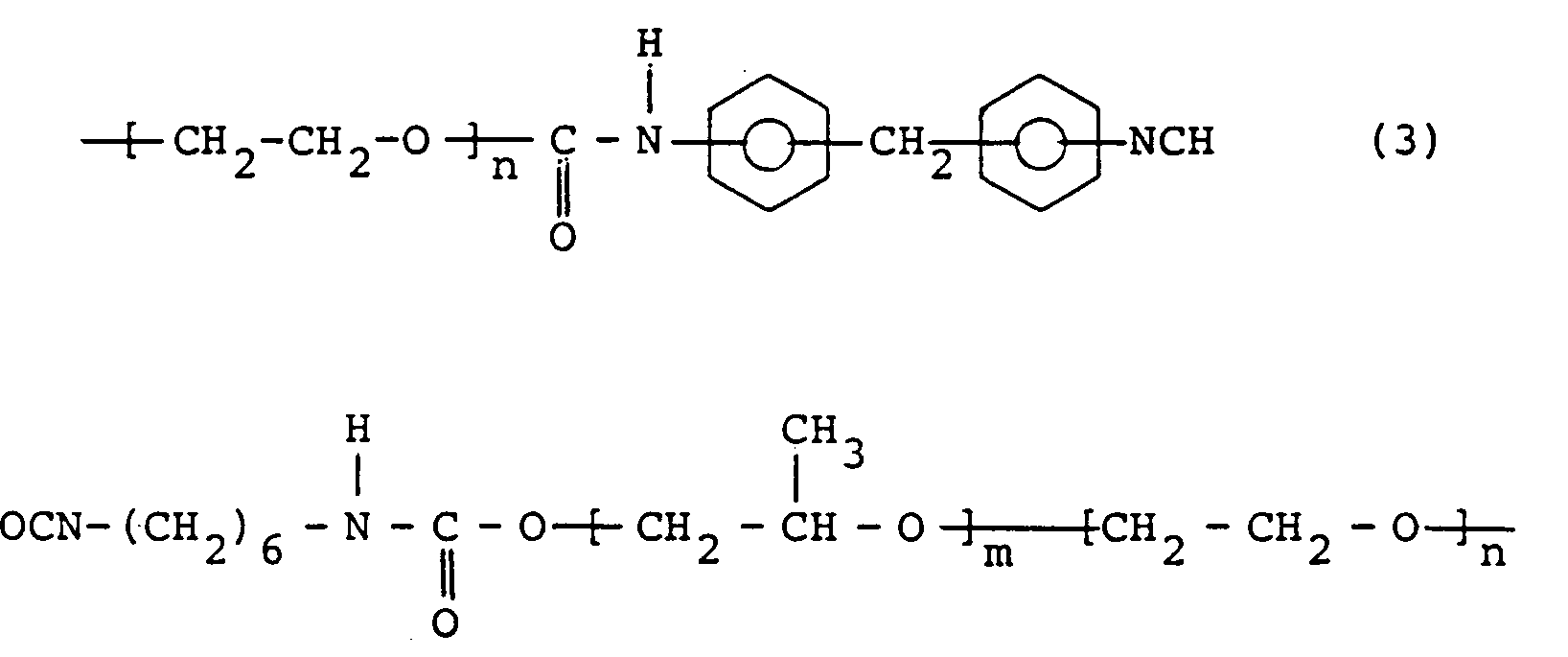
- urethane prepolymers of the following structural formulas (2), (3) and (4) which are derived from a diol obtained by using propylene glycol as an active hydrogen compound and effecting addition polymerization of ethylene oxide and propylene oxide to it.
- urethane prepolymers obtained by using tolylene diisocyanate, 4,4'-diphenylmethane diisocyanate or hexamethylene diisocyanate as a terminal isocyanating agent and containing at least two free isocyanate group per molecule are preferred because of their exceptionally high adhesivity.
- urethane prepolymers containing free isocyanate groups at both ends are especially preferred.
- m is a whole number of 1 to 100
- n is a whole number of 0 to 100
- the propylene oxide units may be randomly joined to the ethylene oxide units.
- urethane prepolymers preferably have a molecular weight of 400 to 50,000 and more preferably 400 to 20,000, chiefly for the purpose of obtaining good solubility in radical-polymerizable unsaturated monomers, as well as excellent bonding properties.
- isocyanate-containing urethane prepolymers of formulas (2) to (4) it is preferable that they be rendered hydrophilic or water-soluble by adjusting their ethylene oxide unit content to a level of 40 to 80 mole percent based on the combined amount of the propylene oxide units and ethylene oxide units constituting the prepolymer chain.
- polyester polyols useful for the aforesaid purpose include adipic acid, azelaic acid, sebacic acid, maleic acid, phthalic acid, isophthalic acid or terephthalic acid.
- the polyols constituting such polyester polyols include ethylene glycol, propylene glycol, 1,4-butanediol, 1,6-hexanediol, diethylene glycol,neopentyl glycol, glycerol, trimethylolpropane or pentaerythritol.
- urethane prepolymers obtained by reacting a polyester polyol with a polyisocyanate, the polyester polyol being prepared, for example, from a combination of adipic acid and propylene glycol and represented by the structural formula (5): where a is a whole number of 1 to 5, b is a whole number of 4 to 10, and d is a whole number of 1 to 200.
- Useful polyester polyols also include compounds formed by reacting a hydroxyl-containing higher fatty acid (such as ricinoleic acid) with glycerol, as well as castor oil and its derivatives.
- a hydroxyl-containing higher fatty acid such as ricinoleic acid
- glycerol such as castor oil and its derivatives.
- tolylene diisocyanate 4,4 -diphenylmethane diisocyanate or hexamethylene diisocyanate
- urethane prepolymers containing one or more isocyanate groups serve to achieve bonding between a restorative material and a tooth by the reaction of the isocyanate group(s) present in the molecule, with the principal organic components constituting living tooth tissues and, in particular, dentin (especially collagen containing a large number of active hydrogen radicals in the molecule), as well as water (body fluid).
- urethane prepolymers containing two or more free isocyanate groups per molecule are preferred because they can exhibit excellent bonding properties.
- urethane prepolymers containing one or more isocyanate groups can be used alone. However, in order to improve the workability of the composition, they may be used in combination with a diluent inert to the isocyanate group, such as acetone, methyl ethyl ketone, ethyl acetate, toluene, xylene or trichloroethane.
- a diluent inert to the isocyanate group such as acetone, methyl ethyl ketone, ethyl acetate, toluene, xylene or trichloroethane.
- a dental adhesive composition comprising component (a) alone would exhibit the desired adhesivity.
- the radical-polymerizable unsaturated monomer used as component (b) in the compositions of the present invention is a component required to rapidly harden the adhesive layer by exposure to light in the presence of the photopolymerization initiator used as component (c).
- any radical-polymerizable unsaturated monomer that does not interfere with the adhesivity of component (a).
- Useful unsaturated monomers include monofunctional and multifunctional unsaturated monomers.
- useful monofunctional unsaturated monomers include methyl (meth)acrylate, ethyl (meth)acrylate, propyl (meth)acrylate, butyl (meth)acrylate, pentyl (meth)acrylate, hexyl (meth)acrylate, 2-hydroxyethyl (meth)acrylate, glycidyl (meth)acrylate, benzyl (meth)acrylate, vinyl acetate, styrene and acrylonitrile.
- Useful bifunctional unsaturated monomers include, for example, polyethylene glycol di(meth)acrylates of the general formula (7): where R 1 is a hydrogen atom or a methyl group, and p is a whole number of 1 to 20.
- Specific examples thereof include ethylene glycol di(meth)acrylate, diethylene glycol di(meth)acrylate, triethylene glycol di-(meth)acrylate, tetraethylene glycol di(meth)acrylate, pentaethylene glycol di(meth)acrylate, hexaethylene glycol di(meth)acrylate, heptaethylene glycol di(meth)acrylate, octaethylene glycol di(meth)acrylate, non- acethylene glycol di(meth)acrylate, decaethylene glycol di(meth)acrylate, polyethylene glycol di(meth)-acrylates of the general formula (7) in which P is 14, polyethylene glycol di(meth)acrylates of the general formula (7) in which p is 17,
- ethylene glycol di(meth)acrylate triethylene glycol di(meth)acrylate, nonaethylene glycol di(meth)acrylate, and polyethylene glycol di(meth)acrylates of the general formula (7) in which p is 14.
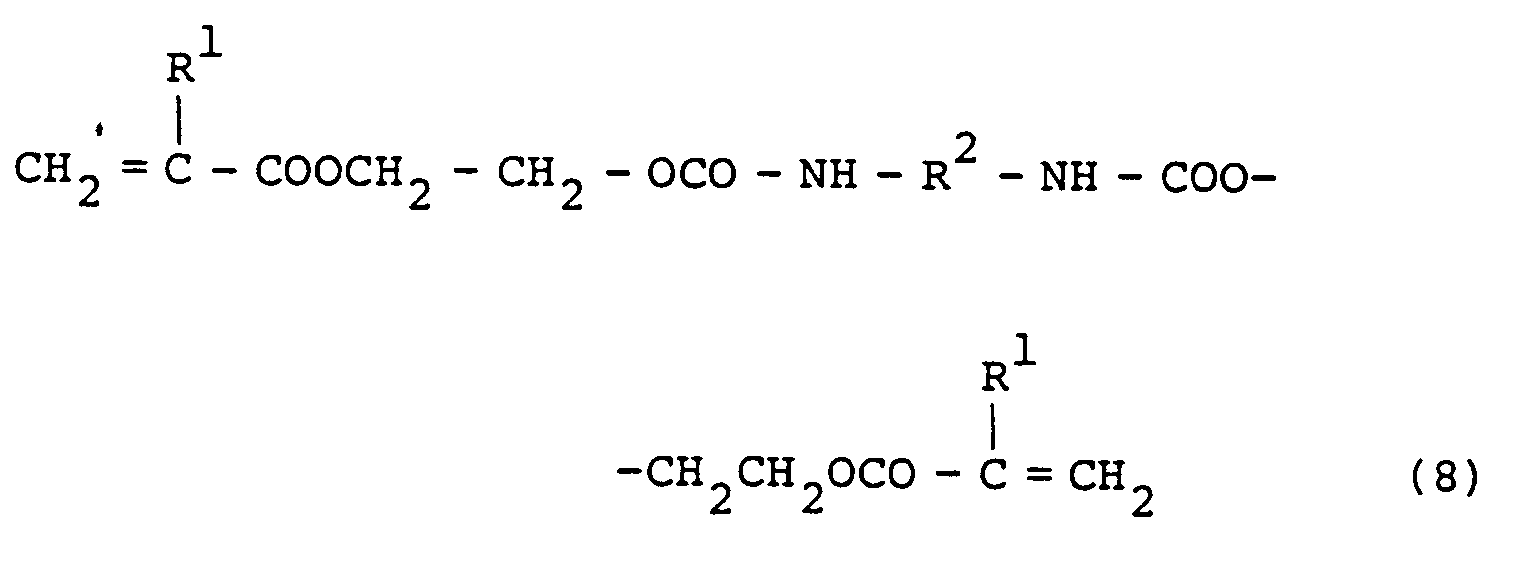
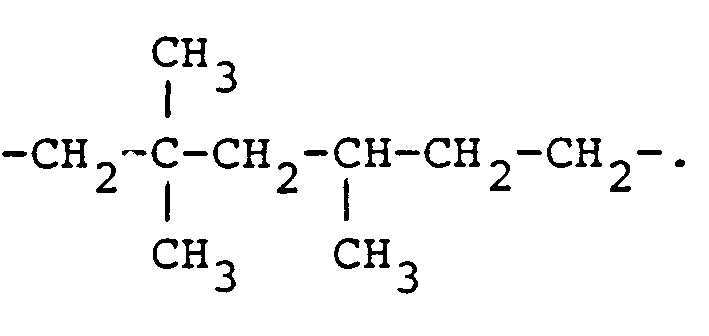
- urethane di(meth)acrylates of the general formula (8): where R 1 is a hydrogen atom or a methyl group, and R 2 is an alkylene group of 1 to 8 carbon atoms, or Specific examples thereof include di(acryloxyethyl)dimethylene diurethane, di(methacryloxyethyl)-dimethylene diurethane, di(acryloxyethyl)tetramethylene diurethane, di(methacryloxyethyl)tetramethylene diurethane, di(acryloxyethyl)trimethylhexamethylene diurethane and di(methacryloxyethyl)-trimethylhexamethylene diurethane.
- 1,6-hexanediol di(meth)acrylate 1,6-hexanediol di(meth)acrylate, neopentyl glycol di(meth)acrylate and trimethylolpropane tri(meth)acrylate.
- trimethylolpropane triacrylate is especially preferred.
- (meth)acrylate compounds having a bisphenol A skeleton and represented by the general formula (10) or (11): where R 3 is a hydrogen atom or a methyl group, and q is a whole number of 1 to 20.
- Specific examples thereof include 2,2-bis(4-methacryloxypolyethoxyphenyl)propanes, 2,2-bis[4-(3-methacryloxy-2-hydroxypropoxy)phenyl]propane, 1,2-bis[3-(meth)acryloyloxy-2-hydroxypropoxy)ethane and 1,4-bis[3-(meth)acryloyloxy -2-hydroxypropoxy)butane.
- Useful tetrafunctional unsaturated monomers include, for example, tetrafunctional urethane (meth)-acrylates having the general formula (12): where R 1 and R 2 are hydrogen atoms or methyl groups, and X is -CH 2 -, -CH 2 CH 2 -, -(CH 2 ) 3 -, -(CH 2 ) 4 -, -(CH 2 ) s -, -(CH 2 ) 6 - or Specific and preferred examples thereof include the tetrafunctional urethane (meth)acrylate of the general formula (12) in which R 1 is a hydrogen atom, R 2 is a methyl group, and X is -(CH 2 ) 6 - (hereinafter referred to as U-4HA) and the tetrafunctional methacrylate of the general formula (12) in which R 1 and R 2 are methyl groups and X is -(CH 2 ) 6 - (hereinafter referred to as U-4H).
- hexafunctional urethane (meth)acrylates having an isocyanuric acid skeleton and represented by the general formula (13): where R 4 and R 5 are hydrogen atoms or methyl groups, and r is a whole number of 1 to 10.
- R 4 and R 5 are hydrogen atoms or methyl groups, and r is a whole number of 1 to 10.
- Specific examples thereof include the compound of the general formula (13) in which r is 6, R 4 is a hydrogen atom, and R 5 is a methyl group (hereinafter referred to as U-6HA) and the compound of the general formula (13) in which r is 6 and both R 4 and R 5 are hydrogen atoms (hereinafter referred to as U-6H).
- U-6HA methyl group
- U-6H the compound of the general formula (13) in which r is 6 and both R 4 and R 5 are hydrogen atoms
- radical-polymerizable unsaturated monomers may be used either alone or in admixture.
- the photopolymerization initiator used as component (c) in the composition of the present invention may be selected from conventionally known ultraviolet light polymerization initiators (such as benzophenone) and visible light polymerization initiators, according to the intended purpose of use.
- a photopolymerization initiator capable of initiating the polymerization in response to visible light in the wavelength range of about 400 to 1,200 nm and free of near-ultraviolet radiation which might be harmful to the oral mucosa.
- the photosensitizer included in the photopolymerization initiator be one which can be excited by visible light in the wavelength range of about 400 to 1,200 nm.
- the compounds which can be used for this purpose are, for example, a-diketone compounds.
- a-diketone compounds include camphorquinone, benzil and diacetyl.
- camphorquinone is especially preferred because of its high polymerization activity.
- a visible light polymerization initiator comprising a combination of a photosensitizer as described above and a reducing agent such as a tertiary amine.
- a reducing agent such as a tertiary amine.
- useful tertiary amines include aliphatic amines such as trimethylamine, triethylamine and tripropylamine; and aromatic amines such as isoamyl 4-(N,N-dimethylamino)benzoate, hexyl 4-(N,N-dimethylamino)benzoate, heptyl 4-(N,N-dimethylamino)benzoate, octyl 4-(N,N-dimethylamino)benzoate, 4,4'-bis(dimethylamino)benzophenone, 4,4'-bis(diethylamino)-benzophenone and 4,4'-bis(dibutylamino)benzophenone.
- aromatic tertiary amines are preferred.
- isoamyl 4-(N,N-dimethylamino)benzoate, 4,4'-bis(dimethylamino)benzophenone and 4,4'-bis(diethylamino)benzophenone are most preferred because excellent visible light polymerizing activity can be obtained by using them in combination with camphorquinone.
- camphorquinone/isoamyl 4-(N,N-dimethylamino)benzoate system camphorquinone is preferably added in an amount of 0.01 to 25% by weight, more preferably 0.05 to 15% by weight, based on the radical-polymerizable unsaturated monomer, and isoamyl 4-(N,N dimethylamino)benzoate is preferably added in an amount of 0.05 to 30% by weight, more preferably 0.1 to 25% by weight.
- camphorquionone is preferably added in an amount of 0.005 to 30% by weight, more preferably 0.03 to 20% by weight, based on the radical-polymerizable unsaturated monomer, and 4,4'-bis(dimethylamino)benzophenone is preferably added in an amount of 0.01 to 25% by weight, more preferably 0.05 to 20% by weight.
- the weight ratio of component (a) to component (b) can range from 1:150 to 150:1 and more preferably from 1:100 to 100:1. In order to obtain adhesivity sufficient for practical purposes, the weight ratio most preferably ranges from 1:50 to 50:1.
- the dental adhesive compositions of the present invention consisting essentially of the above-defined components (a), (b) and (c) exhibit adhesivity sufficient for practical purposes, further research has demonstrated that greater adhesivity can be obtained by adding thereto a polymerizable phosphoric ester compound of the general formula (1): where R is a group selected from the class consisting of and in which R 1 is an alkylene group having carbon atoms 2-12, R' is an alkyl group, n is 1 or 2, m is 1 or 2, l is 0 or 1, and the sum of (n + m + l) is equal to 3.
- polymerizable phosphoric ester compound examples include and Among these polymerizable phosphoric ester compounds, methacryloxyethyl phosphate of the formula and dimethacryloxyethyl phosphate of the formula are especially preferred.
- the polymerizable phosphoric ester compound is usually used in an amount of 0.1 to 30 parts by weight, preferably 0.5 to 10 parts by weight, and more preferably 1.0 to 5.0 parts by weight, per 100 parts by weight of the radical-polymerizable unsaturated monomer used as component (b).
- the dental adhesive compositions of the present invention consist essentially of the above-defined three or four components. If necessary, however, they may additionally contain inorganic fillers (such as silica powder, quartz powder and various glass powders), organic polymers (such as polymethyl methacrylate and polystyrene), colorants, polymerization inhibitors (such as hydroquinone and methylphenol), antioxidants, ultraviolet light absorbers, pigments and dyes.
- inorganic fillers such as silica powder, quartz powder and various glass powders
- organic polymers such as polymethyl methacrylate and polystyrene
- colorants such as polymethyl methacrylate and polystyrene
- polymerization inhibitors such as hydroquinone and methylphenol
- antioxidants such as hydroquinone and methylphenol
- the dental adhesive compositions of the present invention may conveniently be stored, till use, in the form of mixtures consisting of the aforesaid three or four components.
- the light source for curing the dental adhesive compositions of the present invention in a short time, there may be used light emitted by a halogen lamp, xenon lamp, mercury vapour lamp or fluorescent lamp and having wavelengths in the range of 3,500 to 12,000 A (0.35 - 1.2 I .Lm).
- the dental adhesive compositions of the present invention can be applied to a variety of restorative materials. More specifically, they have excellent bonding properties not only to heat-curable materials commonly used as prosthetic materials in the art, including composite resins (i.e., composite materials obtained by blending a multifunctional monomer with an inorganic filler) and crown resins, but also to thermoplastic resins for use in denture bases (such as polymethyl methacrylate, polysulfone and polycarbonate), various cementing materials, amalgam, alumina, gold and alloys.
- composite resins i.e., composite materials obtained by blending a multifunctional monomer with an inorganic filler
- crown resins i.e., composite materials obtained by blending a multifunctional monomer with an inorganic filler
- thermoplastic resins for use in denture bases such as polymethyl methacrylate, polysulfone and polycarbonate
- various cementing materials amalgam, alumina, gold and alloys.
- the dental adhesive compositions of the present invention When used to bond a restorative material to living tooth tissues, especially to dentin, the dental adhesive compositions of the present invention can exhibit adhesivity sufficient for practical purposes, without requiring any troublesome pretreatment with an etching agent (such as phosphoric acid) that has been indispensable in the prior art. Moreover, owing to their photopolymerizability, the dental adhesive compositions of the present invention can be hardened in a short time by exposure to light before their inherent adhesivity is exhibited. Thus, they are easy to handle in the oral cavity.
- an etching agent such as phosphoric acid
- a visible light curable composite resin i.e., a pasty mixture consisting of multifunctional monomers, inorganic fillers and a visible light polymerization initiator
- restorative material A Preparation of restorative material B (visible light curable crown resin)
- a visible light curable crown resin i.e., a mixture consisting of multifunctional monomers and a visible light polymerization initiator
- polyether glycols were reacted with an isocyanating agent comprising tolylene diisocyanate (containing 2,4- and 2,6-isomers in a molar ratio of 80:20; hereinafter referred to as TDI), 4,4-diphenylmethane diisocyanate (hereinafter referred to as MDI) or hexamethylene diisocyanate (hereinafter referred to as HDI).
- TDI tolylene diisocyanate
- MDI 4,4-diphenylmethane diisocyanate
- HDI hexamethylene diisocyanate
- Adipic acid and propylene glycol were mixed in a molar ratio ranging from 1:1.1 to 1:1.5. Then, using magnesium acetate as the catalyst, polycondensation of these compounds was carried out according to conventional procedure. Thus, there were obtained various polyester glycols containing hydroxyl groups at both ends and having different molecular weights. The codes for these polyester glycols are shown in Table 5.
- polyester glycols were reacted with an isocyanating agent comprising TDI, MDI or HDI.
- an isocyanating agent comprising TDI, MDI or HDI.
- the polyester glycol and the isocyanating agent were used in a molar ratio of 1:2.
- castor oil used as a polyol compound was reacted with an isocyanating agent comprising TDI, MDI or HDI.
- the polyol compound and the isocyanating agent were used in a molar ratio of 1:3.
- the molar ratio was calculated on the assumption that castor oil had the structure of ricinoleic acid triglyceride and contained no impurities.
- the resulting urethane prepolymers containing three free isocyanate groups were given their respective codes according to the type of the isocyanating agent used. Specifically, the codes were CO-1 for TDI, CO-2 for MDI, and CO-3 for HDI.
- urethane prepolymers containing three free isocyanate groups which had been obtained in the foregoing synthesis of urethane prepolymers (VII), were reacted with a hydroxyl-containing radical-polymerizable unsaturated monomer comprising 2-hydroxyethyl methacrylate.
- the urethane prepolymer and the unsaturated monomer were used in a molar ratio of 1:1 or 1:2.
- urethane prepolymers containing three free isocyanate groups which had been obtained in the foregoing synthesis of urethane prepolymers (VII), were reacted with a hydroxyl-containing radical-polymerizable unsaturated monomer comprising 2-hydroxyethyl methacrylate.
- the urethane prepolymer and the unsaturated monomer were used in a molar ratio of 1:3.
- the resulting urethane prepolymers containing three radical-polymerizable vinyl groups were given their respective codes according to the type of the starting urethane prepolymer containing three free isocyanate groups. Specifically, the codes were PV-1 for CO-1, PV-2 for CO-2, and PV-3 for CO-3.
- monomer X radical-polymerizable unsaturated monomer
- monomer Z polymerizable phosphoric ester compound
- visible light polymerization initiator a visible light polymerization initiator
- a series of adhesive compositions were prepared by mixing various urethane prepolymers containing two terminal isocyanate groups, which had been obtained in the foregoing synthesis of urethane prepolymers (I), with the radical-polymerizable unsaturated monomer/visible light polymerization initiator mixture LC-15 in a weight ratio of 1:1.
- a series of adhesive compositions were prepared by mixing various urethane prepolymers containing three free isocyanate groups, which had been obtained in the foregoing synthesis of urethane prepolymers (VII), with the radical-polymerizable unsaturated monomer/visible light polymerization initiator mixture LC-56 or LC-57 in a weight ratio of 1:1.
- Example 125 or 1208 a series of adhesive compositions were prepared by using various urethane prepolymers having three radical-polymerizable vinyl groups, which has been obtained in the foregoing synthesis of urethane prepolymers (IX), in place of the urethane prepolymer containing three free isocyanate groups. Then, the adhesivity of these adhesive compositions was evaluated in the same manner as described in Example 1. The results thus obtained are shown in Table 31.
- a series of adhesive compositions were prepared by mixing various urethane prepolymers containing two terminal isocyanate groups, which had been obtained in the foregoing synthesis of urethane prepolymers (I), with the monomer X/monomer Z/visible light polymerization initiator mixture LC-69 in a weight ratio of 1:1.
- each of these adhesive compositions was used to bond restorative material A to an unetched dentin surface of a cattle tooth, and the resulting bond strength was measured.
- the results thus obtained are shown in Table 32.
- a series of adhesive compositions were prepared by mixing the urethane prepolymer TPT-11 containing two terminal isocyanate groups, which had been obtained in the foregoing synthesis of urethane prepolymers (I), with various monomer X/monomer Z/visible light polymerization initiator mixtures in a weight ratio of 1:1.
- a series of adhesive compositions were prepared by mixing the urethane prepolymer TPT-11 containing two terminal isocyanate groups, which had been obtained in the foregoing synthesis of urethane prepolymers (I), with various monomer X/monomer Z/visible light polymerization initiator mixtures (i.e, LC-73 to LC-88) in a weight ratio of 1:1.
- a series of adhesive compositions were prepared by mixing the urethane prepolymer TPT-11 containing two terminal isocyanate groups, which had been obtained in the foregoing synthesis of urethane prepolymers (I), with various monomer X/monomer Z/visible light polymerization initiator mixtures as shown in Table 38 (i.e., LC-77 to LC-80), in a weight ratio of 1:1.
- Example 275 Using the adhesive composition obtained in Example 275, its adhesivity to various restorative materials was evaluated in the same manner as described in Example 1. The results thus obtained are shown in Table 40.
Landscapes
- Health & Medical Sciences (AREA)
- Oral & Maxillofacial Surgery (AREA)
- Epidemiology (AREA)
- Life Sciences & Earth Sciences (AREA)
- Animal Behavior & Ethology (AREA)
- General Health & Medical Sciences (AREA)
- Public Health (AREA)
- Veterinary Medicine (AREA)
- Dental Preparations (AREA)
- Adhesives Or Adhesive Processes (AREA)
Description
- This invention relates to dental adhesive compositions which have excellent bonding properties and are useful in bonding living dental tissues to materials (such as metals, organic polymers and ceramics) used for the restoration thereof.
- In the field of dental materials, a variety of materials have conventionally been used for the purpose of restoring carious teeth (also called decayed teeth) and missing teeth. Such materials include metals such as gold, silver, platinum, alloys and amalgam; organic high polymers such as polymethyl methacrylate, polycarbonate, cured products of multifunctional vinyl resins, and composite resins; and ceramic such as porcelain and implant materials. However, these materials are inherently incapable of adhering to living tooth tissues. Accordingly, in order to achieve bonding between restorative materials and living tooth tissues, there have been proposed a number of dental adhesive compositions containing, as the adhesive component, a compound having any of various polar groups (such as a phosphate group, hydroxyl group or acid anhydride group) with the intention of improving their interaction with the principal inorganic components, such as apatite (a calcium phosphate), or principal organic components, such as collagen (a protein), constituting the tooth tissues.
- When the aforesaid prior art adhesive compositions are used to bond a restorative material to living tooth tissues, they have considerable adhesivity to enamel, but completely fail to exhibit adhesivity to dentin. This is due to the physical and chemical structures of living dentin. Specifically, dentin has a structure in which a vast number of dentinal tubules are penetrated and filled with a body fluid. Moreover, dentin contains a fairly high proportion of proteins such as collagen, as compared with enamel. Thus, it may be said that, from the viewpoint of bonding, dentin is in a very adverse environment. Accordingly, the aforesaid prior art adhesive compositions require pretreatment of the principal inorganic component as apatite, with an etching agent (such as phosphoric acid) so as to produce the so-called anchoring effect which brings about a certain degree of bonding to living dentin. Nevertheless, because of the insufficiency of bond strength, a gap will be produced between the restorative material and the dentin over a long time and, in the worst case, the restorative material may even fall off. Thus, the prior art adhesive compositions cannot be said to have bonding properties adequate for practical purposes.
- EP-A-0 183 027 discloses a biologically compatible adhesive composition comprising a mixture of an adhesion promoting and polymerizable monomer system selected from the group consisting of at least one free radical polymerizable monomer or prepolymer having an ethylenic unsaturation and a phosphorus- containing adhesion promotor, a free radical polymerization catalyst and an accelerator for said catalyst.
- US-A-4 134 935 discloses dental varnishes comprising a graft copolymer or telomerisate obtained by reacting a polyisocyanate with methylmethacrylate and a crosslinkable comonomer having a group which can react with the isocyanate.
- US-A-4 057 535 describes an adhesive for gluing together soft body tissues which comprises an aromatic diisocyanate, a macro diisocyanate and 2,4,6-tris(diethylaminomethyl)phenol.
- It is an object of the present invention to provide a novel photopolymerizable dental adhesive composition which, when used to bond a restorative material to living tooth tissues, has high adhesivity to enamel and, moreover, exhibit practically sufficient adhesivity to dentin, without requiring any troublesome pretreatment with an etching agent (such as phosphoric acid) that has been indispensable in the prior art.
- According to the present invention, there is provided a dental adhesive composition consisting essentially of
- (a) at least one urethane prepolymer containing one or more isocyanate groups, or a blend or the urethane prepolymer and an inert diluent;
- (b) at least one radical-polymerizable unsaturated monomer; and
- (c) a photopolymerization initiator.
- According to the present invention, there is also provided another dental adhesive composition consisting essentially of
- (a) at least one urethane prepolymer containing one or more isocyanate groups, or a blend of the urethane prepolymer and an inert diluent;
- (b) at least one radical-polymerizable unsaturated monomer;
- (c) a photopolymerization initiator; and
- (d) a polymerizable phosphoric ester compound of the general formula (1):


- The urethane prepolymer containing one or more isocyanate groups, which is used as component (a) in the compositions of the present invention, is a compound obtained by reacting a polyol compound with a polyisocyanate [i.e., a compound having two or more isocyanate (-NCO) groups per molecule] in such a way that part of the isocyanate groups remain unreacted.
- The polyol compound used for this purpose may be selected from polyether polyols and polyester polyols. Specific examples of useful polyether polyols include compounds formed by effecting addition polymerization of an alkylene oxide (such as propylene oxide or ethylene oxide) to a low-molecular-weight compound having two or more hydroxyl groups per molecule (such as glycol, glycerol, sorbitol or sucrose). Specific examples of useful polyester polyols include compounds formed by effecting polycondensation of a dibasic acid (such as adipic acid) with a glycol (such as ethylene glycol) so as to give terminal hydroxyl groups; compounds formed by reacting a hydroxyl-containing higher fatty acid (such as ricinoleic acid) with glycerol; and compounds obtained from natural sources, such as castor oil and its derivatives.
- Such polyether polyols can be prepared according to the conventional method which comprises adding an alkaline catalyst (such as potassium hydroxide or sodium hydroxide) to an active hydrogen compound (such as ethylene glycol, propylene glycol or 1,6-hexanediol) and effecting addition polymerization of an alkylene oxide (such as ethylene oxide, propylene oxide or butylene oxide) to the active hydrogen compound.
- In order to obtain excellent bonding properties, it is preferable to use a polyol compound having terminal hydroxyl groups.
- By way of example, urethane prepolymers having one or more isocyanate groups can be obtained by reacting, in the presence of a conventional catalyst such as a tertiary amine or dibutyltin laurate, the above-defined polyol compound with an organic isocyanate (such as tolylene diisocyanate, 4,4 -diphenylmethane diisocyanate or hexamethylene diisocyanate) in such an NCO/OH equivalent ratio as to provide an excess of NCO.
- Among these urethane prepolymers, there may preferably be used urethane prepolymers of the following structural formulas (2), (3) and (4) which are derived from a diol obtained by using propylene glycol as an active hydrogen compound and effecting addition polymerization of ethylene oxide and propylene oxide to it. In particular, urethane prepolymers obtained by using tolylene diisocyanate, 4,4'-diphenylmethane diisocyanate or hexamethylene diisocyanate as a terminal isocyanating agent and containing at least two free isocyanate group per molecule are preferred because of their exceptionally high adhesivity. More specifically, urethane prepolymers containing free isocyanate groups at both ends are especially preferred.


- These urethane prepolymers preferably have a molecular weight of 400 to 50,000 and more preferably 400 to 20,000, chiefly for the purpose of obtaining good solubility in radical-polymerizable unsaturated monomers, as well as excellent bonding properties.
- With regard to the isocyanate-containing urethane prepolymers of formulas (2) to (4) it is preferable that they be rendered hydrophilic or water-soluble by adjusting their ethylene oxide unit content to a level of 40 to 80 mole percent based on the combined amount of the propylene oxide units and ethylene oxide units constituting the prepolymer chain.
- On the other hand, the dibasic acids constituting polyester polyols useful for the aforesaid purpose include adipic acid, azelaic acid, sebacic acid, maleic acid, phthalic acid, isophthalic acid or terephthalic acid. The polyols constituting such polyester polyols include ethylene glycol, propylene glycol, 1,4-butanediol, 1,6-hexanediol, diethylene glycol,neopentyl glycol, glycerol, trimethylolpropane or pentaerythritol.
- Among others, there may preferably be used urethane prepolymers obtained by reacting a polyester polyol with a polyisocyanate, the polyester polyol being prepared, for example, from a combination of adipic acid and propylene glycol and represented by the structural formula (5):

- Useful polyester polyols also include compounds formed by reacting a hydroxyl-containing higher fatty acid (such as ricinoleic acid) with glycerol, as well as castor oil and its derivatives. In this case, it is preferable to use tolylene diisocyanate, 4,4 -diphenylmethane diisocyanate or hexamethylene diisocyanate as the polyisocyanate. Among others, there may preferably be used urethane prepolymers of the structural formula (6):


- These urethane prepolymers containing one or more isocyanate groups serve to achieve bonding between a restorative material and a tooth by the reaction of the isocyanate group(s) present in the molecule, with the principal organic components constituting living tooth tissues and, in particular, dentin (especially collagen containing a large number of active hydrogen radicals in the molecule), as well as water (body fluid). Among others, urethane prepolymers containing two or more free isocyanate groups per molecule are preferred because they can exhibit excellent bonding properties.
- The above-described urethane prepolymers containing one or more isocyanate groups can be used alone. However, in order to improve the workability of the composition, they may be used in combination with a diluent inert to the isocyanate group, such as acetone, methyl ethyl ketone, ethyl acetate, toluene, xylene or trichloroethane.
- Basically, a dental adhesive composition comprising component (a) alone would exhibit the desired adhesivity. However, where it is intended to carry out bonding operation in the oral cavity, restrictions are often imposed on the time required to cure the adhesive layer. Thus, the radical-polymerizable unsaturated monomer used as component (b) in the compositions of the present invention is a component required to rapidly harden the adhesive layer by exposure to light in the presence of the photopolymerization initiator used as component (c). For this purpose, there may be used any radical-polymerizable unsaturated monomer that does not interfere with the adhesivity of component (a). Useful unsaturated monomers include monofunctional and multifunctional unsaturated monomers.
- Specific examples of useful monofunctional unsaturated monomers include methyl (meth)acrylate, ethyl (meth)acrylate, propyl (meth)acrylate, butyl (meth)acrylate, pentyl (meth)acrylate, hexyl (meth)acrylate, 2-hydroxyethyl (meth)acrylate, glycidyl (meth)acrylate, benzyl (meth)acrylate, vinyl acetate, styrene and acrylonitrile. Especially preferred are methyl acrylate, methyl methacrylate, 2-hydroxyethyl methacrylate, vinyl acetate and benzyl methacrylate.
- Useful bifunctional unsaturated monomers include, for example, polyethylene glycol di(meth)acrylates of the general formula (7):



- Furthermore, there may also be used 1,6-hexanediol di(meth)acrylate, neopentyl glycol di(meth)acrylate and trimethylolpropane tri(meth)acrylate. Especially preferred is trimethylolpropane triacrylate.
- Furthermore, there may also be used (meth)acrylate compounds having a bisphenol A skeleton and represented by the general formula (10) or (11):

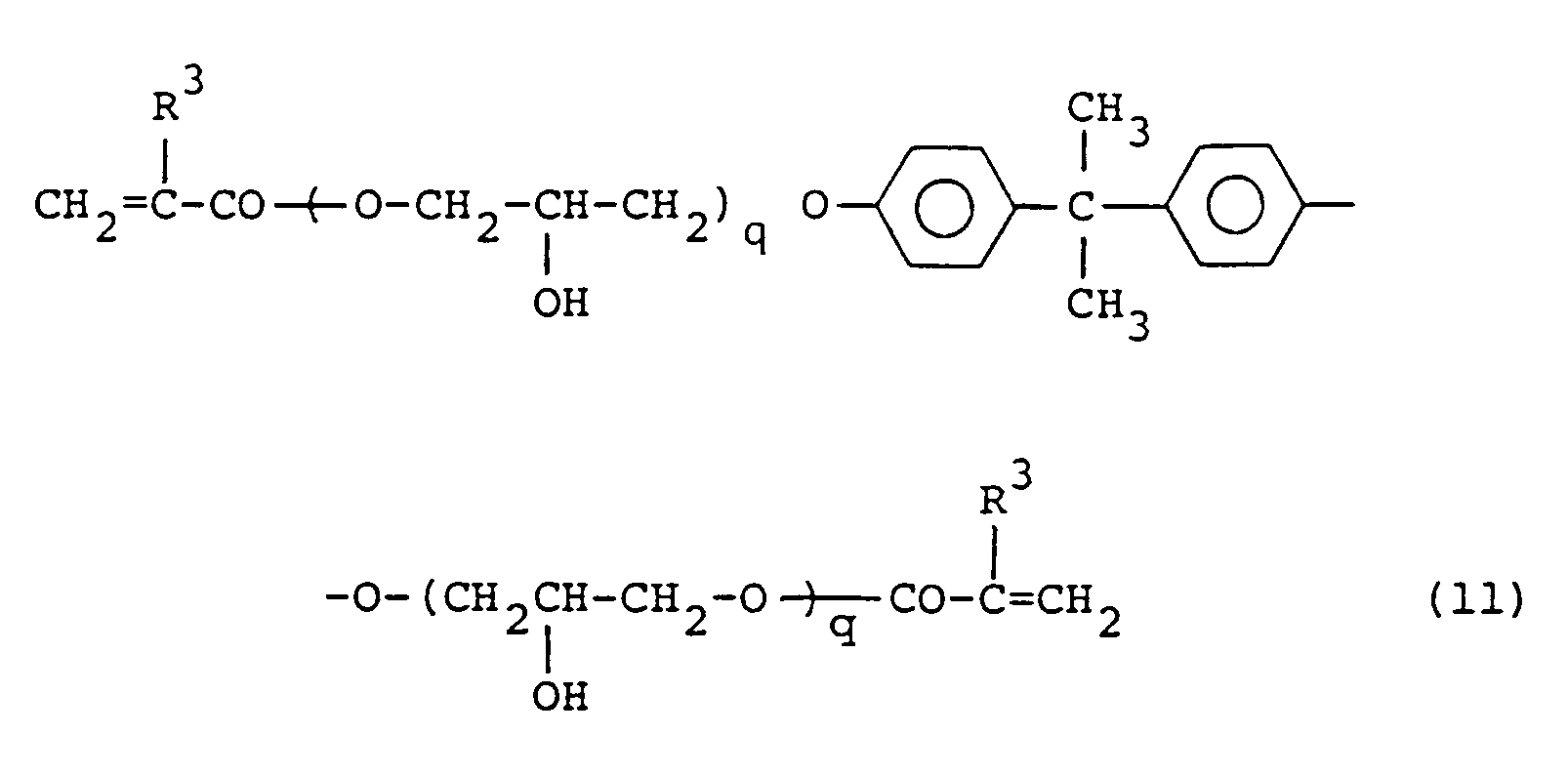
- Specific examples thereof include 2,2-bis(4-methacryloxypolyethoxyphenyl)propanes, 2,2-bis[4-(3-methacryloxy-2-hydroxypropoxy)phenyl]propane, 1,2-bis[3-(meth)acryloyloxy-2-hydroxypropoxy)ethane and 1,4-bis[3-(meth)acryloyloxy -2-hydroxypropoxy)butane.
- Useful tetrafunctional unsaturated monomers include, for example, tetrafunctional urethane (meth)-acrylates having the general formula (12):

- In addition, there may preferably be used hexafunctional urethane (meth)acrylates having an isocyanuric acid skeleton and represented by the general formula (13):

- The foregoing radical-polymerizable unsaturated monomers may be used either alone or in admixture.
- The photopolymerization initiator used as component (c) in the composition of the present invention may be selected from conventionally known ultraviolet light polymerization initiators (such as benzophenone) and visible light polymerization initiators, according to the intended purpose of use. Where the composition of the present invention is to be used in the oral cavity, it is preferable to use a photopolymerization initiator capable of initiating the polymerization in response to visible light in the wavelength range of about 400 to 1,200 nm and free of near-ultraviolet radiation which might be harmful to the oral mucosa. Accordingly, it is preferable that the photosensitizer included in the photopolymerization initiator be one which can be excited by visible light in the wavelength range of about 400 to 1,200 nm. The compounds which can be used for this purpose are, for example, a-diketone compounds. Specific examples of useful a-diketone compounds include camphorquinone, benzil and diacetyl. Among others, camphorquinone is especially preferred because of its high polymerization activity.
- In order to achieve desired excellent photopolymerizability, it is desirable to use a visible light polymerization initiator comprising a combination of a photosensitizer as described above and a reducing agent such as a tertiary amine. Specific examples of useful tertiary amines include aliphatic amines such as trimethylamine, triethylamine and tripropylamine; and aromatic amines such as isoamyl 4-(N,N-dimethylamino)benzoate, hexyl 4-(N,N-dimethylamino)benzoate, heptyl 4-(N,N-dimethylamino)benzoate, octyl 4-(N,N-dimethylamino)benzoate, 4,4'-bis(dimethylamino)benzophenone, 4,4'-bis(diethylamino)-benzophenone and 4,4'-bis(dibutylamino)benzophenone. Among others, aromatic tertiary amines are preferred. In particular, isoamyl 4-(N,N-dimethylamino)benzoate, 4,4'-bis(dimethylamino)benzophenone and 4,4'-bis(diethylamino)benzophenone are most preferred because excellent visible light polymerizing activity can be obtained by using them in combination with camphorquinone.
- The amounts in which these visible light polymerization initiators may be added have their respective appropriate ranges, depending on the types of photosensitizer and reducing agent used. For example, in the camphorquinone/isoamyl 4-(N,N-dimethylamino)benzoate system, camphorquinone is preferably added in an amount of 0.01 to 25% by weight, more preferably 0.05 to 15% by weight, based on the radical-polymerizable unsaturated monomer, and isoamyl 4-(N,N dimethylamino)benzoate is preferably added in an amount of 0.05 to 30% by weight, more preferably 0.1 to 25% by weight. Similarly, in the camphorquinone/4,4 -bis(dimethylamino)benzophenone system, camphorquionone is preferably added in an amount of 0.005 to 30% by weight, more preferably 0.03 to 20% by weight, based on the radical-polymerizable unsaturated monomer, and 4,4'-bis(dimethylamino)benzophenone is preferably added in an amount of 0.01 to 25% by weight, more preferably 0.05 to 20% by weight.
- In the dental adhesive compositions of the present invention, the weight ratio of component (a) to component (b) can range from 1:150 to 150:1 and more preferably from 1:100 to 100:1. In order to obtain adhesivity sufficient for practical purposes, the weight ratio most preferably ranges from 1:50 to 50:1.
- Although the dental adhesive compositions of the present invention consisting essentially of the above-defined components (a), (b) and (c) exhibit adhesivity sufficient for practical purposes, further research has demonstrated that greater adhesivity can be obtained by adding thereto a polymerizable phosphoric ester compound of the general formula (1):


- Specific examples of the polymerizable phosphoric ester compound include


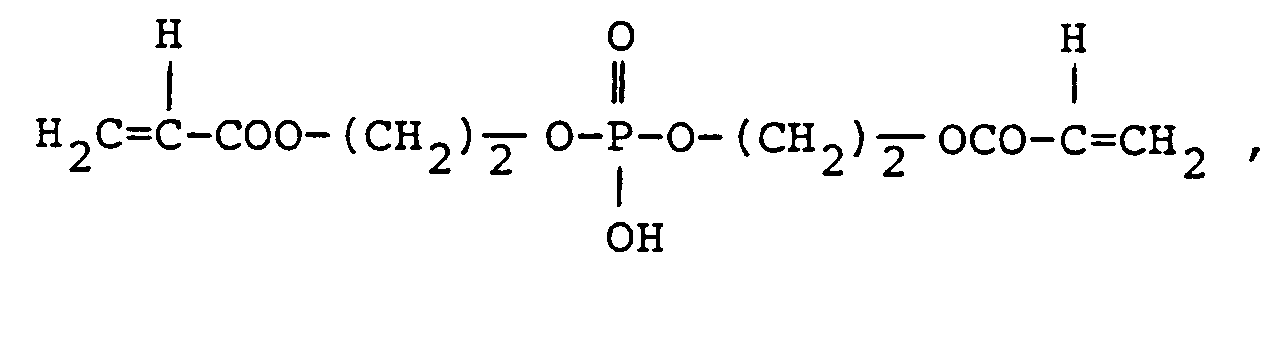


- The polymerizable phosphoric ester compound is usually used in an amount of 0.1 to 30 parts by weight, preferably 0.5 to 10 parts by weight, and more preferably 1.0 to 5.0 parts by weight, per 100 parts by weight of the radical-polymerizable unsaturated monomer used as component (b).
- The dental adhesive compositions of the present invention consist essentially of the above-defined three or four components. If necessary, however, they may additionally contain inorganic fillers (such as silica powder, quartz powder and various glass powders), organic polymers (such as polymethyl methacrylate and polystyrene), colorants, polymerization inhibitors (such as hydroquinone and methylphenol), antioxidants, ultraviolet light absorbers, pigments and dyes.
- In ordinary cases, the dental adhesive compositions of the present invention may conveniently be stored, till use, in the form of mixtures consisting of the aforesaid three or four components. Alternatively, it is also possible to separately store components (a) and a mixture of components (b), (c) and optionally (d), and mix them immediately before use.
- As the light source (in particular, visible light source) for curing the dental adhesive compositions of the present invention in a short time, there may be used light emitted by a halogen lamp, xenon lamp, mercury vapour lamp or fluorescent lamp and having wavelengths in the range of 3,500 to 12,000 A (0.35 - 1.2 I.Lm).
- The dental adhesive compositions of the present invention can be applied to a variety of restorative materials. More specifically, they have excellent bonding properties not only to heat-curable materials commonly used as prosthetic materials in the art, including composite resins (i.e., composite materials obtained by blending a multifunctional monomer with an inorganic filler) and crown resins, but also to thermoplastic resins for use in denture bases (such as polymethyl methacrylate, polysulfone and polycarbonate), various cementing materials, amalgam, alumina, gold and alloys.
- When used to bond a restorative material to living tooth tissues, especially to dentin, the dental adhesive compositions of the present invention can exhibit adhesivity sufficient for practical purposes, without requiring any troublesome pretreatment with an etching agent (such as phosphoric acid) that has been indispensable in the prior art. Moreover, owing to their photopolymerizability, the dental adhesive compositions of the present invention can be hardened in a short time by exposure to light before their inherent adhesivity is exhibited. Thus, they are easy to handle in the oral cavity.
- The present invention is further illustrated by the following examples.
-

- According to the above formulation, a visible light curable composite resin (i.e., a pasty mixture consisting of multifunctional monomers, inorganic fillers and a visible light polymerization initiator) was prepared in a dark room to obtain restorative material A. [Preparation of restorative material B (visible light curable crown resin)]
-

- According to the above formulation, a visible light curable crown resin (i.e., a mixture consisting of multifunctional monomers and a visible light polymerization initiator) was prepared in a dark room to obtain restorative material B.
- [Procedure for the evaluation of bonding properties and method for the measurement of bond strength]
- (1) A freshly extracted cattle fore-tooth was cut with a precision cutter (Isomet; trade name; a product of Bühler Co.) to expose a flat dentin surface and a flat enamel surface. Then, using a piece of No. 1000 water-resistant abrasive paper, these exposed surfaces were fully polished under a stream of water. In some cases, the enamel surface was etched with a phosphoric acid etchant (manufactured by GC Dental Industries Co.) in the usual manner.
- (2) A dental adhesive composition was applied to the dentin surface or the enamel surface. Any volatile components such as a solvent were scattered and evaporated by exposure to a stream of air for about 10 seconds.
- (3) A cylindrical silicone ring (openable on one side) having an inner diameter of about 5 mm, a height of about 5 mm and a wall thickness of about 3 mm was placed on the surface to which the dental adhesive composition had been applied. Then, the silicone ring was filled with a liquid restorative material to a height of about 3 mm.
- (4) The aperture of a visible light projector (GC Light; trade name; manufactured by GC Dental Industries Co.) was brought into contact with the upper end of the silicone ring filled with the restorative material. Thus, the restorative material and the adhesive composition were cured by exposure to visible light for 60 seconds.
- (5) After the lapse of about 10 minutes, the silicone ring was removed to obtain a specimen having the restorative material bonded to the surface of the tooth sample.
- (6) After the entire specimen was stored in water at 37 ° C for a predetermined period of time, a spacer for bonding test (i.e., an acrylic rod having the same diameter as the restorative material) was joined to the top of the restorative material by means of GC Unifast Quick Self-Curing Acrylic Resine (Uni Fast; trade name; manufactured by GC Dental Industries Co.). The resulting assembly was mounted on a testing jig and subjected to a tensile test for the measurement of bond strength. The measuring conditions were as follows.
- Tensile tester: Tensilon (trade name; manufactured by Toyo-Baldwin Co.).
- Crosshead speed (pulling speed): 0.5 mm/min.
- Chart speed: 10 mm/min.
- Full scale: 5 kgW or 20 kgW.
- Number of specimens: n = 3.
- Using propylene glycol as an active hydrogen compound, ring opening copolymerization of propylene oxide and ethylene oxide was carried out according to conventional procedure. Thus, there were obtained various polyether glycols containing ethylene oxide units (hereinafter referred to as EO) and propylene oxide units (hereinafter referred to as PO) in varying molar ratios and having different molecular weights, as shown in Table 1.
- Then, according to conventional procedure, these polyether glycols were reacted with an isocyanating agent comprising tolylene diisocyanate (containing 2,4- and 2,6-isomers in a molar ratio of 80:20; hereinafter referred to as TDI), 4,4-diphenylmethane diisocyanate (hereinafter referred to as MDI) or hexamethylene diisocyanate (hereinafter referred to as HDI). In this reaction, the polyether glycol and the isocyanating agent were used in a molar ratio of 1:2. Thus, there were obtained various urethane prepolymers containing two terminal isocyanate groups and having the codes shown in Table 1.


- In the same manner as described in the foregoing synthesis of urethane prepolymers (I), various polyether glycols were reacted with an isocyanating agent comprising TDI, MDI or HDI. In this case, however, the polyether glycol and the isocyanating agent were used in a molar ratio of 1:1. Thus, there were obtained various urethane prepolymers containing one terminal isocyanate group and one terminal hydroxyl group and having the codes shown in Table 2.

- Some of the urethane prepolymers containing two terminal isocyanate groups, which had been obtained in the foregoing synthesis of urethane prepolymers (I), were reacted with a hydroxyl-containing radical-polymerizable unsaturated monomer comprising 2-hydroxyethyl methacrylate. In this reaction, the urethane prepolymer and the unsaturated monomer were used in a molar ratio of 1:1. Thus, there were obtained various urethane prepolymers containing one terminal radical polymerizable vinyl group and one terminal isocyanate group and having the codes shown in Table 3.

- Some of the urethane prepolymers containing two terminal isocyanate groups, which had been obtained in the foregoing synthesis of urethane prepolymers (I), were reacted with a hydroxyl-containing radical-polymerizable unsaturated monomer comprising 2-hydroxyethyl methacrylate. In this reaction, the urethane prepolymer and the unsaturated monomer were used in a molar ratio of 1:2. Thus, there were obtained various urethane prepolymers containing two terminal radical-polymerizable vinyl groups and having the codes shown in Table 4.

- Adipic acid and propylene glycol were mixed in a molar ratio ranging from 1:1.1 to 1:1.5. Then, using magnesium acetate as the catalyst, polycondensation of these compounds was carried out according to conventional procedure. Thus, there were obtained various polyester glycols containing hydroxyl groups at both ends and having different molecular weights. The codes for these polyester glycols are shown in Table 5.
- Then, according to conventional procedure, these polyester glycols were reacted with an isocyanating agent comprising TDI, MDI or HDI. In this reaction, the polyester glycol and the isocyanating agent were used in a molar ratio of 1:2. Thus, there were obtained various urethane prepolymers containing two terminal isocyanate groups and having the codes shown in Table 5.

- In the same manner as described in the foregoing synthesis of urethane prepolymers (V), various polyester glycols were reacted with an isocyanating agent comprising TDI, MDI or HDI. In this case, however, the polyester glycol and the isocyanating agent were use in a molar ratio of 1:1. Thus, there were obtained various urethane prepolymers containing one terminal isocyanate group and one terminal hydroxyl group and having the codes shown in Table 6.

- According to conventional procedure, castor oil used as a polyol compound was reacted with an isocyanating agent comprising TDI, MDI or HDI. In this reaction, the polyol compound and the isocyanating agent were used in a molar ratio of 1:3. Thus, there were obtained three urethane prepolymers containing three free isocyanate groups. The molar ratio was calculated on the assumption that castor oil had the structure of ricinoleic acid triglyceride and contained no impurities.
- The resulting urethane prepolymers containing three free isocyanate groups were given their respective codes according to the type of the isocyanating agent used. Specifically, the codes were CO-1 for TDI, CO-2 for MDI, and CO-3 for HDI.
- The urethane prepolymers containing three free isocyanate groups, which had been obtained in the foregoing synthesis of urethane prepolymers (VII), were reacted with a hydroxyl-containing radical-polymerizable unsaturated monomer comprising 2-hydroxyethyl methacrylate. In this reaction, the urethane prepolymer and the unsaturated monomer were used in a molar ratio of 1:1 or 1:2. Thus, there were obtained three urethane prepolymers containing one radical-polymerizable vinyl group and two free isocyanate groups and having the codes shown in Table 7, as well as three urethane prepolymers containing two radical-polymerizable vinyl groups and one free isocyanate group and having the codes shown in Table 7.

- The urethane prepolymers containing three free isocyanate groups, which had been obtained in the foregoing synthesis of urethane prepolymers (VII), were reacted with a hydroxyl-containing radical-polymerizable unsaturated monomer comprising 2-hydroxyethyl methacrylate. In this case, the urethane prepolymer and the unsaturated monomer were used in a molar ratio of 1:3. Thus, there were obtained three urethane prepolymers containing three radical-polymerizable vinyl groups.
- The resulting urethane prepolymers containing three radical-polymerizable vinyl groups were given their respective codes according to the type of the starting urethane prepolymer containing three free isocyanate groups. Specifically, the codes were PV-1 for CO-1, PV-2 for CO-2, and PV-3 for CO-3.
- Using a general-purpose mixer, various mixtures consisting of at least one radical-polymerizable unsaturated monomer and a visible light polymerization initiator were prepared in a dark room. The compositions of these mixtures and their respective codes are shown in Tables 8 to 10.
- The code "EDMA" given in the tables as the designation of a radical-polymerizable unsaturated monomer refers to the urethane dimethacrylate of the structural formula


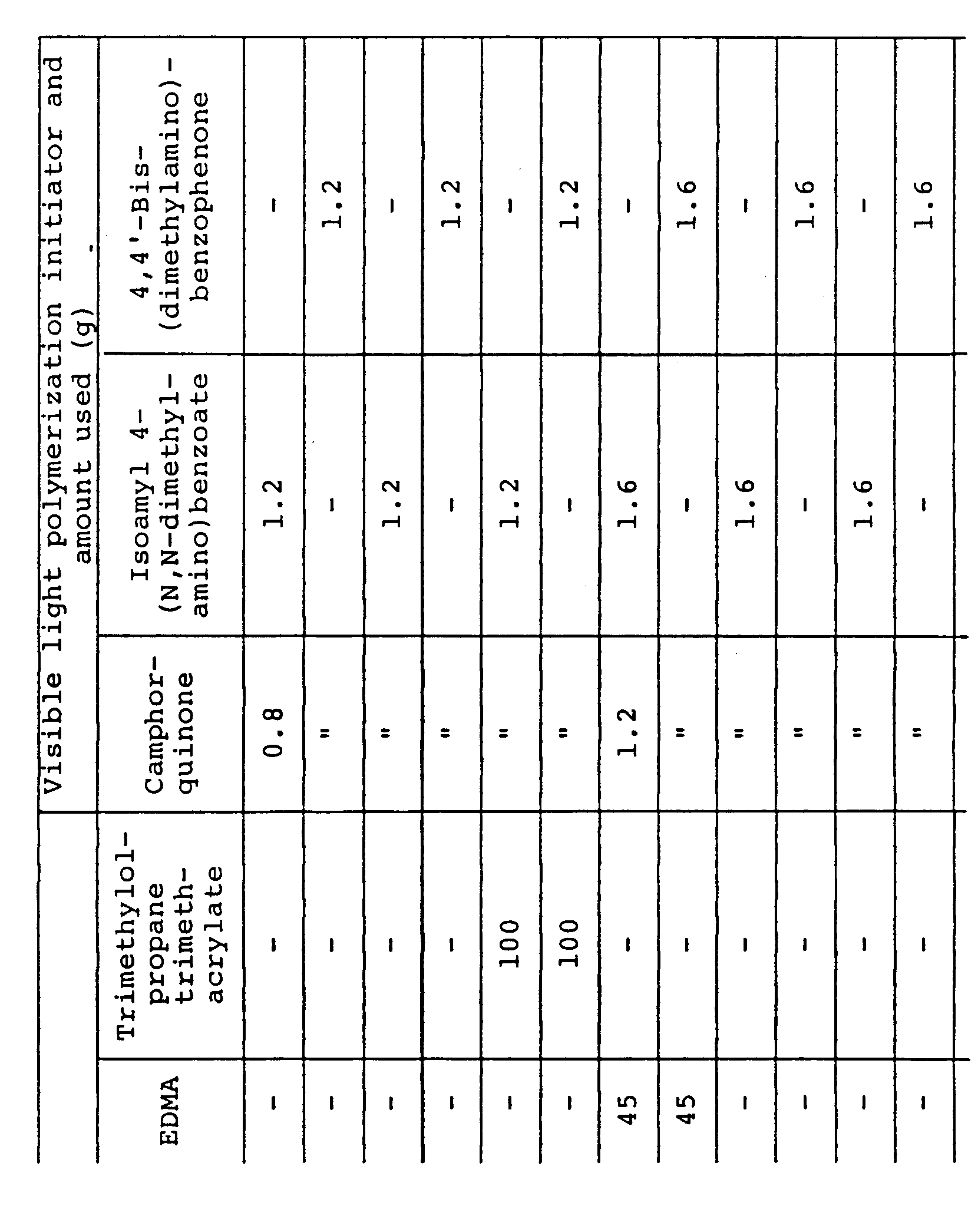

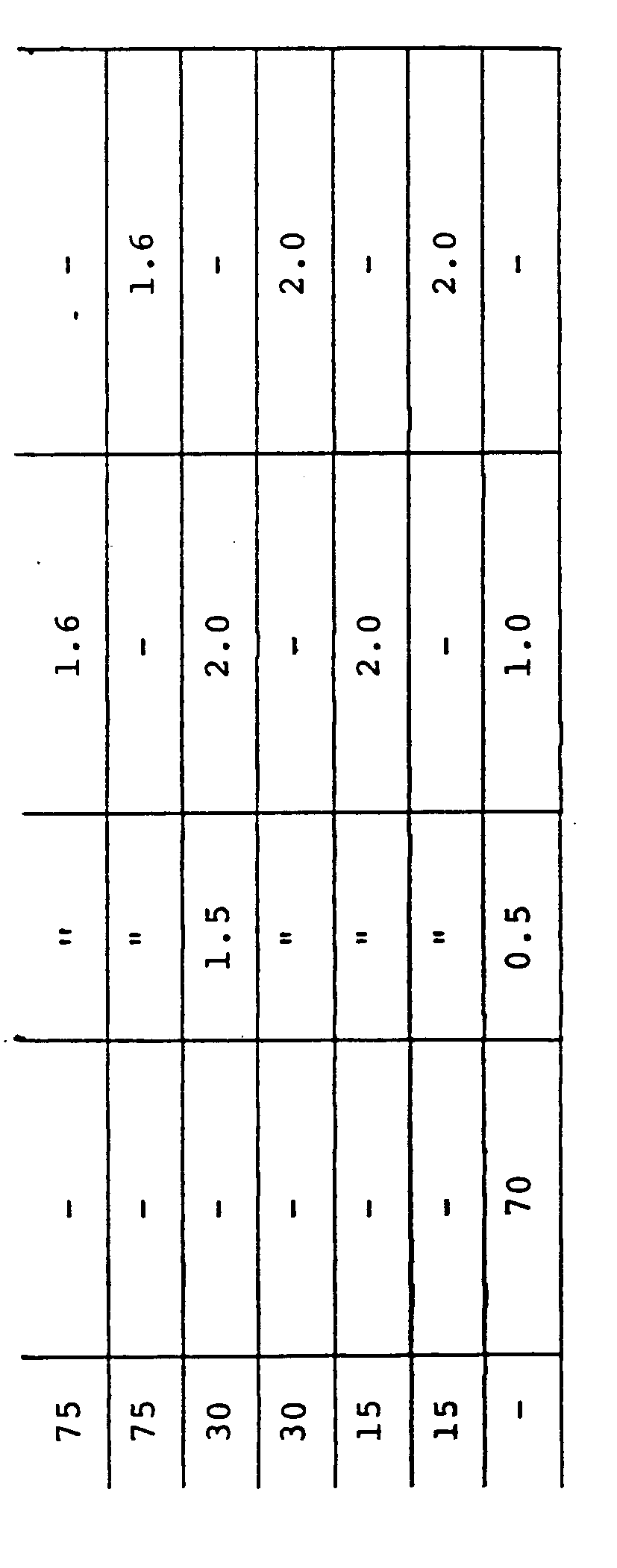


- Using a general-purpose mixer, various mixtures consisting of at least one radical-polymerizable unsaturated monomer (hereinafter referred to as monomer X), a polymerizable phosphoric ester compound (hereinafter referred to as monomer Z), and a visible light polymerization initiator were prepared in a dark room. The compositions of these mixtures and their respective codes are shown in Table 11.


- A series of adhesive compositions were prepared by mixing various urethane prepolymers containing two terminal isocyanate groups, which had been obtained in the foregoing synthesis of urethane prepolymers (I), with the radical-polymerizable unsaturated monomer/visible light polymerization initiator mixture LC-15 in a weight ratio of 1:1.
- According to the above-described procedure for the evaluation of adhesivity and the above-described method for the measurement of bond strength, each of these adhesive compositions was used to bond restorative material A to an unetched dentin surface of a cattle tooth, and the resulting bond strength was measured. The results thus obtained are shown in Table 12.
- Moreover, other series of adhesive compositions were prepared from various urethane prepolymers containing two terminal isocyanate groups and the radical-polymerizable unsaturated monomer/visible light polymerization initiator mixtures LC-15, LC-16, LC-22, LC-23, LC-56 and LC-57, and evaluated in the same manner. The results thus obtained are shown in Tables 12 to 16.


- A series of adhesive compositions were prepared by mixing various urethane prepolymers containing three free isocyanate groups, which had been obtained in the foregoing synthesis of urethane prepolymers (VII), with the radical-polymerizable unsaturated monomer/visible light polymerization initiator mixture LC-56 or LC-57 in a weight ratio of 1:1.
- According to the above-described procedure for the evaluation of adhesivity and the above-described method for the measurement of bond strength, each of these adhesive compositions was used to bond restorative material A to an unetched dentin surface and an etched enamel surface, and the resulting bond strengths were measured. The results thus obtained are shown in Table 17.

- Several series of adhesive compositions were prepared by mixing the isocyanate-containing urethane prepolymer TPT-11, MS-2 or CO-2, which had been obtained in the foregoing synthesis of urethane prepolymers (I), (V) or (VII), with various radical-polymerizable unsaturated monomer/visible light polymerization initiator mixtures in a weight ratio of 1:1.
- Then, using restorative material A, the adhesivity of these adhesive compositions was evaluated in the same manner as described in Example 1. The results thus obtained are shown in Tables 18 to 21.

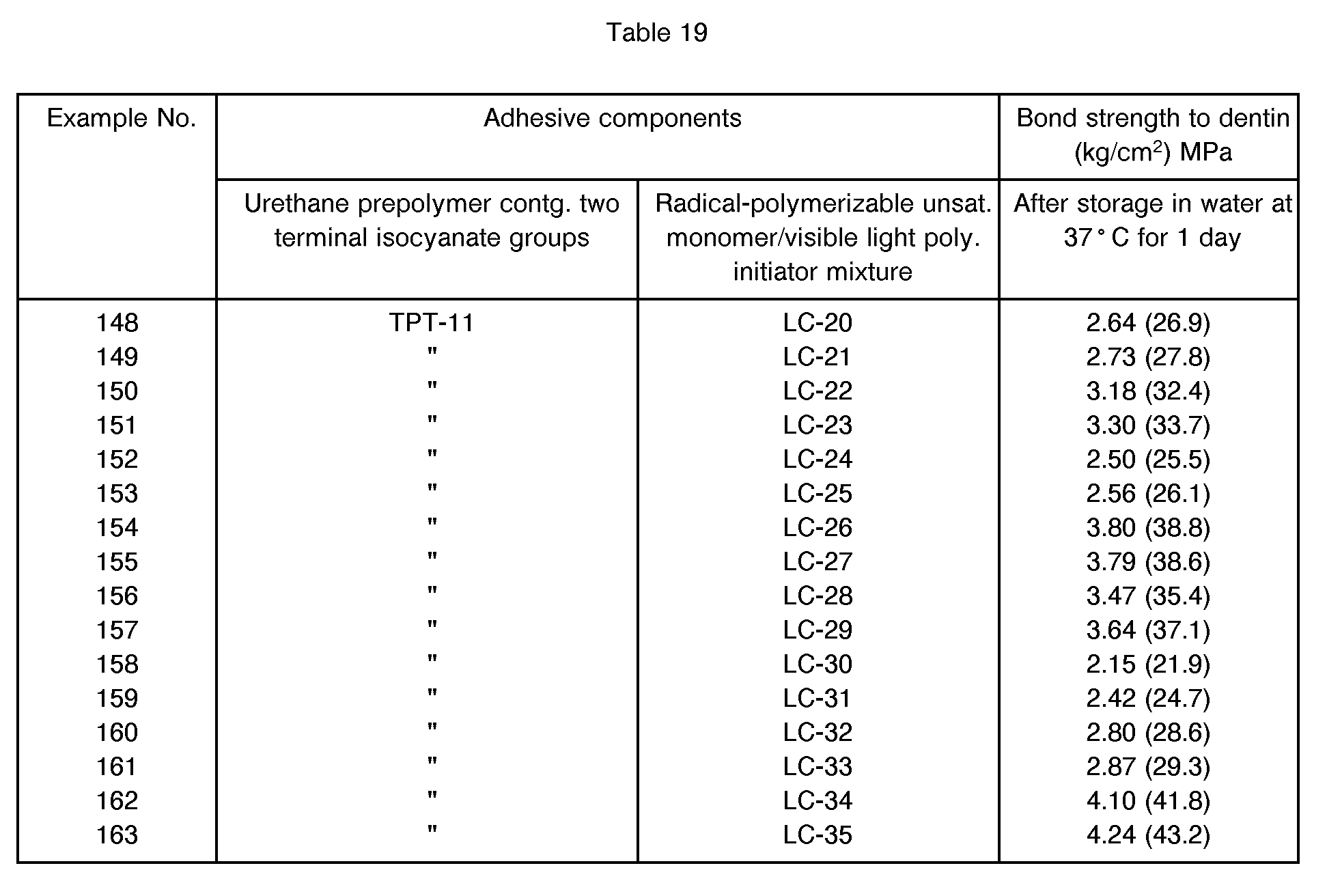


- According to the same procedure as described in Example 1, several series of adhesive compositions were prepared by using various urethane prepolymers containing one terminal isocyanate group and one terminal hydroxyl group, which had been obtained in the foregoing synthesis of urethane prepolymers (II), (III) or (VI), and various urethane prepolymers containing one terminal radical-polymerizable vinyl group and one terminal isocyanate group, which had been obtained in the foregoing synthesis of urethane prepolymers (III). Then, the adhesivity of these adhesive compositions was evaluated in the same manner as described in Example 1. The results thus obtained are shown in Tables 22 and 23.


- According to the same procedure as described in Example 128, a series of adhesive compositions were prepared by using various urethane prepolymers containing one radical-polymerizable vinyl group and two free isocyanate groups and various urethane prepolymers containing two radical-polymerizable vinyl groups and one free isocyanate group, which had been obtained in the foregoing synthesis of urethane prepolymers (VIII). Then, the adhesivity of these adhesive compositions was evaluated in the same manner as described in Example 1. The results thus obtained are shown in Table 24.

- According to the same procedure as described in Examples 7, 33, 59 or 85, various adhesive compositions were prepared by varying the weight ratio of the urethane prepolymer containing two terminal isocyanate groups to the radical-polymerizable unsaturated monomer/visible light polymerization initiator mixture. Then, the bonding power of these adhesive compositions was evaluated in the same manner as described in Example I. The results thus obtained are shown in Table 25.

- According to the same procedure as described in Example 125, various adhesive compositions were prepared by varying the weight ratio of the urethane prepolymer containing three free isocyanate groups to the radical-polymerizable unsaturate monomer/visible light polymerization initiator mixture. Then, the adhesivity of these adhesive compositions to an unetched dentin surface was evaluated in the same manner as described in Example 1. The results thus obtained are shown in Table 26.

- Using the adhesive compositions obtained in Examples 10, 62, 118 and 129, their adhesivity to various restorative materials was evaluated in the same manner as described in Example 1. The results thus obtained are shown in Table 27.


- According to the same procedure as described in Example 1, a series of adhesive compositions were prepared by using various polyether glycols, which had been obtained in the foregoing synthesis of urethane prepolymers (I), in place of the urethane prepolymer containing two terminal isocyanate groups. Then, the bonding power of these adhesive compositions was evaluated in the same manner as described in Example 1. The results thus obtained are shown in Table 28.
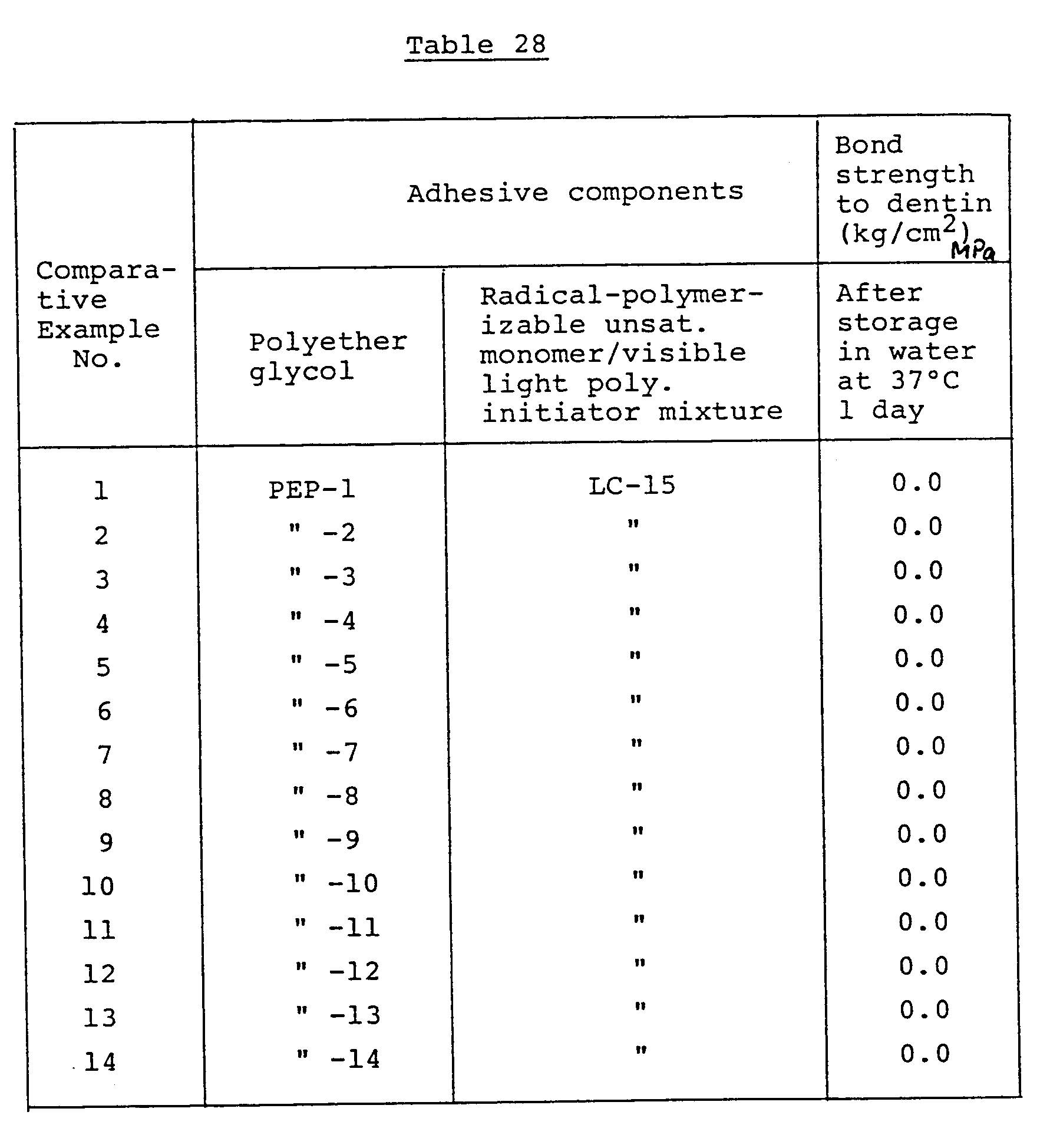
- According to the same procedure as described in Example 1, a series of adhesive compositions were prepared by using various polyester glycols, which had been obtained in the foregoing synthesis of urethane prepolymers (V), in place of the urethane prepolymer containing two terminal isocyanate groups. Then, the bonding power of these adhesive compositions was evaluated in the same manner as described in Example 1. The results thus obtained are shown in Table 29.
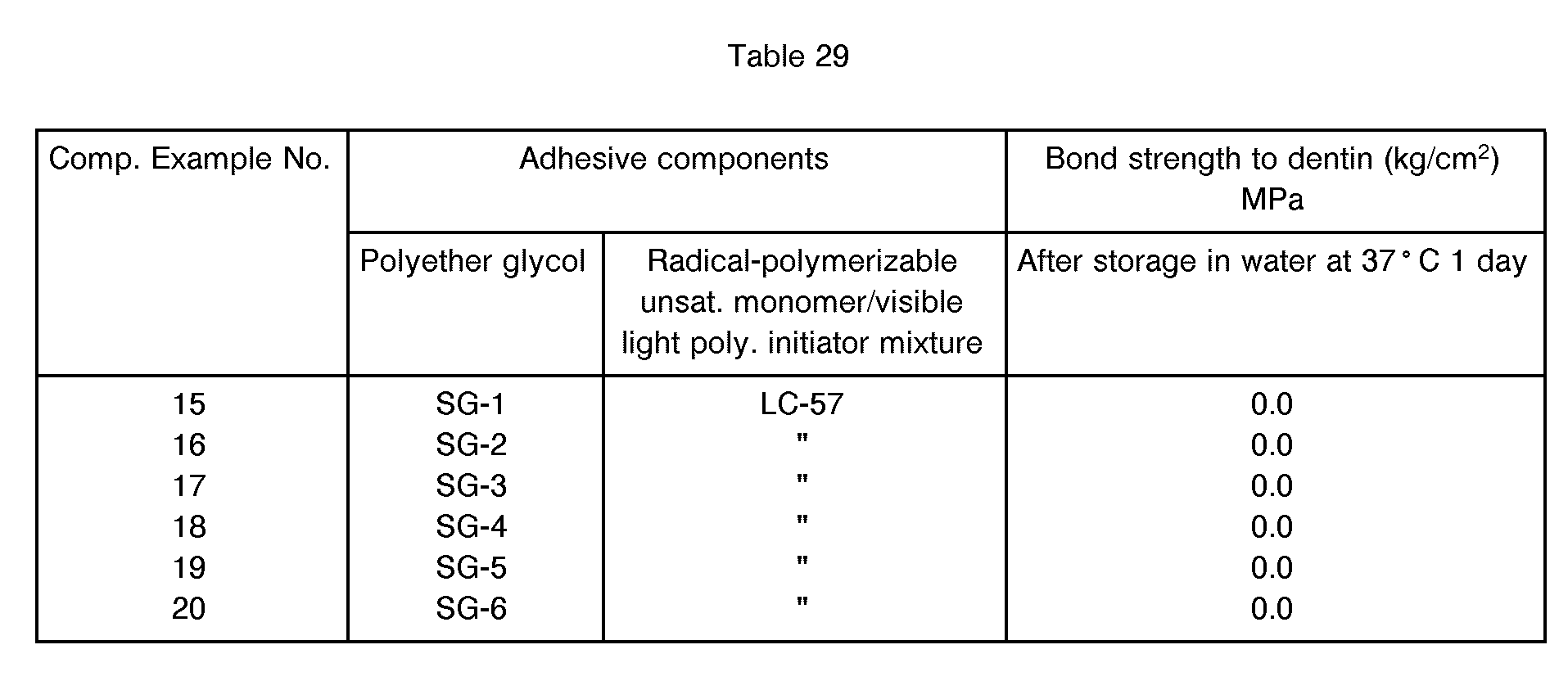
- According to the same procedure as described in Example 125, a series of adhesive compositions were prepared by using various urethane prepolymers having two terminal radical-polymerizable vinyl groups, which had been obtained in the foregoing synthesis of urethane prepolymers (IX), in place of the urethane prepolymer containing two terminal isocyanate groups. Then, the adhesivity of these adhesive compositions was evaluated in the same manner as described in Example 1. The results thus obtained are shown in Table 30.
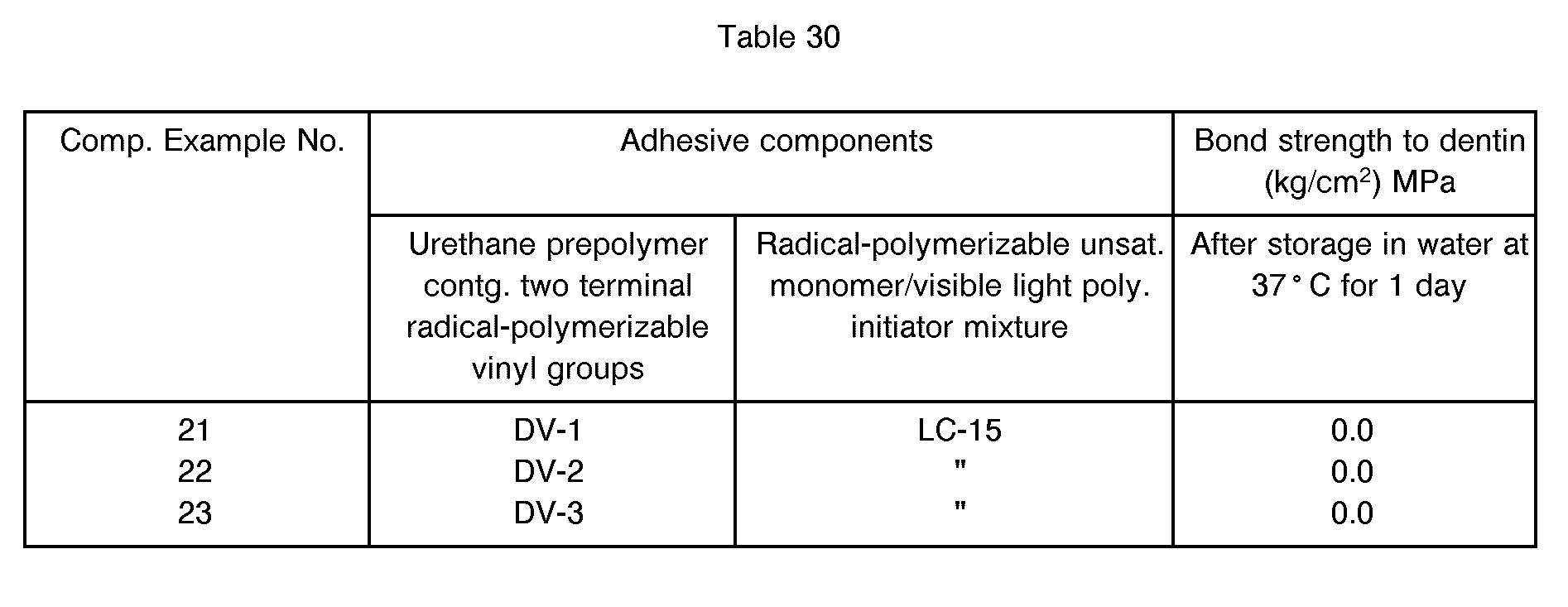
- According to the same procedure as described in Example 125 or 128, a series of adhesive compositions were prepared by using various urethane prepolymers having three radical-polymerizable vinyl groups, which has been obtained in the foregoing synthesis of urethane prepolymers (IX), in place of the urethane prepolymer containing three free isocyanate groups. Then, the adhesivity of these adhesive compositions was evaluated in the same manner as described in Example 1. The results thus obtained are shown in Table 31.

- A series of adhesive compositions were prepared by mixing various urethane prepolymers containing two terminal isocyanate groups, which had been obtained in the foregoing synthesis of urethane prepolymers (I), with the monomer X/monomer Z/visible light polymerization initiator mixture LC-69 in a weight ratio of 1:1.
- According to the above-described procedure for the evaluation of adhesivity and the above-described method for the measurement of bond strength, each of these adhesive compositions was used to bond restorative material A to an unetched dentin surface of a cattle tooth, and the resulting bond strength was measured. The results thus obtained are shown in Table 32.
- Moreover, another series of adhesive compositions were prepared with LC-64 and evaluated in the same manner. The results thus obtained are also shown in Table 32.


- A series of adhesive compositions were prepared by mixing the urethane prepolymer TPT-11 containing two terminal isocyanate groups, which had been obtained in the foregoing synthesis of urethane prepolymers (I), with various monomer X/monomer Z/visible light polymerization initiator mixtures in a weight ratio of 1:1.
- Then, using restorative material A, the adhesivity of these adhesive compositions was evaluated in the same manner as described in Example 1. The results thus obtained are shown in Table 33.

- A series of adhesive compositions were prepared by mixing the urethane prepolymer TPT-11 containing two terminal isocyanate groups, which had been obtained in the foregoing synthesis of urethane prepolymers (I), with various monomer X/monomer Z/visible light polymerization initiator mixtures (i.e, LC-73 to LC-88) in a weight ratio of 1:1.
- Then, using restorative material A, the adhesivity of these adhesive compositions was evaluated in the same manner as described in Example 1. The results thus obtained are shown in Table 34.
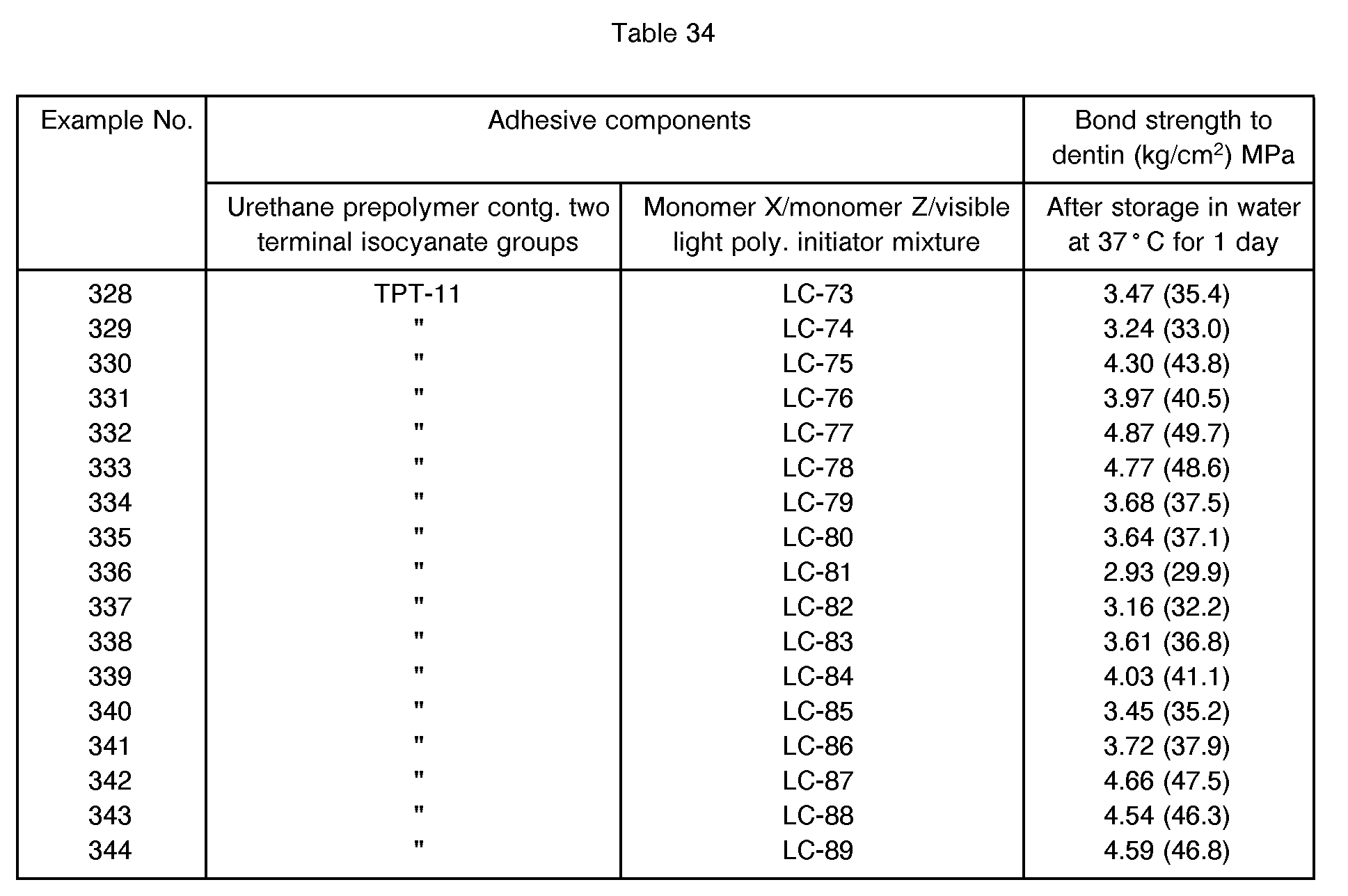
- According to the same procedure as described in Example 1, a series of adhesive compositions were prepared by using various polyether glycols, which had been obtained in the foregoing synthesis of urethane prepolymers (I), in place of the urethane prepolymer containing two terminal isocyanate groups. Then, the adhesivity of these adhesive compositions was evaluated in the same manner as described in Example 1. The results thus obtained are shown in Table 35.

- A series of adhesive compositions comprising various monomer X/monomer Z/visible light polymerization initiator mixtures alone were prepared. Then, the adhesivity of these adhesive compositions was evaluated in the same manner as described in Example 1. The results thus obtained are shown in Table 36.

- A series of adhesive compositions were prepared by mixing the urethane prepolymer TPT-11 containing two terminal isocyanate groups, which had been obtained in the foregoing synthesis of urethane prepolymers (I), with various monomer X/monomer Z/visible light polymerization initiator mixtures as shown in Table 38 (i.e., LC-77 to LC-80), in a weight ratio of 1:1.
- Then, using restorative material A, the adhesivity of these adhesive compositions was evaluated in the same manner as described in Example 1. The results thus obtained are shown in Table 37.


- According to the same procedures as described in Example 1, various adhesive compositions were prepared by varying the weight ratio of the urethane prepolymer containing two terminal isocyanate groups to the monomer X/monomer Z/visible light polymerization initiator mixture. Then, the adhesivity of these adhesive compositions was evaluated in the same manner as described in Example 1. The results thus obtained are shown in Table 39.

- Using the adhesive composition obtained in Example 275, its adhesivity to various restorative materials was evaluated in the same manner as described in Example 1. The results thus obtained are shown in Table 40.

Claims (24)


Applications Claiming Priority (6)
| Application Number | Priority Date | Filing Date | Title |
|---|---|---|---|
| JP190314/87 | 1987-07-31 | ||
| JP19031487 | 1987-07-31 | ||
| JP335727/87 | 1987-12-28 | ||
| JP62335727A JPH01113478A (en) | 1987-07-31 | 1987-12-28 | dental adhesive composition |
| JP63000816A JPH01178569A (en) | 1988-01-06 | 1988-01-06 | Dental adhesive composition |
| JP816/88 | 1988-01-06 |
Publications (3)
| Publication Number | Publication Date |
|---|---|
| EP0301516A2 EP0301516A2 (en) | 1989-02-01 |
| EP0301516A3 EP0301516A3 (en) | 1990-03-28 |
| EP0301516B1 true EP0301516B1 (en) | 1992-09-23 |
Family
ID=27274615
Family Applications (1)
| Application Number | Title | Priority Date | Filing Date |
|---|---|---|---|
| EP88112155A Expired - Lifetime EP0301516B1 (en) | 1987-07-31 | 1988-07-27 | Dental adhesive composition |
Country Status (4)
| Country | Link |
|---|---|
| US (1) | US4968725A (en) |
| EP (1) | EP0301516B1 (en) |
| AU (1) | AU608857B2 (en) |
| DE (1) | DE3874835T2 (en) |
Cited By (9)
| Publication number | Priority date | Publication date | Assignee | Title |
|---|---|---|---|---|
| EP1719530A3 (en) * | 2005-05-05 | 2006-12-13 | Tyco Healthcare Group Lp | Bioabsorbable surgical composition |
| US7858078B2 (en) | 2005-12-06 | 2010-12-28 | Tyco Healthcare Group Lp | Bioabsorbable surgical composition |
| US7910129B2 (en) | 2005-12-06 | 2011-03-22 | Tyco Healthcare Group Lp | Carbodiimide crosslinking of functionalized polyethylene glycols |
| US7947263B2 (en) | 2005-12-06 | 2011-05-24 | Tyco Healthcare Group Lp | Biocompatible surgical compositions |
| US7998466B2 (en) | 2005-12-06 | 2011-08-16 | Tyco Healthcare Group Lp | Biocompatible tissue sealants and adhesives |
| US8288477B2 (en) | 2005-12-06 | 2012-10-16 | Tyco Healthcare Group Lp | Bioabsorbable compounds and compositions containing them |
| US8449714B2 (en) | 2005-12-08 | 2013-05-28 | Covidien Lp | Biocompatible surgical compositions |
| US8500947B2 (en) | 2007-11-15 | 2013-08-06 | Covidien Lp | Speeding cure rate of bioadhesives |
| CN105368374A (en) * | 2015-12-02 | 2016-03-02 | 吉林大学 | Hydrophobic resin adhesive, preparation method and application thereof |
Families Citing this family (28)
| Publication number | Priority date | Publication date | Assignee | Title |
|---|---|---|---|---|
| JPS63316709A (en) * | 1987-06-19 | 1988-12-26 | Mitsubishi Rayon Co Ltd | Photopolymerizable dental composition |
| US4978391A (en) * | 1987-11-13 | 1990-12-18 | Dentsply Management Corp. | Intraoral medicament delivery and procedure |
| JPH024891A (en) * | 1988-06-21 | 1990-01-09 | Mitsubishi Rayon Co Ltd | dental adhesive composition |
| EP0363903A3 (en) * | 1988-10-14 | 1991-03-20 | Dentsply International | Adhesive containing pit and fissure sealants |
| JPH0374310A (en) * | 1989-08-14 | 1991-03-28 | Mitsubishi Rayon Co Ltd | Adhesive composition for dental use |
| JPH03163008A (en) * | 1989-08-14 | 1991-07-15 | Mitsubishi Rayon Co Ltd | dental adhesive |
| US5118779A (en) * | 1989-10-10 | 1992-06-02 | Polymedica Industries, Inc. | Hydrophilic polyurethane elastomers |
| US5087388A (en) * | 1990-02-26 | 1992-02-11 | Research Corporation Technologies, Inc. | Cartridge for extending the lifetime of dyes in dye lasers |
| GB9103717D0 (en) * | 1991-02-22 | 1991-04-10 | Baxenden Chem | Novel copolymers |
| US5326346A (en) * | 1992-07-27 | 1994-07-05 | Board Of Regents, The University Of Texas System | Light-cured urethane dimethacrylate ocular prosthesis |
| TW414713B (en) * | 1994-05-12 | 2000-12-11 | Dentsply Gmbh | Fluoride releasing liquid dental primer product and method |
| US6313191B1 (en) | 1994-08-22 | 2001-11-06 | Dentsply Gmbh | Method and composition for priming and adhering to tooth structure |
| DE19603577C2 (en) * | 1996-02-01 | 2003-11-13 | Heraeus Kulzer Gmbh & Co Kg | adhesive |
| US6339112B1 (en) | 1997-11-13 | 2002-01-15 | H.B. Fuller Licensing & Financing Inc. | Radiation curable compositions comprising metallocene polyolefins |
| DE19806572B4 (en) * | 1998-02-17 | 2007-01-25 | 3M Espe Ag | Adhesive attachment of dental filling materials |
| US6204302B1 (en) * | 1998-11-20 | 2001-03-20 | Bisco, Inc. | Photosensitizers for free radical polymerization initiation resins and method of making the same |
| US6387982B1 (en) | 1998-11-23 | 2002-05-14 | Dentsply Detrey G.M.B.H. | Self etching adhesive primer composition and polymerizable surfactants |
| US6342203B2 (en) | 1999-10-27 | 2002-01-29 | Dakota Dental Development, Inc. | Compositions for dentistry comprising an oil, to repair, restore, adhere to, or protect the surface of a tooth |
| US6620859B2 (en) * | 2000-12-15 | 2003-09-16 | Dakota Dental Development, Inc. | Methods of preparing polymerizable dental compositions with improved taste or aroma, and that prevent oxygen-inhibited layer |
| EP2462939A3 (en) * | 2001-07-31 | 2012-08-15 | Tyco Healthcare Group LP | Bioabsorbable adhesive compounds and compositions |
| US6900251B2 (en) * | 2002-06-26 | 2005-05-31 | Ivoclar Vivadent Ag | Dental materials based on acrylic-ester phosphonic acids |
| US20080044661A1 (en) * | 2004-12-23 | 2008-02-21 | Hazell David M | Isocyanate Composition Comprising a Vegetable Oil and Composites Therefrom |
| JP2008530305A (en) | 2005-02-09 | 2008-08-07 | タイコ ヘルスケア グループ エルピー | Synthetic sealant |
| JP5702044B2 (en) * | 2008-03-04 | 2015-04-15 | 株式会社松風 | Photo-curable dental composition that suppresses color tone change by monomer |
| MY148595A (en) * | 2009-06-12 | 2013-05-15 | Univ Malaya | Polyurethane oligomers for use in restorative dentistry |
| CN108852857A (en) * | 2018-07-16 | 2018-11-23 | 潍坊科技学院 | A kind of dentin desensitizer material and preparation method |
| WO2020122059A1 (en) | 2018-12-12 | 2020-06-18 | 三井化学株式会社 | Monomer composition, method for producing same, raw material composition, curable composition, and molded article |
| CN115873510B (en) * | 2022-11-29 | 2024-06-14 | 烟台德邦科技股份有限公司 | High-temperature-resistant high-humidity high-bonding-strength UV adhesive for battery shell film and preparation method thereof |
Family Cites Families (11)
| Publication number | Priority date | Publication date | Assignee | Title |
|---|---|---|---|---|
| US4134935A (en) * | 1971-08-12 | 1979-01-16 | Bayer Aktiengesellschaft | Dental varnishes |
| US3759809A (en) * | 1972-11-14 | 1973-09-18 | Sun Chemical Corp | Radiation curable compositions comprising an isocyanate modified polyfunctional ester and a photoinitiator |
| US4057535A (en) * | 1976-04-14 | 1977-11-08 | Tatyana Esperovna Lipatova | Adhesive for gluing together soft body tissues |
| GB2090602B (en) * | 1981-01-06 | 1984-08-15 | Mitsubishi Rayon Co | Polymer composition |
| IL65159A0 (en) * | 1981-03-04 | 1982-05-31 | Ici Plc | Polymerisable dental compositions |
| JPS616899Y2 (en) * | 1981-04-27 | 1986-03-03 | ||
| EP0064834B1 (en) * | 1981-05-04 | 1987-07-08 | Dentsply International, Inc. | Dental adhesive system |
| US4539382A (en) * | 1981-07-29 | 1985-09-03 | Kuraray Co., Ltd. | Adhesive composition |
| JPS59135272A (en) * | 1983-01-21 | 1984-08-03 | Kuraray Co Ltd | Adhesive |
| US4678819A (en) * | 1984-08-30 | 1987-07-07 | Mitsubishi Rayon Co., Ltd. | Compositions for artificial marbles and process for producing artificial marbles therefrom |
| US4657941A (en) * | 1984-11-29 | 1987-04-14 | Dentsply Research & Development Corp. | Biologically compatible adhesive containing a phosphorus adhesion promoter and a sulfinic accelerator |
-
1988
- 1988-06-20 AU AU18145/88A patent/AU608857B2/en not_active Ceased
- 1988-07-20 US US07/221,549 patent/US4968725A/en not_active Expired - Fee Related
- 1988-07-27 DE DE8888112155T patent/DE3874835T2/en not_active Expired - Fee Related
- 1988-07-27 EP EP88112155A patent/EP0301516B1/en not_active Expired - Lifetime
Cited By (11)
| Publication number | Priority date | Publication date | Assignee | Title |
|---|---|---|---|---|
| EP1719530A3 (en) * | 2005-05-05 | 2006-12-13 | Tyco Healthcare Group Lp | Bioabsorbable surgical composition |
| US7858078B2 (en) | 2005-12-06 | 2010-12-28 | Tyco Healthcare Group Lp | Bioabsorbable surgical composition |
| US7910129B2 (en) | 2005-12-06 | 2011-03-22 | Tyco Healthcare Group Lp | Carbodiimide crosslinking of functionalized polyethylene glycols |
| US7947263B2 (en) | 2005-12-06 | 2011-05-24 | Tyco Healthcare Group Lp | Biocompatible surgical compositions |
| US7998466B2 (en) | 2005-12-06 | 2011-08-16 | Tyco Healthcare Group Lp | Biocompatible tissue sealants and adhesives |
| US8288477B2 (en) | 2005-12-06 | 2012-10-16 | Tyco Healthcare Group Lp | Bioabsorbable compounds and compositions containing them |
| US8357361B2 (en) | 2005-12-06 | 2013-01-22 | Covidien Lp | Bioabsorbable surgical composition |
| US8449714B2 (en) | 2005-12-08 | 2013-05-28 | Covidien Lp | Biocompatible surgical compositions |
| US8790488B2 (en) | 2005-12-08 | 2014-07-29 | Covidien Lp | Biocompatible surgical compositions |
| US8500947B2 (en) | 2007-11-15 | 2013-08-06 | Covidien Lp | Speeding cure rate of bioadhesives |
| CN105368374A (en) * | 2015-12-02 | 2016-03-02 | 吉林大学 | Hydrophobic resin adhesive, preparation method and application thereof |
Also Published As
| Publication number | Publication date |
|---|---|
| DE3874835T2 (en) | 1993-05-06 |
| EP0301516A3 (en) | 1990-03-28 |
| US4968725A (en) | 1990-11-06 |
| AU1814588A (en) | 1989-02-02 |
| DE3874835D1 (en) | 1992-10-29 |
| EP0301516A2 (en) | 1989-02-01 |
| AU608857B2 (en) | 1991-04-18 |
Similar Documents
| Publication | Publication Date | Title |
|---|---|---|
| US4968725A (en) | Dental adhesive composition | |
| EP0347711B1 (en) | Dental adhesive composition | |
| US4323348A (en) | Dental compositions | |
| EP0189903B2 (en) | Non-toxic organic compositions and calcium hydroxide compositions thereof | |
| FI75268C (en) | In visible light curable liquid dental composition, process for its preparation and its use as dental filler. | |
| US5886064A (en) | Fine-grained polymerizable compositions flowable under pressure or shear stress | |
| EP0393617B1 (en) | Dental adhesive composition | |
| AU2166401A (en) | Radically curable urethane prepolymers and their use in dental materials | |
| JPH0778209B2 (en) | Biologically compatible adhesive | |
| SE468463B (en) | DENTAL CEMENT COMPOSITION INCLUDING CALCIUM HYDROXIDE AND ETHENIC POLYMERIZABLE SUBSTANCE | |
| EP2078049B1 (en) | Materials leading to improved dental composites and dental composites made therefrom | |
| US4774267A (en) | Dental material comprising adduct of glycidilmethacrylate and tricarboxylic acid | |
| JP2505894B2 (en) | Pit and crack sealant containing adhesive | |
| US6001896A (en) | Adhesive for dental resin composite materials | |
| JPH01113478A (en) | dental adhesive composition | |
| EP0468077A1 (en) | Dental adhesive | |
| JPH01178569A (en) | Dental adhesive composition | |
| FI80381C (en) | Visible light curable liquid dental composition, process for its preparation and its use as dental filler | |
| JPH03143440A (en) | Adhesion of odontostructure restorative material to odontostructure | |
| PL170884B1 (en) | A method of producing a methacrylate composition with reduced water absorption for the needs of dentistry |
Legal Events
| Date | Code | Title | Description |
|---|---|---|---|
| PUAI | Public reference made under article 153(3) epc to a published international application that has entered the european phase |
Free format text: ORIGINAL CODE: 0009012 |
|
| AK | Designated contracting states |
Kind code of ref document: A2 Designated state(s): CH DE FR GB IT LI |
|
| PUAL | Search report despatched |
Free format text: ORIGINAL CODE: 0009013 |
|
| AK | Designated contracting states |
Kind code of ref document: A3 Designated state(s): CH DE FR GB IT LI |
|
| 17P | Request for examination filed |
Effective date: 19900606 |
|
| 17Q | First examination report despatched |
Effective date: 19910405 |
|
| GRAA | (expected) grant |
Free format text: ORIGINAL CODE: 0009210 |
|
| AK | Designated contracting states |
Kind code of ref document: B1 Designated state(s): CH DE FR GB IT LI |
|
| ITF | It: translation for a ep patent filed | ||
| REF | Corresponds to: |
Ref document number: 3874835 Country of ref document: DE Date of ref document: 19921029 |
|
| ET | Fr: translation filed | ||
| PLBE | No opposition filed within time limit |
Free format text: ORIGINAL CODE: 0009261 |
|
| STAA | Information on the status of an ep patent application or granted ep patent |
Free format text: STATUS: NO OPPOSITION FILED WITHIN TIME LIMIT |
|
| 26N | No opposition filed | ||
| PGFP | Annual fee paid to national office [announced via postgrant information from national office to epo] |
Ref country code: FR Payment date: 19940711 Year of fee payment: 7 |
|
| PGFP | Annual fee paid to national office [announced via postgrant information from national office to epo] |
Ref country code: GB Payment date: 19940719 Year of fee payment: 7 |
|
| PGFP | Annual fee paid to national office [announced via postgrant information from national office to epo] |
Ref country code: DE Payment date: 19940721 Year of fee payment: 7 |
|
| PGFP | Annual fee paid to national office [announced via postgrant information from national office to epo] |
Ref country code: CH Payment date: 19940725 Year of fee payment: 7 |
|
| PG25 | Lapsed in a contracting state [announced via postgrant information from national office to epo] |
Ref country code: GB Effective date: 19950727 |
|
| PG25 | Lapsed in a contracting state [announced via postgrant information from national office to epo] |
Ref country code: LI Effective date: 19950731 Ref country code: CH Effective date: 19950731 |
|
| REG | Reference to a national code |
Ref country code: CH Ref legal event code: PL |
|
| GBPC | Gb: european patent ceased through non-payment of renewal fee |
Effective date: 19950727 |
|
| PG25 | Lapsed in a contracting state [announced via postgrant information from national office to epo] |
Ref country code: DE Effective date: 19960402 |
|
| PG25 | Lapsed in a contracting state [announced via postgrant information from national office to epo] |
Ref country code: FR Effective date: 19960430 |
|
| REG | Reference to a national code |
Ref country code: FR Ref legal event code: ST |
|
| REG | Reference to a national code |
Ref country code: FR Ref legal event code: ST |
|
| REG | Reference to a national code |
Ref country code: FR Ref legal event code: ST |
|
| PG25 | Lapsed in a contracting state [announced via postgrant information from national office to epo] |
Ref country code: IT Free format text: LAPSE BECAUSE OF NON-PAYMENT OF DUE FEES;WARNING: LAPSES OF ITALIAN PATENTS WITH EFFECTIVE DATE BEFORE 2007 MAY HAVE OCCURRED AT ANY TIME BEFORE 2007. THE CORRECT EFFECTIVE DATE MAY BE DIFFERENT FROM THE ONE RECORDED. Effective date: 20050727 |