EP0300638B1 - A process for preparing highly crystalline poly-1-butene and the catalyst used in the process - Google Patents
A process for preparing highly crystalline poly-1-butene and the catalyst used in the process Download PDFInfo
- Publication number
- EP0300638B1 EP0300638B1 EP88306163A EP88306163A EP0300638B1 EP 0300638 B1 EP0300638 B1 EP 0300638B1 EP 88306163 A EP88306163 A EP 88306163A EP 88306163 A EP88306163 A EP 88306163A EP 0300638 B1 EP0300638 B1 EP 0300638B1
- Authority
- EP
- European Patent Office
- Prior art keywords
- butene
- catalyst
- catalyst composition
- electron donor
- polymerization
- Prior art date
- Legal status (The legal status is an assumption and is not a legal conclusion. Google has not performed a legal analysis and makes no representation as to the accuracy of the status listed.)
- Expired - Lifetime
Links
- VXNZUUAINFGPBY-UHFFFAOYSA-N 1-Butene Chemical compound CCC=C VXNZUUAINFGPBY-UHFFFAOYSA-N 0.000 title claims abstract description 82
- 239000003054 catalyst Substances 0.000 title claims abstract description 63
- 238000000034 method Methods 0.000 title claims description 12
- 238000004519 manufacturing process Methods 0.000 title description 3
- 239000000203 mixture Substances 0.000 claims abstract description 39
- 229920000642 polymer Polymers 0.000 claims abstract description 34
- 239000000178 monomer Substances 0.000 claims abstract description 21
- TWRXJAOTZQYOKJ-UHFFFAOYSA-L Magnesium chloride Chemical compound [Mg+2].[Cl-].[Cl-] TWRXJAOTZQYOKJ-UHFFFAOYSA-L 0.000 claims abstract description 18
- 229910001629 magnesium chloride Inorganic materials 0.000 claims abstract description 9
- 230000000379 polymerizing effect Effects 0.000 claims abstract description 8
- 239000007788 liquid Substances 0.000 claims abstract description 7
- 239000004215 Carbon black (E152) Substances 0.000 claims abstract 3
- 239000010936 titanium Substances 0.000 claims description 22
- 229910052782 aluminium Inorganic materials 0.000 claims description 15
- 230000000707 stereoselective effect Effects 0.000 claims description 15
- 239000001257 hydrogen Substances 0.000 claims description 14
- 229910052739 hydrogen Inorganic materials 0.000 claims description 14
- 229910052719 titanium Inorganic materials 0.000 claims description 14
- 239000004411 aluminium Substances 0.000 claims description 11
- XAGFODPZIPBFFR-UHFFFAOYSA-N aluminium Chemical compound [Al] XAGFODPZIPBFFR-UHFFFAOYSA-N 0.000 claims description 10
- 239000011949 solid catalyst Substances 0.000 claims description 10
- WEEGYLXZBRQIMU-UHFFFAOYSA-N Eucalyptol Chemical compound C1CC2CCC1(C)OC2(C)C WEEGYLXZBRQIMU-UHFFFAOYSA-N 0.000 claims description 9
- WSSSPWUEQFSQQG-UHFFFAOYSA-N 4-methyl-1-pentene Chemical compound CC(C)CC=C WSSSPWUEQFSQQG-UHFFFAOYSA-N 0.000 claims description 8
- 239000007789 gas Substances 0.000 claims description 8
- 125000005842 heteroatom Chemical group 0.000 claims description 7
- -1 titanium halide Chemical class 0.000 claims description 7
- 125000000008 (C1-C10) alkyl group Chemical group 0.000 claims description 6
- 150000004820 halides Chemical class 0.000 claims description 5
- 229920001577 copolymer Polymers 0.000 claims description 4
- 229910003074 TiCl4 Inorganic materials 0.000 claims description 3
- 239000011954 Ziegler–Natta catalyst Substances 0.000 claims description 3
- 229920001519 homopolymer Polymers 0.000 claims description 3
- 125000000383 tetramethylene group Chemical group [H]C([H])([*:1])C([H])([H])C([H])([H])C([H])([H])[*:2] 0.000 claims description 3
- XJDNKRIXUMDJCW-UHFFFAOYSA-J titanium tetrachloride Chemical group Cl[Ti](Cl)(Cl)Cl XJDNKRIXUMDJCW-UHFFFAOYSA-J 0.000 claims description 3
- 125000004435 hydrogen atom Chemical class [H]* 0.000 claims description 2
- 125000002006 1,8-cineol group Chemical group 0.000 claims 1
- 150000001875 compounds Chemical class 0.000 abstract description 19
- 125000004432 carbon atom Chemical group C* 0.000 abstract description 6
- 239000007787 solid Substances 0.000 abstract description 5
- 239000012530 fluid Substances 0.000 abstract description 3
- 150000002430 hydrocarbons Chemical class 0.000 abstract description 3
- 230000003287 optical effect Effects 0.000 abstract description 3
- 230000005540 biological transmission Effects 0.000 abstract description 2
- 229930195733 hydrocarbon Natural products 0.000 abstract 1
- 238000006116 polymerization reaction Methods 0.000 description 47
- 239000000047 product Substances 0.000 description 25
- IJGRMHOSHXDMSA-UHFFFAOYSA-N Atomic nitrogen Chemical compound N#N IJGRMHOSHXDMSA-UHFFFAOYSA-N 0.000 description 24
- 230000000052 comparative effect Effects 0.000 description 20
- OFBQJSOFQDEBGM-UHFFFAOYSA-N n-pentane Natural products CCCCC OFBQJSOFQDEBGM-UHFFFAOYSA-N 0.000 description 17
- 230000000694 effects Effects 0.000 description 13
- UFHFLCQGNIYNRP-UHFFFAOYSA-N Hydrogen Chemical compound [H][H] UFHFLCQGNIYNRP-UHFFFAOYSA-N 0.000 description 11
- AHUXYBVKTIBBJW-UHFFFAOYSA-N dimethoxy(diphenyl)silane Chemical compound C=1C=CC=CC=1[Si](OC)(OC)C1=CC=CC=C1 AHUXYBVKTIBBJW-UHFFFAOYSA-N 0.000 description 11
- 229910052757 nitrogen Inorganic materials 0.000 description 10
- 238000002360 preparation method Methods 0.000 description 8
- 150000001399 aluminium compounds Chemical class 0.000 description 7
- 238000002156 mixing Methods 0.000 description 7
- VEXZGXHMUGYJMC-UHFFFAOYSA-M Chloride anion Chemical compound [Cl-] VEXZGXHMUGYJMC-UHFFFAOYSA-M 0.000 description 6
- 239000011261 inert gas Substances 0.000 description 6
- 239000002245 particle Substances 0.000 description 6
- 239000012071 phase Substances 0.000 description 6
- VOITXYVAKOUIBA-UHFFFAOYSA-N triethylaluminium Chemical compound CC[Al](CC)CC VOITXYVAKOUIBA-UHFFFAOYSA-N 0.000 description 6
- MCULRUJILOGHCJ-UHFFFAOYSA-N triisobutylaluminium Chemical compound CC(C)C[Al](CC(C)C)CC(C)C MCULRUJILOGHCJ-UHFFFAOYSA-N 0.000 description 6
- LVTJOONKWUXEFR-FZRMHRINSA-N protoneodioscin Natural products O(C[C@@H](CC[C@]1(O)[C@H](C)[C@@H]2[C@]3(C)[C@H]([C@H]4[C@@H]([C@]5(C)C(=CC4)C[C@@H](O[C@@H]4[C@H](O[C@H]6[C@@H](O)[C@@H](O)[C@@H](O)[C@H](C)O6)[C@@H](O)[C@H](O[C@H]6[C@@H](O)[C@@H](O)[C@@H](O)[C@H](C)O6)[C@H](CO)O4)CC5)CC3)C[C@@H]2O1)C)[C@H]1[C@H](O)[C@H](O)[C@H](O)[C@@H](CO)O1 LVTJOONKWUXEFR-FZRMHRINSA-N 0.000 description 5
- IMNFDUFMRHMDMM-UHFFFAOYSA-N N-Heptane Chemical compound CCCCCCC IMNFDUFMRHMDMM-UHFFFAOYSA-N 0.000 description 4
- ATUOYWHBWRKTHZ-UHFFFAOYSA-N Propane Chemical compound CCC ATUOYWHBWRKTHZ-UHFFFAOYSA-N 0.000 description 4
- QQONPFPTGQHPMA-UHFFFAOYSA-N Propene Chemical compound CC=C QQONPFPTGQHPMA-UHFFFAOYSA-N 0.000 description 4
- RTAQQCXQSZGOHL-UHFFFAOYSA-N Titanium Chemical compound [Ti] RTAQQCXQSZGOHL-UHFFFAOYSA-N 0.000 description 4
- 229910001873 dinitrogen Chemical class 0.000 description 4
- YONPGGFAJWQGJC-UHFFFAOYSA-K titanium(iii) chloride Chemical compound Cl[Ti](Cl)Cl YONPGGFAJWQGJC-UHFFFAOYSA-K 0.000 description 4
- RTZKZFJDLAIYFH-UHFFFAOYSA-N Diethyl ether Chemical compound CCOCC RTZKZFJDLAIYFH-UHFFFAOYSA-N 0.000 description 3
- PPBRXRYQALVLMV-UHFFFAOYSA-N Styrene Chemical group C=CC1=CC=CC=C1 PPBRXRYQALVLMV-UHFFFAOYSA-N 0.000 description 3
- 239000007795 chemical reaction product Substances 0.000 description 3
- 239000000460 chlorine Substances 0.000 description 3
- 229910052801 chlorine Inorganic materials 0.000 description 3
- 239000011521 glass Substances 0.000 description 3
- 150000002431 hydrogen Chemical class 0.000 description 3
- 238000002844 melting Methods 0.000 description 3
- 230000008018 melting Effects 0.000 description 3
- 230000006911 nucleation Effects 0.000 description 3
- 238000010899 nucleation Methods 0.000 description 3
- 229920001083 polybutene Polymers 0.000 description 3
- 239000000243 solution Substances 0.000 description 3
- 150000003609 titanium compounds Chemical class 0.000 description 3
- 239000004711 α-olefin Substances 0.000 description 3
- ZMZGFLUUZLELNE-UHFFFAOYSA-N 2,3,5-triiodobenzoic acid Chemical compound OC(=O)C1=CC(I)=CC(I)=C1I ZMZGFLUUZLELNE-UHFFFAOYSA-N 0.000 description 2
- VZSRBBMJRBPUNF-UHFFFAOYSA-N 2-(2,3-dihydro-1H-inden-2-ylamino)-N-[3-oxo-3-(2,4,6,7-tetrahydrotriazolo[4,5-c]pyridin-5-yl)propyl]pyrimidine-5-carboxamide Chemical compound C1C(CC2=CC=CC=C12)NC1=NC=C(C=N1)C(=O)NCCC(N1CC2=C(CC1)NN=N2)=O VZSRBBMJRBPUNF-UHFFFAOYSA-N 0.000 description 2
- ZAMOUSCENKQFHK-UHFFFAOYSA-N Chlorine atom Chemical compound [Cl] ZAMOUSCENKQFHK-UHFFFAOYSA-N 0.000 description 2
- 239000004743 Polypropylene Substances 0.000 description 2
- 229910000831 Steel Inorganic materials 0.000 description 2
- 238000013019 agitation Methods 0.000 description 2
- 125000000217 alkyl group Chemical group 0.000 description 2
- 125000004429 atom Chemical group 0.000 description 2
- 238000009835 boiling Methods 0.000 description 2
- 238000012512 characterization method Methods 0.000 description 2
- 238000005660 chlorination reaction Methods 0.000 description 2
- 239000007799 cork Substances 0.000 description 2
- 238000002425 crystallisation Methods 0.000 description 2
- 230000008025 crystallization Effects 0.000 description 2
- 230000007423 decrease Effects 0.000 description 2
- 150000002391 heterocyclic compounds Chemical class 0.000 description 2
- 229920001580 isotactic polymer Polymers 0.000 description 2
- 239000007791 liquid phase Substances 0.000 description 2
- VNWKTOKETHGBQD-UHFFFAOYSA-N methane Chemical compound C VNWKTOKETHGBQD-UHFFFAOYSA-N 0.000 description 2
- 239000002808 molecular sieve Substances 0.000 description 2
- 150000002902 organometallic compounds Chemical class 0.000 description 2
- 229920001155 polypropylene Polymers 0.000 description 2
- 239000001294 propane Substances 0.000 description 2
- URGAHOPLAPQHLN-UHFFFAOYSA-N sodium aluminosilicate Chemical compound [Na+].[Al+3].[O-][Si]([O-])=O.[O-][Si]([O-])=O URGAHOPLAPQHLN-UHFFFAOYSA-N 0.000 description 2
- 239000010959 steel Substances 0.000 description 2
- 238000005406 washing Methods 0.000 description 2
- DURPTKYDGMDSBL-UHFFFAOYSA-N 1-butoxybutane Chemical compound CCCCOCCCC DURPTKYDGMDSBL-UHFFFAOYSA-N 0.000 description 1
- OKTJSMMVPCPJKN-UHFFFAOYSA-N Carbon Chemical group [C] OKTJSMMVPCPJKN-UHFFFAOYSA-N 0.000 description 1
- OTMSDBZUPAUEDD-UHFFFAOYSA-N Ethane Chemical compound CC OTMSDBZUPAUEDD-UHFFFAOYSA-N 0.000 description 1
- VGGSQFUCUMXWEO-UHFFFAOYSA-N Ethene Chemical compound C=C VGGSQFUCUMXWEO-UHFFFAOYSA-N 0.000 description 1
- 239000000654 additive Substances 0.000 description 1
- 150000001335 aliphatic alkanes Chemical class 0.000 description 1
- 150000001336 alkenes Chemical class 0.000 description 1
- 150000001398 aluminium Chemical class 0.000 description 1
- 229940077746 antacid containing aluminium compound Drugs 0.000 description 1
- 229920001585 atactic polymer Polymers 0.000 description 1
- 229910052794 bromium Inorganic materials 0.000 description 1
- 239000001273 butane Substances 0.000 description 1
- 230000003197 catalytic effect Effects 0.000 description 1
- 150000001849 cineol derivatives Chemical class 0.000 description 1
- 229960005233 cineole Drugs 0.000 description 1
- 238000001816 cooling Methods 0.000 description 1
- 238000007334 copolymerization reaction Methods 0.000 description 1
- 239000013078 crystal Substances 0.000 description 1
- 125000004122 cyclic group Chemical group 0.000 description 1
- 238000010586 diagram Methods 0.000 description 1
- 229960004132 diethyl ether Drugs 0.000 description 1
- PPQUYYAZSOKTQD-UHFFFAOYSA-M diethylalumanylium;iodide Chemical compound CC[Al](I)CC PPQUYYAZSOKTQD-UHFFFAOYSA-M 0.000 description 1
- YNLAOSYQHBDIKW-UHFFFAOYSA-M diethylaluminium chloride Chemical compound CC[Al](Cl)CC YNLAOSYQHBDIKW-UHFFFAOYSA-M 0.000 description 1
- 238000001125 extrusion Methods 0.000 description 1
- 230000002349 favourable effect Effects 0.000 description 1
- ZXKXJHAOUFHNAS-UHFFFAOYSA-N fenfluramine hydrochloride Chemical compound [Cl-].CC[NH2+]C(C)CC1=CC=CC(C(F)(F)F)=C1 ZXKXJHAOUFHNAS-UHFFFAOYSA-N 0.000 description 1
- 238000000227 grinding Methods 0.000 description 1
- 229910052736 halogen Inorganic materials 0.000 description 1
- 150000002367 halogens Chemical group 0.000 description 1
- 150000004678 hydrides Chemical class 0.000 description 1
- 239000012442 inert solvent Substances 0.000 description 1
- 238000001746 injection moulding Methods 0.000 description 1
- 229910052740 iodine Inorganic materials 0.000 description 1
- 238000003754 machining Methods 0.000 description 1
- 239000011777 magnesium Substances 0.000 description 1
- 150000002681 magnesium compounds Chemical class 0.000 description 1
- 239000000463 material Substances 0.000 description 1
- 239000000155 melt Substances 0.000 description 1
- IJDNQMDRQITEOD-UHFFFAOYSA-N n-butane Chemical compound CCCC IJDNQMDRQITEOD-UHFFFAOYSA-N 0.000 description 1
- JRZJOMJEPLMPRA-UHFFFAOYSA-N olefin Natural products CCCCCCCC=C JRZJOMJEPLMPRA-UHFFFAOYSA-N 0.000 description 1
- 230000003647 oxidation Effects 0.000 description 1
- 238000007254 oxidation reaction Methods 0.000 description 1
- 230000000717 retained effect Effects 0.000 description 1
- 150000003377 silicon compounds Chemical class 0.000 description 1
- 239000002002 slurry Substances 0.000 description 1
- 239000002904 solvent Substances 0.000 description 1
- 150000003623 transition metal compounds Chemical class 0.000 description 1
- VALAJCQQJWINGW-UHFFFAOYSA-N tri(propan-2-yl)alumane Chemical compound CC(C)[Al](C(C)C)C(C)C VALAJCQQJWINGW-UHFFFAOYSA-N 0.000 description 1
- JLTRXTDYQLMHGR-UHFFFAOYSA-N trimethylaluminium Chemical compound C[Al](C)C JLTRXTDYQLMHGR-UHFFFAOYSA-N 0.000 description 1
- LFXVBWRMVZPLFK-UHFFFAOYSA-N trioctylalumane Chemical compound CCCCCCCC[Al](CCCCCCCC)CCCCCCCC LFXVBWRMVZPLFK-UHFFFAOYSA-N 0.000 description 1
- 229930195735 unsaturated hydrocarbon Natural products 0.000 description 1
Images


Classifications
-
- C—CHEMISTRY; METALLURGY
- C08—ORGANIC MACROMOLECULAR COMPOUNDS; THEIR PREPARATION OR CHEMICAL WORKING-UP; COMPOSITIONS BASED THEREON
- C08F—MACROMOLECULAR COMPOUNDS OBTAINED BY REACTIONS ONLY INVOLVING CARBON-TO-CARBON UNSATURATED BONDS
- C08F4/00—Polymerisation catalysts
- C08F4/42—Metals; Metal hydrides; Metallo-organic compounds; Use thereof as catalyst precursors
- C08F4/44—Metals; Metal hydrides; Metallo-organic compounds; Use thereof as catalyst precursors selected from light metals, zinc, cadmium, mercury, copper, silver, gold, boron, gallium, indium, thallium, rare earths or actinides
- C08F4/60—Metals; Metal hydrides; Metallo-organic compounds; Use thereof as catalyst precursors selected from light metals, zinc, cadmium, mercury, copper, silver, gold, boron, gallium, indium, thallium, rare earths or actinides together with refractory metals, iron group metals, platinum group metals, manganese, rhenium technetium or compounds thereof
- C08F4/62—Refractory metals or compounds thereof
- C08F4/64—Titanium, zirconium, hafnium or compounds thereof
-
- C—CHEMISTRY; METALLURGY
- C08—ORGANIC MACROMOLECULAR COMPOUNDS; THEIR PREPARATION OR CHEMICAL WORKING-UP; COMPOSITIONS BASED THEREON
- C08F—MACROMOLECULAR COMPOUNDS OBTAINED BY REACTIONS ONLY INVOLVING CARBON-TO-CARBON UNSATURATED BONDS
- C08F10/00—Homopolymers and copolymers of unsaturated aliphatic hydrocarbons having only one carbon-to-carbon double bond
- C08F10/04—Monomers containing three or four carbon atoms
- C08F10/08—Butenes
Definitions
- the invention relates to a method for preparing a 1-butene polymer, which is a homopolymer, or a copolymer containing 1-butene units and less than 10% of units derived from other unsaturated monomers, wherein 1-butene or its mixture with other monomers is, in the presence of an electron donor and optionally hydrogen, polymerized in gas phase by means of a Ziegler-Natta catalyst composition, which is obtained by prepolymerizing a premonomer with a combination of: a solid catalyst component supported on a MgCl2 carrier and containing tetravalent titanium halide, an aluminium tri(C1-C10)-alkyl cocatalyst and a stereospecific electron donor having at least one hetero atom.
- the invention also relates to a catalyst composition suitable for the polymerization of 1-butene, which catalyst composition has been obtained by polymerizing a premonomer with a combination of: a solid catalyst component supported on a MgCl2 carrier and conatining a tetravalent titanium halide; an aluminium tri(C1-C10)-alkyl cocatalyst; and a stereospecific electron donor having at least one hetero atom.
- 1-butene can be polymerized by means of such a Ziegler-Natta-catalyst system, which generally consists of the reaction product of a metal organic compound or a hydride of an element of group I-III and a transition metal compound of group IV-VIII.
- the US patent specification 4 503 203 describes the polymerization of 1-butene in the gas phase under low monomer pressure.
- the product may contain less than 20 mole percent of another C2-C6-alphaolefinic unit such as a 1-butene unit and the polymer product obtained may contain up to 15% by weight of atactic polymer.
- an TiCl3.1/3 AlGl3 catalyst was used, whereby the chloride amount of the product was 2800 mg/kg, the portion of isotactic polymer in the product measured as the fraction insoluble in dibutyl ether, was 93.1%, and the bulk density was 0.29 g/cm3.
- the chloride amount contained in the 1-butene/propenecopolymer prepared by means of a catalyst of the same type (2. 9% of propene) was 2900 mg/kg, the portion of isotactic polymer was 94.5% and the bulk density was 0.28 g/cm3.
- the US patent specification 3 562 357 discloses the preparation of 1-butene copolymer by using a catalyst composition based on titanic trichloride, diethylaluminiumchloride and diethylaluminiumiodide, whereby the copolymerization yield is improved by prepolymerizing a C10-C18-monoalphaolefin acting as comonomer by means of the above catalyst composition.
- the catalyst compositon is, however, of a low-yield and obviously non-stereospecific type.
- the JP 55-127409 discloses the preparation of poly-1-butene with a high bulk density by means of a catalyst composition based on titanium trichloride and an organic aluminium compound, whereby the prepolymerization is performed by contacting the alphaolefin with said catalyst composition in the polymerization conditions.
- a catalyst composition based on titanium trichloride is being used, which does not have stereospecificity or components increasing the yield.
- the JP-61-151204 discloses the preparation of an even more crystalline and rigid poly-1-butene with a higher yield advantageously in the presence of a mixture catalyst based on titanium trichloride, whereby the said advantages are achieved by prepolymerizing alphaolefin or styrene monomer with the aid of the same mixture catalyst. This also concerns a low-yield catalyst composition based on titanium trichloride and an aluminium compound.
- crystalline poly 1-butene is prepared, possessing a high bulk density and yielding a high slurry concentration, by first carrying out a prepolymerization with a small amount of alpha-olefin in the presence of a catalyst composition comprising the reaction product of a magnesium compound, a titanium compound and an electron donor, as well as an organometallic compound of an element of group III.
- a catalyst composition comprising the reaction product of a magnesium compound, a titanium compound and an electron donor, as well as an organometallic compound of an element of group III.
- This process uses a high-yield catalyst composition based e.g. on tetravalent titanium, including components increasing the yield and possibly the stereospecificity.
- Ethene and 1-butene are mentioned as examples of monomers used in the prepolymerization.
- the purpose of the invention is to produce a highly crystalline poly-1-butene formed of round grains and easy to handle, of which the above properties are improved, a method for preparing it with an increased yield and a more efficient catalyst for its preparation.
- the invention is mainly characterized in what is being stated in the characterizing part of the claims.
- the prepolymerization is particularly successful when an unsaturated hydrocarbon containing 5-12 carbon atoms is used as a monomer, which is liquid at room temperature, or mixtures of such monomers.
- Preferred compounds are styrene and 4-methyl-1-pentene.
- the carbon chain of the monomer may be even longer, however the polymer thus formed begins to dissolve in the medium.
- the prepolymerization may be carried out either in the monomer medium, or in a mixture of the monomer and an inert solvent, in which for instance propane, butane, pentane, heptane or some other C3-C12 alkane serves as a medium.
- the catalyst system comprises a solid component (A) containing tetravalent titamium halide, a cocatalyst component (B) containing a specific organic Al compound and a stereospecific compound (C) containing a heteroatom or atoms, which is an electron donor.
- the catalyst component A containing tetravalent titanium halide is a tetravalent titanium halide supported on a solid MgCl2 carrier.
- MgCl2 may be a directly commercially available product, which can be mechanically activated e.g. by grinding, or it may be prepared by starting from an organic Mg compound, which is converted into active MgCl2 by catalytic chlorination. The chlorination of dialkylmagnesium is described for instance in the EP patent specification 198 151 (Neste Oy).
- titanium compound Ti(OR) 4-n x n in which R is an alkyl group, having 1-6 C atoms, X is a halogen like Cl, Br, I. and n is an integral 1-4. Titaniumtetrahalides, particularly TiCl4, are advantageous. All the above compounds may be used alone or as mixtures.
- the cocatalyst compound B is an aluminium trialkyl having the following formula: AlR'3 in which R' is an alkyl group, having 1-10 C atoms.
- Trimethylaluminium, triethylaluminium, tri-isopropylaluminium, tri-isobutylaluminium, and trioctylaluminium may be mentioned as suitable aluminium compounds. Among these, triethylaluminium and triisobutylaluminium are recommendable.
- the electron donor C may be a compound comprising a heteroatom or atoms, which may have cyclic groups or open chains.
- the heterocyclic compounds according to the following formula have proved advantageous: in which R1 and R4 signify independently a hydrocarbon group, having advantageously 2-5 C-atoms, and R2, R3 and R5 are each a hydrogen atom or a hydrocarbon group having advantageously 2-5 C-atoms.
- Specially advantageous heterocyclic compounds are cineoles, e.g. 1.4-, 1.8- and m-cineole.
- the electron donor may consequently also be a heterocompound of another kind, like a silicon compound, whereby arylalkoxysilanes are advantageous, e.g. diphenyldimethoxysilane. All these donors may be used alone or as mixtures of two or several donors.
- the weight ratio monomer/catalyst is 0.1-200, preferably 1-50.
- the amounts of the components A, B and C in the prepolymerization are such that the molar ratio of the aluminium contained in the component B and the component C is 1-500, and the molar ratio of the aluminium and the Ti halide contained in the component B is 0.1-500, preferably 0.5-200.
- the prepolymerization may be performed also without the electron donor C.
- the prepolymerization is carried out in conditions where the monomer used and the inert medium are in a liquid state.
- the prepolymerization period may be in the range of from 1 s to 30 min. and the temperature in the range from -20°C to +200°C.
- the prepolymerized catalyst may be washed with some dissol vent having a low boiling point, whereby compounds B and C, possibly remaining unreacted, and prepolymerization monomer are discharged and the prepolymerized solid catalyst may be retained and later fed in a dry state into the polymerization reactor. It may also be fed directly into the polymerization reactor along with the prepolymerization components and 1-butene may be polymerized in the gas phase or the liquid phase, whereby the liquid phase is constituted of 1-butene or a mixture of 1-butene and some inert medium, generally an alkane.
- the actual polymerization of 1-butene is carried out by means of a catalyst composition prepolymerized in the manner described above, in which the catalyst components A, B and C as well as the prepolymerized polymer of the catalyst thus are present.
- the amounts of the components A, B and C are such that the molar ratio of the aluminium contained in the component B and the electron donor C containing heteroatoms is 1-500, and the molar ratio of this aluminium and the Ti halide contained in the component A is 0.1-500, preferably 0.5-200.
- the polymerization may be carried out in conditions where the 1-butene monomer is in a gaseous form.
- the temperature is then in the range of +35 - +75°C, preferably +50 - +65°C.
- the partial pressure of the 1-butene in the polymerization is adjusted depending on the temperature. At a temperature below +35°C the partial pressure of 1-butene cannot be sufficiently raised in order to achieve a sufficient polymerizing activity, as there is a risk of the 1-butene being liquefied.
- the product then also tends to agglomerate.
- the suitable partial pressure of 1-butene is 100-1500 kPa.
- the polymerization temperature must not exceed a temperature of +75°C, since then the tendency of the polymer particles to adhere to each other and to the walls of the polymerizing equipment as well as to the possible agitator increases markedly.
- the ability of function of the catalyst also decreases as the temperature rises too much, thus reducing its ability of function.
- a molecular weight regulator such as hydrogen gas, may be present in the polymerization.
- hydrogen gas may be present in the polymerization.
- an inert gas may also be present, having a lower boiling point than 1-butene.
- gases are for instance nitrogen, methane, ethane and propane.
- the inert gas Under the effect of the inert gas the agglomerating tendency of the polymer particles may be reduced. Also under the effect of the inert gas, the thermal energy generated in the exothermal polymerization reaction is easier to remove.
- the prepolymerized catalyst according to the present invention i.e. the entire catalyst composition
- the catalyst obtained is also very active in the polymerization of 1-butene, and thus minor catalyst amounts need not to be removed from the prepared products.
- the corrosive action of the polymers on the machining equipment is insignificant owing to the low chloride concentration.
- the activity of the catalyst is illustrated in figure 1, representing the consumption of 1-butene as a function of time when polymerizing 1-butene in the gas phase according to example 1.
- the homo- or copolymer of 1-butene obtained with the polymerizing method of the invention is also very crystalline, and is obtained in the form of round particles which are easy to handle, very fluid and devoid of adhering tendencies. This circular shape and the fluidity is a great advantage especially when polymerizing in the gas phase.
- the crystallinity of poly-1-butene is illustrated in figure 2 by means of the DSC diagram compared to two commercial polybutenes, the PB 0100 made by Shell Company, a natural coloured universal quality to be used in mixtures, melt viscosity 0.4, and PB 4121, a black hotwater tube quality, melt viscosity 0.4, containing crystallinity increasing additives.
- Both reference polybutenes are homopolymers, prepared by solvent polymerization and from which the catalyst residues have been washed out.
- the figure shows that the polybutene of the invention is more crystalline and melts at a higher temperature than these commercial polymers.
- the product Owing to the nucleation effect of the polymer prepolymerized into the catalyst and having a high melting point, the product has an increased crystallinity, and consequently its hardness, elastic module, tensile strength and yield point have increased compared to a product that has not been polymerized by using a prepolymerized catalyst.
- the mechanical properties of the polymer are excellent, and owing to its rapid crystallization it is very suitable among others for the manufacture of tubes, films and fibres by means of extrusion. Because of this nucleation effect the size of the crystalline spherulites is very small. Thus the optical properties of the product have improved; the light transmission, i.e. the transparency, has improved. The small size of the spherulites also results in improved mechanical properties, such as the elongation at break and impact strength grow.
- the bulk density of the product is high, so that the polymer produced by polymerization in the gas phase is easily dispersed in the gaseous state.
- the fluidity, stability and lacking adhesiveness to each other and the various parts of the reactor are great advantages of the polymer.
- the stereoregularity of the polymer of the invention is excellent, so that the product can be brought into subsequent treatment after the polymerization without removing a product having objectionable (atactic) stereoregularity.
- the pentane then was discharged in a gaseous form along with the nitrogen flow.
- the feeding of nitrogen into the reactor was stopped and the outlet of the reactor was closed.
- the hydrogen and nitrogen gas was added to the reactor in such amounts that the partial pressures were respectively 10 and 300 kPa.
- the mixing rate was adjusted to 400 rpm.
- the introduction of 1-butene into the reactor along a heated feeding line was started so that the feeding rate was not too high during the pressure increase. Thus the 1-butene was prevented from being liquefied.
- the partial pressure of the 1-butene was raised to 500 kPa for the duration of the polymerization.
- the total pressure during the polymerization was 810 kPa.
- the polymerization was continued for 3 hours, after which the rotation rate of the agitators was reduced to 200 rpm, the 1-butene feeding line was closed and the discharge line of the reactor was opened, while washing the product simultaneously with nitrogen gas. The reactor was opened and the product removed for characterization.
- TSA triethylaluminium
- example 1 The proceeding of example 1 was repeated, however using 20, 50, 5 and 2.5 kPa as the partial hydrogen pressure in the polymerization.
- Example 1 The proceeding of example 1 was repeated, but instead of 1.8 cineole diphenyldimethoxysilane (DPDMS) was used as stereospecific compound.
- the amounts of the compounds B and C were such that the molar ratios Al/Ti and A1/DPDMS with regard to the component A to be used in 1b were respectively 200 and 20.
- polymer e.g. poly-1-butene or polypropene having a particle size between 0.2 and 0.5 mm
- the reactor was filled with nitrogen.
- the catalyst mixture prepared in the preparations was added into the reactor.
- the mixing rate was adjusted to 200 rpm.
- the temperature of the reactor was raised to 55 °C, while simultaneously conducting nitrogen through the reactor.
- the pentane was discharged in a gaseous form along with the nitrogen flow. All the pentane having been discharged from the reactor during about 10 to 20 min., the feeding of nitrogen was stopped and the outlet of the reactor was closed.
- the prepolymerization was carried out by using 1-butene as monomer and n-pentane as inert medium.
- the prepolymerization temperature was 20°C.
- the prepolymerized catalyst formed a paste-like product in the medium and was not polymerizable.
- the prepolymerization was carried out by using propene as monomer and heptane as inert medium.
- the prepolymerization temperature was 40°C and the total pressure 20 kPa.
- Diphenyldimetoxysilane DPDMS was used as the stereospecific compound C.
- the amounts of the compounds B and C were such that the molar ratios Al/Ti and Al/DPDMS were respectively 4 and 0,4 with regard to the used solid catalyst component A.
- the prepolymerization period was 1 h.
- a 2.4-fold amount of the monomer was used with regard to the weight of the catalyst in the prepolymerization.
- the prepolymerized catalyst was dried before the polymerization in the nitrogen flow.
- the polymerization was performed as in the comparative example 1.
- the amount of the compound B was such, that the molar ratio Al/Ti was 200 with regard to the used solid component A.
- the stereospecific compound C was not used in the polymerization.
- the partial pressure of the hydrogen in the polymerization was 20 kPa and the polymerization period was 4h.
- Crystallinity relative proportion of the melting enthalpy of the stable crystal form I of the polymer (cf. Choi, S.Y., Rakus, J.P. and O'Toole, Polym. eng. Sci, August (1966), p. 349) with regard to the melting enthalpy of completely crystalline polymer 125 J/g (%).
- Isotacticity relative proportion of the polymer which is insoluble in diethylether with regard to the total amount of polymer (%).
- Melt index According to Standard ASTM 1238-85.
Landscapes
- Chemical & Material Sciences (AREA)
- Health & Medical Sciences (AREA)
- Chemical Kinetics & Catalysis (AREA)
- Medicinal Chemistry (AREA)
- Polymers & Plastics (AREA)
- Organic Chemistry (AREA)
- Engineering & Computer Science (AREA)
- Materials Engineering (AREA)
- Transition And Organic Metals Composition Catalysts For Addition Polymerization (AREA)
- Organic Low-Molecular-Weight Compounds And Preparation Thereof (AREA)
- Addition Polymer Or Copolymer, Post-Treatments, Or Chemical Modifications (AREA)
- Catalysts (AREA)
- Polyesters Or Polycarbonates (AREA)
- Saccharide Compounds (AREA)
Abstract
Description
- The invention relates to a method for preparing a 1-butene polymer, which is a homopolymer, or a copolymer containing 1-butene units and less than 10% of units derived from other unsaturated monomers, wherein 1-butene or its mixture with other monomers is, in the presence of an electron donor and optionally hydrogen, polymerized in gas phase by means of a Ziegler-Natta catalyst composition, which is obtained by prepolymerizing a premonomer with a combination of: a solid catalyst component supported on a MgCl₂ carrier and containing tetravalent titanium halide, an aluminium tri(C₁-C₁₀)-alkyl cocatalyst and a stereospecific electron donor having at least one hetero atom. The invention also relates to a catalyst composition suitable for the polymerization of 1-butene, which catalyst composition has been obtained by polymerizing a premonomer with a combination of: a solid catalyst component supported on a MgCl₂ carrier and conatining a tetravalent titanium halide; an aluminium tri(C₁-C₁₀)-alkyl cocatalyst; and a stereospecific electron donor having at least one hetero atom.
- When preparing poly-1-butene, one tries to achieve large yields of a material having the form of easily manageable grains and being easily machinable, and the products of which have excellent mechanical and optical properties, among others. These properties are achieved mainly by means of an efficient, stereosspecific catalyst, which reproduces its useful structure in the polymer grains.
- It is known in the field that 1-butene can be polymerized by means of such a Ziegler-Natta-catalyst system, which generally consists of the reaction product of a metal organic compound or a hydride of an element of group I-III and a transition metal compound of group IV-VIII.
- The US patent specification 4 503 203 describes the polymerization of 1-butene in the gas phase under low monomer pressure. The product may contain less than 20 mole percent of another C₂-C₆-alphaolefinic unit such as a 1-butene unit and the polymer product obtained may contain up to 15% by weight of atactic polymer.
- In example 1 an TiCl₃.1/3 AlGl₃ catalyst was used, whereby the chloride amount of the product was 2800 mg/kg, the portion of isotactic polymer in the product measured as the fraction insoluble in dibutyl ether, was 93.1%, and the bulk density was 0.29 g/cm³. In example 2, the chloride amount contained in the 1-butene/propenecopolymer prepared by means of a catalyst of the same type (2. 9% of propene) was 2900 mg/kg, the portion of isotactic polymer was 94.5% and the bulk density was 0.28 g/cm³.
- It is equally known that the above properties can be improved by prepolymerizing a solid catalyst component with a small amount of olefin.
- The US
patent specification 3 562 357 discloses the preparation of 1-butene copolymer by using a catalyst composition based on titanic trichloride, diethylaluminiumchloride and diethylaluminiumiodide, whereby the copolymerization yield is improved by prepolymerizing a C₁₀-C₁₈-monoalphaolefin acting as comonomer by means of the above catalyst composition. The catalyst compositon is, however, of a low-yield and obviously non-stereospecific type. - The JP 55-127409 discloses the preparation of poly-1-butene with a high bulk density by means of a catalyst composition based on titanium trichloride and an organic aluminium compound, whereby the prepolymerization is performed by contacting the alphaolefin with said catalyst composition in the polymerization conditions. In this specification as well, a catalyst composition based on titanium trichloride is being used, which does not have stereospecificity or components increasing the yield.
- The JP-61-151204 discloses the preparation of an even more crystalline and rigid poly-1-butene with a higher yield advantageously in the presence of a mixture catalyst based on titanium trichloride, whereby the said advantages are achieved by prepolymerizing alphaolefin or styrene monomer with the aid of the same mixture catalyst. This also concerns a low-yield catalyst composition based on titanium trichloride and an aluminium compound.
- According to the JP patent application 55-123607, crystalline poly 1-butene is prepared, possessing a high bulk density and yielding a high slurry concentration, by first carrying out a prepolymerization with a small amount of alpha-olefin in the presence of a catalyst composition comprising the reaction product of a magnesium compound, a titanium compound and an electron donor, as well as an organometallic compound of an element of group III. This process uses a high-yield catalyst composition based e.g. on tetravalent titanium, including components increasing the yield and possibly the stereospecificity. Ethene and 1-butene are mentioned as examples of monomers used in the prepolymerization.
- The purpose of the invention is to produce a highly crystalline poly-1-butene formed of round grains and easy to handle, of which the above properties are improved, a method for preparing it with an increased yield and a more efficient catalyst for its preparation. Thus the invention is mainly characterized in what is being stated in the characterizing part of the claims.
- Thus, it has now been discovered that the prepolymerization is particularly successful when an unsaturated hydrocarbon containing 5-12 carbon atoms is used as a monomer, which is liquid at room temperature, or mixtures of such monomers. Preferred compounds are styrene and 4-methyl-1-pentene. The carbon chain of the monomer may be even longer, however the polymer thus formed begins to dissolve in the medium.
- The prepolymerization may be carried out either in the monomer medium, or in a mixture of the monomer and an inert solvent, in which for instance propane, butane, pentane, heptane or some other C₃-C₁₂ alkane serves as a medium. The catalyst system comprises a solid component (A) containing tetravalent titamium halide, a cocatalyst component (B) containing a specific organic Al compound and a stereospecific compound (C) containing a heteroatom or atoms, which is an electron donor.
- The catalyst component A containing tetravalent titanium halide is a tetravalent titanium halide supported on a solid MgCl₂ carrier. MgCl₂ may be a directly commercially available product, which can be mechanically activated e.g. by grinding, or it may be prepared by starting from an organic Mg compound, which is converted into active MgCl₂ by catalytic chlorination. The chlorination of dialkylmagnesium is described for instance in the EP patent specification 198 151 (Neste Oy). A Ti compound, in which the titanium is at a tetravalent oxidation degree, e.g. a compound according to the following formula, has provided suitable as titanium compound:
Ti(OR)4-nxn
in which R is an alkyl group, having 1-6 C atoms, X is a halogen like Cl, Br, I. and n is an integral 1-4. Titaniumtetrahalides, particularly TiCl₄, are advantageous. All the above compounds may be used alone or as mixtures. - The cocatalyst compound B is an aluminium trialkyl having the following formula:
AlR'₃
in which R' is an alkyl group, having 1-10 C atoms. - Trimethylaluminium, triethylaluminium, tri-isopropylaluminium, tri-isobutylaluminium, and trioctylaluminium may be mentioned as suitable aluminium compounds. Among these, triethylaluminium and triisobutylaluminium are recommendable.
- According to the invention, the electron donor C may be a compound comprising a heteroatom or atoms, which may have cyclic groups or open chains. The heterocyclic compounds according to the following formula have proved advantageous:
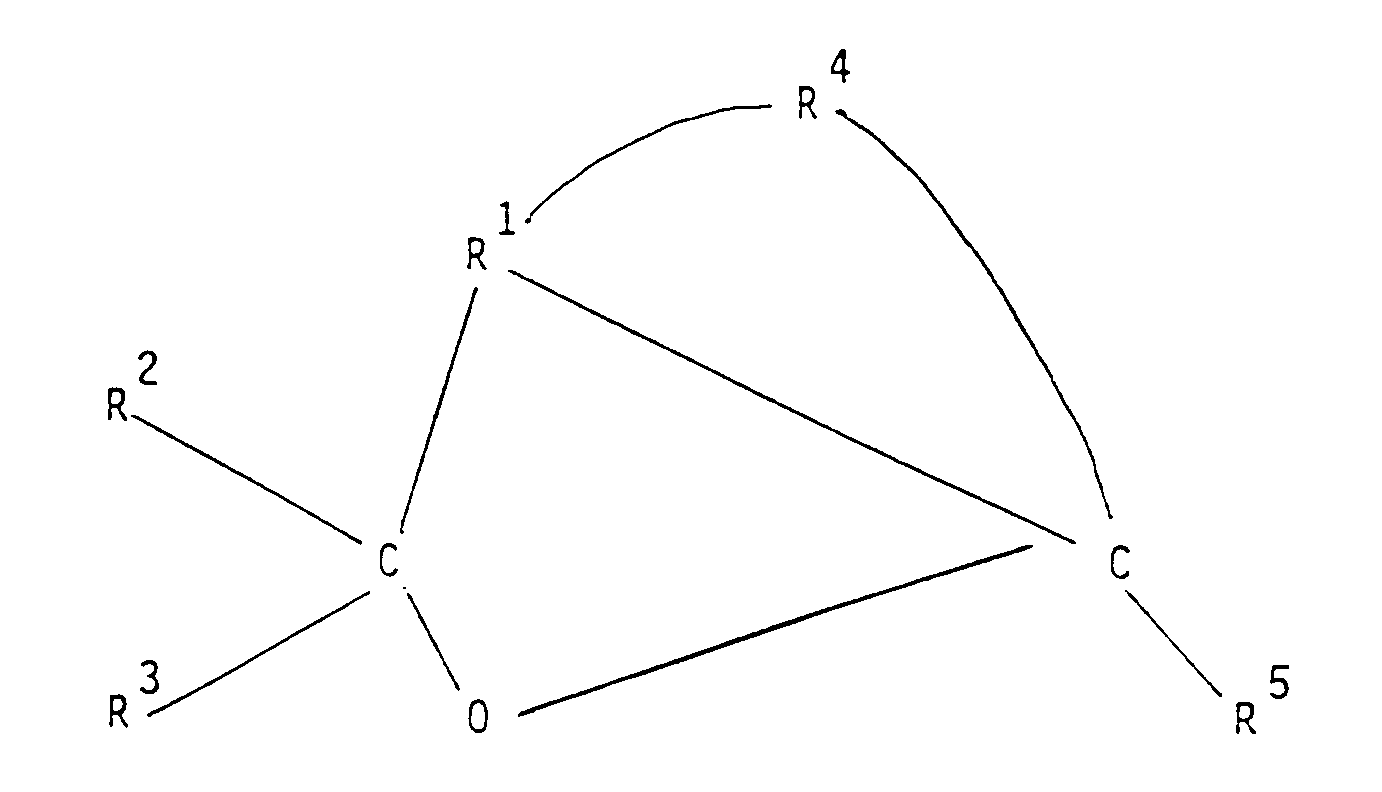
in which R¹ and R⁴ signify independently a hydrocarbon group, having advantageously 2-5 C-atoms, and R², R³ and R⁵ are each a hydrogen atom or a hydrocarbon group having advantageously 2-5 C-atoms. Specially advantageous heterocyclic compounds are cineoles, e.g. 1.4-, 1.8- and m-cineole. The electron donor may consequently also be a heterocompound of another kind, like a silicon compound, whereby arylalkoxysilanes are advantageous, e.g. diphenyldimethoxysilane. All these donors may be used alone or as mixtures of two or several donors. - In the prepolymerization, monomer is used in such a proportion of the ponderal mass of the catalyst, that the weight ratio monomer/catalyst is 0.1-200, preferably 1-50. The amounts of the components A, B and C in the prepolymerization are such that the molar ratio of the aluminium contained in the component B and the component C is 1-500, and the molar ratio of the aluminium and the Ti halide contained in the component B is 0.1-500, preferably 0.5-200. The prepolymerization may be performed also without the electron donor C.
- The prepolymerization is carried out in conditions where the monomer used and the inert medium are in a liquid state. The prepolymerization period may be in the range of from 1 s to 30 min. and the temperature in the range from -20°C to +200°C.
- After the prepolymerization the prepolymerized catalyst may be washed with some dissol vent having a low boiling point, whereby compounds B and C, possibly remaining unreacted, and prepolymerization monomer are discharged and the prepolymerized solid catalyst may be retained and later fed in a dry state into the polymerization reactor. It may also be fed directly into the polymerization reactor along with the prepolymerization components and 1-butene may be polymerized in the gas phase or the liquid phase, whereby the liquid phase is constituted of 1-butene or a mixture of 1-butene and some inert medium, generally an alkane.
- In the process of the present invention, the actual polymerization of 1-butene is carried out by means of a catalyst composition prepolymerized in the manner described above, in which the catalyst components A, B and C as well as the prepolymerized polymer of the catalyst thus are present. When prepolymerizing, the amounts of the components A, B and C are such that the molar ratio of the aluminium contained in the component B and the electron donor C containing heteroatoms is 1-500, and the molar ratio of this aluminium and the Ti halide contained in the component A is 0.1-500, preferably 0.5-200.
- The polymerization may be carried out in conditions where the 1-butene monomer is in a gaseous form. The temperature is then in the range of +35 - +75°C, preferably +50 - +65°C. The partial pressure of the 1-butene in the polymerization is adjusted depending on the temperature. At a temperature below +35°C the partial pressure of 1-butene cannot be sufficiently raised in order to achieve a sufficient polymerizing activity, as there is a risk of the 1-butene being liquefied. The product then also tends to agglomerate. The suitable partial pressure of 1-butene is 100-1500 kPa.
- The polymerization temperature must not exceed a temperature of +75°C, since then the tendency of the polymer particles to adhere to each other and to the walls of the polymerizing equipment as well as to the possible agitator increases markedly. The ability of function of the catalyst also decreases as the temperature rises too much, thus reducing its ability of function.
- A molecular weight regulator, such as hydrogen gas, may be present in the polymerization. Thus products having various melt flow properties for different purposes are handily obtained. It is possible to add hydrogen since the catalyst composition is not hydrogen sensitive, nor does the activity of the catalyst decrease as hydrogen is added, as it usually does, and the other properties of the product remain unchanged.
- In the polymerization an inert gas may also be present, having a lower boiling point than 1-butene. Such gases are for instance nitrogen, methane, ethane and propane. Under the effect of the inert gas the agglomerating tendency of the polymer particles may be reduced. Also under the effect of the inert gas, the thermal energy generated in the exothermal polymerization reaction is easier to remove.
- The prepolymerized catalyst according to the present invention (i.e. the entire catalyst composition) is easy to handle, since, being highly crystalline, it is very fluid (the catalyst particles do not tend to adhere to each other) and since it is mechanically stable. The catalyst obtained is also very active in the polymerization of 1-butene, and thus minor catalyst amounts need not to be removed from the prepared products. The corrosive action of the polymers on the machining equipment is insignificant owing to the low chloride concentration.
- The activity of the catalyst is illustrated in figure 1, representing the consumption of 1-butene as a function of time when polymerizing 1-butene in the gas phase according to example 1.
- The homo- or copolymer of 1-butene obtained with the polymerizing method of the invention is also very crystalline, and is obtained in the form of round particles which are easy to handle, very fluid and devoid of adhering tendencies. This circular shape and the fluidity is a great advantage especially when polymerizing in the gas phase.
- The crystallinity of poly-1-butene is illustrated in figure 2 by means of the DSC diagram compared to two commercial polybutenes, the
PB 0100 made by Shell Company, a natural coloured universal quality to be used in mixtures, melt viscosity 0.4, andPB 4121, a black hotwater tube quality, melt viscosity 0.4, containing crystallinity increasing additives. Both reference polybutenes are homopolymers, prepared by solvent polymerization and from which the catalyst residues have been washed out. The figure shows that the polybutene of the invention is more crystalline and melts at a higher temperature than these commercial polymers. - Owing to the nucleation effect of the polymer prepolymerized into the catalyst and having a high melting point, the product has an increased crystallinity, and consequently its hardness, elastic module, tensile strength and yield point have increased compared to a product that has not been polymerized by using a prepolymerized catalyst. The mechanical properties of the polymer are excellent, and owing to its rapid crystallization it is very suitable among others for the manufacture of tubes, films and fibres by means of extrusion. Because of this nucleation effect the size of the crystalline spherulites is very small. Thus the optical properties of the product have improved; the light transmission, i.e. the transparency, has improved. The small size of the spherulites also results in improved mechanical properties, such as the elongation at break and impact strength grow.
- The above nucleation effect is very evenly distributed over the entire product, and hence also the mechanical tension is evenly distributed, and no local stress centres are generated.
- Out of the polymer of the present invention, which thus has been polymerized by means of the prepolymerized catalyst composition of the invention, object-like products can be rapidly produced by injection moulding, owing to the high crystallinity value and the rapid crystallization. Owing to the phenomenon described above, the cooling effect and duration may be reduced and thus the production cycle may be shortened, thus achieving a higher yield.
- The bulk density of the product is high, so that the polymer produced by polymerization in the gas phase is easily dispersed in the gaseous state. In this respect, the fluidity, stability and lacking adhesiveness to each other and the various parts of the reactor are great advantages of the polymer.
- The stereoregularity of the polymer of the invention is excellent, so that the product can be brought into subsequent treatment after the polymerization without removing a product having objectionable (atactic) stereoregularity.
- The high crystallinity and stability of this polymer and the consequent favourable processing properties result from the specific regular spatial order of the polymer molecules, which, again, results from similar properties of the catalyst composition. A so-called replica effect occurs between the catalyst and the product, i.e. the catalyst structure is reproduced in the polymer product. This effect may be utilized when aiming at a specific end product by using an appropriate catalyst in addition to the operations connected with the various preparation processes.
- The following examples 1 to 21 illustrate the invention. In these examples, the properties of the catalysts and polymers obtained are presented in table 1. The results of similar
comparative polymerization tests 1 to 11 are presented in table 2. -
- 1a. 40 ml of n-pentane dried on molecular sieves, 553.3 µl triisobutylaluminium (TIBA, the organic aluminium compound B) as well as 294.9 µl of 1.8 cineole (the stereospecific heterocompound C) were introduced into a glass bottle filled with inert gas (N₂). The amounts of the compounds B and C, 2.201 mmol and 0.044 mmol, were such, that in respect of the solid catalyst component A to be used in 1b, of which there was 78.1 mg, the molar ratios Al/Ti and Al/1.8-cineole were respectively 50 and 1.25.
- 1b. About 80 mg of component A of the catalyst, which was a tetravalent titanium compound supported on a MgCl₂ carrier was weighed into a 30 ml glass bottle provided with a septum cork and filled with inert gas (N₂). In addition, 1/3 of the solution prepared in 1a was added. The mixture was left at room temperature for about 10 minutes during light agitation, after which 0.3 g (0, 5 cm³) of 4 methyl-1-pentene (prepolymerizing monomer) was added. The mixture was left for 15 minutes during light agitation.
- In order to improve the mixing, 50 g of polymer was added to a 4 dm³ steel reactor equipped with an agitator, e.g. poly1-butene or polypropene, having a particle size between 0,2 and 0, 5 mm. The reactor was filled with nitrogen. Subsequently, the solution remaining from 1a above and the mixture prepared in 1b was added into the reactor. The mixing rate was adjusted to 200 rpm. The temperature of the reactor was raised to 55 C° and simultaneously a nitrogen flow was conducted through the reactor.
- The pentane then was discharged in a gaseous form along with the nitrogen flow. When all the pentane had been discharged from the reactor in about 10 to 20 minutes, the feeding of nitrogen into the reactor was stopped and the outlet of the reactor was closed. After this hydrogen and nitrogen gas was added to the reactor in such amounts that the partial pressures were respectively 10 and 300 kPa. The mixing rate was adjusted to 400 rpm. After this, the introduction of 1-butene into the reactor along a heated feeding line was started so that the feeding rate was not too high during the pressure increase. Thus the 1-butene was prevented from being liquefied. The partial pressure of the 1-butene was raised to 500 kPa for the duration of the polymerization. Thus, the total pressure during the polymerization was 810 kPa. The polymerization was continued for 3 hours, after which the rotation rate of the agitators was reduced to 200 rpm, the 1-butene feeding line was closed and the discharge line of the reactor was opened, while washing the product simultaneously with nitrogen gas. The reactor was opened and the product removed for characterization.
- The same proceeding as in example 1 was adopted for preparing the catalyst and the polymer, however, triethylaluminium (TEA) was used as the organic aluminium compound B instead of tri-isobutyl aluminium.
- The proceeding of example 1 was repeated, however using 20, 50, 5 and 2.5 kPa as the partial hydrogen pressure in the polymerization.
- The proceeding of example 1 was repeated, but instead of 1.8 cineole diphenyldimethoxysilane (DPDMS) was used as stereospecific compound. The amounts of the compounds B and C were such that the molar ratios Al/Ti and A1/DPDMS with regard to the component A to be used in 1b were respectively 200 and 20.
- The proceeding of example 7 was repeated, however, 20, 50, 5 and 2.5 kPa respectively were used as the partial hydrogen pressure in the polymerization.
- C. 80 mg of the same solid component A of the catalyst as in example 1 was weighed into a glass bottle filled with inert gas (N₂) and equipped with a septum cork, 40 ml of n-pentane dried on molecular sieves, as well as the desired amounts of organic aluminium compound B (=tri-isobutylaluminium, TIBA) and the stereospecific compound C (=1.8 cineole) were added. The solution was left standing for 5 minutes. The amounts of the compounds B and C were such that the molar ratios Al/Ti and Al/1.8 cineole were respectively 50 and 1.25 with respect to the solid catalyst component A.
- In order to improve the mixing, 50 g of polymer, e.g. poly-1-butene or polypropene having a particle size between 0.2 and 0.5 mm was introduced into a 4 dm³ steel reactor equipped with an agitator. The reactor was filled with nitrogen. Subsequently, the catalyst mixture prepared in the preparations was added into the reactor. The mixing rate was adjusted to 200 rpm. The temperature of the reactor was raised to 55 °C, while simultaneously conducting nitrogen through the reactor. The pentane was discharged in a gaseous form along with the nitrogen flow. All the pentane having been discharged from the reactor during about 10 to 20 min., the feeding of nitrogen was stopped and the outlet of the reactor was closed. After this, hydrogen and nitrogen gas was added into the reactor in such an amount that the partial pressures were respectively 10 and 300 kPa. The mixing rate was adjusted to 400 rpm. After that, the adding of 1-butene into the reactor along a heated feeding line was started, so that the feeding rate was not too high during the pressure increase. Thus, the 1-butene was prevented from being liquefied. The partial pressure of the 1-butene was raised to 500 kPa for the duration of the polymerization. The total pressure during the polymerization was thus 810 kPa. The polymerization was continued for 3 h, after which the mixing rate was adjusted to 200 rpm. The feeding line of 1-butene was closed and the discharge line of the reactor was opened, while washing the product simultaneously with nitrogen gas. The reactor was opened and the product removed for characterization.
- The proceeding of comparative example 1 was repeated, the partial pressure of hydrogen in the polymerization being however 5 and 2,5 kPa and the
polymerization temperature 50 °C. - The procedure of comparative example 1 was repeated, however using diphenyldimethoxysilane DPDMS as stereospecific compound C instead of 1.8 cineole. The amounts of the compounds B and C were such that the molar ratios Al/Ti and Al/DPDMS were respectively 200 and 20 with regard to the solid catalyst component A to be used. The partial pressure of hydrogen in the polymerization was 20 kPa and the polymerization period 4 h.
- The proceeding of comparative example 4 was repeated, the partial pressure of the hydrogen being however 5 kPa, the polymerization period 3 h and the polymerization temperature 65°C.
- The proceeding of comparative example 4 was repeated, the partial pressure of hydrogen in the polymerization however being 2 kPa.
- The preparations of comparative example 1 were repeated, however the polymerization was done as in example 19. The polymerization period was 2 h and the polymerization temperature was 20 to 85°C. The polymer thus formed had the shape of an integral lump in the reactor.
- The proceeding of comparative example 1 was repeated, however performing the polymerization as in example 19. The polymerization period was 3 h and the polymerization temperature 20 to 28°C.
- The prepolymerization was carried out by using 1-butene as monomer and n-pentane as inert medium. The prepolymerization temperature was 20°C. The prepolymerized catalyst formed a paste-like product in the medium and was not polymerizable.
- The prepolymerization was carried out by using propene as monomer and heptane as inert medium. The prepolymerization temperature was 40°C and the total pressure 20 kPa. Diphenyldimetoxysilane DPDMS was used as the stereospecific compound C. The amounts of the compounds B and C were such that the molar ratios Al/Ti and Al/DPDMS were respectively 4 and 0,4 with regard to the used solid catalyst component A. The prepolymerization period was 1 h. A 2.4-fold amount of the monomer was used with regard to the weight of the catalyst in the prepolymerization. The prepolymerized catalyst was dried before the polymerization in the nitrogen flow. The polymerization was performed as in the comparative example 1. The amount of the compound B was such, that the molar ratio Al/Ti was 200 with regard to the used solid component A. The stereospecific compound C was not used in the polymerization. The partial pressure of the hydrogen in the polymerization was 20 kPa and the polymerization period was 4h.
- The procedure of comparative example 1 was repeated, however triethylaluminium (TEA) was used as the organic aluminium compound B instead of tri-isobutylaluminium and diphenyldimethoxysilane (DPDMS) as the stereospecific compound C.
Table 1 Results of the polymerization tests according to the invention Example no Activity (x) kgPB/gTi Crystallinity (x) % Isotacticity (x) % Melt index (x) g/10 min Bulk density (x) g/cm³ Chloride concentrat (x) mg/ kg 1 386 55.3 99.0 0.12 0.41 44 4 85 53.1 97.7 9.5 0.38 201 5 284 52.7 98.9 0.13 0.39 60 6 208 40.4 98.9 0.04 0.39 82 7 171 48.2 94.8 2.3 0.40 100 8 184 54.5 98.6 8.1 0.41 92 9 140 71.2 95.7 57 0.40 122 10 123 49.2 95.6 1.1 0.38 138 11 109 52.0 96.7 0.30 0.41 156 Table 2 Results of the comparative tests Compar. example no Activity (x) kgPB/gTi Crystallinity (x) % Isotacticity (x) % Melt index (x) g/10 min Bulk density (x) g/cm³ Chloride concentration (x) mg/ kg 1 127 37.3 98.9 - 0.37 133 2 41 31.3 96.5 0.01 0.41 438 3 131 44.7 99.7 0.04 0.39 130 4 107 44.8 91.1 8.3 0.31 158 5 75 55.6 95.1 1.8 0.30 228 6 70 51.5 97.1 0.65 0.36 244 7 431 30.9 98.9 0.18 - 39 8 67 41.6 94.8 0.18 - 254 9 - - - - - - 10 177 58.0 94.5 49 0.40 95 11 104 55.1 87.6 270 0.44 162 (x) The properties presented in the tables have been determined in the following manners. Activity: the total amount of the polymer prepared divided by the amount of titanium contained in the catalyst used in the polymerization (unit: kg of polymer/g of titanium). Crystallinity: relative proportion of the melting enthalpy of the stable crystal form I of the polymer (cf. Choi, S.Y., Rakus, J.P. and O'Toole, Polym. eng. Sci, August (1966), p. 349) with regard to the melting enthalpy of completely crystalline polymer 125 J/g (%). Isotacticity: relative proportion of the polymer which is insoluble in diethylether with regard to the total amount of polymer (%). Melt index: According to Standard ASTM 1238-85. Measuring conditions: 2.16 kg of mass, temperature 190°C, melt density 0.797 g/cm³ (g/10 min.). Bulk density: According to Standard ASTM 1895-69 (g/cm³). Chloride concentration: Calculated by means of the polymer yield, as it is known that the unpolymerized catalyst contained 46% by weight of chlorine (mg of chlorine/kg of polymer = ppm)
Claims (8)
- A method for preparing a 1-butene polymer, which is a homopolymer, or a copolymer containing 1-butene units and less than 10% of units derived from other unsaturated monomers, wherein 1-butene or its mixture with other monomers is, in the presence of an electron donor and optionally hydrogen, polymerized in gas phase by means of a Ziegler-Natta catalyst composition, which is obtained by prepolymerizing a premonomer with a combination of: a solid catalyst component supported on a MgCl₂ carrier and containing a tetravalent titanium halide, an aluminium tri(C₁-C₁₀)-alkyl cocatalyst and a stereospecific electron donor having at least one hetero atom, characterised in that the prepolymerization has been carried out in liquid state at room temperature using as the premonomer a liquid monoethylenically unsaturated C₅-C₁₂-hydrocarbon and using a premonomer/catalyst weight ratio of between 0,1 and 200 and an aluminium tri(C₁-C₁₀)-alkyl cocatalyst/stereospecific electron donor molar ratio of between 1 and 500.
- A method of claim 1 characterised in that the Ti halide is TiCl₄.
- A method of claim 1 or 2 characterised in that 4-methyl-1-pentene is prepolymerized.
- A method of claim 1, 2 or 3 characterised in that 1,8-cineole is used as the electron donor.
- A catalyst composition suitable for the polymerisation of 1-butene, which catalyst composition has been obtained by polymerizing a premonomer with a combination of: a solid catalyst component supported on a MgCl₂ carrier and containing a tetravalent titanium halide; an aluminium tri(C₁-C₁₀)-alkyl cocatalyst; and a stereospecific electron donor having at least one hetero atom, characterised in that the prepolymerization has been carried out in liquid state at room temperature using as the premonomer a liquid monoethylenically unsaturated C₅-C₁₂-hydrocarbon and using a premonomer/catalyst weight ratio of between 0,1 and 200 and an aluminium tri(C₁-C₁₀)-alkyl cocatalyst/stereospecific electron donor molar ratio of between 1 and 500.
- A catalyst composition of claim 5 characterised in that Ti halide is TiCl₄.
- A catalyst composition of claim 5 or 6 characterised in that 4-methyl-pentene is prepolymerized.
- A catalyst composition of claims 5, 6 or 7 characterised in that the electron donor is 1,8-cineole.
Priority Applications (1)
| Application Number | Priority Date | Filing Date | Title |
|---|---|---|---|
| AT88306163T ATE90365T1 (en) | 1987-07-15 | 1988-07-06 | PROCESS FOR THE PREPARATION OF HIGH CRYSTALLINE POLY-1-BUTENE AND CATALYST TO BE USED IN THESE PROCESSES. |
Applications Claiming Priority (2)
| Application Number | Priority Date | Filing Date | Title |
|---|---|---|---|
| FI873129 | 1987-07-15 | ||
| FI873129A FI80280C (en) | 1987-07-15 | 1987-07-15 | FOERFARANDE FOER FRAMSTAELLNING AV POLY-1-BUTEN MED HOEG KISTALLINITET OCH KATALYSATORKOMPOSITIONS FOER DESS FRAMSTAELLNING. |
Publications (3)
| Publication Number | Publication Date |
|---|---|
| EP0300638A2 EP0300638A2 (en) | 1989-01-25 |
| EP0300638A3 EP0300638A3 (en) | 1989-02-01 |
| EP0300638B1 true EP0300638B1 (en) | 1993-06-09 |
Family
ID=8524809
Family Applications (1)
| Application Number | Title | Priority Date | Filing Date |
|---|---|---|---|
| EP88306163A Expired - Lifetime EP0300638B1 (en) | 1987-07-15 | 1988-07-06 | A process for preparing highly crystalline poly-1-butene and the catalyst used in the process |
Country Status (11)
| Country | Link |
|---|---|
| EP (1) | EP0300638B1 (en) |
| JP (1) | JPS6481804A (en) |
| KR (1) | KR890002244A (en) |
| CN (1) | CN1032172A (en) |
| AT (1) | ATE90365T1 (en) |
| CA (1) | CA1332490C (en) |
| DE (1) | DE3881595T2 (en) |
| DK (1) | DK392888A (en) |
| ES (1) | ES2058289T3 (en) |
| FI (1) | FI80280C (en) |
| NO (1) | NO170729C (en) |
Families Citing this family (16)
| Publication number | Priority date | Publication date | Assignee | Title |
|---|---|---|---|---|
| JP2509767B2 (en) * | 1991-06-28 | 1996-06-26 | 出光石油化学株式会社 | Process for producing olefin polymer |
| US5556820A (en) * | 1989-12-28 | 1996-09-17 | Idemitsu Petrochemical Co., Ltd. | Catalyst component for olefin polymerization and process for producing polyolefins |
| JP2823662B2 (en) * | 1990-06-21 | 1998-11-11 | 三菱化学株式会社 | Olefin polymerization catalyst |
| US5778942A (en) * | 1996-07-01 | 1998-07-14 | Stanley Aviation Corporation | Vehicle including freeze stress resistant fluid conducting apparatuses |
| KR100475921B1 (en) * | 2002-12-04 | 2005-03-10 | 현대자동차주식회사 | fluid flow control device of hydraulic steering system |
| KR100472771B1 (en) * | 2003-08-30 | 2005-03-14 | 주식회사 일렘테크놀러지홀딩스 | high stereospecific polybutene-1 polymer and the highly active preparation method thereof |
| CA2859506A1 (en) | 2011-12-23 | 2013-06-27 | Frans Nooren Afdichtingssystemen B.V. | Composition for the application of a protective layer to a substrate and method for the application thereof |
| EP2794743B1 (en) | 2011-12-23 | 2016-07-27 | Frans Nooren Afdichtingssystemen B.V. | Composition for coating a substrate and method for coating a substrate |
| JP6274674B2 (en) | 2012-07-13 | 2018-02-07 | フランス ノーレン アフディクティングスシステメン ビー.ブイ.Frans Nooren Afdichtingssystemen B.V. | Method for protecting articles in a moist environment against corrosion and compositions therefor |
| CN103772557B (en) * | 2012-10-26 | 2016-08-17 | 中国石油化工股份有限公司 | The preparation method of high isotactic PB Polybutene-1 |
| CN103819596B (en) * | 2012-11-16 | 2016-06-08 | 中国石油天然气股份有限公司 | A kind of preparation method of isotactic poly-1-butene |
| CN103288993B (en) * | 2013-07-01 | 2015-06-03 | 青岛科技大学 | Spherical polybutylene-1 with high isotacticity and preparation method thereof |
| CN104710551B (en) * | 2013-12-13 | 2019-03-26 | 中国石油化工股份有限公司 | A method of preparing isoprene copolymer |
| AU2015304077A1 (en) | 2014-08-22 | 2017-02-16 | Frans Nooren Afdichtingssystemen B.V. | Composition for the protection of an article against corrosion |
| EP4112692B1 (en) | 2021-07-02 | 2024-04-17 | Seal for Life Global Dutch Holding B.V. | Composition for the protection against corrosion of an article and process for protection thereof |
| CN115926331B (en) * | 2021-09-22 | 2025-02-11 | 中国石油天然气股份有限公司 | A polybutene-1 alloy and preparation method thereof |
Family Cites Families (8)
| Publication number | Priority date | Publication date | Assignee | Title |
|---|---|---|---|---|
| US3489732A (en) * | 1966-06-01 | 1970-01-13 | Mobil Oil Corp | Butene-1,c10-c18 alpha monoolefin and optional propylene containing interpolymers |
| JPS5936642B2 (en) * | 1974-10-17 | 1984-09-05 | チッソ株式会社 | Production method of low molecular weight polyisobutylene and crystalline polybutene-1 |
| JPS55123607A (en) * | 1979-03-14 | 1980-09-24 | Mitsui Petrochem Ind Ltd | Preparation of poly-1-butene |
| US4503203A (en) * | 1983-12-20 | 1985-03-05 | Union Carbide Corporation | Preparation of granular stereoregular butene-1 polymers in a fluidized bed |
| JPS617308A (en) * | 1984-06-20 | 1986-01-14 | Sumitomo Chem Co Ltd | Crystalline polybutene-1 composition |
| JPH0635491B2 (en) * | 1984-06-25 | 1994-05-11 | 三菱油化株式会社 | Method for producing olefin polymer |
| JPH0725831B2 (en) * | 1985-07-02 | 1995-03-22 | 三菱油化株式会社 | Catalyst component for propylene polymerization |
| JPH0796567B2 (en) * | 1987-02-19 | 1995-10-18 | 三井石油化学工業株式会社 | Method for polymerizing α-olefin |
-
1987
- 1987-07-15 FI FI873129A patent/FI80280C/en not_active IP Right Cessation
-
1988
- 1988-05-31 JP JP63134275A patent/JPS6481804A/en active Pending
- 1988-07-06 DE DE8888306163T patent/DE3881595T2/en not_active Expired - Lifetime
- 1988-07-06 EP EP88306163A patent/EP0300638B1/en not_active Expired - Lifetime
- 1988-07-06 AT AT88306163T patent/ATE90365T1/en not_active IP Right Cessation
- 1988-07-06 ES ES88306163T patent/ES2058289T3/en not_active Expired - Lifetime
- 1988-07-12 NO NO883113A patent/NO170729C/en unknown
- 1988-07-13 CA CA000572734A patent/CA1332490C/en not_active Expired - Fee Related
- 1988-07-14 KR KR1019880008778A patent/KR890002244A/en not_active Ceased
- 1988-07-14 DK DK392888A patent/DK392888A/en not_active Application Discontinuation
- 1988-07-14 CN CN88104353A patent/CN1032172A/en active Pending
Also Published As
| Publication number | Publication date |
|---|---|
| ES2058289T3 (en) | 1994-11-01 |
| DK392888A (en) | 1989-01-16 |
| CA1332490C (en) | 1994-10-11 |
| FI873129A0 (en) | 1987-07-15 |
| CN1032172A (en) | 1989-04-05 |
| EP0300638A3 (en) | 1989-02-01 |
| NO883113D0 (en) | 1988-07-12 |
| DE3881595D1 (en) | 1993-07-15 |
| DE3881595T2 (en) | 1993-09-23 |
| NO170729C (en) | 1992-11-25 |
| DK392888D0 (en) | 1988-07-14 |
| ATE90365T1 (en) | 1993-06-15 |
| KR890002244A (en) | 1989-04-10 |
| FI873129L (en) | 1989-01-16 |
| JPS6481804A (en) | 1989-03-28 |
| FI80280C (en) | 1990-05-10 |
| NO170729B (en) | 1992-08-17 |
| FI80280B (en) | 1990-01-31 |
| NO883113L (en) | 1989-01-16 |
| EP0300638A2 (en) | 1989-01-25 |
Similar Documents
| Publication | Publication Date | Title |
|---|---|---|
| US4857613A (en) | Preparation of homopolymers and copolymers of propene using a Ziegler-Natta catalyst system | |
| US5051484A (en) | Process for producing granular thermoplastic elastomer and granular elastomer | |
| US4352915A (en) | Process for the polymerization of ethylene | |
| EP0027386B1 (en) | Process for producing propylene resin composition and molded articles of said composition | |
| JP3640024B2 (en) | Amorphous 1-butene / propylene copolymer with high tensile strength | |
| CA2171835A1 (en) | Multistage process for the (co)polymerization of olefins | |
| CA1332490C (en) | Highly crystalline poly-1-butene, the process for preparing it and the catalyst used in the process | |
| EP0316693B1 (en) | Propylene ethylene block copolymer composition | |
| EP0376936A2 (en) | A ziegler-Natta catalyst component | |
| EP0823919A1 (en) | Process and catalyst component for homo- and copolymerization of olefins | |
| AU601620B2 (en) | Preparation of homopolymers and copolymers of propene using a ziegler-natta catalyst system | |
| US6417300B1 (en) | Terpolymerization | |
| JPH0122284B2 (en) | ||
| US7345122B2 (en) | High stereospecific polybutylene polymer and highly active process for preparation thereof | |
| JP3421086B2 (en) | Olefin polymerization method | |
| JP3984290B2 (en) | Polypropylene polymer resins made from highly active catalysts having a wide heat-processed window and articles made therefrom | |
| CA1124449A (en) | Process for polymerization of butene-1 | |
| EP0111902A2 (en) | Catalyst and process using same for producing olefin polymer | |
| US3514433A (en) | Process for the production of isotactic polyolefins | |
| EP0729985A2 (en) | Ethylene-propylene copolymer compositions | |
| JPS60152511A (en) | Polymerization of alpha-olefin | |
| JPH01272612A (en) | Production of propylene copolymer composition | |
| US5411926A (en) | Olefin polymerization catalyst | |
| JPH05320468A (en) | Production of propylene resin | |
| JPH04173806A (en) | Production of polyolefinic resin composition |
Legal Events
| Date | Code | Title | Description |
|---|---|---|---|
| PUAI | Public reference made under article 153(3) epc to a published international application that has entered the european phase |
Free format text: ORIGINAL CODE: 0009012 |
|
| PUAL | Search report despatched |
Free format text: ORIGINAL CODE: 0009013 |
|
| AK | Designated contracting states |
Kind code of ref document: A2 Designated state(s): AT BE CH DE ES FR GB GR IT LI LU NL SE |
|
| AK | Designated contracting states |
Kind code of ref document: A3 Designated state(s): AT BE CH DE ES FR GB GR IT LI LU NL SE |
|
| 17P | Request for examination filed |
Effective date: 19890908 |
|
| 17Q | First examination report despatched |
Effective date: 19910321 |
|
| GRAA | (expected) grant |
Free format text: ORIGINAL CODE: 0009210 |
|
| AK | Designated contracting states |
Kind code of ref document: B1 Designated state(s): AT BE CH DE ES FR GB GR IT LI LU NL SE |
|
| PG25 | Lapsed in a contracting state [announced via postgrant information from national office to epo] |
Ref country code: GR Free format text: LAPSE BECAUSE OF FAILURE TO SUBMIT A TRANSLATION OF THE DESCRIPTION OR TO PAY THE FEE WITHIN THE PRESCRIBED TIME-LIMIT Effective date: 19930609 |
|
| REF | Corresponds to: |
Ref document number: 90365 Country of ref document: AT Date of ref document: 19930615 Kind code of ref document: T |
|
| REF | Corresponds to: |
Ref document number: 3881595 Country of ref document: DE Date of ref document: 19930715 |
|
| ET | Fr: translation filed | ||
| PG25 | Lapsed in a contracting state [announced via postgrant information from national office to epo] |
Ref country code: LU Free format text: LAPSE BECAUSE OF NON-PAYMENT OF DUE FEES Effective date: 19930731 |
|
| ITF | It: translation for a ep patent filed | ||
| PLBE | No opposition filed within time limit |
Free format text: ORIGINAL CODE: 0009261 |
|
| STAA | Information on the status of an ep patent application or granted ep patent |
Free format text: STATUS: NO OPPOSITION FILED WITHIN TIME LIMIT |
|
| 26N | No opposition filed | ||
| REG | Reference to a national code |
Ref country code: ES Ref legal event code: FG2A Ref document number: 2058289 Country of ref document: ES Kind code of ref document: T3 |
|
| EAL | Se: european patent in force in sweden |
Ref document number: 88306163.2 |
|
| PGFP | Annual fee paid to national office [announced via postgrant information from national office to epo] |
Ref country code: CH Payment date: 19950717 Year of fee payment: 8 |
|
| PGFP | Annual fee paid to national office [announced via postgrant information from national office to epo] |
Ref country code: ES Payment date: 19950720 Year of fee payment: 8 |
|
| PGFP | Annual fee paid to national office [announced via postgrant information from national office to epo] |
Ref country code: SE Payment date: 19950724 Year of fee payment: 8 |
|
| PGFP | Annual fee paid to national office [announced via postgrant information from national office to epo] |
Ref country code: BE Payment date: 19950804 Year of fee payment: 8 |
|
| PGFP | Annual fee paid to national office [announced via postgrant information from national office to epo] |
Ref country code: NL Payment date: 19960626 Year of fee payment: 9 |
|
| PGFP | Annual fee paid to national office [announced via postgrant information from national office to epo] |
Ref country code: GB Payment date: 19960628 Year of fee payment: 9 |
|
| PG25 | Lapsed in a contracting state [announced via postgrant information from national office to epo] |
Ref country code: SE Effective date: 19960707 |
|
| PG25 | Lapsed in a contracting state [announced via postgrant information from national office to epo] |
Ref country code: ES Free format text: LAPSE BECAUSE OF THE APPLICANT RENOUNCES Effective date: 19960708 |
|
| PGFP | Annual fee paid to national office [announced via postgrant information from national office to epo] |
Ref country code: AT Payment date: 19960715 Year of fee payment: 9 |
|
| PG25 | Lapsed in a contracting state [announced via postgrant information from national office to epo] |
Ref country code: CH Effective date: 19960731 Ref country code: LI Effective date: 19960731 Ref country code: BE Effective date: 19960731 |
|
| BERE | Be: lapsed |
Owner name: NESTE OY Effective date: 19960731 Owner name: IDEMITSU PETROCHEMICAL CY LTD Effective date: 19960731 |
|
| PG25 | Lapsed in a contracting state [announced via postgrant information from national office to epo] |
Ref country code: NL Effective date: 19970201 |
|
| REG | Reference to a national code |
Ref country code: CH Ref legal event code: PL |
|
| NLV4 | Nl: lapsed or anulled due to non-payment of the annual fee |
Effective date: 19970201 |
|
| EUG | Se: european patent has lapsed |
Ref document number: 88306163.2 |
|
| PG25 | Lapsed in a contracting state [announced via postgrant information from national office to epo] |
Ref country code: GB Free format text: LAPSE BECAUSE OF NON-PAYMENT OF DUE FEES Effective date: 19970706 Ref country code: AT Free format text: LAPSE BECAUSE OF NON-PAYMENT OF DUE FEES Effective date: 19970706 |
|
| GBPC | Gb: european patent ceased through non-payment of renewal fee |
Effective date: 19970706 |
|
| REG | Reference to a national code |
Ref country code: ES Ref legal event code: FD2A Effective date: 19991007 |
|
| REG | Reference to a national code |
Ref country code: FR Ref legal event code: TQ |
|
| PGFP | Annual fee paid to national office [announced via postgrant information from national office to epo] |
Ref country code: DE Payment date: 20070719 Year of fee payment: 20 |
|
| PGFP | Annual fee paid to national office [announced via postgrant information from national office to epo] |
Ref country code: IT Payment date: 20070724 Year of fee payment: 20 |
|
| PGFP | Annual fee paid to national office [announced via postgrant information from national office to epo] |
Ref country code: FR Payment date: 20070710 Year of fee payment: 20 |