EP0299533B1 - High potency sweetening agents - Google Patents
High potency sweetening agents Download PDFInfo
- Publication number
- EP0299533B1 EP0299533B1 EP88111508A EP88111508A EP0299533B1 EP 0299533 B1 EP0299533 B1 EP 0299533B1 EP 88111508 A EP88111508 A EP 88111508A EP 88111508 A EP88111508 A EP 88111508A EP 0299533 B1 EP0299533 B1 EP 0299533B1
- Authority
- EP
- European Patent Office
- Prior art keywords
- compound
- mmol
- group
- alkyl
- methyl
- Prior art date
- Legal status (The legal status is an assumption and is not a legal conclusion. Google has not performed a legal analysis and makes no representation as to the accuracy of the status listed.)
- Expired - Lifetime
Links
- 0 CC1*2CCC1*2 Chemical compound CC1*2CCC1*2 0.000 description 4
- CHLICZRVGGXEOD-UHFFFAOYSA-N Cc(cc1)ccc1OC Chemical compound Cc(cc1)ccc1OC CHLICZRVGGXEOD-UHFFFAOYSA-N 0.000 description 2
- CJODFEUQBUMCTC-UHFFFAOYSA-N Cc1ccc(C(CC2O)O)c2c1 Chemical compound Cc1ccc(C(CC2O)O)c2c1 CJODFEUQBUMCTC-UHFFFAOYSA-N 0.000 description 1
Images
Classifications
-
- C—CHEMISTRY; METALLURGY
- C07—ORGANIC CHEMISTRY
- C07D—HETEROCYCLIC COMPOUNDS
- C07D257/00—Heterocyclic compounds containing rings having four nitrogen atoms as the only ring hetero atoms
- C07D257/02—Heterocyclic compounds containing rings having four nitrogen atoms as the only ring hetero atoms not condensed with other rings
- C07D257/04—Five-membered rings
-
- A—HUMAN NECESSITIES
- A23—FOODS OR FOODSTUFFS; TREATMENT THEREOF, NOT COVERED BY OTHER CLASSES
- A23L—FOODS, FOODSTUFFS OR NON-ALCOHOLIC BEVERAGES, NOT OTHERWISE PROVIDED FOR; PREPARATION OR TREATMENT THEREOF
- A23L27/00—Spices; Flavouring agents or condiments; Artificial sweetening agents; Table salts; Dietetic salt substitutes; Preparation or treatment thereof
- A23L27/30—Artificial sweetening agents
-
- C—CHEMISTRY; METALLURGY
- C07—ORGANIC CHEMISTRY
- C07D—HETEROCYCLIC COMPOUNDS
- C07D257/00—Heterocyclic compounds containing rings having four nitrogen atoms as the only ring hetero atoms
- C07D257/02—Heterocyclic compounds containing rings having four nitrogen atoms as the only ring hetero atoms not condensed with other rings
- C07D257/04—Five-membered rings
- C07D257/06—Five-membered rings with nitrogen atoms directly attached to the ring carbon atom
-
- C—CHEMISTRY; METALLURGY
- C07—ORGANIC CHEMISTRY
- C07D—HETEROCYCLIC COMPOUNDS
- C07D403/00—Heterocyclic compounds containing two or more hetero rings, having nitrogen atoms as the only ring hetero atoms, not provided for by group C07D401/00
- C07D403/02—Heterocyclic compounds containing two or more hetero rings, having nitrogen atoms as the only ring hetero atoms, not provided for by group C07D401/00 containing two hetero rings
- C07D403/12—Heterocyclic compounds containing two or more hetero rings, having nitrogen atoms as the only ring hetero atoms, not provided for by group C07D401/00 containing two hetero rings linked by a chain containing hetero atoms as chain links
-
- C—CHEMISTRY; METALLURGY
- C07—ORGANIC CHEMISTRY
- C07D—HETEROCYCLIC COMPOUNDS
- C07D405/00—Heterocyclic compounds containing both one or more hetero rings having oxygen atoms as the only ring hetero atoms, and one or more rings having nitrogen as the only ring hetero atom
- C07D405/02—Heterocyclic compounds containing both one or more hetero rings having oxygen atoms as the only ring hetero atoms, and one or more rings having nitrogen as the only ring hetero atom containing two hetero rings
- C07D405/12—Heterocyclic compounds containing both one or more hetero rings having oxygen atoms as the only ring hetero atoms, and one or more rings having nitrogen as the only ring hetero atom containing two hetero rings linked by a chain containing hetero atoms as chain links
-
- C—CHEMISTRY; METALLURGY
- C07—ORGANIC CHEMISTRY
- C07D—HETEROCYCLIC COMPOUNDS
- C07D409/00—Heterocyclic compounds containing two or more hetero rings, at least one ring having sulfur atoms as the only ring hetero atoms
- C07D409/02—Heterocyclic compounds containing two or more hetero rings, at least one ring having sulfur atoms as the only ring hetero atoms containing two hetero rings
- C07D409/12—Heterocyclic compounds containing two or more hetero rings, at least one ring having sulfur atoms as the only ring hetero atoms containing two hetero rings linked by a chain containing hetero atoms as chain links
-
- C—CHEMISTRY; METALLURGY
- C07—ORGANIC CHEMISTRY
- C07D—HETEROCYCLIC COMPOUNDS
- C07D521/00—Heterocyclic compounds containing unspecified hetero rings
Definitions
- the present invention relates to novel guanidine compounds useful as sweetening agents. Additionally, the present invention relates to sweetening compositions, food products containing the present guanidines, methods of sweetening foods, novel intermediates and methods of preparing the novel guanidines.
- guanidine derivatives are known in the art as sweeteners. See, for example, Yuki and Inoue (Nippon Kagaku Kaishi, no. 11, 2140-43 (1974)), Chemical Abstracts, Vol. 82, no. 140061p (1975) describes N-((4-chlorophenylamino)iminomethyl)- ⁇ -alanine (Chemical Substance Index, vol. 76-85, 1972-1976, p. 1067cs), European Patent Application 0,107,597 published May 2, 1984 (U.S. Patent No. 4,645,678), U.S. Patent 4,673,582 and European Patent Application 0,195,730 published September 24, 1986.
- a problem associated with prior art guanidine sweeteners, especially glycine derivatives, is their lack of stability due to cyclization.
- U.S. Patent 3,615,700 discloses ⁇ -tetrazolyl 6 (and 5,6) substituted tryptamine compounds wherein the d-enantiomers are useful as nonnutritive sweeteners.
- U.S. Patent 4,680,300 discloses methods of preparing guanidines which are useful as anti-inflammatory agents.
- substituted guanidines containing a tetrazole moiety, are useful as sweetening agents.
- the present guanidines are added to food products in amounts sufficient to sweeten the food to a desired level.
- Typical food products include soft drinks, juices, condiments, candies, baked goods, chewing gum and pharmaceuticals.
- the present guanidines are prepared by reacting a 5-substituted tetrazole with an isothiourea or carbodiimide intermediate. The resulting product is recovered and used in food applications to replace sucrose.
- the present guanidines can be combined with other sweeteners and bulking agents.
- Figure 1 illustrates the stability (90°C) of Compound 1 and the stability (70°C) of the glycine analog of Compound 1 as described in Example 43.
- Suitable heterocyclic moieties for R3 are optionally substituted pyridines, thiazoles, indoles, quinolines, naphthyridines, cinnolines, pteridines, thiophenes, benzothiophenes, naphthothiophenes, thianthrenes, furans, pyrans, isobenzofurans, chromenes, xanthenes, phenoxathins, pyrroles, indoles, isoindoles, indolizines, pyridazines, pyrimidines, pyrazines, pyrazoles, imidazoles, pyrroles, indazoles, purines, quinolizines, isoquinolines, quinolines, phthalazines, quinoxalines, quinazolines, carbazoles, carbolines, phenanthridines, acridines, pyrimidines, phenanthrolines, phenazines
- heterocyclic moieties may be optionally substituted with one or more substituents, such as, for example, C1-C6 alkyl, halogen, NO2, CN, trihalomethyl, dihalomethyl, hydroxyl or hydroxyalkyl.
- substituents such as, for example, C1-C6 alkyl, halogen, NO2, CN, trihalomethyl, dihalomethyl, hydroxyl or hydroxyalkyl.
- the present guanidines include tautomeric forms and physiologically acceptable salts of the compounds of Formula I, above.
- Preferred compounds include those wherein X3, X5 and R4 are hydrogen, n equals 1, and X4 is CN or NO2.
- modified hydrocarbyl it is contemplated, as one example, that where R2 is a C2 modified hydrocarbyl group that one atom of carbon may be replaced by an atom of nitrogen so that the C2 hydrocarbyl moiety may be replaced by the -CN cyano moiety.
- R2 is a C3 modified hydrocarbyl group that one atom of carbon may be replaced by a nitrogen atom and two atoms of carbon may be replaced by two atoms of oxygen so that a C3 hydrocarbyl moiety may be replaced by the -NO2 nitro moiety.
- Other replacements of hydrocarbyl carbons by the same or different heteroatoms selected from the group consisting of N, O, S, Cl, Br, and I are similarly contemplated by the invention.
- the present guanidine is one wherein R3 is a substituted phenyl and R1 is H or CH3.
- Preferred guanidines also include those wherein (a) X3 and X5 are selected from the group consisting of H, Br, CF3, CH3, Cl and F and (b) X4 is H or CN. Also preferred are guanidines wherein X3 and X4 form a fused ring, such as 6-Indazolyl.
- R2 substituents include normal alk(en) (yn)yl C2-C13, branched alk(en) (yn)yl C3-C13, cycloalk(en)yl C3-C13, alk(en)yl cycloalk(en)yl C4-C13, cycloalk(en)yl alk(en)yl C4-C13, alk(en)yl cycloalk(en)yl alk(en)yl C5-C13, alk(en)yl bicycloalk(en)yl C7-C13, fused bicycloalk(en)yl C7-C13, alk(en)yl fused bicycloalk(en)yl C8-C13, fused bicycloalk(en)yl alk(en)yl C8-C13, alkenyl fused bicycloalk(en)yl alk(en)yl C9-C9
- R2 is selected from the group consisting of cyclooctyl, benzyl, cyclononyl, phenyl, alpha-phenethyl, cycloheptyl, cyclohexyl, benzhydryl, tetralyl, and decalyl.
- Preferred guanidines also include those listed above wherein R2 is a modified hydrocarbyl group wherein up to four carbon atoms may be replaced by the same or different heteroatoms selected from a group consisting of S to replace C or CH2, N to replace CH, NH and O to replace CH2 and Cl, Br and I to replace CH3 and wherein up to 5 atoms of hydrogen may be substituted by fluorine atoms.
- R2 is a modified hydrocarbyl group wherein up to four carbon atoms may be replaced by the same or different heteroatoms selected from a group consisting of S to replace C or CH2, N to replace CH, NH and O to replace CH2 and Cl, Br and I to replace CH3 and wherein up to 5 atoms of hydrogen may be substituted by fluorine atoms.
- R2 is selected from the group consisting of CH(CH3)C6H5, alkyl substituted S-phenylethyl, diphenylmethyl, pyridinyl, pyridinyl methyl, piperidyl, homopiperidyl, indolyl, indolinyl, isoindolinyl, quinolyl, isoquinolyl, pyrazinyl, pyrimidyl, indazolyl, quinoxalinyl, quinazolinyl, purinyl, OCH2C6H5, pyranyl, tetrahydropyranyl, benzofuranyl, methoxyphenyl, methyloxycarbonylphenyl, 3,4-methylenedioxyphenyl, morpholinyl, benzoxazolyl, acetamidophenyl, cyano, nitro, thienyl, thienyl methyl, tetrahydro-3-thi
- X3, X4, X5 and R2 are as described above.
- Particularly preferred compounds are those of Formula II wherein X3 and X5 are H and X4 is CN or wherein X3 and X5 are selected from the group consisting of CF3, CH3, Cl and F and wherein X4 is selected from the group consisting of H and CN.
- R1 is selected from the group consisting of H and CH3;
- R3 is a substituted phenyl wherein X3 and X5 are H and X4 is CN or wherein X3 and X5 are selected from the group consisting of CF3, CH3, Cl, H and F and wherein X4 is selected from the group consisting of H and CN;
- R2 is selected from the group consisting of CH(CH3)C6H5, CH2C6H5, CH(CH3)-c-C6H11, CH(C6H5)2, c-C6H11, c-C7H13, endo-norbornyl, c-C8H15, c-C9H17, c-C10H17, c-C10H19, SO2C6H5 and SO2C7H13.
- Specifically preferred compounds include 1'-N-[N-cyclononylamino(4-cyanophenylimino)methyl]-5-aminomethyltetrazole (R1, X3, R4, R5 and X5 are H; X4 is CN and R2 is c-C9H17); 1'-N-[N-cyclooctylamino(4-cyanophenylimino)methyl]-5-aminomethyltetrazole (R1, X3, R4, R5 and X5 are H, X4 is CN and R2 is c-C8H15); 1'-N-(N-1-naphthylamino-(4-cyanophenylimino)methyl]-5-aminomethyltetrazole (R1, R4, R5, X3 and X5 are H, X4 is CN and R2 is naphthyl); 1'-N-[N-benzenesulfonylamino-(4-
- Preferred compounds are those wherein X4 is selected from H, CN, C(O)OCH3, F and NO2, as well as those compounds wherein R2 is selected from n-C5H11, n-C6H13, n-C7H15, CH(CH3)(CH2)2CH3, CH(CH3)(CH2)3CH3, (CH2)3CH(CH3)2, (CH2)4CH(CH3)2, (CH2)5CH(CH3)2, C6H5, C6-C10-cycloalkyl, (CH3(CH2)3)C6-C16 cycloalkyl, CH2C6H5, CH2-c-C6H11, CH(CH3)C6H5, CH(C6H5)C6H5, CH(CH3)-c-C6H11, (CH2)2C6H5, (CH2)2-c-C6H11, CH(CH3)CH2C6H5, CH(CH3)CH2-c-C6H11, C6H4(CH3), C6-C10 cycloalkyl(
- a further preferred compound is that of the formula especially that wherein R1 in the above formula is CH3.
- a further preferred compound is that wherein R3 is 4-cyanophenyl, 3,5-dichlorophenyl, 3,5-dimethylphenyl or phenyl, R4 is H and which has the formula and wherein P is H, CH2OCO-t-C4H9 or CH2CH2COOC2H5.
- the compounds of the formula are preferred especially those wherein R1 is H, X3 and X5 being H and X4 being CN, or wherein R2 is phenyl, benzyl, cyclohexyl, cyclooctyl, cyclononyl, 4-pyranyl, 2-decalyl, endo-norbornyl, 1-naphthyl, alpha-phenethyl or benzhydryl or the compounds of the above formula wherein X4 is H and X3 and X5 are Cl or CH3 and wherein R2 may further be of the meaning as just indicated above.
- the present invention also includes physiologically acceptable salts of the presented guanidines, i.e., sulfate, phosphate, citrate, hydrochloride, sodium, potassium, ammonium, calcium and magnesium salts.
- physiologically acceptable salts of the presented guanidines i.e., sulfate, phosphate, citrate, hydrochloride, sodium, potassium, ammonium, calcium and magnesium salts.
- the present invention relates to edible products containing the present guanidine compounds as sweetening agents either alone or in combination with other sweeteners such as carbohydrate sweeteners or high potency sweeteners. Also provided by the present invention is a process for sweetening edible products such as foods, beverages, candies, chewing gums, sweets, pharmaceuticals and veterinary preparations.
- the present invention further contemplates compositions of the present guanidines in combination with other sweetening agents and/or a physiologically acceptable carrier which may be a bulking agent.
- suitable carriers include polydextrose, starch, maltodextrins, cellulose, methylcellulose, maltitol, carboxymethylcellulose, hydroxymethylcellulose, microcrystalline cellulose, sodium alginate, pectins, gums, lactose, maltose, glucose, leucine, glycerol, mannitol, sorbitol, sodium bicarbonate and phosphoric, citric, tartaric, fumaric, benzoic, sorbic, propionic acids and their sodium, potassium and calcium salts and mixtures of all of the above.
- Suitable sweetening agents which may be used in combination with the present guanidines can be sugar or high potency sweeteners such as sucrose, corn syrups, fructose, high fructose corn syrup, aspartame, alitame, neohesperidine dihydrochalcone, hydrogenated isomaltulose, stevioside, L-sugars, glycyrrhizin, xylitol, acesulfam-K, saccharin (sodium, potassium or calcium salt), cyclamic acid (sodium, potassium or calcium salt), trichlorogalactosucrose (TGS or sucralose), monellin and thaumatin and mixtures thereof.
- sugar or high potency sweeteners such as sucrose, corn syrups, fructose, high fructose corn syrup, aspartame, alitame, neohesperidine dihydrochalcone, hydrogenated isomaltulose, stevi
- the present invention also relates to a method of preparing the tetrazole containing guanidine compounds.
- the substituted guanidines of the present invention are prepared employing synthetic methods which are analogous to known methods disclosed in the literature. These known methods have been summarized in a recent paper by Maryanoff (C. Maryanoff, R.C. Stanzione, J.N. Plampin, and J.E. Mills, J. Org. Chem. 1986, 51, 1882-1884). The techniques are further described in J. Med. Chem., 1978, no. 21, pp. 773-781; Chem. Ber. 1966, 99, 1252-157; U.K. patent 1587 258; J. Org. Chem., 1970, 35, pp.
- a reactive intermediate with an easily liberated activating moiety (leaving group), designated by the letter L in the following reactants, can be employed wherein the intermediate contains appropriately substituted amine groups corresponding to the substituents present on the guanidine nitrogens.
- the leaving groups are preferably selected from the group consisting of S-alkyl (isothiourea), O-alkyl, OSO2-aryl, SO3H and halogen moieties.
- a protecting group designated by the letter P will be attached to the tetrazole.
- Preferred protecting groups have the formulas As a general principle, a reaction is brought about between the reactant intermediate and the appropriate complementary amine, that is to say, the following compounds are brought into contact with one another:
- the present invention encompasses novel intermediates used in preparing the present guanidine compounds as seen in the tetrazole containing reactants in (3) and (4) above.
- One of the preferred methods of synthesis employed to obtain these thiourea derivatives consists of allowing an alkyl or aryl isothiocyanate to react with a suitable amine.
- the reaction is conducted from ambient temperature to boiling, depending on the reciprocal reactivity of the two compounds and takes place in an organic solvent such as ethanol, ethyl acetate, acetonitrile, chloroform or acetone.
- the preferred method consists of transforming thiourea derivatives obtained in this way into S-alkyl derivatives.
- the preferred L activating group is the S-CH3 group, such as in the following compound, for example:
- an alkyl or aryl isothiocyanate, R3NCS is allowed to condense with an amine HNR1R2 preferably at ambient temperature and in an organic solvent to yield a thiourea R3NHCSNR1R2.
- the thiourea is purified by recrystallization or other standard procedures and is then methylated with methyl iodide or dimethyl sulfate. This reaction is conducted in an organic solvent (e.g., acetone) at temperatures varying from ambient to 100°C depending on thiourea reactivity.
- the isothiourea is then reacted with the amino methyltetrazole to give the guanidine This reaction may be conducted in water or organic solvents and at temperatures varying from ambient to 100°C.
- the guanidine is then purified by recrystallization or other standard methods.
- the second general method is based on the use of a carbodiimide intermediate which may be obtained by the reaction of an appropriate thiourea with phosgene or with an equimolecular mixture of triphenylphosphine, tertiary amine and carbon tetrachloride in an organic solvent, such as carbon tetrachloride or dichloromethane, at a temperature ranging from ambient temperature to boiling.
- a carbodiimide intermediate which may be obtained by the reaction of an appropriate thiourea with phosgene or with an equimolecular mixture of triphenylphosphine, tertiary amine and carbon tetrachloride in an organic solvent, such as carbon tetrachloride or dichloromethane, at a temperature ranging from ambient temperature to boiling.
- an aryl isothiocyanate R3NCS is allowed to condense with a primary amine (R2-NH2) to yield an N,N′-disubstituted thiourea R3-NHCS-NHR2.
- R2-NH2 primary amine
- the carbodiimide is not purified but rather the carbodiimide is reacted directly with an aminoalkyltetrazole or an aminotetrazole to give the trisubstituted guanidine. Tetra and penta-substituted guanidines may be obtained on further alkylation of the trisubstituted guanidine with alkyl halides.
- the present guanidines may exist as an equilibrium mixture of tautomeric forms. All tautomers of the guanidines are contemplated by the present invention.
- the sweetening agents according to the present invention may exist in zwitterion or in acid form. They can thus be converted into salts by acids or by physiologically acceptable organic or inorganic bases.
- One of the best methods of preparing such salts consists of concentrating to dryness in vacuo a mixture of a compound according to the present invention in an aqueous solution with an equivalent amount of an acid or of an organic or inorganic base.
- the preferred salts according to the present invention are hydrochloride, citrate, phosphate, sulfate, or sodium, potassium, ammonium, calcium or magnesium salts.
- Especially preferred starting materials are those of the formula wherein R2 is cyclohexyl, cyclooctyl, alpha-phenethyl, diphenylmethyl, benzyl, phenyl, endo-norbornyl, 1-naphthyl or 2-decalyl, or wherein the compounds are prepared from the starting material of the formula wherein R3 is 4-cyanophenyl, 3,5-dichlorophenyl, 3,5-dimethylphenyl or phenyl, and from an amine HNR1R2 wherein R2 is cyclohexyl, cyclooctyl, alpha-phenethyl, diphenylmethyl, benzyl, phenyl, endo-norbornyl, 1-naphthyl or 2-decalyl, and wherein R3 is 4-cyanophenyl, 3,5-dichlorophenyl, 3,5-dimethylphenyl or phenyl.
- the present sweetening agents may take the form of a balanced mixture of tautomeric forms.
- the following tautomeric forms may be obtained, when R1 is H: and the following tautomeric forms for tetrazole will apply:
- the present N,N',N''-trisubstituted guanidines may have an asymmetrical carbon atom, i.e., optically active site. These compounds exist in (R) and (S) enantiomeric forms. Both the (R) and (S) enantiomers of the N,N',N''-trisubstituted guanidines are contemplated by the present invention.
- the present invention also relates to a method of sweetening foods or comestible products.
- the present guanidines are added to any consumable product in which it is desired to have a sweet taste.
- the present sweetening agents are added to such products in amounts effective to impart the desired level of sweetness.
- the optimum amount of sweetening agent will vary depending on a variety of factors such as, for example, the sweetness potency of the particular sweetening agent, storage and use conditions of the product, the particular components of the products, the flavor profile of the comestible products and the level of sweetness desired.
- One skilled in the art can readily determine the optimum amount of sweetening agent to be employed in a particular formulation of a food product by conducting routine sweetness (sensory) experiments.
- the present sweetening agents are added to the comestible products in amounts of from about 0.00001 to about 0.1 percent by weight of the comestible product, advantageously from about 0.00005 to about 0.05 weight percent and preferably from about 0.001 to about 0.02 weight percent. Concentrates, of course, will contain higher percentages of sweetening agent(s), and are diluted for end use purposes.
- Suitable products which are sweetened by the present sweetening agents include any products for which a sweet flavor component is desired such as food products (for human or animal consumption), beverages (alcoholic, soft drinks, juices, carbonated beverages), confectionary products (candies, chewing gum, baked goods, pastries, breads, etc.), toilet and hygiene products, cosmetics, pharmaceutical products and veterinary products.
- a sweet flavor component for human or animal consumption
- beverages alcoholic, soft drinks, juices, carbonated beverages
- confectionary products candies, chewing gum, baked goods, pastries, breads, etc.
- toilet and hygiene products cosmetics, pharmaceutical products and veterinary products.
- the present guanidines can be added in amounts in excess of a sucrose equivalent normally found in gum. This excess amount of guanidine sweetener provides a longer sweet taste and enhancement of flavor (flavor enhancer).
- the present guanidines can be added in pure form to foods to impart a sweet flavor. However, because of the high sweetness potency of the present sweetening agents, they are typically admixed with a carrier or bulking agent.
- Suitable carriers or bulking agents include polydextrose, starch, malto-dextrins, cellulose, methylcellulose, carboxymethylcellulose, hydroxymethylcellulose, microcrystalline cellulose, cellulose derivatives, sodium alginate, pectins, gums, lactose, maltose, maltitol, glucose, leucine, glycerol, mannitol, sorbitol, sodium bicarbonate and phosphoric, citric, tartaric, fumaric, benzoic, sorbic and propionic acids and their sodium, potassium and calcium salts and mixtures of all of the above.
- the present guanidines can be employed alone as the sole sweetening agent in a comestible product. Mixtures of the present guanidines can also be employed. Additionally, the present guanidines can be used in combination with other sweetening agents such as sugars (such as sucrose and fructose), corn syrups, dipeptide sweeteners such as aspartame and alitame and other sweeteners such as glycyrrhizin, aminoacyl sugars, xylitol, sorbitol, mannitol, acesulfam K, thaumatin, monellin, cyclamates, saccharin, neohesperidine dihydrochalcone, hydrogenated isomaltulose, stevioside, L-sugars, trichlorogalactosucrose (TGS), and mixtures thereof.
- sugars such as sucrose and fructose
- corn syrups such as glycyrrhizin,
- Step 1 Preparation of N-Cyclooctyl-N'-(4-Cyanophenyl)Thiourea:
- Step 2 Synthesis of N-Cyclooctyl-N′-(4-Cyanophenyl)-S-Methylisothiourea:
- Step 3 Preparation of 1′-N-[N-Cyclooctylamino (4-Cyanophenylimino)methyl]-5-Aminomethyltetrazole:
- the hydrochloride of this compound was prepared by dissolving, with heating, 1.0 g of the above zwitterion in a mixture of 20 ml 1 N HCl and 10 ml ethanol. Upon cooling, 900 mg (82%) of white crystalline compound precipitated and was collected by filtration. Analysis calculated for C18H24N8 HCl ⁇ (0.4 H2O): C, 54.58; H, 6.56; N, 28.29. Found: C, 54.65, H, 6.40, N, 28.33. This HCl salt was also sweet when tasted.
- the hemi-citrate of this compound can be prepared by dissolving, with heating, 1.0 g (2.84 mmoles) of the above zwitterion in a mixture of 15 ml 1 M phosphoric acid and 7 ml ethanol. Upon cooling, 0.94 g (63%) of white crystalline compound slowly precipitates and is collected by filtration.
- the sulfate of this compound can be prepared by dissolving, with heating, 1.0 g (2.84 mmoles) of the above zwitterion in a mixture of 15 ml 1 M sulfuric acid and 7 ml ethanol. Upon cooling, 0.56 g (43%) of white crystalline compound slowly precipitates and is collected by filtration.
- Step 1 Preparation of N-Cyclohexyl-N′-Cyclohexyl-N′-(4-Cyanophenyl Thiourea:
- Step 2 Synthesis of N-Cyclohexyl-N′-(4-Cyanophenyl)-S-Methylisothiourea:
- Step 3 Preparation of 1′-N-[N-Cyclohexylamino(4-Cyano-phenylimino)methyl]-5-Aminomethyltetrazole:
- N-cyclooctyl-N′-(4-cyanophenyl)thiourea (1.0 g, 3.48 mmol) prepared in Example 1 was suspended in methylene chloride (5 ml). Carbon tetrachloride (0.47 ml, 4.86 mmol) was added to the suspension followed by the addition of triphenylphosphine (1.2 g, 4.58 mmol) and triethylamine (0.48 ml, 3.45 mmol). This mixture was heated to reflux resulting in a homogeneous solution. The mixture was stirred at reflux for 1.5 hours resulting in a yellow solution with a solid precipitate.
- Step 2 Preparation of 1′-N-[N-Cyclooctylamino(4-cyanophenylimino)methyl]-5-aminotetrazole:
- Step 1 Preparation of N-(S)-Phenylethyl-N′-(4-Cyanophenyl) Thiourea:
- Step 2 Synthesis of N-(S)-Phenylethyl-N′-(4-Cyanophenyl)-S-Methylisothiourea:
- Step 3 Preparation of 1′-N-[N-(S)-Phenylethylamino (4-Cyanophenylimino)methyl]-5-Aminomethyltetrazole:
- Step 1 Preparation of N-(S)-Phenylethyl-N′-phenyl Thiourea:
- Step 2 Synthesis of N-(S)-Phenylethyl-N′-Phenyl-S-Methylisothiourea:
- Step 3 Preparation of 1′-N-[N-(S)-Phenylethylamino (Phenylimino)methyl]-5-Aminomethyltetrazole:
- Step 1 Preparation of N-(S)-Phenylethyl-N′-(3,5-Dichlorophenyl) Thiourea:
- Step 2 Synthesis of N-(S)-Phenylethyl-N′-3,5-Dichlorophenyl)-S-Methylisothiourea:
- Step 3 Preparation of 1′-N-[N-(S)-Phenylethylamino(3,5-Dichlorophenylimino)methyl]-5-Aminomethyltetrazole:
- Step 3 Preparation of 1′-N-[Benzylamino (3,5-Dichlorophenylimino)methyl]-5-Aminomethyltetrazole:
- Step 2 Synthesis of N-Benzyl-N′-(4-Cyanophenyl)-S-Methylisothiourea:
- Step 3 Preparation of 1′-N-[N-Benzylamino (4-Cyanophenylimino)methyl]-5-Aminomethyltetrazole:
- Step 2 Synthesis of N-Cyclooctyl-N′-(3,5-Dichlorophenyl)-S-Methylisothiourea:
- Step 3 Preparation of 1′-N-[N-Cyclooctylamino (3,5-Dichlorophenylimino)methyl]-5-Aminomethyltetrazole:
- Step 2 Synthesis of N-Cyclohexyl-N′-(3,5-Dichlorophenyl)-S-Methylisothiourea:
- Step 3 Preparation of 1′N-[N-Cyclohexylamino (3,5-Dichlorophenylimino)methyl]-5-Aminomethyltetrazole:
- Step 2 Synthesis of N-n-Butylcyclohexyl-N′-4-Cyanophenyl-S-Methylisothiourea:
- Step 3 Preparation of 1′-N-[N-(Cyclohexane-n-Butyl-amino) (4-cyanophenylimino)methyl]-5-Aminomethyltetrazole:
- Step 2 Synthesis of N-1-Indanyl-N′-4-Cyanophenyl-S-Methylisothiourea:
- Step 3 Preparation of 1′-N-[N′-1-Aminoindanyl-(4-cyanophenylimino)methyl]-5-Aminomethyltetrazole:
- Step 2 Synthesis of N-2-Indanyl-N′-4-Cyanophenyl-S-Methylisothiourea:
- Step 3 Preparation of 1′-N-[N′-2-Aminoindanyl-(4-cyanophenylimino)methyl]-5-Aminomethyltetrazole:
- Step 2 Synthesis of N-1-Tetralyl-N′-4-Cyanophenyl-S-Methylisothiourea:
- Step 3 Preparation of 1′-N-[1-Aminotetralyl-(4-cyanophenylimino)methyl]-5-Aminomethyltetrazole:
- Step 4 Synthesis of N-2-Decalyl-N′-4-Cyanophenyl-S-Methylisothiourea:
- Step 5 Preparation of 1′-N-[2-Aminodecalyl-(4-cyanophenylimino)methyl]-5-Aminoethyltetrazole:
- Step 2 Synthesis of N-3,4-Benzodioxolane-N′-4-Cyanophenyl-S-Methylisothiourea:
- Step 3 Preparation of 1′-N-[3,4-(Methylenedioxy) aniline (4-Cyanophenylimino)methyl]-5-Aminomethyltetrazole:
- Step 1 Preparation of N-3-Tetrahydrothiophen-1,1-dioxide-N′-4-Cyanophenyl Thiourea:
- Step 2 Synthesis of N-3-Tetrahydrothiophen-1,1-dioxide-N′-4-Cyanophenyl-S-Methylisothiourea:
- Step 3 Preparation of 1′-N-[N-Tetrahydro-3-Thiophenamine-1,1-dioxide (4-cyanophenylimino)methyl]-5-Aminomethyl-tetrazole:
- Step 2 Synthesis of N-cyclooctyl-N′-6-Indazolyl-S-Methylisothiourea:
- Step 3 Preparation of 1′-N-[N′-Cyclooctyl (6-indazolylimino)methyl]-5-Aminomethyltetrazole:
- Step 4 Synthesis of N-4-Tetrahydropyran-N′-4-Cyanophenyl-S-Methylisothiourea:
- Step 5 Preparation of 1′-N-[N-4-Aminotetrahydropyran) (4-cyanophenylimino)methyl]-5-Aminomethyltetrazole:
- Step 1 Preparation of N-( S - ⁇ -phenylpropyl)-N′-4-Cyanophenyl Thiourea:
- Step 2 Preparation of N-( S - ⁇ -phenylpropyl)-N′-(4-Cyanophenyl)-S-Methylisothiourea:
- Step 3 Preparation of 1′-N-[N′- S - ⁇ -phenylpropyl) (4-cyanophenylimino)methyl] 5-Aminomethyltetrazole:
- Step 2 Preparation of N-(diphenylmethyl)-N′-(4-Cyanophenyl)-S-methylisothiourea:
- Step 3 Preparation of 1′-N-[N′-diphenylmethyl) (4-Cyanophenylimino)methyl] 5-Aminomethyl tetrazole:
- Step 1 Preparation of N′-( R , S - ⁇ -cyclohexylbenzyl)-N′-4-Cyanophenyl thiourea:
- Step 2 Preparation of N-( R , S - ⁇ -cyclohexylbenzyl)-N′-(4-Cyanophenyl)-S-Methylisothiourea:
- Step 3 Preparation of 1′-N-[N′-( R , S - ⁇ -cyclohexylbenzyl)(4-Cyanophenylimino)methyl]5-Aminomethyl tetrazole:
- Step 2 Synthesis of N-Furfuryl-N′-4-Cyanophenyl-S-Methylisothiourea:
- Step 3 Preparation of 1′-N-[N-Furfurylamino) (4-cyanophenylimino)methyl]-5-Aminomethyltetrazole:
- Step 2 Synthesis of N-2-Thienylmethyl-N′-4-Cyanophenyl-S-Methylisothiourea:
- Step 3 Preparation of 1′-N-[2-Thienyl Methylamino (4-Cyanophenylimino)methyl]-5-Aminomethyltetrazole:
- Step 1 Preparation of N-2-(6-oxo-cis-hydrindanyl)-N′-4-Cyanophenyl Thiourea:
- Step 2 Synthesis of N-2-(6-Oxo-cis-hydrindanyl)-N′-4-Cyanophenyl-S-Methylisothiourea:
- Step 3 Preparation of 1′-N-[N-2-Amino-6-oxo-cis-hydrindane(4-cyanophenylimino)methyl]-5-Aminomethyltetrazole:
- the stability of the glycine derivative of this compound i.e., 1′-N-[N-cyclooctylamino(4-cyanophenylimino)methyl]-glycine was determined in the same way as Cpd. 1 except at 70°C and 50°C instead of 90°C.
- the half-life of the glycine derivative was found to be 5 days (70°C) and 13 days (50°C). The calculated half-life at 90°C is about 2 days.
Landscapes
- Chemical & Material Sciences (AREA)
- Organic Chemistry (AREA)
- Life Sciences & Earth Sciences (AREA)
- Proteomics, Peptides & Aminoacids (AREA)
- Health & Medical Sciences (AREA)
- Nutrition Science (AREA)
- Engineering & Computer Science (AREA)
- Food Science & Technology (AREA)
- Polymers & Plastics (AREA)
- Plural Heterocyclic Compounds (AREA)
- Seasonings (AREA)
- Pharmaceuticals Containing Other Organic And Inorganic Compounds (AREA)
- Medicinal Preparation (AREA)
- Confectionery (AREA)
- Formation And Processing Of Food Products (AREA)
- Ultra Sonic Daignosis Equipment (AREA)
- Macromonomer-Based Addition Polymer (AREA)
- Electroplating And Plating Baths Therefor (AREA)
- Organic Low-Molecular-Weight Compounds And Preparation Thereof (AREA)
- Coloring Foods And Improving Nutritive Qualities (AREA)
- Saccharide Compounds (AREA)
- Measuring Or Testing Involving Enzymes Or Micro-Organisms (AREA)
Abstract
Description
- This application is a Continuation-In-Part (CIP) of Serial No. 104,620 filed October 2, 1987, which was a CIP of Serial No. 074,742 filed 17 July 1987 which is incorporated herein by reference.
- The present invention relates to novel guanidine compounds useful as sweetening agents. Additionally, the present invention relates to sweetening compositions, food products containing the present guanidines, methods of sweetening foods, novel intermediates and methods of preparing the novel guanidines.
- Certain guanidine derivatives are known in the art as sweeteners. See, for example, Yuki and Inoue (Nippon Kagaku Kaishi, no. 11, 2140-43 (1974)), Chemical Abstracts, Vol. 82, no. 140061p (1975) describes N-((4-chlorophenylamino)iminomethyl)-β-alanine (Chemical Substance Index, vol. 76-85, 1972-1976, p. 1067cs), European Patent Application 0,107,597 published May 2, 1984 (U.S. Patent No. 4,645,678), U.S. Patent 4,673,582 and European Patent Application 0,195,730 published September 24, 1986. A problem associated with prior art guanidine sweeteners, especially glycine derivatives, is their lack of stability due to cyclization.
- U.S. Patent 3,615,700 discloses α-tetrazolyl 6 (and 5,6) substituted tryptamine compounds wherein the d-enantiomers are useful as nonnutritive sweeteners.
- U.S. Patent 4,680,300 discloses methods of preparing guanidines which are useful as anti-inflammatory agents.
- It has been discovered that the present guanidines are more stable than prior art compounds which have a carboxyl moiety in place of the present tetrazole moiety. The presence of the tetrazole moiety prevents cyclization of the molecule which occurs in the prior art molecules having a carboxyl moiety in the tetrazole position.
- Briefly, in accordance with the present invention, substituted guanidines, containing a tetrazole moiety, are useful as sweetening agents. The present guanidines are added to food products in amounts sufficient to sweeten the food to a desired level. Typical food products include soft drinks, juices, condiments, candies, baked goods, chewing gum and pharmaceuticals.
- The present guanidines are prepared by reacting a 5-substituted tetrazole with an isothiourea or carbodiimide intermediate. The resulting product is recovered and used in food applications to replace sucrose. The present guanidines can be combined with other sweeteners and bulking agents.
- Of particular interest in the practice of the present invention, (1) 1′-N-[N-cyclooctylamino-(4-cyanophenylimino)methyl]-5-aminomethyltetrazole, (2) 1′-N-[N-1-naphthylamino-(4-cyanophenylimino)methyl]-5-aminomethyltetrazole, (3) 1′-N-[N-benzenesulfonylamino-(4-cyanophenylimino)methyl]-5-aminomethyltetrazole, (4) 1′-N-[N-(S)-phenethylamino-(3,5-dimethylphenylimino) methyl]-5-aminomethyltetrazole, (5) 1′-N-[N-(S)-phenethylamino-(3,5-dichlorophenylimino)methyl]-5-aminomethyltetrazole, (6) 1′-N[N-endo-norbornylamino(4-cyanophenylimino)methyl]-5-aminomethyl tetrazole, (7) 1′-N-[N′-2-Aminodecalyl(4-Cyanophenylimino)methyl]-5-Aminomethyltetrazole, (8) 1′-N-[N′-(R, S-α-Cyclohexylbenzyl)(4-Cyanophenylimino)methyl]5-Aminomethyltetrazole, (9) 1′-N-[N′-Benzhydryl(4-Cyanophenylimino)methyl]5-Aminomethyltetrazole or mixtures of these compounds are employed as a sweetening agent in foods especially in carbonated soft drinks.
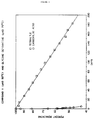
- Figure 1 illustrates the stability (90°C) of Compound 1 and the stability (70°C) of the glycine analog of Compound 1 as described in Example 43.
- The present substituted guanidines are represented by the following formula:

wherein R₃ is an optionally substituted heterocyclic moiety, as defined in the passage immediately after the next definition of R⁴, or an optionally substituted phenyl of the formula
wherein X₃, X₄ and X₅ are the same or different and are selected from the group consisting of
H,
Br,
CF₃,
CF₂CF₃,
CH₂CF₃,
C₁-C₄ alkyl,
CH=NOCH₃,
CH=NOH,
CHO,
CH₂OCH₃,
CH₂OH,
Cl,
CN,
COCF₃,
COC₁-C₃ alkyl,
CONH₂,
CONHC₁-C₃ alkyl,
CON(C₁-C₃ alkyl)₂,
COOC₁-C₃ alkyl,
COOH,
F,
I,
NH₂,
NHC₁-C₃ alkyl,
N(C₁-C₃ alkyl)₂,
NHCHO,
NHCOCH₃,
NHCONH₂,
NHSO₂CH₃,
NO₂,
OC₁-C₃ alkyl,
OCOCH₃,
OH,
SC₁-C₃ alkyl,
SOC₁-C₃ alkyl,
SO₂C₁-C₃ alkyl,
SO₂NH₂,
SO₂NHC₁-C₃ alkyl,
SO₂N(C₁-C₃ alkyl)₂,
and
SO₃H,
or where substituents at X₄ and X₅ form a fused ring;
wherein R₁ is hydrogen, a C₁ to C₄ saturated, unsaturated, acyclic, cyclic or mixed hydrocarbyl or modified hydrocarbyl group and wherein, in the modified hydrocarbyl group,
1 to 2 atoms of carbon may be replaced by 1 to 2 of the same or different heteroatoms selected from the group consisting of N, O, S, Cl, Br and I,
and 1 to 3 atoms of hydrogen may be replaced by 1 to 3 atoms of fluorine, oxygen, or nitrogen;
wherein R₂ is hydrogen, CN, NO₂, a C₁ to C₂₀ saturated, unsaturated, acyclic, cyclic or mixed hydrocarbyl or modified hydrocarbyl group and wherein, in the modified hydrocarbyl group,
1 to 4 atoms of carbon may be replaced by 1 to 4 of the same or different heteroatoms selected from the group consisting of N, O, S, Cl, Br and I,
and 1 to 5 atoms of hydrogen may be replaced by 1 to 5 atoms of fluorine, oxygen, or nitrogen;
wherein R₁ and R₂ can be fused;
n is 0 or 1;
R₄ is H or C₁-C₆ alkyl with proviso that R₄ can only be alkyl on a single carbon atom when n = 2 or 3. - Suitable heterocyclic moieties for R₃ are optionally substituted pyridines, thiazoles, indoles, quinolines, naphthyridines, cinnolines, pteridines, thiophenes, benzothiophenes, naphthothiophenes, thianthrenes, furans, pyrans, isobenzofurans, chromenes, xanthenes, phenoxathins, pyrroles, indoles, isoindoles, indolizines, pyridazines, pyrimidines, pyrazines, pyrazoles, imidazoles, pyrroles, indazoles, purines, quinolizines, isoquinolines, quinolines, phthalazines, quinoxalines, quinazolines, carbazoles, carbolines, phenanthridines, acridines, pyrimidines, phenanthrolines, phenazines, phenarsazines, isothiazoles, phenothiazines, isoxazoles, thiazoles, furazans and heterocyclics of the following formulas:


wherein R is H or C₁-C₆ alkyl. The heterocyclic moieties may be optionally substituted with one or more substituents, such as, for example, C₁-C₆ alkyl, halogen, NO₂, CN, trihalomethyl, dihalomethyl, hydroxyl or hydroxyalkyl. - The present guanidines include tautomeric forms and physiologically acceptable salts of the compounds of Formula I, above. Preferred compounds include those wherein X₃, X₅ and R₄ are hydrogen, n equals 1, and X₄ is CN or NO₂.
- It should be considered that by the term "modified hydrocarbyl" it is contemplated, as one example, that where R₂ is a C₂ modified hydrocarbyl group that one atom of carbon may be replaced by an atom of nitrogen so that the C₂ hydrocarbyl moiety may be replaced by the -CN cyano moiety. As a further example, it is contemplated that where R₂ is a C₃ modified hydrocarbyl group that one atom of carbon may be replaced by a nitrogen atom and two atoms of carbon may be replaced by two atoms of oxygen so that a C₃ hydrocarbyl moiety may be replaced by the -NO₂ nitro moiety. Other replacements of hydrocarbyl carbons by the same or different heteroatoms selected from the group consisting of N, O, S, Cl, Br, and I are similarly contemplated by the invention.
- Preferably, the present guanidine is one wherein R₃ is a substituted phenyl and R₁ is H or CH₃. Preferred guanidines also include those wherein (a) X₃ and X₅ are selected from the group consisting of H, Br, CF₃, CH₃, Cl and F and (b) X₄ is H or CN. Also preferred are guanidines wherein X₃ and X₄ form a fused ring, such as 6-Indazolyl.
- Preferred R₂ substituents include
normal alk(en) (yn)yl C₂-C₁₃,
branched alk(en) (yn)yl C₃-C₁₃,
cycloalk(en)yl C₃-C₁₃,
alk(en)yl cycloalk(en)yl C₄-C₁₃,
cycloalk(en)yl alk(en)yl C₄-C₁₃,
alk(en)yl cycloalk(en)yl alk(en)yl C₅-C₁₃,
alk(en)yl bicycloalk(en)yl C₇-C₁₃,
fused bicycloalk(en)yl C₇-C₁₃,
alk(en)yl fused bicycloalk(en)yl C₈-C₁₃,
fused bicycloalk(en)yl alk(en)yl C₈-C₁₃,
alkenyl fused bicycloalk(en)yl alk(en)yl C₉-C₁₃,
fused tricycloalk(en)yl C₁₀-C₁₃,
alk(en)yl fused tricycloalk(en)yl C₁₁-C₁₃,
fused tricycloalk(en)yl alk(en)yl C₁₁-C₁₃ or
alk(en)yl fused tricycloalk(en)yl alk(en)yl C₁₁-C₁₃. - Particularly preferred are those guanidines wherein R₂ is selected from the group consisting of cyclooctyl, benzyl, cyclononyl, phenyl, alpha-phenethyl, cycloheptyl, cyclohexyl, benzhydryl, tetralyl, and decalyl.
- Preferred guanidines also include those listed above wherein R₂ is a modified hydrocarbyl group wherein up to four carbon atoms may be replaced by the same or different heteroatoms selected from a group consisting of S to replace C or CH₂, N to replace CH, NH and O to replace CH₂ and Cl, Br and I to replace CH₃ and wherein up to 5 atoms of hydrogen may be substituted by fluorine atoms. Also preferred are those sweetening agents wherein R₂ is selected from the group consisting of CH(CH₃)C₆H₅, alkyl substituted S-phenylethyl, diphenylmethyl, pyridinyl, pyridinyl methyl, piperidyl, homopiperidyl, indolyl, indolinyl, isoindolinyl, quinolyl, isoquinolyl, pyrazinyl, pyrimidyl, indazolyl, quinoxalinyl, quinazolinyl, purinyl, OCH₂C₆H₅, pyranyl, tetrahydropyranyl, benzofuranyl, methoxyphenyl, methyloxycarbonylphenyl, 3,4-methylenedioxyphenyl, morpholinyl, benzoxazolyl, acetamidophenyl, cyano, nitro, thienyl, thienyl methyl, tetrahydro-3-thiophene, endo-norbornyl, exo-norbornyl, benzothienyl, 2,2,4,4-tetramethylthiocyclobut-3-yl, thiazolyl, isothiazolyl, SO₂C₆H₅, alkyl substituted -SO₂C₆H₅ (SO₂C₆H₂(2,4,6-trimethyl), SO₂C₆H₂(2,4,6-triisopropyl)), SO₂c-C₆H₁₁, SO₂c-C₇H₁₃, 6-oxo-cis-hydrindane, chlorophenyl, fluorophenyl, and trifluoromethylphenyl.
- Other preferred compounds include those having the formula
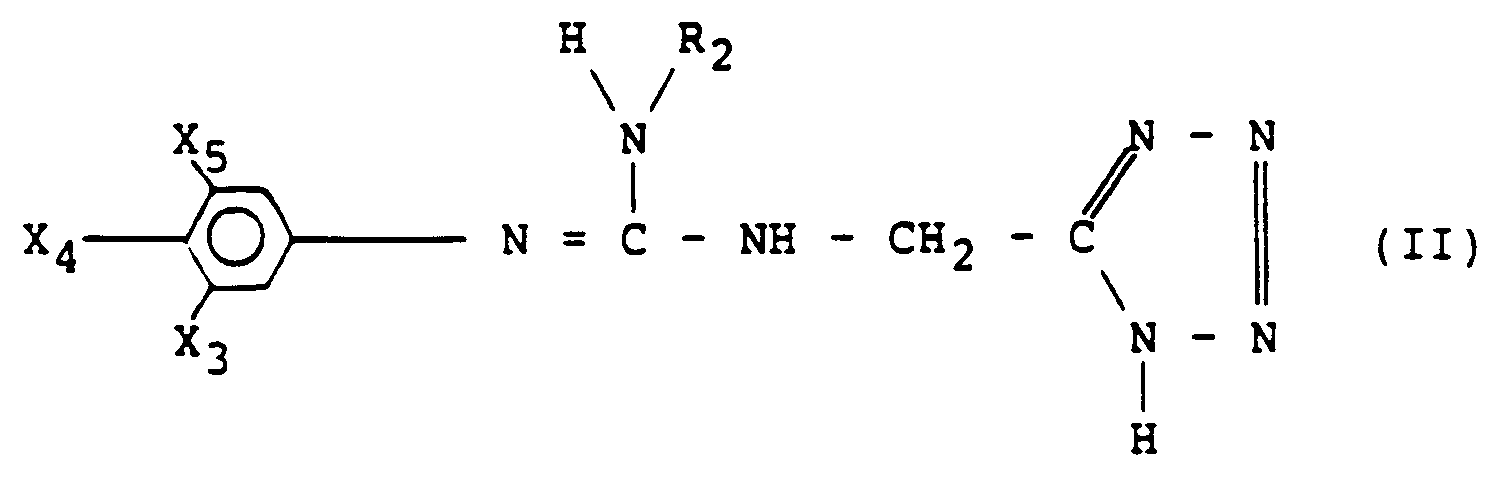
wherein X₃, X₄, X₅ and R₂ are as described above. Particularly preferred compounds are those of Formula II wherein X₃ and X₅ are H and X₄ is CN or wherein X₃ and X₅ are selected from the group consisting of CF₃, CH₃, Cl and F and wherein X₄ is selected from the group consisting of H and CN. - Most preferred are such compounds wherein R₁ is selected from the group consisting of H and CH₃; R₃ is a substituted phenyl wherein X₃ and X₅ are H and X₄ is CN or wherein X₃ and X₅ are selected from the group consisting of CF₃, CH₃, Cl, H and F and wherein X₄ is selected from the group consisting of H and CN; and wherein R₂ is selected from the group consisting of CH(CH₃)C₆H₅, CH₂C₆H₅, CH(CH₃)-c-C₆H₁₁, CH(C₆H₅)₂, c-C₆H₁₁, c-C₇H₁₃, endo-norbornyl, c-C₈H₁₅, c-C₉H₁₇, c-C₁₀H₁₇, c-C₁₀H₁₉, SO₂C₆H₅ and SO₂C₇H₁₃. Specifically preferred compounds include 1'-N-[N-cyclononylamino(4-cyanophenylimino)methyl]-5-aminomethyltetrazole (R₁, X₃, R₄, R₅ and X₅ are H; X₄ is CN and R₂ is c-C₉H₁₇); 1'-N-[N-cyclooctylamino(4-cyanophenylimino)methyl]-5-aminomethyltetrazole (R₁, X₃, R₄, R₅ and X₅ are H, X₄ is CN and R₂ is c-C₈H₁₅); 1'-N-(N-1-naphthylamino-(4-cyanophenylimino)methyl]-5-aminomethyltetrazole (R₁, R₄, R₅, X₃ and X₅ are H, X₄ is CN and R₂ is naphthyl); 1'-N-[N-benzenesulfonylamino-(4-cyanophenylimino)methyl]-5-aminomethyltetrazole (R₁, R₄, R₅, X₃ and X₅ are H, X₄ is CN and R₂ is SO₂C₆H₅); 1'-N-[N-(S)-phenethylamino-(3,5-dimethylphenylimino)methyl]-5-aminomethyltetrazole (R₁, R₄, R₅ and X₄ are H, X₃ and X₅ are CH₃ and R₂ is (S)(CH(CH₃)C₆H₅); 1'-N-[N-(S)-phenethylamino-(3,5-dichlorophenylimino)methyl]-5-aminomethyltetrazole (R₁, R₄, R₅ and X₄ are H, X₃ and X₅ are Cl and R₂ is (S)(CH(CH₃)C₆H₅); 1'-N-[N-endo-norbornylamino-(4-cyanophenylimino)methyl]-5-aminomethyltetrazole (R₁, R₄, R₅, X₃ and X₅ are H, X₄ is CN and R₂ is endo-norbornyl); 1'-N-[N-cyclooctylamino(3-chloro-4-cyanophenylimino) methyl]-5-aminomethyltetrazole (R₁, R₄, R₅ and X₅ are H, X₃ is Cl, X₄ is CN and R₂ is c-C₈H₁₅); 1'-N-(N-cyclooctylamino(4-cyano-3-methylphenylimino)methyl]-5-aminomethyltetrazole (R₁, R₄, R₅ and X₅ are H, X₃ is CH₃, X₄ is CN and R₂ is c-C₈H₁₅); 1'-N-[N-benzylamino(3,5-dichlorophenylimino)methyl]-5-aminomethyltetrazole (R₁, R₄, R₅ and X₄ are H, X₃ and X₅ are Cl and R₂ is CH₂C₆H₅); 1'-N-(N-methyl-N-benzylamino (3,5-dichlorophenylimino)methyl]-5-aminomethyltetrazole (R₁ is CH₃, X₄ , R₄, R₅ are H, X₃ and X₅ are Cl and R₂ is CH₂C₆H₅); 1'-N-[N-(S)-1-cyclohexylethylamino(3,5-dichlorophenylimino)methyl]-5-aminomethyltetrazole (R₁, R₄, R₅ and X₄ are H, X₃ and X₅ are Cl and R₂ is (S)CH(CH₃)-c-C₆H₁₁); 1'-N-[N-(S)-α-methylbenzylamino(4-cyanophenylimino)methyl]-5-aminomethyltetrazole (R₁, X₃, R₄, R₅ and X₅ are H, X₄ is CN and R₂ is (S)CH(CH₃)C₆H₅) and 1'-N-[N-cycloheptylamino(3,5-dichlorophenylimino) methyl]-5-aminomethyltetrazole (R₁, R₄, R₅ and X₄ are H, X₃ and X₅ are Cl and R₂ is c-C₇H₁₃).
- Preferred compounds are those wherein X₄ is selected from H, CN, C(O)OCH₃, F and NO₂, as well as those compounds wherein R₂ is selected from n-C₅H₁₁, n-C₆H₁₃, n-C₇H₁₅, CH(CH₃)(CH₂)₂CH₃, CH(CH₃)(CH₂)₃CH₃, (CH₂)₃CH(CH₃)₂, (CH₂)₄CH(CH₃)₂, (CH₂)₅CH(CH₃)₂, C₆H₅, C₆-C₁₀-cycloalkyl, (CH₃(CH₂)₃)C₆-C₁₆ cycloalkyl,
CH₂C₆H₅, CH₂-c-C₆H₁₁, CH(CH₃)C₆H₅, CH(C₆H₅)C₆H₅, CH(CH₃)-c-C₆H₁₁, (CH₂)₂C₆H₅, (CH₂)₂-c-C₆H₁₁, CH(CH₃)CH₂C₆H₅, CH(CH₃)CH₂-c-C₆H₁₁,
C₆H₄(CH₃), C₆-C₁₀ cycloalkyl(CH₃),
CH₂C₆H₄(CH₃), CH₂-c-C₆H₁₀(CH₃), CH(CH₃)C₆H₄(CH₃), CH(CH₃)-c-C₆H₁₀(CH₃),
(CH₂)₂CH(c-C₃H₅)₂, (CH₂)₃CH(c-C₃H₅)₂, CH(CH₃)CH₂CH(c-C₃H₅)₂, CH(CH₃)(CH₂)₂CH(c-C₃H₅)₂,
naphthyl, 5,6,7,8-tetrahydronaphthyl, perhydronaphthyl, indenyl, indanyl,
naphthyl(CH₃), 5,6,7,8-tetrahydronaphthyl(CH₃), perhydronaphthyl(CH₃), indenyl(CH₃), indanyl(CH₃), fenchyl,
CH₂-naphthyl, CH₂-5,6,7,8-tetrahydronaphthyl, CH₂-perhydronaphthyl, CH₂-indenyl, CH₂-indanyl,
CH₂-naphthyl(CH₃), CH₂-5,6,7,8-tetrahydronaphthyl(CH₃), CH₂-perhydronaphthyl(CH₃), CH₂-indenyl(CH₃), CH₂-indanyl(CH₃),
adamantyl, endo-norbornyl, exo-norbornyl,
CH₂-adamantyl, CH(CH₃)adamantyl, tetralyl, decalyl, and
CH₂-adamantyl(CH₃). - A further preferred compound is that of the formula

especially that wherein R₁ in the above formula is CH₃. - A further preferred compound is that wherein R₃ is 4-cyanophenyl, 3,5-dichlorophenyl, 3,5-dimethylphenyl or phenyl, R₄ is H and which has the formula

and wherein P is H,
CH₂OCO-t-C₄H₉ or CH₂CH₂COOC₂H₅. - Furthermore, the compounds of the formula

are preferred especially those wherein R₁ is H, X₃ and X₅ being H and X₄ being CN, or wherein R₂ is phenyl, benzyl, cyclohexyl, cyclooctyl, cyclononyl, 4-pyranyl, 2-decalyl, endo-norbornyl, 1-naphthyl, alpha-phenethyl or benzhydryl or the compounds of the above formula wherein X₄ is H and X₃ and X₅ are Cl or CH₃ and wherein R₂ may further be of the meaning as just indicated above. - The present invention also includes physiologically acceptable salts of the presented guanidines, i.e., sulfate, phosphate, citrate, hydrochloride, sodium, potassium, ammonium, calcium and magnesium salts.
- Additionally, the present invention relates to edible products containing the present guanidine compounds as sweetening agents either alone or in combination with other sweeteners such as carbohydrate sweeteners or high potency sweeteners. Also provided by the present invention is a process for sweetening edible products such as foods, beverages, candies, chewing gums, sweets, pharmaceuticals and veterinary preparations.
- The present invention further contemplates compositions of the present guanidines in combination with other sweetening agents and/or a physiologically acceptable carrier which may be a bulking agent. Suitable carriers include polydextrose, starch, maltodextrins, cellulose, methylcellulose, maltitol, carboxymethylcellulose, hydroxymethylcellulose, microcrystalline cellulose, sodium alginate, pectins, gums, lactose, maltose, glucose, leucine, glycerol, mannitol, sorbitol, sodium bicarbonate and phosphoric, citric, tartaric, fumaric, benzoic, sorbic, propionic acids and their sodium, potassium and calcium salts and mixtures of all of the above.
- Suitable sweetening agents which may be used in combination with the present guanidines can be sugar or high potency sweeteners such as sucrose, corn syrups, fructose, high fructose corn syrup, aspartame, alitame, neohesperidine dihydrochalcone, hydrogenated isomaltulose, stevioside, L-sugars, glycyrrhizin, xylitol, acesulfam-K, saccharin (sodium, potassium or calcium salt), cyclamic acid (sodium, potassium or calcium salt), trichlorogalactosucrose (TGS or sucralose), monellin and thaumatin and mixtures thereof.
- The present invention also relates to a method of preparing the tetrazole containing guanidine compounds. The substituted guanidines of the present invention are prepared employing synthetic methods which are analogous to known methods disclosed in the literature. These known methods have been summarized in a recent paper by Maryanoff (C. Maryanoff, R.C. Stanzione, J.N. Plampin, and J.E. Mills, J. Org. Chem. 1986, 51, 1882-1884). The techniques are further described in J. Med. Chem., 1978, no. 21, pp. 773-781; Chem. Ber. 1966, 99, 1252-157; U.K. patent 1587 258; J. Org. Chem., 1970, 35, pp. 2067-2069; Chem. Ber. 1967, 100, pp. 591-604; J. fur Prakt. Chem. 1977, 319, pp. 149-157; and The Chemistry of Amidines and Imidates, S. Patai, ed. Wiley-Interscience 1975, pp. 283-348. Two general techniques are particularly useful. The first involves formation of an isothiourea intermediate while the second involves transformation of a carbodiimide intermediate. Either of these intermediates are reacted with a 5-substituted tetrazole resulting in formation of the present guanidines. The preparation of 5-substituted tetrazoles is described by Grzonka and Liberek in Roczniki Chemii, Ann. Soc. Chim. Polonorum, 45, 967-986 (1971).
- In general, a reactive intermediate, with an easily liberated activating moiety (leaving group), designated by the letter L in the following reactants, can be employed wherein the intermediate contains appropriately substituted amine groups corresponding to the substituents present on the guanidine nitrogens. The leaving groups are preferably selected from the group consisting of S-alkyl (isothiourea), O-alkyl, OSO₂-aryl, SO₃H and halogen moieties. A protecting group designated by the letter P will be attached to the tetrazole. Preferred protecting groups have the formulas

As a general principle, a reaction is brought about between the reactant intermediate and the appropriate complementary amine, that is to say, the following compounds are brought into contact with one another:

- The following compounds are brought into contact with one another in the carbodiimide method:

- These reactions can be carried out in water or in organic solvents such as ethanol, methanol, acetone, chloroform, carbon tetrachloride or pyridine at a temperature which may vary from ambient temperature to boiling. The choice of the solvent and the temperature employed will depend on the L group and the reactivity of the amine employed and can be readily determined by one skilled in the art.
- Additionally, the present invention encompasses novel intermediates used in preparing the present guanidine compounds as seen in the tetrazole containing reactants in (3) and (4) above.
- Various methods may be employed to prepare the intermediaries but the corresponding thiourea derivative will generally have to be prepared as follows, for example:

- One of the preferred methods of synthesis employed to obtain these thiourea derivatives consists of allowing an alkyl or aryl isothiocyanate to react with a suitable amine. The reaction is conducted from ambient temperature to boiling, depending on the reciprocal reactivity of the two compounds and takes place in an organic solvent such as ethanol, ethyl acetate, acetonitrile, chloroform or acetone. These reactions can be characterized as follows:
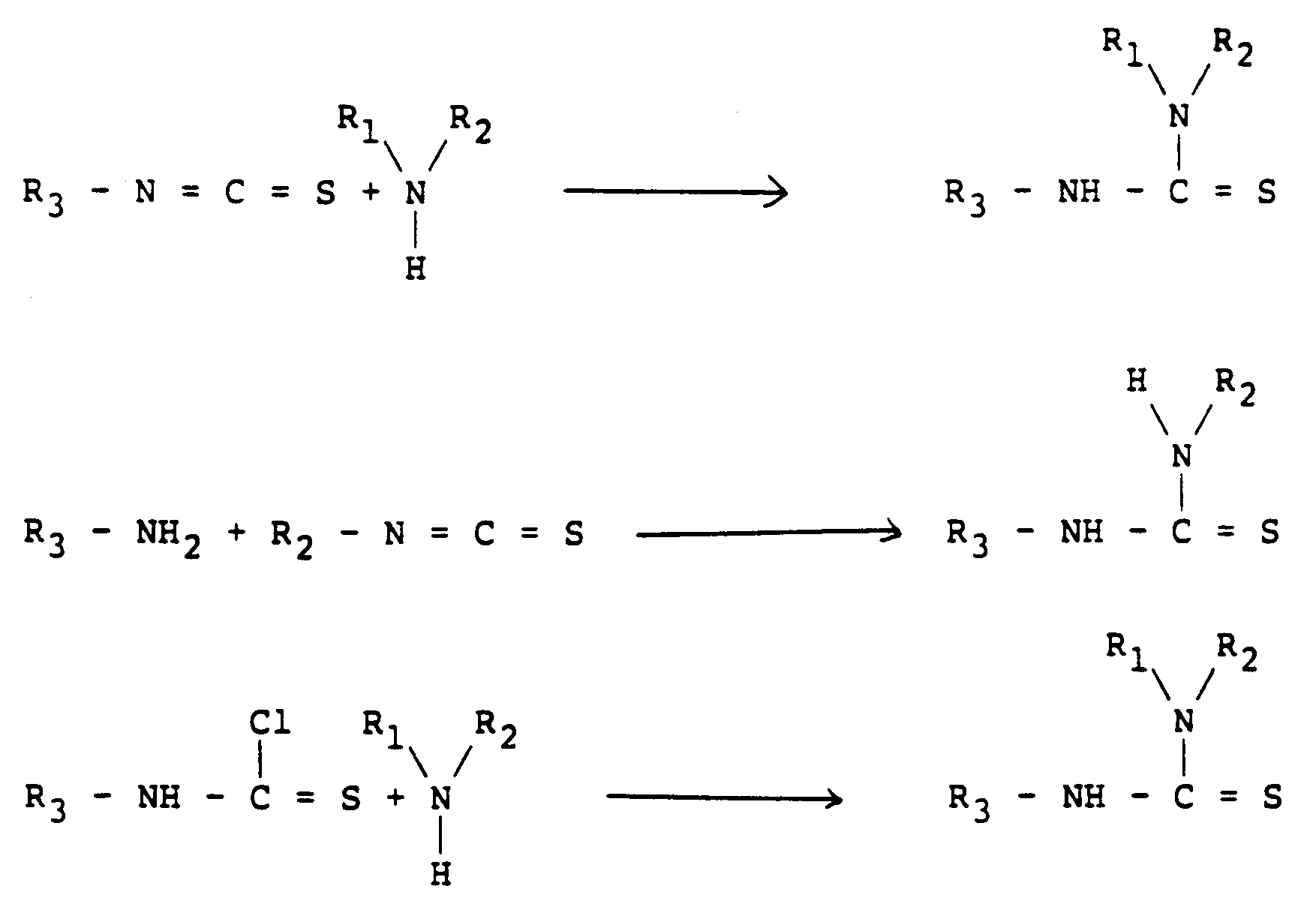
- The preferred method consists of transforming thiourea derivatives obtained in this way into S-alkyl derivatives. The preferred L activating group is the S-CH₃ group, such as in the following compound, for example:

- These intermediates are obtained by treating the corresponding thiourea derivative with an alkylating agent (such as methyl iodide or dimethyl sulfate) in solution in an organic solvent such as acetone or 2-butanone at a temperature ranging from ambient temperature to boiling depending upon reactivity of the materials. The S-methylisothiourea derivatives are thus obtained in the form of salts (iodide or sulfate). These salts are next treated in a solution of sodium hydroxide or potassium hydroxide in order to free their base form. They are next condensed with an aminomethyltetrazole in a suitable solvent, at a temperature ranging from ambient to boiling depending on reactivity of the materials.
-


According to this general method, an alkyl or aryl isothiocyanate, R₃NCS, is allowed to condense with an amine HNR₁R₂ preferably at ambient temperature and in an organic solvent to yield a thiourea R₃NHCSNR₁R₂. The thiourea is purified by recrystallization or other standard procedures and is then methylated with methyl iodide or dimethyl sulfate. This reaction is conducted in an organic solvent (e.g., acetone) at temperatures varying from ambient to 100°C depending on thiourea reactivity. With methyl iodide, a crystalline isothiouronium salt, e.g., R₃N=C(NR₁R₂)SCH₃]⁺I⁻, is thus obtained which is dissolved in water and treated with one molar equivalent of NaOH. The isothiourea R₃N=C(NR₁R₂)SCH₃ is then obtained by extraction by an organic solvent, i.e., methylene chloride, and recrystallization. The isothiourea is then reacted with the amino methyltetrazole to give the guanidine
This reaction may be conducted in water or organic solvents and at temperatures varying from ambient to 100°C. The guanidine is then purified by recrystallization or other standard methods. - The second general method is based on the use of a carbodiimide intermediate which may be obtained by the reaction of an appropriate thiourea with phosgene or with an equimolecular mixture of triphenylphosphine, tertiary amine and carbon tetrachloride in an organic solvent, such as carbon tetrachloride or dichloromethane, at a temperature ranging from ambient temperature to boiling.
-


According to this general method, an aryl isothiocyanate R₃NCS is allowed to condense with a primary amine (R₂-NH₂) to yield an N,N′-disubstituted thiourea R₃-NHCS-NHR₂. After purification by standard techniques such as recrystallization or chromatography, the thiourea is then converted to a carbodiimide R₃-N=C=N-R₂ on reaction in refluxing dichloromethane with one equivalent each of triphenylphosphine, carbon tetrachloride and triethylamine. The carbodiimide is not purified but rather the carbodiimide is reacted directly with an aminoalkyltetrazole or an aminotetrazole to give the trisubstituted guanidine.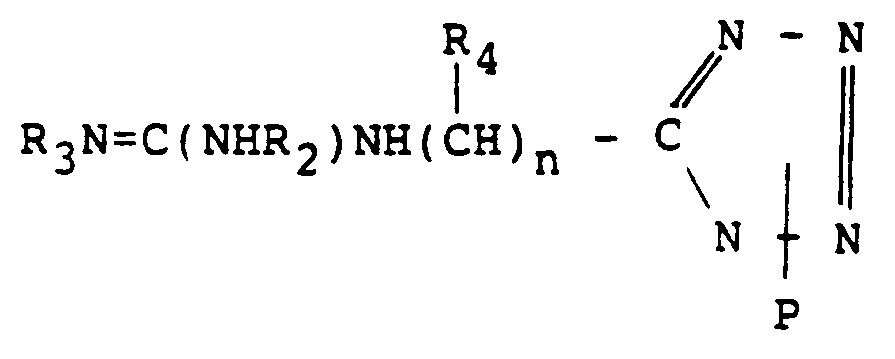
Tetra and penta-substituted guanidines may be obtained on further alkylation of the trisubstituted guanidine with alkyl halides. - The present guanidines may exist as an equilibrium mixture of tautomeric forms. All tautomers of the guanidines are contemplated by the present invention. The guanidines are shown in the general formula as the tautomer with R₃N=C- unsaturation; however, this tautomer is invariably in equilibrium with the tautomers, with -C=NR₂ and

- When P is hydrogen, the sweetening agents according to the present invention may exist in zwitterion or in acid form. They can thus be converted into salts by acids or by physiologically acceptable organic or inorganic bases. One of the best methods of preparing such salts consists of concentrating to dryness in vacuo a mixture of a compound according to the present invention in an aqueous solution with an equivalent amount of an acid or of an organic or inorganic base. The preferred salts according to the present invention are hydrochloride, citrate, phosphate, sulfate, or sodium, potassium, ammonium, calcium or magnesium salts.
- Especially preferred starting materials are those of the formula

wherein
R₂ is cyclohexyl, cyclooctyl, alpha-phenethyl, diphenylmethyl, benzyl, phenyl, endo-norbornyl, 1-naphthyl or 2-decalyl,
or wherein the compounds are prepared from the starting material of the formula
wherein R₃ is 4-cyanophenyl, 3,5-dichlorophenyl, 3,5-dimethylphenyl or phenyl,
and from an amine HNR₁R₂ wherein R₂ is cyclohexyl, cyclooctyl, alpha-phenethyl, diphenylmethyl, benzyl, phenyl, endo-norbornyl, 1-naphthyl or 2-decalyl,
and wherein R₃ is 4-cyanophenyl, 3,5-dichlorophenyl, 3,5-dimethylphenyl or phenyl. - The present sweetening agents may take the form of a balanced mixture of tautomeric forms. Thus, the following tautomeric forms may be obtained, when R₁ is H:

and the following tautomeric forms for tetrazole will apply:
- This is why the present guanidines are represented in Formula (I) by one of the tautomeric forms in the descriptive part of the present specification, in the full knowledge that the tautomeric form must necessarily be in balance with the other tautomeric forms, depending on the nature of the substituents X₃, X₄, X₅, R₁, and R₂, as well as on the pH.
- The present N,N',N''-trisubstituted guanidines may have an asymmetrical carbon atom, i.e., optically active site. These compounds exist in (R) and (S) enantiomeric forms. Both the (R) and (S) enantiomers of the N,N',N''-trisubstituted guanidines are contemplated by the present invention.
- The present invention also relates to a method of sweetening foods or comestible products. In such uses, the present guanidines are added to any consumable product in which it is desired to have a sweet taste. The present sweetening agents are added to such products in amounts effective to impart the desired level of sweetness. The optimum amount of sweetening agent will vary depending on a variety of factors such as, for example, the sweetness potency of the particular sweetening agent, storage and use conditions of the product, the particular components of the products, the flavor profile of the comestible products and the level of sweetness desired. One skilled in the art can readily determine the optimum amount of sweetening agent to be employed in a particular formulation of a food product by conducting routine sweetness (sensory) experiments. Usually, the present sweetening agents are added to the comestible products in amounts of from about 0.00001 to about 0.1 percent by weight of the comestible product, advantageously from about 0.00005 to about 0.05 weight percent and preferably from about 0.001 to about 0.02 weight percent. Concentrates, of course, will contain higher percentages of sweetening agent(s), and are diluted for end use purposes.
- Suitable products which are sweetened by the present sweetening agents include any products for which a sweet flavor component is desired such as food products (for human or animal consumption), beverages (alcoholic, soft drinks, juices, carbonated beverages), confectionary products (candies, chewing gum, baked goods, pastries, breads, etc.), toilet and hygiene products, cosmetics, pharmaceutical products and veterinary products. In sweetening gum, the present guanidines can be added in amounts in excess of a sucrose equivalent normally found in gum. This excess amount of guanidine sweetener provides a longer sweet taste and enhancement of flavor (flavor enhancer).
- The present guanidines can be added in pure form to foods to impart a sweet flavor. However, because of the high sweetness potency of the present sweetening agents, they are typically admixed with a carrier or bulking agent. Suitable carriers or bulking agents include polydextrose, starch, malto-dextrins, cellulose, methylcellulose, carboxymethylcellulose, hydroxymethylcellulose, microcrystalline cellulose, cellulose derivatives, sodium alginate, pectins, gums, lactose, maltose, maltitol, glucose, leucine, glycerol, mannitol, sorbitol, sodium bicarbonate and phosphoric, citric, tartaric, fumaric, benzoic, sorbic and propionic acids and their sodium, potassium and calcium salts and mixtures of all of the above.
- The present guanidines can be employed alone as the sole sweetening agent in a comestible product. Mixtures of the present guanidines can also be employed. Additionally, the present guanidines can be used in combination with other sweetening agents such as sugars (such as sucrose and fructose), corn syrups, dipeptide sweeteners such as aspartame and alitame and other sweeteners such as glycyrrhizin, aminoacyl sugars, xylitol, sorbitol, mannitol, acesulfam K, thaumatin, monellin, cyclamates, saccharin, neohesperidine dihydrochalcone, hydrogenated isomaltulose, stevioside, L-sugars, trichlorogalactosucrose (TGS), and mixtures thereof.
- The following examples illustrate the practice of the present invention.
- 4-Cyanophenylisothiocyanate (20.0 g; 125 mmol) was dissolved in 300 ml ethyl acetate. Cyclooctylamine (17.1 ml, 125 mmol) having a density of 0.928 was added to the reaction mixture with stirring at room temperature. After 10 minutes, a precipitate formed. The reaction mixture was stirred overnight and filtered to give 23.9 g (67%) of white solid (mp=149-151°C) which was dried at room temperature under a vacuum. PMR (CDCl₃) δ 8.71 (br s, 1H), 7.66 (d, J=8 Hz, 2H), 7.39 (d, J=8 Hz, 2H), 6.36 (d, J=8 Hz, 1H), 4.6-4.4 (m, 1H), 2.0-1.9 (m, 2H) and 1.7-1.4 (m, 12H). CMR (CDCl₃) δ 178.9, 142.2, 134.5, 123.6, 119.0, 109.0, 56.0, 32.6, 27.6 26.2 and 24.4.
- A mixture of 20 g (69.7 mmol) of the compound obtained previously and 10.9 ml (d = 2.28; 175 mmol) of methyl iodide was stirred overnight in 250 ml of acetone. In the morning, a solid was present and it was filtered to give 27.3 g (91%) of a white solid. The filtrate was concentrated under reduced pressure to give an orange solid which was triturated with ether and filtered to give 2.1 g of off-white solid which was added to the 27.3 g filtered before. The combined solid produced was dissolved in 100 ml of a 1N solution of sodium hydroxide. The resulting alkaline mixture was extracted with methylene chloride (CH₂Cl₂). The CH₂Cl₂ layer was washed with saturated NaCl and dried with anhydrous sodium sulfate. The CH₂Cl₂ layer was then concentrated under reduced pressure to give 19.8 g (94%) of a white solid (mp=84-86°C). PMR (CDCl₃) δ 7.54 (d, J=7 Hz, 2H), 6.96 (d, J=7 Hz, 2H), 4.58 (br s, 1H), 3.96 (br s, 1H), 2.24 (s, 3H), 2.0-1.8 (m, 2H) and 1.64-1.44 (m, 12H). CMR (CDCl₃) δ 154.5, 153.2, 133.2, 123.0, 119.8, 104.9, 52.9, 32.5, 27.2, 25.6, 23.7 and 14.3.
- A mixture of 5-aminomethyltetrazole (0.50 g, 5.05 mmol), sodium hydroxide (0.20 g, 5.00 mmol) and 1.5 ml of water was added to a solution of N-cyclooctyl-N′-(4-cyanophenyl)-S-methylisothiourea (1.52 g, 5.05 mmol) in 15 ml of absolute ethanol. The mixture was heated to 70° for 20 hours. After cooling, the solution was concentrated to dryness and the residue was dissolved in 20 ml of water. The resulting solution was washed with dichloromethane (3 x 20 ml) and then neutralized with a 1 N HCl solution to bring its pH to 7.5. The desired guanidine compound precipitated and was separated out by filtration to give 1.2 g (70%) of white solid. PMR (CD₃OD) δ 7.75 (d, J=8 Hz, 2H), 7.41 (d, J=8 Hz, 2H), 4.70 (s, 2H), 3.82 (m, 1H) and 1.96-1.46 (m, 14H). CMR (DMSO-D6) δ 158.3, 153.3, 144.0, 133.7, 122.0, 119.0, 105.5, 52.8, 37.8, 31.2, 26.8, 24.6 and 22.9. Analysis calculated for C₁₈H₂₄N₈ (0.6 H₂O): C, 59.52; H, 6.99; N, 30.85. Found: C, 59.38; H, 7.07; N, 31.18. The compound was tasted and was sweeet at a concentration of 10 ug/ml.
- The hydrochloride of this compound was prepared by dissolving, with heating, 1.0 g of the above zwitterion in a mixture of 20 ml 1 N HCl and 10 ml ethanol. Upon cooling, 900 mg (82%) of white crystalline compound precipitated and was collected by filtration. Analysis calculated for C₁₈H₂₄N₈ HCl · (0.4 H₂O): C, 54.58; H, 6.56; N, 28.29. Found: C, 54.65, H, 6.40, N, 28.33. This HCl salt was also sweet when tasted.
- The phosphate of this compound can be prepared by dissolving, with heating, 1.0 g (2.84 mmoles) of the above zwitterion in a mixture of 15 ml 1 M phosphoric acid and 7 ml ethanol. Upon cooling, 1.2 g (92%) of white crystalline compound slowly precipitates and is collected by filtration. PMR (CD₃OD) δ 7.78-7.40 (apparent AB q, J=9 Hz, 4H), 4.81 (s, 2H), 3.88-3.77 (m, 1H) and 1.97-1.45 (m, 14H). Analysis calculated for C₁₈H₂₇N₈PO₄(1.85 H₂O): C, 44.69; H, 6.40; N, 23.16. Found: C, 44.68, H, 6.13, N, 23.19.
- The hemi-citrate of this compound can be prepared by dissolving, with heating, 1.0 g (2.84 mmoles) of the above zwitterion in a mixture of 15 ml 1 M phosphoric acid and 7 ml ethanol. Upon cooling, 0.94 g (63%) of white crystalline compound slowly precipitates and is collected by filtration. PMR (CD₃OD) δ 7.78-7.42 (apparent AB q, J=9 Hz, 4H), 4.73 (s, 2H), 3.88-3.77 (m, 1H), 2.92-2.74 (AB q, J=15 Hz, 2H), 1.98-1.84 (m, 2H), 1.82-1.67 (m, 4H) and 1.64-1.45 (m, 8H). Analysis calculated for C₁₈H₂₄N₈ · 0.5 C₆H₈O₇: C, 56.24; H, 6.29; N, 24.98. Found: C, 55.84, H, 6.23, N, 24.70.
- The sulfate of this compound can be prepared by dissolving, with heating, 1.0 g (2.84 mmoles) of the above zwitterion in a mixture of 15 ml 1 M sulfuric acid and 7 ml ethanol. Upon cooling, 0.56 g (43%) of white crystalline compound slowly precipitates and is collected by filtration. PMR (DMSO-D6) δ 8.79 (br s, 1H), 8.48 (br s, 1H), 7.88 (d, J=8 Hz, 2H), 7.39 (br s, 2H), 4.80 (s, 2H), 3.90-3.75 (m, 1H), 1.88-1.73 (m, 2H) and 1.70-1.30 (m, 12H). Analysis calculated for C₁₈H₂₄N₈ · H₂SO₄ (0.4 H₂O): C, 47.22; H, 5.90; N, 24.47, S, 7.00. Found: C, 47.20, H, 5.83, N, 24.46, S, 6.66.
- 4-Cyanophenylisothiocyanate (100 g; 625 mmol) was dissolved in 1 liter of ethyl acetate. Cyclohexylamine (62 g, 625 mmol) was added to the reaction mixture with stirring at room temperature. After 10 minutes, a precipitate formed. The reaction mixture was stirred overnight and filtered to give 140 g (86%) of white solid (mp=192-193°C) which was dried at room temperature under a vacuum. PMR (DMSO-D6) δ 8.08 (d, 1H), 7.80 (m, 4H), 7.66 (s, 1H), 4.12 (br s, 1H) and 1.95-1.2 (m, 10H). CMR (DMSO-D6) δ 178.6, 144.3, 132.6, 120.9, 119.0, 52.1, 31.5, 25.0 and 24.4. Analysis calculated for C₁₄H₁₇N₃S: C, 64.83; H, 6.61; N, 16.70; S, 12.36. Found: C, 64.70; H, 6.56; N, 16.31; S, 12.48.
- A misture of (30 g, 115.8 mmol) of the compound obtained previously and (26 g, 183.7 mmol) of methyl iodide was stirred overnight in 130 ml of acetone. In the morning, a solid was present and it was filtered. The solid produced was dissolved in 274 ml of a 1 N solution of sodium hydroxide. The resulting alkaline mixture was extracted with methylene chloride (CH₂Cl₂). The CH₂Cl₂ layer was washed with saturated NaCl and dried with anhydrous sodium sulfate. The CH₂Cl₂ layer was then dried with anhydrous sodium sulfate. The CH₂Cl₂ layer was then concentrated under reduced pressure to give 31.0 g (98%) of a white solid (mp=84-85°C). PMR (CDCl₃) δ 7.53 (d, 4H), 6.93 (d, 2H), 4.52 (br s, 1H), 3.73 (br s, 1H), 2.24 (s, 3H) and 2.05-1.1 (m, 10H). CMR (CDCl₃) δ 154.3, 133.1, 123.0, 104.9, 51.7, 31.1, 25.5, 24.8 and 14.2. Analysis calculated for C₁₅H₁₉N₃S: C, 65.90; H, 7.01; N, 15.37; S, 11.73. Found: C, 65.80; H, 6.91; N, 15.35; S, 11.71.
- A mixture of 5-aminomethyltetrazole (0.50 g, 5.05 mmol), sodium hydroxide (0.20 g, 5.00 mmol) and 1.5 ml of water was added to a solution of N-cyclohexyl-N′-(4-cyanophenyl)-S-methylisothiourea (2.76 g, 10.1 mmol) in 15 ml of absolute ethanol. The mixture was heated to 70°C for 20 hours. After cooling, the solution was concentrated to dryness and the residue was dissolved in 20 ml of water. The resulting solution was washed with ether (2 x 20 ml) and then neutralized with a 1 N HCl solution to bring its pH to 7.5. The desired guanidine compound precipitated and was separated out by filtration to give 0.85 g (53%) of the desired compound. PMR (CD₃OD) δ 7.75 (d, J=8 Hz, 2H), 7.45 (d, J=8 Hz, 2H), 4.73 (s, 2H), 3.62 (m, 1H), 2.1-1.9 (m, 2H) and 1.85-1.10 (m, 8H). CMR (CD₃OD) δ 157.9, 153.4, 141.1, 133.0, 122.5, 117.5, 107.7, 51.8, 36.8, 31.6, 24.1 and 23.9. Analysis calculated for C₁₆H₂₀N₈ (1.25 H₂O): C, 55.40; H, 6.54; N, 32.30; Found: C, 55.48; H, 6.59, N, 32.17. The compound was tasted and was sweet at a concentration of 100 µg/ml.
- N-cyclooctyl-N′-(4-cyanophenyl)thiourea (1.0 g, 3.48 mmol) prepared in Example 1 was suspended in methylene chloride (5 ml). Carbon tetrachloride (0.47 ml, 4.86 mmol) was added to the suspension followed by the addition of triphenylphosphine (1.2 g, 4.58 mmol) and triethylamine (0.48 ml, 3.45 mmol). This mixture was heated to reflux resulting in a homogeneous solution. The mixture was stirred at reflux for 1.5 hours resulting in a yellow solution with a solid precipitate. The mixture was cooled and concentrated under reduced pressure resulting in a residue which was triturated with hexane and filtered. The filtrate was concentrated under reduced pressure to give 0.79 g of N-cyclooctyl-N′-(4-cyanophenyl) carbodiimide. IR and NMR spectroscopy verified the structure.
- A solution containing 0.72 g (6.99 mmol) of 5-aminotetrazole in 10 ml of dimethylformamide (DMF) was added to the carbodiimide (0.79 g, 3.12 mmol) obtained in step 1 above. The reaction was heated to 100°C and stirred overnight. In the morning, the reaction was concentrated under reduced pressure at 40°C. The residue was dissolved in 5 ml of 1 N sodium hydroxide and extracted twice with ether. The basic solution was neutralized to pH 7.5 using 1 N HCl to give 0.42 g (38%) of white solid which was filtered. PMR (CD₃OD) δ 7.62 (s, 4H), 4.04 (m, 1H), 2.06-1.92 (m, 2H), and 1.82-1.48 (m, 8H). CMR (CD₃OD) δ 158.8, 151.5, 143.2, 132.0, 121.1, 117.9, 105.0, 51.7, 30.8, 26.5, 24.1 and 22.3.
- 4-Cyanophenylisothiocyanate (10.0 g; 62.5 mmol) was dissolved in 150 ml ethyl acetate. Phenylethylamine (8.05 ml, 62.5 mmol) having a density of 0.940 was added to the reaction mixture with stirring at room temperature. The reaction mixture was stirred overnight and concentrated under reduced pressure to give a yellow solid. This solid was triturated with ether to give a yellow solid. This solid was triturated with ether to give 15.5 g (88%) of white solid (mp=128-129°C). PMR (CDCl₃) δ 7.9 (br s, 1H), 7.6 (d, J=8 Hz, 2H), 7.5-7.25 (m, 7H), 6.56 (br s, 1H), 5.42 (br s, 1H) and 1.60 (d, J=6 Hz, 3H).
- A mixture of 11.2 g (40 mmol) of the compound obtained previously and 6.23 ml (d = 2.28; 100 mmol); of methyl iodide was stirred overnight in 135 ml of acetone. In the morning, a solid was present and it was filtered to give 14.3 g of a white solid. The solid produced was dissolved in 60 ml of a 1 N solution of sodium hydroxide. The resulting alkaline mixture was extracted with ether. The ether layer was washed with saturated NaCl and dried with anhydrous magnesium sulfate. The ether layer was then concentrated under reduced pressure to give 9.7 g (82%) of a colorless oil. PMR (CDCl₃) δ 7.52 (d, J=9 Hz, 2H), 7.40-7.25 (m, 5H), 6.90 (d, J=9 Hz, 2H), 5.09 (q, J=6 Hz, 1H), 4.84 (br s, 1H), 2.22 (s, 3H) and 1.54 (d, J=6 Hz, 3H).
- A mixture of 5-aminomethyltetrazole (0.50 g, 5.05 mmol), sodium hydroxide (0.20 g, 5.00 mmol) and 1.5 ml of water was added to a solution of N-(S)-phenyl-ethyl-N′-(4-cyanophenyl)-S-methylisothiourea (1.52 g, 5.05 mmol) in 15 ml of absolute ethanol. The mixture was heated to 70°C for 20 hours. After cooling, the solution was concentrated to dryness and the residue was dissolved in 20 ml of water. The resulting solution was dissolved in 20 ml of water. The resulting solution was washed with ether (2 x 20 ml) and then neutralized with a 1 N HCl solution to bring its pH to 7.5. The desired guanidine compound precipitated and was separated out by filtration to give 1.2 g (72%) of the title compound. PMD (CD₃OD) δ 7.68 (d, J=9 Hz, 2H), 7.4-7.2 (m, 7H), 5.0-4.8 (m, 1H, partially obscured), 4.73 (s, 2H) and 1.60 (d, J=6 Hz, 3H). CMR (CD₃OD) δ 157.4, 154.2, 141.1, 140.9, 133.2, 128.3, 127.3, 125.3, 122.6, 117.6, 108.3, 52.8, 37.1 and 21.3. Analysis calculated for C₁₈H₁₈N₈: C, 62.41; H, 5.24; N, 32.35. Found: C, 62.06; H, 5.15; N, 32.12. The compound was tasted and was sweet at a concentration of 100 µg/ml.
- Phenylisothiocyanate (10.0 ml; d=1.130; 62.5 mmol) was dissolved in 150 ml ethyl acetate. Phenylethylamine (10.8 ml, 83.9 mmol) having a density of 0.940 was added to the reaction mixture with stirring at room temperature. The reaction mixture was stirred overnight and concentrated under reduced pressure to give a yellow solid. This solid was triturated with hexanes to give 19.7 g (92%) of white solid (mp=64-66°C). PMR (CDCl₃) δ 8.0 (br s, 1H), 7.45-7.15 (m, 10H), 6.28 (br s, 1H), 5.19 (br s, 1H) and 1.55 (d, J=6 Hz, 3H).
- A mixture of 10.2 g (40 mmol) of the compound obtained previously and 6.23 ml (d=2.28; 100 mmol) of methyl iodide was stirred overnight in 135 ml of acetone. In the morning, the reaction was concentrated under reduced pressure. The residue was triturated with ether. The solid produced was dissolved in 60 ml of a 1 N solution of sodium hydroxide. The resulting alkaline mixture was extracted with ether. The ether layer was washed with saturated NaCl and dried with anhydrous magnesium sulfate. The ether layer was then concentrated under reduced pressure to give 10.0 g (92%) of a pale yellow oil. PMR (CDCl₃) δ 7.4-7.2 (m, 7H), 7.02 (t, J=7 Hz, 1H), 6.87 (d, J=7 Hz, 2H), 5.08 (br s, 1H), 4.70 (br s, 1H), 2.28 (s, 3H) and 1.50 (d, J=7 Hz, 3H).
- A mixture of 5-aminomethyltetrazole (0.50 g 5.05 mmol), sodium hydroxide (0.20 g, 5.00 mmol) and 1.5 ml of water was added to a solution of N-(S)-phenylethyl-N′-phenyl-S-methyl-isothiourea (1.36 g, 5.04 mmol) in 15 ml of absolute ethanol. The mixture was heated to 70°C for 20 hours. After cooling, the solution was concentrated to dryness and the residue was dissolved in 20 ml of water. The resulting solution was washed with ether (2 x 20 ml) and then neutralized with a 1 N HCl solution to bring its pH to 7.5. The desired guanidine compound precipitated and was separated out by filtration to give 1.0 g (62%) of the title compound. PMR (CD₃OD) δ 7.4-7.1 (m, 10H), 4.9-4.8 (m, 1H, partially obscured), 4.70 (s, 2H) and 1.60 (d, J=6 Hz, 3H). Analysis calculated for C₁₇H₁₉N₇ (H₂O): C, 60.16; H, 6.24; N, 28.89. Found: C, 59.80; H, 5.71; N, 29.14. The compound was tasted and was sweet at a concentration of 100 µg/ml.
- 3,5-Dichlorophenylisothiocyanate (4.0 g; 19.6 mmol) was dissolved in 40 ml ethyl acetate. Phenylethylamine (2.53 ml, 19.6 mmol) having a density of 0.940 was added to the reaction mixture with stirring at room temperatue. The reaction mixture was stirred overnight and concentrated under reduced pressure to give a yellow solid. This solid was triturated with ether to give 5.8 g (91%) of white solid (mp-168-169°C). PMR (CDCl₃) δ 7.75 (br s, 1H), 7.45-7.15 (m, 8H), 6.40 (br s, 1H), 5.5 (br s, 1H) and 1.59 (d, J=7 Hz, 3H).
- A mixture of 5.0 g (15.4 mmol) of the compound obtained previously and 2.4 ml (d = 2.28; 38.5 mmol) of methyl iodide was stirred overnight in 50 ml of acetone. In the morning, the reaction was concentrated under reduced pressure and triturated with ether. The solid produced was dissolved in 20 ml of 1 N solution of sodium hydroxide. The resulting alkaline mixture was extracted with ether. The ether layer was washed with saturated NaCl and dried with anhydrous magnesium sulfate. The ether layer was then concentrated under reduced pressure to give 4.5 g (86%) of an orange oil. PMR (CDCl₃) δ 7.42-7.27 (m, 5H), 6.98 (t, J=2 Hz, 1H), 6.75 (d, J=2 Hz, 2H), 5.06 (q, J=6 Hz, 1H) 4.74 (br s, 1H), 2.27 (s, 3H) and 1.52 (d, J=6 Hz, 3H).
- A mixture of 5-aminoethyltetrazole (0.50 g, 5.05 mmol), sodium hydroxide (0.20 g, 5.00 mmol) and 1.5 ml of water was added to a solution of N-(S)-phenylethyl-N′-(3,5-dichlorophenyl)-S-methylisothiourea (1.7 g, 5.01 mmol) in 15 ml of absolute ethanol. The mixture was heated to reflux for 20 hours. After cooling, the solution was concnetrated to dryness and the residue was dissolved in 20 ml of water. The resulting solution was washed with ether (2 x 20 ml) and then neutralized with a 1 N HCl solution to bring its pH to 7.5. The desired guanidine compound precipitated and was separated out by filtration to give 1.7 g (85%) of the title compound. PMR (CD₃OD) δ 7.4-7.25 (m, 6H), 7.13 (d, J=2 Hz, 2H), 4.73 (s, 2H) and 1.60 (d, J=7 Hz, 3H). CMR (CD₃OD) δ 159.7, 155.9, 142.7, 140.0, 136.9, 130.0, 129.0, 127.1, 123.5, 54.3, 38.7 and 22.9. Analysis calculated for C₁₇H₁₇N₇Cl₂ (0.3 H₂O): C, 51.60; H, 4.48; N, 24.78. Found: C, 51.53; H, 4.28; N, 24.81. The compound was tasted and was sweet at a concentration of 10 µg/ml.
- 3,5-Dichlorophenylisothiocyanate (4.0 g; 19.6 mmol) was dissolved in 40 ml ethyl acetate. Benzylamine 2.14 ml, 19.6 mmol) having a density of 0.981 was added to the reaction mixture with stirring at room temperature. The reaction mixture was stirred overnight and concentrated under reduced pressure to give a yellow solid. This solid was triturated with ether to give 5.7 g (93%) of white solid (mp=148-150°C). PMR (CDCl₃) δ 8.12 (br s, 1H), 7.41-7.12 (m, 8H), 6.38 (br s, 1H) and 4.87 (d, J=5 Hz, 2H).
- A mixture of 5.0 g (16.1 mmol) of the compound obtained previously and 2.5 ml (d = 2.28; 40.1 mmol) of methyl iodide was stirred overnight in 50 ml of acetone. In the morning, a solid was present and it was filtered to give 6.2 g of a white solid. The solid produced was dissolved in 20 ml of a 1 N solution of sodium hydroxide. The resulting alkaline mixture was extracted with ether. The ether layer was washed with saturated NaCl and dried with anhydrous magnesium sulfate. The ether layer was then concentrated under reduced pressure to give 4.1 g (79%) of a white solid (mp=110-111°C). PMR (CDCl₃) δ 7.42-7.28 (m, 5H), 6.99 (t, J=2 Hz, 1H), 6.82 (d, J=2 Hz, 2H) 4.79 (br s, 1H), 4.52 (s, 2H) and 2.29 (s, 3H).
- A mixture of 5-aminomethyltetrazole (0.50 g, 5.05 mmol), sodium hydroxide (0.20 g, 5.00 mmol) and 1.5 ml of water was added to a solution of N-benzyl-N′-(3,5-dichlorophenyl)-S-Methylisothiourea (1.64 g, 5.05 mmol) in 15 ml of absolute ethanol. The mixture was heated to reflux for 20 hours. After cooling, the solution was concentrated to dryness and the residue was dissolved in 20 ml of water. The resulting solution was washed with ether (2 x 20 ml) and then neutralized with a 1 N HCl solution to bring its pH to 7.5. The desired guanidine compound precipitated and was separated out by filtration to give 1.2 g (63%) of the title compound. PMR (CD₃COOD) δ 7.4-7.15 (m, 8H), 5.02 (s, 2H) and 4.58 (s, 2H). CMR (CD₃COOD) δ 154.1, 153.4, 136.1, 134.6, 134.0, 127.7, 127.0, 126.4, 122.7, 45.0 and 34.4. Analysis calculated for C₁₆H₁₅N₇Cl₂ (0.4 H₂O): C, 50.12; H, 4.15; N, 25.57. Found: C, 50.01; H, 3.90; N, 25.62. The compound was tasted and was sweet at a concentration of 100 µg/ml.
- 4-Cyanophenylisothiocyanate (10.0 g; 62.5 mmol) was dissolved in 150 ml ethyl acetate. Benzylamine (6.82 ml, 62.5 mmol) having a density of 0.981 was added to the reaction mixture with stirring at room temperature. An immediate precipitate formed. The reaction mixture was stirred overnight and filtered to give 13.4 g (80%) of white solid (mp=174-176°C) which was dried at room temperature under a vacuum. PMR (CDCl₃/CD₃OD) δ 7.70-7.56 (m, 4H), 7.40-7.25 (m, 5H) and 4.82 (s, 2H).
- A mixture of 10.0 g (37.5 mmol) of the compound obtained previously and 5.8 ml (d - 2.28; 93.1 mmol) of methyl iodide was stirred overnight in 125 ml of acetone. In the morning, the reaction was concentrated under reduced pressure and triturated with ether. The solid produced was dissolved in 50 ml of a 1 N solution of sodium hydroxide. The resulting alkaline mixture was extracted with ether. The ether layer was washed with saturated NaCl and dried with anhydrous magnesium sulfate. The ether layer was then concentrated under reduced pressure to give 9.5 g (90%) of a white solid (mp = 76-78°C). PMR (CDCl₃) δ 7.53 (d, J=8 Hz, 2H), 7.41-7.28 (m, 5H), 6.97 (d, J=8 Hz, 2H), 4.88 (br s, 1H), 4.55 (s, 2H) and 2.27 (s, 3H).
- A mixture of 5-aminomethyltetrazole (0.50 g, 5.05 mmol), sodium hydroxide (0.20 g, 5.00 mmol) and 1.5 ml of water was added to a solution of N-benzyl-N′-(4-cyanophenyl)-S-methyl-isothiourea (1.42 g, 5.05 mmol) in 15 ml of absolute ethanol. The mixture was heated to reflux for 20 hours. After cooling, the solution was concentrated to dryness and the residue was dissolved in 20 ml of water. The resulting solution was washed with ether (2 x 20 ml) and then neutralized with a 1 N HCl solution to bring its pH to 7.5. The desired guanidine compound precipitated and was separated out by filtration to give 0.74 g (43%) of the title compound. PMR (CD₃COOD) δ 7.71 (d, J=8 Hz, 2H), 7.5-7.2 (m, 7H), 5.02 (s, 2H) and 4.08 (s, 2H) and 4.08 (S, 2H). CMR (CD₃COOD) δ 154.4, 153.6, 138.8, 134.1, 132.9, 127.9, 127.2, 126.5, 123.6, 116.9, 108.9, 45.2 and 35.0. Analysis calculated for C₁₇H₁₆N₈: C, 61.43; H,4.85; N, 33.71. Found: C, 61.38; H, 4.82; N, 33.91. The compound was tasted and was sweet at a concentration of 100 µg/ml.
- 3,5-Dichlorophenylisothiocyanate (4.0 g; 19.6 mmol) was dissolved in 40 ml ethyl acetate. Cyclooctylamine (2.7 ml, 19.7 mmol) having a density of 0.928 was added to the reaction mixture with stirring at room temperature. After 10 minutes, a precipitate formed. The reaction mixture was stirred overnight and filtered to give 2.6 g (40%) of white solid (mp=146-147°C). The filtrate was concentrated under reduced pressure and triturated with ether to give an additional 2.8 g (43%) of white solid. The combined solid (5.4 g, 83%) was dried at room temperature under a vacuum. PMR (CDCl₃) δ 8.0 (br s, 1H), 7.3-7.2 (m, 1H), 7.2-7.1 (m, 2H), 6.1 (br s, 1H), 4.49 (br s, 1H), 2.05-1.87 (m, 2H) and 1.8-1.54 (m, 12H).
- A mixture of 5.0 g (15.1 mmol) of the compound obtained previously and 2.35 ml (d = 2.28; 37.7 mmol) of methyl iodide was stirred overnight in 50 ml of acetone. In the morning, a solid was present and it was filtered to give 5.1 g (72%) of a white solid. The solid produced was dissolved in 20 ml of a 1 N solution of sodium hydroxide. The resulting alkaline mixture was extracted with ether. The ether layer was washed with saturated NaCl and dried with anhydrous magnesium sulfate. The ether layer was then concentrated under reduced pressure to give 3.5 g (69%) of a pale yellow oil that solidified upon standing (mp=45-46°C). PMR (CDCl₃) δ 6.97 (t, J=2 Hz, 1H), 6.79 (d, J=2 Hz, 2H), 4.48 (br s, 1H), 3.92 (br s, 1H), 2.28 (s, 3H), 1.96-1.80 (m, 2H) and 1.70-1.45 (m, 12H). CMR (CDCl₃) δ 153.1, 151.6, 134.4, 121.6, 52.3, 32.0, 26.6, 25.1, 23.3 and 13.7.
- A mixture of 5-aminomethyltetrazole (0.50 g, 5.05 mmol), sodium hydroxide (0.20 g, 5.00 mmol) and 1.5 ml of water was added to a solution of N-cyclooctyl-N′-(3,5-dichlorophenyl)-S-methylisothiourea (1.74 g, 5.04 mmol) in 15 ml of absolute ethanol. The mixture was heated to reflux for 20 hours. After cooling, the solution was concentrated to dryness and the residue was dissolved in 20 ml of water. The resulting solution was washed with ether (2 x 20 ml) and then neutralized with a 1 N HCl solution to bring its pH to 7.5. The desired guanidine compound precipitated and was separated out by filtration to give 1.6 g (80%) of the title compound. PMR (CD₃OD) δ 7.30 (s, 3H), 4.70 (s, 2H), 3.80 (m, 1H) and 1.96-1.40 (m, 14H). CMR (CD₃OD) δ 158.7, 154.3, 139.4, 136.0, 125.9, 122.3, 54.7, 37.6, 31.7, 27.3, 25.2 and 23.5. Analysis calculated for C₁₇H₂₃N₇Cl₂ (1.1 H₂O): C, 49.07; H, 6.10; N, 23.56. Found: C, 48.98; H, 6.10; N, 23.42. The compound was tasted and was sweet at a concentration of 100 µg/ml.
- 3,5-Dichlorophenylisothiocyanate (4.0 g; 19.6 mmol) was dissolved in 40 ml ethyl acetate. Cyclohexylamine (2.3 ml, 20.1 mmol) having a density of 0.867 was added to the reaction mixture with stirring at room temperature. The reaction mixture was stirred overnight and filtered to give 3.7 g (63%) of white solid (mp=169-171°C). The filtrate was concentrated under reduced pressure and triturated with ether to give an additional 1.7 g (29%) of white solid. The combined solid (5.4 g, 91%) was dried at room temperature under a vacuum. PMR (CDCl₃) δ 8.60 (br s, 1H), 7.3-7.21 (m, 1H), 7.2-7.1 (m, 2H), 6.0 (br s, 1H), 4.21 (br s, 1H), 2.15-2.00 (m, 2H) 1.9-1.58 (m, 3H), 1.5-1.3 (m, 2H) and 1.3-1.1 (m, 3H).
- A mixture of 5.0 g (16.5 mmol) of the compound obtained previously and 2.6 ml (d = 2.28; 41.7 mmol) of methyl iodide was stirred at room temperature in 50 ml of acetone. After 40 minutes a precipitate formed. In the morning, the solid was filtered to give 7.1 g (97%) of a white solid. The solid produced was dissolved in 23 ml of a 1 N solution of sodium hydroxide. The resulting alkaline mixture was extracted with ether. The ether layer was washed with saturated NaCl and dried with anhydrous magnesium sulfate. The ether layer was then concentrated under reduced pressure to give 4.9 g (94%) of a white solid (mp=95-96°C). PMR (CDCl₃) δ 6.98 (t, J=2 Hz, 1H), 6.80 (d, J=2 Hz, 2H), 4.40 (br s, 1H), 3.68 (m, 1H), 2.28 (s, 3H), 2.1-2.0 (m, 2H), 1.80-1.56 (m, 3H), 1.45-1.29 (m, 2H) and 1.25-1.07 (m, 3H).
- A mixture of 5-aminomethyltetrazole (0.50 g, 5.05 mmol), sodium hydroxide (0.20 g, 5.00 mmol) and 1.5 ml of water was added to a solution of N-cyclohexyl-N′-(3,5-dichlorophenyl)-S-methylisothiourea (1.6 g, 5.05 mmol) in 15 ml of absolute ethanol. The mixture was heated to reflux for 20 hours. After cooling, the solution was concentrated to dryness and the residue was dissolved in 20 ml of water. The resulting solution was washed with ether (2 x 20 ml) and then neutralized with a 1 N HCl solution to bring its pH to 7.5. The desired guanidine compound precipitated and was separated out by filtration to give 1.3 g (68%) of the title compound. PMR (CD₃COOD) δ 7.34 (s, 1H), 7.25 (s, 2H), 5.0 (s, 2H), 3.6 (m 1H), 2.0-1.85 (m, 2H), 1.8-1.66 (m, 2H), 1.65-1.55 (m, 1H) and 1.42-1.02 (m, 5H). CMR (CD₃COOD) δ 155.3, 153.7, 137.8, 136.0, 127.2, 123.7, 52.9, 35.9, 32.5, 25.1 and 24.9. Analysis calculated for C₁₅H₁₉N₇Cl₂ (0.3 H₂O): C, 48.21; H, 5.29: N, 26.24. Found: C, 48.16; H, 5.13; N, 26.16. The compound was tasted and was sweet at a concentration of 1000 µg/ml.
- To a stirred solution of 3,5-dimethylphenylisothiocyanate (7.63 g, 46.7 mmol) in 60 ml of ethyl acetate was added 6.1 ml of (S)-alpha-methylbenzylamine (5.7 g, 47.3 mmol). The reaction mixture was stirred for 3 days. The resulting slurry was filtered and the product was washed with ether to afford 6.56 g (49.4%) of the desired thiourea. The filtrate was concentrated, slurried in ether, and filtered to yield an additional 3.20 g (24.1%) of the thiourea. PMR (DMSO-D6) ppm 9.31 (s, 1H, ArNH), 8.6 (d, 1H, J=9 Hz, NHCHCH₃), 7.5-7.15 (m, 5H), 7.0 (s, 2H), 6.72 (s, 1H), 5.56 (m, 1H, CHMeN), 2.21 (s, 6H, 2CH₃), 1.45 (d, 3H, J=6 Hz, CHCH₃). ¹³CMR (DMSO-D6) ppm 20.9, 21.8, 52.6, 120.7, 125.6, 126.2, 126.7, 128.3, 137.5, 139.2, 143.9 and 179.7.
- To a stirred suspension of the above thiourea (6.50 g, 22.8 mmol) in 65 ml of acetonitrile was added 2.84 ml of methyl iodide (6.49 g, 45.7 mmol). The resulting solution was stirred overnight. The solution was concentrated, dissolved in 50 ml of methylene chloride, washed with 1 N NaOH (40 ml), and water (25 ml). The organic layer was dried (Na₂SO₄), and concentrated to afford 6.61 g (96.8%) of the isothiourea as an oil. PMR (DMSO-D6) ppm 7.5-7.15 (m, 5H, Ph), 6.60 (d, 1H, J=7.5 Hz, NHCH), 6.51 (s, 1H), 6.22 (s, 2H), 5.08 (dt, 1H, J=7.7, 7.0 Hz), 2.32 (s, 3H, SCH₃), 2.15 (s, 6H, 2 CH₃), 1.45 (d, 3H, J=7 Hz, CHCH₃). ¹³CMR (DMSO-D6) ppm 150.7, 149.9, 145.0, 137.2, 128.0, 123.2, 119.6, 126.3, 126.0, 51.0, 22.4, 20.9, 13.7.
- To a stirred solution of the above S-methylisothiourea (1.51 g, 5.06 mmol) in 15 ml of ethanol was added a solution of 5-aminomethyltetrazole (0.50 g, 5.1 mmol) and NaOH (.206 g, 5.15 mmol) in 2 ml of water. The resulting solution was refluxed for 20 hours. The reaction mixture was concentrated, dissolved in a water/ether mixture, the organic layer removed, and the aqueous layer washed with ether. The pH of the aqueous layer was adjusted to 6-7 with 1 N HCl, the guanidine precipitated as a gum. The mixture was stirred overnight, filtered and the white solid washed with water and air-dried to afford 1.07 g (60.5%) of the desired product. PMR (DMSO-D6) ppm 8.4 (bs, 2H), 7.5-7.2 (m, 5H, Ph), 6.8 (s, 2H, Ar), 6.7 (s, 2H, Ar), 4.95 (s, 1H, CH), 4.5 (s, 2H, CH₂), 2.21 (s, 6H, 2 CH₃), 1.5 (d, 3H, J=7 Hz, H₃CCH). Analysis Calculated for C₁₉H₂₃N₇-1.25 H₂O: C, 61.35; H, 6.91; N, 26.36. Found: C, 61.33; H, 6.91; N, 26.36.
- To a stirred solution of 4-carbomethoxyphenylisothiocyanate (5.52 g, 28.5 mmol) in 50 ml of ethyl acetate was added 3.9 ml of (S)-alpha-methylbenzylamine (3.7 g, 30 mmol). After stirring for 3 days, the reaction mixture was concentrated. The residue was slurried in ether, filtration afforded 6.73 g (75%) of the desired thiourea. The filtrate was concentrated, slurried in a minimal amount of ether and filtered to afford an additional 0.800 g (7.6%) of the thiourea. PMR (DMSO-D6) ppm 9.8 (s, 1H, NHAr), 8.5 (d, 1H, NHCH), 7.9 (d, 2H, J=8.7 Hz, Ar), 7.75 (d, 2H, J=8.7 Hz, Ar), 7.5-7.3 (m, 5H), 5.55 (m, 1H, CHNH), 3.8 (s, 3H), 1.5 (d, 3H, J=7.3 Hz). ¹³CMR (DMSO-D6) ppm 179.3, 165.8, 144.4, 143.5, 129.8, 128.3, 126.9, 123.8, 120.7, 120.6, 51.5, 51.8 and 21.8.
- To a stirred suspension of the above thiourea (6.00 g, 19.1 mmol) in 60 ml of acetone was added 3.0 ml of methyl iodide (6.8 g, 48 mmol). After 15 hours, the reaction solution was concentrated, dissolved in 50 ml of methylene chloride, and washed with 1 N NaOH (30 ml) and water (25 ml). The solution was dried (Na₂SO₄) and concentrated to yield 5.92 g (94.4%) of the isothiourea. PRM (CDCl₃) ppm 7.95 (m, 2H), 7.45-7.2 (m, 5H, Ph), 6.9 (m, 2H), 5.17 (q, 1H, J=7.0 Hz, CHN), 4.8 (s, 1H, NH), 3.9 (s, 3H, CO₂CH₃), 2.2 (s, 3H, SCH₃), 1.5 (d, 3H, J=7.0 Hz, CHCH₃).
- To a stirred solution of the above isothiourea (1.64 g, 4.99 mmol) in 15 ml of ethanol was added a solution of 5-aminomethyltetrazole (0.55 g, 5.6 mmol) and NaOH (0.22 g, 5.5 mmol) in 2 ml of water. The resulting solution was heated in a 70-75°C oil bath for 23 hours. The reaction mixture was concentrated, dissolved in a mixture of ether/water (25 ml/25 ml), the organic layer removed and the aqueous layer was washed with ether (25 ml). The pH of the aqueous layer was adjusted to 7 and the resulting suspension stirred overnight. The suspension was filtered and the product washed with water and air-dried to afford 0.72 g (38%) of product as a white powder. PMR (DMSO-D6) ppm 9.0 (bs, 1-2H), 7.9 (d, 2H, J=8.5 Hz), 7.45-7.15 (m, 7H), 5.0 (q, 1H, J=7 Hz, CHCH₃), 4.60 (s, 2H, CH₂NH), 3.8 (s, 3H, CO₂CH₃), 1.51 (d, 3H, J=7 Hz, CHCH₃). ¹³CMR (DMSO-D6) ppm 22.6, 37.8, 52.0, 52.1, 121.6, 125.3, 126.0, 127.4, 128.5, 130.6, 142.1, 142.5, 153.9, 158.1, 165.7. HPLC: 6.70 min. 95.7%. Analysis calculated for C₁₉H₂₁N₇O₂-0.34 H₂O: C, 59.16; H, 5.67; N, 25.42. Found: C, 59.15; H, 5.51; N, 25.39.
- A mixutre of 1-napthylamine (7.53 g, 52.6 mmol) and 4-cyanophenylisothiocyanate (8.42 g, 52.6 mmol) in 75 ml of ethyl acetate was stirred overnight. The reaction mixture was concentrated, slurried in 150 ml of ethanol for 2 hours. The suspension was filtered and the purple solid washed with copious amounts of ether to afford after air-drying 15.5 g (95%) of the thiourea. PMR (DMSO-D6) ppm 10.22 (m, 2H), 8.1-7.4 (m, 11H). ¹³CMR (DMSO-D6) ppm 181.1, 144.3, 134.7, 133.9, 132.6, 129.7, 128.2, 128.1, 127.0, 126.9, 126.3, 126.1, 125.6, 125.3, 123.0, 122.6, 119.1, 105.4.
- To a stirred suspension of above thiourea (6.00 g, 19.8 mmol) in 120 ml of acetone was added 2.5 ml of methyl iodide (5.7 g, 40 mmol). After 15 hours, an additional 1.2 ml of methyl iodide (2.7 g, 19 mmol) was added. The mixture was stirred an additional 24 hours and concentrated. The residue was dissolved in methylene chloride (50 ml), washed with 1 N NaOH (30 ml) and water (25 ml). The organic layer was dried (Na₂SO₄) and concentrated to afford 5.00 g (80%) of the isothiourea. PMR (CDCl₃) ppm 8.1-7.4 (m, 11H), 7.20 (d, 1H), 6.85 (bs, >1H), 2.19 (bs, 3H). ¹³CMR (CDCl₃) ppm 134.1, 133.1, 128.0, 126.1, 125.8, 128.7, 122.8, 120.4, 120.3, 119.2, 105.5, 14.7.
- To a stirred solution of the above isothiourea (1.59 g, 5.01 mmol) in 15 ml of ethanol was added a solution of 5-aminomethyltetrazole (0.532 g, 5.37 mmol) and NaOH (0.215 g, 5.38 mmol) in 2 ml of water. The resulting solution was refluxed for 20 hours. The reaction mixture was concentrated, dissolved in a mixture of 50 ml of water and 25 ml of ether. The ether layer was removed and the aqeous layer washed with 25 ml of ether. The pH of the aqueous was adjusted to 7 with 1 N HCl and the resulting suspension stirred overnight. Filtration, followed by air-drying afforded 1.31 g (70.8%) of the product as a light purple powder. PMR (DMSO-D6) ppm 8.2-7.0 (m, 11H), 4.7 (s, 2H). HPLC: 6.60
min 100%. - To a stirred suspension of 4-cyanophenylisothiocyanate (7.53 g, 47.0 mmol) in 80 ml of ethyl acetate was added 5.6 ml of exo-2-aminonorbornane (5.2 g, 47 mmol). After 23 hours, the reaction mixture was filtered and the precipitate washed with ether. The yellow tinged solid was air-dried to afford 11.46 g (89.8%) of the thiourea. Analysis calculated for C₁₅N₁₇N₃S: C, 66.39; H, 6.31, N, 15.48. Found: C, 65.98; H, 6.39; N, 15.35.
- To a stirred suspension of the above thiourea (6.00 g, 22.1 mmol) in 60 ml of acetone was added 2.8 ml of methyl iodide (6.3 g, 44 mmol) and stirred overnight. The resulting dark red solution was concentrated, dissolved in 50 ml of methylene chloride and washed with 1 N NaOH (30 ml) and water (25 ml). The organi phase was dried (Na₂SO₄) and concentrated to yield 6.05 g (95.9%) of the isothiourea. PMR (DMSO-D6) ppm 7.6 (d, 2H, J=8.5 Hz), 6.85 (d, 2H, J=8.5 Hz), 6.5 (d, 1H, J=5.5 Hz), 3.6 (m, 1H) 2.4-2.1 (m, 2H), 2.24 (s, 3H, SCH₃), 1.7-1.3 (m, 5H), 1.1 (m, 3H). ¹³CMR (DMSO-D6) ppm 14.0, 26.1, 28.1, 34.9, 35.1, 38.2, 41.1, 56.1, 103.0, 119.6, 123.0, 132.7, 132.8, 152.5, 155.0.
- To a stirred solution of the N-(exo-2-norbornyl)-N′-(4-cyanophenyl)-S-methylisothiourea (1.51 g, 5.30 mmol) in 15 ml of ethanol was added a solution of 5-aminomethyltetrazole (0.538 g, 5.43 mmol) and NaOH (0.212 g, 5.30 mmol) in 2.5 ml of water and the mixture refluxed for 24 hours. The reaction mixture was concentrated. The residue was dissolved in a mixture of water (50 ml) and ether (25 ml). The organic layer was removed and the aqueous layer washed with ether (25 ml). The pH of the aqueous layer was adjusted to 7 with 1 N NCl and stirred overnight. The suspension was filtered, the precipitate washed with water, and air-dried to afford a 1.69 g (94.4%) of the product as a white powder. PMR (DMSO-D6) ppm 7.84 (d, 2H, J=7.5 Hz), 7.40 (d, 2H, J=7.5 Hz), 4.6 (s, 2H), 3.60 (m, 2H), 2.30 (m, 2H), 1.7 (m, 1H), 1.6-1.4 (m, 4H), 1.2-0.9 (m, 3H). HPLC 6.31 min., 100%. Analysis calculated for C₁₇H₂₀N₈-2.98 H₂O: C, 52.32; H, 6.71; N, 28.71. Found: C, 52.31; H, 6.52; N, 28.82.
- To a stirred suspension of 4-cyanophenylisothiocyanate (4.10 g, 25.6 mmol) in 60 ml of ethyl acetate was added endo-2-aminonorbornane (3.0 g, 26.9 mmol). After 18 hours, the reaction mixture was diluted with 50 ml of ethanol and stirred for 5 hours. The reaction mixture was filtered and the precipitate washed with either. The yellow tinged solid was air-dried to afford 4.66 g (67.1%) of the thiourea. PMR (DMSO-D6) ppm 9.8 (s, 1H, NHAr), 8.16 (d, 2H, J=8 Hz), 7.85 (d, 2H, J=8 Hz), 7.7 (d, 2H, J=8 Hz), 4.4 (m, 1H), 2.5 (m, 1H), 2.2 (s, 1H), 2.0 (m, 1H) 1.7-1.15 (m, 1H), 0.85 (m, 1H).
- To a stirred suspension of the above thiourea (2.00 g, 7.37 mmol) in 25 ml of acetone was added 0.9 ml of methyl iodide (2.1 g, 14 mmol) and stirred for 45 hours. The resulting dark red solution was concentrated, dissolved in 50 ml of methylene chloride and washed with 1 N NaOH (10 ml) and water (25 ml). The organic phase was dried (Na₂SO₄) and concentrated to yield 2.11 g (quantitative yield) of the isothiourea. PMR (CDCl₃) ppm 7.52 (m, 2H), 6.96 (m, 2H), 4.7 (s, 1H, NH), 4.06 (m, 1H, 2.55 (s, 1H), 2.25 (s, 3H, SCH₃), 2.4-2.05 (m, 2H), 1.7-1.1 (m, 7H), 0.75 (m, 1H).
- To a stirred solution of the N-(endo-2-norbornyl-N′-(4-cyanophenyl)-S-methylisothiourea (1.61 g, 5.64 mmol) in 15 ml of ethanol was added a solution of 5-aminomethyltetrazole (0.580 g, 5.85 mmol) and NaOH (0.234 g, 5.85 mmol) in 2.5 ml of water and the mixture refluxed for 18 hours. The reaction mixture was concentrated. The residue was dissolved in a mixture of water (50 ml) and ether (25 ml). The organic layer was removed and the aqueous layer washed with ether (25 ml). The pH of the aqueous layer was adjusted to 7 with 1 N HCl and stirred overnight. The suspension was filtered, the precipitate washed with water, and air-dried to afford a 1.27 g (66.8%) of the product as a white powder. PMR (CD₃CO₂D) ppm 7.74 (d, 2H, J=9.0 Hz, Ar), 7.4 (d, 2H, J=9.0 Hz, Ar), 5.0 (s, 2H, CH₂C), 4.0 (m, 1H, CH), 2.5 (m, 1H), 2.2 (s, 1H), 2.0 (m, 1H), 1.65-0.9 (m, 7H), HPLC 6.13 min. 100%. Analysis calculated for C₁₇H₂₀N₈-0.15 H₂O: C, 60.21; H, 6.03; N, 33.04. Found: C, 60.19; H, 5.83; N, 32.88.
- To a stirred suspension of 4-cyanophenylisothiocyanate (4.28 g, 26.7 mmol) in 35 ml of ethyl acetate was added cycloheptylmethylamine (3.40 g, 26.7 mmol) and the reaction mixture was stirred overnight. The reaction solution was concentrated and the residue slurried in ether. The resulting suspension was filtered and the precipitate washed with ether to afford 6.52 g (88.7%) of the thiourea as a white powder. PMR (CDCl₃) ppm 8.8 (s, 1H), 7.7 (d, 2H, J=9.0 Hz), 7.4 (d, 2H, J=9.0 Hz), 6.5 (s, 1H), 3.45 (s, 2H), 2.0-1.0 (m, 13H). Analysis calculated for C₁₆H₂₁N₃S: C, 66.86; H, 7.36; N, 14.62. Found: C, 66.99; H, 7.47; N, 14.61.
- To a stirred suspension of the above thiourea (3.00 g, 10.9 mmol) in 25 ml of acetone was added 1.7 ml of methyl iodide (3.9 g, 27 mmol) and stirred overnight. The reaction solution was concentrated, dissolved in 50 ml of methylene chloride and washed with 1 N NaOH (15 ml) and water (25 ml). The organic phase was dried (Na₂SO₄) and concentrated to yield 3.4 g (quantitative yield) of the isothiourea as a yellow oil which slowly solidified. PMR (CDCl₃) ppm 7.55 (d, 2H, J=9.0 Hz), 6.95 (d, 2H, J=9.0 Hz), 4.7 (s, 1H), 3.2 (bs, 2H), 2.25 (s, 3H, 1.9-1.1 (m, 13H).
- To a stirred solution of the above isothiourea (1.36 g, 4.70 mmol) in 15 ml of ethanol was added a solution of 5-aminomethyltetrazole (0.466 g, 4.70 mmol) and NaOH (0.188 g, 4.70 mmol) in 2.5 ml of water and the mixture refluxed for 50 hours. The reaction mixture was concentrated. The residue was dissolved in a mixture of water (50 ml) and ether (25 ml). The organic layer was removed and the aqueous layer washed with ether (25 ml). The pH of the aqueous layer was adjusted to 7 with 1 N HCl and stirred overnight. The suspension was filtered, the precipitate washed with water, and air-dried to afford a 0.847 g (53%) of the product as a white powder. This was recrystallized from acetonitrile/water to afford 400 mg of the desired material. PMR (CD₃CO₂D) ppm 7.75 (d, 2H, J=9.0 Hz), 7.56 (d, 2H, J=9.0 Hz), 5.0 (s, 2H), 3.15 (d, 1H, J=7 Hz), 1.9-0.9 (m, 12H). Analysis calculated for C₁₈H₂₄N₈-0.88 H₂O: C, 58.70; H, 7.24; N, 30.43. Found: C, 58.03; H, 7.24; N, 30.81. HPLC 8.10 min., 100%.
- To a stirred solution of 7.0 ml nonylamine (5.5 g, 38 mmol) in 50 ml of ethyl acetate was added 4-cyanophenylisothiocyanate (6.00 g, 37.5 mmol) and the mixture stirred overnight. The resulting suspension was filtered and the precipitate washed with ether to afford 1.81 g (15.9%) of the thiourea as a white powder. The filtrate was concentrated, slurried in ether, and filtered to afford an additional 7.10 g (62.3%) of the thiourea. PMR (CDCl₃) ppm 8.9 (s, 1H), 7.6 (d, 2H, Ar), 7.44 (d, 2H, Ar), 6.53 (s, 1H), 3.60 (m, 2H, NCH₂), 1.6 (m, 2H), 1.45-1.1 (m, 12H), 1.26 (t, 3H, CH₃). Analysis calculated for C₁₇H₂₅N₃S: C, 67.28; H, 8.30; H, 13.85. Found: C, 67.03, H, 8.28; N, 13.76.
- To a stirred solution of the above thiourea (5.00 g, 16.5 mmol) in 50 ml of acetone was added 2.6 ml of methyl iodide (5.9 g, 41 mmol) and the mixture stirred overnight. The reaction solution was concentrated, dissolved in 50 ml of methylene chloride and washed with 1 N NaOH (15 ml) and water (25 ml). The organic phase was dried (Na₂SO₄) and concentrated to yield 5.35 g (crude quantitative yield) of the isothiourea as an oil which solidified. PMR (CDCl₃) ppm 7.53 (d, 2H, J=8.5 Hz, Ar), 6.95 (d, 2H, J=8.5 Hz, Ar), 4.6 (s, 1H, NH), 3.3 (t, 2H, J=6.5 Hz, NCH₂), 2.25 (s, 3H, SCH₃), 1.58 (m, 2H), 1.4-1.1 (m, 12H), 0.88 (t, 3H, J=8.5 Hz, CH₂CH₃).
- To a stirred suspension of the above isothiourea (1.92 g, 6.05 mmol) in 20 ml of ethanol was added a solution of 5-aminomethyltetrazole (0.600 g, 6.05 mmol) and NaOH (0.242 g, 6.05 mmol) in 4 ml of water and the mixture refluxed for 20 hours. The reaction mixture was concentrated. The residue was dissolved in a mixture of water (50 ml) and ether (25 ml). A bad emulsion resulted, the aqueous phase was washed with an additional 25 ml of ether. The pH of the aqueous layer was adjusted to 7 with 1 N HCl and stirred overnight. The suspension was filtered, the precipitate washed with water, and air-dried to afford a 1.32 g (59.5%) of the product as a white powder. PMR (DMSO-D6) ppm 7.85 (d, 2H, J=7.5 Hz), 7.4 (d, 2H, J=7.5 Hz), 4.6 (s, 2H), 3.25 (t, 2H, J=7 Hz), 1.55 (m, 2H), 1.25 (m, 12H), 0.85 (t, J=7 Hz). Analysis calculated for C₁₉H₂₈N₈-0.61 H₂O: C, 60.14; H, 7.76; N, 29.53. Found: C, 60.12; H, 7.66; N, 29.63. HPLC: 10.81 min. 98.2%.
- To a stirred solution of dodecylamine (4.86 g, 26.2 mmol) in 80 ml of ethyl acetate was added 4-cyanophenylisothiocyanate (4.20 g, 26.2 mmol) and the mixture stirred for 16 hours. The resulting suspension was filtered and the precipitate washed with ether to afford 4.53 g (50%) of the thiourea as a white powder. the filtrate was concentrated, slurried in ether, and filtered to afford an additional 3.71 g (41.0%) of the thiourea. PMR (CDCl₃) ppm 8.40 (s, 1H, NH), 7.7 (d, 2H, J=8.5 Hz, Ar), 7.36 (d, 2H, Ar), 6.28 (s, 1H, NH), 3.62 (m, 2H, CH₂N), 1.6 (m, 2H), 1.4-1.15 (m, 18H), 0.88 (t, 3H, J=7.0 Hz, CH₃). Analysis calculated for C₂₀H₃₁N₃S: C, 69.52; H, 9.04; N, 12.16. Found: C, 69.73; H, 9.02; N, 12.14.
- To a stirred solution of the above thiourea (4.00 g, 11.6 mmol) in 50 ml of acetone was added 1.8 ml of methyl iodide (4.1 g, 29 mmol) and the mixture stirred overnight. The reaction solution was concentrated, dissolved in 50 ml of methylene chloride and washed with 1 N NaOH (20 ml) and water (25 ml). The organic phase was dried (Na₂SO₄) and concentrated to yield 4.10 g (98.3%) of the isothiourea as a wax. PMR (CDCl₃) ppm 7.55 (d, 2H, J=9H, Ar), 6.95 (d, 2H, J=9 Hz, Ar), 4.65 (s, NH), 3.42 (t, 2H, J=7.5 Hz, NCH₂), 2.25 (s, 3H, SCH₃), 1.68 (m, 2H), 1.4-1.15 (m, 19H), 0.88 (t, 2H, J=7.5 Hz). ¹³CMR (CDCl₃) ppm 14.1, 22.7, 26.9, 29.3, 29.3, 29.4, 29.5, 29.5, 29.6, 31.9, 43.3, 105.0, 119.7, 123.0, 133.0, 133.1, 154.3.
- To a stirred suspension of the above isothiourea (2.92 g, 8.13 mmol) in 20 ml of ethanol was added a solution of 5-aminomethyltetrazole (0.805 g, 8.13 mmol) and NaOH (0.325 g, 8.13 mmol) in 4 ml of water and the mixture refluxed for 20 hours. The reaction mixture was concentrated. The residue was dissolved in a mixture of water (50 ml) and ether (25 ml). A bad emulsion resulted, the aqueous phase was washed with an additional 25 ml of ether. The pH of the aqueous layer was adjusted to 7 with 1 N HCl and stirred overnight. The suspension was filtered, the precipitate washed with water, and air-dried to afford a 2.59 g (77.6%) of the product as a powder. PMR (DMSO-D6) ppm 7.85 (d, 2H, J=9 Hz), 7.4 (d, 2H, J=9 Hz), 4.58 (s, 2H), 3.25 (t, 2H, J=7.5 Hz), 1.55 (m, 2H), 1.4-1.1 (m, 18H), 0.85 (t, 3H, J=7.5 Hz). HPLC: 14.3 minutes 98.7%. Analysis calculated for C₂₂H₃₄N₈: C, 64.36; H, 8.35; N, 27.29. Found: C, 64.05; H, 8.58; N, 27.31.
- In 50 ml of acetone were dissolved 6.33 g (31 mmol) of 3,5-dichlorophenylisothiocyanate and 6.3 g (40 mmol) of benzenesulfonamide. With stirring was added 1.6 g (40 mmol) of NaOH dissolved in 3 ml of water. After stirring overnight, 1.84 g (9 mmol) of additional isothiocyanate was added and allowed to react for an additional 2 hours. The solvent was removed under reduced pressure and the yellow solid triturated with ether to yield 10.74 g (71%) of a white solid after drying. ¹H NMR (Me₂SO-D6, 300 MHz) δ 7.4 (m, 8H), 9.45 (s, 1H); ¹³C NMR (Me₂SO-D6, 75.5 MHz) δ 182.3, 144.8, 143.5, 133.4, 130.2, 127.8, 127.1, 119.9, 117.5.
- To 50 ml of absolute ethanol were added 10 g (26 mmol) of the sodium salt of N-benzenesulfonyl-N′-(3,5-dichlorophenyl)thiourea and 2.5 ml (39 mmol) of iodomethane and the slurry stirred for 30 hours. The solvent was removed under reduced pressure and the residue redissolved in methylene chloride. The solution was washed with water (2 x 50 ml) and the organic layer dried with anhydrous MgSO₄. The solvent was removed under reduced pressure to yield 12.23 g of an off white solid. The crude product was slurried in 50 ml of ether and the product isolated by filtration to yield 8.07 g (83%) of the desired compound. TLC analysis (1:9 EtOAcCH₂Cl₂) swuv visualization) showed a single spot at Rf 0.57. ¹H NMR (CDCl₃, 300 MHz) δ 2.33 (s, 3H), 7.6 (m, 8H) 9.8 (s, 1H); ¹³C NMR (CDCl₃, 75.5 MHz) δ 168.9, 141.8, 137.7, 135.5, 132.6, 128.9, 128.5, 126.3, 125.6, 14.7.
- To 3.75 g (10 mmol) of N-benzenesulfonyl-N′-(3,5-dichlorophenyl)-S-methylisothiourea dissolved in 70 ml absolute ethanol was added a solution containing 0.99 g (10 mmol) of 5-aminomethyltetrazole and 0.40 g (10 mmol) of NaOH in 7 ml of water. The clear solution was refluxed for 2 days and the solvent removed under reduced pressure. The residue was dissolved in 300 ml water and washed with ether (2 x 100 ml). The aqueous layer as adjusted to pH 3.5 with 1 N HCl and the product isolated by filtration and dried (50°C and 10 mmHg to yield 3.24 g (76%) of the desired product. HPLC indicated the compound to be 97.7% pure. ¹H NMR (Me₂SO-D6, 300 MHz) δ 4.72 (s, 2H), 7.5 (m, 8H), 8.15 (t, 1H), 9.25 (s, 1H); ¹³C NMR (Me₂SO-D6, 75.5 MHz) δ 154.8, 153.2, 143.3, 140.0, 133.9, 131.6, 128.7, 125.5, 36.0. Analysis calculated for C₁₅H₁₃N₇Cl₂SO₂ (0.5 H₂O): C, 41.38; H, 3.01; N, 22.53; S, 7.36. Found: C, 41.53; H, 3.1; N, 23.07; S, 7.27.
- In 50 ml of acetone were dissolved 5.0 g (31 mmol) of 4-cyanophenylisothiocyanate and 6.3 g (40 mmol) of benzenesulfonamide. With stirring was added 1.6 g (40 mmol) of NaOH dissolved in 3 ml of water. After stirring overnight, solids were recovered by filtration and after an ether wash yielded 7.85 g (75%) of a white solid. ¹H NMR (Me₂SO-D6, 300 MHz) δ 7.7 (m, 9H), 9.55 (s, 1H); ¹³C NMR (Me₂SO-D6, 75.5 MHz) δ 182.7, 145.3, 144.5, 132.5, 130.1, 127.6, 127.3, 119.8, 119.3, 40.0.
- To 50 ml of absolute ethanol were added 7.0 g (20.6 mmol) of the sodium salt of N-benzenesulfonyl-N′-(4-cyanophenyl)thiourea and 1.9 ml (30 mmol) of iodomethane and the slurry stirred for 30 hours. The solvent was removed under reduced pressure and the residue redissolved in methylene chloride. The solution was washed with water (2 x 50 ml) and the organic layer dried with anhydrous MgSO₄. The solvent was removed under reduced pressure to yield 6.29 g (92%) of an off-white solid. TLC analysis (1:9 EtOAc-CH₂Cl₂, swuv visualization showed a single spot at Rf 0.49. ¹H NMR (Me₂CO-D6, 300 MHz) δ 2.47 (s, 3H), 7.75 (m, 9H), 9.65 (s, 1H); ¹³C NMR (Me₂CO-D6, 75.5 MHz) δ 205.8, 141.5, 133.6, 133.5, 133.4, 132.8, 129.4, 126.9, 126.84, 126.8, 118.4, 14.6.
- To 3.3 g (10 mmol) of N-benzenesufonyl-N′-(4-cyanophenyl)-S-methylisothiourea dissolved in 70 ml absolute ethanol was added a solution containing 0.99 g (10 mmol) of 5-aminomethyltetrazole and 0.40 g (10 mmol) of NaOH in 7 ml of water. The clear solution was refluxed for 2 days, cooled, and the solvent removed under reduced pressure. The residue was dissolved in 300 ml water and washed with ether (2 x 100 ml). The aqueous layer was adjusted to pH 3.5 with 1 N HCl and the product isolated by filtration and dried at 50°C and 10 mmHg to yield 3.11 g (81%) of the desired product. HPLC indicated the compound to be 98.0% pure. ¹H NMR (Me₂SO-D6, 300 MHz) δ 4.8 (s, 2H), 7.65 (m, 9H), 8.3 (t, 1H), 9.25 (s, 1H); ¹³C NMR (Me₂SO-D6) δ 154.8, 153.2, 143.3, 141.9, 133.1, 131.7, 128.8, 125.5, 123.7, 118.7, 106.0, 36.0. Analysis calculated for C₁₆H₁₄N₈SO₂: C, 50.25; H, 3.69; N 29.30; S, 8.38. Found: C, 48.98; H, 3.65; N, 29.08; S, 8.33.
- In 50 ml of acetone were dissolved 3.95 g (24.7 mmol) of 4-cyanophenylisothiocyanate and 7.0 g (24.7) mmol) of triisopropylbenzenesulfonamide. With stirring was added 1.0 g (25 mmol) of NaOH dissolved in 3 ml of water. After stirring for 4 hours, the solvent was removed under reduced pressure and the residual bright yellow solids slurried in diethyl ether. The product was recovered by filtration and after thoroughly drying yielded 9.56 g (83%) of the desired compound. ¹H NMR (Me₂SO-D6, 300 MHz) δ 0.8 (d, 12H), 0.9 (d, 6H), 2.6 (m 1H), 4.4 (m, 2H), 6.75 (s, 2H), 7.3-7.8 (m, 4H), 9.0 (s, 1H).
- To 50 ml of absolute ethanol were added 9.33 g (20 mmol) of the sodium salt of N-(2,4,6-triisopropylbenzenesulfonyl-N′-(4-cyanophenyl)thiourea and 1.9 ml (30 mmol of iodomethane and the slurry stirred for 24 hours. The solvent was removed under reduced pressure and the residue slurried in diethyl ether. The product was recovered by filtration and dried to yield 10 g of the desired compound. ¹H NMR (Me₂SO-D6, 300 MHz), δ 1.1 (d, 12H), 1.18 (d, 6H), 2.55 (s, 3H), 2.9 (m, 1H), 4.25 (m, 2H), 7.15 (s, 2H), 7.7-7.85 (dd, 4H), 9.65 (s, 1H). Analysis calculated for C₂₄H₃₁N₃O₂S₂.NaI: C, 47.4; H, 5.3; N, 6.9. Found: C, 47.8; H, 5.23; N, 6.98.
- To 4.58 g (7.5 mmol) of N-(2,4,6-triisopropylbenzenesulfonyl)-N′-(4-cyanophenyl)-S-methylisothiourea dissolved in 70 ml absolute ethanol was added a solution containing 0.99 g (10 mmol) of 5-aminomethyltetrazole and 0.40 g (10 mmol) of NaOH in 7 ml of water. The clear solution was refluxed for 2 days and the solvent removed under reduced pressure. The residue was dissolved in 300 ml water and washed with ether (2 x 200 ml). The aqueous layer was adjusted to pH 3.5 with 1 N HCl and the product isolated by filtration and dried (50°C and 10 mmHg) to yield 3.14 g (83%) of the desired compound. HPLC indicated the compound to be 99.0% pure. ¹H NMR (ME₂SO-D6, 300 MHz) δ 1.08 (d, 12H), 1.15 (d, 6H), 2.85 (m, 1H), 4.3 (m, 2H), 4.9 (s, 2H), 7.1 (s, 2H), 7.5-7.75 (dd, 4H), 8.25 (t, 1H), 9.2 (s, 1H); ¹³C NMR (Me₂SO-D6, 75.5 MHz ) δ 152.2, 151.1, 148.4, 142.4, 136.9, 133.0, 122.95, 122.8, 118.85, 106.1, 36.05, 33.3, 28.75, 24.55, 23.5. Analysis calculated for C₂₅H₃₂N₈SO₂ (0.5 H₂O): C, 58.0; H, 6.23; N, 21.65; S, 6.2. Found: C, 57.6; H, 6.35; N, 21.68; S, 6.08.
- To 30 ml of concentrated ammonium hydroxide was added 3.00 g (13.7 mmol) of mesitylenesulfonyl chloride. The solution was heated under reflux for 10 minutes and then poured into 200 ml of cold water. The crude product was filtered and redissolved in 10 ml of hot ethanol. 200 ml of hot water was added and after cooling, filtering, and drying 2.0 g (74%) of white needles were isolated, mp 144-145°C.
- In 25 ml of acetone were dissolved 1.6 g (10 mmol) of 4-cyanophenyl isothiocyanate and 2.0 g (10 mmol) of trimethylbenzenesulfonamide. With stirring was added 0.40 g (10 mmol) of NaOH dissolved in 1 ml of water. After stirring for 4 hours solids were recovered by filtration and washed with cold acetone and diethyl ether to give 1.75 g (49%) of a product with mp greater than 250°C. ¹H NMR (Me₂SO-D6, 300 MHz) δ 1.95 (s, 3H), 2.3 (s, 6H), 6.5 (s, 2H), 7.3-7.8 (m, 4H), 9.1 (s, 1H); Analysis calculated for C₁₇H₁₆N₃O₂S₂Na: C, 53.52; H, 4.19; N 11.02. Found: C, 53.26; H, 4.10; N 10.92.
- To 25 ml of absolute ethanol were added 1.7 g (4.5 mmol) of the sodium salt of N-(2,4,6-trimethylbenzenesulfonyl-N′-(4-cyanophenyl)thiourea and 0.42 ml (6.7 mmol) of iodomethane and the slurry stirred for 30 hours. The solvent was removed under reduced pressure and the residue slurried in diethyl ether. The product was isolated by filtration and dried (50°C, 10 mmHg) to yield 1.88 g of the desired product (mp 183-186°C). ¹H NMR (Me₂SO-D6, 300 MHz) δ 2.5 (s, 3H), 2.68 (s, 6H), 2.72 (s, 3H), 7.15 (s, 2H), 7.8-8.1 (m, 4H); ¹³C NMR (Me₂SO-D6, 75.5 MHz) δ 164.2, 142.1, 141.2, 137.7, 136.4, 133.0, 132.9, 131.3, 123.9, 118.6, 107.6, 22.3, 20.4, 15.4.
- To 1.5 g (4.0 mmol) of N-(2,4,6-trimethylbenzenesulfonyl)-N′-(4-cyanophenyl)-S-methylisothiourea dissolved in 70 ml absolute ethanol was added a solution containing 0.40 g (4.0 mmol) of 5-aminomethyltetrazole and 0.16 g (4.0 mmol) of NaOH in 7 ml of water. The clear solution was refluxed for 2 days, cooled, and the solvent removed under reduced pressure. The residue was dissolved in 300 ml water and washed with ether (2 x 100 ml). The aqueous layer was adjusted to pH 3.5 with 1 N HCl and the product isolated by filtration and dried at 50°C and 10 mmHg to yield 0.83 g (49.%) of the desired product. HPLC indicated the compound to be 99.2% pure. ¹H NMR (Me₂SO-D6, 300 MHz) δ 2.0 (s, 3H), 2.3 (s, 6H), 4.6 (s, 2H), 6.7 (s, 2H), 7.2-7.6 (dd, 4H), 8.1 (t, 1H), 9.0 (s, 1H), ¹³C NMR (Me₂SO-D6, 75.5 MHz δ 156, 153.3, 142.8, 141.1, 138.4, 137.8, 133.7, 131.8, 123.6, 119.5, 106.9, 36.6, 22.9, 21.0.
- A suspension of 3,5-dichlorophenylisothiocyanate (5.0 g, 24.5 mmol) in 35 ml of absolute ethanol was treated dropwise with 2.5 ml of aqueous methylamine (40 wt. % soln, 29.4 mmol). The reaction was exothermic and precipitate formation was noted after ca. 5 min. The reaction mixture was further diluted with 10 ml of ethanol, stirred at 25°C for an additional 1.5 h, and then concentrated under reduced pressure. The residue was triturated with hexane to give 5.05 g (88%) of a white solid: ¹H NMR (DMSO-D6) δ 2.92 (d, 3H, J=4.4 Hz), 7.24 (s, 1H), 7.54 (s, 2H), 8.03 (br s, 1H) and 9.81 (br s, 1H).
- To a solution of the thiourea prepared above (5.05 g, 21.4 mmol) in 70 ml of acetone was added 3.3 ml of methyl iodide (7.62 g, 53.7 mmol). The resulting yellow solution was then stirred at room temperature overnight. After ca. 16 h, the reaction mixture was filtered and the precipitate washed with ether. The solid was dissolved in 1 N aqueous sodium hydroxide and the alkaline solution was then extracted with ether. The ether layer was dried over anhydrous sodium sulfate, filtered, and concentrated under reduced pressure to give 5.16 g (97%) of a colorless oil: ¹H NMR (CDCl₃) δ 2.28 (s, 3H), 2.92 (s, 3H), 4.58 (br s, 1H), 6.80 (d, 2H, J=2 Hz) and 6.99 (d, 1H, J=2 Hz).
- A mixture of 5-aminomethyltetrazole (0.50 g, 5.05 mmol), sodium hydroxide (0.20 g, 5.05 mmol), and 1.5 ml of water was added to a solution of N-(3,5-dichlorophenyl-N′-methyl-S-methylisothiourea (1.26 g, 5.05 mmol) in 15 ml of absolute ethanol. The reaction mixture was heated at reflux for 24 h, then cooled to room temperature and concentrated at reduced pressure. Addition of water and ether to the solid residue yielded an unbreakable emulsion. After removal of the organic solvent, the aqueous suspension was adjusted to pH 7.5 with 10% aqueous HCl and then filtered. The precipitate was washed with water and hexane, and then dried in vacuo to give 1.02 g (67%) of a white solid (d > 260°C): IR (Nujol) 3300, 2923, 2853, 1652, 1573, 1445, 1390, 1335, 1252, 1176, 1102, 1004, 842 and 799 cm⁻¹; ¹H NMR (DMSO-D6) δ 2.84 (s, 3H), 4.55 (s, 2H), 7.31 (s, 2H) and 7.41 (s, 1H); ¹³C NMR (DMSO-D6) δ 28.9, 37.5, 121.9, 124.4, 134.6, 140.6, 155.1 and 157.9; An analytical sample was recrystallized from ethanol-water. Analysis calculated for C₁₀H₁₁Cl₂N₇ (1.06 H₂O): C, 37.60; H, 4.15; N, 30.70. Found: C, 37.60; H, 4.04; N, 30.60.
- To a suspension of 3,5-dichlorophenylisothiocyanate (5.0 g, 24.5 mmol) in 35 ml of absolute ethanol was added 1-naphthylamine (3.51 g, 24.5 mmol) in one portion. The resulting dark red suspension was then stirred at room temperature overnight. After 16 h, the precipitate was isolated by filtration and washed with hexane to afford 8.14 g (96%) of an off-white solid: ¹H NMR (DMSO-D6) δ 7.30 (s, 1H), 7.48-7.60 (m, 4H), 7.64 (s, 2H), 7.87 (d, 1H, J=7.6 Hz), 7.94 (t, 2H, J=7.6 Hz), 9.95 (br s, 1H and 10.18 (br s, 1H).
- A suspension of the thiourea prepared above (8.14 g, 23.4 mmol) in 80 ml of acetone was treated with 3.65 ml of methyl iodide (8.32 g, 58.6 mmol). The reaction mixture was then stirred at room temperature overnight. After 18 h, the yellow suspension was filtered and the precipitate was washed with ether. The solid was dissolved in 100 ml of 1 N aqueous sodium hydroxide and then the alkaline solution was extracted with two 100 ml portions of ether. The combined organic phases were dried over anhydrous sodium sulfate, filtered, and concentrated under reduced pressure to give 8.30 g (98%) of an off-white solid (mp 97-99°C): ¹H NMR (CDCl₃) δ 2.27 (s, 3H), 6.45 (br s, 1H), 7.04 (t, 1H, J=1.8 Hz), 7.18-7.28 (m, 3H), 7.43 (t, 1H, J=7.8 Hz), 7.48-7.52 (m, 2H), 7.66-7.69 (m, 1H), 7.83-7.87 (m, 1H) and 7.94-7.97 (m, 1H).
- A mixture of 5-aminomethyltetrazole (0.50 g, 5.05 mmol), sodium hydroxide (0.20 g, 5.05 mmol), and 1.5 ml of water was added to a suspension of N-(3,5-dichlorophenyl)-N′-1-naphthyl-S-methylisothiourea (1.82 g, 5.05 mmol) in 25 ml of absolute ethanol. The reaction mixture was heated at reflux for 64 h, then cooled to room temperature and concentrated at reduced pressure. The residue was dissolved in 50 ml of water and then adjusted to pH 7.5 with 10% aqueous HCl. The solid that precipitated was isolated by filtration and washed with water and ether. This material was recrystallized from acetonitrile-water to give 0.94 g (45%) of an off-white solid (mp 175-178°C): IR (Nujol) 3400, 3200, 2925, 2856, 1654, 1587, 1448, 1328, 1240, 1108, 853 and 781 cm⁻¹; ¹H NMR (DMSO-D6) δ 4.73 (s, 2H), 7.04 (s, 1H), 7.16 (s, 2H), 7.20 (d, 1H, J=8.1 Hz), 7.38 (t, 1H, J=8.1 Hz), 7.47-7.50 (m, 2H), 7.63 (d, 1H, J=8.1 Hz), 7.85-7.88 (m, 1H) and 7.96-8.00 (m, 1H); ¹³C NMR (MeOH-d₄/CDCl₃) δ 38.2, 122.3, 123.1, 124.2, 125.9, 126.8, 127.4, 128.0, 129.0, 129.3, 131.4, 135.0, 135.9, 138.4, 155.9 and 158.8; Analysis calculated for C₁₉H₁₅Cl₂N₇ (0.73 H₂O): C, 53.64; H, 3.90; N, 23.05. Found: C, 53.62; H, 3.62; N, 23.05.
- A suspension of 4-cyanophenylisothiocyanate (10.0 g, 62.4 mmol) in 70 ml of absolute ethanol was treated dropwise with 6.5 ml of aqueous methylamine (40 wt. % soln, 74.9 mmol). The reaction was exothermic with immediate formation of a precipitate. The reaction mixture was stirred at room temperature for an additional 1.5 h, and then concentrated under reduced pressure. The residue was triturated with ether to provide 10.6 g (89%) of an off-white solid: ¹H NMR (DMSO-D6) δ 2.93 (s, 3H), 7.71 (s, 4H), 8.10 (br s, 1H) and 9.98 (br s, 1H).
- To a suspension of the thiourea prepared above (10.6 g, 55.4 mmol) in 180 ml of acetone was added 8.6 ml of methyl iodide (19.7 g, 139 mmol). The resulting light brown solution was then stirred at room temperature overnight. After ca. 16 h, the reaction mixture was concentrated under reduced pressure and the residue triturated with ether. The solid was filtered, dissolved in 200 ml of 1 N aqueous sodium hydroxide and then the alkaline solution was extracted with ether. The organic phase was dried over anhydrous sodium sulfate, filtered, and concentrated to afford 11.2 g (98%) of a pale yellow solid (mp 113-115°C): ¹H NMR (CDCl₃) δ 2.23 (s, 3H), 2.93 (s, 3H), 4.65 (br s, 1H), 6.94 (d, 2H, J=8.3 Hz), and 7.51 (d, 2H, J=8.3 Hz).
- A mixture of 5-aminomethyltetrazole (0.50 g, 5.05 mmol), sodium hydroxide (0.20 g, 5.05 mmol), and 1.5 ml of water was added to a suspension of N-(4-cyanophenyl)-N′-methyl-S-methylisothiourea (1.04 g, 5.05 mmol) in 25 ml of absolute ethanol. The reaction mixture was heated at reflux for 64 h, then cooled to room temperature and concentrated at reduced pressure. The residue was suspended in 50 ml of water and then adjusted to pH 7.5 with 10% aqueous HCl. The precipitate was filtered, washed with water and ether, and then dried in vacuo to give 1.24 g (96%) of a white solid (d > 245°C): IR (Nujol) 3586, 3400, 3200, 2925, 2854, 2223, 1670, 1606, 1568, 1504, 1338, 1261, 1180, 1099 and 813 cm⁻¹; ¹H NMR (DMSO-D6) δ 2.87 (s, 3H), 4.58 (s, 2H), 7.41 (d, 2H, J=8.5 Hz) and 7.86 (d, 2H, J=8.5 Hz); ¹³C NMR (DMSO-D6) δ 29.0, 37.6, 106.3, 118.9, 122.5, 133.7, 142.7, 154.9 and 158.0.
- To a suspension of 4-cyanophenylisothiocyanate (10.0 g, 62.4 mmol) in 120 ml of absolute ethanol was added hexadecylamine (15.1 g, 62.4 mmol) in one portion. The resulting thick white suspension could not be easily stirred, and was subsequently diluted with 200 ml each of ethyl acetate and acetonitrile. A mechanical stirred was inserted and then the reaction mixture was stirred thoroughly at room temperature overnight. After ca. 16 h, the reaction mixture was concentrated under reduced pressure and the residue then triturated with hexane to give 23.7 g (94%) of a white solid: ¹H NMR (Acetone-D6) δ 0.87 (t, 3H, H=7.2 Hz), 1.28 (br s, 26H), 1.60-1.68 (m, 2H), 3.58-3.64 (m, 2H), 7.62 (br s, 1H), 7.67 (d, 2H, J=8.1 Hz), 7.83 (d, 2H, H=8.1 Hz) and 9.20 (br s, 1H).
- A suspension of the thiourea prepared above (23.7 g, 59.0 mmol) in 250 ml of acetone was treated with 9.2 ml of methyl iodide (20.9 g, 147 mmol). The reaction mixture was stirred at room temperature for 18 h and then concentrated under reduced pressure. The residue was dissolved in 1 N aqueous sodium hydroxide and then the alkaline solution was extracted with several portions of ethyl acetate. The combined organic phases were washed with saturated aqueous NaCl, dried over anhydrous magnesium sulfate, filtered, and concentrated to give 24.0 g (98%) of an off-white solid (mp 68-69°C): ¹H NMR (CDCl₃) δ 0.88 (t, 3H, J=7.2 Hz), 1.25 (br s, 26H), 1.52-1.65 (m, 2H), 2.25 (s, 3H), 3.32 (t, 2H, J=7.2 Hz), 4.55 (br s, 1H), 6.95 (d, 2H, J=8.1 Hz) and 7.54 (d, 2H, J=8.1 Hz).
- A mixture of 5-aminomethyltetrazole (0.50 g, 5.05 mmol), sodium hydroxide (0.20 g, 5.05 mml), and 2 ml of water was added to a suspension of N-(4-cyanophenyl)-N′-hexadecyl-S-methylisothiourea (2.10 g, 5.05 mmol) in 20 ml of absolute ethanol. The reaction mixture was heated at reflux for 68 h, then cooled to room temperature and concentrated at reduced pressure. Trituration of the residue with ether yielded a white solid. This material was suspended in 50 ml of water and then adjusted to pH 7.5 with 10% aqueous HCl. When the desired guanidine failed to precipitate, the aqueous solution was lyophilized. The residue was subsequently dissolved in absolute ethanol, filtered, and then concentrated to provide 1.73 g (73%) of a white solid (mp 156-160°C): IR (Nujol) 3414, 2919, 2853, 2227, 1675, 1604, 1571, 1504, 1305, 1274, 1085, 830 and 723 cm⁻¹; ¹H NMR (MeOH-d₄/CDCl₃) δ 0.88 (t, 3H, J=6.9 Hz), 1.25 (br s, 26H), 1.58-1.68 (m, 2H), 3.27 (t, 2H, J=7.2), 4.65 (s, 2H), 7.36 (d, 2H, J=8.6 Hz) and 7.70 (d, 2H, J=8.6 Hz); ¹³C NMR (MeOH-d₄/CDCl₃) δ 14.2, 22.9, 27.0, 29.0, 29.4, 29.6, 29.7, 29.8, 29.90, 29.93, 32.2, 37.5, 43.5, 108.8, 118.5, 122.9, 134.1, 141.6, 155.1 and 158.6. An analytical sample was recrystallized from ethanol-water. Analysis calculated for C₂₆H₄₂N₈ (0.10 H₂O): C, 66.66; H, 9.08, N, 23.92. Found: C, 66.65; H, 9.27; N, 23.44.
- 4-Cyanophenylisothiocyanate (2.22 g; 13.9 mmol) was dissolved in 30 ml ethyl acetate. Cyclohexane n-butylamine (2.15 g, 13.9 mmol) was added to the reaction mixture with stirring at room temperature. After stirring overnight, the reaction mixture was concentrated under reduced pressure. The residue was triturated with ether and filtered to give 3.5 g (80%) of white solid (mp=117-118°C). PMR (CDCl₃) δ 8.91 (br s, 1H), 7.64-7.44 (AB q, J=8, Hz, 4H), 6.58 (br s, 1H), 3.60 (m, 2H), 1.71-1.52 (m, 7H), 1.40-1.08 (m, 8H) and 0.90-0.77 (m, 2H). CMR (CDCl₃) δ 178.8, 142.1, 133.4, 123.0, 118.4, 108.1, 45.4, 33.2, 28.9, 26.5 and 24.1.
- A mixture of 3.0 g (9.52 mmol) of the compound obtained previously and 1.5 ml (d = 2.28; 24.1 mmol) of methyl iodide was stirred overnight in 30 ml of acetone. The reaction mixture was concentrated under reduced pressure and the residue was triturated with ether and filtered to give 2.8 g of yellow solid. The solid was dissolved in 50 ml of a 1 N solution of sodium hydroxide. The resulting alkaline mixture was extracted with ether. The ether layer was washed with saturated NaCl and dried with anhydrous magnesium sulfate. The ether layer was then concentrated under reduced pressure to give 2.8 g (90%) of an orange oil. PMR (CDCl₃) δ 7.56-6.93 (AB q, J=7 Hz, 4H), 4.62 (br s, 1H), 3.42 (t, J=6 Hz, 2H), 2.26 (s, 3H), 1.7-1.5 (m, 7H), 1.4-1.1 (m, 8H) and 0.92-0.77 (m, 2H). CMR (CDCl₃) δ 154.3, 133.1, 123.1, 119.8, 105.1, 43.4, 37.4, 37.0, 33.4, 29.7, 26.7, 26.4, 24.1 and 14.2.
- A mixture of 5-aminomethyltetrazole (0.50 g, 5.05 mmol), sodium hydroxide (0.20 g, 5.00 mmol) and 1.5 ml of water was added to a solution of N-n-Butylcyclohexyl-N′-4-cyanophenyl-S-methylisothiourea (1.66 g, 5.04 mmol) in 15 ml of absolute ethanol. The mixture was heated to reflux for 20 hours. After cooling, the solution was concentrated to dryness and the residue was dissolved in 20 ml of water. The resulting aqueous solution was washed with ether (2 x 20 ml) and then neutralized with a 1 N HCl solution to bring the pH to 7.5. the desired guanidine compound precipitated and was separated out by filtration to give 1.1 g (58%) of the title compound. PMR (CD₃COOD) δ 7.78-7.38 (AB q, J=7 Hz, 4H), 5.02 (s, 2H), 3.34 (t, J=6 Hz, 2H), 1.72-1.50 (m, 7H), 1.35-1.05 (m, 8H) and 0.92-0.76 (m, 2H). CMR (CD₃COOD) δ 156.2, 155.4, 141.0, 134.9, 125.3, 118.8, 110.7, 47.1, 38.5, 37.8, 34.2, 29.7, 27.5, 27.2 and 24.7. Analysis calculated for C₂₀H₂₈N₈ (0.1 H₂O): C, 62.84; H, 7.44; N, 29.31. Found: C, 62.71; H, 7.53; N, 29.17. The compound was tasted and was sweet at a concentration of 150 µg/ml.
- 4-Cyanophenylisothiocyanate (6.0 g; 37.5 mmol) was dissolved in 100 ml ethyl acetate. 1-Aminoindane (5.0 g, 37.5 mmol) was added to the reaction mixture with stirring at room temperature. After 30 minutes, a precipitate formed. The reaction mixture was stirred overnight and filtered to give 7.6 g (69%) of white solid. The filtrate was concentrated under reduced pressure and the residue triturated with ether to give an additional 2.9 g (26%). The combined solid (mp=175-176°C) was dried at room temperature under a vacuum. PMR (DMSO-D6) δ was dried at room temperature under a vacuum. PMR (DMSO-D6) δ 9.90 (br s, 1H), 8.52 (br s, 1H), 7.86-7.73 (AB q, J=8 Hz, 4H), 7.46-7.38 (m, 1H), 7.32-7.18 (m, 3H), 5.89 (br s, 1H), 3.05-2.78 (m, 2H), 2.61-2.49 (m, 1H), and 2.00-1.84 (m, 1H). CMR (DMSO-D6) δ 179.9, 144.2, 143.1, 142.8, 132.6, 127.7, 126.3, 124.6, 124.0, 121.2, 119.0, 104.6, 58.6, 32.6 and 29.6.
- A mixture of 6.2 g (21.2 mmol) of the compound obtained previously and 3.3 ml (d = 2.28; 53.0 mmol) of methyl iodide was stirred overnight in 65 ml of acetone. In the morning, a solid was present and it was filtered to give a white solid. The solid produced was dissolved in 50 ml of a 1 N solution of sodium hydroxide. The resulting alkaline mixture was extracted with methylene chloride (CH₂Cl₂). The CH₂Cl₂ layer was washed with saturated NaCl and dried with anhydrous sodium sulfate. The CH₂Cl₂ layer was then concentrated under reduced pressure to give 5.7 g (88%) of a white solid (mp=125-126°C). PMR (CDCl₃) δ 7.54-6.98 (AB q, J=8 Hz, 4H), 7.40-7.38 (m, 1H), 7.28-7.20 (m, 3H), 5.48 (t, J=7 Hz, 1H), 4.83 (br s, 1H), 3.06-2.80 (m, 2H), 2.72-2.60 (m, 1H), 2.27 (s, 3H) and 1.95-1.82 (m, 1H). CMR (CDCl₃) δ 154.0, 143.5, 143.0, 133.1, 128.2, 126.8, 125.0, 124.0, 123.0, 119.7, 105.2, 58.2, 34.2, 30.1 and 14.2.
- A mixture of 5-aminomethyltetrazole (0.50 g, 5.05 mmol), sodium hydroxide (0.20 g, 5.00 mmol) and 1.5 ml of water was added to a solution of N-1-indanyl-N′-4-cyanophenyl-S-methylisothiourea (1.55 g, 5.05 mmol) in 15 ml of absolute ethanol. The mixture was heated to reflux for 20 hours. After cooling, the solution was concentrated to dryness and the residue was suspended in 20 ml of water. The resulting aqueous suspension was washed with ether (2 x 20 ml) and then neutralized with a 1 N HCl solution to bring the pH to 7.5. The desired guanidine compound was collected by filtration to give 1.2 g (67%) of the title compound. PMR (CD₃COOD) δ 7.76-7.48 (AB q, J=8 Hz, 4H), 7.24 (s, 4H), 5.39 (t, J=5, Hz, 1H), 5.04 (m, 2H), 3.05-2.91 (m, 1H), 2.89-2.74 (m, 1H), 2.67-2.52 (m, 1H) and 2.11-1.96 (m, 1H). CMR (CD₃COOD) δ 156.4, 155.2, 144.4, 141.0, 134.9, 129.8, 127.9, 125.9, 125.4, 118.9, 110.6, 59.6, 33.8 and 30.8. Analysis calculated for C₁₉H₁₈N₈ (0.6 H₂O): C, 61.81; H, 5.24; N, 30.55. Found: C, 61.84; H, 4.85; N, 30.28. The compound was tasted and was sweet at a concentration of 10 µg/ml.
- 4-Cyanophenylisothiocyanate (4.7 g; 29.4 mmol) was dissolved in 40 ml ethyl acetate. An ethyl acetate solution (60 ml) containing 2-aminoindane (neutralized from 5.0 g, 29.5 mmoles, of the hydrochloride) was added with stirring at room temperature. The reaction mixture was stirred overnight and concentrated under reduced pressure. The residue was triturated with ether and filtered to give 3.5 g (80%) of white solid (mp=138-140°C). PMR (DMSO-D6) δ 9.82 (br s, 1H), 8.44 (d, J=4 Hz, 1H), 7.84-7.72 (AB q, J=7 Hz, 4H), 7.32-7.23 (m, 2H), 7.20-7.14 (m, 2H), 4.97 (m, 1H), 3.32 (dd, J=16.7, 7.3 Hz, 2H) and 2.92 (dd, J=16.7, 5.0 Hz, 2H). CMR (DMSO-D6) δ 179.6, 144.2, 140.8, 132.6, 126.4, 124.5, 120.9, 119.0, 104.8, 54.7 and 38.7.
- A mixture of 5.6 g (19.1 mmol) of the compound obtained previously and 3.0 ml (d = 2.28; 48.2 mmol) of methyl iodide was stirred overnight in 60 ml of acetone. In the morning, a solid was present and it was filtered to give a white solid. The solid produced was dissolved in 50 ml of a 1 N solution of sodium hydroxide. The resulting alkaline mixture was extracted with methylene chloride (CH₂Cl₂). The CH₂Cl₂ layer was washed with saturated NaCl and dried with anhydrous sodium sulfate. The CH₂Cl₂ layer was then concentrated under reduced pressure to give 5.3 g (90%) of a white solid (mp=120-122°C). PMR (CDCl₃) δ 7.53-6.96 (AB q, J=8, Hz, 4H), 7.28-7.15 (m, 4H), 4.85 (br s, 1H), 4.75-4.66 (m, 1H), 3.38 (dd, J=15.7, 6.9 Hz, 2H), 2.90 (dd, J=15.7, 5.0 Hz, 2H) and 2.19 (s, 3H). CMR (CDCl₃) δ 154.0, 153.3, 140.6, 133.0, 126.8, 124.8, 122.9, 119.7, 105.1, 54.0, 40.1 and 14.2.
- A mixture of 5-aminomethyltetrazole (0.50 g, 5.05 mmol), sodium hydroxide (0.20 g, 5.00 mmol) and 1.5 ml of water was added to a solution of N-2-indanyl-N′-4-cyanophenyl-S-methylisothiourea (1.55 g, 5.05 mmol) in 15 ml of absolute ethanol. The mixture was heated to reflux for 20 hours. After cooling, the solution was concentrated to dryness and the residue was suspended in 20 ml of water. The resulting aqueous suspension was washed with ether (2 x 20 ml) and then neutralized with a 1 N HCl solution to bring the pH to 7.5. The desired guanidine compound was collected by filtration to give 1.2 g (67%) of the title compound. PMR (CD₃OD) δ 7.49-6.96 (AB q, J=8 Hz, 4H), 7.20-7.07 (m, 4H), 4.53 (s, 2H), 4.46 (quint, J=6 Hz, 1H), 3.23 (dd, J=16, 7.3 Hz, 2H) and 2.87 (dd, J=16, 5.9 Hz, 2H). CMR (CD₃OD) δ 161.2, 157.0, 155.6, 142.2, 134.3, 127.6, 125.5, 124.9, 121.0, 103,5, 54.3, 40.8 and 38.5. Analysis calculated for C₁₉H₁₈N₈ (0.75 H₂O): C, 61.36; H, 5.28; N, 30.13. Found: C, 61.24; H, 4.89; N, 29.69. The compound was tasted and was sweet at a concentration of 10 µg/ml.
- 4-Cyanophenylisothiocyanate (5.44 g; 34.0 mmol) was dissolved in 100 ml ethyl acetate. 1-Aminotetraline (5.0 g, 34.0 mmol) was added to the reaction mixture with stirring at room temperature. After 45 minutes, a precipitate formed. The reaction mixture was stirred overnight and filtered to give 6.4 g (62%) of white solid. The filtrate was concentrated under reduced pressure and the residue triturated with ether to give an additional 3.1 g (30%). The combined solid (mp=187-189°C) was dried at room temperature under a vacuum. PMR (CDCl₃/CD₃OD) δ 7.76-7.55 (AB q, J=8.7 Hz, 4H), 7.88-7.82 (m, 1H), 7.21-7.07 (m, 3H), 5.75 (m, 1H), 2.90-2.70 (m, 2H), 2.22-2.08 (m, 1H) and 1.95-1.80 (m, 3H). CMR (CDCl₃/CD₃OD) δ 179.9, 143.7, 137.6, 136.1, 133.0, 129.3, 128.6, 127.5, 126.3, 122.1, 119.1, 106.6, 52.3, 29.6, 29.3 and 20.4.
- A mixture of 4.6 g (15.0 mmol) of the compound obtained previously and 2.33 ml (d = 2.28; 37.4 mmol) of methyl iodide was stirred overnight in 65 ml of acetone. In the morning, a solid was present and it was filtered to give 6.35 g (96%) of a white solid. The solid produced was dissolved in 50 ml of a 1 N solution of sodium hydroxide. The resulting alkaline mixture was extracted with 65 ml of methylene chloride (CH₂Cl₂). The CH₂Cl₂ layer was washed with saturated NaCl and dried with anhydrous sodium sulfate. The CH₂Cl₂ layer was then concentrated under reduced pressure to give 4.6 g (96%) of a yellow oil which solidified on standing (mp=122-123°C). PMR (CDCl₃) δ 7.53-6.98 (AB q, J=8 Hz, 4H), 7.42-7.35 (m, 1H), 7.23-7.16 (m, 2H), 7.14-7.06 (m, 1H), 5.20 (m, 1H), 4.85 (br s, 1H), 2.90-2.68 (m, 2H), 2.24 (s, 3H) and 2.17-1.78 (m, 4H). CMR (CDCl₃) δ 154.0, 137.7, 136.5, 133.1, 129.3, 128.6, 127.5, 126.3, 123.0, 119.7, 105.1, 50.9, 29.8, 29.2, 19.9 and 14.2.
- A mixture of 5-aminomethyltetrazole (0.50 g, 5.05 mmol), sodium hydroxide (0.20 g, 5.00 mmol) and 1.5 ml of water was added to a solution of N-1-tetralyl-N′-4-cyanophenyl-S-methylisothiourea (1.62 g, 5.05 mmol) in 15 ml of absolute ethanol. The mixture was heated to reflux for 20 hours. After cooling, the solution was concentrated to dryness and the residue was dissolved in 20 ml of water. The resulting aqueous solution was washed with ether (2 x 20 ml) and then neutralized with a 1 N HCl solution to bring the pH to 7.5. The desired guanidine compound was collected by filtration to give 1.7 g (89%) of the title compound. PMR (CD₃COOD) δ 7.74-7.08 (AB q, J=8 Hz, 4H), 7.50-7.48 (m, 2H), 7.18 (s, 4H), 5.08 (m, 3H), 2.86-2.62 (m, 2H) and 2.20-1.66 (m, 4H). CMR (CD₃COOD) δ 156.2, 154.8, 140.8, 138.6, 134.8, 134.2, 130.2, 129.4, 129.0, 127.3, 125.6, 118.8, 110.6, 105.9, 52.9, 30.6 and 29.4. Analysis calculated for C₂₀H₂₀N₈ (1.6 H₂O): C, 59.87; H, 5.83; N, 27.92. Found: C, 59.65; H, 5.50; N, 27.88. The compound was tasted and was sweet at a concentration of 10 µg/ml.
- An ethanol solution (25 ml) containing 5.1 g (33.5 mmoles) of 2-decalone was treated with 2.33 g (33.5 mmoles) of hydroxylamine hydrochloride in 10 ml of water followed by 2.32 g (16.8 mmoles) of potassium carbonate in 15 ml water. The resulting solution was heated to reflux for 1 hour, cooled and concentrated under reduced pressure. The aqueous layer remaining was extracted with ether. The ether layer was dried with magnesium sulfate and concentrated under reduced pressure to give 5.5 g (98%) of a pale yellow liquid as a mixture of isomers. PMR (CDCl₃) δ 2.8-2.6 (m, 1H), 2.4-2.05 (m, 3H) and 1.95-1.2 (m, 10H). CMR (CDCl₃) δ 160.1, 37.4, 36.7, 35.6, 35.5, 29.9, 29.0, 28.7, 28.5, 28.4, 28.3, 28.1, 27.1, 24.3, 24.2, 24.1, 22.9 and 22.8.
- A solution of the oxime obtained above (3.82 g, 100.5 mmoles) in 50 ml THF was added to a suspension containing 5.6 g (33.5 mmoles) of lithium aluminum hydride in 100 ml of THF. The reaction was heated to reflux overnight. After cooling, 6 N KOH was added cautiously with stirring until a white solid formed. This solid was filtered and washed well with ether. The combined filtrates were dried with magnesium sulfate and concentrated under reduced pressure to give 3.9 g (76%) of 2-aminodecalin as a yellow liquid. PMR (CD₃OD) δ 2.65-2.54 (m, 1H) and 1.9-1.1 (m, 16H). CMR (CD₃OD) δ 52.2, 36.8, 36.4, 36.3, 33.1, 32.1, 31.2, 28.0, 26.7 and 21.8.
- 4-Cyanophenylisothiocyanate (4.1 g; 25.6 mmol) was dissolved in 50 ml ethyl acetate. 2-Aminodecalin (3.9 g, 25.5 mmol) was added to the reaction mixture with stirring at room temperature. The reaction mixture was stirred overnight and concentrated under reduced pressure. The residue was triturated with ether and filtered to give 4.7 g (59%) of white solid. PMR (CDCl₃) δ 8.94 (br 2, 1H), 7.64-7.44 (AB q, J=8 Hz, 4H), 6.48 (br s, 1H), 4.22 (m, 1H) and 1.90-1.10 (m, 16H). CMR (CDCl₃) δ 178.4, 141.9, 133.6, 123.0, 118.6, 107.9, 55.1, 34.8, 34.6, 31.8, 31.6, 30.6, 27.1, 26.7, 25.5 and 20.8.
- A mixture of 4.7 g (15.0 mmol) of the compound obtained previously and 2.33 ml (d = 2.28; 37.4 mmol) of methyl iodide was stirred overnight in 65 ml of acetone. In the morning, a solid was present and it was filtered to give 3.1 g (45%) of a white solid. The filtrate was concentrated under reduced pressure to a brown oil which was triturated with ether to give an additional 3.2 g (47%) of off-white solid. The combined solid was dissolved in 50 ml of a 1 N solution of sodium hydroxide. The resulting alkaline mixture was extracted with 65 ml of methylene chloride (CH₂Cl₂). The CH₂Cl₂ layer was washed with saturated NaCl and dried with anhydrous sodium sulfate. The CH₂Cl₂ layer was then concentrated under reduced pressure to give 4.5 g (92%) of an off-white solid foam (mp=117-119°C). PMR (CDCl₃), δ 7.54-6.94 (AB q, J=8 Hz, 4H), 4.51 (br s, 1H), 3.73 (m, 1H), 2.25 (s, 3H) and 1.90-1.15 (m, 16H). CMR (CDCl₃) δ 154.3, 133.1, 123.0, 119.8, 104.9, 52.9, 35.0, 34.8, 32.7, 31.7, 30.7, 27.9, 26.7, 25.6, 20.8 and 14.2.
- A mixture of 5-aminomethyltetrazole (0.70 g, 7.07 mmol), sodium hydroxide (0.28 g, 7.00 mmol) and 2.0 ml of water was added to a solution of N-2-decalin-N′-4-cyanophenyl-S-methylisothiourea (2.0 g, 6.12 mmol) in 20 ml of absolute ethanol. The mixture was heated to reflux for 20 hours. After cooling, the solution was concentrated to dryness and the residue was dissolved in 20 ml of water. The resulting aqueous solution was washed with ether (2 x 20 ml) and then neutralized with a 1 N HCl solution to bring the pH to 7.5. The desired guanidine compound was collected by filtration to give 1.8 g (78%) of the title compound. PMR (CD₃OD) δ 7.76-7.44 (apparent AB q, J=8 Hz, 4H), 4.74 (s, 2H), 3.63 (m, 1H) and 1.88-1.16 (m, 16H). CMR (CD₃OD) δ 155.2, 142.8, 124.2, 119.4, 109.6, 54.6, 38.7, 36.2, 36.0, 32.8, 31.6, 28.0, 27.8, 26.5 and 21.7. Analysis calculated for C₂₀H₂₆N₈: C, 63.47; H, 6.92; N, 29.61. Found: C, 63.05, H, 6.76; N, 29.80. The compound was tasted and was sweet at a concentration of 1 µg/ml.
- 4-Cyanophenylisothiocyanate (5.44 g; 34.0 mmol) was dissolved in 100 ml ethyl acetate. 3,4-(Methylenedioxy) aniline (4.7 g, 34.3 mmol) was added to the reaction mixture with stirring at room temperature. After 5 minutes, a precipitate formed. The reaction mixture was stirred 5 hours and filtered to give 9.4 g (93%) of white solid (mp=187-188°C). PMR (DMSO-D6) δ 10.08 (s, 1H), 10.02 (s, 1H), 7.77 (s, 4H), 7.11 (d, J=1.8 Hz, 1H), 6.90 (d, J=8.2 Hz, 1H), 6.82 (dd, J=8.2, 1.8 Hz, 1H) and 6.04 (s, 2H). CMR (DMSO-D6) δ 179.5, 146.9, 144.7, 144.1, 132.7, 132.5, 122.3, 119.0, 117.6, 107.8, 106.3, 105.1 and 101.2.
- A mixture of 9.0 g (30.3 mmol) of the compound obtained previously and 4.7 ml (d = 2.28; 75.5 mmol) of methyl iodide was stirred overnight in 130 ml of acetone. The reaction mixture was concentrated under reduced pressure to give a brown oil. The oil was dissolved in 50 ml of a 1 N solution of sodium hydroxide. The resulting alkaline mixture was extracted with methylene chloride. the methylene chloride layer was washed with saturated NaCl and dried with anhydrous magnesium sulfate. The organic layer was then concentrated under reduced pressure to give 10.4 g of brown oil. This compound was crystallized from 35% ethyl acetate/hexane to give 5.0 g (53%) of a yellow solid (mp=79-84°C (dec)). PMR (CDCl₃) δ 7.56-7.18 (apparent AB q, J=8 Hz, 4H), 6.87 (br s, 1H), 6.73 (d, J=8 Hz, 1H), 6.65 (br d, J=8 Hz, 1H), 5.94 (s, 2H) and 2.29 (s, 3H). CMR (CDCl₃) δ 147.8, 144.9, 133.2, 121.7, 119.5, 115.7, 108.1, 105.4, 104.7, 101.3 and 14.8.
- A mixture of 5-aminomethyltetrazole (0.50 g, 5.05 mmol), sodium hydroxide (0.20 g, 5.00 mmol) and 1.5 ml of water was added to a solution of N-3,4-Benzodioxolane-N′-4-cyano-phenyl-S-methylisothiourea (1.57 g, 5.05 mmol) in 15 ml of absolute ethanol. The mixture was heated to reflux for 6 hours. After cooling, the solution was concentrated to dryness and the residue was dissolved in 20 ml of water. The resulting aqueous solution was washed with ether (2 x 20 ml) and then neutralized with a 1 N HCl solution to bring the pH to 7.5. The desired guanidine compound precipitated and was separated out by filtration to give 1.0 g (55%) of the title compound. PMR (DMSO-D6) δ 7.75-7.32 (AB q, J=8.5 Hz, 4H), 6.93 (d, J=1.8 Hz, 1H), 6.88 (d, J=8.3 Hz, 1H), 6.68 (dd, J=8.3, 1.8 Hz, 1H), 6.00 (s, 2H) and 4.67 (s, 2H). CMR (DMSO-D6) δ 157.0, 152.2, 147.5, 145.2, 144.6, 133.2, 131.9. 122.0, 119.0, 116.3, 108.3, 104.83, 104.78, 101.2 and 37.4. Analysis calculated for C₁₇H₁₄N₈O₂ (0.25 H₂O): C, 55.66; H, 3.98; N, 30.54. Found: C, 55.74; H, 4.09; N, 30.27. The compound was tasted and was sweet at a concentration of 100 µg/ml.
- 4-Cyanophenylisothiocyanate (5.92 g; 37.0 mmol) was dissolved in 100 ml ethyl acetate. Tetrahydro-3-thiophenamine 1,1-dioxide (5.0 g, 37.0 mmol) was added to the reaction mixture with stirring at room temperature. An immediate precipitate formed. The reaction mixture was stirred overnight and filtered to give 10.5 g (96%) of white solid. The solid (mp=209-210°C (dec.)) was dried at room temperature under a vacuum. PMR (DMSO-D6) δ 10.12 (br s, 1H), 8.49 (br d, J=7 Hz, 1H), 7.76 (s, 4H), 5.04 (m, 1H), 3.60 (dd, J=13.4, 7.4 Hz, 1H), 3.38-3.15 (m, 2H), 3.08 (dd, J=13.4, 7.4 Hz, 1H), 2.60-2.48 (m, 1H) and 2.28-2.11 (m, 1H). CMR (DMSO-D6) δ 179.9, 143.6, 132.7, 121.6, 118.9, 105.1, 54.6, 50.3, 50.2 and 27.9.
- A suspension of 7.0 g (23.7 mmol) of the compound obtained previously and 3.7 ml (d = 2.28; 59.4 mmol) of methyl iodide was stirred overnight in 100 ml of acetone. In the morning, the reaction was filtered to give 7.5 g (72%) of white solid. The solid produced was dissolved in 50 ml of a 1 N solution of sodium hydroxide. The resulting alkaline mixture was extracted with methylene chloride (CH₂Cl₂). The sample did not totally dissolve and was filtered to remove the solid. The CH₂Cl₂ layer from the filtrate was washed with saturated NaCl and dried with anhydrous sodium sulfate. The CH₂Cl₂ layer was then concentrated under reduced pressure to give 2.5 g (34%) of a white solid (mp=134-136°C). PMR (CDCl₃) δ 7.57-6.95 (apparent AB q, J=8, Hz, 4H), 5.43 (br s, 1H), 4.83 (m, 1H), 3.53 (dd, J=13.6, 7.3 Hz, 1H), 3.38-3.27 (m, 1H), 3.21-3.10 (m, 2H), 2.68-2.54 (m, 1H), 2.49-2.36 (m, 1H) and 2.30 (s, 3H). CMR (CDCl₃) δ 153.1, 152.6, 133.1, 122.8, 119.6, 105.5, 55.7, 50.3, 49.0, 28.8 and 14.2.
- A mixture of 5-aminomethyltetrazole (0.50 g, 5.05 mmol), sodium hydroxide (0.20 g, 5.00 mmol) and 1.5 ml of water was added to a solution of N-3-Tetrahydrothiophen-1,1-dioxide-N′-4-cyanophenyl-S-methylisothiourea (1.56 g, 5.05 mmol) in 15 ml of absolute ethanol. The mixture was heated to reflux for 20 hours. After cooling, the solution was concentrated to dryness and the residue was suspended in 20 ml of water. The resulting aqueous suspension was washed with ether (2 x 20 ml) and then neutralized with a 1 N HCl solution to bring the pH to 7.5. The desired guanidine compound was collected by filtration to give 1.5 g (83%) of the title compound. PMR (DMSO-D6) δ 7.82-7.33 (AB q, J=8 Hz, 4H), 4.64 (s, 2H), 4.55 (m, 1H), 3.59 (dd, J=13.3, 7.6 Hz, 1H), 3.40-3.28 (m, 1H), 3.18-3.04 (m, 2H), 2.58-2.44 (m, 1H) and 2.23-2.07 (m, 1H). CMR (DMSO-D6) δ 157.3, 153.0, 145.0, 133.5, 122.6, 118.9, 105.3, 54.6, 50.6, 48.8, 37.4 and 28.6. Analysis calculated for C₁₄H₁₆N₈O₂S (1.2 H₂O): C, 44.02; H, 4.86; N, 29.33. Found: C, 44.00; H, 4.82; N, 29.26. The compound was tasted and was sweet at a concentration of 100 µg/ml.
- Cyclooctylisothiocyanate (1.69 g; 10.0 mmol) was dissolved in 20 ml acetonitrile. 6-Aminoindazole (1.33 g, 10.0 mmol) was added to the reaction mixture with stirring at room temperature. The reaction was heated to reflux and stirred overnight whereupon a precipitate formed. The reaction was cooled and filtered to give 1.9 g (65%) of brown solid (mp=183-185°C). PMR (CDCl₃/CD₃OD) δ 8.03 (br s, 1H), 7.78 (d, J=8.5 Hz, 1H), 7.54 (br s, 1H), 7.41 (s, 1H), 7.02 (d, J=8.5 Hz, 1H), 4.51 (br s, 1H), 2.0-1.88 (m, 2H) and 1.70-1.45 (m, 12H).
- A mixture of 1.8 g (5.96 mmol) of the compound obtained previously and 1.0 ml (d = 2.28; 16.1 mmol) of methyl iodide was stirred overnight in 60 ml of acetone. In the morning, a solid was present and it was filtered to give 2.5 g (95%) of a grey solid. The solid produced was dissolved in 15 ml of a 1 N solution of sodium hydroxide. The resulting alkaline mixture was extracted with methylene chloride (CH₂Cl₂). The CH₂Cl₂ layer was washed with saturated NaCl and dried with anhydrous sodium sulfate. The CH₂Cl₂ layer was then concentrated under reduced pressure to give 1.7 g (89%) of an off-white solid (mp=131-134°C). PMR (CDCl₃) δ 8.00 (s, 1H), 7.63 (d, J=9 Hz, 1H), 6.92 (s, 1H), 6.78 (dd, J=9 Hz, 2 Hz, 1H), 3.92 (m, 1H), 2.78 (s, 3H), 1.96-1.80 (m, 2H) and 1.70-1.40 (m, 12H). CMR (CDCl₃) δ 149.0, 141.5, 134.4, 121.1, 119.5, 118.2, 101.4, 52.8, 32.6, 27.1, 25.5, 23.6 and 14.1.
- A mixture of 5-aminomethyltetrazole (0.50 g, 5.05 mmol), sodium hydroxide (0.20 g, 5.00 mmol) and 1.5 ml of water was added to a solution of N-cyclooctyl-N′-6-indazolyl-S-methylisothiourea (1.55 g, 5.05 mmol) in 15 ml of absolute ethanol. The mixture was heated to reflux for 20 hours. After cooling, the solution was concentrated to dryness and the residue was suspended in 20 ml of water. The resulting aqueous suspension was washed with ether (2 x 20 ml) and then neutralized with a 1 N HCl solution to bring the pH to 7.5. The desired guanidine compound was collected by filtration to give 1.2 g (67%) of the title compound. PMR (DMSO-D6) δ 8.10 (s, 1H), 7.81 (d, J=9 Hz, 1H), 7.43 (s, 1H), 7.02 (d, J=9 Hz, 1H), 4.56 (s, 2H), 3.87 (m, 1H) and 1.94-1.25 (m, 14H). CMR (DMSO-D6) δ 158.3, 153.9, 140.3, 134.7, 133.4, 121.5, 120.8, 117.3, 52.5, 37.4, 31.2, 26.6, 24.5 and 22.8. Analysis calculated for C₁₈H₂₅N₉ (0.5 H₂O): C, 57.43; H, 6.96; N, 33.48. Found: C, 57.46; H, 6.93; N, 32.53. The compound was tasted and was sweet at a concentration of 10 µg/ml.
- An ethanol solution (40 ml) containing 5.0 g (50.0 mmoles) of tetrahydro-4H-pyran-4-one was treated with 3.48 g (50.1 mmoles) of hydroxylamine hydrochloride in 17 ml of water followed by 3.45 g (25.0 mmoles) of potassium carbonate in 23 ml water. The resulting solution was heated to reflux for 1 hour, cooled and concentrated under reduced pressure. The aqueous layer remaining was extracted with ether. The ether layer was dried with magnesium sulfate and concentrated under reduced pressure to give 4.2 g (73%) of a white solid (mp=87-88°C). PMR (CDCl₃) δ 9.68 (br s, 1H), 3.82 (t, J=5.6 Hz, 2H), 3.77 (t, J=5.9 Hz, 2H), 2.68 (t, J=5.9 Hz, 2H) and 2.39 (t, J=5.6 Hz, 2H). CMR (CDCl₃) δ 155.9, 68.2, 66.7, 32.2 and 26.0.
- A solution of the oxime obtained above (4.0 g, 34.8 mmoles) in 50 ml THF was added to a suspension containing 4.0 g (105 mmoles) of lithium aluminum hydride in 100 ml of THF. The reaction was heated to reflux overnight. After cooling, 6 N KOH was added cautiously with stirring until a white solid formed. This solid was filtered and washed well with ether. The combined filtrates were dried with magnesium sulfate and concentrated under reduced pressure to give 2.6 g (74%) of 4-aminotetrahydropyran as a colorless liquid. PMR (CDCl₃) δ 4.00-3.90 (m, 2H), 3.38 (dt, J=11.7, 2.1 Hz, 2H), 2.85 (m, 1H), 1.84-1.72 (m, 2H), 1.58 (br s, 2H) and 1.45-1.30 (m, 2H). CMR (CDCl₃) δ 66.8, 47.7 and 36.7.
- 4-Cyanophenylisothiocyanate (1.9 g; 11.9 mmol) was dissolved in 35 ml ethyl acetate. 4-Aminotetrahydropyran (1.2 g, 11.9 mmol) was added to the reaction mixture with stirring at room temperature. After 30 minutes, a precipitate formed. The reaction mixture was stirred overnight and filtered to give 1.1 g (35%) of white solid. The filtrate was concentrated under reduced pressure and the residue triturated with ether to give an additional 1.0 g (32%). The combined solid was dried at room temperature under a vacuum. PMR (DMSO-D6) δ 9.82 (br s, 1H), 8.17 (br d, J=7 Hz, 1H), 7.79-7.72 (AB q, J=9 Hz, 4H). 4.32 (m, 1H), 3.91-3.81 (m, 2H), 3.45-3.34 (m, 2H), 1.96-1.87 (m, 2H) and 1.50 (dq, J=11.4, 4.3 Hz, 2H). CMR (DMSO-D6) δ 178.9, 144.1, 132.6, 121.0, 119.0, 104.5, 65.8, 49.7 and 31.7.
- A mixture of 2.0 g (7.66 mmol) of the compound obtained previously and 1.19 ml (d = 2.28; 19.1 mmol) of methyl iodide was stirred overnight in 35 ml of acetone. The reaction mixture was concentrated under reduced pressure and the residue was dissolved in 15 ml of a 1 N solution of sodium hydroxide. The resulting alkaline mixture was extracted with methylene chloride. The methylene chloride layer was washed with saturated NaCl and dried with anhydrous magnesium sulfate and then concentrated under reduced pressure to give 1.9 g (90%) of an off-white solid (mp=131-133°C). PMR (CDCl₃) δ 7.55-6.94 (AB q, J=8 Hz, 4H), 4.62 (br s, 1H), 4.08-3.92 (m, 3H), 3.48 (dt, J=11.6, 1.6 Hz, 2H), 2.24 (s, 3H), 2.10-2.00 (m, 2H) and 1.52 (dq, J=11.5, 4.3 Hz, 2H). CMR (CDCl₃) δ 154.0, 152.6, 133.1, 122.9, 119.7, 105.1, 66.7, 49.1, 33.1 and 14.3.
- A mixture of 5-aminomethyltetrazole (0.50 g, 5.05 mmol), sodium hydroxide (0.20 g, 5.00 mmol) and 1.5 ml of water was added to a solution of N-4-tetrahydropyran-N′-4-cyanophenyl-S-methylisothiourea (1.39 g, 5.05 mmol) in 15 ml of absolute ethanol. The mixture was heated to reflux for 20 hours. After cooling, the solution was concentrated to dryness and the residue was dissolved in 20 ml of water. The resulting aqueous solution was washed with ether (2 x 20 ml) and then neutralized with a 1 N HCl solution to bring the pH to 7.5. The desired guanidine compound precipitated and was separated out by filtration to give 1.0 g (61%) of the title compound. PMR (DMSO-D6) 7.86-7.43 (AB Q, J=7.8 Hz, 4H), 4.63 (s, 2H), 3.95-3.75 (m, 3H), 3.29 (t, J=11 Hz, 2H), 1.94-1.72 (m, 2H) and 1.65-1.40 (m, 2H). CMR (DMSO-D6) δ 163.1, 158.4, 148.0, 138.7, 127.2, 123.8, 111.0, 70.6, 53.8, 42.7 and 37.0. Analysis calculated for C₁₅H₁₈N₈O · 1.5 H₂O: C, 51.24; H, 5.96; N, 31.87. Found: C, 51.33; H, 5.83; N, 31.90. The compound was tasted and was sweet at a concentration of 100 µg/ml.
- A mixture of 4-cyanophenyl isothiocyanate (3.60 g, 22.39 mmol) and S-α-phenylpropylamine (3.0 g, 22.39 mmol) in acetonitrile (50 ml) was heated at reflux for 16 hours. The reaction mixture was concentrated to afford a white solid. The solid was recrystallized from hexane-ethyl acetate to afford 6.6 g (quantitative) of the desired product as a white powder. ¹H NMR (CDCl₃) δ 0.93 (t, 3H, J=7.4 Hz), 1.84-2.0 (m, 2H), 7.26-7.42 (m, 7H), 7.61 (d, 2H, J=8.3 Hz). ¹³C NMR (CDCl₃) δ 10.7, 29.4, 60.6, 108.5, 118.5, 123.0, 126.7, 128.2, 129.1, 133.4, 133.5, 179.4. Analysis calculated for C₁₇H₁₇N₃S: C, 69.12; H, 5.80; N, 14.22. Found: C, 68.92; H, 5.64; N, 14.18.
- Iodomethane (9.10 g, 66.33 mmol) was added to a solution of the thiourea (6.50 g, 22.11 mmol) in acetone (100 ml) and the reaction mixture was stirred at ambient temperature for 18 hours. The reaction mixture was concentrated and the residue was partitioned between dichloromethane (500 ml) and sodium hydroxide (1 N, 200 ml). The organic layer was separated, dried (MgSO₄) and concentrated to afford 6.5 g (94%) of the desired product as an oil. ¹H NMR (CDCl₃) δ 0.90 (t, 3H, J=9 Hz), 1.84 (m, 2H), 2.23 (s, 3H), 4.81 (t, 1H, J=7.5 Hz), 6.88 (d, 2H, J=9 Hz), 7.24-7.38 (m, 5H), 7.52 (d, 2H, J=9 Hz). ¹³C NMR (CDCl₃) δ 10.8, 14.4, 29.8, 58.5, 105.1, 119.8, 122.9, 126.6, 127.4, 128.6, 133.2, 142.2, 154.1. Analysis calculated for C₁₈H₁₉N₃S: C, 69.87; H, 6.19; N, 13.58. Found: C, 69.40; H, 6.20; N, 13.44.
- A solution of Aminomethyl tetrazole (3.04 g, 30,74 mmol) and sodium hydroxide (1.23 g, 30.74 mmol) in water (25 ml) was added to a solution of the isothiourea (3.80 g, 12.30 mmol) in ethanol (250 ml) and the mixture was heated at reflux for 4 hours. The reaction mixture was concentrated in vacuo. The residue was partitioned between dichloromethane (200 ml) and sodium hydroxide (1 N, 300 ml). The aqueous layer was neutralized with conc. hydrochloric acid. Slow evaporation of the aqueous layer afforded a white precipitate which was filtered and dried to give 3.0 g (68%) of the desired material. ¹H NMR (DMSO-D6) δ 0.74 (t, 3H), 1.66-1.83 (m, 2H), 4.80 (m, 3H), 7.15-7.19 (m, 7H), 7.62 (d, 2H, J=8.5 Hz). ¹³C NMR (DMSO-D6) δ 11.0, 29.4, 58.8, 107.3, 119.1, 122.9, 126.8, 128.0, 128.9, 133.9, 141.9, 154.5, 156.0.
- A mixture of 4-cyanophenyl isothiocyanate (8.74 g, 54.62 mmol) and aminodiphenylmethane (10.0 g, 54.57 mmol) in acetonitrile (150 ml) was heated at reflux for 4 hours and the reaction mixture was concentrated. Upon addition of hexane-ethyl acetate (9:1) to the residue, a precipitate formed. The precipitate was filtered and recrystallized from hexane-ethyl acetate to afford 18.2 g (97%) of the desired product as a white powder. ¹H NMR (CDCl₃) δ 6.81 (d, 1H, J=6 Hz), 7.25-7.36 (m, 10H), 7.54 (d, 2H, J=8 Hz), 7.87 (d, 2H, J=8 Hz). ¹³C NMR (CDCl₃) δ 60.8, 105.9, 119.1, 121.3, 127.3, 127.6, 128.4, 132.4, 141.3, 143.9, 179.9. Analysis calculated for C₂₁H₁₇N₃S: C, 73.44; H, 4.99; N, 12.24. Found: C, 73.13; H, 4.93; N, 12.24.
- Iodomethane (20.0 g, 146.0 mmol) was added to a solution of the thiourea (17.0 g, 49.56 mmol) in acetone (150 ml) and the reaction mixture was stirred at ambient temperature for 18 hours. The reaction mixture was concentrated and the residue was partitioned between dichloromethane (500 ml) and sodium hydroxide (1 N, 200 ml). The organic layer was separated, dried (MgSO₄) and concentrated to afford 16.0 g (90%) of the desired product as a cyrstalline solid. ¹H NMR (CDCl₃) δ 2.27 (s, 3H), 6.21 (m, 1H), 6.86 (d, 3H, J=8 Hz), 7.25-7.37 (m, 10H), 7.49 (d, 2H, J=7.3 Hz). ¹³C NMR (CDCl₃) δ 14.3, 60.5, 105.3, 119.7, 122.7, 127.3, 127.6, 128.7, 133.0, 141.4. Analysis calculated for C₂₂H₁₉N₃S: C, 73.92; H, 5.36; N, 11.76. Found: C, 73.51; H, 5.21; N, 11.64.
- A solution of Aminomethyl tetrazole (2.77 g, 28.02 mmol) and sodium hydroxide (1.12 g, 28.02 mmol) in water (30 ml) was added to a solutionof the isothiourea (5.0 g, 14.01 mmol) in ethanol (180 ml) and the mixture was heated at reflux for 6 hours. The reaction mixture was concentrated in vacuo. The residue was dissolved in water (200 ml) and sodium hydroxide (1 N, 25 ml). The aqueous solution was neutralized with concentrated hydrochloric acid to afford a precipitate. The precipitate was filtered and dried to give 5.0 g (88%) of the desired guanidine. Recrystallization of this product (methanol-water) afforded pure product. ¹H NMR (DMSO-D6) δ 4.75 (s, 2H), 6.27 (s, 1H), 7.24 (d, 2H, J=8.5 Hz), 7.29-7.36 (m, 10H), 7.72 (d, 2H, J=8.4 Hz). ¹³C NMR (DMSO-D₆) δ 38.1, 60.4, 106.5, 119.3, 122.7, 127.4, 127.7, 128.1, 128.8, 129.0, 133.9, 140.9, 144.0, 154.4, 157.5.
- A mixture of 4-cyanophenyl isothiocyanate (3.80 g, 23.80 mmol) and α-cyclohexylbenzylamine (4.50 g, 23.80 mmol) in acetonitrile (100 ml) was heated at reflux for 4 h and the reaction mixture was concentrated. The residue was recrystallized from hexane-ethyl acetate to afford 7.50 g (90%) of the desired product as a gray-white powder. ¹H NMR (CDCl₃) δ 0.91-1.88 (m, 10H), 7.23-7.36 (m, 7H), 7.57 (d, 2H, J=7.5 Hz). ¹³C NMR (CDCl₃) δ 25.8, 25.9, 26.1, 29.8, 43.1, 64.4, 108.4, 118.5, 123.0, 123.1, 127.2, 128.9, 129.0, 133.4, 133.5, 133.47, 133.6, 179.7. Analysis calculated for C₂₁H₂₃N₃S: C, 72.17; HJ, 6.63; N, 12.02. Found: C, 72.06; H, 6.72; N, 11.99.
- Iodomethane (6.48 g, 47.28 mmol) was added to a solution of the thiourea (5.50 g, 15.76 mmol) in acetone (100 ml) and the reaction mixture was stirred at ambient temperature for 18 hours. The reaction mixture was concentrated and the residue was partitioned between dichloromethane (250 ml) and sodium hydroxide (1 N, 150 ml). The organic layer was separated, dried (MgSO₄) and concentrated to afford 5.20 g (91%) of the desired product as a brown oil. ¹H NMR (CDCl₃) δ 0.84-1.82 (m, 10H), 2.15 (s, 3H), 4.61 (d, 1H, J=7.5 Hz), 6.77 (d, 2H, J=8.2 Hz), 7.10-7.23 (m, 5H), 7.43 (d, 2H, J=8.3 Hz). ¹³C NMR (CDCl₃) δ 14.3, 26.0, 26.1, 26.2, 29.5, 30.1, 43.5, 62.0, 105.0, 119.8, 122.8, 127.0, 127.2, 128.4, 133.1, 141.4. Analysis calculated for C₂₂H₂₅N₃S: C, 72.69; H, 6.93; N, 11.56. Found: C, 71.62; H, 6.72; N, 11.99.
- A solution of Aminomethyl tetrazole (4.36 g, 44.04 mmol) and sodium hydroxide (1.76 g, 44.04 mmol) in water (50 ml) was added to a solution of the isothiourea (8.0 g, 22.04 mmol) in ethanol (400 ml) and the mixture was heated at reflux for 6 hours. The reaction mixture was concentrated in vacuo. The residue was partitioned between dichloromethane (300 ml) and sodium hydroxide (1 N, 300 ml). The aqueous layer was neutralized with conc. hydrochloric acid. The precipitate was filtered, dried and recrystallized from to afford 9.0 g (98%) of the desired product as a colorless crystalline solid. ¹H NMR (DMSO-D6) δ 1.04-1.86 (m, 11H), 4.56 (m, 1H), 4.64 (s, 2H), 7.14 δ 7.74 (AB, 4H, J=8.5 Hz), 7.23-7.35 (m, 5H). ¹³C NMR (DMSO-D6) δ 25.7, 26.0, 29.3, 29.6, 37.7, 42.6, 62.6, 107.2, 119.1, 122.7, 122.8, 127.4, 128.0, 128.1, 134.0, 139.9, 142.1, 154.8, 157.6.
- 4-Cyanophenylisothiocyanate (5.0 g; 31.2 mmol) was dissolved in 100 ml ethyl acetate. Furfuryl amine (2.76 ml, 31.3 mmol) was added to the reaction mixture with stirring at room temperature. After stirring overnight, the reaction mixture was concentrated under reduced pressure. The residue was triturated with ether and filtered to give 5.9 g (74%) of white solid (mp=159-160°C). PMR (DMSO-D6) δ 10.01 (br s, 1H), 8.50 (br s, 1H), 7.82-7.73 (AB q, J=8 Hz, 4H), 7.63 (s, 1H), 6.46-6.42 (m, 1H), 6.41-6.37 (m, 1H) and 4.75 (d, J=4.4 Hz, 2H). CMR (DMSO-D6) δ 180.1, 150.9, 144.0, 142.3, 132.6, 121.4, 119.0, 110.5, 107.7, 104.8 and 40.4.
- A mixture of 5.0 g (19.5 mmol) of the compound obtained previously and 3.04 ml (d = 2.28; 48.8 mmol) of methyl iodide was stirred overnight in 90 ml of acetone. The residue was dissolved in 40 ml of a 1 N solution of sodium hydroxide. The resulting alkaline mixture was extracted with ether. The ether layer was washed with saturated NaCl and dreid with anhydrous magnesium sulfate. The ether layer was then concentrated under reduced pressure to give 4.9 g (92%) of a yellow solid (mp=106-108°C). PMR (CDCl₃) δ 7.54-6.94 (AB q, J=8 Hz, 4H), 7.38 (s, 1H), 6.38-6.32 (m, 1H), 6.31-6.27 (m, 1H), 5.00 (br s, 1H), 4.54 (s, 2H) and 2.26 (s, 3H). CMR (CDCl₃) δ 153.9, 153.3, 150.9, 142.3, 133.0, 123.0, 119.7, 110.5, 107.9, 105.3, 40.1 and 14.1.
- A mixture of 5-aminomethyltetrazole (0.50 g, 5.05 mmol), sodium hydroxide (0.20 g, 5.00 mmol) and 1.5 ml of water was added to a solution of N-furfuryl-N′-4-cyanophenyl-S-methylisothiourea (1.37 g, 5.05 mmol) in 15 ml of absolute ethanol. The mixture was heated to reflux for 20 hours. After cooling, the solution was concentrated to dryness and the residue was dissolved in 15 ml of water. The resulting aqueous solution was washed with ether (2 x 20 ml) and then neutralized with a 1 N HCl solution to bring the pH to 7.5. The desired guanidine compound precipitated and was separated out by filtration to give 1.0 g (62%) of the title compound. PMR (DMSO-D6) δ 7.94-7.35 (AB q, J=8.4 Hz, 4H), 7.64 (s, 1H), 6.44 (s, 2H), 4.62 (s, 2H) and 4.55 (s, 2H). CMR (DMSO-D6) δ 157.6, 154.0, 149.7, 143.6, 142.8, 133.5, 122.4, 118.8, 110.6, 108.0, 105.9, 39.0 and 37.6. Analysis calculated for C₁₅H₁₄N₈O (H₂O): C, 52.94; H, 4.74; N, 32.92. Found: C, 52.76; H, 4.59, N, 33.05. The compound was tasted and was sweet at a concentration of 100 µg/ml.
- 4-Cyanophenylisothiocyanate (5.0 g; 31.2 mmol) was dissolved in 100 ml ethyl acetate. 2-Thienyl methyl amine (3.2 ml, 31.2 mmol) was added to the reaction mixture with stirring at room temperature. After 2 minutes, a precipitate formed. The reaction mixture was stirred overnight and filtered to give 5.0 g (59%) of white solid. The filtrate was concentrated under reduced pressure and the residue triturated with ether to give an additional 2.2 g (26%). The combined solid (mp=175-176°C) was dried at rom temperature under a vacuum. PMR (DMSO-D6) δ 10.02 (br s, 1H), 8.62 (br s, 1H), 7.76 (s, 4H), 7.42 (dd, J=5.1, 1.1 Hz, 1H), 7.12-7.08 (m, 1H), 6.99 (dd, J=5.1, 3.5 Hz, 1H), and 4.93 (s, 2H). CMR (DMSO-D6) δ 179.9, 143.9, 140.7, 132.7, 126.5, 126.3, 125.4, 121.4, 119.0, 104.8 and 42.0.
- A mixture of 6.0 g (22.0 mmol) of the compound obtained previously and 3.42 ml (d = 2.28; 54.9 mmol) of methyl iodide was stirred overnight in 100 ml of acetone. The reaction mixture was concentrated under reduced pressure to give a yellow oil. The oil was dissolved in 50 ml of a 1 N solution of sodium hydroxide. The resulting alkaline mixture was extracted with methylene chloride. The methylene chloride layer was washed with saturated NaCl and dried with anhydrous magnesium sulfate. The organic layer was then concentrated under reduced pressure to give 5.9 g (94%) of pale yellow solid (mp=120-121°C). PMR (CDCl₃) δ 7.54-6.97 (partially obscured AB q, J=8 Hz, 4H), 7.25 (dd, J=5.0, 1.0 Hz, 1H), 7.05-6.94 (m, 2H) overlapping AB q, 5.02 (br s, 1H), 4.72 (s, 2H) and 2.25 (s, 3H). CMR (CDCl₃) δ 153.8, 153.1, 140.6, 133.0, 126.8, 126.2, 125.5, 123.0, 119.7, 105.3, 41.9 and 14.1.
- A mixture of 5-aminomethyltetrazole (0.50 g, 5.05 mmol), sodium hydroxide (0.20 g, 5.00 mmol) and 1.5 ml of water was added to a solution of N-2-thienylmethyl-N′-4-cyanophenyl-S-methylisothiourea (1.45 g, 5.05 mmol) in 15 ml of absolute ethanol. The mixture was heated to reflux overnight. After cooling, the solution was concentrated to dryness and the residue was dissolved in 20 ml of water. The resulting aqueous solution was washed with ether (2 x 20 ml) and then neutralized with a 1 N HCl solution to bring the pH to 7.5. The desired guanidine compound precipitated and was separated out by filtration to give 0.70 g (41%) of the title compound. PMR (DMSO-D6) δ 7.83-7.33 (AB q, J=8.5 Hz, 4H), 7.47 (d, J=4.5 Hz, 1H), 7.00 (d, J=3 Hz, 1H), 6.99 (dd, J=4.5, 3 Hz, 1H), 4.72 (s, 2H) and 4.63 (s, 2H). CMR (DMSO-D6) δ 157.5, 153.6, 144.0, 139.4, 133.5, 126.8, 126.4, 125.9, 122.5, 118.8, 105.7, 40.5, and 37.5. Analysis calculated for C₁₅H₁₄N₈S: C, 53.24; H, 4.17; N, 33.11; S, 9.48. Found: C, 53.03; H, 4.05; N, 33.40; S, 9.60. The compound was tasted and was sweet at a concentration of 100 µg/ml.
- To a stirred suspension of 4-cyanophenylisothiocyanate (51.0 g, 318 mmol) in 400 ml of acetone was added 42.5 ml of 15 N NH₄OH(aq) in 1 portion. After 16 hours, the resulting suspension was filtered and the solid washed with copious amounts of ether. The solid was air dried to afford 42.3 g (75%) of the desired thiourea. PMR (DMSO-D6) δ 10.07 (s, 1H), 7.74 (m, 6H). IR (KBr) cm⁻¹ 3380, 3290, 3180, 3040, 3000, 2040, 1640, 1600, 1580, 1520, 1500, 1480, 1410. Analysis calculated for C₈H₇N₃S: C, 54.22; H, 3.98; N, 23.71. Found: C, 54.12; H, 4.11; N, 23.80.
- To a stirred ice bath cooled suspension of N-(4-cyanophenyl)thiourea (5.32 g, 30.0 mmol), NaCl (0.66 g, 11.4 mmol), and Na₂MoO₄ · 2H₂O (0.108 g, 0.45 mmol) in 15 ml of water was added 9.7 ml of 30% H₂O₂ (94.5 mmol) at a rate such that the reaction temperature did not exceed 10°C. The reaction mixture was allowed to warm to 20°C for 30 minutes, then to 30°C until the exotherm subsided. The reaction mixture was colled to 10°C and filtered. The solid was washed with water and air-dried to afford 6.31 g (93%) of the desired product. PMR (DMSO-D6) δ 10.65 (bs, 2H), 9.85 (bs, 1H), 7.94 (d, 2H, J=8.5 Hz), 7.54 (d, 2H, J=8.5 Hz). CMR (DMSO-D6) δ 165.5, 138.9, 133.9, 126.1, 118.3, 110.3.
- To a stirred solution of Aminomethyl tetrazole (0.220 g, 2.22 mmol) and potassium carbonate (0.220 g, 2.22 mmol) in 5 ml of water was added N-(4-cyanophenyl)aminoiminomethanesulfonic acid (0.500 g, 2.22 mmol) over 5 minutes as a solid. The resulting suspension was stirred overnight and filtered to yield 0.465 g (86%) of crude product. The crude product (200 mg) was sonicated in ethanol, filtered, and air-dried to afford 150 mg of the desired product. PMR (DMSO-D6) δ 4.60 (s, 2H), 7.42 (d, 2H, J=8.1 Hz), 7.84 (d, 2H, J=8.1 Hz). CMR (DMSO-D6) δ 157.2, 154.6, 142.0, 133.8, 122.6, 118.8, 106.6, 37.6.
- 4-Cyanophenylisothiocyanate (2.2 g; 13.7 mmol) was dissolved in 50 ml ethyl acetate. 2-Amino-6-oxo-cis-hydrindane (1.9 g, 13.5 mmol) was added to the reaction mixture with stirring at room temperature. After 5 minutes, a precipitate formed. The reaction mixture was stirred overnight and filtered to give 3.2 g (80%) of white solid. (mp=183-189°C). PMR (DMSO-D6) δ 9.81 (br s, 1H), 8.08 (m, 1H), 7.80-7.71 (AB q, J=8.8 Hz, 4H), 4.36-4.01 (m, 1H), 3.8-3.65 (m, 2H), 3.6-3.48 (m, 2H) and 2.5-1.2 (m, 8H). CMR (DMSO-D6) δ (major isomer) 178.9, 144.2, 132.6, 120.9, 119.1, 104.3, 72.2, 69.0, 48.3, 36.8, 28.8 and 24.2. (minor isomer) 178.9, 144.2, 132.6, 120.9, 119.1, 104.3, 73.5, 67.7, 51.6, 37.8, 35.8, 32.3, 26.0 and 21.9.
- A mixture of 3.0 g (9.97 mmol) of the compound obtained previously and 1.55 ml (d = 2.28; 24.9 mmol) of methyl iodide was stirred overnight in 50 ml of acetone. In the morning, a solid was present and it was filtered to give a white solid. The solid produced was dissolved in 20 ml of a 1 N solution of sodium hydroxide. The resulting alkaline mixture was extracted with methylene chloride (CH₂Cl₂). The CH₂Cl₂ layer was washed with saturated NaCl and dried with anhydrous sodium sulfate. The CH₂Cl₂ layer was then concentrated under reduced pressure to give 2.7 g (87%) of a white solid (mp=130-138°C). PMR (CDCl₃) δ 7.54-6.93 (AB q, J=8.4 Hz, 4H), 4.59 (br s, 1H), 4.0-3.76 (m, 3H), 3.71-3.58 (m, 2H), 2.55-2.31 (m, 1H), 2.24 (s, 3H), 2.18-1.90 (m, 3H) and 1.85-1.17 (m, 4H). CMR (CDCl₃) δ (major isomer) 154.2, 133.1, 122.9, 119.8, 104.9, 73.2, 69.8, 47.7, 37.6, 30.5, 30.3, 24.7 and 14.2. (minor isomer) 153.1, 133.1, 123.0, 119.8, 104.9, 74.4, 68.6, 50.8, 38.5, 36.3, 33.3, 27.4, 22.4 and 14.2.
- A mixture of 5-aminomethyltetrazole (0.50 g, 5.05 mmol), sodium hydroxide (0.20 g, 5.00 mmol) and 1.5 ml of water was added to a solution of N-2-(6-Oxo-cis-hydrindanyl)-N′-4-cyanophenyl-S-methyl-isothiourea (1.59 g, 5.05 mmol) in 15 ml of absolute ethanol. The mixture was heated to reflux for 20 hours. After cooling, the solution was concentrated to dryness and the residue was dissolved in 15 ml of water. The resulting aqueous solution was washed with ether (2 x 20 ml) and then neutralized with a 1 N HCl solution to bring the pH to 7.5. The desired guanidine compound precipitated and was separated out by filtration to give 1.1 g (61%) of the title compound. PMR (CD₃OD) δ 7.76-7.43 (AB q, J=8.6 Hz, 4H), 4.73 (s, 2H), 3.9-3.7 (m, 3H), 3.68-3.5 (m, 2H), 2.6-1.67 (m, 6H) and 1.54-1.32 (m, 2H). CMR (CD₃OD) δ 159.8, 155.6, 142.9, 134.9, 124.3, 119.4, 109.7, 74.3, 70.2, 38.7, 38.5, 31.3, 30.3 and 25.5. The compound was tasted and was sweet at a concentration of 100 µg/ml. The other isomer remained dissolved in the mother liquor.
- All the compounds presented in Examples 1 through 42 were tasted and were sweet.
- Compound 1 above was dissolved in an aqueous sodium phosphate buffer at a pH of 3 at a concentration of 30 µg/ml. The buffer was prepared by adding concentrated phosphoric acid to sodium phosphate diboric until the pH was 3.0. This solution was then maintained at 90°C for 6 days. The percent of compound 1 remaining after 6 days was 98%. Figure 1 shows the "percent remaining" data calculated by HPLC of compound 1 at 90°C and of the glycine derivative at 70°C. The half-life was estimated to be 177 days in this buffer at 90°C. The stability of the glycine derivative of this compound, i.e., 1′-N-[N-cyclooctylamino(4-cyanophenylimino)methyl]-glycine was determined in the same way as Cpd. 1 except at 70°C and 50°C instead of 90°C. The half-life of the glycine derivative was found to be 5 days (70°C) and 13 days (50°C). The calculated half-life at 90°C is about 2 days.
- Table I below lists various compounds according to the invention.

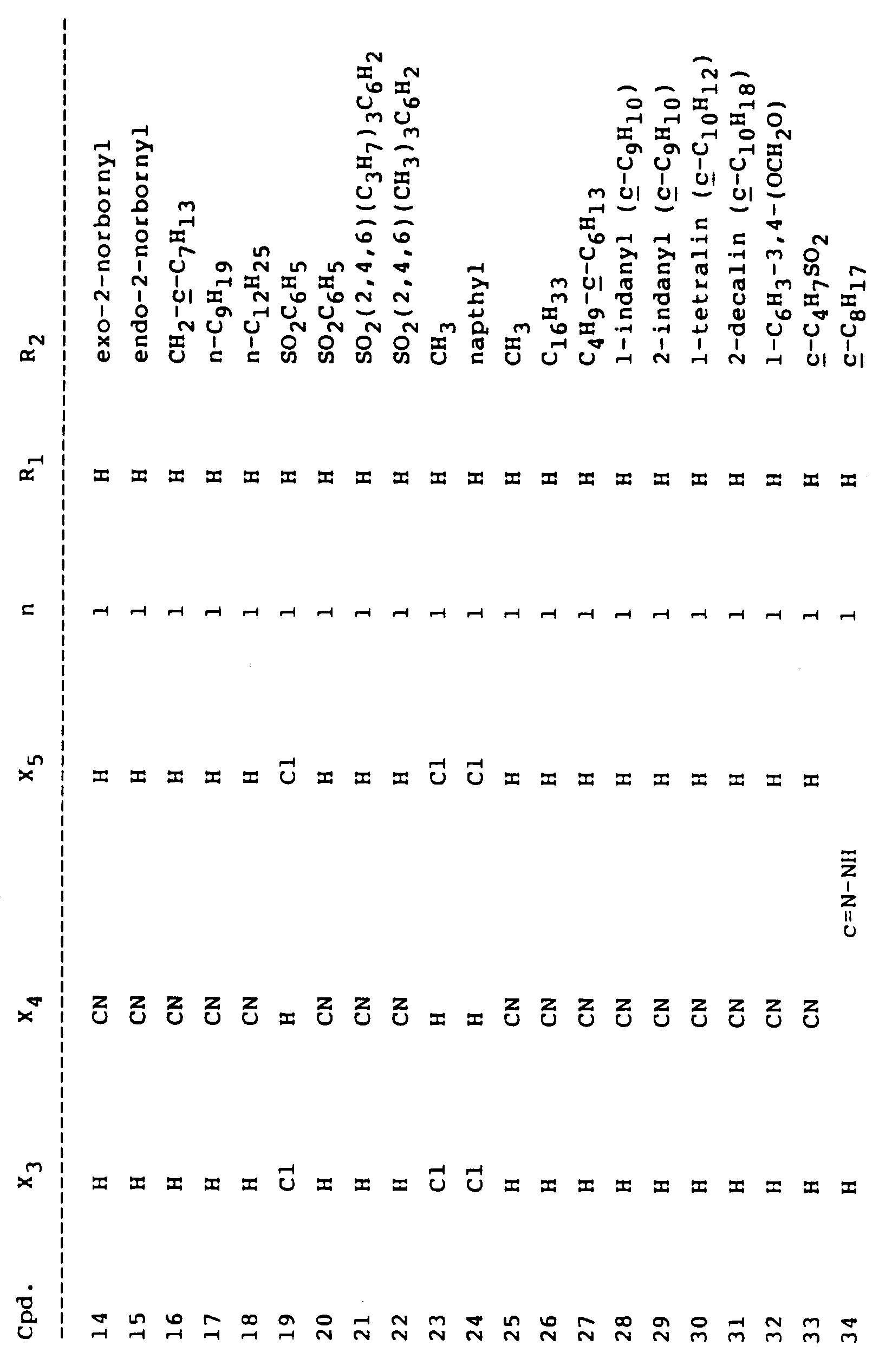

- In similar operations, the various guanidine compounds described in formula I are prepared and are used to sweeten food products.
Claims (79)
- A compound corresponding to the formula,

optionally substituted pyridines, thiazoles, indoles, quinolines, naphthyridines, cinnolines, pteridines, thiophenes, benzothiophenes, naphthothiophenes, thianthrenes, furans, pyrans, isobenzofurans, chromenes, xanthenes, phenoxathins, pyrroles, indoles, isoindoles, indolizines, pyridazines, pyrimidines, pyrazines, pyrazoles, imidazoles, pyrroles, indazoles, purines, quinolizines, isoquinolines, quinolines, phthalazines, quinoxalines, quinazolines, carbazoles, carbolines, phenanthridines, acridines, pyrimidines, phenanthrolines, phenazines, phenarsazines, isothiazoles, phenothiazines, isoxazoles, thiazoles, furazans and heterocyclics of the following formulas: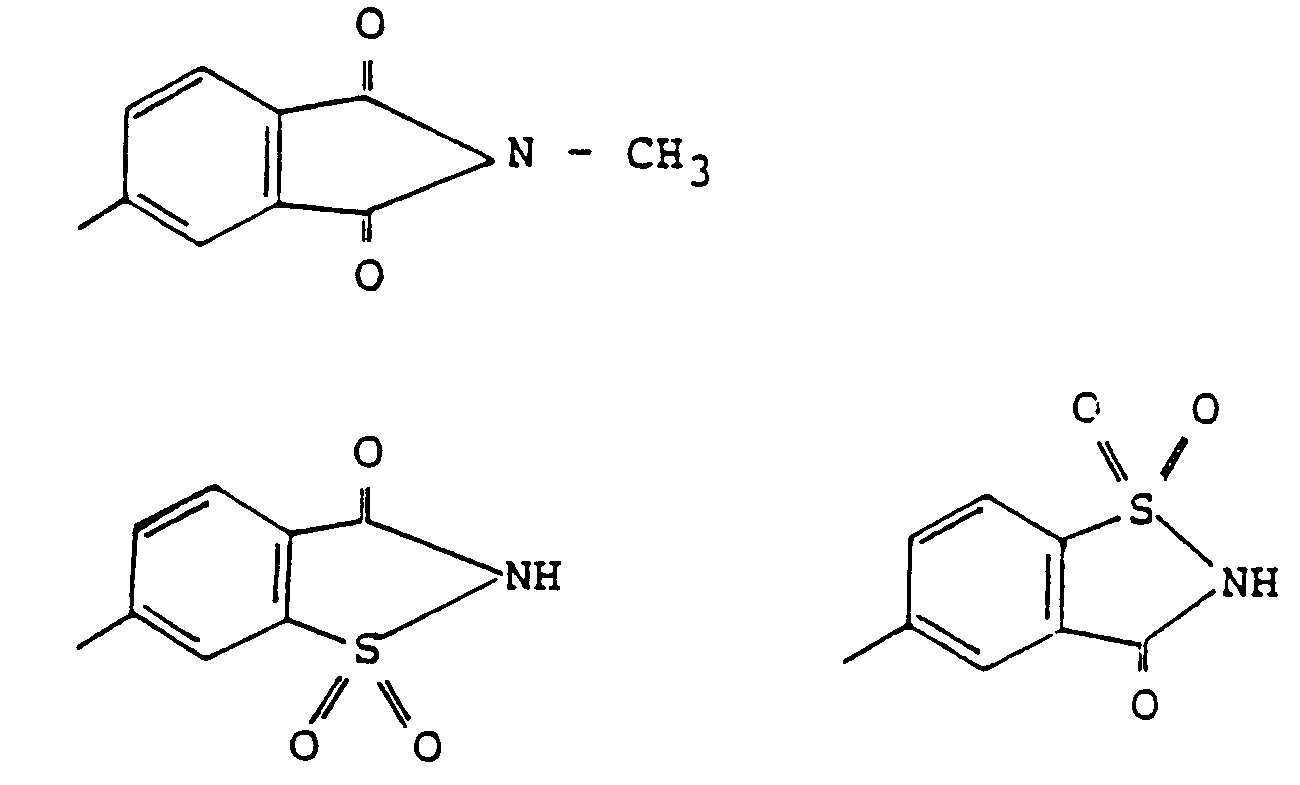


H,
Br,
CF₃,
CF₂CF₃,
CH₂CF₃,
C₁-C₄ alkyl,
CH=NOCH₃,
CH=NOH,
CHO,
CH₂OCH₃,
CH₂OH,
Cl,
CN,
COCF₃,
COC₁-C₃ alkyl,
CONH₂,
CONHC₁-C₃ alkyl,
CON(C₁-C₃ alkyl)₂,
COOC₁-C₃ alkyl,
COOH,
F,
I,
NH₂,
NHC₁-C₃ alkyl,
N(C₁-C₃ alkyl)₂,
NHCHO,
NHCOCH₃,
NHCONH₂,
NHSO₂CH₃,
NO₂,
OC₁-C₃ alkyl,
C(O)OCH₃,
OH,
SC₁-C₃ alkyl,
SOC₁-C₃ alkyl,
SO₂C₁-C₃ alkyl,
SO₂NH₂,
SO₂NHC₁-C₃ alkyl,
SO₂N(C₁-C₃ alkyl)₂,
and
SO₃H,
or wherein substituents at X₄ and X₅ form a fused ring;
wherein R₁ is an atom of hydrogen or R₁ is a C₁ to C₄ saturated, unsaturated, acyclic, cyclic or mixed hydrocarbyl or modified hydrocarbyl group and wherein, in the modified hydrocarbyl group,
1 to 2 atoms of carbon may be replaced by 1 to 2 of the same or different heteroatoms selected from the group consisting of N, O, S, Cl, Br and I,
and 1 to 3 atoms of hydrogen may be replaced by 1 to 3 atoms of fluorine, oxygen, or nitrogen;
wherein R₂ is hydrogen, CN, NO₂ or a C₁ to C₂₀ saturated, unsaturated, acyclic, cyclic or mixed hydrocarbyl or modified hydrocarbyl group and wherein, in the modified hydrocarbyl group,
1 to 4 atoms of carbon may be replaced by 1 to 4 of the same or different heteroatoms selected from the group consisting of N, O, S, Cl, Br and I,
and 1 to 5 atoms of hydrogen may be replaced by 1 to 5 atoms of fluorine, oxygen, or nitrogen;
n is 0, 1, 2, or 3;
wherein R₁ and R₂ can be fused;
wherein R₄ is H or C₁-C₆ alkyl with the proviso that R₄ can only be alkyl on a single carbon atom when n = 2 or 3; and
tautomers and physiologically acceptable salts thereof. - The compound of Claim 1 wherein R₁ is H.
- The compound of Claim 1 wherein R₃ is an optionally substituted phenyl and R₁ is H.
- The compound of Claim 3 wherein R₄ is H and n is 1.
- The compound of Claim 1, 2, 3 or 4 wherein X₃ and X₅ are selected from the group consisting of
H,
Br,
CF₃,
CH₃,
Cl
and
F.
- The compound of Claim 1, 2, 3 or 4 wherein X₄ is selected from the group consisting of
H,
CN,
C(O)OCH₃,
F
and
NO₂.
- The compound of Claim 1, 2, 3 or 4 wherein R₂ is selected from the group consisting of
Normal alk(en)(yn)yl C₂-C₁₃,
Branched alk(en)(yn)yl C₃-C₁₃,
Cycloalk(en)yl C₃-C₁₃,
Alk(en)yl cycloalk(en)yl C₄-C₁₃,
Cycloalk(en)yl alk(en)yl C₄-C₁₃,
Alk(en)yl cycloalk(en)yl alk(en)yl C₅-C₁₃,
Alk(en)yl bicycloalk(en)yl C₇-C₁₃,
Fused bicycloalk(en)yl C₇-C₁₃,
Alk(en)yl fused bicycloalk(en)yl C₈-C₁₃,
Fused bicycloalk(en)yl alk(en)yl C₈-C₁₃,
Alkenyl fused bicycloalk(en)yl alk(en)yl C₉-C₁₃,
Fused tricycloalk(en)yl C₁₀-C₁₃,
Alk(en)yl fused tricycloalk(en)yl C₁₁-C₁₃,
Fused tricycloalk(en)yl alk(en)yl C₁₁-C₁₃ and
Alk(en)yl fused tricycloalk(en)yl alk(en)yl C₁₁-C₁₃. - The compound of Claim 7 wherein R₂ is selected from the group consisting of
n-C₅H₁₁, n-C₆H₁₃, n-C₇H₁₅,
CH(CH₃)(CH₂)₂CH₃, CH(CH₃)(CH₂)₃CH₃, (CH₂)₃CH(CH₃)₂, (CH₂)₄CH(CH₃)₂, (CH₂)₅CH(CH₃)₂,
C₆H₅, C₆-C₁₀ cycloalkyl, (CH₃CH₂CH₂CH₂)C₆-C₁₀ cycloalkyl,
CH₂C₆H₅, CH₂-c-C₆H₁₁, CH(CH₃)C₆H₅, CH(C₆H₅)C₆H₅, CH(CH₃)-c-C₆H₁₁, (CH₂)₂C₆H₅, (CH₂)₂-c-C₆H₁₁, CH(CH₃)CH₂C₆H₅, CH(CH₃)CH₂-c-C₆H₁₁,
C₆H₄(CH₃), C₆-C₁₀ cycloalkyl(CH₃),
CH₂C₆H₄(CH₃), CH₂-c-C₆H₁₀(CH₃), CH(CH₃)C₆H₄(CH₃), CH(CH₃)-c-C₆H₁₀(CH₃),
(CH₂)₂CH(c-C₃H₅)₂, (CH₂)₃CH(c-C₃H₅)₂, CH(CH₃)CH₂CH(c-C₃H₅)₂, CH(CH₃)(CH₂)₂CH(c-C₃H₅)₂,
naphthyl, 5,6,7,8-tetrahydronaphthyl, perhydronaphthyl, indenyl, indanyl,
naphthyl(CH₃), 5,6,7,8-tetrahydronaphthyl(CH₃), perhydronaphthyl(CH₃), indenyl(CH₃), indanyl(CH₃), fenchyl,
CH₂-naphthyl, CH₂-5,6,7,8-tetrahydronaphthyl, CH₂-perhydronaphthyl, CH₂-indenyl, CH₂-indanyl,
CH₂-naphthyl(CH₃), CH₂-5,6,7,8-tetrahydronaphthyl(CH₃), CH₂-perhydronaphthyl(CH₃), CH₂-indenyl(CH₃), CH₂-indanyl(CH₃),
adamantyl, endo-norbornyl, exo-norbornyl,
CH₂-adamantyl, CH(CH₃)adamantyl, tetralyl, decalyl, and
CH₂-adamantyl(CH₃). - The compound of Claim 1, 2, 3 or 4 wherein R₂ is a modified hydrocarbyl group wherein up to four carbon atoms may be replaced by the same or different heteroatoms selected from a group consisting of
S to replace C or CH₂,
N to replace CH or CH₃,
NH and O to replace CH₂ and
Cl, Br and I to replace CH₃,
wherein up to 5 atoms of hydrogen may be substituted by fluorine atoms. - The compound of Claim 9 wherein R₂ is selected from the group consisting of
pyridinyl, pyridinyl methyl, piperidyl, homopiperidyl, indolyl, indolinyl, isoindolinyl, quinolyl, isoquinolyl, pyrazinyl, pyrimidyl, indazolyl, quinoxalinyl, quinazolinyl, purinyl,
pyranyl, tetrahydropyranyl, benzofuranyl, methoxyphenyl, methyloxycarbonylphenyl, 3,4-methylenedioxyphenyl, 6-oxo-cis-hydrindane, morpholinyl, benzoxazolyl, acetamidophenyl, cyano, nitro,
thienyl, thienylmethyl, benzothienyl, tetrahydro-3-thienyl 1,1, dioxide, 2,2,4,4-tetramethylthiacyclobut-3-yl, thiazolyl, isothiazolyl, SO₂C₆H₅, SO₂c-C₆H₁₁, SO₂c-C₇H₁₃,
chlorophenyl,
fluorophenyl and
trifluoromethylphenyl. - The compound of Claim 1 having the formula

- The compound of Claim 11 wherein R₁ is CH₃.
- The compound of Claim 11 wherein X₃ and X₅ are H and X₄ is CN.
- The compound of Claim 11 wherein X₃ and X₅ are selected from the group consisting of CF₃, CH₃, Cl and F and wherein X₄ is selected from the group consisting of H and CN.
- The compound of Claim 11 wherein R₂ is selected from the group consisting of (S)CH(CH₃)C₆H₅, CH₂C₆H₅, CH(CH₃)-c-C₆H₁₁, CH(C₆H₅)₂, c-C₆H₁₁, c-C₇H₁₃, c-C₈H₁₅, c-C₉H₁₇, c-C₁₀H₁₉, 2-decalyl, endo-norbornyl, 1-naphthyl, SO₂C₆H₅ and SO₂c-C₇H₁₃.
- The compound of Claim 11 wherein R₁ is selected from the group consisting of H and CH₃, wherein X₃ and X₅ are H and X₄ is CN or wherein X₃ and X₅ are selected from the group consisting of CF₃, CH₃, Cl, H and F and wherein X₄ is selected from the group consisting of H and CN; and wherein R₂ is selected from the group consisting of (S)CH(CH₃)C₆H₅, CH₂C₆H₅, endo-norbornyl, 1-naphthyl, CH(CH₃)-c-C₆H₁₁, CH(C₆H₅)₂, c-C₆H₁₁, c-C₇H₁₃, c-C₈H₁₅, c-C₉H₁₇, c-C₁₀H₁₉, 2-decalyl, SO₂C₆H₅ and SO₂c-C₇H₁₃.
- The compound of Claim 16 wherein R₁, X₃ and X₅ are H, X₄ is CN and R₂ is c-C₉H₁₇, including tautomeric forms thereof and physiologically acceptable salts thereof.
- The compound of Claim 16 wherein R₁, X₃ and X₅ are H, X₄ is CN and R₂ is c-C₈H₁₅, including tautomeric forms thereof and physiologically acceptable salts thereof.
- The compound of Claim 16 wherein R₁ and X₄ are H, X₃ and X₅ are Cl and R₂ is (S)CH(CH₃)C₆H₅, including tautomeric forms thereof and physiologically acceptable salts thereof.
- The compound of Claim 16 wherein R₁ and X₅ are H, X₃ is Cl, X₄ is CN and R₂ is c-C₈H₁₅, including tautomeric forms thereof and physiologically acceptable salts thereof.
- The compound of Claim 16 wherein R₁ and X₅ are H, X₃ is CH₃, X₄ is CN and R₂ is c-C₈H₁₅, including tautomeric forms thereof and physiologically acceptable salts thereof.
- The compound of Claim 16 wherein R₁ and X₄ are H, X₃ and X₅ are Cl and R₂ is CH₂C₆H₅, including tautomeric forms thereof and physiologically acceptable salts thereof.
- The compound of Claim 16 wherein R₁ is CH₃, X₄ is H, X₃ and X₅ are Cl and R₂ is CH₂C₆H₅, including tautomeric forms thereof and physiologically acceptable salts thereof.
- The compound of Claim 16 wherein R₁ and X₄ are H, X₃ and X₅ are Cl and R₂ is (S)CH(CH₃)-c-C₆H₁₁, including tautomeric forms thereof and physiologically acceptable salts thereof.
- The compound of Claim 16 wherein R₁, X₃ and X₅ are H, X₄ is CN and R₂ is (S)CH(CH₃)C₆H₅, including tautomeric forms thereof and physiologically acceptable salts thereof.
- The compound of Claim 16 wherein R₁, X₃, and X₅ are H, X₄ is CN and R₂ is CH(C₆H₅)₂, including tautomeric forms thereof and physiologically acceptable salts thereof.
- The compound of Claim 16 wherein R₁ and X₄ are H, X₃ and X₅ are Cl and R₂ is c-C₇H₁₃, including tautomeric forms thereof and physiologically acceptable salts thereof.
- The compound of Claim 16 wherein X₄ is CN, R₁, X₃ and X₅ are H, and R₂ is c-C₁₀H₁₇, including tautomeric forms thereof and physiologically acceptable salts thereof.
- The compound of Claim 1 wherein the compound is selected from the group of physiologically acceptable salts consisting of hydrochloride, phosphate, citrate, sulfate, sodium, potassium, ammonium, calcium and magnesium salts.
- A process for sweetening edible products including foods, beverages, confections, chewing gums, pharmaceuticals, veterinary preparations and toilet, cosmetic and hygiene products, characterized in that it comprises adding to the substance an effective sweetening amount of a compound of Claim 1.
- Edible products sweetened according to the process of Claim 30.
- Sweetening compositions characterized in that they comprise an effective sweetening amount of a compound of Claim 1 and a physiologically acceptable carrier therefor.
- The sweetening compositions of Claim 32 wherein the carrier is a bulking agent.
- The sweetening compositions of Claim 32 wherein the carrier is selected from the group consisting of polydextrose, starch, malto-dextrins, cellulose, methylcellulose, carboxymethylcellulose, maltitol, hydroxymethylcellulose, microcrystalline cellulose, sodium alginate, pectins, gums, lactose, maltose, glucose, leucine, glycerol, mannitol, sorbitol, sodium bicarbonate and phosphoric, citric, tartaric, fumaric, benzoic, sorbic, propionic acids and their sodium, potassium and calcium salts and mixtures of any of the above.
- A sweetening composition comprising:(a) a compound of Claim 1; and(b) a different sweetening agent.
- The sweetening composition of Claim 35 further comprising a bulking agent.
- The sweetening composition of Claim 36 wherein the different sweetening agent is selected from the group consisting of sucrose, corn syrups, fructose, aspartame, alitame, neohesperidine dihydrochalcone, high fructose corn syrup, hydrogenated isomaltulose, stevioside, L-sugars, glycyrrhizin, xylitol, acesulfam-K, saccharin (sodium, potassium or calcium salt), cyclamic acid (sodium, potassium or calcium salt), trichlorogalactosucrose, monellin and thaumatin and mixtures thereof.
- A compound of the formula

- The compound of Claim 38 wherein L is S-methyl.
- The compound of Claim 38 wherein R₃ is 4-cyanophenyl, 3,5-dichlorophenyl, 3,5-dimethylphenyl, 6-indazolylimino or phenyl.
- The compound of Claim 38 wherein P is

- The compound of Claim 40 wherein R₄ is H.
- The compound of Claim 42 wherein n is 1.
- The compound of Claim 42 wherein n is 0.
- A compound of the formula

- The compound of Claim 45 wherein R₄ is H.
- The compound of Claim 46 wherein R₃ is substituted phenyl.
- The compound of Claim 47 wherein R₃ is 4-cyanophenyl 3,5-dichlorophenyl, 3,5-dimethylphenyl or phenyl.
- The compound of Claim 45 wherein P is

- The compound of Claim 45 wherein n is 0.
- The compound of Claim 45 wherein n is 1.
- The compound of Claim 48 wherein R₄ and P are H and n is 1.
- A process comprising:(a) reacting a compound of the formula

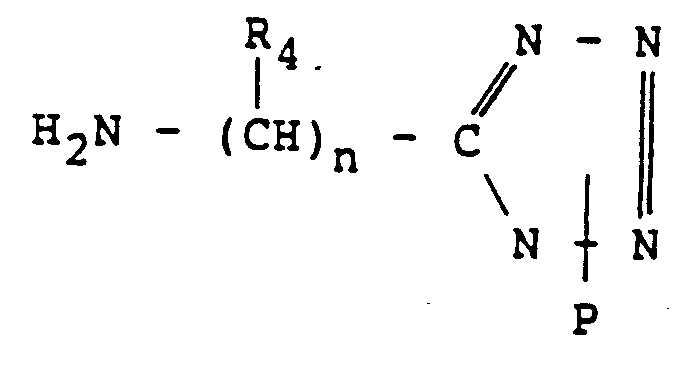
R₁, R₂, R₃, R₄ and n are as defined in Claim 1 under conditions sufficient to form the corresponding guanidine and(b) recovering the guanidine compound formed in (a) above. - The process of Claim 53 wherein P is

- The process of Claim 53 wherein L is -S-CH₃.
- The process of Claim 53 wherein R₃ is a substituted phenyl and R₁ and R₄ are H.
- The process of Claim 56 wherein R₂ is cyclohexyl, cyclooctyl, alpha-phenethyl, diphenyl methyl, benzyl, phenyl, endo-norbornyl, 1-naphthyl, or 2-decalyl.
- A process comprising:(a) reacting a carbodiimide of the formula

HNR₁R₂
wherein P is a protective group, R₁, R₂, R₃, R₄ and n are as defined in Claim 1 under conditions sufficient to form the corresponding guanidine and(b) recovering the guanidine compound formed in (a) above. - The process of Claim 58 wherein P is

- The process of Claim 58 wherein R₁ and R₄ are H.
- The process of Claim 60 wherein R₃ is a substituted phenyl.
- The process of Claim 61 wherein R₃ is 4-cyanophenyl, 3,5-dichlorophenyl, 3,5-dimethylphenyl or phenyl.
- The process of Claim 60 wherein R₂ is cyclohexyl, cyclooctyl, alpha-phenethyl, diphenyl methyl, benzyl, phenyl, endo-norbornyl, 1-naphthyl, or 2-decalyl.
- The process of Claim 63 wherein R₃ is a substituted phenyl.
- The process of Claim 64 wherein R₃ is 4-cyanophenyl, 3,5-dichlorophenyl, 3,5-dimethylphenyl or phenyl.
- A process comprising(a) reacting a carbodiimide compound of the formula
R₃ - N = C = N - R₂
with an amine of the formula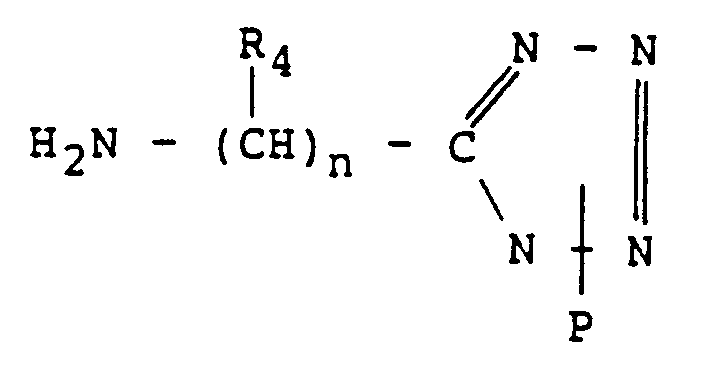 (b) recovering the guanidine compound formed in (a) above.
 - The process of Claim 66 wherein P is


- The process of Claim 66 wherein R₄ and P are H.
- The process of Claim 68 wherein R₃ is a substituted phenyl.
- The process of Claim 69 wherein R₃ is 4-cyanophenyl, 3,5-dichlorophenyl, 3,5-dimethylphenyl.
- The process of Claim 68 wherein R₂ is phenyl, benzyl, cyclohexyl, cyclooctyl, endo-norbornyl, 1-naphthyl, 2-decalyl, alpha-phenethyl or diphenyl methyl.
- The process of Claim 71 wherein R₃ is a substituted phenyl.
- The process of Claim 72 wherein R₃ is 4-cyanophenyl, 3,5-dichlorophenyl, 3,5-dimethylphenyl or phenyl.
- The compound of Claim 1 having the formula

- The compound of Claim 74 wherein R₁ is H.
- The compound of Claim 75 wherein X₃ and X₅ are H and X₄ is CN.
- The compound of Claim 76, wherein R₂ is phenyl, benzyl, cyclohexyl, cyclooctyl, cyclononyl, 4-pyranyl, 2-decalyl, endo-norbornyl, 1-naphthyl, alpha-phenethyl, or benzhydryl.
- The compound of Claim 75 wherein X₄ is H and X₃ and X₅ are Cl or CH₃.
- The compound of Claim 78 wherein R₂ is phenyl, benzyl, cyclohexyl, cyclooctyl, cyclononyl, 4-pyranyl, 2-decalyl, endo-norbornyl, 1-naphthyl, alpha-phenethyl, or benzhydryl.
Priority Applications (1)
| Application Number | Priority Date | Filing Date | Title |
|---|---|---|---|
| AT88111508T ATE87915T1 (en) | 1987-07-17 | 1988-07-18 | POWERFUL SWEETENERS. |
Applications Claiming Priority (6)
| Application Number | Priority Date | Filing Date | Title |
|---|---|---|---|
| US7474287A | 1987-07-17 | 1987-07-17 | |
| US74742 | 1987-07-17 | ||
| US10462087A | 1987-10-02 | 1987-10-02 | |
| US104620 | 1987-10-02 | ||
| US21673888A | 1988-07-12 | 1988-07-12 | |
| US216738 | 1988-07-12 |
Publications (3)
| Publication Number | Publication Date |
|---|---|
| EP0299533A2 EP0299533A2 (en) | 1989-01-18 |
| EP0299533A3 EP0299533A3 (en) | 1989-07-19 |
| EP0299533B1 true EP0299533B1 (en) | 1993-04-07 |
Family
ID=27372540
Family Applications (1)
| Application Number | Title | Priority Date | Filing Date |
|---|---|---|---|
| EP88111508A Expired - Lifetime EP0299533B1 (en) | 1987-07-17 | 1988-07-18 | High potency sweetening agents |
Country Status (14)
| Country | Link |
|---|---|
| EP (1) | EP0299533B1 (en) |
| JP (1) | JPH0655730B2 (en) |
| KR (1) | KR970002877B1 (en) |
| CN (1) | CN1033624A (en) |
| AT (1) | ATE87915T1 (en) |
| AU (1) | AU617121B2 (en) |
| DE (1) | DE3880031T2 (en) |
| DK (1) | DK131589D0 (en) |
| ES (1) | ES2053633T3 (en) |
| FI (1) | FI891245A0 (en) |
| GR (1) | GR3008403T3 (en) |
| NO (1) | NO891097D0 (en) |
| PT (1) | PT88004B (en) |
| WO (1) | WO1989000563A1 (en) |
Cited By (2)
| Publication number | Priority date | Publication date | Assignee | Title |
|---|---|---|---|---|
| US7067148B2 (en) | 2001-02-15 | 2006-06-27 | King Pharmaceutical Research & Development, Inc. | Stabilized pharmaceutical and thyroid hormone compositions and method of preparation |
| US7101569B2 (en) | 2001-08-14 | 2006-09-05 | Franz G Andrew | Methods of administering levothyroxine pharmaceutical compositions |
Families Citing this family (14)
| Publication number | Priority date | Publication date | Assignee | Title |
|---|---|---|---|---|
| US9603848B2 (en) | 2007-06-08 | 2017-03-28 | Senomyx, Inc. | Modulation of chemosensory receptors and ligands associated therewith |
| WO2009035927A2 (en) * | 2007-09-13 | 2009-03-19 | Arete Therapeutics, Inc. | Bis-cyclyl substitued ureas or amides as soluble epoxide hydrolase inhibitors |
| MY153622A (en) | 2008-07-31 | 2015-02-27 | Senomyx Inc | Processes and intermediates for making sweet taste enhancers |
| AU2009292555B2 (en) | 2008-09-10 | 2014-05-29 | AGC Inc. | Novel prostaglandin I2 derivative |
| CN101993432B (en) * | 2009-08-14 | 2014-05-07 | 西南大学 | Carbazoles chalcone derivatives based on carbazole and preparation method thereof |
| RU2564414C2 (en) * | 2010-03-08 | 2015-09-27 | Какен Фармасьютикал Ко., Лтд. | New ep4 agonist |
| CN103156154A (en) * | 2011-12-09 | 2013-06-19 | 味之素株式会社 | Sweetening agent composition and drink food |
| NZ703926A (en) | 2012-08-06 | 2018-04-27 | Senomyx Inc | Sweet flavor modifier |
| KR20150100830A (en) * | 2012-12-26 | 2015-09-02 | 니혼 콘 스타치 가부시키가이샤 | Liquid sweetener composition |
| JO3155B1 (en) | 2013-02-19 | 2017-09-20 | Senomyx Inc | Sweet flavor modifier |
| CN106456592B (en) * | 2014-06-27 | 2019-06-18 | 味之素株式会社 | sweet receptor antagonists |
| CN109890804B (en) | 2016-05-30 | 2026-02-24 | 慕尼黑工业大学 | Urea-containing compounds and derivatives thereof as antibacterial agents |
| CN107721894A (en) | 2016-08-12 | 2018-02-23 | 正大天晴药业集团股份有限公司 | A kind of preparation method of the intermediate of 6 arylamino pyridine ketone formamide mek inhibitor compound |
| WO2020033420A1 (en) | 2018-08-07 | 2020-02-13 | Firmenich Incorporated | 5-substituted 4-amino-1h-benzo[c][1,2,6]thiadiazine 2,2-dioxides and formulations and uses thereof |
Family Cites Families (12)
| Publication number | Priority date | Publication date | Assignee | Title |
|---|---|---|---|---|
| US3294551A (en) * | 1964-02-24 | 1966-12-27 | Lilly Co Eli | 5-carbocyclicaminotetrazole sweetening agents |
| US3515727A (en) * | 1967-04-14 | 1970-06-02 | Lilly Co Eli | Substituted tetrazole |
| US3737436A (en) * | 1968-07-05 | 1973-06-05 | Lilly Co Eli | Alpha-tetrazolyl-6-substituted tryptamine and alpha-tetrazolyl-5,6-disubstitutedtryptamine compounds |
| US3615700A (en) * | 1968-07-05 | 1971-10-26 | Lilly Co Eli | Alpha-tetrazolyl-6-substituted-tryptamine and alpha-tetrazolyl-5 6-disubstituted-tryptamine sweetening compositions and their use |
| GB1587258A (en) * | 1977-06-17 | 1981-04-01 | Gea As | Production of substituted guanidines |
| US4309446A (en) * | 1980-02-22 | 1982-01-05 | Eli Lilly And Company | 5-(Dihydroxyphenoxy)tetrazoles and use as sweeteners for medical compositions |
| US4560694A (en) * | 1982-06-04 | 1985-12-24 | Bayer Aktiengesellschaft | Fungicidal alkylene(cycloalkylene)-bis-heterocyclyl-biguanides |
| FR2533210A1 (en) * | 1982-09-17 | 1984-03-23 | Lyon I Universite Claude | SWEETENERS OF SYNTHESIS |
| US4680300A (en) * | 1985-01-10 | 1987-07-14 | Syntex (U.S.A.) Inc. | Anti-inflammatory guanidines |
| FR2579201B1 (en) * | 1985-03-19 | 1987-05-07 | Bernard Lyon I Universite Clau | IMPROVED CHEMICAL COMPOUNDS, USE AS SWEETENING AGENTS AND COMPOSITIONS CONTAINING SUCH AGENTS |
| FR2579202B1 (en) * | 1985-03-19 | 1988-04-29 | Univ Claude Bernard Lyon | NOVEL CHEMICAL COMPOUNDS, USE AS SWEETENERS AND COMPOSITIONS CONTAINING SUCH AGENTS |
| US4692513A (en) * | 1985-12-20 | 1987-09-08 | The Procter & Gamble Company | Alpha-L-aspartyl-D-heteroaromatic-substituted glycine esters and amides useful as high intensity sweeteners |
-
1988
- 1988-07-14 FI FI891245A patent/FI891245A0/en not_active Application Discontinuation
- 1988-07-14 JP JP63506606A patent/JPH0655730B2/en not_active Expired - Lifetime
- 1988-07-14 WO PCT/US1988/002394 patent/WO1989000563A1/en not_active Ceased
- 1988-07-14 AU AU22522/88A patent/AU617121B2/en not_active Ceased
- 1988-07-14 KR KR1019890700117A patent/KR970002877B1/en not_active Expired - Fee Related
- 1988-07-15 PT PT88004A patent/PT88004B/en not_active IP Right Cessation
- 1988-07-16 CN CN88106127A patent/CN1033624A/en active Pending
- 1988-07-18 DE DE8888111508T patent/DE3880031T2/en not_active Expired - Fee Related
- 1988-07-18 EP EP88111508A patent/EP0299533B1/en not_active Expired - Lifetime
- 1988-07-18 AT AT88111508T patent/ATE87915T1/en not_active IP Right Cessation
- 1988-07-18 ES ES88111508T patent/ES2053633T3/en not_active Expired - Lifetime
-
1989
- 1989-03-14 NO NO891097A patent/NO891097D0/en unknown
- 1989-03-17 DK DK131589A patent/DK131589D0/en not_active Application Discontinuation
-
1993
- 1993-07-07 GR GR920403220T patent/GR3008403T3/el unknown
Cited By (2)
| Publication number | Priority date | Publication date | Assignee | Title |
|---|---|---|---|---|
| US7067148B2 (en) | 2001-02-15 | 2006-06-27 | King Pharmaceutical Research & Development, Inc. | Stabilized pharmaceutical and thyroid hormone compositions and method of preparation |
| US7101569B2 (en) | 2001-08-14 | 2006-09-05 | Franz G Andrew | Methods of administering levothyroxine pharmaceutical compositions |
Also Published As
| Publication number | Publication date |
|---|---|
| FI891245L (en) | 1989-03-16 |
| AU2252288A (en) | 1989-02-13 |
| JPH0655730B2 (en) | 1994-07-27 |
| PT88004B (en) | 1995-03-01 |
| JPH02500371A (en) | 1990-02-08 |
| FI891245A7 (en) | 1989-03-16 |
| PT88004A (en) | 1989-06-30 |
| CN1033624A (en) | 1989-07-05 |
| KR890701570A (en) | 1989-12-21 |
| KR970002877B1 (en) | 1997-03-12 |
| FI891245A0 (en) | 1989-03-16 |
| DK131589A (en) | 1989-03-17 |
| GR3008403T3 (en) | 1993-10-29 |
| WO1989000563A1 (en) | 1989-01-26 |
| DE3880031T2 (en) | 1993-08-19 |
| ES2053633T3 (en) | 1994-08-01 |
| DK131589D0 (en) | 1989-03-17 |
| EP0299533A3 (en) | 1989-07-19 |
| EP0299533A2 (en) | 1989-01-18 |
| ATE87915T1 (en) | 1993-04-15 |
| DE3880031D1 (en) | 1993-05-13 |
| NO891097L (en) | 1989-03-14 |
| NO891097D0 (en) | 1989-03-14 |
| AU617121B2 (en) | 1991-11-21 |
Similar Documents
| Publication | Publication Date | Title |
|---|---|---|
| EP0299533A2 (en) | High potency sweetening agents | |
| DE69927050T2 (en) | BIPHENYL COMPOUNDS AND BIPHENYL ANALOGS AS INTERGRIN ANTAGONISTS | |
| US20030153596A1 (en) | Novel thiourea derivatives and the pharmaceutical compositions containing the same | |
| US7935377B2 (en) | Crystals of free (2R, 4R)-monatin and use thereof | |
| US20080064687A1 (en) | Novel thiourea derivatives and the pharmaceutical compositions containing the same | |
| CA1338669C (en) | Substituted aryl ureas as high potency sweeteners | |
| JP2000319179A (en) | Treating agent for hypercholesterolemia or atherosclerosis | |
| JP6554617B2 (en) | Novel crystal form of 1- (5- (2,4-difluorophenyl) -1-((3-fluorophenyl) sulfonyl) -4-methoxy-1H-pyrrol-3-yl) -N-methylmethanamine salt | |
| NO861047L (en) | SOETNINGSMIDDEL. | |
| US4921939A (en) | Sweetening agents | |
| IE75379B1 (en) | Aminosulfonyl urea ACAT inhibitors | |
| DE69624582T2 (en) | ESTER AND AMIDE AS PLA2 INHIBITORS | |
| JPH05194359A (en) | New urea derivative, and its preparation and therapeutical use | |
| US5064963A (en) | Process for the synthesis of n-(3-(1h-imidazol-1-yl)phenyl-4-(substituted)-2-pyrimidinamines | |
| JP2895913B2 (en) | Butenoic acid derivative | |
| WO2004073709A1 (en) | Antimicrobial agents | |
| US4900740A (en) | N,N'-disubstituted guanidines containing a carboxyl or a tetrazolyl moiety | |
| AU605228B2 (en) | Sweetening agents derived from guanidinoacetic and ethanamidinoacetic acids, process for sweetening various products, and compositions containing such sweetening agents | |
| EP1140803B1 (en) | ((aminoiminomethyl) amino) alkanecarboxamides and their applications in therapy | |
| KR20010013790A (en) | Crystalline Roxifiban | |
| JPH09176165A (en) | Imidazo [1,2-a] pyridine derivative, process for producing the same and use thereof | |
| CN102203073B (en) | Enaminocarbonyl compounds and their use | |
| KR101868438B1 (en) | Method for preparing amide derivatives | |
| JP2606796B2 (en) | Method for producing substituted pyridine compound | |
| JPH0625113B2 (en) | N- (2,6-disubstituted aromatic) -N'-pyridinyl urea |
Legal Events
| Date | Code | Title | Description |
|---|---|---|---|
| PUAI | Public reference made under article 153(3) epc to a published international application that has entered the european phase |
Free format text: ORIGINAL CODE: 0009012 |
|
| AK | Designated contracting states |
Kind code of ref document: A2 Designated state(s): AT BE CH DE ES FR GB GR IT LI LU NL SE |
|
| PUAL | Search report despatched |
Free format text: ORIGINAL CODE: 0009013 |
|
| AK | Designated contracting states |
Kind code of ref document: A3 Designated state(s): AT BE CH DE ES FR GB GR IT LI LU NL SE |
|
| 17P | Request for examination filed |
Effective date: 19891118 |
|
| 17Q | First examination report despatched |
Effective date: 19911011 |
|
| GRAA | (expected) grant |
Free format text: ORIGINAL CODE: 0009210 |
|
| ITF | It: translation for a ep patent filed | ||
| AK | Designated contracting states |
Kind code of ref document: B1 Designated state(s): AT BE CH DE ES FR GB GR IT LI LU NL SE |
|
| REF | Corresponds to: |
Ref document number: 87915 Country of ref document: AT Date of ref document: 19930415 Kind code of ref document: T |
|
| ET | Fr: translation filed | ||
| REF | Corresponds to: |
Ref document number: 3880031 Country of ref document: DE Date of ref document: 19930513 |
|
| REG | Reference to a national code |
Ref country code: GR Ref legal event code: FG4A Free format text: 3008403 |
|
| PLBE | No opposition filed within time limit |
Free format text: ORIGINAL CODE: 0009261 |
|
| STAA | Information on the status of an ep patent application or granted ep patent |
Free format text: STATUS: NO OPPOSITION FILED WITHIN TIME LIMIT |
|
| 26N | No opposition filed | ||
| REG | Reference to a national code |
Ref country code: ES Ref legal event code: FG2A Ref document number: 2053633 Country of ref document: ES Kind code of ref document: T3 |
|
| EPTA | Lu: last paid annual fee | ||
| EAL | Se: european patent in force in sweden |
Ref document number: 88111508.3 |
|
| PGFP | Annual fee paid to national office [announced via postgrant information from national office to epo] |
Ref country code: LU Payment date: 19960701 Year of fee payment: 9 |
|
| PGFP | Annual fee paid to national office [announced via postgrant information from national office to epo] |
Ref country code: GB Payment date: 19960709 Year of fee payment: 9 Ref country code: FR Payment date: 19960709 Year of fee payment: 9 |
|
| PGFP | Annual fee paid to national office [announced via postgrant information from national office to epo] |
Ref country code: AT Payment date: 19960711 Year of fee payment: 9 |
|
| PGFP | Annual fee paid to national office [announced via postgrant information from national office to epo] |
Ref country code: SE Payment date: 19960717 Year of fee payment: 9 |
|
| PGFP | Annual fee paid to national office [announced via postgrant information from national office to epo] |
Ref country code: DE Payment date: 19960726 Year of fee payment: 9 |
|
| PGFP | Annual fee paid to national office [announced via postgrant information from national office to epo] |
Ref country code: NL Payment date: 19960729 Year of fee payment: 9 Ref country code: ES Payment date: 19960729 Year of fee payment: 9 |
|
| PGFP | Annual fee paid to national office [announced via postgrant information from national office to epo] |
Ref country code: GR Payment date: 19960731 Year of fee payment: 9 |
|
| PGFP | Annual fee paid to national office [announced via postgrant information from national office to epo] |
Ref country code: CH Payment date: 19960805 Year of fee payment: 9 |
|
| PGFP | Annual fee paid to national office [announced via postgrant information from national office to epo] |
Ref country code: BE Payment date: 19960911 Year of fee payment: 9 |
|
| PG25 | Lapsed in a contracting state [announced via postgrant information from national office to epo] |
Ref country code: LU Free format text: LAPSE BECAUSE OF NON-PAYMENT OF DUE FEES Effective date: 19970718 Ref country code: GB Free format text: LAPSE BECAUSE OF NON-PAYMENT OF DUE FEES Effective date: 19970718 Ref country code: AT Free format text: LAPSE BECAUSE OF NON-PAYMENT OF DUE FEES Effective date: 19970718 |
|
| PG25 | Lapsed in a contracting state [announced via postgrant information from national office to epo] |
Ref country code: SE Effective date: 19970719 Ref country code: ES Free format text: LAPSE BECAUSE OF EXPIRATION OF PROTECTION Effective date: 19970719 |
|
| PG25 | Lapsed in a contracting state [announced via postgrant information from national office to epo] |
Ref country code: LI Free format text: LAPSE BECAUSE OF NON-PAYMENT OF DUE FEES Effective date: 19970731 Ref country code: GR Free format text: LAPSE BECAUSE OF NON-PAYMENT OF DUE FEES Effective date: 19970731 Ref country code: CH Free format text: LAPSE BECAUSE OF NON-PAYMENT OF DUE FEES Effective date: 19970731 Ref country code: BE Free format text: LAPSE BECAUSE OF NON-PAYMENT OF DUE FEES Effective date: 19970731 |
|
| BERE | Be: lapsed |
Owner name: THE NUTRASWEET CY (A DELAWARE CORP.) Effective date: 19970731 |
|
| PG25 | Lapsed in a contracting state [announced via postgrant information from national office to epo] |
Ref country code: NL Free format text: LAPSE BECAUSE OF NON-PAYMENT OF DUE FEES Effective date: 19980201 |
|
| GBPC | Gb: european patent ceased through non-payment of renewal fee |
Effective date: 19970718 |
|
| REG | Reference to a national code |
Ref country code: CH Ref legal event code: PL |
|
| PG25 | Lapsed in a contracting state [announced via postgrant information from national office to epo] |
Ref country code: FR Free format text: LAPSE BECAUSE OF NON-PAYMENT OF DUE FEES Effective date: 19980331 |
|
| NLV4 | Nl: lapsed or anulled due to non-payment of the annual fee |
Effective date: 19980201 |
|
| PG25 | Lapsed in a contracting state [announced via postgrant information from national office to epo] |
Ref country code: DE Free format text: LAPSE BECAUSE OF NON-PAYMENT OF DUE FEES Effective date: 19980401 |
|
| EUG | Se: european patent has lapsed |
Ref document number: 88111508.3 |
|
| REG | Reference to a national code |
Ref country code: FR Ref legal event code: ST |
|
| REG | Reference to a national code |
Ref country code: ES Ref legal event code: FD2A Effective date: 20010201 |
|
| PG25 | Lapsed in a contracting state [announced via postgrant information from national office to epo] |
Ref country code: IT Free format text: LAPSE BECAUSE OF NON-PAYMENT OF DUE FEES;WARNING: LAPSES OF ITALIAN PATENTS WITH EFFECTIVE DATE BEFORE 2007 MAY HAVE OCCURRED AT ANY TIME BEFORE 2007. THE CORRECT EFFECTIVE DATE MAY BE DIFFERENT FROM THE ONE RECORDED. Effective date: 20050718 |