EP0298202B1 - Organic salts of physostigmine derivatives - Google Patents
Organic salts of physostigmine derivatives Download PDFInfo
- Publication number
- EP0298202B1 EP0298202B1 EP88104977A EP88104977A EP0298202B1 EP 0298202 B1 EP0298202 B1 EP 0298202B1 EP 88104977 A EP88104977 A EP 88104977A EP 88104977 A EP88104977 A EP 88104977A EP 0298202 B1 EP0298202 B1 EP 0298202B1
- Authority
- EP
- European Patent Office
- Prior art keywords
- physostigmine
- organic
- acid
- solution
- iii
- Prior art date
- Legal status (The legal status is an assumption and is not a legal conclusion. Google has not performed a legal analysis and makes no representation as to the accuracy of the status listed.)
- Expired - Lifetime
Links
- PIJVFDBKTWXHHD-HIFRSBDPSA-N physostigmine Chemical class C12=CC(OC(=O)NC)=CC=C2N(C)[C@@H]2[C@@]1(C)CCN2C PIJVFDBKTWXHHD-HIFRSBDPSA-N 0.000 title claims abstract description 33
- 150000003839 salts Chemical class 0.000 title claims abstract description 29
- 238000002360 preparation method Methods 0.000 claims abstract description 13
- 102000012440 Acetylcholinesterase Human genes 0.000 claims abstract description 10
- 108010022752 Acetylcholinesterase Proteins 0.000 claims abstract description 10
- 229940022698 acetylcholinesterase Drugs 0.000 claims abstract description 10
- 150000007524 organic acids Chemical class 0.000 claims abstract description 9
- 125000000753 cycloalkyl group Chemical group 0.000 claims abstract description 6
- 150000001450 anions Chemical class 0.000 claims abstract description 5
- 230000005764 inhibitory process Effects 0.000 claims abstract description 5
- 238000000034 method Methods 0.000 claims abstract description 5
- RTZKZFJDLAIYFH-UHFFFAOYSA-N Diethyl ether Chemical compound CCOCC RTZKZFJDLAIYFH-UHFFFAOYSA-N 0.000 claims description 42
- 239000000243 solution Substances 0.000 claims description 29
- KFZMGEQAYNKOFK-UHFFFAOYSA-N Isopropanol Chemical compound CC(C)O KFZMGEQAYNKOFK-UHFFFAOYSA-N 0.000 claims description 28
- HEMHJVSKTPXQMS-UHFFFAOYSA-M Sodium hydroxide Chemical compound [OH-].[Na+] HEMHJVSKTPXQMS-UHFFFAOYSA-M 0.000 claims description 18
- HKGWQUVGHPDEBZ-OLZOCXBDSA-N eseroline Chemical compound C1=C(O)C=C2[C@]3(C)CCN(C)[C@@H]3N(C)C2=C1 HKGWQUVGHPDEBZ-OLZOCXBDSA-N 0.000 claims description 17
- LFQSCWFLJHTTHZ-UHFFFAOYSA-N Ethanol Chemical compound CCO LFQSCWFLJHTTHZ-UHFFFAOYSA-N 0.000 claims description 13
- FEWJPZIEWOKRBE-UHFFFAOYSA-N Tartaric Acid Chemical compound [H+].[H+].[O-]C(=O)C(O)C(O)C([O-])=O FEWJPZIEWOKRBE-UHFFFAOYSA-N 0.000 claims description 13
- KRKNYBCHXYNGOX-UHFFFAOYSA-N citric acid Chemical compound OC(=O)CC(O)(C(O)=O)CC(O)=O KRKNYBCHXYNGOX-UHFFFAOYSA-N 0.000 claims description 13
- 239000000203 mixture Substances 0.000 claims description 13
- UHOVQNZJYSORNB-UHFFFAOYSA-N Benzene Chemical compound C1=CC=CC=C1 UHOVQNZJYSORNB-UHFFFAOYSA-N 0.000 claims description 12
- OKKJLVBELUTLKV-UHFFFAOYSA-N Methanol Chemical compound OC OKKJLVBELUTLKV-UHFFFAOYSA-N 0.000 claims description 12
- PIJVFDBKTWXHHD-UHFFFAOYSA-N Physostigmine Natural products C12=CC(OC(=O)NC)=CC=C2N(C)C2C1(C)CCN2C PIJVFDBKTWXHHD-UHFFFAOYSA-N 0.000 claims description 12
- 229960001697 physostigmine Drugs 0.000 claims description 12
- 239000003960 organic solvent Substances 0.000 claims description 11
- 239000003153 chemical reaction reagent Substances 0.000 claims description 10
- FAPWRFPIFSIZLT-UHFFFAOYSA-M Sodium chloride Chemical compound [Na+].[Cl-] FAPWRFPIFSIZLT-UHFFFAOYSA-M 0.000 claims description 8
- 239000007787 solid Substances 0.000 claims description 8
- XLYOFNOQVPJJNP-UHFFFAOYSA-N water Substances O XLYOFNOQVPJJNP-UHFFFAOYSA-N 0.000 claims description 8
- 239000012948 isocyanate Substances 0.000 claims description 7
- 150000002513 isocyanates Chemical class 0.000 claims description 7
- 239000002904 solvent Substances 0.000 claims description 7
- LYCAIKOWRPUZTN-UHFFFAOYSA-N Ethylene glycol Chemical compound OCCO LYCAIKOWRPUZTN-UHFFFAOYSA-N 0.000 claims description 6
- VZCYOOQTPOCHFL-UPHRSURJSA-N maleic acid Chemical compound OC(=O)\C=C/C(O)=O VZCYOOQTPOCHFL-UPHRSURJSA-N 0.000 claims description 6
- 238000004519 manufacturing process Methods 0.000 claims description 6
- OFOBLEOULBTSOW-UHFFFAOYSA-N Propanedioic acid Natural products OC(=O)CC(O)=O OFOBLEOULBTSOW-UHFFFAOYSA-N 0.000 claims description 5
- 239000011976 maleic acid Substances 0.000 claims description 5
- 239000012299 nitrogen atmosphere Substances 0.000 claims description 5
- KWYUFKZDYYNOTN-UHFFFAOYSA-M potassium hydroxide Substances [OH-].[K+] KWYUFKZDYYNOTN-UHFFFAOYSA-M 0.000 claims description 5
- 239000011975 tartaric acid Substances 0.000 claims description 5
- VZCYOOQTPOCHFL-UHFFFAOYSA-N trans-butenedioic acid Natural products OC(=O)C=CC(O)=O VZCYOOQTPOCHFL-UHFFFAOYSA-N 0.000 claims description 5
- 238000005406 washing Methods 0.000 claims description 5
- 239000007864 aqueous solution Substances 0.000 claims description 4
- 239000003208 petroleum Substances 0.000 claims description 4
- 239000011541 reaction mixture Substances 0.000 claims description 4
- 239000011780 sodium chloride Substances 0.000 claims description 4
- 150000001338 aliphatic hydrocarbons Chemical class 0.000 claims description 3
- 150000004945 aromatic hydrocarbons Chemical class 0.000 claims description 3
- 150000007522 mineralic acids Chemical class 0.000 claims description 3
- 229920006395 saturated elastomer Polymers 0.000 claims description 3
- RYHBNJHYFVUHQT-UHFFFAOYSA-N 1,4-Dioxane Chemical compound C1COCCO1 RYHBNJHYFVUHQT-UHFFFAOYSA-N 0.000 claims description 2
- 238000001704 evaporation Methods 0.000 claims description 2
- 230000003301 hydrolyzing effect Effects 0.000 claims description 2
- 238000002156 mixing Methods 0.000 claims description 2
- BDERNNFJNOPAEC-UHFFFAOYSA-N propan-1-ol Chemical compound CCCO BDERNNFJNOPAEC-UHFFFAOYSA-N 0.000 claims description 2
- 235000002906 tartaric acid Nutrition 0.000 claims description 2
- 239000002253 acid Substances 0.000 claims 2
- 239000008194 pharmaceutical composition Substances 0.000 claims 2
- 125000003118 aryl group Chemical group 0.000 abstract 1
- 239000000047 product Substances 0.000 description 24
- ZAFNJMIOTHYJRJ-UHFFFAOYSA-N Diisopropyl ether Chemical compound CC(C)OC(C)C ZAFNJMIOTHYJRJ-UHFFFAOYSA-N 0.000 description 12
- 238000013019 agitation Methods 0.000 description 11
- 241000700159 Rattus Species 0.000 description 8
- 238000004458 analytical method Methods 0.000 description 7
- FEWJPZIEWOKRBE-JCYAYHJZSA-N Dextrotartaric acid Chemical compound OC(=O)[C@H](O)[C@@H](O)C(O)=O FEWJPZIEWOKRBE-JCYAYHJZSA-N 0.000 description 5
- 238000006243 chemical reaction Methods 0.000 description 5
- 230000000694 effects Effects 0.000 description 5
- IJGRMHOSHXDMSA-UHFFFAOYSA-N Atomic nitrogen Chemical compound N#N IJGRMHOSHXDMSA-UHFFFAOYSA-N 0.000 description 4
- HEDRZPFGACZZDS-MICDWDOJSA-N Trichloro(2H)methane Chemical compound [2H]C(Cl)(Cl)Cl HEDRZPFGACZZDS-MICDWDOJSA-N 0.000 description 4
- 210000004556 brain Anatomy 0.000 description 4
- 239000002244 precipitate Substances 0.000 description 4
- YXFVVABEGXRONW-UHFFFAOYSA-N Toluene Chemical compound CC1=CC=CC=C1 YXFVVABEGXRONW-UHFFFAOYSA-N 0.000 description 3
- 230000015572 biosynthetic process Effects 0.000 description 3
- 231100000419 toxicity Toxicity 0.000 description 3
- 230000001988 toxicity Effects 0.000 description 3
- 239000007832 Na2SO4 Substances 0.000 description 2
- CDBYLPFSWZWCQE-UHFFFAOYSA-L Sodium Carbonate Chemical compound [Na+].[Na+].[O-]C([O-])=O CDBYLPFSWZWCQE-UHFFFAOYSA-L 0.000 description 2
- PMZURENOXWZQFD-UHFFFAOYSA-L Sodium Sulfate Chemical compound [Na+].[Na+].[O-]S([O-])(=O)=O PMZURENOXWZQFD-UHFFFAOYSA-L 0.000 description 2
- UIIMBOGNXHQVGW-UHFFFAOYSA-M Sodium bicarbonate Chemical compound [Na+].OC([O-])=O UIIMBOGNXHQVGW-UHFFFAOYSA-M 0.000 description 2
- 230000002490 cerebral effect Effects 0.000 description 2
- 238000010908 decantation Methods 0.000 description 2
- 238000001035 drying Methods 0.000 description 2
- 238000009776 industrial production Methods 0.000 description 2
- 229910052757 nitrogen Inorganic materials 0.000 description 2
- 238000000655 nuclear magnetic resonance spectrum Methods 0.000 description 2
- 238000001556 precipitation Methods 0.000 description 2
- 239000013557 residual solvent Substances 0.000 description 2
- 229910052938 sodium sulfate Inorganic materials 0.000 description 2
- 235000011152 sodium sulphate Nutrition 0.000 description 2
- 239000000126 substance Substances 0.000 description 2
- 238000003786 synthesis reaction Methods 0.000 description 2
- RFXBSYPBSRSQDU-UHFFFAOYSA-N 1-isocyanatoheptane Chemical compound CCCCCCCN=C=O RFXBSYPBSRSQDU-UHFFFAOYSA-N 0.000 description 1
- 0 CCCC(C)(C(C)C*)c1c(*CC)ccc(OC(N*)=O)c1 Chemical compound CCCC(C)(C(C)C*)c1c(*CC)ccc(OC(N*)=O)c1 0.000 description 1
- QMCVRAYTYQRADO-UHFFFAOYSA-N CCCC(C)(C(C)NC=C)c1cc(O)ccc1NC Chemical compound CCCC(C)(C(C)NC=C)c1cc(O)ccc1NC QMCVRAYTYQRADO-UHFFFAOYSA-N 0.000 description 1
- ZHBPEKCKPRXXPE-UHFFFAOYSA-O CCCC(C)(C(C)[NH2+]C1CC1)c(cc(cc1)O)c1NC=[IH] Chemical compound CCCC(C)(C(C)[NH2+]C1CC1)c(cc(cc1)O)c1NC=[IH] ZHBPEKCKPRXXPE-UHFFFAOYSA-O 0.000 description 1
- YASYEJJMZJALEJ-UHFFFAOYSA-N Citric acid monohydrate Chemical compound O.OC(=O)CC(O)(C(O)=O)CC(O)=O YASYEJJMZJALEJ-UHFFFAOYSA-N 0.000 description 1
- 206010012289 Dementia Diseases 0.000 description 1
- CTQNGGLPUBDAKN-UHFFFAOYSA-N O-Xylene Chemical compound CC1=CC=CC=C1C CTQNGGLPUBDAKN-UHFFFAOYSA-N 0.000 description 1
- 241000786363 Rhampholeon spectrum Species 0.000 description 1
- VMHLLURERBWHNL-UHFFFAOYSA-M Sodium acetate Chemical compound [Na+].CC([O-])=O VMHLLURERBWHNL-UHFFFAOYSA-M 0.000 description 1
- OIPILFWXSMYKGL-UHFFFAOYSA-N acetylcholine Chemical compound CC(=O)OCC[N+](C)(C)C OIPILFWXSMYKGL-UHFFFAOYSA-N 0.000 description 1
- 229960004373 acetylcholine Drugs 0.000 description 1
- 238000010306 acid treatment Methods 0.000 description 1
- 239000007810 chemical reaction solvent Substances 0.000 description 1
- 239000000544 cholinesterase inhibitor Substances 0.000 description 1
- 229960004106 citric acid Drugs 0.000 description 1
- 229960002303 citric acid monohydrate Drugs 0.000 description 1
- 150000001875 compounds Chemical class 0.000 description 1
- 238000002425 crystallisation Methods 0.000 description 1
- 230000007812 deficiency Effects 0.000 description 1
- 210000002249 digestive system Anatomy 0.000 description 1
- 125000005442 diisocyanate group Chemical group 0.000 description 1
- 230000008034 disappearance Effects 0.000 description 1
- 239000003814 drug Substances 0.000 description 1
- 230000002255 enzymatic effect Effects 0.000 description 1
- 238000011156 evaluation Methods 0.000 description 1
- 238000001914 filtration Methods 0.000 description 1
- 230000002496 gastric effect Effects 0.000 description 1
- 238000000227 grinding Methods 0.000 description 1
- 231100000086 high toxicity Toxicity 0.000 description 1
- 238000006460 hydrolysis reaction Methods 0.000 description 1
- 230000002401 inhibitory effect Effects 0.000 description 1
- 231100000053 low toxicity Toxicity 0.000 description 1
- 238000002844 melting Methods 0.000 description 1
- 230000008018 melting Effects 0.000 description 1
- 239000012074 organic phase Substances 0.000 description 1
- 230000007170 pathology Effects 0.000 description 1
- 230000002093 peripheral effect Effects 0.000 description 1
- 239000012071 phase Substances 0.000 description 1
- 239000002798 polar solvent Substances 0.000 description 1
- 235000011118 potassium hydroxide Nutrition 0.000 description 1
- 239000000843 powder Substances 0.000 description 1
- 230000002035 prolonged effect Effects 0.000 description 1
- 239000000523 sample Substances 0.000 description 1
- 235000017281 sodium acetate Nutrition 0.000 description 1
- 235000017557 sodium bicarbonate Nutrition 0.000 description 1
- 229910000030 sodium bicarbonate Inorganic materials 0.000 description 1
- 235000017550 sodium carbonate Nutrition 0.000 description 1
- 229910000029 sodium carbonate Inorganic materials 0.000 description 1
- 235000011121 sodium hydroxide Nutrition 0.000 description 1
- 238000004611 spectroscopical analysis Methods 0.000 description 1
- 238000002211 ultraviolet spectrum Methods 0.000 description 1
- 239000008096 xylene Substances 0.000 description 1
Images


Classifications
-
- C—CHEMISTRY; METALLURGY
- C07—ORGANIC CHEMISTRY
- C07D—HETEROCYCLIC COMPOUNDS
- C07D487/00—Heterocyclic compounds containing nitrogen atoms as the only ring hetero atoms in the condensed system, not provided for by groups C07D451/00 - C07D477/00
- C07D487/02—Heterocyclic compounds containing nitrogen atoms as the only ring hetero atoms in the condensed system, not provided for by groups C07D451/00 - C07D477/00 in which the condensed system contains two hetero rings
- C07D487/04—Ortho-condensed systems
-
- A—HUMAN NECESSITIES
- A61—MEDICAL OR VETERINARY SCIENCE; HYGIENE
- A61P—SPECIFIC THERAPEUTIC ACTIVITY OF CHEMICAL COMPOUNDS OR MEDICINAL PREPARATIONS
- A61P21/00—Drugs for disorders of the muscular or neuromuscular system
-
- A—HUMAN NECESSITIES
- A61—MEDICAL OR VETERINARY SCIENCE; HYGIENE
- A61P—SPECIFIC THERAPEUTIC ACTIVITY OF CHEMICAL COMPOUNDS OR MEDICINAL PREPARATIONS
- A61P25/00—Drugs for disorders of the nervous system
- A61P25/02—Drugs for disorders of the nervous system for peripheral neuropathies
-
- C—CHEMISTRY; METALLURGY
- C07—ORGANIC CHEMISTRY
- C07C—ACYCLIC OR CARBOCYCLIC COMPOUNDS
- C07C57/00—Unsaturated compounds having carboxyl groups bound to acyclic carbon atoms
- C07C57/02—Unsaturated compounds having carboxyl groups bound to acyclic carbon atoms with only carbon-to-carbon double bonds as unsaturation
- C07C57/13—Dicarboxylic acids
- C07C57/145—Maleic acid
-
- C—CHEMISTRY; METALLURGY
- C07—ORGANIC CHEMISTRY
- C07C—ACYCLIC OR CARBOCYCLIC COMPOUNDS
- C07C59/00—Compounds having carboxyl groups bound to acyclic carbon atoms and containing any of the groups OH, O—metal, —CHO, keto, ether, groups, groups, or groups
- C07C59/235—Saturated compounds containing more than one carboxyl group
- C07C59/245—Saturated compounds containing more than one carboxyl group containing hydroxy or O-metal groups
- C07C59/255—Tartaric acid
-
- C—CHEMISTRY; METALLURGY
- C07—ORGANIC CHEMISTRY
- C07C—ACYCLIC OR CARBOCYCLIC COMPOUNDS
- C07C59/00—Compounds having carboxyl groups bound to acyclic carbon atoms and containing any of the groups OH, O—metal, —CHO, keto, ether, groups, groups, or groups
- C07C59/235—Saturated compounds containing more than one carboxyl group
- C07C59/245—Saturated compounds containing more than one carboxyl group containing hydroxy or O-metal groups
- C07C59/265—Citric acid
Definitions
- This invention relates to organic salts of physostigmine derivatives.
- the invention relates to organic salts of physostigmine derivatives, having the following general formula: in which R is a linear or branched C2-C12 alkyl or a cycloalkyl, and X ⁇ is the anion of an organic acid chosen from the group consisting of tartaric acid, maleic acid and citric acid.
- the invention also relates to the process for preparing said salts and their use in the preparation of pharmaceutical compounds with acetylcholinesterase inhibition properties.
- the anticholinesterase function of physostigmine has been known for some time. It is also well known that a considerable reduction in cerebral acetylcholine concentration occurs in dementia of Alzheimer type, and consequently in treating this pathology it is useful to use medicaments able to increase this concentration.
- physostigmine Although being suitable for this purpose, physostigmine has the drawback of high toxicity, a short duration of action, and peripheral effects which are damaging, particularly to the digestive system.
- Physostigmine derivatives of lesser toxicity are also known, such as those described in Italian patent application No. 47780A/84. (EP-A-154864 and EP-A-354594) or in EP-A-253372.
- the physostigmine is hydrolysed in an organic solvent chosen from methanol, ethanol, propanol, dioxane, ethylene glycol and isopropanol, and preferably in absolute ethanol, under a nitrogen atmosphere at ambient temperature, using as reagent an aqueous KOH or NaOH solution, and preferably an aqueous 5-30% w/w NaOH solution.
- organic solvent chosen from methanol, ethanol, propanol, dioxane, ethylene glycol and isopropanol, and preferably in absolute ethanol, under a nitrogen atmosphere at ambient temperature, using as reagent an aqueous KOH or NaOH solution, and preferably an aqueous 5-30% w/w NaOH solution.
- the hydroalcoholic solution obtained is treated with strong inorganic acids, and preferably with a 1N HCl solution saturated with NaCl.
- the product obtained by processing the solution is crystallised from aromatic and aliphatic hydrocarbon mixtures, and preferably from a 1:1 benzene/petroleum ether mixture to obtain eseroline (11) in the pure state.
- the two reagents are dissolved or suspended, each on its own account, in an organic solvent such as ethyl ether, diisopropyl ether, benzene, toluene, xylene or petroleum ether, and preferably in ethyl ether, there then being added to the eseroline solution a trace of an alkaline substance chosen from NaOH, KOH, NaHCO3, Na2CO3, CH3COONa and Na, and preferably Na, operating under a nitrogen atmosphere at ambient temperature, the diisocyanate solution being added slowly to the eseroline solution until an equimolar ratio of the two reagents is obtained. On termination of the reaction the mixture is washed with water, then the water removed and the physostigmine derivative (III) finally obtained in the dry state by evaporating the reaction solvent.
- an organic solvent such as ethyl ether, diisopropyl ether, benzene, toluene, x
- the physostigmine derivative (III) is dissolved in an organic solvent chosen from ethyl ether, ethanol, methanol, isopropanol, diisopropyl ether or their mixtures, and preferably in isopropyl ether or isopropyl alcohol or mixtures thereof, and the organic acid is dissolved in ethanol, methanol, isopropyl alcohol or ethyl ether, and preferably in isopropyl alcohol.
- an organic solvent chosen from ethyl ether, ethanol, methanol, isopropanol, diisopropyl ether or their mixtures, and preferably in isopropyl ether or isopropyl alcohol or mixtures thereof
- the organic acid is dissolved in ethanol, methanol, isopropyl alcohol or ethyl ether, and preferably in isopropyl alcohol.
- the solutions are mixed under agitation at ambient temperature with the two reagents in equimolar quantities.
- the salt precipitates either spontaneously or, if necessary, on adding a suitable solvent, particularly diisopropyl ether, in a volumetric quantity of 3-5 times the volume of solvent used for dissolving the physostigmine derivative.
- Precipitation takes place either immediately after mixing or within a period of between 30 minutes and 5 hours.
- the product is recovered by filtration and dried at a temperature of between 60 and 90°C. If necessary, the product is purified before or after drying by washing with a suitable apolar or medium polar solvent, in particular ethyl ether. In some cases the product can require grinding.
- a suitable apolar or medium polar solvent in particular ethyl ether. In some cases the product can require grinding.
- a group of rats treated orally with physiological solution acted as control.
- the rats were sacrificed by decapitation at various times after treatment with the products under examination.
- Their brains were isolated and acetylcholinesterase activity evaluated thereon by the method described by Ellman et al. (Ellman, G.L., Courtney, K.D., Andres, V., Featherstone, R.M., A New and Rapid Colorimetric Determination of Acetylcholinesterase Activity. Biochem. Pharm., 1961, 7, 88).
- the hydrolysis reaction is weakly exothermic.
- the mixture is left under agitation at ambient temperature under a nitrogen flow for a time varying from 1 to 2 hours.
- About 190 ml of 1N HCl is then added to the hydroalcoholic solution together with a quantity of NaCl such as to saturate the solution.
- reaction mixture is then poured into a separator funnel and about 500 ml of ethyl ether are added.
- the mixture is agitated and the aqueous (red) phase is separated.
- microcrystalline powdery white product (II) is obtained with a yield of 90%. Product purity is checked by TLC; M.P. 129°C.
- a small quantity of Na (about 300 mg) is then added.
- the presence of the Na prevents the formation of polyalkylation products, so directing the reaction towards the desired product.
- reaction mixture is left under agitation at ambient temperature for a time variable from 5 minutes to half hour.
- the derivative (III) is obtained with a yield varying from 80 to 90%.
- the solutions are mixed under agitation.
- the salt is then filtered off and dried at 80°C for about 2 hours.
- the salt obtained is in the form of a microcrystalline powder with a water solubility of 70%, whereas the corresponding nonsalified derivative is an insoluble waxy solid of low melting point.Of this salt we attach by way of example the NMR spectrum in CDCl3 using TMS as reference ( Figure 1), the I.R. spectrum in Nujol ( Figure 2), and the UV spectrum (aqueous solution 20 ⁇ l/ml ( ⁇ /ml)) ( Figure 3).
- a white flaky precipitate is obtained and filtered off, dried in an oven at 80°C for 3 hours and then finely ground.
- a gum-like solid then precipitates on adding 200 ml of diisopropyl ether and is dried under vacuum at 70°C for 3 hours.
- the dry residue obtained is ground and purified by washing with ethyl ether (for 6 hours).
- a gum-like solid then precipitates on adding 200 ml of diisopropyl ether and is dried under vacuum at 80°C for 3 hours.
- the dry residue obtained is ground and purified by washing with ethyl ether (for about 10 hours).
Landscapes
- Chemical & Material Sciences (AREA)
- Organic Chemistry (AREA)
- Health & Medical Sciences (AREA)
- Pharmacology & Pharmacy (AREA)
- Animal Behavior & Ethology (AREA)
- Veterinary Medicine (AREA)
- Public Health (AREA)
- Chemical Kinetics & Catalysis (AREA)
- General Chemical & Material Sciences (AREA)
- Medicinal Chemistry (AREA)
- Nuclear Medicine, Radiotherapy & Molecular Imaging (AREA)
- Bioinformatics & Cheminformatics (AREA)
- Engineering & Computer Science (AREA)
- Life Sciences & Earth Sciences (AREA)
- Neurology (AREA)
- General Health & Medical Sciences (AREA)
- Biomedical Technology (AREA)
- Neurosurgery (AREA)
- Orthopedic Medicine & Surgery (AREA)
- Physical Education & Sports Medicine (AREA)
- Pharmaceuticals Containing Other Organic And Inorganic Compounds (AREA)
- Steroid Compounds (AREA)
- Organic Low-Molecular-Weight Compounds And Preparation Thereof (AREA)
- Nitrogen Condensed Heterocyclic Rings (AREA)
- Saccharide Compounds (AREA)
- Cephalosporin Compounds (AREA)
Abstract
Description
- This invention relates to organic salts of physostigmine derivatives.
- More particularly, the invention relates to organic salts of physostigmine derivatives, having the following general formula:

in which R is a linear or branched C₂-C₁₂ alkyl or a cycloalkyl, and X⁻ is the anion of an organic acid chosen from the group consisting of tartaric acid, maleic acid and citric acid. - The invention also relates to the process for preparing said salts and their use in the preparation of pharmaceutical compounds with acetylcholinesterase inhibition properties.
- The anticholinesterase function of physostigmine has been known for some time. It is also well known that a considerable reduction in cerebral acetylcholine concentration occurs in dementia of Alzheimer type, and consequently in treating this pathology it is useful to use medicaments able to increase this concentration.
- Although being suitable for this purpose, physostigmine has the drawback of high toxicity, a short duration of action, and peripheral effects which are damaging, particularly to the digestive system.
- Physostigmine derivatives of lesser toxicity are also known, such as those described in Italian patent application No. 47780A/84. (EP-A-154864 and EP-A-354594) or in EP-A-253372.
- However these derivatives have chemical and physical characteristics which make them little suitable for application as they are of waxy solid form or of oily consistency and are insoluble in water and poorly stable towards light and air. Moreover their described production process, based on vacuum synthesis operations, implies technical difficulties with regard to large-scale industrial production and does not allow high-purity products to be obtained, and in addition involves somewhat risky operations in terms of isocyanate toxicity, and low reaction yields.
- These drawbacks are obviated by the salts of formula (I) according to the present invention and by the relative production process. In this respect, said salts are highly water-soluble, have high stability towards light and air, have low toxicity and have a long duration of action.
- Moreover, their preparation process allows the industrial production of high purity products because of the facility for purifying and crystallising the intermediate derivatives.
- The simplification of the method, which does not involve vacuum operations, also results in an increased yield and a reduction in the danger involved in the synthesis.
- The process for preparing the salts of formula (I) according to the present invention starts with physostigmine and is implemented in the following stages:
- a) hydrolysing physostigmine in an organic solvent by means of alkalis, followed by inorganic acid treatment to obtain eseroline (II)

- b) treating the eseroline in an organic solvent with an isocyanate of formula R-N=C=O in which R is a linear or branched C₂-C₁₂ alkyl or a cycloalkyl, to obtain the corresponding physostigmine derivative (III)

- c) salifying said physostigmine derivative in an organic solvent with an organic acid to obtain the salt (I).
- The physostigmine is hydrolysed in an organic solvent chosen from methanol, ethanol, propanol, dioxane, ethylene glycol and isopropanol, and preferably in absolute ethanol, under a nitrogen atmosphere at ambient temperature, using as reagent an aqueous KOH or NaOH solution, and preferably an aqueous 5-30% w/w NaOH solution.
- On termination of the reaction, the hydroalcoholic solution obtained is treated with strong inorganic acids, and preferably with a 1N HCl solution saturated with NaCl.
- The product obtained by processing the solution is crystallised from aromatic and aliphatic hydrocarbon mixtures, and preferably from a 1:1 benzene/petroleum ether mixture to obtain eseroline (11) in the pure state.
- In treating the eseroline with the isocyanate, the two reagents are dissolved or suspended, each on its own account, in an organic solvent such as ethyl ether, diisopropyl ether, benzene, toluene, xylene or petroleum ether, and preferably in ethyl ether, there then being added to the eseroline solution a trace of an alkaline substance chosen from NaOH, KOH, NaHCO₃, Na₂CO₃, CH₃COONa and Na, and preferably Na, operating under a nitrogen atmosphere at ambient temperature, the diisocyanate solution being added slowly to the eseroline solution until an equimolar ratio of the two reagents is obtained. On termination of the reaction the mixture is washed with water, then the water removed and the physostigmine derivative (III) finally obtained in the dry state by evaporating the reaction solvent.
- To salify the physostigmine derivative (III) with the organic acid, said derivative is dissolved in an organic solvent chosen from ethyl ether, ethanol, methanol, isopropanol, diisopropyl ether or their mixtures, and preferably in isopropyl ether or isopropyl alcohol or mixtures thereof, and the organic acid is dissolved in ethanol, methanol, isopropyl alcohol or ethyl ether, and preferably in isopropyl alcohol.
- To obtain these solutions, 5-25 ml of solvent per g of the physostigmine derivative and 5-35 ml of solvent per g of organic acid are used.
- When the two reagents have completely dissolved, the solutions are mixed under agitation at ambient temperature with the two reagents in equimolar quantities.
- The salt precipitates either spontaneously or, if necessary, on adding a suitable solvent, particularly diisopropyl ether, in a volumetric quantity of 3-5 times the volume of solvent used for dissolving the physostigmine derivative.
- Precipitation takes place either immediately after mixing or within a period of between 30 minutes and 5 hours.
- The product is recovered by filtration and dried at a temperature of between 60 and 90°C. If necessary, the product is purified before or after drying by washing with a suitable apolar or medium polar solvent, in particular ethyl ether. In some cases the product can require grinding.
- In this manner the physostigmine organic salts of general formula (I) are obtained with high yield, in high-purity, non-hygroscopic subdivided solid form, with high stability towards air and light.
- The effect on acetylcholinesterase activity in the brain of male CD/SD rats was evaluated for the salts (I) in which R was C₇H₁₅, C₄H₉ and C₉H₁₉ and X⁻ the tartaric acid anion, and for physostigmine as comparison. The products under examination were administered in the form of an aqueous solution orally by gastric probe to these rats after they had fasted for 18 hours.
- A group of rats treated orally with physiological solution acted as control. The rats were sacrificed by decapitation at various times after treatment with the products under examination. Their brains were isolated and acetylcholinesterase activity evaluated thereon by the method described by Ellman et al. (Ellman, G.L., Courtney, K.D., Andres, V., Featherstone, R.M., A New and Rapid Colorimetric Determination of Acetylcholinesterase Activity. Biochem. Pharm., 1961, 7, 88).
- The percentage variation in acetylcholinesterase in the brain of rats treated with the products under examination was calculated compared with that in the brain of the rats treated with physiological solution (control group), the results obtained being summarised in Table 1.


- The results obtained show that when administered orally to the rat the salts of the invention induce a cerebral acetylcholinesterase inhibiting action of a power comparable to that observed on administering physostigmine but with the advantage that their action is considerably more prolonged.
- Finally it must be emphasized that the toxicity of the said salts in the rat (LD₅₀ equal to 6, 20 and 50 mg/kg/os for the salts **, * and *** respectively) is considerably lower than that of physostigmine.
- The following examples are given as illustration of the process for preparing the salts (I) according to the present invention.
- 15 g (0.545 moles) of physostigmine and 70 ml of absolute ethanol are fed into a 3-neck 500 ml flask kept under a rigorous nitrogen atmosphere.
- When the physostigmine has completely dissolved, 70 ml of a 10% w/w NaOH solution through which nitrogen had previously been bubbled to dispel the air are added.
- The hydrolysis reaction is weakly exothermic. The mixture is left under agitation at ambient temperature under a nitrogen flow for a time varying from 1 to 2 hours. About 190 ml of 1N HCl is then added to the hydroalcoholic solution together with a quantity of NaCl such as to saturate the solution.
- The reaction mixture is then poured into a separator funnel and about 500 ml of ethyl ether are added.
- The mixture is agitated and the aqueous (red) phase is separated.
- Washing with water saturated with NaCl is repeated until complete disappearance of colour in the organic phase which is then dried with Na₂SO₄ and the ether evaporated under reduced pressure. A pinkish white solid separates and is crystallized from 1:1 benzene/petroleum ether (B.P. 40-60°C).
- The microcrystalline powdery white product (II) is obtained with a yield of 90%. Product purity is checked by TLC; M.P. 129°C.
- 10 g (0.0458 moles) of eseroline and 300 ml of ethyl ether are fed into a 1 litre flask fitted with a mechanical stirrer and kept under a nitrogen atmosphere.
- A small quantity of Na (about 300 mg) is then added. The presence of the Na prevents the formation of polyalkylation products, so directing the reaction towards the desired product.
- When most of the eseroline has dissolved, an equimolar quantity of heptyl isocyanate dissolved in about 50 ml of ethyl ether is added by a dropping funnel. The addition is made slowly so as to maintain a deficiency of isocyanate in relation to the eseroline.
- When the addition is complete, the reaction mixture is left under agitation at ambient temperature for a time variable from 5 minutes to half hour.
- The progress of the reaction is followed by TLC.
- When the eseroline has completely disappeared, the crude reaction mixture is poured into a separator funnel and washed several times with water until the water remains colourless.
- After drying the ether solution with Na₂SO₄, the ether is evaporated under reduced pressure.
- The derivative (III) is obtained with a yield varying from 80 to 90%.
- The spectroscopic data (NMR, IR, UV, MASS) and analytical data (elementary analysis) for the obtained product conform to the derivative (III) in which R = C₇H₁₅.
- Operating in the same manner and reacting the eseroline with the appropriate isocyanates, physostigmine derivatives (III) were prepared in which R = C₄H₉, C₉H₁₉ and

- 10 g (0.0278 moles) of the derivative (III) in which R = C₇H₁₅ are dissolved in 80 ml of diisopropyl ether, and 4.17 g (0.0278 moles) of L-tartaric acid are dissolved in 80 ml of isopropyl alcohol.
- When the two reagents have completely dissolved, the solutions are mixed under agitation.
- After about 30 minutes a microcrystalline powdery white solid begins to precipitate.
- When precipitation of the salt is complete, 100 ml of diisopropyl ether are added to the mixture, which is then agitated for about 1 hour.
- The salt is then filtered off and dried at 80°C for about 2 hours.
- 13 g of product are obtained with a yield of 91%. M.P. 122-123°C.
Elementary analysis: Calculated Found C 58.9 58.82 H 7.67 7.62 N 8.25 8.20 - The salt obtained is in the form of a microcrystalline powder with a water solubility of 70%, whereas the corresponding nonsalified derivative is an insoluble waxy solid of low melting point.Of this salt we attach by way of example the NMR spectrum in CDCl3 using TMS as reference (Figure 1), the I.R. spectrum in Nujol (Figure 2), and the UV spectrum (
aqueous solution 20 µl/ml (γ/ml)) (Figure 3). - 4.5 g (0.0142 moles) of the derivative (III) in which R = C₄H₉ are dissolved in 30 ml of isopropanol, and 2.13 g (0.0142 moles) of L-tartaric acid are dissolved in 20 ml of isopropanol.
- When the two reagents have completely dissolved, the solutions are mixed under agitation. 30 ml of isopropyl ether are then added very slowly under strong agitation, the mixture is kept under agitation for 4 hours and a further 100 ml of isopropyl ether are added.
- A white flaky precipitate is obtained and filtered off, dried in an oven at 80°C for 3 hours and then finely ground.
- 5.5 g of product are obtained with a yield of 82%. M.P. 123-124°C.
Elementary analysis: Calculated Found C 56.53 56.45 H 7.07 7.10 N 8.99 8.93 - 8.8 g (0.0227 moles) of the derivative (III) in which R = C₉H₁₉ are dissolved in 50 ml of isopropyl ether, and 3.41 g (0.0227 moles) of L-tartaric acid are dissolved in 50 ml of isopropanol.
- When the two reagents have completely dissolved the solutions are mixed under agitation and the solution obtained is left under agitation for 30 minutes.
- A gum-like solid then precipitates on adding 200 ml of diisopropyl ether and is dried under vacuum at 70°C for 3 hours.
- The dry residue obtained is ground and purified by washing with ethyl ether (for 6 hours).
- The product is filtered off and the residual solvent evaporated to obtain 10 g of product with a yield of 82%. M.P. 118-120°C.
Elementary analysis: Calculated Found C 60.34 60.13 H 8.01 7.99 N 7.82 7.87 -

- 10.5 g (0.031 moles) of the derivative (III) in which
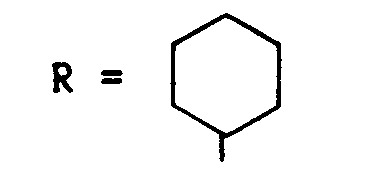
are dissolved in a mixture of 20 ml of isopropanol and 50 ml of diisopropyl ether, and 4.58 g (0.03 of L-tartaric acid are dissolved in 50 ml of isopropanol. - When the two reagents have completely dissolved the solutions are mixed under agitation and the solution obtained is left under agitation for 30 minutes.
- A gum-like solid then precipitates on adding 200 ml of diisopropyl ether and is dried under vacuum at 80°C for 3 hours.
- The dry residue obtained is ground and purified by washing with ethyl ether (for about 10 hours).
- The product is filtered off and the residual solvent evaporated to obtain 9 g of product with a yield of 60%. M.P. 150-151°C.
Elementary analysis: Calculated Found C 58.42 58.35 H 7.10 7.08 N 8.52 8.49 - 1 g (0.0028 moles) of the derivative (III) in which R =C₇H₁₅ is dissolved in 20 ml of ethyl ether, and 0.323 g (0.0028 moles) of maleic acid are dissolved in 10 ml of ethyl ether.
- The two solutions are mixed and immediately a gum-like product separates and, after decantation, is dried at 70°C or 2 hours. 1 g of product is obtained with a yield of 85.5%.
NMR spectrum: in CDCl₃: 0.90 (t); 1.35 (s); 1.6 (s); 2.45 (m); 2.8 (s); 3.1 (s); 3.25 (d); 3.35-3.7 (m); 5.00 (s); 5.3-5.6 (m); 6.25 (d); 6.45 (s); 6.55 (s); 6.85 (s); 6.9 (dd); 12.5 (s).Elementary analysis: Calculated Found C 63.16 63.02 H 7.79 7.73 N 8.84 8.75 - 1 g (0.0028 moles ) of the derivative (III) in which R =C₇H₁₅ is dissolved in 20 ml of ethyl ether, and 0.588 g (0.0028 moles) of citric acid monohydrate are dissolved in 10 ml of ethyl ether.
- The two solutions are mixed and immediately the product separates and, after decantation, is dried at 70°C or 2 hours. 1.2 g of product are obtained with a yield of 75%.
Elementary analysis: Calculated Found C 56.94 56.85 H 7.56 7.48 N 7.38 7.31
Claims (7)
- A process for preparing organic salts of physostigmine derivatives having the following general formula
 a) hydrolysing physostigmine in an organic solvent selected from the group consisting of methanol, ethanol, propanol, isopropanol, dioxane and ethylene glycol, under a nitrogen atmosphere, at ambient temperature, by means of a from 5% to 30% wt/wt NaOH or KOH aqueous solution;b) treating the so obtained solution with a strong inorganic acid to obtain eseroline (II)
 c) reacting, at ambient temperature and in the presence of traces of Na or solid NaOH, the purified eseroline (II) dissolved in an organic solvent with a solution in the same organic solvent of an isocyanate of formula R-N=C=O in which R is a linear or branched C₂-C₁₂ alkyl or cycloalkyl, to obtain the corresponding physostigmine derivative (III)
 e) dissolving said physostigmine derivative (III) in an organic solvent up to an extent of 1 part by wt. of (III) for from 5 to 25 parts by vol. of solvent and mixing the obtained solution with an equimolar amount of an organic acid selected from the group consisting of tartaric, maleic and citric acid, said acid being dissolved in an organic solvent to an extent of 1 part by wt. of acid for from 5 to 35 parts by vol. of solvent.
 - A process as claimed in claim 1. characterised in that said stage b) is conducted with 1N HCl aqueous solution saturated with NaCl.
- A process as claimed in claim 1. characterised in that said mixture of aromatic and aliphatic hydrocarbons used in the stage b) is a 1:1 benzene:petroleum ether mixture.
- Use of organic salts of physostigmine derivatives having the following general formula

- Use of the organic salt of physostigmine derivative having the general formula (I) according to claim 4. in which R is a C₇H₁₅ and X⁻ is the anion of tartaric acid, for the preparation of pharmaceutical compositions with acetylcholinesterase inhibition properties.
Applications Claiming Priority (2)
| Application Number | Priority Date | Filing Date | Title |
|---|---|---|---|
| IT8719964A IT1225462B (en) | 1987-04-03 | 1987-04-03 | ORGANIC SALTS OF PHYSOSTIGMIN DERIVATIVES |
| IT1996487 | 1987-04-03 |
Publications (2)
| Publication Number | Publication Date |
|---|---|
| EP0298202A1 EP0298202A1 (en) | 1989-01-11 |
| EP0298202B1 true EP0298202B1 (en) | 1994-08-31 |
Family
ID=11162687
Family Applications (1)
| Application Number | Title | Priority Date | Filing Date |
|---|---|---|---|
| EP88104977A Expired - Lifetime EP0298202B1 (en) | 1987-04-03 | 1988-03-28 | Organic salts of physostigmine derivatives |
Country Status (10)
| Country | Link |
|---|---|
| US (1) | US4978673A (en) |
| EP (1) | EP0298202B1 (en) |
| JP (1) | JPH0826023B2 (en) |
| KR (1) | KR960007865B1 (en) |
| AT (1) | ATE110725T1 (en) |
| CA (1) | CA1331616C (en) |
| DE (1) | DE3851279T2 (en) |
| ES (1) | ES2060616T3 (en) |
| IE (1) | IE64617B1 (en) |
| IT (1) | IT1225462B (en) |
Cited By (2)
| Publication number | Priority date | Publication date | Assignee | Title |
|---|---|---|---|---|
| US10154988B2 (en) | 2012-11-14 | 2018-12-18 | The Johns Hopkins University | Methods and compositions for treating schizophrenia |
| US10159648B2 (en) | 2015-05-22 | 2018-12-25 | Agenebio, Inc. | Extended release pharmaceutical compositions of levetiracetam |
Families Citing this family (24)
| Publication number | Priority date | Publication date | Assignee | Title |
|---|---|---|---|---|
| US4791107A (en) * | 1986-07-16 | 1988-12-13 | Hoechst-Roussel Pharmaceuticals, Inc. | Memory enhancing and analgesic 1,2,3,3A,8,8A-hexahydro-3A,8 (and) 1,3A,8)-di(and tri)methylpyrrolo(2,3-B)indoles, compositions and use |
| US5187165A (en) * | 1987-05-15 | 1993-02-16 | Hoechst-Roussel Pharmaceuticals Inc. | Memory enhancing and analgesic 1,2,3a,8,8a-hexahydro-3a,8(and 1,3a,8)-di(and tri)methylpyrrolo[2,3-b]indoles |
| US4914102A (en) * | 1989-09-28 | 1990-04-03 | Hoechst Roussel Pharmaceuticals, Inc. | N-aminocarbamates related to physostigmine, pharmacentical compositions and use |
| US5177101A (en) * | 1989-11-30 | 1993-01-05 | Hoechst-Roussel Pharmaceuticals Incorporated | Memory enhancing and analgesic aminocarbonylcarbamates related to physostigmine |
| US5077289A (en) * | 1989-11-30 | 1991-12-31 | Hoechst Roussel Pharmaceuticals Inc. | Memory enhancing and analgesic aminocarbonylcarbamates related to physostigmine |
| US4983616A (en) * | 1990-02-01 | 1991-01-08 | Hoechst-Roussel Pharmaceuticals Inc. | Hexahydropyrrolo(2,3-B)indole carbamates, ureas, amides and related compounds |
| IT1244746B (en) * | 1991-02-14 | 1994-08-08 | Laboratorio Chimico Int Spa | PROCEDURE FOR THE PREPARATION OF 1,3A, 8, -TRIMETHYL-1,2,3,3A, 8, -8A-HEXAIDRO PIRROL (2,3-B) INDOLO-5 (3AS, 8AR) -EPTILCARBAMMATE |
| EP0513703A3 (en) * | 1991-05-13 | 1993-01-13 | Magis Farmaceutici S.P.A. | Carbamate esters of eseroline having anticholinesterase activity, a process for their preparation and relative pharmaceutical compositions containing them as the active principle |
| IT1251166B (en) * | 1991-08-09 | 1995-05-04 | Chiesi Farma Spa | GENESERINE DERIVATIVES, THEIR PREPARATION AND PHARMACEUTICAL COMPOSITIONS CONTAINING THEM |
| US5171750A (en) * | 1991-09-26 | 1992-12-15 | The United States Of America As Represented By The Department Of Health And Human Services | Substituted phenserines as specific inhibitors of acetylcholinesterase |
| US5206260A (en) * | 1991-11-07 | 1993-04-27 | Merck & Co., Inc. | Hexahydropyrrolo[2,3-b]indole derivatives |
| GB9205670D0 (en) * | 1992-03-16 | 1992-04-29 | Indena Spa | New derivatives of physostigmine,their use and pharmaceutical formulations containing them |
| NZ248180A (en) * | 1992-07-21 | 1995-02-24 | Hoechst Roussel Pharma | Process for the preparation of physostigmine carbamate derivatives |
| IT1276928B1 (en) * | 1995-10-13 | 1997-11-03 | Angelini Ricerche Spa | IMPROVED PROCESS TO PRODUCE EPTASTIGMINE AND NEW INTERMEDIATE USEFUL FOR THE PURPOSE |
| US6218383B1 (en) | 1998-08-07 | 2001-04-17 | Targacept, Inc. | Pharmaceutical compositions for the prevention and treatment of central nervous system disorders |
| US6495700B1 (en) * | 2002-01-09 | 2002-12-17 | Axonyx, Inc. | Process for producing phenserine and its analog |
| US20050182044A1 (en) * | 2004-02-17 | 2005-08-18 | Bruinsma Gosse B. | Combinatorial therapy with an acetylcholinesterase inhibitor and (3aR)-1,3a,8-trimethyl-1,2,3,3a,8,8a-hexahydropyrrolo[2,3,-b]indol-5-yl phenylcarbamate |
| CA2508585A1 (en) * | 2004-06-01 | 2005-12-01 | Axonyx, Inc. | Transdermal delivery system for treatment of cognitive disorders |
| EP1604686A1 (en) * | 2004-06-08 | 2005-12-14 | Axonyx, Inc. | Use of phenserine and a HMG CoA reductase inhibitor for delaying Alzheimer's disease progression |
| US20110212928A1 (en) | 2010-02-09 | 2011-09-01 | The Johns Hopkins University | Methods and compositions for improving cognitive function |
| US20130096316A1 (en) * | 2011-10-14 | 2013-04-18 | Qr Pharma, Inc. | Novel Method for Preparation of Bisnorcymerine and Salts Thereof |
| MX362886B (en) | 2012-12-13 | 2019-02-22 | H Lundbeck As | Compositions comprising vortioxetine and donepezil. |
| EP2968220B1 (en) | 2013-03-15 | 2021-05-05 | Agenebio, Inc. | Methods and compositions for improving cognitive function |
| WO2014144663A1 (en) | 2013-03-15 | 2014-09-18 | The Johns Hopkins University | Methods and compositions for improving cognitive function |
Family Cites Families (3)
| Publication number | Priority date | Publication date | Assignee | Title |
|---|---|---|---|---|
| IT1109003B (en) * | 1977-09-20 | 1985-12-16 | Univ Firenze | DERIVATIVES OF 1 2 3 8 3 A 8 A ESAI DROPIRROLO 23 B INDOLO |
| IT1199076B (en) * | 1984-03-01 | 1988-12-30 | Consiglio Nazionale Ricerche | PHYSOSTIGMINE DERIVATIVES WITH PROPERTY OF INHIBITION OF ACETICOLINESTERASI AND RELATED PRODUCTION PROCESS |
| US4791107A (en) * | 1986-07-16 | 1988-12-13 | Hoechst-Roussel Pharmaceuticals, Inc. | Memory enhancing and analgesic 1,2,3,3A,8,8A-hexahydro-3A,8 (and) 1,3A,8)-di(and tri)methylpyrrolo(2,3-B)indoles, compositions and use |
-
1987
- 1987-04-03 IT IT8719964A patent/IT1225462B/en active
-
1988
- 1988-03-28 EP EP88104977A patent/EP0298202B1/en not_active Expired - Lifetime
- 1988-03-28 DE DE3851279T patent/DE3851279T2/en not_active Expired - Fee Related
- 1988-03-28 AT AT88104977T patent/ATE110725T1/en not_active IP Right Cessation
- 1988-03-28 US US07/172,799 patent/US4978673A/en not_active Expired - Fee Related
- 1988-03-28 ES ES88104977T patent/ES2060616T3/en not_active Expired - Lifetime
- 1988-03-30 IE IE96088A patent/IE64617B1/en not_active IP Right Cessation
- 1988-03-31 CA CA000563027A patent/CA1331616C/en not_active Expired - Fee Related
- 1988-04-02 KR KR1019880003709A patent/KR960007865B1/en not_active Expired - Fee Related
- 1988-04-04 JP JP63081443A patent/JPH0826023B2/en not_active Expired - Lifetime
Cited By (2)
| Publication number | Priority date | Publication date | Assignee | Title |
|---|---|---|---|---|
| US10154988B2 (en) | 2012-11-14 | 2018-12-18 | The Johns Hopkins University | Methods and compositions for treating schizophrenia |
| US10159648B2 (en) | 2015-05-22 | 2018-12-25 | Agenebio, Inc. | Extended release pharmaceutical compositions of levetiracetam |
Also Published As
| Publication number | Publication date |
|---|---|
| US4978673A (en) | 1990-12-18 |
| CA1331616C (en) | 1994-08-23 |
| IE64617B1 (en) | 1995-08-23 |
| KR880012602A (en) | 1988-11-28 |
| DE3851279T2 (en) | 1995-02-09 |
| ATE110725T1 (en) | 1994-09-15 |
| JPH0826023B2 (en) | 1996-03-13 |
| KR960007865B1 (en) | 1996-06-13 |
| DE3851279D1 (en) | 1994-10-06 |
| EP0298202A1 (en) | 1989-01-11 |
| JPS6425777A (en) | 1989-01-27 |
| IE880960L (en) | 1988-10-03 |
| IT8719964A0 (en) | 1987-04-03 |
| ES2060616T3 (en) | 1994-12-01 |
| IT1225462B (en) | 1990-11-14 |
Similar Documents
| Publication | Publication Date | Title |
|---|---|---|
| EP0298202A1 (en) | Organic salts of physostigmine derivatives | |
| EP0644887B1 (en) | Intermediates in a process for the purification of clavulanic acid | |
| KR100200239B1 (en) | Process for preparing salts of clavulanic acid | |
| EP0024181B1 (en) | Process for the isolation of a solid salt of p-hydroxymandelic acid; some salts of p-hydroxymandelic acid | |
| EP0647229B1 (en) | Diamine salts of clavulanic acid | |
| IL95949A (en) | Process for the preparation of 3-(l-pyroglutamyl)-l-thiazolidine-4- carboxylic acid and its derivatives | |
| EP0729961A1 (en) | Clavulanic acid salts | |
| JPS6249261B2 (en) | ||
| EP0086324A2 (en) | Process for preparing ascorbic acid | |
| DE19835866B4 (en) | Process for the preparation of 5-perfluoroalkyluracil derivatives | |
| US4322548A (en) | Resolution of racemic mandelic acid | |
| DE69811358T2 (en) | METHOD FOR PRODUCING 1-CHLOROCARBONYL-4-PIPERIDINOPIPERIDINE OR THE HYDROCHLORIDE THEREOF | |
| US2812326A (en) | Purification of bis-dehydroabietyl-ethyelenediamine-di-penicillinate | |
| EP0552912A2 (en) | Method for producing 2,6-dihydroxybenzoic acid | |
| US2400934A (en) | Amines and purification thereof | |
| US3124587A (en) | Process for the production of pyrtooxal- | |
| US4550193A (en) | Process for the preparation of 2,3-dimercaptosuccinic acid and its lower alkyl esters | |
| EP0134934A1 (en) | 2-Keto-sulphon amides and process for their production | |
| US3306935A (en) | Trichloroacetic acid dichloroethylidene hydrazide and process therefor | |
| JPH051053A (en) | New method for producing 6- (3-dimethylaminopropionyl) forskolin | |
| JP3259196B2 (en) | Method for producing 2-hydrazino-4,6-dimethoxypyrimidine | |
| GB2101130A (en) | Process for preparing N-carbamoylbenzoic acid sulfimide derivatives | |
| BG61652B1 (en) | Method for the preparation of clindamycin falmitate hydrochloride | |
| PL172021B1 (en) | Clavulanic acid purification method PL | |
| HK1003222B (en) | Intermediates in a process for the purification of clavulanic acid |
Legal Events
| Date | Code | Title | Description |
|---|---|---|---|
| PUAI | Public reference made under article 153(3) epc to a published international application that has entered the european phase |
Free format text: ORIGINAL CODE: 0009012 |
|
| AK | Designated contracting states |
Kind code of ref document: A1 Designated state(s): AT BE CH DE ES FR GB GR IT LI LU NL SE |
|
| 17P | Request for examination filed |
Effective date: 19890701 |
|
| 17Q | First examination report despatched |
Effective date: 19910508 |
|
| RAP1 | Party data changed (applicant data changed or rights of an application transferred) |
Owner name: CONSIGLIO NAZIONALE DELLE RICERCHE Owner name: MEDIOLANUM FARMACEUTICI S.P.A. |
|
| GRAA | (expected) grant |
Free format text: ORIGINAL CODE: 0009210 |
|
| AK | Designated contracting states |
Kind code of ref document: B1 Designated state(s): AT BE CH DE ES FR GB GR IT LI LU NL SE |
|
| REF | Corresponds to: |
Ref document number: 110725 Country of ref document: AT Date of ref document: 19940915 Kind code of ref document: T |
|
| REF | Corresponds to: |
Ref document number: 3851279 Country of ref document: DE Date of ref document: 19941006 |
|
| ET | Fr: translation filed | ||
| ITF | It: translation for a ep patent filed | ||
| REG | Reference to a national code |
Ref country code: ES Ref legal event code: FG2A Ref document number: 2060616 Country of ref document: ES Kind code of ref document: T3 |
|
| EAL | Se: european patent in force in sweden |
Ref document number: 88104977.9 |
|
| REG | Reference to a national code |
Ref country code: GR Ref legal event code: FG4A Free format text: 3014156 |
|
| PLBE | No opposition filed within time limit |
Free format text: ORIGINAL CODE: 0009261 |
|
| STAA | Information on the status of an ep patent application or granted ep patent |
Free format text: STATUS: NO OPPOSITION FILED WITHIN TIME LIMIT |
|
| 26N | No opposition filed | ||
| PGFP | Annual fee paid to national office [announced via postgrant information from national office to epo] |
Ref country code: DE Payment date: 19980206 Year of fee payment: 11 |
|
| PGFP | Annual fee paid to national office [announced via postgrant information from national office to epo] |
Ref country code: NL Payment date: 19980212 Year of fee payment: 11 |
|
| PGFP | Annual fee paid to national office [announced via postgrant information from national office to epo] |
Ref country code: GB Payment date: 19980220 Year of fee payment: 11 |
|
| PGFP | Annual fee paid to national office [announced via postgrant information from national office to epo] |
Ref country code: FR Payment date: 19980226 Year of fee payment: 11 |
|
| PGFP | Annual fee paid to national office [announced via postgrant information from national office to epo] |
Ref country code: ES Payment date: 19980303 Year of fee payment: 11 |
|
| PGFP | Annual fee paid to national office [announced via postgrant information from national office to epo] |
Ref country code: SE Payment date: 19980306 Year of fee payment: 11 |
|
| PGFP | Annual fee paid to national office [announced via postgrant information from national office to epo] |
Ref country code: GR Payment date: 19980309 Year of fee payment: 11 |
|
| PGFP | Annual fee paid to national office [announced via postgrant information from national office to epo] |
Ref country code: LU Payment date: 19980311 Year of fee payment: 11 |
|
| PGFP | Annual fee paid to national office [announced via postgrant information from national office to epo] |
Ref country code: BE Payment date: 19980323 Year of fee payment: 11 |
|
| PGFP | Annual fee paid to national office [announced via postgrant information from national office to epo] |
Ref country code: CH Payment date: 19980324 Year of fee payment: 11 |
|
| PGFP | Annual fee paid to national office [announced via postgrant information from national office to epo] |
Ref country code: AT Payment date: 19980325 Year of fee payment: 11 |
|
| PG25 | Lapsed in a contracting state [announced via postgrant information from national office to epo] |
Ref country code: LU Free format text: LAPSE BECAUSE OF NON-PAYMENT OF DUE FEES Effective date: 19990328 Ref country code: GB Free format text: LAPSE BECAUSE OF NON-PAYMENT OF DUE FEES Effective date: 19990328 Ref country code: AT Free format text: LAPSE BECAUSE OF NON-PAYMENT OF DUE FEES Effective date: 19990328 |
|
| PG25 | Lapsed in a contracting state [announced via postgrant information from national office to epo] |
Ref country code: SE Free format text: LAPSE BECAUSE OF NON-PAYMENT OF DUE FEES Effective date: 19990329 Ref country code: ES Free format text: LAPSE BECAUSE OF NON-PAYMENT OF DUE FEES Effective date: 19990329 |
|
| PG25 | Lapsed in a contracting state [announced via postgrant information from national office to epo] |
Ref country code: LI Free format text: LAPSE BECAUSE OF NON-PAYMENT OF DUE FEES Effective date: 19990331 Ref country code: GR Free format text: LAPSE BECAUSE OF NON-PAYMENT OF DUE FEES Effective date: 19990331 Ref country code: CH Free format text: LAPSE BECAUSE OF NON-PAYMENT OF DUE FEES Effective date: 19990331 Ref country code: BE Free format text: LAPSE BECAUSE OF NON-PAYMENT OF DUE FEES Effective date: 19990331 |
|
| BERE | Be: lapsed |
Owner name: CONSIGLIO NAZIONALE DELLE RICERCHE Effective date: 19990331 Owner name: MEDIOLANUM FARMACEUTICI S.P.A. Effective date: 19990331 |
|
| PG25 | Lapsed in a contracting state [announced via postgrant information from national office to epo] |
Ref country code: NL Free format text: LAPSE BECAUSE OF NON-PAYMENT OF DUE FEES Effective date: 19991001 |
|
| EUG | Se: european patent has lapsed |
Ref document number: 88104977.9 |
|
| REG | Reference to a national code |
Ref country code: CH Ref legal event code: PL |
|
| GBPC | Gb: european patent ceased through non-payment of renewal fee |
Effective date: 19990328 |
|
| PG25 | Lapsed in a contracting state [announced via postgrant information from national office to epo] |
Ref country code: FR Free format text: LAPSE BECAUSE OF NON-PAYMENT OF DUE FEES Effective date: 19991130 |
|
| NLV4 | Nl: lapsed or anulled due to non-payment of the annual fee |
Effective date: 19991001 |
|
| EUG | Se: european patent has lapsed |
Ref document number: 88104977.9 |
|
| REG | Reference to a national code |
Ref country code: FR Ref legal event code: ST |
|
| PG25 | Lapsed in a contracting state [announced via postgrant information from national office to epo] |
Ref country code: DE Free format text: LAPSE BECAUSE OF NON-PAYMENT OF DUE FEES Effective date: 20000101 |
|
| REG | Reference to a national code |
Ref country code: ES Ref legal event code: FD2A Effective date: 20010503 |
|
| PG25 | Lapsed in a contracting state [announced via postgrant information from national office to epo] |
Ref country code: IT Free format text: LAPSE BECAUSE OF NON-PAYMENT OF DUE FEES;WARNING: LAPSES OF ITALIAN PATENTS WITH EFFECTIVE DATE BEFORE 2007 MAY HAVE OCCURRED AT ANY TIME BEFORE 2007. THE CORRECT EFFECTIVE DATE MAY BE DIFFERENT FROM THE ONE RECORDED. Effective date: 20050328 |