EP0295797B1 - Process for the selective reduction of 2-quinoxalinol-4-oxides to 2-quinoxalinols - Google Patents
Process for the selective reduction of 2-quinoxalinol-4-oxides to 2-quinoxalinols Download PDFInfo
- Publication number
- EP0295797B1 EP0295797B1 EP88304755A EP88304755A EP0295797B1 EP 0295797 B1 EP0295797 B1 EP 0295797B1 EP 88304755 A EP88304755 A EP 88304755A EP 88304755 A EP88304755 A EP 88304755A EP 0295797 B1 EP0295797 B1 EP 0295797B1
- Authority
- EP
- European Patent Office
- Prior art keywords
- quinoxalinol
- oxide
- accordance
- hydrogen
- chloro
- Prior art date
- Legal status (The legal status is an assumption and is not a legal conclusion. Google has not performed a legal analysis and makes no representation as to the accuracy of the status listed.)
- Expired - Lifetime
Links
Classifications
-
- C—CHEMISTRY; METALLURGY
- C07—ORGANIC CHEMISTRY
- C07D—HETEROCYCLIC COMPOUNDS
- C07D241/00—Heterocyclic compounds containing 1,4-diazine or hydrogenated 1,4-diazine rings
- C07D241/36—Heterocyclic compounds containing 1,4-diazine or hydrogenated 1,4-diazine rings condensed with carbocyclic rings or ring systems
- C07D241/50—Heterocyclic compounds containing 1,4-diazine or hydrogenated 1,4-diazine rings condensed with carbocyclic rings or ring systems with hetero atoms directly attached to ring nitrogen atoms
- C07D241/52—Oxygen atoms
-
- C—CHEMISTRY; METALLURGY
- C07—ORGANIC CHEMISTRY
- C07D—HETEROCYCLIC COMPOUNDS
- C07D241/00—Heterocyclic compounds containing 1,4-diazine or hydrogenated 1,4-diazine rings
- C07D241/36—Heterocyclic compounds containing 1,4-diazine or hydrogenated 1,4-diazine rings condensed with carbocyclic rings or ring systems
- C07D241/38—Heterocyclic compounds containing 1,4-diazine or hydrogenated 1,4-diazine rings condensed with carbocyclic rings or ring systems with only hydrogen or carbon atoms directly attached to the ring nitrogen atoms
- C07D241/40—Benzopyrazines
- C07D241/44—Benzopyrazines with hetero atoms or with carbon atoms having three bonds to hetero atoms with at the most one bond to halogen, e.g. ester or nitrile radicals, directly attached to carbon atoms of the hetero ring
Definitions
- This invention is directed to an improved process for the selective reduction of certain 2-quinoxalinol-4-oxides to form 2-quinoxalinols employing sulfided platinum as catalyst and employing hydrogen as the reducing agent.
- 2-quinoxalinol compounds such as 6-chloro-2-hydroxyquinoxaline
- These compounds are generally prepared by the selective reduction of 2-quinoxalinol-4-oxides. Selective reduction is necessary so that excessive reduction, resulting in the formation of compounds such as 3,4-dihydro-2-quinoxalinol, can be avoided. This is particularly a problem with halogenated 2-quinoxalinol compounds wherein excessive hydrogenation will eliminate the halogen substituent.
- United States Patent No. 4,620,003 to Ishikura discloses a process for the reduction of 2-quinoxalinol-4-oxide compounds to 2-quinoxinol compounds, which process involves reacting a 2-quinoxalinol-4-oxide with hydrazine in the presence of (i) a Raney catalyst (especially Raney nickel or sulfided Raney nickel) and (ii) a alkali metal hydroxide, an alkaline earth metal hydroxide, or ammonium hydroxide. While this process reduces the 2-quinoxalinol-4-oxides in desirable efficiencies, a major drawback in the commercial use of the Ishikura process is the relatively high cost of hydrazine relative to other potential reducing agents, in particular hydrogen.
- Sakata et al "The Facile One Pot Synthesis of 6-Substituted 2(1H)-quinoxalinones", Heterocycles , Vol. 23, No. 1, (1985), 143-151, disclose a process for the reduction of 6-chloro-2-quinoxalinol-4-oxide to 6-chloro-2-quinoxalinol employing hydrogen as a reducing agent and palladium as a catalyst.
- Sakata et al indicate that an undesirable amount of overly reduced by-product is formed.
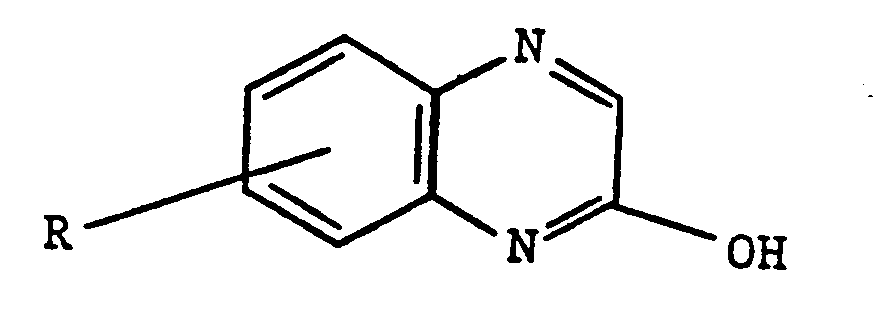
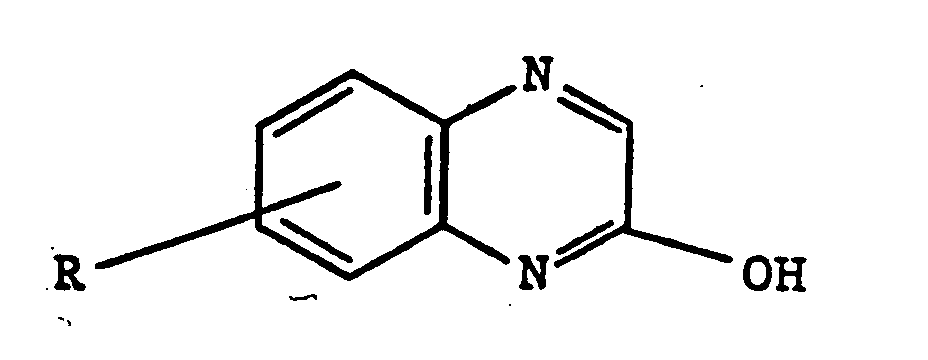
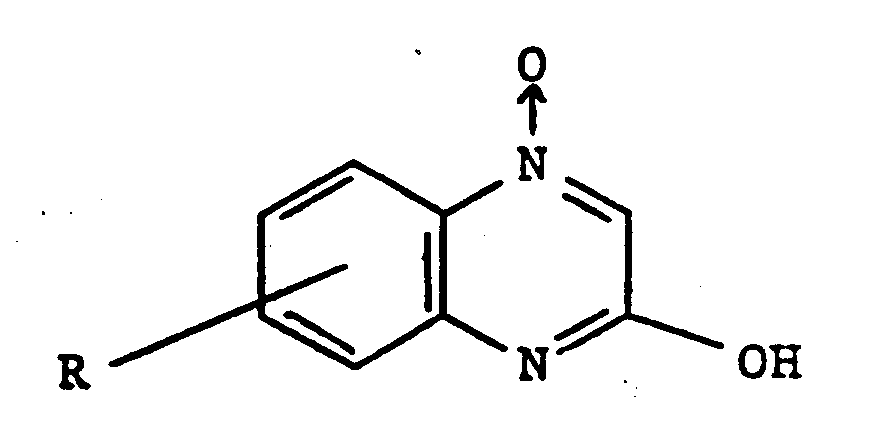
- the present invention is directed to a process for preparing a 2-quinoxalinol compound of the formula: wherein R is hydrogen, halogen or trihalomethyl; which process comprises reducing a 2-quinoxalinol-4-oxide compound of the formula: wherein R is as defined above, with hydrogen at a pressure of 6 x 10 5 to 15 x 10 5 Nm -2 (6 to 15 atmospheres) at a temperature of 20 to 60°C and in the presence of an amount of 0.5 to 1.36 parts of sulfided platinum per 100 parts of said oxide in a stirred autoclave.
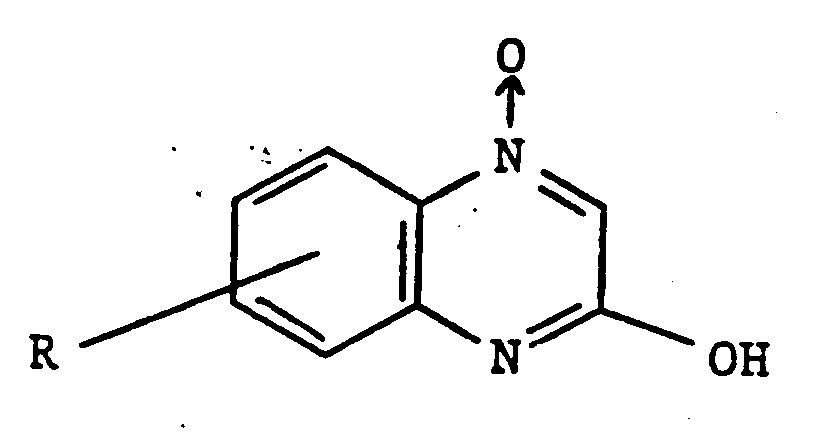
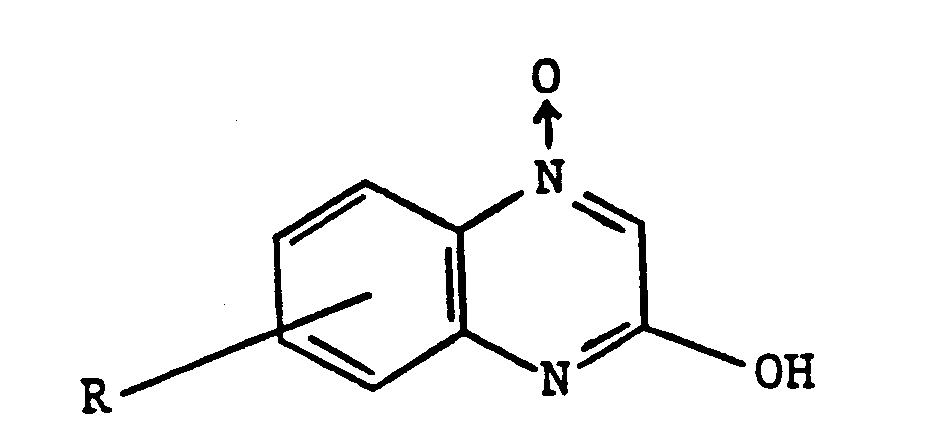
- the 2-quinoxalinol-4-oxide compounds employed as starting materials in the process of this invention are of the formula: wherein R is hydrogen, halogen or trihalomethyl.
- R is hydrogen, chlorine, fluorine, trichloromethyl or trifluoromethyl.
- a particularly preferred starting material is 6-chloro-2-hydroxyquinoxaline-4-oxide, which is subsequently reduced to 6-chloro-2-hydroxyquinoxaline.
- 6-chloro-2-hydroxyquinoxaline-4-oxide may be present as the product of the reaction of 4-chloro-2-nitroacetoacetanilide with a hydroxide (such as sodium hydroxide or potassium hydroxide).
- a hydroxide such as sodium hydroxide or potassium hydroxide
- the process of this invention is catalyzed by sulfided platinum as hydrogenation catalyst.
- the catalyst is employed in amounts of 0.5 to 1,36 parts by weight per 100 parts by weight of 2-quinoxalinol-4-oxide.
- the reaction of this invention is conducted in a solution containing at least one compound selected from the group consisting of alkali metal hydroxides, alkaline earth metal hydroxides and ammonium hydroxide.
- Water is preferred as a reaction solvent but organic solvents (such as alcohols or hydrocarbons) or solvent mixtures of water with an organic solvent may also be employed.
- the process of this invention is carried out at pressures between (6 and 15 atmospheres) 6 x 10 5 and 15 x 10 5 Nm -2 .
- Reaction temperatures may vary widely, with temperatures ranging between 20° and 60°C.
- reaction temperatures and pressures which are most preferably employed will vary in accordance with a number of factors including the starting material employed; the catalyst concentration; and the like. As is apparent to one skilled in the art, reaction pressures and temperatures which are too high will reduce the selectivity of the reaction and produce products which may be too greatly reduced. Conversely, reaction temperatures and pressures which are too low will reduce the activity of the catalyst. However, one of ordinary skill in the art may readily determine the optimum reaction conditions for a particular set of reactants by routine experimentation.
- the process of this invention may be employed in a continuous or in a batch manner.
- the process of this invention employs hydrogen as a reducing agent, it is greatly more economical than prior art processes employing relatively expensive chemicals (such as hydrazine) as reducing agents. Moreover, because the process of this invention may be run at high pressures, the danger of an explosion occurring due to the leaking in of air is greatly reduced.
Landscapes
- Chemical & Material Sciences (AREA)
- Organic Chemistry (AREA)
- Catalysts (AREA)
- Low-Molecular Organic Synthesis Reactions Using Catalysts (AREA)
- Nitrogen And Oxygen Or Sulfur-Condensed Heterocyclic Ring Systems (AREA)
- Pharmaceuticals Containing Other Organic And Inorganic Compounds (AREA)
- Organic Low-Molecular-Weight Compounds And Preparation Thereof (AREA)
- Medicines Containing Antibodies Or Antigens For Use As Internal Diagnostic Agents (AREA)
- Plural Heterocyclic Compounds (AREA)
- Nitrogen Condensed Heterocyclic Rings (AREA)
- Battery Electrode And Active Subsutance (AREA)
- Preparation Of Compounds By Using Micro-Organisms (AREA)
Abstract
Description
| Reduction of 6-Chloro-2-Hydroxyquinoxaline-4-oxide to 6-Chloro-2-Hydroxyquinoxaline Employing H2 as the Reducing Agent | |||||||
| Example or Comparative Experiment | Catalyst Type | Catalyst Amount(g) | Reaction Temperature (°C) | Reaction Pressure 105Nm-2 (psig) | Reaction Time (hours) | Percent H2 Absorbed | Percent Yield |
| 1 | Sulfided Pt | 0.125 | 60 | 7-14 (100-200) | 5.0 | 100 | 79 |
| 2 | Sulfided Pt | 0.125 | 60 | 7-14 (100-200) | 4.0 | 100 | 78 |
| C3 | Sulfided Pd | 1.9 | 20 | 7-14 (100-200) | 5.8 | 117 | 43 |
| C4 | Sulfided Rh | 2.0 | 20 | 41-48 (600-700) | 2.0 | 114 | 61 |
| C5 | Sulfided Ru | 1.9 | 60 | 43-50 (620-720) | 5.9 | 157 | 24 |
| A | Pd | 1.0 | 30 | 31-48 (450-700) | 0.08 | 232 | <0.5 |
| B | Sulfided Ni | 3.8 | 60 | 46-52 (660-760) | 5.0 | 113 | 19 |
Claims (8)
- A process for preparing a 2-quinoxalinol compound of the formula:wherein R is hydrogen, halogen or trihalomethyl; which process comprises reducing a 2-quinoxalinol-4-oxide compound of the formula
 wherein R is as defined above, with hydrogen at a pressure of 6 x 10⁵ to 15 x 105 Nm-2 (6 to 15 atmospheres) at a temperature of 20°C to 60°C in the presence of an amount of 0.5 to 1.36 parts of sulfided platinum per 100 parts of said oxide in a stirred autoclave.
- A process in accordance with claim 1 wherein said 2-quinoxalinol-4-oxide is in a solution further comprising at least one compond selected from the group consisting of alkali metal hydroxides, alkaline earth metal hydroxides and ammonium hydroxide.
- A process in accordance with claim 2 wherein said solution is an aqueous solution.
- A process in accordance with claim 1 wherein R is selected from the group consisting of hydrogen, chlorine, fluorine, trichloromethyl and trifluoromethyl.
- A process in accordance with claim 1 wherein the starting material is 6-chloro-2-hydroxyquinoxaline-4-oxide.
- A process in accordance with claim 1 wherein the catalyst is 5 weight percent sulfided platinum on carbon.
- A process in accordance with claim 1 for preparing 6-chloro-2-hydroxyquinoxaline from 6-chloro-2-hydroxyquinoxaline-4-oxide which process comprises reacting 6-chloro-2-hydroxyquinoxaline-4-oxide with hydrogen in the presence of (a) a catalytically effective amount of sulfided platinum and (b) an aqueous solution of an alkali metal hydroxide at between 20°C and 60°C and at from 6 x 10⁵ Nm-2 to 15 x 105 Nm-2.
- A process in accordance with claim 7 wherein said reaction occurs at about 60°C and at from 8 x 10⁵ to 15 x 105 Nm-2 (8 to 15 atmospheres).
Applications Claiming Priority (2)
| Application Number | Priority Date | Filing Date | Title |
|---|---|---|---|
| US64908 | 1987-06-19 | ||
| US07/064,908 US4814444A (en) | 1987-06-19 | 1987-06-19 | Process for the selective reduction of 2-hydroxyquinoxaline-4-oxides |
Publications (3)
| Publication Number | Publication Date |
|---|---|
| EP0295797A2 EP0295797A2 (en) | 1988-12-21 |
| EP0295797A3 EP0295797A3 (en) | 1989-11-15 |
| EP0295797B1 true EP0295797B1 (en) | 1998-01-07 |
Family
ID=22059048
Family Applications (1)
| Application Number | Title | Priority Date | Filing Date |
|---|---|---|---|
| EP88304755A Expired - Lifetime EP0295797B1 (en) | 1987-06-19 | 1988-05-25 | Process for the selective reduction of 2-quinoxalinol-4-oxides to 2-quinoxalinols |
Country Status (16)
| Country | Link |
|---|---|
| US (1) | US4814444A (en) |
| EP (1) | EP0295797B1 (en) |
| JP (1) | JPH0629267B2 (en) |
| KR (1) | KR900004416B1 (en) |
| CN (1) | CN1017995B (en) |
| AT (1) | ATE161832T1 (en) |
| AU (1) | AU609489B2 (en) |
| BR (1) | BR8802783A (en) |
| CA (1) | CA1321202C (en) |
| DE (1) | DE3856098T2 (en) |
| ES (1) | ES2110396T3 (en) |
| FI (1) | FI99204C (en) |
| IL (1) | IL86415A (en) |
| MX (1) | MX168769B (en) |
| PH (1) | PH25129A (en) |
| ZA (1) | ZA883784B (en) |
Families Citing this family (8)
| Publication number | Priority date | Publication date | Assignee | Title |
|---|---|---|---|---|
| IL86416A (en) * | 1987-06-19 | 1993-07-08 | Uniroyal Chem Co Inc | Process for the preparation of 2-quinoxalinol derivatives |
| DE3925969A1 (en) * | 1989-08-05 | 1991-02-07 | Hoechst Ag | METHOD FOR PRODUCING 2,6-DICHLORCHINOXALINE |
| US5169955A (en) * | 1990-03-01 | 1992-12-08 | Nippon Kayaku Kabushiki Kaisha | Process for producing 2-hydroxyquinoxaline derivatives |
| CZ279488B6 (en) * | 1990-09-25 | 1995-05-17 | Lonza A.G. | Micro-organisms rhodococcus erythropolis and arthrobacter sp. as well as micro-biological preparation of hydroxylated pyrazines and quinoxalines. |
| JP3817736B2 (en) * | 1994-02-17 | 2006-09-06 | 日産化学工業株式会社 | Preparation of 6-substituted-2 (1H) -quinoxalinone |
| CN101941947B (en) * | 2010-08-27 | 2012-06-27 | 山东京博控股股份有限公司 | Synthesis method of 2-chloro-6-chloroquinoxaline |
| CN102180840A (en) * | 2011-03-15 | 2011-09-14 | 安徽丰乐农化有限责任公司 | New preparation process of 6-chloro-2-hydroxyquinoxaline |
| CN111239125A (en) * | 2020-03-06 | 2020-06-05 | 中国药科大学 | Glucose colorimetric detection method by using platinum disulfide |
Citations (1)
| Publication number | Priority date | Publication date | Assignee | Title |
|---|---|---|---|---|
| US4620003A (en) * | 1983-05-25 | 1986-10-28 | Nippon Kayaku Kabushiki Kaisha | Process for producing 2-quinoxalinols |
Family Cites Families (3)
| Publication number | Priority date | Publication date | Assignee | Title |
|---|---|---|---|---|
| US3350450A (en) * | 1963-08-12 | 1967-10-31 | Uniroyal Inc | Process of preparing aromatic amines by the catalytic hydrogenation of aromatic nitro compounds |
| JPS48973A (en) * | 1971-05-28 | 1973-01-09 | ||
| US4636562A (en) * | 1982-05-07 | 1987-01-13 | E. I. Du Pont De Nemours And Company | Process for preparing 6-halo-2-chloroquinoxaline |
-
1987
- 1987-06-19 US US07/064,908 patent/US4814444A/en not_active Expired - Lifetime
-
1988
- 1988-05-18 IL IL86415A patent/IL86415A/en not_active IP Right Cessation
- 1988-05-25 DE DE3856098T patent/DE3856098T2/en not_active Expired - Lifetime
- 1988-05-25 EP EP88304755A patent/EP0295797B1/en not_active Expired - Lifetime
- 1988-05-25 ES ES88304755T patent/ES2110396T3/en not_active Expired - Lifetime
- 1988-05-25 AT AT88304755T patent/ATE161832T1/en not_active IP Right Cessation
- 1988-05-26 ZA ZA883784A patent/ZA883784B/en unknown
- 1988-05-26 CA CA000567838A patent/CA1321202C/en not_active Expired - Lifetime
- 1988-06-08 AU AU17497/88A patent/AU609489B2/en not_active Expired
- 1988-06-08 BR BR8802783A patent/BR8802783A/en not_active IP Right Cessation
- 1988-06-10 PH PH37047A patent/PH25129A/en unknown
- 1988-06-14 KR KR1019880007107A patent/KR900004416B1/en not_active Expired
- 1988-06-16 JP JP63149242A patent/JPH0629267B2/en not_active Expired - Fee Related
- 1988-06-16 FI FI882894A patent/FI99204C/en active IP Right Grant
- 1988-06-17 MX MX011942A patent/MX168769B/en unknown
- 1988-06-17 CN CN88103659A patent/CN1017995B/en not_active Expired
Patent Citations (1)
| Publication number | Priority date | Publication date | Assignee | Title |
|---|---|---|---|---|
| US4620003A (en) * | 1983-05-25 | 1986-10-28 | Nippon Kayaku Kabushiki Kaisha | Process for producing 2-quinoxalinols |
Non-Patent Citations (2)
| Title |
|---|
| Fieser & Fieser, Reagents for Organic Synthesis, Vol.1, p.892, Ed. John Wiley and Sons / New York * |
| Heterocycles 1985, Vol.23, No.1, 143-151 * |
Also Published As
| Publication number | Publication date |
|---|---|
| FI99204C (en) | 1997-10-27 |
| US4814444A (en) | 1989-03-21 |
| KR900004416B1 (en) | 1990-06-25 |
| DE3856098D1 (en) | 1998-02-12 |
| MX168769B (en) | 1993-06-07 |
| CA1321202C (en) | 1993-08-10 |
| BR8802783A (en) | 1988-12-27 |
| EP0295797A2 (en) | 1988-12-21 |
| CN1017995B (en) | 1992-08-26 |
| ES2110396T3 (en) | 1998-02-16 |
| FI99204B (en) | 1997-07-15 |
| AU609489B2 (en) | 1991-05-02 |
| FI882894L (en) | 1988-12-20 |
| ATE161832T1 (en) | 1998-01-15 |
| EP0295797A3 (en) | 1989-11-15 |
| CN1030915A (en) | 1989-02-08 |
| AU1749788A (en) | 1988-12-22 |
| JPS6416772A (en) | 1989-01-20 |
| IL86415A0 (en) | 1988-11-15 |
| DE3856098T2 (en) | 1998-05-07 |
| PH25129A (en) | 1991-02-19 |
| JPH0629267B2 (en) | 1994-04-20 |
| IL86415A (en) | 1993-02-21 |
| ZA883784B (en) | 1989-11-29 |
| FI882894A0 (en) | 1988-06-16 |
| KR890000439A (en) | 1989-03-14 |
Similar Documents
| Publication | Publication Date | Title |
|---|---|---|
| EP0019454B1 (en) | Manufacture of toluene diamine | |
| US4482741A (en) | Preparation of xylylenediamine | |
| US4814444A (en) | Process for the selective reduction of 2-hydroxyquinoxaline-4-oxides | |
| US4373107A (en) | Process for preparing N-alkyl-alkylene-diamines | |
| US4625062A (en) | Process for producing 4-alkoxyanilines | |
| AU601851B2 (en) | Process for the production of 2-quinoxalines | |
| US3230259A (en) | Preparation of o-phenylenediamines | |
| EP1207146B1 (en) | Process for the conversion of 1,4 butynediol to 1, 4 butenediol | |
| EP0013554B1 (en) | Process for production of 1,17-diamino-9-azaheptadecane | |
| US4429156A (en) | Process for the preparation of m-halogen-substituted anilines | |
| US5144076A (en) | Preparation of 3,5-diamino benzotrifluoride | |
| IE44189B1 (en) | Method for synthesizing n-methyl ureas | |
| US6034276A (en) | Process for preparing 1-chloro-2,4-diaminobenzene | |
| JPH0246022B2 (en) | ||
| US4757152A (en) | Process for producing indoles | |
| US4070395A (en) | Process for the preparation of 4,4'-diaminostilbene-2,2'-disulfonic acid or its salts | |
| US4482735A (en) | Process for preparation of methyl methoxyacetate | |
| JPH08245531A (en) | Method for producing halo-substituted aminophenol | |
| US3517064A (en) | Process for the preparation of trialkylhydrazines | |
| US2581986A (en) | Method for the preparation of aminophthalidylalkane salts | |
| EP0484767A1 (en) | Preparation of 3,5-diamino benzotrifluoride | |
| JPS6123176B2 (en) | ||
| GB1576608A (en) | Catalytic reduction of nitronaphthalene sulphonic acids | |
| US20020007086A1 (en) | Process for producing trifluoromethylbenzylamines | |
| JPH04243867A (en) | Production of 2-chloro-4-pyridinemethanol |
Legal Events
| Date | Code | Title | Description |
|---|---|---|---|
| PUAI | Public reference made under article 153(3) epc to a published international application that has entered the european phase |
Free format text: ORIGINAL CODE: 0009012 |
|
| AK | Designated contracting states |
Kind code of ref document: A2 Designated state(s): AT BE CH DE ES FR GB IT LI NL SE |
|
| PUAL | Search report despatched |
Free format text: ORIGINAL CODE: 0009013 |
|
| AK | Designated contracting states |
Kind code of ref document: A3 Designated state(s): AT BE CH DE ES FR GB IT LI NL SE |
|
| 17P | Request for examination filed |
Effective date: 19900504 |
|
| 17Q | First examination report despatched |
Effective date: 19911210 |
|
| APAB | Appeal dossier modified |
Free format text: ORIGINAL CODE: EPIDOS NOAPE |
|
| APAD | Appeal reference recorded |
Free format text: ORIGINAL CODE: EPIDOS REFNE |
|
| APAB | Appeal dossier modified |
Free format text: ORIGINAL CODE: EPIDOS NOAPE |
|
| APBJ | Interlocutory revision of appeal recorded |
Free format text: ORIGINAL CODE: EPIDOS IRAPE |
|
| GRAG | Despatch of communication of intention to grant |
Free format text: ORIGINAL CODE: EPIDOS AGRA |
|
| GRAG | Despatch of communication of intention to grant |
Free format text: ORIGINAL CODE: EPIDOS AGRA |
|
| GRAH | Despatch of communication of intention to grant a patent |
Free format text: ORIGINAL CODE: EPIDOS IGRA |
|
| GRAH | Despatch of communication of intention to grant a patent |
Free format text: ORIGINAL CODE: EPIDOS IGRA |
|
| ITF | It: translation for a ep patent filed | ||
| GRAA | (expected) grant |
Free format text: ORIGINAL CODE: 0009210 |
|
| AK | Designated contracting states |
Kind code of ref document: B1 Designated state(s): AT BE CH DE ES FR GB IT LI NL SE |
|
| REF | Corresponds to: |
Ref document number: 161832 Country of ref document: AT Date of ref document: 19980115 Kind code of ref document: T |
|
| REG | Reference to a national code |
Ref country code: CH Ref legal event code: NV Representative=s name: A. BRAUN, BRAUN, HERITIER, ESCHMANN AG PATENTANWAE Ref country code: CH Ref legal event code: EP |
|
| REF | Corresponds to: |
Ref document number: 3856098 Country of ref document: DE Date of ref document: 19980212 |
|
| REG | Reference to a national code |
Ref country code: ES Ref legal event code: FG2A Ref document number: 2110396 Country of ref document: ES Kind code of ref document: T3 |
|
| ET | Fr: translation filed | ||
| PLBE | No opposition filed within time limit |
Free format text: ORIGINAL CODE: 0009261 |
|
| STAA | Information on the status of an ep patent application or granted ep patent |
Free format text: STATUS: NO OPPOSITION FILED WITHIN TIME LIMIT |
|
| 26N | No opposition filed | ||
| REG | Reference to a national code |
Ref country code: GB Ref legal event code: IF02 |
|
| APAH | Appeal reference modified |
Free format text: ORIGINAL CODE: EPIDOSCREFNO |
|
| PGFP | Annual fee paid to national office [announced via postgrant information from national office to epo] |
Ref country code: AT Payment date: 20070502 Year of fee payment: 20 |
|
| PGFP | Annual fee paid to national office [announced via postgrant information from national office to epo] |
Ref country code: NL Payment date: 20070524 Year of fee payment: 20 |
|
| PGFP | Annual fee paid to national office [announced via postgrant information from national office to epo] |
Ref country code: ES Payment date: 20070528 Year of fee payment: 20 |
|
| PGFP | Annual fee paid to national office [announced via postgrant information from national office to epo] |
Ref country code: SE Payment date: 20070529 Year of fee payment: 20 |
|
| PGFP | Annual fee paid to national office [announced via postgrant information from national office to epo] |
Ref country code: CH Payment date: 20070530 Year of fee payment: 20 |
|
| PGFP | Annual fee paid to national office [announced via postgrant information from national office to epo] |
Ref country code: BE Payment date: 20070615 Year of fee payment: 20 |
|
| PGFP | Annual fee paid to national office [announced via postgrant information from national office to epo] |
Ref country code: DE Payment date: 20070702 Year of fee payment: 20 |
|
| PGFP | Annual fee paid to national office [announced via postgrant information from national office to epo] |
Ref country code: GB Payment date: 20070525 Year of fee payment: 20 |
|
| PGFP | Annual fee paid to national office [announced via postgrant information from national office to epo] |
Ref country code: IT Payment date: 20070526 Year of fee payment: 20 |
|
| PGFP | Annual fee paid to national office [announced via postgrant information from national office to epo] |
Ref country code: FR Payment date: 20070517 Year of fee payment: 20 |
|
| BE20 | Be: patent expired |
Owner name: *UNIROYAL CHEMICAL CY INC. Effective date: 20080525 |
|
| REG | Reference to a national code |
Ref country code: GB Ref legal event code: PE20 Expiry date: 20080524 |
|
| REG | Reference to a national code |
Ref country code: CH Ref legal event code: PFA Owner name: UNIROYAL CHEMICAL COMPANY, INC. Free format text: UNIROYAL CHEMICAL COMPANY, INC.#WORLD HEADQUARTERS#MIDDLEBURY CONNECTICUT 06749 (US) -TRANSFER TO- UNIROYAL CHEMICAL COMPANY, INC.#WORLD HEADQUARTERS#MIDDLEBURY CONNECTICUT 06749 (US) Ref country code: CH Ref legal event code: PL |
|
| EUG | Se: european patent has lapsed | ||
| NLV7 | Nl: ceased due to reaching the maximum lifetime of a patent |
Effective date: 20080525 |
|
| REG | Reference to a national code |
Ref country code: ES Ref legal event code: FD2A Effective date: 20080526 |
|
| PG25 | Lapsed in a contracting state [announced via postgrant information from national office to epo] |
Ref country code: NL Free format text: LAPSE BECAUSE OF EXPIRATION OF PROTECTION Effective date: 20080525 Ref country code: ES Free format text: LAPSE BECAUSE OF EXPIRATION OF PROTECTION Effective date: 20080526 |
|
| PG25 | Lapsed in a contracting state [announced via postgrant information from national office to epo] |
Ref country code: GB Free format text: LAPSE BECAUSE OF EXPIRATION OF PROTECTION Effective date: 20080524 |