EP0295695B1 - Pyrazoline derivatives and agents for treating cerebrovascular diseases containing the same as active ingredient - Google Patents
Pyrazoline derivatives and agents for treating cerebrovascular diseases containing the same as active ingredient Download PDFInfo
- Publication number
- EP0295695B1 EP0295695B1 EP88109678A EP88109678A EP0295695B1 EP 0295695 B1 EP0295695 B1 EP 0295695B1 EP 88109678 A EP88109678 A EP 88109678A EP 88109678 A EP88109678 A EP 88109678A EP 0295695 B1 EP0295695 B1 EP 0295695B1
- Authority
- EP
- European Patent Office
- Prior art keywords
- pyrazoline
- pyridylcarbonyl
- phenyl
- formula
- chlorophenyl
- Prior art date
- Legal status (The legal status is an assumption and is not a legal conclusion. Google has not performed a legal analysis and makes no representation as to the accuracy of the status listed.)
- Expired - Lifetime
Links
- OKZHQSLNJIAWBL-UHFFFAOYSA-N CC(C)N(C(I)=O)N(C)C Chemical compound CC(C)N(C(I)=O)N(C)C OKZHQSLNJIAWBL-UHFFFAOYSA-N 0.000 description 1
Classifications
-
- C—CHEMISTRY; METALLURGY
- C07—ORGANIC CHEMISTRY
- C07D—HETEROCYCLIC COMPOUNDS
- C07D231/00—Heterocyclic compounds containing 1,2-diazole or hydrogenated 1,2-diazole rings
- C07D231/02—Heterocyclic compounds containing 1,2-diazole or hydrogenated 1,2-diazole rings not condensed with other rings
- C07D231/06—Heterocyclic compounds containing 1,2-diazole or hydrogenated 1,2-diazole rings not condensed with other rings having one double bond between ring members or between a ring member and a non-ring member
-
- A—HUMAN NECESSITIES
- A61—MEDICAL OR VETERINARY SCIENCE; HYGIENE
- A61K—PREPARATIONS FOR MEDICAL, DENTAL OR TOILETRY PURPOSES
- A61K31/00—Medicinal preparations containing organic active ingredients
- A61K31/33—Heterocyclic compounds
- A61K31/395—Heterocyclic compounds having nitrogen as a ring hetero atom, e.g. guanethidine or rifamycins
- A61K31/41—Heterocyclic compounds having nitrogen as a ring hetero atom, e.g. guanethidine or rifamycins having five-membered rings with two or more ring hetero atoms, at least one of which being nitrogen, e.g. tetrazole
- A61K31/415—1,2-Diazoles
-
- C—CHEMISTRY; METALLURGY
- C07—ORGANIC CHEMISTRY
- C07D—HETEROCYCLIC COMPOUNDS
- C07D401/00—Heterocyclic compounds containing two or more hetero rings, having nitrogen atoms as the only ring hetero atoms, at least one ring being a six-membered ring with only one nitrogen atom
- C07D401/02—Heterocyclic compounds containing two or more hetero rings, having nitrogen atoms as the only ring hetero atoms, at least one ring being a six-membered ring with only one nitrogen atom containing two hetero rings
- C07D401/04—Heterocyclic compounds containing two or more hetero rings, having nitrogen atoms as the only ring hetero atoms, at least one ring being a six-membered ring with only one nitrogen atom containing two hetero rings directly linked by a ring-member-to-ring-member bond
-
- C—CHEMISTRY; METALLURGY
- C07—ORGANIC CHEMISTRY
- C07D—HETEROCYCLIC COMPOUNDS
- C07D401/00—Heterocyclic compounds containing two or more hetero rings, having nitrogen atoms as the only ring hetero atoms, at least one ring being a six-membered ring with only one nitrogen atom
- C07D401/02—Heterocyclic compounds containing two or more hetero rings, having nitrogen atoms as the only ring hetero atoms, at least one ring being a six-membered ring with only one nitrogen atom containing two hetero rings
- C07D401/06—Heterocyclic compounds containing two or more hetero rings, having nitrogen atoms as the only ring hetero atoms, at least one ring being a six-membered ring with only one nitrogen atom containing two hetero rings linked by a carbon chain containing only aliphatic carbon atoms
-
- C—CHEMISTRY; METALLURGY
- C07—ORGANIC CHEMISTRY
- C07D—HETEROCYCLIC COMPOUNDS
- C07D403/00—Heterocyclic compounds containing two or more hetero rings, having nitrogen atoms as the only ring hetero atoms, not provided for by group C07D401/00
- C07D403/02—Heterocyclic compounds containing two or more hetero rings, having nitrogen atoms as the only ring hetero atoms, not provided for by group C07D401/00 containing two hetero rings
- C07D403/06—Heterocyclic compounds containing two or more hetero rings, having nitrogen atoms as the only ring hetero atoms, not provided for by group C07D401/00 containing two hetero rings linked by a carbon chain containing only aliphatic carbon atoms
-
- C—CHEMISTRY; METALLURGY
- C07—ORGANIC CHEMISTRY
- C07D—HETEROCYCLIC COMPOUNDS
- C07D405/00—Heterocyclic compounds containing both one or more hetero rings having oxygen atoms as the only ring hetero atoms, and one or more rings having nitrogen as the only ring hetero atom
- C07D405/02—Heterocyclic compounds containing both one or more hetero rings having oxygen atoms as the only ring hetero atoms, and one or more rings having nitrogen as the only ring hetero atom containing two hetero rings
- C07D405/06—Heterocyclic compounds containing both one or more hetero rings having oxygen atoms as the only ring hetero atoms, and one or more rings having nitrogen as the only ring hetero atom containing two hetero rings linked by a carbon chain containing only aliphatic carbon atoms
-
- C—CHEMISTRY; METALLURGY
- C07—ORGANIC CHEMISTRY
- C07D—HETEROCYCLIC COMPOUNDS
- C07D405/00—Heterocyclic compounds containing both one or more hetero rings having oxygen atoms as the only ring hetero atoms, and one or more rings having nitrogen as the only ring hetero atom
- C07D405/14—Heterocyclic compounds containing both one or more hetero rings having oxygen atoms as the only ring hetero atoms, and one or more rings having nitrogen as the only ring hetero atom containing three or more hetero rings
-
- C—CHEMISTRY; METALLURGY
- C07—ORGANIC CHEMISTRY
- C07D—HETEROCYCLIC COMPOUNDS
- C07D409/00—Heterocyclic compounds containing two or more hetero rings, at least one ring having sulfur atoms as the only ring hetero atoms
- C07D409/02—Heterocyclic compounds containing two or more hetero rings, at least one ring having sulfur atoms as the only ring hetero atoms containing two hetero rings
- C07D409/06—Heterocyclic compounds containing two or more hetero rings, at least one ring having sulfur atoms as the only ring hetero atoms containing two hetero rings linked by a carbon chain containing only aliphatic carbon atoms
Definitions
- the invention relates to 2-pyrazoline derivatives which have inhibitory action against the formation of cerebral edemas in the acute stage of cerebral apoplexy, thereby protecting ischemic lesions and curing nervous disorders after recuperation, to a process for producing the same, and to agents containing the same as active ingredient.
- a hypertonic solution e.g., glycerol
- intravenous administration of a steroidal agent have been adopted to suppress cerebral edemas. But the former tends to disturb the balance among electrolytes in the blood, while the latter has side effects, such as hemorrhage of digestive tracts.
- Barbiturates e.g., thiopental, pentobarbital and mefobarbital
- the drugs of this type can be used only in institutions capable of whole-body control of patients, because the effective dose is very close to the dose that causes lowered consciousness and suppressed respiration.
- barbiturates have side effects, such as hepatic and renal function insufficiencies.
- Nizofenone has been reported as a drug having action to protect the brain from cerebral ischemia. This helps alleviate consciousness troubles, but has no action to inhibit cerebral edemas ( Japan Clinics, 43, 185, 1985 ).
- the process for the production of the 2-pyrazoline derivatives of formula (A) comprises reaction of an a, ,8-unsaturated aldehyde of the formula: wherein R 2 is defined as in formula (A), with hydrazine in the presence of acetic acid to form a 5-substituted 2-pyrazoline of the formula: wherein R 2 is defined as in formula (A), followed by reaction with an acid chloride of the formula: wherein R 1 is defined as in formula (A).
- Claim 6 demonstrates the pharmaceutical composition for treating cerebrovascular diseases containing, as active ingredient, a 2-pyrazoline derivative of the following formula: wherein R 3 denotes a hydrogen atom, an alkyl, an acetyl, an alkoxycarbonyl, an amino, a benzoyl, a pyridylcarbonyl, a furylcarbonyl, a thienylcarbonyl, a pyrazylcarbonyl, or a carboxyl group; and R 4 stands for a hydrogen atom, an alkyl, a pyridyl, a thienyl, a furyl, a cyclohexyl, a phenyl group; or a pharmaceutically acceptable salt thereof.
- R 3 denotes a hydrogen atom, an alkyl, an acetyl, an alkoxycarbonyl, an amino, a benzoyl, a pyridylcarbonyl, a furylcarbonyl,
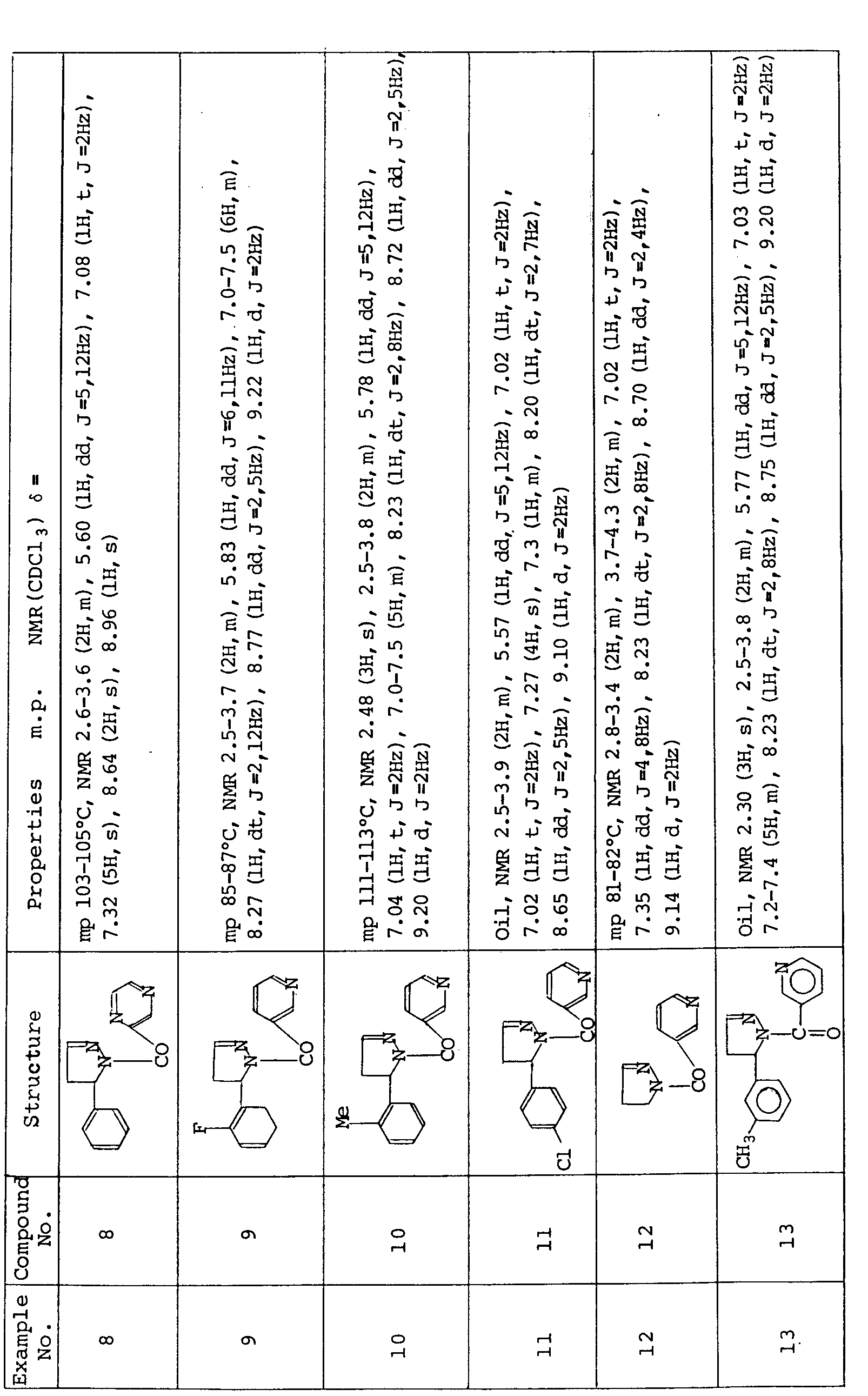
- 2-Pyrazoline derivatives of claims 2 to 4 represented by the general formula (A) include the following compounds (the same compound No. as in Table 1 ):
- the a, ,8-unsaturated aldehydes not readily available commercially can be synthesized by reaction of an aldehyde (R 1 as mentioned above) with diethylphosphonoacetonitrile to form an a, ,8-unsaturated nitrile followed by reaction with diisobutylaluminum hydride.
- compositions for treating cerebrovascular diseases are formed not only with a compound selected from compounds No. 1 to No. 30 as listed above, but also a compound selected from the following list can be used; in this list the compounds No. 32 to 49, 60, 65 and 66 are those of claim 7.
- the compounds 1-66 are altogether represented by the a.m. general formula :
- salts of the compounds of the invention may be mentioned hydrochlorides, phosphates, fumarates and maleates.
- 2-pyrazoline derivatives and salts thereof may be applied in the form of parenteral injections, suppositories or oral preparations. Alternatively, these may also be transfused as a 20% glycerol solution as commonly used for the treatment of cerebral edemas.
- the preferable dose of the aforementioned 2-pyrazoline derivatives and salts thereof in the acute stage of cerebrovascular diseases is 0.1 to 2.0 g/day.
- 10 ml of a parenteral solution containing 3 % of a 2-pyrazoline derivative mentioned above or a salt thereof may be intravenously injected several times a day, or 2 ml of a solution containing 15% of that compound may be intramuscularly injected several times a day.
- Suppositories can be prepared by dispersing or dissolving fine powder of a 2-pyrazoline derivative mentioned above or a salt thereof in a base material, such as Witebsol@, preferably in an amount of 1 to 10 %.
- tablets and capsules can be prepared by mixing 0.1 to 2.0 g of a 2-pyrazoline derivative mentioned above or a salt thereof with pharmaceutically acceptable vehicle, excipient, binder and stabilizer by commonly used techniques.
- the oral agents thus prepared may be administered several times a day depending on the conditions of patients.
- Acetic acid ( 2.7 g ) was added dropwsie to a solution of 2.3 g hydrazine monohydrate in 5 ml ethanol with ice cooling. The resulting mixture was heated under reflux, 5 g of cinnamaldehyde was added dropwise, and heating under reflux was further continued for three hours. After cooling with ice, 3.5 ml of conc. ammonia was added dropwise, and the mixture was extracted twice with 20 ml chloroform. The extract was dried over anhydrous magnesium sulfate, and the dried solution was distilled under reduced pressure ( 110-115 ° C/6mmHg ), affording 3.8 g ( yield: 69 % ) of 5-phenyl-2-pyrzoline.
- Cinnamaldehyde ( 13.2 g ) was added dropwise to a solution of 5 g methylhydrazine in 50 ml ethanol, and the mixture was heated under reflux for six hours. At the end of reaction, the solvent was distilled off under reduced pressure, and the residue was dissolved in 50 ml ether. The solution was washed with water and concentrated, and the concentrate was distilled under reduced pressure, giving 3.6 g (yield: 22 % ) of pure product.
- Ethyl chlorofromate ( 12 g ) was added dropwise under ice cooling to a solution of 14.6 g 5-phenyl-2-pyrazoline and 12 g triethylamine in 100 ml chloroform, and the mixture was stirred at room temperature for three hours.
- the reaction mixture was washed with 3% hydrochloric acid and 3% aqueous solution of sodium bicarbonate in that order and then dried over anhydrous sodium sulfate.
- the solvent was distilled off from the dried solution, and the oily residue thus obtained ( 20 g ) was dissolved in 80 ml ethanol.
- Nicotinic acid hydrazide ( 18 g ) was added in small portions with ice cooling to 22 ml concentrated hydrochloric acid, and 30 ml of aqueous solution of 18 g sodium nitrite was then added dropwise while maintaining the temperature at 0°C or lower. The mixture was stirred at 0°C for 15 minutes and extracted with ether, the extract was washed with an aqueous soltuion of sodium bicarbonate and dried over anhydrous sodium sulfate, and the solvent was distilled off from the dried solution, giving 16 g of nicotinic acid azide.
- Example 38 Test I ( Action upon ischemic cerebral edemas of rats caused by occlusion of the middle cerebral artery)
- Middle cerebral artery occlusion of rats was induced by the method of Tamura et al. ( J. Cerebral Blood Flow and Metabolism, 1981, 53-60 ); the left middle cerebral artery of Wistar rats ( 8 to 10 weeks old ) was occluded under anesthesia with 2% halothane.
- a compound being tested was suspended in 0,5 % aqueous solution of carboxymethyl cellulose, and this suspension was intraperitoneally injected to each rat immediately after occlusion, and 8 hours and 16 hours later (a total of three times).
- Acute toxicity was determined by intraperitoneal injection of a compound being tested to mice and by calculation from the mortality 48 hours after injection by the usual method. These results are summarized in Table 2.
- Example 39 Test II ( Action against cerebral infarction of rats caused by occlusion of the middle cerebral artery)
- Cerebral infarction of rats caused by occlusion of the middle cerebral artery was measured by the method of Tamura et al. ( Japan Clinics, 43, 185, 1985 ).
- the middle cerebral artery of rats was artificially occluded, a compound being tested was suspended in 0.5% aqueous solution of CMC, and this suspension was intraperitoneally injected to each rat immediately after occlusion, and 8 hours and 16 hours later ( a total of three times ).
- Example 40 Tablets containing 1-(3-pyridylcarbonyl)-5-phenyl-2-pyrazoline as active ingredient )
- Example 41 Injections containing 1-(3-pyridylcarbonyl)-5-methyl-2-pyrazoline as active ingredient )
- the solution prepared above may be used for transfusion by diluting it with 200 ml of 0.9% physiological saline or by dissolving it in 200 ml of 10% glycerol solution.
- Example 42 Suppositories containing 1-(3-pyridylcarbonyl)-5-butyl-2-pyrazoline as active ingredient )
Landscapes
- Chemical & Material Sciences (AREA)
- Organic Chemistry (AREA)
- Health & Medical Sciences (AREA)
- Medicinal Chemistry (AREA)
- Pharmacology & Pharmacy (AREA)
- Epidemiology (AREA)
- Life Sciences & Earth Sciences (AREA)
- Animal Behavior & Ethology (AREA)
- General Health & Medical Sciences (AREA)
- Public Health (AREA)
- Veterinary Medicine (AREA)
- Plural Heterocyclic Compounds (AREA)
- Pharmaceuticals Containing Other Organic And Inorganic Compounds (AREA)
Description
- The invention relates to 2-pyrazoline derivatives which have inhibitory action against the formation of cerebral edemas in the acute stage of cerebral apoplexy, thereby protecting ischemic lesions and curing nervous disorders after recuperation, to a process for producing the same, and to agents containing the same as active ingredient.
- Although the mortality from cerebrovascular diseases in Japan has been decreasing year by year (now ranking third to follow those from cancers and heart diseases), it has, however, been reported that 30 to 60 % of the patients with cerebral diseases die in the acute stage, and that many of the patients saved from death are still suffering from cloudiness of consciousness, motor disturbance or sensory insufficiency. Incidentally, it is generally accepted that more than half of the cases of senile dementia in Japan are caused by cerebrovascular diseases.
- Most of nervous disorders remaining after escape from death, which originate from cerebral ischemia in the acute stage, are difficult to cure in the chronic stage when lesions are inveterate.
- Thus the successful treatment in the acute stage is very important with cerebrovascular diseases not only for survival but also for the remedy of lesions remaining after escape from death.
- In remedy in the acute stage of cerebral apoplexy, emphasis is placed on regulating the whole-body and intracranial blood circulation to protect ischemic lesions and minimize the spread of affected parts.
- Transfusion of a hypertonic solution ( e.g., glycerol ) and intravenous administration of a steroidal agent have been adopted to suppress cerebral edemas. But the former tends to disturb the balance among electrolytes in the blood, while the latter has side effects, such as hemorrhage of digestive tracts. Barbiturates ( e.g., thiopental, pentobarbital and mefobarbital ) are also known to have ability to protect the brain from cerebral ischemia ( Anesthesiology, 47, 285, 1977 ), and have been applied clinically ( Japan Clinics, 43, 185, 1985 ). But the drugs of this type can be used only in institutions capable of whole-body control of patients, because the effective dose is very close to the dose that causes lowered consciousness and suppressed respiration. In addition, barbiturates have side effects, such as hepatic and renal function insufficiencies.
- Recently, Nizofenone has been reported as a drug having action to protect the brain from cerebral ischemia. This helps alleviate consciousness troubles, but has no action to inhibit cerebral edemas ( Japan Clinics, 43, 185, 1985 ).
- Thus there is a strong demand for new medicaments and their pharmaceutically active chemicals which inhibit the formation of cerebral edemas in the acute stage of cerebrovascular diseases, thereby protecting ischemic lesions and curing nervous disorders after recuperation, and the object of the present invention is directed to this aim.
- According to the invention this object is solved by the 2-pyrazoline derivatives of claim 1 represented by the following formula:

- According to claim 5 the process for the production of the 2-pyrazoline derivatives of formula (A) comprises reaction of an a, ,8-unsaturated aldehyde of the formula:


- Claim 6 demonstrates the pharmaceutical composition for treating cerebrovascular diseases containing, as active ingredient, a 2-pyrazoline derivative of the following formula:

- 2-Pyrazoline derivatives of claims 2 to 4 represented by the general formula (A) include the following compounds ( the same compound No. as in Table 1 ):
- 1. 1-(3-Pyridylcarbonyl)-5-phenyl-2-pyrazoline
- 2. 1-(4-Pyridylcarbonyl)-5-phenyl-2-pyrazoline
- 3. 1-(2-Pyridylcarbonyl)-5-phenyl-2-pyrazoline
- 4. 1-(3-Pyridylcarbonyl)-5-(2-methoxyphenyl)-2-pyrazoline
- 5. 1-(3-Pyridylcarbonyl)-5-(3-methoxyphenyl)-2-pyrazoline
- 6. 1-(3-Pyridylcarbonyl)-5-(4-methoxyphenyl)-2-pyrazoline
- 7. 1-(3-Pyridylcarbonyl)-5-(2-furyl)-2-pyrazoline
- 8. 1-Pyrazylcarbonyl-5-phenyl-2-pyrazoline
- 9. 1-(3-Pyridylcarbonyl)-5-(2-fluorophenyl)-2-pyrazoline
- 10. 1-(3-Pyridylcarbonyl)-5-(2-methylphenyl)-2-pyrazoline
- 11. 1-(3-Pyridylcarbonyl)-5-(4-chlorophenyl)-2-pyrazoline
- 12. 1-(3-Pyridylcarbonyl)-2-pyrazoline
- 13. 1-(3-Pyridylcarbonyl)-5-(3-methylphenyl)-2-pyrazoline
- 14. 1-(3-Pyridylcarbonyl)-5-(4-methylphenyl)-2-pyrazoline
- 15. 1-(3-Pyridylcarbonyl)-5-(2-chlorophenyl)-2-pyrazoline
- 16. 1-(3-Pyridylcarbonyl)-5-(3-pyridyl)-2-pyrazoline
- 17. 1-(3-Pyridylcarbonyl)-5-methyl-2-pyrazoline
- 18. 1-(2-Pyridylcarbonyl)-5-methyl-2-pyrazoline
- 19. 1-Pyrazylcarbonyl-5-methyl-2-pyrazoline
- 20. 1-(3-Pyridylcarbonyl)-5-ethyl-2-pyrazoline
- 21. 1-(3-Pyridylcarbonyl)-5-propyl-2-pyrazoline
- 22. 1-(3-Pyridylcarbonyl)-5-isopropyl-2-pyrazoline
- 23. 1-(3-Pyridylcarbonyl)-5-cyclopropyl-2-pyrazoline
- 24. 1-(3-Pyridylcarbonyl)-5-butyl-2-pyrazoline
- 25. 1-Ethoxycarbonyl-5-phenyl-2-pyrazoline
- 26. 1-Ethoxycarbonyl-5-(3-pyridyl)-2-pyrazoline
- 27. 1-Ethoxycarbonyl-5-(2-chlorophenyl)-2-pyrazoline
- 28. 1-Ethoxycarbonyl-5-methyl-2-pyrazoline
- 29. 1-Butoxycarbonyl-5-methyl-2-pyrazoline
- 30. 1-Methoxycarbonyl-5-ethyl-2-pyrazoline
- The a, ,8-unsaturated aldehydes not readily available commercially can be synthesized by reaction of an aldehyde


- The pharmaceutical compositions for treating cerebrovascular diseases, containing an active ingredient, are formed not only with a compound selected from compounds No. 1 to No. 30 as listed above, but also a compound selected from the following list can be used; in this list the compounds No. 32 to 49, 60, 65 and 66 are those of claim 7.
- 31. 5-Phenyl-2-pyrazoline
- 32. 5-(4-Chlorophenyl)-2-pyrazoline
- 33. 5-(3-Chlorophenyl)-2-pyrazoline
- 34. 5-(2-Chlorophenyl)-2-pyrazoline
- 35. 5-(4-Methylphenyl)-2-pyrazoline
- 36. 5-(3-Methylphenyl)-2-pyrazoline
- 37. 5-(2-Methylphenyl)-2-pyrazoline
- 38. 5-(4-Methoxylphenyl)-2-pyrazoline
- 39. 5-(3-Methoxylphenyl)-2-pyrazoline
- 40. 5-(2-Methoxylphenyl)-2-pyrazoline
- 41. 5-(4-Fluorophenyl)-2-pyrazoline
- 42. 5-(3-Fluorophenyl)-2-pyrazoline
- 43. 5-(2-Fluorophenyl)-2-pyrazoline
- 44. 5-(4-Trifluoromethylphenyl)-2-pyrazoline
- 45. 5-(3-Trifluoromethylphenyl)-2-pyrazoline
- 46. 5-(2-Trifluoromethylphenyl)-2-pyrazoline
- 47. 5-(4-Hydroxyphenyl)-2-pyrazoline
- 48. 5-(3-Hydroxyphenyl)-2-pyrazoline
- 49. 5-(2-Hydroxyphenyl)-2-pyrazoline
- 50. 5-Methyl-2-pyrazoline
- 51. 5-Cyclohexyl-2-pyrazoline
- 52. 5-(4-Pyridyl)-2-pyrazoline
- 53. 5-(3-Pyridyl)-2-pyrazoline
- 54. 5-(2-Pyridyl)-2-pyrazoline
- 55. 1-Methyl-5-phenyl-2-pyrazoline
- 56. 1-Acetyl-5-phenyl-2-pyrazoline
- 57. Sodium 5-phenyl-2-pyrazoline-1-carboxylate
- 58. 1-Amino-5-phenyl-2-pyrazoline
- 59. 1-Benzoyl-5-phenyl-2-pyrazoline
- 60. 1-(4-Trifluoromethylbenzoyl)-5-phenyl-2-pyrazoline
- 61. 1-Benzoylmethyl-5-phenyl-2-pyrazoline
- 62. 1-Cyclohexylcarbonyl-5-phenyl-2-pyrazoline
- 63. 1-(2-Furylcarbonyl)-5-phenyl-2-pyrazoline
- 64. 1-(2-Thienylcarbonyl)-5-phenyl-2-pyrazoline
- 65. 1-[N-(3-pyridyl)carbamoyl]-5-phenyl-2-pyrazoline
- 66. 1-[N-(3-pyridyl)thiocarbamoyl]-5-phenyl-2-pyrazoline
- The compounds 1-66 are altogether represented by the a.m. general formula :

- As examples of the salts of the compounds of the invention, may be mentioned hydrochlorides, phosphates, fumarates and maleates.
- The above-mentioned 2-pyrazoline derivatives and salts thereof may be applied in the form of parenteral injections, suppositories or oral preparations. Alternatively, these may also be transfused as a 20% glycerol solution as commonly used for the treatment of cerebral edemas.
- The preferable dose of the aforementioned 2-pyrazoline derivatives and salts thereof in the acute stage of cerebrovascular diseases is 0.1 to 2.0 g/day. When applied as parenteral injections, for example, 10 ml of a parenteral solution containing 3 % of a 2-pyrazoline derivative mentioned above or a salt thereof may be intravenously injected several times a day, or 2 ml of a solution containing 15% of that compound may be intramuscularly injected several times a day. Suppositories can be prepared by dispersing or dissolving fine powder of a 2-pyrazoline derivative mentioned above or a salt thereof in a base material, such as Witebsol@, preferably in an amount of 1 to 10 %. In actual practice, for example, three grams of a suppository containing 5 to 10 % of the active ingredient may be applied several times a day. For oral administration, tablets and capsules can be prepared by mixing 0.1 to 2.0 g of a 2-pyrazoline derivative mentioned above or a salt thereof with pharmaceutically acceptable vehicle, excipient, binder and stabilizer by commonly used techniques. The oral agents thus prepared may be administered several times a day depending on the conditions of patients.
- The following preparative examples 1 to 28 will further illustrate the invention.
- Four grams of 60% sodium hydride was suspended in 100 ml tetrahydrofuran, and 17.1 g of diethylphosphonoacetonitrile was added with ice cooling. To the resulting solution, was added dropwise a solution of 10.6 g benzaldehyde in 80 ml tetrahydrofuran, and the mixture was stirred for one hour. After admixing 50 ml water, the organic layer was collected, dried over anhydrous sodium sulfate and concentrated. Distillation of the concentrate under reduced pressure ( 102-106 ° C/6mmHg ) gave 8.9 g ( yield: 69.0 % ) of cinnamonitrile.
- To a solution of 8 g cinnamonitrile in 100 ml tetrahydrofuran, was added dropwise 50 ml of a 1.5M toluene solution of diisobutylaluminum hydride with ice cooling, and the resulting mixture was stirred at room temperature for two hours. The reaction mixture was slowly poured to 200 ml ice water, hydrochloric acid was then added to dissolve the aluminum hydroxide formed, and the organic layer was collected and dried. Distillation of the dried solution under reduced pressure gave 5.2 g ( yield: 63.6 % ) of cinnamaldehyde.
- Acetic acid ( 2.7 g ) was added dropwsie to a solution of 2.3 g hydrazine monohydrate in 5 ml ethanol with ice cooling. The resulting mixture was heated under reflux, 5 g of cinnamaldehyde was added dropwise, and heating under reflux was further continued for three hours. After cooling with ice, 3.5 ml of conc. ammonia was added dropwise, and the mixture was extracted twice with 20 ml chloroform. The extract was dried over anhydrous magnesium sulfate, and the dried solution was distilled under reduced pressure ( 110-115 ° C/6mmHg ), affording 3.8 g ( yield: 69 % ) of 5-phenyl-2-pyrzoline.
- A mixture of 5-phenyl-2-pyrazoline ( 2.9 g ) and triethylamine ( 4 g ) was added dropwise with ice cooling to a suspension of nicotinoyl chloride hydrochloride ( 4 g ) in 20 ml chloroform, the resulting mixture was stirred for 15 minutes, washed with water and concentrated, and the concentrate was purified by silica gel chromatography ( chloroform/methanol = 100/1 ), giving 4.3 g ( yield: 86 % ) of pure product. M.p. 100-102°C; NMR (CDCl3 ): 2.9-3.8 ( 2H, m ), 5.61 ( 1 H, dd, J = 5, 12Hz ), 7.03 ( 1 H, t, J = 2Hz ), 7.31 ( 5H, s ), 7.28(1H,m),8.15(1H,dt,J=8,2Hz),8.68(1H,dd,J=2,6Hz),9.13(1H,d,J=2Hz).
- Compounds No.2 through No.24, prepared in the same manner as in Example 1, are shown in Table 1.
- Triethylamine ( 2.1 g ) was added to a solution of 2.92 g 5-phenyl-2-pyrazoline in 50 ml chloroform, and the mixture was stirred with ice cooling. To the resulting solution, was added dropwise 2.17 g ethyl chloroformate, and the mixture was stirred for one hour. After addition of 50 ml water, the mixture was extracted with 50 ml chloroform, the extract was dried, the dried solution was concentrated, and the residue was purified by silical gel chromatography ( chloroform/methanol = 100/1 ), giving 2.7 g ( yield: 62 % ) of pure product as oil. NMR ( DMSO-d6 ): 1.21 ( 3H, t, J = 6Hz ), 2.6-3.7 ( 2H, m ), 4.18 ( 2H, q, J = 6HZ ), 5.22 ( 1H, dd, J=6, 12Hz), 6.92 ( 1H,t, J=2Hz), 7.1-7.5 (5H, m
- Compounds No.26 through No.30, prepared in the same manner as in Example 23, are shown in Table 1.
- Further preparations are illustrated in the following examples 29 to 37.
- Compounds No.59, No.60, No.62, No.63 and No.64, prepared in the same manner as in Example 1, are shown in Table 1.



- Cinnamaldehyde ( 13.2 g ) was added dropwise to a solution of 5 g methylhydrazine in 50 ml ethanol, and the mixture was heated under reflux for six hours. At the end of reaction, the solvent was distilled off under reduced pressure, and the residue was dissolved in 50 ml ether. The solution was washed with water and concentrated, and the concentrate was distilled under reduced pressure, giving 3.6 g (yield: 22 % ) of pure product. B.p.: 95-105°C/5mmHg; NMR ( CDCl3 ): 2.2-3.3 ( 2H, m ), 2.65 ( 3H, s ), 3.76 ( 1 H, dd, J=10, 14Hz 6.51 ( 1 H, t, J = 2Hz 7.1-7.6 ( 5H, m ).
- Ethyl chlorofromate ( 12 g ) was added dropwise under ice cooling to a solution of 14.6 g 5-phenyl-2-pyrazoline and 12 g triethylamine in 100 ml chloroform, and the mixture was stirred at room temperature for three hours. The reaction mixture was washed with 3% hydrochloric acid and 3% aqueous solution of sodium bicarbonate in that order and then dried over anhydrous sodium sulfate. The solvent was distilled off from the dried solution, and the oily residue thus obtained ( 20 g ) was dissolved in 80 ml ethanol. To this ethanolic solution, was added 10 ml of 40% aqueous solution of caustic soda, the mixture was stirred at room temperature for one hour, and the crystals which precipitated out were collected by filtration and dried under reduced pressure, affording 12 g of pure product. M.p.: 210°C ( dec. ); NMR ( D20 ): 2.6-3.4 ( 2H, m ),4.7(1H,dd,J=12,5Hz),7.14(1H,t,J=2Hz),7.40(5H,s).
- Nicotinic acid hydrazide ( 18 g ) was added in small portions with ice cooling to 22 ml concentrated hydrochloric acid, and 30 ml of aqueous solution of 18 g sodium nitrite was then added dropwise while maintaining the temperature at 0°C or lower. The mixture was stirred at 0°C for 15 minutes and extracted with ether, the extract was washed with an aqueous soltuion of sodium bicarbonate and dried over anhydrous sodium sulfate, and the solvent was distilled off from the dried solution, giving 16 g of nicotinic acid azide.
- This was dissolved in 100 ml benzene, the solution was heated under reflux for five hours, the insoluble matters were filtered off, and the filtrate was concentrated under reduced pressure, giving 13 g of 3-pyridyl isocyanate. A solution of 7.5 g of this compound in 20 ml ethyl acetate was added dropwise to a solution of 7.3 g 5-phenyl-2-pyrazoline in 50 ml ethyl acetate, and the mixture was stirred at room temperature for 30 minutes and then concentrated. The concentrate was purified by silica gel chromatography ( chloroform/methanol = 50/1 ), affording 2.1 g ( yield: 79 % ) of pure product. M.p.: 104-106 °C; NMR (CDCl3 ): 2.6-3.8 ( 2H, m ), 5.38 ( 1 H, dd, J=5, 12Hz ), 6.90 ( 1 H, t, J=2Hz ), 7.30 ( 5H, s ), 7.20 ( 1 H, m ), 8.0-8.4 ( 2H,m),8.2 (1H,b), 8.58 (1H,d,J=2Hz). ).
- To a solution of 9.4 g 3-aminopyridine and 7.6 g carbon disulfide in 100 ml benzene, was added dropwise 14 ml triethylamine, the mixture was stirred at room temperature for three hours, and the two separate layers thus formed were allowed to stand overnight. The benzene layer was removed by decantation, the oily product was washed four times with 30 ml ether, and the solvent was distilled off under reduced pressure, affording triethylammonium (3-pyridyl)dithiocarbamate. This crude salt was dissolved in 75 ml chloroform, 14 ml triethylamine was added, and the resulting solution was cooled in ice. Ethyl chloroformate ( 10.2 ml ) was then added dropwise, the reaction was allowed to proceed at room temperature for one hour, and the reaction mixture was washed with 50 ml water, dried over anhydrous sodium sulfate and concentrated under reduced pressure, giving 13.2 g of crude 3-pyridyl isothiocyanate as oil.
- A solution of this oil ( 7.5 g ) in 20 ml chloroform was added dropwise to a solution of 7.3 g 5-phenyl-2-pyrazoline in 50 ml chloroform, the mxiture was stirred for 30 minutes and then concentrated, and the concentrate was purified by silica gel chromatography ( chloroform/methanol = 50/1 ), giving 8.0 g ( yield: 57 % ) of pure product. M.p.: 156-158 °C; NMR ( CDCl3 ): 2.6-3.8 ( 2H, m ), 5.83 ( 1 H, dd, J = 5, 11 Hz ), 7.07 ( 1 H, t, J = 2Hz ), 7.30 ( 5H, s ), 7.25 ( 1 H, m ), 8.2-8.5 ( 2H, m ), 8.67 ( 1 N, d, J = 2Hz ), 9.26 ( 1 H, b ).
- Middle cerebral artery occlusion of rats was induced by the method of Tamura et al. ( J. Cerebral Blood Flow and Metabolism, 1981, 53-60 ); the left middle cerebral artery of Wistar rats ( 8 to 10 weeks old ) was occluded under anesthesia with 2% halothane. A compound being tested was suspended in 0,5 % aqueous solution of carboxymethyl cellulose, and this suspension was intraperitoneally injected to each rat immediately after occlusion, and 8 hours and 16 hours later (a total of three times). Twenty-four hours after occlusion each of the treated rats was killed, the brain was excised, the water contents of hemispheres were determined by weighing the hemispheres before and after drying at 110°C to the constant weight. On the other hand, the rats of control group were subjected to arterial occlusion in the same way as above, followed by intraperitoneal injection of physiological saline three times a day. The cerebral edema inhibition rate of each compound was calculated from the following equation:

- Acute toxicity (LD50) was determined by intraperitoneal injection of a compound being tested to mice and by calculation from the mortality 48 hours after injection by the usual method. These results are summarized in Table 2.

- Cerebral infarction of rats caused by occlusion of the middle cerebral artery was measured by the method of Tamura et al. ( Japan Clinics, 43, 185, 1985 ). The middle cerebral artery of rats was artificially occluded, a compound being tested was suspended in 0.5% aqueous solution of CMC, and this suspension was intraperitoneally injected to each rat immediately after occlusion, and 8 hours and 16 hours later ( a total of three times ). Twenty-four hours after obstruction, each of the treated rats was killed, and the brain was excised, stained with TTC and cut into equal six parts from top to bottom. The cross-sections were photographed, and the ratio of infarcted areas to the whole brain was measured by means of a planimeter. The result is shown in Table 3.

- Examples 40 to 42 demonstrate some use forms.
- An intimate mixture of 45 g 1-(3-pyridylcarbonyl)-5-phenyl-2-pyrazoline, 42 g lactose, 45 g corn starch and 25 g crystaline cellulose was kneaded and granulated using an aqueous solution of 5 g hydroxypropylcellulose, and the granules thus obtained were dried at 50 °C for four hours, mixed with 3 g magnesium stearate, and shaped into tablets ( each weighing 200 mg ) with a tablet machine.
- 1-(3-Pyridylcarbonyl)-5-methyl-2-pyrazoline ( 0.3 g ) was dissolved in 10 ml of 0.9% physiological saline, and the solution was sealed in a 10-ml ampule, giving an aqueous parenteral injection.
- The solution prepared above may be used for transfusion by diluting it with 200 ml of 0.9% physiological saline or by dissolving it in 200 ml of 10% glycerol solution.
- 1-(3-Pyridylcarbonyl)-5-butyl-2-pyrazoline ( 10 g ) was dissolved in 9 g Witebsol@ ( Dinamit Nobel Chemicals, West Germany ) by heating at 60 °C, the homogeneous mixture thus obtained was cast into a mold ( each piece weighing 1.5 g or 3 g ) and solidified by cooling, giving suppositories.
When the a.m. 2-pyrazoline derivatives are prepared as described above, it should be considered in the first step that the amount of hydrazine can be reduced to 1.0 to 1.5 equivalent proportions if the reaction is carried out in the presence of acetic acid (preferably in an amount of 0.5 to 2 equivalent proportions based on the amount of hydrazine) whereas without acetic acid the hydrazine used to be employed in large excess to prevent the formation of by-product azines. The studies on this reaction revealed that the reaction may be allowed to proceed in a suitable solvent, such a water, methanol and ethanol.
Claims (9)


Applications Claiming Priority (2)
| Application Number | Priority Date | Filing Date | Title |
|---|---|---|---|
| JP148919/87 | 1987-06-17 | ||
| JP14891987 | 1987-06-17 |
Publications (3)
| Publication Number | Publication Date |
|---|---|
| EP0295695A2 EP0295695A2 (en) | 1988-12-21 |
| EP0295695A3 EP0295695A3 (en) | 1990-06-06 |
| EP0295695B1 true EP0295695B1 (en) | 1994-06-08 |
Family
ID=15463593
Family Applications (1)
| Application Number | Title | Priority Date | Filing Date |
|---|---|---|---|
| EP88109678A Expired - Lifetime EP0295695B1 (en) | 1987-06-17 | 1988-06-16 | Pyrazoline derivatives and agents for treating cerebrovascular diseases containing the same as active ingredient |
Country Status (7)
| Country | Link |
|---|---|
| US (2) | US4839376A (en) |
| EP (1) | EP0295695B1 (en) |
| KR (1) | KR900004413B1 (en) |
| CN (1) | CN1014245B (en) |
| CA (1) | CA1311760C (en) |
| DE (1) | DE3889974T2 (en) |
| HU (2) | HU202106B (en) |
Families Citing this family (13)
| Publication number | Priority date | Publication date | Assignee | Title |
|---|---|---|---|---|
| US4895947A (en) * | 1987-12-17 | 1990-01-23 | Mitsui Toatsu Chemicals, Inc. | Process for producing 1-acyl-2-pyrazoline derivative |
| US5089622A (en) * | 1988-12-12 | 1992-02-18 | Mitsui Toatsu Chemicals Incorporated | (-)-2-pyrazoline compounds and therapeutic agent for cerebrovascular disorders containing the same as effective ingredient |
| US5155126A (en) * | 1990-03-20 | 1992-10-13 | E. I. Du Pont De Nemours And Company | Treatment of central nervous system disorders with pyrazole, pyrrole and triazole angiotensin-II receptor antagonists |
| US5250532A (en) * | 1991-04-11 | 1993-10-05 | Dowelanco | 3,4,N-trisubstituted-4,5-dihydro-1H-pyrazole-1-carboxamides and their use as insecticides |
| US5493024A (en) * | 1991-04-11 | 1996-02-20 | Dowelanco | 3,4,N-trisubstituted-4,5-dihydro-1H-pyrazole-1-carboxamides and their use as insectioides |
| US5250561A (en) * | 1991-08-08 | 1993-10-05 | Ortho Pharmaceutical Corporation | Tetrahydroindazole, tetrahydrocyclopentapyrazole, and hexahydrocycloheptapyrazole compounds and their use as HMG-COA reductase inhibitors |
| US5338856A (en) * | 1992-08-17 | 1994-08-16 | Dowelanco | 3,4-N,trisubstituted-4,5-dihydro-1H-pyrazole-1-carboxamides and their use as insecticides |
| WO2007008529A2 (en) * | 2005-07-08 | 2007-01-18 | Kalypsys, Inc | Celullar cholesterol absorption modifiers |
| CN104030983A (en) * | 2014-03-21 | 2014-09-10 | 上海大学 | Fluorine-containing triphenylpyrazole derivative and preparation method thereof |
| TWI730959B (en) * | 2015-05-19 | 2021-06-21 | 英商葛蘭素史克智慧財產發展有限公司 | Heterocyclic amides as kinase inhibitors |
| TW201831464A (en) * | 2016-11-18 | 2018-09-01 | 英商葛蘭素史克智慧財產發展有限公司 | Heterocyclic amides as kinase inhibitors |
| CN114524828B (en) * | 2022-02-22 | 2024-07-09 | 深圳市儿童医院 | A thiazole derivative for treating severe neurological disease and its application |
| CN114524827B (en) * | 2022-02-22 | 2024-07-09 | 深圳市儿童医院 | A pyrazole derivative for treating severe neurological disease and its application |
Family Cites Families (5)
| Publication number | Priority date | Publication date | Assignee | Title |
|---|---|---|---|---|
| US4003889A (en) * | 1973-06-21 | 1977-01-18 | Sandoz Ltd. | 1,3-Diaryl-2-pyrazoline derivatives |
| US4250185A (en) * | 1980-03-10 | 1981-02-10 | Stauffer Chemical Company | 1-(3,5-Dichlorobenzoyl)-3-phenylpyrazolines and their use as mildewicides |
| US4677210A (en) * | 1985-06-19 | 1987-06-30 | Rorer Pharmaceutical Corporation | 1-arylalkoxy- and 1-arylalkylthioaryl-2-pyrazolines as anti-inflammatory or anti-allergic agents |
| JPH0730031B2 (en) * | 1986-04-02 | 1995-04-05 | 日産化学工業株式会社 | Process for producing 2-pyrazolin-5-ones |
| EP0268354A3 (en) * | 1986-10-07 | 1988-06-15 | Imperial Chemical Industries Plc | Substituted pyrazoline |
-
1988
- 1988-06-10 HU HU896190A patent/HU202106B/en not_active IP Right Cessation
- 1988-06-10 HU HU883014A patent/HU199825B/en not_active IP Right Cessation
- 1988-06-13 CA CA000569357A patent/CA1311760C/en not_active Expired - Lifetime
- 1988-06-15 US US07/206,812 patent/US4839376A/en not_active Expired - Lifetime
- 1988-06-16 EP EP88109678A patent/EP0295695B1/en not_active Expired - Lifetime
- 1988-06-16 DE DE3889974T patent/DE3889974T2/en not_active Expired - Fee Related
- 1988-06-16 CN CN88103735A patent/CN1014245B/en not_active Expired
- 1988-06-17 KR KR1019880007292A patent/KR900004413B1/en not_active Expired
-
1989
- 1989-04-06 US US07/334,249 patent/US4990529A/en not_active Expired - Lifetime
Also Published As
| Publication number | Publication date |
|---|---|
| CN1014245B (en) | 1991-10-09 |
| HU896190D0 (en) | 1990-02-28 |
| HU199825B (en) | 1990-03-28 |
| KR900004413B1 (en) | 1990-06-25 |
| US4839376A (en) | 1989-06-13 |
| DE3889974T2 (en) | 1994-09-15 |
| EP0295695A2 (en) | 1988-12-21 |
| US4990529A (en) | 1991-02-05 |
| HUT47267A (en) | 1989-02-28 |
| HU202106B (en) | 1991-02-28 |
| EP0295695A3 (en) | 1990-06-06 |
| CA1311760C (en) | 1992-12-22 |
| DE3889974D1 (en) | 1994-07-14 |
| KR890000428A (en) | 1989-03-14 |
| CN88103735A (en) | 1988-12-28 |
Similar Documents
| Publication | Publication Date | Title |
|---|---|---|
| JPH089541B2 (en) | Brain edema inhibitor containing pyrazoles as the main component | |
| JP2694932B2 (en) | 3-amidopyrazole derivative, method for producing the same and pharmaceutical composition | |
| KR970005927B1 (en) | Pyridine and dyridine n-oxide derivatives of diaryl methyl piperidines or piperazines, and compositions and process for preparation thereof | |
| DE3787480T2 (en) | Alpha-heterocyclic-substituted tolunitriles. | |
| US4990529A (en) | Pyrazolone derivatives for treating cerebrovascular diseases | |
| JP2001506280A (en) | 2-substituted 4,5-diarylimidazole | |
| CA2273102A1 (en) | Urea derivatives | |
| JPS63146874A (en) | Indole derivative | |
| JP2002540191A (en) | 1-Arenesulfonyl-2-aryl-pyrrolidine and piperidine derivatives for the treatment of CNS disorders | |
| JPH08169884A (en) | Cyclopropachromenecarboxylic acid derivative | |
| EP1975168A1 (en) | Pyrazole carboxamide derivatives, pharmaceutical compositions and its preparation | |
| CN101282926B (en) | S1P3 receptor antagonist | |
| MXPA06010879A (en) | Pyrazole compounds and uses related thereto. | |
| DE69002338T2 (en) | Pyrrolidine derivatives and their pharmaceutical use. | |
| JPH062742B2 (en) | Novel 2-pyrazolines and cerebrovascular disorder therapeutic agents containing the same | |
| EP0269030B1 (en) | Lipid-peroxide formation inhibiting composition and novel compounds useful therefor | |
| US5153194A (en) | Thienocycloheptapyridazine compounds and their pharmaceutical use | |
| JPH0713017B2 (en) | Pharmaceutical composition having brain cell protective action | |
| US5089622A (en) | (-)-2-pyrazoline compounds and therapeutic agent for cerebrovascular disorders containing the same as effective ingredient | |
| UA121046C2 (en) | INDOLE DERIVATIVES | |
| CN113980001A (en) | Pyrazole alcohol-pyridazinone coupling compound, pharmaceutical composition thereof and application thereof in medicines | |
| JPH06135943A (en) | New uracil derivative and therapeutic agent for allergic disease comprising the same as active ingredient | |
| US5972943A (en) | Pyridinecarboxamide derivatives | |
| FR2756285A1 (en) | N- (IMIDAZOLYLBUTYL) BENZENESULFONAMIDE DERIVATIVES, THEIR PREPARATION AND THEIR THERAPEUTIC USE | |
| JPH07165756A (en) | Hydroxyquinoxalinedione derivative |
Legal Events
| Date | Code | Title | Description |
|---|---|---|---|
| PUAI | Public reference made under article 153(3) epc to a published international application that has entered the european phase |
Free format text: ORIGINAL CODE: 0009012 |
|
| AK | Designated contracting states |
Kind code of ref document: A2 Designated state(s): CH DE FR GB IT LI NL |
|
| PUAL | Search report despatched |
Free format text: ORIGINAL CODE: 0009013 |
|
| AK | Designated contracting states |
Kind code of ref document: A3 Designated state(s): CH DE FR GB IT LI NL |
|
| 17P | Request for examination filed |
Effective date: 19900918 |
|
| 17Q | First examination report despatched |
Effective date: 19910618 |
|
| GRAA | (expected) grant |
Free format text: ORIGINAL CODE: 0009210 |
|
| AK | Designated contracting states |
Kind code of ref document: B1 Designated state(s): CH DE FR GB IT LI NL |
|
| ITF | It: translation for a ep patent filed | ||
| ET | Fr: translation filed | ||
| REF | Corresponds to: |
Ref document number: 3889974 Country of ref document: DE Date of ref document: 19940714 |
|
| PLBE | No opposition filed within time limit |
Free format text: ORIGINAL CODE: 0009261 |
|
| STAA | Information on the status of an ep patent application or granted ep patent |
Free format text: STATUS: NO OPPOSITION FILED WITHIN TIME LIMIT |
|
| 26N | No opposition filed | ||
| REG | Reference to a national code |
Ref country code: CH Ref legal event code: PFA Free format text: MITSUI TOATSU CHEMICALS, INCORPORATED TRANSFER- MITSUI CHEMICALS, INC. |
|
| REG | Reference to a national code |
Ref country code: GB Ref legal event code: 732E |
|
| REG | Reference to a national code |
Ref country code: FR Ref legal event code: TP |
|
| NLS | Nl: assignments of ep-patents |
Owner name: MITSUI CHEMICALS, INC. |
|
| REG | Reference to a national code |
Ref country code: GB Ref legal event code: IF02 |
|
| PGFP | Annual fee paid to national office [announced via postgrant information from national office to epo] |
Ref country code: FR Payment date: 20020610 Year of fee payment: 15 |
|
| PGFP | Annual fee paid to national office [announced via postgrant information from national office to epo] |
Ref country code: GB Payment date: 20020612 Year of fee payment: 15 |
|
| PGFP | Annual fee paid to national office [announced via postgrant information from national office to epo] |
Ref country code: CH Payment date: 20020617 Year of fee payment: 15 |
|
| PGFP | Annual fee paid to national office [announced via postgrant information from national office to epo] |
Ref country code: DE Payment date: 20020619 Year of fee payment: 15 |
|
| PGFP | Annual fee paid to national office [announced via postgrant information from national office to epo] |
Ref country code: NL Payment date: 20020628 Year of fee payment: 15 |
|
| PG25 | Lapsed in a contracting state [announced via postgrant information from national office to epo] |
Ref country code: GB Free format text: LAPSE BECAUSE OF NON-PAYMENT OF DUE FEES Effective date: 20030616 |
|
| PG25 | Lapsed in a contracting state [announced via postgrant information from national office to epo] |
Ref country code: LI Free format text: LAPSE BECAUSE OF NON-PAYMENT OF DUE FEES Effective date: 20030630 Ref country code: CH Free format text: LAPSE BECAUSE OF NON-PAYMENT OF DUE FEES Effective date: 20030630 |
|
| PG25 | Lapsed in a contracting state [announced via postgrant information from national office to epo] |
Ref country code: NL Free format text: LAPSE BECAUSE OF NON-PAYMENT OF DUE FEES Effective date: 20040101 Ref country code: DE Free format text: LAPSE BECAUSE OF NON-PAYMENT OF DUE FEES Effective date: 20040101 |
|
| GBPC | Gb: european patent ceased through non-payment of renewal fee |
Effective date: 20030616 |
|
| REG | Reference to a national code |
Ref country code: CH Ref legal event code: PL |
|
| PG25 | Lapsed in a contracting state [announced via postgrant information from national office to epo] |
Ref country code: FR Free format text: LAPSE BECAUSE OF NON-PAYMENT OF DUE FEES Effective date: 20040227 |
|
| NLV4 | Nl: lapsed or anulled due to non-payment of the annual fee |
Effective date: 20040101 |
|
| REG | Reference to a national code |
Ref country code: FR Ref legal event code: ST |
|
| PG25 | Lapsed in a contracting state [announced via postgrant information from national office to epo] |
Ref country code: IT Free format text: LAPSE BECAUSE OF NON-PAYMENT OF DUE FEES;WARNING: LAPSES OF ITALIAN PATENTS WITH EFFECTIVE DATE BEFORE 2007 MAY HAVE OCCURRED AT ANY TIME BEFORE 2007. THE CORRECT EFFECTIVE DATE MAY BE DIFFERENT FROM THE ONE RECORDED. Effective date: 20050616 |