EP0295350A2 - Application du N-¬2-(diethylamino)ethyl 2-methoxy 4-¬(1-H 4,5-dihydro-2-imidazolyl) amino 5-chloro benzamide comme anxiolytique et anti-psychotique - Google Patents
Application du N-¬2-(diethylamino)ethyl 2-methoxy 4-¬(1-H 4,5-dihydro-2-imidazolyl) amino 5-chloro benzamide comme anxiolytique et anti-psychotique Download PDFInfo
- Publication number
- EP0295350A2 EP0295350A2 EP19870401364 EP87401364A EP0295350A2 EP 0295350 A2 EP0295350 A2 EP 0295350A2 EP 19870401364 EP19870401364 EP 19870401364 EP 87401364 A EP87401364 A EP 87401364A EP 0295350 A2 EP0295350 A2 EP 0295350A2
- Authority
- EP
- European Patent Office
- Prior art keywords
- anxiolytic
- anxiety
- compartment
- methoxy
- diethylamino
- Prior art date
- Legal status (The legal status is an assumption and is not a legal conclusion. Google has not performed a legal analysis and makes no representation as to the accuracy of the status listed.)
- Granted
Links
- 230000000949 anxiolytic effect Effects 0.000 title claims abstract description 14
- 239000002249 anxiolytic agent Substances 0.000 title claims abstract description 10
- -1 4,5-dihydro-2-imidazolyl Chemical group 0.000 title claims abstract description 4
- 125000002924 primary amino group Chemical group [H]N([H])* 0.000 title claims abstract description 4
- 125000001495 ethyl group Chemical group [H]C([H])([H])C([H])([H])* 0.000 title claims 2
- 239000000164 antipsychotic agent Substances 0.000 title description 2
- 230000000561 anti-psychotic effect Effects 0.000 claims abstract description 4
- MJTGQALMWUUPQM-UHFFFAOYSA-N m-Chlorobenzamide Chemical compound NC(=O)C1=CC=CC(Cl)=C1 MJTGQALMWUUPQM-UHFFFAOYSA-N 0.000 claims abstract description 3
- BFSVOASYOCHEOV-UHFFFAOYSA-N 2-diethylaminoethanol Chemical group CCN(CC)CCO BFSVOASYOCHEOV-UHFFFAOYSA-N 0.000 claims 1
- LFIDDKDILRHDBO-UHFFFAOYSA-N 5-chloro-n-[2-(diethylamino)ethyl]-4-(4,5-dihydro-1h-imidazol-2-ylamino)-2-methoxybenzamide Chemical compound C1=C(OC)C(C(=O)NCCN(CC)CC)=CC(Cl)=C1NC1=NCCN1 LFIDDKDILRHDBO-UHFFFAOYSA-N 0.000 claims 1
- ZMANZCXQSJIPKH-UHFFFAOYSA-N triethylamine Natural products CCN(CC)CC ZMANZCXQSJIPKH-UHFFFAOYSA-N 0.000 abstract description 2
- 208000019901 Anxiety disease Diseases 0.000 description 20
- 150000001875 compounds Chemical class 0.000 description 20
- 230000036506 anxiety Effects 0.000 description 17
- 241001465754 Metazoa Species 0.000 description 13
- VYFYYTLLBUKUHU-UHFFFAOYSA-N dopamine Chemical compound NCCC1=CC=C(O)C(O)=C1 VYFYYTLLBUKUHU-UHFFFAOYSA-N 0.000 description 10
- 239000000126 substance Substances 0.000 description 9
- 208000013403 hyperactivity Diseases 0.000 description 8
- 241000699670 Mus sp. Species 0.000 description 7
- 241000700159 Rattus Species 0.000 description 7
- 230000006399 behavior Effects 0.000 description 6
- ZPUCINDJVBIVPJ-LJISPDSOSA-N cocaine Chemical compound O([C@H]1C[C@@H]2CC[C@@H](N2C)[C@H]1C(=O)OC)C(=O)C1=CC=CC=C1 ZPUCINDJVBIVPJ-LJISPDSOSA-N 0.000 description 6
- 230000001684 chronic effect Effects 0.000 description 5
- 229960003638 dopamine Drugs 0.000 description 5
- 229940079593 drug Drugs 0.000 description 5
- 239000003814 drug Substances 0.000 description 5
- SNICXCGAKADSCV-JTQLQIEISA-N (-)-Nicotine Chemical compound CN1CCC[C@H]1C1=CC=CN=C1 SNICXCGAKADSCV-JTQLQIEISA-N 0.000 description 3
- LFQSCWFLJHTTHZ-UHFFFAOYSA-N Ethanol Chemical compound CCO LFQSCWFLJHTTHZ-UHFFFAOYSA-N 0.000 description 3
- 229940049706 benzodiazepine Drugs 0.000 description 3
- 150000001557 benzodiazepines Chemical class 0.000 description 3
- 229960003920 cocaine Drugs 0.000 description 3
- 230000007423 decrease Effects 0.000 description 3
- 230000001419 dependent effect Effects 0.000 description 3
- 230000003291 dopaminomimetic effect Effects 0.000 description 3
- 230000000694 effects Effects 0.000 description 3
- 238000001802 infusion Methods 0.000 description 3
- 241001515942 marmosets Species 0.000 description 3
- 229960002715 nicotine Drugs 0.000 description 3
- SNICXCGAKADSCV-UHFFFAOYSA-N nicotine Natural products CN1CCCC1C1=CC=CN=C1 SNICXCGAKADSCV-UHFFFAOYSA-N 0.000 description 3
- 230000036544 posture Effects 0.000 description 3
- 201000000980 schizophrenia Diseases 0.000 description 3
- 238000007920 subcutaneous administration Methods 0.000 description 3
- 241000699666 Mus <mouse, genus> Species 0.000 description 2
- 208000028017 Psychotic disease Diseases 0.000 description 2
- 230000001430 anti-depressive effect Effects 0.000 description 2
- 230000001090 anti-dopaminergic effect Effects 0.000 description 2
- 230000001353 anxiety effect Effects 0.000 description 2
- 210000004556 brain Anatomy 0.000 description 2
- AAOVKJBEBIDNHE-UHFFFAOYSA-N diazepam Chemical compound N=1CC(=O)N(C)C2=CC=C(Cl)C=C2C=1C1=CC=CC=C1 AAOVKJBEBIDNHE-UHFFFAOYSA-N 0.000 description 2
- 229960003529 diazepam Drugs 0.000 description 2
- 206010013663 drug dependence Diseases 0.000 description 2
- 230000005713 exacerbation Effects 0.000 description 2
- 230000001939 inductive effect Effects 0.000 description 2
- 210000001009 nucleus accumben Anatomy 0.000 description 2
- 230000011273 social behavior Effects 0.000 description 2
- 208000011117 substance-related disease Diseases 0.000 description 2
- 238000002560 therapeutic procedure Methods 0.000 description 2
- MNWSGMTUGXNYHJ-UHFFFAOYSA-N 2-methoxybenzamide Chemical class COC1=CC=CC=C1C(N)=O MNWSGMTUGXNYHJ-UHFFFAOYSA-N 0.000 description 1
- 208000007848 Alcoholism Diseases 0.000 description 1
- 206010063659 Aversion Diseases 0.000 description 1
- 206010012335 Dependence Diseases 0.000 description 1
- 206010057852 Nicotine dependence Diseases 0.000 description 1
- 208000025569 Tobacco Use disease Diseases 0.000 description 1
- 230000003213 activating effect Effects 0.000 description 1
- 239000000935 antidepressant agent Substances 0.000 description 1
- 229940005513 antidepressants Drugs 0.000 description 1
- 230000000338 anxiogenic effect Effects 0.000 description 1
- 238000009227 behaviour therapy Methods 0.000 description 1
- 210000003169 central nervous system Anatomy 0.000 description 1
- 239000003874 central nervous system depressant Substances 0.000 description 1
- 238000006073 displacement reaction Methods 0.000 description 1
- 239000003651 drinking water Substances 0.000 description 1
- 235000020188 drinking water Nutrition 0.000 description 1
- 210000004392 genitalia Anatomy 0.000 description 1
- 125000002883 imidazolyl group Chemical group 0.000 description 1
- 230000006742 locomotor activity Effects 0.000 description 1
- 230000037023 motor activity Effects 0.000 description 1
- 239000003176 neuroleptic agent Substances 0.000 description 1
- 230000000701 neuroleptic effect Effects 0.000 description 1
- 230000003204 osmotic effect Effects 0.000 description 1
- 229940001470 psychoactive drug Drugs 0.000 description 1
- 239000004089 psychotropic agent Substances 0.000 description 1
- 150000003839 salts Chemical class 0.000 description 1
- 230000008786 sensory perception of smell Effects 0.000 description 1
- 238000009987 spinning Methods 0.000 description 1
- 230000002269 spontaneous effect Effects 0.000 description 1
- 230000002936 tranquilizing effect Effects 0.000 description 1
Images



Classifications
-
- A—HUMAN NECESSITIES
- A61—MEDICAL OR VETERINARY SCIENCE; HYGIENE
- A61K—PREPARATIONS FOR MEDICAL, DENTAL OR TOILETRY PURPOSES
- A61K31/00—Medicinal preparations containing organic active ingredients
- A61K31/33—Heterocyclic compounds
- A61K31/395—Heterocyclic compounds having nitrogen as a ring hetero atom, e.g. guanethidine or rifamycins
- A61K31/41—Heterocyclic compounds having nitrogen as a ring hetero atom, e.g. guanethidine or rifamycins having five-membered rings with two or more ring hetero atoms, at least one of which being nitrogen, e.g. tetrazole
- A61K31/415—1,2-Diazoles
-
- A—HUMAN NECESSITIES
- A61—MEDICAL OR VETERINARY SCIENCE; HYGIENE
- A61P—SPECIFIC THERAPEUTIC ACTIVITY OF CHEMICAL COMPOUNDS OR MEDICINAL PREPARATIONS
- A61P25/00—Drugs for disorders of the nervous system
- A61P25/18—Antipsychotics, i.e. neuroleptics; Drugs for mania or schizophrenia
-
- A—HUMAN NECESSITIES
- A61—MEDICAL OR VETERINARY SCIENCE; HYGIENE
- A61P—SPECIFIC THERAPEUTIC ACTIVITY OF CHEMICAL COMPOUNDS OR MEDICINAL PREPARATIONS
- A61P25/00—Drugs for disorders of the nervous system
- A61P25/20—Hypnotics; Sedatives
Definitions
- the present invention relates to a new application of N- (2 (diethylamino) ethyl) 2-methoxy 4 - ((1-H 4.5 dihydro 2 imidazolyl) amino) 5-chloro benzamide, of formula: and its pharmacologically acceptable salts.
- This compound is already known as activating the central nervous system and antidepressant, according to French patent no. 85.18829.
- the anti-depressive activity is also confirmed by the Porsolt test.
- This compound is distinguished, as a psychotropic drug, from other methoxy-benzamide compounds by the fact that it does not have anti-dopaminergic properties.
- the compound according to the invention is not a neuroleptic in the usual sense of the term because it does not bind to the dopaminergic receptors D.-D 2 . It is inactive in the behavioral tests usually carried out to test neuroleptics. These results could not suggest a priori that the compound according to the invention is tranquilizing and more specifically anxiolytic.
- the compound according to the invention is found to be powerfully anxiolytic. This is demonstrated by the test of the box with two compartments (dark and lit) in the mouse, by the observation of the "social" behavior of the rat, by the test of human confrontation in the marmoset. In addition, this compound lifts the anxiety of withdrawal from substances likely to cause drug dependence such as alcohol, nicotine, cocaine ... In use, these substances provide an anxiolytic effect. However, their chronic use is accompanied by a state of dependence. Abrupt discontinuation of these products causes an exacerbation of initial anxiety, making withdrawal from these substances extremely difficult.
- Benzodiazepine-type drugs usually used in the treatment of anxiety, have the drawback of inducing an exacerbation of anxiety when treatment is stopped and therefore do not constitute a therapy well suited for the withdrawal of drug addicts. Contrary to this, no anxiogenic effect is manifested when stopping chronic treatment with the compound according to the invention.
- anti-psychotic drugs are anti-dopaminergics, the current theory of the physiopathology of schizophrenia being an increased dopaminergic activity at the level of the mesolimbe.
- the tests implemented demonstrate that the compound according to the invention suppresses the hyperactivity induced by dopamine perfused in the brain of the rat, more precisely in the nucleus accumbens.
- the protocol used consists of the following tests:
- This test is based on the natural aversion of mice to light.
- the device used is a box comprising two compartments, one of which is dark (indicated “black compartment” in the figures) and the other illuminated (indicated “white compartment” in the figures).
- This device is designed to give the animal the choice of staying in one or other of the compartments. Under normal conditions, the mice avoid the light and stay mainly in the dark part. Under the influence of an anxiolytic, exploration of the illuminated compartment predominates.
- This test consists in observing by video system the behavior of 2 rats, coming from different cages, put in the presence of each other for 10 minutes, in a strongly lit box.
- the "social" behavior of each animal is assessed by measuring the duration of different activities: partner's sense of smell, jump over the partner, toilet, genital exploration and spinning of the partner. Under the anxiety-provoking influence of light, this behavior tends to remain at a reduced level.
- anxiolytic substances such as benzodiazepines
- the compound according to the invention increases social behavior statistically significantly after the administration of a minimum dose of 0.0001 mg / kg subcutaneously (Fig. N ° 3).
- anxiolytic such as diazepam reduces the animal's anxiety and there is a decrease in the number of aggressive postures as well as an increase in the time spent on the front of the cage, facing the 'experimenter.
- the compound according to the invention reduces anxiety. This effect manifests itself s.c. from 0.000001 mg kg by a significant decrease in the number of aggressive postures and a significant increase in the time spent on the front of the cage (Fig. N '4).
- mice made dependent by repeated administration of various substances undergo withdrawal (cessation of treatment).
- the anxiety caused by this withdrawal is objectified as previously described by the two-compartment box test.
- the test consists in administering the product to be tested during weaning until the day of the test of the 2-compartment box, the increase in the number of passages and adjustments in the illuminated compartment being the criterion of the effectiveness of the product. on anxiety caused by withdrawal.
- Certain substances such as benzodiazepines induce dependence after chronic use. This is one of their drawbacks in therapy.
- Chronic administration of the compound according to the invention at a dose of 1 mg / kg x 2, d for 7 days does not induce anxiety within 8, 48 or 96 hours after stopping treatment.
- the anxiolytic effect of the compound according to the invention is maintained after weaning, the adjustments and passages in the lit compartment remaining significantly higher than those of the controls, 8 and 48 hours after weaning to return to the values witnesses at 96 hours (Fig. 9).
- the compound of the invention also proves to be useful in facilitating the withdrawal of various substances and drugs capable of creating drug dependence by preventing the anxiety generated by stopping them.
Landscapes
- Health & Medical Sciences (AREA)
- Pharmacology & Pharmacy (AREA)
- Veterinary Medicine (AREA)
- Public Health (AREA)
- General Health & Medical Sciences (AREA)
- Chemical & Material Sciences (AREA)
- Animal Behavior & Ethology (AREA)
- Life Sciences & Earth Sciences (AREA)
- Medicinal Chemistry (AREA)
- Engineering & Computer Science (AREA)
- Bioinformatics & Cheminformatics (AREA)
- Neurosurgery (AREA)
- Organic Chemistry (AREA)
- Nuclear Medicine, Radiotherapy & Molecular Imaging (AREA)
- General Chemical & Material Sciences (AREA)
- Chemical Kinetics & Catalysis (AREA)
- Neurology (AREA)
- Biomedical Technology (AREA)
- Epidemiology (AREA)
- Psychiatry (AREA)
- Anesthesiology (AREA)
- Pharmaceuticals Containing Other Organic And Inorganic Compounds (AREA)
- Acyclic And Carbocyclic Compounds In Medicinal Compositions (AREA)
- Organic Low-Molecular-Weight Compounds And Preparation Thereof (AREA)
Abstract
Description
- La présente invention concerne une nouvelle application du N-(2 (diethylamino) éthyl) 2-méthoxy 4-((1-H 4.5 dihydro 2 imidazolyl) amino) 5-chloro benzamide, de formule :

- Ce composé est déjà connu comme activant du système nerveux central et antidépresseur, selon le brevet français n ` 85.18829. L'activité anti-dépressive se trouve d'ailleurs confirmée par le test de Porsolt.
- Ce composé se distingue, en tant que psychotrope, d'autres composés methoxy-benzamides par le fait qu'il ne possède pas de propriétés anti-dopaminergiques. De ce fait. le composé selon l'invention n'est pas un neuroleptique au sens habituel du terme car il ne se lie pas aux récepteurs dopaminergiques D.-D2. Il est inactif dans les essais de comportement habituellement réalisés pour tester les neuroleptiques. Ces résultats ne pouvaient laisser supposer a priori que le composé selon l'invention soit tranquillisant et plus spécifiquement anxiolytique.
- Une étude très approfondie du composé selon l'invention a montré qu'il possédait des propriétés inattendues :
- Le composé selon l'invention se révèle puissamment anxiolytique. Ceci est démontré par le test de la boîte à deux compartiments (sombre et éclairé) chez la souris, par l'observation du comportement "social" du rat, par le test de confrontation humaine chez le ouistiti. De plus, ce composé lève l'anxiété de sevrage de substances susceptibles de provoquer une pharmacodépendance telles que l'alcool, la nicotine, la cocaïne... A l'usage, ces substances procurent un effet anxiolytique. Cependant, leur utilisation chronique s'accompagne d'un état de dépendance. L'arrêt brusque de la prise de ces produits entraîne une exacerbation de l'anxiété initiale, rendant le sevrage de ces substances extrêmement difficile.
- Les médicaments du type benzodiazépine, habituellement utilisés dans le traitement de l'anxiété présentent l'inconvénient d'induire à l'arrêt du traitement une exacerbation de l'anxiété et ne constituent donc pas une thérapie bien adaptée dans le sevrage des toxicomanes. Contrairement à cela, aucun effet anxiogène ne se manifeste lors de l'arrêt d'un traitement chronique par le composé selon l'invention.
- A ce jour, les médicaments anti-psychotiques sont des anti-dopaminergiques, la théorie actuelle de la physio-pathologie de la schizophrénie étant une activité dopaminergique accrue au niveau du mésolimbe.
- Les tests mis en application démontrent que le composé selon l'invention supprime l'hyperactivité induite par la dopamine perfusée dans le cerveau du rat, plus précisément dans le noyau accumbens.
- Le protocole mis en oeuvre consiste en les tests suivants :
- Ce test est basé sur l'aversion naturelle des souris à l'égard de la lumière.
- L'appareil utilisé est une boîte comprenant deux compartiments dont l'un est sombre (indiqué "compartiment noir" dans les figures) et l'autre éclairé (indiqué "compartiment blanc" dans les figures). Cet appareil est conçu pour laisser à l'animal le choix de séjourner dans l'un ou l'autre des compartiments. Dans des conditions normales, les souris évitent la lumière et restent surtout dans la partie sombre. Sous l'influence d'un anxiolytique, l'exploration du compartiment éclairé prédomine.
- Le test consiste à déposer chaque souris au centre du compartiment éclairé et à observer le comportement de l'animal par système vidéo pendant 5 minutes. Le nombre de redressements exploratoires et le nombre de déplacements (franchissement de lignes tracées sur le plancher de chaque compartiment = passages) sont ensuite notés pour chaque compartiment.
-
- - Un effet anxiolytique induit par un médicament tel que le diazepam se caractérise par une augmentation du nombre de redressements exploratoires et du nombre de passages dans le compartiment éclairé.
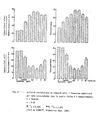
- - Le produit selon l'invention exerce sur ce test un effet anxiolytique qui se manifeste à partir de 0,001 mg/kg par voie sous-cutanée et 0,1 mg.kg par voie orale par l'augmentation significative du nombre des redressements exploratoires et des déplacements dans le compartiment éclairé (Fig. n 1 et no 2).
- Ce test consiste à observer par système vidéo le comportement de 2 rats, issus de cages différentes, mis en présence l'un de l'autre pendant 10 minutes, dans une boite fortement éclairée.
- Le comportement "social" de chaque animal est évalué par la mesure de la durée de différentes activités : flair du partenaire, saut par dessus le partenaire, toilette, exploration génitale et filature du partenaire. Sous l'influence anxiogène de la lumière, ce comportement tend à se maintenir à un niveau réduit.
- L'administration des substances anxiolytiques telles les benzodiazépines, permet la levée de cet effet, avec comme conséquence une augmentation du comportement social.
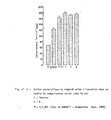
- Le composé selon l'invention augmente le comportement social de façon statistiquement significative après l'administration d'une dose minimale de 0,0001 mg/kg par voie sous-cutanée (Fig. n° 3).
- Chez le ouistiti, la présence d'un expérimentateur inconnu se tenant debout à 60 cm de la cage de l'animal déclenche une anxiété qui se manifeste par une série de postures agressives et le repli de l'animal dans le fond de la cage.
- L'administration d'un anxiolytique comme par exemple le diazepam réduit l'anxiété de l'animal et l'on observe une diminution du nombre de postures agressives ainsi qu'une augmentation du temps passé sur le devant de la cage, face à l'expérimentateur.
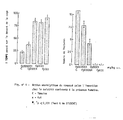
- De la même façon, le composé selon l'invention réduit l'anxiété. Cet effet se manifeste par voie s.c. à partir de 0,000001 mg kg par une diminution significative du nombre de postures agressives et une augmentation significative du temps passé sur le devant de la cage (Fig. n' 4).
- Des souris rendues dépendantes par l'administration répétée de diverses substances subissent un sevrage (arrêt du traitement). L'anxiété provoquée par ce sevrage est objectivée comme précédemment décrit par le test de la boite à deux compartiments.
- De façon générale, l'administration des substances, provoquant la dépendance, diminue "l'état anxieux" de l'animal. Cela se traduit par une augmentation du nombre de redressements et passages dans le compartiment éclairé. Lors du sevrage, l'on constate une exacerbation de l'anxiété de l'animal avec comme conséquence une augmentation du nombre de redressements et de passages dans le compartiment sombre qui dépassent les valeurs observées avant l'administration de la substance.
- Le test consiste à administrer le produit à tester lors du sevrage jusqu'au jour de l'épreuve de la boite à 2 compartiments, l'augmentation du nombre de passages et de redressements dans le compartiment éclairé étant le critère de l'efficacité du produit sur l'anxiété provoquée par le sevrage.
- Des souris rendues dépendantes à l'alcool par adjonction de 8% d'alcool à l'eau de boisson pendant 14 jours subissent un sevrage et sont testées 48 h après le début du sevrage (effet anxiogène maximal).
- L'administration de 1 mgikgrj du composé selon l'invention pendant les 48 heures suivant le sevrage, augmente de façon significative le nombre de passages et de redressements dans le compartiment éclairé par rapport aux animaux sevrés non traités (Fig. n ° 5).
- Des souris rendues dépendantes à la nicotine par administration i.p. de 0.1 mg/kg x 2/j de nicotine pendant 14 jours subissent un sevrage et sont testées 48 h après le début du sevrage (effet anxiogène maximal).
- L'administration de 1 mg/kg/j du composé selon l'invention pendant les 48 heures suivant le sevrage, augmente de façon significative le nombre de passages et de redressements dans le compartiment éclairé par rapport aux animaux sevrés non traités (Fig. n 6).
- Des souris rendues dépendantes à la cocaïne par administration de 1 mg/kg x 2/j pendant 14 jours subissent un sevrage et sont testées 8 h après le début du sevrage (effet anxiogène maximal).
- L'administration, au début du sevrage, de 1 mg.kg du composé selon l'invention augmente de façon significative le nombre de passages et de redressements dans le compartiment éclairé par rapport aux animaux sevrés non traités (Fig. n° 7).
- Certaines substances telles les benzodiazépines induisent une dépendance après utilisation chronique. C'est un de leurs inconvénients en thérapeutique.
- L'administration chronique d'une benzoidazépine pendant 7 jours entraîne, à l'arrêt du traitement une recrudescence de l'anxiété objectivée par un nombre accru de redressements et de passages dans le compartiment sombre (Fig. n 8).
- L'administration chronique du composé selon l'invention à la dose de 1 mg/kg x 2,j pendant 7 jours n'induit pas d'anxiété dans les 8. 48 ou 96 heures après l'arrêt du traitement. Au contraire, on constate que l'effet anxiolytique du composé selon l'invention est maintenu après le sevrage, les redressements et passages dans le compartiment éclairé restant significativement plus élevés que ceux des témoins, 8 et 48 heures après le sevrage pour revenir aux valeurs témoins à 96 heures (Fig. n 9).
- Un des facteurs évoqués pour expliquer la génèse de la schizophrénie, serait une hyperactivité dopaminergique cérébrale. La suppression de cette hyperactivité. comme par les neuroleptiques, permettrait une amélioration de l'état psychotique.
- Dans le test de l'hyperactivité chez le rat. la dopamine est perfusée par voie intra-cérébrale dans le noyau accumbens à l'aide de minipompes osmotiques à une dose de 24 µg/24 heures pendant 13 jours. L'activité motrice spontanée des rats placés cans des cages individuelles est mesurée par l'intermédiaire de cellules photo-électriques. Les résultats sont exprimés en nombre d'interruptions des faisceaux lumineux correspondant aux cellules photo-électriques (passage de l'animal).
- Lors de l'administration de la dopamine, l'on observe une augmentation de l'activité locomotrice des animaux qui se manifeste par deux pics d'hyperactivité vers le 3ème et 9ème jour. Les neuroleptiques classiques empêchent la survenue de cette hyperactivité lorsqu'ils sont administrés pendant la période de la perfusion.
- L'administration du composé selon l'invention à une dose de 0,01 mg/kg s.c. x 2/jour prévient l'apparition de l'hyperactivité normalement induite par la perfusion de la dopamine (Fig. n° 10).
- Les tests cités ci-dessus démontrent l'activité anxiolytique et antipsychotique du composé selon l'invention. Ces propriétés permettent son utilisation comme médicament dans le traitement des divers états d'anxiété ainsi que dans certains états psychotiques.
- Selon les tests, le composé de l'invention se révèle également utile pour faciliter le sevrage de diverses substances et médicaments susceptibles de créer une pharmacodépendance en prévenant l'anxiété engendrée par l'arrêt de ceux-ci.
Claims (2)
Priority Applications (6)
| Application Number | Priority Date | Filing Date | Title |
|---|---|---|---|
| EP87401364A EP0295350B1 (fr) | 1987-06-17 | 1987-06-17 | Application du N-[2-(diethylamino)ethyl]2-methoxy 4-[(1-H 4,5-dihydro-2-imidazolyl) amino]5-chloro benzamide comme anxiolytique et anti-psychotique |
| AT87401364T ATE82124T1 (de) | 1987-06-17 | 1987-06-17 | Anwendung von n-(2-(diaethylamino)aethyl>-2-methoxy-4((1-h-4,5ihydro-2-imidazolyl)amino>-5- chlorobenzamid als anxiolytisches und antipsychotisches mittel. |
| DE8787401364T DE3782651T2 (de) | 1987-06-17 | 1987-06-17 | Anwendung von n-(2-(diaethylamino)aethyl)-2-methoxy-4((1-h-4,5-dihydro-2-imidazolyl)amino)-5-chlorobenzamid als anxiolytisches und antipsychotisches mittel. |
| JP63149247A JPS6485914A (en) | 1987-06-17 | 1988-06-16 | Use of n-(2-(diethylamino)ethyl)-2-methoxy-4- ((1-h-4,5-dihydro-2-imidazolyl)amino)-5- chlorobenzamide as antianxiety and antipsychotic |
| US07/207,947 US5116859A (en) | 1987-06-17 | 1988-06-17 | Method of providing anxiolytic and antipsychotic treatment |
| US07/785,803 US5141949A (en) | 1987-06-17 | 1991-10-31 | Method of providing anxiolytic and antipsychotic treatment |
Applications Claiming Priority (1)
| Application Number | Priority Date | Filing Date | Title |
|---|---|---|---|
| EP87401364A EP0295350B1 (fr) | 1987-06-17 | 1987-06-17 | Application du N-[2-(diethylamino)ethyl]2-methoxy 4-[(1-H 4,5-dihydro-2-imidazolyl) amino]5-chloro benzamide comme anxiolytique et anti-psychotique |
Publications (3)
| Publication Number | Publication Date |
|---|---|
| EP0295350A2 true EP0295350A2 (fr) | 1988-12-21 |
| EP0295350A3 EP0295350A3 (en) | 1990-07-04 |
| EP0295350B1 EP0295350B1 (fr) | 1992-11-11 |
Family
ID=8198221
Family Applications (1)
| Application Number | Title | Priority Date | Filing Date |
|---|---|---|---|
| EP87401364A Expired - Lifetime EP0295350B1 (fr) | 1987-06-17 | 1987-06-17 | Application du N-[2-(diethylamino)ethyl]2-methoxy 4-[(1-H 4,5-dihydro-2-imidazolyl) amino]5-chloro benzamide comme anxiolytique et anti-psychotique |
Country Status (5)
| Country | Link |
|---|---|
| US (2) | US5116859A (fr) |
| EP (1) | EP0295350B1 (fr) |
| JP (1) | JPS6485914A (fr) |
| AT (1) | ATE82124T1 (fr) |
| DE (1) | DE3782651T2 (fr) |
Cited By (3)
| Publication number | Priority date | Publication date | Assignee | Title |
|---|---|---|---|---|
| EP0375504A1 (fr) * | 1988-12-20 | 1990-06-27 | Laboratoires DELAGRANGE | Application de benzamides substitués comme anxiolytiques et anti-psychotiques |
| US5116857A (en) * | 1988-12-14 | 1992-05-26 | Laboratoires Delagrange Div. Societe D'applications Pharmacodynamiques | Method of increasing gastrointestinal motility with substituted benzamides |
| EP0392922A3 (fr) * | 1989-04-12 | 1992-08-05 | Laboratoires DELAGRANGE | Application de dérivés de 2-méthoxy 4-[4,5-dihydro 2-imidazolyl (ou 2-oxazolyl)amino]5-chloro benzamide dans le traitement des troubles de la fonction cognitive |
Families Citing this family (2)
| Publication number | Priority date | Publication date | Assignee | Title |
|---|---|---|---|---|
| US20040251175A1 (en) * | 1998-10-30 | 2004-12-16 | Adams Thomas C. | Apparatuses and methods for making glued screen assemblies |
| EP2073812A4 (fr) * | 2006-09-29 | 2012-08-08 | Univ Illinois | Activateurs de l'histone acétyltransférase et inhibiteurs d'histone déacétylase dans le traitement de l'alcoolisme |
Family Cites Families (5)
| Publication number | Priority date | Publication date | Assignee | Title |
|---|---|---|---|---|
| US3342826A (en) * | 1964-01-13 | 1967-09-19 | Ile De France | Heterocyclic aminoalkyl benzamides |
| US4210660A (en) * | 1978-12-20 | 1980-07-01 | Yamanouchi Pharmaceutical Co., Ltd. | Benzamide derivatives |
| FR2592042B1 (fr) * | 1985-12-19 | 1988-03-25 | Ile De France | Nouveaux ortho-anisamides, leur procede d'obtention, et leurs applications therapeutiques |
| GB8718345D0 (en) * | 1987-08-03 | 1987-09-09 | Fordonal Sa | N-substituted benzamides |
| US4887780A (en) * | 1988-12-30 | 1989-12-19 | The United States Of America As Represented By The Administrator Of The National Aeronautics And Space Administration | Orbiter escape pole |
-
1987
- 1987-06-17 AT AT87401364T patent/ATE82124T1/de not_active IP Right Cessation
- 1987-06-17 DE DE8787401364T patent/DE3782651T2/de not_active Expired - Fee Related
- 1987-06-17 EP EP87401364A patent/EP0295350B1/fr not_active Expired - Lifetime
-
1988
- 1988-06-16 JP JP63149247A patent/JPS6485914A/ja active Pending
- 1988-06-17 US US07/207,947 patent/US5116859A/en not_active Expired - Fee Related
-
1991
- 1991-10-31 US US07/785,803 patent/US5141949A/en not_active Expired - Fee Related
Cited By (4)
| Publication number | Priority date | Publication date | Assignee | Title |
|---|---|---|---|---|
| US5116857A (en) * | 1988-12-14 | 1992-05-26 | Laboratoires Delagrange Div. Societe D'applications Pharmacodynamiques | Method of increasing gastrointestinal motility with substituted benzamides |
| EP0375504A1 (fr) * | 1988-12-20 | 1990-06-27 | Laboratoires DELAGRANGE | Application de benzamides substitués comme anxiolytiques et anti-psychotiques |
| US5086066A (en) * | 1988-12-20 | 1992-02-04 | Laboratoires Delagrange Societe D'applications Pharmacodnymiques | Method of providing anxiolytic and antipsychotic treatment with substituted benzamides |
| EP0392922A3 (fr) * | 1989-04-12 | 1992-08-05 | Laboratoires DELAGRANGE | Application de dérivés de 2-méthoxy 4-[4,5-dihydro 2-imidazolyl (ou 2-oxazolyl)amino]5-chloro benzamide dans le traitement des troubles de la fonction cognitive |
Also Published As
| Publication number | Publication date |
|---|---|
| EP0295350A3 (en) | 1990-07-04 |
| JPS6485914A (en) | 1989-03-30 |
| DE3782651D1 (de) | 1992-12-17 |
| US5141949A (en) | 1992-08-25 |
| DE3782651T2 (de) | 1993-03-25 |
| US5116859A (en) | 1992-05-26 |
| EP0295350B1 (fr) | 1992-11-11 |
| ATE82124T1 (de) | 1992-11-15 |
Similar Documents
| Publication | Publication Date | Title |
|---|---|---|
| Miczek et al. | Brain 5–HT System and Inhibition of Aggressive Behaviour | |
| Sánchez | Stress-induced vocalisation in adult animals. A valid model of anxiety? | |
| Blank et al. | Priming of long-term potentiation in mouse hippocampus by corticotropin-releasing factor and acute stress: implications for hippocampus-dependent learning | |
| Millan et al. | Reciprocal autoreceptor and heteroreceptor control of serotonergic, dopaminergic and noradrenergic transmission in the frontal cortex: relevance to the actions of antidepressant agents | |
| CA3148256A1 (fr) | Procede d'induction de la genese dendritique et synaptique dans des maladies neurodegeneratives chroniques | |
| FR2484941A1 (fr) | ||
| Miczek et al. | Short and long term physiological and neurochemical adaptations to social conflict | |
| LU85639A1 (fr) | Compositions pharmaceutiques et procede de preparation de compositions de phosphatidylserine utilisables au traitement de desordres du systeme nerveux central sans exercer d'effets sur la coagulation du sang | |
| Grubaugh et al. | Microsomal triglyceride transfer protein is necessary to maintain lipid homeostasis and retinal function | |
| EP0295350B1 (fr) | Application du N-[2-(diethylamino)ethyl]2-methoxy 4-[(1-H 4,5-dihydro-2-imidazolyl) amino]5-chloro benzamide comme anxiolytique et anti-psychotique | |
| Mu et al. | Halofuginone attenuates osteoarthritis by rescuing bone remodeling in subchondral bone through oral gavage | |
| Rieger et al. | Neuroendocrine mechanisms of aggression in rodents. | |
| Azmi et al. | Effects of a neurotensin analogue (PD149163) and antagonist (SR142948A) on the scopolamine-induced deficits in a novel object discrimination task | |
| Gianutsos et al. | Narcotic analgesics and aggression | |
| Pennati et al. | Serotonin localization in Phallusia mammillata larvae and effects of 5‐HT antagonists during larval development | |
| CH685920A5 (fr) | Compositions a activite agoniste des recepteurs analogues a 5HT(1) selective. | |
| EP0029790B1 (fr) | Nouveau médicament à base d'aspirine et d'heptaminol | |
| Ebong et al. | Influence of chronic administration of chloroquine on Leydig cell integrity and testosterone profile of albino Wistar rats | |
| EP4516309A1 (fr) | Agonistes de crhr1 destinés à être utilisés dans le traitement de troubles de l'anxiété sociale | |
| Acosta | Neural Mechanisms of Pup-Affiliative Behavior in Adult Virgin California Mice (Peromyscus californicus) | |
| EP0099775A1 (fr) | Application du N-(diéthylaminoéthyl) 2-méthoxy-5-méthylsulfonyl benzamide dans l'inhibition de la tryptophane pyrrolase | |
| EP0375504B1 (fr) | Application de benzamides substitués comme anxiolytiques et anti-psychotiques | |
| Leroy et al. | Crhr1 agonists for use in the treatment of social anxiety disorders | |
| JP2001512422A (ja) | 記憶増強のための薬剤 | |
| Griebel et al. | Nonpeptide vasopressin V1b receptor antagonists |
Legal Events
| Date | Code | Title | Description |
|---|---|---|---|
| PUAI | Public reference made under article 153(3) epc to a published international application that has entered the european phase |
Free format text: ORIGINAL CODE: 0009012 |
|
| AK | Designated contracting states |
Kind code of ref document: A1 Designated state(s): AT BE CH DE ES FR GB GR IT LI LU NL SE |
|
| PUAF | Information related to the publication of a search report (a3 document) modified or deleted |
Free format text: ORIGINAL CODE: 0009199SEPU |
|
| D17D | Deferred search report published (deleted) | ||
| 17P | Request for examination filed |
Effective date: 19890125 |
|
| PUAL | Search report despatched |
Free format text: ORIGINAL CODE: 0009013 |
|
| AK | Designated contracting states |
Kind code of ref document: A3 Designated state(s): AT BE CH DE ES FR GB GR IT LI LU NL SE |
|
| 17Q | First examination report despatched |
Effective date: 19910313 |
|
| GRAA | (expected) grant |
Free format text: ORIGINAL CODE: 0009210 |
|
| AK | Designated contracting states |
Kind code of ref document: B1 Designated state(s): AT BE CH DE ES FR GB GR IT LI LU NL SE |
|
| PG25 | Lapsed in a contracting state [announced via postgrant information from national office to epo] |
Ref country code: IT Free format text: LAPSE BECAUSE OF FAILURE TO SUBMIT A TRANSLATION OF THE DESCRIPTION OR TO PAY THE FEE WITHIN THE PRE;WARNING: LAPSES OF ITALIAN PATENTS WITH EFFECTIVE DATE BEFORE 2007 MAY HAVE OCCURRED AT ANY TIME BEFORE 2007. THE CORRECT EFFECTIVE DATE MAY BE DIFFERENT FROM THE ONE RECORDED.SCRIBED TIME-LIMIT Effective date: 19921111 Ref country code: SE Effective date: 19921111 Ref country code: NL Effective date: 19921111 Ref country code: AT Effective date: 19921111 Ref country code: GR Free format text: LAPSE BECAUSE OF FAILURE TO SUBMIT A TRANSLATION OF THE DESCRIPTION OR TO PAY THE FEE WITHIN THE PRESCRIBED TIME-LIMIT Effective date: 19921111 |
|
| REF | Corresponds to: |
Ref document number: 82124 Country of ref document: AT Date of ref document: 19921115 Kind code of ref document: T |
|
| REF | Corresponds to: |
Ref document number: 3782651 Country of ref document: DE Date of ref document: 19921217 |
|
| GBT | Gb: translation of ep patent filed (gb section 77(6)(a)/1977) |
Effective date: 19921127 |
|
| PG25 | Lapsed in a contracting state [announced via postgrant information from national office to epo] |
Ref country code: ES Free format text: LAPSE BECAUSE OF FAILURE TO SUBMIT A TRANSLATION OF THE DESCRIPTION OR TO PAY THE FEE WITHIN THE PRESCRIBED TIME-LIMIT Effective date: 19930222 |
|
| NLV1 | Nl: lapsed or annulled due to failure to fulfill the requirements of art. 29p and 29m of the patents act | ||
| PG25 | Lapsed in a contracting state [announced via postgrant information from national office to epo] |
Ref country code: GB Effective date: 19930617 |
|
| PG25 | Lapsed in a contracting state [announced via postgrant information from national office to epo] |
Ref country code: BE Effective date: 19930630 Ref country code: LI Effective date: 19930630 Ref country code: CH Effective date: 19930630 Ref country code: LU Free format text: LAPSE BECAUSE OF NON-PAYMENT OF DUE FEES Effective date: 19930630 |
|
| PLBE | No opposition filed within time limit |
Free format text: ORIGINAL CODE: 0009261 |
|
| STAA | Information on the status of an ep patent application or granted ep patent |
Free format text: STATUS: NO OPPOSITION FILED WITHIN TIME LIMIT |
|
| 26N | No opposition filed | ||
| BERE | Be: lapsed |
Owner name: LABORATOIRES DELAGRANGE Effective date: 19930630 |
|
| GBPC | Gb: european patent ceased through non-payment of renewal fee |
Effective date: 19930617 |
|
| PG25 | Lapsed in a contracting state [announced via postgrant information from national office to epo] |
Ref country code: FR Effective date: 19940228 |
|
| REG | Reference to a national code |
Ref country code: CH Ref legal event code: PL |
|
| PG25 | Lapsed in a contracting state [announced via postgrant information from national office to epo] |
Ref country code: DE Effective date: 19940301 |
|
| REG | Reference to a national code |
Ref country code: FR Ref legal event code: ST |