EP0295287B1 - Method for the production of porcine growth hormone using a synthetic gene in yeast cells - Google Patents
Method for the production of porcine growth hormone using a synthetic gene in yeast cells Download PDFInfo
- Publication number
- EP0295287B1 EP0295287B1 EP88900598A EP88900598A EP0295287B1 EP 0295287 B1 EP0295287 B1 EP 0295287B1 EP 88900598 A EP88900598 A EP 88900598A EP 88900598 A EP88900598 A EP 88900598A EP 0295287 B1 EP0295287 B1 EP 0295287B1
- Authority
- EP
- European Patent Office
- Prior art keywords
- growth hormone
- pgh
- gene
- yeast
- porcine growth
- Prior art date
- Legal status (The legal status is an assumption and is not a legal conclusion. Google has not performed a legal analysis and makes no representation as to the accuracy of the status listed.)
- Expired - Lifetime
Links
- 102000018997 Growth Hormone Human genes 0.000 title claims abstract description 30
- 108010051696 Growth Hormone Proteins 0.000 title claims abstract description 30
- 239000000122 growth hormone Substances 0.000 title claims abstract description 30
- 238000000034 method Methods 0.000 title claims abstract description 16
- 210000005253 yeast cell Anatomy 0.000 title claims abstract description 15
- 238000004519 manufacturing process Methods 0.000 title claims abstract description 4
- 108700005078 Synthetic Genes Proteins 0.000 title abstract description 3
- 108090000623 proteins and genes Proteins 0.000 claims abstract description 34
- 240000004808 Saccharomyces cerevisiae Species 0.000 claims abstract description 17
- 239000013598 vector Substances 0.000 claims description 21
- 108091034117 Oligonucleotide Proteins 0.000 claims description 18
- JLCPHMBAVCMARE-UHFFFAOYSA-N [3-[[3-[[3-[[3-[[3-[[3-[[3-[[3-[[3-[[3-[[3-[[5-(2-amino-6-oxo-1H-purin-9-yl)-3-[[3-[[3-[[3-[[3-[[3-[[5-(2-amino-6-oxo-1H-purin-9-yl)-3-[[5-(2-amino-6-oxo-1H-purin-9-yl)-3-hydroxyoxolan-2-yl]methoxy-hydroxyphosphoryl]oxyoxolan-2-yl]methoxy-hydroxyphosphoryl]oxy-5-(5-methyl-2,4-dioxopyrimidin-1-yl)oxolan-2-yl]methoxy-hydroxyphosphoryl]oxy-5-(6-aminopurin-9-yl)oxolan-2-yl]methoxy-hydroxyphosphoryl]oxy-5-(6-aminopurin-9-yl)oxolan-2-yl]methoxy-hydroxyphosphoryl]oxy-5-(6-aminopurin-9-yl)oxolan-2-yl]methoxy-hydroxyphosphoryl]oxy-5-(6-aminopurin-9-yl)oxolan-2-yl]methoxy-hydroxyphosphoryl]oxyoxolan-2-yl]methoxy-hydroxyphosphoryl]oxy-5-(5-methyl-2,4-dioxopyrimidin-1-yl)oxolan-2-yl]methoxy-hydroxyphosphoryl]oxy-5-(4-amino-2-oxopyrimidin-1-yl)oxolan-2-yl]methoxy-hydroxyphosphoryl]oxy-5-(5-methyl-2,4-dioxopyrimidin-1-yl)oxolan-2-yl]methoxy-hydroxyphosphoryl]oxy-5-(5-methyl-2,4-dioxopyrimidin-1-yl)oxolan-2-yl]methoxy-hydroxyphosphoryl]oxy-5-(6-aminopurin-9-yl)oxolan-2-yl]methoxy-hydroxyphosphoryl]oxy-5-(6-aminopurin-9-yl)oxolan-2-yl]methoxy-hydroxyphosphoryl]oxy-5-(4-amino-2-oxopyrimidin-1-yl)oxolan-2-yl]methoxy-hydroxyphosphoryl]oxy-5-(4-amino-2-oxopyrimidin-1-yl)oxolan-2-yl]methoxy-hydroxyphosphoryl]oxy-5-(4-amino-2-oxopyrimidin-1-yl)oxolan-2-yl]methoxy-hydroxyphosphoryl]oxy-5-(6-aminopurin-9-yl)oxolan-2-yl]methoxy-hydroxyphosphoryl]oxy-5-(4-amino-2-oxopyrimidin-1-yl)oxolan-2-yl]methyl [5-(6-aminopurin-9-yl)-2-(hydroxymethyl)oxolan-3-yl] hydrogen phosphate Polymers Cc1cn(C2CC(OP(O)(=O)OCC3OC(CC3OP(O)(=O)OCC3OC(CC3O)n3cnc4c3nc(N)[nH]c4=O)n3cnc4c3nc(N)[nH]c4=O)C(COP(O)(=O)OC3CC(OC3COP(O)(=O)OC3CC(OC3COP(O)(=O)OC3CC(OC3COP(O)(=O)OC3CC(OC3COP(O)(=O)OC3CC(OC3COP(O)(=O)OC3CC(OC3COP(O)(=O)OC3CC(OC3COP(O)(=O)OC3CC(OC3COP(O)(=O)OC3CC(OC3COP(O)(=O)OC3CC(OC3COP(O)(=O)OC3CC(OC3COP(O)(=O)OC3CC(OC3COP(O)(=O)OC3CC(OC3COP(O)(=O)OC3CC(OC3COP(O)(=O)OC3CC(OC3COP(O)(=O)OC3CC(OC3COP(O)(=O)OC3CC(OC3CO)n3cnc4c(N)ncnc34)n3ccc(N)nc3=O)n3cnc4c(N)ncnc34)n3ccc(N)nc3=O)n3ccc(N)nc3=O)n3ccc(N)nc3=O)n3cnc4c(N)ncnc34)n3cnc4c(N)ncnc34)n3cc(C)c(=O)[nH]c3=O)n3cc(C)c(=O)[nH]c3=O)n3ccc(N)nc3=O)n3cc(C)c(=O)[nH]c3=O)n3cnc4c3nc(N)[nH]c4=O)n3cnc4c(N)ncnc34)n3cnc4c(N)ncnc34)n3cnc4c(N)ncnc34)n3cnc4c(N)ncnc34)O2)c(=O)[nH]c1=O JLCPHMBAVCMARE-UHFFFAOYSA-N 0.000 claims description 16
- 241000588724 Escherichia coli Species 0.000 claims description 8
- 239000013604 expression vector Substances 0.000 claims description 7
- 108020004705 Codon Proteins 0.000 claims description 6
- 238000010367 cloning Methods 0.000 claims description 6
- 239000002773 nucleotide Substances 0.000 claims description 3
- 125000003729 nucleotide group Chemical group 0.000 claims description 3
- 125000003275 alpha amino acid group Chemical group 0.000 claims 1
- 230000002194 synthesizing effect Effects 0.000 claims 1
- 150000003431 steroids Chemical class 0.000 abstract description 4
- 241000282887 Suidae Species 0.000 abstract description 2
- 230000001627 detrimental effect Effects 0.000 abstract description 2
- 239000012634 fragment Substances 0.000 description 12
- 150000001413 amino acids Chemical group 0.000 description 9
- TWRXJAOTZQYOKJ-UHFFFAOYSA-L Magnesium chloride Chemical compound [Mg+2].[Cl-].[Cl-] TWRXJAOTZQYOKJ-UHFFFAOYSA-L 0.000 description 8
- 108091008146 restriction endonucleases Proteins 0.000 description 7
- 239000000243 solution Substances 0.000 description 6
- 235000001014 amino acid Nutrition 0.000 description 5
- 239000007853 buffer solution Substances 0.000 description 5
- 210000004027 cell Anatomy 0.000 description 5
- QKNYBSVHEMOAJP-UHFFFAOYSA-N 2-amino-2-(hydroxymethyl)propane-1,3-diol;hydron;chloride Chemical compound Cl.OCC(N)(CO)CO QKNYBSVHEMOAJP-UHFFFAOYSA-N 0.000 description 4
- HEDRZPFGACZZDS-UHFFFAOYSA-N Chloroform Chemical compound ClC(Cl)Cl HEDRZPFGACZZDS-UHFFFAOYSA-N 0.000 description 4
- LFQSCWFLJHTTHZ-UHFFFAOYSA-N Ethanol Chemical compound CCO LFQSCWFLJHTTHZ-UHFFFAOYSA-N 0.000 description 4
- 229910001629 magnesium chloride Inorganic materials 0.000 description 4
- 235000018102 proteins Nutrition 0.000 description 4
- 102000004169 proteins and genes Human genes 0.000 description 4
- 101710088194 Dehydrogenase Proteins 0.000 description 3
- WQZGKKKJIJFFOK-GASJEMHNSA-N Glucose Natural products OC[C@H]1OC(O)[C@H](O)[C@@H](O)[C@@H]1O WQZGKKKJIJFFOK-GASJEMHNSA-N 0.000 description 3
- ROHFNLRQFUQHCH-YFKPBYRVSA-N L-leucine Chemical compound CC(C)C[C@H](N)C(O)=O ROHFNLRQFUQHCH-YFKPBYRVSA-N 0.000 description 3
- 239000000499 gel Substances 0.000 description 3
- 239000008103 glucose Substances 0.000 description 3
- 239000001963 growth medium Substances 0.000 description 3
- 239000000203 mixture Substances 0.000 description 3
- XLYOFNOQVPJJNP-UHFFFAOYSA-N water Substances O XLYOFNOQVPJJNP-UHFFFAOYSA-N 0.000 description 3
- IJGRMHOSHXDMSA-UHFFFAOYSA-N Atomic nitrogen Chemical compound N#N IJGRMHOSHXDMSA-UHFFFAOYSA-N 0.000 description 2
- 108020004414 DNA Proteins 0.000 description 2
- 102000012410 DNA Ligases Human genes 0.000 description 2
- 108010061982 DNA Ligases Proteins 0.000 description 2
- ISWSIDIOOBJBQZ-UHFFFAOYSA-N Phenol Chemical compound OC1=CC=CC=C1 ISWSIDIOOBJBQZ-UHFFFAOYSA-N 0.000 description 2
- 108010021757 Polynucleotide 5'-Hydroxyl-Kinase Proteins 0.000 description 2
- 102000008422 Polynucleotide 5'-hydroxyl-kinase Human genes 0.000 description 2
- FAPWRFPIFSIZLT-UHFFFAOYSA-M Sodium chloride Chemical compound [Na+].[Cl-] FAPWRFPIFSIZLT-UHFFFAOYSA-M 0.000 description 2
- 108091081024 Start codon Proteins 0.000 description 2
- 230000002950 deficient Effects 0.000 description 2
- 239000012153 distilled water Substances 0.000 description 2
- 210000004897 n-terminal region Anatomy 0.000 description 2
- 108020004707 nucleic acids Proteins 0.000 description 2
- 102000039446 nucleic acids Human genes 0.000 description 2
- 150000007523 nucleic acids Chemical class 0.000 description 2
- YBYRMVIVWMBXKQ-UHFFFAOYSA-N phenylmethanesulfonyl fluoride Chemical compound FS(=O)(=O)CC1=CC=CC=C1 YBYRMVIVWMBXKQ-UHFFFAOYSA-N 0.000 description 2
- 239000002244 precipitate Substances 0.000 description 2
- 239000013589 supplement Substances 0.000 description 2
- 102000004400 Aminopeptidases Human genes 0.000 description 1
- 108090000915 Aminopeptidases Proteins 0.000 description 1
- KCXVZYZYPLLWCC-UHFFFAOYSA-N EDTA Chemical compound OC(=O)CN(CC(O)=O)CCN(CC(O)=O)CC(O)=O KCXVZYZYPLLWCC-UHFFFAOYSA-N 0.000 description 1
- QNAYBMKLOCPYGJ-REOHCLBHSA-N L-alanine Chemical compound C[C@H](N)C(O)=O QNAYBMKLOCPYGJ-REOHCLBHSA-N 0.000 description 1
- FFEARJCKVFRZRR-BYPYZUCNSA-N L-methionine Chemical compound CSCC[C@H](N)C(O)=O FFEARJCKVFRZRR-BYPYZUCNSA-N 0.000 description 1
- ROHFNLRQFUQHCH-UHFFFAOYSA-N Leucine Natural products CC(C)CC(N)C(O)=O ROHFNLRQFUQHCH-UHFFFAOYSA-N 0.000 description 1
- 102000003960 Ligases Human genes 0.000 description 1
- 108090000364 Ligases Proteins 0.000 description 1
- 239000001888 Peptone Substances 0.000 description 1
- 108010080698 Peptones Proteins 0.000 description 1
- 101000868144 Sus scrofa Somatotropin Proteins 0.000 description 1
- 239000007983 Tris buffer Substances 0.000 description 1
- XSQUKJJJFZCRTK-UHFFFAOYSA-N Urea Chemical compound NC(N)=O XSQUKJJJFZCRTK-UHFFFAOYSA-N 0.000 description 1
- 238000000246 agarose gel electrophoresis Methods 0.000 description 1
- 235000004279 alanine Nutrition 0.000 description 1
- 239000011324 bead Substances 0.000 description 1
- 229940041514 candida albicans extract Drugs 0.000 description 1
- 239000004202 carbamide Substances 0.000 description 1
- 210000002421 cell wall Anatomy 0.000 description 1
- 230000000295 complement effect Effects 0.000 description 1
- 238000012258 culturing Methods 0.000 description 1
- 238000001962 electrophoresis Methods 0.000 description 1
- 230000002068 genetic effect Effects 0.000 description 1
- 239000011521 glass Substances 0.000 description 1
- 238000001727 in vivo Methods 0.000 description 1
- 239000002609 medium Substances 0.000 description 1
- 229930182817 methionine Natural products 0.000 description 1
- 229910052757 nitrogen Inorganic materials 0.000 description 1
- 235000019319 peptone Nutrition 0.000 description 1
- PTMHPRAIXMAOOB-UHFFFAOYSA-L phosphoramidate Chemical compound NP([O-])([O-])=O PTMHPRAIXMAOOB-UHFFFAOYSA-L 0.000 description 1
- 230000026731 phosphorylation Effects 0.000 description 1
- 238000006366 phosphorylation reaction Methods 0.000 description 1
- 229920002401 polyacrylamide Polymers 0.000 description 1
- 238000002264 polyacrylamide gel electrophoresis Methods 0.000 description 1
- 239000000376 reactant Substances 0.000 description 1
- 239000011535 reaction buffer Substances 0.000 description 1
- 230000010076 replication Effects 0.000 description 1
- 238000012163 sequencing technique Methods 0.000 description 1
- 239000011780 sodium chloride Substances 0.000 description 1
- 238000002415 sodium dodecyl sulfate polyacrylamide gel electrophoresis Methods 0.000 description 1
- LENZDBCJOHFCAS-UHFFFAOYSA-N tris Chemical compound OCC(N)(CO)CO LENZDBCJOHFCAS-UHFFFAOYSA-N 0.000 description 1
- 108700026220 vif Genes Proteins 0.000 description 1
- 239000012138 yeast extract Substances 0.000 description 1
Images




Classifications
-
- C—CHEMISTRY; METALLURGY
- C12—BIOCHEMISTRY; BEER; SPIRITS; WINE; VINEGAR; MICROBIOLOGY; ENZYMOLOGY; MUTATION OR GENETIC ENGINEERING
- C12N—MICROORGANISMS OR ENZYMES; COMPOSITIONS THEREOF; PROPAGATING, PRESERVING, OR MAINTAINING MICROORGANISMS; MUTATION OR GENETIC ENGINEERING; CULTURE MEDIA
- C12N15/00—Mutation or genetic engineering; DNA or RNA concerning genetic engineering, vectors, e.g. plasmids, or their isolation, preparation or purification; Use of hosts therefor
-
- C—CHEMISTRY; METALLURGY
- C12—BIOCHEMISTRY; BEER; SPIRITS; WINE; VINEGAR; MICROBIOLOGY; ENZYMOLOGY; MUTATION OR GENETIC ENGINEERING
- C12N—MICROORGANISMS OR ENZYMES; COMPOSITIONS THEREOF; PROPAGATING, PRESERVING, OR MAINTAINING MICROORGANISMS; MUTATION OR GENETIC ENGINEERING; CULTURE MEDIA
- C12N15/00—Mutation or genetic engineering; DNA or RNA concerning genetic engineering, vectors, e.g. plasmids, or their isolation, preparation or purification; Use of hosts therefor
- C12N15/09—Recombinant DNA-technology
- C12N15/63—Introduction of foreign genetic material using vectors; Vectors; Use of hosts therefor; Regulation of expression
- C12N15/79—Vectors or expression systems specially adapted for eukaryotic hosts
- C12N15/80—Vectors or expression systems specially adapted for eukaryotic hosts for fungi
- C12N15/81—Vectors or expression systems specially adapted for eukaryotic hosts for fungi for yeasts
-
- C—CHEMISTRY; METALLURGY
- C07—ORGANIC CHEMISTRY
- C07K—PEPTIDES
- C07K14/00—Peptides having more than 20 amino acids; Gastrins; Somatostatins; Melanotropins; Derivatives thereof
- C07K14/435—Peptides having more than 20 amino acids; Gastrins; Somatostatins; Melanotropins; Derivatives thereof from animals; from humans
- C07K14/575—Hormones
- C07K14/61—Growth hormone [GH], i.e. somatotropin
Definitions
- the present invention relates to a method for the production of porcine growth hormone (pGH) by a synthetic gene in yeast cells, to improve the growth rate of pigs and the efficiency of feed.
- pGH porcine growth hormone
- EP-A-0111389 describes how pGH may be expressed in yeast, inter alia by steps comprising (a) synthesising oligonucleotides which are based on the amino-acid sequence of pGH; (b) cloning the pGH gene into an E . coli vector between a promoter and a terminator; (c) recloning the resultant promoter-pGH gene-terminator cassette into a yeast expression vector; and (d) expressing the resultant vector in yeast cells.
- the expression vector is the vector (pC1/1-PGH) cloned of a cassette comprising the promoter-pGH gene with an N-terminal synthetic adaptor-terminator, a complete 2 micron gene, a Leu 2d gene and an origin of replication.
- the present inventors have selected the base sequence of porcine growth hormone gene with an amino acid codon preferentially used in yeast cells, used upon the amino acid sequence of porcine growth hormone reported by Seeburg et al. [DNA 2(1983) 37], and the total gene of mature porcine growth hormone in the natural state, in which the N-terminus initiates with ala, is chemically synthesized with a gene synthesizer (Applied Biosystem Model 380B, USA) according to the phosphoramidate's method.
- the synthetic oligonucleotides are ligated as shown in Fig. 2 and cloned to an E . coli vector, pUC18, [Norrander et al. Gene 36 (1983) 101-106] to produce a vector pPGH(552) comprising a SacI/SalI restriction fragment of 552 base pairs, which does not have an N-terminal region of a mature porcine growth hormone gene of 579 base pairs (Refer to Fig. 3).
- SacI/SalI fragment was separated from pPGH(552) and a synthetic adaptor was inserted between the NcoI site and the SalI site of the vector comprising a promoter and a terminator gene, pPGAP [Clontech Lab, Palo Alto, CA 94303, U.S.A. Holland, J.P. & Holland, J.J.J. of Biological Chemistry 255, 2596-2605 (1980), Bitter, G.A. & Egan, K.M. Gene 32, 263-274(1984) 20B-12, Zhu, X.L. et al., Mol. Gen.
- pPGAP-PGH 579
- the adaptor chemically synthesized is comprised of an NcoI restriction site, an initiation codon and some amino acid codons corresponding to the N-terminal region (Refer to Example 3).
- pPGAP-PGH(579) is treated with BamHI restriction enzyme to separate the BamHI fragment (about 1970 base pairs) comprising a promoter, the procine growth hormone gene and a terminator.
- the BamHI fragment is inserted into the BamHI restriction site of a yeast expression vector, pC1/1, which is automatically replicated in E . coli and yeast [ATCC 37115 ; Brake et al., Proc. Natl. Acad. Sci USA 81 (1984), 4642], to produce pC1/1-PGH(Refer to Fig. 5).
- the expression vector is cloned to a yeast strain DCO4 [Yeast Genetic Stock Center, Broach, J.R. & Hicks, J.B. Cell 21, 501 (1980)] by means of the method of Hinnen et al.
- Example 1 Ligation of synthetic oligonucleotides of porcine growth hormone gene and cloning to vector pUC18
- ligation strategy such as in Fig. 2 and vector pUC18 comprising SacI, SalI, XbaI, etc. restriction sites were used.
- the oligonucleotides (U7-U14/L8-L14) corresponding to the 3'-end of the XbaI and SalI restriction fragments from synthetic oligonucleotides were collected at the amount that the OD260 of each oligonucleotide equals to 0.05 and then separately dried.
- Four units of T4 polynucleotide kinase were added to a total volume of 30 ⁇ l in the presence of a buffer solution comprising 50mM Tris-HCl(pH7.5), 1mM ATP, 1mM DTT and 10mM MgCl2 and they were reacted at 37 °C for 30 mins.
- oligonucleotides were pooled and treated with an equal volume of phenol and chloroform mixture, they were precipitated with ethanol. The precipitate was dissolved in 53 ⁇ l of a buffer solution comprising 60mM Tris-HCl (pH7.5), 1mM DTT and 10mM MgCl2. The solution was placed in a 95 °C water bath and kept at room temperature for 6 hrs. so that as its temperature drops slowly, each oligonucleotide produced base pairing with complementary sequence.
- a buffer solution comprising 60mM Tris-HCl (pH7.5), 1mM DTT and 10mM MgCl2.
- T4 DNA ligase (20 units) and 5 ⁇ l of 10mM ATP were added and the 5'- and 3'-ends of the oligonucleotides were ligated at room temperature for 10mins.
- the above solution was treated with phenol and chloroform mixture and precipitated with ethanol.
- E . coli JM103 [BRL, U.S.A., Messing, J., Methods in Enzymology , 103 , 20-78 (1983)] competent cell was added to the ligation reactant and transformed according to Hanahan's method [J.Mol. Biol 116, 557(1983)] at 37 °C.
- the clone containing p3'-PGH was selected from the white colonies by using Birnboim and Doly's method [ Nucleic Acid Res . 7 , 1513 (1979)].
- the oligonucleotides (U1-U7/L2-L8) corresponding to the 5'-end SacI and XbaI restriction fragment of the complete porcine growth hormone gene were ligated by the same method as mentioned above and cloned to the p3'-PGH vector cut with SacI and XbaI restriction enzymes to produce pPGH(552) as shown in Fig. 3.
- the nucleotide sequence was confirmed by Sanger's dideoxy sequencing method [ Proc . Natl . Acad . Sci . USA 74 , 5473-5477] (Refer to Fig. 4).
- Example 2 Manipulation of synthetic porcine growth hormone gene for expression in yeast cell
- pPGH(552) does not comprise 9 amino acids in the 5'-residue of a complete porcine growth hormone and in order to clone the complete porcine growth hormone gene and to have it expressed in yeast cells, the deficient part of the 5'-end was synthesized by the gene synthesizer.
- the adaptor comprising the NcoI restriction site, the initiation codon and the codon corresponding to 8 amino acids was synthesized by selecting codons preferentially used in yeast cells and the SacI restriction site was synthesized at the other end (Refer to Fig. 5).
- the process of cloning was as follows ; pPGH(552) was treated with SacI and SalI restriction enzymes to obtain a restriction fragment corresponding to 552 base pairs and the fragment was separated through agarose gel electrophoresis. The fragment and the synthetic adaptor were inserted between the NcoI and SalI restriction sites of a vector, pPGAP, comprising a promoter and a terminator.
- the detailed procedures are as follows : The 5'-end of each synthetic adaptor was phosphorylated with T4 polynucleotide kinase as described in sample 1.
- Example 2 Based upon the method as in Example 1, the above was cloned to E . coli cell HB101 [ATCC 37017], and pPGAP-PGH comprising the promoter, the complete porcine growth hormone gene and the terminator for expression in yeast was produced.
- the vector, pPGAP contains a glyceraldehyde-3'-phosphate dehydrogenase promoter, a constitutive promoter which is expressed according to the growth of the cell and a terminator.
- pPGAP-PGH was treated with BamHI restriction enzyme to separate the BamHI restriction fragment about 1,970 base pairs, comprising a glyceraldehyde-3'-phosphate dehydrogenase promoter, a porcine growth hormone gene and a glyceraldehyde-3'-phosphate dehydrogenase terminator.
- the BamHI restriction fragment was inserted into the BamHI restriction site of the expression vector pC1/1 which can be replicated in yeast cells, to produce pC1/1-PGH (Refer to Fig. 5).
- the pC1/1-PGH vector was transferred into yeast strain DCO4 according to Hinnen's method [Proc Natl. Acad. Sci, USA 75 (1978), 1929].
- Example 3 Cultivation of yeast for producing porcine growth hormone and its identification
- Each 3ml of yeast cells transformed with vector pC1/1-PGH was cultured in a culture medium without leucine (6.7g of Yeast Nitrogen Base without amino acids, 0.25g of leu-deficient supplements and 6% glucose per l of culture medium) at 30 °C for 24hrs.
- the culture was added to 100ml of YEPD culture medium comprising 2% peptone, 1% yeast extract and 2% glucose and cultured at 30 °C for 24 hrs.
- the fraction corresponding to OD650 of 10 was collected and centrifuged. It is dissolved in 400 ⁇ l of a buffer solution containing 10mM Tris-HCl(pH 7.5), 1mM EDTA, 2mM phenyl methyl sulfonyl fluoride and 8M urea and glass beads, 0.45mm in diameter with the same volume, were added and shaken vigorously. After rupturing the cell wall and letting porcine growth hormone elute into the buffer solution, 4 ⁇ l of eluted solution was executed by electrophoresis on 12.5% SDS polyacrylamide gel.
- porcine growth hormone appears at a hand about 22Kd in an amount corresponding to 10% of the total protein.
- the amino acid sequence confirmed shows the mature porcine growth hormone starting from alanine and in which methionine might be processed by amino peptidase in vivo.
Landscapes
- Health & Medical Sciences (AREA)
- Life Sciences & Earth Sciences (AREA)
- Genetics & Genomics (AREA)
- Chemical & Material Sciences (AREA)
- Organic Chemistry (AREA)
- Engineering & Computer Science (AREA)
- Zoology (AREA)
- Wood Science & Technology (AREA)
- Bioinformatics & Cheminformatics (AREA)
- General Engineering & Computer Science (AREA)
- Biotechnology (AREA)
- Biomedical Technology (AREA)
- Biochemistry (AREA)
- Molecular Biology (AREA)
- General Health & Medical Sciences (AREA)
- Biophysics (AREA)
- Plant Pathology (AREA)
- Mycology (AREA)
- Physics & Mathematics (AREA)
- Endocrinology (AREA)
- Microbiology (AREA)
- Medicinal Chemistry (AREA)
- Toxicology (AREA)
- Gastroenterology & Hepatology (AREA)
- Proteomics, Peptides & Aminoacids (AREA)
- Preparation Of Compounds By Using Micro-Organisms (AREA)
- Medicines That Contain Protein Lipid Enzymes And Other Medicines (AREA)
- Peptides Or Proteins (AREA)
- Micro-Organisms Or Cultivation Processes Thereof (AREA)
- Fodder In General (AREA)
Abstract
Description
- The present invention relates to a method for the production of porcine growth hormone (pGH) by a synthetic gene in yeast cells, to improve the growth rate of pigs and the efficiency of feed.
- Traditionally, pig breeders have used feed with a high protein content or synthetic steroids in order to promote growth and improve the efficiency of feed. But because feed with steroid supplements is not metabolised quickly but remains in the body for a long time and has a detrimental influence on humans, developed nations are prohibiting its use.
- EP-A-0111389 describes how pGH may be expressed in yeast, inter alia by steps comprising (a) synthesising oligonucleotides which are based on the amino-acid sequence of pGH; (b) cloning the pGH gene into an E. coli vector between a promoter and a terminator; (c) recloning the resultant promoter-pGH gene-terminator cassette into a yeast expression vector; and (d) expressing the resultant vector in yeast cells.
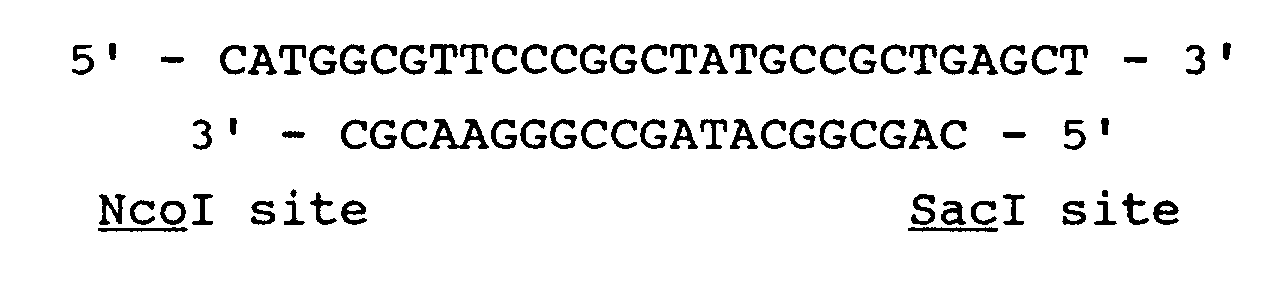
- It has now been discovered that pGH may be produced more effectively if the oligonucleotides are synthesised with SacI, XbaI and SalI restriction sites and codons preferentially used in yeast, as shown in the nucleotide sequence of Figure 1, and in that the pGH gene is cloned with a N-terminal synthetic adaptor having the following base sequence, including NcoI and SacI restriction sites:

The expression vector is the vector (pC1/1-PGH) cloned of a cassette comprising the promoter-pGH gene with an N-terminal synthetic adaptor-terminator, a complete 2 micron gene, a Leu 2d gene and an origin of replication. - In the accompanying drawings:
- Fig. 1 shows synthetic oligonucleotides corresponding to the pGH gene and represented by the base sequence from the 5'-end to the 3'-end.
- Fig. 2 is a ligation strategy of oligonucleotides.
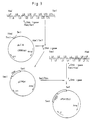
- Fig. 3 is a schematic cloning strategy of synthetic oligonucleotides to a vector of E.coli (pUC18).
- Fig. 4 is the base sequence and putative amino acid sequence of confirmed porcine growth hormone gene.
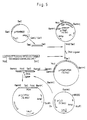
- Fig. 5 is a cloning process for a vector of E.coli(pPGAP) and a yeast expression vector (pC1/1) to produce porcine growth hormone in yeast.
- Fig.6 are the results confirmed by SDS-polyacrylamide gel electrophoresis of porcine growth hormone produced in yeast cells.
- The present inventors have selected the base sequence of porcine growth hormone gene with an amino acid codon preferentially used in yeast cells, used upon the amino acid sequence of porcine growth hormone reported by Seeburg et al. [DNA 2(1983) 37], and the total gene of mature porcine growth hormone in the natural state, in which the N-terminus initiates with ala, is chemically synthesized with a gene synthesizer (Applied Biosystem Model 380B, USA) according to the phosphoramidate's method.
- The synthetic oligonucleotides are ligated as shown in Fig. 2 and cloned to an E.coli vector, pUC18, [Norrander et al. Gene 36 (1983) 101-106] to produce a vector pPGH(552) comprising a SacI/SalI restriction fragment of 552 base pairs, which does not have an N-terminal region of a mature porcine growth hormone gene of 579 base pairs (Refer to Fig. 3).
- In order to produce a clone comprising the complete porcine growth hormone gene and express it in a yeast host, the SacI/SalI fragment was separated from pPGH(552) and a synthetic adaptor was inserted between the NcoI site and the SalI site of the vector comprising a promoter and a terminator gene, pPGAP [Clontech Lab, Palo Alto, CA 94303, U.S.A. Holland, J.P. & Holland, J.J.J. of Biological Chemistry 255, 2596-2605 (1980), Bitter, G.A. & Egan, K.M. Gene 32, 263-274(1984) 20B-12, Zhu, X.L. et al., Mol. Gen. Genet 9194, 31-41(1984) ; ATCC 34025] to obtain pPGAP-PGH (579), wherein the adaptor chemically synthesized is comprised of an NcoI restriction site, an initiation codon and some amino acid codons corresponding to the N-terminal region (Refer to Example 3).
- pPGAP-PGH(579) is treated with BamHI restriction enzyme to separate the BamHI fragment (about 1970 base pairs) comprising a promoter, the procine growth hormone gene and a terminator. The BamHI fragment is inserted into the BamHI restriction site of a yeast expression vector, pC1/1, which is automatically replicated in E.coli and yeast [ATCC 37115 ; Brake et al., Proc. Natl. Acad. Sci USA 81 (1984), 4642], to produce pC1/1-PGH(Refer to Fig. 5).
- The expression vector is cloned to a yeast strain DCO4 [Yeast Genetic Stock Center, Broach, J.R. & Hicks, J.B. Cell 21, 501 (1980)] by means of the method of Hinnen et al. The transformed yeast cell was cultured in YEPD medium comprising 2% glucose as in
sample 5 for 24 hrs, porcine growth hormone was produced depending on growth rate of the cell and 200mg of pig growth hormone per liter of culture can be obtained at the OD₆₅₀ = 20. - The invention is illustrated by the following Examples, without them limiting its range.
- In order to obtain the complete porcine growth hormone gene from the synthetic oligonucleotides having the gene sequences of Fig. 1, ligation strategy such as in Fig. 2 and vector pUC18 comprising SacI, SalI, XbaI, etc. restriction sites were used.
- The oligonucleotides (U7-U14/L8-L14) corresponding to the 3'-end of the XbaI and SalI restriction fragments from synthetic oligonucleotides were collected at the amount that the OD₂₆₀ of each oligonucleotide equals to 0.05 and then separately dried. Four units of T4 polynucleotide kinase were added to a total volume of 30 µl in the presence of a buffer solution comprising 50mM Tris-HCl(pH7.5), 1mM ATP, 1mM DTT and 10mM MgCl₂ and they were reacted at 37 °C for 30 mins. to phosphorylate the 5'-end residue of the oligonucleotides. After the oligonucleotides were pooled and treated with an equal volume of phenol and chloroform mixture, they were precipitated with ethanol. The precipitate was dissolved in 53 µl of a buffer solution comprising 60mM Tris-HCl (pH7.5), 1mM DTT and 10mM MgCl₂. The solution was placed in a 95 °C water bath and kept at room temperature for 6 hrs. so that as its temperature drops slowly, each oligonucleotide produced base pairing with complementary sequence.
- T4 DNA ligase (20 units) and 5 µl of 10mM ATP were added and the 5'- and 3'-ends of the oligonucleotides were ligated at room temperature for 10mins. The above solution was treated with phenol and chloroform mixture and precipitated with ethanol.
- Ten units each of XbaI and SalI restriction enzymes were added to the precipitated nucleic acid in the presence of a buffer solution comprising 60mM Tris(pH7.6), 10mM MgCl₂ and 100mM NaCl and reacted at 37 °C for 1 hr.
- After 7% polyacrylamide gel electrophoresis of the above mixture, a band corresponding to 200-300 base pairs was cut from the gel. After electroelution, the precipitates were dissolved in 20 µl of distilled water.
- Three µl of DNA and 10ng of a vector, pUC18, cut with XbaI and SalI restriction enzymes were ligated in the presence of the ligation solution comprising 60mM Tris-HCl(pH7.5), 10mM DTT, 10mM MgCl₂, 1mM ATP and 10units of T4 DNA ligase at 14 °C for 16hrs.
- E.coli JM103[BRL, U.S.A., Messing, J., Methods in Enzymology, 103, 20-78 (1983)] competent cell was added to the ligation reactant and transformed according to Hanahan's method [J.Mol. Biol 116, 557(1983)] at 37 °C.
- The clone containing p3'-PGH was selected from the white colonies by using Birnboim and Doly's method [Nucleic Acid Res. 7, 1513 (1979)].
- On the other hand, the oligonucleotides (U1-U7/L2-L8) corresponding to the 5'-end SacI and XbaI restriction fragment of the complete porcine growth hormone gene were ligated by the same method as mentioned above and cloned to the p3'-PGH vector cut with SacI and XbaI restriction enzymes to produce pPGH(552) as shown in Fig. 3. The nucleotide sequence was confirmed by Sanger's dideoxy sequencing method [Proc. Natl. Acad. Sci. USA 74, 5473-5477] (Refer to Fig. 4).
- pPGH(552) does not comprise 9 amino acids in the 5'-residue of a complete porcine growth hormone and in order to clone the complete porcine growth hormone gene and to have it expressed in yeast cells, the deficient part of the 5'-end was synthesized by the gene synthesizer. The adaptor comprising the NcoI restriction site, the initiation codon and the codon corresponding to 8 amino acids was synthesized by selecting codons preferentially used in yeast cells and the SacI restriction site was synthesized at the other end (Refer to Fig. 5).
- The process of cloning was as follows ; pPGH(552) was treated with SacI and SalI restriction enzymes to obtain a restriction fragment corresponding to 552 base pairs and the fragment was separated through agarose gel electrophoresis. The fragment and the synthetic adaptor were inserted between the NcoI and SalI restriction sites of a vector, pPGAP, comprising a promoter and a terminator. The detailed procedures are as follows : The 5'-end of each synthetic adaptor was phosphorylated with T4 polynucleotide kinase as described in
sample 1. One µl of each phosphorylation solution, 3 µl (30ng) of the SacI/SalI fragment separated from pPGH(552) and 1 µl (7ng) of vector pPGAP cut with NcoI and SalI restriction enzymes were mixed and kept at 65 °C for 15 mins. They were cooled slowly to room temperature. Two µl of 10mM ATP, 2 µl of a 10-fold concentrated ligation reaction buffer solution, 1 µl of ligase and 8 µl of distilled water were added and reacted at 14 °C for 16 hrs. - Based upon the method as in Example 1, the above was cloned to E.coli cell HB101 [ATCC 37017], and pPGAP-PGH comprising the promoter, the complete porcine growth hormone gene and the terminator for expression in yeast was produced.
- The vector, pPGAP, contains a glyceraldehyde-3'-phosphate dehydrogenase promoter, a constitutive promoter which is expressed according to the growth of the cell and a terminator. pPGAP-PGH was treated with BamHI restriction enzyme to separate the BamHI restriction fragment about 1,970 base pairs, comprising a glyceraldehyde-3'-phosphate dehydrogenase promoter, a porcine growth hormone gene and a glyceraldehyde-3'-phosphate dehydrogenase terminator. The BamHI restriction fragment was inserted into the BamHI restriction site of the expression vector pC1/1 which can be replicated in yeast cells, to produce pC1/1-PGH (Refer to Fig. 5).
- The pC1/1-PGH vector was transferred into yeast strain DCO4 according to Hinnen's method [Proc Natl. Acad. Sci, USA 75 (1978), 1929].
- After culturing at 30 °C for 5 days, a recombinant clone with porcine growth hormone gene was picked and identified by the method such as in Example 3.
- Each 3ml of yeast cells transformed with vector pC1/1-PGH was cultured in a culture medium without leucine (6.7g of Yeast Nitrogen Base without amino acids, 0.25g of leu-deficient supplements and 6% glucose per l of culture medium) at 30 °C for 24hrs. The culture was added to 100ml of YEPD culture medium comprising 2% peptone, 1% yeast extract and 2% glucose and cultured at 30 °C for 24 hrs.
- At the OD₆₅₀ equaled to around 40, the fraction corresponding to OD₆₅₀ of 10 was collected and centrifuged. It is dissolved in 400 µl of a buffer solution containing 10mM Tris-HCl(pH 7.5), 1mM EDTA, 2mM phenyl methyl sulfonyl fluoride and 8M urea and glass beads, 0.45mm in diameter with the same volume, were added and shaken vigorously. After rupturing the cell wall and letting porcine growth hormone elute into the buffer solution, 4 µl of eluted solution was executed by electrophoresis on 12.5% SDS polyacrylamide gel.
- The results are represented in Fig. 6;
-
Lane 8 - represents the standard M.W. of protein from the BioRad company.
-
Lanes - represent total proteins of yeast cells transformed with the vector pC1/1 without porcine growth hormone gene.
- Lanes 2-4
- represent total proteins of yeast cells transformed with the vector pC1/1-PGH containing the porcine growth hormone gene.
- As shown in lanes 2-4 of Fig 6, it is evident by gel scanning that porcine growth hormone appears at a hand about 22Kd in an amount corresponding to 10% of the total protein.
- The amino acid sequence confirmed (Biomedical Resource Center, University of Calfornia, San Francisco) shows the mature porcine growth hormone starting from alanine and in which methionine might be processed by amino peptidase in vivo.
Claims (1)
- A method for the production of porcine growth hormone (pGH), comprising:(a) synthesizing oligonucleotides which are based on the amino-acid sequence of pGH;(b) cloning the pGH gene into an E. coli vector between a promoter and a terminator;(c) recloning the resultant promoter-pGH geneterminator cassette into a yeast expression vector; and(d) expressing the resultant vector in yeast cells;characterized in that the oligonucleotides are synthesized with SacI, XbaI and SalI restriction sites and codons preferentially used in yeast, as shown in the nucleotide sequence of Figure 1, and in that the pGH gene is cloned with a N-terminal synthetic adaptor having the following base sequence, including NcoI and SacI restriction sites:
Priority Applications (1)
| Application Number | Priority Date | Filing Date | Title |
|---|---|---|---|
| AT88900598T ATE92958T1 (en) | 1986-12-31 | 1987-12-28 | PROCESS FOR THE MANUFACTURE OF PIG GROWTH HORMONE USING AN ARTIFICIAL GENE IN YEAST CELLS. |
Applications Claiming Priority (2)
| Application Number | Priority Date | Filing Date | Title |
|---|---|---|---|
| KR1171086 | 1986-12-31 | ||
| KR1019860011710A KR920003663B1 (en) | 1986-12-31 | 1986-12-31 | Production method of porcine growth hormone from yeast cells by synthetic gene |
Publications (2)
| Publication Number | Publication Date |
|---|---|
| EP0295287A1 EP0295287A1 (en) | 1988-12-21 |
| EP0295287B1 true EP0295287B1 (en) | 1993-08-11 |
Family
ID=19254703
Family Applications (1)
| Application Number | Title | Priority Date | Filing Date |
|---|---|---|---|
| EP88900598A Expired - Lifetime EP0295287B1 (en) | 1986-12-31 | 1987-12-28 | Method for the production of porcine growth hormone using a synthetic gene in yeast cells |
Country Status (6)
| Country | Link |
|---|---|
| EP (1) | EP0295287B1 (en) |
| JP (1) | JPH0712317B2 (en) |
| KR (1) | KR920003663B1 (en) |
| AT (1) | ATE92958T1 (en) |
| DE (1) | DE3787016T2 (en) |
| WO (1) | WO1988005080A1 (en) |
Families Citing this family (2)
| Publication number | Priority date | Publication date | Assignee | Title |
|---|---|---|---|---|
| FI94278C (en) * | 1992-04-22 | 1995-08-10 | Risto Wisakanto | Use of a pressure medium in drilling |
| CN109929849B (en) * | 2019-03-18 | 2021-05-04 | 华南农业大学 | An optimized pGH gene and protein and its application in improving the production and activity of pGH secreted and expressed by Pichia pastoris |
Family Cites Families (3)
| Publication number | Priority date | Publication date | Assignee | Title |
|---|---|---|---|---|
| CA1341012C (en) * | 1982-09-27 | 2000-06-06 | Biogen, Inc. | Dna sequences, recombinant dna molecules and processes for producing swine growth hormone-like polypeptides |
| AU2092983A (en) * | 1982-11-08 | 1984-05-17 | Genentech Inc. | Porcine growth hormone produced by recombinant dna technology |
| US4788144A (en) * | 1985-06-28 | 1988-11-29 | International Minerals & Chemical Corp. | Fermentation process for the high level production of swine growth |
-
1986
- 1986-12-31 KR KR1019860011710A patent/KR920003663B1/en not_active Expired
-
1987
- 1987-12-28 EP EP88900598A patent/EP0295287B1/en not_active Expired - Lifetime
- 1987-12-28 DE DE88900598T patent/DE3787016T2/en not_active Expired - Lifetime
- 1987-12-28 WO PCT/KR1987/000015 patent/WO1988005080A1/en not_active Ceased
- 1987-12-28 AT AT88900598T patent/ATE92958T1/en not_active IP Right Cessation
- 1987-12-28 JP JP63500757A patent/JPH0712317B2/en not_active Expired - Lifetime
Also Published As
| Publication number | Publication date |
|---|---|
| KR920003663B1 (en) | 1992-05-06 |
| JPH0712317B2 (en) | 1995-02-15 |
| WO1988005080A1 (en) | 1988-07-14 |
| DE3787016D1 (en) | 1993-09-16 |
| EP0295287A1 (en) | 1988-12-21 |
| ATE92958T1 (en) | 1993-08-15 |
| DE3787016T2 (en) | 1993-11-25 |
| KR880007723A (en) | 1988-08-29 |
| JPH02501260A (en) | 1990-05-10 |
Similar Documents
| Publication | Publication Date | Title |
|---|---|---|
| EP0561137B1 (en) | Hybrid DNA Synthesis of Mature Insulin-like Growth Factors | |
| KR930009337B1 (en) | Process for the preparaton of hirudins | |
| US5436136A (en) | Repressible yeast promoters | |
| HU195534B (en) | Process for preparing polypeptide by bacterial way, by using tryptophan promoter operator | |
| EP0130166A1 (en) | A recombinant plasmid, a transformant microorganism, a polydeoxy-ribonucleotide segment, a process for producing a biologically active protein, and the protein thus produced | |
| Catterall et al. | Primary sequence of ovomucoid messenger RNA as determined from cloned complementary DNA. | |
| Kálmán et al. | Synthesis of a gene for human serum albumin and its expression in Saccharomyces cerevisiae | |
| US5670340A (en) | Process for producing peptides in E. coli | |
| CA2020656C (en) | Plasmids, their preparation and their use in the manufacture of a plasminogen activator | |
| US4940661A (en) | Metallothionein transcription control sequences and use thereof | |
| HU216335B (en) | Process for producing peptides | |
| EP0321940B1 (en) | An improved method for the preparation of natural human growth hormone in pure form | |
| EP0218651B1 (en) | A dna sequence | |
| US5541086A (en) | Method for the production of porcine growth hormone using a synthetic gene in yeast cells | |
| US4711847A (en) | Preparation of secretin | |
| GB2104901A (en) | Expression vectors | |
| WO1988005080A1 (en) | Method for the production of porcine growth hormone using a synthetic gene in yeast cells | |
| EP0264118B1 (en) | Novel method for preparing proteins | |
| EP0295286B1 (en) | Method for the production of salmon growth hormone using a synthetic gene | |
| EP0295285B1 (en) | Method for the production of bovine growth hormone using a synthetic gene | |
| US5270180A (en) | Method for the production of salmon growth hormone using a synthetic gene | |
| US5741674A (en) | Recombinant production of proteins in yeast | |
| KR920003662B1 (en) | Process for producing salmon growth hormone (sgh) from yeast by recombinant dna | |
| KR940004543B1 (en) | Method for preparing a vector having a trp expression system of E. coli | |
| KR920003664B1 (en) | Mass production of phytohormone from yeast cells by synthetic genes |
Legal Events
| Date | Code | Title | Description |
|---|---|---|---|
| PUAI | Public reference made under article 153(3) epc to a published international application that has entered the european phase |
Free format text: ORIGINAL CODE: 0009012 |
|
| 17P | Request for examination filed |
Effective date: 19880915 |
|
| AK | Designated contracting states |
Kind code of ref document: A1 Designated state(s): AT BE CH DE FR GB IT LI LU NL SE |
|
| 17Q | First examination report despatched |
Effective date: 19910215 |
|
| GRAA | (expected) grant |
Free format text: ORIGINAL CODE: 0009210 |
|
| AK | Designated contracting states |
Kind code of ref document: B1 Designated state(s): AT BE CH DE FR GB IT LI LU NL SE |
|
| PG25 | Lapsed in a contracting state [announced via postgrant information from national office to epo] |
Ref country code: CH Effective date: 19930811 Ref country code: LI Effective date: 19930811 |
|
| REF | Corresponds to: |
Ref document number: 92958 Country of ref document: AT Date of ref document: 19930815 Kind code of ref document: T |
|
| RIN1 | Information on inventor provided before grant (corrected) |
Inventor name: HAN, KYU, BEOM Inventor name: PARK, YOUNG, WOO Inventor name: CHUNG, HYUN, HO Inventor name: LEE, YONG, BEOM Inventor name: CHO, JOONG, MYUNG Inventor name: LEE, TAE, HO Inventor name: LEE, TAE, GYU |
|
| REF | Corresponds to: |
Ref document number: 3787016 Country of ref document: DE Date of ref document: 19930916 |
|
| ITF | It: translation for a ep patent filed | ||
| REG | Reference to a national code |
Ref country code: CH Ref legal event code: PL |
|
| ET | Fr: translation filed | ||
| PG25 | Lapsed in a contracting state [announced via postgrant information from national office to epo] |
Ref country code: LU Free format text: LAPSE BECAUSE OF NON-PAYMENT OF DUE FEES Effective date: 19931231 |
|
| PLBE | No opposition filed within time limit |
Free format text: ORIGINAL CODE: 0009261 |
|
| STAA | Information on the status of an ep patent application or granted ep patent |
Free format text: STATUS: NO OPPOSITION FILED WITHIN TIME LIMIT |
|
| 26N | No opposition filed | ||
| EAL | Se: european patent in force in sweden |
Ref document number: 88900598.9 |
|
| EUG | Se: european patent has lapsed | ||
| REG | Reference to a national code |
Ref country code: GB Ref legal event code: IF02 |
|
| PGFP | Annual fee paid to national office [announced via postgrant information from national office to epo] |
Ref country code: NL Payment date: 20061203 Year of fee payment: 20 |
|
| PGFP | Annual fee paid to national office [announced via postgrant information from national office to epo] |
Ref country code: SE Payment date: 20061206 Year of fee payment: 20 |
|
| PGFP | Annual fee paid to national office [announced via postgrant information from national office to epo] |
Ref country code: FR Payment date: 20061208 Year of fee payment: 20 |
|
| PGFP | Annual fee paid to national office [announced via postgrant information from national office to epo] |
Ref country code: AT Payment date: 20061213 Year of fee payment: 20 |
|
| PGFP | Annual fee paid to national office [announced via postgrant information from national office to epo] |
Ref country code: DE Payment date: 20061221 Year of fee payment: 20 |
|
| PGFP | Annual fee paid to national office [announced via postgrant information from national office to epo] |
Ref country code: GB Payment date: 20061227 Year of fee payment: 20 |
|
| PGFP | Annual fee paid to national office [announced via postgrant information from national office to epo] |
Ref country code: IT Payment date: 20061231 Year of fee payment: 20 |
|
| PGFP | Annual fee paid to national office [announced via postgrant information from national office to epo] |
Ref country code: BE Payment date: 20070222 Year of fee payment: 20 |
|
| BE20 | Be: patent expired |
Owner name: *LUCKY LTD Effective date: 20071228 |
|
| REG | Reference to a national code |
Ref country code: GB Ref legal event code: PE20 |
|
| PG25 | Lapsed in a contracting state [announced via postgrant information from national office to epo] |
Ref country code: NL Free format text: LAPSE BECAUSE OF EXPIRATION OF PROTECTION Effective date: 20071228 |
|
| EUG | Se: european patent has lapsed | ||
| NLV7 | Nl: ceased due to reaching the maximum lifetime of a patent |
Effective date: 20071228 |
|
| PG25 | Lapsed in a contracting state [announced via postgrant information from national office to epo] |
Ref country code: GB Free format text: LAPSE BECAUSE OF EXPIRATION OF PROTECTION Effective date: 20071227 |