EP0293071B1 - Redox amino acids and peptides containing them - Google Patents
Redox amino acids and peptides containing them Download PDFInfo
- Publication number
- EP0293071B1 EP0293071B1 EP88302861A EP88302861A EP0293071B1 EP 0293071 B1 EP0293071 B1 EP 0293071B1 EP 88302861 A EP88302861 A EP 88302861A EP 88302861 A EP88302861 A EP 88302861A EP 0293071 B1 EP0293071 B1 EP 0293071B1
- Authority
- EP
- European Patent Office
- Prior art keywords
- formula
- peptide
- amino acid
- amino
- ring
- Prior art date
- Legal status (The legal status is an assumption and is not a legal conclusion. Google has not performed a legal analysis and makes no representation as to the accuracy of the status listed.)
- Expired - Lifetime
Links
- 108090000765 processed proteins & peptides Proteins 0.000 title claims abstract description 147
- 150000001413 amino acids Chemical class 0.000 title claims abstract description 81
- 102000004196 processed proteins & peptides Human genes 0.000 title abstract description 54
- 229910052799 carbon Inorganic materials 0.000 claims abstract description 21
- YNGDWRXWKFWCJY-UHFFFAOYSA-N 1,4-Dihydropyridine Chemical compound C1C=CNC=C1 YNGDWRXWKFWCJY-UHFFFAOYSA-N 0.000 claims abstract description 17
- 238000002360 preparation method Methods 0.000 claims description 84
- 238000000034 method Methods 0.000 claims description 83
- 150000001875 compounds Chemical class 0.000 claims description 72
- 125000006239 protecting group Chemical group 0.000 claims description 68
- 125000003178 carboxy group Chemical group [H]OC(*)=O 0.000 claims description 52
- 125000006701 (C1-C7) alkyl group Chemical group 0.000 claims description 45
- 125000004432 carbon atom Chemical group C* 0.000 claims description 44
- 229910052739 hydrogen Inorganic materials 0.000 claims description 44
- 239000001257 hydrogen Substances 0.000 claims description 44
- 125000002924 primary amino group Chemical group [H]N([H])* 0.000 claims description 41
- 230000008569 process Effects 0.000 claims description 41
- 150000003839 salts Chemical class 0.000 claims description 39
- VEXZGXHMUGYJMC-UHFFFAOYSA-N Hydrochloric acid Chemical compound Cl VEXZGXHMUGYJMC-UHFFFAOYSA-N 0.000 claims description 27
- 125000004435 hydrogen atom Chemical group [H]* 0.000 claims description 25
- XLXSAKCOAKORKW-AQJXLSMYSA-N gonadorelin Chemical compound C([C@@H](C(=O)NCC(=O)N[C@@H](CC(C)C)C(=O)N[C@@H](CCCNC(N)=N)C(=O)N1[C@@H](CCC1)C(=O)NCC(N)=O)NC(=O)[C@H](CO)NC(=O)[C@H](CC=1C2=CC=CC=C2NC=1)NC(=O)[C@H](CC=1N=CNC=1)NC(=O)[C@H]1NC(=O)CC1)C1=CC=C(O)C=C1 XLXSAKCOAKORKW-AQJXLSMYSA-N 0.000 claims description 23
- 125000002887 hydroxy group Chemical group [H]O* 0.000 claims description 23
- 125000000623 heterocyclic group Chemical group 0.000 claims description 21
- UFHFLCQGNIYNRP-UHFFFAOYSA-N Hydrogen Chemical compound [H][H] UFHFLCQGNIYNRP-UHFFFAOYSA-N 0.000 claims description 20
- URLZCHNOLZSCCA-VABKMULXSA-N Leu-enkephalin Chemical compound C([C@@H](C(=O)N[C@@H](CC(C)C)C(O)=O)NC(=O)CNC(=O)CNC(=O)[C@@H](N)CC=1C=CC(O)=CC=1)C1=CC=CC=C1 URLZCHNOLZSCCA-VABKMULXSA-N 0.000 claims description 19
- 125000001997 phenyl group Chemical group [H]C1=C([H])C([H])=C(*)C([H])=C1[H] 0.000 claims description 18
- VEXZGXHMUGYJMC-UHFFFAOYSA-M Chloride anion Chemical compound [Cl-] VEXZGXHMUGYJMC-UHFFFAOYSA-M 0.000 claims description 17
- 239000012634 fragment Substances 0.000 claims description 17
- 125000001188 haloalkyl group Chemical group 0.000 claims description 17
- 101000857870 Squalus acanthias Gonadoliberin Proteins 0.000 claims description 16
- 101000904177 Clupea pallasii Gonadoliberin-1 Proteins 0.000 claims description 15
- 239000000579 Gonadotropin-Releasing Hormone Substances 0.000 claims description 15
- 125000005843 halogen group Chemical group 0.000 claims description 15
- 229910052757 nitrogen Inorganic materials 0.000 claims description 15
- 231100000252 nontoxic Toxicity 0.000 claims description 15
- 230000003000 nontoxic effect Effects 0.000 claims description 15
- KBZOIRJILGZLEJ-LGYYRGKSSA-N argipressin Chemical compound C([C@H]1C(=O)N[C@@H](CCC(N)=O)C(=O)N[C@@H](CC(N)=O)C(=O)N[C@@H](CSSC[C@@H](C(N[C@@H](CC=2C=CC(O)=CC=2)C(=O)N1)=O)N)C(=O)N1[C@@H](CCC1)C(=O)N[C@@H](CCCN=C(N)N)C(=O)NCC(N)=O)C1=CC=CC=C1 KBZOIRJILGZLEJ-LGYYRGKSSA-N 0.000 claims description 14
- 125000004433 nitrogen atom Chemical group N* 0.000 claims description 14
- RGQXHAWMLUYSTD-UHFFFAOYSA-N 1-(2,4-dinitrophenyl)pyridin-1-ium-3-carboxamide;chloride Chemical compound [Cl-].NC(=O)C1=CC=C[N+](C=2C(=CC(=CC=2)[N+]([O-])=O)[N+]([O-])=O)=C1 RGQXHAWMLUYSTD-UHFFFAOYSA-N 0.000 claims description 13
- GXBMIBRIOWHPDT-UHFFFAOYSA-N Vasopressin Natural products N1C(=O)C(CC=2C=C(O)C=CC=2)NC(=O)C(N)CSSCC(C(=O)N2C(CCC2)C(=O)NC(CCCN=C(N)N)C(=O)NCC(N)=O)NC(=O)C(CC(N)=O)NC(=O)C(CCC(N)=O)NC(=O)C1CC1=CC=CC=C1 GXBMIBRIOWHPDT-UHFFFAOYSA-N 0.000 claims description 13
- 108010004977 Vasopressins Proteins 0.000 claims description 13
- 102000002852 Vasopressins Human genes 0.000 claims description 13
- PCJGZPGTCUMMOT-ISULXFBGSA-N neurotensin Chemical compound C([C@@H](C(=O)N[C@@H]([C@@H](C)CC)C(=O)N[C@@H](CC(C)C)C(O)=O)NC(=O)[C@H]1N(CCC1)C(=O)[C@H](CCCN=C(N)N)NC(=O)[C@H](CCCN=C(N)N)NC(=O)[C@H]1N(CCC1)C(=O)[C@H](CCCCN)NC(=O)[C@H](CC(N)=O)NC(=O)[C@H](CCC(O)=O)NC(=O)[C@H](CC=1C=CC(O)=CC=1)NC(=O)[C@H](CC(C)C)NC(=O)[C@H]1NC(=O)CC1)C1=CC=C(O)C=C1 PCJGZPGTCUMMOT-ISULXFBGSA-N 0.000 claims description 13
- XNOPRXBHLZRZKH-DSZYJQQASA-N oxytocin Chemical compound C([C@H]1C(=O)N[C@H](C(N[C@@H](CCC(N)=O)C(=O)N[C@@H](CC(N)=O)C(=O)N[C@@H](CSSC[C@H](N)C(=O)N1)C(=O)N1[C@@H](CCC1)C(=O)N[C@@H](CC(C)C)C(=O)NCC(N)=O)=O)[C@@H](C)CC)C1=CC=C(O)C=C1 XNOPRXBHLZRZKH-DSZYJQQASA-N 0.000 claims description 13
- 229960003726 vasopressin Drugs 0.000 claims description 13
- 102400000050 Oxytocin Human genes 0.000 claims description 12
- 101800000989 Oxytocin Proteins 0.000 claims description 12
- XNOPRXBHLZRZKH-UHFFFAOYSA-N Oxytocin Natural products N1C(=O)C(N)CSSCC(C(=O)N2C(CCC2)C(=O)NC(CC(C)C)C(=O)NCC(N)=O)NC(=O)C(CC(N)=O)NC(=O)C(CCC(N)=O)NC(=O)C(C(C)CC)NC(=O)C1CC1=CC=C(O)C=C1 XNOPRXBHLZRZKH-UHFFFAOYSA-N 0.000 claims description 12
- 239000002253 acid Substances 0.000 claims description 12
- 150000001450 anions Chemical class 0.000 claims description 12
- 229960001723 oxytocin Drugs 0.000 claims description 12
- 125000003545 alkoxy group Chemical group 0.000 claims description 11
- NHXLMOGPVYXJNR-ATOGVRKGSA-N somatostatin Chemical compound C([C@H]1C(=O)N[C@H](C(N[C@@H](CO)C(=O)N[C@@H](CSSC[C@@H](C(=O)N[C@@H](CCCCN)C(=O)N[C@@H](CC(N)=O)C(=O)N[C@@H](CC=2C=CC=CC=2)C(=O)N[C@@H](CC=2C=CC=CC=2)C(=O)N[C@@H](CC=2C3=CC=CC=C3NC=2)C(=O)N[C@@H](CCCCN)C(=O)N[C@H](C(=O)N1)[C@@H](C)O)NC(=O)CNC(=O)[C@H](C)N)C(O)=O)=O)[C@H](O)C)C1=CC=CC=C1 NHXLMOGPVYXJNR-ATOGVRKGSA-N 0.000 claims description 11
- 125000002496 methyl group Chemical group [H]C([H])([H])* 0.000 claims description 10
- 229960000553 somatostatin Drugs 0.000 claims description 10
- YFGBQHOOROIVKG-FKBYEOEOSA-N Met-enkephalin Chemical compound C([C@@H](C(=O)N[C@@H](CCSC)C(O)=O)NC(=O)CNC(=O)CNC(=O)[C@@H](N)CC=1C=CC(O)=CC=1)C1=CC=CC=C1 YFGBQHOOROIVKG-FKBYEOEOSA-N 0.000 claims description 9
- 108010056088 Somatostatin Proteins 0.000 claims description 9
- 102000005157 Somatostatin Human genes 0.000 claims description 9
- 125000004644 alkyl sulfinyl group Chemical group 0.000 claims description 9
- 125000004390 alkyl sulfonyl group Chemical group 0.000 claims description 9
- 125000004414 alkyl thio group Chemical group 0.000 claims description 9
- 230000009467 reduction Effects 0.000 claims description 9
- 101800001814 Neurotensin Proteins 0.000 claims description 8
- 102400001103 Neurotensin Human genes 0.000 claims description 8
- 125000004423 acyloxy group Chemical group 0.000 claims description 8
- 125000004453 alkoxycarbonyl group Chemical group 0.000 claims description 8
- IDLFZVILOHSSID-OVLDLUHVSA-N corticotropin Chemical group C([C@@H](C(=O)N[C@@H](CO)C(=O)N[C@@H](CCSC)C(=O)N[C@@H](CCC(O)=O)C(=O)N[C@@H](CC=1NC=NC=1)C(=O)N[C@@H](CC=1C=CC=CC=1)C(=O)N[C@@H](CCCNC(N)=N)C(=O)N[C@@H](CC=1C2=CC=CC=C2NC=1)C(=O)NCC(=O)N[C@@H](CCCCN)C(=O)N1[C@@H](CCC1)C(=O)N[C@@H](C(C)C)C(=O)NCC(=O)N[C@@H](CCCCN)C(=O)N[C@@H](CCCCN)C(=O)N[C@@H](CCCNC(N)=N)C(=O)N[C@@H](CCCNC(N)=N)C(=O)N1[C@@H](CCC1)C(=O)N[C@@H](C(C)C)C(=O)N[C@@H](CCCCN)C(=O)N[C@@H](C(C)C)C(=O)N[C@@H](CC=1C=CC(O)=CC=1)C(=O)N1[C@@H](CCC1)C(=O)N[C@@H](CC(N)=O)C(=O)NCC(=O)N[C@@H](C)C(=O)N[C@@H](CCC(O)=O)C(=O)N[C@@H](CC(O)=O)C(=O)N[C@@H](CCC(O)=O)C(=O)N[C@@H](CO)C(=O)N[C@@H](C)C(=O)N[C@@H](CCC(O)=O)C(=O)N[C@@H](C)C(=O)N[C@@H](CC=1C=CC=CC=1)C(=O)N1[C@@H](CCC1)C(=O)N[C@@H](CC(C)C)C(=O)N[C@@H](CCC(O)=O)C(=O)N[C@@H](CC=1C=CC=CC=1)C(O)=O)NC(=O)[C@@H](N)CO)C1=CC=C(O)C=C1 IDLFZVILOHSSID-OVLDLUHVSA-N 0.000 claims description 8
- 150000002431 hydrogen Chemical class 0.000 claims description 8
- 125000001424 substituent group Chemical group 0.000 claims description 8
- MMWRGWQTAMNAFC-UHFFFAOYSA-N 1,2-dihydropyridine Chemical compound C1NC=CC=C1 MMWRGWQTAMNAFC-UHFFFAOYSA-N 0.000 claims description 6
- IRFSXVIRXMYULF-UHFFFAOYSA-N 1,2-dihydroquinoline Chemical compound C1=CC=C2C=CCNC2=C1 IRFSXVIRXMYULF-UHFFFAOYSA-N 0.000 claims description 6
- 108010064733 Angiotensins Proteins 0.000 claims description 6
- 102000015427 Angiotensins Human genes 0.000 claims description 6
- CPELXLSAUQHCOX-UHFFFAOYSA-M Bromide Chemical compound [Br-] CPELXLSAUQHCOX-UHFFFAOYSA-M 0.000 claims description 6
- 230000004071 biological effect Effects 0.000 claims description 6
- 125000001309 chloro group Chemical group Cl* 0.000 claims description 6
- CWWARWOPSKGELM-SARDKLJWSA-N methyl (2s)-2-[[(2s)-2-[[2-[[(2s)-2-[[(2s)-2-[[(2s)-5-amino-2-[[(2s)-5-amino-2-[[(2s)-1-[(2s)-6-amino-2-[[(2s)-1-[(2s)-2-amino-5-(diaminomethylideneamino)pentanoyl]pyrrolidine-2-carbonyl]amino]hexanoyl]pyrrolidine-2-carbonyl]amino]-5-oxopentanoyl]amino]-5 Chemical compound C([C@@H](C(=O)NCC(=O)N[C@@H](CC(C)C)C(=O)N[C@@H](CCSC)C(=O)OC)NC(=O)[C@H](CC=1C=CC=CC=1)NC(=O)[C@H](CCC(N)=O)NC(=O)[C@H](CCC(N)=O)NC(=O)[C@H]1N(CCC1)C(=O)[C@H](CCCCN)NC(=O)[C@H]1N(CCC1)C(=O)[C@@H](N)CCCN=C(N)N)C1=CC=CC=C1 CWWARWOPSKGELM-SARDKLJWSA-N 0.000 claims description 6
- IOEPOEDBBPRAEI-UHFFFAOYSA-N 1,2-dihydroisoquinoline Chemical group C1=CC=C2CNC=CC2=C1 IOEPOEDBBPRAEI-UHFFFAOYSA-N 0.000 claims description 5
- 238000004519 manufacturing process Methods 0.000 claims description 5
- 125000000956 methoxy group Chemical group [H]C([H])([H])O* 0.000 claims description 5
- 125000003161 (C1-C6) alkylene group Chemical group 0.000 claims description 4
- 108010033276 Peptide Fragments Proteins 0.000 claims description 4
- 102000007079 Peptide Fragments Human genes 0.000 claims description 4
- 125000001246 bromo group Chemical group Br* 0.000 claims description 4
- 125000004093 cyano group Chemical group *C#N 0.000 claims description 4
- 229910052736 halogen Inorganic materials 0.000 claims description 4
- 150000002367 halogens Chemical class 0.000 claims description 4
- CPELXLSAUQHCOX-UHFFFAOYSA-N Hydrogen bromide Chemical compound Br CPELXLSAUQHCOX-UHFFFAOYSA-N 0.000 claims description 3
- 239000002168 alkylating agent Substances 0.000 claims description 3
- 229940100198 alkylating agent Drugs 0.000 claims description 3
- 238000005349 anion exchange Methods 0.000 claims description 3
- 150000004820 halides Chemical class 0.000 claims description 3
- ROBKVGDBQLURAF-UHFFFAOYSA-N 1,4-dihydroquinoline Chemical group C1=CC=C2CC=CNC2=C1 ROBKVGDBQLURAF-UHFFFAOYSA-N 0.000 claims description 2
- XMBWDFGMSWQBCA-UHFFFAOYSA-N hydrogen iodide Chemical group I XMBWDFGMSWQBCA-UHFFFAOYSA-N 0.000 claims 4
- 229940006460 bromide ion Drugs 0.000 claims 2
- 150000001555 benzenes Chemical group 0.000 claims 1
- -1 carboxyl carbon Chemical compound 0.000 abstract description 220
- 210000004556 brain Anatomy 0.000 abstract description 54
- 230000002459 sustained effect Effects 0.000 abstract description 12
- 150000001721 carbon Chemical group 0.000 abstract description 9
- XEKOWRVHYACXOJ-UHFFFAOYSA-N Ethyl acetate Chemical compound CCOC(C)=O XEKOWRVHYACXOJ-UHFFFAOYSA-N 0.000 description 204
- WEVYAHXRMPXWCK-UHFFFAOYSA-N Acetonitrile Chemical compound CC#N WEVYAHXRMPXWCK-UHFFFAOYSA-N 0.000 description 84
- YMWUJEATGCHHMB-UHFFFAOYSA-N Dichloromethane Chemical compound ClCCl YMWUJEATGCHHMB-UHFFFAOYSA-N 0.000 description 84
- HEDRZPFGACZZDS-UHFFFAOYSA-N Chloroform Chemical compound ClC(Cl)Cl HEDRZPFGACZZDS-UHFFFAOYSA-N 0.000 description 68
- 239000000047 product Substances 0.000 description 68
- OKKJLVBELUTLKV-UHFFFAOYSA-N Methanol Chemical compound OC OKKJLVBELUTLKV-UHFFFAOYSA-N 0.000 description 66
- 239000000203 mixture Substances 0.000 description 64
- 239000011541 reaction mixture Substances 0.000 description 64
- XLYOFNOQVPJJNP-UHFFFAOYSA-N water Substances O XLYOFNOQVPJJNP-UHFFFAOYSA-N 0.000 description 64
- LFQSCWFLJHTTHZ-UHFFFAOYSA-N Ethanol Chemical compound CCO LFQSCWFLJHTTHZ-UHFFFAOYSA-N 0.000 description 62
- 229940024606 amino acid Drugs 0.000 description 58
- 235000001014 amino acid Nutrition 0.000 description 58
- 239000007787 solid Substances 0.000 description 56
- ZMANZCXQSJIPKH-UHFFFAOYSA-N Triethylamine Chemical compound CCN(CC)CC ZMANZCXQSJIPKH-UHFFFAOYSA-N 0.000 description 54
- 238000005481 NMR spectroscopy Methods 0.000 description 52
- 239000000243 solution Substances 0.000 description 49
- RTZKZFJDLAIYFH-UHFFFAOYSA-N Diethyl ether Chemical compound CCOCC RTZKZFJDLAIYFH-UHFFFAOYSA-N 0.000 description 44
- HEDRZPFGACZZDS-MICDWDOJSA-N Trichloro(2H)methane Chemical compound [2H]C(Cl)(Cl)Cl HEDRZPFGACZZDS-MICDWDOJSA-N 0.000 description 40
- CSCPPACGZOOCGX-UHFFFAOYSA-N Acetone Chemical compound CC(C)=O CSCPPACGZOOCGX-UHFFFAOYSA-N 0.000 description 39
- 239000003814 drug Substances 0.000 description 37
- 229940079593 drug Drugs 0.000 description 36
- VYPSYNLAJGMNEJ-UHFFFAOYSA-N Silicium dioxide Chemical compound O=[Si]=O VYPSYNLAJGMNEJ-UHFFFAOYSA-N 0.000 description 31
- 239000000706 filtrate Substances 0.000 description 31
- 238000001914 filtration Methods 0.000 description 28
- YXFVVABEGXRONW-UHFFFAOYSA-N Toluene Chemical compound CC1=CC=CC=C1 YXFVVABEGXRONW-UHFFFAOYSA-N 0.000 description 27
- IAZDPXIOMUYVGZ-WFGJKAKNSA-N Dimethyl sulfoxide Chemical compound [2H]C([2H])([2H])S(=O)C([2H])([2H])[2H] IAZDPXIOMUYVGZ-WFGJKAKNSA-N 0.000 description 26
- 230000000694 effects Effects 0.000 description 26
- 239000000741 silica gel Substances 0.000 description 26
- 229910002027 silica gel Inorganic materials 0.000 description 26
- 125000000217 alkyl group Chemical group 0.000 description 25
- 239000003480 eluent Substances 0.000 description 25
- UIIMBOGNXHQVGW-UHFFFAOYSA-M Sodium bicarbonate Chemical compound [Na+].OC([O-])=O UIIMBOGNXHQVGW-UHFFFAOYSA-M 0.000 description 24
- 125000003275 alpha amino acid group Chemical group 0.000 description 24
- 238000002844 melting Methods 0.000 description 24
- 230000008018 melting Effects 0.000 description 24
- COLNVLDHVKWLRT-QMMMGPOBSA-N L-phenylalanine Chemical compound OC(=O)[C@@H](N)CC1=CC=CC=C1 COLNVLDHVKWLRT-QMMMGPOBSA-N 0.000 description 22
- KDLHZDBZIXYQEI-UHFFFAOYSA-N Palladium Chemical compound [Pd] KDLHZDBZIXYQEI-UHFFFAOYSA-N 0.000 description 22
- 230000006870 function Effects 0.000 description 21
- 238000000921 elemental analysis Methods 0.000 description 19
- 0 CC(C1CN(C)CCC*=C2C=CC=CC2C1)NC Chemical compound CC(C1CN(C)CCC*=C2C=CC=CC2C1)NC 0.000 description 18
- HEMHJVSKTPXQMS-UHFFFAOYSA-M Sodium hydroxide Chemical compound [OH-].[Na+] HEMHJVSKTPXQMS-UHFFFAOYSA-M 0.000 description 18
- 239000003054 catalyst Substances 0.000 description 18
- 238000001727 in vivo Methods 0.000 description 18
- CSNNHWWHGAXBCP-UHFFFAOYSA-L Magnesium sulfate Chemical compound [Mg+2].[O-][S+2]([O-])([O-])[O-] CSNNHWWHGAXBCP-UHFFFAOYSA-L 0.000 description 17
- 239000003921 oil Substances 0.000 description 17
- 230000008499 blood brain barrier function Effects 0.000 description 16
- 239000012044 organic layer Substances 0.000 description 16
- YMUAIJKCQCFCKS-SRVKXCTJSA-N (2s)-n-[(2s)-1-[(2s)-2-carbamoylpyrrolidin-1-yl]-1-oxo-3-(1h-pyrazol-5-yl)propan-2-yl]-5-oxopyrrolidine-2-carboxamide Chemical compound NC(=O)[C@@H]1CCCN1C(=O)[C@@H](NC(=O)[C@H]1NC(=O)CC1)CC1=CC=NN1 YMUAIJKCQCFCKS-SRVKXCTJSA-N 0.000 description 15
- 239000002244 precipitate Substances 0.000 description 15
- 230000002829 reductive effect Effects 0.000 description 15
- 238000004809 thin layer chromatography Methods 0.000 description 15
- 125000002252 acyl group Chemical group 0.000 description 14
- 238000013459 approach Methods 0.000 description 13
- 238000003379 elimination reaction Methods 0.000 description 13
- 150000003254 radicals Chemical class 0.000 description 13
- 239000002904 solvent Substances 0.000 description 13
- 210000001175 cerebrospinal fluid Anatomy 0.000 description 12
- VLKZOEOYAKHREP-UHFFFAOYSA-N n-Hexane Chemical compound CCCCCC VLKZOEOYAKHREP-UHFFFAOYSA-N 0.000 description 12
- 235000017557 sodium bicarbonate Nutrition 0.000 description 12
- 229910000030 sodium bicarbonate Inorganic materials 0.000 description 12
- HPALAKNZSZLMCH-UHFFFAOYSA-M sodium;chloride;hydrate Chemical class O.[Na+].[Cl-] HPALAKNZSZLMCH-UHFFFAOYSA-M 0.000 description 12
- 239000000126 substance Substances 0.000 description 12
- FYSNRJHAOHDILO-UHFFFAOYSA-N thionyl chloride Chemical compound ClS(Cl)=O FYSNRJHAOHDILO-UHFFFAOYSA-N 0.000 description 12
- QDZOEBFLNHCSSF-PFFBOGFISA-N (2S)-2-[[(2R)-2-[[(2S)-1-[(2S)-6-amino-2-[[(2S)-1-[(2R)-2-amino-5-carbamimidamidopentanoyl]pyrrolidine-2-carbonyl]amino]hexanoyl]pyrrolidine-2-carbonyl]amino]-3-(1H-indol-3-yl)propanoyl]amino]-N-[(2R)-1-[[(2S)-1-[[(2R)-1-[[(2S)-1-[[(2S)-1-amino-4-methyl-1-oxopentan-2-yl]amino]-4-methyl-1-oxopentan-2-yl]amino]-3-(1H-indol-3-yl)-1-oxopropan-2-yl]amino]-1-oxo-3-phenylpropan-2-yl]amino]-3-(1H-indol-3-yl)-1-oxopropan-2-yl]pentanediamide Chemical compound C([C@@H](C(=O)N[C@H](CC=1C2=CC=CC=C2NC=1)C(=O)N[C@@H](CC(C)C)C(=O)N[C@@H](CC(C)C)C(N)=O)NC(=O)[C@@H](CC=1C2=CC=CC=C2NC=1)NC(=O)[C@H](CCC(N)=O)NC(=O)[C@@H](CC=1C2=CC=CC=C2NC=1)NC(=O)[C@H]1N(CCC1)C(=O)[C@H](CCCCN)NC(=O)[C@H]1N(CCC1)C(=O)[C@H](N)CCCNC(N)=N)C1=CC=CC=C1 QDZOEBFLNHCSSF-PFFBOGFISA-N 0.000 description 11
- ZAFNJMIOTHYJRJ-UHFFFAOYSA-N Diisopropyl ether Chemical compound CC(C)OC(C)C ZAFNJMIOTHYJRJ-UHFFFAOYSA-N 0.000 description 11
- JUJWROOIHBZHMG-UHFFFAOYSA-N Pyridine Chemical class C1=CC=NC=C1 JUJWROOIHBZHMG-UHFFFAOYSA-N 0.000 description 11
- 238000004458 analytical method Methods 0.000 description 11
- 230000008030 elimination Effects 0.000 description 11
- JVBXVOWTABLYPX-UHFFFAOYSA-L sodium dithionite Chemical compound [Na+].[Na+].[O-]S(=O)S([O-])=O JVBXVOWTABLYPX-UHFFFAOYSA-L 0.000 description 11
- 241000894007 species Species 0.000 description 11
- PMZURENOXWZQFD-UHFFFAOYSA-L Sodium Sulfate Chemical compound [Na+].[Na+].[O-]S([O-])(=O)=O PMZURENOXWZQFD-UHFFFAOYSA-L 0.000 description 10
- 230000004888 barrier function Effects 0.000 description 10
- 210000003169 central nervous system Anatomy 0.000 description 10
- 125000004925 dihydropyridyl group Chemical class N1(CC=CC=C1)* 0.000 description 10
- 238000001704 evaporation Methods 0.000 description 10
- 230000008020 evaporation Effects 0.000 description 10
- YFXIXTOWIFWZBA-UHFFFAOYSA-N 1-[(2-methylpropan-2-yl)oxycarbonylamino]ethyl 3-(1-methylquinolin-1-ium-3-yl)propanoate;iodide Chemical compound [I-].C1=CC=CC2=CC(CCC(=O)OC(NC(=O)OC(C)(C)C)C)=C[N+](C)=C21 YFXIXTOWIFWZBA-UHFFFAOYSA-N 0.000 description 9
- QTBSBXVTEAMEQO-UHFFFAOYSA-N Acetic acid Chemical compound CC(O)=O QTBSBXVTEAMEQO-UHFFFAOYSA-N 0.000 description 9
- UHOVQNZJYSORNB-UHFFFAOYSA-N Benzene Chemical compound C1=CC=CC=C1 UHOVQNZJYSORNB-UHFFFAOYSA-N 0.000 description 9
- QOSSAOTZNIDXMA-UHFFFAOYSA-N Dicylcohexylcarbodiimide Chemical compound C1CCCCC1N=C=NC1CCCCC1 QOSSAOTZNIDXMA-UHFFFAOYSA-N 0.000 description 9
- ZMXDDKWLCZADIW-UHFFFAOYSA-N N,N-Dimethylformamide Chemical compound CN(C)C=O ZMXDDKWLCZADIW-UHFFFAOYSA-N 0.000 description 9
- 125000003277 amino group Chemical group 0.000 description 9
- 239000012298 atmosphere Substances 0.000 description 9
- 239000013078 crystal Substances 0.000 description 9
- 125000000753 cycloalkyl group Chemical group 0.000 description 9
- 230000014509 gene expression Effects 0.000 description 9
- IXCSERBJSXMMFS-UHFFFAOYSA-N hydrogen chloride Substances Cl.Cl IXCSERBJSXMMFS-UHFFFAOYSA-N 0.000 description 9
- 230000004060 metabolic process Effects 0.000 description 9
- OUYCCCASQSFEME-QMMMGPOBSA-N L-tyrosine Chemical compound OC(=O)[C@@H](N)CC1=CC=C(O)C=C1 OUYCCCASQSFEME-QMMMGPOBSA-N 0.000 description 8
- 241000750002 Nestor Species 0.000 description 8
- 125000001797 benzyl group Chemical group [H]C1=C([H])C([H])=C(C([H])=C1[H])C([H])([H])* 0.000 description 8
- 125000003917 carbamoyl group Chemical group [H]N([H])C(*)=O 0.000 description 8
- 239000003610 charcoal Substances 0.000 description 8
- 238000002425 crystallisation Methods 0.000 description 8
- 230000008025 crystallization Effects 0.000 description 8
- COLNVLDHVKWLRT-UHFFFAOYSA-N phenylalanine Natural products OC(=O)C(N)CC1=CC=CC=C1 COLNVLDHVKWLRT-UHFFFAOYSA-N 0.000 description 8
- JUJWROOIHBZHMG-UHFFFAOYSA-O pyridinium Chemical class C1=CC=[NH+]C=C1 JUJWROOIHBZHMG-UHFFFAOYSA-O 0.000 description 8
- 239000007858 starting material Substances 0.000 description 8
- 238000003756 stirring Methods 0.000 description 8
- 108010016626 Dipeptides Proteins 0.000 description 7
- UIIMBOGNXHQVGW-DEQYMQKBSA-M Sodium bicarbonate-14C Chemical compound [Na+].O[14C]([O-])=O UIIMBOGNXHQVGW-DEQYMQKBSA-M 0.000 description 7
- DTQVDTLACAAQTR-UHFFFAOYSA-N Trifluoroacetic acid Chemical compound OC(=O)C(F)(F)F DTQVDTLACAAQTR-UHFFFAOYSA-N 0.000 description 7
- 230000015572 biosynthetic process Effects 0.000 description 7
- 210000004369 blood Anatomy 0.000 description 7
- 239000008280 blood Substances 0.000 description 7
- 210000004899 c-terminal region Anatomy 0.000 description 7
- 238000006243 chemical reaction Methods 0.000 description 7
- 238000003776 cleavage reaction Methods 0.000 description 7
- 239000002552 dosage form Substances 0.000 description 7
- 238000010647 peptide synthesis reaction Methods 0.000 description 7
- 230000007017 scission Effects 0.000 description 7
- 239000012279 sodium borohydride Substances 0.000 description 7
- 229910000033 sodium borohydride Inorganic materials 0.000 description 7
- 239000000725 suspension Substances 0.000 description 7
- 238000003786 synthesis reaction Methods 0.000 description 7
- RYHBNJHYFVUHQT-UHFFFAOYSA-N 1,4-Dioxane Chemical compound C1COCCO1 RYHBNJHYFVUHQT-UHFFFAOYSA-N 0.000 description 6
- PECYZEOJVXMISF-UHFFFAOYSA-N 3-aminoalanine Chemical compound [NH3+]CC(N)C([O-])=O PECYZEOJVXMISF-UHFFFAOYSA-N 0.000 description 6
- OKKJLVBELUTLKV-MZCSYVLQSA-N Deuterated methanol Chemical compound [2H]OC([2H])([2H])[2H] OKKJLVBELUTLKV-MZCSYVLQSA-N 0.000 description 6
- QNAYBMKLOCPYGJ-REOHCLBHSA-N L-alanine Chemical compound C[C@H](N)C(O)=O QNAYBMKLOCPYGJ-REOHCLBHSA-N 0.000 description 6
- QIVBCDIJIAJPQS-VIFPVBQESA-N L-tryptophane Chemical compound C1=CC=C2C(C[C@H](N)C(O)=O)=CNC2=C1 QIVBCDIJIAJPQS-VIFPVBQESA-N 0.000 description 6
- 101800003906 Substance P Proteins 0.000 description 6
- 102400000096 Substance P Human genes 0.000 description 6
- QIVBCDIJIAJPQS-UHFFFAOYSA-N Tryptophan Natural products C1=CC=C2C(CC(N)C(O)=O)=CNC2=C1 QIVBCDIJIAJPQS-UHFFFAOYSA-N 0.000 description 6
- 239000000556 agonist Substances 0.000 description 6
- 229960003767 alanine Drugs 0.000 description 6
- 235000004279 alanine Nutrition 0.000 description 6
- 125000000539 amino acid group Chemical group 0.000 description 6
- 210000001218 blood-brain barrier Anatomy 0.000 description 6
- BEBCJVAWIBVWNZ-UHFFFAOYSA-N glycinamide Chemical group NCC(N)=O BEBCJVAWIBVWNZ-UHFFFAOYSA-N 0.000 description 6
- INQOMBQAUSQDDS-UHFFFAOYSA-N iodomethane Chemical compound IC INQOMBQAUSQDDS-UHFFFAOYSA-N 0.000 description 6
- 239000010410 layer Substances 0.000 description 6
- XHXFXVLFKHQFAL-UHFFFAOYSA-N phosphoryl trichloride Chemical compound ClP(Cl)(Cl)=O XHXFXVLFKHQFAL-UHFFFAOYSA-N 0.000 description 6
- 230000003389 potentiating effect Effects 0.000 description 6
- 230000002028 premature Effects 0.000 description 6
- DHMQDGOQFOQNFH-UHFFFAOYSA-N Glycine Chemical compound NCC(O)=O DHMQDGOQFOQNFH-UHFFFAOYSA-N 0.000 description 5
- SNDPXSYFESPGGJ-UHFFFAOYSA-N L-norVal-OH Natural products CCCC(N)C(O)=O SNDPXSYFESPGGJ-UHFFFAOYSA-N 0.000 description 5
- LRQKBLKVPFOOQJ-YFKPBYRVSA-N L-norleucine Chemical compound CCCC[C@H]([NH3+])C([O-])=O LRQKBLKVPFOOQJ-YFKPBYRVSA-N 0.000 description 5
- 150000001408 amides Chemical class 0.000 description 5
- 230000000975 bioactive effect Effects 0.000 description 5
- 239000007795 chemical reaction product Substances 0.000 description 5
- 239000003638 chemical reducing agent Substances 0.000 description 5
- 229910052801 chlorine Inorganic materials 0.000 description 5
- 239000012230 colorless oil Substances 0.000 description 5
- 125000001495 ethyl group Chemical group [H]C([H])([H])C([H])([H])* 0.000 description 5
- 229910052731 fluorine Inorganic materials 0.000 description 5
- 150000002632 lipids Chemical class 0.000 description 5
- 229930182817 methionine Natural products 0.000 description 5
- 230000036961 partial effect Effects 0.000 description 5
- 238000001953 recrystallisation Methods 0.000 description 5
- QQWYQAQQADNEIC-UHFFFAOYSA-N tert-butyl [[cyano(phenyl)methylidene]amino] carbonate Chemical compound CC(C)(C)OC(=O)ON=C(C#N)C1=CC=CC=C1 QQWYQAQQADNEIC-UHFFFAOYSA-N 0.000 description 5
- 229960004441 tyrosine Drugs 0.000 description 5
- OUYCCCASQSFEME-UHFFFAOYSA-N tyrosine Natural products OC(=O)C(N)CC1=CC=C(O)C=C1 OUYCCCASQSFEME-UHFFFAOYSA-N 0.000 description 5
- KQLBIAPXHRBJMR-UDNSVAPOSA-N (4s)-4-amino-2-[(2s)-2-amino-3-[[(2s)-1-[[(1s)-1-carboxy-2-phenylethyl]amino]-3-(4h-imidazol-4-yl)-1-oxopropan-2-yl]amino]-3-oxopropyl]-6-methylsulfanyl-3-oxohexanoic acid Chemical compound C([C@H](NC(=O)[C@@H](N)CC(C(=O)[C@@H](N)CCSC)C(O)=O)C(=O)N[C@@H](CC=1C=CC=CC=1)C(O)=O)C1C=NC=N1 KQLBIAPXHRBJMR-UDNSVAPOSA-N 0.000 description 4
- 108010013158 ACTH (4-7) Proteins 0.000 description 4
- 102400000345 Angiotensin-2 Human genes 0.000 description 4
- 239000004475 Arginine Substances 0.000 description 4
- 150000008574 D-amino acids Chemical class 0.000 description 4
- COLNVLDHVKWLRT-MRVPVSSYSA-N D-phenylalanine Chemical compound OC(=O)[C@H](N)CC1=CC=CC=C1 COLNVLDHVKWLRT-MRVPVSSYSA-N 0.000 description 4
- QIVBCDIJIAJPQS-SECBINFHSA-N D-tryptophane Chemical compound C1=CC=C2C(C[C@@H](N)C(O)=O)=CNC2=C1 QIVBCDIJIAJPQS-SECBINFHSA-N 0.000 description 4
- 108010092674 Enkephalins Proteins 0.000 description 4
- JOYRKODLDBILNP-UHFFFAOYSA-N Ethyl urethane Chemical compound CCOC(N)=O JOYRKODLDBILNP-UHFFFAOYSA-N 0.000 description 4
- ODKSFYDXXFIFQN-BYPYZUCNSA-P L-argininium(2+) Chemical compound NC(=[NH2+])NCCC[C@H]([NH3+])C(O)=O ODKSFYDXXFIFQN-BYPYZUCNSA-P 0.000 description 4
- ROHFNLRQFUQHCH-YFKPBYRVSA-N L-leucine Chemical compound CC(C)C[C@H](N)C(O)=O ROHFNLRQFUQHCH-YFKPBYRVSA-N 0.000 description 4
- 241001465754 Metazoa Species 0.000 description 4
- DFPAKSUCGFBDDF-UHFFFAOYSA-N Nicotinamide Chemical compound NC(=O)C1=CC=CN=C1 DFPAKSUCGFBDDF-UHFFFAOYSA-N 0.000 description 4
- KZSNJWFQEVHDMF-UHFFFAOYSA-N Valine Natural products CC(C)C(N)C(O)=O KZSNJWFQEVHDMF-UHFFFAOYSA-N 0.000 description 4
- 125000002777 acetyl group Chemical group [H]C([H])([H])C(*)=O 0.000 description 4
- 230000009056 active transport Effects 0.000 description 4
- 125000001931 aliphatic group Chemical group 0.000 description 4
- ORWYRWWVDCYOMK-HBZPZAIKSA-N angiotensin I Chemical compound C([C@@H](C(=O)N[C@@H]([C@@H](C)CC)C(=O)N[C@@H](CC=1NC=NC=1)C(=O)N1[C@@H](CCC1)C(=O)N[C@@H](CC=1C=CC=CC=1)C(=O)N[C@@H](CC=1NC=NC=1)C(=O)N[C@@H](CC(C)C)C(O)=O)NC(=O)[C@@H](NC(=O)[C@H](CCCN=C(N)N)NC(=O)[C@@H](N)CC(O)=O)C(C)C)C1=CC=C(O)C=C1 ORWYRWWVDCYOMK-HBZPZAIKSA-N 0.000 description 4
- 229950006323 angiotensin ii Drugs 0.000 description 4
- 239000005557 antagonist Substances 0.000 description 4
- ODKSFYDXXFIFQN-UHFFFAOYSA-N arginine Natural products OC(=O)C(N)CCCNC(N)=N ODKSFYDXXFIFQN-UHFFFAOYSA-N 0.000 description 4
- 125000003118 aryl group Chemical group 0.000 description 4
- 239000002585 base Substances 0.000 description 4
- 230000003542 behavioural effect Effects 0.000 description 4
- 210000004027 cell Anatomy 0.000 description 4
- HVYWMOMLDIMFJA-DPAQBDIFSA-N cholesterol Chemical compound C1C=C2C[C@@H](O)CC[C@]2(C)[C@@H]2[C@@H]1[C@@H]1CC[C@H]([C@H](C)CCCC(C)C)[C@@]1(C)CC2 HVYWMOMLDIMFJA-DPAQBDIFSA-N 0.000 description 4
- 125000004122 cyclic group Chemical group 0.000 description 4
- QCISPOXZQJDLRF-UHFFFAOYSA-N diethyl 2-[3-(6-methoxyquinolin-3-yl)propanoylamino]propanedioate Chemical compound C1=CC(OC)=CC2=CC(CCC(=O)NC(C(=O)OCC)C(=O)OCC)=CN=C21 QCISPOXZQJDLRF-UHFFFAOYSA-N 0.000 description 4
- 125000001153 fluoro group Chemical group F* 0.000 description 4
- XLXSAKCOAKORKW-UHFFFAOYSA-N gonadorelin Chemical compound C1CCC(C(=O)NCC(N)=O)N1C(=O)C(CCCN=C(N)N)NC(=O)C(CC(C)C)NC(=O)CNC(=O)C(NC(=O)C(CO)NC(=O)C(CC=1C2=CC=CC=C2NC=1)NC(=O)C(CC=1NC=NC=1)NC(=O)C1NC(=O)CC1)CC1=CC=C(O)C=C1 XLXSAKCOAKORKW-UHFFFAOYSA-N 0.000 description 4
- 230000015654 memory Effects 0.000 description 4
- 150000007524 organic acids Chemical class 0.000 description 4
- 239000008194 pharmaceutical composition Substances 0.000 description 4
- 210000002381 plasma Anatomy 0.000 description 4
- QNBVYCDYFJUNLO-UHFFFAOYSA-N pralidoxime iodide Chemical compound [I-].C[N+]1=CC=CC=C1\C=N\O QNBVYCDYFJUNLO-UHFFFAOYSA-N 0.000 description 4
- 229940002612 prodrug Drugs 0.000 description 4
- 239000000651 prodrug Substances 0.000 description 4
- BLTDCIWCFCUQCB-UHFFFAOYSA-N quinoline-3-carboxamide Chemical compound C1=CC=CC2=CC(C(=O)N)=CN=C21 BLTDCIWCFCUQCB-UHFFFAOYSA-N 0.000 description 4
- 125000006413 ring segment Chemical group 0.000 description 4
- 125000002023 trifluoromethyl group Chemical group FC(F)(F)* 0.000 description 4
- 238000005406 washing Methods 0.000 description 4
- TXTWXQXDMWILOF-UHFFFAOYSA-N (2-ethoxy-2-oxoethyl)azanium;chloride Chemical compound [Cl-].CCOC(=O)C[NH3+] TXTWXQXDMWILOF-UHFFFAOYSA-N 0.000 description 3
- NMRCVEILBKVWIK-YFKPBYRVSA-N (2r)-3-chloro-2-[(2-methylpropan-2-yl)oxycarbonylamino]propanoic acid Chemical compound CC(C)(C)OC(=O)N[C@@H](CCl)C(O)=O NMRCVEILBKVWIK-YFKPBYRVSA-N 0.000 description 3
- VIUKPCDHSCAPLR-NSHDSACASA-N (2s)-2-amino-3-(6-methoxyquinolin-3-yl)propanoic acid Chemical compound N1=CC(C[C@H](N)C(O)=O)=CC2=CC(OC)=CC=C21 VIUKPCDHSCAPLR-NSHDSACASA-N 0.000 description 3
- CUKWUWBLQQDQAC-VEQWQPCFSA-N (3s)-3-amino-4-[[(2s)-1-[[(2s)-1-[[(2s)-1-[[(2s,3s)-1-[[(2s)-1-[(2s)-2-[[(1s)-1-carboxyethyl]carbamoyl]pyrrolidin-1-yl]-3-(1h-imidazol-5-yl)-1-oxopropan-2-yl]amino]-3-methyl-1-oxopentan-2-yl]amino]-3-(4-hydroxyphenyl)-1-oxopropan-2-yl]amino]-3-methyl-1-ox Chemical compound C([C@@H](C(=O)N[C@@H]([C@@H](C)CC)C(=O)N[C@@H](CC=1NC=NC=1)C(=O)N1[C@@H](CCC1)C(=O)N[C@@H](C)C(O)=O)NC(=O)[C@@H](NC(=O)[C@H](CCCN=C(N)N)NC(=O)[C@@H](N)CC(O)=O)C(C)C)C1=CC=C(O)C=C1 CUKWUWBLQQDQAC-VEQWQPCFSA-N 0.000 description 3
- WSLDOOZREJYCGB-UHFFFAOYSA-N 1,2-Dichloroethane Chemical compound ClCCCl WSLDOOZREJYCGB-UHFFFAOYSA-N 0.000 description 3
- RMXVBGHAWIJJMN-UHFFFAOYSA-N 1-benzyl-2h-pyridine-4-carboxamide Chemical compound C1=CC(C(=O)N)=CCN1CC1=CC=CC=C1 RMXVBGHAWIJJMN-UHFFFAOYSA-N 0.000 description 3
- OGNSCSPNOLGXSM-UHFFFAOYSA-N 2,4-diaminobutyric acid Chemical compound NCCC(N)C(O)=O OGNSCSPNOLGXSM-UHFFFAOYSA-N 0.000 description 3
- WFDIJRYMOXRFFG-UHFFFAOYSA-N Acetic anhydride Chemical compound CC(=O)OC(C)=O WFDIJRYMOXRFFG-UHFFFAOYSA-N 0.000 description 3
- 102400000344 Angiotensin-1 Human genes 0.000 description 3
- 101800000734 Angiotensin-1 Proteins 0.000 description 3
- 101800000733 Angiotensin-2 Proteins 0.000 description 3
- 101800000414 Corticotropin Proteins 0.000 description 3
- 102400000739 Corticotropin Human genes 0.000 description 3
- KDXKERNSBIXSRK-RXMQYKEDSA-N D-lysine Chemical compound NCCCC[C@@H](N)C(O)=O KDXKERNSBIXSRK-RXMQYKEDSA-N 0.000 description 3
- 101000904173 Homo sapiens Progonadoliberin-1 Proteins 0.000 description 3
- SNDPXSYFESPGGJ-BYPYZUCNSA-N L-2-aminopentanoic acid Chemical compound CCC[C@H](N)C(O)=O SNDPXSYFESPGGJ-BYPYZUCNSA-N 0.000 description 3
- AGPKZVBTJJNPAG-WHFBIAKZSA-N L-isoleucine Chemical compound CC[C@H](C)[C@H](N)C(O)=O AGPKZVBTJJNPAG-WHFBIAKZSA-N 0.000 description 3
- KDXKERNSBIXSRK-YFKPBYRVSA-N L-lysine Chemical compound NCCCC[C@H](N)C(O)=O KDXKERNSBIXSRK-YFKPBYRVSA-N 0.000 description 3
- FFEARJCKVFRZRR-BYPYZUCNSA-N L-methionine Chemical compound CSCC[C@H](N)C(O)=O FFEARJCKVFRZRR-BYPYZUCNSA-N 0.000 description 3
- KZSNJWFQEVHDMF-BYPYZUCNSA-N L-valine Chemical compound CC(C)[C@H](N)C(O)=O KZSNJWFQEVHDMF-BYPYZUCNSA-N 0.000 description 3
- ROHFNLRQFUQHCH-UHFFFAOYSA-N Leucine Natural products CC(C)CC(N)C(O)=O ROHFNLRQFUQHCH-UHFFFAOYSA-N 0.000 description 3
- KDXKERNSBIXSRK-UHFFFAOYSA-N Lysine Natural products NCCCCC(N)C(O)=O KDXKERNSBIXSRK-UHFFFAOYSA-N 0.000 description 3
- 239000004472 Lysine Substances 0.000 description 3
- RFCVXVPWSPOMFJ-STQMWFEESA-N Phe-Leu Chemical compound CC(C)C[C@@H](C(O)=O)NC(=O)[C@@H](N)CC1=CC=CC=C1 RFCVXVPWSPOMFJ-STQMWFEESA-N 0.000 description 3
- 102100024028 Progonadoliberin-1 Human genes 0.000 description 3
- 101000996723 Sus scrofa Gonadotropin-releasing hormone receptor Proteins 0.000 description 3
- DTQVDTLACAAQTR-UHFFFAOYSA-M Trifluoroacetate Chemical compound [O-]C(=O)C(F)(F)F DTQVDTLACAAQTR-UHFFFAOYSA-M 0.000 description 3
- 125000005907 alkyl ester group Chemical group 0.000 description 3
- 125000003710 aryl alkyl group Chemical group 0.000 description 3
- 230000002457 bidirectional effect Effects 0.000 description 3
- 229910052794 bromium Inorganic materials 0.000 description 3
- 125000001589 carboacyl group Chemical group 0.000 description 3
- 239000000969 carrier Substances 0.000 description 3
- 230000015556 catabolic process Effects 0.000 description 3
- 229960000258 corticotropin Drugs 0.000 description 3
- 125000000113 cyclohexyl group Chemical group [H]C1([H])C([H])([H])C([H])([H])C([H])(*)C([H])([H])C1([H])[H] 0.000 description 3
- 125000001511 cyclopentyl group Chemical group [H]C1([H])C([H])([H])C([H])([H])C([H])(*)C1([H])[H] 0.000 description 3
- 238000010908 decantation Methods 0.000 description 3
- 238000000354 decomposition reaction Methods 0.000 description 3
- 238000009792 diffusion process Methods 0.000 description 3
- 239000012153 distilled water Substances 0.000 description 3
- 239000003937 drug carrier Substances 0.000 description 3
- 150000002148 esters Chemical class 0.000 description 3
- DQYBDCGIPTYXML-UHFFFAOYSA-N ethoxyethane;hydrate Chemical compound O.CCOCC DQYBDCGIPTYXML-UHFFFAOYSA-N 0.000 description 3
- LPMSIOHCVLTLIA-LTCKWSDVSA-N ethyl (2s)-2-amino-3-quinolin-3-ylpropanoate;dihydrochloride Chemical compound Cl.Cl.C1=CC=CC2=CC(C[C@H](N)C(=O)OCC)=CN=C21 LPMSIOHCVLTLIA-LTCKWSDVSA-N 0.000 description 3
- XKNFZBQAWFEOBP-KRWDZBQOSA-N ethyl (2s)-3-(6-methoxyquinolin-3-yl)-2-[(2-methylpropan-2-yl)oxycarbonylamino]propanoate Chemical compound C1=CC(OC)=CC2=CC(C[C@@H](C(=O)OCC)NC(=O)OC(C)(C)C)=CN=C21 XKNFZBQAWFEOBP-KRWDZBQOSA-N 0.000 description 3
- 229960003692 gamma aminobutyric acid Drugs 0.000 description 3
- BTCSSZJGUNDROE-UHFFFAOYSA-N gamma-aminobutyric acid Chemical compound NCCCC(O)=O BTCSSZJGUNDROE-UHFFFAOYSA-N 0.000 description 3
- 239000005457 ice water Substances 0.000 description 3
- 238000011065 in-situ storage Methods 0.000 description 3
- 239000002198 insoluble material Substances 0.000 description 3
- 229960003136 leucine Drugs 0.000 description 3
- 125000001909 leucine group Chemical group [H]N(*)C(C(*)=O)C([H])([H])C(C([H])([H])[H])C([H])([H])[H] 0.000 description 3
- 239000000463 material Substances 0.000 description 3
- 230000007246 mechanism Effects 0.000 description 3
- 150000007522 mineralic acids Chemical class 0.000 description 3
- 125000001624 naphthyl group Chemical group 0.000 description 3
- 230000007935 neutral effect Effects 0.000 description 3
- 238000000655 nuclear magnetic resonance spectrum Methods 0.000 description 3
- 210000000056 organ Anatomy 0.000 description 3
- 235000005985 organic acids Nutrition 0.000 description 3
- 239000003960 organic solvent Substances 0.000 description 3
- 230000003647 oxidation Effects 0.000 description 3
- 238000007254 oxidation reaction Methods 0.000 description 3
- 230000035515 penetration Effects 0.000 description 3
- 230000035699 permeability Effects 0.000 description 3
- 230000000144 pharmacologic effect Effects 0.000 description 3
- 125000000405 phenylalanyl group Chemical group 0.000 description 3
- 108010073101 phenylalanylleucine Proteins 0.000 description 3
- 125000005592 polycycloalkyl group Polymers 0.000 description 3
- 230000003595 spectral effect Effects 0.000 description 3
- 125000002328 sterol group Chemical group 0.000 description 3
- 238000013268 sustained release Methods 0.000 description 3
- 239000012730 sustained-release form Substances 0.000 description 3
- 125000005931 tert-butyloxycarbonyl group Chemical group [H]C([H])([H])C(OC(*)=O)(C([H])([H])[H])C([H])([H])[H] 0.000 description 3
- 238000012360 testing method Methods 0.000 description 3
- 239000004474 valine Substances 0.000 description 3
- MTCFGRXMJLQNBG-REOHCLBHSA-N (2S)-2-Amino-3-hydroxypropansäure Chemical compound OC[C@H](N)C(O)=O MTCFGRXMJLQNBG-REOHCLBHSA-N 0.000 description 2
- HQMLIDZJXVVKCW-UWTATZPHSA-N (2r)-2-aminopropanamide Chemical group C[C@@H](N)C(N)=O HQMLIDZJXVVKCW-UWTATZPHSA-N 0.000 description 2
- ZAVSPTOJKOFMTA-SFHVURJKSA-N (2s)-2-[(2-methylpropan-2-yl)oxycarbonylamino]-3-(4-phenylmethoxyphenyl)propanoic acid Chemical compound C1=CC(C[C@H](NC(=O)OC(C)(C)C)C(O)=O)=CC=C1OCC1=CC=CC=C1 ZAVSPTOJKOFMTA-SFHVURJKSA-N 0.000 description 2
- KWWSORXERGAEGJ-JTQLQIEISA-N (2s)-2-amino-3-quinolin-3-ylpropanoic acid Chemical compound C1=CC=CC2=CC(C[C@H](N)C(O)=O)=CN=C21 KWWSORXERGAEGJ-JTQLQIEISA-N 0.000 description 2
- HSINOMROUCMIEA-FGVHQWLLSA-N (2s,4r)-4-[(3r,5s,6r,7r,8s,9s,10s,13r,14s,17r)-6-ethyl-3,7-dihydroxy-10,13-dimethyl-2,3,4,5,6,7,8,9,11,12,14,15,16,17-tetradecahydro-1h-cyclopenta[a]phenanthren-17-yl]-2-methylpentanoic acid Chemical compound C([C@@]12C)C[C@@H](O)C[C@H]1[C@@H](CC)[C@@H](O)[C@@H]1[C@@H]2CC[C@]2(C)[C@@H]([C@H](C)C[C@H](C)C(O)=O)CC[C@H]21 HSINOMROUCMIEA-FGVHQWLLSA-N 0.000 description 2
- SHSUJLMLURFKID-YFUSJSQUSA-N (3s)-4-[(2s)-2-[[(2s)-4-amino-1-[[(2s)-6-amino-1-[[(2s)-1-[[(2s)-1-[[2-[[(2s)-1-[[(2s)-1-amino-4-methylsulfanyl-1-oxobutan-2-yl]amino]-4-methyl-1-oxopentan-2-yl]amino]-2-oxoethyl]amino]-3-(4-hydroxyphenyl)-1-oxopropan-2-yl]amino]-1-oxo-3-phenylpropan-2-yl Chemical compound C([C@@H](C(=O)NCC(=O)N[C@@H](CC(C)C)C(=O)N[C@@H](CCSC)C(N)=O)NC(=O)[C@H](CC=1C=CC=CC=1)NC(=O)[C@H](CCCCN)NC(=O)[C@H](CC(N)=O)NC(=O)[C@H]1N(CCC1)C(=O)[C@H](CC(O)=O)NC(=O)[C@H](C)NC(=O)[C@H]1NC(=O)CC1)C1=CC=C(O)C=C1 SHSUJLMLURFKID-YFUSJSQUSA-N 0.000 description 2
- CLUQWSRYSHBBDD-DYXFYOPSSA-N (4s)-4-[(2-amino-4-methylsulfanylbutanoyl)amino]-5-[[(2s)-1-[[(2s)-1-[[(2s)-1-[[(1s)-1-carboxy-2-(1h-indol-3-yl)ethyl]amino]-5-(diaminomethylideneamino)-1-oxopentan-2-yl]amino]-1-oxo-3-phenylpropan-2-yl]amino]-3-(1h-imidazol-5-yl)-1-oxopropan-2-yl]amino]- Chemical class C([C@H](NC(=O)[C@H](CCC(O)=O)NC(=O)C(N)CCSC)C(=O)N[C@@H](CC=1C=CC=CC=1)C(=O)N[C@@H](CCCN=C(N)N)C(=O)N[C@@H](CC=1C2=CC=CC=C2NC=1)C(O)=O)C1=CN=CN1 CLUQWSRYSHBBDD-DYXFYOPSSA-N 0.000 description 2
- GDPVNEOAIYIHSP-UHFFFAOYSA-N (6-methoxyquinolin-3-yl)methanol Chemical compound N1=CC(CO)=CC2=CC(OC)=CC=C21 GDPVNEOAIYIHSP-UHFFFAOYSA-N 0.000 description 2
- 125000004400 (C1-C12) alkyl group Chemical group 0.000 description 2
- KSLWCCJNTSZTLN-UHFFFAOYSA-N 1-[[2-[(2-methylpropan-2-yl)oxycarbonylamino]acetyl]amino]ethyl 3-(1-methylquinolin-1-ium-3-yl)propanoate;iodide Chemical compound [I-].C1=CC=CC2=CC(CCC(=O)OC(NC(=O)CNC(=O)OC(C)(C)C)C)=C[N+](C)=C21 KSLWCCJNTSZTLN-UHFFFAOYSA-N 0.000 description 2
- OSHXORDEWRRNQO-UHFFFAOYSA-N 3-(chloromethyl)-6-methoxyquinoline;hydrochloride Chemical compound Cl.N1=CC(CCl)=CC2=CC(OC)=CC=C21 OSHXORDEWRRNQO-UHFFFAOYSA-N 0.000 description 2
- BMYNFMYTOJXKLE-UHFFFAOYSA-N 3-azaniumyl-2-hydroxypropanoate Chemical compound NCC(O)C(O)=O BMYNFMYTOJXKLE-UHFFFAOYSA-N 0.000 description 2
- LDCYZAJDBXYCGN-UHFFFAOYSA-N 5-hydroxytryptophan Chemical class C1=C(O)C=C2C(CC(N)C(O)=O)=CNC2=C1 LDCYZAJDBXYCGN-UHFFFAOYSA-N 0.000 description 2
- 108010072661 Angiotensin Amide Proteins 0.000 description 2
- IJGRMHOSHXDMSA-UHFFFAOYSA-N Atomic nitrogen Chemical compound N#N IJGRMHOSHXDMSA-UHFFFAOYSA-N 0.000 description 2
- 239000004215 Carbon black (E152) Substances 0.000 description 2
- 239000000055 Corticotropin-Releasing Hormone Substances 0.000 description 2
- XDTMQSROBMDMFD-UHFFFAOYSA-N Cyclohexane Chemical compound C1CCCCC1 XDTMQSROBMDMFD-UHFFFAOYSA-N 0.000 description 2
- AHLPHDHHMVZTML-SCSAIBSYSA-N D-Ornithine Chemical group NCCC[C@@H](N)C(O)=O AHLPHDHHMVZTML-SCSAIBSYSA-N 0.000 description 2
- VYZAHLCBVHPDDF-UHFFFAOYSA-N Dinitrochlorobenzene Chemical compound [O-][N+](=O)C1=CC=C(Cl)C([N+]([O-])=O)=C1 VYZAHLCBVHPDDF-UHFFFAOYSA-N 0.000 description 2
- 102100038796 E3 ubiquitin-protein ligase TRIM13 Human genes 0.000 description 2
- 239000004471 Glycine Substances 0.000 description 2
- 102000018997 Growth Hormone Human genes 0.000 description 2
- 108010051696 Growth Hormone Proteins 0.000 description 2
- 101000664589 Homo sapiens E3 ubiquitin-protein ligase TRIM13 Proteins 0.000 description 2
- 208000001953 Hypotension Diseases 0.000 description 2
- WHUUTDBJXJRKMK-VKHMYHEASA-N L-glutamic acid Chemical compound OC(=O)[C@@H](N)CCC(O)=O WHUUTDBJXJRKMK-VKHMYHEASA-N 0.000 description 2
- HNDVDQJCIGZPNO-YFKPBYRVSA-N L-histidine Chemical compound OC(=O)[C@@H](N)CC1=CN=CN1 HNDVDQJCIGZPNO-YFKPBYRVSA-N 0.000 description 2
- 241000124008 Mammalia Species 0.000 description 2
- QIAFMBKCNZACKA-UHFFFAOYSA-N N-benzoylglycine Chemical compound OC(=O)CNC(=O)C1=CC=CC=C1 QIAFMBKCNZACKA-UHFFFAOYSA-N 0.000 description 2
- UPCKIPHSXMXJOX-UHFFFAOYSA-N N-hexanoylglycine Chemical compound CCCCCC(=O)NCC(O)=O UPCKIPHSXMXJOX-UHFFFAOYSA-N 0.000 description 2
- PVNIIMVLHYAWGP-UHFFFAOYSA-N Niacin Chemical compound OC(=O)C1=CC=CN=C1 PVNIIMVLHYAWGP-UHFFFAOYSA-N 0.000 description 2
- RZKYEQDPDZUERB-UHFFFAOYSA-N Pindone Chemical group C1=CC=C2C(=O)C(C(=O)C(C)(C)C)C(=O)C2=C1 RZKYEQDPDZUERB-UHFFFAOYSA-N 0.000 description 2
- 229930182558 Sterol Natural products 0.000 description 2
- DKGAVHZHDRPRBM-UHFFFAOYSA-N Tert-Butanol Chemical compound CC(C)(C)O DKGAVHZHDRPRBM-UHFFFAOYSA-N 0.000 description 2
- 241000906446 Theraps Species 0.000 description 2
- XSQUKJJJFZCRTK-UHFFFAOYSA-N Urea Chemical compound NC(N)=O XSQUKJJJFZCRTK-UHFFFAOYSA-N 0.000 description 2
- DFPAKSUCGFBDDF-ZQBYOMGUSA-N [14c]-nicotinamide Chemical compound N[14C](=O)C1=CC=CN=C1 DFPAKSUCGFBDDF-ZQBYOMGUSA-N 0.000 description 2
- CSCPPACGZOOCGX-WFGJKAKNSA-N acetone d6 Chemical compound [2H]C([2H])([2H])C(=O)C([2H])([2H])[2H] CSCPPACGZOOCGX-WFGJKAKNSA-N 0.000 description 2
- 125000005073 adamantyl group Chemical group C12(CC3CC(CC(C1)C3)C2)* 0.000 description 2
- 108010047495 alanylglycine Proteins 0.000 description 2
- 229910052783 alkali metal Inorganic materials 0.000 description 2
- 150000001340 alkali metals Chemical class 0.000 description 2
- 125000005236 alkanoylamino group Chemical group 0.000 description 2
- 125000002947 alkylene group Chemical group 0.000 description 2
- 125000003368 amide group Chemical group 0.000 description 2
- 150000001412 amines Chemical class 0.000 description 2
- 230000000202 analgesic effect Effects 0.000 description 2
- 229960001119 angiotensinamide Drugs 0.000 description 2
- 239000007864 aqueous solution Substances 0.000 description 2
- 125000000637 arginyl group Chemical group N[C@@H](CCCNC(N)=N)C(=O)* 0.000 description 2
- 230000003935 attention Effects 0.000 description 2
- 125000003236 benzoyl group Chemical group [H]C1=C([H])C([H])=C(C([H])=C1[H])C(*)=O 0.000 description 2
- 125000001584 benzyloxycarbonyl group Chemical group C(=O)(OCC1=CC=CC=C1)* 0.000 description 2
- UCMIRNVEIXFBKS-UHFFFAOYSA-N beta-alanine Chemical compound NCCC(O)=O UCMIRNVEIXFBKS-UHFFFAOYSA-N 0.000 description 2
- 230000027455 binding Effects 0.000 description 2
- 210000005098 blood-cerebrospinal fluid barrier Anatomy 0.000 description 2
- ILAHWRKJUDSMFH-UHFFFAOYSA-N boron tribromide Chemical compound BrB(Br)Br ILAHWRKJUDSMFH-UHFFFAOYSA-N 0.000 description 2
- 210000004781 brain capillary Anatomy 0.000 description 2
- 230000008859 change Effects 0.000 description 2
- 239000003153 chemical reaction reagent Substances 0.000 description 2
- 125000004218 chloromethyl group Chemical group [H]C([H])(Cl)* 0.000 description 2
- 235000012000 cholesterol Nutrition 0.000 description 2
- 238000001816 cooling Methods 0.000 description 2
- 239000012043 crude product Substances 0.000 description 2
- NKLCHDQGUHMCGL-UHFFFAOYSA-N cyclohexylidenemethanone Chemical group O=C=C1CCCCC1 NKLCHDQGUHMCGL-UHFFFAOYSA-N 0.000 description 2
- 238000013461 design Methods 0.000 description 2
- 125000004663 dialkyl amino group Chemical group 0.000 description 2
- GBQDHEOHFPJEAY-UHFFFAOYSA-N diethyl 2-(3-quinolin-3-ylpropanoylamino)propanedioate Chemical compound C1=CC=CC2=CC(CCC(=O)NC(C(=O)OCC)C(=O)OCC)=CN=C21 GBQDHEOHFPJEAY-UHFFFAOYSA-N 0.000 description 2
- ISOLMABRZPQKOV-UHFFFAOYSA-N diethyl 2-acetamidopropanedioate Chemical compound CCOC(=O)C(NC(C)=O)C(=O)OCC ISOLMABRZPQKOV-UHFFFAOYSA-N 0.000 description 2
- 125000004177 diethyl group Chemical group [H]C([H])([H])C([H])([H])* 0.000 description 2
- USIUVYZYUHIAEV-UHFFFAOYSA-N diphenyl ether Chemical compound C=1C=CC=CC=1OC1=CC=CC=C1 USIUVYZYUHIAEV-UHFFFAOYSA-N 0.000 description 2
- 238000010494 dissociation reaction Methods 0.000 description 2
- 230000005593 dissociations Effects 0.000 description 2
- 238000001035 drying Methods 0.000 description 2
- ACGFJLFOIOHHGG-INIZCTEOSA-N ethyl (2s)-2-[(2-methylpropan-2-yl)oxycarbonylamino]-3-quinolin-3-ylpropanoate Chemical compound C1=CC=CC2=CC(C[C@@H](C(=O)OCC)NC(=O)OC(C)(C)C)=CN=C21 ACGFJLFOIOHHGG-INIZCTEOSA-N 0.000 description 2
- VTTGJBWDQLXULB-KRWDZBQOSA-N ethyl (2s)-2-[[2-[(2-methylpropan-2-yl)oxycarbonylamino]acetyl]amino]-3-quinolin-3-ylpropanoate Chemical compound C1=CC=CC2=CC(C[C@@H](C(=O)OCC)NC(=O)CNC(=O)OC(C)(C)C)=CN=C21 VTTGJBWDQLXULB-KRWDZBQOSA-N 0.000 description 2
- IMXBUOKKQQRGDQ-INIZCTEOSA-N ethyl (2s)-3-(6-hydroxyquinolin-3-yl)-2-[(2-methylpropan-2-yl)oxycarbonylamino]propanoate Chemical compound C1=CC(O)=CC2=CC(C[C@@H](C(=O)OCC)NC(=O)OC(C)(C)C)=CN=C21 IMXBUOKKQQRGDQ-INIZCTEOSA-N 0.000 description 2
- QURGQUFEJWWDRF-UHFFFAOYSA-N ethyl 4-chloro-6-methoxyquinoline-3-carboxylate Chemical compound C1=CC(OC)=CC2=C(Cl)C(C(=O)OCC)=CN=C21 QURGQUFEJWWDRF-UHFFFAOYSA-N 0.000 description 2
- VNGGYIBIGOOVNP-UHFFFAOYSA-N ethyl 6-methoxy-4-oxo-1h-quinoline-3-carboxylate Chemical compound C1=C(OC)C=C2C(=O)C(C(=O)OCC)=CNC2=C1 VNGGYIBIGOOVNP-UHFFFAOYSA-N 0.000 description 2
- NUBYMKNFTIBVKU-UHFFFAOYSA-N ethyl 6-methoxyquinoline-3-carboxylate Chemical compound C1=CC(OC)=CC2=CC(C(=O)OCC)=CN=C21 NUBYMKNFTIBVKU-UHFFFAOYSA-N 0.000 description 2
- 125000004494 ethyl ester group Chemical group 0.000 description 2
- 238000000605 extraction Methods 0.000 description 2
- 238000004992 fast atom bombardment mass spectroscopy Methods 0.000 description 2
- 125000003630 glycyl group Chemical group [H]N([H])C([H])([H])C(*)=O 0.000 description 2
- 239000000122 growth hormone Substances 0.000 description 2
- 238000004128 high performance liquid chromatography Methods 0.000 description 2
- HNDVDQJCIGZPNO-UHFFFAOYSA-N histidine Natural products OC(=O)C(N)CC1=CN=CN1 HNDVDQJCIGZPNO-UHFFFAOYSA-N 0.000 description 2
- 229940088597 hormone Drugs 0.000 description 2
- 239000005556 hormone Substances 0.000 description 2
- 229930195733 hydrocarbon Natural products 0.000 description 2
- 229910000041 hydrogen chloride Inorganic materials 0.000 description 2
- 230000007062 hydrolysis Effects 0.000 description 2
- 238000006460 hydrolysis reaction Methods 0.000 description 2
- SMWDFEZZVXVKRB-UHFFFAOYSA-O hydron;quinoline Chemical compound [NH+]1=CC=CC2=CC=CC=C21 SMWDFEZZVXVKRB-UHFFFAOYSA-O 0.000 description 2
- 125000004356 hydroxy functional group Chemical group O* 0.000 description 2
- 239000003112 inhibitor Substances 0.000 description 2
- 239000000543 intermediate Substances 0.000 description 2
- 150000004694 iodide salts Chemical group 0.000 description 2
- 229960000310 isoleucine Drugs 0.000 description 2
- AGPKZVBTJJNPAG-UHFFFAOYSA-N isoleucine Natural products CCC(C)C(N)C(O)=O AGPKZVBTJJNPAG-UHFFFAOYSA-N 0.000 description 2
- VFQXVTODMYMSMJ-UHFFFAOYSA-N isonicotinamide Chemical compound NC(=O)C1=CC=NC=C1 VFQXVTODMYMSMJ-UHFFFAOYSA-N 0.000 description 2
- 125000001449 isopropyl group Chemical group [H]C([H])([H])C([H])(*)C([H])([H])[H] 0.000 description 2
- JGNIYFRSFZEFCQ-UHFFFAOYSA-N isoquinoline-4-carboxamide Chemical compound C1=CC=C2C(C(=O)N)=CN=CC2=C1 JGNIYFRSFZEFCQ-UHFFFAOYSA-N 0.000 description 2
- 231100000053 low toxicity Toxicity 0.000 description 2
- 230000014759 maintenance of location Effects 0.000 description 2
- 230000002503 metabolic effect Effects 0.000 description 2
- FVXHCOBLQPWSGZ-SFHVURJKSA-N methyl (2s)-2-benzamido-3-quinolin-3-ylpropanoate Chemical compound N([C@@H](CC=1C=C2C=CC=CC2=NC=1)C(=O)OC)C(=O)C1=CC=CC=C1 FVXHCOBLQPWSGZ-SFHVURJKSA-N 0.000 description 2
- 108700002231 metkephamid Proteins 0.000 description 2
- 230000004048 modification Effects 0.000 description 2
- 238000012986 modification Methods 0.000 description 2
- UDCIYVVYDCXLSX-SDNWHVSQSA-N n-[(4-amino-2-methylpyrimidin-5-yl)methyl]-n-[(e)-5-hydroxy-3-(propyldisulfanyl)pent-2-en-2-yl]formamide Chemical compound CCCSS\C(CCO)=C(/C)N(C=O)CC1=CN=C(C)N=C1N UDCIYVVYDCXLSX-SDNWHVSQSA-N 0.000 description 2
- 235000005152 nicotinamide Nutrition 0.000 description 2
- 239000011570 nicotinamide Substances 0.000 description 2
- 229960003966 nicotinamide Drugs 0.000 description 2
- 229930027945 nicotinamide-adenine dinucleotide Natural products 0.000 description 2
- BOPGDPNILDQYTO-NNYOXOHSSA-N nicotinamide-adenine dinucleotide Chemical compound C1=CCC(C(=O)N)=CN1[C@H]1[C@H](O)[C@H](O)[C@@H](COP(O)(=O)OP(O)(=O)OC[C@@H]2[C@H]([C@@H](O)[C@@H](O2)N2C3=NC=NC(N)=C3N=C2)O)O1 BOPGDPNILDQYTO-NNYOXOHSSA-N 0.000 description 2
- 229940127240 opiate Drugs 0.000 description 2
- 239000005486 organic electrolyte Substances 0.000 description 2
- 239000012430 organic reaction media Substances 0.000 description 2
- 230000016087 ovulation Effects 0.000 description 2
- 230000000803 paradoxical effect Effects 0.000 description 2
- 230000002093 peripheral effect Effects 0.000 description 2
- UYWQUFXKFGHYNT-UHFFFAOYSA-N phenylmethyl ester of formic acid Natural products O=COCC1=CC=CC=C1 UYWQUFXKFGHYNT-UHFFFAOYSA-N 0.000 description 2
- IBBMAWULFFBRKK-UHFFFAOYSA-N picolinamide Chemical compound NC(=O)C1=CC=CC=N1 IBBMAWULFFBRKK-UHFFFAOYSA-N 0.000 description 2
- 239000011148 porous material Substances 0.000 description 2
- 239000002243 precursor Substances 0.000 description 2
- 230000001737 promoting effect Effects 0.000 description 2
- 125000001501 propionyl group Chemical group O=C([*])C([H])([H])C([H])([H])[H] 0.000 description 2
- FLGKQMOTLCGOQH-UHFFFAOYSA-N quinolin-3-ylmethanol Chemical compound C1=CC=CC2=CC(CO)=CN=C21 FLGKQMOTLCGOQH-UHFFFAOYSA-N 0.000 description 2
- RYGIHSLRMNXWCN-UHFFFAOYSA-N quinoline-3-carbaldehyde Chemical compound C1=CC=CC2=CC(C=O)=CN=C21 RYGIHSLRMNXWCN-UHFFFAOYSA-N 0.000 description 2
- 238000010992 reflux Methods 0.000 description 2
- 230000004044 response Effects 0.000 description 2
- 239000011369 resultant mixture Substances 0.000 description 2
- 229920006395 saturated elastomer Polymers 0.000 description 2
- 150000003335 secondary amines Chemical group 0.000 description 2
- 150000003384 small molecules Chemical class 0.000 description 2
- QDRKDTQENPPHOJ-UHFFFAOYSA-N sodium ethoxide Chemical compound [Na+].CC[O-] QDRKDTQENPPHOJ-UHFFFAOYSA-N 0.000 description 2
- 230000021595 spermatogenesis Effects 0.000 description 2
- 235000003702 sterols Nutrition 0.000 description 2
- 238000007920 subcutaneous administration Methods 0.000 description 2
- 150000003512 tertiary amines Chemical group 0.000 description 2
- 230000001225 therapeutic effect Effects 0.000 description 2
- DPJRMOMPQZCRJU-UHFFFAOYSA-M thiamine hydrochloride Chemical compound Cl.[Cl-].CC1=C(CCO)SC=[N+]1CC1=CN=C(C)N=C1N DPJRMOMPQZCRJU-UHFFFAOYSA-M 0.000 description 2
- 229960000344 thiamine hydrochloride Drugs 0.000 description 2
- 235000019190 thiamine hydrochloride Nutrition 0.000 description 2
- 239000011747 thiamine hydrochloride Substances 0.000 description 2
- DTGKSKDOIYIVQL-WEDXCCLWSA-N (+)-borneol Chemical group C1C[C@@]2(C)[C@@H](O)C[C@@H]1C2(C)C DTGKSKDOIYIVQL-WEDXCCLWSA-N 0.000 description 1
- SFLSHLFXELFNJZ-QMMMGPOBSA-N (-)-norepinephrine Chemical compound NC[C@H](O)C1=CC=C(O)C(O)=C1 SFLSHLFXELFNJZ-QMMMGPOBSA-N 0.000 description 1
- HYZHONGSQNXMPH-IQNHEXCWSA-N (2S)-2-amino-N-[(2R)-1-[[2-[[(2S)-1-[[(2S)-1-hydroxy-4-methylsulfinylbutan-2-yl]amino]-1-oxo-3-phenylpropan-2-yl]-methylamino]-2-oxoethyl]amino]-1-oxopropan-2-yl]-3-(4-hydroxyphenyl)propanamide Chemical compound C[C@@H](NC(=O)[C@@H](N)Cc1ccc(O)cc1)C(=O)NCC(=O)N(C)[C@@H](Cc1ccccc1)C(=O)N[C@H](CO)CCS(C)=O HYZHONGSQNXMPH-IQNHEXCWSA-N 0.000 description 1
- BJFIDCADFRDPIO-DZCXQCEKSA-N (2S)-N-[(2S)-6-amino-1-[(2-amino-2-oxoethyl)amino]-1-oxohexan-2-yl]-1-[[(4R,7S,10S,13S,16S,19R)-19-amino-7-(2-amino-2-oxoethyl)-10-(3-amino-3-oxopropyl)-16-[(4-hydroxyphenyl)methyl]-6,9,12,15,18-pentaoxo-13-(phenylmethyl)-1,2-dithia-5,8,11,14,17-pentazacycloeicos-4-yl]-oxomethyl]-2-pyrrolidinecarboxamide Chemical compound NCCCC[C@@H](C(=O)NCC(N)=O)NC(=O)[C@@H]1CCCN1C(=O)[C@H]1NC(=O)[C@H](CC(N)=O)NC(=O)[C@H](CCC(N)=O)NC(=O)[C@H](CC=2C=CC=CC=2)NC(=O)[C@H](CC=2C=CC(O)=CC=2)NC(=O)[C@@H](N)CSSC1 BJFIDCADFRDPIO-DZCXQCEKSA-N 0.000 description 1
- DHDRGOURKDLAOT-YFKPBYRVSA-N (2s)-1-formylpyrrolidine-2-carboxylic acid Chemical compound OC(=O)[C@@H]1CCCN1C=O DHDRGOURKDLAOT-YFKPBYRVSA-N 0.000 description 1
- JVEUTCWLEJSEDI-PXYINDEMSA-N (2s)-2,6-diamino-7-oxo-7-phenylmethoxyheptanoic acid Chemical compound OC(=O)[C@@H](N)CCCC(N)C(=O)OCC1=CC=CC=C1 JVEUTCWLEJSEDI-PXYINDEMSA-N 0.000 description 1
- QVRHYGOVRDLYBO-JTQLQIEISA-N (2s)-2-amino-3-(6-hydroxyquinolin-3-yl)propanoic acid Chemical compound C1=CC(O)=CC2=CC(C[C@H](N)C(O)=O)=CN=C21 QVRHYGOVRDLYBO-JTQLQIEISA-N 0.000 description 1
- XJODGRWDFZVTKW-LURJTMIESA-N (2s)-4-methyl-2-(methylamino)pentanoic acid Chemical compound CN[C@H](C(O)=O)CC(C)C XJODGRWDFZVTKW-LURJTMIESA-N 0.000 description 1
- XFONSTUJPRIGMJ-MYDTUXCISA-N (2s)-n-[(2r)-3-hydroxy-1-[[2-[[(2r)-3-hydroxy-2-[[(2s)-3-(4-hydroxyphenyl)-2-(methylamino)propanoyl]amino]propanoyl]amino]acetyl]amino]-1-oxopropan-2-yl]-2-(methylamino)-3-phenylpropanamide Chemical compound C([C@H](NC)C(=O)N[C@H](CO)C(=O)NC(=O)CNC(=O)[C@@H](CO)NC(=O)[C@H](CC=1C=CC(O)=CC=1)NC)C1=CC=CC=C1 XFONSTUJPRIGMJ-MYDTUXCISA-N 0.000 description 1
- FIOYAHRQRSQYSO-OOPVGHQCSA-N (2s)-n-[(2s)-4-amino-1-[[(2r)-1-amino-1-oxo-3-sulfanylpropan-2-yl]amino]-1,4-dioxobutan-2-yl]-2-[[(2s)-2-[[(2s)-2-[[(2r)-2-amino-3-sulfanylidenepropanoyl]amino]-3-(4-hydroxyphenyl)propanoyl]amino]-3-phenylpropanoyl]amino]pentanediamide Chemical compound C([C@H](NC(=O)[C@H](C=S)N)C(=O)N[C@@H](CC=1C=CC=CC=1)C(=O)N[C@@H](CCC(N)=O)C(=O)N[C@@H](CC(N)=O)C(=O)N[C@@H](CS)C(N)=O)C1=CC=C(O)C=C1 FIOYAHRQRSQYSO-OOPVGHQCSA-N 0.000 description 1
- BHQCQFFYRZLCQQ-UHFFFAOYSA-N (3alpha,5alpha,7alpha,12alpha)-3,7,12-trihydroxy-cholan-24-oic acid Natural products OC1CC2CC(O)CCC2(C)C2C1C1CCC(C(CCC(O)=O)C)C1(C)C(O)C2 BHQCQFFYRZLCQQ-UHFFFAOYSA-N 0.000 description 1
- WXUAQHNMJWJLTG-VKHMYHEASA-N (S)-methylsuccinic acid Chemical compound OC(=O)[C@@H](C)CC(O)=O WXUAQHNMJWJLTG-VKHMYHEASA-N 0.000 description 1
- TXOYIOVDWUBLMU-UHFFFAOYSA-N 1-[(2-methylpropan-2-yl)oxycarbonylamino]ethyl 3-(1-methyl-4h-quinolin-3-yl)propanoate Chemical group C1=CC=C2CC(CCC(=O)OC(NC(=O)OC(C)(C)C)C)=CN(C)C2=C1 TXOYIOVDWUBLMU-UHFFFAOYSA-N 0.000 description 1
- 125000001478 1-chloroethyl group Chemical group [H]C([H])([H])C([H])(Cl)* 0.000 description 1
- 125000004776 1-fluoroethyl group Chemical group [H]C([H])([H])C([H])(F)* 0.000 description 1
- PJUPKRYGDFTMTM-UHFFFAOYSA-N 1-hydroxybenzotriazole;hydrate Chemical compound O.C1=CC=C2N(O)N=NC2=C1 PJUPKRYGDFTMTM-UHFFFAOYSA-N 0.000 description 1
- YCABHAGDPZAUBJ-UHFFFAOYSA-N 1-methyl-2h-pyridine-3-carboxylic acid Chemical class CN1CC(C(O)=O)=CC=C1 YCABHAGDPZAUBJ-UHFFFAOYSA-N 0.000 description 1
- 125000000453 2,2,2-trichloroethyl group Chemical group [H]C([H])(*)C(Cl)(Cl)Cl 0.000 description 1
- 125000004206 2,2,2-trifluoroethyl group Chemical group [H]C([H])(*)C(F)(F)F 0.000 description 1
- YQTCQNIPQMJNTI-UHFFFAOYSA-N 2,2-dimethylpropan-1-one Chemical group CC(C)(C)[C]=O YQTCQNIPQMJNTI-UHFFFAOYSA-N 0.000 description 1
- VRPJIFMKZZEXLR-UHFFFAOYSA-N 2-[(2-methylpropan-2-yl)oxycarbonylamino]acetic acid Chemical compound CC(C)(C)OC(=O)NCC(O)=O VRPJIFMKZZEXLR-UHFFFAOYSA-N 0.000 description 1
- 125000001340 2-chloroethyl group Chemical group [H]C([H])(Cl)C([H])([H])* 0.000 description 1
- HBAHZZVIEFRTEY-UHFFFAOYSA-N 2-heptylcyclohex-2-en-1-one Chemical compound CCCCCCCC1=CCCCC1=O HBAHZZVIEFRTEY-UHFFFAOYSA-N 0.000 description 1
- 125000002379 2-iodobenzoyl group Chemical group IC1=C(C(=O)*)C=CC=C1 0.000 description 1
- 125000003934 2-norbornylethyl group Chemical group [H]C([H])(*)C([H])([H])C1([H])C([H])([H])C2([H])C([H])([H])C([H])([H])C1([H])C2([H])[H] 0.000 description 1
- 125000004105 2-pyridyl group Chemical group N1=C([*])C([H])=C([H])C([H])=C1[H] 0.000 description 1
- DSOGFOBIDOVCHN-UHFFFAOYSA-N 3-(chloromethyl)quinoline Chemical compound C1=CC=CC2=CC(CCl)=CN=C21 DSOGFOBIDOVCHN-UHFFFAOYSA-N 0.000 description 1
- KZLDLNZHGOGVAU-UHFFFAOYSA-N 3-(chloromethyl)quinoline;hydrochloride Chemical compound Cl.C1=CC=CC2=CC(CCl)=CN=C21 KZLDLNZHGOGVAU-UHFFFAOYSA-N 0.000 description 1
- TVZRAEYQIKYCPH-UHFFFAOYSA-N 3-(trimethylsilyl)propane-1-sulfonic acid Chemical compound C[Si](C)(C)CCCS(O)(=O)=O TVZRAEYQIKYCPH-UHFFFAOYSA-N 0.000 description 1
- PECYZEOJVXMISF-UWTATZPHSA-N 3-amino-D-alanine Chemical group NC[C@@H](N)C(O)=O PECYZEOJVXMISF-UWTATZPHSA-N 0.000 description 1
- PECYZEOJVXMISF-REOHCLBHSA-N 3-amino-L-alanine Chemical compound [NH3+]C[C@H](N)C([O-])=O PECYZEOJVXMISF-REOHCLBHSA-N 0.000 description 1
- ASBJGPTTYPEMLP-REOHCLBHSA-N 3-chloro-L-alanine Chemical compound ClC[C@H]([NH3+])C([O-])=O ASBJGPTTYPEMLP-REOHCLBHSA-N 0.000 description 1
- 125000003349 3-pyridyl group Chemical group N1=C([H])C([*])=C([H])C([H])=C1[H] 0.000 description 1
- QCQCHGYLTSGIGX-GHXANHINSA-N 4-[[(3ar,5ar,5br,7ar,9s,11ar,11br,13as)-5a,5b,8,8,11a-pentamethyl-3a-[(5-methylpyridine-3-carbonyl)amino]-2-oxo-1-propan-2-yl-4,5,6,7,7a,9,10,11,11b,12,13,13a-dodecahydro-3h-cyclopenta[a]chrysen-9-yl]oxy]-2,2-dimethyl-4-oxobutanoic acid Chemical compound N([C@@]12CC[C@@]3(C)[C@]4(C)CC[C@H]5C(C)(C)[C@@H](OC(=O)CC(C)(C)C(O)=O)CC[C@]5(C)[C@H]4CC[C@@H]3C1=C(C(C2)=O)C(C)C)C(=O)C1=CN=CC(C)=C1 QCQCHGYLTSGIGX-GHXANHINSA-N 0.000 description 1
- 125000000242 4-chlorobenzoyl group Chemical group ClC1=CC=C(C(=O)*)C=C1 0.000 description 1
- 125000000339 4-pyridyl group Chemical group N1=C([H])C([H])=C([*])C([H])=C1[H] 0.000 description 1
- LDCYZAJDBXYCGN-VIFPVBQESA-N 5-hydroxy-L-tryptophan Chemical compound C1=C(O)C=C2C(C[C@H](N)C(O)=O)=CNC2=C1 LDCYZAJDBXYCGN-VIFPVBQESA-N 0.000 description 1
- 229940000681 5-hydroxytryptophan Drugs 0.000 description 1
- ODHCTXKNWHHXJC-VKHMYHEASA-N 5-oxo-L-proline Chemical compound OC(=O)[C@@H]1CCC(=O)N1 ODHCTXKNWHHXJC-VKHMYHEASA-N 0.000 description 1
- 208000030507 AIDS Diseases 0.000 description 1
- QTBSBXVTEAMEQO-UHFFFAOYSA-M Acetate Chemical compound CC([O-])=O QTBSBXVTEAMEQO-UHFFFAOYSA-M 0.000 description 1
- 239000000275 Adrenocorticotropic Hormone Substances 0.000 description 1
- VHUUQVKOLVNVRT-UHFFFAOYSA-N Ammonium hydroxide Chemical compound [NH4+].[OH-] VHUUQVKOLVNVRT-UHFFFAOYSA-N 0.000 description 1
- 241001550224 Apha Species 0.000 description 1
- DCXYFEDJOCDNAF-UHFFFAOYSA-N Asparagine Natural products OC(=O)C(N)CC(N)=O DCXYFEDJOCDNAF-UHFFFAOYSA-N 0.000 description 1
- 206010004446 Benign prostatic hyperplasia Diseases 0.000 description 1
- 206010048962 Brain oedema Diseases 0.000 description 1
- COVZYZSDYWQREU-UHFFFAOYSA-N Busulfan Chemical compound CS(=O)(=O)OCCCCOS(C)(=O)=O COVZYZSDYWQREU-UHFFFAOYSA-N 0.000 description 1
- 125000004648 C2-C8 alkenyl group Chemical group 0.000 description 1
- GYIFDXUYFZHVAF-DASMHPDHSA-N CC(C1[C@H]2N(CI)c3ccccc3CC12)NC Chemical compound CC(C1[C@H]2N(CI)c3ccccc3CC12)NC GYIFDXUYFZHVAF-DASMHPDHSA-N 0.000 description 1
- JEGMWWXJUXDNJN-UHFFFAOYSA-N CC1CNCCC1 Chemical compound CC1CNCCC1 JEGMWWXJUXDNJN-UHFFFAOYSA-N 0.000 description 1
- NIDRZQXRTIFCJW-UHFFFAOYSA-N CN(CC(C1)C2CCCCC2)CC1C(N)=O Chemical compound CN(CC(C1)C2CCCCC2)CC1C(N)=O NIDRZQXRTIFCJW-UHFFFAOYSA-N 0.000 description 1
- 101100505076 Caenorhabditis elegans gly-2 gene Proteins 0.000 description 1
- CURLTUGMZLYLDI-UHFFFAOYSA-N Carbon dioxide Chemical compound O=C=O CURLTUGMZLYLDI-UHFFFAOYSA-N 0.000 description 1
- BVKZGUZCCUSVTD-UHFFFAOYSA-L Carbonate Chemical compound [O-]C([O-])=O BVKZGUZCCUSVTD-UHFFFAOYSA-L 0.000 description 1
- XVZXOLOFWKSDSR-UHFFFAOYSA-N Cc1cc(C)c([C]=O)c(C)c1 Chemical group Cc1cc(C)c([C]=O)c(C)c1 XVZXOLOFWKSDSR-UHFFFAOYSA-N 0.000 description 1
- 239000004380 Cholic acid Substances 0.000 description 1
- 102000001189 Cyclic Peptides Human genes 0.000 description 1
- 108010069514 Cyclic Peptides Proteins 0.000 description 1
- ODKSFYDXXFIFQN-SCSAIBSYSA-N D-arginine Chemical compound OC(=O)[C@H](N)CCCNC(N)=N ODKSFYDXXFIFQN-SCSAIBSYSA-N 0.000 description 1
- HNDVDQJCIGZPNO-RXMQYKEDSA-N D-histidine Chemical compound OC(=O)[C@H](N)CC1=CN=CN1 HNDVDQJCIGZPNO-RXMQYKEDSA-N 0.000 description 1
- 125000003941 D-tryptophan group Chemical group [H]C1=C([H])C([H])=C2C(C([C@@](N([H])[H])(C(=O)[*])[H])([H])[H])=C([H])N([H])C2=C1[H] 0.000 description 1
- OUYCCCASQSFEME-MRVPVSSYSA-N D-tyrosine Chemical compound OC(=O)[C@H](N)CC1=CC=C(O)C=C1 OUYCCCASQSFEME-MRVPVSSYSA-N 0.000 description 1
- 125000002849 D-tyrosine group Chemical group [H]N([H])[C@@]([H])(C(=O)[*])C([H])([H])C1=C([H])C([H])=C(O[H])C([H])=C1[H] 0.000 description 1
- YXHKONLOYHBTNS-UHFFFAOYSA-N Diazomethane Chemical compound C=[N+]=[N-] YXHKONLOYHBTNS-UHFFFAOYSA-N 0.000 description 1
- 108010051021 Eledoisin Proteins 0.000 description 1
- 206010073292 Endometriosis male Diseases 0.000 description 1
- 108010049140 Endorphins Proteins 0.000 description 1
- 102000009025 Endorphins Human genes 0.000 description 1
- NIGWMJHCCYYCSF-UHFFFAOYSA-N Fenclonine Chemical compound OC(=O)C(N)CC1=CC=C(Cl)C=C1 NIGWMJHCCYYCSF-UHFFFAOYSA-N 0.000 description 1
- WQZGKKKJIJFFOK-GASJEMHNSA-N Glucose Natural products OC[C@H]1OC(O)[C@H](O)[C@@H](O)[C@@H]1O WQZGKKKJIJFFOK-GASJEMHNSA-N 0.000 description 1
- WHUUTDBJXJRKMK-UHFFFAOYSA-N Glutamic acid Natural products OC(=O)C(N)CCC(O)=O WHUUTDBJXJRKMK-UHFFFAOYSA-N 0.000 description 1
- NMJREATYWWNIKX-UHFFFAOYSA-N GnRH Chemical compound C1CCC(C(=O)NCC(N)=O)N1C(=O)C(CC(C)C)NC(=O)C(CC=1C2=CC=CC=C2NC=1)NC(=O)CNC(=O)C(NC(=O)C(CO)NC(=O)C(CC=1C2=CC=CC=C2NC=1)NC(=O)C(CC=1NC=NC=1)NC(=O)C1NC(=O)CC1)CC1=CC=C(O)C=C1 NMJREATYWWNIKX-UHFFFAOYSA-N 0.000 description 1
- 102000006771 Gonadotropins Human genes 0.000 description 1
- 108010086677 Gonadotropins Proteins 0.000 description 1
- MMFKFJORZBJVNF-UWVGGRQHSA-N His-Leu Chemical group CC(C)C[C@@H](C(O)=O)NC(=O)[C@@H](N)CC1=CN=CN1 MMFKFJORZBJVNF-UWVGGRQHSA-N 0.000 description 1
- 208000004454 Hyperalgesia Diseases 0.000 description 1
- 208000035154 Hyperesthesia Diseases 0.000 description 1
- DGAQECJNVWCQMB-PUAWFVPOSA-M Ilexoside XXIX Chemical compound C[C@@H]1CC[C@@]2(CC[C@@]3(C(=CC[C@H]4[C@]3(CC[C@@H]5[C@@]4(CC[C@@H](C5(C)C)OS(=O)(=O)[O-])C)C)[C@@H]2[C@]1(C)O)C)C(=O)O[C@H]6[C@@H]([C@H]([C@@H]([C@H](O6)CO)O)O)O.[Na+] DGAQECJNVWCQMB-PUAWFVPOSA-M 0.000 description 1
- 206010022998 Irritability Diseases 0.000 description 1
- 239000005909 Kieselgur Substances 0.000 description 1
- 150000007649 L alpha amino acids Chemical group 0.000 description 1
- AHLPHDHHMVZTML-BYPYZUCNSA-N L-Ornithine Chemical compound NCCC[C@H](N)C(O)=O AHLPHDHHMVZTML-BYPYZUCNSA-N 0.000 description 1
- RBKYMAQIAMFDOE-CQJMVLFOSA-N L-Phe-L-Phe-Gly-L-Leu-L-Met-NH2 Chemical compound C([C@@H](C(=O)NCC(=O)N[C@@H](CC(C)C)C(=O)N[C@@H](CCSC)C(N)=O)NC(=O)[C@@H](N)CC=1C=CC=CC=1)C1=CC=CC=C1 RBKYMAQIAMFDOE-CQJMVLFOSA-N 0.000 description 1
- ONIBWKKTOPOVIA-BYPYZUCNSA-N L-Proline Chemical compound OC(=O)[C@@H]1CCCN1 ONIBWKKTOPOVIA-BYPYZUCNSA-N 0.000 description 1
- 150000008575 L-amino acids Chemical class 0.000 description 1
- DCXYFEDJOCDNAF-REOHCLBHSA-N L-asparagine Chemical compound OC(=O)[C@@H](N)CC(N)=O DCXYFEDJOCDNAF-REOHCLBHSA-N 0.000 description 1
- CKLJMWTZIZZHCS-REOHCLBHSA-N L-aspartic acid Chemical compound OC(=O)[C@@H](N)CC(O)=O CKLJMWTZIZZHCS-REOHCLBHSA-N 0.000 description 1
- QEFRNWWLZKMPFJ-YGVKFDHGSA-N L-methionine S-oxide Chemical compound CS(=O)CC[C@H](N)C(O)=O QEFRNWWLZKMPFJ-YGVKFDHGSA-N 0.000 description 1
- 108010048179 Lypressin Proteins 0.000 description 1
- 108010064699 MSH Release-Inhibiting Hormone Proteins 0.000 description 1
- NOOJLZTTWSNHOX-UWVGGRQHSA-N Melanostatin Chemical compound NC(=O)CNC(=O)[C@H](CC(C)C)NC(=O)[C@@H]1CCCN1 NOOJLZTTWSNHOX-UWVGGRQHSA-N 0.000 description 1
- 102000003939 Membrane transport proteins Human genes 0.000 description 1
- 108090000301 Membrane transport proteins Proteins 0.000 description 1
- 229920001367 Merrifield resin Polymers 0.000 description 1
- LJLLAWRMBZNPMO-UHFFFAOYSA-N N-acetyl-beta-alanine Chemical compound CC(=O)NCCC(O)=O LJLLAWRMBZNPMO-UHFFFAOYSA-N 0.000 description 1
- QUSAJHVSGUUDKC-ZNTWSVFFSA-N NC(C1=CN[C@H]2[C@@H]3C1C[C@@H]23)=O Chemical compound NC(C1=CN[C@H]2[C@@H]3C1C[C@@H]23)=O QUSAJHVSGUUDKC-ZNTWSVFFSA-N 0.000 description 1
- 206010028980 Neoplasm Diseases 0.000 description 1
- 101100109397 Neurospora crassa (strain ATCC 24698 / 74-OR23-1A / CBS 708.71 / DSM 1257 / FGSC 987) arg-8 gene Proteins 0.000 description 1
- KAFHLONDOVSENM-HNNXBMFYSA-N O-Benzyl-L-tyrosine Chemical compound C1=CC(C[C@H](N)C(O)=O)=CC=C1OCC1=CC=CC=C1 KAFHLONDOVSENM-HNNXBMFYSA-N 0.000 description 1
- AHLPHDHHMVZTML-UHFFFAOYSA-N Orn-delta-NH2 Natural products NCCCC(N)C(O)=O AHLPHDHHMVZTML-UHFFFAOYSA-N 0.000 description 1
- UTJLXEIPEHZYQJ-UHFFFAOYSA-N Ornithine Natural products OC(=O)C(C)CCCN UTJLXEIPEHZYQJ-UHFFFAOYSA-N 0.000 description 1
- 102000035195 Peptidases Human genes 0.000 description 1
- 108091005804 Peptidases Proteins 0.000 description 1
- 108010071384 Peptide T Proteins 0.000 description 1
- BHHGXPLMPWCGHP-UHFFFAOYSA-N Phenethylamine Chemical compound NCCC1=CC=CC=C1 BHHGXPLMPWCGHP-UHFFFAOYSA-N 0.000 description 1
- 108010007301 Physalaemin Proteins 0.000 description 1
- NQRYJNQNLNOLGT-UHFFFAOYSA-N Piperidine Chemical group C1CCNCC1 NQRYJNQNLNOLGT-UHFFFAOYSA-N 0.000 description 1
- 208000019138 Precocious puberty in female Diseases 0.000 description 1
- XYSXOCIWCPFOCG-IHRRRGAJSA-N Pro-Leu-Leu Chemical compound [H]N1CCC[C@H]1C(=O)N[C@@H](CC(C)C)C(=O)N[C@@H](CC(C)C)C(O)=O XYSXOCIWCPFOCG-IHRRRGAJSA-N 0.000 description 1
- ONIBWKKTOPOVIA-UHFFFAOYSA-N Proline Natural products OC(=O)C1CCCN1 ONIBWKKTOPOVIA-UHFFFAOYSA-N 0.000 description 1
- 208000004403 Prostatic Hyperplasia Diseases 0.000 description 1
- ODHCTXKNWHHXJC-GSVOUGTGSA-N Pyroglutamic acid Natural products OC(=O)[C@H]1CCC(=O)N1 ODHCTXKNWHHXJC-GSVOUGTGSA-N 0.000 description 1
- SMWDFEZZVXVKRB-UHFFFAOYSA-N Quinoline Chemical class N1=CC=CC2=CC=CC=C21 SMWDFEZZVXVKRB-UHFFFAOYSA-N 0.000 description 1
- 101000633010 Rattus norvegicus Somatostatin Proteins 0.000 description 1
- RJFAYQIBOAGBLC-BYPYZUCNSA-N Selenium-L-methionine Chemical compound C[Se]CC[C@H](N)C(O)=O RJFAYQIBOAGBLC-BYPYZUCNSA-N 0.000 description 1
- RJFAYQIBOAGBLC-UHFFFAOYSA-N Selenomethionine Natural products C[Se]CCC(N)C(O)=O RJFAYQIBOAGBLC-UHFFFAOYSA-N 0.000 description 1
- MTCFGRXMJLQNBG-UHFFFAOYSA-N Serine Natural products OCC(N)C(O)=O MTCFGRXMJLQNBG-UHFFFAOYSA-N 0.000 description 1
- KEAYESYHFKHZAL-UHFFFAOYSA-N Sodium Chemical compound [Na] KEAYESYHFKHZAL-UHFFFAOYSA-N 0.000 description 1
- VMHLLURERBWHNL-UHFFFAOYSA-M Sodium acetate Chemical compound [Na+].CC([O-])=O VMHLLURERBWHNL-UHFFFAOYSA-M 0.000 description 1
- 241000282898 Sus scrofa Species 0.000 description 1
- AYFVYJQAPQTCCC-UHFFFAOYSA-N Threonine Natural products CC(O)C(N)C(O)=O AYFVYJQAPQTCCC-UHFFFAOYSA-N 0.000 description 1
- 239000004473 Threonine Substances 0.000 description 1
- OKJPEAGHQZHRQV-UHFFFAOYSA-N Triiodomethane Natural products IC(I)I OKJPEAGHQZHRQV-UHFFFAOYSA-N 0.000 description 1
- 108010052741 Wy 42896 Proteins 0.000 description 1
- 101800002865 Xenopsin Proteins 0.000 description 1
- JFBZPFYRPYOZCQ-UHFFFAOYSA-N [Li].[Al] Chemical compound [Li].[Al] JFBZPFYRPYOZCQ-UHFFFAOYSA-N 0.000 description 1
- 238000010521 absorption reaction Methods 0.000 description 1
- 238000009825 accumulation Methods 0.000 description 1
- MCEMSMUXOSFTJG-KBUZRCILSA-N acetic acid;(2s)-2-[[(2s)-2-[[2-[[(2r)-2-[[(2s)-2-amino-3-(4-hydroxyphenyl)propanoyl]amino]propanoyl]amino]acetyl]amino]-3-phenylpropanoyl]-methylamino]-4-methylsulfanylbutanamide Chemical compound CC(O)=O.C([C@@H](C(=O)N(C)[C@@H](CCSC)C(N)=O)NC(=O)CNC(=O)[C@@H](C)NC(=O)[C@@H](N)CC=1C=CC(O)=CC=1)C1=CC=CC=C1 MCEMSMUXOSFTJG-KBUZRCILSA-N 0.000 description 1
- 125000002339 acetoacetyl group Chemical group O=C([*])C([H])([H])C(=O)C([H])([H])[H] 0.000 description 1
- 238000005903 acid hydrolysis reaction Methods 0.000 description 1
- ODHCTXKNWHHXJC-UHFFFAOYSA-N acide pyroglutamique Natural products OC(=O)C1CCC(=O)N1 ODHCTXKNWHHXJC-UHFFFAOYSA-N 0.000 description 1
- 125000003647 acryloyl group Chemical group O=C([*])C([H])=C([H])[H] 0.000 description 1
- 230000009471 action Effects 0.000 description 1
- 239000004480 active ingredient Substances 0.000 description 1
- 125000003670 adamantan-2-yl group Chemical group [H]C1([H])C(C2([H])[H])([H])C([H])([H])C3([H])C([*])([H])C1([H])C([H])([H])C2([H])C3([H])[H] 0.000 description 1
- 125000005076 adamantyloxycarbonyl group Chemical group C12(CC3CC(CC(C1)C3)C2)OC(=O)* 0.000 description 1
- 125000001980 alanyl group Chemical group 0.000 description 1
- 125000003342 alkenyl group Chemical group 0.000 description 1
- 238000005804 alkylation reaction Methods 0.000 description 1
- 125000000266 alpha-aminoacyl group Chemical group 0.000 description 1
- 125000006242 amine protecting group Chemical group 0.000 description 1
- 239000000908 ammonium hydroxide Substances 0.000 description 1
- 150000003863 ammonium salts Chemical group 0.000 description 1
- 230000003444 anaesthetic effect Effects 0.000 description 1
- 230000036592 analgesia Effects 0.000 description 1
- 239000003098 androgen Substances 0.000 description 1
- 108700025616 angiotensin II amide Proteins 0.000 description 1
- JYPVVOOBQVVUQV-CGHBYZBKSA-N angiotensinamide Chemical compound C([C@H](NC(=O)[C@@H](NC(=O)[C@H](CCCN=C(N)N)NC(=O)[C@@H](N)CC(N)=O)C(C)C)C(=O)N[C@@H](C(C)C)C(=O)N[C@@H](CC=1N=CNC=1)C(=O)N1[C@@H](CCC1)C(=O)N[C@@H](CC=1C=CC=CC=1)C(O)=O)C1=CC=C(O)C=C1 JYPVVOOBQVVUQV-CGHBYZBKSA-N 0.000 description 1
- 229940040526 anhydrous sodium acetate Drugs 0.000 description 1
- 239000003957 anion exchange resin Substances 0.000 description 1
- 230000003042 antagnostic effect Effects 0.000 description 1
- 239000002246 antineoplastic agent Substances 0.000 description 1
- 210000000576 arachnoid Anatomy 0.000 description 1
- 230000037007 arousal Effects 0.000 description 1
- 229960001230 asparagine Drugs 0.000 description 1
- 235000009582 asparagine Nutrition 0.000 description 1
- 235000003704 aspartic acid Nutrition 0.000 description 1
- 229940125717 barbiturate Drugs 0.000 description 1
- 230000006399 behavior Effects 0.000 description 1
- WPYMKLBDIGXBTP-UHFFFAOYSA-N benzoic acid group Chemical group C(C1=CC=CC=C1)(=O)O WPYMKLBDIGXBTP-UHFFFAOYSA-N 0.000 description 1
- HSDAJNMJOMSNEV-UHFFFAOYSA-N benzyl chloroformate Chemical compound ClC(=O)OCC1=CC=CC=C1 HSDAJNMJOMSNEV-UHFFFAOYSA-N 0.000 description 1
- YBHILYKTIRIUTE-UHFFFAOYSA-N berberine Chemical group C1=C2CC[N+]3=CC4=C(OC)C(OC)=CC=C4C=C3C2=CC2=C1OCO2 YBHILYKTIRIUTE-UHFFFAOYSA-N 0.000 description 1
- QISXPYZVZJBNDM-UHFFFAOYSA-N berberine Chemical group COc1ccc2C=C3N(Cc2c1OC)C=Cc4cc5OCOc5cc34 QISXPYZVZJBNDM-UHFFFAOYSA-N 0.000 description 1
- 229940093265 berberine Drugs 0.000 description 1
- WQZGKKKJIJFFOK-VFUOTHLCSA-N beta-D-glucose Chemical compound OC[C@H]1O[C@@H](O)[C@H](O)[C@@H](O)[C@@H]1O WQZGKKKJIJFFOK-VFUOTHLCSA-N 0.000 description 1
- 229940000635 beta-alanine Drugs 0.000 description 1
- OQFSQFPPLPISGP-UHFFFAOYSA-N beta-carboxyaspartic acid Natural products OC(=O)C(N)C(C(O)=O)C(O)=O OQFSQFPPLPISGP-UHFFFAOYSA-N 0.000 description 1
- 239000003613 bile acid Substances 0.000 description 1
- 229960000074 biopharmaceutical Drugs 0.000 description 1
- AZWXAPCAJCYGIA-UHFFFAOYSA-N bis(2-methylpropyl)alumane Chemical compound CC(C)C[AlH]CC(C)C AZWXAPCAJCYGIA-UHFFFAOYSA-N 0.000 description 1
- 238000009835 boiling Methods 0.000 description 1
- 208000006752 brain edema Diseases 0.000 description 1
- 210000005013 brain tissue Anatomy 0.000 description 1
- 125000005997 bromomethyl group Chemical group 0.000 description 1
- 125000000484 butyl group Chemical group [H]C([*])([H])C([H])([H])C([H])([H])C([H])([H])[H] 0.000 description 1
- 125000004063 butyryl group Chemical group O=C([*])C([H])([H])C([H])([H])C([H])([H])[H] 0.000 description 1
- 150000004657 carbamic acid derivatives Chemical class 0.000 description 1
- 239000004202 carbamide Substances 0.000 description 1
- 235000011089 carbon dioxide Nutrition 0.000 description 1
- BVKZGUZCCUSVTD-UHFFFAOYSA-N carbonic acid Chemical compound OC(O)=O BVKZGUZCCUSVTD-UHFFFAOYSA-N 0.000 description 1
- 150000004649 carbonic acid derivatives Chemical class 0.000 description 1
- 125000002915 carbonyl group Chemical group [*:2]C([*:1])=O 0.000 description 1
- 150000001732 carboxylic acid derivatives Chemical class 0.000 description 1
- 230000019522 cellular metabolic process Effects 0.000 description 1
- 230000002490 cerebral effect Effects 0.000 description 1
- 238000001311 chemical methods and process Methods 0.000 description 1
- 125000002668 chloroacetyl group Chemical group ClCC(=O)* 0.000 description 1
- BHQCQFFYRZLCQQ-OELDTZBJSA-N cholic acid Chemical compound C([C@H]1C[C@H]2O)[C@H](O)CC[C@]1(C)[C@@H]1[C@@H]2[C@@H]2CC[C@H]([C@@H](CCC(O)=O)C)[C@@]2(C)[C@@H](O)C1 BHQCQFFYRZLCQQ-OELDTZBJSA-N 0.000 description 1
- 229960002471 cholic acid Drugs 0.000 description 1
- 235000019416 cholic acid Nutrition 0.000 description 1
- 210000002987 choroid plexus Anatomy 0.000 description 1
- 238000004891 communication Methods 0.000 description 1
- 230000006957 competitive inhibition Effects 0.000 description 1
- 238000009833 condensation Methods 0.000 description 1
- 230000005494 condensation Effects 0.000 description 1
- 239000000470 constituent Substances 0.000 description 1
- 230000008602 contraction Effects 0.000 description 1
- 239000002178 crystalline material Substances 0.000 description 1
- 150000001924 cycloalkanes Chemical class 0.000 description 1
- 125000001995 cyclobutyl group Chemical group [H]C1([H])C([H])([H])C([H])(*)C1([H])[H] 0.000 description 1
- 125000000582 cycloheptyl group Chemical group [H]C1([H])C([H])([H])C([H])([H])C([H])([H])C([H])(*)C([H])([H])C1([H])[H] 0.000 description 1
- 125000000596 cyclohexenyl group Chemical group C1(=CCCCC1)* 0.000 description 1
- 125000000640 cyclooctyl group Chemical group [H]C1([H])C([H])([H])C([H])([H])C([H])([H])C([H])(*)C([H])([H])C([H])([H])C1([H])[H] 0.000 description 1
- 125000002433 cyclopentenyl group Chemical group C1(=CCCC1)* 0.000 description 1
- 125000001559 cyclopropyl group Chemical group [H]C1([H])C([H])([H])C1([H])* 0.000 description 1
- 238000006114 decarboxylation reaction Methods 0.000 description 1
- 230000003247 decreasing effect Effects 0.000 description 1
- 238000006731 degradation reaction Methods 0.000 description 1
- KXGVEGMKQFWNSR-UHFFFAOYSA-N deoxycholic acid Natural products C1CC2CC(O)CCC2(C)C2C1C1CCC(C(CCC(O)=O)C)C1(C)C(O)C2 KXGVEGMKQFWNSR-UHFFFAOYSA-N 0.000 description 1
- 230000000994 depressogenic effect Effects 0.000 description 1
- 238000010511 deprotection reaction Methods 0.000 description 1
- 238000009795 derivation Methods 0.000 description 1
- 238000003745 diagnosis Methods 0.000 description 1
- 125000004772 dichloromethyl group Chemical group [H]C(Cl)(Cl)* 0.000 description 1
- LTMHNWPUDSTBKD-UHFFFAOYSA-N diethyl 2-(ethoxymethylidene)propanedioate Chemical compound CCOC=C(C(=O)OCC)C(=O)OCC LTMHNWPUDSTBKD-UHFFFAOYSA-N 0.000 description 1
- RZKOUFJIHNWTTF-UHFFFAOYSA-N diethyl 2-[3-(6-hydroxyquinolin-3-yl)propanoylamino]propanedioate Chemical compound C1=CC(O)=CC2=CC(CCC(=O)NC(C(=O)OCC)C(=O)OCC)=CN=C21 RZKOUFJIHNWTTF-UHFFFAOYSA-N 0.000 description 1
- 125000001028 difluoromethyl group Chemical group [H]C(F)(F)* 0.000 description 1
- 125000005044 dihydroquinolinyl group Chemical group N1(CC=CC2=CC=CC=C12)* 0.000 description 1
- SIPUZPBQZHNSDW-UHFFFAOYSA-N diisobutylaluminium hydride Substances CC(C)C[Al]CC(C)C SIPUZPBQZHNSDW-UHFFFAOYSA-N 0.000 description 1
- YWEUIGNSBFLMFL-UHFFFAOYSA-N diphosphonate Chemical compound O=P(=O)OP(=O)=O YWEUIGNSBFLMFL-UHFFFAOYSA-N 0.000 description 1
- 230000006806 disease prevention Effects 0.000 description 1
- GRWZHXKQBITJKP-UHFFFAOYSA-L dithionite(2-) Chemical compound [O-]S(=O)S([O-])=O GRWZHXKQBITJKP-UHFFFAOYSA-L 0.000 description 1
- 238000012377 drug delivery Methods 0.000 description 1
- AYLPVIWBPZMVSH-FCKMLYJASA-N eledoisin Chemical compound C([C@@H](C(=O)N[C@@H]([C@@H](C)CC)C(=O)NCC(=O)N[C@@H](CC(C)C)C(=O)N[C@@H](CCSC)C(N)=O)NC(=O)[C@H](C)NC(=O)[C@H](CC(O)=O)NC(=O)[C@H](CCCCN)NC(=O)[C@H](CO)NC(=O)[C@H]1N(CCC1)C(=O)[C@H]1NC(=O)CC1)C1=CC=CC=C1 AYLPVIWBPZMVSH-FCKMLYJASA-N 0.000 description 1
- 229950011049 eledoisin Drugs 0.000 description 1
- 238000010828 elution Methods 0.000 description 1
- 230000002124 endocrine Effects 0.000 description 1
- 210000002889 endothelial cell Anatomy 0.000 description 1
- 230000003511 endothelial effect Effects 0.000 description 1
- 230000002255 enzymatic effect Effects 0.000 description 1
- 210000003743 erythrocyte Anatomy 0.000 description 1
- 125000001301 ethoxy group Chemical group [H]C([H])([H])C([H])([H])O* 0.000 description 1
- 125000003754 ethoxycarbonyl group Chemical group C(=O)(OCC)* 0.000 description 1
- UWNZRGDUIMVXTL-INIZCTEOSA-N ethyl (2s)-2-[(2-methylpropan-2-yl)oxycarbonylamino]-3-(1-methyl-2h-quinolin-3-yl)propanoate Chemical compound C1=CC=C2N(C)CC(C[C@@H](C(=O)OCC)NC(=O)OC(C)(C)C)=CC2=C1 UWNZRGDUIMVXTL-INIZCTEOSA-N 0.000 description 1
- LESKDQAXMKYKIP-INIZCTEOSA-N ethyl (2s)-2-[(2-methylpropan-2-yl)oxycarbonylamino]-3-(1-methyl-4h-quinolin-3-yl)propanoate Chemical compound C1=CC=C2CC(C[C@@H](C(=O)OCC)NC(=O)OC(C)(C)C)=CN(C)C2=C1 LESKDQAXMKYKIP-INIZCTEOSA-N 0.000 description 1
- IPYSEWVSYFZQRY-KRWDZBQOSA-N ethyl (2s)-2-[[2-[(2-methylpropan-2-yl)oxycarbonylamino]acetyl]amino]-3-(1-methyl-4h-quinolin-3-yl)propanoate Chemical compound C1=CC=C2CC(C[C@@H](C(=O)OCC)NC(=O)CNC(=O)OC(C)(C)C)=CN(C)C2=C1 IPYSEWVSYFZQRY-KRWDZBQOSA-N 0.000 description 1
- AQWWRNLBJVOHIY-GXKRWWSZSA-N ethyl (2s)-2-amino-3-(6-methoxyquinolin-3-yl)propanoate;dihydrochloride Chemical compound Cl.Cl.C1=CC(OC)=CC2=CC(C[C@H](N)C(=O)OCC)=CN=C21 AQWWRNLBJVOHIY-GXKRWWSZSA-N 0.000 description 1
- WHUYXNJHSDCYIU-KRWDZBQOSA-N ethyl (2s)-3-(6-methoxy-1-methyl-4h-quinolin-3-yl)-2-[(2-methylpropan-2-yl)oxycarbonylamino]propanoate Chemical compound C1=C(OC)C=C2CC(C[C@@H](C(=O)OCC)NC(=O)OC(C)(C)C)=CN(C)C2=C1 WHUYXNJHSDCYIU-KRWDZBQOSA-N 0.000 description 1
- 210000003722 extracellular fluid Anatomy 0.000 description 1
- 239000003037 female contraceptive agent Substances 0.000 description 1
- 229940124566 female contraceptive agent Drugs 0.000 description 1
- 230000035558 fertility Effects 0.000 description 1
- 239000012530 fluid Substances 0.000 description 1
- 125000003709 fluoroalkyl group Chemical group 0.000 description 1
- 125000004216 fluoromethyl group Chemical group [H]C([H])(F)* 0.000 description 1
- 125000002485 formyl group Chemical group [H]C(*)=O 0.000 description 1
- 239000007789 gas Substances 0.000 description 1
- 238000007429 general method Methods 0.000 description 1
- 239000008103 glucose Substances 0.000 description 1
- 235000013922 glutamic acid Nutrition 0.000 description 1
- 239000004220 glutamic acid Substances 0.000 description 1
- ZDXPYRJPNDTMRX-UHFFFAOYSA-N glutamine Natural products OC(=O)C(N)CCC(N)=O ZDXPYRJPNDTMRX-UHFFFAOYSA-N 0.000 description 1
- 125000000350 glycoloyl group Chemical group O=C([*])C([H])([H])O[H] 0.000 description 1
- YMAWOPBAYDPSLA-UHFFFAOYSA-N glycylglycine Chemical group [NH3+]CC(=O)NCC([O-])=O YMAWOPBAYDPSLA-UHFFFAOYSA-N 0.000 description 1
- 210000002149 gonad Anatomy 0.000 description 1
- 239000003163 gonadal steroid hormone Substances 0.000 description 1
- 239000002622 gonadotropin Substances 0.000 description 1
- 229940094892 gonadotropins Drugs 0.000 description 1
- 230000036541 health Effects 0.000 description 1
- 238000010438 heat treatment Methods 0.000 description 1
- 125000000268 heptanoyl group Chemical group O=C([*])C([H])([H])C([H])([H])C([H])([H])C([H])([H])C([H])([H])C([H])([H])[H] 0.000 description 1
- 125000005842 heteroatom Chemical group 0.000 description 1
- 125000003104 hexanoyl group Chemical group O=C([*])C([H])([H])C([H])([H])C([H])([H])C([H])([H])C([H])([H])[H] 0.000 description 1
- 230000003054 hormonal effect Effects 0.000 description 1
- 238000007871 hydride transfer reaction Methods 0.000 description 1
- 238000005984 hydrogenation reaction Methods 0.000 description 1
- 230000003301 hydrolyzing effect Effects 0.000 description 1
- 150000002433 hydrophilic molecules Chemical class 0.000 description 1
- UWYVPFMHMJIBHE-OWOJBTEDSA-N hydroxymaleic acid group Chemical group O/C(/C(=O)O)=C/C(=O)O UWYVPFMHMJIBHE-OWOJBTEDSA-N 0.000 description 1
- 239000005555 hypertensive agent Substances 0.000 description 1
- 230000002218 hypoglycaemic effect Effects 0.000 description 1
- 230000036543 hypotension Effects 0.000 description 1
- 208000021822 hypotensive Diseases 0.000 description 1
- 230000001077 hypotensive effect Effects 0.000 description 1
- 210000003016 hypothalamus Anatomy 0.000 description 1
- 238000002513 implantation Methods 0.000 description 1
- 238000010348 incorporation Methods 0.000 description 1
- 238000002329 infrared spectrum Methods 0.000 description 1
- 238000002347 injection Methods 0.000 description 1
- 239000007924 injection Substances 0.000 description 1
- 210000004692 intercellular junction Anatomy 0.000 description 1
- 238000007918 intramuscular administration Methods 0.000 description 1
- 238000001990 intravenous administration Methods 0.000 description 1
- 229910052740 iodine Inorganic materials 0.000 description 1
- 125000002346 iodo group Chemical group I* 0.000 description 1
- 125000000741 isoleucyl group Chemical group [H]N([H])C(C(C([H])([H])[H])C([H])([H])C([H])([H])[H])C(=O)O* 0.000 description 1
- 125000005928 isopropyloxycarbonyl group Chemical group [H]C([H])([H])C([H])(OC(*)=O)C([H])([H])[H] 0.000 description 1
- GDBREXONAMPGBA-FJCMUPJRSA-N kassinin Chemical compound C([C@@H](C(=O)N[C@H](C(=O)NCC(=O)N[C@@H](CC(C)C)C(=O)N[C@@H](CCSC)C(N)=O)C(C)C)NC(=O)[C@H](CCC(O)=O)NC(=O)[C@H](CC(O)=O)NC(=O)[C@H](CO)NC(=O)[C@H](CCCCN)NC(=O)[C@H]1N(CCC1)C(=O)[C@@H](NC(=O)[C@@H](N)CC(O)=O)C(C)C)C1=CC=CC=C1 GDBREXONAMPGBA-FJCMUPJRSA-N 0.000 description 1
- 150000002605 large molecules Chemical class 0.000 description 1
- 230000013016 learning Effects 0.000 description 1
- 229960003837 lypressin Drugs 0.000 description 1
- 229960003646 lysine Drugs 0.000 description 1
- 125000004401 m-toluyl group Chemical group [H]C1=C([H])C(=C([H])C(=C1[H])C([H])([H])[H])C(*)=O 0.000 description 1
- 229920002521 macromolecule Polymers 0.000 description 1
- 239000002583 male contraceptive agent Substances 0.000 description 1
- 230000035800 maturation Effects 0.000 description 1
- 230000001404 mediated effect Effects 0.000 description 1
- 239000000155 melt Substances 0.000 description 1
- 239000012528 membrane Substances 0.000 description 1
- 230000009061 membrane transport Effects 0.000 description 1
- 210000002418 meninge Anatomy 0.000 description 1
- 230000036630 mental development Effects 0.000 description 1
- 239000002207 metabolite Substances 0.000 description 1
- OBPAYXKDLATXQF-SFHVURJKSA-N methyl (2s)-2-benzamido-3-(1-methyl-2h-quinolin-3-yl)propanoate Chemical compound N([C@@H](CC=1CN(C)C2=CC=CC=C2C=1)C(=O)OC)C(=O)C1=CC=CC=C1 OBPAYXKDLATXQF-SFHVURJKSA-N 0.000 description 1
- KNEXMWDEBJVCAS-SFHVURJKSA-N methyl (2s)-2-benzamido-3-(1-methyl-4h-quinolin-3-yl)propanoate Chemical compound N([C@@H](CC=1CC2=CC=CC=C2N(C)C=1)C(=O)OC)C(=O)C1=CC=CC=C1 KNEXMWDEBJVCAS-SFHVURJKSA-N 0.000 description 1
- 125000002816 methylsulfanyl group Chemical group [H]C([H])([H])S[*] 0.000 description 1
- 125000006216 methylsulfinyl group Chemical group [H]C([H])([H])S(*)=O 0.000 description 1
- 125000004170 methylsulfonyl group Chemical group [H]C([H])([H])S(*)(=O)=O 0.000 description 1
- FWDIKROEWJOQIQ-JMBSJVKXSA-N metkefamide Chemical compound C([C@@H](C(=O)N(C)[C@@H](CCSC)C(N)=O)NC(=O)CNC(=O)[C@@H](C)NC(=O)[C@@H](N)CC=1C=CC(O)=CC=1)C1=CC=CC=C1 FWDIKROEWJOQIQ-JMBSJVKXSA-N 0.000 description 1
- 230000000116 mitigating effect Effects 0.000 description 1
- 125000006682 monohaloalkyl group Chemical group 0.000 description 1
- 239000012452 mother liquor Substances 0.000 description 1
- 230000008450 motivation Effects 0.000 description 1
- AXKIRAOQGQRVQW-UHFFFAOYSA-N n-benzyl-1,2-dihydropyridine-4-carboxamide Chemical compound C=1CNC=CC=1C(=O)NCC1=CC=CC=C1 AXKIRAOQGQRVQW-UHFFFAOYSA-N 0.000 description 1
- UFWIBTONFRDIAS-UHFFFAOYSA-N naphthalene-acid Natural products C1=CC=CC2=CC=CC=C21 UFWIBTONFRDIAS-UHFFFAOYSA-N 0.000 description 1
- 210000000653 nervous system Anatomy 0.000 description 1
- 230000001537 neural effect Effects 0.000 description 1
- 230000002182 neurohumoral effect Effects 0.000 description 1
- 239000002858 neurotransmitter agent Substances 0.000 description 1
- 235000001968 nicotinic acid Nutrition 0.000 description 1
- 239000011664 nicotinic acid Substances 0.000 description 1
- 229960003512 nicotinic acid Drugs 0.000 description 1
- 239000012299 nitrogen atmosphere Substances 0.000 description 1
- QJGQUHMNIGDVPM-UHFFFAOYSA-N nitrogen group Chemical group [N] QJGQUHMNIGDVPM-UHFFFAOYSA-N 0.000 description 1
- 125000003518 norbornenyl group Chemical group C12(C=CC(CC1)C2)* 0.000 description 1
- 229960002748 norepinephrine Drugs 0.000 description 1
- SFLSHLFXELFNJZ-UHFFFAOYSA-N norepinephrine Natural products NCC(O)C1=CC=C(O)C(O)=C1 SFLSHLFXELFNJZ-UHFFFAOYSA-N 0.000 description 1
- 125000005441 o-toluyl group Chemical group [H]C1=C([H])C(C(*)=O)=C(C([H])=C1[H])C([H])([H])[H] 0.000 description 1
- 125000002801 octanoyl group Chemical group C(CCCCCCC)(=O)* 0.000 description 1
- 230000000945 opiatelike Effects 0.000 description 1
- 150000007530 organic bases Chemical class 0.000 description 1
- 125000001181 organosilyl group Chemical group [SiH3]* 0.000 description 1
- 229960003104 ornithine Drugs 0.000 description 1
- TWNQGVIAIRXVLR-UHFFFAOYSA-N oxo(oxoalumanyloxy)alumane Chemical compound O=[Al]O[Al]=O TWNQGVIAIRXVLR-UHFFFAOYSA-N 0.000 description 1
- BHAAPTBBJKJZER-UHFFFAOYSA-N p-anisidine Chemical compound COC1=CC=C(N)C=C1 BHAAPTBBJKJZER-UHFFFAOYSA-N 0.000 description 1
- 125000005440 p-toluyl group Chemical group [H]C1=C([H])C(=C([H])C([H])=C1C(*)=O)C([H])([H])[H] 0.000 description 1
- 230000036407 pain Effects 0.000 description 1
- 238000005192 partition Methods 0.000 description 1
- 230000009057 passive transport Effects 0.000 description 1
- 230000001575 pathological effect Effects 0.000 description 1
- 125000000951 phenoxy group Chemical group [H]C1=C([H])C([H])=C(O*)C([H])=C1[H] 0.000 description 1
- WLJVXDMOQOGPHL-UHFFFAOYSA-N phenylacetic acid Chemical compound OC(=O)CC1=CC=CC=C1 WLJVXDMOQOGPHL-UHFFFAOYSA-N 0.000 description 1
- 125000000286 phenylethyl group Chemical group [H]C1=C([H])C([H])=C(C([H])=C1[H])C([H])([H])C([H])([H])* 0.000 description 1
- 239000008055 phosphate buffer solution Substances 0.000 description 1
- DLYUQMMRRRQYAE-UHFFFAOYSA-N phosphorus pentoxide Inorganic materials O1P(O2)(=O)OP3(=O)OP1(=O)OP2(=O)O3 DLYUQMMRRRQYAE-UHFFFAOYSA-N 0.000 description 1
- 125000003367 polycyclic group Chemical group 0.000 description 1
- 125000006684 polyhaloalkyl group Polymers 0.000 description 1
- 239000000843 powder Substances 0.000 description 1
- 108010062853 pressinamide Proteins 0.000 description 1
- 150000003141 primary amines Chemical class 0.000 description 1
- 125000001436 propyl group Chemical group [H]C([*])([H])C([H])([H])C([H])([H])[H] 0.000 description 1
- 201000004240 prostatic hypertrophy Diseases 0.000 description 1
- 235000019833 protease Nutrition 0.000 description 1
- 235000018102 proteins Nutrition 0.000 description 1
- 102000004169 proteins and genes Human genes 0.000 description 1
- 108090000623 proteins and genes Proteins 0.000 description 1
- 239000003586 protic polar solvent Substances 0.000 description 1
- 230000005588 protonation Effects 0.000 description 1
- UMJSCPRVCHMLSP-UHFFFAOYSA-N pyridine Natural products COC1=CC=CN=C1 UMJSCPRVCHMLSP-UHFFFAOYSA-N 0.000 description 1
- 238000005956 quaternization reaction Methods 0.000 description 1
- 238000010791 quenching Methods 0.000 description 1
- 239000012429 reaction media Substances 0.000 description 1
- 108020003175 receptors Proteins 0.000 description 1
- 230000001105 regulatory effect Effects 0.000 description 1
- 210000004994 reproductive system Anatomy 0.000 description 1
- 238000011160 research Methods 0.000 description 1
- 229920005989 resin Polymers 0.000 description 1
- 239000011347 resin Substances 0.000 description 1
- 230000000717 retained effect Effects 0.000 description 1
- 238000007363 ring formation reaction Methods 0.000 description 1
- 238000001304 sample melting Methods 0.000 description 1
- 230000028327 secretion Effects 0.000 description 1
- 229960002718 selenomethionine Drugs 0.000 description 1
- DUIOPKIIICUYRZ-UHFFFAOYSA-N semicarbazide Chemical compound NNC(N)=O DUIOPKIIICUYRZ-UHFFFAOYSA-N 0.000 description 1
- 238000004904 shortening Methods 0.000 description 1
- 235000012239 silicon dioxide Nutrition 0.000 description 1
- 229910052708 sodium Inorganic materials 0.000 description 1
- 239000011734 sodium Substances 0.000 description 1
- 239000007790 solid phase Substances 0.000 description 1
- 238000010532 solid phase synthesis reaction Methods 0.000 description 1
- 239000012265 solid product Substances 0.000 description 1
- 238000010183 spectrum analysis Methods 0.000 description 1
- NHXLMOGPVYXJNR-UHFFFAOYSA-N srif Chemical compound N1C(=O)C(C(C)O)NC(=O)C(CCCCN)NC(=O)C(CC=2C3=CC=CC=C3NC=2)NC(=O)C(CC=2C=CC=CC=2)NC(=O)C(CC=2C=CC=CC=2)NC(=O)C(CC(N)=O)NC(=O)C(CCCCN)NC(=O)C(NC(=O)CNC(=O)C(C)N)CSSCC(C(O)=O)NC(=O)C(CO)NC(=O)C(C(O)C)NC(=O)C1CC1=CC=CC=C1 NHXLMOGPVYXJNR-UHFFFAOYSA-N 0.000 description 1
- 239000003270 steroid hormone Substances 0.000 description 1
- 230000003637 steroidlike Effects 0.000 description 1
- 150000003431 steroids Chemical class 0.000 description 1
- 150000003432 sterols Chemical class 0.000 description 1
- 230000004936 stimulating effect Effects 0.000 description 1
- 238000006467 substitution reaction Methods 0.000 description 1
- 230000002194 synthesizing effect Effects 0.000 description 1
- 238000007910 systemic administration Methods 0.000 description 1
- 125000000999 tert-butyl group Chemical group [H]C([H])([H])C(*)(C([H])([H])[H])C([H])([H])[H] 0.000 description 1
- DZLFLBLQUQXARW-UHFFFAOYSA-N tetrabutylammonium Chemical compound CCCC[N+](CCCC)(CCCC)CCCC DZLFLBLQUQXARW-UHFFFAOYSA-N 0.000 description 1
- 210000001519 tissue Anatomy 0.000 description 1
- 231100000419 toxicity Toxicity 0.000 description 1
- 230000001988 toxicity Effects 0.000 description 1
- 230000002110 toxicologic effect Effects 0.000 description 1
- 231100000027 toxicology Toxicity 0.000 description 1
- 230000037317 transdermal delivery Effects 0.000 description 1
- 230000032258 transport Effects 0.000 description 1
- 125000004665 trialkylsilyl group Chemical group 0.000 description 1
- 125000003866 trichloromethyl group Chemical group ClC(Cl)(Cl)* 0.000 description 1
- 229960004799 tryptophan Drugs 0.000 description 1
- 125000000430 tryptophan group Chemical group [H]N([H])C(C(=O)O*)C([H])([H])C1=C([H])N([H])C2=C([H])C([H])=C([H])C([H])=C12 0.000 description 1
- 125000005454 tryptophanyl group Chemical group 0.000 description 1
- 125000001493 tyrosinyl group Chemical group [H]OC1=C([H])C([H])=C(C([H])=C1[H])C([H])([H])C([H])(N([H])[H])C(*)=O 0.000 description 1
- 125000002233 tyrosyl group Chemical group 0.000 description 1
- 125000003774 valeryl group Chemical group O=C([*])C([H])([H])C([H])([H])C([H])([H])C([H])([H])[H] 0.000 description 1
- 229940124549 vasodilator Drugs 0.000 description 1
- 239000003071 vasodilator agent Substances 0.000 description 1
- 230000004584 weight gain Effects 0.000 description 1
- 235000019786 weight gain Nutrition 0.000 description 1
Classifications
-
- C—CHEMISTRY; METALLURGY
- C07—ORGANIC CHEMISTRY
- C07D—HETEROCYCLIC COMPOUNDS
- C07D213/00—Heterocyclic compounds containing six-membered rings, not condensed with other rings, with one nitrogen atom as the only ring hetero atom and three or more double bonds between ring members or between ring members and non-ring members
- C07D213/02—Heterocyclic compounds containing six-membered rings, not condensed with other rings, with one nitrogen atom as the only ring hetero atom and three or more double bonds between ring members or between ring members and non-ring members having three double bonds between ring members or between ring members and non-ring members
- C07D213/04—Heterocyclic compounds containing six-membered rings, not condensed with other rings, with one nitrogen atom as the only ring hetero atom and three or more double bonds between ring members or between ring members and non-ring members having three double bonds between ring members or between ring members and non-ring members having no bond between the ring nitrogen atom and a non-ring member or having only hydrogen or carbon atoms directly attached to the ring nitrogen atom
- C07D213/60—Heterocyclic compounds containing six-membered rings, not condensed with other rings, with one nitrogen atom as the only ring hetero atom and three or more double bonds between ring members or between ring members and non-ring members having three double bonds between ring members or between ring members and non-ring members having no bond between the ring nitrogen atom and a non-ring member or having only hydrogen or carbon atoms directly attached to the ring nitrogen atom with hetero atoms or with carbon atoms having three bonds to hetero atoms with at the most one bond to halogen, e.g. ester or nitrile radicals, directly attached to ring carbon atoms
- C07D213/78—Carbon atoms having three bonds to hetero atoms, with at the most one bond to halogen, e.g. ester or nitrile radicals
- C07D213/81—Amides; Imides
- C07D213/82—Amides; Imides in position 3
-
- A—HUMAN NECESSITIES
- A61—MEDICAL OR VETERINARY SCIENCE; HYGIENE
- A61K—PREPARATIONS FOR MEDICAL, DENTAL OR TOILETRY PURPOSES
- A61K47/00—Medicinal preparations characterised by the non-active ingredients used, e.g. carriers or inert additives; Targeting or modifying agents chemically bound to the active ingredient
- A61K47/50—Medicinal preparations characterised by the non-active ingredients used, e.g. carriers or inert additives; Targeting or modifying agents chemically bound to the active ingredient the non-active ingredient being chemically bound to the active ingredient, e.g. polymer-drug conjugates
- A61K47/51—Medicinal preparations characterised by the non-active ingredients used, e.g. carriers or inert additives; Targeting or modifying agents chemically bound to the active ingredient the non-active ingredient being chemically bound to the active ingredient, e.g. polymer-drug conjugates the non-active ingredient being a modifying agent
- A61K47/54—Medicinal preparations characterised by the non-active ingredients used, e.g. carriers or inert additives; Targeting or modifying agents chemically bound to the active ingredient the non-active ingredient being chemically bound to the active ingredient, e.g. polymer-drug conjugates the non-active ingredient being a modifying agent the modifying agent being an organic compound
- A61K47/559—Redox delivery systems, e.g. dihydropyridine pyridinium salt redox systems
-
- A—HUMAN NECESSITIES
- A61—MEDICAL OR VETERINARY SCIENCE; HYGIENE
- A61P—SPECIFIC THERAPEUTIC ACTIVITY OF CHEMICAL COMPOUNDS OR MEDICINAL PREPARATIONS
- A61P25/00—Drugs for disorders of the nervous system
-
- C—CHEMISTRY; METALLURGY
- C07—ORGANIC CHEMISTRY
- C07C—ACYCLIC OR CARBOCYCLIC COMPOUNDS
- C07C271/00—Derivatives of carbamic acids, i.e. compounds containing any of the groups, the nitrogen atom not being part of nitro or nitroso groups
- C07C271/06—Esters of carbamic acids
- C07C271/08—Esters of carbamic acids having oxygen atoms of carbamate groups bound to acyclic carbon atoms
- C07C271/10—Esters of carbamic acids having oxygen atoms of carbamate groups bound to acyclic carbon atoms with the nitrogen atoms of the carbamate groups bound to hydrogen atoms or to acyclic carbon atoms
- C07C271/22—Esters of carbamic acids having oxygen atoms of carbamate groups bound to acyclic carbon atoms with the nitrogen atoms of the carbamate groups bound to hydrogen atoms or to acyclic carbon atoms to carbon atoms of hydrocarbon radicals substituted by carboxyl groups
-
- C—CHEMISTRY; METALLURGY
- C07—ORGANIC CHEMISTRY
- C07D—HETEROCYCLIC COMPOUNDS
- C07D211/00—Heterocyclic compounds containing hydrogenated pyridine rings, not condensed with other rings
- C07D211/04—Heterocyclic compounds containing hydrogenated pyridine rings, not condensed with other rings with only hydrogen or carbon atoms directly attached to the ring nitrogen atom
- C07D211/80—Heterocyclic compounds containing hydrogenated pyridine rings, not condensed with other rings with only hydrogen or carbon atoms directly attached to the ring nitrogen atom having two double bonds between ring members or between ring members and non-ring members
- C07D211/84—Heterocyclic compounds containing hydrogenated pyridine rings, not condensed with other rings with only hydrogen or carbon atoms directly attached to the ring nitrogen atom having two double bonds between ring members or between ring members and non-ring members with hetero atoms or with carbon atoms having three bonds to hetero atoms, with at the most one bond to halogen directly attached to ring carbon atoms
- C07D211/90—Carbon atoms having three bonds to hetero atoms with at the most one bond to halogen
-
- C—CHEMISTRY; METALLURGY
- C07—ORGANIC CHEMISTRY
- C07D—HETEROCYCLIC COMPOUNDS
- C07D215/00—Heterocyclic compounds containing quinoline or hydrogenated quinoline ring systems
- C07D215/02—Heterocyclic compounds containing quinoline or hydrogenated quinoline ring systems having no bond between the ring nitrogen atom and a non-ring member or having only hydrogen atoms or carbon atoms directly attached to the ring nitrogen atom
- C07D215/12—Heterocyclic compounds containing quinoline or hydrogenated quinoline ring systems having no bond between the ring nitrogen atom and a non-ring member or having only hydrogen atoms or carbon atoms directly attached to the ring nitrogen atom with substituted hydrocarbon radicals attached to ring carbon atoms
-
- C—CHEMISTRY; METALLURGY
- C07—ORGANIC CHEMISTRY
- C07D—HETEROCYCLIC COMPOUNDS
- C07D215/00—Heterocyclic compounds containing quinoline or hydrogenated quinoline ring systems
- C07D215/02—Heterocyclic compounds containing quinoline or hydrogenated quinoline ring systems having no bond between the ring nitrogen atom and a non-ring member or having only hydrogen atoms or carbon atoms directly attached to the ring nitrogen atom
- C07D215/16—Heterocyclic compounds containing quinoline or hydrogenated quinoline ring systems having no bond between the ring nitrogen atom and a non-ring member or having only hydrogen atoms or carbon atoms directly attached to the ring nitrogen atom with hetero atoms or with carbon atoms having three bonds to hetero atoms with at the most one bond to halogen, e.g. ester or nitrile radicals, directly attached to ring carbon atoms
- C07D215/20—Oxygen atoms
- C07D215/22—Oxygen atoms attached in position 2 or 4
- C07D215/233—Oxygen atoms attached in position 2 or 4 only one oxygen atom which is attached in position 4
-
- C—CHEMISTRY; METALLURGY
- C07—ORGANIC CHEMISTRY
- C07D—HETEROCYCLIC COMPOUNDS
- C07D215/00—Heterocyclic compounds containing quinoline or hydrogenated quinoline ring systems
- C07D215/02—Heterocyclic compounds containing quinoline or hydrogenated quinoline ring systems having no bond between the ring nitrogen atom and a non-ring member or having only hydrogen atoms or carbon atoms directly attached to the ring nitrogen atom
- C07D215/16—Heterocyclic compounds containing quinoline or hydrogenated quinoline ring systems having no bond between the ring nitrogen atom and a non-ring member or having only hydrogen atoms or carbon atoms directly attached to the ring nitrogen atom with hetero atoms or with carbon atoms having three bonds to hetero atoms with at the most one bond to halogen, e.g. ester or nitrile radicals, directly attached to ring carbon atoms
- C07D215/48—Carbon atoms having three bonds to hetero atoms with at the most one bond to halogen
-
- C—CHEMISTRY; METALLURGY
- C07—ORGANIC CHEMISTRY
- C07K—PEPTIDES
- C07K5/00—Peptides containing up to four amino acids in a fully defined sequence; Derivatives thereof
- C07K5/04—Peptides containing up to four amino acids in a fully defined sequence; Derivatives thereof containing only normal peptide links
- C07K5/06—Dipeptides
- C07K5/06008—Dipeptides with the first amino acid being neutral
- C07K5/06017—Dipeptides with the first amino acid being neutral and aliphatic
- C07K5/06026—Dipeptides with the first amino acid being neutral and aliphatic the side chain containing 0 or 1 carbon atom, i.e. Gly or Ala
-
- C—CHEMISTRY; METALLURGY
- C07—ORGANIC CHEMISTRY
- C07K—PEPTIDES
- C07K5/00—Peptides containing up to four amino acids in a fully defined sequence; Derivatives thereof
- C07K5/04—Peptides containing up to four amino acids in a fully defined sequence; Derivatives thereof containing only normal peptide links
- C07K5/06—Dipeptides
- C07K5/06008—Dipeptides with the first amino acid being neutral
- C07K5/06078—Dipeptides with the first amino acid being neutral and aromatic or cycloaliphatic
-
- C—CHEMISTRY; METALLURGY
- C07—ORGANIC CHEMISTRY
- C07K—PEPTIDES
- C07K5/00—Peptides containing up to four amino acids in a fully defined sequence; Derivatives thereof
- C07K5/04—Peptides containing up to four amino acids in a fully defined sequence; Derivatives thereof containing only normal peptide links
- C07K5/06—Dipeptides
- C07K5/06086—Dipeptides with the first amino acid being basic
-
- C—CHEMISTRY; METALLURGY
- C07—ORGANIC CHEMISTRY
- C07K—PEPTIDES
- C07K5/00—Peptides containing up to four amino acids in a fully defined sequence; Derivatives thereof
- C07K5/04—Peptides containing up to four amino acids in a fully defined sequence; Derivatives thereof containing only normal peptide links
- C07K5/06—Dipeptides
- C07K5/06139—Dipeptides with the first amino acid being heterocyclic
-
- C—CHEMISTRY; METALLURGY
- C07—ORGANIC CHEMISTRY
- C07K—PEPTIDES
- C07K5/00—Peptides containing up to four amino acids in a fully defined sequence; Derivatives thereof
- C07K5/04—Peptides containing up to four amino acids in a fully defined sequence; Derivatives thereof containing only normal peptide links
- C07K5/06—Dipeptides
- C07K5/06191—Dipeptides containing heteroatoms different from O, S, or N
-
- C—CHEMISTRY; METALLURGY
- C07—ORGANIC CHEMISTRY
- C07K—PEPTIDES
- C07K5/00—Peptides containing up to four amino acids in a fully defined sequence; Derivatives thereof
- C07K5/04—Peptides containing up to four amino acids in a fully defined sequence; Derivatives thereof containing only normal peptide links
- C07K5/08—Tripeptides
- C07K5/0802—Tripeptides with the first amino acid being neutral
- C07K5/0812—Tripeptides with the first amino acid being neutral and aromatic or cycloaliphatic
-
- C—CHEMISTRY; METALLURGY
- C07—ORGANIC CHEMISTRY
- C07K—PEPTIDES
- C07K5/00—Peptides containing up to four amino acids in a fully defined sequence; Derivatives thereof
- C07K5/04—Peptides containing up to four amino acids in a fully defined sequence; Derivatives thereof containing only normal peptide links
- C07K5/08—Tripeptides
- C07K5/0815—Tripeptides with the first amino acid being basic
-
- C—CHEMISTRY; METALLURGY
- C07—ORGANIC CHEMISTRY
- C07K—PEPTIDES
- C07K5/00—Peptides containing up to four amino acids in a fully defined sequence; Derivatives thereof
- C07K5/04—Peptides containing up to four amino acids in a fully defined sequence; Derivatives thereof containing only normal peptide links
- C07K5/08—Tripeptides
- C07K5/0821—Tripeptides with the first amino acid being heterocyclic, e.g. His, Pro, Trp
-
- C—CHEMISTRY; METALLURGY
- C07—ORGANIC CHEMISTRY
- C07K—PEPTIDES
- C07K5/00—Peptides containing up to four amino acids in a fully defined sequence; Derivatives thereof
- C07K5/04—Peptides containing up to four amino acids in a fully defined sequence; Derivatives thereof containing only normal peptide links
- C07K5/08—Tripeptides
- C07K5/0827—Tripeptides containing heteroatoms different from O, S, or N
-
- C—CHEMISTRY; METALLURGY
- C07—ORGANIC CHEMISTRY
- C07K—PEPTIDES
- C07K7/00—Peptides having 5 to 20 amino acids in a fully defined sequence; Derivatives thereof
- C07K7/04—Linear peptides containing only normal peptide links
- C07K7/06—Linear peptides containing only normal peptide links having 5 to 11 amino acids
-
- A—HUMAN NECESSITIES
- A61—MEDICAL OR VETERINARY SCIENCE; HYGIENE
- A61K—PREPARATIONS FOR MEDICAL, DENTAL OR TOILETRY PURPOSES
- A61K38/00—Medicinal preparations containing peptides
Definitions
- the invention provides novel amino acids and peptides containing them which comprise a dihydropyridine ⁇ pyridinium salt-type redox system and which provide site-specific and sustained delivery of pharmacologically active peptides to the brain.
- the delivery of drug species to the brain is oft-times seriously limited by transport and metabolism factors and, more specifically, by the functional barrier of the endothelial brain capillary wall, i.e. the blood-brain barrier or BBB. Site-specific delivery and sustained delivery of drugs to the brain are even more difficult.
- CSF cerebrospinal fluid
- the boundary between plasma and the central nervous system (CNS) is much less permeable than that between plasma and other tissue cells to a variety of water soluble substances, such as organic electrolytes, organic acids and bases, as well as to large molecules such as proteins.
- CNS central nervous system
- Such a barrier also provides a path for clearance from the brain of the breakdown products of cellular metabolism.
- the CNS and its fluids can be considered basically a three-compartment system: the blood or the plasma, CSF and brain tissue.
- CF extracellular fluid
- the BBB is, moreover, basically the result of the fact that the endothelial cells in the brain capillaries are joined by continuous, tight intercellular junctions, such that material has to pass through the cells rather than between them in order to move from blood to brain. It is interesting that there are areas within the brain, such as the subfornical body and the postremia, in which the capillary cells are not closely linked so that they lack the characteristics of the BBB. They provide the entry of small amounts of compounds which would not ordinarily enter the barriers. Hoffman and Olszewzki, Neurology (Minneap.), 11, 1081 (1961).
- lipid solubility, degree of ionic dissociation or protonation and the ability of temporary combination with membrane constituents affect delivery through the BBB. It has been shown, for example, that in the class of barbiturates, a quantitative correlation could be established between their ease to pass into the brain (as reflected by the different times of onset of anesthetic action) and their lipid/water partition coefficient. Mark et al, J. Pharmacol. and Exp. Therap., 123, 79 (1957).
- BBB is relatively impermeable to the ionized forms of drugs and other molecules.
- Drugs which are weak organic electrolytes appear to pass from blood to CSF to reach a steady state ratio characteristic of each molecule according to its pK a and the existence of a normal pH gradient between blood and CSF. It is clear that it is the most difficult for quaternary pyridinium or ammonium salts to penetrate the BBB.
- a dihydropyridine ⁇ pyridinium redox system has recently been successfully applied to delivery to the brain of a number of drugs.
- a dihydropyridine derivative of a biologically active compound is synthesized, which derivative can enter the CNS through the blood-brain barrier following its systemic administration.
- Subsequent oxidation of the dihydropyridine species to the corresponding pyridinium salt leads to delivery of the drug to the brain.
- the first approach involves derivation of selected drugs which contain a pyridinium nucleus as an integral structural component.
- This approach was first applied to delivering to the brain N-methylpyridinium-2-carbaldoxime chloride (2-PAM), the active nucleus of which constitutes a quaternary pyridinium salt, by way of the dihydropyridine latentiated prodrug form thereof.
- a hydrophilic compound (2-PAM) was made lipoidal (i.e. lipophilic) by making its dihydropyridine form (Pro-2-PAM) to enable its penetration through lipoidal barriers.
- the dihydro form [D-DHC] is then in situ oxidized (rate constant, k1) (by the NAD ⁇ NADH system) to the ideally inactive original [D-QC]+ quaternary salt which, because of its ionic, hydrophilic character, should be rapidly eliminated from the general circulation of the body, while the blood-brain barrier should prevent its elimination from the brain (k3>>k2; k3>>k7).
- Enzymatic cleavage of the [D-QC]+ that is "locked” in the brain effects a sustained delivery of the drug species [D], followed by its normal elimination (k5), metabolism.
- a properly selected carrier [QC]+ will also be rapidly eliminated from the brain (k6>>k2).
- the aforementioned Bodor U.S. Patent No. 4,540,564 specifically contemplates application of the dihydropyridine ⁇ pyridinium salt carrier system to amino acids and peptides, particularly small peptides having 2 to 20 amino acid units.
- amino acids and peptides mentioned in the patent are GABA, tyrosine, tryptophan, met5-enkephalin, leu5-enkephalin, LHRH and its analogs and others.
- Representative carrier-linked amino acids and peptides illustrated in the Bodor patent are the following:
- the free carboxyl function is suitably protected to prevent premature metabolism while the trigonelline-type carrier is linked to the amino acid or peptide through its free amino function.
- Oxidation of the dihydropyridine carrier moiety in vivo to the ionic pyridinium salt carrier/drug entity prevents elimination thereof from the brain, while elimination from the general circulation is accelerated, and subsequent cleavage of the quaternary carrier/drug species results in sustained delivery of the amino acid or peptide (e.g. tryptophan, GABA, leu5-enkephalin, etc.) in the brain and facile elimination of the carrier moiety.
- the amino acid or peptide e.g. tryptophan, GABA, leu5-enkephalin, etc.
- the third approach for delivering drugs to the brain using the redox system provides derivatives of centrally acting amines in which a primary, secondary or tertiary amine function has been replaced with a dihydropyridine/pyridinium salt redox system.
- These brain-specific analogs of centrally acting amines have been recently described in International Patent Application No. PCT/US85/00236, filed February 15, 1985 and published September 12, 1985 under International Publication No. W085/03937.
- the dihydropyridine analogs are characterized by the structural formula wherein D is the residue of a centrally acting primary, secondary or tertiary amine, and is a radical of the formula wherein the dotted line in formula (a) indicates the presence of a double bond in either the 4 or 5 position of the dihydropyridine ring; the dotted line in formula (b) indicates the presence of a double bond in either the 2 or 3 position of the dihydroquinoline ring system; m is zero or one; n is zero, one or two; p is zero, one or two, provided that when p is one or two, each R in formula (b) can be located on either of the two fused rings; q is zero, one, or two, provided that when q is one or two, each R in formula (c) can be located on either of the two fused rings; and each R is independently selected from the group consisting of halo, C1-C7 alkyl, C1-C7 alkoxy, C2-C8 alkoxycarbony
- dihydropyridine analogs act as a delivery system for the corresponding biologically active quaternary compounds in vivo . Due to its lipophilic nature, the dihydropyridine analog will distribute throughout the body and has easy access to the brain through the blood-brain barrier. Oxidation in vivo will then provide the quaternary form, which will be "locked” preferentially in the brain. In contradistinction to the drug-carrier entities described in Bodor U.S. Patent No. 4,540,564 and related publications, however, there is no readily metabolically cleavable bond between drug and quaternary portions, and the active species delivered is not the original drug from which the dihydro analog was derived, but rather is the quaternary analog itself.
- EP-A-0061768 describes a dipeptide which may incorporate a dihydropyridine substituent on the carbon atom adjacent the carbonyl group.
- a major object of the present invention is the provision of a new approach for delivering peptides to the brain using the redox system.
- This approach provides novel amino acids and peptides containing them which comprise a dihydropyridine ⁇ pyridinium salt redox system. These new amino acids contain the redox system appended directly or via an alkylene bridge to the carbon atom adjacent to the carboxyl carbon.
- the redox amino acids of this invention are useful in the preparation of novel, biologically active peptides which are brain-specific and which provide sustained in-brain activity, including many peptides in which the redox amino acid is located in a non-terminal position of the peptide chain.
- the present invention provides novel amino acids which, in the reduced form, have the structural formula wherein Z is either a direct bond or C1-C6 alkylene and can be attached to the heterocyclic ring via a ring carbon atom or via the ring nitrogen atom; R1 is C1-C7 alkyl, C1-C7 haloalkyl or C7-C12 aralkyl when Z is attached to a ring carbon atom; R1 is a direct bond when Z is attached to the ring nitrogen atom; R2 and R3, which can be the same or different, are selected from the group consisting of hydrogen, halo, cyano, C1-C7 alkyl, C1-C7 alkoxy, C2-C8 alkoxycarbonyl, C2-C8 alkanoyloxy, C1-C7 haloalkyl, C1-C7 alkylthio, C1-C7 alkylsulfinyl, C1-C7 alky
- non-toxic pharmaceutically acceptable salts of the compounds of formula (I) are also within the ambit of this invention.
- X ⁇ is the anion of a non-toxic pharmaceutically acceptable acid and Z, R1, R2, R3, R4 and R5 are as defined with formula (I).
- the new dihydropyridine and pyridinium salt-type amino acids of formulas (I) or (II) are useful in the respective preparation of (a) peptides which comprise a non-terminal amino acid fragment of the formula: wherein each of Z, R1, R2 and R3 is as defined above for formula (I), and the dotted lines indicate that the fragment of structure (A) contains a 1,4- or 1,6-dihydropyridine, a 1,4- or 1,2-dihydroquinoline, or a 1,2-dihydroisoquinoline ring system; and wherein the portions of said peptide which are attached to the amino acid fragment (A) are identical to the corresponding portions of a peptide selected from the group consisting of met5-enkephalin, leu5-enkephalin, vasopressin, oxytocin, neurotensin, an ACTH fragment, peptide T, Substance P, angiotensin, somatostatin, LH-RH, and the biologically
- the new peptide analogs of partial structure (A) act as a delivery system for the corresponding quaternary salts of partial structure (B) in vivo;
- the quaternary derivatives which also are chemical intermediates to the dihydro compounds, are pharmacologically active or convertible in vivo to pharmacologically active peptides, and are characterized by site-specific and sustained delivery to the brain when administered via the corresponding dihydropyridine form.
- lipoidal as used herein is intended to mean lipid-soluble or lipophilic.
- C1-C6 alkylene encompasses bivalent radicals of the type -(CH2) n - wherein n is 1 to 6, as well as the corresponding branched chain groups, e.g. methylene, ethylene, propylene, trimethylene, 1,2-butylene, 2,3-butylene, tetramethylene and the like.
- C1-C6 alkylene is -(CH2) n - wherein n is 1 or 4.
- halo encompasses fluoro, chloro, bromo and iodo.
- C1-C7 alkyl includes straight and branched lower alkyl radicals having up to seven carbon atoms.
- R2 and/or R3 are C1-C7 alkyl, they are preferably methyl or ethyl.
- R1 is C1-C7 alkyl, it is preferably methyl.
- C1-C7 alkoxy includes straight and branched chain lower alkoxy radicals having up to seven carbon atoms.
- R2 and/or R3 are C1-C7 alkoxy, they are preferably methoxy or ethoxy.
- C2-C8 alkoxycarbonyl designates straight and branched chain radicals of the formula wherein the C1-C7 alkyl group is defined as above.
- R2 and/or R3 are alkoxycarbonyl , they are preferably ethoxycarbonyl or isopropoxycarbonyl.
- C2-C8 alkanoyloxy designates straight and branched chain radicals of the formula wherein the C1-C7 alkyl group is defined as above.
- R2 and/or R3 are alkanoyloxy, they are preferably acetoxy, pivalyloxy or isobutyryloxy.
- C1-C7 haloalkyl designates straight and branched chain lower alkyl radicals having up to seven carbon atoms and bearing one to three halo substituents (F, Cl, Br or I), which can be the same or different.
- the contemplated monohaloalkyl and polyhaloalkyl groups include chloromethyl, dichloromethyl, trichloromethyl, bromomethyl, fluoromethyl, difluoromethyl, trifluoromethyl, 1-fluoroethyl, 1-chloroethyl, 2-chloroethyl, 2,2,2-trichloroethyl, 2,2,2-trifluoroethyl, 1,2-dichloroethyl, 1-chloropropyl, 3-chloropropyl, 1-chlorobutyl, 1-chloropentyl, 1-chlorohexyl, 4-chlorobutyl and the like.
- the haloalkyl group contains 1 or 2 carbon atoms and bears 1 to 3 halogen substituents, e.g. chloromethyl or trifluoromethyl.
- C1-C7 alkylthio includes straight and branched chain radicals of the type (C1-C7 alkyl)-S- wherein C1-C7 alkyl is defined as before.
- R2 and/or R3 are alkylthio, they are preferably methylthio.
- C1-C7 alkylsulfinyl and “C1-C7 alkylsulfonyl” designate radicals of the formulas (C1-C7 alkyl)-SO- and (C1-C7 alkyl)-SO2-, respectively, wherein C1-C7 alkyl is defined as before.
- R2 and/or R3 are alkylsulfinyl or alkylsulfonyl, methylsulfinyl and methylsulfonyl are preferred.
- R2 and/or R3 are -CONR ⁇ R ⁇ , they are preferably -CONH2 or -CON(CH3)2.
- C7-C12 aralkyl designates radicals of the type -alkylene-aryl wherein the aryl portion is phenyl or naphthyl and the alkylene portion, which can be straight or branched, can contain up to 6 carbon atoms, e.g. methylene, ethylene, propylene, trimethylene, 1,2-butylene, 2,3-butylene, tetramethylene and the like.
- R1 is aralkyl, it is preferably benzyl.
- non-toxic pharmaceutically acceptable salts generally includes the non-toxic salts of compounds of formulas (I) and (A) formed with non-toxic, pharmaceutically acceptable inorganic or organic acids HX.
- the salts include those derived from inorganic acids such as hydrochloric, hydrobromic, sulfuric, sulfamic phosphoric, nitric and the like; and the salt prepared from organic acids such as acetic, propionic, succinic, glucolic, stearic, lactic, malic, tartaric, citric, ascorbic, pamoic, maleic, hydroxymaleic, phenylacetic, glutamic, benzoic, salicyclic, sulfanilic, fumaric, methanesulfonic, toluenesulfonic and the like.
- anion of a non-toxic pharmaceutically acceptable acid as used herein, e.g. in connection with structures (II) and (B), is intended to include
- hydroxyl protective group as used herein is intended to designate a group (Y) which is inserted in place of a hydrogen atom of an OH group or groups in order to protect the OH group(s) during synthesis and/or to improve lipoidal characteristics and prevent premature metabolism of the OH group(s) prior to the compound's reaching the desired site in the body.
- protected hydroxy substituent designates an OY group wherein Y is a "hydroxyl protective group” as defined above.
- Typical hydroxyl protective groups contemplated by the present invention are acyl groups and carbonates.
- the hydroxyl protective group is acyl (i.e., when it is an organic radical derived from a carboxylic acid by removal of the hydroxyl group)
- it preferably represents an acyl radical selected from the group consisting of alkanoyl having 2 to 8 carbon atoms; alkenoyl having one or two double bonds and 3 to 8 carbon atoms; wherein the cycloalkyl portion contains 3 to 7 ring atoms and r is zero, one, two or three; phenoxyacetyl: pyridinecarbonyl; and wherein r is zero, one, two or three and phenyl is unsubstituted or is substituted by 1 to 3 alkyl each having 1 to 4 carbon atoms, alkoxy having 1 to 4 carbon atoms, halo, trifluoromethyl, dialkylamino having 2 to 8 carbon atoms or alkanoylamino having 2
- acyl group is alkanoyl
- alkanoyl there are included both unbranched and branched alkanoyl, for example, acetyl, propionyl, butyryl, isobutyryl, valeryl, isovaleryl, 2-methylbutanoyl, pivalyl (pivaloyl), 3-methylpentanoyl, 3,3-dimethylbutanoyl, 2,2-dimethylpentanoyl and the like.
- Pivalyl, isobutyryl and isovaleryl are especially preferred.
- acyl group is alkenoyl
- alkenoyl there are included, for example, crotonyl, 2,5-hexadienoyl and 3,6-octadienoyl.
- acyl group is there are included cycloalkanecarbonyl and cycloalkanealkanoyl groups wherein the cycloalkane portion can optionally bear 1 or 2 alkyl groups as substituents, e.g. cyclopropanecarbonyl, 1-methylcyclopropanecarbonyl, cyclopropaneacetyl, ⁇ -methylcyclopropaneacetyl, 1-methylcyclopropaneacetyl, cyclopropanepropionyl, ⁇ -methylcyclopropanepropionyl, 2-isobutylcyclopropanepropionyl, cyclobutanecarbonyl, 3,3-dimethylcyclobutanecarbonyl, cyclobutaneacetyl, 2,2-dimethyl-3-ethylcyclobutaneacetyl, cyclopentanecarbonyl, cyclohexaneacetyl, cyclohexanecarbonyl, cycloo
- acyl group is pyridinecarbonyl
- picolinoyl (2-pyridinecarbonyl)
- nicotinoyl (3-pyridinecarbonyl)
- isonicotinoyl (4-pyridinecarbonyl).
- acyl group is there are included, for example, benzoyl, phenylacetyl, ⁇ -phenylpropionyl, ⁇ -phenylpropionyl, p-toluyl, m-toluyl, o-toluyl, o-ethylbenzoyl, p-tert-butylbenzoyl, 3,4-dimethylbenzoyl, 2-methyl-4-ethylbenzoyl, 2,4,6-trimethylbenzoyl, m-methylphenylacetyl, p-isobutylphenylacetyl, ⁇ -(p-ethylphenyl)propionyl, p-anisoyl, m-anisoyl, o-anisoyl, m-isopropoxybenzoyl, p-methoxyphenylacetyl, m-isobutoxyphenylacetyl, m-diethyla
- hydroxyl protective group When the hydroxyl protective group is a carbonate grouping, it has the structural formula i.e., it is an organic radical which can be considered to be derived from a carbonic acid by removal of the hydroxyl group from the COOH portion.
- Y ⁇ preferably represents alkyl having 1 to 7 carbon atoms; alkenyl having one or two double bonds and 2 to 7 carbon atoms; cycloalkyl-C r H 2r - wherein the cycloalkyl portion contains 3 to 7 ring atoms and r is zero, one, two or three; phenoxy; 2-, 3-, or 4-pyridyl; or phenyl-C r H 2r - wherein r is zero, one, two or three and phenyl is unsubstituted or is substituted by 1 to 3 alkyl each having 1 to 4 carbon atoms, alkoxy having 1 to 4 carbon atoms, halo, trifluoromethyl, dialkylamino having 2 to
- carboxyl protective group as used herein is intended to designate a group (W) which is inserted in place of a hydrogen atom of a COOH group or groups in order to protect the COOH group(s) during synthesis and/or to improve lipoidal characteristics and prevent premature metabolism of said COOH group or groups prior to the compound's reaching the desired site in the body.
- carboxyl protective groups W are the groups encompassed by Y ⁇ above, especially C1-C7 alkyl, particularly ethyl, isopropyl and t-butyl. While such simple alkyl esters and the like are often useful, other carboxyl protecting groups may be selected, e.g.
- carboxyl protecting groups W such as the following may be used to replace the hydrogen of the -COOH group: or -alk-O-alkyl, wherein alk is C1-C6 straight or branched alkylene and the alkyl radical is straight or branched and contains 1 to 7 carbon atoms (e.g. and -CH2OCH3).
- carboxyl protective groups W which can be used to replace the hydrogen of the -COOH group and which are especially useful herein are the following: C3-C12 cycloalkyl-C p H 2p - wherein p is 0, 1, 2 or 3; C6-C28 polycycloalkyl-C p H 2p - wherein p is defined as above; C6-C28 polycycloalkenyl-C p H 2p - wherein p is defined as above; C3-C12 cycloalkenyl-C p H 2p - wherein p is defined as above; -CH2-X a -R a wherein X a is S, SO or SO2 and R a is C1-C7 alkyl or C3-C12 cycloalkyl; wherein R a is defined as above; wherein X a is defined as above, R b is C1-C7 alkyl and R c is C1-C7 alkyl or wherein R
- the carboxyl protecting group is C3-C12 cycloalkyl-C p H 2p - or otherwise contains a C3-C12 cycloalkyl group
- the cycloalkyl groups contain 3 to 8 ring atoms and may optionally bear one or more, preferably one to four, alkyl substituents.
- cycloalkyl groups are cyclopropyl, 2-methylcyclopropyl, 3-ethylcyclopropyl, 2-butylcyclopropyl, 3-pentylcyclopropyl, 2-hexylcyclopropyl, cyclobutyl, 2-methylcyclobutyl, 2,3-dimethylcyclobutyl, 3-butylcyclobutyl, 4-hexylcyclobutyl, 2,3,3-trimethylcyclobutyl, 3,3,4,4-tetramethylcyclobutyl, cyclopentyl, 2-methylcyclopentyl, 3-ethylcyclopentyl, 4-butylcyclopentyl, 5-methylcyclopentyl, 3-pentylcyclopentyl, 4-hexylcyclopentyl, 2,3-dimethylcyclopentyl, 2,2,5,5-tetramethylcyclopentyl, 2,3,4-trimethylcyclopentyl, 2,4-dimethyl
- cycloalkyl-C p H 2p - carboxyl protecting groups are cyclohexyl, 2,6-dimethylcyclohexyl and 3,3,5,5-tetramethylcyclohexyl.
- p is preferably zero or one, most preferably zero.
- the carboxyl protecting group is C3-C12 cycloalkenyl-C p H 2p - or otherwise contains a C3-C12 cycloalkenyl group
- the corresponding unsaturated radicals such as cyclopentenyl and cyclohexenyl and the like are contemplated.
- the protective group is C3-C12 cycloalkenyl-C p H 2p -
- p is preferably zero or one, most preferably zero.
- the polycycloalkyl-C p H 2p - radicals which can serve as carboxyl protective groups, or as portions of carboxyl protective groups, are bridged or fused saturated alicyclic hydrocarbon systems consisting of two or more rings, optionally bearing one or more alkyl substituents and having a total of 6 to 28 carbon atoms in the ring portion.
- the corresponding bridged or fused unsaturated alicyclic hydrocarbon systems are intended by the term "C6-C28 polycycloalkenyl-C p H 2p -".
- Such polycycloalkyl and polycycloalkenyl radicals are exemplified by adamantyl (especially 1- or 2-adamantyl), adamantylmethyl (especially 1-adamantylmethyl), adamantylethyl (especially 1-adamantylethyl), bornyl, norbonyl, (e.g. exo -norbornyl or endo -norbornyl), norbornenyl (e.g. 5-norbornen-2-yl), norbornylmethyl (e.g. 2-norbornylmethyl) and norbornylethyl (e.g.
- sterol residue is the portion of a steroidal alcohol which remains after removal of a hydrogen atom from a hydroxy group therein.
- the sterol residue is preferably that of a pharmacologically inactive steroid, e.g. cholesterol, a bile acid (cholic acid or related compound) or the like.
- p is preferably 0, 1 or 2.
- the carboxyl protective group is wherein -NR f R g represents the residue of a saturated monocyclic secondary amine
- such monocycles preferably have 5 to 7 ring atoms optionally containing another hetero atom (-O-, -S- or -N-) in addition to the indicated nitrogen atom, and optionally bear one or more substituents such as phenyl, benzyl and methyl.
- residues of saturated monocyclic secondary amines which are encompassed by the -NR f R g term are morpholino, 1-pyrrolidinyl, 4-benzyl-1-piperazinyl, perhydro-1,2,4-oxathiazin-4-yl, 1- or 4-piperazinyl, 4-methyl-1-piperazinyl, piperidino, hexamethyleneimino, 4-phenylpiperidino, 2-methyl-1-pyrazolidinyl, 1- or 2-pyrazolidinyl, 3-methyl-1-imidazolidinyl, 1- or 3-imidazolidinyl, 4-benzylpiperidino and 4-phenyl-1-piperazinyl.
- Carboxyl protecting groups of the type -CH2COOR in which R is linear or branched C1-C12 alkyl or C5-C16 mono-alicyclic or polycyclic are described in Laruelle et al United States Patent No. 4,568,754. Those groups are said to be useful in providing derivatives of 5-hydroxytryptophan (5-HTP) which are resistant to peripheral decarboxylation and which regenerate 5-HTP at the cerebral level, in this way increasing passage through the blood-brain barrier.
- the Laruelle et al derivatives lack the instant dihydropyridine ⁇ pyridinium salt redox system and thus would not be capable of providing sustained brain delivery via a "locked-in" quaternary form.
- the carboxyl group can be protected by converting it to an amide, i.e. the -COOH group is converted to a -CONR f R g group wherein R f and R g are as defined and exemplified above.
- amide groups are also intended to be encompassed by the expression "carboxyl protecting group” as used with formulas (I) and (II) herein, or similar expressions used herein in conjunction with peptides of partial structures (A) and (B).
- an appropriate carboxyl protecting group will depend upon the reason for protection and the ultimate use of the protected product. For example, if the protecting group is intended to be present in a pharmaceutically useful peptide end product, it will be selected from those protecting groups described hereinabove which offer low toxicity and the desired degree of lipophilicity and rate of in vivo cleavage. On the other hand, if the protecting group is used solely for protection during synthesis, then only the usual synthetic requirements will generally apply.
- Carboxyl protecting groups for use in peptide synthesis are well-known to those skilled in the art. See, for example, M. Bodanszky, Principles of Peptide Synthesis, Springer-Verlag, New York 1984, Ives United States Patent No. 4,619,915 and the various publications on peptide chemistry referred to in the Ives patent. See also Methoden der Organischen Chemie, Houben-Weyl, Volume 15/1 for protecting groups and Volume 15/2 for methods of peptide synthesis.
- Representative carboxyl protecting groups for synthetic purposes include various silyl esters (e.g. trialkylsilyl and trihalosilyl esters), alkyl esters (e.g.
- tert-butyl esters benzyl esters and the other carboxyl protecting groups mentioned in the Ives patent.
- Simple alkyl esters are frequently satisfactory for synthetic purposes, while bulkier and more complex ester groupings (e.g. those of the polycycloalkyl and polycycloalkenyl, such as the sterol, residue types) or amides are generally preferred for use in vivo.
- amino protective group as used herein is intended to designate a group (T) which is inserted in place of a hydrogen atom of an amino group or groups in order to protect the amino group(s) during synthesis and/or to improve lipoidal characteristics and prevent premature metabolism of said amino group or groups prior to the compound's reaching the desired site in the body.
- amino protecting groups selection of a suitable amino protecting group will depend upon the reason for protection and the ultimate use of the protected product.
- a conventional amino protecting group may be employed.
- Appropriate amino protecting groups are known in the art and are described, for example, in the Bodanszky, Ives and Houben-Weyl references cited above.
- Representative amino protecting groups for synthetic use include acyl groups such as tert -butoxycarbonyl, benzyloxycarbonyl, benzoyl, acetyl and the like.
- Yet other conventional amino protecting groups for use in synthesis are described in the literature, e.g. in the Bodanszky publication and Ives patent referred to hereinabove.
- amino protecting group T when the amino protecting group is intended to be present in a pharmaceutically useful peptide end product, then it will be selected from among amino protecting groups which offer low toxicity and the desired degree of lipophilicity and rate of in vivo cleavage.
- amino protecting groups T are activated carbamates, i.e. the protecting group T has the structure wherein R h is hydrogen, C1-C7 alkyl or phenyl and R i can be selected from the groups indicated as suitable carboxyl protecting groups W hereinabove.
- R i is preferably a polycycloalkyl or polycycloalkenyl-containing group, such as adamantyl or a sterol residue, especially a cholesterol or bile acid residue.
- the amino protecting group T may simply be composed of one or two "throw away" natural amino acids, e.g. alanine or phenylalanine, which are not needed for activity but which are designed to be cleaved first from the rest of the molecule by a specific peptidase and in this way prevent premature degradation of the active portion of the molecule.
- alanine or phenylalanine natural amino acids
- the various protecting groups for hydroxyl, carboxyl and amino functions discussed above can be substituted for the hydroxyl, carboxyl and amino functions in the instant amino acids/peptides (or their precursor molecules) by methods well-known in the art. Methods for chemical removal of the protecting groups (when such are not to be retained in the pharmaceutically useful end product) are likewise well-known to those skilled in the art. Typically, amine protecting groups are chemically removed by acidolysis (acid hydrolysis) or hydrogenation, depending on the particular protecting group employed. Hydroxyl and carboxyl protecting groups are typically removed chemically by acid or base hydrolysis. Protecting groups which are incorporated in the pharmaceutical end product must be amenable to hydrolytic or metabolic cleavage in vivo.
- the peptides provided by the present invention are prepared by sequential addition of one or more amino acids or protected amino acids, with the redox system being either first incorporated into an amino acid or protected amino acid which is then added to the growing peptide chain, or else inserted directly into a dipeptide or larger peptide fragement in the course of the peptide synthesis.
- Methods for sequential addition of amino acids to form peptides, utilizing protecting groups where appropriate, are well-known in the art.
- An excellent summary of such methods, including both solid phase synthesis and synthesis in solution, is contained in Nestor et al United States Patent No. 4,530,920. See also SOLID PHASE PEPTIDE SYNTHESIS, second edition, John Morrow Stewart and Janis Dillaha Young, Pierce Chemical Company, Rockford, Illinois, 1984.
- Peptides provided by the present invention can also be prepared by segment condensation methods described in the literature, e.g. in the Bodanszky and Houben-Weyl references cited above.
- the quaternary forms of the redox amino acids and peptides of this invention i.e. the salts of formulas (II) and (B), respectively, can be prepared by a variety of methods suitably combined with the protection/deprotection and peptide linkage steps referred to above. Typical methods of combining the various steps are illustrated in the synthetic examples hereinafter. At the present time, three general methods have been found to be particularly convenient for preparation of the quaternary derivatives. Selection of an appropriate method depends upon the identities of Z and R1 in the desired products of formulas (II) and (B).
- the first of the three methods for preparing the quaternary salts is a halogen replacement reaction which is useful when Z in the desired product of formula (II) or (B) is to be attached to the heterocyclic ring via a ring nitrogen atom and R1 is a direct bond.
- a halogen-containing amino acid or peptide of the formula respectively wherein Hal is chloro or bromo and R4, R5 and Z are defined as before, is reacted with a compound of the formula wherein R2 and R3 are defined as before.
- Preferred starting materials of formula (IV) include nicotinamide, picolinamide, isonicotinamide, 3-quinolinecarboxamide and 4-isoquinolinecarboxamide.
- the reaction is typically carried out in an inert organic solvent, with heating.
- the products of formulas (II) and (B) are of the type in which Z is attached to the heterocyclic ring via a ring nitrogen atom, R1 is a direct bond and X ⁇ is a chloride or bromide anion.
- the second of the three methods found useful in preparing the quaternary salts of this invention is an alkylation reaction and can be used to prepare derivatives of formulas (II) and (B) wherein Z is attached to the heterocyclic ring via a ring carbon atom and R1 is C1-C7 alkyl, C1-C7 haloalkyl or C7-C12 aralkyl.
- an amino acid or peptide of the formula respectively, wherein R2, R3, R4 and R5 and Z are defined as before and Z is attached to the heterocyclic ring via a ring carbon atom is reacted with an alkylating agent of the formula R1-halide (VI) wherein R1 is C1-C7 alkyl, C1-C7 haloalkyl or C7-C12 aralkyl and the halide is iodide, bromide or chloride.
- R1-halide (VI) wherein R1 is C1-C7 alkyl, C1-C7 haloalkyl or C7-C12 aralkyl and the halide is iodide, bromide or chloride.
- a preferred starting material of formula (VI) is methyl iodide.
- this quaternization reaction takes place in a suitable organic solvent.
- the products of formulas (II) and (B) are of the type in which Z is attached to the heterocyclic ring via a ring carbon atom, R1 is C1-C7 alkyl, C1-C7 haloalkyl or C7-C12 aralkyl and X is an iodide, bromide or chloride ion.
- the third method for preparing the quaternary salts is a Zincke exchange reaction useful when Z in the desired product of formula (II) or (B) is to be attached to the heterocyclic ring via a ring nitrogen atom and R1 is a direct bond.
- a Zincke reagent of the formula wherein R2 and R3 are defined as before is reacted with an amino acid or peptide having a pendant primary amino group, i.e. an amino acid/peptide of the formula respectively, wherein R4, R5 and Z are defined as before.
- This reaction is generally conducted in the presence of a suitable base, e.g. triethylamine, in an appropriate organic solvent, e.g.
- the Zincke reagent employed in the process can be prepared by reacting 1-chloro-2,4-dinitrobenzene with a compound of formula (IV) above.
- Preferred Zincke reagents are those produced from nicotinamide, picolinamide, isonicotinamide, 3-quinolinecarboxamide and 4-isoquinolinecarboxamide.
- the anion in the quaternary salt of formula (II) or (B) may be subjected to anion exchange via an anion exchange resin or, more conveniently by use of the method of Kaminski et al, Tetrahedron, Vol. 34, pp. 2857-2859 (1978).
- a methanolic solution of an HX acid will react with a quaternary ammonium halide to produce the methyl halide and the quaternary ⁇ X salt.
- the quaternary salts of formulas (II) and (B) can be reduced to form the corresponding dihydro derivatives of formulas (I) and (A), respectively. Also, the quaternary salts of formulas (II) and (B) may be subjected to lengthening of the peptide chain, with reduction occurring at a later point in the synthetic scheme. Frequently, it may be desirable to postpone reduction until the peptide chain has reached the desired length, i.e. the length desired for the pharmaceutical end product.
- Reduction of the quaternary salts of formulas (II) and (B) to the corresponding dihydro derivatives of formulas (I) and (A), respectively, is usually conducted at a temperature from about -10°C to room temperature, for a period of time from about 10 minutes to 3 hours, conveniently at atmospheric pressure.
- the process is conducted in the presence of a suitable reducing agent, preferably an alkali metal dithionite such as sodium dithionite, an alkali metal borohydride such as sodium borohydride or lithium aluminum borohydride, or a more reactive dihydropyridine such as 1-benzyl-1,2-dihydroisonicotinamide.
- Sodium dithionite reduction is conveniently carried out in an aqueous solution, e.g. aqueous methylene chloride, in the presence of base, e.g. sodium bicarbonate, and, in the case of pyridinium and quinolinium starting materials, generally affords a preponderance of 1,4-dihydro isomer.
- the dihydro product is usually insoluble in water and thus can be readily separated from the sodium dithionite reaction medium.
- sodium borohydride reduction an organic reaction medium is typically employed, e.g. a lower alkanol such as methanol, an aqueous alkanol or other protic solvent.
- a lower alkanol such as methanol
- an aqueous alkanol or other protic solvent e.g. a lower alkanol
- sodium borohydride reduction typically affords a preponderance of the 1,6-dihydropyridine and 1,2-dihydroquinoline isomers, respectively.
- reducing agents include dihydropyridines which are more reactive than the quaternary salts which are to be reduced.
- a particularly suitable reagent of this type is the highly reactive 1-benzyl-1,2-dihydroisonicotinamide, which can be used for selective reduction of the quaternary salts by a direct hydride transfer reaction under neutral conditions [Nuvole et al, J. Chem. Research, 1984, (S), 356].
- pyridinium and quinolinium salts of the invention can be regioselectively reduced to the corresponding 1,4-dihydropyridines and 1,4-dihydroquinolines, respectively, utilizing 1-benzyl-1,2-dihydroisonicotinamide as the reducing agent, typically in a suitable organic reaction medium, e.g. anhydrous methanol.
- suitable organic reaction medium e.g. anhydrous methanol.
- Other possible reducing agents of the reactive dihydropyridine type include ribosyl N-methyl dihydronicotinamide (derived from NADH).
- Especially preferred compounds of the present invention are the amino acids of formula (I) in which the portion of the molecule has one of the following structures, as well as the corresponding peptides of formula (A) and the quaternary forms of these amino acids and dipeptides:
- Z is preferably -CH2- or -(CH2)4-.
- Z is most preferably -(CH2)-; in structures (c), (d), (l), (m) and (n), Z is most preferably -(CH2)4-.
- the corresponding quaternary salts of formula (II) have the partial structures: wherein Z is preferably as defined in the preceding two sentences.
- novel amino acids of formulas (1) and (II) are useful in the preparation of novel bioactive peptides of the partial structural formulas (A) and (B).
- an amino acid fragment of structure (A) or (B) into the peptide chain, there is provided herein a method for imparting improved brain specificity and substained in-brain activity to a pharmacologically active peptide.
- the peptide thus modified is susceptible to administration to a mammal in its reduced form comprising fragment (A) and is capable of in-brain conversion to its oxidized form comprising fragment (B).
- the oxidized form either is itself pharmacologically active or is convertible in vivo to a pharmacologically active form, e.g. by cleavage of one or more amino acid units.
- a pharmacologically active form e.g. by cleavage of one or more amino acid units.
- amino and carboxyl protective groups for the terminal amino and carboxyl functions of the peptide, the protective groups being capable of in-brain cleavage to free amino and carboxyl functions. Suitable such protective groups are discussed hereinabove.
- the amino acid fragment of structure (A) or (B) is preferably located in a non-terminal position of the peptide chain; nevertheless, terminal positions are contemplated as well.
- more than one redox fragment may be incorporated into a given peptide; multiple such fragments may be particularly desirable in the case of larger peptides and/or when a peptide contains a plurality of suitable sites at which to introduce the redox fragment, i.e. a plurality of locations at which the redox fragment can be placed without loss of the peptide's pharmacological activity.
- the final redox peptide of the invention preferably contains a total of 2 to 20 amino acid units.
- the structure of the instant redox peptide is identical to that of a known, naturally occurring bioactive peptide or of a known bioactive synthetic peptide (particularly one which is an analog of a naturally occurring bioactive peptide).
- the peptide must exert a useful central activity, i.e.
- Appropriate known peptides for incorporation of the instant redox system therein include naturally occurring peptides such as met5-enkephalin, leu5-enkephalin, vasopressin, oxytocin, neurotensin, ACTH fragments, peptlde T, Substance P, angiotensin, somatostatin and LH-RH, as well as their biologically active synthetic analogs.
- the enkephalins are two naturally occurring pentapeptides belonging to the endorphin class. Met5-enkephalin has the structure H-Tyr-Gly-Gly-Phe-Met-OH while Leu5-enkephalin has the structure H-Tyr-Gly-Gly-Phe-Leu-OH.
- the most important property of the enkephalins is their morphine-like analgesic action. They also have a variety of effects on memory.
- Some peptides slightly larger than the enkephalins with intrinsic opiate activity have also been identified. These include Met5-enkephalin-Arg6 and Met5-enkephalin-Lys6, which are believed to be potential precursors of Met5-enkephalin; and Met5-enkephalin-Arg6-Phe7, which has high affinity for K-opiate receptors.
- the Gly2 position appears to be particularly amenable to variation, and replacement with a D-amino acid often has been found to lead to a marked increase in potency and/or longer biological half-life.
- structural/conformational changes at the Met5/Leu5 position i.e. replacing Met5 or Leu5 with a different amino acid (L or D)
- L or D different amino acid
- replacement of the terminal acid function with an unsubstituted amide group has afforded a very potent analog, Met5-enkephalin-NH2.
- contraction or extension at the C-terminus has afforded active analogs.
- Vasopressin and oxytocin are cyclic peptides which differ from each other in only two amino acids. All mammalian oxytocin (OXT) has the structure Most vasopressin is arginine-vasopressin (AVP), which has the structure swine vasopressin (SVP) is also known as lysine-vasopressin and has the structure Vasopressin appears to enhance retention of learned responses and to enhance attention and memory. Both oxytocin and vasopressin may be involved in pain mechanisms. In vasopressin, residues 2, 3 and 5 seem to be fairly critical for activity, especially asparagine at 5.
- Neurotensin is a basic tridecapeptide of the formula p-Glu-Leu-Tyr-Glu-Asn-Lys-Pro-Arg-Arg-Pro-Tyr-Ile-Leu-OH which has a variety of hormone-like activities. It has been shown to induce hypotension. It also acts as a CNS neurotransmitter and appears to be a very potent analgesic. The carboxy terminal leucine moiety appears to be essential for binding and the arginine residues at 8 and 9 also are essential for binding and biological activity. Very little variation as positions 11, 12 and 13 seems to be possible.
- Xenopsin an octapeptide which shares many properties with neurotensin, has the structure pGlu-Gly-Lys-Arg-Pro-Trp-Ile-Leu-OH.
- Other potent neurotensin analogs include D-Tyr11-NT and D-Phe11-NT.
- ACTH or adrenocorticotropic hormone
- ACTH4 ⁇ 7 has complex behavioral activities involving learning, memory, motivation, arousal and attention. It has 39 amino acids, but its essential structure is believed to be ACTH4 ⁇ 7, with phenylalanine in position 7 playing a key role in behavioral effects.
- Human ACTH1 ⁇ 39 has the structure: Active fragments include ACTH4 ⁇ 10 and ACTH4 ⁇ 7, with ACTH4 ⁇ 7 being the shortest peptide found to give the typical behavioral effects of ACTH.
- a very active ACTH4 ⁇ 9 analog, OGR 2766 has the structure H-Met(O)-Glu-His-Phe-D-Lys-Phe-OH, which has an oxidized methionine at 4, D-lysine at 8 in place of arginine, and phenylalanine at 9 in place of tryptophan. It shows 1000 fold potentiation, with dissociation of behavioral effects from endocrine, metabolic and opiate-like activities.
- Other active analogs include D-Phe7-ACTH1 ⁇ 10, D-Phe7-ACTH4 ⁇ 7 and D-Phe7-ACTH4 ⁇ 10, although in some ways these analogs behave oppositely from the natural L-forms.
- Peptide T is an octapeptide with anti-AIDS activity.
- Substance P is an undecapeptide which acts as a vasodilator and a depressant, and can produce analgesia and hyperalgesia. It plays an important role in nervous system function.
- Substance P has the structure It appears that most structural variation can occur at positions 1 to 6, with some variation also possible at 8.
- Active analogs include physalaemin, which has the structure pGlu-Ala-Asp-Pro-Asn-Lys-Phe-Tyr-Gly-Leu-Met-NH2; eledoisin, which has the structure pGlu-Pro-Ser-Lys-Asp-Ala-Phe-Ile-Gly-Leu-Met-NH2; and kossinin, which has the structure Asp-Val-Pro-Lys-Ser-Asp-Gln-Phe-Val-Gly-Leu-Met-NH2.
- Verdini et al describe compounds of the formula in which P is a hydrogen atom, a linear or branched aliphatic alkyl group with 1-6 carbon atoms, or a saturated or unsaturated linear or branched chain aliphatic acyl group such as formyl, acetyl, propionyl, n-butyryl, isobutyryl, n-valeryl, isovaleryl, hexanoyl, isohexanoyl, heptanoyl, octanoyl, crotonoyl, methacryloyl, acryloyl; or a substituted acyl group such as hydroxyacetyl, 2-hydroxypropionyl, 3-hydroxypropionyl, aminoace
- Verdini et al analogs show variations possible in the amino acids corresponding to positions 6, 7 and 9-11 of Substance P, substantial variations at position 8 of Substance P (R4 of Verdini et al) using a wide variety of D amino acid residues, and the ability to delete the first five amino acids in Substance P without loss of activity.
- a group of biologically active heptapeptides has been recently described by deCastiglione et al, United States Patent No. 4,567,162, dated January 28, 1986. These peptides are said to display activity on the central nervous system and to be useful in promoting growth activity and improving feed efficiency in animals.
- the compounds have the general formula X-Val-Pro-Pro-Leu-Gly-Trp-A-Y wherein: X represents a hydrogen atom or a terminal nitrogen protecting group of acyl, aliphatic urethane, aromatic urethane, alkyl or aralkyl type; A represents a neutral L- ⁇ -amino acid residue; and Y represents a hydroxy group, an amino group or a group of the formula OR, NHR, NR2 or NH-N-H-R ⁇ wherein R represents a straight chain, branched chain or cyclic (including fused or bridged rings) alkyl group having up to 11 carbon atoms which may be unsubstituted or independently substituted by a hydroxy or amino group or a halogen atom, an aralkyl group having from 7 to 14 carbon atoms or a phenyl group; and R ⁇ represents a hydrogen atom, any of the groups which R may represent, a straight chain, branched chain or cycl
- Angiotensin is a pressor substance.
- Angiotensin I a decapeptide
- angiotensin II by splitting off the C-terminal His-Leu residues.
- the octapeptide II differs among species at position 5 (Val or Ile).
- the active angiotensin II as well as angiotensin amide are hypotensive and may increase the effectiveness of endogenous norepinephrine.
- Angiotensin I --Asp-Arg-Val-Tyr-Ile-His-Pro-Phe-His-Leu--
- Angiotensin II --Asp-Arg-Val-Tyr-Ile-His-Pro-Phe-- Angiotensin Amide: Thus, it would appear that at least the C-terminal dipeptide portion of Angiotensin I could be modified without loss of activity.
- Somatostatin is a cyclic tetradecapeptide that with GRF mediates the neuroregulation of pituitary growth hormone release. It is also a potent inhibitor of central and peripheral neural systems. It has been used as an experimental hypoglycemic and growth hormone inhibitor. Somatostatin has the formula Potent peptides having an N-terminal extension of SRIF-14 have also been isolated. It is believed that modification of the non-cyclic portion of somatostatin, by replacing part or all of the N-terminal dipeptide or by adding to the N-terminus, can be undertaken without loss of activity.
- LH-RH is the luteinizing hormone-releasing factor. It is the neurohumoral hormone produced in the hypothalamus which stimulates secretion of LH and FSH, which in turn regulate functioning of the gonads (by stimulating production of steroid hormones) and regulate gamete production and maturation.
- LH-RH is a decapeptide having the structural formula p-Glu-His-Trp-Ser-Tyr-Gly-Leu-Arg-Pro-Gly-NH2. Agonist analogs of LH-RH may be used to control fertility in two different ways.
- LH-RH analogs can be used to stimulate ovulation in the female as well as spermatogenesis and androgen production in the male.
- Antagonist analogs of LH-RH i.e. analogs which are antagonistic to the normal function of LH-RH, may be used as male or female contraceptives, in the treatment of endometriosis and precocious puberty in females and in the treatment of prostatic hypertrophy in males.
- the antagonist analogs are used to inhibit the production of gonadotropins and sex hormones, which is essentially the same as the high dose, paradoxical effect of the agonist analogs.
- LH-RH analogs most frequently nonapeptides and decapeptides, have been developed to date.
- A is tryptophyl, phenylalanyl, 3-(1-naphthyl)-L-alanyl or 3-(2-naphthyl)-L-alanyl
- B is tyrosyl, phenylalanyl or 3-(1-pentafluorophenyl)-L-alanyl
- C is an amino acyl residue selected from the group consisting of the radicals represented by the following structural formulas:
- Exemplary antagonist analogs of LH-RH are provided by Rivier et al United States Patent No. 4,565,804, dated January 21, 1986 and Rivier et al United States Patent No. 4,569,927, dated February 11, 1986.
- the '804 peptides have the structure X-R1-(W)D-Phe-R3-R4-R5-R6(V)-R7-Arg-Pro-R10 wherein X is hydrogen or an acyl group having 7 or less carbon atoms; R1 is dehydro-Pro, Pro, D-pGlu, D-Phe, D-Trp or ⁇ -D-NAL; W is F, Cl, Cl2Br, NO2 or C ⁇ MeCl; R3 is D-Trp, (N in For)D-Trp or D-TrP which is substituted in the 5- or 6-position with NO2, NH2, OCH3, F, Cl, Br or CH3; R4 is Ser, Orn, AAL or
- ⁇ -D-NAL means the D-isomer of alanine, substituted by naphthyl on the ⁇ -carbon, or 3-D-NAL.
- the ⁇ -carbon is attached at the 2-position of naphthalene ( ⁇ -D-2NAL), but ⁇ -D-1NAL may also be used.
- (C ⁇ Me-4Cl)Phe means phenylalanine substituted at the para position with chloro, the ⁇ -carbon being methylated.
- Dap means ⁇ , ⁇ -diaminopropionic acid, or ⁇ -aminoalanine.
- NML means N ⁇ CH3-L-Leu.
- AAL means ⁇ -amino-Ala or Dap
- aBu means ⁇ , ⁇ -diaminobutyric acid, either of which or Orn may be present in the 4-position.
- DehydroPro is preferably at position 1 when Ser is not present at position 4.
- R6(arg-R ⁇ ,R ⁇ ) n (X) means the D-amino acid in the main chain, which through its side chain amino function also forms part of the arginine-containing peptide side chain.
- the '927 peptides have the structure X-R1-(W)D-Phe-R3-R4-R5-R6-R7-Arg-Pro-R10 wherein X is hydrogen or an acyl group having 7 or less carbon atoms; R1 is dehydro-Pro, D-pGlu, D-Phe, D-Trp or ⁇ -D-NAL; W is F, Cl, Cl2Br, NO2 or C ⁇ MeCl; R3 is (N in For)D-Trp or D-TrP which is substituted in the 5-or 6-position with NO2, NH2, OCH3, F, Cl, Br or CH3; R4 is Ser, Orn, AAL or aBu; R5 is Tyr, Arg, (3F)Phe, (2F)Phe, (3I)Tyr, (3CH3)Phe, (2CH3)Phe, (3Cl)Phe or (2Cl)Phe; R6 is A(4NH2)D-Phe, D-Ly
- a fragment of the instant invention such as Pyrala will be used to replace phenylalanine or tyrosine
- a fragment such as Quinala will be used to replace tryptophan
- a fragment such as Pyrlys will be used to replace lysine, arginine or histidine in a peptide chain.
- Examples 3, 6, 9, 17, 20 to 22, 25, 26, 33, 39, 41, 42, 44, 46, 49, 51, 54 to 56, 58, 61, 64 to 72 describe the preparation of claimed compounds; and Examples 1, 2, 4, 5, 7, 8, 10 to 16, 18, 19, 23, 24, 27 to 32, 34 to 38, 40, 43, 45, 47, 48, 50, 52, 53, 57, 59, 60, 62, 63 and 70 describe the preparation of intermediates.
- the reaction mixture was diluted with chloroform, washed successively with 0.5 N hydrochloric acid, water, 3% aqueous sodium bicarbonate solution and water, dried over anhydrous sodium sulfate and concentrated under reduced pressure.
- the residue was chromatographed on silica gel (10 g), using first 5:1 chloroform/ethyl acetate and then 1:1 chloroform/ethyl acetate as eluents, to give a white solid. Crystallization from a mixture of ethyl acetate and isopropyl ether afforded 0.25 g (60.8%) of the title compound, melting at 131-132°C and having the structural formula: The structure was confirmed by NMR analysis.
- the chloroform layer was washed with water, dried over anhydrous magnesium sulfate and evaporated in vacuo .
- the residue was chromatographed on silica gel, using first 4:1 methylene chloride/ethyl acetate and then 1:1 methylene chloride/ethyl acetate as eluents, to give 1.82 g (75.2%) of the desired product as a white solid, which melted at 151-152°C. after crystallization from a mixture of ethyl acetate and isopropyl ether.
- the product has the structural formula NMR (acetone-d6) ⁇ (1H, m), 7.0 (1H, bs), 6.3 (2H, bs), 6.2 (1H, d), 5.85 (1H, d), 4.65 (1H, dt), 4.15 (3H, q + m), 4.0 (2H, m), 3.15 (4H, m), 1.4 (9H, s), 1.13 (3H, t). Elemental analysis was in agreement with the assigned structure.
- the title compound has the formula NMR (CDCl3) ⁇ 8.55 (1H, d), 7.95 (1H, d), 7.8 (1H, d), 7.35 (1H, dd), 7.15 (1H, d), 5.3 (1H, m), 4.6 (1H, m), 4.15 (2H, q), 3.25 (2H, m), 1.35 (9H, s), 1.2 (3H, t); IR (KBr) ⁇ 3350, 1740, 1710, 1685, 1630, 1500, 1160 cm ⁇ 1.
- That compound which can alternatively be prepared by the process of EXAMPLE 3, can also be named as N-( tert -butoxycarbonyl)-3-(3-carbamoyl-1-pyridinium)-L-alanylglycine ethyl ester. It has the structure depicted in EXAMPLE 3.
- the reaction mixture was stirred overnight at room temperature and then filtered.
- the filtrate was evaporated in vacuo and the residue was chromatographed on silica gel using 2% aqueous acetonitrile and then 8% aqueous acetonitrile as eluents.
- the eluate was concentrated to approximately 100 mL under reduced pressure, then was diluted with 300 mL of water and again evaporated to approximately 100 mL in vacuo.
- the resulting solution was treated with active charcoal and filtered.
- the filtrate was lyophilized to give 0.501 g (49.4%) of a very hygroscopic solid.
- reaction mixture was stirred overnight at room temperature, then was diluted with 200 mL of ethyl ether and washed three times with water and once with saturated brine. Drying over anhydrous magnesium sulfate and evaporation in vacuo afforded a residue which was chromatographed on silica gel, using first methylene chloride and then 1:1 methylene chloride/ethyl acetate as eluents, to give 0.61 g (78.9%) of a colorless solid.
- the title compound can alternatively be named as 1-[2- tert -butoxycarbonyl)amino-2-(N-ethoxycarbonylmethyl)carbamoyl]ethyl-3-carbamoyl-1,4-dihydropyridine.
- the quaternary salts of the invention e.g. the products of EXAMPLES 3, 6, 9, 17, 20, 33, 39, 41, 42, 44, 46, 49, 51, 62, 64, 66, 67, 68 and 69 may be selectively converted to the corresponding 1,4-dihydro derivatives using the following procedure:
- a modified leu5-enkephalin of the structure was synthesized using a DuPont 1000 amino acid coupler on Merrifield resin.
- the pentapeptide was cleaved from the resin using anhydrous HF.
- the molecular weight of the peptide was confirmed by FAB-MS (fast atom bombardment mass spectroscopy) as 732.
- HPLC high pressure liquid chromatography analysis, using 17.5% acetonitrile, 0.02 M tetrabutyl ammonium ion and 0.8% trifluoroacetic acid on a C18 column gave two peaks in a 1:3 ratio.
- the peptides of structure (A) which are provided by this invention are typically administered to mammals by incorporating the selected peptide in a pharmaceutical composition comprising the peptide or a non-toxic pharmaceutically acceptable salt thereof and a non-toxic pharmaceutically acceptable carrier therefor.
- the peptide or its salt is employed in an effective amount, i.e. an amount sufficient to evoke the desired pharmacological response.
- the enkephalin analogs of the invention may be employed in an analgesically effective amount;
- the LHRH agonist analogs of the invention may be used in an amount sufficient to control LH or FSH or to have the desired effect on the reproductive system (e.g. one or more of the physiological and paradoxical utilities disclosed in Nestor et al U.S. Patent No. 4,530,920); and so forth.
- Suitable non-toxic pharmaceutically acceptable carriers for use with the selected peptide of structure (A) will be apparent to those skilled in the art of pharmaceutical formulation. See, for example, Remington's Pharmaceutical Sciences, seventeenth edition, ed. Alfonso R. Gennaro, Mack Publishing Company, Easton, PA (1985). Obviously, the choice of suitable carriers will depend upon the exact nature of the particular dosage form selected, as well as upon the identity of the peptide to be administered. The therapeutic dosage range can be estimated on the basis of animal tests, e.g. in the case of the LHRH agonist analogs, on the basis of tests described in the Nestor et al patent referred to hereinabove.
- Such therapeutic dosage ranges will vary with the particular peptide of structure (A) used, the size, species and condition of the subject, the severity of the subject's condition, the particular dosage form employed, the route of administration and the like. And the quantity of given dosage form needed to deliver the desired dose will of course depend upon the concentration of the peptide of structure (A) in any given pharmaceutical composition/dosage form thereof.
- the active ingredient may be formulated into a sustained release carrier system and/or a route of administration may be selected to slowly release the chemical e.g. subcutaneous implantation or transdermal delivery.
- Routes of administration contemplated for the peptides of structure (A) and pharmaceutical compositions containing them are any of the routes generally used for treatment of the types of conditions for which the peptides are administered. These include parenteral (intravenous, intramuscular, subcutaneous), vaginal, rectal, nasal, oral and buccal routes. Appropriate dosage forms for these routes of administration will be apparent to those skilled in the art; see, for example, Nestor et al U.S. Patent No. 4,530,920.
- unprotected peptides having structure (A) may be administered in parental dosage forms suitable for direct injection into the brain.
Landscapes
- Chemical & Material Sciences (AREA)
- Organic Chemistry (AREA)
- Health & Medical Sciences (AREA)
- General Health & Medical Sciences (AREA)
- Life Sciences & Earth Sciences (AREA)
- Medicinal Chemistry (AREA)
- Proteomics, Peptides & Aminoacids (AREA)
- Genetics & Genomics (AREA)
- Molecular Biology (AREA)
- Biochemistry (AREA)
- Biophysics (AREA)
- Pharmacology & Pharmacy (AREA)
- Bioinformatics & Cheminformatics (AREA)
- Animal Behavior & Ethology (AREA)
- Engineering & Computer Science (AREA)
- Public Health (AREA)
- Veterinary Medicine (AREA)
- Epidemiology (AREA)
- General Chemical & Material Sciences (AREA)
- Chemical Kinetics & Catalysis (AREA)
- Neurosurgery (AREA)
- Neurology (AREA)
- Biomedical Technology (AREA)
- Nuclear Medicine, Radiotherapy & Molecular Imaging (AREA)
- Pharmaceuticals Containing Other Organic And Inorganic Compounds (AREA)
- Peptides Or Proteins (AREA)
- Organic Low-Molecular-Weight Compounds And Preparation Thereof (AREA)
- Plural Heterocyclic Compounds (AREA)
- Pyridine Compounds (AREA)
- Medicines That Contain Protein Lipid Enzymes And Other Medicines (AREA)
- Quinoline Compounds (AREA)
- Hydrogenated Pyridines (AREA)
Abstract
Description
- The invention provides novel amino acids and peptides containing them which comprise a dihydropyridine ⇄ pyridinium salt-type redox system and which provide site-specific and sustained delivery of pharmacologically active peptides to the brain.
- The delivery of drug species to the brain is oft-times seriously limited by transport and metabolism factors and, more specifically, by the functional barrier of the endothelial brain capillary wall, i.e. the blood-brain barrier or BBB. Site-specific delivery and sustained delivery of drugs to the brain are even more difficult.
- Indeed, the barriers separating plasma from the brain and cerebrospinal fluid (CSF) are complex systems involving passive and active transport and serve a number of important functions. The boundary between plasma and the central nervous system (CNS) is much less permeable than that between plasma and other tissue cells to a variety of water soluble substances, such as organic electrolytes, organic acids and bases, as well as to large molecules such as proteins. Such a barrier also provides a path for clearance from the brain of the breakdown products of cellular metabolism. The CNS and its fluids can be considered basically a three-compartment system: the blood or the plasma, CSF and brain tissue. There is a diffusion-controlled exchange between CSF and the extracellular fluid (CF) of the brain. It has also been suggested that the permeabilities of blood-CSF and blood-brain barriers are practically identical with respect to drugs and other foreign substances. Mayer et al, J. Pharmacol. and Exp. Therap., 125, 185 (1959).
- The BBB is, moreover, basically the result of the fact that the endothelial cells in the brain capillaries are joined by continuous, tight intercellular junctions, such that material has to pass through the cells rather than between them in order to move from blood to brain. It is interesting that there are areas within the brain, such as the subfornical body and the postremia, in which the capillary cells are not closely linked so that they lack the characteristics of the BBB. They provide the entry of small amounts of compounds which would not ordinarily enter the barriers. Hoffman and Olszewzki, Neurology (Minneap.), 11, 1081 (1961).
- Foreign compounds which enter organs other than the central nervous system with ease, may penetrate the CNS slowly or hardly at all. A number of theories concerning the nature of the barrier have been proposed. The widely accepted concept describes the boundary as a fat-like layer interspersed with small pores, although the BBB is not a simple, anatomically well-defined unitary physical entity. Shuttleworth, Prog. Exp. Tumor Res., 17, 279 (1972). Penetration of such a barrier may occur by several processes: lipid soluble substances may passively penetrate into the cells, while small molecules such as water and urea may pass through the pores. In addition to these simple physical processes, carrier-mediated and active transport processes govern the movement of many molecules through the BBB. Thus, it is generally accepted that lipid solubility, degree of ionic dissociation or protonation and the ability of temporary combination with membrane constituents affect delivery through the BBB. It has been shown, for example, that in the class of barbiturates, a quantitative correlation could be established between their ease to pass into the brain (as reflected by the different times of onset of anesthetic action) and their lipid/water partition coefficient. Mark et al, J. Pharmacol. and Exp. Therap., 123, 79 (1957). The role of lipid solubility in drug penetration through the BBB is also exemplified by the better absorption of the sparingly water-soluble thiamine propyl disulfide (TPD) as compared to the water-soluble thiamine hydrochloride (THCl). Thomson et al, Ann. Int. Med., 74, 529 (1971). Some materials such as glucose and amino acids are transported by active mechanism, characterized by saturation, bidirectional molecular specificity, bidirectional competitive inhibition and bidirectional countertransport. Fishman, Am. J. Physiol., 206, 836 (1964).
- Changes in permeability of the BBB can be caused by several pathological and toxicological processes. Pardridge, Connor and Crawford, CRC Crit. Rev. Toxicol., 179 (1975). A general increase in the barrier permeability, such as a nonspecific breakdown of the barrier has, however, several consequences, including cerebral edema.
- It too is well documented that the BBB is relatively impermeable to the ionized forms of drugs and other molecules. Drugs which are weak organic electrolytes appear to pass from blood to CSF to reach a steady state ratio characteristic of each molecule according to its pKa and the existence of a normal pH gradient between blood and CSF. It is clear that it is the most difficult for quaternary pyridinium or ammonium salts to penetrate the BBB.
- And removal of substances from the brain and CSF is obviously a significant factor in regulating drug concentrations in the CNS. There are several efflux processes: bulk flow via the arachnoid villi, diffusion of lipid soluble substances into brain and blood, active transport and metabolism by adjacent meninges. Once a drug or metabolite enters the CSF from blood or brain by simple diffusion, it may rapidly be removed, either by nonselective bulk flow or by active transport mechanism associated with the choroid plexus or other nondefined structures in the CSF compartment. It is generally accepted that highly lipid-soluble drugs leave the CSF more rapidly than poorly lipid-soluble ones, but the barrier to passage of compounds from CSF has only superficial similarity to the blood-CSF barrier.
- Drug elimination processes from the brain are significantly directly related to drug accumulation in the brain. It is generally assumed that efflux in the opposite direction involves almost the same processes as for entry, except that the role of the bulk flow and the metabolic processes in the brain are not to be overlooked.
- The two elimination processes studied in the earlier literature and which can be said to have a certain bearing on the present invention involve elimination from the brain of ionic species. Thus, it is found that non-metabolized ionic species, such as the acetate ion, have a three times slower elimination rate from the CSF than from the blood. Freundt, Arz. Forsch., 23, 949 (1973). An even more dramatic change in the elimination rate was found in the case of a quaternary piperidinium salt. The quaternary salt, formed in situ after delivery of a haloalkylamine, which undergoes cyclization to the quaternary salt in the brain as well, was found to have an at least ten times slower elimination rate from the brain than from the rest of the body. It was concluded by the authors [Ross and Froden, Eur. J. Pharmacol., 13, 46 (1970)] that the outflow rate of the quaternary salt corresponded to the inflow rate. Similar results were obtained for the erythrocytes: the efflux of the quaternary salt was very slow. Ross, J. Pharm. Pharmacol., 27, 322 (1975).
- A dihydropyridine ⇄ pyridinium redox system has recently been successfully applied to delivery to the brain of a number of drugs. Generally speaking, according to this system, a dihydropyridine derivative of a biologically active compound is synthesized, which derivative can enter the CNS through the blood-brain barrier following its systemic administration. Subsequent oxidation of the dihydropyridine species to the corresponding pyridinium salt leads to delivery of the drug to the brain.
- Three main approaches have been used thus far for delivering drugs to the brain using this redox system. The first approach involves derivation of selected drugs which contain a pyridinium nucleus as an integral structural component. This approach was first applied to delivering to the brain N-methylpyridinium-2-carbaldoxime chloride (2-PAM), the active nucleus of which constitutes a quaternary pyridinium salt, by way of the dihydropyridine latentiated prodrug form thereof. Thus, a hydrophilic compound (2-PAM) was made lipoidal (i.e. lipophilic) by making its dihydropyridine form (Pro-2-PAM) to enable its penetration through lipoidal barriers. This simple prodrug approach allowed the compound to get into the brain as well as other organs, but this manipulation did not and could not result in any brain specificity. On the contrary, such approach was delimited to relatively small molecule quaternary pyridinium ring-containing drug species and did not provide the overall ideal result of brain-specific, sustained release of the desired drug, with concomitant rapid elimination from the general circulation, enhanced drug efficacy and decreased toxicity. No "trapping" in the brain of the 2-PAM formed in situ resulted, and obviously no brain-specific, sustained delivery occurred as any consequence thereof: the 2-PAM was eliminated as fast from the brain as it was from the general circulation and other organs. Compare U.S. Patents Nos. 3,929,813 and 3,962,447; Bodor et al, J. Pharm. Sci., 67, No. 5, 685 (1978). See also Bodor, "Novel Approaches for the Design of Membrane Transport Properties of Drugs", in Design of Biopharmaceutical Properties Through Prodrugs and Analogs, Roche, E.B. (ed.), APhA Academy of Pharmaceutical Sciences, Washington, D.C., 98-135 (1976). Subsequent extension of this first approach to delivering a much larger quaternary salt, berberine, to the brain via its dihydropyridine prodrug form was, however, found to provide site-specific sustained delivery to the brain of that anti-cancer agent. See Bodor et al, Science, Vol. 214, December 18, 1981, pp. 1370-1372.
- The second approach for delivering drugs to the brain using the redox system involves the use of a dihydropyridine/pyridinium carrier chemically linked to a biologically active compound. Bodor et al, Science, Vol. 214, December 18, 1981, pp. 1370-1372, outlines a scheme for this specific and sustained delivery of drug species to the brain, as depicted in the following Scheme 1:

According to the scheme in Science, a drug [D] is coupled to a quaternary carrier [QC]⁺ and the [D-QC]⁺ which results is then reduced chemically to the lipoidal dihydro form [D-DHC]. After administration of [D-DHC] in vivo, it is rapidly distributed throughout the body, including the brain. The dihydro form [D-DHC] is then in situ oxidized (rate constant, k₁) (by the NAD ⇄ NADH system) to the ideally inactive original [D-QC]⁺ quaternary salt which, because of its ionic, hydrophilic character, should be rapidly eliminated from the general circulation of the body, while the blood-brain barrier should prevent its elimination from the brain (k₃>>k₂; k₃>>k₇). Enzymatic cleavage of the [D-QC]⁺ that is "locked" in the brain effects a sustained delivery of the drug species [D], followed by its normal elimination (k₅), metabolism. A properly selected carrier [QC]⁺ will also be rapidly eliminated from the brain (k₆>>k₂). Because of the facile elimination of [D-QC]⁺ from the general circulation, only minor amounts of drug are released in the body (k₃>>k₄); [D] will be released primarily in the brain (k₄>k₂). The overall result ideally will be a brain-specific sustained release of the target drug species. Specifically, Bodor et al worked with phenylethylamine as the drug model. That compound was coupled to nicotinic acid, then quaternized to give compounds of the formula
which were subsequently reduced by sodium dithionite to the corresponding compounds of the formula
Testing of the N-methyl derivative in vivo supported the criteria set forth in Scheme 1. Bodor et al speculated that various types of drugs might possibly be delivered using the depicted or analogous carrier systems and indicated that use of N-methylnicotinic acid esters and amides and their pyridine ring-substituted derivatives was being studied for delivery of amino- or hydroxyl-containing drugs, including small peptides, to the brain. No other possible specific carriers were disclosed. Other reports of this work with the redox carrier system have appeared in The Friday Evening Post, August 14, 1981, Health Center Communications, University of Florida, Gainesville, Florida; Chemical & Engineering News, December 21, 1981, pp. 24-25; and Science News, January 2, 1982, Vol. 121, No. 1, page 7. More recently, the redox carrier system has been substantially extended in terms of possible carriers and drugs to be delivered. See International Patent Application No. PCT/US83/00725, filed May 12, 1983 and published November 24, 1983 under International Publication No. W083/03968. Also see Bodor et al, Pharmacology and Therapeutics, Vol. 19, No. 3, pp. 337-386 (1983); and Bodor United States Patent No. 4,540,564, issued September 10, 1985. - The aforementioned Bodor U.S. Patent No. 4,540,564 specifically contemplates application of the dihydropyridine ⇄ pyridinium salt carrier system to amino acids and peptides, particularly small peptides having 2 to 20 amino acid units. Among the amino acids and peptides mentioned in the patent are GABA, tyrosine, tryptophan, met⁵-enkephalin, leu⁵-enkephalin, LHRH and its analogs and others. Representative carrier-linked amino acids and peptides illustrated in the Bodor patent are the following:

Thus, in the depicted carrier system as applied to amino acids and peptides, the free carboxyl function is suitably protected to prevent premature metabolism while the trigonelline-type carrier is linked to the amino acid or peptide through its free amino function. Oxidation of the dihydropyridine carrier moiety in vivo to the ionic pyridinium salt carrier/drug entity prevents elimination thereof from the brain, while elimination from the general circulation is accelerated, and subsequent cleavage of the quaternary carrier/drug species results in sustained delivery of the amino acid or peptide (e.g. tryptophan, GABA, leu⁵-enkephalin, etc.) in the brain and facile elimination of the carrier moiety. - The third approach for delivering drugs to the brain using the redox system provides derivatives of centrally acting amines in which a primary, secondary or tertiary amine function has been replaced with a dihydropyridine/pyridinium salt redox system. These brain-specific analogs of centrally acting amines have been recently described in International Patent Application No. PCT/US85/00236, filed February 15, 1985 and published September 12, 1985 under International Publication No. W085/03937. The dihydropyridine analogs are characterized by the structural formula

wherein D is the residue of a centrally acting primary, secondary or tertiary amine, and
is a radical of the formula
wherein the dotted line in formula (a) indicates the presence of a double bond in either the 4 or 5 position of the dihydropyridine ring; the dotted line in formula (b) indicates the presence of a double bond in either the 2 or 3 position of the dihydroquinoline ring system; m is zero or one; n is zero, one or two; p is zero, one or two, provided that when p is one or two, each R in formula (b) can be located on either of the two fused rings; q is zero, one, or two, provided that when q is one or two, each R in formula (c) can be located on either of the two fused rings; and each R is independently selected from the group consisting of halo, C₁-C₇ alkyl, C₁-C₇ alkoxy, C₂-C₈ alkoxycarbonyl, C₂-C₈ alkanoyloxy, C₁-C₇ haloalkyl, C₁-C₇ alkylthio, C₁-C₇ alkylsulfinyl, C₁-C₇ alkylsulfonyl, -CH=NOR‴ wherein R‴ is H or C₁-C₇ alkyl, and -CONRʹRʺ wherein Rʹ and Rʺ which can be the same or different, are each H or C₁-C₇ alkyl. These dihydropyridine analogs act as a delivery system for the corresponding biologically active quaternary compounds in vivo. Due to its lipophilic nature, the dihydropyridine analog will distribute throughout the body and has easy access to the brain through the blood-brain barrier. Oxidation in vivo will then provide the quaternary form, which will be "locked" preferentially in the brain. In contradistinction to the drug-carrier entities described in Bodor U.S. Patent No. 4,540,564 and related publications, however, there is no readily metabolically cleavable bond between drug and quaternary portions, and the active species delivered is not the original drug from which the dihydro analog was derived, but rather is the quaternary analog itself. - The aforementioned International Publication No. W085/03937 contemplates application of its analog system to amino acids and small peptides, e.g. the enkephalins, tryptophan, GABA, LHRH analogs and others. Illustrated redox analogs include the following:

In the depicted analog system as applied to amino acids and peptides, the free carboxyl function is thus suitably protected to prevent premature metabolism while the dihydropyridine ⇄ pyridinium salt type redox system replaces the free amino function in the amino acid or peptide. - As described in International Publication No. WO85/03937, the chemical processes for preparing the redox analog derivatives replace any free amino function in the selected drug with the redox analog system. When these processes are applied to amino acids, they provide a redox amino acid which no longer contains a free amino function for linkage to another amino acid or peptide via a peptide bond (-CONH-). Such an analog amino acid can thus only be used to prepare a peptide having the analog amino acid located at the peptide's N-terminus. This severely limits use of the redox analog amino acids in peptide synthesis. It therefore would be desirable to provide a new approach for delivering peptides to the brain using the redox system, which approach would provide novel redox amino acids which could be used to synthesize peptides having the redox system inserted at a variety of locations in the peptide chain.
- EP-A-0061768 describes a dipeptide which may incorporate a dihydropyridine substituent on the carbon atom adjacent the carbonyl group.
- Accordingly, a major object of the present invention is the provision of a new approach for delivering peptides to the brain using the redox system. This approach provides novel amino acids and peptides containing them which comprise a dihydropyridine ⇄ pyridinium salt redox system. These new amino acids contain the redox system appended directly or via an alkylene bridge to the carbon atom adjacent to the carboxyl carbon. The redox amino acids of this invention are useful in the preparation of novel, biologically active peptides which are brain-specific and which provide sustained in-brain activity, including many peptides in which the redox amino acid is located in a non-terminal position of the peptide chain.
- Consistent with the foregoing, the present invention provides novel amino acids which, in the reduced form, have the structural formula

wherein Z is either a direct bond or C₁-C₆ alkylene and can be attached to the heterocyclic ring via a ring carbon atom or via the ring nitrogen atom; R₁ is C₁-C₇ alkyl, C₁-C₇ haloalkyl or C₇-C₁₂ aralkyl when Z is attached to a ring carbon atom; R₁ is a direct bond when Z is attached to the ring nitrogen atom; R₂ and R₃, which can be the same or different, are selected from the group consisting of hydrogen, halo, cyano, C₁-C₇ alkyl, C₁-C₇ alkoxy, C₂-C₈ alkoxycarbonyl, C₂-C₈ alkanoyloxy, C₁-C₇ haloalkyl, C₁-C₇ alkylthio, C₁-C₇ alkylsulfinyl, C₁-C₇ alkylsulfonyl, -CH=NOR‴ wherein R‴ is hydrogen or C₁-C₇ alkyl, and -CONRʹRʺ wherein Rʹ and Rʺ, which can be the same or different, are each hydrogen or C₁-C₇ alkyl; or one of R₂ and R₃ together with the adjacent ring carbon atom forms a benzene ring fused to the heterocyclic ring, which benzene ring may optionally bear one or two substituents, which can be the same or different, selected from the group consisting of hydroxy, protected hydroxy, halo, cyano, C₁-C₇ alkyl, C₁-C₇ alkoxy, C₂-C₈ alkoxycarbonyl, C₂-C₈ alkanoyloxy, C₁-C₇ haloalkyl, C₁-C₇ alkylthio, C₁-C₇ alkylsulfinyl, C₁-C₇ alkylsulfonyl, -CH=NOR‴ wherein R‴ is hydrogen or C₁-C₇ alkyl, and -CONRʹRʺ wherein Rʹ and Rʺ, which can be the same or different, are each hydrogen or C₁-C₇ alkyl; R₄ is hydrogen or a carboxyl protective group; R₅ is hydrogen or an amino protective group; and the dotted lines indicate that the compound of formula (I) contains a 1,4- or 1,6-dihydropyridine, a 1,4- or 1,2-dihydroquinoline, or a 1,2-dihydroisoquinoline ring system. - The non-toxic pharmaceutically acceptable salts of the compounds of formula (I) are also within the ambit of this invention.
- The corresponding oxidized or quaternary form of the redox amino acids of the present invention can be represented by the formula

wherein X⁻ is the anion of a non-toxic pharmaceutically acceptable acid and Z, R₁, R₂, R₃, R₄ and R₅ are as defined with formula (I). - The new dihydropyridine and pyridinium salt-type amino acids of formulas (I) or (II) are useful in the respective preparation of (a) peptides which comprise a non-terminal amino acid fragment of the formula:

wherein each of Z, R₁, R₂ and R₃ is as defined above for formula (I), and the dotted lines indicate that the fragment of structure (A) contains a 1,4- or 1,6-dihydropyridine, a 1,4- or 1,2-dihydroquinoline, or a 1,2-dihydroisoquinoline ring system; and wherein the portions of said peptide which are attached to the amino acid fragment (A) are identical to the corresponding portions of a peptide selected from the group consisting of met⁵-enkephalin, leu⁵-enkephalin, vasopressin, oxytocin, neurotensin, an ACTH fragment, peptide T, Substance P, angiotensin, somatostatin, LH-RH, and the biologically active synthetic analogs thereof, the amino acid fragment (A) being incorporated in the peptide at a location in the peptide which is not critical to the biological activity of the peptide, said peptide optionally bearing a carboxyl protecting group on the terminal carboxyl function thereof and/or an amino protective group on the terminal amino function thereof; and
(b) peptides which comprise an amino acid fragment of the formula:
wherein each of Z, R₁, R₂ and R₃ is as defined above for formula (I), and X⁻ is the anion of a non-toxic pharmaceutically acceptable acid; and wherein the portions of said peptide which are attached to the amino acid fragment (B) are identical to the corresponding portions of a peptide selected from the group consisting of met⁵-enkephalin, leu⁵-enkephalin, vasopressin, oxytocin, neurotensin, an ACTH fragment, peptide T, Substance P, angiotensin, somatostatin, LH-RH, and the biologically active synthetic analogs thereof, the amino acid fragment (B) being incorporated in the peptide at a location in the peptide which is not critical to the biological activity of the peptide, said peptide optionally bearing a carboxyl protecting group on the terminal carboxyl function thereof and/or an amino protective group on the terminal amino function thereof. - The new peptide analogs of partial structure (A) act as a delivery system for the corresponding quaternary salts of partial structure (B) in vivo; the quaternary derivatives, which also are chemical intermediates to the dihydro compounds, are pharmacologically active or convertible in vivo to pharmacologically active peptides, and are characterized by site-specific and sustained delivery to the brain when administered via the corresponding dihydropyridine form.
- More particularly in accord with the present invention, the following definitions are applicable:
The term "lipoidal" as used herein is intended to mean lipid-soluble or lipophilic. - The term "C₁-C₆ alkylene" as used herein encompasses bivalent radicals of the type -(CH₂)n- wherein n is 1 to 6, as well as the corresponding branched chain groups, e.g. methylene, ethylene, propylene, trimethylene, 1,2-butylene, 2,3-butylene, tetramethylene and the like. Preferably, C₁-C₆ alkylene is -(CH₂)n- wherein n is 1 or 4.
- The term "halo" encompasses fluoro, chloro, bromo and iodo.
- The term "C₁-C₇ alkyl" includes straight and branched lower alkyl radicals having up to seven carbon atoms. When R₂ and/or R₃ are C₁-C₇ alkyl, they are preferably methyl or ethyl. When R₁ is C₁-C₇ alkyl, it is preferably methyl.
- The term "C₁-C₇ alkoxy" includes straight and branched chain lower alkoxy radicals having up to seven carbon atoms. When R₂ and/or R₃ are C₁-C₇ alkoxy, they are preferably methoxy or ethoxy.
- The term "C₂-C₈ alkoxycarbonyl" designates straight and branched chain radicals of the formula

wherein the C₁-C₇ alkyl group is defined as above. When R₂ and/or R₃ are alkoxycarbonyl , they are preferably ethoxycarbonyl or isopropoxycarbonyl. - The term "C₂-C₈ alkanoyloxy" designates straight and branched chain radicals of the formula
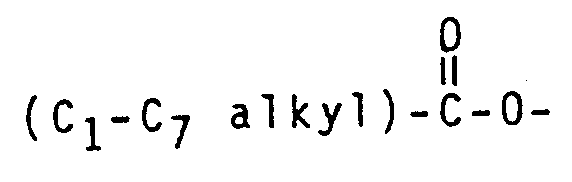
wherein the C₁-C₇ alkyl group is defined as above. When R₂ and/or R₃ are alkanoyloxy, they are preferably acetoxy, pivalyloxy or isobutyryloxy. - The term "C₁-C₇ haloalkyl" designates straight and branched chain lower alkyl radicals having up to seven carbon atoms and bearing one to three halo substituents (F, Cl, Br or I), which can be the same or different. Specific examples of the contemplated monohaloalkyl and polyhaloalkyl groups include chloromethyl, dichloromethyl, trichloromethyl, bromomethyl, fluoromethyl, difluoromethyl, trifluoromethyl, 1-fluoroethyl, 1-chloroethyl, 2-chloroethyl, 2,2,2-trichloroethyl, 2,2,2-trifluoroethyl, 1,2-dichloroethyl, 1-chloropropyl, 3-chloropropyl, 1-chlorobutyl, 1-chloropentyl, 1-chlorohexyl, 4-chlorobutyl and the like. Preferably, the haloalkyl group contains 1 or 2 carbon atoms and bears 1 to 3 halogen substituents, e.g. chloromethyl or trifluoromethyl.
- The term "C₁-C₇ alkylthio" includes straight and branched chain radicals of the type
(C₁-C₇ alkyl)-S-
wherein C₁-C₇ alkyl is defined as before. When R₂ and/or R₃ are alkylthio, they are preferably methylthio. - The terms "C₁-C₇ alkylsulfinyl" and "C₁-C₇ alkylsulfonyl" designate radicals of the formulas
(C₁-C₇ alkyl)-SO-
and
(C₁-C₇ alkyl)-SO₂-,
respectively, wherein C₁-C₇ alkyl is defined as before. When R₂ and/or R₃ are alkylsulfinyl or alkylsulfonyl, methylsulfinyl and methylsulfonyl are preferred. - When R₂ and/or R₃ are -CH=NOR‴, they are preferably -CH=NOH or -CH=NOCH₃.
- When R₂ and/or R₃ are -CONRʹRʺ, they are preferably -CONH₂ or -CON(CH₃)₂.
- The term "C₇-C₁₂ aralkyl" as used herein designates radicals of the type
-alkylene-aryl
wherein the aryl portion is phenyl or naphthyl and the alkylene portion, which can be straight or branched, can contain up to 6 carbon atoms, e.g. methylene, ethylene, propylene, trimethylene, 1,2-butylene, 2,3-butylene, tetramethylene and the like. When R₁ is aralkyl, it is preferably benzyl. - The expression "non-toxic pharmaceutically acceptable salts" as used herein generally includes the non-toxic salts of compounds of formulas (I) and (A) formed with non-toxic, pharmaceutically acceptable inorganic or organic acids HX. For example, the salts include those derived from inorganic acids such as hydrochloric, hydrobromic, sulfuric, sulfamic phosphoric, nitric and the like; and the salt prepared from organic acids such as acetic, propionic, succinic, glucolic, stearic, lactic, malic, tartaric, citric, ascorbic, pamoic, maleic, hydroxymaleic, phenylacetic, glutamic, benzoic, salicyclic, sulfanilic, fumaric, methanesulfonic, toluenesulfonic and the like. The expression "anion of a non-toxic pharmaceutically acceptable acid" as used herein, e.g. in connection with structures (II) and (B), is intended to include anions of such organic or inorganic acids HX.
- The expression "hydroxyl protective group" as used herein is intended to designate a group (Y) which is inserted in place of a hydrogen atom of an OH group or groups in order to protect the OH group(s) during synthesis and/or to improve lipoidal characteristics and prevent premature metabolism of the OH group(s) prior to the compound's reaching the desired site in the body. The expression "protected hydroxy substituent" designates an OY group wherein Y is a "hydroxyl protective group" as defined above.
- Typical hydroxyl protective groups contemplated by the present invention are acyl groups and carbonates. When the hydroxyl protective group is acyl (i.e., when it is an organic radical derived from a carboxylic acid by removal of the hydroxyl group), it preferably represents an acyl radical selected from the group consisting of alkanoyl having 2 to 8 carbon atoms; alkenoyl having one or two double bonds and 3 to 8 carbon atoms;

wherein the cycloalkyl portion contains 3 to 7 ring atoms and r is zero, one, two or three; phenoxyacetyl: pyridinecarbonyl; and
wherein r is zero, one, two or three and phenyl is unsubstituted or is substituted by 1 to 3 alkyl each having 1 to 4 carbon atoms, alkoxy having 1 to 4 carbon atoms, halo, trifluoromethyl, dialkylamino having 2 to 8 carbon atoms or alkanoylamino having 2 to 6 carbon atoms. - When the acyl group is alkanoyl, there are included both unbranched and branched alkanoyl, for example, acetyl, propionyl, butyryl, isobutyryl, valeryl, isovaleryl, 2-methylbutanoyl, pivalyl (pivaloyl), 3-methylpentanoyl, 3,3-dimethylbutanoyl, 2,2-dimethylpentanoyl and the like. Pivalyl, isobutyryl and isovaleryl are especially preferred.
- When the acyl group is alkenoyl, there are included, for example, crotonyl, 2,5-hexadienoyl and 3,6-octadienoyl.
- When the acyl group is

there are included cycloalkanecarbonyl and cycloalkanealkanoyl groups wherein the cycloalkane portion can optionally bear 1 or 2 alkyl groups as substituents, e.g. cyclopropanecarbonyl, 1-methylcyclopropanecarbonyl, cyclopropaneacetyl, α-methylcyclopropaneacetyl, 1-methylcyclopropaneacetyl, cyclopropanepropionyl, α-methylcyclopropanepropionyl, 2-isobutylcyclopropanepropionyl, cyclobutanecarbonyl, 3,3-dimethylcyclobutanecarbonyl, cyclobutaneacetyl, 2,2-dimethyl-3-ethylcyclobutaneacetyl, cyclopentanecarbonyl, cyclohexaneacetyl, cyclohexanecarbonyl, cycloheptanecarbonyl and cycloheptanepropionyl. Cyclohexanecarbonyl is especially preferred. - When the acyl group is pyridinecarbonyl, there are included picolinoyl (2-pyridinecarbonyl), nicotinoyl (3-pyridinecarbonyl) and isonicotinoyl (4-pyridinecarbonyl).
- When the acyl group is

there are included, for example, benzoyl, phenylacetyl, α-phenylpropionyl, β-phenylpropionyl, p-toluyl, m-toluyl, o-toluyl, o-ethylbenzoyl, p-tert-butylbenzoyl, 3,4-dimethylbenzoyl, 2-methyl-4-ethylbenzoyl, 2,4,6-trimethylbenzoyl, m-methylphenylacetyl, p-isobutylphenylacetyl, β-(p-ethylphenyl)propionyl, p-anisoyl, m-anisoyl, o-anisoyl, m-isopropoxybenzoyl, p-methoxyphenylacetyl, m-isobutoxyphenylacetyl, m-diethylaminobenzoyl, 3-methoxy-4-ethoxybenzoyl, 3,4,5-trimethoxybenzoyl, p-dibutylaminobenzoyl, 3,4-diethoxyphenylacetyl, β-(3,4,5-trimethoxyphenyl)propionyl, o-iodobenzoyl, m-bromobenzoyl, p-chlorobenzoyl, p-fluorobenzoyl, 2-bromo-4-chlorobenzoyl, 2,4,6-trichlorobenzoyl, p-chlorophenylacetyl, α-(m-bromophenyl)propionyl, p-trifluoromethylbenzoyl, 2,4-di(trifluoromethyl)benzoyl, m-trifluoromethylphenylacetyl, β-(3-methyl-4-chlorophenyl)propionyl, p-dimethylaminobenzoyl, p-(N-methyl-N-ethylamino)benzoyl, o-acetamidobenzoyl, m-propionamidobenzoyl, 3-chloro-4-acetamidophenylacetyl, p-n-butoxybenzoyl, 2,4,6-triethoxybenzoyl, β-(p-trifluoromethylphenyl)propionyl, 2-methyl-4-methoxybenzoyl, p-acetamidophenylpropionyl, and 3-chloro-4-ethoxybenzoyl. - When the hydroxyl protective group is a carbonate grouping, it has the structural formula
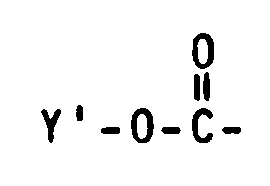
i.e., it is an organic radical which can be considered to be derived from a carbonic acid by removal of the hydroxyl group from the COOH portion. Yʹ preferably represents alkyl having 1 to 7 carbon atoms; alkenyl having one or two double bonds and 2 to 7 carbon atoms;
cycloalkyl-CrH2r-
wherein the cycloalkyl portion contains 3 to 7 ring atoms and r is zero, one, two or three; phenoxy; 2-, 3-, or 4-pyridyl; or
phenyl-CrH2r-
wherein r is zero, one, two or three and phenyl is unsubstituted or is substituted by 1 to 3 alkyl each having 1 to 4 carbon atoms, alkoxy having 1 to 4 carbon atoms, halo, trifluoromethyl, dialkylamino having 2 to 8 carbon atoms or alkanoylamino having 2 to 6 carbon atoms. Most preferably, Yʹ is C₁-C₇ alkyl, particularly ethyl or isopropyl. - Similarly, the expression "carboxyl protective group" as used herein is intended to designate a group (W) which is inserted in place of a hydrogen atom of a COOH group or groups in order to protect the COOH group(s) during synthesis and/or to improve lipoidal characteristics and prevent premature metabolism of said COOH group or groups prior to the compound's reaching the desired site in the body. Typical of such carboxyl protective groups W are the groups encompassed by Yʹ above, especially C₁-C₇ alkyl, particularly ethyl, isopropyl and t-butyl. While such simple alkyl esters and the like are often useful, other carboxyl protecting groups may be selected, e.g. in order to achieve greater control over the rate of in vivo hydrolysis of the ester back to the acid and thus enhance drug delivery. To that end, carboxyl protecting groups W such as the following may be used to replace the hydrogen of the -COOH group:

or
-alk-O-alkyl,
wherein alk is C₁-C₆ straight or branched alkylene and the alkyl radical is straight or branched and contains 1 to 7 carbon atoms (e.g.
and -CH₂OCH₃). - Other carboxyl protective groups W which can be used to replace the hydrogen of the -COOH group and which are especially useful herein are the following:
C₃-C₁₂ cycloalkyl-CpH2p-
wherein p is 0, 1, 2 or 3;
C₆-C₂₈ polycycloalkyl-CpH2p-
wherein p is defined as above;
C₆-C₂₈ polycycloalkenyl-CpH2p-
wherein p is defined as above;
C₃-C₁₂ cycloalkenyl-CpH2p-
wherein p is defined as above;
-CH₂-Xa-Ra
wherein Xa is S, SO or SO₂ and Ra is C₁-C₇ alkyl or C₃-C₁₂ cycloalkyl;
wherein Ra is defined as above;
wherein Xa is defined as above, Rb is C₁-C₇ alkyl and Rc is C₁-C₇ alkyl or wherein Rb and Rc taken together represent -(CH₂)mʹ- wherein mʹ is 3 or 4 and -(CH₂)mʹ-is optionally substituted by one to three C₁-C₇ alkyl;
wherein Rd is hydrogen or C₁-C₇ alkyl and Re is unsubstituted or substituted C₁-C₁₂ alkyl [e.g.
C₃-C₁₂ cycloalkyl-CpH2p- wherein p is defined as above, C₃-C₁₂ cycloalkenyl-CpH2p- wherein p is defined as above or C₂-C₈ alkenyl, the substituents being selected from the group consisting of halo, C₁-C₇ alkoxy, C₁-C₇ alkylthio, C₁-C₇ alkylsulfinyl, C₁-C₇ alkylsulfonyl,
or Re is unsubstituted or substituted phenyl or benzyl, the substituents being selected from the group consisting of C₁-C₇ alkyl, C₁-C₇ alkoxy, halo, carbamoyl, C₂-C₈ alkoxycarbonyl, C₂-C₈ alkanoyloxy, C₁-C₇ haloalkyl, mono(C₁-C₇ alkyl)amino, di(C₁-C₇ alkyl)amino, mono(C₁-C₇ alkyl)carbamoyl, di(C₁-C₇ alkyl)carbamoyl, C₁-C₇ alkylthio, C₁-C₇ alkylsulfinyl and C₁-C₇ alkylsulfonyl, or Re is C₆-C₂₈ polycycloalkyl-CpH2p- or C₆-C₂₈ polycycloalkenyl-CpH2p-wherein p is defined as above;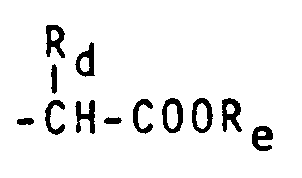
wherein Rd and Re are defined as above; and
wherein Rd is defined as above and Rf and Rg, which can be the same or different, are each hydrogen, C₁-C₇ alkyl, C₃-C₁₂ cycloalkyl-CpH2p-, C₃-C₁₂ cycloalkenyl-CpH2p-, phenyl or benzyl, or one of Rf and Rg is hydrogen, C₁-C₇ alkyl, C₃-C₁₂ cycloalkyl-CpH2p-, C₃-C₁₂ cycloalkenyl-CpH2p-, phenyl or benzyl and the other of Rf and Rg is C₆-C₂₈ polycycloalkyl-CpH2p- or C₆-C₂₈ polycycloalkenyl-CpH2p-, or Rf and Rg are combined such that -NRfRg represents the residue of a saturated monocyclic secondary amine. - When the carboxyl protecting group is C₃-C₁₂ cycloalkyl-CpH2p- or otherwise contains a C₃-C₁₂ cycloalkyl group, the cycloalkyl groups contain 3 to 8 ring atoms and may optionally bear one or more, preferably one to four, alkyl substituents. Exemplary such cycloalkyl groups are cyclopropyl, 2-methylcyclopropyl, 3-ethylcyclopropyl, 2-butylcyclopropyl, 3-pentylcyclopropyl, 2-hexylcyclopropyl, cyclobutyl, 2-methylcyclobutyl, 2,3-dimethylcyclobutyl, 3-butylcyclobutyl, 4-hexylcyclobutyl, 2,3,3-trimethylcyclobutyl, 3,3,4,4-tetramethylcyclobutyl, cyclopentyl, 2-methylcyclopentyl, 3-ethylcyclopentyl, 4-butylcyclopentyl, 5-methylcyclopentyl, 3-pentylcyclopentyl, 4-hexylcyclopentyl, 2,3-dimethylcyclopentyl, 2,2,5,5-tetramethylcyclopentyl, 2,3,4-trimethylcyclopentyl, 2,4-dimethyl-3-ethylcyclopentyl, 2,2,3,4,4-pentamethylcyclopentyl, 2,3-dimethyl-3-propylcyclopentyl, cyclohexyl, 2,6-dimethylcyclohexyl, 3,3,5,5-tetramethylcyclohexyl, 2-methylcyclohexyl, 2-ethylcyclohexyl, 4-propylcyclohexyl, 5-butylcyclohexyl, 2,3-dimethylcyclohexyl, 2,4-dimethylcyclohexyl, 2,5-dimethylcyclohexyl, 2,3,4-trimethylcyclohexyl, 2,3-dimethyl-5-ethylcyclohexyl, 2,5-dimethyl-6-propylcyclohexyl, 2,4-dimethyl-3-butylcyclohexyl, 2,2,4,4-tetramethylcyclohexyl, 3,3,6,6-tetramethylcyclohexyl, 3,3,4,5,5-pentamethylcyclohexyl, 3,3,4,5,5,6-hexamethylcyclohexyl, 3,3,5-trimethyl-4-ethylcyclohexyl, 3,4,4-trimethyl-5-propylcyclohexyl, cycloheptyl, 3-methylcycloheptyl, 5-propylcycloheptyl, 6-butylcycloheptyl, 7-methylcycloheptyl, cyclooctyl, 2-methylcyclooctyl, 3-ethylcyclooctyl, 3,3,4-trimethylcyclooctyl, 3,3,5,5-tetramethylcyclooctyl and the like. Among the presently preferred cycloalkyl-CpH2p- carboxyl protecting groups are cyclohexyl, 2,6-dimethylcyclohexyl and 3,3,5,5-tetramethylcyclohexyl. Thus, when the carboxyl protective group is cycloalkyl-CpH2p-, p is preferably zero or one, most preferably zero.
- When the carboxyl protecting group is C₃-C₁₂ cycloalkenyl-CpH2p- or otherwise contains a C₃-C₁₂ cycloalkenyl group, the corresponding unsaturated radicals such as cyclopentenyl and cyclohexenyl and the like are contemplated. Again, when the protective group is C₃-C₁₂ cycloalkenyl-CpH2p-, p is preferably zero or one, most preferably zero.
- The polycycloalkyl-CpH2p- radicals which can serve as carboxyl protective groups, or as portions of carboxyl protective groups, are bridged or fused saturated alicyclic hydrocarbon systems consisting of two or more rings, optionally bearing one or more alkyl substituents and having a total of 6 to 28 carbon atoms in the ring portion. The corresponding bridged or fused unsaturated alicyclic hydrocarbon systems are intended by the term "C₆-C₂₈ polycycloalkenyl-CpH2p-". Such polycycloalkyl and polycycloalkenyl radicals are exemplified by adamantyl (especially 1- or 2-adamantyl), adamantylmethyl (especially 1-adamantylmethyl), adamantylethyl (especially 1-adamantylethyl), bornyl, norbonyl, (e.g. exo-norbornyl or endo-norbornyl), norbornenyl (e.g. 5-norbornen-2-yl), norbornylmethyl (e.g. 2-norbornylmethyl) and norbornylethyl (e.g. 2-norbornylethyl), and by radicals of the type
-CpH2p-(sterol residue)
wherein p is defined as above and the sterol residue is the portion of a steroidal alcohol which remains after removal of a hydrogen atom from a hydroxy group therein. The sterol residue is preferably that of a pharmacologically inactive steroid, e.g. cholesterol, a bile acid (cholic acid or related compound) or the like. In the case of polycyclic radicals, p is preferably 0, 1 or 2. - When the carboxyl protective group is

wherein -NRfRg represents the residue of a saturated monocyclic secondary amine, such monocycles preferably have 5 to 7 ring atoms optionally containing another hetero atom (-O-, -S- or -N-) in addition to the indicated nitrogen atom, and optionally bear one or more substituents such as phenyl, benzyl and methyl. Illustrative of residues of saturated monocyclic secondary amines which are encompassed by the -NRfRg term are morpholino, 1-pyrrolidinyl, 4-benzyl-1-piperazinyl, perhydro-1,2,4-oxathiazin-4-yl, 1- or 4-piperazinyl, 4-methyl-1-piperazinyl, piperidino, hexamethyleneimino, 4-phenylpiperidino, 2-methyl-1-pyrazolidinyl, 1- or 2-pyrazolidinyl, 3-methyl-1-imidazolidinyl, 1- or 3-imidazolidinyl, 4-benzylpiperidino and 4-phenyl-1-piperazinyl. - Carboxyl protecting groups of the type -CH₂COOR in which R is linear or branched C₁-C₁₂ alkyl or C₅-C₁₆ mono-alicyclic or polycyclic are described in Laruelle et al United States Patent No. 4,568,754. Those groups are said to be useful in providing derivatives of 5-hydroxytryptophan (5-HTP) which are resistant to peripheral decarboxylation and which regenerate 5-HTP at the cerebral level, in this way increasing passage through the blood-brain barrier. The Laruelle et al derivatives lack the instant dihydropyridine ⇄ pyridinium salt redox system and thus would not be capable of providing sustained brain delivery via a "locked-in" quaternary form.
- As yet another alternative in accord with the present invention, the carboxyl group can be protected by converting it to an amide, i.e. the -COOH group is converted to a -CONRfRg group wherein Rf and Rg are as defined and exemplified above. Such amide groups are also intended to be encompassed by the expression "carboxyl protecting group" as used with formulas (I) and (II) herein, or similar expressions used herein in conjunction with peptides of partial structures (A) and (B).
- Selection of an appropriate carboxyl protecting group will depend upon the reason for protection and the ultimate use of the protected product. For example, if the protecting group is intended to be present in a pharmaceutically useful peptide end product, it will be selected from those protecting groups described hereinabove which offer low toxicity and the desired degree of lipophilicity and rate of in vivo cleavage. On the other hand, if the protecting group is used solely for protection during synthesis, then only the usual synthetic requirements will generally apply.
- Carboxyl protecting groups for use in peptide synthesis are well-known to those skilled in the art. See, for example, M. Bodanszky, Principles of Peptide Synthesis, Springer-Verlag, New York 1984, Ives United States Patent No. 4,619,915 and the various publications on peptide chemistry referred to in the Ives patent. See also Methoden der Organischen Chemie, Houben-Weyl, Volume 15/1 for protecting groups and Volume 15/2 for methods of peptide synthesis. Representative carboxyl protecting groups for synthetic purposes include various silyl esters (e.g. trialkylsilyl and trihalosilyl esters), alkyl esters (e.g. tert-butyl esters), benzyl esters and the other carboxyl protecting groups mentioned in the Ives patent. Simple alkyl esters are frequently satisfactory for synthetic purposes, while bulkier and more complex ester groupings (e.g. those of the polycycloalkyl and polycycloalkenyl, such as the sterol, residue types) or amides are generally preferred for use in vivo.
- The expression "amino protective group" as used herein is intended to designate a group (T) which is inserted in place of a hydrogen atom of an amino group or groups in order to protect the amino group(s) during synthesis and/or to improve lipoidal characteristics and prevent premature metabolism of said amino group or groups prior to the compound's reaching the desired site in the body.
- As with the carboxyl protecting groups, selection of a suitable amino protecting group will depend upon the reason for protection and the ultimate use of the protected product. When the protecting group is used solely for protection during synthesis, then a conventional amino protecting group may be employed. Appropriate amino protecting groups are known in the art and are described, for example, in the Bodanszky, Ives and Houben-Weyl references cited above. Representative amino protecting groups for synthetic use include acyl groups such as tert-butoxycarbonyl, benzyloxycarbonyl, benzoyl, acetyl and the like. Yet other conventional amino protecting groups for use in synthesis are described in the literature, e.g. in the Bodanszky publication and Ives patent referred to hereinabove.
- As with the carboxyl protecting groups, when the amino protecting group is intended to be present in a pharmaceutically useful peptide end product, then it will be selected from among amino protecting groups which offer low toxicity and the desired degree of lipophilicity and rate of in vivo cleavage. Especially suitable for in vivo use as amino protecting groups T are activated carbamates, i.e. the protecting group T has the structure

wherein Rh is hydrogen, C₁-C₇ alkyl or phenyl and Ri can be selected from the groups indicated as suitable carboxyl protecting groups W hereinabove. Again, the bulkier groups are preferred for use in vivo, and Ri is preferably a polycycloalkyl or polycycloalkenyl-containing group, such as adamantyl or a sterol residue, especially a cholesterol or bile acid residue. - Alternatively, the amino protecting group T may simply be composed of one or two "throw away" natural amino acids, e.g. alanine or phenylalanine, which are not needed for activity but which are designed to be cleaved first from the rest of the molecule by a specific peptidase and in this way prevent premature degradation of the active portion of the molecule.
- The various protecting groups for hydroxyl, carboxyl and amino functions discussed above can be substituted for the hydroxyl, carboxyl and amino functions in the instant amino acids/peptides (or their precursor molecules) by methods well-known in the art. Methods for chemical removal of the protecting groups (when such are not to be retained in the pharmaceutically useful end product) are likewise well-known to those skilled in the art. Typically, amine protecting groups are chemically removed by acidolysis (acid hydrolysis) or hydrogenation, depending on the particular protecting group employed. Hydroxyl and carboxyl protecting groups are typically removed chemically by acid or base hydrolysis. Protecting groups which are incorporated in the pharmaceutical end product must be amenable to hydrolytic or metabolic cleavage in vivo.
- In general, the peptides provided by the present invention are prepared by sequential addition of one or more amino acids or protected amino acids, with the redox system being either first incorporated into an amino acid or protected amino acid which is then added to the growing peptide chain, or else inserted directly into a dipeptide or larger peptide fragement in the course of the peptide synthesis. Methods for sequential addition of amino acids to form peptides, utilizing protecting groups where appropriate, are well-known in the art. An excellent summary of such methods, including both solid phase synthesis and synthesis in solution, is contained in Nestor et al United States Patent No. 4,530,920. See also SOLID PHASE PEPTIDE SYNTHESIS, second edition, John Morrow Stewart and Janis Dillaha Young, Pierce Chemical Company, Rockford, Illinois, 1984.
- Peptides provided by the present invention can also be prepared by segment condensation methods described in the literature, e.g. in the Bodanszky and Houben-Weyl references cited above.
- The quaternary forms of the redox amino acids and peptides of this invention, i.e. the salts of formulas (II) and (B), respectively, can be prepared by a variety of methods suitably combined with the protection/deprotection and peptide linkage steps referred to above. Typical methods of combining the various steps are illustrated in the synthetic examples hereinafter. At the present time, three general methods have been found to be particularly convenient for preparation of the quaternary derivatives. Selection of an appropriate method depends upon the identities of Z and R₁ in the desired products of formulas (II) and (B).
- The first of the three methods for preparing the quaternary salts is a halogen replacement reaction which is useful when Z in the desired product of formula (II) or (B) is to be attached to the heterocyclic ring via a ring nitrogen atom and R₁ is a direct bond. According to this method, a halogen-containing amino acid or peptide of the formula

respectively, wherein Hal is chloro or bromo and R₄, R₅ and Z are defined as before, is reacted with a compound of the formula
wherein R₂ and R₃ are defined as before. Preferred starting materials of formula (IV) include nicotinamide, picolinamide, isonicotinamide, 3-quinolinecarboxamide and 4-isoquinolinecarboxamide. The reaction is typically carried out in an inert organic solvent, with heating. The products of formulas (II) and (B) are of the type in which Z is attached to the heterocyclic ring via a ring nitrogen atom, R₁ is a direct bond and X⁻ is a chloride or bromide anion. - The second of the three methods found useful in preparing the quaternary salts of this invention is an alkylation reaction and can be used to prepare derivatives of formulas (II) and (B) wherein Z is attached to the heterocyclic ring via a ring carbon atom and R₁ is C₁-C₇ alkyl, C₁-C₇ haloalkyl or C₇-C₁₂ aralkyl. In accord with this method, an amino acid or peptide of the formula

respectively, wherein R₂, R₃, R₄ and R₅ and Z are defined as before and Z is attached to the heterocyclic ring via a ring carbon atom, is reacted with an alkylating agent of the formula
R₁-halide (VI)
wherein R₁ is C₁-C₇ alkyl, C₁-C₇ haloalkyl or C₇-C₁₂ aralkyl and the halide is iodide, bromide or chloride. A preferred starting material of formula (VI) is methyl iodide. Typically, this quaternization reaction takes place in a suitable organic solvent. The products of formulas (II) and (B) are of the type in which Z is attached to the heterocyclic ring via a ring carbon atom, R₁ is C₁-C₇ alkyl, C₁-C₇ haloalkyl or C₇-C₁₂ aralkyl and X is an iodide, bromide or chloride ion. - The third method for preparing the quaternary salts is a Zincke exchange reaction useful when Z in the desired product of formula (II) or (B) is to be attached to the heterocyclic ring via a ring nitrogen atom and R₁ is a direct bond. Thus, a Zincke reagent of the formula

wherein R₂ and R₃ are defined as before is reacted with an amino acid or peptide having a pendant primary amino group, i.e. an amino acid/peptide of the formula
respectively, wherein R₄, R₅ and Z are defined as before. This reaction is generally conducted in the presence of a suitable base, e.g. triethylamine, in an appropriate organic solvent, e.g. methanol, and affords derivatives of formulas (II) and (B) wherein Z is attached to the heterocyclic ring via a ring nitrogen atom, R₁ is a direct bond and X⁻ is a chloride anion. The Zincke reagent employed in the process can be prepared by reacting 1-chloro-2,4-dinitrobenzene with a compound of formula (IV) above. Preferred Zincke reagents are those produced from nicotinamide, picolinamide, isonicotinamide, 3-quinolinecarboxamide and 4-isoquinolinecarboxamide. See also Zincke et al, Annalen, 1904, 333, 296; Lettré, Annalen, 1953, 579, 123; Keijzer et al, Heterocycles, Vol. 16, No. 10, 1981, 1687. - The various starting materials employed in the processes described above are commercially available or can be prepared by known methods.
- When an anion is desired which is different from the one obtained by one of the processes described above, the anion in the quaternary salt of formula (II) or (B) may be subjected to anion exchange via an anion exchange resin or, more conveniently by use of the method of Kaminski et al, Tetrahedron, Vol. 34, pp. 2857-2859 (1978). According to the Kaminski et al method, a methanolic solution of an HX acid will react with a quaternary ammonium halide to produce the methyl halide and the quaternary ·X salt.
- The quaternary salts of formulas (II) and (B) can be reduced to form the corresponding dihydro derivatives of formulas (I) and (A), respectively. Also, the quaternary salts of formulas (II) and (B) may be subjected to lengthening of the peptide chain, with reduction occurring at a later point in the synthetic scheme. Frequently, it may be desirable to postpone reduction until the peptide chain has reached the desired length, i.e. the length desired for the pharmaceutical end product.
- Reduction of the quaternary salts of formulas (II) and (B) to the corresponding dihydro derivatives of formulas (I) and (A), respectively, is usually conducted at a temperature from about -10°C to room temperature, for a period of time from about 10 minutes to 3 hours, conveniently at atmospheric pressure. The process is conducted in the presence of a suitable reducing agent, preferably an alkali metal dithionite such as sodium dithionite, an alkali metal borohydride such as sodium borohydride or lithium aluminum borohydride, or a more reactive dihydropyridine such as 1-benzyl-1,2-dihydroisonicotinamide.
- Sodium dithionite reduction is conveniently carried out in an aqueous solution, e.g. aqueous methylene chloride, in the presence of base, e.g. sodium bicarbonate, and, in the case of pyridinium and quinolinium starting materials, generally affords a preponderance of 1,4-dihydro isomer. The dihydro product is usually insoluble in water and thus can be readily separated from the sodium dithionite reaction medium.
- In the case of sodium borohydride reduction, an organic reaction medium is typically employed, e.g. a lower alkanol such as methanol, an aqueous alkanol or other protic solvent. For pyridinium and quinolinium starting materials, sodium borohydride reduction typically affords a preponderance of the 1,6-dihydropyridine and 1,2-dihydroquinoline isomers, respectively.
- Other useful reducing agents include dihydropyridines which are more reactive than the quaternary salts which are to be reduced. A particularly suitable reagent of this type is the highly reactive 1-benzyl-1,2-dihydroisonicotinamide, which can be used for selective reduction of the quaternary salts by a direct hydride transfer reaction under neutral conditions [Nuvole et al, J. Chem. Research, 1984, (S), 356]. Thus, for example, pyridinium and quinolinium salts of the invention can be regioselectively reduced to the corresponding 1,4-dihydropyridines and 1,4-dihydroquinolines, respectively, utilizing 1-benzyl-1,2-dihydroisonicotinamide as the reducing agent, typically in a suitable organic reaction medium, e.g. anhydrous methanol. Other possible reducing agents of the reactive dihydropyridine type include ribosyl N-methyl dihydronicotinamide (derived from NADH).
- Especially preferred compounds of the present invention are the amino acids of formula (I) in which the

portion of the molecule has one of the following structures, as well as the corresponding peptides of formula (A) and the quaternary forms of these amino acids and dipeptides:

In the above structures, Z is preferably -CH₂- or -(CH₂)₄-. In structures (e), (f), (g), (h), (i), (j) and (k), Z is most preferably -(CH₂)-; in structures (c), (d), (l), (m) and (n), Z is most preferably -(CH₂)₄-. The corresponding quaternary salts of formula (II) have the partial structures:
wherein Z is preferably as defined in the preceding two sentences. - As stated hereinabove, the novel amino acids of formulas (1) and (II) are useful in the preparation of novel bioactive peptides of the partial structural formulas (A) and (B). In particular, by incorporating an amino acid fragment of structure (A) or (B) into the peptide chain, there is provided herein a method for imparting improved brain specificity and substained in-brain activity to a pharmacologically active peptide. The peptide thus modified is susceptible to administration to a mammal in its reduced form comprising fragment (A) and is capable of in-brain conversion to its oxidized form comprising fragment (B). The oxidized form either is itself pharmacologically active or is convertible in vivo to a pharmacologically active form, e.g. by cleavage of one or more amino acid units. For most successful use in vivo, there are further incorporated into the final peptide (i.e. the peptide which is intended for administration) amino and carboxyl protective groups for the terminal amino and carboxyl functions of the peptide, the protective groups being capable of in-brain cleavage to free amino and carboxyl functions. Suitable such protective groups are discussed hereinabove. The amino acid fragment of structure (A) or (B) is preferably located in a non-terminal position of the peptide chain; nevertheless, terminal positions are contemplated as well. Moreover, more than one redox fragment may be incorporated into a given peptide; multiple such fragments may be particularly desirable in the case of larger peptides and/or when a peptide contains a plurality of suitable sites at which to introduce the redox fragment, i.e. a plurality of locations at which the redox fragment can be placed without loss of the peptide's pharmacological activity.
- The final redox peptide of the invention preferably contains a total of 2 to 20 amino acid units. Typically, except for the presence of at least one redox amino acid fragment of structure (A) or (B) and the possible protection of terminal amino and carboxyl functions, the structure of the instant redox peptide is identical to that of a known, naturally occurring bioactive peptide or of a known bioactive synthetic peptide (particularly one which is an analog of a naturally occurring bioactive peptide). Naturally, in order for the final redox peptide's brain specificity/sustained activity to be of value, the peptide must exert a useful central activity, i.e. it should exert a significant pharmacological action in the central nervous system such that it may be used as a drug, that is, for the diagnosis, cure, mitigation, treatment or prevention of disease or in the enhancement of desirable physical or mental development and conditions in man or animals, or it must be convertible in vivo to a peptide having a useful central activity.
- Appropriate known peptides for incorporation of the instant redox system therein include naturally occurring peptides such as met⁵-enkephalin, leu⁵-enkephalin, vasopressin, oxytocin, neurotensin, ACTH fragments, peptlde T, Substance P, angiotensin, somatostatin and LH-RH, as well as their biologically active synthetic analogs.
- Many of these peptides and their analogs have been previously studied in depth, so that it is possible to learn from the scientific literature which positions in the amino acid sequence are fairly critical to the requisite biological activity of a given peptide and which positions may be varied without loss of activity. Some of these teachings of the art and their application to the instant invention are discussed below, but this discussion is not intended to be exhaustive. In this discussion, the conventional peptide representation (amino terminus on left, carboxyl terminus on right) will be used, as will the conventional abbreviations for the individual amino acid units (Phe for phenylalanine, Gly for glycine, etc.). Insofar as concerns configuration, in this general discussion the configuration of optically active amino acids will be assumed to be L unless otherwise specified.
- The enkephalins are two naturally occurring pentapeptides belonging to the endorphin class. Met⁵-enkephalin has the structure
H-Tyr-Gly-Gly-Phe-Met-OH
while Leu⁵-enkephalin has the structure
H-Tyr-Gly-Gly-Phe-Leu-OH.
The most important property of the enkephalins is their morphine-like analgesic action. They also have a variety of effects on memory. - Some peptides slightly larger than the enkephalins with intrinsic opiate activity have also been identified. These include Met⁵-enkephalin-Arg⁶ and Met⁵-enkephalin-Lys⁶, which are believed to be potential precursors of Met⁵-enkephalin; and Met⁵-enkephalin-Arg⁶-Phe⁷, which has high affinity for K-opiate receptors.
- Moreover, many enkephalin analogs have been synthesized (e.g. FK-33-824, LY 127623/metkephamid, Wy-42,896) and structure/activity relationships have been analyzed; see, in particular, J.S. Morley, Annu. Rev. Pharmacol. 20: 81-110 (1980). While virtually every position in the enkephalin chain allows some variation without loss of activity, some positions allow much more variation than others. Thus, in the case of N-terminal substitution, activity can be maintained in the same range by addition of an L-amino acid. The Gly² position appears to be particularly amenable to variation, and replacement with a D-amino acid often has been found to lead to a marked increase in potency and/or longer biological half-life. Also, structural/conformational changes at the Met⁵/Leu⁵ position, i.e. replacing Met⁵ or Leu⁵ with a different amino acid (L or D), have afforded analogs which are invariably active, although increases in potency as the result of such changes are modest. Replacement of the terminal acid function with an unsubstituted amide group has afforded a very potent analog, Met⁵-enkephalin-NH₂. In addition, contraction or extension at the C-terminus has afforded active analogs.
- Vasopressin and oxytocin are cyclic peptides which differ from each other in only two amino acids. All mammalian oxytocin (OXT) has the structure

Most vasopressin is arginine-vasopressin (AVP), which has the structure
swine vasopressin (SVP) is also known as lysine-vasopressin and has the structure
Vasopressin appears to enhance retention of learned responses and to enhance attention and memory. Both oxytocin and vasopressin may be involved in pain mechanisms. In vasopressin, residues 2, 3 and 5 seem to be fairly critical for activity, especially asparagine at 5. Most of the activity in vasopressin and oxytocin seems to be in the covalent ring structure. Removing the C-terminal glycinamide appears not to affect behavior. Behaviorally active fragments include H-Pro-Arg-Gly-NH₂, H-Lys-Gly-NH₂, AVP₁₋₇ (pressinamide), OXT₁₋₈, OXT₁₋₇, OXT₁₋₆, Pro-Leu-Gly-NH₂ and Leu-Gly-NH₂. While the amino acids at 8 and 9 can be removed, shortening to 6 or 7 amino acids appears to cause a change in activity, at least in the case of oxytocin, where OXT₁₋₇ and OXT₁₋₆ affect memory differently from OXT. - Neurotensin (NT) is a basic tridecapeptide of the formula
p-Glu-Leu-Tyr-Glu-Asn-Lys-Pro-Arg-Arg-Pro-Tyr-Ile-Leu-OH
which has a variety of hormone-like activities. It has been shown to induce hypotension. It also acts as a CNS neurotransmitter and appears to be a very potent analgesic. The carboxy terminal leucine moiety appears to be essential for binding and the arginine residues at 8 and 9 also are essential for binding and biological activity. Very little variation as positions 11, 12 and 13 seems to be possible. Xenopsin, an octapeptide which shares many properties with neurotensin, has the structure
pGlu-Gly-Lys-Arg-Pro-Trp-Ile-Leu-OH.
Other potent neurotensin analogs include D-Tyr¹¹-NT and D-Phe¹¹-NT. - ACTH, or adrenocorticotropic hormone, has complex behavioral activities involving learning, memory, motivation, arousal and attention. It has 39 amino acids, but its essential structure is believed to be ACTH₄₋₇, with phenylalanine in position 7 playing a key role in behavioral effects. Human ACTH₁₋₃₉ has the structure:

Active fragments include ACTH₄₋₁₀ and ACTH₄₋₇, with ACTH₄₋₇ being the shortest peptide found to give the typical behavioral effects of ACTH. A very active ACTH₄₋₉ analog, OGR 2766, has the structure
H-Met(O)-Glu-His-Phe-D-Lys-Phe-OH,
which has an oxidized methionine at 4, D-lysine at 8 in place of arginine, and phenylalanine at 9 in place of tryptophan. It shows 1000 fold potentiation, with dissociation of behavioral effects from endocrine, metabolic and opiate-like activities. Other active analogs include D-Phe⁷-ACTH₁₋₁₀, D-Phe⁷-ACTH₄₋₇ and D-Phe⁷-ACTH₄₋₁₀, although in some ways these analogs behave oppositely from the natural L-forms. - Peptide T is an octapeptide with anti-AIDS activity. Substance P is an undecapeptide which acts as a vasodilator and a depressant, and can produce analgesia and hyperalgesia. It plays an important role in nervous system function. Substance P has the structure

It appears that most structural variation can occur at positions 1 to 6, with some variation also possible at 8. Active analogs include physalaemin, which has the structure
pGlu-Ala-Asp-Pro-Asn-Lys-Phe-Tyr-Gly-Leu-Met-NH₂;
eledoisin, which has the structure
pGlu-Pro-Ser-Lys-Asp-Ala-Phe-Ile-Gly-Leu-Met-NH₂;
and kossinin, which has the structure
Asp-Val-Pro-Lys-Ser-Asp-Gln-Phe-Val-Gly-Leu-Met-NH₂.
Moreover, a series of retro-inverso C-terminal hexapeptide analogs of Substance P has been recently described by Verdini et al, United States Patent No. 4,638,046, dated January 20, 1987. Verdini et al describe compounds of the formula
in which P is a hydrogen atom, a linear or branched aliphatic alkyl group with 1-6 carbon atoms, or a saturated or unsaturated linear or branched chain aliphatic acyl group such as formyl, acetyl, propionyl, n-butyryl, isobutyryl, n-valeryl, isovaleryl, hexanoyl, isohexanoyl, heptanoyl, octanoyl, crotonoyl, methacryloyl, acryloyl; or a substituted acyl group such as hydroxyacetyl, 2-hydroxypropionyl, 3-hydroxypropionyl, aminoacetyl, 4-hydroxyphenylacetyl, 4-hydroxyphenylpropionyl, 2-aminopropionyl, 3-aminopropionyl, O-ethylmalonyl, ethoxyformyl, methoxyacetyl, 3-methoxypropionyl, 3-ethoxypropionyl, chloroacetyl, dichloroacetyl, 2-chloropropionyl, 3-chloropropionyl, 2,3-dichloropropionyl, bromoacetyl, 4-hydroxy-3,5-diiodophenylacetyl, 3-oxobutyryl, 3-oxovaleryl, 4-oxovaleryl, methylthioacetyl, 3-methylthiopropionyl, ethylthioacetyl, 3-ethylthiopropionyl, nicotinoyl, 4-aminobutyryl, Nα-[(1-(9-adenyl)-β-D-ribofuranuronosyl)], Nα-[(1-(9-hypoxanthyl)-β-D-ribofuranuronosyl]; or a group such as benzyloxycarbonyl, tert-butyloxycarbonyl, tert-amyloxycarbonyl, isobornyloxycarbonyl, adamantyloxycarbonyl, or chloro or nitro-substituted benzyloxycarbonyl;
R¹ is a residue of methionine, methionine sulphoxide, methionine sulphone, selenomethionine, leucine, norleucine, valine or norvaline;
R² is a residue of leucine, norleucine, valine, norvaline, alanine or isoleucine;
R³ is a hydrogen atom or methyl;
R⁴ is an amino acid residue of D configuration such as phenylalanine, tryptophan, tyrosine, valine, norvaline, leucine, norleucine, isoleucine, serine or derivatives, threonine or derivatives, histidine or derivatives, methionine, methionine-S-methyl, methionine sulphone, arginine or derivatives, lysine or derivatives, ornithine or derivatives, 2,4-diaminobutyric acid or derivatives, 2,3-diaminopropionic acid or derivatives, glutamic acid or aspartic acid or their suitable derivatives;
R⁵ is a hydrogen atom or the side-chain of amino acids such as phenylalanine, tyrosine, 4-chlorophenylalanine, O-benzyltyrosine (or their acetyl, cyclopentyl, tert-butyloxycarbonyl or 4-hydroxyphenylacetyl derivatives);
R⁶ is an amino acid residue such as glutamine or derivatives, pyroglutamic acid, alanine, tyrosine, lysine or derivatives, proline, N-formyl-proline, β-alanine, N-acetyl-β-alanine, glycine, desaminophenylalanine, desaminoaspartic acid, methyldesaminoaspartic acid, or glutamic acid esters represented by the general formula
in which X is methyl, ethyl, methoxyethyl or methoxy(ethoxy)nethyl wherein n = 1, 2 or 3. - The Verdini et al analogs show variations possible in the amino acids corresponding to positions 6, 7 and 9-11 of Substance P, substantial variations at position 8 of Substance P (R⁴ of Verdini et al) using a wide variety of D amino acid residues, and the ability to delete the first five amino acids in Substance P without loss of activity.
- A group of biologically active heptapeptides has been recently described by deCastiglione et al, United States Patent No. 4,567,162, dated January 28, 1986. These peptides are said to display activity on the central nervous system and to be useful in promoting growth activity and improving feed efficiency in animals. The compounds have the general formula
X-Val-Pro-Pro-Leu-Gly-Trp-A-Y
wherein:
X represents a hydrogen atom or a terminal nitrogen protecting group of acyl, aliphatic urethane, aromatic urethane, alkyl or aralkyl type;
A represents a neutral L-α-amino acid residue; and
Y represents a hydroxy group, an amino group or a group of the formula OR, NHR, NR₂ or NH-N-H-Rʹ wherein R represents a straight chain, branched chain or cyclic (including fused or bridged rings) alkyl group having up to 11 carbon atoms which may be unsubstituted or independently substituted by a hydroxy or amino group or a halogen atom, an aralkyl group having from 7 to 14 carbon atoms or a phenyl group; and Rʹ represents a hydrogen atom, any of the groups which R may represent, a straight chain, branched chain or cyclic aliphatic acyl group having from 1 to 11 carbon atoms which may be unsubstituted or independently substituted by a hydroxy or an amino group or a halogen atom, an aromatic acyl group which may be unsubstituted or independently substituted by a hydroxy or amino group or a halogen atom, a straight chain, branched chain or cyclic aliphatic urethane type group having from 3 to 11 carbon atoms, or an aromatic urethane type group. Thus, a significant amount of variation is possible in the structure of the seventh, or terminal amino acid, A. - Angiotensin is a pressor substance. Angiotensin I, a decapeptide, is converted to the active pressor agent, angiotensin II, by splitting off the C-terminal His-Leu residues. The octapeptide II differs among species at position 5 (Val or Ile). The active angiotensin II as well as angiotensin amide are hypotensive and may increase the effectiveness of endogenous norepinephrine. These peptides have the following structures:
Angiotensin I: --Asp-Arg-Val-Tyr-Ile-His-Pro-Phe-His-Leu--
Angiotensin II: --Asp-Arg-Val-Tyr-Ile-His-Pro-Phe--
Angiotensin Amide:
Thus, it would appear that at least the C-terminal dipeptide portion of Angiotensin I could be modified without loss of activity. - Somatostatin (SRIF) is a cyclic tetradecapeptide that with GRF mediates the neuroregulation of pituitary growth hormone release. It is also a potent inhibitor of central and peripheral neural systems. It has been used as an experimental hypoglycemic and growth hormone inhibitor. Somatostatin has the formula

Potent peptides having an N-terminal extension of SRIF-14 have also been isolated. It is believed that modification of the non-cyclic portion of somatostatin, by replacing part or all of the N-terminal dipeptide or by adding to the N-terminus, can be undertaken without loss of activity. - LH-RH, or GnRH, is the luteinizing hormone-releasing factor. It is the neurohumoral hormone produced in the hypothalamus which stimulates secretion of LH and FSH, which in turn regulate functioning of the gonads (by stimulating production of steroid hormones) and regulate gamete production and maturation. LH-RH is a decapeptide having the structural formula
p-Glu-His-Trp-Ser-Tyr-Gly-Leu-Arg-Pro-Gly-NH₂.
Agonist analogs of LH-RH may be used to control fertility in two different ways. Thus, low doses of LH-RH analogs can be used to stimulate ovulation in the female as well as spermatogenesis and androgen production in the male. Larger doses of LH-RH analogs, especially long-acting, highly potent analogs, paradoxically block ovulation and suppress spermatogenesis. In domestic animals, the latter effect promotes weight gain and generally acts as a sterilant. Antagonist analogs of LH-RH, i.e. analogs which are antagonistic to the normal function of LH-RH, may be used as male or female contraceptives, in the treatment of endometriosis and precocious puberty in females and in the treatment of prostatic hypertrophy in males. Basically, the antagonist analogs are used to inhibit the production of gonadotropins and sex hormones, which is essentially the same as the high dose, paradoxical effect of the agonist analogs. - It is now well-known that the glycine residue in the 6-position of LH-RH can be replaced by a variety of D-amino acids to give LH-RH agonists and antagonists of much greater potency than the natural hormone itself. Other changes which have resulted in substantial increase or retention of activity include eliminating Gly-NH₂ at the 10-position to give a nonapeptide as an alkyl-, cycloalkyl- or fluoroalkylamide; replacing Gly-NH₂ at the 10-position with an α-azaglycine amide; replacing Leu at the 7-position with N-methyl-leucine; replacing Trp at the 3-position with 3-(1-naphthyl)-L-alanyl or with 3-(2-naphthyl)-L-alanyl; and replacing Tyr at the 5-position with phenylalanyl or with 3-(1-pentafluorophenyl)-L-alanyl.
- Numerous LH-RH analogs, most frequently nonapeptides and decapeptides, have been developed to date. For example, Nestor et al, United States Patent No. 4,530,920, dated July 23, 1985, provides nonapeptide and decapeptide agonist analogs of LH-RH which have the formula

and the pharmaceutically acceptable salts thereof, wherein:
A is tryptophyl, phenylalanyl, 3-(1-naphthyl)-L-alanyl or 3-(2-naphthyl)-L-alanyl;
B is tyrosyl, phenylalanyl or 3-(1-pentafluorophenyl)-L-alanyl;
C is an amino acyl residue selected from the group consisting of the radicals represented by the following structural formulas: - (a)

n is 1 to 5;
R₁ is alkyl of 1 to 12 carbon atoms, -NRR₃ wherein R is hydrogen or alkyl of 1 to 4 carbon atoms, R₃ is hydrogen, alkyl of 1 to 12 carbon atoms, cycloalkyl, fluoroalkyl, phenyl, benzyl, -(CH₂)n-morpholino or -(CH₂)nN(R₄)₂ wherein n is 1 to 5 and R₄ is lower alkyl;
R₂ is hydrogen or R₃; or R₁ and R₂ comprise a ring represented by the following structural formulas:
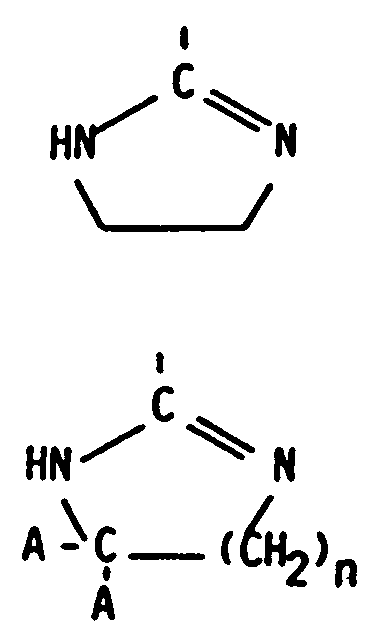
- (b)

- (c) a substituent of the formula


D is leucyl, isoleucyl, nor-leucyl, N-methylleucyl or tryptophanyl;
E is arginyl or leucyl; and
F is glycinamide or -NH-R¹, wherein
R¹ is lower alkyl, cycloalkyl, fluoro lower alkyl or -NH-CO-NH-R² wherein R² is hydrogen or lower alkyl. - Exemplary antagonist analogs of LH-RH are provided by Rivier et al United States Patent No. 4,565,804, dated January 21, 1986 and Rivier et al United States Patent No. 4,569,927, dated February 11, 1986. The '804 peptides have the structure
X-R₁-(W)D-Phe-R₃-R₄-R₅-R₆(V)-R₇-Arg-Pro-R₁₀
wherein X is hydrogen or an acyl group having 7 or less carbon atoms; R₁ is dehydro-Pro, Pro, D-pGlu, D-Phe, D-Trp or β-D-NAL; W is F, Cl, Cl₂Br, NO₂ or CαMeCl; R₃ is D-Trp, (NinFor)D-Trp or D-TrP which is substituted in the 5- or 6-position with NO₂, NH₂, OCH₃, F, Cl, Br or CH₃; R₄ is Ser, Orn, AAL or aBu; R₅ is Tyr, (3F)Phe, (2F)Phe, (3I)Tyr, (3CH₃)Phe, (2CH₃)Phe, (3Cl)Phe or (2Cl)Phe; R₆ is D-Lys, D-Orn or D-Dap; V is arg-Rʹ,Rʺ)n(X), with n being 1 to 5 and Rʹ and Rʺ being H, methyl, ethyl, propyl or butyl; R₇ is Leu, NML, Nle or Nva; and R₁₀ is Gly-NH₂, D-Ala-NH₂ or NH-Y, with Y being lower alkyl, cycloalkyl, fluoro lower alkyl or
where Q is H or lower alkyl. - In the '804 peptides, the expression "β-D-NAL" means the D-isomer of alanine, substituted by naphthyl on the β-carbon, or 3-D-NAL. Preferably, the β-carbon is attached at the 2-position of naphthalene (β-D-2NAL), but β-D-1NAL may also be used. "(CαMe-4Cl)Phe" means phenylalanine substituted at the para position with chloro, the α-carbon being methylated. "Dap" means α,β-diaminopropionic acid, or β-aminoalanine. "NML" means NαCH₃-L-Leu. "AAL" means β-amino-Ala or Dap, and "aBu" means α,γ -diaminobutyric acid, either of which or Orn may be present in the 4-position. DehydroPro is preferably at position 1 when Ser is not present at position 4. "R₆(arg-Rʹ,Rʺ)n(X)" means the D-amino acid in the main chain, which through its side chain amino function also forms part of the arginine-containing peptide side chain.
- The '927 peptides have the structure
X-R₁-(W)D-Phe-R₃-R₄-R₅-R₆-R₇-Arg-Pro-R₁₀
wherein X is hydrogen or an acyl group having 7 or less carbon atoms; R₁ is dehydro-Pro, D-pGlu, D-Phe, D-Trp or β-D-NAL; W is F, Cl, Cl₂Br, NO₂ or CαMeCl; R₃ is (NinFor)D-Trp or D-TrP which is substituted in the 5-or 6-position with NO₂, NH₂, OCH₃, F, Cl, Br or CH₃; R₄ is Ser, Orn, AAL or aBu; R₅ is Tyr, Arg, (3F)Phe, (2F)Phe, (3I)Tyr, (3CH₃)Phe, (2CH₃)Phe, (3Cl)Phe or (2Cl)Phe; R₆ is A(4NH₂)D-Phe, D-Lys, D-Orn, D-Har, D-His, (4gua)D-Phe, D-Tyr, a D-isomer of a lipophilic amino or D-Arg; R₇ is Leu, NML, Nle or Nva; and R₁₀ is Gly-NH₂, D-Ala-NH₂ or NH-Y, with Y being lower alkyl, cycloalkyl, fluoro lower alkyl or
where Q is H or lower alkyl, provided however that when R₅ is Arg, R₆ is D-Tyr. The various terms are as defined with the '804 peptides. - It is clear from the Nestor et al and Rivier et al patents that the amino acid in the 6-position of the LH-RH peptide chain is very amenable to replacement by numerous D-amino acids, including unnatural amino acids which have sizeable side chains. These patents also confirm the extent of other permissible structural changes discussed hereinabove for LH-RH analogs, e.g. at the 3-, 5- and 7-positions.
- It will be apparent from the foregoing that many peptides offer a multiplicity of locations at which a redox amino acid fragment of the present invention might be inserted without loss of the peptide's characteristic activity. Nevertheless, it is preferred that the redox system be located in a position which allows a great deal of structural variation without loss of activity and/or that the specific redox fragment selected be isosteric (or approximately so) with the amino acid unit which it is intended to replace. At the present time, the following redox amino acid fragments are preferred specific embodiments of this invention:

However, it is to be understood that these particular redox fragments are intended to be illustrative, not limitative, of the instant fragments which may be incorporated into known centrally active peptides. - Some especially preferred embodiments of the present invention are the following:
- (a) Enkephalin analogs of the structures
H-Tyr-(A/B)-Gly-Phe-Met-OH
and
H-Tyr-(A/B)-Gly-Phe-Leu-OH
and the corresponding terminal amino protected and terminal carboxyl protected compounds (including the corresponding C-terminal amides) in which the protecting groups are as defined hereinabove and (A/B) represents a redox amino acid fragment of structure (A) or (B) hereinabove, especially when (A/B) is Pyrala, Quinala or Pyrlys, having the L- or D-configuration; - (b) Enkephalin analogs of the structure
H-Tyr-Gly-Gly-Phe-(A/B)-OH
and the protected counterparts as in (a) above, especially when (A/B) is Pyrala, Quinala or Pyrlys, having the L- or D-configuration; - (c) Vasopressin and oxytocin analogs in which the amino acids at the 8- and/or 9-positions are replaced with L- or D-(A/B) as defined above, especially when (A/B) is Pyrala, Quinala or Pyrlys;
- (d) Neurotensin analogs in which Lys⁶ or Tyr¹¹ is replaced with L- or D-(A/B) above, and their C-terminal protected counterparts, especially those in which Pyrlys is in the 6-position or Pyrala is in the 11-position;
- (e) ACTH₁₋₁₀, ACTH₄₋₇ and ACTH₄₋₁₀ analogs in which Phe⁷ is replaced with D-(A/B), and their protected counterparts, especially when (A/B) is Pyrala;
- (f) ACTH₄₋₉ analogs of the structures
H-Met(O)-Glu-His-Phe-D-(A/B)-Phe-OH
and
H-Met(O)-Glu-His-Phe-D-Lys-(A/B)-OH
and their protected counterparts, especially those of the first structure where D-(A/B) is D-Pyrlys and those of the second where (A/B) is Pyrala or Quinala; - (g) ACTH₁₋₁₀ wherein Trp⁹ is replaced with (A/B) and its protected counterparts, especially when (A/B) is Pyrala or Quinala;
- (h) ACTH₄₋₁₀ wherein Arg⁸ is replaced with D-(A/B) and its protected counterparts, especially when (A/B) is Pyrala or Quinala;
- (i) Substance P analogs in which Phe⁸ is replaced with (A/B) and their N-terminal protected counterparts, especially when (A/B) is Pyrala;
- (j) Substance P analogs in which any one of the amino acids at positions 1 to 6 is replaced with (A/B), and their N-terminal protected counterparts, especially when (A/B) is Pyrala, Quinala or Pyrlys;
- (k) Hexapeptide analogs of Substance P having the structure defined in Verdini et al United States Patent No. 4,638,046 and set forth hereinabove, except that Verdini et al's R⁴ amino acid residue is replaced with an amino acid fragment of the present invention D-(A/B), especially D-Pyrala, D-Quinala or D-Pyrlys;
- (l) Heptapeptide analogs of the growth promoting peptides defined in deCastiglione et al United States Patent No. 4,567,162 and set forth hereinabove, except that deCastiglione et al's amino acid unit A is replaced with an amino acid fragment of the present invention L-(A/B), especially L-Pyrala, L-Quinala or L-Pyrlys;
- (m) Angiotensin I analogs in which one or both of the amino acids in the C-terminal dipeptide portion is replaced with (A/B), and the protected counterparts (especially the N-terminal amide), particularly when (A/B) is Pyrala, Quinala or Pyrlys;
- (n) Somatostatin analogs in which (A/B) replaces part or all of the N-terminal dipeptide portion or in which (A/B) is added to the N-terminus, and the corresponding terminal amino protected derivatives, especially when (A/B) is Pyrala, Quinala or Pyrlys;
- (o) LH-RH analogs having the structure defined in Nestor et al United States Patent No. 4,530,920 and set forth hereinabove, except that Nestor et al's amino acid residue C in the 6-position is replaced with an amino acid fragment of the present invention (A/B), especially D-(A/B), where (A/B) is preferably Pyrala, Quinala or Pyrlys; and
- (p) LH-RH analogs of the structures depicted in the Rivier et al '804 and '927 patents and set forth hereinabove, except that Rivier et al's amino acid residue in the 6-position is replaced with an amino acid fragment of the present invention D-(A/B), especially when (A/B) is Pyrala, Quinala or Pyrlys.
- In instances in which isosteric considerations are important, typically a fragment of the instant invention such as Pyrala will be used to replace phenylalanine or tyrosine, a fragment such as Quinala will be used to replace tryptophan and a fragment such as Pyrlys will be used to replace lysine, arginine or histidine in a peptide chain.
- The methods for synthesizing the amino acids and peptides of the present invention have already been discussed hereinabove. In some cases, the methods of peptide synthesis can be simplified by utilizing commercially available bioactive peptides and their fragments. SIGMA® CHEMICAL COMPANY, Post Office Box 14508, St. Louis, MO 63178 US has a large number of such products available; some of those which may be useful in preparing the instant redox peptides include, for example, angiotensin II, neurotensin fragment 1-6, neurotensin fragment 1-8, neurotensin fragment 8-13, somatostatin, Substance P fragment 1-4, Substance P fragment 4-11, Substance P fragment 5-11 and Substance P fragment 7-11.
- In order to further illustrate the amino acids and peptides of the present invention, the following synthetic examples are given, it being understood that same are intended only as illustrative, as many modifications in materials and methods will be apparent to those skilled in the art.
- In the examples to follow, all melting points were taken on a Mel-Temp apparatus and are not corrected. Elemental analyses were performed at Atlantic Microlabs, Inc., Atlanta, GA.
- Examples 3, 6, 9, 17, 20 to 22, 25, 26, 33, 39, 41, 42, 44, 46, 49, 51, 54 to 56, 58, 61, 64 to 72 describe the preparation of claimed compounds; and Examples 1, 2, 4, 5, 7, 8, 10 to 16, 18, 19, 23, 24, 27 to 32, 34 to 38, 40, 43, 45, 47, 48, 50, 52, 53, 57, 59, 60, 62, 63 and 70 describe the preparation of intermediates.
- To a solution of 1.0 g (6.25 mmol) of 3-chloro-L-alanine and 1.3 mL of triethylamine in 50% aqueous 1,4-dioxane were added 1.69 g (6.90 mmol) of 2-(tert-butoxycarbonyloxyimino)-2-phenylacetonitrile with stirring at room temperature. After 2 hours, the reaction mixture was poured into 20 mL of water and extracted twice with ethyl acetate. The organic layer was washed twice with water and then with saturated brine, dried over anhydrous magnesium sulfate and evaporated to give 0.66 g (40.5%) of white solid. Recrystallization from a mixture of ethyl acetate and n-hexane afforded 0.58 g of the pure product (35.6%) melting at 123-124°C, with decomposition, and having the structural formula:

The identity of the product was confirmed by IR and NMR analyses. - To a solution of 0.28 g (2 mmol) of glycine ethyl ester hydrochloride and 0.28 mL (2 mmol) of triethylamine in 10 mL of chloroform, 0.52 g (2 mmol) of N-(tert-butoxycarbonyl)-3-chloro-L-alanine in 6 mL of chloroform and 0.42 g (2 mmol) of dicyclohexylcarbodiimide were added at 0°C. The reaction mixture was stirred for 16 hours at room temperature. The resultant precipitate was removed by filtration and the filtrate was washed successively with 0.5 N hydrochloric acid, water and 3% aqueous sodium bicarbonate, then was dried over anhydrous sodium sulfate. Removal of the solvent left a crystalline residue which was recrystallized from a mixture of ethyl acetate and n-hexane to give 0.415 g (60%) of the pure product melting at 71.5-72.0°C. The identity of the product, which has the structural formula

was confirmed by IR and NMR analyses. - A solution of 0.11 g (0.32 mmol) of N-(tert-butoxycarbonyl)-3-chloro-L-alanylglycine ethyl ester and 47 mg (0.39 mmol) of nicotinamide in 2 mL of dry acetone was gently refluxed overnight. During reflux, acetone was removed by evaporation to leave a pale brown solid. This procedure was repeated three times. Then the well-dried solid was washed five times with 1 mL portions of dry acetone to give 50 mg (27.5%) of pale brown solid. Recrystallization from a mixture of methanol and acetonitrile gave 16 mg of pale brown crystals, melting at 223-235°C. The identity of the product, which has the structural formula

was further confirmed by IR analysis. - To a solution of 0.42 g (1 mmol) of L-phenylalanyl-L-leucine ethyl ester trifluoroacetate, 0.14 mL (1 mmol) of triethylamine and 0.26 g (1 mmol) of N-(tert-butoxycarbonyl)-3-chloro-L-alanine in 8 mL of chloroform, 0.21 g (1 mmol) of dicyclohexylcarbodiimide was added at 0°C. The resultant reaction mixture was stirred overnight at room temperature. The precipitate which formed was removed by filtration and the filtrate was washed successively with 0.5 N hydrochloric acid, water, 3% aqueous sodium bicarbonate and water, then dried over anhydrous sodium sulfate. Removal of the solvent afforded a white solid, which was mixed with 4 mL of a 1:1 mixture of ethyl acetate and n-hexane. Insoluble materials were removed by filtration and the filtrate was evaporated. The residue was recrystallized from a mixture of ethyl acetate and n-hexane to give 0.367 g (66.5%) of the desired product. The product, which has the structural formula

melted at about 110°C. Its identity was further confirmed by IR and NMR analyses and by thin layer chromatography (Rf = 0.34 in 5:1 chloroform/ethyl acetate). - A mixture of 1.46 g (9.3 mmol) of 3-quinolinecarboxaldehyde, 1.8 g (10 mmol) of hippuric acid, 0.6 g (7.0 mmol) of anhydrous sodium acetate and 8 mL of acetic anhydride was heated gradually and stirred for 30 minutes at 90-100°C. To the hot reaction mixture were added 10 mL of hot water. The reaction mixture was then allowed to cool to room temperature. The yellow solid which formed was removed by filtration, washed once with 50% aqueous acetic acid and twice with ethanol, then dried in vacuo to give 2.39 g of yellow solid melting at 200-202°C. Recrystallization from a mixture of chloroform and ethyl acetate afforded 2.05 g (73.4%) of the pure azolactone melting at 209.5-210°C and having the structural formula:

IR and NMR analyses confirmed the identity of the azolactone. - A mixture of 2.0 g (67 mmol) of the azolactone and 0.3 g of 10% palladium on carbon catalyst in 60 mL of acetic acid was vigorously stirred under hydrogen overnight. The catalyst was removed by filtration and washed thoroughly with dimethylformamide. The filtrate and washings were combined and concentrated. The residue was hydrogenated overnight using 0.3 g of 10% palladium on carbon as the catalyst. The catalyst was removed by filtration and the filtrate was evaporated to give a reddish brown solid. The solid was suspended in dry methanol; then, hydrogen chloride gas was passed through the suspension, with cooling in ice water, until saturation was reached. The reaction mixture was allowed to stand overnight, then was evaporated. The resultant residue was neutralized with a sufficient amount of aqueous sodium bicarbonate and extracted twice with chloroform. The combined organic layers were washed with water, dried over anhydrous sodium sulfate and concentrated under reduced pressure. The residue was chromatographed on silicon (IV) oxide, using 2% methanol in chloroform as eluent, to give 0.41 g of an oil which solidified on standing. Recrystallization from a mixture of ethyl acetate and isopropyl ether gave 0.25 g of pale brown crystals melting at 124-125°C. The identity of the product, which has the structural formula

was confirmed by IR analysis. - A solution of 0.21 g (0.63 mmol) of N-benzoyl-3-(3-quinolyl)alanine methyl ester and 1.0 mL of iodomethane in 5.0 mL of anhydrous acetone was refluxed overnight. The resulting precipitate was removed by filtration and recrystallized twice from a mixture of acetonitrile and acetone to give yellow crystals, which were dried in vacuo at 80°C to afford 0.21 g (40%) of orange crystals melting at 110-114°C. The product, which was further characterized by IR and NMR analyses, has the structural formula:

- An ethyl ether solution of 1.48 g (3.9 mmol) of Nε-benzyloxycarbonyl-Nα-(tert-butoxycarbonyl)-L-lysine was combined with an ethyl ether solution of diazomethane at 0°C. The reaction mixture was evaporated to give a colorless oil in nearly quantitative yield (1.54 g). TLC Rf = 0.38 (chloroform/ethyl acetate, 5:1). IR (neat) ν 3340, 1710, 1530 cm⁻¹. NMR (CDCl₃) δ 7.3 (5H, s), 7.25 (1H, m), 5.05 (2H, s), 5.0 (1H, m), 4.1 (1H, m), 3.8 (3H, s), 3.1 (2H, m), 2.0-1.1 (6H, m), 1.4 (9H, s). The product has the structural formula:

- A mixture of 20 g (98.7 mmol) of 1-chloro-2,4-dinitrobenzene and 8 g (65.5 mmol) of nicotinamide was gradually heated to 100°C, then stirred at that temperature for one hour. The mixture was cooled to ambient temperature and 100 mL of anhydrous methanol were added. The resultant solution was poured into 400 mL of anhydrous ethyl ether, with vigorous stirring. The solvent was removed by decantation and the residual precipitate was dissolved in 100 mL of methanol. The resultant solution was poured into 400 mL of anhydrous ethyl ether, the solvent was again removed by decantation and the solid residue was dissolved in 200 mL of water. The aqueous solution was refluxed with active charcoal for 30 minutes, then filtered. The filtrate was evaporated and dried in vacuo over phosphorus pentoxide to give 14.7 g (69.2%) of the title compound of the formula

- A mixture of 0.69 g (1.75 mmol) of Nε-benzyloxycarbonyl-Nα-(tert-butoxycarbonyl)-L-lysine methyl ester and 0.17 g of 10% palladium on carbon catalyst in 10 mL of methanol was stirred under a hydrogen atmosphere for 3 hours. The catalyst was then removed by filtration. To the filtrate was added a solution of 0.568 g (1.75 mmol) of 3-carbamoyl-1-(2,4-dinitrophenyl)pyridinium chloride in 1.5 mL of methanol. The resultant reaction mixture was refluxed overnight, then the precipitate was removed by filtration and the filtrate was evaporated. The residual oil was triturated with a mixture of acetone and ethyl acetate, affording a yellow solid. The solvent was removed and the residue was washed with a mixture of acetone and ethyl acetate and dried in vacuo to give 0.308 g (45.6%) of the title compound as a pale yellow solid. The product, which has the structure

was characterized as follows: IR (KBr tablet) ν 3380, 1730, 1695, 1685, 1510, 1390, 1165 cm⁻¹; NMR (DMSO-d₆) δ 9.83 (1H, s), 9.33 (1H, d, J = 6 Hz), 9.1 (2H, m), 8.25 (1H, dd, J = 6, 8 Hz), 8.12 (1H, bs), 7.2 (1H, bd, J = 7.5 Hz), 4.7 (2H, bt, 7 Hz), 3.9 (1H, m), 3.6 (3H, s), 2.0 (2H, m), 1.35 (9H, s). - To a solution of 3.14 g (20 mmol) of 3-quinolinecarboxaldehyde in 60 mL of methanol was added portionwise 0.95 g (25 mmol) of sodium borohydride at 0°C. The reaction mixture was then stirred at room temperature for 2 hours. Excess sodium borohydride was quenched with acetic acid and the reaction mixture was evaporated in vacuo. The residue was dissolved in dilute aqueous sodium bicarbonate and extracted three times with ethyl acetate. The organic layer was washed with saturated brine, dried over anhydrous magnesium sulfate and evaporated in vacuo to give an oil. The oil was chromatographed on silica gel, using first 3:2 chloroform/ethyl acetate and then ethyl acetate as eluents, to afford 2.35 g (79.5%) of the title compound of the structural formula

The product was characterized as follows: TLC Rf = 0.30 (ethyl acetate); IR (neat) ν 3120, 1580, 1500, 1060 cm⁻¹; NMR (CDCl₃) δ 8.73 (1H, d, J = 2 Hz), 8.07 (1H, s), 8.02 (1H, d, J = 7 Hz), 7.8-7.3 (3H, m), 4.82 (2H, s). - To a solution of 2.53 g (15.9 mmol) of 3-quinolinemethanol in 25 mL of toluene was added dropwise at room temperature 5 mL of thionyl chloride. The reaction mixture was stirred at that temperature for 4 hours, then dried in vacuo to give a solid which was suspended in 20 mL of toluene and treated with 4 mL of thionyl chloride at room temperature overnight. The reaction mixture was concentrated under reduced pressure to give 2.05 g (60%) of a solid. The product, having the structural formula
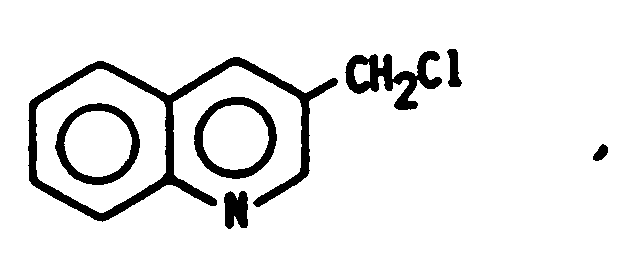
was not further purified. NMR (DMSO-d₆) δ 9.36 (1H, d), 9.1 (1H, bs), 8.6-7.8 (4H, m), 5.2 (2H, s). - To a solution of sodium ethoxide [prepared from 0.25 g (11 mg-atoms) of sodium metal] in 24 mL of ethanol was added, in one portion, 2.39 g (11 mmol) of diethyl acetamidomalonate at room temperature. The reaction mixture was stirred for an additional 30 minute period. To that reaction mixture was then added a solution of 3-chloromethylquinoline [prepared from 2.05 g (9.25 mmol) of its hydrochloride salt by treatment with aqueous sodium bicarbonate and extraction with methylene chloride] in 5 mL of ethanol. The resultant reaction mixture was refluxed overnight, then was evaporated in vacuo, dissolved in 1 N hydrochloric acid and extracted with ethyl acetate. The aqueous layer was neutralized with solid sodium bicarbonate and extracted twice with ethyl ether. The ether layer was washed with saturated brine, dried over anhydrous magnesium sulfate and evaporated in vacuo. The oil thus obtained was chromatographed on silica gel, using 2:1 chloroform/ethyl acetate as eluent, to afford a white crystalline product. Recrystallization from a mixture of ethyl acetate and isopropyl ether gave 1.28 g (38.8%) of the pure compound of the formula

melting at 124-125°C; thin layer chromatography (Rf = 0.28; chloroform/ethyl acetate, 2:1) and IR and NMR spectra confirmed the identity of the title compound. - A suspension of 1.19 g (3.34 mmol) of diethyl (3-quinolylmethyl)acetamidomalonate in 30 mL of 10% aqueous hydrochloric acid was refluxed overnight. The reaction mixture was then cooled to room temperature and neutralized with 10% aqueous sodium hydroxide solution. The precipitate was removed by filtration, washed with water and dried in vacuo to yield 0.48 g (66.4%) of the desired product as a white solid melting at 241-243°C. Elemental analysis and IR confirmed the identity of the product, which has the formula
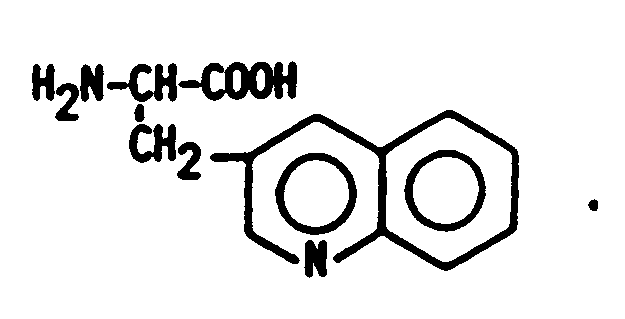
- A solution of 5 g (35.5 mmol) of 2,3-diaminopropionic acid in 88.6 mL of 0.05 M phosphate buffer solution was cooled in ice. The pH of the solution was adjusted to 6.7 with 10% aqueous sodium hydroxide solution. A solution of 7.6 mL (53.7 mmol) of benzyl chloroformate in 7.1 mL of toluene was added dropwise, with vigorous stirring, over a one hour period. The pH was monitored and adjusted to between 6.5 and 7.0 by the addition of 10% aqueous sodium hydroxide solution. The reaction mixture was stirred with cooling at a pH of about 6.5 for an additional 5 hours, then was refrigerated overnight. The resulting precipitate was collected by filtration and the solid was washed with water and ethyl ether. Crystallization from water gave 1.12 g (12.4%) of white crystals melting at 233-235°C (with decomposition). The product has the structural formula:

and was subsequently prepared in 55.7% yield using the same general procedure. - To a solution of 0.7 g (2.96 mmol) of 1-3-(benzyloxycarbonylamino)alanine and 0.62 mL (4.4 mmol) of triethylamine in 14 mL of 50% aqueous dioxane was added, in one portion, 0.79 g (3.26 mmol) of 2-(tert-butoxycarbonyloxyimino)-2-phenylacetonitrile. Stirring was continued overnight at room temperature. The reaction mixture was diluted with 14 mL of water and extracted twice with ethyl acetate. The aqueous layer was acidified with 1 N hydrochloric acid and extracted three times with ethyl acetate. That organic layer was washed twice with water, then once with saturated brine, dried over anhydrous magnesium sulfate and evaporated in vacuo. The residue was chromatographed on silica gel (15 g), using first chloroform and then ethyl acetate as eluents, to give 0.88 g (92.8%) of a colorless oil. NMR (CDCl₃) δ 8.0 (1H, bs), 7.3 (5H, s), 6.2 (1H, m), 5.7 (1H, m), 5.1 (2H, bs), 4.3 (1H, m), 3.55 (2H, m), 1.4 (9H, s). The product has the structural formula:

- To a solution of 0.14 g (1 mmol) of glycine ethyl ester hydrochloride and 0.14 mL (1 mmol) of triethylamine in 5 mL of chloroform was added a solution of 0.32 g (1 mmol) of 1-3-benzyloxycarbonylamino-N-(tert-butoxycarbonyl)alanine in 3 mL of chloroform. Then, 0.21 g (1 mmol) of dicyclohexylcarbodiimide was added at room temperature and the reaction mixture was stirred at that temperature overnight. The reaction mixture was diluted with chloroform, washed successively with 0.5 N hydrochloric acid, water, 3% aqueous sodium bicarbonate solution and water, dried over anhydrous sodium sulfate and concentrated under reduced pressure. The residue was chromatographed on silica gel (10 g), using first 5:1 chloroform/ethyl acetate and then 1:1 chloroform/ethyl acetate as eluents, to give a white solid. Crystallization from a mixture of ethyl acetate and isopropyl ether afforded 0.25 g (60.8%) of the title compound, melting at 131-132°C and having the structural formula:

The structure was confirmed by NMR analysis. - A mixture of 0.192 g (0.467 mmol) of 1-3-benzyloxycarbonylamino-N-(tert-butoxycarbonyl)alanylglycine ethyl ester, 60 mg of 10% palladium on carbon catalyst and 6 mL of methanol was vigorously stirred for 3 hours at room temperature under a hydrogen atmosphere. The catalyst was removed by filtration and the filtrate was mixed with 0.15 g (0.467 mmol) of 3-carbamoyl-1-(2,4-dinitrophenyl)pyridinium chloride. The resultant reaction mixture was refluxed overnight. The precipitate was then removed by filtration and the filtrate was evaporated in vacuo. The residue was chromatographed on silica gel using first acetonitrile and then 10% aqueous acetonitrile as eluents, to give 20 mg of a brown oil. NMR (DMSO-d₆) δ 9.9 (1H, bs), 9.6 (1H, m), 9.3 (2H, m), 9.0 (1H, m), 8.35 (1H, q), 8.2 (1H, bs), 7.3 (1H, bd), 6.0 and 5.3 (1H, m), 4.8 (2H, m), 4.13 (2H, q), 3.95 (2H, m), 1.2 (12H, m). The product has the structural formula:

- A mixture of 0.45 g (2.08 mmol) of 3-(3-quinolyl)alanine, 1 mL of thionyl chloride and 20 mL of ethanol was gently refluxed overnight. The reaction mixture was concentrated under reduced pressure. The residue was dissolved in water and treated with active charcoal. Removal of the active charcoal by filtration afforded a filtrate which was evaporated to give a white solid. Crystallization from a mixture of ethanol and ethyl ether gave 0.598 g (90.6%) of the title compound, melting at 204-205°C with decomposition. NMR spectrum was consistent with the assigned structure:
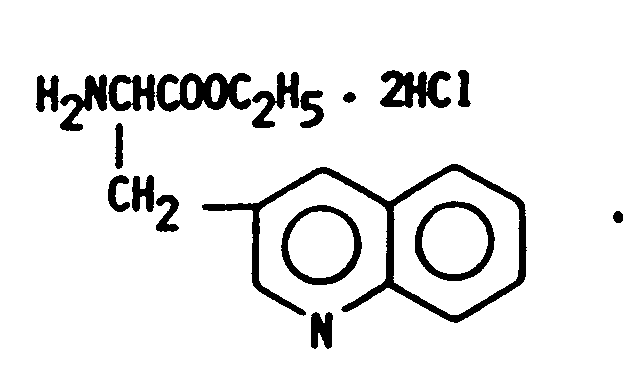
- A mixture of 0.58 g (1.84 mmol) of 3-(3-quinolyl)alanine ethyl ester dihydrochloride, 0.78 mL (5.4 mmol) of triethylamine, 0.49 g (2.03 mmol) of 2-(tert-butoxycarbonyloxyimino)-2-phenylacetonitrile and 12 mL of 50% aqueous dioxane was stirred overnight at room temperature. The reaction mixture was then diluted with 15 mL of water and extracted three times with ethyl acetate. The organic layer was washed, first with water and then with saturated brine, then was dried over anhydrous magnesium sulfate and evaporated in vacuo. The residue was chromatographed on silica gel, using first 5:1 chloroform/ethyl acetate and then 2:1 chloroform/ethyl acetate as eluents, to give 0.486 g (76.7%) of a colorless oil. TLC Rf = 0.4 (chloroform/ethyl acetate, 2:1); NMR (CDCl₃) δ 8.7 (1H, d), 8.1 (1H, bd), 7.93 (1H, d), 7.9-7.4 (3H, m), 5.15 (1H, m), 4.63 (1H, m), 4.2 (2H, m), 3.3 (2H, m), 1.4 (9H, s), 1.3 (3H, t). The product has the structural formula:

- A mixture of 0.486 g (1.41 mmol) of (N-tert-butoxycarbonyl)-3-(3-quinolyl)alanine ethyl ester, 2 mL of methyl iodide and 3 mL of acetone was refluxed overnight. The reaction mixture was evaporated in vacuo and the residue was chromatographed on silica gel, using first acetonitrile and then 2% aqueous acetonitrile as eluents, to give a yellow solid. Crystallization from a mixture of acetone and ethyl acetate yielded 0.497 g (72.5%) of a crystalline product melting at 98-102°C. NMR spectrum and elemental analysis were consistent with the assigned structure:

- To a solution of 0.2 g (0.41 mmol) of 3-[2-(tert-butoxycarbonyl)amino-2-ethoxycarbonyl]ethyl-1-methylquinolinium iodide in 10 mL of ethanol was added dropwise a solution of 20 mg (0.5 mmol) of sodium borohydride in 1 mL of ethanol at 0°C. After 5 minutes, the solution became colorless. The reaction mixture was diluted with 40 mL of deaerated water and extracted twice with deaerated ethyl ether. The combined organic layers were washed, first with deaerated water and then with saturated brine, then were dried over anhydrous magnesium sulfate and evaporated in vacuo to give 0.146 g (99.1%) of a yellow oil. TLC Rf = 0.8 (4% methanol in chloroform); NMR (CDCl₃) δ 7.2-6.4 (4H, m), 6.15 (1H, bs), 5.05 (1H, bd), 4.4 (1H, m), 4.2 (2H, q), 3.9 (2H, bs),2.75 (3H, s), 2.55 (2H, m), 1.4 (9H, s), 1.25 (3H, t). The major product has been assigned the structural formula:

An alternative to the title nomenclature for this product is 3-[2-tert-butoxycarbonyl)amino-2-ethoxycarbonyl]ethyl-1,2-dihydro-1-methylquinoline. - To a solution of 0.2 g (0.41 mmol) of 3-[2-(tert-butoxycarbonyl)amino-2-ethoxycarbonyl]ethyl-1-methylquinolinium iodide in 20 mL of deaerated water were added 0.2 g (2.4 mmol) of sodium bicarbonate and 20 mL of deaerated ethyl ether. The reaction mixture was stirred in an ice water bath and 0.29 g (1.64 mmol) of sodium dithionite was added in one portion. The reaction mixture was stirred for an additional 2 hour period at 0°C. The organic layer was separated, washed first with deaerated water and then with saturated brine, dried over anhydrous magnesium sulfate and evaporated in vacuo to give 76.6 mg (51.8%) of a yellow oil. TLC Rf = 0.77 (4% methanol in chloroform); NMR (CDCl₃) δ 7.2-6.5 (4H, m), 5.8 (1H, m), 5.0 (1H, m), 4.35 (1H, m), 4.2 (2H, q), 3.5 (2H, bs), 3.0 (3H, s), 2.4 (2H, m), 1.49 (9H, s), 1.25 (3H, t). The major product has been assigned the structure:

An alternative to the title nomenclature for this product is 3-[2-(tert-butoxycarbonyl)amino-2-ethoxycarbonyl]ethyl-1,4-dihydro-1-methylquinoline. - A mixture of 24.6 g (0.2 mol) of p-anisidine and 43.2 g (0.2 mol) of diethyl ethoxymethylenemalonate was heated at 130°C until no more bubbles of alcohol could be detected. The reaction mixture was cooled in a dry ice/methanol bath, affording a solid mass. To that residue were added 40 mL of ethyl ether and the dark brown solid was crushed well with the ether to form white crystals. The solid was collected on a previously cooled Büchner funnel to give 42.48 g (72.4%) of a gray solid melting at 38-39°C. IR (KBr) ν 1680, 1640, 1620, 1595, 1525, 1230 cm⁻¹; NMR (acetone-d₆) δ 8.4 (1H, d), 7.3 (2H, d), 6.95 (2H, d), 4.2 (4H, m), 3.8 (3H, s), 1.3 (6H, dt). The product has the structural formula:

- To 200 mL of boiling diphenyl ether were added rapidly 42 g (0.14 mol) of diethyl β-(p-methoxyanilino)methylenemalonate. The dark solution was heated under reflux for 30 minutes, then was cooled to room temperature and diluted with 200 mL of n-hexane. The brown solid which formed was collected, washed twice with n-hexane and then twice with ethyl ether and then dried in vacuo. The resultant solid was suspended in 60 mL of ethanol and the suspension was boiled for 30 minutes, then cooled to room temperature. The product was collected as a pale brown solid (19.34 g, 52.1%), melting at 274-277°C. IR (KBr) ν 3600-2600, 1685, 1620, 1575, 1560, 1520, 1480, 1290, 1170 cm⁻¹; NMR (CDCl₃) δ 8.45 (1H, s), 7.6 (2H, two d), 7.3 (1H, dd), 4.2 (2H, q), 3.8 (3H, s), 1.3 (3H, t). The compound is further characterized by the structural formula
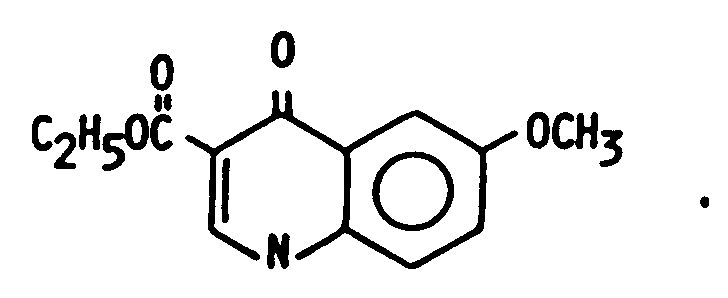
- To a solution of 0.2 g (0.5 mmol) of L-1-[5-(tert-butoxycarbonyl)amino-5-methoxycarbonyl]pentyl-3-carbamoylpyridinium chloride in 20 mL of deaerated water were added 0.25 g (3 mmol) of sodium bicarbonate and 20 mL of deaerated ethyl ether. The reaction mixture was cooled, with stirring, in an ice bath and 0.35 g of sodium dithionite was added in one portion. The reaction mixture was stirred for an additional one hour at 0°C. The organic layer was separated, washed with deaerated water and saturated brine, dried over anhydrous magnesium sulfate and evaporated in vacuo to give 41 mg (23.3%) of a yellow oil. TLC Rf = 0.57 (chloroform/methanol), 5:1); NMR (CDCl₃) δ 7.0 (1H, d); 5.7 (1H, m), 5.5 (1H, m), 5.2 (1H, bd), 4.7 (1H, dt), 4.3 (1H, m), 3.75 (3H, s), 3.15 (2H, m), 1.49 (9H, s). The product has the structural formula:

- To a solution of 0.2 g (0.5 mmol) of L-1-[5-(tert-butoxycarbonyl)amino-5-methoxycarbonyl]pentyl-3-carbamoylpyridinium chloride in 20 mL of deaerated methanol was added 20 mg of sodium borohydride at 0°C. The reaction mixture was stirred for an additional 30 minutes at that temperature, then was evaporated in vacuo and diluted with deaerated water. Extraction with deaerated ethyl ether afforded an organic layer, which was washed with deaerated water and saturated brine, dried over anhydrous magnesium sulfate and evaporated in vacuo. Obtained in this manner was a complex mixture which was shown by NMR spectral analysis to contain the 1,4-dihydro derivative and the 1,6-dihydro derivative. The residue was chromatographed on silica gel (packed by 5% triethylamine in methylene chloride and eluted with 1:9 ethyl acetate/chloroform containing 0.5% triethylamine) to give 21 mg (12%) of the title 1,4-dihydro derivative as a yellow oil, identical to the product of EXAMPLE 25.
- A mixture of 19 g (76.8 mmol) of 1,4-dihydro-3-ethoxycarbonyl-6-methoxy-4-oxoquinoline and 60 mL of phosphorus oxychloride (POCl₃) was refluxed for 4 hours. Excess phosphorus oxychloride was evaporated and the residue was poured onto 100 g of ice made alkaline with 28% ammonium hydroxide, and allowed to remain at room temperature. The precipitate which formed was collected, washed twice with water and dried in vacuo to give 20 g of the product as a pale brown solid, in quantitative yield. TLC Rf = 0.41 (2% methanol in chloroform); NMR (CDCl₃) δ 8.95 (1H, s), 8.05 (1H, bd), 7.6 (2H, m), 4.45 (2H, q), 4.0 (3H s), 1.4 (3H, t); IR (KBr) ν 1740, 1620, 1580, 1500, 1295, 1230, 1020, 830 cm⁻¹. The product has the formula:

- A mixture of 20 g (75.8 mmol) of 3-ethoxycarbonyl-4-chloro-6-methoxyquinoline, 1.5 g of 10% palladium on carbon catalyst, 20 mL of triethylamine and 300 mL of ethanol was shaken under a hydrogen atmosphere (30 psi) at room temperature overnight. The catalyst was removed by filtration and the filtrate was evaporated. The residue was dissolved in methylene chloride, washed with aqueous sodium bicarbonate solution and water, dried over anhydrous sodium sulfate and evaporated in vacuo. That residue was suspended in 500 mL of cyclohexane and the resultant suspension was refluxed, then filtered to remove insoluble materials. The filtrate was allowed to stand at room temperature and the crystalline material which formed was collected to give 9.18 g (51.5%) of a pale brown solid having the structural formula:

NMR (CDCl₃) δ 9.25 (1H, d), 8.7 (1H, d), 8.05 (1H, d, J = 9 Hz), 7.5 (1H, dd, J = 9 Hz, 3 Hz), 7.2 (1H, d, J = 3 Hz), 4.45 (2H, q), 3.9 (3H, s), 1.45 (3H, t). IR (KBr) ν 1713, 1620, 1600, 1500, 1240, 1100, 1025 cm⁻¹. - To a suspension of 5.9 g (25 mmol) of 3-ethoxycarbonyl-6-methoxyquinoline in 120 mL of 1:1 toluene/methylene chloride were added dropwise at -50°C, 36.7 mL (55 mmol) of diisobutylaluminium hydride as a 1.5 M solution in toluene. The reaction mixture was gradually warmed to room temperature. To this mixture were added about 4 mL of methanol to quench excess reducing agent, and then water was added with vigorous stirring. After 30 minutes, 150 mL of ethyl acetate and anhydrous magnesium sulfate were added and the mixture was stirred for an additional 30 minutes. The solid was removed by filtration and washed thoroughly with ethyl acetate. The filtrate and washings were combined and evaporated in vacuo. The residue was chromatographed on silica gel, using first ethyl acetate and then 2% ethanol in ethyl acetate as eluents, to give 1.72 g (36.4%) of the title compound as a solid which melts at 92-93°C after crystallization from a mixture of benzene and isopropyl ether. TLC Rf = 0.17 (ethyl acetate); NMR (CDCl₃) δ 8.6 (1H, d), 7.9 (2H, m), 7.3 (1H, q), 6.95 (1H, d), 4.8 (2H, s), 3.85 (3H, s); IR (KBr) ν 3070, 1625, 1500, 1215 cm⁻¹.
- A subsequent preparation using the same general procedure afforded the title compound in 71.5% yield.
- A mixture of 1.6 g (8.45 mmol) of 3-hydroxymethyl-6-methoxyquinoline, 3 mL of thionyl chloride and 16 mL of toluene was refluxed overnight. The reaction mixture was diluted with 16 mL of toluene. The solid was separated by filtration, washed thoroughly with toluene and dried in vacuo to give 1.52 g (73.7%) of a pale brown solid: NMR (DMSO-d₆) δ 9.15 (1H, d), 8.9 (1H, bs), 8.3 (1H, d), 7.7 (2H, m), 5.1 (2H, s), 3.95 (3H, s); IR (KBr) ν 2540, 2340, 2020, 1620, 1573, 1495, 1250 cm⁻¹. The product has the structural formula:

- A subsequent preparation using the same general procedure afforded the desired compound in 87.0% yield.
- To a solution of sodium ethoxide prepared from 0.3 g (13.1 mmol) of sodium and 30 mL of ethanol were added, in one portion, 2.85 g (13.1 mmol) of diethyl acetamidomalonate. After 30 minutes, 1.52 g (6.24 mmol) of 3-chloromethyl-6-methoxyquinoline hydrochloride were added and the resultant mixture was refluxed overnight. The reaction mixture was evaporated and the residue was dissolved in 25 mL of 1 N hydrochloric acid and extracted twice with ethyl ether. The aqueous layer was neutralized with solid sodium bicarbonate and extracted twice with chloroform. The chloroform layer was washed with water, dried over anhydrous magnesium sulfate and evaporated in vacuo. The residue was chromatographed on silica gel, using first 4:1 methylene chloride/ethyl acetate and then 1:1 methylene chloride/ethyl acetate as eluents, to give 1.82 g (75.2%) of the desired product as a white solid, which melted at 151-152°C. after crystallization from a mixture of ethyl acetate and isopropyl ether. TLC Rf = 0.34 (ethyl acetate); NMR (CDCl₃) δ 8.4 (1H, d), 7.9 (1H, d), 7.7 (1H, bs), 7.35 (1H, d), 7.0 (1H, d), 6.6 (1H, bs), 4.3 (4H, q), 3.9 (3H, s), 3.85 (2H, s), 2.05 (3H, s), 1.3 (6H, t); IR (KBr) ν 3400, 3230, 1740, 1640, 1300 cm⁻¹. The product has the formula:

- An improved yield of 89.3% was obtained when the above procedure was repeated subsequently.
- To a solution of 0.73 g (5.26 mmol) of glycine ethyl ester hydrochloride and 0.74 mL (5.26 mmol) of triethylamine in 42 mL of chloroform were added successively, at 0°C, 2.0 g (5.26 mmol) of Nε-benzyloxycarbonyl-Nα-(tert-butoxycarbonyl)-L-lysine and 1.09 g (5.26 mmol) of dicyclohexylcarbodiimide. The reaction mixture was stirred overnight at room temperature. The resulting precipitate was removed by filtration and the filtrate was washed successively with 0.5 N hydrochloric acid, water, 3% aqueous sodium bicarbonate solution and water, then dried over anhydrous sodium sulfate. Evaporation of the solvent afforded a residue which was triturated with ethyl acetate. Insoluble materials were removed by filtration and the filtrate was evaporated in vacuo. The residue was recrystallized from a mixture of ethyl acetate and isopropyl ether to give 1.15 g (48%) of the title compound as colorless crystals. The mother liquor was concentrated under reduced pressure and the residue was crystallized as before to give a second crop of crystals (0.77 g, 32.1%). Total yield 80.1%, melting point 69-70°C. NMR and IR spectral analyses confirmed the identity of the product, which has the formula:
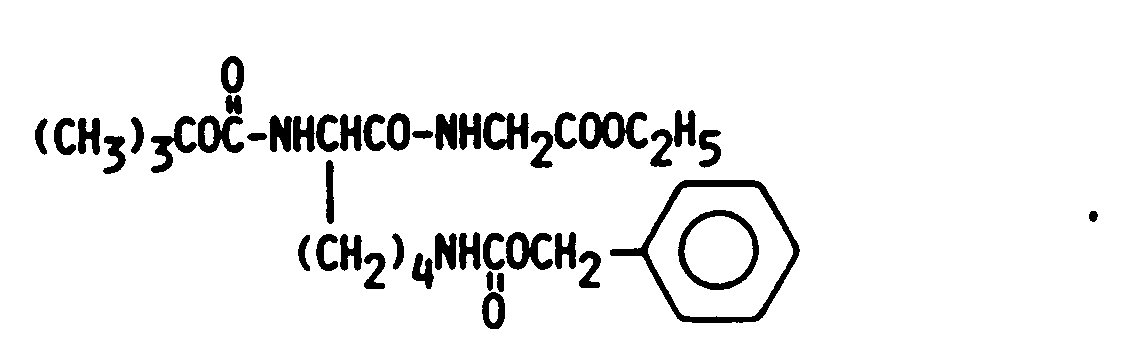
-
- A mixture of 0.911 g (2 mmol) of Nε-benzyloxycarbonyl-Nα-(tert-butoxycarbonyl)-L-lysylglycine ethyl ester and 0.25 g of 10% palladium on carbon catalyst in 5 mL of ethanol was vigorously stirred for 3 hours at room temperature under a hydrogen atmosphere. The reaction mixture was then filtered through Celite® (a diatomaceous earth filter aid) and to the filtrate was added, in one portion, 0.65 g (2 mmol) of 3-carbamoyl-1-(2,4-dinitrophenyl)pyridinium chloride. The reaction mixture was stirred at room temperature overnight, during which time the color changed from dark red to reddish brown. The greenish brown precipitate which formed was removed by filtration and the filtrate was evaporated in vacuo. That residue was chromatographed on silica gel (using acetonitrile, 2% acetonitrile and 10% acetonitrile successively as the eluents) to give a brown oil. The product was taken up in anhydrous acetonitrile, filtered through Celite®, evaporated and dried in vacuo to afford 0.603 g (65.1%) of the desired compound as a yellow solid. NMR (DMSO-d₆) δ 9.8 (1H, bs), 9.3 (1H, bd), 9.05 (1H, bd), 9.0 (1H, m) 8.45 (1H, t), 8.25 (1H, dd), 8.15 (1H, d), 6.8 (1H, m), 4.7 (2H,m), 4.05 (2H, q), 4.0 (1H, m), 3.8 (2H, m), 1.35 (9H, s), 1.15 (3H, t). Elemental analysis was consistent with the assigned structure:

- To a mixture of 0.236 g (0.5 mmol) of (S)-1-[5-(tert-butoxycarbonyl)amino-5-ethoxycarbonylmethylcarbamoyl]pentyl-3-carbamoylpyridinium chloride, 0.25 g (3 mmol) of sodium bicarbonate, 11 mL of methylene chloride and 11 mL of water was added, in one portion at room temperature, 0.31 g (2.0 mmol) of sodium dithionite. The reaction mixture was stirred for an additional one hour period. The organic layer was separated, dried over anhydrous sodium sulfate and evaporated in vacuo to afford 0.19 g (87.1%) of a yellow oil. The product has the structural formula

NMR (acetone-d₆) δ (1H, m), 7.0 (1H, bs), 6.3 (2H, bs), 6.2 (1H, d), 5.85 (1H, d), 4.65 (1H, dt), 4.15 (3H, q + m), 4.0 (2H, m), 3.15 (4H, m), 1.4 (9H, s), 1.13 (3H, t). Elemental analysis was in agreement with the assigned structure. - To a solution of 0.39 g (1 mmol) of diethyl (6-methoxy-3-quinolyl)methylacetamidomalonate in 10 mL of dry methylene chloride was added dropwise at -70°C a 1 M solution of boron tribromide in methylene chloride. The reaction temperature was gradually raised to room temperature while stirring overnight. Then, the reaction mixture was poured into ice water and extracted with methylene chloride. The organic layer was washed with water, dried over anhydrous magnesium sulfate and evaporated in vacuo. The residue was chromatographed on silica gel, using 1:1 ethyl acetate/methylene chloride and then ethyl acetate as eluents, to give 43 mg (11.5%) of the desired product as a solid TLC Rf = 0.46 (ethyl acetate); NMR (CDCl₃) δ 8.4 (1H, bs), 7.95 (1H, d), 7.7 (1H, bs), 7.35 (1H, dd), 7.1 (1H, d), 6.8 (1H, bs), 4.25 (4H, m), 3.8 (2H, bs), 2.0 (3H, s), 1.3 (6H, m); IR (KBr) ν 3700-2800, 1740, 1660, 1645, 1620, 1500 cm⁻¹. The product has the structural formula:
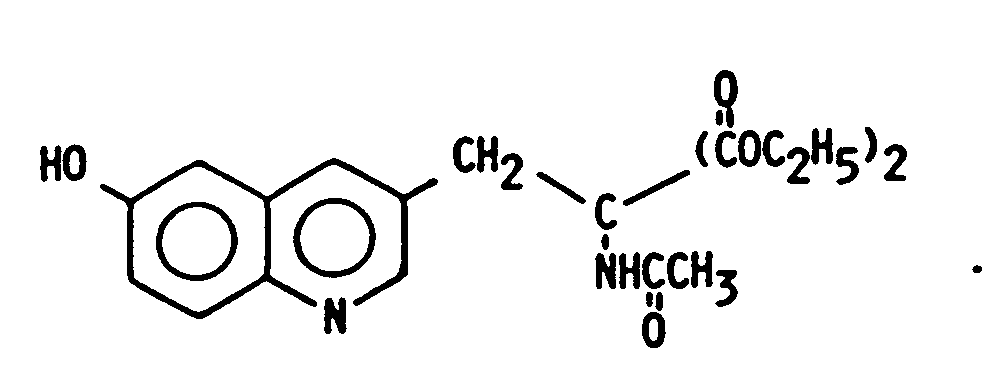
- A mixture of 0.602 g (1.55 mmol) of diethyl (6-methoxy-3-quinolyl)methylacetamidomalonate and 8.2 mL of 10% hydrochloric acid was refluxed overnight. The reaction mixture was cooled to room temperature and neutralized with 1 N sodium hydroxide solution to pH 6.7. The white solid which formed was separated by filtration, washed successively with water and ethyl ether and dried in vacuo to give 0.282 g (73.9%) of the title compound melting at 246-247°C and having the structural formula
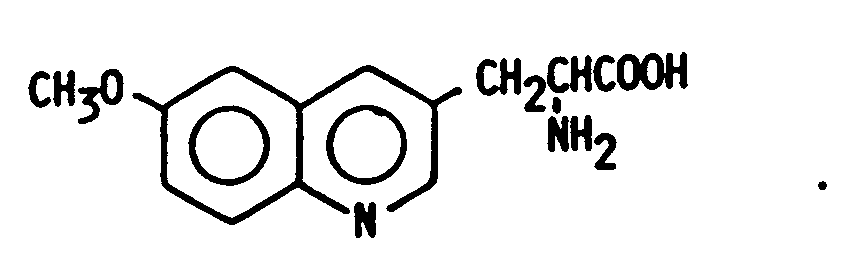
NMR and IR spectral analyses and elemental analysis confirmed the identity of the product. - A mixture of 0.18 g (0.74 mmol) of 3-(6-methoxy-3-quinolyl)alanine and 5.4 mL of 48% hydrobromic acid was stirred at 85-90°C overnight. The reaction mixture was cooled to room temperature and neutralized to pH 7.0 with 1 N sodium hydroxide solution, then was concentrated under reduced pressure to give a brown solid. After filtration, the solid product was washed with a small amount of cold water and ethyl ether and then was dried in vacuo to give 57.4 mg (33.4%) of the title compound of the formula:
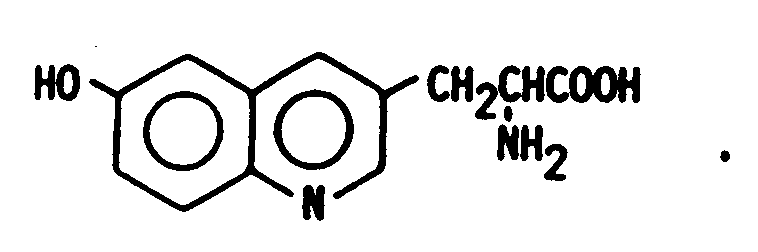
NMR (DMSO-d₆, CF₃COOH) δ 9.05 (1H, bs), 8.9 (1H, bs), 8.2 (1H, d), 7.7 (1H, dd), 7.5 (1H, d), 4.5 (1H, m), 3.5 (2H, m); IR (KBr) ν 3400, 1630, 1500 cm⁻¹. - A mixture of 0.388 g (1 mmol) of diethyl (6-methoxy-3-quinolyl)methylacetamidomalonate and 7.4 mL of 48% hydrobromic acid was stirred at 85°C for 24 hours. The solvent was evaporated and the residue was dissolved in 7 mL of ethanol. Then, 0.3 mL of thionyl chloride was added at 0°C and the mixture was refluxed overnight. The reaction mixture was evaporated in vacuo, taken up in benzene and then evaporated to dryness in vacuo to give a crude, highly hygroscopic residue. To a mixture of this crude product together with 0.39 mL (2.7 mmol) of triethylamine and 6 mL of 50% aqueous 1,4-dioxane there was added, in one portion, 0.24 g (1 mmol) of 2-(tert-butoxycarbonyloxyimino)-2-phenylacetonitrile. The reaction mixture was stirred overnight at room temperature, then was diluted with 6 mL of water and extracted twice with chloroform. The organic layer was washed with water, dried over anhydrous magnesium sulfate and evaporated in vacuo. The residue was chromatographed on silica gel. Elution with 5:1 methylene chloride/ethyl acetate gave 94 mg (27.6%) of the methoxy derivative, i.e. N-(tert-butoxycarbonyl)-3-(6-methoxy-3-quinolyl)alanine ethyl ester, having the formula:

TLC Rf = 0.57 (1:1 methylene chloride/ethyl acetate); NMR (CDCl₃) δ 8.55 (1H, d), 8.0 (1H, d), 7.85 (1H, bs), 7.35 (1H, dd), 7.0 (1H, d), 5.1 (1H, m), 4.65 (1H, m), 4.2 (2H, q), 3.9 (3H, s), 3.3 (2H, m), 1.4 (9H, s), 1.2 (3H, t). - The title compound was eluted with 1:1 methylene chloride/ethyl acetate to give 0.14 g or 42.7% yield; TLC Rf = 0.31 (1:1 methylene chloride/ethyl acetate); melting point 176-177°C after crystallization from a mixture of ethyl acetate and isopropyl ether. The title compound has the formula

NMR (CDCl₃) δ 8.55 (1H, d), 7.95 (1H, d), 7.8 (1H, d), 7.35 (1H, dd), 7.15 (1H, d), 5.3 (1H, m), 4.6 (1H, m), 4.15 (2H, q), 3.25 (2H, m), 1.35 (9H, s), 1.2 (3H, t); IR (KBr) ν 3350, 1740, 1710, 1685, 1630, 1500, 1160 cm⁻¹. - A mixture of 0.81 g (1.92 mmol) of 3-benzyloxycarbonylamino-N-(tert-butoxycarbonyl)-L-alanylglycine ethyl ester, 0.2 g of 10% palladium on carbon catalyst and 30 mL of ethanol was stirred vigorously at room temperature for 4 hours under a hydrogen atmosphere. The reaction mixtue was filtered and the solid residue was washed with 10 mL of ethanol. The filtrate and washing were combined and 0.623 g (1.92 mmol) of 3-carbamoyl-1-(2,4-dinitrophenyl)pyridinium chloride was added in one portion. Stirring was continued at room temperature overnight, then the reaction mixture was filtered and the filtrate was evaporated in vacuo. The residue was chromatographed on silica gel, using first 2% aqueous acetonitrile and then 5% aqueous acetonitrile as eluents. The eluate was concentrated to approximately 100 mL under reduced pressure and then was diluted with 300 mL with water. The resulting solution was concentrated to approximately 100 mL and treated with active charcoal. Removal of the solid by filtration gave a filtrate which was lyophilized to give 0.202 g (24.4%) of the title compound as a white solid. That compound, which can alternatively be prepared by the process of EXAMPLE 3, can also be named as N-(tert-butoxycarbonyl)-3-(3-carbamoyl-1-pyridinium)-L-alanylglycine ethyl ester. It has the structure depicted in EXAMPLE 3.
- To a mixture of 1.68 g (4 mmol) of L-phenylalanyl-L-leucine ethyl ester trifluoroacetate, 0.56 mL (4 mmol) of triethylamine and 32 mL of chloroform were added at 0°C, first 1.52 g (4 mmol) of Nε-benzyloxycarbonyl-Nα-(tert-butoxycarbonyl)-L-lysine, and then 0.83 g (4 mmol) of dicyclohexylcarbodiimide, each being added in a single portion. The reaction mixture was warmed gradually to room temperature and then stirred overnight at that temperature. The precipitate which formed was removed by filtration. The filtrate was evaporated in vacuo and the residue was chromatographed on silica gel using 3:1 methylene chloride/ethyl acetate as eluent to give 2.48 g (92.7%) of the title compound as a white solid melting at 135-136°C after crystallization from a mixture of ethyl acetate and isopropyl ether. The product has the structural formula:

as further confirmed by NMR, IR and elemental analyses. - A mixture of 1.0 g (1.5 mmol) of Nε-benzyloxycarbonyl-Nα-(tert-butoxycarbonyl)-L-lysyl-L-phenylalanyl-L-leucine ethyl ester, 0.25 g of 10% palladium on carbon catalyst and 10 mL of ethanol was stirred vigorously for 3 hours at room temperature under a hydrogen atmosphere. The reaction mixture was filtered and the residue was washed with 5 mL of ethanol. The filtrate and washing were combined and 0.49 g (1.5 mmol) of 3-carbamoyl-1-(2,4-dinitrophenyl)pyridinium chloride was added in one portion at room temperature. The reaction mixture was stirred overnight at room temperature and then filtered. The filtrate was evaporated in vacuo and the residue was chromatographed on silica gel using 2% aqueous acetonitrile and then 8% aqueous acetonitrile as eluents. The eluate was concentrated to approximately 100 mL under reduced pressure, then was diluted with 300 mL of water and again evaporated to approximately 100 mL in vacuo. The resulting solution was treated with active charcoal and filtered. The filtrate was lyophilized to give 0.501 g (49.4%) of a very hygroscopic solid. NMR (DMSO-d₆) δ 9.65 (1H, bs), 9.2 (1H, bd), 9.0 (1H, bd), 8.8 (1H, bs), 8.5-8.1 (3H, m), 7.9 (1H, bd), 7.2 (5H, s), 6.85 (1H, m), 4.6 (4H, m), 4.1 (2H, q), 1.35 (9H, s), 0.9 (6H, m). The title compound prepared in this manner has the structural formula:
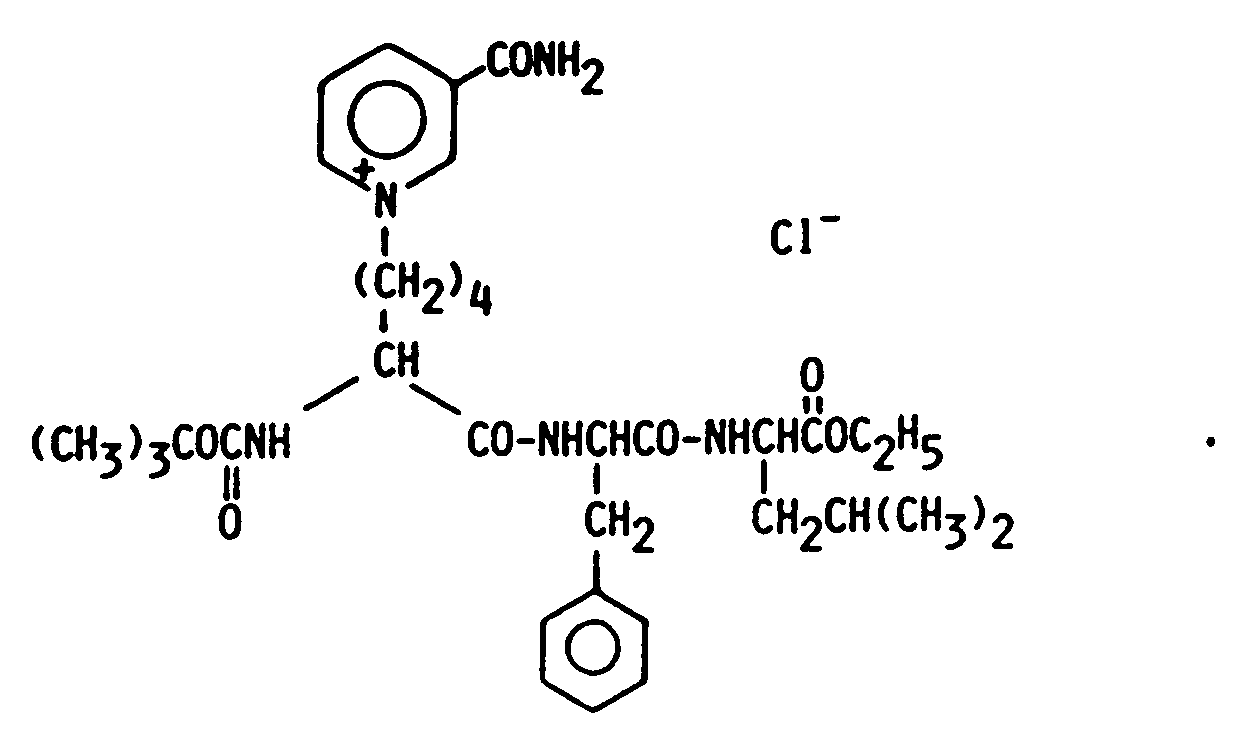
- A mixture of 0.34 g (0.94 mmol) of N-(tert-butoxycarbonyl)-3-(6-hydroxy-3-quinolyl)alanine ethyl ester, 1.3 mL of methyl iodide and 2 mL of acetone was gently refluxed overnight. Evaporation in vacuo afforded a residue which was recrystallized from a mixture of acetone and ethyl acetate to give 0.39 g (82.6%) of the title compound as a yellow solid melting at 174-175°C. NMR, IR and elemental analyses were consistent with the assigned structure:

- To a suspension of 0.54 g (2.19 mmol) of 3-(6-methoxy-3-quinolyl)alanine in 13.5 mL of ethanol was added dropwise 0.68 mL of thionyl chloride at 0°C. The reaction mixture was refluxed overnight, then was evaporated in vacuo, triturated with benzene and evaporated to dryness in vacuo. The crude product, 3-(6-methoxy-3-quinolyl)alanine ethyl ester dihydrochloride, was combined with 0.93 mL (6.4 mmol) of triethylamine and 14.2 mL of 50% aqueous 1,4-dioxane; to that mixture was added, in one portion, 0.58 g (2.4 mmol) of 2-(tert-butoxycarbonyloxyimino)-2-phenylacetonitrile. The resultant mixture was stirred overnight at room temperature, then was diluted with 15 mL of water and extracted twice with chloroform. The organic layer was washed with water, dried over anhydrous magnesium sulfate and evaporated in vacuo. The residue was chromatographed on silica gel, using 5:1 methylene chloride/ethyl acetate as eluent, to give a white solid which was recrystallized from isopropyl ether to afford 0.6 g (73.3%) of the title compound, melting at about 127°C and having the structural formula:

The identity of the product was confirmed by NMR and IR spectral analyses as well as by elemental analysis. - A mixture of 0.415 g (1.11 mmol) of N-(tert-butoxycarbonyl)-3-(6-methoxy-3-quinolyl)alanine ethyl ester, 2 mL of methyl iodide and 3 mL of acetone was gently refluxed overnight. Evaporation in vacuo afforded a residue which was chromatographed on silica gel, using first 3:1 ethyl acetate/acetonitrile and then 1:2 ethyl acetate/acetonitrile as eluents, to give 0.53 g (93.1%) of a yellow amorphous solid. The title compound was further characterized as follows: NMR (DMSO-d₆) δ 9.37 (1H, bs), 8.9 (1H, bs), 8.4 (1H, d), 7.85 (1H, dd), 7.8 (1H, s), 7.4 (1H, m), 4.6 (3H, s), 4.5 (1H, m), 4.12 (2H, q), 4.0 (3H, s), 3.3 (2H, m), 1.27 (9H, s), 1.17 (3H, t). Elemental analysis further confirmed that the product was of the structural formula:

- To a mixture of 0.637 g (2 mmol) of 3-(3-quinolyl)alanine ethyl ester dihydrochloride, 0.35 g (2 mmol) of N-(tert-butoxycarbonyl)glycine, 0.56 mL (4 mmol) of triethylamine and 16 mL of chloroform was added at 0°C, in one portion, 0.42 g (2 mmol) of dicyclohexylcarbodiimide. The reaction mixture was stirred overnight and the precipitate which formed was removed by filtration. The filtrate was washed twice with water, dried over anhydrous magnesium sulfate and evaporated in vacuo. The residue was chromatographed on silica gel, using first 1:1 methylene chloride/ethyl acetate and then 1:3 methylene chloride/ethyl acetate as eluents, to give 0.73 g (9.9%) of the title compound as a colorless oil. TLC Rf = 0.52 (ethyl acetate); NMR (CDCl₃) δ 8.64 (1H, d), 7.9-8.1 (2H, m), 7.9-7.4 (4H, m), 7.1 (1H, bd), 5.46 (1H, bt), 4.9 (1H, m), 4.15 (2H, q), 3.8 (2H, bd), 3.3 (2H, m), 1.37 (9H, s), 1.2 (3H, t). The product has the formula:

- A mixture of 0.55 g (1.37 mmol) of N-(tert-butoxycarbonyl)glycyl-3-(3-quinolyl)alanine ethyl ester, 1.9 mL of methyl iodide and 2.9 mL of acetone was gently refluxed overnight. The solvent was removed by evaporation and the residue was chromatographed on silica gel, using first 2:1 ethyl acetate/acetonitrile and then 1:3 ethyl acetate/acetonitrile as eluents, to give 0.67 g (90.1%) of the title compound as a yellow amorphous solid. NMR (DMSO-d₆) δ 9.5 (1H, s), 9.1 (1H, s), 8.6-7.9 (5H, m), 6.9 (1H, m), 4.8 (1H, m), 4.63 (3H, s), 4.15 (2H, q), 3.45 (4H, m), 1.27 (9H, s), 1.2 (2H, t). The product has the formula:

- To a mixture of 0.1 g (0.15 mmol) of L-[2-(tert-butoxycarbonyl)amino-6-(3-carbamoyl-1-pyridinium)] hexanoyl-L-phenylalanyl-L-leucine ethyl ester, 74 mg (0.89 mmol) of sodium bicarbonate, 5 mL of deaerated methylene chloride and 5 mL of deaerated water, there were added 92 mg (0.59 mmol) of sodium dithionite in one portion. The reaction mixture was stirred at room teaperature for 2 hours, then the organic layer was separated and washed with deaerated water. Drying over anhydrous sodium sulfate and evaporation in vacuo afforded a brown amorphous product: NMR (CDCl₃) δ 7.25 (5H, s), 7.05 (1H, bs), 6.85 (1H, bd), 5.7 (3H, m), 5.3 (1H, bd), 4.7 (2H, m), 4.5 (1H, m), 4.15 (2H, q), 4.1 (1H, m), 3.1 (4H, m), 2.5 (2H, m), 1.4 (9H, s), 1.25 (3H, t), 0.9 (6H, m). The identity of the title compound was confirmed by elemental analysis. It has the structural formula:
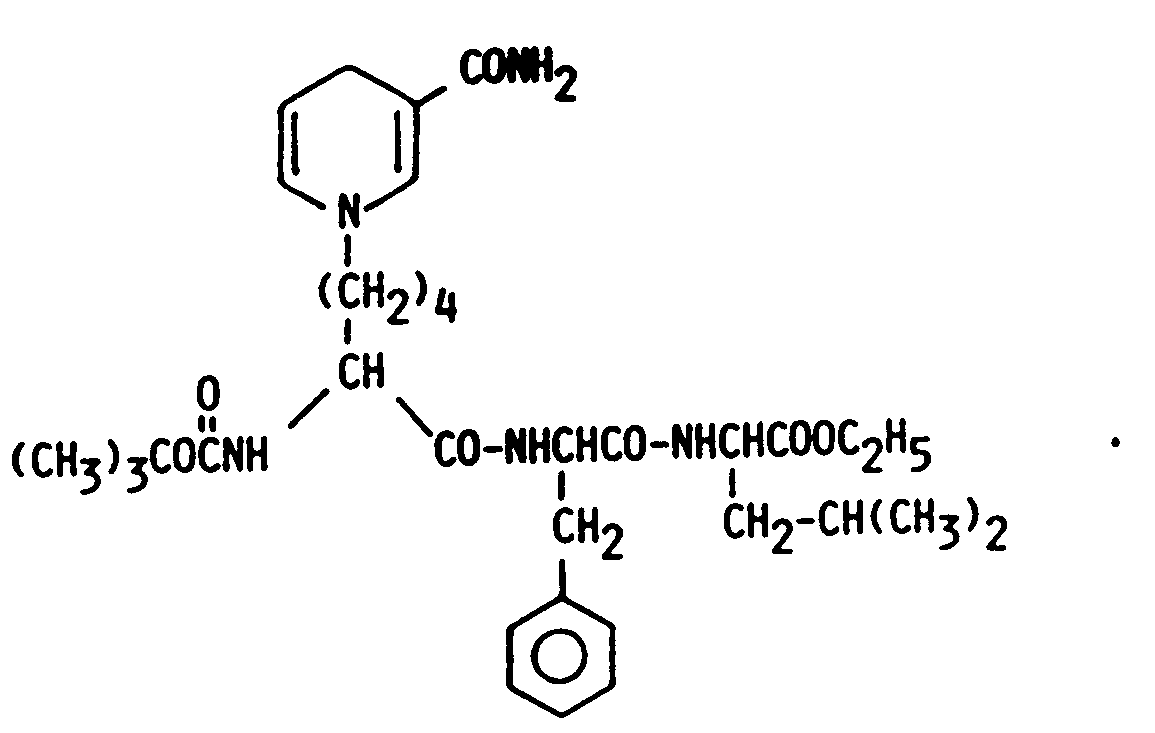
- A solution of 1.04 g (2.64 mmol) of Nε-benzyloxycarbonyl-Nα-(tert-butoxycarbonyl)-L-lysine methyl ester in 5.3 mL of trifluoroacetic acid was stirred for 2 hours at room temperature. The reaction mixture was evaporated in vacuo to give a colorless oil, which was mixed with 0.966 g (2.6 mmol) of O-benzyl-N-(tert-butoxycarbonyl)-L-tyrosine, 0.37 mL (2.6 mmol) of triethylamine and 20.8 mL of chloroform. To that mixture was added, in one portion, 0.54 g (2.6 mL) of dicyclohexylcarbodiimide at 0°C. The reaction mixture was stirred for one hour at 0°C and then overnight at room temperature. The solvent was removed by evaporation and the residue was chromatographed on silica gel, using first methylene chloride and then 1:1 methylene chloride/ethyl acetate as eluents, to give 0.49 g (29.1%) of a colorless solid. NMR (CDCl₃) δ 7.3 (10 H, m), 7.1 (2H, d), 6.85 (2H, d), 6.5 (1H, m), 5.1 (2H, s), 5.0 (1H, m), 4.7-4.1 (2H, m), 3.65 (3H, s), 3.3-2.9 (4H, m), 1.4 (9H, s). A portion of the product was recrystallized from a mixture of ethyl acetate and isopropyl ether to give crystals melting at 167-168°C. The product has the formula

as confirmed by elemental analysis. - A mixture of 0.44 g (0.68 mmol) of O-benzyl-N-(tert-butoxycarbonyl)-L-tyrosyl-Nε-benzyloxycarbonyl-L-lysine methyl ester, 90 mg of 10% palladium on carbon catalyst, 5 mL of methanol and 5 mL of dioxane was vigorously stirred for 1 hour under a hydrogen atmosphere. The reaction mixture was filtered and to the filtrate was added 0.22 g (0.68 mmol) of 3-carbamoyl-1-(2,4-dinitrophenyl)pyridinium chloride. That mixture was stirred overnight at room temperature and then evaporated. The residue was chromatographed on silica gel, using first acetonitrile and then 4% aqueous acetonitrile as eluents, to give a reddish brown oil, which was dissolved in distilled water, treated with active charcoal and lyophilized to afford 0.106 g (27.7%) of a colorless powder; NMR (D₂O, DSS) δ 9.65 (1H, bs), 9.3 (3H, m), 8.95 (2H, m), 8.5 (1H, dd), 8.25 (1H, d), 7.1 (2H, d), 6.8 (2H, d), 4.3 (2H, m), 3.7 (5H, m), 1.4 (9H, s). The product has the formula:

- A mixture of 0.94 g (2 mmol) of Nε-benzyloxycarbonyl-Nα-(tert-butoxycarbonyl)-L-lysylglycine ethyl ester and 4 mL of trifluoroacetic acid was stirred for 40 minutes at room temperature. The reaction mixture was diluted with 30 mL of toluene and evaporated to approximately 3 mL. To this residue were added 40 mL of dry ethyl ether. Decantation of the solvent left a viscous oil which was mixed with 0.74 g (2 mmol) of O-benzyl-N-(tert-butoxycarbonyl)-L-tyrosine, 0.28 mL (2 mmol) of triethylamine and 16 mL of chloroform. Then, 0.42 g (2 mmol) of dicyclohexylcarbodiimide was added in one portion and the reaction mixture was stirred overnight at room temperature. The precipitate which formed was removed by filtration and the filtrate was washed successively with 0.5% aqueous hydrochloric acid, water, 3% aqueous sodium bicarbonate solution and water, then dried over anhydrous sodium sulfate. Evaporation of the solvent afforded a residue which was chromatographed on silica gel, using first 2:1 methylene chloride/ethyl acetate, and then 1:1 methylene chloride/ethyl acetate as eluents, to give 1.17 g (81.4%) of a colorless solid. NMR (CDCl₃) δ 7.3 (10H, m), 7.1 (2H, d), 6.85 (2H, d), 5.2 (1H, m), 5.1 (2H, s), 5.0 (2H, s), 4.4 (2H, m), 4.15 (2H, q), 3.9 (2H, d), 3.1 (4H, m), 1.4 (9H, s), 1.2 (3H, t); IR (KBr) ν 3300, 1690, 1640, 1510, 1240, 1175, 1025 cm⁻¹. A portion of the product was recrystallized from a mixture of isopropyl ether and ethyl acetate to afford a sample melting at 122-124°C. Elemental analysis gave values in accord with the following assigned structure:

- A mixture of 0.72 g (1 mmol) of O-benzyl-N-(tert-butoxycarbonyl)-L-tyrosyl-Nε-benzyloxycarbonyl-L-lysylglycine ethyl ester, 0.15 g of 10% palladium on carbon catalyst and 15 mL of ethanol was vigorously stirred for 2 hours under a hydrogen atmosphere. The catalyst was removed by filtration and 0.325 g (1 mmol) of 3-carbamoyl-1-(2,4-dinitrophenyl)pyridinium chloride was added to the filtrate. The reaction mixture was stirred overnight at room temperature. The solvent was removed by evaporation and the residue was chromatographed on silica gel, twice using acetonitrile, 3% aqueous acetonitrile and 6% aqueous acetonitrile successively as eluents, to give a reddish brown oil. The product was dissolved in distilled water, treated with active charcoal and lyophilized to give 0.109 g (17.1%) of a colorless solid; NMR (CD₃OD) δ 9.8 (1H, m), 9.4 (2H, m), 9.3 (1H, d), 8.95 (1H, dd), 8.5 (1H, dd), 8.4 (1H, d), 8.0 (1H, m), 7.1 (2H, d), 6.7 (2H, d), 4.15 (2H, q), 3.9 (2H, m), 3.7 (2H, m), 3.0 (4H, m), 1.4 (9H, s), 1.25 (3H, t). The product has the structural formula:

- A suspension of 0.608 g (0.85 mmol) of O-benzyl-N-(tert-butoxycarbonyl)-L-tyrosyl-Nε-benzyloxycarbonyl-L-lysylglycine ethyl ester in 60 mL of 50% aqueous methanol was adjusted to pH 12.5 with 1 N aqueous sodium hydroxide solution and the reaction mixture was stirred overnight at room temperature. The reaction mixture was then diluted with 50 mL of water and concentrated to about half of the original volume. The concentrated reaction mixture was adjusted to pH 3 with 1 N aqueous hydrochloric acid, then was extracted twice with ethyl acetate. The organic layer was washed with water and saturated brine, dried over anhydrous magnesium sulfate and evaporated to give 0.56 g (93.5%) of a white solid. NMR (CD₃OD) δ 7.4 (10H, m), 7.2 (2H, d), 6.9 (2H, d), 5.05 (4H, s), 4.3 (2H, m), 1.4 (9H, s); IR (KBr) ν 3500, 1670, 1640, 1510, 1240, 1160 cm⁻¹. The product has the structural formula:
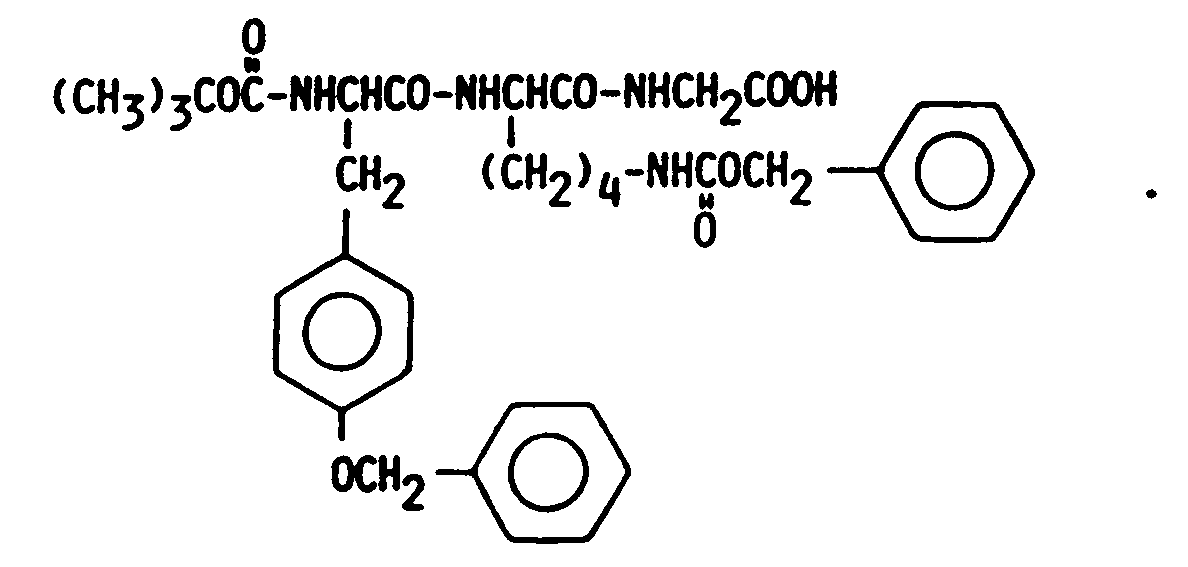
- To a mixture of 0.56 g (0.79 mmol) of O-benzyl-N-(tert-butoxycarbonyl)-L-tyrosyl-Nε-benzyloxycarbonyl-L-lysylglycine, 0.40 g (0.95 mmol) of L-phenylalanyl-L-leucine ethyl ester trifluoroacetate, 0.112 g (0.83 mmol) of 1-hydroxybenztriazole hydrate, 0.13 mL (0.95 mmol) of triethylamine and 8 mL of dimethylformamide was added, in one portion at 0°C, 0.17 g (0.83 mmol) of dicyclohexylcarbodiimide. The reaction mixture was stirred overnight at room temperature, then was diluted with 200 mL of ethyl ether and washed three times with water and once with saturated brine. Drying over anhydrous magnesium sulfate and evaporation in vacuo afforded a residue which was chromatographed on silica gel, using first methylene chloride and then 1:1 methylene chloride/ethyl acetate as eluents, to give 0.61 g (78.9%) of a colorless solid. NMR (DMSO-d₆) δ 8.35 (1H, m), 8.0 (3H, m), 7.4 (15H, m), 7.2 (2H, d), 6.9 (2H, d), 5.05 (2H, s), 5.0 (2H, s), 4.6 (1H, m), 4.4-3.9 (6H, m), 3.7 (2H, m), 3.1-2.6 (6H, m), 1.3 (9H, s), 1.2 (3H, t), 0.9 (6H, m); IR (KBr) ν 3300, 1690, 1640, 1510, 1240 cm⁻¹. Elemental analysis values were consistent with the assigned structure:

- To a mixture of 0.1 g of 3-[2-(N-tert--butoxycarbonyl)amino-2-ethoxycarbonyl]ethyl-6-hydroxy-1-methylquinolinium iodide, 0.1 g of sodium bicarbonate, 15 mL of deaerated ethyl acetate and 10 mL of deaerated water was added, in one portion at room temperature under a nitrogen atmosphere, 0.15 g of sodium dithionite. The reaction mixture was stirred at that temperature for an additional 2 hours. The organic layer was separated, washed with deaerated water and saturated brine, dried over anhydrous sodium sulfate and evaporated in vacuo to give 60 mg of a brown solid melting at 123-125°C. NMR (CDCl₃) δ 6.8-6.4 (3H, m), 5.8 (1H, bs), 5.0 (1H, m), 4.1-4.0 (3H, m), 3.45 (2H, bs), 3.0 (3H, s), 2.4 (2H, m), 1.4 (9H, s), 1.25 (3H, t); IR (KBr) ν 3400, 2970, 1730, 1685, 1510, 1370, 1230, 1155 cm⁻¹. Elemental analysis values were consistent with the assigned structure:

- Repetition of the general procedure of EXAMPLE 21, substituting an equivalent quantity of 3-(2-benzoylamino-2-methoxycarbonyl)ethyl-1-methylquinolinium iodide for the 3-[2-(tert-butoxycarbonyl)amino-2-ethoxycarbonyl]ethyl-1-methylquinolinium iodide employed therein, affords a mixture of 1,2 and 1,4 dihydro derivatives. The title compound, which is the major product, has the structural formula

- When the general procedure of EXAMPLE 22 is repeated, substituting an equivalent quantity of 3-(2-benzoylamino-2-methoxycarbonyl)ethyl-1-methylquinolinium iodide for the 3-[2-(tert-butoxycarbonyl)amino-2-ethoxycarbonyl]ethyl-1-methylquinolinium iodide there employed, there is obtained, as the major product, the title compound of the formula

- The procedure of EXAMPLE 25 is repeated, substituting an equivalent quantity of L-1-[2-(tert-butoxycarbonyl)amino-2-(N-ethoxycarbonylmethyl)carbamoyl]ethyl-3-carbamoylpyridinium chloride for the L-1-[5-(tert-butoxycarbonyl)amino-5-methoxycarbonyl]pentyl-3-carbamoylpyridinium chloride used therein. Obtained in this manner is the title compound of the formula

The title compound can alternatively be named as 1-[2-tert-butoxycarbonyl)amino-2-(N-ethoxycarbonylmethyl)carbamoyl]ethyl-3-carbamoyl-1,4-dihydropyridine. - The procedure of EXAMPLE 22 is followed, utilizing 0.1 g of 3-[2-N-(tert-butoxycarbonyl)amino-2-ethoxycarbonyl]ethyl-6-methoxy-1-methyl-3-quinolinium iodide, 10 mL of water, 0.1 g of sodium bicarbonate, 15 mL of ethyl acetate and 0.15 g of sodium dithionite. Prepared in this manner is the title compound of the formula:

- The procedure of EXAMPLE 22 was followed, utilizing 0.12 g (0.22 mmol) of 3-{2-[N-(tert-butoxycarbonyl)glycyl]amino-2-ethoxycarbonyl}ethyl-1-methylquinolinium iodide, 12 mL of water, 0.11 g (1.3 mmol) of sodium bicarbonate, 12 mL of methylene chloride and 0.16 g of sodium dithionite. There were thus obtained 72 mg of the title compound. NMR values were consistent with the assigned structure:
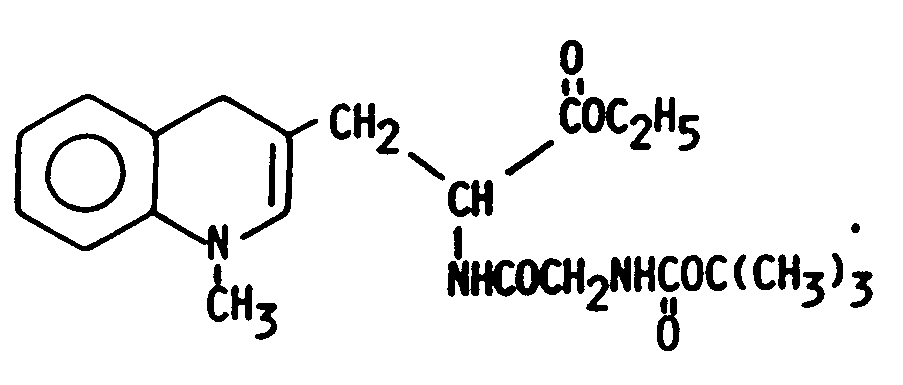
- When the general procedure of EXAMPLE 25 is repeated, using 1-{5-[N-(tert-butoxycarbonyl)-L-tyrosyl]amino-5-methoxycarbonyl}pentyl-3-carbamoylpyridinium chloride in place of the L-1-[5-(tert-butoxycarbonyl)amino-5-methoxycarbonyl]pentyl-3-carbamoylpyridinium chloride, there is obtained the title compound of the formula:

-
- The general procedure of EXAMPLE 22 is repeated, using 1-{5-[N-(tert-butoxycarbonyl)-L-tyrosyl]amino-5-ethoxycarbonylmethylcarbamoyl}pentyl-3-carbamoylpyridinium chloride in place of the 3-[2-(tert-butoxycarbonyl)amino-2-ethoxycarbonyl]ethyl-1-methylquinolinium iodide employed in that Example. Obtained in this manner is the title compound of the formula:

- Following the general procedure of EXAMPLE 3, but substituting N-(tert-butoxycarbonyl)-3-chloro-L-alanyl-L-phenylalanyl-L-leucine ethyl ester for the N-(tert-butoxycarbonyl)-3-chloro-L-alanylglycine ethyl ester there employed, affords the title compound of the formula:

- The procedure of EXAMPLE 22 is repeated, using L-[2-tert-butoxycarbonyl)amino-3-(3-carbamoyl-1-pyridinium)]propionyl-L-phenylalanyl-L-leucine ethyl ester chloride in place of the 3-[2-(tert-butoxycarbonyl)amino-2-ethoxycarbonyl]ethyl-1-methylquinolinium iodide there employed. There is thus obtained the title compound of the formula:

- A mixture of 1.0 g (1.02 mmol) of O-benzyl-N-(tert-butoxycarbonyl)-L-tyrosyl-Nε-benzyloxycarbonyl-L-lysylglycyl-L-phenylalanyl-L-leucine ethyl ester, 0.2 g of 10% palladium on carbon catalyst and 10 mL of dimethylformamide was stirred vigorously under a hydrogen atmosphere for 2 hours. The catalyst was removed by filtration and to the filtrate was added 0.33 g (1.02 mmol) of 3-carbamoyl-1-(2,4-dinitrophenyl)pyridinium chloride. The reaction mixture was stirred overnight at room temperature, then evaporated. The residue was chromatographed on silica gel using acetonitrile, 3% aqueous acetonitrile and 6% aqueous acetonitrile successively as eluents, to give a brown oil. The oil was dissolved in distilled water, treated with active charcoal and lyophilized to give 0.34 g (37.9%) of the title compound as a colorless solid. NMR (CD₃OD) δ 9.45 (1H, bs), 9.1 (1H, d), 9.0 (1H, d), 8.2 (1H, dd), 7.3 (5H, bs), 7.1 (2H, d), 6.7 (2H, d), 4.15 (2H, ql), 3.8 (2H, bs), 3.2-2.8 (4H, m). 1.4 (9H, s), 1.25 (3H, t), 0.9 (6H, m). Elemental analysis was consistent with the assigned structure:

- Repetition of the procedure of EXAMPLE 22, utilizing (S)-2-[N-(tert-butoxycarbonyl)-L-tyrosyl]amino-6-(3-carbamoyl-1-pyridinium)hexanoylglycyl-L-phenylalanyl-L-leucine ethyl ester chloride in place of the 3-[2-(tert-butoxycarbonyl)amino-2-ethoxycarbonyl]ethyl-1-methylquinolinium iodide there employed, affords the title compound of the structural formula:

- A mixture of 0.1 mmol of (S)-1-[5-(tert-Butoxycarbonyl)amino-5-ethoxycarbonylmethylcarbamoyl]pentyl-3-carbamoylpyridinium chloride and 2 mL of ethanol saturated with HCl was stirred at 0°C for 20 minutes. The reaction mixture was diluted with 20 mL of dry ethyl ether, decanted and washed with ethyl ether. The resultant precipitate was suspended in tert-butanol, evaporated and dried in vacuo to give the title compound as a white solid in 78.6% yield. NMR (DMSO-d₆) δ 9.85 (1H, bs), 9.4 (2H, m), 9.0 (2H, dd), 8.5 (2H, m), 8.4-8.1 (3H, m), 4.8 (2H, m), 4.2-3.8 (6H, m), 1.2 (3H, t). Elemental analysis was consistent with the assigned structure:
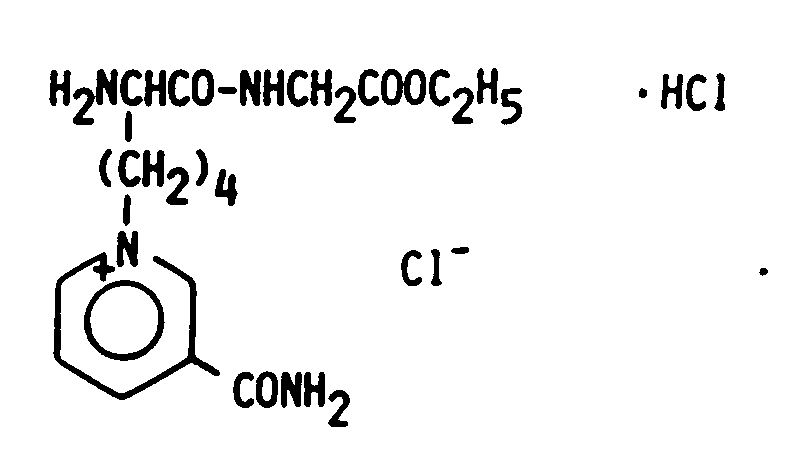
The product can also be named (S)-2-amino-6-(3-carbamoyl-1-pyridinium)hexanoylglycine ethyl ester chloride hydrochloride. - The procedure of EXAMPLE 66 was repeated, using (S)-[2-(tert-butoxycarbonyl)amino-6-(3-carbamoyl-1-pyridinium)]hexanoyl-L-phenylalanyl-L-leucine ethyl ester chloride as the starting material. The title compound was obtained in 89.1% yield. NMR (DMSO-d₆) δ 9.8 (1H, bs), 9.35 (1H, bd), 9.1-8.8 (2H, m), 8.7-8.1 (6H, m), 7.3 (5H, m), 4.7 (3H, m), 4.05 (2H, q), 3.8 (1H, m), 3.0 (2H, m), 1.2 (3H, t), 0.9 (6H, m). Elemental analysis was consistent with the assigned structure:

-
- The procedure of EXAMPLE 66 was repeated, using (S)-2-[N-(tert-butoxycarbonyl-L-tyrosyl]amino-6-(3-carbamoyl-1-pyridinium)hexanoylglycyl-L-phenylalanyl-L-leucine ethyl ester chloride as the starting material. The title compound was obtained in 78.6% yield. NMR (DMSO-d₆) δ 9.75 (1H, bs), 9.3 (1H, d), 9.0 (1H, d), 8.85 (1H, m), 8.6-8.0 (m), 7.25 (5H, m), 7.1 (2H, d), 6.7 (2H, d), 4.7 (2H, m), 1.15 (2H, t), 0.9 (6H, m). Elemental analysis was consistent with the assigned structure:

- Repetition of the procedure of EXAMPLE 66, but using (S)-1-{5-[N-(tert-butoxycarbonyl)-L-tyrosyl]amino-5-ethoxycarbonylmethylcarbamoyl}pentyl-3-carbamoylpyridinium chloride as the starting material, affords the title compound of the formula:

The product can also be named (S)-2-(L-tyrosyl)amino-6-(3-carbamoyl-1-pyridinium)hexanoylglycine ethyl ester chloride hydrochloride. - The quaternary salts of the invention, e.g. the products of EXAMPLES 3, 6, 9, 17, 20, 33, 39, 41, 42, 44, 46, 49, 51, 62, 64, 66, 67, 68 and 69 may be selectively converted to the corresponding 1,4-dihydro derivatives using the following procedure:
- A solution of 4 mmol of the selected quaternary salt and 4.6 mmol of N-benzyl-1,2-dihydroisonicotinamide in anhydrous methanol is stirred under nitrogen at 0°C for 2 hours. The reaction mixture is evaporated in vacuo at 30°C and the residue is suspended in 1,2-dichloroethane, filtered and washed with the same solvent. The filtrate is evaporated in vacuo to a small volume and then flash chromatographed over a column of 150 mesh activated neutral aluminum oxide, eluting first with 1,2-dichloroethane and then with 1:4 acetonitrile/1,2-dichloroethane. The solution is evaporated in vacuo at 30°C and crystallized.
-
- Repetition of the procedure of EXAMPLE 22, utilizing (S)-2-(L-tyrosyl)amino-6-(3-carbamoyl-1-pyridinium)hexanoylglycyl-L-phenylalanyl-L-leucine ethyl ester chloride hydrochloride in place of the 3-[2-(tert-butoxycarbonyl)amino-2-ethoxycarbonyl]ethyl-1-methylquinolinium iodide there employed, afforded the title compound of the structural formula:

- In a representative case, a modified leu⁵-enkephalin of the structure

was synthesized using a DuPont 1000 amino acid coupler on Merrifield resin. The pentapeptide was cleaved from the resin using anhydrous HF. The molecular weight of the peptide was confirmed by FAB-MS (fast atom bombardment mass spectroscopy) as 732. HPLC (high pressure liquid chromatography) analysis, using 17.5% acetonitrile, 0.02 M tetrabutyl ammonium ion and 0.8% trifluoroacetic acid on a C₁₈ column gave two peaks in a 1:3 ratio. - The peptides of structure (A) which are provided by this invention are typically administered to mammals by incorporating the selected peptide in a pharmaceutical composition comprising the peptide or a non-toxic pharmaceutically acceptable salt thereof and a non-toxic pharmaceutically acceptable carrier therefor. The peptide or its salt is employed in an effective amount, i.e. an amount sufficient to evoke the desired pharmacological response. Thus, for example, the enkephalin analogs of the invention may be employed in an analgesically effective amount; the LHRH agonist analogs of the invention may be used in an amount sufficient to control LH or FSH or to have the desired effect on the reproductive system (e.g. one or more of the physiological and paradoxical utilities disclosed in Nestor et al U.S. Patent No. 4,530,920); and so forth.
- Suitable non-toxic pharmaceutically acceptable carriers for use with the selected peptide of structure (A) will be apparent to those skilled in the art of pharmaceutical formulation. See, for example, Remington's Pharmaceutical Sciences, seventeenth edition, ed. Alfonso R. Gennaro, Mack Publishing Company, Easton, PA (1985). Obviously, the choice of suitable carriers will depend upon the exact nature of the particular dosage form selected, as well as upon the identity of the peptide to be administered. The therapeutic dosage range can be estimated on the basis of animal tests, e.g. in the case of the LHRH agonist analogs, on the basis of tests described in the Nestor et al patent referred to hereinabove. Naturally, such therapeutic dosage ranges will vary with the particular peptide of structure (A) used, the size, species and condition of the subject, the severity of the subject's condition, the particular dosage form employed, the route of administration and the like. And the quantity of given dosage form needed to deliver the desired dose will of course depend upon the concentration of the peptide of structure (A) in any given pharmaceutical composition/dosage form thereof. In addition, the active ingredient may be formulated into a sustained release carrier system and/or a route of administration may be selected to slowly release the chemical e.g. subcutaneous implantation or transdermal delivery.
- Routes of administration contemplated for the peptides of structure (A) and pharmaceutical compositions containing them are any of the routes generally used for treatment of the types of conditions for which the peptides are administered. These include parenteral (intravenous, intramuscular, subcutaneous), vaginal, rectal, nasal, oral and buccal routes. Appropriate dosage forms for these routes of administration will be apparent to those skilled in the art; see, for example, Nestor et al U.S. Patent No. 4,530,920. While any of these routes of administration/dosage forms are contemplated for peptides of structure (A) whose terminal amino and carboxyl functions are appropriately protected by the protecting groups described herein for use in vivo, unprotected peptides having structure (A) may be administered in parental dosage forms suitable for direct injection into the brain.
Claims (27)
- A process for the preparation of an amino acid having the formula


- A process for the preparation of a quaternary salt having the formula
 (a) reacting a halogen-containing amino acid of the formula

 (b) reacting an amino acid of the formula

R₁-halide (VI)
wherein R₁ is C₁-C₇ alkyl, C₁-C₇ haloalkyl or C₇-C₁₂ aralkyl and the halide is iodide, bromide or chloride, to afford the corresponding quaternary salt of formula (II) wherein Z is attached to the heterocyclic ring via a ring carbon atom, R₁ is C₁-C₇ alkyl, C₁-C₇ haloalkyl or C₇-C₁₂ aralkyl and X⁻ is an iodide, bromide or chloride ion;(c) reacting a Zincke reagent of the formula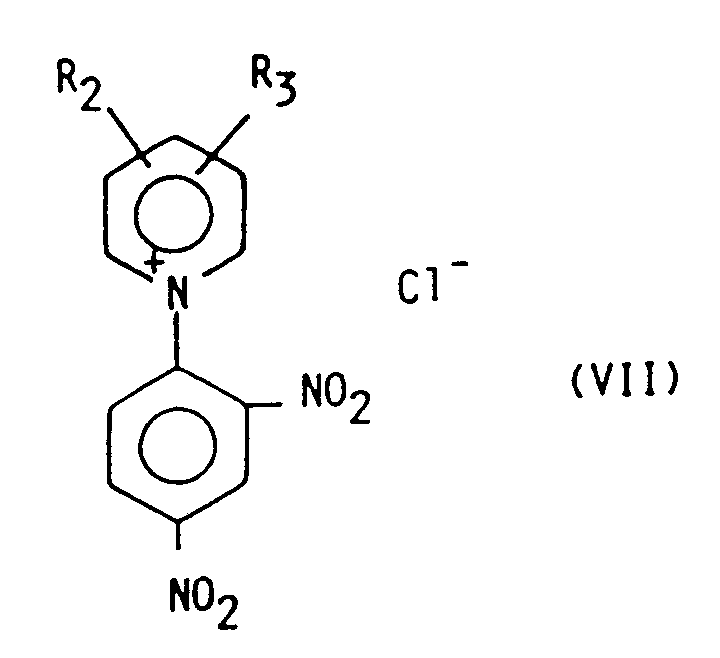
with an amino acid of the formula (d) subjecting a quaternary salt of formula (II) to anion exchange to afford a quaternary salt of formula (II) wherein X⁻ is a different anion.
- A process for the preparation of a peptide comprising a non-terminal amino acid fragment of the formula

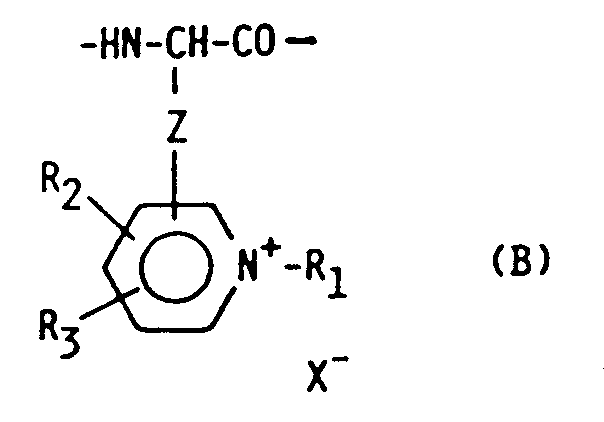
- A process for the preparation of a peptide comprising an amino acid fragment having the formula
 (a) reacting a halogen-containing peptide comprising an amino acid fragment of the formula

 (b) reacting a peptide comprising an amino acid fragment of the formula

and Z is attached to the neterocyclic ring via a ring carbon atom, with an alkylating agent of the formula
R₁-halide (VI)
wherein R₁ is C₁-C₇ alkyl, C₁-C₇ haloalkyl or C₇-C₁₂ aralkyl and the halide is iodide, bromide or chloride, to afford the corresponding peptide comprising an amino acid fragment of formula (B) wherein Z is attached to the heterocyclic ring via a ring carbon atom, R₁ is C₁-C₇ alkyl, C₁-C₇ haloalkyl or C₇-C₁₂ aralkyl and X⁻ is an iodide, bromide or chloride ion;(c) reacting a Zincke reagent of the formula
 (d) subjecting a peptide comprising an amino acid fragment of formula (B) to anion exchange to afford a peptide comprising an amino acid fragment of formula (B) wherein X⁻ is a different anion.
- A process according to Claim 1, 2, 3 or 4 wherein Z is -CH₂-.
- A process according to Claim 1, 2, 3 or 4 wherein Z is -(CH₂)₄-.
- A process according to Claim 1, 2, 3 or 4 wherein R₁ is a direct bond and Z is attached to the ring nitrogen atom.
- A process according to Claim 7 wherein one of R₂ and R₃ is hydrogen.
- A process according to Claim 8 wherein the other of R₂ and R₃ is -CONH₂.
- A process according to Claim 7 wherein one of R₂ and R₃ is -CONH₂ and the other of R₂ and R₃ together with the adjacent ring carbon atom forms a benzene ring fused to the heterocyclic ring.
- A process according to Claim 1, 2, 3 or 4 wherein R₁ is methyl.
- A process according to Claim 1, 2, 3 or 4 wherein Z is attached to a ring carbon atom.
- A process according to Claim 12 wherein R₁ is methyl.
- A process according to Claim 12 wherein at least one of R₂ and R₃ is hydrogen.
- A process according to Claim 14 wherein both R₂ and R₃ are hydrogen.
- A process according to Claim 12 wherein one of R₂ and R₃ is hydrogen and the other of R₂ and R₃ together with the adjacent ring carbon atom forms an unsubstituted benzene ring fused to the heterocyclic ring; or wherein one of R₂ and R₃ is hydrogen and the other of R₂ and R₃ together with the adjacent ring carbon atom forms a benzene ring fused to the heterocyclic ring, said benzene ring bearing one substituent selected from the group consisting of hydroxy, protected hydroxy and methoxy.
- A process according to Claim 1 or 2 wherein R₄ is a carboxyl protective group and/or wherein R₅ is an amino protective group.
- A process according to Claim 1 or 3 containing a 1,4-dihydropyridine ring system or a 1,6-dihydropyridine ring system.
- A process according to Claim 1 or 3 containing a 1,4-dihydroquinoline ring system, a 1,2-dihydroquinoline ring system or a 1,2-dihydroisoquinoline ring system.
- A process according to Claim 1 or 3 wherein
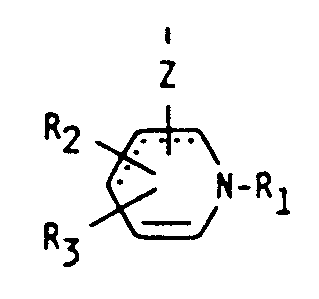

- A process according to Claim 2 or 4 wherein


- A process according to Claim 1 wherein the amino acid of formula (I) has the formula
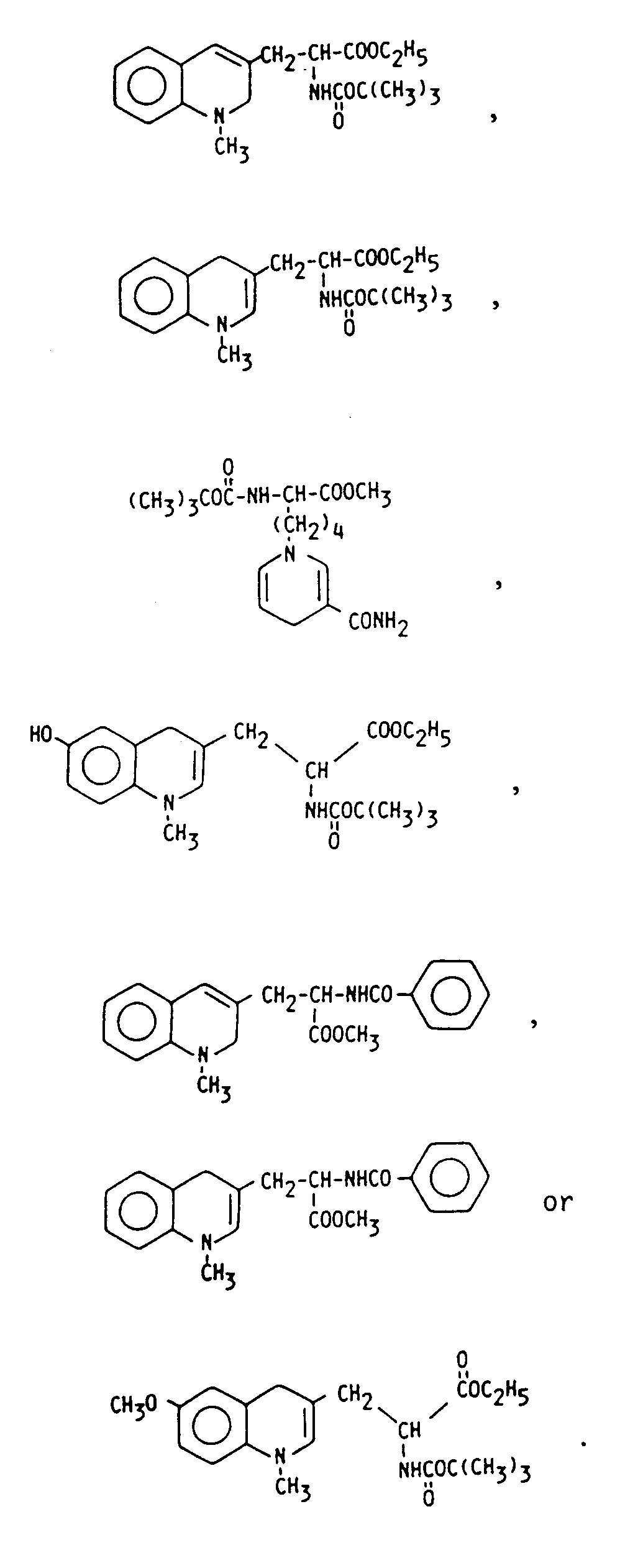
- A process according to Claim 2 wherein the quaternary salt of formula (II) has the formula

- A process for preparing a peptide having any one of the following formulae:-


- A process according to Claim 4 wherein the peptide comprising an amino acid fragment of formula (B) has the formula


Priority Applications (1)
| Application Number | Priority Date | Filing Date | Title |
|---|---|---|---|
| AT88302861T ATE93852T1 (en) | 1987-04-07 | 1988-03-30 | REDOX AMINE ACIDS AND PEPTIDES CONTAINING THEM. |
Applications Claiming Priority (2)
| Application Number | Priority Date | Filing Date | Title |
|---|---|---|---|
| US07/035,648 US4888427A (en) | 1987-04-07 | 1987-04-07 | Amino acids containing dihydropyridine ring systems for site-specific delivery of peptides to the brain |
| US35648 | 2001-12-28 |
Publications (2)
| Publication Number | Publication Date |
|---|---|
| EP0293071A1 EP0293071A1 (en) | 1988-11-30 |
| EP0293071B1 true EP0293071B1 (en) | 1993-09-01 |
Family
ID=21883953
Family Applications (1)
| Application Number | Title | Priority Date | Filing Date |
|---|---|---|---|
| EP88302861A Expired - Lifetime EP0293071B1 (en) | 1987-04-07 | 1988-03-30 | Redox amino acids and peptides containing them |
Country Status (9)
| Country | Link |
|---|---|
| US (1) | US4888427A (en) |
| EP (1) | EP0293071B1 (en) |
| JP (1) | JPS63277662A (en) |
| AT (1) | ATE93852T1 (en) |
| AU (1) | AU619461B2 (en) |
| CA (1) | CA1340726C (en) |
| DE (1) | DE3883600T2 (en) |
| IE (1) | IE62072B1 (en) |
| ZA (1) | ZA882335B (en) |
Families Citing this family (15)
| Publication number | Priority date | Publication date | Assignee | Title |
|---|---|---|---|---|
| GB8727737D0 (en) * | 1987-11-26 | 1987-12-31 | Ici Plc | Antitumour agents |
| US5002935A (en) * | 1987-12-30 | 1991-03-26 | University Of Florida | Improvements in redox systems for brain-targeted drug delivery |
| US5017566A (en) * | 1987-12-30 | 1991-05-21 | University Of Florida | Redox systems for brain-targeted drug delivery |
| IT1228451B (en) * | 1989-02-22 | 1991-06-19 | Sclavo S P A Siena | NEW GEMIN DIAMINE DERIVATIVES AND THEIR USE IN THE SYNTHESIS OF RETRO-REVERSE PEPTIDES |
| US5244915A (en) * | 1990-08-31 | 1993-09-14 | Warner-Lambert Company | Amico acid derivatives cyclized at the c-terminal |
| IL106998A0 (en) * | 1992-09-17 | 1993-12-28 | Univ Florida | Brain-enhanced delivery of neuroactive peptides by sequential metabolism |
| EP0599303A3 (en) * | 1992-11-27 | 1998-07-29 | Takeda Chemical Industries, Ltd. | Peptide conjugate |
| US5625068A (en) * | 1995-06-05 | 1997-04-29 | American Cyanamid Company | Substituted quinoline herbicide intermediates and process |
| ES2235331T3 (en) * | 1997-05-28 | 2005-07-01 | Aventis Pharmaceuticals Inc | QUINOLINE AND QUINOXALINE COMPOUNDS THAT INHIBIT THE GROWTH FACTOR DERIVED FROM PLATES AND / OR THYROSINE KINASE P561CK. |
| US6159978A (en) * | 1997-05-28 | 2000-12-12 | Aventis Pharmaceuticals Product, Inc. | Quinoline and quinoxaline compounds which inhibit platelet-derived growth factor and/or p56lck tyrosine kinases |
| US6180632B1 (en) | 1997-05-28 | 2001-01-30 | Aventis Pharmaceuticals Products Inc. | Quinoline and quinoxaline compounds which inhibit platelet-derived growth factor and/or p56lck tyrosine kinases |
| US6245760B1 (en) | 1997-05-28 | 2001-06-12 | Aventis Pharmaceuticals Products, Inc | Quinoline and quinoxaline compounds which inhibit platelet-derived growth factor and/or p56lck tyrosine kinases |
| US6440933B1 (en) * | 1997-09-10 | 2002-08-27 | University Of Florida | Compounds and method for the prevention and treatment of diabetic retinopathy |
| US8716280B2 (en) | 2009-01-21 | 2014-05-06 | Basilea Pharmaceutica Ag | Bicyclic antibiotics |
| IT201600079328A1 (en) * | 2016-07-28 | 2018-01-28 | Altergon Sa | Improved method for the decontamination of biological material by partition and inactivation |
Family Cites Families (14)
| Publication number | Priority date | Publication date | Assignee | Title |
|---|---|---|---|---|
| US3929813A (en) * | 1973-12-26 | 1975-12-30 | Interx Research Corp | Novel pro-drug derivatives of pyridinium aldoxime type cholinesterase reactivators and process for preparing same |
| US3962447A (en) * | 1973-12-26 | 1976-06-08 | Interx Research Corporation | Novel pro-drug derivatives of pyridinium aldoxime type cholinesterase reactivators and method of using same |
| FR2499076A1 (en) * | 1981-02-02 | 1982-08-06 | Panmedica Laboratoires | NOVEL DERIVATIVES OF (3-INDOL-3 YL) AMINO-2-PROPIONYLOXY ACETIC ACID, PROCESSES FOR THEIR PREPARATION AND MEDICAMENTS CONTAINING SAME |
| AU556932B2 (en) * | 1981-03-30 | 1986-11-27 | Usv Pharmaceutical Corp. | Dipetide with heterocyclic groiup |
| US4540564A (en) * | 1982-05-18 | 1985-09-10 | University Of Florida | Brain-specific drug delivery |
| EP0110955B1 (en) * | 1982-05-18 | 1995-08-23 | University Of Florida | Brain-specific drug delivery |
| GB8319174D0 (en) * | 1983-07-15 | 1983-08-17 | Erba Farmitalia | Biologically active heptapeptides |
| US4530920A (en) * | 1983-11-07 | 1985-07-23 | Syntex (U.S.A.) Inc. | Nonapeptide and decapeptide analogs of LHRH, useful as LHRH agonist |
| IT1206339B (en) * | 1984-01-13 | 1989-04-14 | Anic Spa | HEXAPEPTID RETRO INVERTED ANALOGS C-TERMINALS OF THE SUBSTANCE P. |
| US4569927A (en) * | 1984-02-23 | 1986-02-11 | The Salk Institute For Biological Studies | GnRH Antagonists IV |
| DE3574869D1 (en) * | 1984-02-29 | 1990-01-25 | Univ Florida | BRAIN-SPECIFIC ANALOGS OF CENTRALLY EFFECTIVE AMINES. |
| AU4635885A (en) * | 1984-07-19 | 1986-02-25 | University Of Florida | Compounds for site-enhanced delivery of radionuclides and uses thereof |
| US4565804A (en) * | 1984-09-07 | 1986-01-21 | The Salk Institute For Biological Studies | GnRH Antagonists VI |
| US4619915A (en) * | 1984-10-19 | 1986-10-28 | Pfizer Inc. | Peptide-substituted heterocyclic immunostimulants |
-
1987
- 1987-04-07 US US07/035,648 patent/US4888427A/en not_active Expired - Lifetime
-
1988
- 1988-03-15 IE IE76388A patent/IE62072B1/en not_active IP Right Cessation
- 1988-03-30 EP EP88302861A patent/EP0293071B1/en not_active Expired - Lifetime
- 1988-03-30 AT AT88302861T patent/ATE93852T1/en not_active IP Right Cessation
- 1988-03-30 DE DE88302861T patent/DE3883600T2/en not_active Expired - Lifetime
- 1988-03-31 ZA ZA882335A patent/ZA882335B/en unknown
- 1988-04-06 AU AU14311/88A patent/AU619461B2/en not_active Expired
- 1988-04-06 CA CA000563439A patent/CA1340726C/en not_active Expired - Fee Related
- 1988-04-07 JP JP63086247A patent/JPS63277662A/en active Pending
Also Published As
| Publication number | Publication date |
|---|---|
| ATE93852T1 (en) | 1993-09-15 |
| AU1431188A (en) | 1988-10-13 |
| IE880763L (en) | 1988-10-07 |
| CA1340726C (en) | 1999-09-07 |
| JPS63277662A (en) | 1988-11-15 |
| EP0293071A1 (en) | 1988-11-30 |
| AU619461B2 (en) | 1992-01-30 |
| ZA882335B (en) | 1989-12-27 |
| US4888427A (en) | 1989-12-19 |
| DE3883600T2 (en) | 1994-03-03 |
| IE62072B1 (en) | 1994-12-14 |
| DE3883600D1 (en) | 1993-10-07 |
Similar Documents
| Publication | Publication Date | Title |
|---|---|---|
| US5624894A (en) | Brain-enhanced delivery of neuroactive peptides by sequential metabolism | |
| US4888427A (en) | Amino acids containing dihydropyridine ring systems for site-specific delivery of peptides to the brain | |
| US6242563B1 (en) | Peptide analogues | |
| AU672474B2 (en) | LHRH analogs | |
| EP0161588B1 (en) | Diamino acid derivatives | |
| EP0632053A2 (en) | Cyclic adhesion inhibitors | |
| EP0770622A2 (en) | Cyclic adhesion inhibitors | |
| WO1999012572A1 (en) | Compounds and method for the prevention and treatment of diabetic retinopathy | |
| JP2010189398A (en) | Peptide analogue of pacap | |
| JPH0381292A (en) | Small lhrh analog | |
| CA2054667A1 (en) | Cyclopeptides | |
| US5502035A (en) | N-terminus modified analogs of LHRH | |
| NZ229393A (en) | Peptide derivative with a terminal heterocyclic group | |
| US5639885A (en) | Redox amino acids and peptides containing them | |
| CA2136079A1 (en) | Lhrh antagonists having modified aminoacyl residues at positions 5 and 6 | |
| EP0198271B1 (en) | Peptides | |
| CA2037990A1 (en) | Amino acid derivatives | |
| AU615216B2 (en) | Amino acid derivatives | |
| CA2102447C (en) | Cyclopeptides | |
| US5516759A (en) | LHRH antagonists having lactam groups at the N-terminus | |
| US4256736A (en) | Psychopharmacological peptides | |
| EP0328089A2 (en) | Reduced size LHRH analogs | |
| JP2672677B2 (en) | LHRH homolog |
Legal Events
| Date | Code | Title | Description |
|---|---|---|---|
| PUAI | Public reference made under article 153(3) epc to a published international application that has entered the european phase |
Free format text: ORIGINAL CODE: 0009012 |
|
| AK | Designated contracting states |
Kind code of ref document: A1 Designated state(s): AT BE CH DE ES FR GB GR IT LI LU NL SE |
|
| 17P | Request for examination filed |
Effective date: 19890403 |
|
| 111L | Licence recorded |
Free format text: 0100 PHARMATEC, INC. P.O. BOX 730 |
|
| 17Q | First examination report despatched |
Effective date: 19910521 |
|
| GRAA | (expected) grant |
Free format text: ORIGINAL CODE: 0009210 |
|
| RAP1 | Party data changed (applicant data changed or rights of an application transferred) |
Owner name: UNIVERSITY OF FLORIDA |
|
| AK | Designated contracting states |
Kind code of ref document: B1 Designated state(s): AT BE CH DE ES FR GB GR IT LI LU NL SE |
|
| PG25 | Lapsed in a contracting state [announced via postgrant information from national office to epo] |
Ref country code: IT Free format text: LAPSE BECAUSE OF FAILURE TO SUBMIT A TRANSLATION OF THE DESCRIPTION OR TO PAY THE FEE WITHIN THE PRE;WARNING: LAPSES OF ITALIAN PATENTS WITH EFFECTIVE DATE BEFORE 2007 MAY HAVE OCCURRED AT ANY TIME BEFORE 2007. THE CORRECT EFFECTIVE DATE MAY BE DIFFERENT FROM THE ONE RECORDED.SCRIBED TIME-LIMIT Effective date: 19930901 Ref country code: AT Effective date: 19930901 Ref country code: GR Free format text: LAPSE BECAUSE OF FAILURE TO SUBMIT A TRANSLATION OF THE DESCRIPTION OR TO PAY THE FEE WITHIN THE PRESCRIBED TIME-LIMIT Effective date: 19930901 Ref country code: SE Effective date: 19930901 Ref country code: NL Effective date: 19930901 Ref country code: ES Free format text: THE PATENT HAS BEEN ANNULLED BY A DECISION OF A NATIONAL AUTHORITY Effective date: 19930901 |
|
| REF | Corresponds to: |
Ref document number: 93852 Country of ref document: AT Date of ref document: 19930915 Kind code of ref document: T |
|
| REF | Corresponds to: |
Ref document number: 3883600 Country of ref document: DE Date of ref document: 19931007 |
|
| REG | Reference to a national code |
Ref country code: CH Ref legal event code: PLI Owner name: PHARMATEC, INC. |
|
| ET | Fr: translation filed | ||
| NLV1 | Nl: lapsed or annulled due to failure to fulfill the requirements of art. 29p and 29m of the patents act | ||
| PG25 | Lapsed in a contracting state [announced via postgrant information from national office to epo] |
Ref country code: LU Free format text: LAPSE BECAUSE OF NON-PAYMENT OF DUE FEES Effective date: 19940331 |
|
| PLBE | No opposition filed within time limit |
Free format text: ORIGINAL CODE: 0009261 |
|
| STAA | Information on the status of an ep patent application or granted ep patent |
Free format text: STATUS: NO OPPOSITION FILED WITHIN TIME LIMIT |
|
| 26N | No opposition filed | ||
| REG | Reference to a national code |
Ref country code: GB Ref legal event code: 732E |
|
| REG | Reference to a national code |
Ref country code: GB Ref legal event code: IF02 |
|
| PGFP | Annual fee paid to national office [announced via postgrant information from national office to epo] |
Ref country code: CH Payment date: 20070314 Year of fee payment: 20 |
|
| PGFP | Annual fee paid to national office [announced via postgrant information from national office to epo] |
Ref country code: DE Payment date: 20070316 Year of fee payment: 20 |
|
| PGFP | Annual fee paid to national office [announced via postgrant information from national office to epo] |
Ref country code: GB Payment date: 20070322 Year of fee payment: 20 |
|
| PGFP | Annual fee paid to national office [announced via postgrant information from national office to epo] |
Ref country code: BE Payment date: 20070419 Year of fee payment: 20 |
|
| BE20 | Be: patent expired |
Owner name: *UNIVERSITY OF FLORIDA Effective date: 20080330 |
|
| REG | Reference to a national code |
Ref country code: GB Ref legal event code: PE20 Expiry date: 20080329 |
|
| PGFP | Annual fee paid to national office [announced via postgrant information from national office to epo] |
Ref country code: FR Payment date: 20070319 Year of fee payment: 20 |
|
| REG | Reference to a national code |
Ref country code: CH Ref legal event code: PL |
|
| PG25 | Lapsed in a contracting state [announced via postgrant information from national office to epo] |
Ref country code: GB Free format text: LAPSE BECAUSE OF EXPIRATION OF PROTECTION Effective date: 20080329 |