EP0291065A2 - Nonoriented polyester films for lidding stock - Google Patents
Nonoriented polyester films for lidding stock Download PDFInfo
- Publication number
- EP0291065A2 EP0291065A2 EP88107692A EP88107692A EP0291065A2 EP 0291065 A2 EP0291065 A2 EP 0291065A2 EP 88107692 A EP88107692 A EP 88107692A EP 88107692 A EP88107692 A EP 88107692A EP 0291065 A2 EP0291065 A2 EP 0291065A2
- Authority
- EP
- European Patent Office
- Prior art keywords
- film
- polyester
- layer
- coextruded
- nonoriented
- Prior art date
- Legal status (The legal status is an assumption and is not a legal conclusion. Google has not performed a legal analysis and makes no representation as to the accuracy of the status listed.)
- Withdrawn
Links
Images
Classifications
-
- B—PERFORMING OPERATIONS; TRANSPORTING
- B32—LAYERED PRODUCTS
- B32B—LAYERED PRODUCTS, i.e. PRODUCTS BUILT-UP OF STRATA OF FLAT OR NON-FLAT, e.g. CELLULAR OR HONEYCOMB, FORM
- B32B27/00—Layered products comprising a layer of synthetic resin
- B32B27/06—Layered products comprising a layer of synthetic resin as the main or only constituent of a layer, which is next to another layer of the same or of a different material
- B32B27/08—Layered products comprising a layer of synthetic resin as the main or only constituent of a layer, which is next to another layer of the same or of a different material of synthetic resin
-
- B—PERFORMING OPERATIONS; TRANSPORTING
- B32—LAYERED PRODUCTS
- B32B—LAYERED PRODUCTS, i.e. PRODUCTS BUILT-UP OF STRATA OF FLAT OR NON-FLAT, e.g. CELLULAR OR HONEYCOMB, FORM
- B32B15/00—Layered products comprising a layer of metal
- B32B15/04—Layered products comprising a layer of metal comprising metal as the main or only constituent of a layer, which is next to another layer of the same or of a different material
- B32B15/08—Layered products comprising a layer of metal comprising metal as the main or only constituent of a layer, which is next to another layer of the same or of a different material of synthetic resin
- B32B15/085—Layered products comprising a layer of metal comprising metal as the main or only constituent of a layer, which is next to another layer of the same or of a different material of synthetic resin comprising polyolefins
-
- B—PERFORMING OPERATIONS; TRANSPORTING
- B32—LAYERED PRODUCTS
- B32B—LAYERED PRODUCTS, i.e. PRODUCTS BUILT-UP OF STRATA OF FLAT OR NON-FLAT, e.g. CELLULAR OR HONEYCOMB, FORM
- B32B15/00—Layered products comprising a layer of metal
- B32B15/04—Layered products comprising a layer of metal comprising metal as the main or only constituent of a layer, which is next to another layer of the same or of a different material
- B32B15/08—Layered products comprising a layer of metal comprising metal as the main or only constituent of a layer, which is next to another layer of the same or of a different material of synthetic resin
- B32B15/09—Layered products comprising a layer of metal comprising metal as the main or only constituent of a layer, which is next to another layer of the same or of a different material of synthetic resin comprising polyesters
-
- B—PERFORMING OPERATIONS; TRANSPORTING
- B32—LAYERED PRODUCTS
- B32B—LAYERED PRODUCTS, i.e. PRODUCTS BUILT-UP OF STRATA OF FLAT OR NON-FLAT, e.g. CELLULAR OR HONEYCOMB, FORM
- B32B15/00—Layered products comprising a layer of metal
- B32B15/20—Layered products comprising a layer of metal comprising aluminium or copper
-
- B—PERFORMING OPERATIONS; TRANSPORTING
- B32—LAYERED PRODUCTS
- B32B—LAYERED PRODUCTS, i.e. PRODUCTS BUILT-UP OF STRATA OF FLAT OR NON-FLAT, e.g. CELLULAR OR HONEYCOMB, FORM
- B32B27/00—Layered products comprising a layer of synthetic resin
- B32B27/06—Layered products comprising a layer of synthetic resin as the main or only constituent of a layer, which is next to another layer of the same or of a different material
- B32B27/10—Layered products comprising a layer of synthetic resin as the main or only constituent of a layer, which is next to another layer of the same or of a different material of paper or cardboard
-
- B—PERFORMING OPERATIONS; TRANSPORTING
- B32—LAYERED PRODUCTS
- B32B—LAYERED PRODUCTS, i.e. PRODUCTS BUILT-UP OF STRATA OF FLAT OR NON-FLAT, e.g. CELLULAR OR HONEYCOMB, FORM
- B32B27/00—Layered products comprising a layer of synthetic resin
- B32B27/32—Layered products comprising a layer of synthetic resin comprising polyolefins
-
- B—PERFORMING OPERATIONS; TRANSPORTING
- B32—LAYERED PRODUCTS
- B32B—LAYERED PRODUCTS, i.e. PRODUCTS BUILT-UP OF STRATA OF FLAT OR NON-FLAT, e.g. CELLULAR OR HONEYCOMB, FORM
- B32B27/00—Layered products comprising a layer of synthetic resin
- B32B27/32—Layered products comprising a layer of synthetic resin comprising polyolefins
- B32B27/322—Layered products comprising a layer of synthetic resin comprising polyolefins comprising halogenated polyolefins, e.g. PTFE
-
- B—PERFORMING OPERATIONS; TRANSPORTING
- B32—LAYERED PRODUCTS
- B32B—LAYERED PRODUCTS, i.e. PRODUCTS BUILT-UP OF STRATA OF FLAT OR NON-FLAT, e.g. CELLULAR OR HONEYCOMB, FORM
- B32B27/00—Layered products comprising a layer of synthetic resin
- B32B27/36—Layered products comprising a layer of synthetic resin comprising polyesters
-
- B—PERFORMING OPERATIONS; TRANSPORTING
- B32—LAYERED PRODUCTS
- B32B—LAYERED PRODUCTS, i.e. PRODUCTS BUILT-UP OF STRATA OF FLAT OR NON-FLAT, e.g. CELLULAR OR HONEYCOMB, FORM
- B32B7/00—Layered products characterised by the relation between layers; Layered products characterised by the relative orientation of features between layers, or by the relative values of a measurable parameter between layers, i.e. products comprising layers having different physical, chemical or physicochemical properties; Layered products characterised by the interconnection of layers
- B32B7/04—Interconnection of layers
- B32B7/12—Interconnection of layers using interposed adhesives or interposed materials with bonding properties
-
- B—PERFORMING OPERATIONS; TRANSPORTING
- B32—LAYERED PRODUCTS
- B32B—LAYERED PRODUCTS, i.e. PRODUCTS BUILT-UP OF STRATA OF FLAT OR NON-FLAT, e.g. CELLULAR OR HONEYCOMB, FORM
- B32B2307/00—Properties of the layers or laminate
- B32B2307/30—Properties of the layers or laminate having particular thermal properties
- B32B2307/31—Heat sealable
-
- B—PERFORMING OPERATIONS; TRANSPORTING
- B32—LAYERED PRODUCTS
- B32B—LAYERED PRODUCTS, i.e. PRODUCTS BUILT-UP OF STRATA OF FLAT OR NON-FLAT, e.g. CELLULAR OR HONEYCOMB, FORM
- B32B2553/00—Packaging equipment or accessories not otherwise provided for
Definitions
- the present invention relates to films made of nonoriented polyester, and more specifically to nonoriented coextruded films which further include a heat seal layer and are especially useful in producing lidding stock.
- Biaxially oriented polyethylene terephthalate commonly referred to as "oriented polyester” or “OPET”
- OPET is a common packaging film with over 200 million lbs. used annually.
- OPET is used for a wide variety of packaging applications, both alone and in combination with other materials (lamination) such as snack food packaging, adhesive labels, lidding, pouches, medical device packaging, and packaging for luncheon meat, cheese, bacon, and the like.
- OPET films are manufactured by an orientation process utilizing tenter frame or "double bubble” techniques. Tentering of plastic films is illustrated in U.S. Patent No. 2,823,421 and double-bubble orientation is illustrated in U.S. Patent No. 3,555,604.
- U.S. Patent Nos. 4,141,736 and 4,207,363 describe oriented films made using the tenter and double bubble processes, respectively.
- the orientation process comprises the steps of (1) extruding a thick web and cooling to a solid state; (2) precise reheating of film to the "orientation" temperature, (3) stretching the film in both longitudinal and transverse directions, and (4) reheating the film to relieve internal stresses.
- the process of orientating polyester is very complicated, requiring very expensive equipment and several highly skilled operators.
- Polyethylene film is commonly produced by blown or cast film extrusion techniques. Such films, while being easier to make, do not have the properties of toughness or stiffness which make polyester a favored packaging film for use in flexible packaging applications.
- polyester film produced without orientation yielded a very brittle film of limited use in flexible packaging.
- Various modifications have been made to nonoriented polyester films to improve its properties.
- One example where the polyester is modified to improve its processability in slow cooling of thick films is disclosed in U.S. Patent No. 4,175,147.
- This patent discloses single layer nonoriented films comprised of 97.5% to 99.9% w/w of PET blended with 2.5%-0.1% of polycarbonate.
- Such films are not described as having any toughness above that of nonoriented 100% PET films of similar thicknesses and intrinsic viscosities.
- Oriented polyester films often include a heat sealant layer, and are then used in many flexible packaging applications.
- Oriented heat sealable polyester films are commercially available whereby the heat sealant is applied as a coating.
- OL MYLAR and SCOTCHPAK are examples of heat sealable OPET films having the heat sealant applied as a coating.
- OL MYLAR is a registered trademark of E.I. DuPont de Neumours and Company.
- SCOTCHPAK is a registered trademark of The 3M Company.
- heat seal coatings consist of a polymer dissolved in a solvent such as methyl ethyl ketone, toluene or ethyl acetate.
- the solutions are applied as a dispersion.
- the solvent is subsequently evaporated by passing the web through an oven. This necessitates the need for disposing of or recovering the often hazardous solvents.
- a small amount of the solvent remains with the coating, commonly referred to as "retained solvents". Retained solvents are a concern when packaging food or medical products.
- MELINEX 850 is an example of another heat sealable OPET film.
- MELINEX is a registered trademark of Imperial Chemical Industries, Ltd. It is believed that U.S. Patent 4,375,494 discloses the method of making MELINEX 850.
- the film is made by coextruding a polyester base layer and a heat seal layer, orienting the coextruding layers using biaxially orientation techniques, and then heating the resulting film to a temperature below the crystalline melting point of the oriented polyester but at which the heat seal layer looses its orientation to become an amorphous heat sealable layer.
- Heat seal layers are also known on nonoriented multilayer films, including PET, such as that disclosed in U.S. Patent No. 4,389,450.
- the base layer comprises a blend of 25%-75% of a polymer with a coefficient of friction (COF) of less than about 2, including ethylene copolymers polyester, polypropylene and nylon.
- the blend also includes 25%-75% of a polymer with a COF greater than 2, including ethylene acrylic acid, ethylene methylacrylate, ethylene ethyl acrylate, ethylene vinyl acetate, and ionomer.
- Films made according to U.S. Patent No. 4,389,450 containing 25% olefinic material blended into polyester do not yield the toughness of films of the present invention.
- Heat sealable tough films are often used laminated to other materials for particular applications.
- two common means of packaging are the use of a heat sealed pouch (such as in powdered soft drink mixes) and plastic containers with a peelable lid (such as in yogurt, individual servings of jams and jellies, etc.)
- the pouch or lidding material is often a composite structure formed by (1) laminating printed paper or aluminum foil to oriented PET film and (2) applying a heat seal coating to the laminated structure.
- the lamination is typically made by placing an adhesive layer on the paper, aluminum foil, or even the oriented PET film and then laminating the two webs of material together.
- adhesive lamination techniques are well known.
- An alternative to adhesive lamination is extrusion lamination whereby the webs are bonded by a polymer extruded hot onto one of the webs. Extrusion lamination techniques are also well known.
- the second step in producing flexible packaging stocks is application of the heat sealant by means of coating.
- the sealant coating can be applied by dissolving a heat sealable polymer in a solvent and applying it to the surface of the laminate.
- the laminate is then passed through an oven to evaporate the solvent.
- the polymer which does not evaporate, forms a uniform heat seal coating onto the structure. A small amount of retained solvent often remains in the coating just as when a heat seal coating is applied to single layer OPET.
- the present invention includes a polyester film which is produced by conventional film extrusion methods and which exhibits surprising toughness without orientation.
- the film comprises a layer between about 0.5 mil and about 5 mil thick, of tough, nonoriented polymer comprising a blend of about 95% to about 99% of a polyester and about 1% to about 5% of a polyolefin. It has been found that the addition of the small (1%-5%) amount of olefinic polymer to the polyester yields a film with surprising toughness for a non-oriented polyester.
- Coextruded films of this aspect of the invention consist of the tough base layer and a heat sealant layer.
- the base layer is comprised of polyester with 1%-5% of an olefinic polymer blended therein.
- the heat sealant layer is comprised of a second polymer material such as copolyesters, ethylene vinyl acetate, ethylene acrylic acid, polyethylene and the like and not necessarily from the same group of olefinic polymers used as the additive in the base layer.
- polyester resins either with or without olefinic polymers blended therein, are coextruded with a heat seal layer.
- the multiple layer heat sealable polyester films of both aspects of the invention exhibit excellent toughness and functionality without the need of orienting the film and can be produced on conventional film extrusion equipment, which costs significantly less than orientation equipment and is easier and less costly to operate.
- the non-oriented heat sealable coextruded polyester films of both aspects of this invention demonstrate several advantages over oriented heat sealable polyester films: (1) the films of this invention can be formed into shapes by heat and/or pressure; (2) they exhibit better tear resistance; (3) they exhibit better heat seal properties; and (4) they exhibit better surface receptivity to inks, adhesives and the like. Furthermore, compared to oriented heat sealable polyester films whereby the sealant is applied as a coating, the films of this invention have the following additional advantages: (1) they can be made in one manufacturing step and (2) the sealants contain no retained solvents.
- the heat sealable, non-oriented coextruded polyester films of both aspects of this invention can be laminated to paper, aluminum foil, or another film to form pouch or lidding stocks.
- the use of the films of this invention to produce the pouch or lidding material does not require the usual step of applying a heat seal coating to a laminate of oriented PET film. Elimination of the coating step simplifies the process of making the composite structure and often reduces costs.
- these composites are superior to heat sealable composites which incorporate a heat sealant applied as a solvent based coating in that they: (1) eliminate the coating step; (2) eliminate the need to handle solvents and (3) eliminate retained solvents in the heat sealant.
- the first aspect of the invention in its simplest form is a tough, nonoriented film made of a blend of polyester containing about 1% to about 5% of a polyolefin. (Unless otherwise specified, all percentages are weight percents.)
- the film is between about 0.5 mil and about 5 mil thick. The following examples describe films of this form.
- a polyester polymer was extruded using the conventional chill roll cast film process. Specifically, a polyester polymer characterized by an intrinsic viscosity (IV) of 0.95 was used. The commercial polyester used was Goodyear 9506B manufactured by Goodyear Chemical Company. The polyester was placed into a 2-1/2" diameter extruder and extruded through a coathanger style cast film die onto a chrome plated, water cooled chill roll. The resultant film was wound onto a roll using a conventional film winding system. The film had a thickness of 1.0 mil (0.001 inches).
- Example 1 The film of Example 1 except 1% linear low density polyethylene (“LLDPE”) was blended with the polyester prior to extrusion.
- LLDPE linear low density polyethylene
- the LLDPE used was Dowlex 2045, manufactured by The Dow Chemical Company.
- Example 1 The film of Example 1 except 3% LLDPE was blended with the polyester.
- Example 1 The film of Example 1 except the 5% LLDPE was blended with the polyester.
- Example 4 The film of Example 4 except a 0.80 IV polyester was used. In particular, Goodyear 8006 was utilized. Table 1 compares the tensile strength, elongation, tear resistance and puncture resistance of the films of Examples 1-5, and of 1.0 mil OPET film. Note the surprising increase in all the physical properties when a small amount of LLDPE is added to the polyester. The poor physical properties of the film of Example 1 has limited the commercial applications of nonoriented polyester films.
- copolyesters in a nonoriented state provide tougher film than comparable nonoriented polyesters.
- Eastman 6751 a PCTA copolyester, has improved toughness over straight polyester.
- polyesters with a greater intrinsic viscosity result in films with a greater toughness.
- nonoriented polyester films made of polyesters with an IV of 0.95 or greater and without LLDPE which will be suitable in some applications requiring moderately tough films.
- a new Goodyear CT1006B polyester with an IV of 1.04 was found to provide, without orientation and without the use of LLDPE, a film of good toughness.
- an article entitled “DuPont Unveils Toughened Polyester", published in Packaging , pp.84-87 (Jan. 1987) describes a new "Selar” polyester which reportedly may be cast into moderately tough films. The use of such resins in coextruded films is discussed below in more detail with regard to the second aspect of the invention.
- the present invention has been found, however to surprisingly improve the toughness of polyesters of a wide variety of IV. Low IV polyesters, even when LLDPE is added, may not be tough enough for some appli cations. Therefore, it is thought that the present invention will be most useful when utilizing polyesters with an IV of between about 0.7 and about .95.
- polyester resins which yield relatively tough films without orientation or the need to blend in a small amount of olefin.
- Goodyear 9506C PET was extruded with 0% and 3% LLDPE blended therein.
- Table 1A compares the physical properties of these films compared to conventional cast PET containing 0% olefin. Note that the addition of the olefin still yields improved tear resistance, an important property in many applications such as lidding stocks.
- Goodyear's 9506C resin is a TPA based high molecular weight poly(ethylene terephtalate) resin optimized for high strength and impact resistance for a wide range of applications including industrial yarns, monofilament, strapping, and dual ovenable container applications. It is reportedly produced by a melt phase polymerization followed by a special secondary polymerization process for achieving higher purity and molecular weights.
- SELAR PT polymer manufactured by E.I. DuPont De Nemours, hereafter referred to as "DuPont.”
- SELAR PT is a trademark of DuPont.
- DuPont has claimed that films produced from SELAR PT polymers yield tensile and elongation properties of 7,000 psi and 500%, respectively.
- the tough polyester of both aspects of the invention may also be used in other embodiments of the invention, for example, the tough polyester may typically be part of a coextrusion of a heat sealable film, exemplified in FIG. 1 in which a two-layer film is generally designated 10.
- Layer 11 of film 10 is a heat sealant layer "A" consisting of a copolyester or olefinic polymer.
- Layer 12 of film 10 is the base layer "B" consisting of a polyester polymer with a small amount of polyolefin blended therein.
- the base layer 12 provides the film with stiffness, tear resistance and toughness. As illustrated in Examples 1-5, these properties are affected by 1) the polyester polymer used and 2) the amount of polyolefin added to the polyester.
- a base layer 12 consisting of a polyester/LLDPE polymer blend of Example 3 was coextruded with a heat sealant layer 11 consisting of a modified ethylene vinyl acetate (EVA) polymer.
- EVA ethylene vinyl acetate
- the commercial modified EVA used in this example was Plexar 326 (commonly used as a tie layer for polyester base layers), manufactured by USI Chemicals Company.
- the polymer for the base layer 12 was placed into a first extruder and the polymer for the heat sealant layer 11 was placed into a second extruder and the polymers were coextruded through a feedblock and cast film die and then quenched on a chilled roll.
- the resultant film had a total thickness of 1.0 mil (0.001 inches), of which 0.8 mil was the base layer 12 and 0.2 mil was the heat sealant layer 11.
- Example 6 The film of Example 6 except a non-modified EVA was used for the heat sealant layer 11.
- Table 2 compares the heat seal properties of the films of Examples 6 and 7. Note that the film using the modified EVA, Example 6, exhibits superior sealing properties compared to the non-modified EVA of Example 7. This occurs as the bond between the heat sealant layer and the base layer is weaker for the non-modified EVA. When the sealed samples are peeled apart, the non-modified EVA separates from the base polyester. Therefore, a preferred embodiment of this invention is the use of a modified olefin, such as EVA modified to adhere to polyester, as the heat sealant layer 11.
- a modified olefin such as EVA modified to adhere to polyester
- tie layers are useful for structures of the present invention when the base layer is coextruded with a noncompatible layer (heat seal or otherwise).
- a noncompatible layer heat seal or otherwise.
- Three layer films utilizing a tie layer allow the use of heat sealant polymers which normally form a poor bond to the base polyester, and hence have poor sealing properties.
- FIG. 2 illustrates a three-layer film generally designated 13.
- Layer 14 of film 13 is the base layer comparable to layer 12 of film 10 (FIG. 1).
- Layer 16 is a heat sealant layer comparable to layer 11 of film 10.
- Layer 15 is a tie layer which bonds layers 14 and 16.
- Example 6 The film of Example 6 (FIG. 1) except an ethylene methyl acetate (EMA) is used as the heat sealant layer 11. No tie layer is used between this heat seal layer and the base layer 12.
- EMA ethylene methyl acetate
- a base layer 14 (FIG. 2) of the polyester/LLDPE blend of Example 3 is coextruded with a tie layer 15 of a modified olefin and a heat sealant layer 16 of EMA.
- a base layer consisting of a polyester polymer characterized by an intrinsic viscosity (IV) of 0.95 with 3% LLDPE blended therein was coextruded with a heat sealant layer consisting of a copolyester.
- the commercial 0.95 IV polyester used in this example was Goodyear 9506B manufactured by Goodyear Chemical Company.
- the copolyester heat sealant layer was poly (ethylene-co-diethylene terephthalate).
- One commercial copolyester of this formulation is Kodabond 5116 manufactured by Eastman Chemical Products, Inc. Kodabond is a registered trademark of Eastman Chemical Products, Inc.
- copolyester as the heat sealant layer has advantages over the olefinic sealants of the previous examples when sealing to non-olefinic substrates, such as tubs and trays formed from polyester.
- Example 6 Whether one uses a olefinic versus a copolyester heat sealant will depend on the intended application.
- the films of Example 6, containing an olefinic heat sealant, and of Example 10, containing a copolyester heat sealant were sealed to seven common materials used for containers.
- the seal strengths are listed in Table 3. Note: Seals made with 0.25" wide seal bar at 40psi for 0.5 sec dwell. Note that the films of Examples 6 and 10 exhibit often widely different seal strengths to the various substrates. For example, for crystallized polyester trays, the film of Example 10 would be preferred versus the film of Example 6.
- the films of the present invention demonstrate superior sealing properties compared to commercially available heat sealable OPET films.
- Table 4 compares the seal properties the film of Example 6 to SCOTCHPAK film when sealed to high impact polystyrene ("HIPS").
- Table 5 compares seal strength of the film of Example 10 compared to MELINEX 850 and OL MYLAR when sealed to crystallized polyester trays.
- the films of the present invention demonstrate superior tear resistance compared to heat sealable OPET films.
- Table 6 compares the tear resistance of MELINEX 850 and OL MYLAR to film of Example 10 made at a thickness of 0.0006".
- the tear resistance of films made from the newly developed resins used in the second aspect of the invention are superior to films made of conventional resins. This improved tear resistance is manifest in coextruded films comparable to the film of Example 10.
- FIG. 3 illustrates a common construction for a flexible packaging materials generally designated by 17.
- the laminate 17 is made from a first web 20 laminated to a second web 18 by a lamination bonding layer 19.
- the lamination bonding layer 19 may be either an adhesive or an extrusion as discussed in the background section of the specification.
- a heat seal coating 21 is applied by solvent coating techniques, also described in the background section. The heat seal coating 21 of these common composites often contains retained solvents.
- FIG. 4 illustrates a laminated stock generally referred to as 22, which is another embodiment of the present invention.
- Laminate 22 is comprised of first web 23 laminated to a film of this invention designated as 10 from FIG. 1.
- the web 23 may be aluminium foil, paper, oriented polyester, oriented polypropylene or a nonoriented polymer film.
- Web 23 may also consist of a multilayer structure where various functional layers are used to achieve desired characteristics in the final laminate.
- the web 23 and film 10 are bonded by either adhesive or extrusion lamination techniques by lamination bonding layer 24, similar to bonding layer 19 of FIG. 3. Since film 10 already has a heat sealant layer, 11, no heat seal coating step is necessary as in making structure 17.
- Structure 22 has many advantages over the more conventional structure 17: (1) it can be constructed in one less manufacturing step, i.e., no heat seal coating step; (2) it can often be made at lower cost due to elimination of the coating step; and (3) the sealant layer 11 of structure 22 is comprised of a pure polymer and therefore contains 0% retained solvents.
- This example describes the lidstock produced by well known means and illustrated by FIG. 3.
- aluminum foil designated as 20, of a thickness of 0.0003 inches was first laminated to 0.00048 inch thick OPET film 18 by adhesive 19.
- ethylene vinyl acetate polymer dissolved in solvent ethyl acetate was coated onto film 18 of the laminate.
- the laminate was passed through an oven wherein the majority of the ethyl acetate solvent was evaporated leaving the EVA polymer as a uniform heat seal coating, 21.
- This example describes the manufacture of a lidding stock using a film of the first aspect of the present invention, specifically as described in Example 6, with a structure as shown in FIG. 4.
- the film of Example 6 was adhesively laminated to 0.0003 thick aluminum foil.
- Example 12 The structure of Example 12 except the film of Example 10 was laminated to 0.0003 thick aluminum foil.
- Example 11 The laminate of Example 11 was analyzed by gas chromatography for the presence of the solvent ethyl acetate and found to contain 2000 mg/ream retained solvent.
- the cost of manufacturing the film of Example 11 was approximately 22% more than the cost of manufacturing the films of Examples 12 and 13.
- HIPS high impact polystyrene
Landscapes
- Laminated Bodies (AREA)
- Wrappers (AREA)
Abstract
Description
- This application is a continuation-in-part of copending Application Serial No. 07/050,166, entitled "Tough Nonoriented Polyester Films," filed May 14, 1987, which in turn is a continuation-in-part of copending Application Serial No. 06/759,391, entitled "Polyester/Copolyester Coextruded Packaging Film," filed July 26, 1985.
- The present invention relates to films made of nonoriented polyester, and more specifically to nonoriented coextruded films which further include a heat seal layer and are especially useful in producing lidding stock.
- Biaxially oriented polyethylene terephthalate, commonly referred to as "oriented polyester" or "OPET", is a common packaging film with over 200 million lbs. used annually. OPET is used for a wide variety of packaging applications, both alone and in combination with other materials (lamination) such as snack food packaging, adhesive labels, lidding, pouches, medical device packaging, and packaging for luncheon meat, cheese, bacon, and the like.
- OPET films are manufactured by an orientation process utilizing tenter frame or "double bubble" techniques. Tentering of plastic films is illustrated in U.S. Patent No. 2,823,421 and double-bubble orientation is illustrated in U.S. Patent No. 3,555,604. U.S. Patent Nos. 4,141,736 and 4,207,363 describe oriented films made using the tenter and double bubble processes, respectively. The orientation process comprises the steps of (1) extruding a thick web and cooling to a solid state; (2) precise reheating of film to the "orientation" temperature, (3) stretching the film in both longitudinal and transverse directions, and (4) reheating the film to relieve internal stresses. The process of orientating polyester is very complicated, requiring very expensive equipment and several highly skilled operators.
- This is in contrast to the process used to make many other commodity plastic packaging films such as polyethylene. Polyethylene film is commonly produced by blown or cast film extrusion techniques. Such films, while being easier to make, do not have the properties of toughness or stiffness which make polyester a favored packaging film for use in flexible packaging applications.
- Prior to this invention and recent developments of new polyester resins, polyester film produced without orientation yielded a very brittle film of limited use in flexible packaging. Various modifications have been made to nonoriented polyester films to improve its properties. One example where the polyester is modified to improve its processability in slow cooling of thick films is disclosed in U.S. Patent No. 4,175,147. This patent discloses single layer nonoriented films comprised of 97.5% to 99.9% w/w of PET blended with 2.5%-0.1% of polycarbonate. Such films, however, are not described as having any toughness above that of nonoriented 100% PET films of similar thicknesses and intrinsic viscosities.
- Oriented polyester films often include a heat sealant layer, and are then used in many flexible packaging applications. Oriented heat sealable polyester films are commercially available whereby the heat sealant is applied as a coating. OL MYLAR and SCOTCHPAK are examples of heat sealable OPET films having the heat sealant applied as a coating. OL MYLAR is a registered trademark of E.I. DuPont de Neumours and Company. SCOTCHPAK is a registered trademark of The 3M Company.
- Most heat seal coatings consist of a polymer dissolved in a solvent such as methyl ethyl ketone, toluene or ethyl acetate. The solutions are applied as a dispersion. The solvent is subsequently evaporated by passing the web through an oven. This necessitates the need for disposing of or recovering the often hazardous solvents. Furthermore, often a small amount of the solvent remains with the coating, commonly referred to as "retained solvents". Retained solvents are a concern when packaging food or medical products.
- MELINEX 850 is an example of another heat sealable OPET film. MELINEX is a registered trademark of Imperial Chemical Industries, Ltd. It is believed that U.S. Patent 4,375,494 discloses the method of making MELINEX 850. The film is made by coextruding a polyester base layer and a heat seal layer, orienting the coextruding layers using biaxially orientation techniques, and then heating the resulting film to a temperature below the crystalline melting point of the oriented polyester but at which the heat seal layer looses its orientation to become an amorphous heat sealable layer.
- Heat seal layers are also known on nonoriented multilayer films, including PET, such as that disclosed in U.S. Patent No. 4,389,450. This patent discloses a multiple layer heat sealable packaging sheet. The base layer (nonsealant layer) comprises a blend of 25%-75% of a polymer with a coefficient of friction (COF) of less than about 2, including ethylene copolymers polyester, polypropylene and nylon. The blend also includes 25%-75% of a polymer with a COF greater than 2, including ethylene acrylic acid, ethylene methylacrylate, ethylene ethyl acrylate, ethylene vinyl acetate, and ionomer. Films made according to U.S. Patent No. 4,389,450 containing 25% olefinic material blended into polyester do not yield the toughness of films of the present invention.
- In copending Application Serial No. 06/759,391, the grandparent application for this case, a nonoriented coextruded heat sealable film is disclosed. A copolyester used in the heat seal layer was found to provide exceptional heat seal properties, especially when the film was laminated to paper web and used to make microwave popcorn popping bags. In that application, the base polyester layer was not required to have, nor did it have, any particular toughness characteristics when made into thin films. In copending Application Serial No. 07/050,166, the parent application for this case, nonoriented tough polyester films are disclosed. The coextrusion of such films with heat seal layers (as discussed below) is also disclosed. The present application includes a disclosure to the use of new resins in similar applications.
- Heat sealable tough films are often used laminated to other materials for particular applications. For example, two common means of packaging are the use of a heat sealed pouch (such as in powdered soft drink mixes) and plastic containers with a peelable lid (such as in yogurt, individual servings of jams and jellies, etc.) The pouch or lidding material is often a composite structure formed by (1) laminating printed paper or aluminum foil to oriented PET film and (2) applying a heat seal coating to the laminated structure.
- The lamination is typically made by placing an adhesive layer on the paper, aluminum foil, or even the oriented PET film and then laminating the two webs of material together. Such adhesive lamination techniques are well known. An alternative to adhesive lamination is extrusion lamination whereby the webs are bonded by a polymer extruded hot onto one of the webs. Extrusion lamination techniques are also well known.
- The second step in producing flexible packaging stocks is application of the heat sealant by means of coating. The sealant coating can be applied by dissolving a heat sealable polymer in a solvent and applying it to the surface of the laminate. The laminate is then passed through an oven to evaporate the solvent. The polymer, which does not evaporate, forms a uniform heat seal coating onto the structure. A small amount of retained solvent often remains in the coating just as when a heat seal coating is applied to single layer OPET.
- Besides the problem of retained solvents, such laminates are also expensive in that they use oriented films and require two converting steps to produce.
- The present invention includes a polyester film which is produced by conventional film extrusion methods and which exhibits surprising toughness without orientation.
- In one aspect of the invention, the film comprises a layer between about 0.5 mil and about 5 mil thick, of tough, nonoriented polymer comprising a blend of about 95% to about 99% of a polyester and about 1% to about 5% of a polyolefin. It has been found that the addition of the small (1%-5%) amount of olefinic polymer to the polyester yields a film with surprising toughness for a non-oriented polyester.
- Coextruded films of this aspect of the invention consist of the tough base layer and a heat sealant layer. The base layer is comprised of polyester with 1%-5% of an olefinic polymer blended therein. The heat sealant layer is comprised of a second polymer material such as copolyesters, ethylene vinyl acetate, ethylene acrylic acid, polyethylene and the like and not necessarily from the same group of olefinic polymers used as the additive in the base layer.
- In another aspect of this invention, recently developed polyester resins either with or without olefinic polymers blended therein, are coextruded with a heat seal layer.
- The multiple layer heat sealable polyester films of both aspects of the invention exhibit excellent toughness and functionality without the need of orienting the film and can be produced on conventional film extrusion equipment, which costs significantly less than orientation equipment and is easier and less costly to operate.
- In addition, the non-oriented heat sealable coextruded polyester films of both aspects of this invention demonstrate several advantages over oriented heat sealable polyester films: (1) the films of this invention can be formed into shapes by heat and/or pressure; (2) they exhibit better tear resistance; (3) they exhibit better heat seal properties; and (4) they exhibit better surface receptivity to inks, adhesives and the like. Furthermore, compared to oriented heat sealable polyester films whereby the sealant is applied as a coating, the films of this invention have the following additional advantages: (1) they can be made in one manufacturing step and (2) the sealants contain no retained solvents.
- The heat sealable, non-oriented coextruded polyester films of both aspects of this invention can be laminated to paper, aluminum foil, or another film to form pouch or lidding stocks. The use of the films of this invention to produce the pouch or lidding material does not require the usual step of applying a heat seal coating to a laminate of oriented PET film. Elimination of the coating step simplifies the process of making the composite structure and often reduces costs.
- In addition, these composites are superior to heat sealable composites which incorporate a heat sealant applied as a solvent based coating in that they: (1) eliminate the coating step; (2) eliminate the need to handle solvents and (3) eliminate retained solvents in the heat sealant.
-
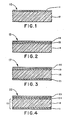
- FIGURE 1 shows a multilayer film including a tough nonoriented polyester layer of the present invention in a two-layer "AB" structure.
- FIGURE 2 shows a multilayer film of the present invention, a three-layer "ABC" structure.
- FIGURE 3 illustrates a prior art flexible packaging structure comprised of an adhesive or extrusion lamination of OPET film to aluminum foil paper or film with a heat seal coating applied to the laminate.
- FIGURE 4 shows a flexible packaging structure of the present invention comprised of an adhesive or extrusion lamination of the films of the present invention to a web of aluminum foil, paper or film.
- The first aspect of the invention in its simplest form is a tough, nonoriented film made of a blend of polyester containing about 1% to about 5% of a polyolefin. (Unless otherwise specified, all percentages are weight percents.) The film is between about 0.5 mil and about 5 mil thick. The following examples describe films of this form.
- A polyester polymer was extruded using the conventional chill roll cast film process. Specifically, a polyester polymer characterized by an intrinsic viscosity (IV) of 0.95 was used. The commercial polyester used was Goodyear 9506B manufactured by Goodyear Chemical Company. The polyester was placed into a 2-1/2" diameter extruder and extruded through a coathanger style cast film die onto a chrome plated, water cooled chill roll. The resultant film was wound onto a roll using a conventional film winding system. The film had a thickness of 1.0 mil (0.001 inches).
- The film of Example 1 except 1% linear low density polyethylene ("LLDPE") was blended with the polyester prior to extrusion. The LLDPE used was Dowlex 2045, manufactured by The Dow Chemical Company.
- The film of Example 1 except 3% LLDPE was blended with the polyester.
- The film of Example 1 except the 5% LLDPE was blended with the polyester.
- The film of Example 4 except a 0.80 IV polyester was used. In particular, Goodyear 8006 was utilized.
Table 1 compares the tensile strength, elongation, tear resistance and puncture resistance of the films of Examples 1-5, and of 1.0 mil OPET film.
- Note also that beyond approximately 3% LLDPE added to the polyester, no further improvement in physical properties are realized. Also, as the amount of LLDPE goes up, the haze level of the film increases, and above about 10%, the toughness of the film begins to decrease. Therefore, levels of about 1% to about 5% are preferred.
- Some copolyesters in a nonoriented state provide tougher film than comparable nonoriented polyesters. For example, Eastman 6751, a PCTA copolyester, has improved toughness over straight polyester.
- Also, even in nonoriented polyesters without LLDPE, polyesters with a greater intrinsic viscosity (IV) result in films with a greater toughness. Thus, there may be nonoriented polyester films made of polyesters with an IV of 0.95 or greater and without LLDPE which will be suitable in some applications requiring moderately tough films. For example, a new Goodyear CT1006B polyester with an IV of 1.04 was found to provide, without orientation and without the use of LLDPE, a film of good toughness. Also, an article entitled "DuPont Unveils Toughened Polyester", published in Packaging, pp.84-87 (Jan. 1987), describes a new "Selar" polyester which reportedly may be cast into moderately tough films. The use of such resins in coextruded films is discussed below in more detail with regard to the second aspect of the invention.
- The present invention has been found, however to surprisingly improve the toughness of polyesters of a wide variety of IV. Low IV polyesters, even when LLDPE is added, may not be tough enough for some appli cations. Therefore, it is thought that the present invention will be most useful when utilizing polyesters with an IV of between about 0.7 and about .95.
- The reason why small amounts of polyolefin in the polyester provides films of superior toughness is not yet fully understood. It is known, however, that in addition to LLDPE, ethylene vinyl acetate copolymers ("EVA") also provide similar improvements in the toughness of nonoriented polyester films. It is thought that the olefin acts as a nucleating agent which increases the crystallinity, hence toughness, of the extruded film. Since olefins are incompatible with polyesters, they act as sites for formation of crystalline regions. Therefore, it is believed that a wide variety of polyolefin may be blended in small amounts in polyester films and provide similar surprising results.
- With regard to the second aspect of the present invention, it has been found that recent advancements in the development of new polyester polymers by manufacturers such as Eastman Chemical, Goodyear Chemical and E.I. DuPont De Nemours have produced polyester resins which yield relatively tough films without orientation or the need to blend in a small amount of olefin. As one example, Goodyear 9506C PET was extruded with 0% and 3% LLDPE blended therein. Table 1A compares the physical properties of these films compared to conventional cast PET containing 0% olefin.

- It is reported that Goodyear's 9506C resin is a TPA based high molecular weight poly(ethylene terephtalate) resin optimized for high strength and impact resistance for a wide range of applications including industrial yarns, monofilament, strapping, and dual ovenable container applications. It is reportedly produced by a melt phase polymerization followed by a special secondary polymerization process for achieving higher purity and molecular weights.
- Another example of new PET polymers which yield tough film without the addition of olefins is SELAR PT polymer manufactured by E.I. DuPont De Nemours, hereafter referred to as "DuPont." SELAR PT is a trademark of DuPont. DuPont has claimed that films produced from SELAR PT polymers yield tensile and elongation properties of 7,000 psi and 500%, respectively.
- The tough polyester of both aspects of the invention may also be used in other embodiments of the invention, for example, the tough polyester may typically be part of a coextrusion of a heat sealable film, exemplified in FIG. 1 in which a two-layer film is generally designated 10.
Layer 11 offilm 10 is a heat sealant layer "A" consisting of a copolyester or olefinic polymer.Layer 12 offilm 10 is the base layer "B" consisting of a polyester polymer with a small amount of polyolefin blended therein. Thebase layer 12 provides the film with stiffness, tear resistance and toughness. As illustrated in Examples 1-5, these properties are affected by 1) the polyester polymer used and 2) the amount of polyolefin added to the polyester. - Various heat seal layers have been experimented with to find suitable heat seal layers that can be coextruded with both the novel polyester-polyolefin blend material of the first aspect of the invention and the new resins used in the second aspect of the invention. Examples 6-10 illustrate various experimental heat sealant combinations, and Tables 2-5 illustrate some of the results of the investigation. The heat seal layers used with the base layers of the first aspect of the invention were found to provide similar properties when used with base layers of the second aspect of the invention.
- A
base layer 12 consisting of a polyester/LLDPE polymer blend of Example 3 was coextruded with aheat sealant layer 11 consisting of a modified ethylene vinyl acetate (EVA) polymer. The commercial modified EVA used in this example was Plexar 326 (commonly used as a tie layer for polyester base layers), manufactured by USI Chemicals Company. The polymer for thebase layer 12 was placed into a first extruder and the polymer for theheat sealant layer 11 was placed into a second extruder and the polymers were coextruded through a feedblock and cast film die and then quenched on a chilled roll. The resultant film had a total thickness of 1.0 mil (0.001 inches), of which 0.8 mil was thebase layer 12 and 0.2 mil was theheat sealant layer 11. - The film of Example 6 except a non-modified EVA was used for the
heat sealant layer 11. Specifically, USI 3404, manufactured by USI Chemical Company, was used for this example. - Table 2 compares the heat seal properties of the films of Examples 6 and 7.

heat sealant layer 11. - Commonly known tie layers are useful for structures of the present invention when the base layer is coextruded with a noncompatible layer (heat seal or otherwise). Three layer films utilizing a tie layer allow the use of heat sealant polymers which normally form a poor bond to the base polyester, and hence have poor sealing properties.
- For example, FIG. 2 illustrates a three-layer film generally designated 13.
Layer 14 offilm 13 is the base layer comparable tolayer 12 of film 10 (FIG. 1).Layer 16 is a heat sealant layer comparable tolayer 11 offilm 10.Layer 15 is a tie layer which bonds layers 14 and 16. - The three-layer approach broadens the selection of polymers used for the heat sealant layer of films of this invention. The following examples further demonstrates this utility.
- The film of Example 6 (FIG. 1) except an ethylene methyl acetate (EMA) is used as the
heat sealant layer 11. No tie layer is used between this heat seal layer and thebase layer 12. - A base layer 14 (FIG. 2) of the polyester/LLDPE blend of Example 3 is coextruded with a
tie layer 15 of a modified olefin and aheat sealant layer 16 of EMA. - The bond of the
heat sealant 16 to thebase layer 14 of Example 9 would be superior to that between theheat sealant 11 and thebase layer 12 of the film of Example 8. This is a result of the use oftie layer 15. - The following example illustrates the use of a copolyester polymer as the heat sealant layer rather than a olefinic polymer used in the previous examples.
- A base layer consisting of a polyester polymer characterized by an intrinsic viscosity (IV) of 0.95 with 3% LLDPE blended therein was coextruded with a heat sealant layer consisting of a copolyester. The commercial 0.95 IV polyester used in this example was Goodyear 9506B manufactured by Goodyear Chemical Company. The copolyester heat sealant layer was poly (ethylene-co-diethylene terephthalate). One commercial copolyester of this formulation is Kodabond 5116 manufactured by Eastman Chemical Products, Inc. Kodabond is a registered trademark of Eastman Chemical Products, Inc.
- The use of a copolyester as the heat sealant layer has advantages over the olefinic sealants of the previous examples when sealing to non-olefinic substrates, such as tubs and trays formed from polyester.
- Whether one uses a olefinic versus a copolyester heat sealant will depend on the intended application. To demonstrate the differences in utilizing a olefinic heat sealant versus a copolyester heat sealant, the films of Example 6, containing an olefinic heat sealant, and of Example 10, containing a copolyester heat sealant, were sealed to seven common materials used for containers. The seal strengths are listed in Table 3.

Note that the films of Examples 6 and 10 exhibit often widely different seal strengths to the various substrates. For example, for crystallized polyester trays, the film of Example 10 would be preferred versus the film of Example 6. - The films of the present invention demonstrate superior sealing properties compared to commercially available heat sealable OPET films. Table 4 compares the seal properties the film of Example 6 to SCOTCHPAK film when sealed to high impact polystyrene ("HIPS"). Table 5 compares seal strength of the film of Example 10 compared to MELINEX 850 and OL MYLAR when sealed to crystallized polyester trays.

- The films of the present invention demonstrate superior tear resistance compared to heat sealable OPET films. Table 6 compares the tear resistance of MELINEX 850 and OL MYLAR to film of Example 10 made at a thickness of 0.0006".

- As shown in Table 1A, the tear resistance of films made from the newly developed resins used in the second aspect of the invention are superior to films made of conventional resins. This improved tear resistance is manifest in coextruded films comparable to the film of Example 10.
- FIG. 3 illustrates a common construction for a flexible packaging materials generally designated by 17. The laminate 17 is made from a
first web 20 laminated to asecond web 18 by alamination bonding layer 19. Thelamination bonding layer 19 may be either an adhesive or an extrusion as discussed in the background section of the specification. Aheat seal coating 21 is applied by solvent coating techniques, also described in the background section. Theheat seal coating 21 of these common composites often contains retained solvents. - The films of both aspects of the present invention can be used to form a laminated flexible packaging stock which can replace the laminated and coated stock of FIG. 3 described above. For example, FIG. 4 illustrates a laminated stock generally referred to as 22, which is another embodiment of the present invention.
Laminate 22 is comprised offirst web 23 laminated to a film of this invention designated as 10 from FIG. 1. Theweb 23 may be aluminium foil, paper, oriented polyester, oriented polypropylene or a nonoriented polymer film.Web 23 may also consist of a multilayer structure where various functional layers are used to achieve desired characteristics in the final laminate. - The
web 23 andfilm 10 are bonded by either adhesive or extrusion lamination techniques bylamination bonding layer 24, similar tobonding layer 19 of FIG. 3. Sincefilm 10 already has a heat sealant layer, 11, no heat seal coating step is necessary as in makingstructure 17. -
Structure 22 has many advantages over the more conventional structure 17: (1) it can be constructed in one less manufacturing step, i.e., no heat seal coating step; (2) it can often be made at lower cost due to elimination of the coating step; and (3) thesealant layer 11 ofstructure 22 is comprised of a pure polymer and therefore contains 0% retained solvents. - The presence of retained solvents in heat seal layers is often objectionable as the solvents are often hazardous materials such as toluene, methyl ethyl ketone or ethyl acetate.
- The following examples will serve to further describe the advantages of flexible packaging structures produced with films of both aspects of the present invention over those made by conventional means. The examples describe a packaging lidstock for individual servings of jam, jelly and other condiments.
- This example describes the lidstock produced by well known means and illustrated by FIG. 3. Referring to FlG. 3, aluminum foil designated as 20, of a thickness of 0.0003 inches, was first laminated to 0.00048 inch
thick OPET film 18 byadhesive 19. Subsequently, ethylene vinyl acetate polymer dissolved in solvent ethyl acetate was coated ontofilm 18 of the laminate. The laminate was passed through an oven wherein the majority of the ethyl acetate solvent was evaporated leaving the EVA polymer as a uniform heat seal coating, 21. - This example describes the manufacture of a lidding stock using a film of the first aspect of the present invention, specifically as described in Example 6, with a structure as shown in FIG. 4. The film of Example 6 was adhesively laminated to 0.0003 thick aluminum foil.
- The structure of Example 12 except the film of Example 10 was laminated to 0.0003 thick aluminum foil.
- The laminate of Example 11 was analyzed by gas chromatography for the presence of the solvent ethyl acetate and found to contain 2000 mg/ream retained solvent.
- The cost of manufacturing the film of Example 11 was approximately 22% more than the cost of manufacturing the films of Examples 12 and 13.
- To demonstrate the comparable functionality of the lidding stocks of Examples 11 and 12, the stocks were heat sealed to rigid high impact polystyrene (HIPS). HIPS is commonly used for the formed containers used in the packaging of jams, jellies, ketchup and other condiments and foodstuffs. Table 7 contains seal strengths data from these examples:

- Note that the laminate of Examples 12 yields slightly better seal properties than the laminate of Example 11. Laminates made using a base layer of the second aspect of the present invention and the heat seal layers as in Examples 12 and 13 would provide similar results as disclosed in Table 7.
- The preferred embodiments of the invention disclosed herein are illustrative of the invention and are capable of variation without departing from the scope of the invention. It is intended, therefore, that the following claims, including all equivalents, define the invention.
Claims (29)
(i) about 95 to 99% of a polyester and
(ii) about 1% to about 5% of polyolefin.
(i) a tough base layer comprising a blend of polyester and a polyolefin in a ratio of polyester to polyolefin of between about 99:1 to 19:1, and
(ii) a olefin heat seal layer on one side of said base layer;
(i) a tough base layer comprising a nonoriented polyester; and
(ii) a heat seal layer on one side of said base layer;
Applications Claiming Priority (4)
| Application Number | Priority Date | Filing Date | Title |
|---|---|---|---|
| US5016687A | 1987-05-14 | 1987-05-14 | |
| US50166 | 1987-05-14 | ||
| US6767287A | 1987-06-26 | 1987-06-26 | |
| US67672 | 1998-04-28 |
Publications (2)
| Publication Number | Publication Date |
|---|---|
| EP0291065A2 true EP0291065A2 (en) | 1988-11-17 |
| EP0291065A3 EP0291065A3 (en) | 1989-06-07 |
Family
ID=26727959
Family Applications (1)
| Application Number | Title | Priority Date | Filing Date |
|---|---|---|---|
| EP88107692A Withdrawn EP0291065A3 (en) | 1987-05-14 | 1988-05-13 | Nonoriented polyester films for lidding stock |
Country Status (2)
| Country | Link |
|---|---|
| EP (1) | EP0291065A3 (en) |
| JP (1) | JPS6456548A (en) |
Cited By (11)
| Publication number | Priority date | Publication date | Assignee | Title |
|---|---|---|---|---|
| DE8900366U1 (en) * | 1989-01-13 | 1989-08-03 | Indag Gesellschaft für Industriebedarf mbH, 69214 Eppelheim | Foil bags |
| US4946743A (en) * | 1987-06-26 | 1990-08-07 | Reynolds Consumer Products, Inc. | Nonoriented polyester films for lidding stock with modified heat seal layer |
| EP0379190A3 (en) * | 1989-01-19 | 1991-03-20 | Toyo Boseki Kabushiki Kaisha | A polyester laminated film |
| EP0687636A1 (en) * | 1994-06-15 | 1995-12-20 | Du Pont De Nemours International S.A. | Lid for container |
| WO1998030390A1 (en) * | 1997-01-10 | 1998-07-16 | Elopak Systems Ag | A packaging laminate |
| EP0812874A4 (en) * | 1995-12-28 | 1999-12-15 | Gunze Kk | Easy-to-break-through film |
| EP0967159A1 (en) * | 1998-06-23 | 1999-12-29 | The Procter & Gamble Company | Package with child deterrent means |
| WO2006134042A1 (en) * | 2005-06-17 | 2006-12-21 | Evonik Röhm Gmbh | Heat-sealing compound for sealing aluminium foil and polyethylene terephthalate film to polypropylene, polyvinyl chloride and polystyrene containers |
| EP2275474A1 (en) | 2002-04-09 | 2011-01-19 | Illinois Tool Works Inc. | High integrity polyester strapping |
| WO2014109739A1 (en) * | 2013-01-09 | 2014-07-17 | Albea Americas, Inc. | Layered materials comprising aluminum foil and tubes made therefrom |
| US10815042B2 (en) | 2016-06-09 | 2020-10-27 | Sunovion Pharmaceuticals Inc. | Easy-open peel pouch |
Families Citing this family (3)
| Publication number | Priority date | Publication date | Assignee | Title |
|---|---|---|---|---|
| JPH05177775A (en) * | 1992-01-06 | 1993-07-20 | Yamato Esuron Kk | Surface coating film |
| JPH05194110A (en) * | 1992-01-22 | 1993-08-03 | Teisan Seiyaku Kk | Repellent-containing body |
| JP6852268B2 (en) * | 2016-03-16 | 2021-03-31 | 住友ベークライト株式会社 | Unstretched sealant film and packaging |
Family Cites Families (4)
| Publication number | Priority date | Publication date | Assignee | Title |
|---|---|---|---|---|
| US4046837A (en) * | 1972-09-25 | 1977-09-06 | Eastman Kodak Company | Polyester-polyolefin blend film or coating composition |
| JPS5265588A (en) * | 1975-11-26 | 1977-05-31 | Toray Ind Inc | Covered metal structures and manufacturing thereof |
| EP0044616B1 (en) * | 1980-07-17 | 1985-01-09 | Imperial Chemical Industries Plc | Films from compositions of polyesters and olefine polymers |
| US4564658A (en) * | 1982-11-24 | 1986-01-14 | General Electric Company | Thermoplastic polyester-linear low density polyethylene molding compositions |
-
1988
- 1988-05-13 EP EP88107692A patent/EP0291065A3/en not_active Withdrawn
- 1988-05-14 JP JP63118047A patent/JPS6456548A/en active Pending
Cited By (22)
| Publication number | Priority date | Publication date | Assignee | Title |
|---|---|---|---|---|
| US4946743A (en) * | 1987-06-26 | 1990-08-07 | Reynolds Consumer Products, Inc. | Nonoriented polyester films for lidding stock with modified heat seal layer |
| EP0364301A3 (en) * | 1988-10-14 | 1990-11-28 | Reynolds Consumer Products, Inc. | Nonoriented polyester films with modified heat seal layer |
| DE8900366U1 (en) * | 1989-01-13 | 1989-08-03 | Indag Gesellschaft für Industriebedarf mbH, 69214 Eppelheim | Foil bags |
| EP0379190A3 (en) * | 1989-01-19 | 1991-03-20 | Toyo Boseki Kabushiki Kaisha | A polyester laminated film |
| US5458965A (en) * | 1989-01-19 | 1995-10-17 | Toyo Boseki Kabushiki Kaisha | Polyester laminated film |
| EP0712719A1 (en) * | 1989-01-19 | 1996-05-22 | Toyo Boseki Kabushiki Kaisha | A polyester laminated film |
| EP0687636A1 (en) * | 1994-06-15 | 1995-12-20 | Du Pont De Nemours International S.A. | Lid for container |
| WO1995034489A1 (en) * | 1994-06-15 | 1995-12-21 | Du Pont De Nemours International S.A. | Lid for container |
| US6361856B1 (en) | 1995-12-28 | 2002-03-26 | Gunze Limited | Easily tearable film |
| EP0812874A4 (en) * | 1995-12-28 | 1999-12-15 | Gunze Kk | Easy-to-break-through film |
| WO1998030390A1 (en) * | 1997-01-10 | 1998-07-16 | Elopak Systems Ag | A packaging laminate |
| EP0967159A1 (en) * | 1998-06-23 | 1999-12-29 | The Procter & Gamble Company | Package with child deterrent means |
| WO1999067154A1 (en) * | 1998-06-23 | 1999-12-29 | The Procter & Gamble Company | A package with child deterrent means |
| EP2275474A1 (en) | 2002-04-09 | 2011-01-19 | Illinois Tool Works Inc. | High integrity polyester strapping |
| EP2275474B1 (en) | 2002-04-09 | 2018-10-17 | Signode International IP Holdings LLC | High integrity polyester strapping |
| WO2006134042A1 (en) * | 2005-06-17 | 2006-12-21 | Evonik Röhm Gmbh | Heat-sealing compound for sealing aluminium foil and polyethylene terephthalate film to polypropylene, polyvinyl chloride and polystyrene containers |
| US8025758B2 (en) | 2005-06-17 | 2011-09-27 | Evonik Rohm Gmbh | Heat-sealing compound for sealing aluminium foil and polyethylene terephthalate film to polypropylene, polyvinyl chloride and polystyrene containers |
| KR101365764B1 (en) * | 2005-06-17 | 2014-02-20 | 에보니크 룀 게엠베하 | Heat-sealing material for sealing aluminium foil and polyethylene terephthalate film to polypropylene, polyvinyl chloride and polystyrene containers |
| WO2014109739A1 (en) * | 2013-01-09 | 2014-07-17 | Albea Americas, Inc. | Layered materials comprising aluminum foil and tubes made therefrom |
| US10160580B2 (en) | 2013-01-09 | 2018-12-25 | Albea Americas, Inc. | Layered materials comprising aluminum foil and tubes made therefrom |
| US10815042B2 (en) | 2016-06-09 | 2020-10-27 | Sunovion Pharmaceuticals Inc. | Easy-open peel pouch |
| US11312554B2 (en) | 2016-06-09 | 2022-04-26 | Sunovion Pharmaceuticals Inc. | Easy-open peel pouch |
Also Published As
| Publication number | Publication date |
|---|---|
| EP0291065A3 (en) | 1989-06-07 |
| JPS6456548A (en) | 1989-03-03 |
Similar Documents
| Publication | Publication Date | Title |
|---|---|---|
| US4946743A (en) | Nonoriented polyester films for lidding stock with modified heat seal layer | |
| CA1037370A (en) | Packaging of foodstuffs | |
| US4765999A (en) | Polyester/copolyester coextruded packaging film | |
| EP1709116B1 (en) | Composition comprising ethylene copolymers and polyolefin | |
| US5324467A (en) | Process for preparation of oriented multilayer laminate film | |
| EP0476836B1 (en) | Biaxially oriented laminated film | |
| US4716061A (en) | Polypropylene/polyester nonoriented heat sealable moisture barrier film and bag | |
| US4623587A (en) | Multi-layer film or sheet material | |
| CA1317427C (en) | Biaxially oriented multilayer barrier films | |
| US6361856B1 (en) | Easily tearable film | |
| US20110300363A1 (en) | High-strength polypropylene-base barrier film for packing purposes, method for the production and the use thereof | |
| US20100151218A1 (en) | Innerliner with nylon skin layer | |
| AU2005275079B2 (en) | Composition comprising ethylene copolymers and polyolefins | |
| WO2010015402A1 (en) | Multilayer structures comprising a microlayer sequence | |
| EP0465681B1 (en) | Monoaxially oriented multilayered packaging material | |
| US4741957A (en) | Heat sealable multilayer film and method of making same | |
| CN112672882A (en) | Recyclable PE packaging film with improved stiffness | |
| AU2021463113B2 (en) | Thermoformable sheet and thermoformed package | |
| JP2016060525A (en) | Shrink label | |
| JP2714866B2 (en) | Polyester laminate | |
| JPS59230746A (en) | Film for packing | |
| JPH10278192A (en) | Laminated film | |
| JPH10119204A (en) | Laminated film | |
| JPH06126916A (en) | Polyester laminate | |
| JPH0596617A (en) | Polyvinyl alcohol stretch formed object |
Legal Events
| Date | Code | Title | Description |
|---|---|---|---|
| PUAI | Public reference made under article 153(3) epc to a published international application that has entered the european phase |
Free format text: ORIGINAL CODE: 0009012 |
|
| AK | Designated contracting states |
Kind code of ref document: A2 Designated state(s): AT BE CH DE ES FR GB GR IT LI LU NL SE |
|
| PUAL | Search report despatched |
Free format text: ORIGINAL CODE: 0009013 |
|
| AK | Designated contracting states |
Kind code of ref document: A3 Designated state(s): AT BE CH DE ES FR GB GR IT LI LU NL SE |
|
| RAP1 | Party data changed (applicant data changed or rights of an application transferred) |
Owner name: REYNOLDS CONSUMER PRODUCTS, INC. |
|
| STAA | Information on the status of an ep patent application or granted ep patent |
Free format text: STATUS: THE APPLICATION IS DEEMED TO BE WITHDRAWN |
|
| 18D | Application deemed to be withdrawn |
Effective date: 19891208 |