EP0290496B2 - Use of an adenosine, hypoxanthine and ribose-containing solution for improved protection of the heart during surgery - Google Patents
Use of an adenosine, hypoxanthine and ribose-containing solution for improved protection of the heart during surgery Download PDFInfo
- Publication number
- EP0290496B2 EP0290496B2 EP87906894A EP87906894A EP0290496B2 EP 0290496 B2 EP0290496 B2 EP 0290496B2 EP 87906894 A EP87906894 A EP 87906894A EP 87906894 A EP87906894 A EP 87906894A EP 0290496 B2 EP0290496 B2 EP 0290496B2
- Authority
- EP
- European Patent Office
- Prior art keywords
- hypoxanthine
- heart
- adenosine
- solution
- ribose
- Prior art date
- Legal status (The legal status is an assumption and is not a legal conclusion. Google has not performed a legal analysis and makes no representation as to the accuracy of the status listed.)
- Expired - Lifetime
Links
Classifications
-
- A—HUMAN NECESSITIES
- A61—MEDICAL OR VETERINARY SCIENCE; HYGIENE
- A61K—PREPARATIONS FOR MEDICAL, DENTAL OR TOILETRY PURPOSES
- A61K31/00—Medicinal preparations containing organic active ingredients
- A61K31/70—Carbohydrates; Sugars; Derivatives thereof
-
- A—HUMAN NECESSITIES
- A61—MEDICAL OR VETERINARY SCIENCE; HYGIENE
- A61K—PREPARATIONS FOR MEDICAL, DENTAL OR TOILETRY PURPOSES
- A61K33/00—Medicinal preparations containing inorganic active ingredients
-
- A—HUMAN NECESSITIES
- A61—MEDICAL OR VETERINARY SCIENCE; HYGIENE
- A61P—SPECIFIC THERAPEUTIC ACTIVITY OF CHEMICAL COMPOUNDS OR MEDICINAL PREPARATIONS
- A61P5/00—Drugs for disorders of the endocrine system
- A61P5/24—Drugs for disorders of the endocrine system of the sex hormones
-
- A—HUMAN NECESSITIES
- A61—MEDICAL OR VETERINARY SCIENCE; HYGIENE
- A61P—SPECIFIC THERAPEUTIC ACTIVITY OF CHEMICAL COMPOUNDS OR MEDICINAL PREPARATIONS
- A61P9/00—Drugs for disorders of the cardiovascular system
Definitions
- the present invention relates to an improved cardioplegic solution to protect the heart from ischemia-induced damage incurred during interruption of the blood circulation to the heart during surgery and transplantation.
- Surgical procedures for the correction of complex congenital heart abnormalities, placement of cardiac valvular prostheses or repair of defective valves, and bypassing obstructed coronary vessels require the body to be supported by the heart-lung machine while the heart is rendered quiescent by interruption of its blood supply and briefly perfusing it with a cold solution containing electrolytes and a high potassium concentration (cardioplegic solution). This enables the surgeon to work in a still and bloodless field to complete the intricate surgical procedures before irreversible ischemic damage is incurred.
- the ischemic heart tolerates ischemia for 20-30 minutes before irreversible damage occurs. With the onset of ischemia, the supply of substrates for energy production ceases, and the high energy phosphate adenosine triphosphate (ATP) (which provides energy for contraction and operation of ion pumps in the myocardial cell) is degraded over time to its precursors ADP and AMP. AMP can undergo further degradation at the myocardial membrane to the diffusable purine nucleoside adenosine. Adenosine is also rapidly metabolized to inosine, hypoxanthine and xanthine. With the restoration of blood flow, these nucleosides are washed out of the heart via the circulation.
- ATP high energy phosphate adenosine triphosphate
- J. Thorac. Cardiovasc. Surg. Vol 84, p.16 to 22 1982 shows the metabolic links between adenosine and hypoxanthine.
- Medline Abstract No 00891392; Farmakol, Toksikol (USSR) 1968, Vol 31, P 273-277 indicates that purines such as hypoxanthine and adenine have positive effects on the heart; while US-A-4,605,644 discloses the use of adenine and ribose for the perfusion of cardiac tissue, and J. Thorac. Cardiovasc. Surg. Vol 90, P68-72 1985 discloses the use of allopurinol for the prevention of perfusion injury.
- the present invention therefore, there is provided the use of the compounds adenosine, hypoxanthine and ribose as additives to a heart perfusate in the manufacture of a cardioplegic solution for reducing ischemic damage to a heart isolated from a normal blood supply.
- the improved effect can be measured in terms of greater preservation of high energy phosphates during ischemia, more rapid recovery of high energy phosphates after ischemia, and a greater recovery of contractile function following an ischemic period.
- the use of this solution provides increased protection of the heart during ischemia incurred during surgery, or during the transportation of the heart between donor and recipient for cardiac transplantation.
- Adenosine, hypoxanthine and ribose are endogenous substances.
- Adenosine is a purine nucleoside; hypoxanthine is a purine base; ribose is a sugar.
- hypoxanthine is a purine base; ribose is a sugar.
- adenine nucleotide pool is degraded to the diffusable nucleosides adenosine, inosine and hypoxanthine. These are then washed out during the reperfusion period. ATP levels may be depressed for as long as 7-10 days due to the loss of these nucleotide precursors adenosine, inosine, hypoxanthine.
- the restoration of the adenine nucleotides can be accomplished via two major pathways.
- the first is via de novo synthesis; however, this pathway is very slow and more than one week would be required to replenish a 50% decline in ATP levels.
- the second mechanism includes the nucleotide salvage pathways which include the direct phosphorylation of adenosine to AMP, and the phosphorylation of hypoxanthine to IMP which is then converted to AMP. From AMP, ADP and ultimately ATP can be regenerated if irreversible damage of the intracellular organelles has not occurred.
- the salvaged hypoxanthine requires its condensation with phosphoribosyl-pyrophosphate (PRPP) which in turn is derived from the ribose moiety.
- PRPP phosphoribosyl-pyrophosphate
- the cell in the absence of damage to the cells' biochemical machinery, the cell is capable of regenerating these high energy phosphate pools (AMP, ADP, ATP) relatively rapidly. Yet in actuality, the restoration of high energy phosphates post-ischemia occurs quite slowly. The retarded rate of recovery may be due to the low concentrations of substrate precursor in the form of adenosine, hypoxanthine and ribose.
- adenosine and hypoxanthine are individually capable of preserving and/or restoring myocardial ATP was achieved in experiments carried out in the Langendorff isolated perfused rat heart model.
- Adenosine (100 »M) or hypoxanthine (100 »M) were used in addition to a standard heart perfusate, and the effects on preischemic, ischemic and post-ischemic ATP values were determined and are presented in Table 1 by way of comparison.
- the invention is embodied in: (1) A formula for preparation of a solution for reducing ischemic damage to the heart during cardiac surgery or during harvesting for cardiac transplantation.
- This solution has the following ionic content: Na 110 meq/l Cl 160 meq/l K 16 meq/l Ca++ 1.4 meq/l Mg 32 meq.
Landscapes
- Health & Medical Sciences (AREA)
- Life Sciences & Earth Sciences (AREA)
- Pharmacology & Pharmacy (AREA)
- Veterinary Medicine (AREA)
- Public Health (AREA)
- General Health & Medical Sciences (AREA)
- Chemical & Material Sciences (AREA)
- Animal Behavior & Ethology (AREA)
- Medicinal Chemistry (AREA)
- Epidemiology (AREA)
- Chemical Kinetics & Catalysis (AREA)
- Inorganic Chemistry (AREA)
- Nuclear Medicine, Radiotherapy & Molecular Imaging (AREA)
- General Chemical & Material Sciences (AREA)
- Organic Chemistry (AREA)
- Molecular Biology (AREA)
- Bioinformatics & Cheminformatics (AREA)
- Engineering & Computer Science (AREA)
- Heart & Thoracic Surgery (AREA)
- Endocrinology (AREA)
- Diabetes (AREA)
- Cardiology (AREA)
- Pharmaceuticals Containing Other Organic And Inorganic Compounds (AREA)
- Saccharide Compounds (AREA)
- Agricultural Chemicals And Associated Chemicals (AREA)
Abstract
Description
- The present invention relates to an improved cardioplegic solution to protect the heart from ischemia-induced damage incurred during interruption of the blood circulation to the heart during surgery and transplantation.
- Surgical procedures for the correction of complex congenital heart abnormalities, placement of cardiac valvular prostheses or repair of defective valves, and bypassing obstructed coronary vessels require the body to be supported by the heart-lung machine while the heart is rendered quiescent by interruption of its blood supply and briefly perfusing it with a cold solution containing electrolytes and a high potassium concentration (cardioplegic solution). This enables the surgeon to work in a still and bloodless field to complete the intricate surgical procedures before irreversible ischemic damage is incurred.
- The ischemic heart tolerates ischemia for 20-30 minutes before irreversible damage occurs. With the onset of ischemia, the supply of substrates for energy production ceases, and the high energy phosphate adenosine triphosphate (ATP) (which provides energy for contraction and operation of ion pumps in the myocardial cell) is degraded over time to its precursors ADP and AMP. AMP can undergo further degradation at the myocardial membrane to the diffusable purine nucleoside adenosine. Adenosine is also rapidly metabolized to inosine, hypoxanthine and xanthine. With the restoration of blood flow, these nucleosides are washed out of the heart via the circulation. If the ischemia time has been of sufficient length, the level of ATP is reduced, hence less energy for contraction and maintenance of ionic fluxes, and the contractile function of the heart may be diminished or lost. Therefore, methods were developed which would extend the length of time the heart could tolerate ischemia in order to reduce the morbidity and motality of cardiac operations. Investigations of possible solutions useful in delaying the onset of ischemic damage have involved the use of a multitude of ingredients, but the standard cardioplegic solution in use today contains normal plasma concentrations of electrolytes with the exception of an elevated concentration of potassium which depolarizes the cardiac muscle, rendering it quiescent. The use of hyperkalemic solutions with hypothermia to lower the basal metabolic rate of the cardiac tissue reduces the rate of ATP degradation during ischemia and increases the tolerated ischemic time of the heart during surgery. The protection afforded by these techniques, however, is not optimal in all cases and inadequate myocardial protection during prolonged ischemia is responsible for prolonged weaning from the cardiopulmonary bypass machine, the use of inotropic drums to support the failing heart postoperatively, and for the mortality associated with postoperative arrhythmias or cardiac failure. Therefore, improvements in the protective cardioplegic solution are needed to reduce the risks attendant with cardiac surgical procedures.
- J. Thorac. Cardiovasc. Surg. Vol 84, p.16 to 22 1982 shows the metabolic links between adenosine and hypoxanthine. Medline Abstract No 00891392; Farmakol, Toksikol (USSR) 1968, Vol 31, P 273-277 indicates that purines such as hypoxanthine and adenine have positive effects on the heart; while US-A-4,605,644 discloses the use of adenine and ribose for the perfusion of cardiac tissue, and J. Thorac. Cardiovasc. Surg. Vol 90, P68-72 1985 discloses the use of allopurinol for the prevention of perfusion injury.
- We have discovered that the measured ability of the myocardium to tolerate ischemia can be enhanced significantly with the addition of adenosine, hypoxanthine and ribose to standard electrolyte solutions.
- According to the present invention, therefore, there is provided the use of the compounds adenosine, hypoxanthine and ribose as additives to a heart perfusate in the manufacture of a cardioplegic solution for reducing ischemic damage to a heart isolated from a normal blood supply.
- The improved effect can be measured in terms of greater preservation of high energy phosphates during ischemia, more rapid recovery of high energy phosphates after ischemia, and a greater recovery of contractile function following an ischemic period. The use of this solution provides increased protection of the heart during ischemia incurred during surgery, or during the transportation of the heart between donor and recipient for cardiac transplantation.
- Adenosine, hypoxanthine and ribose are endogenous substances. Adenosine is a purine nucleoside; hypoxanthine is a purine base; ribose is a sugar. When these substances are used as additives to standard cardioplegic solutions, a relatively high local concentration in the heart can be achieved, without exposure to the systemic circulation. Since these substances are washed out of the myocardium and rapidly distributed and metabolized, they provide a very wide margin of safety.
- The rationale behind the use of these substances is to facilitate the preservation and repletion of the adenine nucleotide pool during ischemia by serving as substrate for the purine nucleotide salvage pathways. These pathways are summarized below.

During ischemia, the intracellular adenine nucelotide pool is degraded to the diffusable nucleosides adenosine, inosine and hypoxanthine. These are then washed out during the reperfusion period. ATP levels may be depressed for as long as 7-10 days due to the loss of these nucleotide precursors adenosine, inosine, hypoxanthine. The restoration of the adenine nucleotides can be accomplished via two major pathways. The first is via de novo synthesis; however, this pathway is very slow and more than one week would be required to replenish a 50% decline in ATP levels. The second mechanism includes the nucleotide salvage pathways which include the direct phosphorylation of adenosine to AMP, and the phosphorylation of hypoxanthine to IMP which is then converted to AMP. From AMP, ADP and ultimately ATP can be regenerated if irreversible damage of the intracellular organelles has not occurred. The salvaged hypoxanthine requires its condensation with phosphoribosyl-pyrophosphate (PRPP) which in turn is derived from the ribose moiety. Thus, in the absence of damage to the cells' biochemical machinery, the cell is capable of regenerating these high energy phosphate pools (AMP, ADP, ATP) relatively rapidly. Yet in actuality, the restoration of high energy phosphates post-ischemia occurs quite slowly. The retarded rate of recovery may be due to the low concentrations of substrate precursor in the form of adenosine, hypoxanthine and ribose. - The discovery that adenosine and hypoxanthine are individually capable of preserving and/or restoring myocardial ATP was achieved in experiments carried out in the Langendorff isolated perfused rat heart model. Adenosine (100 »M) or hypoxanthine (100 »M) were used in addition to a standard heart perfusate, and the effects on preischemic, ischemic and post-ischemic ATP values were determined and are presented in Table 1 by way of comparison.
TABLE 1 ATP »moles/g wet weight Equilibration 10' Ischemia 15' RP 30' RP 60' RP Untreated 3.4±0.1 1.2±0.1 2.1±0.7 2.1±0.1 2.1±0.1 Adenosine 3.9±0.4 1.7±0.1 2.9-0.8 2.7+.08 2.7+.06 Untreated 3.4±.1 1.4±.1 2.3±.1 2.2±.1 1.8±.2 Hypoxanthine 3.4±.2 1.4±.2 2.7±.2 2.7±.1 2.3±.1 RP = reperfusion, N ≧ 5, T = 37°C - These experiments demonstrated that adenosine or hypoxanthine are able to enhance nucleotide pools (ATP) during ischemia and/or during the post-ischemic reperfusion period. The improvement on energy stores would theoretically improve the functional recovery of the heart since ATP is necessary for contractile activity. This hypothesis was also tested using the aforementioned isolated rat heart model. The effects of adenosine and hypoxanthine on the recovery of cardiac contractile function was assessed by the determination of left ventricular developed pressure during the post ischemic reperfusion phase with the use of an intra-ventricular saline filled balloon. These results are shown in Table 2 by way of comparison
TABLE 2 % of Control Developed Pressure Control 15' RP 30' RP 60' RP Untreated 100% 75±7 73±6 73±6 Adenosine 100% 86±3 96±3 95±3 Untreated 100% 76±5 74±5 82±5 Hypoxanthine 100% 84±5 88±2 87±3 RP = Reperfusion, N ≧ 5, T = 37°C - These data established that either adenosine or hypoxanthine is capable of restoring the contractile function of the isolated perfused rat heart after a period of 10 minutes of total ischemia.
- To extend these studies from an in vitro system to a clinically relevant in vivo model, we compared the effects of a standard cardioplegic electrolyte solution versus the same electrolyte solution with the exception of the addition of adenosine, hypoxanthine and ribose. Using dogs on cardiopulmonary bypass, the same protocol was used as is conventional in clinical cardiac surgery. The animals were anesthetized, placed on the cardiopulmonary bypass machine and a saline-filled balloon was inserted into the left ventricle of the heart to record developed pressure. Following stabilization of hemodynamic variables, the hearts were flushed via the native coronary circulation with either a standard cardioplegic solution or the same solution containing adenosine, hypoxanthine and ribose for five minutes prior to the onset of ischemia. The electrolyte contents of these two solutions are shown in Table 3.
TABLE 3 Standard Cardioplegic Solution Invented Cardioplegic Solution Na 110 meq/l 110 meq/l Cl 160 meq/l 160 meq/l K 16 meq/l 16 meq/l Ca++ 2.4 meq/l 2.4 meq/l Mg 32 meq/l 32 meq/l Ado 0 100 »moles/l Hx 0 100 »moles/l Ribose 0 2 mmoles/l - The pH of each solution was adjusted to 7.4 and the osmolarity was approximately 300 mosm in each. Following cardioplegic arrest, the heart was made ischemic for 1 hour at 37°C. During the hour of ischemia, serial biopsies were obtained to determine the rate of ATP degradation in the untreated and treated group. These results are shown in Table 4.
TABLE 4 APT (» moles/gm wet weight) 30' equilibration 15' ischemia 30' ischemia 45' ischemia 60' ischemia Untreated (Std cardioplegia) 5.09±.24 3.67±.24 3.01±.25 2.03±.30 1.97±.13 Treated Std cardioplegia + Adenosine, Hypoxanthine, Ribose) 5.29±.20 4.51±.42 4.03±.42 3.07±.48 2.74±.27 N ≧ 5 in each group - These data show that our invented cardioplegia solution reduces the rate of ATP degradation during ischemia. This finding applies to hearts undergoing conventional cardiac surgical protocols and hearts harvested for cardiac transplantation.
- During the post-ischemic reperfusion period, the recovery of ATP pools and the recovery of left heart contractile function were also assessed in the dog model described above. The effects of ischemia on the heart protected with the standard cardioplegic solution were compared to the hearts protected with the same solution except for the addition of adenosine, hypoxanthine and ribose. These results, expressed in terms of recovery of ATP and left heart function, are shown in Table 5.
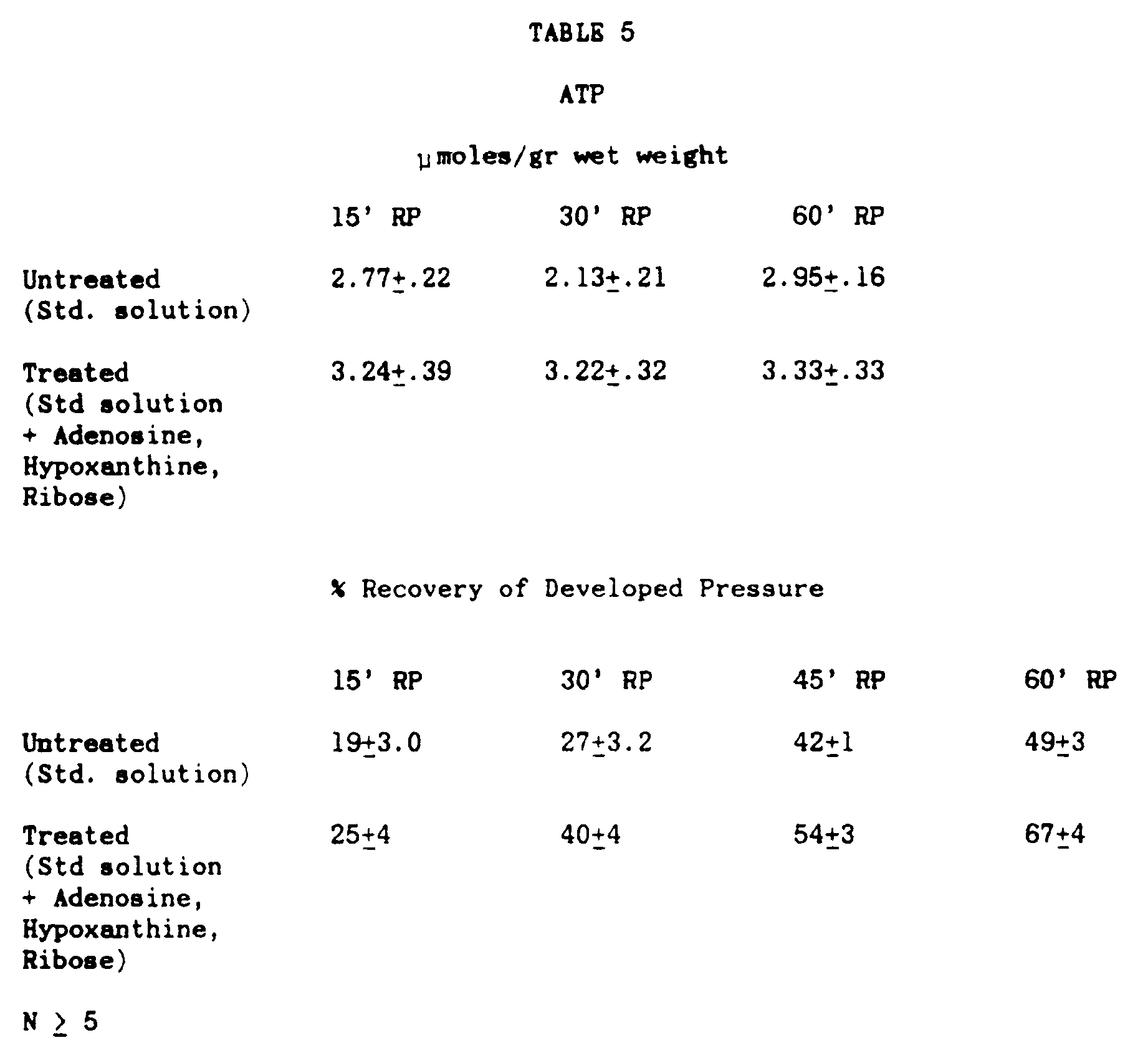
- These experiments shown that the protection of the heart during one hour of ischemia at 37° C is greater in terms of preservation and recovery of ATP levels and in terms of recovery of the contractile function of the heart when the invented solution containing adenosine, hypoxanthine and ribose is compared to a standard clinically accepted cardioplegic solution.
- Preferably, the invention is embodied in:
(1) A formula for preparation of a solution for reducing ischemic damage to the heart during cardiac surgery or during harvesting for cardiac transplantation. This solution has the following ionic content:Na 110 meq/l Cl 160 meq/l K 16 meq/l Ca++ 1.4 meq/l Mg 32 meq. Adenosine in quantity to yield a final conc. of 100 »moles/l Hypoxanthine in quantity to yield a final conc. of 100 »moles/l Ribose in quantity to yield a final conc. of 2 mmoles/l + NaHCO₃ or HCl to adjust pH to 7.4
(2) A method for reducing ischemic damage to the heart during operations or transplantation by the use of the above invented solution as an infusion to arrest the heart prior to ischemia during operations or prior to harvesting hearts from donors in preparation for transplantations.
Claims (6)
- The use of the compounds adenosine, hypoxanthine and ribose in combination as additives to a heart perfusate in the manufacture of a cardioplegic solution for reducing ischemic damage to a heart isolated from a normal blood supply.
- The use according to either of claim 1 wherein the final concentrations of adenosine and hypoxanthine in the solution are respectively 100» moles per litre.
- The use according to claim 1 wherein the ribose additive has a final concentration in the solution of about 2 mmoles.
- The use according to claims 3 and 4 when dependent upon claim 2 wherein the additive further comprises Na, Cl, K, Ca and Mg ions in solution.
- The use according to claim 5 wherein the ions in solution have the following concentrations:
Na 110 meq/l
Cl 160 meq/l
K 16 meq/l
Ca++ 2.4 meq/l
Mg 32 meq, and
NaHCO₃ or HCl to adjust pH to 7.4. - A method for reducing ischemic damage to the heart when isolated from the functioning body which comprises perfusing the heart with a cardioplegic solution as claimed in any one of claims 1 to 5.
Priority Applications (1)
| Application Number | Priority Date | Filing Date | Title |
|---|---|---|---|
| AT87906894T ATE81778T1 (en) | 1986-10-06 | 1987-10-05 | USE OF A SOLUTION CONTAINING ADENOSIN, HYPOXANTHINE AND RIBOSE TO PROTECT THE HEART DURING SURGICAL PROCEDURES. |
Applications Claiming Priority (3)
| Application Number | Priority Date | Filing Date | Title |
|---|---|---|---|
| US91555786A | 1986-10-06 | 1986-10-06 | |
| US915557 | 1986-10-06 | ||
| PCT/US1987/002524 WO1988002258A1 (en) | 1986-10-06 | 1987-10-05 | Use of an adenosine, hypoxanthine and ribose-containing solution for improved protection of the heart during surgery |
Publications (4)
| Publication Number | Publication Date |
|---|---|
| EP0290496A1 EP0290496A1 (en) | 1988-11-17 |
| EP0290496A4 EP0290496A4 (en) | 1989-11-29 |
| EP0290496B1 EP0290496B1 (en) | 1992-10-28 |
| EP0290496B2 true EP0290496B2 (en) | 1995-12-20 |
Family
ID=25435935
Family Applications (1)
| Application Number | Title | Priority Date | Filing Date |
|---|---|---|---|
| EP87906894A Expired - Lifetime EP0290496B2 (en) | 1986-10-06 | 1987-10-05 | Use of an adenosine, hypoxanthine and ribose-containing solution for improved protection of the heart during surgery |
Country Status (10)
| Country | Link |
|---|---|
| US (1) | US4880783A (en) |
| EP (1) | EP0290496B2 (en) |
| JP (1) | JP2930589B2 (en) |
| AT (1) | ATE81778T1 (en) |
| AU (1) | AU618723B2 (en) |
| CA (1) | CA1317225C (en) |
| DE (1) | DE3782427T2 (en) |
| DK (1) | DK173372B1 (en) |
| NZ (1) | NZ222051A (en) |
| WO (1) | WO1988002258A1 (en) |
Families Citing this family (22)
| Publication number | Priority date | Publication date | Assignee | Title |
|---|---|---|---|---|
| US5070877A (en) * | 1988-08-11 | 1991-12-10 | Medco Research, Inc. | Novel method of myocardial imaging |
| IE882585L (en) * | 1988-08-25 | 1990-02-25 | Prendergast Patrick T | Viral treatment system |
| DE68916036T2 (en) * | 1988-11-15 | 1994-09-29 | Toa Eiyo Ltd | AGENT FOR TREATMENT AND PROPHYLAXIS OF CORONARY AND CEREBRAL ISCHEMIC DISEASES. |
| US5679650A (en) * | 1993-11-24 | 1997-10-21 | Fukunaga; Atsuo F. | Pharmaceutical compositions including mixtures of an adenosine compound and a catecholamine |
| US6180616B1 (en) | 1990-05-10 | 2001-01-30 | Atsuo F. Fukunaga | Use of purine receptor agonists to alleviate or normalize physiopathologically excited sensory nerve function |
| US5677290A (en) * | 1990-05-10 | 1997-10-14 | Fukunaga; Atsuo F. | Therapeutic use of adenosine compounds as surgical anesthetics |
| US6004945A (en) * | 1990-05-10 | 1999-12-21 | Fukunaga; Atsuo F. | Use of adenosine compounds to relieve pain |
| US5320846A (en) * | 1991-04-17 | 1994-06-14 | New England Deaconess Hospital Corp. | Method and composition for testing patients with metabolic depleting diseases |
| IT1252174B (en) * | 1991-12-09 | 1995-06-05 | Crinos Industria Farmaco | OLIGODESOXYBONUCLEOTIDES WITH ANTI-SCHEMICAL ACTIVITY AND PROCEDURES FOR THEIR OBTAINING |
| US5466680A (en) * | 1992-03-26 | 1995-11-14 | Cytologics, Inc. | Method and compositions for enhancing white blood cell functioning on a mucosal or cutaneous surface |
| US5852000A (en) * | 1993-08-25 | 1998-12-22 | Otsuka Pharmaceutical Factory, Inc. | Cardiac rehabilitation agent |
| US5629298A (en) * | 1995-03-13 | 1997-05-13 | University Of Massachusetts Medical Center | Adenosine as a positive inotrop in the compromised heart |
| GB9814039D0 (en) * | 1998-06-29 | 1998-08-26 | Univ London | Materials and methods relating to the prevention or treatment of ischaemia-reperfusion injury |
| US20030166605A1 (en) * | 1999-04-27 | 2003-09-04 | Edward Leung | Method of minimizing damage to heart tissue during cardiac surgery and cardiac transplantation |
| AU2001228325A1 (en) * | 2000-02-01 | 2001-08-14 | Novo-Nordisk A/S | Use of compounds for the regulation of food intake |
| US20010020012A1 (en) * | 2000-02-01 | 2001-09-06 | Andersen Maibritt Bansholm | Use of compounds for the regulation of food intake |
| CA2439043A1 (en) | 2001-02-26 | 2002-09-06 | Ben-Ami Ballin | Syringe for use in blood analysis |
| US20040111079A1 (en) * | 2002-12-03 | 2004-06-10 | Richard Hayes | Targeted sanguinous drug solution delivery to a targeted organ |
| CA2464175A1 (en) * | 2003-04-14 | 2004-10-14 | Queen's University At Kingston | Methods and compositions for modulating proteins modified in preconditioning against ischemia/hypoxia |
| IT1391588B1 (en) * | 2008-10-15 | 2012-01-11 | Giellepi Chemicals S P A | SYNERGIC COMPOSITION FOR THE RECOVERY AND REDUCTION OF LIEVE ISCHEMIC DAMAGE |
| US20210219542A1 (en) * | 2018-05-15 | 2021-07-22 | The Regents Of The University Of Colorado, A Body Corporate | Compositions and methods for storage of red blood cells |
| CN121818659A (en) * | 2024-10-10 | 2026-04-10 | 四川大学华西医院 | Application of natural derivative in preparation of medicines for treating cardiomyopathy and/or myocardial fibrosis |
Family Cites Families (24)
| Publication number | Priority date | Publication date | Assignee | Title |
|---|---|---|---|---|
| US2994640A (en) * | 1957-02-22 | 1961-08-01 | Byk Gulden Lomberg Chem Fab | Anti-inflammatory therapy with purine molecular compounds |
| US3868451A (en) * | 1971-03-30 | 1975-02-25 | Abbott Lab | Adenosine-5{40 -esters in treating angina pectoris |
| US3914414A (en) * | 1973-06-14 | 1975-10-21 | Abbott Lab | Method of increasing coronary pO{HD 2 {B in mammals |
| US3992531A (en) * | 1973-12-26 | 1976-11-16 | Abbott Laboratories | 2-Substituted adenosine-5'-carboxylates in the treatment of anginal pain |
| GB1523865A (en) * | 1974-09-02 | 1978-09-06 | Wellcome Found | Purine compunds and salts thereof |
| EP0011399A1 (en) * | 1978-11-11 | 1980-05-28 | FISONS plc | N-substituted theophyllines, processes for their preparation and pharmaceutical compositions containing them |
| US4338319A (en) * | 1979-11-27 | 1982-07-06 | Aktiebolaget Draco | Method for the treatment of chronic obstructive airway or cardiac diseases |
| US4481197A (en) * | 1980-04-25 | 1984-11-06 | Burroughs Wellcome Co. | Anti-inflammatory deoxyribosides |
| DE3019322A1 (en) * | 1980-05-21 | 1981-12-03 | Merck Patent Gmbh, 6100 Darmstadt | PSYCHOPHARMACONE AND USE OF ADENOSINE DERIVATIVES |
| US4388308A (en) * | 1980-06-09 | 1983-06-14 | G.D. Searle & Co. | N6 -[(2-Hydroxypropyl)aryl]adenosines |
| US4546095A (en) * | 1980-07-21 | 1985-10-08 | Markov Angel K | Use of fructose-1,6-diphosphate for treating myocardial infarction |
| US4673563A (en) * | 1980-10-14 | 1987-06-16 | The University Of Virginia Alumni Patents Foundation | Adenosine in the treatment of supraventricular tachycardia |
| EP0054635B1 (en) * | 1980-12-23 | 1985-02-13 | Dr. Franz Köhler Chemie GmbH | Protective solution for heart and kidney, and manufacturing process |
| US4514405A (en) * | 1981-09-17 | 1985-04-30 | Merck Patent Gesellschaft Mit Beschrankter Haftung | Use of adenosine derivatives as anticonvulsants |
| SE8200252L (en) * | 1982-01-18 | 1983-07-19 | Pharmacia Ab | PHARMACEUTICAL COMPOSITION |
| IT1200944B (en) * | 1982-08-10 | 1989-01-27 | Malesci Sas | XANTHINIC DERIVATIVES, PROCEDURE FOR THEIR PREPARATION, PHARMACEUTICAL COMPOSITIONS THAT CONTAIN IT AND THEIR THERAPEUTIC USE |
| US4473571A (en) * | 1983-01-17 | 1984-09-25 | Sterling Drug Inc. | 8-Substituted-2-(4-pyridinyl)-9H-purin-6-amines and their cardiotonic use |
| US4501735A (en) * | 1983-12-05 | 1985-02-26 | Warner-Lambert Company | N6-(1- and 2-benzocycloalkyl) adenosines |
| IT1206341B (en) * | 1984-02-16 | 1989-04-14 | Crinos Industria Farmaco | PHARMACEUTICAL COMPOSITION FOR THE TREATMENT OF ACUTE MYOCARDIUM ISCHHEMIA. |
| US4593019A (en) * | 1984-10-26 | 1986-06-03 | Warner-Lambert Company | N6 -tricyclic adenosines |
| US4614732A (en) * | 1984-10-26 | 1986-09-30 | Warner-Lambert Company | N6 -acenaphthyl adenosines and analogs thereof |
| US4605644A (en) * | 1985-02-07 | 1986-08-12 | Regents Of The University Of Minnesota | Method for stimulating recovery from ischemia employing ribose and adenine |
| EP0506205B1 (en) * | 1985-09-24 | 1999-01-27 | Item Development Ab | Use of adenosine for the manufacture of medicaments for continuous intravenous infusion to human patients |
| US4693996A (en) * | 1985-12-23 | 1987-09-15 | Warner-Lambert Company | Method of treating heart failure and medicaments therefor |
-
1987
- 1987-10-05 EP EP87906894A patent/EP0290496B2/en not_active Expired - Lifetime
- 1987-10-05 CA CA000548637A patent/CA1317225C/en not_active Expired - Fee Related
- 1987-10-05 AT AT87906894T patent/ATE81778T1/en not_active IP Right Cessation
- 1987-10-05 AU AU80789/87A patent/AU618723B2/en not_active Ceased
- 1987-10-05 NZ NZ222051A patent/NZ222051A/en unknown
- 1987-10-05 DE DE3782427T patent/DE3782427T2/en not_active Expired - Fee Related
- 1987-10-05 JP JP62506227A patent/JP2930589B2/en not_active Expired - Fee Related
- 1987-10-05 WO PCT/US1987/002524 patent/WO1988002258A1/en not_active Ceased
-
1988
- 1988-06-03 DK DK198803057A patent/DK173372B1/en active IP Right Grant
- 1988-09-29 US US07/252,027 patent/US4880783A/en not_active Expired - Lifetime
Also Published As
| Publication number | Publication date |
|---|---|
| DE3782427T2 (en) | 1996-07-18 |
| ATE81778T1 (en) | 1992-11-15 |
| CA1317225C (en) | 1993-05-04 |
| AU618723B2 (en) | 1992-01-09 |
| JP2930589B2 (en) | 1999-08-03 |
| DK305788A (en) | 1988-06-03 |
| US4880783A (en) | 1989-11-14 |
| WO1988002258A1 (en) | 1988-04-07 |
| EP0290496A4 (en) | 1989-11-29 |
| EP0290496B1 (en) | 1992-10-28 |
| EP0290496A1 (en) | 1988-11-17 |
| DK173372B1 (en) | 2000-09-11 |
| NZ222051A (en) | 1990-07-26 |
| JPH01501311A (en) | 1989-05-11 |
| DE3782427D1 (en) | 1992-12-03 |
| DK305788D0 (en) | 1988-06-03 |
| AU8078987A (en) | 1988-04-21 |
Similar Documents
| Publication | Publication Date | Title |
|---|---|---|
| EP0290496B1 (en) | Use of an adenosine, hypoxanthine and ribose-containing solution for improved protection of the heart during surgery | |
| Lazar et al. | Reversal of ischemic damage with secondary blood cardioplegia | |
| Ely et al. | Functional and metabolic evidence of enhanced myocardial tolerance to ischemia and reperfusion with adenosine | |
| Hearse et al. | Myocardial protection during ischemic cardiac arrest: possible deleterious effects of glucose and mannitol in coronary infusates | |
| Stewart et al. | Inhibition of surgically induced ischemia/reperfusion injury by oxygen free radical scavengers | |
| Wyatt et al. | Purine-enriched asanguineous cardioplegia retards adenosine triphosphate degradation during ischemia and improves postischemic ventricular function | |
| US4605644A (en) | Method for stimulating recovery from ischemia employing ribose and adenine | |
| Schaff et al. | Effect of potassium cardioplegia on myocardial ischemia and post arrest ventricular function. | |
| Humphrey et al. | Improved functional recovery of ischemic myocardium by suppression of adenosine catabolism | |
| Wright et al. | Beneficial effects of potassium cardioplegia during intermittent aortic cross-clamping and reperfusion | |
| Webb et al. | Suspended animation of the heart with metabolic inhibitors. Effect of magnesium sulfate or fluoride and adrenochrome in rats | |
| US4774088A (en) | Method and additives for improving the quality and shelf life of stored blood | |
| Flameng et al. | Cardioprotective effects of mioflazine during 1 h normothermic global ischaemia in the canine heart | |
| Bersohn et al. | Effect of increased magnesium on recovery from ischemia in rat and rabbit hearts | |
| Wright et al. | Potassium cardioplegia: An alternate method of intraoperative myocardial protection | |
| EP0275249B2 (en) | Continuous intravenous infusion of adenosine to human patients, a unit dosage form of adenosine and use of adenosine for the manufacture of medicaments | |
| Bretschneider et al. | Cardioplegia: Principles and problems | |
| Abbott et al. | Effect of calcium chloride administration on the postischemic isolated rat heart | |
| Hearse et al. | Protection of the myocardium during ischemic arrest: possible toxicity of carnitine in cardioplegic solutions | |
| JP3875295B2 (en) | Myocardial protective fluid | |
| Van Gilst et al. | Improved recovery of cardiac function after 24 h of hypothermic arrest in the isolated rat heart: comparison of a prostacyclin analogue (ZK 36 374) and a calcium entry blocker (diltiazem) | |
| Galiñanes et al. | Effect of sodium aspartate on the recovery of the rat heart from long-term hypothermic storage | |
| Thelin et al. | Metabolic and functional effects of creatine phosphate in cardioplegic solution: Studies on Rat Hearts during and after Normothermic Ischemia | |
| Sollevi et al. | Adenine nucleotide degradation in the human myocardium during cardioplegia | |
| Kober et al. | HTK versus UW solution for myocardial protection during moderate hypothermia |
Legal Events
| Date | Code | Title | Description |
|---|---|---|---|
| PUAI | Public reference made under article 153(3) epc to a published international application that has entered the european phase |
Free format text: ORIGINAL CODE: 0009012 |
|
| 17P | Request for examination filed |
Effective date: 19880518 |
|
| AK | Designated contracting states |
Kind code of ref document: A1 Designated state(s): AT BE CH DE FR GB IT LI LU NL SE |
|
| A4 | Supplementary search report drawn up and despatched |
Effective date: 19891129 |
|
| 17Q | First examination report despatched |
Effective date: 19910328 |
|
| GRAA | (expected) grant |
Free format text: ORIGINAL CODE: 0009210 |
|
| AK | Designated contracting states |
Kind code of ref document: B1 Designated state(s): AT BE CH DE FR GB IT LI LU NL SE |
|
| REF | Corresponds to: |
Ref document number: 81778 Country of ref document: AT Date of ref document: 19921115 Kind code of ref document: T |
|
| ITF | It: translation for a ep patent filed | ||
| REF | Corresponds to: |
Ref document number: 3782427 Country of ref document: DE Date of ref document: 19921203 |
|
| ET | Fr: translation filed | ||
| PLBI | Opposition filed |
Free format text: ORIGINAL CODE: 0009260 |
|
| 26 | Opposition filed |
Opponent name: ITEM DEVELOPMENT AB Effective date: 19930705 |
|
| NLR1 | Nl: opposition has been filed with the epo |
Opponent name: ITEM DEVELOPMENT AB |
|
| EPTA | Lu: last paid annual fee | ||
| EAL | Se: european patent in force in sweden |
Ref document number: 87906894.8 |
|
| PUAH | Patent maintained in amended form |
Free format text: ORIGINAL CODE: 0009272 |
|
| STAA | Information on the status of an ep patent application or granted ep patent |
Free format text: STATUS: PATENT MAINTAINED AS AMENDED |
|
| 27A | Patent maintained in amended form |
Effective date: 19951220 |
|
| AK | Designated contracting states |
Kind code of ref document: B2 Designated state(s): AT BE CH DE FR GB IT LI LU NL SE |
|
| ITF | It: translation for a ep patent filed | ||
| REG | Reference to a national code |
Ref country code: CH Ref legal event code: AEN Free format text: MANTENIMENTO DEL BREVETTO IN FORMA MODIFICATA |
|
| NLR2 | Nl: decision of opposition | ||
| NLR3 | Nl: receipt of modified translations in the netherlands language after an opposition procedure | ||
| ET3 | Fr: translation filed ** decision concerning opposition | ||
| REG | Reference to a national code |
Ref country code: GB Ref legal event code: IF02 |
|
| PGFP | Annual fee paid to national office [announced via postgrant information from national office to epo] |
Ref country code: NL Payment date: 20050916 Year of fee payment: 19 |
|
| PGFP | Annual fee paid to national office [announced via postgrant information from national office to epo] |
Ref country code: AT Payment date: 20050921 Year of fee payment: 19 |
|
| PGFP | Annual fee paid to national office [announced via postgrant information from national office to epo] |
Ref country code: GB Payment date: 20050928 Year of fee payment: 19 |
|
| PGFP | Annual fee paid to national office [announced via postgrant information from national office to epo] |
Ref country code: FR Payment date: 20051017 Year of fee payment: 19 |
|
| PGFP | Annual fee paid to national office [announced via postgrant information from national office to epo] |
Ref country code: CH Payment date: 20051027 Year of fee payment: 19 Ref country code: SE Payment date: 20051027 Year of fee payment: 19 |
|
| PGFP | Annual fee paid to national office [announced via postgrant information from national office to epo] |
Ref country code: LU Payment date: 20051104 Year of fee payment: 19 |
|
| PGFP | Annual fee paid to national office [announced via postgrant information from national office to epo] |
Ref country code: BE Payment date: 20051122 Year of fee payment: 19 |
|
| PGFP | Annual fee paid to national office [announced via postgrant information from national office to epo] |
Ref country code: DE Payment date: 20051130 Year of fee payment: 19 |
|
| PG25 | Lapsed in a contracting state [announced via postgrant information from national office to epo] |
Ref country code: AT Free format text: LAPSE BECAUSE OF NON-PAYMENT OF DUE FEES Effective date: 20061005 |
|
| PG25 | Lapsed in a contracting state [announced via postgrant information from national office to epo] |
Ref country code: SE Free format text: LAPSE BECAUSE OF NON-PAYMENT OF DUE FEES Effective date: 20061006 |
|
| PG25 | Lapsed in a contracting state [announced via postgrant information from national office to epo] |
Ref country code: LI Free format text: LAPSE BECAUSE OF NON-PAYMENT OF DUE FEES Effective date: 20061031 Ref country code: CH Free format text: LAPSE BECAUSE OF NON-PAYMENT OF DUE FEES Effective date: 20061031 |
|
| PGFP | Annual fee paid to national office [announced via postgrant information from national office to epo] |
Ref country code: IT Payment date: 20061031 Year of fee payment: 20 |
|
| PG25 | Lapsed in a contracting state [announced via postgrant information from national office to epo] |
Ref country code: NL Free format text: LAPSE BECAUSE OF NON-PAYMENT OF DUE FEES Effective date: 20070501 Ref country code: DE Free format text: LAPSE BECAUSE OF NON-PAYMENT OF DUE FEES Effective date: 20070501 |
|
| REG | Reference to a national code |
Ref country code: CH Ref legal event code: PL |
|
| EUG | Se: european patent has lapsed | ||
| GBPC | Gb: european patent ceased through non-payment of renewal fee |
Effective date: 20061005 |
|
| NLV4 | Nl: lapsed or anulled due to non-payment of the annual fee |
Effective date: 20070501 |
|
| REG | Reference to a national code |
Ref country code: FR Ref legal event code: ST Effective date: 20070629 |
|
| PG25 | Lapsed in a contracting state [announced via postgrant information from national office to epo] |
Ref country code: GB Free format text: LAPSE BECAUSE OF NON-PAYMENT OF DUE FEES Effective date: 20061005 |
|
| BERE | Be: lapsed |
Owner name: THE *UNIVERSITY OF VIRGINIA ALUMNI PATENTS FOUNDAT Effective date: 20061031 |
|
| PG25 | Lapsed in a contracting state [announced via postgrant information from national office to epo] |
Ref country code: FR Free format text: LAPSE BECAUSE OF NON-PAYMENT OF DUE FEES Effective date: 20061031 |
|
| PG25 | Lapsed in a contracting state [announced via postgrant information from national office to epo] |
Ref country code: LU Free format text: LAPSE BECAUSE OF NON-PAYMENT OF DUE FEES Effective date: 20061005 |
|
| PG25 | Lapsed in a contracting state [announced via postgrant information from national office to epo] |
Ref country code: BE Free format text: LAPSE BECAUSE OF FAILURE TO SUBMIT A TRANSLATION OF THE DESCRIPTION OR TO PAY THE FEE WITHIN THE PRESCRIBED TIME-LIMIT Effective date: 20061031 |