EP0290285B1 - Bicyclic sulfonamide derivatives and their preparation, their use and formulations containing them - Google Patents
Bicyclic sulfonamide derivatives and their preparation, their use and formulations containing them Download PDFInfo
- Publication number
- EP0290285B1 EP0290285B1 EP19880304146 EP88304146A EP0290285B1 EP 0290285 B1 EP0290285 B1 EP 0290285B1 EP 19880304146 EP19880304146 EP 19880304146 EP 88304146 A EP88304146 A EP 88304146A EP 0290285 B1 EP0290285 B1 EP 0290285B1
- Authority
- EP
- European Patent Office
- Prior art keywords
- compound
- lower alkyl
- salt
- hept
- formula
- Prior art date
- Legal status (The legal status is an assumption and is not a legal conclusion. Google has not performed a legal analysis and makes no representation as to the accuracy of the status listed.)
- Expired - Lifetime
Links
- -1 Bicyclic sulfonamide Chemical class 0.000 title claims abstract description 56
- 239000000203 mixture Substances 0.000 title claims abstract description 50
- 238000002360 preparation method Methods 0.000 title claims description 14
- 238000009472 formulation Methods 0.000 title claims description 4
- 229940124530 sulfonamide Drugs 0.000 title abstract description 6
- 150000001875 compounds Chemical class 0.000 claims abstract description 86
- 125000000217 alkyl group Chemical group 0.000 claims abstract description 29
- 150000003839 salts Chemical class 0.000 claims abstract description 29
- 125000001997 phenyl group Chemical group [H]C1=C([H])C([H])=C(*)C([H])=C1[H] 0.000 claims abstract description 18
- 125000003118 aryl group Chemical group 0.000 claims abstract description 13
- 229910052736 halogen Inorganic materials 0.000 claims abstract description 12
- 150000002367 halogens Chemical class 0.000 claims abstract description 12
- 239000003814 drug Substances 0.000 claims abstract description 10
- 229910052739 hydrogen Inorganic materials 0.000 claims abstract description 10
- 125000003545 alkoxy group Chemical group 0.000 claims abstract description 9
- 125000003710 aryl alkyl group Chemical group 0.000 claims abstract description 9
- 239000001257 hydrogen Substances 0.000 claims abstract description 8
- 125000004435 hydrogen atom Chemical group [H]* 0.000 claims abstract description 8
- 125000000449 nitro group Chemical group [O-][N+](*)=O 0.000 claims abstract description 8
- 238000006243 chemical reaction Methods 0.000 claims description 21
- 238000000034 method Methods 0.000 claims description 20
- 230000008569 process Effects 0.000 claims description 12
- 230000015572 biosynthetic process Effects 0.000 claims description 10
- 230000007062 hydrolysis Effects 0.000 claims description 7
- 238000006460 hydrolysis reaction Methods 0.000 claims description 7
- 238000004519 manufacturing process Methods 0.000 claims description 6
- 239000007858 starting material Substances 0.000 claims description 6
- 239000003085 diluting agent Substances 0.000 claims description 4
- 239000002552 dosage form Substances 0.000 claims description 4
- 239000000546 pharmaceutical excipient Substances 0.000 claims description 4
- 241001465754 Metazoa Species 0.000 claims description 3
- 230000001225 therapeutic effect Effects 0.000 claims description 3
- RZWIIPASKMUIAC-VQTJNVASSA-N thromboxane Chemical compound CCCCCCCC[C@H]1OCCC[C@@H]1CCCCCCC RZWIIPASKMUIAC-VQTJNVASSA-N 0.000 claims description 3
- 201000010099 disease Diseases 0.000 claims description 2
- 208000037265 diseases, disorders, signs and symptoms Diseases 0.000 claims description 2
- 229940079593 drug Drugs 0.000 abstract description 7
- 230000002785 anti-thrombosis Effects 0.000 abstract description 5
- 239000003146 anticoagulant agent Substances 0.000 abstract description 4
- RTZKZFJDLAIYFH-UHFFFAOYSA-N Diethyl ether Chemical compound CCOCC RTZKZFJDLAIYFH-UHFFFAOYSA-N 0.000 description 55
- YMWUJEATGCHHMB-UHFFFAOYSA-N Dichloromethane Chemical compound ClCCl YMWUJEATGCHHMB-UHFFFAOYSA-N 0.000 description 54
- ZMANZCXQSJIPKH-UHFFFAOYSA-N Triethylamine Chemical compound CCN(CC)CC ZMANZCXQSJIPKH-UHFFFAOYSA-N 0.000 description 36
- OKKJLVBELUTLKV-UHFFFAOYSA-N Methanol Chemical compound OC OKKJLVBELUTLKV-UHFFFAOYSA-N 0.000 description 32
- HEDRZPFGACZZDS-MICDWDOJSA-N Trichloro(2H)methane Chemical compound [2H]C(Cl)(Cl)Cl HEDRZPFGACZZDS-MICDWDOJSA-N 0.000 description 32
- LFQSCWFLJHTTHZ-UHFFFAOYSA-N Ethanol Chemical compound CCO LFQSCWFLJHTTHZ-UHFFFAOYSA-N 0.000 description 31
- 239000000243 solution Substances 0.000 description 30
- XLYOFNOQVPJJNP-UHFFFAOYSA-N water Substances O XLYOFNOQVPJJNP-UHFFFAOYSA-N 0.000 description 27
- WYURNTSHIVDZCO-UHFFFAOYSA-N Tetrahydrofuran Chemical compound C1CCOC1 WYURNTSHIVDZCO-UHFFFAOYSA-N 0.000 description 26
- CSCPPACGZOOCGX-UHFFFAOYSA-N Acetone Chemical compound CC(C)=O CSCPPACGZOOCGX-UHFFFAOYSA-N 0.000 description 21
- VEXZGXHMUGYJMC-UHFFFAOYSA-N Hydrochloric acid Chemical compound Cl VEXZGXHMUGYJMC-UHFFFAOYSA-N 0.000 description 19
- UHOVQNZJYSORNB-UHFFFAOYSA-N Benzene Chemical compound C1=CC=CC=C1 UHOVQNZJYSORNB-UHFFFAOYSA-N 0.000 description 18
- HEDRZPFGACZZDS-UHFFFAOYSA-N Chloroform Chemical compound ClC(Cl)Cl HEDRZPFGACZZDS-UHFFFAOYSA-N 0.000 description 18
- IAZDPXIOMUYVGZ-UHFFFAOYSA-N Dimethylsulphoxide Chemical compound CS(C)=O IAZDPXIOMUYVGZ-UHFFFAOYSA-N 0.000 description 18
- 229910052799 carbon Inorganic materials 0.000 description 17
- XEKOWRVHYACXOJ-UHFFFAOYSA-N Ethyl acetate Chemical compound CCOC(C)=O XEKOWRVHYACXOJ-UHFFFAOYSA-N 0.000 description 15
- HEMHJVSKTPXQMS-UHFFFAOYSA-M Sodium hydroxide Chemical compound [OH-].[Na+] HEMHJVSKTPXQMS-UHFFFAOYSA-M 0.000 description 15
- 125000002496 methyl group Chemical group [H]C([H])([H])* 0.000 description 15
- JUJWROOIHBZHMG-UHFFFAOYSA-N Pyridine Chemical compound C1=CC=NC=C1 JUJWROOIHBZHMG-UHFFFAOYSA-N 0.000 description 14
- PMZURENOXWZQFD-UHFFFAOYSA-L Sodium Sulfate Chemical compound [Na+].[Na+].[O-]S([O-])(=O)=O PMZURENOXWZQFD-UHFFFAOYSA-L 0.000 description 14
- VLKZOEOYAKHREP-UHFFFAOYSA-N n-Hexane Chemical compound CCCCCC VLKZOEOYAKHREP-UHFFFAOYSA-N 0.000 description 14
- 239000002904 solvent Substances 0.000 description 14
- 239000011541 reaction mixture Substances 0.000 description 13
- YLQBMQCUIZJEEH-UHFFFAOYSA-N tetrahydrofuran Natural products C=1C=COC=1 YLQBMQCUIZJEEH-UHFFFAOYSA-N 0.000 description 13
- KWYUFKZDYYNOTN-UHFFFAOYSA-M Potassium hydroxide Chemical compound [OH-].[K+] KWYUFKZDYYNOTN-UHFFFAOYSA-M 0.000 description 12
- UIIMBOGNXHQVGW-UHFFFAOYSA-M Sodium bicarbonate Chemical compound [Na+].OC([O-])=O UIIMBOGNXHQVGW-UHFFFAOYSA-M 0.000 description 12
- 239000002585 base Substances 0.000 description 12
- 150000001732 carboxylic acid derivatives Chemical class 0.000 description 12
- DSNBHJFQCNUKMA-SCKDECHMSA-N thromboxane A2 Chemical compound OC(=O)CCC\C=C/C[C@@H]1[C@@H](/C=C/[C@@H](O)CCCCC)O[C@@H]2O[C@H]1C2 DSNBHJFQCNUKMA-SCKDECHMSA-N 0.000 description 12
- VYPSYNLAJGMNEJ-UHFFFAOYSA-N Silicium dioxide Chemical compound O=[Si]=O VYPSYNLAJGMNEJ-UHFFFAOYSA-N 0.000 description 10
- 239000007864 aqueous solution Substances 0.000 description 10
- 239000000741 silica gel Substances 0.000 description 10
- 229910002027 silica gel Inorganic materials 0.000 description 10
- 208000010110 spontaneous platelet aggregation Diseases 0.000 description 10
- DTQVDTLACAAQTR-UHFFFAOYSA-N Trifluoroacetic acid Chemical compound OC(=O)C(F)(F)F DTQVDTLACAAQTR-UHFFFAOYSA-N 0.000 description 8
- 239000002253 acid Substances 0.000 description 8
- 239000000284 extract Substances 0.000 description 8
- OAYLNYINCPYISS-UHFFFAOYSA-N ethyl acetate;hexane Chemical compound CCCCCC.CCOC(C)=O OAYLNYINCPYISS-UHFFFAOYSA-N 0.000 description 7
- 230000003389 potentiating effect Effects 0.000 description 7
- UMJSCPRVCHMLSP-UHFFFAOYSA-N pyridine Natural products COC1=CC=CN=C1 UMJSCPRVCHMLSP-UHFFFAOYSA-N 0.000 description 7
- 159000000000 sodium salts Chemical class 0.000 description 7
- 0 C*CC(C1)CC2=CC1C(C)C2C Chemical compound C*CC(C1)CC2=CC1C(C)C2C 0.000 description 6
- ZMXDDKWLCZADIW-UHFFFAOYSA-N N,N-Dimethylformamide Chemical compound CN(C)C=O ZMXDDKWLCZADIW-UHFFFAOYSA-N 0.000 description 6
- KEAYESYHFKHZAL-UHFFFAOYSA-N Sodium Chemical compound [Na] KEAYESYHFKHZAL-UHFFFAOYSA-N 0.000 description 6
- CDBYLPFSWZWCQE-UHFFFAOYSA-L Sodium Carbonate Chemical compound [Na+].[Na+].[O-]C([O-])=O CDBYLPFSWZWCQE-UHFFFAOYSA-L 0.000 description 6
- WQDUMFSSJAZKTM-UHFFFAOYSA-N Sodium methoxide Chemical compound [Na+].[O-]C WQDUMFSSJAZKTM-UHFFFAOYSA-N 0.000 description 6
- 150000001299 aldehydes Chemical class 0.000 description 6
- 239000003054 catalyst Substances 0.000 description 6
- 239000003153 chemical reaction reagent Substances 0.000 description 6
- 239000003795 chemical substances by application Substances 0.000 description 6
- 238000001816 cooling Methods 0.000 description 6
- 239000010410 layer Substances 0.000 description 6
- 229910000030 sodium bicarbonate Inorganic materials 0.000 description 6
- 235000017557 sodium bicarbonate Nutrition 0.000 description 6
- DKGAVHZHDRPRBM-UHFFFAOYSA-N Tert-Butanol Chemical compound CC(C)(C)O DKGAVHZHDRPRBM-UHFFFAOYSA-N 0.000 description 5
- 230000009471 action Effects 0.000 description 5
- CSKNSYBAZOQPLR-UHFFFAOYSA-N benzenesulfonyl chloride Chemical compound ClS(=O)(=O)C1=CC=CC=C1 CSKNSYBAZOQPLR-UHFFFAOYSA-N 0.000 description 5
- 125000003178 carboxy group Chemical group [H]OC(*)=O 0.000 description 5
- 150000002148 esters Chemical class 0.000 description 5
- 238000010438 heat treatment Methods 0.000 description 5
- 230000002401 inhibitory effect Effects 0.000 description 5
- 239000003921 oil Substances 0.000 description 5
- 239000012044 organic layer Substances 0.000 description 5
- QAOWNCQODCNURD-UHFFFAOYSA-N sulfuric acid Substances OS(O)(=O)=O QAOWNCQODCNURD-UHFFFAOYSA-N 0.000 description 5
- 125000000999 tert-butyl group Chemical group [H]C([H])([H])C(*)(C([H])([H])[H])C([H])([H])[H] 0.000 description 5
- IDPURXSQCKYKIJ-UHFFFAOYSA-N 1-(4-methoxyphenyl)methanamine Chemical compound COC1=CC=C(CN)C=C1 IDPURXSQCKYKIJ-UHFFFAOYSA-N 0.000 description 4
- VHYFNPMBLIVWCW-UHFFFAOYSA-N 4-Dimethylaminopyridine Chemical compound CN(C)C1=CC=NC=C1 VHYFNPMBLIVWCW-UHFFFAOYSA-N 0.000 description 4
- MZRVEZGGRBJDDB-UHFFFAOYSA-N N-Butyllithium Chemical compound [Li]CCCC MZRVEZGGRBJDDB-UHFFFAOYSA-N 0.000 description 4
- SJRJJKPEHAURKC-UHFFFAOYSA-N N-Methylmorpholine Chemical compound CN1CCOCC1 SJRJJKPEHAURKC-UHFFFAOYSA-N 0.000 description 4
- PXIPVTKHYLBLMZ-UHFFFAOYSA-N Sodium azide Chemical compound [Na+].[N-]=[N+]=[N-] PXIPVTKHYLBLMZ-UHFFFAOYSA-N 0.000 description 4
- FAPWRFPIFSIZLT-UHFFFAOYSA-M Sodium chloride Chemical compound [Na+].[Cl-] FAPWRFPIFSIZLT-UHFFFAOYSA-M 0.000 description 4
- 125000001797 benzyl group Chemical group [H]C1=C([H])C([H])=C(C([H])=C1[H])C([H])([H])* 0.000 description 4
- 125000000484 butyl group Chemical group [H]C([*])([H])C([H])([H])C([H])([H])C([H])([H])[H] 0.000 description 4
- 150000008280 chlorinated hydrocarbons Chemical class 0.000 description 4
- 238000004587 chromatography analysis Methods 0.000 description 4
- 238000004440 column chromatography Methods 0.000 description 4
- 125000001495 ethyl group Chemical group [H]C([H])([H])C([H])([H])* 0.000 description 4
- 239000003112 inhibitor Substances 0.000 description 4
- 125000001449 isopropyl group Chemical group [H]C([H])([H])C([H])(*)C([H])([H])[H] 0.000 description 4
- ZCSHNCUQKCANBX-UHFFFAOYSA-N lithium diisopropylamide Chemical compound [Li+].CC(C)[N-]C(C)C ZCSHNCUQKCANBX-UHFFFAOYSA-N 0.000 description 4
- CTSLXHKWHWQRSH-UHFFFAOYSA-N oxalyl chloride Chemical compound ClC(=O)C(Cl)=O CTSLXHKWHWQRSH-UHFFFAOYSA-N 0.000 description 4
- 239000007800 oxidant agent Substances 0.000 description 4
- 150000002924 oxiranes Chemical class 0.000 description 4
- 125000001147 pentyl group Chemical group C(CCCC)* 0.000 description 4
- 150000003180 prostaglandins Chemical class 0.000 description 4
- 239000002464 receptor antagonist Substances 0.000 description 4
- 229940044551 receptor antagonist Drugs 0.000 description 4
- 238000010992 reflux Methods 0.000 description 4
- 238000003756 stirring Methods 0.000 description 4
- FYSNRJHAOHDILO-UHFFFAOYSA-N thionyl chloride Chemical compound ClS(Cl)=O FYSNRJHAOHDILO-UHFFFAOYSA-N 0.000 description 4
- 125000000094 2-phenylethyl group Chemical group [H]C1=C([H])C([H])=C(C([H])=C1[H])C([H])([H])C([H])([H])* 0.000 description 3
- 125000006201 3-phenylpropyl group Chemical group [H]C1=C([H])C([H])=C(C([H])=C1[H])C([H])([H])C([H])([H])C([H])([H])* 0.000 description 3
- 201000001320 Atherosclerosis Diseases 0.000 description 3
- ZAMOUSCENKQFHK-UHFFFAOYSA-N Chlorine atom Chemical compound [Cl] ZAMOUSCENKQFHK-UHFFFAOYSA-N 0.000 description 3
- CYSWUSAYJNCAKA-FYJFLYSWSA-N ClC1=C(C=CC=2N=C(SC=21)OCC)OC1=CC=C(C=N1)/C=C/[C@H](C)NC(C)=O Chemical compound ClC1=C(C=CC=2N=C(SC=21)OCC)OC1=CC=C(C=N1)/C=C/[C@H](C)NC(C)=O CYSWUSAYJNCAKA-FYJFLYSWSA-N 0.000 description 3
- YXFVVABEGXRONW-UHFFFAOYSA-N Toluene Chemical compound CC1=CC=CC=C1 YXFVVABEGXRONW-UHFFFAOYSA-N 0.000 description 3
- 206010047139 Vasoconstriction Diseases 0.000 description 3
- SRVFFFJZQVENJC-IHRRRGAJSA-N aloxistatin Chemical compound CCOC(=O)[C@H]1O[C@@H]1C(=O)N[C@@H](CC(C)C)C(=O)NCCC(C)C SRVFFFJZQVENJC-IHRRRGAJSA-N 0.000 description 3
- 150000001412 amines Chemical class 0.000 description 3
- 229940127217 antithrombotic drug Drugs 0.000 description 3
- 239000000872 buffer Substances 0.000 description 3
- OSVHLUXLWQLPIY-KBAYOESNSA-N butyl 2-[(6aR,9R,10aR)-1-hydroxy-9-(hydroxymethyl)-6,6-dimethyl-6a,7,8,9,10,10a-hexahydrobenzo[c]chromen-3-yl]-2-methylpropanoate Chemical compound C(CCC)OC(C(C)(C)C1=CC(=C2[C@H]3[C@H](C(OC2=C1)(C)C)CC[C@H](C3)CO)O)=O OSVHLUXLWQLPIY-KBAYOESNSA-N 0.000 description 3
- 239000000460 chlorine Substances 0.000 description 3
- 229910052801 chlorine Inorganic materials 0.000 description 3
- KRKNYBCHXYNGOX-UHFFFAOYSA-N citric acid Chemical compound OC(=O)CC(O)(C(O)=O)CC(O)=O KRKNYBCHXYNGOX-UHFFFAOYSA-N 0.000 description 3
- UAOMVDZJSHZZME-UHFFFAOYSA-N diisopropylamine Chemical compound CC(C)NC(C)C UAOMVDZJSHZZME-UHFFFAOYSA-N 0.000 description 3
- NLFBCYMMUAKCPC-KQQUZDAGSA-N ethyl (e)-3-[3-amino-2-cyano-1-[(e)-3-ethoxy-3-oxoprop-1-enyl]sulfanyl-3-oxoprop-1-enyl]sulfanylprop-2-enoate Chemical compound CCOC(=O)\C=C\SC(=C(C#N)C(N)=O)S\C=C\C(=O)OCC NLFBCYMMUAKCPC-KQQUZDAGSA-N 0.000 description 3
- 239000012948 isocyanate Substances 0.000 description 3
- 150000002513 isocyanates Chemical class 0.000 description 3
- 208000010125 myocardial infarction Diseases 0.000 description 3
- 125000001624 naphthyl group Chemical group 0.000 description 3
- 150000002923 oximes Chemical class 0.000 description 3
- 229940094443 oxytocics prostaglandins Drugs 0.000 description 3
- 210000004623 platelet-rich plasma Anatomy 0.000 description 3
- LPNYRYFBWFDTMA-UHFFFAOYSA-N potassium tert-butoxide Chemical compound [K+].CC(C)(C)[O-] LPNYRYFBWFDTMA-UHFFFAOYSA-N 0.000 description 3
- 239000000047 product Substances 0.000 description 3
- 125000001436 propyl group Chemical group [H]C([*])([H])C([H])([H])C([H])([H])[H] 0.000 description 3
- 238000000746 purification Methods 0.000 description 3
- RWWYLEGWBNMMLJ-YSOARWBDSA-N remdesivir Chemical compound NC1=NC=NN2C1=CC=C2[C@]1([C@@H]([C@@H]([C@H](O1)CO[P@](=O)(OC1=CC=CC=C1)N[C@H](C(=O)OCC(CC)CC)C)O)O)C#N RWWYLEGWBNMMLJ-YSOARWBDSA-N 0.000 description 3
- 229910000029 sodium carbonate Inorganic materials 0.000 description 3
- 239000012312 sodium hydride Substances 0.000 description 3
- 229910000104 sodium hydride Inorganic materials 0.000 description 3
- 150000003456 sulfonamides Chemical class 0.000 description 3
- 125000003944 tolyl group Chemical group 0.000 description 3
- 230000025033 vasoconstriction Effects 0.000 description 3
- GHYOCDFICYLMRF-UTIIJYGPSA-N (2S,3R)-N-[(2S)-3-(cyclopenten-1-yl)-1-[(2R)-2-methyloxiran-2-yl]-1-oxopropan-2-yl]-3-hydroxy-3-(4-methoxyphenyl)-2-[[(2S)-2-[(2-morpholin-4-ylacetyl)amino]propanoyl]amino]propanamide Chemical compound C1(=CCCC1)C[C@@H](C(=O)[C@@]1(OC1)C)NC([C@H]([C@@H](C1=CC=C(C=C1)OC)O)NC([C@H](C)NC(CN1CCOCC1)=O)=O)=O GHYOCDFICYLMRF-UTIIJYGPSA-N 0.000 description 2
- NWRBCVOWIUGFTA-UHFFFAOYSA-N (4-chlorosulfonylphenyl) acetate Chemical compound CC(=O)OC1=CC=C(S(Cl)(=O)=O)C=C1 NWRBCVOWIUGFTA-UHFFFAOYSA-N 0.000 description 2
- VIMMECPCYZXUCI-MIMFYIINSA-N (4s,6r)-6-[(1e)-4,4-bis(4-fluorophenyl)-3-(1-methyltetrazol-5-yl)buta-1,3-dienyl]-4-hydroxyoxan-2-one Chemical compound CN1N=NN=C1C(\C=C\[C@@H]1OC(=O)C[C@@H](O)C1)=C(C=1C=CC(F)=CC=1)C1=CC=C(F)C=C1 VIMMECPCYZXUCI-MIMFYIINSA-N 0.000 description 2
- QOLHWXNSCZGWHK-BWBORTOCSA-N (6r,7r)-1-[(4s,5r)-4-acetyloxy-5-methyl-3-methylidene-6-phenylhexyl]-4,7-dihydroxy-6-(11-phenoxyundecylcarbamoyloxy)-2,8-dioxabicyclo[3.2.1]octane-3,4,5-tricarboxylic acid Chemical compound C([C@@H](C)[C@H](OC(C)=O)C(=C)CCC12[C@@H]([C@@H](OC(=O)NCCCCCCCCCCCOC=3C=CC=CC=3)C(O1)(C(O)=O)C(O)(C(O2)C(O)=O)C(O)=O)O)C1=CC=CC=C1 QOLHWXNSCZGWHK-BWBORTOCSA-N 0.000 description 2
- RYHBNJHYFVUHQT-UHFFFAOYSA-N 1,4-Dioxane Chemical compound C1COCCO1 RYHBNJHYFVUHQT-UHFFFAOYSA-N 0.000 description 2
- RUFPHBVGCFYCNW-UHFFFAOYSA-N 1-naphthylamine Chemical compound C1=CC=C2C(N)=CC=CC2=C1 RUFPHBVGCFYCNW-UHFFFAOYSA-N 0.000 description 2
- NGNBDVOYPDDBFK-UHFFFAOYSA-N 2-[2,4-di(pentan-2-yl)phenoxy]acetyl chloride Chemical compound CCCC(C)C1=CC=C(OCC(Cl)=O)C(C(C)CCC)=C1 NGNBDVOYPDDBFK-UHFFFAOYSA-N 0.000 description 2
- 125000004182 2-chlorophenyl group Chemical group [H]C1=C([H])C(Cl)=C(*)C([H])=C1[H] 0.000 description 2
- 125000004204 2-methoxyphenyl group Chemical group [H]C1=C([H])C(*)=C(OC([H])([H])[H])C([H])=C1[H] 0.000 description 2
- LKFNLHZZPHHFEC-UHFFFAOYSA-N 2-phenylethanesulfonyl chloride Chemical compound ClS(=O)(=O)CCC1=CC=CC=C1 LKFNLHZZPHHFEC-UHFFFAOYSA-N 0.000 description 2
- OINWZUJVEXUHCC-UHFFFAOYSA-N 3-chlorobenzenesulfonyl chloride Chemical compound ClC1=CC=CC(S(Cl)(=O)=O)=C1 OINWZUJVEXUHCC-UHFFFAOYSA-N 0.000 description 2
- NHQDETIJWKXCTC-UHFFFAOYSA-N 3-chloroperbenzoic acid Chemical compound OOC(=O)C1=CC=CC(Cl)=C1 NHQDETIJWKXCTC-UHFFFAOYSA-N 0.000 description 2
- 125000004179 3-chlorophenyl group Chemical group [H]C1=C([H])C(*)=C([H])C(Cl)=C1[H] 0.000 description 2
- DUWPDKKXSBXWLY-UHFFFAOYSA-N 3-phenylpropane-1-sulfonyl chloride Chemical compound ClS(=O)(=O)CCCC1=CC=CC=C1 DUWPDKKXSBXWLY-UHFFFAOYSA-N 0.000 description 2
- NPDACUSDTOMAMK-UHFFFAOYSA-N 4-Chlorotoluene Chemical compound CC1=CC=C(Cl)C=C1 NPDACUSDTOMAMK-UHFFFAOYSA-N 0.000 description 2
- TXEBWPPWSVMYOA-UHFFFAOYSA-N 4-[3-[(1-amino-2-chloroethyl)amino]propyl]-1-[[3-(2-chlorophenyl)phenyl]methyl]-5-hydroxyimidazolidin-2-one Chemical compound NC(CCl)NCCCC1NC(=O)N(Cc2cccc(c2)-c2ccccc2Cl)C1O TXEBWPPWSVMYOA-UHFFFAOYSA-N 0.000 description 2
- MLOSJPZSZWUDSK-UHFFFAOYSA-N 4-carboxybutyl(triphenyl)phosphanium;bromide Chemical compound [Br-].C=1C=CC=CC=1[P+](C=1C=CC=CC=1)(CCCCC(=O)O)C1=CC=CC=C1 MLOSJPZSZWUDSK-UHFFFAOYSA-N 0.000 description 2
- LACFLXDRFOQEFZ-UHFFFAOYSA-N 4-ethylbenzenesulfonyl chloride Chemical compound CCC1=CC=C(S(Cl)(=O)=O)C=C1 LACFLXDRFOQEFZ-UHFFFAOYSA-N 0.000 description 2
- 125000004860 4-ethylphenyl group Chemical group [H]C1=C([H])C(=C([H])C([H])=C1*)C([H])([H])C([H])([H])[H] 0.000 description 2
- 125000001255 4-fluorophenyl group Chemical group [H]C1=C([H])C(*)=C([H])C([H])=C1F 0.000 description 2
- 125000004203 4-hydroxyphenyl group Chemical group [H]OC1=C([H])C([H])=C(*)C([H])=C1[H] 0.000 description 2
- 125000004172 4-methoxyphenyl group Chemical group [H]C1=C([H])C(OC([H])([H])[H])=C([H])C([H])=C1* 0.000 description 2
- ALBQXDHCMLLQMB-UHFFFAOYSA-N 4-phenylbenzenesulfonyl chloride Chemical compound C1=CC(S(=O)(=O)Cl)=CC=C1C1=CC=CC=C1 ALBQXDHCMLLQMB-UHFFFAOYSA-N 0.000 description 2
- 206010002383 Angina Pectoris Diseases 0.000 description 2
- 239000004475 Arginine Substances 0.000 description 2
- IJGRMHOSHXDMSA-UHFFFAOYSA-N Atomic nitrogen Chemical compound N#N IJGRMHOSHXDMSA-UHFFFAOYSA-N 0.000 description 2
- 108091003079 Bovine Serum Albumin Proteins 0.000 description 2
- WKBOTKDWSSQWDR-UHFFFAOYSA-N Bromine atom Chemical compound [Br] WKBOTKDWSSQWDR-UHFFFAOYSA-N 0.000 description 2
- OKTJSMMVPCPJKN-UHFFFAOYSA-N Carbon Chemical compound [C] OKTJSMMVPCPJKN-UHFFFAOYSA-N 0.000 description 2
- 102000008186 Collagen Human genes 0.000 description 2
- 108010035532 Collagen Proteins 0.000 description 2
- FKLJPTJMIBLJAV-UHFFFAOYSA-N Compound IV Chemical compound O1N=C(C)C=C1CCCCCCCOC1=CC=C(C=2OCCN=2)C=C1 FKLJPTJMIBLJAV-UHFFFAOYSA-N 0.000 description 2
- XBPCUCUWBYBCDP-UHFFFAOYSA-N Dicyclohexylamine Chemical compound C1CCCCC1NC1CCCCC1 XBPCUCUWBYBCDP-UHFFFAOYSA-N 0.000 description 2
- JOYRKODLDBILNP-UHFFFAOYSA-N Ethyl urethane Chemical compound CCOC(N)=O JOYRKODLDBILNP-UHFFFAOYSA-N 0.000 description 2
- LYCAIKOWRPUZTN-UHFFFAOYSA-N Ethylene glycol Chemical compound OCCO LYCAIKOWRPUZTN-UHFFFAOYSA-N 0.000 description 2
- WQZGKKKJIJFFOK-GASJEMHNSA-N Glucose Natural products OC[C@H]1OC(O)[C@H](O)[C@@H](O)[C@@H]1O WQZGKKKJIJFFOK-GASJEMHNSA-N 0.000 description 2
- MHAJPDPJQMAIIY-UHFFFAOYSA-N Hydrogen peroxide Chemical compound OO MHAJPDPJQMAIIY-UHFFFAOYSA-N 0.000 description 2
- WTDHULULXKLSOZ-UHFFFAOYSA-N Hydroxylamine hydrochloride Chemical compound Cl.ON WTDHULULXKLSOZ-UHFFFAOYSA-N 0.000 description 2
- DGAQECJNVWCQMB-PUAWFVPOSA-M Ilexoside XXIX Chemical compound C[C@@H]1CC[C@@]2(CC[C@@]3(C(=CC[C@H]4[C@]3(CC[C@@H]5[C@@]4(CC[C@@H](C5(C)C)OS(=O)(=O)[O-])C)C)[C@@H]2[C@]1(C)O)C)C(=O)O[C@H]6[C@@H]([C@H]([C@@H]([C@H](O6)CO)O)O)O.[Na+] DGAQECJNVWCQMB-PUAWFVPOSA-M 0.000 description 2
- KFZMGEQAYNKOFK-UHFFFAOYSA-N Isopropanol Chemical compound CC(C)O KFZMGEQAYNKOFK-UHFFFAOYSA-N 0.000 description 2
- ODKSFYDXXFIFQN-BYPYZUCNSA-P L-argininium(2+) Chemical compound NC(=[NH2+])NCCC[C@H]([NH3+])C(O)=O ODKSFYDXXFIFQN-BYPYZUCNSA-P 0.000 description 2
- KDXKERNSBIXSRK-YFKPBYRVSA-N L-lysine Chemical compound NCCCC[C@H](N)C(O)=O KDXKERNSBIXSRK-YFKPBYRVSA-N 0.000 description 2
- 239000004472 Lysine Substances 0.000 description 2
- KDXKERNSBIXSRK-UHFFFAOYSA-N Lysine Natural products NCCCCC(N)C(O)=O KDXKERNSBIXSRK-UHFFFAOYSA-N 0.000 description 2
- 239000012359 Methanesulfonyl chloride Substances 0.000 description 2
- JGFZNNIVVJXRND-UHFFFAOYSA-N N,N-Diisopropylethylamine (DIPEA) Chemical compound CCN(C(C)C)C(C)C JGFZNNIVVJXRND-UHFFFAOYSA-N 0.000 description 2
- JLTDJTHDQAWBAV-UHFFFAOYSA-N N,N-dimethylaniline Chemical compound CN(C)C1=CC=CC=C1 JLTDJTHDQAWBAV-UHFFFAOYSA-N 0.000 description 2
- LRHPLDYGYMQRHN-UHFFFAOYSA-N N-Butanol Chemical compound CCCCO LRHPLDYGYMQRHN-UHFFFAOYSA-N 0.000 description 2
- AMQJEAYHLZJPGS-UHFFFAOYSA-N N-Pentanol Chemical compound CCCCCO AMQJEAYHLZJPGS-UHFFFAOYSA-N 0.000 description 2
- QCOGKXLOEWLIDC-UHFFFAOYSA-N N-methylbutylamine Chemical compound CCCCNC QCOGKXLOEWLIDC-UHFFFAOYSA-N 0.000 description 2
- KFSLWBXXFJQRDL-UHFFFAOYSA-N Peracetic acid Chemical compound CC(=O)OO KFSLWBXXFJQRDL-UHFFFAOYSA-N 0.000 description 2
- 102000004005 Prostaglandin-endoperoxide synthases Human genes 0.000 description 2
- 108090000459 Prostaglandin-endoperoxide synthases Proteins 0.000 description 2
- 238000007239 Wittig reaction Methods 0.000 description 2
- 230000004931 aggregating effect Effects 0.000 description 2
- 230000002776 aggregation Effects 0.000 description 2
- 238000004220 aggregation Methods 0.000 description 2
- BHELZAPQIKSEDF-UHFFFAOYSA-N allyl bromide Chemical compound BrCC=C BHELZAPQIKSEDF-UHFFFAOYSA-N 0.000 description 2
- 150000003863 ammonium salts Chemical class 0.000 description 2
- 239000005557 antagonist Substances 0.000 description 2
- YZXBAPSDXZZRGB-DOFZRALJSA-N arachidonic acid Chemical compound CCCCC\C=C/C\C=C/C\C=C/C\C=C/CCCC(O)=O YZXBAPSDXZZRGB-DOFZRALJSA-N 0.000 description 2
- ODKSFYDXXFIFQN-UHFFFAOYSA-N arginine Natural products OC(=O)C(N)CCCNC(N)=N ODKSFYDXXFIFQN-UHFFFAOYSA-N 0.000 description 2
- RQPZNWPYLFFXCP-UHFFFAOYSA-L barium dihydroxide Chemical compound [OH-].[OH-].[Ba+2] RQPZNWPYLFFXCP-UHFFFAOYSA-L 0.000 description 2
- 229910001863 barium hydroxide Inorganic materials 0.000 description 2
- WGQKYBSKWIADBV-UHFFFAOYSA-N benzylamine Chemical compound NCC1=CC=CC=C1 WGQKYBSKWIADBV-UHFFFAOYSA-N 0.000 description 2
- 210000004369 blood Anatomy 0.000 description 2
- 239000008280 blood Substances 0.000 description 2
- 229940098773 bovine serum albumin Drugs 0.000 description 2
- GDTBXPJZTBHREO-UHFFFAOYSA-N bromine Substances BrBr GDTBXPJZTBHREO-UHFFFAOYSA-N 0.000 description 2
- 229910052794 bromium Inorganic materials 0.000 description 2
- 150000001733 carboxylic acid esters Chemical class 0.000 description 2
- 239000000969 carrier Substances 0.000 description 2
- 206010008118 cerebral infarction Diseases 0.000 description 2
- 208000026106 cerebrovascular disease Diseases 0.000 description 2
- HVYWMOMLDIMFJA-DPAQBDIFSA-N cholesterol Chemical compound C1C=C2C[C@@H](O)CC[C@]2(C)[C@@H]2[C@@H]1[C@@H]1CC[C@H]([C@H](C)CCCC(C)C)[C@@]1(C)CC2 HVYWMOMLDIMFJA-DPAQBDIFSA-N 0.000 description 2
- 229920001436 collagen Polymers 0.000 description 2
- 229940125904 compound 1 Drugs 0.000 description 2
- 229940125797 compound 12 Drugs 0.000 description 2
- 229940127206 compound 14d Drugs 0.000 description 2
- 238000007796 conventional method Methods 0.000 description 2
- 239000013078 crystal Substances 0.000 description 2
- 230000008021 deposition Effects 0.000 description 2
- SBZXBUIDTXKZTM-UHFFFAOYSA-N diglyme Chemical compound COCCOCCOC SBZXBUIDTXKZTM-UHFFFAOYSA-N 0.000 description 2
- USIUVYZYUHIAEV-UHFFFAOYSA-N diphenyl ether Chemical compound C=1C=CC=CC=1OC1=CC=CC=C1 USIUVYZYUHIAEV-UHFFFAOYSA-N 0.000 description 2
- DMBHHRLKUKUOEG-UHFFFAOYSA-N diphenylamine Chemical compound C=1C=CC=CC=1NC1=CC=CC=C1 DMBHHRLKUKUOEG-UHFFFAOYSA-N 0.000 description 2
- KAQKFAOMNZTLHT-VVUHWYTRSA-N epoprostenol Chemical compound O1C(=CCCCC(O)=O)C[C@@H]2[C@@H](/C=C/[C@@H](O)CCCCC)[C@H](O)C[C@@H]21 KAQKFAOMNZTLHT-VVUHWYTRSA-N 0.000 description 2
- ZKQFHRVKCYFVCN-UHFFFAOYSA-N ethoxyethane;hexane Chemical compound CCOCC.CCCCCC ZKQFHRVKCYFVCN-UHFFFAOYSA-N 0.000 description 2
- RIFGWPKJUGCATF-UHFFFAOYSA-N ethyl chloroformate Chemical compound CCOC(Cl)=O RIFGWPKJUGCATF-UHFFFAOYSA-N 0.000 description 2
- 239000000945 filler Substances 0.000 description 2
- 239000008103 glucose Substances 0.000 description 2
- IXCSERBJSXMMFS-UHFFFAOYSA-N hydrogen chloride Substances Cl.Cl IXCSERBJSXMMFS-UHFFFAOYSA-N 0.000 description 2
- XNXVOSBNFZWHBV-UHFFFAOYSA-N hydron;o-methylhydroxylamine;chloride Chemical compound Cl.CON XNXVOSBNFZWHBV-UHFFFAOYSA-N 0.000 description 2
- 125000002887 hydroxy group Chemical group [H]O* 0.000 description 2
- 239000005457 ice water Substances 0.000 description 2
- ZXEKIIBDNHEJCQ-UHFFFAOYSA-N isobutanol Chemical compound CC(C)CO ZXEKIIBDNHEJCQ-UHFFFAOYSA-N 0.000 description 2
- 150000002576 ketones Chemical class 0.000 description 2
- 239000000463 material Substances 0.000 description 2
- QARBMVPHQWIHKH-UHFFFAOYSA-N methanesulfonyl chloride Chemical compound CS(Cl)(=O)=O QARBMVPHQWIHKH-UHFFFAOYSA-N 0.000 description 2
- JWZYGFWDYKICAU-UHFFFAOYSA-N n-(1-adamantylmethyl)-4-methylbenzenesulfonamide Chemical compound C1=CC(C)=CC=C1S(=O)(=O)NCC1(C2)CC(C3)CC2CC3C1 JWZYGFWDYKICAU-UHFFFAOYSA-N 0.000 description 2
- XZMHJYWMCRQSSI-UHFFFAOYSA-N n-[5-[2-(3-acetylanilino)-1,3-thiazol-4-yl]-4-methyl-1,3-thiazol-2-yl]benzamide Chemical compound CC(=O)C1=CC=CC(NC=2SC=C(N=2)C2=C(N=C(NC(=O)C=3C=CC=CC=3)S2)C)=C1 XZMHJYWMCRQSSI-UHFFFAOYSA-N 0.000 description 2
- 239000012299 nitrogen atmosphere Substances 0.000 description 2
- 125000003854 p-chlorophenyl group Chemical group [H]C1=C([H])C(*)=C([H])C([H])=C1Cl 0.000 description 2
- 125000000636 p-nitrophenyl group Chemical group [H]C1=C([H])C(=C([H])C([H])=C1*)[N+]([O-])=O 0.000 description 2
- 125000001037 p-tolyl group Chemical group [H]C1=C([H])C(=C([H])C([H])=C1*)C([H])([H])[H] 0.000 description 2
- KHIWWQKSHDUIBK-UHFFFAOYSA-N periodic acid Chemical compound OI(=O)(=O)=O KHIWWQKSHDUIBK-UHFFFAOYSA-N 0.000 description 2
- XHXFXVLFKHQFAL-UHFFFAOYSA-N phosphoryl trichloride Chemical compound ClP(Cl)(Cl)=O XHXFXVLFKHQFAL-UHFFFAOYSA-N 0.000 description 2
- XOKSLPVRUOBDEW-UHFFFAOYSA-N pinane Chemical compound CC1CCC2C(C)(C)C1C2 XOKSLPVRUOBDEW-UHFFFAOYSA-N 0.000 description 2
- 125000002924 primary amino group Chemical group [H]N([H])* 0.000 description 2
- BDERNNFJNOPAEC-UHFFFAOYSA-N propan-1-ol Chemical compound CCCO BDERNNFJNOPAEC-UHFFFAOYSA-N 0.000 description 2
- 125000006239 protecting group Chemical group 0.000 description 2
- LEHBURLTIWGHEM-UHFFFAOYSA-N pyridinium chlorochromate Chemical compound [O-][Cr](Cl)(=O)=O.C1=CC=[NH+]C=C1 LEHBURLTIWGHEM-UHFFFAOYSA-N 0.000 description 2
- 230000009467 reduction Effects 0.000 description 2
- 229920006395 saturated elastomer Polymers 0.000 description 2
- 239000011734 sodium Substances 0.000 description 2
- 229910052708 sodium Inorganic materials 0.000 description 2
- DVWOYOSIEJRHKW-UIRZNSHLSA-M sodium (2S)-2-[[(2S)-2-[[(4,4-difluorocyclohexyl)-phenylmethoxy]carbonylamino]-4-methylpentanoyl]amino]-1-hydroxy-3-[(3S)-2-oxopyrrolidin-3-yl]propane-1-sulfonate Chemical compound FC1(CCC(CC1)C(OC(=O)N[C@H](C(=O)N[C@H](C(S(=O)(=O)[O-])O)C[C@H]1C(NCC1)=O)CC(C)C)C1=CC=CC=C1)F.[Na+] DVWOYOSIEJRHKW-UIRZNSHLSA-M 0.000 description 2
- 239000011780 sodium chloride Substances 0.000 description 2
- 150000003461 sulfonyl halides Chemical class 0.000 description 2
- AKEJUJNQAAGONA-UHFFFAOYSA-N sulfur trioxide Chemical compound O=S(=O)=O AKEJUJNQAAGONA-UHFFFAOYSA-N 0.000 description 2
- 208000024891 symptom Diseases 0.000 description 2
- 238000003786 synthesis reaction Methods 0.000 description 2
- 229950005792 tenoate Drugs 0.000 description 2
- FRACPXUHUTXLCX-BELIEFIBSA-N tert-butyl N-{1-[(1S)-1-{[(1R,2S)-1-(benzylcarbamoyl)-1-hydroxy-3-[(3S)-2-oxopyrrolidin-3-yl]propan-2-yl]carbamoyl}-2-cyclopropylethyl]-2-oxopyridin-3-yl}carbamate Chemical compound CC(C)(C)OC(=O)NC1=CC=CN(C1=O)[C@@H](CC2CC2)C(=O)N[C@@H](C[C@@H]3CCNC3=O)[C@H](C(=O)NCC4=CC=CC=C4)O FRACPXUHUTXLCX-BELIEFIBSA-N 0.000 description 2
- 238000002834 transmittance Methods 0.000 description 2
- QAEDZJGFFMLHHQ-UHFFFAOYSA-N trifluoroacetic anhydride Chemical compound FC(F)(F)C(=O)OC(=O)C(F)(F)F QAEDZJGFFMLHHQ-UHFFFAOYSA-N 0.000 description 2
- RIOQSEWOXXDEQQ-UHFFFAOYSA-N triphenylphosphine Chemical compound C1=CC=CC=C1P(C=1C=CC=CC=1)C1=CC=CC=C1 RIOQSEWOXXDEQQ-UHFFFAOYSA-N 0.000 description 2
- XAOBILRPRDDHCO-UTLUCORTSA-N (1R,3R,5S)-6,6-dimethyl-3-prop-2-enylbicyclo[3.1.1]heptan-2-one Chemical class C1[C@@]2([H])C(=O)[C@H](CC=C)C[C@]1([H])C2(C)C XAOBILRPRDDHCO-UTLUCORTSA-N 0.000 description 1
- JQBXCXNVDNGTLN-METRDYBUSA-N (1S,2S,7R,9S)-10,10-dimethyl-4-oxatricyclo[7.1.1.02,7]undecan-5-ol Chemical compound CC1(C)[C@@H]2C[C@H]1[C@H]1COC(O)C[C@H]1C2 JQBXCXNVDNGTLN-METRDYBUSA-N 0.000 description 1
- FANCTJAFZSYTIS-IQUVVAJASA-N (1r,3s,5z)-5-[(2e)-2-[(1r,3as,7ar)-7a-methyl-1-[(2r)-4-(phenylsulfonimidoyl)butan-2-yl]-2,3,3a,5,6,7-hexahydro-1h-inden-4-ylidene]ethylidene]-4-methylidenecyclohexane-1,3-diol Chemical compound C([C@@H](C)[C@@H]1[C@]2(CCCC(/[C@@H]2CC1)=C\C=C\1C([C@@H](O)C[C@H](O)C/1)=C)C)CS(=N)(=O)C1=CC=CC=C1 FANCTJAFZSYTIS-IQUVVAJASA-N 0.000 description 1
- XZFDKWMYCUEKSS-BQBZGAKWSA-N (1s,5r)-6,6-dimethylbicyclo[3.1.1]heptan-4-one Chemical compound C1[C@@]2([H])C(=O)CC[C@]1([H])C2(C)C XZFDKWMYCUEKSS-BQBZGAKWSA-N 0.000 description 1
- KDDNKZCVYQDGKE-UHFFFAOYSA-N (2-chlorophenyl)methanamine Chemical compound NCC1=CC=CC=C1Cl KDDNKZCVYQDGKE-UHFFFAOYSA-N 0.000 description 1
- QFLWZFQWSBQYPS-AWRAUJHKSA-N (3S)-3-[[(2S)-2-[[(2S)-2-[5-[(3aS,6aR)-2-oxo-1,3,3a,4,6,6a-hexahydrothieno[3,4-d]imidazol-4-yl]pentanoylamino]-3-methylbutanoyl]amino]-3-(4-hydroxyphenyl)propanoyl]amino]-4-[1-bis(4-chlorophenoxy)phosphorylbutylamino]-4-oxobutanoic acid Chemical compound CCCC(NC(=O)[C@H](CC(O)=O)NC(=O)[C@H](Cc1ccc(O)cc1)NC(=O)[C@@H](NC(=O)CCCCC1SC[C@@H]2NC(=O)N[C@H]12)C(C)C)P(=O)(Oc1ccc(Cl)cc1)Oc1ccc(Cl)cc1 QFLWZFQWSBQYPS-AWRAUJHKSA-N 0.000 description 1
- CIJGEBXETKIQOK-UHFFFAOYSA-N 1-(2,4,6-trihydroxyphenyl)dodecan-1-one Chemical compound CCCCCCCCCCCC(=O)C1=C(O)C=C(O)C=C1O CIJGEBXETKIQOK-UHFFFAOYSA-N 0.000 description 1
- ZBTMRBYMKUEVEU-UHFFFAOYSA-N 1-bromo-4-methylbenzene Chemical compound CC1=CC=C(Br)C=C1 ZBTMRBYMKUEVEU-UHFFFAOYSA-N 0.000 description 1
- YKYWUHHZZRBGMG-JWTNVVGKSA-N 1-methyl-2-[[(1r,5s)-6-[[5-(trifluoromethyl)pyridin-2-yl]methoxymethyl]-3-azabicyclo[3.1.0]hexan-3-yl]methyl]benzimidazole Chemical compound C1([C@@H]2CN(C[C@@H]21)CC=1N(C2=CC=CC=C2N=1)C)COCC1=CC=C(C(F)(F)F)C=N1 YKYWUHHZZRBGMG-JWTNVVGKSA-N 0.000 description 1
- XYPISWUKQGWYGX-UHFFFAOYSA-N 2,2,2-trifluoroethaneperoxoic acid Chemical compound OOC(=O)C(F)(F)F XYPISWUKQGWYGX-UHFFFAOYSA-N 0.000 description 1
- BAYAKMPRFGNNFW-UHFFFAOYSA-N 2,4-dimethylpentan-3-ol Chemical compound CC(C)C(O)C(C)C BAYAKMPRFGNNFW-UHFFFAOYSA-N 0.000 description 1
- JKMHFZQWWAIEOD-UHFFFAOYSA-N 2-[4-(2-hydroxyethyl)piperazin-1-yl]ethanesulfonic acid Chemical compound OCC[NH+]1CCN(CCS([O-])(=O)=O)CC1 JKMHFZQWWAIEOD-UHFFFAOYSA-N 0.000 description 1
- GLVYLTSKTCWWJR-UHFFFAOYSA-N 2-carbonoperoxoylbenzoic acid Chemical compound OOC(=O)C1=CC=CC=C1C(O)=O GLVYLTSKTCWWJR-UHFFFAOYSA-N 0.000 description 1
- KMVZDSQHLDGKGV-UHFFFAOYSA-N 2-chlorobenzenesulfonyl chloride Chemical compound ClC1=CC=CC=C1S(Cl)(=O)=O KMVZDSQHLDGKGV-UHFFFAOYSA-N 0.000 description 1
- 125000004198 2-fluorophenyl group Chemical group [H]C1=C([H])C(F)=C(*)C([H])=C1[H] 0.000 description 1
- WFBUQJSXXDVYFZ-UHFFFAOYSA-N 2-methylpropane-2-sulfonyl chloride Chemical compound CC(C)(C)S(Cl)(=O)=O WFBUQJSXXDVYFZ-UHFFFAOYSA-N 0.000 description 1
- YOETUEMZNOLGDB-UHFFFAOYSA-N 2-methylpropyl carbonochloridate Chemical compound CC(C)COC(Cl)=O YOETUEMZNOLGDB-UHFFFAOYSA-N 0.000 description 1
- WPHUUIODWRNJLO-UHFFFAOYSA-N 2-nitrobenzenesulfonyl chloride Chemical compound [O-][N+](=O)C1=CC=CC=C1S(Cl)(=O)=O WPHUUIODWRNJLO-UHFFFAOYSA-N 0.000 description 1
- 125000003903 2-propenyl group Chemical group [H]C([*])([H])C([H])=C([H])[H] 0.000 description 1
- LJGHYPLBDBRCRZ-UHFFFAOYSA-N 3-(3-aminophenyl)sulfonylaniline Chemical compound NC1=CC=CC(S(=O)(=O)C=2C=C(N)C=CC=2)=C1 LJGHYPLBDBRCRZ-UHFFFAOYSA-N 0.000 description 1
- YNJSNEKCXVFDKW-UHFFFAOYSA-N 3-(5-amino-1h-indol-3-yl)-2-azaniumylpropanoate Chemical compound C1=C(N)C=C2C(CC(N)C(O)=O)=CNC2=C1 YNJSNEKCXVFDKW-UHFFFAOYSA-N 0.000 description 1
- QDFXRVAOBHEBGJ-UHFFFAOYSA-N 3-(cyclononen-1-yl)-4,5,6,7,8,9-hexahydro-1h-diazonine Chemical compound C1CCCCCCC=C1C1=NNCCCCCC1 QDFXRVAOBHEBGJ-UHFFFAOYSA-N 0.000 description 1
- WADSJYLPJPTMLN-UHFFFAOYSA-N 3-(cycloundecen-1-yl)-1,2-diazacycloundec-2-ene Chemical compound C1CCCCCCCCC=C1C1=NNCCCCCCCC1 WADSJYLPJPTMLN-UHFFFAOYSA-N 0.000 description 1
- 125000004180 3-fluorophenyl group Chemical group [H]C1=C([H])C(*)=C([H])C(F)=C1[H] 0.000 description 1
- ZLYBFBAHAQEEQQ-UHFFFAOYSA-N 4-chlorobenzenesulfonyl chloride Chemical compound ClC1=CC=C(S(Cl)(=O)=O)C=C1 ZLYBFBAHAQEEQQ-UHFFFAOYSA-N 0.000 description 1
- ULKSBNNXKJWYFZ-UHFFFAOYSA-N 4-fluorobenzenesulfonyl bromide Chemical compound FC1=CC=C(S(Br)(=O)=O)C=C1 ULKSBNNXKJWYFZ-UHFFFAOYSA-N 0.000 description 1
- BFXHJFKKRGVUMU-UHFFFAOYSA-N 4-fluorobenzenesulfonyl chloride Chemical compound FC1=CC=C(S(Cl)(=O)=O)C=C1 BFXHJFKKRGVUMU-UHFFFAOYSA-N 0.000 description 1
- 125000004861 4-isopropyl phenyl group Chemical group [H]C1=C([H])C(=C([H])C([H])=C1*)C([H])(C([H])([H])[H])C([H])([H])[H] 0.000 description 1
- DTJVECUKADWGMO-UHFFFAOYSA-N 4-methoxybenzenesulfonyl chloride Chemical compound COC1=CC=C(S(Cl)(=O)=O)C=C1 DTJVECUKADWGMO-UHFFFAOYSA-N 0.000 description 1
- JXRGUPLJCCDGKG-UHFFFAOYSA-N 4-nitrobenzenesulfonyl chloride Chemical compound [O-][N+](=O)C1=CC=C(S(Cl)(=O)=O)C=C1 JXRGUPLJCCDGKG-UHFFFAOYSA-N 0.000 description 1
- RGUKYNXWOWSRET-UHFFFAOYSA-N 4-pyrrolidin-1-ylpyridine Chemical compound C1CCCN1C1=CC=NC=C1 RGUKYNXWOWSRET-UHFFFAOYSA-N 0.000 description 1
- WNXNUPJZWYOKMW-UHFFFAOYSA-N 5-bromopentanoic acid Chemical compound OC(=O)CCCCBr WNXNUPJZWYOKMW-UHFFFAOYSA-N 0.000 description 1
- YSXDKDWNIPOSMF-UHFFFAOYSA-N 5-chloropentanoic acid Chemical compound OC(=O)CCCCCl YSXDKDWNIPOSMF-UHFFFAOYSA-N 0.000 description 1
- RZZNGDIYQSCFGK-ROUUACIJSA-N 7-[(1s,2s)-2-(heptylamino)cyclopentyl]heptanoic acid Chemical compound CCCCCCCN[C@H]1CCC[C@@H]1CCCCCCC(O)=O RZZNGDIYQSCFGK-ROUUACIJSA-N 0.000 description 1
- URIJAUPOANDMLC-UHFFFAOYSA-N 7-[4-(benzylsulfonylamino)-6,6-dimethyl-3-bicyclo[3.1.1]heptanyl]hept-5-enoic acid Chemical compound CC1(C)C(CC2CC=CCCCC(O)=O)CC1C2NS(=O)(=O)CC1=CC=CC=C1 URIJAUPOANDMLC-UHFFFAOYSA-N 0.000 description 1
- URCGUMXNFUWRLK-UHFFFAOYSA-N 7-[4-(methanesulfonamido)-6,6-dimethyl-3-bicyclo[3.1.1]heptanyl]hept-5-enoic acid Chemical compound C1C2C(C)(C)C1CC(CC=CCCCC(O)=O)C2NS(C)(=O)=O URCGUMXNFUWRLK-UHFFFAOYSA-N 0.000 description 1
- MBVKBASMCPABGT-UHFFFAOYSA-N 7-[4-[(2-chlorophenyl)sulfonylamino]-6,6-dimethyl-3-bicyclo[3.1.1]heptanyl]hept-5-enoic acid Chemical compound CC1(C)C(CC2CC=CCCCC(O)=O)CC1C2NS(=O)(=O)C1=CC=CC=C1Cl MBVKBASMCPABGT-UHFFFAOYSA-N 0.000 description 1
- XBZYJNKXAHEOHX-UHFFFAOYSA-N 7-[4-[(3-chlorophenyl)sulfonylamino]-6,6-dimethyl-3-bicyclo[3.1.1]heptanyl]hept-5-enoic acid Chemical compound CC1(C)C(CC2CC=CCCCC(O)=O)CC1C2NS(=O)(=O)C1=CC=CC(Cl)=C1 XBZYJNKXAHEOHX-UHFFFAOYSA-N 0.000 description 1
- OJQBVMJZGAGAPC-UHFFFAOYSA-N 7-[4-[(4-acetyloxyphenyl)sulfonylamino]-6,6-dimethyl-3-bicyclo[3.1.1]heptanyl]hept-5-enoic acid Chemical compound C1=CC(OC(=O)C)=CC=C1S(=O)(=O)NC1C(CC=CCCCC(O)=O)CC2CC1C2(C)C OJQBVMJZGAGAPC-UHFFFAOYSA-N 0.000 description 1
- XIMLRJYDOCLCLL-UHFFFAOYSA-N 7-[4-[(4-chlorophenyl)sulfonylamino]-6,6-dimethyl-3-bicyclo[3.1.1]heptanyl]hept-5-enoic acid Chemical compound CC1(C)C(CC2CC=CCCCC(O)=O)CC1C2NS(=O)(=O)C1=CC=C(Cl)C=C1 XIMLRJYDOCLCLL-UHFFFAOYSA-N 0.000 description 1
- HDQIQAKHFHUGIZ-UHFFFAOYSA-N 7-[4-[(4-ethylphenyl)sulfonylamino]-6,6-dimethyl-3-bicyclo[3.1.1]heptanyl]hept-5-enoic acid Chemical compound C1=CC(CC)=CC=C1S(=O)(=O)NC1C(CC=CCCCC(O)=O)CC2CC1C2(C)C HDQIQAKHFHUGIZ-UHFFFAOYSA-N 0.000 description 1
- PCRFWBSRVLUSBI-UHFFFAOYSA-N 7-[4-[(4-fluorophenyl)sulfonylamino]-6,6-dimethyl-3-bicyclo[3.1.1]heptanyl]hept-5-enoic acid Chemical compound CC1(C)C(CC2CC=CCCCC(O)=O)CC1C2NS(=O)(=O)C1=CC=C(F)C=C1 PCRFWBSRVLUSBI-UHFFFAOYSA-N 0.000 description 1
- FCESKWXXNQHYNE-UHFFFAOYSA-N 7-[4-[(4-hydroxyphenyl)sulfonylamino]-6,6-dimethyl-3-bicyclo[3.1.1]heptanyl]hept-5-enoic acid Chemical compound CC1(C)C(CC2CC=CCCCC(O)=O)CC1C2NS(=O)(=O)C1=CC=C(O)C=C1 FCESKWXXNQHYNE-UHFFFAOYSA-N 0.000 description 1
- IAXDONLXICIXSA-UHFFFAOYSA-N 7-[4-[(4-methoxyphenyl)sulfonylamino]-6,6-dimethyl-3-bicyclo[3.1.1]heptanyl]hept-5-enoic acid Chemical compound C1=CC(OC)=CC=C1S(=O)(=O)NC1C(CC=CCCCC(O)=O)CC2CC1C2(C)C IAXDONLXICIXSA-UHFFFAOYSA-N 0.000 description 1
- KKGIWSIMNNYLSX-UHFFFAOYSA-N 7-[6,6-dimethyl-4-(2-phenylethylsulfonylamino)-3-bicyclo[3.1.1]heptanyl]hept-5-enoic acid Chemical compound CC1(C)C(CC2CC=CCCCC(O)=O)CC1C2NS(=O)(=O)CCC1=CC=CC=C1 KKGIWSIMNNYLSX-UHFFFAOYSA-N 0.000 description 1
- LSPGMCYBSPKVAN-UHFFFAOYSA-N 7-[6,6-dimethyl-4-(3-phenylpropylsulfonylamino)-3-bicyclo[3.1.1]heptanyl]hept-5-enoic acid Chemical compound CC1(C)C(CC2CC=CCCCC(O)=O)CC1C2NS(=O)(=O)CCCC1=CC=CC=C1 LSPGMCYBSPKVAN-UHFFFAOYSA-N 0.000 description 1
- NNYSSGZXIWQKQA-UHFFFAOYSA-N 7-[6,6-dimethyl-4-(naphthalen-2-ylsulfonylamino)-3-bicyclo[3.1.1]heptanyl]hept-5-enoic acid Chemical compound C1=CC=CC2=CC(S(=O)(=O)NC3C4CC(CC3CC=CCCCC(O)=O)C4(C)C)=CC=C21 NNYSSGZXIWQKQA-UHFFFAOYSA-N 0.000 description 1
- QKIDPLQFBMBHQJ-UHFFFAOYSA-N 7-[6,6-dimethyl-4-[(4-methylphenyl)sulfonylamino]-3-bicyclo[3.1.1]heptanyl]hept-5-enoic acid Chemical compound C1=CC(C)=CC=C1S(=O)(=O)NC1C(CC=CCCCC(O)=O)CC2CC1C2(C)C QKIDPLQFBMBHQJ-UHFFFAOYSA-N 0.000 description 1
- CSDPJKJZTJAHKU-UHFFFAOYSA-N 7-[6,6-dimethyl-4-[(4-nitrophenyl)sulfonylamino]-3-bicyclo[3.1.1]heptanyl]hept-5-enoic acid Chemical compound CC1(C)C(CC2CC=CCCCC(O)=O)CC1C2NS(=O)(=O)C1=CC=C([N+]([O-])=O)C=C1 CSDPJKJZTJAHKU-UHFFFAOYSA-N 0.000 description 1
- VLZBULDOJODFQV-UHFFFAOYSA-N 7-[6,6-dimethyl-4-[(4-phenylphenyl)sulfonylamino]-3-bicyclo[3.1.1]heptanyl]hept-5-enoic acid Chemical compound CC1(C)C(CC2CC=CCCCC(O)=O)CC1C2NS(=O)(=O)C(C=C1)=CC=C1C1=CC=CC=C1 VLZBULDOJODFQV-UHFFFAOYSA-N 0.000 description 1
- ZCYVEMRRCGMTRW-UHFFFAOYSA-N 7553-56-2 Chemical compound [I] ZCYVEMRRCGMTRW-UHFFFAOYSA-N 0.000 description 1
- OSDWBNJEKMUWAV-UHFFFAOYSA-N Allyl chloride Chemical compound ClCC=C OSDWBNJEKMUWAV-UHFFFAOYSA-N 0.000 description 1
- VHUUQVKOLVNVRT-UHFFFAOYSA-N Ammonium hydroxide Chemical compound [NH4+].[OH-] VHUUQVKOLVNVRT-UHFFFAOYSA-N 0.000 description 1
- 102000007347 Apyrase Human genes 0.000 description 1
- 108010007730 Apyrase Proteins 0.000 description 1
- 206010003210 Arteriosclerosis Diseases 0.000 description 1
- 206010006482 Bronchospasm Diseases 0.000 description 1
- IYXQBBDHLNFHEB-KJYVVIDUSA-N CC([C@H](C1)CC2CN)C1C2S Chemical compound CC([C@H](C1)CC2CN)C1C2S IYXQBBDHLNFHEB-KJYVVIDUSA-N 0.000 description 1
- OYPRJOBELJOOCE-UHFFFAOYSA-N Calcium Chemical compound [Ca] OYPRJOBELJOOCE-UHFFFAOYSA-N 0.000 description 1
- UXVMQQNJUSDDNG-UHFFFAOYSA-L Calcium chloride Chemical compound [Cl-].[Cl-].[Ca+2] UXVMQQNJUSDDNG-UHFFFAOYSA-L 0.000 description 1
- VEXZGXHMUGYJMC-UHFFFAOYSA-M Chloride anion Chemical compound [Cl-] VEXZGXHMUGYJMC-UHFFFAOYSA-M 0.000 description 1
- 102100026735 Coagulation factor VIII Human genes 0.000 description 1
- 238000006969 Curtius rearrangement reaction Methods 0.000 description 1
- YXHKONLOYHBTNS-UHFFFAOYSA-N Diazomethane Chemical compound C=[N+]=[N-] YXHKONLOYHBTNS-UHFFFAOYSA-N 0.000 description 1
- BWLUMTFWVZZZND-UHFFFAOYSA-N Dibenzylamine Chemical compound C=1C=CC=CC=1CNCC1=CC=CC=C1 BWLUMTFWVZZZND-UHFFFAOYSA-N 0.000 description 1
- XTHFKEDIFFGKHM-UHFFFAOYSA-N Dimethoxyethane Chemical compound COCCOC XTHFKEDIFFGKHM-UHFFFAOYSA-N 0.000 description 1
- 102000009123 Fibrin Human genes 0.000 description 1
- 108010073385 Fibrin Proteins 0.000 description 1
- BWGVNKXGVNDBDI-UHFFFAOYSA-N Fibrin monomer Chemical compound CNC(=O)CNC(=O)CN BWGVNKXGVNDBDI-UHFFFAOYSA-N 0.000 description 1
- PXGOKWXKJXAPGV-UHFFFAOYSA-N Fluorine Chemical compound FF PXGOKWXKJXAPGV-UHFFFAOYSA-N 0.000 description 1
- HTTJABKRGRZYRN-UHFFFAOYSA-N Heparin Chemical compound OC1C(NC(=O)C)C(O)OC(COS(O)(=O)=O)C1OC1C(OS(O)(=O)=O)C(O)C(OC2C(C(OS(O)(=O)=O)C(OC3C(C(O)C(O)C(O3)C(O)=O)OS(O)(=O)=O)C(CO)O2)NS(O)(=O)=O)C(C(O)=O)O1 HTTJABKRGRZYRN-UHFFFAOYSA-N 0.000 description 1
- 101000911390 Homo sapiens Coagulation factor VIII Proteins 0.000 description 1
- UFHFLCQGNIYNRP-UHFFFAOYSA-N Hydrogen Chemical compound [H][H] UFHFLCQGNIYNRP-UHFFFAOYSA-N 0.000 description 1
- WOBHKFSMXKNTIM-UHFFFAOYSA-N Hydroxyethyl methacrylate Chemical compound CC(=C)C(=O)OCCO WOBHKFSMXKNTIM-UHFFFAOYSA-N 0.000 description 1
- 206010020880 Hypertrophy Diseases 0.000 description 1
- WHXSMMKQMYFTQS-UHFFFAOYSA-N Lithium Chemical compound [Li] WHXSMMKQMYFTQS-UHFFFAOYSA-N 0.000 description 1
- DJEQZVQFEPKLOY-UHFFFAOYSA-N N,N-dimethylbutylamine Chemical compound CCCCN(C)C DJEQZVQFEPKLOY-UHFFFAOYSA-N 0.000 description 1
- ARTXHZPXVWCYNU-NXNVCVFFSA-N N-[(1R,2R,3S,5S)-6,6-dimethyl-3-prop-2-enyl-2-bicyclo[3.1.1]heptanyl]benzenesulfonamide Chemical class N([C@H]1[C@@]2(C[C@](C[C@@H]1CC=C)(C2(C)C)[H])[H])S(=O)(=O)C1=CC=CC=C1 ARTXHZPXVWCYNU-NXNVCVFFSA-N 0.000 description 1
- JOCBAPPQYZGRSS-VRKREXBASA-N N-[(1R,2S,3S,5S)-6,6-dimethyl-3-(2-oxoethyl)-2-bicyclo[3.1.1]heptanyl]benzenesulfonamide Chemical compound C1(=CC=CC=C1)S(=O)(=O)N[C@@H]1[C@H]2C([C@@H](C[C@H]1CC=O)C2)(C)C JOCBAPPQYZGRSS-VRKREXBASA-N 0.000 description 1
- RKMNCLZMGRAMKR-TUZCVBONSA-N N-[(1R,2S,3S,5S)-6,6-dimethyl-3-(oxiran-2-ylmethyl)-2-bicyclo[3.1.1]heptanyl]benzenesulfonamide Chemical compound N([C@@H]1[C@@]2(C[C@](C[C@H]1CC1OC1)(C2(C)C)[H])[H])S(=O)(=O)C1=CC=CC=C1 RKMNCLZMGRAMKR-TUZCVBONSA-N 0.000 description 1
- FIWILGQIZHDAQG-UHFFFAOYSA-N NC1=C(C(=O)NCC2=CC=C(C=C2)OCC(F)(F)F)C=C(C(=N1)N)N1N=C(N=C1)C1(CC1)C(F)(F)F Chemical compound NC1=C(C(=O)NCC2=CC=C(C=C2)OCC(F)(F)F)C=C(C(=N1)N)N1N=C(N=C1)C1(CC1)C(F)(F)F FIWILGQIZHDAQG-UHFFFAOYSA-N 0.000 description 1
- OHJIHGVLRDHSDV-BNAVIEMTSA-N OC(=O)CCC\C=C/C[C@@H]1[C@@H](/C=C/[C@@H](O)CCCCC)C[C@@H]2C(C)(C)[C@H]1C2 Chemical compound OC(=O)CCC\C=C/C[C@@H]1[C@@H](/C=C/[C@@H](O)CCCCC)C[C@@H]2C(C)(C)[C@H]1C2 OHJIHGVLRDHSDV-BNAVIEMTSA-N 0.000 description 1
- ZLMJMSJWJFRBEC-UHFFFAOYSA-N Potassium Chemical compound [K] ZLMJMSJWJFRBEC-UHFFFAOYSA-N 0.000 description 1
- 229920002684 Sepharose Polymers 0.000 description 1
- VMHLLURERBWHNL-UHFFFAOYSA-M Sodium acetate Chemical compound [Na+].CC([O-])=O VMHLLURERBWHNL-UHFFFAOYSA-M 0.000 description 1
- 206010042434 Sudden death Diseases 0.000 description 1
- 108090000190 Thrombin Proteins 0.000 description 1
- 208000007536 Thrombosis Diseases 0.000 description 1
- 108010069102 Thromboxane-A synthase Proteins 0.000 description 1
- 230000003187 abdominal effect Effects 0.000 description 1
- YLEIFZAVNWDOBM-ZTNXSLBXSA-N ac1l9hc7 Chemical compound C([C@H]12)C[C@@H](C([C@@H](O)CC3)(C)C)[C@@]43C[C@@]14CC[C@@]1(C)[C@@]2(C)C[C@@H]2O[C@]3(O)[C@H](O)C(C)(C)O[C@@H]3[C@@H](C)[C@H]12 YLEIFZAVNWDOBM-ZTNXSLBXSA-N 0.000 description 1
- 238000009825 accumulation Methods 0.000 description 1
- PBCJIPOGFJYBJE-UHFFFAOYSA-N acetonitrile;hydrate Chemical compound O.CC#N PBCJIPOGFJYBJE-UHFFFAOYSA-N 0.000 description 1
- 230000004913 activation Effects 0.000 description 1
- 230000001154 acute effect Effects 0.000 description 1
- 229910052783 alkali metal Inorganic materials 0.000 description 1
- 150000001340 alkali metals Chemical class 0.000 description 1
- 229910052784 alkaline earth metal Inorganic materials 0.000 description 1
- 150000001342 alkaline earth metals Chemical class 0.000 description 1
- 150000001336 alkenes Chemical class 0.000 description 1
- 150000004703 alkoxides Chemical class 0.000 description 1
- 125000004390 alkyl sulfonyl group Chemical group 0.000 description 1
- HFEHLDPGIKPNKL-UHFFFAOYSA-N allyl iodide Chemical compound ICC=C HFEHLDPGIKPNKL-UHFFFAOYSA-N 0.000 description 1
- 238000005937 allylation reaction Methods 0.000 description 1
- 150000001413 amino acids Chemical class 0.000 description 1
- 239000000908 ammonium hydroxide Substances 0.000 description 1
- 230000003042 antagnostic effect Effects 0.000 description 1
- YUENFNPLGJCNRB-UHFFFAOYSA-N anthracen-1-amine Chemical compound C1=CC=C2C=C3C(N)=CC=CC3=CC2=C1 YUENFNPLGJCNRB-UHFFFAOYSA-N 0.000 description 1
- YCSBALJAGZKWFF-UHFFFAOYSA-N anthracen-2-amine Chemical compound C1=CC=CC2=CC3=CC(N)=CC=C3C=C21 YCSBALJAGZKWFF-UHFFFAOYSA-N 0.000 description 1
- 229960004676 antithrombotic agent Drugs 0.000 description 1
- 229940114079 arachidonic acid Drugs 0.000 description 1
- 235000021342 arachidonic acid Nutrition 0.000 description 1
- 125000005140 aralkylsulfonyl group Chemical group 0.000 description 1
- 150000004945 aromatic hydrocarbons Chemical class 0.000 description 1
- 239000003849 aromatic solvent Substances 0.000 description 1
- 208000011775 arteriosclerosis disease Diseases 0.000 description 1
- 210000001367 artery Anatomy 0.000 description 1
- 125000004391 aryl sulfonyl group Chemical group 0.000 description 1
- 208000006673 asthma Diseases 0.000 description 1
- 230000003143 atherosclerotic effect Effects 0.000 description 1
- 239000012298 atmosphere Substances 0.000 description 1
- 150000001540 azides Chemical class 0.000 description 1
- CGWWQPZGKPHLBU-UHFFFAOYSA-N benzenesulfonyl bromide Chemical compound BrS(=O)(=O)C1=CC=CC=C1 CGWWQPZGKPHLBU-UHFFFAOYSA-N 0.000 description 1
- 210000000621 bronchi Anatomy 0.000 description 1
- 230000007885 bronchoconstriction Effects 0.000 description 1
- KWYMVQMYZBVTAZ-UHFFFAOYSA-N butane-1-sulfonyl bromide Chemical compound CCCCS(Br)(=O)=O KWYMVQMYZBVTAZ-UHFFFAOYSA-N 0.000 description 1
- WEDIIKBPDQQQJU-UHFFFAOYSA-N butane-1-sulfonyl chloride Chemical compound CCCCS(Cl)(=O)=O WEDIIKBPDQQQJU-UHFFFAOYSA-N 0.000 description 1
- 239000011575 calcium Substances 0.000 description 1
- 229910052791 calcium Inorganic materials 0.000 description 1
- 239000001110 calcium chloride Substances 0.000 description 1
- 229910001628 calcium chloride Inorganic materials 0.000 description 1
- AXCZMVOFGPJBDE-UHFFFAOYSA-L calcium dihydroxide Chemical compound [OH-].[OH-].[Ca+2] AXCZMVOFGPJBDE-UHFFFAOYSA-L 0.000 description 1
- 239000000920 calcium hydroxide Substances 0.000 description 1
- 229910001861 calcium hydroxide Inorganic materials 0.000 description 1
- 239000002775 capsule Substances 0.000 description 1
- 150000007942 carboxylates Chemical class 0.000 description 1
- 210000004027 cell Anatomy 0.000 description 1
- 210000001627 cerebral artery Anatomy 0.000 description 1
- 230000002490 cerebral effect Effects 0.000 description 1
- 230000008859 change Effects 0.000 description 1
- 235000012000 cholesterol Nutrition 0.000 description 1
- 230000005796 circulatory shock Effects 0.000 description 1
- 239000012141 concentrate Substances 0.000 description 1
- 210000004351 coronary vessel Anatomy 0.000 description 1
- 125000000332 coumarinyl group Chemical class O1C(=O)C(=CC2=CC=CC=C12)* 0.000 description 1
- 125000004122 cyclic group Chemical group 0.000 description 1
- 125000000753 cycloalkyl group Chemical group 0.000 description 1
- HPXRVTGHNJAIIH-UHFFFAOYSA-N cyclohexanol Chemical compound OC1CCCCC1 HPXRVTGHNJAIIH-UHFFFAOYSA-N 0.000 description 1
- XCIXKGXIYUWCLL-UHFFFAOYSA-N cyclopentanol Chemical compound OC1CCCC1 XCIXKGXIYUWCLL-UHFFFAOYSA-N 0.000 description 1
- 125000001511 cyclopentyl group Chemical group [H]C1([H])C([H])([H])C([H])([H])C([H])(*)C1([H])[H] 0.000 description 1
- 230000006378 damage Effects 0.000 description 1
- 238000006114 decarboxylation reaction Methods 0.000 description 1
- 230000007850 degeneration Effects 0.000 description 1
- KPUNOVLMCQQCSK-UHFFFAOYSA-N diazomethane;ethoxyethane Chemical compound C=[N+]=[N-].CCOCC KPUNOVLMCQQCSK-UHFFFAOYSA-N 0.000 description 1
- SOCTUWSJJQCPFX-UHFFFAOYSA-N dichromate(2-) Chemical compound [O-][Cr](=O)(=O)O[Cr]([O-])(=O)=O SOCTUWSJJQCPFX-UHFFFAOYSA-N 0.000 description 1
- 229940043279 diisopropylamine Drugs 0.000 description 1
- VAYGXNSJCAHWJZ-UHFFFAOYSA-N dimethyl sulfate Chemical compound COS(=O)(=O)OC VAYGXNSJCAHWJZ-UHFFFAOYSA-N 0.000 description 1
- XXBDWLFCJWSEKW-UHFFFAOYSA-N dimethylbenzylamine Chemical compound CN(C)CC1=CC=CC=C1 XXBDWLFCJWSEKW-UHFFFAOYSA-N 0.000 description 1
- QILSFLSDHQAZET-UHFFFAOYSA-N diphenylmethanol Chemical compound C=1C=CC=CC=1C(O)C1=CC=CC=C1 QILSFLSDHQAZET-UHFFFAOYSA-N 0.000 description 1
- 125000005982 diphenylmethyl group Chemical group [H]C1=C([H])C([H])=C(C([H])=C1[H])C([H])(*)C1=C([H])C([H])=C([H])C([H])=C1[H] 0.000 description 1
- 230000000694 effects Effects 0.000 description 1
- 239000000839 emulsion Substances 0.000 description 1
- 230000032050 esterification Effects 0.000 description 1
- 238000005886 esterification reaction Methods 0.000 description 1
- SBBFZWWBMFILKH-UHFFFAOYSA-N ethanesulfonyl bromide Chemical compound CCS(Br)(=O)=O SBBFZWWBMFILKH-UHFFFAOYSA-N 0.000 description 1
- FRYHCSODNHYDPU-UHFFFAOYSA-N ethanesulfonyl chloride Chemical compound CCS(Cl)(=O)=O FRYHCSODNHYDPU-UHFFFAOYSA-N 0.000 description 1
- IDGUHHHQCWSQLU-UHFFFAOYSA-N ethanol;hydrate Chemical compound O.CCO IDGUHHHQCWSQLU-UHFFFAOYSA-N 0.000 description 1
- 239000012259 ether extract Substances 0.000 description 1
- NJRPGIPTMJWZQV-UHFFFAOYSA-N ethyl 2-(cyclohexanecarbonylamino)-5,6-dihydro-4h-cyclopenta[b]thiophene-3-carboxylate Chemical compound S1C=2CCCC=2C(C(=O)OCC)=C1NC(=O)C1CCCCC1 NJRPGIPTMJWZQV-UHFFFAOYSA-N 0.000 description 1
- 229950003499 fibrin Drugs 0.000 description 1
- 210000002950 fibroblast Anatomy 0.000 description 1
- 239000000706 filtrate Substances 0.000 description 1
- 238000003818 flash chromatography Methods 0.000 description 1
- 229910052731 fluorine Inorganic materials 0.000 description 1
- 239000011737 fluorine Substances 0.000 description 1
- 238000005194 fractionation Methods 0.000 description 1
- DDRPCXLAQZKBJP-UHFFFAOYSA-N furfurylamine Chemical compound NCC1=CC=CO1 DDRPCXLAQZKBJP-UHFFFAOYSA-N 0.000 description 1
- 229910000087 gallane Inorganic materials 0.000 description 1
- 239000008187 granular material Substances 0.000 description 1
- 230000009931 harmful effect Effects 0.000 description 1
- 229960002897 heparin Drugs 0.000 description 1
- 229920000669 heparin Polymers 0.000 description 1
- 238000004128 high performance liquid chromatography Methods 0.000 description 1
- 230000000887 hydrating effect Effects 0.000 description 1
- 230000036571 hydration Effects 0.000 description 1
- 238000006703 hydration reaction Methods 0.000 description 1
- 229910000041 hydrogen chloride Inorganic materials 0.000 description 1
- 238000007327 hydrogenolysis reaction Methods 0.000 description 1
- WGCNASOHLSPBMP-UHFFFAOYSA-N hydroxyacetaldehyde Natural products OCC=O WGCNASOHLSPBMP-UHFFFAOYSA-N 0.000 description 1
- 230000006872 improvement Effects 0.000 description 1
- 238000000338 in vitro Methods 0.000 description 1
- 208000030603 inherited susceptibility to asthma Diseases 0.000 description 1
- 239000007924 injection Substances 0.000 description 1
- 238000002347 injection Methods 0.000 description 1
- 239000002198 insoluble material Substances 0.000 description 1
- 230000003993 interaction Effects 0.000 description 1
- 238000007918 intramuscular administration Methods 0.000 description 1
- 238000001990 intravenous administration Methods 0.000 description 1
- 239000011630 iodine Substances 0.000 description 1
- 229910052740 iodine Inorganic materials 0.000 description 1
- 230000000302 ischemic effect Effects 0.000 description 1
- 125000000959 isobutyl group Chemical group [H]C([H])([H])C([H])(C([H])([H])[H])C([H])([H])* 0.000 description 1
- 150000002632 lipids Chemical group 0.000 description 1
- 229910052744 lithium Inorganic materials 0.000 description 1
- 239000012280 lithium aluminium hydride Substances 0.000 description 1
- LULAYUGMBFYYEX-UHFFFAOYSA-N metachloroperbenzoic acid Natural products OC(=O)C1=CC=CC(Cl)=C1 LULAYUGMBFYYEX-UHFFFAOYSA-N 0.000 description 1
- 229910052751 metal Inorganic materials 0.000 description 1
- 239000002184 metal Substances 0.000 description 1
- IZDROVVXIHRYMH-UHFFFAOYSA-N methanesulfonic anhydride Chemical compound CS(=O)(=O)OS(C)(=O)=O IZDROVVXIHRYMH-UHFFFAOYSA-N 0.000 description 1
- ITYJDNHFRZSTJY-UHFFFAOYSA-N methanesulfonyl bromide Chemical compound CS(Br)(=O)=O ITYJDNHFRZSTJY-UHFFFAOYSA-N 0.000 description 1
- GBMDVOWEEQVZKZ-UHFFFAOYSA-N methanol;hydrate Chemical compound O.OC GBMDVOWEEQVZKZ-UHFFFAOYSA-N 0.000 description 1
- 150000004702 methyl esters Chemical class 0.000 description 1
- 125000000325 methylidene group Chemical group [H]C([H])=* 0.000 description 1
- 239000002480 mineral oil Substances 0.000 description 1
- 235000010446 mineral oil Nutrition 0.000 description 1
- SYSQUGFVNFXIIT-UHFFFAOYSA-N n-[4-(1,3-benzoxazol-2-yl)phenyl]-4-nitrobenzenesulfonamide Chemical class C1=CC([N+](=O)[O-])=CC=C1S(=O)(=O)NC1=CC=C(C=2OC3=CC=CC=C3N=2)C=C1 SYSQUGFVNFXIIT-UHFFFAOYSA-N 0.000 description 1
- RIWRFSMVIUAEBX-UHFFFAOYSA-N n-methyl-1-phenylmethanamine Chemical compound CNCC1=CC=CC=C1 RIWRFSMVIUAEBX-UHFFFAOYSA-N 0.000 description 1
- UYYCVBASZNFFRX-UHFFFAOYSA-N n-propan-2-ylcyclohexanamine Chemical compound CC(C)NC1CCCCC1 UYYCVBASZNFFRX-UHFFFAOYSA-N 0.000 description 1
- 125000004123 n-propyl group Chemical group [H]C([H])([H])C([H])([H])C([H])([H])* 0.000 description 1
- DASJFYAPNPUBGG-UHFFFAOYSA-N naphthalene-1-sulfonyl chloride Chemical compound C1=CC=C2C(S(=O)(=O)Cl)=CC=CC2=C1 DASJFYAPNPUBGG-UHFFFAOYSA-N 0.000 description 1
- OPECTNGATDYLSS-UHFFFAOYSA-N naphthalene-2-sulfonyl chloride Chemical compound C1=CC=CC2=CC(S(=O)(=O)Cl)=CC=C21 OPECTNGATDYLSS-UHFFFAOYSA-N 0.000 description 1
- 229910052757 nitrogen Inorganic materials 0.000 description 1
- JRZJOMJEPLMPRA-UHFFFAOYSA-N olefin Natural products CCCCCCCC=C JRZJOMJEPLMPRA-UHFFFAOYSA-N 0.000 description 1
- 150000007530 organic bases Chemical class 0.000 description 1
- TWLXDPFBEPBAQB-UHFFFAOYSA-N orthoperiodic acid Chemical compound OI(O)(O)(O)(O)=O TWLXDPFBEPBAQB-UHFFFAOYSA-N 0.000 description 1
- 230000001590 oxidative effect Effects 0.000 description 1
- 238000007248 oxidative elimination reaction Methods 0.000 description 1
- 238000005949 ozonolysis reaction Methods 0.000 description 1
- 230000001717 pathogenic effect Effects 0.000 description 1
- 239000008188 pellet Substances 0.000 description 1
- 150000004965 peroxy acids Chemical class 0.000 description 1
- 230000000144 pharmacologic effect Effects 0.000 description 1
- WVDDGKGOMKODPV-ZQBYOMGUSA-N phenyl(114C)methanol Chemical compound O[14CH2]C1=CC=CC=C1 WVDDGKGOMKODPV-ZQBYOMGUSA-N 0.000 description 1
- OAHKWDDSKCRNFE-UHFFFAOYSA-N phenylmethanesulfonyl chloride Chemical compound ClS(=O)(=O)CC1=CC=CC=C1 OAHKWDDSKCRNFE-UHFFFAOYSA-N 0.000 description 1
- 150000004714 phosphonium salts Chemical class 0.000 description 1
- UHZYTMXLRWXGPK-UHFFFAOYSA-N phosphorus pentachloride Chemical compound ClP(Cl)(Cl)(Cl)Cl UHZYTMXLRWXGPK-UHFFFAOYSA-N 0.000 description 1
- 239000006187 pill Substances 0.000 description 1
- 229930006728 pinane Natural products 0.000 description 1
- 239000004033 plastic Substances 0.000 description 1
- 229920005547 polycyclic aromatic hydrocarbon Polymers 0.000 description 1
- 125000005575 polycyclic aromatic hydrocarbon group Polymers 0.000 description 1
- 239000011591 potassium Substances 0.000 description 1
- 229910052700 potassium Inorganic materials 0.000 description 1
- NZWXHDXFVAUIKZ-UHFFFAOYSA-N potassium;methanidylsulfinylmethane Chemical group [K+].CS([CH2-])=O NZWXHDXFVAUIKZ-UHFFFAOYSA-N 0.000 description 1
- 239000000843 powder Substances 0.000 description 1
- 150000003141 primary amines Chemical class 0.000 description 1
- OVARTBFNCCXQKS-UHFFFAOYSA-N propan-2-one;hydrate Chemical compound O.CC(C)=O OVARTBFNCCXQKS-UHFFFAOYSA-N 0.000 description 1
- KPBSJEBFALFJTO-UHFFFAOYSA-N propane-1-sulfonyl chloride Chemical compound CCCS(Cl)(=O)=O KPBSJEBFALFJTO-UHFFFAOYSA-N 0.000 description 1
- DRINJBFRTLBHNF-UHFFFAOYSA-N propane-2-sulfonyl chloride Chemical compound CC(C)S(Cl)(=O)=O DRINJBFRTLBHNF-UHFFFAOYSA-N 0.000 description 1
- GMVPRGQOIOIIMI-DWKJAMRDSA-N prostaglandin E1 Chemical compound CCCCC[C@H](O)\C=C\[C@H]1[C@H](O)CC(=O)[C@@H]1CCCCCCC(O)=O GMVPRGQOIOIIMI-DWKJAMRDSA-N 0.000 description 1
- 150000003165 prostaglandin E1 derivatives Chemical class 0.000 description 1
- YIBNHAJFJUQSRA-YNNPMVKQSA-N prostaglandin H2 Chemical compound C1[C@@H]2OO[C@H]1[C@H](/C=C/[C@@H](O)CCCCC)[C@H]2C\C=C/CCCC(O)=O YIBNHAJFJUQSRA-YNNPMVKQSA-N 0.000 description 1
- KAQKFAOMNZTLHT-OZUDYXHBSA-N prostaglandin I2 Chemical compound O1\C(=C/CCCC(O)=O)C[C@@H]2[C@@H](/C=C/[C@@H](O)CCCCC)[C@H](O)C[C@@H]21 KAQKFAOMNZTLHT-OZUDYXHBSA-N 0.000 description 1
- 239000002599 prostaglandin synthase inhibitor Substances 0.000 description 1
- 210000001147 pulmonary artery Anatomy 0.000 description 1
- NPRDHMWYZHSAHR-UHFFFAOYSA-N pyridine;trioxochromium Chemical compound O=[Cr](=O)=O.C1=CC=NC=C1.C1=CC=NC=C1 NPRDHMWYZHSAHR-UHFFFAOYSA-N 0.000 description 1
- 239000000700 radioactive tracer Substances 0.000 description 1
- 239000000018 receptor agonist Substances 0.000 description 1
- 229940044601 receptor agonist Drugs 0.000 description 1
- 208000023504 respiratory system disease Diseases 0.000 description 1
- TZSZZENYCISATO-WIOPSUGQSA-N rodatristat Chemical compound CCOC(=O)[C@@H]1CC2(CN1)CCN(CC2)c1cc(O[C@H](c2ccc(Cl)cc2-c2ccccc2)C(F)(F)F)nc(N)n1 TZSZZENYCISATO-WIOPSUGQSA-N 0.000 description 1
- BHRZNVHARXXAHW-UHFFFAOYSA-N sec-butylamine Chemical compound CCC(C)N BHRZNVHARXXAHW-UHFFFAOYSA-N 0.000 description 1
- 210000002460 smooth muscle Anatomy 0.000 description 1
- 239000001632 sodium acetate Substances 0.000 description 1
- 235000017281 sodium acetate Nutrition 0.000 description 1
- ODZPKZBBUMBTMG-UHFFFAOYSA-N sodium amide Chemical compound [NH2-].[Na+] ODZPKZBBUMBTMG-UHFFFAOYSA-N 0.000 description 1
- 239000001509 sodium citrate Substances 0.000 description 1
- NLJMYIDDQXHKNR-UHFFFAOYSA-K sodium citrate Chemical compound O.O.[Na+].[Na+].[Na+].[O-]C(=O)CC(O)(CC([O-])=O)C([O-])=O NLJMYIDDQXHKNR-UHFFFAOYSA-K 0.000 description 1
- AJPJDKMHJJGVTQ-UHFFFAOYSA-M sodium dihydrogen phosphate Chemical compound [Na+].OP(O)([O-])=O AJPJDKMHJJGVTQ-UHFFFAOYSA-M 0.000 description 1
- CWXOAQXKPAENDI-UHFFFAOYSA-N sodium methylsulfinylmethylide Chemical group [Na+].CS([CH2-])=O CWXOAQXKPAENDI-UHFFFAOYSA-N 0.000 description 1
- 229910000162 sodium phosphate Inorganic materials 0.000 description 1
- AKHNMLFCWUSKQB-UHFFFAOYSA-L sodium thiosulfate Chemical compound [Na+].[Na+].[O-]S([O-])(=O)=S AKHNMLFCWUSKQB-UHFFFAOYSA-L 0.000 description 1
- 235000019345 sodium thiosulphate Nutrition 0.000 description 1
- 239000011343 solid material Substances 0.000 description 1
- 238000007920 subcutaneous administration Methods 0.000 description 1
- 125000001424 substituent group Chemical group 0.000 description 1
- 239000000758 substrate Substances 0.000 description 1
- 239000000829 suppository Substances 0.000 description 1
- 239000000725 suspension Substances 0.000 description 1
- 239000003826 tablet Substances 0.000 description 1
- YBRBMKDOPFTVDT-UHFFFAOYSA-N tert-butylamine Chemical compound CC(C)(C)N YBRBMKDOPFTVDT-UHFFFAOYSA-N 0.000 description 1
- 150000003512 tertiary amines Chemical class 0.000 description 1
- 229960004072 thrombin Drugs 0.000 description 1
- 210000001519 tissue Anatomy 0.000 description 1
- 125000002088 tosyl group Chemical group [H]C1=C([H])C(=C([H])C([H])=C1C([H])([H])[H])S(*)(=O)=O 0.000 description 1
- 229910052723 transition metal Inorganic materials 0.000 description 1
- 150000003624 transition metals Chemical class 0.000 description 1
- IMFACGCPASFAPR-UHFFFAOYSA-N tributylamine Chemical compound CCCCN(CCCC)CCCC IMFACGCPASFAPR-UHFFFAOYSA-N 0.000 description 1
- ODHXBMXNKOYIBV-UHFFFAOYSA-N triphenylamine Chemical compound C1=CC=CC=C1N(C=1C=CC=CC=1)C1=CC=CC=C1 ODHXBMXNKOYIBV-UHFFFAOYSA-N 0.000 description 1
- LZTRCELOJRDYMQ-UHFFFAOYSA-N triphenylmethanol Chemical compound C=1C=CC=CC=1C(C=1C=CC=CC=1)(O)C1=CC=CC=C1 LZTRCELOJRDYMQ-UHFFFAOYSA-N 0.000 description 1
- 210000004026 tunica intima Anatomy 0.000 description 1
- 235000021122 unsaturated fatty acids Nutrition 0.000 description 1
- 150000004670 unsaturated fatty acids Chemical class 0.000 description 1
- ZJVTYKZWDWVIFD-UHFFFAOYSA-N zinc;hydrochloride Chemical compound Cl.[Zn] ZJVTYKZWDWVIFD-UHFFFAOYSA-N 0.000 description 1
Classifications
-
- C—CHEMISTRY; METALLURGY
- C07—ORGANIC CHEMISTRY
- C07C—ACYCLIC OR CARBOCYCLIC COMPOUNDS
- C07C311/00—Amides of sulfonic acids, i.e. compounds having singly-bound oxygen atoms of sulfo groups replaced by nitrogen atoms, not being part of nitro or nitroso groups
- C07C311/15—Sulfonamides having sulfur atoms of sulfonamide groups bound to carbon atoms of six-membered aromatic rings
- C07C311/16—Sulfonamides having sulfur atoms of sulfonamide groups bound to carbon atoms of six-membered aromatic rings having the nitrogen atom of at least one of the sulfonamide groups bound to hydrogen atoms or to an acyclic carbon atom
- C07C311/19—Sulfonamides having sulfur atoms of sulfonamide groups bound to carbon atoms of six-membered aromatic rings having the nitrogen atom of at least one of the sulfonamide groups bound to hydrogen atoms or to an acyclic carbon atom to an acyclic carbon atom of a hydrocarbon radical substituted by carboxyl groups
-
- A—HUMAN NECESSITIES
- A61—MEDICAL OR VETERINARY SCIENCE; HYGIENE
- A61K—PREPARATIONS FOR MEDICAL, DENTAL OR TOILETRY PURPOSES
- A61K31/00—Medicinal preparations containing organic active ingredients
- A61K31/16—Amides, e.g. hydroxamic acids
- A61K31/18—Sulfonamides
-
- C—CHEMISTRY; METALLURGY
- C07—ORGANIC CHEMISTRY
- C07C—ACYCLIC OR CARBOCYCLIC COMPOUNDS
- C07C311/00—Amides of sulfonic acids, i.e. compounds having singly-bound oxygen atoms of sulfo groups replaced by nitrogen atoms, not being part of nitro or nitroso groups
-
- C—CHEMISTRY; METALLURGY
- C07—ORGANIC CHEMISTRY
- C07C—ACYCLIC OR CARBOCYCLIC COMPOUNDS
- C07C311/00—Amides of sulfonic acids, i.e. compounds having singly-bound oxygen atoms of sulfo groups replaced by nitrogen atoms, not being part of nitro or nitroso groups
- C07C311/01—Sulfonamides having sulfur atoms of sulfonamide groups bound to acyclic carbon atoms
- C07C311/02—Sulfonamides having sulfur atoms of sulfonamide groups bound to acyclic carbon atoms of an acyclic saturated carbon skeleton
-
- C—CHEMISTRY; METALLURGY
- C07—ORGANIC CHEMISTRY
- C07C—ACYCLIC OR CARBOCYCLIC COMPOUNDS
- C07C311/00—Amides of sulfonic acids, i.e. compounds having singly-bound oxygen atoms of sulfo groups replaced by nitrogen atoms, not being part of nitro or nitroso groups
- C07C311/15—Sulfonamides having sulfur atoms of sulfonamide groups bound to carbon atoms of six-membered aromatic rings
Definitions
- the present invention relates to new compounds which may be used as medicines for improving symptoms caused by thromboxane and to their production.
- this invention relates to novel pinane type sulfonamide derivatives to which an unsaturated fatty acid is attached.
- the compounds of the present invention may be used as antithrombotic, anti-vasoconstricting, and anti-bronchoconstricting drugs.
- Atherosclerosis which is regarded as the main risk factor of myocardial infarction and cerebral infarction, begins in the arterial intima with mucoid accumulation and fibroblast formation, progressively followed by degeneration, deposition of lipid and cholesterol and destruction and atheromasia of the intima tissue, with gradual formation of high-degree and localized hypertrophy in the intima.
- Atherosclerosis has long been regarded as caused by thrombus formation and fibrin deposition, but recent discoveries of thromboxane A 2 (TXA 2 ) by Samuelsson et al. and prostacycline (PG1 2 ) by Vane et al. have revealed an interaction between platelets and the vessel wall. Platelets are said to play an important role in the onset and progress of atherosclerosis. Therefore, it is now recognized that the use of antithrombotic drugs, particularly drugs which inhibit platelet aggregation, are effective for the treatment of atherosclerotic diseases.
- prostaglandins are know to have a potent platelet aggregation inhibitory action. From these facts, prostaglandin derivatives have attracted much attention as possible, antithrombotic drugs. For example, analogues of prostaglandin E 1 and 1 2 receptor agonists have been developed. Since thromboxane A 2 shows potent platelet aggregation and vasoconstriction action, thromboxane A 2 synthesis inhibitors, such as cyclooxygenase inhibitors and thromboxane synthetase inhibitors, and thromboxane A 2 receptor antagonists, have been developed.
- Thromboxane A 2 receptor antagonists include 13-APA (Venton D.L. et al., J. Med. Chem., 22, 824 (1979)), PTA 2 (Lefer A.M. et al., Proc. Natl. Acad. Sci. U.S.A., 76, 2566 (1979)), BM-13177 (Lefer A.M. et al., Drugs of Today, 21, 283 (1985)), SQ-29548 (Ogletree et al., J. Pharmacol. Exp. Ther., 34, 435, (1985)) or the like. Thromboxane A 2 receptor antagonists are also disclosed in Japan Kokai No. 83-13551, Japan Kokai No. 86-49, USP 4,654,357 or the like.
- cyclooxygenase When thrombin acts on platelets, cyclooxygenase is activated. By activation of cyclooxygenase, thromboxane A 2 is produced enzymatically in platelets, the vessel wall, and various other cells, from arachidonic acid through prostaglandins G 2 and H 2 .
- This product has various potent physiological or pathogenic actions.
- potent platelet aggregation action and action constricting the smooth muscle of the bronchi, and of the coronary, cerebral and pulmonary arteries, etc. are considered to be the factors which relate to the onset and progress of such circulatory and respiratory diseases as angina pectoris, myocardial infarction, cerebral infarction, and bronchial asthma.
- thromboxane A 2 antagonists or inhibitors as anti-thrombotics, anti-vasoconstrictives or anti-bronchoconstrictives.
- Inhibitors have some problems since they influence prostaglandins which bear various important roles other than thromboxane A 2 and uncontrollable thromboxane-like harmful effects are caused by accumulated substrates such as prostaglandin H 2 Thus, the development of antagonists has been especially sought.
- This invention provides bycyclic sulfonamide derivatives represented by the formula: (wherein R 1 is hydrogen or lower alkyl; R 2 is lower alkyl, aralkyl, or aryl which may be substituted by lower alkyl, alkoxy, acetoxy, hydroxy, halogen, nitro or phenyl; and the wavy line indicates the R or S configuration, or their mixture), or their salts.
- R 1 is hydrogen or lower alkyl
- R 2 is lower alkyl, aralkyl, or aryl which may be substituted by lower alkyl, alkoxy, acetoxy, hydroxy, halogen, nitro or phenyl
- the wavy line indicates the R or S configuration, or their mixture
- These compounds may be used as antithrombotic, an- tivasoconstricting and antibronchoconstricting drugs.
- This invention is based upon the synthesis of the bicyclic sulfonamide derivatives represented by the general formula (I) and the salts thereof, and the finding that these new compounds have potent activity as thromboxane A 2 receptor antagonists, and are chemically and biochemically stable.
- the compounds of the present invention can be prepared by the following processes A and B.
- One process for preparing a compound of the formula: (wherein R 1 is hydrogen or lower alkyl; R 2 is lower alkyl, aralkyl or aryl which may be substituted by lower alkyl, alkoxy, acetoxy, hydroxy, halogen, nitro or phenyl; and the wavy line indicates the R or S configuration or their mixture), or salts thereof, comprises reacting a compound of the formula: (wherein R' i is lower alkyl; and the wavy line is as defined above), or salt thereof, with a compound of the formula:
- Another process for preparing a compound of the formula: (wherein R 1 is hydrogen or lower alkyl; R 2 is lower alkyl, aralkyl or aryl which may be substituted by lower alkyl, alkoxy, acetoxy, hydroxy, halogen, nitro or phenyl; and the wavy line indicates the R or S configuration or their mixture), or salts thereof, comprises reacting a compound of the formula: (wherein R 2 and the wavy line are each as defined above), or its equivalent, with a compound of the formula: (wherein Ar is aryl; and R 1 is as defined above) and, if desired, subjecting the resulting compound to esterfication, hydrolysis and/or salt formation.
- lower alkyl includes both straight and branched C1-CS alkyl, e.g., methyl, ethyl, n-propyl, isopropyl, butyl, tert-butyl, pentyl or the like.
- alkoxy includes C1-CS alkloxy, e.g., methoxy, ethoxy, propoxy, isopropoxy, butoxy, tert- butoxy or the like.
- aryl includes phenyl, naphthyl, poly aromatic hydrocarbons or the like.
- aralkyl includes lower alkyl substituted by aryl, e.g., benzyl, phenethyl, 3-phenylpropyl, 4-phenylbutyl, 5-phenylpropyl or the like.
- aryl when represented by “Ar” includes phenyl or substituted phenyl, e.g., tolyl, methoxyphenyl or the like.
- halogen refers to fluorine, chlorine, bromine, or idodine.
- R 1 is hydrogen or lower alkyl, e.g., methyl, ethyl, propyl, isopropyl, butyl, tert-butyl, pentyl or the like.
- the preferred R', lower alkyl is methyl, ethyl, propyl, isopropyl, butyl, tert-butyl, pentyl or the like.
- the preferred R 2 is lower alkyl, aralkyl, e.g., methyl, ethyl, propyl, isopropyl, butyl, tert-butyl, pentyl or benzyl, phenethyl, 3-phenylpropyl, 4-phenylbutyl, 5-phenylpentyl or the like, or aryl which may be substituted by lower alkyl, alkoxy, acetoxy, hydroxy, halogen, nitro or phenyl, e.g., phenyl, naphthyl, 4-tolyl, 4-ethylphenyl, 4-propylphenyl, 4-isopropylphenyl, 4-tert-butylphenyl, 2-methoxyphenyl, 4-methoxyphenyl, 4-ethoxyphenyl, 4-propoxyphenyl, 4-acetoxyphenyl, 4-hydroxyphenyl, 2-chlorophenyl, 3-chloroph
- R 1 is hydrogen or methyl.
- R' i is methyl.
- Especially preferred R 2 groups are methyl, benzyl, phenethyl, 3-phenylpropyl or the like, or phenyl, naphthyl, 4-tolyl, 4-ethylphenyl, 2-methoxyphenyl, 4-methoxyphenyl, 4-acetoxyphenyl, 4-hydroxyphenyl, 2-chlorophenyl, 3-chlorophenyl, 4-chlorophenyl, 4-fluorophenyl, 4-nitrophenyl or the like.
- Especially preferred Hal is chlorine.
- Especially preferred groups Ar are phenyl or substituted phenyl, e.g., tolyl or the like.
- the amine salts include, for example, salts with trifluoroacetic acid or the like.
- the salts of the present compounds represented by the general formula (I) include, for example, salts with alkali metals such as lithium, sodium, and potassium, salts with alkaline earth metals such as calcium, ammonium salts, salts with organic bases such as triethylamine, 2-aminobutane, tert- butylamine, diisopropylethylamine, n-butylmethylamine, n-butyldimethylamine, tri-n-butylamine, dicyclohexylamine, N-isopropylcyclohexylamine, furfurylamine, benzylamine, methylbenzylamine, dibenzylamine, N,N-dimethylbenzylamine, 2-chlorobenzylamine, 4-methoxybenzylamine, 1-naphthlenemethylamine, diphenylamine, triphenylamine, 1-naphthylamine, 1-aminoanthracene, 2-aminoan
- the compounds of the present invention represented by the general formula (I) include all the possible stereoisomeric forms (e.g., diastereomer, epimer, enantiomer or the like).
- the 5(E) and 5(Z) isomers can be shown by the following formulae. (In the following formulae, only one enantiomer is shown.)
- the starting materials for processes A and B can be prepared in accordance with the following reaction sequences, in which details of the manner in which processes A and B may be carried out are given.
- the aldehyde equivalent V is allowed to react with an ylide in accordance with the Wittig reaction to give the compound IV.
- the ylide used may be prepared by base treatment of a phosphonium salt which has been prepared from a 5-halogenopentanoic acid by reaction with triphenylphosphine.
- a base treatment sodium dimsyl, potassium dimsyl, potassium tert-butoxide, sodium hydride, n-butyl lithium or lithium diisopropylamide is exemplified as a base.
- 5-halogenopentanoic acid 5-chloropentanoic acid, 5-bromopentanoic acid or the like is exemplified.
- This step can be carried out in a solvent such as an ether,( e.g., ethyl ether, tetrahydrofuran), n-hexane or dimethylsulfoxide at a temperature of -10 ° C to room temperature for several hours.
- a solvent such as an ether,( e.g., ethyl ether, tetrahydrofuran), n-hexane or dimethylsulfoxide
- the carboxy of the 3-side chain may be esterified.
- the esterification may be effected by one of the following conventional methods: a method for reacting the carboxylic acid with an alcohol such as methanol, ethanol, n-propanol, isopropanol, butanol or pentanol in the presence of a catalyst, as required, such as dry hydrogen chloride or concentrated sulfuric acid; a method for reacting a halogenide prepared from the carboxylic acid with an alcohol as cited above in the presence of a base such as N,N-dimethylaniline, pyridine, or sodium hydroxide; a method employing a metal alkoxide; a method employing diazomethane; and a method employing dimethyl sulfuric acid and diazabicyclononene or diazabicycloundecene.
- the Z-form alone or a mixture of the Z- form and E-form is produced under certain reaction conditions.
- This step can be carried out by oxidizing the hydroxy into the carboxy directly or through an aldehyde.
- a chromate-type agent such as Jones' reagent, Collins' reagent, pyridinium chlorochromate or pyridimium dichromate, or dimethylsulfoxide combined with sulfur trioxide, trifluoroacetic anhydride, methanesulfonic anhydride, thionyl chloride or oxalyl chloride or the like may be used.
- a tertiary amine e.g., triethylamine or pyridine may be used as a decomposing agent.
- a chlorinated hydrocarbon such as chloroform or dichloromethane
- an ether such as diethyl ether or tetrahydrofuran
- dimethylformamide or acetone may be used depending on the property of the agent used.
- the reaction may be carried out under cooling or at room temperature over several hours.
- the 2-carboxy group of the compound III is converted into the acid azide, which is then rearranged into the isocyanate, which is then allowed to react with an alcohol to yield the urethane II.
- This step can be achieved by the Curtius rearrangement; that is, the acid azide compound may be prepared by the reaction of sodium azide with either the acid chloride or the active ester of the compound III; the acid chloride may be prepared by treating the carboxy group with thionyl chloride, phosphoryl chloride, or phosphorus pentachloride; the active ester may be prepared by allowing the carboxy group to react with ethyl chloroformate or isobutoxycarbonyl chloride in the presence of a basic catalyst such as triethylamine or 4-dimethylaminopyridine in a solvent such as acetone, dimethylformamide, dimethylsulfoxide, ethyl acetate, or tetrahydrofuran for several tens of minutes to several hours, under cooling
- the isocyanate can be prepared by refluxing the acid azide compound in benzene, toluene, or diphenyl ether for several tens of minutes to several hours.
- the alcohol which reacts with the isocyanate includes those giving a urethane which might readily yield the desired primary amine, for example, isobutanol, tert-butanol, diisopropyl- methanol, cyclopentanol, cyclohexanol, benzyl alcohol, diphenylmethanol or triphenylmethanol.
- This reaction can be achieved by several hours reflux in a solvent such as an aromatic solvent, e.g., benzene, on chlorinated hydrocarbon, (e.g., dichloromethane, chloroform), ethyl acetate, acetone or the like in the presence of a base such as triethylamine, 4-dimethylaminopyridine, or 4-pyrrolidinopyridine, as required.
- a solvent such as an aromatic solvent, e.g., benzene
- chlorinated hydrocarbon e.g., dichloromethane, chloroform
- ethyl acetate e.g., acetone or the like
- a base such as triethylamine, 4-dimethylaminopyridine, or 4-pyrrolidinopyridine, as required.
- the compound 11 is allowed to react in the following manner to give the compound I of the present invention.
- This step also provides, if desired, the means of obtaining the free amino compound previously referred to herein as the "starting material" in process A.
- the removal of the amino protecting group is achieved by a conventional method, for example, hydrolysis with an acid such as hydrochloric acid or sulfuric acid or a base such as sodium hydroxide, potassium hydroxide or barium hydroxide, decarboxylation with trifluoroacetic acid, hydrogenolysis, or the like.
- the product can be used in the form of an ammonium salt in the subsequent step, and if necessary, it may be converted into the free amine by the treatment with an adequate base such as sodium carbonate or sodium bicarbonate.
- a substituted sulfonyl halide which has a desired substituent, such as lower alkyl sulfonyl halide (e.g., methanesulfonyl chloride, methanesulfonyl bromide, ethanesulfonyl chloride, ethanesulfonyl bromide, propanesulfonyl chloride, isopropanesulfonyl chloride, butanesulfonyl chloride, butanesulfonyl bromide, tert-butanesulfonyl chloride or the like), aralkyl sulfonyl halide (e.g., benzenesulfonyl chloride, phenethylsulfonyl chloride, 3-phenyl- propanesulfonyl chloride or the like), aryl sulfonyl
- lower alkyl sulfonyl halide
- the carboxylic acid ester I-a may be converted into the free carboxylic acid I-b, a compound of the present invention, in a conventional manner for the hydrolysis of esters (other ester functions, if any, are also hydrolyzed.)
- a catalyst such as hydrochloric acid, sulfuric acid, sodium hydroxide, potassium hydroxide or barium hydroxide may be used.
- methanol-water, ethanol- water, acetone-water, or acetonitrile- water may be used as a solvent.
- the free carboxylic acid I-b is converted into a salt of the carboxylic acid I-c, a compound of the present invention represented by the general formula (I), by treating in the conventional manner using a base such as eg., sodium methoxide, sodium hydroxide, potassium hydroxide, calcium hydroxide, ammonium hydroxide, dicyclohexylamine, methylmorpholine, pyridine, triethylamine, lysine or arginine.
- a base such as eg., sodium methoxide, sodium hydroxide, potassium hydroxide, calcium hydroxide, ammonium hydroxide, dicyclohexylamine, methylmorpholine, pyridine, triethylamine, lysine or arginine.
- an allyl group is introduced into the active methylene of the compound XI.
- an allylation agent an allyl halide such as allyl chloride, allyl bromide, or allyl iodide is used.
- a catalyst a relatively strong base such as sodium amide, potassium tert-butoxide, sodium hydride or lithium diisopropylamide may be used.
- an ether such as tetrahydrofuran, ethyl ether, glyme or diglyme.
- the reaction is carried out at a temperature of -78 ° C to 25 °C for a period of several minutes to several hours.
- a diallyl-product sometimes may also be produced.
- the ketone of the compound X is converted into an oxime.
- the oxime formation may be carried out using hydroxylamine hydrochloride or O-methylhydroxylamine hydrochloride in the presence of a base.
- a base pyridine, potassium hydroxide, sodium carbonate, sodium acetate or the like may be used and as a solvent, an alcohol, e.g., methanol, ethanol or the like, or water is used singly or as a mixture.
- the reaction is usually carried out at room temperature or under heating for a period of several tens of minutes to several tens of hours.
- the oxime of the compound IX is reduced to an amine, which is then allowed to react with a substituted sulfonyl halide without purification to give a compound VIII.
- the reduction is effected with sodium metal, zinc-hydrochloric acid, stannous chloride-hydrochloric acid, sodium-alcohol, lithium aluminium hydride or the like.
- a solvent an ether, e.g., ethyl ether, tetrahydrofuran, diglyme or the like, or alcohol, e.g., ethanol, methanol or the like may be used in this reduction.
- the reaction may be carried out at room temperature or under refluxing for several hours.
- the reaction of the amine to the compound VIII may be carried out in the same manner as in Step 4.
- a combined reagent of hydrogen peroxide with a transition metal catalyst or a peroxy acid or its ester such as performic acid, peracetic acid, perbenzoic acid, monoperphthalic acid, monopermaleic acid, pertrifluoroacetic acid, metachloroperbenzoic acid or paranitroperbenzoic acid may be used.
- a solvent an ether, e.g., ethyl ether, tetrahydrofuran, or the like, alcohol, e.g., methanol, ethanol or the like, or chlorinated hydrocarbon, e.g., dichloromethane, chloroform or the like is exemplified.
- the reaction may be carried out at a temperature of 0 ° C to room temperature for a period of several minutes to several hours.
- the epoxide prepared in this step may be a mixture of epimers.
- the epoxide VIII is converted into an aldehyde VI (the aforementioned "staring material" of process B) losing one carbon through oxidative cleavage of the glycol produced by hydration.
- an oxidizing agent which also serves as a hydrating catalyst, periodic acid or orthoperiodic acid may be used.
- a solvent which is miscible with water such as an ether, e.g., ethyl ether, tetrahydrofuran, dioxane or the like, or alcohol, e.g., ethanol or the like.
- the reaction may be carried out at room temperature for a period of several tens of minutes to several hours.
- the compound VIII can be converted into the compound VI in one step by ozonolysis which attains simultaneously the reactions of Steps 4' and 5'.
- the aldehyde VI or its cyclic equivalent is allowed to react with an ylide to give the compound (I) of the present invention.
- This step may be carried out in accordance with Step 1.
- the prepared carboxylate I-a or free carboxylic acid I-b, the compound of present invention, is converted into a salt or the carboxylic acid I-c by treatment in accordance with Step 4.
- R 1 and R 2 each has the same meaning as defined above.
- R 3 is a carboxy protecting group ordinarily used, for example, alkyl ( e.g., diisopropylmethyl, isobutyl, tert-butyl or the like), cycloalkyl ( e.g., cyclopentyl or the like), aryl ( e.g., benzyl or the like) or aralkyl ( e.g., diphenylmethyl or the like).
- alkyl e.g., diisopropylmethyl, isobutyl, tert-butyl or the like
- cycloalkyl e.g., cyclopentyl or the like
- aryl e.g., benzyl or the like
- aralkyl e.g., diphenylmethyl or the like.
- the wavy line indicates the R or S configuration or their mixture.
- a mixture of 4 g of 60 % sodium hydride dispersed in mineral oil and 100 ml of dimethylsulfoxide is stirred at 80 °C in atmosphere of nitrogen for about 1 hour until the generation of hydrogen gas ceases. After cooling to room temperature, a solution of 22.15 g of (4-carboxybutyl)triphenylphosphonium bromide in 60 ml of dimethylsulfoxide is added and the mixture is stirred for 15 minutes.
- This crude aldehyde is dissolved in 40 ml of 0.375 M solution of sodium methoxide in 40 ml of methanol and the mixture is allowed to stand at room temperature for 1 hour.
- the mixture is acidified with dilute hydrochloric acid and extracted with dichloromethane.
- the extract is washed with water, dried over anhydrous sodium sulfate and evaporated under reduced pressure to give the trans-aldehyde, which is oxidized with Jones' reagent in the same manner as in 2-(1).
- the prepared crude carboxylic acid 3c is purified by frash column chromatography on silica gel.
- the extract is washed with water, dried over anhydrous sodium sulfate and evaporated under reduced pressure.
- the residue is dissolved in 50 ml of benzene, then refluxed for 30 minutes with heating, and evaporated.
- the residue is dissolved in 30 ml of tert-butyl alcohol, further refluxed with heating for 72 hours and evaporated.
- the compound 5b-f can be prepared in the same manner as in Example 1.
- the residue is fractionally distilled through a fractionation column of about 10 cm length to give 1.90 g of the starting material at 61 - 65 °C/8 mmHg and 16.1 g of the titled compound 12 at 60 - 78 °C/5 mmHg in 13.8 % and 66.0 % yield, respectively. It is considered that the titled compound 12 is a mixture of epimers at 3-position.
- a mixture of 22.6 g of ketone 12 (prepared in 4), 23.8 g of O-methylhydroxylamine hydrochloride, 25 ml of pyridine and 300 ml of ethanol is refluxed with heating for 18 hours and then concentrated under reduced pressure to about 1/3 volume. Ice water is added and the mixture is acidified with dilute hydrochloric acid and extracted with ethyl acetate. The extract is washed with an aqueous solution of sodium hydrogencarbonate and water, successively, dried over anhydrous sodium sulfate, and evaporated under reduced pressure.
- NMR data indicate that compound 15c is a mixture of epimer.
- Compound 14b [prepared in 6-(1)] is allowed to react in the same manner as in 7 to give compound 15b as an oil, which is allowed to react in the same manner as in 8 without further purification to give compound 16b.
- Compound 16b is treated in the same manner as in 1 and Example 8-(1) to give 6b-a and 9b-a.
- the aqueous layer is acidified to about pH 3 with 10 % hydrochloric acid and then extracted with 200 ml of ether twice. The extract is washed successively, with water, an aqueous solution of sodium chloride, dried on anhydrous sodium sulfate, and evaporated under reduced pressure.
- To the resulting crude carboxylic acid dissolved in 40 ml of ethyl acetate is added 4.03 g of 4-methoxylbenzylamine in 10 ml of ethyl acetate and the mixture is allowed to stand at room temperature overnight and then filtrated to collect 10.9 g of the crystals which contain about 2 % of E-olefin.
- the crude salt (41.9 g ) added 200 ml of 5 % hydrochloric acid is extracted with ether. The extract is washed with water, dried, and evaporated to give the carboxylic acid which is treated with 4-methoxybenzylamine again to give 35.2 g of the titled compound 17b-a.
- the prepared compound is estimated to contain 0.6 % of E-olefine by HPLC.
- the compounds of the present invention have a potent antagonistic action against the thromboxane A 2 receptor, and strongly inhibit platelet aggregation or vasoconstriction caused by thromboxane A 2 . This means that the compounds of the invention are useful as anti-thrombotic and anti-vasoconstricting drugs.
- the platelet aggregation inhibitory activity of the present invention is shown in the following in vitro tests effected using representative compounds of the present invention.
- the platelet pellet suspended in a small amount of a buffer (137 mM NaCI, 2.7 mM KCI, 1.0 mM MgCI 2 , 3.8 mM NaH 2 PO 4 , 3.8 mM Hepes, 5.6 mM glucose, 0.035% bovine serum albumin, pH 7.35) was applied on 10 ml of Sepharose 2B column and eluted with the buffer to prepare a washed platelet.
- the platelet aggregation reaction was measured by an aggregometer (NKK HEMA TRACER 1 MODEL PAT-6A.6M, Niko bioscience).
- a measuring cuvette was placed 245 ⁇ l of the washed platelet of which platelet number was adjusted to 5 x 10 5 / ⁇ l and set in the aggregometer.
- the washed platelet was stirred (1000 rpm) at 37 °C and 3.8 ⁇ l of 0.1 M of CaCl 2 was added thereto.
- test compound dimethylsulfoxide solution
- Collagen reagent Horm@ [HORMON-CHEMIE Munchen GMBH, final concentrate 4 ⁇ g/ml
- 50 % aggregation inhibitory rate was calculated from the aggregation inhibitory rate (which was measured 3 minutes after adding a platelet aggregating agent).
- the light transmittance for the washed platelet and the buffer were setted at 0 % and 100 %, respectively.
- the objective compounds of this invention show a potent inhibitory activity against platelet aggregation caused by collagen.
- the objective compounds of the present invention strongly inhibit thromboxane induced platelet aggregation, vasoconstriction, and bronchoconstriction. Therefore, the human or animal clinical application of such pharmacological actions of the compounds can be expected, that is, the compounds can be used for treatment or improvement of such symptoms as arteriosclerosis, myocardial infarction, acute ischemic angina pectoris, circulatory shock, sudden death and so forth.
- the objective compounds of the present invention can be administered orally or parenterally.
- the compounds can be formulated into tablets, capsules, pills, granules, fine subtilaes, solutions, emulsions, suppositories, and injections for intravenous, intramuscular, subcutaneous administration.
- adequate carriers and fillers are selected from conventionally used carriers and fillers.
- the objective compounds of the present invention may be administered in a dose of about 10 to 800 mg per day for an adult.
- the invention provides the use of a compound or salt of the invention in making a medicament.
- the invention further includes a pharmaceutical or veterinary formulation comprising a compound or salt of the invention formulated for pharmaceutical or veterinary use, respectively, and optionally formulated in unit dosage form and/or with an acceptable diluent, carrier or excipient.
- the invention also includes a method of making a therapeutic composition for use in humans or other animals, comprising formulating a bulk quantity of a compound or salt of the invention for pharmaceutical or veterinary use, optionally in unit dosage form and/or with an acceptable diluent, carrier or excipient.
Landscapes
- Chemical & Material Sciences (AREA)
- Organic Chemistry (AREA)
- Health & Medical Sciences (AREA)
- Medicinal Chemistry (AREA)
- Pharmacology & Pharmacy (AREA)
- Epidemiology (AREA)
- Life Sciences & Earth Sciences (AREA)
- Animal Behavior & Ethology (AREA)
- General Health & Medical Sciences (AREA)
- Public Health (AREA)
- Veterinary Medicine (AREA)
- Pharmaceuticals Containing Other Organic And Inorganic Compounds (AREA)
- Organic Low-Molecular-Weight Compounds And Preparation Thereof (AREA)
- Nitrogen Condensed Heterocyclic Rings (AREA)
- Acyclic And Carbocyclic Compounds In Medicinal Compositions (AREA)
- Nitrogen And Oxygen Or Sulfur-Condensed Heterocyclic Ring Systems (AREA)
Abstract
Description
- The present invention relates to new compounds which may be used as medicines for improving symptoms caused by thromboxane and to their production. In more detail, this invention relates to novel pinane type sulfonamide derivatives to which an unsaturated fatty acid is attached. The compounds of the present invention may be used as antithrombotic, anti-vasoconstricting, and anti-bronchoconstricting drugs.
- The general course of atherosclerosis, which is regarded as the main risk factor of myocardial infarction and cerebral infarction, begins in the arterial intima with mucoid accumulation and fibroblast formation, progressively followed by degeneration, deposition of lipid and cholesterol and destruction and atheromasia of the intima tissue, with gradual formation of high-degree and localized hypertrophy in the intima. Atherosclerosis has long been regarded as caused by thrombus formation and fibrin deposition, but recent discoveries of thromboxane A2 (TXA2) by Samuelsson et al. and prostacycline (PG12) by Vane et al. have revealed an interaction between platelets and the vessel wall. Platelets are said to play an important role in the onset and progress of atherosclerosis. Therefore, it is now recognized that the use of antithrombotic drugs, particularly drugs which inhibit platelet aggregation, are effective for the treatment of atherosclerotic diseases.
- In addition to conventional antithrombotic drugs such as heparin and coumarin compounds, certain types of prostaglandins are know to have a potent platelet aggregation inhibitory action. From these facts, prostaglandin derivatives have attracted much attention as possible, antithrombotic drugs. For example, analogues of prostaglandin E1 and 12 receptor agonists have been developed. Since thromboxane A2 shows potent platelet aggregation and vasoconstriction action, thromboxane A2 synthesis inhibitors, such as cyclooxygenase inhibitors and thromboxane synthetase inhibitors, and thromboxane A2 receptor antagonists, have been developed. Thromboxane A2 receptor antagonists include 13-APA (Venton D.L. et al., J. Med. Chem., 22, 824 (1979)), PTA2 (Lefer A.M. et al., Proc. Natl. Acad. Sci. U.S.A., 76, 2566 (1979)), BM-13177 (Lefer A.M. et al., Drugs of Today, 21, 283 (1985)), SQ-29548 (Ogletree et al., J. Pharmacol. Exp. Ther., 34, 435, (1985)) or the like. Thromboxane A2 receptor antagonists are also disclosed in Japan Kokai No. 83-13551, Japan Kokai No. 86-49, USP 4,654,357 or the like.
- When thrombin acts on platelets, cyclooxygenase is activated. By activation of cyclooxygenase, thromboxane A2 is produced enzymatically in platelets, the vessel wall, and various other cells, from arachidonic acid through prostaglandins G2 and H2. This product has various potent physiological or pathogenic actions. In particular, potent platelet aggregation action and action constricting the smooth muscle of the bronchi, and of the coronary, cerebral and pulmonary arteries, etc. are considered to be the factors which relate to the onset and progress of such circulatory and respiratory diseases as angina pectoris, myocardial infarction, cerebral infarction, and bronchial asthma. Moreover, it is said that strong action occurs even at a concentration of 10-10 to 10-11 M. therefore, increasing attention has been paid to the development of thromboxane A2 antagonists or inhibitors as anti-thrombotics, anti-vasoconstrictives or anti-bronchoconstrictives. Inhibitors, however, have some problems since they influence prostaglandins which bear various important roles other than thromboxane A2 and uncontrollable thromboxane-like harmful effects are caused by accumulated substrates such as prostaglandin H2 Thus, the development of antagonists has been especially sought.
- This invention provides bycyclic sulfonamide derivatives represented by the formula:

- This invention is based upon the synthesis of the bicyclic sulfonamide derivatives represented by the general formula (I) and the salts thereof, and the finding that these new compounds have potent activity as thromboxane A2 receptor antagonists, and are chemically and biochemically stable.
- The compounds of the present invention can be prepared by the following processes A and B.
- One process for preparing a compound of the formula:


- Hal-S02-R2
- Another process for preparing a compound of the formula:


- The following lists exemplify various terms used throughout this specification.
- The term "lower alkyl" includes both straight and branched C1-CS alkyl, e.g., methyl, ethyl, n-propyl, isopropyl, butyl, tert-butyl, pentyl or the like.
- The term "alkoxy" includes C1-CS alkloxy, e.g., methoxy, ethoxy, propoxy, isopropoxy, butoxy, tert- butoxy or the like.
- The term "aryl" includes phenyl, naphthyl, poly aromatic hydrocarbons or the like.
- The term "aralkyl" includes lower alkyl substituted by aryl, e.g., benzyl, phenethyl, 3-phenylpropyl, 4-phenylbutyl, 5-phenylpropyl or the like.
- The term "aryl" when represented by "Ar" includes phenyl or substituted phenyl, e.g., tolyl, methoxyphenyl or the like.
- The term "halogen" refers to fluorine, chlorine, bromine, or idodine.
- The term "equivalent" means a tautomer.
- In the general formulae, R1 is hydrogen or lower alkyl, e.g., methyl, ethyl, propyl, isopropyl, butyl, tert-butyl, pentyl or the like. The preferred R', lower alkyl, is methyl, ethyl, propyl, isopropyl, butyl, tert-butyl, pentyl or the like. The preferred R2 is lower alkyl, aralkyl, e.g., methyl, ethyl, propyl, isopropyl, butyl, tert-butyl, pentyl or benzyl, phenethyl, 3-phenylpropyl, 4-phenylbutyl, 5-phenylpentyl or the like, or aryl which may be substituted by lower alkyl, alkoxy, acetoxy, hydroxy, halogen, nitro or phenyl, e.g., phenyl, naphthyl, 4-tolyl, 4-ethylphenyl, 4-propylphenyl, 4-isopropylphenyl, 4-tert-butylphenyl, 2-methoxyphenyl, 4-methoxyphenyl, 4-ethoxyphenyl, 4-propoxyphenyl, 4-acetoxyphenyl, 4-hydroxyphenyl, 2-chlorophenyl, 3-chlorophenyl, 4-chlorophenyl, 2-fluorophenyl, 3-fluorophenyl, 4-fluorophenyl, 2-nitrophenyl, 4-nitrophenyl or the like. The preferred Hal, halogen, is chlorine, bromine or iodine. The preferred Ar is phenyl or substituted phenyl, e.g., tolyl, methoxyphenyl or the like.
- An especially preferred R1 is hydrogen or methyl. An especially preferred R'i is methyl. Especially preferred R2 groups are methyl, benzyl, phenethyl, 3-phenylpropyl or the like, or phenyl, naphthyl, 4-tolyl, 4-ethylphenyl, 2-methoxyphenyl, 4-methoxyphenyl, 4-acetoxyphenyl, 4-hydroxyphenyl, 2-chlorophenyl, 3-chlorophenyl, 4-chlorophenyl, 4-fluorophenyl, 4-nitrophenyl or the like. Especially preferred Hal is chlorine. Especially preferred groups Ar are phenyl or substituted phenyl, e.g., tolyl or the like.
- The amine salts include, for example, salts with trifluoroacetic acid or the like.
- Furthermore, the salts of the present compounds represented by the general formula (I) include, for example, salts with alkali metals such as lithium, sodium, and potassium, salts with alkaline earth metals such as calcium, ammonium salts, salts with organic bases such as triethylamine, 2-aminobutane, tert- butylamine, diisopropylethylamine, n-butylmethylamine, n-butyldimethylamine, tri-n-butylamine, dicyclohexylamine, N-isopropylcyclohexylamine, furfurylamine, benzylamine, methylbenzylamine, dibenzylamine, N,N-dimethylbenzylamine, 2-chlorobenzylamine, 4-methoxybenzylamine, 1-naphthlenemethylamine, diphenylamine, triphenylamine, 1-naphthylamine, 1-aminoanthracene, 2-aminoanthracene, de- hydroabietylamine, N-methylmorpholine, pyridine, and salts with amino acids such as lysine and arginine.
- Illustrative compounds of the present invention are given below:-
- 7-(6,6-dimethyl-2-phenylmethanesulfonamidobicyclo[3.1.1 ]hept-3-yl)-5-heptenoic acid,
- 7-[6,6-dimethyl-2-(2-phenylethanesulfonamido)bicyclo[3.1.1 ]hept-3-yl]-5-heptenoic acid,
- 7-[6,6-dimethyl-2-(3-phenylpropanesulfonamido)bicyclo[3.1.1 ]hept-3-yl]-5-heptenoic acid,
- 7-[2-(2-chlorobenzenesulfonamido)-6,6-dimethylbicyclo[3.1.1 ]hept-3-yl]-5-heptenoic acid,
- 7-(6,6-Dimethyl-2-methanesulfonamidobicyclo[3.1.1 ]hept-3-yl)-5-heptenoic acid,
- 7-[2-(3-chlorobenzenesulfonamido)-6,6-dimethylbicyclo[3.1.1 ]hept-3-yl]-5-heptenoic acid,
- 7-[2-(4-chlorobenzenesulfonamido)-6,6-dimethylbicyclo[3.1.1 ]hept-3-yl]-5-heptenoic acid,
- 7-[6,6-dimethyl-2-(4-fluorobenzenesulfonamido)bicyclo[3.1.1 ]hept-3-yl]-5-heptenoic acid,
- 7-[6,6-dimethyl-2-(4-ethylbenzenesulfonamido)bicyclo[3.1.1 ]hept-3-yl]-5-heptenoic acid,
- 7-[6,6-dimethyl-2-(4-nitrobenzenesulfonamido)bicyclo[3.1.1 ]hept-3-yl]-5-heptenoic acid,
- 7-[6,6-dimethyl-2-(4-methoxybenzenesulfonamido)bicyclo[3.1.1 ]hept-3-yl]-5-heptenoic acid,
- 7-[2-(4-acetoxybenzenesulfonamido)-6,6-dimethylbicyclo[3.1.1 ]hept-3-yl]-5-heptenoic acid,
- 7-[6,6-dimethyl-2-(4-hydroxybenzenesulfonamido)bicyclo[3.1.1 ]hept-3-yl]-5-heptenoic acid,
- 7-[6,6-dimethyl-2-(4-toluenesulfonamido)bicyclo[3.1.1 ]hept-3-yl]-5-heptenoic acid,
- 7-[2-(4-biphenylsulfonamido)-6,6-dimethylbicyclo[3.1.1 ]hept-3-yl]-5-heptenoic acid,
- 7-[6,6-dimethyl-2-(2-naphthalenesulfonamido)bicyclo[3.1.1]hept-3-yl]-5-heptenoic acid, and their carboxylate esters and salts.
- The compounds of the present invention represented by the general formula (I) include all the possible stereoisomeric forms (e.g., diastereomer, epimer, enantiomer or the like).
- Among the stereoisomers which are included in the compounds of the present invention (I), the 5(E) and 5(Z) isomers can be shown by the following formulae. (In the following formulae, only one enantiomer is shown.)


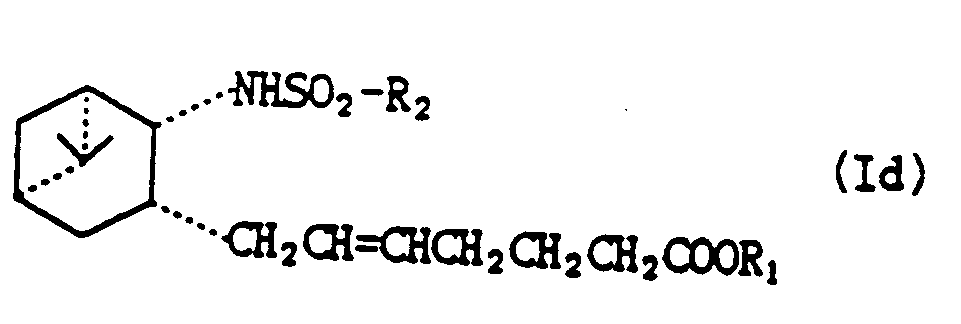
- The starting materials for processes A and B can be prepared in accordance with the following reaction sequences, in which details of the manner in which processes A and B may be carried out are given.

- In this step, the aldehyde equivalent V is allowed to react with an ylide in accordance with the Wittig reaction to give the compound IV. The ylide used may be prepared by base treatment of a phosphonium salt which has been prepared from a 5-halogenopentanoic acid by reaction with triphenylphosphine. For the base treatment, sodium dimsyl, potassium dimsyl, potassium tert-butoxide, sodium hydride, n-butyl lithium or lithium diisopropylamide is exemplified as a base. As the 5-halogenopentanoic acid, 5-chloropentanoic acid, 5-bromopentanoic acid or the like is exemplified. This step can be carried out in a solvent such as an ether,( e.g., ethyl ether, tetrahydrofuran), n-hexane or dimethylsulfoxide at a temperature of -10 ° C to room temperature for several hours.
- To protect it from the subsequent reaction, the carboxy of the 3-side chain, for example, may be esterified. The esterification may be effected by one of the following conventional methods: a method for reacting the carboxylic acid with an alcohol such as methanol, ethanol, n-propanol, isopropanol, butanol or pentanol in the presence of a catalyst, as required, such as dry hydrogen chloride or concentrated sulfuric acid; a method for reacting a halogenide prepared from the carboxylic acid with an alcohol as cited above in the presence of a base such as N,N-dimethylaniline, pyridine, or sodium hydroxide; a method employing a metal alkoxide; a method employing diazomethane; and a method employing dimethyl sulfuric acid and diazabicyclononene or diazabicycloundecene.
- In this step of the Wittig reaction, the Z-form alone or a mixture of the Z- form and E-form is produced under certain reaction conditions.
- In this step, the hydroxy of the compound IV is oxidized to give the compound III.
- This step can be carried out by oxidizing the hydroxy into the carboxy directly or through an aldehyde.
- As an oxidizing agent, a chromate-type agent such as Jones' reagent, Collins' reagent, pyridinium chlorochromate or pyridimium dichromate, or dimethylsulfoxide combined with sulfur trioxide, trifluoroacetic anhydride, methanesulfonic anhydride, thionyl chloride or oxalyl chloride or the like may be used. In a case where dimethylsulfoxide is used as an oxidizing agent, a tertiary amine, e.g., triethylamine or pyridine may be used as a decomposing agent. As a solvent, a chlorinated hydrocarbon such as chloroform or dichloromethane, an ether such as diethyl ether or tetrahydrofuran, or dimethylformamide or acetone may be used depending on the property of the agent used. The reaction may be carried out under cooling or at room temperature over several hours.
- In this step, the 2-carboxy group of the compound III is converted into the acid azide, which is then rearranged into the isocyanate, which is then allowed to react with an alcohol to yield the urethane II. This step can be achieved by the Curtius rearrangement; that is, the acid azide compound may be prepared by the reaction of sodium azide with either the acid chloride or the active ester of the compound III; the acid chloride may be prepared by treating the carboxy group with thionyl chloride, phosphoryl chloride, or phosphorus pentachloride; the active ester may be prepared by allowing the carboxy group to react with ethyl chloroformate or isobutoxycarbonyl chloride in the presence of a basic catalyst such as triethylamine or 4-dimethylaminopyridine in a solvent such as acetone, dimethylformamide, dimethylsulfoxide, ethyl acetate, or tetrahydrofuran for several tens of minutes to several hours, under cooling. The isocyanate can be prepared by refluxing the acid azide compound in benzene, toluene, or diphenyl ether for several tens of minutes to several hours. The alcohol which reacts with the isocyanate includes those giving a urethane which might readily yield the desired primary amine, for example, isobutanol, tert-butanol, diisopropyl- methanol, cyclopentanol, cyclohexanol, benzyl alcohol, diphenylmethanol or triphenylmethanol. This reaction can be achieved by several hours reflux in a solvent such as an aromatic solvent, e.g., benzene, on chlorinated hydrocarbon, (e.g., dichloromethane, chloroform), ethyl acetate, acetone or the like in the presence of a base such as triethylamine, 4-dimethylaminopyridine, or 4-pyrrolidinopyridine, as required.
- In this step, the compound 11 is allowed to react in the following manner to give the compound I of the present invention. This step also provides, if desired, the means of obtaining the free amino compound previously referred to herein as the "starting material" in process A.
- The removal of the amino protecting group is achieved by a conventional method, for example, hydrolysis with an acid such as hydrochloric acid or sulfuric acid or a base such as sodium hydroxide, potassium hydroxide or barium hydroxide, decarboxylation with trifluoroacetic acid, hydrogenolysis, or the like. The product can be used in the form of an ammonium salt in the subsequent step, and if necessary, it may be converted into the free amine by the treatment with an adequate base such as sodium carbonate or sodium bicarbonate.
- The subsequent reaction to give the sulfonamide derivatives is achieved with a substituted sulfonyl halide which has a desired substituent, such as lower alkyl sulfonyl halide ( e.g., methanesulfonyl chloride, methanesulfonyl bromide, ethanesulfonyl chloride, ethanesulfonyl bromide, propanesulfonyl chloride, isopropanesulfonyl chloride, butanesulfonyl chloride, butanesulfonyl bromide, tert-butanesulfonyl chloride or the like), aralkyl sulfonyl halide (e.g., benzenesulfonyl chloride, phenethylsulfonyl chloride, 3-phenyl- propanesulfonyl chloride or the like), aryl sulfonyl halide (e.g., benzenesulfonyl chloride, benzenesulfonyl bromide, naphthylsulfonyl chloride, naphthylsulfonyl bromide or the like) or substituted aryl sulfonyl halide ( e.g., 4-tolyl chloride, 4-tolyl bromide, 4-ethylbenzenesulfonyl chloride, 4-biphenylsulfonyl chloride, 4-nitrobenzenesulfonyl chloride, 4-methoxybenzenesulfonyl chloride, 4-fluorobenzenesulfonyl chloride, 4-fluorobenzenesulfonyl bromide, 4-acetoxybenzenesulfonyl chloride), usually in the presence of a base such as pyridine or triethylamine in a solvent such as a chlorinated hydrocarbon, e.g., chloroform or dichloromethane, an ether, e.g., ethyl ether or tetrahydrofuran, or an aromatic hydrocarbon, e.g., benzene, at room temperature for several tens of minutes. In this reaction, a carboxylic acid ester I-a which is a compound of the present invention is prepared.
- The carboxylic acid ester I-a may be converted into the free carboxylic acid I-b, a compound of the present invention, in a conventional manner for the hydrolysis of esters (other ester functions, if any, are also hydrolyzed.) In carrying out the hydrolysis, a catalyst such as hydrochloric acid, sulfuric acid, sodium hydroxide, potassium hydroxide or barium hydroxide may be used. As a solvent, methanol-water, ethanol- water, acetone-water, or acetonitrile- water may be used. If necessary, the free carboxylic acid I-b is converted into a salt of the carboxylic acid I-c, a compound of the present invention represented by the general formula (I), by treating in the conventional manner using a base such as eg., sodium methoxide, sodium hydroxide, potassium hydroxide, calcium hydroxide, ammonium hydroxide, dicyclohexylamine, methylmorpholine, pyridine, triethylamine, lysine or arginine.

- In this step, an allyl group is introduced into the active methylene of the compound XI. As an allylation agent, an allyl halide such as allyl chloride, allyl bromide, or allyl iodide is used. As a catalyst, a relatively strong base such as sodium amide, potassium tert-butoxide, sodium hydride or lithium diisopropylamide may be used. As a solvent, it is desirable to use an ether such as tetrahydrofuran, ethyl ether, glyme or diglyme.
- The reaction is carried out at a temperature of -78 ° C to 25 °C for a period of several minutes to several hours.
- In this step, a diallyl-product sometimes may also be produced.
- In this step, the ketone of the compound X is converted into an oxime. The oxime formation may be carried out using hydroxylamine hydrochloride or O-methylhydroxylamine hydrochloride in the presence of a base. As a base, pyridine, potassium hydroxide, sodium carbonate, sodium acetate or the like may be used and as a solvent, an alcohol, e.g., methanol, ethanol or the like, or water is used singly or as a mixture. The reaction is usually carried out at room temperature or under heating for a period of several tens of minutes to several tens of hours.
- In this step, the oxime of the compound IX is reduced to an amine, which is then allowed to react with a substituted sulfonyl halide without purification to give a compound VIII.
- The reduction is effected with sodium metal, zinc-hydrochloric acid, stannous chloride-hydrochloric acid, sodium-alcohol, lithium aluminium hydride or the like. As a solvent, an ether, e.g., ethyl ether, tetrahydrofuran, diglyme or the like, or alcohol, e.g., ethanol, methanol or the like may be used in this reduction. The reaction may be carried out at room temperature or under refluxing for several hours. The reaction of the amine to the compound VIII may be carried out in the same manner as in Step 4.
- In this step, the double bond of the compound VIII is oxidized to form an epoxide to give a compound VII.
- As an oxidizing agent, a combined reagent of hydrogen peroxide with a transition metal catalyst or a peroxy acid or its ester such as performic acid, peracetic acid, perbenzoic acid, monoperphthalic acid, monopermaleic acid, pertrifluoroacetic acid, metachloroperbenzoic acid or paranitroperbenzoic acid may be used. As a solvent, an ether, e.g., ethyl ether, tetrahydrofuran, or the like, alcohol, e.g., methanol, ethanol or the like, or chlorinated hydrocarbon, e.g., dichloromethane, chloroform or the like is exemplified. The reaction may be carried out at a temperature of 0 ° C to room temperature for a period of several minutes to several hours. The epoxide prepared in this step may be a mixture of epimers.
- In this step, the epoxide VIII is converted into an aldehyde VI (the aforementioned "staring material" of process B) losing one carbon through oxidative cleavage of the glycol produced by hydration. As an oxidizing agent, which also serves as a hydrating catalyst, periodic acid or orthoperiodic acid may be used. It is desirable to use a solvent which is miscible with water, such as an ether, e.g., ethyl ether, tetrahydrofuran, dioxane or the like, or alcohol, e.g., ethanol or the like. The reaction may be carried out at room temperature for a period of several tens of minutes to several hours.
- The compound VIII can be converted into the compound VI in one step by ozonolysis which attains simultaneously the reactions of Steps 4' and 5'.
- In this step, the aldehyde VI or its cyclic equivalent is allowed to react with an ylide to give the compound (I) of the present invention. This step may be carried out in accordance with Step 1. The prepared carboxylate I-a or free carboxylic acid I-b, the compound of present invention, is converted into a salt or the carboxylic acid I-c by treatment in accordance with Step 4.
- In the process scheme, R1 and R2 each has the same meaning as defined above. R3 is a carboxy protecting group ordinarily used, for example, alkyl ( e.g., diisopropylmethyl, isobutyl, tert-butyl or the like), cycloalkyl ( e.g., cyclopentyl or the like), aryl ( e.g., benzyl or the like) or aralkyl ( e.g., diphenylmethyl or the like).
- The wavy line indicates the R or S configuration or their mixture.
- The salts of the compounds of the general formula (I) are the same as mentioned above.
- Starting compounds used in the present invention can be prepared in the method described in Helv. Chim. Acta., 66, 989 (1983) or J. Org. Chem., 50, 1904, (1985).
- The following Examples and physical constants are included to explain embodiments of the present invention in more detail, but these are not intended to limit the scope of the invention.
-

- A mixture of 4 g of 60 % sodium hydride dispersed in mineral oil and 100 ml of dimethylsulfoxide is stirred at 80 °C in atmosphere of nitrogen for about 1 hour until the generation of hydrogen gas ceases. After cooling to room temperature, a solution of 22.15 g of (4-carboxybutyl)triphenylphosphonium bromide in 60 ml of dimethylsulfoxide is added and the mixture is stirred for 15 minutes. To the above mixture is added a solution of 3.73 g of (-)-(4aR, 6S, 8S, 8aS)-7,7-dimethyl-6,8-methanoperhydroisochroman-3-ol 1 a in 50 ml of dimethylsulfoxide and the mixture is stirred at room temperature for 2.5 hours. The reaction mixture to which is added 300 ml of ice-chilled water is extracted with 200 ml of ether. The aqueous layer which is adjusted to about pH 3 with 10 % hydrochloric acid is extracted with 300 ml of ether and the ether layer is washed with water. To the ether extract cooled with ice-water is added an excess amount of a diazomethane ether solution and the mixture is stirred for 10 minutes. The reaction mixture is evaporated and the residue is purified by flash column chromatography (240 g of silica gel, 230-400 mesh, eluted with hexane-ethyl acetate = 4:1 to 2:1) to give 4.01 g of the titled compound 2a as an oil in 71.7 % yield.
- [α]D: -3.5 ° (23°C, c 1.060, CH30H).
- IR v max(film): 3430, 1740 cm-1.
- NMR δ ppm (CDCl3):0.87(3H,s), 1.11 (1 H,d,J = 9Hz), 1.20(3H,s), 1.32-2.70(16H), 3.54(1 H,dd,J =6,10Hz), 3.54(1 H,dd,J = 6,1 OHz), 3.66(3H,s), 3.86(1 H,dd,J = 6,1 OHz), 5.27(2H,m).
- Anal. Calcd. (%) for C18H3003: C 73.43, H 10.27. Found (%): C 73.17, H 10.06.
-

- Yield 91.7%
- [α]D +34.1 ° (23 °C, c 1.309, CH3OH).
- IR ν max(film): 3440, 1742 cm-1.
- NMR 8 ppm (CDCIa): 0.85(lH,d,J=9Hz), 0.94(3H,s), 1.19(3H,s), 1.35-2.5 (16H), 3.57(2H,d,J=7Hz), 3.65(3H,s), 5.43(2H,m).
- Anal. Calcd. (%) for GaH3o0a: C 73.43, H 10.27. Found (%): C 73.22, H 10.38.
-

- Compound 1 e is allowed to react in the same manner as in 1-(1) to give compound 2e.
- Yield 75.6 %
- [α]D -32.3 ° 23 ° C, C 1.042, CH3OH).
- IR and NMR data of compound 2e are identical with those of compound 2b [prepared in 1-(2)].
-

- To a solution of 2.10 g of alcohol 2a [prepared in 1-(1)] in 20 ml of acetone is dropwise added 3.8 ml of 3 M Jones' reagent at 0 ° C under stirring and the mixture is stirred at 0 ° C for 1 hour. Water is added to the reaction mixture to dissolve solid material and the mixture is extracted with ether. The extract is washed well with water, dried over anhydrous sodium sulfate and evaporated under reduced pressure to give 2.12 g of the titled compound 3a, which is used in the next reaction without further purification, in 96.6 % yield.
- IR v max(film):1740, 1706 cm-1.
- NMR δ ppm(CDCl3):0.90(3H,s), 1.22(3H,s), 1.4-2.7(15H), 3.18(1H,m), 3.65(3H,s), 5.35(2H,m), 8.95-(1 H,br.s).
-

- Yield 93.4 %
- IR v max(film):1740, 1700 cm-1.
- NMR δ ppm(CDCl3):0.88(3H,s), 0.94(1 H,d,J=10Hz), 1.20(3H,s), 1.4-2.9 (15H), 3.64(3H,s), 5.43(2H,m), 9.70(1 H,br.s).
- Yield 97.7 %.
- IR and NMR data are identical with those of compound 3b.
-

- To a solution of 1.0 ml of oxalyl chloride in 25 ml of dichloromethane are dropwise added a solution of 1.7 ml of dimethylsulfoxide in 15 ml of dichloromethane at -60 °C under stirring and then a solution of 3.0 g of alcohol 2d in 30 ml of dichloromethane at the same temperature and the mixture is stirred for 1 hour. A solution of 9 ml of triethylamine in 15 ml of dichloromethane is added thereto and the mixture is slowly warmed up to room temperature. The reaction mixture is poured into water and the organic layer is separated. The aqueous layer is extracted with dichloromethane. The combined organic layers are washed with water, dried over anhydrous sodium sulfate and evaporated under reduced pressure to give the corresponding 2a,3a-aldehyde.
- This crude aldehyde is dissolved in 40 ml of 0.375 M solution of sodium methoxide in 40 ml of methanol and the mixture is allowed to stand at room temperature for 1 hour. The mixture is acidified with dilute hydrochloric acid and extracted with dichloromethane. The extract is washed with water, dried over anhydrous sodium sulfate and evaporated under reduced pressure to give the trans-aldehyde, which is oxidized with Jones' reagent in the same manner as in 2-(1).
- The prepared crude carboxylic acid 3c is purified by frash column chromatography on silica gel.
- Yield 70.1 %
- [α]D -47.4 ° (20 °C, c 1.474, CH3OH).
- IR v max(film):1741, 1702 cm-1.
- NMR 6 ppm(CDCl3):0.82(3H,s), 1.22(3H,s), 1.4-2.2(16H), 3.67(3H,s), 5.43(2H,m), 9.73(1 H,br.s).
- Anal. Calcd. (%) for C18H28O4: C 70.10, H 9.15. Found (%): C 69.74, H 9.14.
-

- To a solution of 2.063 g of carboxylic acid 3a [prepared in 2-(1)] in 8 ml of acetone and 1.5 ml of water are dropwise added a solution of 1.4 ml of triethylamine in 3 ml of acetone, and a solution of 1.0 g of ethyl chlorocarbonate in 2 ml of acetone, successively, at 0 ° C under stirring and the mixture is stirred at the same temperature for 1 hour. A solution of 1.0 g of sodium azide in 4 ml of water is added and the mixture is stirred at 0 ° C for 1 hour. To a reaction mixture is added 10 ml of water and the mixture is extracted with ethyl ether. The extract is washed with water, dried over anhydrous sodium sulfate and evaporated under reduced pressure. The residue is dissolved in 50 ml of benzene, then refluxed for 30 minutes with heating, and evaporated. The residue is dissolved in 30 ml of tert-butyl alcohol, further refluxed with heating for 72 hours and evaporated. The resulting residue is purified by frash column chromatography (45 g of silica gel, 230 - 400 mesh, eluted with hexane-ethyl acetate = 6:1) to give the titled compound 4a as an oil.
- Each compound 3b, 3c and 3e is allowed to react in the same manner as mentioned above to give compound 4b, 4c and 4e, respectively. The results are shown in Table 1.

-

- To 1.25 g of the BOC compound 4a (prepared in 3) is added 10 ml of trifluoroacetic acid at room temperature, the mixture is stirred for 30 minutes and the solvent is evaporated. The residue is dissolved in 15 ml of dichloromethane, 600 mg of benzenesulfonyl chloride and 3 ml of triethylamine are added thereto and the mixture is stirred at room temperature for 20 minutes. The reaction mixture is washed with water, dried over anhydrous sodium sulfate and evaporated. The residue is purified by frash column chromatography [45 g of silica gel, 230 - 400 mesh, eluted with hexane -ethyl acetate = 4:1]. The eluate is evaporated to give crystals, which are washed with hexane to give the titled compound 5a-a.
- Yield 78.6 %
- Mp. 55 °C.
- [α]D +52.7 ° (23 °C, c 1.094, CH3OH).
- IRνmax(KBr): 3280, 1735, 1337, 1320, 1167, 1157 cm-1.
- NMR δ ppm(CDCl3: 0.84(3H,s), 0.96(1 H,d,J=10Hz), 1.07(3H,s), 1.2-2.5 (14H), 3.66(3H,s), 3.90(1 H,m), 4.86(1 H,d,J=10Hz), 5.23(2H, m), 7.35-7.66 (3H,m), 7.80-7.91 (2H,m).
- CD λ mm (Δ ∈ )CH3OH: 269.5 (+0.297), 262.5 (+0.358), 255.5 (+0.345), 222 (+5.03).
- Anal. Calcd. (%) for C23H33N04S: C 65.84, H 7.93, N 3.34, S 7.64. Found (%):C 65.77, H 7.85, N 3.34, S 7.59.
-

- The compound 5b-f can be prepared in the same manner as in Example 1.
- To 0.5 ml of solution of 500 mg of BOC compound 4b (Table 1) in dichloromethane is added 1 ml of trifluoroacetic acid and the mixture is stirred for 30 minutes. The solvent is evaporated under reduced pressure and the residue is dissolved in ether. The resulting solution is washed with a 10 % sodium carbonate anqueous solution, a saturated aqueous solution of sodium chloride, successivly, dried on anhydrous sodium sulfate, and evaporated under reduced pressure. To the residue dissolved in 10 ml of dichloromethane is added 1 ml of triethylamine and 428 mg of 3-chlorobenzenesulfonyl chloride is added thereto at 0 °C. The mixture is stirred for 1 hour. Ether is added to the reaction mixture, which is then washed with 10 % hydrochloric acid, a saturated aqueous solution of sodium hydrogencarbonate and water, successivly, dried on anhydrous sodium salfate, and distilled under reduced pressure. The residue is purifed by frash column chromatography (25 g of silica gel, eluted with hexane-ethyl acetate =4:1) to give 576 mg of the titled compound 5b-f.
- The results are shown in Table 2.
- In the same manner as described in Example 1 or 2, the starting compound 4b, 4c or 4e of which amino protecting group is deprotected to allowed to react with benzenesulfonyl chloride, tosyl chlroide, 4-fluorobenzenesulfonyl chlroide, methanesulfonyl chloride, nitrobenzenesulfonyl chloride, 2-naphthylsulfonyl chloride, benzylsulfonyl chloride, 4-biphenylsulfonyl chloride, 4-metoxybenzenesulfonyl chloride, 3-phenyl- propanesulfonyl chloride, 2-phenylethanesulfonyl chloride, 4-chlorobenzenesulfonyl chloride, 2-chlorobenzenesulfonyl chloride, 3-chlorobenzenesulfonyl chloride, 4-ethylbenzenesulfonyl chloride, or 4-acetoxybenzenesulfonyl chloride in the presence of triethylamine in dichloromethane.
- The compounds shown in Table 2 are prepared.


-

- To a solution of 1.58 g of methyl ester 5a-a (prepared in Example 1) in 20 ml of methanol is added 8 ml of 10 % aqueous solution of sodium hydroxide and the mixture is stirred at room temperature for 2 hours. The reaction mixture is acidified with 10 % hydrochloric acid, extracted with ether, washed with water, dried over anhydrous sodium sulfate and evaporated. The residue is purified by frash column chromatograpy [20 g of silica gel, 230 -400 mesh, eluted with hexane - ethyl acetate = 2:1 to 1:1] to give titled compound 6a-a as an oil.
- Yield 95.3 %.
- [α]D +48.7 ° (23 °C, c 1.513, CH3OH).
- IR ν max(CHCl3): 3520, 3395, 3265, 1710, 1342, 1158 cm-1.
- NMR δ ppm(CDCl3): 0.85(3H,s), 0.98(1 H,d,J=10Hz), 1.07(3H,s), 1.3-2.5 (14H), 3.91 (1 H,m), 5.23(1 H,d, J = 7Hz), 5.33(2H,m), 7.33-7.63 (3H,m), 7.80-7.91 (2H,m), 8.15 (1 H,br.s).

- To a solution of 1.676 g of the above carboxylic acid 6a-a in 10 ml of methanol is added 18.2 ml of 0.221 M solution of sodium methylate in methanol and the solvent is evaporated under reduced pressure. The residue is dissolved in 30 ml of water, treated with active carbon and then lyophilized to give the titled compound 7a-a as powder.
- IR v max(KBr): 3300, 1560, 1338, 1308, 1153 cm-1.
- (1) The reaction is carried out in the same as in Example 22-(1) to yield the compounds shown in Table 3.


-


- (2) The reaction is carried out in the same manner as in Example 22-(2) to yield the compounds shown in Table 4.


-

- In nitrogen atmosphere, 115 ml of 1.6 M solution of n-butyllithium in hexane is dropwise added to a solution of 30 ml of diisopropylamine in 40 ml of dry tetrahydrofuran at -30 ° C. After the mixture is stirred at -20 °C for 5 minutes, a solution of 18.9 g of (+)-nopinone 11 in 20 ml of dry tetrahydrofuran is dropwise added at -30 °C. After stirred at 0 °C for 10 minutes, the mixture is cooled to -30 °C. Then a solution of 17.5 ml of allyl bromide in 10 ml of dry tetrahydrofuran is dropwise added. After stirred at 35 °C for 30 minutes, the reaction mixture is poured into dilute hydrochloric acid under ice cooling. After the organic layer is separated, the aqueous layer is extracted with ether. The combined organic layers are washed with an aqueous solution of sodium hydrogencarbonate and water, successively, dried over anhydrous sodium sulfate, and evaporated under reduced pressure. The residue is fractionally distilled through a fractionation column of about 10 cm length to give 1.90 g of the starting material at 61 - 65 °C/8 mmHg and 16.1 g of the titled compound 12 at 60 - 78 °C/5 mmHg in 13.8 % and 66.0 % yield, respectively. It is considered that the titled compound 12 is a mixture of epimers at 3-position.
- Anal. Calcd. (%) for C12H18O: C, 80.85;H, 9.96. Found (%): C, 80.59;H, 9.96.
- The residue is purified by frash chromatography [60 g of silica gel, 230 - 400 mesh, eluted with hexane - ether = 10 : 1] to give 1.10 g of the dipropenyl compound in 3.7 % yield.
- [α]D +56.4 ° (23 °C, c 1.172, CHCI3).
- IR v max(film):1704 cm-1.
- NMR δ ppm(CDCl3): 0.85(3H,s), 1.35(3H,s), 1.8-2.9(10H), 4.8-5.3(4H,m), 5.5-6.2(2H,m).
- Anal. Calcd. (%) for C15 H22O: C, 82.52; H, 10.16. Found (%): C, 81.69; H, 9.91.
-

- A mixture of 22.6 g of ketone 12 (prepared in 4), 23.8 g of O-methylhydroxylamine hydrochloride, 25 ml of pyridine and 300 ml of ethanol is refluxed with heating for 18 hours and then concentrated under reduced pressure to about 1/3 volume. Ice water is added and the mixture is acidified with dilute hydrochloric acid and extracted with ethyl acetate. The extract is washed with an aqueous solution of sodium hydrogencarbonate and water, successively, dried over anhydrous sodium sulfate, and evaporated under reduced pressure. The residue is separated into three isomers shown in Table 5 by frash chromatography (450 g of silica gel, 230 - 400 mesh, eluted with hexane - ether = 20 : 1 to 10 : 1). In the second and third eluates, either syn or anti isomer of compound 13b is eluated.

-

- To 160 ml of solution of 11.4 g of O-methyloxime 13a (prepared in 5) in 99 % ethanol is added 14 g of sodium metal cut into small pieces in small portions over 3 hours under refluxing. The reaction mixture is refluxed with heating until sodium metal completely disappears, then cooled to room temperature and poured into water. The mixture is extracted with ether and the extract is washed with water, dried over anhydrous sodium sulfate and evaporated under reduced pressure.
- A mixture of the residue, 10 ml of benzenesulfonyl chloride, 26 ml of triethylamine and 165 ml of dichloromethane is allowed to stand at room temperature overnight and then poured into dilute hydrochloric acid under ice cooling. The organic layer is separated and the aqueous layer is extracted with dichloromethane. The combined extracts are washed with an aqueous solution of sodium hydrogencarbonate and water, dried over anhydrous sodium sulfate and evaporated under reduced pressure. The residue is purified by frash chromatography (300 g of silica gel, 230 - 400 mesh, eluted with hexane - ethyl acetate = 4 : 1) to give two types of isomers 14c and 14d.
- Yield 17.1 %
- [α]D -32.0 ° (22 °C, c 1.233, CHCl3).
- IR v max(film): 3330, 1342, 1162 cm-1.
- NMR δ ppm(CDCl3): 0.93(3H,s), 1.04(3H,s), 0.7-2.8(9H), 3.95(1 H, m), 4.82 (1H,d,J=9Hz), 4.90(1 H,s), 5.00 (1 H,s), 5.11 (1 H,s), 5.75(1 H,m), 7.4-7.6(3H,m), 7.7-8.0(2H,m).
- Yield 75.5 %
- Mp. 93 °C (benzene)
- [α]D -33.9 ° (22 °C, c 1.144, CHCl3).
- IR v max(Nujol): 3260, 1327, 1173 cm-1.
- NMR δ ppm(CDCl3): 0.72(3H,s), 1.08(3H,s), 1.2-2.5(9H), 3.36 (1 H,t,J = 8Hz), 4.71 (1 H,d,J =9Hz), 4.89-(1 H,s), 5.03(1 H,m), 5.70(1 H, m), 7.4-7.7(3H,m), 7.8-8.0(2H,m).
- Anal. Calcd. (%) for C18H25NO2S,1/2(C8H8. H20): C 68.63, H 7.95, N 3.81, S 8.72. Found (%): C 68.53, H 7.61, N 3.95, S 8.89.
- (2) Compound 13b is allowed to react in the same manner as in 6-(1) to give compound 14b.

- Mp. 57-58 °C (hexane).
- [α]D +22.6 ° 22 °C, c 1.353, CHCl3).
- IR v max(Nujol): 3295, 1330, 1163 cm-1.
- NMR 6 ppm(CDCl3): 0.69(1 H,d,J=10Hz), 1.00(3H,s), 1.08(3H,s), 1.3-1.6(1 H, m), 1.7-2.3(7H,m), 3.35-(3H,m), 4.80(1H,dd,J=9,3Hz), 4.96(1 H, s), 5.14(1H,d,J=9Hz), 5.4-5.9 (1H,m), 7.4-7.6(3H,m), 7.8-8.2 (2H,m).
- Anal. Calcd. (%) for C18H25NO2S: C 67.68, H 7.89, N 4.38, S 10.04. Found (%):C 67.44, H 7.94, N 4.43, S 9.85.
-

- To a solution of 0.855 g of olefin 14c (prepared in 6) in 13 ml of dichloromethane is added 1.2 g of m-chloroperbenzoic acid in small portions under ice cooling. The reaction mixture is stirred at room temperature for 5 hours and insoluble material is filtered off and washed with dichloromethane. The filtrate is washed with an aqueous solution of sodium thiosulfate, an aqueous solution of sodium hydrogencarbonate and water, successively, dried over anhydrous sodium sulfate, and evaporated under reduced pressure. The residue is crystallized from benzene to give 0.95 g of the titled compound 15c.
- Yield 95.5 %.
- Mp. 127-131 °C.
- [α]D -34.7 ° (22 °C, c 1.027, CHCl3).
- NMR data indicate that compound 15c is a mixture of epimer.
- IR v max(Nujol): 3260, 1328, 1172 cm-1.
- NMR δ ppm(CDCl3): 0.72(3H,s), 1.05, 1.07(total 3H,s), 1.3-2.2(9H), 2.38 (1 H,m), 2.72(1 H,m), 2.86(1 H,m), 3.33(1 H,m), 4.80, 4.88(total 1 H,d,J = 8Hz), 7.4-7.6(3H,m), 7.7-8.0(2H,m).
- Anal. Calcd. (%) for C21 H27NO3S.1/2C5 H5: C, 67.53; H, 7.28; N, 3.75; S, 8.58. Found (%): C, 67.13; H, 7.51; N, 3.85; S, 8.57.
-
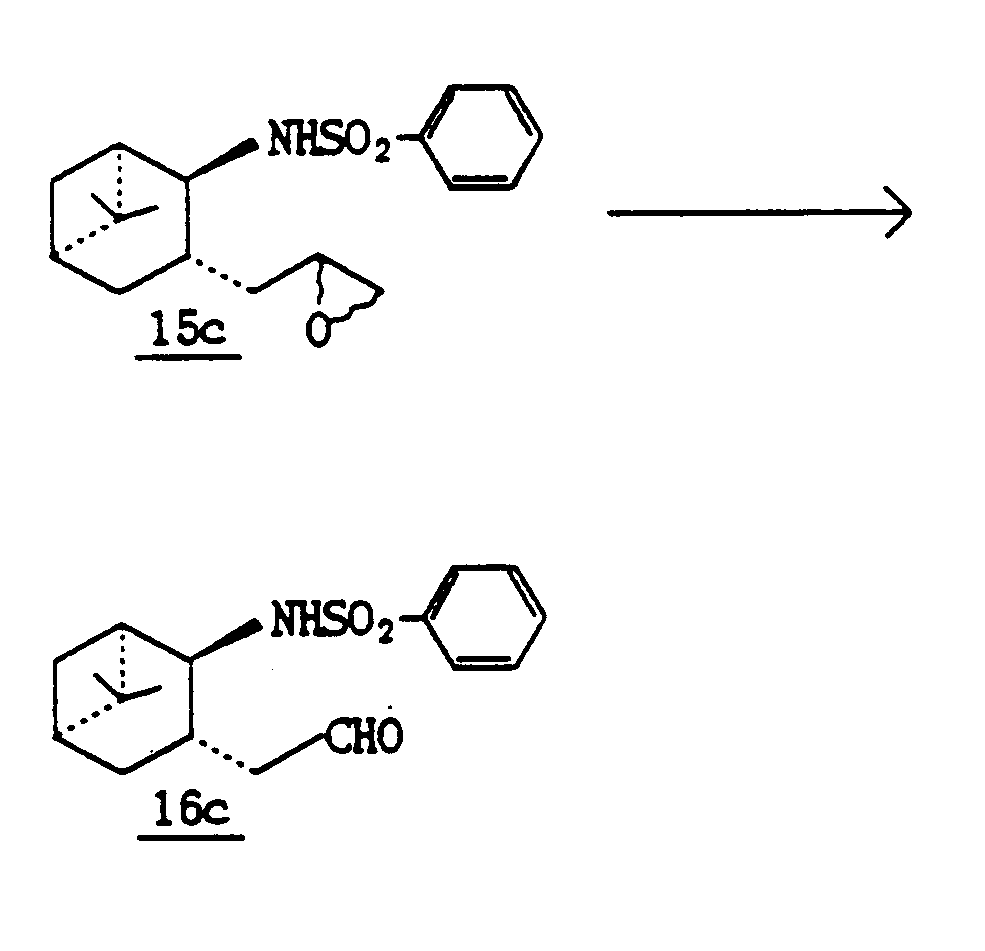
- To a solution of 0.938 g of epoxide 15c (prepared in 7) in 10 ml of dioxane is dropwise added 3 ml of aqueous solution of 1.2 g of periodic acid at room temperature and the mixture is stirred at room temperature for 4 hours. The reaction mixture is washed with water, dried over anhydrous sodium sulfate, and evaporated under reduced pressure.
- After the residue is purified by frash chromatography (silica gel, 230 - 400 mesh, eluted with hexane - ethyl acetate = 3 : 2), the eluate is crystallized from hexane to give 445 mg of the titled compound 16c in 49.5 % yield.
- Mp. 108-110 °C.
- IR: ν max(Nujol):3215, 1704, 1328, 1151 cm-1.
- NMR δ ppm(CDCl3: 0.70(3H,s), 1.06(3H,s), 1.3-2.9(9H), 3.33(1 H,t,J = 9Hz), 4.87(1 H,d,J = 9Hz), 7.4-7.6-(3H, m), 7.7-7.9(2H,m), 9.70(1 H,s).
- Anal. Calcd. (%) for C17H23NO3S: C, 63.52; H, 7.21; N, 4.36; S, 9.97. Found (%):C, 63.21; H, 7.23; N, 4.29; S, 9.73.
-

- NMR δ ppm(CDCl3): 0.72(1H,d,J=10Hz), 1.04(3H,s), 1.10(3H,s), 1.7-2.8 (8H), 3.35(1H,dd,J=8,3Hz), 3.69 (3H,s), 5.17(1 H,d,J = 8Hz), 7.4-7.7(3H,m), 7.80-8.0(2H,m), 9.62 (1 H,d,J = 2Hz).
-
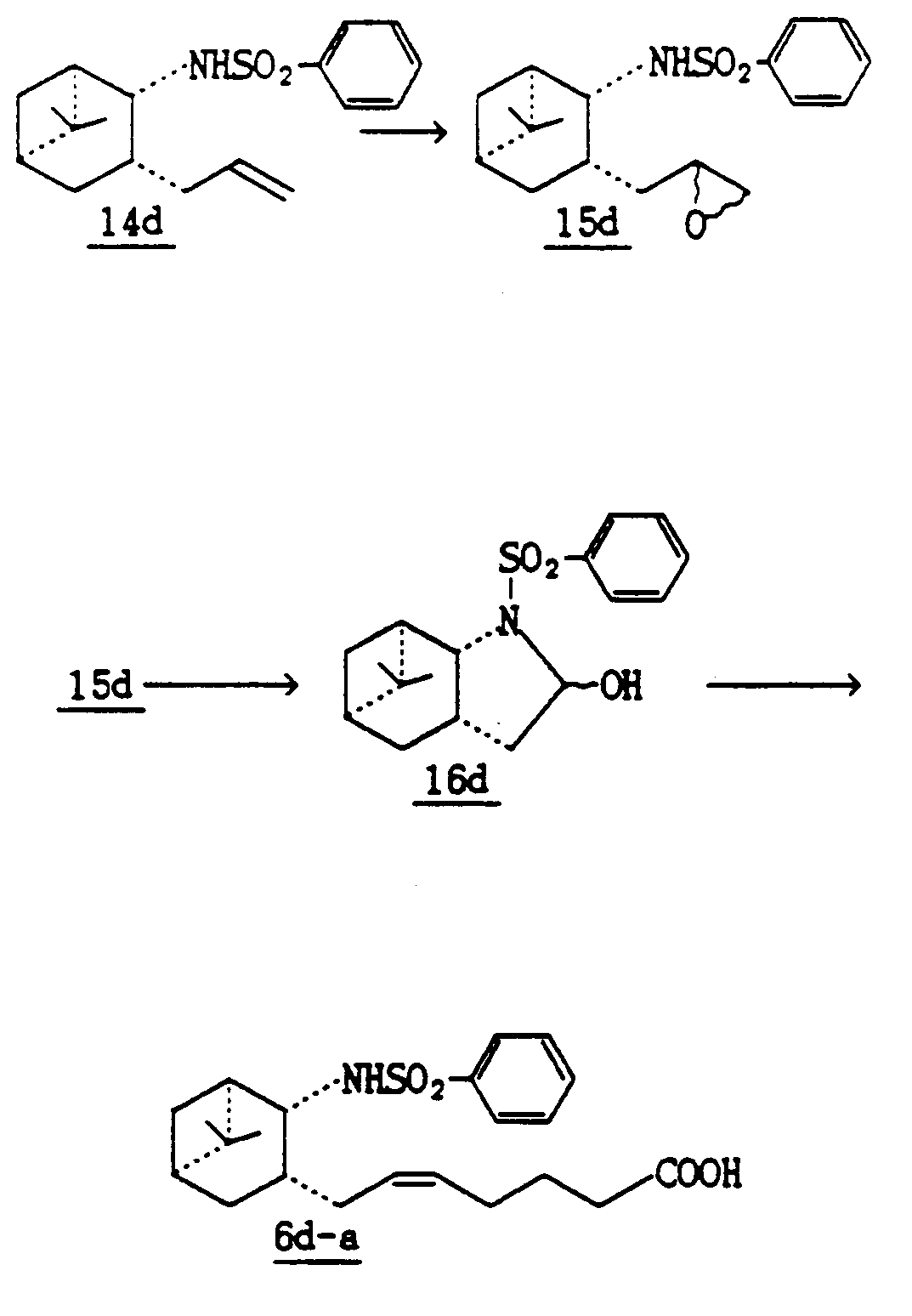
- Compound 14d [prepared in 6-(1)] is allowed to react according to the manners of 7, 8, 1 and Example 8-(1) to give compound 6d-a as an oil.
- [α]D -4.7° (20°C, c 0.706, CH3OH).
- IR v max(film):3300, 1708, 1341, 1156 cm-1.
- NMR δ ppm(CDCl3): 0.81(3H,s), 1.03(3H,s), 1.2-2.7(15H), 3.96(1 H, m), 5.43(2H,m), 7.4-7.6(3H,m), 7.7-7.9(2H,m), 8.68(1 H, br.s).
-

- Compound 6d-a is treated in the same manner as in Example 8-(2) to give sodium salt 7d-a.
- IR ν max(KBr): 3290, 1565, 1322, 1159 cm-1.
-
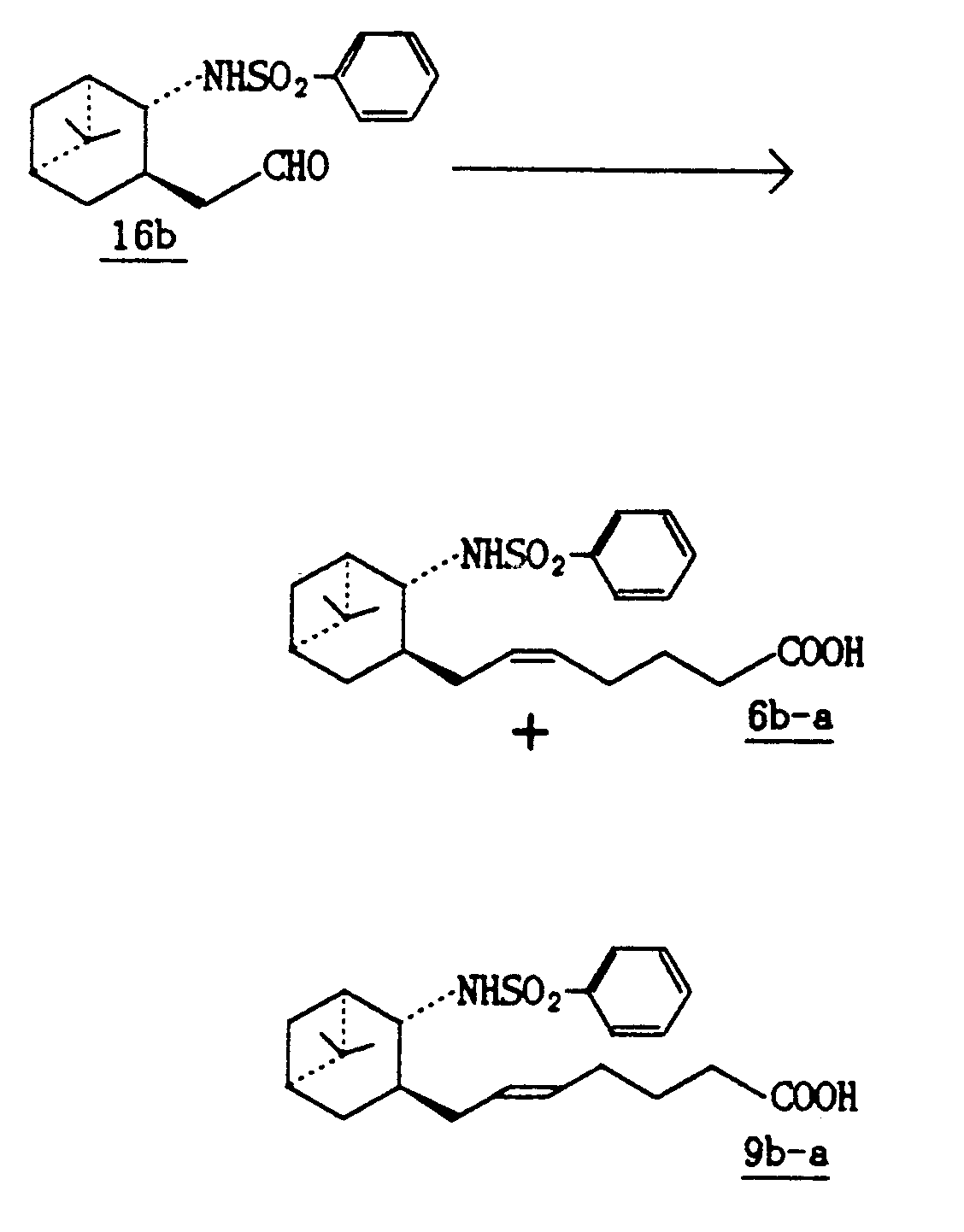
- Compound 16b is treated in the same manner as in 1 and Example 8-(1) to give 6b-a and 9b-a.
- [α]D +26.5° (20°C, c 1.208, CH3OH).
- IR v max(film):3285, 1708, 1323, 1160 cm-1.
- NMR δ ppm(CDCl3):0.70(1H,d,J=8Hz), 1.00(3H,s), 1.08(3H,s), 1.2-2.5(14H), 3.37(1 H,m), 4.89-(1 H,d,J = 8Hz), 5.27(2H,m), 7.3-7.7 (3H,m), 7.8-8.0(2H,m).
-

- Compound 9b-a is treated in the same manner as in Example 8-(2) to give sodium salt 10b-a.
- IRνmax(KBr
):329 0, 1565, 1322, 1306, 1159, 967 cm-1. -

- To a suspension of 36.46 g of (4-carboxybutyl)triphenylphosphonium bromide in 160 ml of dry tetrahydrofuran is added 18.46 g of potassium tert-butoxide under stirring in an nitrogen atmosphere and the mixture is stirred for 2 hours to prepare Wittig reagent. To the resulting mixture is slowly dropwise added a solution of 9.44 g of aldehyde 16b-a in 60 ml of tetrahydrofuran at 0 ° C and the mixture is stirred at the same temperature for 2 hours. The reaction mixture added 200 ml of water is washed with 150 ml of ether twice. The aqueous layer is acidified to about pH 3 with 10 % hydrochloric acid and then extracted with 200 ml of ether twice. The extract is washed successively, with water, an aqueous solution of sodium chloride, dried on anhydrous sodium sulfate, and evaporated under reduced pressure. To the resulting crude carboxylic acid dissolved in 40 ml of ethyl acetate is added 4.03 g of 4-methoxylbenzylamine in 10 ml of ethyl acetate and the mixture is allowed to stand at room temperature overnight and then filtrated to collect 10.9 g of the crystals which contain about 2 % of E-olefin.
- The crude salt (41.9 g ) added 200 ml of 5 % hydrochloric acid is extracted with ether. The extract is washed with water, dried, and evaporated to give the carboxylic acid which is treated with 4-methoxybenzylamine again to give 35.2 g of the titled compound 17b-a. The prepared compound is estimated to contain 0.6 % of E-olefine by HPLC.
- Mp. 125~127°C.
- [α]D +27.7 (24°C, c 1.083, CH30H).
- IRνmax(KBr); 1542, 1517, 1309, 1151 cm-1.
- NMRδppm(CDCl3) 0.69(1 H,d,J = 9.8Hz), 1.02(3H,s), 1.11(3H,s), 1.32-2.37(14H), 3.18(1H,m), 3.78(3H,s), 3.91 (1 H,d,J = 13.8Hz), 3.95 (1 H,d,J = 13.8Hz), 5.34(2H,m), 5.65(3H,br,s), 6.40(1 H,br,s), 6.86 (2H,d,J = 8.7Hz), 7.29(2H,d,J=8.7Hz), 7.42-7.58(3H), 7.90(2H, m).
- Anal. Calcd. (%) for C3oH42N205S: C 66.39, H 7.80, N 5.16, S 5.91. Found (%): C 66.28, H 7.76, N 5.15, S 5.94.
- The compounds of the present invention have a potent antagonistic action against the thromboxane A2 receptor, and strongly inhibit platelet aggregation or vasoconstriction caused by thromboxane A2. This means that the compounds of the invention are useful as anti-thrombotic and anti-vasoconstricting drugs. The platelet aggregation inhibitory activity of the present invention is shown in the following in vitro tests effected using representative compounds of the present invention.
- From the abdominal artery of a male rat (Sprague-Dowley, 8 weeks old) was collected 10 ml of blood with a syringe containing 1.5 ml of ACD (85 mM sodium citrate, 70 mM citric acid, 110 mM glucose) and 20 µg of prostaglandin E1. The blood is placed in a plastic test tube, mixed by moderate turning and centrifuged for 10 minutes at 160 x g to give platelet rich plasma (PRP). To the prepared PRP was added apyrase (25 µg/ml) and the mixture was layered on 40 % bovine serum albumin. The resulting mixture is centrifuged at 1200 x g for 25 minutes. The platelet pellet suspended in a small amount of a buffer (137 mM NaCI, 2.7 mM KCI, 1.0 mM MgCI2, 3.8 mM NaH2PO4, 3.8 mM Hepes, 5.6 mM glucose, 0.035% bovine serum albumin, pH 7.35) was applied on 10 ml of Sepharose 2B column and eluted with the buffer to prepare a washed platelet.
- The platelet aggregation reaction was measured by an aggregometer (NKK HEMA TRACER 1 MODEL PAT-6A.6M, Niko bioscience). In a measuring cuvette was placed 245 µl of the washed platelet of which platelet number was adjusted to 5 x 10⁵/µl and set in the aggregometer. The washed platelet was stirred (1000 rpm) at 37 °C and 3.8 µl of 0.1 M of CaCl2 was added thereto. One minutes after, 0.5 µl of a solution of test compound (dimethylsulfoxide solution) was added and 2 minutes after, 1 µl of Collagen reagent Horm@ [HORMON-CHEMIE Munchen GMBH, final concentrate 4 µg/ml) as a platelet aggregating agent was added. The change in light transmittance caused by platelet aggregation was recorded against time elasped.
- 50 % aggregation inhibitory rate was calculated from the aggregation inhibitory rate (which was measured 3 minutes after adding a platelet aggregating agent). The light transmittance for the washed platelet and the buffer were setted at 0 % and 100 %, respectively.
- The results of the test are shown in Table 6.




- The objective compounds of this invention show a potent inhibitory activity against platelet aggregation caused by collagen.
- The objective compounds of the present invention strongly inhibit thromboxane induced platelet aggregation, vasoconstriction, and bronchoconstriction. Therefore, the human or animal clinical application of such pharmacological actions of the compounds can be expected, that is, the compounds can be used for treatment or improvement of such symptoms as arteriosclerosis, myocardial infarction, acute ischemic angina pectoris, circulatory shock, sudden death and so forth. The objective compounds of the present invention can be administered orally or parenterally. For example, the compounds can be formulated into tablets, capsules, pills, granules, fine subtilaes, solutions, emulsions, suppositories, and injections for intravenous, intramuscular, subcutaneous administration. In preparing the therapeutic preparations of the compounds, adequate carriers and fillers are selected from conventionally used carriers and fillers.
- The objective compounds of the present invention may be administered in a dose of about 10 to 800 mg per day for an adult.
- Thus, the invention provides the use of a compound or salt of the invention in making a medicament.
- The invention further includes a pharmaceutical or veterinary formulation comprising a compound or salt of the invention formulated for pharmaceutical or veterinary use, respectively, and optionally formulated in unit dosage form and/or with an acceptable diluent, carrier or excipient.
- Such formulations may be made in a manner known to the skilled reader using conventional procedures. Thus, in general the invention also includes a method of making a therapeutic composition for use in humans or other animals, comprising formulating a bulk quantity of a compound or salt of the invention for pharmaceutical or veterinary use, optionally in unit dosage form and/or with an acceptable diluent, carrier or excipient.
(wherein Hal is halogen; and R2 is as defined above) and, if desired, subjecting the resulting compound to hydrolysis and/or salt formation.
Claims (10)


Priority Applications (1)
| Application Number | Priority Date | Filing Date | Title |
|---|---|---|---|
| AT88304146T ATE92474T1 (en) | 1987-05-08 | 1988-05-06 | BICYCLIC SULFONAMIDE DERIVATIVES, THEIR PRODUCTION, THEIR USE AND PREPARATIONS THEY CONTAIN. |
Applications Claiming Priority (2)
| Application Number | Priority Date | Filing Date | Title |
|---|---|---|---|
| JP11308687 | 1987-05-08 | ||
| JP113086/87 | 1987-05-08 |
Publications (3)
| Publication Number | Publication Date |
|---|---|
| EP0290285A2 EP0290285A2 (en) | 1988-11-09 |
| EP0290285A3 EP0290285A3 (en) | 1991-01-30 |
| EP0290285B1 true EP0290285B1 (en) | 1993-08-04 |
Family
ID=14603125
Family Applications (1)
| Application Number | Title | Priority Date | Filing Date |
|---|---|---|---|
| EP19880304146 Expired - Lifetime EP0290285B1 (en) | 1987-05-08 | 1988-05-06 | Bicyclic sulfonamide derivatives and their preparation, their use and formulations containing them |
Country Status (9)
| Country | Link |
|---|---|
| US (1) | US4904819A (en) |
| EP (1) | EP0290285B1 (en) |
| KR (1) | KR950004045B1 (en) |
| AT (1) | ATE92474T1 (en) |
| AU (1) | AU599227B2 (en) |
| CA (1) | CA1294974C (en) |
| DE (1) | DE3882795T2 (en) |
| DK (1) | DK248788A (en) |
| ES (1) | ES2058275T3 (en) |
Families Citing this family (10)
| Publication number | Priority date | Publication date | Assignee | Title |
|---|---|---|---|---|
| NZ218115A (en) * | 1985-11-18 | 1990-02-26 | Shionogi & Co | Bicyclic sulphonamides and pharmaceutical compositions |
| CA1332607C (en) * | 1988-07-19 | 1994-10-18 | Masayuki Narisada | Alkenyltetrazole derivatives |
| PL185107B1 (en) | 1995-06-21 | 2003-02-28 | Shionogi & Co | Bicyclic amine derivatives and pgd2 antagonist containing them |
| JP4120993B2 (en) * | 1996-12-12 | 2008-07-16 | 塩野義製薬株式会社 | Heterocyclic fused benzenecarboxylic amide derivatives and PGD2 antagonists containing the same |
| BR9714016A (en) * | 1996-12-13 | 2000-02-29 | Shionogi & Co | Benzothiophenecarboxamide derivatives and pgd2 antagonists, which comprise the same |
| ID26346A (en) | 1998-03-31 | 2000-12-14 | Shionogi & Co | PROCESS OF MAKING 5-HYDROXYBENZO ACID (b) TIOFEN-3-CARBOXICATE |
| US6506789B2 (en) | 1998-06-03 | 2003-01-14 | Shionogi & Co., Ltd. | Methods for the treatment of itching comprising administering PGD2 receptor antagonist |
| US20050106589A1 (en) * | 2003-11-17 | 2005-05-19 | Hashem Akhavan-Tafti | Compositions and methods for releasing nucleic acids from solid phase binding materials |
| US20050106576A1 (en) * | 2003-11-17 | 2005-05-19 | Hashem Akhavan-Tafti | Methods of using cleavable solid phases for isolating nucleic acids |
| FR2898893A1 (en) * | 2006-03-27 | 2007-09-28 | Ppg Sipsy Soc Par Actions Simp | METHOD FOR THE DIASTEREOSELECTIVE ALKYLATION OF NOPINONE COMPOUND OXIME ETHER AND NOVEL INTERMEDIATES FOR THE SYNTHESIS OF CARBON-SUBSTITUTED DIASTEREOSPECIFIC 2-AMINO-NOPINONE DERIVATIVES |
Family Cites Families (8)
| Publication number | Priority date | Publication date | Assignee | Title |
|---|---|---|---|---|
| DE1445783A1 (en) * | 1964-10-30 | 1969-01-23 | Hoechst Ag | Process for the preparation of benzenesulfonylureas |
| GB1249490A (en) * | 1968-12-24 | 1971-10-13 | Leo Pharm Prod Ltd | New sulphamyl-benzoic acid derivatives |
| US3706790A (en) * | 1970-02-27 | 1972-12-19 | Merck & Co Inc | (mono-and di-substituted sulfamoyl) benzoic acids |
| AR206507A1 (en) * | 1972-10-13 | 1976-07-30 | Ciba Geigy Ag | PROCEDURE FOR THE OBTAINING OF NEW 4-ETHERS OF 3-AMINO-5-SULFAMOYLBENZOIC ACIDS |
| DE3000377A1 (en) * | 1980-01-07 | 1981-07-09 | Boehringer Mannheim Gmbh, 6800 Mannheim | NEW SULPHONAMIDES, METHOD FOR THE PRODUCTION THEREOF AND MEDICINAL PRODUCTS CONTAINING THESE COMPOUNDS |
| DE3162659D1 (en) * | 1980-07-22 | 1984-04-19 | Ono Pharmaceutical Co | 9,11-methano-13-aza-11a-carbathrombanoic acid analogues and pharmaceutical use thereof |
| US4654357A (en) * | 1985-08-09 | 1987-03-31 | E. R. Squibb & Sons, Inc. | 7-oxabicycloheptane substituted sulfonamide prostaglandin analogs |
| NZ218115A (en) * | 1985-11-18 | 1990-02-26 | Shionogi & Co | Bicyclic sulphonamides and pharmaceutical compositions |
-
1988
- 1988-04-12 CA CA000563918A patent/CA1294974C/en not_active Expired - Fee Related
- 1988-04-28 US US07/187,645 patent/US4904819A/en not_active Expired - Fee Related
- 1988-04-29 AU AU15347/88A patent/AU599227B2/en not_active Ceased
- 1988-05-06 ES ES88304146T patent/ES2058275T3/en not_active Expired - Lifetime
- 1988-05-06 DE DE88304146T patent/DE3882795T2/en not_active Expired - Fee Related
- 1988-05-06 EP EP19880304146 patent/EP0290285B1/en not_active Expired - Lifetime
- 1988-05-06 DK DK248788A patent/DK248788A/en not_active Application Discontinuation
- 1988-05-06 AT AT88304146T patent/ATE92474T1/en not_active IP Right Cessation
- 1988-05-07 KR KR1019880005325A patent/KR950004045B1/en not_active Expired - Fee Related
Also Published As
| Publication number | Publication date |
|---|---|
| EP0290285A3 (en) | 1991-01-30 |
| DK248788A (en) | 1988-11-09 |
| DK248788D0 (en) | 1988-05-06 |
| ES2058275T3 (en) | 1994-11-01 |
| DE3882795T2 (en) | 1993-11-11 |
| KR880013885A (en) | 1988-12-22 |
| HK1004750A1 (en) | 1998-12-04 |
| US4904819A (en) | 1990-02-27 |
| KR950004045B1 (en) | 1995-04-22 |
| ATE92474T1 (en) | 1993-08-15 |
| AU599227B2 (en) | 1990-07-12 |
| EP0290285A2 (en) | 1988-11-09 |
| CA1294974C (en) | 1992-01-28 |
| DE3882795D1 (en) | 1993-09-09 |
| AU1534788A (en) | 1988-11-10 |
Similar Documents
| Publication | Publication Date | Title |
|---|---|---|
| EP0608847B1 (en) | Carbocyclic sulfonamides as agonists or antagonists of PGEZ | |
| EP0226346B1 (en) | Bicyclic sulfonamide derivatives | |
| FR2665440A1 (en) | NOVEL SUBSTITUTED CYCLOALKYLSULFONAMIDES, PREPARATION METHODS AND MEDICAMENTS CONTAINING SAME. | |
| EP0223593B1 (en) | Phenoxyalkylcarboxylic acids and esters and their preparation and pharmaceutical formulation | |
| KR950004045B1 (en) | Bicyclic sulfonamide derivatives and preparation method thereof | |
| AU2001292331B2 (en) | 5-amidino-2-hydroxybenzenesulfonamide derivatives, pharmaceutical compositions containing the same and intermediates for their preparation | |
| US5206428A (en) | Tetrahydronaphthalene derivatives and preparation thereof | |
| HK1004750B (en) | Bicyclic sulfonamide derivatives and their preparation, their use and formulations containing them | |
| CA2917604A1 (en) | New antifibrinolytic compounds | |
| JPH0623170B2 (en) | Bicyclo ring system sulfonamide derivative and method for producing the same | |
| KR0125576B1 (en) | Alkenyltetrazole derivative | |
| JP2561466B2 (en) | Phenylsulfonylaminoalkylbicycloheptyl heptenoic acid derivative | |
| JPH02180862A (en) | Novel carbon ring based sulfonamide derivative, production thereof and remedy containing the same as active ingredient | |
| HK1003571B (en) | Alkenyltetrazole derivatives, their preparation and use | |
| KR940011909B1 (en) | Bicyclic sulfonamide derivatives | |
| JP2913157B2 (en) | New carbocyclic sulfonamide derivatives | |
| JP2934035B2 (en) | Hydroxybicyclo [2,2,1] heptane sulfonamide derivatives | |
| JP2832725B2 (en) | Alkenyltetrazole derivatives | |
| KR950001024B1 (en) | Method for preparing bicyclo cyclic sulfonamide derivative | |
| JPH05194370A (en) | Sulfonamide derivative | |
| JPH08198839A (en) | Aryl sulfonamide derivative and thromboxane A2 antagonist containing the derivative |
Legal Events
| Date | Code | Title | Description |
|---|---|---|---|
| PUAI | Public reference made under article 153(3) epc to a published international application that has entered the european phase |
Free format text: ORIGINAL CODE: 0009012 |
|
| AK | Designated contracting states |
Kind code of ref document: A2 Designated state(s): AT BE CH DE ES FR GB GR IT LI LU NL SE |
|
| PUAL | Search report despatched |
Free format text: ORIGINAL CODE: 0009013 |
|
| RHK1 | Main classification (correction) |
Ipc: C07C143/75 |
|
| AK | Designated contracting states |
Kind code of ref document: A3 Designated state(s): AT BE CH DE ES FR GB GR IT LI LU NL SE |
|
| 17P | Request for examination filed |
Effective date: 19901218 |
|
| 17Q | First examination report despatched |
Effective date: 19921204 |
|
| GRAA | (expected) grant |
Free format text: ORIGINAL CODE: 0009210 |
|
| AK | Designated contracting states |
Kind code of ref document: B1 Designated state(s): AT BE CH DE ES FR GB GR IT LI LU NL SE |
|
| REF | Corresponds to: |
Ref document number: 92474 Country of ref document: AT Date of ref document: 19930815 Kind code of ref document: T |
|
| REF | Corresponds to: |
Ref document number: 3882795 Country of ref document: DE Date of ref document: 19930909 |
|
| ITF | It: translation for a ep patent filed | ||
| ET | Fr: translation filed | ||
| REG | Reference to a national code |
Ref country code: GR Ref legal event code: FG4A Free format text: 3009611 |
|
| RAP4 | Party data changed (patent owner data changed or rights of a patent transferred) |
Owner name: SHIONOGI SEIYAKU KABUSHIKI KAISHA TRADING UNDER TH |
|
| PLBE | No opposition filed within time limit |
Free format text: ORIGINAL CODE: 0009261 |
|
| STAA | Information on the status of an ep patent application or granted ep patent |
Free format text: STATUS: NO OPPOSITION FILED WITHIN TIME LIMIT |
|
| EPTA | Lu: last paid annual fee | ||
| 26N | No opposition filed | ||
| REG | Reference to a national code |
Ref country code: ES Ref legal event code: FG2A Ref document number: 2058275 Country of ref document: ES Kind code of ref document: T3 |
|
| EAL | Se: european patent in force in sweden |
Ref document number: 88304146.9 |
|
| PGFP | Annual fee paid to national office [announced via postgrant information from national office to epo] |
Ref country code: AT Payment date: 20010426 Year of fee payment: 14 |
|
| PGFP | Annual fee paid to national office [announced via postgrant information from national office to epo] |
Ref country code: GR Payment date: 20010427 Year of fee payment: 14 Ref country code: FR Payment date: 20010427 Year of fee payment: 14 |
|
| PGFP | Annual fee paid to national office [announced via postgrant information from national office to epo] |
Ref country code: GB Payment date: 20010504 Year of fee payment: 14 |
|
| PGFP | Annual fee paid to national office [announced via postgrant information from national office to epo] |
Ref country code: LU Payment date: 20010507 Year of fee payment: 14 Ref country code: BE Payment date: 20010507 Year of fee payment: 14 |
|
| PGFP | Annual fee paid to national office [announced via postgrant information from national office to epo] |
Ref country code: ES Payment date: 20010509 Year of fee payment: 14 |
|
| PGFP | Annual fee paid to national office [announced via postgrant information from national office to epo] |
Ref country code: SE Payment date: 20010517 Year of fee payment: 14 |
|
| PGFP | Annual fee paid to national office [announced via postgrant information from national office to epo] |
Ref country code: DE Payment date: 20010523 Year of fee payment: 14 |
|
| PGFP | Annual fee paid to national office [announced via postgrant information from national office to epo] |
Ref country code: NL Payment date: 20010531 Year of fee payment: 14 |
|
| PGFP | Annual fee paid to national office [announced via postgrant information from national office to epo] |
Ref country code: CH Payment date: 20010803 Year of fee payment: 14 |
|
| REG | Reference to a national code |
Ref country code: GB Ref legal event code: IF02 |
|
| PG25 | Lapsed in a contracting state [announced via postgrant information from national office to epo] |
Ref country code: LU Free format text: LAPSE BECAUSE OF NON-PAYMENT OF DUE FEES Effective date: 20020506 Ref country code: GB Free format text: LAPSE BECAUSE OF NON-PAYMENT OF DUE FEES Effective date: 20020506 Ref country code: AT Free format text: LAPSE BECAUSE OF NON-PAYMENT OF DUE FEES Effective date: 20020506 |
|
| PG25 | Lapsed in a contracting state [announced via postgrant information from national office to epo] |
Ref country code: SE Free format text: LAPSE BECAUSE OF NON-PAYMENT OF DUE FEES Effective date: 20020507 Ref country code: ES Free format text: LAPSE BECAUSE OF NON-PAYMENT OF DUE FEES Effective date: 20020507 |
|
| PG25 | Lapsed in a contracting state [announced via postgrant information from national office to epo] |
Ref country code: LI Free format text: LAPSE BECAUSE OF NON-PAYMENT OF DUE FEES Effective date: 20020531 Ref country code: CH Free format text: LAPSE BECAUSE OF NON-PAYMENT OF DUE FEES Effective date: 20020531 Ref country code: BE Free format text: LAPSE BECAUSE OF NON-PAYMENT OF DUE FEES Effective date: 20020531 |
|
| PG25 | Lapsed in a contracting state [announced via postgrant information from national office to epo] |
Ref country code: NL Free format text: LAPSE BECAUSE OF NON-PAYMENT OF DUE FEES Effective date: 20021201 |
|
| PG25 | Lapsed in a contracting state [announced via postgrant information from national office to epo] |
Ref country code: DE Free format text: LAPSE BECAUSE OF NON-PAYMENT OF DUE FEES Effective date: 20021203 |
|
| PG25 | Lapsed in a contracting state [announced via postgrant information from national office to epo] |
Ref country code: GR Free format text: LAPSE BECAUSE OF NON-PAYMENT OF DUE FEES Effective date: 20021206 |
|
| GBPC | Gb: european patent ceased through non-payment of renewal fee |
Effective date: 20020506 |
|
| EUG | Se: european patent has lapsed | ||
| REG | Reference to a national code |
Ref country code: CH Ref legal event code: PL |
|
| PG25 | Lapsed in a contracting state [announced via postgrant information from national office to epo] |
Ref country code: FR Free format text: LAPSE BECAUSE OF NON-PAYMENT OF DUE FEES Effective date: 20030131 |
|
| NLV4 | Nl: lapsed or anulled due to non-payment of the annual fee |
Effective date: 20021201 |
|
| REG | Reference to a national code |
Ref country code: FR Ref legal event code: ST |
|
| REG | Reference to a national code |
Ref country code: ES Ref legal event code: FD2A Effective date: 20030611 |
|
| PG25 | Lapsed in a contracting state [announced via postgrant information from national office to epo] |
Ref country code: IT Free format text: LAPSE BECAUSE OF NON-PAYMENT OF DUE FEES;WARNING: LAPSES OF ITALIAN PATENTS WITH EFFECTIVE DATE BEFORE 2007 MAY HAVE OCCURRED AT ANY TIME BEFORE 2007. THE CORRECT EFFECTIVE DATE MAY BE DIFFERENT FROM THE ONE RECORDED. Effective date: 20050506 |