EP0287136B1 - Matériau granulaire de traitement d'eau et procédé de fabrication - Google Patents
Matériau granulaire de traitement d'eau et procédé de fabrication Download PDFInfo
- Publication number
- EP0287136B1 EP0287136B1 EP19880200384 EP88200384A EP0287136B1 EP 0287136 B1 EP0287136 B1 EP 0287136B1 EP 19880200384 EP19880200384 EP 19880200384 EP 88200384 A EP88200384 A EP 88200384A EP 0287136 B1 EP0287136 B1 EP 0287136B1
- Authority
- EP
- European Patent Office
- Prior art keywords
- granules
- adjuvant
- process according
- density
- aforesaid
- Prior art date
- Legal status (The legal status is an assumption and is not a legal conclusion. Google has not performed a legal analysis and makes no representation as to the accuracy of the status listed.)
- Expired - Lifetime
Links
- 239000008187 granular material Substances 0.000 title claims abstract description 101
- 238000011282 treatment Methods 0.000 title claims description 51
- XLYOFNOQVPJJNP-UHFFFAOYSA-N water Substances O XLYOFNOQVPJJNP-UHFFFAOYSA-N 0.000 title claims description 43
- 238000000034 method Methods 0.000 title claims description 35
- 230000008569 process Effects 0.000 title claims description 32
- 238000004519 manufacturing process Methods 0.000 title claims description 19
- 239000000463 material Substances 0.000 claims abstract description 50
- 239000002671 adjuvant Substances 0.000 claims abstract description 39
- 239000000203 mixture Substances 0.000 claims abstract description 20
- 239000004033 plastic Substances 0.000 claims abstract description 15
- 229920003023 plastic Polymers 0.000 claims abstract description 15
- 125000002091 cationic group Chemical group 0.000 claims abstract description 11
- 239000011159 matrix material Substances 0.000 claims abstract description 11
- 229920000867 polyelectrolyte Polymers 0.000 claims abstract description 10
- 239000000843 powder Substances 0.000 claims abstract description 9
- 229920005992 thermoplastic resin Polymers 0.000 claims abstract description 6
- 238000010438 heat treatment Methods 0.000 claims abstract description 4
- 238000002156 mixing Methods 0.000 claims abstract description 4
- 229920001169 thermoplastic Polymers 0.000 claims abstract description 4
- 239000004416 thermosoftening plastic Substances 0.000 claims abstract description 3
- 238000010301 surface-oxidation reaction Methods 0.000 claims abstract 3
- 238000007254 oxidation reaction Methods 0.000 claims description 11
- 229920005989 resin Polymers 0.000 claims description 11
- 239000011347 resin Substances 0.000 claims description 11
- 230000003647 oxidation Effects 0.000 claims description 10
- 230000000694 effects Effects 0.000 claims description 7
- VTYYLEPIZMXCLO-UHFFFAOYSA-L Calcium carbonate Chemical compound [Ca+2].[O-]C([O-])=O VTYYLEPIZMXCLO-UHFFFAOYSA-L 0.000 claims description 6
- 239000008346 aqueous phase Substances 0.000 claims description 6
- 238000001914 filtration Methods 0.000 claims description 6
- 150000003839 salts Chemical class 0.000 claims description 5
- VEXZGXHMUGYJMC-UHFFFAOYSA-N Hydrochloric acid Chemical compound Cl VEXZGXHMUGYJMC-UHFFFAOYSA-N 0.000 claims description 4
- 239000007864 aqueous solution Substances 0.000 claims description 4
- 238000001228 spectrum Methods 0.000 claims description 4
- 239000000126 substance Substances 0.000 claims description 4
- 239000002253 acid Substances 0.000 claims description 3
- 229910000019 calcium carbonate Inorganic materials 0.000 claims description 3
- 238000001816 cooling Methods 0.000 claims description 3
- 229910052500 inorganic mineral Inorganic materials 0.000 claims description 3
- 239000011707 mineral Substances 0.000 claims description 3
- 230000035515 penetration Effects 0.000 claims description 3
- 238000002791 soaking Methods 0.000 claims description 3
- BPQQTUXANYXVAA-UHFFFAOYSA-N Orthosilicate Chemical compound [O-][Si]([O-])([O-])[O-] BPQQTUXANYXVAA-UHFFFAOYSA-N 0.000 claims description 2
- XAGFODPZIPBFFR-UHFFFAOYSA-N aluminium Chemical compound [Al] XAGFODPZIPBFFR-UHFFFAOYSA-N 0.000 claims description 2
- 229910052782 aluminium Inorganic materials 0.000 claims description 2
- 229920001577 copolymer Polymers 0.000 claims description 2
- 238000004090 dissolution Methods 0.000 claims description 2
- 229920002492 poly(sulfone) Polymers 0.000 claims description 2
- 229920006122 polyamide resin Polymers 0.000 claims description 2
- 229920000642 polymer Polymers 0.000 claims description 2
- 229920005672 polyolefin resin Polymers 0.000 claims description 2
- 229920005990 polystyrene resin Polymers 0.000 claims description 2
- 229920000915 polyvinyl chloride Polymers 0.000 claims description 2
- 239000000725 suspension Substances 0.000 claims description 2
- 229920002554 vinyl polymer Polymers 0.000 claims description 2
- QGZKDVFQNNGYKY-UHFFFAOYSA-O Ammonium Chemical compound [NH4+] QGZKDVFQNNGYKY-UHFFFAOYSA-O 0.000 claims 1
- 239000004411 aluminium Substances 0.000 claims 1
- 239000011859 microparticle Substances 0.000 abstract 1
- 239000011049 pearl Substances 0.000 abstract 1
- 239000002245 particle Substances 0.000 description 16
- 244000005700 microbiome Species 0.000 description 10
- OKTJSMMVPCPJKN-UHFFFAOYSA-N Carbon Chemical compound [C] OKTJSMMVPCPJKN-UHFFFAOYSA-N 0.000 description 9
- 239000012071 phase Substances 0.000 description 8
- QVGXLLKOCUKJST-UHFFFAOYSA-N atomic oxygen Chemical compound [O] QVGXLLKOCUKJST-UHFFFAOYSA-N 0.000 description 7
- 238000005243 fluidization Methods 0.000 description 7
- 239000001301 oxygen Substances 0.000 description 7
- 229910052760 oxygen Inorganic materials 0.000 description 7
- 239000007789 gas Substances 0.000 description 6
- 230000003993 interaction Effects 0.000 description 6
- 239000007788 liquid Substances 0.000 description 6
- 239000007787 solid Substances 0.000 description 6
- 125000000129 anionic group Chemical group 0.000 description 5
- QAOWNCQODCNURD-UHFFFAOYSA-N Sulfuric acid Chemical compound OS(O)(=O)=O QAOWNCQODCNURD-UHFFFAOYSA-N 0.000 description 4
- VSCWAEJMTAWNJL-UHFFFAOYSA-K aluminium trichloride Chemical compound Cl[Al](Cl)Cl VSCWAEJMTAWNJL-UHFFFAOYSA-K 0.000 description 4
- 230000008901 benefit Effects 0.000 description 4
- KMUONIBRACKNSN-UHFFFAOYSA-N potassium dichromate Chemical compound [K+].[K+].[O-][Cr](=O)(=O)O[Cr]([O-])(=O)=O KMUONIBRACKNSN-UHFFFAOYSA-N 0.000 description 4
- 239000002028 Biomass Substances 0.000 description 3
- 241001441724 Tetraodontidae Species 0.000 description 3
- 229910052799 carbon Inorganic materials 0.000 description 3
- 239000002131 composite material Substances 0.000 description 3
- 230000002349 favourable effect Effects 0.000 description 3
- 239000010408 film Substances 0.000 description 3
- 239000004576 sand Substances 0.000 description 3
- 239000000243 solution Substances 0.000 description 3
- 238000005406 washing Methods 0.000 description 3
- IJGRMHOSHXDMSA-UHFFFAOYSA-N Atomic nitrogen Chemical compound N#N IJGRMHOSHXDMSA-UHFFFAOYSA-N 0.000 description 2
- 241000731961 Juncaceae Species 0.000 description 2
- 239000002585 base Substances 0.000 description 2
- 150000001875 compounds Chemical class 0.000 description 2
- 230000003750 conditioning effect Effects 0.000 description 2
- 238000005189 flocculation Methods 0.000 description 2
- 230000016615 flocculation Effects 0.000 description 2
- 239000002223 garnet Substances 0.000 description 2
- 238000007654 immersion Methods 0.000 description 2
- 235000010755 mineral Nutrition 0.000 description 2
- 230000004048 modification Effects 0.000 description 2
- 238000012986 modification Methods 0.000 description 2
- 239000008262 pumice Substances 0.000 description 2
- 239000004575 stone Substances 0.000 description 2
- 239000010409 thin film Substances 0.000 description 2
- 239000002351 wastewater Substances 0.000 description 2
- NLXLAEXVIDQMFP-UHFFFAOYSA-N Ammonia chloride Chemical compound [NH4+].[Cl-] NLXLAEXVIDQMFP-UHFFFAOYSA-N 0.000 description 1
- UXVMQQNJUSDDNG-UHFFFAOYSA-L Calcium chloride Chemical compound [Cl-].[Cl-].[Ca+2] UXVMQQNJUSDDNG-UHFFFAOYSA-L 0.000 description 1
- 239000005569 Iron sulphate Substances 0.000 description 1
- 241001508691 Martes zibellina Species 0.000 description 1
- BELBBZDIHDAJOR-UHFFFAOYSA-N Phenolsulfonephthalein Chemical compound C1=CC(O)=CC=C1C1(C=2C=CC(O)=CC=2)C2=CC=CC=C2S(=O)(=O)O1 BELBBZDIHDAJOR-UHFFFAOYSA-N 0.000 description 1
- UIIMBOGNXHQVGW-DEQYMQKBSA-M Sodium bicarbonate-14C Chemical compound [Na+].O[14C]([O-])=O UIIMBOGNXHQVGW-DEQYMQKBSA-M 0.000 description 1
- 241001080024 Telles Species 0.000 description 1
- 230000002378 acidificating effect Effects 0.000 description 1
- 239000000654 additive Substances 0.000 description 1
- 239000003463 adsorbent Substances 0.000 description 1
- 238000010936 aqueous wash Methods 0.000 description 1
- NKWPZUCBCARRDP-UHFFFAOYSA-L calcium bicarbonate Chemical compound [Ca+2].OC([O-])=O.OC([O-])=O NKWPZUCBCARRDP-UHFFFAOYSA-L 0.000 description 1
- 229910000020 calcium bicarbonate Inorganic materials 0.000 description 1
- 239000001110 calcium chloride Substances 0.000 description 1
- 229910001628 calcium chloride Inorganic materials 0.000 description 1
- 239000004927 clay Substances 0.000 description 1
- 238000004140 cleaning Methods 0.000 description 1
- 239000011248 coating agent Substances 0.000 description 1
- 238000000576 coating method Methods 0.000 description 1
- 238000004040 coloring Methods 0.000 description 1
- 230000000052 comparative effect Effects 0.000 description 1
- 230000000295 complement effect Effects 0.000 description 1
- 239000008367 deionised water Substances 0.000 description 1
- 229910021641 deionized water Inorganic materials 0.000 description 1
- 230000001627 detrimental effect Effects 0.000 description 1
- 238000010790 dilution Methods 0.000 description 1
- 239000012895 dilution Substances 0.000 description 1
- 239000006185 dispersion Substances 0.000 description 1
- 238000006073 displacement reaction Methods 0.000 description 1
- 238000001125 extrusion Methods 0.000 description 1
- 238000000855 fermentation Methods 0.000 description 1
- 230000004151 fermentation Effects 0.000 description 1
- 238000005188 flotation Methods 0.000 description 1
- 229920001903 high density polyethylene Polymers 0.000 description 1
- 239000004700 high-density polyethylene Substances 0.000 description 1
- 238000009434 installation Methods 0.000 description 1
- BAUYGSIQEAFULO-UHFFFAOYSA-L iron(2+) sulfate (anhydrous) Chemical compound [Fe+2].[O-]S([O-])(=O)=O BAUYGSIQEAFULO-UHFFFAOYSA-L 0.000 description 1
- 230000014759 maintenance of location Effects 0.000 description 1
- 230000003472 neutralizing effect Effects 0.000 description 1
- 229910052757 nitrogen Inorganic materials 0.000 description 1
- 229940091263 other mineral product in atc Drugs 0.000 description 1
- 238000006385 ozonation reaction Methods 0.000 description 1
- 229960003531 phenolsulfonphthalein Drugs 0.000 description 1
- 230000001737 promoting effect Effects 0.000 description 1
- 238000000746 purification Methods 0.000 description 1
- 239000010802 sludge Substances 0.000 description 1
- 238000005063 solubilization Methods 0.000 description 1
- 230000007928 solubilization Effects 0.000 description 1
- 238000001179 sorption measurement Methods 0.000 description 1
- HIFJUMGIHIZEPX-UHFFFAOYSA-N sulfuric acid;sulfur trioxide Chemical compound O=S(=O)=O.OS(O)(=O)=O HIFJUMGIHIZEPX-UHFFFAOYSA-N 0.000 description 1
- 230000009466 transformation Effects 0.000 description 1
Images


Classifications
-
- B—PERFORMING OPERATIONS; TRANSPORTING
- B01—PHYSICAL OR CHEMICAL PROCESSES OR APPARATUS IN GENERAL
- B01J—CHEMICAL OR PHYSICAL PROCESSES, e.g. CATALYSIS OR COLLOID CHEMISTRY; THEIR RELEVANT APPARATUS
- B01J20/00—Solid sorbent compositions or filter aid compositions; Sorbents for chromatography; Processes for preparing, regenerating or reactivating thereof
- B01J20/28—Solid sorbent compositions or filter aid compositions; Sorbents for chromatography; Processes for preparing, regenerating or reactivating thereof characterised by their form or physical properties
- B01J20/28002—Solid sorbent compositions or filter aid compositions; Sorbents for chromatography; Processes for preparing, regenerating or reactivating thereof characterised by their form or physical properties characterised by their physical properties
- B01J20/28011—Other properties, e.g. density, crush strength
-
- B—PERFORMING OPERATIONS; TRANSPORTING
- B01—PHYSICAL OR CHEMICAL PROCESSES OR APPARATUS IN GENERAL
- B01J—CHEMICAL OR PHYSICAL PROCESSES, e.g. CATALYSIS OR COLLOID CHEMISTRY; THEIR RELEVANT APPARATUS
- B01J2/00—Processes or devices for granulating materials, e.g. fertilisers in general; Rendering particulate materials free flowing in general, e.g. making them hydrophobic
- B01J2/20—Processes or devices for granulating materials, e.g. fertilisers in general; Rendering particulate materials free flowing in general, e.g. making them hydrophobic by expressing the material, e.g. through sieves and fragmenting the extruded length
-
- B—PERFORMING OPERATIONS; TRANSPORTING
- B01—PHYSICAL OR CHEMICAL PROCESSES OR APPARATUS IN GENERAL
- B01J—CHEMICAL OR PHYSICAL PROCESSES, e.g. CATALYSIS OR COLLOID CHEMISTRY; THEIR RELEVANT APPARATUS
- B01J20/00—Solid sorbent compositions or filter aid compositions; Sorbents for chromatography; Processes for preparing, regenerating or reactivating thereof
- B01J20/28—Solid sorbent compositions or filter aid compositions; Sorbents for chromatography; Processes for preparing, regenerating or reactivating thereof characterised by their form or physical properties
- B01J20/28002—Solid sorbent compositions or filter aid compositions; Sorbents for chromatography; Processes for preparing, regenerating or reactivating thereof characterised by their form or physical properties characterised by their physical properties
- B01J20/28004—Sorbent size or size distribution, e.g. particle size
-
- B—PERFORMING OPERATIONS; TRANSPORTING
- B01—PHYSICAL OR CHEMICAL PROCESSES OR APPARATUS IN GENERAL
- B01J—CHEMICAL OR PHYSICAL PROCESSES, e.g. CATALYSIS OR COLLOID CHEMISTRY; THEIR RELEVANT APPARATUS
- B01J20/00—Solid sorbent compositions or filter aid compositions; Sorbents for chromatography; Processes for preparing, regenerating or reactivating thereof
- B01J20/28—Solid sorbent compositions or filter aid compositions; Sorbents for chromatography; Processes for preparing, regenerating or reactivating thereof characterised by their form or physical properties
- B01J20/28014—Solid sorbent compositions or filter aid compositions; Sorbents for chromatography; Processes for preparing, regenerating or reactivating thereof characterised by their form or physical properties characterised by their form
- B01J20/28016—Particle form
- B01J20/28019—Spherical, ellipsoidal or cylindrical
-
- B—PERFORMING OPERATIONS; TRANSPORTING
- B01—PHYSICAL OR CHEMICAL PROCESSES OR APPARATUS IN GENERAL
- B01J—CHEMICAL OR PHYSICAL PROCESSES, e.g. CATALYSIS OR COLLOID CHEMISTRY; THEIR RELEVANT APPARATUS
- B01J20/00—Solid sorbent compositions or filter aid compositions; Sorbents for chromatography; Processes for preparing, regenerating or reactivating thereof
- B01J20/28—Solid sorbent compositions or filter aid compositions; Sorbents for chromatography; Processes for preparing, regenerating or reactivating thereof characterised by their form or physical properties
- B01J20/28014—Solid sorbent compositions or filter aid compositions; Sorbents for chromatography; Processes for preparing, regenerating or reactivating thereof characterised by their form or physical properties characterised by their form
- B01J20/28026—Particles within, immobilised, dispersed, entrapped in or on a matrix, e.g. a resin
-
- B—PERFORMING OPERATIONS; TRANSPORTING
- B01—PHYSICAL OR CHEMICAL PROCESSES OR APPARATUS IN GENERAL
- B01J—CHEMICAL OR PHYSICAL PROCESSES, e.g. CATALYSIS OR COLLOID CHEMISTRY; THEIR RELEVANT APPARATUS
- B01J20/00—Solid sorbent compositions or filter aid compositions; Sorbents for chromatography; Processes for preparing, regenerating or reactivating thereof
- B01J20/28—Solid sorbent compositions or filter aid compositions; Sorbents for chromatography; Processes for preparing, regenerating or reactivating thereof characterised by their form or physical properties
- B01J20/28014—Solid sorbent compositions or filter aid compositions; Sorbents for chromatography; Processes for preparing, regenerating or reactivating thereof characterised by their form or physical properties characterised by their form
- B01J20/2803—Sorbents comprising a binder, e.g. for forming aggregated, agglomerated or granulated products
-
- B—PERFORMING OPERATIONS; TRANSPORTING
- B01—PHYSICAL OR CHEMICAL PROCESSES OR APPARATUS IN GENERAL
- B01J—CHEMICAL OR PHYSICAL PROCESSES, e.g. CATALYSIS OR COLLOID CHEMISTRY; THEIR RELEVANT APPARATUS
- B01J20/00—Solid sorbent compositions or filter aid compositions; Sorbents for chromatography; Processes for preparing, regenerating or reactivating thereof
- B01J20/28—Solid sorbent compositions or filter aid compositions; Sorbents for chromatography; Processes for preparing, regenerating or reactivating thereof characterised by their form or physical properties
- B01J20/28054—Solid sorbent compositions or filter aid compositions; Sorbents for chromatography; Processes for preparing, regenerating or reactivating thereof characterised by their form or physical properties characterised by their surface properties or porosity
- B01J20/28095—Shape or type of pores, voids, channels, ducts
- B01J20/28097—Shape or type of pores, voids, channels, ducts being coated, filled or plugged with specific compounds
-
- C—CHEMISTRY; METALLURGY
- C02—TREATMENT OF WATER, WASTE WATER, SEWAGE, OR SLUDGE
- C02F—TREATMENT OF WATER, WASTE WATER, SEWAGE, OR SLUDGE
- C02F3/00—Biological treatment of water, waste water, or sewage
- C02F3/02—Aerobic processes
- C02F3/10—Packings; Fillings; Grids
-
- C—CHEMISTRY; METALLURGY
- C08—ORGANIC MACROMOLECULAR COMPOUNDS; THEIR PREPARATION OR CHEMICAL WORKING-UP; COMPOSITIONS BASED THEREON
- C08J—WORKING-UP; GENERAL PROCESSES OF COMPOUNDING; AFTER-TREATMENT NOT COVERED BY SUBCLASSES C08B, C08C, C08F, C08G or C08H
- C08J3/00—Processes of treating or compounding macromolecular substances
- C08J3/12—Powdering or granulating
-
- Y—GENERAL TAGGING OF NEW TECHNOLOGICAL DEVELOPMENTS; GENERAL TAGGING OF CROSS-SECTIONAL TECHNOLOGIES SPANNING OVER SEVERAL SECTIONS OF THE IPC; TECHNICAL SUBJECTS COVERED BY FORMER USPC CROSS-REFERENCE ART COLLECTIONS [XRACs] AND DIGESTS
- Y02—TECHNOLOGIES OR APPLICATIONS FOR MITIGATION OR ADAPTATION AGAINST CLIMATE CHANGE
- Y02W—CLIMATE CHANGE MITIGATION TECHNOLOGIES RELATED TO WASTEWATER TREATMENT OR WASTE MANAGEMENT
- Y02W10/00—Technologies for wastewater treatment
- Y02W10/10—Biological treatment of water, waste water, or sewage
Definitions
- the invention relates to a method for manufacturing a granular water treatment material. It aims to obtain a material specifically adapted to the mode of water treatment for which said material is intended. In particular, it is applicable for the manufacture of a granular material for biological treatment (known as fixed microorganisms or fixed biomass) or physicochemical treatment (penetration bed filtration). It extends to a new granular material capable of being manufactured by said process.
- a granular material for biological treatment known as fixed microorganisms or fixed biomass
- physicochemical treatment penetration bed filtration
- water treatment is meant both the treatment of water with a view to making it drinkable and the purification of water or residual aqueous effluents.
- water treatments use natural granular materials such as sand, expanded clay or not, activated or not reconstituted carbon, and other mineral products. These materials are chosen according to the treatment envisaged, with a view to fixing the microorganisms in the case of biological treatments or physically trapping the suspended materials in the case of treatments by filtration.
- the advantage of these materials is linked to their availability and low cost, but they are ill-suited to these treatments and the implementation methods are unreliable and ineffective, in particular for biological treatments with fixed biomass.
- patent FR-A-2545098 (FR 83.07186) describes a composite material for biological treatments; this material consists of thermoplastic matrices, in particular cylindrical in shape, on the surface of which adsorbent particles of activated carbon have been fixed.
- This material has substantially the same fixing properties of microorganisms as activated carbon, but differs from it by better mechanical resistance.
- this material remains sensitive to attrition phenomena and is only suitable for one type of biological treatment, namely treatment in a fixed, immersed or trickling bed; he it should be noted that, by expansion of the synthetic matrix, it is possible to modulate the density of the material, however this expansion is very difficult in practice to control and the size of the particles is related to the degree of expansion and therefore is not adjustable regardless of density.
- such a material lends itself poorly to washing operations with a view to eliminating the fixed biomass.
- the present invention proposes to provide a new water treatment material, having volume and surface properties, improved compared to existing materials.
- the invention aims to make it possible to carry out water treatments, both in a fixed bed and in a turbulent bed or a fluidized bed.
- Another objective is to improve the efficiency of the material compared to known materials: efficiency of fixing of microorganisms in the case of biological treatments, efficiency of physicochemical retention in the case of filtration.
- Another objective is to provide a material suitable for easy and economical washing or cleaning.
- Another objective is to provide a material having mechanical properties which are further improved compared to the above-mentioned activated carbon composite material, making in particular said material insensitive to attrition phenomena.
- adjuvant is meant both a powder of a single compound and a mixture of powders, the density considered _da_ of the adjuvant being, in the latter case, the average density of said mixture.
- the oxidizable thermoplastic resin can be chosen in a manner known per se from the following families: polyolefin resins, polystyrene resins, polysulfone resins, polyvinyl resins, polyamide resins, the resin used being a polymer or a copolymer of these families having oxidizable free double bonds .
- the process of the invention leads to a continuous matrix in which the grains of additives are dispersed in a homogeneous manner, so that each granule has good mechanical resistance linked to the nature of the base resin used.
- the process of the invention allows an independent adjustment of the two volume parameters (density, size of the granules) conditioning the hydrodynamics and the material transfers in the water treatment processes.
- the size of the granules will be chosen so that the biological film which forms around each granule remains of small thickness compared to the size of said granule, so that the resulting density of the bioparticle is stable (release of the film has very little effect on the density of the bioparticle). This removes sudden changes in density detrimental to the hydrodynamics of the reactor as well as the risk of entrainment of highly charged particles (very large coating).
- the density of the material is chosen so as to optimize the implementation of the chosen process: energy required for the minimized washing phase in the case of fixed bed processes, fluidization energy or minimized suspension in the case of fluidized beds or turbulent beds.
- the adjuvant will be chosen with a particle size with a narrow spectrum, between 10 and 100 microns, and with a density _da_ such as 2.2d-1.2dr ⁇ da ⁇ 50d-49dr.
- a density _da_ such as 2.2d-1.2dr ⁇ da ⁇ 50d-49dr.
- This choice seems to optimize in the generality of the cases the resistance qualities of the granules, while authorizing the density adjustment mentioned above independently of the size of said granules.
- narrow spectrum particle size is meant a particle size for which the size of the largest or smallest grains does not differ by more than 100% from that of the medium size grains.
- the spheroid shape of the granules to which the process leads minimizes the interactions between particles, avoids the effects of interparticle flocculation and makes it possible to maintain a homogeneous bed very favorable for good transfer of material (absence of preferential path).
- the surface properties linked to the wettability of the material ensure good interaction between the material and the water to be treated and, in the case of three-phase reactors (solid bed of granules, liquid aqueous phase to be treated and gas phase: air, fermentation gas, nitrogen ...) a gas / solid interaction, thus eliminating the phenomena of flotation of the granules and the risks of flocculation between particles ( by trapping gas bubbles).
- the oxidation of the granules can be carried out by any known process and in particular by bringing the granules into contact with a sulfochromic mixture (sulfuric acid, potassium dichromate and water) or with a sulfonating mixture of oleum (fuming sulfuric acid).
- a sulfochromic mixture sulfuric acid, potassium dichromate and water
- oleum oleuming sulfuric acid
- the oxidation of the granules is carried out to a degree of oxidation corresponding to a hydrophilicity characterized by a contact angle of the material with respect to water in the presence of air less than 40 °.
- the granules thus obtained ensure excellent interaction with the water to be treated and, if necessary, lend themselves perfectly to the execution of a complementary final treatment as described below, which further improves this interaction.
- the process is completed by a final treatment of the spheroid granules, consisting of grafting ionically a polyelectrolyte of cationic type on the surface of said granules.
- This final treatment can in particular be carried out by bringing the granules into contact with an aqueous solution containing a polyelectrolyte of the following group: polyethylene-imine hydrochloride, polyvinyl ammonium hydrochloride, poly aluminum chloride.
- This contacting can be ensured by any process, in particular by immersion in a column through which the aqueous solution circulates.
- This final treatment has the advantage of neutralizing the negative hydrophilic sites due to oxidation and of creating, from each of these, numerous cationic hydrophilic sites which are very favorable, on the one hand, to the fixation of micro- organisms which are generally negatively charged, on the other hand, to the adsorption (by chemisorption) of the colloidal suspended solids which also have negative surface charges, which represents an essential advantage in filtration.
- this final treatment accentuates the hydrophilicity of the material (each anionic site being replaced by several cationic sites) and the abovementioned advantages relating to the interactions of the solid / liquid / gas phases are reinforced.
- the process according to the invention lends itself to the creation of surface microporosities on the surface of the granules, with a view to promoting the kinetics of colonization of the microorganisms in the case of biological treatments (shorter latency phase).
- a first mode of implementation for obtaining these surface microporosities consists in choosing an adjuvant constituted by a mineral salt soluble in water (calcium chloride, iron sulphate, sodium bicarbonate, etc.), in order to create said microporosities by solubilization of the grains of this salt located on the surface during a subsequent contact with an aqueous phase.
- This contacting can be ensured, either during the soaking phase carried out in a cold aqueous bath, or during a special operation of immersion in water before the oxidation phase.
- the dissolution of the adjuvant grains located on the surface of the granules reveals a multitude of micro-cells, notably increasing the kinetics of biological treatments.
- Another mode of implementation consists in choosing an adjuvant constituted by a product insoluble in water, capable of being attacked chemically and in subjecting the granules to a surface chemical treatment, capable of attacking said adjuvant in order to create a micro - surface porosity.
- the granular material according to the invention can be used to carry out biological water treatments or physico-chemical treatments.
- the density _d_ and the size _t_ of the granules will be respectively adjusted in the following ranges, which are more specifically adapted to this mode of treatment: 1.05 ⁇ d ⁇ 1.2 and 1.5 mm ⁇ t ⁇ 3 mm.
- the density _d_ and the size _t_ will be respectively adjusted in the following ranges: 1.01 ⁇ d ⁇ 1.05 and 1.5 mm ⁇ t ⁇ 3 mm.
- the density _d_ and the size _t_ will be respectively adjusted so that: d ⁇ 1.1 and t ⁇ 3 mm.
- the density _d_ and the size _t_ will be respectively adjusted so that: d ⁇ 1.1 and 0.5 mm ⁇ t ⁇ 3 mm.
- the granular material which it is proposed to manufacture in the present example is intended for biological treatments in a fluidized bed of urban waste water.
- the size _t_ of each granule of the material which is chosen to minimize in said application the fluidization energy and to keep an always very thin biological film around the granules, is 2.7 mm.
- the density _d_ which contributes to conditioning the hydrodynamic fluidization conditions, was chosen at d 1.19.
- thermoplastic resin powder consisting of high density polyethylene is mixed with an adjuvant consisting of calcium carbonate (insoluble in water) present under powder form.
- the resin powder has a particle size of the order of a few hundred microns and a density dr of 0.96, while the adjuvant has an average particle size equal to 30 microns, the particle size spectrum of this adjuvant being between 10 and 50 microns.
- the density _da_ of the adjuvant is 2.7.
- This adjuvant was chosen in particular from because its density _da_ much higher than that of the resin, satisfies the relation: 2,2d-1,2dr ⁇ da ⁇ 50d-49dr, or in the example: 1.46 ⁇ da ⁇ 12.46.
- the assembly After homogeneous mixing of the two powders in this proportion by weight (30% of adjuvant, 70% of resin), the assembly is introduced into an extruder hopper and is caused to circulate by means of an endless screw in a body. which takes it to a temperature of 200 ° C.
- This extruder of the traditional type, is equipped at the outlet with a die having cylindrical extrusion holes with a diameter of 2.8 mm.
- the resin is in the form of a plastic paste entraining the micrograins of adjuvant.
- this paste forms cylindrical plastic rods which are cut to lengths of 2.8 mm.
- the plastic sections thus obtained fall into a cold water bath which causes, by the effect of cooling and shrinking, a beading giving the granules a spheroid shape with an average diameter equal to 2.7 mm.
- the measured density of these granules is 1.19.
- FIG. 1 illustrates, in partial view and on a very expanded scale, a granule, with its plastic matrix 1 and its micrograins of adjuvant distributed either at the surface 2 or at the heart of the matrix 3.
- the spheroid granules thus obtained are immersed in an acidic aqueous bath, containing 30% by weight hydrochloric acid.
- the granules are left for half a day in this bath, then are washed with water.
- the next step in the process is to oxidize the granules using a sulfochromic mixture composed of sulfuric acid (93% by weight), potassium dichromate (1% by weight) and water.
- a sulfochromic mixture composed of sulfuric acid (93% by weight), potassium dichromate (1% by weight) and water.
- the granules are left for approximately three hours in the bath, then are washed in an aqueous solution.
- FIG. 3 illustrates the structure of the granules obtained which comprise anionic hydrophilic sites such as 5, distributed over the surface of the granule and in the micro-alveoli. The presence of these sites is noted by the character of the compound preferably wettable with water relative to air. The contact angle measured was, in this case, close to 0 ° (total spread of the drop of water).
- the final stage of the process consists in grafting on the anionic sites created in the preceding stage a mineral polyelectrolyte constituted by a polychloride of aluminum (polyelectrolyte "WAC” manufactured by "ATOCHEM”).
- Poly aluminum chloride is in the form of a solution comprising 1200 g of polyelectrolyte per liter. This solution is brought, by dilution in deionized water, to a concentration of 1 g per liter. The granules are immersed in the latter solution for three hours. At the end of the bath, an aqueous wash is carried out.
- FIG. 4 A granule has been illustrated in FIG. 4 after this treatment with polyelectrolyte.
- Each anionic site has fixed a polyelectrolyte chain by chemisorption, so that the granules thus treated have a large number of cationic hydrophilic sites distributed over their surface.
- cationic sites can be highlighted by coloring the granules with a dye.
- anionic of the phenol red type there is a uniform red coloration around the grain, showing the ionic fixations of the dye on the cationic sites of the material.
- the granules thus produced are placed in a bioreactor 7 as shown diagrammatically in FIG. 5, being in the form of a vertical column containing an expandable bed 8. At its base, the reactor is supplied with air by a conduit 9, through a fluidization distributor 10.
- the urban water to be treated is introduced via a conduit 11 above the distributor and recirculation of the treated water is traditionally ensured by a conduit 12 in order to obtain expansion of the bed to appropriate levels.
- the treated water is recovered by overflow through a pipe 13.
- the sludge production obtained during these tests is 0.48 kg of total dry matter / kg of D.T.O. or 1.2 kg of M.S.T. per kg of C.O.T. eliminated.
- the material does not modify the behavior of the dispersion gas / liquid, whereas in traditional materials, the bubbles coalesce between them and reduce by more than half the quantities of oxygen transferred.
- traditional materials there are phenomena of displacement of the solid / liquid interfaces in the presence of air bubbles, creating hydrodynamic instability.
- the granular material according to the invention allows very effective fixing of microorganisms, in the form of thin films very dense in active microorganisms, without appreciable modification of the hydrodynamics over time.
Landscapes
- Chemical & Material Sciences (AREA)
- Organic Chemistry (AREA)
- Chemical Kinetics & Catalysis (AREA)
- Analytical Chemistry (AREA)
- Life Sciences & Earth Sciences (AREA)
- Hydrology & Water Resources (AREA)
- Health & Medical Sciences (AREA)
- Microbiology (AREA)
- Dispersion Chemistry (AREA)
- Engineering & Computer Science (AREA)
- Environmental & Geological Engineering (AREA)
- Water Supply & Treatment (AREA)
- Biodiversity & Conservation Biology (AREA)
- Medicinal Chemistry (AREA)
- Polymers & Plastics (AREA)
- Biological Treatment Of Waste Water (AREA)
- Water Treatment By Sorption (AREA)
- Solid-Sorbent Or Filter-Aiding Compositions (AREA)
- Soy Sauces And Products Related Thereto (AREA)
Description
- L'invention concerne un procédé de fabrication d'un matériau granulaire de traitement d'eau. Elle vise à obtenir un matériau spécifiquement adapté au mode de traitement d'eau auquel ledit matériau est destiné. En particulier, elle s'applique pour la fabrication d'un matériau granulaire de traitement biologique (dit à micro-organismes fixés ou à biomasse fixée) ou de traitement physicochimique (filtration en lit à pénétration). Elle s'étend à un nouveau matériau granulaire susceptible d'être fabriqué par ledit procédé.
- Par "traitement d'eau", on entend aussi bien le traitement des eaux en vue de les rendre potables que l'épuration d'eaux ou d'effluents aqueux résiduaires.
- De façon traditionnelle, les traitements d'eau utilisent des matériaux granulaires naturels tels que sables, argiles expansées ou non, charbons actifs reconstitués ou pas, et autres produits minéraux. Ces matériaux sont choisis en fonction du traitement envisagé, en vue de fixer les micro-organismes dans le cas des traitements biologiques ou de piéger physiquement les matières en suspension dans le cas des traitements par filtration. L'intérêt de ces matériaux est lié à leur disponibilité et à leur faible coût, mais ils sont mal adaptés à ces traitements et les procédés de mise en oeuvre sont peu fiables et peu performants, notamment pour les traitements biologiques à biomasse fixée.
- Par ailleurs, le brevet FR-A-2545098 (FR 83.07186) décrit un matériau composite pour des traitements biologiques; ce matériau est constitué par des matrices thermoplastiques de forme notamment cylindrique, en surface desquelles ont été fixées des particules adsorbantes de charbon actif. Ce matériau possède sensiblement les mêmes propriétés de fixation des micro-organismes que le charbon actif, mais s'en différencie par une meilleure résistance mécanique. Toutefois, ce matériau demeure sensible aux phénomènes d'attrition et n'est adapté qu'à seul type de traitement biologique, à savoir traitement en lit fixe, immergé ou à ruissellement; il est à noter que, par expansion de la matrice synthétique, il est possible de moduler la densité du matériau, cependant cette expansion est très difficile en pratique à contrôler et la taille des particules est liée au degré d'expansion et donc n'est pas ajustable indépendamment de la densité. De plus, un tel matériau se prête mal aux opérations de lavage en vue de l'élimination de la biomasse fixée.
- La présente invention se propose de fournir un nouveau matériau de traitement d'eau, présentant des propriétés de volume et de surface, améliorées par rapport aux matériaux existants.
- Un objectif de l'invention est d'indiquer un procédé de fabrication d'un tel matériau granulaire permettant d'en ajuster les caractéristiques en fonction du mode de mise en oeuvre prévu, de façon que le matériau puisse être optimisé sur le plan hydrodynamique et des transferts de matière.
- En particulier, l'invention vise à permettre d'effectuer des traitements d'eau, aussi bien en lit fixe qu'en lit turbulent ou lit fluidisé.
- Un autre objectif est d'améliorer l'efficacité du matériau par rapport aux matériaux connus: efficacité de fixation des micro-organismes dans le cas des traitements biologiques, efficacité de rétention physicochimique dans le cas des filtrations.
- Un autre objectif est de fournir un matériau se prêtant à des lavages ou nettoyages faciles et économiques.
- Un autre objectif est de fournir un matériau présentant des propriétés mécaniques encore améliorées par rapport au matériau composite au charbon actif sus-évoqué, rendant en particulier ledit matériau insensible aux phénomènes d'attrition.
- Le procédé visé par l'invention en vue de la fabrication d'un matériau granulaire de traitement d'eau permet d'obtenir des granulés sphéroïdes de densité _d_ et de taille _t_ ajustables indépendamment dans des plages respectives 1 < d ≦ 3 et 0,5 mm ≦ t ≦ 10 mm, en vue de permettre d'adapter lesdits granulés au type de traitement concerné; à cet effet, le procédé de fabrication conforme à l'invention consiste:
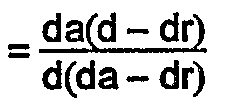
- · à mélanger une résine thermoplastique oxydable, de densité _dr_ inférieure à _d_, avec un adjuvant se présentant sous forme de poudre de granulométrie inférieure à environ 200 microns et de densité _da_ telle que da > 1,7d-0,7dr, le mélange étant réalisé de façon que le rapport pondéral d'adjuvant pa dans le mélange soit tel que pa =
- · à chauffer le mélange pour le rendre plastique,
- · à extruder ledit mélange plastique à travers une filière de façon à produire des joncs plastiques de diamètre légèrement supérieur à t,
- · à tronçonner, immédiatement à la sortie de la filière, les joncs pour obtenir des tronçons plastiques de longueur sensiblement égale au diamètre,
- · à assurer un trempage desdits tronçons plastiques de façon à engendrer, par l'effet du refroidissement et des retraits, un perlage desdits tronçons leur conférant la forme de granulés sphéroïdes,
- · à réaliser une oxydation desdits granulés sphéroïdes, adaptée pour créer des sites hydrophiles à leur surface, en vue de donner auxdits granulés une mouillabilité préférentielle à l'eau par rapport à l'air.
- Par "adjuvant", on entend aussi bien une poudre d'un composé unique qu'un mélange de poudres, la densité considérée _da_ de l'adjuvant étant, dans ce dernier cas, la densité moyenne dudit mélange.
- La résine thermoplastique oxydable peut être choisie de façon connue en soi parmi les familles suivantes: résines polyoléfines, résines polystyréniques, résines polysulfones, résines polyvinyliques, résines polyamides, la résine utilisée étant un polymère ou un copolymère de ces familles possédant des doubles liaisons libres oxydables.
- Le procédé de l'invention conduit à une matrice continue dans laquelle sont dispersés de façon homogène les grains d'adjuvants, de sorte que chaque granulé possède une bonne résistance mécanique liée à la nature de la résine de base utilisée.
- Le procédé de l'invention permet un ajustement indépendant des deux paramètres de volume (densité, taille des granulés) conditionnant l'hydrodynamique et les transferts de matière dans les procédés de traitement des eaux. Dans le cas des traitements biologiques à microorganismes fixés, la taille des granulés sera choisie de façon que le film biologique qui se forme autour de chaque granulé demeure d'épaisseur faible par rapport à la taille dudit granulé, de sorte que la densité résultante de la bioparticule soit stable (relargage du film affectant très peu la densité de la bioparticule). On supprime ainsi les modifications brusques de densité préjudiciables à l'hydrodynamique du réacteur ainsi que les risques d'entraînement de particules très chargées (enrobage très volumineux). La densité du matériau est choisie de façon à optimiser la mise en oeuvre du procédé choisi: énergie nécessaire à la phase de lavage minimisée dans le cas des procédés en lit fixe, énergie de fluidisation ou de mise en suspension minimisée dans le cas des lits fluidisés ou lits turbulents.
- De préférence, l'adjuvant sera choisi de granulométrie à spectre étroit, comprise entre 10 et 100 microns, et de densité _da_ telle que 2,2d-1,2dr ≦ da ≦ 50d-49dr. Ce choix paraît optimiser dans la généralité des cas les qualités de résistance des granulés, tout en autorisant l'ajustement de densité sus-évoqué indépendamment de la taille desdits granulés. Par "granulométrie à spectre étroit", on entend une granulométrie pour laquelle la taille des grains les plus gros ou les plus petits ne diffèrent pas de plus de 100% de celle des grains de taille moyenne.
- En outre, la forme sphéroïde des granulés à laquelle conduit le procédé minimise les interactions entre particules, évite les effets de floculation interparticulaire et permet de conserver un lit homogène très favorable à un bon transfert de matière (absence de cheminement préférentiel).
- De plus, les propriétés de surface liées à la mouillabilité du matériau assurent une bonne interaction entre le matériau et l'eau à traiter et évite, dans le cas des réacteurs triphasiques (lit solide de granulés, phase aqueuse liquide à traiter et phase gazeuse: air, gaz de fermentation, azote...) une interaction gaz/solide, supprimant ainsi les phénomènes de flottation des granulés et les risques de floculation entre particules (par piégeage des bulles de gaz).
- L'oxydation des granulés peut être réalisée par tout procédé connu et en particulier par une mise en contact des granulés avec un mélange sulfochromique (acide sulfurique, bichromate de potassium et eau) ou avec un mélange sulfonant d'oléum (acide sulfurique fumant). Bien entendu, d'autres procédés tels que l'ozonation peuvent être utilisés.
- De préférence, l'oxydation des granulés est conduite jusqu'à un degré d'oxydation correspondant à une hydrophilie caractérisée par un angle de contact du matériau vis-à-vis de l'eau en présence d'air inférieur à 40°. Les granulés ainsi obtenus assurent une excellente interaction avec l'eau à traiter et, le cas échéant, se prêtent parfaitement à l'exécution d'un traitement final complémentaire tel que décrit ci-après, qui améliore encore cette interaction.
- Selon un mode de mise en oeuvre préférentiel, le procédé est complété par un traitement final des granulés sphéroïdes, consistant à greffer par voie ionique un polyélectrolyte de type cationique à la surface desdits granulés. Ce traitement final peut notamment être effectué en mettant les granulés au contact d'une solution aqueuse contenant un polyélectrolyte du groupe suivant: chlorhydrate de polyéthylène-iminés, chlorhydrate de polyvinyl-ammonium, polychlorure d'aluminium. Cette mise en contact peut être assurée par tout processus, notamment par immersion dans une colonne à travers laquelle circule la solution aqueuse.
- Ce traitement final présente l'avantage de neutraliser les sites hydrophiles négatifs dus à l'oxydation et de créer, à partir de chacun de ceux-ci, de nombreux sites hydrophiles cationiques très favorables, d'une part, à la fixation des micro-organismes qui sont en général chargés négativement, d'autre part, à l'adsorption (par chimisorption) des matières en suspension colloïdales qui présentent également des charges de surface négatives, ce qui représente un avantage essentiel en filtration. De plus, ce traitement final accentue l'hydrophilie du matériau (chaque site anionique étant remplacé par plusieurs sites cationiques) et les avantages sus-évoqués relatifs aux interactions des phases solide/liquide/gaz sont renforcés.
- Par ailleurs, le procédé conforme à l'invention se prête à la création de microporosités superficielles à la surface des granulés, en vue de favoriser la cinétique de colonisation des micro-organismes dans le cas des traitements biologiques (phase de latence plus courte).
- Un premier mode de mise en oeuvre pour obtenir ces microporosités superficielles consiste à choisir un adjuvant constitué par un sel minéral soluble dans l'eau (chlorure de calcium, sulfate de fer, bicarbonate de sodium, etc...), en vue de créer lesdites microporosités par solubilisation des grains de ce sel situés en surface lors d'une mise en contact ultérieure avec une phase aqueuse. Cette mise en contact peut être assurée, soit lors de la phase de trempage effectuée dans un bain aqueux froid, soit au cours d'une opération spéciale d'immersion dans de l'eau avant la phase d'oxydation. La dissolution des grains d'adjuvant situés en surface des granulés fait apparaître une multitude de micro-alvéoles, augmentant notablement la cinétique des traitements biologiques.
- Un autre mode de mise en oeuvre consiste à choisir un adjuvant constitué par un produit insoluble dans l'eau, susceptible d'être attaqué chimiquement et à soumettre les granulés à un traitement chimique superficiel, apte à attaquer ledit adjuvant en vue de créer une micro-porosité en surface.
- Dans ce dernier cas, on peut notamment choisir comme adjuvant du carbonate de calcium ou un silicate et soumettre les granulés à une attaque acide qui solubilise en surface les grains de ces sels, faisant apparaître comme précédemment une multitude de micro-alvéoles.
- L'invention s'étend, en tant que tel, à un matériau granulaire, ayant les caractéristiques physico-chimiques du matériau obtenu par le procédé défini précédemment; ce matériau se caractérise en ce qu'il se présente sous la forme de granulés sphéroïdes de densité _d_ et de taille _t_, telles que 1 < d ≦ 3 et 0,5 mm ≦ t ≦ 10 mm, et en ce que:
- · chaque granulé sphéroïde est composé d'une matrice polymérique thermoplastique et d'un adjuvant plus dense sous forme de micrograins dispersés dans ladite matrice,
- · chaque granulé possède en surface une porosité sous la forme de micro-alvéoles, chacune de dimension correspondant à celle d'au moins un micrograin d'adjuvant,
- · chaque granulé possède des sites hydrophiles cationiques répartis sur sa surface et dans les micro-alvéoles.
- Il est à noter que, _ contrairement au matériau composite du brevet FR-A 2545098 (FR n° 83.07186) très sensible à l'attrition qui a tendance à faire disparaître le charbon actif en surface, _ chaque granulé du matériau conforme à l'invention présente une peau continue, superficiellement alvéolée, mais sans particules fragiles en saillie, ce qui limite considérablement l'effet des phénomènes d'attrition sur les granulés.
- Le matériau granulaire conforme à l'invention peut être utilisé pour réaliser des traitements biologiques d'eau ou des traitements physico-chimiques.
- Dans le cas d'un traitement biologique appelé à être mis en oeuvre en lit fluidisé, la densité _d_ et la taille _t_ des granulés seront respectivement ajustées dans les plages suivantes, qui sont plus spécifiquement adaptées à ce mode de traitement:

- Dans le cas d'un traitement biologique s'opérant par mise en suspension du granulé dans la phase aqueuse (lit turbulent), la densité _d_ et la taille _t_ seront respectivement ajustées dans les plages suivantes:

- Dans le cas d'un traitement biologique appelé à être mis en oeuvre en lit fixe immergé, la densité _d_ et la taille _t_ seront respectivement ajustées de sorte que:

- Dans le cas d'une filtration d'eau en lit fixe à pénétration, la densité _d_ et la taille _t_ seront respectivement ajustées de sorte que:

- L'invention est illustrée ci-après par des exemples de fabrication et des exemples de mise en oeuvre, la mise en oeuvre du matériau ayant été faite dans un dispositif en lui-même connu tel que schématisé à la figure 5 des dessins; sur ces dessins:
- les figures 1, 2, 3 et 4 illustrent, à échelle très dilatée, un granulé de matériau à l'issue des différentes étapes du procédé de fabrication,
- la figure 5 est une coupe schématique d'un réacteur triphasique à lit fluidisé ayant servi à la mise en oeuvre du matériau.
- Le matériau granulaire que l'on se propose de fabriquer dans le présent exemple est destiné à des traitements biologiques en lit fluidisé d'eaux usées résiduaires urbaines.
- Dans cette application, la taille _t_ de chaque granulé du matériau, qui est choisie pour minimiser dans ladite application l'énergie de fluidisation et conserver un film biologique toujours très mince autour des granulés, est de 2,7 mm. La densité _d_ qui contribue à conditionner les conditions hydrodynamiques de fluidisation, a été choisie à d = 1,19.
- Pour obtenir un matériau granulaire adapté à un tel traitement biologique en lit fluidisé, l'on mélange une poudre de résine thermoplastique constituée par du polyéthylène haute densité, avec un adjuvant constitué par du carbonate de calcium (insoluble dans l'eau) se présentant sous forme de poudre. La poudre de résine possède une granulométrie de l'ordre de quelques centaines de microns et une densité dr de 0,96, cependant que l'adjuvant possède une granulométrie moyenne égale à 30 microns, le spectre de granulométrie de cet adjuvant se situant entre 10 et 50 microns. La densité _da_ de l'adjuvant est de 2,7.
- Cet adjuvant a été en particulier choisi du fait que sa densité _da_ très supérieure à celle de la résine, satisfait la relation:

soit dans l'exemple: 1,46 ≦ da ≦ 12,46. - Cette relation optimise le rapport pondéral d'adjuvant à insérer dans la résine qui est calculé par la relation: pa =

en attribuant à ce pourcentage une valeur telle que, à la fois, la résine soit en quantité suffisante pour constituer une matrice continue et l'adjuvant soit en quantité suffisante pour créer en surface une microporosité suffisante comme évoqué plus loin. - Le pourcentage pondéral d'adjuvant calculé par la formule sus-évoquée est en l'exemple égal à pa = 0,3.
- Après mélange homogène des deux poudres dans cette proportion pondérale (30% d'adjuvant, 70% de résine), l'ensemble est introduit dans une trémie d'extrudeuse et est amené à circuler au moyen d'une vis sans fin dans un corps de chauffe qui le porte à une température de 200°C. Cette extrudeuse, de type traditionnel, est équipée en sortie d'une filière ayant des trous d'extrusion cylindrique d'un diamètre de 2,8 mm.
- Après le corps de chauffe, en aval de la filière, la résine se présente sous la forme d'une pâte plastique entraînant les micrograins d'adjuvant. A la sortie de la filière, cette pâte forme des joncs plastiques cylindriques qui sont tronçonnés à des longueurs de 2,8 mm.
- Les tronçons plastiques ainsi obtenus tombent dans un bain d'eau froide qui provoque, par l'effet du refroidissement et du retrait, un perlage conférant aux granulés une forme sphéroïde de diamètre moyen égal à 2,7 mm. La densité mesurée de ces granulés est de 1,19.
- La figure 1 illustre, en vue partielle et à échelle très dilatée, un granulé, avec sa matrice plastique 1 et ses micrograins d'adjuvant répartis soit en surface 2 soit au coeur de la matrice 3.
- Les granulés sphéroïdes ainsi obtenus sont immergés dans un bain aqueux acide, contenant 30% en poids d'acide chlorhydrique. Les granulés sont laissés une demi-journée dans ce bain, puis sont lavés à l'eau.
- Les granulés obtenus, observés au microscope, ont l'allure illustrée à la figure 2: les micrograins de surface 2 ont été dissous par une transformation en bicarbonate de calcium et solubilisés dans l'eau. Ils ont laissé place à des micro-alvéoles telles que schématisées en 4. Les micrograins internes 3 sont restés intacts.
- L'étape suivante du procédé consiste à oxyder les granulés au moyen d'un mélange sulfochromique composé d'acide sulfurique (93% en poids), de bichromate de potassium (1% en poids) et d'eau. Les granulés sont laissés environ trois heures dans le bain, puis sont lavés dans une solution aqueuse.
- La figure 3 illustre la structure des granulés obtenus qui comportent des sites hydrophiles anioniques tels que 5, répartis sur la surface du granulé et dans les micro-alvéoles. La présence de ces sites est constatée par le caractère du composé préférentiellement mouillable à l'eau par rapport à l'air. L'angle de contact mesuré était, dans ce cas, proche de 0° (étalement total de la goutte d'eau).
- L'étape finale du procédé consiste à greffer sur les sites anioniques créés à l'étape précédente un polyélectrolyte minéral constitué par un polychlorure d'aluminium (polyélectrolyte "WAC" fabriqué par "ATOCHEM").
- Le polychlorure d'aluminium se présente sous forme d'une solution comportant 1200 g de polyélectrolyte par litre. Cette solution est ramenée, par dilution dans de l'eau déionisée, à une concentration de 1 g par litre. Les granulés sont immergés dans cette dernière solution pendant trois heures. A la sortie du bain, un lavage aqueux est effectué.
- On a illustré à la figure 4 un granulé après ce traitement au polyélectrolyte. Chaque site anionique a fixé par chimisorption une chaîne de polyélectrolyte, de sorte que les granulés ainsi traités possèdent une grand nombre de sites hydrophiles cationiques répartis sur leur surface.
- Ces sites cationiques peuvent être mis en évidence en colorant les granulés au moyen d'un colorant anionique du type rouge de phénol: l'on constate une coloration rouge uniforme autour du grain, montrant les fixations ioniques du colorant sur les sites cationiques du matériau.
- Les granulés ainsi fabriqués sont disposés dans un bioréacteur 7 tel que schématisé à la figure 5, se présentant sous la forme d'une colonne verticale contenant un lit expansable 8. A sa base, le réacteur est alimenté par de l'aire par un conduit 9, à travers un distributeur de fluidisation 10.
- L'eau urbaine à traiter est introduite par un conduit 11 au-dessus du distributeur et une recirculation de l'eau traitée est assurée de façon traditionnelle par un conduit 12 en vue d'obtenir une expansion du lit à des niveaux appropriés. L'eau traitée est récupérée par surverse à travers un conduit 13.
- L'on constate qu'au terme de longues périodes de fonctionnement, aucun entraînement du matériau granulaire ne se produit, les bulles d'air sortant en tête de la colonne, libres de tout granulé. L'interface supérieure solide/liquide est parfaitement nette et définie.
- A l'entrée, les eaux résiduaires introduites par le conduit 11 ont les caractéristiques suivantes, en pollution:
- D.T.O. (demande totale en oxygène): 420 mg O₂/litre
- C.O.T. (carbone organique total): 150 mg/l
- Le temps de passage de l'eau est de 35 mn et la vitesse de l'air 12 m/heure. Le débit liquide est de 10 l/heure. Ces paramètres correspondent à une charge organique appliquée par m³ de réacteur et par jour, de:
- D.T.O.: 12,6 kg/m³.jour
- C.O.T.: 4,7 kg/m³.jour
- Après la période de mise en régime, l'analyse des eaux traitées a fourni les données suivantes:
- D.T.O.: 25 mg O₂/l
- C.O.T.: 9 mg/l
- D.T.O.: 11, 8 kg/m³.jour
- C.O.T.: 4,4 kg/m³.jour
- Le rendement moyen de dépollution aussi bien en D.T.O. qu'en C.O.T. est de 94%, ce qui est remarquable.
- La production de boue obtenue lors de ces essais (récupérée dans un décanteur secondaire) est de 0,48 kg de matière sèche totale/kg de D.T.O. éliminée ou de 1,2 kg de M.S.T. par kg de C.O.T. éliminé.
- Ces excellentes performances sont dues aux excellentes conditions hydrodynamiques, engendrées par le matériau qui assure un transfert d'oxygène remarquable, dû à une bonne stabilité du lit fluidisé et à une fixation très favorable des micro-organismes sur les granulés par film mince (sans modification des conditions hydrodynamiques de fluidisation au cours du temps).
- Dans une installation similaire, sont effectués des essais comparatifs de transfert d'oxygène entre plusieurs matériaux traditionnels: sable (granulométrie 0,3 mm), grenat (granulométrie 0,380 mm), pierre ponce (granulométrie 0,3 mm) et le matériau conforme à l'invention tel que décrit précédemment (2,7 mm). La fluidisation est menée dans tous les cas de façon à effectuer une expansion totale du lit de l'ordre de 2,5 fois la hauteur initiale de matériaux. Les granulométries des matériaux classiques ont été choisies de façon à obtenir une fluidisation dans de bonnes conditions avec des énergies comparables.
- Le paramètre comparé après ces essais est le rapport du coefficient de transfert d'oxygène de la colonne garnie, au coefficient de transfert d'oxygène de la colonne à bulles non garnie. La valeur de ces coefficients caractérise l'influence du matériau sur le transfert d'oxygène. Les résultats obtenus sont les suivants:
- sable: 0,47
- grenat: 0,46
- pierre ponce: 0,42
- matériau granulaire conforme à l'invention: 1.
- En conséquence, dans le cas de l'invention, le matériau ne modifie pas le comportement de la dispersion gaz/liquide, alors que dans les matériaux traditionnels, les bulles coalescent entre elles et abaissent de plus de moitié les quantités d'oxygène transférées. De plus, avec les matériaux traditionnels, on constate des phénomènes de déplacement des interfaces solide/liquide en présence des bulles d'air, créant une instabilité hydrodynamique.
- Ainsi, le matériau granulaire conforme à l'invention permet une fixation très efficace des microorganismes, sous forme de films minces très denses en microorganismes actifs, sans modification sensible de l'hydrodynamique au cours du temps.
ce qui correspond à des charges organiques éliminées par m³ de réacteur et par jour, de:
Claims (17)
ledit procédé de fabrication étant caractérisé en ce qu'il consiste:


Priority Applications (1)
| Application Number | Priority Date | Filing Date | Title |
|---|---|---|---|
| AT88200384T ATE64109T1 (de) | 1987-03-13 | 1988-03-01 | Koerniges material zur behandlung von wasser und verfahren zu seiner herstellung. |
Applications Claiming Priority (2)
| Application Number | Priority Date | Filing Date | Title |
|---|---|---|---|
| FR8703611 | 1987-03-13 | ||
| FR8703611A FR2612085B1 (fr) | 1987-03-13 | 1987-03-13 | Materiau granulaire de traitement d'eau et procede de fabrication |
Publications (2)
| Publication Number | Publication Date |
|---|---|
| EP0287136A1 EP0287136A1 (fr) | 1988-10-19 |
| EP0287136B1 true EP0287136B1 (fr) | 1991-06-05 |
Family
ID=9349042
Family Applications (1)
| Application Number | Title | Priority Date | Filing Date |
|---|---|---|---|
| EP19880200384 Expired - Lifetime EP0287136B1 (fr) | 1987-03-13 | 1988-03-01 | Matériau granulaire de traitement d'eau et procédé de fabrication |
Country Status (7)
| Country | Link |
|---|---|
| US (1) | US4915884A (fr) |
| EP (1) | EP0287136B1 (fr) |
| JP (1) | JPS63302994A (fr) |
| AT (1) | ATE64109T1 (fr) |
| DE (1) | DE3863116D1 (fr) |
| ES (1) | ES2023483B3 (fr) |
| FR (1) | FR2612085B1 (fr) |
Families Citing this family (13)
| Publication number | Priority date | Publication date | Assignee | Title |
|---|---|---|---|---|
| US5413749A (en) * | 1993-06-04 | 1995-05-09 | Wheelabrator Engineered Systems Inc. | Process of making beads for a liquid purification bed |
| AU713333B2 (en) * | 1995-10-04 | 1999-12-02 | Solutia Inc. | Porous polymeric biosupports and their use in the biotreatment of aqueous waste streams |
| US6045700A (en) * | 1996-07-29 | 2000-04-04 | Solutia Inc. | Retrievable organic carbon scavengers for cleaning of contaminated surface water sediments |
| GB2334029A (en) * | 1998-02-04 | 1999-08-11 | John James Todd | Media for waste water treatment |
| JP4530320B2 (ja) * | 2001-05-22 | 2010-08-25 | 三菱レイヨン株式会社 | 微生物固定化担体 |
| US20050261399A1 (en) * | 2004-05-19 | 2005-11-24 | David Hunkeler | Powdered flocculants prepared by using evaporative cooling to coat polymeric materials on a porous substrate |
| FR2902767B1 (fr) * | 2006-06-22 | 2008-09-19 | J P B Creations Sa | Dispositif de conditionnement d'un produit a base de colle |
| CA2830300C (fr) * | 2011-03-18 | 2020-04-14 | Schaefer Kalk Gmbh & Co. Kg | Particules composites microstructurees |
| JP7155127B2 (ja) | 2016-09-08 | 2022-10-18 | シェーファー・カーク・ゲーエムベーハー・ウント・コンパニー・カーゲー | 阻害性炭酸カルシウム添加剤 |
| US11760874B2 (en) | 2016-09-08 | 2023-09-19 | Schaefer Kalk Gmbh & Co. Kg | Composite powder containing calcium carbonate and having microstructured particles having inhibiting calcium carbonate |
| ES2984033T3 (es) | 2016-09-08 | 2024-10-28 | Schaefer Kalk Gmbh & Co Kg | Polvo compuesto que contiene carbonato de calcio con partículas microestructuradas |
| PL3509733T3 (pl) | 2016-09-08 | 2020-11-16 | Schaefer Kalk Gmbh & Co. Kg | Zawierający sól wapnia proszek kompozytowy z cząstkami z mikrostrukturą |
| CN118458938B (zh) * | 2024-06-20 | 2024-10-18 | 北京建筑大学 | 一种脱氮除磷复合填料、制备方法及应用 |
Family Cites Families (11)
| Publication number | Priority date | Publication date | Assignee | Title |
|---|---|---|---|---|
| GB774681A (en) * | 1953-09-01 | 1957-05-15 | Ici Ltd | Improvements in or relating to thermoplastic polymeric materials |
| US2918701A (en) * | 1956-02-23 | 1959-12-29 | Eastman Kodak Co | Method for pelleting organic thermoplastic materials |
| US3207818A (en) * | 1963-12-27 | 1965-09-21 | Western Electric Co | Methods of forming spherical particles of crystallizable thermoplastic polymers |
| US3476844A (en) * | 1965-12-20 | 1969-11-04 | Novacel Sa | Process for producing artificial sponges |
| US3436449A (en) * | 1966-02-03 | 1969-04-01 | Ici Ltd | Granulation of theromplastic materials |
| US4326009A (en) * | 1977-07-27 | 1982-04-20 | Royer Garfield P | Polymeric particulate carrier |
| EP0014943A1 (fr) * | 1979-02-16 | 1980-09-03 | Ardyth Dale Lakes | Procédé de préparation d'un tampon auto-dosant retenant un liquide et d'autres articles poreux |
| US4385016A (en) * | 1980-12-19 | 1983-05-24 | Phillips Petroleum Company | Method of extruding and pelletizing expandable polymeric composition with recycling of transparent water supplied across the face of the extrusion die |
| US4383956A (en) * | 1981-01-30 | 1983-05-17 | American Optical Corporation | Method of a single element complete air filtering structure for a respirator filter cartridge |
| IT1163386B (it) * | 1983-05-19 | 1987-04-08 | Montedison Spa | Procedimento per la produzione di granuli espandibili di polimeri termoplastici e relativa apparecchiatura |
| US4581443A (en) * | 1984-10-09 | 1986-04-08 | Celanese Corporation | Production of improved pellets from melt-processable polymer which is capable of forming and anisotropic melt |
-
1987
- 1987-03-13 FR FR8703611A patent/FR2612085B1/fr not_active Expired
-
1988
- 1988-03-01 DE DE8888200384T patent/DE3863116D1/de not_active Expired - Lifetime
- 1988-03-01 EP EP19880200384 patent/EP0287136B1/fr not_active Expired - Lifetime
- 1988-03-01 AT AT88200384T patent/ATE64109T1/de not_active IP Right Cessation
- 1988-03-01 ES ES88200384T patent/ES2023483B3/es not_active Expired - Lifetime
- 1988-03-12 JP JP63059206A patent/JPS63302994A/ja active Pending
- 1988-03-14 US US07/167,587 patent/US4915884A/en not_active Expired - Fee Related
Also Published As
| Publication number | Publication date |
|---|---|
| JPS63302994A (ja) | 1988-12-09 |
| ES2023483B3 (es) | 1992-01-16 |
| FR2612085B1 (fr) | 1989-06-16 |
| EP0287136A1 (fr) | 1988-10-19 |
| US4915884A (en) | 1990-04-10 |
| DE3863116D1 (de) | 1991-07-11 |
| FR2612085A1 (fr) | 1988-09-16 |
| ATE64109T1 (de) | 1991-06-15 |
Similar Documents
| Publication | Publication Date | Title |
|---|---|---|
| EP0287136A1 (fr) | Matériau granulaire de traitement d'eau et procédé de fabrication | |
| CH617412A5 (fr) | ||
| EP2231532B1 (fr) | Procédé de traitement d'eau par oxydation avancée et floculation lestée, et installation de traitement correspondante | |
| EP0330582A1 (fr) | Procédé et installation de traitement d'eau par décantation faisant intervenir du sable fin | |
| EP2632859B1 (fr) | Procede de separation entre liquide et matiere en suspension d'une boue et dispositif mettant en ouvre un tel procede | |
| EP0218487B1 (fr) | Chlorosulfate d'aluminium basique, son procédé de préparation et son application comme agent coagulant | |
| CA1320287C (fr) | Dispositif de transfert de gaz et flottation dans le traitement d'eau a epurer | |
| MC1995A1 (fr) | Procede de purification biologique des eaux contenant des matieres organiques et produits derives,utilisant la diffusion et l'action de micro-organismes aerobies et anaerobies et dispositif pour la mise en oeuvre | |
| CA2279405C (fr) | Procede de traitement physico-chimique d'effluents, notamment d'eaux de surface destinees a la consommation | |
| EP2307318B1 (fr) | Procede de traitement d'un liquide par flottation induite par des particules flottantes | |
| EP0162783A2 (fr) | Procédé pour le traitement et l'épuration des eaux, par floculation en lit fluidisé des particules en suspension | |
| FR2758812A1 (fr) | Procede de traitement physico-chimique d'effluents, notamment d'eaux de surface destinees a la consommation | |
| FR2673932A1 (fr) | Procede et appareillage pour l'epuration d'eaux residuaires par voie biologique. | |
| EP0436409A1 (fr) | Procédé d'ozonation de l'eau avec activation par catalyse hétérogène | |
| EP2826752B1 (fr) | Procédé de clarification des eaux contenant des structures colloïdales et gâteau obtenu | |
| BE1004260A5 (fr) | Procede de traitement d'eaux usees par la technique des boues activees. | |
| EP1235635B1 (fr) | Procede de filtration membranaire de liquides et dispositif de mise en oeuvre dudit procede | |
| FR2538800A1 (fr) | Procede de traitement biologique et reacteur a lit fixe pour sa mise en oeuvre | |
| EP0056117B1 (fr) | Procédé de traitement d'un liquide | |
| FR2723935A1 (fr) | Procede pour abaisser la teneur en cations multivalents de solutions aqueuses | |
| FR2588263A1 (fr) | Procede pour la fabrication de particules de polymeres semi-cristallins de granulometrie controlee, produits obtenus et application de ces produits | |
| JP2022191065A (ja) | 水処理方法および水処理装置 | |
| JP2879897B2 (ja) | 発泡プラスチック粒子を用いる懸濁物除去方法と装置 | |
| CH633238A5 (fr) | Traitement d'eaux usees. | |
| EP0046614A1 (fr) | Procédé d'immobilisation de cellules microbiennes globulaires par adhésion à un support solide |
Legal Events
| Date | Code | Title | Description |
|---|---|---|---|
| PUAI | Public reference made under article 153(3) epc to a published international application that has entered the european phase |
Free format text: ORIGINAL CODE: 0009012 |
|
| AK | Designated contracting states |
Kind code of ref document: A1 Designated state(s): AT BE CH DE ES FR GB GR IT LI LU NL SE |
|
| 17P | Request for examination filed |
Effective date: 19890223 |
|
| 17Q | First examination report despatched |
Effective date: 19900316 |
|
| GRAA | (expected) grant |
Free format text: ORIGINAL CODE: 0009210 |
|
| AK | Designated contracting states |
Kind code of ref document: B1 Designated state(s): AT BE CH DE ES FR GB GR IT LI LU NL SE |
|
| PG25 | Lapsed in a contracting state [announced via postgrant information from national office to epo] |
Ref country code: SE Effective date: 19910605 Ref country code: NL Effective date: 19910605 Ref country code: GR Free format text: LAPSE BECAUSE OF FAILURE TO SUBMIT A TRANSLATION OF THE DESCRIPTION OR TO PAY THE FEE WITHIN THE PRESCRIBED TIME-LIMIT Effective date: 19910605 Ref country code: AT Effective date: 19910605 |
|
| REF | Corresponds to: |
Ref document number: 64109 Country of ref document: AT Date of ref document: 19910615 Kind code of ref document: T |
|
| REF | Corresponds to: |
Ref document number: 3863116 Country of ref document: DE Date of ref document: 19910711 |
|
| ITF | It: translation for a ep patent filed | ||
| GBT | Gb: translation of ep patent filed (gb section 77(6)(a)/1977) | ||
| NLV1 | Nl: lapsed or annulled due to failure to fulfill the requirements of art. 29p and 29m of the patents act | ||
| REG | Reference to a national code |
Ref country code: ES Ref legal event code: FG2A Ref document number: 2023483 Country of ref document: ES Kind code of ref document: B3 |
|
| PG25 | Lapsed in a contracting state [announced via postgrant information from national office to epo] |
Ref country code: LU Free format text: LAPSE BECAUSE OF NON-PAYMENT OF DUE FEES Effective date: 19920331 |
|
| PLBE | No opposition filed within time limit |
Free format text: ORIGINAL CODE: 0009261 |
|
| STAA | Information on the status of an ep patent application or granted ep patent |
Free format text: STATUS: NO OPPOSITION FILED WITHIN TIME LIMIT |
|
| 26N | No opposition filed | ||
| PGFP | Annual fee paid to national office [announced via postgrant information from national office to epo] |
Ref country code: GB Payment date: 19930812 Year of fee payment: 6 |
|
| PGFP | Annual fee paid to national office [announced via postgrant information from national office to epo] |
Ref country code: DE Payment date: 19930817 Year of fee payment: 6 |
|
| PGFP | Annual fee paid to national office [announced via postgrant information from national office to epo] |
Ref country code: ES Payment date: 19930820 Year of fee payment: 6 |
|
| PGFP | Annual fee paid to national office [announced via postgrant information from national office to epo] |
Ref country code: FR Payment date: 19930826 Year of fee payment: 6 Ref country code: CH Payment date: 19930826 Year of fee payment: 6 |
|
| PGFP | Annual fee paid to national office [announced via postgrant information from national office to epo] |
Ref country code: BE Payment date: 19930831 Year of fee payment: 6 |
|
| PG25 | Lapsed in a contracting state [announced via postgrant information from national office to epo] |
Ref country code: GB Effective date: 19940301 |
|
| PG25 | Lapsed in a contracting state [announced via postgrant information from national office to epo] |
Ref country code: ES Free format text: LAPSE BECAUSE OF NON-PAYMENT OF DUE FEES Effective date: 19940302 |
|
| PG25 | Lapsed in a contracting state [announced via postgrant information from national office to epo] |
Ref country code: LI Effective date: 19940331 Ref country code: CH Effective date: 19940331 Ref country code: BE Effective date: 19940331 |
|
| BERE | Be: lapsed |
Owner name: INSTITUT NATIONAL DES SCIENCES APPLIQUEES DE TOULO Effective date: 19940331 |
|
| GBPC | Gb: european patent ceased through non-payment of renewal fee |
Effective date: 19940301 |
|
| PG25 | Lapsed in a contracting state [announced via postgrant information from national office to epo] |
Ref country code: FR Effective date: 19941130 |
|
| REG | Reference to a national code |
Ref country code: CH Ref legal event code: PL |
|
| PG25 | Lapsed in a contracting state [announced via postgrant information from national office to epo] |
Ref country code: DE Effective date: 19941201 |
|
| REG | Reference to a national code |
Ref country code: FR Ref legal event code: ST |
|
| REG | Reference to a national code |
Ref country code: ES Ref legal event code: FD2A Effective date: 19990301 |
|
| PG25 | Lapsed in a contracting state [announced via postgrant information from national office to epo] |
Ref country code: IT Free format text: LAPSE BECAUSE OF NON-PAYMENT OF DUE FEES;WARNING: LAPSES OF ITALIAN PATENTS WITH EFFECTIVE DATE BEFORE 2007 MAY HAVE OCCURRED AT ANY TIME BEFORE 2007. THE CORRECT EFFECTIVE DATE MAY BE DIFFERENT FROM THE ONE RECORDED. Effective date: 20050301 |