EP0286596B1 - Use of n,n-dialkylhydroxylamines and their preparation - Google Patents
Use of n,n-dialkylhydroxylamines and their preparation Download PDFInfo
- Publication number
- EP0286596B1 EP0286596B1 EP88810220A EP88810220A EP0286596B1 EP 0286596 B1 EP0286596 B1 EP 0286596B1 EP 88810220 A EP88810220 A EP 88810220A EP 88810220 A EP88810220 A EP 88810220A EP 0286596 B1 EP0286596 B1 EP 0286596B1
- Authority
- EP
- European Patent Office
- Prior art keywords
- formula
- compound
- composition according
- styrene
- hydrogen peroxide
- Prior art date
- Legal status (The legal status is an assumption and is not a legal conclusion. Google has not performed a legal analysis and makes no representation as to the accuracy of the status listed.)
- Expired - Lifetime
Links
- 238000002360 preparation method Methods 0.000 title claims description 13
- MHAJPDPJQMAIIY-UHFFFAOYSA-N Hydrogen peroxide Chemical compound OO MHAJPDPJQMAIIY-UHFFFAOYSA-N 0.000 claims description 60
- -1 poly(arylene sulfide Chemical compound 0.000 claims description 53
- 238000000034 method Methods 0.000 claims description 52
- 150000001875 compounds Chemical class 0.000 claims description 49
- 239000000203 mixture Substances 0.000 claims description 37
- 239000003760 tallow Substances 0.000 claims description 35
- 229920000642 polymer Polymers 0.000 claims description 31
- LRHPLDYGYMQRHN-UHFFFAOYSA-N N-Butanol Chemical group CCCCO LRHPLDYGYMQRHN-UHFFFAOYSA-N 0.000 claims description 30
- 229910052739 hydrogen Inorganic materials 0.000 claims description 26
- 239000001257 hydrogen Substances 0.000 claims description 26
- PPBRXRYQALVLMV-UHFFFAOYSA-N Styrene Natural products C=CC1=CC=CC=C1 PPBRXRYQALVLMV-UHFFFAOYSA-N 0.000 claims description 24
- 150000001412 amines Chemical class 0.000 claims description 24
- 239000012429 reaction media Substances 0.000 claims description 22
- 125000004435 hydrogen atom Chemical group [H]* 0.000 claims description 19
- 150000001993 dienes Chemical class 0.000 claims description 18
- 125000000217 alkyl group Chemical group 0.000 claims description 17
- 239000002904 solvent Substances 0.000 claims description 17
- 229920005989 resin Polymers 0.000 claims description 16
- 239000011347 resin Substances 0.000 claims description 16
- 230000001590 oxidative effect Effects 0.000 claims description 15
- 125000004432 carbon atom Chemical group C* 0.000 claims description 13
- RRHGJUQNOFWUDK-UHFFFAOYSA-N Isoprene Chemical compound CC(=C)C=C RRHGJUQNOFWUDK-UHFFFAOYSA-N 0.000 claims description 12
- 150000001204 N-oxides Chemical class 0.000 claims description 11
- 239000004793 Polystyrene Substances 0.000 claims description 11
- 125000005740 oxycarbonyl group Chemical group [*:1]OC([*:2])=O 0.000 claims description 11
- 229920002223 polystyrene Polymers 0.000 claims description 11
- 125000004079 stearyl group Chemical group [H]C([*])([H])C([H])([H])C([H])([H])C([H])([H])C([H])([H])C([H])([H])C([H])([H])C([H])([H])C([H])([H])C([H])([H])C([H])([H])C([H])([H])C([H])([H])C([H])([H])C([H])([H])C([H])([H])C([H])([H])C([H])([H])[H] 0.000 claims description 11
- KAKZBPTYRLMSJV-UHFFFAOYSA-N Butadiene Chemical compound C=CC=C KAKZBPTYRLMSJV-UHFFFAOYSA-N 0.000 claims description 10
- DKGAVHZHDRPRBM-UHFFFAOYSA-N Tert-Butanol Chemical compound CC(C)(C)O DKGAVHZHDRPRBM-UHFFFAOYSA-N 0.000 claims description 10
- 229920003048 styrene butadiene rubber Polymers 0.000 claims description 9
- 239000005062 Polybutadiene Substances 0.000 claims description 8
- 229920001577 copolymer Polymers 0.000 claims description 8
- 229920001971 elastomer Polymers 0.000 claims description 8
- 229920002857 polybutadiene Polymers 0.000 claims description 8
- 229920000069 polyphenylene sulfide Polymers 0.000 claims description 8
- 229920001400 block copolymer Polymers 0.000 claims description 7
- 125000002960 margaryl group Chemical group [H]C([*])([H])C([H])([H])C([H])([H])C([H])([H])C([H])([H])C([H])([H])C([H])([H])C([H])([H])C([H])([H])C([H])([H])C([H])([H])C([H])([H])C([H])([H])C([H])([H])C([H])([H])C([H])([H])C([H])([H])[H] 0.000 claims description 7
- 125000001421 myristyl group Chemical group [H]C([*])([H])C([H])([H])C([H])([H])C([H])([H])C([H])([H])C([H])([H])C([H])([H])C([H])([H])C([H])([H])C([H])([H])C([H])([H])C([H])([H])C([H])([H])C([H])([H])[H] 0.000 claims description 7
- 125000000913 palmityl group Chemical group [H]C([*])([H])C([H])([H])C([H])([H])C([H])([H])C([H])([H])C([H])([H])C([H])([H])C([H])([H])C([H])([H])C([H])([H])C([H])([H])C([H])([H])C([H])([H])C([H])([H])C([H])([H])C([H])([H])[H] 0.000 claims description 7
- 230000015556 catabolic process Effects 0.000 claims description 6
- 238000006731 degradation reaction Methods 0.000 claims description 6
- 239000000806 elastomer Substances 0.000 claims description 6
- 239000000463 material Substances 0.000 claims description 6
- 239000007800 oxidant agent Substances 0.000 claims description 6
- SNRUBQQJIBEYMU-UHFFFAOYSA-N Dodecane Natural products CCCCCCCCCCCC SNRUBQQJIBEYMU-UHFFFAOYSA-N 0.000 claims description 5
- 125000003438 dodecyl group Chemical group [H]C([H])([H])C([H])([H])C([H])([H])C([H])([H])C([H])([H])C([H])([H])C([H])([H])C([H])([H])C([H])([H])C([H])([H])C([H])([H])C([H])([H])* 0.000 claims description 5
- 239000011368 organic material Substances 0.000 claims description 5
- 239000002244 precipitate Substances 0.000 claims description 5
- 230000002441 reversible effect Effects 0.000 claims description 5
- 229920006132 styrene block copolymer Polymers 0.000 claims description 5
- NLHHRLWOUZZQLW-UHFFFAOYSA-N Acrylonitrile Chemical compound C=CC#N NLHHRLWOUZZQLW-UHFFFAOYSA-N 0.000 claims description 4
- UFHFLCQGNIYNRP-UHFFFAOYSA-N Hydrogen Chemical compound [H][H] UFHFLCQGNIYNRP-UHFFFAOYSA-N 0.000 claims description 4
- 238000006957 Michael reaction Methods 0.000 claims description 4
- MTAZNLWOLGHBHU-UHFFFAOYSA-N butadiene-styrene rubber Chemical compound C=CC=C.C=CC1=CC=CC=C1 MTAZNLWOLGHBHU-UHFFFAOYSA-N 0.000 claims description 4
- 230000000087 stabilizing effect Effects 0.000 claims description 4
- 229920001897 terpolymer Polymers 0.000 claims description 4
- 238000011065 in-situ storage Methods 0.000 claims description 3
- 125000001997 phenyl group Chemical group [H]C1=C([H])C([H])=C(*)C([H])=C1[H] 0.000 claims description 3
- NTXGQCSETZTARF-UHFFFAOYSA-N buta-1,3-diene;prop-2-enenitrile Chemical compound C=CC=C.C=CC#N NTXGQCSETZTARF-UHFFFAOYSA-N 0.000 claims description 2
- HQQADJVZYDDRJT-UHFFFAOYSA-N ethene;prop-1-ene Chemical group C=C.CC=C HQQADJVZYDDRJT-UHFFFAOYSA-N 0.000 claims description 2
- 229920001195 polyisoprene Polymers 0.000 claims description 2
- 229920002725 thermoplastic elastomer Polymers 0.000 claims description 2
- 150000002431 hydrogen Chemical group 0.000 claims 3
- 239000000047 product Substances 0.000 description 34
- AVXURJPOCDRRFD-UHFFFAOYSA-N Hydroxylamine Chemical compound ON AVXURJPOCDRRFD-UHFFFAOYSA-N 0.000 description 26
- VLKZOEOYAKHREP-UHFFFAOYSA-N n-Hexane Chemical compound CCCCCC VLKZOEOYAKHREP-UHFFFAOYSA-N 0.000 description 21
- 238000007254 oxidation reaction Methods 0.000 description 20
- KFZMGEQAYNKOFK-UHFFFAOYSA-N Isopropanol Chemical compound CC(C)O KFZMGEQAYNKOFK-UHFFFAOYSA-N 0.000 description 18
- OKKJLVBELUTLKV-UHFFFAOYSA-N Methanol Chemical compound OC OKKJLVBELUTLKV-UHFFFAOYSA-N 0.000 description 15
- 238000006243 chemical reaction Methods 0.000 description 14
- 230000006641 stabilisation Effects 0.000 description 14
- 238000011105 stabilization Methods 0.000 description 14
- LFQSCWFLJHTTHZ-UHFFFAOYSA-N Ethanol Chemical compound CCO LFQSCWFLJHTTHZ-UHFFFAOYSA-N 0.000 description 13
- XEKOWRVHYACXOJ-UHFFFAOYSA-N Ethyl acetate Chemical compound CCOC(C)=O XEKOWRVHYACXOJ-UHFFFAOYSA-N 0.000 description 12
- 150000002443 hydroxylamines Chemical class 0.000 description 12
- 230000003647 oxidation Effects 0.000 description 12
- 239000011541 reaction mixture Substances 0.000 description 12
- 238000004458 analytical method Methods 0.000 description 11
- 238000002844 melting Methods 0.000 description 11
- 230000008018 melting Effects 0.000 description 11
- 239000000654 additive Substances 0.000 description 10
- 150000003335 secondary amines Chemical class 0.000 description 10
- 239000007787 solid Substances 0.000 description 10
- 239000003381 stabilizer Substances 0.000 description 10
- XLYOFNOQVPJJNP-UHFFFAOYSA-N water Substances O XLYOFNOQVPJJNP-UHFFFAOYSA-N 0.000 description 10
- 230000015572 biosynthetic process Effects 0.000 description 9
- 238000004132 cross linking Methods 0.000 description 9
- 239000000243 solution Substances 0.000 description 9
- 230000000996 additive effect Effects 0.000 description 8
- 239000000499 gel Substances 0.000 description 8
- 239000002530 phenolic antioxidant Substances 0.000 description 8
- BDERNNFJNOPAEC-UHFFFAOYSA-N propan-1-ol Chemical compound CCCO BDERNNFJNOPAEC-UHFFFAOYSA-N 0.000 description 8
- 125000005265 dialkylamine group Chemical group 0.000 description 7
- BAPJBEWLBFYGME-UHFFFAOYSA-N Methyl acrylate Chemical compound COC(=O)C=C BAPJBEWLBFYGME-UHFFFAOYSA-N 0.000 description 6
- 239000000706 filtrate Substances 0.000 description 6
- 238000001914 filtration Methods 0.000 description 6
- 125000002496 methyl group Chemical group [H]C([H])([H])* 0.000 description 6
- 238000012545 processing Methods 0.000 description 6
- 238000006845 Michael addition reaction Methods 0.000 description 5
- DHXOCDLHWYUUAG-UHFFFAOYSA-N n,n-didodecylhydroxylamine Chemical compound CCCCCCCCCCCCN(O)CCCCCCCCCCCC DHXOCDLHWYUUAG-UHFFFAOYSA-N 0.000 description 5
- 239000003921 oil Substances 0.000 description 5
- OJMIONKXNSYLSR-UHFFFAOYSA-N phosphorous acid Chemical compound OP(O)O OJMIONKXNSYLSR-UHFFFAOYSA-N 0.000 description 5
- 238000000746 purification Methods 0.000 description 5
- 238000000197 pyrolysis Methods 0.000 description 5
- 239000007858 starting material Substances 0.000 description 5
- 238000003756 stirring Methods 0.000 description 5
- 238000004809 thin layer chromatography Methods 0.000 description 5
- WGKLOLBTFWFKOD-UHFFFAOYSA-N tris(2-nonylphenyl) phosphite Chemical group CCCCCCCCCC1=CC=CC=C1OP(OC=1C(=CC=CC=1)CCCCCCCCC)OC1=CC=CC=C1CCCCCCCCC WGKLOLBTFWFKOD-UHFFFAOYSA-N 0.000 description 5
- HEDRZPFGACZZDS-UHFFFAOYSA-N Chloroform Chemical compound ClC(Cl)Cl HEDRZPFGACZZDS-UHFFFAOYSA-N 0.000 description 4
- VYPSYNLAJGMNEJ-UHFFFAOYSA-N Silicium dioxide Chemical compound O=[Si]=O VYPSYNLAJGMNEJ-UHFFFAOYSA-N 0.000 description 4
- BTANRVKWQNVYAZ-UHFFFAOYSA-N butan-2-ol Chemical compound CCC(C)O BTANRVKWQNVYAZ-UHFFFAOYSA-N 0.000 description 4
- 239000012065 filter cake Substances 0.000 description 4
- ZXEKIIBDNHEJCQ-UHFFFAOYSA-N isobutanol Chemical compound CC(C)CO ZXEKIIBDNHEJCQ-UHFFFAOYSA-N 0.000 description 4
- 238000005191 phase separation Methods 0.000 description 4
- 239000000741 silica gel Substances 0.000 description 4
- 229910002027 silica gel Inorganic materials 0.000 description 4
- QTBSBXVTEAMEQO-UHFFFAOYSA-N Acetic acid Chemical compound CC(O)=O QTBSBXVTEAMEQO-UHFFFAOYSA-N 0.000 description 3
- YXFVVABEGXRONW-UHFFFAOYSA-N Toluene Chemical compound CC1=CC=CC=C1 YXFVVABEGXRONW-UHFFFAOYSA-N 0.000 description 3
- 150000001336 alkenes Chemical class 0.000 description 3
- 239000012230 colorless oil Substances 0.000 description 3
- 238000002845 discoloration Methods 0.000 description 3
- 239000007863 gel particle Substances 0.000 description 3
- 238000004128 high performance liquid chromatography Methods 0.000 description 3
- 229910052751 metal Inorganic materials 0.000 description 3
- 239000002184 metal Substances 0.000 description 3
- QUSNBJAOOMFDIB-UHFFFAOYSA-N monoethyl amine Natural products CCN QUSNBJAOOMFDIB-UHFFFAOYSA-N 0.000 description 3
- WQAJFRSBFZAUPB-UHFFFAOYSA-N n,n-dioctylhydroxylamine Chemical compound CCCCCCCCN(O)CCCCCCCC WQAJFRSBFZAUPB-UHFFFAOYSA-N 0.000 description 3
- 239000012071 phase Substances 0.000 description 3
- 238000006116 polymerization reaction Methods 0.000 description 3
- NLKNQRATVPKPDG-UHFFFAOYSA-M potassium iodide Chemical compound [K+].[I-] NLKNQRATVPKPDG-UHFFFAOYSA-M 0.000 description 3
- VZCYOOQTPOCHFL-UHFFFAOYSA-N trans-butenedioic acid Natural products OC(=O)C=CC(O)=O VZCYOOQTPOCHFL-UHFFFAOYSA-N 0.000 description 3
- 238000005160 1H NMR spectroscopy Methods 0.000 description 2
- GOXQRTZXKQZDDN-UHFFFAOYSA-N 2-Ethylhexyl acrylate Chemical compound CCCCC(CC)COC(=O)C=C GOXQRTZXKQZDDN-UHFFFAOYSA-N 0.000 description 2
- XDTMQSROBMDMFD-UHFFFAOYSA-N Cyclohexane Chemical compound C1CCCCC1 XDTMQSROBMDMFD-UHFFFAOYSA-N 0.000 description 2
- YMWUJEATGCHHMB-UHFFFAOYSA-N Dichloromethane Chemical compound ClCCl YMWUJEATGCHHMB-UHFFFAOYSA-N 0.000 description 2
- XBDQKXXYIPTUBI-UHFFFAOYSA-M Propionate Chemical compound CCC([O-])=O XBDQKXXYIPTUBI-UHFFFAOYSA-M 0.000 description 2
- QAOWNCQODCNURD-UHFFFAOYSA-N Sulfuric acid Chemical compound OS(O)(=O)=O QAOWNCQODCNURD-UHFFFAOYSA-N 0.000 description 2
- 229910052783 alkali metal Inorganic materials 0.000 description 2
- 125000004183 alkoxy alkyl group Chemical group 0.000 description 2
- 239000003963 antioxidant agent Substances 0.000 description 2
- 239000008346 aqueous phase Substances 0.000 description 2
- 239000006227 byproduct Substances 0.000 description 2
- 238000004440 column chromatography Methods 0.000 description 2
- 238000007796 conventional method Methods 0.000 description 2
- 238000009826 distribution Methods 0.000 description 2
- 150000002148 esters Chemical class 0.000 description 2
- 238000001879 gelation Methods 0.000 description 2
- 238000007429 general method Methods 0.000 description 2
- 238000002955 isolation Methods 0.000 description 2
- VZCYOOQTPOCHFL-UPHRSURJSA-N maleic acid Chemical compound OC(=O)\C=C/C(O)=O VZCYOOQTPOCHFL-UPHRSURJSA-N 0.000 description 2
- 238000004519 manufacturing process Methods 0.000 description 2
- DDLNUIWJEDITCB-UHFFFAOYSA-N n,n-di(tetradecyl)hydroxylamine Chemical compound CCCCCCCCCCCCCCN(O)CCCCCCCCCCCCCC DDLNUIWJEDITCB-UHFFFAOYSA-N 0.000 description 2
- MJCJUDJQDGGKOX-UHFFFAOYSA-N n-dodecyldodecan-1-amine Chemical compound CCCCCCCCCCCCNCCCCCCCCCCCC MJCJUDJQDGGKOX-UHFFFAOYSA-N 0.000 description 2
- NQYKSVOHDVVDOR-UHFFFAOYSA-N n-hexadecylhexadecan-1-amine Chemical compound CCCCCCCCCCCCCCCCNCCCCCCCCCCCCCCCC NQYKSVOHDVVDOR-UHFFFAOYSA-N 0.000 description 2
- SQDFHQJTAWCFIB-UHFFFAOYSA-N n-methylidenehydroxylamine Chemical compound ON=C SQDFHQJTAWCFIB-UHFFFAOYSA-N 0.000 description 2
- HSUGDXPUFCVGES-UHFFFAOYSA-N n-tetradecyltetradecan-1-amine Chemical compound CCCCCCCCCCCCCCNCCCCCCCCCCCCCC HSUGDXPUFCVGES-UHFFFAOYSA-N 0.000 description 2
- JRZJOMJEPLMPRA-UHFFFAOYSA-N olefin Natural products CCCCCCCC=C JRZJOMJEPLMPRA-UHFFFAOYSA-N 0.000 description 2
- 239000003960 organic solvent Substances 0.000 description 2
- AQSJGOWTSHOLKH-UHFFFAOYSA-N phosphite(3-) Chemical class [O-]P([O-])[O-] AQSJGOWTSHOLKH-UHFFFAOYSA-N 0.000 description 2
- 229920000098 polyolefin Polymers 0.000 description 2
- 238000001556 precipitation Methods 0.000 description 2
- 230000002028 premature Effects 0.000 description 2
- 125000002924 primary amino group Chemical group [H]N([H])* 0.000 description 2
- 238000000425 proton nuclear magnetic resonance spectrum Methods 0.000 description 2
- 238000011084 recovery Methods 0.000 description 2
- 238000001953 recrystallisation Methods 0.000 description 2
- 238000004064 recycling Methods 0.000 description 2
- 238000012552 review Methods 0.000 description 2
- 239000005060 rubber Substances 0.000 description 2
- 230000001629 suppression Effects 0.000 description 2
- 150000003512 tertiary amines Chemical class 0.000 description 2
- 238000012360 testing method Methods 0.000 description 2
- 229910052724 xenon Inorganic materials 0.000 description 2
- FHNFHKCVQCLJFQ-UHFFFAOYSA-N xenon atom Chemical compound [Xe] FHNFHKCVQCLJFQ-UHFFFAOYSA-N 0.000 description 2
- DREPONDJUKIQLX-UHFFFAOYSA-N 1-[ethenyl(ethoxy)phosphoryl]oxyethane Chemical compound CCOP(=O)(C=C)OCC DREPONDJUKIQLX-UHFFFAOYSA-N 0.000 description 1
- GLVYLTSKTCWWJR-UHFFFAOYSA-N 2-carbonoperoxoylbenzoic acid Chemical compound OOC(=O)C1=CC=CC=C1C(O)=O GLVYLTSKTCWWJR-UHFFFAOYSA-N 0.000 description 1
- JSIAIROWMJGMQZ-UHFFFAOYSA-N 2h-triazol-4-amine Chemical class NC1=CNN=N1 JSIAIROWMJGMQZ-UHFFFAOYSA-N 0.000 description 1
- RREANTFLPGEWEN-MBLPBCRHSA-N 7-[4-[[(3z)-3-[4-amino-5-[(3,4,5-trimethoxyphenyl)methyl]pyrimidin-2-yl]imino-5-fluoro-2-oxoindol-1-yl]methyl]piperazin-1-yl]-1-cyclopropyl-6-fluoro-4-oxoquinoline-3-carboxylic acid Chemical compound COC1=C(OC)C(OC)=CC(CC=2C(=NC(\N=C/3C4=CC(F)=CC=C4N(CN4CCN(CC4)C=4C(=CC=5C(=O)C(C(O)=O)=CN(C=5C=4)C4CC4)F)C\3=O)=NC=2)N)=C1 RREANTFLPGEWEN-MBLPBCRHSA-N 0.000 description 1
- HRPVXLWXLXDGHG-UHFFFAOYSA-N Acrylamide Chemical compound NC(=O)C=C HRPVXLWXLXDGHG-UHFFFAOYSA-N 0.000 description 1
- NIXOWILDQLNWCW-UHFFFAOYSA-M Acrylate Chemical compound [O-]C(=O)C=C NIXOWILDQLNWCW-UHFFFAOYSA-M 0.000 description 1
- 238000007072 Cope reaction Methods 0.000 description 1
- KCXVZYZYPLLWCC-UHFFFAOYSA-N EDTA Chemical compound OC(=O)CN(CC(O)=O)CCN(CC(O)=O)CC(O)=O KCXVZYZYPLLWCC-UHFFFAOYSA-N 0.000 description 1
- VZCYOOQTPOCHFL-OWOJBTEDSA-N Fumaric acid Chemical compound OC(=O)\C=C\C(O)=O VZCYOOQTPOCHFL-OWOJBTEDSA-N 0.000 description 1
- 238000005985 Hofmann elimination reaction Methods 0.000 description 1
- 229920002633 Kraton (polymer) Polymers 0.000 description 1
- PEEHTFAAVSWFBL-UHFFFAOYSA-N Maleimide Chemical compound O=C1NC(=O)C=C1 PEEHTFAAVSWFBL-UHFFFAOYSA-N 0.000 description 1
- CERQOIWHTDAKMF-UHFFFAOYSA-M Methacrylate Chemical compound CC(=C)C([O-])=O CERQOIWHTDAKMF-UHFFFAOYSA-M 0.000 description 1
- GYCMBHHDWRMZGG-UHFFFAOYSA-N Methylacrylonitrile Chemical compound CC(=C)C#N GYCMBHHDWRMZGG-UHFFFAOYSA-N 0.000 description 1
- JKIJEFPNVSHHEI-UHFFFAOYSA-N Phenol, 2,4-bis(1,1-dimethylethyl)-, phosphite (3:1) Chemical compound CC(C)(C)C1=CC(C(C)(C)C)=CC=C1OP(OC=1C(=CC(=CC=1)C(C)(C)C)C(C)(C)C)OC1=CC=C(C(C)(C)C)C=C1C(C)(C)C JKIJEFPNVSHHEI-UHFFFAOYSA-N 0.000 description 1
- 229920013632 Ryton Polymers 0.000 description 1
- 239000004736 Ryton® Substances 0.000 description 1
- MFCKXJXHJKOXHM-UHFFFAOYSA-N [3,3,3-tris[3-(3,5-ditert-butyl-4-hydroxyphenyl)propanoyloxy]-2,2-dimethylpropyl] 3-(3,5-ditert-butyl-4-hydroxyphenyl)propanoate Chemical compound CC(C)(C)C1=C(O)C(C(C)(C)C)=CC(CCC(=O)OCC(C)(C)C(OC(=O)CCC=2C=C(C(O)=C(C=2)C(C)(C)C)C(C)(C)C)(OC(=O)CCC=2C=C(C(O)=C(C=2)C(C)(C)C)C(C)(C)C)OC(=O)CCC=2C=C(C(O)=C(C=2)C(C)(C)C)C(C)(C)C)=C1 MFCKXJXHJKOXHM-UHFFFAOYSA-N 0.000 description 1
- 150000001252 acrylic acid derivatives Chemical class 0.000 description 1
- 238000007259 addition reaction Methods 0.000 description 1
- 230000002411 adverse Effects 0.000 description 1
- 230000032683 aging Effects 0.000 description 1
- 229910052977 alkali metal sulfide Inorganic materials 0.000 description 1
- 230000003373 anti-fouling effect Effects 0.000 description 1
- 230000003078 antioxidant effect Effects 0.000 description 1
- 150000001491 aromatic compounds Chemical class 0.000 description 1
- 238000010533 azeotropic distillation Methods 0.000 description 1
- 239000002585 base Substances 0.000 description 1
- 239000011230 binding agent Substances 0.000 description 1
- 238000012661 block copolymerization Methods 0.000 description 1
- 125000000484 butyl group Chemical group [H]C([*])([H])C([H])([H])C([H])([H])C([H])([H])[H] 0.000 description 1
- 150000003857 carboxamides Chemical class 0.000 description 1
- 239000003054 catalyst Substances 0.000 description 1
- 239000007795 chemical reaction product Substances 0.000 description 1
- 239000003795 chemical substances by application Substances 0.000 description 1
- 239000003086 colorant Substances 0.000 description 1
- 238000000748 compression moulding Methods 0.000 description 1
- 238000007334 copolymerization reaction Methods 0.000 description 1
- 239000012043 crude product Substances 0.000 description 1
- 238000001514 detection method Methods 0.000 description 1
- 230000001627 detrimental effect Effects 0.000 description 1
- 235000014113 dietary fatty acids Nutrition 0.000 description 1
- 235000011180 diphosphates Nutrition 0.000 description 1
- 230000008034 disappearance Effects 0.000 description 1
- 238000004821 distillation Methods 0.000 description 1
- 229960001484 edetic acid Drugs 0.000 description 1
- 230000000694 effects Effects 0.000 description 1
- 239000000839 emulsion Substances 0.000 description 1
- 238000007720 emulsion polymerization reaction Methods 0.000 description 1
- UJTPZISIAWDGFF-UHFFFAOYSA-N ethenylsulfonylbenzene Chemical compound C=CS(=O)(=O)C1=CC=CC=C1 UJTPZISIAWDGFF-UHFFFAOYSA-N 0.000 description 1
- 125000003754 ethoxycarbonyl group Chemical group C(=O)(OCC)* 0.000 description 1
- 125000001495 ethyl group Chemical group [H]C([H])([H])C([H])([H])* 0.000 description 1
- 150000003947 ethylamines Chemical class 0.000 description 1
- 239000000194 fatty acid Substances 0.000 description 1
- 229930195729 fatty acid Natural products 0.000 description 1
- 150000004665 fatty acids Chemical class 0.000 description 1
- 239000000835 fiber Substances 0.000 description 1
- 238000009472 formulation Methods 0.000 description 1
- 239000011521 glass Substances 0.000 description 1
- 229920000578 graft copolymer Polymers 0.000 description 1
- 238000010559 graft polymerization reaction Methods 0.000 description 1
- 229920006158 high molecular weight polymer Polymers 0.000 description 1
- 239000002198 insoluble material Substances 0.000 description 1
- 238000007689 inspection Methods 0.000 description 1
- LVHBHZANLOWSRM-UHFFFAOYSA-N itaconic acid Chemical compound OC(=O)CC(=C)C(O)=O LVHBHZANLOWSRM-UHFFFAOYSA-N 0.000 description 1
- 239000000155 melt Substances 0.000 description 1
- FQPSGWSUVKBHSU-UHFFFAOYSA-N methacrylamide Chemical compound CC(=C)C(N)=O FQPSGWSUVKBHSU-UHFFFAOYSA-N 0.000 description 1
- 125000001160 methoxycarbonyl group Chemical group [H]C([H])([H])OC(*)=O 0.000 description 1
- UOLYGQPUCCHDJO-UHFFFAOYSA-N methyl 3-(didodecylamino)propanoate Chemical compound CCCCCCCCCCCCN(CCC(=O)OC)CCCCCCCCCCCC UOLYGQPUCCHDJO-UHFFFAOYSA-N 0.000 description 1
- ANJJCCHSOLVKGV-UHFFFAOYSA-N methyl 3-[di(tetradecyl)amino]propanoate Chemical compound CCCCCCCCCCCCCCN(CCC(=O)OC)CCCCCCCCCCCCCC ANJJCCHSOLVKGV-UHFFFAOYSA-N 0.000 description 1
- 239000000178 monomer Substances 0.000 description 1
- OTXXCIYKATWWQI-UHFFFAOYSA-N n,n-dihexadecylhydroxylamine Chemical compound CCCCCCCCCCCCCCCCN(O)CCCCCCCCCCCCCCCC OTXXCIYKATWWQI-UHFFFAOYSA-N 0.000 description 1
- VMESOKCXSYNAKD-UHFFFAOYSA-N n,n-dimethylhydroxylamine Chemical compound CN(C)O VMESOKCXSYNAKD-UHFFFAOYSA-N 0.000 description 1
- YPMXMXFOJOBIKQ-UHFFFAOYSA-N n-hexadecyloctadecan-1-amine Chemical compound CCCCCCCCCCCCCCCCCCNCCCCCCCCCCCCCCCC YPMXMXFOJOBIKQ-UHFFFAOYSA-N 0.000 description 1
- HKUFIYBZNQSHQS-UHFFFAOYSA-N n-octadecyloctadecan-1-amine Chemical compound CCCCCCCCCCCCCCCCCCNCCCCCCCCCCCCCCCCCC HKUFIYBZNQSHQS-UHFFFAOYSA-N 0.000 description 1
- 150000002825 nitriles Chemical class 0.000 description 1
- 150000002826 nitrites Chemical class 0.000 description 1
- 238000006053 organic reaction Methods 0.000 description 1
- 238000010525 oxidative degradation reaction Methods 0.000 description 1
- 239000003973 paint Substances 0.000 description 1
- 238000012667 polymer degradation Methods 0.000 description 1
- 125000001436 propyl group Chemical group [H]C([*])([H])C([H])([H])C([H])([H])[H] 0.000 description 1
- 230000001603 reducing effect Effects 0.000 description 1
- 238000010992 reflux Methods 0.000 description 1
- 230000000717 retained effect Effects 0.000 description 1
- 150000003839 salts Chemical class 0.000 description 1
- 238000000926 separation method Methods 0.000 description 1
- 239000003352 sequestering agent Substances 0.000 description 1
- AKHNMLFCWUSKQB-UHFFFAOYSA-L sodium thiosulfate Chemical compound [Na+].[Na+].[O-]S([O-])(=O)=S AKHNMLFCWUSKQB-UHFFFAOYSA-L 0.000 description 1
- 235000019345 sodium thiosulphate Nutrition 0.000 description 1
- 125000000446 sulfanediyl group Chemical group *S* 0.000 description 1
- 239000000725 suspension Substances 0.000 description 1
- 229920003051 synthetic elastomer Polymers 0.000 description 1
- 239000005061 synthetic rubber Substances 0.000 description 1
- 229920001169 thermoplastic Polymers 0.000 description 1
- 239000004416 thermosoftening plastic Substances 0.000 description 1
- 238000004448 titration Methods 0.000 description 1
- 229920006305 unsaturated polyester Polymers 0.000 description 1
- 238000005292 vacuum distillation Methods 0.000 description 1
- 229920002554 vinyl polymer Polymers 0.000 description 1
- 239000003039 volatile agent Substances 0.000 description 1
Classifications
-
- C—CHEMISTRY; METALLURGY
- C08—ORGANIC MACROMOLECULAR COMPOUNDS; THEIR PREPARATION OR CHEMICAL WORKING-UP; COMPOSITIONS BASED THEREON
- C08K—Use of inorganic or non-macromolecular organic substances as compounding ingredients
- C08K5/00—Use of organic ingredients
- C08K5/16—Nitrogen-containing compounds
- C08K5/32—Compounds containing nitrogen bound to oxygen
-
- Y—GENERAL TAGGING OF NEW TECHNOLOGICAL DEVELOPMENTS; GENERAL TAGGING OF CROSS-SECTIONAL TECHNOLOGIES SPANNING OVER SEVERAL SECTIONS OF THE IPC; TECHNICAL SUBJECTS COVERED BY FORMER USPC CROSS-REFERENCE ART COLLECTIONS [XRACs] AND DIGESTS
- Y02—TECHNOLOGIES OR APPLICATIONS FOR MITIGATION OR ADAPTATION AGAINST CLIMATE CHANGE
- Y02P—CLIMATE CHANGE MITIGATION TECHNOLOGIES IN THE PRODUCTION OR PROCESSING OF GOODS
- Y02P20/00—Technologies relating to chemical industry
- Y02P20/50—Improvements relating to the production of bulk chemicals
- Y02P20/582—Recycling of unreacted starting or intermediate materials
Definitions
- the present invention pertains to the use of long chain N,N-dialkylhydroxylamines for stabilizing specific organic materials against thermal, oxidative or actinic degradation, to the stabilized compositions and to the preparation of those hydroxylamines.
- U.S. Patent No. 4,590,231 describes the use of hydroxylamines as process stabilizers in the presence of costabilizers, such as phenolic antioxidants, in polyolefin compositions.
- U.S. Patent No. 4,405,745 describes the use of alkaline earth nitrites
- U.S. Patent No. 4,411,853 teaches the use of dialkyltin dicarboxylates
- U.S. Patent No. 4,412,062 describes the use of phosphites, phenolic antioxidants and thiophthalimides
- U.S. Patent No. 4,413,081 teaches the use of Group 8 metal dihydrocarbyldithiocarbamates
- U.S. Patent No. 4,418,029 describes the use of Group IIA or IIB metal salts of fatty acids
- U.S. Patent No. 4,478,969 teaches the use of aminotriazoles as stabilizers for the arylene sulfide resins.
- U.S. Patent No. 3,432,578 describes the stabilization of conjugated diene polymers against the adverse effects of ultraviolet light by use of diarylhydroxylamines or of diaralkylhydroxylamines.
- U.S. Patent No. 3,408,422 describes the stabilization of unsaturated polyester compositions using various N,N-dialkylhydroxylamines.
- U.S. Patent No. 3,644,244 describes the use of hydroxylamines including the N,N-dialkylhydroxylamines as stabilizers to prevent the gelation of organosols of butadiene/acrylonitrile graft copolymers.
- U.S. Patent No. 4,316,996 pertains to the use of N,N-dialkylhydroxylamine compounds which can prevent the discoloration of phenolic antioxidants in rubber compositions.
- U.S. Patent No. 4,547,532 pertains to the use of N,N-dialkylhydroxylamines to prevent the premature increase in viscosity of polymer-based antifouling paints containing an organotin compound.
- U.S. Patent No. 4,409,408 discloses the use of N,N-dialkylhydroxylamines and tertiary alkylcatechols in stabilizing vinyl aromatic compounds, such as styrene, against premature polymerization.
- U.S. Patent No. 4,298,678 describe photosensitive compositions comprising a photooxidant, leuco dye, a substituted hydroxylamine and optionally a polymeric binder, e.g. a synthetic rubber.
- Wawzonek et al describe the direct oxidation of secondary dialkylamines to the corresponding hydroxylamines using hydrogen peroxide, but point out the over-oxidation, low yields and other difficulties encountered.
- British Patent No. 1,134,851 describes preparing N,N-dialkylhydroxylamines by oxidizing a tertiary amine with hydrogen peroxide to form the N-oxide in the presence of water, removing the water by azeotropic distillation and pyrolyzing the residue to form an olefin and the hydroxylamine.
- U.S. Patent No. 3,274,252 discloses the process for the aqueous oxidation of a tri(lower alkyl)amine with hydrogen peroxide in the presence of an alkali metal tungstate catalyst and alkali metal pyrophosphate to give the corresponding amine oxide followed by pyrolysis of the aqueous reaction mass to give the corresponding N,N-di(lower alkyl)hydroxylamine.
- U.S. Patent No. 3,709,942 discusses the preparation of N,N-dimethylhydroxylamine by the pyrolysis of aqueous alkyldimethylamine oxide.
- U.S. Patent No. 3,293,034 describes the preparation of various N,N-di(lower alkoxyalkyl)hydroxylamines by the oxidation of the corresponding secondary amine with hydrogen peroxide. Control of the reaction is difficult and the products are isolated by vacuum distillation in low yields.
- U.S. Patent No. 3,467,711 describes a process for preparing various N,N-di(lower alkoxyalkyl)hydroxylamines by the oxidation of the corresponding secondary amine with aqueous hydrogen peroxide in the presence of a metal sequestering agent such as ethylene diamine tetraacetic acid.
- N,N-dialkylhydroxylamines by a reverse Michael reaction on the N-oxides of the corresponding ⁇ -dialkylaminopropionic esters or nitriles or selected Mannich bases under alkaline conditions.
- Said N-oxides are prepared by oxidation of the corresponding ⁇ -dialkylamino compounds using monoperphthalic acid.
- Rogers also describes the pyrolysis of tertiary amine oxides to give N,N-dialkylhydroxylamines.
- the present invention relates to a composition
- a composition comprising an organic material subject to thermal, oxidative or actinic degradation and at least one compound of the formula (I) wherein R1 and R2 are independently dodecyl, tetradecyl, hexadecyl, heptadecyl or octadecyl, characterized in that the organic material is a poly(arylene sulfide) resin, a modified polystyrene or a polymer containing a diene component.
- radicals R1 and R2 are the alkyl mixture found in di(hydrogenated tallow)amine.
- a typical di(hydrogenated tallow)amine has the following distribution of alkyl substituents: R1R2NH R1 R2 % C16 C14 1.9 C16 C16 12.4 C16 C17 2.8 C16 C18 36.0 C17 C18 3.9 C18 C18 39.0 other 4.0
- di(hydrogenated tallow)amine originating from animal sources may well vary somewhat in the specific distribution of alkyl substituents, but the di(hydrogenated tallow)amine contains major amounts of N,N-dihexadecylamine, N,N-dioctadecylamine and N-hexadecyl-N-octadecylamine.
- the individual components of the mixture can be separated by distillation under high vacuum.
- the hydroxylamines of the formula (I) are excellent process stabilizers for poly(arylene sulfide) resin, modified polystyrene and polymers containing a diene component. In general, it is advantageous to add 0.05 to 5 %, preferably 0.10 to 2 % by weight of the compound of the formula (I), relative to the material to be stabilized.
- the hydroxylamines of the formula (I) are conveniently incorporated into the material to be stabilized after polymerization.
- the poly(arylene sulfide) resin used in the instant compositions is normally a solid, heat curable, high molecular weight polymer that can be formed into fiber or film.
- the arylene sulfide polymers useful in the instant invention include those having a melt flow index of at least about 20 g/10 min and generally in the range of about 50 to about 400 g/10 min and higher (determined by the method of ASTM D 1238-70, modified to a temperature of 316°C, using a 5 kg weight).
- the arylene sulfide polymers can be linear, branched or lightly crosslinked.
- the method by which these polymers are produced is not critical, they are preferably made by use of polyhalo aromatic compounds, alkali metal sulfides and organic amides.
- the preferred arylene sulfide polymer is poly(p-phenylene sulfide).
- a process stabilizer is added to prevent a change in polymer viscosity which is indicative of undesired crosslinking, gel formation, chain extension or thermo-oxidative degradation.
- the hydroxylamines of the formula (I) are excellent process stabilizers for poly(arylene sulfide) which is conveniently processed at elevated temperatures of 300° to 425°C.
- the modified polystyrene used in the instant compositions is preferably impact polystyrene (IPS).
- IPS impact polystyrene
- the polymers containing a diene component are polymers obtained by polymerization of a diene compound or copolymerization including graft or block copolymerization of a diene compound with other monomers.
- the polymer containing a diene component is an elastomer, e.g. polybutadiene, polyisoprene, ethylene/propylene/diene terpolymer, isoprene/isobutylene copolymer or acrylonitrile/butadiene copolymer.
- elastomer e.g. polybutadiene, polyisoprene, ethylene/propylene/diene terpolymer, isoprene/isobutylene copolymer or acrylonitrile/butadiene copolymer.
- Polybutadiene e.g. a low cis content polybutadiene as available, for example, from Firestone as ®Diene 55, is preferred.
- compositions are also those, wherein the polymer containing a diene component is a styrene copolymer, a styrene block copolymer or a styrene terpolymer.
- the polymer containing a diene component is a styrene copolymer, a styrene block copolymer or a styrene terpolymer.
- examples are styrene/butadiene copolymer, styrene/butadiene block copolymer, styrene/isoprene copolymer, styrene/isoprene block copolymer or acrylonitrile/butadiene/styrene (ABS).
- the styrene block copolymer can be e.g. a thermoplastic elastomer, in particular styrene/butadiene block copolymer or styrene/isoprene block copolymer, such as those available as ®Kraton from Shell.
- the styrene block copolymer can also be a resin, e.g. the styrene/butadiene block copolymer as available, for example, as ®K-resin from Phillips.
- Styrene/butadiene copolymers such as those which are available as ®Stereon from Firestone are also preferred.
- polymers containing a diene component are susceptible to oxidative crosslinking which manifests itself in the formation of unwanted gel particles.
- gel particles are particularly detrimental in elastomers used to modify thermoplastics such as polystyrene, polyolefins and other resins to impart enhanced impact strength. Gel particles lower polymer clarity and lead to "fisheyes" in the finished article.
- a combination of a phenolic antioxidant and a phosphite are used to control gel formation in these polymers during high temperature processing.
- European Patent Application No. 79,806 describes the stabilization of such polymers using a phenolic antioxidant and a thio synergist. While such phenolic antioxidants suppress gel formation, the stabilized elastomer is susceptible to color formation on exposure to both ultraviolet and gamma irradiation. Since high levels of phosphite must be used in such systems, the relatively unstable phosphites often lead to the formation of "black specks" during high temperature processing. The phenolic antioxidants which are unstable to ultraviolet and gamma irradiation offer minimal suppression to gel formation.
- both the suppression of gel formation and resistance to discoloration are achieved. It is preferred to use from 0 to 1.0 % by weight, based on the polymer, of a phosphite concomitantly.
- a preferred phosphite is tris[nonylphenyl] phosphite or tris[2,4-di-tert-butyl-phenyl] phosphite.
- the present invention also relates to the use of a compound of the formula (I) for stabilizing a poly(arylene sulfide) resin, a modified polystyrene or a polymer containing a diene component against thermal, oxidative or actinic degradation.
- compositions do not include photosensitive compositions comprising a hydroxylamine as described in U.S. Patent No. 4,298,678.
- a further object of the instant invention is an improved process for the preparation of N,N-dialkylhydroxylamines of the formula (I). Accordingly, the present invention also pertains to a process for the preparation of a compound of the formula (I) wherein R1 and R2 are independently alkyl of 8 to 36 carbon atoms, by reacting a compound of the formula (II) wherein R1 and R2 are as defined above, E is hydrogen, alkyl of 1 to 4 carbon atoms or (C1-C12alkyl)oxycarbonylmethyl, X is (C1-C12alkyl)oxycarbonyl, -CN, -CONR3R4, or -PO(OC2H5)2, where R3 and R4 are independently hydrogen or alkyl of 1 to 4 carbon atoms, and T is hydrogen or (C1-C12alkyl)oxycarbonyl, or T and X together are -CO-N(L)-CO- where L is hydrogen, alkyl of 1 to 4 carbon atoms or phen
- the starting compound of the formula (II) is conveniently prepared by the Michael addition of a secondary dialkylamine to an alpha,beta-unsaturated compound under the influence of heat.
- dialkylamines and the alpha,beta-unsaturated compounds are largely items of commerce or can be prepared by conventional methods.
- radicals T, E, and X depend on the nature of the alpha,heta-unsaturated compound used to prepare the starting Michael addition material.
- alpha,beta-unsaturated compound is an acrylate, methacrylate or related ester
- E is hydrogen or alkyl of 1 to 4 carbon atoms, preferably methyl
- T is hydrogen
- X is (C1-C12alkyl)oxycarbonyl.
- the acrylates where E and T are each hydrogen and X is (C1-C8lkyl)oxycarbonyl are the preferred alpha,beta-unsaturated compounds.
- T is hydrogen
- E is (C1-C12alkyl)oxycarbonylmethyl
- X is (C1-C12alkyl)oxycarbonyl.
- T is hydrogen
- E is hydrogen or methyl
- X is -CN.
- T is hydrogen
- E is hydrogen or methyl
- X is -CONR3R4 where R3 and R4 are independently hydrogen or alkyl of 1 to 4 carbon atoms, preferably methyl.
- T is hydrogen
- E is hydrogen
- X is -PO(OC2H5)2.
- alpha,beta-unsaturated compound is a maleate or fumarate, preferably a maleate
- E is hydrogen and T and X are (C1-C12alkyl)oxycarbonyl.
- E is hydrogen and T and X together are -CO-N(L)-CO- where L is hydrogen, phenyl or alkyl of 1 to 4 carbon atoms, e.g. methyl, ethyl, propyl or butyl.
- Examples of (C1-C12alkyl)oxycarbonylmethyl are methoxycarbonylmethyl, ethoxycarbonylmethyl, n-butoxycarbonylmethyl, n-amyloxycarbonylmethyl, 2-ethylhexyloxycarbonylmethyl, decyloxycarbonylmethyl or dodecyloxycarbonylmethyl.
- (C1-C8alkyl)oxycarbonylmethyl is preferred.
- Examples of (C1-C12alkyl)oxycarbonyl are methoxycarbonyl, ethoxycarbonyl, n-butoxycarbonyl, n-amyloxycarbonyl, 2-ethylhexyloxycarbonyl, decyloxycarbonyl or dodecyloxycarbonyl.
- (C1-C8alkyl)oxycarbonyl is preferred.
- the instant process is carried out under mild conditions at a temperature of 15° to 50°C, preferably at ambient temperature, most preferably at 23° to 25°C.
- the oxidant in the instant process is aqueous 10 to 70 % hydrogen peroxide, preferably a 50 to 70 % aqueous hydrogen peroxide solution.
- a molar excess of hydrogen peroxide e.g. up to a threefold molar excess with reference to the compound of the formula (II), can be used to assure complete conversion of the Michael addition product to the corresponding N-oxide without fear of over-oxidation of the N-oxide.
- the key aspect of the instant invention upon which the improved process is focused involves the relative solubilities of the N-oxide formed during the oxidation step and of the N,N-dialkylhydroxylamine formed therefrom when the reverse Michael addition occurs.
- the starting Michael addition material i.e. the substituted ethylamine
- its corresponding N-oxide are rendered soluble in the reaction medium.
- the reverse Michael reaction occurs with the N-oxide intermediate in situ, the corresponding long chain, N,N-dialkylhydroxylamine is rendered insoluble in the reaction medium and begins to precipitate from the reaction medium.
- This precipitation of desired product not only protects said product from unwanted over-oxidation problems, but also facilitates its isolation and purification.
- N,N-dialkylhydroxylamines of the formula (I) are obtained in high yield and purity by mere filtration of the reaction mixture. Still further purification by recrystallization can be carried out if needed.
- reaction medium is critical for the benefits of the instant improved product to be achieved.
- the important criteria are solubility of the compound of the formula (II) and its corresponding N-oxide in the reaction medium and the concomitant insolubility of the corresponding N,N-dialkylhydroxylamine in the same reaction medium.
- reaction medium There will clearly be some minor variation in choice of reaction medium depending on which alpha,beta-unsaturated compound was originally used to prepare said ethylamine starting material.
- aqueous hydrogen peroxide solution is used as the oxidant and since water is present from this source as well as the by-product of the oxidation itself, a solvent with at least some water miscibility or solubility is desirable.
- the lower alkanols are the reaction medium solvents of choice such as e.g. methanol, ethanol, n-propanol, isopropanol, n-butanol, isobutanol, sec-butanol and tert-butanol.
- the most preferred solvent is n-butanol.
- the butyl alcohols particularly n -butanol, provide a unique balance between water miscibility which is required to carry out the oxidation of the compound of the formula (II) while allowing for a convenient phase separation between the aqueous phase and the organic solvent phase of the reaction mixture.
- the phase separation allows for recycling of the starting materials which may then be recovered from the reaction filtrate.
- This unique two phase system allows for the safe removal of spent hydrogen peroxide and water.
- the n-butanol solution of amine may then be recycled using freshly added hydrogen peroxide.
- Another object of the invention is a further improved process for preparing compounds of the formula (I). Therefore, the present invention also pertains to a process for the preparation of a compound of the formula (I) wherein R1 and R2 are independently alkyl of 8 to 36 carbon atoms, by oxidizing a compound of the formula (V) wherein R1 and R2 are as defined above, with an aqueous hydrogen peroxide solution at a temperature of 40° to 65°C, characterized in that the compound of the formula (V) is dissolved in a lower alkanol solvent and oxidized with a molar excess of a 10 to 70 % aqueous hydrogen peroxide solution and that the compound of the formula (I) precipitates from the aqueous lower alkanol reaction medium.
- the instant process is carried out under mild conditions at a temperature of 40° to 65°C, preferably at 50° to 60°C.
- the oxidant in the instant process is 10 to 70 % aqueous hydrogen peroxide, preferably a 50 to 70 % aqueous hydrogen peroxide solution.
- a molar excess of hydrogen peroxide e.g. up to a threefold molar excess with reference to the compound of the formula (V), can be used to assure complete conversion of the secondary amine to the corresponding N,N-dialkylhydroxylamine without fear of over-oxidation of the product.
- the key aspect of the instant invention upon which the improved process is focused involves a facile method of preventing over-oxidation of the N,N-dialkylhydroxylamine formed. This occurs because of the relative solubilities of the starting secondary dialkylamine and the product formed during the oxidation reaction when it is carried out in an aqueous lower alkanol reaction medium.
- the secondary dialkylamine is soluble in the reaction medium, but the corresponding long-chain N,N-dialkylhydroxylamine formed is insoluble in the reaction medium and precipitates from the reaction medium as it is formed.
- This precipitation of desired product not only protects said product from unwanted over-oxidation problems, but also facilitates its isolation and purification.
- reaction medium is critical for the benefits of the instant improved process to be achieved.
- the important criteria are solubility of long chain secondary dialkylamine in the reaction medium and the concomitant insolubility of the corresponding N,N-dialkylhydroxylamine in the same reaction medium.
- reaction medium depending on which specific long chain dialkylamine is used.
- aqueous hydrogen peroxide solution is used as the oxidant and since water is present from this source as well as the by-product of the oxidation itself, a solvent with at least some water miscibility or solubility is desirable.
- the lower alkanols are the reaction medium solvents of choice such as e.g. methanol, ethanol, n-propanol, isopropanol, n-butanol, isobutanol, sec-butanol and tert-butanol.
- the most preferred solvents are n-butanol and tert-butanol.
- butyl alcohols particularly n -butanol
- the phase separation facilitates recycling of the starting materials which may be recovered from the reaction filtrate.
- the starting materials are largely items of commerce or can be prepared by conventional methods.
- This oil (5.0 g) is purified by column chromatography using hexane and ethyl acetate solvents on silica gel to give 4.9 g (98 % recovery) of a colorless oil. Analysis: Calculated for C28H57NO2: C, 76.5; H, 13.1; N, 3.2. Found: C, 76.6; H, 13.0; N, 3.1.
- This oil (5.0 g) is purified by column chromatography using hexane and ethyl acetate solvents on silica gel to give 4.9 g of a colorless oil. Analysis: Calculated for C32H65NO2: C, 77.5; H, 13.2; N, 2.8. Found: C, 77.8; H, 13.4; N, 3.0.
- the above-named product is isolated from the reaction mixture by filtration.
- the filter cake is washed with two 50 ml portions of n-butanol at 55°C; then dried to give the desired product in a yield of 63 g (68 %) as a white solid melting at 93-96°C.
- TLC thin layer chromatography
- the above-named product is isolated from the reaction mixture by filtration.
- the filter cake is washed with 100 ml of n-butanol at 55°C, and then with two 200 ml portions of methanol at ambient temperature to give the desired product in a yield of 27.6 g (57 %) as a white solid melting at 98-100°C.
- Example 11 The general procedure of Example 11 is followed using 100 g (0.19 mol) of dihexadecylamine (451 eq. wt., 88 % secondary amine), 30.2 (0,44 mol) of 50 % aqueous hydrogen peroxide solution and 400 ml of ethanol. After stirring for 48 hours, the reaction mixture is filtered to give the above-named product which is twice recrystallized from 500 ml of chloroform. The desired product is obtained in a yield of 29.4 g (32 %) as white needles melting at 97-99°C. Analysis: Calculated for C32H67NO: C, 79.8; H, 14.0; N, 2.0. Found: C, 79.5; H, 14.0; N, 2.7.
- Example 12 The general procedure of Example 12 is followed using at 50° to 55°C 50 g (0.12 mol) of ditetradecylamine, 200 ml of n-propanol and 8.3 g (0.12 mol) of 50 % aqueous hydrogen peroxide solution.
- the above-named product is obtained in a yield of 33.4 g (64 %) as white needles melting at 97-99°C.
- Example 15 This example illustrates the variety of conditions which may be useful in the oxidation of di(hydrogenated tallow)amine to N,N-di(hydrogenated tallow)hydroxylamine without over-oxidation to the corresponding nitrone.
- a 25 % wt/vol suspension of di(hydrogenated tallow)amine (494 eq. wt.; 90 % secondary amine) in an alcohol solution is treated with the indicated equivalents of aqueous hydrogen peroxide solution and at the indicated temperature. After the indicated time, the reaction mixture is cooled and the product mixture isolated by filtration. The composition of the dried product mixture is determined by inspection of its XL 200 1H NMR spectrum. The results are tabulated below. Table 1 Alkanol Equivalents of Aqueous H2O2 Temp.
- Example 17 Stabilization of Poly(phenylene sulfide)
- Unstabilized poly(phenylene sulfide) (®Ryton #62515, Phillips Petroleum Co.) is dry blended with designated amount in parts per hundred weight (phr) of the test additive. 50 g of the blend of poly(phenylene sulfide) and additive are added to a Brabender Plasticorder which has been preheated to 325°C for three minutes.
- the Plasticorder is operated at 325°C at 60 rpm in the Torque Range of 0 to 10 Nm and the increase in torque as a function of time is determined. The time for the measured torque to reach a value of 1.5 Nm above the minimum value is taken as the time required for undesired crosslinking and concomitant polymer degradation to begin.
- test additives Following the general procedure of Example 17, but operating the Brabender Plasticorder at 375°C, the ability of the test additives at a concentration of 1 % by weight to prevent the thermal degradation and crosslinking of poly(phenylene sulfide) under these still more rigorous higher temperature conditions is measured.
- a solution polymerized copolymer of styrene and butadiene with a butadiene content of about 24 % (®K-Resin, Phillips) is mixed in a Brabender Plasticorder for one minute at 250°C.
- the copolymer contains 1.0 % by weight of tris[nonylphenyl] phosphite as added by the manufacturer.
- the stabilizer N,N-di(hydrogenated tallow)hydroxylamine is dry blended into the styrene/butadiene copolymer at the indicated weight concentrations.
- the Plasticorder is operated at 90 rpm in the Torque Range of 1 to 10 Nm, and the increase in torque as a function of time is determined. The time for the measured torque to increase 0.04 Nm above the minimum value is taken as the time needed to the onset of crosslinking.
- the stabilizer additives are first incorporated into a solution of 100 g of the styrene/butadiene copolymer (®K-resin, Phillips) in 300 ml of cyclohexane and thoroughly mixed. The cyclohexane solvent is removed under reduced pressure at 40°C to give the solid stabilized resin which is then treated in the Brabender Plasticorder as described in Example 19.
- styrene/butadiene copolymer (®K-resin, Phillips)
- Example 19 The time required for the onset of crosslinking is determined as in Example 19. Additionally, samples of each formulation are taken from the Plasticorder as soon as the stabilized polymer is thoroughly mixed. These samples are converted into plaques which are exposed to the Xenon Arc Weather-Ometer for 168 hours or exposed to gamma irradiation (Co 60, 4 Mrad exposure). The color as measured by the Hunter b value method for each sample is ascertained. Higher b color values indicate more color formation.
- Example 20 Using the procedure described in Example 20 and using a different batch of styrene/butadiene copolymer (®K-resin, Phillips) which contained 0.5 % by weight of tris[nonylphenyl] phosphite as received, the time for onset of crosslinking and the colors developed after exposure to 168 hours in the Xenon Arc Weather-Ometer and after exposure to 2.5 Mrad of gamma irradiation are ascertained using polymer stabilized with a number of different stabilizer combinations.
- ®K-resin styrene/butadiene copolymer
- unstabilized polybutadiene having a low cis content (®Diene 55, Firestone) is admixed with the indicated amount of the N,N-di(hydrogenated tallow)hydroxylamine.
- Samples (3 cm x 3 cm x 10 mm) are prepared from the polymer by compression molding (100°C for 1 minute). The samples are placed in a 70°C oven till the gel content reaches 15 % as measured by the weight of toluene insoluble material retained on a 40 mesh screen. The time required for this level of gel to be attained is measured in days.
Landscapes
- Chemical & Material Sciences (AREA)
- Health & Medical Sciences (AREA)
- Chemical Kinetics & Catalysis (AREA)
- Medicinal Chemistry (AREA)
- Polymers & Plastics (AREA)
- Organic Chemistry (AREA)
- Organic Low-Molecular-Weight Compounds And Preparation Thereof (AREA)
- Compositions Of Macromolecular Compounds (AREA)
Description
- The present invention pertains to the use of long chain N,N-dialkylhydroxylamines for stabilizing specific organic materials against thermal, oxidative or actinic degradation, to the stabilized compositions and to the preparation of those hydroxylamines.
- U.S. Patent No. 4,590,231 describes the use of hydroxylamines as process stabilizers in the presence of costabilizers, such as phenolic antioxidants, in polyolefin compositions.
- U.S. Patent Nos. 4,434,122 and 4,543,224 describe the stabilization of arylene sulfide resins using phenolic amide or ester-base antioxidants.
- Evidence that the stabilization of arylene sulfide polymers has been a problem for a long time is seen by the many attempts to find an adequate stabilizer for the processing of the resins. U.S. Patent No. 4,405,745 describes the use of alkaline earth nitrites; U.S. Patent No. 4,411,853 teaches the use of dialkyltin dicarboxylates; U.S. Patent No. 4,412,062 describes the use of phosphites, phenolic antioxidants and thiophthalimides; U.S. Patent No. 4,413,081 teaches the use of Group 8 metal dihydrocarbyldithiocarbamates; U.S. Patent No. 4,418,029 describes the use of Group IIA or IIB metal salts of fatty acids; and U.S. Patent No. 4,478,969 teaches the use of aminotriazoles as stabilizers for the arylene sulfide resins.
- U.S. Patent No. 3,432,578 describes the stabilization of conjugated diene polymers against the adverse effects of ultraviolet light by use of diarylhydroxylamines or of diaralkylhydroxylamines.
- U.S. Patent No. 3,408,422 describes the stabilization of unsaturated polyester compositions using various N,N-dialkylhydroxylamines.
- U.S. Patent No. 3,644,244 describes the use of hydroxylamines including the N,N-dialkylhydroxylamines as stabilizers to prevent the gelation of organosols of butadiene/acrylonitrile graft copolymers.
- U.S. Patent No. 4,242,224 describes the use of N,N-dialkylhydroxylamines to reduce or retard the pink discoloration found in amine antioxidant and antiozonant emulsions used in the rubber industry.
- U.S. Patent No. 4,316,996 pertains to the use of N,N-dialkylhydroxylamine compounds which can prevent the discoloration of phenolic antioxidants in rubber compositions.
- U.S. Patent No. 4,547,532 pertains to the use of N,N-dialkylhydroxylamines to prevent the premature increase in viscosity of polymer-based antifouling paints containing an organotin compound.
- U.S. Patent No. 4,409,408 discloses the use of N,N-dialkylhydroxylamines and tertiary alkylcatechols in stabilizing vinyl aromatic compounds, such as styrene, against premature polymerization.
- U.S. Patent Nos. 3,222,334 and 3,341,487 describe N,N-dialkylhydroxylamines as short-stopping agents for emulsion polymerizations.
- U.S. Patent No. 4,298,678 describe photosensitive compositions comprising a photooxidant, leuco dye, a substituted hydroxylamine and optionally a polymeric binder, e.g. a synthetic rubber.
- Several reviews of the general methods of the preparation of N,N-dialkylhydroxylamines are available, e.g. S. Wawzonek et al, Organic Preparations and Procedures Int. 4(3), 135 (1972); and J.S. Roberts, Comprehensive Organic Chem., Ed. Sir D. Barton and W.D. Ollis, Chapter 6.4, p. 185 (1979). Both of these reviews point out the facile Cope reaction involving the pyrolysis of an amine oxide to give an olefin and concomitantly a hydroxylamine.
- Wawzonek et al describe the direct oxidation of secondary dialkylamines to the corresponding hydroxylamines using hydrogen peroxide, but point out the over-oxidation, low yields and other difficulties encountered.
- British Patent No. 1,134,851 describes preparing N,N-dialkylhydroxylamines by oxidizing a tertiary amine with hydrogen peroxide to form the N-oxide in the presence of water, removing the water by azeotropic distillation and pyrolyzing the residue to form an olefin and the hydroxylamine.
- A.C. Cope et al, Organic Reactions, Vol. 11, Chapter 5, 317 (1960) describe the preparation of olefins from amines, the Hofmann elimination reaction and the pyrolysis of amine oxides.
- U.S. Patent No. 3,274,252 discloses the process for the aqueous oxidation of a tri(lower alkyl)amine with hydrogen peroxide in the presence of an alkali metal tungstate catalyst and alkali metal pyrophosphate to give the corresponding amine oxide followed by pyrolysis of the aqueous reaction mass to give the corresponding N,N-di(lower alkyl)hydroxylamine.
- U.S. Patent No. 3,709,942 discusses the preparation of N,N-dimethylhydroxylamine by the pyrolysis of aqueous alkyldimethylamine oxide.
- U.S. Patent No. 3,293,034 describes the preparation of various N,N-di(lower alkoxyalkyl)hydroxylamines by the oxidation of the corresponding secondary amine with hydrogen peroxide. Control of the reaction is difficult and the products are isolated by vacuum distillation in low yields.
- U.S. Patent No. 3,467,711 describes a process for preparing various N,N-di(lower alkoxyalkyl)hydroxylamines by the oxidation of the corresponding secondary amine with aqueous hydrogen peroxide in the presence of a metal sequestering agent such as ethylene diamine tetraacetic acid.
- M.A.T. Rogers, J. Chem. Soc., 1955, 769 describes the preparation of N,N-dialkylhydroxylamines by a reverse Michael reaction on the N-oxides of the corresponding β-dialkylaminopropionic esters or nitriles or selected Mannich bases under alkaline conditions. Said N-oxides are prepared by oxidation of the corresponding β-dialkylamino compounds using monoperphthalic acid.
- Rogers also describes the pyrolysis of tertiary amine oxides to give N,N-dialkylhydroxylamines.
- Further Rogers points out that the direct oxidation of secondary amines by hydrogen peroxide is quite unsuitable which is not surprising in view of the strong reducing properties of hydroxylamines which are formed in the presence of hydrogen peroxide.
- The present invention relates to a composition comprising an organic material subject to thermal, oxidative or actinic degradation and at least one compound of the formula (I)

wherein R₁ and R₂ are independently dodecyl, tetradecyl, hexadecyl, heptadecyl or octadecyl, characterized in that the organic material is a poly(arylene sulfide) resin, a modified polystyrene or a polymer containing a diene component. - Compounds of the formula (I) wherein R₁ and R₂ are each dodecyl, tetradecyl, hexadecyl or octadecyl are also preferred.
- Those compounds of the formula (I) wherein R₁ is hexadecyl and R₂ is tetradecyl, heptadecyl or octadecyl are of interest.
- Compounds of the formula (I) wherein R₁ is heptadecyl and R₂ is octadecyl are also of interest.
- Compounds of the formula (I) wherein R₁ and R₂ are octadecyl are of special interest.
- According to a further preferred embodiment the radicals R₁ and R₂ are the alkyl mixture found in di(hydrogenated tallow)amine.
- A typical di(hydrogenated tallow)amine has the following distribution of alkyl substituents:
R₁R₂NH R₁ R₂ % C₁₆ C₁₄ 1.9 C₁₆ C₁₆ 12.4 C₁₆ C₁₇ 2.8 C₁₆ C₁₈ 36.0 C₁₇ C₁₈ 3.9 C₁₈ C₁₈ 39.0 other 4.0 - It is clear that the di(hydrogenated tallow)amine originating from animal sources may well vary somewhat in the specific distribution of alkyl substituents, but the di(hydrogenated tallow)amine contains major amounts of N,N-dihexadecylamine, N,N-dioctadecylamine and N-hexadecyl-N-octadecylamine. The individual components of the mixture can be separated by distillation under high vacuum.
- However, for the purposes of this invention, there is no need to carry out such separation and the hydroxylamines prepared from the di(hydrogenated tallow)amine represent a preferred embodiment.
- The hydroxylamines of the formula (I) are excellent process stabilizers for poly(arylene sulfide) resin, modified polystyrene and polymers containing a diene component. In general, it is advantageous to add 0.05 to 5 %, preferably 0.10 to 2 % by weight of the compound of the formula (I), relative to the material to be stabilized. The hydroxylamines of the formula (I) are conveniently incorporated into the material to be stabilized after polymerization.
- The poly(arylene sulfide) resin used in the instant compositions is normally a solid, heat curable, high molecular weight polymer that can be formed into fiber or film. The arylene sulfide polymers useful in the instant invention include those having a melt flow index of at least about 20 g/10 min and generally in the range of about 50 to about 400 g/10 min and higher (determined by the method of ASTM D 1238-70, modified to a temperature of 316°C, using a 5 kg weight). Thus, the arylene sulfide polymers can be linear, branched or lightly crosslinked. Although the method by which these polymers are produced is not critical, they are preferably made by use of polyhalo aromatic compounds, alkali metal sulfides and organic amides.
- The preferred arylene sulfide polymer is poly(p-phenylene sulfide).
- Because of the use of high processing temperatures to shorten polymer dwell time in the processing equipment and to improve productivity puts, a process stabilizer is added to prevent a change in polymer viscosity which is indicative of undesired crosslinking, gel formation, chain extension or thermo-oxidative degradation. As already mentioned above, the hydroxylamines of the formula (I) are excellent process stabilizers for poly(arylene sulfide) which is conveniently processed at elevated temperatures of 300° to 425°C.
- The modified polystyrene used in the instant compositions is preferably impact polystyrene (IPS).
- In the compositions of the invention the polymers containing a diene component are polymers obtained by polymerization of a diene compound or copolymerization including graft or block copolymerization of a diene compound with other monomers.
- Those compositions are preferred, wherein the polymer containing a diene component is an elastomer, e.g. polybutadiene, polyisoprene, ethylene/propylene/diene terpolymer, isoprene/isobutylene copolymer or acrylonitrile/butadiene copolymer. Polybutadiene, e.g. a low cis content polybutadiene as available, for example, from Firestone as ®Diene 55, is preferred.
- Preferred compositions are also those, wherein the polymer containing a diene component is a styrene copolymer, a styrene block copolymer or a styrene terpolymer. Examples are styrene/butadiene copolymer, styrene/butadiene block copolymer, styrene/isoprene copolymer, styrene/isoprene block copolymer or acrylonitrile/butadiene/styrene (ABS).
- The styrene block copolymer can be e.g. a thermoplastic elastomer, in particular styrene/butadiene block copolymer or styrene/isoprene block copolymer, such as those available as ®Kraton from Shell.
- The styrene block copolymer can also be a resin, e.g. the styrene/butadiene block copolymer as available, for example, as ®K-resin from Phillips.
- Styrene/butadiene copolymers such as those which are available as ®Stereon from Firestone are also preferred.
- During the high temperature, high shear processing of polymers containing a diene component, said polymers are susceptible to oxidative crosslinking which manifests itself in the formation of unwanted gel particles. These gel particles are particularly detrimental in elastomers used to modify thermoplastics such as polystyrene, polyolefins and other resins to impart enhanced impact strength. Gel particles lower polymer clarity and lead to "fisheyes" in the finished article.
- Generally a combination of a phenolic antioxidant and a phosphite are used to control gel formation in these polymers during high temperature processing. European Patent Application No. 79,806 describes the stabilization of such polymers using a phenolic antioxidant and a thio synergist. While such phenolic antioxidants suppress gel formation, the stabilized elastomer is susceptible to color formation on exposure to both ultraviolet and gamma irradiation. Since high levels of phosphite must be used in such systems, the relatively unstable phosphites often lead to the formation of "black specks" during high temperature processing. The phenolic antioxidants which are unstable to ultraviolet and gamma irradiation offer minimal suppression to gel formation.
- When the phenolic antioxidant and all or part of the phosphite is replaced by e.g. from 0.05 to 1.0 % by weight, preferably 0.1 to 0.25 % by weight, based on the modified polystyrene or the polymer containing a diene component, of a long chain N,N-dialkylhydroxylamine of the formula (I), both the suppression of gel formation and resistance to discoloration are achieved. It is preferred to use from 0 to 1.0 % by weight, based on the polymer, of a phosphite concomitantly. A preferred phosphite is tris[nonylphenyl] phosphite or tris[2,4-di-tert-butyl-phenyl] phosphite.
- The present invention also relates to the use of a compound of the formula (I) for stabilizing a poly(arylene sulfide) resin, a modified polystyrene or a polymer containing a diene component against thermal, oxidative or actinic degradation.
- The instant compositions do not include photosensitive compositions comprising a hydroxylamine as described in U.S. Patent No. 4,298,678.
- A further object of the instant invention is an improved process for the preparation of N,N-dialkylhydroxylamines of the formula (I). Accordingly, the present invention also pertains to a process for the preparation of a compound of the formula (I)

wherein R₁ and R₂ are independently alkyl of 8 to 36 carbon atoms, by reacting a compound of the formula (II)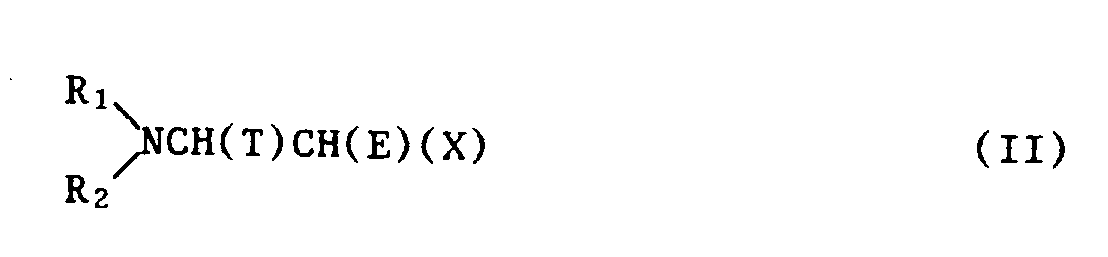
wherein R₁ and R₂ are as defined above, E is hydrogen, alkyl of 1 to 4 carbon atoms or (C₁-C₁₂alkyl)oxycarbonylmethyl, X is (C₁-C₁₂alkyl)oxycarbonyl, -CN, -CONR₃R₄,
or -PO(OC₂H₅)₂, where R₃ and R₄ are independently hydrogen or alkyl of 1 to 4 carbon atoms, and T is hydrogen or (C₁-C₁₂alkyl)oxycarbonyl, or T and X together are -CO-N(L)-CO- where L is hydrogen, alkyl of 1 to 4 carbon atoms or phenyl, with an aqueous hydrogen peroxide solution at a temperature of 15° to 50°C to give the corresponding N-oxide of the formula (III)
which undergoes the reverse Michael reaction in situ to give the compound of the formula (I) and the compound of the formula (IV),
TCH = C(E)(X) (IV)
characterized in that the compound of the formula (II) is dissolved in a lower alkanol solvent and oxidized with a molar excess of a 10 to 70 % aqueous hydrogen peroxide solution and that the compound of the formula (I) precipitates from the aqueous lower alkanol reaction medium. - The starting compound of the formula (II) is conveniently prepared by the Michael addition of a secondary dialkylamine to an alpha,beta-unsaturated compound under the influence of heat.
- The dialkylamines and the alpha,beta-unsaturated compounds are largely items of commerce or can be prepared by conventional methods.
- The meanings of the radicals T, E, and X depend on the nature of the alpha,heta-unsaturated compound used to prepare the starting Michael addition material.
- When the alpha,beta-unsaturated compound is an acrylate, methacrylate or related ester, E is hydrogen or alkyl of 1 to 4 carbon atoms, preferably methyl, T is hydrogen and X is (C₁-C₁₂alkyl)oxycarbonyl.
- The acrylates where E and T are each hydrogen and X is (C₁-C₈lkyl)oxycarbonyl are the preferred alpha,beta-unsaturated compounds.
- When the alpha,beta-unsaturated compound is an itaconate, T is hydrogen, E is (C₁-C₁₂alkyl)oxycarbonylmethyl and X is (C₁-C₁₂alkyl)oxycarbonyl.
- When the alpha,beta-unsaturated compound is an acrylonitrile or methacrylonitrile, T is hydrogen, E is hydrogen or methyl and X is -CN.
- When the alpha,beta-unsaturated compound is an acrylamide or methacrylamide, T is hydrogen, E is hydrogen or methyl and X is -CONR₃R₄ where R₃ and R₄ are independently hydrogen or alkyl of 1 to 4 carbon atoms, preferably methyl.
- When the alpha,beta-unsaturated compound is diethyl vinylphosphonate, T is hydrogen, E is hydrogen and X is -PO(OC₂H₅)₂.
- When the alpha,beta-unsaturated compound is phenyl vinyl sulfone, T is hydrogen, E is hydrogen and X is

- When the alpha,beta-unsaturated compound is a maleate or fumarate, preferably a maleate, E is hydrogen and T and X are (C₁-C₁₂alkyl)oxycarbonyl.
- When the alpha,beta-unsaturated compound is a maleimide, E is hydrogen and T and X together are -CO-N(L)-CO- where L is hydrogen, phenyl or alkyl of 1 to 4 carbon atoms, e.g. methyl, ethyl, propyl or butyl.
- Examples of (C₁-C₁₂alkyl)oxycarbonylmethyl are methoxycarbonylmethyl, ethoxycarbonylmethyl, n-butoxycarbonylmethyl, n-amyloxycarbonylmethyl, 2-ethylhexyloxycarbonylmethyl, decyloxycarbonylmethyl or dodecyloxycarbonylmethyl. (C₁-C₈alkyl)oxycarbonylmethyl is preferred.
- Examples of (C₁-C₁₂alkyl)oxycarbonyl are methoxycarbonyl, ethoxycarbonyl, n-butoxycarbonyl, n-amyloxycarbonyl, 2-ethylhexyloxycarbonyl, decyloxycarbonyl or dodecyloxycarbonyl. (C₁-C₈alkyl)oxycarbonyl is preferred.
- The instant process is carried out under mild conditions at a temperature of 15° to 50°C, preferably at ambient temperature, most preferably at 23° to 25°C.
- The oxidant in the instant process is aqueous 10 to 70 % hydrogen peroxide, preferably a 50 to 70 % aqueous hydrogen peroxide solution. A molar excess of hydrogen peroxide, e.g. up to a threefold molar excess with reference to the compound of the formula (II), can be used to assure complete conversion of the Michael addition product to the corresponding N-oxide without fear of over-oxidation of the N-oxide.
- The key aspect of the instant invention upon which the improved process is focused involves the relative solubilities of the N-oxide formed during the oxidation step and of the N,N-dialkylhydroxylamine formed therefrom when the reverse Michael addition occurs.
- By picking the proper reaction medium, the starting Michael addition material (i.e. the substituted ethylamine) and its corresponding N-oxide are rendered soluble in the reaction medium. However, when the reverse Michael reaction occurs with the N-oxide intermediate in situ, the corresponding long chain, N,N-dialkylhydroxylamine is rendered insoluble in the reaction medium and begins to precipitate from the reaction medium.
- This precipitation of desired product not only protects said product from unwanted over-oxidation problems, but also facilitates its isolation and purification.
- The N,N-dialkylhydroxylamines of the formula (I) are obtained in high yield and purity by mere filtration of the reaction mixture. Still further purification by recrystallization can be carried out if needed.
- It is thus clear that the choice of reaction medium is critical for the benefits of the instant improved product to be achieved. The important criteria are solubility of the compound of the formula (II) and its corresponding N-oxide in the reaction medium and the concomitant insolubility of the corresponding N,N-dialkylhydroxylamine in the same reaction medium. There will clearly be some minor variation in choice of reaction medium depending on which alpha,beta-unsaturated compound was originally used to prepare said ethylamine starting material.
- Since aqueous hydrogen peroxide solution is used as the oxidant and since water is present from this source as well as the by-product of the oxidation itself, a solvent with at least some water miscibility or solubility is desirable.
- The lower alkanols are the reaction medium solvents of choice such as e.g. methanol, ethanol, n-propanol, isopropanol, n-butanol, isobutanol, sec-butanol and tert-butanol. The most preferred solvent is n-butanol.
- In addition, the butyl alcohols, particularly n-butanol, provide a unique balance between water miscibility which is required to carry out the oxidation of the compound of the formula (II) while allowing for a convenient phase separation between the aqueous phase and the organic solvent phase of the reaction mixture. The phase separation allows for recycling of the starting materials which may then be recovered from the reaction filtrate. This unique two phase system allows for the safe removal of spent hydrogen peroxide and water. The n-butanol solution of amine may then be recycled using freshly added hydrogen peroxide.
- Another object of the invention is a further improved process for preparing compounds of the formula (I). Therefore, the present invention also pertains to a process for the preparation of a compound of the formula (I)

wherein R₁ and R₂ are independently alkyl of 8 to 36 carbon atoms, by oxidizing a compound of the formula (V)
wherein R₁ and R₂ are as defined above, with an aqueous hydrogen peroxide solution at a temperature of 40° to 65°C, characterized in that the compound of the formula (V) is dissolved in a lower alkanol solvent and oxidized with a molar excess of a 10 to 70 % aqueous hydrogen peroxide solution and that the compound of the formula (I) precipitates from the aqueous lower alkanol reaction medium. - The instant process is carried out under mild conditions at a temperature of 40° to 65°C, preferably at 50° to 60°C.
- The oxidant in the instant process is 10 to 70 % aqueous hydrogen peroxide, preferably a 50 to 70 % aqueous hydrogen peroxide solution. A molar excess of hydrogen peroxide, e.g. up to a threefold molar excess with reference to the compound of the formula (V), can be used to assure complete conversion of the secondary amine to the corresponding N,N-dialkylhydroxylamine without fear of over-oxidation of the product.
- The key aspect of the instant invention upon which the improved process is focused involves a facile method of preventing over-oxidation of the N,N-dialkylhydroxylamine formed. This occurs because of the relative solubilities of the starting secondary dialkylamine and the product formed during the oxidation reaction when it is carried out in an aqueous lower alkanol reaction medium.
- The secondary dialkylamine is soluble in the reaction medium, but the corresponding long-chain N,N-dialkylhydroxylamine formed is insoluble in the reaction medium and precipitates from the reaction medium as it is formed.
- This precipitation of desired product not only protects said product from unwanted over-oxidation problems, but also facilitates its isolation and purification.
- The instant N,N-dialkylhydroxylamines are obtained in high yield and purity by mere filtration of the reaction mixture. Still further purification by recrystallization can be carried out if needed.
- It is thus clear that the choice of reaction medium is critical for the benefits of the instant improved process to be achieved. The important criteria are solubility of long chain secondary dialkylamine in the reaction medium and the concomitant insolubility of the corresponding N,N-dialkylhydroxylamine in the same reaction medium. There will clearly be some minor variation in choice of reaction medium depending on which specific long chain dialkylamine is used.
- Since aqueous hydrogen peroxide solution is used as the oxidant and since water is present from this source as well as the by-product of the oxidation itself, a solvent with at least some water miscibility or solubility is desirable.
- The lower alkanols are the reaction medium solvents of choice such as e.g. methanol, ethanol, n-propanol, isopropanol, n-butanol, isobutanol, sec-butanol and tert-butanol. The most preferred solvents are n-butanol and tert-butanol.
- In addition, the butyl alcohols, particularly n-butanol, provide a unique balance between water miscibility which is required to carry out the oxidation of the long chain N,N-dialkylamines while allowing for a convenient phase separation between the aqueous phase and the organic solvent phase of the reaction mixture. The phase separation facilitates recycling of the starting materials which may be recovered from the reaction filtrate.
- The starting materials are largely items of commerce or can be prepared by conventional methods.
- A mixture of 49.4 g (0.1 mol) of di(hydrogenated tallow)amine (eq. wt. of 494 g/mol) and 9 ml (0.1 mol) of methyl acrylate are heated to reflux. Upon completion of the addition reaction, as determined by the complete disappearance of the starting amine by thin layer chromatography (TLC) analysis, the mixture is cooled. The volatiles are removed in vacuo to give 54.4 g (94 % yield) of the above-named product as a yellow oil.
- IR (methylene cloride) Vc=o 1735 cm⁻¹.
Analysis: Calculated for C₃₈H₇₇NO₂: C, 78.7; H, 13.4; N, 2.4. Found: C, 78.8; H, 13.4; N, 2.4. - Into a solution of 29 g (0.05 mol) of the product of Example 1 in 200 ml of isopropanol is added 2.4 ml (0.063 mol) of 70 % aqueous hydrogen peroxide solution. After stirring at 23-25°C for 1 hour, an additional 1.2 ml (0.031 mol) of a 70 % aqueous hydrogen peroxide solution is added. After stirring for another 1 hour at 23-25°C, another additional 1.2 ml (0.031 mol) of 70 % aqueous hydrogen peroxide is added. After a total of 18 hours stirring at 23-25°C, the product is isolated by filtration and washed with isopropanol to give 20.9 g (82 % yield) of white solid melting at 88-90°C.
- The product (19 g) is recrystallized from 300 ml of isopropanol to give 13.1 g (69 % recovery) of the above-named product as a white solid melting at 93-95°C.
Analysis: Calculated for C₃₄H₇₁NO: C, 80.1; H, 14.0; N, 2.8. Found: C, 80.0; H, 14.3; N, 2.9. - Following the general procedure of Example 1, 52.2 g (0.105 mol) of di(hydrogenated tallow)amine (eq. wt. of 494 g/mol) and 18.4 g (0.1 mol) of 2-ethylhexyl acrylate are reacted. The reaction product is purified by high pressure liquid chromatography (HPLC) using hexane and ethyl acetate solvents on silica gel to give 40.6 g (60 % yield) of the above-named product as a colorless oil.
- IR (methylene cloride) Vc=o 1735 cm⁻¹.
- Using the general procedure of Example 2, 29.7 g (0.044 mol) of the product of Example 3 in 125 ml of isopropanol is oxidized using 2.5 ml (0.065 mol) of 70 % aqueous hydrogen peroxide to yield 16.3 g (73 % yield) of the above-named product as a white solid melting at 93-96°C.
- From the HPLC purification, using hexane and ethyl acetate solvents, of the filtrate, 4.4 g (48 % yield) of 2-ethylhexyl acrylate is recovered.
- Following the general procedure of Example 1, 75 g (0.21 mol) of didodecylamine and 19.1 ml (0.21) of methyl acrylate are reacted to give 92.6 g (quantitative yield) of the above-named product as a yellow oil.
- This oil (5.0 g) is purified by column chromatography using hexane and ethyl acetate solvents on silica gel to give 4.9 g (98 % recovery) of a colorless oil.
Analysis: Calculated for C₂₈H₅₇NO₂: C, 76.5; H, 13.1; N, 3.2. Found: C, 76.6; H, 13.0; N, 3.1. - Using the general procedure of Example 2, 87.6 g (0.2 mol) of the product of Example 5 in 800 ml of isopropanol is oxidized using 9.7 ml (0.25 mol) of 70 % aqueous hydrogen peroxide solution to give 32.1 g (44 % yield) of the above-named product as a white solid melting at 85-86°C.
Analysis: Calculated for C₂₄H₅₁NO: C, 78.0; H, 13.9; N, 3.8. Found: C, 78.4; H, 13.5; N, 3.7. - Following the general procedure of Example 1, 50.4 g (0.123 mol) of ditetradecylamine and 11.1 ml (0.123 mol) of methyl acrylate are reacted to give 62.6 g (quantitative yield) of the above-named product as a yellow oil.
- This oil (5.0 g) is purified by column chromatography using hexane and ethyl acetate solvents on silica gel to give 4.9 g of a colorless oil.
Analysis: Calculated for C₃₂H₆₅NO₂: C, 77.5; H, 13.2; N, 2.8. Found: C, 77.8; H, 13.4; N, 3.0. - Using the general procedure of Example 2, 57.5 g (0.116 mol) of the product of Example 7 in 450 ml of isopropanol is oxidized using 5.6 ml (0.15 mol) of 70 % aqueous hydrogen peroxide solution to give 21.5 g (44 % yield) of the above-named product as a white solid melting at 94-96°C.
Analysis: Calculated for C₂₈H₅₉NO: C, 79.0; H, 14.0; N, 3.3. Found: C, 79.2; H, 14.0; N, 3.2. - Into a solution of 100 g (0.18 mol) of di(hydrogenated tallow)amine (494 eq. wt., 90 % secondary amine) in 400 ml of n-butanol at 55°C is added 8.6 ml (0.22 mol) of 70 % aqueous hydrogen peroxide solution. The reaction is complete when all the hydrogen peroxide is consumed as determined by titration of an aliquot of the reaction mixture with potassium iodide/sulfuric acid/sodium thiosulfate.
- The above-named product is isolated from the reaction mixture by filtration. The filter cake is washed with two 50 ml portions of n-butanol at 55°C; then dried to give the desired product in a yield of 63 g (68 %) as a white solid melting at 93-96°C.
- Following the general procedure of Example 9, to a solution of 52.6 g (0.09 mol) of di(hydrogenated tallow)amine (526 eq. wt., 90 % secondary amine) dissolved in 200 ml of n-butanol at 55°C is added 5.3 ml (0.14 mol) of 70 % aqueous hydrogen peroxide solution. During the course of the reaction three additional 0.5 ml (0.01 mol) portions of 70 % aqueous hydrogen peroxide solution are added after 22, 24 and 72 hours.
- The progress of the reaction is followed by thin layer chromatography (TLC) (silica gel; chloroform/acetic acid 98/2). The reaction is complete when all the starting amine has disappeared as determined by the TLC analysis.
- The above-named product is isolated from the reaction mixture by filtration. The filter cake is washed with 100 ml of n-butanol at 55°C, and then with two 200 ml portions of methanol at ambient temperature to give the desired product in a yield of 27.6 g (57 %) as a white solid melting at 98-100°C.
- Following the general procedure of Example 9, to 200 g (0.36 mol) of di(hydrogenated tallow)amine (494 eq. wt., 90 % secondary amine) suspended in 800 ml of ethanol at 55°C is added 29.4 ml (0.77 mol) of 70 % aqueous hydrogen peroxide solution. After stirring for 18 hours at 55°C, the reaction mixture is filtered and the moist filter cake is recrystallized from 1000 ml of hexane. The recrystallized material is washed with 500 ml of hexane at 55°C. The above-named product is obtained in a yield of 123 g (66 %) as a white solid melting at 90-93°C.
- The general procedure of Example 11 is followed using 100 g (0.19 mol) of dihexadecylamine (451 eq. wt., 88 % secondary amine), 30.2 (0,44 mol) of 50 % aqueous hydrogen peroxide solution and 400 ml of ethanol. After stirring for 48 hours, the reaction mixture is filtered to give the above-named product which is twice recrystallized from 500 ml of chloroform. The desired product is obtained in a yield of 29.4 g (32 %) as white needles melting at 97-99°C.
Analysis: Calculated for C₃₂H₆₇NO: C, 79.8; H, 14.0; N, 2.0. Found: C, 79.5; H, 14.0; N, 2.7. - Following the general procedure of Example 12, to a solution of 50 g (0.14 mol) of didodecylamine dissolved in 200 ml of n-propanol at 40°C is added dropwise 9.62 g (0.14 mol) of 50 % aqueous hydrogen peroxide solution. After 72 hours at 40-45°C, the reaction mixture is filtered to give a crude product which is subsequently recrystallized from 300 ml of hexane. The above-named product is obtained in a yield of 24.8 g (48 %) as white needles melting at 90-92°C.
Analysis: Calculated for C₂₄H₅₁NO: C, 78.0; H, 13.9; N, 3.8. Found: C, 78.0; H, 14.2; N, 3.7. - The general procedure of Example 12 is followed using at 50° to 55°C 50 g (0.12 mol) of ditetradecylamine, 200 ml of n-propanol and 8.3 g (0.12 mol) of 50 % aqueous hydrogen peroxide solution. The above-named product is obtained in a yield of 33.4 g (64 %) as white needles melting at 97-99°C.
- A 25 % wt/vol suspension of di(hydrogenated tallow)amine (494 eq. wt.; 90 % secondary amine) in an alcohol solution is treated with the indicated equivalents of aqueous hydrogen peroxide solution and at the indicated temperature. After the indicated time, the reaction mixture is cooled and the product mixture isolated by filtration. The composition of the dried product mixture is determined by inspection of its XL 200 ¹H NMR spectrum. The results are tabulated below.
Table 1 Alkanol Equivalents of Aqueous H₂O₂ Temp. Time Relative Mole Ratio by ¹H NMR*) Hydroxylamine/Amine/Nitrone Methanol 2.1 60°C 24 h 50 / 50 / <5 Ethanol 2.0 55°C 5 h 50 / 50 / <5 Isopropanol 1.0 60°C 4 h 40 / 60 / <5 n-Butanol 1.0 50°C 24 h 70 / 30 / <5 tert-Butanol 1.0 65°C 48 h 90 / 10 / <5 *) Limits of detection are approximately 5 mol % and the value of less than 5 mol % is assigned to a component, if it is not detected in the ¹H NMR spectrum. - Into a warm solution of 49.5 g of di(hydrogenated tallow)amine (494 eq. wt.; 90 % secondary amine; 0.09 mol) in 200 ml of n-butanol at 54° to 55°C is added 6.8 g (0.1 mol) of 50 % aqueous hydrogen peroxide solution. After 6 hours at 54° to 55°C, the reaction mixture is filtered through a fritted glass funnel while the reaction mass is warm. The reaction filtrate is allowed to cool and is diluted with 400 ml of methanol. A second crop is collected from the diluted filtrate. Finally, the reaction filtrate is diluted with 400 ml of water and third crop is collected. The three reaction filter cakes are dried separately and analyzed by ¹H NMR and LC. The results of the analysis are summarized in Table 2.

- Unstabilized poly(phenylene sulfide) (®Ryton #62515, Phillips Petroleum Co.) is dry blended with designated amount in parts per hundred weight (phr) of the test additive. 50 g of the blend of poly(phenylene sulfide) and additive are added to a Brabender Plasticorder which has been preheated to 325°C for three minutes.
- The Plasticorder is operated at 325°C at 60 rpm in the Torque Range of 0 to 10 Nm and the increase in torque as a function of time is determined. The time for the measured torque to reach a value of 1.5 Nm above the minimum value is taken as the time required for undesired crosslinking and concomitant polymer degradation to begin.
- The results are shown in Table 3. High numbers indicate a delay in the time required for poly(phenylene sulfide) to thermally degrade and crosslink. Accordingly, high numbers indicate a good process stabilization.
Table 3 Additive Additive Concentration (phr) Time (min) to Reach torque of 1.5 Nm over Minimum Torque none -- 8.5 N,N-Dioctylhydroxylamine **) 1.0 32 N,N-Didodecylhydroxylamine 1.0 40 N,N-Di(hydrogenated tallow)hydroxylamine *) 1.0 39 N,N-Dioctylhydroxylamine **) 0.5 17.5 N,N-Didodecylhydroxylamine 0.5 20.75 N,N-Di(hydrogenated tallow)hydroxylamine *) 0.5 19 N,N-Di(hydrogenated tallow)hydroxylamine *) 2.0 69 Combination neopentanetetrayl tetrakis[3,5-di-tert-butyl-4-hydroxyhydrocinnamate] / N,N-di(hydrogenated tallow)hydroxylamine*) 0.5/0.5 28.5 *)Hydroxylamine of Example 9 **)comparison - Following the general procedure of Example 17, but operating the Brabender Plasticorder at 375°C, the ability of the test additives at a concentration of 1 % by weight to prevent the thermal degradation and crosslinking of poly(phenylene sulfide) under these still more rigorous higher temperature conditions is measured.
- The results are shown in Table 4.
Table 4 Additive Time (min) to Reach Torque of 1.5 Nm over Minimum Torque none 5 1 % of N,N-dioctylhydroxylamine **) 8 1 % of N,N-didodecylhydroxylamine 10 1 % of N,N-di(hydrogenated tallow)hydroxylamine 18 (High values indicate good process stabilization) ** comparison - A solution polymerized copolymer of styrene and butadiene with a butadiene content of about 24 % (®K-Resin, Phillips) is mixed in a Brabender Plasticorder for one minute at 250°C. The copolymer contains 1.0 % by weight of tris[nonylphenyl] phosphite as added by the manufacturer. The stabilizer N,N-di(hydrogenated tallow)hydroxylamine is dry blended into the styrene/butadiene copolymer at the indicated weight concentrations.
- The Plasticorder is operated at 90 rpm in the Torque Range of 1 to 10 Nm, and the increase in torque as a function of time is determined. The time for the measured torque to increase 0.04 Nm above the minimum value is taken as the time needed to the onset of crosslinking.
- The results are shown in Table 5.
Table 5 Additive Time (min) to Reach Torque of 0.04 Nm over Minimum Torque 1 % of tris[nonylphenyl] phosphite 12 1 % of tris[nonylphenyl] phosphite + 0.1 % of N,N-di(hydrogenated tallow)hydroxylamine 30 (High values indicate good process stabilization) - Following the general method described in Example 19, the stabilizer additives are first incorporated into a solution of 100 g of the styrene/butadiene copolymer (®K-resin, Phillips) in 300 ml of cyclohexane and thoroughly mixed. The cyclohexane solvent is removed under reduced pressure at 40°C to give the solid stabilized resin which is then treated in the Brabender Plasticorder as described in Example 19.
- The time required for the onset of crosslinking is determined as in Example 19. Additionally, samples of each formulation are taken from the Plasticorder as soon as the stabilized polymer is thoroughly mixed. These samples are converted into plaques which are exposed to the Xenon Arc Weather-Ometer for 168 hours or exposed to gamma irradiation (Co 60, 4 Mrad exposure). The color as measured by the Hunter b value method for each sample is ascertained. Higher b color values indicate more color formation.
- The results are shown in Table 6.

- Using the procedure described in Example 20 and using a different batch of styrene/butadiene copolymer (®K-resin, Phillips) which contained 0.5 % by weight of tris[nonylphenyl] phosphite as received, the time for onset of crosslinking and the colors developed after exposure to 168 hours in the Xenon Arc Weather-Ometer and after exposure to 2.5 Mrad of gamma irradiation are ascertained using polymer stabilized with a number of different stabilizer combinations.
- The results are shown in Table 7.

- Following the general procedure of Example 20, unstabilized polybutadiene having a low cis content (®Diene 55, Firestone) is admixed with the indicated amount of the N,N-di(hydrogenated tallow)hydroxylamine.
- Samples (3 cm x 3 cm x 10 mm) are prepared from the polymer by compression molding (100°C for 1 minute). The samples are placed in a 70°C oven till the gel content reaches 15 % as measured by the weight of toluene insoluble material retained on a 40 mesh screen. The time required for this level of gel to be attained is measured in days.
- The results are shown in Table 8.
Table 8 Additive Time to Reach Aging at 70°C 15 % Gel on Oven (days) none 7 0.25 % of N,N-di(hydrogenated tallow)hydroxylamine 22 - Additionally the time to the onset of crosslinking in the Brabender Plasticorder at 190°C is measured.
- The results are shown in Table 9.
Table 9 Additive Time (min) to Reach Torque of 0.04 Nm over Minimum Torque none 1.0 0.1 % of N,N-di(hydrogenated tallow) hydroxylamine 7.0 0.25 % of N,N-di(hydrogenated tallow) hydroxylamine 14.0 0.50 % of N,N-di(hydrogenated tallow) hydroxylamine 22.0 - The addition of the instant hydroxylamine to the polybutadiene dramatically increased the time required for crosslinking or for gelation to occur.
Claims (25)
- A composition comprising an organic material subject to thermal, oxidative or actinic degradation and at least one compound of the formula (I)

- A composition according to claim 1 wherein R₁ and R₂ are each dodecyl, tetradecyl, hexadecyl or octadecyl.
- A composition according to claim 1 wherein R₁ is hexadecyl and R₂ is tetradecyl, heptadecyl or octadecyl.
- A composition according to claim 1 wherein R₁ is heptadecyl and R₂ is octadecyl.
- A composition according to claim 1 wherein R₁ and R₂ are octadecyl.
- A composition according to claim 1 wherein R₁ and R₂ are the alkyl mixture found in di(hydrogenated tallow) amine.
- A composition according to claim 1 wherein the poly(arylene sulfide) resin is poly(p-phenylene sulfide).
- A composition according to claim 1 wherein the modified polystyrene is impact polystyrene (IPS).
- A composition according to claim 1 wherein the polymer containing a diene component is an elastomer.
- A composition according to claim 9 wherein the elastomer is polybutadiene, polyisoprene, ethylene/propylene/diene terpolymer, isoprene/isobutylene copolymer or acrylonitrile/butadiene copolymer.
- A composition according to claim 9 wherein the elastomer is polybutadiene.
- A composition according to claim 1 wherein the polymer containing a diene component is a styrene copolymer, a styrene block copolymer or a styrene terpolymer.
- A composition according to claim 1 wherein the polymer containing a diene component is styrene/butadiene copolymer, styrene/butadiene block copolymer, styrene/isoprene copolymer, styrene/isoprene block copolymer or acrylonitrile/butadiene/styrene (ABS).
- A composition according to claim 12 wherein the styrene block copolymer is a thermoplastic elastomer.
- A method for stabilizing a poly(arylene sulfide) resin, a modified polystyrene or a polymer containing a diene component against thermal, oxidative or actinic degradation, which comprises incorporating into the material to be stabilized at least one compound of the formula (I)

- A process for the preparation of a compound of the formula (I)


TCH = C(E)(X) (IV)
characterized in that the compound of the formula (II) is dissolved in a lower alkanol solvent and oxidized with a molar excess of a 10 to 70 % aqueous hydrogen peroxide solution and that the compound of the formula (I) precipitates from the aqueous lower alkanol reaction medium. - A process according to claim 16 wherein T is hydrogen, E is hydrogen and X is (C₁-C₈alkyl)oxycarbonyl.
- A process according to claim 16 which is carried out at ambient temperature.
- A process according to claim 16 which is carried out at 23° to 25°C.
- A process according to claim 16 wherein a 50 to 70 % aqueous hydrogen peroxide solution is used as an oxidant.
- A process according to claim 16 wherein the lower alkanol solvent is n-butanol.
- A process for the preparation of a compound of the formula (I)


- A process according to claim 22 which is carried out at 50° to 60°C.
- A process according to claim 22 wherein a 50 to 70 % aqueous hydrogen peroxide solution is used as an oxidant.
- A process according to claim 22 wherein the lower alkanol solvent is n-butanol or tert-butanol.
Applications Claiming Priority (2)
| Application Number | Priority Date | Filing Date | Title |
|---|---|---|---|
| US07/036,939 US4782105A (en) | 1987-04-10 | 1987-04-10 | Long chain N,N,-dialkylhydroxylamines and stabilized compositions |
| US36939 | 1987-04-10 |
Publications (3)
| Publication Number | Publication Date |
|---|---|
| EP0286596A2 EP0286596A2 (en) | 1988-10-12 |
| EP0286596A3 EP0286596A3 (en) | 1990-01-24 |
| EP0286596B1 true EP0286596B1 (en) | 1995-06-21 |
Family
ID=21891527
Family Applications (1)
| Application Number | Title | Priority Date | Filing Date |
|---|---|---|---|
| EP88810220A Expired - Lifetime EP0286596B1 (en) | 1987-04-10 | 1988-03-31 | Use of n,n-dialkylhydroxylamines and their preparation |
Country Status (9)
| Country | Link |
|---|---|
| US (1) | US4782105A (en) |
| EP (1) | EP0286596B1 (en) |
| JP (2) | JP2567656B2 (en) |
| BR (1) | BR8801687A (en) |
| CA (1) | CA1325224C (en) |
| DE (1) | DE3854013T2 (en) |
| ES (1) | ES2074056T3 (en) |
| HK (1) | HK1000210A1 (en) |
| ZA (1) | ZA882452B (en) |
Families Citing this family (37)
| Publication number | Priority date | Publication date | Assignee | Title |
|---|---|---|---|---|
| US5021479A (en) * | 1987-10-26 | 1991-06-04 | Ciba-Geigy Corporation | Substituted hydroxylamine ester stabilizers |
| US4894398A (en) * | 1987-11-13 | 1990-01-16 | Dow Corning Corporation | Method for stabilizing unsaturated organosilicone compositions |
| IT1237126B (en) * | 1989-11-07 | 1993-05-18 | Ciba Geigy Spa | POLYMERIC STABILIZERS CONTAINING PREVENTED AMINE GROUPS AND HYDROXYLAMIN GROUPS |
| US5045583A (en) * | 1990-04-24 | 1991-09-03 | Ciba-Geigy Corporation | O-alkenyl substituted hydroxylamine stabilizers |
| US5290888A (en) * | 1990-07-20 | 1994-03-01 | Ciba-Geigy Corporation | Process for stabilizing ethylenically unsaturated compounds and stabilized monomer compositions |
| US5258138A (en) * | 1990-07-20 | 1993-11-02 | Ciba-Geigy Corporation | Process for stabilizing ethylenically unsaturated compounds and stabilized monomer compositions |
| US5144075A (en) * | 1991-01-17 | 1992-09-01 | Ciba-Geigy Corporation | Process for the preparation of n,n-dihydrocarbylhydroxylamines |
| US5185448A (en) * | 1991-05-07 | 1993-02-09 | Ciba-Geigy Corporation | Substituted 1-oxy-4-acyloxypiperidine and 1-oxy-4-acylaminopiperidine stabilizers |
| US5262538A (en) * | 1991-05-07 | 1993-11-16 | Ciba-Geigy Corporation | Substituted 1-hydroxy-2,6-diaryl-4-acyloxypiperidines or 1-hydroxy-2,6-diaryl-4-acylaminopiperidines and stabilized compositions |
| US5180829A (en) * | 1991-05-07 | 1993-01-19 | Ciba-Geigy Corporation | Substituted 1-hydroxy-2,6-diaryl-4-acyloxypiperidines or 1-hydroxy-2,6-diaryl-4-acylaminopiperidines and stabilized compositions |
| US5235056A (en) * | 1992-04-22 | 1993-08-10 | Ciba-Geigy Corporation | Substituted 1-hydroxy-2,6-diaryl-4-piperidone ketals and polymer compositions stabilized therewith |
| US5270369A (en) * | 1992-10-21 | 1993-12-14 | Phillips Petroleum Company | Additive to improve polymer clarity and viscosity |
| US5596033A (en) * | 1993-04-15 | 1997-01-21 | Ciba-Geigy Corporation | Gas fade resistant stabilizer system for polypropylene fiber |
| US5844029A (en) * | 1995-09-25 | 1998-12-01 | General Electric Company | Polymer compositions containing hydrocarbon amine oxide and hydrocarbon amine oxide stabilizer compositions |
| US5866718A (en) * | 1997-03-20 | 1999-02-02 | General Electric Company | Synthesis of tertiary amine oxides |
| JP4093612B2 (en) * | 1997-05-29 | 2008-06-04 | 富士フイルム株式会社 | Process for producing N, N-disubstituted hydroxylamines |
| US6444733B1 (en) | 1999-03-01 | 2002-09-03 | Ciba Specialty Chemicals Corporation | Stabilizer combination for the rotomolding process |
| NL1014465C2 (en) * | 1999-03-01 | 2002-01-29 | Ciba Sc Holding Ag | Stabilizer combination for the rotomolding process. |
| US6664317B2 (en) * | 2000-02-18 | 2003-12-16 | Ciba Specialty Chemicals Corporation | Stabilized gamma irradiated polyolefins |
| US6723255B2 (en) * | 2000-03-07 | 2004-04-20 | Atofina Chemicals, Inc. | Compositions for shortstopping free radical emulsion polymerizations and stabilizing latices made therefrom |
| US20020198297A1 (en) * | 2001-03-02 | 2002-12-26 | Odorisio Paul A. | Polyester and polyamide compositions of low residual aldehyde content |
| US6908650B2 (en) * | 2001-03-02 | 2005-06-21 | Ciba Specialty Chemicals Corporation | Polyester and polyamide compositions of low residual aldehyde content |
| EP1379584B1 (en) * | 2001-03-20 | 2005-08-24 | Ciba Specialty Chemicals Holding Inc. | Flame retardant compositions |
| WO2004024810A2 (en) * | 2002-09-11 | 2004-03-25 | Ciba, Specialty Chemicals Holding Inc. | Stabillization of organic materials |
| AU2003303818A1 (en) * | 2003-01-29 | 2004-08-23 | Ciba Specialty Chemicals Holding Inc. | Ink-jet ink and recording material |
| WO2005041905A2 (en) * | 2003-10-30 | 2005-05-12 | Ciba Specialty Chemicals Holding Inc. | Stabilized body care products, household products, textiles and fabrics |
| US7291669B2 (en) * | 2004-03-16 | 2007-11-06 | Ciba Specialty Chemicals Corporation | Stabilized polyolefin compositions |
| JP2009209216A (en) * | 2008-02-29 | 2009-09-17 | Fujifilm Corp | Electro-conductive polymer composition and electrode material |
| EP2230226B1 (en) | 2009-03-18 | 2017-01-18 | Infineum International Limited | Additives for fuel oils |
| US9238716B2 (en) | 2011-03-28 | 2016-01-19 | Massachusetts Institute Of Technology | Conjugated lipomers and uses thereof |
| CN102888109A (en) * | 2011-07-18 | 2013-01-23 | 四川得阳特种新材有限公司 | Manufacturing method of fiberglass-containing polyphenylene sulfide composite granulates |
| CN102888110B (en) * | 2011-07-18 | 2024-03-22 | 四川得阳特种新材料有限公司 | A method for manufacturing polyphenylene sulfide composite granules containing toughening materials |
| KR20150000461A (en) * | 2011-10-27 | 2015-01-02 | 메사추세츠 인스티튜트 오브 테크놀로지 | Amino acid derivatives functionalized on the n-terminal capable of forming drug incapsulating microspheres |
| CN102942725B (en) * | 2012-10-31 | 2015-09-30 | 营口市风光化工有限公司 | A kind ofly provide the composition of thermostability for polyolefine |
| CN102952308B (en) * | 2012-10-31 | 2014-10-29 | 营口市风光化工有限公司 | Anti-oxygen acid removing agent for polyolefins, and preparation method thereof |
| WO2016109789A1 (en) | 2014-12-31 | 2016-07-07 | Basf Se | Candle wax compositions stabilized with uv absorbers and select hindered amine light stabilizers |
| FR3080437B1 (en) * | 2018-04-24 | 2020-04-17 | Safran Aircraft Engines | INJECTION SYSTEM FOR A TURBOMACHINE ANNULAR COMBUSTION CHAMBER |
Family Cites Families (29)
| Publication number | Priority date | Publication date | Assignee | Title |
|---|---|---|---|---|
| NL131752C (en) * | 1960-09-08 | |||
| NL296169A (en) * | 1962-08-14 | |||
| US3341487A (en) * | 1964-07-21 | 1967-09-12 | Pennsalt Chemicals Corp | Process for stopping emulsion polymerizations by the addition of dithiocarbamate salts and alkyl hydroxyl amines |
| US3432578A (en) * | 1964-10-05 | 1969-03-11 | Shell Oil Co | Conjugated diene polymer compositions stabilized with certain hydroxylamines |
| US3408422A (en) * | 1964-11-04 | 1968-10-29 | Shell Oil Co | Stabilization of unsaturated polyesters and resulting products |
| US3418295A (en) * | 1965-04-27 | 1968-12-24 | Du Pont | Polymers and their preparation |
| US3697470A (en) * | 1969-05-21 | 1972-10-10 | Dorothy S Albert | N-alkyl-n-arylhydroxylamines as shortstopping agents and popcorn polymer inhibitors |
| US3644244A (en) * | 1969-12-15 | 1972-02-22 | Du Pont | Polybutadiene-polynitrile graft copolymer dispersions stabilized with hydroxylamines |
| US3818006A (en) * | 1971-04-13 | 1974-06-18 | P Klemchuk | N-hydroxy-amino-s-triazines |
| US3770847A (en) * | 1971-12-30 | 1973-11-06 | Stauffer Chemical Co | Curable organopolysiloxanes |
| NL7205492A (en) * | 1972-04-24 | 1973-10-26 | ||
| DE2301158A1 (en) * | 1973-01-11 | 1974-07-18 | Bayer Ag | EMULSION POLYMERIZATION OF CHLOROPRENE WITH DIAETHYLHYDROXYLAMINE AS A DESACTIVATOR |
| US4242224A (en) * | 1979-08-17 | 1980-12-30 | The Goodyear Tire & Rubber Company | Color stabilization of amine antioxidant and antiozonant emulsions |
| US4298678A (en) * | 1980-08-14 | 1981-11-03 | E. I. Du Pont De Nemours And Company | Photosensitive compositions and elements containing substituted hydroxylamine |
| US4316996A (en) * | 1980-11-17 | 1982-02-23 | The Goodyear Tire & Rubber Company | Discoloration prevention of phenolic antioxidants |
| US4547532A (en) * | 1982-04-02 | 1985-10-15 | M&T Chemicals Inc. | Antifouling paint |
| US4434122A (en) * | 1982-05-11 | 1984-02-28 | Phillips Petroleum Company | Polymer stabilization |
| US4543224A (en) * | 1982-05-11 | 1985-09-24 | Phillips Petroleum Company | Polymer stabilization |
| US4411853A (en) * | 1982-05-11 | 1983-10-25 | Phillips Petroleum Company | Polymer stabilization |
| US4478969A (en) * | 1982-05-11 | 1984-10-23 | Phillips Petroleum Company | Polymer stabilization |
| US4418029A (en) * | 1982-05-11 | 1983-11-29 | Phillips Petroleum Company | Stabilized polyphenylene sulfide fiber |
| US4412062A (en) * | 1982-06-25 | 1983-10-25 | Phillips Petroleum Company | Polymer stabilization |
| US4405745A (en) * | 1982-09-24 | 1983-09-20 | Phillips Petroleum Company | Polymer stabilization |
| US4409408A (en) * | 1982-09-24 | 1983-10-11 | Atlantic Richfield Company | Inhibiting polymerization of vinyl aromatic monomers |
| US4413081A (en) * | 1983-02-01 | 1983-11-01 | Phillips Petroleum Company | Polymer stabilization |
| US4590231A (en) * | 1983-10-11 | 1986-05-20 | Ciba-Geigy Corporation | Polyolefin compositions stabilized against degradation using hydroxylamine derivatives |
| US4649221A (en) * | 1984-07-23 | 1987-03-10 | Ciba-Geigy Corporation | Polyhydroxylamines |
| US4612393A (en) * | 1985-04-29 | 1986-09-16 | Ciba-Geigy Corporation | Bis(substituted thioalkyl)hydroxylamines and stabilized polyolefin compositions |
| US4696964A (en) * | 1986-04-11 | 1987-09-29 | Ciba-Geigy Corporation | Compositions stabilized with ethers of di- and tri-substituted hydroxylamines |
-
1987
- 1987-04-10 US US07/036,939 patent/US4782105A/en not_active Expired - Lifetime
-
1988
- 1988-03-31 ES ES88810220T patent/ES2074056T3/en not_active Expired - Lifetime
- 1988-03-31 EP EP88810220A patent/EP0286596B1/en not_active Expired - Lifetime
- 1988-03-31 DE DE3854013T patent/DE3854013T2/en not_active Expired - Lifetime
- 1988-04-08 ZA ZA882452A patent/ZA882452B/en unknown
- 1988-04-08 CA CA000563617A patent/CA1325224C/en not_active Expired - Lifetime
- 1988-04-08 BR BR8801687A patent/BR8801687A/en unknown
- 1988-04-11 JP JP63088864A patent/JP2567656B2/en not_active Expired - Lifetime
-
1996
- 1996-04-17 JP JP8119691A patent/JP2688598B2/en not_active Expired - Lifetime
-
1997
- 1997-09-05 HK HK97101729A patent/HK1000210A1/en not_active IP Right Cessation
Non-Patent Citations (1)
| Title |
|---|
| "Römpp Chemie Lexikon, 9.Auflage, S. 3559 * |
Also Published As
| Publication number | Publication date |
|---|---|
| DE3854013D1 (en) | 1995-07-27 |
| ZA882452B (en) | 1988-10-11 |
| DE3854013T2 (en) | 1995-10-26 |
| BR8801687A (en) | 1988-11-16 |
| JP2567656B2 (en) | 1996-12-25 |
| EP0286596A3 (en) | 1990-01-24 |
| CA1325224C (en) | 1993-12-14 |
| HK1000210A1 (en) | 1998-02-06 |
| ES2074056T3 (en) | 1995-09-01 |
| JP2688598B2 (en) | 1997-12-10 |
| JPS63258833A (en) | 1988-10-26 |
| JPH09124573A (en) | 1997-05-13 |
| US4782105A (en) | 1988-11-01 |
| EP0286596A2 (en) | 1988-10-12 |
Similar Documents
| Publication | Publication Date | Title |
|---|---|---|
| HK1000210B (en) | Use of n, n-dialkylhydroxylamines and their preparation | |
| HK1000210A1 (en) | Use of n, n-dialkylhydroxylamines and their preparation | |
| EP0323409B1 (en) | Polyolefin compositions stabilized with long chain N,N-dialkylhydroxylamines | |
| EP0322166B1 (en) | Phenolic compound and its use as a stabilizer for butadiene polymer | |
| US4525514A (en) | Stabilizer for polymeric substance and polymeric substance composition containing the same | |
| EP0410351A1 (en) | Curable mixtures of fluoroelastomers containing bromine or iodine and of organic peroxides | |
| EP0022749B1 (en) | Alcanolamid-beta-ketocarboxylic acid esters and their use as stabilizers for chlorine-containing thermoplastics | |
| CA1048537A (en) | METAL SALTS OF N,N-DISUBSTITUTED .beta.-ALANINES AND STABILIZED COMPOSITIONS | |
| JP3424080B2 (en) | Low color processing, heat and light stabilizer system for polypropylene fibers | |
| US4279804A (en) | Piperidine compounds and their use as stabilizers for synthetic polymers | |
| JPH11172229A (en) | 4-hydroxyquinoline-3-carboxylic acid derivative as light stabilizer | |
| DE602004002090T2 (en) | PROPER STERICIALLY PREVENTED AMINE WITH LIGHT PROTECTION (HINDERED AMIN LIGHT STABILIZERS) | |
| US4634728A (en) | Polyol carboxyalkylthioalkanoamidophenol compounds and organic material stabilized therewith | |
| US4116930A (en) | Pyromellitic dimiides of 3,5-dialkyl-4-hydroxyphenylsubstituted amines | |
| EP0049166A1 (en) | Hydrolytically stable diphosphites useful as antioxidants | |
| JP2764282B2 (en) | Long-chain N-alkyl-α-alkyl nitrones and their use as stabilizers | |
| EP0414916B1 (en) | Phosphite compound and application thereof | |
| CA1270840A (en) | Triazole derivatives and the use thereof for stabilising organic polymers | |
| US4104251A (en) | Substituted tetraalkylpiperidone-4-oximes | |
| US4569959A (en) | Isocyanurate esters of thioamidophenols and polyolefin polymeric compositions stabilized therewith | |
| EP0240463A2 (en) | Substituted aminooxypropion amides | |
| EP0275449B1 (en) | Rubber compositions containing amine derivatives of 1,3,4,-thiadiazole | |
| JPS6138214B2 (en) | ||
| US3883476A (en) | Pyromellitic diimides of 3,5-dialkyl-4-hydroxyphenylsubstituted amines | |
| US4680325A (en) | Anti-oxidant isocyanurate ester of thioamidophenol and polyolefins stabilized therewith |
Legal Events
| Date | Code | Title | Description |
|---|---|---|---|
| PUAI | Public reference made under article 153(3) epc to a published international application that has entered the european phase |
Free format text: ORIGINAL CODE: 0009012 |
|
| 17P | Request for examination filed |
Effective date: 19880402 |
|
| AK | Designated contracting states |
Kind code of ref document: A2 Designated state(s): BE CH DE ES FR GB IT LI NL |
|
| PUAL | Search report despatched |
Free format text: ORIGINAL CODE: 0009013 |
|
| AK | Designated contracting states |
Kind code of ref document: A3 Designated state(s): BE CH DE ES FR GB IT LI NL |
|
| 17Q | First examination report despatched |
Effective date: 19920714 |
|
| GRAA | (expected) grant |
Free format text: ORIGINAL CODE: 0009210 |
|
| AK | Designated contracting states |
Kind code of ref document: B1 Designated state(s): BE CH DE ES FR GB IT LI NL |
|
| REF | Corresponds to: |
Ref document number: 3854013 Country of ref document: DE Date of ref document: 19950727 |
|
| ITF | It: translation for a ep patent filed | ||
| REG | Reference to a national code |
Ref country code: ES Ref legal event code: FG2A Ref document number: 2074056 Country of ref document: ES Kind code of ref document: T3 |
|
| ET | Fr: translation filed | ||
| PLBE | No opposition filed within time limit |
Free format text: ORIGINAL CODE: 0009261 |
|
| STAA | Information on the status of an ep patent application or granted ep patent |
Free format text: STATUS: NO OPPOSITION FILED WITHIN TIME LIMIT |
|
| 26N | No opposition filed | ||
| REG | Reference to a national code |
Ref country code: CH Ref legal event code: PUE Owner name: CIBA-GEIGY AG TRANSFER- CIBA SC HOLDING AG |
|
| BECN | Be: change of holder's name |
Effective date: 19961129 |
|
| NLS | Nl: assignments of ep-patents |
Owner name: CIBA SC HOLDING AG |
|
| REG | Reference to a national code |
Ref country code: GB Ref legal event code: 732E |
|
| REG | Reference to a national code |
Ref country code: CH Ref legal event code: PFA Free format text: CIBA SC HOLDING AG TRANSFER- CIBA SPECIALTY CHEMICALS HOLDING INC. |
|
| NLT1 | Nl: modifications of names registered in virtue of documents presented to the patent office pursuant to art. 16 a, paragraph 1 |
Owner name: CIBA SPECIALTY CHEMICALS HOLDING INC. |
|
| REG | Reference to a national code |
Ref country code: FR Ref legal event code: TP |
|
| REG | Reference to a national code |
Ref country code: ES Ref legal event code: PC2A |
|
| REG | Reference to a national code |
Ref country code: GB Ref legal event code: IF02 |
|
| PGFP | Annual fee paid to national office [announced via postgrant information from national office to epo] |
Ref country code: CH Payment date: 20070205 Year of fee payment: 20 |
|
| PGFP | Annual fee paid to national office [announced via postgrant information from national office to epo] |
Ref country code: NL Payment date: 20070212 Year of fee payment: 20 |
|
| PGFP | Annual fee paid to national office [announced via postgrant information from national office to epo] |
Ref country code: DE Payment date: 20070215 Year of fee payment: 20 |
|
| PGFP | Annual fee paid to national office [announced via postgrant information from national office to epo] |
Ref country code: GB Payment date: 20070220 Year of fee payment: 20 |
|
| PGFP | Annual fee paid to national office [announced via postgrant information from national office to epo] |
Ref country code: ES Payment date: 20070309 Year of fee payment: 20 |
|
| PGFP | Annual fee paid to national office [announced via postgrant information from national office to epo] |
Ref country code: BE Payment date: 20070514 Year of fee payment: 20 |
|
| PGFP | Annual fee paid to national office [announced via postgrant information from national office to epo] |
Ref country code: IT Payment date: 20070424 Year of fee payment: 20 |
|
| BE20 | Be: patent expired |
Owner name: *CIBA SPECIALTY CHEMICALS HOLDING INC. Effective date: 20080331 |
|
| REG | Reference to a national code |
Ref country code: GB Ref legal event code: PE20 Expiry date: 20080330 |
|
| PG25 | Lapsed in a contracting state [announced via postgrant information from national office to epo] |
Ref country code: NL Free format text: LAPSE BECAUSE OF EXPIRATION OF PROTECTION Effective date: 20080331 |
|
| PGFP | Annual fee paid to national office [announced via postgrant information from national office to epo] |
Ref country code: FR Payment date: 20070205 Year of fee payment: 20 |
|
| REG | Reference to a national code |
Ref country code: CH Ref legal event code: PL |
|
| PG25 | Lapsed in a contracting state [announced via postgrant information from national office to epo] |
Ref country code: GB Free format text: LAPSE BECAUSE OF EXPIRATION OF PROTECTION Effective date: 20080330 |
|
| NLV7 | Nl: ceased due to reaching the maximum lifetime of a patent |
Effective date: 20080331 |
|
| REG | Reference to a national code |
Ref country code: ES Ref legal event code: FD2A Effective date: 20080401 |
|
| PG25 | Lapsed in a contracting state [announced via postgrant information from national office to epo] |
Ref country code: ES Free format text: LAPSE BECAUSE OF EXPIRATION OF PROTECTION Effective date: 20080401 |