EP0285432B1 - Therapeutic nucleosides - Google Patents
Therapeutic nucleosides Download PDFInfo
- Publication number
- EP0285432B1 EP0285432B1 EP88302922A EP88302922A EP0285432B1 EP 0285432 B1 EP0285432 B1 EP 0285432B1 EP 88302922 A EP88302922 A EP 88302922A EP 88302922 A EP88302922 A EP 88302922A EP 0285432 B1 EP0285432 B1 EP 0285432B1
- Authority
- EP
- European Patent Office
- Prior art keywords
- compound
- formula
- pharmaceutically acceptable
- acceptable derivative
- prophylaxis
- Prior art date
- Legal status (The legal status is an assumption and is not a legal conclusion. Google has not performed a legal analysis and makes no representation as to the accuracy of the status listed.)
- Expired - Lifetime
Links
- 239000002777 nucleoside Substances 0.000 title abstract description 4
- 125000003835 nucleoside group Chemical group 0.000 title 1
- 230000001225 therapeutic effect Effects 0.000 title 1
- 150000001875 compounds Chemical class 0.000 claims abstract description 67
- 238000011282 treatment Methods 0.000 claims abstract description 15
- 238000011321 prophylaxis Methods 0.000 claims abstract description 11
- 238000000034 method Methods 0.000 claims abstract description 10
- 238000004519 manufacturing process Methods 0.000 claims abstract description 4
- 239000008194 pharmaceutical composition Substances 0.000 claims abstract description 3
- 239000004480 active ingredient Substances 0.000 claims description 30
- 238000006243 chemical reaction Methods 0.000 claims description 20
- 208000030507 AIDS Diseases 0.000 claims description 15
- 241000725303 Human immunodeficiency virus Species 0.000 claims description 14
- KDCGOANMDULRCW-UHFFFAOYSA-N 7H-purine Chemical compound N1=CNC2=NC=NC2=C1 KDCGOANMDULRCW-UHFFFAOYSA-N 0.000 claims description 9
- 239000003795 chemical substances by application Substances 0.000 claims description 9
- 206010038997 Retroviral infections Diseases 0.000 claims description 8
- 125000003277 amino group Chemical group 0.000 claims description 8
- 125000004169 (C1-C6) alkyl group Chemical group 0.000 claims description 7
- 125000005913 (C3-C6) cycloalkyl group Chemical group 0.000 claims description 7
- 239000003814 drug Substances 0.000 claims description 7
- 125000004191 (C1-C6) alkoxy group Chemical group 0.000 claims description 6
- 125000002887 hydroxy group Chemical group [H]O* 0.000 claims description 6
- UXUZARPLRQRNNX-VPRFCXCPSA-N 2-amino-9-[(3s,4r,5r)-3-fluoro-4-hydroxy-5-(hydroxymethyl)oxolan-2-yl]-3h-purin-6-one Chemical compound C1=2NC(N)=NC(=O)C=2N=CN1C1O[C@H](CO)[C@@H](O)[C@@H]1F UXUZARPLRQRNNX-VPRFCXCPSA-N 0.000 claims description 5
- 239000002243 precursor Substances 0.000 claims description 5
- MHWHYOFBOWTAHZ-AYQXTPAHSA-N (2r,3r,4s,5r)-5-(2,6-diaminopurin-9-yl)-4-fluoro-2-(hydroxymethyl)oxolan-3-ol Chemical compound C12=NC(N)=NC(N)=C2N=CN1[C@@H]1O[C@H](CO)[C@@H](O)[C@@H]1F MHWHYOFBOWTAHZ-AYQXTPAHSA-N 0.000 claims description 4
- 208000015181 infectious disease Diseases 0.000 claims description 4
- 238000013160 medical therapy Methods 0.000 claims description 4
- 238000002360 preparation method Methods 0.000 claims description 4
- 125000002924 primary amino group Chemical group [H]N([H])* 0.000 claims description 4
- 125000000328 arabinofuranosyl group Chemical group C1([C@@H](O)[C@H](O)[C@H](O1)CO)* 0.000 claims description 2
- 229910052739 hydrogen Inorganic materials 0.000 claims description 2
- 239000001257 hydrogen Substances 0.000 claims description 2
- 125000004435 hydrogen atom Chemical group [H]* 0.000 claims description 2
- 125000000561 purinyl group Chemical group N1=C(N=C2N=CNC2=C1)* 0.000 claims description 2
- 239000003937 drug carrier Substances 0.000 claims 1
- 208000011580 syndromic disease Diseases 0.000 claims 1
- 208000031886 HIV Infections Diseases 0.000 abstract description 2
- OKKJLVBELUTLKV-UHFFFAOYSA-N Methanol Chemical compound OC OKKJLVBELUTLKV-UHFFFAOYSA-N 0.000 description 48
- XLYOFNOQVPJJNP-UHFFFAOYSA-N water Substances O XLYOFNOQVPJJNP-UHFFFAOYSA-N 0.000 description 45
- 239000000203 mixture Substances 0.000 description 36
- 238000009472 formulation Methods 0.000 description 29
- WEVYAHXRMPXWCK-UHFFFAOYSA-N Acetonitrile Chemical compound CC#N WEVYAHXRMPXWCK-UHFFFAOYSA-N 0.000 description 18
- 239000002904 solvent Substances 0.000 description 17
- 239000000725 suspension Substances 0.000 description 17
- KWYUFKZDYYNOTN-UHFFFAOYSA-M Potassium hydroxide Chemical compound [OH-].[K+] KWYUFKZDYYNOTN-UHFFFAOYSA-M 0.000 description 15
- HEDRZPFGACZZDS-UHFFFAOYSA-N Chloroform Chemical compound ClC(Cl)Cl HEDRZPFGACZZDS-UHFFFAOYSA-N 0.000 description 14
- 101710101148 Probable 6-oxopurine nucleoside phosphorylase Proteins 0.000 description 14
- 102000030764 Purine-nucleoside phosphorylase Human genes 0.000 description 14
- 101710132082 Pyrimidine/purine nucleoside phosphorylase Proteins 0.000 description 14
- 102100031372 Thymidine phosphorylase Human genes 0.000 description 14
- 239000000047 product Substances 0.000 description 12
- 239000000243 solution Substances 0.000 description 12
- 150000002148 esters Chemical class 0.000 description 10
- VYPSYNLAJGMNEJ-UHFFFAOYSA-N Silicium dioxide Chemical compound O=[Si]=O VYPSYNLAJGMNEJ-UHFFFAOYSA-N 0.000 description 9
- 239000000706 filtrate Substances 0.000 description 9
- 239000004615 ingredient Substances 0.000 description 9
- TZLVRPLSVNESQC-UHFFFAOYSA-N potassium azide Chemical compound [K+].[N-]=[N+]=[N-] TZLVRPLSVNESQC-UHFFFAOYSA-N 0.000 description 9
- 239000008057 potassium phosphate buffer Substances 0.000 description 9
- 239000000741 silica gel Substances 0.000 description 9
- 229910002027 silica gel Inorganic materials 0.000 description 9
- PEDCQBHIVMGVHV-UHFFFAOYSA-N Glycerine Chemical compound OCC(O)CO PEDCQBHIVMGVHV-UHFFFAOYSA-N 0.000 description 8
- 150000003839 salts Chemical class 0.000 description 8
- 238000005160 1H NMR spectroscopy Methods 0.000 description 6
- -1 amino acid esters Chemical class 0.000 description 6
- 239000007788 liquid Substances 0.000 description 6
- 239000003826 tablet Substances 0.000 description 6
- GBBJCSTXCAQSSJ-JVZYCSMKSA-N 1-[(2r,3s,4r,5r)-3-fluoro-4-hydroxy-5-(hydroxymethyl)oxolan-2-yl]-5-methylpyrimidine-2,4-dione Chemical compound O=C1NC(=O)C(C)=CN1[C@H]1[C@@H](F)[C@H](O)[C@@H](CO)O1 GBBJCSTXCAQSSJ-JVZYCSMKSA-N 0.000 description 5
- LFQSCWFLJHTTHZ-UHFFFAOYSA-N Ethanol Chemical compound CCO LFQSCWFLJHTTHZ-UHFFFAOYSA-N 0.000 description 5
- 239000002585 base Substances 0.000 description 5
- 238000004587 chromatography analysis Methods 0.000 description 5
- 238000004108 freeze drying Methods 0.000 description 5
- 239000008213 purified water Substances 0.000 description 5
- MWBWWFOAEOYUST-UHFFFAOYSA-N 2-aminopurine Chemical compound NC1=NC=C2N=CNC2=N1 MWBWWFOAEOYUST-UHFFFAOYSA-N 0.000 description 4
- WHNWPMSKXPGLAX-UHFFFAOYSA-N N-Vinyl-2-pyrrolidone Chemical compound C=CN1CCCC1=O WHNWPMSKXPGLAX-UHFFFAOYSA-N 0.000 description 4
- IQFYYKKMVGJFEH-XLPZGREQSA-N Thymidine Chemical compound O=C1NC(=O)C(C)=CN1[C@@H]1O[C@H](CO)[C@@H](O)C1 IQFYYKKMVGJFEH-XLPZGREQSA-N 0.000 description 4
- 238000007792 addition Methods 0.000 description 4
- 239000002775 capsule Substances 0.000 description 4
- 239000000969 carrier Substances 0.000 description 4
- 238000013270 controlled release Methods 0.000 description 4
- 230000000694 effects Effects 0.000 description 4
- HQKMJHAJHXVSDF-UHFFFAOYSA-L magnesium stearate Chemical compound [Mg+2].CCCCCCCCCCCCCCCCCC([O-])=O.CCCCCCCCCCCCCCCCCC([O-])=O HQKMJHAJHXVSDF-UHFFFAOYSA-L 0.000 description 4
- 235000013855 polyvinylpyrrolidone Nutrition 0.000 description 4
- 229920000036 polyvinylpyrrolidone Polymers 0.000 description 4
- 229940069328 povidone Drugs 0.000 description 4
- 102000004169 proteins and genes Human genes 0.000 description 4
- 108090000623 proteins and genes Proteins 0.000 description 4
- WVDDGKGOMKODPV-UHFFFAOYSA-N Benzyl alcohol Chemical compound OCC1=CC=CC=C1 WVDDGKGOMKODPV-UHFFFAOYSA-N 0.000 description 3
- VEXZGXHMUGYJMC-UHFFFAOYSA-N Hydrochloric acid Chemical compound Cl VEXZGXHMUGYJMC-UHFFFAOYSA-N 0.000 description 3
- HEMHJVSKTPXQMS-UHFFFAOYSA-M Sodium hydroxide Chemical compound [OH-].[Na+] HEMHJVSKTPXQMS-UHFFFAOYSA-M 0.000 description 3
- 230000036436 anti-hiv Effects 0.000 description 3
- 230000037396 body weight Effects 0.000 description 3
- 239000007963 capsule composition Substances 0.000 description 3
- 238000007906 compression Methods 0.000 description 3
- 230000006835 compression Effects 0.000 description 3
- 238000007907 direct compression Methods 0.000 description 3
- 239000002552 dosage form Substances 0.000 description 3
- 238000011049 filling Methods 0.000 description 3
- 239000007903 gelatin capsule Substances 0.000 description 3
- 235000011187 glycerol Nutrition 0.000 description 3
- 239000008187 granular material Substances 0.000 description 3
- 125000004356 hydroxy functional group Chemical group O* 0.000 description 3
- 239000000843 powder Substances 0.000 description 3
- 239000000829 suppository Substances 0.000 description 3
- 238000005406 washing Methods 0.000 description 3
- REZWVJHKIBWHOX-JVZYCSMKSA-N (2r,3r,4s,5r)-5-(2-aminopurin-9-yl)-4-fluoro-2-(hydroxymethyl)oxolan-3-ol Chemical compound C12=NC(N)=NC=C2N=CN1[C@@H]1O[C@H](CO)[C@@H](O)[C@@H]1F REZWVJHKIBWHOX-JVZYCSMKSA-N 0.000 description 2
- IKVGMUSSDVUPDQ-MCOZSMFQSA-N (2r,3r,4s,5r)-5-[2-amino-6-(cyclopropylamino)purin-9-yl]-4-fluoro-2-(hydroxymethyl)oxolan-3-ol Chemical compound C=12N=CN([C@H]3[C@H]([C@H](O)[C@@H](CO)O3)F)C2=NC(N)=NC=1NC1CC1 IKVGMUSSDVUPDQ-MCOZSMFQSA-N 0.000 description 2
- 125000004178 (C1-C4) alkyl group Chemical group 0.000 description 2
- 125000000229 (C1-C4)alkoxy group Chemical group 0.000 description 2
- 101710169336 5'-deoxyadenosine deaminase Proteins 0.000 description 2
- MSSXOMSJDRHRMC-UHFFFAOYSA-N 9H-purine-2,6-diamine Chemical compound NC1=NC(N)=C2NC=NC2=N1 MSSXOMSJDRHRMC-UHFFFAOYSA-N 0.000 description 2
- 206010001513 AIDS related complex Diseases 0.000 description 2
- 102000055025 Adenosine deaminases Human genes 0.000 description 2
- DWRXFEITVBNRMK-UHFFFAOYSA-N Beta-D-1-Arabinofuranosylthymine Natural products O=C1NC(=O)C(C)=CN1C1C(O)C(O)C(CO)O1 DWRXFEITVBNRMK-UHFFFAOYSA-N 0.000 description 2
- FBPFZTCFMRRESA-FSIIMWSLSA-N D-Glucitol Natural products OC[C@H](O)[C@H](O)[C@@H](O)[C@H](O)CO FBPFZTCFMRRESA-FSIIMWSLSA-N 0.000 description 2
- 108010010803 Gelatin Proteins 0.000 description 2
- 108010017213 Granulocyte-Macrophage Colony-Stimulating Factor Proteins 0.000 description 2
- 102100039620 Granulocyte-macrophage colony-stimulating factor Human genes 0.000 description 2
- 241000598436 Human T-cell lymphotropic virus Species 0.000 description 2
- 235000010643 Leucaena leucocephala Nutrition 0.000 description 2
- 240000007472 Leucaena leucocephala Species 0.000 description 2
- 229930006000 Sucrose Natural products 0.000 description 2
- CZMRCDWAGMRECN-UGDNZRGBSA-N Sucrose Chemical compound O[C@H]1[C@H](O)[C@@H](CO)O[C@@]1(CO)O[C@@H]1[C@H](O)[C@@H](O)[C@H](O)[C@@H](CO)O1 CZMRCDWAGMRECN-UGDNZRGBSA-N 0.000 description 2
- 210000001744 T-lymphocyte Anatomy 0.000 description 2
- 208000036142 Viral infection Diseases 0.000 description 2
- MKUXAQIIEYXACX-UHFFFAOYSA-N aciclovir Chemical compound N1C(N)=NC(=O)C2=C1N(COCCO)C=N2 MKUXAQIIEYXACX-UHFFFAOYSA-N 0.000 description 2
- 125000000217 alkyl group Chemical group 0.000 description 2
- 125000003118 aryl group Chemical group 0.000 description 2
- IQFYYKKMVGJFEH-UHFFFAOYSA-N beta-L-thymidine Natural products O=C1NC(=O)C(C)=CN1C1OC(CO)C(O)C1 IQFYYKKMVGJFEH-UHFFFAOYSA-N 0.000 description 2
- 125000004432 carbon atom Chemical group C* 0.000 description 2
- 230000003833 cell viability Effects 0.000 description 2
- 239000006185 dispersion Substances 0.000 description 2
- 229940079593 drug Drugs 0.000 description 2
- 239000000839 emulsion Substances 0.000 description 2
- 239000000796 flavoring agent Substances 0.000 description 2
- 235000019634 flavors Nutrition 0.000 description 2
- 239000008273 gelatin Substances 0.000 description 2
- 229920000159 gelatin Polymers 0.000 description 2
- 235000019322 gelatine Nutrition 0.000 description 2
- 235000011852 gelatine desserts Nutrition 0.000 description 2
- 239000011521 glass Substances 0.000 description 2
- 230000007062 hydrolysis Effects 0.000 description 2
- 238000006460 hydrolysis reaction Methods 0.000 description 2
- 239000001866 hydroxypropyl methyl cellulose Substances 0.000 description 2
- 235000010979 hydroxypropyl methyl cellulose Nutrition 0.000 description 2
- 229920003088 hydroxypropyl methyl cellulose Polymers 0.000 description 2
- UFVKGYZPFZQRLF-UHFFFAOYSA-N hydroxypropyl methyl cellulose Chemical compound OC1C(O)C(OC)OC(CO)C1OC1C(O)C(O)C(OC2C(C(O)C(OC3C(C(O)C(O)C(CO)O3)O)C(CO)O2)O)C(CO)O1 UFVKGYZPFZQRLF-UHFFFAOYSA-N 0.000 description 2
- 238000001802 infusion Methods 0.000 description 2
- 239000003112 inhibitor Substances 0.000 description 2
- 238000002347 injection Methods 0.000 description 2
- 239000007924 injection Substances 0.000 description 2
- 238000007918 intramuscular administration Methods 0.000 description 2
- 238000001990 intravenous administration Methods 0.000 description 2
- 235000019359 magnesium stearate Nutrition 0.000 description 2
- 239000000155 melt Substances 0.000 description 2
- 238000000465 moulding Methods 0.000 description 2
- 150000003833 nucleoside derivatives Chemical class 0.000 description 2
- 239000006072 paste Substances 0.000 description 2
- 125000001997 phenyl group Chemical group [H]C1=C([H])C([H])=C(*)C([H])=C1[H] 0.000 description 2
- XHXFXVLFKHQFAL-UHFFFAOYSA-N phosphoryl trichloride Chemical compound ClP(Cl)(Cl)=O XHXFXVLFKHQFAL-UHFFFAOYSA-N 0.000 description 2
- 230000000750 progressive effect Effects 0.000 description 2
- WXMKPNITSTVMEF-UHFFFAOYSA-M sodium benzoate Chemical compound [Na+].[O-]C(=O)C1=CC=CC=C1 WXMKPNITSTVMEF-UHFFFAOYSA-M 0.000 description 2
- 235000010234 sodium benzoate Nutrition 0.000 description 2
- 239000004299 sodium benzoate Substances 0.000 description 2
- 239000000600 sorbitol Substances 0.000 description 2
- 238000007920 subcutaneous administration Methods 0.000 description 2
- 239000000126 substance Substances 0.000 description 2
- 239000005720 sucrose Substances 0.000 description 2
- 229940124597 therapeutic agent Drugs 0.000 description 2
- 229940104230 thymidine Drugs 0.000 description 2
- RWQNBRDOKXIBIV-UHFFFAOYSA-N thymine Chemical compound CC1=CNC(=O)NC1=O RWQNBRDOKXIBIV-UHFFFAOYSA-N 0.000 description 2
- 230000000699 topical effect Effects 0.000 description 2
- 230000009385 viral infection Effects 0.000 description 2
- 238000005550 wet granulation Methods 0.000 description 2
- 229960002555 zidovudine Drugs 0.000 description 2
- HBOMLICNUCNMMY-XLPZGREQSA-N zidovudine Chemical compound O=C1NC(=O)C(C)=CN1[C@@H]1O[C@H](CO)[C@@H](N=[N+]=[N-])C1 HBOMLICNUCNMMY-XLPZGREQSA-N 0.000 description 2
- BNHBMSPUNNCNTL-WCGPTHBMSA-N (2r,3r,4s,5r)-5-(2-amino-6-ethoxypurin-9-yl)-4-fluoro-2-(hydroxymethyl)oxolan-3-ol Chemical compound C1=NC=2C(OCC)=NC(N)=NC=2N1[C@@H]1O[C@H](CO)[C@@H](O)[C@@H]1F BNHBMSPUNNCNTL-WCGPTHBMSA-N 0.000 description 1
- KQCIMIYHCZNJBE-GQTRHBFLSA-N (2r,3r,4s,5r)-5-(2-amino-6-methoxypurin-9-yl)-4-fluoro-2-(hydroxymethyl)oxolan-3-ol Chemical compound C1=NC=2C(OC)=NC(N)=NC=2N1[C@@H]1O[C@H](CO)[C@@H](O)[C@@H]1F KQCIMIYHCZNJBE-GQTRHBFLSA-N 0.000 description 1
- IIZPXYDJLKNOIY-JXPKJXOSSA-N 1-palmitoyl-2-arachidonoyl-sn-glycero-3-phosphocholine Chemical compound CCCCCCCCCCCCCCCC(=O)OC[C@H](COP([O-])(=O)OCC[N+](C)(C)C)OC(=O)CCC\C=C/C\C=C/C\C=C/C\C=C/CCCCC IIZPXYDJLKNOIY-JXPKJXOSSA-N 0.000 description 1
- CTPDSKVQLSDPLC-UHFFFAOYSA-N 2-(oxolan-2-ylmethoxy)ethanol Chemical compound OCCOCC1CCCO1 CTPDSKVQLSDPLC-UHFFFAOYSA-N 0.000 description 1
- XNWFRZJHXBZDAG-UHFFFAOYSA-N 2-METHOXYETHANOL Chemical compound COCCO XNWFRZJHXBZDAG-UHFFFAOYSA-N 0.000 description 1
- QCQCHGYLTSGIGX-GHXANHINSA-N 4-[[(3ar,5ar,5br,7ar,9s,11ar,11br,13as)-5a,5b,8,8,11a-pentamethyl-3a-[(5-methylpyridine-3-carbonyl)amino]-2-oxo-1-propan-2-yl-4,5,6,7,7a,9,10,11,11b,12,13,13a-dodecahydro-3h-cyclopenta[a]chrysen-9-yl]oxy]-2,2-dimethyl-4-oxobutanoic acid Chemical compound N([C@@]12CC[C@@]3(C)[C@]4(C)CC[C@H]5C(C)(C)[C@@H](OC(=O)CC(C)(C)C(O)=O)CC[C@]5(C)[C@H]4CC[C@@H]3C1=C(C(C2)=O)C(C)C)C(=O)C1=CN=CC(C)=C1 QCQCHGYLTSGIGX-GHXANHINSA-N 0.000 description 1
- BXJHWYVXLGLDMZ-UHFFFAOYSA-N 6-O-methylguanine Chemical compound COC1=NC(N)=NC2=C1NC=N2 BXJHWYVXLGLDMZ-UHFFFAOYSA-N 0.000 description 1
- RYYIULNRIVUMTQ-UHFFFAOYSA-N 6-chloroguanine Chemical compound NC1=NC(Cl)=C2N=CNC2=N1 RYYIULNRIVUMTQ-UHFFFAOYSA-N 0.000 description 1
- SFXXRVSPZSOREJ-UHFFFAOYSA-N 6-ethoxy-7h-purin-2-amine Chemical compound CCOC1=NC(N)=NC2=C1NC=N2 SFXXRVSPZSOREJ-UHFFFAOYSA-N 0.000 description 1
- QGZKDVFQNNGYKY-UHFFFAOYSA-O Ammonium Chemical compound [NH4+] QGZKDVFQNNGYKY-UHFFFAOYSA-O 0.000 description 1
- 235000003911 Arachis Nutrition 0.000 description 1
- 244000105624 Arachis hypogaea Species 0.000 description 1
- 241000416162 Astragalus gummifer Species 0.000 description 1
- KHVMGHSKMPKVBL-UHFFFAOYSA-N CC(C1C=C)OC(CO)C1O Chemical compound CC(C1C=C)OC(CO)C1O KHVMGHSKMPKVBL-UHFFFAOYSA-N 0.000 description 1
- 0 CCC(N)=NC(C)C(C)(C=C=C)C(*)=C Chemical compound CCC(N)=NC(C)C(C)(C=C=C)C(*)=C 0.000 description 1
- 229920002785 Croscarmellose sodium Polymers 0.000 description 1
- HTJDQJBWANPRPF-UHFFFAOYSA-N Cyclopropylamine Chemical compound NC1CC1 HTJDQJBWANPRPF-UHFFFAOYSA-N 0.000 description 1
- GUBGYTABKSRVRQ-WFVLMXAXSA-N DEAE-cellulose Chemical compound OC1C(O)C(O)C(CO)O[C@H]1O[C@@H]1C(CO)OC(O)C(O)C1O GUBGYTABKSRVRQ-WFVLMXAXSA-N 0.000 description 1
- 102000004190 Enzymes Human genes 0.000 description 1
- 108090000790 Enzymes Proteins 0.000 description 1
- 241000713310 Human T-cell lymphotropic virus type 4 Species 0.000 description 1
- 206010020460 Human T-cell lymphotropic virus type I infection Diseases 0.000 description 1
- 241000714260 Human T-lymphotropic virus 1 Species 0.000 description 1
- 241000713340 Human immunodeficiency virus 2 Species 0.000 description 1
- DGAQECJNVWCQMB-PUAWFVPOSA-M Ilexoside XXIX Chemical compound C[C@@H]1CC[C@@]2(CC[C@@]3(C(=CC[C@H]4[C@]3(CC[C@@H]5[C@@]4(CC[C@@H](C5(C)C)OS(=O)(=O)[O-])C)C)[C@@H]2[C@]1(C)O)C)C(=O)O[C@H]6[C@@H]([C@H]([C@@H]([C@H](O6)CO)O)O)O.[Na+] DGAQECJNVWCQMB-PUAWFVPOSA-M 0.000 description 1
- 102000014150 Interferons Human genes 0.000 description 1
- 108010050904 Interferons Proteins 0.000 description 1
- 208000007766 Kaposi sarcoma Diseases 0.000 description 1
- 125000002061 L-isoleucyl group Chemical group [H]N([H])[C@]([H])(C(=O)[*])[C@](C([H])([H])[H])([H])C(C([H])([H])[H])([H])[H] 0.000 description 1
- 125000003580 L-valyl group Chemical group [H]N([H])[C@]([H])(C(=O)[*])C(C([H])([H])[H])(C([H])([H])[H])[H] 0.000 description 1
- GUBGYTABKSRVRQ-QKKXKWKRSA-N Lactose Natural products OC[C@H]1O[C@@H](O[C@H]2[C@H](O)[C@@H](O)C(O)O[C@@H]2CO)[C@H](O)[C@@H](O)[C@H]1O GUBGYTABKSRVRQ-QKKXKWKRSA-N 0.000 description 1
- 208000008771 Lymphadenopathy Diseases 0.000 description 1
- FYYHWMGAXLPEAU-UHFFFAOYSA-N Magnesium Chemical compound [Mg] FYYHWMGAXLPEAU-UHFFFAOYSA-N 0.000 description 1
- 208000001388 Opportunistic Infections Diseases 0.000 description 1
- 229910019142 PO4 Inorganic materials 0.000 description 1
- 229910019213 POCl3 Inorganic materials 0.000 description 1
- 206010033885 Paraparesis Diseases 0.000 description 1
- NBIIXXVUZAFLBC-UHFFFAOYSA-N Phosphoric acid Chemical compound OP(O)(O)=O NBIIXXVUZAFLBC-UHFFFAOYSA-N 0.000 description 1
- 102000009097 Phosphorylases Human genes 0.000 description 1
- 108010073135 Phosphorylases Proteins 0.000 description 1
- 201000004681 Psoriasis Diseases 0.000 description 1
- 208000005074 Retroviridae Infections Diseases 0.000 description 1
- FAPWRFPIFSIZLT-UHFFFAOYSA-M Sodium chloride Chemical compound [Na+].[Cl-] FAPWRFPIFSIZLT-UHFFFAOYSA-M 0.000 description 1
- 206010043561 Thrombocytopenic purpura Diseases 0.000 description 1
- 229920001615 Tragacanth Polymers 0.000 description 1
- 125000003668 acetyloxy group Chemical group [H]C([H])([H])C(=O)O[*] 0.000 description 1
- 229960004150 aciclovir Drugs 0.000 description 1
- 239000002253 acid Substances 0.000 description 1
- 238000005903 acid hydrolysis reaction Methods 0.000 description 1
- 229910052783 alkali metal Inorganic materials 0.000 description 1
- 150000001340 alkali metals Chemical class 0.000 description 1
- 229910052784 alkaline earth metal Inorganic materials 0.000 description 1
- 150000001342 alkaline earth metals Chemical class 0.000 description 1
- 125000004183 alkoxy alkyl group Chemical group 0.000 description 1
- 150000008064 anhydrides Chemical class 0.000 description 1
- 230000000840 anti-viral effect Effects 0.000 description 1
- 239000002246 antineoplastic agent Substances 0.000 description 1
- 239000003963 antioxidant agent Substances 0.000 description 1
- 235000006708 antioxidants Nutrition 0.000 description 1
- 239000007864 aqueous solution Substances 0.000 description 1
- 125000003710 aryl alkyl group Chemical group 0.000 description 1
- 125000005160 aryl oxy alkyl group Chemical group 0.000 description 1
- 235000019445 benzyl alcohol Nutrition 0.000 description 1
- 125000001797 benzyl group Chemical group [H]C1=C([H])C([H])=C(C([H])=C1[H])C([H])([H])* 0.000 description 1
- 239000011230 binding agent Substances 0.000 description 1
- 210000004369 blood Anatomy 0.000 description 1
- 239000008280 blood Substances 0.000 description 1
- 230000036765 blood level Effects 0.000 description 1
- 239000000872 buffer Substances 0.000 description 1
- 244000309466 calf Species 0.000 description 1
- 125000002915 carbonyl group Chemical group [*:2]C([*:1])=O 0.000 description 1
- 150000001733 carboxylic acid esters Chemical class 0.000 description 1
- 238000000006 cell growth inhibition assay Methods 0.000 description 1
- 230000007541 cellular toxicity Effects 0.000 description 1
- 239000001913 cellulose Substances 0.000 description 1
- 229920002678 cellulose Polymers 0.000 description 1
- 229940110456 cocoa butter Drugs 0.000 description 1
- 235000019868 cocoa butter Nutrition 0.000 description 1
- 238000002648 combination therapy Methods 0.000 description 1
- 230000002301 combined effect Effects 0.000 description 1
- 229940125904 compound 1 Drugs 0.000 description 1
- 239000007891 compressed tablet Substances 0.000 description 1
- 238000001816 cooling Methods 0.000 description 1
- 239000006071 cream Substances 0.000 description 1
- 239000001767 crosslinked sodium carboxy methyl cellulose Substances 0.000 description 1
- 235000010947 crosslinked sodium carboxy methyl cellulose Nutrition 0.000 description 1
- 238000005520 cutting process Methods 0.000 description 1
- 125000006317 cyclopropyl amino group Chemical group 0.000 description 1
- 230000000120 cytopathologic effect Effects 0.000 description 1
- 231100000433 cytotoxic Toxicity 0.000 description 1
- 229940127089 cytotoxic agent Drugs 0.000 description 1
- 230000001472 cytotoxic effect Effects 0.000 description 1
- 229960002656 didanosine Drugs 0.000 description 1
- 239000003085 diluting agent Substances 0.000 description 1
- 238000010790 dilution Methods 0.000 description 1
- 239000012895 dilution Substances 0.000 description 1
- 201000010099 disease Diseases 0.000 description 1
- 208000037265 diseases, disorders, signs and symptoms Diseases 0.000 description 1
- 239000007884 disintegrant Substances 0.000 description 1
- 239000002270 dispersing agent Substances 0.000 description 1
- 238000001035 drying Methods 0.000 description 1
- 239000007904 elastic gelatin capsule Substances 0.000 description 1
- 239000002702 enteric coating Substances 0.000 description 1
- 238000009505 enteric coating Methods 0.000 description 1
- 125000004185 ester group Chemical group 0.000 description 1
- 125000001033 ether group Chemical group 0.000 description 1
- 238000011156 evaluation Methods 0.000 description 1
- 238000002474 experimental method Methods 0.000 description 1
- 239000012065 filter cake Substances 0.000 description 1
- 239000006260 foam Substances 0.000 description 1
- 210000001035 gastrointestinal tract Anatomy 0.000 description 1
- 239000000499 gel Substances 0.000 description 1
- 230000023611 glucuronidation Effects 0.000 description 1
- 150000004820 halides Chemical class 0.000 description 1
- 229910052736 halogen Inorganic materials 0.000 description 1
- 150000002367 halogens Chemical group 0.000 description 1
- 239000002955 immunomodulating agent Substances 0.000 description 1
- 229940121354 immunomodulator Drugs 0.000 description 1
- 230000001506 immunosuppresive effect Effects 0.000 description 1
- 238000000338 in vitro Methods 0.000 description 1
- 239000000411 inducer Substances 0.000 description 1
- 239000003701 inert diluent Substances 0.000 description 1
- 230000005764 inhibitory process Effects 0.000 description 1
- 239000007972 injectable composition Substances 0.000 description 1
- 230000000266 injurious effect Effects 0.000 description 1
- 229940047124 interferons Drugs 0.000 description 1
- 210000000936 intestine Anatomy 0.000 description 1
- 238000010255 intramuscular injection Methods 0.000 description 1
- 239000007927 intramuscular injection Substances 0.000 description 1
- 238000010253 intravenous injection Methods 0.000 description 1
- 239000008101 lactose Substances 0.000 description 1
- 235000010445 lecithin Nutrition 0.000 description 1
- 239000000787 lecithin Substances 0.000 description 1
- 229940067606 lecithin Drugs 0.000 description 1
- 239000007937 lozenge Substances 0.000 description 1
- 239000000314 lubricant Substances 0.000 description 1
- 229910052749 magnesium Inorganic materials 0.000 description 1
- 239000011777 magnesium Substances 0.000 description 1
- 239000003550 marker Substances 0.000 description 1
- 238000002844 melting Methods 0.000 description 1
- 230000008018 melting Effects 0.000 description 1
- 239000012528 membrane Substances 0.000 description 1
- GBMDVOWEEQVZKZ-UHFFFAOYSA-N methanol;hydrate Chemical compound O.OC GBMDVOWEEQVZKZ-UHFFFAOYSA-N 0.000 description 1
- HRDXJKGNWSUIBT-UHFFFAOYSA-N methoxybenzene Chemical group [CH2]OC1=CC=CC=C1 HRDXJKGNWSUIBT-UHFFFAOYSA-N 0.000 description 1
- 125000004184 methoxymethyl group Chemical group [H]C([H])([H])OC([H])([H])* 0.000 description 1
- 238000002156 mixing Methods 0.000 description 1
- 239000002324 mouth wash Substances 0.000 description 1
- 201000006417 multiple sclerosis Diseases 0.000 description 1
- TZBAVQKIEKDGFH-UHFFFAOYSA-N n-[2-(diethylamino)ethyl]-1-benzothiophene-2-carboxamide;hydrochloride Chemical compound [Cl-].C1=CC=C2SC(C(=O)NCC[NH+](CC)CC)=CC2=C1 TZBAVQKIEKDGFH-UHFFFAOYSA-N 0.000 description 1
- 230000000926 neurological effect Effects 0.000 description 1
- 238000007911 parenteral administration Methods 0.000 description 1
- 235000010603 pastilles Nutrition 0.000 description 1
- 239000008188 pellet Substances 0.000 description 1
- 125000001805 pentosyl group Chemical group 0.000 description 1
- NBIIXXVUZAFLBC-UHFFFAOYSA-K phosphate Chemical compound [O-]P([O-])([O-])=O NBIIXXVUZAFLBC-UHFFFAOYSA-K 0.000 description 1
- 239000010452 phosphate Substances 0.000 description 1
- 235000011007 phosphoric acid Nutrition 0.000 description 1
- 230000000865 phosphorylative effect Effects 0.000 description 1
- 230000036470 plasma concentration Effects 0.000 description 1
- 229920003023 plastic Polymers 0.000 description 1
- 239000004033 plastic Substances 0.000 description 1
- 230000003389 potentiating effect Effects 0.000 description 1
- 239000003755 preservative agent Substances 0.000 description 1
- 230000002335 preservative effect Effects 0.000 description 1
- 230000002265 prevention Effects 0.000 description 1
- DBABZHXKTCFAPX-UHFFFAOYSA-N probenecid Chemical compound CCCN(CCC)S(=O)(=O)C1=CC=C(C(O)=O)C=C1 DBABZHXKTCFAPX-UHFFFAOYSA-N 0.000 description 1
- 125000006239 protecting group Chemical group 0.000 description 1
- YGSDEFSMJLZEOE-UHFFFAOYSA-M salicylate Chemical compound OC1=CC=CC=C1C([O-])=O YGSDEFSMJLZEOE-UHFFFAOYSA-M 0.000 description 1
- 229960001860 salicylate Drugs 0.000 description 1
- 238000007493 shaping process Methods 0.000 description 1
- 229910052708 sodium Inorganic materials 0.000 description 1
- 239000011734 sodium Substances 0.000 description 1
- 239000011780 sodium chloride Substances 0.000 description 1
- 229940080313 sodium starch Drugs 0.000 description 1
- 239000007787 solid Substances 0.000 description 1
- 239000007921 spray Substances 0.000 description 1
- 229910001220 stainless steel Inorganic materials 0.000 description 1
- 239000010935 stainless steel Substances 0.000 description 1
- 239000007858 starting material Substances 0.000 description 1
- 238000003756 stirring Methods 0.000 description 1
- 210000002784 stomach Anatomy 0.000 description 1
- 125000001273 sulfonato group Chemical class [O-]S(*)(=O)=O 0.000 description 1
- 239000004094 surface-active agent Substances 0.000 description 1
- 239000000375 suspending agent Substances 0.000 description 1
- 208000024891 symptom Diseases 0.000 description 1
- 239000006188 syrup Substances 0.000 description 1
- 235000020357 syrup Nutrition 0.000 description 1
- 239000007916 tablet composition Substances 0.000 description 1
- 125000003831 tetrazolyl group Chemical group 0.000 description 1
- 238000002560 therapeutic procedure Methods 0.000 description 1
- 239000002562 thickening agent Substances 0.000 description 1
- 229940113082 thymine Drugs 0.000 description 1
- 238000011200 topical administration Methods 0.000 description 1
- 239000000196 tragacanth Substances 0.000 description 1
- 235000010487 tragacanth Nutrition 0.000 description 1
- 229940116362 tragacanth Drugs 0.000 description 1
- 238000005809 transesterification reaction Methods 0.000 description 1
- 125000005389 trialkylsiloxy group Chemical group 0.000 description 1
- UNXRWKVEANCORM-UHFFFAOYSA-N triphosphoric acid Chemical class OP(O)(=O)OP(O)(=O)OP(O)(O)=O UNXRWKVEANCORM-UHFFFAOYSA-N 0.000 description 1
- 210000003501 vero cell Anatomy 0.000 description 1
- 239000008215 water for injection Substances 0.000 description 1
- 229960000523 zalcitabine Drugs 0.000 description 1
Classifications
-
- C—CHEMISTRY; METALLURGY
- C07—ORGANIC CHEMISTRY
- C07H—SUGARS; DERIVATIVES THEREOF; NUCLEOSIDES; NUCLEOTIDES; NUCLEIC ACIDS
- C07H19/00—Compounds containing a hetero ring sharing one ring hetero atom with a saccharide radical; Nucleosides; Mononucleotides; Anhydro-derivatives thereof
- C07H19/02—Compounds containing a hetero ring sharing one ring hetero atom with a saccharide radical; Nucleosides; Mononucleotides; Anhydro-derivatives thereof sharing nitrogen
- C07H19/04—Heterocyclic radicals containing only nitrogen atoms as ring hetero atom
- C07H19/06—Pyrimidine radicals
-
- C—CHEMISTRY; METALLURGY
- C07—ORGANIC CHEMISTRY
- C07H—SUGARS; DERIVATIVES THEREOF; NUCLEOSIDES; NUCLEOTIDES; NUCLEIC ACIDS
- C07H19/00—Compounds containing a hetero ring sharing one ring hetero atom with a saccharide radical; Nucleosides; Mononucleotides; Anhydro-derivatives thereof
- C07H19/02—Compounds containing a hetero ring sharing one ring hetero atom with a saccharide radical; Nucleosides; Mononucleotides; Anhydro-derivatives thereof sharing nitrogen
- C07H19/04—Heterocyclic radicals containing only nitrogen atoms as ring hetero atom
- C07H19/16—Purine radicals
-
- A—HUMAN NECESSITIES
- A61—MEDICAL OR VETERINARY SCIENCE; HYGIENE
- A61P—SPECIFIC THERAPEUTIC ACTIVITY OF CHEMICAL COMPOUNDS OR MEDICINAL PREPARATIONS
- A61P31/00—Antiinfectives, i.e. antibiotics, antiseptics, chemotherapeutics
- A61P31/12—Antivirals
-
- A—HUMAN NECESSITIES
- A61—MEDICAL OR VETERINARY SCIENCE; HYGIENE
- A61P—SPECIFIC THERAPEUTIC ACTIVITY OF CHEMICAL COMPOUNDS OR MEDICINAL PREPARATIONS
- A61P31/00—Antiinfectives, i.e. antibiotics, antiseptics, chemotherapeutics
- A61P31/12—Antivirals
- A61P31/14—Antivirals for RNA viruses
- A61P31/18—Antivirals for RNA viruses for HIV
Definitions
- AIDS is an immunosuppressive or immunodestructive disease that predisposes subjects to fatal opportunistic infections. Characteristically, AIDS is associated with a progressive depletion of T-cells, especially the helper-inducer subset bearing the OKT4 surface marker.
- the above mentioned 2 ⁇ -fluoronucleosides have the general formula in which R represents hydrogen, hydroxy, C1 ⁇ 6 alkyl, amino or amino substituted by C1 ⁇ 6 alkoxy or C3 ⁇ 6 cycloalkyl (e.g. cyclopropylamino).
- R represents hydrogen, hydroxy, C1 ⁇ 6 alkyl, amino or amino substituted by C1 ⁇ 6 alkoxy or C3 ⁇ 6 cycloalkyl (e.g. cyclopropylamino).
- the compounds of formula (I) and their pharmaceutically acceptable derivatives are hereinafter referred to as the compounds according to the invention.
- Particularly preferred compounds of the invention include:
- Compound 1) above is especially preferred on the basis of the high anti-HIV activity.
- phenyl optionally substituted by halogen, C1 ⁇ 4 alkyl or C1 ⁇ 4 alkoxy); sulphonate esters such as alkyl- or aralkylsulphonyl (e.g. methansulphonyl); amino acid esters (e.g. L-valyl or L-isoleucyl); and mono-, di- or triphosphate esters.
- sulphonate esters such as alkyl- or aralkylsulphonyl (e.g. methansulphonyl); amino acid esters (e.g. L-valyl or L-isoleucyl); and mono-, di- or triphosphate esters.
- the tablets may optionally be coated or scored and may be formulated so as to provide slow or controlled release of the active ingredient therein using, for example, hydroxypropylmethyl cellulose in varying proportions to provide the desired release profile. Tablets may optionally be provided with an enteric coating, to provide release in parts of the gut other than the stomach. This is particularly advantageous where the base is a purine, as such compounds are susceptible to acid hydrolysis.
- Thymidine phosphorylase (8,000 I.U.) and purine nucleoside phosphorylase (11,100 I.U.) (T.A. Krenitsky, et al ., Biochemistry , 20 :3615, 1981 and U.S. Patent 4,381,444) were added and the reaction stirred at 37°C.
- 8,000 I.U. of thymidine phosphorylase and 5,500 I.U. of purine nucleoside phosphorylase were added.
- the reaction was diluted to 250 ml with 5 mM potassium phosphate buffer, pH 7.0, which contained 0.04% (w/v) potassium azide. The pH of the reaction was adjusted to 7.0 with KOH and 12,000 I.U.
- Capsules of formulation D are prepared by dispersing the active ingredient in the lecithin and arachis oil and filling the dispersion into soft, elastic gelatin capsules.
- CCID50 tetrazolium dye
Landscapes
- Health & Medical Sciences (AREA)
- Chemical & Material Sciences (AREA)
- Life Sciences & Earth Sciences (AREA)
- Organic Chemistry (AREA)
- General Health & Medical Sciences (AREA)
- Virology (AREA)
- Molecular Biology (AREA)
- Chemical Kinetics & Catalysis (AREA)
- Biochemistry (AREA)
- Nuclear Medicine, Radiotherapy & Molecular Imaging (AREA)
- General Chemical & Material Sciences (AREA)
- Pharmacology & Pharmacy (AREA)
- Animal Behavior & Ethology (AREA)
- Oncology (AREA)
- Public Health (AREA)
- Veterinary Medicine (AREA)
- Genetics & Genomics (AREA)
- Biotechnology (AREA)
- Communicable Diseases (AREA)
- Engineering & Computer Science (AREA)
- Medicinal Chemistry (AREA)
- Tropical Medicine & Parasitology (AREA)
- AIDS & HIV (AREA)
- Saccharide Compounds (AREA)
- Pharmaceuticals Containing Other Organic And Inorganic Compounds (AREA)
Abstract
Description
- The present invention relates to certain 2ʹ-fluoronucleosides for use in medical therapy particularly in the treatment or prophylaxis of viral infections especially human retroviral infections.
- AIDS is an immunosuppressive or immunodestructive disease that predisposes subjects to fatal opportunistic infections. Characteristically, AIDS is associated with a progressive depletion of T-cells, especially the helper-inducer subset bearing the OKT⁴ surface marker.
- Human Immunodeficiency Virus (HIV) has been reproducibly isolated from patients with AIDS or with signs and symptoms that frequently precede AIDS. HIV is cytopathic and appears to preferentially infect and destroy OKT⁴ -bearing T-cells, and it is now generally recognized that HIV is the etiological agent of AIDS.
- Since the discovery of HIV as the etiological agent of AIDS, numerous proposals have been made for anti-HIV chemotherapeutic agents that may be effective in the treatment of AIDS. Thus, for example, European Patent Specification No. 196185 describes 3ʹ-azido-3ʹ-deoxythymidine (which has the approved name zidovudine) and its pharmaceutically acceptable derivatives and their use in the treatment of human retrovirus infections including AIDS and associated clinical conditions.
- It has now been found that certain 2ʹ-fluoronucleosides of general formula (I) below have exceptionally potent activity against HIV which renders the compounds and their derivatives useful in the treatment of prophylaxis of AIDS and related conditions.
- The above mentioned 2ʹ-fluoronucleosides have the general formula

in which R represents hydrogen, hydroxy, C₁₋₆ alkyl, amino or amino substituted by C₁₋₆ alkoxy or C₃₋₆ cycloalkyl (e.g. cyclopropylamino). The compounds of formula (I) and their pharmaceutically acceptable derivatives are hereinafter referred to as the compounds according to the invention. - According to one feature of the present invention we provide the use of a compound of general formula (I) (as defined above) or a pharmaceutically acceptable derivative in the manufacture of a medicament for the treatment or prophylaxis of a human retroviral infection.
- The compounds of formula (I) in which R is hydroxy or amino have previously been described in the literature; for example in J.A. Montgomery et al., J. Med. Chem., 1986, 29, 2389-92, which discloses the cytotoxic evaluation of the above compounds. Other compounds of formula (I) are disclosed in European Patent Specification No. 219829.
- The present invention further includes as new compounds the compounds of formula (I) above and their pharmaceutically acceptable derivatives in which R represents either C₁₋₆ alkyl or amino substituted by C₁₋₆ alkoxy or C₃₋₆ cycloalkyl.
- Particularly preferred compounds of the invention include:
- 1) 2,6-Diamino-9-(2-deoxy-2-fluoro-β-D-arabinofuranosyl)-9H-purine.
- 2) 9-(2-Deoxy-2-fluoro-β-D-arabinofuranosyl)guanine.
- 3) 2-Amino-6-(cyclopropylamino)-9-(2-deoxy-2-fluoro-β-D-arabinofuranosyl)-9H-purine.
- 5) 2-Amino-9-(2-deoxy-2-fluoro-β-D-arabinofuranosyl)-9H-purine.
- Compound 1) above is especially preferred on the basis of the high anti-HIV activity.
- The present invention further provides a compound of formula (I) (in which R represents either C₁₋₆ alkyl or amino substituted by C₁₋₄ alkoxy or C₃₋₆ cycloalkyl) or a pharmaceutically acceptable derivative thereof for use in medical therapy particularly in the treatment or prophylaxis of viral infections especially human retroviral infections.
- Examples of retroviral infections which may be treated or prevented in accordance with the invention include human retroviral infections such as Human Immunodeficiency Virus (HIV), HIV-2 and Human T-cell Lymphotropic Virus (HLTV) e.g. HTLV-I or HTLV-IV infections. The compounds according to the invention are especially useful for the treatment or prophylaxis of AIDS and related clinical conditions such as AIDS-related complex (ARC), progressive generalised lymphadenopathy (PGL), AIDS-related neurological conditions, such as multiple sclerosis or tropical paraparesis, anti-HIV antibody-positive and HIV-positive conditions, Kaposi's sarcoma and thrombocytopenic purpura. The compounds may also be used in the treatment or prevention of psoriasis.
- By "a pharmaceutically acceptable derivative" is meant any pharmaceutically acceptable salt, ester or salt of such ester, or any other compound which upon administration to the recipient is capable of providing (directly or indirectly) the parent compound of formula (I)
Preferred esters of the compounds of formula (I) include carboxylic acid esters in which the non-carbonyl moiety of the ester grouping is selected from straight or branched chain alkyl, alkoxyalkyl (e.g. methoxymethyl), aralkyl (e.g. benzyl) aryloxyalkyl (e.g. phenoxymethyl), aryl (e.g. phenyl) optionally substituted by halogen, C₁₋₄ alkyl or C₁₋₄ alkoxy); sulphonate esters such as alkyl- or aralkylsulphonyl (e.g. methansulphonyl); amino acid esters (e.g. L-valyl or L-isoleucyl); and mono-, di- or triphosphate esters. - With regard to the above-described esters, unless otherwise specified, any alkyl moiety present advantageously contains 1 to 18 carbon atoms, particularly 1 to 6 carbon atoms. Any aryl moiety present in such esters advantageously comprises a phenyl group.
- Any reference to any of the above compounds also includes a reference to a pharmaceutically acceptable salt thereof.
- Examples of pharmaceutically acceptable salts of the compounds of formula (I) include base salts such as alkali metals (e.g. sodium), alkaline earth metals (e.g. magnesium), ammonium and NX₄⁺ (wherein X is C1-4 alkyl) salts.
- The compounds according to the invention may be employed in medical therapy in combination with other therapeutic agents, for example 3ʹ-azido-3ʹ-deoxy thymidine (zidovudine), acyclic nucleoside derivatives such as 9-(2-hydroxyethoxymethyl)-guanine (acyclovir), 2ʹ,3ʹ-dideoxynucleosides such as 2ʹ,3ʹ-dideoxycytidine, 2ʹ,3ʹ-dideoxyadenosine and 2ʹ,3ʹ-dideoxyinosine, interferons such as alpha-interferon, nucleoside transport inhibitors such as dipryidamole, glucuronidation inhibitors such as probenicid, immunomodulators such as granulocyte macrophage colony stimulating factor (GMCSF) and other agents for example as described in European Patent Specification 217580. The component compounds of such combination therapy may be administered simultaneously, in either separate or combined formulations, or at different times e.g. sequentially such that a combined effect is achieved.
- The compounds according to the invention, also referred to herein as the active ingredient, may be administered for therapy by any suitable route including oral, rectal, nasal, topical (including buccal and sublingual), vaginal and parenteral (including subcutaneous, intramuscular, intravenous and intradermal). It will be appreciated that the preferred route will vary with the condition and age of the recipient, the nature of the infection and the chosen active ingredient.
- In general a suitable dose will be in the range of 3.0 to 120 mg per kilogram body weight of the recipient per day, preferably in the range of 6 to 90 mg per kilogram body weight per day and most preferably in the range 15 to 60 mg per kilogram body weight per day. The desired dose is preferably presented as two, three, four, five, six or more sub-doses administered at appropriate intervals throughout the day. These sub-doses may be administered in unit dosage forms, for example, containing 10 to 1500 mg, preferably 20 to 1000 mg, and most preferably 50 to 700 mg of active ingredient per unit dosage form.
- Experiments suggest that a dose should be administered to achieve peak plasma concentrations of the active compound of from about 1 to about 75 µM, preferably about 2 to 50 µM, most preferably about 3 to about 30 µM. This may be achieved, for example, by the intravenous injection of a 0.1 to 5% solution of the active ingredient, optionally in saline, or orally administered as a bolus containing about 1 to about 100 mg/kg of the active ingredient. Desirable blood levels may be maintained by a continuous infusion to provide about 0.01 to about 5.0 mg/kg/hour or by intermittent infusions containing about 0.4 to about 15 mg/kg of the active ingredient.
- While it is possible for the active ingredient to be administered alone it is preferably to present it as a pharmaceutical formulation. The formulations of the present invention comprise at least one active ingredient, as above defined, together with one or more acceptable carriers thereof and optionally other therapeutic agents. Each carrier must be "acceptable" in the sense of being compatible with the other ingredients of the formulation and not injurious to the patient. Those formulations in which the active ingredient is a compound of formula (I) in which R represents either C₁₋₆ alkyl or amino substituted by C₁₋₆ alkoxy or C₃₋₆ cycloalkyl, or a pharmaceutically acceptable derivative thereof represent a further feature of the present invention. Formulations include those suitable for oral, rectal, nasal, topical (including buccal and sublingual), vaginal or parenteral (including subcutaneous, intramuscular, intravenous and intradermal) administration. The formulations may conveniently be presented in unit dosage form and may be prepared by any methods well known in the art of pharmacy. Such methods include the step of bringing into association the active ingredient with the carrier which constitutes one or more accessory ingredients. In general, the formulations are parepared by uniformly and intimately bringing into association the active ingredient with liquid carriers or finely divided solid carriers or both, and then if necessary shaping the product.
- Formulations of the present invention suitable for oral administration may be presented as discrete units such as capsules, cachets or tablets each containing a predetermined amount of the active ingredient; as a powder or granules; as a solution or a suspension in an aqueous or non-aqueous liquid; or as an oil-in-water liquid emulsion or a water-in-oil liquid emulsion. The active ingredient may also be presented as a bolus, electuary or paste.
- A tablet may be made by compression or moulding, optionally with one or more accessory ingredients. Compressed tablets may be prepared by compressing in a suitable machine the active ingredient in a free-flowing form such as a powder or granules, optionally mixed with a binder (e.g. povidone, gelatin, hydroxypropylmethyl cellulose), lubricant, inert diluent, preservative, disintegrant (e.g. sodium starch glycollate, cross-linked povidone, cross-linked sodium carboxymethyl cellulose) surface-active or dispersing agent. Moulded tablets may be made by moulding in a suitable kachine a mixture of the powdered compound moistened with an inert liquid diluent. The tablets may optionally be coated or scored and may be formulated so as to provide slow or controlled release of the active ingredient therein using, for example, hydroxypropylmethyl cellulose in varying proportions to provide the desired release profile. Tablets may optionally be provided with an enteric coating, to provide release in parts of the gut other than the stomach. This is particularly advantageous where the base is a purine, as such compounds are susceptible to acid hydrolysis.
- Formulations suitable for topical administration in the mouth include lozenges comprising the active ingredient in a flavoured basis, usually sucrose and acacia or tragacanth; pastilles comprising the active ingredients in an inert basis such as gelatin and glycerin, or sucrose and acacia; and mouthwashes comprising the active ingredient in a suitable liquid carrier.
- Formulations for rectal administration may be presented as a suppository with a suitable base comprising for example cocoa butter or a salicylate.
- Formulations suitable for vaginal administration may be presented as pessaries, tampons, creams, gels, pastes, foams or spray formulations containing in addition to the active ingredients such carriers as are known in the art to be appropriate.
- Formulations suitable for parenteral administration include aqueous and non-aqueous isotonic sterile injection solutions which may contain anti-oxidants, buffers, bacteriostats and solutes which render the formulation isotonic with the blood of the intended receipient; and aqueous and non-aqueous sterile suspensions which may include suspending agents and thickening agents. The formulations may be presented in unit-dose or multi-dose sealed containers, for example, ampoules and vials, and may be stored in a freeze-dried (lyophilized) condition requiring only the additions of the sterile carrier, for example water for injections, immediately prior to use. Extemporaneous injection solutions and suspensions may be prepared from sterile powders, granules and tablets of the kind previously described.
- Preferred unit dosage formulations are those containing a daily dose or unit, daily sub-dose, as herein above recited, or an appropriate fraction thereof, of an active ingredient.
- The present invention further includes a process for the preparation of a compound according to the invention and pharmaceutically acceptable derivatives thereof which comprises either:
- (A) reacting a compound of formula:

- (B) reacting a purine base of formula
B - H (III)
wherein B is the required purine moiety of a compound according to the invention).
or a functional equivalent thereof, with a compound serving to introduce the desired arabinofuranosyl ring at the 9- position of the purine base of formula (III); or - (C) for the preparation of a compound of formula (I) in which R is hydroxy, reacting the corresponding compound of formula (I) in which R is amino with an agent (e.g. adenosine deaminase) serving to convert the said amino group to a hydroxy group;
and thereafter, or simultaneously therewith, effecting one or more of the following optional conversions:-- (i) when a compound of formula (I) is formed, converting it into a pharmaceutically acceptable derivative thereof,
- (ii) when a pharmaceutically acceptable derivative of a compound of formula (I) is formed, converting the said derivative into a compound of formula (I), or a different derivative thereof.
- With regard to process (A), A may represent a protected hydroxy group e.g. an ester grouping of the type referred to above in relation to formula (I) particularly acetoxy, or an ether group such as a trialkylsilyloxy group, e.g. t-butyldimethylsilyloxy or an aralkoxy group e.g. triphenylmethoxy. Such groups may be converted for example by hydrolysis to the desired hydroxy group or by transesterification, to an alternative ester group.
- With regard to process (B), this may be effected for example by treating an appropriate purine base of formula (III) or a salt or protected derivative thereof, with a 2'-deoxy-2'-fluoroarabinose derivative for example in the presence of the appropriate pentosyl transferring enzyme.
- A compound of formula (I) may be converted into a pharmaceutically acceptable phosphate or other ester by reaction with respectively a phosphorylating agent, e.g. POCl₃ or an appropriate esterifying agent, e.g. an acid halide or anhydride. The compound of formula (I), including esters thereof, may be converted into pharmaceitucally acceptable salts thereof in conventional manner, e.g. by treatment with an appropriate base. An ester or salt of a compound of formula (I) may be converted into the parent compound, e.g. by hydrolysis.
- The following Examples are intended for illustration only and are not intended to limit the scope of the invention in any way. The term 'active ingredient' as used in the Examples means a compound of formula (I) or a pharmaceutically acceptable derivative thereof.
- 2,6-Diaminopurine (Pacific Chemical Laboratories, 1.0 g, 6.4 mmoles) and 1-(2-Deoxy-2-fluoro-β-D-arabinofuranosyl)thymine (C.H. Tann et al., J. Org. Chem. 50:3647, 1985; 0,3 g, 1.2 mmoles) was suspended in 100 ml of 5 mM potassium phosphate buffer, pH 7.0, which contained 0.04% (w/v) potassium azide. Thymidine phosphorylase (160,000 I.U.) and purine nucleoside phosphorylase (290,000 I.U.) (T.A. Krenitsky et al., Biochemistry, 20:3615, 1981 and U.S. Patent 4,381,444) absorbed onto 69 ml of DEAE-cellulose were added and the suspension shaken at 37°C for 1 day. The suspension was then shaken at 50°C for 1 day at which time 2.0 g of 2,6-diaminopurine was added. After shaking for 4 additional days at 50°C, the reaction was filtered. The filter cake was washed with water and the filtrates combined and the solvent removed under vacuum. The residue was dissolved in water and applied to a 2.5 x 17 cm AG1X2-hydroxide (Bio-Rad) column. After washing the column with water, the product was eluted with methanol/water (9/1). The product was further purified by chromatography on silica gel with acetonitrile/water (9/1) as the solvent followed by chromatography on silica gel with chloroform/methanol/water (80/20/2) as the solvent. After the solvent was removed under vacuum, the residue was dissolved in water and lyophilization yielded 0.2 g of title compounds that analysed as a 1.4 hydrate.
Anal. Calcd. for C₁₀H₁₃FN₆O₃. 1.4H₂O Calcd.: C, 38.81; H, 5.15; N, 27.16; F, 6.14 Found: C, 38.66; H, 5.07; N, 26.83; F, 6.52 - Structure further confirmed by ¹H-NMR
- 2,6-Diamino-9-(2-deoxy-2-fluoro-β-D-arabinofuranosyl)-9H-purine (0.1 g, 0.35 mmoles) prepared as in Example 1, was dissolved in 10 ml of water. Calf intestine adenosine deaminase (10 I.U., Boehringer Mannheim) was added and the solution incubated at 37°C for one day. The solvent was removed under vacuum. The residue was dissolved in acetonitrile/water (85/15) and chromatographed on silica gel with acetonitrile/water (85/15) as the solvent. Product containing fractions were combined and the solvent removed under vacuum. The residue was dissolved in water and lyophilistion yielded 0.14 g of the title compound that analysed as a 1.1 hydrate.
Anal. Calcd. for C₁₀H₁₂FN₅O₄. 1.1H₂O Calcd.: C, 39.37; H, 4.69; N, 29.96 Found: C, 39.46; H, 4.63; N, 22.98 - Structure further confirmed by ¹H-NMR
- A solution of 2-amino-6-chloropurine (4.6 g, 27.5 mmole) and cyclopropylamine (12.5 g, 220 mmole 8 equiv) in MeOH (100 ml) was heated at 50°C for 18 hours. Then 2-methoxyethanol (50 ml) was added, and the reaction was heated at 70°C for an additional 6 hours. After cooling, a small amount of unreacted starting material was filtered off, and the filtrate was evaporated and purified on a silica gel column eluting with CHCl₃: 5% to 10% MeOH. The product was then recrystallised twice from MeOH and once from EtOH as a hydrochloride salt to give 1.45 g, (23%) of product; m.p. 253-257°C,
Anal. Calcd. for C₈H₁₀N₆.HCl. 1.25H₂O Calcd.: C, 41.57; H, 5.01; N, 36.35; Cl, 15.34 Found: C, 41.55; H, 5.01; N, 36.28; Cl, 15.0 - 1-2-deoxy-2-fluoro-β-D-2-Amino-6-(cyclopropylamino)purine hydrochloride (0.5 g, 2.2 mmoles) and 1-(2-deoxy-2-fluoro-β-D-arabinofuransoyl)thymine (C.H. Tann et al., J. Org. Chem. 50:3647, 1985; 0.5 g; 1.9 mmoles) were dissolved in 6 ml of 5 mM potassium phosphate buffer, pH 7.0 which contained 0.04% (w/v) potassium azide. The pH of the solution was adjusted to 6.8 with potassium hydroxide. Thymidine phosphorylase (16,000 I.U) and purine nucleoside phosphorylase (5,500 I.U) (T.A. Krenitsky et al., Biochemistry, 20: 3615, 1981 and U.S. Patent 4,381,444) were added and the reaction incubated at 37°C. After 20 days the reaction was filtered. Methanol was added to the filtrate to precipitate the protein and the suspension was filtered. The title compound which was contained in the filtrate was purified by successive chromatography on AG1X2-hydroxide (Bio-Rad) with water as the solvent followed by silica gel with acetonitrile/water (95/5) as the solvent followed by silica gel with chloroform/methanol/water (85/15/1.5) as the solvent. Lyophilisation yielded 0.045 g, of the title compounds that analysed as a hydrate.
Anal. Calc. for C₁₃H₁₇FN₆O₃.H₂O: Calcd.: C, 45.61; H, 5.59; N, 24.55 Found: C, 45.80; H, 5.54; N, 24.43
Structure further confirmed by ¹H-NMR - 2-Amino-6-methoxypurine (0.4 g, 2.4 mmoles) which may be prepared according to R.W. Balsiger and J.A. Montgomery J. Org. Chem., 20: 1573, 1960) and 1-(2-deoxy-2-fluoro-β-D-arabinofuranosyl)thymine (C.H. Tann et al., J. Org. Chem., 50:3647, 1985; 0.4 g; 1.5 mmoles) were suspended in 20 ml of 5 mM potassium phosphate buffer, pH, 7.0, which contained 0.04% (w/v) potassium azide. The pH of the suspension was adjusted to 7.0 with KOH. Thymidine phosphorylase (12,000 I.U) and purine nucleoside phosphorylase (16,600 I.U) (T.A. Krenitsky et al., Biochemistry, 20:3615, 1981 and U.S. Patent 4,381,444) were added and the suspension stirred at 37°C. On day 3, an additional 8,000 I.U. thymidine phosphorylase and 11,100 I.U. of purine nucleoside phosphorylase were added. On day 15, the reaction was diluted to 200 ml with 5 mM potassium phosphate buffer, pH 7.0, which contained 0.05% (w/v) potassium azide. The pH of the reaction was adjusted to 7.0 with KOH and 8,000 I.U. thymidine phosphorylase and 11,100 I.U. purine nucleoside phosphorylase were added. On day 20, the pH of the reaction was adjusted to 7.2 with KOH and 8,000 I.U. thymidine phosphorylase and 11,100 I.U. purine nucleoside phosphorylase were added. On day 43, 0.2 g of 1-(-2-deoxy-2-fluoro-β-D-arabinofuranosyl)thymine was added. The pH of the reaction was adjusted to 6.9 with 10 mM H₃PO₄ and 8,000 I.U. thymidine phosphorylase and 2,800 I.U. purine nucleoside phosphorylase added. On day 63, the suspension was filtered. The filtrate was evaporated. The residue was dissolved in water and 2 volumes of methanol added to precipitate the protein. The suspension was filtered and the filtrate evaporated.
- The residue was dissolved in water and applied to a 2.5 x 8 cm AG1X2-hydroxide (Bio-Rad) column. After washing the column with water and methanol/water (1/1), the product was eluted with methanol/water (9/1). Product containing fractions were combined and the solvent removed under vacuum. The residue was dissolved in chloroform/methanol/water (90/10/1) and applied to a 2.5 x 55 cm silica gel column. The column was eluted with chloroform/methanol/water (90/10/1). Product containing fractions were combined and the solvent removed under vacuum. The residue was dissolved in water and lyophilisation yielded 0.021 g of title compound that analysed as a 0.5 hydrate.
Anal. Calcd. for C₁₁H₁₄FN₅O₄0.5 H₂O Calcd.: C, 42.86; H, 4.90; N, 22.72 Found: C, 42.92; H, 4.93; N, 22.61 - Structure further confirmed by ¹H-NMR
- 2-Amino-6-ethoxypurine (0.5 g, 2.8 mmoles) which may be prepared according to R.W. Balsiger and J.A. Montgomery J. Org. Chem., 25:1573, 1960) and 1-(2-deoxy-2-fluoro-β-D-arabinofuranosyl)thymine (C.H. Tann et al., J. Org. Chem., 50:3647, 1985; 0.5 g; 1.9 mmoles) were suspended in 25 ml of 5 mM potassium phosphate buffer, pH 7.0, which contained 0.04% (w/v) potassium azide. Thymidine phosphorylase (8,000 I.U.) and purine nucleoside phosphorylase (11,100 I.U.) (T.A. Krenitsky, et al., Biochemistry, 20:3615, 1981 and U.S. Patent 4,381,444) were added and the reaction stirred at 37°C. On day 24, 8,000 I.U. of thymidine phosphorylase and 5,500 I.U. of purine nucleoside phosphorylase were added. On day 49, the reaction was diluted to 250 ml with 5 mM potassium phosphate buffer, pH 7.0, which contained 0.04% (w/v) potassium azide. The pH of the reaction was adjusted to 7.0 with KOH and 12,000 I.U. of thymidine phosphorylase and 8,300 I.U. of purine nucleoside phosphorylase were added. On day 79, the solvent was removed under vacuum. The residue was dissolved in hot water and two volumes of acetonitrile added to precipitate the protein. After standing overnight the suspension was filtered. The filtrate was evaporated. The residue was dissolved in hot water and then allowed to cool to 25°C. The suspension was filtered and the filtrate applied to a 2.5 x 8 cm AG1X2-hydroxide (Bio-Rad) column. After washing the column with water and methanol/water (1/1) the product was eluted with methanol water (9/1). Product containing fractions were combined and the solvent removed under vacuum. The residue was dissolved in chloroform/methanol/water (90/10/1) and applied to a 2.5 x 55cm silica gel column. The column was eluted with chloroform/methanol/water (90/10/1). Product containing fractions were combined and the solvent removed under vacuum. The residue was dissolved in water and lyophilisation, yielded 0.041 g of title compound that analysed as 0.4 hydrate.
Anal. Calcd. for C₁₂H₁₆FN₅O₄.0.4 H₂O Calcd.: C, 44.97; H, 5.28; N, 21.85 Found: C, 44.97; H, 5.33; N, 21.85 - Structure further confirmed by ¹H-NMR.
- 2-Aminopurine (Pacific Chemical Laboratories, 0.3g, 2.2 mmoles) and 1-(2-deoxy-2-fluoro-β-D-arabinofuranosyl)thymine (C.H. Tann et al., J. Org. Chem., 50:3647, 1985; 0.3 g; 1.2 mmoles) were suspended in 25 ml of 5 mM potassium phosphate buffer, pH 7.0, which contained 0.04% (w/v) potassium azide. Thymidine phosphorylase (12,000 I.U.) (T.A. Krenitsky, et al, Biochemistry, 20:3615, 1981) was added and the suspension stirred at 37°C. On day 3, 5,500 I,U, of purine nucleoside phosphorylase (T.A. Krenitsky, et al., Biochemistry, 20:3615, 1981 and U.S. Patent 4,381,444) was added. On day 18, the reaction was diluted to 200 ml with 5 mM potassium phosphate buffer, pH 7.0, which contained 0.4% (w/v) potassium azide. On day 26, 0.4 g of 2-aminopurine, 8.000 I.U. of thymidine phosphorylase, and 2,800 I.U. of purine phosphorylase were added. On day 41, 0.2 g of 1-(2-deoxy-2-fluoro-β-D-arabinofuranosyl)thymidine, 8,000 I.U of thymidine phosphorylase and 2,800 I.U. of purine nucleoside phosphorylase were added. On day 48, the reaction was diluted to 1,000 ml with 5 mM potassium phosphate buffer, pH 7.0 which contained 0.04% (w/v) potassium azide and 2.0 g of 2-aminopurine, 16,000 I.U. of thymidine phosphorylase and 5,500 I.U. purine nucleoside phosphorylase were added. On day 54, 1 g of 2-aminopurine, 8,000 I.U. of thymidine phosporylase, and 2,800 I.U. of purine nucleoside phosphorylase were added. On day 68, the suspension was evaporated to near dryness. Three volumes of ethanol were added to precipitate the protein and the suspension filtered. The title compound which was contained in the filtrate was purified by chromatography on AG1X2-hydroxide (Bio-Rad) with methanol/water (9/1) as the solvent followed by chromatography on silica gel with acetonitrile/water (95/5) as the solvent. Lyophilisation yielded 0.13 g of the title compound that analysed as a 0.3 hydrate.
Anal. Calcd. for C₁₀H₁₂FN₅O₃.0.3 H₂O Calcd.: C, 43.73; H, 4.62; N, 25.50; F, 6.92 Found: C, 43.47; H, 4.65; N, 25.22; F, 7.17 - Structure further confirmed by ¹H-NMR.
- The following formulations A, B and C are prepared by wet granulation of the ingredients with a solution of povidone, followed by addition of magnesium stearate and compression.

- The following formulations, D and E, are prepared by direct compression of the admixed ingredients. The lactose in formulation E is of the direct compression type.

- The formulation is prepared by wet granulation of the ingredients (below) with a solution of povidone followed by the addition of magnesium stearate and compression.
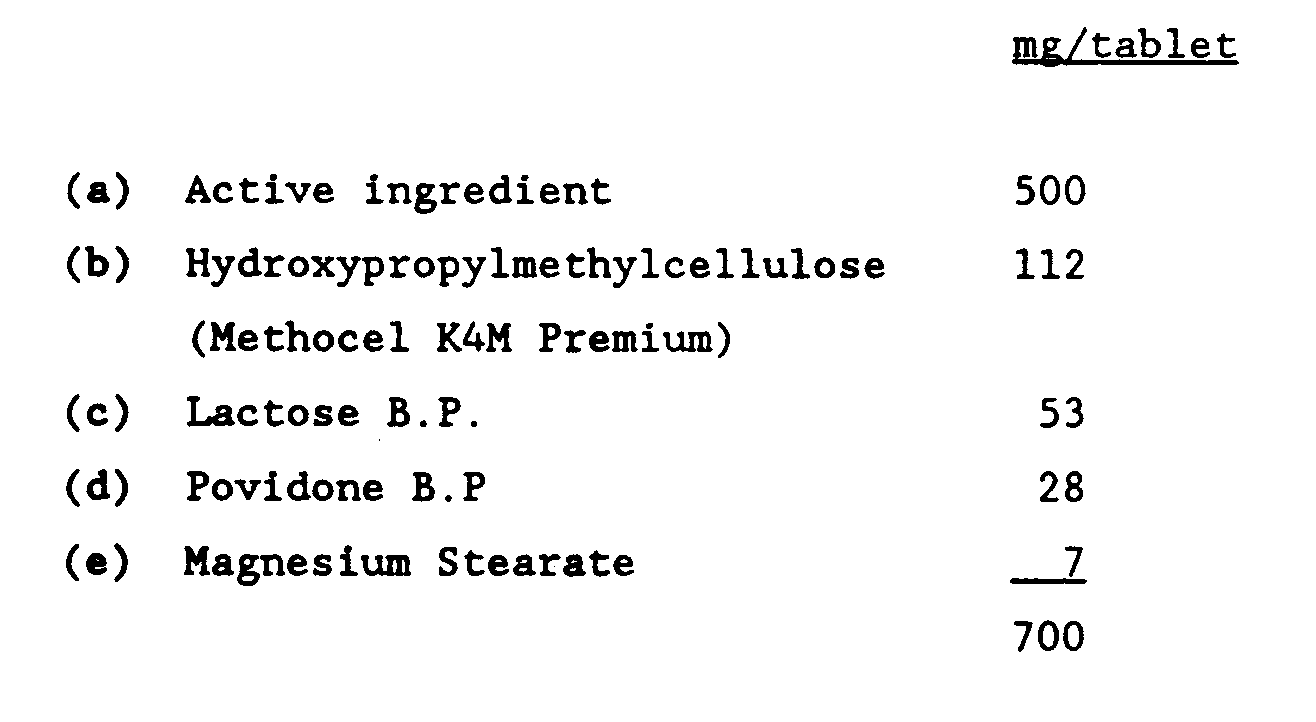
- Drug release takes place over a period of about 6-8 hours and is complete after 12 hours.
- A capsule formulation is prepared by admixing the ingredients of Formulation D in Example 1 above and filling into a two-part hard gelatin capsule. Formulation B (infra) is prepared in a similar manner.

- Capsules of formulation C are prepared by melting the Macrogol 4000 BP, dispersing the active ingredient in the melt and filling the melt into a two-part hard gelatin capsule.

- Capsules of formulation D are prepared by dispersing the active ingredient in the lecithin and arachis oil and filling the dispersion into soft, elastic gelatin capsules.
- The following controlled release capsule formulation is prepared by extruding ingredients a, b and c using an extruder, followed by spheronisation of the extrude and drying. The dried pellets are then coated with release- controlling membrane (d) and filled into a two-piece, hard gelatin capsule.

-

- The active ingredient is dissolved in most of the water (35°-40°C) and the pH adjusted to between 4.0 and 7.0 with the hydrochloric acid or the sodium hydroxide as appropriate. The batch is then made up to volume with the water and filtered through a sterile micropore filter into a sterile 10ml amber glass vial (type 1) and sealed with sterile closures and overseals.
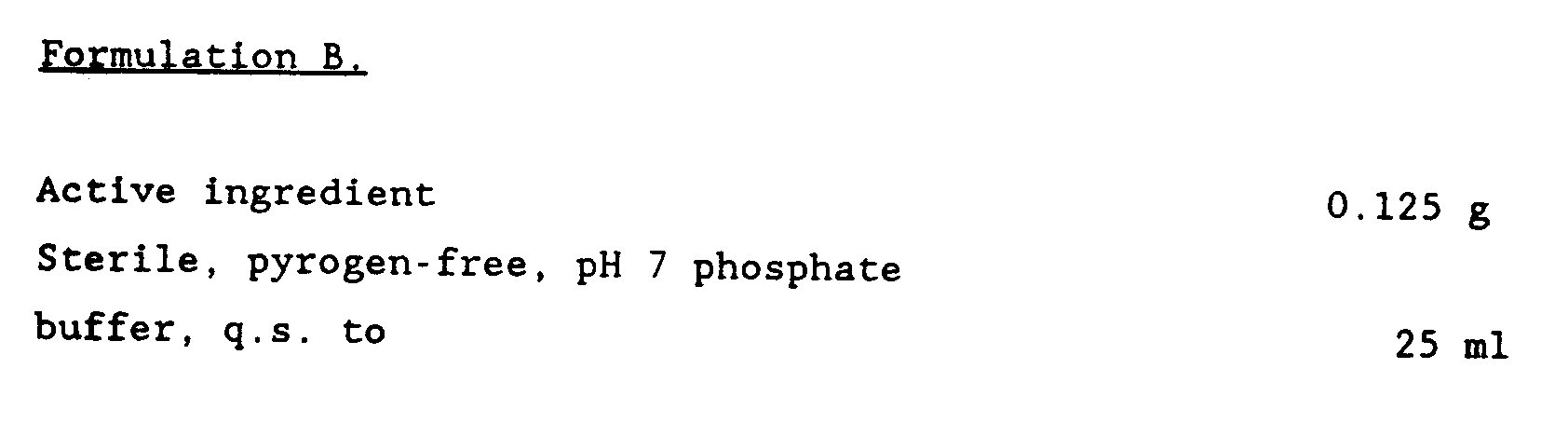
-

- The active ingredient is dissolved in the glycofurol. The benzyl alcohol is then added and dissolved, and water added to 3 ml. The mixture is then filtered through a sterile micropore filter and sealed in sterile 3 ml amber glass vials (type 1).
-

- The active ingredient is dissolved in a mixture of the glycerol and most of the purified water. An aqueous solution of the sodium benzoate is then added to the solution, followed by addition of the sorbitol solution and finally the flavour. The volume is made up with purified water and mixed well.
- When the active ingredient is poorly soluble, the following formulation (B) is used.

- The sorbitol solution is mixed with the glycerol and part of the purified water. The sodium benzoate in dissolved in purified water and added to the bulk. The dispersible cellulose and flavour is added and dispersed. The active ingredient is then added and dispersed and volume is made up with purified water.
-

- One-fifth of the Witepsol H15 is melted in a steam-jacketed pan at 45°C maximum. The active ingredient is sifted through a 200µm sieve and added to the molten base with mixing, using a silverson fitted with a cutting head, until a smooth dispersion is achieved. Maintaining the mixture at 45°C, the remaining Witepsol H15 is added to the suspension and stirred to ensure a homogenous mix. The entire suspension is passed through a 250µm stainless steel screen and, with continuous stirring, is allowed to cool to 40°C. At a temperature of 38°C to 40°C, 2.02g of the mixture is filled into suitable, 2 ml plastic moulds. The suppositories are allowed to cool to room temperature.
-

- The above ingredients are mixed directly and pessaries prepared by direct compression of the resulting mixture.
- Cell toxicity is assessed in a cell growth inhibition assay. Subconfluent cultures of Vero cells grown on 96-well microtiter dishes are exposed to different dilutions of drug, and cell viability determined daily on replicate cultures using uptake of a tetrazolium dye (MTT). The concentration required for a 50% inhibition of cell viability at 96 hours is termed CCID₅₀. The CCID₅₀ for 9-(2-deoxy-2-fluoro-β-D-arabinofuranosyl) guanine was 39 µM.
- 9-(2-deoxy-2-fluoro-β-D-arabinofuranosyl) guanine was tested for activity against HIV in vitro in accordance with the method described by H. Mitsuya et al, Proc. Natl. Acad. Sci., USA, Vol 82, pp 7096-7100, October 1985, and found to have activity at a concentration of 1 µM.
In the above-described process according to the invention, it will be appreciated that the precursor compounds of formula (I) as well as the above-mentioned agents and conditions, will be selected from those that are known in the art of nucleoside synthetic chemistry. Examples of such conversion procudures are described hereinafter for guidance and it will be understood that they can be modified in conventional manner depending on the desired compound of formula (I). In particular, where a conversion is described which would otherwise result in the undesired reaction of labile groups then such groups may be protected in conventional manner, with subsequent removal of the protecting groups after completion of the conversion.
Claims (12)
- A compound of general formula (I)B

- Use of a compound of general formula (I)A

- Use as claimed in claim 2 in which the compound of formula (I)A is 2,6-diamino-9-(2-deoxy-2-fluoro-β-D-arabinofuranosyl)-9H-purine.
- Use as claimed in claim 2 in which the compound of formula (I)A is 9-(2-deoxy-2-fluoro-β-D-arabinofuranosyl)guanine.
- Use as claimed in any of claims 2 to 4 in which the said human retroviral infection is a Human Immunodeficiency Virus (HIV) infection.
- Use as claimed in claim 5 in the manufacture of a medicament for the treatment or prophylaxis of Acquired Immune Deficiency Syndrome (AIDS).
- A process for the preparation of a compound of formula (I)B according to claim (1) comprising:(A) reacting a compound of formula:
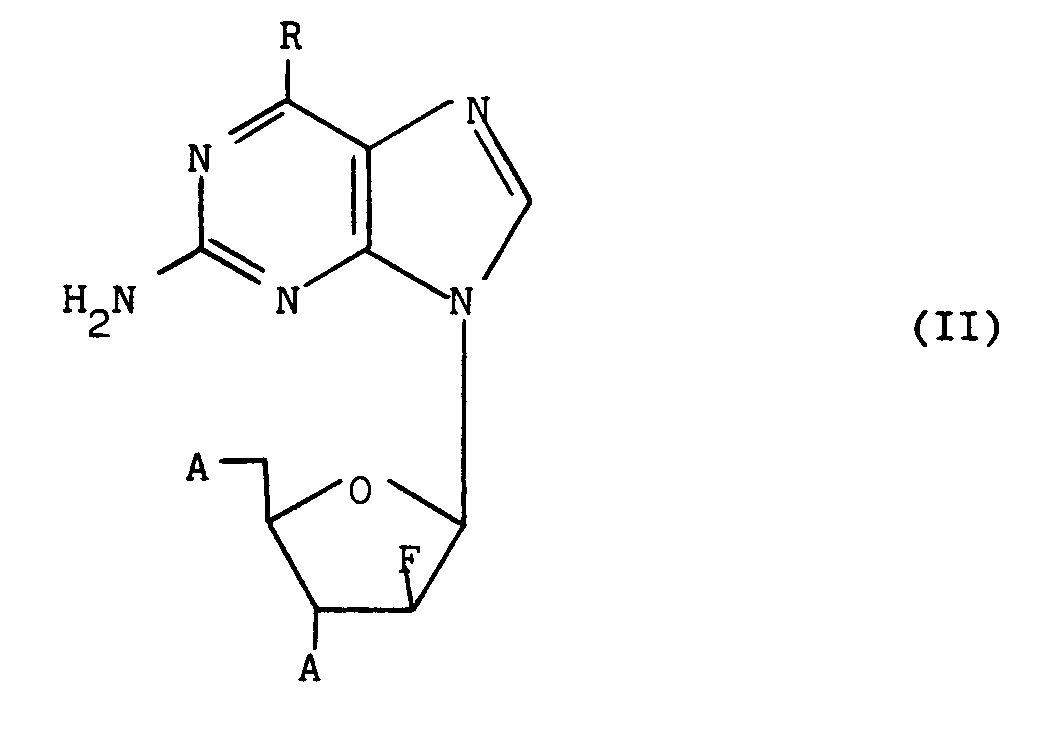 (B) reacting a purine base of formula
B - H (III)
wherein B is the required purine moiety of a compound of formula (I)B according to claim 1 or a functional equivalent thereof, with a compound serving to introduce the desired arabinofuranosyl ring at the 9- position of the purine base of formula (III);
and thereafter, or simultaneously therewith, effecting one or more of the following optional conversions:-(i) when a compound of formula (I)B is formed, converting it into a pharmaceutically acceptable derivative thereof,(ii) when a pharmaceutically acceptable derivative of a compound of formula (I)B is formed, converting the said derivative into a compound of formula (I)B, or a different derivative thereof. - A pharmaceutical formulation comprising as active ingredient a compound of formula (I)B according to claim 1 or a pharmaceutically acceptable derivative thereof, together with a pharmaceutically acceptable carrier therefor.
- A compound of formula (I)B according to claim 1 or a pharmaceutically acceptable derivative thereof for use in medical therapy.
- A compound as claimed in claim 9 for the treatment or prophylaxis of a human retroviral infection.
- A compound as claimed in claim 9 for the treatment or prophylaxis of a Human Immunodeficiency Virus (HIV) infection.
- A compound as claimed in claim 9 for the treatment or prophylaxis of Acquired Immunodeficiency Syndrome (AIDS).
Priority Applications (1)
| Application Number | Priority Date | Filing Date | Title |
|---|---|---|---|
| AT88302922T ATE82294T1 (en) | 1987-04-03 | 1988-03-31 | THERAPEUTIC NUCLEOSIDES. |
Applications Claiming Priority (2)
| Application Number | Priority Date | Filing Date | Title |
|---|---|---|---|
| GB8708050 | 1987-04-03 | ||
| GB878708050A GB8708050D0 (en) | 1987-04-03 | 1987-04-03 | Therapeutic nucleosides |
Publications (3)
| Publication Number | Publication Date |
|---|---|
| EP0285432A2 EP0285432A2 (en) | 1988-10-05 |
| EP0285432A3 EP0285432A3 (en) | 1990-01-24 |
| EP0285432B1 true EP0285432B1 (en) | 1992-11-11 |
Family
ID=10615214
Family Applications (1)
| Application Number | Title | Priority Date | Filing Date |
|---|---|---|---|
| EP88302922A Expired - Lifetime EP0285432B1 (en) | 1987-04-03 | 1988-03-31 | Therapeutic nucleosides |
Country Status (12)
| Country | Link |
|---|---|
| EP (1) | EP0285432B1 (en) |
| JP (1) | JPS63258891A (en) |
| KR (1) | KR880012628A (en) |
| AT (1) | ATE82294T1 (en) |
| AU (1) | AU1412088A (en) |
| DE (1) | DE3875769T2 (en) |
| DK (1) | DK177888A (en) |
| GB (1) | GB8708050D0 (en) |
| GR (1) | GR3006366T3 (en) |
| HU (1) | HU199869B (en) |
| IL (1) | IL85945A0 (en) |
| ZA (1) | ZA882344B (en) |
Families Citing this family (17)
| Publication number | Priority date | Publication date | Assignee | Title |
|---|---|---|---|---|
| US5310732A (en) * | 1986-02-03 | 1994-05-10 | The Scripps Research Institute | 2-halo-2'-deoxyadenosines in the treatment of rheumatoid arthritis |
| US5106837A (en) * | 1988-03-16 | 1992-04-21 | The Scripps Research Institute | Adenosine derivatives with therapeutic activity |
| IL86381A0 (en) * | 1987-05-19 | 1988-11-15 | Nippon Kayaku Kk | Oxetanocins and pharmaceutical compositions containing the same |
| US5214048A (en) * | 1987-05-19 | 1993-05-25 | Nippon Kayaku Kabushiki Kaisha | Oxetanocins |
| DE68924319T2 (en) * | 1988-03-16 | 1996-05-15 | Scripps Research Inst | SUBSTITUTED ADEN DERIVATIVES USED AS THERAPEUTIC AGENTS. |
| US4996308A (en) * | 1988-03-25 | 1991-02-26 | Merrell Dow Pharmaceuticals Inc. | Derivatives with unsaturated substitutions for the 5'-hydroxymethyl group |
| FI95384C (en) * | 1989-04-06 | 1996-01-25 | Squibb Bristol Myers Co | Process for the preparation of 3'-deoxy-3'-substituted methyl nucleosides and intermediates used in the process |
| KR910007655A (en) * | 1989-10-03 | 1991-05-30 | 엠. 피. 잭슨 | Therapeutic Nucleosides |
| US5420115A (en) * | 1990-09-10 | 1995-05-30 | Burroughs Wellcome Co. | Method for the treatment of protoza infections with 21 -deoxy-21 -fluoropurine nucleosides |
| AU1254892A (en) * | 1990-12-18 | 1992-07-22 | Sloan-Kettering Institute For Cancer Research | Novel synthesis of 2'-"up" fluorinated 2''-deoxy-arabinofuranosylpurines |
| JPH06321784A (en) * | 1993-03-18 | 1994-11-22 | Nippon Chemiphar Co Ltd | Anti-human immunodeficiency virus agent |
| CA2119315A1 (en) * | 1993-03-18 | 1994-09-19 | Tsujiaki Hata | Nucleoside derivatives and anti-herpes composition |
| US5654286A (en) * | 1993-05-12 | 1997-08-05 | Hostetler; Karl Y. | Nucleotides for topical treatment of psoriasis, and methods for using same |
| JP4658807B2 (en) * | 2003-10-24 | 2011-03-23 | ヤマサ醤油株式会社 | Process for producing α-1-phosphorylated 2-deoxy-2-fluoroarabinoside and 2'-deoxy-2'-fluoro-β-D-arabinonucleoside |
| JP6983814B2 (en) * | 2016-12-14 | 2021-12-17 | ヤマサ醤油株式会社 | Nucleoside derivative showing antiviral activity |
| WO2018181102A1 (en) * | 2017-03-29 | 2018-10-04 | ヤマサ醤油株式会社 | Nucleoside derivative or salt thereof, and pharmaceutical composition containing same |
| JP7378760B2 (en) * | 2019-03-14 | 2023-11-14 | 国立大学法人 鹿児島大学 | Anti-hepatitis B virus agent |
Family Cites Families (2)
| Publication number | Priority date | Publication date | Assignee | Title |
|---|---|---|---|---|
| US3658787A (en) * | 1969-08-04 | 1972-04-25 | Syntex Corp | Halogenated purine nucleosides and derivatives |
| US4751221A (en) * | 1985-10-18 | 1988-06-14 | Sloan-Kettering Institute For Cancer Research | 2-fluoro-arabinofuranosyl purine nucleosides |
-
1987
- 1987-04-03 GB GB878708050A patent/GB8708050D0/en active Pending
-
1988
- 1988-03-30 DK DK177888A patent/DK177888A/en not_active Application Discontinuation
- 1988-03-31 IL IL85945A patent/IL85945A0/en unknown
- 1988-03-31 KR KR1019880003558A patent/KR880012628A/en not_active Withdrawn
- 1988-03-31 AU AU14120/88A patent/AU1412088A/en not_active Abandoned
- 1988-03-31 HU HU881600A patent/HU199869B/en not_active IP Right Cessation
- 1988-03-31 JP JP63080186A patent/JPS63258891A/en active Pending
- 1988-03-31 EP EP88302922A patent/EP0285432B1/en not_active Expired - Lifetime
- 1988-03-31 ZA ZA882344A patent/ZA882344B/en unknown
- 1988-03-31 AT AT88302922T patent/ATE82294T1/en active
- 1988-03-31 DE DE8888302922T patent/DE3875769T2/en not_active Expired - Fee Related
-
1992
- 1992-11-26 GR GR920402724T patent/GR3006366T3/el unknown
Also Published As
| Publication number | Publication date |
|---|---|
| HU199869B (en) | 1990-03-28 |
| DK177888A (en) | 1988-10-04 |
| EP0285432A3 (en) | 1990-01-24 |
| IL85945A0 (en) | 1988-09-30 |
| ZA882344B (en) | 1989-12-27 |
| AU1412088A (en) | 1988-10-06 |
| EP0285432A2 (en) | 1988-10-05 |
| ATE82294T1 (en) | 1992-11-15 |
| KR880012628A (en) | 1988-11-28 |
| DE3875769D1 (en) | 1992-12-17 |
| HUT48268A (en) | 1989-05-29 |
| DE3875769T2 (en) | 1993-04-08 |
| GB8708050D0 (en) | 1987-05-07 |
| DK177888D0 (en) | 1988-03-30 |
| JPS63258891A (en) | 1988-10-26 |
| GR3006366T3 (en) | 1993-06-21 |
Similar Documents
| Publication | Publication Date | Title |
|---|---|---|
| EP0206497B1 (en) | Therapeutic nucleosides and their preparation | |
| EP0286425B1 (en) | Therapeutic nucleosides | |
| FI106461B (en) | Process for the preparation of therapeutically useful enantiomeric compounds and in the process useful intermediate | |
| CA1285935C (en) | Therapeutic nucleosides | |
| EP0285432A2 (en) | Therapeutic nucleosides | |
| US5185437A (en) | Therapeutic nucleosides | |
| US5574149A (en) | Method of treating HIV infections with 2',3'-dideoxy-3'-fluoro-5-chlorouridine | |
| AU637831B2 (en) | Therapeutic necleosides | |
| US5559100A (en) | Methods of treating hepatitis B virus infection with therapeutic nucleosides | |
| EP0361831B1 (en) | Antiviral nucleoside combination | |
| EP0366385B1 (en) | Guanine derivatives having antiviral activity and their pharmaceutically acceptable salts | |
| EP0306597B1 (en) | Antiviral nucleosides | |
| WO1993014103A1 (en) | Therapeutic nucleosides | |
| EP0287215B1 (en) | Therapeutic nucleosides | |
| US5175274A (en) | Therapeutic nucleosides | |
| WO1988009332A1 (en) | Therapeutic nucleosides | |
| CA1327005C (en) | Therapeutic nucleosides | |
| WO1988009796A1 (en) | Nucleoside analogues |
Legal Events
| Date | Code | Title | Description |
|---|---|---|---|
| PUAI | Public reference made under article 153(3) epc to a published international application that has entered the european phase |
Free format text: ORIGINAL CODE: 0009012 |
|
| 17P | Request for examination filed |
Effective date: 19880415 |
|
| AK | Designated contracting states |
Kind code of ref document: A2 Designated state(s): AT BE CH DE ES FR GB GR IT LI LU NL SE |
|
| PUAL | Search report despatched |
Free format text: ORIGINAL CODE: 0009013 |
|
| AK | Designated contracting states |
Kind code of ref document: A3 Designated state(s): AT BE CH DE ES FR GB GR IT LI LU NL SE |
|
| RHK1 | Main classification (correction) |
Ipc: C07H 19/16 |
|
| RAP3 | Party data changed (applicant data changed or rights of an application transferred) |
Owner name: THE WELLCOME FOUNDATION LIMITED |
|
| 17Q | First examination report despatched |
Effective date: 19910618 |
|
| GRAA | (expected) grant |
Free format text: ORIGINAL CODE: 0009210 |
|
| AK | Designated contracting states |
Kind code of ref document: B1 Designated state(s): AT BE CH DE ES FR GB GR IT LI LU NL SE |
|
| PG25 | Lapsed in a contracting state [announced via postgrant information from national office to epo] |
Ref country code: ES Free format text: THE PATENT HAS BEEN ANNULLED BY A DECISION OF A NATIONAL AUTHORITY Effective date: 19921111 |
|
| REF | Corresponds to: |
Ref document number: 82294 Country of ref document: AT Date of ref document: 19921115 Kind code of ref document: T |
|
| ITF | It: translation for a ep patent filed | ||
| REF | Corresponds to: |
Ref document number: 3875769 Country of ref document: DE Date of ref document: 19921217 |
|
| ET | Fr: translation filed | ||
| ITTA | It: last paid annual fee | ||
| REG | Reference to a national code |
Ref country code: GR Ref legal event code: FG4A Free format text: 3006366 |
|
| PLBE | No opposition filed within time limit |
Free format text: ORIGINAL CODE: 0009261 |
|
| STAA | Information on the status of an ep patent application or granted ep patent |
Free format text: STATUS: NO OPPOSITION FILED WITHIN TIME LIMIT |
|
| 26N | No opposition filed | ||
| PGFP | Annual fee paid to national office [announced via postgrant information from national office to epo] |
Ref country code: FR Payment date: 19940310 Year of fee payment: 7 |
|
| PGFP | Annual fee paid to national office [announced via postgrant information from national office to epo] |
Ref country code: AT Payment date: 19940314 Year of fee payment: 7 |
|
| PGFP | Annual fee paid to national office [announced via postgrant information from national office to epo] |
Ref country code: SE Payment date: 19940316 Year of fee payment: 7 |
|
| PGFP | Annual fee paid to national office [announced via postgrant information from national office to epo] |
Ref country code: GB Payment date: 19940321 Year of fee payment: 7 |
|
| PGFP | Annual fee paid to national office [announced via postgrant information from national office to epo] |
Ref country code: DE Payment date: 19940323 Year of fee payment: 7 Ref country code: CH Payment date: 19940323 Year of fee payment: 7 |
|
| PGFP | Annual fee paid to national office [announced via postgrant information from national office to epo] |
Ref country code: GR Payment date: 19940330 Year of fee payment: 7 |
|
| PGFP | Annual fee paid to national office [announced via postgrant information from national office to epo] |
Ref country code: NL Payment date: 19940331 Year of fee payment: 7 Ref country code: LU Payment date: 19940331 Year of fee payment: 7 |
|
| PGFP | Annual fee paid to national office [announced via postgrant information from national office to epo] |
Ref country code: BE Payment date: 19940427 Year of fee payment: 7 |
|
| EPTA | Lu: last paid annual fee | ||
| EAL | Se: european patent in force in sweden |
Ref document number: 88302922.5 |
|
| PG25 | Lapsed in a contracting state [announced via postgrant information from national office to epo] |
Ref country code: LU Free format text: LAPSE BECAUSE OF NON-PAYMENT OF DUE FEES Effective date: 19950331 Ref country code: LI Effective date: 19950331 Ref country code: GB Effective date: 19950331 Ref country code: CH Effective date: 19950331 Ref country code: BE Effective date: 19950331 Ref country code: AT Effective date: 19950331 |
|
| PG25 | Lapsed in a contracting state [announced via postgrant information from national office to epo] |
Ref country code: SE Effective date: 19950401 |
|
| BERE | Be: lapsed |
Owner name: THE WELLCOME FOUNDATION LTD Effective date: 19950331 |
|
| PG25 | Lapsed in a contracting state [announced via postgrant information from national office to epo] |
Ref country code: GR Free format text: THE PATENT HAS BEEN ANNULLED BY A DECISION OF A NATIONAL AUTHORITY Effective date: 19950930 |
|
| PG25 | Lapsed in a contracting state [announced via postgrant information from national office to epo] |
Ref country code: NL Effective date: 19951001 |
|
| GBPC | Gb: european patent ceased through non-payment of renewal fee |
Effective date: 19950331 |
|
| PG25 | Lapsed in a contracting state [announced via postgrant information from national office to epo] |
Ref country code: FR Free format text: LAPSE BECAUSE OF NON-PAYMENT OF DUE FEES Effective date: 19951130 |
|
| REG | Reference to a national code |
Ref country code: CH Ref legal event code: PL Ref country code: GR Ref legal event code: MM2A Free format text: 3006366 |
|
| NLV4 | Nl: lapsed or anulled due to non-payment of the annual fee |
Effective date: 19951001 |
|
| PG25 | Lapsed in a contracting state [announced via postgrant information from national office to epo] |
Ref country code: DE Effective date: 19951201 |
|
| EUG | Se: european patent has lapsed |
Ref document number: 88302922.5 |
|
| REG | Reference to a national code |
Ref country code: FR Ref legal event code: ST |
|
| PG25 | Lapsed in a contracting state [announced via postgrant information from national office to epo] |
Ref country code: IT Free format text: LAPSE BECAUSE OF NON-PAYMENT OF DUE FEES;WARNING: LAPSES OF ITALIAN PATENTS WITH EFFECTIVE DATE BEFORE 2007 MAY HAVE OCCURRED AT ANY TIME BEFORE 2007. THE CORRECT EFFECTIVE DATE MAY BE DIFFERENT FROM THE ONE RECORDED. Effective date: 20050331 |