EP0283266A2 - Pattern recognition system - Google Patents
Pattern recognition system Download PDFInfo
- Publication number
- EP0283266A2 EP0283266A2 EP88302300A EP88302300A EP0283266A2 EP 0283266 A2 EP0283266 A2 EP 0283266A2 EP 88302300 A EP88302300 A EP 88302300A EP 88302300 A EP88302300 A EP 88302300A EP 0283266 A2 EP0283266 A2 EP 0283266A2
- Authority
- EP
- European Patent Office
- Prior art keywords
- pattern
- category
- parameter
- input
- calculating
- Prior art date
- Legal status (The legal status is an assumption and is not a legal conclusion. Google has not performed a legal analysis and makes no representation as to the accuracy of the status listed.)
- Withdrawn
Links
Images


Classifications
-
- G—PHYSICS
- G10—MUSICAL INSTRUMENTS; ACOUSTICS
- G10L—SPEECH ANALYSIS TECHNIQUES OR SPEECH SYNTHESIS; SPEECH RECOGNITION; SPEECH OR VOICE PROCESSING TECHNIQUES; SPEECH OR AUDIO CODING OR DECODING
- G10L15/00—Speech recognition
-
- G—PHYSICS
- G06—COMPUTING OR CALCULATING; COUNTING
- G06F—ELECTRIC DIGITAL DATA PROCESSING
- G06F18/00—Pattern recognition
- G06F18/20—Analysing
- G06F18/24—Classification techniques
- G06F18/241—Classification techniques relating to the classification model, e.g. parametric or non-parametric approaches
- G06F18/2413—Classification techniques relating to the classification model, e.g. parametric or non-parametric approaches based on distances to training or reference patterns
-
- G—PHYSICS
- G06—COMPUTING OR CALCULATING; COUNTING
- G06F—ELECTRIC DIGITAL DATA PROCESSING
- G06F18/00—Pattern recognition
- G06F18/20—Analysing
- G06F18/24—Classification techniques
- G06F18/241—Classification techniques relating to the classification model, e.g. parametric or non-parametric approaches
- G06F18/2415—Classification techniques relating to the classification model, e.g. parametric or non-parametric approaches based on parametric or probabilistic models, e.g. based on likelihood ratio or false acceptance rate versus a false rejection rate
- G06F18/24155—Bayesian classification
Definitions
- the present invention relates to a pattern recognition system for calculating a similarity (or distance) between an input pattern and a reference pattern in speech recognition or character recognition, and converting the similarity into a posterior probability to improve recognition precision.
- a pattern recognition method using a multiple similarity method is known when a character or speech input is to be recognized.
- a multiple similarity is a kind of a scale of similarity represented by an angle between a partial space defined by a standard pattern and a space defined by a feature vector of an input pattern, and its weight of the scale is quite different for each category of a standard pattern. Therefore, in order to improve recognition ratio, another method is proposed. In this method, the multiple similarity is converted into a posterior probability, and the posterior probability is used as an evaluation value of the similarity (Japanese Patent Disclosure (Kokai) No. 59-219799 published on December 11, 1984).
- Si) of similarity Si belonging to a certain category Ci is a posterior probability to be calculated.
- Si) probability of similarity Si belonging to a certain category Ci.
- Ci) is a probability of multiple similarity Si obtained when data belonging to category Ci is recognized using a dictionary of category Ci.
- Si) is a probability of multiple similarity Si obtained when data belonging to category Cj is recognized using a dictionary of category Ci.
- Si) shown in Fig. 1D can be calculated by equation (1).
- the shapes of the above mentioned two probability distributions are important.
- the shapes of the posterior probability distributions differ depending on individual categories (e.g., some categories are easily recognized, and others are not easily recognized; some categories are similar to each other, and others are not similar to each other; and so on).
- Cj) for each category, a large volume of data is necessary, and it becomes impossible to form a table.
- the present invention has been made in consideration of the above situation and has as its object to provide a pattern recognition system which can form an accurate conversion converting a multiple similarity into a posterior probability for each category, and can therefore improve a recognition ratio.
- a posterior probability conversion means for converting a multiple similarity obtained based on a feature vector of an input pattern and a standard pattern for each category into a posterior probability is constituted by the following parameter table and posterior probability conversion filter. More specifically, the parameter table stores a parameter pair ⁇ and ⁇ . A parameter ⁇ indicates a number of components which are not involved in a subspace spanned by a reference pattern. The other parameter ⁇ indicates a variance in a direction of non-reference subspace. Both parameters are estimated from multiple similarity values between a reference pattern and training data.
- the posterior probability conversion filter calculates a posterior probability based on the multiple similarity calculated by the multiple similarity calculation section, and the parameter sets.
- Training similarity value data of these parameters ⁇ ij and ⁇ ij for all i can be obtained for one training pattern belonging to Cj.
- the paremeter table storing these parameters can be very easily acquired.
- a precise posterior probability conversion table can be formed with a smaller volume of data, and hence, recognition precision can be improved.
- Fig. 2A shows functional blocks of an embodiment in which the present invention is applied to a phoneme-based or a syllable-based word recognition system
- Fig. 2B is a block diagram showing an arrangement for realizing the functions shown in Fig. 2A by using a CPU.
- a speech signal is input to acoustic processing section 1 through a speech input means such as a microphone (not shown) at predetermined time intervals (frames).
- acoustic processing section 1 comprises filter band 1a for dividing a speech frequency range into 8 to 30 ranges and analyzing frequency spectra of these renges, and A/D converter 1b.
- section 1 extracts feature pattern data of a speech input.
- the obtained feature pattern data is supplied to phoneme similarity calculation section 2.
- Section 2 calculates multiple similarity Si between reference pattern data stored in multiple similarity (reference) phoneme feature memory 3 and the input feature pattern data.
- Obtained multiple similarity Si is supplied to posterior probability conversion filter 4.
- Filter 4 converts multiple similarity Si into posterior probability P(Ci
- Filter 4 constitutes a posterior probability conversion means together with FPB 5 serving as a parameter table.
- Word matching section 6 collates a posterior probability sequence output from filter 4 with a word dictionary stored in word dictionary 7 in accordance with the Viterbi algorithm in the Hidden Markov Model or DP matching to perform word recognition processing.
- FPB 5 can only store probabilities P(Si
- Si) can be calculated by equation (1).
- parameter data ⁇ ij and ⁇ ij for uniquely determining these probabilities are stored in FPB 5 in place of the above-mentioned probabilities, as shown in Fig. 4.
- the registration procedures of the parameter data will be explained below.
- Cj) (i ⁇ j) can be approximiated by the distribution in the same manner as in posterior probability P(Si
- parameters ⁇ ij and ⁇ ij can be calculated by the above equations, and can be registered or prestored.
- multiple similarity Si between standard pattern data of category Ci in multiple similarity phoneme dictionary 3 and the feature pattern data is calculated by: where ⁇ im indicates a proper vector having an Mi-th largest proper value of a correlative matrix constituted by a learning pattern of an i-th phoneme category. Mi indicates that vectors are used up to an (Mi)th proper vector.
- the operations of the respective blocks of Fig. 2B are performed by CPU 10 through bus B.
- step A1 phoneme feature data obtained from acoustic processing section 1 is fetched by phoneme similarity calculation section 2.
- step A2 phoneme feature reference memory 3 is accessed to read out standard pattern data of a pnoneme feature for each category. Then, multiple similarites Si between the input phoneme feature data and the standard pattern data are sequentially calculated. Resultant multiple similarities Si are sequetnially sent to posterior probability conversion filter 4.
- Filter 4 converts input multiple similaritis Si into posterior probabilities P(Ci
- CPU 10 accesses filter parameter bank 5 in accordace with input similarity Si, sequentially reads out parameters ⁇ ij and ⁇ ij stored therein, and supplies the readout parameters to filter 4.
- the operation of conversion filter 4 will be described later with reference to the flow chart shown in Fig. 6B.
- step A4 The sequence of posterior probabilities P(Ci
- step A4 matching between the probabilities and data stored in word dictionary 7 is performed.
- the Viterbi algorithm by the Hidden Markov Model is executed by CPU 10, and a word recognition output is obtained as output data.
- Cj) (j 1 to n).
- Cj) are substituted in equation (1) to obtain posterior probabilities P(Ci
- Fig. 7 shows a conventional case wherein a similarity is used.
- a posterior probability of the same speech input "i ⁇ chi” is calculated, as shown in Fig. 9. More specifically, posterior probabilities of categories "ki”, “i”, and “hi” associated with first syllable "i” are calculated from their multiple similarities 0.65, 0.60, and 0.55, and respectively yield 0.05, 0.01, and 0.0.
- Posterior probabilities of categories "chi” and “shi” are calculated from the their multiple similarities 0.75 and 0.70 (see the conversion table shown in Fig. 10), thus yielding 0.7 and 0.2.
- "i ⁇ chi” and “ki ⁇ shi” which cannot be distinguished by the recognition using similarities shown in Fig. 8 can be distinguished as 0.71 and 0.25 by the posterior probabilities, and "i ⁇ chi” can be obtained as a correct recognition result.
- filter parameter bank 5 can be formed by a smaller number of samples, and posterior probabilities can be precisely obtained.
- the pattern recognition percentage can be greatly improved.
- n2 parameter sets are prepared for PFB 5.
- some category groups which tend to be erroneously recognized can be specified.
- parameter sets which tend to be erroneously recognized may be prestored to form an FPB shown in Fig. 12.
- multiple similarities Si rarely yield large values at the same time for a large number of categories. For this reason, the following calculation is made in equation (1): However, when the value Si is sufficiently large almost all terms of this relation becomes 0. Therefore, approximation can be satisfactorily made by:
- the FPB can be rendered compact while maintaining its high performance.
- the present invention is not limited to speech recognition, but may be applied to various fields such as character recognition, wherein recognition is performed using multiple similarities.
- parameters for determining a posterior probability for each category can be obtained with a smaller number of samples, and recognition using these parameters can be performed, thus greatly improving recognition precision.
Landscapes
- Engineering & Computer Science (AREA)
- Physics & Mathematics (AREA)
- Theoretical Computer Science (AREA)
- Data Mining & Analysis (AREA)
- Artificial Intelligence (AREA)
- Computer Vision & Pattern Recognition (AREA)
- General Physics & Mathematics (AREA)
- General Engineering & Computer Science (AREA)
- Evolutionary Computation (AREA)
- Life Sciences & Earth Sciences (AREA)
- Evolutionary Biology (AREA)
- Bioinformatics & Cheminformatics (AREA)
- Bioinformatics & Computational Biology (AREA)
- Human Computer Interaction (AREA)
- Health & Medical Sciences (AREA)
- Audiology, Speech & Language Pathology (AREA)
- Multimedia (AREA)
- Acoustics & Sound (AREA)
- Computational Linguistics (AREA)
- Probability & Statistics with Applications (AREA)
- Character Discrimination (AREA)
- Image Analysis (AREA)
- Image Processing (AREA)
Abstract
Description
- The present invention relates to a pattern recognition system for calculating a similarity (or distance) between an input pattern and a reference pattern in speech recognition or character recognition, and converting the similarity into a posterior probability to improve recognition precision.
- A pattern recognition method using a multiple similarity method is known when a character or speech input is to be recognized. However, a multiple similarity is a kind of a scale of similarity represented by an angle between a partial space defined by a standard pattern and a space defined by a feature vector of an input pattern, and its weight of the scale is quite different for each category of a standard pattern. Therefore, in order to improve recognition ratio, another method is proposed. In this method, the multiple similarity is converted into a posterior probability, and the posterior probability is used as an evaluation value of the similarity (Japanese Patent Disclosure (Kokai) No. 59-219799 published on December 11, 1984).
- Assuming that a calculated multiple similarity is Si, conditional probability P(Ci | Si) of similarity Si belonging to a certain category Ci is a posterior probability to be calculated. In order to calculate the probability distribution, probabilities of all similarities obtained between 0 and 1 (i.e., [0,1]) belonging to each category must be calculated, and it is hard to realize in a practical application. Thus, the conditional probability is developed using the Bayes' theorem as follows:
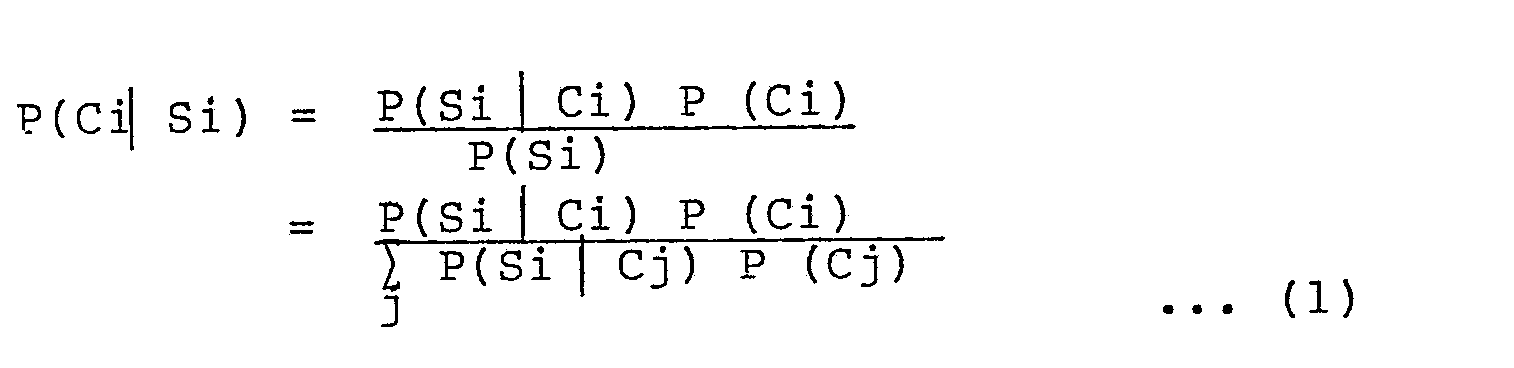 P(Si | Cj) are calculated, posterior probability P(Ci | Si) can be calculated.
- P(Si | Ci) is a probability of multiple similarity Si obtained when data belonging to category Ci is recognized using a dictionary of category Ci.
- P(Cj | Si) is a probability of multiple similarity Si obtained when data belonging to category Cj is recognized using a dictionary of category Ci.
- Of these probability distributions, for example, as shown in Figs. 1A to 1D, the distribution of similarities S1 when they are recognized using the same dictionary of a category (C1) as an input category (C1) is concentrated near 1.0. However, similarities S1 obtained when they are recognized using a dictionary of a category (C1) different from an input category (C2) are distributed at smaller values in a wider range.
- Therefore, when such probability distributions are stored as tables, posterior probability P(Ci | Si) shown in Fig. 1D can be calculated by equation (1).
- However, upon design of such a table, the following problems are posed.
- That is, in order to convert a multiple similarity into a posterior probability, the shapes of the above mentioned two probability distributions are important. In this case, the shapes of the posterior probability distributions differ depending on individual categories (e.g., some categories are easily recognized, and others are not easily recognized; some categories are similar to each other, and others are not similar to each other; and so on). However, in order to calculate P(Si | Ci) and ΣP(Si | Cj) for each category, a large volume of data is necessary, and it becomes impossible to form a table.
- Thereofre, in a conventional system, a common table is formed for all the categories at the cost of the recognition ratio, and conversion to a posterior probability is performed. Thus, the recognition ratio is inevitably decreased.
- In a conventional pattern recognition system which converts a multiple similarity into a posterior probability to evaluate a similarity, it is diffucult to form a conversion table for obtaining a posterior probability for each category. Therefore, a simple table must be used instead, and hence, the recognition ratio is decreased.
- The present invention has been made in consideration of the above situation and has as its object to provide a pattern recognition system which can form an accurate conversion converting a multiple similarity into a posterior probability for each category, and can therefore improve a recognition ratio.
- According to the characteristic feature of the present invention, a posterior probability conversion means for converting a multiple similarity obtained based on a feature vector of an input pattern and a standard pattern for each category into a posterior probability is constituted by the following parameter table and posterior probability conversion filter. More specifically, the parameter table stores a parameter pair α and β. A parameter α indicates a number of components which are not involved in a subspace spanned by a reference pattern. The other parameter β indicates a variance in a direction of non-reference subspace. Both parameters are estimated from multiple similarity values between a reference pattern and training data.
- The posterior probability conversion filter calculates a posterior probability based on the multiple similarity calculated by the multiple similarity calculation section, and the parameter sets.
- It is experimentally and theoretically demonstrated that probability distribution P(Si | Cj) of multiple similarity Si obtained when data belonging to a category Cj is recognized using a reference pattern of category Ci can be approximated by a distribution regardless of i = j or i ≠ j. αij and βij whose properties are mentioned above serve as parameters for detemining the shape of the distribution, and the probebility distrubution is represented by:

- Training similarity value data of these parameters αij and βij for all i can be obtained for one training pattern belonging to Cj. In order to calculate effective estimation values of these parameters, only several tens of training data is necessary. For this reason, the paremeter table storing these parameters can be very easily acquired.
- During pattern recognition, necessary parameter set α and β is read out in accordance with resultant similarity Si, and equation (1) is calculated by the posterior probability conversion filter, thus obtaining a desired posterior probability distribution.
- Therefore, according to the present invention, a precise posterior probability conversion table can be formed with a smaller volume of data, and hence, recognition precision can be improved.
- This invention can be more fully understood from the following datailed description when taken in conjunction with the accompanying drawings, in which;
- Figs. 1A to 1D are views showing a probability distribution of similarities;
- Fig. 2A is a block diagram functionally showing an arrangement according to an embodiment of the present invention;
- Fig. 2B is a block diagram showing a detailed arrangement of the embodiment shown in Fig. 2A;
- Figs. 3 and 4 are views showing contents of a filter parameter bank;
- Fig. 5 is a view showing procedures of fetching parameter sets of a posterior probability;
- Figs. 6A and 6B are flow charts for explaining the operation of the embodiment shown in Figs. 2A and 2B;
- Figs. 7 and 8 are views showing a recognition result of a speech input in accordance with a similarity;
- Figs. 9 and 11 are views showing a recognition result of a speech input in accordance with a posterior probability;
- Fig. 10 shows a similarity-posterior probability conversion table; and
- Fig. 12 is a view showing a filter parameter bank according to another embodiment of the present invention.
- Fig. 2A shows functional blocks of an embodiment in which the present invention is applied to a phoneme-based or a syllable-based word recognition system, and Fig. 2B is a block diagram showing an arrangement for realizing the functions shown in Fig. 2A by using a CPU.
- More specifically, a speech signal is input to
acoustic processing section 1 through a speech input means such as a microphone (not shown) at predetermined time intervals (frames). As shown in Figs. 2B,acoustic processing section 1 comprises filter band 1a for dividing a speech frequency range into 8 to 30 ranges and analyzing frequency spectra of these renges, and A/D converter 1b. Thus,section 1 extracts feature pattern data of a speech input. - The obtained feature pattern data is supplied to phoneme
similarity calculation section 2.Section 2 calculates multiple similarity Si between reference pattern data stored in multiple similarity (reference)phoneme feature memory 3 and the input feature pattern data. Obtained multiple similarity Si is supplied to posteriorprobability conversion filter 4.Filter 4 converts multiple similarity Si into posterior probability P(Ci | Si) using parameters αij and βij stored in filter parameter bank (to be referred to as FPB hereinafter) 5.Filter 4 constitutes a posterior probability conversion means together withFPB 5 serving as a parameter table. -
Word matching section 6 collates a posterior probability sequence output fromfilter 4 with a word dictionary stored inword dictionary 7 in accordance with the Viterbi algorithm in the Hidden Markov Model or DP matching to perform word recognition processing. With the above arrangement,FPB 5 can only store probabilities P(Si | Cj) (i = 1 to n, j = 1 to n), as shown in Fig. 3. With these parameters, posterior probability P(Ci | Si) can be calculated by equation (1). However, according to the present invention, parameter data αij and βij for uniquely determining these probabilities are stored inFPB 5 in place of the above-mentioned probabilities, as shown in Fig. 4. The registration procedures of the parameter data will be explained below. In this case, probability P(Si | Cj) (i ≠ j) can be approximiated by the distribution in the same manner as in posterior probability P(Si | Ci), and can be stored by the identical procedures. - Assuming that a sample value x is given, its probability density function P(x) is represented by:


- Therefore, when several tens of feature pattern data are sampled in advance for each category Ci during learning, parameters αij and βij can be calculated by the above equations, and can be registered or prestored.
- Assuming that a pattern vector of feature parameter data at a given time output from
acoustic processing section 1 is given as xk (k = 1, 2, ...N), multiple similarity Si between standard pattern data of category Ci in multiplesimilarity phoneme dictionary 3 and the feature pattern data is calculated by:
- Similarity Si (i = 1 to n) for each category is calculated by the multiple similarity calculation, as shown in Fig. 5. The operations of the respective blocks of Fig. 2B are performed by CPU 10 through bus B.
- The operation of CPU 10 shown in Fig. 2B will be described with reference to the flow chart shown in Fig. 6A. In step A1, phoneme feature data obtained from
acoustic processing section 1 is fetched by phonemesimilarity calculation section 2. - The flow advances to step A2, and for the fetched phoneme feature data, phoneme
feature reference memory 3 is accessed to read out standard pattern data of a pnoneme feature for each category. Then, multiple similarites Si between the input phoneme feature data and the standard pattern data are sequentially calculated. Resultant multiple similarities Si are sequetnially sent to posteriorprobability conversion filter 4. -
Filter 4 converts input multiple similaritis Si into posterior probabilities P(Ci | Si), in step A3. For this purpose, CPU 10 accesses filterparameter bank 5 in accordace with input similarity Si, sequentially reads out parameters αij and βij stored therein, and supplies the readout parameters to filter 4. The operation ofconversion filter 4 will be described later with reference to the flow chart shown in Fig. 6B. - The sequence of posterior probabilities P(Ci | Si) obtained by
filter 4 is supplied toword matching section 6. In step A4, matching between the probabilities and data stored inword dictionary 7 is performed. The Viterbi algorithm by the Hidden Markov Model is executed by CPU 10, and a word recognition output is obtained as output data. - The conversion processing to posterior probability P(Si | Ci) by
filter 4 is executed by CPU 10 the procedures shown in Fig. 6B. - More specifically, when multiple smilarity Si is input to filter 4 in step B1, i is incremented from 1 to n by one in steps B2, B3, B4, and B5, and the following processing is executed. As shown in Fig. 5, n parameter sets αij and βij (j = 1 to n) are fetched from
FPB 5 in step B5. Next, in step B6, n parameter sets αij and βij and n similarities Si (i = 1 to n) are substituted in equation (2) to obtain n probabilities P(Si | Cj) (j = 1 to n). In step B7, these n probabilities P(Si | Cj) are substituted in equation (1) to obtain posterior probabilities P(Ci | Si). Obtained posterior probabilities P(Ci | Si) are supplied to word matching 6 in step B8. - A description will be made with reference to Figs. 7 to 11 while comparing results of conversion speech recognition using a similarity and speech recognition using a posterior probability according to the present invention.
- Fig. 7 shows a conventional case wherein a similarity is used. When "i·chi" is input as a word speech input, 0.65, 0.60, and 0.55 are respectively obtained as multiple similarities for three categories "ki", "i", and "hi" associated with first syllable "i".
- Similarities 0.75 and 0.70 are obtained for two categories "chi" and "shi" associated with second syllable "chi".
- Therefore, upon recognition of a word, a sum of similarities for a combination of "ki·shi" is 0.65 + 0.70 = 1.35, and a sum of similarities for a combination of "i·chi" is 0.60 + 0.75 = 1.35, as shown in Fig. 8. Therefore, the similarities of "ki·shi" and "i·chi" are the same, and it cannot be discriminated which result is correct.
- In contrast to this, a posterior probability of the same speech input "i·chi" according to the present invention is calculated, as shown in Fig. 9. More specifically, posterior probabilities of categories "ki", "i", and "hi" associated with first syllable "i" are calculated from their multiple similarities 0.65, 0.60, and 0.55, and respectively yield 0.05, 0.01, and 0.0.
- Posterior probabilities of categories "chi" and "shi" are calculated from the their multiple similarities 0.75 and 0.70 (see the conversion table shown in Fig. 10), thus yielding 0.7 and 0.2. As a result, as shown in Fig. 11, "i·chi" and "ki·shi" which cannot be distinguished by the recognition using similarities shown in Fig. 8 can be distinguished as 0.71 and 0.25 by the posterior probabilities, and "i·chi" can be obtained as a correct recognition result.
- According to this embodiment,
filter parameter bank 5 can be formed by a smaller number of samples, and posterior probabilities can be precisely obtained. Thus, the pattern recognition percentage can be greatly improved. - The present invention is not limited to the above embodiment. For example, in the above embodiment, n² parameter sets are prepared for
PFB 5. In practice, however, some category groups which tend to be erroneously recognized can be specified. Thus, parameter sets which tend to be erroneously recognized may be prestored to form an FPB shown in Fig. 12. In practical applications, since multiple similarities have superior identification properties, multiple similarities Si rarely yield large values at the same time for a large number of categories. For this reason, the following calculation is made in equation (1):

- With the above arrangement, the FPB can be rendered compact while maintaining its high performance.
- The present invention is not limited to speech recognition, but may be applied to various fields such as character recognition, wherein recognition is performed using multiple similarities.
- According to the present invention as described above, parameters for determining a posterior probability for each category can be obtained with a smaller number of samples, and recognition using these parameters can be performed, thus greatly improving recognition precision.
Claims (6)
wherein said posterior probability conversion means (4) includes: a parameter table (5) storing parameter sets each composed of a plurality of paramenter pairs of α and β, said parameter α indicating a number of components which are not involved in a subspace spanned by a reference pattern, the parameter β indicating a variance in a direction of non-reference subspace, and both parameters α and β being estimated from multiple similarity values between a reference pattern and training data, for each category of learning patterns, and for every category of reference patterns; and means (4) for calculating the posterior probabilities based on the multiple similarities calculated by said multiple similarity calculation section and the parameter sets stored in said parameter table.
P(Si | Cj) (j = 1 to n)
and means (10) for calculating posterior probabilities P(Ci | Si) based on the probability distribution P(Si | Cj).
means (1) for extracting feature data of an input pattern;
means (2) for calculating multiple similarities Si (i = 1 to n) between reference patterns and the input pattern;
means (4, 5) for obtaining predetermined parameter sets (α, β) in accordance with the resultant similarities Si;
means (4, 10) for calculating a posterior probability represented by:

means (6, 7) for determining the input pattern using the resultant posterior probability.
Applications Claiming Priority (2)
| Application Number | Priority Date | Filing Date | Title |
|---|---|---|---|
| JP60394/87 | 1987-03-16 | ||
| JP62060394A JPS63225300A (en) | 1987-03-16 | 1987-03-16 | Pattern recognition equipment |
Publications (2)
| Publication Number | Publication Date |
|---|---|
| EP0283266A2 true EP0283266A2 (en) | 1988-09-21 |
| EP0283266A3 EP0283266A3 (en) | 1991-03-13 |
Family
ID=13140893
Family Applications (1)
| Application Number | Title | Priority Date | Filing Date |
|---|---|---|---|
| EP19880302300 Withdrawn EP0283266A3 (en) | 1987-03-16 | 1988-03-16 | Pattern recognition system |
Country Status (3)
| Country | Link |
|---|---|
| US (1) | US4905287A (en) |
| EP (1) | EP0283266A3 (en) |
| JP (1) | JPS63225300A (en) |
Cited By (2)
| Publication number | Priority date | Publication date | Assignee | Title |
|---|---|---|---|---|
| US5075896A (en) * | 1989-10-25 | 1991-12-24 | Xerox Corporation | Character and phoneme recognition based on probability clustering |
| EP2299385A1 (en) * | 2009-09-16 | 2011-03-23 | Kabushiki Kaisha Toshiba | Pattern recognition method, character recognition method, pattern recognition apparatus, and character recognition apparatus |
Families Citing this family (29)
| Publication number | Priority date | Publication date | Assignee | Title |
|---|---|---|---|---|
| JP2739950B2 (en) * | 1988-03-31 | 1998-04-15 | 株式会社東芝 | Pattern recognition device |
| US5040213A (en) * | 1989-01-27 | 1991-08-13 | Ricoh Company, Ltd. | Method of renewing reference pattern stored in dictionary |
| FI97919C (en) * | 1992-06-05 | 1997-03-10 | Nokia Mobile Phones Ltd | Speech recognition method and system for a voice-controlled telephone |
| US5384699A (en) * | 1992-08-24 | 1995-01-24 | Associated Universities, Inc. | Preventive maintenance system for the photomultiplier detector blocks of pet scanners |
| JP3114468B2 (en) * | 1993-11-25 | 2000-12-04 | 松下電器産業株式会社 | Voice recognition method |
| EP0694862A3 (en) * | 1994-07-22 | 1996-07-24 | At & T Corp | Degraded gray-scale document recognition using pseudo two-dimensional hidden markov models and N-best hypotheses |
| US5982926A (en) * | 1995-01-17 | 1999-11-09 | At & T Ipm Corp. | Real-time image enhancement techniques |
| US5689585A (en) * | 1995-04-28 | 1997-11-18 | Xerox Corporation | Method for aligning a text image to a transcription of the image |
| US5719996A (en) * | 1995-06-30 | 1998-02-17 | Motorola, Inc. | Speech recognition in selective call systems |
| US5825977A (en) * | 1995-09-08 | 1998-10-20 | Morin; Philippe R. | Word hypothesizer based on reliably detected phoneme similarity regions |
| US5684925A (en) * | 1995-09-08 | 1997-11-04 | Matsushita Electric Industrial Co., Ltd. | Speech representation by feature-based word prototypes comprising phoneme targets having reliable high similarity |
| US5822728A (en) * | 1995-09-08 | 1998-10-13 | Matsushita Electric Industrial Co., Ltd. | Multistage word recognizer based on reliably detected phoneme similarity regions |
| US5754978A (en) * | 1995-10-27 | 1998-05-19 | Speech Systems Of Colorado, Inc. | Speech recognition system |
| US5999893A (en) * | 1997-05-02 | 1999-12-07 | The United States Of America As Represented By The Secretary Of The Navy | Classification system and method using combined information testing |
| JP2001075964A (en) * | 1999-08-31 | 2001-03-23 | Sony Corp | Information processing apparatus, information processing method, and recording medium |
| US7711123B2 (en) | 2001-04-13 | 2010-05-04 | Dolby Laboratories Licensing Corporation | Segmenting audio signals into auditory events |
| US7610205B2 (en) * | 2002-02-12 | 2009-10-27 | Dolby Laboratories Licensing Corporation | High quality time-scaling and pitch-scaling of audio signals |
| US7461002B2 (en) * | 2001-04-13 | 2008-12-02 | Dolby Laboratories Licensing Corporation | Method for time aligning audio signals using characterizations based on auditory events |
| US7283954B2 (en) * | 2001-04-13 | 2007-10-16 | Dolby Laboratories Licensing Corporation | Comparing audio using characterizations based on auditory events |
| US6900361B2 (en) * | 2001-05-08 | 2005-05-31 | Battelle Memorial Institute | Process for lactose conversion to polyols |
| US7269546B2 (en) * | 2001-05-09 | 2007-09-11 | International Business Machines Corporation | System and method of finding documents related to other documents and of finding related words in response to a query to refine a search |
| US6925433B2 (en) * | 2001-05-09 | 2005-08-02 | International Business Machines Corporation | System and method for context-dependent probabilistic modeling of words and documents |
| DE60225130T2 (en) * | 2001-05-10 | 2009-02-26 | Dolby Laboratories Licensing Corp., San Francisco | IMPROVED TRANSIENT PERFORMANCE FOR LOW-BITRATE CODERS THROUGH SUPPRESSION OF THE PREVIOUS NOISE |
| US20060008178A1 (en) * | 2004-07-08 | 2006-01-12 | Seeger Adam A | Simulation of scanning beam images by combination of primitive features extracted from a surface model |
| WO2009067428A1 (en) * | 2007-11-19 | 2009-05-28 | Pyronia Medical Technologies, Inc. | Patient positining system and methods for diagnostic radiology and radiotherapy |
| US8160866B2 (en) * | 2008-04-18 | 2012-04-17 | Tze Fen Li | Speech recognition method for both english and chinese |
| US10210246B2 (en) * | 2014-09-26 | 2019-02-19 | Oracle International Corporation | Techniques for similarity analysis and data enrichment using knowledge sources |
| US10976907B2 (en) | 2014-09-26 | 2021-04-13 | Oracle International Corporation | Declarative external data source importation, exportation, and metadata reflection utilizing http and HDFS protocols |
| US10936599B2 (en) | 2017-09-29 | 2021-03-02 | Oracle International Corporation | Adaptive recommendations |
-
1987
- 1987-03-16 JP JP62060394A patent/JPS63225300A/en active Pending
-
1988
- 1988-03-16 US US07/169,054 patent/US4905287A/en not_active Expired - Lifetime
- 1988-03-16 EP EP19880302300 patent/EP0283266A3/en not_active Withdrawn
Non-Patent Citations (1)
| Title |
|---|
| PROCEEDINGS OF THE INTERNATIONAL CONFERENCE ON ACOUSTICS, SPEECH, AND SIGNAL PROCESSING (ICASSP 86), TOKYO, APRIL 7 - 11 1986, IEEE, NEW YORK US; T. Ukita et al.:"A speaker independent recognition algorithm for connected word using word boundary hypothesizer", pages 1077 - 1080 * |
Cited By (4)
| Publication number | Priority date | Publication date | Assignee | Title |
|---|---|---|---|---|
| US5075896A (en) * | 1989-10-25 | 1991-12-24 | Xerox Corporation | Character and phoneme recognition based on probability clustering |
| EP2299385A1 (en) * | 2009-09-16 | 2011-03-23 | Kabushiki Kaisha Toshiba | Pattern recognition method, character recognition method, pattern recognition apparatus, and character recognition apparatus |
| CN102024150A (en) * | 2009-09-16 | 2011-04-20 | 株式会社东芝 | Pattern recognition method and pattern recognition apparatus |
| US8457413B2 (en) | 2009-09-16 | 2013-06-04 | Kabushiki Kaisha Toshiba | Pattern recognition method, character recognition method, pattern recognition apparatus, and character recognition apparatus |
Also Published As
| Publication number | Publication date |
|---|---|
| US4905287A (en) | 1990-02-27 |
| JPS63225300A (en) | 1988-09-20 |
| EP0283266A3 (en) | 1991-03-13 |
Similar Documents
| Publication | Publication Date | Title |
|---|---|---|
| EP0283266A2 (en) | Pattern recognition system | |
| EP0043006B1 (en) | Pattern recognition apparatus using prototype probability matching | |
| EP0492470B1 (en) | Method of speech recognition | |
| EP0355748B1 (en) | A pattern recognition apparatus and method for doing the same | |
| US6278970B1 (en) | Speech transformation using log energy and orthogonal matrix | |
| US5023912A (en) | Pattern recognition system using posterior probabilities | |
| EP0380297B1 (en) | Method and apparatus for speech recognition | |
| US4625287A (en) | Monosyllable recognition apparatus | |
| CA1172363A (en) | Continuous speech recognition method | |
| EP0960417B1 (en) | Method of determining model-specific factors for pattern recognition, in particular for speech patterns | |
| US6058205A (en) | System and method for partitioning the feature space of a classifier in a pattern classification system | |
| US4624011A (en) | Speech recognition system | |
| EP0319140B1 (en) | Speech recognition | |
| US5133012A (en) | Speech recognition system utilizing both a long-term strategic and a short-term strategic scoring operation in a transition network thereof | |
| US4910782A (en) | Speaker verification system | |
| EP0475759A2 (en) | Phoneme discrimination method | |
| EP0344017B1 (en) | Speech recognition system | |
| EP0074769A1 (en) | Recognition of speech or speech-like sounds using associative memory | |
| US5375173A (en) | Speaker adapted speech recognition system | |
| US5546499A (en) | Speech recognition system utilizing pre-calculated similarity measurements | |
| EP0430615A2 (en) | Speech recognition system | |
| US4979213A (en) | Orthogonalized dictionary speech recognition apparatus and method thereof | |
| EP0838803B1 (en) | Distance calculation for use in a speech recognition apparatus | |
| US7295978B1 (en) | Systems and methods for using one-dimensional gaussian distributions to model speech | |
| US6134525A (en) | Identification-function calculator, identification-function calculating method, identification unit, identification method, and speech recognition system |
Legal Events
| Date | Code | Title | Description |
|---|---|---|---|
| PUAI | Public reference made under article 153(3) epc to a published international application that has entered the european phase |
Free format text: ORIGINAL CODE: 0009012 |
|
| 17P | Request for examination filed |
Effective date: 19880325 |
|
| AK | Designated contracting states |
Kind code of ref document: A2 Designated state(s): DE FR GB |
|
| PUAL | Search report despatched |
Free format text: ORIGINAL CODE: 0009013 |
|
| AK | Designated contracting states |
Kind code of ref document: A3 Designated state(s): DE FR GB |
|
| 17Q | First examination report despatched |
Effective date: 19920922 |
|
| STAA | Information on the status of an ep patent application or granted ep patent |
Free format text: STATUS: THE APPLICATION IS DEEMED TO BE WITHDRAWN |
|
| 18D | Application deemed to be withdrawn |
Effective date: 19930402 |