EP0283147B1 - Labile ketone derivatives of 3-substituted-1-alkylamino-2-propanols and their use as beta-adrenergic blockers - Google Patents
Labile ketone derivatives of 3-substituted-1-alkylamino-2-propanols and their use as beta-adrenergic blockers Download PDFInfo
- Publication number
- EP0283147B1 EP0283147B1 EP88301615A EP88301615A EP0283147B1 EP 0283147 B1 EP0283147 B1 EP 0283147B1 EP 88301615 A EP88301615 A EP 88301615A EP 88301615 A EP88301615 A EP 88301615A EP 0283147 B1 EP0283147 B1 EP 0283147B1
- Authority
- EP
- European Patent Office
- Prior art keywords
- compound
- pharmaceutically acceptable
- acid addition
- acceptable acid
- formula
- Prior art date
- Legal status (The legal status is an assumption and is not a legal conclusion. Google has not performed a legal analysis and makes no representation as to the accuracy of the status listed.)
- Expired - Lifetime
Links
- 239000002876 beta blocker Substances 0.000 title abstract description 20
- 150000002576 ketones Chemical class 0.000 title description 11
- 150000001875 compounds Chemical class 0.000 claims abstract description 58
- 150000003839 salts Chemical class 0.000 claims abstract description 36
- 239000002253 acid Substances 0.000 claims abstract description 21
- 125000004432 carbon atom Chemical group C* 0.000 claims abstract description 16
- 230000004410 intraocular pressure Effects 0.000 claims abstract description 16
- 230000000903 blocking effect Effects 0.000 claims abstract description 13
- KFZMGEQAYNKOFK-UHFFFAOYSA-N 2-propanol Substances CC(C)O KFZMGEQAYNKOFK-UHFFFAOYSA-N 0.000 claims abstract description 12
- 125000000217 alkyl group Chemical group 0.000 claims abstract description 12
- 125000003710 aryl alkyl group Chemical group 0.000 claims abstract description 9
- 125000000468 ketone group Chemical group 0.000 claims abstract description 8
- AQHHHDLHHXJYJD-UHFFFAOYSA-N propranolol Chemical compound C1=CC=C2C(OCC(O)CNC(C)C)=CC=CC2=C1 AQHHHDLHHXJYJD-UHFFFAOYSA-N 0.000 claims description 49
- 239000000203 mixture Substances 0.000 claims description 27
- 229960003712 propranolol Drugs 0.000 claims description 24
- TWBNMYSKRDRHAT-RCWTXCDDSA-N (S)-timolol hemihydrate Chemical compound O.CC(C)(C)NC[C@H](O)COC1=NSN=C1N1CCOCC1.CC(C)(C)NC[C@H](O)COC1=NSN=C1N1CCOCC1 TWBNMYSKRDRHAT-RCWTXCDDSA-N 0.000 claims description 21
- 230000000694 effects Effects 0.000 claims description 19
- 239000003814 drug Substances 0.000 claims description 18
- 229960004605 timolol Drugs 0.000 claims description 17
- 229960001222 carteolol Drugs 0.000 claims description 13
- LWAFSWPYPHEXKX-UHFFFAOYSA-N carteolol Chemical compound N1C(=O)CCC2=C1C=CC=C2OCC(O)CNC(C)(C)C LWAFSWPYPHEXKX-UHFFFAOYSA-N 0.000 claims description 12
- 241001465754 Metazoa Species 0.000 claims description 11
- 125000000623 heterocyclic group Chemical group 0.000 claims description 7
- 125000003118 aryl group Chemical group 0.000 claims description 6
- 125000001449 isopropyl group Chemical group [H]C([H])([H])C([H])(*)C([H])([H])[H] 0.000 claims description 6
- 208000010412 Glaucoma Diseases 0.000 claims description 5
- JOATXPAWOHTVSZ-UHFFFAOYSA-N Celiprolol Chemical compound CCN(CC)C(=O)NC1=CC=C(OCC(O)CNC(C)(C)C)C(C(C)=O)=C1 JOATXPAWOHTVSZ-UHFFFAOYSA-N 0.000 claims description 4
- 229960004324 betaxolol Drugs 0.000 claims description 4
- CHDPSNLJFOQTRK-UHFFFAOYSA-N betaxolol hydrochloride Chemical compound [Cl-].C1=CC(OCC(O)C[NH2+]C(C)C)=CC=C1CCOCC1CC1 CHDPSNLJFOQTRK-UHFFFAOYSA-N 0.000 claims description 4
- 229960002320 celiprolol Drugs 0.000 claims description 4
- UWCBNAVPISMFJZ-UHFFFAOYSA-N cetamolol Chemical compound CNC(=O)COC1=CC=CC=C1OCC(O)CNC(C)(C)C UWCBNAVPISMFJZ-UHFFFAOYSA-N 0.000 claims description 4
- 229950003205 cetamolol Drugs 0.000 claims description 4
- 229960002704 metipranolol Drugs 0.000 claims description 4
- BLWNYSZZZWQCKO-UHFFFAOYSA-N metipranolol hydrochloride Chemical compound [Cl-].CC(C)[NH2+]CC(O)COC1=CC(C)=C(OC(C)=O)C(C)=C1C BLWNYSZZZWQCKO-UHFFFAOYSA-N 0.000 claims description 4
- 239000008194 pharmaceutical composition Substances 0.000 claims description 4
- 238000002360 preparation method Methods 0.000 claims description 4
- 239000002552 dosage form Substances 0.000 claims description 3
- 239000003937 drug carrier Substances 0.000 claims description 3
- 231100000252 nontoxic Toxicity 0.000 claims description 3
- 230000003000 nontoxic effect Effects 0.000 claims description 3
- 125000000999 tert-butyl group Chemical group [H]C([H])([H])C(*)(C([H])([H])[H])C([H])([H])[H] 0.000 claims description 2
- 238000002560 therapeutic procedure Methods 0.000 claims description 2
- CEMAWMOMDPGJMB-UHFFFAOYSA-N (+-)-Oxprenolol Chemical compound CC(C)NCC(O)COC1=CC=CC=C1OCC=C CEMAWMOMDPGJMB-UHFFFAOYSA-N 0.000 claims 3
- SSEBTPPFLLCUMN-CYBMUJFWSA-N (1r)-2-(tert-butylamino)-1-(7-ethyl-1-benzofuran-2-yl)ethanol Chemical compound CCC1=CC=CC2=C1OC([C@H](O)CNC(C)(C)C)=C2 SSEBTPPFLLCUMN-CYBMUJFWSA-N 0.000 claims 3
- NXQMNKUGGYNLBY-GFCCVEGCSA-N (2r)-1-(3-methylphenoxy)-3-(propan-2-ylamino)propan-2-ol Chemical compound CC(C)NC[C@@H](O)COC1=CC=CC(C)=C1 NXQMNKUGGYNLBY-GFCCVEGCSA-N 0.000 claims 3
- NXWGWUVGUSFQJC-GFCCVEGCSA-N (2r)-1-[(2-methyl-1h-indol-4-yl)oxy]-3-(propan-2-ylamino)propan-2-ol Chemical compound CC(C)NC[C@@H](O)COC1=CC=CC2=C1C=C(C)N2 NXWGWUVGUSFQJC-GFCCVEGCSA-N 0.000 claims 3
- METKIMKYRPQLGS-GFCCVEGCSA-N (R)-atenolol Chemical compound CC(C)NC[C@@H](O)COC1=CC=C(CC(N)=O)C=C1 METKIMKYRPQLGS-GFCCVEGCSA-N 0.000 claims 3
- HCUOEKSZWPGJIM-YBRHCDHNSA-N (e,2e)-2-hydroxyimino-6-methoxy-4-methyl-5-nitrohex-3-enamide Chemical compound COCC([N+]([O-])=O)\C(C)=C\C(=N/O)\C(N)=O HCUOEKSZWPGJIM-YBRHCDHNSA-N 0.000 claims 3
- SGUAFYQXFOLMHL-UHFFFAOYSA-N 2-hydroxy-5-{1-hydroxy-2-[(4-phenylbutan-2-yl)amino]ethyl}benzamide Chemical compound C=1C=C(O)C(C(N)=O)=CC=1C(O)CNC(C)CCC1=CC=CC=C1 SGUAFYQXFOLMHL-UHFFFAOYSA-N 0.000 claims 3
- 101001109689 Homo sapiens Nuclear receptor subfamily 4 group A member 3 Proteins 0.000 claims 3
- 101000598778 Homo sapiens Protein OSCP1 Proteins 0.000 claims 3
- 101001067395 Mus musculus Phospholipid scramblase 1 Proteins 0.000 claims 3
- 102100022673 Nuclear receptor subfamily 4 group A member 3 Human genes 0.000 claims 3
- 229960002213 alprenolol Drugs 0.000 claims 3
- PAZJSJFMUHDSTF-UHFFFAOYSA-N alprenolol Chemical compound CC(C)NCC(O)COC1=CC=CC=C1CC=C PAZJSJFMUHDSTF-UHFFFAOYSA-N 0.000 claims 3
- 229960002274 atenolol Drugs 0.000 claims 3
- 229960004374 befunolol Drugs 0.000 claims 3
- ZPQPDBIHYCBNIG-UHFFFAOYSA-N befunolol Chemical compound CC(C)NCC(O)COC1=CC=CC2=C1OC(C(C)=O)=C2 ZPQPDBIHYCBNIG-UHFFFAOYSA-N 0.000 claims 3
- HXLAFSUPPDYFEO-UHFFFAOYSA-N bevantolol Chemical compound C1=C(OC)C(OC)=CC=C1CCNCC(O)COC1=CC=CC(C)=C1 HXLAFSUPPDYFEO-UHFFFAOYSA-N 0.000 claims 3
- 229960003588 bevantolol Drugs 0.000 claims 3
- 229950006886 bufuralol Drugs 0.000 claims 3
- VCVQSRCYSKKPBA-UHFFFAOYSA-N bunitrolol Chemical compound CC(C)(C)NCC(O)COC1=CC=CC=C1C#N VCVQSRCYSKKPBA-UHFFFAOYSA-N 0.000 claims 3
- 229950008581 bunitrolol Drugs 0.000 claims 3
- 229960000330 bupranolol Drugs 0.000 claims 3
- HQIRNZOQPUAHHV-UHFFFAOYSA-N bupranolol Chemical compound CC1=CC=C(Cl)C(OCC(O)CNC(C)(C)C)=C1 HQIRNZOQPUAHHV-UHFFFAOYSA-N 0.000 claims 3
- 229960000831 levobunolol Drugs 0.000 claims 3
- IXHBTMCLRNMKHZ-LBPRGKRZSA-N levobunolol Chemical compound O=C1CCCC2=C1C=CC=C2OC[C@@H](O)CNC(C)(C)C IXHBTMCLRNMKHZ-LBPRGKRZSA-N 0.000 claims 3
- 229960003134 mepindolol Drugs 0.000 claims 3
- IUBSYMUCCVWXPE-UHFFFAOYSA-N metoprolol Chemical compound COCCC1=CC=C(OCC(O)CNC(C)C)C=C1 IUBSYMUCCVWXPE-UHFFFAOYSA-N 0.000 claims 3
- 229960002237 metoprolol Drugs 0.000 claims 3
- LFTFGCDECFPSQD-UHFFFAOYSA-N moprolol Chemical compound COC1=CC=CC=C1OCC(O)CNC(C)C LFTFGCDECFPSQD-UHFFFAOYSA-N 0.000 claims 3
- 229950002481 moprolol Drugs 0.000 claims 3
- 229960004255 nadolol Drugs 0.000 claims 3
- VWPOSFSPZNDTMJ-UCWKZMIHSA-N nadolol Chemical compound C1[C@@H](O)[C@@H](O)CC2=C1C=CC=C2OCC(O)CNC(C)(C)C VWPOSFSPZNDTMJ-UCWKZMIHSA-N 0.000 claims 3
- 229960004570 oxprenolol Drugs 0.000 claims 3
- 229960002035 penbutolol Drugs 0.000 claims 3
- KQXKVJAGOJTNJS-HNNXBMFYSA-N penbutolol Chemical compound CC(C)(C)NC[C@H](O)COC1=CC=CC=C1C1CCCC1 KQXKVJAGOJTNJS-HNNXBMFYSA-N 0.000 claims 3
- 229960002508 pindolol Drugs 0.000 claims 3
- PHUTUTUABXHXLW-UHFFFAOYSA-N pindolol Chemical compound CC(C)NCC(O)COC1=CC=CC2=NC=C[C]12 PHUTUTUABXHXLW-UHFFFAOYSA-N 0.000 claims 3
- 229950000245 toliprolol Drugs 0.000 claims 3
- 125000000956 methoxy group Chemical group [H]C([H])([H])O* 0.000 claims 2
- 125000004122 cyclic group Chemical group 0.000 abstract 1
- RTZKZFJDLAIYFH-UHFFFAOYSA-N Diethyl ether Chemical compound CCOCC RTZKZFJDLAIYFH-UHFFFAOYSA-N 0.000 description 35
- 239000000243 solution Substances 0.000 description 31
- 150000002923 oximes Chemical class 0.000 description 24
- UIIMBOGNXHQVGW-UHFFFAOYSA-M Sodium bicarbonate Chemical compound [Na+].OC([O-])=O UIIMBOGNXHQVGW-UHFFFAOYSA-M 0.000 description 20
- VEXZGXHMUGYJMC-UHFFFAOYSA-N Hydrochloric acid Chemical compound Cl VEXZGXHMUGYJMC-UHFFFAOYSA-N 0.000 description 19
- WYURNTSHIVDZCO-UHFFFAOYSA-N Tetrahydrofuran Chemical compound C1CCOC1 WYURNTSHIVDZCO-UHFFFAOYSA-N 0.000 description 18
- XLYOFNOQVPJJNP-UHFFFAOYSA-N water Substances O XLYOFNOQVPJJNP-UHFFFAOYSA-N 0.000 description 18
- XEKOWRVHYACXOJ-UHFFFAOYSA-N Ethyl acetate Chemical compound CCOC(C)=O XEKOWRVHYACXOJ-UHFFFAOYSA-N 0.000 description 17
- HEDRZPFGACZZDS-MICDWDOJSA-N Trichloro(2H)methane Chemical compound [2H]C(Cl)(Cl)Cl HEDRZPFGACZZDS-MICDWDOJSA-N 0.000 description 14
- 230000002829 reductive effect Effects 0.000 description 14
- ZSAGIFFJUVSAIV-JXAWBTAJSA-N (nz)-n-[1-naphthalen-1-yloxy-3-(propan-2-ylamino)propan-2-ylidene]hydroxylamine Chemical compound C1=CC=C2C(OCC(/CNC(C)C)=N\O)=CC=CC2=C1 ZSAGIFFJUVSAIV-JXAWBTAJSA-N 0.000 description 13
- CSNNHWWHGAXBCP-UHFFFAOYSA-L Magnesium sulfate Chemical compound [Mg+2].[O-][S+2]([O-])([O-])[O-] CSNNHWWHGAXBCP-UHFFFAOYSA-L 0.000 description 13
- UFWIBTONFRDIAS-UHFFFAOYSA-N Naphthalene Chemical compound C1=CC=CC2=CC=CC=C21 UFWIBTONFRDIAS-UHFFFAOYSA-N 0.000 description 13
- 229940097320 beta blocking agent Drugs 0.000 description 13
- 229940079593 drug Drugs 0.000 description 13
- 210000001519 tissue Anatomy 0.000 description 13
- IAZDPXIOMUYVGZ-WFGJKAKNSA-N Dimethyl sulfoxide Chemical compound [2H]C([2H])([2H])S(=O)C([2H])([2H])[2H] IAZDPXIOMUYVGZ-WFGJKAKNSA-N 0.000 description 12
- 241000283973 Oryctolagus cuniculus Species 0.000 description 12
- MUBZPKHOEPUJKR-UHFFFAOYSA-N Oxalic acid Chemical compound OC(=O)C(O)=O MUBZPKHOEPUJKR-UHFFFAOYSA-N 0.000 description 11
- 241000700159 Rattus Species 0.000 description 11
- 239000002243 precursor Substances 0.000 description 11
- OKKJLVBELUTLKV-UHFFFAOYSA-N Methanol Chemical compound OC OKKJLVBELUTLKV-UHFFFAOYSA-N 0.000 description 10
- FAPWRFPIFSIZLT-UHFFFAOYSA-M Sodium chloride Chemical compound [Na+].[Cl-] FAPWRFPIFSIZLT-UHFFFAOYSA-M 0.000 description 10
- 235000017557 sodium bicarbonate Nutrition 0.000 description 10
- 229910000030 sodium bicarbonate Inorganic materials 0.000 description 10
- UHOVQNZJYSORNB-UHFFFAOYSA-N Benzene Chemical compound C1=CC=CC=C1 UHOVQNZJYSORNB-UHFFFAOYSA-N 0.000 description 9
- 210000004369 blood Anatomy 0.000 description 9
- 239000008280 blood Substances 0.000 description 9
- 238000000034 method Methods 0.000 description 9
- HEDRZPFGACZZDS-UHFFFAOYSA-N Chloroform Chemical compound ClC(Cl)Cl HEDRZPFGACZZDS-UHFFFAOYSA-N 0.000 description 8
- YNAVUWVOSKDBBP-UHFFFAOYSA-N Morpholine Chemical compound C1COCCN1 YNAVUWVOSKDBBP-UHFFFAOYSA-N 0.000 description 8
- 238000006243 chemical reaction Methods 0.000 description 8
- 239000000047 product Substances 0.000 description 8
- 0 *c1cccc(OCC(CN*I)=NO)c1 Chemical compound *c1cccc(OCC(CN*I)=NO)c1 0.000 description 7
- ZVVJOJMCXYDDEW-UHFFFAOYSA-N 1-chloro-3-naphthalen-1-yloxypropan-2-ol Chemical compound C1=CC=C2C(OCC(CCl)O)=CC=CC2=C1 ZVVJOJMCXYDDEW-UHFFFAOYSA-N 0.000 description 7
- -1 3,4-dimethoxyphenethyl Chemical group 0.000 description 7
- QTBSBXVTEAMEQO-UHFFFAOYSA-N Acetic acid Chemical compound CC(O)=O QTBSBXVTEAMEQO-UHFFFAOYSA-N 0.000 description 6
- IAZDPXIOMUYVGZ-UHFFFAOYSA-N Dimethylsulphoxide Chemical compound CS(C)=O IAZDPXIOMUYVGZ-UHFFFAOYSA-N 0.000 description 6
- WTDHULULXKLSOZ-UHFFFAOYSA-N Hydroxylamine hydrochloride Chemical compound Cl.ON WTDHULULXKLSOZ-UHFFFAOYSA-N 0.000 description 6
- 230000009471 action Effects 0.000 description 6
- 239000012043 crude product Substances 0.000 description 6
- 238000004128 high performance liquid chromatography Methods 0.000 description 6
- 230000001077 hypotensive effect Effects 0.000 description 6
- 229910052943 magnesium sulfate Inorganic materials 0.000 description 6
- 235000019341 magnesium sulphate Nutrition 0.000 description 6
- VLKZOEOYAKHREP-UHFFFAOYSA-N n-Hexane Chemical compound CCCCCC VLKZOEOYAKHREP-UHFFFAOYSA-N 0.000 description 6
- 230000000284 resting effect Effects 0.000 description 6
- JWZZKOKVBUJMES-UHFFFAOYSA-N (+-)-Isoprenaline Chemical compound CC(C)NCC(O)C1=CC=C(O)C(O)=C1 JWZZKOKVBUJMES-UHFFFAOYSA-N 0.000 description 5
- ZAFNJMIOTHYJRJ-UHFFFAOYSA-N Diisopropyl ether Chemical compound CC(C)OC(C)C ZAFNJMIOTHYJRJ-UHFFFAOYSA-N 0.000 description 5
- RLYWTAABELHFBH-UHFFFAOYSA-N n-[1-[(4-morpholin-4-yl-1,2,5-thiadiazol-3-yl)oxy]-3-(propan-2-ylamino)propan-2-ylidene]hydroxylamine;hydrochloride Chemical compound Cl.CC(C)NCC(=NO)COC1=NSN=C1N1CCOCC1 RLYWTAABELHFBH-UHFFFAOYSA-N 0.000 description 5
- 238000000746 purification Methods 0.000 description 5
- UCTWMZQNUQWSLP-UHFFFAOYSA-N adrenaline Chemical compound CNCC(O)C1=CC=C(O)C(O)=C1 UCTWMZQNUQWSLP-UHFFFAOYSA-N 0.000 description 4
- 210000001742 aqueous humor Anatomy 0.000 description 4
- 210000004087 cornea Anatomy 0.000 description 4
- 239000013078 crystal Substances 0.000 description 4
- 239000000284 extract Substances 0.000 description 4
- 229960001317 isoprenaline Drugs 0.000 description 4
- 239000010410 layer Substances 0.000 description 4
- 239000012044 organic layer Substances 0.000 description 4
- 239000011541 reaction mixture Substances 0.000 description 4
- 238000003756 stirring Methods 0.000 description 4
- 238000012360 testing method Methods 0.000 description 4
- 238000005303 weighing Methods 0.000 description 4
- BYCWTLNAPPAPAN-UHFFFAOYSA-N 5-(3-chloro-2-hydroxypropoxy)-3,4-dihydro-1h-quinolin-2-one Chemical compound N1C(=O)CCC2=C1C=CC=C2OCC(CCl)O BYCWTLNAPPAPAN-UHFFFAOYSA-N 0.000 description 3
- WEVYAHXRMPXWCK-UHFFFAOYSA-N Acetonitrile Chemical compound CC#N WEVYAHXRMPXWCK-UHFFFAOYSA-N 0.000 description 3
- QOSSAOTZNIDXMA-UHFFFAOYSA-N Dicylcohexylcarbodiimide Chemical compound C1CCCCC1N=C=NC1CCCCC1 QOSSAOTZNIDXMA-UHFFFAOYSA-N 0.000 description 3
- BRLQWZUYTZBJKN-UHFFFAOYSA-N Epichlorohydrin Chemical compound ClCC1CO1 BRLQWZUYTZBJKN-UHFFFAOYSA-N 0.000 description 3
- VYPSYNLAJGMNEJ-UHFFFAOYSA-N Silicium dioxide Chemical compound O=[Si]=O VYPSYNLAJGMNEJ-UHFFFAOYSA-N 0.000 description 3
- HEMHJVSKTPXQMS-UHFFFAOYSA-M Sodium hydroxide Chemical compound [OH-].[Na+] HEMHJVSKTPXQMS-UHFFFAOYSA-M 0.000 description 3
- 208000001871 Tachycardia Diseases 0.000 description 3
- 229960002892 adrenalone Drugs 0.000 description 3
- PZMVOUYYNKPMSI-UHFFFAOYSA-N adrenalone Chemical compound CNCC(=O)C1=CC=C(O)C(O)=C1 PZMVOUYYNKPMSI-UHFFFAOYSA-N 0.000 description 3
- KRKNYBCHXYNGOX-UHFFFAOYSA-N citric acid Chemical compound OC(=O)CC(O)(C(O)=O)CC(O)=O KRKNYBCHXYNGOX-UHFFFAOYSA-N 0.000 description 3
- 238000004440 column chromatography Methods 0.000 description 3
- 239000003480 eluent Substances 0.000 description 3
- 239000000706 filtrate Substances 0.000 description 3
- JJWLVOIRVHMVIS-UHFFFAOYSA-N isopropylamine Chemical compound CC(C)N JJWLVOIRVHMVIS-UHFFFAOYSA-N 0.000 description 3
- 230000014759 maintenance of location Effects 0.000 description 3
- NICFVTJDTQBEPP-UHFFFAOYSA-N n-[1-[(4-morpholin-4-yl-1,2,5-thiadiazol-3-yl)oxy]-3-(propan-2-ylamino)propan-2-ylidene]hydroxylamine Chemical compound CC(C)NCC(=NO)COC1=NSN=C1N1CCOCC1 NICFVTJDTQBEPP-UHFFFAOYSA-N 0.000 description 3
- WSWBJKYTMDUKQZ-UHFFFAOYSA-N n-[1-chloro-3-[(4-morpholin-4-yl-1,2,5-thiadiazol-3-yl)oxy]propan-2-ylidene]hydroxylamine Chemical compound ON=C(CCl)COC1=NSN=C1N1CCOCC1 WSWBJKYTMDUKQZ-UHFFFAOYSA-N 0.000 description 3
- 235000006408 oxalic acid Nutrition 0.000 description 3
- 230000003647 oxidation Effects 0.000 description 3
- 238000007254 oxidation reaction Methods 0.000 description 3
- 238000001953 recrystallisation Methods 0.000 description 3
- 238000000926 separation method Methods 0.000 description 3
- 239000000741 silica gel Substances 0.000 description 3
- 229910002027 silica gel Inorganic materials 0.000 description 3
- 238000011200 topical administration Methods 0.000 description 3
- QZYAPUNGDHUHRX-UHFFFAOYSA-N 1-chloro-3-[(4-morpholin-4-yl-1,2,5-thiadiazol-3-yl)oxy]propan-2-one Chemical compound ClCC(=O)COC1=NSN=C1N1CCOCC1 QZYAPUNGDHUHRX-UHFFFAOYSA-N 0.000 description 2
- HHJQQFQOCSJWIH-UHFFFAOYSA-N 1-chloro-3-naphthalen-1-yloxypropan-2-one Chemical compound C1=CC=C2C(OCC(=O)CCl)=CC=CC2=C1 HHJQQFQOCSJWIH-UHFFFAOYSA-N 0.000 description 2
- KJCVRFUGPWSIIH-UHFFFAOYSA-N 1-naphthol Chemical compound C1=CC=C2C(O)=CC=CC2=C1 KJCVRFUGPWSIIH-UHFFFAOYSA-N 0.000 description 2
- OCZOBNNLPVVOFG-UHFFFAOYSA-N 5-(3-chloro-2-hydroxyiminopropoxy)-3,4-dihydro-1H-quinolin-2-one Chemical compound N1C(=O)CCC2=C1C=CC=C2OCC(CCl)=NO OCZOBNNLPVVOFG-UHFFFAOYSA-N 0.000 description 2
- AVXURJPOCDRRFD-UHFFFAOYSA-N Hydroxylamine Chemical compound ON AVXURJPOCDRRFD-UHFFFAOYSA-N 0.000 description 2
- AIJULSRZWUXGPQ-UHFFFAOYSA-N Methylglyoxal Chemical compound CC(=O)C=O AIJULSRZWUXGPQ-UHFFFAOYSA-N 0.000 description 2
- 102000004316 Oxidoreductases Human genes 0.000 description 2
- 108090000854 Oxidoreductases Proteins 0.000 description 2
- JUJWROOIHBZHMG-UHFFFAOYSA-N Pyridine Chemical compound C1=CC=NC=C1 JUJWROOIHBZHMG-UHFFFAOYSA-N 0.000 description 2
- GSEJCLTVZPLZKY-UHFFFAOYSA-N Triethanolamine Chemical compound OCCN(CCO)CCO GSEJCLTVZPLZKY-UHFFFAOYSA-N 0.000 description 2
- DTQVDTLACAAQTR-UHFFFAOYSA-N Trifluoroacetic acid Chemical compound OC(=O)C(F)(F)F DTQVDTLACAAQTR-UHFFFAOYSA-N 0.000 description 2
- 238000004458 analytical method Methods 0.000 description 2
- 230000001384 anti-glaucoma Effects 0.000 description 2
- 239000000030 antiglaucoma agent Substances 0.000 description 2
- 238000011088 calibration curve Methods 0.000 description 2
- 230000008859 change Effects 0.000 description 2
- XENVCRGQTABGKY-ZHACJKMWSA-N chlorohydrin Chemical compound CC#CC#CC#CC#C\C=C\C(Cl)CO XENVCRGQTABGKY-ZHACJKMWSA-N 0.000 description 2
- WBLIXGSTEMXDSM-UHFFFAOYSA-N chloromethane Chemical compound Cl[CH2] WBLIXGSTEMXDSM-UHFFFAOYSA-N 0.000 description 2
- 238000001816 cooling Methods 0.000 description 2
- 150000002148 esters Chemical class 0.000 description 2
- 238000002474 experimental method Methods 0.000 description 2
- AKRQHOWXVSDJEF-UHFFFAOYSA-N heptane-1-sulfonic acid Chemical compound CCCCCCCS(O)(=O)=O AKRQHOWXVSDJEF-UHFFFAOYSA-N 0.000 description 2
- 238000006460 hydrolysis reaction Methods 0.000 description 2
- 238000001727 in vivo Methods 0.000 description 2
- 238000011065 in-situ storage Methods 0.000 description 2
- 238000001990 intravenous administration Methods 0.000 description 2
- 238000011835 investigation Methods 0.000 description 2
- 230000007794 irritation Effects 0.000 description 2
- 210000004731 jugular vein Anatomy 0.000 description 2
- 230000000670 limiting effect Effects 0.000 description 2
- 238000005259 measurement Methods 0.000 description 2
- 238000002844 melting Methods 0.000 description 2
- 230000008018 melting Effects 0.000 description 2
- 230000004060 metabolic process Effects 0.000 description 2
- 239000012046 mixed solvent Substances 0.000 description 2
- OTUVEBHTDHILPT-UHFFFAOYSA-N n-(1-chloro-3-naphthalen-1-yloxypropan-2-ylidene)hydroxylamine Chemical compound C1=CC=C2C(OCC(CCl)=NO)=CC=CC2=C1 OTUVEBHTDHILPT-UHFFFAOYSA-N 0.000 description 2
- VLTRZXGMWDSKGL-UHFFFAOYSA-N perchloric acid Chemical compound OCl(=O)(=O)=O VLTRZXGMWDSKGL-UHFFFAOYSA-N 0.000 description 2
- 230000008569 process Effects 0.000 description 2
- 230000009467 reduction Effects 0.000 description 2
- 229920006395 saturated elastomer Polymers 0.000 description 2
- 239000011780 sodium chloride Substances 0.000 description 2
- 239000002904 solvent Substances 0.000 description 2
- 238000013222 sprague-dawley male rat Methods 0.000 description 2
- 239000000126 substance Substances 0.000 description 2
- 125000001424 substituent group Chemical group 0.000 description 2
- 239000000758 substrate Substances 0.000 description 2
- 230000009885 systemic effect Effects 0.000 description 2
- 230000006794 tachycardia Effects 0.000 description 2
- YBRBMKDOPFTVDT-UHFFFAOYSA-N tert-butylamine Chemical compound CC(C)(C)N YBRBMKDOPFTVDT-UHFFFAOYSA-N 0.000 description 2
- 230000000699 topical effect Effects 0.000 description 2
- UCTWMZQNUQWSLP-VIFPVBQESA-N (R)-adrenaline Chemical compound CNC[C@H](O)C1=CC=C(O)C(O)=C1 UCTWMZQNUQWSLP-VIFPVBQESA-N 0.000 description 1
- 229930182837 (R)-adrenaline Natural products 0.000 description 1
- WLRMANUAADYWEA-NWASOUNVSA-N (S)-timolol maleate Chemical compound OC(=O)\C=C/C(O)=O.CC(C)(C)NC[C@H](O)COC1=NSN=C1N1CCOCC1 WLRMANUAADYWEA-NWASOUNVSA-N 0.000 description 1
- ADFXKUOMJKEIND-UHFFFAOYSA-N 1,3-dicyclohexylurea Chemical compound C1CCCCC1NC(=O)NC1CCCCC1 ADFXKUOMJKEIND-UHFFFAOYSA-N 0.000 description 1
- RYHBNJHYFVUHQT-UHFFFAOYSA-N 1,4-Dioxane Chemical compound C1COCCO1 RYHBNJHYFVUHQT-UHFFFAOYSA-N 0.000 description 1
- DDMMUKVUEJQEPV-UHFFFAOYSA-N 1-chloro-3-[(4-morpholin-4-yl-1,2,5-thiadiazol-3-yl)oxy]propan-2-ol Chemical compound ClCC(O)COC1=NSN=C1N1CCOCC1 DDMMUKVUEJQEPV-UHFFFAOYSA-N 0.000 description 1
- QCQCHGYLTSGIGX-GHXANHINSA-N 4-[[(3ar,5ar,5br,7ar,9s,11ar,11br,13as)-5a,5b,8,8,11a-pentamethyl-3a-[(5-methylpyridine-3-carbonyl)amino]-2-oxo-1-propan-2-yl-4,5,6,7,7a,9,10,11,11b,12,13,13a-dodecahydro-3h-cyclopenta[a]chrysen-9-yl]oxy]-2,2-dimethyl-4-oxobutanoic acid Chemical compound N([C@@]12CC[C@@]3(C)[C@]4(C)CC[C@H]5C(C)(C)[C@@H](OC(=O)CC(C)(C)C(O)=O)CC[C@]5(C)[C@H]4CC[C@@H]3C1=C(C(C2)=O)C(C)C)C(=O)C1=CN=CC(C)=C1 QCQCHGYLTSGIGX-GHXANHINSA-N 0.000 description 1
- KXGPRHSNYCJFTB-UHFFFAOYSA-N 5-[3-(tert-butylamino)-2-hydroxyiminopropoxy]-3,4-dihydro-1h-quinolin-2-one Chemical compound N1C(=O)CCC2=C1C=CC=C2OCC(CNC(C)(C)C)=NO KXGPRHSNYCJFTB-UHFFFAOYSA-N 0.000 description 1
- OCNMLFWDRDDMMR-UHFFFAOYSA-N 5-[3-(tert-butylamino)-2-hydroxyiminopropoxy]-3,4-dihydro-1h-quinolin-2-one;hydrochloride Chemical compound Cl.N1C(=O)CCC2=C1C=CC=C2OCC(CNC(C)(C)C)=NO OCNMLFWDRDDMMR-UHFFFAOYSA-N 0.000 description 1
- XOXGLLQTNQBDKL-UHFFFAOYSA-N 5-hydroxyquinolin-2(1H)-one Chemical compound N1C(=O)C=CC2=C1C=CC=C2O XOXGLLQTNQBDKL-UHFFFAOYSA-N 0.000 description 1
- COVZYZSDYWQREU-UHFFFAOYSA-N Busulfan Chemical compound CS(=O)(=O)OCCCCOS(C)(=O)=O COVZYZSDYWQREU-UHFFFAOYSA-N 0.000 description 1
- DLQLUFIZFWWYQJ-UHFFFAOYSA-N C(C(=O)O)(=O)O.C(C)(C)(C)NCC(COC1=NSN=C1N1CCOCC1)=NO Chemical compound C(C(=O)O)(=O)O.C(C)(C)(C)NCC(COC1=NSN=C1N1CCOCC1)=NO DLQLUFIZFWWYQJ-UHFFFAOYSA-N 0.000 description 1
- 229910014033 C-OH Inorganic materials 0.000 description 1
- XOSBEPJBLCQTAP-UHFFFAOYSA-N CC(C)(C)NCC(=NO)COC1=NSN=C1N1CCOCC1 Chemical compound CC(C)(C)NCC(=NO)COC1=NSN=C1N1CCOCC1 XOSBEPJBLCQTAP-UHFFFAOYSA-N 0.000 description 1
- NJKJXZBMVMRXFL-WYMLVPIESA-N CC(C/C(/COc1cc(C)ccc1)=N\O)=C Chemical compound CC(C/C(/COc1cc(C)ccc1)=N\O)=C NJKJXZBMVMRXFL-WYMLVPIESA-N 0.000 description 1
- UMLCQTGHFZZFTQ-UHFFFAOYSA-N CC(CNC)(COC)O[U] Chemical compound CC(CNC)(COC)O[U] UMLCQTGHFZZFTQ-UHFFFAOYSA-N 0.000 description 1
- DQKZZEDULZBBKT-UHFFFAOYSA-N CCC(C)(CNC)[O](CC)[U] Chemical compound CCC(C)(CNC)[O](CC)[U] DQKZZEDULZBBKT-UHFFFAOYSA-N 0.000 description 1
- GYPMBQZAVBFUIZ-UHFFFAOYSA-N Cc(cc1OC)ccc1OC Chemical compound Cc(cc1OC)ccc1OC GYPMBQZAVBFUIZ-UHFFFAOYSA-N 0.000 description 1
- JKGUZHDCTVIIJB-UHFFFAOYSA-N Cc1ccc(CCOC)cc1 Chemical compound Cc1ccc(CCOC)cc1 JKGUZHDCTVIIJB-UHFFFAOYSA-N 0.000 description 1
- BMLWTSOVUIAQRW-UHFFFAOYSA-N Cc1n[s]nc1N1CCOCC1 Chemical compound Cc1n[s]nc1N1CCOCC1 BMLWTSOVUIAQRW-UHFFFAOYSA-N 0.000 description 1
- PBSDGMSFZYTSDV-UHFFFAOYSA-N Cl.C1=CC=C2C(OCC(CNC(C)C)=NO)=CC=CC2=C1 Chemical compound Cl.C1=CC=C2C(OCC(CNC(C)C)=NO)=CC=CC2=C1 PBSDGMSFZYTSDV-UHFFFAOYSA-N 0.000 description 1
- 229910014570 C—OH Inorganic materials 0.000 description 1
- HTTJABKRGRZYRN-UHFFFAOYSA-N Heparin Chemical compound OC1C(NC(=O)C)C(O)OC(COS(O)(=O)=O)C1OC1C(OS(O)(=O)=O)C(O)C(OC2C(C(OS(O)(=O)=O)C(OC3C(C(O)C(O)C(O3)C(O)=O)OS(O)(=O)=O)C(CO)O2)NS(O)(=O)=O)C(C(O)=O)O1 HTTJABKRGRZYRN-UHFFFAOYSA-N 0.000 description 1
- 208000001953 Hypotension Diseases 0.000 description 1
- 241000143252 Idaea infirmaria Species 0.000 description 1
- 206010023644 Lacrimation increased Diseases 0.000 description 1
- 238000005835 Pfitzner-Moffat oxidation reaction Methods 0.000 description 1
- NBIIXXVUZAFLBC-UHFFFAOYSA-N Phosphoric acid Chemical compound OP(O)(O)=O NBIIXXVUZAFLBC-UHFFFAOYSA-N 0.000 description 1
- 238000000692 Student's t-test Methods 0.000 description 1
- QAOWNCQODCNURD-UHFFFAOYSA-N Sulfuric acid Chemical compound OS(O)(=O)=O QAOWNCQODCNURD-UHFFFAOYSA-N 0.000 description 1
- 238000010521 absorption reaction Methods 0.000 description 1
- 150000007513 acids Chemical class 0.000 description 1
- 230000002411 adverse Effects 0.000 description 1
- 230000003042 antagnostic effect Effects 0.000 description 1
- 239000003963 antioxidant agent Substances 0.000 description 1
- 230000003078 antioxidant effect Effects 0.000 description 1
- 238000003556 assay Methods 0.000 description 1
- 239000002585 base Substances 0.000 description 1
- 125000001797 benzyl group Chemical group [H]C1=C([H])C([H])=C(C([H])=C1[H])C([H])([H])* 0.000 description 1
- 239000013060 biological fluid Substances 0.000 description 1
- 230000015572 biosynthetic process Effects 0.000 description 1
- 230000036765 blood level Effects 0.000 description 1
- 239000000872 buffer Substances 0.000 description 1
- 229950004443 bunolol Drugs 0.000 description 1
- 239000002775 capsule Substances 0.000 description 1
- 125000003178 carboxy group Chemical group [H]OC(*)=O 0.000 description 1
- FYBXRCFPOTXTJF-UHFFFAOYSA-N carteolol hydrochloride Chemical compound [Cl-].N1C(=O)CCC2=C1C=CC=C2OCC(O)C[NH2+]C(C)(C)C FYBXRCFPOTXTJF-UHFFFAOYSA-N 0.000 description 1
- 239000003054 catalyst Substances 0.000 description 1
- 239000003638 chemical reducing agent Substances 0.000 description 1
- 238000004587 chromatography analysis Methods 0.000 description 1
- 230000002057 chronotropic effect Effects 0.000 description 1
- 238000013461 design Methods 0.000 description 1
- IJKVHSBPTUYDLN-UHFFFAOYSA-N dihydroxy(oxo)silane Chemical compound O[Si](O)=O IJKVHSBPTUYDLN-UHFFFAOYSA-N 0.000 description 1
- 238000010790 dilution Methods 0.000 description 1
- 239000012895 dilution Substances 0.000 description 1
- 230000002526 effect on cardiovascular system Effects 0.000 description 1
- 238000000921 elemental analysis Methods 0.000 description 1
- 229960005139 epinephrine Drugs 0.000 description 1
- 238000011067 equilibration Methods 0.000 description 1
- 239000012458 free base Substances 0.000 description 1
- 239000011521 glass Substances 0.000 description 1
- 229960002897 heparin Drugs 0.000 description 1
- 229920000669 heparin Polymers 0.000 description 1
- 125000001183 hydrocarbyl group Chemical group 0.000 description 1
- 150000003840 hydrochlorides Chemical class 0.000 description 1
- 230000007062 hydrolysis Effects 0.000 description 1
- 230000003301 hydrolyzing effect Effects 0.000 description 1
- 125000002887 hydroxy group Chemical group [H]O* 0.000 description 1
- 208000021822 hypotensive Diseases 0.000 description 1
- 239000005457 ice water Substances 0.000 description 1
- 229960004716 idoxuridine Drugs 0.000 description 1
- 239000012535 impurity Substances 0.000 description 1
- 238000002347 injection Methods 0.000 description 1
- 239000007924 injection Substances 0.000 description 1
- 238000010253 intravenous injection Methods 0.000 description 1
- 239000002085 irritant Substances 0.000 description 1
- 231100000021 irritant Toxicity 0.000 description 1
- 238000002955 isolation Methods 0.000 description 1
- 229940039009 isoproterenol Drugs 0.000 description 1
- 230000004317 lacrimation Effects 0.000 description 1
- 230000037353 metabolic pathway Effects 0.000 description 1
- VNWKTOKETHGBQD-UHFFFAOYSA-N methane Natural products C VNWKTOKETHGBQD-UHFFFAOYSA-N 0.000 description 1
- 239000012452 mother liquor Substances 0.000 description 1
- QAXZWHGWYSJAEI-UHFFFAOYSA-N n,n-dimethylformamide;ethanol Chemical compound CCO.CN(C)C=O QAXZWHGWYSJAEI-UHFFFAOYSA-N 0.000 description 1
- ZSAGIFFJUVSAIV-UHFFFAOYSA-N n-[1-naphthalen-1-yloxy-3-(propan-2-ylamino)propan-2-ylidene]hydroxylamine Chemical compound C1=CC=C2C(OCC(CNC(C)C)=NO)=CC=CC2=C1 ZSAGIFFJUVSAIV-UHFFFAOYSA-N 0.000 description 1
- 150000002790 naphthalenes Chemical class 0.000 description 1
- 238000000655 nuclear magnetic resonance spectrum Methods 0.000 description 1
- 239000007935 oral tablet Substances 0.000 description 1
- 150000002894 organic compounds Chemical class 0.000 description 1
- CTSLXHKWHWQRSH-UHFFFAOYSA-N oxalyl chloride Chemical compound ClC(=O)C(Cl)=O CTSLXHKWHWQRSH-UHFFFAOYSA-N 0.000 description 1
- 150000002924 oxiranes Chemical class 0.000 description 1
- WEXRUCMBJFQVBZ-UHFFFAOYSA-N pentobarbital Chemical compound CCCC(C)C1(CC)C(=O)NC(=O)NC1=O WEXRUCMBJFQVBZ-UHFFFAOYSA-N 0.000 description 1
- 229960001412 pentobarbital Drugs 0.000 description 1
- 230000000144 pharmacologic effect Effects 0.000 description 1
- 235000011007 phosphoric acid Nutrition 0.000 description 1
- 239000002244 precipitate Substances 0.000 description 1
- 230000002035 prolonged effect Effects 0.000 description 1
- BDERNNFJNOPAEC-UHFFFAOYSA-N propan-1-ol Chemical class CCCO BDERNNFJNOPAEC-UHFFFAOYSA-N 0.000 description 1
- ZMRUPTIKESYGQW-UHFFFAOYSA-N propranolol hydrochloride Chemical compound [H+].[Cl-].C1=CC=C2C(OCC(O)CNC(C)C)=CC=CC2=C1 ZMRUPTIKESYGQW-UHFFFAOYSA-N 0.000 description 1
- 102000004169 proteins and genes Human genes 0.000 description 1
- 108090000623 proteins and genes Proteins 0.000 description 1
- UMJSCPRVCHMLSP-UHFFFAOYSA-N pyridine Natural products COC1=CC=CN=C1 UMJSCPRVCHMLSP-UHFFFAOYSA-N 0.000 description 1
- 238000011084 recovery Methods 0.000 description 1
- 238000010992 reflux Methods 0.000 description 1
- 238000011160 research Methods 0.000 description 1
- 230000000241 respiratory effect Effects 0.000 description 1
- 230000002441 reversible effect Effects 0.000 description 1
- HRZFUMHJMZEROT-UHFFFAOYSA-L sodium disulfite Chemical compound [Na+].[Na+].[O-]S(=O)S([O-])(=O)=O HRZFUMHJMZEROT-UHFFFAOYSA-L 0.000 description 1
- 229940001584 sodium metabisulfite Drugs 0.000 description 1
- 235000010262 sodium metabisulphite Nutrition 0.000 description 1
- 239000007787 solid Substances 0.000 description 1
- 229910001220 stainless steel Inorganic materials 0.000 description 1
- 239000010935 stainless steel Substances 0.000 description 1
- 210000002784 stomach Anatomy 0.000 description 1
- 238000006467 substitution reaction Methods 0.000 description 1
- 235000011149 sulphuric acid Nutrition 0.000 description 1
- 238000001356 surgical procedure Methods 0.000 description 1
- 230000002459 sustained effect Effects 0.000 description 1
- 238000003786 synthesis reaction Methods 0.000 description 1
- YLQBMQCUIZJEEH-UHFFFAOYSA-N tetrahydrofuran Natural products C=1C=COC=1 YLQBMQCUIZJEEH-UHFFFAOYSA-N 0.000 description 1
- 230000001225 therapeutic effect Effects 0.000 description 1
- 229960005221 timolol maleate Drugs 0.000 description 1
- 239000003643 water by type Substances 0.000 description 1
Images


Classifications
-
- C—CHEMISTRY; METALLURGY
- C07—ORGANIC CHEMISTRY
- C07D—HETEROCYCLIC COMPOUNDS
- C07D215/00—Heterocyclic compounds containing quinoline or hydrogenated quinoline ring systems
- C07D215/02—Heterocyclic compounds containing quinoline or hydrogenated quinoline ring systems having no bond between the ring nitrogen atom and a non-ring member or having only hydrogen atoms or carbon atoms directly attached to the ring nitrogen atom
- C07D215/16—Heterocyclic compounds containing quinoline or hydrogenated quinoline ring systems having no bond between the ring nitrogen atom and a non-ring member or having only hydrogen atoms or carbon atoms directly attached to the ring nitrogen atom with hetero atoms or with carbon atoms having three bonds to hetero atoms with at the most one bond to halogen, e.g. ester or nitrile radicals, directly attached to ring carbon atoms
- C07D215/20—Oxygen atoms
- C07D215/22—Oxygen atoms attached in position 2 or 4
- C07D215/227—Oxygen atoms attached in position 2 or 4 only one oxygen atom which is attached in position 2
-
- A—HUMAN NECESSITIES
- A61—MEDICAL OR VETERINARY SCIENCE; HYGIENE
- A61P—SPECIFIC THERAPEUTIC ACTIVITY OF CHEMICAL COMPOUNDS OR MEDICINAL PREPARATIONS
- A61P25/00—Drugs for disorders of the nervous system
- A61P25/02—Drugs for disorders of the nervous system for peripheral neuropathies
-
- A—HUMAN NECESSITIES
- A61—MEDICAL OR VETERINARY SCIENCE; HYGIENE
- A61P—SPECIFIC THERAPEUTIC ACTIVITY OF CHEMICAL COMPOUNDS OR MEDICINAL PREPARATIONS
- A61P27/00—Drugs for disorders of the senses
- A61P27/02—Ophthalmic agents
-
- A—HUMAN NECESSITIES
- A61—MEDICAL OR VETERINARY SCIENCE; HYGIENE
- A61P—SPECIFIC THERAPEUTIC ACTIVITY OF CHEMICAL COMPOUNDS OR MEDICINAL PREPARATIONS
- A61P27/00—Drugs for disorders of the senses
- A61P27/02—Ophthalmic agents
- A61P27/06—Antiglaucoma agents or miotics
-
- A—HUMAN NECESSITIES
- A61—MEDICAL OR VETERINARY SCIENCE; HYGIENE
- A61P—SPECIFIC THERAPEUTIC ACTIVITY OF CHEMICAL COMPOUNDS OR MEDICINAL PREPARATIONS
- A61P43/00—Drugs for specific purposes, not provided for in groups A61P1/00-A61P41/00
-
- C—CHEMISTRY; METALLURGY
- C07—ORGANIC CHEMISTRY
- C07C—ACYCLIC OR CARBOCYCLIC COMPOUNDS
- C07C251/00—Compounds containing nitrogen atoms doubly-bound to a carbon skeleton
- C07C251/32—Oximes
- C07C251/34—Oximes with oxygen atoms of oxyimino groups bound to hydrogen atoms or to carbon atoms of unsubstituted hydrocarbon radicals
- C07C251/36—Oximes with oxygen atoms of oxyimino groups bound to hydrogen atoms or to carbon atoms of unsubstituted hydrocarbon radicals with the carbon atoms of the oxyimino groups bound to hydrogen atoms or to acyclic carbon atoms
- C07C251/38—Oximes with oxygen atoms of oxyimino groups bound to hydrogen atoms or to carbon atoms of unsubstituted hydrocarbon radicals with the carbon atoms of the oxyimino groups bound to hydrogen atoms or to acyclic carbon atoms to carbon atoms of a saturated carbon skeleton
-
- C—CHEMISTRY; METALLURGY
- C07—ORGANIC CHEMISTRY
- C07D—HETEROCYCLIC COMPOUNDS
- C07D285/00—Heterocyclic compounds containing rings having nitrogen and sulfur atoms as the only ring hetero atoms, not provided for by groups C07D275/00 - C07D283/00
- C07D285/01—Five-membered rings
- C07D285/02—Thiadiazoles; Hydrogenated thiadiazoles
- C07D285/04—Thiadiazoles; Hydrogenated thiadiazoles not condensed with other rings
- C07D285/10—1,2,5-Thiadiazoles; Hydrogenated 1,2,5-thiadiazoles
Definitions
- the present invention relates to 3-substituted-1-alkylamino-2-propanol derivatives having ⁇ -adrenergic blocking properties.
- ⁇ -adrenergic blockers were first reported to be useful for the therapeutic treatment of glaucoma in 1967 [Phillips et al, Brit. J. Ophthal ., 1967, 51 , 222].
- timolol was approved for market use and since that time the drug has become very popular with ophthalmologists as an effective antiglaucoma agent.
- ophthalmologists As an effective antiglaucoma agent.
- a vast number of serious cardiovascular, respiratory, CNS, and ocular side effects secondary to topical ocular timolol administration has been reported [Ahmad, The Lancet , 1979, 2 , 1028; Buskirk, Ophthalmology , 1980, 87 , 447; Mishra et al, J.
- esters of adrenalone but not adrenalone itself can be converted via a reduction-hydrolysis sequence to deliver adrenaline (epinephrine) at the iris-ciliary body, the desired site of action [Bodor et al, Exp. Eye. Res. , 1984, 38 , 621]. Research was conducted to ascertain whether lipophilic ketones could also be reduced in the iris-ciliary body.
- -X- is -O-, -CH2- or ⁇ ;
- Y is a derivatized keto group which is hydrolyzable or enzymatically convertible to a keto group
- R is substituted or unsubstituted alkyl having from 1 to 12 carbon atoms or substituted or unsubstituted aralkyl having from 7 to 20 carbon atoms,said substituents not adversely affecting the ⁇ -adrenergic blocking and other pharmaceutical properties of the compound
- Ar is the residue of a 1-alkylamino-2-propanol having a cyclic substituent at the 3-position thereof, said substituted propanol having ⁇ -adrenergic blocking properties; and acid-addition salts thereof with pharmaceutically acceptable acids; the invention also provides the compounds as defined for use in therapy.
- Another embodiment of the invention comprises a pharmaceutical composition in unit dosage form comprising a ⁇ -adrenergic blocking effective amount of one of the above described compounds or salts and a pharmaceutically acceptable carrier therefor.
- a further embodiment of the invention comprises use of one of the above described compounds or salts in the preparation of a medicament having a ⁇ -adrenergic blocking effect.
- Another embodiment of the invention comprises an ophthalmic pharmaceutical composition
- the present invention is predicated on the discovery that the hydrolytically sensitive oxime-type and other labile ketone groups of the compounds of the invention would enable the delivery to and hydrolysis and reduction of the derivative at the iris-ciliary site of action to the active ⁇ -adrenergic blocking amino-alcohol.
- Y may be any group or substituent which is readily hydrolyzed or enzymatically converted to a hydroxyl group at the intended site of action, preferably at the cornea or iris-ciliary body after administration of the parent compound to the animal undergoing treatment.
- R is a sterically hindered group such as the secondary or tertiary alkyls e.g., isopropyl, t-butyl, etc.
- Suitable aralkyl groups include benzyl, 3,4-dimethoxyphenethyl, 1-phenethylethyl, etc.; it being understood that by the term, "aralkyl", is intended any hydrocarbyl group.
- Ar may be any aromatic or heterocyclic residue of the known 3-aromatic or 3-heterocyclic substituted 1-alkylamino-2-propanol ⁇ -blockers, e.g., those residues having the formulae:
- Any pharmaceutically acceptable acid may be used to form the acid-addition salts of the invention, e.g., HCl, H2SO4, H3PO4, maleic, succinic, methanesulfonic, citric acid , etc.
- the preferred compounds according to the present invention are those having the formulae in Table A.
- the following overall reaction scheme may be employed to prepare the products of the invention:
- the conventional reaction of Ar-OH and epichlorohydrin with a small amount of morpholine as catalyst affords a mixture of the chlorohydrin 1 and the epoxide 2; the latter being converted to 1 by treatment with conc. HCl.
- Oxidation of 1 by the Pfitzner-Moffat method [Pfitzner et al, 1965, J . Am . Chem . Soc. , 87, 5661 and 5670] yields the ketone 3.
- Subsequent reaction of 3 with hydroxylamine HCl gives the oxime 4, which is a mixture of the Z- and E-isomers. In the usual case the ratio is about 1:2 , as determined by NMR [Silverstein, "Spectrometric identification of organic compounds", 1974, 3rd ed.: G. Clayton Bassler and Terence C. Morril, New York, Wiley].
- the major product, 4 (E-), can be isolated by recrystallization from benzene. Treatment of 4 with isopropylamine in THF gives the oxime 5 essentially as the pure Z-isomer, which can be converted to the HCl salt 6. Alternately, the oxidation of the racemic ⁇ -blocker with DCC/(COCl)2 at -20° to -78° will result in the ketone which can be converted to 6 without isolation by adding H2NOH HCl.
- the invention is illustrated by the following non-limiting examples wherein melting points were determined with a Fisher-Johns melting point apparatus and are uncorrected.
- the 90-MHz NMR spectra were taken on a Varian EM390 NMR spectrometer. TLC was performed on 0.25/mm Merck silica gel 60 F-254 glass plates.
- the E-isomer was isolated from the crude product by recrystallization from benzene. M.p. 162-163°C.
- the animals were also observed for local action of the drugs on the eyes, e.g., irritation, congestion, redness, lacrimation, etc.
- ketoxime analogs of both propranolol and timolol display a certain degree of ocular hypotensive activity.
- Propranolone ketoxime (6a) has shown the highest activity at both tested concentration levels, 1 and 2.5%. This activity was much more pronounced and prolonged than that of propranolol itself administered at the same dose levels (Tables 1 and 2).
- the ketoxime (6a) was completely devoid of the ocular irritation which always accompanied propranolol administration at both dose levels. This irritant activity might have contributed to the reduced action of propranolol on the IOP at the 1% dose level and, also, might have completely masked its ocular hypotensive activity at the 2.5% dose level.
- Timolone ketoxime (6b) has also shown a significant ocular hypotensive activity which was faster in its onset and shorter in its duration than timolol (1b) itself (Table 3).
- the other ketoxime precursors the ones for the N-isopropyl analog (6d) of (6b) and (6c) for carteolol, showed low activity at the dose levels used but showed some ⁇ -antagonist activity.
- mice Male Sprague-Dawley rats weighing 150-250 g were used. Each animal was anesthetized with sodium pentobarbital (50 mg/kg) and the jugular vein was cannulated with PE50 tubing. This cannula was subcutaneously threaded around the neck and exteriorized dorsally. The cannula was filled with heparin solution (1000/ ⁇ l) and sealed with a solid 22-gauge stylet. Animals were housed in individual stainless steel cages and at least 24 hours were allowed for recovery from the surgery. Food and water were provided ad libitum . On the day of the experiment, the heart rate of each rat was monitored with a plethsmograph and the data recorded on a Physioscribe II recorder.
- Figure 1 depicts the mean change in heart rate over time for ( ⁇ ) propranolol HCl (1a), ( ⁇ ) timolol maleate (1b), ( ⁇ ) carteolol HCl (1c), ( ⁇ ) propranolone ketoxime HC1 (6a), ( ⁇ ) timolone ketoxime oxalate (6b), ( ⁇ ) N-isopropyl timolone ketoxime HCl (6d), ( ⁇ ) carteolone oxime HCl (6c) and (- - -) saline solution.
- Samples were then rehomogenized in CH3OH to prepare 10% homogenates, transferred to micro-filters and centrifuged for 20 minutes at 10000 r/minute to precipitate proteins.
- Aqueous humor was analyzed as such without any further dilution.
- Aliquots of 5-20 ⁇ l of the 10% tissue homogenate samples were analyzed by HPLC. Quantitation was done by using a calibration curve obtained by the addition of known amounts of the compound to aqueous humor, iris-ciliary body or cornea obtained from a control rabbit after topical administration of saline solution.
- HPLC high pressure liquid chromatography
- the mobile phase used for separation of carteolol (1c), carteolone oxime (5c), timolol (1b), timolone oxime (5b) and timolone ispropyl oxime (5d) consisted of water, 1-heptane sulfonic acid, 0.1M acetic acid, tetrahydrofuran, 0.1M triethanolamine and methanol (430, 2, 40, 30, 100 and 398).
- Figure 2 is a plot of blood levels ( ⁇ g/ml) vs. time of 5a after administration of 6a at a dose level of 6 mg/kg to rats.
- the hydrolytically sensitive precursors of the present invention comprise effective chemical delivery systems (CDS) for the ⁇ -blockers and intraocular pressure reducing agents.
- CDS chemical delivery systems
- the compounds of the invention may be administered to animals in need thereof by instilling solutions thereof into the eye or via oral tablets, capsules, etc., or any other convenient route of administration at dosages of from about 0.001 to about 20 mg/kg.
- the compounds may be formulated with any conventional pharmaceutically acceptable carrier, such as those utilized for the parent amino-alcohol ⁇ -blockers.
Landscapes
- Chemical & Material Sciences (AREA)
- Organic Chemistry (AREA)
- Health & Medical Sciences (AREA)
- Veterinary Medicine (AREA)
- Chemical Kinetics & Catalysis (AREA)
- General Chemical & Material Sciences (AREA)
- Medicinal Chemistry (AREA)
- Nuclear Medicine, Radiotherapy & Molecular Imaging (AREA)
- Bioinformatics & Cheminformatics (AREA)
- Pharmacology & Pharmacy (AREA)
- Life Sciences & Earth Sciences (AREA)
- Animal Behavior & Ethology (AREA)
- General Health & Medical Sciences (AREA)
- Public Health (AREA)
- Engineering & Computer Science (AREA)
- Ophthalmology & Optometry (AREA)
- Biomedical Technology (AREA)
- Neurology (AREA)
- Neurosurgery (AREA)
- Organic Low-Molecular-Weight Compounds And Preparation Thereof (AREA)
- Acyclic And Carbocyclic Compounds In Medicinal Compositions (AREA)
- Pharmaceuticals Containing Other Organic And Inorganic Compounds (AREA)
- Nitrogen- Or Sulfur-Containing Heterocyclic Ring Compounds With Rings Of Six Or More Members (AREA)
- Furan Compounds (AREA)
- Indole Compounds (AREA)
- Quinoline Compounds (AREA)
- Thiazole And Isothizaole Compounds (AREA)
- Plural Heterocyclic Compounds (AREA)
Abstract
Description
- The present invention relates to 3-substituted-1-alkylamino-2-propanol derivatives having β-adrenergic blocking properties.
- β-adrenergic blockers were first reported to be useful for the therapeutic treatment of glaucoma in 1967 [Phillips et al, Brit. J. Ophthal., 1967, 51, 222]. In 1978 timolol was approved for market use and since that time the drug has become very popular with ophthalmologists as an effective antiglaucoma agent. Recently, however, a vast number of serious cardiovascular, respiratory, CNS, and ocular side effects secondary to topical ocular timolol administration has been reported [Ahmad, The Lancet, 1979, 2, 1028; Buskirk, Ophthalmology, 1980, 87, 447; Mishra et al, J. Anaesth., 1983, 55, 897; and Linkewich et al, Am. J. Hosp. Pharm., 1981, 38, 699]. Currently, timolol is no longer the sole β-blocker used to treat glaucoma. Befanolol, carteolol and metipranolol were introduced recently and a number of other newer β-adrenergic antagonists (e.g., L-bunolol, betaxolol, celiprolol, cetamolol, etc.) are currently under investigation as antiglaucoma agents.
- It became desirable to design an antiglaucoma drug which could be delivered to the eye compartments in a sustained and controlled manner with minimal systemic absorption and/or no systemic side effects.
- It was previously found that after topical application to the eye, esters of adrenalone but not adrenalone itself can be converted via a reduction-hydrolysis sequence to deliver adrenaline (epinephrine) at the iris-ciliary body, the desired site of action [Bodor et al, Exp. Eye. Res., 1984, 38, 621]. Research was conducted to ascertain whether lipophilic ketones could also be reduced in the iris-ciliary body.
- It was hypothesized that ketone precursors of β-blockers which are also β-hydroxylamines like adrenaline could then possibly be converted to the active β-blockers in the iris-ciliary body by a reductive process. Various attempts, however, to synthesize the ketones corresponding to a number of β-blockers (i.e., propranolol, timolol, carteolol, etc.) failed, due to the chemical instability of these β-amino-ketone esters.
- It is an object of the present invention to provide novel hydrolytically sensitive precursors of the ketone precursors of the β-adrenergic blocking β-hydroxylamines which are readily converted to the active β-blockers in the iris-ciliary body by combined hydrolytic and reductive processes.
- This and other objects are realized by the present invention which provides novel compounds having the formula:

Wherein:
-X- is -O-, -CH₂- or ― ;
=Y is a derivatized keto group which is hydrolyzable or enzymatically convertible to a keto group;
R is substituted or unsubstituted alkyl having from 1 to 12 carbon atoms or substituted or unsubstituted aralkyl having from 7 to 20 carbon atoms,said substituents not adversely affecting the β-adrenergic blocking and other pharmaceutical properties of the compound and
Ar is the residue of a 1-alkylamino-2-propanol having a cyclic substituent at the 3-position thereof, said substituted propanol having β-adrenergic blocking properties; and
acid-addition salts thereof with pharmaceutically acceptable acids; the invention also provides the compounds as defined for use in therapy. - Another embodiment of the invention comprises a pharmaceutical composition in unit dosage form comprising a β-adrenergic blocking effective amount of one of the above described compounds or salts and a pharmaceutically acceptable carrier therefor.
- A further embodiment of the invention comprises use of one of the above described compounds or salts in the preparation of a medicament having a β-adrenergic blocking effect.
- Another embodiment of the invention comprises an ophthalmic pharmaceutical composition comprising an effective interocular pressure reducing amount of one of the above described compounds or salts, or a corresponding compound or salt wherein =Y is =O, and a non-toxic ophthalmically acceptable carrier therefor.
- Yet another embodiment of the invention comprises use of a compound or salt of formula (I), or a corresponding compound or salt wherein =Y is =O, in the preparation of a medicament for treating glaucoma or for lowering intraocular pressure.
- The present invention is predicated on the discovery that the hydrolytically sensitive oxime-type and other labile ketone groups of the compounds of the invention would enable the delivery to and hydrolysis and reduction of the derivative at the iris-ciliary site of action to the active β-adrenergic blocking amino-alcohol.
- The preferred compounds of the invention are those of the formula (I) above wherein
Y is =N-OR₁, =N-NH₂, =N-NR₁R₂,
Wherein: R₁ and R₂ may be the same or different and are H, alkyl having from 1 to 8 carbon atoms or aryl or aralkyl having from 6 to 15 carbon atoms;
R₃ is R₁, -COOR₁ or -CON(R₁)₂, and
Ar and R have the meanings set forth above. - It will be understood, however, that Y may be any group or substituent which is readily hydrolyzed or enzymatically converted to a hydroxyl group at the intended site of action, preferably at the cornea or iris-ciliary body after administration of the parent compound to the animal undergoing treatment. In addition, in the ophthalmic composition and uses of the invention, =Y in the compounds of formula (I) and their salts can be =O, i.e. the ketones corresponding to formula (I) can be utilized.
- It is further preferred to employ those compounds of the above formula wherein R is a sterically hindered group such as the secondary or tertiary alkyls e.g., isopropyl, t-butyl, etc. Suitable aralkyl groups include benzyl, 3,4-dimethoxyphenethyl, 1-phenethylethyl, etc.; it being understood that by the term, "aralkyl", is intended any hydrocarbyl group.
- Ar may be any aromatic or heterocyclic residue of the known 3-aromatic or 3-heterocyclic substituted 1-alkylamino-2-propanol β-blockers, e.g., those residues having the formulae:


- Any pharmaceutically acceptable acid may be used to form the acid-addition salts of the invention, e.g., HCl, H₂SO₄, H₃PO₄, maleic, succinic, methanesulfonic, citric acid , etc.
- The preferred compounds according to the present invention are those having the formulae in Table A.


- Particularly preferred are compounds 1e, 1h, 1l, 1cc, 1k, 1p, 1t, 1v, 1bb, 1i and 1s.
- The following overall reaction scheme may be employed to prepare the products of the invention:
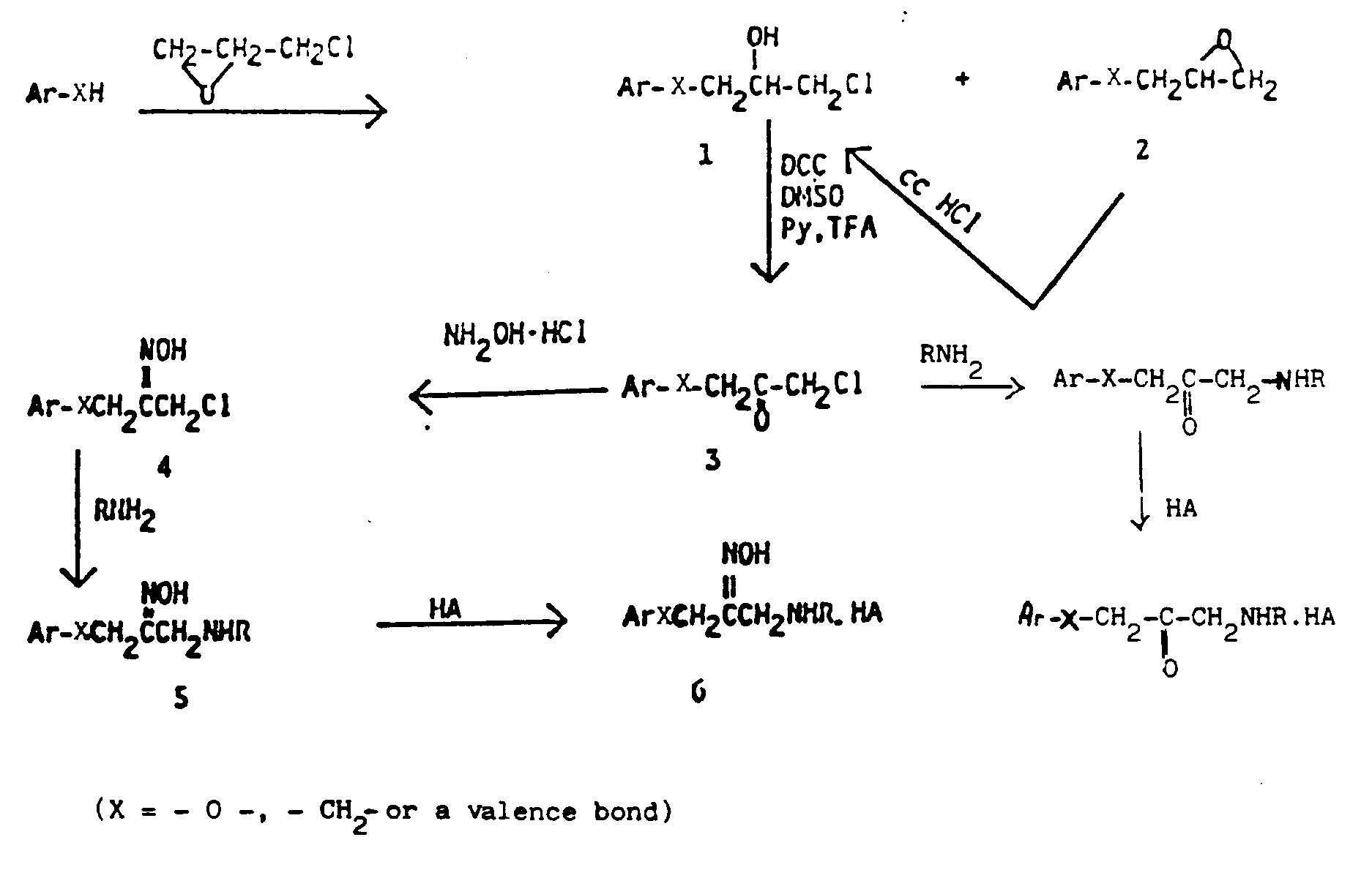
The conventional reaction of Ar-OH and epichlorohydrin with a small amount of morpholine as catalyst affords a mixture of the chlorohydrin 1 and theepoxide 2; the latter being converted to 1 by treatment with conc. HCl. Oxidation of 1 by the Pfitzner-Moffat method [Pfitzner et al, 1965, J. Am. Chem. Soc., 87, 5661 and 5670] yields theketone 3. Subsequent reaction of 3 with hydroxylamine HCl gives theoxime 4, which is a mixture of the Z- and E-isomers. In the usual case the ratio is about 1:2 , as determined by NMR [Silverstein, "Spectrometric identification of organic compounds", 1974, 3rd ed.: G. Clayton Bassler and Terence C. Morril, New York, Wiley]. - The major product, 4 (E-), can be isolated by recrystallization from benzene. Treatment of 4 with isopropylamine in THF gives the
oxime 5 essentially as the pure Z-isomer, which can be converted to theHCl salt 6. Alternately, the oxidation of the racemic β-blocker
with DCC/(COCl)₂ at -20° to -78° will result in the ketone
which can be converted to 6 without isolation by adding H₂NOH HCl. - The invention is illustrated by the following non-limiting examples wherein melting points were determined with a Fisher-Johns melting point apparatus and are uncorrected. The 90-MHz NMR spectra were taken on a Varian EM390 NMR spectrometer. TLC was performed on 0.25/mm Merck silica gel 60 F-254 glass plates.
- The synthesis of the propanolone oxime (6a) is a typical example.

- A mixture of 1-naphthol (20g, 0.14 mole), ephichlorohydrin (51.3g, 0.55 mole), and morpholine (0.7 ml) was heated at 100-120°C for 7.5 h. Excess epichlorohydrin and morpholine were removed under reduced pressure, the residue was dissolved in chloroform and shaken with 10 ml of conc. HCl to convert (2a) to the chlorohydrin (1a). The organic layer was separated and washed with water, then with dil. NaHCO₃ and finally with water. It was dried over anhydrous MgSO₄ and concentrated to yield 29.8g (98%) of the crude product. This was used in the next step (oxidation) without purification.
- Purification of a sample of the crude (1a) was carried out by column chromatography (silica gel: Aldrich 100-200 mesh, 60 Å x4W, eluent CHCl₃). NMR (CDCl₃) δ 8.15 (m, 1H), δ 7.75 (m, 1H) δ 7.5-7.2 (m, 4H), δ 6.7 (d, d, J=7 Hz, J=1 Hz, 1H), δ 4.35-3.50 (m, 5H), δ 2.9 (d, J=6 Hz, 1H).
- To a solution of 1,3-dicyclohexylcarbodiimide (DCC) (47.1g, 0.228 mole DMSO (36 ml), and pyridine (3.6 ml) in diethyl ether (300 ml) was added a solution of (1a) (18.0g, 76 mmole) in diethyl ether (36 ml). To this solution was then added dropwise a solution of trifluoroacetic acid (1.8 ml) in diethyl ether under ice-water cooling, and the mixture was stirred at room temperature for 1 h and allowed to stand overnight. A solution of oxalic acid (18g) in MeOH was added to the reaction mixture in small portions, and the stirring was continued for 0.5 h. The dicyclohexylurea was filtered and washed with ether. The filtrate was washed with a 5% NaHCO₃ solution, then with water and dried over anhydrous MgSO₄. From the filtrate 6.3g of the desired compound was recovered. The mother liquor was concentrated under reduced pressure and the residue was recrystallized from 2-propanol to yield an additional 3.3g. The total yield was 9.6g (Y=56%). This product was used in the next step without further purification. A pure sample was obtained by column chromatography (silica gel: Aldrich 100-200 mesh, 60 Å x 7W, eluent CHCl₃: hexane = 3.1). NMR(CDCl₃) δ 8.25 (m, 1H), δ 7.80 (m, 1H), δ 7.65 7.20 (m, 4H), δ 6.75 (d, J=7 Hz, 1H), δ 4.83 (s, 2H),
δ 4,43 (s, 2H). - A mixture of (3a) (1.0g, 4.26 mmole), hydroxylamine hydrochloride (0.36g, 5.1 mmole), and DMSO (10 ml) was heated at 40-60°C for half an hour. Water (40 ml) was introduced and the solution was extracted with CHCl₃. The organic layer was washed with water several times, dried over anhydrous magnesium sulfate, and concentrated under reduced pressure. The crude yield was 1.1g (Y=100%). Further purification was carried out by column chromatography (silica gel: Aldrich 100-200 mesh, 60 Å x 30W, eluent: benzene:AcOEt=4:1). The product was a mixture of Z- and E- isomer (E:Z=2:1). This isomer mixture could be used in the next step. NMR (CDCl₃ + DMSO-d6 (1 drop) δ 10.85 (s, 0.33H, -NOH of z-isomer), δ 10.75 (s, 0.67H, -NOH of E-isomer), δ 8.4-8.1 (m, 1H), δ 7.9-7.65 (m, 1H), δ 7.6-7.2 (m, 4H), δ 6.95-6.7 (m, 1H), δ 5.2 (s, 1.33H, OCH₂ of E-isomer), δ 4.9 (s, 0.67H, OCH₂ of Z-isomer), δ 4.45 (s, 0.67H, -CH₂Cl of Z-isomer) δ 4.3 (s, 1.33H, -CH₂Cl of E-isomer).
- The E-isomer was isolated from the crude product by recrystallization from benzene. M.p. 162-163°C.
- A mixture of (4a) (2.5g, 10 mmole), isopropylamine (6.0g, 8.7 ml, 100 mmole), and THF (50 ml) was heated at 50°C for 1.5 h. The reaction mixture was concentrated under reduced pressure. To the residue was added dil. NaHCO₃ and the solution was extracted with ethyl acetate. After the organic extract was shaken with dil. HCl solution, the separated aqueous layer was made basic with dil. HCl solution, extracted with AcOEt, dried over anhydrous MgSO₄, and concentrated under reduced pressure. The crude yield was 2.6g (Y=95%). The crude product was purified from a mixed solvent of isopropyl ether and hexane. The pure yield was 0.98g (Y=36%). M.p. 131.5-132.5°C. This product was the Z-isomer only. NMR(CDCl₃) δ 8.30-8.20 (m, 1H, one of H of naphthalene), δ 6.90-6.80 (m, 1H, one of H of naphthalene), δ 5.16 (2, 2H, -OCH2-), δ 3.70 (s, 2H, -CH2N-), δ 3.05-2.70 (m, 1H, N-CH<), δ 1.10.
- To diethyl ether saturated with HCl gas was added a solution of propranolone oxime (5a) (0.30g) in diethyl ether. The mixture was stirred at room temperature for 0.5 h. The precipitated white crystals were filtered and dried in vacuo overnight. The yield was 0.32g (Y=94%). This product was essentially pure Z-isomer. NMR (DMSO-d6) δ 12.00 (s, 1H, -NOH), δ 8.30-8.15 (m, 1H, of naphthalene), δ 7.95-7.80 (m, 1H, of naphthalene), δ 7.65-7.30 (m, 4H, part of naphthalene), δ 7.05-6.95) (m, 1H, one of H of naphthalene), δ 5.15 (s, 2H, -OCH₂), δ 3.96 (s, 2H, -CH₂N), δ 3.55-3.20 (m, 2H, NCH, -NH), δ 1.27 (d, J=6 Hz, 6H, -(CH₃)2).
Anal. (C₁₆H2OO₂N₂·HCl) C,H,N. -

- was synthesized according to the method given for (1a). Yield 83%; the crude compound was used in the next step. NMR (CDCl₃) δ 4.5 (d, J=5 Hz, 2H), δ 4.2 (pentet, J=5 Hz, 1H), δ 3.8- δ 3.65 (m, 6H), δ 3.55-3.40 (m, 4H). The peak of C-OH could not be identified.
3-Chloro-1-[(4-morpholino-1,2,5-thiadiazol-3-yl)oxy]-2-propanone (3b) was synthesized according to the method given for (3a). Yield: 65%. The crude product was used in the next step. Purification of the crude product (recrystallization from 2-propanol) yielded the pure sample. NMR (CDCl₃) δ 5.22 (s, 2H), δ 4.13 (s, 2H), δ 3.75 (m, 4H, δ 3.50 (m, 4H). - In a 500 ml round-bottomed flask were placed (3b) (13.69, 49 mmole) and hydroxylamine hydrochloride (5.1g, 73.4 mmole), in an ethanol-DMF mixed solvent (266 ml). The mixture was stirred at room temperature for 18 hours. The reaction mixture was poured into water (2L) and was extracted with ether. The organic extract was washed well with water, dried over anhydrous MgSO₄, and was concentrated in vacuo at 30°C. The crude yield was 11.8g (Y=83%). The product was a mixture of Z- and E- isomers (E: Z=1.1: 1.0). This crude mixture can be used in the next step. NMR (CDCl₃) δ 9.30 (broad s, 0.5H, -NOH of Z-isomer), δ 9.10 (broad s, 0.5H -NOH of E-isomer), δ 5.35 (s, 1H, O-CH₂ of E-isomer) δ 5.10 (s, 1H, Z-isomer), δ 4.30 (s, 1H, -CH₂-N of Z-isomer), δ 4.17 (s, 1H, -CH₂-N of E-isomer), δ 4.8-4.7 (m, 4H) δ 3.6-3.4 (m, 4H).
- In a 250 ml round-bottomed flask fitted with a dropping funnel was placed (4b) (9.89, 33.5 mmol) in THF (147 ml). The solution was cooled in an ice bath, and a solution of tert-butylamine (12.2g, 168 mmol) in THF (20 ml) was added through the dropping funnel during 10 minutes keeping the reaction temperature at -5 to 0°C (pH 6-7). The stirring was continued for 1 hour at the same temperature. The solvent was evaporated under reduced pressure at 25°C. To the residue was added diluted HCl (2.8 ml conc. HCl) and it was extracted with ethyl acetate. To the aqueous layer separated was added a dil. NaHCO₃ solution (NaHCO₃ 3.1g) at -5°C (pH ∼ 6-7). It was extracted with ether to remove some impurities. Small amounts of NaHCO₃ (0.1-0.3g) were added to the aqueous layer to make it slightly basic, and the mixture was extracted with ether. This procedure was repeated 4 times (pH was about 8) and another 3 times after raising the pH to about 9 with dil. NaOH solution. The organic extracts were combined, washed with water, dried over anhydrous MgSO₄, and concentrated in vacuo. Yield 3.1g (Y=28%). The crude product was triturated with isopropyl ether to yield 2.8g. This was recrystallized from isopropyl ether to yield 1.8g (Y=16%) of pure compound.
- In a 50 ml round bottomed flask was placed a solution of oxalic acid (0.20g, 2.22 mmole) in ether (10 ml). To this solution was added a solution of (5b) (0.43g, 1.3 mmole) in ether. The mixture was stirred at room temperature for 1 hour. The white non-hygroscopic crystals were filtered and dried in vacuo. Yield 0.53g (Y=97%). M.p. 165-166° (dec:). NMR (CDCL₃) δ 5.3 (s, 2H), δ 3.9-3.7 (m, 4H), δ 3.6-3.4 (m, 6H), δ 1.1 (s, 9H).
Anal. (C₁₈H₂₅O₇N₅), C,H,N. -

- In a 250 ml round-bottomed flask fitted with a reflux condenser were placed 5-hydroxycarbostyril (15.0g, 92 mmole), epichlorohydrin (34.2g, 0.37 mole), morpholine (1.5 ml), and dioxane (90 ml). The mixture was refluxed for 16 hours, then it was concentrated in vacuo (20 mm/Hg) at 80-90°C. To the residue was added 300 ml of 2N HCl, stirred for 15 minutes, then 0.8-1.0 L of ethyl acetate was added and the mixture was stirred vigorously for 0.5 hour. The organic layer was separated, washed well with water, then with dil. NaHCO₃ and was concentrated in vacuo. Yield: 19.9g (85%).
NMR (DMSO-d6) δ 10.3 (s, 1H -NH-), δ 7.25-6.50 (m, 3H, Ph), δ 4.20-3.60 (m, 5H, OCH₂CHCH₂Cl), δ 3.00-2.30 (m, 4H, -CH₂CH₂CO-).
5-(3-Chloro-2-oxo)propoxy)-3,4-dihydrocarbostyril (3c) was synthesized according to the method described for (3a). NMR (DMSO-d6) δ 10.10 (s, 1H, -NH-), δ 7.20-7.00 (m, 1H, Ph), δ 6.65-6.50 (m, 2H, Ph), δ 4.95 (s, 2H, OCH₂), δ 4.70 (s, 2H, CH₂Cl), δ 3.0-2.8 (m, 2H, -C-CH₂CO-), δ 2.5-2.3 (m, 2H, -CH₂-C-CO-).
5-[3-Chloro-2-(hydroxyimino)propoxy]-3,4-dihydrocarbostyril (4c) was synthesized similarly to the method given for (4b). NMR (DMSO-d6) δ 11.88 (s, 0.3H), z- of NOH), δ 11.80 (s, 0.7H, E- of NOH) δ 10.08 (s, 1H, -NH-), δ 7.30-6.50 (m, 3H, Ph), δ 4.93 (s, 1.4H, E- of OCH₂) δ 4.73 (s, 0.6H, Z- of OCH₂), δ 4.38 (s, 2H, Z & E- of CH₂Cl), δ 3.00- δ 2.80 (m, 2H, C-CH₂-CO-), δ 2.65-2.40 (m, 2H, CH₂-C-CO). - In a 100 ml round-bottomed flask fitted with a dropping funnel were placed (4c) (2.0g, 7.45 mmole) and THF (70 ml). The solution was cooled to 0°C and a solution of tert-butylamine (0.82g, 1.17 ml, 11.2 mmole) in THF was introduced through the dropping funnel. The mixture was stirred under cooling for 2 hours. To the reactive mixture was added a solution of oxalic acid (1.48g, 16.4 mmole) in THF. The precipitate was filtered, triturated with water (600-700 ml) by stirring well for 15 minutes, and it was filtered again. The filtrate was extracted with ethyl acetate several times. The aqueous layer was cooled to 0°C, basified with a dil. NaHCO₃ solution (NaHCO₃ 0.81g), and was immediately extracted with ethyl acetate. The extract was evaporated in vacuo (20 mHg) at 30°C. Yield: 0.63g (28%). Recrystallized from i-propanol, the product was Z-isomer. M.p. 177-180°C (dec.)
NMR (DMSO-d₆) δ 11.0PPM(s, 1H), δ 10.1 (s, 1H), δ 7.3-7.1 (m, 1H), δ 6.7-6.5 (m, 2H), δ 4.9 (s, 2H), δ 3.3 (s, 3H contain NH), δ 3.0-2.8 (m, 2H), δ 2.6-2.3 (m, 2H), δ 1.05 (s, 9H). - The free base (5c) was converted to the hydrochloride salt (6c) in ether with HCl gas. M.p. 167-169°C (dec.).
Anal. (C₁₆H₂₄O₃N₃Cl) C,H,N. -

- In a 200 ml round-bottomed flask were placed 3-chloro-1-[3-(4-morpholino-1,2,5-thiadiazyloxy)]-2-propanone oxime (4b) (3.53g, 12.1 mmole), isopropylamine (3.56g, 60.3 mmole), and THF (71 ml). The mixture was stirred at room temperture for 2.5 hours. The reaction mixture was concentrated in vacuo at room temperature. The residue was triturated with isopropyl ether and precipitated crystals were filtered with suction. The crystals were dissolved in dil. HCl solution. To the solution was added ether and NaHCO₃ in small portions under vigorous stirring conditions. The organic layer was washed with water and dried over anhydrous MgSO₄, and concentrated in vacuo. Yield: 0.42g (Y=11.6%) from isopropyl ether.
- The oxime (4b) (0.25g) was dissolved in ether and ether saturated with HCl was introduced dropwise into the solution. The mixture was stirred for 10 minutes, filtered and dried in vacuo overnight. Yield: 89%.
Anal. (C₁₂H₂₂N₅O₃S Cl) C,H,N. -
1 - 1-(Isopropylamino)-3-(1-naphthyloxy)-2-propanone oxime hydrochloride, propranolone oxime hydrochloride (6a),
C₁₆H₂₁O₂N₂Cl
.Calc.: C, 62.23; H, 6.85; N, 9.07 Found: C, 62.32; H, 6.89; N, 9.05.
2 - 1-(tert-Butylamino)-3-[(4-morpholino-1,2,5-triadiazol-3-yl)oxy]-2-propanone oxime oxalate, timolone oxime oxalate (6b), C₁₅H₂₅O₇N₅S C₁₃H₂₃O₃N₅S. (COOH)₂.Calc.: C, 42.95; H, 6.01; N, 16.70 Found: C, 43.00; H, 6.04; N, 16.67.
3 - 5-[3-(tert-Butylamino)-2-(hydroxyimino)propoxy]-3,4-dihydrocarbostyril hydrochloride, carteolone oxime HCl (6c), C₁₆H₂₄O₃N₃Cl.Calc.: C, 56.22; H, 7.08; N, 12.30 Found: C, 56.10; H, 7.13; N, 12.21
4 - 1-(Isopropylamino)-3-[(4-morpholino-1,2,5-thiadiazol-3-yl)oxy]-2-propanone oxime hydrochloride (6d), C₁₂H₂₂N₅O₃S Cl · 1/3 H₂O.Calc.: C, 40.27; H, 6.38; N, 19.57 Found: C, 40.54; H, 6.42; N, 19.46 - The following non-limiting examples illustrate the pharmacological properties of the compounds of the invention.
- Adult male New Zealand albino rabbits weighing 2.5 - 3.5 kg were used. The animals were kept in individual cages with free access to food and water. Intraocular pressure was measured using a Digilab model 30R pneumatonometer. The pneumatonometer readings were checked at least twice a day using the Digilab calibration verifier. All measurements were obtained from unrestrained, unanesthetized rabbits. One drop of 0.5% propacaine (Ophthetic-Allergan Pharmaceuticals, Inc.) diluted 1:2 with saline was instilled in each eye immediately prior to IOP measurement. Drugs were administered as 1 or 2.5% solution in buffer pH 7.4 or in saline in both eyes of a group of at least four rabbits. Another group of at least three rabbits served as control and was administered the carrier only. IOP was recorded after 30 and 60 minutes and then after 2, 3, 4, 6 and 8 hours following the drug or carrier administration. Values are given as means ± standard error (S.E.) of the mean. The significance of the change was determined using the student's t-test.
- The animals were also observed for local action of the drugs on the eyes, e.g., irritation, congestion, redness, lacrimation, etc.
- The results are set forth in Tables 1 - 3.


- These results reveal that the ketoxime analogs of both propranolol and timolol display a certain degree of ocular hypotensive activity. Propranolone ketoxime (6a) has shown the highest activity at both tested concentration levels, 1 and 2.5%. This activity was much more pronounced and prolonged than that of propranolol itself administered at the same dose levels (Tables 1 and 2). In addition, the ketoxime (6a) was completely devoid of the ocular irritation which always accompanied propranolol administration at both dose levels. This irritant activity might have contributed to the reduced action of propranolol on the IOP at the 1% dose level and, also, might have completely masked its ocular hypotensive activity at the 2.5% dose level. Timolone ketoxime (6b) has also shown a significant ocular hypotensive activity which was faster in its onset and shorter in its duration than timolol (1b) itself (Table 3). On the other hand, the other ketoxime precursors, the ones for the N-isopropyl analog (6d) of (6b) and (6c) for carteolol, showed low activity at the dose levels used but showed some β-antagonist activity.
- Male Sprague-Dawley rats weighing 150-250 g were used. Each animal was anesthetized with sodium pentobarbital (50 mg/kg) and the jugular vein was cannulated with PE50 tubing. This cannula was subcutaneously threaded around the neck and exteriorized dorsally. The cannula was filled with heparin solution (1000/µl) and sealed with a solid 22-gauge stylet. Animals were housed in individual stainless steel cages and at least 24 hours were allowed for recovery from the surgery. Food and water were provided ad libitum. On the day of the experiment, the heart rate of each rat was monitored with a plethsmograph and the data recorded on a Physioscribe II recorder. One hour was allowed as an equilibration period before any drugs were administered. Drugs were dissolved in normal saline as 0.3% solution and were administered intravenously at a dose of 6 mg/kg. The resting heart rate was then recorded after 1, 3, 5, 10 and 15 minutes following i.v. injection. Isoprenaline (Isoproterenol bitartarate), was then administered subcutaneously at a dose of 50 µg/kg and the heart rate was recorded for 3, 5, 10, 15, 20, 30, 45 and 60 minutes after administration. A control group of seven animals was intravenously administered saline solution and was treated exactly in the same manner as the drug-treated groups.
- The significance of the difference between the effect of saline solution and the drugs under investigation on the resting heart rate and on isoprenaline tachycardia was analyzed using the student's "t" test. Values are given as mean ± S.E. of the mean. The results are depicted in Figure 1 which depicts the mean change in heart rate over time for (□) propranolol HCl (1a), (▲) timolol maleate (1b), (·) carteolol HCl (1c), (○) propranolone ketoxime HC1 (6a), (∇) timolone ketoxime oxalate (6b), (△) N-isopropyl timolone ketoxime HCl (6d), (■) carteolone oxime HCl (6c) and (- - -) saline solution.
- In another set of experiments the effect of the oral administration of propranolol Hcl (1a) and propranolone oxime HC1 (6a) in doses of 25, 50 and 100 mg/kg on the resting heart rate and isoprenalinetachycardia was evaluated in rats. Drugs were administered to groups of 5 rats using a stomach tube and the heart rate was recorded for 1 hour. Then isoprenaline (50 µg/kg, s.c.) was administered and the heart rate was recorded after 3, 5, 10, 15, 20, 30, 45 and 60 minutes following administration. A control group of 5 rats was treated exactly in the same manner after the oral administration of the appropriate volume of saline solution.
- The resting heart rate portions of these studies revealed that most of the tested ketoximes exhibit a negative chronotropic action in rats. Again, the ketoximes of propranol (6a) and timolol (6b) have shown the highest activity in this test, whereas carteolone ketoxime (6c) and the oxime (6d) were less active. It should be also noted that in this test carteolol (1c) itself has shown the lowest activity on the heart rate of rats.
- When the potential β-adrenergic antagonist activity of the ketoxime precursors of propranolol, timolol and carteolol was assessed against isoprenaline-tachycardia using the parent compounds as obvious reference drugs as described above, results were in agreement with the findings of the studies on the effect on the IOP and resting heart rate. Thus, the ketoxime precursors of propranolol (6a) and timolol (6b) were the most effective whereas (6c) and (6d) were the least active. See Figure 1.
- These results indicate that at least two of the investigated ketoxime precursors (6a and 6b) have an antiglaucoma activity which is probably linked to their β-adrenergic antagonistic properties. Yet, whether these properties are due to an inherent intrinsic activity of the ketoximes themselves or are the result of their active biological conversion to their parent drugs needed to be verified. For this reason the in vivo disposition of the different ketoximes and their parent β-blockers in the different ocular tissues was studied in rabbits.
- Adult male New Zealand albino rabbits weighing 2.5-3.5 kg were used. Standard doses of 100 µl of 1% solution of the drugs in saline solution were administered topically to both eyes of each rabbit. After appropriate time intervals (30, 60 and 120 minutes), the animals were sacrificed. Aqueous humor was obtained by making a single puncture at the limbus using a 25
g x 5/8" needle attached to 1 c.c. syringe. Then the cornea and the iris-ciliary body were isolated. The tissues were pooled and homogenized using a Tekmar SDT tissuemizer in ice cold perchloric acid (0.05 M) which contained 0.05% sodium metabisulfite as antioxidant. Samples were then rehomogenized in CH₃OH to prepare 10% homogenates, transferred to micro-filters and centrifuged for 20 minutes at 10000 r/minute to precipitate proteins. Aqueous humor was analyzed as such without any further dilution. Aliquots of 5-20 µl of the 10% tissue homogenate samples were analyzed by HPLC. Quantitation was done by using a calibration curve obtained by the addition of known amounts of the compound to aqueous humor, iris-ciliary body or cornea obtained from a control rabbit after topical administration of saline solution. - A group of seven adult male Sprague-Dawley rats weighing 150-250 g was used. Animals were intrajugularly injected with propranolone oxime (6a) at a dose of 6 mg/kg. After 1, 3, 5, 20, 40 and 60 minutes, one ml of blood was withdrawn from the jugular vein and dropped immediately into a tared tube containing 1 ml of ice-cold acetonitrile. The tubes were vigorously shaken, centrifuged, decanted and analyzed for propranolol (1a) and propranolone oxime (5a) by HPLC. Quantitation was done by using a calibration curve obtained by addition of known amounts of propranolol oxime HCl (6a) to blood obtained from a control rat pretreated with saline solution.
- The results of the ocular tissue tests are set forth in Tables 4 and 5.

Table 5 Tissue Concentrationa of propranolol at various timeintervals following topical administration of propranolol.HCl (1a)(1% solution). Concentration of propranolol (mcg/g tissue) Tissue/Time 30 min. 60 min. 120 min. Cornea 47.10±5.57 14.54±2.97 0.00±0.00 Iris-ciliary body 8.05±1.47 0.00±0.00 0.00±0.00 Aqueous humor 1.28±0.19 0.26±0.08 0.00±0.00 aFigures represent the mean ± S.E. of the mean of four rabbits. - The results of the ocular tissue studies show that propranolol (1a) could be detected in measurable concentrations in the different eye compartments for the first two hours following the topical administration of its ketoxime precursor (6a) at its effective ocular hypotensive dose level (1%) (Table 4). On the other hand, propranolol could not be detected in any of the tested eye tissues two hours after its ocular application (Table 5), and it had completely disappeared from the iris-ciliary body which is supposed to be the site of its ocular hypotensive action, one hour after administration. These results might explain the shorter duration of propranolol action on the IOP relative to that of its ketoxime precursor. In addition, these results might also suggest that the ocular hypotensive activity of the oxime is most probably due to its active conversion to propranolol in situ in the ocular tissues of rabbits. This is also supported by the finding that following the ophthalmic administration of the other ketoxime precursors (6b and 6c) of timolol and carteolol, respectively, at the low dose level used, the parent β-adrenergic antagonists in any of the eye compartments could not be found. This would suggest that either the ketone formed or the reduced form, the active β-blocker, is disposed of so fast that it cannot be detected, or that the ketones are not such good substrates for the reductase enzyme as the propanolone ketoxime.
- The studies in ocular tissue and blood revealed that the metabolic pathway of the oxime in the blood is quite different from that in ocular tissues. Thus, propranolol was not detected in rat's blood following the i.v. administration of the oxime and, instead, another more polar compound was detected. However, 5 minutes after injection even this compound had totally disappeared. The oxime itself appeared to have a very fast metabolism in blood (Fig. 2). The t1/2 in blood was equivalent to 7.64 ± 0.55 minutes and one hour after i.v. administration the oxime had completely disappeared from the blood.
- While these results would suggest that the propranolol formed in situ in the iris-ciliary body is responsible for the IOP reduction observed, the ketoxime itself might have intrinsic activity.
- Based on the previous observation of the necessity to convert adrenalone to lipophilic esters to be reduced, one could expect that the lipophilic propranolone is easily reduced, while the ketones derived from timolol and carteolol, being less lipophilic (heterocyclic substitution of naphthalene), are not reduced that extensively. The N-isopropyl analog (6d) of timolol was synthesized and tested in order to assess the importance of the N-alkyl function. Propranolol contains an i-propyl group, like 6d, but 6d was still found inactive. The difference in the behavior of the 6a vs. 6b-d thus might be due to the difference in the Ar-group which appears to determine the substrate properties necessary to bind to the reductase enzyme. This hypothesis is supported by the relative HPLC retention times of the free bases 5a-5d which were 12.86, 7.22, 3.10, 6.10 for 5a, 5b, 5c and 5d, respectively, indicating that 5a is by far the most lipophilic.
- The following example illustrates the HPLC analytical method used to obtain these results.
- A high pressure liquid chromatography (HPLC) method was developed for the assay of the β-blockers and their ketoxime analogs in biological fluids. The chromatographic analysis was performed on a system consisting of Beckman Model 112 solvent delivery system, Model 340 Injector, and Waters Model 481 variable wave length LC spectrophotometer. An ASI reverse phase chrompack C₁₈ column, operated at ambient temperature, was used for all separations. The mobile phase used for separation of propranolol (1a) and propranolone oxime (5a) consisted of water, 1-heptane sulfonic acid, 0.1M acetic acid, 0.1M triethanolamine and methanol (90, 1g, 100, 799). With a flow rate of 1.5 ml/minute, the two compounds showed retention times of 2.44 and 3.21 minutes for propranolone oxime and propranolol, respectively. The mobile phase used for separation of carteolol (1c), carteolone oxime (5c), timolol (1b), timolone oxime (5b) and timolone ispropyl oxime (5d) consisted of water, 1-heptane sulfonic acid, 0.1M acetic acid, tetrahydrofuran, 0.1M triethanolamine and methanol (430, 2, 40, 30, 100 and 398). With a flow rate of 1.5 ml/minute, the retention times for these compounds were 3.10, 3.54, 6.10, 7.22 and 9.15 minutes for carteolone oxime (5c), carteolol (1c), timolone isopropyl oxime (5d), timolone oxime (5b) and timolol (1b), respectively.
- The results are depicted in Figure 2 which is a plot of blood levels (µg/ml) vs. time of 5a after administration of 6a at a dose level of 6 mg/kg to rats.
- It is believed that the compounds of the invention are converted to their parent β-blockers according to the following scheme A which shows the conversion of 5a to 1a. Similar conversions would follow scheme B.
- The hydrolytically sensitive precursors of the present invention comprise effective chemical delivery systems (CDS) for the β-blockers and intraocular pressure reducing agents.

The compounds of the invention may be administered to animals in need thereof by instilling solutions thereof into the eye or via oral tablets, capsules, etc., or any other convenient route of administration at dosages of from about 0.001 to about 20 mg/kg. - The compounds may be formulated with any conventional pharmaceutically acceptable carrier, such as those utilized for the parent amino-alcohol β-blockers.
Claims (32)
- A compound having the formula

- A compound or salt according to Claim 1, wherein =Y is =N-OR₁, =N-NH₂, =N-NR₁R₂,
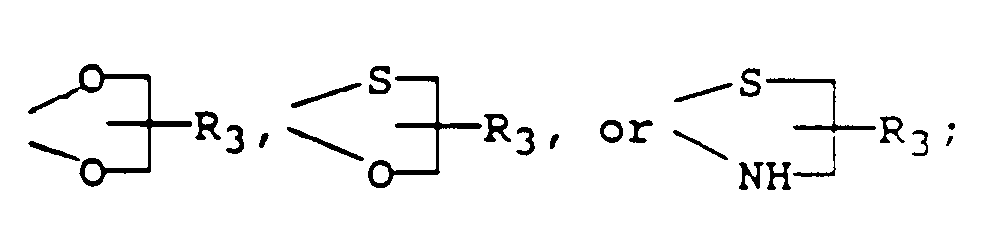
- A compound or salt according to Claim 2, wherein =Y is =NOR₁ wherein R₁ is H or alkyl having from 1 to 8 carbon atoms.
- A compound or salt according to claim 3, wherein =Y is =NOH.
- A compound or salt according to any one of the preceding claims, wherein -X- is -O-.
- A compound or salt according to any one of Claims 1-5, wherein R is isopropyl or t-butyl.
- A compound or salt according to any one of Claims 1-6, wherein Ar is the 3-aromatic or heterocyclic residue of propanolol, timolol, carteolol, alprenolol, atenolol, befunolol, betaxolol, bevantolol, bufuralol, bunitrolol, bupranolol , celiprolol, cetamolol, labetolol, levobunolol, mepindolol, metipranolol, metoprolol, moprolol, nadolol, oxprenolol, penbutolol, pindolol or toliprolol.
- A compound or salt according to any one of Claims 1-6, wherein Ar is

- The compound of Claim 1 having the formula

- The compound of Claim 1 having the formula

- The compound of Claim 1 having the formula

- The compound of Claim 1 having the formula

- The compound of Claim 1 having the formula

- The compound of Claim 1 having the formula

- The compound of Claim 1 having the formula

- The compound of Claim 1 having the formula
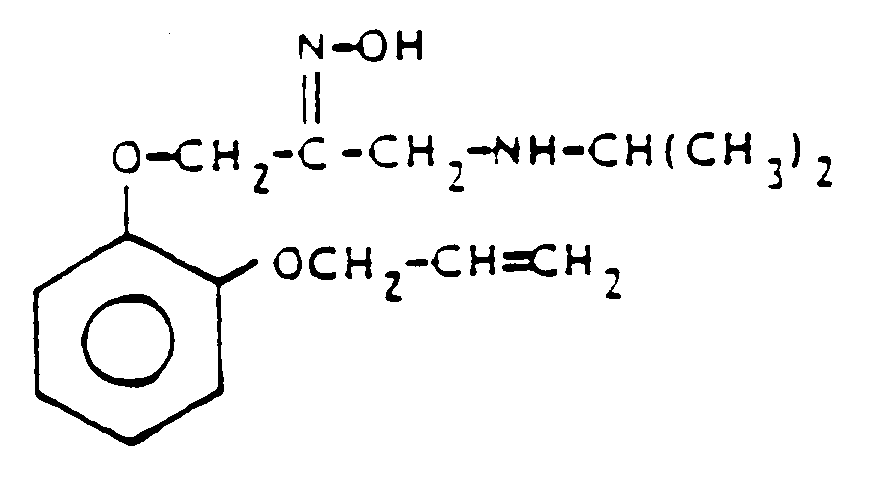
- The compound of Claim 1 having the formula

- The compound of Claim 1 having the formula
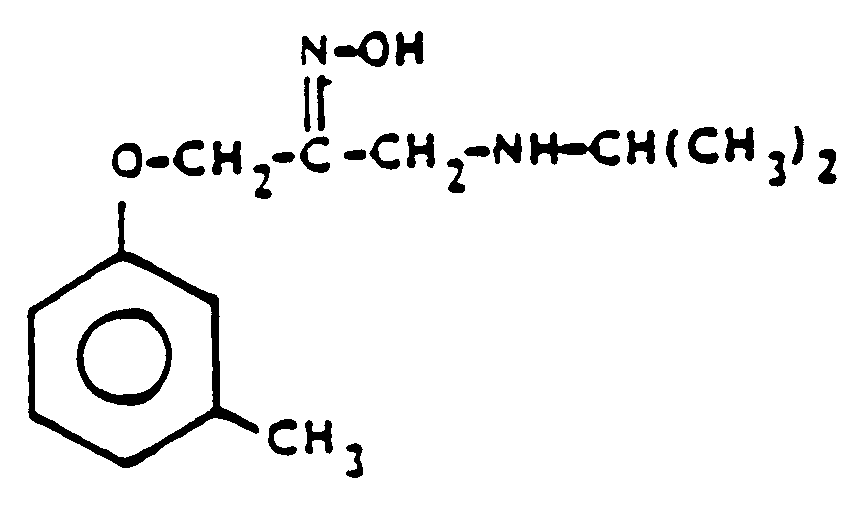
- The compound of Claim 1 having the formula
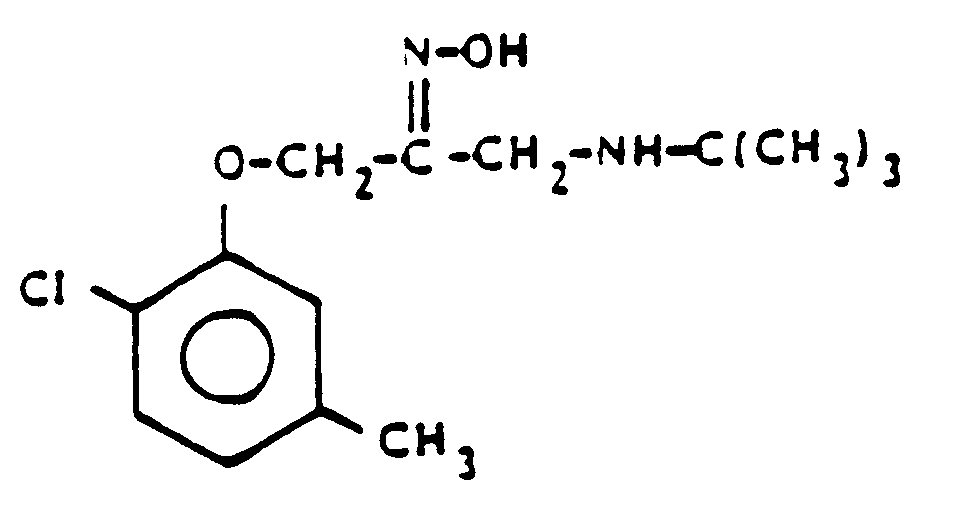
- Use of the compound of any one of claims 1 to 19 or a pharmaceutically acceptable acid addition salt thereof in the preparation of a medicament having a β-adrenergic blocking effect.
- A pharmaceutical composition of matter, in unit dosage form, for use in eliciting a β-adrenergic blocking response in a warm-blooded animal, said composition comprising an effective β-adrenergic blocking amount of a compound as claimed in any one of claims 1 to 19 or a pharmaceutically acceptable acid addition salt thereof and a non-toxic pharmaceutically acceptable carrier therefor.
- Use of a compound having the formula

- Use according to Claim 22, wherein =Y is =N-OR₁, =N-NH₂, =N-NR₁R₂,

- Use according to Claim 23, wherein =Y is =NOR₁ wherein R₁ is H or alkyl having from 1 to 8 carbon atoms.
- Use according to any one of Claims 22-24, wherein Ar is the 3-aromatic or heterocyclic residue of propranolol, timolol, carteolol, alprenolol, atenolol, befunolol, betaxolol, bevantolol, bufuralol, bunitrolol, bupranolol, celiprolol, cetamolol, labetolol, levobunolol, mepindolol, metipranolol, metoprolol, moprolol, nadolol, oxprenolol, penbutolol, pindolol or toliprolol.
- Use according to Claim 22, wherein the compound is selected from the group consisting of


- An ophthalmic pharmaceutical composition of matter, in unit dosage form, for use in the lowering of intraocular pressure in a warm-blooded animal, especially in the treatment of glaucoma, said composition comprising an effective intraocular pressure reducing amount of a compound having the formula

- A composition according to Claim 27, wherein =Y is =N-OR₁, =N-NH₂, =N-NR₁R₂,
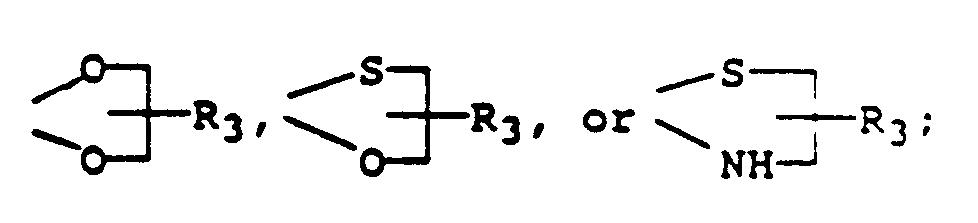
- A composition according to Claim 28, wherein =Y is =NOR₁ wherein R₁ is H or alkyl having from 1 to 8 carbon atoms.
- A composition according to any one of Claims 27-29, wherein Ar is the 3-aromatic or heterocyclic residue of propranolol, timolol, carteolol, alprenolol, atenolol, befunolol, betaxolol, bevantolol, bufuralol, bunitrolol, bupranolol, celiprolol, cetamolol, labetolol, levobunolol, mepindolol, metipranolol, metoprolol, moprolol, nadolol, oxprenolol, penbutolol, pindolol or toliprolol.
- A composition according to Claim 27, comprising an effective intraocular pressure reducing amount of a compound having the formula


- The compounds of claims 1 to 19 for use in therapy.
Priority Applications (1)
| Application Number | Priority Date | Filing Date | Title |
|---|---|---|---|
| AT8888301615T ATE105547T1 (en) | 1987-03-16 | 1988-02-25 | LABOR KETO DERIVATIVES OF 3-SUBSTITUTE 1ALKYLAMINO-2-PROPANOLS AND THEIR USE AS BETA ADRENEGIC BLOCKERS. |
Applications Claiming Priority (2)
| Application Number | Priority Date | Filing Date | Title |
|---|---|---|---|
| US2600287A | 1987-03-16 | 1987-03-16 | |
| US26002 | 1987-03-16 |
Publications (2)
| Publication Number | Publication Date |
|---|---|
| EP0283147A1 EP0283147A1 (en) | 1988-09-21 |
| EP0283147B1 true EP0283147B1 (en) | 1994-05-11 |
Family
ID=21829283
Family Applications (1)
| Application Number | Title | Priority Date | Filing Date |
|---|---|---|---|
| EP88301615A Expired - Lifetime EP0283147B1 (en) | 1987-03-16 | 1988-02-25 | Labile ketone derivatives of 3-substituted-1-alkylamino-2-propanols and their use as beta-adrenergic blockers |
Country Status (14)
| Country | Link |
|---|---|
| EP (1) | EP0283147B1 (en) |
| JP (2) | JPH01501797A (en) |
| KR (1) | KR960008766B1 (en) |
| AT (1) | ATE105547T1 (en) |
| AU (1) | AU609788B2 (en) |
| CA (1) | CA1335286C (en) |
| DE (2) | DE3889486D1 (en) |
| DK (1) | DK626588A (en) |
| ES (1) | ES2051831T3 (en) |
| FI (1) | FI94337C (en) |
| IE (1) | IE62828B1 (en) |
| NO (1) | NO171312C (en) |
| WO (1) | WO1988007036A1 (en) |
| ZA (1) | ZA881226B (en) |
Families Citing this family (2)
| Publication number | Priority date | Publication date | Assignee | Title |
|---|---|---|---|---|
| AU609788B2 (en) * | 1987-03-16 | 1991-05-09 | University Of Florida | Labile ketone derivatives of 3-substituted-1-alkylamino- 2-propanols and their use as beta-adrenergic blockers |
| US5177064A (en) * | 1990-07-13 | 1993-01-05 | University Of Florida | Targeted drug delivery via phosphonate derivatives |
Family Cites Families (8)
| Publication number | Priority date | Publication date | Assignee | Title |
|---|---|---|---|---|
| US3619370A (en) * | 1969-04-21 | 1971-11-09 | Frosst & Co Charles E | Microbial reduction of thiadiazoles |
| DE2645710C2 (en) * | 1976-10-09 | 1985-06-27 | Merck Patent Gmbh, 6100 Darmstadt | Phenoxy-aminopropanols, process for their manufacture and pharmaceutical preparation |
| JPS563862A (en) * | 1979-06-26 | 1981-01-16 | Nippon Denso Co | Refrigeration device |
| IL65541A0 (en) * | 1981-05-06 | 1982-07-30 | Haessle Ab | Alkylamino-2-propanols,process for their preparation and pharmaceutical preparations containing same |
| US4521414A (en) * | 1981-06-18 | 1985-06-04 | The Texas A&M University System | Ophthalmic compositions and their use for treating elevated intraocular pressure and glaucoma |
| ATE19510T1 (en) * | 1981-12-17 | 1986-05-15 | Haessle Ab | PARA-SUBSTITUTED 3-PHENOXY-1CARBONYLAMINOALKYLAMINOPROPAN-2-OLS WITH BLOCKING EFFECTS ON BETA-RECEPTORS. |
| US4616022A (en) * | 1984-08-17 | 1986-10-07 | Warner-Lambert Company | Procaterol stabilization |
| AU609788B2 (en) * | 1987-03-16 | 1991-05-09 | University Of Florida | Labile ketone derivatives of 3-substituted-1-alkylamino- 2-propanols and their use as beta-adrenergic blockers |
-
1988
- 1988-02-16 AU AU13459/88A patent/AU609788B2/en not_active Expired
- 1988-02-16 WO PCT/US1988/000386 patent/WO1988007036A1/en not_active Ceased
- 1988-02-16 JP JP63501931A patent/JPH01501797A/en active Granted
- 1988-02-22 IE IE47588A patent/IE62828B1/en not_active IP Right Cessation
- 1988-02-22 ZA ZA881226A patent/ZA881226B/en unknown
- 1988-02-25 DE DE3889486A patent/DE3889486D1/en not_active Expired - Lifetime
- 1988-02-25 DE DE3889486T patent/DE3889486T4/en not_active Expired - Lifetime
- 1988-02-25 AT AT8888301615T patent/ATE105547T1/en not_active IP Right Cessation
- 1988-02-25 EP EP88301615A patent/EP0283147B1/en not_active Expired - Lifetime
- 1988-02-25 ES ES88301615T patent/ES2051831T3/en not_active Expired - Lifetime
- 1988-02-26 CA CA000560031A patent/CA1335286C/en not_active Expired - Fee Related
- 1988-11-10 DK DK626588A patent/DK626588A/en not_active Application Discontinuation
- 1988-11-15 FI FI885271A patent/FI94337C/en active IP Right Grant
- 1988-11-15 NO NO885081A patent/NO171312C/en not_active IP Right Cessation
- 1988-12-16 KR KR1019880701483A patent/KR960008766B1/en not_active Expired - Fee Related
-
1992
- 1992-10-19 JP JP4306006A patent/JPH06122624A/en active Pending
Also Published As
| Publication number | Publication date |
|---|---|
| NO171312B (en) | 1992-11-16 |
| JPH01501797A (en) | 1989-06-22 |
| IE62828B1 (en) | 1995-03-08 |
| JPH0518820B2 (en) | 1993-03-15 |
| FI94337C (en) | 1995-08-25 |
| DE3889486D1 (en) | 1994-06-16 |
| DK626588D0 (en) | 1988-11-10 |
| ATE105547T1 (en) | 1994-05-15 |
| AU609788B2 (en) | 1991-05-09 |
| KR890700573A (en) | 1989-04-25 |
| NO171312C (en) | 1993-02-24 |
| CA1335286C (en) | 1995-04-18 |
| ZA881226B (en) | 1988-08-17 |
| IE880475L (en) | 1988-09-16 |
| JPH06122624A (en) | 1994-05-06 |
| DK626588A (en) | 1988-12-08 |
| FI94337B (en) | 1995-05-15 |
| FI885271L (en) | 1988-11-15 |
| AU1345988A (en) | 1988-10-10 |
| DE3889486T2 (en) | 1994-09-01 |
| NO885081D0 (en) | 1988-11-15 |
| ES2051831T3 (en) | 1994-07-01 |
| EP0283147A1 (en) | 1988-09-21 |
| KR960008766B1 (en) | 1996-07-03 |
| DE3889486T4 (en) | 1994-12-01 |
| FI885271A0 (en) | 1988-11-15 |
| NO885081L (en) | 1989-01-13 |
| WO1988007036A1 (en) | 1988-09-22 |
Similar Documents
| Publication | Publication Date | Title |
|---|---|---|
| KR101468827B1 (en) | Carvedilol Phosphate Salts and(or) Solvates Thereof, Corresponding Compositions, and(or) Methods of Treatment | |
| Bodor et al. | Improved delivery through biological membranes. 26. Design, synthesis, and pharmacological activity of a novel chemical delivery system for. beta.-adrenergic blocking agents | |
| US5082847A (en) | Carbostyril compounds connected via an oxyalkyl group with a piperidine ring and having pharmaceutical utility | |
| EP0030861A2 (en) | Isoquinoline acetic acids and pharmaceutical compositions thereof | |
| IE912760A1 (en) | Compounds | |
| FR2659323A1 (en) | 4- (AMINOMETHYL) PIPERIDINE DERIVATIVES, THEIR PREPARATION AND THEIR THERAPEUTIC USE. | |
| AU5833494A (en) | Piperidine derivatives as calcium channel antagonists | |
| US5017618A (en) | Labile derivatives of ketone analogs of 3-substituted-1-alkylamino-2-propanols and their use as beta-adrenergic blockers | |
| KR840001551B1 (en) | Process for the preparation of cyclohexene derivatives | |
| US4134991A (en) | Derivatives of 2-(3-phenyl-2-aminopropionyloxy)-acetic acid | |
| CA1201437A (en) | Esters of aryloxypropanolamine derivatives | |
| US4068076A (en) | 5-(1-Hydroxy-2-(heterocyclic amino))ethyl-8-hydroxy-3,4-dihydrocarbostyril derivatives | |
| US4147869A (en) | 3,4-Dihydrocarbostyril derivatives and process for preparing the same | |
| US4612312A (en) | Glutarimide antianxiety and antihypertensive agents | |
| CH619453A5 (en) | ||
| WO1995031458A1 (en) | 3-hydroxyquinuclidin-3-ylphenylquinolines as squalene synthase inhibitors | |
| EP0063084B1 (en) | Phenethanol amine derivatives, their preparation and use in medicine | |
| EP0283147A1 (en) | Labile ketone derivatives of 3-substituted-1-alkylamino-2-propanols and their use as beta-adrenergic blockers | |
| GB2151620A (en) | B-phenethanolamine antiobesity agents | |
| US4555513A (en) | 1,2 Dihydro- and 1,2,3,4-tetrahydro quinolylacetic acids and analgesic use thereof | |
| IE912261A1 (en) | New oxazolopyridine compounds, process for preparing these¹and pharmaceutical compositons containing them | |
| US4432991A (en) | Therapeutically active 3-amino-1-phenyl(and substituted phenyl)-2-pyrazolines | |
| US4404221A (en) | 2'-Substituted-spiro[benzofuran-2(3H),1'-cyclohexanes] and its pharmaceutical use | |
| US4034100A (en) | Antihypertensive agents | |
| CA1088068A (en) | Piperidino-quinazolines |
Legal Events
| Date | Code | Title | Description |
|---|---|---|---|
| PUAI | Public reference made under article 153(3) epc to a published international application that has entered the european phase |
Free format text: ORIGINAL CODE: 0009012 |
|
| AK | Designated contracting states |
Kind code of ref document: A1 Designated state(s): AT BE CH DE ES FR GB GR IT LI LU NL SE |
|
| 17P | Request for examination filed |
Effective date: 19890310 |
|
| RAP1 | Party data changed (applicant data changed or rights of an application transferred) |
Owner name: UNIVERSITY OF FLORIDA |
|
| 17Q | First examination report despatched |
Effective date: 19901112 |
|
| RAP1 | Party data changed (applicant data changed or rights of an application transferred) |
Owner name: UNIVERSITY OF FLORIDA |
|
| GRAA | (expected) grant |
Free format text: ORIGINAL CODE: 0009210 |
|
| AK | Designated contracting states |
Kind code of ref document: B1 Designated state(s): AT BE CH DE ES FR GB GR IT LI LU NL SE |
|
| PG25 | Lapsed in a contracting state [announced via postgrant information from national office to epo] |
Ref country code: NL Effective date: 19940511 Ref country code: SE Free format text: THE PATENT HAS BEEN ANNULLED BY A DECISION OF A NATIONAL AUTHORITY Effective date: 19940511 Ref country code: GR Free format text: LAPSE BECAUSE OF FAILURE TO SUBMIT A TRANSLATION OF THE DESCRIPTION OR TO PAY THE FEE WITHIN THE PRESCRIBED TIME-LIMIT Effective date: 19940511 Ref country code: AT Effective date: 19940511 |
|
| REF | Corresponds to: |
Ref document number: 105547 Country of ref document: AT Date of ref document: 19940515 Kind code of ref document: T |
|
| REF | Corresponds to: |
Ref document number: 3889486 Country of ref document: DE Date of ref document: 19940616 |
|
| ET | Fr: translation filed | ||
| REG | Reference to a national code |
Ref country code: ES Ref legal event code: FG2A Ref document number: 2051831 Country of ref document: ES Kind code of ref document: T3 |
|
| ITF | It: translation for a ep patent filed | ||
| NLV1 | Nl: lapsed or annulled due to failure to fulfill the requirements of art. 29p and 29m of the patents act | ||
| PG25 | Lapsed in a contracting state [announced via postgrant information from national office to epo] |
Ref country code: LU Free format text: LAPSE BECAUSE OF NON-PAYMENT OF DUE FEES Effective date: 19950228 |
|
| PLBE | No opposition filed within time limit |
Free format text: ORIGINAL CODE: 0009261 |
|
| STAA | Information on the status of an ep patent application or granted ep patent |
Free format text: STATUS: NO OPPOSITION FILED WITHIN TIME LIMIT |
|
| 26N | No opposition filed | ||
| REG | Reference to a national code |
Ref country code: GB Ref legal event code: IF02 |
|
| PGFP | Annual fee paid to national office [announced via postgrant information from national office to epo] |
Ref country code: CH Payment date: 20070214 Year of fee payment: 20 |
|
| PGFP | Annual fee paid to national office [announced via postgrant information from national office to epo] |
Ref country code: DE Payment date: 20070216 Year of fee payment: 20 Ref country code: GB Payment date: 20070216 Year of fee payment: 20 |
|
| PGFP | Annual fee paid to national office [announced via postgrant information from national office to epo] |
Ref country code: ES Payment date: 20070227 Year of fee payment: 20 |
|
| PGFP | Annual fee paid to national office [announced via postgrant information from national office to epo] |
Ref country code: BE Payment date: 20070316 Year of fee payment: 20 |
|
| PGFP | Annual fee paid to national office [announced via postgrant information from national office to epo] |
Ref country code: IT Payment date: 20070626 Year of fee payment: 20 |
|
| BE20 | Be: patent expired |
Owner name: *UNIVERSITY OF FLORIDA Effective date: 20080225 |
|
| REG | Reference to a national code |
Ref country code: GB Ref legal event code: PE20 |
|
| REG | Reference to a national code |
Ref country code: CH Ref legal event code: PL |
|
| PGFP | Annual fee paid to national office [announced via postgrant information from national office to epo] |
Ref country code: FR Payment date: 20070212 Year of fee payment: 20 |
|
| REG | Reference to a national code |
Ref country code: ES Ref legal event code: FD2A Effective date: 20080226 |
|
| PG25 | Lapsed in a contracting state [announced via postgrant information from national office to epo] |
Ref country code: GB Free format text: LAPSE BECAUSE OF EXPIRATION OF PROTECTION Effective date: 20080224 |
|
| PG25 | Lapsed in a contracting state [announced via postgrant information from national office to epo] |
Ref country code: ES Free format text: LAPSE BECAUSE OF EXPIRATION OF PROTECTION Effective date: 20080226 |