EP0282103A1 - A passage device for cattle - Google Patents
A passage device for cattle Download PDFInfo
- Publication number
- EP0282103A1 EP0282103A1 EP88200165A EP88200165A EP0282103A1 EP 0282103 A1 EP0282103 A1 EP 0282103A1 EP 88200165 A EP88200165 A EP 88200165A EP 88200165 A EP88200165 A EP 88200165A EP 0282103 A1 EP0282103 A1 EP 0282103A1
- Authority
- EP
- European Patent Office
- Prior art keywords
- passage device
- door
- doors
- opening
- animal
- Prior art date
- Legal status (The legal status is an assumption and is not a legal conclusion. Google has not performed a legal analysis and makes no representation as to the accuracy of the status listed.)
- Granted
Links
- 241000283690 Bos taurus Species 0.000 title claims abstract description 9
- 241001465754 Metazoa Species 0.000 claims description 40
- 230000005484 gravity Effects 0.000 claims description 3
- 210000004894 snout Anatomy 0.000 claims description 3
- 238000012216 screening Methods 0.000 claims 1
- 238000005192 partition Methods 0.000 description 3
- 239000000725 suspension Substances 0.000 description 3
- 241000282887 Suidae Species 0.000 description 2
- 230000000694 effects Effects 0.000 description 2
- 238000000926 separation method Methods 0.000 description 2
- 206010038743 Restlessness Diseases 0.000 description 1
- 229910000831 Steel Inorganic materials 0.000 description 1
- 230000000903 blocking effect Effects 0.000 description 1
- 238000004590 computer program Methods 0.000 description 1
- 230000006378 damage Effects 0.000 description 1
- 239000010959 steel Substances 0.000 description 1
Images


Classifications
-
- A—HUMAN NECESSITIES
- A01—AGRICULTURE; FORESTRY; ANIMAL HUSBANDRY; HUNTING; TRAPPING; FISHING
- A01K—ANIMAL HUSBANDRY; AVICULTURE; APICULTURE; PISCICULTURE; FISHING; REARING OR BREEDING ANIMALS, NOT OTHERWISE PROVIDED FOR; NEW BREEDS OF ANIMALS
- A01K1/00—Housing animals; Equipment therefor
- A01K1/02—Pigsties; Dog-kennels; Rabbit-hutches or the like
- A01K1/0209—Feeding pens for pigs or cattle
-
- A—HUMAN NECESSITIES
- A01—AGRICULTURE; FORESTRY; ANIMAL HUSBANDRY; HUNTING; TRAPPING; FISHING
- A01K—ANIMAL HUSBANDRY; AVICULTURE; APICULTURE; PISCICULTURE; FISHING; REARING OR BREEDING ANIMALS, NOT OTHERWISE PROVIDED FOR; NEW BREEDS OF ANIMALS
- A01K1/00—Housing animals; Equipment therefor
- A01K1/0005—Stable partitions
- A01K1/0017—Gates, doors
Definitions
- This invention relates to passage device for cattle, comprising an opening closable by two doors hinged around vertical pins on either side of the opening.
- Such a passage device is described as an access to a feeding station for cattle in European patent application 0095214.
- the known passage device for cattle comprises two (half-) doors hinged around vertical pins on either side of the opening, through which a feeding trough in the feeding station can be reached.
- a passage device is suitable in particular for use in feeding stations for e.g. pigs, but can be used also in other situations, e.g. when separating cattle.
- a passage device of the above described type is characterized in that, as viewed from the space accessible through the passage device, the one door can be opened only ontwardly and the other door only inwardly.
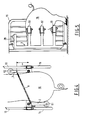
- Fig. 1 is a diagrammatic front view of an embodiment of a passage device according to the present invention.
- the device shown comprises a steel frame 1 having two uprights 21, 22, bounding an access opening 23.
- the uprights in this embodiment are interconnected near their upper ends by a beam 24.
- a door 2, 3 hinged around a vertical pin.
- each upright has two suspension points 4. In the rest position, doors 2, 3 jointly shut off the opening 23.
- the device is arranged in such a manner that the right-hand door 3 opens inwardly, while the left-hand door 2 opens outwardly.
- the beam 24 has stops 6, 7 which prevent the left door from turning inwards and the right door from turning outwards.
- a similar effect can be obtained also differently, e.g. by providing suitable stops on the uprights, or by constructing the suspension points of the doors in such a manner that turning in one direction only is possible.
- Doors 2, 3 can be constructed in many ways. As shown in the drawings, the doors can advantageously be constructed in a manner similar to that shown in EP-A-0095214, wherein the doors each consist of a vertical tube 25, 26, which are mounted on the associated uprights for pivotal movement around a vertical pin and which each carry a plurality of interspaced horizontal tube sections 27, 28. Tube sections 27, 28, as shown, are preferably installed at different heights and extend beyond the middle of the access opening 23, so that the doors overlap one another so to speak.
- the horizontal tube sections of each door in the embodiment shown, are not interconnected at the ends away from the associated vertical tube, and further carry guide rollers 51, 52 at the free ends, at least in the region where the animals may come into contact with the horizontal tube sections. Said guide rollers are adapted to roll along the body of a passing animal and prevent injuries of the animal.
- the resetting force may e.g. be the force of gravity.
- the suspension points of the doors may be provided with run-on lugs, as shown in EP-A-0095214.
- the resetting force can be obtained also by using suitable springs, optionally in combination with gravity.
- a lifting device 11 is adapted to lift latches 9, 10.
- the lifting device is controllable in any manner known therefor: electrically, electromagnetically, mechanically, pneumatically, hydraulically, etc. The control may take place e.g. by a computer program.
- the operation of the device is as follows: When the doors are not locked by latches 9, 10, e.g. in case no animal is present in a feeding station positioned behind the passage device, the doors are kept closed by the resetting force.
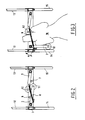
- the stops of the doors are provided, as shown in Fig. 2, in such a manner that the door 2 opening outwardly is opened already over a very small distance, so to say, so that an animal 16 can open the door further with its snout, to gain access.
- This situation is shown in Fig. 3.
- the animal then pushes the second door 3 inwards and is on its way to the space therebehind (e.g. a feeding station).
- This space is preferably dimensioned in such a manner that only one animal can be contained therein.
- At 12 and 13 side walls of a feeding station or a different space are shown.
- the first door which slides along the animal′s body, is screened by it in such a manner that a second animal has no grip on it on the side where the first animal is present.
- an additional partition or fensing substantially perpendicular to the opening plane of the passage device is indicated at 14.
- the inwardly-opening door 3, too, is adequately protected by the animal's body against undesirable operation by a competitor during the passage of the entering animal.
- an additional partition or fencing may be provided, as mentioned hereinbefore, but then on the other side of the passage device.
- Such a screen is indicated at 15.
- the outwardly and inwardly turning doors can be locked when their stops are reached again by means of the latches 9, 10, thereby blocking access to other animals. Only when the animal has finished eating (in the example of a feeding station) or when the animal is not entitled to get food, are the latches unlocked again, so that a following animal can gain access.
- the doors are interconnected by a tension spring 8, providing the above mentioned resetting force.
- a tension spring 8 providing the above mentioned resetting force.
- the points of application of the tension spring on the doors are different, as shown. On the outwardly turning door 2, the point of application is close to the hinge pin (distance (a), see Fig. 1), so that a relatively small force is sufficient to open this door.
- the other spring end has a point of application relatively far away from the hinge pin of the inwardly opening door 3 (distance (b), see Fig. 1).
- distance (b) the hinge pin of the inwardly opening door 3
- the inwardly turning door will exert, through the tension spring, an increasingly large closing force on the outwardly turning door.
- the latter is thus closed immediately behind the passing animal, thereby effecting a good separation between two successive animals.
- such a separation is not only important for allowing undisturbed eating of the animal where it is used in a feeding station, but it is also highly important for other applications.
- One conceivable example is a separating device for cattle, wherein, after an animal has gained access, through a passage device according to the present invention, to a space therebehind, the animal is recognized e.g. electronically, after which either of two or more doors can be opened through computer control towards separated spaces wherein the animals are to be isolated from the group. Examples are pregnant or sick animals.
- Fig. 3 shows how a pig 16 has already opened door 2 with its snout. This is easy, because spring 8 is tensioned only slightly and moreover the distance (a) is only small.
- Fig. 5 is a side view of the situation shown in Fig. 4, wherein the partition or fencing 15 is clearly shown.
- Fig. 6 shows the situation when the pig has almost passed the passage device, roller 51 of door 2 has rolled along the animal's body and is again in the initial position of Fig. 2, after which locking can take place by means of latch 9.
- Fig. 7 the pig has entirely passed the passage device and also door 3 is again in the starting position, wherein it can be locked by means of latch 10. Doors 2 and 3 are now both locked; a following animal cannot be admitted until the locking has been removed by means of device 11.
Landscapes
- Life Sciences & Earth Sciences (AREA)
- Environmental Sciences (AREA)
- Zoology (AREA)
- Animal Husbandry (AREA)
- Biodiversity & Conservation Biology (AREA)
- Housing For Livestock And Birds (AREA)
- Special Wing (AREA)
- Meat, Egg Or Seafood Products (AREA)
- Specific Sealing Or Ventilating Devices For Doors And Windows (AREA)
Abstract
Description
- This invention relates to passage device for cattle, comprising an opening closable by two doors hinged around vertical pins on either side of the opening.
- Such a passage device is described as an access to a feeding station for cattle in European patent application 0095214.
- The known passage device for cattle comprises two (half-) doors hinged around vertical pins on either side of the opening, through which a feeding trough in the feeding station can be reached.
- It is known that animals, and especially pigs, try to push each other aside when being fed and in the known feeding station it is difficult to prevent two or more animals from trying to simultaneously enter the station through the access opening. In that case, an undisturbed eating is excluded: thus, unrest arises in the feeding station and the animals may injure each other.
- It is an object of the present invention to provide a passage device arranged in such a manner that only one animal has access. Such a passage device is suitable in particular for use in feeding stations for e.g. pigs, but can be used also in other situations, e.g. when separating cattle.
- According to the present invention, a passage device of the above described type is characterized in that, as viewed from the space accessible through the passage device, the one door can be opened only ontwardly and the other door only inwardly.
- One embodiment of the present invention will now be described, by way of example, with reference to the accompanying drawings, in which:
- Fig. 1 is a diagrammatic front view of an embodiment of a passage device according to the present invention;
- Fig. 2 is a top view of a passage device according to the present invention; and
- Figs. 3-7 are diagrammatic top views and a side view (Fig. 5) of the manner in which an animal can pass a passage device according to the present invention.
- Fig. 1 is a diagrammatic front view of an embodiment of a passage device according to the present invention. The device shown comprises a steel frame 1 having two
uprights door doors - In the embodiment shown, the device is arranged in such a manner that the right-
hand door 3 opens inwardly, while the left-hand door 2 opens outwardly. To that effect, the beam 24 has stops 6, 7 which prevent the left door from turning inwards and the right door from turning outwards. A similar effect can be obtained also differently, e.g. by providing suitable stops on the uprights, or by constructing the suspension points of the doors in such a manner that turning in one direction only is possible. -
Doors vertical tube horizontal tube sections sections guide rollers - The use of overlapping doors results in that only one animal can pass the access opening at a time and also makes it possible for an animal to return half-way the passage of the access opening, without becoming seized between the doors.
- On the doors a resetting force is acting, which urges the doors into the rest position shown in Fig. 1. The resetting force may e.g. be the force of gravity. In that case, e.g. the suspension points of the doors may be provided with run-on lugs, as shown in EP-A-0095214.
- The resetting force can be obtained also by using suitable springs, optionally in combination with gravity.
- It has been found to be advantageous when the resetting force acting on the door turning inwardly exceeds the resetting force acting on the door turning outwardly.
- The resetting force urges the doors against
stops upper cross tubes stops latches 9, 10 may be provided, which are advantageously remotely and/or automatically controlled. In the embodiment shown, alifting device 11 is adapted to liftlatches 9, 10. The lifting device is controllable in any manner known therefor: electrically, electromagnetically, mechanically, pneumatically, hydraulically, etc. The control may take place e.g. by a computer program. - The operation of the device is as follows: When the doors are not locked by
latches 9, 10, e.g. in case no animal is present in a feeding station positioned behind the passage device, the doors are kept closed by the resetting force. - The stops of the doors are provided, as shown in Fig. 2, in such a manner that the
door 2 opening outwardly is opened already over a very small distance, so to say, so that ananimal 16 can open the door further with its snout, to gain access. This situation is shown in Fig. 3. The animal then pushes thesecond door 3 inwards and is on its way to the space therebehind (e.g. a feeding station). This space is preferably dimensioned in such a manner that only one animal can be contained therein. At 12 and 13 side walls of a feeding station or a different space are shown. - When the animal passes through the passage device, the first door, which slides along the animal′s body, is screened by it in such a manner that a second animal has no grip on it on the side where the first animal is present. To prevent a second animal from arriving at the exterior of the door, there can be provided an additional partition or fensing substantially perpendicular to the opening plane of the passage device. Such a screen is indicated at 14.
- The inwardly-opening
door 3, too, is adequately protected by the animal's body against undesirable operation by a competitor during the passage of the entering animal. Here too, an additional partition or fencing may be provided, as mentioned hereinbefore, but then on the other side of the passage device. Such a screen is indicated at 15. - After the passage of the animal, successively the outwardly and inwardly turning doors can be locked when their stops are reached again by means of the
latches 9, 10, thereby blocking access to other animals. Only when the animal has finished eating (in the example of a feeding station) or when the animal is not entitled to get food, are the latches unlocked again, so that a following animal can gain access. - In a preferred embodiment of the present invention, the doors are interconnected by a
tension spring 8, providing the above mentioned resetting force. Advantageously, the points of application of the tension spring on the doors are different, as shown. On the outwardly turningdoor 2, the point of application is close to the hinge pin (distance (a), see Fig. 1), so that a relatively small force is sufficient to open this door. - The other spring end, however, has a point of application relatively far away from the hinge pin of the inwardly opening door 3 (distance (b), see Fig. 1). By virtue of this particular positioning of the points of application, it is achieved that the inwardly turning door will exert, through the tension spring, an increasingly large closing force on the outwardly turning door. The latter is thus closed immediately behind the passing animal, thereby effecting a good separation between two successive animals. As mentioned hereinbefore, such a separation is not only important for allowing undisturbed eating of the animal where it is used in a feeding station, but it is also highly important for other applications. One conceivable example is a separating device for cattle, wherein, after an animal has gained access, through a passage device according to the present invention, to a space therebehind, the animal is recognized e.g. electronically, after which either of two or more doors can be opened through computer control towards separated spaces wherein the animals are to be isolated from the group. Examples are pregnant or sick animals.
- Fig. 3 shows how a
pig 16 has already openeddoor 2 with its snout. This is easy, becausespring 8 is tensioned only slightly and moreover the distance (a) is only small. - In Fig. 4, the animal has passed the passage device already substantially and, to that end, had to open also
door 3. Due to the relatively large distance (b),spring 8 has now arrived at its maximum tension, so thatrollers - Fig. 5 is a side view of the situation shown in Fig. 4, wherein the partition or
fencing 15 is clearly shown. - Fig. 6 shows the situation when the pig has almost passed the passage device,
roller 51 ofdoor 2 has rolled along the animal's body and is again in the initial position of Fig. 2, after which locking can take place by means of latch 9. - In Fig. 7 the pig has entirely passed the passage device and also
door 3 is again in the starting position, wherein it can be locked by means oflatch 10.Doors device 11.
Claims (17)
Priority Applications (1)
| Application Number | Priority Date | Filing Date | Title |
|---|---|---|---|
| AT88200165T ATE76712T1 (en) | 1987-02-02 | 1988-02-01 | ACCESS DEVICE FOR LIVESTOCK. |
Applications Claiming Priority (2)
| Application Number | Priority Date | Filing Date | Title |
|---|---|---|---|
| NL8700243A NL8700243A (en) | 1987-02-02 | 1987-02-02 | ACCESS DEVICE FOR THE TRANSMISSION OF ONLY ONE PIECE OF CATTLE. |
| NL8700243 | 1987-02-02 |
Publications (2)
| Publication Number | Publication Date |
|---|---|
| EP0282103A1 true EP0282103A1 (en) | 1988-09-14 |
| EP0282103B1 EP0282103B1 (en) | 1992-06-03 |
Family
ID=19849502
Family Applications (1)
| Application Number | Title | Priority Date | Filing Date |
|---|---|---|---|
| EP88200165A Expired - Lifetime EP0282103B1 (en) | 1987-02-02 | 1988-02-01 | A passage device for cattle |
Country Status (6)
| Country | Link |
|---|---|
| US (1) | US4813379A (en) |
| EP (1) | EP0282103B1 (en) |
| AT (1) | ATE76712T1 (en) |
| CA (1) | CA1295895C (en) |
| DE (1) | DE3871563T2 (en) |
| NL (1) | NL8700243A (en) |
Cited By (2)
| Publication number | Priority date | Publication date | Assignee | Title |
|---|---|---|---|---|
| EP0561338A1 (en) * | 1992-03-16 | 1993-09-22 | BANSS MASCHINENFABRIK GmbH & CO. KG | Device for closing a passage for slaughter animals |
| WO2004095915A1 (en) * | 2003-05-02 | 2004-11-11 | Delaval Holding Ab | A one-way gate for animals |
Families Citing this family (9)
| Publication number | Priority date | Publication date | Assignee | Title |
|---|---|---|---|---|
| US4930447A (en) * | 1988-08-15 | 1990-06-05 | Peacock Steve N | Divider gate for parallel dairy parlor |
| US5463984A (en) * | 1994-08-29 | 1995-11-07 | Hubbard; Leslie H. | One way animal gate |
| AUPO608097A0 (en) * | 1997-04-09 | 1997-05-01 | Sorraghan, Kevin | Animinal sorting module |
| FR2889646B1 (en) * | 2005-08-10 | 2007-10-05 | Satene Sarl Sarl | DOOR CONTROL DEVICE FOR HOUSING COMPRISING AN AUTOMATIC CLOSURE CONTROL |
| CA2578663C (en) * | 2007-02-13 | 2012-04-17 | Leo Rousseau | Automatic animal retrieving platform assembly |
| US7765958B2 (en) * | 2008-06-05 | 2010-08-03 | Wurtz Henry J | Entrance gate for a livestock sorter |
| RU2596698C2 (en) * | 2014-09-29 | 2016-09-10 | Федеральное государственное бюджетное образовательное учреждение высшего профессионального образования "Государственный аграрный университет Северного Зауралья" | Device for zoological and veterinary procedures |
| DE202016101095U1 (en) * | 2016-03-01 | 2016-04-14 | Gea Farm Technologies Gmbh | Milking parlor with a drive arrangement for milking parlor gates |
| US12270431B2 (en) * | 2021-08-13 | 2025-04-08 | William Dean | Device for preventing bruising in livestock |
Citations (2)
| Publication number | Priority date | Publication date | Assignee | Title |
|---|---|---|---|---|
| US3874118A (en) * | 1973-12-14 | 1975-04-01 | John C Robinson | Animal actuated door |
| EP0095214B1 (en) * | 1982-05-18 | 1987-04-22 | N.V. Nederlandsche Apparatenfabriek NEDAP | Feeding box |
Family Cites Families (3)
| Publication number | Priority date | Publication date | Assignee | Title |
|---|---|---|---|---|
| US3079711A (en) * | 1960-12-22 | 1963-03-05 | Dean L Turner | One-way animal gate |
| US3222805A (en) * | 1963-04-30 | 1965-12-14 | Hansen Robert | Cattle gate |
| SE445872B (en) * | 1985-05-17 | 1986-07-28 | Andersson Karl Arne | PLANT FOR TASTLE RISK PRODUCTION |
-
1987
- 1987-02-02 NL NL8700243A patent/NL8700243A/en not_active Application Discontinuation
-
1988
- 1988-02-01 CA CA000557796A patent/CA1295895C/en not_active Expired - Fee Related
- 1988-02-01 AT AT88200165T patent/ATE76712T1/en not_active IP Right Cessation
- 1988-02-01 EP EP88200165A patent/EP0282103B1/en not_active Expired - Lifetime
- 1988-02-01 DE DE8888200165T patent/DE3871563T2/en not_active Expired - Lifetime
- 1988-02-02 US US07/151,605 patent/US4813379A/en not_active Expired - Fee Related
Patent Citations (2)
| Publication number | Priority date | Publication date | Assignee | Title |
|---|---|---|---|---|
| US3874118A (en) * | 1973-12-14 | 1975-04-01 | John C Robinson | Animal actuated door |
| EP0095214B1 (en) * | 1982-05-18 | 1987-04-22 | N.V. Nederlandsche Apparatenfabriek NEDAP | Feeding box |
Cited By (2)
| Publication number | Priority date | Publication date | Assignee | Title |
|---|---|---|---|---|
| EP0561338A1 (en) * | 1992-03-16 | 1993-09-22 | BANSS MASCHINENFABRIK GmbH & CO. KG | Device for closing a passage for slaughter animals |
| WO2004095915A1 (en) * | 2003-05-02 | 2004-11-11 | Delaval Holding Ab | A one-way gate for animals |
Also Published As
| Publication number | Publication date |
|---|---|
| DE3871563T2 (en) | 1992-12-03 |
| ATE76712T1 (en) | 1992-06-15 |
| EP0282103B1 (en) | 1992-06-03 |
| CA1295895C (en) | 1992-02-18 |
| DE3871563D1 (en) | 1992-07-09 |
| NL8700243A (en) | 1988-09-01 |
| US4813379A (en) | 1989-03-21 |
Similar Documents
| Publication | Publication Date | Title |
|---|---|---|
| US12622409B2 (en) | Animal crate with swing or drop door | |
| US4813379A (en) | Passage device for cattle | |
| DE3853802T2 (en) | Doors for pets. | |
| EP0610171B1 (en) | Feeder apparatus for pigs | |
| US20050028752A1 (en) | Swinging gate assembly, electronic livestock feeding station, and automated sorting system | |
| US4559904A (en) | Feeding box | |
| KR102315442B1 (en) | Stall for calf | |
| US10760305B2 (en) | Self-locking guillotine door | |
| US3543723A (en) | Sow feed stall | |
| DE60009710T2 (en) | DOOR FOR LIVESTOCK SYSTEMS | |
| KR200483169Y1 (en) | Door lock for a cowhouse | |
| DE60117833T2 (en) | BOX FOR PETS, ESPECIALLY SAW | |
| EP2474223A1 (en) | Fence door | |
| US10772289B2 (en) | Head gate for a cattle containment chute | |
| US1116220A (en) | Automatic door for stalls. | |
| EP0260263B1 (en) | Animal box | |
| GB2270455A (en) | Apparatus for catching wild animals | |
| EP2064945B1 (en) | Dovecote | |
| WO1990003108A1 (en) | Booth for pigs | |
| CA2986987C (en) | Head gate for a cattle containment chute | |
| EP1208746B1 (en) | Mating and waiting stable | |
| AU1640300A (en) | Improvements in dairy bails | |
| DE8906842U1 (en) | Breeding cell | |
| IE73649B1 (en) | An animal stall system |
Legal Events
| Date | Code | Title | Description |
|---|---|---|---|
| PUAI | Public reference made under article 153(3) epc to a published international application that has entered the european phase |
Free format text: ORIGINAL CODE: 0009012 |
|
| AK | Designated contracting states |
Kind code of ref document: A1 Designated state(s): AT BE CH DE FR GB IT LI NL |
|
| 17P | Request for examination filed |
Effective date: 19880922 |
|
| 17Q | First examination report despatched |
Effective date: 19900718 |
|
| GRAA | (expected) grant |
Free format text: ORIGINAL CODE: 0009210 |
|
| ITF | It: translation for a ep patent filed | ||
| AK | Designated contracting states |
Kind code of ref document: B1 Designated state(s): AT BE CH DE FR GB IT LI NL |
|
| REF | Corresponds to: |
Ref document number: 76712 Country of ref document: AT Date of ref document: 19920615 Kind code of ref document: T |
|
| REF | Corresponds to: |
Ref document number: 3871563 Country of ref document: DE Date of ref document: 19920709 |
|
| ET | Fr: translation filed | ||
| PLBE | No opposition filed within time limit |
Free format text: ORIGINAL CODE: 0009261 |
|
| STAA | Information on the status of an ep patent application or granted ep patent |
Free format text: STATUS: NO OPPOSITION FILED WITHIN TIME LIMIT |
|
| 26N | No opposition filed | ||
| PGFP | Annual fee paid to national office [announced via postgrant information from national office to epo] |
Ref country code: GB Payment date: 19950124 Year of fee payment: 8 |
|
| PGFP | Annual fee paid to national office [announced via postgrant information from national office to epo] |
Ref country code: FR Payment date: 19950209 Year of fee payment: 8 |
|
| PGFP | Annual fee paid to national office [announced via postgrant information from national office to epo] |
Ref country code: AT Payment date: 19950224 Year of fee payment: 8 |
|
| PGFP | Annual fee paid to national office [announced via postgrant information from national office to epo] |
Ref country code: BE Payment date: 19950227 Year of fee payment: 8 |
|
| PGFP | Annual fee paid to national office [announced via postgrant information from national office to epo] |
Ref country code: NL Payment date: 19950228 Year of fee payment: 8 |
|
| PGFP | Annual fee paid to national office [announced via postgrant information from national office to epo] |
Ref country code: DE Payment date: 19950309 Year of fee payment: 8 |
|
| PGFP | Annual fee paid to national office [announced via postgrant information from national office to epo] |
Ref country code: CH Payment date: 19950531 Year of fee payment: 8 |
|
| PG25 | Lapsed in a contracting state [announced via postgrant information from national office to epo] |
Ref country code: GB Effective date: 19960201 Ref country code: AT Effective date: 19960201 |
|
| PG25 | Lapsed in a contracting state [announced via postgrant information from national office to epo] |
Ref country code: BE Effective date: 19960228 |
|
| PG25 | Lapsed in a contracting state [announced via postgrant information from national office to epo] |
Ref country code: LI Effective date: 19960229 Ref country code: CH Effective date: 19960229 |
|
| BERE | Be: lapsed |
Owner name: NEDERLANDSCHE APPARATENFABRIEK NEDAP N.V. Effective date: 19960228 |
|
| PG25 | Lapsed in a contracting state [announced via postgrant information from national office to epo] |
Ref country code: NL Effective date: 19960901 |
|
| GBPC | Gb: european patent ceased through non-payment of renewal fee |
Effective date: 19960201 |
|
| REG | Reference to a national code |
Ref country code: CH Ref legal event code: PL |
|
| PG25 | Lapsed in a contracting state [announced via postgrant information from national office to epo] |
Ref country code: FR Effective date: 19961031 |
|
| NLV4 | Nl: lapsed or anulled due to non-payment of the annual fee |
Effective date: 19960901 |
|
| PG25 | Lapsed in a contracting state [announced via postgrant information from national office to epo] |
Ref country code: DE Effective date: 19961101 |
|
| REG | Reference to a national code |
Ref country code: FR Ref legal event code: ST |
|
| PG25 | Lapsed in a contracting state [announced via postgrant information from national office to epo] |
Ref country code: IT Free format text: LAPSE BECAUSE OF NON-PAYMENT OF DUE FEES;WARNING: LAPSES OF ITALIAN PATENTS WITH EFFECTIVE DATE BEFORE 2007 MAY HAVE OCCURRED AT ANY TIME BEFORE 2007. THE CORRECT EFFECTIVE DATE MAY BE DIFFERENT FROM THE ONE RECORDED. Effective date: 20050201 |