EP0282077B1 - Pyridyloxy derivatives - Google Patents
Pyridyloxy derivatives Download PDFInfo
- Publication number
- EP0282077B1 EP0282077B1 EP88103890A EP88103890A EP0282077B1 EP 0282077 B1 EP0282077 B1 EP 0282077B1 EP 88103890 A EP88103890 A EP 88103890A EP 88103890 A EP88103890 A EP 88103890A EP 0282077 B1 EP0282077 B1 EP 0282077B1
- Authority
- EP
- European Patent Office
- Prior art keywords
- pyridyl
- oxy
- acetamide
- cis
- butenyl
- Prior art date
- Legal status (The legal status is an assumption and is not a legal conclusion. Google has not performed a legal analysis and makes no representation as to the accuracy of the status listed.)
- Expired - Lifetime
Links
- 0 CCCC=*COC(CC(CN(C*)C*)C1)NC1C1=*=CC=C1 Chemical compound CCCC=*COC(CC(CN(C*)C*)C1)NC1C1=*=CC=C1 0.000 description 5
- ORHNYIBNKAJKPU-UHFFFAOYSA-N OC(C1)NCCC1C1OCCO1 Chemical compound OC(C1)NCCC1C1OCCO1 ORHNYIBNKAJKPU-UHFFFAOYSA-N 0.000 description 2
- OYFCGNMRESVBQW-UHFFFAOYSA-N BC1NCCC(COCO)C1 Chemical compound BC1NCCC(COCO)C1 OYFCGNMRESVBQW-UHFFFAOYSA-N 0.000 description 1
- NIUGJCRXZUTRGC-UHFFFAOYSA-N CC(CCC(C1)C(O)=O)C1Br Chemical compound CC(CCC(C1)C(O)=O)C1Br NIUGJCRXZUTRGC-UHFFFAOYSA-N 0.000 description 1
- MPPBONSSCILZDV-UHFFFAOYSA-N CC(CCN1)CC1OC Chemical compound CC(CCN1)CC1OC MPPBONSSCILZDV-UHFFFAOYSA-N 0.000 description 1
- VZNWRLRJAONDPM-ARJAWSKDSA-N CC/C=C\CCOC1NCCC(CN2CCSCC2)C1 Chemical compound CC/C=C\CCOC1NCCC(CN2CCSCC2)C1 VZNWRLRJAONDPM-ARJAWSKDSA-N 0.000 description 1
- XIKJEQLKAGBSGJ-UHFFFAOYSA-N CCCNCC1=CCCC1 Chemical compound CCCNCC1=CCCC1 XIKJEQLKAGBSGJ-UHFFFAOYSA-N 0.000 description 1
- HLPIHRDZBHXTFJ-UHFFFAOYSA-N CCc1ccc[o]1 Chemical compound CCc1ccc[o]1 HLPIHRDZBHXTFJ-UHFFFAOYSA-N 0.000 description 1
- LEGMHPGYPXPXKB-UHFFFAOYSA-N OC1NCCCC1 Chemical compound OC1NCCCC1 LEGMHPGYPXPXKB-UHFFFAOYSA-N 0.000 description 1
Classifications
-
- C—CHEMISTRY; METALLURGY
- C07—ORGANIC CHEMISTRY
- C07D—HETEROCYCLIC COMPOUNDS
- C07D213/00—Heterocyclic compounds containing six-membered rings, not condensed with other rings, with one nitrogen atom as the only ring hetero atom and three or more double bonds between ring members or between ring members and non-ring members
- C07D213/02—Heterocyclic compounds containing six-membered rings, not condensed with other rings, with one nitrogen atom as the only ring hetero atom and three or more double bonds between ring members or between ring members and non-ring members having three double bonds between ring members or between ring members and non-ring members
- C07D213/04—Heterocyclic compounds containing six-membered rings, not condensed with other rings, with one nitrogen atom as the only ring hetero atom and three or more double bonds between ring members or between ring members and non-ring members having three double bonds between ring members or between ring members and non-ring members having no bond between the ring nitrogen atom and a non-ring member or having only hydrogen or carbon atoms directly attached to the ring nitrogen atom
- C07D213/60—Heterocyclic compounds containing six-membered rings, not condensed with other rings, with one nitrogen atom as the only ring hetero atom and three or more double bonds between ring members or between ring members and non-ring members having three double bonds between ring members or between ring members and non-ring members having no bond between the ring nitrogen atom and a non-ring member or having only hydrogen or carbon atoms directly attached to the ring nitrogen atom with hetero atoms or with carbon atoms having three bonds to hetero atoms with at the most one bond to halogen, e.g. ester or nitrile radicals, directly attached to ring carbon atoms
- C07D213/62—Oxygen or sulfur atoms
- C07D213/63—One oxygen atom
- C07D213/64—One oxygen atom attached in position 2 or 6
-
- C—CHEMISTRY; METALLURGY
- C07—ORGANIC CHEMISTRY
- C07D—HETEROCYCLIC COMPOUNDS
- C07D405/00—Heterocyclic compounds containing both one or more hetero rings having oxygen atoms as the only ring hetero atoms, and one or more rings having nitrogen as the only ring hetero atom
- C07D405/02—Heterocyclic compounds containing both one or more hetero rings having oxygen atoms as the only ring hetero atoms, and one or more rings having nitrogen as the only ring hetero atom containing two hetero rings
- C07D405/12—Heterocyclic compounds containing both one or more hetero rings having oxygen atoms as the only ring hetero atoms, and one or more rings having nitrogen as the only ring hetero atom containing two hetero rings linked by a chain containing hetero atoms as chain links
-
- C—CHEMISTRY; METALLURGY
- C07—ORGANIC CHEMISTRY
- C07D—HETEROCYCLIC COMPOUNDS
- C07D405/00—Heterocyclic compounds containing both one or more hetero rings having oxygen atoms as the only ring hetero atoms, and one or more rings having nitrogen as the only ring hetero atom
- C07D405/14—Heterocyclic compounds containing both one or more hetero rings having oxygen atoms as the only ring hetero atoms, and one or more rings having nitrogen as the only ring hetero atom containing three or more hetero rings
Definitions
- the greatest cause of ulcer formation in the stomach or duodenum is regarded as excessive secretion of gastric acid, and compounds having anti-cholinergic activity or compounds which neutralize gastric acid have been proposed as antiulcer agents.
- the anticholinergic compounds are no longer used generally as antiulcer agents because of their strong side effects.
- the drugs for neutralizing gastric acid have a poor duration of effect and have been desired to be improved.
- European Laid-Open Patent Publication No. 177016 discloses that a compound of the following formula is useful as an antipeptic ulcer agent based on its histamine H2 receptor antagonizing activity. Although this compound has fairly good antiulcer activity, the duration of its histamine H2 receptor antagonizing activity is short and its toxicity is high.
- C1-C6 as used herein to qualify an atomic grouping or a compound, means that the atomic grouping or compound so qualified has not more than 6 carbon atoms, preferably not more than 4 carbon atoms.
- C1-C6 alkyl group represented by R1 and R2 in formula (I) may be a liner or branched C1-C6-alkyl group, such as methyl, ethyl, propyl, isopropyl, butyl, isobutyl, sec-butyl, tert-butyl, pentyl, isoamyl and hexyl groups.
- Examples of the "saturated or partially unsaturated 4- ro 8-membered heterocyclic group which may contain a hetero atom selected from N, O and S" include azetidino, pyrrolidino, piperidino, 1-perhydroazepinyl, dihydro-1-pyrrolyl, tetrahydro-1-pyridyl, 1-piperazinyl, morpholino and thiomorpholino. These heterocyclic groups may further contain as substituent on the ring a C1-C6 alkyl group such as methyl or ethyl, or a hydroxyl group.
- a preferred group of compounds of formula (I) provided by this invention are those of formula (I) in which each of R1 and R2 is a C1-C6 alkyl group, especially a methyl group, or R1 and R2, taken together with the nitrogen atom to which they are bonded, form a saturated or partially unsaturated 5- to 7-membered heterocyclic group which may be substituted by a C1-C6 alkyl group, such as a pyrrolidino, piperidino, 3-methyl-piperidino, 1,2,3,6-tetrahydro-1-pyridyl or 1-perhydro-azepinyl group, particularly the piperidino group.
- a C1-C6 alkyl group such as a pyrrolidino, piperidino, 3-methyl-piperidino, 1,2,3,6-tetrahydro-1-pyridyl or 1-perhydro-azepinyl group, particularly the piperidino group.
- the compounds may include both cis- and trans-isomers. Generally, the cis-isomers are preferred.
- the bonding site of the furane ring in formula (I) may be the 2- or 3-position to the methylene group (-CH2-). Usually, when n is 1, the furane ring is preferably bonded to the methylene group at the 2-position. When n is 2, the furane ring is preferably bonded to the methylene group at the 3-position.
- Especially preferred compounds of formula (I) are N- ⁇ 4-[4-(piperidinomethyl)pyridyl-2-oxy]-cis-2-butenyl ⁇ -2-(furfurylsulfinyl)acetamide, N- ⁇ 4-[4-(piperidinomethyl)pyridyl-2-oxy]-cis-2-butenyl ⁇ -2-(3-furylmethylsulfonyl)acetamide, and N- ⁇ 4-[4-(piperidinomethyl)pyridyl-2-oxy]butyl ⁇ -2-(furfurylsulfinyl)acetamide.
- the compound of this invention contains a basic amino group in the molecule, and can exist in the form of an acid addition salt.
- the acid addition salt are salts with inorganic acids such as hydrochloric acid, sulfuric acid, hydrobromic acid, hydriodic acid, nitric acid and phosphoric acid, and salts with organic acids such as lactic acid, maleic acid, fumaric acid, benzoic acid, salicyclic acid, tartaric acid, acetic acid, benzenesulfonic acid, carbonic acid, citric acid, gluconic acid, glutamic acid, mandelic acid, metasulfonic acid, panthotheic acid, stearic acid, succinic acid and tannic acid.
- Suitable salts are pharmaceutically acceptable salts.
- the compound of formula (I) can be produced by reacting an amine compound represented by the following formula wherein R1, R2 and Y are as defined hereinabove, with an acetic acid derivative represented by the following formula wherein Z represents a halogen atom or a hydroxyl group, and n is as defined hereinabove.
- the reaction of the compound of formula (II) with the compound of formula (III) can be carried out by a known amidation reaction.
- the reaction of the amine compound (II) with the halide compound of formula (III) in which Z is a halogen atom may be carried out usually in the presence of a base in a reaction medium.
- the base are inorganic bases such as sodium hydroxide, potassium hydroxide, potassium carbonate and sodium carbonate, and organic bases such as pyridine and triethylamine.
- the reaction medium may generally be an organic solvent, for example a halogenated hydrocarbon such as dichloromethane and chloroform, an aromatic hydrocarbon such as benzene, toluene and xylene, an ether such as tetrahydrofuran and dioxane, an amide such as dimethylformamide and dimethylacetamide, acetonitrile, or dimethyl sulfoxide, either singly or in combination.
- the reaction temperature and pressure may be varied depending upon the starting compounds used. Usually, the reaction can be conveniently carried out under atmospheric pressure at a temperature of 0 °C to the refluxing temperature of the reaction mixture, preferably 0 °C to room temperature.
- the reaction of the amine compound (II) with the carboxylic acid compound of formula (III) in which Z is a hydroxyl group is a dehydrocondensation reaction, and may be carried out usually in the presence of a dehydrocondensing agent in a reaction medium.
- the condensation agent may be, for example, dicyclohexylcarbodiimide (DCC) or 1-ethyl-3-(3-dimethylaminopropyl)-carbodiimide hydrochloride (WSC).
- the reaction medium is generally an inert solvent, for example, an aromatic hydrocaron such as benzene, toluene and xylene, an ether such as tetrahydrofuran and dioxane, an amide such as dimethylformamide and dimethylacetamide, acetonitrile, or dimethyl sulfoxide.
- the reaction temperature and pressure may be varied depending upon the starting compounds used. Usually, the reaction can be conveniently carried out under atmospheric pressure at a temperature of 0 °C to the refluxing temperature of the reaction mixture, preferably 0 °C to room temperature.
- the carboxylic acid compound of formula (III) in which Z is a hydroxyl group may be reacted with the amine compound (II) after it is converted to an active ester, for example, by reacting it with N-hydroxylsuccinimide or 4-nitrophenol.
- the compound of formula (III) may be used in an amount of generally 1 to 5 moles, preferably 1.0 to 2.0 moles, per mole of the compound of formula (II).
- the amine compound (II) used as one starting material in the amidation reaction is known per se , or may be produced by a known method (see, for example, European Patent No. 177016 cited hereinabove.
- Examples of the amine compound (II) include 4-[4-(piperidinomethyl)pyridyl-2-oxy]-2-butenamine, 4-[4-(dimethylaminomethyl)pyridyl-2-oxy]-2-butenamine, 4-[4-(3-methylpiperidinomethyl)pyridyl-2-oxy]-2-butenamine, 4-[4-(pyrrolidinomethyl)pyridyl-2-oxy]-2-butenamine, 4-[4-(morpholinometyl)pyridyl-2-oxy]-2-butenamine, 4-[4-(1,2,3,6-tetrahydro-1-pyridylmethyl)pyridyl-2-oxy]-2-butenamine, 4-[4-(1-perhydroaze
- the acetic acid derivative of formula (III) may be obtained by reacting the corresponding furylmethylmercaptan with a haloacetate ester, if desired oxidizing the reaction product, and hydrolyzing it (see Japanese Laid-Open Patent Publication No. 153268/1987).
- Examples include 2-(furfurylthio)acetic acid, 2-(furfurylsulfinyl)acetic acid, 2-(furfurylsulfonyl)acetic acid, 2-(3-furylmethylthio)acetic acid, 2-(3-furylmethylsulfinyl)acetic acid and 2-(3-furylmethylsulfonyl)acetic acid.
- the compound of formula (I) may also be produced through the route shown by the following reaction scheme A.
- A' is a protected formyl group or a hydroxymethyl group in which the hydroxyl group is protected;
- A'' is a formyl or hydroxymethyl group;
- R3 is a protective group for the hydroxyl group;
- R4 is an active ester residue, such as an o-or p-nitrophenyl group or a 2,4-dinitrophenyl group;
- X1, X2 and X3 each represent a halogen atom; and R1, R2, Y and n are as defined above.
- a halogenopyridine derivative of formula (IV) is reacted with an alcohol derivative of formula (V) to produce a pyridyl ether derivative of formula (VI-a).
- the halogen atom (X1) is preferably a bromine or chlorine atom.
- the halogenopyridine derivative may be produced in accordance with the following Reaction Scheme B. Specifically, it may be produced by reacting 2-amino-4-methylpyridine or isonicotinic acid N-oxide, which is easily available industrially, with the reagents indicated in the above Reaction Scheme B (for details, see Referential Examples 2 to 10 given hereinbelow).
- the "protected formyl group" includes, for example, cyclic acetals such as 2-(1,3-dioxolane), 2-(1,3-dioxane), 2-(1,3-oxathilane) and 2-(1,3-dioxathiane) and acyclic acetals such as dimethylacetal, diethylacetal and dipropylacetal.
- the protected formyl group may be formed, for example, by reacting the formyl group with an alcohol or an orthoformate ester.
- alcohols that can be used to protect the formyl group are lower alcohols such as methanol, ethanol, and propanol, and lower alkylene glycols such as 1,2-ethylene glycol and 1,3-propylene glycol.
- the orthoforamte ester may be, for example, a lower alkyl ester of orthoformic acid such as methyl orthoformate or ethyl orthoformate.
- the protective group of the hydroxyl group may be ordinary protective groups for the hydroxyl group. which can be easily split off by hydrolysis. Examples include a tetrahydropyranyl group, lower alkoxyalkyl groups such as methoxymethyl and methoxyethyl groups, aralkyl groups such as triphenylmethyl and diphenylmethyl groups and silyl groups such as a trimethylsilyl group.
- Examples of the alcohol derivative of formula (V) are 4-(2-tetrahydropyranyloxy]-2-buten-1-ol, 4-(triphenylmethyloxy]-2-buten-1-ol, 4-benzyloxy-2-buten-1-ol, 4-(2-tetrahydrofuryl)-2-buten-1-ol, 4-(2-tetrahydropyranyloxy]-butan-1-ol, 4-(triphenylmethyloxy]-butan-1-ol, 4-(benzyloxy]-butan-1-ol, and 4-(2-tetrahydrofuryl)-butan-1-ol.
- reaction of the halogenopyridine derivative of formula (IV) with the alcohol derivative of formula (V) may be carried out by method (a) or (b) described below.
- phase transfer catalyst may be, for example, an organic ammonium salt or a crown ether.
- organic ammonium salt are tetra-n-butyl ammonium iodide, tetra-n-butyl ammonium bromide, tetra-n-butyl ammonium chloride, tetra-n-butyl ammonium hydrogen sulfate.
- the crown ether are 12-crown-4 and 18-crown-6.
- the inorganic base may be, for example, an alkali metal hydroxide or carbonate such as sodium hydroxide, potassium hydroxide, sodium carbonate, potassium carbonate.
- the amount of each of the phase transfer catalyst and the inorganic base is suitably 1/10 to 2 equivalents based ont the compound of formula (V).
- the reaction is desirably carried out usually in a solvent.
- suitable solvents are aromatic hydrocarbons such as benzene, toluene and xylene, ethers such as dimethoxyethane, tetrahydrofuran and dioxane, amides such as dimethylformamide and nitriles such as acetonitrile and propionitrile.
- the reaction temperature is generally in the range of 80 to 200 °C.
- This method is carried out by reacting the compound of formula (IV) with the compound of formula (V) in the presence of an alkali metal compound in the solvent described above.
- alkali metal compound examples include sodium hydride, potassium hydride and sodiumamide.
- the amount of the alkali metal compound used is generally 1 to 3 equivalents based on the compound of formula (V).
- the reaction may be carried out at a temperature of usually about 35 to 120 °C.
- the compound of formula (V) may be used in a proportion of generally 1 to 3 moles, preferably 1.0 to 1.5 moles, per mole of the compound of formula (IV).
- the pyridyl ether derivative of formula (VI-a) formed in the first step is hydrolyzed to give a pyridyloxy alcohol derivative of formula (VI-b).
- this step is carried out in the presence of an acid such as hydrochloric acid, sulfuric acid, acetic acid, p-toluenesulfonic acid, camphorsulfonic acid or citric acid; or pyridinium p-toluenesulfonate or pyridinium chloride.
- an acid such as hydrochloric acid, sulfuric acid, acetic acid, p-toluenesulfonic acid, camphorsulfonic acid or citric acid; or pyridinium p-toluenesulfonate or pyridinium chloride.
- the hydrolysis is carried out usually in water or a mixture of it with a water-miscible organic solvent such as acetone, or an alcohol (e.g., methanol, ethanol or propanol).
- a water-miscible organic solvent such as acetone, or an alcohol (e.g., methanol, ethanol or propanol).
- the reaction smoothly proceeds usually at a temperature of about 25 to 70 °C.
- This step comprises reacting the pyridineoxy alcohol derivative of formula (VI-b) obtained in the second step with a halogenating agent to produce a pyridyloxyhalogen derivative of formula (VI-c).
- Example of the halogenating agent that can be used in this step include thionyl chloride, p-toluenesulfonyl chloride, methanesulfonyl chloride, phosphorus oxychloride, phosphorus trichloride, phosphorus pentabromide, phosphorus tribromide, phosphorus oxybromide, methanesulfonic anhydride, and methanesulfonyl bromide.
- the halogenating agent may be used usually in a proportion of 1 to 5 equivalents, preferably 1 to 2 equivalents, per mole of the pyridyloxyalcohol derivative of formula (VI-b).
- this step is carried out in the presence of a base, for example, an organic base such as triethylamine or pyridine, or an inorganic base such as anhydrous potassium carbonate or anhydrous sodium hydrogen carbonate.
- a base for example, an organic base such as triethylamine or pyridine, or an inorganic base such as anhydrous potassium carbonate or anhydrous sodium hydrogen carbonate.
- the amount of the base is preferably 1 to 2 equivalents based on the halogenating agent.
- the reaction is carried out in a solvent.
- suitable solvents are halogenated hydrocarbons such as chloroform and dichloromethane, aromatic hydrocarbons such as benzene and toluene, and ethers such as tetrahydrofuran and dimethoxyethane.
- the reaction proceeds smoothly at a temperature of generally from about -10 °C to about 15 °C.
- a pyridyloxyphthalimide derivative of general formula (VI-d) is produced by reacting the pyridyloxyhalogen derivative (VI-c) formed in the third step with phthalimide or its alkali metal salt.
- the reaction in this step may be carried out in the same way as in method (a) in the first step described hereinabove.
- the reaction is carried out in the same way as in method (a) except that the use of the inorganic base in method (a) is omitted.
- the pyridyloxyphthalimide derivative of formula (VI-d) formed in the fourth step is hydrolyzed to produce a pyridyloxyamine derivatives of formula (VI-d).
- the reaction in this step is carried out in the presence of an inorganic base such as hydrazine, sodium hydroxide, potassium hydroxide, sodium carbonate or potassium carbonate, or an organic base such as methylamine and ethylamine.
- an inorganic base such as hydrazine, sodium hydroxide, potassium hydroxide, sodium carbonate or potassium carbonate, or an organic base such as methylamine and ethylamine.
- the amount of the base is usually 1 to 2 equivalents per mole of the pyridyloxyphthalimide derivative of formula (VI-d).
- the reaction carried out desirably in a solvent, for example an alcohol such as methanol, ethanol, propanol, water, or an ether such as ethyl ether, tetrahydrofuran or dimethoxyethane.
- a solvent for example an alcohol such as methanol, ethanol, propanol, water, or an ether such as ethyl ether, tetrahydrofuran or dimethoxyethane.
- a solvent for example an alcohol such as methanol, ethanol, propanol, water, or an ether such as ethyl ether, tetrahydrofuran or dimethoxyethane.
- the compounds of formulae (VI-a), (VI-b), (VI-c), (VI-d) and (VI-e) obtained in the first to the fifth steps may, if desired, be converted to the corresponding compounds having a formyl or hydroxymethyl group by treating them with acids such as mineral acids (e.g., hydrochloric acid or sulfuric acid) or organic acids (e.g., acetic acid, p-toluenesulfonic acid, camphorsulfonic acid and citric acid) to deprotect them.
- acids such as mineral acids (e.g., hydrochloric acid or sulfuric acid) or organic acids (e.g., acetic acid, p-toluenesulfonic acid, camphorsulfonic acid and citric acid) to deprotect them.
- the proportion of the compound of formula (VII) relative to the compound of formula (VI-e) is not critical, but the compound of formula (VII) is suitably used in a proportion of 1 to 5 moles, perferably 1 to 2 moles, per mole of the compound of formula (VI-e).
- the furfurylthio ester of formula (VII) to be reacted with the compound of formula (VI-e) in this step may be obtained, for example, by reacting 2-(furfurylsulfinyl)acetic acid with a nitrophenol (e.g., p-nitrophenol, 2,4-dinitrophenol, or o-nitrophenol) in the presence of a dehydrocondensing agent (such as dicyclohexylcarbodiimide).
- a nitrophenol e.g., p-nitrophenol, 2,4-dinitrophenol, or o-nitrophenol
- a dehydrocondensing agent such as dicyclohexylcarbodiimide
- the active ester residue (R4) is preferably the o- or p-nitrophenyl group or the 2,4-dinitrophenyl group mentioned above. It may be another active ester residue usually employed in amidization in the field of peptide chemistry, for example residues of N-hydroxysuccinimide, pentachlorophenol, pentafluorophenol, N-hydroxyphthalimide and N-hydroxy-5-norbornene-2,3-dicarboximide.
- the above reaction is desirably carried out in a solvent, for example, an ether such as ethyl ether, tetrahydrofuran, dimethoxyethane or dioxane, a halogenated hydrocarbon such as chloroform or dichloromethane, an aromatic hydrocarbon such as benzene and toluene, or an amide such as dimethylformamide.
- a solvent for example, an ether such as ethyl ether, tetrahydrofuran, dimethoxyethane or dioxane, a halogenated hydrocarbon such as chloroform or dichloromethane, an aromatic hydrocarbon such as benzene and toluene, or an amide such as dimethylformamide.
- the reaction proceeds smothly usually at a temperature of about 0 to 50 °C.
- this step is carried out in the presence of an acid.
- Suitable acids used for this purpose include, for example, mineral acids such as hydrochloric acid and sulfuric acid and organic acids such as p-toluenesulfonic acid, camphorsulfonic acid and citric acid.
- the amount of the acid used is generally 1 to 5 equivalents per mole of the compound of formula (VIII-a).
- this reaction is carried out in a solvent, for example water, a ketone such as acetone, an alcohol such as methanol, ethanol and propanol, an ether such as tetrahydrofuran and dimethoxyethane, or a nitrile such as acetonitrile, either singly or in combination.
- a solvent for example water, a ketone such as acetone, an alcohol such as methanol, ethanol and propanol, an ether such as tetrahydrofuran and dimethoxyethane, or a nitrile such as acetonitrile, either singly or in combination.
- the reaction can be carried out generally at room temperature to about 120 °C, optionally under heating at a temperature of about 70 to 120 °C.
- halogenating agent examples include thionyl chloride, p-toluenesulfonyl chloride, methanesulfonyl chloride, phosphorus oxychloride, phosphorus pentachloride, phosphorus trichloride, methanesulfonic anhydride, phosphorus tribromide and methanesulfonyl bromide.
- the halogenating agent may be used in a proportion of generally 1 to 5 equivalents, preferably 1 to 2 equivalents, per mole of the compound of formula (VIII-b).
- this step is carried out usually in the presence of base.
- the base include organic bases such as triethylamine and pyridine and inorganic bases such as potassium carbonate, sodium carbonate and sodium hydrogen carbonate.
- the amount of the base used is generally at least equal in equivalent weight to the halogenating agent, preferably 1 to 1.5 equivalents basd on the latter.
- the halogenation reaction is desirably carried out in a solvent, for example a halogenated hydrocarbon such as chloroform or dichloromethane, an aromatic hydrocarbon such as benzene and toluene, or an ether such as tetrahydrofuran and dimethoxyethane. The reaction proceeds smoothly usually at a temperature of -10 to about 15 °C.
- the pyridyloxy derivative of formula (VIII-c) produced in this step may be directly used in the subsequent reaction without isolation.
- the compound of formula (VIII-b) in which A ⁇ is a formyl group obtained in the seventh step i.e. a compound of the following formula wherein Y and n are as defined above, is reacted with a disubstituted amine of formula (IX) to produce the compound of formula (I).
- This step is carried out by using a reducing agent.
- a reducing agent examples include metal hydride complexes such as sodium borohydride, lithium borohydride, and sodium cyanoborohydride.
- the reaction is desirably carried out in a solvent, for example a halogenated hydrocarbon such as chloroform and dichloromethane, or a lower alcohol such as methanol, ethanol and isopropanol.
- a solvent for example a halogenated hydrocarbon such as chloroform and dichloromethane, or a lower alcohol such as methanol, ethanol and isopropanol.
- the reaction usually proceeds smoothly at a temperature of -10 °C to 15 °C.
- the compound of formula (VIII-c) obtained in the eighth step i.e. a compound of the following formula wherein Y, X3 and n are as defined hereinabove, is reacted with the disubstituted amine of formula (IX) to produce the compound of formula (I).
- This reaction is desirably carried out in a solvent, for example a halogenated hydrocarbon as chloroform and dichloromethane, a lower alcohol such as methanol, ethanol and isopropanol, or an ether such as tetrahydrofuran.
- a solvent for example a halogenated hydrocarbon as chloroform and dichloromethane, a lower alcohol such as methanol, ethanol and isopropanol, or an ether such as tetrahydrofuran.
- the reaction is conveniently carried out usually at a temperature of 10 to 100 °C, preferably at the refluxing temperature of the solvent.
- the suitable amount of the disubstituted amine of formula (IX) is generally 1 to 5 moles, preferably 2 to 4 moles, per mole of the compound of formula (VIII-c).
- the compounds of formulae (VIII-a), (VIII-b) and (VIII-c) in the Reaction Schme A namely the compounds of the following formula wherein G represents a formyl group, a protected formyl group, a hydroxymethyl group, a hydroxymethyl group having the hydroxyl group protected, or a halogenomethyl group, and Y and n are as defined hereinabove, are also novel compounds which are important intermediates of the production of the compounds of formula (I).
- the oxidation may be carried out by a conventional method in a solvent stable to oxidation using an oxidizing agent, for example hydrogen peroxide, t-butyl hydroperoxide, peroxy acids such as peroxyacetic acid, peroxybenzoic acid, m-chloroperoxybenzoic acid and peroxycamphor acid, sodium metaperoxyiodate, hydroperoxide, ozone, selenium dioxide, chromic acid, nitrogen tetroxide, iodine, bromine, N-bromosuccinimide, iodosyl benzene, sulfuryl chloride and t-butyl hypochlorite.
- an oxidizing agent for example hydrogen peroxide, t-butyl hydroperoxide, peroxy acids such as peroxyacetic acid, peroxybenzoic acid, m-chloroperoxybenzoic acid and peroxycamphor acid, sodium metaperoxyiodate, hydroperoxide, ozone, selenium dioxide, chromic
- the compound of formula (I) produced as above may be isolated and purified by known methods such as crystallization, extraction and chromatography.
- the compound of formula (I) may be converted to its acid addition salt by treatment with the aforesaid inorganic acids or organic acids in a customary manner.
- the pyridyloxy derivative of formula (I) provided by this invention has gastric acid secretion inhibiting activity based on its excellent histamine H2 receptor antagonizing activity, and an action of protecting the mucosa of the digestive organs, and can be used as an anti-peptic ulcer agent.
- Hartley-strain guinea pigs male 300 to 350 g were stunned with a blow to the head.
- the heart was removed, and the right atrium was dissected from the hearts in the Krebs' solution bubbled with a 95 % O2 and 5 % CO2 gas mixture.
- the separated right atrium was suspended in an Organ bath filled with the Krebs' solution kept at 32 °C.
- the gaseous mixture was passed through the Organ bath, and a diastolic tension was adjusted to 1 g.
- the contraction of the atrium was recorded by a force displacement transducer, and the heart rate was measured by interlocking a heart rate meter to the transducer.
- Histamine (used in the form of dihydrochloride; the same hereinafter) was added to the Organ bath cumulatively in a concentration of 1 x 10 ⁇ 8 M to 3 x 10 ⁇ 5 M. Thus, the dose-response curve of histamine was obtained.
- the Organ bath was washed several times, and each of the test compounds (1 x 10 ⁇ 6, 1 x 10 ⁇ 7 M) was added to the Organ bath, and a dose-response curve of histamine in the presence of the test compound was obtained 10 minutes later.
- the pA2 value of each of the test compound was determined from the first histamine dose-response curve and the histamine dose-response curve obtained in the presence of the test compounds by the method of J. M. Van Rossum (Arch. Int. Pharmacodyn. Ther., 143-299, 1963).
- cimetidine was used, and its pA2, measured by the same procedure as above, was 6.5.
- the pyrolus of the stomach was ligated, and a cannula was inserted into the esophagus and the fore-stomach portion.
- physiological saline containing 1/2000 N NaOH and kept at 37 ⁇ 1 °C was perfused at a rate of 1 ml/min. by means of a peristaltic pump.
- the pH of the solution flowing from the cannula inserted in the fore-stomach portion was continuously recorded by a pH meter.
- Tetragastrin (40 ⁇ g/kg/hr) was infused intravenously from a cannula injected in the caudal vein. After the increase of gastric acid secretion became constant (pH 3 to 4), each of the following compounds was administered through another caudal vein cannula, and its effect was examined.
- the compound of formula (I) provided by this invention can be administered orally or parenterally (for example, intramuscularly, intravenously, subcutaneously, or intrarectally) to humans and other mammals for the treatment or prevention of diseases, particularly gastric ulcer or duodenal ulcer.
- parenterally for example, intramuscularly, intravenously, subcutaneously, or intrarectally
- the compound of formula (I) may be formulated by known methods (see Remington, "Pharmaceutical Sciences", Mack Publishing Company, Easton, Pennsylvania, U. S. A., 14th edition, 1970) into various forms suitable for oral or parenteral administration.
- the compound of this invention can be formulated by using various nontoxic carriers or diluents normally used in drugs of this type, for example vehicles, binders, lubricants, disintegrants, antiseptics, isotonizing agents, stabilizers, dispersants, antioxidants, coloring agents, flavoring agents, buffers, propellants and surface-active agents.
- such medicaments may be formulated into tablets, capsules, granules, powders, pellets, pills, trouches, suppositories, injectable preparations, syrups, and aerosols.
- specific examples of the nontoxic carriers or diluents which can be used include starch, gelatin, glucose, lactose, fructose, maltose, magnesium carbonate, talc, magnesium stearate, methyl cellulose, carboxymethyl cellulose or its esters, gum arabic, polyethylene glycol, alkyl p-hydroxybenzoates, syrup, ethanol, propylene glycol, Vaseline, carbowax, glycerol, sodium chloride, sodium sulfite, sodium phosphate, citric acid, dichlorodifluoromethane, 1,2-dichlorotetrafluoroethane and sorbitan trioleate.
- the medicaments may also contain other therapeutically effective drugs.
- the dose of the compound of formula (I) can be varied widely depending upon the type of the animal to be treated, the route of administration, the severity of the patient's condition, the diagnosis of a physician, etc. Generally, it may be 0.1 to 5 mg/kg, preferably 0.3 to 3 mg/kg, per day. It is of course possible to administer the compound of formula (I) in dose larger than the above-specified upper limit or smaller than the above-specified lower limit according to the severity of the patient's condition and the physician's diagnosis. The above dose may be taken once a day or in several portions a day.
- the captioned compound was produced (yield 37%) by repeating the reaction of Example 1 except that 0.12 g (0.65 mM) of 2-(furfurylsulfinyl)acetic acid was used instead of the 2-(furfurylthio)acetic acid. Recrystallization from a mixture of benzene and hexane gave colorless crystals.
- the captioned compound was obtained as a colorless oil (yield 51 %) by repeating Example 1 except that 0.13 g (0.65 mM) of 2-(3-furylmethylsulfonyl)acetic acid was used instead of the 2-(furfurylthio)acetic acid.
- the captioned compound was obtained (yield 38%) by repeating Example 2 except that 0.65 mM of 4-[4-(dimethylaminomethyl)pyridyl-2-oxy]-cis-2-butenamine was used instead of the 4-[4-(piperidinomethyl)pyridyl-2-oxy]-cis-2-butenamine.
- the captioned compound was obtained (yield 66%) by repeating Example 3 except that 0.65 mM of 4-[4-(dimethylaminomethyl)pyridyl-2-oxy]-cis-2-butenamine was used instead of the 4-[4-(piperidinomethyl)pyridyl-2-oxy]-cis-2-butenamine.
- the captioned compound was obtained (yield 20%) by repeating Example 5 except that 0.65 mM of 2-(3-furylmethylthio)acetic acid was used instead of the 2-(3-furylmethylsulfonyl)acetic acid.
- the captioned compound was obtained (yield 25%) by repeating Example 5 except that 0.65 mM of 2-(furfurylsulfonyl)acetic acid was used instead of the 2-(3-furylmethylsulfonyl)acetic acid.
- the captioned compound was obtained (yield 43%) by repeating Example 2 except that 0.65 mM of 4-[4-(3-methylpiperidinomethyl)pyridyl-2-oxy]-cis-2-butenamine was used instead of the 4-[4-(piperidinomethyl)pyridyl-2-oxy]-cis-2-butenamine.
- the captioned compound was obtained (yield 50%) by repeating Example 3 except that 0.65 mM of 4-[4-(3-methylpiperidinomethyl)pyridyl-2-oxy]-cis-2-butenamine was used instead of the 4-[4-(piperidinomethyl)pyridyl-2-oxy]-cis-2-butenamine.
- the captioned compound was obtained (yield 41%) by repeating Example 2 except that 0.65 mM of 4-[4-(pyrrolidinomethyl)pyridyl-2-oxy]-cis-2-butenamine was used instead of the 4-[4-(piperidinomethyl)pyridyl-2-oxy]-cis-2-butenamine.
- the captioned compound was obtained (yield 49%) by repeating Example 3 except that 0.65 mM of 4-[4-(pyrrolidinomethyl)pyridyl-2-oxy]-cis-2-butenamine was used instead of the 4-[4-(piperidinomethyl)pyridyl-2-oxy]-cis-2-butenamine.
- the captioned compound was obtained (yield 35%) by repeating Example 2 except that 0.65 mM of 4-[4-(morpholinomethyl)pyridyl-2-oxy]-cis-2-butenamine was used instead of the 4-[4-(piperidinomethyl)pyridyl-2-oxy]-cis-2-butenamine.
- the captioned compound was obtained (yield 36%) by repeating Example 2 except that 0.65 mM of 4-[4-(1,2,3,6-tetrahydro-1-pyridylmethyl)pyridyl-2-oxy]-cis-2-butenamine was used instead of the 4-[4-(piperidinomethyl)pyridyl-2-oxy]-cis-2-butenamine.
- the captioned compound was obtained (yield 52%) by repeating Example 3 except that 0.65 mM of 4-[4-(1,2,3,6-tetrahydro-1-pyridylmethyl)pyridyl-2-oxy]-cis-2-butenamine was used instead of the 4-[4-(piperidinomethyl)pyridyl-2-oxy]-cis-2-butenamine.
- the captioned compound was obtained (yield 34%) by repeating Example 2 except that 0.65 mM of 4-[4-(1-perhydroazepinylmethyl)pyridyl-2-oxy]-cis-2-butenamine was used instead of the 4-[4-(piperidinomethyl)pyridyl-2-oxy]-cis-2-butenamine.
- the captioned compound was obtained (yield 41%) by repeating Example 3 except that 0.65 mM of 4-[4-(1-perhydroazepinylmethyl)pyridyl-2-oxy]-cis-2-butenamine was used instead of the 4-[4-(piperidinomethyl)pyridyl-2-oxy]-cis-2-butenamine.
- the captioned compound was obtained (yield 37%) by repeating Example 2 except that 0.65 mM of 4-[4-(4-methyl-1-piperazinylmethyl)pyridyl-2-oxy]-cis-2-butenamine was used instead of the 4-[4-(piperidinomethyl)pyridyl-2-oxy]-cis-2-butneamine.
- the captioned compound was obtained (yield 55%) by repeating Example 3 except that 0.65 mM of 4-[4-(4-methyl-1-piperidinylmethyl)pyridyl-2-oxy]-cis-2-butenamine was used instead of the 4-[4-(piperidinomethyl)pyridyl-2-oxy]-cis-2-butenamine.
- the captioned compound was obtained (yield 12%) by repeating Example 2 except that 0.65 mM of 4-[4-(thiomorpholinomethyl)pyridyl-2-oxy]-cis-2-butenamine was used instead of the 4-[4-(piperinomethyl)pyridyl-2-oxy]-cis-2-butenamine.
- the captioned compound was obtained (yield 24%) by repeating Example 3 except that 0.65 mM of 4-[4-(thiomorpholinomethyl)pyridyl-2-oxy]-cis-2-butenamine was used instead of the 4-[4-(piperidinomethyl)pyridyl-2-oxy]-cis-2-butenamine.
- the captioned compound was obtained by repeating Example 2 except that 0.65 mM of 4-[4-(piperidinomethyl)pyridyl-2-oxy]butanamine was instead of the 4-[4-(piperidinomethyl)pyridyl-2-oxy]-cis-2-butenamine. Recrystallization from hexane gave a colorless powder in a yield of 24 %.
- the captioned compound was obtained (yield 15%) by repeating Example 3 except that 0.65 mM of 4-[4-(piperidinomethyl)pyridyl-2-oxy]butanamine was used instead of the 4-[4-(piperidinomethyl)pyridyl-2-oxy]-cis-2-butenamine.
- the captioned compound was obtained (yield 30%) by repeating Example 1 except that 0.65 mM of 4-[4-(4-methyl-1-piperazinylmethyl)pyridyl-2-oxy]butanamine was used instead of the 4-[4-(piperidinomethyl)pyridyl-2-oxy]-cis-2-butenamine.
- Tetrahydrofuran was evaporated under reduced pressure.
- a 4N aqueous solution of sodium hydroxide was added to adjust the pH of the mixture to 10 to 11. It was extracted with ethyl acetate, and the organic layer was washed with a saturated aqueous solution of sodium chloride. The aqueous layer was further extracted with ethyl acetate twice. The organic layers were combined, and dried over anhydrous sodium sulfate. The dried product was concentrated under reduced pressure to give 51.3 g of 2-bromo-4-pyridinemethanol in a yield of 88 %.
- a mixture of 21.0 g of 2-bromo-4-pyridinemethanol, 32.3 g of N-bromosuccinimide and 23.1 g of anhydrous sodium carbonate was suspended in 600 ml of benzene, and heated under reflux (bath temperature 110 to 120 °C) for 4 hours. The mixture was cooled over an ice bath, and a saturated aqueous solution of sodium hydrogen carbonate was added to adjust its pH to 9 to 10. The insoluble matter was removed by filtration (by washing with ethyl acetate). The organic layer was separated, washed with a 10% aqueous solution of sodium thiosulfate and then with a saturated aqueous solution of sodium chloride, and dried over sodium sulfate.
- Recipe I-a for preparation of tablets each containing 30 mg of the compound prepared in Example 2 as the active ingredient
- Recipe I-b for preparation of tablets each containing 60 mg of the compound prepared in Example 2 as the active ingredient
- N- ⁇ 4-[4-(piperidinomethyl)pyridyl-2-oxy]-cis-2-butenyl ⁇ -2-(furfurylsulfinyl)acetamide, lactose, corn starch and carboxymethyl cellulose calcium were mixed.
- a solution of methyl cellulose (25 cps) in deionized water was added. They were kneaded, then granulated, and sized. The granules were mixed further with magnesium stearate. The mixture was tableted to give tablets each containing 30 or 60 mg of the above active compound.
Landscapes
- Chemical & Material Sciences (AREA)
- Organic Chemistry (AREA)
- Plural Heterocyclic Compounds (AREA)
- Pharmaceuticals Containing Other Organic And Inorganic Compounds (AREA)
Description
- This invention relates to novel pyridyloxy derivatives, and more specifically to compounds of the following formula (I), or a salt thereof,

wherein each of R₁ and R₂ represents a C₁-C₆ alkyl group, or R₁ and R₂, together with the nitrogen atom to which they are bonded, may form a saturated or partially unsaturated 4- to 8-membered heterocyclic group which may contain a hetero atom selected from N, O and S and which may optionally be substituted by a C₁-C₆ alkyl or hydroxyl group, Y represents a group of the formula -CH₂-CH₂- or -CH=CH-, and n is 0, 1 or 2, and use thereof as a drug, particularly antiulcer agent. - This invention relates also to intermediates useful for the production of the compounds of formula (I) represented by the following formula:

wherein G represents a formyl group, a formyl group which is protected by 2-(1,3-dioxolane), 2-(1,3-dioxane), 2-(1,3-oxathilane), 2-(1,3-dioxathiane), dimethylacetal, diethylacetal and dipropylacetal, a hydroxymethyl group, a hydroxymethyl group in which the hydroxyl group is protected by a tetrahydropyranyl, C₁-C₆ alkoxyalkyl, aralkyl or silyl group, or a halogenomethyl group, Y represents -CH₂-CH₂ or -CH=CH-, and n is 0, 1 or 2. - The greatest cause of ulcer formation in the stomach or duodenum is regarded as excessive secretion of gastric acid, and compounds having anti-cholinergic activity or compounds which neutralize gastric acid have been proposed as antiulcer agents. The anticholinergic compounds, however, are no longer used generally as antiulcer agents because of their strong side effects. The drugs for neutralizing gastric acid have a poor duration of effect and have been desired to be improved.
- It is known that secretion of gastric acid is caused by stimulation of a histamine H₂ receptor, and the administration of a drug having histamine H₂ receptor antagonizing activity inhibits secretion of gastric acid and is useful for therapy and treatment of peptic ulcer. Certain substituted pyridyloxy derivatives have been suggested as drugs having histamine H₂ receptor antagonizing activity (European Laid-Open Patent Publications Nos. 87274, 89153, 105702, 172968 and 177016).
- For example, European Laid-Open Patent Publication No. 177016 discloses that a compound of the following formula

is useful as an antipeptic ulcer agent based on its histamine H₂ receptor antagonizing activity. Although this compound has fairly good antiulcer activity, the duration of its histamine H₂ receptor antagonizing activity is short and its toxicity is high. - It has been strongly desired to develop a drug having stronger histamine H₂ receptor antagonizing activity, i.e. long-lasting high gastric acid secretion inhibiting activity and an action of protecting the mucosa of the digestive organs, which are the desirable pharmacological effects of an anti-peptic ulcer agent.
- We have extensively made investigations in order to meet this desire, and have now found that compounds of formula (I) given above have gastric acid secretion inhibiting activity based on their excellent histamine H₂ receptor antagonizing activity, and an action of protecting the mucosa of the digestive organs, and therefore are useful as an antipeptic ulcer agent.
- The term "C₁-C₆", as used herein to qualify an atomic grouping or a compound, means that the atomic grouping or compound so qualified has not more than 6 carbon atoms, preferably not more than 4 carbon atoms.
- Thus, the "C₁-C₆ alkyl group" represented by R₁ and R₂ in formula (I) may be a liner or branched C₁-C₆-alkyl group, such as methyl, ethyl, propyl, isopropyl, butyl, isobutyl, sec-butyl, tert-butyl, pentyl, isoamyl and hexyl groups. Examples of the "saturated or partially unsaturated 4- ro 8-membered heterocyclic group which may contain a hetero atom selected from N, O and S" include azetidino, pyrrolidino, piperidino, 1-perhydroazepinyl, dihydro-1-pyrrolyl, tetrahydro-1-pyridyl, 1-piperazinyl, morpholino and thiomorpholino. These heterocyclic groups may further contain as substituent on the ring a C₁-C₆ alkyl group such as methyl or ethyl, or a hydroxyl group.
- A preferred group of compounds of formula (I) provided by this invention are those of formula (I) in which each of R₁ and R₂ is a C₁-C₆ alkyl group, especially a methyl group, or R₁ and R₂, taken together with the nitrogen atom to which they are bonded, form a saturated or partially unsaturated 5- to 7-membered heterocyclic group which may be substituted by a C₁-C₆ alkyl group, such as a pyrrolidino, piperidino, 3-methyl-piperidino, 1,2,3,6-tetrahydro-1-pyridyl or 1-perhydro-azepinyl group, particularly the piperidino group.
- Where the group Y is -CH=CH- in formula (I), the compounds may include both cis- and trans-isomers. Generally, the cis-isomers are preferred. The bonding site of the furane ring

in formula (I) may be the 2- or 3-position to the methylene group (-CH₂-). Usually, when n is 1, the furane ring is preferably bonded to the methylene group at the 2-position. When n is 2, the furane ring is preferably bonded to the methylene group at the 3-position. - Typical examples of the compounds of formula (I) provided by this invention are given below.
N-{4-[4-(piperidinomethyl)pyridyl-2-oxy]-2-butenyl}-2-(furfurylthio)acetamide,
N-{4-[4-(piperidinomethyl)pyridyl-2-oxy]-2-butenyl}-2-(furfurylsulfinyl)acetamide,
N-{4-[4-(piperidinomethyl)pyridyl-2-oxy]-2-butenyl}-2-(furfurylsulfonyl)acetamide,
N-{4-[4-(piperidinomethyl)pyridyl-2-oxy]-2-butenyl}-2-(3-furylmethylthio)acetamide,
N-{4-[4-(piperidinomethyl)pyridyl-2-oxy]-2-butenyl}-2-(3-furylmethylsulfinyl)acetamide,
N-{4-[4-(piperidinomethyl)pyridyl-2-oxy]-2-butenyl}-2-(3-furylmethylsulfonyl)acetamide,
N-{4-[4-(piperidinomethyl)pyridyl-2-oxy]-2-butenyl}-2-(3-furylmethylsulfonyl)acetamide,
N-{4-[4-(dimethylaminomethyl)pyridyl-2-oxy]-2-butenyl}-2-(furfurylthio)acetamide,
N-{4-[4-(dimethylaminomethyl)pyridyl-2-oxy]-2-butenyl}-2-(furfurylsulfinyl)acetamide,
N-{4-[4-(dimethylaminomethyl)pyridyl-2-oxy]butenyl}-2-(furfurylsulfonyl)acetamide,
N-{4-[4-(dimethylaminomethyl)pyridyl-2-oxy]-2-butenyl}-2-(3-furylmethylthio)acetamide,
N-{4-[4-(dimethylaminomethyl)pyridyl-2-oxy]-2-butenyl}-2-(3-furylmethylsulfinyl)acetamide,
N-{4-[4-(dimethylaminomethyl)pyridyl-2-oxy]-2-butenyl}-2-(3-furylmethylsulfonyl)acetamide,
N-{4-[4-(3-methylpiperidinomethyl)pyridyl-2-oxy]-2-butenyl}-2-(furfurylthio)acetamide,
N-{4-[4-(3-methylpiperidinomethyl)pyridyl-2-oxy]-2-butenyl}-2-(furfurylsulfonyl)acetamide,
N-{4-[4-(3-methylpiperidinomethyl)pyridyl-2-oxy]-2-butenyl}-2-(furfurylsulfonyl)acetamide,
N-{4-[4-(3-methylpiperidinomethyl)pyridyl-2-oxy]-2-butenyl}-2-(3-furylmethylthio)acetamide,
N-{4-[4-(3-methylpiperidinomethyl)pyridyl-2-oxy]-2-butenyl}-2-(3-furylmethylsulfinyl)acetamide,
N-{4-[4-(3-methylpiperidinomethyl)pyridyl-2-oxy]-2-butenyl}-2-(3-furylmethylsulfonyl)acetamide,
N-{4-[4-(pyrrolidinomethyl)pyridyl-2-oxy]-2-butenyl}-2-(furfurylthio)acetamide,
N-{4-[4-(pyrrolidinomethyl)pyridyl-2-oxy]-2-butenyl}-2-(furfurylsulfinyl)acetamide,
N-{4-[4-(pyrrolidinomethyl)pyridyl-2-oxy]-2-butenyl}-2-(furfurylsulfonyl)acetamide,
N-{4-[4-(pyrrolidinomethyl)pyridyl-2-oxy]-2-butenyl}-2-(3-furylmethylthio)acetamide,
N-{4-[4-(pyrrolidinomethyl)pyridyl-2-oxy]-2-butenyl}-2-(3-furylmethylsulfinyl) acetamide,
N-{4-[4-(pyrrolidinomethyl)pyridyl-2-oxy]-2-butenyl}-2-(3-furylmethylsulfonyl)acetamide,
N-{4-[4-(morpholinomethyl)pyridyl-2-oxy]-2-butenyl}-2-(furfurylthio)acetamide,
N-{4-[4-(morpholinomethyl)pyridyl-2-oxy]-2-butenyl}-2-(furfurylsulfinyl)acetamide,
N-{4-[4-(morpholinomethyl)pyridyl-2-oxy]-2-butenyl}-2-(furfurylsulfonyl) acetamide,
N-{4-[4-(morpholinomethyl)pyridyl-2-oxy]-2-butenyl}-2-(3-furylmethylthio)acetamide,
N-{4-[4-(morpholinomethyl)pyridyl-2-oxy]-2-butenyl}-2-(3-furylmethylsulfinyl)acetamide,
N-{4-[4-(morpholinomethyl)pyridyl-2-oxy]-2-butenyl}-2-(3-furylmethylsulfonyl)acetamide,
N-{4-[4-(1,2,3,6-tetrahydro-1-pyridylmethyl)pyridyl-2-oxy]-2-butenyl}-2-(furfurylthio)acetamide,
N-{4-[4-(1,2,3,6-tetrahydro-1-pyridyimethyl)pyridyl-2-oxy]-2-butenyl}-2-(furfurylthio)acetamide,
N-{4-[4-(1,2,3,6-tetrahydro-1-pyridylmethyl)pyridyl-2-oxy]-2-butenyl}-2-(furfurylsulfinyl)acetamide,
N-{4-[4-(1,2,3,6-tetrahydro-1-pyridylmethyl)pyridol-2-oxy]-2-butenyl}-2-(furfurylsulfonyl)acetamide,
N-{4-[4-(1,2,3,6-tetrahydro-1-pyridylmethyl)pyridol-2-oxy]-2-butenyl}-2-(3-furylmethylthio)acetamide,
N-{4-[4-(1,2,3,6-tetrahydro-1-pyridylmethyl)pyridol-2-oxy]-2-butenyl}-2-(3-furylmethylsulfinyl)acetamide,
N-{4-[4-(1,2,3,6-tetrahydro-1-pyridylmethyl)pyridyl-2-oxy]-2-butenyl}-2-(3-furylmethylsulfonyl)acet amide,
N-{4-[4-(1-perhydroazepinylmethyl)pyridyl-2-oxy]-2-butenyl}-2-(furfurylthio)acetamide,
N-{4-[4-(1-perhydroazepinylmethyl)pyridyl-2-oxy]-2-butenyl}-2-(furfurylsulfinyl)acetamide,
N-{4-[4-(1-perhydroazepinylmethyl)pyridyl-2-oxyl-2-butenyl}-2-(furfurylsulfonyl)acetamide,
N-{4-[4-(1-perhydroazepinylmethyl)pyridyl-2-oxy]-2-butenyl}-2-(3-furylmethylthio)acetamide,
N-{4-[4-(1-perhydroazepinylmethyl)pyridyl-2-oxy]-2-butenyl}-2-(3-furylmethylsulfinyl)acetamide,
N-{4-[4-(1-perhydroazepinylmethyl)pyridyl-2-oxy]-2-butenyl}-2-(3-furylmethylsulfonyl)acetamide,
N-{4-[4-(4-methyl-1-piperazinylmethyl)pyridyl-2-oxy]-2-butenyl}-2-(furfurylthio)acetamide,
N-{4-[4-(4-methyl-1-piperazinylmethyl)pyridyl-2-oxy]-2-butenyl}-2-(furfurylsufinyl)acetamide,
N-{4-[4-(4-methyl-1-piperazinylmethyl)pyridyl-2-oxy]-2-butenyl}-2-(furfurylsulfonyl)acetamide,
N-{4-[4-(4-methyl-1-piperazinylmethyl)pyridyl-2-oxy]-2-butenyl}-2-(3-furylmethylthio)acetamide,
N-{4-[4-(4-methyl-1-piperazinylethyl)pyridyl-2-oxy]-2-butenyl)-2-(3-furylmethylsulfinyl)acetamide,
N-{4-[4-(4-methyl-1-piperazinylmethyl)pyridyl-2-oxy]-2-butenyl}-2-(3-furylmethylsulfonyl)acetamide,
N-{4-[4-(thiomorpholinomethyl)pyridyl-2-oxy]-2-butenyl}-2-(furfurylthio)acetamide,
N-{4-[4-(thiomorpholinomethyl)pyrdyl-2-oxy]-2-butenyl}-2-(furfurylsulfinyl)acetamide,
N-{4-[4-(thiomorpholinomethyl)pyridyl-2-oxy]-2-butenyl}-2-(furfurylsulfonyl)acetamide,
N-{4-[4-(thiomorpholinomethyl)pyridyl-2-oxy]-2-butenyl}-2-(3-furylmethylthio)acetamide,
N-{4-[4-(thiomorpholinomethyl)pyridyl-2-oxy]-2-butenyl}-2-(3-furfurylmethylsulfinyl)acetamide,
N-{4-[4-(thiomorpholinomethyl)pyridyl-2-oxy]-2-butenyl}-2-(3-furylmethylsulfonyl)acetamide,
N-{4-[4-(4-hydroxypiperidinomethyl)pyridyl-2-oxy]-2-butenyl}-2-(furfurylthio)acetamide,
N-{4-[4-(4-hydroxypiperidinomethyl)pyridyl-2-oxy]-2-butenyl}-2-(furfurylsulfinyl)acetamide,
N-{4-[4-(4-hydroxypiperidinomethyl)pyridyl-2-oxy]-2-butenyl}-2-(furfurylsulfonyl)acetamide,
N-{4-[4-(4-hydroxypiperidinomethyl)pyridyl-2-oxy]-2-butenyl}-2-(3-furylmethylthio)acetamide,
N-{4-[4-(4-hydroxypiperidinomethyl)pyridyl-2-oxy]-2-butenyl}-2-(3-furylmethylsulfinyl)acetamide,
N-{4-[4-(4-hydroxypiperidinomethyl)pyridyl-2-oxy]-2-butenyl}-2-(3-furylmethylsulfonyl)acetamide,
N-{4-[4-(piperidinomethyl)pyridyl-2-oxy]butyl}-2-(furfurylthio)acetamide,
N-{4-[4-(piperidinomethyl)pyridyl-2-oxy]butyl}-2-(furfurylsulfinyl)acetamide,
N-{4-[4-(piperidinomethyl)pyridyl-2-oxy]butyl}-2-(furfurylsulfonyl)acetamide,
N-{4-[4-(piperidinomethyl)pyridyl-2-oxy]butyl}-2-(3-furylmethylthio)acetamide,
N-{4-[4-(piperidinomethyl)pyridyl-2-oxy]butyl}-2-(3-furylmethylsulfinyl)acetamide,
N-{4-[4-(piperidinomethyl)pyridyl-2-oxy]butyl}-2-(3-furylmethylsulfonyl)acetamide,
N-{4-[4-(dimethylaminomethyl)pyridyl-2-oxy]butyl}-2-(furfurylthio)acetamide,
N-{4-[4-(dimethylaminomethyl)pyridyl-2-oxy]butyl}-2-(furfurylsulfinyl)acetamide,
N-{4-[4-(dimethylaminomethyl)pyridyl-2-oxy]butyl}-2-(furfurylsulfonyl)acetamide,
N-{4-[4-(dimethylaminomethyl)pyridyl-2-oxy]butyl}-2-(3-furylmethylthio)acetamide,
N-{4-[4-(dimethylaminomethyl)pyridyl-2-oxy]butyl}-2-(3-furylmethylsulfinyl)acetamide,
N-{4-[4-(dimethylaminomethyl)pyridyl-2-oxy]butyl}-2-(3-furylmethylsulfonyl)acetamide,
N-{4-[4-(4-methyl-1-piperazinylmethyl)pyridyl-2-oxy]butyl}2-(furfurylthio)acetamide,
N-{4-[4-(4-methyl-1-piperazinylmethyl)pyridyl-2-oxy]butyl}2-(furfurylsulfinyl)acetamide,
N-{4-[4-(4-methyl-1-piperazinylmethyl)pyridyl-2-oxy]butyl}2-(furfurylsulfonyl)acetamide,
N-{4-[4-(4-methyl-1-piperazinylmethyl)pyridyl-2-oxy]butyl}2-(3-furylmethylthio)acetamide,
N-{4-[4-(4-methyl-1-piperazinylmethyl)pyridyl-2-oxy]butyl}2-(3-furylmethylsulfinyl)acetamide,
N-{4-[4-(4-methyl-1-piperazinylmethyl)pyridyl-2-oxy]butyl}2-(3-furylmethylsulfonyl)acetamide,
N-{4-[4-(pyrrolidinomethyl)pyridyl-2-oxy]butyl}-2-(furfurylthio)acetamide,
N-{4-[4-(pyrrolidinomethyl)pyridyl-2-oxy]butyl}-2-(furfurylsulfinyl)acetamide,
N-{4-[4-(pyrrolidinomethyl)pyridyl-2-oxy]butyl}-2-(furfurylsulfonyl)acetamide,
N-{4-[4-(pyrrolidinomethyl)pyridyl-2-oxy]butyl}-2-(3-furylmethylthio)acetamide,
N-{4-[4-(pyrrolidinomethyl)pyridyl-2-oxy]butyl}-2-(3-furylmethylsulfinyl)acetamide, and
N-{4-[4-(pyrrolidinomethyl)pyridyl-2-oxy]butyl}-2-(3-furylmethylsulfonyl)acetamide. - Preferred among the above-illustrated compounds are
N-{4[4-(piperidinomethyl)pyridyl-2-oxy]-cis-2-butenyl}-2-(furfurylthio)acetamide,
N-{4[4-(piperidinomethyl)pyridyl-2-oxy]-cis-2-butenyl}-2-(furfurylsulfinyl)acetamide,
N-{4[4-(piperidinomethyl)pyridyl-2-oxy]-cis-2-butenyl}-2-(3-furfurylmethylsulfonyl)acetamide,
N-{4-[4-(dimethylaminomethyl)pyridyl-2-oxy]-cis-2-butenyl}-2-(furfurylsulfinyl)acetamide,
N-{4-[4-(3-methylpiperidinomethyl)pyridyl-2-oxy]-cis-2-butenyl}-2-(furfurylsulfinyl)acetamide,
N-{4-[4-(pyrrolidinomethyl)pyridyl-2-oxy]-cis-2-butenyl}-2-(furfurylsulfinyl)acetamide,
N-{4-[4-(morpholinomethyl)pyridyl-2-oxy]-cis-2-butenyl}-2-(furfurylsulfinyl)acetamide,
N-{4-[4-(1,2,3,6-tetrahydro-1-pyridylmethyl)pyridyl-2-oxy]-cis-2-butenyl}-2-(furfurylsulfinyl)acetamide, and
N-{4-[4-(piperidinomethyl)pyridyl-2-oxy]butyl}-2-(furfurylsulfinyl)acetamide. - Especially preferred compounds of formula (I) are
N-{4-[4-(piperidinomethyl)pyridyl-2-oxy]-cis-2-butenyl}-2-(furfurylsulfinyl)acetamide,
N-{4-[4-(piperidinomethyl)pyridyl-2-oxy]-cis-2-butenyl}-2-(3-furylmethylsulfonyl)acetamide, and
N-{4-[4-(piperidinomethyl)pyridyl-2-oxy]butyl}-2-(furfurylsulfinyl)acetamide. - The compound of this invention contains a basic amino group in the molecule, and can exist in the form of an acid addition salt. Examples of the acid addition salt are salts with inorganic acids such as hydrochloric acid, sulfuric acid, hydrobromic acid, hydriodic acid, nitric acid and phosphoric acid, and salts with organic acids such as lactic acid, maleic acid, fumaric acid, benzoic acid, salicyclic acid, tartaric acid, acetic acid, benzenesulfonic acid, carbonic acid, citric acid, gluconic acid, glutamic acid, mandelic acid, metasulfonic acid, panthotheic acid, stearic acid, succinic acid and tannic acid. Suitable salts are pharmaceutically acceptable salts.
- The compound of formula (I) can be produced by reacting an amine compound represented by the following formula

wherein R₁, R₂ and Y are as defined hereinabove,
with an acetic acid derivative represented by the following formula
wherein Z represents a halogen atom or a hydroxyl group, and n is as defined hereinabove. - The reaction of the compound of formula (II) with the compound of formula (III) can be carried out by a known amidation reaction. Thus, the reaction of the amine compound (II) with the halide compound of formula (III) in which Z is a halogen atom may be carried out usually in the presence of a base in a reaction medium. Examples of the base are inorganic bases such as sodium hydroxide, potassium hydroxide, potassium carbonate and sodium carbonate, and organic bases such as pyridine and triethylamine. The reaction medium may generally be an organic solvent, for example a halogenated hydrocarbon such as dichloromethane and chloroform, an aromatic hydrocarbon such as benzene, toluene and xylene, an ether such as tetrahydrofuran and dioxane, an amide such as dimethylformamide and dimethylacetamide, acetonitrile, or dimethyl sulfoxide, either singly or in combination. The reaction temperature and pressure may be varied depending upon the starting compounds used. Usually, the reaction can be conveniently carried out under atmospheric pressure at a temperature of 0 °C to the refluxing temperature of the reaction mixture, preferably 0 °C to room temperature.
- The reaction of the amine compound (II) with the carboxylic acid compound of formula (III) in which Z is a hydroxyl group is a dehydrocondensation reaction, and may be carried out usually in the presence of a dehydrocondensing agent in a reaction medium. The condensation agent may be, for example, dicyclohexylcarbodiimide (DCC) or 1-ethyl-3-(3-dimethylaminopropyl)-carbodiimide hydrochloride (WSC). The reaction medium is generally an inert solvent, for example, an aromatic hydrocaron such as benzene, toluene and xylene, an ether such as tetrahydrofuran and dioxane, an amide such as dimethylformamide and dimethylacetamide, acetonitrile, or dimethyl sulfoxide. The reaction temperature and pressure may be varied depending upon the starting compounds used. Usually, the reaction can be conveniently carried out under atmospheric pressure at a temperature of 0 °C to the refluxing temperature of the reaction mixture, preferably 0 °C to room temperature.
- The carboxylic acid compound of formula (III) in which Z is a hydroxyl group may be reacted with the amine compound (II) after it is converted to an active ester, for example, by reacting it with N-hydroxylsuccinimide or 4-nitrophenol.
- In the amidation reaction, the compound of formula (III) may be used in an amount of generally 1 to 5 moles, preferably 1.0 to 2.0 moles, per mole of the compound of formula (II).
- The amine compound (II) used as one starting material in the amidation reaction is known per se, or may be produced by a known method (see, for example, European Patent No. 177016 cited hereinabove. Examples of the amine compound (II) include
4-[4-(piperidinomethyl)pyridyl-2-oxy]-2-butenamine,
4-[4-(dimethylaminomethyl)pyridyl-2-oxy]-2-butenamine,
4-[4-(3-methylpiperidinomethyl)pyridyl-2-oxy]-2-butenamine,
4-[4-(pyrrolidinomethyl)pyridyl-2-oxy]-2-butenamine,
4-[4-(morpholinometyl)pyridyl-2-oxy]-2-butenamine,
4-[4-(1,2,3,6-tetrahydro-1-pyridylmethyl)pyridyl-2-oxy]-2-butenamine,
4-[4-(1-perhydroazepinylmethyl)pyridyl-2-oxy]-2-butenamine,
4-[4-(4-methyl-1-piperazinylmethyl)pyridyl-2-oxy]-2-butenamine,
4-[4-(4-hydroxypiperidinomethyl)pyridyl-2-oxy]-2-butenamine,
4-[4-(thiomorpholinomethyl)pyridyl-2-oxy]-2-butenamine,
4-[4-(piperidinomethyl)pyridyl-2-oxy]butanamine,
4-[4-(dimethylaminomethyl)pyridyl-2-oxy]butanamine,
4-[4-(3-methylpiperidinomethyl)pyridyl-2-oxy]butanamine,
4-[4-(pyrrolidinomethyl)pyridyl-2-oxy]butanamine,
4-[4-(morpholinomethyl)pyridyl-2-oxy]butanamine,
4-[4-(1,2,3,6-tetrahydro-1-pyridylmethyl)pyridyl-2-oxy]butanamine,
4-[4-(1-perhydroazepinylmethyl)pyridyl-2-oxy]butanamine,
4-[4-(4-methyl-1-piperazinylmethyl)pyridyl-2-oxy]butan- amine,
4-[4-(4-hydroxypiperidinomethyl)pyridyl-2-oxy]butanamine, and
4-[4-(thiomorpholinomethyl)pyridyl-2-oxy]butanamine. - The acetic acid derivative of formula (III) may be obtained by reacting the corresponding furylmethylmercaptan with a haloacetate ester, if desired oxidizing the reaction product, and hydrolyzing it (see Japanese Laid-Open Patent Publication No. 153268/1987). Examples include 2-(furfurylthio)acetic acid, 2-(furfurylsulfinyl)acetic acid, 2-(furfurylsulfonyl)acetic acid, 2-(3-furylmethylthio)acetic acid, 2-(3-furylmethylsulfinyl)acetic acid and 2-(3-furylmethylsulfonyl)acetic acid.
- The compound of formula (I) may also be produced through the route shown by the following reaction scheme A.


In the above formulae:-
A' is a protected formyl group or a hydroxymethyl group in which the hydroxyl group is protected;
A'' is a formyl or hydroxymethyl group;
R₃ is a protective group for the hydroxyl group;
R₄ is an active ester residue, such as an o-or p-nitrophenyl group or a 2,4-dinitrophenyl group;
X₁, X₂ and X₃ each represent a halogen atom; and
R₁, R₂, Y and n are as defined above. - The steps shown in the Reaction Scheme A will now be described more specifically.
- In this step, a halogenopyridine derivative of formula (IV) is reacted with an alcohol derivative of formula (V) to produce a pyridyl ether derivative of formula (VI-a).
- In the starting halogenopyridine derivative of general formula (IV), the halogen atom (X₁) is preferably a bromine or chlorine atom. The halogenopyridine derivative may be produced in accordance with the following Reaction Scheme B.

Specifically, it may be produced by reacting 2-amino-4-methylpyridine or isonicotinic acid N-oxide, which is easily available industrially, with the reagents indicated in the above Reaction Scheme B (for details, see Referential Examples 2 to 10 given hereinbelow). - The "protected formyl group", as used herein, includes, for example, cyclic acetals such as 2-(1,3-dioxolane), 2-(1,3-dioxane), 2-(1,3-oxathilane) and 2-(1,3-dioxathiane) and acyclic acetals such as dimethylacetal, diethylacetal and dipropylacetal. The protected formyl group may be formed, for example, by reacting the formyl group with an alcohol or an orthoformate ester. Examples of alcohols that can be used to protect the formyl group are lower alcohols such as methanol, ethanol, and propanol, and lower alkylene glycols such as 1,2-ethylene glycol and 1,3-propylene glycol. The orthoforamte ester may be, for example, a lower alkyl ester of orthoformic acid such as methyl orthoformate or ethyl orthoformate.
- The protective group of the hydroxyl group may be ordinary protective groups for the hydroxyl group. which can be easily split off by hydrolysis. Examples include a tetrahydropyranyl group, lower alkoxyalkyl groups such as methoxymethyl and methoxyethyl groups, aralkyl groups such as triphenylmethyl and diphenylmethyl groups and silyl groups such as a trimethylsilyl group.
- Examples of the alcohol derivative of formula (V) are 4-(2-tetrahydropyranyloxy]-2-buten-1-ol, 4-(triphenylmethyloxy]-2-buten-1-ol, 4-benzyloxy-2-buten-1-ol, 4-(2-tetrahydrofuryl)-2-buten-1-ol, 4-(2-tetrahydropyranyloxy]-butan-1-ol, 4-(triphenylmethyloxy]-butan-1-ol, 4-(benzyloxy]-butan-1-ol, and 4-(2-tetrahydrofuryl)-butan-1-ol.
- The reaction of the halogenopyridine derivative of formula (IV) with the alcohol derivative of formula (V) may be carried out by method (a) or (b) described below.
- This method is carried out in the presence of a phase transfer catalyst and an inorganic base. Preferably, the phase transfer catalyst may be, for example, an organic ammonium salt or a crown ether. Examples of the organic ammonium salt are tetra-n-butyl ammonium iodide, tetra-n-butyl ammonium bromide, tetra-n-butyl ammonium chloride, tetra-n-butyl ammonium hydrogen sulfate. Examples of the crown ether are 12-crown-4 and 18-crown-6. The inorganic base may be, for example, an alkali metal hydroxide or carbonate such as sodium hydroxide, potassium hydroxide, sodium carbonate, potassium carbonate.
- The amount of each of the phase transfer catalyst and the inorganic base is suitably 1/10 to 2 equivalents based ont the compound of formula (V).
- The reaction is desirably carried out usually in a solvent. Examples of suitable solvents are aromatic hydrocarbons such as benzene, toluene and xylene, ethers such as dimethoxyethane, tetrahydrofuran and dioxane, amides such as dimethylformamide and nitriles such as acetonitrile and propionitrile.
- Preferably, the reaction temperature is generally in the range of 80 to 200 °C.
- This method is carried out by reacting the compound of formula (IV) with the compound of formula (V) in the presence of an alkali metal compound in the solvent described above. Examples of the alkali metal compound are sodium hydride, potassium hydride and sodiumamide. Preferably, the amount of the alkali metal compound used is generally 1 to 3 equivalents based on the compound of formula (V). The reaction may be carried out at a temperature of usually about 35 to 120 °C.
- In both the methods (a) and (b), the compound of formula (V) may be used in a proportion of generally 1 to 3 moles, preferably 1.0 to 1.5 moles, per mole of the compound of formula (IV).
- In this step, the pyridyl ether derivative of formula (VI-a) formed in the first step is hydrolyzed to give a pyridyloxy alcohol derivative of formula (VI-b).
- Preferably, this step is carried out in the presence of an acid such as hydrochloric acid, sulfuric acid, acetic acid, p-toluenesulfonic acid, camphorsulfonic acid or citric acid; or pyridinium p-toluenesulfonate or pyridinium chloride.
- Desirably, the hydrolysis is carried out usually in water or a mixture of it with a water-miscible organic solvent such as acetone, or an alcohol (e.g., methanol, ethanol or propanol). The reaction smoothly proceeds usually at a temperature of about 25 to 70 °C.
- This step comprises reacting the pyridineoxy alcohol derivative of formula (VI-b) obtained in the second step with a halogenating agent to produce a pyridyloxyhalogen derivative of formula (VI-c).
- Example of the halogenating agent that can be used in this step include thionyl chloride, p-toluenesulfonyl chloride, methanesulfonyl chloride, phosphorus oxychloride, phosphorus trichloride, phosphorus pentabromide, phosphorus tribromide, phosphorus oxybromide, methanesulfonic anhydride, and methanesulfonyl bromide. The halogenating agent may be used usually in a proportion of 1 to 5 equivalents, preferably 1 to 2 equivalents, per mole of the pyridyloxyalcohol derivative of formula (VI-b).
- Preferably, this step is carried out in the presence of a base, for example, an organic base such as triethylamine or pyridine, or an inorganic base such as anhydrous potassium carbonate or anhydrous sodium hydrogen carbonate. The amount of the base is preferably 1 to 2 equivalents based on the halogenating agent.
- Desirably, the reaction is carried out in a solvent. Examples of suitable solvents are halogenated hydrocarbons such as chloroform and dichloromethane, aromatic hydrocarbons such as benzene and toluene, and ethers such as tetrahydrofuran and dimethoxyethane. The reaction proceeds smoothly at a temperature of generally from about -10 °C to about 15 °C.
- In this step, a pyridyloxyphthalimide derivative of general formula (VI-d) is produced by reacting the pyridyloxyhalogen derivative (VI-c) formed in the third step with phthalimide or its alkali metal salt.
- When phthalimide is used, the reaction in this step may be carried out in the same way as in method (a) in the first step described hereinabove. When the alkali metal salt of phthalimide is used, the reaction is carried out in the same way as in method (a) except that the use of the inorganic base in method (a) is omitted.
- In this step, the pyridyloxyphthalimide derivative of formula (VI-d) formed in the fourth step is hydrolyzed to produce a pyridyloxyamine derivatives of formula (VI-d).
- Preferably, the reaction in this step is carried out in the presence of an inorganic base such as hydrazine, sodium hydroxide, potassium hydroxide, sodium carbonate or potassium carbonate, or an organic base such as methylamine and ethylamine. Desirably, the amount of the base is usually 1 to 2 equivalents per mole of the pyridyloxyphthalimide derivative of formula (VI-d).
- The reaction carried out desirably in a solvent, for example an alcohol such as methanol, ethanol, propanol, water, or an ether such as ethyl ether, tetrahydrofuran or dimethoxyethane. The reaction proceeds smoothly generally at a temperature of 30 to 100 °C.
- The compounds of formulae (VI-a), (VI-b), (VI-c), (VI-d) and (VI-e) obtained in the first to the fifth steps may, if desired, be converted to the corresponding compounds having a formyl or hydroxymethyl group by treating them with acids such as mineral acids (e.g., hydrochloric acid or sulfuric acid) or organic acids (e.g., acetic acid, p-toluenesulfonic acid, camphorsulfonic acid and citric acid) to deprotect them.
- In this step, the pyridyloxyamine of formula (VI-e) obtained in the fifth step with a furfurylthio ester of general formula (VII) to produce an acetal pyridyloxy derivative represented by general formula (VIII-a).
- The proportion of the compound of formula (VII) relative to the compound of formula (VI-e) is not critical, but the compound of formula (VII) is suitably used in a proportion of 1 to 5 moles, perferably 1 to 2 moles, per mole of the compound of formula (VI-e).
- The furfurylthio ester of formula (VII) to be reacted with the compound of formula (VI-e) in this step may be obtained, for example, by reacting 2-(furfurylsulfinyl)acetic acid with a nitrophenol (e.g., p-nitrophenol, 2,4-dinitrophenol, or o-nitrophenol) in the presence of a dehydrocondensing agent (such as dicyclohexylcarbodiimide).
- The active ester residue (R₄) is preferably the o- or p-nitrophenyl group or the 2,4-dinitrophenyl group mentioned above. It may be another active ester residue usually employed in amidization in the field of peptide chemistry, for example residues of N-hydroxysuccinimide, pentachlorophenol, pentafluorophenol, N-hydroxyphthalimide and N-hydroxy-5-norbornene-2,3-dicarboximide.
- The above reaction is desirably carried out in a solvent, for example, an ether such as ethyl ether, tetrahydrofuran, dimethoxyethane or dioxane, a halogenated hydrocarbon such as chloroform or dichloromethane, an aromatic hydrocarbon such as benzene and toluene, or an amide such as dimethylformamide.
- The reaction proceeds smothly usually at a temperature of about 0 to 50 °C.
- In this step, the acetalpyridyloxy derivative of formula (VIII-a) obtained in the sixth step is deprotected to produce a pyridyloxy derivative of formula (VIII-b).
- Desirably, this step is carried out in the presence of an acid. Suitable acids used for this purpose include, for example, mineral acids such as hydrochloric acid and sulfuric acid and organic acids such as p-toluenesulfonic acid, camphorsulfonic acid and citric acid. The amount of the acid used is generally 1 to 5 equivalents per mole of the compound of formula (VIII-a).
- Desirably, this reaction is carried out in a solvent, for example water, a ketone such as acetone, an alcohol such as methanol, ethanol and propanol, an ether such as tetrahydrofuran and dimethoxyethane, or a nitrile such as acetonitrile, either singly or in combination. The reaction can be carried out generally at room temperature to about 120 °C, optionally under heating at a temperature of about 70 to 120 °C.
- In this step, the pyridyloxy derivative of formula (VIII-b) in which A'' is a hydroxymethyl group obtained in the seventh step is reacted with a halogenating agent to produce a pyridyloxy derivative of formula (VIII-c).
- Examples of the halogenating agent used in this step are thionyl chloride, p-toluenesulfonyl chloride, methanesulfonyl chloride, phosphorus oxychloride, phosphorus pentachloride, phosphorus trichloride, methanesulfonic anhydride, phosphorus tribromide and methanesulfonyl bromide. The halogenating agent may be used in a proportion of generally 1 to 5 equivalents, preferably 1 to 2 equivalents, per mole of the compound of formula (VIII-b).
- Preferably, this step is carried out usually in the presence of base. Examples of the base include organic bases such as triethylamine and pyridine and inorganic bases such as potassium carbonate, sodium carbonate and sodium hydrogen carbonate. The amount of the base used is generally at least equal in equivalent weight to the halogenating agent, preferably 1 to 1.5 equivalents basd on the latter. The halogenation reaction is desirably carried out in a solvent, for example a halogenated hydrocarbon such as chloroform or dichloromethane, an aromatic hydrocarbon such as benzene and toluene, or an ether such as tetrahydrofuran and dimethoxyethane. The reaction proceeds smoothly usually at a temperature of -10 to about 15 °C.
- If required, the pyridyloxy derivative of formula (VIII-c) produced in this step may be directly used in the subsequent reaction without isolation.
- In this step, the compound of formula (VIII-b) in which Aʺ is a formyl group obtained in the seventh step, i.e. a compound of the following formula

wherein Y and n are as defined above,
is reacted with a disubstituted amine of formula (IX) to produce the compound of formula (I). - This step is carried out by using a reducing agent. Examples of the reducing agent are metal hydride complexes such as sodium borohydride, lithium borohydride, and sodium cyanoborohydride. The reaction is desirably carried out in a solvent, for example a halogenated hydrocarbon such as chloroform and dichloromethane, or a lower alcohol such as methanol, ethanol and isopropanol. The reaction usually proceeds smoothly at a temperature of -10 °C to 15 °C.
- In this step, the compound of formula (VIII-c) obtained in the eighth step, i.e. a compound of the following formula

wherein Y, X₃ and n are as defined hereinabove,
is reacted with the disubstituted amine of formula (IX) to produce the compound of formula (I). - This reaction is desirably carried out in a solvent, for example a halogenated hydrocarbon as chloroform and dichloromethane, a lower alcohol such as methanol, ethanol and isopropanol, or an ether such as tetrahydrofuran. The reaction is conveniently carried out usually at a temperature of 10 to 100 °C, preferably at the refluxing temperature of the solvent. The suitable amount of the disubstituted amine of formula (IX) is generally 1 to 5 moles, preferably 2 to 4 moles, per mole of the compound of formula (VIII-c).
- The compounds of formulae (VI-a), (VI-b), (VI-c), (VI-d) and (VI-e) in the Reaction Scheme A and the corresponding deprotected compounds resulting from conversion of the protected formyl group into the formyl group, namely the compounds of the following formula

wherein A represents a formyl group, a protected formyl group, a hydroxymethyl group or a hydroxymethyl group in which the hydroxyl group is protected, B represents a halogen atom, an amino group, a phthalimide group, a hydroxyl group or a protected hydroxyl group, and Y is as defined hereinabove,
are novel compounds which are important intermediates for the compounds of formula (I). - The compounds of formulae (VIII-a), (VIII-b) and (VIII-c) in the Reaction Schme A, namely the compounds of the following formula

wherein G represents a formyl group, a protected formyl group, a hydroxymethyl group, a hydroxymethyl group having the hydroxyl group protected, or a halogenomethyl group, and Y and n are as defined hereinabove,
are also novel compounds which are important intermediates of the production of the compounds of formula (I). - The compound of formula (I) in which n is 0 which is produced as above may be converted by oxidation into the corresponding compound of formula (I) in which n is 1.
- The oxidation may be carried out by a conventional method in a solvent stable to oxidation using an oxidizing agent, for example hydrogen peroxide, t-butyl hydroperoxide, peroxy acids such as peroxyacetic acid, peroxybenzoic acid, m-chloroperoxybenzoic acid and peroxycamphor acid, sodium metaperoxyiodate, hydroperoxide, ozone, selenium dioxide, chromic acid, nitrogen tetroxide, iodine, bromine, N-bromosuccinimide, iodosyl benzene, sulfuryl chloride and t-butyl hypochlorite.
- The compound of formula (I) produced as above may be isolated and purified by known methods such as crystallization, extraction and chromatography.
- The compound of formula (I) may be converted to its acid addition salt by treatment with the aforesaid inorganic acids or organic acids in a customary manner.
- The pyridyloxy derivative of formula (I) provided by this invention has gastric acid secretion inhibiting activity based on its excellent histamine H₂ receptor antagonizing activity, and an action of protecting the mucosa of the digestive organs, and can be used as an anti-peptic ulcer agent.
- The excellent pharmacological activities of the compounds (I) of this invention can be demonstrated by the following standard animal experiments.
- Hartley-strain guinea pigs (male 300 to 350 g) were stunned with a blow to the head. The heart was removed, and the right atrium was dissected from the hearts in the Krebs' solution bubbled with a 95 % O₂ and 5 % CO₂ gas mixture. The separated right atrium was suspended in an Organ bath filled with the Krebs' solution kept at 32 °C. The gaseous mixture was passed through the Organ bath, and a diastolic tension was adjusted to 1 g. The contraction of the atrium was recorded by a force displacement transducer, and the heart rate was measured by interlocking a heart rate meter to the transducer.
- Histamine (used in the form of dihydrochloride; the same hereinafter) was added to the Organ bath cumulatively in a concentration of 1 x 10⁻⁸ M to 3 x 10⁻⁵ M. Thus, the dose-response curve of histamine was obtained. The Organ bath was washed several times, and each of the test compounds (1 x 10⁻⁶, 1 x 10⁻⁷ M) was added to the Organ bath, and a dose-response curve of histamine in the presence of the test compound was obtained 10 minutes later.
- The pA₂ value of each of the test compound was determined from the first histamine dose-response curve and the histamine dose-response curve obtained in the presence of the test compounds by the method of J. M. Van Rossum (Arch. Int. Pharmacodyn. Ther., 143-299, 1963).
- The results are shown in Table 1.

- For comparison, cimetidine was used, and its pA₂, measured by the same procedure as above, was 6.5.
- This test was conducted by a partially modified version of the method of Ghosh et al. [M. N. Ghosh, H. O. Schild, Brit. J. Pharmacol., 13, 54-61 (1958)].
- Male Wistar rats (body weight 200 to 250 g) which had been caused to fast for 24 hours was anesthetized by injecting urethane (1.4 g/kg) intraeritoneally.
- Then, the pyrolus of the stomach was ligated, and a cannula was inserted into the esophagus and the fore-stomach portion. After fixation, physiological saline containing 1/2000 N NaOH and kept at 37±1 °C was perfused at a rate of 1 ml/min. by means of a peristaltic pump. The pH of the solution flowing from the cannula inserted in the fore-stomach portion was continuously recorded by a pH meter.
- Tetragastrin (40µg/kg/hr) was infused intravenously from a cannula injected in the caudal vein. After the increase of gastric acid secretion became constant (pH 3 to 4), each of the following compounds was administered through another caudal vein cannula, and its effect was examined.
- The doses which evidently showed the action of inhibiting gastric acid secretion were evaluated on the following standards, and the efficacies are shown in Table 2.
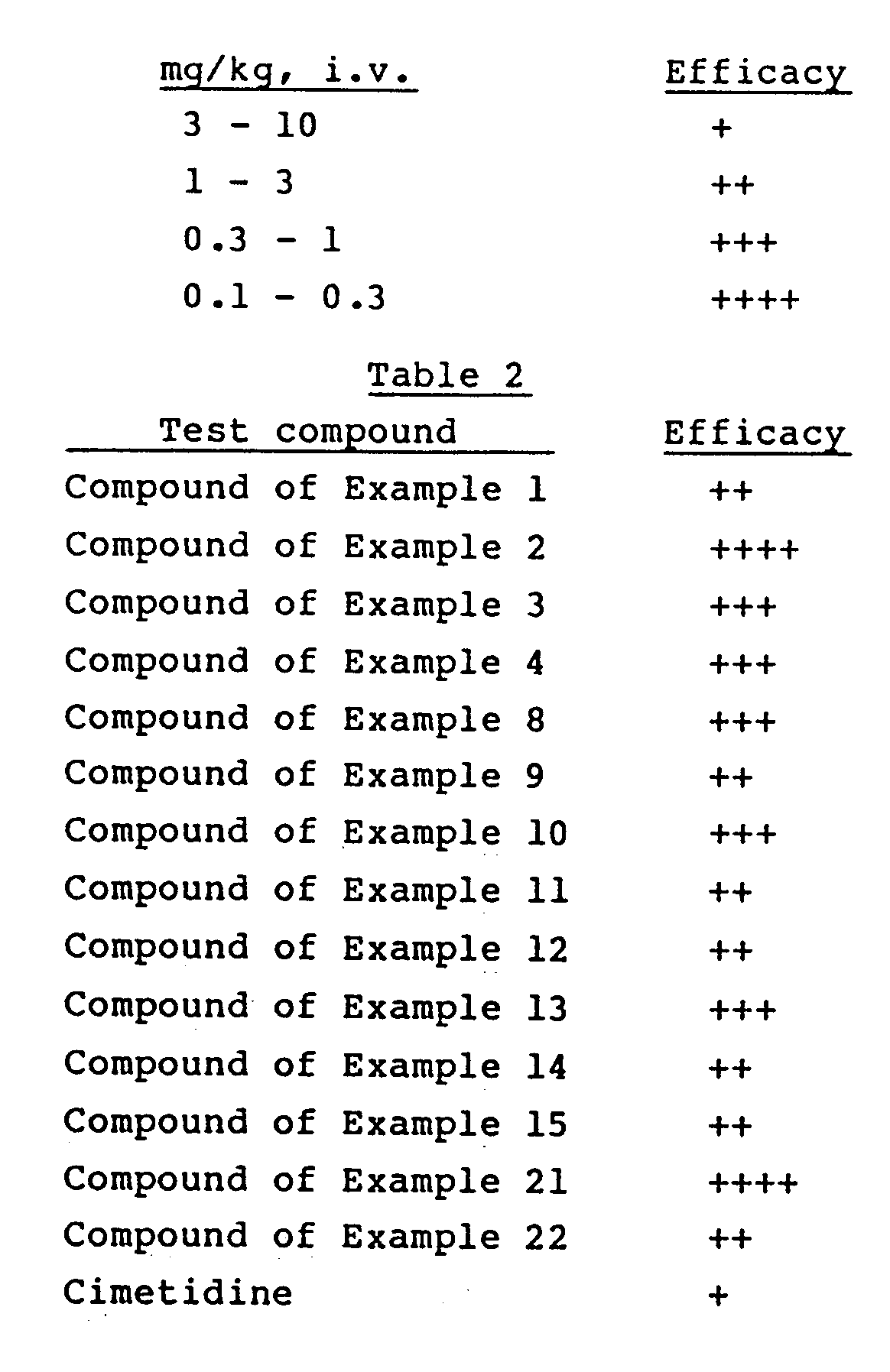
- Male Donryu rats (150 to 250 g) which had been caused to fast for 24 hours were used. In the test, a necrotizing agent (0.4N HCl + 50% ethanol) was orally administered in a dose of 5 ml/kg 30 minutes after administering each of the test compounds (10 mg/kg, p.o.). One hour after administration of the necrotizing agent, the stomach was isolated and fixed by formalin. The area of a lesion was measured, and by comparison with a control group, the percent inhibition was determined. The results are shown in Table 3.

- The data obtained by the above pharmacological test demonstrate that the compounds of formula provided by this invention have strong histamine H₂ receptor antagnizing activity and gastric acid secretion inhibiting activity, and also an excellent action of gastric mucosal protection. Accordingly, they are useful as drugs for therapy or treatment of gastric ulcer or duodenal ulcer.
- The compound of formula (I) provided by this invention can be administered orally or parenterally (for example, intramuscularly, intravenously, subcutaneously, or intrarectally) to humans and other mammals for the treatment or prevention of diseases, particularly gastric ulcer or duodenal ulcer.
- For use as medicaments, the compound of formula (I) may be formulated by known methods (see Remington, "Pharmaceutical Sciences", Mack Publishing Company, Easton, Pennsylvania, U. S. A., 14th edition, 1970) into various forms suitable for oral or parenteral administration. For example, the compound of this invention can be formulated by using various nontoxic carriers or diluents normally used in drugs of this type, for example vehicles, binders, lubricants, disintegrants, antiseptics, isotonizing agents, stabilizers, dispersants, antioxidants, coloring agents, flavoring agents, buffers, propellants and surface-active agents.
- Depending upon their uses, such medicaments may be formulated into tablets, capsules, granules, powders, pellets, pills, trouches, suppositories, injectable preparations, syrups, and aerosols. Specific examples of the nontoxic carriers or diluents which can be used include starch, gelatin, glucose, lactose, fructose, maltose, magnesium carbonate, talc, magnesium stearate, methyl cellulose, carboxymethyl cellulose or its esters, gum arabic, polyethylene glycol, alkyl p-hydroxybenzoates, syrup, ethanol, propylene glycol, Vaseline, carbowax, glycerol, sodium chloride, sodium sulfite, sodium phosphate, citric acid, dichlorodifluoromethane, 1,2-dichlorotetrafluoroethane and sorbitan trioleate.
- The medicaments may also contain other therapeutically effective drugs.
- The dose of the compound of formula (I) can be varied widely depending upon the type of the animal to be treated, the route of administration, the severity of the patient's condition, the diagnosis of a physician, etc. Generally, it may be 0.1 to 5 mg/kg, preferably 0.3 to 3 mg/kg, per day. It is of course possible to administer the compound of formula (I) in dose larger than the above-specified upper limit or smaller than the above-specified lower limit according to the severity of the patient's condition and the physician's diagnosis. The above dose may be taken once a day or in several portions a day.
- The following examples illustrate the present invention more specifically.
-

- 0.78 g of 60% sodium hydride was suspended in 20 ml of anhydrous tetrahydrofuran, and 1.54 g (17.7 mM) of 4-amino-cis-2-buten-1-ol was slowly added. The mixture was refluxed with stirring for 20 minutes. Then, under ice cooling, a solution of 3.00 g (11.8 mM) of 2-bromo-4-(piperidinomethyl)pyridine in 10 ml of tetrahydrofuran was added slowly to the mixture, and the entire mixture was then refluxed for 48 hours with stirring. After the reaction, the insoluble matter was removed by filtration, and the solvent was evaporated from the filtrate. The residue was extracted with 100 ml of dichloromethane three times. The extracts were dried over anhydrous magnesium sulfate, and the solvent was evaporated. The residue was purified by silica gel column chromatography using a 1:3 mixture of methanol and ethyl acetate as an eluent to give 1.49 g (yield 48 %) of the compound as a pale brown oil.
¹H-NMR (δ, CDCl₃): 1.30-1.50 (2H, m), 1.50-1.65 (4H, m), 1.82 (2H, brs), 2.30-2.40 (4H, m), 3.40 (2H, s), 3.45 (2H, d, J=4.5Hz), 4.88 (2H, d, J=4.5Hz), 5.70-5.85 (2H, m), 6.72 (1H, s), 6.86 (1H, d, J=4.2Hz), 8.05 (1H, d, J=4.2Hz). - By the same procedure as described above, the following compounds were produced.
- 4-[4-(3-methylpiperidinomethyl)pyridyl-2-oxy]-cis-2-butenamine
¹H-NMR (δ, CDCl₃): 0.86 (3H, d, J=5.8Hz), 1.50-1.84 (1H, m), 1.88-2.00 (2H, m), 2.60-2.80 (4H, m), 3.44 (2H, s), 3.46 (2H, d, J=4.0Hz), 4.89 (2H, d, J=4.0Hz), 5.68-5.83 (2H, m), 6.72 (1H, s), 6.86 (1H, d, J=4.2Hz), 8.06 (1H, d, J=4.2Hz). - 4-[4-(1,2,3,6-tetrahydro-1-pyridylmethyl)pyridyl-2-oxy]-cis-2-butenamine
¹H-NMR (δ, CDCl₃): 2.18 (2H, dt, J=2.5Hz, 5.6Hz), 2.55 (2H, t, J=5.6Hz), 2.97 (2H, dt, J=2.5Hz, 2.6Hz), 3.44 (2H, d, J=4.5Hz), 3.52 (2H, s), 4.89 (2H, d, J=4.5Hz), 5.60-5.82 (4H, m), 6.75 (1H, s), 6.91 (1H, d, J=5.4Hz), 8.06 (1H, d, J=5.4Hz). - 4-[4-(1-perhydroazepinylmethyl)pyridyl-2-oxy]-cis-2-butenamine
¹H-NMR (δ, CDCl₃): 1.58-1.70 (8H, m), 2.45-2.70 (4H, m), 3.47 (2H, d, J=4.6Hz), 3.58 (2H, s), 4.89 (2H, d, J=4.5Hz), 5.68-5.80 (2H, m), 6.75 (1H, s), 6.89 (1H, d, J=5.4Hz), 8.05 (1H, d, J=5.4Hz). - 4-[4-(4-methyl-1-piperazinylmethyl)pyridyl-2-oxy]-cis-2-butenamine
¹H-NMR (δ, CDCl₃): 1.50 (2H, brs), 2.30 (3H, s), 2.40-2.60 (8H, m), 3.45 (2H, s), 3.46 (2H, d, J=4.7Hz), 4.88 (2H, d, J=4.7Hz), 5.70-5.80 (2H, m), 6.73 (1H, s), 6.87 (1H, d, J=5.5Hz), 8.06 (1H, d, J=5.5Hz). - 4-[4-(thiomorpholinomethyl)pyridyl-2-oxy]-cis-2-butenamine
¹H-NMR (δ, CDCl₃): 1.26 (2H, brs), 2.65-2.75 (8H, m), 3.45 (2H, s), 3.47 (2H, d, J=4.5Hz), 4.89 (2H, d, J=4.5Hz), 6.70-6.80 (2H, m), 6.72 (1H, s), 6.85 (1H, d, J=4.2Hz), 8.06 (1H, d, J=4.2Hz). - 4-[4-(piperidinomethyl)pyridyl-2-oxy]-butanamine
¹H-NMR (δ, CDCl₃): 1.40-1.50 (4H, m), 1.50-1.70 (6H, m), 1.89 (2H, tt, J=6.6Hz, 6.6Hz), 2.30-2.45 (4H, m), 2.77 (2H, t, J=6.6Hz), 3.40 (2H, s), 4.29 (2H, t, J=6.6Hz), 6.70 (1H, s), 6.85 (1H, d, J=4.2Hz), 8.05 (1H, d, J=4.2Hz). - 4-[4-(4-methyl-1-piperazinylmethyl)pyridyl-2-oxy]-butanamine
¹H-NMR (δ, CDCl₃): 1.25 (2H, brs), 1.61 (2H, tt, J=6.6Hz, 6.6Hz), 1.82 (2H, tt, J=6.6Hz, 6.6Hz), 2.91 (3H, s), 2.40-2.60 (8H, m), 2.77 (2H, t, J=6.6Hz), 3.45 (2H, s), 4.29 (2H, t, J=6.6Hz), 6.71 (1H, s), 6.85 (1H, d, J=4.2Hz), 8.05 (1H, d, J=4.2Hz). -

- 0.17 g (0.65 mM) of 4-[4-(piperidinomethyl)pyridyl-2-oxy]-cis-2-butenamine and 0.11 g (0.65 mM) of 2-(furfurylthio)acetic acid were dissolved in 20 ml of dichloromethane. To the resulting solution was added 0.15 g (0.78 mM) of 1-ethyl-3-(3-dimethylaminopropyl)carbodiimide hydrochloride, and the mixture was stirred for 18 hours. Then, 20 ml of dichloromethane and 20 ml of water were added to extract the reaction mixture. The dichloromethane layer was washed with 30 ml of water. The extract was dried over anhydrous magnesium sulfate, and the solvent was evaporated. The residue was purified by silica gel column chromatography using a 2:98 mixture of methanol and dichloromethane as an eluent to give 0.18 g (yield 67 %) of the captioned compound as an oil.
IR (cm⁻¹, film): 1655 (C=O)
¹H-NMR (δ, CDCl₃): 1.40-1.50 (2H, m), 1.50-1.65, (4H, m), 2.30-2.45 (4H, m), 3.23 (2H, s), 3.41 (2H, s), 3.74 (2H, s), 3.99 (2H, dd, J=6.1Hz, 6.1Hz), 4.91 (2H, d, J=6.1Hz), 5.55-5.70 (1H, m), 5.80-5.95 (1H, m), 6.20 (1H, d, J=3.2Hz), 6.30 (1H, dd, J=3.2, 1.4Hz), 6.74 (1H, s), 6.80-6.95 (1H, brs), 6.88 (1H, d, J=4.3Hz), 7.36 (1H, d, J=1.4Hz), 8.06 (1H, d, J=4.3Hz).Mass: as C₂₂H₂₉N₃O₃S Calculated: 415, 1930 Found: 415, 1931 -

- The captioned compound was produced (yield 37%) by repeating the reaction of Example 1 except that 0.12 g (0.65 mM) of 2-(furfurylsulfinyl)acetic acid was used instead of the 2-(furfurylthio)acetic acid. Recrystallization from a mixture of benzene and hexane gave colorless crystals.
Melting point: 92.7 - 94.9 °C
IR (cm⁻¹, KBr Tab.): 1645 (C=O)
1041 (S→O)
¹H-NMR (δ, CDCl₃): 1.40-1.50 (2H, m), 1.50-1.65 (4H, m), 2.30-2.45 (4H, m), 3.34 (1H, d, J=14.2Hz), 3.40 (2H, s), 3.69 (1H, d, J=14.2Hz), 4.15 (2H, dd, J=6.1Hz, 6.1Hz), 4.14 (1H, d, J=14.2Hz), 4.38 (1H, d, J=14.2Hz), 4.93 (2H, t, J=6.1Hz), 5.60-5.75 (1H, m), 5.80-5.90 (1H, m), 6.40 (1H, dd, J=3.1Hz, 1.6Hz), 6.47 (1H, d, J=3.1Hz), 6.73 (1H, s), 6.87 (1H, d, J=5.1Hz), 7.15-7.25 (1H, brs), 7.44 (1H, d, J=1.6Hz), 8.04 (1H, d, J=5.1Hz).Mass: as C₂₂H₂₉N₃O₄S Calculated: 431.1879 Found: 431.1883 -

- The captioned compound was obtained as a colorless oil (yield 51 %) by repeating Example 1 except that 0.13 g (0.65 mM) of 2-(3-furylmethylsulfonyl)acetic acid was used instead of the 2-(furfurylthio)acetic acid.
IR (cm⁻¹, film): 1680 (C=O)
1319, 1118 (SO₂)
¹H-NMR (δ, CDCl₃): 1.40-1.50 (2H, m), 1.50-1.70 (4H, m), 2.30-2.45 (4H, m), 3.42 (2H, s), 3.75 (2H, s), 4.09 (2H, t, J=5.9Hz), 4.34 (2H, s), 4.94 (2H, d, J=5.9Hz), 5.6-5.75 (1H, m), 5.80-5.90 (1H, m), 6.60 (1H, d, J=1.8Hz), 6.75 (1H, s), 6.91 (1H, d, J=5.1Hz), 7.25-7.4 (1H, brs), 7.45 (1H, d, J=1.8Hz), 7.65 (1H, s), 8.05 (1H, d, J=5.1Hz).Mass: as C₂₂H₂₉N₃O₅S Calculated: 447.1829 Found: 447.1820 -

- The captioned compound was obtained (yield 38%) by repeating Example 2 except that 0.65 mM of 4-[4-(dimethylaminomethyl)pyridyl-2-oxy]-cis-2-butenamine was used instead of the 4-[4-(piperidinomethyl)pyridyl-2-oxy]-cis-2-butenamine.
IR (cm⁻¹, film): 1666 (C=O)
1040 (S→O)
¹H-NMR (δ, CDCl₃): 2.24 (6H, s), 3.33 (1H, d, J=14.2Hz), 3.37 (2H, s), 3.59 (1H, d, J=14.2Hz), 4.11 (2H, dd, J=6.8Hz, 6.0Hz), 4.19 (1H, d, J=13.3Hz), 4.26 (1H, d, J=13.3Hz), 4.93 (2H, d, J=6.4Hz), 5.62-5.74 (1H, m), 5.80-5.90 (1H, m), 6.39 (1H, dd, J=2.9Hz, 2.1Hz), 6.47 (1H, d, J=2.9Hz), 6.71 (1H, s), 6.87 (1H, d, J=5.6Hz), 7.11 (1H, brs), 7.44 (1H, d, J=2.1Hz), 8.07 (1H, d, J=5.6Hz).Mass: as C₁₉H₂₅N₃O₄S Calculated: 391.1566 Found: 391.1563 -

- The captioned compound was obtained (yield 66%) by repeating Example 3 except that 0.65 mM of 4-[4-(dimethylaminomethyl)pyridyl-2-oxy]-cis-2-butenamine was used instead of the 4-[4-(piperidinomethyl)pyridyl-2-oxy]-cis-2-butenamine.
IR (cm⁻¹, film): 1680 (C=O)
1322, 1118 (SO₂)
¹H-NMR (δ, CDCl₃): 2.24 (6H, s), 3.37 (2H, s), 3.75 (2H, s), 4.09 (2H, dd, J=6.3, 5.6Hz), 4.34 (2H, s), 4.94 (2H, d, J=5.6Hz), 5.63-5.73 (1H, m), 5.80-5.90 (1H, m), 6.59 (1H, d, J=1.5Hz), 6.72 (1H, s), 6.89 (1H, d, J=5.6Hz), 7.24 (1H, brs), 7.46 (1H, dd, J=1.5Hz, 1.0Hz), 7.65 (1H, d, J=1.0Hz), 8.07 (1H, d, J=5.6Hz).Mass: as C₁₉H₂₅N₃O₅S Calculated: 407.1515 Found: 407.1510 -

- The captioned compound was obtained (yield 20%) by repeating Example 5 except that 0.65 mM of 2-(3-furylmethylthio)acetic acid was used instead of the 2-(3-furylmethylsulfonyl)acetic acid.
IR (cm⁻¹, film): 1652 (C=O)
¹H-NMR (δ, CDCl₃): 2.26 (6H, s), 3.16 (2H, s), 3.39 (2H, s), 3.57 (2H, s), 4.03 (2H, dd, J=6.1Hz, 6.1Hz), 4.93 (2H, d, J=6.1Hz), 5.58-5.70 (1H, m), 5.81-5.92 (1H, m), 6.36 (1H, d, J=1.5Hz), 6.73 (1H, s), 6.88 (1H, brs), 6.89 (1H, d, J=5.1Hz), 7.35 (1H, s), 7.38 (1H, d, J=1.5Hz), 8.08 (1H, d, J=5.1Hz). -

- The captioned compound was obtained (yield 25%) by repeating Example 5 except that 0.65 mM of 2-(furfurylsulfonyl)acetic acid was used instead of the 2-(3-furylmethylsulfonyl)acetic acid.
IR (cm⁻¹, film): 1668 (C=O)
1320, 1150 (SO₂)
¹H-NMR (δ, CDCl₃): 2.26 (6H, s), 3.39 (2H, s), 3.85 (2H, s), 4.09 (2H, dd, J=6.3Hz, 6.3Hz), 4.58 (2H, s), 4.94 (2H, d, J=6.3Hz), 5.62-5.72 (1H, m), 5.80-5.90 (1H, m), 6.43 (1H, dd, J=3.1Hz, 2.1Hz), 6.62 (1H, d, J=3.1Hz), 6.74 (1H, s), 6.89 (1H, d, J=5.0Hz), 7.24 (1H, brs), 7.49 (1H, d, J=2.1Hz), 8.07 (1H, d, J=5.0Hz). -

- The captioned compound was obtained (yield 43%) by repeating Example 2 except that 0.65 mM of 4-[4-(3-methylpiperidinomethyl)pyridyl-2-oxy]-cis-2-butenamine was used instead of the 4-[4-(piperidinomethyl)pyridyl-2-oxy]-cis-2-butenamine.
IR (cm⁻¹, film): 1666 (C=O)
1036 (S→O)
¹H-NMR (δ, CDCl₃): 0.84 (3H, d, J=5.6Hz), 1.54-1.73(6H, m), 1.84-1.94 (1H, m), 2.69-2.78 (2H, m), 3.33 (1H, d, J=14.1Hz), 3.40 (2H, s), 3.59 (1H, d, J=14.1Hz), 4.11 (1H, dd, J=5.0Hz, 7.0Hz), 4.19 (1H, d, J=13.4Hz), 4.26 (1H, d, J=13.4Hz), 4.93 (2H, d, J=7.1Hz), 5.66-5.72 (1H, m), 5.82-5.90 (1H, m), 6.39 (1H, dd, J=3.4Hz, 2.0Hz), 6.47 (1H, d, J=3.4Hz), 6.73 (1H, s), 6.87 (1H, d, J=5.4Hz), 7.15 (1H, brs), 7.44 (1H, d, J=2.0Hz), 8.05 (1H, d, J=5.4Hz).Mass: as C₂₃H₃₁N₃O₄S Calculated: 445.2034 Found: 445.2029 -

- The captioned compound was obtained (yield 50%) by repeating Example 3 except that 0.65 mM of 4-[4-(3-methylpiperidinomethyl)pyridyl-2-oxy]-cis-2-butenamine was used instead of the 4-[4-(piperidinomethyl)pyridyl-2-oxy]-cis-2-butenamine.
IR (cm⁻¹, film): 1678 (C=O)
1318, 1118 (SO₂)
¹H-NMR (δ, CDCl₃): 0.84 (3H, d, J=6.1Hz), 1.55-1.85 (6H, m), 1.85-1.95 (1H, m), 2.66-2.78 (2H, m), 3.41 (2H, s), 3.75 (2H, s), 4.09 (2H, dd, J=5.9Hz, 6.1Hz), 4.34 (2H, s), 4.94 (2H, d, J=6.3Hz), 5.64-5.72 (1H, m), 5.82-5.90 (1H, m), 6.60 (1H, s), 6.74 (1H, s), 6.89 (1H, d, J=5.4Hz), 7.33 (1H, brs), 7.46 (1H, s), 7.66 (1H, s), 8.05 (1H, d, J=5.4Hz).Mass: as C₂₃H₃₁N₃O₅S Calculated: 461.1984 Found: 461.1998 -

- The captioned compound was obtained (yield 41%) by repeating Example 2 except that 0.65 mM of 4-[4-(pyrrolidinomethyl)pyridyl-2-oxy]-cis-2-butenamine was used instead of the 4-[4-(piperidinomethyl)pyridyl-2-oxy]-cis-2-butenamine.
IR (cm⁻¹, film): 1672 (C=O)
1040 (S→O)
¹H-NMR (δ, CDCl₃): 1.75-1.84 (4H, m), 2.48-2.55 (4H, m), 3.35 (2H, d, J=14.9 Hz), 4.10 (1H, dd, J=5.9Hz, 6.3Hz), 4.19 (2H, d, J=14.2Hz), 4.27 (2H, d, J=14.2Hz), 4.93 (1H, d, J=6.6Hz), 5.62-5.72 (1H, m), 5.80-5.90 (1H, m), 6.39 (1H, dd, J=2.9 Hz, 1.8Hz), 6.47 (1H, d, J=2.9Hz), 6.88 (1H, d, J=5.1Hz), 7.28 (1H, s), 7.43 (1H, d, J=1.8Hz), 8.05 (1H, d, J=5.1Hz).Mass: as C₂₁H₂₇N₃O₄S Calculated: 417.1722 Found: 417.1716 -

The captioned compound was obtained (yield 49%) by repeating Example 3 except that 0.65 mM of 4-[4-(pyrrolidinomethyl)pyridyl-2-oxy]-cis-2-butenamine was used instead of the 4-[4-(piperidinomethyl)pyridyl-2-oxy]-cis-2-butenamine.
IR (cm⁻¹, film): 1680 (C=O)
1324, 1118 (SO₂)
¹H-NMR (δ, CDCl₃): 1.65-1.85 (4H, m), 2.47-2.54 (4H, m), 3.57 (2H, s), 3.75 (2H, s), 4.09 (2H, dd, J=5.8Hz, 6.4Hz), 4.34 (2H, s), 4.94 (2H, d, J=7.8Hz), 6.60 (1H, d, J=1.8Hz), 6.65-6.75 (1H, m), 6.75 (1H, s), 6.80-6.92 (1H, m), 6.90 (1H, d, J=4.4Hz), 7.25-7.32 (1H, m), 7.46 (1H, d, J=1.8Hz), 7.66 (1H, s), 8.05 (1H, d, J=4.4Hz).Mass: as C₂₁H₂₇N₃O₅S Calculated: 433.1670 Found: 433.1662 -

- The captioned compound was obtained (yield 35%) by repeating Example 2 except that 0.65 mM of 4-[4-(morpholinomethyl)pyridyl-2-oxy]-cis-2-butenamine was used instead of the 4-[4-(piperidinomethyl)pyridyl-2-oxy]-cis-2-butenamine.
IR (cm⁻¹, film): 1666 (C=O)
1036 (S→O)
¹H-NMR (δ, CDCl₃): 2.44 (4H, t, J=4.4Hz), 3.32 (1H, d, J=14.5Hz), 3.44 (2H, s), 3.59 (1H, d, J=14.5Hz), 3.72 (4H, t, J=4.4Hz), 4.11 (2H, dd, J=6.4Hz, 6.1Hz), 4.18 (1H, d, J=14.1Hz), 4.26 (1H, d, J=14.1Hz), 4.93 (2H, d, J=7.0Hz), 5.62-5.72 (1H, m), 5.80-5.90 (1H, m), 6.39 (1H, dd, J=3.5Hz, 1.7Hz), 6.47 (1H, d, J=3.5Hz), 6.74 (1H, s), 6.88 (1H, d, J=5.1Hz), 7.05-7.15 (1H, m), 7.44 (1H, d, J=1.7Hz), 8.06 (1H, d, J=5.1Hz).Mass: as C₂₁H₂₇N₃O₅S Calculated: 433.1671 Found: 433.1671 -

- The captioned compound was obtained (yield 36%) by repeating Example 2 except that 0.65 mM of 4-[4-(1,2,3,6-tetrahydro-1-pyridylmethyl)pyridyl-2-oxy]-cis-2-butenamine was used instead of the 4-[4-(piperidinomethyl)pyridyl-2-oxy]-cis-2-butenamine.
IR (cm⁻¹, film): 1668 (C=O)
1040 (S→O)
¹H-NMR (δ, CDCl₃): 2.18 (2H, dt, J=2.5Hz, 5.6Hz), 2.55 (2H, t, J=5.6Hz), 2.97 (2H, dt, J=2.5Hz, 2.6Hz), 3.33 (1H, d, J=14.0Hz), 3.52 (2H, s), 3.59 (1H, d, J=14.0Hz), 4.11 (2H, dd, J=5.9Hz, 6.6Hz), 4.18 (1H, d, J=13.9Hz), 4.26 (1H, d, J=13.9Hz), 4.93 (2H, d, J=6.6Hz), 5.60-5.90 (4H, m), 6.39 (1H, dd, J=3.1Hz, 1.2Hz), 6.47(1H, d, J=3.1Hz), 6.91 (1H, d, J=5.4Hz), 7.15 (1H, brs), 7.44 (1H, d, J=1.2Hz), 8.06 (1H, d, J=5.4Hz).Mass: as C₂₂H₂₇N₃O₄S Calculated: 429.1722 Found: 429.1708 -

- The captioned compound was obtained (yield 52%) by repeating Example 3 except that 0.65 mM of 4-[4-(1,2,3,6-tetrahydro-1-pyridylmethyl)pyridyl-2-oxy]-cis-2-butenamine was used instead of the 4-[4-(piperidinomethyl)pyridyl-2-oxy]-cis-2-butenamine.
IR (cm⁻¹, film): 1678 (C=O)
1318, 1118 (SO₂)
¹H-NMR (δ, CDCl₃): 2.18 (2H, dt, J=5.5Hz, 3.0Hz), 2.55 (2H, t, J=5.5Hz), 2.97 (2H, dt, J=3.0Hz, 2.2Hz), 3.52 (2H, s), 3.75 (2H, s), 4.08 (2H, dd, J=5.9Hz, 6.3Hz), 4.34 (2H, s), 4.93 (2H, d, J=6.5Hz), 5.61-5.90 (4H, m), 6.59 (1H, d, J=1.0Hz), 6.77 (1H, s), 6.93 (1H, d, J=5.4Hz), 7.26 (1H, brs), 7.46 (1H, dd, J=1.0Hz, 1.0Hz), 7.65 (1H, d, J=1.0Hz), 8.06 (1H, d, J=5.4Hz).Mass: as C₂₂H₂₇N₃O₅S Calculated: 445.1671 Found: 445.1663 -

- The captioned compound was obtained (yield 34%) by repeating Example 2 except that 0.65 mM of 4-[4-(1-perhydroazepinylmethyl)pyridyl-2-oxy]-cis-2-butenamine was used instead of the 4-[4-(piperidinomethyl)pyridyl-2-oxy]-cis-2-butenamine.
IR (cm⁻¹, film): 1668 (C=O)
1034 (S→O)
¹H-NMR (δ, CDCl₃): 1.55-1.78 (8H, m), 2.55-2.62 (4H, m), 3.33 (1H, d, J=15.1Hz), 3.58 (2H, s), 3.59 (1H, d, J=15.1Hz), 4.11 (2H, dd, J=6.4Hz, 5.8Hz), 4.18 (1H, d, J=14.4Hz), 4.26 (1H, d, J=14.4Hz), 4.93 (2H, d, J=6.4Hz), 5.64-5.73 (1H, m), 5.80-5.91 (1H, m), 6.39 (1H, dd, J=2.8Hz, 1.4Hz), 6.47 (1H, d, J=2.8Hz), 6.75 (1H, s), 6.90 (1H, d, J=5.5Hz), 7.16 (1H, brs), 7.44 (1H, d, J=1.4Hz), 8.04 (1H, d, J=5.5Hz).Mass: as C₂₃H₃₁N₃O₄S Calculated: 445.2034 Found: 445.2018 -
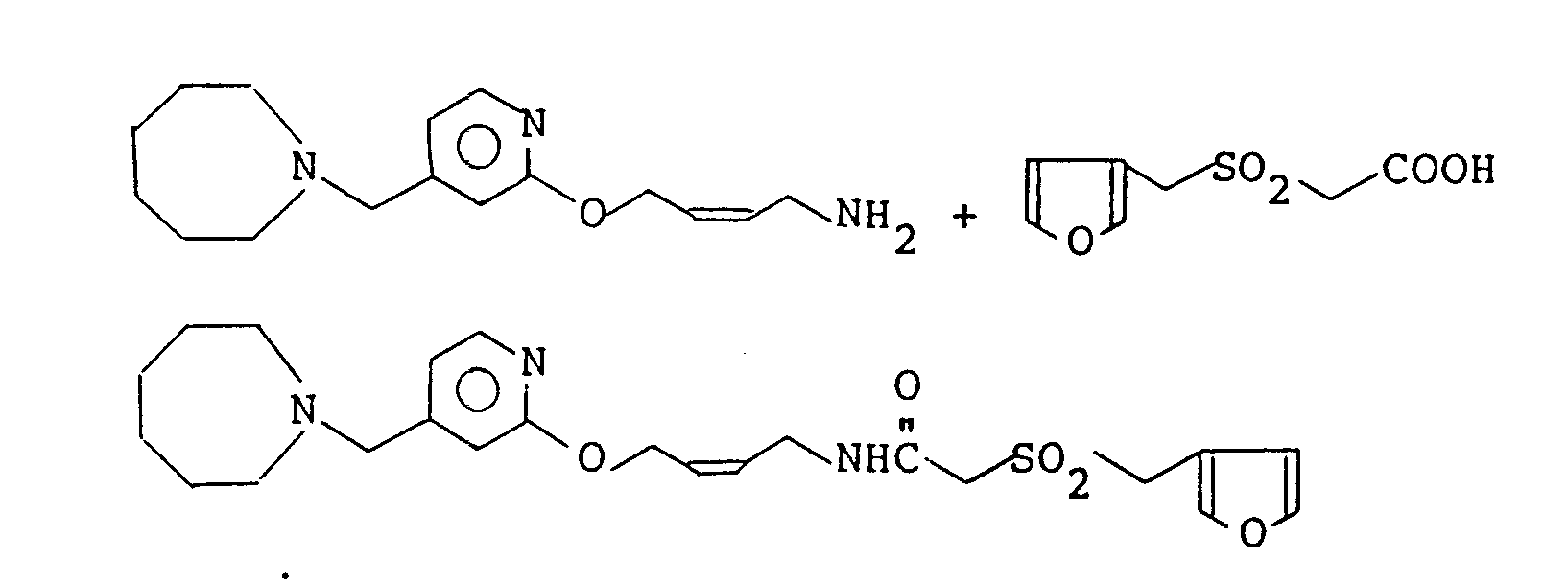
- The captioned compound was obtained (yield 41%) by repeating Example 3 except that 0.65 mM of 4-[4-(1-perhydroazepinylmethyl)pyridyl-2-oxy]-cis-2-butenamine was used instead of the 4-[4-(piperidinomethyl)pyridyl-2-oxy]-cis-2-butenamine.
IR (cm⁻¹, film): 1680 (C=O)
1320, 1118 (SO₂)
¹H-NMR (δ, CDCl₃): 1.55-1.78 (8H, m), 2.55-2.65 (4H, m), 3.58 (2H, S), 3.77 (2H, s), 4.08 (2H, dd, J=5.9Hz, 5.8Hz), 4.35 (2H, s), 4.93 (2H, d, J=5.9Hz), 5.63-5.73 (1H, m), 5.80-5.90 (1H, m), 6.59 (1H, d, J=1.0Hz), 6.76 (1H, s), 6.91 (1H, d, J=5.4Hz), 7.39 (1H, brs), 7.45 (1H, dd, J=1.0Hz, 1.0Hz), 7.65 (1H, d, J=1.0Hz), 8.04 (1H, d, J=5.4Hz).Mass: as C₂₃H₃₁N₃O₅S Calculated: 461.1984 Found: 461.1984 -

- The captioned compound was obtained (yield 37%) by repeating Example 2 except that 0.65 mM of 4-[4-(4-methyl-1-piperazinylmethyl)pyridyl-2-oxy]-cis-2-butenamine was used instead of the 4-[4-(piperidinomethyl)pyridyl-2-oxy]-cis-2-butneamine.
IR (cm⁻¹, film): 1665 (C=O)
1040 (S→O)
¹H-NMR (δ, CDCl₃): 2.29 (3H, s), 2.40-2.60 (8H, m), 3.32 (1H, d, J=13.4Hz), 3.45 (2H, s), 3.60 (1H, d, J=13.4Hz), 4.11 (2H, dd, J=6.3Hz, 6.3Hz), 4.18 (1H, d, J=14.2Hz), 4.27 (1H, d, J=14.2Hz), 4.93 (2H, d, J=6.6Hz), 5.62-5.73 (1H, m), 5.80-5.90 (1H, m), 6.40 (1H, dd, J=3.5Hz, 2.0Hz), 6.47 (1H, d, J=3.5Hz), 6.74 (1H, s), 6.87 (1H, d, J=5.0Hz), 7.13 (1H, brs), 7.44 (1H, d, J=2.0Hz), 8.05 (1H, d, J=5.0Hz).Mass: as C₂₂H₃₀N₄O₄S Calculated: 446.1987 Found: 446.1978 -

- The captioned compound was obtained (yield 55%) by repeating Example 3 except that 0.65 mM of 4-[4-(4-methyl-1-piperidinylmethyl)pyridyl-2-oxy]-cis-2-butenamine was used instead of the 4-[4-(piperidinomethyl)pyridyl-2-oxy]-cis-2-butenamine.
IR (cm⁻¹, film): 1680 (C=O)
1310, 1120 (SO₂)
¹H-NMR (δ, CDCl₃): 2.30 (3H, s), 2.45-2.60 (8H, m), 3.46 (2H, s), 3.76 (2H, s), 4.69 (2H, dd, J=5.4Hz, 5.6Hz), 4.34 (2H, s), 4.93 (2H, d, J=7.0Hz), 5.62-5.73 (1H, m), 5.80-5.92 (1H, m), 6.59 (1H, d, J=1.4Hz), 6.75 (1H, s), 6.89 (1H, d, J=5.4Hz), 7.28 (1H, brs), 7.46 (1H, d, J=1.4Hz), 7.65 (1H, s), 8.05 (1H, d, J=5.4Hz).Mass: as C₂₂H₃₀N₄O₅S Calculated: 462.1937 Found: 462.1939 -

- The captioned compound was obtained (yield 12%) by repeating Example 2 except that 0.65 mM of 4-[4-(thiomorpholinomethyl)pyridyl-2-oxy]-cis-2-butenamine was used instead of the 4-[4-(piperinomethyl)pyridyl-2-oxy]-cis-2-butenamine.
IR (cm⁻¹, film): 1666 (C=O)
1036 (S→O)
¹H-NMR (δ, CDCl₃): 2.60-2.80 (8H, m), 3.34 (1H, d, 14.1Hz), 3.45 (2H, s), 3.59 (1H, d, J=14.1Hz), 4.10 (2H, dd, J=6.4Hz, 5.0Hz), 4.18 (1H, d, J=13.9Hz), 4.28 (1H, d, J=13.9Hz), 4.93 (2H, d, J=6.6Hz), 5.64-5.74 (1H, m), 5.80-5.90 (1H, m), 6.40 (1H, dd, J=3.5Hz, 6.1Hz), 6.47 (1H, d, J=3.5Hz), 6.72 (1H, s), 6.85 (1H, d, J=5.1Hz), 7.20 (1H, brs), 7.44 (1H, d, J=1.6Hz), 8.06 (1H, d, J=5.1Hz). -

- The captioned compound was obtained (yield 24%) by repeating Example 3 except that 0.65 mM of 4-[4-(thiomorpholinomethyl)pyridyl-2-oxy]-cis-2-butenamine was used instead of the 4-[4-(piperidinomethyl)pyridyl-2-oxy]-cis-2-butenamine.
IR (cm⁻¹, film): 1678 (C=O)
1318, 1118 (SO₂)
¹H-NMR (δ, CDCl₃): 2.60-2.80 (8H, m), 3.46 (2H, s), 3.77 (2H, s), 4.08 (2H, dd, J=5.8Hz, 6.2Hz), 4.34 (2H, s), 4.94 (2H, d, J=6.6Hz), 5.64-5.74 (1H, m), 5.80-5.92 (1H, m), 6.59 (1H, s), 6.74 (1H, s), 6.87 (1H, d, J=5.2Hz), 7.29 (1H, brs), 7.46 (1H, s), 7.65 (1H, s), 8.06 (1H, d, J=5.2Hz). -

- The captioned compound was obtained by repeating Example 2 except that 0.65 mM of 4-[4-(piperidinomethyl)pyridyl-2-oxy]butanamine was instead of the 4-[4-(piperidinomethyl)pyridyl-2-oxy]-cis-2-butenamine. Recrystallization from hexane gave a colorless powder in a yield of 24 %.
Melting point: 102.8-104.3 °C
IR (cm⁻¹, KBr Tab.): 1647 (C=O)
1050 (S→O)
¹H-NMR (δ, CDCl₃): 1.40-1.65 (6H, m), 1.65-1.90 (4H, m), 2.30-2.45 (4H, m), 3.31 (1H, d, J=14.5Hz), 3.40 (2H, s), 3.41 (2H, dt, J=6.1Hz, 6.1Hz), 3.58 (1H, d, J=14.5Hz), 4.16 (1H, d, J=13.9Hz), 4.26 (1H, d, J=13.9Hz), 4.30 (2H, t, J=6.1Hz), 6.40 (1H, dd, J=3.5Hz, 2.0Hz), 6.47 (1H, d, J=3.5Hz), 6.90 (1H, s), 6.85 (1H, dd, J=5.4Hz, 1.3Hz), 6.95 (1H, brs), 7.44 (1H, d, J=2.0Hz), 8.03 (1H, d, J=5.4Hz).Mass: as C₂₂H₃₁N₃O₄S Calculated: 433.2036 Found: 433.2037 -

- The captioned compound was obtained (yield 15%) by repeating Example 3 except that 0.65 mM of 4-[4-(piperidinomethyl)pyridyl-2-oxy]butanamine was used instead of the 4-[4-(piperidinomethyl)pyridyl-2-oxy]-cis-2-butenamine.
IR (cm⁻¹, film): 1678 (C=O)
1320, 1119 (SO₂)
¹H-NMR (δ, CDCl₃): 1.30-1.65 (6H, m), 1.65-1.90 (4H, m), 2.30-2.45 (4H, m), 3.38 (2H, dd, J=6.1Hz), 3.40 (2H, s), 3.76 (2H, s), 4.30 (2H, t, J=6.1Hz), 4.31 (2H, s), 6.59 (1H, 1.4Hz), 6.70 (1H, s), 6.73 (1H, brs), 6.80 (1H, dd, J=5.4Hz, 1.0Hz), 7.43 (1H, d, J=1.4Hz, 1.4Hz), 7.65 (1H, s), 8.04 (1H, d, J=5.4Hz).Mass: as C₂₂H₃₁N₃O₅S Calculated: 449.1983 Found: 449.1972 -

- The captioned compound was obtained (yield 30%) by repeating Example 1 except that 0.65 mM of 4-[4-(4-methyl-1-piperazinylmethyl)pyridyl-2-oxy]butanamine was used instead of the 4-[4-(piperidinomethyl)pyridyl-2-oxy]-cis-2-butenamine.
IR (cm⁻¹, film): 1675 (C=O)
¹H-NMR (δ, CDCl₃): 1.68 (2H, tt, J=6.3Hz, 6.3Hz), 1.81 (2H, tt, J=6.3Hz, 6.3Hz), 2.31 (3H, s), 2.40-2.60 (8H, m), 3.22 (2H, s), 3.29 (2H, dt, J=6.3Hz, 6.3Hz), 3.48 (2H, s), 3.74 (2H, s), 4.30 (2H, t, J=6.3Hz), 6.21 (1H, d, J=3.2Hz), 6.30 (1H, dd, J=3.2Hz, 1.4Hz), 6.71 (1H, s), 6.80 (1H, brs), 6.86 (1H, d, J=5.4Hz), 7.36 (1H, d, J=1.4Hz), 8.05 (1H, d, J=5.4Hz). -

- 108.1 g of 2-amino-4-methylpyridine was dissolved in 500 ml of 47% hydrobromic acid, and the solution was cooled to 0 °C with a freezing mixture. Then, 500 g of bromine was added dropwise. A solution of 172.5g of sodium nitrite in 500 ml of water was added dropwise while adjusting the reaction temperature to below 5 °C. After the sodium nitrite solution was completely added, the mixture was stirred for 1 hour, and then a solution of 300 g of sodium hydroxide in 1 liter of water to render the solution basic. The solution was extracted with ethyl acetate. The organic layer was washed with water and dried. The solvent was evaporated. The residue was purified by distillation to give 126 g (yield 73 %) of 2-bromo-4-methylpyridine.
Boiling point: 79 - 81 °C/4-5 mmHg
¹H-NMR (δ, CDCl₃): 8.22 (1H, d, J=4.9Hz), 7.33 (1H, s), 7.70 (1H, d, J=4.9Hz), 2.34 (3H, s). -

- 50 g of 2-bromo-4-methylpyridine was dissolved in 400 ml of conc. sulfuric acid, and under ice cooling, 87.2 g of chromic trioxide was added little by little. The mixture was stirred for 1 hour and put in ice water. The precipitated crystals were collected by filtration, and recrystallized from ethanol to give 48.8 g (yield 82%) of 2-bromo-4-pyridinecarboxylic acid having a melting point of 213.9 to 214.4 °C.
-

- 17.4 g of sodium borohydride was suspended in 1.6 liters of tetrahydrofuran, and the suspension was stirred by a mechanical stirrer. The suspension was cooled with ice-water, and 62.2 g of 2-bromo-4-pyridinecarboxylic acid was added little by little. The mixture was heated to room temperature, and stirred until evolution of hydrogen ceased. A solution of 75.8 ml of boron trifluoride etherate in 500 ml of tetrahydrofuran was added dropwise at room temperature for 3 hours. After the addition, the mixture was stirred for 20 hours. The reaction solution was cooled with ice-water, and acidified to a pH of 1 to 2 by adding 1.5N hydrochloric acid. Tetrahydrofuran was evaporated under reduced pressure. A 4N aqueous solution of sodium hydroxide was added to adjust the pH of the mixture to 10 to 11. It was extracted with ethyl acetate, and the organic layer was washed with a saturated aqueous solution of sodium chloride. The aqueous layer was further extracted with ethyl acetate twice. The organic layers were combined, and dried over anhydrous sodium sulfate. The dried product was concentrated under reduced pressure to give 51.3 g of 2-bromo-4-pyridinemethanol in a yield of 88 %.
Melting point: 63.3 to 64.4 °C (diisopropyl ether)
¹H-NMR (δ, CDCl₃): 8.31 (1H, d, J=4.5Hz), 7.38 (1H, s), 7.22 (1H, d, J=4.5Hz), 4.76 (2H, s), 2.40-2.70 (1H, m).
IR (cm⁻¹, KBr): 3268, 1598, 1382, 1070Mass: as C₆H₆BrO Found: 186.9638 Calculated: 186.9633 -

- A mixture of 21.0 g of 2-bromo-4-pyridinemethanol, 32.3 g of N-bromosuccinimide and 23.1 g of anhydrous sodium carbonate was suspended in 600 ml of benzene, and heated under reflux (bath temperature 110 to 120 °C) for 4 hours. The mixture was cooled over an ice bath, and a saturated aqueous solution of sodium hydrogen carbonate was added to adjust its pH to 9 to 10. The insoluble matter was removed by filtration (by washing with ethyl acetate). The organic layer was separated, washed with a 10% aqueous solution of sodium thiosulfate and then with a saturated aqueous solution of sodium chloride, and dried over sodium sulfate. The solvent was evaporated to give 18.2 g (yield 88 %) of 2-bromo-4-pyridinecarboxaldehyde.
Melting point: 52.6 to 53.5 °C
¹H-NMR (δ, CDCl₃): 10.03 (1H, s), 8.64 (1H, d, J=4.9Hz), 7.90 (1H, s), 7.68 (1H, d, J=4.9Hz).
IR (cm⁻¹, KBr): 1704, 1554, 1204Mass: as C₆H₄BrO Found: 184.9485 Calculated: 184.9476 -

- 60 g of 2-bromo-4-pyridinecarboxaldehyde was dissolved in 600 ml of benzene, and 40 g of ethylene glycol and 6 g of p-toluenesulfonic acid were put in the solution. The mixture was heated under reflux for 18 hours while water was removed by using a Dean-Stark trap. After the reaction, the reaction mixture was made basic by adding ice and a saturated aqueous solution of sodium hydrogen carbonate. The organic layer was washed with water and dried. The solvent was evaporated. The residue was distilled to give 60 g (yield 82 %) of 2-bromo-4-(1,3-dioxolan-2-yl)pyridine.
Boiling point: 121 - 122 °C/3 mmHg.
¹H-NMR (δ, CDCl₃): 8.39 (1H, d, J=5.5Hz), 7.60 (1H, s), 7.34 (1H, d, J=5.5Hz), 5.80 (1H, s), 4.07 (2H, d, J=12Hz), 4.05 (2H, d, J=12Hz).
IR (cm⁻¹, film): 2894, 1594, 1553, 1367, 1121, 1097Mass: as C₈H₈BrNO Found: 228.9738 Calculated: 228.9738 -

- 10 g of 2-bromo-4-(1,3-dioxolan-yl)pyridine, 9.7 g of 4-(2-oxytetrahydropyranyl)-cis-2-buten-1-ol (9.7 g), 7.0 g of powdery sodium hydroxide, 9.7 g of potassium carbonate and 1.3 g of tetra-n-butylammonium hydrogen sulfate were suspended in 150 ml of toluene, and the suspension was refluxed for 18 hours.
- After cooling, the reaction mixture was diluted with benzene, washed with water, and dried. The solvent was evaporated to give 12.1 g (yield 87 %) of 2-[4-(2-oxytetrahydropyranyl)-cis-2-buten-1-oxy]-4-(1,3-dioxolan-2-yl)pyridine.
¹H-NMR (δ, CDCl₃): 8.15 (1H, d, J=5.5Hz), 6.96 (1H, d, J=5.5Hz), 6.85 (1H, s), 5.79 (1H, s), 5.70-5.90 (2H, m), 4.93 (2H, d, J=5.4Hz), 4.65-4.68 (1H, m), 4.37 (1H, dd, J=12.5, 5.4Hz), 4.20 (1H, dd, J=12.5, 5.4Hz), 4.04 (4H, d, J=2Hz), 3.82-3.91 (1H, m), 3.46-3.56 (1H, m), 1.46-1.92 (6H, m).
IR (cm⁻¹, film): 2952, 1618, 1566, 1316Mass: as C₁₇H₂₃NO₅: Found: 321.1591 Calculated: 321.1577 -

- 12.1 g of 2-[4-(2-oxytetrahydropyranyl)-cis-2-buten-1-oxy]-4-(1,3-dioxolan-2-yl)pyridine was dissolved in 250 ml of ethanol, and 1.5 g of pyridinium p-toluenesulfonate was added. The mixture was stirred at 55 °C (bath temperature) for 18 hours.
- After the reaction, a saturated aqueous solution of sodium hydrogen carbonate was added to render the reaction mixture basic. The solvent was concentrated.
- The residue was taken into ethyl acetate, washed with water and dried. The solvent was evaporated to give 8.9 g of 4-[4-(1,3-dioxolan-2-yl)pyridyl-2-oxy]-cis-2-buten-1-ol quantitatively.
¹H-NMR (δ, CDCl₃): 8.10 (1H, d, J=4.5Hz), 6.98 (1H, d, J=4.5Hz), 6.86 (1H, s), 5.83-5.92 (1H, m), 5.78 (1H, s), 5.69-5.78 (1H, m), 5.01 (2H, d, J=7.4Hz), 4.32 (2H, d, J=6.4Hz), 4.01-4.08 (4H, m).
IR (cm⁻¹, film): 3424, 2896, 1620, 1566, 1426, 1316, 1032Mass: as C₁₂H₁₅NO₄: Found: 237.0998 Calculated: 237.1001 -

- 10 g of 4-[4-(1,3-dioxolan-2-yl)pyridyl-2-oxy]-cis-2-buten-1-ol and 6 g of triethylamine were dissolved in 250 ml of chloroform, and under ice cooling, 6 g of thionyl chloride was added dropwise.
- Under the same conditions, the mixture was stirred for 1 hour. Ice and then a saturated aqueous solution of sodium hydrogen carbonate were added to render the solution basic. The organic layer was washed with water and dried, and the solvent was evaporated.
- The residue, without purification, was immediately dissolved in 250 ml of acetonitrile, and 8 g of potassium phthalimide and 1.4 g of tetra-n-butylammonium hydrogen sulfate were added, and the mixture was refiuxed overnight.
- After cooling, the insoluble matter was removed from the reaction mixture by filtration, and the filtrate was concentrated. The concentrate was taken into ethyl acetate, washed with a 1N aqueous solution of sodium hydroxide and then with water, and dried. The solvent was evaporated.
- The residue was recrystallized from ethanol to give 8 g (yield 53 %) of N-(4-[4-(1,3-dioxolan-2-yl)pyridyl-2-oxy]-cis-2-butene)phthalimide.
Melting point: 96.9 - 97.9 °C
¹H-NMR (δ, CDCl₃): 8.17 (1H, d, J=5.3Hz), 7.85 (2H, dd, J=6.3, 3.7Hz), 7.72 (2H, dd, J=6.3, 3.7Hz), 6.98 (1H, d, J=5.3Hz), 6.86 (1H, s), 5.88-5.96 (1H, m), 5.80 (1H, s), 5.64-5.74 (1H, m), 5.12 (2H, d, J=7.2Hz), 4.47 (2H, d, J=7.2Hz), 4.00-4.09 (4H, m).
IR (cm⁻¹, KBr): 2496, 1770, 1716, 1614, 1568, 1120, 1092Mass: as C₂₀H₁₈N₂O₅: Found: 366.1221 Calculated: 366.1216 -

- 8.5 g of N-{4-[4-(1,3-dioxolan-2-yl)pyridyl-2-oxy}-cis-2-butene}phthalimide was dissolved in 200 ml of methanol, and 2.3 g of hydrazine hydrate was added. The mixture was refluxed for 10 hours. After cooling, the insoluble matter was removed from the reaction mixture by filtration, and the filtrate was concentrated. On standing, the residue crystallized to give 10.3 g (yield 78 %) of 4-[4-(1,3-dioxolan-2-yl)pyridyl-2-oxy]-cis-2-buten-1-amine.
¹H-NMR (δ, CDCl₃): 8.15 (1H, d, J=4.8Hz), 6.97 (1H, d, J=4.8Hz), 6.85 (1H, s), 5.78 (1H, s), 5.68-5.76 (2H, m), 4.90 (2H, d, J=4.8Hz), 4.01-4.07 (4H, m), 3.45 (2H, d) J=4.8Hz).
IR (cm⁻¹, KBr): 3068, 1666, 1082 -

- 13.5 g of p-nitrophenyl furfurylsulfinylacetate was suspended in 300 ml of tetrahydrofuran, and under ice cooling, a solution of 10.3 g of 4-[4-(1,3-dioxolan-2-yl)pyridyl-2-oxy]-cis-2-buten-1-amine in 100 ml of tetrahydrofuran was added dropwise. The temperature was returned to room temperature one hour later, and the mixture was stirred overnight.
- The solution was concentrated. The residue was taken into ethyl acetate, washed with a 1N aqueous solution of sodium hydroxide and water, and dried. The solvent was evaporated to give 16.1 g (yield 91 %) of N-{4-[4-(1,3-dioxolan-2-yl)pyridyl-2-oxy]-cis-2-butenyl}-2-(furfurylsulfinyl)acetamide.
¹H-NMR (δ, CDCl₃): 8.15 (1H, d, J=5.5Hz), 7.44 (1H, d, J=2.4Hz), 7.10-7.20 (1H, br-s), 6.98 (1H, d, J=5.5Hz), 6.47 (1H, d, J=2.8Hz), 6.39 (1H, dd, J=2.4, 2.8Hz), 5.79-5.90 (1H, m), 5.78 (1H, s), 5.63-5.72 (1H, m), 4.95 (2H, d, J=6.9Hz), 4.27 (1H, d, J=14.2Hz), 4.18 (1H, d, J=14.2Hz), 4.10 (2H, t, J=6.6Hz), 4.01-4.07 (4H, m), 3.59 (1H, d, J=14.2Hz), 3.34 (1H, d, J=14.2Hz).
IR (cm⁻¹, film): 1660, 1618, 1566, 1310, 1034Mass: as C₁₉H₂₂N₂O₆S: Found: 406.1208 Calculated: 406.1199 -

- 10.0 g of N-{4-[4-(1,3-dioxolan-2-yl)pyridyl-2-oxy]-cis-2-butenyl}-2-(furfurylsulfinyl)acetamide was dissolved in 200 ml of a 1:1 mixture of water and acetone, and 5.6 g of p-toluenesulfonic acid was added. The mixture was refluxed for 18 hours. After cooling, a saturated aqueous solution of sodium hydrogen carbonate was added to the reaction mixture to make it basic, and the mixture was concentrated. The concentrate was taken into ethyl acetate, washed with water, and dried, and the solvent was evaporated. The residue was subjected to column chromatography (1% methanol-chloroform) to give 4.6 g (yield 52 %) of N-[4-(4-formyl-2-pyridyloxy]-cis-2-butenyl]-2-(furfurylsulfinyl)acetamide.
Melting point: 67.6 - 69.9 °C
¹H-NMR (δ, CDCl₃): 10.00 (1H, s), 8.36 (1H, d, J=4.6Hz), 7.45 (1H, d, J=3Hz), 7.30 (1H, d, J=4.6Hz), 7.16 (1H, s), 7.08 (1H, br-s), 6.47 (1H, d, J=3.5Hz), 6.40 (1H, dd, J=3.5, 3.0Hz), 5.82-5.92 (1H, m), 5.66-5.76 (1H, m), 5.00 (2H, d, J=6.4Hz), 4.27 (1H, d, J=14.3Hz), 4.18 (1H, d, J=14.3Hz), 4.12 (2H, t, J=6.3Hz), 3.59 (1H, d, J=14.1Hz), 3.34 (1H, d, J=14.1Hz).
IR (cm⁻¹, KBr): 3236, 1712, 1624, 1564, 1036Mass: as C₁₇H₁₈N₂O₅S: Found: 362.0934 Calculated: 362.0937 -

- 4.0 g of N-[4-(4-formyl-2-pyridyloxy]-cis-2-butenyl]-2-(furfurylsulfinyl)acetamide was dissolved in 100 ml of ethanol, and under ice cooling, 2.0 g of piperidine was added. The mixture was stirred. Three hours later, 0.5 g of sodium borohydride was added under ice cooling, and the mixture was stirred. Acetic acid was added to decompose the hydride, and the solution was concentrated.
- The residue was taken into ethyl acetate and extracted twice with 20% acetic acid. The acetic acid layer was washed four times with ethyl acetate, made basic with potassium carbonate and extracted with ethyl acetate. The organic layer was washed with water, and dried. The solvent was evaporated. The residue was recrystallized from ether-hexane to give 2.2 g (yield 46%) of N-{4-[4-(piperidinomethyl)pyridyl-2-oxy]-cis-2-butenyl}-2-(furfurylsulfinyl)acetamide.
Melting point: 92.7 - 94.9 °C
¹H-NMR (δ, CDCl₃): 1.40-1.50 (2H, m), 1.50-1.65 (4H, m), 2.30-2.45 (4H, m), 3.34 (1H, d, J=14.2Hz), 3.40 (2H, s), 3.96 (1H, d, J=14.2Hz), 4.15 (2H, dd, J=6.1Hz, 6.1Hz), 4.14 (1H, d, J=14.2Hz), 4.38 (1H, d, J=14.2Hz), 4.93 (2H, t, J=6.1Hz), 5.60-5.75 (1H, m), 5.80-5.90 (1H, m), 6.40 (1H, dd, J=3.1Hz, 1.6Hz), 6.47 (1H, d, J=3.1Hz), 6.73 (1H, s), 6.87 (1H, d, J=5.1Hz), 7.15-7.25 (1H, brs), 7.44 (1H, d, J=1.6Hz), 8.04 (1H, d, J=5.1Hz).
IR (cm⁻¹, film): 1645 (C=O), 1041 (S-O)Mass: as C₂₂H₂₉N₃O₄S: Found: 431.1883 Calculated: 431.1879 -

- 70 ml of 2-bromo-4-pyridinemethanol, 70 ml of dimethoxymethane and 2.15 g of p-toluenesulfonic acid monohydrate were suspended in 300 ml of benzene. The suspension was passed through a Soxhlet extractor containing 25 g of 3 Å molecular sieves, and refluxed for 20 hours. After cooling, the reaction mixture was washed with a saturated aqueous solution of sodium hydrogen carbonate and water, dried, and concentrated under reduced pressure. The residue was distilled to give 13.2 g (yield 50 %) of 2-bromo-4-(methoxymethoxymethyl)pyridine.
Boiling point: 118 - 125 °C/3 mmHg.
¹H-NMR (δ, CDCl₃): 8.33 (1H, d, J=4.8Hz), 7.51 (1H, s), 7.22 (1H, dd, J=4.8, 2.1Hz), 4.73 (2H, s), 4.59 (2H, s), 3.41 (3H, s),
IR (cm⁻¹, film): 2950, 1600, 1550, 1470, 1390Mass: as C₈H₁₀BrNO₂: Found: 232.9880 Calculated: 232.9876 -

87 g of isonicotinic acid N-oxide, 350 ml of phosphorus oxychloride and 192 g of phosphorus pentachloride were mixed and refluxed for 3 hours. The reaction mixture was poured into water and left to stand overnight. The resulting precipitate was collected by filtration, and recrystallized from ethanol to give 65 g (66 %) of 2-chloro-4-pyridinecarboxylic acid.
Melting point: 228.1 - 228.7 °C
IR (cm⁻¹, KBr): 1718, 1604, 1566, 1458, 1372Mass: as C₆H₄NO₂Cl: Found: 156.9940 Calculated: 156.9931 -

- 35.59 g of sodium borohydride was suspended in 3 liters of tetrahydrofuran, and the suspension was stirred by a mechanical stirrer. The suspension was cooled with ice water, and 98.83 g of 2-chloro-4-pyridinecarboxylic acid was added little by little. The mixture was heated to room temperature, and stirred until evolution of hydrogen ceased. A solution of 148 ml of boron trifluoride etherate in 1000 ml of tetrahydrofuran was added dropwise at room temperature for 3 hours. After the addition, the mixture was stirred for 20 hours. The reaction solution was cooled with ice water, and adjusted to pH 1 to 2 with 1.5N hydrochloric acid. The tetrahydrofuran was evaporated under reduced pressure, and a 4N aqueous solution of sodium hydroxide was added to adjust the pH of the mixture to 10 to 11. The solution was then extracted with ethyl acetate and the organic layer was washed with a saturated aqueous solution of sodium chloride. The aqueous layer was further extracted with ethyl acetate twice, and the organic layers were washed with a saturated aqueous solution of sodium chloride. The organic layers were combined, dried over anhydrous sodium sulfate, and concentrated under reduced pressure to give 75.0 g (yield 83 %) of 2-chloro-4-pyridinemethanol.
Melting point: 65.7 - 66.4 °C.
¹H-NMR (δ, CDCl₃): 8.30 (1H, d, J=4.6Hz), 7.37 (1H, s), 7.22 (1H, d, J=4.6Hz), 4.76 (2H, s), 2.70-2.85 (1H, br-s).
IR (cm⁻¹, film): 3284, 1600, 1394 -

- 4.30 g of 2-chloro-4-pyridinemethanol, 20 ml of dimethoxymethane and 0.57 g of p-toluenesulfonic acid monohydrate were suspended in 200 ml of benzene. The suspension was passed through a Soxhlet extractor containing 25 g of 2 Å molecular sieves, and refluxed for 20 hours. After cooling, the reaction solution was washed with a saturated solution of sodium hydrogen carbonate and water, dried, and concentrated under reduced pressure. The residue was distilled to give 4.0 g (yield 71 %) of 2-chloro-4-(methoxymethoxymethyl)pyridine.
Boiling point: 118 - 120 °C/5 mmHg.
¹H-NMR (δ, CDCl₃): 8.35 (1H, d, J=5.6Hz), 7.36 (1H, s), 7.20 (1H, d, J=5.6Hz), 4.74 (2H, s), 4.61 (2H, s), 3.41 (3H, s). -

4.8 g of sodium hydride having a purity of 60 % was suspended in 50 ml of tetrahydrofuran and 5 ml of dimethylformamide, and under ice cooling, a solution of 13.9 g of 2-bromo-4-(methoxymethoxymethyl)pyridine and 13.25 g of 4-(2-oxytetrahydropyranyl)-cis-2-buten-1-ol in 200 ml of tetrahydrofuran was added dropwise. The mixture was refluxed for 18 hours. After cooling, 10 ml of water was added, and the mixture was concentrated under reduced pressure. The residue was taken into benzene, and filtered through Celite. The filtrate was washed with water and dried, and the solvent was evaporated to give 16 g (yield 82 %) of 2⁅4-(2-oxytetrahydropyranyl)-cis-2-buten-1-oxy]-4-(methoxymethoxymethyl)pyridine.
¹H-NMR (δ, CDCl₃): 8.10 (1H, d, J=5.4Hz), 6.84 (1H, d, J=5.4Hz), 6.74 (1H, s), 5.84 (2H, s), 4.92 (2H, d, J=6Hz), 4.71 (2H, s), 4.66 (1H, t, J=3.6Hz), 4.55 (2H, s), 4.37 (1H, dd, J=11.7, 6.3Hz), 4.19 (1H, dd, J=11.7, 6.3Hz), 3.87 (1H, m), 3.55 (1H, m), 3.40 (3H, s), 1.49-1.80 (6H, m).
IR (cm⁻¹, film): 2950, 1620, 1570, 1450, 1320.Mass: as C₁₇H₂₅NO₅: Found: 323.1745 Calculated: 323.1733 -

- 16 g of 2-[4-(2-oxytetrahydropyranyl)-cis-2-buten-1-oxy]-4-(methoxymethoxymethyl)pyridine was dissolved in 300 ml of ethanol, and 1.3 g of pyridinium p-toluenesulfonate was added. The mixture was stirred for 18 hours at 60 °C (bath temperature). After the reaction, a saturated aqueous solution of sodium hydrogen carbonate was added to render the reaction mixture alkaline, and then the reaction mixture was concentratd under reduced pressure. The residue was taken into ethyl acetate, washed with water, and dried. The solvent was evaporated to give 11.28 g (yield 95 %) of 4-[4-(methoxymethoxymethyl)pyridyl-2-oxy]-cis-2-buten-1-ol.
¹H-NMR (δ, CDCl₃): 8.05 (1H, d, J=5.4Hz), 6.85 (1H, d, J=5.4Hz), 6.76 (1H, s), 5.89 (1H, m), 5.76 (1H, m), 5.01 (2H, d, J=6.9Hz), 4.71 (2H, s), 4.56 (2H, s), 4.32 (2H, d, J=6.0Hz), 3.40 (3H, s).
IR (cm⁻¹, film): 3400, 2950, 1620, 1560, 1420, 1320.Mass: as C₁₂H₁₇NO₄: Found: 239.1161 Calculated: 239.1158 -

- 2 g of 4-[4-(methoxymethoxymethyl)pyridyl-2-oxy]-cis-2-buten-1-ol was dissolved in 30 ml of dichloromethane, and 3 g of anhydrous potassium carbonate was suspended in the solution. Under ice cooling, a solution of 1.1 g of thionyl chloride in 5 ml of dichloromethane was added dropwise. Under the same conditions, the mixture was stirred for 1 hour. The insoluble matter was removed by filtration, and the solution was concentrated under reduced pressure. The residue was dissolved in 100 ml of toluene, and 2.3 g of potassium phthalimide and 305 g of tetra-n-butylammonium hydrogen sulfate were suspended in the solution. The suspension was refluxed for 18 hours. After cooling, the insoluble matter was removed by filtration, and the residue was diluted with benzene, washed with a 1N aqueous solution of sodium hydroxide and water, and dried. The solvent was evaporated to give 97 g (yield 97 %) of N-{4-[4-(methoxymethoxymethyl)pyridyl-2-oxy]-cis-2-butenyl}phthalimide.
Melting point: 69.2 - 70.1 °C (ethanol-ethyl ether)
¹H-NMR (δ, CDCl₃): 8.13 (1H, d, J=5.4Hz), 7.84 (2H, m), 7.72 (2H, m), 6.85 (1H, d, J=5.4Hz), 6.76 (1H, s), 5.92 (1H, m), 5.68 (1H, m), 5.11 (2H, d, J=6.6Hz), 4.71 (2H, s). 4.56 (2H, s), 4.47 (2H, d, J=7.2Hz), 3.41 (3H, s).
IR (cm⁻¹, KBr): 2960, 1720, 1630, 1570, 1400, 1320.Mass: as C₂₀H₂₀N₂O₅: Found: 368.1360 Calculated: 368.1372 -

- 3.285 g of N-{4-[4-(methoxymethoxymethyl)pyridyl-2-oxy]-cis-2-butenyl}phthalimide was dissolved in 100 ml of methanol, and 1.48 g of hydrazine monohydrate was added. The mixture was refluxed for 3 hours. The reaction mixture was concentrated under reduced pressure. The residue (crystal) was washed with dichloromethane, and the filtrate was concentrated under reduced pressure. The residue was taken into ethyl acetate, washed with water, and dried. The solvent was evaporated to give 1.84 g (yield 86 %) of 1-amino-4-[-4-(methoxymethoxymethyl)pyridyl-2-oxy]-cis-2-butene.
¹H-NMR (δ , CDCl₃) : 8.10 (1H, d, J=4.5Hz), 6.85 (1H, d, J=4.5Hz), 6.75 (1H, s), 5.74 (2H, m), 4.89 (2H, m), 4.71 (2H, s), 4.55 (2H, s), 3.45 (2H, m), 3.40 (3H, s), 1.49 (2H, br-s).
IR (cm⁻¹, film): 3400, 3300, 2950, 1620, 1570, 1430, 1320.Mass: as C₁₂H₁₈N₂O₃: Found: 238.1294 Calculated: 238.1317 -

- 1.7 g of 1-amino-4-[4-(methoxymethoxymethyl)pyridyl-2-oxy]-cis-2-butene was dissolved in 100 ml of tetrahydrofuran, and 2.34 g of p-nitrophenyl furfurylthioacetate was added. The mixture was stirred overnight at room temperature. The reaction solution was concentrated under reduced pressure. The residue was taken into ethyl acetate, washed with a 1N aqueous solution of sodium hydroxide and water, and dried. The solvent was evaporated to give 2.5 g (yield 89 %) of N-{4-[4-(methoxymethoxymethyl)pyridyl-2-oxy]-cis-2-butenyl}-2-(furfurylthio)acetamide.
¹H-NMR (δ, CDCl₃) : 8.12 (1H, d, J=4.2Hz), 7.36 (1H, m), 6.86 (2H, d, J=4.2Hz), 6.77 (1H, s), 6.29 (1H, dd, J=3.3, 1.8Hz), 6.20 (1H, d, J=3.9Hz), 5.85 (1H, m), 5.62 (1H, m), 4.93 (2H, d, J=6.3Hz), 4.72 (2H, s), 4.56 (2H, s), 3.99 (2H, t, J=5.4Hz), 3.74 (2H, s), 3.41 (3H, s), 3.22 (2H, s).
IR (cm⁻¹, film): 3350, 2950, 1660, 1620, 1560, 1420.Mass: as C₁₉H₂₄N₂O₅S: Found: 392.1402 Calculated: 392.1405 -

- 200 mg of N-{4-[4-(methoxymethoxymethyl)pyridyl-2-oxy]-cis-2-butenyl}-2-(furfurylthio)acetamide was dissolved in 15 ml of methanol, and 10 mg of p-toluenesulfonic acid monohydrate was added. The mixture was refluxed, and after the reaction, the reaction mixture was cooled and made alkaline by adding a saturated aqueous solution of sodium hydrogen carbonate. The mixture was then concentrated under reduced pressure. The residue was taken into ethyl acetate, washed with water, and dried. The solvent was then evaporated. The residue was subjected to column chromatography (moving phase: benzene/ethyl acetate) to give 87 mg (yield 50 %) of N-{4-[4-(hydroxymethyl)pyridyl-2-oxy]-cis-2-butenyl}-2-(furfurylthio)acetamide.
¹H-NMR ( , CDCl₃): 8.11 (1H, d, J=6.0Hz), 7.35 (1H, d, J=1.5Hz), 6.86 (2H, d, J=4.2Hz), 6.79 (1H, s), 6.29 (1H, dd, J=3.3, 1.5Hz), 5.84 (1H, m), 5.60 (1H, m), 4.93 (2H, d, J=5.7Hz), 4.68 (2H, s), 3.98 (2H, t, J=6.6Hz), 3.73 (2H, s), 3.22 (2H, s).
IR (cm⁻¹, film): 3400, 2950, 1660, 1620, 1560, 1420 1400.Mass: as C₁₇H₂₀N₂O₄S: Found: 348.1140 Calculated: 348.1143 - EXAMPLE 37

- 900 mg of N-{4-[4-(hydroxymethyl)pyridyl-2-oxy]-cis-2-butenyl}-2-(furfurylthio)acetamide and 834 mg of triethylamine were dissolved in 20 ml of chloroform, and a solution of 946 mg of methanesulfonyl chloride in 5 ml of chloroform was added dropwise under ice cooling. The mixture was stirred for 1 hour, and the reaction mixture was washed with a saturated aqueous solution of sodium hydrogen carbonate and water, and dried. The solvent was evaporated. The residue was dissolved in ethanol and added to 1.17 g of piperidine under ice cooling. The mixture was refluxed for 6 hours. The reaction mixture was concentrated under reduced pressure, and the residue was taken into ethyl acetate and extracted with a 10% aqueous solution of acetic acid. Potassium carbonate (solid) was added to the aqueous layer to make it alkaline, and the alkaline layer was extracted with ethyl acetate. The organic layer was washed with water, and dried, and the solvent was evaporated to give 820 mg (79 %) of N-{4-[4-(piperidinomethyl)pyridyl-2-oxy]-cis-2-butenyl}-2-(furfurylthio)acetamide.
¹H-NMR (δ, CDCl₃): 8.06 (1H, d, J=4.2Hz), 7.35 (1H, d, J=1.8Hz), 6.88 (2H, d, J=4.2Hz), 6.74 (1H, s), 6.29 (1H, dd, J=4.2, 1.8Hz), 6.20 (1H, d, J=1.8Hz), 5.86 (1H, m), 5.64 (1H, m), 4.91 (2H, d, J=7.2Hz), 3.99 (2H, t, J=6.0Hz), 3.74 (2H, s), 3.41 (2H, s), 3.22 (2H, s), 2.37 (4H, m), 1.58 (4H, m), 1.44 (2H, m).
IR (cm⁻¹, film): 3350, 2950, 1670, 1620, 1570, 1430 1420 1310.Mass: as C₂₂H₂₉N₃O₃S: Found: 415.1927 Calculated: 415.1929 -

- 810 mg of N-{4-[4-(piperidinomethyl)pyridyl-2-oxy]-cis-2-butenyl}-2-(furfurylthio)acetamide was dissolved in 30 ml of dichloromethane, and the solution was cooled with ice-sodium chloride. A solution of 493 mg of m-chloroperbenzoic acid in 15 ml of dichloromethane was added dropwise. Under the same conditions, the mixture was stirred for 15 minutes. The reaction mixture was washed with a cold saturated aqueous solution of sodium hydrogen carbonate and water and dried. The solvent was evaporated to give 387 mg (yield 45 %) of N-{4[4-(piperidinomethyl)pyridyl-2-oxy]-cis-2-butenyl}-2-(furfurylsulfinyl)acetamide.
Melting point: 92.7 - 94.9 °C.
¹H-NMR (δ, CDCl₃): 8.04 (1H, d, J=5.1Hz), 7.44 (1H, d, J=1.6Hz), 7.15-7.25 (1H, br-s), 6.73 (1H, s), 6.47 (1H, d, J=5.1Hz), 6.40 (1H, dd, J=3.1, 1.6Hz), 5.80-5.90 (1H, m), 5.60-5.75 (1H, m), 4.93 (2H, t, J=6.1Hz), 4.38 (1H, d, J=14.2Hz), 4.15 (2H, dd, J=6.1, 6.1Hz), 4.14 (1H, d, J=14.2Hz), 3.69 (1H, d, J=14.2Hz), 3.40 (2H, s), 3.34 (1H, d, J=14.2Hz), 2.30-2.45 (4H, m), 1.50-1.65 (4H, m), 1.40-1.50 (2H, m).
IR (cm⁻¹, KBr): 3350, 2950, 1645, 1620, 1530, 1410, 1290, 1041.Mass: as C₂₂H₂₉N₃O₄S: Found: 431.1883 Calculated: 431.1879 -

- 69.0 g of 2-chloro-4-pyridinemethanol, 128.3 g of N-bromosuccinimide and 101.9 g of anhydrous sodium carbonate were suspended in 1.8 liters of benzene, and refluxed for 4 hours. After cooling, a saturated aqueous solution of sodium hydrogen carbonate was added little by little with stirring until bubbling ceased. The insoluble matter was removed by filtration. The organic layer was separated, washed with a 10 % aqueous solution of sodium thiosulfate once and then a saturated aqueous solution of sodium chloride twice, and dried. The solvent was evaporated to give 64.3 g (yield 95 %) of 2-chloro-4-pyridinecarboxaldehyde.
¹H-NMR (δ, CDCl₃): 7.66 (1H, d, J=4.7Hz), 7.76 (1H, s), 8.66 (1H, d, J=4.7Hz), 10.06 (1H, s).
IR (cm⁻¹, film): 2860, 1712, 1592, 1558 -

- 60 g of 2-chloro-4-pyridinecarboxaldehyde and 90 g of ethyl orthoformate were dissolved in 600 ml of ethanol, and 7 g of p-toluenesulfonic acid was added. The mixture was refluxed for 1 hour. After cooling, the reaction solution was concentrated. The concentrate was taken into ethyl acetate, washed with a saturated aqueous solution of sodium hydrogen carbonate and then a saturated aqueous solution of sodium chloride, and dried. The solvent was then evaporated. The residue was distilled under reduced pressure to give 75 g (yield 82 %) of 2-chloro-4-diethoxymethylpyridine.
Boiling point: 102 - 103 °C/2 mmHg
¹H-NMR (δ, CDCl₃): 1.26 (6H, t, J=7.2Hz), 3.50-3.65 (4H, m), 5.48 (1H, s), 7.32 (1H, d, J=5.4Hz), 7.46 (1H, s), 8.39 (1H, d, J=5.4Hz).
IR (cm⁻¹, film): 2984, 1596, 1556 -

- 20 g of 2-chloro-4-diethoxymethylpyridine and 31.32 g of 4-(2-oxytetrahydropyranyl)-cis-2-buten-1-ol were dissolved in 500 ml of tetrahydrofuran, and 10 ml of dimethylformamide was added. Under ice cooling, oily sodium hydride (9.28 g, 60% assay) was suspended in the solution. The temperature of the solution was returned to room temperature, and then it was gradually heated to 80 °C and further refluxed for 18 hours. After cooling, water was added under ice cooling and the solution was concentrated. The residue was diluted with benzene, and the insoluble matter was removed by filtration through Celite. The organic layer as the filtrate was separated, and the aqueous layer was again extracted with benzene. The organic layers were combined, washed with a saturated aqueous solution of sodium chloride, and dried. The solvent was evaporated to give 49.62 g of 2-[4-(2-oxytetrahydropyranyl)-cis-2-buten-1-oxy]-4-(diethoxymethyl)pyridine.
Yield: quantitative
¹H-NMR (δ, CDCl₃): 1.24 (6H, t, J=7.2Hz), 1.40-1.90 (6H, m), 3.40-3.70 (5H, m), 3.85-3.95 (1H, m), 4.20-4.30 (1H, m), 4.40-4.50 (1H, m), 4.65-4.70 (1H, m), 4.92 (2H, d, J=6.4Hz), 5.44 (1H, s), 5.75-5.95 (2H, m), 6.87 (1H, s), 6.98 (1H, d, J=5.5Hz), 8.13 (1H, d, J=5.5Hz).
IR (cm⁻¹, film): 2984, 1616, 1566 -

- 49.62 g of 2-[4-(2-oxytetrahydropyranyl)-cis-2-buten-1-oxy]-4-(diethoxymethyl)pyridine was dissolved in 500 ml of ethanol, and 2.64 g of p-toluenesulfonic acid was added. The mixture was stirred for 3 hours. After cooling, a saturated aqueous solution of sodium hydrogen carbonate was added under ice cooling to render the solution basic, and then the solution was concentrated. The residue was extracted twice with ethyl acetate. The extracts were washed with a saturated aqueous solution of sodium chloride, dried and concentrated to give 29 g of 4-[4-(diethoxymethyl)pyridyl-2-oxy]-cis-2-buten-1-ol.
Yield: quantitative
¹H-NMR (δ, CDCl₃): 1.24 (6H, t, J=7.4Hz), 3.50-3.70 (4H, m), 4.33 (2H, d, J=6.5Hz), 5.01 (2H, d, J=6.8Hz), 5.43 (1H, s), 5.70-5.80 (1H, m), 5.90-6.00 (1H, m), 6.88 (1H, s), 6.99 (1H, d, J=5.3Hz), 8.07 (1H, d, J=5.3Hz).
IR (cm⁻¹, film): 3416, 1616, 1586Mass: as C₁₄H₂₁NO₄: Calculated: 267.1471 Found: 267.1477 -
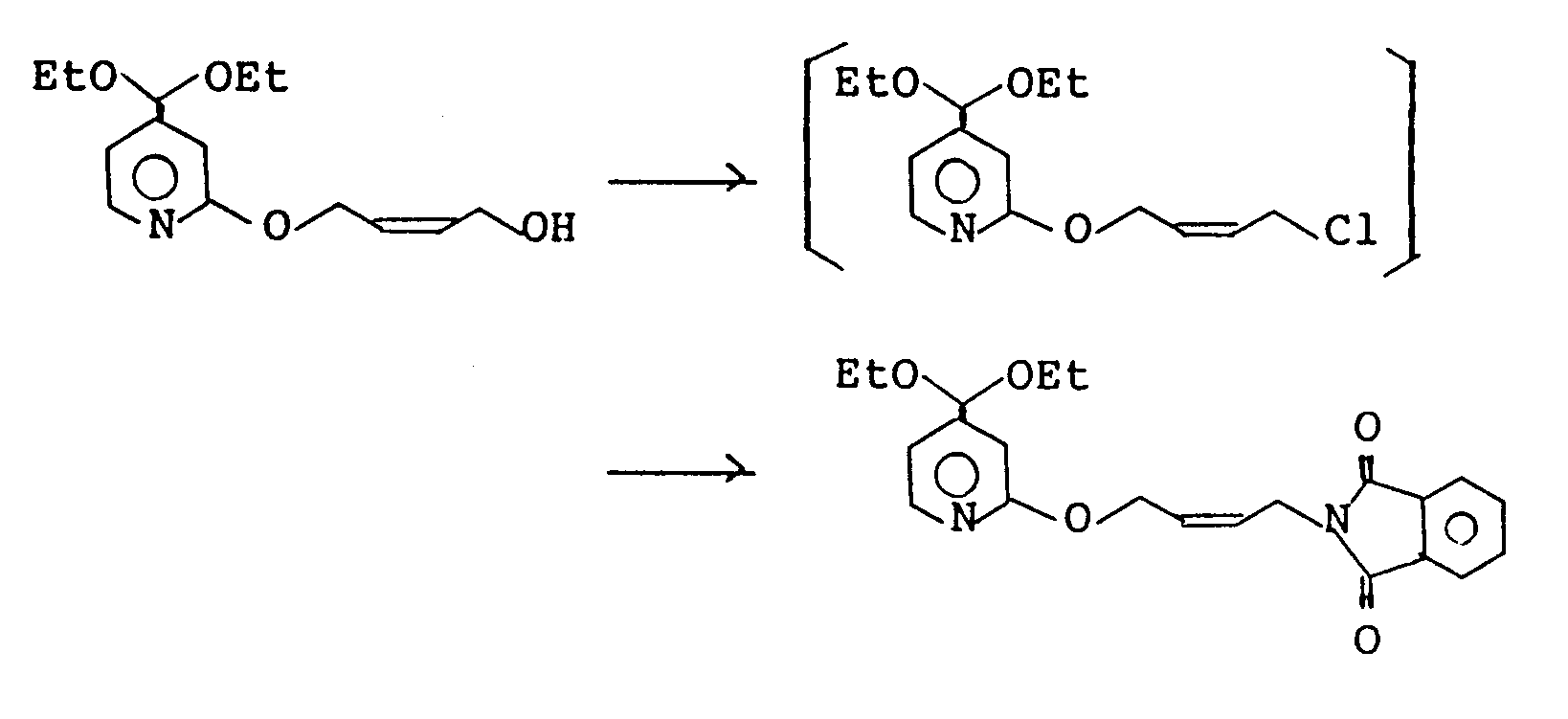
- 29 g of 4-[4-(diethoxymethyl)pyridyl-2-oxy]-cis-2-buten-1-ol was dissolved in 500 ml of methylene chloride, and 12.2 g of anhydrous potassium carbonate was suspended in the solution. Under ice cooling, a solution of 13.2 g of thionyl chloride in 100 ml of methylene chloride was added dropwise. The mixture was stirred for 1 hour, and the solid was separated by filtration. The filtrate was concentrated and the residue was dissolved in 800 ml of toluene. 26.5 g of potassium phthalimide, 0.9 g of anhydrous potassium carbonate and 3.1 g of tetra-n-butylammonium hydrogensulfate were suspended.
- With vigorous stirring, the mixture was refluxed for 20 hours. After cooling, the insoluble matter was separated by filtration and washed well with ethyl acetate. The filtrate and the washing were combined and washed with water. The aqueous layer was extracted with ethyl acetate. The organic layers were combined, washed with a cold 1N-solution of sodium hydroxide three times and then with a saturated aqueous solution of sodium chloride once, and dried. The solvent was evaporated to give 41.05 g of N-{4-[4-(diethoxymethyl)pyridyl-2-oxy]-cis-2-butene}phthalimide.
Yield: quantitative
¹H-NMR (δ, CDCl₃): 1.24 (6H, t, J=7.2Hz), 3.50-3.70 (4H, m), 4.57 (2H, d, J=6.2Hz), 5.12 (2H, d, J=6.5Hz), 5.44 (1H, s), 5.60-5.70 (1H, m), 5.90-6.00 (1H, m), 6.89 (1H, s), 6.98 (1H, d, J=5.2Hz), 7.70-7.80 (2H, m), 7.80-7.90 (2H, m), 8.15 (d, J=5.2Hz).
IR (cm⁻¹): 1770, 1716, 1614Mass: as C₂₂H₂₄N₂O₅: Calculated: 396.1688 Found: 396.1694 -

- 41.06 g of N-4-[4-(diethoxymethyl)pyridyl-2-oxy]-cis-2-butene}phthalimide was dissolved in 500 ml of methanol, and 13.93 g of hydrazine monohydrate was added. The mixture was refluxed for 2 hours. The reaction mixture was concentrated, and the residue was diluted with methylene chloride. The insoluble matter was separated by filtration, and the solid was washed with methylene chloride. The filtrate and the washing were combined and concentrated. Methylene chloride was added to the concentrate, and the mixture was repeatedly filtered, and washed until no solid precipitated. The concentrate was dissolved in ethyl acetate and washed twice with water. The organic layer was extracted with cold 10% acetic acid. The extract (acetic acid solution) was made basic by adding solid anhydrous potassium carbonate under ice cooling, and the solution was extracted twice with ethyl acetate, washed with a saturated aqueous solution of sodium chloride, and dried. The solvent was evaporated to give 12.4 g (yield 50.2 %) of 4-[4-(diethoxymethyl)pyridyl-2-oxy]-cis-2-buten-1-amine.
¹H-NMR (δ, CDCl₃): 1.23 (6H, t, J=9Hz), 1.55 (2H, brs), 3.45 (2H, d, J=4.8Hz), 3.55 (4H, m), 4.89 (2H, d, J=5.4Hz), 5.43 (1H, s), 5.75 (2H, m), 6.87 (1H, s), 6.97 (1H, d, J=4.5Hz), 8.13 (1H, d, J=4.5Hz).
IR (cm⁻¹ film): 3400, 3200, 3000, 2950, 1680, 1620, 1570, 1410, 1060Mass: as C₁₄H₂₂N₂O₃: Found: 266.1642 Calculated: 266.1641 -

- 12.4 g of 4-[4-(diethoxymethyl)pyridyl-2-oxy]-cis-2-buten-1-amine was dissolved in 300 ml of tetrahydrofuran, and 17.3 g of 2-(furfurylsulfinyl)acetic acid p-nitrophenyl ester was added. The mixture was stirred for 5 hours at room temperature and then concentrated.
- The residue was dissolved in ethyl acetate and washed with a 10% aqueous solution of potassium carbonate twice and then water once. The aqueous layer was extracted with ethyl acetate, and the organic layers were combined, washed with a saturated aqueous solution of sodium chloride, and dried. The solvent was evaporated to give 19.83 g (yield 97 %) of N-{4-[4-(diethoxymethyl)pyridyl-2-oxy]-cis-2-butenyl}-2-(furfurylsulfinyl)acetamide.
¹H-NMR (δ, CDCl₃): 1.23 (6H, t, J=9Hz), 3.33 (1H, d, J=14.4Hz), 3.58 (5H, m), 4.11 (2H, t, J=6.6Hz), 4.18 (1H, d, J=18.5Hz), 4.27 (1H, d, J=18.5Hz), 4.94 (2H, d, J=5.7Hz), 5.43 (1H, s), 5.67 (1H, m), 5.86 (1H, m), 6.40 (1H, m), 6.47 (1H, d, J=3.3Hz), 6.87 (1H, s), 6.98 (1H, d, J=5.4Hz), 7.11 (1H, brs), 7.43 (1H, d, J=1.8Hz), 8.12 (1H, d, J=5.1Hz).
IR (cm⁻¹): 3400, 2950, 1680, 1620, 1570, 1400.Mass: as C₂₁H₂₈N₂O₆S: Found: 436.1676 Calculated: 436.1668 -

- 19.83 g of N-{4-[4-(diethoxymethyl)pyridyl-2-oxy]-cis-2-butenyl}-2-(furfurylsulfinyl)acetamide was dissolved in 600 ml of a 4:1 mixture of acetone-water, and 1.72 g of p- toluenesulfonic acid monohydrate was added. The mixture was refluxed for 3 hours. After cooling, the solution was concentrated. The residue was taken into ethyl acetate, and added to a cold saturated aqueous solution of sodium hydrogen carbonate. The precipitated insoluble matter was removed by filtration, and the organic layer was separated. The aqueous layer was extracted with ethyl acetate. The organic layers were combined, washed with a saturated aqueous solution of sodium chloride and dried. The solvent was evaporated to give 16.64 g of N-[4-(4-formyl-2-pyridyl-oxy]-cis-2-butenyl}-2-(furfurylsulfinyl)acetamide.
Yield: quantitative
Melting point: 67.6 - 69.9 °C
¹H-NMR (δ, CDCl₃): 10.00 (1H, s), 8.36 (1H, d, J=4.6Hz), 7.45 (1H, d, J=3Hz), 7.30 (1H, d, J=4.6Hz), 7.16 (1H, s), 7.08 (1H, brs), 6.47 (1H, d, J=3.5Hz), 6.40 (1H, dd, J=3.5, 3.0Hz), 5.82-5.92 (1H, m), 5.66-5.76 (1H, m), 5.00 (2H, d, J=6.4Hz), 4.27 (1H, d, J=14.3Hz), 4.18 (1H, d, J=14.3Hz), 4.12 (2H, t, J=6.3Hz), 3.59 (1H, d, J=14.1Hz), 3.34 (1H, d, J=14.1Hz).
IR (cm⁻¹, KBr): 3236, 1712, 1624, 1564, 1036Mass: as C₁₇H₁₈N₂O₅S: Found: 362.0934 Calculated: 362.0937 - The following are specific formulation examples of medicaments using the compounds of the present invention.
- Recipe I-a (for preparation of tablets each containing 30 mg of the compound prepared in Example 2 as the active ingredient)


Recipe I-b (for preparation of tablets each containing 60 mg of the compound prepared in Example 2 as the active ingredient)
- N-{4-[4-(piperidinomethyl)pyridyl-2-oxy]-cis-2-butenyl}-2-(furfurylsulfinyl)acetamide, lactose, corn starch and carboxymethyl cellulose calcium were mixed. A solution of methyl cellulose (25 cps) in deionized water was added. They were kneaded, then granulated, and sized. The granules were mixed further with magnesium stearate. The mixture was tableted to give tablets each containing 30 or 60 mg of the above active compound.
- Recipe II (for preparation of capsules each containing 30 mg of the compound obtained in Example 2 as the active ingredient per capsule)

N-{4-[4-(piperidinomethyl)pyridyl-2-oxy]-cis-2-butenyl}-2-(furfurylsulfinyl)acetamide was thoroughly pulverized, and well mixed with lactose, corn starch and magnesium stearate. The mixture was filled into No. 5 capsules.
Claims (13)
- A compound represented by the following formula or a salt thereof

- The compound of claim 1 wherein each of R₁ and R₂ represents a C₁-C₆ alkyl group, or R₁ and R₂, together with the nitrogen atom to which they are bonded, forms a saturated or partially unsaturated 5- to 7-membered heterocyclic group which may be substituted by a C₁-C₆ alkyl group.
- The compound of claim 1 wherein each of R₁ and R₂ is a methyl group, or R₁ and R₂, taken together with the nitrogen atom to which they are bonded, form a pyrrolidino, piperidino, 3-methylpiperidino, 1,2,3,6-tetrahydro-1-pyridyl or 1-perhydroazepinyl group.
- The compound of claim 1 wherein the moiety

- The compound of claim 1 wherein n is 1 and the furan ring is bonded at the 2-position to the methylene group.
- The compound of claim 1 wherein n is 2 and the furane ring is bonded at the 3-position to the methylene group.
- The compound of claim 1 which is
N-{4-[4-(piperidinomethyl)pyridyl-2-oxy]-cis-2-butenyl}-2-(furfurylthio)acetamide,
N-{4-[4-(piperidinomethyl)pyridyl-2-oxy]-cis-2-butenyl}-2-(furfurylsulfinyl) acetamide,
N-{4-[4-(piperidinomethyl)pyridyl-2-oxy]-cis-2-butenyl}-2-(3-furylmethylsulfonyl) acetamide,
N-{4-[4-(dimethylaminomethyl)pyridyl-2-oxy]-cis-2-butenyl}-2-(furfurylsulfinyl)acetamide,
N-{4-[4-(3-methylpiperidinomethyl)pyridyl-2-oxy]-cis-2-butenyl}-2-(furfurylsulfinyl)acetamide,
N-{4-[4-(pyrrolidinomethyl)pyridyl-2-oxy]-cis-2-butenyl}-2-(furfurylsulfinyl)acetamide,
N-{4-(4-(morpholinomethyl)pyridyl-2-oxy]-cis-2-butenyl}-2-(furfurylsulfinyl)acetamide,
N-{4-[4-(1,2,3,6-tetrahydro-1-pyridylmethyl)pyridyl-2-oxy]-cis-2-butenyl}-2-(furfurylsulfinyl)acetamide, or
N-{4-[4-(piperidinomethyl)pyridyl-2-oxy]butyl}-2-(furfurylsulfinyl)acetamide. - The compound of claim 1 which is
N-{4-[4-(piperidinomethyl)pyridyl-2-oxy]-cis-2-butenyl}-2-(furfurylsulfinyl)acetamide,
N-{4-[4-(piperidinomethyl)pyridyl-2-oxy]-cis-2-butenyl}-2-(3-furylmethylsulfonyl)acetamide, and
N-{4-[4-(piperidinomethyl)pyridyl-2-oxy]butyl}-2-(furfurylsulfinyl)acetamide. - A pharmaceutical composition comprising the compound of formula (I) or its pharmaceutically acceptable salt as set forth in claim 1 and a carrier or diluent.
- A drug comprising the compound of formula (I) or its pharmaceutically acceptable salt as set forth in claim 1.
- An anti-peptic ulcer agent comprising the compound of formula (I) or its pharmaceutically acceptable salt as set forth in claim 1 as an active ingredient.
- The compound of formula (I) or its pharmaceutically acceptable salt according to claim 1 for use in treating a disease, particularly gastric ulcer or duodenal ulcer.
- A compound represented by the following formula

Applications Claiming Priority (6)
| Application Number | Priority Date | Filing Date | Title |
|---|---|---|---|
| JP56434/87 | 1987-03-13 | ||
| JP5643487A JPS63225371A (en) | 1987-03-13 | 1987-03-13 | Pyridyloxy derivative |
| JP288331/87 | 1987-11-17 | ||
| JP28833187 | 1987-11-17 | ||
| JP288332/87 | 1987-11-17 | ||
| JP28833287 | 1987-11-17 |
Publications (3)
| Publication Number | Publication Date |
|---|---|
| EP0282077A2 EP0282077A2 (en) | 1988-09-14 |
| EP0282077A3 EP0282077A3 (en) | 1989-11-29 |
| EP0282077B1 true EP0282077B1 (en) | 1993-11-10 |
Family
ID=27295920
Family Applications (1)
| Application Number | Title | Priority Date | Filing Date |
|---|---|---|---|
| EP88103890A Expired - Lifetime EP0282077B1 (en) | 1987-03-13 | 1988-03-11 | Pyridyloxy derivatives |
Country Status (3)
| Country | Link |
|---|---|
| US (2) | US4912101A (en) |
| EP (1) | EP0282077B1 (en) |
| DE (1) | DE3885482T2 (en) |
Families Citing this family (9)
| Publication number | Priority date | Publication date | Assignee | Title |
|---|---|---|---|---|
| EP0569587A1 (en) * | 1991-01-30 | 1993-11-18 | Central Glass Company, Limited | Phthalimide compound and production thereof |
| JPH06247933A (en) * | 1992-03-23 | 1994-09-06 | Sankyo Co Ltd | Pyridyloxy derivative |
| ATE164574T1 (en) * | 1992-08-07 | 1998-04-15 | Fujirebio Kk | METHOD FOR PRODUCING AMINOBUTENE DERIVATIVES |
| FI952450A7 (en) * | 1992-11-20 | 1995-07-19 | Kaken Pharma Co Ltd | Acetamide derivative |
| CN102212031B (en) * | 2010-12-31 | 2014-04-09 | 华润双鹤药业股份有限公司 | Preparation method of 2-substituted-4-(piperidylmethyl) pyridine |
| CN102276588B (en) * | 2011-05-05 | 2014-05-21 | 四川科伦药物研究有限公司 | Preparation method of lafutidine |
| CN102702181A (en) * | 2012-06-29 | 2012-10-03 | 海南美兰史克制药有限公司 | Lafutidine compound and novel preparation method of lafutidine compound |
| CN110642832B (en) * | 2018-12-19 | 2022-09-30 | 安徽贝克生物制药有限公司 | Preparation method and application of lafutidine and intermediate thereof |
| EP4196793A1 (en) | 2020-08-11 | 2023-06-21 | Université de Strasbourg | H2 blockers targeting liver macrophages for the prevention and treatment of liver disease and cancer |
Family Cites Families (5)
| Publication number | Priority date | Publication date | Assignee | Title |
|---|---|---|---|---|
| IN151188B (en) * | 1978-02-13 | 1983-03-05 | Smith Kline French Lab | |
| AU547405B2 (en) * | 1981-07-08 | 1985-10-17 | Sanofi | Amidobenzamides |
| GB8328907D0 (en) * | 1983-10-28 | 1983-11-30 | Smith Kline French Lab | Chemical compounds |
| CA1275097A (en) * | 1984-10-02 | 1990-10-09 | Fujio Nohara | Pyridyloxy derivatives |
| ES2032394T3 (en) * | 1986-02-20 | 1993-02-16 | Hoechst Aktiengesellschaft | PROCEDURE FOR PREPARING SUBSTITUTED TENOIMIDAZOLE DERIVATIVES. |
-
1988
- 1988-03-09 US US07/166,022 patent/US4912101A/en not_active Expired - Lifetime
- 1988-03-11 DE DE88103890T patent/DE3885482T2/en not_active Expired - Lifetime
- 1988-03-11 EP EP88103890A patent/EP0282077B1/en not_active Expired - Lifetime
-
1989
- 1989-01-26 US US07/301,856 patent/US4977267A/en not_active Expired - Fee Related
Also Published As
| Publication number | Publication date |
|---|---|
| DE3885482D1 (en) | 1993-12-16 |
| EP0282077A2 (en) | 1988-09-14 |
| US4977267A (en) | 1990-12-11 |
| DE3885482T2 (en) | 1994-04-21 |
| EP0282077A3 (en) | 1989-11-29 |
| US4912101A (en) | 1990-03-27 |
Similar Documents
| Publication | Publication Date | Title |
|---|---|---|
| US8247434B2 (en) | Fexofenadine polymorphs and processes of preparing the same | |
| JP3004678B2 (en) | Substituted (quinolin-2-yl-methoxy) phenyl-acyl-sulfonamides and -cyanamides | |
| EP0516069A1 (en) | Leukotriene B4 antagonist | |
| JPH0557983B2 (en) | ||
| US4912101A (en) | 4-aminomethyl-pyridyl-2-oxy derivatives having anti-ulcer activity | |
| KR870001918B1 (en) | Process for preparing pyridyl compound | |
| US5126354A (en) | Leukotriene synthesis-inhibiting disubstituted (quinolin-2-yl-methoxy) phenylacetic acid derivatives | |
| IE54896B1 (en) | Pyrrolacetic amides having antiinflammatory activity | |
| US5192771A (en) | (quinolin-2-yl-methoxy)phenylacetic acid derivatives containing cyclic substituents | |
| US5179106A (en) | Substituted n-(quinolin-2-yl-methoxy) benzyl-sulphonylurea leukotriene synthesis inhibitors | |
| JPH09505303A (en) | HIV Protease Inhibitor Prodrugs | |
| US4542127A (en) | Antidiabetic salicylic acid derivatives | |
| Sakamoto et al. | Studies on prodrugs. IV. Preparation and characterization of N-(5-substituted 2-oxo-1, 3-dioxol-4-yl) methyl norfloxacin | |
| JPS62252780A (en) | Novel indenothiazole derivative and production thereof | |
| EP0334119B1 (en) | Compounds for inhibiting the biosynthesis of lipoxygenase-derived metabolites of arachidonic acid | |
| WO1992021647A1 (en) | Carbocyclic and heterocyclic hiv protease inhibitors | |
| JP4113602B2 (en) | Pyrrolidine derivatives and anti-ulcer agents, antibacterial agents | |
| CZ390392A3 (en) | Benzofuranyl- and thiophenylmethylthio alkanecarboxylic acid derivatives, process of their preparation and use | |
| JPH06329644A (en) | Substituted piperazine | |
| JP3310687B2 (en) | Quinone derivatives | |
| US5185362A (en) | Diphenylamine cardiovascular agents, compositions and use | |
| US6191150B1 (en) | Formamide compounds as therapeutic agents | |
| JP2765001B2 (en) | Protease inhibitor | |
| CZ109593A3 (en) | Substituted derivatives of (benzothiazolyl- and quinoxalyl-methoxy) phenylacetic acid | |
| US4873232A (en) | Novel use for carbamoyl benzoates |
Legal Events
| Date | Code | Title | Description |
|---|---|---|---|
| PUAI | Public reference made under article 153(3) epc to a published international application that has entered the european phase |
Free format text: ORIGINAL CODE: 0009012 |
|
| AK | Designated contracting states |
Kind code of ref document: A2 Designated state(s): CH DE FR GB IT LI NL |
|
| PUAL | Search report despatched |
Free format text: ORIGINAL CODE: 0009013 |
|
| AK | Designated contracting states |
Kind code of ref document: A3 Designated state(s): CH DE FR GB IT LI NL |
|
| 17P | Request for examination filed |
Effective date: 19891201 |
|
| 17Q | First examination report despatched |
Effective date: 19920225 |
|
| GRAA | (expected) grant |
Free format text: ORIGINAL CODE: 0009210 |
|
| AK | Designated contracting states |
Kind code of ref document: B1 Designated state(s): CH DE FR GB IT LI NL |
|
| ITF | It: translation for a ep patent filed | ||
| REF | Corresponds to: |
Ref document number: 3885482 Country of ref document: DE Date of ref document: 19931216 |
|
| ET | Fr: translation filed | ||
| PLBE | No opposition filed within time limit |
Free format text: ORIGINAL CODE: 0009261 |
|
| STAA | Information on the status of an ep patent application or granted ep patent |
Free format text: STATUS: NO OPPOSITION FILED WITHIN TIME LIMIT |
|
| 26N | No opposition filed | ||
| REG | Reference to a national code |
Ref country code: CH Ref legal event code: PUE Owner name: FUJIREBIO KABUSHIKI KAISHA TRANSFER- UCB JAPAN CO. Ref country code: CH Ref legal event code: NV Representative=s name: RIEDERER HASLER & PARTNER PATENTANWAELTE AG |
|
| REG | Reference to a national code |
Ref country code: GB Ref legal event code: 732E |
|
| NLS | Nl: assignments of ep-patents |
Owner name: UCB JAPAN CO., LTD |
|
| REG | Reference to a national code |
Ref country code: FR Ref legal event code: TP |
|
| REG | Reference to a national code |
Ref country code: GB Ref legal event code: IF02 |
|
| PGFP | Annual fee paid to national office [announced via postgrant information from national office to epo] |
Ref country code: GB Payment date: 20070307 Year of fee payment: 20 |
|
| PGFP | Annual fee paid to national office [announced via postgrant information from national office to epo] |
Ref country code: DE Payment date: 20070308 Year of fee payment: 20 |
|
| PGFP | Annual fee paid to national office [announced via postgrant information from national office to epo] |
Ref country code: CH Payment date: 20070314 Year of fee payment: 20 |
|
| PGFP | Annual fee paid to national office [announced via postgrant information from national office to epo] |
Ref country code: NL Payment date: 20070315 Year of fee payment: 20 |
|
| PGFP | Annual fee paid to national office [announced via postgrant information from national office to epo] |
Ref country code: IT Payment date: 20070622 Year of fee payment: 20 |
|
| REG | Reference to a national code |
Ref country code: GB Ref legal event code: PE20 Expiry date: 20080310 |
|
| REG | Reference to a national code |
Ref country code: CH Ref legal event code: PL |
|
| PG25 | Lapsed in a contracting state [announced via postgrant information from national office to epo] |
Ref country code: NL Free format text: LAPSE BECAUSE OF EXPIRATION OF PROTECTION Effective date: 20080311 |
|
| PGFP | Annual fee paid to national office [announced via postgrant information from national office to epo] |
Ref country code: FR Payment date: 20070308 Year of fee payment: 20 |
|
| NLV7 | Nl: ceased due to reaching the maximum lifetime of a patent |
Effective date: 20080311 |
|
| PG25 | Lapsed in a contracting state [announced via postgrant information from national office to epo] |
Ref country code: GB Free format text: LAPSE BECAUSE OF EXPIRATION OF PROTECTION Effective date: 20080310 |