EP0280985B1 - Opaque dental ceramic material - Google Patents
Opaque dental ceramic material Download PDFInfo
- Publication number
- EP0280985B1 EP0280985B1 EP88102570A EP88102570A EP0280985B1 EP 0280985 B1 EP0280985 B1 EP 0280985B1 EP 88102570 A EP88102570 A EP 88102570A EP 88102570 A EP88102570 A EP 88102570A EP 0280985 B1 EP0280985 B1 EP 0280985B1
- Authority
- EP
- European Patent Office
- Prior art keywords
- paste
- ceramic
- opaque
- powder
- layer
- Prior art date
- Legal status (The legal status is an assumption and is not a legal conclusion. Google has not performed a legal analysis and makes no representation as to the accuracy of the status listed.)
- Expired - Lifetime
Links
- 229910010293 ceramic material Inorganic materials 0.000 title claims description 4
- 239000011351 dental ceramic Substances 0.000 title claims description 4
- 239000000919 ceramic Substances 0.000 claims abstract description 69
- 239000000843 powder Substances 0.000 claims abstract description 47
- 238000000034 method Methods 0.000 claims abstract description 33
- 239000002184 metal Substances 0.000 claims abstract description 16
- 238000010410 dusting Methods 0.000 claims abstract description 8
- 239000011248 coating agent Substances 0.000 claims abstract description 5
- 238000000576 coating method Methods 0.000 claims abstract description 5
- 238000010304 firing Methods 0.000 claims description 21
- PEDCQBHIVMGVHV-UHFFFAOYSA-N Glycerine Chemical compound OCC(O)CO PEDCQBHIVMGVHV-UHFFFAOYSA-N 0.000 claims description 18
- 239000007788 liquid Substances 0.000 claims description 15
- 239000000203 mixture Substances 0.000 claims description 15
- GWEVSGVZZGPLCZ-UHFFFAOYSA-N Titan oxide Chemical compound O=[Ti]=O GWEVSGVZZGPLCZ-UHFFFAOYSA-N 0.000 claims description 12
- IAZDPXIOMUYVGZ-UHFFFAOYSA-N Dimethylsulphoxide Chemical compound CS(C)=O IAZDPXIOMUYVGZ-UHFFFAOYSA-N 0.000 claims description 8
- 238000002156 mixing Methods 0.000 claims description 8
- LYCAIKOWRPUZTN-UHFFFAOYSA-N Ethylene glycol Chemical compound OCCO LYCAIKOWRPUZTN-UHFFFAOYSA-N 0.000 claims description 6
- XOLBLPGZBRYERU-UHFFFAOYSA-N tin dioxide Chemical compound O=[Sn]=O XOLBLPGZBRYERU-UHFFFAOYSA-N 0.000 claims description 6
- MCMNRKCIXSYSNV-UHFFFAOYSA-N Zirconium dioxide Chemical compound O=[Zr]=O MCMNRKCIXSYSNV-UHFFFAOYSA-N 0.000 claims description 4
- 238000009835 boiling Methods 0.000 claims description 4
- 239000002245 particle Substances 0.000 claims description 4
- 238000002360 preparation method Methods 0.000 claims description 4
- CETPSERCERDGAM-UHFFFAOYSA-N ceric oxide Chemical compound O=[Ce]=O CETPSERCERDGAM-UHFFFAOYSA-N 0.000 claims description 3
- 229910000422 cerium(IV) oxide Inorganic materials 0.000 claims description 3
- WGCNASOHLSPBMP-UHFFFAOYSA-N hydroxyacetaldehyde Natural products OCC=O WGCNASOHLSPBMP-UHFFFAOYSA-N 0.000 claims description 3
- 229910052845 zircon Inorganic materials 0.000 claims description 2
- 230000010485 coping Effects 0.000 abstract description 5
- 239000004615 ingredient Substances 0.000 abstract description 2
- 229910052573 porcelain Inorganic materials 0.000 description 9
- 239000000463 material Substances 0.000 description 6
- 235000011187 glycerol Nutrition 0.000 description 5
- 239000000049 pigment Substances 0.000 description 5
- 210000003298 dental enamel Anatomy 0.000 description 4
- 239000005337 ground glass Substances 0.000 description 4
- 239000003605 opacifier Substances 0.000 description 4
- 239000000758 substrate Substances 0.000 description 4
- VYPSYNLAJGMNEJ-UHFFFAOYSA-N Silicium dioxide Chemical compound O=[Si]=O VYPSYNLAJGMNEJ-UHFFFAOYSA-N 0.000 description 3
- 238000000926 separation method Methods 0.000 description 3
- XLYOFNOQVPJJNP-UHFFFAOYSA-N water Substances O XLYOFNOQVPJJNP-UHFFFAOYSA-N 0.000 description 3
- 239000000001 dental powder Substances 0.000 description 2
- 210000004268 dentin Anatomy 0.000 description 2
- 230000000694 effects Effects 0.000 description 2
- 230000004907 flux Effects 0.000 description 2
- 229920000642 polymer Polymers 0.000 description 2
- 150000003839 salts Chemical class 0.000 description 2
- 239000002002 slurry Substances 0.000 description 2
- 230000000087 stabilizing effect Effects 0.000 description 2
- 239000004925 Acrylic resin Substances 0.000 description 1
- 229920000178 Acrylic resin Polymers 0.000 description 1
- 229910002012 Aerosil® Inorganic materials 0.000 description 1
- OKTJSMMVPCPJKN-UHFFFAOYSA-N Carbon Chemical compound [C] OKTJSMMVPCPJKN-UHFFFAOYSA-N 0.000 description 1
- JOYRKODLDBILNP-UHFFFAOYSA-N Ethyl urethane Chemical compound CCOC(N)=O JOYRKODLDBILNP-UHFFFAOYSA-N 0.000 description 1
- KKCBUQHMOMHUOY-UHFFFAOYSA-N Na2O Inorganic materials [O-2].[Na+].[Na+] KKCBUQHMOMHUOY-UHFFFAOYSA-N 0.000 description 1
- 239000000654 additive Substances 0.000 description 1
- 230000001464 adherent effect Effects 0.000 description 1
- 238000004026 adhesive bonding Methods 0.000 description 1
- 235000010443 alginic acid Nutrition 0.000 description 1
- 229920000615 alginic acid Polymers 0.000 description 1
- 229940037003 alum Drugs 0.000 description 1
- PNEYBMLMFCGWSK-UHFFFAOYSA-N aluminium oxide Inorganic materials [O-2].[O-2].[O-2].[Al+3].[Al+3] PNEYBMLMFCGWSK-UHFFFAOYSA-N 0.000 description 1
- 239000007767 bonding agent Substances 0.000 description 1
- 239000011449 brick Substances 0.000 description 1
- 239000003795 chemical substances by application Substances 0.000 description 1
- 229910052681 coesite Inorganic materials 0.000 description 1
- 238000001246 colloidal dispersion Methods 0.000 description 1
- 239000012141 concentrate Substances 0.000 description 1
- 229910052593 corundum Inorganic materials 0.000 description 1
- 229910052906 cristobalite Inorganic materials 0.000 description 1
- -1 derivatives thereof Chemical compound 0.000 description 1
- 230000003292 diminished effect Effects 0.000 description 1
- 239000007789 gas Substances 0.000 description 1
- 239000011521 glass Substances 0.000 description 1
- 150000002314 glycerols Chemical class 0.000 description 1
- 150000002334 glycols Chemical class 0.000 description 1
- 230000003760 hair shine Effects 0.000 description 1
- 231100001261 hazardous Toxicity 0.000 description 1
- 230000002209 hydrophobic effect Effects 0.000 description 1
- 229910052907 leucite Inorganic materials 0.000 description 1
- 230000000873 masking effect Effects 0.000 description 1
- 229910044991 metal oxide Inorganic materials 0.000 description 1
- 150000004706 metal oxides Chemical class 0.000 description 1
- 230000000704 physical effect Effects 0.000 description 1
- 230000000379 polymerizing effect Effects 0.000 description 1
- 238000003908 quality control method Methods 0.000 description 1
- 230000000717 retained effect Effects 0.000 description 1
- 238000007665 sagging Methods 0.000 description 1
- 229910000077 silane Inorganic materials 0.000 description 1
- 239000000377 silicon dioxide Substances 0.000 description 1
- 235000012239 silicon dioxide Nutrition 0.000 description 1
- 229910052682 stishovite Inorganic materials 0.000 description 1
- 239000000126 substance Substances 0.000 description 1
- 239000000725 suspension Substances 0.000 description 1
- 229910052905 tridymite Inorganic materials 0.000 description 1
- 239000002699 waste material Substances 0.000 description 1
- 229910001845 yogo sapphire Inorganic materials 0.000 description 1
Classifications
-
- A—HUMAN NECESSITIES
- A61—MEDICAL OR VETERINARY SCIENCE; HYGIENE
- A61C—DENTISTRY; APPARATUS OR METHODS FOR ORAL OR DENTAL HYGIENE
- A61C13/00—Dental prostheses; Making same
- A61C13/0003—Making bridge-work, inlays, implants or the like
-
- A—HUMAN NECESSITIES
- A61—MEDICAL OR VETERINARY SCIENCE; HYGIENE
- A61C—DENTISTRY; APPARATUS OR METHODS FOR ORAL OR DENTAL HYGIENE
- A61C5/00—Filling or capping teeth
- A61C5/70—Tooth crowns; Making thereof
- A61C5/77—Methods or devices for making crowns
-
- A—HUMAN NECESSITIES
- A61—MEDICAL OR VETERINARY SCIENCE; HYGIENE
- A61K—PREPARATIONS FOR MEDICAL, DENTAL OR TOILETRY PURPOSES
- A61K6/00—Preparations for dentistry
- A61K6/15—Compositions characterised by their physical properties
- A61K6/16—Refractive index
-
- A—HUMAN NECESSITIES
- A61—MEDICAL OR VETERINARY SCIENCE; HYGIENE
- A61K—PREPARATIONS FOR MEDICAL, DENTAL OR TOILETRY PURPOSES
- A61K6/00—Preparations for dentistry
- A61K6/15—Compositions characterised by their physical properties
- A61K6/17—Particle size
-
- A—HUMAN NECESSITIES
- A61—MEDICAL OR VETERINARY SCIENCE; HYGIENE
- A61K—PREPARATIONS FOR MEDICAL, DENTAL OR TOILETRY PURPOSES
- A61K6/00—Preparations for dentistry
- A61K6/20—Protective coatings for natural or artificial teeth, e.g. sealings, dye coatings or varnish
-
- A—HUMAN NECESSITIES
- A61—MEDICAL OR VETERINARY SCIENCE; HYGIENE
- A61K—PREPARATIONS FOR MEDICAL, DENTAL OR TOILETRY PURPOSES
- A61K6/00—Preparations for dentistry
- A61K6/70—Preparations for dentistry comprising inorganic additives
- A61K6/78—Pigments
-
- A—HUMAN NECESSITIES
- A61—MEDICAL OR VETERINARY SCIENCE; HYGIENE
- A61K—PREPARATIONS FOR MEDICAL, DENTAL OR TOILETRY PURPOSES
- A61K6/00—Preparations for dentistry
- A61K6/80—Preparations for artificial teeth, for filling teeth or for capping teeth
- A61K6/802—Preparations for artificial teeth, for filling teeth or for capping teeth comprising ceramics
- A61K6/816—Preparations for artificial teeth, for filling teeth or for capping teeth comprising ceramics comprising titanium oxide
-
- A—HUMAN NECESSITIES
- A61—MEDICAL OR VETERINARY SCIENCE; HYGIENE
- A61K—PREPARATIONS FOR MEDICAL, DENTAL OR TOILETRY PURPOSES
- A61K6/00—Preparations for dentistry
- A61K6/80—Preparations for artificial teeth, for filling teeth or for capping teeth
- A61K6/802—Preparations for artificial teeth, for filling teeth or for capping teeth comprising ceramics
- A61K6/818—Preparations for artificial teeth, for filling teeth or for capping teeth comprising ceramics comprising zirconium oxide
-
- A—HUMAN NECESSITIES
- A61—MEDICAL OR VETERINARY SCIENCE; HYGIENE
- A61K—PREPARATIONS FOR MEDICAL, DENTAL OR TOILETRY PURPOSES
- A61K6/00—Preparations for dentistry
- A61K6/80—Preparations for artificial teeth, for filling teeth or for capping teeth
- A61K6/802—Preparations for artificial teeth, for filling teeth or for capping teeth comprising ceramics
- A61K6/822—Preparations for artificial teeth, for filling teeth or for capping teeth comprising ceramics comprising rare earth metal oxides
-
- A—HUMAN NECESSITIES
- A61—MEDICAL OR VETERINARY SCIENCE; HYGIENE
- A61K—PREPARATIONS FOR MEDICAL, DENTAL OR TOILETRY PURPOSES
- A61K6/00—Preparations for dentistry
- A61K6/80—Preparations for artificial teeth, for filling teeth or for capping teeth
- A61K6/84—Preparations for artificial teeth, for filling teeth or for capping teeth comprising metals or alloys
Definitions
- a kit with an opaque dental ceramic (porcelain) paste for applying to dental substructures, to be used in the preparation of ceramic dental appliances, such as crowns and bridges, and a method of using the same are provided.
- the dental technician When crowns, bridges and other metal dental substructures (copings) are to be veneered, the dental technician must first apply and fire a layer of opaque ceramic paste. This layer ensures a good bond to the veneering ceramic and, in addition, masks the unfavorable metal color of the substructure which is necessary to obtain a good aesthetic appearance.
- an opaque slurry may optionally be fired on.
- a thin suspension of ceramic opaque is mixed, applied and fired (EP-A-0 152 337)
- Conventional opaque ceramic paste consists of a pulverized opaque ceramic powder which is mixed with water, or a special modeling liquid, by the dental technician.
- the opaque powder itself consists of ground glass frits, which, owing to their chemical compositions can be melted at temperatures below 1000°C and opacifying agents. During firing, leucite is partially crystallized out, thus the thermal expansion of the glass is adapted to the thermal expansion of the metal. A high portion of opacifiers ensures a good masking of the dark metal.
- the opaque materials are sold in several shades since they form the color basis for the desired tooth shade.
- the dental technician In preparing the opaque ceramic paste, the dental technician must adjust the consistency of the paste to obtain a paste which is sufficiently viscous so as to adhere to the metal substructure without sagging, but not so viscous that it cannot be easily applied. This procedure involves much trial and error and is very time consuming.
- the present invention provides a method for coating a metal substructure for a dental appliance in accordance with claim 1.
- the additional layer may optionally be applied using a paste made by mixing a ceramic powder with an organic liquid.
- a paste made by mixing a ceramic powder with an organic liquid.
- the ceramic paste will be pre-formed and will be loaded into a package in which it can be stored, and from which it can be easily dispensed.
- a kit in accordance with claim 9 which contains the preformed, ready to use opaque paste, the coarse ceramic powder, and optionally other ceramic materials that are needed to complete the building of a dental appliance.
- preformed paste Using the method, preformed paste, and the kit of the invention, it is possible for the dental technician to build a dental appliance such as a crown or a bridge using fewer steps, less time and less tedious methods.
- the preformed paste provided eliminates the need for time consuming trial and error mixing of a paste in the laboratory. The assured quality control of the paste that is used, and the method in which it is used lessens the possibility of applying an opaque layer that is too thin or too thick.
- U. S. Patent 4,064,311 to McLean et al, teaches a process for a ceramic article which comprises firing porcelain onto a metal substrate.
- the metal substrate has an adherent layer of metal oxide deposited thereon which is wetted by the porcelain in the fused state.
- U. S. Patent 4,557,691 to Martin et al, teaches an opaque porcelain paste comprising an opaque porcelain powder mixed with an aqueous colloidal dispersion of urethane polymer.
- the paste can be applied as the first layer to a dental coping, and does not need to be fired prior to the addition of the body porcelain layers.
- European Patent Application 0,119,062 teaches a storable paste-like material for use in preparing porcelain dental prostheses comprising a porcelain powder, water, and a small amount of finely divided ceramic material that overcomes the natural separation of the mixture of porcelain powder and water.
- the ceramic powders used in the present invention broadly constitute a known class of compositions.
- the powders used in making dental ceramic pastes have a grain size below about 60 ⁇ m.
- grain size is kept below about 50 ⁇ m and preferably below about 40 ⁇ m and in addition, powders of a grain size less than about 2 ⁇ m are mixed therewith. Powders having an average grain size in the range of from 40 to 100 ⁇ m are used in a dusting step.
- either the powder used to make the opaque ceramic paste is ground to a finer grain size than usual, or a portion of very fine powder having a grain size below about 2 ⁇ m is added to the opaque ceramic powder, such that between about 10% and 20% of the ceramic powder comprises a ceramic powder having a grain size below about 2 um.
- the fine powder added can be a very fine opaque frit or an opacifier such as CeO2, ZrSiO4, SnO2, ZrO2, or TiO2 or mixtures thereof. As these opacifiers are supplied by the manufacturers in very small grain size, they need not be ground again.
- the opaque powder is mixed with an organic liquid having a boiling point below 300°C to form a paste.
- the organic liquid used should not extend the firing times required and should not generate any hazardous gases during firing.
- Organic liquids that may be used in the method of the invention may be selected from the glycerols, glycols, derivatives thereof, or dimethylsulfoxide. Particularly preferred is glycerol.
- Additives that increase the viscosity of the paste such as alginates and stabilizing salts can be used. The consistency of the paste must be adjusted so that it can be applied to a metal substructure in an even layer with one stroke of the brush.
- the opaque ceramic paste be preformed and packaged in tubes or syringes so that required quantities can be easily extruded by the technician.
- Pre-forming the paste at the factory ensures that a paste having a specific viscosity and composition for the purpose it is to be used is consistantly produced, thus avoiding the time consuming preparation of the paste in the laboratory.
- the addition of or presence of the fine grain particles, i.e. below 2 ⁇ m in diameter, helps prevent separation of the organic liquid from the dental powder in the paste while it is being stored and improves the spreadability of the paste.
- the coated substructure is dusted with a layer of coarse ceramic powder, having an average grain size of between 40 ⁇ m and 100 ⁇ m.
- the coarse ceramic powder is taken up with a wide, dry brush. The brush is tapped above the object and the coarse grains of powder are thus released onto the freshly applied paste.
- Other means of providing a dusting will be apparent to those skilled in the art.
- the coarse ceramic powder used preferably is chosen such that it has thermal stability under the conditions required for firing the ceramic paste composition. That is, the coarse grains will have properties such that they will form a strong sintered bond with the ceramic paste when the substructure is fired, but the grains will not be significantly melted or distorted by the firing so that a coarse grainy surface similar to that of sandpaper will be obtained.
- ceramic powders may be chosen having a thermal stability such that a substantial portion of the grain structure is retained during firing, so that the sandpaper consistency of the surface, described above, is obtained.
- a second layer of ceramic paste is then applied to the substructure, filling the gaps between the protrusions of the coarse grains on the surface of the ceramic opaque, and fired.
- the second layer of ceramic prior to firing, may be stained, to imitate anomalies in teeth.
- natural teeth are not perfectly smooth and do not have perfect consistency of color. Accordingly, when artificial teeth are made having perfect consistency, they do not look natural.
- artificial teeth after they are fired, are often coated with a stain paste comprising a fine ground glass flux and pigments and fired again. During firing the stain paste fuses to the ceramic to provide a stained surface fused to the ceramic.
- a first firing is required before the application of stain paste, apparently because the unfired ceramic is not stable enough to accommodate the "wet" stain paste.
- the stain paste may be applied to the second layer of ceramic before firing, reducing further the number of steps required to produce a finished product.
- the stain paste can be prepared by mixing a dry preparation of stain powder (fine ground glass flux and pigments) with a modeling liquid.
- the modeling liquid may be an organic liquid having a boiling point less than 300°C such as glycerol, glycol, derivatives thereof, or dimethylsulfoxide.
- the stains can be blended with the unfired layer of ceramic before firing, if necessary.
- the pigments may be printed onto a substrate, parchment or flammable polymer for example, and placed on the ceramic before firing. During firing the substrate burns off or evaporates leaving the pigments fused to the ceramic.
- stains can be applied to the dental appliance without the need for an additional firing.
- the first paste layer used may be made especially opaque, in order to completely mask the metal which it covers, and formulated to form a good bond with the metal.
- the second layer may be shaded according to the desired tooth shade. Dentin and enamel layers may be added in due course.
- the coarse ceramic grains distributed on the first layer of ceramic opaque simplifies the addition of the second layer of ceramic paste since the technician need only concentrate on filling the gaps between the grains to achieve an even layer. Further, like bricks in a wall that overlap end to end, the grains serve as posts or anchors to improve the bonding of the next layer of ceramic.
- the use of additional opacifying oxides such as TiO2 or SnO2 in the composition is not desirable because of their high opacifying effect.
- a hydrophobic aerosil such as Degussa R 972
- the spreadability of this paste is not as good as that of the first layer because of the absence of the fine (less than 2 um) particles, but high spreadability of the second layer is not needed because application of the second layer is made easy because of the presence of the coarse grains fired on to the first layer of paste.
- the rough surface, resulting from the use of the coarse ceramic particles, can also be used in the case where a silane bonding agent is used for applying and polymerizing an acrylic resin veneer.
- the present method can also be used in the adhesive bonding technique. Both methods are well known in the art.
- the method of the present invention has the advantages that it saves the dental technician considerable time, because application of the different layers of paste is made easier. There is less waste of material because the technique is simplified and the time spent on trial and error mixing of the paste in the laboratory is substantially eliminated.
- the opaque layers may be made especially thin and even, thus leaving enough room for body and enamel layers so that a good aesthetic result can be obtained. Also, since the technique is made simple, and more even layers are obtained, the possibility of faults developing is reduced.
- composition that may be used for the first opaque layer, the following is provided:
- composition of the opaque for the first layer is composition of the opaque for the first layer:
- All oxides are ingredients of a ground glass frit. Only the TiO2 is admixed to insure the presence of a fine powder, which is needed to insure the good spreadability of the paste.
- composition of the opaque paste for the second layer will differ slightly from the above formula because part of the opacifiers will be replaced by pigments in order to produce the desired tooth shade.
- the opaque not including the TiO2, has the following grain size distribution: ⁇ 5 ⁇ 12 ⁇ 24 ⁇ 40 ⁇ m 21 66 98 100 %
- TiO2 has a grain size less than about 1 ⁇ m.
- the paste has the following composition: opaque powder 67.7 weight-% glycerol 32.0 " alum or other stabilizing salt 0.3 "
- the coarse ceramic powder distributed on the opaque paste after it is applied to the dental appliance substructure has the following composition: SiO2 56 weight-% Al2O3 13 " K2O 9 " Na2O 4 " CeO2 18 "
- the paste and dusting powder described in the Example will be fired at about 980°C.
- the materials used in the method of the invention may be provided in kit form.
- the preformed opaque paste may be packaged in a kit with a coarse ceramic powder that has the thermal stability required by the present method under the firing conditions required to fire the pre-formed paste. If more than one ceramic paste having different properties for different applications, and having different firing requirements, and more than one coarse ceramic powder are provided in the same kit, the packages containing them can be color coded so that the correct coarse ceramic powder is used with the correct ceramic paste. As will be apparent to those skilled in the art, many specific ceramic compositions may be matched with many specific dusting powders by comparing physical properties that are known in the art.
- the kit may be provided with additional ceramics for use in the body layers and the dentin and enamel layers and other conventional materials as required. To the degree possible, these materials may be provided in a preformed paste, or in conventional states. For example, as described above, a paste composition of the second opaque layer may be provided.
Landscapes
- Health & Medical Sciences (AREA)
- Oral & Maxillofacial Surgery (AREA)
- General Health & Medical Sciences (AREA)
- Epidemiology (AREA)
- Life Sciences & Earth Sciences (AREA)
- Animal Behavior & Ethology (AREA)
- Public Health (AREA)
- Veterinary Medicine (AREA)
- Chemical & Material Sciences (AREA)
- Ceramic Engineering (AREA)
- Plastic & Reconstructive Surgery (AREA)
- Engineering & Computer Science (AREA)
- Dentistry (AREA)
- Inorganic Chemistry (AREA)
- Dental Preparations (AREA)
Abstract
Description
- A kit with an opaque dental ceramic (porcelain) paste for applying to dental substructures, to be used in the preparation of ceramic dental appliances, such as crowns and bridges, and a method of using the same are provided.
- When crowns, bridges and other metal dental substructures (copings) are to be veneered, the dental technician must first apply and fire a layer of opaque ceramic paste. This layer ensures a good bond to the veneering ceramic and, in addition, masks the unfavorable metal color of the substructure which is necessary to obtain a good aesthetic appearance.
- Before the application of the opaque paste, an opaque slurry may optionally be fired on. For this purpose a thin suspension of ceramic opaque is mixed, applied and fired (EP-A-0 152 337)
- Conventional opaque ceramic paste consists of a pulverized opaque ceramic powder which is mixed with water, or a special modeling liquid, by the dental technician. The opaque powder itself consists of ground glass frits, which, owing to their chemical compositions can be melted at temperatures below 1000°C and opacifying agents. During firing, leucite is partially crystallized out, thus the thermal expansion of the glass is adapted to the thermal expansion of the metal. A high portion of opacifiers ensures a good masking of the dark metal. The opaque materials are sold in several shades since they form the color basis for the desired tooth shade.
- In preparing the opaque ceramic paste, the dental technician must adjust the consistency of the paste to obtain a paste which is sufficiently viscous so as to adhere to the metal substructure without sagging, but not so viscous that it cannot be easily applied. This procedure involves much trial and error and is very time consuming.
- Conventional opaque application requires much time and skill because a very even layer thickness has to be achieved. If the layer of ceramic opaque is too thin, the metal substructure shines through, when the opaque is too thick, there is not enough space left for the full application of the subsequent body and enamel layers, which results in a diminished aesthetic effect.
- Accordingly, there is a need in the art for an opaque paste, and a method, which makes it possible to avoid the time consuming procedure of mixing the paste in the laboratory, and makes it possible to apply opaque ceramic paste more easily and more consistently, using fewer steps, to dental substructures and whereby an even layer thickness is achieved.
- The present invention provides a method for coating a metal substructure for a dental appliance in accordance with claim 1.
- The additional layer may optionally be applied using a paste made by mixing a ceramic powder with an organic liquid. Preferably the ceramic paste will be pre-formed and will be loaded into a package in which it can be stored, and from which it can be easily dispensed.
- A kit in accordance with claim 9 is also provided which contains the preformed, ready to use opaque paste, the coarse ceramic powder, and optionally other ceramic materials that are needed to complete the building of a dental appliance.
- Using the method, preformed paste, and the kit of the invention, it is possible for the dental technician to build a dental appliance such as a crown or a bridge using fewer steps, less time and less tedious methods. The preformed paste provided eliminates the need for time consuming trial and error mixing of a paste in the laboratory. The assured quality control of the paste that is used, and the method in which it is used lessens the possibility of applying an opaque layer that is too thin or too thick.
- U. S. Patent 4,064,311, to McLean et al, teaches a process for a ceramic article which comprises firing porcelain onto a metal substrate. The metal substrate has an adherent layer of metal oxide deposited thereon which is wetted by the porcelain in the fused state.
- U. S. Patent 4,557,691, to Martin et al, teaches an opaque porcelain paste comprising an opaque porcelain powder mixed with an aqueous colloidal dispersion of urethane polymer. The paste can be applied as the first layer to a dental coping, and does not need to be fired prior to the addition of the body porcelain layers.
- European Patent Application 0,119,062 teaches a storable paste-like material for use in preparing porcelain dental prostheses comprising a porcelain powder, water, and a small amount of finely divided ceramic material that overcomes the natural separation of the mixture of porcelain powder and water.
- The ceramic powders used in the present invention broadly constitute a known class of compositions. Conventionally, the powders used in making dental ceramic pastes have a grain size below about 60 µm. In the ceramic powder used in the paste of the present invention, grain size is kept below about 50 µm and preferably below about 40 µm and in addition, powders of a grain size less than about 2 µm are mixed therewith. Powders having an average grain size in the range of from 40 to 100 µm are used in a dusting step.
- In the method of the invention, either the powder used to make the opaque ceramic paste is ground to a finer grain size than usual, or a portion of very fine powder having a grain size below about 2 µm is added to the opaque ceramic powder, such that between about 10% and 20% of the ceramic powder comprises a ceramic powder having a grain size below about 2 um. In the case where very fine powder is added to the opaque ceramic powder, the fine powder added can be a very fine opaque frit or an opacifier such as CeO₂, ZrSiO₄, SnO₂, ZrO₂, or TiO₂ or mixtures thereof. As these opacifiers are supplied by the manufacturers in very small grain size, they need not be ground again.
- In the method of the invention, the opaque powder is mixed with an organic liquid having a boiling point below 300°C to form a paste. The organic liquid used should not extend the firing times required and should not generate any hazardous gases during firing. Organic liquids that may be used in the method of the invention may be selected from the glycerols, glycols, derivatives thereof, or dimethylsulfoxide. Particularly preferred is glycerol. Additives that increase the viscosity of the paste, such as alginates and stabilizing salts can be used. The consistency of the paste must be adjusted so that it can be applied to a metal substructure in an even layer with one stroke of the brush.
- Using the paste of the invention as described eliminates the need for multiple application of the opaque slurry and firing steps as described in the prior art.
- For convenience, it is preferred that the opaque ceramic paste be preformed and packaged in tubes or syringes so that required quantities can be easily extruded by the technician. Pre-forming the paste at the factory ensures that a paste having a specific viscosity and composition for the purpose it is to be used is consistantly produced, thus avoiding the time consuming preparation of the paste in the laboratory. The addition of or presence of the fine grain particles, i.e. below 2 µm in diameter, helps prevent separation of the organic liquid from the dental powder in the paste while it is being stored and improves the spreadability of the paste.
- After a layer of paste has been applied, the coated substructure is dusted with a layer of coarse ceramic powder, having an average grain size of between 40 µm and 100 µm. In the dusting step, the coarse ceramic powder is taken up with a wide, dry brush. The brush is tapped above the object and the coarse grains of powder are thus released onto the freshly applied paste. Other means of providing a dusting will be apparent to those skilled in the art.
- The coarse ceramic powder used preferably is chosen such that it has thermal stability under the conditions required for firing the ceramic paste composition. That is, the coarse grains will have properties such that they will form a strong sintered bond with the ceramic paste when the substructure is fired, but the grains will not be significantly melted or distorted by the firing so that a coarse grainy surface similar to that of sandpaper will be obtained.
- Alternatively, when extra large grains of powder are used in the dusting step, ceramic powders may be chosen having a thermal stability such that a substantial portion of the grain structure is retained during firing, so that the sandpaper consistency of the surface, described above, is obtained.
- A second layer of ceramic paste is then applied to the substructure, filling the gaps between the protrusions of the coarse grains on the surface of the ceramic opaque, and fired.
- Also, the second layer of ceramic, prior to firing, may be stained, to imitate anomalies in teeth. As is known to those skilled in the art, natural teeth are not perfectly smooth and do not have perfect consistency of color. Accordingly, when artificial teeth are made having perfect consistency, they do not look natural. To avoid this problem, and to provide a natural appearance, artificial teeth, after they are fired, are often coated with a stain paste comprising a fine ground glass flux and pigments and fired again. During firing the stain paste fuses to the ceramic to provide a stained surface fused to the ceramic. In prior art methods of applying opaque, a first firing is required before the application of stain paste, apparently because the unfired ceramic is not stable enough to accommodate the "wet" stain paste. Using the ceramic paste and method of the invention, the stain paste may be applied to the second layer of ceramic before firing, reducing further the number of steps required to produce a finished product. As is known to those skilled in the art, the stain paste can be prepared by mixing a dry preparation of stain powder (fine ground glass flux and pigments) with a modeling liquid. According to the present invention, the modeling liquid may be an organic liquid having a boiling point less than 300°C such as glycerol, glycol, derivatives thereof, or dimethylsulfoxide. According to the present invention, the stains can be blended with the unfired layer of ceramic before firing, if necessary.
- Alternatively or additionally, the pigments may be printed onto a substrate, parchment or flammable polymer for example, and placed on the ceramic before firing. During firing the substrate burns off or evaporates leaving the pigments fused to the ceramic.
- Accordingly, stains can be applied to the dental appliance without the need for an additional firing.
- As is known to those skilled in the art, the first paste layer used may be made especially opaque, in order to completely mask the metal which it covers, and formulated to form a good bond with the metal. The second layer may be shaded according to the desired tooth shade. Dentin and enamel layers may be added in due course.
- The coarse ceramic grains distributed on the first layer of ceramic opaque simplifies the addition of the second layer of ceramic paste since the technician need only concentrate on filling the gaps between the grains to achieve an even layer. Further, like bricks in a wall that overlap end to end, the grains serve as posts or anchors to improve the bonding of the next layer of ceramic.
- In the second layer of opaque paste, which is applied to the spaces between the coarse grains, the use of additional opacifying oxides such as TiO₂ or SnO₂ in the composition is not desirable because of their high opacifying effect. To prevent separation of the dental powder from the modeling liquid in the paste used in the second layer, it is preferred that about 3% of a hydrophobic aerosil (such as Degussa R 972) be added to the organic liquid (preferably glycerol). The spreadability of this paste is not as good as that of the first layer because of the absence of the fine (less than 2 um) particles, but high spreadability of the second layer is not needed because application of the second layer is made easy because of the presence of the coarse grains fired on to the first layer of paste.
- The rough surface, resulting from the use of the coarse ceramic particles, can also be used in the case where a silane bonding agent is used for applying and polymerizing an acrylic resin veneer. The present method can also be used in the adhesive bonding technique. Both methods are well known in the art.
- The method of the present invention has the advantages that it saves the dental technician considerable time, because application of the different layers of paste is made easier. There is less waste of material because the technique is simplified and the time spent on trial and error mixing of the paste in the laboratory is substantially eliminated. The opaque layers may be made especially thin and even, thus leaving enough room for body and enamel layers so that a good aesthetic result can be obtained. Also, since the technique is made simple, and more even layers are obtained, the possibility of faults developing is reduced.
- As an example of the composition that may be used for the first opaque layer, the following is provided:
- Composition of the opaque for the first layer:
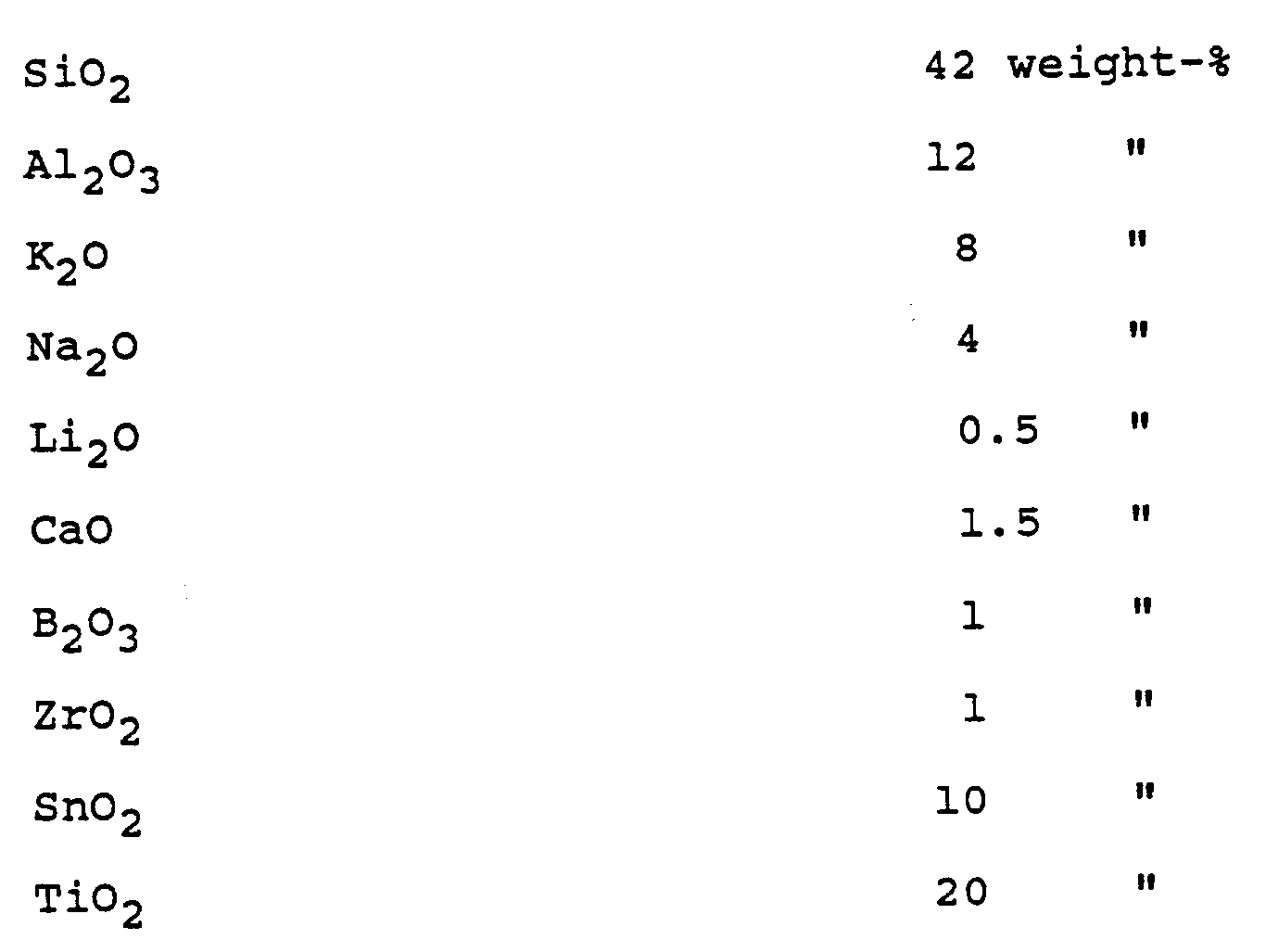
- All oxides are ingredients of a ground glass frit. Only the TiO₂ is admixed to insure the presence of a fine powder, which is needed to insure the good spreadability of the paste.
- The composition of the opaque paste for the second layer will differ slightly from the above formula because part of the opacifiers will be replaced by pigments in order to produce the desired tooth shade.
- The opaque, not including the TiO₂, has the following grain size distribution:
< 5 < 12 < 24 < 40 µm 21 66 98 100 % - On the average, TiO₂ has a grain size less than about 1 µm.
The paste has the following composition:opaque powder 67.7 weight-% glycerol 32.0 " alum or other stabilizing salt 0.3 "
The coarse ceramic powder distributed on the opaque paste after it is applied to the dental appliance substructure has the following composition:SiO₂ 56 weight-% Al₂O₃ 13 " K₂O 9 " Na₂O 4 " CeO₂ 18 "
The sieve fraction used: < 80 µm > 40 µm - The paste and dusting powder described in the Example will be fired at about 980°C.
- For convenience, the materials used in the method of the invention may be provided in kit form.
- The preformed opaque paste, with known firing properties, may be packaged in a kit with a coarse ceramic powder that has the thermal stability required by the present method under the firing conditions required to fire the pre-formed paste. If more than one ceramic paste having different properties for different applications, and having different firing requirements, and more than one coarse ceramic powder are provided in the same kit, the packages containing them can be color coded so that the correct coarse ceramic powder is used with the correct ceramic paste. As will be apparent to those skilled in the art, many specific ceramic compositions may be matched with many specific dusting powders by comparing physical properties that are known in the art.
- In addition to the opaque paste, the kit may be provided with additional ceramics for use in the body layers and the dentin and enamel layers and other conventional materials as required. To the degree possible, these materials may be provided in a preformed paste, or in conventional states. For example, as described above, a paste composition of the second opaque layer may be provided.
Claims (10)
- A method for coating a metal substructure for a dental appliance comprising the steps of: preparing a first opaque ceramic paste by mixing an opaque ceramic powder with an organic liquid having a boiling point below 300°C; coating said metal structure with said opaque ceramic paste; dusting onto the coating of said opaque ceramic paste a coarse ceramic powder having an average grain size of from 40 µm to 100 µm, said powder having thermal stability such that its grain structure is at least partially maintained under the conditions of firing said dental appliance; applying at least one additional layer of ceramic opaque paste; and firing said dental appliance.
- The method according to Claim 1 in which said organic liquid is selected from the group comprising glycerol, glycol, derivatives thereof or dimethylsulfoxide, and said ceramic paste contains a powder of SnO₂, CeO₂, TiO₂, ZrO₂, ZrSiO₄ or mixtures thereof.
- A method according to Claim 1 in which said ceramic powder used in said first opaque ceramic paste comprises grains having a particle diameter of less than 40 µm.
- The method according to Claim 3 in which 10 % to 20 % of said powder has a grain size of less than 2 µm.
- The method according to Claim 1 wherein the ceramic opaque paste used for at least one of said additional layers is prepared by mixing a dental ceramic powder with an organic liquid having a boiling point below 300°C.
- The method according to Claim 1 wherein a second layer of opaque paste is applied in such a manner that the gaps between projecting grains of coarse ceramic material are filled.
- The method according to Claim 6, which comprises the step of applying a stain paste to said second layer of opaque paste.
- The method according to Claim 7, which comprises the step of preparing said stain paste by mixing a dry preparation of stain powder with an organic liquid selected from the group comprising glycerol, glycol, derivatives thereof or dimethylsulfoxide.
- A kit for preparing a dental appliance comprising: at least one pre-formed ready to use opaque ceramic paste as defined in Claims 1 to 4,
a coarse ceramic powder having an average grain size of from 40 µm to 100 µm as defined in Claims 1 to 4. - The kit according to Claim 9, which has said pre-formed opaque paste packaged in a syringe for easy dispensing of said paste.
Priority Applications (1)
| Application Number | Priority Date | Filing Date | Title |
|---|---|---|---|
| AT88102570T ATE100309T1 (en) | 1987-02-24 | 1988-02-22 | OPAQUE DENTAL CERAMIC MATERIAL. |
Applications Claiming Priority (2)
| Application Number | Priority Date | Filing Date | Title |
|---|---|---|---|
| US18211 | 1987-02-24 | ||
| US07/018,211 US4806383A (en) | 1987-02-24 | 1987-02-24 | Method of applying opaque dental cermic material to a metal structure |
Publications (2)
| Publication Number | Publication Date |
|---|---|
| EP0280985A1 EP0280985A1 (en) | 1988-09-07 |
| EP0280985B1 true EP0280985B1 (en) | 1994-01-19 |
Family
ID=21786808
Family Applications (1)
| Application Number | Title | Priority Date | Filing Date |
|---|---|---|---|
| EP88102570A Expired - Lifetime EP0280985B1 (en) | 1987-02-24 | 1988-02-22 | Opaque dental ceramic material |
Country Status (6)
| Country | Link |
|---|---|
| US (1) | US4806383A (en) |
| EP (1) | EP0280985B1 (en) |
| AT (1) | ATE100309T1 (en) |
| CA (1) | CA1305589C (en) |
| DE (1) | DE3887178T2 (en) |
| ZA (1) | ZA88764B (en) |
Families Citing this family (18)
| Publication number | Priority date | Publication date | Assignee | Title |
|---|---|---|---|---|
| US5062798A (en) * | 1988-04-27 | 1991-11-05 | Ngk Spark Plug Co., Ltd. | SiC based artificial dental implant |
| DE4001057C2 (en) * | 1989-02-06 | 1996-07-11 | Wall Giselher | Process for separating layer formation in the infusion technique |
| DE4119483A1 (en) * | 1991-06-13 | 1992-12-24 | Ivoclar Ag | MIXTURE AND USE OF THE SAME |
| US5284442A (en) * | 1992-05-20 | 1994-02-08 | Peterson Ken N | Tooth caps and artificial teeth and the method of forming same |
| FR2702649B1 (en) * | 1993-03-16 | 1995-06-09 | Sofraced Sa | PROCESS AND KIT FOR MAKING A CERAMIC CUP TO PREPARE A DENTAL RECONSTRUCTION. |
| US5482732A (en) * | 1994-06-09 | 1996-01-09 | Dentsply Research & Development Corp. | Dental porcelain shading method |
| EP0747034B1 (en) * | 1995-06-08 | 2001-08-16 | Vita Zahnfabrik H. Rauter GmbH & Co. KG | Powder mixture for the preparation of a paste of opaque material |
| US5713994A (en) * | 1996-06-10 | 1998-02-03 | Ceramco Inc. | Low-fusing temperature porcelain, compositions, prostheses, methods and kits |
| US6048205A (en) * | 1998-03-12 | 2000-04-11 | Wright; Cynthia K. | Biocompatible dental restoration system using layers of high strength ceramic, gold, and porcelain |
| DE69917458T2 (en) * | 1998-07-10 | 2004-09-23 | New Age Biomaterials, Inc., Halifax | COMPOSITE COVERED GLASS-CERAMIC DENTAL CONSTRUCT |
| US6022819A (en) * | 1998-07-17 | 2000-02-08 | Jeneric/Pentron Incorporated | Dental porcelain compositions |
| US6206958B1 (en) | 1998-07-17 | 2001-03-27 | Jeneric/Pentron, Incorporated | Dental porcelain compositions |
| DE10107451B4 (en) * | 2001-02-14 | 2004-04-15 | 3M Espe Ag | Process for the production of dental prostheses, dental prosthetic item which can be produced by the process and pre-sintered blank |
| DE10339246B4 (en) * | 2003-08-26 | 2012-03-29 | Ivoclar Vivadent Ag | Method for producing a dental restoration part |
| US8362735B2 (en) | 2011-03-07 | 2013-01-29 | Protective Energy Economizer Technology | Single phase motor energy economizer for regulating the use of electricity |
| DE102014104434A1 (en) * | 2014-03-28 | 2015-10-01 | Hpdent Gmbh | Additive for the production of ceramic compositions in dental technology, mixing fluid and method for producing a mixing fluid |
| KR20200091818A (en) | 2019-01-23 | 2020-07-31 | 소후 인코포레이티드 | Dental porcelain paste superior in application property |
| EP4061275A4 (en) * | 2019-11-18 | 2023-12-27 | Jensen Industries Inc. | Masking compositions for milled lithium-silicate glass-ceramic dental restorations and method for making same |
Family Cites Families (17)
| Publication number | Priority date | Publication date | Assignee | Title |
|---|---|---|---|---|
| US3338732A (en) * | 1964-10-07 | 1967-08-29 | Wolverine Porcelain Enameling | Porcelain enamel coating |
| US3880662A (en) * | 1973-01-08 | 1975-04-29 | B D K Ltd Inc | Porcelain mix for dental appliances |
| US4064311A (en) * | 1974-07-12 | 1977-12-20 | National Research Development Corporation | Production of metal-ceramic articles |
| US4021915A (en) * | 1974-08-13 | 1977-05-10 | Harry Ernest Rubens | Permanent coloring coat for natural teeth |
| US4010048A (en) * | 1974-12-24 | 1977-03-01 | Howmedica, Inc. | Bonding agent for fusing porcelain to nonprecious metal alloy |
| US4198244A (en) * | 1978-04-07 | 1980-04-15 | National Research Development Corporation | Fluorescing agents for dental porcelain |
| DE3027473C2 (en) * | 1980-07-19 | 1985-12-05 | Degussa Ag, 6000 Frankfurt | Gold-containing preparation for coating metallic parts (II) |
| DE3046334A1 (en) * | 1980-12-09 | 1982-07-22 | Etablissement Dentaire Ivoclar, Schaan | INTERRUPTABLE BASE FOR PRODUCING AN INTERMEDIATE LAYER BETWEEN A HIGH-MELTING DENTAL METAL ALLOY AND TOOTHPORCELAIN |
| US4556389A (en) * | 1981-12-31 | 1985-12-03 | Four Brain Company Ltd. | Method and compositions for bonding metals and ceramics with which to make prosthetic teeth |
| US4461618A (en) * | 1982-01-25 | 1984-07-24 | Johnson & Johnson Dental Products Company | Process for producing a dental restoration |
| NZ205033A (en) * | 1982-08-12 | 1986-07-11 | Univ Alabama | Dispensing syringe with longitudinal slits in barrel |
| NZ207277A (en) * | 1983-03-09 | 1986-03-14 | Johnson & Johnson Dental Prod | A storage paste for preparing porcelain dental prostheses |
| US4557691A (en) * | 1983-04-11 | 1985-12-10 | Johnson & Johnson Dental Products Company | Dental porcelain paste and method of using the same |
| US4559191A (en) * | 1983-08-15 | 1985-12-17 | Celanese Corporation | Production of ceramic fibers |
| FR2559384B1 (en) * | 1984-02-15 | 1987-04-03 | Suissor Sa | BASIC CERAMIC LAYER FOR THE OPACIFICATION OF THE METAL CAP OF A DENTAL CERAMO-METALLIC RECONSTRUCTION |
| US4645454A (en) * | 1985-05-08 | 1987-02-24 | Forsyth Dental Infirmary For Children | Porcelain products and methods |
| DE3524783A1 (en) * | 1985-07-11 | 1987-01-22 | Herrmann Rolf | Dental ceramic composition |
-
1987
- 1987-02-24 US US07/018,211 patent/US4806383A/en not_active Expired - Lifetime
-
1988
- 1988-02-03 ZA ZA88764A patent/ZA88764B/en unknown
- 1988-02-22 DE DE3887178T patent/DE3887178T2/en not_active Expired - Lifetime
- 1988-02-22 AT AT88102570T patent/ATE100309T1/en not_active IP Right Cessation
- 1988-02-22 EP EP88102570A patent/EP0280985B1/en not_active Expired - Lifetime
- 1988-02-23 CA CA000559524A patent/CA1305589C/en not_active Expired - Lifetime
Also Published As
| Publication number | Publication date |
|---|---|
| DE3887178D1 (en) | 1994-03-03 |
| US4806383A (en) | 1989-02-21 |
| ZA88764B (en) | 1988-11-30 |
| EP0280985A1 (en) | 1988-09-07 |
| DE3887178T2 (en) | 1994-09-01 |
| ATE100309T1 (en) | 1994-02-15 |
| CA1305589C (en) | 1992-07-28 |
Similar Documents
| Publication | Publication Date | Title |
|---|---|---|
| US4879136A (en) | Method of applying opaque dental ceramic material to a metal structure | |
| US4806383A (en) | Method of applying opaque dental cermic material to a metal structure | |
| EP1189571B1 (en) | Porcelain compositions for low expansion all-porcelain cores and alloys | |
| US6022819A (en) | Dental porcelain compositions | |
| CA2239861C (en) | Alkali silicate glass | |
| US6626986B2 (en) | Low-temperature-sintering potassium-zinc-silicate glass | |
| DE10031431B4 (en) | Deep-sintering potassium-zinc-silicate glass and its use | |
| US5713994A (en) | Low-fusing temperature porcelain, compositions, prostheses, methods and kits | |
| US5562733A (en) | Dental ceramic, coated titanium prosthesis | |
| CA2183127A1 (en) | Porcelain coating compositions for low expansion porcelain cores and the resulting all-ceramic dental restorations | |
| EP0201334A2 (en) | Preparations for making sintered procelain products and methods of making such products | |
| US3880662A (en) | Porcelain mix for dental appliances | |
| EP0187692B1 (en) | Dental compositions, fired dental porcelains and processes for making and using same | |
| US5679144A (en) | Powder composition for the preparation of an opaque dental porcelain in the form of a paste | |
| US6206958B1 (en) | Dental porcelain compositions | |
| US6087282A (en) | Non-greening porcelain compositions | |
| EP0328772A2 (en) | Dental ceramic material and methods | |
| DE69720705T2 (en) | LOW-MELTING PORCELAIN, COMPOSITIONS, PROSTHESES, METHODS AND KITS | |
| EP0847375B1 (en) | Silicate glass composition and process for modification of ceramic materials | |
| JPS60195033A (en) | Transparent surface porcelain layer for ceramic-metal tooth | |
| EP0468435B1 (en) | Dental ceramic composition for titanium prostheses | |
| EP0119062B1 (en) | Storable dental porcelain paste | |
| JPH08508025A (en) | Forming material, method and kit for producing a ceramic cap for making a dental restoration | |
| US4957440A (en) | Process for preparing nonshrinking porcelain opaque covering for dental appliances | |
| EP0747034B1 (en) | Powder mixture for the preparation of a paste of opaque material |
Legal Events
| Date | Code | Title | Description |
|---|---|---|---|
| PUAI | Public reference made under article 153(3) epc to a published international application that has entered the european phase |
Free format text: ORIGINAL CODE: 0009012 |
|
| AK | Designated contracting states |
Kind code of ref document: A1 Designated state(s): AT BE CH DE ES FR GB IT LI LU NL SE |
|
| 17P | Request for examination filed |
Effective date: 19890210 |
|
| 17Q | First examination report despatched |
Effective date: 19901017 |
|
| GRAA | (expected) grant |
Free format text: ORIGINAL CODE: 0009210 |
|
| AK | Designated contracting states |
Kind code of ref document: B1 Designated state(s): AT BE CH DE ES FR GB IT LI LU NL SE |
|
| PG25 | Lapsed in a contracting state [announced via postgrant information from national office to epo] |
Ref country code: BE Effective date: 19940119 Ref country code: AT Effective date: 19940119 Ref country code: SE Effective date: 19940119 Ref country code: ES Free format text: THE PATENT HAS BEEN ANNULLED BY A DECISION OF A NATIONAL AUTHORITY Effective date: 19940119 Ref country code: NL Effective date: 19940119 |
|
| REF | Corresponds to: |
Ref document number: 100309 Country of ref document: AT Date of ref document: 19940215 Kind code of ref document: T |
|
| ITF | It: translation for a ep patent filed | ||
| PG25 | Lapsed in a contracting state [announced via postgrant information from national office to epo] |
Ref country code: LU Free format text: LAPSE BECAUSE OF NON-PAYMENT OF DUE FEES Effective date: 19940228 |
|
| REF | Corresponds to: |
Ref document number: 3887178 Country of ref document: DE Date of ref document: 19940303 |
|
| ET | Fr: translation filed | ||
| NLV1 | Nl: lapsed or annulled due to failure to fulfill the requirements of art. 29p and 29m of the patents act | ||
| PLBE | No opposition filed within time limit |
Free format text: ORIGINAL CODE: 0009261 |
|
| STAA | Information on the status of an ep patent application or granted ep patent |
Free format text: STATUS: NO OPPOSITION FILED WITHIN TIME LIMIT |
|
| 26N | No opposition filed | ||
| REG | Reference to a national code |
Ref country code: GB Ref legal event code: IF02 |
|
| PGFP | Annual fee paid to national office [announced via postgrant information from national office to epo] |
Ref country code: GB Payment date: 20070223 Year of fee payment: 20 |
|
| PGFP | Annual fee paid to national office [announced via postgrant information from national office to epo] |
Ref country code: CH Payment date: 20070227 Year of fee payment: 20 |
|
| PGFP | Annual fee paid to national office [announced via postgrant information from national office to epo] |
Ref country code: DE Payment date: 20070330 Year of fee payment: 20 |
|
| REG | Reference to a national code |
Ref country code: CH Ref legal event code: PFA Owner name: DENTSPLY GMBH Free format text: DENTSPLY GMBH#EISENBAHNSTRASSE 180 POSTFACH 201 160#D-63264 DREIEICH (DE) -TRANSFER TO- DENTSPLY GMBH#EISENBAHNSTRASSE 180 POSTFACH 201 160#D-63264 DREIEICH (DE) |
|
| PGFP | Annual fee paid to national office [announced via postgrant information from national office to epo] |
Ref country code: IT Payment date: 20070523 Year of fee payment: 20 |
|
| REG | Reference to a national code |
Ref country code: GB Ref legal event code: PE20 |
|
| REG | Reference to a national code |
Ref country code: CH Ref legal event code: PL |
|
| PGFP | Annual fee paid to national office [announced via postgrant information from national office to epo] |
Ref country code: FR Payment date: 20070221 Year of fee payment: 20 |
|
| PG25 | Lapsed in a contracting state [announced via postgrant information from national office to epo] |
Ref country code: GB Free format text: LAPSE BECAUSE OF EXPIRATION OF PROTECTION Effective date: 20080221 |