EP0279858B1 - Microwave food product and method - Google Patents
Microwave food product and method Download PDFInfo
- Publication number
- EP0279858B1 EP0279858B1 EP87907040A EP87907040A EP0279858B1 EP 0279858 B1 EP0279858 B1 EP 0279858B1 EP 87907040 A EP87907040 A EP 87907040A EP 87907040 A EP87907040 A EP 87907040A EP 0279858 B1 EP0279858 B1 EP 0279858B1
- Authority
- EP
- European Patent Office
- Prior art keywords
- component
- layer
- microwave
- edible
- food
- Prior art date
- Legal status (The legal status is an assumption and is not a legal conclusion. Google has not performed a legal analysis and makes no representation as to the accuracy of the status listed.)
- Revoked
Links
Images










Classifications
-
- A—HUMAN NECESSITIES
- A23—FOODS OR FOODSTUFFS; TREATMENT THEREOF, NOT COVERED BY OTHER CLASSES
- A23G—COCOA; COCOA PRODUCTS, e.g. CHOCOLATE; SUBSTITUTES FOR COCOA OR COCOA PRODUCTS; CONFECTIONERY; CHEWING GUM; ICE-CREAM; PREPARATION THEREOF
- A23G9/00—Frozen sweets, e.g. ice confectionery, ice-cream; Mixtures therefor
- A23G9/44—Frozen sweets, e.g. ice confectionery, ice-cream; Mixtures therefor characterised by shape, structure or physical form
- A23G9/48—Composite products, e.g. layered, laminated, coated, filled
-
- A—HUMAN NECESSITIES
- A23—FOODS OR FOODSTUFFS; TREATMENT THEREOF, NOT COVERED BY OTHER CLASSES
- A23B—PRESERVATION OF FOODS, FOODSTUFFS OR NON-ALCOHOLIC BEVERAGES; CHEMICAL RIPENING OF FRUIT OR VEGETABLES
- A23B2/00—Preservation of foods or foodstuffs, in general
- A23B2/05—Preservation of foods or foodstuffs, in general by heating using irradiation or electric treatment
- A23B2/08—Preservation of foods or foodstuffs, in general by heating using irradiation or electric treatment using microwaves or dielectric heating
-
- A—HUMAN NECESSITIES
- A23—FOODS OR FOODSTUFFS; TREATMENT THEREOF, NOT COVERED BY OTHER CLASSES
- A23L—FOODS, FOODSTUFFS OR NON-ALCOHOLIC BEVERAGES, NOT OTHERWISE PROVIDED FOR; PREPARATION OR TREATMENT THEREOF
- A23L5/00—Preparation or treatment of foods or foodstuffs, in general; Food or foodstuffs obtained thereby; Materials therefor
- A23L5/10—General methods of cooking foods, e.g. by roasting or frying
- A23L5/15—General methods of cooking foods, e.g. by roasting or frying using wave energy, irradiation, electrical means or magnetic fields, e.g. oven cooking or roasting using radiant dry heat
-
- A—HUMAN NECESSITIES
- A23—FOODS OR FOODSTUFFS; TREATMENT THEREOF, NOT COVERED BY OTHER CLASSES
- A23P—SHAPING OR WORKING OF FOODSTUFFS, NOT FULLY COVERED BY A SINGLE OTHER SUBCLASS
- A23P20/00—Coating of foodstuffs; Coatings therefor; Making laminated, multi-layered, stuffed or hollow foodstuffs
- A23P20/20—Making of laminated, multi-layered, stuffed or hollow foodstuffs, e.g. by wrapping in preformed edible dough sheets or in edible food containers
-
- B—PERFORMING OPERATIONS; TRANSPORTING
- B65—CONVEYING; PACKING; STORING; HANDLING THIN OR FILAMENTARY MATERIAL
- B65D—CONTAINERS FOR STORAGE OR TRANSPORT OF ARTICLES OR MATERIALS, e.g. BAGS, BARRELS, BOTTLES, BOXES, CANS, CARTONS, CRATES, DRUMS, JARS, TANKS, HOPPERS, FORWARDING CONTAINERS; ACCESSORIES, CLOSURES, OR FITTINGS THEREFOR; PACKAGING ELEMENTS; PACKAGES
- B65D81/00—Containers, packaging elements, or packages, for contents presenting particular transport or storage problems, or adapted to be used for non-packaging purposes after removal of contents
- B65D81/34—Containers, packaging elements, or packages, for contents presenting particular transport or storage problems, or adapted to be used for non-packaging purposes after removal of contents for packaging foodstuffs or other articles intended to be cooked or heated within the package
- B65D81/3446—Containers, packaging elements, or packages, for contents presenting particular transport or storage problems, or adapted to be used for non-packaging purposes after removal of contents for packaging foodstuffs or other articles intended to be cooked or heated within the package specially adapted to be heated by microwaves
- B65D81/3453—Rigid containers, e.g. trays, bottles, boxes, cups
-
- B—PERFORMING OPERATIONS; TRANSPORTING
- B65—CONVEYING; PACKING; STORING; HANDLING THIN OR FILAMENTARY MATERIAL
- B65D—CONTAINERS FOR STORAGE OR TRANSPORT OF ARTICLES OR MATERIALS, e.g. BAGS, BARRELS, BOTTLES, BOXES, CANS, CARTONS, CRATES, DRUMS, JARS, TANKS, HOPPERS, FORWARDING CONTAINERS; ACCESSORIES, CLOSURES, OR FITTINGS THEREFOR; PACKAGING ELEMENTS; PACKAGES
- B65D2581/00—Containers, packaging elements, or packages, for contents presenting particular transport or storage problems, or adapted to be used for non-packaging purposes after removal of contents
- B65D2581/34—Containers, packaging elements, or packages, for contents presenting particular transport or storage problems, or adapted to be used for non-packaging purposes after removal of contents for packaging foodstuffs or other articles intended to be cooked or heated within
- B65D2581/3401—Cooking or heating method specially adapted to the contents of the package
- B65D2581/3429—Packages containing a secondary product to be cooked and discharged over the primary product
- B65D2581/3431—Packages containing a secondary product to be cooked and discharged over the primary product the secondary product, e.g. fudge, being heated over ice-cream
-
- B—PERFORMING OPERATIONS; TRANSPORTING
- B65—CONVEYING; PACKING; STORING; HANDLING THIN OR FILAMENTARY MATERIAL
- B65D—CONTAINERS FOR STORAGE OR TRANSPORT OF ARTICLES OR MATERIALS, e.g. BAGS, BARRELS, BOTTLES, BOXES, CANS, CARTONS, CRATES, DRUMS, JARS, TANKS, HOPPERS, FORWARDING CONTAINERS; ACCESSORIES, CLOSURES, OR FITTINGS THEREFOR; PACKAGING ELEMENTS; PACKAGES
- B65D2581/00—Containers, packaging elements, or packages, for contents presenting particular transport or storage problems, or adapted to be used for non-packaging purposes after removal of contents
- B65D2581/34—Containers, packaging elements, or packages, for contents presenting particular transport or storage problems, or adapted to be used for non-packaging purposes after removal of contents for packaging foodstuffs or other articles intended to be cooked or heated within
- B65D2581/3437—Containers, packaging elements, or packages, for contents presenting particular transport or storage problems, or adapted to be used for non-packaging purposes after removal of contents for packaging foodstuffs or other articles intended to be cooked or heated within specially adapted to be heated by microwaves
- B65D2581/3439—Means for affecting the heating or cooking properties
- B65D2581/344—Geometry or shape factors influencing the microwave heating properties
- B65D2581/3441—3-D geometry or shape factors, e.g. depth-wise
-
- B—PERFORMING OPERATIONS; TRANSPORTING
- B65—CONVEYING; PACKING; STORING; HANDLING THIN OR FILAMENTARY MATERIAL
- B65D—CONTAINERS FOR STORAGE OR TRANSPORT OF ARTICLES OR MATERIALS, e.g. BAGS, BARRELS, BOTTLES, BOXES, CANS, CARTONS, CRATES, DRUMS, JARS, TANKS, HOPPERS, FORWARDING CONTAINERS; ACCESSORIES, CLOSURES, OR FITTINGS THEREFOR; PACKAGING ELEMENTS; PACKAGES
- B65D2581/00—Containers, packaging elements, or packages, for contents presenting particular transport or storage problems, or adapted to be used for non-packaging purposes after removal of contents
- B65D2581/34—Containers, packaging elements, or packages, for contents presenting particular transport or storage problems, or adapted to be used for non-packaging purposes after removal of contents for packaging foodstuffs or other articles intended to be cooked or heated within
- B65D2581/3437—Containers, packaging elements, or packages, for contents presenting particular transport or storage problems, or adapted to be used for non-packaging purposes after removal of contents for packaging foodstuffs or other articles intended to be cooked or heated within specially adapted to be heated by microwaves
- B65D2581/3471—Microwave reactive substances present in the packaging material
- B65D2581/3472—Aluminium or compounds thereof
-
- B—PERFORMING OPERATIONS; TRANSPORTING
- B65—CONVEYING; PACKING; STORING; HANDLING THIN OR FILAMENTARY MATERIAL
- B65D—CONTAINERS FOR STORAGE OR TRANSPORT OF ARTICLES OR MATERIALS, e.g. BAGS, BARRELS, BOTTLES, BOXES, CANS, CARTONS, CRATES, DRUMS, JARS, TANKS, HOPPERS, FORWARDING CONTAINERS; ACCESSORIES, CLOSURES, OR FITTINGS THEREFOR; PACKAGING ELEMENTS; PACKAGES
- B65D2581/00—Containers, packaging elements, or packages, for contents presenting particular transport or storage problems, or adapted to be used for non-packaging purposes after removal of contents
- B65D2581/34—Containers, packaging elements, or packages, for contents presenting particular transport or storage problems, or adapted to be used for non-packaging purposes after removal of contents for packaging foodstuffs or other articles intended to be cooked or heated within
- B65D2581/3437—Containers, packaging elements, or packages, for contents presenting particular transport or storage problems, or adapted to be used for non-packaging purposes after removal of contents for packaging foodstuffs or other articles intended to be cooked or heated within specially adapted to be heated by microwaves
- B65D2581/3486—Dielectric characteristics of microwave reactive packaging
- B65D2581/3487—Reflection, Absorption and Transmission [RAT] properties of the microwave reactive package
-
- Y—GENERAL TAGGING OF NEW TECHNOLOGICAL DEVELOPMENTS; GENERAL TAGGING OF CROSS-SECTIONAL TECHNOLOGIES SPANNING OVER SEVERAL SECTIONS OF THE IPC; TECHNICAL SUBJECTS COVERED BY FORMER USPC CROSS-REFERENCE ART COLLECTIONS [XRACs] AND DIGESTS
- Y10—TECHNICAL SUBJECTS COVERED BY FORMER USPC
- Y10S—TECHNICAL SUBJECTS COVERED BY FORMER USPC CROSS-REFERENCE ART COLLECTIONS [XRACs] AND DIGESTS
- Y10S99/00—Foods and beverages: apparatus
- Y10S99/14—Induction heating
Definitions
- the present invention relates to a means and methods of controlling the heating of foods in a microwave oven, primarily to achieve differential heating between two or more edible substances positioned adjacent one another in a multi-component food product. It has been found that the desired degree of control by one food and hence the amount of heating of the other food is determined by certain physical properties of the food products.
- microwave reflective packaging with various sized apertures to control the amount of microwave radiation simultaneously impinging on various foods.
- Such reflective packaging was metal or contained metal.
- the foods desired to be heated were separated in the package with each food having one or more preselected apertures in the shield adjacent the food.
- the heating of each food was tuned by selecting the appropriate size and/or shape of the aperture to achieve a desired temperature within the heating time of the package.
- Such packaging was relatively effective for certain food concepts which allowed separation of the components, but was expensive and required empirical design to be effective.
- U.S. Patents 2,600,566 to Moffet and 2,714,070 to Welch when read in context, discuss the need for metallic shielding "packaging" to control heating of multi-component food systems. Further, these particular packaging concepts do not appear to be disposable, but appear to be permanent receptacles. Both patents discuss the concept of differential temperatures, for example, between a sauce and an ice cream through the use of metal shielding. Neither Welch nor Moffet discusses controlled heating of one food with a shielding or control food via control of the thickness, and dielectric properties of the shielding layer.
- a method of designing a microwave heatable food product which food product comprises a first edible component, a shield means positioned in proximity to said first edible component to control the amount of microwave power transmitted to the first component upon exposing said food product to microwave radiation, said shield means including a second edible component which is partially transmissive of microwave radiation, and package means containing said first and second components, characterised in that said method comprises the steps of selecting the thickness and dielectric properties of the second edible component to control the amount of microwave power that the said second edible component will transmit to the first edible component, and thereby control the heating of said first edible component to a pre-selected degree within a pre-selected time of exposure to microwave radiation of a pre-determined power, the second component having a shielding value in excess of about 70% of the first shielding inflection point value.
- the dielectric properties of the second edible component are selected by selecting the free water content of the second edible component.
- the dielectric properties of the second edible component are selected by selecting the E' value of the second edible component.
- the dielectric properties of the second edible component are selected by selecting the E'' value of the second edible component.
- the second component is designed to have at least a majority of the thickness thereof in excess of about 0.25cm.
- the second component has a free water content in the range of between about 20% and about 95% by weight of said second component.
- the method includes the step of designing the shield means to include a metal shield, in shielding relation to at least a portion of said food product, said metal shield having an opening therein designed to allow said second component to be exposed to microwave radiation.
- the method includes the step of selecting the position for the second component to be between the first component and said shield.
- the method includes the step of selecting the second edible component to contain multiple layers of immiscible edible components.
- the method includes the step of selecting the thickness and dielectric properties of the second edible component to decrease the amount of microwave power transmitted to the first component.
- the step of selecting the thickness and dielectric properties of the second edible component to increase the amount of microwave power transmitted to the first component is selected the thickness and dielectric properties of the second edible component to increase the amount of microwave power transmitted to the first component.
- the first edible component is selected to be ice cream and the second edible component is selected to include a sweetened viscous sauce in a layer in contact with the ice cream, said shield means being designed to include a metal shielding layer adjacent said ice cream, so that the second edible component and the said metal shield co-operate to form said shield means which substantially completely surrounds said ice cream, the method comprising the further step of designing the food product to include a brownie positioned adjacent said sauce, the brownie having a substantial portion thereof substantially unshielded from direct exposure to microwave radiation.
- the invention further provides a method of designing a microwave heatable food product having at least one edible component, including: selecting the thickness and dielectric properties of said at least one edible component to achieve an approximate local maximum or local minimum in the functional relationship between power adsorbance and thickness of an edible component of the food product during exposure to microwave radiation, whereby said edible component will heat to within a predetermined time/temperature relationship range during exposure to microwave radiation of a predetermined energy.
- the invention includes a method comprising the further step of manufacturing the food product as designed and also includes a method comprising the further step of locating the manufactured product in a microwave oven and heating the food product using microwave energy within the microwave oven.
- Thermal load can be defined as specific heat in calories/gram multiplied by the mass in grams.
- thermal diffusivity is defined as the thermal conductivity (heat input rate in calories/seconds multiplied by distance in centimeters multiplied by temperature difference in degrees centrigrade) divided by density and specific heat of the product.
- Tolerance is important because of timer variation from oven to oven, the different power outputs of different ovens and because of the hot/cold spot phenomena in ovens. This means that for a given time of exposure, the amount of available energy for heating a food product can significantly vary thereby causing the product to be either overheated or underheated. Without tolerance, consumer acceptance of heat sensitive food products could be unacceptably low. Tolerance of products is dependent on the particular product being heated and the consumer concept of quality for that particular product. For example, ice cream, which is very sensitive to heating, has a very small heat tolerance range. Quality ice cream should be stiff or viscous and not soupy. In contrast, soup, which is not sensitive to overheating, would be very tolerant.
- tolerance is that given the above described variabilities in microwave ovens, etc., that a substantial percent of the products after being heated in a microwave oven according to the instructions will have a level of quality acceptable to the consumer. Tolerance con be tested organoleptically which is a standard procedure in the food industry.
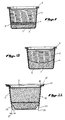
- Figure 1 shows a food system which was a basis for the present invention.
- Food item or component 1 is a brownie and food item or component 2 is ice cream. It was desired to heat the brownie to a serving temperature of approximately 43°C-60°C while the ice cream remained "frozen", i.e., at a temperature of approximately -9°C or colder without appreciable localized melting of the ice cream for example at the interface between the brownie and ice cream.
- frozen means the product is at a temperature of less than 0°C.
- Container 3 has a shield 4, preferably metal, on the sidewall, extending from the top down to approximately the top surface of the brownie.
- the top of the container also has a shielding closure or lid 5, preferably metal, to shield incident radiation from the sides and top of the ice cream.
- the lid 5 is removably secured to the container 4 and can be glued or heat sealed on and preferably includes a piece of metal foil, for example, aluminum foil, attached to the top of a container in a manner as is known in the art.
- the shield or control layer 6 is positioned between the layers 1 and 2.
- Figure 18 illustrates another form of product designed in accordance with the present invention and contains two different edible products 7 and 8.
- layer 7 can be a sauce, shielding or control layer positioned inside cup 3.
- the cup 3 can also have the shield 4 therearound.
- the lid 5 shields the open end of the cup 3 and, as seen in Figure 1, can be recessed in the cup 3.
- the layer of product 8 can be, for example, ice cream.
- the form of the invention shown in Figure 18 can be, for example, a layer of cheese sauce 7 and a layer of broccoli 8 as described hereinafter in one of the examples.
- Figure 19 shows a still further embodiment of a product designed in accordance with the present invention which includes a cup 3 having a lid 9 secured to the top thereof in any suitable manner.
- the lid 9 need not be metal if the shielding or control layer 10 has sufficient shield value.
- Enrobed within the layer 10 is another edible component 11 which can be, for example, ice cream, and the shield layer 10 can be a sauce. If the shield value of the layer 10 is adequate, then the shield 4 as shown in Figures 1 and 18 need not be added.
- Figure 20 shows a still further embodiment of a product designed in accordance with the present invention comprising a two-component food product.
- the control layer is the layer 14 sandwiched between or encased in edible component 15.
- the control layer 14 can have its physical properties adjusted as hereinafter described to help control the heating of the exterior layer 15 while controlling the relative values of its own absorbance and reflectance.
- a three layer system was initially used, i.e., a layer of brownie, a layer of sauce thereon, and a layer of ice cream on top of the sauce as seen in Figure 1. It was noted that when the layer of sauce was eliminated there was more heating and melting of the ice cream. Then, various control layers were interposed between the brownie and ice cream. It was initially believed that the improved performance from the sauce layer was due to the thermal insulation of the intermediate layer. To test this theory, experiments were conducted using aluminum foil and a silicone foam insert as the intermediate layer. The results of that type of experimentation are shown in Figure 2.
- the shield or control layer(s) can be defined as an edible layer that affects the microwave irradiation of another edible product or component in the food product, i.e., it is capable of being used for control or it is selected or intended for the purpose of control or is suitable for control. It is to be understood that all components have an effect on the system to some degree.
- the use of the layer as a shield can provide shielding control of the time/temperature relationship and final temperature of one or more of the components of the system.
- this interposed layer is an edible shield which fulfills a long felt need in microwave food heating.
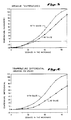
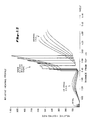
- Figure 2 shows temperature differentials which graphically illustrate the effectiveness of the present invention compared to a food system with no intermediate layer and an ineffective layer.
- FIG 2 shows a functional relationship between temperature differential and heating time for a three component system as shown in Figure 1 having a brownie and an ice cream layer with an interposed shielding layer.
- Temperature differential is the temperature difference between the brownie and the ice cream. The temperatures were taken in four places, two in the brownie 1 cm up from bottom and 2 cm in from the side and two in the ice cream 3 cm up from bottom and 2 cm in from the side with at least 8 runs for each sample with the temperatures being averaged numerically.
- the sauce had a thickness of 6mm with the high moisture sauce having a free water content of 37%. (Unless otherwise indicated all component concentrations listed herein are percents by weight).
- the normal or control sauce had a free water content of 24%.
- the foil used was aluminum foil with a thickness of 0.0025 cm and the edges fit tightly against the inside wall of the container.
- the foam pad was a silicon foam having a thickness of 3mm also fitting tightly against the inside surface of the cup.
- the no intermediate layer product had the brownie and ice cream in contact with one another.
- the brownie had a thickness of 1.7 cm and weighed 42 grams and the ice cream had a butter fat content of 12% by weight, an overrun of 70% and a charge weight of 60 grams.
- Figure 2 shows that the lower the transmission of microwave energy, through the use of a reflector like metal foil or higher moisture content sauces, the higher the temperature differential.
- the temperature profile of heating of the foam layer product is Line E, Figure 2. The reversal of the curves for the no intermediate layer and the foam pad at about 80 seconds is probably due to conductive heat transfer showing an effect with time.
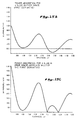
- Figures 9A, B, and C show curves for reflectance, absorbance, shielding, and related properties of the intermediate layer as a function of layer thickness. The curves are based on calculations.
- Figures 9B and 9C utilize different E' and E'' values for comparison and would represent layers with increased water contents. The locations and intensities of the maxima and minima on these types of curves are dependent on the dielectric properties of the layer material.
- the disposition of microwave energy in the product in Figure 1 can be approximately defined by the theoretical relationships in Figures 9A, B, and C.
- the amount of microwave power that is delivered to the brownie is largely dependent on the amount of power reflected by the intermediate layer.
- the amount of power that is delivered to the ice cream is largely dependent on both the amount of power reflected by and absorbed in the intermediate layer.
- the relative heating rate of the intermediate layer which was calculated from the absorbance and thermal load of the layer is also displayed in Figures 9A, B, and C.
- FIG. 9A Another test of the theory underlying the present invention involved the measurement of intermediate layer temperatures as a function of intermediate layer thickness.
- the relative heating rate of the intermediate layer is highest at very low thicknesses, falls to a minimum and then rises to a maximum at about 1.6 cm.
- Figure 13 illustrates the results of experimentation measuring the sauce temperatures of the brownie-sauce-ice cream system at sauce thicknesses between 0.4 cm and 1.6 cm.
- the heating rate is highest at 0.4 cm (temperature in still lower sauce thicknesses cannot be accurately measured with a Luxtron model 750 fluoroptic thermometric system), slightly lower at 0.8 cm, lowest at 1.2 cm and then higher again at 1.6 cm.
- the thermal loads of the two main components of the system in combination with proper microwave characteristics of the shield layer effective differential heating can be achieved in a three or more component system.
- one component with properly selected properties can also be effectively used to shield the other component to achieve differential heating.
- this might take the form of cheese sauce and broccoli wherein the broccoli can be on top of the cheese sauce.
- the cheese sauce can be heated and also act as a shield to prevent the broccoli from objectionable heating or overcooking.
- the time necessary to heat such systems also needs to be controlled in relation to the physical characteristics of the food system components.
- the dielectric properties e.g., E' and E''
- geometries of the components of the system it is possible to reliably control the absorbance, reflectance, transmission, and shielding ability of them and subsequently reliably control the disposition of microwave power in a multi-component food system.
- Geometry has an effect on the system.
- the physical dimensions of, the shape of and the relative positions of the components play a part. These can be selected empirically or through experimentation.
- the shield layer be generally the same shape as the surface it is in contact with, i.e., it coincides with the shape of the edible components adjacent thereto.
- Figure 9A represents the relationships for the chocolate sauce described above as calculated from a mathematical model of that chocolate sauce layer (24% free water) suspended in space. This sauce is believed to have values of 13.0 and 3.5 for E' and E'', respectively at room temperature.
- E' and E'' increase in Figures 9A, B, and C, the intensities (amplitudes) of all the peaks on similar plots increase while the wavelength of the generally sinusoidal curves decreases.
- the shielding ability of the intermediate layer can be varied as described above to optimize the shielding effect but the microwave and thermal loads of the component being shielded, and other components as well, should also be considered. If the sauce in the example discussed remains constant and is shielding about 80% of the incident microwave power as is suggested in Figure 9A, the remaining 20% transmitted through the layer will have a greater effect on raising the temperature of a small amount of ice cream than it will on a large amount just due to the thermal load of the ice cream. This is illustrated in Figure 12 which shows the effect of the amount of ice cream being shielded with a constant intermediate layer. It can be observed that the small amount of shielded ice cream heats up more rapidly than higher amounts of shielded ice cream.
- 2 (1) T Q/P (2) Where:
- the shielded cube decreases the incident microwave power by about 5/6.
- a poor reflecting layer e.g., butter with 25% reflection
- the shielded cube packing shields on the sides and top
- the shielded cube will only be about 53% as effective as the high reflectance sauce product at shielding the ice cream (i.e., melts in 53% of the time).
- the same amount of ice cream totally unshielded will be 7% as effective and the ice cream in the shielded cube without a sauce layer will be about 40% as effective as the system with a high reflectance sauce.
- a determination which needs to be made is the desired temperature or heating differential.
- Another determination which needs to be made is how the product will be distributed. Will it be distributed frozen, refrigerated or shelf stable, i.e., the starting temperature of the product needs to be known. More importantly, the properties of the product just prior to exposure to microwave radiation should be known to properly design the product. Generally a product will be microwaved directly from storage and the storage conditions will be the starting condition of the product. However, a product may be stored at -10°C but heated after a thaw or preheating period. The microwave properties could be substantially different at these different temperatures. Thus, the properties of the product as hereinafter described are those just prior to the product being exposed to microwave radiation for consumption.
- the shielding layer should be immiscible with the other layer(s) in contact therewith.
- Immiscible means that the layers remain substantially separate or distinct having a substantially distinct interface between the two layers. Immiscibility can be achieved by the control of the properties of each of the layers or can also be provided by a barrier film between the two layers which is also preferably edible. What is believed to be important is not a complete separation of the layers over time, but the provision of a sharp change or break in dielectric properties (E' and/or E'') at the interface between the two layers.
- the layers remain immiscible, at least initially during exposure to microwave radiation.
- the shielding layer should be high in water because 1) water is inexpensive, and 2) water is a very effective and edible shield and has easily variable dielectric properties by the addition of viscosifiers and other soluble materials.
- the water should preferably be nonfrozen, i.e., in this case not in the ice or crystalline form even when it is at a temperature below 0°C. Ice content can be easily affected by the addition of freezing point depressants such as sugars, salt, etc.
- an edible barrier can also be interposed between two layers to provide immiscibility if less viscous or higher water layers are desired.
- the shielded product is less tolerant to heat take-up or temperature increase, e.g., small thermal load or degraded by a small increase in temperature or heat uptake, then more shielding is required. Conversely, if the product is more tolerant to heat uptake or temperature increase, then less shielding is required.
- the tolerance to heat of the shielded product is dependent upon its dielectric properties, its thermal mass and also its sensory attributes.
- the amount of shielding can be varied as discussed above by varying the makeup of the shielding layer and also by using in combination therewith metal shielding or other shields. As seen from the disclosure herein, the smaller the food item that is to be shielded, generally the more incident radiation which needs to be shielded from the product particularly when it is not very tolerant to heat uptake as for example ice cream.
- Air gaps may occur between food component layers, and it is within the scope of this invention to adjust air gap thickness(es), or eliminate said gap(s), to achieve a desired profile of microwave power deposition within the multi-component food product.
- the layer thickness is chosen at about or beyond the peak of the initial incline so that minor variations do not adversely affect the amount of transmitted microwave energy particularly for systems intolerant to heat uptake.
- This peak or change in slope of the shield value curve can be approximated by the first point of inflection of the first derivative of the shielded power curve. For example, in Figure 9A, the first point of inflection occurs near 80%. Also, the required thickness of this layer can be changed by varying the dielectric properties of the layer and achieve the same shield value.
- layer thicknesses are chosen at about a zero or near a local minimum in the curve relating the absolute value of the first derivative of the power absorbtion curve so that minor variations in layer thickness or composition do not adversely affect the amount of absorbed microwave energy, particularly for systems intolerant to heat uptake. Typically, this occurs at about a local maximum or a local minimum in the power absorbtion curve.
- the water layer thickness would be approximately 0.4 cm, 0.75 cm, or 1.10 cm, etc., since these thicknesses produce local minima or maxima in the layer power absorbtion and would best enable one to achieve heating rate control.
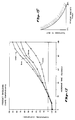
- Figure 24B illustrates a case where, for bread thicknesses below 2.5 cm, the power absorbtion curves have no local maximum or local minimum; a local power absorbtion minimum occurs for water near 3.2 cm and a local minimum occurs for oil near 3.9 cm.
- Figure 25C shows the absolute value of the first derivative of the power absorbtion curve in Figure 25A. A local minimum in the absolute value of the first derivative of the power absorbtion curve occurs at a thickness of approximately 0.9 cm to 1.0 cm, and zeros in the absolute value of the first derivative of the power absorbtion curve occur at thicknesses near 3.0 cm and 3.8 cm.
- heating rate control would be more easily attained at thicknesses near 0.9 cm to 1.0 cm, 3.0 cm and 3.8 cm than, for example, near thicknesses of 2.3 cm or 4.8 cm.
- the optimum thickness of this layer can be changed by varying the dielectric properties of the layers in the multi-component food system to achieve substantially the same result.
- a multi-component layered food system can be easily manufactured to attain a desired power deposition profile within the food system.
- the shield layer is used to control the amount of energy transmitted to the shielded component.
- the shielding layer has thickness such that the shield value (absorbance plus reflectance) just prior to exposure to microwave radiation for consumption is at least about 70%, preferably at least about 80%, and most preferably at least about 90% of the first point of inflection of the shielding power versus thickness curve.
- the shielding layer has a substantial amount of water.
- this water should be free water and unfrozen at the storage temperature or temperature of the product just prior to heating in the microwave oven.
- the free water content be in the range of between about 20% and about 95%. preferably in the range of between about 24% and about 90%, and most preferably in the range of between about 27% and about 85% by weight of shielding layer just prior to exposure to radiation.
- This free water level can be measured by the procedure set forth in AOAC (methods of analysis) 14th edition 1984 section 31.118 using an air oven and exposing the sample to 70°C for 16 hours under a pressure of less than 50mm HG.
- the shielding component should have less than about 50% ice, preferably less than about 30% ice, and most preferably less than about 10% ice by weight of said component as measured just prior to exposure to radiation. Ice content can be measured by differential scanning calorimetry. The amount of free water and ice can be easily adjusted by controlling the additives to this layer, as described above, which can function as freezing point depressants as well as viscosifiers if desired.
- the water in the shielding layer is ice, its ability to shield is substantially reduced, but could be utilized in systems requiring little shielding.
- the shielding layer as described above can be in multiple layers and can also be nonhomogeneous for example it could contain particulate material.
- the layer applying to the composite layers as well.
- An example of this would be a sundae with both a chocolate sauce and a caramel sauce positioned adjacent to one another and forming a shield around, for example, ice cream.
- the shielding or control layer has thickness and dielectric properties such that of the incident microwave power impinging from the oven side on the exposed, direct or indirect, major surface thereof about 20% to about 90%, preferably about 25% to about 80% and more preferably about 30% to about 80% of the incident power is reflected and about 10% to about 65%, preferably about 15% to about 65% and more preferably about 20% to about 65% of the incident power is absorbed and preferably the sum of reflected and absorbed power for shielding or control exceeds about 60% more preferably about 70% and most preferably about 80%.
- E' and E'' can be measured with a network analyzer, such as a Hewlett Packard network analyzer.
- a network analyzer such as a Hewlett Packard network analyzer.
- absorbance, reflectance, transmission and shielding can be calculated.
- E' and E'' and hence the absorbance, reflectance, transmission and shielding values are for the product at a temperature the same as that at which the product would be just prior to exposure to microwave radiation for consumption.
- absorbance, reflectance, transmission and shielding can be measured or determined for the composite using a coaxial wave guide at the subject temperature as just described.
- the shielding value is the numerical sum of reflectance and absorbance values or 1.0 minus transmission.
- the thickness of the shielding layer is selected to exceed a minimum thickness preferably above about 0.25 cm more preferably above about 0.4 cm and most preferably above about 0.5 cm.
- the thickness of the layer can be nonuniform and it is preferred that a major portion, preferably at least about 75% and more preferably at least about 90% and most preferably all, on an area basis, is in excess of these values. It can be seen from Figures 9A, B, and C that a thickness in excess of a minimum in practicality will only slightly change the amount of the shielding ability or value of the shielding layer.
- the above values are based on a microwave frequency of 2,450 megahertz. These values will change as the frequency changes.
- the most utilized frequency for operation of home microwave ovens is 2,450 megahertz and an industrially used microwave frequency is 915 megahertz.
- the mode of control is the same but the values for thickness, dielectric properties, absorbance, transmission and reflectance will change but are accommodatable with the theory and equations.
- a layer When viewing layered food systems from the perspective of multi-layer interference effects, it is the system that effects control of each of the edible layers. Power disposition (deposition) or absorbtion in a layer is controlled by the components of the food system.
- food system includes the microwave oven cavity components, e.g, shelf, metal floor, air gap therebetween, packaging components, if any, utensils, if any, heaters, if any, the food layers or components, etc.
- microwave oven cavity components e.g, shelf, metal floor, air gap therebetween
- packaging components if any, utensils, if any, heaters, if any, the food layers or components, etc.
- the heating of any food system or product is dynamic and temperature varies with time and location in the product. This is particularly true with microwave heating because of the changing dielectric properties of the product as its temperature changes. Heating results in temperature gradients within each of the components and from component to component in a system. Further, because of the nonuniformity of microwave heating of a food product it can have hot and cold spots within the product. Therefore, it is difficult to define a microwave heated product by its temperature because of the variability of the temperature within such a nonuniformly heated product. Temperature can be measured at various locations within a product to determine an appropriate time/temperature relationship and would normally be done on an empirical basis after determining the proper location and number of the temperature probes. This type of data can be correlated to consumer testing of the product. However, the desired end result of heating is the perception by the consumer of the product temperature or temperature differential and/or the degree of cooking, e.g., overcooked or undercooked.
- the time/temperature relationship of the product during heating determines both the final temperature and the degree of cooking, i.e., the total heat or energy uptake.
- Consumer perception of temperature and degree of cooking can be tested organoleptically, for example, too hot, too cold, overcooked or undercooked.
- actual temperature is not necessarily the relevant criteria, but the perception of temperature, for example, two ice creams which are at the same temperature can be consumed, but the sensation of temperature to a consumer is different. This can be caused, e.g., by the differing ice contents of the products, i.e., a high ice content product can be perceived as very cold when in fact it has the same temperature as a lower ice product.
- a time/temperature relationship can be measured by temperature probes at given locations which can give a representative but incomplete indication of the dynamics of the system at predetermined locations. Such testing can indicate proper or improper heating. However, the final temperature of the product is better measured organoleptically. Thus, within the desired time range of heating, the product should not be overcooked or undercooked and should not become overly hot or stay too cold from an organoleptic standpoint or one product should not heat faster than another product, whereby, the consumer perceives the resulting product as not being properly heated.
- Preparation instructions can be devised by both organoleptic testing and temperature measurement systems for different wattage ovens to determine the appropriate time range and time/temperature relationship generally required to achieve an acceptable end product, i.e., within a temperature range for consumption.
- Heating of a product is done within a predetermined or selected time/temperature relationship range and the final product temperature should be within a predetermined or selected temperature range.
- the final temperature can be that desired for consumption or the product can cool from the final temperature or equilibrate before consumption.
- the ranges are predetermined or selected by evaluating the heated or cooked product(s) for ensuring adequate heating to provide an acceptably cooked and/or appropriate temperature for consumption.
- the dielectric properties or free water level can be adjusted to achieve the same control over the heating characteristics of the shielding sauce layer.
- the dielectric properties or free water level can be determined to be within predetermined ranges and also, the thickness can be predetermined to be within a predetermined range. Then, both the thickness and dielectric properties or free water level can be varied within these ranges to achieve the proper heating characteristics or time/temperature relationships during heating.
- the invention herein provides means for controlling the heating characteristics of one component foods as well the different components of a multi-component food system in an easy manner.
- system analysis should include the air layer above the food product or package, the top product or package layer, subsequent product or package layers -- including any air gaps, and the glass (plastic or ceramic) shelf, air gap, and metal cavity floor.
- the shield or control layers can be defined as one or more layers that affect the microwave power absorbtion, reflection and transmission of one or more edible products or components in the food product, i.e. they are capable of being used for control or they are selected or intended for the purpose of control or are suitable for control. It is understood that all components even oven and food package components, e.g., the metal floor, the shelf, the gap between the floor and shelf, packaging material, metal shields, microwave heater (e.g., that disclosed in U.S.
- Patents 4,641,005 to Seiferth, 4,230,924 to Brastad et al or 4,267,420 to Brastad) etc. have an effect on the system to some degree.
- the use of one or more layers as shields can provide shielding control of the time/temperature relationship and final temperature of one or more of the components of the system.
- the multiple-layer free space treatment is inherently more complex than the single-layer treatment a better means of manipulating the important parameters involved has been devised.
- the inflection point of the first derivative of the shielding power curve of the control layer was used as a means of describing the shield layer's properties. It is more effective to adjust power absorbtion in the layer or layers and associated desired heating rates of those layers to make a heating controlled food system.
- Dielectric properties are important in describing how microwaves affect a food material.
- the wavelength of microwaves vary within food products and other materials dependent on their dielectric properties which are dependent on temperature.
- Microwave power absorbtion is also dependent on the dielectric properties of food products and other materials.
- the microwave radiation will change wavelength and power absorbtion will change as the microwave travels through each of the layers. At the boundaries between the layers reflection can occur diverting some of the microwave back into a layer it has just traversed to be absorbed or transmitted. It will also interact with the incoming microwave to create a standing wave.
- the standing wave generated in this manner is dependent on the relationship between the phases of the incoming and reflected microwaves. Since microwaves are cyclic in nature the phase of the wave at the point that it interacts is dependent on the distance that the microwave has traversed as well as its wavelength. In the case of a multi-layer food product in an oven this distance is the thickness of the layers. Consequently, microwaves in a multi-layer food product would be in the form of a series of standing waves. The shape of these standing waves and the microwave power that is absorbed from them is dependent on the dielectric properties and thickness of each of the component layers. This invention teaches how the dielectric properties and thicknesses of the component layers of multi-layer food products can be manipulated to obtain desired power absorbtion and subsequently the heating rates in preselected layers.
- At least one of four parameters should be considered when making a food product with desired power absorbtions in selected component layers.
- a first step in practicing the invention is to identify the desired power absorbtion for the food product layer(s) of interest within the product as a whole and in some cases to identify certain layers within which the degree of absorbtion is inconsequential with respect to the overall food product quality. Then one of the layers of interest is tuned to its desired power absorbtion.
- Retuning layers previously tuned is done in a similar manner. Prioritizing layers of interest and identifying or adding layers where preselected power absorbtion is not desired may be done to produce a component food product where the layers of interest have desired power absorbtion.
- Another aspect of the present invention is the ability to utilise the invention to provide consistent performance results from product to product. Once a product has been designed and found workable, it is important to ensure that each subsequent similar product or a substantial number of those product, i.e., more than 50% and preferably more than 80% of the products, are similar or substantially identical in performance capability.
- both layer thicknesses and dielectric constants may vary and suitable control over both of these properties is necessary to achieve heating rate control and practice the invention.
- the control of thickness and dielectric properties as hereafter described is for the purpose of maintaining consistency of performance of repetitively produced similar products as just described for control of thickness.
- the dielectric properties are those at a temperature just prior to exposure to microwave radiation. Good heating rate control can be attained if the variation in thickness and n, the real part of the square root of the complex dielectric constant as defined above, in each layer approximately obey inequality 5: n ⁇ t + t ⁇ n ⁇ (0.075)(12.24) cm (5) where:
- Desired end results include desired heating characteristics of one or more component layers of a multi-layer food product as described by any one or combination of the following measurable responses: heat to within a preselected temperature range or to a temperature within that preselected temperature range; heat within a preselected time range; heat within a preselected temperature range within a preselected time range; heat to a temperature within a preselected temperature range within a preselected time range; have a preselected deposition of power within at least one of the layers of edible components at a time just prior to exposure to microwave radiation or at a time at the end of exposure to microwave radiation; and/or have a preselected deposition of power within one or more or all of the layers of edible component at a time just prior to exposure to microwave radiation or at the end of exposure to microwave radiation; and/or have one or more of the layers of edible component heat within a desired or preselected time/temperature relationship range.
- An example of the desired power deposition end result would be the desire to heat on the outer surfaces of a
- Another application might require preselected dielectric properties of all of the edible layers and a desired average criticality in one or more of the edible layers. It is then possible to vary the thicknesses of layers and/or the number of layers and/or the positions of layers relative to each other to obtain this desired end result.
- the invention herein provides many ways of controlling the heating characteristics of preselected layer(s) of a food product containing one or more layers.
- the making of food systems with desired end results is greatly facilitated using the computer program (Appendix A) contained herein. It is possible to theoretically evaluate many combinations using this computer program and thus avoid an inefficient empirical approach to obtaining desired end results in multi-layer (or multi-component) microwave food systems.
- the program allows the use of interference analysis techniques to evaluate or analyze layer effects and change or manipulate responses in one or more layers of the food system and the food product can be changed in accordance with or in response to the output or results of the evaluation.
- a discussion of interference analysis techniques can be found in " Dielectrics and Waves ", A. R. von Hippel, MIT Press 1954, pp. 58-60 and " Field Theory of Guided Waves ", R. E. Collins, McGraw-Hill Co. 1960, pp. 76-96, the disclosures of which books are incorporated herein by reference.
- the included computer program can be used to calculate the local heating rate within a food product/package system without regard to heat or mass transfer. It is written in the ASYST language, available from the Macmillan Software Company and runs on an IBM PC, XT, or AT with at least 512K of memory and an 8087 mathematics coprocessor. The program calculates the local electric field at position x using interference analysis techniques and then calculates the heating rate at x using equation 2. Where:
- Analysis of a food system begins with measurement or estimation of the food component complex dielectric constants, densities, heat capacities, and the physical dimensions for each layer in the system.
- the data is entered in the model, and if an undesired heating rate profile is obtained, the thickness and dielectric constant of each layer in the system can be varied systematically until more suitable results are obtained.
- layers whose thickness is less critical are varied first.
- the analysis suggests addition of an air gap, for example, between the bottom product layer and the oven shelf obtained by interposing a cardboard box, whose thickness can be adjusted to optimize the product heating profile. It may be desirable to re-configure the product, for example, by changing the order in which particular food components are layered within the product.
- a reflective packaging element e.g., of metal
- an air gap of an optimized thickness may be indicated.
- the program can handle metal thicknesses up to 0.05 cm. Beyond this thickness, the calculated electric fields beyond the metal layer become so small that the computer reaches an underflow condition and program execution is halted. Since the overwhelmingly preponderant effect of a "thick" (i.e. thicker than a few hundred angstroms) metal layer is to provide a reflection coefficient near -1.0 (the negative sign arises from the 180° phase change which occurs at the metal surface) the precise metal thickness used in the calculations is unimportant.
- one or more food products either in a superposed or layered relationship or in side-by-side relationship or in single layers can be made.
- the foregoing analytical technique using interference analysis can be used to make a food product. To accomplish this, one first selects at least one food product and determines a time/temperature relationship range and/or final temperature within a temperature range for said food product to follow or achieve, respectively, during beating in a microwave oven.
- the performance characteristics including, e.g., relative heating rate, power deposition and tolerance of the food system, food product or food products are analyzed using the interference analysis techniques.
- the results of the analysis are used to make an adjustment in at least one of the food products (edible components) whereby the food product (one or more of the edible components) will generally heat within the time/temperature range and reach a temperature generally within the temperature range during microwave heating.
- the food product can be a plurality of food products which can be in superposed layers. A product is then made by the foregoing method.
- the heating characteristics or time/temperature relationship of the brownie or exposed component can be varied by varying its thickness and/or dielectric properties or free water level.
- the heating characteristics or time/temperature relationship of the directly exposed component can be varied by varying the thickness and/or dielectric properties or free water level of an indirectly exposed control layer adjacent thereto, i.e., by varying its absorbance and reflectance as described above.
- the final brownie temperature can be controlled or adjusted by the control or adjustment of the indirectly exposed control layer's thickness and/or dielectric properties or free water level characteristics.
- the brownie can remain relatively cool during heating while the sauce layer can be made to heat to a relatively higher temperature by having high absorbance and low reflectance.
- the brownie can be heated to a relatively higher temperature and the control layer to a relatively lower temperature by its having high absorbance and low reflectivity.
- Another product concept that could use this control mechanism could be a filled pastry or brownie or a product where the control layer is inside one or more surrounding products or between two or more products or layers.
- FIG. 9B An evaluation of Figures 9B, D, E, F, and G shows the effect of changing E' and/or E''.
- a decrease in E' dampens the effect of thickness on reflectance, absorbance and shielding if E'' remains generally constant.
- An increase in E'' also dampens the effect of thickness on reflectance, absorbance and shielding if E' remains generally constant.
- the thickness at which successive maxima or minima occur for reflectance and absorbance are increased or decreased by decreasing or increasing, respectively, E'.
- E' and E'' can be adjusted to achieve a desired value for at least one of absorbance and reflectance at a selected thickness so that the food product will heat within a predetermined time/temperature relationship range when exposed to microwave radiation.
- E' and/or E'' value can be selected and the thickness adjusted to achieve the same performance characteristics.
- the value of E' and/or E'' is preferably adequate to provide an acceptable tolerance for the range of or variation in product thickness.
- the critical nature of thickness can be changed, e.g., reduced, making the manufacture and heating of foods less critical.
- Another method to control the shape of the reflectance and absorbance curves is to change the value of n and K, respectively the real and imaginary parts of the square root of the complex dielectric permittivity. As n increases, the thicknesses at which successive maxima and minima occur in the absorbance and reflectance curves decrease. As K increases, the intensity difference between successive maxima and minima in the absorbance and reflectance curves decreases. The converse of the above manipulations results in opposite changes.
- the present invention can be utilised in several ways to control the disposition of microwave energy in the different components of the multi-component system. This can be accomplished by varying one or more properties over a wide range providing flexibility in product concepts.
- a particularly preferred embodiment is that shown in Figure 1 and is described hereinafter. It includes a brownie positioned in the bottom of a shielded cup having a layer of chocolate sauce positioned thereover and in contact therewith and having positioned over the sauce a layer of ice cream in contact with the sauce each contact surface being generally flat. Each layer has a substantially uniform thickness but it is particularly desired for the sauce to have a uniform thickness.
- the metal shield and the sauce cooperate with one another to substantially completely and preferably completely surround the ice cream to prevent leakage of microwave radiation through gaps between the shielding layer and the metal shield.
- Figure 3 shows the results of a series of experiments to test a two layer system of ice cream and sauce.
- the ice cream and sauce are substantially as described for the product used in the Figure 2 experiments.
- Figure 3 shows the effect of the thickness of the shielding layer on ice cream temperature for various heating times.
- the graphs shows that for increasing control layer (sauce) thickness, the higher the shielding effect of the shielding component. Further increases in thickness would be expected to increase the shield value but at a reduced rate.
- the data agrees with the theoretically obtained shield power curve of Figure 9A.
- Figure 3 was corrected for different starting temperatures to better show the results.
- Figures 4, 5, 6, and 7 illustrate various temperature relationships as functions of microwave heating time for food component systems with and without a shielding layer.
- the brownie and ice cream components of this system are substantially as those described in the explanation of Figure 2.
- Figure 2 also includes other than an edible shielding layer, i.e., aluminum foil and silicon foam and also shows the use of two edible shielding layers with different water content.
- These four figures show the effect of the use of a shielding layer versus a product without a shielding layer and the effect of the amount of shielding provided by the shield layer.
- the graphs show that the lower the microwave transmissivity the higher the temperature differential.
- Figure 8 is a graph illustrating a functional relationship between temperature differential, shielding layer thickness and microwave heating time. The graph was generated by calculation using a model constructed with the raw data of Figure 7. The product had a sauce with dielectric properties the same as those used in Figure 9A.
- Hot Scoop a microwaveable ice cream sundae
- Hot Scoop contains a total product weight of 150 grams which comprises approximately 90 grams of ice cream and about 60 grams of sauce.
- Sauces available are a chocolate sauce, caramel sauce and a mint flavored sauce. Heating experiments were conducted on the chocolate and mint products measuring the ice cream temperature at 2 cm from the sidewall and 1 cm below the sauce layer on top and attempting to measure the sauce temperature at 2 cm from the sidewall through the top cover and into the sauce at a depth of 4mm to 6mm which was difficult in view of the thinness of sauce and the dynamic property of the product when it is heated, e.g., the sauce sinks into the ice cream and the ice cream comes up around the sides when heated.
- the sauce temperature readings although taken as well as could be done, are probably not very accurate.
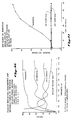
- the temperature differential between the sauce and the ice cream was calculated from the temperature measurements graphically depicted in Figure 10 as a function of heating time. As shown, Hot Scoop product achieved no measurable temperature difference between the ice cream and sauce indicating that the ice cream and sauce were heating, at least where measured and as measured, at the same rate providing no differential temperature.
- Fudge sauce thickness was varied from 0.2 cm to 1.0 cm in steps of 0.2. It can be seen from Figure 23 that these small changes in thickness of the sauce layer (denoted by the peaks beginning at about 2.4 cm from the top on the figure) have a large effect on the average relative heating rates of the ice cream layer (denoted by the peaks at about 1.4 cm from the top). Although the relative heating rate of the brownie (the peaks the farthest from the top) does not appreciably change in these examples, the ratio of the average relative heating rate of the brownie to the average relative heating rate of the sauce or ice cream does vary considerably. Thus, it is predicted that this system can be designed to obtain varying relative heating rates for the ice cream and sauce layer by varying the sauce layer thickness.
Landscapes
- Engineering & Computer Science (AREA)
- Life Sciences & Earth Sciences (AREA)
- Food Science & Technology (AREA)
- Polymers & Plastics (AREA)
- Chemical & Material Sciences (AREA)
- Wood Science & Technology (AREA)
- Health & Medical Sciences (AREA)
- Nutrition Science (AREA)
- Mechanical Engineering (AREA)
- Zoology (AREA)
- General Preparation And Processing Of Foods (AREA)
- Electric Ovens (AREA)
- Food Preservation Except Freezing, Refrigeration, And Drying (AREA)
- Cookers (AREA)
- Confectionery (AREA)
- Constitution Of High-Frequency Heating (AREA)
- Freezing, Cooling And Drying Of Foods (AREA)
Abstract
Description
- The present invention relates to a means and methods of controlling the heating of foods in a microwave oven, primarily to achieve differential heating between two or more edible substances positioned adjacent one another in a multi-component food product. It has been found that the desired degree of control by one food and hence the amount of heating of the other food is determined by certain physical properties of the food products.
- In the heating of foods in a microwave oven, temperature differentials and differential heating have been achieved through the use of package shielding material. For example, it has long been practiced in microwave cooking to use microwave reflective packaging with various sized apertures to control the amount of microwave radiation simultaneously impinging on various foods. Such reflective packaging was metal or contained metal. The foods desired to be heated were separated in the package with each food having one or more preselected apertures in the shield adjacent the food. The heating of each food was tuned by selecting the appropriate size and/or shape of the aperture to achieve a desired temperature within the heating time of the package. Such packaging was relatively effective for certain food concepts which allowed separation of the components, but was expensive and required empirical design to be effective.
- A major drawback to such an approach was that it required that each individual food component be in a separate compartment to separate each of the food substances to achieve the proper heating of each component. Another major drawback was that the shielding material was metal. In years past oven manufacturers objected to and recommended against the use of metal in a microwave oven for fear of possible damage to the oven circuitry and because metal packaging can cause arcing which is a consumer detriment. Further, metal shielding is difficult to use with some packaging materials and is also expensive.
- Numerous patents have addressed some of these problems, see for example, U.S. Patents 4,081,646, 4,233,325, and 4,122,324.
- To date, shielding of foods has been a packaging function and no one has been commercially successful in achieving controlled simultaneous heating of two or more foods absent this type of shielding. Even in the use of two of more food components together, no one has taught how to select properties of the control food to function as a microwave energy transmission inhibitor adjacent to and between the source of microwave energy and another food or how to select properties of one food component to accomplish controlled heating of other food components. Further, even with the above described metal shielding being available it has found little use and most microwave heating is still done until the foods being simultaneously heated reach some temperature with little or no control of the balance of the heating.
- Likewise, U.S. Patents 2,600,566 to Moffet and 2,714,070 to Welch, when read in context, discuss the need for metallic shielding "packaging" to control heating of multi-component food systems. Further, these particular packaging concepts do not appear to be disposable, but appear to be permanent receptacles. Both patents discuss the concept of differential temperatures, for example, between a sauce and an ice cream through the use of metal shielding. Neither Welch nor Moffet discusses controlled heating of one food with a shielding or control food via control of the thickness, and dielectric properties of the shielding layer. For example, Welch states in
columns cooker 10 can penetrate the food body only from the top, thereof, throughpaper member 50. Since the sauce 49 is a relatively high loss substance, it will absorb substantially all the microwave energy passing therethrough with the result that little or no microwave energy passes into the ice cream body 47. The ice cream body 47 thus remains frozen and, due to the ice crystals therein, substantially entirely reflects any energy which does pass through sauce 49 back into sauce 49. Since the cake member 48 is a relatively good heat insulator, the ice cream body 47 is not melted to any substantial extent by conductive heat from the sauce 49..... The resulting product is an ice cream having a hot fudge sauce which may be eaten directly from the paper container 46 inside the shield member 45." - According to this invention there is provided a method of designing a microwave heatable food product, which food product comprises a first edible component, a shield means positioned in proximity to said first edible component to control the amount of microwave power transmitted to the first component upon exposing said food product to microwave radiation, said shield means including a second edible component which is partially transmissive of microwave radiation, and package means containing said first and second components, characterised in that said method comprises the steps of selecting the thickness and dielectric properties of the second edible component to control the amount of microwave power that the said second edible component will transmit to the first edible component, and thereby control the heating of said first edible component to a pre-selected degree within a pre-selected time of exposure to microwave radiation of a pre-determined power, the second component having a shielding value in excess of about 70% of the first shielding inflection point value.
- Preferably the dielectric properties of the second edible component are selected by selecting the free water content of the second edible component.
- Advantageously the dielectric properties of the second edible component are selected by selecting the E' value of the second edible component.
- Conveniently the dielectric properties of the second edible component are selected by selecting the E'' value of the second edible component.
- Preferably the second component is designed to have at least a majority of the thickness thereof in excess of about 0.25cm.
- Advantageously the second component has a free water content in the range of between about 20% and about 95% by weight of said second component.
- Preferably the method includes the step of designing the shield means to include a metal shield, in shielding relation to at least a portion of said food product, said metal shield having an opening therein designed to allow said second component to be exposed to microwave radiation.
- Preferably the method includes the step of selecting the position for the second component to be between the first component and said shield.
- Advantageously the method includes the step of selecting the second edible component to contain multiple layers of immiscible edible components.
- Preferably the method includes the step of selecting the thickness and dielectric properties of the second edible component to decrease the amount of microwave power transmitted to the first component.
- Advantageously the step of selecting the thickness and dielectric properties of the second edible component to increase the amount of microwave power transmitted to the first component.
- Preferably the first edible component is selected to be ice cream and the second edible component is selected to include a sweetened viscous sauce in a layer in contact with the ice cream, said shield means being designed to include a metal shielding layer adjacent said ice cream, so that the second edible component and the said metal shield co-operate to form said shield means which substantially completely surrounds said ice cream, the method comprising the further step of designing the food product to include a brownie positioned adjacent said sauce, the brownie having a substantial portion thereof substantially unshielded from direct exposure to microwave radiation.
- The invention further provides a method of designing a microwave heatable food product having at least one edible component, including:
selecting the thickness and dielectric properties of said at least one edible component to achieve an approximate local maximum or local minimum in the functional relationship between power adsorbance and thickness of an edible component of the food product during exposure to microwave radiation, whereby said edible component will heat to within a predetermined time/temperature relationship range during exposure to microwave radiation of a predetermined energy. - The invention includes a method comprising the further step of manufacturing the food product as designed and also includes a method comprising the further step of locating the manufactured product in a microwave oven and heating the food product using microwave energy within the microwave oven.
- Surprisingly, it has been found that by control of the thickness, and microwave load (a combination of dielectric properties of a control layer and the thermal loads) or by the control of thickness and dielectric constant of a control layer and the thermal loads of each component highly effective cooking control can be achieved. Thermal load can be defined as specific heat in calories/gram multiplied by the mass in grams. Another dimension of thermal performance is thermal diffusivity which is defined as the thermal conductivity (heat input rate in calories/seconds multiplied by distance in centimeters multiplied by temperature difference in degrees centrigrade) divided by density and specific heat of the product. It has been found that certain foods can achieve a reflectance of about 65% and a transmission of as low as 20% or even lower, e.g., 10%, for high water layers, of the incident power and can function as an effective shield within given time constraints. Further, it was surprisingly found through calculation that conductive heat transfer from the shielding component to the shielded food component, when made in accordance with the invention, had little practical effect on heating of the shielded component within the short time that is required to heat many foods in a microwave oven, making it possible to allow the shielding layer to heat without detriment to the shielded layer. These factors make it possible to use edible foods or edible substances as shields to control heating of other foods in a microwave environment reducing the need for metal or other nonedible shields and insulating layers. The result is the ability to make new types of microwave foods and food systems that cannot be properly heated together in any other manner.
- Given the physical characteristics of the components of the food system and a desired amount of differential heating it is possible to design multiple component food systems with controlled differential heating or temperatures at the end of microwave heating which overcome the above problems.
- The invention will now be described with reference to the drawings in which:
- Figure 1 is a side sectional view of a multi-component food product.
- Figure 2 is a graph showing the functional relationship between temperature differential and heating time for various multi-component food systems having different intermediate control layers: metal foil, control sauce with 24% water, a silicone foam insert, a high moisture sauce with 37% water, and no intermediate layer.
- Figure 3 is a graph showing a functional relationship between the temperature and heating time of a shielded component of a multi-component food system as shown in Figure 1 with different intermediate layer thicknesses.
- Figure 4 is a graph showing a functional relationship between ice cream temperature and heating time of products in a multi-component food system as shown in Figure 1 with and without an intermediate sauce layer.
- Figure 5 is a graph showing a functional relationship between the temperature of a brownie in a multi-component food system as shown in Figure 1 and heating time for systems with and without an intermediate layer of shielding sauce.
- Figure 6 is a graph showing a functional relationship between temperature differential, i.e., the temperature of the brownie minus the temperature of the ice cream as a function of heating time for a multi-component food system as shown in Figure 1 with and without an intermediate layer of sauce.
- Figure 7 is a graph showing a functional relationship between temperature differential, i.e., the temperature of the brownie minus the temperature of the ice cream, as a function of heating time for a multi-component food system as shown in Figure 1 with different shielding layer thicknesses using the control sauce with 24% free water.
- Figure 8 is a three dimensional representation of a mathematical model showing a functional relationship between temperature differential, microwave heating time, and sauce thickness for the control sauce having a free water content of 24% for a multi-component food system as shown in Figure 1 having ice cream and brownie on opposite sides of the shielding layer.
- Figures 9A, B, and C are graphs showing functional relationships between four variables; reflected power, absorbed power, shielded power, and relative heating rate (absorbance/thickness) each as a function of shielding layer thickness for a shield layer having relative dielectric constant (E') (hereinafter dielectric constant) values of 13, 26, and 39 and relative dielectric loss factor (E'') (hereinafter dielectric loss factor) values of 3.5, 7.0, and 10.5, respectively. E' is the real part and E'' is the imaginary part of the complex permittivity as is well known to those skilled in the art. See, for example, A. Von Hippel, Dielectric Materials and Applications, MIT Press, 1954.
- Figures 9D, E, F, and G are graphs showing functional relationships between four variables; reflected power, absorbed power, shielded power, and relative heating rate. When these figures are viewed in combination with Figure 9B they show the effect of changing E' or E'' while holding the other constant.
- Figure 10 is a graph showing a functional relationship between the temperature differential between sauce layer and ice cream for a currently existing product called Hot Scoop which is ice cream and sauce in an unshielded paper cup compared to a product similar to that shown in Figure 1 having a control sauce layer and ice cream, but with metal shielding on the side of the container also as shown in Figure 1. The limitations on this graph are discussed hereinafter.
- Figure 11 is a graph showing a comparison of heating temperature profiles of ice cream as a function of heating time in a microwave oven for two Hot Scoop products and the invention using ice cream, brownie, and sauce in a metal shielded cup.
- Figure 12 is a graph showing functional relationships between ice cream temperatures and heating time for products similar to that in Figure 1 that had different ice cream weights and heated in two different ways, in a microwave oven and sitting in a room at room temperature.
- Figure 13 is a graph showing a functional relationship between temperature of the shielding sauce layer and microwave heating time for four different thicknesses.
- Figure 14 is a three dimensional representation of a mathematical model showing a functional relationship between intermediate layer sauce temperature, sauce thickness, and microwave heating time for a sauce having a free water content of 24% and a multi-component food system as shown in Figure 1 having ice cream and brownie on opposite sides of the shielding layer.
- Figure 15 is an illustration generally showing a possible functional relationship between tolerance to heat of the shielded component and the amount of microwave energy transmitted through the shielding component(s) which is useful to directionally design multi-component food systems.
- Figure 16 is a graph illustrating functional relationships between ice cream temperature and microwave heating time. Line A represents a 314 gram ice cream sample and Line B represents a 100 gram charge of ice cream surrounded on all sides by fudge sauce with a substantially uniform thickness and weighing 444 grams. No metal shielding was used.
- Figure 17 is a graph showing functional relationships between ice cream temperatures and microwave heating time. Line A represents a 544 gram charge of ice cream,
Line 8 represents a 314 gram charge of ice cream and Line C represents a 100 gram charge of ice cream surrounded with a substantially uniform thickness of fudge sauce weighing 444 grams. No metal shielding was used. - Figure 18 is a side sectional view of a container similar to that shown in Figure 1 containing another form of the present invention.
- Figure 19 is a side sectional view of a multi-component food product in a package showing a still further form of the present invention and is similar to that form used in Figures 16 and 17, an entirely food enrobed food product.
- Figure 20 is a side sectional view of another food product having a control layer inside.
- Figure 21 is a graph showing functional relationships between ice cream temperature and microwave heating time for ice cream in an unshielded container, one of the products was enrobed in a layer of sauce.
- Figure 22 is sectional view of a container.
- Figure 23 is a graph showing functional relationships between relative heating rate and distance from the top for a food system as described in the Example of the brownie/sauce/ice cream/metal multi-layer system.
- Figures 24A, B, C and D are graphs showing a functional relationship between percent power absorbtion for each layer in a system as a function of the thickness of one layer in the system which is varied. In this figure, the following relative complex dielectric constants were used: oil (2.6-i0.147); water (76.5-i11.1); and bread (2.85-i0.75).
- Figures 25A, B and C are graphs showing, respectively, the functional relationship between power absorbtion and layer thickness, the first derivative of power absorbtion vs. thickness, and the absolute value of the first derivative of power absorbtion vs. thickness. Figure 25A was calculated from
equation 3 with E' = 5 and E'' = 1. - The physics of microwaves in a food system is extremely complicated and little is known about how microwave heating in foods is accomplished. The complication, in large part, could be due to the fact that food systems themselves are extremely complicated, presenting many looks to the microwave field. Such things as preferential heating, the differing chemical natures of foods, nonhomogeneity, the varying locations that discreet food items with different microwave characteristics are positioned next to one another within a single food system, hot and cold spots in an oven, etc. These all complicate the food scientist's and package designer's jobs in designing food products for heating in a microwave oven.
- In developing the hereinafter described differentially heating food products, certain discoveries were made about the characteristics of the edible components of these systems which were a surprise. The major surprises were that through proper selection one could control how much incident radiation can be shielded by, or how little will be transmitted through, some food components or edible substances and how little effect conductive heat transfer can have in the overall heating of food products within the short time necessary to heat food items in a microwave oven. Other surprises were that: theoretically an increase in thickness in excess of a minimum does not necessarily substantially change the shielding value and a change in thickness above the minimum can simultaneously change absorbance and reflectance oppositely in cycles. As can be seen in Figures 9A, B, and C, absorbance and reflectance cycle with increasing thickness in an opposing manner as thickness increases over small dimensional changes allowing great latitude in product design. The combination of the low microwave transmission of certain food components and the small role that conduction and other forms of heat transfer can play, provided the basis for achieving controlled differential heating in multi-component food systems, i.e., two or more food or edible components positioned adjacent or proximate to one another. Within a given time of heating in a microwave oven we have been able to achieve predictable and controlled temperatures which were different, say for example, 11°C or more, with some differentials being as high as 65°C to 80°C and even as high as 110°C (See Figure 2) over small distances, for example 2 cm. Even more surprising is that the food systems of this invention are tolerant to different ovens and varying heating times. These tolerances are important for the effective preparation of the items by consumers.
- Tolerance is important because of timer variation from oven to oven, the different power outputs of different ovens and because of the hot/cold spot phenomena in ovens. This means that for a given time of exposure, the amount of available energy for heating a food product can significantly vary thereby causing the product to be either overheated or underheated. Without tolerance, consumer acceptance of heat sensitive food products could be unacceptably low. Tolerance of products is dependent on the particular product being heated and the consumer concept of quality for that particular product. For example, ice cream, which is very sensitive to heating, has a very small heat tolerance range. Quality ice cream should be stiff or viscous and not soupy. In contrast, soup, which is not sensitive to overheating, would be very tolerant. What is meant by tolerance herein, is that given the above described variabilities in microwave ovens, etc., that a substantial percent of the products after being heated in a microwave oven according to the instructions will have a level of quality acceptable to the consumer. Tolerance con be tested organoleptically which is a standard procedure in the food industry.
- Figure 1 shows a food system which was a basis for the present invention. Food item or
component 1 is a brownie and food item orcomponent 2 is ice cream. It was desired to heat the brownie to a serving temperature of approximately 43°C-60°C while the ice cream remained "frozen", i.e., at a temperature of approximately -9°C or colder without appreciable localized melting of the ice cream for example at the interface between the brownie and ice cream. As used herein, unless otherwise designated, frozen means the product is at a temperature of less than 0°C. Container 3 has ashield 4, preferably metal, on the sidewall, extending from the top down to approximately the top surface of the brownie. The top of the container also has a shielding closure orlid 5, preferably metal, to shield incident radiation from the sides and top of the ice cream. Thelid 5 is removably secured to thecontainer 4 and can be glued or heat sealed on and preferably includes a piece of metal foil, for example, aluminum foil, attached to the top of a container in a manner as is known in the art. The shield orcontrol layer 6 is positioned between thelayers - Figure 18 illustrates another form of product designed in accordance with the present invention and contains two different
edible products layer 7 can be a sauce, shielding or control layer positioned insidecup 3. Thecup 3 can also have theshield 4 therearound. Thelid 5 shields the open end of thecup 3 and, as seen in Figure 1, can be recessed in thecup 3. The layer ofproduct 8 can be, for example, ice cream. The form of the invention shown in Figure 18 can be, for example, a layer ofcheese sauce 7 and a layer ofbroccoli 8 as described hereinafter in one of the examples. - Figure 19 shows a still further embodiment of a product designed in accordance with the present invention which includes a
cup 3 having alid 9 secured to the top thereof in any suitable manner. Thelid 9 need not be metal if the shielding orcontrol layer 10 has sufficient shield value. Enrobed within thelayer 10 is anotheredible component 11 which can be, for example, ice cream, and theshield layer 10 can be a sauce. If the shield value of thelayer 10 is adequate, then theshield 4 as shown in Figures 1 and 18 need not be added. - Figure 20 shows a still further embodiment of a product designed in accordance with the present invention comprising a two-component food product. In this example, the control layer is the
layer 14 sandwiched between or encased inedible component 15. In this particular embodiment thecontrol layer 14 can have its physical properties adjusted as hereinafter described to help control the heating of theexterior layer 15 while controlling the relative values of its own absorbance and reflectance. - In the development of the present invention, a three layer system was initially used, i.e., a layer of brownie, a layer of sauce thereon, and a layer of ice cream on top of the sauce as seen in Figure 1. It was noted that when the layer of sauce was eliminated there was more heating and melting of the ice cream. Then, various control layers were interposed between the brownie and ice cream. It was initially believed that the improved performance from the sauce layer was due to the thermal insulation of the intermediate layer. To test this theory, experiments were conducted using aluminum foil and a silicone foam insert as the intermediate layer. The results of that type of experimentation are shown in Figure 2. The surprise was that it was not thermal insulation which was making the sauce layer prevent heating of the ice cream, but it was in fact the nontransmission of microwave energy to the ice cream. This is graphically shown by the fact that the highest temperature differential is achieved by a very good conductor of heat and a perfect reflector of microwave energy, i.e., the aluminum foil, while the good insulator and high transmitter of microwave energy, provided one of the lowest temperature differentials. At this same time, the theoretical understanding was being developed which explained the phenomenon of reflectivity and absorbance as functions of thickness and dielectric properties of certain types of food products.
- Thus, by interposing an unneeded intermediate
edible layer 6 of sauce between theice cream 2 and thebrownie 1, which was initially added only for meeting the definition of the product concept, i.e., a brownie with chocolate sauce and ice cream, the temperature differential between the brownie and ice cream was substantially increased when the properties of that layer were properly selected. - The shield or control layer(s) can be defined as an edible layer that affects the microwave irradiation of another edible product or component in the food product, i.e., it is capable of being used for control or it is selected or intended for the purpose of control or is suitable for control. It is to be understood that all components have an effect on the system to some degree. The use of the layer as a shield can provide shielding control of the time/temperature relationship and final temperature of one or more of the components of the system.
- With the use of the invention, effective heating of the brownie and almost complete elimination of detrimental heating of the ice cream were achieved. It was found that this intermediate layer, if it had a high water content, was very low in transmissivity (high in the sum of absorbance and reflectance) of the incident power thereby acting as an effective edible shield when positioned between the food product to be shielded and the microwave environment. It was also a surprise that the control layer could also enhance heating of the brownie thereby reducing the time of exposure to radiation for a given brownie size. The invention permits the design and use of new types of microwave products because edible instead of nonedible shields, as in U.S. Patent 4,233,325, can be used. This edible shield in combination with the side and top metal shield, as seen in Figure 1, prevented detrimental heating of the ice cream within the time period required to heat the brownie, thereby improving the performance of the multi-component food system. Thus, this interposed layer is an edible shield which fulfills a long felt need in microwave food heating.
- Figure 2 shows temperature differentials which graphically illustrate the effectiveness of the present invention compared to a food system with no intermediate layer and an ineffective layer.
- In order to test the theory underlying the present invention, certain experiments were conducted. Some of the results are illustrated in Figure 2. A brownie-sauce-ice cream system was used and opposite ends of the spectrum of reflectance and heat transfer were also tested using a brownie-metal foil or silicone foam-ice cream system. Line A in Figure 2 shows heating results when an aluminum foil layer was positioned between the brownie and ice cream. This foil, for practical purposes, is a perfect reflector (no transmission or absorbtion) and a perfect conductor of heat. Another experiment utilized an insulating layer, which for practical purposes is a perfect transmitter of microwave energy and a perfect thermal insulator. The particular layer was a silicone foam. Line E in Figure 2 shows heating results for this foam layer.
- Figure 2 shows a functional relationship between temperature differential and heating time for a three component system as shown in Figure 1 having a brownie and an ice cream layer with an interposed shielding layer. Temperature differential is the temperature difference between the brownie and the ice cream. The temperatures were taken in four places, two in the
brownie 1 cm up from bottom and 2 cm in from the side and two in theice cream 3 cm up from bottom and 2 cm in from the side with at least 8 runs for each sample with the temperatures being averaged numerically. The sauce had a thickness of 6mm with the high moisture sauce having a free water content of 37%. (Unless otherwise indicated all component concentrations listed herein are percents by weight). The normal or control sauce had a free water content of 24%. The foil used was aluminum foil with a thickness of 0.0025 cm and the edges fit tightly against the inside wall of the container. The foam pad was a silicon foam having a thickness of 3mm also fitting tightly against the inside surface of the cup. The no intermediate layer product had the brownie and ice cream in contact with one another. The brownie had a thickness of 1.7 cm and weighed 42 grams and the ice cream had a butter fat content of 12% by weight, an overrun of 70% and a charge weight of 60 grams. - Figure 2 shows that the lower the transmission of microwave energy, through the use of a reflector like metal foil or higher moisture content sauces, the higher the temperature differential. The foam pad which provided the highest transmission and the best insulation, generally provided the lowest temperature differential showing that it is the transmission of microwave energy which is the primary cause of heating the shielded component. The temperature profile of heating of the foam layer product is Line E, Figure 2. The reversal of the curves for the no intermediate layer and the foam pad at about 80 seconds is probably due to conductive heat transfer showing an effect with time.
- It can be seen that the aluminum foil, the "perfect" reflector and "perfect" conductor of heat provided the highest temperature differential while the foam, a "perfect" transmitter of microwave energy and "perfect" insulator, provided the lowest temperature differential. The prior art had discussed the need for insulators to prevent detrimental heating. Thus the best performance, with regard to temperature differential, being from the best heat conductor and the worst performance being the poor heat conductor was a surprise. These results provide support for the theory that it is control of the transmission of microwave energy in food systems of this type which is the key contributing factor to achieving temperature differential, not thermal insulation which the prior art considered to be required. Thus, a relatively high heat conductive layer with controlled transmissivity can be effectively used.
- The theory underlying the present invention is further illustrated in Figures 9A, B, and C which show curves for reflectance, absorbance, shielding, and related properties of the intermediate layer as a function of layer thickness. The curves are based on calculations. Figure 9A is specific to the control sauce type intermediate layer described above and having the following properties E' = 13 and E'' = 3.5 which has a free water content of 24%. Figures 9B and 9C utilize different E' and E'' values for comparison and would represent layers with increased water contents. The locations and intensities of the maxima and minima on these types of curves are dependent on the dielectric properties of the layer material.
- The disposition of microwave energy in the product in Figure 1 can be approximately defined by the theoretical relationships in Figures 9A, B, and C. For example, the amount of microwave power that is delivered to the brownie is largely dependent on the amount of power reflected by the intermediate layer. However, the amount of power that is delivered to the ice cream is largely dependent on both the amount of power reflected by and absorbed in the intermediate layer. Thus, by addition of the amount of power reflected by and absorbed in the intermediate layer, it is possible to determine the amount of power that has been shielded by the intermediate layer as shown in Figures 9A, B, and C. The relative heating rate of the intermediate layer which was calculated from the absorbance and thermal load of the layer is also displayed in Figures 9A, B, and C. It is apparent that the effectiveness of the layer as a shield can remain high through a wide range of thicknesses, but its absorbing and reflecting properties and subsequently its ability to heat can vary significantly with a change in thickness. In general, an increase or decrease in absorbance or reflectance results in a decrease or increase, respectively, in the other. The relationships described in Figures 9A, B, and C show that food materials can act the same as other shielding boundaries and differently because it can also absorb, thereby allowing the achievement of temperature differentials and differential heating as desired in the product in Figure 1 or the achievement of other beneficial dispositions of microwave power within a food product in an effective and controlled manner.
- Another test of the theory underlying the present invention involved the measurement of the temperature differential between the brownie and the ice cream as a function of intermediate layer thickness. To understand the results one should review Figure 9A, a theoretical series of curves based on a layer having E' = 13 and E'' = 3.5. This figure indicates that the percent of power reflected by the intermediate layer should rise from zero to a maxima and then fall to a minima between layer thicknesses of 0 cm and about 1.6 cm. The power reflected by the intermediate layer helps heat the brownie in Figure 1 and also helps shield the ice cream, thereby, exerting a major effect on the temperature differential between the two components. Figure 7 illustrates the results of experimentation varying intermediate layer thickness of the brownie-sauce-ice cream system between 0 cm and 1.6 cm. On the three dimensional graphical representation, Figure 8, temperature differential is plotted as a function of both layer thickness (mm) and microwave preparation time (P, seconds). It is observed that the curve of this plane in space shows a strong relationship to the shape of the reflectance curve of Figure 9A. Thus, the theory and the practical application of that theory are in good agreement.
- Another test of the theory underlying the present invention involved the measurement of intermediate layer temperatures as a function of intermediate layer thickness. As illustrated in Figure 9A, the relative heating rate of the intermediate layer is highest at very low thicknesses, falls to a minimum and then rises to a maximum at about 1.6 cm. Figure 13 illustrates the results of experimentation measuring the sauce temperatures of the brownie-sauce-ice cream system at sauce thicknesses between 0.4 cm and 1.6 cm. As can be seen from this data the heating rate is highest at 0.4 cm (temperature in still lower sauce thicknesses cannot be accurately measured with a Luxtron model 750 fluoroptic thermometric system), slightly lower at 0.8 cm, lowest at 1.2 cm and then higher again at 1.6 cm. A mathematical model of sauce temperature as functions of sauce thickness and microwave preparation time was prepared using this data. The three dimensional representation of this model is illustrated in Figure 14. It is observed that the curve of this plane in space shows a strong relationship to the relative heating rate curve of Figure 9A. Thus, again, the theory and the practical application of that theory are in good agreement.
- By properly selecting, either by calculation or empirically, the thermal loads of the two main components of the system in combination with proper microwave characteristics of the shield layer effective differential heating can be achieved in a three or more component system. Further, work has also indicated that in a two component system, one component with properly selected properties can also be effectively used to shield the other component to achieve differential heating. For example, this might take the form of cheese sauce and broccoli wherein the broccoli can be on top of the cheese sauce. The cheese sauce can be heated and also act as a shield to prevent the broccoli from objectionable heating or overcooking. The time necessary to heat such systems also needs to be controlled in relation to the physical characteristics of the food system components.
- By selecting the relative thermal loads of the components in the multi-component system, the dielectric properties (e.g., E' and E'') and geometries of the components of the system, it is possible to reliably control the absorbance, reflectance, transmission, and shielding ability of them and subsequently reliably control the disposition of microwave power in a multi-component food system. Geometry has an effect on the system. For example, the physical dimensions of, the shape of and the relative positions of the components play a part. These can be selected empirically or through experimentation. It is preferred that the shield layer be generally the same shape as the surface it is in contact with, i.e., it coincides with the shape of the edible components adjacent thereto.
- The series of curves illustrated in Figures 9A, B, and C indicate the dependency of the absorbance, reflectance, shielding ability (absorbance plus reflectance), and layer heating rate on the dielectric constant (E') and dielectric loss factor (E'') with varying layer thicknesses. Figure 9A represents the relationships for the chocolate sauce described above as calculated from a mathematical model of that chocolate sauce layer (24% free water) suspended in space. This sauce is believed to have values of 13.0 and 3.5 for E' and E'', respectively at room temperature. As the values of E' and E'' increase in Figures 9A, B, and C, the intensities (amplitudes) of all the peaks on similar plots increase while the wavelength of the generally sinusoidal curves decreases. This is illustrated in Figure 9B which is projected for an intermediate layer with the following dielectric properties of E' = 26.0 and E'' = 7.0. Further increases in these values to E' = 39.0 and E'' = 10.5 yield the relationships illustrated in Figure 9C with even higher intensities and lower wavelengths. Consequently, by controlling the thickness and dielectric properties of the intermediate layer it is possible to control the reflectance, absorbance, shielding ability, and heating rate of that layer and vary reflectance and absorbance several times over a wide range of thicknesses above a minimum thickness. This permits the design of numerous products having acceptable performance at different thicknesses. It is also possible to use the above described relationships to design even single component food products to heat in accordance with the same criteria set forth for the multi-component systems.
- In addition to controlling the functionality of the active or shield (intermediate) layer one should also consider the properties of the materials (layers) adjacent the active layer. For example, the shielding ability of the intermediate layer can be varied as described above to optimize the shielding effect but the microwave and thermal loads of the component being shielded, and other components as well, should also be considered. If the sauce in the example discussed remains constant and is shielding about 80% of the incident microwave power as is suggested in Figure 9A, the remaining 20% transmitted through the layer will have a greater effect on raising the temperature of a small amount of ice cream than it will on a large amount just due to the thermal load of the ice cream. This is illustrated in Figure 12 which shows the effect of the amount of ice cream being shielded with a constant intermediate layer. It can be observed that the small amount of shielded ice cream heats up more rapidly than higher amounts of shielded ice cream.
- Therefore, one should first consider the relationships identified in Figures 9A, B, and C to optimize the desired property (i.e., reflectance, absorbance, heating rate, and/or shielding ability) of the active (intermediate) layer. One should then consider the effects of the materials in close proximity to the active layer as seen in Figure 12.
- It is likely, in certain cases, such as small single serving type products, say 200 grams or less, where the thermal and microwave loads are small, that these factors will not combine to yield a satisfactory product. If this occurs, the use of packaging shields and/or absorbers, as part of the total product may be required.
- As seen in Figures 10, 11, 12, 16 and 17, the importance of relative thermal load and the need for shielding in low thermal load products are graphically illustrated.
- Performance estimates can also be calculated for systems with and without shielding. This was done for
a a 5 cm. cube of ice cream with an assumed E' value of 3 and an E'' value of 0.8 and 100% overrun. The time to half-melt the-ice cream in a cube form was calculated for differing shielding arrangements. Energy required to half-melt the ice cream of 62.5 grams was 336 calories by calculation which in a 700 watt oven will half-melt in about 26 seconds if unshielded. This can be calculated by the equations:


Where: - P
- = Power
- V
- = Volume of product
- Erms
- = Electric field strength
- f
- = Frequency
- E''
- = Dielectric loss
- Eo
- = Permittivity of free space
- T
- = Time required to half-melt
- Q
- = Heat required to half-melt
- It is seen that the shielded cube decreases the incident microwave power by about 5/6. In addition a poor reflecting layer (e.g., butter with 25% reflection) in the shielded cube (packaging shields on the sides and top) will only be about 53% as effective as the high reflectance sauce product at shielding the ice cream (i.e., melts in 53% of the time). The same amount of ice cream totally unshielded will be 7% as effective and the ice cream in the shielded cube without a sauce layer will be about 40% as effective as the system with a high reflectance sauce. This calculation shows that proper selection of control layer thickness and dielectric properties in combination can be used to practice the invention.
- In the practice of the present invention a determination which needs to be made is the desired temperature or heating differential. Another determination which needs to be made is how the product will be distributed. Will it be distributed frozen, refrigerated or shelf stable, i.e., the starting temperature of the product needs to be known. More importantly, the properties of the product just prior to exposure to microwave radiation should be known to properly design the product. Generally a product will be microwaved directly from storage and the storage conditions will be the starting condition of the product. However, a product may be stored at -10°C but heated after a thaw or preheating period. The microwave properties could be substantially different at these different temperatures. Thus, the properties of the product as hereinafter described are those just prior to the product being exposed to microwave radiation for consumption. This would be after preheating, thawing, etc. either in the microwave, after holding at an elevated temperature or the like. Usually it is the final and major exposure to microwave radiation that prepares the product for consumption that is the condition for which the product is designed. By selecting the relative thermal loads, adjusting the dielectric properties of the components of the food system, the reflectance, absorbance and transmission of the shielding component and the time necessary to heat the portion which should be hotter or require more heat input, the desired differential can be reliably achieved.
- Preferably, the shielding layer should be immiscible with the other layer(s) in contact therewith. Immiscible means that the layers remain substantially separate or distinct having a substantially distinct interface between the two layers. Immiscibility can be achieved by the control of the properties of each of the layers or can also be provided by a barrier film between the two layers which is also preferably edible. What is believed to be important is not a complete separation of the layers over time, but the provision of a sharp change or break in dielectric properties (E' and/or E'') at the interface between the two layers. Preferably the layers remain immiscible, at least initially during exposure to microwave radiation. Also, the shielding layer should be high in water because 1) water is inexpensive, and 2) water is a very effective and edible shield and has easily variable dielectric properties by the addition of viscosifiers and other soluble materials. The water should preferably be nonfrozen, i.e., in this case not in the ice or crystalline form even when it is at a temperature below 0°C. Ice content can be easily affected by the addition of freezing point depressants such as sugars, salt, etc. Also, by adding sufficient viscosifiers such as starch, gums or sugars or others, it could easily be made immiscible with a host of other food product layers and by binding the water effectively with the additives there will be little moisture migration during storage and can be stored over a wide range of temperatures without losing its immiscibility. An edible barrier can also be interposed between two layers to provide immiscibility if less viscous or higher water layers are desired.
- As seen in Figures 9A, B, and C, by changing the dielectric properties of the shielding layer, which can be easily done by changing the free water content, the functionality of the shield can be easily adjusted.
- As seen in Figure 15 if the shielded product is less tolerant to heat take-up or temperature increase, e.g., small thermal load or degraded by a small increase in temperature or heat uptake, then more shielding is required. Conversely, if the product is more tolerant to heat uptake or temperature increase, then less shielding is required. The tolerance to heat of the shielded product is dependent upon its dielectric properties, its thermal mass and also its sensory attributes. The amount of shielding can be varied as discussed above by varying the makeup of the shielding layer and also by using in combination therewith metal shielding or other shields. As seen from the disclosure herein, the smaller the food item that is to be shielded, generally the more incident radiation which needs to be shielded from the product particularly when it is not very tolerant to heat uptake as for example ice cream.
- It is believed important that the boundary between the food component layers be distinct, i.e., provide an abrupt change in impedance at layer boundaries, in order to consistently achieve a desired profile of microwave power deposition within the multi-component food product. Air gaps may occur between food component layers, and it is within the scope of this invention to adjust air gap thickness(es), or eliminate said gap(s), to achieve a desired profile of microwave power deposition within the multi-component food product. From reviewing the graphs of Figures 9A, B and C and Figures 24A, B and C (the calculations relating to Figures 24A, B and C were produced using the computer program listed in Appendix A), it is seen, particularly for products with high E' and E'' values that portions of the power absorbtion curves have very steep slopes as they relate to a change in a particular layer thickness. Thus, desirably, in using Figures 9A, B and C, the layer thickness is chosen at about or beyond the peak of the initial incline so that minor variations do not adversely affect the amount of transmitted microwave energy particularly for systems intolerant to heat uptake. This peak or change in slope of the shield value curve can be approximated by the first point of inflection of the first derivative of the shielded power curve. For example, in Figure 9A, the first point of inflection occurs near 80%. Also, the required thickness of this layer can be changed by varying the dielectric properties of the layer and achieve the same shield value.
- Further, in reviewing Figures 24A, B and C, desirably, layer thicknesses are chosen at about a zero or near a local minimum in the curve relating the absolute value of the first derivative of the power absorbtion curve so that minor variations in layer thickness or composition do not adversely affect the amount of absorbed microwave energy, particularly for systems intolerant to heat uptake. Typically, this occurs at about a local maximum or a local minimum in the power absorbtion curve. For example, in Figure 24A. desirably, the water layer thickness would be approximately 0.4 cm, 0.75 cm, or 1.10 cm, etc., since these thicknesses produce local minima or maxima in the layer power absorbtion and would best enable one to achieve heating rate control. Figure 24B illustrates a case where, for bread thicknesses below 2.5 cm, the power absorbtion curves have no local maximum or local minimum; a local power absorbtion minimum occurs for water near 3.2 cm and a local minimum occurs for oil near 3.9 cm. Figure 25C shows the absolute value of the first derivative of the power absorbtion curve in Figure 25A. A local minimum in the absolute value of the first derivative of the power absorbtion curve occurs at a thickness of approximately 0.9 cm to 1.0 cm, and zeros in the absolute value of the first derivative of the power absorbtion curve occur at thicknesses near 3.0 cm and 3.8 cm. For the case depicted in Figures 25A, B and C, heating rate control would be more easily attained at thicknesses near 0.9 cm to 1.0 cm, 3.0 cm and 3.8 cm than, for example, near thicknesses of 2.3 cm or 4.8 cm. Also, the optimum thickness of this layer can be changed by varying the dielectric properties of the layers in the multi-component food system to achieve substantially the same result. Thus, one can see that a multi-component layered food system can be easily manufactured to attain a desired power deposition profile within the food system.
- As described above the shield layer is used to control the amount of energy transmitted to the shielded component. Preferably the shielding layer has thickness such that the shield value (absorbance plus reflectance) just prior to exposure to microwave radiation for consumption is at least about 70%, preferably at least about 80%, and most preferably at least about 90% of the first point of inflection of the shielding power versus thickness curve. These values are determinable by calculation using the following equation to produce a shielding value curve as hereinafter described in reference to determining absorbance and reflectance values. Based on theory and assuming a layer in free space, absorbance, transmission and reflectance can be calculated by
Equation 3.

Where: - A
- = Fraction of absorbed power
- d
- = Thickness
- e
- = Base of natural log
- i
- = √
-1 - k
- = Extinction coefficient
- n
- = Refractive index
- r
- = Reflected electric field intensity
= Transmitted electric field intensity - λo
- = Wavelength = 12.24 cm @ 2450 megahertz
- n - ik
- = √
E' - iE'' - This equation is graphically illustrated in Figures 9A, B, and C. The formula is based on the product being a layer in free space at 2450 megahertz and can probably be improved for accuracy to include layers not in free space. Transmission and reflectance can also be measured by a Genesys Machine (manufactured by Gerling Laboratories) or a Hewlett Packard 8753A network analyzer.
- Further, preferably the shielding layer has a substantial amount of water. Also, preferably, this water should be free water and unfrozen at the storage temperature or temperature of the product just prior to heating in the microwave oven. Preferably, the free water content be in the range of between about 20% and about 95%. preferably in the range of between about 24% and about 90%, and most preferably in the range of between about 27% and about 85% by weight of shielding layer just prior to exposure to radiation. This free water level can be measured by the procedure set forth in AOAC (methods of analysis) 14th edition 1984 section 31.118 using an air oven and exposing the sample to 70°C for 16 hours under a pressure of less than 50mm HG. Preferably, the shielding component should have less than about 50% ice, preferably less than about 30% ice, and most preferably less than about 10% ice by weight of said component as measured just prior to exposure to radiation. Ice content can be measured by differential scanning calorimetry. The amount of free water and ice can be easily adjusted by controlling the additives to this layer, as described above, which can function as freezing point depressants as well as viscosifiers if desired.
- If the water in the shielding layer is ice, its ability to shield is substantially reduced, but could be utilized in systems requiring little shielding.
- Also, it is to be understood that the shielding layer as described above can be in multiple layers and can also be nonhomogeneous for example it could contain particulate material. With the described values for the layer applying to the composite layers as well. An example of this would be a sundae with both a chocolate sauce and a caramel sauce positioned adjacent to one another and forming a shield around, for example, ice cream.
- The shielding or control layer has thickness and dielectric properties such that of the incident microwave power impinging from the oven side on the exposed, direct or indirect, major surface thereof about 20% to about 90%, preferably about 25% to about 80% and more preferably about 30% to about 80% of the incident power is reflected and about 10% to about 65%, preferably about 15% to about 65% and more preferably about 20% to about 65% of the incident power is absorbed and preferably the sum of reflected and absorbed power for shielding or control exceeds about 60% more preferably about 70% and most preferably about 80%. These values for absorbance and reflectance and also for transmission and shielding (as well as the first point of inflection as disclosed above) as disclosed in the specification and as used in the claims (except as noted below for a composite layer) are determined for a single layer by calculation from the above equation

- E' and E'' can be measured with a network analyzer, such as a Hewlett Packard network analyzer. By using the E' and E'' values in the equation absorbance, reflectance, transmission and shielding can be calculated. E' and E'' and hence the absorbance, reflectance, transmission and shielding values are for the product at a temperature the same as that at which the product would be just prior to exposure to microwave radiation for consumption. For a multiple layer "layer", absorbance, reflectance, transmission and shielding can be measured or determined for the composite using a coaxial wave guide at the subject temperature as just described. The shielding value is the numerical sum of reflectance and absorbance values or 1.0 minus transmission.
- The thickness of the shielding layer is selected to exceed a minimum thickness preferably above about 0.25 cm more preferably above about 0.4 cm and most preferably above about 0.5 cm. The thickness of the layer can be nonuniform and it is preferred that a major portion, preferably at least about 75% and more preferably at least about 90% and most preferably all, on an area basis, is in excess of these values. It can be seen from Figures 9A, B, and C that a thickness in excess of a minimum in practicality will only slightly change the amount of the shielding ability or value of the shielding layer. However, it can be seen from the curves denoted reflectance and absorbance that a further increase in the thickness can change the relative amounts of absorbance and reflectance allowing fine tuning of the time/temperature relationship for heating during exposure to microwave radiation. This allows for the design of food products to achieve adequate shielding while being able to adjust the temperature of the shielding layer and outer layer(s) without significantly or substantially changing the shielding ability of the shield layer.
- The above values are based on a microwave frequency of 2,450 megahertz. These values will change as the frequency changes. The most utilized frequency for operation of home microwave ovens is 2,450 megahertz and an industrially used microwave frequency is 915 megahertz. Thus, if the frequency changes the mode of control is the same but the values for thickness, dielectric properties, absorbance, transmission and reflectance will change but are accommodatable with the theory and equations.
- When viewing layered food systems from the perspective of multi-layer interference effects, it is the system that effects control of each of the edible layers. Power disposition (deposition) or absorbtion in a layer is controlled by the components of the food system. As used herein, food system includes the microwave oven cavity components, e.g, shelf, metal floor, air gap therebetween, packaging components, if any, utensils, if any, heaters, if any, the food layers or components, etc. Thus, if a layer needs little or no power or a lot of power this can be accomplished by manipulation of one or more of the food system components to provide controlled heating. The layered food system approach is described hereinafter.
- The heating of any food system or product, including microwave heating, is dynamic and temperature varies with time and location in the product. This is particularly true with microwave heating because of the changing dielectric properties of the product as its temperature changes. Heating results in temperature gradients within each of the components and from component to component in a system. Further, because of the nonuniformity of microwave heating of a food product it can have hot and cold spots within the product. Therefore, it is difficult to define a microwave heated product by its temperature because of the variability of the temperature within such a nonuniformly heated product. Temperature can be measured at various locations within a product to determine an appropriate time/temperature relationship and would normally be done on an empirical basis after determining the proper location and number of the temperature probes. This type of data can be correlated to consumer testing of the product. However, the desired end result of heating is the perception by the consumer of the product temperature or temperature differential and/or the degree of cooking, e.g., overcooked or undercooked.
- The time/temperature relationship of the product during heating determines both the final temperature and the degree of cooking, i.e., the total heat or energy uptake. Consumer perception of temperature and degree of cooking can be tested organoleptically, for example, too hot, too cold, overcooked or undercooked. In fact, actual temperature is not necessarily the relevant criteria, but the perception of temperature, for example, two ice creams which are at the same temperature can be consumed, but the sensation of temperature to a consumer is different. This can be caused, e.g., by the differing ice contents of the products, i.e., a high ice content product can be perceived as very cold when in fact it has the same temperature as a lower ice product.
- A time/temperature relationship can be measured by temperature probes at given locations which can give a representative but incomplete indication of the dynamics of the system at predetermined locations. Such testing can indicate proper or improper heating. However, the final temperature of the product is better measured organoleptically. Thus, within the desired time range of heating, the product should not be overcooked or undercooked and should not become overly hot or stay too cold from an organoleptic standpoint or one product should not heat faster than another product, whereby, the consumer perceives the resulting product as not being properly heated. Preparation instructions can be devised by both organoleptic testing and temperature measurement systems for different wattage ovens to determine the appropriate time range and time/temperature relationship generally required to achieve an acceptable end product, i.e., within a temperature range for consumption.
- Heating of a product is done within a predetermined or selected time/temperature relationship range and the final product temperature should be within a predetermined or selected temperature range. The final temperature can be that desired for consumption or the product can cool from the final temperature or equilibrate before consumption. The ranges are predetermined or selected by evaluating the heated or cooked product(s) for ensuring adequate heating to provide an acceptably cooked and/or appropriate temperature for consumption.
- It can also be seen from Figures 9A, B, and C that there are several ways to design a product to achieve similar desired end results for a given product. If one needs to preselect the dielectric properties or the free water level because of product constraints, then an adjustment in the thickness of the shielding layer above a minimum thickness will vary the heating characteristics or time/temperature relationship as described above. It should be noted, according to theory, that absorbed power initially increases with an increase in thickness but quickly reaches a relatively flat response, i.e., a further increase does not substantially increase or decrease absorbance. Thereafter, further increases can substantially increase or decrease absorbance. Thus, with a given sauce, i.e., dielectric properties or free water level, the thickness can be varied to control the heating characteristics or time/temperature relationship. It would be preferred to preselect a range or ranges of thicknesses such that a change in thickness results in a relatively small increase or decrease or change in absorbance and reflectance values so that the thickness is not critical. If the layer thickness is a constraint, then the dielectric properties or free water level can be adjusted to achieve the same control over the heating characteristics of the shielding sauce layer. Another aspect of utilizing the invention is that the dielectric properties or free water level can be determined to be within predetermined ranges and also, the thickness can be predetermined to be within a predetermined range. Then, both the thickness and dielectric properties or free water level can be varied within these ranges to achieve the proper heating characteristics or time/temperature relationships during heating. Even more significantly, in making a three-layer product, for example, the brownie, sauce, and ice cream product, by changing the reflectance of the shield, thereby oppositely changing the absorbance of the shielding layer, the heating characteristics or time/temperature relationship of the brownie can be changed. The reflectance value of the shield can be increased or decreased thereby allowing fine tuning of the heating of the brownie by providing it more or less energy. Thus, it can be seen that the invention herein provides means for controlling the heating characteristics of one component foods as well the different components of a multi-component food system in an easy manner.
- The foregoing explanation is based generally on a single-layer edible component positioned in free space. Although this is a good explanation and an effective way to make food products, further work illustrates the unexpected importance of other layers in the food system including those in a microwave oven and the interaction of layers. It has been surprisingly found through a theoretical analysis that all layers, whether part of the food product, package and even the oven should not necessarily be ignored in order to achieve desirable, predictable and/or consistent heating results. The magnitude of the effect of a change in a layer on the layer itself or other layers in the product in some cases was much larger than expected. A change in one layer affects the heating characteristics of the remaining layers and itself to some degree (in some cases inconsequentially).
- When performing this analysis one should include all layers relevant to system heating. The analysis can be done using interference analysis techniques. Since the food product to be heated most often is in proximity to the oven's glass (plastic or ceramic) shelf which in turn lies above an air gap and the metal cavity floor, one should include all of these layers along with the food component layer(s) in the analysis, although in some cases the properties of particular layers may prove inconsequential to overall system heating. In general however, one should consider the effects on the food product of layers heretofore believed unimportant to food product heating. Thus, system analysis should include the air layer above the food product or package, the top product or package layer, subsequent product or package layers -- including any air gaps, and the glass (plastic or ceramic) shelf, air gap, and metal cavity floor. These are all layers and some, e.g., the metal floor or a metal shield would be considered by some to not have dielectric properties and the computer program will accommodate them as hereinafter described. As used herein all layers of whatever material have thickness and dielectric properties including metal.
- Extension of the single-layer treatment to multiple layers allows for one or more layers to be adjusted to control the disposition of microwave power within one or more layers in close proximity. The shield or control layers can be defined as one or more layers that affect the microwave power absorbtion, reflection and transmission of one or more edible products or components in the food product, i.e. they are capable of being used for control or they are selected or intended for the purpose of control or are suitable for control. It is understood that all components even oven and food package components, e.g., the metal floor, the shelf, the gap between the floor and shelf, packaging material, metal shields, microwave heater (e.g., that disclosed in U.S. Patents 4,641,005 to Seiferth, 4,230,924 to Brastad et al or 4,267,420 to Brastad) etc. have an effect on the system to some degree. The use of one or more layers as shields can provide shielding control of the time/temperature relationship and final temperature of one or more of the components of the system.
- Due to the fact that the multiple-layer free space treatment is inherently more complex than the single-layer treatment a better means of manipulating the important parameters involved has been devised. In the prior description involving the single-layer treatment, the inflection point of the first derivative of the shielding power curve of the control layer was used as a means of describing the shield layer's properties. It is more effective to adjust power absorbtion in the layer or layers and associated desired heating rates of those layers to make a heating controlled food system.
- It is documented in food science literature that foods vary with respect to their dielectric properties. Dielectric properties are important in describing how microwaves affect a food material. The wavelength of microwaves vary within food products and other materials dependent on their dielectric properties which are dependent on temperature. Microwave power absorbtion is also dependent on the dielectric properties of food products and other materials. When several food or edible materials with different dielectric properties are assembled possibly with other materials in a multi-layered configuration, the microwave radiation will change wavelength and power absorbtion will change as the microwave travels through each of the layers. At the boundaries between the layers reflection can occur diverting some of the microwave back into a layer it has just traversed to be absorbed or transmitted. It will also interact with the incoming microwave to create a standing wave. The standing wave generated in this manner is dependent on the relationship between the phases of the incoming and reflected microwaves. Since microwaves are cyclic in nature the phase of the wave at the point that it interacts is dependent on the distance that the microwave has traversed as well as its wavelength. In the case of a multi-layer food product in an oven this distance is the thickness of the layers. Consequently, microwaves in a multi-layer food product would be in the form of a series of standing waves. The shape of these standing waves and the microwave power that is absorbed from them is dependent on the dielectric properties and thickness of each of the component layers. This invention teaches how the dielectric properties and thicknesses of the component layers of multi-layer food products can be manipulated to obtain desired power absorbtion and subsequently the heating rates in preselected layers.
- At least one of four parameters should be considered when making a food product with desired power absorbtions in selected component layers. The number of layers, the position of each layer relative to each other layer, the thickness of each layer, and the dielectric properties (relative dielectric constant and relative dielectric loss factor) of each layer. A first step in practicing the invention is to identify the desired power absorbtion for the food product layer(s) of interest within the product as a whole and in some cases to identify certain layers within which the degree of absorbtion is inconsequential with respect to the overall food product quality. Then one of the layers of interest is tuned to its desired power absorbtion. This is accomplished by manipulating one or more of the four parameters described above for it or one or more of the layers so the system beginning with those layers where a preselected power absorbtion is not desired and possibly ending with the layer of interest until the desired power absorbtion is attained. A second layer and subsequent layers of interest can then be tuned in a similar manner. It is very likely that tuning subsequent layers will affect the power absorbtion of layers previously tuned. This is because each layer has an effect, which may vary in intensity, on the power absorbtion of all the layers in the food product.
- Retuning layers previously tuned is done in a similar manner. Prioritizing layers of interest and identifying or adding layers where preselected power absorbtion is not desired may be done to produce a component food product where the layers of interest have desired power absorbtion.
- Another aspect of the present invention is the ability to utilise the invention to provide consistent performance results from product to product. Once a product has been designed and found workable, it is important to ensure that each subsequent similar product or a substantial number of those product, i.e., more than 50% and preferably more than 80% of the products, are similar or substantially identical in performance capability.
- In general, both layer thicknesses and dielectric constants may vary and suitable control over both of these properties is necessary to achieve heating rate control and practice the invention. The control of thickness and dielectric properties as hereafter described is for the purpose of maintaining consistency of performance of repetitively produced similar products as just described for control of thickness. The dielectric properties are those at a temperature just prior to exposure to microwave radiation. Good heating rate control can be attained if the variation in thickness and n, the real part of the square root of the complex dielectric constant as defined above, in each layer approximately obey inequality 5:

where: - t
- = layer thickness, cm
- Power absorbtion is shown in Figure 25A.
- The 1st derivative of Figure 25A is shown in Figure 25B.
- The absolute value of 1st derivative of Figure 25A is shown in Figure 25C.
- There are many ways to use the invention herein to achieve desired end results for a multi-layered food product in a microwave oven. There are four fundamental variables that can be manipulated: layer dielectrics, layer thickness, number of layers, and the positions of the layers relative to each other. Layers herein include oven components, package components or other components in the oven, e.g., cooking utensils. To make a product using the invention herein, these variables can be preselected, selected, varied or not considered. Desired end results include desired heating characteristics of one or more component layers of a multi-layer food product as described by any one or combination of the following measurable responses: heat to within a preselected temperature range or to a temperature within that preselected temperature range; heat within a preselected time range; heat within a preselected temperature range within a preselected time range; heat to a temperature within a preselected temperature range within a preselected time range; have a preselected deposition of power within at least one of the layers of edible components at a time just prior to exposure to microwave radiation or at a time at the end of exposure to microwave radiation; and/or have a preselected deposition of power within one or more or all of the layers of edible component at a time just prior to exposure to microwave radiation or at the end of exposure to microwave radiation; and/or have one or more of the layers of edible component heat within a desired or preselected time/temperature relationship range. An example of the desired power deposition end result would be the desire to heat on the outer surfaces of a particular layer and not in the center or vice versa.
- Consequently, there are four fundamental variables and there are fifteen combinations of these four variables (order is unimportant, includes sets of 4, 3, 2 and 1 variables(s)). If the variables can be selected (or preselected), varied or not considered the number of possible combinations is eighty-one because this is considered a three-level, four-variable, full factorial, statistical design. Some of these combinations would not be useful for the purposes of design (e.g. the combination when all the fundamental variables are not considered). Any one of these variables can be individually selected or changed, or any combination of these four variables can be selected or changed. Responses from a change in one or more variables in one or more layers would be to obtain one or more of the above discussed desired end results. It has been found that the power deposition profile within food systems can be adjusted in surprising ways by manipulation of component layer thickness or its relative dielectric constant or dielectric properties since E' and E'' are coupled. In certain systems the percent of incident power absorbed in a particular layer can be changed by nearly a factor of ten by manipulation of component layer thicknesses or dielectric constants. Of course the total number of responses considered expands the possibilities accordingly.
- By way of example, it might be necessary to preselect the dielectric properties and/or thicknesses of one or more of the layers due to food product and/or oven and/or package constraints and it might be desired to achieve a preselected time/temperature relationship in those layers. It is then possible to vary the dielectrics of the other layers and/or thicknesses of the other layers and/or the positions of the layers and/or the number of layers to achieve this desired end result. Another application might require a preselected number and position of layers and a desired preselected disposition of power within one of the edible layers. It is then possible to vary the dielectric properties and thicknesses of one or more or all of the layers to obtain this desired end result. Another application might require preselected dielectric properties of all of the edible layers and a desired average criticality in one or more of the edible layers. It is then possible to vary the thicknesses of layers and/or the number of layers and/or the positions of layers relative to each other to obtain this desired end result.
- Thus, it can be seen that the invention herein provides many ways of controlling the heating characteristics of preselected layer(s) of a food product containing one or more layers. The making of food systems with desired end results is greatly facilitated using the computer program (Appendix A) contained herein. It is possible to theoretically evaluate many combinations using this computer program and thus avoid an inefficient empirical approach to obtaining desired end results in multi-layer (or multi-component) microwave food systems. The program allows the use of interference analysis techniques to evaluate or analyze layer effects and change or manipulate responses in one or more layers of the food system and the food product can be changed in accordance with or in response to the output or results of the evaluation. A discussion of interference analysis techniques can be found in "Dielectrics and Waves", A. R. von Hippel, MIT Press 1954, pp. 58-60 and "Field Theory of Guided Waves", R. E. Collins, McGraw-Hill Co. 1960, pp. 76-96, the disclosures of which books are incorporated herein by reference.
- The included computer program can be used to calculate the local heating rate within a food product/package system without regard to heat or mass transfer. It is written in the ASYST language, available from the Macmillan Software Company and runs on an IBM PC, XT, or AT with at least 512K of memory and an 8087 mathematics coprocessor. The program calculates the local electric field at position x using interference analysis techniques and then calculates the heating rate at
x using equation 2.
Where: - Erms(x)
- = Electric field at position x cm, in volts/cm.
- cp(x)
- = Heat capacity at x, in cal/gm degree C.
- ρ(x)
- = Density at x, in gm/ml.
- E''(x)
- = Relative dielectric loss factor at position X.
- Analysis of a food system begins with measurement or estimation of the food component complex dielectric constants, densities, heat capacities, and the physical dimensions for each layer in the system. The data is entered in the model, and if an undesired heating rate profile is obtained, the thickness and dielectric constant of each layer in the system can be varied systematically until more suitable results are obtained. Usually, layers whose thickness is less critical (for example to the product concept) are varied first. Sometimes, the analysis suggests addition of an air gap, for example, between the bottom product layer and the oven shelf obtained by interposing a cardboard box, whose thickness can be adjusted to optimize the product heating profile. It may be desirable to re-configure the product, for example, by changing the order in which particular food components are layered within the product. In other cases, the addition of a reflective packaging element (e.g., of metal) and an air gap of an optimized thickness may be indicated.
- The program can handle metal thicknesses up to 0.05 cm. Beyond this thickness, the calculated electric fields beyond the metal layer become so small that the computer reaches an underflow condition and program execution is halted. Since the overwhelmingly preponderant effect of a "thick" (i.e. thicker than a few hundred angstroms) metal layer is to provide a reflection coefficient near -1.0 (the negative sign arises from the 180° phase change which occurs at the metal surface) the precise metal thickness used in the calculations is unimportant.
- As described herein, one or more food products (or systems) either in a superposed or layered relationship or in side-by-side relationship or in single layers can be made. The foregoing analytical technique using interference analysis can be used to make a food product. To accomplish this, one first selects at least one food product and determines a time/temperature relationship range and/or final temperature within a temperature range for said food product to follow or achieve, respectively, during beating in a microwave oven. The performance characteristics, including, e.g., relative heating rate, power deposition and tolerance of the food system, food product or food products are analyzed using the interference analysis techniques. The results of the analysis are used to make an adjustment in at least one of the food products (edible components) whereby the food product (one or more of the edible components) will generally heat within the time/temperature range and reach a temperature generally within the temperature range during microwave heating. As discussed, the food product can be a plurality of food products which can be in superposed layers. A product is then made by the foregoing method.
- The heating characteristics or time/temperature relationship of the brownie or exposed component can be varied by varying its thickness and/or dielectric properties or free water level. Also, the heating characteristics or time/temperature relationship of the directly exposed component can be varied by varying the thickness and/or dielectric properties or free water level of an indirectly exposed control layer adjacent thereto, i.e., by varying its absorbance and reflectance as described above. Thus, the final brownie temperature can be controlled or adjusted by the control or adjustment of the indirectly exposed control layer's thickness and/or dielectric properties or free water level characteristics. For example, the brownie can remain relatively cool during heating while the sauce layer can be made to heat to a relatively higher temperature by having high absorbance and low reflectance. The brownie can be heated to a relatively higher temperature and the control layer to a relatively lower temperature by its having high absorbance and low reflectivity. Another product concept that could use this control mechanism could be a filled pastry or brownie or a product where the control layer is inside one or more surrounding products or between two or more products or layers.
- An evaluation of Figures 9B, D, E, F, and G shows the effect of changing E' and/or E''. A decrease in E' dampens the effect of thickness on reflectance, absorbance and shielding if E'' remains generally constant. An increase in E'' also dampens the effect of thickness on reflectance, absorbance and shielding if E' remains generally constant. In particular, the thickness at which successive maxima or minima occur for reflectance and absorbance are increased or decreased by decreasing or increasing, respectively, E'. E' and E'' can be adjusted to achieve a desired value for at least one of absorbance and reflectance at a selected thickness so that the food product will heat within a predetermined time/temperature relationship range when exposed to microwave radiation. Conversely, the E' and/or E'' value can be selected and the thickness adjusted to achieve the same performance characteristics. The value of E' and/or E'' is preferably adequate to provide an acceptable tolerance for the range of or variation in product thickness. Thus, the critical nature of thickness can be changed, e.g., reduced, making the manufacture and heating of foods less critical. Another method to control the shape of the reflectance and absorbance curves is to change the value of n and K, respectively the real and imaginary parts of the square root of the complex dielectric permittivity. As n increases, the thicknesses at which successive maxima and minima occur in the absorbance and reflectance curves decrease. As K increases, the intensity difference between successive maxima and minima in the absorbance and reflectance curves decreases. The converse of the above manipulations results in opposite changes.
- What is meant by direct exposure to microwave radiation is that on first impingement of the radiation, the radiation has not passed through another food product whereas indirect exposure means the radiation has just passed through another food. Passage through or reflection from packaging or oven components does not mean the food is not directly exposed.
- The present invention can be utilised in several ways to control the disposition of microwave energy in the different components of the multi-component system. This can be accomplished by varying one or more properties over a wide range providing flexibility in product concepts.
- A particularly preferred embodiment is that shown in Figure 1 and is described hereinafter. It includes a brownie positioned in the bottom of a shielded cup having a layer of chocolate sauce positioned thereover and in contact therewith and having positioned over the sauce a layer of ice cream in contact with the sauce each contact surface being generally flat. Each layer has a substantially uniform thickness but it is particularly desired for the sauce to have a uniform thickness. The metal shield and the sauce cooperate with one another to substantially completely and preferably completely surround the ice cream to prevent leakage of microwave radiation through gaps between the shielding layer and the metal shield.
- When data were taken for comparison of similar or the same products the temperature probes were located in positions that were believed would provide the most valid and/or reliable data even if they were in different locations in the same or different products. The attempt was to locate the probes in constant positions relative to the geometry of the containers.
- Figure 3 shows the results of a series of experiments to test a two layer system of ice cream and sauce. The ice cream and sauce are substantially as described for the product used in the Figure 2 experiments. Figure 3 shows the effect of the thickness of the shielding layer on ice cream temperature for various heating times. The graphs shows that for increasing control layer (sauce) thickness, the higher the shielding effect of the shielding component. Further increases in thickness would be expected to increase the shield value but at a reduced rate. The data agrees with the theoretically obtained shield power curve of Figure 9A. Figure 3 was corrected for different starting temperatures to better show the results.
- When viewing Figure 3 in conjunction with Figure 9A, it is seen that absorbance and reflectance both vary oppositely with increasing thickness with these curves having a somewhat sinusoidal shape. This means that an increase in thickness can both increase and decrease absorbtion and reflection. However, when evaluating the shielded power curve (which is total incident power minus the transmitted power), it is seen, from a practical standpoint, that an increase in thickness results in an increase in shielded power or a decrease in transmitted power with only a slight reversal of that trend after a first thickness peak or maximum. However, this change is of a minor nature and practically is of little consequence. It can be seen from these graphs that with a desired amount of shielded power that the absorbance and reflectance can be changed to change the heating characteristics of the shielding layer, i.e., it can be made to heat more or less by adjusting the dielectric properties of the shielding layer. The theoretical approach of Figure 9A is supported by actual data taken which is illustrated in Figure 3.
- Figures 4, 5, 6, and 7 illustrate various temperature relationships as functions of microwave heating time for food component systems with and without a shielding layer. The brownie and ice cream components of this system are substantially as those described in the explanation of Figure 2. Figure 2 also includes other than an edible shielding layer, i.e., aluminum foil and silicon foam and also shows the use of two edible shielding layers with different water content. These four figures show the effect of the use of a shielding layer versus a product without a shielding layer and the effect of the amount of shielding provided by the shield layer. The graphs show that the lower the microwave transmissivity the higher the temperature differential.
- Figure 8 is a graph illustrating a functional relationship between temperature differential, shielding layer thickness and microwave heating time. The graph was generated by calculation using a model constructed with the raw data of Figure 7. The product had a sauce with dielectric properties the same as those used in Figure 9A.
- There is currently being sold a microwaveable ice cream sundae called Hot Scoop. It contains a total product weight of 150 grams which comprises approximately 90 grams of ice cream and about 60 grams of sauce. Sauces available are a chocolate sauce, caramel sauce and a mint flavored sauce. Heating experiments were conducted on the chocolate and mint products measuring the ice cream temperature at 2 cm from the sidewall and 1 cm below the sauce layer on top and attempting to measure the sauce temperature at 2 cm from the sidewall through the top cover and into the sauce at a depth of 4mm to 6mm which was difficult in view of the thinness of sauce and the dynamic property of the product when it is heated, e.g., the sauce sinks into the ice cream and the ice cream comes up around the sides when heated. The sauce temperature readings, although taken as well as could be done, are probably not very accurate. The temperature differential between the sauce and the ice cream was calculated from the temperature measurements graphically depicted in Figure 10 as a function of heating time. As shown, Hot Scoop product achieved no measurable temperature difference between the ice cream and sauce indicating that the ice cream and sauce were heating, at least where measured and as measured, at the same rate providing no differential temperature.
- In contrast, by practicing the present invention, it is seen in Figure 10 that much greater differential heating was achieved. Product against which the Hot Scoop product was tested was in a metal shielded cup as seen in Figure 1 with a total component weight of 134 grams comprising 60 grams of ice cream, 32 grams of sauce, and 42 grams of brownie with the shielding sauce having a thickness of 0.6 cm. Further, it can be seen in Figure 11 that the heating time of the Hot Scoop product is extremely critical while the heating time for the invention product is much more tolerant to heating time variations in a microwave oven. Also, the invention product is designed to substantially prevent movement of the layers, particularly the shield layer, substantially throughout heating. This is accomplished by having generally flat layers or coplanar layers.
- Using a computer program predicted heating rate data on the following multi-layer system were obtained:
Layer E' E'' Thickness Heat Capacity (cal/g deg C) Density (g/ml) Metal 1.0 2.7x10⁸ 0.05 cm 1.2 2.7 Ice Cream 5.96 2.3 2.3 cm 4.4 0.6 Sauce 11.9 7.0 Variable 0.6 1.1 Brownie 2.6 4.0x10⁻¹ 1.7 cm 0.5 0.7 Shelf 4.0 4.3x10⁻³ 0.6 cm 0.2 2.23 Air 1.0 0.0 0.9 cm 0.24 1.3x10⁻³ - Fudge sauce thickness was varied from 0.2 cm to 1.0 cm in steps of 0.2. It can be seen from Figure 23 that these small changes in thickness of the sauce layer (denoted by the peaks beginning at about 2.4 cm from the top on the figure) have a large effect on the average relative heating rates of the ice cream layer (denoted by the peaks at about 1.4 cm from the top). Although the relative heating rate of the brownie (the peaks the farthest from the top) does not appreciably change in these examples, the ratio of the average relative heating rate of the brownie to the average relative heating rate of the sauce or ice cream does vary considerably. Thus, it is predicted that this system can be designed to obtain varying relative heating rates for the ice cream and sauce layer by varying the sauce layer thickness. It is also predicted that the ratio of relative heating of the brownie layer to the relative heating rate of either of the other layers can be adjusted by varying the sauce layer thickness. Therefore, it is predicted that a variety of relative heating rates and thus a variety of final preparation temperatures and/or times may be achieved by varying the chocolate sauce layer in this system.

Still better heating rate control can be attained if the variation in thickness and dielectric constant in each layer approximately obey inequality 7:

If the layer dimensions are fixed the heating rates of the food or edible component(s) can be controlled by manipulating one or more of the dielectric properties of the various food components to determine their wavelength therein and hence the fraction of incident power absorbed by each component in the system and therefore its heating rate and heating profile within the system.
Claims (15)
- A method of designing a microwave heatable food product, which food product comprises a first edible component, a shield means positioned in proximity to said first edible component to control the amount of microwave power transmitted to the first component upon exposing said food product to microwave radiation, said shield means including a second edible component which is partially transmissive of microwave radiation, and package means containing said first and second components, characterised in that said method comprises the steps of selecting the thickness and dielectric properties of the second edible component to control the amount of microwave power that the said second edible component will transmit to the first edible component, and thereby control the heating of said first edible component to a pre-selected degree within a pre-selected time of exposure to microwave radiation of a pre-determined power, the second component having a shielding value in excess of about 70% of the first shielding inflection point value.
- A method according to Claim 1 wherein the dielectric properties of the second edible component are selected by selecting the free water content of the second edible component.
- A method according to Claim 1 wherein the dielectric properties of the second edible component are selected by selecting the E' value of the second edible component.
- A method according to Claim 1 wherein the dielectric properties of the second edible component are selected by selecting the E'' value of the second edible component.
- A method according to any one of the preceding Claims wherein the second component is designed to have at least a majority of the thickness thereof in excess of about 0.25cm.
- A method according to any one of the preceding Claims wherein the second component has a free water content in the range of between about 20% and about 95% by weight of said second component.
- A method according to any one of the preceding Claims including the step of designing the shield means to include a metal shield in shielding relation to at least a portion of said food product, said metal shield having an opening therein designed to allow said second component to be exposed to microwave radiation.
- A method according to any one of the preceding Claims comprising the step of selecting the position for the second component to be between the first component and said shield.
- A method according to any one of the preceding Claims comprising the step of selecting the second edible component to contain multiple layers of immiscible edible components.
- A method according to any one of the preceding Claims including the step of selecting the thickness and dielectric properties of the second edible component to decrease the amount of microwave power transmitted to the first component.
- A method according to any one of Claims 1 to 9 including the step of selecting the thickness and dielectric properties of the second edible component to increase the amount of microwave power transmitted to the first component.
- A method according to any one of the preceding Claims wherein the first edible component is selected to be ice cream and the second edible component is selected to include a sweetened viscous sauce in a layer in contact with the ice cream, said shield means being designed to include a metal shielding layer adjacent said ice cream, so that the second edible component and the said metal shield co-operate to form said shield means which substantially completely surrounds said ice cream, the method comprising the further step of designing the food product to include a brownie positioned adjacent said sauce, the brownie having a substantial portion thereof substantially unshielded from direct exposure to microwave radiation.
- A method of designing a microwave heatable food product having at least one edible component, including:
selecting the thickness and dielectric properties of said at least one edible component to achieve an approximate local maximum or local minimum in the functional relationship between power adsorbance and thickness of an edible component of the food product during exposure to microwave radiation, whereby said edible component will heat to within a predetermined time/temperature relationship range during exposure to microwave radiation of a predetermined energy. - A method according to any one of the preceding Claims comprising the further step of manufacturing the food product as designed.
- A method according to Claim 14 comprising the further step of locating the manufactured product in a microwave oven and heating the food product using microwave energy within the microwave oven.
Applications Claiming Priority (5)
| Application Number | Priority Date | Filing Date | Title |
|---|---|---|---|
| US06/903,007 US4926020A (en) | 1986-09-02 | 1986-09-02 | Microwave food products and method of their manufacture |
| US903007 | 1986-09-02 | ||
| US07/085,125 US5008507A (en) | 1986-09-02 | 1987-08-13 | Microwave food products and method of their manufacture |
| PCT/US1987/002126 WO1988001476A2 (en) | 1986-09-02 | 1987-08-27 | Microwave food product and method |
| US85125 | 1993-06-30 |
Publications (2)
| Publication Number | Publication Date |
|---|---|
| EP0279858A1 EP0279858A1 (en) | 1988-08-31 |
| EP0279858B1 true EP0279858B1 (en) | 1995-03-29 |
Family
ID=26772327
Family Applications (1)
| Application Number | Title | Priority Date | Filing Date |
|---|---|---|---|
| EP87907040A Revoked EP0279858B1 (en) | 1986-09-02 | 1987-08-27 | Microwave food product and method |
Country Status (7)
| Country | Link |
|---|---|
| US (1) | US5008507A (en) |
| EP (1) | EP0279858B1 (en) |
| JP (1) | JPH01501279A (en) |
| AT (1) | ATE120339T1 (en) |
| AU (1) | AU8152187A (en) |
| CA (1) | CA1315144C (en) |
| DE (1) | DE3751204T2 (en) |
Families Citing this family (16)
| Publication number | Priority date | Publication date | Assignee | Title |
|---|---|---|---|---|
| US5140121A (en) * | 1986-09-02 | 1992-08-18 | The Pillsbury Company | Microwave food product and methods of their manufacture and heating |
| EP1020122A1 (en) | 1998-12-29 | 2000-07-19 | Societe Des Produits Nestle S.A. | Frozen dessert and method for its production |
| WO2001021506A1 (en) | 1999-09-24 | 2001-03-29 | Brown Bruce W | Dual compartment food package for microwave cooking |
| ES2201892B1 (en) * | 2001-12-20 | 2005-05-16 | Rosa Elena Serra Galdos | COMPLEX PACKING SYSTEM. |
| US20050226962A1 (en) * | 2004-04-07 | 2005-10-13 | Kraft Foods Holdings, Inc. | Reheatable frozen sandwiches |
| US20060096978A1 (en) * | 2004-11-10 | 2006-05-11 | Graphic Packaging International, Inc | Insulated packages for microwaveable foods |
| US7514659B2 (en) | 2005-01-14 | 2009-04-07 | Graphic Packaging International, Inc. | Package for browning and crisping dough-based foods in a microwave oven |
| EP1840047B1 (en) * | 2006-03-31 | 2009-08-26 | Graphic Packaging International, Inc. | Microwavable construct for heating, browning and crisping rounded food item |
| US8853601B2 (en) | 2006-03-31 | 2014-10-07 | Graphic Packaging International, Inc. | Microwavable construct for heating, browning, and crisping rounded food items |
| EP2772452B1 (en) * | 2006-07-27 | 2016-01-06 | Graphic Packaging International, Inc. | Microwave heating construct |
| US20090039076A1 (en) * | 2007-08-09 | 2009-02-12 | Albert Vincent Maslowski | Multi-Compartment Microwaveable Food Container |
| EP2151165A1 (en) * | 2008-08-06 | 2010-02-10 | Nestec S.A. | Multi-Layered Chilled Dessert |
| EP2610196B1 (en) | 2008-08-14 | 2014-07-30 | Graphic Packaging International, Inc. | Microwave heating construct and method of using same |
| US8772685B2 (en) * | 2008-12-31 | 2014-07-08 | Dart Industries Inc. | Microwave steam cooking container system |
| HK1211555A1 (en) * | 2012-10-12 | 2016-05-27 | General Mills, Inc. | Microwavable food packaging, and related products and methods |
| EP3388363B1 (en) * | 2014-06-18 | 2019-11-27 | Luigi Lavazza S.p.A. | Cartridge for preparing a liquid product and method for producing it |
Citations (1)
| Publication number | Priority date | Publication date | Assignee | Title |
|---|---|---|---|---|
| US2714040A (en) * | 1951-10-22 | 1955-07-26 | Yale & Towne Mfg Co | Demountable wheels |
Family Cites Families (33)
| Publication number | Priority date | Publication date | Assignee | Title |
|---|---|---|---|---|
| US2485659A (en) * | 1945-11-05 | 1949-10-25 | Ellis Foster Co | Delectric heating |
| US2600566A (en) * | 1949-11-23 | 1952-06-17 | Jr Frank Wesley Moffett | Method of heating frozen food packages |
| US2714070A (en) * | 1950-04-04 | 1955-07-26 | Raytheon Mfg Co | Microwave heating apparatus and method of heating a food package |
| GB1069206A (en) * | 1963-04-17 | 1967-05-17 | Matsushita Electric Industrial Co Ltd | An energy sensitive element |
| US3256101A (en) * | 1963-04-22 | 1966-06-14 | Robert G Arns | Method of microwave heating |
| US3666876A (en) * | 1970-07-17 | 1972-05-30 | Exxon Research Engineering Co | Novel compositions with controlled electrical properties |
| SE352230B (en) * | 1970-09-08 | 1972-12-27 | Alfa Laval Ab | |
| SE352229B (en) * | 1970-09-08 | 1972-12-27 | Alfa Laval Ab | |
| USRE30310E (en) * | 1970-09-08 | 1980-06-17 | Alfa-Laval Ab | Method and apparatus for treating heat-sensitive products |
| SE355479B (en) * | 1970-09-08 | 1973-04-30 | Alfa Laval Ab | |
| US3985991A (en) * | 1972-08-16 | 1976-10-12 | Levinson Melvin L | Methods of microwave heating in metal containers |
| US3987267A (en) * | 1972-10-25 | 1976-10-19 | Chemetron Corporation | Arrangement for simultaneously heating a plurality of comestible items |
| US3865301A (en) * | 1973-11-15 | 1975-02-11 | Trans World Services | Partially shielded food package for dielectric heating |
| US4082413A (en) * | 1974-11-29 | 1978-04-04 | The Perkin-Elmer Corporation | Selective radiation absorption devices for producing heat energy |
| US3983256A (en) * | 1975-02-10 | 1976-09-28 | The Pillsbury Company | Precooked farinaceous foods adapted for microwave heating and a syrup topping therefor |
| US4390555A (en) * | 1975-04-28 | 1983-06-28 | Levinson Melvin L | Microwave oven cooking method |
| US4103431A (en) * | 1975-04-28 | 1978-08-01 | Levinson Melvin L | Microwave drying |
| US4390554A (en) * | 1975-04-28 | 1983-06-28 | Levinson Melvin L | Microwave heating of certain frozen foods |
| US4027384A (en) * | 1975-08-05 | 1977-06-07 | The United States Of America As Represented By The Secretary Of The Army | Microwave absorbers |
| US4038660A (en) * | 1975-08-05 | 1977-07-26 | The United States Of America As Represented By The Secretary Of The Army | Microwave absorbers |
| US4133896A (en) * | 1976-02-09 | 1979-01-09 | The Pillsbury Company | Food package including condiment container for heating food |
| US4190757A (en) * | 1976-10-08 | 1980-02-26 | The Pillsbury Company | Microwave heating package and method |
| US4154855A (en) * | 1977-08-30 | 1979-05-15 | Litton Systems, Inc. | Method of cooking foods in a microwave oven |
| US4144435A (en) * | 1977-11-21 | 1979-03-13 | The Procter & Gamble Company | Vessel for use in a microwave oven |
| US4283427A (en) * | 1978-12-19 | 1981-08-11 | The Pillsbury Company | Microwave heating package, method and susceptor composition |
| US4342788A (en) * | 1979-06-01 | 1982-08-03 | Campbell Soup Company | Method of cooking chicken parts |
| SE7907117L (en) * | 1979-08-27 | 1981-02-28 | Findus | PACKAGING FOR FOOD PRODUCTS |
| US4233325A (en) * | 1979-09-13 | 1980-11-11 | International Flavors & Fragrances Inc. | Ice cream package including compartment for heating syrup |
| US4518618A (en) * | 1982-02-12 | 1985-05-21 | The Clorox Company | Food coating compositions for foods cooked by microwave |
| GB2117925B (en) * | 1982-02-19 | 1986-02-05 | Hitachi Heating Appl | Heating apparatus of thawing sensor controlled type |
| GB8403675D0 (en) * | 1984-02-13 | 1984-03-14 | Griffith Laboratories | Food coating compositions |
| US4789552A (en) * | 1985-03-06 | 1988-12-06 | David Speakman | Frozen edible product and method for making the same |
| US4794008A (en) * | 1987-02-27 | 1988-12-27 | General Foods Corporation | Method of preparing a packaged frozen confection |
-
1987
- 1987-08-13 US US07/085,125 patent/US5008507A/en not_active Expired - Lifetime
- 1987-08-26 CA CA000545404A patent/CA1315144C/en not_active Expired - Fee Related
- 1987-08-27 EP EP87907040A patent/EP0279858B1/en not_active Revoked
- 1987-08-27 DE DE3751204T patent/DE3751204T2/en not_active Revoked
- 1987-08-27 AU AU81521/87A patent/AU8152187A/en not_active Abandoned
- 1987-08-27 JP JP62506379A patent/JPH01501279A/en active Pending
- 1987-08-27 AT AT87907040T patent/ATE120339T1/en not_active IP Right Cessation
Patent Citations (1)
| Publication number | Priority date | Publication date | Assignee | Title |
|---|---|---|---|---|
| US2714040A (en) * | 1951-10-22 | 1955-07-26 | Yale & Towne Mfg Co | Demountable wheels |
Also Published As
| Publication number | Publication date |
|---|---|
| ATE120339T1 (en) | 1995-04-15 |
| DE3751204D1 (en) | 1995-05-04 |
| US5008507A (en) | 1991-04-16 |
| CA1315144C (en) | 1993-03-30 |
| DE3751204T2 (en) | 1995-08-03 |
| EP0279858A1 (en) | 1988-08-31 |
| AU8152187A (en) | 1988-03-24 |
| JPH01501279A (en) | 1989-05-11 |
Similar Documents
| Publication | Publication Date | Title |
|---|---|---|
| EP0340291B1 (en) | Susceptor in combination with grid for microwave oven package | |
| US4926020A (en) | Microwave food products and method of their manufacture | |
| US5006684A (en) | Apparatus for heating a food item in a microwave oven having heater regions in combination with a reflective lattice structure | |
| US5008507A (en) | Microwave food products and method of their manufacture | |
| US4972059A (en) | Method and apparatus for adjusting the temperature profile of food products during microwave heating | |
| US5519195A (en) | Methods and devices used in the microwave heating of foods and other materials | |
| US5101084A (en) | Microwave food products and method of their manufacture and heating | |
| US5140121A (en) | Microwave food product and methods of their manufacture and heating | |
| US4988841A (en) | Microwave food products and method of their manufacture | |
| CA1132664A (en) | Microwave heating package, method and susceptor composition | |
| US4656325A (en) | Microwave heating package and method | |
| US6204492B1 (en) | Abuse-tolerant metallic packaging materials for microwave cooking | |
| EP0382399B1 (en) | Methods and devices used in the microwave heating of foods and other materials | |
| US4935252A (en) | Microwave oven preparation of waffle | |
| CA2785965C (en) | Multi-temperature and multi-texture frozen food microwave heating tray | |
| US4874917A (en) | Microwave food product and method of manufacture | |
| EP0416026B1 (en) | Susceptor for heating a single food product | |
| EP0161739A2 (en) | Microwave heating package | |
| Ramaswamy et al. | Microwave applications in food processing | |
| CA1306509C (en) | Microwave heating | |
| CA1330066C (en) | Susceptor in combination with grid for microwave oven package | |
| Perry | Packaging for the microwave oven | |
| CA1228126A (en) | Microwave heating package and method | |
| Jain et al. | Microwave ovens: their operation and cooking limitations | |
| JPH0984571A (en) | Microwave food thawing/heating equipment and food thawing/heating tool |
Legal Events
| Date | Code | Title | Description |
|---|---|---|---|
| PUAI | Public reference made under article 153(3) epc to a published international application that has entered the european phase |
Free format text: ORIGINAL CODE: 0009012 |
|
| AK | Designated contracting states |
Kind code of ref document: A1 Designated state(s): AT BE CH DE FR GB IT LI LU NL SE |
|
| 17P | Request for examination filed |
Effective date: 19880810 |
|
| 17Q | First examination report despatched |
Effective date: 19901112 |
|
| GRAA | (expected) grant |
Free format text: ORIGINAL CODE: 0009210 |
|
| AK | Designated contracting states |
Kind code of ref document: B1 Designated state(s): AT BE CH DE FR GB IT LI LU NL SE |
|
| PG25 | Lapsed in a contracting state [announced via postgrant information from national office to epo] |
Ref country code: BE Effective date: 19950329 Ref country code: IT Free format text: LAPSE BECAUSE OF FAILURE TO SUBMIT A TRANSLATION OF THE DESCRIPTION OR TO PAY THE FEE WITHIN THE PRESCRIBED TIME-LIMIT;WARNING: LAPSES OF ITALIAN PATENTS WITH EFFECTIVE DATE BEFORE 2007 MAY HAVE OCCURRED AT ANY TIME BEFORE 2007. THE CORRECT EFFECTIVE DATE MAY BE DIFFERENT FROM THE ONE RECORDED. Effective date: 19950329 Ref country code: CH Effective date: 19950329 Ref country code: AT Effective date: 19950329 Ref country code: LI Effective date: 19950329 Ref country code: NL Free format text: LAPSE BECAUSE OF FAILURE TO SUBMIT A TRANSLATION OF THE DESCRIPTION OR TO PAY THE FEE WITHIN THE PRESCRIBED TIME-LIMIT Effective date: 19950329 |
|
| REF | Corresponds to: |
Ref document number: 120339 Country of ref document: AT Date of ref document: 19950415 Kind code of ref document: T |
|
| REF | Corresponds to: |
Ref document number: 3751204 Country of ref document: DE Date of ref document: 19950504 |
|
| PG25 | Lapsed in a contracting state [announced via postgrant information from national office to epo] |
Ref country code: SE Effective date: 19950629 |
|
| REG | Reference to a national code |
Ref country code: CH Ref legal event code: PL |
|
| ET | Fr: translation filed | ||
| PG25 | Lapsed in a contracting state [announced via postgrant information from national office to epo] |
Ref country code: GB Effective date: 19950827 |
|
| PG25 | Lapsed in a contracting state [announced via postgrant information from national office to epo] |
Ref country code: LU Free format text: LAPSE BECAUSE OF NON-PAYMENT OF DUE FEES Effective date: 19950831 |
|
| NLV1 | Nl: lapsed or annulled due to failure to fulfill the requirements of art. 29p and 29m of the patents act | ||
| PLBI | Opposition filed |
Free format text: ORIGINAL CODE: 0009260 |
|
| PLBQ | Unpublished change to opponent data |
Free format text: ORIGINAL CODE: EPIDOS OPPO |
|
| PLBF | Reply of patent proprietor to notice(s) of opposition |
Free format text: ORIGINAL CODE: EPIDOS OBSO |
|
| 26 | Opposition filed |
Opponent name: UNILEVER PLC / UNILEVER NV Effective date: 19951220 |
|
| GBPC | Gb: european patent ceased through non-payment of renewal fee |
Effective date: 19950827 |
|
| PG25 | Lapsed in a contracting state [announced via postgrant information from national office to epo] |
Ref country code: FR Effective date: 19960430 |
|
| PG25 | Lapsed in a contracting state [announced via postgrant information from national office to epo] |
Ref country code: DE Effective date: 19960501 |
|
| PLBF | Reply of patent proprietor to notice(s) of opposition |
Free format text: ORIGINAL CODE: EPIDOS OBSO |
|
| REG | Reference to a national code |
Ref country code: FR Ref legal event code: ST |
|
| PLBF | Reply of patent proprietor to notice(s) of opposition |
Free format text: ORIGINAL CODE: EPIDOS OBSO |
|
| RDAH | Patent revoked |
Free format text: ORIGINAL CODE: EPIDOS REVO |
|
| RDAG | Patent revoked |
Free format text: ORIGINAL CODE: 0009271 |
|
| STAA | Information on the status of an ep patent application or granted ep patent |
Free format text: STATUS: PATENT REVOKED |
|
| 27W | Patent revoked |
Effective date: 19970412 |