EP0279643B1 - Cyanoguanidine derivatives, the preparation thereof and their use for the synthesis of cimetidine - Google Patents
Cyanoguanidine derivatives, the preparation thereof and their use for the synthesis of cimetidine Download PDFInfo
- Publication number
- EP0279643B1 EP0279643B1 EP88301313A EP88301313A EP0279643B1 EP 0279643 B1 EP0279643 B1 EP 0279643B1 EP 88301313 A EP88301313 A EP 88301313A EP 88301313 A EP88301313 A EP 88301313A EP 0279643 B1 EP0279643 B1 EP 0279643B1
- Authority
- EP
- European Patent Office
- Prior art keywords
- compound
- formula
- process according
- reaction
- halogenating agent
- Prior art date
- Legal status (The legal status is an assumption and is not a legal conclusion. Google has not performed a legal analysis and makes no representation as to the accuracy of the status listed.)
- Expired - Lifetime
Links
Classifications
-
- C—CHEMISTRY; METALLURGY
- C07—ORGANIC CHEMISTRY
- C07C—ACYCLIC OR CARBOCYCLIC COMPOUNDS
- C07C323/00—Thiols, sulfides, hydropolysulfides or polysulfides substituted by halogen, oxygen or nitrogen atoms, or by sulfur atoms not being part of thio groups
- C07C323/01—Thiols, sulfides, hydropolysulfides or polysulfides substituted by halogen, oxygen or nitrogen atoms, or by sulfur atoms not being part of thio groups containing thio groups and halogen atoms, or nitro or nitroso groups bound to the same carbon skeleton
- C07C323/02—Thiols, sulfides, hydropolysulfides or polysulfides substituted by halogen, oxygen or nitrogen atoms, or by sulfur atoms not being part of thio groups containing thio groups and halogen atoms, or nitro or nitroso groups bound to the same carbon skeleton having sulfur atoms of thio groups bound to acyclic carbon atoms of the carbon skeleton
- C07C323/03—Thiols, sulfides, hydropolysulfides or polysulfides substituted by halogen, oxygen or nitrogen atoms, or by sulfur atoms not being part of thio groups containing thio groups and halogen atoms, or nitro or nitroso groups bound to the same carbon skeleton having sulfur atoms of thio groups bound to acyclic carbon atoms of the carbon skeleton the carbon skeleton being acyclic and saturated
-
- C—CHEMISTRY; METALLURGY
- C07—ORGANIC CHEMISTRY
- C07D—HETEROCYCLIC COMPOUNDS
- C07D233/00—Heterocyclic compounds containing 1,3-diazole or hydrogenated 1,3-diazole rings, not condensed with other rings
- C07D233/54—Heterocyclic compounds containing 1,3-diazole or hydrogenated 1,3-diazole rings, not condensed with other rings having two double bonds between ring members or between ring members and non-ring members
- C07D233/64—Heterocyclic compounds containing 1,3-diazole or hydrogenated 1,3-diazole rings, not condensed with other rings having two double bonds between ring members or between ring members and non-ring members with substituted hydrocarbon radicals attached to ring carbon atoms, e.g. histidine
-
- C—CHEMISTRY; METALLURGY
- C07—ORGANIC CHEMISTRY
- C07C—ACYCLIC OR CARBOCYCLIC COMPOUNDS
- C07C323/00—Thiols, sulfides, hydropolysulfides or polysulfides substituted by halogen, oxygen or nitrogen atoms, or by sulfur atoms not being part of thio groups
- C07C323/23—Thiols, sulfides, hydropolysulfides or polysulfides substituted by halogen, oxygen or nitrogen atoms, or by sulfur atoms not being part of thio groups containing thio groups and nitrogen atoms, not being part of nitro or nitroso groups, bound to the same carbon skeleton
- C07C323/39—Thiols, sulfides, hydropolysulfides or polysulfides substituted by halogen, oxygen or nitrogen atoms, or by sulfur atoms not being part of thio groups containing thio groups and nitrogen atoms, not being part of nitro or nitroso groups, bound to the same carbon skeleton at least one of the nitrogen atoms being part of any of the groups, X being a hetero atom, Y being any atom
- C07C323/43—Y being a hetero atom
- C07C323/44—X or Y being nitrogen atoms
Definitions
- the present invention relates to a precursor for the synthesis of Cimetidine which has an action of controlling secretion of acid in the stomach based on the histamine H2 receptor antagonism and is valuable as a drug for treating gastric ulcer, and a process for the preparation of this precursor.
- Imidazole derivatives such as 4-hydroxymethyl-5-methylimidazole disclosed in Japanese Patent Application Laid-Open Specification No. 142271/81, 4-(2-aminoethylthio)-5-methylimidazole disclosed in Japanese Patent Application Laid-Open Specification No. 42661/72 and [(4-methyl-5-imidazolyl)methylthioethyl]-S-methylisothiourea are mainly known as the precursor for the synthesis of Cimetidine, and Cimetidine can be derived from these imidazole derivatives.
- N-cyano-N′-2-(2,3-diketobutylthio)ethyl-N ⁇ -methylguanidine disclosed in Spanish Patent No. 455,991 [Chemical Abstracts, 89 , 146904 I, 1978].
- Diacetyl which is the starting material for the synthesis of this precursor has an offensive smell and causes a problem concerning the working environment, and the yield of the precursor is not always high.
- This cyanoguanidine derivative can be easily converted to Cimetidine, for example, by reacting the cyanoguanidine derivative in ethanol at room temperature in the presence of formalin and aqueous ammonia.
- the present invention relates to a novel cyanoguanidine derivative and a process for the preparation thereof.
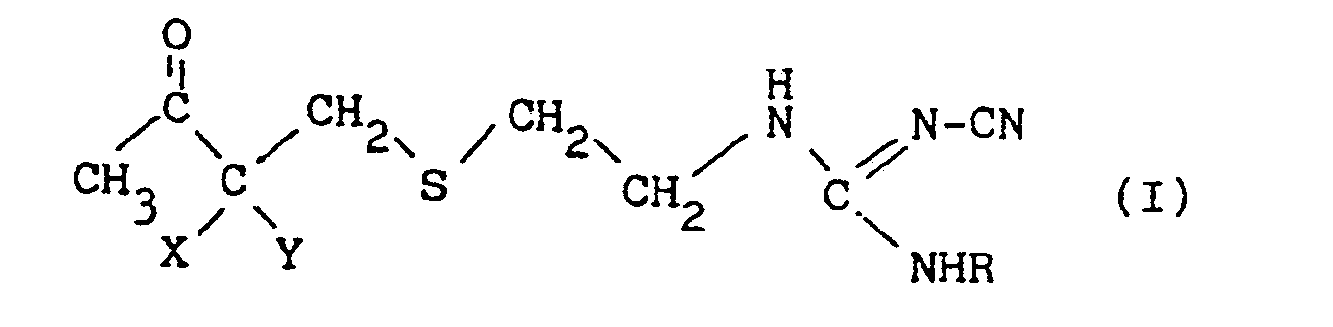
- the novel cyanoguanidine derivative is represented by the following formula (I): wherein Z and Y, which may be the same or different, stand for a chlorine atom or a bromine atom, and R stands for an alkyl group, preferably C1 ⁇ 4 alkyl.
- the cyanoguanidine derivative of the formula (I) according to the present invention can be prepared by reacting a cyanoguanidine derivative represented by the following formula (II): wherein X and R are as defined above, with a halogenating agent.
- the cyanoguanidine derivative (haloketone derivative) of the formula (II), which is used as the starting material in the above reaction, can be prepared, for example, according to the process disclosed in our copending Japanese Patent Application No. 203640/86, which comprises reacting a methylvinylketone represented by the following formula (III): wherein X stands for a hydrogen atom, a chlorine atom or a bromine atom, with a mercaptoguanidine derivative represented by the following formula (IV): wherein R stands for a lower alkyl group, or reacting an amidinoketone derivative represented by the following formula (V): wherein R stands for a lower alkyl group, with a halogenating agent.
- the methylvinylketone derivative of the formula (III) can be easily obtained by dehydrohalogenating a compound represented by the following formula: in the presence of a base.
- the novel cyanoguanidine derivative of the present invention is represented by the above-mentioned general formula (I), and in the general formula (I), X and Y, which may be the same or different, stand for a chlorine atom or a bromine atom, and R stands for a lower alkyl group such as a methyl group, an ethyl group or an n-propyl group.
- the novel cyanoguanidine derivative represented by the general formula (I) is synthesized by halogenating the compound represented by the general formula (II).
- halogenating agent there can be mentioned chlorine, bromine, sodium hypochlorite, calcium hypochlorite (bleaching powder), potassium hypochlorite and t-butyl hypochlorite.
- the halogenation is carried out at -70 to 50°C for 0.1 to 5 hours by using a solvent in an amount of 100 ml to 10l, preferably 1 to 5l, a basic catalyst in an amount of 1 to 100 moles and the halogenating agent in amount of 1 to 100 moles, preferably 1 to 10 moles, per mole of the compound of the formula (II). More preferably, the halogenation is carried out at 0 to 30°C for 0.1 to 2 hours.
- halogenated lower alkyl compounds such as chloroform, methylene chloride and dichloroethane and ethers such as diethyl ether and dioxane.
- ethers such as diethyl ether and dioxane.
- trialkylamines such as triethylamine, trimethylamine and triisopropylamine and pyridines such as pyridine and 4-N,N-dimethylaminopyridine.
- the halogenation is carried out at -20 to 50°C, preferably 0 to 30°C, for 0.1 to 5 hours, preferably 0.1 to 2 hours, by using a solvent in an amount of 100 ml to 10l, preferably 1 to 5l, and the halogenating agent in an amount of 1 to 10 moles, preferably 1 to 3 moles, per mole of the compound of the formula (II).
- the solvent there can be used lower alcohols such as methanol, ethanol, n-propanol and isopropanol, halogenated lower alkyl compounds such as chloroform and methylene chloride, ether solvents such as diethyl ether and dioxane and ester solvents such as ethyl acetate.
- lower alcohols such as methanol, ethanol, n-propanol and isopropanol
- halogenated lower alkyl compounds such as chloroform and methylene chloride
- ether solvents such as diethyl ether and dioxane
- ester solvents such as ethyl acetate.
- the intended compound is isolated by adding water to the reaction mixture, extracting the mixture with an organic solvent such as chloroform or ethyl acetate and subjecting the extract to ordinary refining means such as column chromatography.
- an organic solvent such as chloroform or ethyl acetate
- the cyanoguanidine derivative of the general formula (I) obtained according to the present invention can be easily converted to Cimetidine, for example, by reacting the cyanoguanidine derivative of the formula (I) in ethanol at room temperature in the presence of formalin and aqueous ammonia according to the invention of our copending Japanese Patent Application No. 32327/87 entitled "PROCESS FOR PREPARATION OF IMIDAZOLE DERIVATIVES".
Landscapes
- Chemical & Material Sciences (AREA)
- Organic Chemistry (AREA)
- Organic Low-Molecular-Weight Compounds And Preparation Thereof (AREA)
- Pharmaceuticals Containing Other Organic And Inorganic Compounds (AREA)
Description
- The present invention relates to a precursor for the synthesis of Cimetidine which has an action of controlling secretion of acid in the stomach based on the histamine H₂ receptor antagonism and is valuable as a drug for treating gastric ulcer, and a process for the preparation of this precursor.
- Imidazole derivatives such as 4-hydroxymethyl-5-methylimidazole disclosed in Japanese Patent Application Laid-Open Specification No. 142271/81, 4-(2-aminoethylthio)-5-methylimidazole disclosed in Japanese Patent Application Laid-Open Specification No. 42661/72 and [(4-methyl-5-imidazolyl)methylthioethyl]-S-methylisothiourea are mainly known as the precursor for the synthesis of Cimetidine, and Cimetidine can be derived from these imidazole derivatives. As the precursor that can be converted to Cimetidine by forming an imidazole ring at the final stage, there can be mentioned N-cyano-N′-2-(2,3-diketobutylthio)ethyl-N˝-methylguanidine disclosed in Spanish Patent No. 455,991 [Chemical Abstracts, 89, 146904 I, 1978]. Diacetyl which is the starting material for the synthesis of this precursor has an offensive smell and causes a problem concerning the working environment, and the yield of the precursor is not always high.
- We made investigations with a view to developing a reasonable Cimetidine-preparing process having a reduced number of reaction stages and simplifying operations. As the result, we found a novel cyanoguanidine derivative which is quite different from the above-mentioned compounds disclosed in the literature references. Accordingly, the present invention provides this novel cyanoguanidine derivative and a process for the preparation of this novel cyanoguanidine derivative.
- This cyanoguanidine derivative can be easily converted to Cimetidine, for example, by reacting the cyanoguanidine derivative in ethanol at room temperature in the presence of formalin and aqueous ammonia.
- More specifically, the present invention relates to a novel cyanoguanidine derivative and a process for the preparation thereof. The novel cyanoguanidine derivative is represented by the following formula (I):

wherein Z and Y, which may be the same or different, stand for a chlorine atom or a bromine atom, and R stands for an alkyl group, preferably C₁₋₄ alkyl. - The cyanoguanidine derivative of the formula (I) according to the present invention can be prepared by reacting a cyanoguanidine derivative represented by the following formula (II):

wherein X and R are as defined above, with a halogenating agent. - The cyanoguanidine derivative (haloketone derivative) of the formula (II), which is used as the starting material in the above reaction, can be prepared, for example, according to the process disclosed in our copending Japanese Patent Application No. 203640/86, which comprises reacting a methylvinylketone represented by the following formula (III):

wherein X stands for a hydrogen atom, a chlorine atom or a bromine atom,
with a mercaptoguanidine derivative represented by the following formula (IV):
wherein R stands for a lower alkyl group,
or reacting an amidinoketone derivative represented by the following formula (V):
wherein R stands for a lower alkyl group, with a halogenating agent. - The methylvinylketone derivative of the formula (III) can be easily obtained by dehydrohalogenating a compound represented by the following formula:

- The novel cyanoguanidine derivative of the present invention is represented by the above-mentioned general formula (I), and in the general formula (I), X and Y, which may be the same or different, stand for a chlorine atom or a bromine atom, and R stands for a lower alkyl group such as a methyl group, an ethyl group or an n-propyl group.
- Examples of the compound of the present invention are described below.

- The novel cyanoguanidine derivative represented by the general formula (I) is synthesized by halogenating the compound represented by the general formula (II).
- As the halogenating agent, there can be mentioned chlorine, bromine, sodium hypochlorite, calcium hypochlorite (bleaching powder), potassium hypochlorite and t-butyl hypochlorite.
- In the case where chlorine or bromine is used as the halogenating agent, the halogenation is carried out at -70 to 50°C for 0.1 to 5 hours by using a solvent in an amount of 100 mℓ to 10ℓ, preferably 1 to 5ℓ, a basic catalyst in an amount of 1 to 100 moles and the halogenating agent in amount of 1 to 100 moles, preferably 1 to 10 moles, per mole of the compound of the formula (II). More preferably, the halogenation is carried out at 0 to 30°C for 0.1 to 2 hours. As preferred examples of the solvent used singly, there can be mentioned halogenated lower alkyl compounds such as chloroform, methylene chloride and dichloroethane and ethers such as diethyl ether and dioxane. As the basic catalyst, there can be used trialkylamines such as triethylamine, trimethylamine and triisopropylamine and pyridines such as pyridine and 4-N,N-dimethylaminopyridine.
- In the case where sodium hypochlorite, calcium hypochlorite, potassium hypochlorite or t-butyl hypochlorite is used as the halogenating agent, the halogenation is carried out at -20 to 50°C, preferably 0 to 30°C, for 0.1 to 5 hours, preferably 0.1 to 2 hours, by using a solvent in an amount of 100 mℓ to 10ℓ, preferably 1 to 5ℓ, and the halogenating agent in an amount of 1 to 10 moles, preferably 1 to 3 moles, per mole of the compound of the formula (II). As the solvent, there can be used lower alcohols such as methanol, ethanol, n-propanol and isopropanol, halogenated lower alkyl compounds such as chloroform and methylene chloride, ether solvents such as diethyl ether and dioxane and ester solvents such as ethyl acetate.
- After the reaction, the intended compound is isolated by adding water to the reaction mixture, extracting the mixture with an organic solvent such as chloroform or ethyl acetate and subjecting the extract to ordinary refining means such as column chromatography.
- The cyanoguanidine derivative of the general formula (I) obtained according to the present invention can be easily converted to Cimetidine, for example, by reacting the cyanoguanidine derivative of the formula (I) in ethanol at room temperature in the presence of formalin and aqueous ammonia according to the invention of our copending Japanese Patent Application No. 32327/87 entitled "PROCESS FOR PREPARATION OF IMIDAZOLE DERIVATIVES".
- The present invention will now be described in detail with reference to the following examples and referential examples.
- In 1 mℓ of methylene chloride was dissolved 0.13 g of N-[2-(2-chloro-3-oxobutylthio)]ethyl-N′-cyano-N˝-methylguanidine and 1 mℓ of triethylamine, and a solution of 0.25 g of bromine in 2.5 mℓ of methylene chloride was added dropwise to the above solution while maintaining the temperature at 10 to 20°C. The mixture was stirred at 20°C for 30 minutes, and a saturated aqueous solution of sodium hydrogencarbonate and ethyl acetate were added to the mixture to effect extraction. The organic layer was dried with anhydrous sodium sulfate and concentrated under reduced pressure. The obtained residue was refined by silica gel column chromatography (developing solvent: ethylacetate/ethanol = 10/1) to obtain 82 mg of a colorless oily product (the yield 48%).
-

- (a) 2.61 (3H, s)
- (b) 2.90 (3H, d, J = 6Hz)
- (c) 2.91 (2H, t, J = 7Hz)
- (d) 3.47 (2H, q, J = 7Hz)
- (e) 3.48 (1H, d, J = 14Hz)
- (f) 3.72 (1H, d, J = 14Hz)
- (g) 5.80 (1H, br.t)
- (h) 6.08 (1H, br.q)
- In 1 mℓ of methanol was dissolved 131 mg of N-[2-(2-chloro-3-oxobutylthio)]ethyl-N′-cyano-N˝-methylguanidine, and 0.63 mℓ of an aqueous solution of sodium hypochlorite was added to the solution and reaction was carried out at room temperature for 3 hours. Then, 15 mℓ of ethyl acetate was added to the reaction liquid and the organic layer was recovered. The obtained organic layer was dried with anhydrous sodium sulfate and concentrated under reduced pressure. The obtained residue was refined by silica gel column chromatography (developing solvent: ethylacetate/ethanol = 10/1) to obtain 37 mg of a colorless oily product (the yield was 25%).
-

- (a) 2.56 (3H, s)
- (b) 2.84 (3H, s)
- (c) 2.86 (2H, t, J = 7Hz)
- (d) 3.41 (2H, t, J = 7Hz)
- (e) 3.56 (2H, s)
- In 1 mℓ of methanol was dissolved 131 mg of N-[2-(2-chloro-3-oxobutylthio)]ethyl-N′-cyano-N˝-methylguanidine, and the solution was cooled with water and 55 mg of t-butyl hypochlorite was added to the solution. The mixture was stirred at 0°C for 1 hour and 1 mℓ of water and 15 mℓ of ethyl acetate were added to the reaction mixture. The ethyl acetate layer was recovered, dried with anhydrous sodium sulfate and concentrated under reduced pressure. The obtained residue was refined by silica gel column chromatography (developing solvent: ethyl acetate/ethanol = 10/1) to obtain 24 mg of a colorless oily product (the yield was 16%).
- In 1 mℓ of methanol was dissolved 149 mg of N-cyano-N′-[2-(2,2-dichloro-3-oxobutylthio)]ethyl-N˝-methylguanidine, and 0.5 mℓ of aqueous ammonia (ammonia content = 28%) and 0.06 mℓ of formalin (formaldehyde content = 37%) were added to the solution and the mixture was stirred at room temperature for 20 hours. The solvent was removed from the reaction mixture under reduced pressure, and the obtained residue was refined by silica gel column chromatography (eluting solvent: MeOH/CHCℓ₃ = 1/20 → MeOH/CHCℓ₃ = 1/10) to obtain 36 mg of intended Cimetidine (the yield was 28%).
- In 1 mℓ of methanol was dissolved 171 mg of N- 2-(2-bromo-2-chloro-3-oxobutylthio) ethyl-N′-cyano-N˝-methylguanidine, and the solution was cooled with water and 0.5 mℓ of aqueous ammonia (ammonia content = 28%) and 0.06 mℓ of formalin (formaldehyde content = 37%) were added to the solution. The mixture was stirred at room temperature for 1 hour and the solvent was removed under reduced pressure. The obtained residue was refined by silica gel column chromatography (eluting solvent: MeOH/CHCℓ₃ = 1/20 → MeOH/CHCℓ₃ = 1/10) to obtain 30 mg of intended Cimetidine (the yield was 24%).
Claims (16)


Applications Claiming Priority (2)
| Application Number | Priority Date | Filing Date | Title |
|---|---|---|---|
| JP32329/87 | 1987-02-17 | ||
| JP62032329A JPH0623181B2 (en) | 1987-02-17 | 1987-02-17 | Cyanoguanidine derivative and method for producing the same |
Publications (3)
| Publication Number | Publication Date |
|---|---|
| EP0279643A2 EP0279643A2 (en) | 1988-08-24 |
| EP0279643A3 EP0279643A3 (en) | 1989-05-31 |
| EP0279643B1 true EP0279643B1 (en) | 1991-11-27 |
Family
ID=12355901
Family Applications (1)
| Application Number | Title | Priority Date | Filing Date |
|---|---|---|---|
| EP88301313A Expired - Lifetime EP0279643B1 (en) | 1987-02-17 | 1988-02-17 | Cyanoguanidine derivatives, the preparation thereof and their use for the synthesis of cimetidine |
Country Status (8)
| Country | Link |
|---|---|
| US (1) | US4886912A (en) |
| EP (1) | EP0279643B1 (en) |
| JP (1) | JPH0623181B2 (en) |
| KR (1) | KR950011444B1 (en) |
| CA (1) | CA1286319C (en) |
| DE (1) | DE3866374D1 (en) |
| ES (1) | ES2045101T3 (en) |
| MY (1) | MY103208A (en) |
Families Citing this family (5)
| Publication number | Priority date | Publication date | Assignee | Title |
|---|---|---|---|---|
| JP3085768B2 (en) * | 1992-01-28 | 2000-09-11 | 株式会社東京自働機械製作所 | Folding device for packaging machine |
| US6353005B1 (en) | 1999-03-02 | 2002-03-05 | Sepracor, Inc. | Method and compositions using (+) norcisapride in combination with proton pump inhibitors or H2 receptor antagonist |
| US6362202B1 (en) | 1999-03-02 | 2002-03-26 | Sepracor Inc. | Methods and compositions using (−) norcisapride in combination with proton pump inhibitors or H2 receptor antagonists |
| ITBO20000735A1 (en) * | 2000-12-21 | 2002-06-21 | Gd Spa | MACHINES AND METHOD FOR WRAPPING OF PRODUCTS |
| EP4196793A1 (en) | 2020-08-11 | 2023-06-21 | Université de Strasbourg | H2 blockers targeting liver macrophages for the prevention and treatment of liver disease and cancer |
Family Cites Families (2)
| Publication number | Priority date | Publication date | Assignee | Title |
|---|---|---|---|---|
| US4276421A (en) * | 1978-11-18 | 1981-06-30 | Societe De Recherches Et De Syntheses Organiques S.A. | Cyano-guanidine geometrical isomers |
| IE55946B1 (en) * | 1982-10-08 | 1991-02-27 | Gea Farmaceutisk Fabrik As | Thioethercyanoguanidines and their use as intermediates in producing imidazoles |
-
1987
- 1987-02-17 JP JP62032329A patent/JPH0623181B2/en not_active Expired - Lifetime
-
1988
- 1988-02-15 MY MYPI88000156A patent/MY103208A/en unknown
- 1988-02-16 CA CA000559042A patent/CA1286319C/en not_active Expired - Lifetime
- 1988-02-17 US US07/156,668 patent/US4886912A/en not_active Expired - Fee Related
- 1988-02-17 ES ES88301313T patent/ES2045101T3/en not_active Expired - Lifetime
- 1988-02-17 DE DE8888301313T patent/DE3866374D1/en not_active Expired - Lifetime
- 1988-02-17 EP EP88301313A patent/EP0279643B1/en not_active Expired - Lifetime
- 1988-02-17 KR KR1019880001676A patent/KR950011444B1/en not_active Expired - Fee Related
Also Published As
| Publication number | Publication date |
|---|---|
| MY103208A (en) | 1993-05-29 |
| EP0279643A3 (en) | 1989-05-31 |
| JPS63201165A (en) | 1988-08-19 |
| EP0279643A2 (en) | 1988-08-24 |
| US4886912A (en) | 1989-12-12 |
| DE3866374D1 (en) | 1992-01-09 |
| CA1286319C (en) | 1991-07-16 |
| JPH0623181B2 (en) | 1994-03-30 |
| ES2045101T3 (en) | 1994-01-16 |
| KR880009919A (en) | 1988-10-05 |
| KR950011444B1 (en) | 1995-10-04 |
Similar Documents
| Publication | Publication Date | Title |
|---|---|---|
| US4620008A (en) | Processes for the preparation of omeprazole and intermediates therefore | |
| US4898954A (en) | Process for the preparation of oxiranes | |
| JPH04230260A (en) | Process for producing 2-chloro-5-methylpyridine | |
| US4886912A (en) | Cyanoguanidine derivative and process for preparation thereof | |
| EP0279644B1 (en) | Cyanoguanidine derivative and process for preparation thereof | |
| KR930006198B1 (en) | Novel α-chloroketone derivatives and preparation method thereof | |
| US4560764A (en) | Synthesis of an imidazolyl isothiourea | |
| US6620932B2 (en) | 2-alkoxy-5-methoxypyrimidines or their tautomeric forms and methods for producing the same | |
| CN116217553B (en) | A triazone compound and its preparation method and application | |
| JPH04308578A (en) | 1-(2-(methacryloyloxy)ethyl)-2-alkylimidazole compound | |
| US4520201A (en) | Synthesis of cimetidine and analogs thereof | |
| EP0259140B1 (en) | Cyanoguanidine derivative and process for preparation thereof | |
| EP0276574B1 (en) | Alpha-acyloxyketone derivatives | |
| JP3887893B2 (en) | Process for producing 4- [2- (4- (trifluoromethoxy) phenyl) ethylamino] pyrimidine derivative, production intermediate and process for producing the same | |
| JP3048080B2 (en) | Piperidine derivative, production method thereof and plant growth regulator | |
| KR970001473B1 (en) | Method for preparing pyrazole sulfonyl chloride derivative | |
| JPS63190872A (en) | Production of cyanoguanidine derivative | |
| JPH0379345B2 (en) | ||
| FR2537134A1 (en) | THIAZOLE DERIVATIVES AND PROCESS FOR THEIR SYNTHESIS | |
| JPH0466572A (en) | Production of n-alkylpyrazole derivative | |
| JPH0415233B2 (en) | ||
| SK9722001A3 (en) | 1-(6-methylpyridine-3-yl)-2-[4-(methylsulfonyl)phenyl]ethanone and method for its preparation | |
| JP2002187883A (en) | 6- (1-Fluoroethyl) -5-iodo-4-pyrimidone and process for producing the same | |
| JPH0586948B2 (en) | ||
| IE53383B1 (en) | Chemical process |
Legal Events
| Date | Code | Title | Description |
|---|---|---|---|
| PUAI | Public reference made under article 153(3) epc to a published international application that has entered the european phase |
Free format text: ORIGINAL CODE: 0009012 |
|
| AK | Designated contracting states |
Kind code of ref document: A2 Designated state(s): DE ES FR GB IT NL |
|
| PUAL | Search report despatched |
Free format text: ORIGINAL CODE: 0009013 |
|
| AK | Designated contracting states |
Kind code of ref document: A3 Designated state(s): DE ES FR GB IT NL |
|
| 17P | Request for examination filed |
Effective date: 19890807 |
|
| 17Q | First examination report despatched |
Effective date: 19910218 |
|
| GRAA | (expected) grant |
Free format text: ORIGINAL CODE: 0009210 |
|
| AK | Designated contracting states |
Kind code of ref document: B1 Designated state(s): DE ES FR GB IT NL |
|
| REF | Corresponds to: |
Ref document number: 3866374 Country of ref document: DE Date of ref document: 19920109 |
|
| ITF | It: translation for a ep patent filed | ||
| ET | Fr: translation filed | ||
| PLBE | No opposition filed within time limit |
Free format text: ORIGINAL CODE: 0009261 |
|
| STAA | Information on the status of an ep patent application or granted ep patent |
Free format text: STATUS: NO OPPOSITION FILED WITHIN TIME LIMIT |
|
| 26N | No opposition filed | ||
| REG | Reference to a national code |
Ref country code: ES Ref legal event code: FG2A Ref document number: 2045101 Country of ref document: ES Kind code of ref document: T3 |
|
| PGFP | Annual fee paid to national office [announced via postgrant information from national office to epo] |
Ref country code: GB Payment date: 19970210 Year of fee payment: 10 |
|
| PGFP | Annual fee paid to national office [announced via postgrant information from national office to epo] |
Ref country code: FR Payment date: 19970211 Year of fee payment: 10 |
|
| PGFP | Annual fee paid to national office [announced via postgrant information from national office to epo] |
Ref country code: DE Payment date: 19970221 Year of fee payment: 10 |
|
| PGFP | Annual fee paid to national office [announced via postgrant information from national office to epo] |
Ref country code: NL Payment date: 19970227 Year of fee payment: 10 Ref country code: ES Payment date: 19970227 Year of fee payment: 10 |
|
| PG25 | Lapsed in a contracting state [announced via postgrant information from national office to epo] |
Ref country code: GB Free format text: LAPSE BECAUSE OF NON-PAYMENT OF DUE FEES Effective date: 19980217 |
|
| PG25 | Lapsed in a contracting state [announced via postgrant information from national office to epo] |
Ref country code: ES Free format text: LAPSE BECAUSE OF NON-PAYMENT OF DUE FEES Effective date: 19980218 |
|
| PG25 | Lapsed in a contracting state [announced via postgrant information from national office to epo] |
Ref country code: FR Free format text: THE PATENT HAS BEEN ANNULLED BY A DECISION OF A NATIONAL AUTHORITY Effective date: 19980228 |
|
| PG25 | Lapsed in a contracting state [announced via postgrant information from national office to epo] |
Ref country code: NL Free format text: LAPSE BECAUSE OF NON-PAYMENT OF DUE FEES Effective date: 19980901 |
|
| GBPC | Gb: european patent ceased through non-payment of renewal fee |
Effective date: 19980217 |
|
| NLV4 | Nl: lapsed or anulled due to non-payment of the annual fee |
Effective date: 19980901 |
|
| PG25 | Lapsed in a contracting state [announced via postgrant information from national office to epo] |
Ref country code: DE Free format text: LAPSE BECAUSE OF NON-PAYMENT OF DUE FEES Effective date: 19981103 |
|
| REG | Reference to a national code |
Ref country code: FR Ref legal event code: ST |
|
| REG | Reference to a national code |
Ref country code: ES Ref legal event code: FD2A Effective date: 20000403 |
|
| PG25 | Lapsed in a contracting state [announced via postgrant information from national office to epo] |
Ref country code: IT Free format text: LAPSE BECAUSE OF NON-PAYMENT OF DUE FEES;WARNING: LAPSES OF ITALIAN PATENTS WITH EFFECTIVE DATE BEFORE 2007 MAY HAVE OCCURRED AT ANY TIME BEFORE 2007. THE CORRECT EFFECTIVE DATE MAY BE DIFFERENT FROM THE ONE RECORDED. Effective date: 20050217 |