EP0279560B1 - Method of making a papermaker's felt - Google Patents
Method of making a papermaker's felt Download PDFInfo
- Publication number
- EP0279560B1 EP0279560B1 EP88300912A EP88300912A EP0279560B1 EP 0279560 B1 EP0279560 B1 EP 0279560B1 EP 88300912 A EP88300912 A EP 88300912A EP 88300912 A EP88300912 A EP 88300912A EP 0279560 B1 EP0279560 B1 EP 0279560B1
- Authority
- EP
- European Patent Office
- Prior art keywords
- loops
- batt
- pin
- fabric
- felt
- Prior art date
- Legal status (The legal status is an assumption and is not a legal conclusion. Google has not performed a legal analysis and makes no representation as to the accuracy of the status listed.)
- Expired - Lifetime
Links
- 238000004519 manufacturing process Methods 0.000 title claims abstract 4
- 239000004744 fabric Substances 0.000 claims abstract description 61
- 239000002657 fibrous material Substances 0.000 claims abstract description 6
- 238000000034 method Methods 0.000 claims description 5
- 238000005452 bending Methods 0.000 claims description 4
- 230000001154 acute effect Effects 0.000 claims description 2
- 238000009434 installation Methods 0.000 abstract description 4
- 238000010276 construction Methods 0.000 abstract 1
- 239000000835 fiber Substances 0.000 description 3
- 238000003780 insertion Methods 0.000 description 2
- 230000037431 insertion Effects 0.000 description 2
- 239000000203 mixture Substances 0.000 description 2
- XLYOFNOQVPJJNP-UHFFFAOYSA-N water Substances O XLYOFNOQVPJJNP-UHFFFAOYSA-N 0.000 description 2
- 238000003809 water extraction Methods 0.000 description 2
- 239000000853 adhesive Substances 0.000 description 1
- 238000004026 adhesive bonding Methods 0.000 description 1
- 230000001070 adhesive effect Effects 0.000 description 1
- 239000010410 layer Substances 0.000 description 1
- 239000000463 material Substances 0.000 description 1
- 239000002356 single layer Substances 0.000 description 1
Images
Classifications
-
- D—TEXTILES; PAPER
- D21—PAPER-MAKING; PRODUCTION OF CELLULOSE
- D21F—PAPER-MAKING MACHINES; METHODS OF PRODUCING PAPER THEREON
- D21F7/00—Other details of machines for making continuous webs of paper
- D21F7/08—Felts
- D21F7/10—Seams thereof
-
- D—TEXTILES; PAPER
- D21—PAPER-MAKING; PRODUCTION OF CELLULOSE
- D21F—PAPER-MAKING MACHINES; METHODS OF PRODUCING PAPER THEREON
- D21F7/00—Other details of machines for making continuous webs of paper
- D21F7/08—Felts
- D21F7/083—Multi-layer felts
-
- Y—GENERAL TAGGING OF NEW TECHNOLOGICAL DEVELOPMENTS; GENERAL TAGGING OF CROSS-SECTIONAL TECHNOLOGIES SPANNING OVER SEVERAL SECTIONS OF THE IPC; TECHNICAL SUBJECTS COVERED BY FORMER USPC CROSS-REFERENCE ART COLLECTIONS [XRACs] AND DIGESTS
- Y10—TECHNICAL SUBJECTS COVERED BY FORMER USPC
- Y10S—TECHNICAL SUBJECTS COVERED BY FORMER USPC CROSS-REFERENCE ART COLLECTIONS [XRACs] AND DIGESTS
- Y10S162/00—Paper making and fiber liberation
- Y10S162/90—Papermaking press felts
-
- Y—GENERAL TAGGING OF NEW TECHNOLOGICAL DEVELOPMENTS; GENERAL TAGGING OF CROSS-SECTIONAL TECHNOLOGIES SPANNING OVER SEVERAL SECTIONS OF THE IPC; TECHNICAL SUBJECTS COVERED BY FORMER USPC CROSS-REFERENCE ART COLLECTIONS [XRACs] AND DIGESTS
- Y10—TECHNICAL SUBJECTS COVERED BY FORMER USPC
- Y10S—TECHNICAL SUBJECTS COVERED BY FORMER USPC CROSS-REFERENCE ART COLLECTIONS [XRACs] AND DIGESTS
- Y10S162/00—Paper making and fiber liberation
- Y10S162/904—Paper making and fiber liberation with specified seam structure of papermaking belt
Definitions
- Pin seam fabrics for use on papermaking machines are composed of a woven base and the ends of the base are provided with interdigitated loops that are connected by a removable pin or pintle.
- the base fabric can either be woven in endless form, as disclosed in U.S. Patent 3,815,645, or alternately can be woven in flat form, in which case loops are attached to the free ends of the fabric, in a manner such as disclosed in U.S. Patents No. 4,123,022 and 4,401,137.
- a pin seam fabric has distinct advantages in that it can readily be installed and removed from the papermaking machine by insertion and removal of the pin from the interdigitated loops at the ends of the fabric.
- pin seam fabrics have not been successfully employed as papermaker felts in the press section of the papermaking machine. It is essential that a felt have uniform water drainage characteristics and density throughout its length in order to obtain uniform water extraction from the paper web, as well as to prevent marring or marking of the paper.
- the density adjacent the ends is normally greater, due to the interweaving of the loops, than the density of the remainder of the fabric. If used as a felt, this variation in density can produce non-uniform water extraction characteristics, and the added fibers in the area of the pin seam joint can cause marring or non-uniform texture for the paper web.
- a papermaker's felt with an outer batt of fibrous material which is needled to the base fabric.
- the batt serves to engage and protect the paper sheet as it passes through the nip, while the base fabric is designed to receive extracted water from the paper sheet and carry it away from the press nip.
- the batt is attached to the base fabric on a needling machine, in which the base fabric, in endless form, is advanced through the needling area.
- a needled batt is not normally used with a pin seam base fabric, because the batt, through needling, would be intertwined with the pin seam joint and would prevent the joint from being opened so that the fabric could be installed on the papermaking machine.
- U.S. Patent 4,601,785 discloses a pin seam base fabric having a needled batt which can be used as a felt in the press section of a papermaking machine.
- the base fabric is produced in flat form and loops are provided in the ends to provide a pin seam fabric.
- a batt is then needled into at least one surface of the fabric and after needling, the batt is cut at a location offset from the pin seam joint and the portion of the batt extending across the joint is loosened from the base fabric to provide a flap.
- the pin is removed from the pin seam joint, and after installation of the felt on the papermaking machine, the pin is reinserted into the interdigitated loops.
- the loose flap of the batt is then reattached to the base fabric either by needling or adhesives.
- the invention is directed to an improved papermaker's felt incorporating a pin seam base fabric having a fibrous batt needled into a face of the fabric.
- a pin seam fabric having interdigitated loops at the ends of the fabric joined by a pin is initially produced either in flat or endless form.
- a batt of fibrous material is then needled into a face of the fabric and across the pin seam joint.
- the pin is removed and the felt is bent back on itself at the joint to bring the portions of the batt located on either side of the joint into contiguous relation. This bending action causes the loops to separate and the batt is then cut along a line extending through the separated loops to provide a flat or opened felt.
- the felt can then be installed in the press section of the papermaking machine and the pin reinserted through the interdigitated loops. On reinsertion of the pin, the cut ends of the batt fall into abutting relation to provide a uniform density for the felt at the area of the pin seam.
- the method of the invention enables the batt to be cut at the pin seam joint without the danger of inadvertantly cutting or severing the base fabric. Further, it is not necessary to loosen any portion of the batt from the base fabric and thus stuffers are not required in the area of the pin seam joint to provide a uniform density for the felt in this area.
- the drawings illustrate a papermaker's felt including a woven base fabric 1 formed of machine direction yarns 2 and cross yarns 3.
- the machine direction yarns 2 and cross yarns 3 can be formed of monofilaments or staple yarns and consist of synthetic or natural fibers, or mixtures thereof.
- Base fabric 1 can be woven either in flat form and interweaving separate loops with the cross direction yarns adjacent the ends of the fabric, or alternately, the base can be woven in endless form, in which the loops are integrally formed with the fabric.
- While the drawings show a base fabric formed of a single layer of machine direction and cross direction yarns, it is contemplated that the base fabric may also be composed of multiple layer fabric.
- a batt of fibrous material 6 is needled into a face of the base fabric 1 in a conventional needling operation and the needling of the batt extends across the pin seam joint.
- the batt may be composed of synthetic or natural fibers or a mixture thereof.
- Batt 6 is then cut along a line through the separated loops as indicated by the blade or cutting member 7 in Fig. 2.
- the cut is preferably made at a slight acute angle to a plane extending through the contiguous portions of the batt Cutting of the batt enables the felt to be opened into flat form and installed in the press section of the papermaking machine.
- loops 4 on the ends of the felt are brought into interdigitating relation and pin 5 is reinserted through the loops, as shown in Fig. 3.
- the cut ends of the batt as indicated by 8 in Fig. 3, will automatically be brought into abutting contiguous relation to provide a uniform outer layer across the pin seam joint.
- the batt is cut along a line through the separated loops 4, as shown in Fig. 2, so that there is no likelihood of the base fabric being cut or severed as the batt is cut.
- it is not necessary to loosen a flap of the batt from the base material and correspondingly it is not necessary to reattach a loosened flap to the base fabric after the felt is installed on the papermaking machine. This substantially reduces the overall time and labor of installation on the papermaking machine.
Landscapes
- Paper (AREA)
- Cleaning Implements For Floors, Carpets, Furniture, Walls, And The Like (AREA)
Abstract
Description
- Pin seam fabrics for use on papermaking machines are composed of a woven base and the ends of the base are provided with interdigitated loops that are connected by a removable pin or pintle. The base fabric can either be woven in endless form, as disclosed in U.S. Patent 3,815,645, or alternately can be woven in flat form, in which case loops are attached to the free ends of the fabric, in a manner such as disclosed in U.S. Patents No. 4,123,022 and 4,401,137.
- A pin seam fabric has distinct advantages in that it can readily be installed and removed from the papermaking machine by insertion and removal of the pin from the interdigitated loops at the ends of the fabric. However, in the past, pin seam fabrics have not been successfully employed as papermaker felts in the press section of the papermaking machine. It is essential that a felt have uniform water drainage characteristics and density throughout its length in order to obtain uniform water extraction from the paper web, as well as to prevent marring or marking of the paper. As pin seam fabrics have generally been produced in flat form with loops subsequently attached or interwoven into the free ends, the density adjacent the ends is normally greater, due to the interweaving of the loops, than the density of the remainder of the fabric. If used as a felt, this variation in density can produce non-uniform water extraction characteristics, and the added fibers in the area of the pin seam joint can cause marring or non-uniform texture for the paper web.
- It is also recognized that it is desirable to construct a papermaker's felt with an outer batt of fibrous material which is needled to the base fabric. The batt serves to engage and protect the paper sheet as it passes through the nip, while the base fabric is designed to receive extracted water from the paper sheet and carry it away from the press nip. The batt is attached to the base fabric on a needling machine, in which the base fabric, in endless form, is advanced through the needling area. However, a needled batt is not normally used with a pin seam base fabric, because the batt, through needling, would be intertwined with the pin seam joint and would prevent the joint from being opened so that the fabric could be installed on the papermaking machine.
- U.S. Patent 4,601,785 discloses a pin seam base fabric having a needled batt which can be used as a felt in the press section of a papermaking machine. According to the aforementioned patent, the base fabric is produced in flat form and loops are provided in the ends to provide a pin seam fabric. A batt is then needled into at least one surface of the fabric and after needling, the batt is cut at a location offset from the pin seam joint and the portion of the batt extending across the joint is loosened from the base fabric to provide a flap. The pin is removed from the pin seam joint, and after installation of the felt on the papermaking machine, the pin is reinserted into the interdigitated loops. The loose flap of the batt is then reattached to the base fabric either by needling or adhesives.
- While U.S. Patent 4,601,785 describes a manner in which a needled pin seam base fabric can be utilized as a felt in the press section of a papermaking machine, in actual practice, after the batt is loosened, cross direction stuffers or yarns are required to be inserted beneath the flap and behind the loops to fill the gap resulting from the loosening of the batt flap from the base fabric. In addition, when installed on the papermaking machine, it is necessary that the loose flap of the batt be needled, glued, or otherwise reaffixed to the base fabric. The insertion of stuffers along with the reattachment of the flap requires a substantial amount of manual labor.
- The invention is directed to an improved papermaker's felt incorporating a pin seam base fabric having a fibrous batt needled into a face of the fabric. In accordance with the invention, a pin seam fabric having interdigitated loops at the ends of the fabric joined by a pin is initially produced either in flat or endless form. A batt of fibrous material is then needled into a face of the fabric and across the pin seam joint. After needling, the pin is removed and the felt is bent back on itself at the joint to bring the portions of the batt located on either side of the joint into contiguous relation. This bending action causes the loops to separate and the batt is then cut along a line extending through the separated loops to provide a flat or opened felt.
- The felt can then be installed in the press section of the papermaking machine and the pin reinserted through the interdigitated loops. On reinsertion of the pin, the cut ends of the batt fall into abutting relation to provide a uniform density for the felt at the area of the pin seam.
- The method of the invention enables the batt to be cut at the pin seam joint without the danger of inadvertantly cutting or severing the base fabric. Further, it is not necessary to loosen any portion of the batt from the base fabric and thus stuffers are not required in the area of the pin seam joint to provide a uniform density for the felt in this area.
- As the batt is not loosened from the base fabric it is not necessary to reattach the loosened batt to the fabric by needling or gluing as as been required in past practice.
- Other objects and advantages will appear in the course of the following description.
- The drawings illustrate the best mode presently contemplated of carrying out the invention.
- In the drawings:
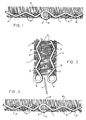
- Fig. 1 is a diagrammatic cross section of the papermaker's felt according to one example of the invention,
- Fig. 2 is a view similar to Fig. 1 showing the felt bent back on itself after removal of the pin from the joint;
- Fig. 3 is a view similar to Fig. 1 showing the felt as assembled on the papermaking machine.
- The drawings illustrate a papermaker's felt including a woven base fabric 1 formed of
machine direction yarns 2 andcross yarns 3. The machine direction yarns 2 andcross yarns 3 can be formed of monofilaments or staple yarns and consist of synthetic or natural fibers, or mixtures thereof. - The ends of the base fabric 1 are provided with a plurality of interdigitated
loops 4 which are connected by a pin orpintle 5. Base fabric 1 can be woven either in flat form and interweaving separate loops with the cross direction yarns adjacent the ends of the fabric, or alternately, the base can be woven in endless form, in which the loops are integrally formed with the fabric. - While the drawings show a base fabric formed of a single layer of machine direction and cross direction yarns, it is contemplated that the base fabric may also be composed of multiple layer fabric.
- A batt of fibrous material 6 is needled into a face of the base fabric 1 in a conventional needling operation and the needling of the batt extends across the pin seam joint. The batt may be composed of synthetic or natural fibers or a mixture thereof.
- After the entire length of the base fabric 1 has been needled on the needling machine,
pin 5 is removed from theloops 4 and because of the needled batt 6, the felt will remain in endless form even thoughpin 5 has been removed. The felt is then bent back against itself at the pin seam joint, as shown in Fig. 2 to bring the portions of the batt 6 located adjacent the joint into contiguous relation. This bending action will cause theloops 4 on the ends of the fabric to separate, as shown in Fig. 2. - Batt 6 is then cut along a line through the separated loops as indicated by the blade or cutting member 7 in Fig. 2. The cut is preferably made at a slight acute angle to a plane extending through the contiguous portions of the batt Cutting of the batt enables the felt to be opened into flat form and installed in the press section of the papermaking machine. On installation in the press section,
loops 4 on the ends of the felt are brought into interdigitating relation andpin 5 is reinserted through the loops, as shown in Fig. 3. As the batt 6 is not loosened from the base fabric 1, the cut ends of the batt, as indicated by 8 in Fig. 3, will automatically be brought into abutting contiguous relation to provide a uniform outer layer across the pin seam joint. - With the method of the invention, the batt is cut along a line through the
separated loops 4, as shown in Fig. 2, so that there is no likelihood of the base fabric being cut or severed as the batt is cut. As a further advantage, it is not necessary to loosen a flap of the batt from the base material and correspondingly it is not necessary to reattach a loosened flap to the base fabric after the felt is installed on the papermaking machine. This substantially reduces the overall time and labor of installation on the papermaking machine. - As the batt is not separated or loosened from the base fabric in the area of the pin seam joint, there is no tendency for cross direction yarns to be pulled from the base fabric and thus there is no need to apply additional stuffers to the fabric adjacent the pin seam joint before reattaching the batt.
Claims (5)
Priority Applications (1)
| Application Number | Priority Date | Filing Date | Title |
|---|---|---|---|
| AT88300912T ATE64421T1 (en) | 1987-02-20 | 1988-02-03 | PROCESS FOR MAKING A PAPERMAKER FELT. |
Applications Claiming Priority (2)
| Application Number | Priority Date | Filing Date | Title |
|---|---|---|---|
| US17227 | 1987-02-20 | ||
| US07/017,227 US4737241A (en) | 1987-02-20 | 1987-02-20 | Method of making a papermaker's felt |
Publications (3)
| Publication Number | Publication Date |
|---|---|
| EP0279560A2 EP0279560A2 (en) | 1988-08-24 |
| EP0279560A3 EP0279560A3 (en) | 1988-10-05 |
| EP0279560B1 true EP0279560B1 (en) | 1991-06-12 |
Family
ID=21781435
Family Applications (1)
| Application Number | Title | Priority Date | Filing Date |
|---|---|---|---|
| EP88300912A Expired - Lifetime EP0279560B1 (en) | 1987-02-20 | 1988-02-03 | Method of making a papermaker's felt |
Country Status (6)
| Country | Link |
|---|---|
| US (1) | US4737241A (en) |
| EP (1) | EP0279560B1 (en) |
| AT (1) | ATE64421T1 (en) |
| CA (1) | CA1306348C (en) |
| DE (1) | DE3863196D1 (en) |
| FI (1) | FI92740C (en) |
Families Citing this family (26)
| Publication number | Priority date | Publication date | Assignee | Title |
|---|---|---|---|---|
| US4902383A (en) * | 1988-04-05 | 1990-02-20 | Asten Group, Inc. | Method of making a papermaker's felt with no flap seam |
| US5015220A (en) * | 1988-08-03 | 1991-05-14 | Tamfelt, Inc. | Seam for work fabric and method of manufacture thereof |
| US4913947A (en) * | 1989-02-01 | 1990-04-03 | The Orr Felt Company | Seam for papermaker's felt |
| US4938269A (en) * | 1989-02-01 | 1990-07-03 | The Orr Felt Company | Papermaker's felt seam with different loops |
| US4939025A (en) * | 1989-02-01 | 1990-07-03 | The Orr Felt Company | Papermaker's felt with flex joint seam for pin |
| US5031283A (en) * | 1990-02-14 | 1991-07-16 | Niagara Lockport Industries Inc. | Multifilament helical seaming element |
| US5343896A (en) * | 1990-06-06 | 1994-09-06 | Asten Group, Inc. | Papermakers fabric having stacked machine direction yarns |
| US5411062A (en) * | 1990-06-06 | 1995-05-02 | Asten Group, Inc. | Papermakers fabric with orthogonal machine direction yarn seaming loops |
| USRE35966E (en) * | 1990-06-06 | 1998-11-24 | Asten, Inc. | Papermakers fabric with orthogonal machine direction yarn seaming loops |
| US5199467A (en) * | 1990-06-06 | 1993-04-06 | Asten Group, Inc. | Papermakers fabric with stacked machine direction yarns |
| US5230371A (en) * | 1990-06-06 | 1993-07-27 | Asten Group, Inc. | Papermakers fabric having diverse flat machine direction yarn surfaces |
| US5713396A (en) * | 1990-06-06 | 1998-02-03 | Asten, Inc. | Papermakers fabric with stacked machine and cross machine direction yarns |
| US5148838A (en) * | 1990-06-06 | 1992-09-22 | Asten Group, Inc. | Papermakers fabric with orthogonal machine direction yarn seaming loops |
| US5089324A (en) * | 1990-09-18 | 1992-02-18 | Jwi Ltd. | Press section dewatering fabric |
| CA2083211C (en) * | 1992-11-09 | 1996-07-09 | Robert W. Legge | Papermaker felt |
| NZ272169A (en) * | 1994-06-09 | 1997-06-24 | Albany Int Corp | Transfer belt for papermaking machine: seam construction: pintles passed through seaming loops |
| EP0747529A3 (en) * | 1995-06-06 | 1998-05-13 | Appleton Mills | Papermaking felt and method of making it, substrate, and method of making paper |
| US5731063A (en) * | 1995-06-06 | 1998-03-24 | Appleton Mills | Papermaking felt and substrate |
| US5571590A (en) * | 1995-06-06 | 1996-11-05 | Appleton Mills | Methods of making papermaking felt and substrate |
| US20060068665A1 (en) * | 2004-09-29 | 2006-03-30 | Heinz Pernegger | Seamed felt for forming fiber cement articles and related methods |
| US20130008552A1 (en) | 2011-07-06 | 2013-01-10 | Hans Peter Breuer | Felt for forming fiber cement articles and related methods |
| US9005399B2 (en) | 2013-01-10 | 2015-04-14 | Huyck Licensco, Inc. | Pin seamed press felt with triple layer base fabric |
| US20150308045A1 (en) | 2014-04-25 | 2015-10-29 | Huyck Licensco, Inc. | Seamed papermaker's press felt with reinforced batt layer |
| CA3058201C (en) | 2017-05-31 | 2022-08-16 | Huyck Licensco Inc. | Pin seamed press felt and method of making same |
| US11098450B2 (en) | 2017-10-27 | 2021-08-24 | Albany International Corp. | Methods for making improved cellulosic products using novel press felts and products made therefrom |
| DE102021128660A1 (en) * | 2021-11-04 | 2023-05-04 | Voith Patent Gmbh | Stringing and Procedure |
Family Cites Families (6)
| Publication number | Priority date | Publication date | Assignee | Title |
|---|---|---|---|---|
| SE355389B (en) * | 1970-12-31 | 1973-04-16 | Nordiska Maskinfilt Ab | |
| GB1529728A (en) * | 1975-11-27 | 1978-10-25 | Jwi Ltd | Woven seam in fabric and method of making same |
| US4123022A (en) * | 1977-09-12 | 1978-10-31 | Albany International Corp. | Seam for forming wires and dryer felts |
| AU527809B2 (en) * | 1978-11-30 | 1983-03-24 | Albany International Corp. | Forming fabric seam and method of producing |
| JPS57176295A (en) * | 1981-04-23 | 1982-10-29 | Ichikawa Woolen Textile | Papermaking needle felt and method |
| SE429982C (en) * | 1982-11-02 | 1985-11-18 | Nordiskafilt Ab | FILLED WITH ALSO FOR THE PRESS PARTY IN A PAPER MACHINE AND THE PROCEDURE FOR ITS MANUFACTURING |
-
1987
- 1987-02-20 US US07/017,227 patent/US4737241A/en not_active Expired - Fee Related
-
1988
- 1988-02-03 AT AT88300912T patent/ATE64421T1/en not_active IP Right Cessation
- 1988-02-03 DE DE8888300912T patent/DE3863196D1/en not_active Expired - Fee Related
- 1988-02-03 FI FI880499A patent/FI92740C/en not_active IP Right Cessation
- 1988-02-03 EP EP88300912A patent/EP0279560B1/en not_active Expired - Lifetime
- 1988-02-17 CA CA000559113A patent/CA1306348C/en not_active Expired - Fee Related
Also Published As
| Publication number | Publication date |
|---|---|
| DE3863196D1 (en) | 1991-07-18 |
| FI92740B (en) | 1994-09-15 |
| FI92740C (en) | 1994-12-27 |
| ATE64421T1 (en) | 1991-06-15 |
| CA1306348C (en) | 1992-08-18 |
| FI880499A7 (en) | 1988-08-21 |
| EP0279560A3 (en) | 1988-10-05 |
| FI880499A0 (en) | 1988-02-03 |
| EP0279560A2 (en) | 1988-08-24 |
| US4737241A (en) | 1988-04-12 |
Similar Documents
| Publication | Publication Date | Title |
|---|---|---|
| US4737241A (en) | Method of making a papermaker's felt | |
| EP0294951B1 (en) | Pin seamed papermakers felt having a reinforced batt flap | |
| KR100533868B1 (en) | A multilayer papermaker's press felt fabric | |
| US4565735A (en) | Papermakers' felt | |
| US5082532A (en) | Papermaking machine and a seamed papermaker's fabric | |
| ZA9810582B (en) | Warp loop seam | |
| ATE33155T1 (en) | FELTS WITH LOCKING SEAM FOR USE IN THE PRESS SECTION OF PAPER MACHINES AND PROCESS FOR THEIR MANUFACTURE. | |
| CA1303833C (en) | Process to manufacture a felt with a flap and a felt produced thereby | |
| US4755260A (en) | Method for producing felt for paper making | |
| NZ332189A (en) | Multi-axial press fabric, for the press section of a paper machine, comprising fibre batt material needled into one of the plies and through the second base fabric | |
| USRE39709E1 (en) | Multiaxial pin seamed papermaker's press felt | |
| US5466339A (en) | Method of making and using a paper maker felt | |
| FI85396C (en) | SKYDDSFLIK FOER SKARVEN VID NAOLADE FILTAR FOER INDUSTRIELLT BRUK. | |
| AU605243B2 (en) | Method of making a papermaker's felt | |
| US4758309A (en) | Device for mounting fabrics in papermaking machines | |
| US4958673A (en) | Papermaking machine and a seamed papermaker's fabric | |
| EP0182597B1 (en) | Pin seamed fabric | |
| EP0341041A2 (en) | Single layer pin seam fabric having perpendicular seaming loops and method | |
| US4913947A (en) | Seam for papermaker's felt | |
| CA1319289C (en) | Single layer pin seam fabric having perpendicular seaming loops and method | |
| CA1286135C (en) | Method for seaming a papermaker's fabric |
Legal Events
| Date | Code | Title | Description |
|---|---|---|---|
| PUAI | Public reference made under article 153(3) epc to a published international application that has entered the european phase |
Free format text: ORIGINAL CODE: 0009012 |
|
| PUAL | Search report despatched |
Free format text: ORIGINAL CODE: 0009013 |
|
| AK | Designated contracting states |
Kind code of ref document: A2 Designated state(s): AT CH DE FR GB IT LI NL SE |
|
| AK | Designated contracting states |
Kind code of ref document: A3 Designated state(s): AT CH DE FR GB IT LI NL SE |
|
| 17P | Request for examination filed |
Effective date: 19890321 |
|
| 17Q | First examination report despatched |
Effective date: 19900926 |
|
| GRAA | (expected) grant |
Free format text: ORIGINAL CODE: 0009210 |
|
| AK | Designated contracting states |
Kind code of ref document: B1 Designated state(s): AT CH DE FR GB IT LI NL SE |
|
| REF | Corresponds to: |
Ref document number: 64421 Country of ref document: AT Date of ref document: 19910615 Kind code of ref document: T |
|
| ITF | It: translation for a ep patent filed | ||
| REF | Corresponds to: |
Ref document number: 3863196 Country of ref document: DE Date of ref document: 19910718 |
|
| ET | Fr: translation filed | ||
| PGFP | Annual fee paid to national office [announced via postgrant information from national office to epo] |
Ref country code: NL Payment date: 19920229 Year of fee payment: 5 |
|
| PLBE | No opposition filed within time limit |
Free format text: ORIGINAL CODE: 0009261 |
|
| STAA | Information on the status of an ep patent application or granted ep patent |
Free format text: STATUS: NO OPPOSITION FILED WITHIN TIME LIMIT |
|
| 26N | No opposition filed | ||
| PG25 | Lapsed in a contracting state [announced via postgrant information from national office to epo] |
Ref country code: NL Effective date: 19930901 |
|
| NLV4 | Nl: lapsed or anulled due to non-payment of the annual fee | ||
| EAL | Se: european patent in force in sweden |
Ref document number: 88300912.8 |
|
| PGFP | Annual fee paid to national office [announced via postgrant information from national office to epo] |
Ref country code: FR Payment date: 19980112 Year of fee payment: 11 |
|
| PGFP | Annual fee paid to national office [announced via postgrant information from national office to epo] |
Ref country code: AT Payment date: 19980115 Year of fee payment: 11 |
|
| PGFP | Annual fee paid to national office [announced via postgrant information from national office to epo] |
Ref country code: SE Payment date: 19980116 Year of fee payment: 11 |
|
| PGFP | Annual fee paid to national office [announced via postgrant information from national office to epo] |
Ref country code: GB Payment date: 19980121 Year of fee payment: 11 |
|
| PGFP | Annual fee paid to national office [announced via postgrant information from national office to epo] |
Ref country code: DE Payment date: 19980126 Year of fee payment: 11 |
|
| PGFP | Annual fee paid to national office [announced via postgrant information from national office to epo] |
Ref country code: CH Payment date: 19980127 Year of fee payment: 11 |
|
| PG25 | Lapsed in a contracting state [announced via postgrant information from national office to epo] |
Ref country code: GB Free format text: LAPSE BECAUSE OF NON-PAYMENT OF DUE FEES Effective date: 19990203 Ref country code: AT Free format text: LAPSE BECAUSE OF NON-PAYMENT OF DUE FEES Effective date: 19990203 |
|
| PG25 | Lapsed in a contracting state [announced via postgrant information from national office to epo] |
Ref country code: SE Free format text: LAPSE BECAUSE OF NON-PAYMENT OF DUE FEES Effective date: 19990204 |
|
| PG25 | Lapsed in a contracting state [announced via postgrant information from national office to epo] |
Ref country code: LI Free format text: LAPSE BECAUSE OF NON-PAYMENT OF DUE FEES Effective date: 19990228 Ref country code: CH Free format text: LAPSE BECAUSE OF NON-PAYMENT OF DUE FEES Effective date: 19990228 |
|
| GBPC | Gb: european patent ceased through non-payment of renewal fee |
Effective date: 19990203 |
|
| REG | Reference to a national code |
Ref country code: CH Ref legal event code: PL |
|
| PG25 | Lapsed in a contracting state [announced via postgrant information from national office to epo] |
Ref country code: FR Free format text: LAPSE BECAUSE OF NON-PAYMENT OF DUE FEES Effective date: 19991029 |
|
| EUG | Se: european patent has lapsed |
Ref document number: 88300912.8 |
|
| PG25 | Lapsed in a contracting state [announced via postgrant information from national office to epo] |
Ref country code: DE Free format text: LAPSE BECAUSE OF NON-PAYMENT OF DUE FEES Effective date: 19991201 |
|
| REG | Reference to a national code |
Ref country code: FR Ref legal event code: ST |
|
| PG25 | Lapsed in a contracting state [announced via postgrant information from national office to epo] |
Ref country code: IT Free format text: LAPSE BECAUSE OF NON-PAYMENT OF DUE FEES;WARNING: LAPSES OF ITALIAN PATENTS WITH EFFECTIVE DATE BEFORE 2007 MAY HAVE OCCURRED AT ANY TIME BEFORE 2007. THE CORRECT EFFECTIVE DATE MAY BE DIFFERENT FROM THE ONE RECORDED. Effective date: 20050203 |