EP0279376B1 - Process for producing polyurea resin - Google Patents
Process for producing polyurea resin Download PDFInfo
- Publication number
- EP0279376B1 EP0279376B1 EP88102085A EP88102085A EP0279376B1 EP 0279376 B1 EP0279376 B1 EP 0279376B1 EP 88102085 A EP88102085 A EP 88102085A EP 88102085 A EP88102085 A EP 88102085A EP 0279376 B1 EP0279376 B1 EP 0279376B1
- Authority
- EP
- European Patent Office
- Prior art keywords
- diisocyanate
- bis
- aromatic
- polyurea resin
- group
- Prior art date
- Legal status (The legal status is an assumption and is not a legal conclusion. Google has not performed a legal analysis and makes no representation as to the accuracy of the status listed.)
- Expired - Lifetime
Links
- 0 C*C(C)N(C)C(C(C=C1)=CCC1N)=O Chemical compound C*C(C)N(C)C(C(C=C1)=CCC1N)=O 0.000 description 2
Classifications
-
- C—CHEMISTRY; METALLURGY
- C08—ORGANIC MACROMOLECULAR COMPOUNDS; THEIR PREPARATION OR CHEMICAL WORKING-UP; COMPOSITIONS BASED THEREON
- C08G—MACROMOLECULAR COMPOUNDS OBTAINED OTHERWISE THAN BY REACTIONS ONLY INVOLVING UNSATURATED CARBON-TO-CARBON BONDS
- C08G71/00—Macromolecular compounds obtained by reactions forming a ureide or urethane link, otherwise, than from isocyanate radicals in the main chain of the macromolecule
- C08G71/02—Polyureas
-
- C—CHEMISTRY; METALLURGY
- C08—ORGANIC MACROMOLECULAR COMPOUNDS; THEIR PREPARATION OR CHEMICAL WORKING-UP; COMPOSITIONS BASED THEREON
- C08G—MACROMOLECULAR COMPOUNDS OBTAINED OTHERWISE THAN BY REACTIONS ONLY INVOLVING UNSATURATED CARBON-TO-CARBON BONDS
- C08G18/00—Polymeric products of isocyanates or isothiocyanates
- C08G18/06—Polymeric products of isocyanates or isothiocyanates with compounds having active hydrogen
- C08G18/28—Polymeric products of isocyanates or isothiocyanates with compounds having active hydrogen characterised by the compounds used containing active hydrogen
- C08G18/65—Low-molecular-weight compounds having active hydrogen with high-molecular-weight compounds having active hydrogen
- C08G18/66—Compounds of groups C08G18/42, C08G18/48, or C08G18/52
- C08G18/6666—Compounds of group C08G18/48 or C08G18/52
- C08G18/667—Compounds of group C08G18/48 or C08G18/52 with compounds of group C08G18/32 or polyamines of C08G18/38
- C08G18/6681—Compounds of group C08G18/48 or C08G18/52 with compounds of group C08G18/32 or polyamines of C08G18/38 with compounds of group C08G18/32 or C08G18/3271 and/or polyamines of C08G18/38
- C08G18/6685—Compounds of group C08G18/48 or C08G18/52 with compounds of group C08G18/32 or polyamines of C08G18/38 with compounds of group C08G18/32 or C08G18/3271 and/or polyamines of C08G18/38 with compounds of group C08G18/3225 or polyamines of C08G18/38
-
- C—CHEMISTRY; METALLURGY
- C08—ORGANIC MACROMOLECULAR COMPOUNDS; THEIR PREPARATION OR CHEMICAL WORKING-UP; COMPOSITIONS BASED THEREON
- C08G—MACROMOLECULAR COMPOUNDS OBTAINED OTHERWISE THAN BY REACTIONS ONLY INVOLVING UNSATURATED CARBON-TO-CARBON BONDS
- C08G18/00—Polymeric products of isocyanates or isothiocyanates
- C08G18/06—Polymeric products of isocyanates or isothiocyanates with compounds having active hydrogen
- C08G18/28—Polymeric products of isocyanates or isothiocyanates with compounds having active hydrogen characterised by the compounds used containing active hydrogen
- C08G18/30—Low-molecular-weight compounds
- C08G18/32—Polyhydroxy compounds; Polyamines; Hydroxyamines
- C08G18/3225—Polyamines
- C08G18/3237—Polyamines aromatic
- C08G18/3243—Polyamines aromatic containing two or more aromatic rings
-
- C—CHEMISTRY; METALLURGY
- C08—ORGANIC MACROMOLECULAR COMPOUNDS; THEIR PREPARATION OR CHEMICAL WORKING-UP; COMPOSITIONS BASED THEREON
- C08G—MACROMOLECULAR COMPOUNDS OBTAINED OTHERWISE THAN BY REACTIONS ONLY INVOLVING UNSATURATED CARBON-TO-CARBON BONDS
- C08G18/00—Polymeric products of isocyanates or isothiocyanates
- C08G18/06—Polymeric products of isocyanates or isothiocyanates with compounds having active hydrogen
- C08G18/28—Polymeric products of isocyanates or isothiocyanates with compounds having active hydrogen characterised by the compounds used containing active hydrogen
- C08G18/30—Low-molecular-weight compounds
- C08G18/38—Low-molecular-weight compounds having heteroatoms other than oxygen
- C08G18/3819—Low-molecular-weight compounds having heteroatoms other than oxygen having nitrogen
- C08G18/3823—Low-molecular-weight compounds having heteroatoms other than oxygen having nitrogen containing -N-C=O groups
- C08G18/3825—Low-molecular-weight compounds having heteroatoms other than oxygen having nitrogen containing -N-C=O groups containing amide groups
-
- C—CHEMISTRY; METALLURGY
- C08—ORGANIC MACROMOLECULAR COMPOUNDS; THEIR PREPARATION OR CHEMICAL WORKING-UP; COMPOSITIONS BASED THEREON
- C08G—MACROMOLECULAR COMPOUNDS OBTAINED OTHERWISE THAN BY REACTIONS ONLY INVOLVING UNSATURATED CARBON-TO-CARBON BONDS
- C08G18/00—Polymeric products of isocyanates or isothiocyanates
- C08G18/06—Polymeric products of isocyanates or isothiocyanates with compounds having active hydrogen
- C08G18/28—Polymeric products of isocyanates or isothiocyanates with compounds having active hydrogen characterised by the compounds used containing active hydrogen
- C08G18/40—High-molecular-weight compounds
- C08G18/48—Polyethers
- C08G18/50—Polyethers having heteroatoms other than oxygen
-
- C—CHEMISTRY; METALLURGY
- C08—ORGANIC MACROMOLECULAR COMPOUNDS; THEIR PREPARATION OR CHEMICAL WORKING-UP; COMPOSITIONS BASED THEREON
- C08G—MACROMOLECULAR COMPOUNDS OBTAINED OTHERWISE THAN BY REACTIONS ONLY INVOLVING UNSATURATED CARBON-TO-CARBON BONDS
- C08G18/00—Polymeric products of isocyanates or isothiocyanates
- C08G18/06—Polymeric products of isocyanates or isothiocyanates with compounds having active hydrogen
- C08G18/28—Polymeric products of isocyanates or isothiocyanates with compounds having active hydrogen characterised by the compounds used containing active hydrogen
- C08G18/40—High-molecular-weight compounds
- C08G18/48—Polyethers
- C08G18/50—Polyethers having heteroatoms other than oxygen
- C08G18/5021—Polyethers having heteroatoms other than oxygen having nitrogen
- C08G18/5024—Polyethers having heteroatoms other than oxygen having nitrogen containing primary and/or secondary amino groups
- C08G18/5027—Polyethers having heteroatoms other than oxygen having nitrogen containing primary and/or secondary amino groups directly linked to carbocyclic groups
-
- C—CHEMISTRY; METALLURGY
- C08—ORGANIC MACROMOLECULAR COMPOUNDS; THEIR PREPARATION OR CHEMICAL WORKING-UP; COMPOSITIONS BASED THEREON
- C08G—MACROMOLECULAR COMPOUNDS OBTAINED OTHERWISE THAN BY REACTIONS ONLY INVOLVING UNSATURATED CARBON-TO-CARBON BONDS
- C08G18/00—Polymeric products of isocyanates or isothiocyanates
- C08G18/06—Polymeric products of isocyanates or isothiocyanates with compounds having active hydrogen
- C08G18/28—Polymeric products of isocyanates or isothiocyanates with compounds having active hydrogen characterised by the compounds used containing active hydrogen
- C08G18/40—High-molecular-weight compounds
- C08G18/48—Polyethers
- C08G18/50—Polyethers having heteroatoms other than oxygen
- C08G18/5021—Polyethers having heteroatoms other than oxygen having nitrogen
- C08G18/5036—Polyethers having heteroatoms other than oxygen having nitrogen containing -N-C=O groups
- C08G18/5039—Polyethers having heteroatoms other than oxygen having nitrogen containing -N-C=O groups containing amide groups
Definitions
- This invention relates to a process for producing polyurea resin, and more particularly to a process for producing polyurea resin high in hardness, and strength, and excellent in heat resistance so as to be useful for a roller for making paper, steel, business machines, and the like.
- polyurea resin For the production of polyurea resin has been conventionally known a process for producing a polyurea elastomer which is adapted to react a specific oligomer amino benzoate compound obtained by reacting aminobenzoate with polyol, acting as a curing agent, with polyisocyanate, as disclosed in Japanese Patent Publication No. 32641/1985, Japanese Patent Application Laid-Open No. 135514/1981, and U.S. Patent No. 4,328,322.
- a process for producing a polyurethane urea polymer which is adapted to subject a compound obtained by adding a hydroxyl group to amino benzoate at a predetermined ratio, which serves as a curing agent, and polyisocyanate to a polyaddition reaction, as disclosed in Japanese Patent Application Laid-Open No. 89322/1984; cf. also US-A-4 504 648.
- the former process for producing a polyurea elastomer using an oligomer amino benzoate compound is disadvantageous in that the so-obtained elastomer has a maximum Shore hardness as low as 45.
- the molecular weight of a polyol moiety in the oligomer amino benzoate compound is decreased to avoid this problem, the viscosity of the mixture of the elastomer components increases to a degree sufficient to deteriorate the workability of the mixture, and the temperature dependence of the elastomer increases as well.
- the process failed to produce a polyurea elastomer of sufficient hardness and heat resistance.
- a polyurethane urea polymer obtained according to the above-described latter process which uses an amino benzoate compound containing a hydroxyl group is clearly different in structure from a polyurea polymer. Unfortunately it had the disadvantage of decreased heat resistance due to its hydroxyl group of 10% or more at its terminal. The polymer also failed to exhibit a hardness of 70-80 in Hs(D) sufficient for use for a roll for making paper or steel. Its maximum hardness, in fact, was as low as 50 in Hs(D).
- the present invention provides a process for producing polyurea resin in which an amino compound represented by the formula (I) and aromatic polyamine and polyisocyanate are reacted together wherein, R represents n-valent polyalkylene, polyalkylene ether, or polyalkylene polyester group with an average molecular weight of 200 or more, preferably 200 to 5000, in which the group may contain unsaturated bond, A represents an oxygen atom or an imino group, m is an integer of 1 to 3, and in case m is 1 the NH2-group is in 4-position, and n is an integer of 2 to 4.
- the residues that bond to R may be same or different to each other.
- the amine compound used in the present invention and represented by the formula (I) described above may be synthesized according to a process disclosed in Japanese Patent Publication No 32641/1985 and Japanese Patent Application Laid-Open No. 135514/1981. More particularly, it is prepared by a method in which a nitro compound which is obtained by reacting a polyol compound or a polyol containing a terminal amino group represented by the following formula (II) (wherein R, A and n are the same as described above) with p-nitrobenzoyl chloride, dinitrobenzoyl chloride, or trinitrobenzoyl chloride in an amount of n equivalents in the presence of a dehydrochlorination agent, is subjected to reduction according to a conventional procedure.
- the polyol compounds and the polyol containing a terminal amino group of formula (II) which are used for synthesizing the amine compound of formula (I) include, for example, aliphatic polyester glycols such as polyethylene adipate, polybutylene adipate, and polypropylene adipate and the like, which are obtained by condensating aliphatic glycol with dicarboxylic acid to extend its chain length; polyalkylene ether glycols such as polypropylene ether glycol and tetramethylene ether glycol and the like, which are obtained by ring opening polymerization of ethylene oxide, propylene oxide, and tetrahydrofuran and the like; polyester glycols obtained by ring-opening polymerization of ⁇ -caprolactone; compounds obtained by hydroxylation of a terminal group of polybutadiene; compounds obtained by copolymerization of at least two kinds of alkylene oxides, compounds obtained by copolymerization of at least two kinds of glyco
- polyether polyol as a polyol component produces an elastomer which has satisfactory physical properties, as in a conventional prepolymer process for preparing polyurethane elastomer.
- Amine compounds represented by the above-described formula (I) which are suitable for in the present invention include the following:
- l and l ⁇ each are an integer which makes the average molecular weight of the alkyl group positioned at the center of the compound to be 200 or higher.
- Aromatic polyamines used in the present invention may have any substituent, such as a halogen atom, an alkyl group, a trifluoromethyl group, or an alkoxycarbonyl group or the like incorporated therein.
- Aromatic polyamines suitable for use in the present invention include aromatic diamines of a diaminodiphenyl methane system such as 4,4 ⁇ -methylene bis(aniline), 4,4 ⁇ -methylene bis(2-chloroaniline), 4,4 ⁇ -methylene-bis(2,3-dichloroaniline)(TCDAM), 4,4 ⁇ -methylene bis(2,5-dichloroaniline), 4,4 ⁇ -methylene bis(2-methylaniline), 4,4 ⁇ -methylene bis(2-ethylaniline), 4,4 ⁇ -methylene bis(2-isopropylaniline), 4,4 ⁇ -methylene bis(2,6-dimethylaniline), 4,4 ⁇ -methylene bis(2,6-diethylaniline), 4,4 ⁇ -methylene bis(2-ethyl-6-methylaniline), 4,4 ⁇ -methylene bis(2-chloro-6-methylaniline), 4,4 ⁇ -methylene bis(2-chloro-6-ethylaniline), 4,4 ⁇ -methylene bis(3-chloro
- aromatic diamines such as 3,3 ⁇ -diamino benzophenone m- or p-phenylene diamine and m- or p-xylylene diamine and the like; and aromatic tetramines such as 3,3 ⁇ ,4,4 ⁇ -tetra-amino phenylether and 3,3 ⁇ ,4,4 ⁇ -tetra-amino biphenyl and the like.
- Polyisocyanate compounds which may be used in the present invention include any polyisocyanates conventionally used to prepare a polyurethane elastomer, such as hexamethylene diisocyanate (HMDI), 2,2,4-trimethylhexamethylene diisocyanate, 1,3,6-hexamethylene triisocyanate, cyclohexane diisocyanate, dicyclohexylmethane diisocyanate, 2-isocyanate ethyl-2,6-diisocyanate hexanoate, an adduct of trimethylol propane with hexamethylene diisocyanate, 2,4-tolylene diisocyanate (2,4-TDI), 2,6-tolylene diisocyanate (2,6-TDI), a mixture of 2,4-TDI and 2,6-TDI, a dimer of 2,4-tolylene diisocyanate, xylylene diisocyanate (XDI), metaxylylene di
- prepolymer which is produced by a reaction between each of the above-described polyisocyanates and usual polyol, may be used in the present invention.
- the amount of aromatic polyamine used in the present invention is determined by the desired physical properties of the polyurea resin and workability, it is generally 3 to 50%, preferably 5 to 50%, preferably 20 to 40%, by weight based on the amine component. (total of aromatic polyamines and the amine compound represented by formula (I)). If the amount of aromatic polyamine is too small the polyurea resin obtained exhibits insufficient hardness. If the amount of aromatic polyamine is too large, it is difficult to keep a mixed solution of the amine compound of formula (I) and the aromatic polyamine in a liquid state. Even when kept at a liquid state, its viscosity is highly increased to such a degree that it is difficult to handle the mixture and molding operation. This also causes crystals of polyurea to precipitate during molding, leading to an inability to prepare a uniform polyurea resin.
- the ratio of the amine component including the amine compound represented by formula (I) and the aromatic polyamine to the polyisocyanate is generally 0.9-2.0, preferably 0.9 to 1.5, more preferably 1.0 to 1.3, in terms of the molar ratio of the amino group (NH2) to the isocyanate group (-NCO) (-NH2/-NCO).
- a predetermined amount of the aromatic polyamine is added to the amine compound represented by formula (I) and then dissolved by heating, thereby preparing a mixed solution.
- the solution is then subjected to sufficient deaeration under a reduced pressure of 1,3 to 2,7 kPa (10 to 20mmHg), after which it is cooled to room temperature.
- a predetermined amount of polyisocyanate is added to and fully mixed with the solution, which is then subjected to deaeration and poured into a mold preheated to 100-120°C for curing for a time not to exceed one hour, resulting in the preparation of a molded material.
- the molded material is removed from the mold and subjected to postcuring in an oven at 100 to 180°C, after which it is aged at room temperature for one week, finally resulting in a polyurea resin of the present invention.
- a catalyst may be used as required.
- the catalyst is preferably a material which can be dissolved in a mixed solution of the amine compound of formula (I) and the aromatic polyamine.
- the catalysts include, tertiary amines such as triethylenediamine, triethylamine, tripropylamine, tributylamine, hexamethylenetetramine, N-alkylmorpholine, N-pentamethyldiethylene triamine, N-hexamethyltriethylene tetramine, N,N-diethylaniline, N,N-dimethylbenzylamine, N,N-dimethyllaurylamine, N,N-dimethylpiperidine, N,N ⁇ -dimethylpiperadine, N,N,N ⁇ ,N ⁇ -tetramethylene ethyldiamine, N,N,N ⁇ ,N ⁇ -tetramethyl propyldiamine, N,N,N ⁇ ,N ⁇ -tetramethyl-1,3-butanediamine, N,N,N ⁇ ,N ⁇ -tetramethyl hexamethylenediamine, N,N,N ⁇ ,N ⁇ ,N ⁇ -pentamethyl diethylene
- Catalysts may also include organometallic catalysts, such as lewis acid catalysts, which include organotin compounds such as tetra-n-butyl tin, tri-n-butyl tin acetate, n-butyl tin trichloride, trimethyl tin hydroxide, dimethyl tin dichloride, dibutyl tin dilaurate, dibutyl tin di-2-ethyl hexoate, and stannous octoate and the like, metal acetylacetonates, such as zinc acetylacetonate, aluminum acetylacetonate, and cobalt acetylacetonate and the like, metal naphthenates, such as zinc naphthenate, lead naphthenate, lead caprylate, and cobalt naphthenate and the like; organomercuric compounds, such as phenyl mercury acetate, phenyl mercury
- the above-described catalysts may be used alone or in combination.
- the amount of catalyst used is generally 0.01 to 5, preferably 0.05 to 3, parts by weight based on 100 parts by weight of the mixed solution of the amine compound of formula (I) with the aromatic polyamine.
- materials such as an oxidation inhibitor, an ultraviolet light absorber, a coloring-preventing agent, a hydrolysis preventive agent, an antifungal agent, a fire retardant agent, a coloring agent, a filler, a loading material, and the like, which have been used for a conventional polyurethane elastomer may also be suitably used, depending on the applications of the polyurea resin.
- polyurea resin or a polyurea elastomer with increased hardness, strength, and toughness can be produced.
- a polyurea resin produced through the present invention has remarkably decreased temperature dependence and exhibits excellent heat resistance.
- the present invention uses aromatic polyamine, so that a polyurea elastomer containing a large proportion of phenyl groups, which the prior art could not produce, may be readily prepared without the use of solvent.
- the thus-obtained elastomer exhibits very high hardness and excellent toughness due to elongation above 50%.
- the elastomer also exhibits high heat resistance compared to a conventional polyurethane urea elastomer.
- the present invention can provide a new material increased in heat resistance, hardness, and toughness which fills a gap between a thermosetting resin, such as epoxy resin, melamine resin, and polyamide resin or the like, which is hard but fragile, and urethane resin, which is increased in strength but inferior in heat resistance.
- a thermosetting resin such as epoxy resin, melamine resin, and polyamide resin or the like, which is hard but fragile, and urethane resin, which is increased in strength but inferior in heat resistance.
- the physical properties of the polyurea resin (or elastomer) produced by the process of this invention can be arbitrary selected within the following ranges: Hardness in Hs(D) is preferably 40-90, more preferably being 50-90, tensile strength is preferably 400-800 kg/cm2, more preferably being 500-800 kg/cm2, and TG index is preferably 300-400, more preferably being 330-400.
- polyurea resin prepared by the present invention can be used for many applications, such as for machine parts, mining materials, shoe sole materials, potting materials, rigid laminated boards, packing agents, binders, and the like. Especially, it is suitable for use for a roll for making paper and steel, plastic products, veneers, a roller for business machines, and the like.
- Example 1 was substantially repeated while varying the amount or kind of each of the aromatic polyamine and aromatic polyisocyanate with respect to polytetramethylene glycol bis(p-aminobenzoate), resulting in the preparation of polyurea resin.
- the physical properties and thermal characteristics of the polyurea resin obtained were measured as in Example 1.
- the results of Examples 2 to 8 and 9 to 11 were as shown in Tables 1 and 3, respectively.
- the hardness of the polyurea resin obtained in each of Examples 1 to 8 was measured while increasing its temperature, the results of which were as shown in Table 2.
- Example 24.4 g of liquid MDI was mixed with 100 g of polytetramethylene glycol bis(4-aminobenzoate) without adding 4,4 ⁇ -methylene bis(2-chloroaniline), which is the aromatic polyamine thereto.
- the mixture obtained was treated similarly as in Example 1 to prepare a polyurea resin.
- the physical properties and thermal characteristics of the thus-obtained resin were measured as in Example 1.
- Tables 1 and 3 show the physical properties, polyamine conditions (composition and viscosity), formulation and cure conditions, and workability.
- the physical properties were measured according to JIS K 6301.
- Tables 1 and 3 indicate that the polyurea obtained in Comparative Example 1 is inferior in hardness and 100% modulus.
- the polyurea resins obtained in Examples 1 to 11 were generally excellent in physical properties such as hardness, 100% modulus, and the like, as well as having increased TG indexes and Tg values, thus being highly superior in heat resistance to the polyurea of Comparative Example 1.
- Table 2 indicates that the decrease in initial hardness (70 to 80) of each of the polyurea resins obtained in Examples 1 to 8 is limited to a low level, irrespective of a temperature increase from 25°C to 180°C. As such, the resin of the present invention has a highly decreased temperature dependence.
Landscapes
- Chemical & Material Sciences (AREA)
- Health & Medical Sciences (AREA)
- Chemical Kinetics & Catalysis (AREA)
- Medicinal Chemistry (AREA)
- Polymers & Plastics (AREA)
- Organic Chemistry (AREA)
- Polyurethanes Or Polyureas (AREA)
Description
- This invention relates to a process for producing polyurea resin, and more particularly to a process for producing polyurea resin high in hardness, and strength, and excellent in heat resistance so as to be useful for a roller for making paper, steel, business machines, and the like.
- For the production of polyurea resin has been conventionally known a process for producing a polyurea elastomer which is adapted to react a specific oligomer amino benzoate compound obtained by reacting aminobenzoate with polyol, acting as a curing agent, with polyisocyanate, as disclosed in Japanese Patent Publication No. 32641/1985, Japanese Patent Application Laid-Open No. 135514/1981, and U.S. Patent No. 4,328,322. Also, a process for producing a polyurethane urea polymer is proposed which is adapted to subject a compound obtained by adding a hydroxyl group to amino benzoate at a predetermined ratio, which serves as a curing agent, and polyisocyanate to a polyaddition reaction, as disclosed in Japanese Patent Application Laid-Open No. 89322/1984; cf. also US-A-4 504 648.
- The former process for producing a polyurea elastomer using an oligomer amino benzoate compound is disadvantageous in that the so-obtained elastomer has a maximum Shore hardness as low as 45. When the molecular weight of a polyol moiety in the oligomer amino benzoate compound is decreased to avoid this problem, the viscosity of the mixture of the elastomer components increases to a degree sufficient to deteriorate the workability of the mixture, and the temperature dependence of the elastomer increases as well. Thus, the process failed to produce a polyurea elastomer of sufficient hardness and heat resistance.
- A polyurethane urea polymer obtained according to the above-described latter process which uses an amino benzoate compound containing a hydroxyl group is clearly different in structure from a polyurea polymer. Unfortunately it had the disadvantage of decreased heat resistance due to its hydroxyl group of 10% or more at its terminal. The polymer also failed to exhibit a hardness of 70-80 in Hs(D) sufficient for use for a roll for making paper or steel. Its maximum hardness, in fact, was as low as 50 in Hs(D).
- Further, DE-A-2 019 432 should be mentioned disclosing a process for producing synthetic polymers by polyaddition reaction of an amine of the formula [o-NH₂-C₆H₄-COX]nR where n = 2 to 8, X = O or S and R = n-valent polyalkylene ether with a polyisocyanate and an aromatic diamine. There was, however, still a need for polymers with superior physical properties.
- Accordingly, it is an object of the present invention to provide a novel process for producing polyurea resin that is decreased in temperature dependence and highly increased in hardness, strength, toughness, and heat resistance.
- It is another object of the present invention to provide a process for producing polyurea resin exhibiting excellent physical properties and heat resistance.
- It is another object of the present invention to provide a process for producing polyurea resin, in which good workability is attained without the use of solvent.
- It is a further object of the present invention to provide a polyurea resin of high hardness, and strength and excellent heat resistance so as to be useful for a roller for making paper, steel, business machines, and the like.
- Other and further objects, features, and advantages of the invention will be detailed more fully in the following description.
- It has been found that the above-noted objects of the present invention are accomplished by reacting an amine compound represented by a formula (I), described below, together with an aromatic polyamine with polyisocyanate.
- The present invention provides a process for producing polyurea resin in which an amino compound represented by the formula (I) and aromatic polyamine and polyisocyanate are reacted together

wherein, R represents n-valent polyalkylene, polyalkylene ether, or polyalkylene polyester group with an average molecular weight of 200 or more, preferably 200 to 5000, in which the group may contain unsaturated bond, A represents an oxygen atom or an imino group, m is an integer of 1 to 3, and in case m is 1 the NH₂-group is in 4-position, and n is an integer of 2 to 4. The residues that bond to R may be same or different to each other. - The amine compound used in the present invention and represented by the formula (I) described above may be synthesized according to a process disclosed in Japanese Patent Publication No 32641/1985 and Japanese Patent Application Laid-Open No. 135514/1981. More particularly, it is prepared by a method in which a nitro compound which is obtained by reacting a polyol compound or a polyol containing a terminal amino group represented by the following formula (II)

(wherein R, A and n are the same as described above) with p-nitrobenzoyl chloride, dinitrobenzoyl chloride, or trinitrobenzoyl chloride in an amount of n equivalents in the presence of a dehydrochlorination agent, is subjected to reduction according to a conventional procedure. - The polyol compounds and the polyol containing a terminal amino group of formula (II) which are used for synthesizing the amine compound of formula (I) include, for example, aliphatic polyester glycols such as polyethylene adipate, polybutylene adipate, and polypropylene adipate and the like, which are obtained by condensating aliphatic glycol with dicarboxylic acid to extend its chain length; polyalkylene ether glycols such as polypropylene ether glycol and tetramethylene ether glycol and the like, which are obtained by ring opening polymerization of ethylene oxide, propylene oxide, and tetrahydrofuran and the like; polyester glycols obtained by ring-opening polymerization of ε-caprolactone; compounds obtained by hydroxylation of a terminal group of polybutadiene; compounds obtained by copolymerization of at least two kinds of alkylene oxides, compounds obtained by copolymerization of at least two kinds of glycols with dicarboxylic acid, polyester polyols obtained by copolycondensation of long chain diols such as a mixture of aromatic glycols and the like; polyol such as glycerine or trimethylol propane, aliphatic glycol, and dicarboxylic acid; polyether polyols obtained by ring-opening polymerization of ethylene oxide, propylene oxide, and tetrahydrofuran or the like using polyol such as glycerine. trimethylol propane or the like as an initiator, and polyols containing a terminal amino group obtained by substitutionally changing a terminal hydroxyl group thereof into an amino group according to a known amination treatment; and the like.
- It has been found that in the present invention the use of polyether polyol as a polyol component produces an elastomer which has satisfactory physical properties, as in a conventional prepolymer process for preparing polyurethane elastomer.
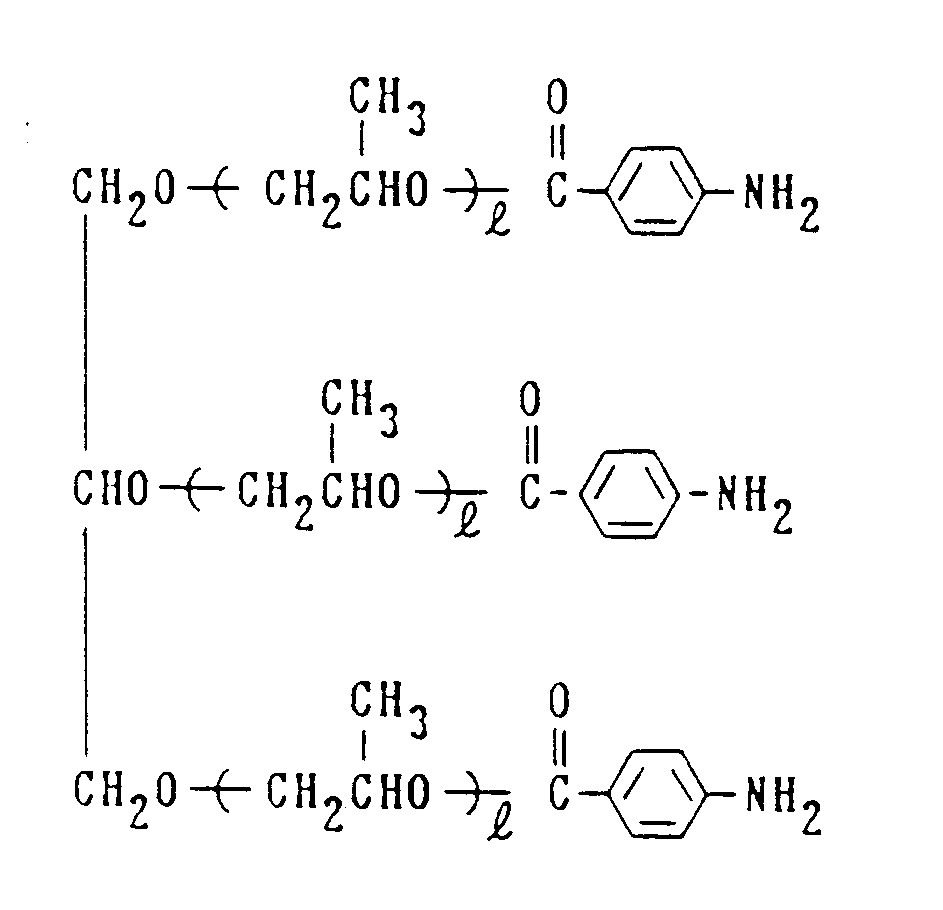
- Amine compounds represented by the above-described formula (I) which are suitable for in the present invention include the following:
-

-

-

-

-

-

-
-

-

-

-


In these formulas, ℓ and ℓʹ each are an integer which makes the average molecular weight of the alkyl group positioned at the center of the compound to be 200 or higher. - Aromatic polyamines used in the present invention may have any substituent, such as a halogen atom, an alkyl group, a trifluoromethyl group, or an alkoxycarbonyl group or the like incorporated therein.
- Aromatic polyamines suitable for use in the present invention include aromatic diamines of a diaminodiphenyl methane system such as 4,4ʹ-methylene bis(aniline), 4,4ʹ-methylene bis(2-chloroaniline), 4,4ʹ-methylene-bis(2,3-dichloroaniline)(TCDAM), 4,4ʹ-methylene bis(2,5-dichloroaniline), 4,4ʹ-methylene bis(2-methylaniline), 4,4ʹ-methylene bis(2-ethylaniline), 4,4ʹ-methylene bis(2-isopropylaniline), 4,4ʹ-methylene bis(2,6-dimethylaniline), 4,4ʹ-methylene bis(2,6-diethylaniline), 4,4ʹ-methylene bis(2-ethyl-6-methylaniline), 4,4ʹ-methylene bis(2-chloro-6-methylaniline), 4,4ʹ-methylene bis(2-chloro-6-ethylaniline), 4,4ʹ-methylene bis(3-chloro-2,6-diethylaniline), 4,4ʹ-methylene bis(2-trifluoromethyl aniline), and 4,4ʹ-methylene-bis(2-methoxycarbonyl aniline) and the like; aromatic diamines containing an oxygen or sulfur atom such as 4,4ʹ-diaminodiphenyl ether, 4,4ʹ diamino-3,3ʹ-dichlorodiphenyl ether, 4,4ʹ diaminodiphenyl sulfone, 4,4ʹ-diamino-3,3ʹ-dichlorodiphenyl sulfone, bis(4-aminophenoxyphenyl) sulfone, 1,2-bis(2-aminophenylthio) ethane, bis-[2-(2-aminophenylthio) ethyl] terephthalate and the like; aromatic diamines of an aminobenzoate system such as 1,3-propanediol bis(4-aminobenzoate), 1,4-butandiol bis(4-aminobenzoate), diethylene glycol bis(4-aminobenzoate), triethylene glycol bis(4-aminobenzoate), 4-chloro-3,5-diamino isopropylbenzoate, 4 chloro-3,5-diamino isobutylbenzoate and the like; aromatic diamines of a toluene diamine system such as 2,4-toluene diamine, 2,6-toluene diamine, 3,5-diethyl-2,4-toluene diamine, 3,5-diethyl-2,6-toluene diamine, 3,5-dimethylthio-2,4-toluene diamine, and 3,5-dimethylthio-2,6-toluene diamine and the like; aromatic diamines of a diamino diphenylpropane system such as 2,2-bis(4-aminophenyl) propane, 2,2-bis(4-amino-3-methylphenyl) propane. 2,2-bis(4-amino-3-ethylphenyl) propane, 2,2-bis(4-amino-3-isopropylphenyl) propane, 2,2-bis(4-amino-3,5-dimethylphenyl) propane, 2,2-bis(4-amino-3,5-diethylphenyl) propane, 2,2-bis(4-amino-3,5-diisopropylphenyl) propane, and 2,2-bis(4-amino-3-ethyl-5-methylphenyl) propane and the like, aromatic diamines such as 3,3ʹ-diamino benzophenone m- or p-phenylene diamine and m- or p-xylylene diamine and the like; and aromatic tetramines such as 3,3ʹ,4,4ʹ-tetra-amino phenylether and 3,3ʹ,4,4ʹ-tetra-amino biphenyl and the like. The above-described aromatic polyamines may be used alone or in combination.
- Polyisocyanate compounds which may be used in the present invention include any polyisocyanates conventionally used to prepare a polyurethane elastomer, such as hexamethylene diisocyanate (HMDI), 2,2,4-trimethylhexamethylene diisocyanate, 1,3,6-hexamethylene triisocyanate, cyclohexane diisocyanate, dicyclohexylmethane diisocyanate, 2-isocyanate ethyl-2,6-diisocyanate hexanoate, an adduct of trimethylol propane with hexamethylene diisocyanate, 2,4-tolylene diisocyanate (2,4-TDI), 2,6-tolylene diisocyanate (2,6-TDI), a mixture of 2,4-TDI and 2,6-TDI, a dimer of 2,4-tolylene diisocyanate, xylylene diisocyanate (XDI), metaxylylene diisocyanate (MXDI), tetramethylxylylene diisocyanate, m-phenylene diisocyanate, 4,4ʹ-biphenyl isocyanate, diphenylether-4,4ʹ-diisocyanate, 3,3ʹ-ditoluene-4,4ʹ-diisocyanate (TODI), dianisidine diisocyanate (DADI), 4,4ʹ-diphenylmethane diisocyanate (MDI), 3,3ʹ-dimethyl-4,4ʹ-diphenylmethane diisocyanate, 1,5-naphthalene diisocyanate (NDI), and triphenylmethane triisocyanate (TTI) and the like. The above-described polyisocyanates may be used alone or in combination.
- Also, a so-called prepolymer, which is produced by a reaction between each of the above-described polyisocyanates and usual polyol, may be used in the present invention.
- Although the amount of aromatic polyamine used in the present invention is determined by the desired physical properties of the polyurea resin and workability, it is generally 3 to 50%, preferably 5 to 50%, preferably 20 to 40%, by weight based on the amine component. (total of aromatic polyamines and the amine compound represented by formula (I)). If the amount of aromatic polyamine is too small the polyurea resin obtained exhibits insufficient hardness. If the amount of aromatic polyamine is too large, it is difficult to keep a mixed solution of the amine compound of formula (I) and the aromatic polyamine in a liquid state. Even when kept at a liquid state, its viscosity is highly increased to such a degree that it is difficult to handle the mixture and molding operation. This also causes crystals of polyurea to precipitate during molding, leading to an inability to prepare a uniform polyurea resin.
- Also, in the present invention the ratio of the amine component including the amine compound represented by formula (I) and the aromatic polyamine to the polyisocyanate is generally 0.9-2.0, preferably 0.9 to 1.5, more preferably 1.0 to 1.3, in terms of the molar ratio of the amino group (NH₂) to the isocyanate group (-NCO) (-NH₂/-NCO).
- Hereafter will be described an example of the manner of operation of the present invention.
- A predetermined amount of the aromatic polyamine is added to the amine compound represented by formula (I) and then dissolved by heating, thereby preparing a mixed solution. The solution is then subjected to sufficient deaeration under a reduced pressure of 1,3 to 2,7 kPa (10 to 20mmHg), after which it is cooled to room temperature.
- Subsequently a predetermined amount of polyisocyanate is added to and fully mixed with the solution, which is then subjected to deaeration and poured into a mold preheated to 100-120°C for curing for a time not to exceed one hour, resulting in the preparation of a molded material. Next the molded material is removed from the mold and subjected to postcuring in an oven at 100 to 180°C, after which it is aged at room temperature for one week, finally resulting in a polyurea resin of the present invention.
- In the present invention a catalyst may be used as required. The catalyst is preferably a material which can be dissolved in a mixed solution of the amine compound of formula (I) and the aromatic polyamine.
- The catalysts include, tertiary amines such as triethylenediamine, triethylamine, tripropylamine, tributylamine, hexamethylenetetramine, N-alkylmorpholine, N-pentamethyldiethylene triamine, N-hexamethyltriethylene tetramine, N,N-diethylaniline, N,N-dimethylbenzylamine, N,N-dimethyllaurylamine, N,N-dimethylpiperidine, N,Nʹ-dimethylpiperadine, N,N,Nʹ,Nʹ-tetramethylene ethyldiamine, N,N,Nʹ,Nʹ-tetramethyl propyldiamine, N,N,Nʹ,Nʹ-tetramethyl-1,3-butanediamine, N,N,Nʹ,Nʹ-tetramethyl hexamethylenediamine, N,N,Nʹ,Nʺ,Nʹ-pentamethyl diethylenetriamine, tris(dimethyl aminomethyl) phenol, N,Nʹ,Nʺ-tris(dialkyl aminoalkyl) hexahydro-s-triazine, 1,8-diaza-bicyclo-5,4,0-undecene, 1,8-diaza-bicyclo-5,4,0-undecene-methylammonium methosulfate; and aziridinyl compounds and the like. Catalysts may also include organometallic catalysts, such as lewis acid catalysts, which include organotin compounds such as tetra-n-butyl tin, tri-n-butyl tin acetate, n-butyl tin trichloride, trimethyl tin hydroxide, dimethyl tin dichloride, dibutyl tin dilaurate, dibutyl tin di-2-ethyl hexoate, and stannous octoate and the like, metal acetylacetonates, such as zinc acetylacetonate, aluminum acetylacetonate, and cobalt acetylacetonate and the like, metal naphthenates, such as zinc naphthenate, lead naphthenate, lead caprylate, and cobalt naphthenate and the like; organomercuric compounds, such as phenyl mercury acetate, phenyl mercury oleate, and mercury naphthenate and the like; organolead compounds, such as lead octoate and lead naphthenate and the like; basic metal salts of organoborate ester; organic boron compound basic materials such as alkaline metal salts of carboxylic acid that have 2 to 12 carbon atoms, including potassium acetate, potassium propionate, potassium 2-ethylhexoate, sodium benzoate and the like, and alkaline metal salts of carboxylic acid that have 13 or more carbon atoms, including sodium oleate, potassium linoleate and the like, as well as alkaline metal salts of a weak acid other than carboxylic acid, including sodium phenolate and the like; strong basic materials such as sodium methoxide, benzyl trimethylammonium hydroxide, and hydroxide of alkaline metal and the like; chelate compounds represented by a chelate compound of salicylaldehyde with potassium; and co-catalysts such as phenols, epoxy compounds, and alkyl carbonates and the like.
- The above-described catalysts may be used alone or in combination.
- The amount of catalyst used is generally 0.01 to 5, preferably 0.05 to 3, parts by weight based on 100 parts by weight of the mixed solution of the amine compound of formula (I) with the aromatic polyamine.
- In the process of the present invention, materials such as an oxidation inhibitor, an ultraviolet light absorber, a coloring-preventing agent, a hydrolysis preventive agent, an antifungal agent, a fire retardant agent, a coloring agent, a filler, a loading material, and the like, which have been used for a conventional polyurethane elastomer may also be suitably used, depending on the applications of the polyurea resin.
- According to the present invention polyurea resin or a polyurea elastomer with increased hardness, strength, and toughness can be produced.
- Also, a polyurea resin produced through the present invention has remarkably decreased temperature dependence and exhibits excellent heat resistance.
- Further, the present invention uses aromatic polyamine, so that a polyurea elastomer containing a large proportion of phenyl groups, which the prior art could not produce, may be readily prepared without the use of solvent. The thus-obtained elastomer exhibits very high hardness and excellent toughness due to elongation above 50%. The elastomer also exhibits high heat resistance compared to a conventional polyurethane urea elastomer.
- It will thus be noted that the present invention can provide a new material increased in heat resistance, hardness, and toughness which fills a gap between a thermosetting resin, such as epoxy resin, melamine resin, and polyamide resin or the like, which is hard but fragile, and urethane resin, which is increased in strength but inferior in heat resistance.
- The physical properties of the polyurea resin (or elastomer) produced by the process of this invention can be arbitrary selected within the following ranges: Hardness in Hs(D) is preferably 40-90, more preferably being 50-90, tensile strength is preferably 400-800 kg/cm², more preferably being 500-800 kg/cm², and TG index is preferably 300-400, more preferably being 330-400.
- As can be indicated from the foregoing, polyurea resin prepared by the present invention can be used for many applications, such as for machine parts, mining materials, shoe sole materials, potting materials, rigid laminated boards, packing agents, binders, and the like. Especially, it is suitable for use for a roll for making paper and steel, plastic products, veneers, a roller for business machines, and the like.
- The present invention will be understood more readily with reference to the following examples, however, which are not to be construed to limit the scope of the present invention.
- 100 parts by weight of polytetramethylene-glycol bis(p-aminobenzoate)(an amine compound of formula (I) wherein R has a molecular weight of 970) and 43 parts by weight of 4,4'-methylene bis(2-chloroaniline) were mixed together to prepare a mixture, which was then dissolved by heating, subjected to deareation, and then cooled to room temperature. The solution obtained was mixed with 73.4 parts by weight of liquid MDI, subjected to deaeration, poured into a mold preheated to 100°C, and therein cured for 20 minutes before removal. It was thereafter subjected to postcure in a forced-draft oven and then aged at room temperature for one week, finally resulting in a polyurea resin.
- The physical properties, Polyamine conditions (composition and viscosity), composition and cure conditions, and workability of the procedure were as shown in Table 1. The physical properties were measured according to JIS K 6301.
- The measurement of thermal characteristics of the polyurea resin yielded the results shown in Table 1. The testing methods of the thermal characteristics were as follows:
- (a) TG Index (The method discribed in Polymer Digest, 1984, January, PP 26-34):
The TG index is usually used as an indication of the heat life of electrical insulating material and the like.
It was calculated by graph analysis of a thermogravimetric curve (TGA curve) obtained by measurements taken at a heating rate of 5°C/min. More Particularly, the TG Index was calculated according to an equation,
- (b)

Tg is frequently used to indicate a temperature range (a temperature range below Tg) which causes a material to exhibit high hardness and toughness. It was indicated by the temperature of a peak value corresponding to a glass transition point of tanδ measured at a heating rate of 3°C/min and a frequency of 10 Hz using a viscoelastic spectrometer (VES-FIII, manufactured by Iwamoto Seisakusho). - Example 1 was substantially repeated while varying the amount or kind of each of the aromatic polyamine and aromatic polyisocyanate with respect to polytetramethylene glycol bis(p-aminobenzoate), resulting in the preparation of polyurea resin. The physical properties and thermal characteristics of the polyurea resin obtained were measured as in Example 1. The results of Examples 2 to 8 and 9 to 11 were as shown in Tables 1 and 3, respectively. The hardness of the polyurea resin obtained in each of Examples 1 to 8 was measured while increasing its temperature, the results of which were as shown in Table 2.
- 24.4 g of liquid MDI was mixed with 100 g of polytetramethylene glycol bis(4-aminobenzoate) without adding 4,4ʹ-methylene bis(2-chloroaniline), which is the aromatic polyamine thereto. The mixture obtained was treated similarly as in Example 1 to prepare a polyurea resin. The physical properties and thermal characteristics of the thus-obtained resin were measured as in Example 1.
- Tables 1 and 3 show the physical properties, polyamine conditions (composition and viscosity), formulation and cure conditions, and workability. The physical properties were measured according to JIS K 6301.
- Tables 1 and 3 indicate that the polyurea obtained in Comparative Example 1 is inferior in hardness and 100% modulus.
- To the contrary, the polyurea resins obtained in Examples 1 to 11 were generally excellent in physical properties such as hardness, 100% modulus, and the like, as well as having increased TG indexes and Tg values, thus being highly superior in heat resistance to the polyurea of Comparative Example 1.
- Further, Table 2 indicates that the decrease in initial hardness (70 to 80) of each of the polyurea resins obtained in Examples 1 to 8 is limited to a low level, irrespective of a temperature increase from 25°C to 180°C. As such, the resin of the present invention has a highly decreased temperature dependence.


Claims (13)
- A process for producing polyurea resin which comprises mixing an amine compound represented by the formulawherein R represents n-valent polyalkylene, polyalkylene ether or polyalkylene polyester groups with an average molecular weight of 200 or more, provided that the group may contain unsaturated bond; A represents an oxygen atom or an imino group; m is an integer of 1 to 3, and in case m is 1 the NH₂-group is in 4-position; and n is an integer of 2 to 4; with an aromatic polyamine and then reacting the mixture with a polyisocyanate.

- The process as claimed in claim 1, wherein R in the amine compound of the formula has an average molecular weight of 200-5000.
- The process as claimed in claim 1, wherein A in the amine compound of the formula is an oxygen atom.
- The process as claimed in claim 1, wherein the amine compound is polytetramethylene glycol bis(4-aminobenzoate).
- The process as claimed in claim 1, wherein the aromatic polyamine is selected from diamino diphenyl methans, aromatic diamines containing an oxygen or sulfur atom, aminobenzoates, toluene diamines, phenylene diamines, xylylene diamines, diamino dipropanes, diamino benzophenones and aromatic tetramines.
- The process claimed in claim 1, wherein the aromatic polyamine is selected from 4,4'-methylene bis(2-chloroaniline), 1,3-propanediol bis(4-aminobenzoate) and 4,4'-methylene bis(2,3-dichloroaniline).
- The process as claimed in claim 1, wherein the polyisocyanate is selected from 4,4'-diphenylmethane diisocyanate, dicyclohexylmethane diisocyanate, 2-isocyanateethyl-2,6-diisocyanate hexanoate, 3,3'-ditoluene-4,4'-diisocyanate and adduct of trimethylol propane and hexamethylene diisocyanate.
- The process as claimed in claim 1, wherein the amount of the aromatic polyamine is 5 to 50% by weight based on the total of amine component.
- The process as claimed in claim 8, wherein the amount of the aromatic polyamine is 20 to 40% by weight based on the total of amine component.
- The process as claimed in claim 1, wherein the ratio of the amine component to the polyisocyanate is 0.9 to 1.5 in terms of molar ratio of the amino group to the isocyanate group.
- The process as claimed in claim 1, wherein the reaction is conducted without using solvent.
- A polyurea resin obtained by a process according to claim 1.
- The polyurea resin as claim in claim 12, wherein the resin has hardness of 50-90 in Hs(D), tensile strength of 500-800 kg/cm² and heat resistance of 330-400 in TG index.
Applications Claiming Priority (2)
| Application Number | Priority Date | Filing Date | Title |
|---|---|---|---|
| JP34848/87 | 1987-02-18 | ||
| JP62034848A JP2577900B2 (en) | 1987-02-18 | 1987-02-18 | Method for producing polyurea resin |
Publications (3)
| Publication Number | Publication Date |
|---|---|
| EP0279376A2 EP0279376A2 (en) | 1988-08-24 |
| EP0279376A3 EP0279376A3 (en) | 1989-03-29 |
| EP0279376B1 true EP0279376B1 (en) | 1993-11-03 |
Family
ID=12425605
Family Applications (1)
| Application Number | Title | Priority Date | Filing Date |
|---|---|---|---|
| EP88102085A Expired - Lifetime EP0279376B1 (en) | 1987-02-18 | 1988-02-12 | Process for producing polyurea resin |
Country Status (8)
| Country | Link |
|---|---|
| US (2) | US5039775A (en) |
| EP (1) | EP0279376B1 (en) |
| JP (1) | JP2577900B2 (en) |
| KR (1) | KR930004365B1 (en) |
| AU (1) | AU602555B2 (en) |
| CA (1) | CA1332646C (en) |
| DE (1) | DE3885314T2 (en) |
| ZA (1) | ZA881024B (en) |
Families Citing this family (37)
| Publication number | Priority date | Publication date | Assignee | Title |
|---|---|---|---|---|
| JP3060108B2 (en) | 1989-05-02 | 2000-07-10 | イハラケミカル工業株式会社 | Manufacturing method of polyurethane urea elastomer |
| JPH0361450A (en) * | 1989-07-28 | 1991-03-18 | Osaka Gas Co Ltd | Palatable food contained in aerosol container |
| US5013813A (en) * | 1989-12-18 | 1991-05-07 | Texaco Chemical Company | Polyurea elastomer with rapid dry time |
| US5319058A (en) * | 1991-10-22 | 1994-06-07 | Ihara Chemical Industry Co., Ltd. | Method for the preparation of a polyurea resin |
| US5183877A (en) * | 1991-10-25 | 1993-02-02 | H. B. Fuller Company | Polyurea or polyurea-urethane adhesive for bonding elastomers |
| US5173537A (en) * | 1991-12-20 | 1992-12-22 | Shell Oil Company | Selective hydrogenation of conjugated diolefin poylmers |
| JP3220873B2 (en) * | 1992-07-02 | 2001-10-22 | イハラケミカル工業株式会社 | Polyurethane urea elastomer |
| JP3213744B2 (en) * | 1993-03-17 | 2001-10-02 | 保土谷化学工業株式会社 | Process for producing polyurea and polyurethane urea resins |
| US5484870A (en) * | 1993-06-28 | 1996-01-16 | Acushnet Company | Polyurea composition suitable for a golf ball cover |
| US5407452A (en) * | 1993-07-28 | 1995-04-18 | Chevron Chemical Company | Fuel compositions containing poly(oxyalkylene) aromatic esters |
| JP3455857B2 (en) * | 1993-11-24 | 2003-10-14 | イハラケミカル工業株式会社 | Adhesive composition |
| US5380345A (en) * | 1993-12-03 | 1995-01-10 | Chevron Research And Technology Company | Polyalkyl nitro and amino aromatic esters and fuel compositions containing the same |
| US5538521A (en) * | 1993-12-23 | 1996-07-23 | Chevron Chemical Company | Fuel compositions containing polyalkyl and poly(oxyalkylene)aromatic esters |
| US5540743A (en) * | 1994-12-30 | 1996-07-30 | Chevron Chemical Company | Polyalky and poly(oxyalkylene) benzyl amine esters and fuel compositions containing the same |
| US5865861A (en) * | 1997-12-22 | 1999-02-02 | Chevron Chemical Company Llc | Fuel compositions containing polyamines of poly(oxyalkylene) aromatic |
| US6020392A (en) * | 1998-09-04 | 2000-02-01 | Air Products And Chemicals, Inc. | Polyurea elastomeric microcellular foam |
| US6114488A (en) * | 1999-03-02 | 2000-09-05 | Air Products And Chemicals, Inc. | Polyurethaneurea elastomers for dynamic applications |
| AU5006700A (en) * | 1999-05-13 | 2000-12-05 | K & L Technologies, Inc. | Polyurea composition |
| US6165236A (en) * | 1999-06-02 | 2000-12-26 | Chevron Chemical Company Llc | Poly(oxyalkylene) pyridyl and piperidyl esters and fuel compositions containing the same |
| US6403063B1 (en) * | 1999-07-26 | 2002-06-11 | Kenneth I. Sawyer | Method of treating nail fungus |
| JP4763161B2 (en) * | 2001-06-19 | 2011-08-31 | 善二郎 小柳津 | Polishing pad or buff material, polishing polyurea elastic rigid foam used for the same, and method for producing the same |
| US20060216267A1 (en) * | 2002-08-20 | 2006-09-28 | Kovacs Stephen G | Hydrophobic elastomeric polymer chemistry device for inhibiting the growth of onychomycosis and urushiol-induced allergic contact dermatitis |
| US20040167283A1 (en) * | 2003-02-24 | 2004-08-26 | Michael Vinciguerra | Linear polyphosphonates that exhibit an advantageous combination of properties, and methods related thereto |
| US6861499B2 (en) * | 2003-02-24 | 2005-03-01 | Triton Systems, Inc. | Branched polyphosphonates that exhibit an advantageous combination of properties, and methods related thereto |
| US7560525B2 (en) * | 2004-04-02 | 2009-07-14 | Frx Polymers, Llc | Crystalline polyphosphonates and methods related thereto |
| US7569717B2 (en) * | 2005-07-19 | 2009-08-04 | Frx Polymers, Llc | Diaryl alkylphosphonates and method for preparing same |
| US7645850B2 (en) * | 2005-08-11 | 2010-01-12 | Frx Polymers, Inc. | Poly(block-phosphonato-ester) and poly(block-phosphonato-carbonate) and methods of making same |
| US7666932B2 (en) * | 2005-10-17 | 2010-02-23 | Frx Polymers, Inc. | Compositions comprising polyphosphonates and additives that exhibit an advantageous combination of properties, and methods related thereto |
| WO2007079272A2 (en) * | 2005-10-18 | 2007-07-12 | Frx Polymers Llc | Diaryl alkylphosphonates and methods for preparing same |
| US7838604B2 (en) * | 2005-12-01 | 2010-11-23 | Frx Polymers, Inc. | Method for the production of block copolycarbonate/phosphonates and compositions therefrom |
| US8771725B2 (en) * | 2007-10-12 | 2014-07-08 | Chesson Laboratory Associates, Inc. | Poly(urea-urethane) compositions useful as topical medicaments and methods of using the same |
| US7928259B2 (en) * | 2008-02-12 | 2011-04-19 | Frx Polymers, Inc. | Diaryl alkylphosphonates and methods for preparing same |
| JP5346481B2 (en) * | 2008-03-31 | 2013-11-20 | アイカ工業株式会社 | Urea urethane resin composition |
| JP5090993B2 (en) * | 2008-03-31 | 2012-12-05 | アイカ工業株式会社 | Urea urethane resin composition |
| EP2948464A4 (en) | 2013-01-22 | 2016-12-07 | Frx Polymers Inc | PHOSPHORUS-CONTAINING EPOXY COMPOUNDS AND COMPOSITIONS THEREOF |
| US10189938B2 (en) * | 2014-10-13 | 2019-01-29 | Sika Technology Ag | Polyurea composition |
| CN109134814B (en) * | 2018-07-30 | 2020-12-18 | 喻传云 | Polyurethane spinning rubber ring and preparation method thereof |
Family Cites Families (12)
| Publication number | Priority date | Publication date | Assignee | Title |
|---|---|---|---|---|
| NL293505A (en) * | 1962-05-31 | |||
| FR1358187A (en) * | 1962-05-31 | 1964-04-10 | Gen Tire & Rubber Co | Improvements in the production of polyurethane foams and similar materials |
| DE2019432C3 (en) * | 1970-04-22 | 1982-05-06 | Bayer Ag, 5090 Leverkusen | Process for the production of terminal amino groups containing organic compounds and their use for the production of plastics |
| JPS5480397A (en) * | 1977-12-09 | 1979-06-27 | Ihara Chem Ind Co Ltd | Production of polyurethane elastomer |
| JPS6032641B2 (en) * | 1978-09-19 | 1985-07-29 | イハラケミカル工業株式会社 | Method for manufacturing polyurea elastomer |
| US4328322A (en) * | 1979-12-03 | 1982-05-04 | Polaroid Corporation | Synthetic polymers by polyisocyanate polyaddition process |
| JPS56135514A (en) * | 1979-12-03 | 1981-10-23 | Polaroid Corp | Synthetic polymer and manufacture |
| US4328959A (en) * | 1980-11-14 | 1982-05-11 | Gerwin Holtmann | Method and device for removing used refractory lining and/or slag deposits from elongated vessels |
| JPS5989322A (en) * | 1982-11-13 | 1984-05-23 | Toyo Tire & Rubber Co Ltd | Polyurethane urea polymer and its production |
| JPS61303A (en) * | 1984-06-13 | 1986-01-06 | 東洋ゴム工業株式会社 | Shoe sole |
| US4847416A (en) * | 1986-10-27 | 1989-07-11 | The Dow Chemical Company | Capping of polyols with aromatic amines |
| AU602282B2 (en) * | 1988-02-08 | 1990-10-04 | Walbro Corporation | Stratified air scavenging in two-stroke engine |
-
1987
- 1987-02-18 JP JP62034848A patent/JP2577900B2/en not_active Expired - Fee Related
-
1988
- 1988-02-09 AU AU11457/88A patent/AU602555B2/en not_active Expired
- 1988-02-12 EP EP88102085A patent/EP0279376B1/en not_active Expired - Lifetime
- 1988-02-12 DE DE88102085T patent/DE3885314T2/en not_active Expired - Lifetime
- 1988-02-13 KR KR1019880001393A patent/KR930004365B1/en not_active Expired - Lifetime
- 1988-02-15 CA CA000558884A patent/CA1332646C/en not_active Expired - Lifetime
- 1988-02-15 ZA ZA881024A patent/ZA881024B/en unknown
-
1990
- 1990-01-18 US US07/465,601 patent/US5039775A/en not_active Expired - Lifetime
-
1991
- 1991-04-16 US US07/685,923 patent/US5086153A/en not_active Expired - Lifetime
Also Published As
| Publication number | Publication date |
|---|---|
| US5086153A (en) | 1992-02-04 |
| DE3885314T2 (en) | 1994-04-28 |
| US5039775A (en) | 1991-08-13 |
| AU1145788A (en) | 1988-08-25 |
| JPS63202612A (en) | 1988-08-22 |
| EP0279376A3 (en) | 1989-03-29 |
| JP2577900B2 (en) | 1997-02-05 |
| AU602555B2 (en) | 1990-10-18 |
| KR890013086A (en) | 1989-09-21 |
| DE3885314D1 (en) | 1993-12-09 |
| KR930004365B1 (en) | 1993-05-26 |
| ZA881024B (en) | 1988-08-11 |
| EP0279376A2 (en) | 1988-08-24 |
| CA1332646C (en) | 1994-10-18 |
Similar Documents
| Publication | Publication Date | Title |
|---|---|---|
| US5039775A (en) | Process for producing polyurea resin | |
| US4786703A (en) | Process for the preparation of polyisocyanate prepolymers and polyurethanes having high temperature performance and low hysteresis | |
| US5077371A (en) | Low free toluene diisocyanate polyurethanes | |
| AU659224B2 (en) | Method for the preparation of a polyurea resin | |
| US4327204A (en) | Process for producing polyurethane elastomer by mixing a hardener composition with an isocyanate composition | |
| CA1179098A (en) | Synthetic polymers by polyisocyanate polyaddition process | |
| KR20080071085A (en) | Polyurethane cured with amine and its preparation | |
| US4504648A (en) | Polyurethaneurea and process for preparing the same | |
| KR20000062686A (en) | Polyurethaneurea elastomers for dynamic applications | |
| CA2099197C (en) | Polyurethaneurea elastomer | |
| CA1200347A (en) | Polyether polyurethane elastomers | |
| JP3060108B2 (en) | Manufacturing method of polyurethane urea elastomer | |
| US4537945A (en) | Polyether derivative and a poly(urethane)ureamide obtained therefrom | |
| JP2671208B2 (en) | Thermosetting adhesive composition | |
| JP3291594B2 (en) | Composite polyurea elastomer | |
| JP3291593B2 (en) | Conductive polyurea elastomer | |
| JP3122886B2 (en) | Composite polyurea elastomer casting composition | |
| JP3278757B2 (en) | Method for producing polyurea resin | |
| JP3160680B2 (en) | Composite polyurea elastomer composition | |
| JP3484210B2 (en) | Heat resistant bonding structure between adherend and polyurea elastomer and bonding method thereof | |
| KR830002012B1 (en) | Method of Making Polyurethane Elastomers | |
| JP2005002169A (en) | Thermosetting polyurethane composition and roll or belt for OA equipment obtained using the composition | |
| MXPA02010800A (en) | Process for producing polyurethane elastomer. | |
| JPH01114096A (en) | Flexible printed wiring board |
Legal Events
| Date | Code | Title | Description |
|---|---|---|---|
| PUAI | Public reference made under article 153(3) epc to a published international application that has entered the european phase |
Free format text: ORIGINAL CODE: 0009012 |
|
| AK | Designated contracting states |
Kind code of ref document: A2 Designated state(s): BE CH DE FR GB IT LI NL |
|
| PUAL | Search report despatched |
Free format text: ORIGINAL CODE: 0009013 |
|
| RHK1 | Main classification (correction) |
Ipc: C08G 18/46 |
|
| AK | Designated contracting states |
Kind code of ref document: A3 Designated state(s): BE CH DE FR GB IT LI NL |
|
| 17P | Request for examination filed |
Effective date: 19890727 |
|
| 17Q | First examination report despatched |
Effective date: 19910516 |
|
| GRAA | (expected) grant |
Free format text: ORIGINAL CODE: 0009210 |
|
| AK | Designated contracting states |
Kind code of ref document: B1 Designated state(s): BE CH DE FR GB IT LI NL |
|
| ET | Fr: translation filed | ||
| REF | Corresponds to: |
Ref document number: 3885314 Country of ref document: DE Date of ref document: 19931209 |
|
| ITF | It: translation for a ep patent filed | ||
| PLBE | No opposition filed within time limit |
Free format text: ORIGINAL CODE: 0009261 |
|
| STAA | Information on the status of an ep patent application or granted ep patent |
Free format text: STATUS: NO OPPOSITION FILED WITHIN TIME LIMIT |
|
| 26N | No opposition filed | ||
| REG | Reference to a national code |
Ref country code: GB Ref legal event code: IF02 |
|
| PGFP | Annual fee paid to national office [announced via postgrant information from national office to epo] |
Ref country code: GB Payment date: 20070207 Year of fee payment: 20 |
|
| PGFP | Annual fee paid to national office [announced via postgrant information from national office to epo] |
Ref country code: DE Payment date: 20070208 Year of fee payment: 20 |
|
| PGFP | Annual fee paid to national office [announced via postgrant information from national office to epo] |
Ref country code: CH Payment date: 20070214 Year of fee payment: 20 |
|
| PGFP | Annual fee paid to national office [announced via postgrant information from national office to epo] |
Ref country code: NL Payment date: 20070215 Year of fee payment: 20 |
|
| REG | Reference to a national code |
Ref country code: CH Ref legal event code: PFA Owner name: IHARA CHEMICAL INDUSTRY CO., LTD Free format text: IHARA CHEMICAL INDUSTRY CO., LTD#4-26, IKENOHATA 1-CHOME#TAITOH-KU/TOKYO (JP) -TRANSFER TO- IHARA CHEMICAL INDUSTRY CO., LTD#4-26, IKENOHATA 1-CHOME#TAITOH-KU/TOKYO (JP) |
|
| PGFP | Annual fee paid to national office [announced via postgrant information from national office to epo] |
Ref country code: IT Payment date: 20070622 Year of fee payment: 20 Ref country code: BE Payment date: 20070413 Year of fee payment: 20 |
|
| BE20 | Be: patent expired |
Owner name: *IHARA CHEMICAL INDUSTRY CO. LTD Effective date: 20080212 |
|
| REG | Reference to a national code |
Ref country code: GB Ref legal event code: PE20 |
|
| REG | Reference to a national code |
Ref country code: CH Ref legal event code: PL |
|
| NLV7 | Nl: ceased due to reaching the maximum lifetime of a patent |
Effective date: 20080212 |
|
| PG25 | Lapsed in a contracting state [announced via postgrant information from national office to epo] |
Ref country code: NL Free format text: LAPSE BECAUSE OF EXPIRATION OF PROTECTION Effective date: 20080212 |
|
| PGFP | Annual fee paid to national office [announced via postgrant information from national office to epo] |
Ref country code: FR Payment date: 20070208 Year of fee payment: 20 |
|
| PG25 | Lapsed in a contracting state [announced via postgrant information from national office to epo] |
Ref country code: GB Free format text: LAPSE BECAUSE OF EXPIRATION OF PROTECTION Effective date: 20080211 |