EP0277835B1 - Blends based on vinyl-aromatic polymers with improved characteristics of chemical resistance - Google Patents
Blends based on vinyl-aromatic polymers with improved characteristics of chemical resistance Download PDFInfo
- Publication number
- EP0277835B1 EP0277835B1 EP88300956A EP88300956A EP0277835B1 EP 0277835 B1 EP0277835 B1 EP 0277835B1 EP 88300956 A EP88300956 A EP 88300956A EP 88300956 A EP88300956 A EP 88300956A EP 0277835 B1 EP0277835 B1 EP 0277835B1
- Authority
- EP
- European Patent Office
- Prior art keywords
- weight
- aromatic
- carbon atoms
- blends according
- vinyl
- Prior art date
- Legal status (The legal status is an assumption and is not a legal conclusion. Google has not performed a legal analysis and makes no representation as to the accuracy of the status listed.)
- Expired - Lifetime
Links
- 239000000203 mixture Substances 0.000 title claims abstract description 52
- 239000000126 substance Substances 0.000 title claims abstract description 9
- 229920000642 polymer Polymers 0.000 title claims abstract description 7
- 125000003118 aryl group Chemical group 0.000 claims abstract description 36
- 229920000728 polyester Polymers 0.000 claims abstract description 16
- 229920006249 styrenic copolymer Polymers 0.000 claims abstract description 12
- 239000000178 monomer Substances 0.000 claims abstract description 9
- 150000002825 nitriles Chemical class 0.000 claims abstract description 7
- 229920006285 olefinic elastomer Polymers 0.000 claims abstract description 5
- 239000011347 resin Substances 0.000 claims abstract description 5
- 229920005989 resin Polymers 0.000 claims abstract description 5
- 229920000515 polycarbonate Polymers 0.000 claims description 22
- 239000004417 polycarbonate Substances 0.000 claims description 22
- 125000004432 carbon atom Chemical group C* 0.000 claims description 14
- 229930185605 Bisphenol Natural products 0.000 claims description 7
- -1 acyclic polyene Chemical class 0.000 claims description 6
- IISBACLAFKSPIT-UHFFFAOYSA-N bisphenol A Chemical compound C=1C=C(O)C=CC=1C(C)(C)C1=CC=C(O)C=C1 IISBACLAFKSPIT-UHFFFAOYSA-N 0.000 claims description 6
- 229910052739 hydrogen Inorganic materials 0.000 claims description 6
- 239000001257 hydrogen Substances 0.000 claims description 6
- 229920001897 terpolymer Polymers 0.000 claims description 6
- NLHHRLWOUZZQLW-UHFFFAOYSA-N Acrylonitrile Chemical group C=CC#N NLHHRLWOUZZQLW-UHFFFAOYSA-N 0.000 claims description 4
- VGGSQFUCUMXWEO-UHFFFAOYSA-N Ethene Chemical compound C=C VGGSQFUCUMXWEO-UHFFFAOYSA-N 0.000 claims description 4
- 239000005977 Ethylene Substances 0.000 claims description 4
- LYCAIKOWRPUZTN-UHFFFAOYSA-N Ethylene glycol Chemical compound OCCO LYCAIKOWRPUZTN-UHFFFAOYSA-N 0.000 claims description 4
- 125000004122 cyclic group Chemical group 0.000 claims description 4
- 229910052736 halogen Inorganic materials 0.000 claims description 4
- 150000002367 halogens Chemical class 0.000 claims description 4
- 150000004291 polyenes Chemical class 0.000 claims description 4
- UFHFLCQGNIYNRP-UHFFFAOYSA-N Hydrogen Chemical compound [H][H] UFHFLCQGNIYNRP-UHFFFAOYSA-N 0.000 claims description 3
- OFOBLEOULBTSOW-UHFFFAOYSA-N Malonic acid Chemical compound OC(=O)CC(O)=O OFOBLEOULBTSOW-UHFFFAOYSA-N 0.000 claims description 2
- 150000002431 hydrogen Chemical class 0.000 claims description 2
- WGCNASOHLSPBMP-UHFFFAOYSA-N hydroxyacetaldehyde Natural products OCC=O WGCNASOHLSPBMP-UHFFFAOYSA-N 0.000 claims description 2
- 238000006116 polymerization reaction Methods 0.000 claims description 2
- 229920002554 vinyl polymer Polymers 0.000 claims description 2
- PPBRXRYQALVLMV-UHFFFAOYSA-N Styrene Chemical compound C=CC1=CC=CC=C1 PPBRXRYQALVLMV-UHFFFAOYSA-N 0.000 description 6
- 238000000034 method Methods 0.000 description 6
- VPWNQTHUCYMVMZ-UHFFFAOYSA-N 4,4'-sulfonyldiphenol Chemical class C1=CC(O)=CC=C1S(=O)(=O)C1=CC=C(O)C=C1 VPWNQTHUCYMVMZ-UHFFFAOYSA-N 0.000 description 5
- 239000003795 chemical substances by application Substances 0.000 description 5
- 150000001875 compounds Chemical class 0.000 description 3
- 229920001577 copolymer Polymers 0.000 description 3
- 229920000139 polyethylene terephthalate Polymers 0.000 description 3
- 239000005020 polyethylene terephthalate Substances 0.000 description 3
- VXNZUUAINFGPBY-UHFFFAOYSA-N 1-Butene Chemical compound CCC=C VXNZUUAINFGPBY-UHFFFAOYSA-N 0.000 description 2
- YMWUJEATGCHHMB-UHFFFAOYSA-N Dichloromethane Chemical compound ClCCl YMWUJEATGCHHMB-UHFFFAOYSA-N 0.000 description 2
- KKEYFWRCBNTPAC-UHFFFAOYSA-N Terephthalic acid Chemical compound OC(=O)C1=CC=C(C(O)=O)C=C1 KKEYFWRCBNTPAC-UHFFFAOYSA-N 0.000 description 2
- XYLMUPLGERFSHI-UHFFFAOYSA-N alpha-Methylstyrene Chemical class CC(=C)C1=CC=CC=C1 XYLMUPLGERFSHI-UHFFFAOYSA-N 0.000 description 2
- 238000001125 extrusion Methods 0.000 description 2
- QQVIHTHCMHWDBS-UHFFFAOYSA-N isophthalic acid Chemical compound OC(=O)C1=CC=CC(C(O)=O)=C1 QQVIHTHCMHWDBS-UHFFFAOYSA-N 0.000 description 2
- 239000000049 pigment Substances 0.000 description 2
- 238000005809 transesterification reaction Methods 0.000 description 2
- SVHAMPNLOLKSFU-UHFFFAOYSA-N 1,2,2-trichloroethenylbenzene Chemical compound ClC(Cl)=C(Cl)C1=CC=CC=C1 SVHAMPNLOLKSFU-UHFFFAOYSA-N 0.000 description 1
- AUHKVLIZXLBQSR-UHFFFAOYSA-N 1,2-dichloro-3-(1,2,2-trichloroethenyl)benzene Chemical compound ClC(Cl)=C(Cl)C1=CC=CC(Cl)=C1Cl AUHKVLIZXLBQSR-UHFFFAOYSA-N 0.000 description 1
- XPXMCUKPGZUFGR-UHFFFAOYSA-N 1-chloro-2-(1,2,2-trichloroethenyl)benzene Chemical compound ClC(Cl)=C(Cl)C1=CC=CC=C1Cl XPXMCUKPGZUFGR-UHFFFAOYSA-N 0.000 description 1
- HECLRDQVFMWTQS-RGOKHQFPSA-N 1755-01-7 Chemical compound C1[C@H]2[C@@H]3CC=C[C@@H]3[C@@H]1C=C2 HECLRDQVFMWTQS-RGOKHQFPSA-N 0.000 description 1
- YIYBRXKMQFDHSM-UHFFFAOYSA-N 2,2'-Dihydroxybenzophenone Chemical class OC1=CC=CC=C1C(=O)C1=CC=CC=C1O YIYBRXKMQFDHSM-UHFFFAOYSA-N 0.000 description 1
- VXHYVVAUHMGCEX-UHFFFAOYSA-N 2-(2-hydroxyphenoxy)phenol Chemical class OC1=CC=CC=C1OC1=CC=CC=C1O VXHYVVAUHMGCEX-UHFFFAOYSA-N 0.000 description 1
- BLDLRWQLBOJPEB-UHFFFAOYSA-N 2-(2-hydroxyphenyl)sulfanylphenol Chemical class OC1=CC=CC=C1SC1=CC=CC=C1O BLDLRWQLBOJPEB-UHFFFAOYSA-N 0.000 description 1
- XSVZEASGNTZBRQ-UHFFFAOYSA-N 2-(2-hydroxyphenyl)sulfinylphenol Chemical class OC1=CC=CC=C1S(=O)C1=CC=CC=C1O XSVZEASGNTZBRQ-UHFFFAOYSA-N 0.000 description 1
- QUWAJPZDCZDTJS-UHFFFAOYSA-N 2-(2-hydroxyphenyl)sulfonylphenol Chemical class OC1=CC=CC=C1S(=O)(=O)C1=CC=CC=C1O QUWAJPZDCZDTJS-UHFFFAOYSA-N 0.000 description 1
- SMZOUWXMTYCWNB-UHFFFAOYSA-N 2-(2-methoxy-5-methylphenyl)ethanamine Chemical compound COC1=CC=C(C)C=C1CCN SMZOUWXMTYCWNB-UHFFFAOYSA-N 0.000 description 1
- VEORPZCZECFIRK-UHFFFAOYSA-N 3,3',5,5'-tetrabromobisphenol A Chemical compound C=1C(Br)=C(O)C(Br)=CC=1C(C)(C)C1=CC(Br)=C(O)C(Br)=C1 VEORPZCZECFIRK-UHFFFAOYSA-N 0.000 description 1
- UFERIGCCDYCZLN-UHFFFAOYSA-N 3a,4,7,7a-tetrahydro-1h-indene Chemical compound C1C=CCC2CC=CC21 UFERIGCCDYCZLN-UHFFFAOYSA-N 0.000 description 1
- JLBJTVDPSNHSKJ-UHFFFAOYSA-N 4-Methylstyrene Chemical compound CC1=CC=C(C=C)C=C1 JLBJTVDPSNHSKJ-UHFFFAOYSA-N 0.000 description 1
- ODJUOZPKKHIEOZ-UHFFFAOYSA-N 4-[2-(4-hydroxy-3,5-dimethylphenyl)propan-2-yl]-2,6-dimethylphenol Chemical compound CC1=C(O)C(C)=CC(C(C)(C)C=2C=C(C)C(O)=C(C)C=2)=C1 ODJUOZPKKHIEOZ-UHFFFAOYSA-N 0.000 description 1
- SDDLEVPIDBLVHC-UHFFFAOYSA-N Bisphenol Z Chemical compound C1=CC(O)=CC=C1C1(C=2C=CC(O)=CC=2)CCCCC1 SDDLEVPIDBLVHC-UHFFFAOYSA-N 0.000 description 1
- BCKLAWNUJSBONO-UHFFFAOYSA-N C1C(C)=CC=C2CCCC21 Chemical compound C1C(C)=CC=C2CCCC21 BCKLAWNUJSBONO-UHFFFAOYSA-N 0.000 description 1
- 229920002943 EPDM rubber Polymers 0.000 description 1
- 229920004142 LEXAN™ Polymers 0.000 description 1
- 239000004418 Lexan Substances 0.000 description 1
- CERQOIWHTDAKMF-UHFFFAOYSA-N Methacrylic acid Chemical compound CC(=C)C(O)=O CERQOIWHTDAKMF-UHFFFAOYSA-N 0.000 description 1
- GYCMBHHDWRMZGG-UHFFFAOYSA-N Methylacrylonitrile Chemical compound CC(=C)C#N GYCMBHHDWRMZGG-UHFFFAOYSA-N 0.000 description 1
- YGYAWVDWMABLBF-UHFFFAOYSA-N Phosgene Chemical compound ClC(Cl)=O YGYAWVDWMABLBF-UHFFFAOYSA-N 0.000 description 1
- KYPYTERUKNKOLP-UHFFFAOYSA-N Tetrachlorobisphenol A Chemical compound C=1C(Cl)=C(O)C(Cl)=CC=1C(C)(C)C1=CC(Cl)=C(O)C(Cl)=C1 KYPYTERUKNKOLP-UHFFFAOYSA-N 0.000 description 1
- NIXOWILDQLNWCW-UHFFFAOYSA-N acrylic acid group Chemical group C(C=C)(=O)O NIXOWILDQLNWCW-UHFFFAOYSA-N 0.000 description 1
- 229920001893 acrylonitrile styrene Polymers 0.000 description 1
- 239000000654 additive Substances 0.000 description 1
- 125000005907 alkyl ester group Chemical group 0.000 description 1
- 239000002216 antistatic agent Substances 0.000 description 1
- 229910052799 carbon Inorganic materials 0.000 description 1
- ROORDVPLFPIABK-UHFFFAOYSA-N diphenyl carbonate Chemical compound C=1C=CC=CC=1OC(=O)OC1=CC=CC=C1 ROORDVPLFPIABK-UHFFFAOYSA-N 0.000 description 1
- 229920001971 elastomer Polymers 0.000 description 1
- HQQADJVZYDDRJT-UHFFFAOYSA-N ethene;prop-1-ene Chemical group C=C.CC=C HQQADJVZYDDRJT-UHFFFAOYSA-N 0.000 description 1
- 239000000945 filler Substances 0.000 description 1
- 125000000524 functional group Chemical group 0.000 description 1
- 239000011521 glass Substances 0.000 description 1
- 239000003365 glass fiber Substances 0.000 description 1
- 239000008187 granular material Substances 0.000 description 1
- 229920001519 homopolymer Polymers 0.000 description 1
- 125000004435 hydrogen atom Chemical group [H]* 0.000 description 1
- 238000010348 incorporation Methods 0.000 description 1
- 238000002347 injection Methods 0.000 description 1
- 239000007924 injection Substances 0.000 description 1
- 239000000314 lubricant Substances 0.000 description 1
- 238000004519 manufacturing process Methods 0.000 description 1
- 238000005259 measurement Methods 0.000 description 1
- 238000000465 moulding Methods 0.000 description 1
- QYZLKGVUSQXAMU-UHFFFAOYSA-N penta-1,4-diene Chemical compound C=CCC=C QYZLKGVUSQXAMU-UHFFFAOYSA-N 0.000 description 1
- ISWSIDIOOBJBQZ-UHFFFAOYSA-N phenol group Chemical group C1(=CC=CC=C1)O ISWSIDIOOBJBQZ-UHFFFAOYSA-N 0.000 description 1
- 238000006068 polycondensation reaction Methods 0.000 description 1
- SCUZVMOVTVSBLE-UHFFFAOYSA-N prop-2-enenitrile;styrene Chemical compound C=CC#N.C=CC1=CC=CC=C1 SCUZVMOVTVSBLE-UHFFFAOYSA-N 0.000 description 1
- 239000001294 propane Substances 0.000 description 1
- 230000035939 shock Effects 0.000 description 1
- 239000003381 stabilizer Substances 0.000 description 1
- 150000003440 styrenes Chemical class 0.000 description 1
- 238000009864 tensile test Methods 0.000 description 1
Classifications
-
- C—CHEMISTRY; METALLURGY
- C08—ORGANIC MACROMOLECULAR COMPOUNDS; THEIR PREPARATION OR CHEMICAL WORKING-UP; COMPOSITIONS BASED THEREON
- C08L—COMPOSITIONS OF MACROMOLECULAR COMPOUNDS
- C08L51/00—Compositions of graft polymers in which the grafted component is obtained by reactions only involving carbon-to-carbon unsaturated bonds; Compositions of derivatives of such polymers
- C08L51/04—Compositions of graft polymers in which the grafted component is obtained by reactions only involving carbon-to-carbon unsaturated bonds; Compositions of derivatives of such polymers grafted on to rubbers
-
- C—CHEMISTRY; METALLURGY
- C08—ORGANIC MACROMOLECULAR COMPOUNDS; THEIR PREPARATION OR CHEMICAL WORKING-UP; COMPOSITIONS BASED THEREON
- C08L—COMPOSITIONS OF MACROMOLECULAR COMPOUNDS
- C08L51/00—Compositions of graft polymers in which the grafted component is obtained by reactions only involving carbon-to-carbon unsaturated bonds; Compositions of derivatives of such polymers
- C08L51/06—Compositions of graft polymers in which the grafted component is obtained by reactions only involving carbon-to-carbon unsaturated bonds; Compositions of derivatives of such polymers grafted on to homopolymers or copolymers of aliphatic hydrocarbons containing only one carbon-to-carbon double bond
-
- C—CHEMISTRY; METALLURGY
- C08—ORGANIC MACROMOLECULAR COMPOUNDS; THEIR PREPARATION OR CHEMICAL WORKING-UP; COMPOSITIONS BASED THEREON
- C08L—COMPOSITIONS OF MACROMOLECULAR COMPOUNDS
- C08L67/00—Compositions of polyesters obtained by reactions forming a carboxylic ester link in the main chain; Compositions of derivatives of such polymers
-
- C—CHEMISTRY; METALLURGY
- C08—ORGANIC MACROMOLECULAR COMPOUNDS; THEIR PREPARATION OR CHEMICAL WORKING-UP; COMPOSITIONS BASED THEREON
- C08L—COMPOSITIONS OF MACROMOLECULAR COMPOUNDS
- C08L69/00—Compositions of polycarbonates; Compositions of derivatives of polycarbonates
Definitions
- the present invention relates to a blend based on vinyl-aromatic polymers endowed with improved characteristics of chemical resistance which are particularly suitable to be heat-transformed into shaped bodies by extrusion.
- GB-A-2118194 shows that blends based on vinyl-aromatic polymers are suitable for use in the industrial sectors for the production by molding and extrusion of articles for the technical application sectors.
- This Italian application discloses in particular blends comprising:
- the present invention provides a blend based on vinyl aromatic polymers, the blend being endowed with improved chemical resistance to gasoline, and consisting of an impact resistant styrenic copolymer and a mixture of aromatic resins, the mixture of resins containing aromatic groups constituted by from 70 to 99% by weight of an aromatic polycarbonate and from 30 to 1% by weight of an aromatic polyester, characterised in that the impact resistant styrenic copolymer contains from 8 to 30% by weight of an ethylenically unsaturated nitrile, from 15 to 45% by weight of an olefinic elastomer and from 77 to 25% by weight of a vinyl-aromatic monomer, and the proportions of the components, expressed in % by weight with respect to the blend, are 10 to 90% of the impact resistant styrenic copolymer and 90 to 10% of the mixture of the aromatic polycarbonate and the aromatic polyester, the amount of the aromatic polyester being from 5 to 15% by weight with respect to the blend.
- blends consisting of:
- the elastomeric component (which is the support on which the acrylonitrile and the styrene are partly grafted and partly mechanically adhered as acrylonitrile-styrene copolymer) is an ethylene/alpha olefines/cyclic or acylic having an unconjugated double bond polyene terpolymer with a low unsaturation.
- Said terpolymer has an etheylene content between 20% and 80% by moles, a polyene content between 0.1% and 20% by moles, and the remainder being constituted by an alpha-olefinic monomer.
- terpolymers of low unsaturation are ethylene/propylene/cyclic or acyclic polyene terpolymers; or ethylene/butene-1/cyclic or acyclic polyenes; the polyene being selected from the group comprising pentadiene-1,4; hexadiene-1,4; hexadiene-1,5; heptadiene-1,5; dodecatriene-1,7,9; methyl-heptadiene-1,5; 6-alkylene-norbornene; norbornadiene-2,5; 2-alkylnorbornadiene-2,5; cyclooctadiene-1,5; dicyclopentadiene; tetrahydroindene; 5-methyl-tetrahydroindene, etc.
- vinyl-aromatic monomer comprises compounds having the formula: in which X represents hydrogen or an alkyl radical having from 1 to 4 carbon atoms; Y represents hydrogen, a halogen, or an alkyl radical having from 1 to 4 carbon atoms; and n is zero or an integer from 1 to 5.
- vinyl-aromtic compounds having the formula (I) are: styrene; methyl styrene; mono-, di-, tri-, tetra-, and penta-chloro-styrene and the respective alpha-methyl-styrenes; styrenes alkylated in the nucleus and the respective alpha-methyl-styrenes such as ortho- and para-methyl-styrenes and ortho- and para-ethyl-styrenes; and ortho- and para-alpha-methyl-styrenes. These monomers may be used alone or in mixture with each other.
- ethylenically unsaturated nitrile is to be understood, firstly and preferably, acrylonitrile; even if other acrylic monomers such as methacrylonitrile and alkyl-esters of acrylic or methacrylic acid, may be used.
- the aromatic polycarbonates used in the blends of the present invention may be homopolymers or copolymers based on, for example, one or more of the following bisphenols: di-hydroxy-diphenyls, bis-(hydroxy-phenyl)-alkanes, bis-(hydroxy-phenyl)-cycloalkanes, bis-(hydroxy-phenyl)-sulphides, bis-(hydroxy-phenyl)-ethers, bis-(hydroxy-phenyl)-ketones, bis-(hydroxy-phenyl)-sulphoxides, bis-(hydroxy-phenyl)-sulphones, alpha-alpha-bis-(hydroxy-phenyl)-di-isopropyl-benzenes, and also their derivatives alkylated or halogenated in the nucleus.
- di-hydroxy-aromatic compounds are well known per se and are described in the literature.
- Preferred bisphenols are those corresponding to the formula: in which R1, R2, R3 and R4 each represents hydrogen or an alkyl radical containing from 1 to 4 carbon atoms or a halogen, and A represents -O-, -CO-, -SO2-, an alkylene radical containing from 2 to 10 carbon atoms, an alkylidene radical containing from 2 to 10 carbon atoms, a cyclo-alkylene radical containing from 5 to 15 carbon atoms, a cyclo-alkylidene radical containing rom 5 to 15 carbon atoms, or the radical: 2,2-bis-(4-hydroxy-phenyl)-propane; 2,2-bis-(3,5-dimethyl)-4-hydroxy-phenyl)-propane; 2,2-bis-(3,5-di-chloro-4-hydroxyphenyl)-propane; 2,2-bis-(3,5-di-bromo-4-hydroxy-phenyl)-propane, and 1,1-bis-(
- Partcularly preferred polycarbonates are those based on one or more of the above-mentioned bisphenols. More particularly, polycarbonates based on 2,2-bis-(4-hydroxy-phenyl)-propane or on 2,2-bis-(3,5-di-methyl-4-hydroxy-phenyl)-propane, alone or in mixture with each other or with one of the above reported bisphenols, are especially preferred.
- Polycarbonates containing in the chain units derived from terephthalic and/or isophthalic acid may also be used.
- the aromatic polycarbonates may be produced according to per se known processes, for example according to the trans-esterification process in the molten state from bisphenols and diphenyl-carbonate, or according to the two-phase interfacial process from bisphenol and phosgene, as described in H. Schnell "Chemistry and Physics of Polycarbonates", Interscience Publishers, New York, 1964.
- the aromatic polycarbonates may also be of branched type obtained by incorporation of a small quantity, preferably between 0.05 and 2 moles per cent, of compounds having three or more functional groups, particularly those having three or more hydroxylic phenolic groups.
- the aromatic polycarbonates used in the blends of the present invention have an average molecular weight of at least 10,000, more specifically from 10,000 to 200,000, and preferably between 20,000 and 80,000 as determined by the measurement of relative viscosity in CH2Cl2 at 25°C and at a concentration of 0.5% by weight.
- aromatic polycarbonates containing the recurring units (II) are per se well known in the art and are available on the market from different producers; for example, General Electric Company, Pittsfield, Massachusetts, U.S.A., by the trade name "LEXAN”; ANIC S. Donato Milanese (Milano) by the trade name "SINVET”, etc.
- the aromatic polyesters which may be used in the blends of the present invention are obtained by polymerization of a glycol having the formula: HO - (CH2) n - OH (IV) in which n is an integer from 2 to 10 with a dicarboxylic acid of the formula: HOOC-R1 - B - R2 - COOH (V) in which R1 and R2 each represents -(CH2) m - where m is zero or an integer from 1 to 4 and B is a divalent aromatic radical represented by: wherein E may be: -(-CH2) p -; -(CH2) p -CO-(CH2) p -; -(CH2) p -O-(CH2) p -; -O(CH2) q -O-; where p may be zero or an integer from 1 to 5; and q is an integer from 1 to 5.
- a glycol having the formula: HO - (CH2) n - OH (IV) in which
- Preferred aromatic polyesters are poly(ethylene-terephthalate), poly(propylene-terephthalate), poly(butylene-terephthalate), and poly(ethylene-2,2'-di-phenoxy-ethane-4,4'dicarboxylate). These polyesters have preferably a molecular weight between 10,000 and 80,000 and may be produced according to per se known techniques of polycondensation or poly-trans-esterification.
- the blends of the present invention may be prepared in any known type of mixer, for instance, single-screw or double-screw extruders, Banbury mixers, mixing rollers, etc.
- Fillers glass fibers, pigments and other additives such as stabilizers, anti-flame agents, lubricants, anti-static agents, pigments, etc., may be added during the step of mixing the components.
- the present polymeric blends show a set of properties that are on the whole significantly better than those of the single components. For this reason these polymeric blends find use in applications requiring high tenacity, high heat-dimensional stability, good hydrolysis-resistance and easy workability, combined with a high resistance to external agents and high chemical resistance to the action of gasoline. These blends thus find an application in the automotive industry, in electronics, and, generally, in technical products of various kinds.
- the mixture was extruded at a temperature of 260°C and the obtained granules were injection-molded in order to provide test pieces for the mechanical-physical tests.
- the polycarbonate "SINVET 221" is a trademark for a product sold by the firm ANIC of S. DONATO MILANESE (Milano). * All compositions are given as percent by weight of each component of the total blend.
Landscapes
- Chemical & Material Sciences (AREA)
- Health & Medical Sciences (AREA)
- Chemical Kinetics & Catalysis (AREA)
- Medicinal Chemistry (AREA)
- Polymers & Plastics (AREA)
- Organic Chemistry (AREA)
- Compositions Of Macromolecular Compounds (AREA)
- Graft Or Block Polymers (AREA)
- Reinforced Plastic Materials (AREA)
Abstract
Description
- The present invention relates to a blend based on vinyl-aromatic polymers endowed with improved characteristics of chemical resistance which are particularly suitable to be heat-transformed into shaped bodies by extrusion.
- GB-A-2118194 shows that blends based on vinyl-aromatic polymers are suitable for use in the industrial sectors for the production by molding and extrusion of articles for the technical application sectors. This Italian application discloses in particular blends comprising:
- -- from 20 to 80% by weight, with respect to the blend, of a modified vinyl-aromatic polymer containing from 5 to 15% by weight of an ethylenically unsaturated nitrile; and
- -- from 80 to 20% by weight, with respect to the blend, of at least one resin containing aromatic groups selected from aromatic polycarbonates and aromatic polyesters.
- In fact, and for example in the case of particularly stringent requirements from the automotive industry, it is necessary that the obtained shaped articles have:
- -- a high resistance to external agents, in terms of resistance to color variation with time and of mechanical and thermal characteristics; and
- -- a high chemical resistance to the action of gasoline.
- The blends described in the above British application do not provide all the above properties required in the automotive sector.
- It has now been discovered that if the vinyl-aromatic copolymer, containing an ethylenically unsaturated nitrile and made impact- or shock-resistant by an olefinic elastomer, is blended with an aromatic polycarbonate and with an aromatic polyester, blends having improved characteristics of resistance to external agents and improved chemical resistance are obtained, without modifying and, preferably, improving the other mechanical and thermal properties of the foregoing copolymer.
- The present invention provides a blend based on vinyl aromatic polymers, the blend being endowed with improved chemical resistance to gasoline, and consisting of an impact resistant styrenic copolymer and a mixture of aromatic resins, the mixture of resins containing aromatic groups constituted by from 70 to 99% by weight of an aromatic polycarbonate and from 30 to 1% by weight of an aromatic polyester, characterised in that the impact resistant styrenic copolymer contains from 8 to 30% by weight of an ethylenically unsaturated nitrile, from 15 to 45% by weight of an olefinic elastomer and from 77 to 25% by weight of a vinyl-aromatic monomer, and the proportions of the components, expressed in % by weight with respect to the blend, are 10 to 90% of the impact resistant styrenic copolymer and 90 to 10% of the mixture of the aromatic polycarbonate and the aromatic polyester, the amount of the aromatic polyester being from 5 to 15% by weight with respect to the blend.
- Particularly preferred are blends consisting of:
- -- from 25% to 55% by weight of an impact-resistant styrenic copolymer of the above type;
- -- from 30% to 60% by weight of an aromatic polycarbonate; and
- -- from 10% to 15% by weight of an aromatic polyester the sum of these three components being equal to 100%.
- In the impact-resistant styrenic copolymer, the elastomeric component (which is the support on which the acrylonitrile and the styrene are partly grafted and partly mechanically adhered as acrylonitrile-styrene copolymer) is an ethylene/alpha olefines/cyclic or acylic having an unconjugated double bond polyene terpolymer with a low unsaturation. Said terpolymer has an etheylene content between 20% and 80% by moles, a polyene content between 0.1% and 20% by moles, and the remainder being constituted by an alpha-olefinic monomer.
- Examples of terpolymers of low unsaturation are ethylene/propylene/cyclic or acyclic polyene terpolymers; or ethylene/butene-1/cyclic or acyclic polyenes; the polyene being selected from the group comprising pentadiene-1,4; hexadiene-1,4; hexadiene-1,5; heptadiene-1,5; dodecatriene-1,7,9; methyl-heptadiene-1,5; 6-alkylene-norbornene; norbornadiene-2,5; 2-alkylnorbornadiene-2,5; cyclooctadiene-1,5; dicyclopentadiene; tetrahydroindene; 5-methyl-tetrahydroindene, etc.
- The term vinyl-aromatic monomer comprises compounds having the formula:

in which X represents hydrogen or an alkyl radical having from 1 to 4 carbon atoms; Y represents hydrogen, a halogen, or an alkyl radical having from 1 to 4 carbon atoms; and n is zero or an integer from 1 to 5. - Examples of vinyl-aromtic compounds having the formula (I) are: styrene; methyl styrene; mono-, di-, tri-, tetra-, and penta-chloro-styrene and the respective alpha-methyl-styrenes; styrenes alkylated in the nucleus and the respective alpha-methyl-styrenes such as ortho- and para-methyl-styrenes and ortho- and para-ethyl-styrenes; and ortho- and para-alpha-methyl-styrenes. These monomers may be used alone or in mixture with each other.
- As ethylenically unsaturated nitrile is to be understood, firstly and preferably, acrylonitrile; even if other acrylic monomers such as methacrylonitrile and alkyl-esters of acrylic or methacrylic acid, may be used.
- According to the present invention, the aromatic polycarbonates used in the blends of the present invention may be homopolymers or copolymers based on, for example, one or more of the following bisphenols:
di-hydroxy-diphenyls, bis-(hydroxy-phenyl)-alkanes, bis-(hydroxy-phenyl)-cycloalkanes, bis-(hydroxy-phenyl)-sulphides, bis-(hydroxy-phenyl)-ethers, bis-(hydroxy-phenyl)-ketones, bis-(hydroxy-phenyl)-sulphoxides, bis-(hydroxy-phenyl)-sulphones, alpha-alpha-bis-(hydroxy-phenyl)-di-isopropyl-benzenes, and also their derivatives alkylated or halogenated in the nucleus. These and other di-hydroxy-aromatic compounds are well known per se and are described in the literature. - Preferred bisphenols are those corresponding to the formula:
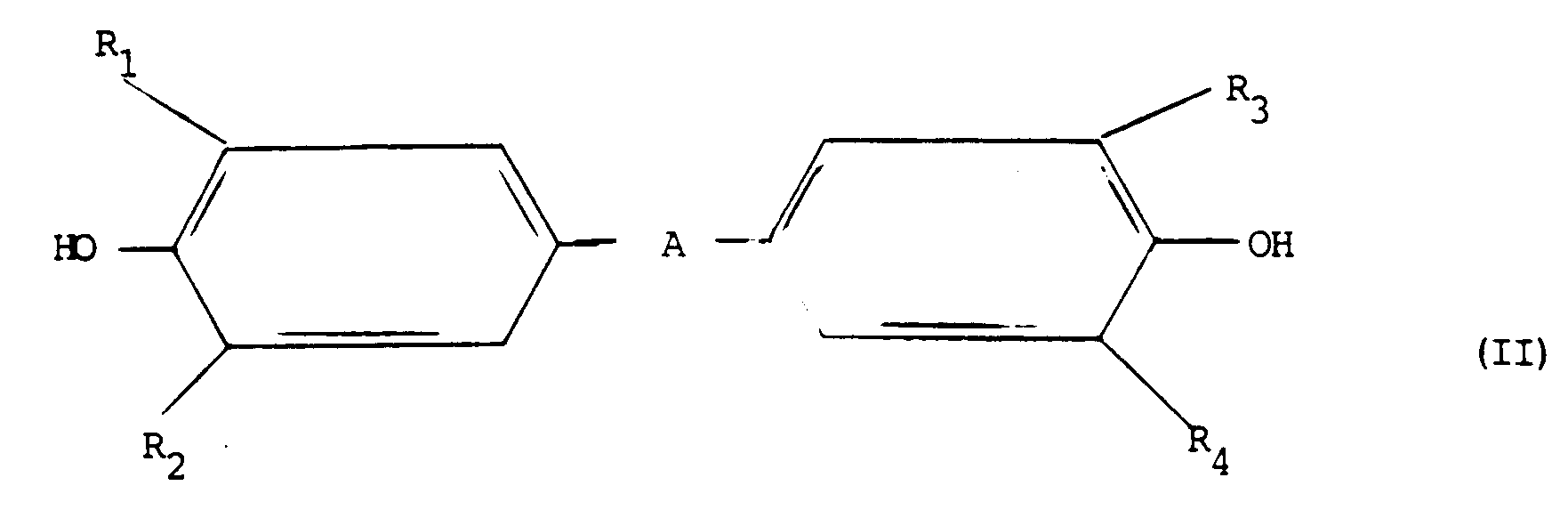
in which R₁, R₂, R₃ and R₄ each represents hydrogen or an alkyl radical containing from 1 to 4 carbon atoms or a halogen, and A represents -O-, -CO-, -SO₂-, an alkylene radical containing from 2 to 10 carbon atoms, an alkylidene radical containing from 2 to 10 carbon atoms, a cyclo-alkylene radical containing from 5 to 15 carbon atoms, a cyclo-alkylidene radical containing rom 5 to 15 carbon atoms, or the radical:
2,2-bis-(4-hydroxy-phenyl)-propane; 2,2-bis-(3,5-dimethyl)-4-hydroxy-phenyl)-propane; 2,2-bis-(3,5-di-chloro-4-hydroxyphenyl)-propane; 2,2-bis-(3,5-di-bromo-4-hydroxy-phenyl)-propane, and 1,1-bis-(4-hydroxy-phenyl)-cyclohexane. - Partcularly preferred polycarbonates are those based on one or more of the above-mentioned bisphenols. More particularly, polycarbonates based on 2,2-bis-(4-hydroxy-phenyl)-propane or on 2,2-bis-(3,5-di-methyl-4-hydroxy-phenyl)-propane, alone or in mixture with each other or with one of the above reported bisphenols, are especially preferred.
- Polycarbonates containing in the chain units derived from terephthalic and/or isophthalic acid may also be used. The aromatic polycarbonates may be produced according to per se known processes, for example according to the trans-esterification process in the molten state from bisphenols and diphenyl-carbonate, or according to the two-phase interfacial process from bisphenol and phosgene, as described in H. Schnell "Chemistry and Physics of Polycarbonates", Interscience Publishers, New York, 1964.
- The aromatic polycarbonates may also be of branched type obtained by incorporation of a small quantity, preferably between 0.05 and 2 moles per cent, of compounds having three or more functional groups, particularly those having three or more hydroxylic phenolic groups.
- The aromatic polycarbonates used in the blends of the present invention have an average molecular weight of at least 10,000, more specifically from 10,000 to 200,000, and preferably between 20,000 and 80,000 as determined by the measurement of relative viscosity in CH₂Cl₂ at 25°C and at a concentration of 0.5% by weight.
- The aromatic polycarbonates containing the recurring units (II) are per se well known in the art and are available on the market from different producers; for example, General Electric Company, Pittsfield, Massachusetts, U.S.A., by the trade name "LEXAN"; ANIC S. Donato Milanese (Milano) by the trade name "SINVET", etc.
- The aromatic polyesters which may be used in the blends of the present invention are obtained by polymerization of a glycol having the formula:
HO - (CH₂)n - OH (IV)
in which n is an integer from 2 to 10 with a dicarboxylic acid of the formula:
HOOC-R₁ - B - R₂ - COOH (V)
in which R₁ and R₂ each represents -(CH₂)m- where m is zero or an integer from 1 to 4 and B is a divalent aromatic radical represented by:
wherein E may be:
-(-CH₂)p-; -(CH₂)p -CO-(CH₂)p -;
-(CH₂)p-O-(CH₂)p-; -O(CH₂)q-O-;
where p may be zero or an integer from 1 to 5; and
q is an integer from 1 to 5. - Preferred aromatic polyesters are poly(ethylene-terephthalate), poly(propylene-terephthalate), poly(butylene-terephthalate), and poly(ethylene-2,2'-di-phenoxy-ethane-4,4'dicarboxylate). These polyesters have preferably a molecular weight between 10,000 and 80,000 and may be produced according to per se known techniques of polycondensation or poly-trans-esterification.
- The blends of the present invention may be prepared in any known type of mixer, for instance, single-screw or double-screw extruders, Banbury mixers, mixing rollers, etc.
- Fillers, glass fibers, pigments and other additives such as stabilizers, anti-flame agents, lubricants, anti-static agents, pigments, etc., may be added during the step of mixing the components.
- The present polymeric blends show a set of properties that are on the whole significantly better than those of the single components. For this reason these polymeric blends find use in applications requiring high tenacity, high heat-dimensional stability, good hydrolysis-resistance and easy workability, combined with a high resistance to external agents and high chemical resistance to the action of gasoline. These blends thus find an application in the automotive industry, in electronics, and, generally, in technical products of various kinds.
- The following illustrative but not limiting examples are given in order still better to comprehend the present invention and to put it in practice. In the examples all parts are expressed by weight, unless indicated otherwise.
- The properties of the blends of the present invention have been tested on test pieces molded by injection, by using the following methods:
- 1. The Vicat softening point procedure was determined, according to the Standard ISO 306, in oil at 5 Kg.
- 2. The IZOD impact strength was determined at 23°C according to the Standard ASTM D. 256, by using test pieces of size 1/2" x 1/8" (1.27 cm x 0.32 cm).
- 3. The tensile strength was determined according to the Standard ASTM D. 638.
- 4. The tests for resistance to gasoline were carried out on test pieces subjected to creep in a tensile test, maintaining their central part, for a 40 mm stretch, in contact with gasoline. For this purpose, a glass container containing gasoline was fixed, by means of a rubber gasket, to the lower end of the vertically arranged test piece, in correspondence with its wider dimension. The test piece was subjected to a load of 200 Kg/cm² and the time necessary for it to rupture was measured.
- Into a single screw extruder BANDERA TR 45 having a length/diameter ratio = 30, there were fed, in the proportions recorded in the following table, a blend constituted by:
- A. A styrenic copolymer (AES) containing 24% by weight of acrylonitrile, 30% by weight of ethylene-propylene-diene rubber, and 46% of styrene; and
- B. A mixture constituted by polycarbonate "SINVET 221" and polyethylene-terephthalate, in the amounts recorded in the table.
- The mixture was extruded at a temperature of 260°C and the obtained granules were injection-molded in order to provide test pieces for the mechanical-physical tests.
- The properties of the blends measured on the thus-obtained test pieces were recorded in the following table:
Table Composition* Examples 1 2 3 4 Styrenic copolymer (AES) 50 50 37.5 20 Polycarbonate 50 45 50 50 Polyethylene-terephthalate 5 12.5 30 Properties Units Resilience IZOD with indent J/m 565 527 507 138 Tensile Strength: -Yield Stress N/mm² 36.5 37 39.5 41.5 -Elongation % 46 55 76 106 -Modulus of elasticity N/mm² 1950 1990 2050 2100 VICAT B °C 109 109 110 109 Chemical Resistance to gasoline min. 5 11 30 10 The polycarbonate "SINVET 221" is a trademark for a product sold by the firm ANIC of S. DONATO MILANESE (Milano). * All compositions are given as percent by weight of each component of the total blend.
Claims (10)
- A blend based on vinyl aromatic polymers, the blend being endowed with improved chemical resistance to gasoline, and consisting of an impact resistant styrenic copolymer and a mixture of resins containing aromatic groups constituted by from 70 to 99% by weight of an aromatic polycarbonate and from 30 to 1% by weight of an aromatic polyester, characterised in that the impact resistant styrenic copolymer contains from 8 to 30% by weight of an ethylenically unsaturated nitrile, from 15 to 45% by weight of an olefinic elastomer and from 77 to 25% by weight of a vinyl-aromatic monomer, and the proportions of the components, expressed in % by weight with respect to the blend, are 10 to 90% of the impact resistant styrenic copolymer and 90 to 10% of the mixture of the aromatic polycarbonate and the aromatic polyester, the amount of the aromatic polyester being from 5 to 15% by weight with respect to the blend.
- The blend of Claim 1, consisting of:-- from 25% to 55% by weight of an impact-resistant styrenic copolymer as defined in Claim 1;-- from 30% to 60% by weight of an aromatic polycarbonate; and-- from 10% to 15% by weight of an aromatic polyester, the sum of these three components being equal to 100%.
- Blends according to Claim 1 or 2, characterized in that the olefinic elastomer is constituted by a low unsaturation terpolymer of ethylene/alpha olefine/cyclic or acyclic polyene having unconjugated double bonds.
- Blends according to Claim 3, characterized in that the terpolymer is constituted by from 20% to 80% by moles of ethylene, from 0.1 to 20% by moles of polyene, and the remaining part being consitituted by an alpha-olefinic monomer.
- Blends according to any one of the preceding claims, wherein the vinyl-aromatic monomer has the formula (I):
 X represents hydrogen or an alkyl radical having from 1 to 4 carbon atoms;Y represents hydrogen, a halogen or an alkyl radical having from 1 to 4 carbon atoms, andn is 0 or an integer between 1 and 5.
 - Blends according to any one of the preceding claims, characterized in that the ethylenically unsaturated copolymerized nitrile is acrylonitrile.
- Blends according to any one of the preceding claims, wherein the aromatic polycarbonate is obtained from a bis-phenol having the formula:


- Blends according to Claim 7, wherein the aromatic polycarbonate has an average molecular weight higher than 10,000, and preferably between 10,000 and 200,000.
- Blends according to any one of the preceding claims, wherein the aromatic polyester is obtained by polymerization of a glycol having the formula:
HO - (CH₂)n - OH (IV)
in which n is an integer from 2 to 10, with a dicarboxylic acid of the formula:
HOOC-R₁ - B - R₂ - COOH (V)
in which R₁ and R₂ each represents -(CH₂)m-where m is zero or an integer from 1 to 4, and B is a divalent aromatic radical represented by:
-(-CH₂)p-; -(CH₂)p-CO-(CH₂)p-;
-(CH₂)p-O-(CH₂)p-; -O-(CH₂)p-O-;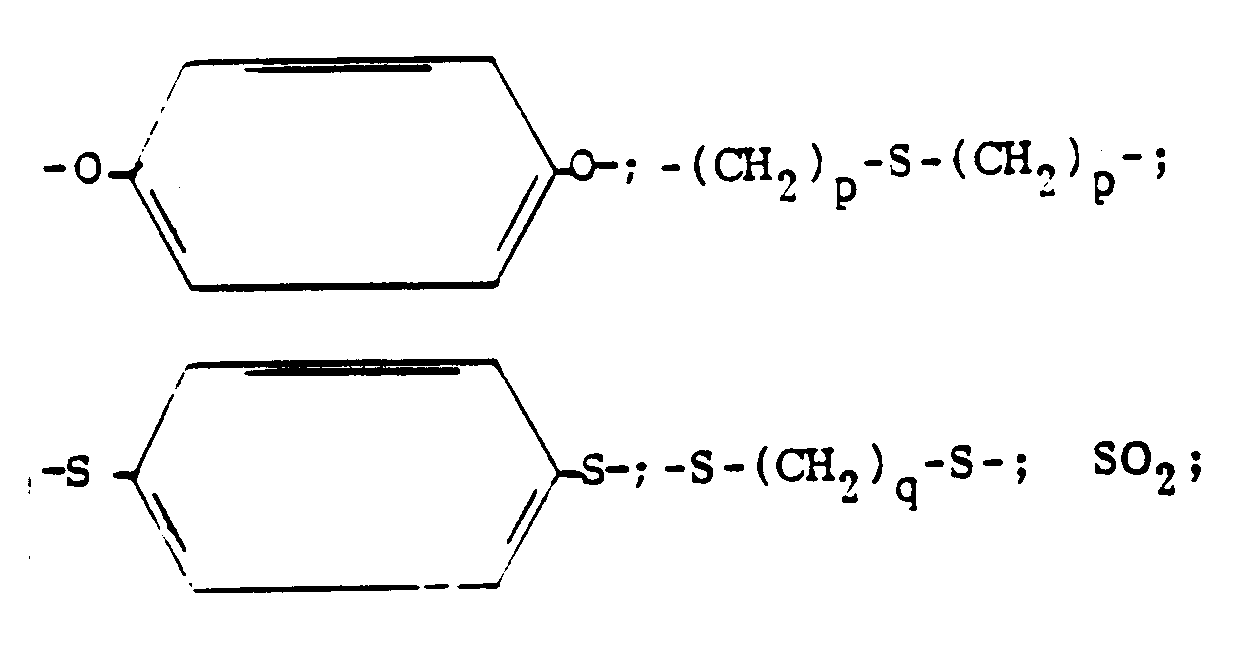
- Blends according to Claim 9, wherein the aromatic polyester has a molecular weight between 10,000 and 80,000.
Applications Claiming Priority (2)
| Application Number | Priority Date | Filing Date | Title |
|---|---|---|---|
| IT19248/87A IT1203326B (en) | 1987-02-04 | 1987-02-04 | VINYL-AROMATIC POLYMER-BASED MIXTURE WITH IMPROVED CHEMICAL RESISTANCE CHARACTERISTICS |
| IT1924887 | 1987-02-04 |
Publications (3)
| Publication Number | Publication Date |
|---|---|
| EP0277835A2 EP0277835A2 (en) | 1988-08-10 |
| EP0277835A3 EP0277835A3 (en) | 1989-08-09 |
| EP0277835B1 true EP0277835B1 (en) | 1994-07-13 |
Family
ID=11156106
Family Applications (1)
| Application Number | Title | Priority Date | Filing Date |
|---|---|---|---|
| EP88300956A Expired - Lifetime EP0277835B1 (en) | 1987-02-04 | 1988-02-04 | Blends based on vinyl-aromatic polymers with improved characteristics of chemical resistance |
Country Status (13)
| Country | Link |
|---|---|
| US (1) | US4866124A (en) |
| EP (1) | EP0277835B1 (en) |
| JP (1) | JPS63196642A (en) |
| KR (1) | KR960005634B1 (en) |
| AT (1) | ATE108476T1 (en) |
| AU (1) | AU606126B2 (en) |
| CA (1) | CA1278126C (en) |
| CS (1) | CS274569B2 (en) |
| DE (1) | DE3850583T2 (en) |
| DK (1) | DK39588A (en) |
| ES (1) | ES2056101T3 (en) |
| IT (1) | IT1203326B (en) |
| NO (1) | NO173190C (en) |
Families Citing this family (6)
| Publication number | Priority date | Publication date | Assignee | Title |
|---|---|---|---|---|
| IT1228206B (en) * | 1989-01-10 | 1991-06-05 | Montedipe Spa | MIXTURES BASED ON STYRENE COPOLYMERS WITH IMPROVED MECHANICAL CHARACTERISTICS. |
| IT1230790B (en) * | 1989-05-26 | 1991-10-29 | Montedipe Spa | COMPOUNDS BASED ON STYRENE COPOLYMERS HAVING IMPROVED CHARACTERISTICS OF RESILIENCE AT LOW TEMPERATURES. |
| US5244954A (en) * | 1990-12-21 | 1993-09-14 | Ecp Enichem Polimeri S.R.L. | Moulding thermoplastic compositions endowed with improved mould release characteristics |
| US5385164A (en) * | 1994-04-04 | 1995-01-31 | Sauter; Herman J. | Cold weather personal shelter device |
| US5585434A (en) * | 1995-05-31 | 1996-12-17 | Montell North America Inc. | Blends of polyolefin graft copolymers and polycarbonate |
| DE10300110A1 (en) * | 2003-01-07 | 2004-07-15 | Bayer Ag | Homogeneously colored compositions based on impact modified polyalkylene terephthalate / polycarbonate blends |
Family Cites Families (10)
| Publication number | Priority date | Publication date | Assignee | Title |
|---|---|---|---|---|
| AU475232B2 (en) * | 1971-12-29 | 1976-08-19 | Teijin Limited | Thermoplastic compositions |
| US4257937A (en) * | 1978-11-06 | 1981-03-24 | General Electric Company | Modified polyester compositions |
| AU551792B2 (en) * | 1981-12-08 | 1986-05-08 | Teijin Chemicals Ltd | Polycarbonate/polyester composition |
| IT1199981B (en) * | 1982-03-24 | 1989-01-05 | Montedison Spa | MIXTURES BASED ON VINYL-AROMATIC POLYMERS |
| DE3377283D1 (en) * | 1982-09-24 | 1988-08-11 | Uniroyal Inc | Impact resistant blend and method for making it |
| AU2906884A (en) * | 1983-07-05 | 1985-01-10 | General Electric Company | Polyester resin composition |
| US4665125A (en) * | 1984-11-20 | 1987-05-12 | Mitsubishi Rayon Company Limited | Thermoplastic resin composition of a polycarbonate and vinyl aromatic-vinyl cyanide comonomers/diene rubber graft copolymer |
| DE3538389A1 (en) * | 1985-07-30 | 1987-02-05 | Bayer Ag | THERMOPLASTIC MOLDING COMPOUNDS |
| US4710534A (en) * | 1985-12-09 | 1987-12-01 | General Electric Company | Low gloss, flame reterdant, impact resistant polycarbonate composition |
| US4626572A (en) * | 1985-12-23 | 1986-12-02 | General Electric Company | Resinous composition |
-
1987
- 1987-02-04 IT IT19248/87A patent/IT1203326B/en active
-
1988
- 1988-01-27 DK DK039588A patent/DK39588A/en not_active Application Discontinuation
- 1988-02-02 JP JP63022666A patent/JPS63196642A/en active Pending
- 1988-02-03 NO NO880482A patent/NO173190C/en unknown
- 1988-02-03 CA CA000558027A patent/CA1278126C/en not_active Expired - Fee Related
- 1988-02-03 US US07/151,935 patent/US4866124A/en not_active Expired - Fee Related
- 1988-02-03 CS CS67988A patent/CS274569B2/en unknown
- 1988-02-04 DE DE3850583T patent/DE3850583T2/en not_active Expired - Fee Related
- 1988-02-04 AU AU11308/88A patent/AU606126B2/en not_active Ceased
- 1988-02-04 AT AT88300956T patent/ATE108476T1/en active
- 1988-02-04 KR KR1019880001037A patent/KR960005634B1/en not_active Expired - Lifetime
- 1988-02-04 ES ES88300956T patent/ES2056101T3/en not_active Expired - Lifetime
- 1988-02-04 EP EP88300956A patent/EP0277835B1/en not_active Expired - Lifetime
Also Published As
| Publication number | Publication date |
|---|---|
| NO880482D0 (en) | 1988-02-03 |
| CS67988A2 (en) | 1990-10-12 |
| IT1203326B (en) | 1989-02-15 |
| NO880482L (en) | 1988-08-05 |
| DK39588A (en) | 1988-08-05 |
| EP0277835A2 (en) | 1988-08-10 |
| AU606126B2 (en) | 1991-01-31 |
| DE3850583D1 (en) | 1994-08-18 |
| EP0277835A3 (en) | 1989-08-09 |
| AU1130888A (en) | 1988-08-11 |
| KR880010051A (en) | 1988-10-06 |
| DK39588D0 (en) | 1988-01-27 |
| ATE108476T1 (en) | 1994-07-15 |
| US4866124A (en) | 1989-09-12 |
| DE3850583T2 (en) | 1994-12-01 |
| CS274569B2 (en) | 1991-08-13 |
| ES2056101T3 (en) | 1994-10-01 |
| KR960005634B1 (en) | 1996-04-30 |
| CA1278126C (en) | 1990-12-18 |
| JPS63196642A (en) | 1988-08-15 |
| NO173190B (en) | 1993-08-02 |
| NO173190C (en) | 1993-11-10 |
| IT8719248A0 (en) | 1987-02-04 |
Similar Documents
| Publication | Publication Date | Title |
|---|---|---|
| EP0192065A2 (en) | Polycarbonate resin composition | |
| EP0375940A2 (en) | Low gloss polycarbonate blend | |
| EP0135677A1 (en) | Composition of polyester resin | |
| US4866124A (en) | Blends based on vinyl-aromatic polymers endowed with improved characteristics of chemical resistance | |
| EP0131188A1 (en) | Polycarbonate composition | |
| JPS634873B2 (en) | ||
| CA1135436A (en) | Polyarylene ester compositions | |
| US5110866A (en) | Thermoplastic polyester resin composition having improved impact resistance | |
| KR20190066391A (en) | Thermoplastic resin composition and molded article using the same | |
| EP0429595B1 (en) | Blends based on styrene copolymers having improved impact strength at low temperatures | |
| EP0269027B1 (en) | Blends based on vinyl aromatic polymers having high molding fluidity and thermoresistance | |
| EP0379039B1 (en) | Mixtures based on styrene copolymers having improved mechanical characteristics | |
| CA1317049C (en) | Polycarbonate composition | |
| JP3055162B2 (en) | Polybutylene terephthalate resin composition | |
| JPH041223A (en) | Polyarylate, its preparation, and thermoplastic resin composition containing same | |
| EP0258053A2 (en) | Low wear polyarylate | |
| EP0601226B1 (en) | Flame retarded polyester resin composition | |
| JPS58157844A (en) | Resin composition | |
| KR0147359B1 (en) | Thermoplastic Modifier Composition Improves Appearance and Impact Resistance of Molded Thermoplastics | |
| EP0427268A2 (en) | Thermoplastic compositions based on vinyl-aromatic copolymers and polyamide resins | |
| US5256722A (en) | Blends based on vinyl aromatic polymers having high molding fluidity and high thermo resistance | |
| EP0517157B1 (en) | Polyarylate/polyester thermoplastic resin composition having high impact resistance and low melt viscosity | |
| KR950009157B1 (en) | Impact resistant resin compositions | |
| JPH01141945A (en) | Thermoplastic resin composition | |
| KR100440917B1 (en) | Low-gloss thermoplastic resin composition using copolymer having cyclic iminoether branch as mattifying agent |
Legal Events
| Date | Code | Title | Description |
|---|---|---|---|
| PUAI | Public reference made under article 153(3) epc to a published international application that has entered the european phase |
Free format text: ORIGINAL CODE: 0009012 |
|
| AK | Designated contracting states |
Kind code of ref document: A2 Designated state(s): AT BE CH DE ES FR GB LI NL SE |
|
| PUAL | Search report despatched |
Free format text: ORIGINAL CODE: 0009013 |
|
| AK | Designated contracting states |
Kind code of ref document: A3 Designated state(s): AT BE CH DE ES FR GB LI NL SE |
|
| 17P | Request for examination filed |
Effective date: 19900126 |
|
| 17Q | First examination report despatched |
Effective date: 19920228 |
|
| RAP1 | Party data changed (applicant data changed or rights of an application transferred) |
Owner name: MONTEDIPE S.R.L. |
|
| RAP1 | Party data changed (applicant data changed or rights of an application transferred) |
Owner name: ECP ENICHEM POLIMERI S.R.L. (ABBREVIATED: ECP S.R. |
|
| RAP1 | Party data changed (applicant data changed or rights of an application transferred) |
Owner name: ENICHEM S.P.A. |
|
| GRAA | (expected) grant |
Free format text: ORIGINAL CODE: 0009210 |
|
| AK | Designated contracting states |
Kind code of ref document: B1 Designated state(s): AT BE CH DE ES FR GB LI NL SE |
|
| PG25 | Lapsed in a contracting state [announced via postgrant information from national office to epo] |
Ref country code: SE Effective date: 19940713 Ref country code: NL Effective date: 19940713 |
|
| REF | Corresponds to: |
Ref document number: 108476 Country of ref document: AT Date of ref document: 19940715 Kind code of ref document: T |
|
| REF | Corresponds to: |
Ref document number: 3850583 Country of ref document: DE Date of ref document: 19940818 |
|
| ET | Fr: translation filed | ||
| REG | Reference to a national code |
Ref country code: ES Ref legal event code: FG2A Ref document number: 2056101 Country of ref document: ES Kind code of ref document: T3 |
|
| NLV1 | Nl: lapsed or annulled due to failure to fulfill the requirements of art. 29p and 29m of the patents act | ||
| EUG | Se: european patent has lapsed |
Ref document number: 88300956.5 Effective date: 19941011 |
|
| PG25 | Lapsed in a contracting state [announced via postgrant information from national office to epo] |
Ref country code: GB Effective date: 19950204 Ref country code: AT Effective date: 19950204 |
|
| PG25 | Lapsed in a contracting state [announced via postgrant information from national office to epo] |
Ref country code: ES Free format text: LAPSE BECAUSE OF EXPIRATION OF PROTECTION Effective date: 19950206 |
|
| PG25 | Lapsed in a contracting state [announced via postgrant information from national office to epo] |
Ref country code: LI Effective date: 19950228 Ref country code: CH Effective date: 19950228 Ref country code: BE Effective date: 19950228 |
|
| PLBE | No opposition filed within time limit |
Free format text: ORIGINAL CODE: 0009261 |
|
| STAA | Information on the status of an ep patent application or granted ep patent |
Free format text: STATUS: NO OPPOSITION FILED WITHIN TIME LIMIT |
|
| 26N | No opposition filed | ||
| BERE | Be: lapsed |
Owner name: ENICHEM S.P.A. Effective date: 19950228 |
|
| GBPC | Gb: european patent ceased through non-payment of renewal fee |
Effective date: 19950204 |
|
| PG25 | Lapsed in a contracting state [announced via postgrant information from national office to epo] |
Ref country code: FR Effective date: 19951031 |
|
| PG25 | Lapsed in a contracting state [announced via postgrant information from national office to epo] |
Ref country code: DE Effective date: 19951101 |
|
| REG | Reference to a national code |
Ref country code: FR Ref legal event code: ST |
|
| REG | Reference to a national code |
Ref country code: ES Ref legal event code: FD2A Effective date: 19991201 |