EP0274717A2 - Plant male sterilant - Google Patents
Plant male sterilant Download PDFInfo
- Publication number
- EP0274717A2 EP0274717A2 EP87118878A EP87118878A EP0274717A2 EP 0274717 A2 EP0274717 A2 EP 0274717A2 EP 87118878 A EP87118878 A EP 87118878A EP 87118878 A EP87118878 A EP 87118878A EP 0274717 A2 EP0274717 A2 EP 0274717A2
- Authority
- EP
- European Patent Office
- Prior art keywords
- group
- plant
- atom
- alkyl group
- alkoxy
- Prior art date
- Legal status (The legal status is an assumption and is not a legal conclusion. Google has not performed a legal analysis and makes no representation as to the accuracy of the status listed.)
- Granted
Links
Classifications
-
- C—CHEMISTRY; METALLURGY
- C07—ORGANIC CHEMISTRY
- C07C—ACYCLIC OR CARBOCYCLIC COMPOUNDS
- C07C251/00—Compounds containing nitrogen atoms doubly-bound to a carbon skeleton
- C07C251/72—Hydrazones
-
- A—HUMAN NECESSITIES
- A01—AGRICULTURE; FORESTRY; ANIMAL HUSBANDRY; HUNTING; TRAPPING; FISHING
- A01H—NEW PLANTS OR NON-TRANSGENIC PROCESSES FOR OBTAINING THEM; PLANT REPRODUCTION BY TISSUE CULTURE TECHNIQUES
- A01H1/00—Processes for modifying genotypes ; Plants characterised by associated natural traits
- A01H1/02—Methods or apparatus for hybridisation; Artificial pollination ; Fertility
- A01H1/026—Methods or apparatus for hybridisation; Artificial pollination ; Fertility by treatment with chemicals
-
- A—HUMAN NECESSITIES
- A01—AGRICULTURE; FORESTRY; ANIMAL HUSBANDRY; HUNTING; TRAPPING; FISHING
- A01N—PRESERVATION OF BODIES OF HUMANS OR ANIMALS OR PLANTS OR PARTS THEREOF; BIOCIDES, e.g. AS DISINFECTANTS, AS PESTICIDES OR AS HERBICIDES; PEST REPELLANTS OR ATTRACTANTS; PLANT GROWTH REGULATORS
- A01N37/00—Biocides, pest repellants or attractants, or plant growth regulators containing organic compounds containing a carbon atom having three bonds to hetero atoms with at the most two bonds to halogen, e.g. carboxylic acids
- A01N37/44—Biocides, pest repellants or attractants, or plant growth regulators containing organic compounds containing a carbon atom having three bonds to hetero atoms with at the most two bonds to halogen, e.g. carboxylic acids containing at least one carboxylic group or a thio analogue, or a derivative thereof, and a nitrogen atom attached to the same carbon skeleton by a single or double bond, this nitrogen atom not being a member of a derivative or of a thio analogue of a carboxylic group, e.g. amino-carboxylic acids
- A01N37/50—Biocides, pest repellants or attractants, or plant growth regulators containing organic compounds containing a carbon atom having three bonds to hetero atoms with at the most two bonds to halogen, e.g. carboxylic acids containing at least one carboxylic group or a thio analogue, or a derivative thereof, and a nitrogen atom attached to the same carbon skeleton by a single or double bond, this nitrogen atom not being a member of a derivative or of a thio analogue of a carboxylic group, e.g. amino-carboxylic acids the nitrogen atom being doubly bound to the carbon skeleton
-
- A—HUMAN NECESSITIES
- A01—AGRICULTURE; FORESTRY; ANIMAL HUSBANDRY; HUNTING; TRAPPING; FISHING
- A01N—PRESERVATION OF BODIES OF HUMANS OR ANIMALS OR PLANTS OR PARTS THEREOF; BIOCIDES, e.g. AS DISINFECTANTS, AS PESTICIDES OR AS HERBICIDES; PEST REPELLANTS OR ATTRACTANTS; PLANT GROWTH REGULATORS
- A01N43/00—Biocides, pest repellants or attractants, or plant growth regulators containing heterocyclic compounds
- A01N43/48—Biocides, pest repellants or attractants, or plant growth regulators containing heterocyclic compounds having rings with two nitrogen atoms as the only ring hetero atoms
- A01N43/58—1,2-Diazines; Hydrogenated 1,2-diazines
-
- A—HUMAN NECESSITIES
- A01—AGRICULTURE; FORESTRY; ANIMAL HUSBANDRY; HUNTING; TRAPPING; FISHING
- A01N—PRESERVATION OF BODIES OF HUMANS OR ANIMALS OR PLANTS OR PARTS THEREOF; BIOCIDES, e.g. AS DISINFECTANTS, AS PESTICIDES OR AS HERBICIDES; PEST REPELLANTS OR ATTRACTANTS; PLANT GROWTH REGULATORS
- A01N47/00—Biocides, pest repellants or attractants, or plant growth regulators containing organic compounds containing a carbon atom not being member of a ring and having no bond to a carbon or hydrogen atom, e.g. derivatives of carbonic acid
- A01N47/02—Biocides, pest repellants or attractants, or plant growth regulators containing organic compounds containing a carbon atom not being member of a ring and having no bond to a carbon or hydrogen atom, e.g. derivatives of carbonic acid the carbon atom having no bond to a nitrogen atom
Definitions
- the present invention relates to a plant male sterilant which comprises a compound, as an active ingredient, having the formula (I) : wherein M+ is an alkali metal cation, an alkaline earth metal cation or in which R4, R5 and R6 are the same or different and each is hydrogen atom, a C1-C6 alkyl group, a C3-C4 alkenyl group, a C3-C4 alkynyl group, a C3-C8 cycloalkyl group, benzyl group or phenyl group; R1 is a C1-C9 alkyl group, a C3-C6 alkenyl group, a C3-C4 alkynyl group, a C1-C3 alkoxy (C1-C4)-alkyl group, a C1-C3 mono-or polyhaloalkyl group, a C3-C8 cycloalkyl group, benzyl group or phenyl group
- the first filial generation plant has many outstanding characters such as an increased yield compared with its parent variety, owing to its vigorous growth. In order to obtain hybrid seeds it is necessary to prevent a self-pollination of a female parent and stamens of the female parent have to be removed for that purpose.
- a plant male sterilant which comprises as an active ingredient an effective amount of a compound having the formula (I) : wherein M+ is an alkali metal cation, an alkaline earth metal cation or in which R4, R5 and R6 are the same or different and each is hydrogen atom, a C1-C6 alkyl group, a C3-C4 alkenyl group, a C3-C4 alkynyl group, a C3-C8 cycloalkyl group, benzyl group or phenyl group; R1 is a C1-C9 alkyl group, a C3-C6 alkenyl group,a C3-C4 alkynyl group, a C1-C3 alkoxy (C1-C4) alkyl group, a C1-C3 mono-or polyhaloalkyl group, a C3-C8 cycloalkyl group, benzyl group or phen
- W and Z are taken together to form C-N
- X is -OH, -O ⁇ M+ or -OR1 and A is a dihalomethyl group or a trihalomethyl group
- Y is fluorine atom, a trihalomethyl group or a C1-C4 alkoxy group.
- the plant male sterilant of the present invention is used for various cultivated plants, for instance, grains such as rice, wheat, barley, wild oats, rye and corn, leguminous crops such as soybean, vegetables such as eggplant, tomato and cabbage or flower and ornamental plants such as morningglory, petunia and zinnia.
- the plant male sterilant can sufficiently induce male sterility in plant without causing any serious phytotoxicity on the plant.
- the plant male sterilant of the present invention when used, it can induce almost completely male sterility in plant without causing any undesirable side-effects on plant.
- the hybrid seeds can be easily obtained by means of cross-pollination.
- the reaction is usually carried out in a solvent at a temperature of 0 to 50°C for a period of 10 minutes to 10 hours.
- the compound (IV) may be used in an amount of about 1 to about 1.5 equivalents to one equivalent of the compound (III).
- ethers e.g. diethyl ether, diisopropyl ether, dioxane, tetrahydrofuran and diethylene glycol dimethyl ether
- alcohols e.g. methanol, ethanol, isopropanol, t-butanol, octanol, cyclohexanol, methyl cellosolve, diethylene glycol and glycerin
- tertiaryamines e.g. pyridine, triethylamine, N,N-diethylaniline, tributylamine and N-methylmorpholine
- acid amides e.g. formamide, N,N-dimethylformamide, acetamide
- water and the like.
- solvent for instance, ethers (e.g. diethyl ether, diisopropyl ether, dioxane, tetrahydrofuran and diethylene glycol dimethyl ether), alcohols
- Inorganic bases such as sodium carbonate, potassium carbonate, sodium acetate and potassium acetate may be added to the reaction mixture in order that the reaction proceeds smoothly.
- reaction mixture After completion of the reaction, the reaction mixture is subjected to ordinary post-treatments such as extraction with an organic solvent and concentration. If desired, any conventional purification procedures such as chromatography and recrystallization may be adopted.
- the compound (IV) is obtainable according to the ordinary methods described in, for instance, Organic Functional Group Preparations, S.R. Sandler and W. Karo, Academic Press, Chapter 15(1968).
- a cinnoline-3-carboxylate ester derivative in which X on the formula (I) is -OR1, i.e. having the formula (I-1) : wherein R1, Y, A and A ⁇ are as defined above, is obtainable by reacting a hydrazone derivative having the formula (V) : wherein R1, Y, A and A ⁇ are as defined above and Q is a halogen atom and when Y is fluorine atom, Q is also fluorine atom, with a dehydrohalogenating agent.
- the reaction is carried out by using the dehydrohalogenating agent, in a solvent or without any solvent, at a temperature of 0 to 150°C for a period of 10 minutes to 20 hours.
- the dehydrohalogenating agent may be used in an amount of about 1 to about 10 equivalents to one equivalent of the compound (V).
- quaternary ammonium salts or crown ethers may be added to the reaction mixture.
- solvent examples include, for instance, aliphatic hydrocarbons (e.g. hexane, heptane, ligroin, petroleum ether), aromatic hydrocarbons (e.g. benzene, toluene, xylene), halogenated hydrocarbons (e.g. chloroform, carbon tetrachloride, dichloroethane, chlorobenzene, dichlorobenzene), ethers (e.g. diethyl ether, diisopropyl ether, dioxane, tetrahydrofuran, diethylene glycol dimethyl ether), ketones (e.g.
- aliphatic hydrocarbons e.g. hexane, heptane, ligroin, petroleum ether
- aromatic hydrocarbons e.g. benzene, toluene, xylene
- halogenated hydrocarbons e.g. chloroform, carbon tetrachloride,
- esters e.g. ethyl formate, ethyl acetate, butyl acetate, diethyl carbonate
- nitro compounds e.g. nitroethane, nitrobenzene
- nitriles e.g. acetonitrile, isobutyronitrile
- tertiary amines e.g. pyridine, triethylamine, N,N-diethylaniline, tributylamine, N-methylmorphorine
- acid amides e.g. formamide, N,N-dimethylformamide, acetamide
- sulfur compounds e.g. dimethyl sulfoxide, sulfolane
- water and the like. Their mixtures are also usable.
- dehydrohalogenating agent examples include organic bases (e.g. pyridine, triethylamine, N,N-diethylaniline), inorganic bases (e.g. sodium hydroxide, potassium hydroxide, sodium carbonate, potassium carbonate, sodium hydride), alkali metal alkoxide (e.g. sodium methoxide, sodium ethoxide), and the like.
- organic bases e.g. pyridine, triethylamine, N,N-diethylaniline
- inorganic bases e.g. sodium hydroxide, potassium hydroxide, sodium carbonate, potassium carbonate, sodium hydride
- alkali metal alkoxide e.g. sodium methoxide, sodium ethoxide
- the quaternary ammonium salts there are, for instance, benzyl triethyl ammonium chloride and tetrabutyl ammonium chloride, and the like.
- the crown ether are, for instance, dibenzo-18-crown-6, and the like.
- reaction mixture After completion of the reaction, the reaction mixture is subjected to ordinary post-treatments such as collection of crystals by means of addition of water, extraction with an organic solvent and concentration. If desired, purification procedures such as chromatography and recrystallization may be adopted to obtain the compound (I-1).
- a cinnoline-3-carboxylic acid derivative in which X on the formula (I) is hydroxyl group, i.e. having the formula (I-2) : wherein Y, A and A ⁇ are as defined above, can be prepared by subjecting the compound (I-1) to hydrolysis.
- the reaction is usually carried out in either water or a mixture of water and other solvents such as alcohols (e.g. methanol, ethanol, isopropanol, diethylene glycol, glycerin), ketones (e.g. acetone), ethers (e.g. tetrahydrofuran, dioxane), nitriles (e.g. acetonitrile), acid amides (e.g. formamide, N,N-dimethylformamide) and sulfur compounds (e.g. dimethyl sulfoxide).
- alcohols e.g. methanol, ethanol, isopropanol, diethylene glycol, glycerin
- ketones e.g. acetone
- ethers e.g. tetrahydrofuran, dioxane
- nitriles e.g. acetonitrile
- acid amides e.g. formamide, N,N-dimethylformamide
- acids or alkalis to the reaction mixture in an amount of about 1 to about 100 equivalents to one equivalent of the compound (I-1).
- the reaction can be accomplished at a temperature of 20 to 100°C for a period of 30 minutes to 10 hours.
- the acids are, for instance, hydrochloric acid, sulfuric acid, nitric acid, and the like.
- Examples of the alkalis are, for instance, sodium hydroxide, potassium hydroxide, and the like.
- the reaction mixture is subjected to the reaction of neutralization with acids such as hydrochloric acid, sulfuric acid, formic acid and acetic acid.
- acids such as hydrochloric acid, sulfuric acid, formic acid and acetic acid.
- post-treatment of the reaction mixture if there are precipitated crystals, they are collected by filtration, otherwise the compound (I-2) is obtainable by subjecting the reaction mixture to purification procedures such as extraction with an organic solvent and concentration.
- a cinnoline-3-carboxylic acid derivative in which X on the formula (I) is -O ⁇ M+, i.e. having the formula (I-3) : wherein Y, A and A ⁇ are as defined above and M+ is an alkali metal cation or an alkaline earth metal cation, can be prepared by reacting the compound (I-2) with a metal hydroxide having the formula: M+OH ⁇ , wherein M+ is as defined above.
- metal hydroxide examples include lithium hydroxide, sodium hydroxide, potassium hydroxide, calcium hydroxide, and the like.
- the reaction is usually carried out in water and the metal hydroxide may be employed in an amount of about 0.7 to about 1 equivalent to one equivalent of the compound (I-2).
- the reaction can be accomplished at a temperature of 0 to 50°C for a period of 5 minutes to 5 hours. After completion of the reaction, if desired, a water layer is washed with an organic solvent and the compound (I-3) is obtainable by concentrating the water layer.
- a cinnoline-3-carboxylic acid amine salt derivative in which X on the formula (I) is wherein R4, R5, R6, Y, A and A ⁇ are as defined above, can be prepared by reacting the compound (I-2) with an amine having the formula (VI) : wherein R4, R5 and R6 are as defined above.
- the reaction is usually carried out in a solvent or without any solvent at a temperature of 0 to 100°C for a period of 5 minutes to 8 hours.
- the amine(VI) may be used in an amount of about 1 to about 10 equivalents to one equivalent of the compound (I-2).
- solvent examples include aromatic hydrocarbons (e.g. benzene, toluene, xylene), halogenated hydrocarbons (e.g. chloroform, carbon tetrachloride, dichloroethane, chlorobenzene, dichlorobenzene), ethers (e.g. diethyl ether, diisopropyl ether, dioxane, tetrahydrofuran, diethylene glycol dimethyl ether), alcohols (e.g.
- aromatic hydrocarbons e.g. benzene, toluene, xylene
- halogenated hydrocarbons e.g. chloroform, carbon tetrachloride, dichloroethane, chlorobenzene, dichlorobenzene
- ethers e.g. diethyl ether, diisopropyl ether, dioxane, tetrahydrofuran, diethylene glycol dimethyl ether
- alcohols
- reaction mixture After completion of the reaction, the reaction mixture is subjected to ordinary post-treatments such as concentration and, if necessary, to purification procedures such as recrystallization to give the compound (I-4).
- a cinnoline-3-carboxylic acid amide derivative in which X on the formula (I) is i.e. having the formula (I-5) : wherein R2, R3, Y, A and A ⁇ are as defined above, can be prepared by reacting a cinnoline-3-carboxylic acid halide having the formula (VII): wherein Y, A and A ⁇ are as defined above and X ⁇ is a halogen atom, with an amine having the formula (VIII): wherein R2 and R3 are as defined above.
- the reaction is usually carried out in a solvent or without any solvent, in the presense of a dehydrohalogenating agent at a temperature of 0 to 50°C for a period of 10 minutes to 3 hours.
- the compound (VIII) and the dehydrohalogenating agent may be used in an amount of about 1 to about 5 equivalents to and about 1 to about 2 equivalents to one equivalent of the compound (VII) respectively.
- solvent examples include, for instance, aliphatic hydrocarbons (e.g. hexane, heptane, ligroin, petroleum ether), aromatic hydrocarbons (e.g. benzene, toluene, xylene), halogenated hydrocarbons (e.g. chloroform, carbon tetrachloride, dichloroethane, chlorobenzene, dichlorobenzene), ethers (e.g. diethyl ether, diisopropyl ether, dioxane, tetrahydrofuran, diethylene glycol dimethyl ether), esters (e.g.
- aliphatic hydrocarbons e.g. hexane, heptane, ligroin, petroleum ether
- aromatic hydrocarbons e.g. benzene, toluene, xylene
- halogenated hydrocarbons e.g. chloroform, carbon tetrachloride,
- nitro compounds e.g. nitroethane, nitrobenzene
- nitriles e.g. acetonitrile, isobutylonitrile
- tertiary amines e.g. pyridine, triethylamine, N,N-diethylaniline, tributylamine, N-methylmorphorine
- acid amines e.g. formamide, N,N-dimethylformamide, acetamide
- sulfur compounds e.g. dimethyl sulfoxide, sulfolane
- water and the like. The mixtures of them are also usable.
- Examples of the dehydrohalogenating agent are organic bases such as pyridine, triethylamine, N,N-diethylaniline.
- reaction mixture After completion of the reaction, the reaction mixture is subjected to ordinary post-treatments such as extraction with an organic solvent and concentration to obtain the compound (I-5). If necessary, purification procedures such as chromatography and recrystallization may be adopted.
- the compound (VII) can be easily obtained by subjecting the compound (I-2) to ordinary acid halogenation.
- the obtained solution was added dropwise to a solution of 710 mg of ethyl 2,6-difluorobenzoylacetate in a mixture of 15 ml of 70 % methanol and 2 ml of pyridine at 10 to 20 °C over about 10 minutes, followed by stirring the reaction mixture for 1 hour at room temperature.
- the obtained solution was added dropwise to a solution of 1.70 g of ethyl 2,6-difluorobenzoylacetate (purity: ca. 80 %) in a mixture of 25 ml of 70 % methanol and 3 ml of pyridine at 10 to 20°C over about 10 minutes, followed by stirring the resultant solution for 1 hour at room temperature.
- the organic layer was washed with 10 ml of each of saturated sodium bicarbonate solution, saturated saline solution and dried over anhydrous magnesium sulfate.
- the compounds as described above as an active ingredient of the plant male sterilant of the present invention can be applied in conventional preparation forms such as an emulsifiable concentrate, a wettable powder, a flowable, a granule and a liquid formulation in combination with a conventional solid carrier, liquid carrier, surface active agent or an auxiliary substance for formulation.
- the content of the compounds of the present invention as the active ingredient in such preparations is within a range of 1 to 80 % by weight, preferably 2 to 70 % by weight.
- solid carrier for instance, are fine powders or granules of kaolin clay, attapulgite clay, bentonite, terra alba, pyrophyllite, talc, diatomaceous earth, calcite, walnut powders, urea, ammonium sulfate and synthetic hydrous silicate, etc.
- liquid carrier there may be exemplified aromatic hydrocarbons (e.g. xylene, methylnaphthalene), alcohols (e.g. isopropanol, ethylene glycol, cellosolve), ketones (e.g. acetone, cyclohexanone, isophorone), vegetable oils (e.g. soybean oil, cotton seed oil), dimethylsulfoxide, N,N-dimethylformamide, acetonitrile, water, etc.
- aromatic hydrocarbons e.g. xylene, methylnaphthalene
- alcohols e.g. isopropanol, ethylene glycol, cellosolve
- ketones e.g. acetone, cyclohexanone, isophorone
- vegetable oils e.g. soybean oil, cotton seed oil
- dimethylsulfoxide e.g. soybean oil, cotton seed oil
- N,N-dimethylformamide acetonitrile, water, etc.
- Examples of the surface active agent used for emulsification, dispersion or spreading are, for instance, anionic type agents (e.g. alkylsulfates, alkylsulfonates, alkylarylsulfonates, dialkylsulfosuccinates, polyoxyethylenealkylphosphates), non-ionic type agents (e.g. polyoxyethylene alkyl ethers, polyoxyethylene alkylaryl ethers, polyoxyethylene polyoxypropylene block copolymer, sorbitan fatty acid esters, polyoxyethylene sorbitan fatty acid esters), etc.
- anionic type agents e.g. alkylsulfates, alkylsulfonates, alkylarylsulfonates, dialkylsulfosuccinates, polyoxyethylenealkylphosphates
- non-ionic type agents e.g. polyoxyethylene alkyl ethers, polyoxyethylene alkylaryl ethers, polyoxyethylene polyoxypropylene
- auxiliary substance for formulation examples include ligninsulfonates, sodium alginate, polyvinyl alcohol, gum arabic, CMC (carboxymethyl cellulose), PAP (isopropyl acid phosphate), etc.
- the compounds according to the present invention are usually formulated and applied to plant by foliar treatment, soil treatment or application on the surface of the water during the period of just before the reproductive growth to the flowering.
- the dosage rate thereof varies depending on weather conditions, formulation used, application timing, application method, soil involved, species or varieties of the plants treated, etc. Generally, however, the dosage rate is from 5 to 10,000 grams, preferably from 20 to 3,000 grams, of the active ingredient per ha.
- the plant male sterilant of the present invention formulated in the form of an emulsifiable concentrate, a wettable powder, a flowable or a liquid formulation is ordinarily employed by diluting it with water at a volume of 1 to 10 liters per are, if necessary, with addition of auxiliary substances such as a spreading agent.
- the plant male sterilant formulated in the form of granules may be normally applied without dilution.
- the spreading agent examples include, in addition to the surface active agents as noted above, polyoxyethylene resin acid (ester), ligninsulfonate, abietic acid salt, dinaphthylmethanedisulfonate, paraffin, etc.
- the compounds of the present invention may be applied in combination with plant growth regulators, herbicides, insecticides, acaricides, nematocides, fungicides, fertilizers, soil improvers, etc.
- the sterilant of the present invention can be treated several times with the same plant by changing the application timing.
- Two parent plants are planted alternately. A number of ridges or a width thereof of each parent plant varies depending on species or varieties of the plant treated, enviromental conditions, etc.
- the female plant After applying the plant male sterilant of the present invention to female plant, the female plant, which is already male sterilized, are pollinated with pollens of male plant carried by wind, insects, etc, and thereby the hibrid seeds can be obtained.
- Plastic pots (volume: 200 ml) were filled with artificial soil mix and seeds of wheat (variety: NORIN No.61) were sowed therein and grown in a greenhouse under the conditions of a day length of 15 hours and a temperature of 27°C (day) and 20°C (night).
- test compounds formulated in an emulsifiable concentrate or a liquid formulation were diluted with water containing a spreading agent, and the dilution was sprayed over the foliage of the test plant by means of a small hand sprayer at a spray volume of 10 liters per are three times to the same pot, i.e. 14-18 days before, 7-11 days before and 0-4 days before the first heading time of the test plant.
- the test was carried out in one pot per a treatment.
- test compound No. 3 was sprayed over the foliage of the test plant once to the same pot according to the method in Test Example 1, 13 days before or 6 days before the first heading time of the test plant.
- the test was carried out in one pot per a treatment.
- the fertility rate of the heads by artificial pollination was 58.0 % and 42.5 % respectively at each treated day and seeds were sufficiently obtained, and thereby the female fertility was recognized.
- Test Example 1 Wheat were grown according to the same method as in Test Example 1.
- the test compounds i.e. No.2 and No.3, were sprayed over the foliage of the test plant according to the same methods as in Test Example 1 except that the dosage of the test compounds were 2.0, 7.8, 31.3, 125 and 500 g/ha, 10 days before the first heading time of the test plant.
- the sterility rate was calculated according to the same method as in Test Example 1 and rated with an index A, B or C, each of which is equivalent to 80-100 %, 50-79 % or not more than 50 % respectively.
- the phytotoxity to heads were observed visually and rated with an index A, B or C, in which "A” indicates the phytotoxity is hardly noticeable, “B” indicates the phytotoxity is acceptable and “C” indicates the phytotoxity is not acceptable.
- the test was carried out in three pots per a treatment.
- the compounds No. 2 and No. 3 of the present invention showed a good result for both sterility rate and phytotoxity in a wide range of dosage.
- a suitable dosage rate at which both a sufficient sterility rate and a low phytotoxity can be obtained, was not found. That is, when the phytotoxity was low, the sterility rate was insufficient and when the sterility rate was sufficient, the phytotoxity was high.
- Plastic pots (volume: 200 ml) were filled with artificial soil mix and seeds of rice were sowed therein and grown under the same conditions as in Test Example 1.
- Pots were flooded and then the test compounds were sprayed over the foliage of the test plant according to the same methods as in Test Example 1, 15 days before or 10 days before the first heading time of the test plant.
- Plastic pots (volume: 200 ml ) were filled with plow-field soil and seeds of morningglory were sowed therein and grown under the same conditions as in Test Example 1 for 7 days. After that, there was carried out a short day treatment (22°C, day length of 8 hours) in a growth chamber for 14 days. After the short day treatment, the test plant was replaced under the same conditions as in Test Example 1.
- test compound No. 30 was sprayed over the foliage of the test plant according to the same methods as in Test Example 1, except that the dosage of the test compound was 125 and 500 g/ha, three times, i.e. 21, 28 and 35 days after sowing to the same pots. The test was carried out in two pots per a treatment.
- the compound No. 30 of the present invention showed good results for sterility, phytotoxicity and fertility rate.
Landscapes
- Life Sciences & Earth Sciences (AREA)
- Environmental Sciences (AREA)
- General Health & Medical Sciences (AREA)
- Health & Medical Sciences (AREA)
- Chemical & Material Sciences (AREA)
- Engineering & Computer Science (AREA)
- Dentistry (AREA)
- Plant Pathology (AREA)
- Wood Science & Technology (AREA)
- Zoology (AREA)
- Pest Control & Pesticides (AREA)
- Agronomy & Crop Science (AREA)
- Organic Chemistry (AREA)
- General Chemical & Material Sciences (AREA)
- Chemical Kinetics & Catalysis (AREA)
- Genetics & Genomics (AREA)
- Botany (AREA)
- Developmental Biology & Embryology (AREA)
- Agricultural Chemicals And Associated Chemicals (AREA)
- Organic Low-Molecular-Weight Compounds And Preparation Thereof (AREA)
- Breeding Of Plants And Reproduction By Means Of Culturing (AREA)
- Plural Heterocyclic Compounds (AREA)
Abstract


R¹ is a C₁-C₉ alkyl group, a C₃-C₆ alkenyl group, a C₃-C₄ alkynyl group, a C₁-C₃ alkoxy (C₁-C₄)-alkyl group, a C₁-C₃ mono-or polyhaloalkyl group, a C₃-C₈ cycloalkyl group, benzyl group or phenyl group; and
R² and R³ are the same or different and each is hydrogen atom, a C₁-C₆ alkyl group, a C₃-C₄ alkenyl group, a C₃-C₄ alkynyl group, a C₃-C₈ cycloalkyl group, a benzyl group in which at most two of hydrogen atoms at the α-position thereof may be substituted by methyl group, a C₂-C₃ hydroxyalkyl group or a phenyl group in which at most three of hydrogen atoms thereof may be substituded by the same or different C₁-C₂ alkyl group or halogen atom;
Y is fluorine atom, chlorine atom, a trihalomethyl group or a C₁-C₆ alkoxy group;
A is a C₁-C₃ polyhaloalkyl group;
Aʹ is hydrogen atom or a halogen atom; and
W and Z are C-F and N-H respectively with non-bonding or are taken together to form C-N, provided that X is OR¹ in case that W and Z are C-F and N-H respectively. The plant male sterilant of the present invention can easily and efficiently induce male sterility in a plant without losing a pollination ability of the plant.
Description
- The present invention relates to a plant male sterilant which comprises a compound, as an active ingredient, having the formula (I) :


R¹ is a C₁-C₉ alkyl group, a C₃-C₆ alkenyl group, a C₃-C₄ alkynyl group, a C₁-C₃ alkoxy (C₁-C₄)-alkyl group, a C₁-C₃ mono-or polyhaloalkyl group, a C₃-C₈ cycloalkyl group, benzyl group or phenyl group; and
R² and R³ are the same or different and each is hydrogen atom, a C₁-C₆ alkyl group, a C₃-C₄ alkenyl group, a C₃-C₄ alkynyl group, a C₃-C₈ cycloalkyl group, a benzyl group in which at most two of hydrogen atoms at the α-position thereof may be substituted by methyl group, a C₂-C₃ hydroxyalkyl group or a phenyl group in which at most three of hydrogen atoms thereof may be substituded by the same or different C₁-C₂ alkyl group or halogen atom;
Y is fluorine atom, chlorine atom, a trihalomethyl group or a C₁-C₆ alkoxy group;
A is a C₁-C₃ polyhaloalkyl group;
Aʹ is hydrogen atom or a halogen atom; and
W and Z are C-F and N-H respectively with non-bonding, or are taken together to form C-N, provided that X is OR¹ in case that W and Z are C-F and N-H respectively, and an inert carrier or diluent. - In recent years, the food crisis has caused public discussion and the increase of producing food has become a big problem. Under this situation, the production of hybrid seeds has attracted attention.
- It is known that the first filial generation plant has many outstanding characters such as an increased yield compared with its parent variety, owing to its vigorous growth. In order to obtain hybrid seeds it is necessary to prevent a self-pollination of a female parent and stamens of the female parent have to be removed for that purpose.
- Hitherto, there have made a lot of efforts for the operation of romoving stamens, i.e. castration, and also, since grains having a high rate of self-pollination, e.g. rice, wheat, and the like, have both stamens and pistils in small spikelet, it has been almost impossible to produce the hybrid seeds manually. There are another methods such as a use of a cytoplasmic male sterility, but this method has problems such as it takes a long time for its breeding. Therefore, in recent years, it has been desired simple and sure methods to induce male sterility in plant without losing a pollination ability of the female parent.
- Some kinds of cinnoline derivatives are described in some literatures [Zh. Obshch. Khim., 37, 2487 (1967); J. Chem. Soc. Chem. Commun., 1974, 752; and Synthesis, 1983, 52] and also disclosed in EP-A No. 138661 as a chemical hybridizing agent.
- However, the above mentioned compounds are not necessarily satisfied since its efficiency is insufficient or they show a chemical injury on crop.
- As the result of the continuous effort of the present inventors, now it has been found that a compound having the formula (I) can induce the male sterility in plant very simply and efficiently by treating plant with the compound. Consequently the present invention is accomplished.
- According to the present invention, there are provided a plant male sterilant, which comprises as an active ingredient an effective amount of a compound having the formula (I) :
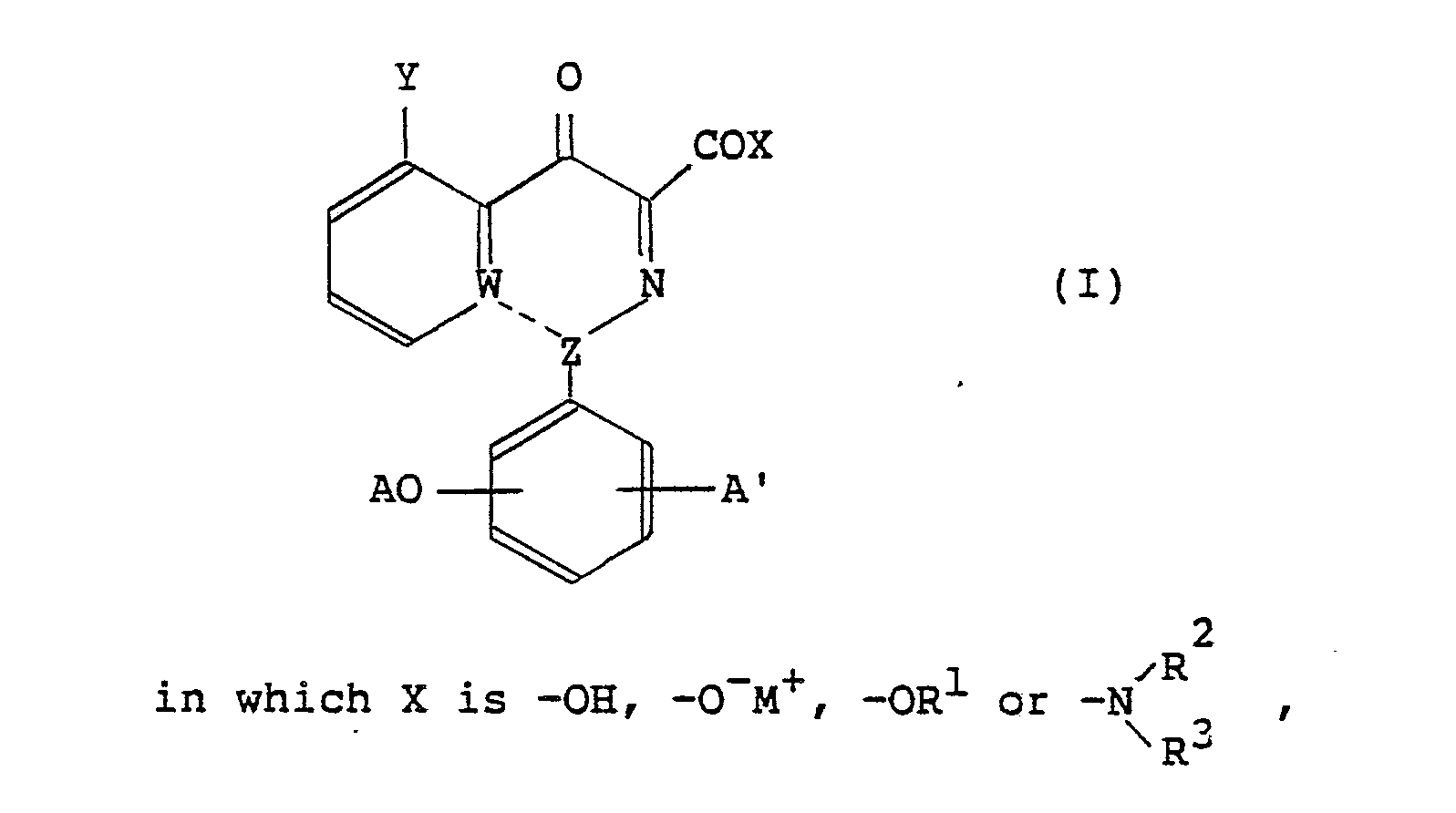

R¹ is a C₁-C₉ alkyl group, a C₃-C₆ alkenyl group,a C₃-C₄ alkynyl group, a C₁-C₃ alkoxy (C₁-C₄) alkyl group, a C₁-C₃ mono-or polyhaloalkyl group, a C₃-C₈ cycloalkyl group, benzyl group or phenyl group; an
R² and R³ are the same or different and each is hydrogen atom, a C₁-C₆ alkyl group, a C₃-C₄ alkenyl group, a C₃-C₄ alkynyl group, a C₃-C₈ cycloalkyl group, a benzyl group in which at most two of hydrogen atoms at the α-position thereof may be substituted by methyl group, a C₂-C₃ hydroxyalkyl group or a phenyl group in which at most three of hydrogen atoms thereof may be substituted by the same or different C₁-C₂ alkyl group or halogen atom;
Y is fluorine atom, chlorine atom, a trihalomethyl group or a C₁-C₆ alkoxy group;
A is a C₁-C₃ polyhaloalkyl group;
Aʹ is hydrogen atom or a halogen atom; and
W and Z are C-F and N-H respectively with non-bonding, or are taken together to form C-N, provided that X is OR¹ in case that W and Z are C-F and N-H respectively, and an inert carrier or diluent;
a method for inducing male sterility in plant, which comprises applying an effective amount of a compound having the formula (I) :

R¹ is a C₁-C₉ alkyl group, a C₃-C₆ alkenyl group, a C₃-C₄ alkynyl group, a C₁-C₃ alkoxy (C₁-C₄)-alkyl group, a C₁-C₃ mono-or polyhaloalkyl group, a C₃-C₈ cycloalkyl group, benzyl group or phenyl group; an R² and R³ are the same or different and each is hydrogen atom, a C₁-C₆ alkyl group, a C₃-C₄ alkenyl group, a C₃-C₄ alkynyl group, a C₃-C₈ cycloalkyl group, a benzyl group in which at most two of hydrogen atoms at the α-position thereof may be substituted by methyl group, a C₂-C₃ hydroxyalkyl group or a phenyl group in which at most three of hydrogen atoms thereof may be substituded by the same or different C₁-C₂ alkyl group or halogen atom;
Y is fluorine atom, chlorine atom, a trihalomethyl group or a C₁-C₆ alkoxy group;
A is a C₁-C₃ polyhaloalkyl group;
Aʹ is hydrogen atom or a halogen atom; and
W and Z are C-F and N-H respectively with non-bonding, or are taken together to form C-N, provided that X is OR¹ in case that W and Z are C-F and N-H respectively, and an inert carrier or diluent to the plant;
a hydrazone derivative having the formula (II) :
Y is fluorine atom, chlorine atom, a trihalomethyl group or a C₁-C₆ alkoxy group;
A is a C₁-C₃ polyhaloalkyl group; and
Aʹ is hydrogen atom or a halogen atom. - Hereinafter, the present invention is explained in detail.
- Among the plant male sterilants of the present invention, those wherein W and Z are taken together to form C-N are preferred in efficiency. More preferred are those wherein W and Z are taken together to form C-N and X is -OH, -O⁻M⁺ or -OR¹.
- Further, particularly more preferred are those wherein W and Z are taken together to form C-N, X is -OH, -O⁻M⁺ or -OR¹ and A is a dihalomethyl group or a trihalomethyl group, and among them, the most preferred are those wherein Y is fluorine atom, a trihalomethyl group or a C₁-C₄ alkoxy group.
- The plant male sterilant of the present invention is used for various cultivated plants, for instance, grains such as rice, wheat, barley, wild oats, rye and corn, leguminous crops such as soybean, vegetables such as eggplant, tomato and cabbage or flower and ornamental plants such as morningglory, petunia and zinnia. The plant male sterilant can sufficiently induce male sterility in plant without causing any serious phytotoxicity on the plant.
- That is to say, when the plant male sterilant of the present invention is used, it can induce almost completely male sterility in plant without causing any undesirable side-effects on plant.
- Further, as mentioned in the following Test Examples, since the plant male sterilant of the present invention has no harmful influence on a pistil, the hybrid seeds can be easily obtained by means of cross-pollination.
- Processes for preparing the compounds used as an active ingredient in plant male sterilant of the present invention are explained as follows. Among the compounds, a compound in which W and Z are C-F and N-H respectively with non-bonding, i.e. a hydrazone derivative having the formula (II) :

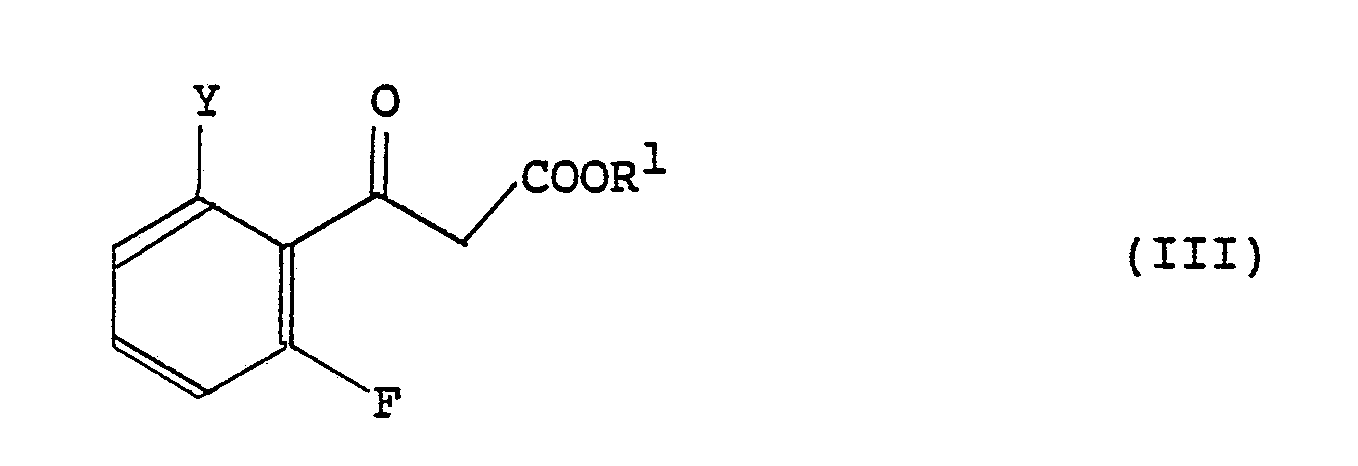

- The reaction is usually carried out in a solvent at a temperature of 0 to 50°C for a period of 10 minutes to 10 hours. The compound (IV) may be used in an amount of about 1 to about 1.5 equivalents to one equivalent of the compound (III).
- Examples of the solvent are, for instance, ethers (e.g. diethyl ether, diisopropyl ether, dioxane, tetrahydrofuran and diethylene glycol dimethyl ether), alcohols (e.g. methanol, ethanol, isopropanol, t-butanol, octanol, cyclohexanol, methyl cellosolve, diethylene glycol and glycerin), tertiaryamines (e.g. pyridine, triethylamine, N,N-diethylaniline, tributylamine and N-methylmorpholine), acid amides (e.g. formamide, N,N-dimethylformamide, acetamide), water, and the like. Their mixtures are also usable.
- Inorganic bases such as sodium carbonate, potassium carbonate, sodium acetate and potassium acetate may be added to the reaction mixture in order that the reaction proceeds smoothly.
- After completion of the reaction, the reaction mixture is subjected to ordinary post-treatments such as extraction with an organic solvent and concentration. If desired, any conventional purification procedures such as chromatography and recrystallization may be adopted.
- Among the compounds (II), which are obtainable according to the above process, those wherein A is a dihalomethyl group or a trihalomethyl group and Y is fluorine atom, a trihalomethyl group or a C₁-C₄ alkoxy group are preferred.
- The compound (IV) is obtainable according to the ordinary methods described in, for instance, Organic Functional Group Preparations, S.R. Sandler and W. Karo, Academic Press, Chapter 15(1968).
- The compounds, in which W and Z are taken together to form C-N, can be prepared as follows:
- (1) A cinnoline-3-carboxylate ester derivative in which X on the formula (I) is -OR¹, i.e. having the formula (I-1) :


- The reaction is carried out by using the dehydrohalogenating agent, in a solvent or without any solvent, at a temperature of 0 to 150°C for a period of 10 minutes to 20 hours. The dehydrohalogenating agent may be used in an amount of about 1 to about 10 equivalents to one equivalent of the compound (V).
- In order to carry out the reaction more efficiently, quaternary ammonium salts or crown ethers may be added to the reaction mixture.
- Examples of the solvent are, for instance, aliphatic hydrocarbons (e.g. hexane, heptane, ligroin, petroleum ether), aromatic hydrocarbons (e.g. benzene, toluene, xylene), halogenated hydrocarbons (e.g. chloroform, carbon tetrachloride, dichloroethane, chlorobenzene, dichlorobenzene), ethers (e.g. diethyl ether, diisopropyl ether, dioxane, tetrahydrofuran, diethylene glycol dimethyl ether), ketones (e.g. acetone, methyl ethyl ketone, methyl isobutyl ketone, isophorone, cyclohexanone), esters (e.g. ethyl formate, ethyl acetate, butyl acetate, diethyl carbonate), nitro compounds (e.g. nitroethane, nitrobenzene), nitriles (e.g. acetonitrile, isobutyronitrile), tertiary amines (e.g. pyridine, triethylamine, N,N-diethylaniline, tributylamine, N-methylmorphorine), acid amides (e.g. formamide, N,N-dimethylformamide, acetamide), sulfur compounds (e.g. dimethyl sulfoxide, sulfolane), water, and the like. Their mixtures are also usable.
- Examples of the dehydrohalogenating agent are, for instance, organic bases (e.g. pyridine, triethylamine, N,N-diethylaniline), inorganic bases (e.g. sodium hydroxide, potassium hydroxide, sodium carbonate, potassium carbonate, sodium hydride), alkali metal alkoxide (e.g. sodium methoxide, sodium ethoxide), and the like.
- As for the quaternary ammonium salts, there are, for instance, benzyl triethyl ammonium chloride and tetrabutyl ammonium chloride, and the like. Examples of the crown ether are, for instance, dibenzo-18-crown-6, and the like.
- After completion of the reaction, the reaction mixture is subjected to ordinary post-treatments such as collection of crystals by means of addition of water, extraction with an organic solvent and concentration. If desired, purification procedures such as chromatography and recrystallization may be adopted to obtain the compound (I-1).
- (2) A cinnoline-3-carboxylic acid derivative, in which X on the formula (I) is hydroxyl group, i.e. having the formula (I-2) :
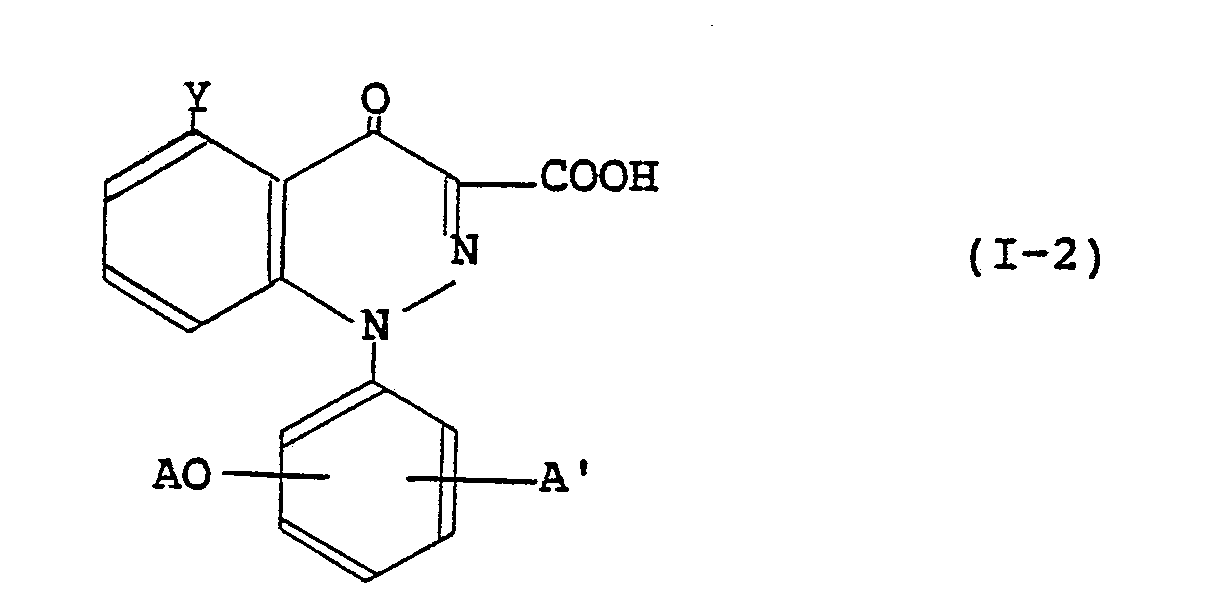
- The reaction is usually carried out in either water or a mixture of water and other solvents such as alcohols (e.g. methanol, ethanol, isopropanol, diethylene glycol, glycerin), ketones (e.g. acetone), ethers (e.g. tetrahydrofuran, dioxane), nitriles (e.g. acetonitrile), acid amides (e.g. formamide, N,N-dimethylformamide) and sulfur compounds (e.g. dimethyl sulfoxide).
- Usually, there is added acids or alkalis to the reaction mixture in an amount of about 1 to about 100 equivalents to one equivalent of the compound (I-1).
- The reaction can be accomplished at a temperature of 20 to 100°C for a period of 30 minutes to 10 hours. Examples of the acids are, for instance, hydrochloric acid, sulfuric acid, nitric acid, and the like. Examples of the alkalis are, for instance, sodium hydroxide, potassium hydroxide, and the like.
- In case of using the alkalis, after completion of the reaction, the reaction mixture is subjected to the reaction of neutralization with acids such as hydrochloric acid, sulfuric acid, formic acid and acetic acid. As for post-treatment of the reaction mixture, if there are precipitated crystals, they are collected by filtration, otherwise the compound (I-2) is obtainable by subjecting the reaction mixture to purification procedures such as extraction with an organic solvent and concentration.
- (3) A cinnoline-3-carboxylic acid derivative, in which X on the formula (I) is -O⁻M⁺, i.e. having the formula (I-3) :

- Examples of the metal hydroxide are, for instance, lithium hydroxide, sodium hydroxide, potassium hydroxide, calcium hydroxide, and the like.
- The reaction is usually carried out in water and the metal hydroxide may be employed in an amount of about 0.7 to about 1 equivalent to one equivalent of the compound (I-2).
- The reaction can be accomplished at a temperature of 0 to 50°C for a period of 5 minutes to 5 hours. After completion of the reaction, if desired, a water layer is washed with an organic solvent and the compound (I-3) is obtainable by concentrating the water layer.
- (4) A cinnoline-3-carboxylic acid amine salt derivative, in which X on the formula (I) is


- The reaction is usually carried out in a solvent or without any solvent at a temperature of 0 to 100°C for a period of 5 minutes to 8 hours. The amine(VI) may be used in an amount of about 1 to about 10 equivalents to one equivalent of the compound (I-2).
- Examples of the solvent are, for instance, aromatic hydrocarbons (e.g. benzene, toluene, xylene), halogenated hydrocarbons (e.g. chloroform, carbon tetrachloride, dichloroethane, chlorobenzene, dichlorobenzene), ethers (e.g. diethyl ether, diisopropyl ether, dioxane, tetrahydrofuran, diethylene glycol dimethyl ether), alcohols (e.g. methanol, ethanol, isopropanol, t-butanol, octanol, cyclohexanol, methyl cellosolve, diethylene glycol, glycerin), esters (e.g. ethyl formate, ethyl acetate, butyl acetate, diethyl carbonate), nitro compounds (e.g. nitro ethane, nitro benzene), nitriles (e.g. acetonitrile, isobutylonitrile), water, and the like. Their mixtures are also usable.
- After completion of the reaction, the reaction mixture is subjected to ordinary post-treatments such as concentration and, if necessary, to purification procedures such as recrystallization to give the compound (I-4).
- (5) A cinnoline-3-carboxylic acid amide derivative, in which X on the formula (I) is


- The reaction is usually carried out in a solvent or without any solvent, in the presense of a dehydrohalogenating agent at a temperature of 0 to 50°C for a period of 10 minutes to 3 hours. The compound (VIII) and the dehydrohalogenating agent may be used in an amount of about 1 to about 5 equivalents to and about 1 to about 2 equivalents to one equivalent of the compound (VII) respectively.
- Examples of the solvent are, for instance, aliphatic hydrocarbons (e.g. hexane, heptane, ligroin, petroleum ether), aromatic hydrocarbons (e.g. benzene, toluene, xylene), halogenated hydrocarbons (e.g. chloroform, carbon tetrachloride, dichloroethane, chlorobenzene, dichlorobenzene), ethers (e.g. diethyl ether, diisopropyl ether, dioxane, tetrahydrofuran, diethylene glycol dimethyl ether), esters (e.g. ethyl formate, ethyl acetate, butyl acetate, diethyl carbonate), nitro compounds (e.g. nitroethane, nitrobenzene), nitriles (e.g. acetonitrile, isobutylonitrile), tertiary amines (e.g. pyridine, triethylamine, N,N-diethylaniline, tributylamine, N-methylmorphorine), acid amines (e.g. formamide, N,N-dimethylformamide, acetamide), sulfur compounds (e.g. dimethyl sulfoxide, sulfolane), water, and the like. The mixtures of them are also usable.
- Examples of the dehydrohalogenating agent are organic bases such as pyridine, triethylamine, N,N-diethylaniline.
- After completion of the reaction, the reaction mixture is subjected to ordinary post-treatments such as extraction with an organic solvent and concentration to obtain the compound (I-5). If necessary, purification procedures such as chromatography and recrystallization may be adopted.
- On the other hand, the compound (VII) can be easily obtained by subjecting the compound (I-2) to ordinary acid halogenation.
- Typical examples of the compound contained in the plant male sterilant of the present invention, which can be prepared through the above procedures, are shown in Table 1 and Table 2.

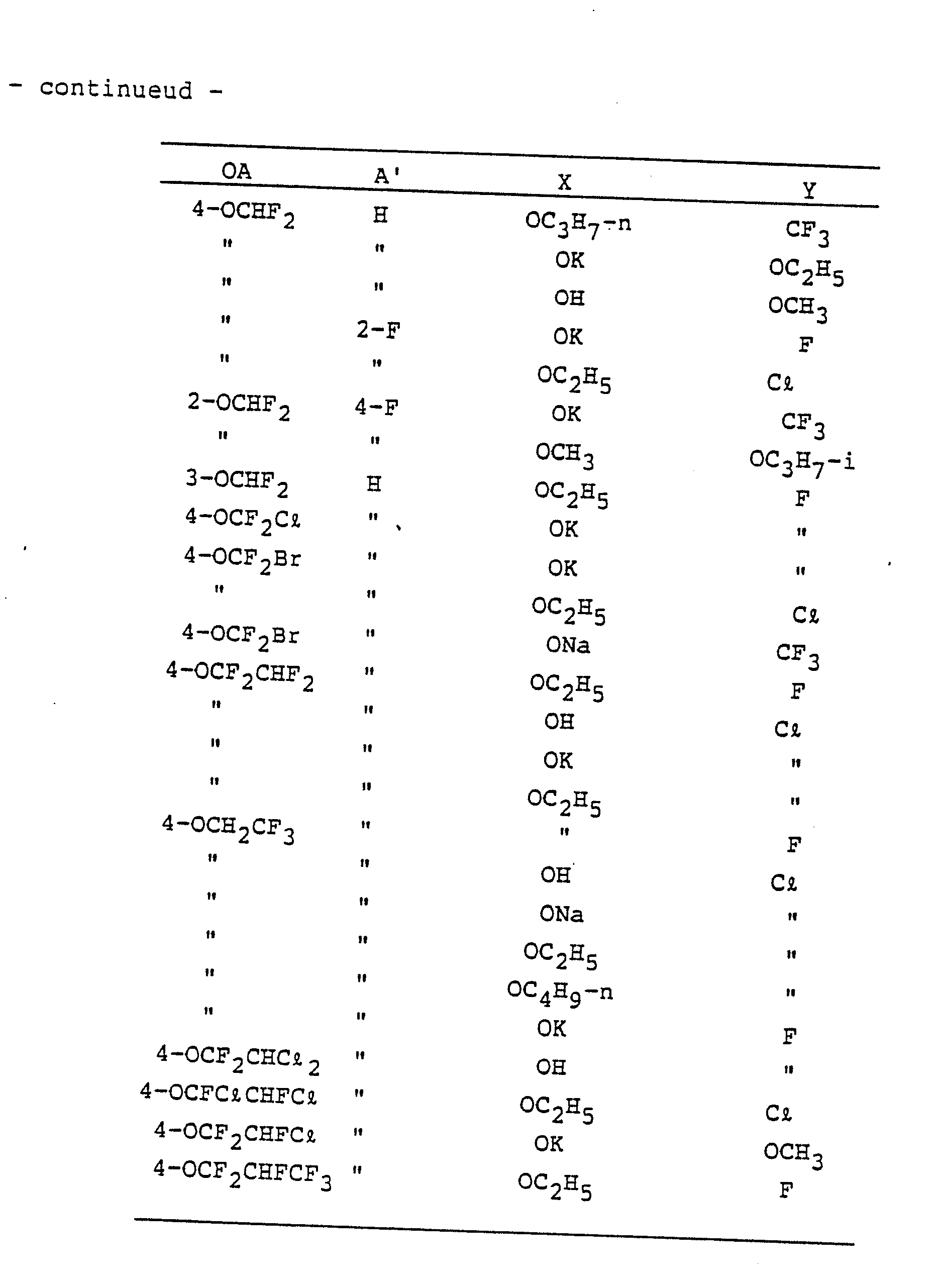

- The present invention is more specifically described and explained by means of the following Examples, wherein the compound number of the active ingredient corresponds to the one in Table 3 and Table 4. It is to be understood that the present invention is not limited to the Examples and various changers and modifications can be made without departing from the scope and spirit of the present invention.
- To 551 mg of 4-trifluoromethoxyaniline was added 6 mℓ of water and 2 mℓ of concentrated hydrochloric acid to prepare a solution of hydrochloric acid salt. And thereto, a solution of 236 mg of sodium nitrite in 2 mℓ of water was added dropwise over about 5 minutes while cooling with ice to form a diazonium salt.
- The obtained solution was added dropwise to a solution of 710 mg of ethyl 2,6-difluorobenzoylacetate in a mixture of 15 mℓ of 70 % methanol and 2 mℓ of pyridine at 10 to 20 °C over about 10 minutes, followed by stirring the reaction mixture for 1 hour at room temperature.
- After adding 30 mℓ of water thereto, the resultant mixture was extracted twice with 30 mℓ of ethyl acetate. After the extract was concentrated, the residue was purified by means of silica gel column chromatography with a mixture of n-hexane and ethyl acetate (v/v=10/1) to give 1048 mg of ethyl 2-[(4-trifluoromethoxyphenyl)-1,1-diazanediyl]-(2,6-difluorobenzoyl)acetate (yield: 80.9 % by mole).
- To 1048 mg of 4-difluoromethoxyaniline was added 6 mℓ of water and 3 mℓ of concentrated hydrochloric acid to prepare a solution of hydrochloric acid salt. And thereto, a solution of 500 mg of sodium nitrite in 3 mℓ of water was added dropwise over about 5 minutes while cooling with ice to form a diazonium salt.
- The obtained solution was added dropwise to a solution of 1.70 g of ethyl 2,6-difluorobenzoylacetate (purity: ca. 80 %) in a mixture of 25 mℓ of 70 % methanol and 3 mℓ of pyridine at 10 to 20°C over about 10 minutes, followed by stirring the resultant solution for 1 hour at room temperature.
- After adding 50 mℓ of water thereto, the reaction mixture was extracted twice with 40 mℓ of ethyl acetate. After the extract was concentrated, the residue was purified by means of silica gel column chromatography with a mixture of n-hexane and ethyl acetate (v/v=10/1) to give 1.96 g of ethyl 2-[(4-difluoromethoxyphenyl)-1,1-diazanediyl]-(2,6-difluorobenzoyl)acetate (yield: 82.7 % by mole).
- There were added 4.24 g of ethyl 2-[(4-trifluoromethoxyphenyl)-1,1-diazanediyl]-(2,6-difluorobenzoyl)acetate, 1.41 g of potassium carbonate and 10 mg of dibenzo-18-crown-6 to 20 mℓ of N,N-dimethylformamide, and the resultant mixture was heated for 1 hour at 100°C.
- After cooling the reaction mixture to room temperature, the mixture was poured into 100 mℓ of ice-water. After being allowed to stand for 2 hours, precipitated crystals were collected by filtration.
- The crystals were washed twice with 20 mℓ of water and then dried under reduced pressure to give 3.93 g of ethyl 1-(4-trifluoromethoxyphenyl)-1,4-dihydro-4-oxo-5-fluorocinnoline-3-carboxylate (yield: 97.3 % by mole, m.p.: 178.0°C).
- There were added 4.30 g of ethyl 2-[(4-difluoromethoxyphenyl)-1,1-diazanediyl]-(2,6-dichlorobenzoyl)acetate and 1.50 g of potassium carbonate to 25 mℓ of N,N-dimethylformamide, and the reaction mixture was heated for 1 hour and a half at 100°C.
- After cooling the mixture to room temperature, crystals were precipitated by pouring the mixture into 100 mℓ of ice-water.
- The crystals were collected by filtration, washed with 20 mℓ of water and then recrystallized from ethanol to give 3.68 g of ethyl 1-(4-difluoromethoxyphenyl)-1,4-dihydro-4-oxo-5-chlorocinnoline-3-carboxylate (yield: 93.4 % by mole, m.p.: 134.0°C).
- There were added 2.31 g of ethyl 1-(4-trifluoromethoxyphenyl)-1,4-dihydro-4-oxo-5-fluorocinnoline-3-carboxylate and 0.67 g of potassium hydroxide to a mixture of 24 mℓ of ethanol and 6 mℓ of water and then the resultant mixture was stirred for 7 hours at 60 to 70°C.
- After cooling the reaction mixture to room temperature, the mixture was diluted with 100 mℓ of water and washed with 30 mt of diethyl ether. Crystals were precipitated after neutralizing the water layer with concentrated hydrochloric acid to pH 2.
- The crystals were collected by filtration, washed twice with 20 mℓ of water, and dried under reduced pressure to give 2.14 g of 1-(4-trifluoromethoxyphenyl)-1,4-dihydro-4-oxo-5-fluorocinnoline-3-carboxylic acid (yield: 99.5 % by mole, m.p. : 200 - 205°C (dec.)).
- There were added 405 mg of 1-(4-trifluoromethoxyphenyl)-1,4-dihydro-4-oxo-5-fluorocinnoline-3-carboxylic acid and 1.21 mℓ of 0.827 M aqueous solution of potassium hydroxide to 10 mℓ of water and then the resultant suspension was stirred for 3 hours at room temperature. the reaction mixture was washed with 10 mℓ of ethyl acetate.
- After removing the water, the obtained crystals were dried to give 406 mg of potassium 1-(4-trifluoromethoxyphenyl)-1,4-dihydro-4-oxo-5-fluorocinnoline-3-carboxylate (yield: 100 % by mole, m.p. : 198 - 213°C(dec.)).
- There were added 368 mg of 1-(4-trifluoromethoxyphenyl)-1,4-dihydro-4-oxo-5-fluorocinnoline-3-carboxylic acid, 179 mg of thionyl chloride and 50 mg of pyridine to 10 mℓ of toluene and the resultant solution was heated under reflux for 2 hours.
- After cooling the reaction mixture to room temperature, the mixture was added dropwise over about 10 minutes to a solution of 146 mg of diethylamine and 152 mg of triethylamine in 10 mℓ of ethyl acetate while cooling with ice.
- After stirring the mixture for 3 hours at room temperature, the resultant mixture was allowed to stand overnight. The mixture was poured into 30 mℓ of diluted hydrochloric acid with ice, and the obtained mixture was extracted twice with 20 mℓ of ethyl acetate.
- The organic layer was washed with 10 mℓ of each of saturated sodium bicarbonate solution, saturated saline solution and dried over anhydrous magnesium sulfate.
- After the extract was concentrated, the residue was purified by means of silica gel column chromatography with a mixture of n-hexane and acetone (v/v=3/1) to give 143 mg of N,N-diethyl-1-(4-trifluoromethoxyphenyl)-1,4-dihydro-4-oxo-5-fluorocinnoline-3-carboxamide (yield: 33.8 % by mole, m.p.: 118.5°C).
- Some examples of the present invention prepared in the same manner as the above are shown in Table 3 and Table 4.


- Hereinafter, the method of the present invention for inducing male sterility in a plant is explained.
- On the practical usage of the compounds as described above as an active ingredient of the plant male sterilant of the present invention, they can be applied in conventional preparation forms such as an emulsifiable concentrate, a wettable powder, a flowable, a granule and a liquid formulation in combination with a conventional solid carrier, liquid carrier, surface active agent or an auxiliary substance for formulation.
- The content of the compounds of the present invention as the active ingredient in such preparations is within a range of 1 to 80 % by weight, preferably 2 to 70 % by weight.
- Examples of the solid carrier, for instance, are fine powders or granules of kaolin clay, attapulgite clay, bentonite, terra alba, pyrophyllite, talc, diatomaceous earth, calcite, walnut powders, urea, ammonium sulfate and synthetic hydrous silicate, etc.
- As the liquid carrier, there may be exemplified aromatic hydrocarbons (e.g. xylene, methylnaphthalene), alcohols (e.g. isopropanol, ethylene glycol, cellosolve), ketones (e.g. acetone, cyclohexanone, isophorone), vegetable oils (e.g. soybean oil, cotton seed oil), dimethylsulfoxide, N,N-dimethylformamide, acetonitrile, water, etc.
- Examples of the surface active agent used for emulsification, dispersion or spreading are, for instance, anionic type agents (e.g. alkylsulfates, alkylsulfonates, alkylarylsulfonates, dialkylsulfosuccinates, polyoxyethylenealkylphosphates), non-ionic type agents (e.g. polyoxyethylene alkyl ethers, polyoxyethylene alkylaryl ethers, polyoxyethylene polyoxypropylene block copolymer, sorbitan fatty acid esters, polyoxyethylene sorbitan fatty acid esters), etc.
- Examples of the auxiliary substance for formulation include ligninsulfonates, sodium alginate, polyvinyl alcohol, gum arabic, CMC (carboxymethyl cellulose), PAP (isopropyl acid phosphate), etc.
- The compounds according to the present invention are usually formulated and applied to plant by foliar treatment, soil treatment or application on the surface of the water during the period of just before the reproductive growth to the flowering.
- As for the application on the surface of the water, it is necessary to partition a male plant and a female plant, which are planted adjoining each other, so that the male sterilant is not absorbed by the male plant.
- As for the foliar treatment and soil treatment, it is also necessary to keep the male sterilant off the male plant.
- In case of using the compounds as an active ingredient of the plant male sterilant, the dosage rate thereof varies depending on weather conditions, formulation used, application timing, application method, soil involved, species or varieties of the plants treated, etc. Generally, however, the dosage rate is from 5 to 10,000 grams, preferably from 20 to 3,000 grams, of the active ingredient per ha.
- The plant male sterilant of the present invention formulated in the form of an emulsifiable concentrate, a wettable powder, a flowable or a liquid formulation is ordinarily employed by diluting it with water at a volume of 1 to 10 liters per are, if necessary, with addition of auxiliary substances such as a spreading agent.
- On the other hand, the plant male sterilant formulated in the form of granules may be normally applied without dilution.
- Examples of the spreading agent include, in addition to the surface active agents as noted above, polyoxyethylene resin acid (ester), ligninsulfonate, abietic acid salt, dinaphthylmethanedisulfonate, paraffin, etc.
- Further, the compounds of the present invention may be applied in combination with plant growth regulators, herbicides, insecticides, acaricides, nematocides, fungicides, fertilizers, soil improvers, etc.
- Furthermore, the sterilant of the present invention can be treated several times with the same plant by changing the application timing.
- In order to obtain a lot of hybrid seeds, it is applicable to employ a method as follows:
- Two parent plants are planted alternately. A number of ridges or a width thereof of each parent plant varies depending on species or varieties of the plant treated, enviromental conditions, etc. After applying the plant male sterilant of the present invention to female plant, the female plant, which is already male sterilized, are pollinated with pollens of male plant carried by wind, insects, etc, and thereby the hibrid seeds can be obtained.
- Practical embodiments of preparation of the plant male sterilant of the present invention are illustratively shown in the following Formulation Examples wherein all parts are by weight. The compound number of the active ingredient corresponds to the one in Table 3 and Table 4.
- Fifty parts of the compound No. 21, 8 parts of calcium ligninsulfonate, 2 parts of sodium laurylsulfate and 45 parts of synthetic hydrous silicate are well mixed while being powdered to obtain a wettable powder.
- Ten parts of the compound No. 3, 8, 11, 14, 21, 24, 25, 26, 29, 30 or 31, 14 parts of polyoxyethylenestyrylphenyl ether, 6 parts of calcium dodecylbenzenesulfonate and 70 parts of xylene are well mixed to obtain an emulsifiable concentrate.
- Two parts of the compound No. 8, 1 part of synthetic hydrous silicate, 2 parts of calcium ligninsulfonate, 30 parts of bentonite and 65 parts of kaolin clay are well mixed while being powdered. The mixture is then kneaded with water, granulated and dried to obtain granules.
- Twenty-five parts of the compound No. 1, 6, 9, 12, 19 or 45 is mixed with 3 parts of polyoxyethylene sorbitan monooleate, 3 parts of carboxymethyl cellulose and 69 parts of water and pulverized until the particle size of the mixture becomes less than 5 microns to obtain a flowable.
- Three parts of the compound No. 2, 7, 10, 13, 20, 23, 28 or 33, 1 part of polyoxyethylenestyrylphenyl ether and 96 parts of water are well mixed to obtain a liquid formulation.
- The biological data of the compounds as the active ingredient in the plant male sterilant of the present invention are shown in the following Test Examples, wherein the compound number of the active ingredient corresponds to the one in Table 3 and Table 4.
- Plastic pots (volume: 200 ml) were filled with artificial soil mix and seeds of wheat (variety: NORIN No.61) were sowed therein and grown in a greenhouse under the conditions of a day length of 15 hours and a temperature of 27°C (day) and 20°C (night).
- A designed amount of the test compounds formulated in an emulsifiable concentrate or a liquid formulation was diluted with water containing a spreading agent, and the dilution was sprayed over the foliage of the test plant by means of a small hand sprayer at a spray volume of 10 liters per are three times to the same pot, i.e. 14-18 days before, 7-11 days before and 0-4 days before the first heading time of the test plant.
- After the heading, flowering and ripening of the test plant, there were harvested 4 heads per pot and spikelets and seeds thereof were counted.
- The test was carried out in one pot per a treatment.
- The sterility rate was calculated according to the following expression:
Sterility Rate (%) = (1-B/A) × 100 - A: the number of seeds per spikelet of an untreated plant
- B: the number of seeds per spikelet of a treated plant
- The results are shown in Table 5 by the sterility rates (%). It is shown that the test compounds induced the complete or nearly complete sterility in the test plants.

- 1/10000a Wagnel pots were filled with artificial soil mix and the seeds of wheat (variety: NORIN No. 61), were grown according to the same methods and under the same conditions as in Test Example 1.
- The test compound No. 3 was sprayed over the foliage of the test plant once to the same pot according to the method in Test Example 1, 13 days before or 6 days before the first heading time of the test plant.
- After the heading and flowering, artificial pollination was carried out as to 2 heads per pot of the pots which appeared to be sterile, using pollens obtained from the heads of untreated plant.
- After ripening, there were harvested 4 heads per pot of no artificial pollination and 2 heads per pot of artificial pollination and each of spikelets and seeds thereof was counted.
- The test was carried out in one pot per a treatment.
- The sterility rate and the fertility rate were calculated according to the following expression:
Sterility rate (%) = (1-B/A) × 100
Fertility rate (%) = B/A × 100 - A: the number of seeds per spikelet of an untreated plant
- B: the number of seeds per spikelet of a treated plant
- The results are shown in Table 6. In table 6, "treated day" shows the number of days before the first heading time of the test plant, in which the test plant was treated with the test compounds, "sterility" is the sterility rate of no artificial pollination heads, and "Fertility" is the fertility rate of artificial pollination.

- As for the compound No.3, a sufficient sterilizing effect was shown in the heads by no artificial pollination at both treated days, i.e. 6 days before and 13 days before the first heading time. On the other hand, the fertility rate of the heads by artificial pollination was 58.0 % and 42.5 % respectively at each treated day and seeds were sufficiently obtained, and thereby the female fertility was recognized.
- Wheat were grown according to the same method as in Test Example 1. The test compounds, i.e. No.2 and No.3, were sprayed over the foliage of the test plant according to the same methods as in Test Example 1 except that the dosage of the test compounds were 2.0, 7.8, 31.3, 125 and 500 g/ha, 10 days before the first heading time of the test plant.
- After the heading, flowering and ripening, there were harvested 4 heads per pot and spikelets and seeds thereof were counted.
- The sterility rate was calculated according to the same method as in Test Example 1 and rated with an index A, B or C, each of which is equivalent to 80-100 %, 50-79 % or not more than 50 % respectively.
- The phytotoxity to heads were observed visually and rated with an index A, B or C, in which "A" indicates the phytotoxity is hardly noticeable, "B" indicates the phytotoxity is acceptable and "C" indicates the phytotoxity is not acceptable.
- The test was carried out in three pots per a treatment.
- The results were shown in Table 7.

- The compounds No. 2 and No. 3 of the present invention showed a good result for both sterility rate and phytotoxity in a wide range of dosage. On the contrary, with respect to the reference compound, a suitable dosage rate, at which both a sufficient sterility rate and a low phytotoxity can be obtained, was not found. That is, when the phytotoxity was low, the sterility rate was insufficient and when the sterility rate was sufficient, the phytotoxity was high.
- [Sterility and female fertility test of rice] Plastic pots (volume: 200 ml) were filled with artificial soil mix and seeds of rice were sowed therein and grown under the same conditions as in Test Example 1.
- Pots were flooded and then the test compounds were sprayed over the foliage of the test plant according to the same methods as in Test Example 1, 15 days before or 10 days before the first heading time of the test plant.
- Two pots were used per one experimental plot. One for an observation of the sterility of the test plant was kept free. The other for the female fertility was artificially pollinated with pollens, which were blown off from other untreated pots placed next thereto, after the heading.
- After ripening, there were harvested 4 heads per pot and glumous flower and seeds were counted.
- The sterility rate and the fertility rate were calculated according to the following expression:
Sterility rate of heads by no artificial pollination (%) = (1-B/A) × 100
Fertility rate of heads by artificial pollinatio (%) = B/A × 100 - A: the number of seeds per glumous flower of an untreated plant
- B: the number of seeds per glumous flower of a treated plant
- The results are shown in Table 8. In table 8, the meanings of the terms "treated day", "sterility" and "fertility" are as defined in Test Example 2.

- As for the compound No. 2, a sufficient sterility rate was shown in the heads by no artificial pollination at both treated days, i.e. 15 days before and 10 days before the first heading time.
- On the other hand, seeds were sufficiently obtained from the heads by artificial pollination, and thereby the female fertility was recognized.
- Plastic pots (volume: 200 mℓ ) were filled with plow-field soil and seeds of morningglory were sowed therein and grown under the same conditions as in Test Example 1 for 7 days. After that, there was carried out a short day treatment (22°C, day length of 8 hours) in a growth chamber for 14 days. After the short day treatment, the test plant was replaced under the same conditions as in Test Example 1.
- The test compound No. 30 was sprayed over the foliage of the test plant according to the same methods as in Test Example 1, except that the dosage of the test compound was 125 and 500 g/ha, three times, i.e. 21, 28 and 35 days after sowing to the same pots. The test was carried out in two pots per a treatment.
- After flowering, six flowers per a treatment were observed visually and rated with the following index.
-
- A: No anther dehiscence
- B: Anther dehiscence, few pollen number
- C: Anther dehiscence, normal pollen number
-
- A: No or slight phytotoxicity
- B: Phytotoxic, but the pistil is normal
- C: Phytotoxic to the pistil
- Artificial pollination was carried out to the flowers of which the effect to the anther was index A and the flowers of untreated control. The anther of the untreated control was hand-emasculated before flowering.
- After seed set, the number of seed set flowers was counted and the fertility rate was calculated according to the following expression:

- The results are shown in Table 9.

- The compound No. 30 of the present invention showed good results for sterility, phytotoxicity and fertility rate.
- In addition to the ingredients used in the Examples, Formulation Examples and test Examples, other ingredients can be used in the Examples, Formulation Examples and Test Examples as set forth in the specification to obtain substantially the same results.
Claims (14)


R¹ is a C₁-C₉ alkyl group, a C₃-C₆ alkenyl group, a C₃-C₄ alkynyl group, a C₁-C₃ alkoxy (C₁-C₄)-alkyl group, a C₁-C₃ mono-or polyhaloalkyl group, a C₃-C₈ cycloalkyl group, benzyl group or phenyl group; and
R² and R³ are the same or different and each is hydrogen atom, a C₁-C₆ alkyl group, a C₃-C₄ alkenyl group, a C₃-C₄ alkynyl group, a C₃-C₈ cycloalkyl group, a benzyl group in which at most two of hydrogen atoms at the α-position thereof may be substituted by methyl group, a C₂-C₃ hydroxyalkyl group or a phenyl group in which at most three of hydrogen atoms thereof may be substituded by the same or different C₁-C₂ alkyl group or halogen atom;
Y is fluorine atom, chlorine atom, a trihalomethyl group or a C₁-C₆ alkoxy group;
A is a C₁-C₃ polyhaloalkyl group;
Aʹ is hydrogen atom or a halogen atom; and
W and Z are C-F and N-H respectively with non-bonding, or are taken together to form C-N, provided that X is OR¹ in case that W and Z are C-F and N-H respectively, and an inert carrier or diluent.


R¹ is a C₁-C₉ alkyl group, a C₃-C₆ alkenyl group, a C₃-C₄ alkynyl group, a C₁-C₃ alkoxy (C₁-C₄)-alkyl group, a C₁-C₃ mono-or polyhaloalkyl group, a C₃-C₈ cycloalkyl group, benzyl group or phenyl group; and
R² and R³ are the same or different and each is hydrogen atom, a C₁-C₆ alkyl group, a C₃-C₄ alkenyl group, a C₃-C₄ alkynyl group, a C₃-C₈ cycloalkyl group, a benzyl group in which at most two of hydrogen atoms at the α-position thereof may be substituted by methyl group a C₂-C₃ hydroxyalkyl group or a phenyl group in which at most three of hydrogen atoms thereof may be substituded by the same or different C₁-C₂ alkyl group or halogen atom;
Y is fluorine atom, chlorine atom, a trihalomethyl group or a C₁-C₆ alkoxy group;
A is a C₁-C₃ polyhaloalkyl group;
Aʹ is hydrogen atom or a halogen atom; and
W and Z are C-F and N-H respectively with non-bonding, or are taken together to form C-N, provided that X is OR¹ in case that W and Z are C-F and N-H respectively, and an inert carrier or diluent to the plant.

Y is fluorine atom, chlorine atom, a trihalomethyl group or a C₁-C₆ alkoxy group;
A is a C₁-C₃ polyhaloalkyl group; and
Aʹ is hydrogen atom or a halogen atom.
Applications Claiming Priority (4)
| Application Number | Priority Date | Filing Date | Title |
|---|---|---|---|
| JP31425586 | 1986-12-26 | ||
| JP31425486 | 1986-12-26 | ||
| JP314255/86 | 1986-12-26 | ||
| JP314254/86 | 1986-12-26 |
Publications (3)
| Publication Number | Publication Date |
|---|---|
| EP0274717A2 true EP0274717A2 (en) | 1988-07-20 |
| EP0274717A3 EP0274717A3 (en) | 1988-08-03 |
| EP0274717B1 EP0274717B1 (en) | 1992-12-02 |
Family
ID=26567878
Family Applications (1)
| Application Number | Title | Priority Date | Filing Date |
|---|---|---|---|
| EP87118878A Expired - Lifetime EP0274717B1 (en) | 1986-12-26 | 1987-12-19 | Plant male sterilant |
Country Status (6)
| Country | Link |
|---|---|
| US (1) | US4915727A (en) |
| EP (1) | EP0274717B1 (en) |
| KR (1) | KR950009515B1 (en) |
| AU (1) | AU606905B2 (en) |
| DE (1) | DE3782931T2 (en) |
| ES (1) | ES2044909T3 (en) |
Cited By (6)
| Publication number | Priority date | Publication date | Assignee | Title |
|---|---|---|---|---|
| EP0530063A1 (en) * | 1991-08-22 | 1993-03-03 | Orsan | Pollen suppressant for dicotyledon plants comprising a 5-oxy-substituted cinnoline |
| EP0530064A1 (en) * | 1991-08-22 | 1993-03-03 | Hybrinova | Pollen suppressant for Liliopsida plants comprising a 5-oxy-substituted cinnoline |
| US5332716A (en) * | 1988-09-13 | 1994-07-26 | Jeffrey Labovitz | Pollen suppressant comprising a 5-oxy- or amino-substituted cinnoline |
| WO2021233786A1 (en) | 2020-05-19 | 2021-11-25 | Syngenta Crop Protection Ag | Herbicidal cinnoline derivatives |
| WO2021233787A1 (en) | 2020-05-19 | 2021-11-25 | Syngenta Crop Protection Ag | Herbicidal cinnoline derivatives |
| WO2023088921A1 (en) | 2021-11-18 | 2023-05-25 | Syngenta Crop Protection Ag | Herbicidal derivatives |
Families Citing this family (4)
| Publication number | Priority date | Publication date | Assignee | Title |
|---|---|---|---|---|
| AU599850B2 (en) * | 1987-12-18 | 1990-07-26 | Sumitomo Chemical Company, Limited | Plant male sterilant |
| US5129939A (en) * | 1988-09-13 | 1992-07-14 | Orsan | Pollen suppressant comprising a 5-oxy- or amino-substituted cinnoline |
| KR100301462B1 (en) * | 1994-07-14 | 2001-10-22 | 구자홍 | Protective circuit of induction cooker |
| CN113349052A (en) * | 2021-07-12 | 2021-09-07 | 中国海洋大学 | Method for constructing laver mutant library |
Family Cites Families (4)
| Publication number | Priority date | Publication date | Assignee | Title |
|---|---|---|---|---|
| US4729782A (en) * | 1983-09-14 | 1988-03-08 | Lafarge Coppee | Pollen suppressant comprising a fused pyridazinone |
| US4604134A (en) * | 1983-09-14 | 1986-08-05 | Lafarge Coppee | Pollen suppressant comprising a fused pyridazine |
| EP0197226A1 (en) * | 1985-04-03 | 1986-10-15 | Lafarge Coppee | Chemical hybridization agents comprising derivatives of cinnoline-3-carboxylic acids, and their application |
| CA1289960C (en) * | 1986-12-25 | 1991-10-01 | Masato Mizutani | Cinnoline derivative, process for preparing the same and herbicidal composition containing the same |
-
1987
- 1987-12-11 AU AU82471/87A patent/AU606905B2/en not_active Ceased
- 1987-12-19 ES ES87118878T patent/ES2044909T3/en not_active Expired - Lifetime
- 1987-12-19 DE DE8787118878T patent/DE3782931T2/en not_active Expired - Fee Related
- 1987-12-19 EP EP87118878A patent/EP0274717B1/en not_active Expired - Lifetime
- 1987-12-24 KR KR1019870014909A patent/KR950009515B1/en not_active Expired - Fee Related
- 1987-12-24 US US07/137,703 patent/US4915727A/en not_active Expired - Fee Related
Cited By (8)
| Publication number | Priority date | Publication date | Assignee | Title |
|---|---|---|---|---|
| US5332716A (en) * | 1988-09-13 | 1994-07-26 | Jeffrey Labovitz | Pollen suppressant comprising a 5-oxy- or amino-substituted cinnoline |
| EP0530063A1 (en) * | 1991-08-22 | 1993-03-03 | Orsan | Pollen suppressant for dicotyledon plants comprising a 5-oxy-substituted cinnoline |
| EP0530064A1 (en) * | 1991-08-22 | 1993-03-03 | Hybrinova | Pollen suppressant for Liliopsida plants comprising a 5-oxy-substituted cinnoline |
| WO2021233786A1 (en) | 2020-05-19 | 2021-11-25 | Syngenta Crop Protection Ag | Herbicidal cinnoline derivatives |
| WO2021233787A1 (en) | 2020-05-19 | 2021-11-25 | Syngenta Crop Protection Ag | Herbicidal cinnoline derivatives |
| CN115802892A (en) * | 2020-05-19 | 2023-03-14 | 先正达农作物保护股份公司 | Herbicidal cinnoline derivatives |
| CN115802892B (en) * | 2020-05-19 | 2025-08-08 | 先正达农作物保护股份公司 | Herbicidal cinnoline derivatives |
| WO2023088921A1 (en) | 2021-11-18 | 2023-05-25 | Syngenta Crop Protection Ag | Herbicidal derivatives |
Also Published As
| Publication number | Publication date |
|---|---|
| EP0274717A3 (en) | 1988-08-03 |
| DE3782931T2 (en) | 1993-04-08 |
| US4915727A (en) | 1990-04-10 |
| AU606905B2 (en) | 1991-02-21 |
| ES2044909T3 (en) | 1994-01-16 |
| KR880006984A (en) | 1988-08-26 |
| AU8247187A (en) | 1988-06-30 |
| DE3782931D1 (en) | 1993-01-14 |
| EP0274717B1 (en) | 1992-12-02 |
| KR950009515B1 (en) | 1995-08-23 |
Similar Documents
| Publication | Publication Date | Title |
|---|---|---|
| HU188525B (en) | Herbicidal preparations containing tetrahydrophthalimide derivatives and process for the production of the active substance | |
| RU2029472C1 (en) | Uracil derivatives, intermediate compounds, herbicide composition, and method of struggle against weed | |
| EP0274717B1 (en) | Plant male sterilant | |
| KR920000050B1 (en) | Method for preparing 2-substituted phenyl-3-chlorotetrahydro-2H-indazoles | |
| EP0197495B1 (en) | 4,5,6,7-tetrahydro-2h-indazole derivatives and herbicides containing them | |
| EP0320782B1 (en) | Plant male sterilant | |
| JPH043392B2 (en) | ||
| US4976775A (en) | Plant male sterilant | |
| JP3064371B2 (en) | Benzoxazyluracil derivative, process for producing the same and herbicide containing the same as active ingredient | |
| EP0118982A1 (en) | Organic phosphorous quinoxalinone and their production and use | |
| JP2696252B2 (en) | Cyclohexanecarboxylic acid derivatives and herbicides and plant growth regulators containing the same | |
| JP2514016B2 (en) | Indole derivative | |
| JPH01250362A (en) | Cinnoline derivative, its production and herbicide containing the same as an active ingredient | |
| KR100545784B1 (en) | 3,4,5,6-Terahydrophthalimides having herbicidal activity | |
| JPH04360876A (en) | Aminouracil derivative, production thereof and herbicide comprising the derivative as active ingredient | |
| JPS63264405A (en) | Male sterilization agent for plant | |
| JPH10231213A (en) | Herbicide composition | |
| JPH01246203A (en) | Male abortive agent for plants | |
| JPS63264464A (en) | Cinnoline derivative, production thereof and herbicide comprising said derivative as active ingredient | |
| JPH0322382B2 (en) | ||
| PH26916A (en) | Plant male sterilant | |
| JPS59212479A (en) | Pyridazine derivative and herbicide | |
| JPS62132882A (en) | Triazinoindole derivative, production thereof and herbicide containing said derivative as active ingredient | |
| JP2001058907A (en) | Herbicide composition | |
| JP2001058908A (en) | Herbicide composition |
Legal Events
| Date | Code | Title | Description |
|---|---|---|---|
| PUAI | Public reference made under article 153(3) epc to a published international application that has entered the european phase |
Free format text: ORIGINAL CODE: 0009012 |
|
| PUAL | Search report despatched |
Free format text: ORIGINAL CODE: 0009013 |
|
| AK | Designated contracting states |
Kind code of ref document: A2 Designated state(s): CH DE ES FR GB IT LI NL |
|
| AK | Designated contracting states |
Kind code of ref document: A3 Designated state(s): CH DE ES FR GB IT LI NL |
|
| 17P | Request for examination filed |
Effective date: 19890124 |
|
| 17Q | First examination report despatched |
Effective date: 19901011 |
|
| GRAA | (expected) grant |
Free format text: ORIGINAL CODE: 0009210 |
|
| AK | Designated contracting states |
Kind code of ref document: B1 Designated state(s): CH DE ES FR GB IT LI NL |
|
| REF | Corresponds to: |
Ref document number: 3782931 Country of ref document: DE Date of ref document: 19930114 |
|
| ET | Fr: translation filed | ||
| ITF | It: translation for a ep patent filed | ||
| PLBE | No opposition filed within time limit |
Free format text: ORIGINAL CODE: 0009261 |
|
| STAA | Information on the status of an ep patent application or granted ep patent |
Free format text: STATUS: NO OPPOSITION FILED WITHIN TIME LIMIT |
|
| 26N | No opposition filed | ||
| REG | Reference to a national code |
Ref country code: ES Ref legal event code: FG2A Ref document number: 2044909 Country of ref document: ES Kind code of ref document: T3 |
|
| PGFP | Annual fee paid to national office [announced via postgrant information from national office to epo] |
Ref country code: FR Payment date: 19940228 Year of fee payment: 10 |
|
| PGFP | Annual fee paid to national office [announced via postgrant information from national office to epo] |
Ref country code: GB Payment date: 19951207 Year of fee payment: 9 |
|
| PGFP | Annual fee paid to national office [announced via postgrant information from national office to epo] |
Ref country code: ES Payment date: 19951218 Year of fee payment: 9 |
|
| PGFP | Annual fee paid to national office [announced via postgrant information from national office to epo] |
Ref country code: CH Payment date: 19951228 Year of fee payment: 9 |
|
| PGFP | Annual fee paid to national office [announced via postgrant information from national office to epo] |
Ref country code: NL Payment date: 19951230 Year of fee payment: 9 |
|
| PGFP | Annual fee paid to national office [announced via postgrant information from national office to epo] |
Ref country code: DE Payment date: 19960207 Year of fee payment: 9 |
|
| PG25 | Lapsed in a contracting state [announced via postgrant information from national office to epo] |
Ref country code: GB Effective date: 19961219 |
|
| PG25 | Lapsed in a contracting state [announced via postgrant information from national office to epo] |
Ref country code: ES Free format text: LAPSE BECAUSE OF THE APPLICANT RENOUNCES Effective date: 19961220 |
|
| PG25 | Lapsed in a contracting state [announced via postgrant information from national office to epo] |
Ref country code: LI Effective date: 19961231 Ref country code: CH Effective date: 19961231 |
|
| PG25 | Lapsed in a contracting state [announced via postgrant information from national office to epo] |
Ref country code: NL Effective date: 19970701 |
|
| GBPC | Gb: european patent ceased through non-payment of renewal fee |
Effective date: 19961219 |
|
| REG | Reference to a national code |
Ref country code: CH Ref legal event code: PL |
|
| PG25 | Lapsed in a contracting state [announced via postgrant information from national office to epo] |
Ref country code: FR Effective date: 19970829 |
|
| NLV4 | Nl: lapsed or anulled due to non-payment of the annual fee |
Effective date: 19970701 |
|
| PG25 | Lapsed in a contracting state [announced via postgrant information from national office to epo] |
Ref country code: DE Effective date: 19970902 |
|
| REG | Reference to a national code |
Ref country code: FR Ref legal event code: ST |
|
| REG | Reference to a national code |
Ref country code: ES Ref legal event code: FD2A Effective date: 20010402 |
|
| PG25 | Lapsed in a contracting state [announced via postgrant information from national office to epo] |
Ref country code: IT Free format text: LAPSE BECAUSE OF NON-PAYMENT OF DUE FEES;WARNING: LAPSES OF ITALIAN PATENTS WITH EFFECTIVE DATE BEFORE 2007 MAY HAVE OCCURRED AT ANY TIME BEFORE 2007. THE CORRECT EFFECTIVE DATE MAY BE DIFFERENT FROM THE ONE RECORDED. Effective date: 20051219 |