EP0274443B1 - Heteroaryl 3-oxo-propanenitrile derivatives and process for their preparation - Google Patents
Heteroaryl 3-oxo-propanenitrile derivatives and process for their preparation Download PDFInfo
- Publication number
- EP0274443B1 EP0274443B1 EP88300115A EP88300115A EP0274443B1 EP 0274443 B1 EP0274443 B1 EP 0274443B1 EP 88300115 A EP88300115 A EP 88300115A EP 88300115 A EP88300115 A EP 88300115A EP 0274443 B1 EP0274443 B1 EP 0274443B1
- Authority
- EP
- European Patent Office
- Prior art keywords
- phenyl
- oxo
- dihydro
- pyrazol
- cyano
- Prior art date
- Legal status (The legal status is an assumption and is not a legal conclusion. Google has not performed a legal analysis and makes no representation as to the accuracy of the status listed.)
- Expired - Lifetime
Links
- -1 Heteroaryl 3-oxo-propanenitrile derivatives Chemical class 0.000 title claims description 25
- 238000000034 method Methods 0.000 title claims description 15
- 238000002360 preparation method Methods 0.000 title claims description 6
- 150000001875 compounds Chemical class 0.000 claims description 139
- 125000004169 (C1-C6) alkyl group Chemical group 0.000 claims description 31
- 239000001257 hydrogen Substances 0.000 claims description 25
- 229910052739 hydrogen Inorganic materials 0.000 claims description 25
- 125000003178 carboxy group Chemical group [H]OC(*)=O 0.000 claims description 21
- 125000004178 (C1-C4) alkyl group Chemical group 0.000 claims description 20
- 229910052736 halogen Inorganic materials 0.000 claims description 20
- 150000002367 halogens Chemical class 0.000 claims description 20
- 125000004435 hydrogen atom Chemical group [H]* 0.000 claims description 20
- 125000001997 phenyl group Chemical group [H]C1=C([H])C([H])=C(*)C([H])=C1[H] 0.000 claims description 18
- 150000003839 salts Chemical class 0.000 claims description 16
- 125000006828 (C2-C7) alkoxycarbonyl group Chemical group 0.000 claims description 15
- 125000001424 substituent group Chemical group 0.000 claims description 14
- 125000002023 trifluoromethyl group Chemical group FC(F)(F)* 0.000 claims description 12
- 125000005236 alkanoylamino group Chemical group 0.000 claims description 11
- 125000000229 (C1-C4)alkoxy group Chemical group 0.000 claims description 10
- 125000004191 (C1-C6) alkoxy group Chemical group 0.000 claims description 8
- 125000004453 alkoxycarbonyl group Chemical group 0.000 claims description 8
- 125000004076 pyridyl group Chemical group 0.000 claims description 8
- 125000000753 cycloalkyl group Chemical group 0.000 claims description 7
- 125000000449 nitro group Chemical group [O-][N+](*)=O 0.000 claims description 7
- 125000003837 (C1-C20) alkyl group Chemical group 0.000 claims description 5
- UFHFLCQGNIYNRP-UHFFFAOYSA-N Hydrogen Chemical compound [H][H] UFHFLCQGNIYNRP-UHFFFAOYSA-N 0.000 claims description 4
- 125000004423 acyloxy group Chemical group 0.000 claims description 4
- QVGXLLKOCUKJST-UHFFFAOYSA-N atomic oxygen Chemical group [O] QVGXLLKOCUKJST-UHFFFAOYSA-N 0.000 claims description 4
- 239000001301 oxygen Substances 0.000 claims description 4
- 229910052760 oxygen Inorganic materials 0.000 claims description 4
- 125000003917 carbamoyl group Chemical group [H]N([H])C(*)=O 0.000 claims description 3
- NINIDFKCEFEMDL-UHFFFAOYSA-N Sulfur Chemical group [S] NINIDFKCEFEMDL-UHFFFAOYSA-N 0.000 claims description 2
- 239000005864 Sulphur Chemical group 0.000 claims description 2
- 125000003302 alkenyloxy group Chemical group 0.000 claims description 2
- 125000001797 benzyl group Chemical group [H]C1=C([H])C([H])=C(C([H])=C1[H])C([H])([H])* 0.000 claims description 2
- 125000004430 oxygen atom Chemical group O* 0.000 claims description 2
- 125000002924 primary amino group Chemical group [H]N([H])* 0.000 claims description 2
- 125000002887 hydroxy group Chemical group [H]O* 0.000 claims 2
- ZMXDDKWLCZADIW-UHFFFAOYSA-N N,N-Dimethylformamide Chemical compound CN(C)C=O ZMXDDKWLCZADIW-UHFFFAOYSA-N 0.000 description 57
- 125000004289 pyrazol-3-yl group Chemical group [H]N1N=C(*)C([H])=C1[H] 0.000 description 42
- ZMANZCXQSJIPKH-UHFFFAOYSA-N Triethylamine Chemical compound CCN(CC)CC ZMANZCXQSJIPKH-UHFFFAOYSA-N 0.000 description 24
- RYHBNJHYFVUHQT-UHFFFAOYSA-N 1,4-Dioxane Chemical compound C1COCCO1 RYHBNJHYFVUHQT-UHFFFAOYSA-N 0.000 description 21
- XEKOWRVHYACXOJ-UHFFFAOYSA-N Ethyl acetate Chemical compound CCOC(C)=O XEKOWRVHYACXOJ-UHFFFAOYSA-N 0.000 description 21
- 239000002244 precipitate Substances 0.000 description 21
- YMWUJEATGCHHMB-UHFFFAOYSA-N Dichloromethane Chemical compound ClCCl YMWUJEATGCHHMB-UHFFFAOYSA-N 0.000 description 20
- XLYOFNOQVPJJNP-UHFFFAOYSA-N water Substances O XLYOFNOQVPJJNP-UHFFFAOYSA-N 0.000 description 20
- QTBSBXVTEAMEQO-UHFFFAOYSA-N Acetic acid Chemical compound CC(O)=O QTBSBXVTEAMEQO-UHFFFAOYSA-N 0.000 description 18
- OKKJLVBELUTLKV-UHFFFAOYSA-N Methanol Chemical compound OC OKKJLVBELUTLKV-UHFFFAOYSA-N 0.000 description 18
- 238000003756 stirring Methods 0.000 description 17
- LFQSCWFLJHTTHZ-UHFFFAOYSA-N Ethanol Chemical compound CCO LFQSCWFLJHTTHZ-UHFFFAOYSA-N 0.000 description 16
- 239000011541 reaction mixture Substances 0.000 description 16
- 238000006243 chemical reaction Methods 0.000 description 15
- KRKNYBCHXYNGOX-UHFFFAOYSA-N citric acid Chemical compound OC(=O)CC(O)(C(O)=O)CC(O)=O KRKNYBCHXYNGOX-UHFFFAOYSA-N 0.000 description 15
- 239000000243 solution Substances 0.000 description 15
- 239000005457 ice water Substances 0.000 description 14
- WEVYAHXRMPXWCK-UHFFFAOYSA-N Acetonitrile Chemical compound CC#N WEVYAHXRMPXWCK-UHFFFAOYSA-N 0.000 description 12
- UHOVQNZJYSORNB-UHFFFAOYSA-N Benzene Chemical compound C1=CC=CC=C1 UHOVQNZJYSORNB-UHFFFAOYSA-N 0.000 description 12
- KEAYESYHFKHZAL-UHFFFAOYSA-N Sodium Chemical compound [Na] KEAYESYHFKHZAL-UHFFFAOYSA-N 0.000 description 11
- 239000012312 sodium hydride Substances 0.000 description 11
- 229910000104 sodium hydride Inorganic materials 0.000 description 11
- 238000011282 treatment Methods 0.000 description 11
- WYURNTSHIVDZCO-UHFFFAOYSA-N Tetrahydrofuran Chemical compound C1CCOC1 WYURNTSHIVDZCO-UHFFFAOYSA-N 0.000 description 10
- HEMHJVSKTPXQMS-UHFFFAOYSA-M sodium hydroxide Inorganic materials [OH-].[Na+] HEMHJVSKTPXQMS-UHFFFAOYSA-M 0.000 description 10
- KWYUFKZDYYNOTN-UHFFFAOYSA-M Potassium hydroxide Chemical compound [OH-].[K+] KWYUFKZDYYNOTN-UHFFFAOYSA-M 0.000 description 9
- 239000000203 mixture Substances 0.000 description 9
- 239000002904 solvent Substances 0.000 description 9
- HEDRZPFGACZZDS-UHFFFAOYSA-N Chloroform Chemical compound ClC(Cl)Cl HEDRZPFGACZZDS-UHFFFAOYSA-N 0.000 description 8
- RTZKZFJDLAIYFH-UHFFFAOYSA-N Diethyl ether Chemical compound CCOCC RTZKZFJDLAIYFH-UHFFFAOYSA-N 0.000 description 8
- KFZMGEQAYNKOFK-UHFFFAOYSA-N Isopropanol Chemical compound CC(C)O KFZMGEQAYNKOFK-UHFFFAOYSA-N 0.000 description 8
- VYPSYNLAJGMNEJ-UHFFFAOYSA-N Silicium dioxide Chemical compound O=[Si]=O VYPSYNLAJGMNEJ-UHFFFAOYSA-N 0.000 description 8
- 238000001816 cooling Methods 0.000 description 8
- 238000002425 crystallisation Methods 0.000 description 8
- 230000008025 crystallization Effects 0.000 description 8
- PLAWGBUYOMFEGY-UHFFFAOYSA-N 2-cyano-3-oxo-n-phenyl-3-(1-phenyl-4h-chromeno[4,3-c]pyrazol-3-yl)propanamide Chemical compound N=1N(C=2C=CC=CC=2)C(C2=CC=CC=C2OC2)=C2C=1C(=O)C(C#N)C(=O)NC1=CC=CC=C1 PLAWGBUYOMFEGY-UHFFFAOYSA-N 0.000 description 7
- 125000004997 halocarbonyl group Chemical group 0.000 description 7
- IAZDPXIOMUYVGZ-UHFFFAOYSA-N Dimethylsulphoxide Chemical compound CS(C)=O IAZDPXIOMUYVGZ-UHFFFAOYSA-N 0.000 description 6
- JUJWROOIHBZHMG-UHFFFAOYSA-N Pyridine Chemical compound C1=CC=NC=C1 JUJWROOIHBZHMG-UHFFFAOYSA-N 0.000 description 6
- YXFVVABEGXRONW-UHFFFAOYSA-N Toluene Chemical compound CC1=CC=CC=C1 YXFVVABEGXRONW-UHFFFAOYSA-N 0.000 description 6
- 239000003480 eluent Substances 0.000 description 6
- 208000015181 infectious disease Diseases 0.000 description 6
- 239000003826 tablet Substances 0.000 description 6
- BGOWFIJRIJEOHH-UHFFFAOYSA-N 2-cyano-3-oxo-n-phenyl-3-(1-phenyl-4h-thiochromeno[4,3-c]pyrazol-3-yl)propanamide Chemical compound N=1N(C=2C=CC=CC=2)C(C2=CC=CC=C2SC2)=C2C=1C(=O)C(C#N)C(=O)NC1=CC=CC=C1 BGOWFIJRIJEOHH-UHFFFAOYSA-N 0.000 description 5
- 0 C[C@@]1[C@](C)[C@@](CC2*CCCC2)C[C@@]2[C@@]1C2 Chemical compound C[C@@]1[C@](C)[C@@](CC2*CCCC2)C[C@@]2[C@@]1C2 0.000 description 5
- DGAQECJNVWCQMB-PUAWFVPOSA-M Ilexoside XXIX Chemical compound C[C@@H]1CC[C@@]2(CC[C@@]3(C(=CC[C@H]4[C@]3(CC[C@@H]5[C@@]4(CC[C@@H](C5(C)C)OS(=O)(=O)[O-])C)C)[C@@H]2[C@]1(C)O)C)C(=O)O[C@H]6[C@@H]([C@H]([C@@H]([C@H](O6)CO)O)O)O.[Na+] DGAQECJNVWCQMB-PUAWFVPOSA-M 0.000 description 5
- 239000003795 chemical substances by application Substances 0.000 description 5
- 238000001704 evaporation Methods 0.000 description 5
- 230000008020 evaporation Effects 0.000 description 5
- 230000007062 hydrolysis Effects 0.000 description 5
- 238000006460 hydrolysis reaction Methods 0.000 description 5
- 239000012442 inert solvent Substances 0.000 description 5
- 238000010992 reflux Methods 0.000 description 5
- 239000000725 suspension Substances 0.000 description 5
- YLQBMQCUIZJEEH-UHFFFAOYSA-N tetrahydrofuran Natural products C=1C=COC=1 YLQBMQCUIZJEEH-UHFFFAOYSA-N 0.000 description 5
- PAYRUJLWNCNPSJ-UHFFFAOYSA-N Aniline Chemical compound NC1=CC=CC=C1 PAYRUJLWNCNPSJ-UHFFFAOYSA-N 0.000 description 4
- CTQNGGLPUBDAKN-UHFFFAOYSA-N O-Xylene Chemical compound CC1=CC=CC=C1C CTQNGGLPUBDAKN-UHFFFAOYSA-N 0.000 description 4
- 210000004027 cell Anatomy 0.000 description 4
- 230000002519 immonomodulatory effect Effects 0.000 description 4
- 125000001449 isopropyl group Chemical group [H]C([H])([H])C([H])(*)C([H])([H])[H] 0.000 description 4
- RLNPJOTVKKWVKP-UHFFFAOYSA-N n-benzyl-2-cyano-3-oxo-3-(1-phenyl-4h-chromeno[4,3-c]pyrazol-3-yl)propanamide Chemical compound N=1N(C=2C=CC=CC=2)C(C2=CC=CC=C2OC2)=C2C=1C(=O)C(C#N)C(=O)NCC1=CC=CC=C1 RLNPJOTVKKWVKP-UHFFFAOYSA-N 0.000 description 4
- 239000003960 organic solvent Substances 0.000 description 4
- CTSLXHKWHWQRSH-UHFFFAOYSA-N oxalyl chloride Chemical compound ClC(=O)C(Cl)=O CTSLXHKWHWQRSH-UHFFFAOYSA-N 0.000 description 4
- 239000008194 pharmaceutical composition Substances 0.000 description 4
- FYSNRJHAOHDILO-UHFFFAOYSA-N thionyl chloride Chemical compound ClS(Cl)=O FYSNRJHAOHDILO-UHFFFAOYSA-N 0.000 description 4
- 239000008096 xylene Substances 0.000 description 4
- VCXQYCYMMROSGW-UHFFFAOYSA-N 1-phenyl-4h-thiochromeno[4,3-c]pyrazole-3-carbonyl chloride Chemical compound C1SC2=CC=CC=C2C2=C1C(C(=O)Cl)=NN2C1=CC=CC=C1 VCXQYCYMMROSGW-UHFFFAOYSA-N 0.000 description 3
- CVQSWZMJOGOPAV-UHFFFAOYSA-N 2,3-dihydrothiochromen-4-one Chemical compound C1=CC=C2C(=O)CCSC2=C1 CVQSWZMJOGOPAV-UHFFFAOYSA-N 0.000 description 3
- WFDIJRYMOXRFFG-UHFFFAOYSA-N Acetic anhydride Chemical compound CC(=O)OC(C)=O WFDIJRYMOXRFFG-UHFFFAOYSA-N 0.000 description 3
- CSCPPACGZOOCGX-UHFFFAOYSA-N Acetone Chemical compound CC(C)=O CSCPPACGZOOCGX-UHFFFAOYSA-N 0.000 description 3
- 239000001828 Gelatine Substances 0.000 description 3
- 241000699670 Mus sp. Species 0.000 description 3
- DNIAPMSPPWPWGF-UHFFFAOYSA-N Propylene glycol Chemical compound CC(O)CO DNIAPMSPPWPWGF-UHFFFAOYSA-N 0.000 description 3
- 229920002472 Starch Polymers 0.000 description 3
- 229930006000 Sucrose Natural products 0.000 description 3
- CZMRCDWAGMRECN-UGDNZRGBSA-N Sucrose Chemical compound O[C@H]1[C@H](O)[C@@H](CO)O[C@@]1(CO)O[C@@H]1[C@H](O)[C@@H](O)[C@H](O)[C@@H](CO)O1 CZMRCDWAGMRECN-UGDNZRGBSA-N 0.000 description 3
- 239000002253 acid Substances 0.000 description 3
- 239000013543 active substance Substances 0.000 description 3
- 125000003545 alkoxy group Chemical group 0.000 description 3
- 125000000484 butyl group Chemical group [H]C([*])([H])C([H])([H])C([H])([H])C([H])([H])[H] 0.000 description 3
- 239000003937 drug carrier Substances 0.000 description 3
- 229920000159 gelatin Polymers 0.000 description 3
- 235000019322 gelatine Nutrition 0.000 description 3
- HQKMJHAJHXVSDF-UHFFFAOYSA-L magnesium stearate Substances [Mg+2].CCCCCCCCCCCCCCCCCC([O-])=O.CCCCCCCCCCCCCCCCCC([O-])=O HQKMJHAJHXVSDF-UHFFFAOYSA-L 0.000 description 3
- 125000002496 methyl group Chemical group [H]C([H])([H])* 0.000 description 3
- VLKZOEOYAKHREP-UHFFFAOYSA-N n-Hexane Chemical compound CCCCCC VLKZOEOYAKHREP-UHFFFAOYSA-N 0.000 description 3
- ACHCVNZWYGDXIZ-UHFFFAOYSA-N n-benzyl-2-cyano-3-oxo-3-(1-phenyl-4h-thiochromeno[4,3-c]pyrazol-3-yl)propanamide Chemical compound N=1N(C=2C=CC=CC=2)C(C2=CC=CC=C2SC2)=C2C=1C(=O)C(C#N)C(=O)NCC1=CC=CC=C1 ACHCVNZWYGDXIZ-UHFFFAOYSA-N 0.000 description 3
- 230000007935 neutral effect Effects 0.000 description 3
- 239000000047 product Substances 0.000 description 3
- UMJSCPRVCHMLSP-UHFFFAOYSA-N pyridine Natural products COC1=CC=CN=C1 UMJSCPRVCHMLSP-UHFFFAOYSA-N 0.000 description 3
- 239000011734 sodium Substances 0.000 description 3
- 229910052708 sodium Inorganic materials 0.000 description 3
- QDRKDTQENPPHOJ-UHFFFAOYSA-N sodium ethoxide Chemical compound [Na+].CC[O-] QDRKDTQENPPHOJ-UHFFFAOYSA-N 0.000 description 3
- 235000019698 starch Nutrition 0.000 description 3
- 229960004793 sucrose Drugs 0.000 description 3
- 239000006188 syrup Substances 0.000 description 3
- 235000020357 syrup Nutrition 0.000 description 3
- SCYULBFZEHDVBN-UHFFFAOYSA-N 1,1-Dichloroethane Chemical compound CC(Cl)Cl SCYULBFZEHDVBN-UHFFFAOYSA-N 0.000 description 2
- IIZPXYDJLKNOIY-JXPKJXOSSA-N 1-palmitoyl-2-arachidonoyl-sn-glycero-3-phosphocholine Chemical compound CCCCCCCCCCCCCCCC(=O)OC[C@H](COP([O-])(=O)OCC[N+](C)(C)C)OC(=O)CCC\C=C/C\C=C/C\C=C/C\C=C/CCCCC IIZPXYDJLKNOIY-JXPKJXOSSA-N 0.000 description 2
- KGCPHZNGYDYXTL-UHFFFAOYSA-N 1-phenyl-4h-thiochromeno[4,3-c]pyrazole-3-carboxylic acid Chemical compound C1SC2=CC=CC=C2C2=C1C(C(=O)O)=NN2C1=CC=CC=C1 KGCPHZNGYDYXTL-UHFFFAOYSA-N 0.000 description 2
- STOQDQKQPUUXKF-UHFFFAOYSA-N 2-cyano-3-oxo-3-(1-phenyl-4h-thiochromeno[4,3-c]pyrazol-3-yl)-n-[3-(trifluoromethyl)phenyl]propanamide Chemical compound FC(F)(F)C1=CC=CC(NC(=O)C(C#N)C(=O)C=2C3=C(C4=CC=CC=C4SC3)N(N=2)C=2C=CC=CC=2)=C1 STOQDQKQPUUXKF-UHFFFAOYSA-N 0.000 description 2
- JSAWMTKJZCAXMC-UHFFFAOYSA-N 2-cyano-n-(4-fluorophenyl)-3-oxo-3-(1-phenyl-4h-chromeno[4,3-c]pyrazol-3-yl)propanamide Chemical compound C1=CC(F)=CC=C1NC(=O)C(C#N)C(=O)C1=NN(C=2C=CC=CC=2)C2=C1COC1=CC=CC=C21 JSAWMTKJZCAXMC-UHFFFAOYSA-N 0.000 description 2
- VDYNPNAPWQIFTQ-UHFFFAOYSA-N 3-(8-chloro-1-phenyl-4h-chromeno[4,3-c]pyrazol-3-yl)-2-cyano-3-oxo-n-phenylpropanamide Chemical compound C1=2C3=CC(Cl)=CC=C3OCC=2C(C(=O)C(C#N)C(=O)NC=2C=CC=CC=2)=NN1C1=CC=CC=C1 VDYNPNAPWQIFTQ-UHFFFAOYSA-N 0.000 description 2
- LOYKAQUQXXZDBA-UHFFFAOYSA-N 3-(8-chloro-1-phenyl-4h-thiochromeno[4,3-c]pyrazol-3-yl)-2-cyano-n-(4-fluorophenyl)-3-oxopropanamide Chemical compound C1=CC(F)=CC=C1NC(=O)C(C#N)C(=O)C1=NN(C=2C=CC=CC=2)C2=C1CSC1=CC=C(Cl)C=C21 LOYKAQUQXXZDBA-UHFFFAOYSA-N 0.000 description 2
- MBCVHQPKZWURCA-UHFFFAOYSA-N 3-oxo-3-(1-phenyl-4h-thiochromeno[4,3-c]pyrazol-3-yl)propanenitrile Chemical compound C1SC2=CC=CC=C2C2=C1C(C(CC#N)=O)=NN2C1=CC=CC=C1 MBCVHQPKZWURCA-UHFFFAOYSA-N 0.000 description 2
- GUBGYTABKSRVRQ-XLOQQCSPSA-N Alpha-Lactose Chemical compound O[C@@H]1[C@@H](O)[C@@H](O)[C@@H](CO)O[C@H]1O[C@@H]1[C@@H](CO)O[C@H](O)[C@H](O)[C@H]1O GUBGYTABKSRVRQ-XLOQQCSPSA-N 0.000 description 2
- VHUUQVKOLVNVRT-UHFFFAOYSA-N Ammonium hydroxide Chemical compound [NH4+].[OH-] VHUUQVKOLVNVRT-UHFFFAOYSA-N 0.000 description 2
- 229920002134 Carboxymethyl cellulose Polymers 0.000 description 2
- 229920002261 Corn starch Polymers 0.000 description 2
- CMSMOCZEIVJLDB-UHFFFAOYSA-N Cyclophosphamide Chemical compound ClCCN(CCCl)P1(=O)NCCCO1 CMSMOCZEIVJLDB-UHFFFAOYSA-N 0.000 description 2
- FBPFZTCFMRRESA-FSIIMWSLSA-N D-Glucitol Natural products OC[C@H](O)[C@H](O)[C@@H](O)[C@H](O)CO FBPFZTCFMRRESA-FSIIMWSLSA-N 0.000 description 2
- FBPFZTCFMRRESA-KVTDHHQDSA-N D-Mannitol Chemical compound OC[C@@H](O)[C@@H](O)[C@H](O)[C@H](O)CO FBPFZTCFMRRESA-KVTDHHQDSA-N 0.000 description 2
- XTHFKEDIFFGKHM-UHFFFAOYSA-N Dimethoxyethane Chemical compound COCCOC XTHFKEDIFFGKHM-UHFFFAOYSA-N 0.000 description 2
- PEDCQBHIVMGVHV-UHFFFAOYSA-N Glycerine Chemical compound OCC(O)CO PEDCQBHIVMGVHV-UHFFFAOYSA-N 0.000 description 2
- VEXZGXHMUGYJMC-UHFFFAOYSA-N Hydrochloric acid Chemical compound Cl VEXZGXHMUGYJMC-UHFFFAOYSA-N 0.000 description 2
- GUBGYTABKSRVRQ-QKKXKWKRSA-N Lactose Natural products OC[C@H]1O[C@@H](O[C@H]2[C@H](O)[C@@H](O)C(O)O[C@@H]2CO)[C@H](O)[C@@H](O)[C@H]1O GUBGYTABKSRVRQ-QKKXKWKRSA-N 0.000 description 2
- 229930195725 Mannitol Natural products 0.000 description 2
- NQRYJNQNLNOLGT-UHFFFAOYSA-N Piperidine Chemical compound C1CCNCC1 NQRYJNQNLNOLGT-UHFFFAOYSA-N 0.000 description 2
- ZLMJMSJWJFRBEC-UHFFFAOYSA-N Potassium Chemical compound [K] ZLMJMSJWJFRBEC-UHFFFAOYSA-N 0.000 description 2
- WQDUMFSSJAZKTM-UHFFFAOYSA-N Sodium methoxide Chemical compound [Na+].[O-]C WQDUMFSSJAZKTM-UHFFFAOYSA-N 0.000 description 2
- 229910021626 Tin(II) chloride Inorganic materials 0.000 description 2
- HEDRZPFGACZZDS-MICDWDOJSA-N Trichloro(2H)methane Chemical compound [2H]C(Cl)(Cl)Cl HEDRZPFGACZZDS-MICDWDOJSA-N 0.000 description 2
- 230000001154 acute effect Effects 0.000 description 2
- 235000010443 alginic acid Nutrition 0.000 description 2
- 229920000615 alginic acid Polymers 0.000 description 2
- 125000000217 alkyl group Chemical group 0.000 description 2
- 150000001408 amides Chemical class 0.000 description 2
- 125000003277 amino group Chemical group 0.000 description 2
- 239000000908 ammonium hydroxide Substances 0.000 description 2
- 239000007864 aqueous solution Substances 0.000 description 2
- 230000037396 body weight Effects 0.000 description 2
- 239000002775 capsule Substances 0.000 description 2
- 239000001768 carboxy methyl cellulose Substances 0.000 description 2
- 235000010948 carboxy methyl cellulose Nutrition 0.000 description 2
- 239000008112 carboxymethyl-cellulose Substances 0.000 description 2
- 238000007796 conventional method Methods 0.000 description 2
- 239000008120 corn starch Substances 0.000 description 2
- MLIREBYILWEBDM-UHFFFAOYSA-N cyanoacetic acid Chemical compound OC(=O)CC#N MLIREBYILWEBDM-UHFFFAOYSA-N 0.000 description 2
- 229960004397 cyclophosphamide Drugs 0.000 description 2
- 235000013681 dietary sucrose Nutrition 0.000 description 2
- WYACBZDAHNBPPB-UHFFFAOYSA-N diethyl oxalate Chemical compound CCOC(=O)C(=O)OCC WYACBZDAHNBPPB-UHFFFAOYSA-N 0.000 description 2
- 239000003085 diluting agent Substances 0.000 description 2
- 239000003814 drug Substances 0.000 description 2
- 239000000839 emulsion Substances 0.000 description 2
- SRXHTCWBOVZAIS-UHFFFAOYSA-N ethyl 1-phenyl-4h-chromeno[4,3-c]pyrazole-3-carboxylate Chemical compound C1OC2=CC=CC=C2C2=C1C(C(=O)OCC)=NN2C1=CC=CC=C1 SRXHTCWBOVZAIS-UHFFFAOYSA-N 0.000 description 2
- ZIUSEGSNTOUIPT-UHFFFAOYSA-N ethyl 2-cyanoacetate Chemical compound CCOC(=O)CC#N ZIUSEGSNTOUIPT-UHFFFAOYSA-N 0.000 description 2
- OAYLNYINCPYISS-UHFFFAOYSA-N ethyl acetate;hexane Chemical compound CCCCCC.CCOC(C)=O OAYLNYINCPYISS-UHFFFAOYSA-N 0.000 description 2
- 125000004494 ethyl ester group Chemical group 0.000 description 2
- 125000001495 ethyl group Chemical group [H]C([H])([H])C([H])([H])* 0.000 description 2
- 239000008187 granular material Substances 0.000 description 2
- 125000004356 hydroxy functional group Chemical group O* 0.000 description 2
- 238000001802 infusion Methods 0.000 description 2
- 238000010253 intravenous injection Methods 0.000 description 2
- 239000012948 isocyanate Substances 0.000 description 2
- 150000002513 isocyanates Chemical class 0.000 description 2
- 239000008101 lactose Substances 0.000 description 2
- 239000000787 lecithin Substances 0.000 description 2
- 235000010445 lecithin Nutrition 0.000 description 2
- 229940067606 lecithin Drugs 0.000 description 2
- 235000019359 magnesium stearate Nutrition 0.000 description 2
- 239000000594 mannitol Substances 0.000 description 2
- 235000010355 mannitol Nutrition 0.000 description 2
- BDAGIHXWWSANSR-UHFFFAOYSA-N methanoic acid Natural products OC=O BDAGIHXWWSANSR-UHFFFAOYSA-N 0.000 description 2
- 229920000609 methyl cellulose Polymers 0.000 description 2
- 239000001923 methylcellulose Substances 0.000 description 2
- 235000010981 methylcellulose Nutrition 0.000 description 2
- LEHFFDJPBGHSSH-UHFFFAOYSA-N n-(3-chlorophenyl)-2-cyano-3-oxo-3-(1-phenyl-4h-chromeno[4,3-c]pyrazol-3-yl)propanamide Chemical compound ClC1=CC=CC(NC(=O)C(C#N)C(=O)C=2C3=C(C4=CC=CC=C4OC3)N(N=2)C=2C=CC=CC=2)=C1 LEHFFDJPBGHSSH-UHFFFAOYSA-N 0.000 description 2
- 239000003921 oil Substances 0.000 description 2
- 235000019198 oils Nutrition 0.000 description 2
- DGTNSSLYPYDJGL-UHFFFAOYSA-N phenyl isocyanate Chemical compound O=C=NC1=CC=CC=C1 DGTNSSLYPYDJGL-UHFFFAOYSA-N 0.000 description 2
- QKFJKGMPGYROCL-UHFFFAOYSA-N phenyl isothiocyanate Chemical compound S=C=NC1=CC=CC=C1 QKFJKGMPGYROCL-UHFFFAOYSA-N 0.000 description 2
- HKOOXMFOFWEVGF-UHFFFAOYSA-N phenylhydrazine Chemical compound NNC1=CC=CC=C1 HKOOXMFOFWEVGF-UHFFFAOYSA-N 0.000 description 2
- 229940067157 phenylhydrazine Drugs 0.000 description 2
- 239000006187 pill Substances 0.000 description 2
- 229920001223 polyethylene glycol Polymers 0.000 description 2
- 239000011591 potassium Substances 0.000 description 2
- 229910052700 potassium Inorganic materials 0.000 description 2
- 159000000001 potassium salts Chemical class 0.000 description 2
- LPNYRYFBWFDTMA-UHFFFAOYSA-N potassium tert-butoxide Chemical compound [K+].CC(C)(C)[O-] LPNYRYFBWFDTMA-UHFFFAOYSA-N 0.000 description 2
- 159000000000 sodium salts Chemical class 0.000 description 2
- 239000000600 sorbitol Substances 0.000 description 2
- 239000008223 sterile water Substances 0.000 description 2
- 239000000829 suppository Substances 0.000 description 2
- 239000000454 talc Substances 0.000 description 2
- 229910052623 talc Inorganic materials 0.000 description 2
- 235000012222 talc Nutrition 0.000 description 2
- 239000003981 vehicle Substances 0.000 description 2
- TXUICONDJPYNPY-UHFFFAOYSA-N (1,10,13-trimethyl-3-oxo-4,5,6,7,8,9,11,12,14,15,16,17-dodecahydrocyclopenta[a]phenanthren-17-yl) heptanoate Chemical compound C1CC2CC(=O)C=C(C)C2(C)C2C1C1CCC(OC(=O)CCCCCC)C1(C)CC2 TXUICONDJPYNPY-UHFFFAOYSA-N 0.000 description 1
- 125000004209 (C1-C8) alkyl group Chemical group 0.000 description 1
- IXPNQXFRVYWDDI-UHFFFAOYSA-N 1-methyl-2,4-dioxo-1,3-diazinane-5-carboximidamide Chemical compound CN1CC(C(N)=N)C(=O)NC1=O IXPNQXFRVYWDDI-UHFFFAOYSA-N 0.000 description 1
- YWWKXKQNHSMQCR-UHFFFAOYSA-N 1-oxo-2,3-dihydrothiochromen-4-one Chemical class C1=CC=C2C(=O)CCS(=O)C2=C1 YWWKXKQNHSMQCR-UHFFFAOYSA-N 0.000 description 1
- VGCQENNQMPLURG-UHFFFAOYSA-N 1-phenyl-4h-chromeno[4,3-c]pyrazole-3-carbonyl chloride Chemical compound C1OC2=CC=CC=C2C2=C1C(C(=O)Cl)=NN2C1=CC=CC=C1 VGCQENNQMPLURG-UHFFFAOYSA-N 0.000 description 1
- JOVHPEVVMIQWML-UHFFFAOYSA-N 1-phenyl-4h-chromeno[4,3-c]pyrazole-3-carboxylic acid Chemical compound C1OC2=CC=CC=C2C2=C1C(C(=O)O)=NN2C1=CC=CC=C1 JOVHPEVVMIQWML-UHFFFAOYSA-N 0.000 description 1
- KCYJAVFZHACRFI-UHFFFAOYSA-N 2,4-dihydro-1h-thiochromeno[4,3-c]pyrazol-3-one Chemical class C1SC2=CC=CC=C2C2=C1C(=O)NN2 KCYJAVFZHACRFI-UHFFFAOYSA-N 0.000 description 1
- WSHVLCNXVUAQMH-UHFFFAOYSA-N 2-cyano-3-(8-methoxy-1-phenyl-4h-thiochromeno[4,3-c]pyrazol-3-yl)-3-oxo-n-phenylpropanamide Chemical compound C1=2C3=CC(OC)=CC=C3SCC=2C(C(=O)C(C#N)C(=O)NC=2C=CC=CC=2)=NN1C1=CC=CC=C1 WSHVLCNXVUAQMH-UHFFFAOYSA-N 0.000 description 1
- WVTBFPGDSMQYCW-UHFFFAOYSA-N 2-cyano-3-(8-methyl-1-phenyl-4h-chromeno[4,3-c]pyrazol-3-yl)-3-oxo-n-phenylpropanamide Chemical compound C1=2C3=CC(C)=CC=C3OCC=2C(C(=O)C(C#N)C(=O)NC=2C=CC=CC=2)=NN1C1=CC=CC=C1 WVTBFPGDSMQYCW-UHFFFAOYSA-N 0.000 description 1
- JXPXGSMZQIHLSP-UHFFFAOYSA-N 2-cyano-3-[1-(3,5-dichlorophenyl)-4h-thiochromeno[4,3-c]pyrazol-3-yl]-n-(4-fluorophenyl)-3-oxopropanamide Chemical compound C1=CC(F)=CC=C1NC(=O)C(C#N)C(=O)C1=NN(C=2C=C(Cl)C=C(Cl)C=2)C2=C1CSC1=CC=CC=C21 JXPXGSMZQIHLSP-UHFFFAOYSA-N 0.000 description 1
- XPKQRWWVTAMDQN-UHFFFAOYSA-N 2-cyano-3-[1-(3-fluorophenyl)-4h-chromeno[4,3-c]pyrazol-3-yl]-3-oxo-n-phenylpropanamide Chemical compound FC1=CC=CC(N2C=3C4=CC=CC=C4OCC=3C(C(=O)C(C#N)C(=O)NC=3C=CC=CC=3)=N2)=C1 XPKQRWWVTAMDQN-UHFFFAOYSA-N 0.000 description 1
- XBLQYJSAUUSNER-UHFFFAOYSA-N 2-cyano-3-[1-(3-nitrophenyl)-4h-chromeno[4,3-c]pyrazol-3-yl]-3-oxo-n-phenylpropanamide Chemical compound [O-][N+](=O)C1=CC=CC(N2C=3C4=CC=CC=C4OCC=3C(C(=O)C(C#N)C(=O)NC=3C=CC=CC=3)=N2)=C1 XBLQYJSAUUSNER-UHFFFAOYSA-N 0.000 description 1
- GGLLHGVDLOGPBC-UHFFFAOYSA-N 2-cyano-3-[1-(4-fluorophenyl)-4h-chromeno[4,3-c]pyrazol-3-yl]-3-oxo-n-phenylpropanamide Chemical compound C1=CC(F)=CC=C1N1C(C2=CC=CC=C2OC2)=C2C(C(=O)C(C#N)C(=O)NC=2C=CC=CC=2)=N1 GGLLHGVDLOGPBC-UHFFFAOYSA-N 0.000 description 1
- DJQMAAYFBZBBOF-UHFFFAOYSA-N 2-cyano-3-[1-(4-fluorophenyl)-4h-thiochromeno[4,3-c]pyrazol-3-yl]-3-oxo-n-phenylpropanamide Chemical compound C1=CC(F)=CC=C1N1C(C2=CC=CC=C2SC2)=C2C(C(=O)C(C#N)C(=O)NC=2C=CC=CC=2)=N1 DJQMAAYFBZBBOF-UHFFFAOYSA-N 0.000 description 1
- AUGFWIYQOBMHTC-UHFFFAOYSA-N 2-cyano-3-oxo-3-(1-phenyl-4h-chromeno[4,3-c]pyrazol-3-yl)-n-pyridin-2-ylpropanamide Chemical compound N=1N(C=2C=CC=CC=2)C(C2=CC=CC=C2OC2)=C2C=1C(=O)C(C#N)C(=O)NC1=CC=CC=N1 AUGFWIYQOBMHTC-UHFFFAOYSA-N 0.000 description 1
- MLUDMOKPRSJXKG-UHFFFAOYSA-N 2-cyano-3-oxo-3-(1-phenyl-4h-chromeno[4,3-c]pyrazol-3-yl)-n-pyridin-3-ylpropanamide Chemical compound N=1N(C=2C=CC=CC=2)C(C2=CC=CC=C2OC2)=C2C=1C(=O)C(C#N)C(=O)NC1=CC=CN=C1 MLUDMOKPRSJXKG-UHFFFAOYSA-N 0.000 description 1
- MICJDQNRQYMUEG-UHFFFAOYSA-N 2-cyano-3-oxo-3-(1-phenyl-4h-thiochromeno[4,3-c]pyrazol-3-yl)-n-pyridin-2-ylpropanamide Chemical compound N=1N(C=2C=CC=CC=2)C(C2=CC=CC=C2SC2)=C2C=1C(=O)C(C#N)C(=O)NC1=CC=CC=N1 MICJDQNRQYMUEG-UHFFFAOYSA-N 0.000 description 1
- KBPCHSROILEPMD-UHFFFAOYSA-N 2-cyano-3-oxo-3-(1-phenyl-4h-thiochromeno[4,3-c]pyrazol-3-yl)-n-pyridin-3-ylpropanamide Chemical compound N=1N(C=2C=CC=CC=2)C(C2=CC=CC=C2SC2)=C2C=1C(=O)C(C#N)C(=O)NC1=CC=CN=C1 KBPCHSROILEPMD-UHFFFAOYSA-N 0.000 description 1
- LNDXGLRONNCLHV-UHFFFAOYSA-N 2-cyano-3-oxo-3-(1-phenyl-4h-thiochromeno[4,3-c]pyrazol-3-yl)-n-pyridin-4-ylpropanamide Chemical compound N=1N(C=2C=CC=CC=2)C(C2=CC=CC=C2SC2)=C2C=1C(=O)C(C#N)C(=O)NC1=CC=NC=C1 LNDXGLRONNCLHV-UHFFFAOYSA-N 0.000 description 1
- YIPQHJLOJIWGAQ-UHFFFAOYSA-N 2-cyano-3-oxo-3-(1-phenyl-4h-thiochromeno[4,3-c]pyrazol-3-yl)propanamide Chemical compound C1SC2=CC=CC=C2C2=C1C(C(=O)C(C#N)C(=O)N)=NN2C1=CC=CC=C1 YIPQHJLOJIWGAQ-UHFFFAOYSA-N 0.000 description 1
- XYZSODPLANCWLV-UHFFFAOYSA-N 2-cyano-3-oxo-3-(1-phenyl-4h-thiochromeno[4,3-c]pyrazol-3-yl)propanoic acid Chemical compound C1SC2=CC=CC=C2C2=C1C(C(=O)C(C#N)C(=O)O)=NN2C1=CC=CC=C1 XYZSODPLANCWLV-UHFFFAOYSA-N 0.000 description 1
- ATWUBYFUWYIWTM-UHFFFAOYSA-N 2-cyano-3-oxo-n-(2-phenylethyl)-3-(1-phenyl-4h-thiochromeno[4,3-c]pyrazol-3-yl)propanamide Chemical compound N=1N(C=2C=CC=CC=2)C(C2=CC=CC=C2SC2)=C2C=1C(=O)C(C#N)C(=O)NCCC1=CC=CC=C1 ATWUBYFUWYIWTM-UHFFFAOYSA-N 0.000 description 1
- WNJWIDMSMIVTKL-UHFFFAOYSA-N 2-cyano-3-oxo-n-phenyl-3-[1-[3-(trifluoromethyl)phenyl]-4h-thiochromeno[4,3-c]pyrazol-3-yl]propanamide Chemical compound FC(F)(F)C1=CC=CC(N2C=3C4=CC=CC=C4SCC=3C(C(=O)C(C#N)C(=O)NC=3C=CC=CC=3)=N2)=C1 WNJWIDMSMIVTKL-UHFFFAOYSA-N 0.000 description 1
- TZPKNEWUTDOODS-UHFFFAOYSA-N 2-cyano-N-(3-fluorophenyl)-2-[(1-phenyl-4H-chromeno[4,3-c]pyrazol-3-yl)oxy]acetamide Chemical compound FC=1C=C(C=CC=1)NC(C(OC=1C2=C(N(N=1)C1=CC=CC=C1)C1=C(OC2)C=CC=C1)C#N)=O TZPKNEWUTDOODS-UHFFFAOYSA-N 0.000 description 1
- VTMURJUZAIMSKE-UHFFFAOYSA-N 2-cyano-n-(3-nitrophenyl)-3-oxo-3-(1-phenyl-4h-chromeno[4,3-c]pyrazol-3-yl)propanamide Chemical compound [O-][N+](=O)C1=CC=CC(NC(=O)C(C#N)C(=O)C=2C3=C(C4=CC=CC=C4OC3)N(N=2)C=2C=CC=CC=2)=C1 VTMURJUZAIMSKE-UHFFFAOYSA-N 0.000 description 1
- PZPXJBSXHHHUDM-UHFFFAOYSA-N 2-cyano-n-(4-fluorophenyl)-3-(8-methoxy-1-phenyl-4h-chromeno[4,3-c]pyrazol-3-yl)-3-oxopropanamide Chemical compound C1=2C3=CC(OC)=CC=C3OCC=2C(C(=O)C(C#N)C(=O)NC=2C=CC(F)=CC=2)=NN1C1=CC=CC=C1 PZPXJBSXHHHUDM-UHFFFAOYSA-N 0.000 description 1
- PMZWWNHMIGSANR-UHFFFAOYSA-N 2-cyano-n-(4-fluorophenyl)-3-[1-(4-fluorophenyl)-4h-chromeno[4,3-c]pyrazol-3-yl]-3-oxopropanamide Chemical compound C1=CC(F)=CC=C1NC(=O)C(C#N)C(=O)C1=NN(C=2C=CC(F)=CC=2)C2=C1COC1=CC=CC=C21 PMZWWNHMIGSANR-UHFFFAOYSA-N 0.000 description 1
- RLKIZXFGDAHRML-UHFFFAOYSA-N 2-cyano-n-(4-fluorophenyl)-3-[1-(4-fluorophenyl)-4h-thiochromeno[4,3-c]pyrazol-3-yl]-3-oxopropanamide Chemical compound C1=CC(F)=CC=C1NC(=O)C(C#N)C(=O)C1=NN(C=2C=CC(F)=CC=2)C2=C1CSC1=CC=CC=C21 RLKIZXFGDAHRML-UHFFFAOYSA-N 0.000 description 1
- WCQPKGVOMWQJSE-UHFFFAOYSA-N 2-cyano-n-[4-(dimethylamino)phenyl]-3-oxo-3-(1-phenyl-4h-thiochromeno[4,3-c]pyrazol-3-yl)propanamide Chemical compound C1=CC(N(C)C)=CC=C1NC(=O)C(C#N)C(=O)C1=NN(C=2C=CC=CC=2)C2=C1CSC1=CC=CC=C21 WCQPKGVOMWQJSE-UHFFFAOYSA-N 0.000 description 1
- IWWFYWLKVDAVII-UHFFFAOYSA-N 2-cyano-n-cyclohexyl-3-oxo-3-(1-phenyl-4h-thiochromeno[4,3-c]pyrazol-3-yl)propanamide Chemical compound N=1N(C=2C=CC=CC=2)C(C2=CC=CC=C2SC2)=C2C=1C(=O)C(C#N)C(=O)NC1CCCCC1 IWWFYWLKVDAVII-UHFFFAOYSA-N 0.000 description 1
- MXJAAYGAXOGBKD-UHFFFAOYSA-N 2-cyano-n-ethyl-3-oxo-3-(1-phenyl-4h-chromeno[4,3-c]pyrazol-3-yl)propanamide Chemical compound C1OC2=CC=CC=C2C2=C1C(C(=O)C(C#N)C(=O)NCC)=NN2C1=CC=CC=C1 MXJAAYGAXOGBKD-UHFFFAOYSA-N 0.000 description 1
- JCATVLBNFDQYRW-UHFFFAOYSA-N 2-cyano-n-methyl-3-oxo-3-(1-phenyl-4h-chromeno[4,3-c]pyrazol-4-yl)propanamide Chemical compound CNC(=O)C(C#N)C(=O)C1OC2=CC=CC=C2C2=C1C=NN2C1=CC=CC=C1 JCATVLBNFDQYRW-UHFFFAOYSA-N 0.000 description 1
- XVPPLOYHGYJALT-UHFFFAOYSA-N 2-cyano-n-methyl-3-oxo-n-phenyl-3-(1-phenyl-4h-chromeno[4,3-c]pyrazol-3-yl)propanamide Chemical compound C=1C=CC=CC=1N(C)C(=O)C(C#N)C(=O)C(C1=C2C3=CC=CC=C3OC1)=NN2C1=CC=CC=C1 XVPPLOYHGYJALT-UHFFFAOYSA-N 0.000 description 1
- PMEKHNOMXFPLAK-UHFFFAOYSA-N 2-cyano-n-pyridin-2-ylacetamide Chemical compound N#CCC(=O)NC1=CC=CC=N1 PMEKHNOMXFPLAK-UHFFFAOYSA-N 0.000 description 1
- UWVPXTFXOASKOT-UHFFFAOYSA-N 2h-thiochromeno[4,3-c]pyrazol-3-one Chemical class C1=CC=C2C3=NNC(=O)C3=CSC2=C1 UWVPXTFXOASKOT-UHFFFAOYSA-N 0.000 description 1
- GBXQXWZDYNJVRB-UHFFFAOYSA-N 3-(4-methyl-1-phenyl-4h-chromeno[4,3-c]pyrazol-3-yl)-3-oxopropanenitrile Chemical compound CC1OC2=CC=CC=C2C2=C1C(C(=O)CC#N)=NN2C1=CC=CC=C1 GBXQXWZDYNJVRB-UHFFFAOYSA-N 0.000 description 1
- KZTUZEAHBNJLKM-UHFFFAOYSA-N 3-(6,8-dichloro-1-phenyl-4h-chromeno[4,3-c]pyrazol-3-yl)-3-oxopropanenitrile Chemical compound C1=2C3=CC(Cl)=CC(Cl)=C3OCC=2C(C(=O)CC#N)=NN1C1=CC=CC=C1 KZTUZEAHBNJLKM-UHFFFAOYSA-N 0.000 description 1
- DUNZGYQTMBXPHH-UHFFFAOYSA-N 3-(6-chloro-1-phenyl-4h-chromeno[4,3-c]pyrazol-3-yl)-2-cyano-3-oxo-n-phenylpropanamide Chemical compound C1OC=2C(Cl)=CC=CC=2C2=C1C(C(=O)C(C#N)C(=O)NC=1C=CC=CC=1)=NN2C1=CC=CC=C1 DUNZGYQTMBXPHH-UHFFFAOYSA-N 0.000 description 1
- HZFAVIVHYSBALA-UHFFFAOYSA-N 3-(7,8-dichloro-1-phenyl-4h-chromeno[4,3-c]pyrazol-3-yl)-3-oxopropanenitrile Chemical compound C1=2C=3C=C(Cl)C(Cl)=CC=3OCC=2C(C(=O)CC#N)=NN1C1=CC=CC=C1 HZFAVIVHYSBALA-UHFFFAOYSA-N 0.000 description 1
- MXFKGBLQWCJLHA-UHFFFAOYSA-N 3-(7-chloro-1-phenyl-4h-chromeno[4,3-c]pyrazol-3-yl)-2-cyano-3-oxo-n-phenylpropanamide Chemical compound C1OC2=CC(Cl)=CC=C2C2=C1C(C(=O)C(C#N)C(=O)NC=1C=CC=CC=1)=NN2C1=CC=CC=C1 MXFKGBLQWCJLHA-UHFFFAOYSA-N 0.000 description 1
- RXFCEULCWDZAKK-UHFFFAOYSA-N 3-(8-bromo-1-phenyl-4h-chromeno[4,3-c]pyrazol-3-yl)-2-cyano-3-oxo-n-phenylpropanamide Chemical compound C1=2C3=CC(Br)=CC=C3OCC=2C(C(=O)C(C#N)C(=O)NC=2C=CC=CC=2)=NN1C1=CC=CC=C1 RXFCEULCWDZAKK-UHFFFAOYSA-N 0.000 description 1
- QVNMOMMSSGVKNY-UHFFFAOYSA-N 3-(8-chloro-1-phenyl-4h-chromeno[4,3-c]pyrazol-3-yl)-3-oxopropanenitrile Chemical compound C1=2C3=CC(Cl)=CC=C3OCC=2C(C(=O)CC#N)=NN1C1=CC=CC=C1 QVNMOMMSSGVKNY-UHFFFAOYSA-N 0.000 description 1
- IIOVLVCDTTVYNA-UHFFFAOYSA-N 3-(8-chloro-1-phenyl-4h-thiochromeno[4,3-c]pyrazol-3-yl)-2-cyano-3-oxo-n-phenylpropanamide Chemical compound C1=2C3=CC(Cl)=CC=C3SCC=2C(C(=O)C(C#N)C(=O)NC=2C=CC=CC=2)=NN1C1=CC=CC=C1 IIOVLVCDTTVYNA-UHFFFAOYSA-N 0.000 description 1
- QZEIMRGEKBVURD-UHFFFAOYSA-N 3-(8-chloro-1-phenyl-4h-thiochromeno[4,3-c]pyrazol-3-yl)-2-cyano-n-(3-methylphenyl)-3-oxopropanamide Chemical compound CC1=CC=CC(NC(=O)C(C#N)C(=O)C=2C3=C(C4=CC(Cl)=CC=C4SC3)N(N=2)C=2C=CC=CC=2)=C1 QZEIMRGEKBVURD-UHFFFAOYSA-N 0.000 description 1
- OTDMKXLMBWEATL-UHFFFAOYSA-N 3-(8-chloro-1-phenyl-4h-thiochromeno[4,3-c]pyrazol-3-yl)-3-oxopropanenitrile Chemical compound C1=2C3=CC(Cl)=CC=C3SCC=2C(C(=O)CC#N)=NN1C1=CC=CC=C1 OTDMKXLMBWEATL-UHFFFAOYSA-N 0.000 description 1
- VGSVZQMKHCUQRS-UHFFFAOYSA-N 3-(8-methoxy-1-phenyl-4h-chromeno[4,3-c]pyrazol-3-yl)-3-oxopropanenitrile Chemical compound C1=2C3=CC(OC)=CC=C3OCC=2C(C(=O)CC#N)=NN1C1=CC=CC=C1 VGSVZQMKHCUQRS-UHFFFAOYSA-N 0.000 description 1
- NTVVFSSQMJKPDQ-UHFFFAOYSA-N 3-(8-methoxy-1-phenyl-4h-thiochromeno[4,3-c]pyrazol-3-yl)-3-oxopropanenitrile Chemical compound C1=2C3=CC(OC)=CC=C3SCC=2C(C(=O)CC#N)=NN1C1=CC=CC=C1 NTVVFSSQMJKPDQ-UHFFFAOYSA-N 0.000 description 1
- MQPFBAXQDPHCQD-UHFFFAOYSA-N 3-(8-methyl-1-phenyl-4h-thiochromeno[4,3-c]pyrazol-3-yl)-3-oxopropanenitrile Chemical compound C1=2C3=CC(C)=CC=C3SCC=2C(C(=O)CC#N)=NN1C1=CC=CC=C1 MQPFBAXQDPHCQD-UHFFFAOYSA-N 0.000 description 1
- WKQNZJVLKQWLEU-UHFFFAOYSA-N 3-[1-(3-aminophenyl)-4h-thiochromeno[4,3-c]pyrazol-3-yl]-2-cyano-3-oxo-n-phenylpropanamide Chemical compound NC1=CC=CC(N2C=3C4=CC=CC=C4SCC=3C(C(=O)C(C#N)C(=O)NC=3C=CC=CC=3)=N2)=C1 WKQNZJVLKQWLEU-UHFFFAOYSA-N 0.000 description 1
- IFADRJRXYOQRLL-UHFFFAOYSA-N 3-[1-(3-chlorophenyl)-4h-chromeno[4,3-c]pyrazol-3-yl]-2-cyano-3-oxo-n-phenylpropanamide Chemical compound ClC1=CC=CC(N2C=3C4=CC=CC=C4OCC=3C(C(=O)C(C#N)C(=O)NC=3C=CC=CC=3)=N2)=C1 IFADRJRXYOQRLL-UHFFFAOYSA-N 0.000 description 1
- HMASLXLXLMVFLJ-UHFFFAOYSA-N 3-[1-(3-chlorophenyl)-4h-chromeno[4,3-c]pyrazol-3-yl]-3-oxopropanenitrile Chemical compound ClC1=CC=CC(N2C=3C4=CC=CC=C4OCC=3C(C(=O)CC#N)=N2)=C1 HMASLXLXLMVFLJ-UHFFFAOYSA-N 0.000 description 1
- MEGPSCMUIFTMSQ-UHFFFAOYSA-N 3-[1-(3-chlorophenyl)-4h-thiochromeno[4,3-c]pyrazol-3-yl]-2-cyano-n-(4-fluorophenyl)-3-oxopropanamide Chemical compound C1=CC(F)=CC=C1NC(=O)C(C#N)C(=O)C1=NN(C=2C=C(Cl)C=CC=2)C2=C1CSC1=CC=CC=C21 MEGPSCMUIFTMSQ-UHFFFAOYSA-N 0.000 description 1
- OCYSUGBOZUMXFF-UHFFFAOYSA-N 3-[1-(3-chlorophenyl)-4h-thiochromeno[4,3-c]pyrazol-3-yl]-3-oxopropanenitrile Chemical compound ClC1=CC=CC(N2C=3C4=CC=CC=C4SCC=3C(C(=O)CC#N)=N2)=C1 OCYSUGBOZUMXFF-UHFFFAOYSA-N 0.000 description 1
- FHNBBUNRSLMKHL-UHFFFAOYSA-N 3-[1-(3-nitrophenyl)-4h-chromeno[4,3-c]pyrazol-3-yl]-3-oxopropanenitrile Chemical compound [O-][N+](=O)C1=CC=CC(N2C=3C4=CC=CC=C4OCC=3C(C(=O)CC#N)=N2)=C1 FHNBBUNRSLMKHL-UHFFFAOYSA-N 0.000 description 1
- FAXDLNNAFZKVSK-UHFFFAOYSA-N 3-[1-(4-chlorophenyl)-4h-chromeno[4,3-c]pyrazol-3-yl]-3-oxopropanenitrile Chemical compound C1=CC(Cl)=CC=C1N1C(C2=CC=CC=C2OC2)=C2C(C(=O)CC#N)=N1 FAXDLNNAFZKVSK-UHFFFAOYSA-N 0.000 description 1
- UAJKBJTZABLKNM-UHFFFAOYSA-N 3-[1-(4-chlorophenyl)-4h-thiochromeno[4,3-c]pyrazol-3-yl]-3-oxopropanenitrile Chemical compound C1=CC(Cl)=CC=C1N1C(C2=CC=CC=C2SC2)=C2C(C(=O)CC#N)=N1 UAJKBJTZABLKNM-UHFFFAOYSA-N 0.000 description 1
- RLOBBIBOWFEPQW-UHFFFAOYSA-N 3-[1-(4-fluorophenyl)-4h-thiochromeno[4,3-c]pyrazol-3-yl]-3-oxopropanenitrile Chemical compound C1=CC(F)=CC=C1N1C(C2=CC=CC=C2SC2)=C2C(C(=O)CC#N)=N1 RLOBBIBOWFEPQW-UHFFFAOYSA-N 0.000 description 1
- SFIKWGLYUKGOHW-UHFFFAOYSA-N 3-[1-(4-methoxyphenyl)-4h-thiochromeno[4,3-c]pyrazol-3-yl]-3-oxopropanenitrile Chemical compound C1=CC(OC)=CC=C1N1C(C2=CC=CC=C2SC2)=C2C(C(=O)CC#N)=N1 SFIKWGLYUKGOHW-UHFFFAOYSA-N 0.000 description 1
- DVAZBUOYCQWLQT-UHFFFAOYSA-N 3-[1-(4-methylphenyl)-4h-thiochromeno[4,3-c]pyrazol-3-yl]-3-oxopropanenitrile Chemical compound C1=CC(C)=CC=C1N1C(C2=CC=CC=C2SC2)=C2C(C(=O)CC#N)=N1 DVAZBUOYCQWLQT-UHFFFAOYSA-N 0.000 description 1
- ZCCQALRFHFBBDP-UHFFFAOYSA-N 3-[1-(4-nitrophenyl)-4h-thiochromeno[4,3-c]pyrazol-3-yl]-3-oxopropanenitrile Chemical compound C1=CC([N+](=O)[O-])=CC=C1N1C(C2=CC=CC=C2SC2)=C2C(C(=O)CC#N)=N1 ZCCQALRFHFBBDP-UHFFFAOYSA-N 0.000 description 1
- QVSQGWSKWOHOHF-UHFFFAOYSA-N 3-[8-chloro-1-(4-fluorophenyl)-4h-thiochromeno[4,3-c]pyrazol-3-yl]-2-cyano-3-oxo-n-phenylpropanamide Chemical compound C1=CC(F)=CC=C1N1C(C2=CC(Cl)=CC=C2SC2)=C2C(C(=O)C(C#N)C(=O)NC=2C=CC=CC=2)=N1 QVSQGWSKWOHOHF-UHFFFAOYSA-N 0.000 description 1
- ZZVWZTRCAOCHSV-UHFFFAOYSA-N 3-oxo-3-(1-phenyl-4h-chromeno[4,3-c]pyrazol-3-yl)propanenitrile Chemical compound C1OC2=CC=CC=C2C2=C1C(C(CC#N)=O)=NN2C1=CC=CC=C1 ZZVWZTRCAOCHSV-UHFFFAOYSA-N 0.000 description 1
- OSWFIVFLDKOXQC-UHFFFAOYSA-N 4-(3-methoxyphenyl)aniline Chemical compound COC1=CC=CC(C=2C=CC(N)=CC=2)=C1 OSWFIVFLDKOXQC-UHFFFAOYSA-N 0.000 description 1
- MSTDXOZUKAQDRL-UHFFFAOYSA-N 4-Chromanone Chemical compound C1=CC=C2C(=O)CCOC2=C1 MSTDXOZUKAQDRL-UHFFFAOYSA-N 0.000 description 1
- HVCNXQOWACZAFN-UHFFFAOYSA-N 4-ethylmorpholine Chemical compound CCN1CCOCC1 HVCNXQOWACZAFN-UHFFFAOYSA-N 0.000 description 1
- 244000215068 Acacia senegal Species 0.000 description 1
- 229920001817 Agar Polymers 0.000 description 1
- 241000416162 Astragalus gummifer Species 0.000 description 1
- KYNSBQPICQTCGU-UHFFFAOYSA-N Benzopyrane Chemical group C1=CC=C2C=CCOC2=C1 KYNSBQPICQTCGU-UHFFFAOYSA-N 0.000 description 1
- SAIKULLUBZKPDA-UHFFFAOYSA-N Bis(2-ethylhexyl) amine Chemical compound CCCCC(CC)CNCC(CC)CCCC SAIKULLUBZKPDA-UHFFFAOYSA-N 0.000 description 1
- FIPWRIJSWJWJAI-UHFFFAOYSA-N Butyl carbitol 6-propylpiperonyl ether Chemical compound C1=C(CCC)C(COCCOCCOCCCC)=CC2=C1OCO2 FIPWRIJSWJWJAI-UHFFFAOYSA-N 0.000 description 1
- OYPRJOBELJOOCE-UHFFFAOYSA-N Calcium Chemical compound [Ca] OYPRJOBELJOOCE-UHFFFAOYSA-N 0.000 description 1
- ZAMOUSCENKQFHK-UHFFFAOYSA-N Chlorine atom Chemical compound [Cl] ZAMOUSCENKQFHK-UHFFFAOYSA-N 0.000 description 1
- FBPFZTCFMRRESA-JGWLITMVSA-N D-glucitol Chemical compound OC[C@H](O)[C@@H](O)[C@H](O)[C@H](O)CO FBPFZTCFMRRESA-JGWLITMVSA-N 0.000 description 1
- BWLUMTFWVZZZND-UHFFFAOYSA-N Dibenzylamine Chemical compound C=1C=CC=CC=1CNCC1=CC=CC=C1 BWLUMTFWVZZZND-UHFFFAOYSA-N 0.000 description 1
- QOSSAOTZNIDXMA-UHFFFAOYSA-N Dicylcohexylcarbodiimide Chemical compound C1CCCCC1N=C=NC1CCCCC1 QOSSAOTZNIDXMA-UHFFFAOYSA-N 0.000 description 1
- ZAFNJMIOTHYJRJ-UHFFFAOYSA-N Diisopropyl ether Chemical compound CC(C)OC(C)C ZAFNJMIOTHYJRJ-UHFFFAOYSA-N 0.000 description 1
- LVGKNOAMLMIIKO-UHFFFAOYSA-N Elaidinsaeure-aethylester Natural products CCCCCCCCC=CCCCCCCCC(=O)OCC LVGKNOAMLMIIKO-UHFFFAOYSA-N 0.000 description 1
- WQZGKKKJIJFFOK-GASJEMHNSA-N Glucose Natural products OC[C@H]1OC(O)[C@H](O)[C@@H](O)[C@@H]1O WQZGKKKJIJFFOK-GASJEMHNSA-N 0.000 description 1
- 229920000084 Gum arabic Polymers 0.000 description 1
- KDXKERNSBIXSRK-YFKPBYRVSA-N L-lysine Chemical compound NCCCC[C@H](N)C(O)=O KDXKERNSBIXSRK-YFKPBYRVSA-N 0.000 description 1
- 241000186779 Listeria monocytogenes Species 0.000 description 1
- 239000004472 Lysine Substances 0.000 description 1
- KDXKERNSBIXSRK-UHFFFAOYSA-N Lysine Natural products NCCCCC(N)C(O)=O KDXKERNSBIXSRK-UHFFFAOYSA-N 0.000 description 1
- FYYHWMGAXLPEAU-UHFFFAOYSA-N Magnesium Chemical compound [Mg] FYYHWMGAXLPEAU-UHFFFAOYSA-N 0.000 description 1
- 241000124008 Mammalia Species 0.000 description 1
- 241000699666 Mus <mouse, genus> Species 0.000 description 1
- LKJPYSCBVHEWIU-UHFFFAOYSA-N N-[4-cyano-3-(trifluoromethyl)phenyl]-3-[(4-fluorophenyl)sulfonyl]-2-hydroxy-2-methylpropanamide Chemical compound C=1C=C(C#N)C(C(F)(F)F)=CC=1NC(=O)C(O)(C)CS(=O)(=O)C1=CC=C(F)C=C1 LKJPYSCBVHEWIU-UHFFFAOYSA-N 0.000 description 1
- HTLZVHNRZJPSMI-UHFFFAOYSA-N N-ethylpiperidine Chemical compound CCN1CCCCC1 HTLZVHNRZJPSMI-UHFFFAOYSA-N 0.000 description 1
- 206010028980 Neoplasm Diseases 0.000 description 1
- 229910020667 PBr3 Inorganic materials 0.000 description 1
- 208000037581 Persistent Infection Diseases 0.000 description 1
- BHHGXPLMPWCGHP-UHFFFAOYSA-N Phenethylamine Chemical compound NCCC1=CC=CC=C1 BHHGXPLMPWCGHP-UHFFFAOYSA-N 0.000 description 1
- 239000002202 Polyethylene glycol Substances 0.000 description 1
- 229920001214 Polysorbate 60 Polymers 0.000 description 1
- 239000004372 Polyvinyl alcohol Substances 0.000 description 1
- ATUOYWHBWRKTHZ-UHFFFAOYSA-N Propane Chemical compound CCC ATUOYWHBWRKTHZ-UHFFFAOYSA-N 0.000 description 1
- 241000607762 Shigella flexneri Species 0.000 description 1
- FAPWRFPIFSIZLT-UHFFFAOYSA-M Sodium chloride Chemical compound [Na+].[Cl-] FAPWRFPIFSIZLT-UHFFFAOYSA-M 0.000 description 1
- 235000021355 Stearic acid Nutrition 0.000 description 1
- 241000193998 Streptococcus pneumoniae Species 0.000 description 1
- QAOWNCQODCNURD-UHFFFAOYSA-N Sulfuric acid Chemical class OS(O)(=O)=O QAOWNCQODCNURD-UHFFFAOYSA-N 0.000 description 1
- 229920001615 Tragacanth Polymers 0.000 description 1
- GSEJCLTVZPLZKY-UHFFFAOYSA-N Triethanolamine Chemical compound OCCN(CCO)CCO GSEJCLTVZPLZKY-UHFFFAOYSA-N 0.000 description 1
- 235000010489 acacia gum Nutrition 0.000 description 1
- 239000000205 acacia gum Substances 0.000 description 1
- 125000000738 acetamido group Chemical group [H]C([H])([H])C(=O)N([H])[*] 0.000 description 1
- 125000003668 acetyloxy group Chemical group [H]C([H])([H])C(=O)O[*] 0.000 description 1
- 230000007059 acute toxicity Effects 0.000 description 1
- 231100000403 acute toxicity Toxicity 0.000 description 1
- 230000001464 adherent effect Effects 0.000 description 1
- 239000008272 agar Substances 0.000 description 1
- 235000010419 agar Nutrition 0.000 description 1
- 239000000783 alginic acid Substances 0.000 description 1
- 229960001126 alginic acid Drugs 0.000 description 1
- 150000004781 alginic acids Chemical class 0.000 description 1
- 125000005336 allyloxy group Chemical group 0.000 description 1
- 239000004411 aluminium Substances 0.000 description 1
- XAGFODPZIPBFFR-UHFFFAOYSA-N aluminium Chemical compound [Al] XAGFODPZIPBFFR-UHFFFAOYSA-N 0.000 description 1
- 229910052782 aluminium Inorganic materials 0.000 description 1
- 150000001412 amines Chemical class 0.000 description 1
- 239000003242 anti bacterial agent Substances 0.000 description 1
- 230000000259 anti-tumor effect Effects 0.000 description 1
- 229940088710 antibiotic agent Drugs 0.000 description 1
- 150000004945 aromatic hydrocarbons Chemical class 0.000 description 1
- 230000001580 bacterial effect Effects 0.000 description 1
- 238000010009 beating Methods 0.000 description 1
- UPABQMWFWCMOFV-UHFFFAOYSA-N benethamine Chemical compound C=1C=CC=CC=1CNCCC1=CC=CC=C1 UPABQMWFWCMOFV-UHFFFAOYSA-N 0.000 description 1
- WQZGKKKJIJFFOK-VFUOTHLCSA-N beta-D-glucose Chemical compound OC[C@H]1O[C@@H](O)[C@H](O)[C@@H](O)[C@@H]1O WQZGKKKJIJFFOK-VFUOTHLCSA-N 0.000 description 1
- 239000011230 binding agent Substances 0.000 description 1
- 230000003115 biocidal effect Effects 0.000 description 1
- 125000004106 butoxy group Chemical group [*]OC([H])([H])C([H])([H])C(C([H])([H])[H])([H])[H] 0.000 description 1
- 239000011575 calcium Substances 0.000 description 1
- 229910052791 calcium Inorganic materials 0.000 description 1
- CJZGTCYPCWQAJB-UHFFFAOYSA-L calcium stearate Chemical compound [Ca+2].CCCCCCCCCCCCCCCCCC([O-])=O.CCCCCCCCCCCCCCCCCC([O-])=O CJZGTCYPCWQAJB-UHFFFAOYSA-L 0.000 description 1
- 239000008116 calcium stearate Substances 0.000 description 1
- 235000013539 calcium stearate Nutrition 0.000 description 1
- 239000001913 cellulose Substances 0.000 description 1
- 229920002678 cellulose Polymers 0.000 description 1
- 239000000460 chlorine Substances 0.000 description 1
- 229910052801 chlorine Inorganic materials 0.000 description 1
- 208000035850 clinical syndrome Diseases 0.000 description 1
- 229940110456 cocoa butter Drugs 0.000 description 1
- 235000019868 cocoa butter Nutrition 0.000 description 1
- 238000004737 colorimetric analysis Methods 0.000 description 1
- 239000006184 cosolvent Substances 0.000 description 1
- 239000012043 crude product Substances 0.000 description 1
- DGJMPUGMZIKDRO-UHFFFAOYSA-N cyanoacetamide Chemical compound NC(=O)CC#N DGJMPUGMZIKDRO-UHFFFAOYSA-N 0.000 description 1
- 125000000113 cyclohexyl group Chemical group [H]C1([H])C([H])([H])C([H])([H])C([H])(*)C([H])([H])C1([H])[H] 0.000 description 1
- 125000001511 cyclopentyl group Chemical group [H]C1([H])C([H])([H])C([H])([H])C([H])(*)C1([H])[H] 0.000 description 1
- 230000001472 cytotoxic effect Effects 0.000 description 1
- 239000008121 dextrose Substances 0.000 description 1
- 235000014113 dietary fatty acids Nutrition 0.000 description 1
- ZWWWLCMDTZFSOO-UHFFFAOYSA-N diethoxyphosphorylformonitrile Chemical compound CCOP(=O)(C#N)OCC ZWWWLCMDTZFSOO-UHFFFAOYSA-N 0.000 description 1
- 238000010790 dilution Methods 0.000 description 1
- 239000012895 dilution Substances 0.000 description 1
- XXBDWLFCJWSEKW-UHFFFAOYSA-N dimethylbenzylamine Chemical compound CN(C)CC1=CC=CC=C1 XXBDWLFCJWSEKW-UHFFFAOYSA-N 0.000 description 1
- 201000010099 disease Diseases 0.000 description 1
- 208000037265 diseases, disorders, signs and symptoms Diseases 0.000 description 1
- 239000006185 dispersion Substances 0.000 description 1
- MOTZDAYCYVMXPC-UHFFFAOYSA-N dodecyl hydrogen sulfate Chemical class CCCCCCCCCCCCOS(O)(=O)=O MOTZDAYCYVMXPC-UHFFFAOYSA-N 0.000 description 1
- 239000006196 drop Substances 0.000 description 1
- 229940079593 drug Drugs 0.000 description 1
- 230000000694 effects Effects 0.000 description 1
- 125000002587 enol group Chemical group 0.000 description 1
- 150000002085 enols Chemical class 0.000 description 1
- CCIVGXIOQKPBKL-UHFFFAOYSA-N ethanesulfonic acid Chemical class CCS(O)(=O)=O CCIVGXIOQKPBKL-UHFFFAOYSA-N 0.000 description 1
- DZFYOYRNBGNPJW-UHFFFAOYSA-N ethoxythallium Chemical compound [Tl+].CC[O-] DZFYOYRNBGNPJW-UHFFFAOYSA-N 0.000 description 1
- WYQYDIOILGQMHT-UHFFFAOYSA-N ethyl 2-cyano-3-oxo-3-(1-phenyl-4h-chromeno[4,3-c]pyrazol-3-yl)propanoate Chemical compound C1OC2=CC=CC=C2C2=C1C(C(=O)C(C#N)C(=O)OCC)=NN2C1=CC=CC=C1 WYQYDIOILGQMHT-UHFFFAOYSA-N 0.000 description 1
- PJNCTOBYJAZJOU-UHFFFAOYSA-N ethyl 2-oxo-2-(4-oxo-2,3-dihydrochromen-3-yl)acetate Chemical compound C1=CC=C2C(=O)C(C(=O)C(=O)OCC)COC2=C1 PJNCTOBYJAZJOU-UHFFFAOYSA-N 0.000 description 1
- QSAPGDZPCWYLBS-UHFFFAOYSA-N ethyl 2-oxo-2-(4-oxo-2,3-dihydrothiochromen-3-yl)acetate Chemical compound C1=CC=C2C(=O)C(C(=O)C(=O)OCC)CSC2=C1 QSAPGDZPCWYLBS-UHFFFAOYSA-N 0.000 description 1
- LVGKNOAMLMIIKO-QXMHVHEDSA-N ethyl oleate Chemical compound CCCCCCCC\C=C/CCCCCCCC(=O)OCC LVGKNOAMLMIIKO-QXMHVHEDSA-N 0.000 description 1
- 229940093471 ethyl oleate Drugs 0.000 description 1
- 238000002474 experimental method Methods 0.000 description 1
- 239000000194 fatty acid Substances 0.000 description 1
- 229930195729 fatty acid Natural products 0.000 description 1
- 239000007888 film coating Substances 0.000 description 1
- 238000009501 film coating Methods 0.000 description 1
- 235000003599 food sweetener Nutrition 0.000 description 1
- 235000019253 formic acid Nutrition 0.000 description 1
- 235000011187 glycerol Nutrition 0.000 description 1
- 150000002334 glycols Chemical class 0.000 description 1
- 150000004820 halides Chemical class 0.000 description 1
- 125000005843 halogen group Chemical group 0.000 description 1
- 125000000623 heterocyclic group Chemical group 0.000 description 1
- 150000002429 hydrazines Chemical class 0.000 description 1
- 150000002431 hydrogen Chemical group 0.000 description 1
- 229960001438 immunostimulant agent Drugs 0.000 description 1
- 239000003022 immunostimulating agent Substances 0.000 description 1
- 238000000338 in vitro Methods 0.000 description 1
- 238000001727 in vivo Methods 0.000 description 1
- 238000011534 incubation Methods 0.000 description 1
- 239000004615 ingredient Substances 0.000 description 1
- 150000007529 inorganic bases Chemical class 0.000 description 1
- 239000013067 intermediate product Substances 0.000 description 1
- 238000007918 intramuscular administration Methods 0.000 description 1
- 239000007927 intramuscular injection Substances 0.000 description 1
- 238000010255 intramuscular injection Methods 0.000 description 1
- 229960004393 lidocaine hydrochloride Drugs 0.000 description 1
- YECIFGHRMFEPJK-UHFFFAOYSA-N lidocaine hydrochloride monohydrate Chemical compound O.[Cl-].CC[NH+](CC)CC(=O)NC1=C(C)C=CC=C1C YECIFGHRMFEPJK-UHFFFAOYSA-N 0.000 description 1
- 239000007788 liquid Substances 0.000 description 1
- 239000000314 lubricant Substances 0.000 description 1
- 210000002540 macrophage Anatomy 0.000 description 1
- 229910052749 magnesium Inorganic materials 0.000 description 1
- 238000012423 maintenance Methods 0.000 description 1
- 230000002503 metabolic effect Effects 0.000 description 1
- 239000002207 metabolite Substances 0.000 description 1
- 238000002156 mixing Methods 0.000 description 1
- YPLIFKZBNCNJJN-UHFFFAOYSA-N n,n-bis(ethylamino)ethanamine Chemical compound CCNN(CC)NCC YPLIFKZBNCNJJN-UHFFFAOYSA-N 0.000 description 1
- QAXZWHGWYSJAEI-UHFFFAOYSA-N n,n-dimethylformamide;ethanol Chemical compound CCO.CN(C)C=O QAXZWHGWYSJAEI-UHFFFAOYSA-N 0.000 description 1
- MWLYOACUVQRBKL-UHFFFAOYSA-N n-(3-chlorophenyl)-3-(8-chloro-1-phenyl-4h-thiochromeno[4,3-c]pyrazol-3-yl)-2-cyano-3-oxopropanamide Chemical compound ClC1=CC=CC(NC(=O)C(C#N)C(=O)C=2C3=C(C4=CC(Cl)=CC=C4SC3)N(N=2)C=2C=CC=CC=2)=C1 MWLYOACUVQRBKL-UHFFFAOYSA-N 0.000 description 1
- ITOXBNOFJMGADA-UHFFFAOYSA-N n-(3-chlorophenyl)-3-[1-(3-chlorophenyl)-4h-chromeno[4,3-c]pyrazol-3-yl]-2-cyano-3-oxopropanamide Chemical compound ClC1=CC=CC(NC(=O)C(C#N)C(=O)C=2C3=C(C4=CC=CC=C4OC3)N(N=2)C=2C=C(Cl)C=CC=2)=C1 ITOXBNOFJMGADA-UHFFFAOYSA-N 0.000 description 1
- QARKRWRLAOBYBV-UHFFFAOYSA-N n-(3-chlorophenyl)-3-[1-(3-chlorophenyl)-4h-thiochromeno[4,3-c]pyrazol-3-yl]-2-cyano-3-oxopropanamide Chemical compound ClC1=CC=CC(NC(=O)C(C#N)C(=O)C=2C3=C(C4=CC=CC=C4SC3)N(N=2)C=2C=C(Cl)C=CC=2)=C1 QARKRWRLAOBYBV-UHFFFAOYSA-N 0.000 description 1
- SYSQUGFVNFXIIT-UHFFFAOYSA-N n-[4-(1,3-benzoxazol-2-yl)phenyl]-4-nitrobenzenesulfonamide Chemical class C1=CC([N+](=O)[O-])=CC=C1S(=O)(=O)NC1=CC=C(C=2OC3=CC=CC=C3N=2)C=C1 SYSQUGFVNFXIIT-UHFFFAOYSA-N 0.000 description 1
- BLNCAMDDNYLXAA-UHFFFAOYSA-N n-benzyl-2-cyano-3-(8-methyl-1-phenyl-4h-chromeno[4,3-c]pyrazol-3-yl)-3-oxopropanamide Chemical compound C1=2C3=CC(C)=CC=C3OCC=2C(C(=O)C(C#N)C(=O)NCC=2C=CC=CC=2)=NN1C1=CC=CC=C1 BLNCAMDDNYLXAA-UHFFFAOYSA-N 0.000 description 1
- BBZQVJIXTZUETG-UHFFFAOYSA-N n-benzyl-2-cyano-3-[1-(3-nitrophenyl)-4h-thiochromeno[4,3-c]pyrazol-3-yl]-3-oxopropanamide Chemical compound [O-][N+](=O)C1=CC=CC(N2C=3C4=CC=CC=C4SCC=3C(C(=O)C(C#N)C(=O)NCC=3C=CC=CC=3)=N2)=C1 BBZQVJIXTZUETG-UHFFFAOYSA-N 0.000 description 1
- NRJNDQSMLXLKBY-UHFFFAOYSA-N n-benzyl-2-cyano-3-[1-(4-fluorophenyl)-4h-chromeno[4,3-c]pyrazol-3-yl]-3-oxopropanamide Chemical compound C1=CC(F)=CC=C1N1C(C2=CC=CC=C2OC2)=C2C(C(=O)C(C#N)C(=O)NCC=2C=CC=CC=2)=N1 NRJNDQSMLXLKBY-UHFFFAOYSA-N 0.000 description 1
- YPDQGSYCKJYSLV-UHFFFAOYSA-N n-benzyl-2-cyano-3-oxo-3-[1-[3-(trifluoromethyl)phenyl]-4h-thiochromeno[4,3-c]pyrazol-3-yl]propanamide Chemical compound FC(F)(F)C1=CC=CC(N2C=3C4=CC=CC=C4SCC=3C(C(=O)C(C#N)C(=O)NCC=3C=CC=CC=3)=N2)=C1 YPDQGSYCKJYSLV-UHFFFAOYSA-N 0.000 description 1
- STIDVQXSAHAXSP-UHFFFAOYSA-N n-benzyl-3-(8-chloro-1-phenyl-4h-chromeno[4,3-c]pyrazol-3-yl)-2-cyano-3-oxopropanamide Chemical compound C1=2C3=CC(Cl)=CC=C3OCC=2C(C(=O)C(C#N)C(=O)NCC=2C=CC=CC=2)=NN1C1=CC=CC=C1 STIDVQXSAHAXSP-UHFFFAOYSA-N 0.000 description 1
- GMIXCSQUZDNSOH-UHFFFAOYSA-N n-benzyl-3-(8-chloro-1-phenyl-4h-thiochromeno[4,3-c]pyrazol-3-yl)-2-cyano-3-oxopropanamide Chemical compound C1=2C3=CC(Cl)=CC=C3SCC=2C(C(=O)C(C#N)C(=O)NCC=2C=CC=CC=2)=NN1C1=CC=CC=C1 GMIXCSQUZDNSOH-UHFFFAOYSA-N 0.000 description 1
- UIVHVVCKSDSTFK-UHFFFAOYSA-N n-benzyl-3-[8-chloro-1-(3-chlorophenyl)-4h-thiochromeno[4,3-c]pyrazol-3-yl]-2-cyano-3-oxopropanamide Chemical compound ClC1=CC=CC(N2C=3C4=CC(Cl)=CC=C4SCC=3C(C(=O)C(C#N)C(=O)NCC=3C=CC=CC=3)=N2)=C1 UIVHVVCKSDSTFK-UHFFFAOYSA-N 0.000 description 1
- SUKZYHDNQFNMIK-UHFFFAOYSA-N n-benzyl-3-[8-chloro-1-(3-fluorophenyl)-4h-thiochromeno[4,3-c]pyrazol-3-yl]-2-cyano-3-oxopropanamide Chemical compound FC1=CC=CC(N2C=3C4=CC(Cl)=CC=C4SCC=3C(C(=O)C(C#N)C(=O)NCC=3C=CC=CC=3)=N2)=C1 SUKZYHDNQFNMIK-UHFFFAOYSA-N 0.000 description 1
- GAGWXQSJUCRLOG-UHFFFAOYSA-N n-benzyl-3-[8-chloro-1-(3-methylphenyl)-4h-thiochromeno[4,3-c]pyrazol-3-yl]-2-cyano-3-oxopropanamide Chemical compound CC1=CC=CC(N2C=3C4=CC(Cl)=CC=C4SCC=3C(C(=O)C(C#N)C(=O)NCC=3C=CC=CC=3)=N2)=C1 GAGWXQSJUCRLOG-UHFFFAOYSA-N 0.000 description 1
- GGJXZCGWUOHKHJ-UHFFFAOYSA-N n-benzyl-3-[8-chloro-1-(4-fluorophenyl)-4h-thiochromeno[4,3-c]pyrazol-3-yl]-2-cyano-3-oxopropanamide Chemical compound C1=CC(F)=CC=C1N1C(C2=CC(Cl)=CC=C2SC2)=C2C(C(=O)C(C#N)C(=O)NCC=2C=CC=CC=2)=N1 GGJXZCGWUOHKHJ-UHFFFAOYSA-N 0.000 description 1
- MXMANGMSTWZRFB-UHFFFAOYSA-N n-butyl-2-cyano-3-oxo-3-(1-phenyl-4h-chromeno[4,3-c]pyrazol-3-yl)propanamide Chemical compound C1OC2=CC=CC=C2C2=C1C(C(=O)C(C#N)C(=O)NCCCC)=NN2C1=CC=CC=C1 MXMANGMSTWZRFB-UHFFFAOYSA-N 0.000 description 1
- RIWRFSMVIUAEBX-UHFFFAOYSA-N n-methyl-1-phenylmethanamine Chemical compound CNCC1=CC=CC=C1 RIWRFSMVIUAEBX-UHFFFAOYSA-N 0.000 description 1
- 229920001206 natural gum Polymers 0.000 description 1
- 230000001613 neoplastic effect Effects 0.000 description 1
- 231100000252 nontoxic Toxicity 0.000 description 1
- 230000003000 nontoxic effect Effects 0.000 description 1
- QIQXTHQIDYTFRH-UHFFFAOYSA-N octadecanoic acid Chemical compound CCCCCCCCCCCCCCCCCC(O)=O QIQXTHQIDYTFRH-UHFFFAOYSA-N 0.000 description 1
- OQCDKBAXFALNLD-UHFFFAOYSA-N octadecanoic acid Natural products CCCCCCCC(C)CCCCCCCCC(O)=O OQCDKBAXFALNLD-UHFFFAOYSA-N 0.000 description 1
- 239000004006 olive oil Substances 0.000 description 1
- 235000008390 olive oil Nutrition 0.000 description 1
- 230000003287 optical effect Effects 0.000 description 1
- 150000007524 organic acids Chemical class 0.000 description 1
- 235000005985 organic acids Nutrition 0.000 description 1
- 150000007530 organic bases Chemical class 0.000 description 1
- 230000020477 pH reduction Effects 0.000 description 1
- 238000007911 parenteral administration Methods 0.000 description 1
- 230000007170 pathology Effects 0.000 description 1
- 239000001814 pectin Substances 0.000 description 1
- 229920001277 pectin Polymers 0.000 description 1
- 235000010987 pectin Nutrition 0.000 description 1
- 239000000825 pharmaceutical preparation Substances 0.000 description 1
- 229940117953 phenylisothiocyanate Drugs 0.000 description 1
- IPNPIHIZVLFAFP-UHFFFAOYSA-N phosphorus tribromide Chemical compound BrP(Br)Br IPNPIHIZVLFAFP-UHFFFAOYSA-N 0.000 description 1
- 229960005235 piperonyl butoxide Drugs 0.000 description 1
- 229920000136 polysorbate Polymers 0.000 description 1
- 229940068965 polysorbates Drugs 0.000 description 1
- 229920002451 polyvinyl alcohol Polymers 0.000 description 1
- 235000019422 polyvinyl alcohol Nutrition 0.000 description 1
- 239000001267 polyvinylpyrrolidone Substances 0.000 description 1
- 229920000036 polyvinylpyrrolidone Polymers 0.000 description 1
- 235000013855 polyvinylpyrrolidone Nutrition 0.000 description 1
- 230000003389 potentiating effect Effects 0.000 description 1
- 239000000843 powder Substances 0.000 description 1
- 239000002243 precursor Substances 0.000 description 1
- 229940002612 prodrug Drugs 0.000 description 1
- 239000000651 prodrug Substances 0.000 description 1
- 230000002035 prolonged effect Effects 0.000 description 1
- 125000002572 propoxy group Chemical group [*]OC([H])([H])C(C([H])([H])[H])([H])[H] 0.000 description 1
- 125000001436 propyl group Chemical group [H]C([*])([H])C([H])([H])C([H])([H])[H] 0.000 description 1
- 238000000926 separation method Methods 0.000 description 1
- 239000000377 silicon dioxide Substances 0.000 description 1
- 235000010413 sodium alginate Nutrition 0.000 description 1
- 239000000661 sodium alginate Substances 0.000 description 1
- 229940005550 sodium alginate Drugs 0.000 description 1
- 229910000162 sodium phosphate Inorganic materials 0.000 description 1
- 229920003109 sodium starch glycolate Polymers 0.000 description 1
- 229940079832 sodium starch glycolate Drugs 0.000 description 1
- 239000008109 sodium starch glycolate Substances 0.000 description 1
- 238000010561 standard procedure Methods 0.000 description 1
- 239000001119 stannous chloride Substances 0.000 description 1
- 235000011150 stannous chloride Nutrition 0.000 description 1
- 239000008107 starch Substances 0.000 description 1
- 229940032147 starch Drugs 0.000 description 1
- 239000008117 stearic acid Substances 0.000 description 1
- 238000007920 subcutaneous administration Methods 0.000 description 1
- 239000000126 substance Substances 0.000 description 1
- 239000005720 sucrose Substances 0.000 description 1
- 238000009495 sugar coating Methods 0.000 description 1
- 235000011149 sulphuric acid Nutrition 0.000 description 1
- 239000004094 surface-active agent Substances 0.000 description 1
- 239000003765 sweetening agent Substances 0.000 description 1
- 238000010189 synthetic method Methods 0.000 description 1
- 231100001274 therapeutic index Toxicity 0.000 description 1
- 238000011285 therapeutic regimen Methods 0.000 description 1
- 230000004797 therapeutic response Effects 0.000 description 1
- AXZWODMDQAVCJE-UHFFFAOYSA-L tin(II) chloride (anhydrous) Chemical compound [Cl-].[Cl-].[Sn+2] AXZWODMDQAVCJE-UHFFFAOYSA-L 0.000 description 1
- 231100000048 toxicity data Toxicity 0.000 description 1
- 235000010487 tragacanth Nutrition 0.000 description 1
- 239000000196 tragacanth Substances 0.000 description 1
- 229940116362 tragacanth Drugs 0.000 description 1
- 210000004881 tumor cell Anatomy 0.000 description 1
- 230000035899 viability Effects 0.000 description 1
- 230000003612 virological effect Effects 0.000 description 1
- 238000005303 weighing Methods 0.000 description 1
- 239000000080 wetting agent Substances 0.000 description 1
Classifications
-
- C—CHEMISTRY; METALLURGY
- C07—ORGANIC CHEMISTRY
- C07D—HETEROCYCLIC COMPOUNDS
- C07D491/00—Heterocyclic compounds containing in the condensed ring system both one or more rings having oxygen atoms as the only ring hetero atoms and one or more rings having nitrogen atoms as the only ring hetero atoms, not provided for by groups C07D451/00 - C07D459/00, C07D463/00, C07D477/00 or C07D489/00
- C07D491/02—Heterocyclic compounds containing in the condensed ring system both one or more rings having oxygen atoms as the only ring hetero atoms and one or more rings having nitrogen atoms as the only ring hetero atoms, not provided for by groups C07D451/00 - C07D459/00, C07D463/00, C07D477/00 or C07D489/00 in which the condensed system contains two hetero rings
- C07D491/04—Ortho-condensed systems
- C07D491/044—Ortho-condensed systems with only one oxygen atom as ring hetero atom in the oxygen-containing ring
- C07D491/052—Ortho-condensed systems with only one oxygen atom as ring hetero atom in the oxygen-containing ring the oxygen-containing ring being six-membered
-
- C—CHEMISTRY; METALLURGY
- C07—ORGANIC CHEMISTRY
- C07D—HETEROCYCLIC COMPOUNDS
- C07D491/00—Heterocyclic compounds containing in the condensed ring system both one or more rings having oxygen atoms as the only ring hetero atoms and one or more rings having nitrogen atoms as the only ring hetero atoms, not provided for by groups C07D451/00 - C07D459/00, C07D463/00, C07D477/00 or C07D489/00
- C07D491/02—Heterocyclic compounds containing in the condensed ring system both one or more rings having oxygen atoms as the only ring hetero atoms and one or more rings having nitrogen atoms as the only ring hetero atoms, not provided for by groups C07D451/00 - C07D459/00, C07D463/00, C07D477/00 or C07D489/00 in which the condensed system contains two hetero rings
- C07D491/04—Ortho-condensed systems
-
- A—HUMAN NECESSITIES
- A61—MEDICAL OR VETERINARY SCIENCE; HYGIENE
- A61P—SPECIFIC THERAPEUTIC ACTIVITY OF CHEMICAL COMPOUNDS OR MEDICINAL PREPARATIONS
- A61P31/00—Antiinfectives, i.e. antibiotics, antiseptics, chemotherapeutics
- A61P31/04—Antibacterial agents
-
- A—HUMAN NECESSITIES
- A61—MEDICAL OR VETERINARY SCIENCE; HYGIENE
- A61P—SPECIFIC THERAPEUTIC ACTIVITY OF CHEMICAL COMPOUNDS OR MEDICINAL PREPARATIONS
- A61P31/00—Antiinfectives, i.e. antibiotics, antiseptics, chemotherapeutics
- A61P31/12—Antivirals
- A61P31/14—Antivirals for RNA viruses
-
- A—HUMAN NECESSITIES
- A61—MEDICAL OR VETERINARY SCIENCE; HYGIENE
- A61P—SPECIFIC THERAPEUTIC ACTIVITY OF CHEMICAL COMPOUNDS OR MEDICINAL PREPARATIONS
- A61P37/00—Drugs for immunological or allergic disorders
- A61P37/02—Immunomodulators
- A61P37/04—Immunostimulants
-
- C—CHEMISTRY; METALLURGY
- C07—ORGANIC CHEMISTRY
- C07D—HETEROCYCLIC COMPOUNDS
- C07D495/00—Heterocyclic compounds containing in the condensed system at least one hetero ring having sulfur atoms as the only ring hetero atoms
- C07D495/02—Heterocyclic compounds containing in the condensed system at least one hetero ring having sulfur atoms as the only ring hetero atoms in which the condensed system contains two hetero rings
- C07D495/04—Ortho-condensed systems
Definitions
- the present invention relates to new heteroaryl 3-oxo-propanamide derivatives, to a process for their preparation and to pharmaceutical compositions containing them.
- US-A-4268516 discloses certain 1,2,3,4-tetrahydrobenzothiopyrano[4,3-c] pyrazol-3-ones and 2,3-dihydro[1]benzothiopyrano[4,3-c]pyrazol-3-ones useful as immunoregulators.
- the present invention includes within its scope the pharmaceutically acceptable salts, and also all possible isomers, stereoisomers and optical isomers and their mixtures, and the metabolites and the metabolic precursors or bioprecursors of the compounds of formula (I).
- a halogen atom is preferably chlorine orfluorine.
- the alkyl, alkanoyloxy, alkoxy and alkanoylamino groups may be branched or straight chain groups.
- a C 1 -C 20 alkyl group is preferably a C 1 -C 6 alkyl group.
- a C 1 -C 6 alkyl group is, e.g., methyl, ethyl, propyl, isopropyl, butyl or tert.butyl, more preferably methyl or tert.butyl.
- a C 3 -C 4 alkenyloxy group is preferably allyloxy.
- a C 1 -C 6 alkoxy group is, e.g., methoxy, ethoxy, propoxy, isopropoxy, butoxy or tert.butoxy, preferably it is methoxy, ethoxy or propoxy.
- a C 5- C 8 cycloalkyl group is preferably cyclopentyl or cyclohexyl.
- a C 2 -C 8 alkanoylamino group is preferably acetylamino or propionylamino.
- a C 2 -C 8 alkanoyloxy group is preferably acetoxy or propionyloxy.
- a C 2 C 7 alkoxycarbonyl group is preferably a C 2- C 5 alkoxycarbonyl group, in particular a C 2 -C 3 alkoxycarbonyl one.
- pharmaceutically acceptable salts ere either those with inorganic bases, such as sodium, potassium, calcium and aluminium hydroxydes, or with organic bases, such as lysine, triethylamine, triethanolamine, dibenzylamine, methylbenzylamine, di-(2-ethyl-hexyl)-amine, piperidine, N-ethylpiperidine, N,N-diethylaminoethylamine, N-ethylmorpholine, ⁇ -phenethylamine, N-benzyl- ⁇ -phenethylamine, N-benzyl-N,N-dimethylamine and the other acceptable organic amines, as well as the salts with inorganic, e.g.
- hydrochloric, hydrobromic and sulphuric acids and with organic acids e.g. citric, tartaric, maleic, malic, fumaric, methanesulphonic and ethanesulphonic acids.
- organic acids e.g. citric, tartaric, maleic, malic, fumaric, methanesulphonic and ethanesulphonic acids.
- Preferred salts of the compounds of formula (I) are the sodium and the potassium salts thereof.
- the present invention also includes within its scope pharmaceutically acceptable bioprecursors (otherwise known as pro-drugs) of the compounds of formula (I), i.e. compounds which have a different formula to formula (I) above, but which nevertheless upon administration to a human being are converted directly or indirectly in vivo into a compound of formula (I).
- pharmaceutically acceptable bioprecursors otherwise known as pro-drugs
- Preferred compounds of the invention are the compounds of formula (I), wherein X is oxygen or a -S(O)p -group, in which p is zero or 1 ;
- More preferred compounds of the invention are the compounds of formula (I) wherein X is oxygen or sulphur;
- the compounds of formula (I) and the salts thereof can be prepared by a process comprising :
- Y is a reactive derivative of a carboxy group, it is, for example, a halocarbonyl group, preferably a chlorocarbonyl group, or a C 2 -C 7 alkoxycarbonyl group, preferably a C 2 -C 3 alkoxycarbonyl group.
- reaction between a compound of formula (II) wherein Y is carboxy and a compound of formula (III) may be carried out, for example, in the presence of a condensing agent such as diethyl cyanophosphonate, in the presence of a base such as triethylamine, in an inert solvent such as dimethylformamide at a temperature varying between 0°C and about 50°C.
- a condensing agent such as diethyl cyanophosphonate
- a base such as triethylamine
- an inert solvent such as dimethylformamide
- reaction between a compound of formula (II) wherein Y is a reactive derivative of a carboxy group and a compound of formula (III) may be carried out, for example, in the presence of a strong base such as sodium hydride, potassium t.butoxide, thallous ethoxide, in an inert solvent such as 1,2-dimethoxyethane, dioxane, dimethylformamide, at a temperature varying between about 0°C and about 100°C.
- a strong base such as sodium hydride, potassium t.butoxide, thallous ethoxide
- an inert solvent such as 1,2-dimethoxyethane, dioxane, dimethylformamide
- reaction between a compound of formula (IV) and a compound of formula (V) or (Va) may be carried out, for example, in the presence of a base such as sodium hydride or triethylamine, in an inert solvent such as toluene, dioxane, tetrahydrofuran, dimethylformamide, at a temperature varying between about 0°C and about100°C.
- a base such as sodium hydride or triethylamine
- an inert solvent such as toluene, dioxane, tetrahydrofuran, dimethylformamide
- Z is, for example, a halocarbonyl group, preferably a chlorocarbonyl group, or a C 2 -C 7 alkoxycarbonyl group, preferably a C 2 -C 3 alkoxycarbonyl group.
- reaction between a compound of formula (VI), wherein Z is a halocarbonyl group, and a compound of formula (VII) may be carried out, for example, in an inert solvent such as dichloroethane, dioxane, dimethylformamide, in the presence of pyridine or triethylamine as acid acceptor, at a temperature varying between about 0°C and about 100°C.
- an inert solvent such as dichloroethane, dioxane, dimethylformamide
- reaction between a compound of formula (VI), wherein Z is C 1 -C 6 alkyl ester, and a compound of formula (VII) may be carried out, for example, by beating at the reflux temperature in an aromatic hydrocarbon such as toluene orxylene, preferably distilling off slowly togetberwith the diluent the free C 1 -C 6 alkyl alcohol generated during the reaction.
- an aromatic hydrocarbon such as toluene orxylene
- the conversion of a compound of formula (I) wherein Q is a C 2 -C 7 alkoxycarbonyl group into the corresponding compound of formula (I) in which Q is a free carboxyl group may be performed by selective basic hydrolysis, using e.g. aqueous sodium or potassium hydroxide in a solvent such as dioxane or dimethylformamide at a temperature varying between about 0°C and about 50°C.
- a compound of formula (I) may be converted, as stated above, into another compound of formula (I) by known methods ; for example, in a compound of formula (I) a nitro group may be converted into an amino group by treatment, for example, with stannous chloride in concentrated hydrochloric acid, using, if necessary, an organic cosolvent such as acetic acid, dioxane, tetrahydrofuran at a temperature varying between room temperature and about 100°C.
- an organic cosolvent such as acetic acid, dioxane, tetrahydrofuran at a temperature varying between room temperature and about 100°C.
- an amino group may be converted into a formylamino or a C 2 -C 8 alkanoylamino group, for example by reacting with formic acid or with the suitable C 2 -C 8 alkanoyl anhydride without any solvent or in an organic solvent such as dioxane, dimethylformamide, tetrahydrofuran, usually in the presence of a base such as pyridine or triethylamine, at a temperature varying between 0°C and about 100°C.
- a base such as pyridine or triethylamine
- Process-variants b) and c) described above may be considered as examples of conversions of a compound of formula (I) into another compound of formula (I) too.
- the compounds of formula (II), wherein Y is a C 2 -C 7 alkoxycarbonyl group may be prepared, for example, by reacting a compound of formula (VIII) wherein
- reaction between a compound of formula (VIII) and a compound of formula (IX) may be carried out, for example, in a solvent such as C 1 -C 6 alkyl alcohol, dioxane, tetrahydrofuran, dimethylformamide, acetic acid, at a temperature varying between about 0°C and about 150°C.
- a solvent such as C 1 -C 6 alkyl alcohol, dioxane, tetrahydrofuran, dimethylformamide, acetic acid
- the compounds of formula (II), wherein Y is carboxy may be prepared, for example, by hydrolysis of the corresponding compounds of formula (II) wherein Y is C 2 -C 7 alkoxycarbonyl, according to standard methods well known in the art, for example, by basic hydrolysis, carried out e.g. by treatment with sodium or potassium hydroxide in a solvent such as water, C 1 -C 6 alkyl alcohol, dioxane, dimethylformamide and their mixtures, at a temperature varying between about 0°C and about 50°C.
- a solvent such as water, C 1 -C 6 alkyl alcohol, dioxane, dimethylformamide and their mixtures
- the compounds of formula (II), wherein Y is halocarbonyl, preferably chlorocarbonyl, may be prepared, for example, by reaction of the corresponding compound of Formula (II), wherein Y is carboxy, with the suitable acid halide, for example oxalyl chloride, thionyl chloride, PCI 3 , PBr 3 , in an inert solvent such as ether, benzene, dichloroethane, dioxane or without any solvent, at a temperature varying between about 0°C and about 100°C.
- the suitable acid halide for example oxalyl chloride, thionyl chloride, PCI 3 , PBr 3
- an inert solvent such as ether, benzene, dichloroethane, dioxane or without any solvent
- the compounds of Formula (III) are, in some cases, commercially available products, or may be prepared by methods well known in the art.
- a compound of Formula (III), wherein Q is a group, wherein R a and R b are as defined above may be prepared by reacting cyanoacetic acid with a compound of formula (VII) in the presence of a condensing agent such as dicyclohexylcarbodiimide, 1,1-cabonyldiimi- dazole and the like, in an inert organic solvent such as benzene, dioxane, acetonitrile, at a temperature varying between about 0°C and about 50°C.
- a condensing agent such as dicyclohexylcarbodiimide, 1,1-cabonyldiimi- dazole and the like
- an inert organic solvent such as benzene, dioxane, acetonitrile
- the compounds of formula (IV) are compounds of general formula (I), wherein Q is hydrogen and may be obtained by process a) above, for example, by reacting a compound of formula (II), wherein Y is C 2 -C 7 alkoxycarbonyl, with acetonitrile, in the presence of a strong base e.g. sodium hydride, potassium tert.butoxide, in an inert organic solvent such as benzene, dioxane, tetrahydrofuran, at a temperature varying between about 0°C and about 100°C.
- a strong base e.g. sodium hydride, potassium tert.butoxide
- an inert organic solvent such as benzene, dioxane, tetrahydrofuran
- the compounds of formula (VI),wherein Z is C 2 -C 7 alkoxycarbonyl, are compounds of general formula (1) wherein Q is C 2 -C 7 alkoxycarbonyl and may be obtained by process a) above, for example, by reacting a compound of formula (II) with a compound of formula (X) wherein
- the compounds of formula (VI), wherein Z is halocarbonyl may be prepared, for example, by basic hydrolysis of a compound of formula (VI), wherein Z is C 2 -C 7 alkoxycarbonyl, using, for example, the same experimental conditions described above for the hydrolysis of the compounds of formula (II), wherein Y is C 2 -C 7 alkoxycarbonyl, in order to obtain the corresponding carboxy derivative, which in turn may be transformed into a compound of formula (VI), wherein Z is halocarbonyl, preferably chlorocarbonyl, using, for example, the same experimental conditions described above for the preparation of the compounds of formula (II), wherein Y is halocarbonyl.
- the compounds of formula (VIII) may be prepared, for example, by reacting a compound of formula (XI) wherein
- reaction between a compound of formula (XI) and a compound of formula (XII) may be carried out, for example, in the presence of a strong base such as sodium methoxide, sodium ethoxide, sodium hydride, potassium tert.butoxide, in an organic solvent such as C 1 -C 6 alkyl alcohol, benzene, dioxane, dimethylformamide, at a temperature varying between about 0°C and about 100°C.
- a strong base such as sodium methoxide, sodium ethoxide, sodium hydride, potassium tert.butoxide
- organic solvent such as C 1 -C 6 alkyl alcohol, benzene, dioxane, dimethylformamide
- the compounds of formula (XI) may be prepared by synthetic methods well known in the art, for example, according to the methods described in J.A.C.S. 76, 5065 (1954) and in "Advances in Heterocyclic Chemistry", 18, 59 (1975).
- groups are present, such as NH 2 and/or OH, which need to be protected before submitting them to the hereabove illustrated reactions, they may be protected before the reactions take place and then deprotected, according to well known methods in organic chemistry.
- the compounds of formula (I) possess immunomodulating activity and can be used in particular as immunostimulant agents e.g. in the treatment of acute and chronic infections of both bacterial and viral origin, alone or in association with antibiotic agents, and in the treatment of neoplastic diseases, alone or in association with antitumoral agents, in mammals.
- the immunomodulating activity of the compounds of the invention is proved, for example, by the fact that they are effective in potentiating the cytotoxic activity of the macrophages towards tumor cells in vitro.
- mice are treated i.p. with the tested compounds and then, seven days later, peritoneal cells are collected and plated for 2 hours at 37°C. After this period the walls art washed to eliminite the non adherent cells, tumor target cells are then added and the incubation is prolonged for 48 hours. At the end of this period the target cells viability is evaluated by a colorimetric method and quantified at 570 nm.
- the compounds of the invention proved to be active also in models of infection in mice.
- the compound of the present invention 2-cyano-3-(1,4-dihydro-1-phenyl-[1]-ben- zothiopyrano[4,3-c] pyrazol-3-yl)-3-oxo-N-phenyl-propanamide (internal code FCE 24578), for instance, was tested, according to the procedure described by Cleeland R., Grunberg E. 1986, 825-876, "Antibiotics in laboratory Medicine" Lorian V.
- Analogous toxicity data have been found for the other compounds of the invention.
- the therapeutic regimen for the different clinical syndromes must be adapted to the type of pathology taking into account, as usual, also the route of administration, the form in which the compound is administered and the age, weight and conditions of the subject involved.
- the oral route is employed, in general, for all conditions requiring such compounds. Preference is given to intravenous injection or infusion for the treatment of acute infections. For maintenance regimens the oral or parenteral, e.g. intramuscular or subcutaneous, route is preferred.
- the compounds of the invention can be administered orally at doses ranging e.g. from about 0.5 to about 10 mg/kg of body weight par day in adult humans.
- doses ranging e.g. from about 0.5 to about 10 mg/kg of body weight par day in adult humans.
- Doses of active compounds ranging e.g. from about 0.2 to about 5 mg/kg of body weight can be used for the parenteral administration in adult humans.
- these dosage regimens may be adjusted to provide the optimal therapeutic response.
- compositions containing the compounds of this invention in association with pharmaceutically acceptable carriers or diluents will, of course, depend upon the desired route of administration.
- compositions may be formulated in the conventional manner with the usual ingredients.
- the compounds of the invention may be administered in the form of aqueous or oily solutions orsuspension, tablets, pills, gelatine capsules, syrups, drops or suppositories.
- the pharmaceutical compositions containing the compounds of this invention are preferably tablets, pills or gelatine capsules which contain the active substance together with diluants, such as lactose, dextrose, sucrose, mannitol, sorbitol, cellulose ; lubricants, for instance silica, talc, stearic acid, magnesium or calcium stearate, and/or polyethylene glycols ; or they may also contain binders, such as starches, gelatine, methylcellulose, carboxymethylcellulose, gum-arabic, tragacanth, polyvinylpyrrolidone ; disag- gregating agents, such as starches, alginic acid, alginates, sodium starch glycolate ; effervescing mixtures ; dyestuffs; sweeteners ; wetting agents, such as lecithin, polysorbates, laurylsulphates ; and, in general, nontoxic and pharmacologically inactive substances used in
- Said pharmaceutical preparations may be manufactured in known manner, for example by means of mixing, granulating, tabletting, sugar-coating, or film-coating processes.
- liquid dispersions for oral administration may be e.g. syrups, emulsions and suspensions.
- the syrups may contain as carrier, for example, saccharose or saccharose with glycerine and/or mannitol and/or sorbitol.
- the suspensions and the emulsions may contain as carrier, for example, a natural gum, agar, sodium alginate, pectin, methylcellulose, carboxymethylcellulose, or polyvinyl alcohol.
- the suspensions or solutions for intramuscular injections may contain together with the active compound a pharmaceutically acceptable carrier, e.g. sterile water, olive oil, ethyl oleate, glycols, e.g. propylene glycol, and if desired, a suitable amount of lidocaine hydrochloride.
- a pharmaceutically acceptable carrier e.g. sterile water, olive oil, ethyl oleate, glycols, e.g. propylene glycol, and if desired, a suitable amount of lidocaine hydrochloride.
- the solutions for intravenous injections or infusions may contain as carrier, for example, sterile water or preferably they may be in the form of sterile aqueous isotonic saline solutions.
- the suppositories may contain together with the active compound a pharmaceutically acceptable carrier, e.g. cocoabutter, polyethylene glycol, a polyoxyethylene sorbitan fatty acid ester surfactant or lecithin.
- a pharmaceutically acceptable carrier e.g. cocoabutter, polyethylene glycol, a polyoxyethylene sorbitan fatty acid ester surfactant or lecithin.
- Thiochroman-4-one (5 g) is reacted with diethyl oxalate (4.44 g) in anhydrous ethanol (25 ml) in the presence of sodium ethoxide (2.07 g) under stirring for 1 hour at about 10°C and then for 3 hours at 25°C.
- the precipitate is filtered and washed with cold ethanol then dissolved in water. Acidification with citric acid gives an oil precipitate which is extracted with ethyl acetate.
- Ethyl cyanoacetate (1.4 g) is treated with 50% sodium hydride (0.56 g) in dimethylformamide (10 ml) under stirring at room temperature until the effervescence subsides.
- a solution of 4-chromanone (11.2 g) and diethyl oxalate (13.3 g) in anhydrous dioxane (75 ml) is added under stirring at room temperature to a suspension of 50% sodium hydride (4 g) in anhydrous dioxane (150 ml). The mixture is allowed to react under stirring at 80°C for 3.5 hours.
- reaction mixture is diluted with ice water and acidified to pH 4 with 40% citric acid aqueous solution.
- the oily precipitate is extracted with ethyl acetate, then the organic solution is washed with 40% citric acid and water until neutral.
- the residue is purified over a Si0 2 column using hexane/ethyl acetate 80 : 20 as eluent. Crystallization from isopropyl alcohol gives 3-ethoxalylchroman-4-one, m.p.
- the crude product is dissolved in anhydrous dioxane (35 ml) and reacted for 2 hours under stirring at room temperature with ethyl cyanoacetate (1.5 g) carbnion, prepared by treatment with 50% sodium hydride (0.8 g) in anhydrous dimethylformamide (20 ml) at room temperature.
- the reaction mixture is then diluted with ice water and acidified to pH 1 with N HCI.
- the precipitate is filtered and dissolved in ethyl acetate, then the organic solution is washed with N HCI and water until neutral. Evaporation to dryness yields a residue which is purified over a Si0 2 column using chloroforml methanol 80 : 20 as eluent.
- Tablets each weighing 150 mg and containing 50 mg of active substance, can be manufactured as follows:
- composition for 10 000 tablets
- tablets can be prepared having the same composition, but containing, for example, as active substance one of the following compounds :
Landscapes
- Chemical & Material Sciences (AREA)
- Organic Chemistry (AREA)
- Health & Medical Sciences (AREA)
- Life Sciences & Earth Sciences (AREA)
- Animal Behavior & Ethology (AREA)
- Veterinary Medicine (AREA)
- General Chemical & Material Sciences (AREA)
- Medicinal Chemistry (AREA)
- Nuclear Medicine, Radiotherapy & Molecular Imaging (AREA)
- Chemical Kinetics & Catalysis (AREA)
- Pharmacology & Pharmacy (AREA)
- Public Health (AREA)
- Immunology (AREA)
- General Health & Medical Sciences (AREA)
- Virology (AREA)
- Communicable Diseases (AREA)
- Oncology (AREA)
- Engineering & Computer Science (AREA)
- Bioinformatics & Cheminformatics (AREA)
- Molecular Biology (AREA)
- Pharmaceuticals Containing Other Organic And Inorganic Compounds (AREA)
- Heterocyclic Carbon Compounds Containing A Hetero Ring Having Oxygen Or Sulfur (AREA)
- Nitrogen Condensed Heterocyclic Rings (AREA)
- Plural Heterocyclic Compounds (AREA)
- Hydrogenated Pyridines (AREA)
- Pyridine Compounds (AREA)
- Heterocyclic Carbon Compounds Containing A Hetero Ring Having Nitrogen And Oxygen As The Only Ring Hetero Atoms (AREA)
Description
- The present invention relates to new heteroaryl 3-oxo-propanamide derivatives, to a process for their preparation and to pharmaceutical compositions containing them.
- US-A-4268516 discloses certain 1,2,3,4-tetrahydrobenzothiopyrano[4,3-c] pyrazol-3-ones and 2,3-dihydro[1]benzothiopyrano[4,3-c]pyrazol-3-ones useful as immunoregulators.
- The compounds of the invention have the general formula (I)

- X represents an oxygen atom or a -S(O)n -group, wherein n is zero, 1 or 2 ;
- R1 represents C1-C6 alkyl, benzyl, pyridyl or phenyl, the phenyl being unsubstituted or substituted by one or two substituents chosen independently from halogen, trifluoromethyl, C1-C6 alkyl, C1-C8 alkoxy, nitro, amino, formylamino and C2-C8 alkanoylamino ;
- each of R2 and R3 is independently hydrogen, halogen, C1-C6 alkyl, hydroxy, C1-C6alkoxy C3-C4alkenyloxy, nitro, amino, formylamino or C2-C8 alkanoylamino ;
- R4 represents hydrogen or C1-C6 alkyl ; and
- Q represents hydrogen, carboxy, CONH2, C2-C7 alkoxycarbonyl
- a') C5-C8 cycloalkyl ;
- b') pyridyl, unsubstituted or substituted by one or two substituents chosen independently from halogen, C1-C6 alkyl and C1-C8 alkoxy ; or
- c') phenyl, unsubstituted or substituted by one or two substituents independently chosen from halogen, CF3,C1-C6 alkyl, C1-C6 alkoxy, amino, nitro,formylamino, C2-C8 alkanoylamino, di (C1-C6 alkyl) amino, hydroxy, formyloxy and C2-C8 alkanoyloxy.
- The present invention includes within its scope the pharmaceutically acceptable salts, and also all possible isomers, stereoisomers and optical isomers and their mixtures, and the metabolites and the metabolic precursors or bioprecursors of the compounds of formula (I).
- It has to be noticed that the compounds of formula (I) may be represented also by a tautomeric structure, namely the enol structure of formula (la)

- X, Ri, R2, R3, R4 and Q are as defined above.
- However, the compounds of formula (la), which fall within the scope of the present invention too, are described in the present specification as compounds of formula (I). A halogen atom is preferably chlorine orfluorine. The alkyl, alkanoyloxy, alkoxy and alkanoylamino groups may be branched or straight chain groups.
- A C1-C20 alkyl group is preferably a C1-C6 alkyl group.
- A C1-C6 alkyl group is, e.g., methyl, ethyl, propyl, isopropyl, butyl or tert.butyl, more preferably methyl or tert.butyl.
- A C3-C4 alkenyloxy group is preferably allyloxy.
- A C1-C6 alkoxy group is, e.g., methoxy, ethoxy, propoxy, isopropoxy, butoxy or tert.butoxy, preferably it is methoxy, ethoxy or propoxy.
- A C5-C8 cycloalkyl group is preferably cyclopentyl or cyclohexyl.
- A C2-C8 alkanoylamino group is preferably acetylamino or propionylamino.
- A C2-C8 alkanoyloxy group is preferably acetoxy or propionyloxy.
- A C2C7 alkoxycarbonyl group is preferably a C2-C5 alkoxycarbonyl group, in particular a C2-C3 alkoxycarbonyl one. Examples of pharmaceutically acceptable salts ere either those with inorganic bases, such as sodium, potassium, calcium and aluminium hydroxydes, or with organic bases, such as lysine, triethylamine, triethanolamine, dibenzylamine, methylbenzylamine, di-(2-ethyl-hexyl)-amine, piperidine, N-ethylpiperidine, N,N-diethylaminoethylamine, N-ethylmorpholine, β-phenethylamine, N-benzyl-β-phenethylamine, N-benzyl-N,N-dimethylamine and the other acceptable organic amines, as well as the salts with inorganic, e.g. hydrochloric, hydrobromic and sulphuric acids and with organic acids, e.g. citric, tartaric, maleic, malic, fumaric, methanesulphonic and ethanesulphonic acids. Preferred salts of the compounds of formula (I) are the sodium and the potassium salts thereof.
- As stated above, the present invention also includes within its scope pharmaceutically acceptable bioprecursors (otherwise known as pro-drugs) of the compounds of formula (I), i.e. compounds which have a different formula to formula (I) above, but which nevertheless upon administration to a human being are converted directly or indirectly in vivo into a compound of formula (I).
- Preferred compounds of the invention are the compounds of formula (I), wherein X is oxygen or a -S(O)p -group, in which p is zero or 1 ;
- R1 represents C1-C6 alkyl ; unsubstituted pyridyl ; or phenyl, unsubstituted or substituted by one or two substituents chosen independently from halogen, trifluoromethyl, C1-C6 alkyl, C1-C6 alkoxy, nitro, amino and C2-C8 alkanoylamino ;
- R2 and R3 each independently is hydrogen, halogen, C1-C4 alkyl or C1-C4 alkoxy ;
- R4 represents hydrogen or C1-C4 alkyl ;
- Q represents hydrogen, -CONH2, C2-C5 alkoxycarbonyl or a -CONR'aR'b or-CSNHR'b group, wherein R'a is hydrogen or C1-C6 alkyl and R'b is C1-C6 alkyl or a -(CH2)m-R'5 group wherein m is 0, 1 or 2 and R'5 is C5-C8 cycloalkyl, unsubstituted pyridyl or phenyl unsubstituted or substituted by one or two substituents chosen inde- pendentlyfrom halogen, CF3, C1-C4 alkyl, C1-C4 alkoxy, hydroxy, nitro and di-(C1-C4 alkyl) amino ; and the pharmaceutically acceptable salts thereof
- More preferred compounds of the invention are the compounds of formula (I) wherein X is oxygen or sulphur;
- R1 represents C1-C4 alkyl or phenyl unsubstituted or substituted by one or two substituents selected independently from nitro, halogen, CF3, C1-C4 alkyl and C1-C4 alkoxy ; each of R2 and R3 independently is Hydrogen, halogen, C1-C4 alkyl or C1-C4 alkoxy ;
- R4 represents hydrogen or C1-C4 alkyl ;
- Q represents hydrogen, C2-C3 alkoxycarbonyl or a -CONR"aR"b or -CSNHR"b group wherein R"a is hydrogen or C1-C4 alkyl and R"b is C1-C4 alkyl or a-(CH2)m R"5 group in which m is as defined above and R"5 is C5-C6 cycloalkyl or it is phenyl unsubstituted or substituted by one or two substituents chosen independently from nitro, halogen, CF3, C1-C4 alkyl and C1-C4 alkoxy and the pharmaceutically acceptable salts thereof.
- Examples of particularly preferred compounds of the invention are :
- 2-cyano-3-(1,4-dihydro-1-phenyl)-[1]-benzothiopyranol[4,3-c]pyrazol-3-yl)-3-oxo-N-phenyl-propanamide ;
- N-(3-chloro-phe nyl)-2-cyano-3-(1,4-dihydro-1-phenyl-[1 ]-benzothiopyrano[4,3-c]pyrazol-3-yl)-3-oxo-propana mide;
- 2-cyano-3-(1,4-dihydro-l-phenyl-[1 ]-benzothiopyrano[4,3-c]pyrazol-3-yl)-3-oxo-N-(3-trifluoromethyl-phenyl)-propanamide ;
- 2-cyano-3-(1,4-dihydro-1-phenyl-[1 ]-benzothiopyrano[4,3-c]pyrazol-3-yl)-N-(4-fluoro-phenyl)-3-oxo-propana mide;
- N-benzyl-2-cyano-3-(1,4-dihydro-1-phenyl-[1]-benzothiopyrano[4,3-c]pyrazol-3-yl)-3-oxo-propanamide ; 3-(8-chloro-1,4-dihydro-1-phenyl-[1]-benzothiopyrano[4,3-c]pyrazol-3-yl)-2-cyano-3-oxo-N-phenyl-propanam ide ;
- 2-cyano-3-(1,4-d ihydro-8-methyl-1-phenyl-[1 ]-benzothiopyrano[4,3-c]pyrazol-3-yl)-3-oxo-N-phenyl-propana mide;
- N-benzyl-3-(8-chloro-1,4-dihydro-l-phenyl-[1 ]-benzothiopyrano[4,3-]pyrazol-3-yl)-2-cyano-3-oxo-propanami de ;
- N-benzyl-2-cyano-3-(1,4-d ihydro-8-methyl-1-phenyl-[1 ]-benzothiopyrano[4,3-c]pyrazol-3-yl)-3-oxo-propanam ide ;
- N-(3-chloro-phenyl)-3-(8-chloro-1,4-dihydro-1-phenyl-[1 ]-benzothiopyrano[4,3-o]pyrazol-3-yl)-2-cyano-3-oxo -propanamide ;
- 3-(8-chloro-1,4-dihydro-l-phenyl-[1]-benzothiopyrano[4,3-c]pyrazol-3-yl)-2-cyano-N-(4-fluoro-phenyl)-3-oxo -propanamide ;
- 3-[1-(4-fluoro-phenyl)-1,4-dihydro-[1 ]-benzoth iopyrano[4,3-c]pyrazol-3-yl]-2-cyano-,N-(4-fluoro-phenyl)-3-ox o-propanamide ;
- 2-cyano-3-[1,4-d ihydro-1-(4-fluoro-phenyl)-[1 ]-benzoth iopyrano[4,3-c]pyrazol-3-yl]-3-oxo-N-phenyl-propana mide;
- 2-cyano-3-(1,4-dihydro-l-phenyl-[1]-benzopyrano[4,3-c]pyrazol-3-yl)-3-oxo-N-phenyl-propanamide ; N-(3-chloro-phenyl)-2-cyano-3-(1,4-dihydro-1-phenyl[1]-benzopyrano[4,3-c]pyrazol-3-yl)-3-oxo-propanamide ;
- 2-cyano-3-(1,4-dihydro-1-phe nyl-[1 ]-benzopyrano[4,3-c]pyrazol-3-yl)-N-(4-fluoro-phe nyl)-3-oxo-propanamid e
- N-benzyl-2-cyano-3-(1,4-dihydro-1-phenyl-[1]-benzopyrano[4,3-c]pyrazol-3-yl)-3-oxo-propanamide ;
- The compounds of formula (I) and the salts thereof can be prepared by a process comprising :
- a) reacting a compound of formula (II)

- X, R1, R2, R3 and R4 are as defined above and Y is carboxy or a reactive derivative of a carboxy group, with a compound of formula (III)

- Q is as Q defined above, except carboxy, so obtaining a compound of formula (I), wherein Q is as defined above except carboxy ; or
- X, R1, R2, R3 and R4 are as defined above and Y is carboxy or a reactive derivative of a carboxy group, with a compound of formula (III)
- b) reacting a compound of formula (IV)

- X, R1, R2, R3 and R4 are as defined above, with a compound formula (V) or (Va)

- Rb is as defined above, so obtaining a compound of formula (I) wherein Q is a -CONHRb or a -CSNHRb group, respectively, wherein Rb is as defined above ; or
- X, R1, R2, R3 and R4 are as defined above, with a compound formula (V) or (Va)
- c) reacting a compound of formula (VI)

- X, R1, R2, R3 and R4 are as defined above and Z is a reactive derivative of a carboxy group, with a compound of formula (VII)

- Ra and Rb are as defined above, so obtaining compounds of formula (I) wherein Qisa a

- X, R1, R2, R3 and R4 are as defined above and Z is a reactive derivative of a carboxy group, with a compound of formula (VII)
- d) converting a compound of formula (I) wherein Q is a C2-C7 alkoxycarbonyl group into the corresponding compound of formula (I) in which Q is a free carboxy group ; and, if desired, converting a compound of formula (1) into another compound of formula (I) and/or, if desired, converting a compound of formula (I) into a pharmaceutically acceptable salt and/or, if desired, converting a salt into a free compound.
- When Y is a reactive derivative of a carboxy group, it is, for example, a halocarbonyl group, preferably a chlorocarbonyl group, or a C2-C7 alkoxycarbonyl group, preferably a C2-C3 alkoxycarbonyl group.
- The reaction between a compound of formula (II) wherein Y is carboxy and a compound of formula (III) may be carried out, for example, in the presence of a condensing agent such as diethyl cyanophosphonate, in the presence of a base such as triethylamine, in an inert solvent such as dimethylformamide at a temperature varying between 0°C and about 50°C. The reaction between a compound of formula (II) wherein Y is a reactive derivative of a carboxy group and a compound of formula (III) may be carried out, for example, in the presence of a strong base such as sodium hydride, potassium t.butoxide, thallous ethoxide, in an inert solvent such as 1,2-dimethoxyethane, dioxane, dimethylformamide, at a temperature varying between about 0°C and about 100°C.
- The reaction between a compound of formula (IV) and a compound of formula (V) or (Va) may be carried out, for example, in the presence of a base such as sodium hydride or triethylamine, in an inert solvent such as toluene, dioxane, tetrahydrofuran, dimethylformamide, at a temperature varying between about 0°C and about100°C.
- In the compounds of formula (VI), Z is, for example, a halocarbonyl group, preferably a chlorocarbonyl group, or a C2-C7 alkoxycarbonyl group, preferably a C2-C3 alkoxycarbonyl group.
- The reaction between a compound of formula (VI), wherein Z is a halocarbonyl group, and a compound of formula (VII) may be carried out, for example, in an inert solvent such as dichloroethane, dioxane, dimethylformamide, in the presence of pyridine or triethylamine as acid acceptor, at a temperature varying between about 0°C and about 100°C. The reaction between a compound of formula (VI), wherein Z is C1-C6 alkyl ester, and a compound of formula (VII) may be carried out, for example, by beating at the reflux temperature in an aromatic hydrocarbon such as toluene orxylene, preferably distilling off slowly togetberwith the diluent the free C1-C6 alkyl alcohol generated during the reaction.
- The conversion of a compound of formula (I) wherein Q is a C2-C7 alkoxycarbonyl group into the corresponding compound of formula (I) in which Q is a free carboxyl group may be performed by selective basic hydrolysis, using e.g. aqueous sodium or potassium hydroxide in a solvent such as dioxane or dimethylformamide at a temperature varying between about 0°C and about 50°C.
- A compound of formula (I) may be converted, as stated above, into another compound of formula (I) by known methods ; for example, in a compound of formula (I) a nitro group may be converted into an amino group by treatment, for example, with stannous chloride in concentrated hydrochloric acid, using, if necessary, an organic cosolvent such as acetic acid, dioxane, tetrahydrofuran at a temperature varying between room temperature and about 100°C. Furthermore, for example, an amino group may be converted into a formylamino or a C2-C8 alkanoylamino group, for example by reacting with formic acid or with the suitable C2-C8 alkanoyl anhydride without any solvent or in an organic solvent such as dioxane, dimethylformamide, tetrahydrofuran, usually in the presence of a base such as pyridine or triethylamine, at a temperature varying between 0°C and about 100°C.
- Process-variants b) and c) described above may be considered as examples of conversions of a compound of formula (I) into another compound of formula (I) too.
- Also the optional salification of a compound of formula (I) as well as the conversion of a salt into the free compound and the separation of a mixture of isomers into the single isomers may be carried out by conventional methods.
- The compounds of formula (II), wherein Y is a C2-C7 alkoxycarbonyl group, may be prepared, for example, by reacting a compound of formula (VIII)

- X, R2, R3 and R4 are as defined above and R6 is C1-C6 alkyl, preferably C1-C2 alkyl, with a compound of formula (IX)
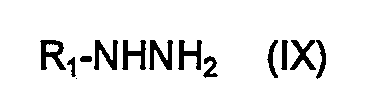
- R1 is as defined above.
- The reaction between a compound of formula (VIII) and a compound of formula (IX) may be carried out, for example, in a solvent such as C1-C6 alkyl alcohol, dioxane, tetrahydrofuran, dimethylformamide, acetic acid, at a temperature varying between about 0°C and about 150°C.
- The compounds of formula (II), wherein Y is carboxy may be prepared, for example, by hydrolysis of the corresponding compounds of formula (II) wherein Y is C2-C7 alkoxycarbonyl, according to standard methods well known in the art, for example, by basic hydrolysis, carried out e.g. by treatment with sodium or potassium hydroxide in a solvent such as water, C1-C6 alkyl alcohol, dioxane, dimethylformamide and their mixtures, at a temperature varying between about 0°C and about 50°C.
- The compounds of formula (II), wherein Y is halocarbonyl, preferably chlorocarbonyl, may be prepared, for example, by reaction of the corresponding compound of Formula (II), wherein Y is carboxy, with the suitable acid halide, for example oxalyl chloride, thionyl chloride, PCI3, PBr3, in an inert solvent such as ether, benzene, dichloroethane, dioxane or without any solvent, at a temperature varying between about 0°C and about 100°C.
- The compounds of Formula (III) are, in some cases, commercially available products, or may be prepared by methods well known in the art. For example a compound of Formula (III), wherein Q is a

- The compounds of formula (IV) are compounds of general formula (I), wherein Q is hydrogen and may be obtained by process a) above, for example, by reacting a compound of formula (II), wherein Y is C2-C7 alkoxycarbonyl, with acetonitrile, in the presence of a strong base e.g. sodium hydride, potassium tert.butoxide, in an inert organic solvent such as benzene, dioxane, tetrahydrofuran, at a temperature varying between about 0°C and about 100°C.
- The compounds of formula (VI),wherein Z is C2-C7 alkoxycarbonyl, are compounds of general formula (1) wherein Q is C2-C7 alkoxycarbonyl and may be obtained by process a) above, for example, by reacting a compound of formula (II) with a compound of formula (X)

- R7 is C1-C6 alkyl, using the same experimental conditions as described above for the reaction between a compound of formula (II) and a compound of formula (III).
- The compounds of formula (VI), wherein Z is halocarbonyl, may be prepared, for example, by basic hydrolysis of a compound of formula (VI), wherein Z is C2-C7 alkoxycarbonyl, using, for example, the same experimental conditions described above for the hydrolysis of the compounds of formula (II), wherein Y is C2-C7 alkoxycarbonyl, in order to obtain the corresponding carboxy derivative, which in turn may be transformed into a compound of formula (VI), wherein Z is halocarbonyl, preferably chlorocarbonyl, using, for example, the same experimental conditions described above for the preparation of the compounds of formula (II), wherein Y is halocarbonyl.
- The compounds of formula (VIII) may be prepared, for example, by reacting a compound of formula (XI)

- X, R2, R3 and R4 are as defined above, with a compound of formula (Xll)

- each of R8 and R'8, being the same or different, is C1-C8 alkyl, preferably methyl or ethyl.
- The reaction between a compound of formula (XI) and a compound of formula (XII) may be carried out, for example, in the presence of a strong base such as sodium methoxide, sodium ethoxide, sodium hydride, potassium tert.butoxide, in an organic solvent such as C1-C6 alkyl alcohol, benzene, dioxane, dimethylformamide, at a temperature varying between about 0°C and about 100°C.
- The compounds of formula (XI) may be prepared by synthetic methods well known in the art, for example, according to the methods described in J.A.C.S. 76, 5065 (1954) and in "Advances in Heterocyclic Chemistry", 18, 59 (1975).
- The compounds of formule (V), (Va), (VII), (IX), (X) and (XII) arc known products and may be prepared by conventional methods : in some cases they are commercially available products.
- When in the compounds of the present invention and in the intermediate products thereof, groups are present, such as NH2 and/or OH, which need to be protected before submitting them to the hereabove illustrated reactions, they may be protected before the reactions take place and then deprotected, according to well known methods in organic chemistry.
- The compounds of formula (I) possess immunomodulating activity and can be used in particular as immunostimulant agents e.g. in the treatment of acute and chronic infections of both bacterial and viral origin, alone or in association with antibiotic agents, and in the treatment of neoplastic diseases, alone or in association with antitumoral agents, in mammals.
- The immunomodulating activity of the compounds of the invention is proved, for example, by the fact that they are effective in potentiating the cytotoxic activity of the macrophages towards tumor cells in vitro.
- The experimental procedure to evaluate this activity is as follows : groups of 4 mice are treated i.p. with the tested compounds and then, seven days later, peritoneal cells are collected and plated for 2 hours at 37°C. After this period the walls art washed to eliminite the non adherent cells, tumor target cells are then added and the incubation is prolonged for 48 hours. At the end of this period the target cells viability is evaluated by a colorimetric method and quantified at 570 nm.
- By virtue of their immunomodulating activity the compounds of the invention proved to be active also in models of infection in mice. The compound of the present invention 2-cyano-3-(1,4-dihydro-1-phenyl-[1]-ben- zothiopyrano[4,3-c] pyrazol-3-yl)-3-oxo-N-phenyl-propanamide (internal code FCE 24578), for instance, was tested, according to the procedure described by Cleeland R., Grunberg E. 1986, 825-876, "Antibiotics in laboratory Medicine" Lorian V. Editor (Williams and Wilkins), in the following models of infection : L.monocytogenes; D.pneumoniae ; S.flexneri and P.aeruginosa ; the last one being performed in cyclophosphamide immunosup- pressed mice, according to Cryz S.J., Purer E., Germanier R., 1983, Infect, lmm., 39, 1067-1071.
- The following Tables 1, 2 and 3 summarize the obtained results :


- As preferred examples of compounds of formula (I) having immunomodulating activity the following can be mentioned :
- 2-cyano-3-(1,4-dihydro-l-phenyl-[1]-benzopyrano[4,3-c]pyrazol-3-yl)-3-oxo-N-phenyi-propanamide (intemal code FCE 25158) and 2-cyano-3-(1,4-dihydro-1-phenyl-[1]-benzothiopyrano[4,3-c]pyrazol-3-yl)-3-oxo-N-phenyl-propanamide (internal code FCE 24578). In view of their high therapeutic index the compounds of the Invention can be safely used in medicine.
- For example, the approximate acute toxicity (LDso) in the mouse of the compounds 2-cyano-3-(1,4-dihydro-1-phenyl-[1]-benzopyrano[4,3-c]pyrazol-3-yl)-3-oxo-N-phenyl-propanamide, and 2-cyano-3-(1.4-dihydro-1-phenyl-[1]-benzothiopyrano [4,3-c]pyrazol-3-yl)-3-oxo-N-phenyi-propanamide, determined per os with single administration of increasing doses and measured on the seventh day after the day of treatment, is higher then 800 mg/kg. Analogous toxicity data have been found for the other compounds of the invention. The therapeutic regimen for the different clinical syndromes must be adapted to the type of pathology taking into account, as usual, also the route of administration, the form in which the compound is administered and the age, weight and conditions of the subject involved.
- The oral route is employed, in general, for all conditions requiring such compounds. Preference is given to intravenous injection or infusion for the treatment of acute infections. For maintenance regimens the oral or parenteral, e.g. intramuscular or subcutaneous, route is preferred.
- For these purposes the compounds of the invention can be administered orally at doses ranging e.g. from about 0.5 to about 10 mg/kg of body weight par day in adult humans. Doses of active compounds ranging e.g. from about 0.2 to about 5 mg/kg of body weight can be used for the parenteral administration in adult humans. Of course, these dosage regimens may be adjusted to provide the optimal therapeutic response.
- The nature of the pharmaceutical compositions containing the compounds of this invention in association with pharmaceutically acceptable carriers or diluents will, of course, depend upon the desired route of administration.
- The compositions may be formulated in the conventional manner with the usual ingredients. For example, the compounds of the invention may be administered in the form of aqueous or oily solutions orsuspension, tablets, pills, gelatine capsules, syrups, drops or suppositories.
- Thus, for oral administration, the pharmaceutical compositions containing the compounds of this invention, are preferably tablets, pills or gelatine capsules which contain the active substance together with diluants, such as lactose, dextrose, sucrose, mannitol, sorbitol, cellulose ; lubricants, for instance silica, talc, stearic acid, magnesium or calcium stearate, and/or polyethylene glycols ; or they may also contain binders, such as starches, gelatine, methylcellulose, carboxymethylcellulose, gum-arabic, tragacanth, polyvinylpyrrolidone ; disag- gregating agents, such as starches, alginic acid, alginates, sodium starch glycolate ; effervescing mixtures ; dyestuffs; sweeteners ; wetting agents, such as lecithin, polysorbates, laurylsulphates ; and, in general, nontoxic and pharmacologically inactive substances used in pharmaceutical formulations.
- Said pharmaceutical preparations may be manufactured in known manner, for example by means of mixing, granulating, tabletting, sugar-coating, or film-coating processes.
- The liquid dispersions for oral administration may be e.g. syrups, emulsions and suspensions.
- The syrups may contain as carrier, for example, saccharose or saccharose with glycerine and/or mannitol and/or sorbitol. The suspensions and the emulsions may contain as carrier, for example, a natural gum, agar, sodium alginate, pectin, methylcellulose, carboxymethylcellulose, or polyvinyl alcohol.
- The suspensions or solutions for intramuscular injections may contain together with the active compound a pharmaceutically acceptable carrier, e.g. sterile water, olive oil, ethyl oleate, glycols, e.g. propylene glycol, and if desired, a suitable amount of lidocaine hydrochloride.
- The solutions for intravenous injections or infusions may contain as carrier, for example, sterile water or preferably they may be in the form of sterile aqueous isotonic saline solutions.
- The suppositories may contain together with the active compound a pharmaceutically acceptable carrier, e.g. cocoabutter, polyethylene glycol, a polyoxyethylene sorbitan fatty acid ester surfactant or lecithin.
- The following examples illustrate but do not limit the invention :
- Thiochroman-4-one (5 g) is reacted with diethyl oxalate (4.44 g) in anhydrous ethanol (25 ml) in the presence of sodium ethoxide (2.07 g) under stirring for 1 hour at about 10°C and then for 3 hours at 25°C. The precipitate is filtered and washed with cold ethanol then dissolved in water. Acidification with citric acid gives an oil precipitate which is extracted with ethyl acetate. Evaporation of the solvent in vacuo to dryness gives 3-ethoxalyl-thiochroman-4-one, oil (5.65 g), which is reacted with phenylhydrazine (2.54 g) in acetic acid (35 ml) at a temperature varying between 25°C and about 40°C for 30 minutes.The reaction mixture is diluted with ice water and then neutralized with 30% ammonium hydroxide. The precipitate is filtered, dissolved in ethyl acetate and washed with water. After evaporation of the solvent in vacuo the residue is crystallized from dichloromethanefisopropyl ether to give 1,4-dihydro-1-phenyl-[1]-benzothiopyrano[4,3-c]pyrazoie-3-carboxyiic acid, ethyl ester, m.p. 139-141°C (4.2 g), which is reacted with acetonitrile (16.5 g) in dioxane (25 ml) in the presence of 50% sodium hydride (1.2 g) under stirring at 60°C for 30 minutes. After cooling the reaction mixture is diluted with ice water and acidified to pH 4 with citric acid. The precipitate is filtered and washed with water and purified over a Si02 column using hexane-ethyl acetate 80 : 20 as eluent.
- Crystallization from dichloromethane/isopropyl ether gives 3-(1,4-dihydro-1-phenyl-[1]-benzothiopyra- no[4,3-c]pyrazol-3-yl)-3-oxo-propanenitrile, m.p. 151-153°C (3.45 g), which is reacted with phenyl isocyanate (1.3 g) in the presence of triethylamine (1.15 g) in dimethylformamide (30 ml) under stirring at 25-30°C for 30 minutes. The reaction mixture is diluted with ice water and the precipitate is filtered and washed with water. Crystallization from dichloromethane/methanol gives 4 g of 2-cyano-3-(1,4-dihydro-1-phenyl-[1]-benzothiopy- rano[4,3-c]pyrazol-3-yl)-3-oxo-N-phenyl-propanamide, m.p. 228-230°C, NMR (DMSO d 6) 8 ppm : 4.20 (s) (2H, -CH2S -), 6.60 (s) (1H, OH), 6.50-7.80 (m) (14 H, phenyl protons), 10.90 (s) (1H. CONH-).
- By proceeding analogously the following compounds can be prepared :
- 2-cyano-3-[1,4-dihydro-1-(4-methyl-phenyl)-[1]-benzothiopyrano[4,3-c]pyrazol-3-yl]-3-oxo-N-phenyl_propan n amide, m.p. 262-265°C ;
- 3-[1-(4-ch!oro-pheny))-1,4-dihydro-[1]-benzothiopyrano[4.3-c]pyrazol-3-yl]-2"cyano-3-oxo-N"pheny!-propana mide, m.p. 235-240°C dec. ;
- 2-cyano-3-[1,4-dihydro-1-(3-trifluoromethyl-phenyl)-[1]-benzothiopyrano[4,3-c]pyrazol-3-yl]-3-oxo-N-phenyl- propanamide ;
- 3-[1-(3-chloro-phenyl)-1,4-dihydro-[1]-benzothiopyrano[4,3-c]pyrazol-3-yl]-2-cyano-3-oxo-N_phenyl_pr®pana mide, m.p. 224-226°C.
- 2-cyano-3-[1,4-dihydro-1-(4-fluoro-phenyl)-[1]-benzothiopyrano [4,3-c]pyrazol-3-yl]-3-oxo-N-phenyl-propanamide, m.p. 217-218°C ;
- 3-(1-(2-chloro-phenyl)-1,4-dihydro-(1]-benzothiopyrano[4,3-c]pyrazol-3-yl] -2-cyano-3-oxo-N-pheny)-propanamide;
- 3-[1-(3,5-dichloro-phenyl)-1,4-dihydro-[1]-benzothiopyrano[4,3-c]pyrazol-3-yl]-2-cyano-3-oxo-N-phenyl-prop anamide ;
- 3-[1-(3-bromo-phenyl)-1,4-dihydro-[1]-benzothiopyrano(4,3-c]pyrazol-3-yl]-2-cYano-3-oxo-N-phenY9-propana mide;
- 2-cyano-3- [1,4-dihydro-1-(3-methyl-phenyl)-[1]-benzothiopyrano[4,3-o]pyrazol-3-ylj-3-oxo-N-phenyl-propanamide ;
- 2-cyano-3- [1,4-dihydro-1-(3-nitro-phenyl)-[1]-benzothiopyrano[4,3-c]pyrazol-3-yi]-3-oxo-N-phenyl-propanamide;
- 2-cyano-3-[1,4-dihydro-1-(4-nitro-phenyl)-[1]-benzothiopyrano[4,3-c]pyrazol-3-yl]-3-oxo-N-phenyl-propanam ide ;
- 2-cyano-3-[1,4-dihydro-1-(4-methoxy-phenyl)-[I]-benzothiopyrano[4,3-c]pyrazol-3-yl]-3-oxo-N-phenyl-propa namide, m.p. 260°C dec. ;
- 2-cyan0-3-[1,4-dihydro-1-(3-fluoro-phenyl)-[1]-benzothiopyrano[4 ,3-c]pyrazol-3-yl]-3-oxo-N-phenyl-propana mide ; and
- 2-cyano-3-[1,4-dihydro-1-(3-methoxy-phenyl)-[1]-benzothiopyrano[4,3-c]pyrazol-3-yl]-3-oxo-N-phenyl-propa namide.
- By proceeding according to Example 1, using the suitable substituted hydrazines, the following compounds can be prepared :
- 2-cyano-3-(1,4-dihydro-1-methyl-[1]-benzothiopyrano[4,3-c]pyrazol-3-yl)-3-oxo-N-phenyl-propanamide,m.p. 240-242°C ;
- 3-(1-tert.butyl-1,4-dihydro-[1]-benzothiopyrano[4,3-c]pyrazol-3-yl)-2-cyano-2-oxo-N-phenyl-propanamide, m.p. 211-212°C ;
- 2-cyano-3-(1,4-dihydro-1-ethyl-[1]-benzothiopyrano[4,3-c]pyrazol-3-yl)-3-oxo-N-phenyB-propanamide ; 2-cyano-3-[1,4-dihydro-1-(2-pyridyl)-[1j-benzothiopyrano[4,3-c]pyrazol-3-yl]-3-oxo-N-phenyi-propanamide ; and
- 2-cyano-3-[1,4-d ihydro-1-(3-pyridyl)-[1 ]-benzothiopyra no(4,3-cjPYrazol-3-yl]-3-oxo-N-phenY!-propanamide.
- By proceeding acccording to Examples 1 and 2, using the suitable isocyanates, the following compounds can be prepared :
- N-(3-chloro-phenyl)-2-cyano-3-(1,4-dihydro-1-phenyl-[1]-benzothiopyrano[4,3-c]pYrazol-3_Y!)_3_®x®_propana mide, m.p. 238-240°C ;
- N-(4-chloro-phenyl)-2-cyano-3-(1,4-dihydro-1-phenyl-[1]-benzothiopyrano[4,3-c]pyrazol-3-yl)-3-oxo-propana mide, m.p. 247-249°C ;
- 2-cyano-3-(1,4-dihydro-1-phenyi-[1]-benzothiopyrano[4,3-c]pyrazol-3-yl)-N-(4-methoxy-phenyl)-3-oxo-propa namide, m.p. 219-220°C;
- 2-cyano-3-(1,4-dihydro-1-phenyl-[1]-benzothiopyrano[4,3-c]pyrazol-3-yl)-N-(4-methyl-phenyl)-3-oxo-propana mide, m.p. 217-219°C;
- 2-cyano-3-(1,4-dihydro-1-phenyl-[1]-benzothiopyrano[4,3-c]pyrazol-3-yl)-3-oxo-N-(3-trifluoromethyl-phenyl)-propanamide, m.p. 273-277°C ;
- 2-cyano-3-(1,4-dihydro-1-phenyl-[1] -benzothiopyrano[4,3-c]pyrazol-3-yl)-N-(4-fluoro-phenyl)-3-oxo-propana mide, m.p. 260-263°C ;
- N-(3-chloro-phenyl)-2-cyano [1,4-dihydro-1-(4-fluoro-phenyl)-[1]-benzothiopyrano[4,3-c]pyrazol-3-yl]-3-oxo-propanamide ;
- 3-[1-(4-fluoro-phenyl)-1,4-dihydro-[1]-benzothiopyrano[4,3-c]pyrazol-3-yl]-2-cyano-N-(4 fluoro-phenyl)-3-oxo -propanamide, m.p. 272°C dec. ;
- N-(4-chloro-phenyl)-2-cyano-(1,4-dihydro-1-methyl-[1 ]-benzothiopyrano[4,3-c]pyrazol-3-yl)-3-oxo-propanam ide ;
- 3-[1-(3-chloro-phenyl)-1,4-dihydro-[1 ]-benzothiopyrano[4,3-c]pyrazol-3-yl]-N-(3-chloro-phenyl)-2-cyano-3-ox o-propanamide ;
- N-benzyl-2-cyano-(1,4-dihydro-l-(3-methoxy-phenyl)-[1 ]-benzothiopyrano[4,3-c]pyrazol-3-yl]-3-oxo-propana mide;
- N-benzyl-2-cyano-[1,4-dihydro-1-(3-methyl-phenyl)-[1 ]-benzothiopyrano[4,3-c]pyrazol-3-yl]-3-oxo-propanam ide;
- N-(2-chloro-phenyl)-2-cyano-3-(1,4-dihydro-1-phenyl-[1 ]-benzothiopyrano[4,3-c]pyrazol-3-yl)-3-oxo-propana mide;
- N-(3-bromo-phenyl)-2-cyano-3-(1,4-dihydro-1-phenyl-[1 ]-benzothiopyrano[4,3-c]pyrazol-3-yl)-3-oxo-propana mide;
- 2-cyano-3-(1,4-dihydro-1-phenyl-[1 ]-benzothiopyrano[4,3-c]pyrazol-3-yl)-N-(3-methyl-phenyl)-3-oxo-propana mide,m.p.198-200°C ;
- 2-cyano-3-(1,4-dihydro-1-phenyl-[1 ]-benzothiopyrano[4,3-c]pyrazol-3-yl)-N-(3-nitro-phenyl)-3-oxo-propanam ide,m.p.258-261°C ;
- 3-[1-(3-chloro-phenyl)-1,4-dihydro-[1]-benzothiopyrano[4,3-c]pyrazol-3-yl]-2-cyano-N-(4-fluoro-phenyl)-3-ox o-propanamide ;
- 3-[1-(3,5-dichloro-phenyl)-1,4-dihydro-[1]-benzothiopyrano[4,3-c]pyrazol-3-yl]-2-cyano-N-(4-fluoro-phenyl)-3 -oxo-propanamide ;
- 2-cyano-N-(4-fluoro-phenyl)-3-[1,4-dihydro-1-(3-trifluoro-methyl-phenyl)-[1]-benzothiopyrano[4,3-c]pyrazol-3 -yl]-3-oxo-propanamide ;
- N-benzyl-3-[1-(3-chloro-phenyl)-1,4-dihydro-(1 ]-benzothiopyrano[4,3-c]pyrazol-3-yl]-2-cyano-3-oxo-propana mide ;
- N-benzyl-3-(1-(3,5-dichloro-phenyl)-1,4-dihydro-[1]-benzothiopyrano[4,3-c]pyrazol-3-yl] -2-cyano-3-oxo-propanamide ;
- N-benzyl-2-cyano-3-[1-(4-fl uoro-phenyl)-1,4-dihydro-[1 ]-benzothiopyrano[4,3-c]pyrazol-3-yl]-3-oxo-propana mide;
- N-benzyl-2-cyano-3-[1,4-dihydro-1-(3-trifluoromethyl-phenyl)-[1 ]-benzothiopyrano[4,3-c]pyrazol-3-yl]-3-oxo-propanamide ;
- N-benzyl-2-cyano-3-[1,4-dihydro-1-(3-nitro-phenyl)-[1]-benzothiopyrano[4,3-c]pyrazol-3-yl] -3-oxo-propanamide;
- 2-cyano-N-(3-fluoro-phenyl)-3-(1,4-dihydro-1-phenyl-(1]-benzothiopyrano(4,3-c]pyrazol-3-yl)-3-oxo-propana mide, m.p. 215-217°C;
- N-butyl-2-cyano-3-(1,4-dihydro-1-phenyl-[I]-benzothiopyrano [4,3-c]pyrazol-3-yl)-3-oxo-propanamide, m.p. 208-209°C ;
- N-tert.butyl-2-cyano-3-(1,4-dihydro-1-phenyl-[1]-benzothiopyrano[4,3-c]pyrazol-3-yl)-3-oxo-propanamide ; N-butyl-3-[1-(3-chloro-phenyl)-1,4-dihydro-[1 ]-benzothiopyrano[4,3-c]pyrazol-3-yl]-2-cyano-3-oxo-propanam ide ;
- N-tert.butyl-3-[1-(3-chloro-phenyl)-1,4-d ihydro-[1 ]-benzothiopyrano[4,3-c]pyrazol-3-yl)-2-cyano-3-oxo-propa namide ;
- N-benzyl-2-cyano-3-(1,4-dihydro-1-phenyl-[1]-benzothiopyrano [4,3-c]pyrazol-3-yl)-3-oxo-propanamide, m.p. 268-271°C ;
- 2-cyano-N-cyclohexyl-3-(1,4-dihydro-1-phenyl-[1]-benzothiopyrano[4,3-c]pyrazol-3-yl)-3-oxo-propanamide, m.p. 212-214°C ; and
- 2-cyano-3-(1,4-dihydro-1-phenyl-[1]-benzothiopyrano[4,3-c]pyrazol-3-yl)-N-(3-methoxy-phenyl)-3-oxo-propa namide.
- By proceeding according to Examples 1, 2 and 3, starting from the suitable thiochroman-4-one oxides, the following compounds can be prepared :
- 2-cyano-3-(1,4-dihydro-1-phenyl-(1 )-benzothiopyrano[4,3-c]pyrazol-3-yl 5,5-dioxide)-3-oxo-N-phenyl-propanamide, m.p. 273-275°C ;
- N-(4-chloro-phenyl)-2-cyano-3-(1,4-dihydro-1-phenyl-[1]-benzothiopyrano [4,3-c]pyrazol-3-yl 5,5-dioxide)-3-oxo-propanamide ;
- 2-cyano-3-(1,4-dihydro-1-phenyl-[1 ]-benzothiopyrano[4,3-c]pyrazol-3-yl 5-oxide)-3-oxo-N-phenyl-propanamide, and
- N-benzyl-2-cyano-3-(1,4-dihydro-1-phenyl-[1 ]-benzothiopyrano[4,3-c]pyrazol-3-yl 5-oxide)-3-oxo-propanamide.
- 1,4-Dihydro-1-phenyl-[1]-benzothiopyrano [4,3-c]pyrazole-3-carboxylic acid, ethyl ester (3.36 g) suspended in dioxane (60 ml) is treated with N/1 NaOH (30 ml) under stirring at room temperature for 5 hours. The reaction mixture is diluted with ice water and acidified to pH 3 with 37% HCI. The precipitate is filtered, washed with water and dried in vacuo at 50°C to give 1,4-dihydro-1-phenyl-[1]-benzothiopyrano[4,3-c]pyrazole-3-car boxylic acid (2.8 g) which is reacted with oxalyl chloride (17 g) under stirring, at room temperature for 8 hours. The reaction mixture is evaporated to dryness in vacuo and the residue, 1,4-dihydro-1-phenyl-[1]-benzothio- pyrano[4,3-c]pyrazole-3-carbonyl chloride (2.9 g), is dissolved in dimethylformamide (10 ml) and added under stirring to a suspension obtained by treatment of 2-cyano-acetylamino-pyridine (1.62 g) with 50% sodium hydride (0.5 g) in dimethylformamide (5 ml). The reaction mixture is kept at room temperature for 20 hours. The basic aqueous solution is washed with ethyl ether and then is acidified to pH 5 with 37% HCI. The precipitate is filtered, washed with water and then crystallized from ethanol to give 2.7 got 2-cyano-3-(1,4-dihydro-1-phenyl-[1]-benzothiopyrano[4,3-c] pyrazol-3-yl)-3-oxo-N-(2-pyridyl)-propanamide, m.p. 258-260°C.
- By proceeding analogously the following compounds can be prepared :
- 2-cyano-3-(1,4-dihydro-1-phenyl-[1]-benzothiopyrano[4,3-c]pyrazol-3-yl)-3-oxo-N-(4-pyridyl)-propanamide ;
- 2-cyano-N-(4-fluoro-benzyl)-3-(1,4-dihydro-1-phenyl-[1]-benzothiopyrano[4,3-c]pyrazol-3-yl)-3-oxo-propana mide;
- 2-cyano-3-(1,4-dihydro-1-phenyl-[1]-benzopyrano[4.3-c]pyrazol-3-yl)-3-oxo-N-(2-pyridyl)-propanamide ;
- 2-cyano-3-(1,4-dihydro-1-phenyl-[1]-benzopyrano[4,3-c]pyrazol-3-yl)-3-oxo-N-(3-pyridyl)-propanamide ;
- 2-cyano-3-(1,4-dihydro-1-phenyl-[1]-benzopyrano[4,3-c]pyrazol-3-yl)-3-oxo-N-phenyl-propanamide, m.p. 280-282°C;
- 2-cyano-3-(1,4-dihydro-1-phenyl-[1]-benzopyrano[4,3-c]pyrazol-3-yl)-3-oxo-N-methyl-N-(2-pyridyl)-propana mide;
- 2-cyano-3-(1,4-dihydro-1-phenyl-[1]-benzopyrano[4,3-c]pyrazol-3-yl)-3-oxo-N-methyl-N-phenyl-propanamide ;
- 2-cyano-3-(1,4-dihydro-1-phenyl-[1 ]-benzothiopyrano[4,3-c]pyrazol-3-yl)-3-oxo-N-methy9-N-phenyl-propana mide, m.p. 183-184°C;
- N-benzyl-2-cyano-3-[1-(3-fluoro-phenyl)-1,4-dihydro-[1]-benzothiopyrano[4,3-c]pyrazol-3-]-3-oxo-propanami de ;
- 2-cyano-3-(1,4-dihydro-1-phenyl-[1]-benzothiopyrano[4,3-c]pyrazol-3-yl)-N-phenethyl-3-oxo-propanamide ;
- 2-cyano-3-(1,4-dihydro-1-phenyl-[1]-benzothiopyrano[4,3-c]pyrazol-3-yl)-N-(4-dimethylamino-phenyl)-3-oxo -propanamide ;
- 2-cyano-3-(1,4-dihydro-1-phenyl-[1 ]-benzothiopyrano[4,3-c]pyrazol-3-yl)-N-(2,6-dimethyl-phenyl)-3-oxo-pro panamide, m.p. 215-216°C;
- N-(3,5-dichloro-phenyl)-2-cyano-3-(1,4-dihydro-1-phenyl-[1]-benzothiopyrano[4,3-c]pyrazol-3-yl)-3-oxo-prop anamide ;
- N-benzyl-2-cyano-3-(1,4-dihydro-1-phenyi-[1]-benzothiopyrano [4,3-c]pyrazol-3-yl)-3-oxo-propanamide, mp. 268-271 °C ;
- N-benzyl-2-cyano-3-(1,4-dihydro-l-phenyl-[1]-benzopyrano [4,3-c]pyrazol-3-yl)-3-oxo-propanamide ;
- N-(2-chloro-benzyl)-2-cyano-3-(1,4-dihydro-1-phenyl-[1]-benzothiopyrano[4,3-c]pyrazol-3-yl)-3-oxo-propana mide;
- 2-cyano-3-(1,4-dihydro-1-phenyl-[1]-benzothiopyrano(4,3-c]pyrazol-3-yl)-3-oxo-N-phenyl-peopanamide, m.p. 228-230°C ; and
- N-(3-hydroxy-phenyl)-2-cyano-3-(1,4-dihydro-1-phenyl-[1]-benzothiopyrano[4,3-c]pyrazol-3-yl)-3-oxo-propa namide ; and
- N-benzyl-3-[l-(2-chloro-phenyl)-1,4-dihydro-[1]-benzothiopyrano[4,3-c]pyrazol-3-yl]-2-cyano-3-oxo-propana mide.
- Ethyl cyanoacetate (1.4 g) is treated with 50% sodium hydride (0.56 g) in dimethylformamide (10 ml) under stirring at room temperature until the effervescence subsides.
- To this solution 1,4-dihydro-1-phenyl-[1]-benzothiopyrano [4,3-c]pyrazole-3-carbonyl chloride (3.26 g), prepared according to Example 5, dissolved in dimethylformamide (10 ml) is added under stirring at room temperature. The reaction mixture is allowed to react for 20 hours, then it is diluted with ice water and acidified to pH 3 with 37% HCI. The precipitate is extracted with ethyl acetate and the organic solution washed with water and then evaporated to dryness in vacuo. The residue is purified over a Si02 column, using hexane-ethyl acetate 80 : 20 as eluent, to give 2-
cyano-3- (1,4-dihydro-1-phenyl-[1]-benzothiopyrano[4,3-c]pyrazol-3-yl)-3-oxo- propanoic acid, ethyl ester (2.4 g), m.p. 176-178°C, which is reacted with aniline (1.7 g) in xylene (100 ml) at the reflux temperature for 48 hours. After cooling the precipitate is filtered and washed with xylene, then crystallized from dichloromethane/methanol to give 1.5 g of 2-cyano-3-(1,4-dihydro-1-phenyl-[1]-benzothiopyra- no[4,3-c] pyrazol-3-yl)-3-oxo-N-phenyl-propanamide, m.p. 228-230°C. - By proceeding analogously the following compounds can be prepared : N-(3-chloro-phenyl)-2-cyano-3-(1,4-dihydro-1-phenyl-[1]-benzothiopyrano[4,3-c]pyrazol-3-yl)-3-oxo-propana mide, m.p. 238-240°C ; and 2-cyano-3-(1,4-dihydro-1-phenyl-[1 ]-benzothiopyrano[4,3-c]pyrazol-3-yl)-3-oxo-N-(3-pyridyl)-propanamide.
- By proceeding according to Examples 1 and 3, starting from the suitable substituted thiochroman-4-ones, the following compounds can be prepared :
- 2-cyano-3-(1,4-dihydro-8-methoxy-1-phenyl-[1]-benzothiopyrano [4,3-c]pyrazol-3-yl)-3-oxo-N-phenyl-propanamide, m.p. 205-210°C dec. 3-(8-chloro-1,4-dihydro-1-phenyl-[1]-benzothiopyrano[4,3-c]pyrazol-3-yl)-2-cyano-3-oxo-N-phenyl-propanamide, m.p.235-236°C ;
- 2-cyano-3-(1,4-dihydro-8-methyl-l-phenyl-[1]-benzothiopyrano[4,3-c]pyrazol-3-yl)-3-oxo-N-phenyl-propana mide, m.p. 224-226°C ;
- 3-(7,8-dichloro-1,4-dihydro-l-phenyl-[1]-benzothiopyrano[4,3-c]pyrazol-3-yl)-2-cyano-3-oxo-N-phenyl-propa namide ;
- 3-(8-bromo-1,4-dihydro-1-phenyl-[1]-benzothiopyrano[4,3-c]pyrazol-3-yl)-2-cyano-3-oxo-N-phenyl-propanam ide ;
- N-benzyl-3-[8-chloro-1-(3-chloro-phenyl)-1,4-dihydro-[1]-benzothiopyrano[4,3-c]pyrazol-3-yl]-2-cyano-3-oxo -propanamide ;
- N-benzyl-3-[8-chloro-1-(4-fluoro-phenyl)-1,4-dihydro-[1]-benzothiopyrano[4,3-c]pyrazol-3-yl]-2-cyano-3-oxo-propanamide ;
- N-benzyl-3-(8-chloro-1,4-dihydro-1-phenyl-[1]-benzothiopyrano [4,3-c]-pyrazol-3-yl)-2-cyano-3-oxo-propanamide, m.p. 216-218°C;
- N-(3-chloro-phenyl)-3-(8-chloro-1,4-dihydro-1-phenyl-[1]-benzothiopyrano[4,3-c]-pyrazol-3-yl)-2-cyano-3-ox o-propanamide ;
- N-benzyl-3-[8-chloro-1-(3-fluoro-phenyl)-1,4-dihydro-[1 ]-benzothiopyrano[4,3-c]pyrazol-3-yl]-2-cyano-3-oxo-propanamide ;
- N-benzyl-3-[8-chloro-1,4-dihydro-1-(3-methyl-phenyl)-[1]-benzothiopyrano[4,3-c] pyrazol-3-yl]-2-cyano-3-oxo-propanamide ;
- 3-(8-chloro-1,4-dihydro-1-phenyl-[1]-benzothiopyrano[4,3-c]-pyrazol-3-yl)-2-cyano-3-oxo-N-(3-methyl-phenyl )-propanamide ;
- N-benzyl-2-cyano-3-(1,4-d ihydro-8-methoxy-1-phenyl-[1 ]-benzothiopyrano[4,3-c]pyrazol-3-yl)-3-oxo-propa n amide ;
- N-benzyl-2-cyano-3-(1,4-dihydro-8-methyl-1-phenyl-[1 ]-benzothiopyrano[4,3-c]pyrazol-3-yl)-3-oxo-propanam ide;
- 3-[8-chloro-1-(3-chloro-phenyl)-1,4-dihydro-[1 ]-benzothiopyrano[4,3-c]pyrazol-3-yl)-2-cyano-3-oxo-N-phenyl -propanamide ;
- 3-[8-chloro-1-(4-fluoro-phenyl)-1,4-dihydro-[1]-benzothiopyrano[4,3-c]pyrazol-3-yl]-2-cyano-3-oxo-N-phenyl- propanamide ;
- N-(3-chloro-phenyl)-2-cyano-3-(1,4-dihydro-8-methyl-1-phenyl-yl]-benzothiopyrano(4,3-c]pyrazol-3-yl)-3-oxo -propenamide ;
- 3-(8-chloro-1,4-dihydro-1-phenyl-[1]-benzothiopyrano[4,3-c]pyrazol-3-yl)-2-cyano-N-(4-fluoro-phenyl)-3-oxo -propanamide ; and
- 3-(8-chloro-1,4-dihydro-1-phenyl-[1]-benzothlopyrano[4,3-c]pyrazol-3-yl)-2-cyano-N-(3-fluoro-phenyl)-3-oxo -propanamide.
- 2-Cyano-3-[1,4-dihydro-1-(3-nitro-phenyl)-[1 ]-benzothiopyrano[4,3-c]pyrazol-3-yl]-3-oxo-N-phenyl-propa namide (4.95 g) is reacted with SnCl2 · 2H20 (22.5 g) in 37% HCI (16 ml) and acetic acid (144 ml) under stirring at 40°C for 5 hours. After cooling the precipitate is filtered and washed with acetic acid and then dissolved in dimethylformamide-2N NaOH 1 : 1. Dilution with excess aqueous NaH2P04 gives a precipitate which is filtered, washed with water and crystallized from chloroform/ethanol to give 3.45 g of 3-[1-(3-amino-phenyl)-1,4-dihydro-[1]-benzothiopyrano[4,3-c] pyrazol-3-yl]-2-cyano-3-oxo-N-phenyl-propanamide.
- By proceeding analogously the following compounds can be obtained :
- 3-[1-(4-amino-pheny))-1,4-dihydro-[1]-benzothiopyrano [4,3-c]pyrazol-3-yl]-2-cyano-3-oxo-N-phenyl-propanamide;
- 3-(8-amino-1,4-dihydro-1-phenyl-[1]-benzopyrano[4,3-c]pyrazol-3-yl)-2-cyano-3-o,co-N-phenyl-propanamide; and
- N-(3-amino-phenyl)-2-cyano-3-(1,4-dihydro-1-phenyl-[1]-benzothiopyrano[4,3-c]pyrazol-3-yl)-3-oxo-propana mide.
- 3-[1-(3-amino-phenyl)-1.4-dihydro-[1]-benzothiopyrano[4,3-c]pyrazo)-3-yl]-2-cyano-3-oxo-N-phenyl-pro panamide (1.9 g) dissolved in dimethylformamide (25 ml) is reacted with acetic anhydride (5 ml) in the presence of pyridine (5 ml) at room temperature for 20 hours. The reaction mixture is diluted with ice water and the precipitate is filtered and washed with water: crystallization from dimethylformamide-ethanol gives 1.6 g of 3-[1-(3-acetylamino-)phenyl)-1,4-dihydro-[1]-benzothiopyrano[4,3-c]pyrazol-3-yl]-2-cyano-3-oxo-N-phenyl-propa namide.
- By proceeding analogously the following compounds can be prepared :
- 3-[1-(4-acetylamino-phenyl)-1,4-dihydro-[1]-benzothiopyrano[4,3-c]pyrazol-3-yl)-2-oyano-3-oxo-N-phenyl-pr opanamide ;
- 3-(8-acetylamino-1,4-dihydro-1-phenyl-[1 ]-benzopyrano[4,3-c]pyrazol-3-yl)-2-cyano-3-oxo-N-phenyl-propan amide ; and
- N-(3-acetylamino-phenyl)-2-cyano-3-(1,4-dihydro-1-phenyl-[1]-benzothiopyrano[4,3-c]pyrazol-3-yl)-3-oxo-pr opanamide.
- A solution of 4-chromanone (11.2 g) and diethyl oxalate (13.3 g) in anhydrous dioxane (75 ml) is added under stirring at room temperature to a suspension of 50% sodium hydride (4 g) in anhydrous dioxane (150 ml). The mixture is allowed to react under stirring at 80°C for 3.5 hours.
- After cooling, the reaction mixture is diluted with ice water and acidified to pH 4 with 40% citric acid aqueous solution. The oily precipitate is extracted with ethyl acetate, then the organic solution is washed with 40% citric acid and water until neutral. After evaporation of the solvent in vacuo the residue is purified over a Si02 column using hexane/ethyl acetate 80 : 20 as eluent. Crystallization from isopropyl alcohol gives 3-ethoxalylchroman-4-one, m.p. 73-75°C (7.7 g), which is reacted with phenylhydrazine (3.88 g) in acetic acid (80 ml) at a temperature varying between 25°C and about 40°C for 30 minutes. The reaction mixture is diluted with ice water and then neutralized with 30% ammonium hydroxide. The precipitate is filtered and washed with water. Crystallization from isopropyl alcohol gives 1,4-dihydro-1-phenyl-[1]-benzopyrano[4,3-c]pyrazole-3-carboxylic acid, ethyl ester, m.p.154-158°C (7.4 g), which is reacted with acetonitrile (74 ml) in dioxane (45 ml) in the presence of 50% sodium hydride (2.2 g) under stirring at 60°C for 30 minutes. After cooling the reaction mixture is diluted with ice water and acidified to pH 4 with citric acid. The precipitate is filtered and washed with water and purified over a Si02 column, using chloroform as eluent.
- Crystallization from dichloromethane/isopropyl ether gives 4.3 g of 3-(1,4-dihydro-1-pheny)-[1]-benzopyrano[4,3-c] pyrazol-3-yl)-3-oxo-propanenitrile, m.p. 155-158°C, NMR (CDCl3) 8 ppm: 4.19 (s) (2H,-CH2CN), 5.54 (s) (2H, -OCH2-), 6.65-7.35 (m) (4H, benzopyran protons), 7.58 (m) (5H, phenyl protons).
- By proceeding analogously the following compounds can be prepared :
- 3-[1-(4-chloro-phenyl)-1,4-dihydro-[1]-benzopyrano[4,3-c]pyrazol-3-yl]-3-oxo-propanenitrile ;
- 3-[1-(3-chloro-phenyl)-1,4-dihydro-[1]-benzopyrano[4,3-c]pyrazol-3-yl]-3-oxo-propanenitrile ;
- 3-[1,4-dihydro-1-(3-trifluoromethyl-phenyl)-[1]-benzo-pyrano[4,3-c]pyrazol-3-yl]-3-oxo-propanenitrile ;
- 3-[1,4-dihydro-1- (3-nitro-phenyl)-[1]-benzopyrano[4,3-c]pyrazol-3-yl]-3-oxo-propanenitrile ;
- 3-(1-(4-fluoro-phenyl)-1,4-dihydro-[1]-benzopyrano[4,3-c]pyrazol-3-yl]-3-oxo-propanenitrile ;
- 3-(1,4-dihydro-1-(4-methyl-phenyl)-[1]-benzopyraro[4,3-c]pyrazol-3-yl)-3-oxo-propanenitrile ;
- 3-[1,4-dihydro-1-(4-methoxy-phenyt)-[1]-benzopyrano[4,3-c]pyrazol-3-yl)-3-oxo-propanenitrile;
- 3-(1,4-dihydro-4-methyl-1-phenyl-[1]-benzopyrano[4,3-c]pyrazol-3-yl)-3-oxo-propanenitrile ;
- 3-(1,4-dihydro-8-methyl-1-phenyl-[1]-benzopyrono[4,3-c]pyrazol-3-yl)-3-oxo-propanenitrile ;
- 3-(1,4-dihydro-8-methoxy-1-phenyl-[1]-benzopyrano[4,3-c]pyrazol-3-yl)-3-oxo-propanenitrile ;
- 3-(8-chloro-1,4-dihydro-1-phenyl-[1]-benzopyrano[4,3-c]pyrazol-3-yl)-3-oxo-propanenitrile ;
- 3-(7,8-dichloro-1,4-dihydro-1-phenyl-[1]-benzopyrano[4,3-c]pyrazol-3-yl)-3-oxo-propanenitrile ; and
- 3-(6,8-dichloro-1,4-dihydro-1-phenyl-[1]-benzopyrano[4,3-c]pyrazol-3-yl)-3-oxo-propanenitrile.
- By proceeding according to Example 10, starting from suitable thiochroman-4-ones, the following compounds can be prepared :
- 3-[1,4-dihydro-1-(4-methyl-phenyl)-[1]-benzothiopyrano[4,3-c]pyrazol-3-yl]-3-oxo-propanenitrile, m.p. 183-184°C;
- 3-[1-(4-chloro-phenyl)-1,4-dihydro-[1]-benzothiopyrano[4,3-c]pyrazol-3-yl]-3-oxo-propanenitrile, m.p. 194-198°C;
- 3-(1,4-dihydro-1-(3-trifluoromethyl-phenyl)-[1]-benzothiopyrano[4,3-c]pyrazol-3-yl]-3-oxo-propanenitrile ;
- 3-[1-(3-chloro-phenyl)-1,4-dihydro-[1]-benzothiopyrano[4,3-c]pyrazol-3-yl]-3-oxo-propanenitrile, m.p. 187-188°C;
- 3-[1,4-dihydro-1-(4-fluoro-phenyl)-[1]-benzothiopyrano[4,3-c]pyrazol-3-yl]-3-oxo-propanenitrile, m.p. 190-192°C;
- 3-[1,4-dihydro-1-(4-nitrophenyl)-[1]-benzothiopyrano[4,3-c]pyrazol-3-yl]-3-oxo-propanenitrile ;
- 3-[1,4-dihydro-1-(4-methoxy-phenyl)-[1]-benzothiopyrano[4,3-c]pyrazol-3-yl]-3-oxo-propanenitrile, m.p. 157-159°C,
- 3-(1,4-dihydro-1-methyl-[1]-benzothiopyrano[4,3-c]pyrazol-3-yl]-3-oxo-propanenitrile, m.p. 188-190°C ;
- 3-(1-tert.butyl-1,4-dihydro-[1]-benzothiopyrano[4,3-c]pyrazol3-yl]-3-oxo-propanenitrile, m.p. 150-152°C ;
- 3-(8-chloro-1,4-dihydro-1-phenyl-[1]-benzothiopyrano[4,3-c]pyrazol-3-yl)-3-oxo-propanenitrile, m.p. 151-153°C;
- 3-(1,4-dihydro-8-methyl-1-phenyl-[1]-benzothiopyrano[4,3-c]pyrazol-3-yl)-3-oxo-propanenitrile ;
- 3-(1,4-dihydro-8-methoxy-1-phenyl-[1]-benzothiopyrano[4,3-c]pyrazol-3-yl)-3-oxo-propanenitrile ; and
- 3-(1,4-dihydro-1-phenyl-[1]-benzothiopyrano[4,3-c]pyrazol-3-yl)-3-oxo-propanenitrile, m.p. 151-153°C.
- 3-(1,4-dihydro-1-phenyl-[1]-benzopyrano[4,3-c]pyrazol-3-yl)-3-oxo-propanenitrile (2.1 g) is reacted with phenyl isocyanate (0.8 g) in the presence of triethylamine (0.75 g) in dimethylformamide (20 ml) under stirring at 25-30°C for 90 minutes. The reaction mixture is diluted with ice water, acidified to pH 2 with HCI and the precipitate is filtered and washed with water. Crystallization from dichloromethane/methanol gives 2.5 g of 2-cyano-3-(1,4-dihydro-1-phenyl-[1]-benzopyrano[4,3-c]pyrazol-3-yl)-3-oxo-N-phenyl-proparamide, m.p. 280-282°C, NMR (CDCI3) 8 ppm : 5.54 (s) (2H, -CH20-), 6.7-7.7 (m) (14H, phenyl protons), 8.94 (s) (1H, CONH-), 16.4 (bs) (1 H, enol).
- By proceeding analogously the following compounds can be prepared :
- 2-cyano-3-[1,4-dihydro-1-(3-nitrophenyl)-[1]-benzopyrano[4,3-c]pyrazol-3-yl]-3-oxo-N-phenyl-propanamide ;
- 2-cyano-3-[1,4-dihydro-1-(3-methoxy-phenyl)-[1]-benzopyrano[4,3-c]pyrazol-3-yl]-3-oxo-N-phenyl-propanam ide;
- 2-cyano-3-(1,4-dihydro-1-(3-methyl-phenyl)-[1]-benzopyrano[4,3-c]pyrazol-3-yl]-3-oxo-1l-phenyl-propanami de ;
- 3-[1-(3-fluoro-phenyl)-1,4-dihydro-[1]-benzopyrano[4,3-c]pyrazol-3-yl]-2-cyano-3-oxo-N-phenyl-propanamide ;
- 2-cyano-3-[1,4-dihydro-1-(3-trifluoromethyl-phenyl)-[1 ]-benzopyrano[4,3-c]pyrazol-3-yl]-3-oxo-N-phenylprop anamide ;
- 2-cyano-3-[1,4-dihydro-8-nitro-1-phenyl- [1]-benzopyrano[4,3-c]pyrazol-3-yl)-3-oxo-N-phenyl-propanamide ;
- 3-(8-tert.butyl-1,4-dihydro-1-phenyl-[1]-benzopyrano[4,3-c]pyrazol-3-yl)-2-cyano-3-oxo-N-phenyl-proparana mide;
- 3-(8-chloro-1,4-dihydro-1-phenyl-[1 ]-benzopyrano[4,3-c]pyrazol-3-yl)-2-cyano-3-oxo-N-phenyl-propanamide, m.p. 270-273°C ;
- 3-(8-chloro-1,4-dihydro-4-methyl-1-phenyl-[1]-benzopyrano[4,3-c]pyrazol-3-yl)-2-cyano-3-oxo-N-phenyl-pro panamide ;
- 3-(7-chloro-1,4-dihydro-l-phenyl-[1]-benzopyrano[4,3-c]pyrazol-3-yl)-2-cyano-3-oxo-N-phenyl-propanamide;
- 3-(6-chloro-1,4-dihydro-1-phenyl-[1]-benzopyrano[4,3-c]pyrazol-3-yl)-2-cyano-3-oxo-N-phenyl-propanamide;
- 3-(8-bromo-1,4-dihydro-1-phenyl-[1]-benzopyrano[4,3-c]pyrazol-3-yl)-2-cyano-3-oxo-N-phenyl-propanamide
- 2-cyano-3-(1,4-dihydro-6,8-dimethyl-1-phenyl-[1]-benzopyrano[4,3-c]pyrazol-3-yl)-3-oxo-N-phenyl-propana mide;
- 3-[8-chloro-1-(3-chloro-phenyl)-1,4-dihydro-[1]-benzopyrano[4,3-c]pyrazol-3-yl)-2-cyano-3-oxo-N-phenyl-pro panamide ;
- 3-[8-chloro-1-(4-fluoro-phenyl)-1,4-dihydro-[1]-benzopyrano[4,3-c]pyrazol-3-yl)-2-cyano-3-oxo-N-phenyl-pro panamide ;
- 3-[1-(3-chloro-phenyl)-1,4-dihydro-[1 ]-benzopyrano[4,3-c]pyrazol-3-yl]-2-cyano-3-oxo-N-phenyl-propanamide
- 2-cyano-3-[1,4-dihydro-1-(4-fluoro-phenyl)-[1]-benzopyrano[4,3-c]pyrazol-3-yl]-3-oxo-N-phenyl-propanamide
- 2-cyano-3-(1,4-dihydro-8-methoxy-1-phenyl-[1]-benzopyrano[4,3-c]pyrazol-3-yl)-3-oxo-N-phenyl-propanami de ;
- 3-(8-chloro-1,4-dihydro-l-phenyl-[1]-benzopyrano[4,3-c]pyrazol-3-yl)-2-cyano-3-oxo-N-phenyl-propanamide;
- 2-cyano-3-(1,4-dihydro-4-methyl-1-phenyl-[1]-benzopyrano[4,3-c]pyrazol-3-yl)-3-oxo-N-pheny)-propanamide, m.p. 243-246°C ;
- 2-cyano-3-(7,8-dichloro-1,4-dihydro-1-phenyl-[1]-benzopyrano[4,3-c]pyrazol-3-yl)-3-oxo-N-phenyl-propanam ide ;
- 3-(6,8-dichloro-1,4-dihydro-1 -phenyl-[1]-benzopyrano[4,3-c]pyrazol-3-yl)-2-cyano-3-oxo-N-phenyl-propanam ide ; and
- 2-cyano-3-(1,4-dihydro-8-methyl-1-phenyl-[1]-benzopyrano[4.3-c]pyrazol-3-yl)-3-oxo-N-phenyl-propanamide.
- By proceeding according to Example 12, using the suitable isocyanates, the following compounds can be prepared :
- N-(3-chloro-phenyl)-2-cyano-3-(1,4-dihydro-1-phenyl-[1]-benzopyrano[4,3-c]pyrazol-3-yl)-3-oxo-propanamide
- N-(3-fluoro-phenyl)-2-cyano-3-(1,4-dihydro-l-phenyl-[1]-benzopyrano[4,3-c]pyrazol-3-yl)-3-oxa-propanamide
- 2-cyano-3-(1,4-dihydro-1-phenyl-[1]-benzopyrano[4,3-c]pyrazol-3-yl)-N-(3-methoxy-phenyl)-3-oxo-propanam ide ;
- 2-cyano-3-(1,4-dihydro-1-phenyl-[1 ]-benzopyrano[4,3-c]pyrazol-3-yl)-N-(3-methyl-phenyl)-3-oxo-propanami de ;
- 2-cyano-3-(1,4-dihydro-1 -phenyl-[1 ]-benzopyrano[4,3-c]pyrazol-3-yl)-3-oxo-N-(3-trifluoromethyl-phenyl)-pro panamide ;
- 2-cyano-3-(1,4-dihydro-1-phenyl-[1 ]-benzopyrano[4,3-c]pyrazol-3-yl)-N-(4-fluoro-phenyl)-3-oxo-propanamide
- 3-[1-(4-chloro-phenyl)-1,4-dihydro-[1 ]-benzopyrano[4,3-c]pyrazol-3-yl]-2-cyano-N-(4-fluoro-phenyl)-3-oxo-pr opanamide ;
- 2-cyano-3-(1,4-dihydro-1 -phenyl-[1 ]-benzopyrano[4,3-c]pyrazol-3-yl)-N-(3-methyl-phenyl)-3-oxo-propanami de;
- N-benzyl-2-cyano-3-(1,4-d ihydro-8-methoxy-1-phenyl-[1 ]-benzopyrano[4,3-c]pyrazol-3-yl)-3-oxo-propanami de ;
- 3-(8-chloro-1,4-dihydro-1-phenyl-[1]-benzopyrano[4,3-c]pyrazol-3-yl)-2-cyano-N-(3-fluoro-phenyl)-3-oxo-pro panamide ;
- N-benzyl-2-cyano-3-(1,4-dihydro-1-phenyl-[1]-benzopyrano[4,3-c]pyrazol-3-yl)-3-oxo-propanamide ;
- 2-eyano-N-cyclohexyl-3-(1,4-dihydro-1-phenyl-[1]-benzopyrano [4,3-c]pyrazol-3-yl)-3-oxo-propanamide ;
- 2-cyano-3-(1,4-dihydro-1-phenyl-[1]-benzopyrano[4,3-c]pyrazol-4-yl)-N-methyl-3-oxo-propanamide ;
- 2-cyano-N-ethyl-3-(1,4-dihydro-1-phenyl-[1]-benzopyrano[4,3-c]pyrazol-3-yl)-3-oxo-propanamide ;
- N-butyl-2-cyano-3-(1,4-dihydro-1-phenyl-[1]-benzopyrano[4,3-c]pyrazol-3-yl)-3-oxo-propanamide ;
- N-tert.butyl-2-cyano-3-(1,4-dihydro-1-phenyl-[1]-benzopyrano[4,3-c]pyrazol-3-yl)-3-oxo-propanamide ;
- N-(3,5-dichloro-phenyl)-2-cyano-3-(1,4-dihydro-1-phenyl-[1]-benzopyrano[4,3-c]pyrazol-3-yl)-3-oxo-propana mide ;
- 2-cyano-3-(1,4-dihydro-1-phenyl-[1]-benzopyrano[4,3-c]pyrazol-3-yl)-N-(3-nitro-phenyl)-3-oxo-propanamide ;
- N-benzyl-2-cyano-3-[1-(4-fluoro-phenyl)-1,4-dihydro-[1]-benzopyrano[4,3-c]pyrazol-3-yl]-3-oxo-propanamide ;
- N-benzyl-3-(8-tert.butyl-1,4-dihydro-1-phenyl-[1]-benzopyrano[4,3-c]pyrazol-3-yl)-2-cyano-3-oxo-propanami de ;
- N-benzyl-3-(8-chloro-1,4-dihydro-1-phenyl-[1]-benzopyrano [4,3-c]pyrazol-3-yl)-2-cyano-3-oxo-propanamide, m.p. 281-284°C ;
- N-benzyl-3-[8-chloro-1-(3-chloro-phenyl)-1,4-dihydro-[1]-benzopyrano[4,3-c]pyrazol-3-yl]-2-cyano-3-oxo-pro panamide ;
- N-benzyl-3-[8-chloro-1-(4-fluoro-phenyl)-1,4-dihydro-[1]-benzopyrano[4,3-c]pyrazol-3-yl]-2-cyano-4-oxo-pro panamide ;
- N-benzyl-2-cyano-3-(1,4-dihydro-8-methyl-1-phenyl-[1]-benzopyrano[4,3-c]pyrazol-3-yl)-3-oxo-propanamide ;
- N-(3-chloro-phenyl)-3-[1-(3-chloro-phenyl)-1,4-dihydro-[1 ]-benzopyrano[4,3-c]pyrazol-3-yl]-2-cyano-3-oxo-p ropanamide;
- N-(3-chloro-phenyl)-3-(8-chloro-1,4-d ihydro-1-phe nyl-[1 ]-be nzopyrano[4,3-c] pyrazol-3-yl]-2-cyano-3-oxo-pro panamide ;
- N-(3-chloro-phenyl)-2-cyano-3-(1-(4-fluoro-phenyl)-1,4-dihydro-[1 ]-benzopyrano[4,3-c]pyrazol-3-yl]-3-oxo-pr opanamide ;
- 3-[1-(3-chloro-phenyl)-1,4-dihydro-[1 ]-benzopyrano[4,3-c]pyrazol-3-yl]-2-cyano-N-(4-fluoro-phenyl)-3-oxo-pr opanamide ;
- 2-cyano-3-[1-(4-fluoro-phenyl)-1,4-dihydro-[1]-benzopyrano [4,3-c]pyrazol-3-yl]-N-(4-fluoro-phenyl)-3-oxo-propanamide ;
- 3-(8-chloro-1,4-dihydro-4-methyl-1-phenyl-[1]-benzopyrano[4,3-c]pyrazol-3-yl)-2-cyano-3-oxo-N-benzyl-pro panamide ;
- N-benzyl-2-cyano-3-(1,4-dihydro-4-methyl-1-phenyl-[1 ]-benzopyrano[4,3-c](pyrazol-3-yl)-3-oxo-propanamide
- N-buty)-3-[1-(4-chloro-phenyl)-1,4-dihydro-[1 ]-benzopyrano [4,3-c]pyrazol-3-yl]-2-cyano-3-oxo-propanamide ;
- N-tert.butyl-3-[1-(4-chloro-phenyl)-1,4-dihydro-[1]-benzopyrano[4,3-c]pyrazol-3-yl]-2-cyano-3-oxo-propanam ide ;
- N-benzy)-3-[1-(3-chloro-phenyl)-1,4-dihydro-[1 ]-benzopyrano [4,3-c]pyrazol-3-yl)-2-cyano-3-oxo-propamide ;
- 3-[1-(4-chloro-phenyl)-1,4-dihydro-[1]-benzopyrano[4,3-c]pyrazol-3-yl]-2-cyano-N-cyclohexyl-3-oxo-propana mide;
- 3-(8-chloro-l,4-dihydro-1-phenyl-[1]-benzopyrano[4,3-c]pyrazol-3-yl)-2-cyano-N-(4-fluoro-phenyl)-3-oxo-pro panamide ; and
- 2-cyano-N-(4-fluoro-phenyl)-3-(1,4-dihydro-8-methoxy-1-phenyl-[1]-benzopyrano[4,3-c]pyrazol-3-yl)-3-oxo-p ropanamide.
- 3-(1,4-dihydro-1-phenyl-[1]-benzothiopyrano[4,3-c]pyrazol-3-yl)-3-oxo-propanenitrile (1.66 g) is reacted with phenyl isothiocyanate (1 g) in the presence of triethylamine (0.56 g) in dimethylformamide (15 ml) under stirring at 50°C for 1 hour. After cooling, the reaction mixture is diluted with ice water and acidified to pH 1 with 2 N HCI.
- The precipitate is extracted with chloroform and the organic solution is washed with N HCI and then with water until neutral. After evaporation of the solvent in vacuo the residue is crystallized from CH2Cl2/isopropyl alcohol to give 1.55 g of2-cyano-3-(1,4-dihydro-1-phenyl-benzothiopyrano[4,3-c]pyrazo)-3-yl)-3-oxo-N-phenyl- thiopropanamide, m.p. 167-170°C.
- By proceeding analogously the following compounds can be prepared :
- N-(4-chloro-phenyl)-2-cyano-3-(1,4-dihydro-1-phenyl-[1]-benzothiopyrano[4,3-c]pyrazol-3-yl)-3-oxo-thioprop anamide ;
- N-(4-chloro-phenyl)-2-cyano-3-(1,4-dihydro-1-phenyl-[1]-benzopyrano[4,3-c]pyrazol-3-yl)-3-oxo-thiopropan amide ;
- 2-cyano-3-(1,4-dihydro-1-phenyl-[1]-benzopyrano[4,3-o]pyrazol-3-yl)-3-oxo-N-phenyl-thiopropanamide ; and
- 3-(8-chloro-1,4-dihydro-1-phenyl-[1]-benzothiopyrano[4,3-c]pyrazol-3-yl)-2-cyano-3-oxo-N-phenyl-thiopropa namide.
- 1,4-Dihydro-1-phenyl-[1]-benzopyrano[4,3-c]pyrazole-3-carboxylic acid, ethyl ester (4.2 g) suspended in dioxane (60 ml) is heated with 1% KOH solution in ethanol (124 ml) at reflux temperature for 30 minutes. The reaction mixture is diluted with ice water and acidified to pH 3 with 37% HCI. The precipitate is filtered, washed with water and dried in vacuo at 50°C to give 1,4-dihydro-1-phenyl-[1]-benzopyrano[4,3-c]pyrazole-3-carboxylic acid (3.5 g) which is reacted with thionyl chloride (1.34 ml) in dioxane (70 ml) at reflux temperature for 2 hours. After cooling the solution is evaporated to dryness in vacuo to give 1,4-dihydro-1-phenyl-[1]-benzopyrano[4,3-c]pyrazole-3-carbonyl chloride as crystalline residue. The crude product is dissolved in anhydrous dioxane (35 ml) and reacted for 2 hours under stirring at room temperature with ethyl cyanoacetate (1.5 g) carbnion, prepared by treatment with 50% sodium hydride (0.8 g) in anhydrous dimethylformamide (20 ml) at room temperature. The reaction mixture is then diluted with ice water and acidified to pH 1 with N HCI. The precipitate is filtered and dissolved in ethyl acetate, then the organic solution is washed with N HCI and water until neutral. Evaporation to dryness yields a residue which is purified over a Si02 column using chloroforml methanol 80 : 20 as eluent. Crystallization from acetone gives 1.2 g of 2-cyano-3-(1,4-dihydro-1-phenyl-[1]-benzopyrano[4,3-c]py- razol-3-yl)-3-oxo-propanoic acid, ethyl ester.
- By proceeding analogously the compound 2-cyano-3-(1,4-dihydro-1-phenyl-[1]-benzothiopyrano[4,3-c]py- razol-3-yl)-3-oxo-propanoic acid, ethyl ester, m.p. 176-178°C, can be obtained.
- 2-Cyano-3-(1,4-dihydro-1-phenyl-[1]-benzopyrano[4,3-c]pyrazol-3-yl)-3-oxo-propanoic acid, ethyl ester (1.2 g) is reacted with aniline (1.1 g) in xylene (100 ml) at the reflux temperature for 48 hours. After cooling the precipitate is filtered and washed with xylene, then crystallized from dichloromethane/methanol to give 0.7 g of 2-cyano-3-(1,4-dihydro-1-phenyl-[1]-benzopyrano[4,3-c]pyrazol-3-yl)-3-oxo-N-phenyl-propanamide, m.p. 280-282°C.
- By proceeding analogously the following compounds can be prepared :
- N-(3-chloro-phenyl)-2-cyano-3-(1,4-dihydro-1-pheny9-[1]-benzopyrano[4,3-c]pyrazol-3-yl)-3-oxo-propanamide ; and
- 2-cyano-3-(1,4-d ihydro-1-phenyl-[1]-benzopyrano[4,3-c]pyrazol-3-yl)-3-oxo-N-(4-trifluoromethyl-phenyl)-pro panamide.
- 2-Cyanoacetamide (1.85 g) is treated with 50% sodium hydride (1.28 g) in dimethylformamide (35 ml) under stirring at room temperature until the effervescence subsides. To this solution 1,4-dihydro-1-phenyl-[1]-benzo- thiopyrano [4,3-c]pyrazole-3-carbonyl chloride (6.53 g), prepared according to Example 15, dissolved in dioxane (35 ml) is added under stirring at room temperature. The reaction mixture is allowed to reactfor2 hours, then is diluted with ice water and acidified to pH 1 with 37% HCI. The gummy precipitate is extracted with ethyl acetate and the organic solution washed with N HCI and then evaporated to dryness in vacuo. The residue is purified over Si02 column, using chloroform/methanol 80 : 20 as eluent, to give 2-cyano-3-(1,4-dihydro-1-phenyl-[1]-benzothiopyrano[4,3-c]pyrazol-3-yl)-3-oxo-propanamide, m.p. > 300°C dec., NMR (DMSO de) δ ppm: 4.10 (s) (2H, -S-CHr), 6.00-7.00 (bs) (2H, CONH2), 6.60-7.80 (m) (9H, phenyl protons), 9.00 (bs) (1H, OH).
- By proceeding analogously the following compound can be prepared :
- 2-cyano-3-(1,4-dihydro-1-phenyl-[1]-benzopyrano [4,3-c]pyrazol-3-yl-3-oxo-propanamide.
- 2-Cyano-3-(1,4-dihydro-1-phenyl-[1]-benzopyrano[4,3-c]pyrazol-3-yl)-3-oxo-N-phenyl-propanamide is dissolved by treatment with an equivalent amount of sodium ethoxide in ethanol. The solution is evaporated to dryness and the residue is treated with isopropyl ether and then filtered to give the sodium salt of 2-cyano-3-[1,4-dihydro-1-phenyl-[1]-benzopyrano[4,3-c]pyrazol-3-yl]-3-oxo-N-phenyl-propanamide m.p. > 300°C.
- By proceeding analogously the sodium salts of the following compounds can be obtained :
- 2-cyano-3-(1,4-dihydro-1-phenyl-[1]-benzothiopyrano[4,3-c]pyrazol-3-yl)-3-oxo-N-phenyl-propanamide, m.p. > 300°C;
- N-benzyl-2-cyano-3-(1,4-dihydro-1-phenyl-[I]-benzothiopyrano[4,3-c]pyrazol-3-yl)-3-oxo-propanamide, m.p. > 290°C dec.
- Tablets, each weighing 150 mg and containing 50 mg of active substance, can be manufactured as follows:
- 2-cyano-3-(1,4-dihydro-1-phenyl-[1]-benzothiopyrano[4,3-c]pyrazol-3-yl)-3-oxo-N-phenyl-

- 2-cyano-3-(1,4-dihydro-1-phenyl-[1]-benzothiopyrano[4,3-c]pyrazol-3-yl)-3-oxo-N-phenyl-propanamide, lactose and half of the corn starch are mixed ; the mixture is then forced through a sieve of 0.5 mm opennings. Corn starch (18 g) is suspended in warm water (180 ml). The resulting paste is used to granulate the powder. The granules are dried, comminuted on a sieve of sieve size 1.4 mm, then the remaining quantity of starch, talc and magnesium stearate is added, carefully mixed and processed into tablets using punches of 8 mm diameter.
- By proceeding analogously, tablets can be prepared having the same composition, but containing, for example, as active substance one of the following compounds :
- 2-cyano-3-(1,4-dihydro-1-phenyl-[1]-benzopyrano[4,3-c]pyrazol-3-yl)-3-oxo-N-phenyl-propanamide ;
- 2-cyano-3-(1,4-dihydro-1-phenyl-[1]-benzothiopyrano[4,3-c]pyrazol-3-yl)-N-(4-fluoro-phenyl)-3-oxo-propana mide;
- 3-(8-chloro-1,4-dihydro-1-phenyl-[1]-benzothiopyrano[4,3-c]pyrazol-3-yl)-2-cyano-3-oxo-N-phenyl-propanam ide ;
- N-benzyl-2-cyano-3-(1,4-dihydro-1-phenyl-[1]-benzopyrano [4,3-c]pyrazol-3-yl)-3-oxo-propanamide ;
- N-benzyl-2-cyano-3-(1,4-dihydro-1-phenyl-[1]-benzothiopyrano[4,3-c]pyrazol-3-yl)-3-oxo-propanamide ;
- N-(3-chloro-phenyl)-2-cyano-3-(1,4-dihydro-1-phenyl-[1]-benzothiopyrano[4,3-c]pyrazol-3-yl)-3-oxo-propana mide ; and
- N-benzyl-3-(8-chloro-1,4-dihydro-1-phenyl-[1 ]-benzoth iopyrano[4,3-c]pyrazol-3-yl)-2-cyano-3-oxo-propanam ide.
or a


and the pharmaceutically acceptable salts thereof, in particular the sodium and the potassium salts.
Claims (13)


and, if desired, converting a compound of formula (I) into another compound of formula (I) and/or, if desired, converting a compound of formula (I) into a pharmaceutically acceptable salt and/or, if desired, converting a salt into a free compound.
Priority Applications (1)
| Application Number | Priority Date | Filing Date | Title |
|---|---|---|---|
| AT88300115T ATE63915T1 (en) | 1987-01-09 | 1988-01-08 | 3-OXO-PROPANNITRILE HETEROARYL DERIVATIVES AND PROCESS FOR THEIR PREPARATION. |
Applications Claiming Priority (4)
| Application Number | Priority Date | Filing Date | Title |
|---|---|---|---|
| GB878700477A GB8700477D0 (en) | 1987-01-09 | 1987-01-09 | Heteroaryl 2-cyano-3-oxo-propanamide derivatives |
| GB8700477 | 1987-01-09 | ||
| GB8717282 | 1987-07-22 | ||
| GB878717282A GB8717282D0 (en) | 1987-07-22 | 1987-07-22 | Heteroaryl 3-oxo-propanenitrile derivatives |
Publications (2)
| Publication Number | Publication Date |
|---|---|
| EP0274443A1 EP0274443A1 (en) | 1988-07-13 |
| EP0274443B1 true EP0274443B1 (en) | 1991-05-29 |
Family
ID=26291768
Family Applications (1)
| Application Number | Title | Priority Date | Filing Date |
|---|---|---|---|
| EP88300115A Expired - Lifetime EP0274443B1 (en) | 1987-01-09 | 1988-01-08 | Heteroaryl 3-oxo-propanenitrile derivatives and process for their preparation |
Country Status (23)
| Country | Link |
|---|---|
| US (1) | US4816467A (en) |
| EP (1) | EP0274443B1 (en) |
| JP (1) | JP2672312B2 (en) |
| KR (1) | KR960002852B1 (en) |
| CN (1) | CN1025500C (en) |
| AU (1) | AU598893B2 (en) |
| CA (1) | CA1310647C (en) |
| CZ (1) | CZ277972B6 (en) |
| DE (1) | DE3862937D1 (en) |
| DK (1) | DK8088A (en) |
| ES (1) | ES2029003T3 (en) |
| FI (1) | FI89489C (en) |
| GR (1) | GR3002032T3 (en) |
| HU (1) | HU198722B (en) |
| IE (1) | IE60620B1 (en) |
| IL (1) | IL85004A (en) |
| MY (1) | MY103348A (en) |
| NO (1) | NO165841C (en) |
| NZ (1) | NZ223113A (en) |
| PH (1) | PH27000A (en) |
| PT (1) | PT86516B (en) |
| SU (1) | SU1695826A3 (en) |
| YU (2) | YU46787B (en) |
Families Citing this family (20)
| Publication number | Priority date | Publication date | Assignee | Title |
|---|---|---|---|---|
| DE3888864T2 (en) * | 1987-04-09 | 1994-10-13 | Du Pont | Insecticide-substituted indazoles. |
| GB8814587D0 (en) * | 1988-06-20 | 1988-07-27 | Erba Carlo Spa | Condensed pyrazole 3-oxo-propanenitrile derivatives & process for their preparation |
| GB8814586D0 (en) * | 1988-06-20 | 1988-07-27 | Erba Carlo Spa | Tricyclic 3-oxo-propanenitrile derivatives & process for their preparation |
| GB2227741B (en) * | 1989-02-06 | 1992-08-05 | Erba Carlo Spa | Condensed 3-oxo-propanenitrile derivatives and process for their preparation |
| GB8907799D0 (en) * | 1989-04-06 | 1989-05-17 | Erba Carlo Spa | Heteroaryl-3-oxo-propanenitrile derivatives useful in the treatment of rheumatoid arthritis and other autoimmune diseases |
| US5260328A (en) * | 1989-04-06 | 1993-11-09 | Farmitalia Carlo Erba Srl | Phenyl-indenopurazol 3-oxo-propanamide derivatives useful in the treatment of rheumatoid arthritis |
| GB8916290D0 (en) * | 1989-07-17 | 1989-08-31 | Erba Carlo Spa | Heteroaryl-3-oxo-propanenitrile derivatives useful in stimulating myelopoiesis |
| ES2102367T3 (en) * | 1990-05-18 | 1997-08-01 | Hoechst Ag | AMIDAS OF ISOXAZOL-4-CARBOXILIC ACIDS AND AMIDAS OF HIDROXIALQUILIDEN-CIANOACETIC ACIDS, MEDICINES CONTAINING THESE COMPOUNDS AND THEIR USE. |
| US5547975A (en) * | 1994-09-20 | 1996-08-20 | Talley; John J. | Benzopyranopyrazolyl derivatives for the treatment of inflammation |
| US5886016A (en) * | 1995-09-15 | 1999-03-23 | G.D. Searle & Co. | Benzopyranopyrazolyl derivatives for the treatment of inflammation |
| JP2000501073A (en) * | 1995-11-06 | 2000-02-02 | オーソ−マクニール・フアーマシユーチカル・インコーポレーテツド | 1-arylsulfonyl, aryl (thio) carbonylpyridazino derivatives and production method |
| GB9720899D0 (en) * | 1997-10-01 | 1997-12-03 | Pharmacia & Upjohn Spa | Condensed heterocyclic compounds |
| JP2003531588A (en) * | 2000-04-11 | 2003-10-28 | ジェネンテック・インコーポレーテッド | Multivalent antibodies and their uses |
| ATE363473T1 (en) * | 2001-09-19 | 2007-06-15 | Pharmacia Corp | SUBSTITUTED PYRAZOLE COMPOUNDS FOR THE TREATMENT OF INFLAMMATION |
| CA2534426A1 (en) * | 2003-08-08 | 2005-02-17 | Barnes-Jewish Hospital | Emulsion particles for imaging and therapy and methods of use thereof |
| US20060035242A1 (en) | 2004-08-13 | 2006-02-16 | Michelitsch Melissa D | Prion-specific peptide reagents |
| CA2650574A1 (en) * | 2006-04-27 | 2007-11-08 | Barnes-Jewish Hospital | Detection and imaging of target tissue |
| EA201290305A1 (en) * | 2009-11-13 | 2012-12-28 | Мерк Сероно С.А. | Derivatives of tricyclic pyrazolamine |
| CN102086212B (en) * | 2009-12-03 | 2013-06-12 | 沈阳药科大学 | Antifungal agent-2, 3,4, 5-tetrahydro-4H-benzo [ b ] thiopyrano [4,3-c ] pyrazole-2-carboxamide derivatives |
| WO2018075564A1 (en) | 2016-10-17 | 2018-04-26 | University Of Maryland, College Park | Multispecific antibodies targeting human immunodeficiency virus and methods of using the same |
Family Cites Families (4)
| Publication number | Priority date | Publication date | Assignee | Title |
|---|---|---|---|---|
| US4268516A (en) * | 1978-10-11 | 1981-05-19 | Pfizer Inc. | [1]Benzothiopyrano[4,3-c]pyrazoles as immunoregulatory agents |
| EP0022446A1 (en) * | 1979-04-06 | 1981-01-21 | F. HOFFMANN-LA ROCHE & CO. Aktiengesellschaft | Process for the preparation of biotin esters and biotin |
| AU8029982A (en) * | 1981-02-11 | 1982-08-19 | E.I. Du Pont De Nemours And Company | 3,4-dihydro-(1,4-dihydro)-2 substituted-thio benzopyrano 3,4-d imidazoles |
| PH21213A (en) * | 1984-10-26 | 1987-08-21 | Fujisawa Pharmaceutical Co | Benzene- and pyrazole- fused heterocyclic compound and pharmaceutical composition comprising the same |
-
1987
- 1987-12-31 US US07/140,221 patent/US4816467A/en not_active Expired - Fee Related
-
1988
- 1988-01-01 IL IL85004A patent/IL85004A/en not_active IP Right Cessation
- 1988-01-04 IE IE288A patent/IE60620B1/en not_active IP Right Cessation
- 1988-01-04 PH PH36319A patent/PH27000A/en unknown
- 1988-01-05 AU AU10037/88A patent/AU598893B2/en not_active Ceased
- 1988-01-06 YU YU1088A patent/YU46787B/en unknown
- 1988-01-07 CA CA000556010A patent/CA1310647C/en not_active Expired - Lifetime
- 1988-01-07 CZ CS88179A patent/CZ277972B6/en not_active IP Right Cessation
- 1988-01-07 NZ NZ223113A patent/NZ223113A/en unknown
- 1988-01-07 CN CN88100153A patent/CN1025500C/en not_active Expired - Fee Related
- 1988-01-08 MY MYPI88000014A patent/MY103348A/en unknown
- 1988-01-08 PT PT86516A patent/PT86516B/en not_active IP Right Cessation
- 1988-01-08 DK DK008088A patent/DK8088A/en not_active Application Discontinuation
- 1988-01-08 FI FI880078A patent/FI89489C/en not_active IP Right Cessation
- 1988-01-08 NO NO880068A patent/NO165841C/en unknown
- 1988-01-08 DE DE8888300115T patent/DE3862937D1/en not_active Expired - Lifetime
- 1988-01-08 KR KR1019880000056A patent/KR960002852B1/en not_active Expired - Lifetime
- 1988-01-08 SU SU884355070A patent/SU1695826A3/en active
- 1988-01-08 EP EP88300115A patent/EP0274443B1/en not_active Expired - Lifetime
- 1988-01-08 ES ES198888300115T patent/ES2029003T3/en not_active Expired - Lifetime
- 1988-01-08 HU HU8858A patent/HU198722B/en not_active IP Right Cessation
- 1988-01-08 JP JP63002374A patent/JP2672312B2/en not_active Expired - Lifetime
-
1989
- 1989-04-18 YU YU00794/89A patent/YU79489A/en unknown
-
1991
- 1991-05-30 GR GR91400684T patent/GR3002032T3/en unknown
Also Published As
Similar Documents
| Publication | Publication Date | Title |
|---|---|---|
| EP0274443B1 (en) | Heteroaryl 3-oxo-propanenitrile derivatives and process for their preparation | |
| EP1728794B1 (en) | Maleate addition salt of hydropyridine derivatives | |
| EP0347773B1 (en) | Condensed pyrazole 3-oxo-propanenitrile derivatives and process for their preparation | |
| KR19980703098A (en) | Bicyclic benzazine derivatives as vasopressin antagonists | |
| US4826837A (en) | Cinnoline-carboxamides and process for their preparation | |
| EP0420883B1 (en) | Tricyclic 3-oxo-propanenitrile derivatives and process for their preparation | |
| US4898867A (en) | Thienopyrimidine derivaties as aldose-reductase inhibitors | |
| EP0278603B1 (en) | Condensed pyrazole derivatives and process for their preparation | |
| GB2227741A (en) | Condensed 3-pyrazolyl-3-oxo-propanenitrile derivates | |
| US4431657A (en) | Analgesic compositions consisting of 2H-benzothieno[3,2-c]pyrazol-3-amine derivatives | |
| EP0284018B1 (en) | Benzopyran[4,3-d]-thiazole-derivatives with anti-allergic, anti-anaphylactic and anti-arthritic activity and compositions containing them | |
| HK1096684B (en) | Maleate addition salt of hydropyridine derivatives |
Legal Events
| Date | Code | Title | Description |
|---|---|---|---|
| PUAI | Public reference made under article 153(3) epc to a published international application that has entered the european phase |
Free format text: ORIGINAL CODE: 0009012 |
|
| AK | Designated contracting states |
Kind code of ref document: A1 Designated state(s): AT BE CH DE ES FR GB GR IT LI LU NL SE |
|
| 17P | Request for examination filed |
Effective date: 19880725 |
|
| 17Q | First examination report despatched |
Effective date: 19900105 |
|
| GRAA | (expected) grant |
Free format text: ORIGINAL CODE: 0009210 |
|
| AK | Designated contracting states |
Kind code of ref document: B1 Designated state(s): AT BE CH DE ES FR GB GR IT LI LU NL SE |
|
| REF | Corresponds to: |
Ref document number: 63915 Country of ref document: AT Date of ref document: 19910615 Kind code of ref document: T |
|
| ITF | It: translation for a ep patent filed | ||
| REF | Corresponds to: |
Ref document number: 3862937 Country of ref document: DE Date of ref document: 19910704 |
|
| ET | Fr: translation filed | ||
| PLBE | No opposition filed within time limit |
Free format text: ORIGINAL CODE: 0009261 |
|
| STAA | Information on the status of an ep patent application or granted ep patent |
Free format text: STATUS: NO OPPOSITION FILED WITHIN TIME LIMIT |
|
| 26N | No opposition filed | ||
| REG | Reference to a national code |
Ref country code: ES Ref legal event code: FG2A Ref document number: 2029003 Country of ref document: ES Kind code of ref document: T3 |
|
| REG | Reference to a national code |
Ref country code: GR Ref legal event code: FG4A Free format text: 3002032 |
|
| EPTA | Lu: last paid annual fee | ||
| EAL | Se: european patent in force in sweden |
Ref document number: 88300115.8 |
|
| PGFP | Annual fee paid to national office [announced via postgrant information from national office to epo] |
Ref country code: DE Payment date: 19991231 Year of fee payment: 13 |
|
| PGFP | Annual fee paid to national office [announced via postgrant information from national office to epo] |
Ref country code: GB Payment date: 20000105 Year of fee payment: 13 |
|
| PGFP | Annual fee paid to national office [announced via postgrant information from national office to epo] |
Ref country code: SE Payment date: 20000107 Year of fee payment: 13 |
|
| PGFP | Annual fee paid to national office [announced via postgrant information from national office to epo] |
Ref country code: CH Payment date: 20000110 Year of fee payment: 13 Ref country code: AT Payment date: 20000110 Year of fee payment: 13 |
|
| PGFP | Annual fee paid to national office [announced via postgrant information from national office to epo] |
Ref country code: LU Payment date: 20000111 Year of fee payment: 13 |
|
| PGFP | Annual fee paid to national office [announced via postgrant information from national office to epo] |
Ref country code: FR Payment date: 20000112 Year of fee payment: 13 |
|
| PGFP | Annual fee paid to national office [announced via postgrant information from national office to epo] |
Ref country code: GR Payment date: 20000127 Year of fee payment: 13 |
|
| PGFP | Annual fee paid to national office [announced via postgrant information from national office to epo] |
Ref country code: NL Payment date: 20000131 Year of fee payment: 13 Ref country code: ES Payment date: 20000131 Year of fee payment: 13 |
|
| PGFP | Annual fee paid to national office [announced via postgrant information from national office to epo] |
Ref country code: BE Payment date: 20000315 Year of fee payment: 13 |
|
| PG25 | Lapsed in a contracting state [announced via postgrant information from national office to epo] |
Ref country code: LU Free format text: LAPSE BECAUSE OF NON-PAYMENT OF DUE FEES Effective date: 20010108 Ref country code: GB Free format text: LAPSE BECAUSE OF NON-PAYMENT OF DUE FEES Effective date: 20010108 Ref country code: AT Free format text: LAPSE BECAUSE OF NON-PAYMENT OF DUE FEES Effective date: 20010108 |
|
| PG25 | Lapsed in a contracting state [announced via postgrant information from national office to epo] |
Ref country code: SE Free format text: LAPSE BECAUSE OF NON-PAYMENT OF DUE FEES Effective date: 20010109 Ref country code: ES Free format text: LAPSE BECAUSE OF NON-PAYMENT OF DUE FEES Effective date: 20010109 |
|
| PG25 | Lapsed in a contracting state [announced via postgrant information from national office to epo] |
Ref country code: LI Free format text: LAPSE BECAUSE OF NON-PAYMENT OF DUE FEES Effective date: 20010131 Ref country code: GR Free format text: LAPSE BECAUSE OF NON-PAYMENT OF DUE FEES Effective date: 20010131 Ref country code: CH Free format text: LAPSE BECAUSE OF NON-PAYMENT OF DUE FEES Effective date: 20010131 Ref country code: BE Free format text: LAPSE BECAUSE OF NON-PAYMENT OF DUE FEES Effective date: 20010131 |
|
| BERE | Be: lapsed |
Owner name: FARMITALIA CARLO ERBA S.R.L. Effective date: 20010131 |
|
| PG25 | Lapsed in a contracting state [announced via postgrant information from national office to epo] |
Ref country code: NL Free format text: LAPSE BECAUSE OF NON-PAYMENT OF DUE FEES Effective date: 20010801 |
|
| GBPC | Gb: european patent ceased through non-payment of renewal fee |
Effective date: 20010108 |
|
| EUG | Se: european patent has lapsed |
Ref document number: 88300115.8 |
|
| REG | Reference to a national code |
Ref country code: CH Ref legal event code: PL |
|
| PG25 | Lapsed in a contracting state [announced via postgrant information from national office to epo] |
Ref country code: FR Free format text: LAPSE BECAUSE OF NON-PAYMENT OF DUE FEES Effective date: 20010928 |
|
| NLV4 | Nl: lapsed or anulled due to non-payment of the annual fee |
Effective date: 20010801 |
|
| PG25 | Lapsed in a contracting state [announced via postgrant information from national office to epo] |
Ref country code: DE Free format text: LAPSE BECAUSE OF NON-PAYMENT OF DUE FEES Effective date: 20011101 |
|
| REG | Reference to a national code |
Ref country code: FR Ref legal event code: ST |
|
| REG | Reference to a national code |
Ref country code: ES Ref legal event code: FD2A Effective date: 20021016 |
|
| PG25 | Lapsed in a contracting state [announced via postgrant information from national office to epo] |
Ref country code: IT Free format text: LAPSE BECAUSE OF NON-PAYMENT OF DUE FEES;WARNING: LAPSES OF ITALIAN PATENTS WITH EFFECTIVE DATE BEFORE 2007 MAY HAVE OCCURRED AT ANY TIME BEFORE 2007. THE CORRECT EFFECTIVE DATE MAY BE DIFFERENT FROM THE ONE RECORDED. Effective date: 20050108 |